EP0509080B1 - Inhibitors and substrates of thrombin - Google Patents
Inhibitors and substrates of thrombin Download PDFInfo
- Publication number
- EP0509080B1 EP0509080B1 EP91919539A EP91919539A EP0509080B1 EP 0509080 B1 EP0509080 B1 EP 0509080B1 EP 91919539 A EP91919539 A EP 91919539A EP 91919539 A EP91919539 A EP 91919539A EP 0509080 B1 EP0509080 B1 EP 0509080B1
- Authority
- EP
- European Patent Office
- Prior art keywords
- sub
- peptide
- thrombin
- pro
- phe
- Prior art date
- Legal status (The legal status is an assumption and is not a legal conclusion. Google has not performed a legal analysis and makes no representation as to the accuracy of the status listed.)
- Expired - Lifetime
Links
- 108090000190 Thrombin Proteins 0.000 title claims abstract description 38
- 229960004072 thrombin Drugs 0.000 title claims abstract description 35
- 239000003112 inhibitor Substances 0.000 title abstract description 15
- 239000000758 substrate Substances 0.000 title abstract description 9
- 108090000765 processed proteins & peptides Proteins 0.000 claims abstract description 28
- -1 isothioureido Chemical group 0.000 claims abstract description 8
- 150000002009 diols Chemical class 0.000 claims abstract description 4
- 210000004369 blood Anatomy 0.000 claims description 11
- 239000008280 blood Substances 0.000 claims description 11
- 230000015572 biosynthetic process Effects 0.000 claims description 10
- 230000002401 inhibitory effect Effects 0.000 claims description 10
- 230000015271 coagulation Effects 0.000 claims description 9
- 238000005345 coagulation Methods 0.000 claims description 9
- 208000007536 Thrombosis Diseases 0.000 claims description 8
- 239000003814 drug Substances 0.000 claims description 8
- 238000003786 synthesis reaction Methods 0.000 claims description 8
- MOILFCKRQFQVFS-BDNRQGISSA-N (1r,3s,4r,5r)-4,6,6-trimethylbicyclo[3.1.1]heptane-3,4-diol Chemical compound C1[C@@H]2C(C)(C)[C@H]1C[C@H](O)[C@@]2(O)C MOILFCKRQFQVFS-BDNRQGISSA-N 0.000 claims description 7
- 238000000034 method Methods 0.000 claims description 7
- IVDFJHOHABJVEH-UHFFFAOYSA-N pinacol Chemical compound CC(C)(O)C(C)(C)O IVDFJHOHABJVEH-UHFFFAOYSA-N 0.000 claims description 6
- 238000002360 preparation method Methods 0.000 claims description 6
- 230000002265 prevention Effects 0.000 claims description 6
- 125000001584 benzyloxycarbonyl group Chemical group C(=O)(OCC1=CC=CC=C1)* 0.000 claims description 5
- 239000003146 anticoagulant agent Substances 0.000 claims description 4
- 239000003937 drug carrier Substances 0.000 claims description 4
- 239000008194 pharmaceutical composition Substances 0.000 claims description 4
- UYWQUFXKFGHYNT-UHFFFAOYSA-N phenylmethyl ester of formic acid Natural products O=COCC1=CC=CC=C1 UYWQUFXKFGHYNT-UHFFFAOYSA-N 0.000 claims description 4
- 125000000229 (C1-C4)alkoxy group Chemical group 0.000 claims description 3
- 229940127219 anticoagulant drug Drugs 0.000 claims description 3
- 238000009826 distribution Methods 0.000 claims description 3
- 239000003085 diluting agent Substances 0.000 claims description 2
- 125000001449 isopropyl group Chemical group [H]C([H])([H])C([H])(*)C([H])([H])[H] 0.000 claims description 2
- 239000008024 pharmaceutical diluent Substances 0.000 claims description 2
- 102000004196 processed proteins & peptides Human genes 0.000 abstract description 7
- 150000001413 amino acids Chemical class 0.000 abstract description 3
- 229910052796 boron Inorganic materials 0.000 abstract description 3
- ZOXJGFHDIHLPTG-UHFFFAOYSA-N Boron Chemical compound [B] ZOXJGFHDIHLPTG-UHFFFAOYSA-N 0.000 abstract description 2
- 125000002877 alkyl aryl group Chemical group 0.000 abstract description 2
- 125000000217 alkyl group Chemical group 0.000 abstract description 2
- ZADPBFCGQRWHPN-UHFFFAOYSA-N boronic acid Chemical compound OBO ZADPBFCGQRWHPN-UHFFFAOYSA-N 0.000 abstract description 2
- 125000002795 guanidino group Chemical group C(N)(=N)N* 0.000 abstract description 2
- JEDOBLVMBKRNHF-UHFFFAOYSA-N 5-amino-1H-imidazole-2-carboximidamide Chemical compound NC(=N)C1=NC(N)=CN1 JEDOBLVMBKRNHF-UHFFFAOYSA-N 0.000 abstract 1
- 101100379075 Burkholderia cepacia andAa gene Proteins 0.000 abstract 1
- COLNVLDHVKWLRT-MRVPVSSYSA-N D-phenylalanine Chemical compound OC(=O)[C@H](N)CC1=CC=CC=C1 COLNVLDHVKWLRT-MRVPVSSYSA-N 0.000 abstract 1
- ABLZXFCXXLZCGV-UHFFFAOYSA-N Phosphorous acid Chemical group OP(O)=O ABLZXFCXXLZCGV-UHFFFAOYSA-N 0.000 abstract 1
- 125000003545 alkoxy group Chemical group 0.000 abstract 1
- 125000003118 aryl group Chemical group 0.000 abstract 1
- 125000004802 cyanophenyl group Chemical group 0.000 abstract 1
- 230000002209 hydrophobic effect Effects 0.000 abstract 1
- 125000002887 hydroxy group Chemical group [H]O* 0.000 abstract 1
- 125000006501 nitrophenyl group Chemical group 0.000 abstract 1
- 125000004076 pyridyl group Chemical group 0.000 abstract 1
- RTZKZFJDLAIYFH-UHFFFAOYSA-N Diethyl ether Chemical compound CCOCC RTZKZFJDLAIYFH-UHFFFAOYSA-N 0.000 description 24
- 239000000243 solution Substances 0.000 description 23
- 150000001875 compounds Chemical class 0.000 description 22
- WYURNTSHIVDZCO-UHFFFAOYSA-N Tetrahydrofuran Chemical compound C1CCOC1 WYURNTSHIVDZCO-UHFFFAOYSA-N 0.000 description 20
- XEKOWRVHYACXOJ-UHFFFAOYSA-N Ethyl acetate Chemical compound CCOC(C)=O XEKOWRVHYACXOJ-UHFFFAOYSA-N 0.000 description 19
- XLYOFNOQVPJJNP-UHFFFAOYSA-N water Substances O XLYOFNOQVPJJNP-UHFFFAOYSA-N 0.000 description 16
- VEXZGXHMUGYJMC-UHFFFAOYSA-N Hydrochloric acid Chemical compound Cl VEXZGXHMUGYJMC-UHFFFAOYSA-N 0.000 description 15
- ZMANZCXQSJIPKH-UHFFFAOYSA-N Triethylamine Chemical compound CCN(CC)CC ZMANZCXQSJIPKH-UHFFFAOYSA-N 0.000 description 14
- IJGRMHOSHXDMSA-UHFFFAOYSA-N Atomic nitrogen Chemical compound N#N IJGRMHOSHXDMSA-UHFFFAOYSA-N 0.000 description 12
- 239000011541 reaction mixture Substances 0.000 description 12
- HEDRZPFGACZZDS-UHFFFAOYSA-N Chloroform Chemical compound ClC(Cl)Cl HEDRZPFGACZZDS-UHFFFAOYSA-N 0.000 description 10
- CSNNHWWHGAXBCP-UHFFFAOYSA-L Magnesium sulfate Chemical compound [Mg+2].[O-][S+2]([O-])([O-])[O-] CSNNHWWHGAXBCP-UHFFFAOYSA-L 0.000 description 10
- 230000000694 effects Effects 0.000 description 10
- 239000002904 solvent Substances 0.000 description 9
- YMWUJEATGCHHMB-UHFFFAOYSA-N Dichloromethane Chemical compound ClCCl YMWUJEATGCHHMB-UHFFFAOYSA-N 0.000 description 8
- 238000006243 chemical reaction Methods 0.000 description 8
- 239000000203 mixture Substances 0.000 description 8
- 238000004809 thin layer chromatography Methods 0.000 description 8
- 235000019439 ethyl acetate Nutrition 0.000 description 7
- VLKZOEOYAKHREP-UHFFFAOYSA-N n-Hexane Chemical compound CCCCCC VLKZOEOYAKHREP-UHFFFAOYSA-N 0.000 description 7
- 239000007787 solid Substances 0.000 description 7
- XKRFYHLGVUSROY-UHFFFAOYSA-N Argon Chemical compound [Ar] XKRFYHLGVUSROY-UHFFFAOYSA-N 0.000 description 6
- IAZDPXIOMUYVGZ-UHFFFAOYSA-N Dimethylsulphoxide Chemical compound CS(C)=O IAZDPXIOMUYVGZ-UHFFFAOYSA-N 0.000 description 6
- 108010073385 Fibrin Proteins 0.000 description 6
- 102000009123 Fibrin Human genes 0.000 description 6
- BWGVNKXGVNDBDI-UHFFFAOYSA-N Fibrin monomer Chemical compound CNC(=O)CNC(=O)CN BWGVNKXGVNDBDI-UHFFFAOYSA-N 0.000 description 6
- OKKJLVBELUTLKV-UHFFFAOYSA-N Methanol Chemical compound OC OKKJLVBELUTLKV-UHFFFAOYSA-N 0.000 description 6
- UIIMBOGNXHQVGW-UHFFFAOYSA-M Sodium bicarbonate Chemical compound [Na+].OC([O-])=O UIIMBOGNXHQVGW-UHFFFAOYSA-M 0.000 description 6
- 229950003499 fibrin Drugs 0.000 description 6
- 229910052757 nitrogen Inorganic materials 0.000 description 6
- LFQSCWFLJHTTHZ-UHFFFAOYSA-N Ethanol Chemical compound CCO LFQSCWFLJHTTHZ-UHFFFAOYSA-N 0.000 description 5
- 108010049003 Fibrinogen Proteins 0.000 description 5
- 102000008946 Fibrinogen Human genes 0.000 description 5
- VYPSYNLAJGMNEJ-UHFFFAOYSA-N Silicium dioxide Chemical compound O=[Si]=O VYPSYNLAJGMNEJ-UHFFFAOYSA-N 0.000 description 5
- 230000036772 blood pressure Effects 0.000 description 5
- 239000000872 buffer Substances 0.000 description 5
- 229940012952 fibrinogen Drugs 0.000 description 5
- 229960002897 heparin Drugs 0.000 description 5
- 229920000669 heparin Polymers 0.000 description 5
- 229910052943 magnesium sulfate Inorganic materials 0.000 description 5
- 239000012074 organic phase Substances 0.000 description 5
- 239000000047 product Substances 0.000 description 5
- 230000002829 reductive effect Effects 0.000 description 5
- XTHFKEDIFFGKHM-UHFFFAOYSA-N Dimethoxyethane Chemical compound COCCOC XTHFKEDIFFGKHM-UHFFFAOYSA-N 0.000 description 4
- HTTJABKRGRZYRN-UHFFFAOYSA-N Heparin Chemical compound OC1C(NC(=O)C)C(O)OC(COS(O)(=O)=O)C1OC1C(OS(O)(=O)=O)C(O)C(OC2C(C(OS(O)(=O)=O)C(OC3C(C(O)C(O)C(O3)C(O)=O)OS(O)(=O)=O)C(CO)O2)NS(O)(=O)=O)C(C(O)=O)O1 HTTJABKRGRZYRN-UHFFFAOYSA-N 0.000 description 4
- 229940122388 Thrombin inhibitor Drugs 0.000 description 4
- 239000013078 crystal Substances 0.000 description 4
- 150000002148 esters Chemical class 0.000 description 4
- 230000005764 inhibitory process Effects 0.000 description 4
- 239000003208 petroleum Substances 0.000 description 4
- 239000003868 thrombin inhibitor Substances 0.000 description 4
- YDMBNDUHUNWWRP-VJBWXMMDSA-N (2s)-1-[(2r)-2-amino-3-phenylpropanoyl]-n-[(2s)-5-(diaminomethylideneamino)-1-(4-nitroanilino)-1-oxopentan-2-yl]piperidine-2-carboxamide Chemical compound C([C@@H](N)C(=O)N1[C@@H](CCCC1)C(=O)N[C@@H](CCCN=C(N)N)C(=O)NC=1C=CC(=CC=1)[N+]([O-])=O)C1=CC=CC=C1 YDMBNDUHUNWWRP-VJBWXMMDSA-N 0.000 description 3
- AHLFJIALFLSDAQ-UHFFFAOYSA-N 2-(pentylazaniumyl)acetate Chemical compound CCCCCNCC(O)=O AHLFJIALFLSDAQ-UHFFFAOYSA-N 0.000 description 3
- WEVYAHXRMPXWCK-UHFFFAOYSA-N Acetonitrile Chemical group CC#N WEVYAHXRMPXWCK-UHFFFAOYSA-N 0.000 description 3
- 102000004411 Antithrombin III Human genes 0.000 description 3
- 108090000935 Antithrombin III Proteins 0.000 description 3
- NQTADLQHYWFPDB-UHFFFAOYSA-N N-Hydroxysuccinimide Chemical compound ON1C(=O)CCC1=O NQTADLQHYWFPDB-UHFFFAOYSA-N 0.000 description 3
- SJRJJKPEHAURKC-UHFFFAOYSA-N N-Methylmorpholine Chemical compound CN1CCOCC1 SJRJJKPEHAURKC-UHFFFAOYSA-N 0.000 description 3
- 239000007832 Na2SO4 Substances 0.000 description 3
- NTUPOKHATNSWCY-JYJNAYRXSA-N Phe-Pro-Arg Chemical compound C([C@H](N)C(=O)N1[C@@H](CCC1)C(=O)N[C@@H](CCCN=C(N)N)C(O)=O)C1=CC=CC=C1 NTUPOKHATNSWCY-JYJNAYRXSA-N 0.000 description 3
- 108010094028 Prothrombin Proteins 0.000 description 3
- 102100027378 Prothrombin Human genes 0.000 description 3
- PMZURENOXWZQFD-UHFFFAOYSA-L Sodium Sulfate Chemical compound [Na+].[Na+].[O-]S([O-])(=O)=O PMZURENOXWZQFD-UHFFFAOYSA-L 0.000 description 3
- FAPWRFPIFSIZLT-UHFFFAOYSA-M Sodium chloride Chemical compound [Na+].[Cl-] FAPWRFPIFSIZLT-UHFFFAOYSA-M 0.000 description 3
- HEMHJVSKTPXQMS-UHFFFAOYSA-M Sodium hydroxide Chemical compound [OH-].[Na+] HEMHJVSKTPXQMS-UHFFFAOYSA-M 0.000 description 3
- 230000004913 activation Effects 0.000 description 3
- 238000004458 analytical method Methods 0.000 description 3
- 230000002965 anti-thrombogenic effect Effects 0.000 description 3
- 229960005348 antithrombin iii Drugs 0.000 description 3
- 229910052786 argon Inorganic materials 0.000 description 3
- 230000000740 bleeding effect Effects 0.000 description 3
- 239000012043 crude product Substances 0.000 description 3
- 229940012957 plasmin Drugs 0.000 description 3
- 230000008569 process Effects 0.000 description 3
- 229940039716 prothrombin Drugs 0.000 description 3
- 238000004007 reversed phase HPLC Methods 0.000 description 3
- 239000000741 silica gel Substances 0.000 description 3
- 229910002027 silica gel Inorganic materials 0.000 description 3
- 229910000030 sodium bicarbonate Inorganic materials 0.000 description 3
- 229910052938 sodium sulfate Inorganic materials 0.000 description 3
- 238000003756 stirring Methods 0.000 description 3
- UMGDCJDMYOKAJW-UHFFFAOYSA-N thiourea Chemical class NC(N)=S UMGDCJDMYOKAJW-UHFFFAOYSA-N 0.000 description 3
- PJVWKTKQMONHTI-UHFFFAOYSA-N warfarin Chemical compound OC=1C2=CC=CC=C2OC(=O)C=1C(CC(=O)C)C1=CC=CC=C1 PJVWKTKQMONHTI-UHFFFAOYSA-N 0.000 description 3
- 229960005080 warfarin Drugs 0.000 description 3
- MOILFCKRQFQVFS-OORONAJNSA-N (1s,3r,4s,5s)-4,6,6-trimethylbicyclo[3.1.1]heptane-3,4-diol Chemical compound C1[C@H]2C(C)(C)[C@@H]1C[C@@H](O)[C@]2(O)C MOILFCKRQFQVFS-OORONAJNSA-N 0.000 description 2
- 238000005160 1H NMR spectroscopy Methods 0.000 description 2
- YOETUEMZNOLGDB-UHFFFAOYSA-N 2-methylpropyl carbonochloridate Chemical compound CC(C)COC(Cl)=O YOETUEMZNOLGDB-UHFFFAOYSA-N 0.000 description 2
- 108090000790 Enzymes Proteins 0.000 description 2
- 102000004190 Enzymes Human genes 0.000 description 2
- DHMQDGOQFOQNFH-UHFFFAOYSA-N Glycine Chemical compound NCC(O)=O DHMQDGOQFOQNFH-UHFFFAOYSA-N 0.000 description 2
- 238000005481 NMR spectroscopy Methods 0.000 description 2
- 108010022999 Serine Proteases Proteins 0.000 description 2
- 102000012479 Serine Proteases Human genes 0.000 description 2
- PXIPVTKHYLBLMZ-UHFFFAOYSA-N Sodium azide Chemical compound [Na+].[N-]=[N+]=[N-] PXIPVTKHYLBLMZ-UHFFFAOYSA-N 0.000 description 2
- HEDRZPFGACZZDS-MICDWDOJSA-N Trichloro(2H)methane Chemical compound [2H]C(Cl)(Cl)Cl HEDRZPFGACZZDS-MICDWDOJSA-N 0.000 description 2
- 238000002835 absorbance Methods 0.000 description 2
- 229940030225 antihemorrhagics Drugs 0.000 description 2
- MJSHDCCLFGOEIK-UHFFFAOYSA-N benzyl (2,5-dioxopyrrolidin-1-yl) carbonate Chemical compound O=C1CCC(=O)N1OC(=O)OCC1=CC=CC=C1 MJSHDCCLFGOEIK-UHFFFAOYSA-N 0.000 description 2
- 210000001715 carotid artery Anatomy 0.000 description 2
- 239000003153 chemical reaction reagent Substances 0.000 description 2
- 238000001514 detection method Methods 0.000 description 2
- 229940088598 enzyme Drugs 0.000 description 2
- 235000019441 ethanol Nutrition 0.000 description 2
- 230000020764 fibrinolysis Effects 0.000 description 2
- 239000003527 fibrinolytic agent Substances 0.000 description 2
- 230000003480 fibrinolytic effect Effects 0.000 description 2
- 230000000025 haemostatic effect Effects 0.000 description 2
- JARKCYVAAOWBJS-UHFFFAOYSA-N hexanal Chemical compound CCCCCC=O JARKCYVAAOWBJS-UHFFFAOYSA-N 0.000 description 2
- 238000004128 high performance liquid chromatography Methods 0.000 description 2
- 238000000338 in vitro Methods 0.000 description 2
- 238000002347 injection Methods 0.000 description 2
- 239000007924 injection Substances 0.000 description 2
- KWGKDLIKAYFUFQ-UHFFFAOYSA-M lithium chloride Chemical compound [Li+].[Cl-] KWGKDLIKAYFUFQ-UHFFFAOYSA-M 0.000 description 2
- 230000014759 maintenance of location Effects 0.000 description 2
- 238000011587 new zealand white rabbit Methods 0.000 description 2
- 239000011780 sodium chloride Substances 0.000 description 2
- 239000007858 starting material Substances 0.000 description 2
- 210000003462 vein Anatomy 0.000 description 2
- PGOHTUIFYSHAQG-LJSDBVFPSA-N (2S)-6-amino-2-[[(2S)-5-amino-2-[[(2S)-2-[[(2S)-2-[[(2S)-2-[[(2S)-4-amino-2-[[(2S)-2-[[(2S)-2-[[(2S)-2-[[(2S)-2-[[(2S)-5-amino-2-[[(2S)-5-amino-2-[[(2S)-2-[[(2S)-2-[[(2S)-2-[[(2S,3R)-2-[[(2S)-5-amino-2-[[(2S)-2-[[(2S)-2-[[(2S,3R)-2-[[(2S)-2-[[(2S)-2-[[(2S)-2-[[(2S)-2-[[(2S)-5-amino-2-[[(2S)-1-[(2S,3R)-2-[[(2S)-2-[[(2S)-2-[[(2R)-2-[[(2S)-2-[[(2S)-2-[[2-[[(2S)-2-[[(2S)-2-[[(2S)-2-[[(2S)-1-[(2S)-2-[[(2S)-2-[[(2S)-2-[[(2S)-2-amino-4-methylsulfanylbutanoyl]amino]-3-(1H-indol-3-yl)propanoyl]amino]-5-carbamimidamidopentanoyl]amino]propanoyl]pyrrolidine-2-carbonyl]amino]-3-methylbutanoyl]amino]-4-methylpentanoyl]amino]-4-methylpentanoyl]amino]acetyl]amino]-3-hydroxypropanoyl]amino]-4-methylpentanoyl]amino]-3-sulfanylpropanoyl]amino]-4-methylsulfanylbutanoyl]amino]-5-carbamimidamidopentanoyl]amino]-3-hydroxybutanoyl]pyrrolidine-2-carbonyl]amino]-5-oxopentanoyl]amino]-3-hydroxypropanoyl]amino]-3-hydroxypropanoyl]amino]-3-(1H-imidazol-5-yl)propanoyl]amino]-4-methylpentanoyl]amino]-3-hydroxybutanoyl]amino]-3-(1H-indol-3-yl)propanoyl]amino]-5-carbamimidamidopentanoyl]amino]-5-oxopentanoyl]amino]-3-hydroxybutanoyl]amino]-3-hydroxypropanoyl]amino]-3-carboxypropanoyl]amino]-3-hydroxypropanoyl]amino]-5-oxopentanoyl]amino]-5-oxopentanoyl]amino]-3-phenylpropanoyl]amino]-5-carbamimidamidopentanoyl]amino]-3-methylbutanoyl]amino]-4-methylpentanoyl]amino]-4-oxobutanoyl]amino]-5-carbamimidamidopentanoyl]amino]-3-(1H-indol-3-yl)propanoyl]amino]-4-carboxybutanoyl]amino]-5-oxopentanoyl]amino]hexanoic acid Chemical compound CSCC[C@H](N)C(=O)N[C@@H](Cc1c[nH]c2ccccc12)C(=O)N[C@@H](CCCNC(N)=N)C(=O)N[C@@H](C)C(=O)N1CCC[C@H]1C(=O)N[C@@H](C(C)C)C(=O)N[C@@H](CC(C)C)C(=O)N[C@@H](CC(C)C)C(=O)NCC(=O)N[C@@H](CO)C(=O)N[C@@H](CC(C)C)C(=O)N[C@@H](CS)C(=O)N[C@@H](CCSC)C(=O)N[C@@H](CCCNC(N)=N)C(=O)N[C@@H]([C@@H](C)O)C(=O)N1CCC[C@H]1C(=O)N[C@@H](CCC(N)=O)C(=O)N[C@@H](CO)C(=O)N[C@@H](CO)C(=O)N[C@@H](Cc1cnc[nH]1)C(=O)N[C@@H](CC(C)C)C(=O)N[C@@H]([C@@H](C)O)C(=O)N[C@@H](Cc1c[nH]c2ccccc12)C(=O)N[C@@H](CCCNC(N)=N)C(=O)N[C@@H](CCC(N)=O)C(=O)N[C@@H]([C@@H](C)O)C(=O)N[C@@H](CO)C(=O)N[C@@H](CC(O)=O)C(=O)N[C@@H](CO)C(=O)N[C@@H](CCC(N)=O)C(=O)N[C@@H](CCC(N)=O)C(=O)N[C@@H](Cc1ccccc1)C(=O)N[C@@H](CCCNC(N)=N)C(=O)N[C@@H](C(C)C)C(=O)N[C@@H](CC(C)C)C(=O)N[C@@H](CC(N)=O)C(=O)N[C@@H](CCCNC(N)=N)C(=O)N[C@@H](Cc1c[nH]c2ccccc12)C(=O)N[C@@H](CCC(O)=O)C(=O)N[C@@H](CCC(N)=O)C(=O)N[C@@H](CCCCN)C(O)=O PGOHTUIFYSHAQG-LJSDBVFPSA-N 0.000 description 1
- KWPACVJPAFGBEQ-IKGGRYGDSA-N (2s)-1-[(2r)-2-amino-3-phenylpropanoyl]-n-[(3s)-1-chloro-6-(diaminomethylideneamino)-2-oxohexan-3-yl]pyrrolidine-2-carboxamide Chemical compound C([C@@H](N)C(=O)N1[C@@H](CCC1)C(=O)N[C@@H](CCCNC(N)=N)C(=O)CCl)C1=CC=CC=C1 KWPACVJPAFGBEQ-IKGGRYGDSA-N 0.000 description 1
- SLQMUASKUOLVIO-MOPGFXCFSA-N (2s)-1-[(2r)-3-phenyl-2-(phenylmethoxycarbonylamino)propanoyl]pyrrolidine-2-carboxylic acid Chemical compound OC(=O)[C@@H]1CCCN1C(=O)[C@H](NC(=O)OCC=1C=CC=CC=1)CC1=CC=CC=C1 SLQMUASKUOLVIO-MOPGFXCFSA-N 0.000 description 1
- MVTHUEOHHHQQKY-QMMMGPOBSA-N (2s)-2-(diaminomethylideneamino)-3-phenylpropanoic acid Chemical compound NC(N)=N[C@H](C(O)=O)CC1=CC=CC=C1 MVTHUEOHHHQQKY-QMMMGPOBSA-N 0.000 description 1
- MJIDYLIDXWGFRN-QMMMGPOBSA-N (2s)-2-[2-(diaminomethylidene)hydrazinyl]-3-phenylpropanoic acid Chemical compound NC(=N)NN[C@H](C(O)=O)CC1=CC=CC=C1 MJIDYLIDXWGFRN-QMMMGPOBSA-N 0.000 description 1
- NTUPOKHATNSWCY-PMPSAXMXSA-N (2s)-2-[[(2s)-1-[(2r)-2-amino-3-phenylpropanoyl]pyrrolidine-2-carbonyl]amino]-5-(diaminomethylideneamino)pentanoic acid Chemical compound C([C@@H](N)C(=O)N1[C@@H](CCC1)C(=O)N[C@@H](CCCN=C(N)N)C(O)=O)C1=CC=CC=C1 NTUPOKHATNSWCY-PMPSAXMXSA-N 0.000 description 1
- PECGVEGMRUZOML-AWEZNQCLSA-N (2s)-2-amino-3,3-diphenylpropanoic acid Chemical compound C=1C=CC=CC=1C([C@H](N)C(O)=O)C1=CC=CC=C1 PECGVEGMRUZOML-AWEZNQCLSA-N 0.000 description 1
- NNQDMQVWOWCVEM-NSCUHMNNSA-N (e)-1-bromoprop-1-ene Chemical compound C\C=C\Br NNQDMQVWOWCVEM-NSCUHMNNSA-N 0.000 description 1
- 241000283690 Bos taurus Species 0.000 description 1
- UXVMQQNJUSDDNG-UHFFFAOYSA-L Calcium chloride Chemical compound [Cl-].[Cl-].[Ca+2] UXVMQQNJUSDDNG-UHFFFAOYSA-L 0.000 description 1
- 244000025254 Cannabis sativa Species 0.000 description 1
- BIZXMJOJCWSMKW-UHFFFAOYSA-N Cl.OBO Chemical compound Cl.OBO BIZXMJOJCWSMKW-UHFFFAOYSA-N 0.000 description 1
- 108010071289 Factor XIII Proteins 0.000 description 1
- 241000282326 Felis catus Species 0.000 description 1
- 108010058861 Fibrin Fibrinogen Degradation Products Proteins 0.000 description 1
- 239000004471 Glycine Substances 0.000 description 1
- 241000282412 Homo Species 0.000 description 1
- 206010020751 Hypersensitivity Diseases 0.000 description 1
- 108060005987 Kallikrein Proteins 0.000 description 1
- 102000001399 Kallikrein Human genes 0.000 description 1
- ONIBWKKTOPOVIA-BYPYZUCNSA-N L-Proline Chemical compound OC(=O)[C@@H]1CCCN1 ONIBWKKTOPOVIA-BYPYZUCNSA-N 0.000 description 1
- 241000124008 Mammalia Species 0.000 description 1
- 108091005804 Peptidases Proteins 0.000 description 1
- 102000035195 Peptidases Human genes 0.000 description 1
- GLUYKHMBGKQBHE-JYJNAYRXSA-N Phe-Val-Arg Chemical compound NC(=N)NCCC[C@@H](C(O)=O)NC(=O)[C@H](C(C)C)NC(=O)[C@@H](N)CC1=CC=CC=C1 GLUYKHMBGKQBHE-JYJNAYRXSA-N 0.000 description 1
- 108010051456 Plasminogen Proteins 0.000 description 1
- 102100038124 Plasminogen Human genes 0.000 description 1
- ONIBWKKTOPOVIA-UHFFFAOYSA-N Proline Natural products OC(=O)C1CCCN1 ONIBWKKTOPOVIA-UHFFFAOYSA-N 0.000 description 1
- UIIMBOGNXHQVGW-DEQYMQKBSA-M Sodium bicarbonate-14C Chemical compound [Na+].O[14C]([O-])=O UIIMBOGNXHQVGW-DEQYMQKBSA-M 0.000 description 1
- 229920002472 Starch Polymers 0.000 description 1
- DKGAVHZHDRPRBM-UHFFFAOYSA-N Tert-Butanol Chemical compound CC(C)(C)O DKGAVHZHDRPRBM-UHFFFAOYSA-N 0.000 description 1
- 208000001435 Thromboembolism Diseases 0.000 description 1
- 108010000499 Thromboplastin Proteins 0.000 description 1
- 102000002262 Thromboplastin Human genes 0.000 description 1
- XSQUKJJJFZCRTK-UHFFFAOYSA-N Urea Natural products NC(N)=O XSQUKJJJFZCRTK-UHFFFAOYSA-N 0.000 description 1
- 102000003990 Urokinase-type plasminogen activator Human genes 0.000 description 1
- 108090000435 Urokinase-type plasminogen activator Proteins 0.000 description 1
- 229930003448 Vitamin K Natural products 0.000 description 1
- STDGMQNLGVNKJY-WCCKRBBISA-N [(1r)-1-amino-4-bromobutyl]boronic acid;hydrochloride Chemical compound Cl.OB(O)[C@@H](N)CCCBr STDGMQNLGVNKJY-WCCKRBBISA-N 0.000 description 1
- WJRLIVKLXYDXHQ-UHFFFAOYSA-N acetic acid;butan-1-ol;ethyl acetate;hydrate Chemical compound O.CC(O)=O.CCCCO.CCOC(C)=O WJRLIVKLXYDXHQ-UHFFFAOYSA-N 0.000 description 1
- VXDSLUMUNWTSDB-UHFFFAOYSA-N acetic acid;chloroform;methanol Chemical compound OC.CC(O)=O.ClC(Cl)Cl VXDSLUMUNWTSDB-UHFFFAOYSA-N 0.000 description 1
- ADLJEAHDCMGZSZ-UHFFFAOYSA-N acetic acid;ethyl acetate;pyridine;hydrate Chemical compound O.CC(O)=O.CCOC(C)=O.C1=CC=NC=C1 ADLJEAHDCMGZSZ-UHFFFAOYSA-N 0.000 description 1
- 239000012190 activator Substances 0.000 description 1
- 230000002776 aggregation Effects 0.000 description 1
- 238000004220 aggregation Methods 0.000 description 1
- 150000001299 aldehydes Chemical class 0.000 description 1
- LDPIQRWHBLWKPR-UHFFFAOYSA-N aminoboronic acid Chemical compound NB(O)O LDPIQRWHBLWKPR-UHFFFAOYSA-N 0.000 description 1
- 239000012298 atmosphere Substances 0.000 description 1
- OJHAHQJRQIOCFK-UHFFFAOYSA-N azane;chloroform;methanol Chemical compound N.OC.ClC(Cl)Cl OJHAHQJRQIOCFK-UHFFFAOYSA-N 0.000 description 1
- HSDAJNMJOMSNEV-UHFFFAOYSA-N benzyl chloroformate Chemical compound ClC(=O)OCC1=CC=CC=C1 HSDAJNMJOMSNEV-UHFFFAOYSA-N 0.000 description 1
- 125000001797 benzyl group Chemical group [H]C1=C([H])C([H])=C(C([H])=C1[H])C([H])([H])* 0.000 description 1
- 230000000903 blocking effect Effects 0.000 description 1
- 230000037396 body weight Effects 0.000 description 1
- 150000001642 boronic acid derivatives Chemical class 0.000 description 1
- 239000012888 bovine serum Substances 0.000 description 1
- XGEVQFYEGCLIGT-UHFFFAOYSA-N bromoboronic acid Chemical compound OB(O)Br XGEVQFYEGCLIGT-UHFFFAOYSA-N 0.000 description 1
- OQROAIRCEOBYJA-UHFFFAOYSA-N bromodiphenylmethane Chemical compound C=1C=CC=CC=1C(Br)C1=CC=CC=C1 OQROAIRCEOBYJA-UHFFFAOYSA-N 0.000 description 1
- 125000000484 butyl group Chemical group [H]C([*])([H])C([H])([H])C([H])([H])C([H])([H])[H] 0.000 description 1
- 239000001110 calcium chloride Substances 0.000 description 1
- 229910001628 calcium chloride Inorganic materials 0.000 description 1
- 239000002775 capsule Substances 0.000 description 1
- 125000003739 carbamimidoyl group Chemical group C(N)(=N)* 0.000 description 1
- SKCNIGRBPJIUBQ-UHFFFAOYSA-N chloroform;ethyl acetate Chemical compound ClC(Cl)Cl.CCOC(C)=O SKCNIGRBPJIUBQ-UHFFFAOYSA-N 0.000 description 1
- WORJEOGGNQDSOE-UHFFFAOYSA-N chloroform;methanol Chemical compound OC.ClC(Cl)Cl WORJEOGGNQDSOE-UHFFFAOYSA-N 0.000 description 1
- 239000003593 chromogenic compound Substances 0.000 description 1
- 150000004775 coumarins Chemical class 0.000 description 1
- 238000004132 cross linking Methods 0.000 description 1
- 238000002425 crystallisation Methods 0.000 description 1
- 230000001419 dependent effect Effects 0.000 description 1
- 230000008021 deposition Effects 0.000 description 1
- PGSRDLGPKTVELT-UHFFFAOYSA-N dibromoborane methylsulfanylmethane Chemical compound CSC.BrBBr PGSRDLGPKTVELT-UHFFFAOYSA-N 0.000 description 1
- DKRMKJKQCXCUGJ-UHFFFAOYSA-N dichloromethylboronic acid Chemical compound OB(O)C(Cl)Cl DKRMKJKQCXCUGJ-UHFFFAOYSA-N 0.000 description 1
- 239000012895 dilution Substances 0.000 description 1
- 238000010790 dilution Methods 0.000 description 1
- 238000004090 dissolution Methods 0.000 description 1
- 230000002526 effect on cardiovascular system Effects 0.000 description 1
- 230000002255 enzymatic effect Effects 0.000 description 1
- LJQKCYFTNDAAPC-UHFFFAOYSA-N ethanol;ethyl acetate Chemical compound CCO.CCOC(C)=O LJQKCYFTNDAAPC-UHFFFAOYSA-N 0.000 description 1
- SLIRLABNGAZSHX-UHFFFAOYSA-N ethyl 2-acetamido-2-cyanoacetate Chemical compound CCOC(=O)C(C#N)NC(C)=O SLIRLABNGAZSHX-UHFFFAOYSA-N 0.000 description 1
- 238000001704 evaporation Methods 0.000 description 1
- 230000008020 evaporation Effects 0.000 description 1
- 229940012444 factor xiii Drugs 0.000 description 1
- 210000001105 femoral artery Anatomy 0.000 description 1
- 239000000208 fibrin degradation product Substances 0.000 description 1
- 239000000706 filtrate Substances 0.000 description 1
- 238000001914 filtration Methods 0.000 description 1
- 238000009472 formulation Methods 0.000 description 1
- 230000006251 gamma-carboxylation Effects 0.000 description 1
- 239000000499 gel Substances 0.000 description 1
- 239000011521 glass Substances 0.000 description 1
- 230000023597 hemostasis Effects 0.000 description 1
- 230000007062 hydrolysis Effects 0.000 description 1
- 238000006460 hydrolysis reaction Methods 0.000 description 1
- 238000000099 in vitro assay Methods 0.000 description 1
- 238000001727 in vivo Methods 0.000 description 1
- 238000011534 incubation Methods 0.000 description 1
- 229910017053 inorganic salt Inorganic materials 0.000 description 1
- 239000002198 insoluble material Substances 0.000 description 1
- 238000001990 intravenous administration Methods 0.000 description 1
- 239000013038 irreversible inhibitor Substances 0.000 description 1
- 239000007788 liquid Substances 0.000 description 1
- YNESATAKKCNGOF-UHFFFAOYSA-N lithium bis(trimethylsilyl)amide Chemical compound [Li+].C[Si](C)(C)[N-][Si](C)(C)C YNESATAKKCNGOF-UHFFFAOYSA-N 0.000 description 1
- 231100000053 low toxicity Toxicity 0.000 description 1
- 210000004072 lung Anatomy 0.000 description 1
- ZSSKQNMIJQJESW-UHFFFAOYSA-L magnesium 2-methylbutane dichloride Chemical compound [Mg+2].[Cl-].[Cl-].CCC(C)C ZSSKQNMIJQJESW-UHFFFAOYSA-L 0.000 description 1
- 239000011159 matrix material Substances 0.000 description 1
- 230000007246 mechanism Effects 0.000 description 1
- 239000012452 mother liquor Substances 0.000 description 1
- 239000006225 natural substrate Substances 0.000 description 1
- FEMOMIGRRWSMCU-UHFFFAOYSA-N ninhydrin Chemical compound C1=CC=C2C(=O)C(O)(O)C(=O)C2=C1 FEMOMIGRRWSMCU-UHFFFAOYSA-N 0.000 description 1
- 150000002825 nitriles Chemical class 0.000 description 1
- 238000000655 nuclear magnetic resonance spectrum Methods 0.000 description 1
- 230000003287 optical effect Effects 0.000 description 1
- 229940127216 oral anticoagulant drug Drugs 0.000 description 1
- 239000012044 organic layer Substances 0.000 description 1
- 125000002524 organometallic group Chemical group 0.000 description 1
- 230000036961 partial effect Effects 0.000 description 1
- WEXRUCMBJFQVBZ-UHFFFAOYSA-N pentobarbital Chemical compound CCCC(C)C1(CC)C(=O)NC(=O)NC1=O WEXRUCMBJFQVBZ-UHFFFAOYSA-N 0.000 description 1
- 210000005259 peripheral blood Anatomy 0.000 description 1
- 239000011886 peripheral blood Substances 0.000 description 1
- 230000000144 pharmacologic effect Effects 0.000 description 1
- 108010089198 phenylalanyl-prolyl-arginine Proteins 0.000 description 1
- 239000008363 phosphate buffer Substances 0.000 description 1
- SHUZOJHMOBOZST-UHFFFAOYSA-N phylloquinone Natural products CC(C)CCCCC(C)CCC(C)CCCC(=CCC1=C(C)C(=O)c2ccccc2C1=O)C SHUZOJHMOBOZST-UHFFFAOYSA-N 0.000 description 1
- 230000009805 platelet accumulation Effects 0.000 description 1
- 230000009024 positive feedback mechanism Effects 0.000 description 1
- 230000001323 posttranslational effect Effects 0.000 description 1
- LPNYRYFBWFDTMA-UHFFFAOYSA-N potassium tert-butoxide Chemical compound [K+].CC(C)(C)[O-] LPNYRYFBWFDTMA-UHFFFAOYSA-N 0.000 description 1
- 239000000843 powder Substances 0.000 description 1
- 125000001500 prolyl group Chemical group [H]N1C([H])(C(=O)[*])C([H])([H])C([H])([H])C1([H])[H] 0.000 description 1
- 102000004169 proteins and genes Human genes 0.000 description 1
- 108090000623 proteins and genes Proteins 0.000 description 1
- 238000001953 recrystallisation Methods 0.000 description 1
- 230000009467 reduction Effects 0.000 description 1
- 238000010992 reflux Methods 0.000 description 1
- 239000012047 saturated solution Substances 0.000 description 1
- 239000000377 silicon dioxide Substances 0.000 description 1
- 238000001228 spectrum Methods 0.000 description 1
- 239000007921 spray Substances 0.000 description 1
- 235000019698 starch Nutrition 0.000 description 1
- 235000000346 sugar Nutrition 0.000 description 1
- 150000008163 sugars Chemical class 0.000 description 1
- 239000000725 suspension Substances 0.000 description 1
- 238000013268 sustained release Methods 0.000 description 1
- 239000012730 sustained-release form Substances 0.000 description 1
- YLQBMQCUIZJEEH-UHFFFAOYSA-N tetrahydrofuran Natural products C=1C=COC=1 YLQBMQCUIZJEEH-UHFFFAOYSA-N 0.000 description 1
- 229940124597 therapeutic agent Drugs 0.000 description 1
- 231100000048 toxicity data Toxicity 0.000 description 1
- 230000001052 transient effect Effects 0.000 description 1
- 229960005356 urokinase Drugs 0.000 description 1
- 235000019168 vitamin K Nutrition 0.000 description 1
- 239000011712 vitamin K Substances 0.000 description 1
- 150000003721 vitamin K derivatives Chemical class 0.000 description 1
- 229940046010 vitamin k Drugs 0.000 description 1
- 238000005303 weighing Methods 0.000 description 1
Classifications
-
- C—CHEMISTRY; METALLURGY
- C07—ORGANIC CHEMISTRY
- C07K—PEPTIDES
- C07K5/00—Peptides containing up to four amino acids in a fully defined sequence; Derivatives thereof
- C07K5/02—Peptides containing up to four amino acids in a fully defined sequence; Derivatives thereof containing at least one abnormal peptide link
- C07K5/0207—Peptides containing up to four amino acids in a fully defined sequence; Derivatives thereof containing at least one abnormal peptide link containing the structure -NH-(X)4-C(=0), e.g. 'isosters', replacing two amino acids
-
- A—HUMAN NECESSITIES
- A61—MEDICAL OR VETERINARY SCIENCE; HYGIENE
- A61P—SPECIFIC THERAPEUTIC ACTIVITY OF CHEMICAL COMPOUNDS OR MEDICINAL PREPARATIONS
- A61P43/00—Drugs for specific purposes, not provided for in groups A61P1/00-A61P41/00
-
- A—HUMAN NECESSITIES
- A61—MEDICAL OR VETERINARY SCIENCE; HYGIENE
- A61P—SPECIFIC THERAPEUTIC ACTIVITY OF CHEMICAL COMPOUNDS OR MEDICINAL PREPARATIONS
- A61P7/00—Drugs for disorders of the blood or the extracellular fluid
- A61P7/02—Antithrombotic agents; Anticoagulants; Platelet aggregation inhibitors
-
- C—CHEMISTRY; METALLURGY
- C07—ORGANIC CHEMISTRY
- C07K—PEPTIDES
- C07K5/00—Peptides containing up to four amino acids in a fully defined sequence; Derivatives thereof
- C07K5/02—Peptides containing up to four amino acids in a fully defined sequence; Derivatives thereof containing at least one abnormal peptide link
- C07K5/0202—Peptides containing up to four amino acids in a fully defined sequence; Derivatives thereof containing at least one abnormal peptide link containing the structure -NH-X-X-C(=0)-, X being an optionally substituted carbon atom or a heteroatom, e.g. beta-amino acids
-
- C—CHEMISTRY; METALLURGY
- C07—ORGANIC CHEMISTRY
- C07K—PEPTIDES
- C07K5/00—Peptides containing up to four amino acids in a fully defined sequence; Derivatives thereof
- C07K5/04—Peptides containing up to four amino acids in a fully defined sequence; Derivatives thereof containing only normal peptide links
- C07K5/06—Dipeptides
- C07K5/06008—Dipeptides with the first amino acid being neutral
-
- C—CHEMISTRY; METALLURGY
- C07—ORGANIC CHEMISTRY
- C07K—PEPTIDES
- C07K5/00—Peptides containing up to four amino acids in a fully defined sequence; Derivatives thereof
- C07K5/04—Peptides containing up to four amino acids in a fully defined sequence; Derivatives thereof containing only normal peptide links
- C07K5/06—Dipeptides
- C07K5/06191—Dipeptides containing heteroatoms different from O, S, or N
-
- C—CHEMISTRY; METALLURGY
- C07—ORGANIC CHEMISTRY
- C07K—PEPTIDES
- C07K5/00—Peptides containing up to four amino acids in a fully defined sequence; Derivatives thereof
- C07K5/04—Peptides containing up to four amino acids in a fully defined sequence; Derivatives thereof containing only normal peptide links
- C07K5/08—Tripeptides
- C07K5/0802—Tripeptides with the first amino acid being neutral
- C07K5/0812—Tripeptides with the first amino acid being neutral and aromatic or cycloaliphatic
-
- C—CHEMISTRY; METALLURGY
- C07—ORGANIC CHEMISTRY
- C07K—PEPTIDES
- C07K7/00—Peptides having 5 to 20 amino acids in a fully defined sequence; Derivatives thereof
- C07K7/02—Linear peptides containing at least one abnormal peptide link
-
- A—HUMAN NECESSITIES
- A61—MEDICAL OR VETERINARY SCIENCE; HYGIENE
- A61K—PREPARATIONS FOR MEDICAL, DENTAL OR TOILETRY PURPOSES
- A61K38/00—Medicinal preparations containing peptides
-
- Y—GENERAL TAGGING OF NEW TECHNOLOGICAL DEVELOPMENTS; GENERAL TAGGING OF CROSS-SECTIONAL TECHNOLOGIES SPANNING OVER SEVERAL SECTIONS OF THE IPC; TECHNICAL SUBJECTS COVERED BY FORMER USPC CROSS-REFERENCE ART COLLECTIONS [XRACs] AND DIGESTS
- Y02—TECHNOLOGIES OR APPLICATIONS FOR MITIGATION OR ADAPTATION AGAINST CLIMATE CHANGE
- Y02P—CLIMATE CHANGE MITIGATION TECHNOLOGIES IN THE PRODUCTION OR PROCESSING OF GOODS
- Y02P20/00—Technologies relating to chemical industry
- Y02P20/50—Improvements relating to the production of bulk chemicals
- Y02P20/55—Design of synthesis routes, e.g. reducing the use of auxiliary or protecting groups
Definitions
- the invention relates to thrombin inhibitors and substrates.
- Thrombin the last enzyme in the coagulation system, cleaves soluble fibrinogen to fibrin, which is then crosslinked and forms an insoluble gel forming the matrix for a thrombus.
- thrombin the last enzyme in the coagulation system, cleaves soluble fibrinogen to fibrin, which is then crosslinked and forms an insoluble gel forming the matrix for a thrombus.
- Thrombin contributes to haemostatic control by means of several biological reactions. In addition to its primary function, the conversion of fibrinogen to fibrin, thrombin activates Factor XIII, which is responsible for the crosslinking of fibrin. Thrombin also acts by means of a positive feedback mechanism involving the activation of Factors V and VIII, which both are necessary for its own formation from prothrombin. Thrombin has another essential role: its binding to platelets initiates platelet release and aggregation which is responsible for primary haemostasis.
- Fibrinolysis is the process which causes an enzymatic dissolution of fibrinogen and fibrin clots.
- Plasma contains a protein, plasminogen, which under the influence of various activators is converted to plasmin, a proteolytic enzyme, the activity of which resembles that of fibrin. Plasmin breaks down fibrin to fibrin degradation products.
- the fibrinolysis system Under normal conditions, the fibrinolysis system is in balance with the coagulation system. Small thrombi formed in the blood stream can be dissolved enzymatically and the circulation through the vessels can be restored by the fibrinolytic system in the body. If the fibrinolytic activity is too high, it may cause or prolong bleeding and if it is too low compared to the activity of the coagulation system, there is a risk of thrombosis.
- thrombin The reactions of thrombin are further controlled by natural inhibitors in plasma. The most important of these are antithrombin III and heparin. These two compounds have been isolated and are therapeutically and prophylactically used in conditions where there is an imbalance in the haemostatic mechanisms with risk for prothrombin activation.
- heparins act by accelerating the inhibition of thrombin by antithrombin III.
- Coumarin derivatives, the oral anticoagulants e.g. Warfarin
- Warfarin prevent the generation of thrombin by blocking the post-translational vitamin K-dependent ⁇ -carboxylation in the synthesis of prothrombin.
- heparin nor Warfarin is ideal. Heparin must be given parenterally and, as it functions as a cofactor to antithrombin III, it has no effect without this inhibitor. The effect of Warfarin develops very slowly and individual doses must be adjusted by frequent tests. None of these anticoagulants is specific for thrombin: they also inhibit other serine proteases and both of them may cause bleeding if the doses are not correctly balanced.
- D-Phe-Pro-Arg has been considered the best sequence for about 15 years. and it has been shown to have very good affinity for the active site of thrombin, in substrates (Km around 10 -6 M) as well as in inhibitors (Ki 10 -7 M to 10 -9 M).
- Reduction of blood pressure is a side effect observed in many of the previous thrombin inhibitors containing Arg or Arg analogues like Gpa and Apa [7]. This side effect which in some compounds can be disturbingly serious is believed to depend on the positively charged guanidino or amidino group of the side chain of Arg or its analogues.
- the present invention provides thrombin inhibitors and substrates derived from D-Phe-Pro-Arg or its analogues wherein Arg is replaced.
- the present invention provides the use for the preparation of a medicament for the treatment or prevention of thrombosis of thrombin-inhibiting peptides of the formula wherein
- the invention provides peptides of the formula wherein X, Y and Z are as defined above except that Y may not be -CH(CH 3 ) 2 .
- R 2 and R 3 taken together represent the residue of pinacol or pinanediol.
- Y is methoxypropyl
- a preferred class of peptide consists of compounds in which X is benzyloxycarbonyl.
- peptides of the invention which are of the formula: Z-D-Phe-Pro-Boro-methoxypropylglycine-pinanediol.
- the present invention also provides thrombin-inhibiting peptides of the invention for use as a pharmaceutical, optionally for use as a pharmaceutical for oral administration.
- a further aspect the present invention provides pharmaceutical compositions for inhibiting thrombin in a mammalian host, comprising a thrombin-inhibiting peptide as defined in the present invention and a pharmaceutically acceptable carrier or diluent.
- the pharmaceutical composition is for oral administration.
- the present invention provides the use, to prevent the coagulation of blood in blood collecting or distribution containers, of a peptide used in the present invention to prepare a medicament for the treatment or prevention of thrombosis.
- the present invention provides the use of the synthesis outlined in scheme 2 or scheme 3 herein to synthesise the peptides of the present invention.
- the compounds of the use of the invention have anti-thrombogenic properties and may be employed for indications when an anti-thrombogenic agent is indicated.
- these compounds may be administered orally or parenterally to a host to obtain an anti-thrombogenic effect.
- the compounds may be administered alone or in combination with a pharmaceutical carrier or diluent at a dose of from 0.02 to 15 mg/Kg of body weight and preferably 1-10 mg/Kg to obtain the anti-thrombogenic effect, and may be given as a single dose or in divided doses or as a sustained release formulation.
- 0.1-1 mg/Kg may be administered intravenously.
- ⁇ о ⁇ октивное о ⁇ оло ⁇ о ⁇ о ⁇ ра ⁇ ии for use with whole blood from 1-10 mg per litre may be provided to prevent coagulation.
- Pharmaceutical diliuents are well known and include sugars, starches and water which may be used to make tablets, capsules, injectable solutions and the like.
- the compounds of the invention may be added to blood for the purpose of preventing coagulation of the blood in blood collecting or distribution containers, tubing or implantable apparatus which comes in contact with blood.
- the advantages of the compounds of the invention include oral activity, rapid onset of activity and low toxicity.
- these compounds may have special utility in the treatment of individuals who are hypersensitive to compounds such as heparin.
- Examples 1 to 5 below illustrate with reference to Schemes 1 to 3 processes useful for synthesising inhibitors of the invention.
- Examples 3, 6 and 7 illustrate compounds of the invention, whilst inhibitory properties of some compounds of the invention are shown in Tables 1, 2 and 3.
- TLC Thin layer chromatography
- A Chloroform-ethyl acetate (2:1)
- B chloroform-methanol-acetic acid (20:4:1)
- C n-butanol-acetic acid-ethyl acetate-water (1:1:1:1)
- D chloroform-methanol (9:1)
- E pyridine-ethyl acetate-acetic acid-water (5:5:1:3)
- F chloroform-methanol-ammonia (1M) (60:35:5).
- the spots were visualized by ninhydrin and chlorine-dicarboxidine spray reagents (CM Swahn and J Gyllander, J Chromatogr (1979) 170 , 292.
- Reactions were carried out under argon or nitrogen used directly from the cylinder through a glass line.
- Pentylglycine was obtained by the Strecker* synthesis, using hexanal, in a yield of 31.6% (*Vogel, Textbook of Practical Organic Chemistry).
- a volume of 150 ⁇ l of citrated normal human plasm and 20 ⁇ l of buffer or sample were warmed at 37°C for 1 min. Coagulation was started by adding 150 ⁇ l of freshly prepared bovine thrombin (5NIHu/ml saline) and the coagulation time was recorded on a coagulometer.
- bovine thrombin (5NIHu/ml saline)
- a phosphate buffer, pH7.8, containing 0.1% bovine serum albumine and 0.02% sodium azide was used.
- the samples were dissolved in DMSO and diluted with the buffer. When no inhibitor was used DMSO was added to the buffer to the same concentration as that used in the samples.
- the inhibitor concentrations were plotted against the thrombin times in a semilogarithmic graph from which the inhibitor concentration that cased a doubling (40 sec) of the thrombin time was determined.
- the inhibition of human ⁇ -thrombin was determined by the inhibition of the enzyme catalyzed hydrolysis of three different concentrations of the chromogenic susbtrate S-2238.
- Cats weighing 2-3kg were anaesthetized with Mebumal, given as an intraperitnoeal injection.
- the central blood pressure and heart rate were recorded on a Grass Polygraph by means of a catheter inserted in the femoral artery.
- km of substrates with human ⁇ -thrombin were determined by measuring the absorbance at a series of dilutions of substrate. (page 753, Longman Scientific & Technical, 5th edition, 1989.)
- Deposition of 111 indium-labelled platelets was monitored after 1mg/kg intravenous doses, via a cannula in the marginal ear vein of New Zealand white rabbits, as outlined in G.R. May, C.M.Hero, K.D.BUTLER, C.P.PAGE, JOURNAL OF PHARMACOLOGICAL METHODS, 24 ,pp1-35, 1990.
- Peripheral blood pressure was monitored by a pressure sensor in the carotid artery.
Landscapes
- Chemical & Material Sciences (AREA)
- Organic Chemistry (AREA)
- Health & Medical Sciences (AREA)
- Life Sciences & Earth Sciences (AREA)
- General Health & Medical Sciences (AREA)
- Medicinal Chemistry (AREA)
- Biochemistry (AREA)
- Biophysics (AREA)
- Genetics & Genomics (AREA)
- Molecular Biology (AREA)
- Proteomics, Peptides & Aminoacids (AREA)
- Crystallography & Structural Chemistry (AREA)
- Engineering & Computer Science (AREA)
- Bioinformatics & Cheminformatics (AREA)
- Chemical Kinetics & Catalysis (AREA)
- General Chemical & Material Sciences (AREA)
- Nuclear Medicine, Radiotherapy & Molecular Imaging (AREA)
- Pharmacology & Pharmacy (AREA)
- Animal Behavior & Ethology (AREA)
- Public Health (AREA)
- Veterinary Medicine (AREA)
- Diabetes (AREA)
- Hematology (AREA)
- Medicines That Contain Protein Lipid Enzymes And Other Medicines (AREA)
- Peptides Or Proteins (AREA)
- Medicines Containing Material From Animals Or Micro-Organisms (AREA)
- Pharmaceuticals Containing Other Organic And Inorganic Compounds (AREA)
Abstract
Description
- The invention relates to thrombin inhibitors and substrates.
- Thrombin, the last enzyme in the coagulation system, cleaves soluble fibrinogen to fibrin, which is then crosslinked and forms an insoluble gel forming the matrix for a thrombus. When a vessel is damaged, the above process is necessary to stop bleeding. Under normal circumstances there is no measurable amount of thrombin present in plasma. Increase of the thrombin concentration can result in formation of clots, which can lead to thromboembolic disease, one of the most common serious medical problems of our time.
- Thrombin contributes to haemostatic control by means of several biological reactions. In addition to its primary function, the conversion of fibrinogen to fibrin, thrombin activates Factor XIII, which is responsible for the crosslinking of fibrin. Thrombin also acts by means of a positive feedback mechanism involving the activation of Factors V and VIII, which both are necessary for its own formation from prothrombin. Thrombin has another essential role: its binding to platelets initiates platelet release and aggregation which is responsible for primary haemostasis.
- Fibrinolysis is the process which causes an enzymatic dissolution of fibrinogen and fibrin clots. Plasma contains a protein, plasminogen, which under the influence of various activators is converted to plasmin, a proteolytic enzyme, the activity of which resembles that of fibrin. Plasmin breaks down fibrin to fibrin degradation products.
- Under normal conditions, the fibrinolysis system is in balance with the coagulation system. Small thrombi formed in the blood stream can be dissolved enzymatically and the circulation through the vessels can be restored by the fibrinolytic system in the body. If the fibrinolytic activity is too high, it may cause or prolong bleeding and if it is too low compared to the activity of the coagulation system, there is a risk of thrombosis.
- The reactions of thrombin are further controlled by natural inhibitors in plasma. The most important of these are antithrombin III and heparin. These two compounds have been isolated and are therapeutically and prophylactically used in conditions where there is an imbalance in the haemostatic mechanisms with risk for prothrombin activation.
- Mainly two types of therapeutic agents are used for the prevention of thrombosis. The heparins act by accelerating the inhibition of thrombin by antithrombin III. Coumarin derivatives, the oral anticoagulants, e.g. Warfarin, prevent the generation of thrombin by blocking the post-translational vitamin K-dependent γ-carboxylation in the synthesis of prothrombin. Neither heparin nor Warfarin is ideal. Heparin must be given parenterally and, as it functions as a cofactor to antithrombin III, it has no effect without this inhibitor. The effect of Warfarin develops very slowly and individual doses must be adjusted by frequent tests. None of these anticoagulants is specific for thrombin: they also inhibit other serine proteases and both of them may cause bleeding if the doses are not correctly balanced.
- Thus, direct acting, specific thrombin inhibitors, having oral activity would be useful alternatives to the above anticoagulants. Much research in this area has resulted in the synthesis of different kinds of inhibitors of thrombin.
- By imitating amino acid sequences of fibrinogen, the important natural substrate of thrombin, several good short peptide substrates for thrombin have been synthesized. The very first developed sequence with affinity for the active site of thrombin was Phe-Val-Arg [1] which mimics the fibrinogen sequence preceding the bond split by thrombin. This sequence has later been improved to give D-Phe-Pro-Arg and D-Phe-Pip-Arg which have been used in chromogenic substrates, e.g. D-Phe-Pro-Arg-pNA and D-Phe-Pip-Arg-pNA [1] and in inhibitors of thrombin, e.g. the peptide aldehyde D-Phe-Pro-Arg-H [2], the irreversible inhibitor D-Phe-Pro-Arg-CH2Cl [3], inhibitors with a ketomethylene bond e.g. D-Phe-Pro-Arg-k-Gly-piperidide [4] and in the recently synthesized peptide boronic acid inhibitors e.g. Z-D-Phe-Pro-boroArg [5] and the nitrile: Boc-D-Phe-Pro-ArgCN (6).
- Thus, D-Phe-Pro-Arg has been considered the best sequence for about 15 years. and it has been shown to have very good affinity for the active site of thrombin, in substrates (Km around 10-6M) as well as in inhibitors (Ki 10-7M to 10-9M).
- Reduction of blood pressure is a side effect observed in many of the previous thrombin inhibitors containing Arg or Arg analogues like Gpa and Apa [7]. This side effect which in some compounds can be disturbingly serious is believed to depend on the positively charged guanidino or amidino group of the side chain of Arg or its analogues.
- We have surprisingly found that by changing the side chain to a non-basic alkyl or alkylaryl group of a certain size, the affinity for thrombin is still very good although the affinity for other serine proteases is greatly reduced, i.e. these inhibitors/substrates are more specific for thrombin than corresponding compounds containing Arg. With this non-basic side chain the blood pressure lowering side effect is greatly reduced.
- The present invention provides thrombin inhibitors and substrates derived from D-Phe-Pro-Arg or its analogues wherein Arg is replaced.
- In one aspect the present invention provides the use for the preparation of a medicament for the treatment or prevention of thrombosis of thrombin-inhibiting peptides of the formulawherein

- X is H, CH3 or an N-protecting group,
- Y is C3-C9 alkyl, or C3-C9 alkyl substituted by C1-C4 alkoxy,
- Z is
wherein
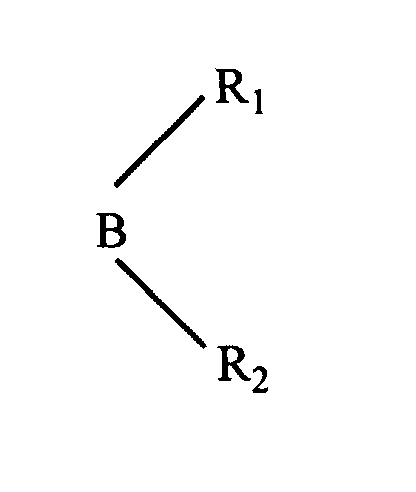
- R1 and R2 taken together represent the residue of a diol.
-
- In another aspect, the invention provides peptides of the formulawherein X, Y and Z are as defined above except that Y may not be -CH(CH3)2.

- Preferably, R2 and R3 taken together represent the residue of pinacol or pinanediol.
- In preferred peptides Y is methoxypropyl.
- A preferred class of peptide consists of compounds in which X is benzyloxycarbonyl.
- Also preferred are those peptides of the invention which are of the formula:
- The present invention also provides thrombin-inhibiting peptides of the invention for use as a pharmaceutical, optionally for use as a pharmaceutical for oral administration.
- A further aspect the present invention provides pharmaceutical compositions for inhibiting thrombin in a mammalian host, comprising a thrombin-inhibiting peptide as defined in the present invention and a pharmaceutically acceptable carrier or diluent. Preferably, the pharmaceutical composition is for oral administration.
- In fifth aspect the present invention provides the use, to prevent the coagulation of blood in blood collecting or distribution containers, of a peptide used in the present invention to prepare a medicament for the treatment or prevention of thrombosis.
- In sixth aspect, the present invention provides the use of the synthesis outlined in scheme 2 or scheme 3 herein to synthesise the peptides of the present invention.
- As outlined above, the compounds of the use of the invention have anti-thrombogenic properties and may be employed for indications when an anti-thrombogenic agent is indicated. Generally, these compounds may be administered orally or parenterally to a host to obtain an anti-thrombogenic effect. In the case of larger mammals such as humans, the compounds may be administered alone or in combination with a pharmaceutical carrier or diluent at a dose of from 0.02 to 15 mg/Kg of body weight and preferably 1-10 mg/Kg to obtain the anti-thrombogenic effect, and may be given as a single dose or in divided doses or as a sustained release formulation. When an extracorporeal blood loop is to be established for a patient, 0.1-1 mg/Kg may be administered intravenously. For use with whole blood from 1-10 mg per litre may be provided to prevent coagulation. Pharmaceutical diliuents are well known and include sugars, starches and water which may be used to make tablets, capsules, injectable solutions and the like. The compounds of the invention may be added to blood for the purpose of preventing coagulation of the blood in blood collecting or distribution containers, tubing or implantable apparatus which comes in contact with blood.
- The advantages of the compounds of the invention include oral activity, rapid onset of activity and low toxicity. In addition, these compounds may have special utility in the treatment of individuals who are hypersensitive to compounds such as heparin.
- In the following examples, the symbols have the following meanings:
- Aa
- = amino acid
- Ac
- = acetyl
- Boc
- = t-butyloxcarbonyl
- Bu
- = butyl
- Bzl
- = benzyl
- Mpg
- = methoxypropylglycyl
- Oct
- = octylglycyl
- EtOAc
- = ethyl acetate
- EtOH
- = ethylalcohol
- HOSu
- = N-hydroxy succinimide
- MeOH
- = methylalcohol
- NMR
- = nuclear magnetic resonance
- PinOH
- = pinanediol
- pip
- = piperidide
- TLC
- = thin layer chromatography
- THF
- = tetrahydrofuran
- Z
- = Cbz=benzyloxycarbonyl
- Apa
- = amidinophenylalanine
- Dpa
- = 3,3-diphenylalanine
- Gpa
- = guanidinophenylalanine
- Irg
- = isothiouronium analogue of Arg
- Mbg
- = 2-(2-methylbutyl) glycine
- Pgl
- = pentylglycine
- boroAa
- = boronic acid analogue of Aa
- Examples 1 to 5 below illustrate with reference to Schemes 1 to 3 processes useful for synthesising inhibitors of the invention. Examples 3, 6 and 7 illustrate compounds of the invention, whilst inhibitory properties of some compounds of the invention are shown in Tables 1, 2 and 3.
- The following conditions were adopted for the analysis of most of the synthetic compounds on reversed-phase HPLC (RP-HPLC): column: SuperPac Pep-S (4x250mm); eluant: A = water containing 0.1% TFA, B = acetonitrile containing 0.1% TFA; gradient: 50% to 90% B in A in 25 min; flow rate: 1.0ml/min; detection: UV absorbance at 210nm.
- Thin layer chromatography (TLC) was carried out on the following comounds using precoated silica plates (Merck, F254) in the following systems: A: Chloroform-ethyl acetate (2:1); B: chloroform-methanol-acetic acid (20:4:1); C: n-butanol-acetic acid-ethyl acetate-water (1:1:1:1); D: chloroform-methanol (9:1); E: pyridine-ethyl acetate-acetic acid-water (5:5:1:3); F: chloroform-methanol-ammonia (1M) (60:35:5). The spots were visualized by ninhydrin and chlorine-dicarboxidine spray reagents (CM Swahn and J Gyllander, J Chromatogr (1979) 170, 292.
- Magnetic resonance spectra were recorded at 250 MHz using a Bruker instrument.
- To a solution of potassium tertiary butoxide (6.75g, 0.06 mol) in tertiary butanol (350ml) was added, at room temperature under argon, ethyl acetamido cyanoacetate (10g, 0.059 mol). When the solution had become clear bromodiphenyl methane (14.55g, 0.059 mol) was added. The mixture was stirred at 20°C for 24h, then evaporated water reduced pressure. The solid residue was treated with ethyl acetate (500ml) and water (175ml). The organic phase was dried (Na2SO4) and concentrated to give yellow crystals. The crystals were washed repeatedly with ether and dried to give ethyl 2-diphenylmethylacetamido cyanoacetate (11.61g, 58%, m.p. 181-185°C). The ester (11.61g, 34.4 mol) was mixed with hydrochloric acid (20%) and refluxed for 30h. The reaction mixture was allowed to cool and the crystals were collected, washed (ether), and dried to give HCl.D,L-Dpa (7.82g, 81.8%).
- To a solution of D,L-Dpa.HCl (0.56g, 0.0021 mol) in NaOH (2N, 5ml), cooled to 0°C and vigorously stirred was added, dropwise, benzyl chloroformate (0.39g, 0.33ml, 0.0023mol). The reaction mixture was kept at pH10 and at 5°C to 10°C. The solution was warmed to room temperature and stirred vigorously for 1h. The solution was washed with ether (4 times) and acidified to pH3 with HCl (5N). The mixture was extracted with dichloromethane and the organic phase dried and concentrated to give Z-DL-Dpa (0.73g, 97%, m.p. 214-217°C).
- To a stirred solution of Z-D,L-Dpa (1.88g, 0.005 mol) and N-hydroxy succinimide (0.575g, 0.005 mol) in dry 1,2-dimethoxyethane (30ml) at 0°C was added dicyclohexyl carbodiiamide (1.03g, 0.005 mol). The mixture was maintained at 0°C for 4h. The suspension was filtered and the filtrate was concentrated to dryness to give an oil which was triturated with ether and filtered to give Z-D,L-Dpa-ONSu (2.15g, 91%, m.p. 139-142°C).
- To a solution of proline (0.78g, 0.0068mol) and NaHCO3 (0.57g, 0.0068mol) in water (8ml) was added a solution of Z-D,L-Dpa-ONSu (2.15g, 0.0045mol) in 1,2-dimethoxyethane (15ml). After 2h the solvent was removed under reduced pressure and water (5ml) was added. The solution was acidified (cone, HCl) to pH2 to give white crystals (1.98g, m.p. 113-117°C). Fractional recrystallisation from EtOAc gave as the first crop one diastereomer as a solid (0.7g, m.p. 180-183°C, FAB MS:M+473; 1H nmr: 7.26 (15H, m, 3xPh), 5.66 (1H, d, CH), 5.23 (1H, m, CH), 4.40 (1H, d, CH), 2.03 (2H, s, CH2) , 2.20 (4H, m, 2xCH2); 13C nmr:172.19 (CO), 156.1 (CO), 139.17 (CO), 127-128 (Ph), 66.88 (CH2), 59.48 (CH), 55.58 (CH), 24.15 (CH2). Further crystallisation from the mother liquor gave as a second crop a mixture of diastereomers (0.43g, m.p. 126-130°C). Addition of petroleum ether. (b.p. 60-80°C) gave the other isomer (0.54g, m.p. 128-131°C), FAB MS:M+473; H nmr: 7.29 (15H, m, 3Ph), 5.55 (1H, d, CH), 5.23 (1H, m, CH), 4.47 (1H, d, CH), 2.04 (2H, s, CH2), 1.20-2.20 (4H, m, 2 CH2); 13C:172.77 (CO), 156.13 (CO), 139.48 (CO), 126.99-128.72 (Ph), 66.90 (CH2), 59.62 (CH), 55.48 (CH), 53.54 (CH), 47.44 (CH2), 27.94 (CH2), 24.58 (CH2).
- The title compound was prepared as described by D.S. Matteson et al (1984) in Organometallics, 3, 1284-1288 and in EP-A-293881.
- To a solution of Z-D-Dpa-Pro-OH (236mg, 0.5mmol) in THF (5ml) in the presence of triethylamine (70µl, 0.5mmol) was added isobutyl chloroformate (65µl, 0.5mmol) at -15°C and the solution was stirred at -13°C for 13 min. After the addition of (+) - pinanediol 4-bromo-R-1-aminobutaneboronate hydrochloride (183mg, 0.5mmol) in CHCl3 (3ml) followed by that of Et3N (70µl, 0.5mmol), the reaction mixture was stirred at the same temperature for 2h, and then below 10°C for 2h. THF was removed under reduced pressure and the residue was dissolved in ethyl acetate (50ml), which was washed with 1% NaHCO3, water, 0.2N HCl and water, and then dried over Na2SO4. Removal of solvent gave an oily product quantitatively. HPLC analysis showed one major peak at the retention time of 22.8 min along with several minor components.
- To a solution of the above compound (2/5th of total amount synthesized, 0.2mmol) in ethanol (1ml) was added thiourea (61mg, 0.8mmol) under an atmosphere of argon at room temperature. After stirring for 4 days, ethyl acetate (70ml) was added to the reaction mixture, which was washed with 1% NaHCO3, water, 0.2N HCl and then water, and dried over Na2SO4. The residue obtained by removing the solvent was treated with n-hexane to get the product as a powder. Reprecipitatation from ethyl acetate with 2:1 mixture of ethyl ether and n-hexane gave a product (98.9mg, 60.6%, two step overall). Retention time on RP-HPLC analysis was 13.5 min under the conditions described at the general procedure. 1H NMR analysis in deuterated chloroform gave a complex pattern because of the existence of a proline residue in the molecule, however, the typical signals corresponding to pinanediol were observed as proper ratios.
- A solution of pinanediol (dichloromethyl)boronate (1ml, 1.2g, 4.6mol) in THF (7ml) was placed in a septum fitted flask (100ml), and 1,1-dimethylpropane magnesium chloride (4.6ml, 4.6mmol) added dropwise from a dry syringe at 0°C.
- The reaction mixture was left stirring under nitrogen at room temperature After 7 hours TLC showed mainly one spot [Rf = 0.82, chloroform:pet.ether (1:1)]. The solvent was removed and the residue dissolved in ether (50ml) washed with water (2x10ml), dried (MgSO4) and filtered.
- The ether was removed and the crude product purified on a column of silica gel, eluted with hexane and 10% of chloroform to give the α-chloroboronic ester as a pale yellow oil (0.55g, 40% yield).
- The above compound (0.55g, 1.8mmol) in THF (5ml) was added via a double ended needle at -78°C to a solution of lithiumbis(trimethyl-silyl) amide (1.8ml, 1.8mmol) in THF (5ml) under nitrogen. The reaction mixture was kept overnight at 20°C then the solvent was removed. The crude product was dissolved in petroleum ether (40-60°C) (25ml) to precipitate out the inorganic salt (LiCl). The reaction mixture was filtered, cooled to -78°C and dry ethereal HCl, 1M (3 equiv, 5.4ml, 5.4mmol) added. The flask was kept in a fridge overnight, Next morning, the reaction mixture was filtered to isolate the hydrochloride (0.41g, 1.29mmol, 72% yield) as a white solid.
- Z-D-Phe-Pro-OH (0.45g, 1.1mmol) was dissolved in THF (7ml) and the equivalent of N-methylmorpholine (0.11g, 1.1mmol) added. The solution was cooled to -20°C and one equivalent of isobutylchloroformate (0.149g, 1.1mol) added dropwise. After 10 min., a solution of the above aminohydrochloride (0.348g, 1.1mmol) dissolved in THF (7ml) van transferred under nitrogen, and triethylamine (0.11g, 1.1mmol) added to the reaction mixture. The reaction mixture was stirred for one hour at -20°C, followed by 2h at room temperature. Insoluble material was removed by filtration, then the solvent removed by evaporation, and the residue dissolved in ethyl acetate (30ml). The organic layer was washed with 0.2N hydrochloric acid (10ml), 5% aqueous sodium bicarbonate, saturated solution of sodium chloride and water. The organic phase was then dried over anhydrous MgSO4, filtered and the solvent evaporated to give a white solid which was purified on a column of silica gel elated with light petroleum to give the desired product (0.59g, 81%). The structure was confirmed by 1H NMR and MS.
- All the reactions involving boron used purified anhydrous reagents.
- Reactions were carried out under argon or nitrogen used directly from the cylinder through a glass line.
- In a 250 ml reaction flask fitted with a reflux condenser was placed 1-bromo-1-propene (3.63g, 30mmol).
- Dibromo borane -methyl sulfide complex in dichloromethane (60ml, 60mmol) was then added to the reaction flask dropwise and the mixture was refluxed under nitrogen for 5h.
- The solvent was removed and the reaction mixture washed with water and dried (MgSO4).
- A dry round-bottomed flask (100ml) was charged with the bromo boronic acid (0.5g, 3mmol) and pinanediol (0.52g, 3mmol) a magnetic follower and dry ether (20ml), fitted with a septum and flashed with nitrogen.
- The reaction mixture was left stirring for two hours until the solid dissolved, the organic phase was washed with water (10ml), separated, dried (MgSO4) and filtered. The crude product was purified on a column of silica gel (230-400 mesh), eluted with chloroform (the product was eluted before the pale red ring). The first fraction (100ml) was collected and the solvent evaporated to give α-bromo boronic ester (0.8g, 86.6%) as a colourless liquid.
- Pentylglycine was obtained by the Strecker* synthesis, using hexanal, in a yield of 31.6% (*Vogel, Textbook of Practical Organic Chemistry).
- To a solution of pentylglycine (0.5g, 3.5mmol) in a mixture of water (4ml) and THF (4ml) to give a 0.5M solution, in the presence of triethylamine (0.64ml, 1.22eq.) was added Z-OSu (0.963g, 3.86mmol.) at room temperature, solution became clear after 15min. TLC after 2h indicated some starting material and so a further portion of triethylamine (0.2ml) and Z-OSu (200mg) was added. TLC after a further 2h indicated no starting material and so the solution was poured onto water (50ml) and was extracted by CHCl3(50ml). The organic phase was washed by HCl (1M, 20ml) and dried (MgSO4) and concentrated to give Z-Pgl (1.18g) as a gummy solid, which was recrystallised (DCM/Petroleum ether bp60-80°C) to a white crystalline solid (0.8g). Structure was confirmed by 1H Nmr.
- The following compound was synthesised according substantially to Example 3:
22 Z-D-Phe-Pro-BoroMbg-OPin 89% Nmr - The following compounds were synthesised according substantially to Example 2a:
11 Z-D-Phe-Pro-BoroPgl-OPinac 41.5% Nmr 43 Z-D-Phe-Pro-BoroOct-OPinac 77% Nmr 


- A volume of 150µl of citrated normal human plasm and 20µl of buffer or sample were warmed at 37°C for 1 min. Coagulation was started by adding 150µl of freshly prepared bovine thrombin (5NIHu/ml saline) and the coagulation time was recorded on a coagulometer.
- A phosphate buffer, pH7.8, containing 0.1% bovine serum albumine and 0.02% sodium azide was used. The samples were dissolved in DMSO and diluted with the buffer. When no inhibitor was used DMSO was added to the buffer to the same concentration as that used in the samples. The inhibitor concentrations were plotted against the thrombin times in a semilogarithmic graph from which the inhibitor concentration that cased a doubling (40 sec) of the thrombin time was determined.
- The inhibition of human α-thrombin was determined by the inhibition of the enzyme catalyzed hydrolysis of three different concentrations of the chromogenic susbtrate S-2238.
- 200µl of sample or buffer and 50µl of S-2238 were incubated at 37°C for 1 min and 50µl of human α-thrombin (0.25 NIHu/ml) was added. The initial rate of inhibited and uninhibited reactions were recorded at 405nm. The increase in optical density was plotted according to the method of Lineweaver and Burke. The Km and apparent Km were determined and Ki was calculated using the relationship:
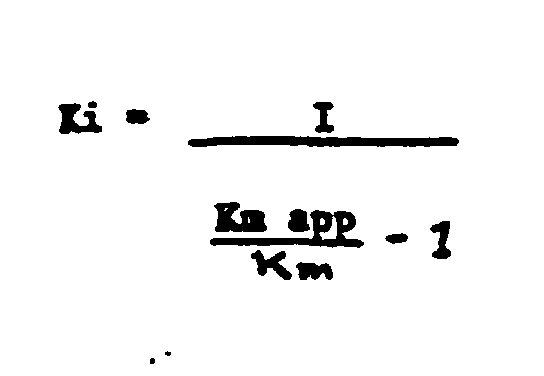
- Cats weighing 2-3kg were anaesthetized with Mebumal, given as an intraperitnoeal injection. The central blood pressure and heart rate were recorded on a Grass Polygraph by means of a catheter inserted in the femoral artery.
- The km of substrates with human α-thrombin were determined by measuring the absorbance at a series of dilutions of substrate. (page 753, Longman Scientific & Technical, 5th edition, 1989.)
- A volume of 150µl of citrated (3.2%) normal human plasma was incubated at 37°C with sample (20µl) or buffer (20µl, control) for 1 min. To the solution was added reconstituted "AUTOMATED APTT" (available from Organon Teknika,0.1ml). Each solution was activated at 37°C for 5 min.
- After activation, calcium chloride (0.1ml, 0.025M, prewarmed at 37°C) was added and clot detection was timed using a "semiautomated coagulometer" (Nach, Schnicter und Gross).
- Deposition of 111 indium-labelled platelets was monitored after 1mg/kg intravenous doses, via a cannula in the marginal ear vein of New Zealand white rabbits, as outlined in G.R.May, C.M.Hero, K.D.BUTLER, C.P.PAGE, JOURNAL OF PHARMACOLOGICAL METHODS, 24,pp1-35, 1990. Peripheral blood pressure was monitored by a pressure sensor in the carotid artery.
- Data was obtained as for in-vitro tests, but using plasma samples obtained at 0,1,10,30 and 60 minutes after dosing of 1mg/kg, i.v. bolus injection in a marginal ear vein in New Zealand white rabbits, which were anaesthetized from a canula in the carotid artery.
PLATELET ACCUMULATION Compound (% of normal) Blood Pressure Δ% of normal Leg Lung 4mg/kg i.v. dose No 22 Z-D-PheProBoroMbgOPin None 11%, transient 0 1mg/kg i.v. dose No 22 Z-D-PheProBoroMbgOPin None None None EX-VIVO DATA T.T A.P.T.T. Compound No 11 1 2 1 2 TIME (Min) 0 30 24.5 26 46.5 26.4 1 >300 >200 >300 UC UC 10 >300 >200 >300 UC UC 30 >102 >200 >300 236.7 49 60 >94 >200 >300 53.0 38.4 Compound No 22 TIME (Min) 0 28.9 22.5 22.4 23.5 42 59.5 43.9 58 1 111 106 171.5 168.5 111.4 111 102.9 126 10 35.9 34 37.9 38.4 48.9 53 60.5 67 30 29 30 32 31 34.9 49 59 53.9 60 28.4 28.5 27.9 28 40.4 48.4 65.5 62 - Inhibition data for some of the new compounds are shown in Table 2.
In-vitroassays Ki(nM) TT (µM) APTT(µM) 22 Z-D-Phe-Pro-BoroMbg-OPin 7.0 0.56 4.11 11 Z-D-Phe-Pro-BoroPgl-OPinac 19.0 2.0 2.34 43 Z-D-Phe-Pro-BoroOct-OPinac 22.5 3.86 22 Z-D-Phe-Pro-BoroMbg-OPin 7.43 1.12 4.0 IC50 No Incubation Plasmin No inc Xa No inc Urokinase No inc Kallikrein No inc 22 Z-D-Phe-Pro-BoroMbg-OPinac 0.007 11.5 3.86 9.13 12.9 50 Z-D-Phe-Pro-BoroMpg-OPin 0.0007 3.23 1.72 3.63 7.26 -
- 1. Claeson, G., and Aurell, L., Annals of New York Academy of Sciences, 370, 79-811 (1981).
- 2. Bajusz, S., Barabas, E., Tolnay, P., et al Int. J. Peptide Protein Res. 12, 217-221 (1978).
- 3. Kettner, C., and Shaw, E., Thrombosis Research 14, 969-973 (1979).
- 4. Szelke, M. and Jones D.M. US patent 4,638,047-A.
- 5. Kettner, C. and Shenvi, A.B. EP-A-293881 (1988).
- 6. Stüber, W., Kosina, H. and Heimburger, N. Int. J. Peptide Protein Res. 31, 63-70 (1988).
- 7. Kaiser, B., Hauptmann, J. and Markwardt, F. Die Pharmacie 42, 119-121 (1987).
-
Claims (18)
- The use for the preparation of a medicament for the treatment or prevention of thrombosis of a peptide of the formulawherein
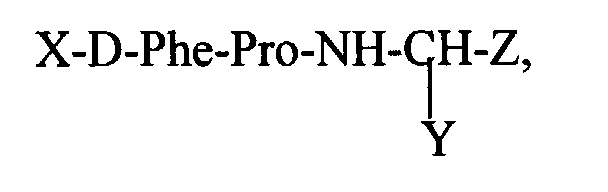 X is H, CH3 or an N-protecting group,Y is C3-C9 alkyl, or C3-C9 alkyl substituted by C1-C4 alkoxy,Z iswherein
 R1 and R2 taken together represent the residue of a diol.
 - The use of claim 1, wherein R1 and R2 taken together represent the residue of pinacol or pinanediol.
- The use of claim 1 or claim 2, wherein Y is methoxypropyl.
- The use of any of claims 1 to 3, wherein X is benzyloxycarbonyl.
- The use for the preparation of a medicament for the treatment or prevention of thrombosis of a peptide which is:
- The use of a thrombin-inhibiting peptide of any of claims 1 to 5 for the preparation of a medicament for oral administration.
- The use of a peptide of any of claims 1 to 5 for the preparation of a medicament for use as an anticoagulant by inhibiting thrombin.
- A method for preparing a medicament for the treatment or prevention of thrombosis, comprising combining a peptide of any of claims 1 to 5 and a pharmaceutical carrier or diluent.
- The use to prevent the coagulation of blood in blood collecting or distribution containers of a peptide of any of claims 1 to 5.
- A peptide of the formulawherein
 X is H, CH3 or an N-protecting group,Y is C3-C9 alkyl other than -CH(CH3)2, or C3-C9 alkyl substituted by C1-C4 alkoxy,Z iswherein
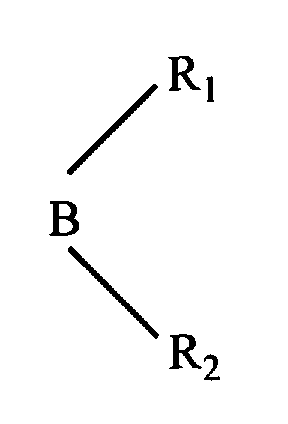 R1 and R2 taken together represent the residue of a diol.
 - A peptide of claim 10, wherein R1 and R2 taken together represent the residue of pinacol or pinanediol.
- A peptide of claim 10 or claim 11, wherein Y is methoxypropyl.
- A peptide of any of claims 10 to 12, wherein X is benzyloxycarbonyl.
- A peptide which is:
- A thrombin-inhibiting peptide of any of claims 10 to 14 for use as a pharmaceutical, optionally for use as a pharmaceutical for oral administration.
- A pharmaceutical composition for inhibiting thrombin in a mammalian host, comprising a thrombin-inhibiting peptide as defined in any one of claims 10 to 14 and a pharmaceutically acceptable carrier or diluent.
- A pharmaceutical composition of claim 16 which is for oral administration.
- The use of the synthesis outlined in scheme 2 or scheme 3 herein to synthesise a peptide of any of claims 10 to 14.
Priority Applications (2)
| Application Number | Priority Date | Filing Date | Title |
|---|---|---|---|
| EP97201436A EP0807638A1 (en) | 1990-11-06 | 1991-11-06 | Inhibitors and substrates of thrombin |
| EP99200841A EP0955309A1 (en) | 1990-11-06 | 1991-11-06 | Inhibitors and substrates of thrombin |
Applications Claiming Priority (3)
| Application Number | Priority Date | Filing Date | Title |
|---|---|---|---|
| GB9024129 | 1990-11-06 | ||
| GB909024129A GB9024129D0 (en) | 1990-11-06 | 1990-11-06 | Inhibitors and substrates of thrombin |
| PCT/GB1991/001946 WO1992007869A1 (en) | 1990-11-06 | 1991-11-06 | Inhibitors and substrates of thrombin |
Related Child Applications (3)
| Application Number | Title | Priority Date | Filing Date |
|---|---|---|---|
| EP97201436A Division EP0807638A1 (en) | 1990-11-06 | 1991-11-06 | Inhibitors and substrates of thrombin |
| EP97201436.9 Division-Into | 1997-05-13 | ||
| EP99200841.7 Division-Into | 1999-03-18 |
Publications (2)
| Publication Number | Publication Date |
|---|---|
| EP0509080A1 EP0509080A1 (en) | 1992-10-21 |
| EP0509080B1 true EP0509080B1 (en) | 2000-08-16 |
Family
ID=10684957
Family Applications (3)
| Application Number | Title | Priority Date | Filing Date |
|---|---|---|---|
| EP91919539A Expired - Lifetime EP0509080B1 (en) | 1990-11-06 | 1991-11-06 | Inhibitors and substrates of thrombin |
| EP97201436A Withdrawn EP0807638A1 (en) | 1990-11-06 | 1991-11-06 | Inhibitors and substrates of thrombin |
| EP99200841A Withdrawn EP0955309A1 (en) | 1990-11-06 | 1991-11-06 | Inhibitors and substrates of thrombin |
Family Applications After (2)
| Application Number | Title | Priority Date | Filing Date |
|---|---|---|---|
| EP97201436A Withdrawn EP0807638A1 (en) | 1990-11-06 | 1991-11-06 | Inhibitors and substrates of thrombin |
| EP99200841A Withdrawn EP0955309A1 (en) | 1990-11-06 | 1991-11-06 | Inhibitors and substrates of thrombin |
Country Status (14)
| Country | Link |
|---|---|
| US (1) | US5858979A (en) |
| EP (3) | EP0509080B1 (en) |
| JP (2) | JP3173786B2 (en) |
| AT (1) | ATE195531T1 (en) |
| AU (1) | AU636521B2 (en) |
| DE (2) | DE69132369D1 (en) |
| DK (1) | DK0509080T3 (en) |
| ES (1) | ES2149158T3 (en) |
| GB (1) | GB9024129D0 (en) |
| GR (1) | GR3034839T3 (en) |
| IE (2) | IE913871A1 (en) |
| NZ (2) | NZ264128A (en) |
| WO (1) | WO1992007869A1 (en) |
| ZA (1) | ZA918805B (en) |
Families Citing this family (59)
| Publication number | Priority date | Publication date | Assignee | Title |
|---|---|---|---|---|
| AU3136693A (en) * | 1991-11-06 | 1993-06-07 | Scripps Research Institute, The | Phosphonamidate ester-containing pseudopeptides |
| SE9103612D0 (en) * | 1991-12-04 | 1991-12-04 | Astra Ab | NEW PEPTIDE DERIVATIVES |
| US6387881B1 (en) * | 1992-09-19 | 2002-05-14 | Trigen Ltd | Inhibitors and substrates of thrombin |
| DE69419141D1 (en) * | 1993-02-12 | 1999-07-22 | Corvas Int Inc | INHIBITORS AGAINST THROMBOSE |
| FR2701951B1 (en) * | 1993-02-24 | 1995-06-09 | Adir | NOVEL PEPTIDE DERIVATIVES OF BORONIC ACID, THEIR PREPARATION PROCESS AND THE PHARMACEUTICAL COMPOSITIONS CONTAINING THEM. |
| WO1994021650A1 (en) * | 1993-03-24 | 1994-09-29 | The Du Pont Merck Pharmaceutical Company | Boronic acid and ester inhibitors of thrombin |
| IL109319A0 (en) * | 1993-04-27 | 1994-07-31 | Du Pont Merck Pharma | Amidino and guanidino substituted boronic acid compounds |
| EP0699074B1 (en) * | 1993-04-30 | 2002-11-13 | Merck & Co. Inc. | Thrombin inhibitors |
| US5780631A (en) * | 1993-06-03 | 1998-07-14 | Astra Aktiebolag | Starting materials in the synthesis of thrombin and kininogenase inhibitors |
| SE9301916D0 (en) * | 1993-06-03 | 1993-06-03 | Ab Astra | NEW PEPTIDES DERIVATIVES |
| US6984627B1 (en) | 1993-06-03 | 2006-01-10 | Astrazeneca Ab | Peptide derivatives |
| GB9318637D0 (en) * | 1993-09-08 | 1993-10-27 | Ferring Res Ltd | Enzyme inhibitors |
| US5462964A (en) * | 1993-10-20 | 1995-10-31 | The Du Pont Merck Pharmaceutical Company | Dipeptide boronic acid inhibitors of trypsin-like enzymes |
| IL111175A0 (en) * | 1993-10-07 | 1994-12-29 | Du Pont Merck Pharma | Electrophilic peptide analogs as inhibitors of trypsin-like serine proteases and pharmaceutical compositions containing them |
| CA2174311A1 (en) * | 1993-10-07 | 1995-04-13 | Gregory James Pacofsky | Boropeptide inhibitors of thrombin which contain a substituted pyrrolidine ring |
| IL111176A0 (en) * | 1993-10-07 | 1994-12-29 | Du Pont Merck Pharma | Dipeptide boronic acid inhibitors of trypsin-like enzymes and pharmaceutical compositions containing them |
| US6060462A (en) * | 1993-10-20 | 2000-05-09 | Dupont Pharmaceuticals Company | Electrophilic peptide analogs as inhibitors of trypsin-like enzymes |
| US5686419A (en) * | 1994-01-21 | 1997-11-11 | Georgia Tech Research Corp. | Basic α-aminoalkylphosphonate derivatives |
| US5693617A (en) * | 1994-03-15 | 1997-12-02 | Proscript, Inc. | Inhibitors of the 26s proteolytic complex and the 20s proteasome contained therein |
| US5561146A (en) * | 1994-06-10 | 1996-10-01 | Bristol-Myers Squibb Company | Modified guanidino and amidino thrombin inhibitors |
| FR2721611B1 (en) * | 1994-06-22 | 1996-09-27 | Adir | New peptide derivatives of boronic acid, their process of preparation and the pharmaceutical compositions which contain them. |
| US5510369A (en) * | 1994-07-22 | 1996-04-23 | Merck & Co., Inc. | Pyrrolidine thrombin inhibitors |
| US6083903A (en) | 1994-10-28 | 2000-07-04 | Leukosite, Inc. | Boronic ester and acid compounds, synthesis and uses |
| SE9404196D0 (en) * | 1994-12-02 | 1994-12-02 | Astra Ab | New antithrombotic formulation |
| GB9502985D0 (en) * | 1995-02-16 | 1995-04-05 | Thrombosis Res Inst | Enzyme inhibitors |
| FI973360L (en) * | 1995-02-17 | 1997-08-15 | Basf Ag | New dipeptide amidines as thrombin inhibitors |
| US5629324A (en) * | 1995-04-10 | 1997-05-13 | Merck & Co., Inc. | Thrombin inhibitors |
| AR005245A1 (en) | 1995-12-21 | 1999-04-28 | Astrazeneca Ab | THROMBIN INHIBITOR PRODROGES, A PHARMACEUTICAL FORMULATION THAT INCLUDES THEM, THE USE OF SUCH PRODROGES FOR THE MANUFACTURE OF A MEDICINAL PRODUCT AND A PROCEDURE FOR ITS PREPARATION |
| EP0821522B1 (en) | 1996-07-23 | 2008-04-09 | Canon Kabushiki Kaisha | Camera control apparatus and method |
| US6004955A (en) * | 1996-08-15 | 1999-12-21 | Dupont Pharmaceuticals Company | Cyclic carbamates and isoxazolidines as IIb/IIIa antagonists |
| US5798377A (en) * | 1996-10-21 | 1998-08-25 | Merck & Co., Inc. | Thrombin inhibitors |
| WO1999037668A1 (en) | 1998-01-26 | 1999-07-29 | Basf Aktiengesellschaft | Thrombin inhibitors |
| WO1999050249A2 (en) | 1998-04-01 | 1999-10-07 | Du Pont Pharmaceuticals Company | Pyrimidines and triazines as integrin antagonists |
| WO2000038683A1 (en) | 1998-12-23 | 2000-07-06 | Du Pont Pharmaceuticals Company | THROMBIN OR FACTOR Xa INHIBITORS |
| AU3192500A (en) * | 1999-03-16 | 2000-10-04 | C & C Research Laboratories | Substituted proline derivatives and medicinal compositions containing the same |
| US6258932B1 (en) * | 1999-08-09 | 2001-07-10 | Tripep Ab | Peptides that block viral infectivity and methods of use thereof |
| CN1377276A (en) * | 1999-08-09 | 2002-10-30 | 特里帕普股份公司 | Medicinal composition containing tripeptide |
| JP2004516286A (en) | 2000-12-18 | 2004-06-03 | メルク エンド カムパニー インコーポレーテッド | Benzylamine derivatives and their use as thrombin inhibitors |
| US6528503B2 (en) | 2000-12-18 | 2003-03-04 | Merck & Co., Inc. | Thrombin inhibitors |
| CA2436176A1 (en) | 2001-02-09 | 2002-08-22 | Merck & Co., Inc. | Thrombin inhibitors |
| US6593455B2 (en) * | 2001-08-24 | 2003-07-15 | Tripep Ab | Tripeptide amides that block viral infectivity and methods of use thereof |
| US6455670B1 (en) * | 2001-09-06 | 2002-09-24 | Tripep Ab | Pentamer peptide amide, ALGPG-NH2, that inhibits viral infectivity and methods of use thereof |
| EP1436317A1 (en) * | 2001-09-19 | 2004-07-14 | Tripep Ab | Molecules that block viral infectivity and methods of use thereof |
| US7084134B2 (en) | 2002-05-02 | 2006-08-01 | Merk & Co., Inc. | Thrombin inhibitors |
| US20050288253A1 (en) | 2002-09-09 | 2005-12-29 | Trigen Limited | Boronic acid salts |
| DE60305113T2 (en) | 2002-09-09 | 2006-12-07 | Trigen Ltd. | Boric acid salts and their use in the provision of drugs for thrombosis treatment |
| PL378163A1 (en) * | 2003-02-21 | 2006-03-06 | Tripep Ab | Glycinamide derivative for inhibiting hiv replication |
| US20050096319A1 (en) * | 2003-02-21 | 2005-05-05 | Balzarini Jan M.R. | Identification of compounds that inhibit replication of human immunodeficiency virus |
| GB0405267D0 (en) * | 2004-03-09 | 2004-04-21 | Trigen Ltd | Compounds |
| EP1724253A3 (en) * | 2005-05-10 | 2009-11-04 | Ajinomoto Co., Inc. | Production method of optically active diphenylalanine compounds |
| WO2008104271A2 (en) * | 2007-02-28 | 2008-09-04 | Sanofi-Aventis | Imaging probes |
| AU2013270682A1 (en) | 2012-06-08 | 2014-12-11 | Biogen Ma Inc. | Procoagulant compounds |
| AU2013270683A1 (en) | 2012-06-08 | 2014-12-11 | Biogen Ma Inc. | Chimeric clotting factors |
| JP7164521B2 (en) | 2016-06-21 | 2022-11-01 | オリオン・オフサルモロジー・エルエルシー | carbocyclic prolinamide derivatives |
| JP7179721B2 (en) | 2016-06-21 | 2022-11-29 | オリオン・オフサルモロジー・エルエルシー | Heterocyclic prolinamide derivative |
| DE102016009766A1 (en) | 2016-08-11 | 2018-02-15 | Julius-Maximilians-Universität Würzburg | Production of bitter substance derivatives |
| WO2023283256A1 (en) | 2021-07-09 | 2023-01-12 | Aligos Therapeutics, Inc. | Anti-viral compounds |
| US12065428B2 (en) | 2021-09-17 | 2024-08-20 | Aligos Therapeutics, Inc. | Anti-viral compounds |
| AU2023303408A1 (en) | 2022-07-06 | 2024-12-19 | Aligos Therapeutics, Inc. | Anti-viral compounds |
Citations (1)
| Publication number | Priority date | Publication date | Assignee | Title |
|---|---|---|---|---|
| EP0145441A2 (en) * | 1983-12-05 | 1985-06-19 | E.I. Du Pont De Nemours And Company | Alpha-aminoboronic acid peptides |
Family Cites Families (7)
| Publication number | Priority date | Publication date | Assignee | Title |
|---|---|---|---|---|
| US4428874A (en) * | 1981-03-25 | 1984-01-31 | Pentapharm A.G. | Tripeptide derivatives |
| JPS5856695A (en) * | 1981-09-28 | 1983-04-04 | Nitto Boseki Co Ltd | Novel substrate for assay of thrombin |
| DE3606480A1 (en) * | 1986-02-28 | 1987-09-03 | Behringwerke Ag | OLIGOPEPTIDYLNITRILE DERIVATIVES, THESE CONTAINERS, METHOD FOR THE PRODUCTION THEREOF AND THEIR USE |
| US5187157A (en) * | 1987-06-05 | 1993-02-16 | Du Pont Merck Pharmaceutical Company | Peptide boronic acid inhibitors of trypsin-like proteases |
| US4929602A (en) * | 1987-11-25 | 1990-05-29 | Scripps Clinic And Research Foundation | Method of inhibiting platelet dependent arterial thrombosis |
| US5023236A (en) * | 1988-04-07 | 1991-06-11 | Corvas, Inc. | Factor VII/VIIA active site inhibitors |
| US5288707A (en) * | 1990-08-13 | 1994-02-22 | Sandoz Ltd. | Borolysine peptidomimetics |
-
1990
- 1990-11-06 GB GB909024129A patent/GB9024129D0/en active Pending
-
1991
- 1991-11-05 NZ NZ264128A patent/NZ264128A/en not_active IP Right Cessation
- 1991-11-05 NZ NZ240477A patent/NZ240477A/en not_active IP Right Cessation
- 1991-11-06 DE DE69132369A patent/DE69132369D1/en not_active Expired - Fee Related
- 1991-11-06 AU AU89007/91A patent/AU636521B2/en not_active Ceased
- 1991-11-06 JP JP51818591A patent/JP3173786B2/en not_active Expired - Fee Related
- 1991-11-06 IE IE387191A patent/IE913871A1/en not_active IP Right Cessation
- 1991-11-06 DE DE69132369T patent/DE69132369T4/en not_active Expired - Lifetime
- 1991-11-06 AT AT91919539T patent/ATE195531T1/en not_active IP Right Cessation
- 1991-11-06 IE IE20000539A patent/IE20000539A1/en not_active IP Right Cessation
- 1991-11-06 EP EP91919539A patent/EP0509080B1/en not_active Expired - Lifetime
- 1991-11-06 EP EP97201436A patent/EP0807638A1/en not_active Withdrawn
- 1991-11-06 DK DK91919539T patent/DK0509080T3/en active
- 1991-11-06 EP EP99200841A patent/EP0955309A1/en not_active Withdrawn
- 1991-11-06 ZA ZA918805A patent/ZA918805B/en unknown
- 1991-11-06 ES ES91919539T patent/ES2149158T3/en not_active Expired - Lifetime
- 1991-11-06 WO PCT/GB1991/001946 patent/WO1992007869A1/en not_active Ceased
-
1995
- 1995-06-02 US US08/459,394 patent/US5858979A/en not_active Expired - Fee Related
-
2000
- 2000-11-13 GR GR20000402527T patent/GR3034839T3/en not_active IP Right Cessation
- 2000-12-27 JP JP2000398079A patent/JP3453357B2/en not_active Expired - Fee Related
Patent Citations (1)
| Publication number | Priority date | Publication date | Assignee | Title |
|---|---|---|---|---|
| EP0145441A2 (en) * | 1983-12-05 | 1985-06-19 | E.I. Du Pont De Nemours And Company | Alpha-aminoboronic acid peptides |
Non-Patent Citations (1)
| Title |
|---|
| J. Biol. Chem.,1990, vol. 265, No. 30, 1990, pp. 18289-18297; C. Kettner et al * |
Also Published As
| Publication number | Publication date |
|---|---|
| GB9024129D0 (en) | 1990-12-19 |
| IE20000539A1 (en) | 2002-03-20 |
| IE913871A1 (en) | 1992-05-22 |
| EP0509080A1 (en) | 1992-10-21 |
| JP2001226397A (en) | 2001-08-21 |
| ZA918805B (en) | 1993-04-28 |
| JP3173786B2 (en) | 2001-06-04 |
| WO1992007869A1 (en) | 1992-05-14 |
| DE69132369T2 (en) | 2001-02-22 |
| ES2149158T3 (en) | 2000-11-01 |
| GR3034839T3 (en) | 2001-02-28 |
| DE69132369T4 (en) | 2001-09-13 |
| JPH05504775A (en) | 1993-07-22 |
| DK0509080T3 (en) | 2000-09-18 |
| AU8900791A (en) | 1992-05-26 |
| US5858979A (en) | 1999-01-12 |
| EP0807638A1 (en) | 1997-11-19 |
| NZ264128A (en) | 1996-11-26 |
| NZ240477A (en) | 1994-10-26 |
| JP3453357B2 (en) | 2003-10-06 |
| EP0955309A1 (en) | 1999-11-10 |
| DE69132369D1 (en) | 2000-09-21 |
| AU636521B2 (en) | 1993-04-29 |
| ATE195531T1 (en) | 2000-09-15 |
Similar Documents
| Publication | Publication Date | Title |
|---|---|---|
| US5858979A (en) | Inhibitors and substrates of thrombin | |
| US5288707A (en) | Borolysine peptidomimetics | |
| RU2075481C1 (en) | Derivatives of boron-containing peptides and pharmaceutical composition exhibiting inhibiting activity to trypsin-like serine proteases | |
| US5371072A (en) | Asp-Pro-Arg α-keto-amide enzyme inhibitors | |
| EP0012845B1 (en) | Tetrahydroisoquinoline compounds, process for preparing same and pharmaceutical compositions containing them | |
| EP0688336B1 (en) | Peptide boronic acid derivatives having protease inhibiting activity | |
| CA2159834A1 (en) | Thrombin inhibitors | |
| NZ250957A (en) | Peptide derivatives containing boron; medicaments | |
| US6114308A (en) | Inhibitors of trypsin-like enzymes | |
| US5686419A (en) | Basic α-aminoalkylphosphonate derivatives | |
| US5952307A (en) | Basic α-aminoalkylphosphonate derivatives | |
| US5648338A (en) | Inhibitors and substrates of thrombin | |
| EP0846682B1 (en) | Penicillaminamide derivatives | |
| US6387881B1 (en) | Inhibitors and substrates of thrombin | |
| HK1025777A (en) | Inhibitors and substrates of thrombin | |
| AU2002331654A1 (en) | Peptide arginals and methods for treating disseminated intravascular coagulation | |
| WO2003016273A2 (en) | Peptide arginals and methods for treating disseminated intravascular coagulation | |
| NO300504B1 (en) | Compound and therapeutic composition comprising this | |
| HU224427B1 (en) | Peptide derivatives of anticoagulant activity, pharmaceutical compositions containing them and their use | |
| HK1010378B (en) | Peptide derivatives of the boronic acid having protease inhibiting activity, process for their production and pharmaceutical compositions comprising them |
Legal Events
| Date | Code | Title | Description |
|---|---|---|---|
| PUAI | Public reference made under article 153(3) epc to a published international application that has entered the european phase |
Free format text: ORIGINAL CODE: 0009012 |
|
| 17P | Request for examination filed |
Effective date: 19920727 |
|
| AK | Designated contracting states |
Kind code of ref document: A1 Designated state(s): AT BE CH DE DK ES FR GB GR IT LI LU NL SE |
|
| RAP1 | Party data changed (applicant data changed or rights of an application transferred) |
Owner name: ELLERMAN PHARMACEUTICALS LIMITED |
|
| 17Q | First examination report despatched |
Effective date: 19940725 |
|
| RAP1 | Party data changed (applicant data changed or rights of an application transferred) |
Owner name: TRIGEN LIMITED |
|
| GRAG | Despatch of communication of intention to grant |
Free format text: ORIGINAL CODE: EPIDOS AGRA |
|
| GRAG | Despatch of communication of intention to grant |
Free format text: ORIGINAL CODE: EPIDOS AGRA |
|
| GRAG | Despatch of communication of intention to grant |
Free format text: ORIGINAL CODE: EPIDOS AGRA |
|
| GRAH | Despatch of communication of intention to grant a patent |
Free format text: ORIGINAL CODE: EPIDOS IGRA |
|
| GRAH | Despatch of communication of intention to grant a patent |
Free format text: ORIGINAL CODE: EPIDOS IGRA |
|
| GRAH | Despatch of communication of intention to grant a patent |
Free format text: ORIGINAL CODE: EPIDOS IGRA |
|
| ITF | It: translation for a ep patent filed | ||
| DX | Miscellaneous (deleted) | ||
| GRAA | (expected) grant |
Free format text: ORIGINAL CODE: 0009210 |
|
| AK | Designated contracting states |
Kind code of ref document: B1 Designated state(s): AT BE CH DE DK ES FR GB GR IT LI LU NL SE |
|
| REF | Corresponds to: |
Ref document number: 195531 Country of ref document: AT Date of ref document: 20000915 Kind code of ref document: T |
|
| REG | Reference to a national code |
Ref country code: CH Ref legal event code: EP Ref country code: CH Ref legal event code: NV Representative=s name: BRAUN & PARTNER PATENT-, MARKEN-, RECHTSANWAELTE |
|
| REG | Reference to a national code |
Ref country code: DK Ref legal event code: T3 |
|
| REF | Corresponds to: |
Ref document number: 69132369 Country of ref document: DE Date of ref document: 20000921 |
|
| ET | Fr: translation filed | ||
| REG | Reference to a national code |
Ref country code: ES Ref legal event code: FG2A Ref document number: 2149158 Country of ref document: ES Kind code of ref document: T3 |
|
| NLR4 | Nl: receipt of corrected translation in the netherlands language at the initiative of the proprietor of the patent | ||
| PLBE | No opposition filed within time limit |
Free format text: ORIGINAL CODE: 0009261 |
|
| STAA | Information on the status of an ep patent application or granted ep patent |
Free format text: STATUS: NO OPPOSITION FILED WITHIN TIME LIMIT |
|
| 26N | No opposition filed | ||
| REG | Reference to a national code |
Ref country code: GB Ref legal event code: IF02 |
|
| REG | Reference to a national code |
Ref country code: GB Ref legal event code: 732E |
|
| REG | Reference to a national code |
Ref country code: CH Ref legal event code: PLI Owner name: TRIGEN LIMITED Free format text: THE THROMBOSIS RESEARCH INSTITUTE#EMMANUEL KAYE BUILDING MANRESA ROAD#LONDON SW3 6LR (GB) -TRANSFER TO- TRIGEN LIMITED#20 ST JAMES'S STREET#LONDON SW1A 1ES (GB) Ref country code: CH Ref legal event code: PUE Owner name: THE THROMBOSIS RESEARCH INSTITUTE Free format text: TRIGEN LIMITED#20 ST JAMES'S STREET#LONDON SW1A 1ES (GB) -TRANSFER TO- THE THROMBOSIS RESEARCH INSTITUTE#EMMANUEL KAYE BUILDING MANRESA ROAD#LONDON SW3 6LR (GB) |
|
| REG | Reference to a national code |
Ref country code: GB Ref legal event code: 732E |
|
| REG | Reference to a national code |
Ref country code: CH Ref legal event code: NV Representative=s name: BRAUN & PARTNER PATENT-, MARKEN-, RECHTSANWAELTE |
|
| REG | Reference to a national code |
Ref country code: FR Ref legal event code: CL Ref country code: FR Ref legal event code: TP |
|
| PGFP | Annual fee paid to national office [announced via postgrant information from national office to epo] |
Ref country code: AT Payment date: 20051110 Year of fee payment: 15 |
|
| PGFP | Annual fee paid to national office [announced via postgrant information from national office to epo] |
Ref country code: BE Payment date: 20051123 Year of fee payment: 15 |
|
| PGFP | Annual fee paid to national office [announced via postgrant information from national office to epo] |
Ref country code: DE Payment date: 20051124 Year of fee payment: 15 |
|
| PGFP | Annual fee paid to national office [announced via postgrant information from national office to epo] |
Ref country code: CH Payment date: 20051130 Year of fee payment: 15 |
|
| PGFP | Annual fee paid to national office [announced via postgrant information from national office to epo] |
Ref country code: ES Payment date: 20061011 Year of fee payment: 16 Ref country code: GR Payment date: 20061011 Year of fee payment: 16 |
|
| PGFP | Annual fee paid to national office [announced via postgrant information from national office to epo] |
Ref country code: GB Payment date: 20061013 Year of fee payment: 16 |
|
| PGFP | Annual fee paid to national office [announced via postgrant information from national office to epo] |
Ref country code: NL Payment date: 20061017 Year of fee payment: 16 |
|
| PGFP | Annual fee paid to national office [announced via postgrant information from national office to epo] |
Ref country code: LU Payment date: 20061024 Year of fee payment: 16 |
|
| PGFP | Annual fee paid to national office [announced via postgrant information from national office to epo] |
Ref country code: FR Payment date: 20061030 Year of fee payment: 16 |
|
| NLS | Nl: assignments of ep-patents |
Owner name: THE THROMBOSIS RESEARCH INSTITUTE Effective date: 20060816 |
|
| NLUE | Nl: licence registered with regard to european patents |
Effective date: 20060816 |
|
| PG25 | Lapsed in a contracting state [announced via postgrant information from national office to epo] |
Ref country code: AT Free format text: LAPSE BECAUSE OF NON-PAYMENT OF DUE FEES Effective date: 20061106 |
|
| PGFP | Annual fee paid to national office [announced via postgrant information from national office to epo] |
Ref country code: SE Payment date: 20061110 Year of fee payment: 16 |
|
| PGFP | Annual fee paid to national office [announced via postgrant information from national office to epo] |
Ref country code: DK Payment date: 20061114 Year of fee payment: 16 |
|
| PG25 | Lapsed in a contracting state [announced via postgrant information from national office to epo] |
Ref country code: CH Free format text: LAPSE BECAUSE OF NON-PAYMENT OF DUE FEES Effective date: 20061130 Ref country code: BE Free format text: LAPSE BECAUSE OF NON-PAYMENT OF DUE FEES Effective date: 20061130 Ref country code: LI Free format text: LAPSE BECAUSE OF NON-PAYMENT OF DUE FEES Effective date: 20061130 |
|
| PGFP | Annual fee paid to national office [announced via postgrant information from national office to epo] |
Ref country code: IT Payment date: 20061130 Year of fee payment: 16 |
|
| REG | Reference to a national code |
Ref country code: ES Ref legal event code: PC2A |
|
| PG25 | Lapsed in a contracting state [announced via postgrant information from national office to epo] |
Ref country code: DE Free format text: LAPSE BECAUSE OF NON-PAYMENT OF DUE FEES Effective date: 20070601 Ref country code: NL Free format text: LAPSE BECAUSE OF NON-PAYMENT OF DUE FEES Effective date: 20070601 |
|
| REG | Reference to a national code |
Ref country code: CH Ref legal event code: PL |
|
| NLV4 | Nl: lapsed or anulled due to non-payment of the annual fee |
Effective date: 20070601 |
|
| BERE | Be: lapsed |
Owner name: *THE THROMBOSIS RESEARCH INSTITUTE Effective date: 20061130 |
|
| REG | Reference to a national code |
Ref country code: FR Ref legal event code: ST Effective date: 20080131 |
|
| REG | Reference to a national code |
Ref country code: DK Ref legal event code: EBP |
|
| EUG | Se: european patent has lapsed | ||
| GBPC | Gb: european patent ceased through non-payment of renewal fee |
Effective date: 20071106 |
|
| PG25 | Lapsed in a contracting state [announced via postgrant information from national office to epo] |
Ref country code: FR Free format text: LAPSE BECAUSE OF NON-PAYMENT OF DUE FEES Effective date: 20061130 |
|
| PG25 | Lapsed in a contracting state [announced via postgrant information from national office to epo] |
Ref country code: DK Free format text: LAPSE BECAUSE OF NON-PAYMENT OF DUE FEES Effective date: 20071130 Ref country code: SE Free format text: LAPSE BECAUSE OF NON-PAYMENT OF DUE FEES Effective date: 20071107 |
|
| PG25 | Lapsed in a contracting state [announced via postgrant information from national office to epo] |
Ref country code: GB Free format text: LAPSE BECAUSE OF NON-PAYMENT OF DUE FEES Effective date: 20071106 |
|
| REG | Reference to a national code |
Ref country code: ES Ref legal event code: FD2A Effective date: 20071107 |
|
| PG25 | Lapsed in a contracting state [announced via postgrant information from national office to epo] |
Ref country code: ES Free format text: LAPSE BECAUSE OF NON-PAYMENT OF DUE FEES Effective date: 20071107 |
|
| PG25 | Lapsed in a contracting state [announced via postgrant information from national office to epo] |
Ref country code: GR Free format text: LAPSE BECAUSE OF NON-PAYMENT OF DUE FEES Effective date: 20080605 |
|
| PG25 | Lapsed in a contracting state [announced via postgrant information from national office to epo] |
Ref country code: IT Free format text: LAPSE BECAUSE OF NON-PAYMENT OF DUE FEES Effective date: 20071106 Ref country code: LU Free format text: LAPSE BECAUSE OF NON-PAYMENT OF DUE FEES Effective date: 20071106 |