EP0507836B1 - Novel fibronectin receptor - Google Patents
Novel fibronectin receptor Download PDFInfo
- Publication number
- EP0507836B1 EP0507836B1 EP91902032A EP91902032A EP0507836B1 EP 0507836 B1 EP0507836 B1 EP 0507836B1 EP 91902032 A EP91902032 A EP 91902032A EP 91902032 A EP91902032 A EP 91902032A EP 0507836 B1 EP0507836 B1 EP 0507836B1
- Authority
- EP
- European Patent Office
- Prior art keywords
- integrin
- fibronectin
- subunit
- receptor
- cells
- Prior art date
- Legal status (The legal status is an assumption and is not a legal conclusion. Google has not performed a legal analysis and makes no representation as to the accuracy of the status listed.)
- Expired - Lifetime
Links
Images

Classifications
-
- C—CHEMISTRY; METALLURGY
- C07—ORGANIC CHEMISTRY
- C07K—PEPTIDES
- C07K14/00—Peptides having more than 20 amino acids; Gastrins; Somatostatins; Melanotropins; Derivatives thereof
- C07K14/435—Peptides having more than 20 amino acids; Gastrins; Somatostatins; Melanotropins; Derivatives thereof from animals; from humans
- C07K14/705—Receptors; Cell surface antigens; Cell surface determinants
- C07K14/70546—Integrin superfamily
- C07K14/7055—Integrin beta1-subunit-containing molecules, e.g. CD29, CD49
-
- A—HUMAN NECESSITIES
- A61—MEDICAL OR VETERINARY SCIENCE; HYGIENE
- A61K—PREPARATIONS FOR MEDICAL, DENTAL OR TOILETRY PURPOSES
- A61K38/00—Medicinal preparations containing peptides
Definitions
- This invention relates to receptors for adhesion peptides, and more specifically to a novel receptor having affinity for fibronectin.
- Multicellular organisms such as man, have some 10 14 cells which can be divided into a minimum of fifty different types, such as blood cells and nerve cells.
- cells adhere to other cells, or to extracellular materials, in specific and orderly ways.
- Such cell adhesion mechanisms appear to be of importance in mediating patterns of cellular growth, migration and differentiation, whereby cells develop specialized characteristics so as to function as, for example, muscle cells or liver cells.
- Cell adhesion mechanisms are also implicated in dedifferentiation and invasion, notably where cells lose their specialized forms and become metastasizing cancer cells.
- the adhesion of cells to extracellular matrices and their migration on the matrices is mediated in many cases by the binding of a cell surface receptor to an Arg-Gly-Asp containing sequence in the matrix protein (as reviewed in Ruoslahti and Pierschbacher, Science 238:491(1987)).
- the Arg-Gly-Asp sequence is a cell attachment site at least in fibronectin, vitronectin, various collagens, laminin and tenascin. Despite the similarity of their cell attachment sites, these proteins can be recognized individually by the specific receptors.
- Integrins are a family of adhesion receptors which bind to Arg-Gly-Asp binding sites of extracellular matrix membrane proteins via the Arg-Gly-Asp binding sites. They are heterodimeric molecules composed of one alpha ( ⁇ ) and one beta ( ⁇ ) subunit. Several subunits of each kind are known, and various ⁇ combinations make up receptors with different ligand specificities.
- the ⁇ 1 subfamily includes receptors for fibronectin, various collagens, laminin and tenascin.
- the ⁇ 2 subfamily consists of leukocyte specific receptors, while the ⁇ 3 subfamily contains multispecific receptors commonly referred to as the platelet glycoprotein IIb-IIIa and the vitronectin receptor.
- the ⁇ v subunit associates with the ⁇ 3 subunit to form a vitronectin receptor and with two recently described ⁇ subunits called ⁇ x and ⁇ s .
- the ⁇ v ⁇ x integrin is a vitronectin and fibronectin receptor while the ligand specificity of ⁇ v ⁇ s is not known.
- the present invention provides a substantially pure integrin-type receptor characterized in that it consists of an ⁇ v and a ⁇ 1 subunit.
- the ⁇ v ⁇ 1 integrin binds to fibronectin and GRGDSPK but does not bind to vitronectin.
- the ⁇ v ⁇ 1 integrin can be used to determine the presence of a ⁇ v ⁇ 1 ligand and to develop adhesion peptides specific for the various integrins.
- the presence of the ⁇ v ⁇ 1 can be used to assess ability of cells to adhere to fibronectin.
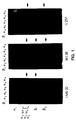
- Figure 1 is a photograph of a gel showing integrin subunits expressed on various cell types.
- Figure 2 shows the results of cell adhesion assays on fibronectin and vitronectin.
- the error bars indicate the standard error of the mean of three independent assays.
- the invention relates to a new receptor composed of an ⁇ v and a ⁇ 1 subunit, or their immunological equivalents.
- This integrin-type receptor is herein termed " ⁇ v ⁇ 1 receptor or " ⁇ v ⁇ 1 integrin".”
- the ⁇ v ⁇ 1 receptor is immunoprecipitated with a monoclonal antibody to the ⁇ v subunit and includes a band in the expected position of the ⁇ 1 subunit, as shown in Figure 1, left panel.
- Amino acids are identified herein by the standard one-letter abbreviations, as follows: Amino Acid Symbol Alanine A Aspartic acid D Cysteine C Glutamine Q Glutamic acid E Glycine G Histidine H Isoleucine I Leucine L Lysine K Methionine M Phenylalanine F Proline P Serine S Threonine T Tryptophan W Tyrosine Y Valine V
- the subunits of the new receptor were immunologically indistinguishable from ⁇ 1 and ⁇ 1 with at least three antibodies to each subunit. Therefore, by the criteria of electrophoretic mobility and immunological reactivity, the new receptor is composed of ⁇ v and ⁇ 1 subunits or their immunological equivalents.
- the new ⁇ v ⁇ 1 does not bind to vitronectin but can be isolated on a GRGDSPK column.
- This ligand binding pattern appears to be different from that of any of the previously characterized integrins.
- the ability of this receptor to bind to a GRGDSPK column is a property shared by two vitronectin-binding integrins, ⁇ v ⁇ 3 (Pytela, et al., Proc. Natl. Acad. Sci. USA 82:5766 (1985)), and the platelet receptor ⁇ IIB ⁇ 3 (Pytela, et al., Science 231:1559 (1986) (and references therein).
- a complex between ⁇ v and the recently described ⁇ s subunit may also belong to this group (Freed, et al., EMBO 8:2955 (1989)).
- Another recently described complex of ⁇ v ( ⁇ v ⁇ x ) binds to both fibronectin and vitronectin (Cheresh et al., Cell 57:59 (1989)).
- Fibronectin-binding integrins of the ⁇ 1 class do not bind to vitronectin and unlike the ⁇ v ⁇ 1 integrin described here, do not bind detectably to the GRGDSPK column. Therefore, the ⁇ v ⁇ 1 complex appears to have a distinct intermediate specificity between the vitronectin binding integrins and the ⁇ 1 class integrins.
- ⁇ subunits Three different ⁇ subunits have been shown to associate with more than one ⁇ subunit. Two of these, ⁇ 4 and ⁇ 6 , can pair with either one of two ⁇ subunits.
- the ⁇ v subunit appears to be especially versatile since it has already been shown to be capable of associating with four ⁇ subunits.
- the association between ⁇ v and ⁇ 1 described here unexpectedly crosses the boundaries of two previously proposed integrin classes, forcing a reevaluation of the currently accepted integrin classification.
- ⁇ subunit determines the specificity of integrins.
- the new ⁇ v ⁇ 1 integrin described here is a fibronectin receptor, whereas ⁇ v ⁇ 3 is a vitronectin receptor. This result, along with the demonstration that ⁇ v ⁇ x binds to fibronectin, shows that the ⁇ subunit plays a greater role in determining receptor specificity than thought previously.
- the ⁇ v ⁇ 1 is useful in assaying the ability of cells to attach to extracellular matrices; the presence of ⁇ v ⁇ 1 on the cell surface indicates the ability to attach to fibronectin.
- the presence of the ⁇ v ⁇ 1 integrin is detected in an immunoassay format using an antibody against each of the subunits as described in Example I or by a modification of that immunoassay format.
- Such assays are well known to those skilled in the art. See generally, ANTIBODIES; A LABORATORY MANUAL (Harlow and Lane, eds.) Cold Spring Harbor Laboratory (1988).
- ⁇ v ⁇ 1 receptor Another area where the ⁇ v ⁇ 1 receptor is useful is the analysis of ligands for integrins.
- the specificity of such ligands is important. For example, synthetic peptides containing the RGD sequence that bind to the platelet integrin gp IIb/IIIa but not to other integrins are being developed into anti-platelet pharmaceuticals.
- the ability of a compound to interact with the ⁇ v ⁇ 1 integrin can be assessed by affinity chromatography as described under Example II.
- a cell attachment assay can be used as described under Example III when the contribution by other integrins possessed by the test cells can be excluded.
- an enzyme immunoassay format or a radioreceptor assay can be used as described in Hautanen et al., J. Biol. Chem. 264:1347-1442 (1989); Gehlsen et al., J. Biol. Chem., 264:19034-19038 (1989).
- Antibodies to the integrin subunits were prepared as indicated in the following table: subunit host monoclonal or polyclonal immunogen reference or confirmation ⁇ v mouse monoclonal Mab 147 purified vitronectin receptor immunoblotting; reactive with ⁇ v subunit ⁇ v mouse Mab 59 purified vitronectin receptor immunoblotting; reactive with ⁇ v subunit ⁇ v rabbit polyclonal KRVRPPQEEQEREQLQPHENGEGNSET Freed et al. EMBO J. 8:2955 (1989) ⁇ 5 rabbit polyclonal EKAQLKPPATSDA immunoblotting; reactive with ⁇ 5 subunit ⁇ 6 mouse monoclonal GoH3 ⁇ 6 Sonneberg et al., J.
- Human neuroblastoma cells (IMR 32; ATCC Accession No. CCL 127), lung cell fibroblasts (WI-38; ATCC Accession No. CCL 75), for example, (WI-38; ATCC Accession No. CCL 757) and glioblastoma cells (U251) were surface labeled with 125 I and lactoperoxidase according to the method of Pytela et al., Cell 40:191-198 (1985), which is incorporated herein by reference, and extracted with a buffer containing a 0.5% Triton-X-100, 150 mM NaCl, 1 ⁇ g/ml leupeptin, 1 mg/ml aprotinin, 0.4 ⁇ g/ml pepstatin and 10 mM Tris, pH 7.2.
- Triton-X-100 150 mM NaCl, 1 ⁇ g/ml leupeptin, 1 mg/ml aprotinin, 0.4 ⁇ g/ml pepstatin
- Integrin heterodimers were immunoprecipitated with antibodies specific for either the ⁇ 1 or ⁇ subunits and analyzed by SDS-PAGE. Briefly, the extracts were clarified at 15,000 rpm and precleared by an incubation with preimmune rabbit or mouse IgG-Sepharose. Following an incubation with the primary antibodies, immunocomplexes were uncovered with either Sepharose-Protein A or Sepharose-goat anti-mouse IgG.
- ⁇ v -containing integrins and ⁇ 1 -containing integrins were immunopurified from the WI-38 extract on anti- ⁇ v (Mab 147) and anti- ⁇ 1 (Mab LM 534) Sepharose columns respectively.
- the column was eluted with 50 mM glycine-HCl pH 3, containing 0.5% Triton-X-100. After neutralization, the material was divided in three aliquots for immunoprecipitation with anti- ⁇ 1 antibodies or anti- ⁇ v antibodies and the immunoprecipitates were analyzed by SDS-PAGE substantially as described above. In each case association between the ⁇ v and the ⁇ 1 subunits was found.
- IMR 32 cells were surface labeled with 125 I and lysed in 200 mM octylglucoside, 150 mM NaCl, 1 mM CaCl 2 , 1 mM MgCl 2 , 1 mM MnCl 2 , 1 ⁇ g/ml leupeptin, 1 ⁇ g/ml aprotinin, 0.4 ⁇ g/ml pepstatin, and 10 mM Tris, pH 7.2.
- the cell extract was applied to a 110 kD fibronectin fragment-Sepharose column and the column was washed with 50 mM octylglucoside, 1 mM CaCl 2 , 1 mM MgCl 2 , 1 mM MnCl 2 , 150 mM NaCl, and 10 mM Tris, pH 7.2, alone and with 1 mg/ml GRGESP peptide.
- the column was subsequently eluted with 1 mg/ml GRGDSP peptide followed by elution with 10 mM EDTA.
- IMR 32 cell extract was also fractionated by identical means on a GRGDSPK column.
- Microtiter plates were coated with various concentrations of fibronectin and vitronectin and postcoated with 0.05% bovine serum albumin. After washing, approximately 10 5 IMR 32 (human neuroblastoma; ATCC CCl 127) or MG-63 (human osteosarcoma; ATCC CCL 1427) cells were plated per well and incubated at 37°C for 90 minutes. The attached cells were fixed in 3% paraformaldehyde and stained with 0.5% crystal violet. The attachment was quantitated by reading the absorbance at 600 nm. As shown in Figure 2, the IMR 32 cells attach to fibronectin, but not to vitronectin or fibrinogen, whereas the MG-63 cells attach to all three substrates.
Landscapes
- Health & Medical Sciences (AREA)
- Life Sciences & Earth Sciences (AREA)
- Chemical & Material Sciences (AREA)
- Organic Chemistry (AREA)
- Zoology (AREA)
- Molecular Biology (AREA)
- Gastroenterology & Hepatology (AREA)
- Immunology (AREA)
- Biochemistry (AREA)
- Biophysics (AREA)
- General Health & Medical Sciences (AREA)
- Genetics & Genomics (AREA)
- Medicinal Chemistry (AREA)
- Toxicology (AREA)
- Proteomics, Peptides & Aminoacids (AREA)
- Cell Biology (AREA)
- Peptides Or Proteins (AREA)
- Plural Heterocyclic Compounds (AREA)
- Pharmaceuticals Containing Other Organic And Inorganic Compounds (AREA)
- Preparation Of Compounds By Using Micro-Organisms (AREA)
- Saccharide Compounds (AREA)
- Medicines That Contain Protein Lipid Enzymes And Other Medicines (AREA)
- Investigating Or Analysing Biological Materials (AREA)
Abstract
Description
| Amino Acid | Symbol |
| Alanine | A |
| Aspartic acid | D |
| Cysteine | C |
| Glutamine | Q |
| Glutamic acid | E |
| Glycine | G |
| Histidine | H |
| Isoleucine | I |
| Leucine | L |
| Lysine | K |
| Methionine | M |
| Phenylalanine | F |
| Proline | P |
| Serine | S |
| Threonine | T |
| Tryptophan | W |
| Tyrosine | Y |
| Valine | V |
| subunit | host | monoclonal or polyclonal | immunogen | reference or confirmation |
| αv | mouse | monoclonal Mab 147 | purified vitronectin receptor | immunoblotting; reactive with αv subunit |
| αv | mouse | Mab 59 | purified vitronectin receptor | immunoblotting; reactive with αv subunit |
| αv | rabbit | polyclonal | KRVRPPQEEQEREQLQPHENGEGNSET | Freed et al. EMBO J. 8:2955 (1989) |
| α5 | rabbit | polyclonal | EKAQLKPPATSDA | immunoblotting; reactive with α5 subunit |
| α6 | mouse | monoclonal GoH3 | α6 | Sonneberg et al., J. Biol. Chem. 263:14030 (1988) |
| α2 | mouse | monoclonal PIH5 | α2 | Wagner and Carter J. Cell Biol. 105:1073 (1987) |
| α3 | rabbit | polyclonal | cytoplasmic domain of α3 subunit | Hynes et al., J. Cell Biol. 109:409 (1989) |
| β1 | rabbit | polyclonal | KKKEKEKMNAKWDTGENPIYSAVTTVVNPKYEGK | immunoblotting; reactive with β1 subunit |
| β1 | mouse | monoclonal LM 534 LM 442 | purified fibronectin receptor | immunoblotting; reactive with β1 subunit |
Claims (6)
- An integrin consisting of subunits αv, and β1, or their immunological equivalents, wherein said integrin binds to GRGDSPK and to fibronectin, but not to vitronectin.
- Immunological equivalents of the integrin of claim 1 binding to GRGDSPK and to fibronectin, but not to vitronectin.
- A method of isolating the αvβ1 integrin of claim 1, comprising the steps of:a) fractionating a cell or tissue extract;b) passing the fractionated extract over a column containing fibronectin or a fibronectin fragment of at least 110 kd comprising a site that binds αvβ1 integrin;c) eluting the material retained on the column; andd) separating the αvβ1 integrin from the eluted material.
- A method for detecting the presence of the α1β1 integrin of claim 1, comprising the steps of:a) contacting a sample suspected of containing said integrin with antibodies that specifically bind to the αv, subunit and with antibodies that specifically bind to the β1 subunit;b) detecting the presence of both antibodies bound to a single integrin;c) the presence of both antibodies bound to a single integrin indicating the presence of the αvβ1 integrin in the sample.
- A method for detecting the presence of a ligand, said ligand characterized by specifically binding to the integrin of claim 1, comprising the steps of:a) contacting a sample suspected of containing said ligand with the integrin of claim 1;b) detecting the presence of any bound integrin;c) the presence of bound integrin indicating the presence of said ligand in the sample.
Applications Claiming Priority (3)
| Application Number | Priority Date | Filing Date | Title |
|---|---|---|---|
| US461349 | 1990-01-05 | ||
| US07/461,349 US5169930A (en) | 1990-01-05 | 1990-01-05 | Fibronectin receptor |
| PCT/US1991/000048 WO1991009874A1 (en) | 1990-01-05 | 1991-01-02 | Novel fibronectin receptor |
Publications (2)
| Publication Number | Publication Date |
|---|---|
| EP0507836A1 EP0507836A1 (en) | 1992-10-14 |
| EP0507836B1 true EP0507836B1 (en) | 1998-06-17 |
Family
ID=23832211
Family Applications (1)
| Application Number | Title | Priority Date | Filing Date |
|---|---|---|---|
| EP91902032A Expired - Lifetime EP0507836B1 (en) | 1990-01-05 | 1991-01-02 | Novel fibronectin receptor |
Country Status (10)
| Country | Link |
|---|---|
| US (2) | US5169930A (en) |
| EP (1) | EP0507836B1 (en) |
| JP (2) | JP2512653B2 (en) |
| KR (1) | KR927003643A (en) |
| AT (1) | ATE167487T1 (en) |
| AU (3) | AU639302B2 (en) |
| CA (1) | CA2072013A1 (en) |
| DE (1) | DE69129621T2 (en) |
| NO (1) | NO302703B1 (en) |
| WO (1) | WO1991009874A1 (en) |
Families Citing this family (36)
| Publication number | Priority date | Publication date | Assignee | Title |
|---|---|---|---|---|
| US5843156A (en) | 1988-08-24 | 1998-12-01 | Endoluminal Therapeutics, Inc. | Local polymeric gel cellular therapy |
| US5169930A (en) * | 1990-01-05 | 1992-12-08 | La Jolla Cancer Research Foundation | Fibronectin receptor |
| US5610148A (en) * | 1991-01-18 | 1997-03-11 | University College London | Macroscopically oriented cell adhesion protein for wound treatment |
| US5629287A (en) * | 1991-01-18 | 1997-05-13 | University College London | Depot formulations |
| DE69322860T2 (en) * | 1992-04-03 | 1999-07-01 | Genentech, Inc., South San Francisco, Calif. | ANTIBODIES AGAINST ALPHA V BETA 3 INTEGRIN |
| US5279941A (en) * | 1992-06-12 | 1994-01-18 | Trustees Of The University Of Pennsylvania | Determination of endometrial receptivity toward embryo implantation |
| MX9306682A (en) * | 1992-10-30 | 1994-04-29 | Bristol Myers Squibb Co | LEAGUES OF THE RECEIVER OF THE EXTRACELLULAR MATRIX, WHICH MODULATE THE FUNCTION OF LEUKOCYTES. |
| EP0896002A4 (en) * | 1997-01-29 | 2005-02-02 | Toray Industries | Chimeric proteins, heterodimer complexes thereof and substitute for platelet |
| US6124260A (en) | 1998-09-30 | 2000-09-26 | Cedars-Sinai Medical Center | Inhibition of smooth muscle cell migration by Tenascin-C peptides |
| US20040018485A1 (en) * | 1999-04-15 | 2004-01-29 | Ilya Ravkin | Multiplexed analysis of cells |
| US20030129654A1 (en) * | 1999-04-15 | 2003-07-10 | Ilya Ravkin | Coded particles for multiplexed analysis of biological samples |
| US20030166015A1 (en) * | 1999-04-15 | 2003-09-04 | Zarowitz Michael A. | Multiplexed analysis of cell-substrate interactions |
| US20030207249A1 (en) * | 1999-04-15 | 2003-11-06 | Beske Oren E. | Connection of cells to substrates using association pairs |
| WO2001058368A1 (en) | 2000-02-10 | 2001-08-16 | Harmonia Medical Technologies Inc. | Transurethral volume reduction of the prostate (tuvor) |
| JP2004537712A (en) * | 2000-10-18 | 2004-12-16 | バーチャル・アレイズ・インコーポレーテッド | Multiple cell analysis system |
| GB0209893D0 (en) * | 2002-04-30 | 2002-06-05 | Molmed Spa | Conjugate |
| GB0209896D0 (en) * | 2002-04-30 | 2002-06-05 | Molmed Spa | Conjugate |
| US7488451B2 (en) * | 2003-09-15 | 2009-02-10 | Millipore Corporation | Systems for particle manipulation |
| US20050208468A1 (en) * | 2003-09-15 | 2005-09-22 | Beske Oren E | Assays with primary cells |
| JP2009511190A (en) * | 2005-10-13 | 2009-03-19 | エンドルミナル セラピューティクス, インコーポレイテッド | Intramural treatment with channels |
| WO2008045252A2 (en) | 2006-10-04 | 2008-04-17 | The Board Of Trustees Of The Leland Stanford Junior University | Engineered integrin binding peptides |
| US8778888B2 (en) * | 2009-11-06 | 2014-07-15 | The Board Of Trustees Of The Leland Stanford Junior University | Cystine knot peptides binding to alpha IIb beta 3 integrins and methods of use |
| US8895291B2 (en) | 2010-10-08 | 2014-11-25 | Terumo Bct, Inc. | Methods and systems of growing and harvesting cells in a hollow fiber bioreactor system with control conditions |
| JP6612227B2 (en) | 2013-11-16 | 2019-11-27 | テルモ ビーシーティー、インコーポレーテッド | Cell growth in bioreactors |
| US11008547B2 (en) | 2014-03-25 | 2021-05-18 | Terumo Bct, Inc. | Passive replacement of media |
| WO2016049421A1 (en) | 2014-09-26 | 2016-03-31 | Terumo Bct, Inc. | Scheduled feed |
| WO2017004592A1 (en) | 2015-07-02 | 2017-01-05 | Terumo Bct, Inc. | Cell growth with mechanical stimuli |
| WO2017205667A1 (en) | 2016-05-25 | 2017-11-30 | Terumo Bct, Inc. | Cell expansion |
| US11685883B2 (en) | 2016-06-07 | 2023-06-27 | Terumo Bct, Inc. | Methods and systems for coating a cell growth surface |
| US11104874B2 (en) | 2016-06-07 | 2021-08-31 | Terumo Bct, Inc. | Coating a bioreactor |
| WO2018184028A2 (en) | 2017-03-31 | 2018-10-04 | Terumo Bct, Inc. | Cell expansion |
| US12234441B2 (en) | 2017-03-31 | 2025-02-25 | Terumo Bct, Inc. | Cell expansion |
| US11624046B2 (en) | 2017-03-31 | 2023-04-11 | Terumo Bct, Inc. | Cell expansion |
| GB2619893A (en) | 2021-03-23 | 2023-12-20 | Terumo Bct Inc | Cell capture and expansion |
| US12209689B2 (en) | 2022-02-28 | 2025-01-28 | Terumo Kabushiki Kaisha | Multiple-tube pinch valve assembly |
| USD1099116S1 (en) | 2022-09-01 | 2025-10-21 | Terumo Bct, Inc. | Display screen or portion thereof with a graphical user interface for displaying cell culture process steps and measurements of an associated bioreactor device |
Family Cites Families (5)
| Publication number | Priority date | Publication date | Assignee | Title |
|---|---|---|---|---|
| US4353982A (en) * | 1980-04-10 | 1982-10-12 | Hoffmann-La Roche Inc. | Immunochemical assay for creatine kinase-MB isoenzyme |
| US5169930A (en) * | 1990-01-05 | 1992-12-08 | La Jolla Cancer Research Foundation | Fibronectin receptor |
| DE69322860T2 (en) * | 1992-04-03 | 1999-07-01 | Genentech, Inc., South San Francisco, Calif. | ANTIBODIES AGAINST ALPHA V BETA 3 INTEGRIN |
| DE4212304A1 (en) * | 1992-04-13 | 1993-10-14 | Cassella Ag | Aspartic acid derivatives, their preparation and use |
| JPH06511156A (en) * | 1992-07-16 | 1994-12-15 | イコス コーポレイション | Relief of symptoms associated with inflammatory disease conditions |
-
1990
- 1990-01-05 US US07/461,349 patent/US5169930A/en not_active Expired - Fee Related
-
1991
- 1991-01-02 AT AT91902032T patent/ATE167487T1/en active
- 1991-01-02 AU AU71759/91A patent/AU639302B2/en not_active Ceased
- 1991-01-02 EP EP91902032A patent/EP0507836B1/en not_active Expired - Lifetime
- 1991-01-02 JP JP3502972A patent/JP2512653B2/en not_active Expired - Lifetime
- 1991-01-02 KR KR1019920701592A patent/KR927003643A/en not_active Ceased
- 1991-01-02 CA CA002072013A patent/CA2072013A1/en not_active Abandoned
- 1991-01-02 WO PCT/US1991/000048 patent/WO1991009874A1/en not_active Ceased
- 1991-01-02 DE DE69129621T patent/DE69129621T2/en not_active Expired - Fee Related
-
1992
- 1992-07-03 NO NO922633A patent/NO302703B1/en not_active IP Right Cessation
-
1993
- 1993-10-21 AU AU49174/93A patent/AU675804B2/en not_active Ceased
-
1994
- 1994-07-22 US US08/279,279 patent/US5591592A/en not_active Expired - Lifetime
-
1995
- 1995-10-11 JP JP7263377A patent/JP2594779B2/en not_active Expired - Lifetime
-
1997
- 1997-05-20 AU AU23529/97A patent/AU2352997A/en not_active Abandoned
Non-Patent Citations (3)
| Title |
|---|
| Dialog Information Services, File 55: Biosis 85-91, Dialog accession no. 7670156, Dedhar S. et al: & J Cell Biol. 110 (6). 1990. 2185-2194 * |
| Nature, Vol. 309, May 1984 Michael D. Pierschbacher et al.: see page 30-33 * |
| Science, Vol. 238, October 1987 Erkki Ruoslahti et al.: "New Perspectives in Cell Adhesion: RGD and Integrins ", see page 491-497 * |
Also Published As
| Publication number | Publication date |
|---|---|
| JPH08211055A (en) | 1996-08-20 |
| DE69129621D1 (en) | 1998-07-23 |
| JPH05505179A (en) | 1993-08-05 |
| AU4917493A (en) | 1994-01-13 |
| NO922633D0 (en) | 1992-07-03 |
| WO1991009874A1 (en) | 1991-07-11 |
| NO922633L (en) | 1992-07-03 |
| AU2352997A (en) | 1997-09-11 |
| US5591592A (en) | 1997-01-07 |
| KR927003643A (en) | 1992-12-18 |
| CA2072013A1 (en) | 1991-07-06 |
| AU7175991A (en) | 1991-07-24 |
| EP0507836A1 (en) | 1992-10-14 |
| NO302703B1 (en) | 1998-04-14 |
| AU675804B2 (en) | 1997-02-20 |
| DE69129621T2 (en) | 1999-02-25 |
| US5169930A (en) | 1992-12-08 |
| ATE167487T1 (en) | 1998-07-15 |
| JP2512653B2 (en) | 1996-07-03 |
| AU639302B2 (en) | 1993-07-22 |
| JP2594779B2 (en) | 1997-03-26 |
Similar Documents
| Publication | Publication Date | Title |
|---|---|---|
| US5169930A (en) | Fibronectin receptor | |
| Ruoslahti et al. | [46] Fibronectin: Purification, immunochemical properties, and biological activities | |
| Hemler et al. | Multiple very late antigen (VLA) heterodimers on platelets. Evidence for distinct VLA-2, VLA-5 (fibronectin receptor), and VLA-6 structures. | |
| Gehlsen et al. | The human laminin receptor is a member of the integrin family of cell adhesion receptors | |
| Buck et al. | Integrin (the CSAT antigen): functionality requires oligomeric integrity. | |
| Brown et al. | Expression and function of a putative cell surface receptor for fibronectin in hamster and human cell lines. | |
| Davis | Affinity of integrins for damaged extracellular matrix: αvβ3 binds to denatured collagen type I through RGD sites | |
| AU680411B2 (en) | Antibodies to alphavbeta3 integrin | |
| Belitsos et al. | Homotypic cell aggregation induced by anti-CD44 (Pgp-1) monoclonal antibodies and related to CD44 (Pgp-1) expression. | |
| US4935343A (en) | Monoclonal antibodies for interleukin-1β | |
| Dedhar et al. | Isolation of a novel integrin receptor mediating Arg-Gly-Asp-directed cell adhesion to fibronectin and type I collagen from human neuroblastoma cells. Association of a novel beta 1-related subunit with alpha v. | |
| Vanderpuye et al. | A vitronectin-receptor-related molecule in human placental brush border membranes | |
| Brown et al. | Monoclonal antibodies to distinctive epitopes on the α and β subunits of the fibronectin receptor | |
| Hogg et al. | Monoclonal antibody with specificity for monocytes and neurons | |
| Hsu et al. | Growth control in cultured 3T3 fibroblasts: neutralization and identification of a growth-inhibitory factor by a monoclonal antibody. | |
| EP0631586B1 (en) | Amino procollagen 1(i) peptides | |
| Macarak et al. | Production and characterization of a monoclonal antibody to human type III collagen. | |
| EP0605410A1 (en) | IMMUNOLOGICAL DIAGNOSIS OF RHUMATOID POLYARTHRITIS. | |
| US5180809A (en) | Adhesion receptor for laminin and its use | |
| Woods et al. | Antigenic polymorphism of human very late activation protein-2 (platelet glycoprotein Ia-IIa). Platelet alloantigen Hca. | |
| Morich et al. | Immunoperoxidase slide assay (IPSA)—a new screening method for hybridoma supernatants directed against cell surface antigens compared to other binding assays | |
| EP0452314B1 (en) | Adhesion receptor for laminin and its use | |
| AU2006213411B2 (en) | Antibody for assay of ADAMTS13 activity and method of activity assay | |
| GB2265713A (en) | Assay for autoantibodies against thyroglobulin or thyroid peroxidase | |
| US5527679A (en) | β5 protein and DNA encoding the same |
Legal Events
| Date | Code | Title | Description |
|---|---|---|---|
| PUAI | Public reference made under article 153(3) epc to a published international application that has entered the european phase |
Free format text: ORIGINAL CODE: 0009012 |
|
| 17P | Request for examination filed |
Effective date: 19920714 |
|
| AK | Designated contracting states |
Kind code of ref document: A1 Designated state(s): AT BE CH DE DK ES FR GB GR IT LI LU NL SE |
|
| 17Q | First examination report despatched |
Effective date: 19930402 |
|
| RAP1 | Party data changed (applicant data changed or rights of an application transferred) |
Owner name: LA JOLLA CANCER RESEARCH FOUNDATION |
|
| GRAG | Despatch of communication of intention to grant |
Free format text: ORIGINAL CODE: EPIDOS AGRA |
|
| GRAH | Despatch of communication of intention to grant a patent |
Free format text: ORIGINAL CODE: EPIDOS IGRA |
|
| GRAH | Despatch of communication of intention to grant a patent |
Free format text: ORIGINAL CODE: EPIDOS IGRA |
|
| GRAA | (expected) grant |
Free format text: ORIGINAL CODE: 0009210 |
|
| AK | Designated contracting states |
Kind code of ref document: B1 Designated state(s): AT BE CH DE DK ES FR GB GR IT LI LU NL SE |
|
| PG25 | Lapsed in a contracting state [announced via postgrant information from national office to epo] |
Ref country code: GR Free format text: LAPSE BECAUSE OF NON-PAYMENT OF DUE FEES Effective date: 19980617 Ref country code: ES Free format text: THE PATENT HAS BEEN ANNULLED BY A DECISION OF A NATIONAL AUTHORITY Effective date: 19980617 Ref country code: AT Free format text: LAPSE BECAUSE OF FAILURE TO SUBMIT A TRANSLATION OF THE DESCRIPTION OR TO PAY THE FEE WITHIN THE PRESCRIBED TIME-LIMIT Effective date: 19980617 |
|
| REF | Corresponds to: |
Ref document number: 167487 Country of ref document: AT Date of ref document: 19980715 Kind code of ref document: T |
|
| REG | Reference to a national code |
Ref country code: CH Ref legal event code: EP |
|
| ITF | It: translation for a ep patent filed | ||
| REF | Corresponds to: |
Ref document number: 69129621 Country of ref document: DE Date of ref document: 19980723 |
|
| ET | Fr: translation filed | ||
| PG25 | Lapsed in a contracting state [announced via postgrant information from national office to epo] |
Ref country code: DK Free format text: LAPSE BECAUSE OF FAILURE TO SUBMIT A TRANSLATION OF THE DESCRIPTION OR TO PAY THE FEE WITHIN THE PRESCRIBED TIME-LIMIT Effective date: 19980917 |
|
| REG | Reference to a national code |
Ref country code: CH Ref legal event code: NV Representative=s name: E. BLUM & CO. PATENTANWAELTE |
|
| PG25 | Lapsed in a contracting state [announced via postgrant information from national office to epo] |
Ref country code: LU Free format text: LAPSE BECAUSE OF NON-PAYMENT OF DUE FEES Effective date: 19990102 |
|
| PG25 | Lapsed in a contracting state [announced via postgrant information from national office to epo] |
Ref country code: SE Free format text: LAPSE BECAUSE OF NON-PAYMENT OF DUE FEES Effective date: 19990103 |
|
| PG25 | Lapsed in a contracting state [announced via postgrant information from national office to epo] |
Ref country code: BE Free format text: LAPSE BECAUSE OF NON-PAYMENT OF DUE FEES Effective date: 19990131 |
|
| PLBE | No opposition filed within time limit |
Free format text: ORIGINAL CODE: 0009261 |
|
| STAA | Information on the status of an ep patent application or granted ep patent |
Free format text: STATUS: NO OPPOSITION FILED WITHIN TIME LIMIT |
|
| 26N | No opposition filed | ||
| BERE | Be: lapsed |
Owner name: LA JOLLA CANCER RESEARCH FOUNDATION Effective date: 19990131 |
|
| PG25 | Lapsed in a contracting state [announced via postgrant information from national office to epo] |
Ref country code: NL Free format text: LAPSE BECAUSE OF NON-PAYMENT OF DUE FEES Effective date: 19990801 |
|
| REG | Reference to a national code |
Ref country code: GB Ref legal event code: IF02 |
|
| PGFP | Annual fee paid to national office [announced via postgrant information from national office to epo] |
Ref country code: GB Payment date: 20020102 Year of fee payment: 12 |
|
| PGFP | Annual fee paid to national office [announced via postgrant information from national office to epo] |
Ref country code: FR Payment date: 20020110 Year of fee payment: 12 |
|
| PGFP | Annual fee paid to national office [announced via postgrant information from national office to epo] |
Ref country code: CH Payment date: 20020115 Year of fee payment: 12 |
|
| PGFP | Annual fee paid to national office [announced via postgrant information from national office to epo] |
Ref country code: DE Payment date: 20020212 Year of fee payment: 12 |
|
| PG25 | Lapsed in a contracting state [announced via postgrant information from national office to epo] |
Ref country code: GB Free format text: LAPSE BECAUSE OF NON-PAYMENT OF DUE FEES Effective date: 20030102 |
|
| PG25 | Lapsed in a contracting state [announced via postgrant information from national office to epo] |
Ref country code: LI Free format text: LAPSE BECAUSE OF NON-PAYMENT OF DUE FEES Effective date: 20030131 Ref country code: CH Free format text: LAPSE BECAUSE OF NON-PAYMENT OF DUE FEES Effective date: 20030131 |
|
| PG25 | Lapsed in a contracting state [announced via postgrant information from national office to epo] |
Ref country code: DE Free format text: LAPSE BECAUSE OF NON-PAYMENT OF DUE FEES Effective date: 20030801 |
|
| GBPC | Gb: european patent ceased through non-payment of renewal fee |
Effective date: 20030102 |
|
| REG | Reference to a national code |
Ref country code: CH Ref legal event code: PL |
|
| PG25 | Lapsed in a contracting state [announced via postgrant information from national office to epo] |
Ref country code: FR Free format text: LAPSE BECAUSE OF NON-PAYMENT OF DUE FEES Effective date: 20030930 |
|
| REG | Reference to a national code |
Ref country code: FR Ref legal event code: ST |
|
| PG25 | Lapsed in a contracting state [announced via postgrant information from national office to epo] |
Ref country code: IT Free format text: LAPSE BECAUSE OF NON-PAYMENT OF DUE FEES Effective date: 20050102 |