EP0507604B1 - Ionically crosslinked carboxyl-containing polysaccharides for adhesion prevention - Google Patents
Ionically crosslinked carboxyl-containing polysaccharides for adhesion prevention Download PDFInfo
- Publication number
- EP0507604B1 EP0507604B1 EP92302953A EP92302953A EP0507604B1 EP 0507604 B1 EP0507604 B1 EP 0507604B1 EP 92302953 A EP92302953 A EP 92302953A EP 92302953 A EP92302953 A EP 92302953A EP 0507604 B1 EP0507604 B1 EP 0507604B1
- Authority
- EP
- European Patent Office
- Prior art keywords
- carboxyl
- composition
- adhesion
- crosslinked
- gel
- Prior art date
- Legal status (The legal status is an assumption and is not a legal conclusion. Google has not performed a legal analysis and makes no representation as to the accuracy of the status listed.)
- Expired - Lifetime
Links
- 229920001282 polysaccharide Polymers 0.000 title claims abstract description 36
- 239000005017 polysaccharide Substances 0.000 title claims abstract description 36
- 125000003178 carboxy group Chemical group [H]OC(*)=O 0.000 title claims abstract description 29
- 150000004676 glycans Chemical class 0.000 title claims abstract 8
- 230000002265 prevention Effects 0.000 title claims description 15
- 208000014674 injury Diseases 0.000 claims abstract description 13
- 230000008733 trauma Effects 0.000 claims abstract description 13
- 229910021578 Iron(III) chloride Inorganic materials 0.000 claims abstract description 9
- 229920002385 Sodium hyaluronate Polymers 0.000 claims abstract description 8
- RBTARNINKXHZNM-UHFFFAOYSA-K iron trichloride Chemical compound Cl[Fe](Cl)Cl RBTARNINKXHZNM-UHFFFAOYSA-K 0.000 claims abstract description 8
- 229940010747 sodium hyaluronate Drugs 0.000 claims abstract description 8
- YWIVKILSMZOHHF-QJZPQSOGSA-N sodium;(2s,3s,4s,5r,6r)-6-[(2s,3r,4r,5s,6r)-3-acetamido-2-[(2s,3s,4r,5r,6r)-6-[(2r,3r,4r,5s,6r)-3-acetamido-2,5-dihydroxy-6-(hydroxymethyl)oxan-4-yl]oxy-2-carboxy-4,5-dihydroxyoxan-3-yl]oxy-5-hydroxy-6-(hydroxymethyl)oxan-4-yl]oxy-3,4,5-trihydroxyoxane-2- Chemical compound [Na+].CC(=O)N[C@H]1[C@H](O)O[C@H](CO)[C@@H](O)[C@@H]1O[C@H]1[C@H](O)[C@@H](O)[C@H](O[C@H]2[C@@H]([C@@H](O[C@H]3[C@@H]([C@@H](O)[C@H](O)[C@H](O3)C(O)=O)O)[C@H](O)[C@@H](CO)O2)NC(C)=O)[C@@H](C(O)=O)O1 YWIVKILSMZOHHF-QJZPQSOGSA-N 0.000 claims abstract description 8
- KIUKXJAPPMFGSW-DNGZLQJQSA-N (2S,3S,4S,5R,6R)-6-[(2S,3R,4R,5S,6R)-3-Acetamido-2-[(2S,3S,4R,5R,6R)-6-[(2R,3R,4R,5S,6R)-3-acetamido-2,5-dihydroxy-6-(hydroxymethyl)oxan-4-yl]oxy-2-carboxy-4,5-dihydroxyoxan-3-yl]oxy-5-hydroxy-6-(hydroxymethyl)oxan-4-yl]oxy-3,4,5-trihydroxyoxane-2-carboxylic acid Chemical compound CC(=O)N[C@H]1[C@H](O)O[C@H](CO)[C@@H](O)[C@@H]1O[C@H]1[C@H](O)[C@@H](O)[C@H](O[C@H]2[C@@H]([C@@H](O[C@H]3[C@@H]([C@@H](O)[C@H](O)[C@H](O3)C(O)=O)O)[C@H](O)[C@@H](CO)O2)NC(C)=O)[C@@H](C(O)=O)O1 KIUKXJAPPMFGSW-DNGZLQJQSA-N 0.000 claims description 50
- 229920002674 hyaluronan Polymers 0.000 claims description 48
- 229960003160 hyaluronic acid Drugs 0.000 claims description 48
- 239000003814 drug Substances 0.000 claims description 7
- 238000002347 injection Methods 0.000 claims description 3
- 239000007924 injection Substances 0.000 claims description 3
- 229940021182 non-steroidal anti-inflammatory drug Drugs 0.000 claims description 3
- UPSPUYADGBWSHF-UHFFFAOYSA-N tolmetin Chemical compound C1=CC(C)=CC=C1C(=O)C1=CC=C(CC(O)=O)N1C UPSPUYADGBWSHF-UHFFFAOYSA-N 0.000 claims description 3
- 229960001017 tolmetin Drugs 0.000 claims description 3
- -1 Fe3+ cation Chemical class 0.000 claims description 2
- 238000012377 drug delivery Methods 0.000 claims description 2
- 239000003102 growth factor Substances 0.000 claims description 2
- 239000000203 mixture Substances 0.000 claims 11
- 229940079593 drug Drugs 0.000 claims 2
- 230000003115 biocidal effect Effects 0.000 claims 1
- 239000000041 non-steroidal anti-inflammatory agent Substances 0.000 claims 1
- 230000015572 biosynthetic process Effects 0.000 abstract description 15
- 238000000034 method Methods 0.000 abstract description 10
- 206010060932 Postoperative adhesion Diseases 0.000 abstract description 8
- 150000003839 salts Chemical class 0.000 abstract description 6
- 150000004804 polysaccharides Chemical class 0.000 description 28
- 210000001519 tissue Anatomy 0.000 description 23
- 238000001356 surgical procedure Methods 0.000 description 18
- 239000000243 solution Substances 0.000 description 14
- 238000006243 chemical reaction Methods 0.000 description 12
- 238000012360 testing method Methods 0.000 description 12
- XEEYBQQBJWHFJM-UHFFFAOYSA-N Iron Chemical compound [Fe] XEEYBQQBJWHFJM-UHFFFAOYSA-N 0.000 description 10
- 241000700159 Rattus Species 0.000 description 6
- 210000004534 cecum Anatomy 0.000 description 6
- 239000006260 foam Substances 0.000 description 6
- 210000004185 liver Anatomy 0.000 description 6
- FAPWRFPIFSIZLT-UHFFFAOYSA-M Sodium chloride Chemical compound [Na+].[Cl-] FAPWRFPIFSIZLT-UHFFFAOYSA-M 0.000 description 5
- 238000013019 agitation Methods 0.000 description 5
- 238000004132 cross linking Methods 0.000 description 5
- 239000003431 cross linking reagent Substances 0.000 description 5
- 229910052742 iron Inorganic materials 0.000 description 5
- 210000002540 macrophage Anatomy 0.000 description 5
- RTZKZFJDLAIYFH-UHFFFAOYSA-N Diethyl ether Chemical compound CCOCC RTZKZFJDLAIYFH-UHFFFAOYSA-N 0.000 description 4
- 206010052428 Wound Diseases 0.000 description 4
- 208000027418 Wounds and injury Diseases 0.000 description 4
- 230000001225 therapeutic effect Effects 0.000 description 4
- XLYOFNOQVPJJNP-UHFFFAOYSA-N water Substances O XLYOFNOQVPJJNP-UHFFFAOYSA-N 0.000 description 4
- 239000004971 Cross linker Substances 0.000 description 3
- 241000283973 Oryctolagus cuniculus Species 0.000 description 3
- 239000007864 aqueous solution Substances 0.000 description 3
- 125000002057 carboxymethyl group Chemical group [H]OC(=O)C([H])([H])[*] 0.000 description 3
- 150000001875 compounds Chemical class 0.000 description 3
- 230000007935 neutral effect Effects 0.000 description 3
- 230000000399 orthopedic effect Effects 0.000 description 3
- 239000000049 pigment Substances 0.000 description 3
- 239000011780 sodium chloride Substances 0.000 description 3
- 229940124597 therapeutic agent Drugs 0.000 description 3
- VHUUQVKOLVNVRT-UHFFFAOYSA-N Ammonium hydroxide Chemical compound [NH4+].[OH-] VHUUQVKOLVNVRT-UHFFFAOYSA-N 0.000 description 2
- NOWKCMXCCJGMRR-UHFFFAOYSA-N Aziridine Chemical compound C1CN1 NOWKCMXCCJGMRR-UHFFFAOYSA-N 0.000 description 2
- CURLTUGMZLYLDI-UHFFFAOYSA-N Carbon dioxide Chemical compound O=C=O CURLTUGMZLYLDI-UHFFFAOYSA-N 0.000 description 2
- 208000035874 Excoriation Diseases 0.000 description 2
- WSFSSNUMVMOOMR-UHFFFAOYSA-N Formaldehyde Chemical compound O=C WSFSSNUMVMOOMR-UHFFFAOYSA-N 0.000 description 2
- HTTJABKRGRZYRN-UHFFFAOYSA-N Heparin Chemical compound OC1C(NC(=O)C)C(O)OC(COS(O)(=O)=O)C1OC1C(OS(O)(=O)=O)C(O)C(OC2C(C(OS(O)(=O)=O)C(OC3C(C(O)C(O)C(O3)C(O)=O)OS(O)(=O)=O)C(CO)O2)NS(O)(=O)=O)C(C(O)=O)O1 HTTJABKRGRZYRN-UHFFFAOYSA-N 0.000 description 2
- 241001465754 Metazoa Species 0.000 description 2
- 208000031737 Tissue Adhesions Diseases 0.000 description 2
- 102000003978 Tissue Plasminogen Activator Human genes 0.000 description 2
- 108090000373 Tissue Plasminogen Activator Proteins 0.000 description 2
- 238000005299 abrasion Methods 0.000 description 2
- 238000010521 absorption reaction Methods 0.000 description 2
- 239000002253 acid Substances 0.000 description 2
- 229910052782 aluminium Inorganic materials 0.000 description 2
- XAGFODPZIPBFFR-UHFFFAOYSA-N aluminium Chemical compound [Al] XAGFODPZIPBFFR-UHFFFAOYSA-N 0.000 description 2
- 125000000129 anionic group Chemical group 0.000 description 2
- 239000003242 anti bacterial agent Substances 0.000 description 2
- 229940088710 antibiotic agent Drugs 0.000 description 2
- 238000001574 biopsy Methods 0.000 description 2
- WERYXYBDKMZEQL-UHFFFAOYSA-N butane-1,4-diol Chemical compound OCCCCO WERYXYBDKMZEQL-UHFFFAOYSA-N 0.000 description 2
- 150000001768 cations Chemical class 0.000 description 2
- 210000002950 fibroblast Anatomy 0.000 description 2
- 239000000834 fixative Substances 0.000 description 2
- 239000011521 glass Substances 0.000 description 2
- 210000005161 hepatic lobe Anatomy 0.000 description 2
- 210000000440 neutrophil Anatomy 0.000 description 2
- 238000002360 preparation method Methods 0.000 description 2
- 229920005989 resin Polymers 0.000 description 2
- 239000011347 resin Substances 0.000 description 2
- 241000894007 species Species 0.000 description 2
- 229960000187 tissue plasminogen activator Drugs 0.000 description 2
- 239000008215 water for injection Substances 0.000 description 2
- SQDAZGGFXASXDW-UHFFFAOYSA-N 5-bromo-2-(trifluoromethoxy)pyridine Chemical compound FC(F)(F)OC1=CC=C(Br)C=N1 SQDAZGGFXASXDW-UHFFFAOYSA-N 0.000 description 1
- 206010000050 Abdominal adhesions Diseases 0.000 description 1
- 206010002091 Anaesthesia Diseases 0.000 description 1
- 229920002134 Carboxymethyl cellulose Polymers 0.000 description 1
- 229920002101 Chitin Polymers 0.000 description 1
- 229920001661 Chitosan Polymers 0.000 description 1
- 229920001287 Chondroitin sulfate Polymers 0.000 description 1
- 208000034656 Contusions Diseases 0.000 description 1
- 229920002307 Dextran Polymers 0.000 description 1
- 102000004190 Enzymes Human genes 0.000 description 1
- 108090000790 Enzymes Proteins 0.000 description 1
- 241000287828 Gallus gallus Species 0.000 description 1
- 229920002683 Glycosaminoglycan Polymers 0.000 description 1
- 229920002971 Heparan sulfate Polymers 0.000 description 1
- 241000282414 Homo sapiens Species 0.000 description 1
- DGAQECJNVWCQMB-PUAWFVPOSA-M Ilexoside XXIX Chemical compound C[C@@H]1CC[C@@]2(CC[C@@]3(C(=CC[C@H]4[C@]3(CC[C@@H]5[C@@]4(CC[C@@H](C5(C)C)OS(=O)(=O)[O-])C)C)[C@@H]2[C@]1(C)O)C)C(=O)O[C@H]6[C@@H]([C@H]([C@@H]([C@H](O6)CO)O)O)O.[Na+] DGAQECJNVWCQMB-PUAWFVPOSA-M 0.000 description 1
- YQEZLKZALYSWHR-UHFFFAOYSA-N Ketamine Chemical compound C=1C=CC=C(Cl)C=1C1(NC)CCCCC1=O YQEZLKZALYSWHR-UHFFFAOYSA-N 0.000 description 1
- 208000034693 Laceration Diseases 0.000 description 1
- 241000124008 Mammalia Species 0.000 description 1
- ZLMJMSJWJFRBEC-UHFFFAOYSA-N Potassium Chemical compound [K] ZLMJMSJWJFRBEC-UHFFFAOYSA-N 0.000 description 1
- 206010072170 Skin wound Diseases 0.000 description 1
- 229920002472 Starch Polymers 0.000 description 1
- 210000001015 abdomen Anatomy 0.000 description 1
- 230000003187 abdominal effect Effects 0.000 description 1
- 210000003489 abdominal muscle Anatomy 0.000 description 1
- 238000012084 abdominal surgery Methods 0.000 description 1
- 210000003815 abdominal wall Anatomy 0.000 description 1
- 230000002378 acidificating effect Effects 0.000 description 1
- 230000003213 activating effect Effects 0.000 description 1
- 239000000783 alginic acid Substances 0.000 description 1
- 229920000615 alginic acid Polymers 0.000 description 1
- 235000010443 alginic acid Nutrition 0.000 description 1
- 229960001126 alginic acid Drugs 0.000 description 1
- 150000004781 alginic acids Chemical class 0.000 description 1
- 229910052783 alkali metal Inorganic materials 0.000 description 1
- 150000001340 alkali metals Chemical class 0.000 description 1
- JGDITNMASUZKPW-UHFFFAOYSA-K aluminium trichloride hexahydrate Chemical compound O.O.O.O.O.O.Cl[Al](Cl)Cl JGDITNMASUZKPW-UHFFFAOYSA-K 0.000 description 1
- 229940009861 aluminum chloride hexahydrate Drugs 0.000 description 1
- 150000001408 amides Chemical class 0.000 description 1
- 238000001949 anaesthesia Methods 0.000 description 1
- 230000037005 anaesthesia Effects 0.000 description 1
- 230000003872 anastomosis Effects 0.000 description 1
- 230000000740 bleeding effect Effects 0.000 description 1
- 239000001569 carbon dioxide Substances 0.000 description 1
- 229910002092 carbon dioxide Inorganic materials 0.000 description 1
- 239000001768 carboxy methyl cellulose Substances 0.000 description 1
- 235000010948 carboxy methyl cellulose Nutrition 0.000 description 1
- 239000008112 carboxymethyl-cellulose Substances 0.000 description 1
- 238000013130 cardiovascular surgery Methods 0.000 description 1
- 210000004027 cell Anatomy 0.000 description 1
- 229960001927 cetylpyridinium chloride Drugs 0.000 description 1
- YMKDRGPMQRFJGP-UHFFFAOYSA-M cetylpyridinium chloride Chemical compound [Cl-].CCCCCCCCCCCCCCCC[N+]1=CC=CC=C1 YMKDRGPMQRFJGP-UHFFFAOYSA-M 0.000 description 1
- 239000003795 chemical substances by application Substances 0.000 description 1
- 229940059329 chondroitin sulfate Drugs 0.000 description 1
- 239000011248 coating agent Substances 0.000 description 1
- 238000000576 coating method Methods 0.000 description 1
- 210000001520 comb Anatomy 0.000 description 1
- 230000000052 comparative effect Effects 0.000 description 1
- 230000009519 contusion Effects 0.000 description 1
- 238000002316 cosmetic surgery Methods 0.000 description 1
- 239000006071 cream Substances 0.000 description 1
- 230000007812 deficiency Effects 0.000 description 1
- 239000000539 dimer Substances 0.000 description 1
- 238000001035 drying Methods 0.000 description 1
- 210000001951 dura mater Anatomy 0.000 description 1
- YQGOJNYOYNNSMM-UHFFFAOYSA-N eosin Chemical compound [Na+].OC(=O)C1=CC=CC=C1C1=C2C=C(Br)C(=O)C(Br)=C2OC2=C(Br)C(O)=C(Br)C=C21 YQGOJNYOYNNSMM-UHFFFAOYSA-N 0.000 description 1
- 150000002118 epoxides Chemical class 0.000 description 1
- 150000002148 esters Chemical class 0.000 description 1
- 230000001747 exhibiting effect Effects 0.000 description 1
- 238000000855 fermentation Methods 0.000 description 1
- 230000004151 fermentation Effects 0.000 description 1
- 239000010408 film Substances 0.000 description 1
- 239000012530 fluid Substances 0.000 description 1
- 239000000499 gel Substances 0.000 description 1
- 230000035876 healing Effects 0.000 description 1
- 229920000669 heparin Polymers 0.000 description 1
- 229960002897 heparin Drugs 0.000 description 1
- 230000002757 inflammatory effect Effects 0.000 description 1
- 229960003299 ketamine Drugs 0.000 description 1
- 230000003902 lesion Effects 0.000 description 1
- 210000003041 ligament Anatomy 0.000 description 1
- 238000011670 long-evans rat Methods 0.000 description 1
- 231100000053 low toxicity Toxicity 0.000 description 1
- WSFSSNUMVMOOMR-NJFSPNSNSA-N methanone Chemical compound O=[14CH2] WSFSSNUMVMOOMR-NJFSPNSNSA-N 0.000 description 1
- 230000000926 neurological effect Effects 0.000 description 1
- 238000011587 new zealand white rabbit Methods 0.000 description 1
- 231100000252 nontoxic Toxicity 0.000 description 1
- 230000003000 nontoxic effect Effects 0.000 description 1
- 206010033675 panniculitis Diseases 0.000 description 1
- 239000001814 pectin Substances 0.000 description 1
- 229920001277 pectin Polymers 0.000 description 1
- 235000010987 pectin Nutrition 0.000 description 1
- 210000004303 peritoneum Anatomy 0.000 description 1
- 239000008363 phosphate buffer Substances 0.000 description 1
- 230000002980 postoperative effect Effects 0.000 description 1
- 229910052700 potassium Inorganic materials 0.000 description 1
- 239000011591 potassium Substances 0.000 description 1
- 238000001556 precipitation Methods 0.000 description 1
- 239000011541 reaction mixture Substances 0.000 description 1
- 238000002278 reconstructive surgery Methods 0.000 description 1
- 230000001850 reproductive effect Effects 0.000 description 1
- 229910052708 sodium Inorganic materials 0.000 description 1
- 239000011734 sodium Substances 0.000 description 1
- 238000010186 staining Methods 0.000 description 1
- 229910001220 stainless steel Inorganic materials 0.000 description 1
- 239000010935 stainless steel Substances 0.000 description 1
- 239000008107 starch Substances 0.000 description 1
- 235000019698 starch Nutrition 0.000 description 1
- 238000007619 statistical method Methods 0.000 description 1
- 210000004304 subcutaneous tissue Anatomy 0.000 description 1
- 230000002195 synergetic effect Effects 0.000 description 1
- 210000002435 tendon Anatomy 0.000 description 1
- 210000000115 thoracic cavity Anatomy 0.000 description 1
- 230000009772 tissue formation Effects 0.000 description 1
- 230000008467 tissue growth Effects 0.000 description 1
- 230000000699 topical effect Effects 0.000 description 1
- 230000001988 toxicity Effects 0.000 description 1
- 231100000419 toxicity Toxicity 0.000 description 1
- 230000003144 traumatizing effect Effects 0.000 description 1
- 239000013638 trimer Substances 0.000 description 1
- 210000004291 uterus Anatomy 0.000 description 1
- 210000001835 viscera Anatomy 0.000 description 1
- 230000029663 wound healing Effects 0.000 description 1
- 239000003357 wound healing promoting agent Substances 0.000 description 1
- BPICBUSOMSTKRF-UHFFFAOYSA-N xylazine Chemical compound CC1=CC=CC(C)=C1NC1=NCCCS1 BPICBUSOMSTKRF-UHFFFAOYSA-N 0.000 description 1
- 229960001600 xylazine Drugs 0.000 description 1
Classifications
-
- A—HUMAN NECESSITIES
- A61—MEDICAL OR VETERINARY SCIENCE; HYGIENE
- A61K—PREPARATIONS FOR MEDICAL, DENTAL OR TOILETRY PURPOSES
- A61K45/00—Medicinal preparations containing active ingredients not provided for in groups A61K31/00 - A61K41/00
- A61K45/06—Mixtures of active ingredients without chemical characterisation, e.g. antiphlogistics and cardiaca
-
- A—HUMAN NECESSITIES
- A61—MEDICAL OR VETERINARY SCIENCE; HYGIENE
- A61K—PREPARATIONS FOR MEDICAL, DENTAL OR TOILETRY PURPOSES
- A61K31/00—Medicinal preparations containing organic active ingredients
- A61K31/33—Heterocyclic compounds
- A61K31/395—Heterocyclic compounds having nitrogen as a ring hetero atom, e.g. guanethidine or rifamycins
- A61K31/40—Heterocyclic compounds having nitrogen as a ring hetero atom, e.g. guanethidine or rifamycins having five-membered rings with one nitrogen as the only ring hetero atom, e.g. sulpiride, succinimide, tolmetin, buflomedil
-
- A—HUMAN NECESSITIES
- A61—MEDICAL OR VETERINARY SCIENCE; HYGIENE
- A61K—PREPARATIONS FOR MEDICAL, DENTAL OR TOILETRY PURPOSES
- A61K31/00—Medicinal preparations containing organic active ingredients
- A61K31/70—Carbohydrates; Sugars; Derivatives thereof
- A61K31/715—Polysaccharides, i.e. having more than five saccharide radicals attached to each other by glycosidic linkages; Derivatives thereof, e.g. ethers, esters
-
- A—HUMAN NECESSITIES
- A61—MEDICAL OR VETERINARY SCIENCE; HYGIENE
- A61K—PREPARATIONS FOR MEDICAL, DENTAL OR TOILETRY PURPOSES
- A61K31/00—Medicinal preparations containing organic active ingredients
- A61K31/70—Carbohydrates; Sugars; Derivatives thereof
- A61K31/715—Polysaccharides, i.e. having more than five saccharide radicals attached to each other by glycosidic linkages; Derivatives thereof, e.g. ethers, esters
- A61K31/716—Glucans
- A61K31/717—Celluloses
-
- A—HUMAN NECESSITIES
- A61—MEDICAL OR VETERINARY SCIENCE; HYGIENE
- A61K—PREPARATIONS FOR MEDICAL, DENTAL OR TOILETRY PURPOSES
- A61K31/00—Medicinal preparations containing organic active ingredients
- A61K31/70—Carbohydrates; Sugars; Derivatives thereof
- A61K31/715—Polysaccharides, i.e. having more than five saccharide radicals attached to each other by glycosidic linkages; Derivatives thereof, e.g. ethers, esters
- A61K31/716—Glucans
- A61K31/722—Chitin, chitosan
-
- A—HUMAN NECESSITIES
- A61—MEDICAL OR VETERINARY SCIENCE; HYGIENE
- A61K—PREPARATIONS FOR MEDICAL, DENTAL OR TOILETRY PURPOSES
- A61K31/00—Medicinal preparations containing organic active ingredients
- A61K31/70—Carbohydrates; Sugars; Derivatives thereof
- A61K31/715—Polysaccharides, i.e. having more than five saccharide radicals attached to each other by glycosidic linkages; Derivatives thereof, e.g. ethers, esters
- A61K31/726—Glycosaminoglycans, i.e. mucopolysaccharides
- A61K31/728—Hyaluronic acid
-
- A—HUMAN NECESSITIES
- A61—MEDICAL OR VETERINARY SCIENCE; HYGIENE
- A61P—SPECIFIC THERAPEUTIC ACTIVITY OF CHEMICAL COMPOUNDS OR MEDICINAL PREPARATIONS
- A61P31/00—Antiinfectives, i.e. antibiotics, antiseptics, chemotherapeutics
- A61P31/02—Local antiseptics
-
- A—HUMAN NECESSITIES
- A61—MEDICAL OR VETERINARY SCIENCE; HYGIENE
- A61P—SPECIFIC THERAPEUTIC ACTIVITY OF CHEMICAL COMPOUNDS OR MEDICINAL PREPARATIONS
- A61P43/00—Drugs for specific purposes, not provided for in groups A61P1/00-A61P41/00
Definitions
- This invention relates to a treatment for preventing post-operative adhesion formation.
- Adhesions are unwanted tissue growth occurring between layers of adjacent bodily tissue or between tissue and internal organs when the healing process begins following a surgical procedure. More specifically, the invention relates to such a method which employs the use of ionically crosslinked carboxyl-containing polysaccharides to control the incidence and extent of adhesion formation at a site of surgical trauma.
- U.S. Patent 4,141,973 discloses the use of a non-inflammatory hyaluronic acid (HA) fraction for numerous therapeutic applications.
- HA hyaluronic acid
- These applications include, among other things, the prevention of fibrous tissue formation, e.g., the prevention of adhesions; the protection of skin wounds; and the most successful application to date, the use of HA as a viscoelastic ophthalmic during ophthalmic surgery.
- HA in the free acid form or as its salt (sodium, potassium, etc.), is highly soluble in moist environments. This high solubility as well as susceptability to naturally occurring enzymes leads to a very short half life of approximately 1 to 3 days in bodily tissue. While this may be acceptable for prevention of adhesions in some indications, for others a longer half life is desirable.
- U.S. Patent 4,772,419 discloses crosslinking HA with a polyfunctional crosslinking agent which creates ether, ester, or amide linkages.
- the covalently crosslinked HA forms a gel, and this gel is disclosed as being efficacious for the prevention of adhesions and accretion of tissues.
- PCT Application WO 89/02445 discloses a water-insoluble derivative of HA prepared by reacting HA with any of a number of different activating agents to prepare a covalently crosslinked HA fraction.
- PCT Application WO 86/00912 discloses crosslinking HA or other carboxyl-containing polysaccharides with a polyfunctional epoxide to prepare a degradable gel for the prevention of adhesions or accretions of bodily tissue.
- CS264719 (Galatik et al), translated by Allen Translation Service, discloses high molecular weight, high viscosity alkali metal hyaluronates cross-linked with Mg 2+ , Al 3+ , Ca 2+ , Cr 3+ , Zn 2+ , or Zr 4+ in dimer, trimer or higher order complexes.
- the complexes can also be cross-linked with Fe 3+ (not preferred) and can be used to prevent post-operative adhesion.
- the invention is a treatment reducing the incidence of post-operative adhesion formation.
- the invention comprises the step of topically applying as an adhesion preventative an effective amount of an ionically crosslinked carboxyl-containing polysaccharide or a pharmacologically acceptable salt thereof to a site of surgical trauma.
- the adhesion preventative in preferred embodiments of this invention has a half life greater than that of the corresponding uncrosslinked polysaccharide, and comparable to that of a corresponding covalently crosslinked polysaccharide.
- the adhesion preventative When the adhesion preventative is topically applied to a site of surgical trauma, it exhibits an increased tendency to reduce the incidence of post-operative adhesion formation relative to that of either an uncrosslinked carboxyl-containing polysaccharide or a covalently crosslinked carboxyl-containing polysaccharide.
- the crosslinking agents used for preparing the adhesion preventative are biocompatible and non-toxic to bodily tissue.
- the treatment of this invention can be used in those applications requiring a reduction in the incidence of post-operative adhesion formation, or for any other application which could directly or indirectly benefit from such a therapeutic use, e.g. ophthalmic and orthopedic applications.
- the ionically crosslinked carboxyl-containing polysaccharide may also be useful as a drug delivery system, e.g. for delivery of wound healing agents, antibiotics, etc.
- carboxyl-containing polysaccharides falling outside the scope of the invention include, carboxymethyl cellulose, carboxymethyl chitin, carboxymethyl chitosan, carboxymethyl starch, alginic acid, pectin, carboxymethyl dextran, and glucosaminoglycans such as heparin, heparin sulfate and chondroitin sulfate.
- the carboxyl-containing polysaccharide of the invention is HA.
- the adhesion preventative can employ the carboxyl-containing polysaccharide in the free acid form, or alternatively, a pharmacologically acceptable salt of the polysaccharide can be used.
- the adhesion preventative employs the pharmacologically acceptable salt of the carboxyl-containing polysaccharide to prevent the formation of adhesions.
- This adhesion preventative is sodium hyaluronate.
- Carboxyl-containing polysaccharides falling outside the scope of the invention which can be used to prepare adhesion preventatives are known compounds that are described, for example, in U.S. Patent Nos. 4,517,295 and U.S. Patent 4,141,973; and Handbook of Water Soluble Gums and Resins , Chapter 4, by Stelzer & Klug, published by McGraw-Hill, 1980. Processes for preparing HA, are illustrated in the Balazs patent, which details a procedure for extracting HA from rooster combs, and in U.S. Patent 4,517,295 which describes a fermentation process for making HA.
- the HA used to make the adhesion preventative should be highly purified (medical grade quality) for surgical applications.
- the crosslinking agents which can be used to ionically crosslink the carboxyl-containing polysaccharide are compounds which possess a polyvalent cation, viz. the trivalent cation ferric chloride, because of its low toxicity and biocompatibility with bodily tissue.
- the crosslinking reaction typically occurs almost instantaneously when an aqueous polycation solution is contacted with an aqueous solution of at least 0.5 weight percent of the carboxyl-containing polysaccharide.
- concentration of polycationic species present in the reaction mixture should be a concentration sufficient to crosslink at least 10 percent of the carboxyl groups of the polysaccharide.
- pH it is usually desirable to adjust pH to about neutral. In some instances, it is necessary to preadjust the polysaccharide solution pH to an acidic pH to prevent precipitation of the HA upon addition of the polycation solution. This often becomes necessary when strong ionic bonds are created, when the crosslinking agent used is ferric chloride.
- the crosslinking reaction utilizes a polysaccharide possessing anionic groups at each of the carboxyl sites. These anionic groups are ionically bound to the polyvalent cations.
- the ionically crosslinked polysaccharide which represents the adhesion preventative used in the method of the invention, is characterized by its tendency to gradually disassociate into its separate ionic species when placed in an ionic medium, e.g. saline.
- the viscosity of the adhesion preventative can be controlled by changing the concentration of polysaccharide in solution or by varying the concentration of polycation to control the crosslink density.
- the adhesion preventative may exist in the form of a gel at relatively high viscosities, or alternately, it may exist as a low viscosity fluid. Regardless of the viscosity which the adhesion preventative exhibits, it may exhibit an increased half life in comparison to an uncrosslinked polysaccharide because of its crosslinked structure.
- topical application refers to the administration of the adhesion preventative nonsystemically to the surface of the bodily tissue to be treated.
- site of surgical trauma is meant to include the site of tissue that has been injured in any way, and includes, for example, tissue sites that have undergone incision, drying, suturing, excision, abrasion, contusion, laceration, anastomosis, manipulation, prosthetic surgery, curettage, orthopedic surgery, neurosurgery, cardiovascular surgery, or plastic or reconstructive surgery.
- Site of surgical trauma also includes tissue that is adjacent to the injured tissue.
- the treatment of this invention can be used to prevent post-operative adhesions in any animal that is susceptible to unwanted adhesion formation following surgery.
- the method is used to prevent adhesions from developing in mammals, preferably human beings.
- the treatment of the invention is useful in any surgical procedure in which it is desired to inhibit the formation of post-surgical adhesions. It is thus broadly useful in all types of surgery in which adhesion formation can be a complication.
- the invention is useful in abdominal surgery, in gynecological surgery, in thoracic surgery, in orthopedic surgery affecting tendons, ligaments, etc., in neurological surgery affecting the dura mater, in liver surgery, and the like.
- the adhesion preventative may be administered to the site of surgical trauma by any convenient mode such as, for example, by lavage, by coating directly on the site in a gel, cream, film, or foam, or by any other convenient mode.
- the adhesion preventative is applied directly to the surgical site by injection through a syringe.
- the administration of the adhesion preventative can occur at any time before significant wound healing has occurred. It is preferred and most convenient to administer the adhesion preventative during surgery or at the conclusion of the surgical procedure just prior to closing of the wound. However, in some cases, it may be desired to administer the adhesion preventative continually over a period of time.
- an "effective amount" of adhesion preventative topically applied to the site of surgical trauma is an amount necessary to affect a reduction in the incidence of post-operative surgical adhesion formation.
- the amount applied will depend on numerous factors, most significantly of which is the surface area of the site of surgical trauma.
- the amount of preventative applied should be enough to coat the entire area exposed to the surgical trauma, and if necessary or desired, an additional amount sufficient to coat bodily tissue adjacent to those areas actually exposed to the surgical trauma.
- the effective amount can be readily determined empirically.
- the adhesion preventative used to prevent adhesion formation as described in this invention may also be used as a delivery vehicle for other adhesion prevention aids.
- the preventative can be used as a delivery vehicle for other well known adhesion preventatives, e.g. tolmetin or other non-steroidal anti-inflammatory drugs (NSAIDS) as described in U.S. Patent 4,937,254, or tissue plasminogen activator (tPA) as described in European Patent No. 297860.
- NSAIDS non-steroidal anti-inflammatory drugs
- tPA tissue plasminogen activator
- the adhesion preventative can be used not only for reducing adhesions but also as a delivery vehicle for other therapeutic agents, such as antibiotics, growth factors and other medicaments.
- Six rats in this study receive no treatment and serve as the control group.
- Six rats are treated with a lyophilized porous foam of HA covalently crosslinked with Crosslinker CX-100 Polyfunctional Aziridine Crosslinker (from ICI Resins, U.S.).
- a 6 cm diameter piece of the covalently crosslinked HA foam is cut up into smaller pieces and then placed over the abraded liver areas. Saline is applied to the foam until saturation to hydrate the foam.
- the rats Seven days after the surgery, the rats are sacrificed by carbon dioxide inhalation, and the sites are examined for the extent of adhesions. The number of sites and area of cecum adhesions are measured and recorded. The extent of liver adhesions at three sites is graded on a 0-to-6 scale, with a maximum total score of 18 representing the most severe adhesion formation. Ranking of the total scores of the three liver sites is used in statistical analysis of the experimental results. The results are summarized in Table 1.
- Example 1 The procedure described in Example 1 for preparing the iron crosslinked HA gel, as well as its testing protocol, are substantially repeated to prepare and evalute an iron crosslinked HA gel with low crosslink density as an adhesion preventative. The following changes are made:
- the iron crosslinked HA gel shows significantly lower adhesions to the cecum and between liver lobes relative to the frequency of adhesions exhibited for an untreated control, a non-crosslinked HA adhesion preventative, or a covalently crosslinked HA adhesion preventative.
- Adhesions are subjectively scored on a scale from 0 (no adhesion) to 4 (severe adhesion) in increments of 0.5 in a blinded randomized manner. Table 3 summarizes the the results. Efficacy of Aluminum Crosslinked HA Gel for Reducing Adhesions Test Group No. of Rabbits Treated Median Score Mean Rank Control 10 3.50 25.0 Aluminum-Crosslinked HA 10 1.00 10.2
- Ferric chloride crosslinked HA gel prepared from Example 2 (referred to as the "test” case) and sodium hyaluronate solution (referred to as the “control” case) are injected into the abdominal subcutaneous tissues of rats and analyzed at 1, 3, 7 and 14 days (4 rats/time period) to determine tissue reaction and absorption characteristics. Each animal has 2 test and 2 control 0.5 cc injection sites. Fixation is either by 10% formalin or a pH 7.4 fixative composed of 3% formaldehyde, 0.5% cetylpyridinium chloride and 30 mM NaCl in a 0.1 M phosphate buffer. The latter fixative forms an insoluble complex with glycosaminoglycans (ref: J. Histochem.
- Hemantoxylin & eosin (H&E) staining is used with selected sites stained with Alcian blue in order to better visualize the HA. Tissue reaction grading is subjective.
- Tissue reactions at test and control sites ranged from trace to slight at 1 and 3 days.
- Neutrophils and macrophages are present at day 1.
- day 3 there are predominantly macrophages with smaller numbers of neutrophils and fibroblasts.
- Frequent macrophages at the day 3 test sites had a fine golden-brown intracytoplasmic pigment.
- HA is present at the majority of sites at 3 days.
- tissue reactions at the control sites are either zero or trace to minimal and composed predominantly of fibroblasts. There is apparent total absorption of HA at all control sites. A minimal amount of HA is still present at 3/7 test sites.
- tissue reactions of both samples are within acceptable limits.
Landscapes
- Health & Medical Sciences (AREA)
- Life Sciences & Earth Sciences (AREA)
- Chemical & Material Sciences (AREA)
- General Health & Medical Sciences (AREA)
- Veterinary Medicine (AREA)
- Medicinal Chemistry (AREA)
- Pharmacology & Pharmacy (AREA)
- Public Health (AREA)
- Animal Behavior & Ethology (AREA)
- Epidemiology (AREA)
- Molecular Biology (AREA)
- Nuclear Medicine, Radiotherapy & Molecular Imaging (AREA)
- Dermatology (AREA)
- Organic Chemistry (AREA)
- Chemical Kinetics & Catalysis (AREA)
- General Chemical & Material Sciences (AREA)
- Communicable Diseases (AREA)
- Oncology (AREA)
- Engineering & Computer Science (AREA)
- Bioinformatics & Cheminformatics (AREA)
- Pharmaceuticals Containing Other Organic And Inorganic Compounds (AREA)
- Materials For Medical Uses (AREA)
- Adhesives Or Adhesive Processes (AREA)
- Agricultural Chemicals And Associated Chemicals (AREA)
Abstract
Description
- This invention relates to a treatment for preventing post-operative adhesion formation. Adhesions are unwanted tissue growth occurring between layers of adjacent bodily tissue or between tissue and internal organs when the healing process begins following a surgical procedure. More specifically, the invention relates to such a method which employs the use of ionically crosslinked carboxyl-containing polysaccharides to control the incidence and extent of adhesion formation at a site of surgical trauma.
- The medical and scientific community has extensively studied the therapeutic uses of carboxyl-containing polysaccharides and their water soluble salts for well over a decade. For example, U.S. Patent 4,141,973 (the Balazs patent) discloses the use of a non-inflammatory hyaluronic acid (HA) fraction for numerous therapeutic applications. These applications include, among other things, the prevention of fibrous tissue formation, e.g., the prevention of adhesions; the protection of skin wounds; and the most successful application to date, the use of HA as a viscoelastic ophthalmic during ophthalmic surgery.
- The prevention or reduction of adhesion formation following surgery requires a therapeutic agent which has an acceptable half life in bodily tissue. HA, in the free acid form or as its salt (sodium, potassium, etc.), is highly soluble in moist environments. This high solubility as well as susceptability to naturally occurring enzymes leads to a very short half life of approximately 1 to 3 days in bodily tissue. While this may be acceptable for prevention of adhesions in some indications, for others a longer half life is desirable.
- Accordingly, attempts have been made to increase the half life of HA and other carboxyl-containing polysaccharides without sacrificing the therapeutic efficiency of such compounds, particularly for adhesion prevention. For example, U.S. Patent 4,772,419 discloses crosslinking HA with a polyfunctional crosslinking agent which creates ether, ester, or amide linkages. The covalently crosslinked HA forms a gel, and this gel is disclosed as being efficacious for the prevention of adhesions and accretion of tissues. PCT Application WO 89/02445 discloses a water-insoluble derivative of HA prepared by reacting HA with any of a number of different activating agents to prepare a covalently crosslinked HA fraction. PCT Application WO 86/00912 discloses crosslinking HA or other carboxyl-containing polysaccharides with a polyfunctional epoxide to prepare a degradable gel for the prevention of adhesions or accretions of bodily tissue.
- Although the attempts to enhance the half life of HA as well as other carboxyl-containing polysaccharides by covalently crosslinking the chosen polysaccharide have met with some success, the biocompatibility and toxicity of the crosslinking agents used for the covalent bonding is unknown. Additionally, the degree of reduction in the incidence of adhesion prevention, although slightly better than HA in its uncrosslinked form, is still inadequate for numerous applications. Therefore, in view of the deficiencies of the prior art, it would be desirable to prepare a derivatized carboxyl-containing polysaccharide which is biocompatible with bodily tissue and exhibits a high degree of adhesion prevention or reduction relative to that of either the native or the covalently crosslinked carboxyl-containing polysaccharides described in the literature.
- CS264719 (Galatik et al), translated by Allen Translation Service, discloses high molecular weight, high viscosity alkali metal hyaluronates cross-linked with Mg2+, Al3+, Ca2+, Cr3+, Zn2+, or Zr4+ in dimer, trimer or higher order complexes. The complexes can also be cross-linked with Fe3+ (not preferred) and can be used to prevent post-operative adhesion.
- The invention is a treatment reducing the incidence of post-operative adhesion formation. The invention comprises the step of topically applying as an adhesion preventative an effective amount of an ionically crosslinked carboxyl-containing polysaccharide or a pharmacologically acceptable salt thereof to a site of surgical trauma.
- The adhesion preventative in preferred embodiments of this invention has a half life greater than that of the corresponding uncrosslinked polysaccharide, and comparable to that of a corresponding covalently crosslinked polysaccharide. When the adhesion preventative is topically applied to a site of surgical trauma, it exhibits an increased tendency to reduce the incidence of post-operative adhesion formation relative to that of either an uncrosslinked carboxyl-containing polysaccharide or a covalently crosslinked carboxyl-containing polysaccharide. Additionally, the crosslinking agents used for preparing the adhesion preventative are biocompatible and non-toxic to bodily tissue.
- The treatment of this invention can be used in those applications requiring a reduction in the incidence of post-operative adhesion formation, or for any other application which could directly or indirectly benefit from such a therapeutic use, e.g. ophthalmic and orthopedic applications. The ionically crosslinked carboxyl-containing polysaccharide may also be useful as a drug delivery system, e.g. for delivery of wound healing agents, antibiotics, etc.
- Examples of carboxyl-containing polysaccharides falling outside the scope of the invention include, carboxymethyl cellulose, carboxymethyl chitin, carboxymethyl chitosan, carboxymethyl starch, alginic acid, pectin, carboxymethyl dextran, and glucosaminoglycans such as heparin, heparin sulfate and chondroitin sulfate. The carboxyl-containing polysaccharide of the invention is HA.
- The adhesion preventative can employ the carboxyl-containing polysaccharide in the free acid form, or alternatively, a pharmacologically acceptable salt of the polysaccharide can be used. Preferably, the adhesion preventative employs the pharmacologically acceptable salt of the carboxyl-containing polysaccharide to prevent the formation of adhesions. This adhesion preventative is sodium hyaluronate.
- Carboxyl-containing polysaccharides falling outside the scope of the invention which can be used to prepare adhesion preventatives are known compounds that are described, for example, in U.S. Patent Nos. 4,517,295 and U.S. Patent 4,141,973; and Handbook of Water Soluble Gums and Resins, Chapter 4, by Stelzer & Klug, published by McGraw-Hill, 1980. Processes for preparing HA, are illustrated in the Balazs patent, which details a procedure for extracting HA from rooster combs, and in U.S. Patent 4,517,295 which describes a fermentation process for making HA. The HA used to make the adhesion preventative should be highly purified (medical grade quality) for surgical applications.
- The crosslinking agents which can be used to ionically crosslink the carboxyl-containing polysaccharide are compounds which possess a polyvalent cation, viz. the trivalent cation ferric chloride, because of its low toxicity and biocompatibility with bodily tissue.
- The crosslinking reaction typically occurs almost instantaneously when an aqueous polycation solution is contacted with an aqueous solution of at least 0.5 weight percent of the carboxyl-containing polysaccharide. The concentration of polycationic species present in the reaction mixture should be a concentration sufficient to crosslink at least 10 percent of the carboxyl groups of the polysaccharide. After the reaction, it is usually desirable to adjust pH to about neutral. In some instances, it is necessary to preadjust the polysaccharide solution pH to an acidic pH to prevent precipitation of the HA upon addition of the polycation solution. This often becomes necessary when strong ionic bonds are created, when the crosslinking agent used is ferric chloride.
- The crosslinking reaction utilizes a polysaccharide possessing anionic groups at each of the carboxyl sites. These anionic groups are ionically bound to the polyvalent cations. The ionically crosslinked polysaccharide, which represents the adhesion preventative used in the method of the invention, is characterized by its tendency to gradually disassociate into its separate ionic species when placed in an ionic medium, e.g. saline.
- The viscosity of the adhesion preventative can be controlled by changing the concentration of polysaccharide in solution or by varying the concentration of polycation to control the crosslink density. The adhesion preventative may exist in the form of a gel at relatively high viscosities, or alternately, it may exist as a low viscosity fluid. Regardless of the viscosity which the adhesion preventative exhibits, it may exhibit an increased half life in comparison to an uncrosslinked polysaccharide because of its crosslinked structure.
- As used herein, topical application refers to the administration of the adhesion preventative nonsystemically to the surface of the bodily tissue to be treated. The term "site of surgical trauma" is meant to include the site of tissue that has been injured in any way, and includes, for example, tissue sites that have undergone incision, drying, suturing, excision, abrasion, contusion, laceration, anastomosis, manipulation, prosthetic surgery, curettage, orthopedic surgery, neurosurgery, cardiovascular surgery, or plastic or reconstructive surgery. "Site of surgical trauma" also includes tissue that is adjacent to the injured tissue.
- The treatment of this invention can be used to prevent post-operative adhesions in any animal that is susceptible to unwanted adhesion formation following surgery. Advantageously, the method is used to prevent adhesions from developing in mammals, preferably human beings.
- The treatment of the invention is useful in any surgical procedure in which it is desired to inhibit the formation of post-surgical adhesions. It is thus broadly useful in all types of surgery in which adhesion formation can be a complication. For instance, the invention is useful in abdominal surgery, in gynecological surgery, in thoracic surgery, in orthopedic surgery affecting tendons, ligaments, etc., in neurological surgery affecting the dura mater, in liver surgery, and the like.
- The adhesion preventative may be administered to the site of surgical trauma by any convenient mode such as, for example, by lavage, by coating directly on the site in a gel, cream, film, or foam, or by any other convenient mode. Preferably, the adhesion preventative is applied directly to the surgical site by injection through a syringe.
- The administration of the adhesion preventative can occur at any time before significant wound healing has occurred. It is preferred and most convenient to administer the adhesion preventative during surgery or at the conclusion of the surgical procedure just prior to closing of the wound. However, in some cases, it may be desired to administer the adhesion preventative continually over a period of time.
- An "effective amount" of adhesion preventative topically applied to the site of surgical trauma is an amount necessary to affect a reduction in the incidence of post-operative surgical adhesion formation. The amount applied will depend on numerous factors, most significantly of which is the surface area of the site of surgical trauma. Preferably, the amount of preventative applied should be enough to coat the entire area exposed to the surgical trauma, and if necessary or desired, an additional amount sufficient to coat bodily tissue adjacent to those areas actually exposed to the surgical trauma. The effective amount can be readily determined empirically.
- The adhesion preventative used to prevent adhesion formation as described in this invention may also be used as a delivery vehicle for other adhesion prevention aids. For example, the preventative can be used as a delivery vehicle for other well known adhesion preventatives, e.g. tolmetin or other non-steroidal anti-inflammatory drugs (NSAIDS) as described in U.S. Patent 4,937,254, or tissue plasminogen activator (tPA) as described in European Patent No. 297860. Such a combination may create a synergistic effect between tolmetin and the adhesion preventative to significantly improve the efficacy of either therapeutic agent used alone. Alternatively, the adhesion preventative can be used not only for reducing adhesions but also as a delivery vehicle for other therapeutic agents, such as antibiotics, growth factors and other medicaments.
- The following examples are intended to illustrate the claimed invention.
- 0.634 grams of sodium hyaluronate with an average molecular weight of about 600,000 is dissolved in 39.36 gm of water for injection in a glass beaker. After a homogeneous aqueous solution is obtained, 1.2 milliliters of a 1 N HCl is added with agitation to adjust solution pH. Then, 5.2 milliliters of a 1.5% ferric chloride solution is added with agitation. Finally, 2.493 ml of a 1.7 N NH4OH solution is added with agitation until a homogeneous gel is obtained with a pH close to neutral. The resulting gel exhibits a viscosity of about 88,600 cps.
- Long Evans rats (each weighs about 250 gm) are used in this study. Anaesthesia is accomplished with Ketamine (60 mg/Kg) and xylazine (10 mg/Kg) given intraperitoneally. To stimulate adhesions, the cecum is exteriorized and abrasions are made by wiping the cecum with gauze until punctate bleeding develops. Three 8 mm lesions are created on each side of the abdominal wall by removing a layer of the peritoneum and transverse abdominal muscle with a stainless steel biopsy punch. All accessible surfaces of the liver are abraded by rubbing them with the wooden end of a sterile swab. Six rats receive the ferric chloride crosslinked HA gel prepared by the process described in subpart (a) above. Three (3) ml of the ferric HA gel is applied to the cecum, biopsy punch sites and liver at closure of the incision.
- Six rats in this study receive no treatment and serve as the control group. Six rats are treated with a lyophilized porous foam of HA covalently crosslinked with Crosslinker CX-100 Polyfunctional Aziridine Crosslinker (from ICI Resins, U.S.). A 6 cm diameter piece of the covalently crosslinked HA foam is cut up into smaller pieces and then placed over the abraded liver areas. Saline is applied to the foam until saturation to hydrate the foam.
- Seven days after the surgery, the rats are sacrificed by carbon dioxide inhalation, and the sites are examined for the extent of adhesions. The number of sites and area of cecum adhesions are measured and recorded. The extent of liver adhesions at three sites is graded on a 0-to-6 scale, with a maximum total score of 18 representing the most severe adhesion formation. Ranking of the total scores of the three liver sites is used in statistical analysis of the experimental results. The results are summarized in Table 1.

- The results indicate that the iron crosslinked HA gel shows significantly lower adhesions to the cecum and between liver lobes relative to the frequency of adhesions exhibited for an untreated control or a covalently crosslinked HA adhesion preventative.
- The procedure described in Example 1 for preparing the iron crosslinked HA gel, as well as its testing protocol, are substantially repeated to prepare and evalute an iron crosslinked HA gel with low crosslink density as an adhesion preventative. The following changes are made:
- (a) Half of the amount of the ferric chloride solution is used to prepare the iron crosslinked HA gel to reduce the crosslink density, e.g. 2.6 ml of a 1.5% ferric chloride solution is added to the HA solution instead of 5.2 ml of solution which results in a gel of lower viscosity, i.e. 60,200 cps.;
- (b) the adhesion preventative is compared with a lyophilized porous foam of HA which is covalently crosslinked with 1,4 butanediol digylcidyl ether instead of Polyfunctional Aziridine Crosslinker; and
- (c) the adhesion preventative is additionally compared with non-crosslinked sodium hyaluronate in saline solution exhibiting a viscosity of about 93,800 cps.
-
- The results of the study are shown in Table 2.
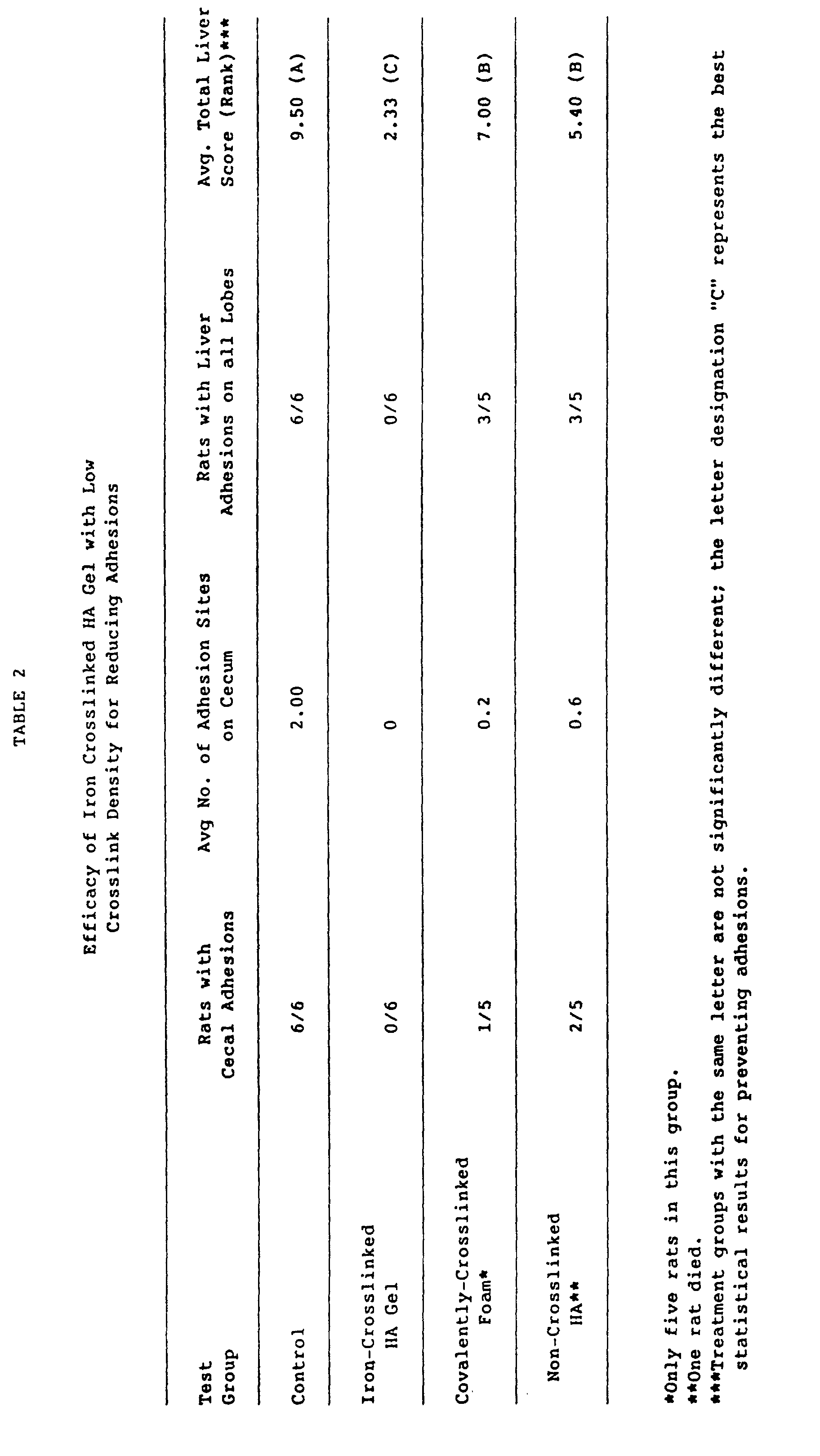
- The results indicate that the iron crosslinked HA gel shows significantly lower adhesions to the cecum and between liver lobes relative to the frequency of adhesions exhibited for an untreated control, a non-crosslinked HA adhesion preventative, or a covalently crosslinked HA adhesion preventative.
- 1.917 grams of sodium hyaluronate is dissolved in 118.1 grams of water for injection in a glass beaker. After a homogeneous aqueous solution is obtained, 7.2 milliliters of a 5% aluminum chloride hexahydrate solution is added with agitation. Then, 2.2 milliliters of a 1.7 N NH4OH solution is added with agitation until a homogeneous gel is obtained with a pH close to neutral.
- Female New Zealand white rabbits of reproductive age (each weighed about 3.0 to 3.5 Kg) underwent uterine horn surgery to induce abdominal adhesion. The procedure involved making a midline incision into the abdomen, traumatizing both uterine horns, applying the crosslinked HA gel, and closing the wound. Twenty (20) rabbits are evenly divided into two groups: the control group, which receives no treatment before closing the wound, and aluminum-crosslinked HA treatment group. For the treated group, 10 millilitiers of crosslinked HA gel (prepared according to subpart (a) above) is squirted directly on the uterus wherever adhesions are expected right before closing the wound. Seven days after surgery, each rabbit is sacrificed and a second procedure is performed to evaluate the extent of adhesions. Adhesions are subjectively scored on a scale from 0 (no adhesion) to 4 (severe adhesion) in increments of 0.5 in a blinded randomized manner. Table 3 summarizes the the results.
Efficacy of Aluminum Crosslinked HA Gel for Reducing Adhesions Test Group No. of Rabbits Treated Median Score Mean Rank Control 10 3.50 25.0 Aluminum-Crosslinked HA 10 1.00 10.2 - The results indicate that the use of an aluminum crosslinked HA gel as an adhesion preventative significantly reduces the incidence of post-operative adhesion formation.
- Ferric chloride crosslinked HA gel prepared from Example 2 (referred to as the "test" case) and sodium hyaluronate solution (referred to as the "control" case) are injected into the abdominal subcutaneous tissues of rats and analyzed at 1, 3, 7 and 14 days (4 rats/time period) to determine tissue reaction and absorption characteristics. Each animal has 2 test and 2 control 0.5 cc injection sites. Fixation is either by 10% formalin or a pH 7.4 fixative composed of 3% formaldehyde, 0.5% cetylpyridinium chloride and 30 mM NaCl in a 0.1 M phosphate buffer. The latter fixative forms an insoluble complex with glycosaminoglycans (ref: J. Histochem. and Cytochem., 33: 1060-1066, 1985). Hemantoxylin & eosin (H&E) staining is used with selected sites stained with Alcian blue in order to better visualize the HA. Tissue reaction grading is subjective.
- Tissue reactions at test and control sites ranged from trace to slight at 1 and 3 days. Neutrophils and macrophages are present at day 1. By day 3 there are predominantly macrophages with smaller numbers of neutrophils and fibroblasts. Frequent macrophages at the day 3 test sites had a fine golden-brown intracytoplasmic pigment. HA is present at the majority of sites at 3 days.
- At the day 7 test sites, coarse pigment-containing macrophages are the predominant cell type comprising a minimal to slight tissue reaction. The tissue reactions at the control sites are either zero or trace to minimal and composed predominantly of fibroblasts. There is apparent total absorption of HA at all control sites. A minimal amount of HA is still present at 3/7 test sites.
- By 14 days the reactions at test sites are considered to be minimal with a decrease in the overall numbers of pigment-containing macrophages. The majority of control sites are difficult to localize due to a lack of residual tissue reaction. HA has been totally absorbed at all test and control sites by 14 days.
- The tissue reactions of both samples are within acceptable limits.
Claims (10)
- A composition comprising an ionically crosslinked carboxyl-containing polysaccharide aqueous gel, wherein the carboxyl-containing polysaccharide is medical grade, highly purified hyaluronic acid or sodium hyaluronate having carboxyl groups which are ionically crosslinked with a Fe3+ cation in an amount which is sufficient to crosslink at least 10 % of the carboxyl groups of the polysaccharide.
- The composition of claim 1, wherein the carboxyl-containing polysaccharide is sodium hyaluronate.
- The gel composition of claim 1 or claim 2, wherein the carboxyl-containing polysaccharide is crosslinked with ferric chloride.
- The composition of any one of claims 1 to 3, further comprising a drug.
- The composition of claim 4, wherein the drug is an adhesion prevention aid, antibiotic or growth factor.
- The composition of claim 5, wherein the adhesion prevention aid. is a non-steroidal anti-inflammatory drug, preferably tolmetin.
- A topically applicable composition for application to a site of surgical trauma for the prevention of adhesion comprising a composition according to any one of claims 1 to 6.
- The composition of claim 7, which is topically applicable directly to the site of surgical trauma in one application by injection through a syringe.
- A drug delivery system comprising a composition according to any one of claims 4 to 8.
- Use of an ionically crosslinked carboxyl-containing polysaccharide composition as defined in any one of claims 1 to 8 in the production of a topically applicable medicament for use in adhesion prevention.
Priority Applications (1)
| Application Number | Priority Date | Filing Date | Title |
|---|---|---|---|
| EP05076407A EP1593394A3 (en) | 1991-04-05 | 1992-04-03 | Ionically crosslinked carboxyl-containing polysaccharides for adhesion prevention |
Applications Claiming Priority (2)
| Application Number | Priority Date | Filing Date | Title |
|---|---|---|---|
| US68095591A | 1991-04-05 | 1991-04-05 | |
| US680955 | 1991-04-05 |
Related Child Applications (1)
| Application Number | Title | Priority Date | Filing Date |
|---|---|---|---|
| EP05076407A Division EP1593394A3 (en) | 1991-04-05 | 1992-04-03 | Ionically crosslinked carboxyl-containing polysaccharides for adhesion prevention |
Publications (3)
| Publication Number | Publication Date |
|---|---|
| EP0507604A2 EP0507604A2 (en) | 1992-10-07 |
| EP0507604A3 EP0507604A3 (en) | 1993-10-06 |
| EP0507604B1 true EP0507604B1 (en) | 2005-07-20 |
Family
ID=24733195
Family Applications (2)
| Application Number | Title | Priority Date | Filing Date |
|---|---|---|---|
| EP92302953A Expired - Lifetime EP0507604B1 (en) | 1991-04-05 | 1992-04-03 | Ionically crosslinked carboxyl-containing polysaccharides for adhesion prevention |
| EP05076407A Withdrawn EP1593394A3 (en) | 1991-04-05 | 1992-04-03 | Ionically crosslinked carboxyl-containing polysaccharides for adhesion prevention |
Family Applications After (1)
| Application Number | Title | Priority Date | Filing Date |
|---|---|---|---|
| EP05076407A Withdrawn EP1593394A3 (en) | 1991-04-05 | 1992-04-03 | Ionically crosslinked carboxyl-containing polysaccharides for adhesion prevention |
Country Status (10)
| Country | Link |
|---|---|
| US (1) | US5532221A (en) |
| EP (2) | EP0507604B1 (en) |
| JP (1) | JP2702641B2 (en) |
| AT (1) | ATE299706T1 (en) |
| AU (1) | AU647905B2 (en) |
| BR (1) | BR9201215A (en) |
| CA (1) | CA2065111C (en) |
| DE (1) | DE69233535T2 (en) |
| ES (1) | ES2246490T3 (en) |
| GR (1) | GR920100122A (en) |
Cited By (1)
| Publication number | Priority date | Publication date | Assignee | Title |
|---|---|---|---|---|
| US8524213B2 (en) | 2003-12-30 | 2013-09-03 | Genzyme Corporation | Polymeric materials, their preparation and use |
Families Citing this family (88)
| Publication number | Priority date | Publication date | Assignee | Title |
|---|---|---|---|---|
| US5629287A (en) * | 1991-01-18 | 1997-05-13 | University College London | Depot formulations |
| US5610148A (en) * | 1991-01-18 | 1997-03-11 | University College London | Macroscopically oriented cell adhesion protein for wound treatment |
| US5531716A (en) * | 1993-09-29 | 1996-07-02 | Hercules Incorporated | Medical devices subject to triggered disintegration |
| US5419775A (en) * | 1994-01-18 | 1995-05-30 | Allergan, Inc. | Syringe flange adapter and method |
| ITPD940054A1 (en) * | 1994-03-23 | 1995-09-23 | Fidia Advanced Biopolymers Srl | SULPHATED POLYSACCHARIDES |
| US5690961A (en) * | 1994-12-22 | 1997-11-25 | Hercules Incorporated | Acidic polysaccharides crosslinked with polycarboxylic acids and their uses |
| DE69635127T2 (en) * | 1995-06-06 | 2006-06-29 | C.R. Bard, Inc. | METHOD FOR PRODUCING NETWORKED WATER-SOLUBLE POLYMER PARTICLES, THE PARTICLES AND THEIR USE |
| US6214331B1 (en) | 1995-06-06 | 2001-04-10 | C. R. Bard, Inc. | Process for the preparation of aqueous dispersions of particles of water-soluble polymers and the particles obtained |
| US5612321A (en) * | 1995-06-22 | 1997-03-18 | Hercules Incorporated | Antioxidant grafted polysaccharides |
| BR9610996A (en) | 1995-08-29 | 1999-07-13 | Fidia Advanced Biopolymers Srl | Biomaterials for prevention of post-surgical adhesions comprising derivatives of hyaluronic acids |
| SE505873C2 (en) * | 1996-01-10 | 1997-10-20 | Moelnlycke Ab | Process for the production of absorbent materials, absorbent materials and absorbent articles containing the material in question |
| US5688923A (en) * | 1996-02-15 | 1997-11-18 | Hercules Incorporated | Pectin fibers |
| US5718862A (en) * | 1996-04-24 | 1998-02-17 | Hercules Incorporated | Secondary shaping of ionically crosslinked polymer compositions for medical devices |
| US5684051A (en) * | 1996-04-24 | 1997-11-04 | Hercules Incorporated | Medical devices with improved elastic response |
| US5820918A (en) * | 1996-07-11 | 1998-10-13 | Hercules Incorporated | Medical devices containing in-situ generated medical compounds |
| US6368356B1 (en) | 1996-07-11 | 2002-04-09 | Scimed Life Systems, Inc. | Medical devices comprising hydrogel polymers having improved mechanical properties |
| US6060534A (en) | 1996-07-11 | 2000-05-09 | Scimed Life Systems, Inc. | Medical devices comprising ionically and non-ionically crosslinked polymer hydrogels having improved mechanical properties |
| CA2273852C (en) | 1996-12-06 | 2009-09-29 | Amgen Inc. | Combination therapy using an il-1 inhibitor for treating il-1 mediated diseases |
| US5789571A (en) * | 1997-01-15 | 1998-08-04 | Biocoat Incorporated | Method of making free acids from polysaccharide salts |
| US20050090662A1 (en) * | 1997-01-15 | 2005-04-28 | Beavers Ellington M. | Method of making free acids from polysaccharide salts |
| US20040096422A1 (en) * | 1997-06-17 | 2004-05-20 | Schwartz Herbert E. | Compositions of polyacids and polyethers and methods for their use in reducing pain |
| US6869938B1 (en) | 1997-06-17 | 2005-03-22 | Fziomed, Inc. | Compositions of polyacids and polyethers and methods for their use in reducing adhesions |
| US20050074495A1 (en) * | 1997-06-17 | 2005-04-07 | Fziomed, Inc. | Compositions of polyacids and methods for their use in reducing adhesions |
| US5906997A (en) * | 1997-06-17 | 1999-05-25 | Fzio Med, Inc. | Bioresorbable compositions of carboxypolysaccharide polyether intermacromolecular complexes and methods for their use in reducing surgical adhesions |
| US7192984B2 (en) * | 1997-06-17 | 2007-03-20 | Fziomed, Inc. | Compositions of polyacids and polyethers and methods for their use as dermal fillers |
| AU5925399A (en) | 1998-09-16 | 2000-04-03 | Oncopharmaceutical, Inc. | Treatment of oncologic tumors with an injectable formulation of a golgi apparatus disturbing agent |
| US6410519B1 (en) * | 1999-03-04 | 2002-06-25 | United States Surgical Corporation | Scar reduction |
| EP1162984A2 (en) * | 1999-03-15 | 2001-12-19 | Trustees Of Boston University | Use of cross linked polysaccharides for the inhibition of angiogenesis |
| AU776564B2 (en) * | 1999-03-19 | 2004-09-16 | Genzyme Corporation | Surface modification of substrates |
| US20040048021A1 (en) * | 1999-03-19 | 2004-03-11 | Wan Barbara Y. F. | Surface modification of substrates |
| US7083777B1 (en) * | 1999-04-02 | 2006-08-01 | The Brigham And Women's Hospital, Inc. | Immunomodulating polymers |
| ES2311455T3 (en) * | 1999-04-02 | 2009-02-16 | Fziomed, Inc. | COMPOSITIONS OF POLYACYDES, OF NON-IONIC POLYMERS OF ALKYLENE OXIDE MONOMERS AND MULTIVALENT CATIONS AND ITS USE FOR REDUCTION OF ADHERENCES. |
| KR20010010151A (en) * | 1999-07-16 | 2001-02-05 | 김윤 | Antiadhesion barrier containing water-soluble alginate and carboxymethyl cellulose as major components and preparation method thereof |
| CA2377544C (en) | 1999-07-28 | 2008-09-23 | United States Surgical Corporation | Hyaluronic acid anti-adhesion barrier |
| US6566345B2 (en) | 2000-04-28 | 2003-05-20 | Fziomed, Inc. | Polyacid/polyalkylene oxide foams and gels and methods for their delivery |
| US6638917B1 (en) | 2000-02-25 | 2003-10-28 | Scimed Life Systems, Inc. | Reducing adhesion |
| KR20030031480A (en) * | 2000-04-28 | 2003-04-21 | 프지오메드, 인코포레이티드 | Hemostatic compositions of polyacids and polyalkylene oxides and methods for their use |
| AU2001264817A1 (en) * | 2000-05-23 | 2001-12-17 | Exhale Therapeutics, Inc. | Method for treating respiratory disorders associated with pulmonary elastic fiber injury comprising the use of clycosaminoglycans |
| AU2001296558A1 (en) | 2000-10-03 | 2002-04-15 | Oncopharmaceutical, Inc. | Inhibitors of angiogenesis and tumor growth for local and systemic administration |
| SV2003000753A (en) | 2000-12-05 | 2003-06-16 | Brigham & Womens Hospital | USE OF ZWITTERIONIC POLYSACARIDS FOR THE SPECIFIC MODULATION OF IMMUNE PROGRESS |
| US6913765B2 (en) | 2001-03-21 | 2005-07-05 | Scimed Life Systems, Inc. | Controlling resorption of bioresorbable medical implant material |
| EP1404390B1 (en) * | 2001-06-29 | 2012-08-01 | Cook Biotech, Inc. | Porous sponge matrix medical devices and methods |
| US7008979B2 (en) * | 2002-04-30 | 2006-03-07 | Hydromer, Inc. | Coating composition for multiple hydrophilic applications |
| WO2003094937A1 (en) * | 2002-05-09 | 2003-11-20 | Medigenes | A pharmaceutical composition for treatment of wounds containing blood plasma or serum |
| US7465766B2 (en) * | 2004-01-08 | 2008-12-16 | The Cleveland Clinic Foundation | Hydroxyphenyl cross-linked macromolecular network and applications thereof |
| US8137688B2 (en) * | 2003-01-10 | 2012-03-20 | The Cleveland Clinic Foundation | Hydroxyphenyl cross-linked macromolecular network and applications thereof |
| US8138265B2 (en) * | 2003-01-10 | 2012-03-20 | The Cleveland Clinic Foundation | Hydroxyphenyl cross-linked macromolecular network and applications thereof |
| US20040167480A1 (en) * | 2003-02-21 | 2004-08-26 | Advanced Medical Optics, Inc. | Administration of multiple viscoelastic solutions with a multi-compartment syringe |
| US20040219160A1 (en) * | 2003-03-31 | 2004-11-04 | The Brigham And Women's Hospital, Inc. | Zwitterionic immunomodulators for the treatment of asthma and allergy |
| CN100333804C (en) * | 2003-04-18 | 2007-08-29 | 上海建华精细生物制品有限公司 | Sodium hyaluronate anti-adhesion film, and its prepn. method |
| US9066912B2 (en) | 2003-11-17 | 2015-06-30 | Ethicon, Inc. | Drug-enhanced adhesion prevention |
| US8277831B2 (en) * | 2004-02-17 | 2012-10-02 | Advanced Technologies And Regenerative Medicine, Llc. | Drug-enhanced adhesion prevention |
| US20060040895A1 (en) * | 2004-08-19 | 2006-02-23 | Kipling Thacker | Aesthetic use of hyaluronan |
| US20060142478A1 (en) * | 2004-12-29 | 2006-06-29 | Mengkui Luo | Carboxyalkyl cellulose polymer network |
| US20060142480A1 (en) * | 2004-12-29 | 2006-06-29 | Mengkui Luo | Method of making carboxyalkyl cellulose polymer network |
| US20060142484A1 (en) * | 2004-12-29 | 2006-06-29 | Glasser Wolfgang G | Sulfoalkylated cellulose polymer network |
| US7230049B2 (en) * | 2004-12-29 | 2007-06-12 | Weyerhaeuser Co. | Method of crosslinking a carboxylated polymer using a triazine crosslinking activator |
| US7241836B2 (en) * | 2004-12-29 | 2007-07-10 | Weyerhaeuser Co. | Method of crosslinking a mixture of carboxylated polymers using a triazine crosslinking activator |
| US7393905B2 (en) * | 2004-12-29 | 2008-07-01 | Weyerhaeuser Company | Crosslinked mixed carboxylated polymer network |
| US7541396B2 (en) * | 2004-12-29 | 2009-06-02 | Weyerhaeuser Nr Company | Method for making carboxyalkyl cellulose |
| US20060142477A1 (en) * | 2004-12-29 | 2006-06-29 | Glasser Wolfgang G | Method for making sulfoalkylated cellulose polymer network |
| US20060142481A1 (en) * | 2004-12-29 | 2006-06-29 | Herriott Carole W | Method for making a mixed polymer network |
| US7300965B2 (en) | 2004-12-29 | 2007-11-27 | Weyerhaeuser Company | Mixed polymer network |
| US20060142561A1 (en) * | 2004-12-29 | 2006-06-29 | Mengkui Luo | Carboxyalkyl cellulose |
| US20060142476A1 (en) * | 2004-12-29 | 2006-06-29 | Weerawarna S A | Crosslinked carboxylated polymer |
| CN100415310C (en) * | 2005-03-04 | 2008-09-03 | 蒋婧 | Post-surgery functional barrier film and method for preparing the same |
| US7323184B2 (en) * | 2005-08-22 | 2008-01-29 | Healagenics, Inc. | Compositions and methods for the treatment of wounds and the reduction of scar formation |
| US8206726B2 (en) | 2006-02-06 | 2012-06-26 | The Brigham And Women's Hospital, Inc. | Zwitterionic polysaccharides for promotion of immune system maturation and health |
| US8114159B2 (en) * | 2006-11-20 | 2012-02-14 | Depuy Spine, Inc. | Anterior spinal vessel protector |
| RU2366666C1 (en) * | 2007-12-20 | 2009-09-10 | Институт синтетических полимерных материалов (ИСПМ) им. Н.С. Ениколопова РАН | Method for preparation of cured hyaluronic acid salts in water medium |
| EP2249891B1 (en) * | 2008-02-13 | 2016-05-25 | The Cleveland Clinic Foundation | Molecular enhancement of extracellular matrix and methods of use |
| US8668863B2 (en) | 2008-02-26 | 2014-03-11 | Board Of Regents, The University Of Texas System | Dendritic macroporous hydrogels prepared by crystal templating |
| US8410180B2 (en) * | 2008-04-30 | 2013-04-02 | The Cleveland Clinic Foundation | Methods to treat urinary incontinence |
| KR101062068B1 (en) * | 2008-12-01 | 2011-09-02 | 포항공과대학교 산학협력단 | Anti-adhesion Composition |
| JP2013523752A (en) * | 2010-03-29 | 2013-06-17 | エボニック デグサ コーポレイション | Compositions and methods for improving retention of pharmaceutical compositions at the site of topical administration |
| JP6042815B2 (en) | 2010-10-08 | 2016-12-14 | ザ ボード オブ リージェンツ オブ ザ ユニバーシティ オブ テキサス システム | Anti-adhesion barrier membranes using alginate and hyaluronic acid for biomedical applications |
| WO2012048283A1 (en) | 2010-10-08 | 2012-04-12 | Board Of Regents, The University Of Texas System | One-step processing of hydrogels for mechanically robust and chemically desired features |
| EP2731617A4 (en) | 2011-07-12 | 2015-07-01 | Brigham & Womens Hospital | LIPID-CONTAINING PSA COMPOSITIONS, METHODS OF ISOLATION AND METHODS OF USING SAME |
| FR2983483B1 (en) | 2011-12-02 | 2014-11-14 | Vivacy Lab | PROCESS FOR SIMULTANEOUS SUBSTITUTION AND RETICULATION OF A POLYSACCHARIDE VIA ITS HYDROXYL FUNCTIONS |
| JP6242910B2 (en) | 2012-12-11 | 2017-12-06 | ボード・オブ・リージエンツ,ザ・ユニバーシテイ・オブ・テキサス・システム | Hydrogel membrane for adhesion prevention |
| US11565027B2 (en) | 2012-12-11 | 2023-01-31 | Board Of Regents, The University Of Texas System | Hydrogel membrane for adhesion prevention |
| JP6077663B2 (en) | 2013-08-29 | 2017-02-08 | 大日精化工業株式会社 | Method for producing water-insoluble molded body and water-insoluble molded body |
| JP6918365B2 (en) | 2015-08-19 | 2021-08-11 | プレジデント アンド フェローズ オブ ハーバード カレッジ | Lipidized PSA Compositions and Methods |
| CA2961868A1 (en) * | 2016-04-08 | 2017-10-08 | Johnson & Johnson Consumer Inc. | Topical compositions containing cross-linked glycosaminoglycans |
| US11491181B2 (en) | 2016-07-15 | 2022-11-08 | President And Fellows Of Harvard College | Glycolipid compositions and methods of use |
| JPWO2018079812A1 (en) * | 2016-10-31 | 2019-09-19 | キユーピー株式会社 | Gel composition and method for producing the same |
| WO2018165327A1 (en) | 2017-03-08 | 2018-09-13 | Alafair Biosciences, Inc. | Hydrogel medium for the storage and preservation of tissue |
| JP7385876B2 (en) | 2020-03-31 | 2023-11-24 | 株式会社クレハ | Bioabsorbable medical materials |
Citations (1)
| Publication number | Priority date | Publication date | Assignee | Title |
|---|---|---|---|---|
| CS264719B1 (en) * | 1987-03-06 | 1989-09-12 | Galatik Antonin | Pharmacological preparation based on hyaluronic acid derivative |
Family Cites Families (22)
| Publication number | Priority date | Publication date | Assignee | Title |
|---|---|---|---|---|
| US4024073A (en) * | 1972-01-08 | 1977-05-17 | Toray Industries, Inc. | Hydrogel and production thereof |
| US4141973A (en) * | 1975-10-17 | 1979-02-27 | Biotrics, Inc. | Ultrapure hyaluronic acid and the use thereof |
| US4181718A (en) * | 1975-12-29 | 1980-01-01 | Mason Norbert S | Polyanion-stabilized aluminum hydrogels |
| JPS5436388A (en) * | 1977-08-26 | 1979-03-17 | Sumitomo Electric Ind Ltd | Porous polysaccharide and its preparation |
| CA1140328A (en) * | 1979-06-29 | 1983-02-01 | Russell H. Raines | Aqueous solutions containing crosslinked hydroxyethyl carboxyethyl cellulose |
| JPS5844711B2 (en) * | 1979-07-04 | 1983-10-05 | 日東電工株式会社 | Water-soluble pressure-sensitive adhesive composition |
| CS211876B1 (en) * | 1980-04-30 | 1982-02-26 | Maxmilian Mozisek | Method of making the netted carboxymethylcelulose of high sorption capacity |
| US4486335A (en) * | 1982-08-30 | 1984-12-04 | Hercules Incorporated | Carboxymethyl hydroxyethyl cellulose composition |
| IN163192B (en) * | 1983-10-11 | 1988-08-20 | Fidia Spa | |
| US4548847A (en) * | 1984-01-09 | 1985-10-22 | Kimberly-Clark Corporation | Delayed-swelling absorbent systems |
| SE456346B (en) * | 1984-07-23 | 1988-09-26 | Pharmacia Ab | GEL TO PREVENT ADHESION BETWEEN BODY TISSUE AND SET FOR ITS PREPARATION |
| US4619995A (en) * | 1984-12-24 | 1986-10-28 | Nova Chem Limited | N,O-carboxymethyl chitosan and preparative method therefor |
| SE8501022L (en) * | 1985-03-01 | 1986-09-02 | Pharmacia Ab | FORMAT CREATES AND PROCEDURES FOR ITS PREPARATION |
| JPH0725663B2 (en) * | 1985-03-11 | 1995-03-22 | 大正製薬株式会社 | Method for producing enteric coated soft capsule |
| IN166447B (en) * | 1985-11-27 | 1990-05-12 | Ethicon Inc | |
| US4937270A (en) * | 1987-09-18 | 1990-06-26 | Genzyme Corporation | Water insoluble derivatives of hyaluronic acid |
| NZ226171A (en) * | 1987-09-18 | 1990-06-26 | Ethicon Inc | Gel formulation containing polypeptide growth factor |
| IT1219587B (en) * | 1988-05-13 | 1990-05-18 | Fidia Farmaceutici | SELF-CROSS-LINKED CARBOXYLY POLYSACCHARIDES |
| HU203372B (en) * | 1989-02-24 | 1991-07-29 | Richter Gedeon Vegyeszet | Process for producing hyaluronic associates and pharmaceutical compositions and cosmetics comprising such active ingredient |
| IL96101A0 (en) * | 1989-10-31 | 1991-07-18 | Pfizer Hospital Prod | Use of derivatives of chitin soluble in aqueous solutions for preventing adhesions |
| US5093319A (en) * | 1989-10-31 | 1992-03-03 | Pfizer Hospital Products Group, Inc. | Use of derivatives of chitin soluble in aqueous solutions for preventing adhesions |
| DE4115454A1 (en) * | 1991-05-11 | 1992-11-12 | Basf Ag | Iron (III) -HYALURONATE |
-
1992
- 1992-03-26 GR GR920100122A patent/GR920100122A/en not_active IP Right Cessation
- 1992-04-02 AU AU14015/92A patent/AU647905B2/en not_active Ceased
- 1992-04-03 AT AT92302953T patent/ATE299706T1/en not_active IP Right Cessation
- 1992-04-03 EP EP92302953A patent/EP0507604B1/en not_active Expired - Lifetime
- 1992-04-03 EP EP05076407A patent/EP1593394A3/en not_active Withdrawn
- 1992-04-03 DE DE69233535T patent/DE69233535T2/en not_active Expired - Fee Related
- 1992-04-03 CA CA002065111A patent/CA2065111C/en not_active Expired - Fee Related
- 1992-04-03 ES ES92302953T patent/ES2246490T3/en not_active Expired - Lifetime
- 1992-04-06 BR BR929201215A patent/BR9201215A/en not_active Application Discontinuation
- 1992-04-06 JP JP4112371A patent/JP2702641B2/en not_active Expired - Fee Related
-
1994
- 1994-02-04 US US08/192,336 patent/US5532221A/en not_active Expired - Lifetime
Patent Citations (1)
| Publication number | Priority date | Publication date | Assignee | Title |
|---|---|---|---|---|
| CS264719B1 (en) * | 1987-03-06 | 1989-09-12 | Galatik Antonin | Pharmacological preparation based on hyaluronic acid derivative |
Cited By (1)
| Publication number | Priority date | Publication date | Assignee | Title |
|---|---|---|---|---|
| US8524213B2 (en) | 2003-12-30 | 2013-09-03 | Genzyme Corporation | Polymeric materials, their preparation and use |
Also Published As
| Publication number | Publication date |
|---|---|
| ATE299706T1 (en) | 2005-08-15 |
| AU647905B2 (en) | 1994-03-31 |
| CA2065111A1 (en) | 1992-10-06 |
| EP0507604A2 (en) | 1992-10-07 |
| US5532221A (en) | 1996-07-02 |
| JP2702641B2 (en) | 1998-01-21 |
| AU1401592A (en) | 1992-10-08 |
| JPH05124968A (en) | 1993-05-21 |
| BR9201215A (en) | 1992-12-01 |
| EP1593394A3 (en) | 2007-08-01 |
| EP0507604A3 (en) | 1993-10-06 |
| CA2065111C (en) | 1999-11-09 |
| ES2246490T3 (en) | 2006-02-16 |
| EP1593394A2 (en) | 2005-11-09 |
| DE69233535D1 (en) | 2005-08-25 |
| GR920100122A (en) | 1993-03-16 |
| DE69233535T2 (en) | 2006-04-20 |
Similar Documents
| Publication | Publication Date | Title |
|---|---|---|
| AU647905B2 (en) | Ionically crosslinked carboxyl-containing polysaccharides for adhesion prevention | |
| US6869938B1 (en) | Compositions of polyacids and polyethers and methods for their use in reducing adhesions | |
| US6086907A (en) | Method and composition for preventing surgical adhesions | |
| US5140016A (en) | Method and composition for preventing surgical adhesions using a dilute solution of polymer | |
| US8809301B2 (en) | Surgical hydrogel | |
| US5942499A (en) | Method of promoting bone growth with hyaluronic acid and growth factors | |
| EP1181023B1 (en) | Compositions of polyacids, non-ionic polymers consisting of alkylene oxide monomers and multivalent cations and their use in reducing adhesions | |
| CN110997019A (en) | Wound dressing comprising hyaluronic acid-calcium and polylysine and method for producing same | |
| JPH0751512B2 (en) | Wound healing agent | |
| RU2204394C2 (en) | Agent for treatment of fungal infection, gastric and duodenal ulcers induced by helicobacter pylori | |
| US20040096422A1 (en) | Compositions of polyacids and polyethers and methods for their use in reducing pain | |
| EP0420877B1 (en) | A method and composition for preventing surgical adhesions | |
| EP3153156A1 (en) | Composition based on a stabilized solution of active ingredients | |
| JP3679710B2 (en) | Composition containing dextrin for inhibiting surgical adhesions | |
| Himeda et al. | Adhesion preventive effect of a novel hyaluronic acid gel film in rats | |
| HK1083072A (en) | Ionically crosslinked carboxyl-containing polysaccharides for adhesion prevention | |
| US20230040901A1 (en) | Pharmaceutical composition for inhibiting postoperative adhesions | |
| US20220133772A1 (en) | Medication | |
| US7732428B1 (en) | Surgical compositions and methods of using the same | |
| Himeda et al. | Application of biocompatible gel of hyaluronic acid in adhesion prevention | |
| WO2011089446A1 (en) | Use of pharmaceutically active compounds | |
| CA2246747C (en) | Method of promoting bone growth with hyaluronic acid and growth factors | |
| EP3787593A1 (en) | A composition for reduction of scar formation |
Legal Events
| Date | Code | Title | Description |
|---|---|---|---|
| PUAI | Public reference made under article 153(3) epc to a published international application that has entered the european phase |
Free format text: ORIGINAL CODE: 0009012 |
|
| AK | Designated contracting states |
Kind code of ref document: A2 Designated state(s): AT BE CH DE ES GB IT LI LU NL |
|
| PUAL | Search report despatched |
Free format text: ORIGINAL CODE: 0009013 |
|
| AK | Designated contracting states |
Kind code of ref document: A3 Designated state(s): AT BE CH DE ES GB IT LI LU NL |
|
| 17P | Request for examination filed |
Effective date: 19940315 |
|
| RAP1 | Party data changed (applicant data changed or rights of an application transferred) |
Owner name: LIFECORE BIOMEDICAL, INC. |
|
| 17Q | First examination report despatched |
Effective date: 19960524 |
|
| GRAP | Despatch of communication of intention to grant a patent |
Free format text: ORIGINAL CODE: EPIDOSNIGR1 |
|
| GRAS | Grant fee paid |
Free format text: ORIGINAL CODE: EPIDOSNIGR3 |
|
| GRAA | (expected) grant |
Free format text: ORIGINAL CODE: 0009210 |
|
| RIC1 | Information provided on ipc code assigned before grant |
Ipc: 7A 61K 31/728 A |
|
| AK | Designated contracting states |
Kind code of ref document: B1 Designated state(s): AT BE CH DE ES GB IT LI LU NL |
|
| REG | Reference to a national code |
Ref country code: GB Ref legal event code: FG4D |
|
| REG | Reference to a national code |
Ref country code: CH Ref legal event code: EP |
|
| REF | Corresponds to: |
Ref document number: 69233535 Country of ref document: DE Date of ref document: 20050825 Kind code of ref document: P |
|
| REG | Reference to a national code |
Ref country code: CH Ref legal event code: NV Representative=s name: PATENTANWAELTE SCHAAD, BALASS, MENZL & PARTNER AG |
|
| REG | Reference to a national code |
Ref country code: ES Ref legal event code: FG2A Ref document number: 2246490 Country of ref document: ES Kind code of ref document: T3 |
|
| PLBE | No opposition filed within time limit |
Free format text: ORIGINAL CODE: 0009261 |
|
| STAA | Information on the status of an ep patent application or granted ep patent |
Free format text: STATUS: NO OPPOSITION FILED WITHIN TIME LIMIT |
|
| 26N | No opposition filed |
Effective date: 20060421 |
|
| PGFP | Annual fee paid to national office [announced via postgrant information from national office to epo] |
Ref country code: CH Payment date: 20080415 Year of fee payment: 17 Ref country code: DE Payment date: 20080411 Year of fee payment: 17 Ref country code: ES Payment date: 20080520 Year of fee payment: 17 Ref country code: LU Payment date: 20080416 Year of fee payment: 17 |
|
| PGFP | Annual fee paid to national office [announced via postgrant information from national office to epo] |
Ref country code: AT Payment date: 20080410 Year of fee payment: 17 |
|
| PGFP | Annual fee paid to national office [announced via postgrant information from national office to epo] |
Ref country code: IT Payment date: 20080428 Year of fee payment: 17 Ref country code: BE Payment date: 20080616 Year of fee payment: 17 |
|
| PGFP | Annual fee paid to national office [announced via postgrant information from national office to epo] |
Ref country code: NL Payment date: 20080403 Year of fee payment: 17 |
|
| PGFP | Annual fee paid to national office [announced via postgrant information from national office to epo] |
Ref country code: GB Payment date: 20080409 Year of fee payment: 17 |
|
| BERE | Be: lapsed |
Owner name: *LIFECORE BIOMEDICAL INC. Effective date: 20090430 |
|
| REG | Reference to a national code |
Ref country code: CH Ref legal event code: PL |
|
| GBPC | Gb: european patent ceased through non-payment of renewal fee |
Effective date: 20090403 |
|
| NLV4 | Nl: lapsed or anulled due to non-payment of the annual fee |
Effective date: 20091101 |
|
| PG25 | Lapsed in a contracting state [announced via postgrant information from national office to epo] |
Ref country code: CH Free format text: LAPSE BECAUSE OF NON-PAYMENT OF DUE FEES Effective date: 20090430 Ref country code: LI Free format text: LAPSE BECAUSE OF NON-PAYMENT OF DUE FEES Effective date: 20090430 Ref country code: AT Free format text: LAPSE BECAUSE OF NON-PAYMENT OF DUE FEES Effective date: 20090403 Ref country code: DE Free format text: LAPSE BECAUSE OF NON-PAYMENT OF DUE FEES Effective date: 20091103 |
|
| PG25 | Lapsed in a contracting state [announced via postgrant information from national office to epo] |
Ref country code: NL Free format text: LAPSE BECAUSE OF NON-PAYMENT OF DUE FEES Effective date: 20091101 |
|
| PG25 | Lapsed in a contracting state [announced via postgrant information from national office to epo] |
Ref country code: GB Free format text: LAPSE BECAUSE OF NON-PAYMENT OF DUE FEES Effective date: 20090403 |
|
| PG25 | Lapsed in a contracting state [announced via postgrant information from national office to epo] |
Ref country code: BE Free format text: LAPSE BECAUSE OF NON-PAYMENT OF DUE FEES Effective date: 20090430 |
|
| REG | Reference to a national code |
Ref country code: ES Ref legal event code: FD2A Effective date: 20090404 |
|
| PG25 | Lapsed in a contracting state [announced via postgrant information from national office to epo] |
Ref country code: ES Free format text: LAPSE BECAUSE OF NON-PAYMENT OF DUE FEES Effective date: 20090404 |
|
| PG25 | Lapsed in a contracting state [announced via postgrant information from national office to epo] |
Ref country code: IT Free format text: LAPSE BECAUSE OF NON-PAYMENT OF DUE FEES Effective date: 20090403 |
|
| PG25 | Lapsed in a contracting state [announced via postgrant information from national office to epo] |
Ref country code: LU Free format text: LAPSE BECAUSE OF NON-PAYMENT OF DUE FEES Effective date: 20090403 |