EP0506664B1 - Computer graphics for molecular design - Google Patents
Computer graphics for molecular design Download PDFInfo
- Publication number
- EP0506664B1 EP0506664B1 EP90914255A EP90914255A EP0506664B1 EP 0506664 B1 EP0506664 B1 EP 0506664B1 EP 90914255 A EP90914255 A EP 90914255A EP 90914255 A EP90914255 A EP 90914255A EP 0506664 B1 EP0506664 B1 EP 0506664B1
- Authority
- EP
- European Patent Office
- Prior art keywords
- chemical method
- molecule
- quantum chemical
- molecules
- molecular
- Prior art date
- Legal status (The legal status is an assumption and is not a legal conclusion. Google has not performed a legal analysis and makes no representation as to the accuracy of the status listed.)
- Expired - Lifetime
Links
- 238000000034 method Methods 0.000 claims description 14
- 238000005421 electrostatic potential Methods 0.000 claims description 10
- 230000005428 wave function Effects 0.000 claims description 6
- 230000004071 biological effect Effects 0.000 claims description 4
- 238000004422 calculation algorithm Methods 0.000 claims description 2
- 230000005686 electrostatic field Effects 0.000 claims description 2
- 238000004770 highest occupied molecular orbital Methods 0.000 claims description 2
- PAYRUJLWNCNPSJ-UHFFFAOYSA-N N-phenyl amine Natural products NC1=CC=CC=C1 PAYRUJLWNCNPSJ-UHFFFAOYSA-N 0.000 description 5
- NEHMKBQYUWJMIP-UHFFFAOYSA-N anhydrous methyl chloride Natural products ClC NEHMKBQYUWJMIP-UHFFFAOYSA-N 0.000 description 5
- NBRKLOOSMBRFMH-UHFFFAOYSA-N tert-butyl chloride Chemical compound CC(C)(C)Cl NBRKLOOSMBRFMH-UHFFFAOYSA-N 0.000 description 5
- 230000000694 effects Effects 0.000 description 3
- 229940050176 methyl chloride Drugs 0.000 description 3
- 230000000269 nucleophilic effect Effects 0.000 description 3
- VGGGRWRBGXENKI-UHFFFAOYSA-N 1-chlorodibenzo-p-dioxin Chemical compound O1C2=CC=CC=C2OC2=C1C=CC=C2Cl VGGGRWRBGXENKI-UHFFFAOYSA-N 0.000 description 2
- IJGRMHOSHXDMSA-UHFFFAOYSA-N Atomic nitrogen Chemical compound N#N IJGRMHOSHXDMSA-UHFFFAOYSA-N 0.000 description 2
- 125000004429 atom Chemical group 0.000 description 2
- 229910052799 carbon Inorganic materials 0.000 description 2
- 230000000295 complement effect Effects 0.000 description 2
- 238000011161 development Methods 0.000 description 2
- 239000003814 drug Substances 0.000 description 2
- 229940079593 drug Drugs 0.000 description 2
- 230000003993 interaction Effects 0.000 description 2
- 231100000331 toxic Toxicity 0.000 description 2
- 230000002588 toxic effect Effects 0.000 description 2
- HGUFODBRKLSHSI-UHFFFAOYSA-N 2,3,7,8-tetrachloro-dibenzo-p-dioxin Chemical compound O1C2=CC(Cl)=C(Cl)C=C2OC2=C1C=C(Cl)C(Cl)=C2 HGUFODBRKLSHSI-UHFFFAOYSA-N 0.000 description 1
- OKTJSMMVPCPJKN-UHFFFAOYSA-N Carbon Chemical compound [C] OKTJSMMVPCPJKN-UHFFFAOYSA-N 0.000 description 1
- 241001465754 Metazoa Species 0.000 description 1
- 238000000367 ab initio method Methods 0.000 description 1
- 238000013459 approach Methods 0.000 description 1
- 150000001721 carbon Chemical class 0.000 description 1
- 125000001309 chloro group Chemical group Cl* 0.000 description 1
- 239000003086 colorant Substances 0.000 description 1
- 150000002013 dioxins Chemical class 0.000 description 1
- 238000007336 electrophilic substitution reaction Methods 0.000 description 1
- 238000004519 manufacturing process Methods 0.000 description 1
- 239000002547 new drug Substances 0.000 description 1
- 229910052757 nitrogen Inorganic materials 0.000 description 1
- 238000010606 normalization Methods 0.000 description 1
- 238000012797 qualification Methods 0.000 description 1
- 238000003077 quantum chemistry computational method Methods 0.000 description 1
- 238000012360 testing method Methods 0.000 description 1
Images


Classifications
-
- C—CHEMISTRY; METALLURGY
- C07—ORGANIC CHEMISTRY
- C07K—PEPTIDES
- C07K1/00—General methods for the preparation of peptides, i.e. processes for the organic chemical preparation of peptides or proteins of any length
-
- G—PHYSICS
- G16—INFORMATION AND COMMUNICATION TECHNOLOGY [ICT] SPECIALLY ADAPTED FOR SPECIFIC APPLICATION FIELDS
- G16C—COMPUTATIONAL CHEMISTRY; CHEMOINFORMATICS; COMPUTATIONAL MATERIALS SCIENCE
- G16C20/00—Chemoinformatics, i.e. ICT specially adapted for the handling of physicochemical or structural data of chemical particles, elements, compounds or mixtures
- G16C20/50—Molecular design, e.g. of drugs
-
- G—PHYSICS
- G16—INFORMATION AND COMMUNICATION TECHNOLOGY [ICT] SPECIALLY ADAPTED FOR SPECIFIC APPLICATION FIELDS
- G16C—COMPUTATIONAL CHEMISTRY; CHEMOINFORMATICS; COMPUTATIONAL MATERIALS SCIENCE
- G16C10/00—Computational theoretical chemistry, i.e. ICT specially adapted for theoretical aspects of quantum chemistry, molecular mechanics, molecular dynamics or the like
Definitions
- This invention will describe a method to graphically describe the surface of a molecule and on this surface present calculated molecular properties to be able to study, develop and manufacture molecules, preferably biologically active molecules for the pharmaceutical industry.
- the surface of a molecule is often described with help of the Van der Waals model. However this model does not show the change of the electronic density around atoms when atoms bind to molecules. It is instead better to let the surface be defined as an envelope having constant electronic density. This surface does better describe the very electronic density that makes a molecule unique.
- a biologically active molecule often binds to specific receptors in the cells. This binding is often an effect of the receptors and the molecules having complementary forms and complementary qualities, for example electrostatic potential. Positive surfaces on the receptor bind to negative surfaces on the active molecule and vice versa.
- the average local ionization energy described below works, i.e. surfaces with a high ionization energy bind to surfaces with a low energy according to the theory of electrophilic-nucleophilic interaction.
- Using the average ionization potential on the surfaces of the molecule open a new possibility to study the electrophilic-nucleophilic interaction.
- the surface of the molecule is defined as an envelope having constant or near constant electron density.
- the surface will be generated by calculating so called "grid points", having equal electron density. For making that, one will use a repeated algorithm, where the electron density and its gradient in every point are calculated analytically from the wave function.
- the normal to this surface has in every point the same direction as the gradient of the electron density in this point. The normal is thus obtained by normalization of the gradient.
- At every point of the surface there are a number of molecular properties, calculated from the wave function, for example:
- the areas marked with half-broken lines have a potential higher than +21 kcal/mole, dotted areas have a potential between +21 and ⁇ kcal/mole and +dotted areas have a potential below ⁇ kcal/mole.
- tert-butyl chloride is much less reactive towards nucleophilic attack due to the steric hinderence at the substituted carbon.
- Figure 3 shows methyl chloride.
- the coding is the same as for tert butyl chloride.
- Carbon shows a big surface with high electrostatic potential and is consequently highly sensitive for a nuclear attack.
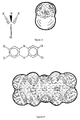
- Figure 4 shows the molecular surface of a tetra chloro-dibenzodioxine molecule.
- the area with half-broken lines represents an electrostatic potential on the surface less than ⁇ kcal/mol
- dotted areas represents a potential between ⁇ and -1 ⁇ kcal/mol and +dotted areas below -1 ⁇ kcal/mole. This molecule is known to be highly toxic.
- Figure 5 shows the molecular surface of dibenzodioxine, coded in the same way as figure 3.
- This molecule is rather similar to tetra chloro dibenzodixoine but is not toxic. It is noted from the picture that the molecule shows a negative potential on most of its surface in contrast to tetra chloro dibenzodioxin.
- Scientific publications teach that biological activity of dioxins depends on the electrostatic potential. This example will show that this invention displays better than other corresponding methods the difference between the potentials and the forms of molecules.
- Figure 6 shows the molecular surface of aniline and the average ionization energy on the surface.
- the regions marked with half-broken lines have the lowest energy.
- the tendency of the molecule to transport electrons to an attacking electrophilic molecule is here maximized. That corresponds with the experimentally shown picture of aniline as orto-para directing by electrophilic substitution. It is also a surface marked with half-broken lines over the free electronic pair of nitrogen. By this function the molecule will become protonized. It is also a type of nuclear attack. There are no other methods that so clearly point out the electrophilic attack sites on a molecule.
Landscapes
- Chemical & Material Sciences (AREA)
- Life Sciences & Earth Sciences (AREA)
- Health & Medical Sciences (AREA)
- Engineering & Computer Science (AREA)
- Bioinformatics & Cheminformatics (AREA)
- General Health & Medical Sciences (AREA)
- Medicinal Chemistry (AREA)
- Organic Chemistry (AREA)
- Computing Systems (AREA)
- Genetics & Genomics (AREA)
- Spectroscopy & Molecular Physics (AREA)
- Bioinformatics & Computational Biology (AREA)
- Physics & Mathematics (AREA)
- Theoretical Computer Science (AREA)
- Analytical Chemistry (AREA)
- Biochemistry (AREA)
- Biophysics (AREA)
- Crystallography & Structural Chemistry (AREA)
- Molecular Biology (AREA)
- Proteomics, Peptides & Aminoacids (AREA)
- Pharmacology & Pharmacy (AREA)
- Addition Polymer Or Copolymer, Post-Treatments, Or Chemical Modifications (AREA)
- Pharmaceuticals Containing Other Organic And Inorganic Compounds (AREA)
- Investigating Or Analysing Biological Materials (AREA)
- Peptides Or Proteins (AREA)
- Pyridine Compounds (AREA)
Description
To determine the activity of the molecules, one must first synthesize them. This is often a very arduous task. After that, one has to make tests on animals to determine the biological activity. This is also very expensive and usually takes a long time. To day there are instruments to determine which molecules have the best qualifications to bind to the receptor. The invention allows to reduce the number of synthetizations and the development work only to a few molecules. That would lead to big economic effects for many drugs producing companies.
The electrostatic values in the region surrounding a molecule are calculated at grid points located on a three-dimensional surface whereby equipotential 3-D surfaces are determined.
With help of computer graphics the three dimensional surface is displayed color coded according to the value of one of the molecular properties above.
Claims (6)
- A quantum chemical method for molecular design comprising the steps of gradually selecting a number of molecules having probably desirable properties, use an ab-inito or similar quantum chemical method for getting an approximate wave function for the molecule in question, said method being characterised by the further steps of using a repeating algorithm or similar methods for analytically calculating equidistant grid points from the wave function and then defining the surface of the molecule as an envelope of constant or near constant electronic density and with help of three dimensional computer graphics illustrating quantum chemically calculated molecular properties on this surface and then comparing this picture with pictures of corresponding calculated molecules having known desired biological activity or with molecules of the receptor in the cell.
- The quantum chemical method according to claim 1 characterized in that the illustrated molecular property is the electrostatic potential.
- The quantum chemical method according to claim 1 characterized in that the illustrated molecular property is the average local ionization energy.
- The quantum chemical method according to claim 1 characterized in that the illustrated molecular property is the electrostatic field perpendicular to the surface.
- The quantum chemical method according to claim 1 characterized in that the molecular property is the HOMO density.
- The quantum chemical method according to claim 1 characterized in that the molecule in question is biologically active.
Applications Claiming Priority (3)
| Application Number | Priority Date | Filing Date | Title |
|---|---|---|---|
| SE8903055A SE470430B (en) | 1989-09-18 | 1989-09-18 | Methods of using quantum chemical methods in molecular design |
| SE8903055 | 1989-09-18 | ||
| PCT/SE1990/000593 WO1991004543A1 (en) | 1989-09-18 | 1990-09-17 | Computer graphics for molecular design |
Publications (2)
| Publication Number | Publication Date |
|---|---|
| EP0506664A1 EP0506664A1 (en) | 1992-10-07 |
| EP0506664B1 true EP0506664B1 (en) | 1998-11-25 |
Family
ID=20376901
Family Applications (1)
| Application Number | Title | Priority Date | Filing Date |
|---|---|---|---|
| EP90914255A Expired - Lifetime EP0506664B1 (en) | 1989-09-18 | 1990-09-17 | Computer graphics for molecular design |
Country Status (4)
| Country | Link |
|---|---|
| EP (1) | EP0506664B1 (en) |
| DE (1) | DE69032789T2 (en) |
| SE (1) | SE470430B (en) |
| WO (1) | WO1991004543A1 (en) |
Families Citing this family (6)
| Publication number | Priority date | Publication date | Assignee | Title |
|---|---|---|---|---|
| US5025388A (en) * | 1988-08-26 | 1991-06-18 | Cramer Richard D Iii | Comparative molecular field analysis (CoMFA) |
| JP2638359B2 (en) * | 1991-11-26 | 1997-08-06 | 富士通株式会社 | Constraint condition generator for molecular dynamics method |
| FR2687404B1 (en) * | 1992-02-19 | 1994-05-20 | Centre Nal Recherc Scientifique | IMMUNOLOGICALLY RELATED PEPTIDES TO PROTEINS OF A VIRAL AGENT AND THEIR BIOLOGICAL APPLICATIONS. |
| US6420127B1 (en) | 1994-11-18 | 2002-07-16 | Washington University | Compounds and pharmaceutical compositions for the treatment and prophylaxis of bacterial infections |
| US6872542B1 (en) | 1993-11-18 | 2005-03-29 | Siga Pharmaceuticals, Inc. | Treatment or prophylaxis of diseases caused by pilus-forming bacteria |
| DE69433901T2 (en) * | 1993-11-18 | 2005-07-28 | Siga Technologies, Inc. | COMPOUNDS AND PHARMACEUTICAL COMPOSITIONS FOR THE TREATMENT AND PROPHYLAXIS OF BACTERIAL INFECTIONS |
Family Cites Families (1)
| Publication number | Priority date | Publication date | Assignee | Title |
|---|---|---|---|---|
| US4704692A (en) * | 1986-09-02 | 1987-11-03 | Ladner Robert C | Computer based system and method for determining and displaying possible chemical structures for converting double- or multiple-chain polypeptides to single-chain polypeptides |
-
1989
- 1989-09-18 SE SE8903055A patent/SE470430B/en not_active IP Right Cessation
-
1990
- 1990-09-17 WO PCT/SE1990/000593 patent/WO1991004543A1/en not_active Ceased
- 1990-09-17 EP EP90914255A patent/EP0506664B1/en not_active Expired - Lifetime
- 1990-09-17 DE DE69032789T patent/DE69032789T2/en not_active Expired - Fee Related
Also Published As
| Publication number | Publication date |
|---|---|
| EP0506664A1 (en) | 1992-10-07 |
| WO1991004543A1 (en) | 1991-04-04 |
| SE8903055L (en) | 1991-03-19 |
| SE8903055D0 (en) | 1989-09-18 |
| SE470430B (en) | 1994-02-21 |
| DE69032789T2 (en) | 1999-07-29 |
| DE69032789D1 (en) | 1999-01-07 |
Similar Documents
| Publication | Publication Date | Title |
|---|---|---|
| Chen et al. | Lower-order symmetric mechanism modes and bifurcation behavior of deployable bar structures with cyclic symmetry | |
| Dupuy et al. | A study of dislocation junctions in FCC metals by an orientation dependent line tension model | |
| Imamura | Electronic Structures of Polymers Using the Tight‐Binding Approximation. I. Polyethylene by the Extended Hückel Method | |
| Došlić et al. | On the vertex degree indices of connected graphs | |
| Karsch | Simulating the quark-gluon plasma on the lattice | |
| Siddiqui et al. | Computation of metric dimension and partition dimension of nanotubes | |
| Myo et al. | Three-body Coulomb breakup of 11Li in the complex scaling method | |
| Bagger | Supersymmetric sigma models | |
| Engelmann et al. | A simple shell element formulation for large-scale elastoplastic analysis | |
| Beyer et al. | Ab initio studies on hydrogen bonded chains. II. Equilibrium geometry and vibrational spectra of the bent chain of hydrogen fluoride molecules | |
| Manz | Apples to apples comparison of standardized to unstandardized principal component analysis of methods that assign partial atomic charges in molecules | |
| Häser | Characterization of electronic structure in molecules by one-center expansion techniques. No three-center four-electron bond in PF5 | |
| Messina | Spherical colloids: effect of discrete macroion charge distribution and counterion valence | |
| Hargittai et al. | The VSEPR model of molecular geometry | |
| WO1991004543A1 (en) | Computer graphics for molecular design | |
| Maksić | Modified atoms in molecules | |
| Kunz | Three-center corrections to the NaCl valence band | |
| Aguilar-Spíndola et al. | Nookiin: Python software to build commensurable multilayer heterostructures | |
| Stander et al. | A 4‐node quadrilateral membrane element with in‐plane vertex rotations and modified reduced quadrature | |
| Lambin et al. | Ewald summation of multipolar interactions at an arbitrary order on a two‐dimensional lattice | |
| Miesch et al. | Pentaquarks on the light front and their mixing to baryons | |
| Laaksonen et al. | Theoretical modeling of sodium chloride and related systems. I. The interaction energies | |
| Hoffstein | Calculation of LEED Intensities for A1 Using Band Structure-Matching Formalism | |
| Voskou | Distributional Results for Geodesic Segments in the Hyperbolic Plane | |
| Nielsen et al. | Approximating smallest enclosing disks. |
Legal Events
| Date | Code | Title | Description |
|---|---|---|---|
| PUAI | Public reference made under article 153(3) epc to a published international application that has entered the european phase |
Free format text: ORIGINAL CODE: 0009012 |
|
| AK | Designated contracting states |
Kind code of ref document: A1 Designated state(s): AT BE CH DE DK ES FR GB IT LI NL SE |
|
| 17P | Request for examination filed |
Effective date: 19920923 |
|
| RBV | Designated contracting states (corrected) |
Designated state(s): DE GB |
|
| 17Q | First examination report despatched |
Effective date: 19961202 |
|
| GRAG | Despatch of communication of intention to grant |
Free format text: ORIGINAL CODE: EPIDOS AGRA |
|
| GRAG | Despatch of communication of intention to grant |
Free format text: ORIGINAL CODE: EPIDOS AGRA |
|
| GRAH | Despatch of communication of intention to grant a patent |
Free format text: ORIGINAL CODE: EPIDOS IGRA |
|
| GRAH | Despatch of communication of intention to grant a patent |
Free format text: ORIGINAL CODE: EPIDOS IGRA |
|
| GRAA | (expected) grant |
Free format text: ORIGINAL CODE: 0009210 |
|
| AK | Designated contracting states |
Kind code of ref document: B1 Designated state(s): DE GB |
|
| REF | Corresponds to: |
Ref document number: 69032789 Country of ref document: DE Date of ref document: 19990107 |
|
| PG25 | Lapsed in a contracting state [announced via postgrant information from national office to epo] |
Ref country code: GB Free format text: LAPSE BECAUSE OF NON-PAYMENT OF DUE FEES Effective date: 19990917 |
|
| PLBE | No opposition filed within time limit |
Free format text: ORIGINAL CODE: 0009261 |
|
| STAA | Information on the status of an ep patent application or granted ep patent |
Free format text: STATUS: NO OPPOSITION FILED WITHIN TIME LIMIT |
|
| 26N | No opposition filed | ||
| GBPC | Gb: european patent ceased through non-payment of renewal fee |
Effective date: 19990917 |
|
| PG25 | Lapsed in a contracting state [announced via postgrant information from national office to epo] |
Ref country code: DE Free format text: LAPSE BECAUSE OF NON-PAYMENT OF DUE FEES Effective date: 20000701 |