EP0506246A1 - Preparation of itaconic acid polymers - Google Patents
Preparation of itaconic acid polymers Download PDFInfo
- Publication number
- EP0506246A1 EP0506246A1 EP19920301966 EP92301966A EP0506246A1 EP 0506246 A1 EP0506246 A1 EP 0506246A1 EP 19920301966 EP19920301966 EP 19920301966 EP 92301966 A EP92301966 A EP 92301966A EP 0506246 A1 EP0506246 A1 EP 0506246A1
- Authority
- EP
- European Patent Office
- Prior art keywords
- monomer
- reactor
- water
- initiator
- percent
- Prior art date
- Legal status (The legal status is an assumption and is not a legal conclusion. Google has not performed a legal analysis and makes no representation as to the accuracy of the status listed.)
- Withdrawn
Links
Classifications
-
- C—CHEMISTRY; METALLURGY
- C08—ORGANIC MACROMOLECULAR COMPOUNDS; THEIR PREPARATION OR CHEMICAL WORKING-UP; COMPOSITIONS BASED THEREON
- C08F—MACROMOLECULAR COMPOUNDS OBTAINED BY REACTIONS ONLY INVOLVING CARBON-TO-CARBON UNSATURATED BONDS
- C08F22/00—Homopolymers and copolymers of compounds having one or more unsaturated aliphatic radicals each having only one carbon-to-carbon double bond, and at least one being terminated by a carboxyl radical and containing at least one other carboxyl radical in the molecule; Salts, anhydrides, esters, amides, imides or nitriles thereof
-
- C—CHEMISTRY; METALLURGY
- C08—ORGANIC MACROMOLECULAR COMPOUNDS; THEIR PREPARATION OR CHEMICAL WORKING-UP; COMPOSITIONS BASED THEREON
- C08F—MACROMOLECULAR COMPOUNDS OBTAINED BY REACTIONS ONLY INVOLVING CARBON-TO-CARBON UNSATURATED BONDS
- C08F22/00—Homopolymers and copolymers of compounds having one or more unsaturated aliphatic radicals each having only one carbon-to-carbon double bond, and at least one being terminated by a carboxyl radical and containing at least one other carboxyl radical in the molecule; Salts, anhydrides, esters, amides, imides or nitriles thereof
- C08F22/02—Acids; Metal salts or ammonium salts thereof, e.g. maleic acid or itaconic acid
-
- C—CHEMISTRY; METALLURGY
- C08—ORGANIC MACROMOLECULAR COMPOUNDS; THEIR PREPARATION OR CHEMICAL WORKING-UP; COMPOSITIONS BASED THEREON
- C08F—MACROMOLECULAR COMPOUNDS OBTAINED BY REACTIONS ONLY INVOLVING CARBON-TO-CARBON UNSATURATED BONDS
- C08F122/00—Homopolymers of compounds having one or more unsaturated aliphatic radicals each having only one carbon-to-carbon double bond, and at least one being terminated by a carboxyl radical and containing at least one other carboxyl radical in the molecule; Salts, anhydrides, esters, amides, imides or nitriles thereof
- C08F122/02—Acids; Metal salts or ammonium salts thereof, e.g. maleic acid or itaconic acid
-
- C—CHEMISTRY; METALLURGY
- C09—DYES; PAINTS; POLISHES; NATURAL RESINS; ADHESIVES; COMPOSITIONS NOT OTHERWISE PROVIDED FOR; APPLICATIONS OF MATERIALS NOT OTHERWISE PROVIDED FOR
- C09K—MATERIALS FOR MISCELLANEOUS APPLICATIONS, NOT PROVIDED FOR ELSEWHERE
- C09K8/00—Compositions for drilling of boreholes or wells; Compositions for treating boreholes or wells, e.g. for completion or for remedial operations
- C09K8/52—Compositions for preventing, limiting or eliminating depositions, e.g. for cleaning
- C09K8/528—Compositions for preventing, limiting or eliminating depositions, e.g. for cleaning inorganic depositions, e.g. sulfates or carbonates
-
- C—CHEMISTRY; METALLURGY
- C11—ANIMAL OR VEGETABLE OILS, FATS, FATTY SUBSTANCES OR WAXES; FATTY ACIDS THEREFROM; DETERGENTS; CANDLES
- C11D—DETERGENT COMPOSITIONS; USE OF SINGLE SUBSTANCES AS DETERGENTS; SOAP OR SOAP-MAKING; RESIN SOAPS; RECOVERY OF GLYCEROL
- C11D3/00—Other compounding ingredients of detergent compositions covered in group C11D1/00
- C11D3/16—Organic compounds
- C11D3/37—Polymers
- C11D3/3746—Macromolecular compounds obtained by reactions only involving carbon-to-carbon unsaturated bonds
- C11D3/3757—(Co)polymerised carboxylic acids, -anhydrides, -esters in solid and liquid compositions
-
- D—TEXTILES; PAPER
- D06—TREATMENT OF TEXTILES OR THE LIKE; LAUNDERING; FLEXIBLE MATERIALS NOT OTHERWISE PROVIDED FOR
- D06M—TREATMENT, NOT PROVIDED FOR ELSEWHERE IN CLASS D06, OF FIBRES, THREADS, YARNS, FABRICS, FEATHERS OR FIBROUS GOODS MADE FROM SUCH MATERIALS
- D06M15/00—Treating fibres, threads, yarns, fabrics, or fibrous goods made from such materials, with macromolecular compounds; Such treatment combined with mechanical treatment
- D06M15/19—Treating fibres, threads, yarns, fabrics, or fibrous goods made from such materials, with macromolecular compounds; Such treatment combined with mechanical treatment with synthetic macromolecular compounds
- D06M15/21—Macromolecular compounds obtained by reactions only involving carbon-to-carbon unsaturated bonds
- D06M15/263—Macromolecular compounds obtained by reactions only involving carbon-to-carbon unsaturated bonds of unsaturated carboxylic acids; Salts or esters thereof
-
- D—TEXTILES; PAPER
- D21—PAPER-MAKING; PRODUCTION OF CELLULOSE
- D21C—PRODUCTION OF CELLULOSE BY REMOVING NON-CELLULOSE SUBSTANCES FROM CELLULOSE-CONTAINING MATERIALS; REGENERATION OF PULPING LIQUORS; APPARATUS THEREFOR
- D21C5/00—Other processes for obtaining cellulose, e.g. cooking cotton linters ; Processes characterised by the choice of cellulose-containing starting materials
- D21C5/02—Working-up waste paper
- D21C5/025—De-inking
- D21C5/027—Chemicals therefor
-
- D—TEXTILES; PAPER
- D21—PAPER-MAKING; PRODUCTION OF CELLULOSE
- D21H—PULP COMPOSITIONS; PREPARATION THEREOF NOT COVERED BY SUBCLASSES D21C OR D21D; IMPREGNATING OR COATING OF PAPER; TREATMENT OF FINISHED PAPER NOT COVERED BY CLASS B31 OR SUBCLASS D21G; PAPER NOT OTHERWISE PROVIDED FOR
- D21H17/00—Non-fibrous material added to the pulp, characterised by its constitution; Paper-impregnating material characterised by its constitution
- D21H17/20—Macromolecular organic compounds
- D21H17/33—Synthetic macromolecular compounds
- D21H17/34—Synthetic macromolecular compounds obtained by reactions only involving carbon-to-carbon unsaturated bonds
- D21H17/37—Polymers of unsaturated acids or derivatives thereof, e.g. polyacrylates
-
- D—TEXTILES; PAPER
- D21—PAPER-MAKING; PRODUCTION OF CELLULOSE
- D21H—PULP COMPOSITIONS; PREPARATION THEREOF NOT COVERED BY SUBCLASSES D21C OR D21D; IMPREGNATING OR COATING OF PAPER; TREATMENT OF FINISHED PAPER NOT COVERED BY CLASS B31 OR SUBCLASS D21G; PAPER NOT OTHERWISE PROVIDED FOR
- D21H21/00—Non-fibrous material added to the pulp, characterised by its function, form or properties; Paper-impregnating or coating material, characterised by its function, form or properties
- D21H21/06—Paper forming aids
- D21H21/08—Dispersing agents for fibres
-
- C—CHEMISTRY; METALLURGY
- C08—ORGANIC MACROMOLECULAR COMPOUNDS; THEIR PREPARATION OR CHEMICAL WORKING-UP; COMPOSITIONS BASED THEREON
- C08F—MACROMOLECULAR COMPOUNDS OBTAINED BY REACTIONS ONLY INVOLVING CARBON-TO-CARBON UNSATURATED BONDS
- C08F222/00—Copolymers of compounds having one or more unsaturated aliphatic radicals, each having only one carbon-to-carbon double bond, and at least one being terminated by a carboxyl radical and containing at least one other carboxyl radical in the molecule; Salts, anhydrides, esters, amides, imides, or nitriles thereof
- C08F222/02—Acids; Metal salts or ammonium salts thereof, e.g. maleic acid or itaconic acid
-
- C—CHEMISTRY; METALLURGY
- C09—DYES; PAINTS; POLISHES; NATURAL RESINS; ADHESIVES; COMPOSITIONS NOT OTHERWISE PROVIDED FOR; APPLICATIONS OF MATERIALS NOT OTHERWISE PROVIDED FOR
- C09K—MATERIALS FOR MISCELLANEOUS APPLICATIONS, NOT PROVIDED FOR ELSEWHERE
- C09K23/00—Use of substances as emulsifying, wetting, dispersing, or foam-producing agents
-
- C—CHEMISTRY; METALLURGY
- C09—DYES; PAINTS; POLISHES; NATURAL RESINS; ADHESIVES; COMPOSITIONS NOT OTHERWISE PROVIDED FOR; APPLICATIONS OF MATERIALS NOT OTHERWISE PROVIDED FOR
- C09K—MATERIALS FOR MISCELLANEOUS APPLICATIONS, NOT PROVIDED FOR ELSEWHERE
- C09K23/00—Use of substances as emulsifying, wetting, dispersing, or foam-producing agents
- C09K23/12—Sulfonates of aromatic or alkylated aromatic compounds
-
- Y—GENERAL TAGGING OF NEW TECHNOLOGICAL DEVELOPMENTS; GENERAL TAGGING OF CROSS-SECTIONAL TECHNOLOGIES SPANNING OVER SEVERAL SECTIONS OF THE IPC; TECHNICAL SUBJECTS COVERED BY FORMER USPC CROSS-REFERENCE ART COLLECTIONS [XRACs] AND DIGESTS
- Y02—TECHNOLOGIES OR APPLICATIONS FOR MITIGATION OR ADAPTATION AGAINST CLIMATE CHANGE
- Y02W—CLIMATE CHANGE MITIGATION TECHNOLOGIES RELATED TO WASTEWATER TREATMENT OR WASTE MANAGEMENT
- Y02W30/00—Technologies for solid waste management
- Y02W30/50—Reuse, recycling or recovery technologies
- Y02W30/64—Paper recycling
Definitions
- the present invention is concerned with itaconic acid polymers and, more particularly, to a process for the preparation, at high conversion, of biodegradable itaconic acid polymers.
- Polymers made by this process are suitable for use as detergent additives, scale inhibitors and removers, sequestrants, yarn sizers, deflocculating agents, de-inking agents, suspending agents and dispersing agents.
- U.S.-A-2,294,226 describes the polymerization of dimethyl itaconate as the dipotassium salt by refluxing it with alcoholic potassium hydroxide, and subsequently hydrolyzing it to produce polyitaconic acid.
- This patent claims that the polyitaconic acid obtained by treating this salt with inorganic acids is water soluble.
- U.S.-A-3,560,529 describes the polymerization of itaconic anhydride. This patent claims to have resolved two problems: (1) it identified a suitable initiator and; (2) the process could be practised under ambient conditions without the need of costly pressurized equipment. However, conversion of itaconic acid was found to be erratic, unreliable and inconsistent.
- U.S.-A-3,055, 873 describes a method of polymerizing monoalkyl itaconate with hydrolysis of the poly(monoalkyl itaconate) and finally the precipitation of the itaconic acid. However, the process resulted in 75 percent conversion, leaving 25 percent of the monomer unpolymerized.
- a process for producing itaconic acid polymers which comprises polymerizing, in a reactor and at a temperature of from about 50 to about 200°C, a reaction mixture comprising water, initiator and itaconic acid monomer, optionally together with acrylic acid monomer, and wherein the acid groups of the monomer(s) and/or polymer are neutralized to a level of from about 80 to 100 equivalent percent with water-soluble base before or during the polymerization, e.g. prior to addition to the reactor.
- the reaction is usually completed in about two hours.
- the reaction mixture may, for example, be formed by:-
- the monomer(s) may be added to the reactor in the form of an aqueous solution.
- the initiator may be added to the reactor in the form of an aqueous solution.
- the monomer(s) may be added to the reactor at a substantially uniform addition rate.
- the initiator may be added to the reactor at a substantially uniform addition rate.
- the acid groups of the monomer(s) and/or polymer are completely neutralized with the water-soluble base.
- uniform addition rate when referring to the addition of a material to the reactor, includes addition of that material linearly (i.e. continuously at a single uniform addition rate), and addition in several discontinuous stages with each stage being uniform.
- a reactor containing water, is charged with at least partially neutralized, preferably completely neutralized, monomer e.g. monomer solution.
- the reactor is heated followed by the gradual addition, at a substantially uniform addition rate, of an initiator, e.g. an initiator solution.
- the initiator e.g. the initiator solution
- the monomer e.g. the monomer solution
- the reactor may be initially charged with water, the reactor heated to increase the temperature, and at least partially, preferably completely, neutralized monomer, e.g. monomer solution, and initiator, e.g. initiator solution, added at uniform addition rates, preferably linearly and as separate streams.
- the present invention provides an aqueous batch or continuous process for the preparation, at high conversion, of itaconic acid polymers. With significantly less unpolymerized monomers remaining in the final product, environmental concerns are minimized and product performance is improved. In addition, the novel process of the present invention is completed over a shorter period of time, when compared to the prior art, and is accomplished with relative ease and consistency. Additionally, high conversion of the monomers will lower the cost of production by reducing the amount of unpolymerized monomer in the final product.
- Polymers synthesized according to the process of the present invention are biodegradable and are useful as detergent additives, scale inhibitors and removers, sequesterants, yarn sizing, deflocculating agents, de-inking agents, suspending agents and dispersing agents.
- Copolymers of itaconic acid and acrylic acid produced by the process of the present invention can also be used as powder detergent additives because they are safe, cost effective and efficient at controlling crystal growth during the wash cycle.
- the polymers, for example the itaconic acid homopolymers, of the process of this invention may have a weight average molecular weight of less than about 10,000, while the preferred molecular weight is less than about 5000.
- Molecular weights referred to hereinafter are all weight average molecular weights unless stated otherwise.
- the critical aspect of the present invention is the neutralization of the acid groups of the monomer and/or polymer prior to or during the polymerization reaction, e.g. prior to addition of the monomer(s) to the reactor.
- the acid groups are completely neutralized.
- “Complete neutralization" of itaconic acid requires two moles of base neutralizer for each mole of itaconic acid.
- base neutralizer for example, two moles of sodium hydroxide are required to neutralize one mole of itaconic acid.
- a divalent base such as calcium hydroxide
- Any base may be used to neutralize the acid groups to the respective salt, for example to neutralize itaconic acid to its itaconate salts.
- Suitable bases include sodium hydroxide, potassium hydroxide, lithium hydroxide, ammonium hydroxide and the like.
- Organic materials such as amines may also be used as neutralizers.
- the acid groups are neutralized to a level of from about 80 to about 100 percent. This may be accomplished by adding to the monomer(s) from about 80 to about 120 equivalent percent of the neutralizer.
- the neutralized monomer may be prepared by adding the neutralizer to a reactor charged with deionized water and the acid monomer(s) e.g. itaconic acid. Since the addition of the neutralizer results in an exothermic reaction, the neutralizer should be added slowly to the reactor or the reactor may be cooled with ice while slowly adding the neutralizer.
- the neutralizer is typically added in the form of a solution. The resulting monomer solution is preferably completely neutralized.
- Initiators useful in the polymerization process of this invention include all initiators which decompose within the polymerization temperature of this invention, for example: persulfates such as sodium, ammonium, and potassium persulfate; perphosphates, such as sodium, ammonium, and potassium perphosphate; tertiary butyl hydroperoxide; and hydrogen peroxide.
- the initiator is sodium persulfate.
- the initiators used in the process of the present invention are water soluble and may be prepared in solution by charging a reactor with deionized water and dissolving the initiator in the water charge.
- the concentration of these initiators is preferably from 0.5 to 20.0 percent by weight of active initiator on monomer, more preferably from 1 to 10 percent by weight of the total monomer concentration.
- Preferred initiators are water soluble persulfate salts including mixtures and solutions thereof.
- the polymerization is preferably run to about 10 to 80 weight percent solids, and most preferably to about 30 to 60 percent solids.
- Polymerization temperatures are between 50 to 200°C, preferably from 80 to 200°C, and most preferably from 80 to 120°C.
- a process for preparing itaconic acid polymers which comprises (a) adding a monomer solution, previously neutralized with water soluble base, to a reactor initially charged with water, (b) adding thereto under uniform addition rates, an initiator solution comprising 0.5 to 20 percent by weight of active initiator on monomer, and (c) running the reactor at a temperature from about 80 to 120 degrees centigrade.
- the monomer solution is contained in the initial charge.
- the monomer solution is cofed into the initial charge linearly, and as a separate solution, during the addition of the initiator.
- Polymers produced by the process of this invention are useful as detergent additives since they prevent redeposition of soil during laundering.
- the polymers are preferably present in the detergent compositions in an among of up to 30% by weight, more preferably in an amount of 0.1 to 20 percent by weight, and most preferably in an amount of 0.5 to 5 percent by weight.
- the polymers are most effective when added to detergent compositions based on: surfactants, including anionic, nonionic, zwitterionic, ampholytic surfactants and mixtures thereof; builders, including zeolites, silicates, carbonates, phosphates, perforates and mixtures thereof; and, optionally, adjuvants such as perfumes, colorants, fatty acids, fluorescent whiteners, and opacifiers.
- the polymers of this invention are also useful in water treatment compositions and dispersant compositions.
- the polymers produced by the process of this invention form clear, tough films, and can be applied from aqueous solutions in the sizing of yarn to impart abrasion resistance for weaving. The film is then removed from the yarn after weaving by dissolving the polymer with water.
- Polymers produced by the process of the present invention are also suitable as deflocculating agents for paper making. They may also be used as de-inking agents in newspaper repulping and as dispersing agents in latex paints, ceramics and glazes. The polymers may be used as suspending agents for aqueous insecticide emulsions since their adhesive properties help to hold the insecticide on the treated surface.
- Polymers produced by the process of the present invention may be further used as scale inhibitors and dispersants for water treatment applications and are especially useful inhibitors for barium sulfate formations in oil-well drilling applications. These polymers can also be used as dispersants for inorganic particulates, such as kaolin clay, calcium carbonate, zeolites, titanium dioxide and the like.
- polymers produced by the process of this invention are biodegradable.
- a biodegradable synthetic polymeric detergent additive is preferred since the use of non-biodegradable polymeric additives raises serious environmental concerns due to the uncontrolled build-up of polyacids.
- the resultant polymer solution showed 98.8 percent conversion of the itaconic acid. Unpolymerized residual itaconic acid content was 1.2 percent. The resultant polymer had a solids content of 30.2 percent and a pH of 4.6. Based on gel permeation chromatography (GPC), the weight average molecular (Mw) was 1960, and the number average molecular weight (Mn) was 1640.
- GPC gel permeation chromatography
- Example 1 The procedure of Example 1 was repeated except that a monomer solution containing 265 grams of itaconic acid, 160 grams of deionized water and 160 grams of 50 percent NaOH was added to 150 grams of deionized water.
- An initiator solution of 20 grams of sodium persulfate and 75 grams of deionized water was prepared. The initiator solution was fed into the flask over 2 hours while maintaining the flask at a temperature sufficient to continue to reflux the mixture -- about 100°C. When the addition was complete, the polymer solution was held at the reflux temperature for an additional 30 minutes, then cooled. The polymer solution was diluted with 250 grams of deionized water and post-neutralized with 31 grams of 50 percent NaOH to a final pH of 7.
- the resultant polymer solution showed 98.8 percent conversion of the itaconic acid. Unpolymerized residual itaconic acid content was 1.2 percent. The resultant polymer had a solids content of 30 percent and a pH of 6.7. Based on GPC, the Mw was 4500 and Mn was 3390.
- Example 2 The procedure for Example 2 was repeated.
- the resultant polymer solution showed 99.3 percent conversion of the itaconic acid. Unpolymerized residual itaconic acid content was 0.7 percent.
- the resultant polymer solution had a solids content of 29.9 percent and a pH of 7.
- the Mw was 3810 and the Mn was 3080.
- Biodegradation of the resultant polymer solution was 44.6 percent. This was based on biological oxygen demand (BOD) testing for 47 days.
- Polymer degradability was measured on a scale of 0 to 100 percent based on BOD testing.
- the BOD procedure is the method described in Standard Methods for the Examination of Water & Wastewater , page 525, 16th edition (1985).
- the BOD test used was a closed bottle test whereby a solution of the resultant polymer and mineral salt was inoculated with municipal sewage bacteria. Biodegradation was indicated by oxygen uptake. The oxygen uptake was determined by measuring the dissolved oxygen content of the solution. BOD test results are provided for 5 mg/300 ml concentrations for the duration of test.
- the resultant polymer solution showed 88.0 percent conversion of the itaconic acid. Unpolymerized residual itaconic acid content was 12.0 percent.
- the resultant polymer solution had a solids content of 47.9 percent and a pH of 7.4.
- the Mw was 2540 and the Mn was 2220.
- the resultant polymer solution showed 92.6 percent conversion of the itaconic acid. Unpolymerized residual itaconic acid contentwas 7.4 percent.
- the resultant polymer solution had a solids content of 46.9 percent and a pH of 13.9.
- the Mw was 2620 and the Mn was 2260.
- Example 5 The procedure for Example 5 was repeated except that 160 grams of 50 percent NaOH was prepared as the base solution. When the addition was complete, the polymer solution was held at the reflux temperature for an additional 30 minutes. The polymer solution was cooled to about 50°C and post-neutralized with 83 grams of 50 percent NaOH. The polymer solution was further cooled and packaged.
- the resultant polymer solution showed 91.3 percent conversion of the itaconic acid. Unpolymerized residual itaconic acid content was 8.7 percent.
- the resultant polymer solution had a solids content of 47.1 percent and a pH of 7.1.
- the Mw was 2570 and the Mn was 2220. Residual itaconic acid content was 8.7 percent.
- Example 2 The procedure of Example 2 was repeated except that a monomer solution containing 265 grams of itaconic acid and 165.5 grams of 50 percent NaOH were added to the 150 grams of deionized water. When the addition of the initiator solution was complete, the polymer solution was cooled to about 50°C and post-neutralized with 74.9 grams of 50 percent NaOH.
- the resultant polymer solution showed 92.5 percent conversion of the itaconic acid. Unpolymerized residual itaconic acid content was 7.5 percent. The resultant polymer solution had a solids content of 46.9 percent and a pH of 7.1. The Mw was 2860 and the Mn was 2440.
- a 0.1% active polymer solution based on acid was prepared. The pH of 8 oz. aliquots was adjusted to pH 5.5 with dilute HCl or NaOH as necessary.
- the preweighed salts and/or solutions were added to a two liter volumetric flask in the order listed: 4.86 g 1% SrCl 2.6 H20 3.14 g CaCl 2.2 H2O 22.88 g MgCl 2.6 H2O 1.76 g KCl 47.91 g NaCl 0.34 g NaHCO3 8.75 g Na2SO4
- the two liter flask was then filled to the mark with deionized water and mixed well.
- Solution A was filtered through a 0.45 micrometer filter and then carbon dioxide (CO2) was bubbled through the solution for 2-3 hours.
- the pH was adjusted to 4.0 with hydrochloric acid (HCl) as necessary.
- the preweighed salts and/or solutions were added to a second two liter volumetric flask in the order listed: 8.96 g 1% BaSO4 3.49 g SrCl 2.6 H20 20.62 g CaCl 2.2 H2O 8.43 g MgCl 2.2 H2O 1.42 g KCl 148.34 g NaCl 1.37 g NaHCO3 3.40 g 1% NaSO4
- the two liter flask was then filled to the mark with deionized water and mixed well.
- Solution B was filtered through a 0.45 micrometer filter and then carbon dioxide (CO2) was bubbled through the solution for 2-3 hours.
- the pH was adjusted to 4.0 with hydrochloric acid (HCl) as necessary.
- Samples containing no polymer were prepared as a control. Also, samples containing no barium were prepared by replacing Solution A with polished deionized water.
- the level of barium sulfate present in the samples was determined by atomic absorption. The percent inhibition measures the amount of barium at low pH which did not precipitate out of solution.
- the data demonstrates that the itaconic acid polymers and copolymers of this invention are twice as effective at inhibiting the formation of barium sulfate (higher numbers indicate better performance), when compared to a polyacrylic acid homopolymer of comparable molecular weight and DETPMP, a commonly used commercial phosphonate scale inhibitor.
- Table IV illustrates the evaluation of the polyitaconic acid homopolymer of Example #3 and a pair of 80/20 Acrylic Acid/Itaconic Acid copolymers in the commercial heavy-duty liquid detergent.
- Polyitaconic homopolymer exhibits some improvements on oily/particulate soils (stain A) and particulate soils (stain C) but shows significant benefits on oxidizable soils (stain B) removal.
- the Acrylic Acid/Itaconic Acid (80/20) copolymers display an almost analogous performance profile to the polyitaconic homopolymer, except benefits on particulates and oily/particulates are less significant.
- the polyitaconic acid homopolymer was evaluated in a prototypical non-phosphate powder composition utilizing a higher polymer concentration, four percent by weight, slightly higher water hardness (125 ppm) and one cup of detergent base (130 grams). The results of the test are illustrated below in Table V.
- Example 3 The polymer of Example 3 was also evaluated as a clay dispersant and compared to a conventional clay dispersant.
- the test procedure was as follows:
- Steps 7 and 8 were repeated several times to find the minimum slurry viscosity.
- Acusol 445N3 0.515 (515) 0.384 (384) 0.340 (340) 0.332 (332) 0.358 (358) 0.383 (383)
- Example 3 1.200 (1200) 0.840 (840) 0.745 (745) 0.384 (384) 0.302 (302) 0.298 (298) 0.298 (298) 0.312 (312) 0.305 (305) 1 Brookfield RVTDV-II (#2 spindle, 20 rpm, 23°C) 2 Percent Polymer Solids On Dry Clay 3
- Acusol is a trademark of the Rohm and Haas Co.
- Acusol 445N is a fully neutralized acrylic acid homopolymer with molecular weight 4,500.
Landscapes
- Chemical & Material Sciences (AREA)
- Chemical Kinetics & Catalysis (AREA)
- Organic Chemistry (AREA)
- Health & Medical Sciences (AREA)
- Medicinal Chemistry (AREA)
- Polymers & Plastics (AREA)
- Engineering & Computer Science (AREA)
- Life Sciences & Earth Sciences (AREA)
- General Chemical & Material Sciences (AREA)
- Wood Science & Technology (AREA)
- Oil, Petroleum & Natural Gas (AREA)
- Toxicology (AREA)
- Textile Engineering (AREA)
- Inorganic Chemistry (AREA)
- General Life Sciences & Earth Sciences (AREA)
- Materials Engineering (AREA)
- Addition Polymer Or Copolymer, Post-Treatments, Or Chemical Modifications (AREA)
- Detergent Compositions (AREA)
- Polymerisation Methods In General (AREA)
- Biological Depolymerization Polymers (AREA)
Abstract
Itaconic acid homopolymers or copolymers are formed at high conversion by polymerizing a monomer solution, the acid groups of the monomer(s) and/or polymer being at least partially neutralized before or during polymerization. These polymers are biodegradable and are most useful as detergent additives, scale inhibitors and removers, sequesterants, yarn sizers, deflocculating agents, de-inking agents, suspending agents and dispersing agents.
Description
- The present invention is concerned with itaconic acid polymers and, more particularly, to a process for the preparation, at high conversion, of biodegradable itaconic acid polymers. Polymers made by this process are suitable for use as detergent additives, scale inhibitors and removers, sequestrants, yarn sizers, deflocculating agents, de-inking agents, suspending agents and dispersing agents.
- Processes for the preparation of polymers of itaconic acid are known in the art. However, while the prior art processes have had some impact on resolving inherent difficulties in polymerizing this dicarboxylic acid, low polymerization conversion of the acid continues to be a problem. High levels of unpolymerized monomers in the final product raise serious environmental concerns and cause significant application problems. Additionally, many of the processes are known to be difficult, erratic, inconsistent and, in one instance where a detonatable initiator is employed, hazardous to practice.
- Marvel and Shepherd, in the Journal of Organic Chemistry, vol. 24, pp. 599-605 (1959), describe the first polymerization of itaconic acid in dilute hydrochloric acid, using potassium persulfate as the catalyst. However, the problem with this polymerization process was that it took a number of days to complete the process, and conversion of the itaconic acid was only 35 percent. This means that 65 percent of the acid remained unpolymerized. This made the process commercially unacceptable.
- U.S.-A-2,294,226 describes the polymerization of dimethyl itaconate as the dipotassium salt by refluxing it with alcoholic potassium hydroxide, and subsequently hydrolyzing it to produce polyitaconic acid. This patent claims that the polyitaconic acid obtained by treating this salt with inorganic acids is water soluble.
- Nakamoto, Ogo and Imoto, in Chemie III, pp. 104-114 (1968), describes radical polymerization of itaconic acid in various solvents under high pressure, 5000 kg/cm². However, the polymerization process resulted in a 50 percent conversion and required specialized equipment. This made the process costly and commercially unfeasible.
- U.S.-A-3,560,529 describes the polymerization of itaconic anhydride. This patent claims to have resolved two problems: (1) it identified a suitable initiator and; (2) the process could be practised under ambient conditions without the need of costly pressurized equipment. However, conversion of itaconic acid was found to be erratic, unreliable and inconsistent.
- U.S.-A-3,055, 873 describes a method of polymerizing monoalkyl itaconate with hydrolysis of the poly(monoalkyl itaconate) and finally the precipitation of the itaconic acid. However, the process resulted in 75 percent conversion, leaving 25 percent of the monomer unpolymerized.
- While prior art processes have made significant improvements in the production of polymers of itaconic acid, further improvements are required.
- We have unexpectedly found that, when itaconic acid monomer, optionally together with acrylic acid monomer, is polymerized according to the process of this invention, high conversion of the monomer(s) to polymer is achieved.
- According to the present invention there is provided a process for producing itaconic acid polymers, which comprises polymerizing, in a reactor and at a temperature of from about 50 to about 200°C, a reaction mixture comprising water, initiator and itaconic acid monomer, optionally together with acrylic acid monomer, and wherein the acid groups of the monomer(s) and/or polymer are neutralized to a level of from about 80 to 100 equivalent percent with water-soluble base before or during the polymerization, e.g. prior to addition to the reactor. The reaction is usually completed in about two hours.
- The reaction mixture may, for example, be formed by:-
- (a) initially charging the reactor with water, adding the monomer(s) to the reactor charged with the water, and adding the initiator to the resulting water/monomer(s) mixture;
- (b) initially charging the reactor with the water, and adding the initiator and the monomer(s) to the reactor charged with the water, the monomer(s) being cofed to the reactor with, but as a separate stream to, the initiator; or
- (c) adding, to the reactor, an initial charge comprising the water and the monomer(s), and adding the initiator to the initial charge of monomer(s) and water.
- The monomer(s) may be added to the reactor in the form of an aqueous solution. Similarly, the initiator may be added to the reactor in the form of an aqueous solution.
- The monomer(s) may be added to the reactor at a substantially uniform addition rate. Similarly, the initiator may be added to the reactor at a substantially uniform addition rate.
- Preferably, the acid groups of the monomer(s) and/or polymer are completely neutralized with the water-soluble base.
- As used herein, the term "uniform addition rate", when referring to the addition of a material to the reactor, includes addition of that material linearly (i.e. continuously at a single uniform addition rate), and addition in several discontinuous stages with each stage being uniform.
- In one embodiment of the process of the present invention a reactor, containing water, is charged with at least partially neutralized, preferably completely neutralized, monomer e.g. monomer solution. The reactor is heated followed by the gradual addition, at a substantially uniform addition rate, of an initiator, e.g. an initiator solution. In an alternative embodiment of the process of the present invention, the initiator, e.g. the initiator solution, and the monomer, e.g. the monomer solution, are cofed at substantially uniform addition rates, preferably linearly, and as separate solutions. For example, the reactor may be initially charged with water, the reactor heated to increase the temperature, and at least partially, preferably completely, neutralized monomer, e.g. monomer solution, and initiator, e.g. initiator solution, added at uniform addition rates, preferably linearly and as separate streams.
- The present invention provides an aqueous batch or continuous process for the preparation, at high conversion, of itaconic acid polymers. With significantly less unpolymerized monomers remaining in the final product, environmental concerns are minimized and product performance is improved. In addition, the novel process of the present invention is completed over a shorter period of time, when compared to the prior art, and is accomplished with relative ease and consistency. Additionally, high conversion of the monomers will lower the cost of production by reducing the amount of unpolymerized monomer in the final product.
- Polymers synthesized according to the process of the present invention are biodegradable and are useful as detergent additives, scale inhibitors and removers, sequesterants, yarn sizing, deflocculating agents, de-inking agents, suspending agents and dispersing agents.
- Copolymers of itaconic acid and acrylic acid produced by the process of the present invention can also be used as powder detergent additives because they are safe, cost effective and efficient at controlling crystal growth during the wash cycle.
- The polymers, for example the itaconic acid homopolymers, of the process of this invention may have a weight average molecular weight of less than about 10,000, while the preferred molecular weight is less than about 5000. Molecular weights referred to hereinafter are all weight average molecular weights unless stated otherwise.
- The critical aspect of the present invention is the neutralization of the acid groups of the monomer and/or polymer prior to or during the polymerization reaction, e.g. prior to addition of the monomer(s) to the reactor. Preferably, the acid groups are completely neutralized. "Complete neutralization" of itaconic acid requires two moles of base neutralizer for each mole of itaconic acid. For example, two moles of sodium hydroxide are required to neutralize one mole of itaconic acid. However, when a divalent base, such as calcium hydroxide, is used to neutralize the itaconic acid, only one mole is required to neutralize each mole of itaconic acid. Any base may be used to neutralize the acid groups to the respective salt, for example to neutralize itaconic acid to its itaconate salts. Suitable bases include sodium hydroxide, potassium hydroxide, lithium hydroxide, ammonium hydroxide and the like. Organic materials such as amines may also be used as neutralizers.
- The acid groups are neutralized to a level of from about 80 to about 100 percent. This may be accomplished by adding to the monomer(s) from about 80 to about 120 equivalent percent of the neutralizer. For example, the neutralized monomer may be prepared by adding the neutralizer to a reactor charged with deionized water and the acid monomer(s) e.g. itaconic acid. Since the addition of the neutralizer results in an exothermic reaction, the neutralizer should be added slowly to the reactor or the reactor may be cooled with ice while slowly adding the neutralizer. The neutralizer is typically added in the form of a solution. The resulting monomer solution is preferably completely neutralized.
- Initiators useful in the polymerization process of this invention include all initiators which decompose within the polymerization temperature of this invention, for example: persulfates such as sodium, ammonium, and potassium persulfate; perphosphates, such as sodium, ammonium, and potassium perphosphate; tertiary butyl hydroperoxide; and hydrogen peroxide. Preferably the initiator is sodium persulfate. The initiators used in the process of the present invention are water soluble and may be prepared in solution by charging a reactor with deionized water and dissolving the initiator in the water charge. The concentration of these initiators is preferably from 0.5 to 20.0 percent by weight of active initiator on monomer, more preferably from 1 to 10 percent by weight of the total monomer concentration. Preferred initiators are water soluble persulfate salts including mixtures and solutions thereof.
- The polymerization is preferably run to about 10 to 80 weight percent solids, and most preferably to about 30 to 60 percent solids. Polymerization temperatures are between 50 to 200°C, preferably from 80 to 200°C, and most preferably from 80 to 120°C.
- In a further embodiment of the present invention there is provided a process for preparing itaconic acid polymers which comprises (a) adding a monomer solution, previously neutralized with water soluble base, to a reactor initially charged with water, (b) adding thereto under uniform addition rates, an initiator solution comprising 0.5 to 20 percent by weight of active initiator on monomer, and (c) running the reactor at a temperature from about 80 to 120 degrees centigrade. In a variation of this further embodiment the monomer solution is contained in the initial charge. In an alternative variation of this embodiment the monomer solution is cofed into the initial charge linearly, and as a separate solution, during the addition of the initiator.
- Polymers produced by the process of this invention are useful as detergent additives since they prevent redeposition of soil during laundering. The polymers are preferably present in the detergent compositions in an among of up to 30% by weight, more preferably in an amount of 0.1 to 20 percent by weight, and most preferably in an amount of 0.5 to 5 percent by weight. The polymers are most effective when added to detergent compositions based on: surfactants, including anionic, nonionic, zwitterionic, ampholytic surfactants and mixtures thereof; builders, including zeolites, silicates, carbonates, phosphates, perforates and mixtures thereof; and, optionally, adjuvants such as perfumes, colorants, fatty acids, fluorescent whiteners, and opacifiers. The polymers of this invention are also useful in water treatment compositions and dispersant compositions.
- Additionally, the polymers produced by the process of this invention form clear, tough films, and can be applied from aqueous solutions in the sizing of yarn to impart abrasion resistance for weaving. The film is then removed from the yarn after weaving by dissolving the polymer with water. Polymers produced by the process of the present invention are also suitable as deflocculating agents for paper making. They may also be used as de-inking agents in newspaper repulping and as dispersing agents in latex paints, ceramics and glazes. The polymers may be used as suspending agents for aqueous insecticide emulsions since their adhesive properties help to hold the insecticide on the treated surface. Polymers produced by the process of the present invention may be further used as scale inhibitors and dispersants for water treatment applications and are especially useful inhibitors for barium sulfate formations in oil-well drilling applications. These polymers can also be used as dispersants for inorganic particulates, such as kaolin clay, calcium carbonate, zeolites, titanium dioxide and the like.
- An additional advantage of the polymers produced by the process of this invention is that they are biodegradable. A biodegradable synthetic polymeric detergent additive is preferred since the use of non-biodegradable polymeric additives raises serious environmental concerns due to the uncontrolled build-up of polyacids.
- The following Examples are provided to illustrate preferred embodiments of the present invention for the production, at high conversion, of itaconic acid polymers that are biodegradable, and that improve application performance, the process being relatively easy to practice with polymerization over a shorter period of time when compared to the prior art. Where noted, ratios of itaconic acid to acrylic acid are given as weight percent based on total monomer charge.
- To a two liter, four neck round bottom flask equipped with a mechanical stirrer, reflux condenser, thermometer and addition funnels, was added 150 grams of deionized water. The flask was heated to 90°C. A monomer solution of 265 grams of itaconic acid, 160 grams of 50 percent NaOH and 350 grams of deionized water was prepared. An initiator solution of 20 grams sodium persulfate and 75 grams of deionized water was also prepared. The monomer and initiator solutions were fed into the flask linearly and separately over 2 hours, while maintaining the flask at a temperature sufficient to continue to reflux the mixture, about 100°C. When the addition was complete, the polymer solution was held at the reflux temperature for an additional 30 minutes. The polymer solution was cooled and packaged.
- The resultant polymer solution showed 98.8 percent conversion of the itaconic acid. Unpolymerized residual itaconic acid content was 1.2 percent. The resultant polymer had a solids content of 30.2 percent and a pH of 4.6. Based on gel permeation chromatography (GPC), the weight average molecular (Mw) was 1960, and the number average molecular weight (Mn) was 1640.
- The procedure of Example 1 was repeated except that a monomer solution containing 265 grams of itaconic acid, 160 grams of deionized water and 160 grams of 50 percent NaOH was added to 150 grams of deionized water. An initiator solution of 20 grams of sodium persulfate and 75 grams of deionized water was prepared. The initiator solution was fed into the flask over 2 hours while maintaining the flask at a temperature sufficient to continue to reflux the mixture -- about 100°C. When the addition was complete, the polymer solution was held at the reflux temperature for an additional 30 minutes, then cooled. The polymer solution was diluted with 250 grams of deionized water and post-neutralized with 31 grams of 50 percent NaOH to a final pH of 7.
- The resultant polymer solution showed 98.8 percent conversion of the itaconic acid. Unpolymerized residual itaconic acid content was 1.2 percent. The resultant polymer had a solids content of 30 percent and a pH of 6.7. Based on GPC, the Mw was 4500 and Mn was 3390.
- The procedure for Example 2 was repeated. The resultant polymer solution showed 99.3 percent conversion of the itaconic acid. Unpolymerized residual itaconic acid content was 0.7 percent. The resultant polymer solution had a solids content of 29.9 percent and a pH of 7. The Mw was 3810 and the Mn was 3080.
- Biodegradation of the resultant polymer solution was 44.6 percent. This was based on biological oxygen demand (BOD) testing for 47 days.
- Polymer degradability was measured on a scale of 0 to 100 percent based on BOD testing. The BOD procedure is the method described in Standard Methods for the Examination of Water & Wastewater, page 525, 16th edition (1985).
- The BOD test used was a closed bottle test whereby a solution of the resultant polymer and mineral salt was inoculated with municipal sewage bacteria. Biodegradation was indicated by oxygen uptake. The oxygen uptake was determined by measuring the dissolved oxygen content of the solution. BOD test results are provided for 5 mg/300 ml concentrations for the duration of test.
- To a two liter, four neck round bottom flask equipped with a mechanical stirrer, reflux condenser, thermometer and addition funnels was added 160 grams of deionized water and 265 grams of itaconic acid. The flask was heated to the reflux temperature -- about 100°C. An initiator solution of 20 grams of sodium persulfate and 75 grams of deionized water was prepared. The initiator solution was fed into the flask linearly over 2 hours while maintaining the flask at a temperature sufficient to continue to reflux the mixture -- approximately 90°C. When the addition was complete, the polymer solution was held at the reflux temperature for an additional 30 minutes. The polymer solution was cooled to 50°C. 270 grams of 50 percent NaOH was added to the flask while the temperature was maintained at less than 70°C. When the post-neutralization was complete, the polymer solution was cooled and packaged.
- The resultant polymer solution showed 88.0 percent conversion of the itaconic acid. Unpolymerized residual itaconic acid content was 12.0 percent. The resultant polymer solution had a solids content of 47.9 percent and a pH of 7.4. The Mw was 2540 and the Mn was 2220.
- To a two liter, four neck round bottom flask equipped with a mechanical stirrer, reflux condenser, thermometer and addition funnels was added 150 grams of deionized water and 265 grams of itaconic acid. An initiator solution of 20 grams of sodium persulfate and 75 grams of deionized water was prepared. A base solution of 320 grams of 50 percent NaOH was also prepared. The initiator solution and the base solution were fed into the flask linearly and separately over 2 hours while maintaining the flask at a temperature sufficient to continue to reflux the mixture of about 100°C. When the addition was complete, the polymer solution was held at the reflux temperature for an additional 30 minutes, cooled and packaged.
- The resultant polymer solution showed 92.6 percent conversion of the itaconic acid. Unpolymerized residual itaconic acid contentwas 7.4 percent. The resultant polymer solution had a solids content of 46.9 percent and a pH of 13.9. The Mw was 2620 and the Mn was 2260.
- The procedure for Example 5 was repeated except that 160 grams of 50 percent NaOH was prepared as the base solution. When the addition was complete, the polymer solution was held at the reflux temperature for an additional 30 minutes. The polymer solution was cooled to about 50°C and post-neutralized with 83 grams of 50 percent NaOH. The polymer solution was further cooled and packaged.
- The resultant polymer solution showed 91.3 percent conversion of the itaconic acid. Unpolymerized residual itaconic acid content was 8.7 percent. The resultant polymer solution had a solids content of 47.1 percent and a pH of 7.1. The Mw was 2570 and the Mn was 2220. Residual itaconic acid content was 8.7 percent.
- The procedure of Example 2 was repeated except that a monomer solution containing 265 grams of itaconic acid and 165.5 grams of 50 percent NaOH were added to the 150 grams of deionized water. When the addition of the initiator solution was complete, the polymer solution was cooled to about 50°C and post-neutralized with 74.9 grams of 50 percent NaOH.
- The resultant polymer solution showed 92.5 percent conversion of the itaconic acid. Unpolymerized residual itaconic acid content was 7.5 percent. The resultant polymer solution had a solids content of 46.9 percent and a pH of 7.1. The Mw was 2860 and the Mn was 2440.
- To a two liter, four neck round bottom flask equipped with a mechanical stirrer, reflux condenser, thermometer and addition funnels was added 150 grams of deionized water. The flask was heated to 90°C. A monomer solution of 212 grams of itaconic acid, 53 grams of acrylic acid, 189 grams of 50 percent NaOH and 241 grams of deionized water was prepared. An initiator solution of 20 grams sodium persulfate and 75 grams of deionized water was also prepared. The comonomer and initiator solutions were fed into the flask linearly and separately over 2 hours while maintaining the flask at a temperature sufficient to continue to reflux the mixture, about 100°C. When the addition was complete, the copolymer solution was held at the reflux temperature for an additional 30 minutes. The copolymer solution was cooled and packaged.
- The following samples demonstrate the superior performance of itaconic acid polymers of this invention at preventing the formation of barium sulfate scale in aqueous systems at low pH and high salt concentrations. These conditions are typically found in oil-well drilling operations and paper manufacturing processes.
- A 0.1% active polymer solution based on acid was prepared. The pH of 8 oz. aliquots was adjusted to pH 5.5 with dilute HCl or NaOH as necessary.
- The preweighed salts and/or solutions were added to a two liter volumetric flask in the order listed:
4.86 g 1% SrCl2.6H₂0
3.14 g CaCl2.2H₂O
22.88 g MgCl2.6H₂O
1.76 g KCl
47.91 g NaCl
0.34 g NaHCO₃
8.75 g Na₂SO₄
The two liter flask was then filled to the mark with deionized water and mixed well. Solution A was filtered through a 0.45 micrometer filter and then carbon dioxide (CO₂) was bubbled through the solution for 2-3 hours. The pH was adjusted to 4.0 with hydrochloric acid (HCl) as necessary. - The preweighed salts and/or solutions were added to a second two liter volumetric flask in the order listed:
8.96 g 1% BaSO₄
3.49 g SrCl2.6H₂0
20.62 g CaCl2.2H₂O
8.43 g MgCl2.2H₂O
1.42 g KCl
148.34 g NaCl
1.37 g NaHCO₃
3.40 g 1% NaSO₄
The two liter flask was then filled to the mark with deionized water and mixed well. Solution B was filtered through a 0.45 micrometer filter and then carbon dioxide (CO₂) was bubbled through the solution for 2-3 hours. The pH was adjusted to 4.0 with hydrochloric acid (HCl) as necessary. - 50 ml of Solution A was added to a 113.4 g (four ounce) jar. 3 ml of polymer solution was added to the jar and the solution was mixed well. Finally, 50 ml of Solution B was added to the jar, the contents were mixed, and the solution was placed in a 90°C water bath for 16 hours. 10 ml of the mixture was filtered through a 0.45 micrometer filter into 100 ml volumetric flask.
- Samples containing no polymer were prepared as a control. Also, samples containing no barium were prepared by replacing Solution A with polished deionized water.
- The level of barium sulfate present in the samples was determined by atomic absorption. The percent inhibition measures the amount of barium at low pH which did not precipitate out of solution.

-
Sample Composition Mw % Inhibition Control 1: No Polymer - - 3 Control 2: Acrylic Polymer 70AA/30MAA** 4500 12 Control 3: Phosphonate DETPMP* 573.0 11 Example #3 Polyitaconic Acid 3700 23 Example #8 80AA/20 IA** 3810 24 * DETPMP = diethylenetriaminepenta(methylene phosphonate); FW = formula weight. ** AA = Acrylic Acid; MAA = Methacrylic Acid; IA = Itaconic Acid - The data demonstrates that the itaconic acid polymers and copolymers of this invention are twice as effective at inhibiting the formation of barium sulfate (higher numbers indicate better performance), when compared to a polyacrylic acid homopolymer of comparable molecular weight and DETPMP, a commonly used commercial phosphonate scale inhibitor.
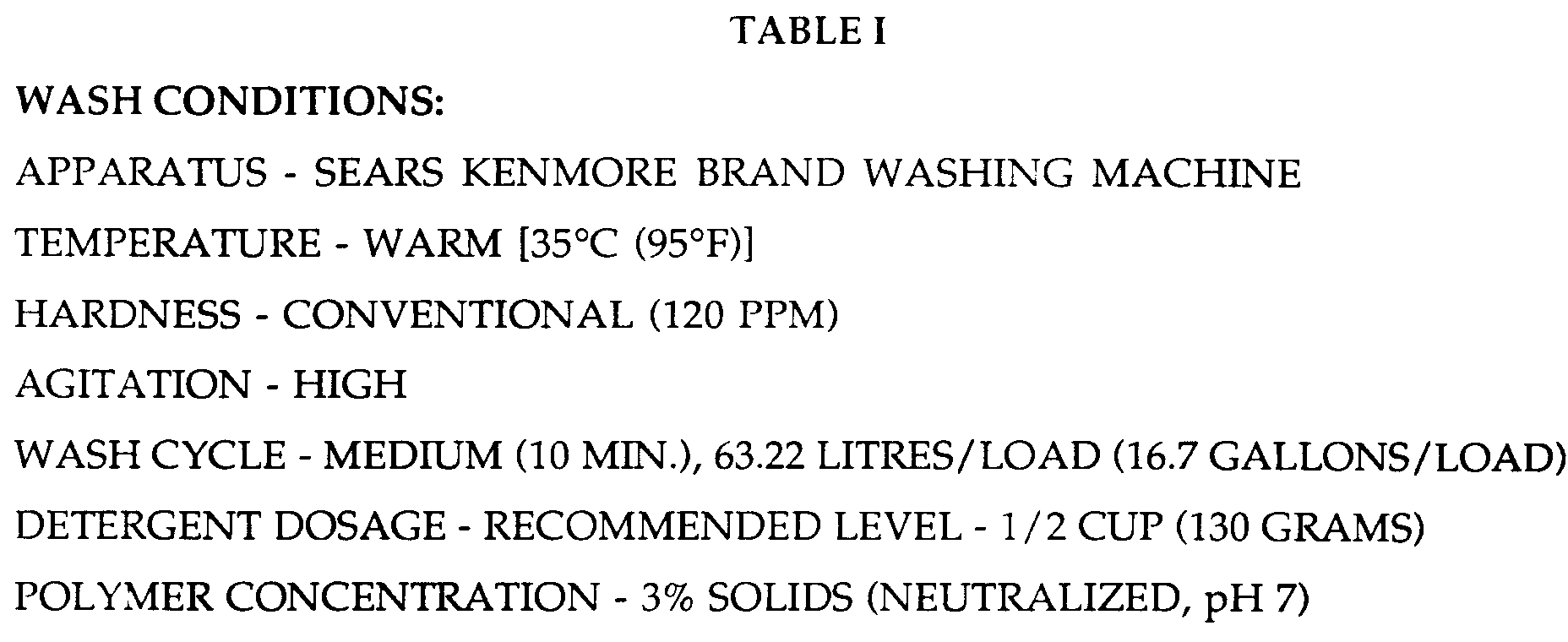
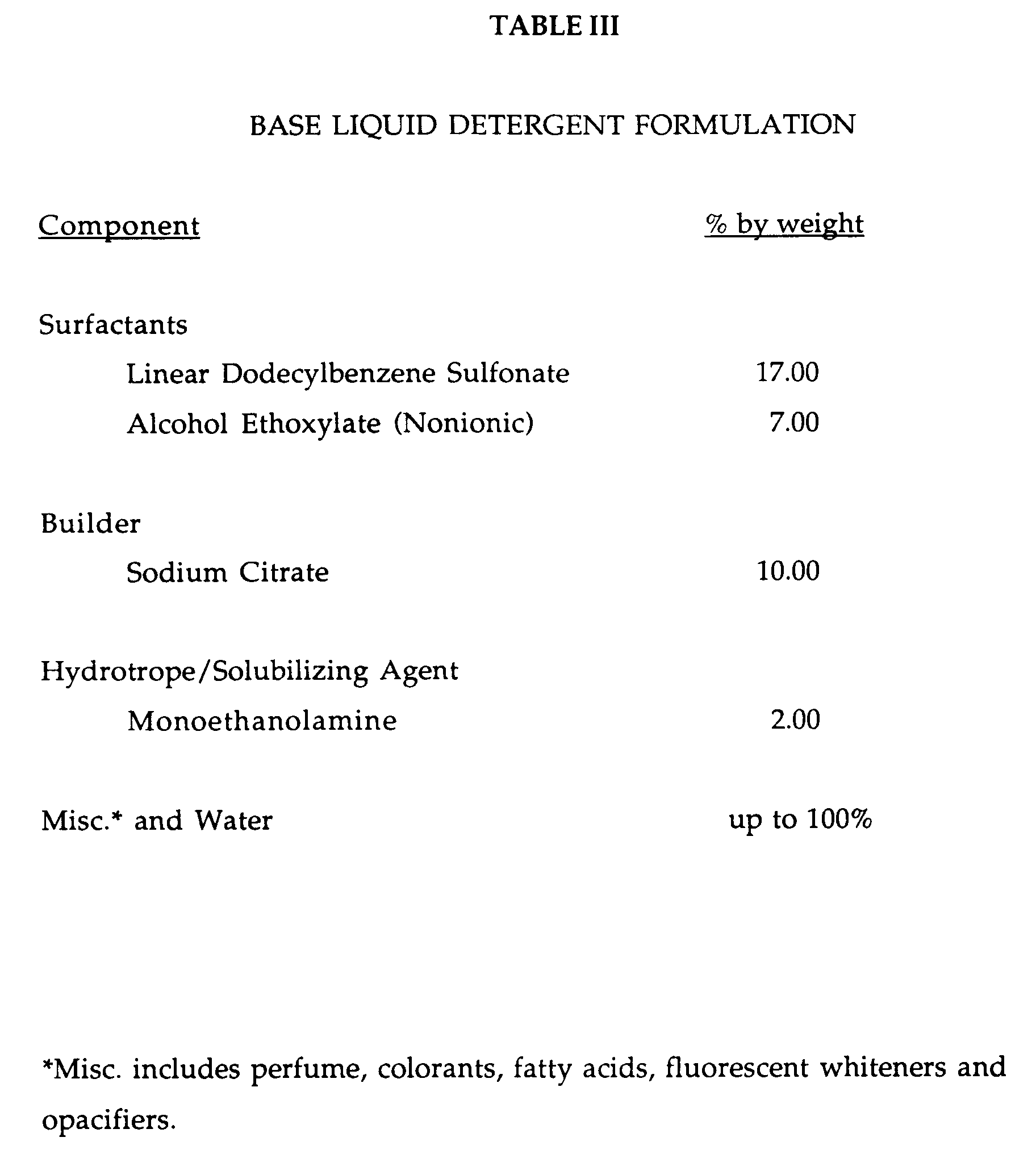
- The performance of the polymers of this invention in a commercial liquid detergent formulation was evaluated by washing cotton, polyester/cotton blend (65/35) and polyester soiled fabrics in a commercially available, heavy duty liquid detergent utilizing Sears Kenmore Ultra Fabric Care brand washing machines (model Heavy Duty 80 Series) set to typical U.S. laundering parameters ("Kenmore" is a trademark). Washing conditions, soil/fabric combinations and polymer concentration are detailed in Tables I and II, and the liquid detergent formulation base used for evaluating the copolymers of the invention is illustrated in Table III.
- Soiled cloths were prepared (except where noted) by Scientific Services (Oakland, NJ) and cut to a specified size [8.89cm x 11.43cm (3 1/2" x 4 1/2")]. Reflectance was measured using a Pacific Scientific Colorimeter (Colorgard System 1000) and the data recorded using the L, a, b color scale. The reflectance (L) of the soiled cloths was measured before laundering so that only cloths of the same reflectance were used in a test.
- Reflectance was then measured after laundering to evaluate the efficacy of the detergent and are reported as the average value. In an effort to create realistic soil/fabric combinations encountered in a consumer's wash load, soils were selected from four classes;
- Particulates (clays)
- Oily/Particulates (collar soils)
- Oxidizables (stains)
- Enzyme Sensitive (proteinaceous)
- Table IV illustrates the evaluation of the polyitaconic acid homopolymer of Example #3 and a pair of 80/20 Acrylic Acid/Itaconic Acid copolymers in the commercial heavy-duty liquid detergent.

- Polyitaconic homopolymer exhibits some improvements on oily/particulate soils (stain A) and particulate soils (stain C) but shows significant benefits on oxidizable soils (stain B) removal.
- The Acrylic Acid/Itaconic Acid (80/20) copolymers display an almost analogous performance profile to the polyitaconic homopolymer, except benefits on particulates and oily/particulates are less significant.
- The polyitaconic acid homopolymer was evaluated in a prototypical non-phosphate powder composition utilizing a higher polymer concentration, four percent by weight, slightly higher water hardness (125 ppm) and one cup of detergent base (130 grams). The results of the test are illustrated below in Table V.

- Significant improvements are exhibited on dust/sebum (collar soil) removal on all three fabrics (cotton, polyester/cotton blend and polyester).
- The polymer of Example 3 was also evaluated as a clay dispersant and compared to a conventional clay dispersant. The test procedure was as follows:
- 1. RUW kaolin clay (RUW is a trademark of Engelhard Corp.) was dried at 70°C for three days and was sifted to remove any particles larger than 20 U.S. Standard mesh (850 micrometers).
- 2. A dispersant solution was prepared by adding polymer, soda ash (to control pH), and diluting with deionized water such that the solution contained 15.0 percent by weight polymer solids and 10.0 percent by weight soda ash solids.
- 3. 5.0 grams of the dispersant solution was diluted to 214.3 grams with deionized water.
- 4. 500 grams of the dried sifted clay was added to the diluted dispersant solution and the clay was mixed with a spatula until thoroughly wetted.
- 5. The mixture was then stirred at high speed for five minutes using a Hamilton Beach brand multimixer. The mixture was allowed to cool at room temperature for two hours.
- 6. The mixture was then mixed for one minute at low speed and the viscosity was measured.
- 7. 0.33 grams of the dispersant solution was added to the mixture.
- 8. The mixture was then mixed for one minute at low speed and the viscosity was measured.
- Steps 7 and 8 were repeated several times to find the minimum slurry viscosity.
- The data, which appears in Table VI below, shows that the itaconic homopolymer works well as a dispersant as indicated by the minimum slurry viscosity. Furthermore, the minimum viscosity was maintained over a wide range of polymer levels allowing a wide operating window when using the itaconic homopolymer as a dispersant.
TABLE VI Slurry Viscosity, Pa s (cps)¹ Dispersant Level² 0.15 0.16 0.17 0.18 0.19 0.20 0.21 0.22 0.23 Acusol 445N³ 0.515 (515) 0.384 (384) 0.340 (340) 0.332 (332) 0.358 (358) 0.383 (383) Example 3 1.200 (1200) 0.840 (840) 0.745 (745) 0.384 (384) 0.302 (302) 0.298 (298) 0.298 (298) 0.312 (312) 0.305 (305) ¹ Brookfield RVTDV-II (#2 spindle, 20 rpm, 23°C) ² Percent Polymer Solids On Dry Clay ³ Acusol is a trademark of the Rohm and Haas Co. Acusol 445N is a fully neutralized acrylic acid homopolymer with molecular weight 4,500.
| SOIL CLASS | SOIL IDENTITY (SWATCH FABRIC) |
| PARTICULATES | *BIG OAK CLAY (COTTON) |
| *SKIPPACK CLAY (COTTON) | |
| SCIENTIFIC SERVICES CLAY (COTTON) | |
| OILY/PARTICULATES | COSMETIC MAKEUP (COTTON) |
| DUST/SEBUM (COTTON, PE/COTTON, PE)** | |
| OXIDIZABLE | GRAPE JUICE (PE/COTTON)** |
| BREWED TEA (PE/COTTON)** | |
| GRASS (COTTON) |
| * Prepared by applying 0.7 - 0.8 grams of a 25% clay slurry (in water) of Skippack or Big Oak Clay to a 8.89 cm X 11.43 cm (3 1/2" X 4 1/2") white cotton swatch (Cotton #405 - Test Fabrics) using a China bristle brush (#10). The soil was "painted" onto the cloth inside a 5.08 cm (2") diameter circle and allowed to air dry overnight prior to laundering. | |
| ** PE = polyester |
Claims (14)
- A process for producing itaconic acid polymers, which comprises polymerizing, in a reactor and at a temperature of from about 50 to about 200°C, a reaction mixture comprising water, initiator and itaconic acid monomer, optionally together with acrylic acid monomer, and wherein the acid groups of the monomer(s) and/or polymer are neutralized to a level of from about 80 to 100 equivalent percent with water-soluble base before or during the polymerization.
- A process as claimed in claim 1, wherein the reaction mixture is formed by:-(a) initially charging the reactor with water, adding the monomer(s) to the reactor charged with the water, and adding the initiator to the resulting water/monomer(s) mixture; or(b) initially charging the reactor with the water, and adding the initiator and the monomer(s) to the reactor charged with the water, the monomer(s) being cofed to the reactor with, but as a separate stream to, the initiator.
- A process as claimed in claim 1 or claim 2, wherein the monomer(s) is/are added to the reactor at a substantially uniform addition rate.
- A process as claimed in any preceding claim, wherein the monomer(s) is/are added to the reactor as an aqueous solution.
- A process as claimed in any preceding claim, wherein the reaction mixture is formed by adding, to the reactor, an initial charge comprising the water and the monomer(s), and adding the initiator to the initial charge of monomer(s) and water.
- A process as claimed in any preceding claim, wherein the initiator is added at a substantially uniform addition rate.
- A process as claimed in any preceding claim, wherein the initiator is added to the reactor as an aqueous solution.
- A process as claimed in claim 7, wherein the initiator solution comprises 0.5 to 20 percent, for example 1.0 to 10 percent, by weight of active initiator on monomer.
- A process as claimed in any preceding claim, wherein the polymerization is run at solids levels in the range of from 30 to 80 percent by weight, for example 30 to 60 percent by weight, based on the total amount of monomer(s).
- A process as claimed in any preceding claim, wherein monomer(s) are completely neutralized.
- A process as claimed in any preceding claim, wherein the monomer(s) have been neutralized with water-soluble base prior to addition to the reactor.
- A detergent composition containing up to about 30 percent by weight of a polymer prepared by a process as claimed in any of claims 1 to 11.
- A water treatment composition, or a dispersant composition, containing an effective amount of a polymer prepared by a process as claimed in any of claims 1 to 11.
- Use of a polymer, prepared by a process as claimed in any of claims 1 to 11, as a detergent additive, a scale inhibitor, a sequestrant, a deflocculating agent, a de-inking agent, a suspending agent, a dispersing agent, or a yarn sizing agent.
Applications Claiming Priority (2)
| Application Number | Priority Date | Filing Date | Title |
|---|---|---|---|
| US676056 | 1991-03-27 | ||
| US07/676,056 US5223592A (en) | 1991-03-27 | 1991-03-27 | Process for polymerization of itaconic acid |
Publications (1)
| Publication Number | Publication Date |
|---|---|
| EP0506246A1 true EP0506246A1 (en) | 1992-09-30 |
Family
ID=24713053
Family Applications (1)
| Application Number | Title | Priority Date | Filing Date |
|---|---|---|---|
| EP19920301966 Withdrawn EP0506246A1 (en) | 1991-03-27 | 1992-03-09 | Preparation of itaconic acid polymers |
Country Status (10)
| Country | Link |
|---|---|
| US (1) | US5223592A (en) |
| EP (1) | EP0506246A1 (en) |
| JP (1) | JPH0586129A (en) |
| KR (1) | KR920018095A (en) |
| CN (1) | CN1065276A (en) |
| AU (1) | AU1138192A (en) |
| BR (1) | BR9201061A (en) |
| CA (1) | CA2063197A1 (en) |
| MX (1) | MX174542B (en) |
| NZ (1) | NZ242068A (en) |
Cited By (10)
| Publication number | Priority date | Publication date | Assignee | Title |
|---|---|---|---|---|
| US5399639A (en) * | 1993-07-12 | 1995-03-21 | National Starch And Chemical Investment Holding Corporation | Method for manufacturing of polymers |
| US5431846A (en) * | 1993-05-20 | 1995-07-11 | Lever Brothers Company, Division Of Conopco, Inc. | Copolymers and detergent compositions containing them |
| EP0918088A1 (en) * | 1997-11-24 | 1999-05-26 | The Procter & Gamble Company | Use of a crystal growth inhibitor to reduce fabric abrasion |
| WO1999027052A1 (en) * | 1997-11-24 | 1999-06-03 | The Procter & Gamble Company | Use of a crystal growth inhibitor to reduce fabric abrasion |
| US6692536B1 (en) | 1997-11-24 | 2004-02-17 | The Procter & Gamble Company | Use of a crystal growth inhibitor to reduce fabric abrasion |
| WO2009151837A1 (en) | 2008-05-16 | 2009-12-17 | University Of New Hampshire | Polycarboxylic acid polymers |
| WO2014143773A1 (en) * | 2013-03-15 | 2014-09-18 | Lubrizol Advanced Materials, Inc. | Itaconic acid polymers |
| WO2014151439A1 (en) * | 2013-03-15 | 2014-09-25 | Lubrizol Advanced Materials, Inc. | Itaconic acid polymers for oral care applications |
| EP2694664A4 (en) * | 2011-04-06 | 2015-03-25 | Univ New Hampshire | RECOVERING A MONOMER OF VINYLIC ACID |
| EP3261614A1 (en) * | 2015-02-27 | 2018-01-03 | Itaconix (U.K.) Limited | Polymers of itaconic acid and uses thereof as a film forming agent in a cosmetic or personal care product |
Families Citing this family (34)
| Publication number | Priority date | Publication date | Assignee | Title |
|---|---|---|---|---|
| DE69433262T2 (en) * | 1993-03-12 | 2004-05-13 | Fmc Corp. | PERSULFATE MIXTURES FOR PROCESSING WET-RESISTANT PAPER |
| US5888350A (en) * | 1993-08-17 | 1999-03-30 | Fmc Corporation | Method for repulping and/or decolorizing broke using persulfate/metal mixtures |
| JP3629033B2 (en) * | 1993-08-17 | 2005-03-16 | エフ エム シー コーポレーション | Persulfate / metal mixtures for repulping and decolorization |
| US6703469B2 (en) * | 2001-03-05 | 2004-03-09 | Specialty Fertilizer Products, Llc | Anionic polymers composed of dicarboxylic acids and uses thereof |
| US20040226329A1 (en) * | 2001-03-05 | 2004-11-18 | Sanders John Larry | Anionic polymers composed of dicarboxylic acids and uses thereof |
| US20040226331A1 (en) * | 2001-03-05 | 2004-11-18 | Sanders John Larry | Anionic polymers composed of dicarboxylic acids and uses thereof |
| US20040230020A1 (en) * | 2001-03-05 | 2004-11-18 | Sanders John Larry | Anionic polymers composed of dicarboxylic acids and uses thereof |
| US20040226330A1 (en) * | 2001-03-05 | 2004-11-18 | Sanders John Larry | Anionic polymers composed of dicarboxylic acids and uses thereof |
| BR0214995A (en) * | 2001-12-07 | 2004-12-07 | Specialty Fertilizer Products | Anti-Explosive Fertilizer Coatings |
| AU2003267940A1 (en) * | 2002-01-24 | 2003-12-31 | John L. Sanders | Anti-explosive fertilizer coatings |
| US20060086674A1 (en) * | 2004-10-25 | 2006-04-27 | Morgan H W | Fluid filter having filter basket and method |
| WO2011075567A1 (en) * | 2009-12-16 | 2011-06-23 | University Of New Hampshire | Emulsion polymerization of esters of itaconic acid |
| US8420758B2 (en) * | 2010-03-11 | 2013-04-16 | Itaconix Corporation | Regulated and continuous polymerization of polycarboxylic acid polymers |
| US9145340B2 (en) | 2012-08-13 | 2015-09-29 | Verdesian Life Sciences, Llc | Method of reducing atmospheric ammonia in livestock and poultry containment facilities |
| US9961922B2 (en) | 2012-10-15 | 2018-05-08 | Verdesian Life Sciences, Llc | Animal feed and/or water amendments for lowering ammonia concentrations in animal excrement |
| US20140296463A1 (en) * | 2013-03-27 | 2014-10-02 | Lubrizol Advanced Materials, Inc. | Polymers derived from itaconic acid |
| US11254620B2 (en) | 2013-08-05 | 2022-02-22 | Verdesian Life Sciences U.S., Llc | Micronutrient-enhanced polymeric seed coatings |
| TW201522390A (en) | 2013-08-27 | 2015-06-16 | 特級肥料產品公司 | Polyanionic polymers |
| WO2015035031A1 (en) | 2013-09-05 | 2015-03-12 | Verdesian Life Sciences, Llc | Polymer-boric acid compositions |
| US9790395B2 (en) | 2013-12-26 | 2017-10-17 | Itaconix Corporation | Soluble aqueous compositions of zinc salts of selected polyitaconic acid polymers |
| KR20160103055A (en) | 2013-12-26 | 2016-08-31 | 이타코닉스 코포레이션 | Soluble aqueous compositions of selected polyitaconic acid polymers |
| ES2823562T3 (en) * | 2014-03-14 | 2021-05-07 | Lubrizol Advanced Mat Inc | Polymers and copolymers of itaconic acid |
| US10519070B2 (en) | 2014-05-21 | 2019-12-31 | Verdesian Life Sciences U.S., Llc | Polymer soil treatment compositions including humic acids |
| WO2015179552A1 (en) | 2014-05-22 | 2015-11-26 | Verdesian Life Sciences, Llc | Polymeric compositions |
| US10544300B2 (en) | 2015-07-07 | 2020-01-28 | Cargill, Incorporated | Aqueous binder comprising reaction products of itaconic acid |
| US9487423B1 (en) | 2015-08-04 | 2016-11-08 | Itaconix Corporation | Partially decarboxylated polycarboxylic acid polymers |
| EP3337831B1 (en) | 2015-08-21 | 2024-02-28 | G&P Holding, Inc. | Silver and copper itaconates and poly itaconates |
| WO2017085069A1 (en) | 2015-11-18 | 2017-05-26 | Albert-Ludwigs-Universität Freiburg | Polymer having antimicrobial and/or antifouling properties |
| FR3058649A1 (en) * | 2016-11-14 | 2018-05-18 | Coatex | PROCESS FOR GRINDING MINERALS IN THE PRESENCE OF A POLY (ITACONATE) |
| CN107352891B (en) * | 2017-06-28 | 2020-02-07 | 大千生态环境集团股份有限公司 | Long-span steel bridge paving material |
| US10738139B2 (en) | 2018-12-18 | 2020-08-11 | Itaconix Corporation | Decarboxylation and amidation of polyitaconic acid polymers |
| CN115701982B (en) * | 2020-06-22 | 2024-07-05 | 联合利华知识产权控股有限公司 | Biodegradable adhesive composition |
| CN113265019B (en) * | 2021-05-11 | 2022-06-03 | 济宁南天农科化工有限公司 | Itaconic acid autopolymer type hydrogen peroxide stabilizer and preparation method thereof |
| CN118290652B (en) * | 2024-03-19 | 2025-08-01 | 南京艾普拉斯化工有限公司 | Novel bio-based ternary polymer and preparation method and application thereof |
Citations (1)
| Publication number | Priority date | Publication date | Assignee | Title |
|---|---|---|---|---|
| DE3233776A1 (en) * | 1982-09-11 | 1984-03-15 | Basf Ag, 6700 Ludwigshafen | METHOD FOR PRODUCING COPOLYMERISATES FROM MONOETHYLENICALLY UNSATURATED MONO- AND DICARBONIC ACIDS |
Family Cites Families (3)
| Publication number | Priority date | Publication date | Assignee | Title |
|---|---|---|---|---|
| US2294226A (en) * | 1939-10-28 | 1942-08-25 | Gen Electric | Preparation of granulated polymers and copolymers |
| US3560529A (en) * | 1968-09-10 | 1971-02-02 | Fmc Corp | Polymerization of itaconic anhydride |
| US5032646A (en) * | 1981-10-29 | 1991-07-16 | Pfizer Inc. | (Meth)acrylic acid/itaconic acid copolymers, their preparation and use as antiscalants |
-
1991
- 1991-03-27 US US07/676,056 patent/US5223592A/en not_active Expired - Lifetime
-
1992
- 1992-03-03 AU AU11381/92A patent/AU1138192A/en not_active Abandoned
- 1992-03-09 EP EP19920301966 patent/EP0506246A1/en not_active Withdrawn
- 1992-03-17 CA CA 2063197 patent/CA2063197A1/en not_active Abandoned
- 1992-03-19 MX MX9201228A patent/MX174542B/en not_active IP Right Cessation
- 1992-03-20 NZ NZ242068A patent/NZ242068A/en unknown
- 1992-03-26 KR KR1019920004900A patent/KR920018095A/en not_active Ceased
- 1992-03-26 CN CN92102091A patent/CN1065276A/en active Pending
- 1992-03-26 JP JP6864592A patent/JPH0586129A/en not_active Withdrawn
- 1992-03-26 BR BR9201061A patent/BR9201061A/en not_active Application Discontinuation
Patent Citations (1)
| Publication number | Priority date | Publication date | Assignee | Title |
|---|---|---|---|---|
| DE3233776A1 (en) * | 1982-09-11 | 1984-03-15 | Basf Ag, 6700 Ludwigshafen | METHOD FOR PRODUCING COPOLYMERISATES FROM MONOETHYLENICALLY UNSATURATED MONO- AND DICARBONIC ACIDS |
Non-Patent Citations (1)
| Title |
|---|
| CHEMICAL ABSTRACTS, vol. 102, no. 24, 17 June 1985, Columbus, Ohio, US; abstract no. 204872, 'WATER-SOLUBLE COPOLYMER' page 39 ;column 2 ; &JP-A-6032810 (NIPPON ZEON Co. Ltd.) * |
Cited By (14)
| Publication number | Priority date | Publication date | Assignee | Title |
|---|---|---|---|---|
| US5431846A (en) * | 1993-05-20 | 1995-07-11 | Lever Brothers Company, Division Of Conopco, Inc. | Copolymers and detergent compositions containing them |
| US5399639A (en) * | 1993-07-12 | 1995-03-21 | National Starch And Chemical Investment Holding Corporation | Method for manufacturing of polymers |
| EP0634428B1 (en) * | 1993-07-12 | 1998-10-21 | National Starch and Chemical Investment Holding Corporation | A method for manufacture of polymers |
| US6692536B1 (en) | 1997-11-24 | 2004-02-17 | The Procter & Gamble Company | Use of a crystal growth inhibitor to reduce fabric abrasion |
| WO1999027052A1 (en) * | 1997-11-24 | 1999-06-03 | The Procter & Gamble Company | Use of a crystal growth inhibitor to reduce fabric abrasion |
| EP0924292A1 (en) * | 1997-11-24 | 1999-06-23 | The Procter & Gamble Company | Use of a crystal growth inhibitor to reduce fabric abrasion |
| EP0918088A1 (en) * | 1997-11-24 | 1999-05-26 | The Procter & Gamble Company | Use of a crystal growth inhibitor to reduce fabric abrasion |
| WO2009151837A1 (en) | 2008-05-16 | 2009-12-17 | University Of New Hampshire | Polycarboxylic acid polymers |
| EP2283066A4 (en) * | 2008-05-16 | 2013-01-02 | Univ New Hampshire | POLY-CARBOXYLIC ACID POLYMERS |
| AU2009257918B2 (en) * | 2008-05-16 | 2014-12-11 | University Of New Hampshire | Polycarboxylic acid polymers |
| EP2694664A4 (en) * | 2011-04-06 | 2015-03-25 | Univ New Hampshire | RECOVERING A MONOMER OF VINYLIC ACID |
| WO2014143773A1 (en) * | 2013-03-15 | 2014-09-18 | Lubrizol Advanced Materials, Inc. | Itaconic acid polymers |
| WO2014151439A1 (en) * | 2013-03-15 | 2014-09-25 | Lubrizol Advanced Materials, Inc. | Itaconic acid polymers for oral care applications |
| EP3261614A1 (en) * | 2015-02-27 | 2018-01-03 | Itaconix (U.K.) Limited | Polymers of itaconic acid and uses thereof as a film forming agent in a cosmetic or personal care product |
Also Published As
| Publication number | Publication date |
|---|---|
| JPH0586129A (en) | 1993-04-06 |
| MX9201228A (en) | 1992-10-01 |
| BR9201061A (en) | 1992-11-24 |
| CN1065276A (en) | 1992-10-14 |
| AU1138192A (en) | 1992-10-01 |
| NZ242068A (en) | 1994-08-26 |
| MX174542B (en) | 1994-05-23 |
| KR920018095A (en) | 1992-10-21 |
| CA2063197A1 (en) | 1992-09-28 |
| US5223592A (en) | 1993-06-29 |
Similar Documents
| Publication | Publication Date | Title |
|---|---|---|
| US5223592A (en) | Process for polymerization of itaconic acid | |
| AU701617B2 (en) | Aqueous process for preparing low molecular weight polymers | |
| EP0429307B1 (en) | Biodegradable, water-soluble graft copolymers, compositions containing such copolymers, and methods of use of such copolymers | |
| AU670152B2 (en) | Detergent compositions containing maleate polymers | |
| AU660166B2 (en) | Biodegradable polymers, process for preparation of such polymers, and compositions containing such polymers | |
| DE19516957C2 (en) | Water-soluble copolymers and process for their preparation and their use | |
| BG62006B1 (en) | BIOLOGICALLY DIAGNOSTIC COMPOUNDS, METHOD FOR THE USE AND USE OF THE COMPOSITION | |
| AU4235799A (en) | High temperature viscosity stable thickener | |
| WO2006064940A1 (en) | Amino group-containing water-soluble copolymer | |
| CA2139817A1 (en) | Aqueous process for preparing water soluble polymers of monoethylenically unsaturated dicarboxylic acids | |
| US5336744A (en) | Process for polymerization of itaconic acid | |
| CA2127526C (en) | Method for manufacture of polymers | |
| EP0747343A1 (en) | Polycarboxylic monomer, polymer of the same, and detergent composition containing the polymer | |
| JP7682278B2 (en) | Ester bond-containing polycarboxylic acid (salt) and method for producing same | |
| JP2002060433A (en) | New water-soluble copolymer and its manufacturing method, and use thereof | |
| JP3394055B2 (en) | Biodegradable hydrophilic crosslinked polymer, method for producing the same, and use of the crosslinked polymer | |
| CA1322068C (en) | Terpolymer | |
| HUT67903A (en) | Water-soluble addition polymers of cyclohexene anhydrides, process for producing and using thereof | |
| PT95965A (en) | PROCESS FOR THE PREPARATION OF COPOLYMERS OF BIODEGRADABLE WATER SOLUBLE POLYCARBOXYLIC ACIDS AND COMPOSITIONS CONTAINING THEM | |
| DE60222475T2 (en) | POLY-BETA-CARBOXYL ACRYLAMIDE POLYMER, ITS USE AND METHOD FOR THE PRODUCTION THEREOF | |
| CN117715949A (en) | Polycarboxylic acid (salt) containing ester bond and method for producing same | |
| JP2009035633A (en) | Polymer builder | |
| JP2001055419A (en) | Unsaturated carboxylic acid polymer, its production and biodegradable builder |
Legal Events
| Date | Code | Title | Description |
|---|---|---|---|
| PUAI | Public reference made under article 153(3) epc to a published international application that has entered the european phase |
Free format text: ORIGINAL CODE: 0009012 |
|
| 17P | Request for examination filed |
Effective date: 19920321 |
|
| AK | Designated contracting states |
Kind code of ref document: A1 Designated state(s): DE FR GB IT |
|
| 18W | Application withdrawn |
Withdrawal date: 19950307 |