EP0505384B1 - Methods of and apparatus for monitoring respiration and conductive gel used therewith - Google Patents
Methods of and apparatus for monitoring respiration and conductive gel used therewith Download PDFInfo
- Publication number
- EP0505384B1 EP0505384B1 EP90917375A EP90917375A EP0505384B1 EP 0505384 B1 EP0505384 B1 EP 0505384B1 EP 90917375 A EP90917375 A EP 90917375A EP 90917375 A EP90917375 A EP 90917375A EP 0505384 B1 EP0505384 B1 EP 0505384B1
- Authority
- EP
- European Patent Office
- Prior art keywords
- gauge
- composition
- patient
- tube
- volume
- Prior art date
- Legal status (The legal status is an assumption and is not a legal conclusion. Google has not performed a legal analysis and makes no representation as to the accuracy of the status listed.)
- Expired - Lifetime
Links
Images



Classifications
-
- H—ELECTRICITY
- H01—ELECTRIC ELEMENTS
- H01B—CABLES; CONDUCTORS; INSULATORS; SELECTION OF MATERIALS FOR THEIR CONDUCTIVE, INSULATING OR DIELECTRIC PROPERTIES
- H01B1/00—Conductors or conductive bodies characterised by the conductive materials; Selection of materials as conductors
- H01B1/20—Conductive material dispersed in non-conductive organic material
-
- A—HUMAN NECESSITIES
- A61—MEDICAL OR VETERINARY SCIENCE; HYGIENE
- A61B—DIAGNOSIS; SURGERY; IDENTIFICATION
- A61B5/00—Measuring for diagnostic purposes; Identification of persons
- A61B5/103—Measuring devices for testing the shape, pattern, colour, size or movement of the body or parts thereof, for diagnostic purposes
- A61B5/11—Measuring movement of the entire body or parts thereof, e.g. head or hand tremor or mobility of a limb
- A61B5/113—Measuring movement of the entire body or parts thereof, e.g. head or hand tremor or mobility of a limb occurring during breathing
- A61B5/1135—Measuring movement of the entire body or parts thereof, e.g. head or hand tremor or mobility of a limb occurring during breathing by monitoring thoracic expansion
-
- H—ELECTRICITY
- H01—ELECTRIC ELEMENTS
- H01M—PROCESSES OR MEANS, e.g. BATTERIES, FOR THE DIRECT CONVERSION OF CHEMICAL ENERGY INTO ELECTRICAL ENERGY
- H01M6/00—Primary cells; Manufacture thereof
- H01M6/22—Immobilising of electrolyte
Definitions
- the instant invention relates to apparatus and a process for monitoring respiration as well as to a conductive gel used therewith, wherein the apparatus comprises at least first and preferably second circumferential gauges that attach around a patient's abdomen and chest to monitor expansion thereof as the patient breaths.
- the gauges are configured as hollow tubes containing the new and improved conductive gel.
- respiratory inductive plethysmographs have advantages over conventional thoracic impedance monitors for infants.
- Plethysmographs need to be substantially modified before being used for routine monitoring of infants in hospitals or at home.
- the cost is excessive and the associated systems complex.
- apparatus for monitoring respiration as defined in claim 9.
- the instant invention further contemplates a conductive fluid or gel containing water and glycerol, 35-90% by volume and preferably 50-70% by volume and at least one of the following salts: NaCl, preferably from about 20% (g/100 ml) by volume to saturated solution; KCl, preferably from about 20% (g/100 ml) by volume to saturated solution; and sodium or potassium acetate, preferably from about 20% (g/100 ml) by volume to saturated solution; calcium lactate, preferably from about 20% (g/100 ml) by volume to saturated solution; and magnesium sulfate, preferably from about 20% by volume to saturated solution. It is particularly preferred that the salts be present as a saturated solution.
- FIG. 1 there is shown a patient designated generally by the numeral 10 having a chest or thorax 11, a diaphragm generally illustrated by the numeral 12; and an abdomen 13.
- the chest gauge 14 is positioned above the patient's diaphragm 12, while the abdominal gauge 16 is positioned below the patient's diaphragm.
- the gauges 14 and 16 are connected via leads 17 and 18 to a monitoring circuit, designated generally by the numeral 19 and illustrated more specifically in Figure 8.
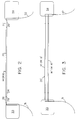
- a silicone rubber tube 20 having a length in the range of 16-36 cm, a wall thickness of 0.06 mm (0.003 inch) and an inside diameter of 2 mm is filled with a conductive gel 24 so as to have mechanical and electrical characteristics similar to gauges using a mercury conductor.
- the tube 20 is sealed at first and second ends 26 and 27 by bronze or gold L-shaped contacts 28 and 29, respectively, which are soldered to standard patient lead wire connectors 31 and 32.
- VelcroTM pads 33 and 34 are bonded or otherwise connected to the L-shaped contacts 28 and 29 so that the gauges 14 and 16 attach securely about the patient's thorax and abdomen.
- FIG. 3 there is shown an alternative embodiment of the invention, wherein the silicone rubber tubing 20 is arranged in pairs with identical tubes 20A and 20B, each having substantially the same characteristics as the tube 20 of Figure 2.
- Gel 24 is a mixture of the following substances: glycerol in the range of about 35-90% by volume and preferably about 40-70% by volume mixed with water; NaCl, from about 20 g per 100 ml by volume to preferably a saturated solution; KCl, from about 20 g per 100 ml by volume to preferably a saturated solution; potassium acetate, from about 20 g per 100 ml by volume to preferably a saturated solution; calcium lactate, from about 20 g per 100 ml by volume to preferably a saturated solution; magnesium sulfate, from about 20 g per 100 ml by volume to preferably a saturated solution; optional ingredients: glucose, 1 g to 50 g per 100 ml by volume and commercial, nontoxic food coloring.
- glycerol in the range of about 35-90% by volume and preferably about 40-70% by volume mixed with water
- NaCl from about 20 g per 100 ml by volume to preferably a saturated solution
- KCl from about 20 g per
- a satisfactory method for making the gel is to start with water and to add NaCl to saturation, then add KCl to saturation, K acetate to saturation, calcium lactate to saturation, and, if a gel is desired, magnesium sulfate to saturation. In every instance, saturation is observed by the presence of an undissolved solid phase of the added component. Thereafter, the glycerol is added and, after the volume of glycerol exceeds a value of about 40%, undissolved salts surprisingly enter into the solution, thereby resulting in a system having salt concentrations exceeding those in water alone. It is contemplated that other methods may also be used, e.g., adding the salts to a glycerol-water mixture. In any case, an important inventive aspect of this invention is the discovery of the enhanced salt solubilities due to the presence of glycerol, and it is contemplated that equivalent salt mixtures or even single salts may be used to obtain advantages of the invention.
- All of the above components are commonly used materials which are available for intravenous fluid preparations and are readily available in sterile form.
- the solution does not support bacterial growth without glucose. If glucose is included, it is preferred that a mixture be made up in a closed, sterile circuit. Since the mixture is normally a clear gel, the addition of food coloring helps in determining if the contacts are immersed and whether the tube is completely filled with gel so as to preclude air spaces or voids.
- the silicone rubber tubes 14 and 16 have very thin walls, e.g., as low as 0.076 mm (0.003 inch), the addition of food coloring indicates whether the walls have been ruptured or whether there has been passage of any of the gel or its constituents through the tubing wall by osmosis.
- Another advantage of the aforedescribed gel is that it may be stored for an indefinite period without leaking through the tube wall and thereafter serve as a stable transducer for at least a month or more while maintaining impedance below about 80 kohms.
- the impedance of the gauges 14 and 16 is in the range of 20-60 kohms, with voltage/centimeter remaining substantially constant at different gauge lengths, as is illustrated in Figure 5.
- the change in impedance with stretch is nearly linear for at least 50% of the length of the gauge.
- the signal-to-noise ratio is high, with more than 300 mv/cm of stretch when activated by 2-4 volts applied in the range of 500 Hz to 30 kHz.
- Gauges 14 and 16 are capable of resolving a 0.1 mm change in dimension with a battery-powered circuit. Since the circumferential respiratory excursion for adults is usually less than 6 cm (0.1 mm to 60 mm), the gauge provides a highly accurate indicator of tidal volume.
- tidal volume By simultaneous cross-sectional measurements of the patient's thorax or chest 11 with the gauge 14 and the patient's abdomen 13 with the gauge 16, approximations of tidal volume accurate to 0.1 mm of gauge length can be obtained. Since the absolute circumference is known, the variation in circumference can be used to estimate volume based on coefficients determined in vivo by one obstruction performed during inspiration and another performed during expiration. The relationship of tidal volume to circumference is a unique coefficient relating volume to the square of the circumference of the applied gauges 14 and 16. The interaction of the thorax 11 and the abdomen 13 is calculated simultaneously in real time to estimate both tidal volume and functional residual capacity.
- the signal from the gauge provides both absolute circumference and circumference variation to an accuracy of 0.1 mm, an estimate of both functional residual capacity and tidal volume can be developed to a presumed accuracy of a few cubic centimeters.
- an independently calibratable monitor for absolute volume of respiratory effort is provided.
- the gauges 14 and 16 can be manufactured to tolerances where the impedance is calculable simply by knowing the gauge geometry.
- gauge 14 or 16 is mounted on an accurate vernier rule 60 by fixing one end 26 thereto and attaching the other end 27 to a sliding element 61 settable to fixed stops.
- the gauge 14 or 16 is then stretched to measured lengths and the voltage levels indicative of these lengths is entered into the microprocessor 19 ( Figures 1 and 7) via a standard digital switch.
- the gauge 14 or 16 may be stretched a number of times between fixed stops and the voltages at those stops entered in and averaged by the microprocessor 9.
- the gauge 14 or 16 is then wrapped around a patient 10 and the separation distance "L" entered in the microprocessor 19 as a correction factor via a digital switch.
- the distance "L” is added to the lengths of the gauges 14 and 16 so that the total circumference of the patient is taken into account when computing residual capacity and tidal volume of the patient's respiration.
- gauges 16 and 17 of the instant invention allow for faster more efficient utilizations of systems such as NMR's and CT's.
- the chest gauge 14 and abdominal gauge 16 are connected to the microprocessor and clock 19.
- Leads 31 and 31' of the gauges 14 and 16, respectively, are connected through analog-to-digital converters 70 and 70' to the microprocessor and clock 19 via leads 71 and 71'.
- Leads 32 and 32' are connected to the analog-to-digital converters 70 and 70' via variable resistors Rc and Ra, respectively, and their input is also fed to the microprocessor 19 via lines 71 and 71'.
- the signals on lines 31 and 31', and 32 and 32' are fed through digital input-output chips 74 and 74' via lines 76 and 76', and 77 and 77', respectively, with the signals on lines 77 and 77' being unmodified by the resistors Rc and Ra in series with the gauges and while changes in pulse amplitude are measured through programmable input amplifiers 80 and 80'.
- the output of the microprocessor 19 can be displayed by a digital readout 81, or via a digital-to-analog converter 82, recorded on tape or by a polygraph 83.
- the signal from the digital-to-analog converter 82 may also sound an alarm 84 or be used to enhance NMR or CT scan images 85.
Landscapes
- Health & Medical Sciences (AREA)
- Life Sciences & Earth Sciences (AREA)
- Chemical & Material Sciences (AREA)
- Engineering & Computer Science (AREA)
- Physics & Mathematics (AREA)
- Molecular Biology (AREA)
- Public Health (AREA)
- Pathology (AREA)
- Oral & Maxillofacial Surgery (AREA)
- Biomedical Technology (AREA)
- Heart & Thoracic Surgery (AREA)
- Medical Informatics (AREA)
- Dentistry (AREA)
- Surgery (AREA)
- Animal Behavior & Ethology (AREA)
- General Health & Medical Sciences (AREA)
- Biophysics (AREA)
- Veterinary Medicine (AREA)
- Manufacturing & Machinery (AREA)
- Physiology (AREA)
- Chemical Kinetics & Catalysis (AREA)
- Electrochemistry (AREA)
- General Chemical & Material Sciences (AREA)
- Dispersion Chemistry (AREA)
- Spectroscopy & Molecular Physics (AREA)
- Measurement And Recording Of Electrical Phenomena And Electrical Characteristics Of The Living Body (AREA)
- Measurement Of The Respiration, Hearing Ability, Form, And Blood Characteristics Of Living Organisms (AREA)
Abstract
Description
- The instant invention relates to apparatus and a process for monitoring respiration as well as to a conductive gel used therewith, wherein the apparatus comprises at least first and preferably second circumferential gauges that attach around a patient's abdomen and chest to monitor expansion thereof as the patient breaths. The gauges are configured as hollow tubes containing the new and improved conductive gel.
- In the past, continuous volumetric monitoring of patients' ventilation generally involved use of face masks or mouthpieces, approaches which are not only invasive and uncomfortable to the patient but also interfere with the very breathing patterns being measured. These approaches required considerable cooperation from patients, which cooperation was compromised if the patient was critically ill, comatose, or very young. In addition, leaving mouthpieces in place was a danger in and of itself in that mouthpieces can suffocate patients. Utilizing these invasive methods required constant supervision and attention, further limiting the desirability of these techniques.
- In view of such deficiencies, noninvasive techniques were developed such as those exemplified in U.S. Patent Nos. 3,268,845 and 3,483,861, wherein respiration is monitored by measuring expansion of the patient's torso at primary levels of respiration; namely, expansion of the thoracic cavity, diaphragm, and abdomen. A current approach is shown in U.S. Patent No. 4,373,534, wherein inductive loops are positioned around the thoracic cavity and abdomen. As the patient breathes, the inductive loops expand and contract, resulting in changes in cross-sectional area and inductance of the loops. Monitoring these changes provides a measure of respiration volume. This has been performed in research for a number of years, using mercury in rubber gauges. The art has continued to progress to current approaches, wherein elastic tubes containing mercury or aqueous solutions are used. Mercury is a material which should, if possible, be avoided since exposure to mercury presents a severe health hazard.
- As was pointed out in Brouillette et al., "Comparison of Respiratory Inductive Plethysmography and Thoracic Impedance for Apnea Monitoring," Journal of Pediatrics, September 1987, pp. 377-383, incorporated herein by reference, respiratory inductive plethysmographs have advantages over conventional thoracic impedance monitors for infants. Plethysmographs need to be substantially modified before being used for routine monitoring of infants in hospitals or at home. Moreover, the cost is excessive and the associated systems complex.
- One approach has been to use natural rubber tubes containing a conductive aqueous solution. However, rubber tubes containing aqueous solutions have been found to have a limited shelf-life of six to ten months and an active life of only 48 hours. Accordingly, they are only useful for overnight diagnostic recordings. Continuous monitoring over several days using such tubes results in considerable expense, since the tubes must be replaced repeatedly. The concept of a rubber tube with an aqueous solution has the advantage of generating very clear signals with low noise generated by physiological and electronic interference. Apparently, the shelf-life of these devices in a Mylar storage envelope and active life after the envelope is opened is limited by passage of the aqueous solution through the walls of the gauge.
- Another general deficiency of prior art devices is that these devices are incapable of obtaining rapid, quantitative, absolute measurements which are accurate.
- In view of the aforementioned considerations, there is a need for an improved apparatus and method which monitors respiration with accuracy and absolute values, which apparatus has signal-to-noise ratio advantages of currently available natural tubes with aqueous electrolytes, yet have both extended shelf-life and extended active life.
- In the apparatus aspect of the invention, there is provided apparatus for monitoring respiration as defined in claim 9.
- The instant invention further contemplates a conductive fluid or gel containing water and glycerol, 35-90% by volume and preferably 50-70% by volume and at least one of the following salts: NaCl, preferably from about 20% (g/100 ml) by volume to saturated solution; KCl, preferably from about 20% (g/100 ml) by volume to saturated solution; and sodium or potassium acetate, preferably from about 20% (g/100 ml) by volume to saturated solution; calcium lactate, preferably from about 20% (g/100 ml) by volume to saturated solution; and magnesium sulfate, preferably from about 20% by volume to saturated solution. It is particularly preferred that the salts be present as a saturated solution.
- Upon further study of the specification and appended claims, further objects and advantages of this invention will become apparent to those skilled in the art.
- Various other objects, features, and attendant advantages of the present invention will be more fully appreciated as the same becomes better understood when considered in conjunction with the accompanying drawings in which like reference characters designate the same or similar parts throughout the several views, and wherein:
- Figure 1 is a diagram showing attachment of the apparatus of the instant invention to a patient;
- Figure 2 is a planar view of one gauge of the instant invention shown in its relaxed state before being attached to the patient;
- Figure 3 is a planar view of a second embodiment of the gauge having a pair of silicone rubber tubes, rather than a single tube;
- Figures 4A and 4B are graphs illustrating change in voltage as a function of tube stretch;
- Figure 5 is a graph illustrating that the voltage rate in millivolts/centimeter remains substantially constant between 18-24 cm when the tube in accordance with the instant invention is in a relaxed state;
- Figure 6 is a diagram showing how the tubular gauges of the instant invention are calibrated; and
- Figure 7 is a schematic diagram of a circuit for processing information from the tubular gauges shown applied to the patient in Figure 1.
- Referring now to Figure 1, there is shown a patient designated generally by the
numeral 10 having a chest or thorax 11, a diaphragm generally illustrated by thenumeral 12; and anabdomen 13. A chest gauge, designated generally by thenumeral 14, having the configuration of the gauges shown in Figures 2 and 3, is tensioned around the patient's chest 11, while an abdominal gauge designated generally by thenumeral 16, also having the configuration of the gauges shown in Figures 2 and 3 is tensioned around the patient's abdomen. In other words, thechest gauge 14 is positioned above the patient'sdiaphragm 12, while theabdominal gauge 16 is positioned below the patient's diaphragm. Thegauges leads numeral 19 and illustrated more specifically in Figure 8. - Referring now to Figure 2, there is shown one embodiment for the
gauges silicone rubber tube 20 having a length in the range of 16-36 cm, a wall thickness of 0.06 mm (0.003 inch) and an inside diameter of 2 mm is filled with aconductive gel 24 so as to have mechanical and electrical characteristics similar to gauges using a mercury conductor. Thetube 20 is sealed at first andsecond ends shaped contacts lead wire connectors ™ pads shaped contacts gauges - Referring now to Figure 3, there is shown an alternative embodiment of the invention, wherein the
silicone rubber tubing 20 is arranged in pairs with identical tubes 20A and 20B, each having substantially the same characteristics as thetube 20 of Figure 2. -
Gel 24 is a mixture of the following substances:
glycerol in the range of about 35-90% by volume and preferably about 40-70% by volume mixed with water;
NaCl, from about 20 g per 100 ml by volume to preferably a saturated solution;
KCl, from about 20 g per 100 ml by volume to preferably a saturated solution;
potassium acetate, from about 20 g per 100 ml by volume to preferably a saturated solution;
calcium lactate, from about 20 g per 100 ml by volume to preferably a saturated solution;
magnesium sulfate, from about 20 g per 100 ml by volume to preferably a saturated solution;
optional ingredients: glucose, 1 g to 50 g per 100 ml by volume and commercial, nontoxic food coloring. - A satisfactory method for making the gel is to start with water and to add NaCl to saturation, then add KCl to saturation, K acetate to saturation, calcium lactate to saturation, and, if a gel is desired, magnesium sulfate to saturation. In every instance, saturation is observed by the presence of an undissolved solid phase of the added component. Thereafter, the glycerol is added and, after the volume of glycerol exceeds a value of about 40%, undissolved salts surprisingly enter into the solution, thereby resulting in a system having salt concentrations exceeding those in water alone. It is contemplated that other methods may also be used, e.g., adding the salts to a glycerol-water mixture. In any case, an important inventive aspect of this invention is the discovery of the enhanced salt solubilities due to the presence of glycerol, and it is contemplated that equivalent salt mixtures or even single salts may be used to obtain advantages of the invention.
- All of the above components are commonly used materials which are available for intravenous fluid preparations and are readily available in sterile form. The solution does not support bacterial growth without glucose. If glucose is included, it is preferred that a mixture be made up in a closed, sterile circuit. Since the mixture is normally a clear gel, the addition of food coloring helps in determining if the contacts are immersed and whether the tube is completely filled with gel so as to preclude air spaces or voids. In addition, since the
silicone rubber tubes - Depending on its geometry, the impedance of the
gauges Gauges - By simultaneous cross-sectional measurements of the patient's thorax or chest 11 with the
gauge 14 and the patient's abdomen 13 with thegauge 16, approximations of tidal volume accurate to 0.1 mm of gauge length can be obtained. Since the absolute circumference is known, the variation in circumference can be used to estimate volume based on coefficients determined in vivo by one obstruction performed during inspiration and another performed during expiration. The relationship of tidal volume to circumference is a unique coefficient relating volume to the square of the circumference of the applied gauges 14 and 16. The interaction of the thorax 11 and the abdomen 13 is calculated simultaneously in real time to estimate both tidal volume and functional residual capacity. Since the signal from the gauge provides both absolute circumference and circumference variation to an accuracy of 0.1 mm, an estimate of both functional residual capacity and tidal volume can be developed to a presumed accuracy of a few cubic centimeters. By using the twogauges gauges - Referring now to Figure 6, there is shown apparatus for performing the calibrating step of the instant invention, wherein
gauge accurate vernier rule 60 by fixing oneend 26 thereto and attaching theother end 27 to a slidingelement 61 settable to fixed stops. Thegauge - In order to obtain an accurate average signal, the
gauge - The
gauge patient 10 and the separation distance "L" entered in themicroprocessor 19 as a correction factor via a digital switch. The distance "L" is added to the lengths of thegauges - By utilizing the aforedescribed gauges 14 and 16, one is able to obtain immediately a reading of absolute volume and need not wait the usual ten minutes for a system using induction loops to average out readings and settle down to a reasonable approximation of volume. Accordingly, the
gauges - Referring now to Figure 7, it is seen that the
chest gauge 14 andabdominal gauge 16 are connected to the microprocessor andclock 19. Leads 31 and 31' of thegauges digital converters 70 and 70' to the microprocessor andclock 19 vialeads 71 and 71'. Leads 32 and 32' are connected to the analog-to-digital converters 70 and 70' via variable resistors Rc and Ra, respectively, and their input is also fed to themicroprocessor 19 vialines 71 and 71'. The signals onlines output chips 74 and 74' vialines lines 77 and 77' being unmodified by the resistors Rc and Ra in series with the gauges and while changes in pulse amplitude are measured throughprogrammable input amplifiers 80 and 80'. - The output of the
microprocessor 19 can be displayed by adigital readout 81, or via a digital-to-analog converter 82, recorded on tape or by apolygraph 83. The signal from the digital-to-analog converter 82 may also sound analarm 84 or be used to enhance NMR orCT scan images 85.
Claims (14)
- A stretchable tube comprising a length, wall thickness and inside diameter whereby the tube is useful as a respiratory gauge
characterized in that
the tube has a minimum response to proximate high frequency electromagnetic fields and contains a composition of 35-90 % by volume glycerol, 65-10% by volume water and an amount of a salt in a concentration of about 20 g per 100 ml to saturation which is effective as an electrolyte. - A tube of claim 1, wherein said salt is sodium chloride, potassium chloride, potassium acetate, potassium bromide, calcium lactate or a mixture thereof.
- A tube according to claim 2, wherein all the salts of the composition are present as a saturated solution thereof in a higher concentration than when formulated with water alone.
- A tube according to claim 2, further comprising a gel-forming concentration of magnesium sulfate.
- A tube of claim 3, the composition being a fluid.
- A tube of claim 2, the composition being a gel.
- A process for measuring respiration of a patient comprising:
calibrating first and second tubular gauges of stretchable composition, and tensioning the first tubular gauge and securing the tensioned gauge about the patient's chest, tensioning the second tubular gauge and securing the tensioned gauge about the patient's abdomen, and measuring changes in impedance in each gauge as the gauge expands and contracts in length due to respiration of the patient in order to monitor the patient's respiration, characterized in that
the tubular gauges of stretchable composition are filled with a conductive gel or fluid being a composition of 35-90 % by volume glycerol, 65-10 % by volume water and an amount of a salt in a concentration of from about 20 g per 100 ml to saturation which is effective as an electrolyte. - The process of claim 7, wherein a measurement of absolute volume of respiratory effort is available immediately because the gauges are calibrated prior to attachment to the patient.
- An apparatus for monitoring respiration of mammals comprising first tubular gauge means (14) for surrounding the chest (11) of the mammal and second tubular gauge means (16) for surrounding the abdomen of the mammal, each gauge means comprising at least one stretchable tube (20), means for applying signals indicative of changes in impedances of the tubes as the tubes stretch to signal processing means wherein immediate, absolute calculation of the thoracic volume is achieved,
characterized in that
the tube (20) is filled with a conductive gel (24) or fluid being a composition of 35-90 % by volume glycerol, 65-10 % by volume water, and an amount of a salt in a concentration of from about 20 g per 100 ml to saturation which is effective as an electrolyte, the conductive gel or fluid (24) is in electrical contact with a pair of electrical contacts (28,29) disposed within opposite ends (26,27) of the tubes, and the tubes are of a length and wall thickness and the conductive gel or fluid is of a composition which are each selected to provide a substantially linear change in impedance per unit of stretch. - The apparatus of claim 9, wherein the first and second tubular gauge means each comprise a pair of tubes filled with a conductive gel.
- The apparatus of claim 9 or 10, wherein the tubes each have a length in the range of 16 to 36 cm, a wall thickness in the range of 0.025 to 0.15 mm (1 to 6 mils), and an inside diameter in the range of 1 to 3 mm.
- An apparatus according to any one of claims 9-11, wherein the salt in the composition of the tubes is sodium chloride, potassium chloride, potassium acetate, potassium bromide, calcium lactate or a mixture thereof.
- The apparatus of claim 9 and 11, wherein the first and second tubular gauge means each comprise a pair of silicone rubber tubes filled with a conductive gel wherein said salt is sodium chloride, potassium chloride, potassium acetate, potassium bromide, calcium lactate or a mixture thereof.
- The apparatus of claim 13, wherein the composition is about 40 % by volume glycerol.
Applications Claiming Priority (3)
| Application Number | Priority Date | Filing Date | Title |
|---|---|---|---|
| US433705 | 1989-11-09 | ||
| US07/433,705 US5099855A (en) | 1989-11-09 | 1989-11-09 | Methods of and apparatus for monitoring respiration and conductive gel used therewith |
| PCT/US1990/006590 WO1991007760A1 (en) | 1989-11-09 | 1990-11-09 | Methods of and apparatus for monitoring respiration and conductive gel used therewith |
Publications (3)
| Publication Number | Publication Date |
|---|---|
| EP0505384A1 EP0505384A1 (en) | 1992-09-30 |
| EP0505384A4 EP0505384A4 (en) | 1992-11-19 |
| EP0505384B1 true EP0505384B1 (en) | 1996-01-31 |
Family
ID=23721233
Family Applications (1)
| Application Number | Title | Priority Date | Filing Date |
|---|---|---|---|
| EP90917375A Expired - Lifetime EP0505384B1 (en) | 1989-11-09 | 1990-11-09 | Methods of and apparatus for monitoring respiration and conductive gel used therewith |
Country Status (5)
| Country | Link |
|---|---|
| US (2) | US5099855A (en) |
| EP (1) | EP0505384B1 (en) |
| AU (1) | AU6753890A (en) |
| DE (1) | DE69025200T2 (en) |
| WO (1) | WO1991007760A1 (en) |
Families Citing this family (43)
| Publication number | Priority date | Publication date | Assignee | Title |
|---|---|---|---|---|
| US5099855A (en) * | 1989-11-09 | 1992-03-31 | State Of Oregon, Acting By And Through The Oregon State Board Of Higher Education, Acting For And On Behalf Of The Oregon Health Sciences University | Methods of and apparatus for monitoring respiration and conductive gel used therewith |
| NL9202256A (en) * | 1992-12-24 | 1994-07-18 | Peter Bernard Defares | Interactive breathing regulator. |
| SE9301346D0 (en) * | 1993-04-22 | 1993-04-22 | Siemens-Elema Ab | The electrode device |
| DE69432862T2 (en) * | 1993-04-26 | 2004-05-19 | iLife Systems, Inc., Dallas | REPIRATION DISPLAY WITH SIMPLIFIED BREATH SENSOR |
| US5540732A (en) * | 1994-09-21 | 1996-07-30 | Medtronic, Inc. | Method and apparatus for impedance detecting and treating obstructive airway disorders |
| ATE273020T1 (en) | 1995-09-29 | 2004-08-15 | Biomarin Pharm Inc | USE OF HEPARINASES TO REDUCE INFLAMMATORY REACTIONS |
| US5857459A (en) * | 1997-02-04 | 1999-01-12 | Medical Graphics Corporation | Boxless measurement of thoracic gas volume |
| AUPO785397A0 (en) * | 1997-07-11 | 1997-08-07 | Micro Monitoring Systems Pty. Ltd. | Apnoea monitor |
| US6050959A (en) * | 1998-05-14 | 2000-04-18 | Card; Robert D. | Apparatus and method for measuring sexual arousal |
| US6790183B2 (en) * | 1998-10-14 | 2004-09-14 | Raymond L. H. Murphy | Method and apparatus for displaying body sounds and performing diagnosis based on body sound analysis |
| US6139505A (en) * | 1998-10-14 | 2000-10-31 | Murphy; Raymond L. H. | Method and apparatus for displaying lung sounds and performing diagnosis based on lung sound analysis |
| US7094206B2 (en) * | 1999-04-23 | 2006-08-22 | The Trustees Of Tufts College | System for measuring respiratory function |
| IL152300A0 (en) | 2000-04-17 | 2003-05-29 | Vivometrics Inc | Systems and methods for ambulatory monitoring of physiological signs |
| US20080082018A1 (en) * | 2003-04-10 | 2008-04-03 | Sackner Marvin A | Systems and methods for respiratory event detection |
| EP1731094B1 (en) * | 2004-03-24 | 2014-02-26 | Nihon Kohden Corporation | Garment with a respiratory information analysis device |
| US9492084B2 (en) * | 2004-06-18 | 2016-11-15 | Adidas Ag | Systems and methods for monitoring subjects in potential physiological distress |
| JP2006073991A (en) * | 2004-08-02 | 2006-03-16 | Sony Corp | Electromagnetic wave suppressing material, electromagnetic wave suppressing device, and electronic device |
| US9504410B2 (en) * | 2005-09-21 | 2016-11-29 | Adidas Ag | Band-like garment for physiological monitoring |
| EP1874388A4 (en) * | 2005-04-13 | 2011-09-07 | Univ Maryland | TECHNIQUES FOR COMPENSATING THE MOVEMENT OF A TREATMENT TARGET IN A PATIENT |
| US8747382B2 (en) | 2005-04-13 | 2014-06-10 | University Of Maryland, Baltimore | Techniques for compensating movement of a treatment target in a patient |
| WO2006113804A2 (en) * | 2005-04-20 | 2006-10-26 | Vivometrics, Inc. | Systems and methods for non-invasive physiological monitoring of non-human animals |
| WO2006127573A2 (en) | 2005-05-20 | 2006-11-30 | Vivometrics, Inc. | Methods and systems for determining dynamic hyperinflation |
| US8033996B2 (en) * | 2005-07-26 | 2011-10-11 | Adidas Ag | Computer interfaces including physiologically guided avatars |
| US7918801B2 (en) | 2005-12-29 | 2011-04-05 | Medility Llc | Sensors for monitoring movements, apparatus and systems therefor, and methods for manufacture and use |
| US8762733B2 (en) * | 2006-01-30 | 2014-06-24 | Adidas Ag | System and method for identity confirmation using physiologic biometrics to determine a physiologic fingerprint |
| US20070270671A1 (en) * | 2006-04-10 | 2007-11-22 | Vivometrics, Inc. | Physiological signal processing devices and associated processing methods |
| US8475387B2 (en) * | 2006-06-20 | 2013-07-02 | Adidas Ag | Automatic and ambulatory monitoring of congestive heart failure patients |
| US9833184B2 (en) * | 2006-10-27 | 2017-12-05 | Adidas Ag | Identification of emotional states using physiological responses |
| US8538552B2 (en) * | 2007-01-09 | 2013-09-17 | Angel Medical Systems, Inc. | Adaptive conductive lead systems |
| US7703334B2 (en) * | 2007-10-04 | 2010-04-27 | Medility Llc | Bandage type sensor arrangement and carrier assembly therefore, and method of manufacture |
| US20090309683A1 (en) * | 2008-06-16 | 2009-12-17 | Cochran William T | Sensor inductors, sensors for monitoring movements and positioning, apparatus, systems and methods therefore |
| US7956603B2 (en) * | 2008-06-16 | 2011-06-07 | Medility Llc | Sensor inductors, sensors for monitoring movements and positioning, apparatus, systems and methods therefore |
| US20090309578A1 (en) * | 2008-06-16 | 2009-12-17 | Cochran William T | Sensor inductors, sensors for monitoring movements and positioning, apparatus, systems and methods therefore |
| DE102008032992B4 (en) * | 2008-07-14 | 2010-05-12 | Pro Thesis Gmbh | Method and system for creating a 3D stem-stump model for producing a prosthesis stem |
| US9141759B2 (en) | 2011-03-31 | 2015-09-22 | Adidas Ag | Group performance monitoring system and method |
| US9317660B2 (en) | 2011-03-31 | 2016-04-19 | Adidas Ag | Group performance monitoring system and method |
| US8818478B2 (en) | 2011-03-31 | 2014-08-26 | Adidas Ag | Sensor garment |
| US9767257B2 (en) | 2011-03-31 | 2017-09-19 | Adidas Ag | Group performance monitoring system and method |
| US10478668B2 (en) | 2014-11-24 | 2019-11-19 | Adidas Ag | Activity monitoring base station |
| US10881466B2 (en) | 2016-08-29 | 2021-01-05 | Covidien Lp | Systems, methods, and computer-readable media of providing distance, orientation feedback and motion compensation while navigating in 3D |
| CN107440723A (en) * | 2017-09-21 | 2017-12-08 | 东莞见达信息技术有限公司 | Method and device for measuring chest and abdomen respiration change by conductive silica gel |
| US11471217B2 (en) | 2017-12-11 | 2022-10-18 | Covidien Lp | Systems, methods, and computer-readable media for improved predictive modeling and navigation |
| CN116130737A (en) | 2021-11-15 | 2023-05-16 | 圆益Pne有限公司 | Expansion member for probe for battery charge and discharge and probe including the same |
Family Cites Families (12)
| Publication number | Priority date | Publication date | Assignee | Title |
|---|---|---|---|---|
| US2194809A (en) * | 1939-05-20 | 1940-03-26 | Jr Daniel William Powell | Diaphragmeter |
| US2518906A (en) * | 1948-10-15 | 1950-08-15 | Donald O Kocmich | Variable electrical resistance device |
| US2671153A (en) * | 1951-07-31 | 1954-03-02 | Lindberg Instr Co | Electric control device and electrolytic fluid therefor |
| US3268845A (en) * | 1965-09-21 | 1966-08-23 | Henry B Whitmore | Respiration and movement transducer |
| FR1484672A (en) * | 1966-02-28 | 1967-06-16 | Piel Soc Ind Des Ets | heating element, in particular for heating clothing, and clothing comprising this element |
| US3483861A (en) * | 1966-11-21 | 1969-12-16 | Brian L Tiep | Apparatus for measuring respiration |
| US3520294A (en) * | 1968-01-26 | 1970-07-14 | Electro Medical System Inc | Labor contraction monitoring system |
| GB1596298A (en) * | 1977-04-07 | 1981-08-26 | Morgan Ltd P K | Method of and apparatus for detecting or measuring changes in the cross-sectional area of a non-magnetic object |
| US4258720A (en) * | 1979-02-09 | 1981-03-31 | Medasonics | Strain gauge plethysmograph |
| US4373534A (en) * | 1981-04-14 | 1983-02-15 | Respitrace Corporation | Method and apparatus for calibrating respiration monitoring system |
| US4588762A (en) * | 1983-11-25 | 1986-05-13 | Graphic Controls Corporation | Pressure sensitive adhesive compositions for medical electrodes |
| US5099855A (en) * | 1989-11-09 | 1992-03-31 | State Of Oregon, Acting By And Through The Oregon State Board Of Higher Education, Acting For And On Behalf Of The Oregon Health Sciences University | Methods of and apparatus for monitoring respiration and conductive gel used therewith |
-
1989
- 1989-11-09 US US07/433,705 patent/US5099855A/en not_active Expired - Lifetime
-
1990
- 1990-11-09 WO PCT/US1990/006590 patent/WO1991007760A1/en not_active Ceased
- 1990-11-09 DE DE69025200T patent/DE69025200T2/en not_active Expired - Fee Related
- 1990-11-09 EP EP90917375A patent/EP0505384B1/en not_active Expired - Lifetime
- 1990-11-09 AU AU67538/90A patent/AU6753890A/en not_active Abandoned
-
1991
- 1991-10-31 US US07/786,214 patent/US5329932A/en not_active Expired - Fee Related
Also Published As
| Publication number | Publication date |
|---|---|
| DE69025200D1 (en) | 1996-03-14 |
| EP0505384A4 (en) | 1992-11-19 |
| US5329932A (en) | 1994-07-19 |
| AU6753890A (en) | 1991-06-13 |
| DE69025200T2 (en) | 1996-07-25 |
| WO1991007760A1 (en) | 1991-05-30 |
| US5099855A (en) | 1992-03-31 |
| EP0505384A1 (en) | 1992-09-30 |
Similar Documents
| Publication | Publication Date | Title |
|---|---|---|
| US5099855A (en) | Methods of and apparatus for monitoring respiration and conductive gel used therewith | |
| US4815473A (en) | Method and apparatus for monitoring respiration | |
| Zimmerman et al. | Postural changes in rib cage and abdominal volume-motion coefficients and their effect on the calibration of a respiratory inductance plethysmograph | |
| Pasterkamp et al. | Asymmetry of respiratory sounds and thoracic transmission | |
| Adams et al. | Measurement of breath amplitudes: comparison of three noninvasive respiratory monitors to integrated pneumotachograph | |
| USRE29703E (en) | Non-invasively measuring arterial oxygen tension | |
| Sadleir et al. | Detection and quantification of intraperitoneal fluid using electrical impedance tomography | |
| Hergils et al. | Middle-ear pressure under basal conditions | |
| Rithalia | Developments in transcutaneous blood gas monitoring: a review | |
| Armstrong et al. | Lung tissue volume estimated by simultaneous radiographic and helium dilution methods. | |
| US3893444A (en) | Non-invasively measuring arterial oxygen tension | |
| Pasterkamp et al. | Effect of gas density on respiratory sounds. | |
| CA1216635A (en) | Surface inductive plethysmography | |
| Furuike et al. | Comparison of physiologic dead space/tidal volume ratio and alveolar-arterial PO2 difference during incremental and constant work exercise | |
| Gilbert et al. | Breathing pattern during CO2 inhalation obtained from motion of the chest and abdomen | |
| Jones | A respiration monitor foe use with CT body scanning and other imaging techniques | |
| John et al. | Airway and body surface sensors for triggering in neonatal ventilation | |
| Dawids | Evaluation of applied potential tomography: a clinician's view | |
| Newton et al. | Measurement of ventilation using digitally filtered transthoracic impedance | |
| US10034620B2 (en) | Measuring lung volume changes by impedance pneumography | |
| Dellagrammaticas et al. | Clinical evaluation of the Dinamap noninvasive blood pressure monitor in pre-term neonates | |
| Cosby et al. | Continuous measurement of alveolo-arterial gradients at ambient and anoxic levels | |
| Anday et al. | Sequential pulmonary function measurements in very low‐birth weight infants during the first week of life | |
| Hamilton et al. | Impedance-measuring ventilation monitor for infants | |
| Hartford et al. | Frequency responses of infant air‐balloon versus liquid‐filled catheters for intra‐esophageal pressure measurement |
Legal Events
| Date | Code | Title | Description |
|---|---|---|---|
| PUAI | Public reference made under article 153(3) epc to a published international application that has entered the european phase |
Free format text: ORIGINAL CODE: 0009012 |
|
| 17P | Request for examination filed |
Effective date: 19920511 |
|
| AK | Designated contracting states |
Kind code of ref document: A1 Designated state(s): DE FR GB |
|
| A4 | Supplementary search report drawn up and despatched |
Effective date: 19921002 |
|
| AK | Designated contracting states |
Kind code of ref document: A4 Designated state(s): DE FR GB |
|
| 17Q | First examination report despatched |
Effective date: 19940721 |
|
| GRAA | (expected) grant |
Free format text: ORIGINAL CODE: 0009210 |
|
| AK | Designated contracting states |
Kind code of ref document: B1 Designated state(s): DE FR GB |
|
| REF | Corresponds to: |
Ref document number: 69025200 Country of ref document: DE Date of ref document: 19960314 |
|
| RAP2 | Party data changed (patent owner data changed or rights of a patent transferred) |
Owner name: STATE OF OREGON, ACTING BY AND THROUGH THE OREGON |
|
| RAP2 | Party data changed (patent owner data changed or rights of a patent transferred) |
Owner name: STATE OF OREGON, BY AND THROUGH OREGON STATE BOARD |
|
| ET | Fr: translation filed | ||
| PGFP | Annual fee paid to national office [announced via postgrant information from national office to epo] |
Ref country code: GB Payment date: 19961114 Year of fee payment: 7 |
|
| PGFP | Annual fee paid to national office [announced via postgrant information from national office to epo] |
Ref country code: DE Payment date: 19961122 Year of fee payment: 7 |
|
| PGFP | Annual fee paid to national office [announced via postgrant information from national office to epo] |
Ref country code: FR Payment date: 19961126 Year of fee payment: 7 |
|
| PLBE | No opposition filed within time limit |
Free format text: ORIGINAL CODE: 0009261 |
|
| STAA | Information on the status of an ep patent application or granted ep patent |
Free format text: STATUS: NO OPPOSITION FILED WITHIN TIME LIMIT |
|
| 26N | No opposition filed | ||
| PG25 | Lapsed in a contracting state [announced via postgrant information from national office to epo] |
Ref country code: GB Free format text: LAPSE BECAUSE OF NON-PAYMENT OF DUE FEES Effective date: 19971109 |
|
| PG25 | Lapsed in a contracting state [announced via postgrant information from national office to epo] |
Ref country code: FR Free format text: THE PATENT HAS BEEN ANNULLED BY A DECISION OF A NATIONAL AUTHORITY Effective date: 19971130 |
|
| GBPC | Gb: european patent ceased through non-payment of renewal fee |
Effective date: 19971109 |
|
| PG25 | Lapsed in a contracting state [announced via postgrant information from national office to epo] |
Ref country code: DE Free format text: LAPSE BECAUSE OF NON-PAYMENT OF DUE FEES Effective date: 19980801 |
|
| REG | Reference to a national code |
Ref country code: FR Ref legal event code: ST |