EP0501628B1 - Heat shrinkable protective sheets - Google Patents
Heat shrinkable protective sheets Download PDFInfo
- Publication number
- EP0501628B1 EP0501628B1 EP92301113A EP92301113A EP0501628B1 EP 0501628 B1 EP0501628 B1 EP 0501628B1 EP 92301113 A EP92301113 A EP 92301113A EP 92301113 A EP92301113 A EP 92301113A EP 0501628 B1 EP0501628 B1 EP 0501628B1
- Authority
- EP
- European Patent Office
- Prior art keywords
- strip
- sheet
- sleeve
- closure strip
- closure
- Prior art date
- Legal status (The legal status is an assumption and is not a legal conclusion. Google has not performed a legal analysis and makes no representation as to the accuracy of the status listed.)
- Expired - Lifetime
Links
Images

Classifications
-
- B—PERFORMING OPERATIONS; TRANSPORTING
- B29—WORKING OF PLASTICS; WORKING OF SUBSTANCES IN A PLASTIC STATE IN GENERAL
- B29C—SHAPING OR JOINING OF PLASTICS; SHAPING OF MATERIAL IN A PLASTIC STATE, NOT OTHERWISE PROVIDED FOR; AFTER-TREATMENT OF THE SHAPED PRODUCTS, e.g. REPAIRING
- B29C65/00—Joining or sealing of preformed parts, e.g. welding of plastics materials; Apparatus therefor
- B29C65/02—Joining or sealing of preformed parts, e.g. welding of plastics materials; Apparatus therefor by heating, with or without pressure
- B29C65/18—Joining or sealing of preformed parts, e.g. welding of plastics materials; Apparatus therefor by heating, with or without pressure using heated tools
- B29C65/24—Joining or sealing of preformed parts, e.g. welding of plastics materials; Apparatus therefor by heating, with or without pressure using heated tools characterised by the means for heating the tool
- B29C65/30—Electrical means
- B29C65/32—Induction
-
- B—PERFORMING OPERATIONS; TRANSPORTING
- B29—WORKING OF PLASTICS; WORKING OF SUBSTANCES IN A PLASTIC STATE IN GENERAL
- B29C—SHAPING OR JOINING OF PLASTICS; SHAPING OF MATERIAL IN A PLASTIC STATE, NOT OTHERWISE PROVIDED FOR; AFTER-TREATMENT OF THE SHAPED PRODUCTS, e.g. REPAIRING
- B29C61/00—Shaping by liberation of internal stresses; Making preforms having internal stresses; Apparatus therefor
- B29C61/06—Making preforms having internal stresses, e.g. plastic memory
- B29C61/0608—Making preforms having internal stresses, e.g. plastic memory characterised by the configuration or structure of the preforms
-
- B—PERFORMING OPERATIONS; TRANSPORTING
- B29—WORKING OF PLASTICS; WORKING OF SUBSTANCES IN A PLASTIC STATE IN GENERAL
- B29C—SHAPING OR JOINING OF PLASTICS; SHAPING OF MATERIAL IN A PLASTIC STATE, NOT OTHERWISE PROVIDED FOR; AFTER-TREATMENT OF THE SHAPED PRODUCTS, e.g. REPAIRING
- B29C61/00—Shaping by liberation of internal stresses; Making preforms having internal stresses; Apparatus therefor
- B29C61/06—Making preforms having internal stresses, e.g. plastic memory
- B29C61/0608—Making preforms having internal stresses, e.g. plastic memory characterised by the configuration or structure of the preforms
- B29C61/0616—Making preforms having internal stresses, e.g. plastic memory characterised by the configuration or structure of the preforms layered or partially layered preforms, e.g. preforms with layers of adhesive or sealing compositions
-
- B—PERFORMING OPERATIONS; TRANSPORTING
- B29—WORKING OF PLASTICS; WORKING OF SUBSTANCES IN A PLASTIC STATE IN GENERAL
- B29C—SHAPING OR JOINING OF PLASTICS; SHAPING OF MATERIAL IN A PLASTIC STATE, NOT OTHERWISE PROVIDED FOR; AFTER-TREATMENT OF THE SHAPED PRODUCTS, e.g. REPAIRING
- B29C61/00—Shaping by liberation of internal stresses; Making preforms having internal stresses; Apparatus therefor
- B29C61/06—Making preforms having internal stresses, e.g. plastic memory
- B29C61/10—Making preforms having internal stresses, e.g. plastic memory by bending plates or sheets
-
- B—PERFORMING OPERATIONS; TRANSPORTING
- B29—WORKING OF PLASTICS; WORKING OF SUBSTANCES IN A PLASTIC STATE IN GENERAL
- B29C—SHAPING OR JOINING OF PLASTICS; SHAPING OF MATERIAL IN A PLASTIC STATE, NOT OTHERWISE PROVIDED FOR; AFTER-TREATMENT OF THE SHAPED PRODUCTS, e.g. REPAIRING
- B29C65/00—Joining or sealing of preformed parts, e.g. welding of plastics materials; Apparatus therefor
- B29C65/02—Joining or sealing of preformed parts, e.g. welding of plastics materials; Apparatus therefor by heating, with or without pressure
- B29C65/18—Joining or sealing of preformed parts, e.g. welding of plastics materials; Apparatus therefor by heating, with or without pressure using heated tools
-
- B—PERFORMING OPERATIONS; TRANSPORTING
- B29—WORKING OF PLASTICS; WORKING OF SUBSTANCES IN A PLASTIC STATE IN GENERAL
- B29C—SHAPING OR JOINING OF PLASTICS; SHAPING OF MATERIAL IN A PLASTIC STATE, NOT OTHERWISE PROVIDED FOR; AFTER-TREATMENT OF THE SHAPED PRODUCTS, e.g. REPAIRING
- B29C66/00—General aspects of processes or apparatus for joining preformed parts
- B29C66/004—Preventing sticking together, e.g. of some areas of the parts to be joined
- B29C66/0042—Preventing sticking together, e.g. of some areas of the parts to be joined of the joining tool and the parts to be joined
- B29C66/0044—Preventing sticking together, e.g. of some areas of the parts to be joined of the joining tool and the parts to be joined using a separating sheet, e.g. fixed on the joining tool
-
- B—PERFORMING OPERATIONS; TRANSPORTING
- B29—WORKING OF PLASTICS; WORKING OF SUBSTANCES IN A PLASTIC STATE IN GENERAL
- B29C—SHAPING OR JOINING OF PLASTICS; SHAPING OF MATERIAL IN A PLASTIC STATE, NOT OTHERWISE PROVIDED FOR; AFTER-TREATMENT OF THE SHAPED PRODUCTS, e.g. REPAIRING
- B29C66/00—General aspects of processes or apparatus for joining preformed parts
- B29C66/01—General aspects dealing with the joint area or with the area to be joined
- B29C66/05—Particular design of joint configurations
- B29C66/10—Particular design of joint configurations particular design of the joint cross-sections
- B29C66/11—Joint cross-sections comprising a single joint-segment, i.e. one of the parts to be joined comprising a single joint-segment in the joint cross-section
- B29C66/112—Single lapped joints
- B29C66/1122—Single lap to lap joints, i.e. overlap joints
-
- B—PERFORMING OPERATIONS; TRANSPORTING
- B29—WORKING OF PLASTICS; WORKING OF SUBSTANCES IN A PLASTIC STATE IN GENERAL
- B29C—SHAPING OR JOINING OF PLASTICS; SHAPING OF MATERIAL IN A PLASTIC STATE, NOT OTHERWISE PROVIDED FOR; AFTER-TREATMENT OF THE SHAPED PRODUCTS, e.g. REPAIRING
- B29C66/00—General aspects of processes or apparatus for joining preformed parts
- B29C66/40—General aspects of joining substantially flat articles, e.g. plates, sheets or web-like materials; Making flat seams in tubular or hollow articles; Joining single elements to substantially flat surfaces
- B29C66/41—Joining substantially flat articles ; Making flat seams in tubular or hollow articles
- B29C66/43—Joining a relatively small portion of the surface of said articles
- B29C66/432—Joining a relatively small portion of the surface of said articles for making tubular articles or closed loops, e.g. by joining several sheets ; for making hollow articles or hollow preforms
- B29C66/4322—Joining a relatively small portion of the surface of said articles for making tubular articles or closed loops, e.g. by joining several sheets ; for making hollow articles or hollow preforms by joining a single sheet to itself
-
- B—PERFORMING OPERATIONS; TRANSPORTING
- B29—WORKING OF PLASTICS; WORKING OF SUBSTANCES IN A PLASTIC STATE IN GENERAL
- B29C—SHAPING OR JOINING OF PLASTICS; SHAPING OF MATERIAL IN A PLASTIC STATE, NOT OTHERWISE PROVIDED FOR; AFTER-TREATMENT OF THE SHAPED PRODUCTS, e.g. REPAIRING
- B29C66/00—General aspects of processes or apparatus for joining preformed parts
- B29C66/70—General aspects of processes or apparatus for joining preformed parts characterised by the composition, physical properties or the structure of the material of the parts to be joined; Joining with non-plastics material
- B29C66/72—General aspects of processes or apparatus for joining preformed parts characterised by the composition, physical properties or the structure of the material of the parts to be joined; Joining with non-plastics material characterised by the structure of the material of the parts to be joined
- B29C66/723—General aspects of processes or apparatus for joining preformed parts characterised by the composition, physical properties or the structure of the material of the parts to be joined; Joining with non-plastics material characterised by the structure of the material of the parts to be joined being multi-layered
-
- B—PERFORMING OPERATIONS; TRANSPORTING
- B29—WORKING OF PLASTICS; WORKING OF SUBSTANCES IN A PLASTIC STATE IN GENERAL
- B29C—SHAPING OR JOINING OF PLASTICS; SHAPING OF MATERIAL IN A PLASTIC STATE, NOT OTHERWISE PROVIDED FOR; AFTER-TREATMENT OF THE SHAPED PRODUCTS, e.g. REPAIRING
- B29C66/00—General aspects of processes or apparatus for joining preformed parts
- B29C66/70—General aspects of processes or apparatus for joining preformed parts characterised by the composition, physical properties or the structure of the material of the parts to be joined; Joining with non-plastics material
- B29C66/73—General aspects of processes or apparatus for joining preformed parts characterised by the composition, physical properties or the structure of the material of the parts to be joined; Joining with non-plastics material characterised by the intensive physical properties of the material of the parts to be joined, by the optical properties of the material of the parts to be joined, by the extensive physical properties of the parts to be joined, by the state of the material of the parts to be joined or by the material of the parts to be joined being a thermoplastic or a thermoset
- B29C66/737—General aspects of processes or apparatus for joining preformed parts characterised by the composition, physical properties or the structure of the material of the parts to be joined; Joining with non-plastics material characterised by the intensive physical properties of the material of the parts to be joined, by the optical properties of the material of the parts to be joined, by the extensive physical properties of the parts to be joined, by the state of the material of the parts to be joined or by the material of the parts to be joined being a thermoplastic or a thermoset characterised by the state of the material of the parts to be joined
- B29C66/7371—General aspects of processes or apparatus for joining preformed parts characterised by the composition, physical properties or the structure of the material of the parts to be joined; Joining with non-plastics material characterised by the intensive physical properties of the material of the parts to be joined, by the optical properties of the material of the parts to be joined, by the extensive physical properties of the parts to be joined, by the state of the material of the parts to be joined or by the material of the parts to be joined being a thermoplastic or a thermoset characterised by the state of the material of the parts to be joined oriented or heat-shrinkable
- B29C66/73711—General aspects of processes or apparatus for joining preformed parts characterised by the composition, physical properties or the structure of the material of the parts to be joined; Joining with non-plastics material characterised by the intensive physical properties of the material of the parts to be joined, by the optical properties of the material of the parts to be joined, by the extensive physical properties of the parts to be joined, by the state of the material of the parts to be joined or by the material of the parts to be joined being a thermoplastic or a thermoset characterised by the state of the material of the parts to be joined oriented or heat-shrinkable oriented
-
- B—PERFORMING OPERATIONS; TRANSPORTING
- B29—WORKING OF PLASTICS; WORKING OF SUBSTANCES IN A PLASTIC STATE IN GENERAL
- B29C—SHAPING OR JOINING OF PLASTICS; SHAPING OF MATERIAL IN A PLASTIC STATE, NOT OTHERWISE PROVIDED FOR; AFTER-TREATMENT OF THE SHAPED PRODUCTS, e.g. REPAIRING
- B29C66/00—General aspects of processes or apparatus for joining preformed parts
- B29C66/70—General aspects of processes or apparatus for joining preformed parts characterised by the composition, physical properties or the structure of the material of the parts to be joined; Joining with non-plastics material
- B29C66/73—General aspects of processes or apparatus for joining preformed parts characterised by the composition, physical properties or the structure of the material of the parts to be joined; Joining with non-plastics material characterised by the intensive physical properties of the material of the parts to be joined, by the optical properties of the material of the parts to be joined, by the extensive physical properties of the parts to be joined, by the state of the material of the parts to be joined or by the material of the parts to be joined being a thermoplastic or a thermoset
- B29C66/737—General aspects of processes or apparatus for joining preformed parts characterised by the composition, physical properties or the structure of the material of the parts to be joined; Joining with non-plastics material characterised by the intensive physical properties of the material of the parts to be joined, by the optical properties of the material of the parts to be joined, by the extensive physical properties of the parts to be joined, by the state of the material of the parts to be joined or by the material of the parts to be joined being a thermoplastic or a thermoset characterised by the state of the material of the parts to be joined
- B29C66/7371—General aspects of processes or apparatus for joining preformed parts characterised by the composition, physical properties or the structure of the material of the parts to be joined; Joining with non-plastics material characterised by the intensive physical properties of the material of the parts to be joined, by the optical properties of the material of the parts to be joined, by the extensive physical properties of the parts to be joined, by the state of the material of the parts to be joined or by the material of the parts to be joined being a thermoplastic or a thermoset characterised by the state of the material of the parts to be joined oriented or heat-shrinkable
- B29C66/73715—General aspects of processes or apparatus for joining preformed parts characterised by the composition, physical properties or the structure of the material of the parts to be joined; Joining with non-plastics material characterised by the intensive physical properties of the material of the parts to be joined, by the optical properties of the material of the parts to be joined, by the extensive physical properties of the parts to be joined, by the state of the material of the parts to be joined or by the material of the parts to be joined being a thermoplastic or a thermoset characterised by the state of the material of the parts to be joined oriented or heat-shrinkable heat-shrinkable
-
- B—PERFORMING OPERATIONS; TRANSPORTING
- B29—WORKING OF PLASTICS; WORKING OF SUBSTANCES IN A PLASTIC STATE IN GENERAL
- B29C—SHAPING OR JOINING OF PLASTICS; SHAPING OF MATERIAL IN A PLASTIC STATE, NOT OTHERWISE PROVIDED FOR; AFTER-TREATMENT OF THE SHAPED PRODUCTS, e.g. REPAIRING
- B29C66/00—General aspects of processes or apparatus for joining preformed parts
- B29C66/90—Measuring or controlling the joining process
- B29C66/91—Measuring or controlling the joining process by measuring or controlling the temperature, the heat or the thermal flux
- B29C66/912—Measuring or controlling the joining process by measuring or controlling the temperature, the heat or the thermal flux by measuring the temperature, the heat or the thermal flux
- B29C66/9121—Measuring or controlling the joining process by measuring or controlling the temperature, the heat or the thermal flux by measuring the temperature, the heat or the thermal flux by measuring the temperature
- B29C66/91211—Measuring or controlling the joining process by measuring or controlling the temperature, the heat or the thermal flux by measuring the temperature, the heat or the thermal flux by measuring the temperature with special temperature measurement means or methods
- B29C66/91212—Measuring or controlling the joining process by measuring or controlling the temperature, the heat or the thermal flux by measuring the temperature, the heat or the thermal flux by measuring the temperature with special temperature measurement means or methods involving measurement means being part of the welding jaws, e.g. integrated in the welding jaws
- B29C66/91213—Measuring or controlling the joining process by measuring or controlling the temperature, the heat or the thermal flux by measuring the temperature, the heat or the thermal flux by measuring the temperature with special temperature measurement means or methods involving measurement means being part of the welding jaws, e.g. integrated in the welding jaws and measuring the electrical resistance of a resistive element belonging to said welding jaws, said element being, e.g. a thermistor
-
- B—PERFORMING OPERATIONS; TRANSPORTING
- B29—WORKING OF PLASTICS; WORKING OF SUBSTANCES IN A PLASTIC STATE IN GENERAL
- B29C—SHAPING OR JOINING OF PLASTICS; SHAPING OF MATERIAL IN A PLASTIC STATE, NOT OTHERWISE PROVIDED FOR; AFTER-TREATMENT OF THE SHAPED PRODUCTS, e.g. REPAIRING
- B29C66/00—General aspects of processes or apparatus for joining preformed parts
- B29C66/90—Measuring or controlling the joining process
- B29C66/91—Measuring or controlling the joining process by measuring or controlling the temperature, the heat or the thermal flux
- B29C66/912—Measuring or controlling the joining process by measuring or controlling the temperature, the heat or the thermal flux by measuring the temperature, the heat or the thermal flux
- B29C66/9121—Measuring or controlling the joining process by measuring or controlling the temperature, the heat or the thermal flux by measuring the temperature, the heat or the thermal flux by measuring the temperature
- B29C66/91211—Measuring or controlling the joining process by measuring or controlling the temperature, the heat or the thermal flux by measuring the temperature, the heat or the thermal flux by measuring the temperature with special temperature measurement means or methods
- B29C66/91218—Measuring or controlling the joining process by measuring or controlling the temperature, the heat or the thermal flux by measuring the temperature, the heat or the thermal flux by measuring the temperature with special temperature measurement means or methods using colour change, e.g. using separate colour indicators
-
- B—PERFORMING OPERATIONS; TRANSPORTING
- B29—WORKING OF PLASTICS; WORKING OF SUBSTANCES IN A PLASTIC STATE IN GENERAL
- B29C—SHAPING OR JOINING OF PLASTICS; SHAPING OF MATERIAL IN A PLASTIC STATE, NOT OTHERWISE PROVIDED FOR; AFTER-TREATMENT OF THE SHAPED PRODUCTS, e.g. REPAIRING
- B29C66/00—General aspects of processes or apparatus for joining preformed parts
- B29C66/90—Measuring or controlling the joining process
- B29C66/91—Measuring or controlling the joining process by measuring or controlling the temperature, the heat or the thermal flux
- B29C66/912—Measuring or controlling the joining process by measuring or controlling the temperature, the heat or the thermal flux by measuring the temperature, the heat or the thermal flux
- B29C66/9121—Measuring or controlling the joining process by measuring or controlling the temperature, the heat or the thermal flux by measuring the temperature, the heat or the thermal flux by measuring the temperature
- B29C66/91221—Measuring or controlling the joining process by measuring or controlling the temperature, the heat or the thermal flux by measuring the temperature, the heat or the thermal flux by measuring the temperature of the parts to be joined
-
- B—PERFORMING OPERATIONS; TRANSPORTING
- B29—WORKING OF PLASTICS; WORKING OF SUBSTANCES IN A PLASTIC STATE IN GENERAL
- B29C—SHAPING OR JOINING OF PLASTICS; SHAPING OF MATERIAL IN A PLASTIC STATE, NOT OTHERWISE PROVIDED FOR; AFTER-TREATMENT OF THE SHAPED PRODUCTS, e.g. REPAIRING
- B29C66/00—General aspects of processes or apparatus for joining preformed parts
- B29C66/90—Measuring or controlling the joining process
- B29C66/91—Measuring or controlling the joining process by measuring or controlling the temperature, the heat or the thermal flux
- B29C66/912—Measuring or controlling the joining process by measuring or controlling the temperature, the heat or the thermal flux by measuring the temperature, the heat or the thermal flux
- B29C66/9121—Measuring or controlling the joining process by measuring or controlling the temperature, the heat or the thermal flux by measuring the temperature, the heat or the thermal flux by measuring the temperature
- B29C66/91231—Measuring or controlling the joining process by measuring or controlling the temperature, the heat or the thermal flux by measuring the temperature, the heat or the thermal flux by measuring the temperature of the joining tool
-
- B—PERFORMING OPERATIONS; TRANSPORTING
- B29—WORKING OF PLASTICS; WORKING OF SUBSTANCES IN A PLASTIC STATE IN GENERAL
- B29C—SHAPING OR JOINING OF PLASTICS; SHAPING OF MATERIAL IN A PLASTIC STATE, NOT OTHERWISE PROVIDED FOR; AFTER-TREATMENT OF THE SHAPED PRODUCTS, e.g. REPAIRING
- B29C66/00—General aspects of processes or apparatus for joining preformed parts
- B29C66/90—Measuring or controlling the joining process
- B29C66/91—Measuring or controlling the joining process by measuring or controlling the temperature, the heat or the thermal flux
- B29C66/914—Measuring or controlling the joining process by measuring or controlling the temperature, the heat or the thermal flux by controlling or regulating the temperature, the heat or the thermal flux
- B29C66/9141—Measuring or controlling the joining process by measuring or controlling the temperature, the heat or the thermal flux by controlling or regulating the temperature, the heat or the thermal flux by controlling or regulating the temperature
- B29C66/91411—Measuring or controlling the joining process by measuring or controlling the temperature, the heat or the thermal flux by controlling or regulating the temperature, the heat or the thermal flux by controlling or regulating the temperature of the parts to be joined, e.g. the joining process taking the temperature of the parts to be joined into account
-
- B—PERFORMING OPERATIONS; TRANSPORTING
- B29—WORKING OF PLASTICS; WORKING OF SUBSTANCES IN A PLASTIC STATE IN GENERAL
- B29C—SHAPING OR JOINING OF PLASTICS; SHAPING OF MATERIAL IN A PLASTIC STATE, NOT OTHERWISE PROVIDED FOR; AFTER-TREATMENT OF THE SHAPED PRODUCTS, e.g. REPAIRING
- B29C66/00—General aspects of processes or apparatus for joining preformed parts
- B29C66/90—Measuring or controlling the joining process
- B29C66/91—Measuring or controlling the joining process by measuring or controlling the temperature, the heat or the thermal flux
- B29C66/914—Measuring or controlling the joining process by measuring or controlling the temperature, the heat or the thermal flux by controlling or regulating the temperature, the heat or the thermal flux
- B29C66/9141—Measuring or controlling the joining process by measuring or controlling the temperature, the heat or the thermal flux by controlling or regulating the temperature, the heat or the thermal flux by controlling or regulating the temperature
- B29C66/91421—Measuring or controlling the joining process by measuring or controlling the temperature, the heat or the thermal flux by controlling or regulating the temperature, the heat or the thermal flux by controlling or regulating the temperature of the joining tools
-
- B—PERFORMING OPERATIONS; TRANSPORTING
- B29—WORKING OF PLASTICS; WORKING OF SUBSTANCES IN A PLASTIC STATE IN GENERAL
- B29C—SHAPING OR JOINING OF PLASTICS; SHAPING OF MATERIAL IN A PLASTIC STATE, NOT OTHERWISE PROVIDED FOR; AFTER-TREATMENT OF THE SHAPED PRODUCTS, e.g. REPAIRING
- B29C66/00—General aspects of processes or apparatus for joining preformed parts
- B29C66/90—Measuring or controlling the joining process
- B29C66/91—Measuring or controlling the joining process by measuring or controlling the temperature, the heat or the thermal flux
- B29C66/914—Measuring or controlling the joining process by measuring or controlling the temperature, the heat or the thermal flux by controlling or regulating the temperature, the heat or the thermal flux
- B29C66/9141—Measuring or controlling the joining process by measuring or controlling the temperature, the heat or the thermal flux by controlling or regulating the temperature, the heat or the thermal flux by controlling or regulating the temperature
- B29C66/91431—Measuring or controlling the joining process by measuring or controlling the temperature, the heat or the thermal flux by controlling or regulating the temperature, the heat or the thermal flux by controlling or regulating the temperature the temperature being kept constant over time
-
- B—PERFORMING OPERATIONS; TRANSPORTING
- B29—WORKING OF PLASTICS; WORKING OF SUBSTANCES IN A PLASTIC STATE IN GENERAL
- B29C—SHAPING OR JOINING OF PLASTICS; SHAPING OF MATERIAL IN A PLASTIC STATE, NOT OTHERWISE PROVIDED FOR; AFTER-TREATMENT OF THE SHAPED PRODUCTS, e.g. REPAIRING
- B29C61/00—Shaping by liberation of internal stresses; Making preforms having internal stresses; Apparatus therefor
- B29C61/06—Making preforms having internal stresses, e.g. plastic memory
- B29C61/0608—Making preforms having internal stresses, e.g. plastic memory characterised by the configuration or structure of the preforms
- B29C61/0666—Making preforms having internal stresses, e.g. plastic memory characterised by the configuration or structure of the preforms comprising means indicating that the shrinking temperature is reached
- B29C2061/0683—Making preforms having internal stresses, e.g. plastic memory characterised by the configuration or structure of the preforms comprising means indicating that the shrinking temperature is reached the means being a thermochromic painting or coating
-
- B—PERFORMING OPERATIONS; TRANSPORTING
- B29—WORKING OF PLASTICS; WORKING OF SUBSTANCES IN A PLASTIC STATE IN GENERAL
- B29C—SHAPING OR JOINING OF PLASTICS; SHAPING OF MATERIAL IN A PLASTIC STATE, NOT OTHERWISE PROVIDED FOR; AFTER-TREATMENT OF THE SHAPED PRODUCTS, e.g. REPAIRING
- B29C53/00—Shaping by bending, folding, twisting, straightening or flattening; Apparatus therefor
- B29C53/36—Bending and joining, e.g. for making hollow articles
- B29C53/38—Bending and joining, e.g. for making hollow articles by bending sheets or strips at right angles to the longitudinal axis of the article being formed and joining the edges
- B29C53/40—Bending and joining, e.g. for making hollow articles by bending sheets or strips at right angles to the longitudinal axis of the article being formed and joining the edges for articles of definite length, i.e. discrete articles
-
- B—PERFORMING OPERATIONS; TRANSPORTING
- B29—WORKING OF PLASTICS; WORKING OF SUBSTANCES IN A PLASTIC STATE IN GENERAL
- B29C—SHAPING OR JOINING OF PLASTICS; SHAPING OF MATERIAL IN A PLASTIC STATE, NOT OTHERWISE PROVIDED FOR; AFTER-TREATMENT OF THE SHAPED PRODUCTS, e.g. REPAIRING
- B29C61/00—Shaping by liberation of internal stresses; Making preforms having internal stresses; Apparatus therefor
- B29C61/06—Making preforms having internal stresses, e.g. plastic memory
- B29C61/0608—Making preforms having internal stresses, e.g. plastic memory characterised by the configuration or structure of the preforms
- B29C61/0666—Making preforms having internal stresses, e.g. plastic memory characterised by the configuration or structure of the preforms comprising means indicating that the shrinking temperature is reached
-
- B—PERFORMING OPERATIONS; TRANSPORTING
- B29—WORKING OF PLASTICS; WORKING OF SUBSTANCES IN A PLASTIC STATE IN GENERAL
- B29C—SHAPING OR JOINING OF PLASTICS; SHAPING OF MATERIAL IN A PLASTIC STATE, NOT OTHERWISE PROVIDED FOR; AFTER-TREATMENT OF THE SHAPED PRODUCTS, e.g. REPAIRING
- B29C66/00—General aspects of processes or apparatus for joining preformed parts
- B29C66/70—General aspects of processes or apparatus for joining preformed parts characterised by the composition, physical properties or the structure of the material of the parts to be joined; Joining with non-plastics material
- B29C66/71—General aspects of processes or apparatus for joining preformed parts characterised by the composition, physical properties or the structure of the material of the parts to be joined; Joining with non-plastics material characterised by the composition of the plastics material of the parts to be joined
-
- B—PERFORMING OPERATIONS; TRANSPORTING
- B29—WORKING OF PLASTICS; WORKING OF SUBSTANCES IN A PLASTIC STATE IN GENERAL
- B29C—SHAPING OR JOINING OF PLASTICS; SHAPING OF MATERIAL IN A PLASTIC STATE, NOT OTHERWISE PROVIDED FOR; AFTER-TREATMENT OF THE SHAPED PRODUCTS, e.g. REPAIRING
- B29C66/00—General aspects of processes or apparatus for joining preformed parts
- B29C66/70—General aspects of processes or apparatus for joining preformed parts characterised by the composition, physical properties or the structure of the material of the parts to be joined; Joining with non-plastics material
- B29C66/71—General aspects of processes or apparatus for joining preformed parts characterised by the composition, physical properties or the structure of the material of the parts to be joined; Joining with non-plastics material characterised by the composition of the plastics material of the parts to be joined
- B29C66/712—General aspects of processes or apparatus for joining preformed parts characterised by the composition, physical properties or the structure of the material of the parts to be joined; Joining with non-plastics material characterised by the composition of the plastics material of the parts to be joined the composition of one of the parts to be joined being different from the composition of the other part
-
- B—PERFORMING OPERATIONS; TRANSPORTING
- B29—WORKING OF PLASTICS; WORKING OF SUBSTANCES IN A PLASTIC STATE IN GENERAL
- B29C—SHAPING OR JOINING OF PLASTICS; SHAPING OF MATERIAL IN A PLASTIC STATE, NOT OTHERWISE PROVIDED FOR; AFTER-TREATMENT OF THE SHAPED PRODUCTS, e.g. REPAIRING
- B29C66/00—General aspects of processes or apparatus for joining preformed parts
- B29C66/70—General aspects of processes or apparatus for joining preformed parts characterised by the composition, physical properties or the structure of the material of the parts to be joined; Joining with non-plastics material
- B29C66/73—General aspects of processes or apparatus for joining preformed parts characterised by the composition, physical properties or the structure of the material of the parts to be joined; Joining with non-plastics material characterised by the intensive physical properties of the material of the parts to be joined, by the optical properties of the material of the parts to be joined, by the extensive physical properties of the parts to be joined, by the state of the material of the parts to be joined or by the material of the parts to be joined being a thermoplastic or a thermoset
- B29C66/737—General aspects of processes or apparatus for joining preformed parts characterised by the composition, physical properties or the structure of the material of the parts to be joined; Joining with non-plastics material characterised by the intensive physical properties of the material of the parts to be joined, by the optical properties of the material of the parts to be joined, by the extensive physical properties of the parts to be joined, by the state of the material of the parts to be joined or by the material of the parts to be joined being a thermoplastic or a thermoset characterised by the state of the material of the parts to be joined
- B29C66/7371—General aspects of processes or apparatus for joining preformed parts characterised by the composition, physical properties or the structure of the material of the parts to be joined; Joining with non-plastics material characterised by the intensive physical properties of the material of the parts to be joined, by the optical properties of the material of the parts to be joined, by the extensive physical properties of the parts to be joined, by the state of the material of the parts to be joined or by the material of the parts to be joined being a thermoplastic or a thermoset characterised by the state of the material of the parts to be joined oriented or heat-shrinkable
- B29C66/73711—General aspects of processes or apparatus for joining preformed parts characterised by the composition, physical properties or the structure of the material of the parts to be joined; Joining with non-plastics material characterised by the intensive physical properties of the material of the parts to be joined, by the optical properties of the material of the parts to be joined, by the extensive physical properties of the parts to be joined, by the state of the material of the parts to be joined or by the material of the parts to be joined being a thermoplastic or a thermoset characterised by the state of the material of the parts to be joined oriented or heat-shrinkable oriented
- B29C66/73712—General aspects of processes or apparatus for joining preformed parts characterised by the composition, physical properties or the structure of the material of the parts to be joined; Joining with non-plastics material characterised by the intensive physical properties of the material of the parts to be joined, by the optical properties of the material of the parts to be joined, by the extensive physical properties of the parts to be joined, by the state of the material of the parts to be joined or by the material of the parts to be joined being a thermoplastic or a thermoset characterised by the state of the material of the parts to be joined oriented or heat-shrinkable oriented mono-axially
-
- B—PERFORMING OPERATIONS; TRANSPORTING
- B29—WORKING OF PLASTICS; WORKING OF SUBSTANCES IN A PLASTIC STATE IN GENERAL
- B29C—SHAPING OR JOINING OF PLASTICS; SHAPING OF MATERIAL IN A PLASTIC STATE, NOT OTHERWISE PROVIDED FOR; AFTER-TREATMENT OF THE SHAPED PRODUCTS, e.g. REPAIRING
- B29C66/00—General aspects of processes or apparatus for joining preformed parts
- B29C66/90—Measuring or controlling the joining process
- B29C66/95—Measuring or controlling the joining process by measuring or controlling specific variables not covered by groups B29C66/91 - B29C66/94
- B29C66/954—Measuring or controlling the joining process by measuring or controlling specific variables not covered by groups B29C66/91 - B29C66/94 by measuring or controlling the thickness of the parts to be joined
-
- B—PERFORMING OPERATIONS; TRANSPORTING
- B29—WORKING OF PLASTICS; WORKING OF SUBSTANCES IN A PLASTIC STATE IN GENERAL
- B29K—INDEXING SCHEME ASSOCIATED WITH SUBCLASSES B29B, B29C OR B29D, RELATING TO MOULDING MATERIALS OR TO MATERIALS FOR MOULDS, REINFORCEMENTS, FILLERS OR PREFORMED PARTS, e.g. INSERTS
- B29K2995/00—Properties of moulding materials, reinforcements, fillers, preformed parts or moulds
- B29K2995/0037—Other properties
- B29K2995/0049—Heat shrinkable
-
- B—PERFORMING OPERATIONS; TRANSPORTING
- B29—WORKING OF PLASTICS; WORKING OF SUBSTANCES IN A PLASTIC STATE IN GENERAL
- B29L—INDEXING SCHEME ASSOCIATED WITH SUBCLASS B29C, RELATING TO PARTICULAR ARTICLES
- B29L2009/00—Layered products
Definitions
- the present invention relates to heat shrinkable protective sheets useful as protective coverings which may be used in, for example, sealing and protecting pipe weld joints, telephone cables, electrical splices, pipelines and the like, from adverse environmental conditions such as corrosion and moisture.
- wrap-around sleeve Another general type of heat shrinkable covering is represented by the so-called "wrap-around sleeve", one example of which is disclosed in U.S. Pat. No. 4,200,676 to D.A. Caponigro. While wrap-around sleeves are more versatile than tubular sleeves in that they can be readily applied to articles, including large diameter pipes, which do not have an accessible exposed end, the closure systems by which the adjoining ends of the sleeve are interconnected are an inherent source of weakness. Mechanical closure systems are especially vulnerable to damage, while conventionally bonded overlaps can permit slippage during application and subsequently creep due to the hoop stresses remaining in the shrunk sleeves and so render the sleeves less effective than those which have a continuous covering.
- the preamble of claim 1 is based on CA-A-2022840 which discloses a heat shrinkable wrap-around sleeve comprising a heat shrinkable sheet with a heat stable strip welded on one end.
- the free end of the heat stable strip is overlapped on the outer side of the opposite end of the sheet and welded thereto by heating applied directly on the outer side without the use of hold-down adhesive.
- the present invention provides a heat shrinkable wrap-around sleeve as defined in claim 1.
- a sleeve is adapted to be applied to an article in wrapping relation thereto, the sleeve comprising a sheet of dimensionally heat unstable flexible material having longitudinally spaced end portions capable of being brought into overlapping relation when the sheet is applied to the article, the material having been stretched in the longitudinal direction from an original heat stable form to a dimensionally heat unstable form capable of moving in the direction of its original form by the application of heat alone; a cross-linked dimensionally heat unstable closure strip having one edge disposed on one of the end portions of said sheet and welded thereto, said strip being of sufficient width that when the end portions of the sheet are brought together and the end portion having the free edge of the closure strip is overlapped on the opposite end portion, the free edge of the closure strip can be applied on the underlapping end portion and welded thereto by direct heating applied thereon; and a covering of a hold-down adhesive across a transverse zone of a side of the closure strip
- the sheet is wrapped around the article to be protected with the end portion having the closure strip overlapped on the opposite end portion.
- Direct heating can then be applied to weld the free edge of the closure strip to the underlapping end portion.
- Heating of the welded sleeve thus formed can then be applied in any conventional manner in order to shrink the sleeve down to form a protective wrapping around the article.
- the closure strip may differ in character from the sheet material. For example, it can differ from the sheet material in its dimensional heat stability, its color, chemical composition, degree of crosslinking, thickness or in the method by which it has been crosslinked.
- the strip can differ from the sheet material in more than one of the above-mentioned respects.
- a covering of a hold-down adhesive is provided across a transverse zone of a side of the closure strip to be overlapped on the said opposite end portion of the sheet.
- the strip has a degree of heat shrinkability which is approximately equal to or less than that of the sheet material, typically such that it exhibits on heating a longitudional shrinkage of about 2% to about 50%, based on the length of the unshrunk strip.
- a degree of heat shrinkability which is approximately equal to or less than that of the sheet material, typically such that it exhibits on heating a longitudional shrinkage of about 2% to about 50%, based on the length of the unshrunk strip.
- the strip tends to expand in all dimensions, especially with polymeric strips due to the volumetric increase associated with crystalline melting.
- the shrinkage can be enough to offset this expansion phenomenon, but not enough to cause undue curling, wrinkling or peel back. More preferably, said shrinkage is about 5% to about 20%.
- the sheet material however typically may have a degree of longitudinal shrinkage of about 20% to about 80% based on the length of the unshrunk sheet.
- peel back, curling and wrinkling are serious problems which can normally be overcome only by use of a high strength and effective hold-down adhesive or a mechanical closure.
- the shrinkage in the closure strip has a value in the range noted above, however, the demand on the hold down adhesive is reduced substantially, and there is much greater choice in selection of the same.
- uniform is meant that the weld is of substantially uniform peel strength along its entire length.
- homogeneous is meant that the area or line of welding between the closure strip and heat unstable sheet does not present a line of weakness, so that when subjected to shear testing the welded joint does not fail along an interface corresponding to the boundaries of the original strip and sheet.
- the dimensionally heat unstable sheet material may typically have a shrink ratio of from about 1:1.05 to about 1:3.0, that is a shrinkage of about 5% to 67% based on the length of the unshrunk sheet.
- the closure strip may commence shrinkage at a temperature different from that of the sheet.
- the closure strip may commence to shrink at a temperature lower than the temperature at which the sheet commences shrinkage, preferably about 5°C to about 15°C lower.
- the closure strip may commence shrinkage at about 100°C and the sheet at 110°C.
- the sheet material and strip are preferably organic polymeric materials, the same or different.
- suitable organic polymer materials reference should be made to applicant's related European patent application No. 414,414 published February 27, 1991.
- the strip is formed of a material chemically different from sheet material.
- the sheet material may be formed from any of the above-referred to materials and the strip from a polymer chemically structured such that it forms welds very effectively to the above noted sheet materials.
- weld efficient polymers are well known to those skilled in the art.
- One preferred group of such polymers comprises weld efficient terpolymers of which examples include ethylene-vinyl acetate-methacrylic acid or acrylic acid polymers, EPDM polymers (ethylene-propylene-diene monomer polymers).
- EPDM polymers ethylene-propylene-diene monomer polymers
- Further well known examples are the polymers available under the trade-mark FUSABOND from Dupont Canada which are maleic anhydride modified polyolefins.
- Such weld-efficient copolymers or terpolymers may be considerably more costly and less mechanically strong than the polymers typically used to produce the sheet material. It is therefore advantageous to form the closure strip of such weld efficient materials but to form the sheet of other polymers selected specifically for their cost and performance properties.
- the dimensionally heat unstable sheet materials and the closure strips are preferably crosslinked polymeric material.
- the material is preferably cross-linked to a degree of 25% to 85%, more preferably in the range 45% to 70%.
- the degree of crosslinking of a given plastics material is definable by reference to solvent extraction tests conducted under standardized conditions on samples of the plastics. At zero crosslinking a solvent for the plastics will totally dissolve the plastics material, while a material which suffers no weight loss in such tests is regarded as 100% crosslinked. Intermediate degrees of crosslinking are indicated by proportionately intermediate percentage weight losses.
- the closure strip is crosslinked to a degree somewhat higher than the dimensionally heat unstable material to which it is welded so that it will have good mechanical strength when hot during the procedure of shrinking down the wrap-around sleeve onto the pipe or other article during final use of the products.
- the closure strip which has a lower degree of crosslinking than the sheet.
- the degree of crosslinking often has a marked effect on the ease with which the weld can be effected.
- the lower the degree of crosslinking the easier and faster the weld can be achieved.
- the method employed to crosslink the closure strip may be different from that used for the sheet material.
- methods which may be used for crosslinking include exposure to ionizing radiation, blending of the polymer with organic peroxides, and formation of pendant silane groups on the polymer and exposure of the polymer to moisture to crosslink the silane groups.
- exposure to ionizing radiation in order to crosslink polymers is frequently conducted either by exposure of the polymer to gamma rays from radioactive sources such as cobalt-60 or to high energy electrons from electron accelerators.
- Crosslinking by blending with peroxides includes blending polymers with selected small quantities of organic peroxides appropriate for the particular polymer to be crosslinked. Examples of commonly used peroxides include ⁇ , ⁇ '-bis (t-butylperoxy) diisopropyl benzene and dicumyl peroxide.
- Treatment with silane may include grafting a silane such as vinyl silane to a polymer such as,an ethylene polymer or copolymerizing a silane, for example a vinylsilane, with an olefin or like monomer. In either case a polymer having pendant silane groups is formed. The resultant polymer is then crosslinked by exposure to moisture, for example in the form of steam.
- the crosslinking mechanism consists of hydrolysis and condensation of the pendant silane groups.
- Each of these crosslinking procedures has its own benefits and limitations and the properties of the crosslinked products can be markedly different even at the same degree of crosslinking. Accordingly, by selection of different crosslinking methods products having properties suited for particular applications can be obtained. For example, electron beam crosslinking is advantageous for crosslinking of continuous sheet material at very high speeds for subsequent use as the sheet material component, of which greater quantities are normally required. Silane crosslinking results in a more 3-dimensional crosslinked structure which imparts higher tensile properties at temperatures above the crystalline melting point of the polymer.
- a silane crosslinked polyolefin or like polymer is often more resistant to being stretched and thinned out than an electron beam cured one.
- a silane crosslinked closure strip which can have a lower degree of crosslink than a beam-cured sheet material, allowing easier welding of the closure strip to the sheet material without sacrificing resistance to being stretched thin by the retractive forces of the sleeve.
- the closure strip may be of a different colour from the sheet material.
- the closure strip may be transparent or somewhat translucent while the sheet material may be opaque.
- a pattern of thermochromic paint may be applied on the underside of and be visible through the closure strip, which guides the installer by providing a visual indication, for example a color change, when sufficient heat has been applied so that the temperature needed to achieve a satisfactory weld has been reached.
- selected infra red absorptive additives such as copper phthalocyanine which do not substantially impair its transparency may be included in the closure strip.
- the closure strip may be of a color different from the sheet material, for example black, which more effectively absorbs infra-red radiation, for cases in which infra-red heaters are used to weld the wrapped-around sleeve.
- the recovered thickness of the sheet materials and closure strips are 0.254 to 5.08 mm (about 0.01 to about 0.2 inch) more preferably 0.508 to 2.54 mm (about 0.02 to about 0.1 inch).
- a closure strip thinner, than the sheet in order to reduce the thickness at the overlap area and make it easier to get heat through to a pipe or other article to be covered and to a functional coating which may require heating to achieve its greatest effect.
- the closure strip is about 10 to about 80% thinner than the sheet, based on the thickness of the sheet, more preferably about 30 to about 60% thinner.
- the closure strip is preferably about 10 to about 80% thicker than the sheet, based on the thickness of the sheet, more preferably about 20 to about 60% thicker.
- the inner side of the dimensionally heat unstable sheet material that is, the side to be laid against the article to be protected, is lined with a functional coating.
- the coating may be, for example, a sealant, an adhesive material, a mastic, a grease, or a two-component curable composition as described in more detail in European application 414,414.
- a covering of a hold-down adhesive is provided across a transverse zone of a side of the closure strip to be overlapped on the opposite end portion of the sheet material.
- the hold-down adhesive performs a function of facilitating welding of the overlap closure strip to the underlap sheet analogous to that performed by the hold-down adhesive described in the Tailor et al U.S. Patent No. 4,472,468 referred to above.
- the nature of the hold-down adhesive, and its manner of application and use are described in detail in the Tailor et al patent, which is incorporated herein by reference for its disclosures in the above respects.
- the hold-down adhesive performs the function of holding down the closure strip on the sheet when applied to an article to be protected while the strip is being welded to the sheet. If the adhesive is pressure sensitive, the overlap is secured to the underlap merely by pressing the overlapping portions together. When heat is first applied at the overlap, the adhesive prevents slippage at the interface as the material tends to shrink and also prevents the overlap from curling and peeling back during the initial heat application. Suitable shear-resistant adhesives are well-known to those skilled in the art.
- the preferred materials are iso-butylene polymers, such as polyisobutylene, polybutene, and butyl rubber. These polymers can be partially cured to increase the shear-strength particularly at elevated temperatures.
- isobutylene polymers that are useful include halogenated butyl rubbers, and other modified butyls for example terpolymers in which divinylbenzene is added to impart a cure (e.g. Polysar's XL-20 and XL-50) and filled, plasticised and partially cured masterbatch crumb (e.g. Columbian Carbon's Bucar 5214).
- An appropriate quantity and grade of poly-isobutylene (Vistanex) may also be used to impart a desired tack (pressure sensitive) property according to the formulation.
- Addition of fillers is useful in adjusting tack and the cohesive strength of the adhesive.
- the fillers suitable for the application include carbon black, mica, graphite, talc, asbestos, aluminium hydrate, clays, hydrated silicas, calcium silicates, silicate-aluminates, fine furnace and thermal blacks, magnesium carbonate, and calcium carbonate.
- the preferred fillers are carbon blacks and talcs.
- adhesive materials useful for the hold-down application include those based on nitrile rubbers, styrene-butadiene rubbers, styrene-isoprene rubbers, neoprenes, polyurethanes, ethylenevinyl acetate, acrylates, (e.g. ethylene-ethyl acrylate), silicones, poly-vinyl-acetate, amino resins, amorphous polypropylenes and polyvinylacetals.
- These adhesives may be of the hot-melt type, contact cement type, lacquer type, thermosetting adhesive type, pressure sensitive adhesive type, crosslinked adhesives, or two component adhesives.
- a pressure sensitive transfer tape with a thin polymeric liner sandwiched between two pressure sensitive adhesive films can be applied to the overlap and so that one adhesive film is bonded to overlap and the adhesive film on the other side can be adhered to the underlap (e.g. J-Tape, 266P and other tapes from Adchem Corp. U.S.A.).
- the hold-down adhesive may also be a material which is not pressure sensitive at ambient temperatures but which develops pressure-sensitivity when heated. In such case, the adhesive-covered zone may be carefully heated to render the adhesive tacky and bond it to the underlap.
- the adhesive may be heated by applying heat directly to the adhesive material before applying the sleeve to the article.
- Sleeves having a functional coating on the sheet material and a hold-down adhesive stripe or like covering on the closure strip can be readily manufactured in a continuous fashion by:
- step (d) the closure strip material may be fed either in continuous form if unstretched, or normally in discrete pieces if the strip material has been stretched continuously longitudinally.
- the hold-down adhesive is fed continuously in the form of a layer on a release paper to the closure strip as it feeds through the welding apapratus.
- the closure strip material if welded continuously to the lengths of sheet material, is cut to separate the product into individual sleeves, after the welding operation and preferably after the hold-down adhesive has been applied.
- This process is sufficiently simple that sleeves can be effectively and economically be manufactured from bulk rolls of the continuous sheet material and continuous closure strip material at locations remote from the site of manufacture of the sheet and closure strip material, for example at warehouses.
- the protective wrap-around sleeve is manufactured by drawing the strip and sheet continuously over opposite sides of a heated member, preferably a heated wedge welding member as described in more detail in the above-mentioned European application 414,414.
- a heated member preferably a heated wedge welding member as described in more detail in the above-mentioned European application 414,414.
- the free end of the strip extends a sufficient distance that when the two ends of the sheet are brought together and the end having the panel overlapped on the opposite end, the free end of the strip can be applied on the outer side of the underlap end.
- This product is useful as a wrap around sleeve.
- the closure strip differs from the sheet in one or more of the above mentioned respects, so that the weldability and mechanical and other properties of the weld and closure zone can be tailored to suit the requirements of the application to which the sleeve is to be put.
- the free end of the closure strip is welded onto the outer side of the underlap end by direct heating applied thereon, for example with a propane flame or other torch flame, before being shrunk down onto the pipe or other article by application of heating in the normal manner.
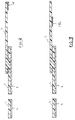
- Figure 1 shows a wrap-around sleeve 1 comprising a longitudinally heat shrinkable flexible polymeric sheet 2 having longitudinal end portions 2a and 2b.
- a closure strip is welded on the end portion 2a.
- the strip 3 is of sufficient width that when in use, the sleeve 1 is wrapped around an article to be protected (not shown), for example a pipe, with portions 2a overlapping on portion 2b, the free end of the strip 3 can be heated and/or pressed down onto the outer side of the sheet 2 and can be welded thereto by applying heat directly on the outer side of strip 3, using, for example, a propane torch or the like.
- the inner side of the sheet 2 is coated with a functional coating 4.
- Such wrap-around sleeve may be manufactured using heated wedge welding apparatus as described in more detail in the above-mentioned European application 414,414.
- the strip 3 is clear.
- the underside of the strip 3 may be provided with a conventional temperature sensitive indicator, for example a pattern of thermochromic paint, visible through the clear strip 3, which provides a visual indication of, for example, a colour change, when a temperature is reached at which the strip satisfactorily welds to the sheet 3.
- a conventional temperature sensitive indicator for example a pattern of thermochromic paint
- the coating 4 is softened by the heating subsequently applied to the sleeve 1 in the course of shrinking it down, and the hoop stress in the sleeve 1 causes the coating 4 to extrude to fill the channel or transition 6 between the end of the sheet 2 and the underside of the strip 3.
- Visual inspection of the coating 4 which fills the channel 6 provides the user with further visual assurance of the effectiveness of the seal provided by the shrunk-down sleeve.
- Fig. 2 shows a further form of sleeve having a stripe 18 of hold-down adhesive, seen in cross-section, extending across the full length of the closure strip 3.
- the stripe 18 secures the free end of strip 3 on the outer side of the opposite end of the sheet 2 until the strip 3 is completely welded to the sheet 2.
- Fig. 2 may be manufactured conveniently using welding apparatus similar to that described above but comprising two sets each of the welding stations formed by the feed rollers and the heated wedge, disposed in spaced parallel arrangement. Two pieces of the sheet material 2 are disposed symmetrically on each side of a common piece of the closure strip material 3, having a stripe of the hold-down adhesive applied down its median, this stripe being twice the width of the stripe 18. After the welding the double workpiece is cut along the middle of the wide stripe of adhesive to yield two completed sleeves each of the forms shown in Fig. 2 having the transverse stripe of adhesive at the free end of the strip 3.
- the version shown in Fig. 2 may be vulnerable to damage, since there may be a tendency for soil to work its way under the free edge of the overlap where the bond strength of the adhesive 18 is relatively weak as compared with the bond strength of welded together area of the strip 3 and sheet 2.
- Fig. 3 it may be more desirable to employ the version shown in Fig. 3 wherein the adhesive stripe 18a is spaced inwardly for the free edge of the strip 2.
- the exposed outer edge of the overlap is a welded joint, which may be better able to withstand soil stress and like stresses.
- the embodiment of Fig. 3 may be manfuactured in the manner generally described above with reference to Fig. 2 but with less convenience since two separate applications of the hold-down adhesive stripes 18a have to be made to each double workpiece.
- a heat shrinkable wraparound sleeve of the design shown in Figure 6 of U.S. Patent 4,472,468 was produced from a mixture of low density polyethylene (LDPE) and ethylene vinyl acetate copolymer (EVA) in the ratio of 1:1 by weight.
- LDPE low density polyethylene
- EVA ethylene vinyl acetate copolymer
- the degree of crosslinking was 65%, the stretch was 30%, and the sheet material thickness was 1.17 mm (0.046 inch) recovered.
- the functional coating was a 1.65 mm (0.065 inch) thick layer of a mastic typical of corrosion protection systems, and the hold-down adhesive stripe was a non-flowing tacky butyl compound.
- the sleeve was applied to a steel pipe using the following procedure:
- Example 2 To a heat shrinkable sheet identical to that described in Example 2 was welded, in the manner described in Example 2, a closure strip of the same composition, except that it was unpigmented (i.e. translucent), and was stretched only 10%.
- the underside of the closure strip was printed with a thermochromic ink composition designed to change colour from blue-green to black at 120°C.
- the hold-down adhesive stripe was applied in such a way as to leave one inch of bare closure strip overhanging it. This sleeve was then applied to a pipe in a manner identical to that described in Comparative Example 1.
- the closure strip During the initial application of the heat to the overlap area, the closure strip responded quickly, conforming well to the surface below it, and becoming crystal clear. After completion of the shrinking process, additional heat was applied in long, end to end strokes until the thermochromic indicator changed colour. The resultant sleeve showed no sign of bubbles or entrapped air, and the leading edge was welded down firmly.
- this example demonstrates the value of indenting the adhesive hold-down strip so as to allow the leading edge of the closure strip to weld to the backing, resulting in a firmly secured edge which is more resistant to being lifted than is the case in systems relying on the soft, tacky hold-down adhesive.
- a heat shrinkable sheet composed of a mixture of high density polyethylene (HDPE), ethylene-propylene-diene monomer terpolymer (EPDM), and carbon black was prepared.
- the recovered thickness was 1.17mm (0.046 inch), the degree of stretch was 30% and the crosslinking was effected by exposure to 8 Mrad of electron radiation.
- Example 2 During application of the sleeve, the sample problems were noted as in Example 2, - ie - some initial wrinkling, and some residual air pockets and bubbles. The peel strength was 25 pli.
- a sleeve was prepared from the same backing, and in the same manner, as described in Example 4, except that the closure strip was ethylene-vinyl acetate-maleic anhydride terpolymer (Dupont Fusabond) which had been crosslinked via a 9 Mrad dose of electron radiation.
- the closure strip was ethylene-vinyl acetate-maleic anhydride terpolymer (Dupont Fusabond) which had been crosslinked via a 9 Mrad dose of electron radiation.
Landscapes
- Engineering & Computer Science (AREA)
- Mechanical Engineering (AREA)
- Physics & Mathematics (AREA)
- Thermal Sciences (AREA)
- Lining Or Joining Of Plastics Or The Like (AREA)
- Wrappers (AREA)
- Protection Of Pipes Against Damage, Friction, And Corrosion (AREA)
- Cable Accessories (AREA)
- Insulating Bodies (AREA)
- Organic Low-Molecular-Weight Compounds And Preparation Thereof (AREA)
- Agricultural Chemicals And Associated Chemicals (AREA)
- Pharmaceuticals Containing Other Organic And Inorganic Compounds (AREA)
- Laminated Bodies (AREA)
- Shaping By String And By Release Of Stress In Plastics And The Like (AREA)
Abstract
Description
- The present invention relates to heat shrinkable protective sheets useful as protective coverings which may be used in, for example, sealing and protecting pipe weld joints, telephone cables, electrical splices, pipelines and the like, from adverse environmental conditions such as corrosion and moisture.
- It is known to use for this purpose heat shrinkable tubular sleeves formed by extrusion. However, there is difficulty in extruding sleeves of any diameter but especially greater than about 12 inches (about 30 cm). The procedures for imparting a heat shrink memory to and for stretching the sleeves are complex and difficult as well.
- Another general type of heat shrinkable covering is represented by the so-called "wrap-around sleeve", one example of which is disclosed in U.S. Pat. No. 4,200,676 to D.A. Caponigro. While wrap-around sleeves are more versatile than tubular sleeves in that they can be readily applied to articles, including large diameter pipes, which do not have an accessible exposed end, the closure systems by which the adjoining ends of the sleeve are interconnected are an inherent source of weakness. Mechanical closure systems are especially vulnerable to damage, while conventionally bonded overlaps can permit slippage during application and subsequently creep due to the hoop stresses remaining in the shrunk sleeves and so render the sleeves less effective than those which have a continuous covering.
- These problems have been largely overcome by the method described in U.S. patent 4,472,468 in the name Tailor et al dated September 18, 1984 assigned to the assignee of the present application, wherein a hold-down adhesive is used to bond together overlapped end portions of a heat shrinkable sheet before applying heat externally by means of a torch in order to weld the sheets together. However, the heat shrinkable sheets described in the Tailor et al patent provide limited freedom of choice of design of the welded closure. Moreover, usually the inner side of the sheet, that is, the side to be laid against the article to be protected, is lined with a functional coating. With the arrangement shown in the Tailor et al patent it is necessary to provide a zone which is free from functional coating on the underside of the overlap end in order to allow fusing of the overlap onto the outer side of the underlap end. In order to provide the coating free zone it has been necessary to employ a discontinuous method of applying the coating or to mask off the desired coating free areas of the sheet and then to strip off the masking material together with the coating after performing a continuous coating operation. These procedures are complicated and labour intensive.
- The preamble of
claim 1 is based on CA-A-2022840 which discloses a heat shrinkable wrap-around sleeve comprising a heat shrinkable sheet with a heat stable strip welded on one end. The free end of the heat stable strip is overlapped on the outer side of the opposite end of the sheet and welded thereto by heating applied directly on the outer side without the use of hold-down adhesive. - The present invention provides a heat shrinkable wrap-around sleeve as defined in
claim 1. Such a sleeve is adapted to be applied to an article in wrapping relation thereto, the sleeve comprising a sheet of dimensionally heat unstable flexible material having longitudinally spaced end portions capable of being brought into overlapping relation when the sheet is applied to the article, the material having been stretched in the longitudinal direction from an original heat stable form to a dimensionally heat unstable form capable of moving in the direction of its original form by the application of heat alone; a cross-linked dimensionally heat unstable closure strip having one edge disposed on one of the end portions of said sheet and welded thereto, said strip being of sufficient width that when the end portions of the sheet are brought together and the end portion having the free edge of the closure strip is overlapped on the opposite end portion, the free edge of the closure strip can be applied on the underlapping end portion and welded thereto by direct heating applied thereon; and a covering of a hold-down adhesive across a transverse zone of a side of the closure strip to be overlapped on said opposite end portion; said closure strip exhibiting shrinkage in said longitudinal direction on heating approximately equal to or less than that of the sheet. - In use, the sheet is wrapped around the article to be protected with the end portion having the closure strip overlapped on the opposite end portion. Direct heating can then be applied to weld the free edge of the closure strip to the underlapping end portion. Heating of the welded sleeve thus formed can then be applied in any conventional manner in order to shrink the sleeve down to form a protective wrapping around the article.
- It is an advantage of the present sleeve that the closure strip may differ in character from the sheet material. For example, it can differ from the sheet material in its dimensional heat stability, its color, chemical composition, degree of crosslinking, thickness or in the method by which it has been crosslinked. The strip can differ from the sheet material in more than one of the above-mentioned respects. These arrangements provide advantages of design of the sleeve since the weldability and mechanical and other properties of the weld and closure zone can be tailored to suit the requirements of the application to which the sleeve is to be put.
- According to the invention a covering of a hold-down adhesive is provided across a transverse zone of a side of the closure strip to be overlapped on the said opposite end portion of the sheet. With this arrangement, a sleeve is provided having the advantages of the wrap-around sleeve disclosed in the above-mentioned Tailor et al patent but which can be manufactured with considerably greater ease and economy.
- With prior attempts of which the inventors are aware, wherein two dimensionally heat unstable edges or pieces are welded together, problems have arisen in effecting a satisfactory weld.
- One of the problems is that of peel back which occurs when two overlapping heat shrinkable sheets are heated. When heat is applied, the outside surface of the overlap tends to recover or shrink before the inside surface and thus there is differential contraction across the thickness of the sheets between the overlap and underlap. When heat is applied from one side only, the heat shrinkable sheet tends to curl upwardly or wrinkle as a result. These problems can be greatly mitigated with the structure of the invention.
- In the present invention, the strip has a degree of heat shrinkability which is approximately equal to or less than that of the sheet material, typically such that it exhibits on heating a longitudional shrinkage of about 2% to about 50%, based on the length of the unshrunk strip. When a dimensionally heat stable strip is heated, the strip tends to expand in all dimensions, especially with polymeric strips due to the volumetric increase associated with crystalline melting. With a closure strip having a degree of longitudinal shrinkage within the range of about 2% to about 25%, based on the length of the unshrunk strip, the shrinkage can be enough to offset this expansion phenomenon, but not enough to cause undue curling, wrinkling or peel back. More preferably, said shrinkage is about 5% to about 20%. The sheet material however typically may have a degree of longitudinal shrinkage of about 20% to about 80% based on the length of the unshrunk sheet. At these degrees of shrinkage, peel back, curling and wrinkling are serious problems which can normally be overcome only by use of a high strength and effective hold-down adhesive or a mechanical closure. When the shrinkage in the closure strip has a value in the range noted above, however, the demand on the hold down adhesive is reduced substantially, and there is much greater choice in selection of the same. As a result, with the present sleeve, it is possible when welding the closure strip to the underlapping end portion of the sheet to obtain welded bonds which are uniform and homogeneous. By "uniform" is meant that the weld is of substantially uniform peel strength along its entire length. By "homogeneous" is meant that the area or line of welding between the closure strip and heat unstable sheet does not present a line of weakness, so that when subjected to shear testing the welded joint does not fail along an interface corresponding to the boundaries of the original strip and sheet.
- In some applications, the dimensionally heat unstable sheet material may typically have a shrink ratio of from about 1:1.05 to about 1:3.0, that is a shrinkage of about 5% to 67% based on the length of the unshrunk sheet.
- A further respect in which the dimensional stability of the closure strip may differ from that of the sheet is that the closure strip may commence shrinkage at a temperature different from that of the sheet. Advantageously, the closure strip may commence to shrink at a temperature lower than the temperature at which the sheet commences shrinkage, preferably about 5°C to about 15°C lower. For example, the closure strip may commence shrinkage at about 100°C and the sheet at 110°C. This arrangement has the advantage that it ensures establishment of contact of the closure strip with the sheet before the sheet begins to recover its original unstretched dimension. The closure strip will tend to become tacky at a lower temperature than the sheet and hence as the closure strip shrinks it will form a bond to the sheet before shrinkage of the latter commences.
- The sheet material and strip are preferably organic polymeric materials, the same or different. For examples of suitable organic polymer materials reference should be made to applicant's related European patent application No. 414,414 published February 27, 1991.
- In advantageous forms of the present sleeve, the strip is formed of a material chemically different from sheet material. For example, the sheet material may be formed from any of the above-referred to materials and the strip from a polymer chemically structured such that it forms welds very effectively to the above noted sheet materials. Examples of such weld efficient polymers are well known to those skilled in the art. One preferred group of such polymers comprises weld efficient terpolymers of which examples include ethylene-vinyl acetate-methacrylic acid or acrylic acid polymers, EPDM polymers (ethylene-propylene-diene monomer polymers). Further well known examples are the polymers available under the trade-mark FUSABOND from Dupont Canada which are maleic anhydride modified polyolefins.
- Such weld-efficient copolymers or terpolymers may be considerably more costly and less mechanically strong than the polymers typically used to produce the sheet material. It is therefore advantageous to form the closure strip of such weld efficient materials but to form the sheet of other polymers selected specifically for their cost and performance properties.
- The dimensionally heat unstable sheet materials and the closure strips are preferably crosslinked polymeric material. In the case of, for example, a polyolefin or other polymeric dimensionally heat unstable sheet material, the material is preferably cross-linked to a degree of 25% to 85%, more preferably in the range 45% to 70%. In this connection, the degree of crosslinking of a given plastics material is definable by reference to solvent extraction tests conducted under standardized conditions on samples of the plastics. At zero crosslinking a solvent for the plastics will totally dissolve the plastics material, while a material which suffers no weight loss in such tests is regarded as 100% crosslinked. Intermediate degrees of crosslinking are indicated by proportionately intermediate percentage weight losses. For certain applications, it may be desirable that the closure strip is crosslinked to a degree somewhat higher than the dimensionally heat unstable material to which it is welded so that it will have good mechanical strength when hot during the procedure of shrinking down the wrap-around sleeve onto the pipe or other article during final use of the products. However, especially with sleeves wherein the sheet material is highly crosslinked, it can be advantageous to employ a closure strip which has a lower degree of crosslinking than the sheet. The degree of crosslinking often has a marked effect on the ease with which the weld can be effected. Generally speaking, the lower the degree of crosslinking, the easier and faster the weld can be achieved. However, a low degree of crosslinking in the sheet would result in a sleeve which has a sluggish response to heating and is prone to melting and sagging. It is advantageous to be able to compensate for a higher crosslink in the sheet by a lower crosslink in the closure strip in order to promote ease and effectiveness of welding without sacrificing responsiveness of the sleeve to heating.
- Advantageously, the method employed to crosslink the closure strip may be different from that used for the sheet material. Examples of methods which may be used for crosslinking include exposure to ionizing radiation, blending of the polymer with organic peroxides, and formation of pendant silane groups on the polymer and exposure of the polymer to moisture to crosslink the silane groups. Each of these methods is in itself well known, as are the conditions employed to achieve desired degrees of crosslinking, and need not be described in detail herein. Briefly, exposure to ionizing radiation in order to crosslink polymers is frequently conducted either by exposure of the polymer to gamma rays from radioactive sources such as cobalt-60 or to high energy electrons from electron accelerators. Crosslinking by blending with peroxides includes blending polymers with selected small quantities of organic peroxides appropriate for the particular polymer to be crosslinked. Examples of commonly used peroxides include α, α'-bis (t-butylperoxy) diisopropyl benzene and dicumyl peroxide. Treatment with silane may include grafting a silane such as vinyl silane to a polymer such as,an ethylene polymer or copolymerizing a silane, for example a vinylsilane, with an olefin or like monomer. In either case a polymer having pendant silane groups is formed. The resultant polymer is then crosslinked by exposure to moisture, for example in the form of steam. The crosslinking mechanism consists of hydrolysis and condensation of the pendant silane groups. Each of these crosslinking procedures has its own benefits and limitations and the properties of the crosslinked products can be markedly different even at the same degree of crosslinking. Accordingly, by selection of different crosslinking methods products having properties suited for particular applications can be obtained. For example, electron beam crosslinking is advantageous for crosslinking of continuous sheet material at very high speeds for subsequent use as the sheet material component, of which greater quantities are normally required. Silane crosslinking results in a more 3-dimensional crosslinked structure which imparts higher tensile properties at temperatures above the crystalline melting point of the polymer. Therefore, at the same degree of crosslink, a silane crosslinked polyolefin or like polymer is often more resistant to being stretched and thinned out than an electron beam cured one. As a result, it is advantageous to use a silane crosslinked closure strip which can have a lower degree of crosslink than a beam-cured sheet material, allowing easier welding of the closure strip to the sheet material without sacrificing resistance to being stretched thin by the retractive forces of the sleeve.
- It is a further advantage of the sleeves of the invention that the closure strip may be of a different colour from the sheet material. For example, the closure strip may be transparent or somewhat translucent while the sheet material may be opaque. A pattern of thermochromic paint may be applied on the underside of and be visible through the closure strip, which guides the installer by providing a visual indication, for example a color change, when sufficient heat has been applied so that the temperature needed to achieve a satisfactory weld has been reached. Optionally, should it be desired to employ infra red heating, selected infra red absorptive additives such as copper phthalocyanine which do not substantially impair its transparency may be included in the closure strip.
- Alternatively, the closure strip may be of a color different from the sheet material, for example black, which more effectively absorbs infra-red radiation, for cases in which infra-red heaters are used to weld the wrapped-around sleeve.
- Use of a different color can also make it easier for an inspector to determine the location of the overlap area. It is frequently recommended that the wrap-around sleeve should be positioned in a specific orientation on a pipe or other article in order to promote filling of the underlap with functional coating material. By having the closure strip of a color distinctly different from the sheet, an inspector can at a glance determine that, firstly, the sleeve was positioned properly and, secondly, the closure strip was put over the sheet material rather than under it.
- Preferably, in order to provide a protective covering with good strength properties, the recovered thickness of the sheet materials and closure strips, which may be the same or different, are 0.254 to 5.08 mm (about 0.01 to about 0.2 inch) more preferably 0.508 to 2.54 mm (about 0.02 to about 0.1 inch). In some circumstances it is advantageous to use a closure strip thinner, than the sheet in order to reduce the thickness at the overlap area and make it easier to get heat through to a pipe or other article to be covered and to a functional coating which may require heating to achieve its greatest effect. Preferably the closure strip is about 10 to about 80% thinner than the sheet, based on the thickness of the sheet, more preferably about 30 to about 60% thinner. Conversely, and especially where the sheet material exhibits a high degree of shrinkage, it is advantageous to employ a closure strip thicker than the sheet material in order to provide greater resistance to thinning out of the closure strip as a result of the shrinkage forces. In such case the closure strip is preferably about 10 to about 80% thicker than the sheet, based on the thickness of the sheet, more preferably about 20 to about 60% thicker.
- Advantageously, the inner side of the dimensionally heat unstable sheet material, that is, the side to be laid against the article to be protected, is lined with a functional coating. The coating may be, for example, a sealant, an adhesive material, a mastic, a grease, or a two-component curable composition as described in more detail in European application 414,414.
- A covering of a hold-down adhesive is provided across a transverse zone of a side of the closure strip to be overlapped on the opposite end portion of the sheet material. In use, the hold-down adhesive performs a function of facilitating welding of the overlap closure strip to the underlap sheet analogous to that performed by the hold-down adhesive described in the Tailor et al U.S. Patent No. 4,472,468 referred to above. The nature of the hold-down adhesive, and its manner of application and use are described in detail in the Tailor et al patent, which is incorporated herein by reference for its disclosures in the above respects.
- Briefly, the hold-down adhesive performs the function of holding down the closure strip on the sheet when applied to an article to be protected while the strip is being welded to the sheet. If the adhesive is pressure sensitive, the overlap is secured to the underlap merely by pressing the overlapping portions together. When heat is first applied at the overlap, the adhesive prevents slippage at the interface as the material tends to shrink and also prevents the overlap from curling and peeling back during the initial heat application. Suitable shear-resistant adhesives are well-known to those skilled in the art.
- The preferred materials are iso-butylene polymers, such as polyisobutylene, polybutene, and butyl rubber. These polymers can be partially cured to increase the shear-strength particularly at elevated temperatures. Other isobutylene polymers that are useful include halogenated butyl rubbers, and other modified butyls for example terpolymers in which divinylbenzene is added to impart a cure (e.g. Polysar's XL-20 and XL-50) and filled, plasticised and partially cured masterbatch crumb (e.g. Columbian Carbon's Bucar 5214). An appropriate quantity and grade of poly-isobutylene (Vistanex) may also be used to impart a desired tack (pressure sensitive) property according to the formulation. Addition of fillers is useful in adjusting tack and the cohesive strength of the adhesive. The fillers suitable for the application include carbon black, mica, graphite, talc, asbestos, aluminium hydrate, clays, hydrated silicas, calcium silicates, silicate-aluminates, fine furnace and thermal blacks, magnesium carbonate, and calcium carbonate. The preferred fillers, however, are carbon blacks and talcs.
- Other adhesive materials useful for the hold-down application include those based on nitrile rubbers, styrene-butadiene rubbers, styrene-isoprene rubbers, neoprenes, polyurethanes, ethylenevinyl acetate, acrylates, (e.g. ethylene-ethyl acrylate), silicones, poly-vinyl-acetate, amino resins, amorphous polypropylenes and polyvinylacetals. These adhesives may be of the hot-melt type, contact cement type, lacquer type, thermosetting adhesive type, pressure sensitive adhesive type, crosslinked adhesives, or two component adhesives. Many variations of adhesive systems used are possible; for example, a pressure sensitive transfer tape with a thin polymeric liner sandwiched between two pressure sensitive adhesive films can be applied to the overlap and so that one adhesive film is bonded to overlap and the adhesive film on the other side can be adhered to the underlap (e.g. J-Tape, 266P and other tapes from Adchem Corp. U.S.A.).
- The hold-down adhesive may also be a material which is not pressure sensitive at ambient temperatures but which develops pressure-sensitivity when heated. In such case, the adhesive-covered zone may be carefully heated to render the adhesive tacky and bond it to the underlap. The adhesive may be heated by applying heat directly to the adhesive material before applying the sleeve to the article.
- Sleeves having a functional coating on the sheet material and a hold-down adhesive stripe or like covering on the closure strip can be readily manufactured in a continuous fashion by:
- (a) manufacture of bulk rolls comprising a functional coating disposed continuously on heat shrinkable continuous sheet material;
- (b) manufacturing the closure strip material in continuous sheet form;
- (c) cutting the heat shrinkable sheet material to length;
- (d) feeding the sheet material and the closure strip material simultaneously through a continuously operating welding apparatus; and
- (e) applying a hold-down adhesive to the closure strip.
- In step (d) the closure strip material may be fed either in continuous form if unstretched, or normally in discrete pieces if the strip material has been stretched continuously longitudinally.
- Preferably the hold-down adhesive is fed continuously in the form of a layer on a release paper to the closure strip as it feeds through the welding apapratus. The closure strip material, if welded continuously to the lengths of sheet material, is cut to separate the product into individual sleeves, after the welding operation and preferably after the hold-down adhesive has been applied.
- This process is sufficiently simple that sleeves can be effectively and economically be manufactured from bulk rolls of the continuous sheet material and continuous closure strip material at locations remote from the site of manufacture of the sheet and closure strip material, for example at warehouses.
- In the preferred form, the protective wrap-around sleeve is manufactured by drawing the strip and sheet continuously over opposite sides of a heated member, preferably a heated wedge welding member as described in more detail in the above-mentioned European application 414,414. By carefully controlling the heating of the heated member, it is possible to heat only a thin skin portion of the strip and sheet in contact with the heated member to the temperature required to effect fusion. Surprisingly, it has been found that this welding method allows a satisfactory uniform and preferably homogeneous weld to be achieved between materials one or both of which are dimensionally heat unstable, without problems such as peel back or puckering of the welded portions occurring. The key to the successful use of this method is to ensure that only a very thin layer of each surface is heated to the temperature required to effect fusion when the two surfaces are subsequently brought into contact. If too great a thickness is heated, the materials will deform due to thermal expansion or to heat-induced shrinkage, and this will result in poor mating of the surfaces and consequent inadequate welds and/or unacceptable appearance.
- In the preferred form, the free end of the strip extends a sufficient distance that when the two ends of the sheet are brought together and the end having the panel overlapped on the opposite end, the free end of the strip can be applied on the outer side of the underlap end. This product is useful as a wrap around sleeve. Advantageously, the closure strip differs from the sheet in one or more of the above mentioned respects, so that the weldability and mechanical and other properties of the weld and closure zone can be tailored to suit the requirements of the application to which the sleeve is to be put. In the field, in applying the sleeve around a pipe or the like, the free end of the closure strip is welded onto the outer side of the underlap end by direct heating applied thereon, for example with a propane flame or other torch flame, before being shrunk down onto the pipe or other article by application of heating in the normal manner.
- The present invention will now be described by way of example only with reference to the accompanying drawings in which:
- Fig. 1 shows partially schematically and partially in perspective a welded wrap-around sleeve not in accordance with the invention; and
- Figs. 2 and 3 are cross-sections through forms of welded product according to the invention, having hold-down adhesive coverings applied thereto.
- Referring to the drawings, wherein like numerals indicate like parts, Figure 1 shows a wrap-around
sleeve 1 comprising a longitudinally heat shrinkableflexible polymeric sheet 2 havinglongitudinal end portions end portion 2a. Thestrip 3 is of sufficient width that when in use, thesleeve 1 is wrapped around an article to be protected (not shown), for example a pipe, withportions 2a overlapping onportion 2b, the free end of thestrip 3 can be heated and/or pressed down onto the outer side of thesheet 2 and can be welded thereto by applying heat directly on the outer side ofstrip 3, using, for example, a propane torch or the like. - The inner side of the
sheet 2 is coated with afunctional coating 4. - Such wrap-around sleeve may be manufactured using heated wedge welding apparatus as described in more detail in the above-mentioned European application 414,414.
- In one preferred form, the
strip 3 is clear. The underside of thestrip 3 may be provided with a conventional temperature sensitive indicator, for example a pattern of thermochromic paint, visible through theclear strip 3, which provides a visual indication of, for example, a colour change, when a temperature is reached at which the strip satisfactorily welds to thesheet 3. Usually, thecoating 4 is softened by the heating subsequently applied to thesleeve 1 in the course of shrinking it down, and the hoop stress in thesleeve 1 causes thecoating 4 to extrude to fill the channel ortransition 6 between the end of thesheet 2 and the underside of thestrip 3. Visual inspection of thecoating 4 which fills thechannel 6 provides the user with further visual assurance of the effectiveness of the seal provided by the shrunk-down sleeve. - Fig. 2 shows a further form of sleeve having a
stripe 18 of hold-down adhesive, seen in cross-section, extending across the full length of theclosure strip 3. In use, when wrapped around an article such as a pipe, in the configuration seen in Fig. 1, thestripe 18 secures the free end ofstrip 3 on the outer side of the opposite end of thesheet 2 until thestrip 3 is completely welded to thesheet 2. - The embodiment of Fig. 2 may be manufactured conveniently using welding apparatus similar to that described above but comprising two sets each of the welding stations formed by the feed rollers and the heated wedge, disposed in spaced parallel arrangement. Two pieces of the
sheet material 2 are disposed symmetrically on each side of a common piece of theclosure strip material 3, having a stripe of the hold-down adhesive applied down its median, this stripe being twice the width of thestripe 18. After the welding the double workpiece is cut along the middle of the wide stripe of adhesive to yield two completed sleeves each of the forms shown in Fig. 2 having the transverse stripe of adhesive at the free end of thestrip 3. - In applications in which the welded sleeve is exposed to soil stress, the version shown in Fig. 2 may be vulnerable to damage, since there may be a tendency for soil to work its way under the free edge of the overlap where the bond strength of the adhesive 18 is relatively weak as compared with the bond strength of welded together area of the
strip 3 andsheet 2. - In such cases it may be more desirable to employ the version shown in Fig. 3 wherein the
adhesive stripe 18a is spaced inwardly for the free edge of thestrip 2. In use, the exposed outer edge of the overlap is a welded joint, which may be better able to withstand soil stress and like stresses. The embodiment of Fig. 3 may be manfuactured in the manner generally described above with reference to Fig. 2 but with less convenience since two separate applications of the hold-downadhesive stripes 18a have to be made to each double workpiece. - Although the above description provides ample information to enable one skilled in the art to conduct the present welding methods and to fabricate the welded products, for the avoidance of doubt some detailed examples of the methods in accordance with the invention will be given:
- A heat shrinkable wraparound sleeve of the design shown in Figure 6 of U.S. Patent 4,472,468 (Tailor et al) was produced from a mixture of low density polyethylene (LDPE) and ethylene vinyl acetate copolymer (EVA) in the ratio of 1:1 by weight. The degree of crosslinking was 65%, the stretch was 30%, and the sheet material thickness was 1.17 mm (0.046 inch) recovered. The functional coating was a 1.65 mm (0.065 inch) thick layer of a mastic typical of corrosion protection systems, and the hold-down adhesive stripe was a non-flowing tacky butyl compound.
- The sleeve was applied to a steel pipe using the following procedure:
- (a) Starting first with the end opposite the closure area, the sleeve was wrapped around the pipe such as to leave about one-half inch of slack. The outside end of the sleeve was adhered by applying firm finger pressure to the sheet material along the hold-down adhesive.
- (b) Using a propane torch, the closure area was heated gently to recover the bare area and form an initial weld.
- (c) Using a stronger flame, the remainder of the sleeve was shrunk, starting in the middle and moving outward toward one end, then repeating for the other end.
- (d) Additional heat was applied to the closure area, using end-to-end strokes, to complete the formation of the weld.
- During the shrinking operation, a tendency to wrinkle and curl-back was noted along the outermost edge over the hold-down adhesive. This required some additional patting down. In addition, the rapid shrinkage typical of these levels of stretch resulted in some small bubbles of air trapped between the two layers of backing in the weld area, and these were seen to be susceptible to burning through.
- After cooling the peel strength of the weld was tested in a peeling mode. Failure occurred in a smooth cohesive fashion indicating an acceptable weld, except where air pockets were encountered.
- A mastic coated yellow heat shrinkable sheet, identical in composition, crosslink and stretch to that referred to in Comparative Example 1, but with no bare area or hold-down adhesive, was prepared. To this was welded, using a heated wedge welder, in the manner described above with reference to European application 414,414, a closure strip of crosslinked LDPE/EVA mixture identical in colour, composition and recovered thickness to that of the backing. However, the degree of crosslink was higher due to a higher electron beam dose, and the material was not stretched. A hold-down adhesive stripe was applied to the free end of the closure. The sleeve was then applied to the pipe in a manner identical to that described in Comparative Example 1.
- During initial application of heat to the weld area, some buckling of the closure occurred due to thermal expansion not countered by any built-in recoverability. However, once a bond had been established adjacent to the hold-down adhesive stripe, and the remainder of the sleeve was shrunk, the resulting hoop stress caused these buckled areas to lie essentially flat, with only a few small pockets of trapped air. Due to the lack of stretch, no wrinkling was observed along the leading edge of the closure.
- After cooling, the peel characteristics of the weld were tested in the same manner as in Comparative Example 1, with similar results. This illustrates that the use of an unstretched closure is effective in eliminating wrinkling and curl-back of the leading edge, but has the adverse effect of causing initial wrinkling or buckling due to thermal expansion, increasing the danger of air entrapment between the two surfaces to be fused.
- To a heat shrinkable sheet identical to that described in Example 2 was welded, in the manner described in Example 2, a closure strip of the same composition, except that it was unpigmented (i.e. translucent), and was stretched only 10%. The underside of the closure strip was printed with a thermochromic ink composition designed to change colour from blue-green to black at 120°C. The hold-down adhesive stripe was applied in such a way as to leave one inch of bare closure strip overhanging it. This sleeve was then applied to a pipe in a manner identical to that described in Comparative Example 1.
- During the initial application of the heat to the overlap area, the closure strip responded quickly, conforming well to the surface below it, and becoming crystal clear. After completion of the shrinking process, additional heat was applied in long, end to end strokes until the thermochromic indicator changed colour. The resultant sleeve showed no sign of bubbles or entrapped air, and the leading edge was welded down firmly.
- After cooling, the peel characteristics of the weld were tested as in Comparative Example 1, and excellent, uniform cohesive failure was observed. This example demonstrates the value of being able to use a translucent closure in conjunction with a thermochromic indicator to give a visual indication to the installer as to when sufficient heat has been applied to establish an excellent weld. It also demonstrates that it is advantageous with weldable closure systems to be able to independently select the degree of stretch in the closure strip and in the sheet material. In this particular case, the 10% stretch in the closure strip provided enough recoverability to eliminate the adverse thermal expansion effects of the unstretched closure strip, as seen in Example 9, and the adverse effects of the highly stretched closure area in the single piece sleeve as seen in Comparative Example 1. Finally, this example demonstrates the value of indenting the adhesive hold-down strip so as to allow the leading edge of the closure strip to weld to the backing, resulting in a firmly secured edge which is more resistant to being lifted than is the case in systems relying on the soft, tacky hold-down adhesive.
- A heat shrinkable sheet composed of a mixture of high density polyethylene (HDPE), ethylene-propylene-diene monomer terpolymer (EPDM), and carbon black was prepared. The recovered thickness was 1.17mm (0.046 inch), the degree of stretch was 30% and the crosslinking was effected by exposure to 8 Mrad of electron radiation. To this was laminated a 1.65mm (0.065 inch) thick layer of a mastic typical of those used in corrosion protection applications. A weldable closure strip, composed of the same material but 0.91 mm (0.036 inch) thick and not stretched, was welded onto one end of she heat recoverable sheet using a heated wedge welder in the manner described in Example 2, and a stripe of hold-down adhesive was applied to the underside of its free-end. The sleeve was then applied to a pipe in the same manner as described in Comparative Example 1.
- During application of the sleeve, the sample problems were noted as in Example 2, - ie - some initial wrinkling, and some residual air pockets and bubbles. The peel strength was 25 pli.
- A sleeve was prepared from the same backing, and in the same manner, as described in Example 4, except that the closure strip was ethylene-vinyl acetate-maleic anhydride terpolymer (Dupont Fusabond) which had been crosslinked via a 9 Mrad dose of electron radiation.
- After application as described in Comparative Example 1, the resulting weld had a peel strength of 39 pli. This demonstrates, in comparison to Example 4, the value of being able to use a different material for the weldable closure strip than is used for the remainder of the sleeve in order to provide an enhanced weld. (The terpolymer is much more expensive, and not as tough as the HDPE/EPDM mixture, and is therefore not as suitable for rise as the sleeve backing.)
Claims (13)
- A heat shrinkable wrap-around sleeve (1) adapted to be applied to an article in wrapping relation thereto, the sleeve comprising a sheet (2) of dimensionally heat unstable flexible material having longitudinally spaced end portions (2a, 2b) capable of being brought into overlapping relation when the sheet is applied to the article, the material having been stretched in the longitudinal direction from an original heat stable form to a dimensionally heat unstable form capable of moving in the direction of its original form by the application of heat alone; and a closure strip (3) having one edge disposed on one of the end portions (2a) of said sheet (2) and welded thereto, said strip (3) being of sufficient width that when the end portions (2a,2b) of the sheet (2) are brought together and the end portion (2b) having the free edge of the closure strip (3) is overlapped on the opposite end portion (2a), the free edge of the closure strip (3) can be applied on the underlapping end portion and welded thereto by direct heating applied thereon; characterised by a covering (18) of a hold-down adhesive across a transverse zone of a side of the closure strip (3) to be overlapped on said opposite end portion (2a) and by said closure strip (3) being a cross-linked dimensionally heat unstable closure strip which exhibits shrinkage in said longitudinal direction on heating approximately equal to or less than that of the sheet (2).
- A sleeve as claimed in claim 1 wherein [i] said sheet exhibits on heating a longitudinal shrinkage of 5% to 67%, preferably 20% to 80%, based on the length of the unshrunk sheet; and/or [ii] said closure strip exhibits longitudinal shrinkage on heating of 2% to 50% or 2% to 25%, preferably 5% to 20%, based on the length of the unshrunk strip; and/or [iii] said closure strip commences shrinkage at a lower temperature than said sheet, preferably 5°C to 15°C lower than said sheet.
- A sleeve as claimed in any preceding claim wherein said strip is translucent or transparent, the sleeve preferably having a thermochromic indicator on the underside of and visible through said clear strip.
- A sleeve as claimed in any preceding claim wherein said strip contains a colorant different from a colorant contained in said sheet.
- A sleeve as claimed in any preceding claim wherein said strip and sheet material are of different chemical composition and said strip is a weld efficient polymer.
- A sleeve as claimed in any preceding claim wherein [i] said sheet material is cross-linked to a degree of 25% to 85%, preferably 45% to 70%; and/or [ii] said strip is cross-linked to a degree lower than said sheet material.
- A sleeve as claimed in any preceding claim wherein the recovered thickness of said sheet material and said strip are each 0.254 to 5.08 mm (0.01 to 0.2 inch), preferably 0.508 to 2.54 mm (0.02 to 0.1 inch) thick.
- A sleeve as claimed in any preceding claim wherein said sheet material has a functional coating on its inner side, the functional coating preferably being a sealant or an adhesive material.
- A sleeve as claimed in any preceding claim wherein said hold-down adhesive is a pressure sensitive adhesive, for example an isobutylene polymer or a blend of isobutylene polymers, with a filler.
- A sleeve as claimed in any preceding claim wherein [i] the hold-down adhesive is not pressure-sensitive at ambient temperature but develops pressure-sensitivity when heated; and/or [ii] the hold-down adhesive is constituted by a strip of double-sided adhesive transfer tape.
- A sleeve as claimed in any preceding claim wherein said strip is 10 to 80% thinner, preferably 30 to 60%, than said sheet material, based on the thickness of the sheet material.
- A sleeve as claimed in any preceding claim wherein said sheet material and strip have each been cross-linked by a method selected independently from exposure to ionizing radiation, blending with organic peroxides and formation of a polymer containing pendant silane groups and exposure to moisture to cross-link said silane groups.
- A sleeve as claimed in any preceding claim wherein said transverse zone is spaced inwardly from said free edge of said closure strip.
Applications Claiming Priority (2)
| Application Number | Priority Date | Filing Date | Title |
|---|---|---|---|
| US66086691A | 1991-02-26 | 1991-02-26 | |
| US660866 | 1991-02-26 |
Publications (3)
| Publication Number | Publication Date |
|---|---|
| EP0501628A2 EP0501628A2 (en) | 1992-09-02 |
| EP0501628A3 EP0501628A3 (en) | 1993-02-03 |
| EP0501628B1 true EP0501628B1 (en) | 1997-05-07 |
Family
ID=24651287
Family Applications (1)
| Application Number | Title | Priority Date | Filing Date |
|---|---|---|---|
| EP92301113A Expired - Lifetime EP0501628B1 (en) | 1991-02-26 | 1992-02-11 | Heat shrinkable protective sheets |
Country Status (8)
| Country | Link |
|---|---|
| EP (1) | EP0501628B1 (en) |
| AT (1) | ATE152665T1 (en) |
| AU (1) | AU650097B2 (en) |
| CA (1) | CA2061306C (en) |
| DE (1) | DE69219503T2 (en) |
| DK (1) | DK0501628T3 (en) |
| ES (1) | ES2101805T3 (en) |
| FI (1) | FI109106B (en) |
Families Citing this family (7)
| Publication number | Priority date | Publication date | Assignee | Title |
|---|---|---|---|---|
| GB9401043D0 (en) | 1994-01-20 | 1994-03-16 | Raychem Ltd | Dimensionally heat-recoverable article |
| GB9510543D0 (en) * | 1995-05-24 | 1995-07-19 | Raychem Ltd | Heat shrinkable article |
| WO1997031415A2 (en) * | 1996-02-21 | 1997-08-28 | Raychem Limited | Wall or bulkhead feedthrough for wiring bundles |
| CN1214807A (en) * | 1996-03-27 | 1999-04-21 | 雷伊化学有限公司 | Sealed wall or wire gland feed-throughs |
| GB0419651D0 (en) * | 2004-09-03 | 2004-10-06 | Polypipe Civils Ltd | A pipe system |
| GB2550987B (en) | 2016-10-19 | 2018-09-05 | Seven Star Wraps Ltd | Wrapping |
| CN115709560B (en) * | 2022-10-27 | 2026-05-01 | 杭州莱恩瑟特医疗技术有限公司 | Polymer medical catheter fitting and forming method and connecting method thereof |
Family Cites Families (6)
| Publication number | Priority date | Publication date | Assignee | Title |
|---|---|---|---|---|
| JPS607175Y2 (en) * | 1980-10-07 | 1985-03-09 | 宇部興産株式会社 | fusible sheet |
| DE3366586D1 (en) * | 1982-07-23 | 1986-11-06 | Shaw Ind Ltd | Heat shrinkable covering and method of applying same |
| DE3580058D1 (en) * | 1984-05-29 | 1990-11-15 | Raychem Sa Nv | OBJECT TO CONNECT DIMENSIONALLY RESETABLE ROWS. |
| US4594755A (en) * | 1985-03-18 | 1986-06-17 | Minnesota Mining And Manufacturing Company | Cable branch-off sealing member |
| DE3635942A1 (en) * | 1986-10-22 | 1988-04-28 | Siemens Ag | PLASTIC WRAPPING TAPE FOR CORROSION PROTECTION |
| FI903912A7 (en) * | 1989-08-10 | 1991-02-11 | Shaw Ind Ltd | Shrinkable cover and method for making the same |
-
1992
- 1992-02-11 EP EP92301113A patent/EP0501628B1/en not_active Expired - Lifetime
- 1992-02-11 ES ES92301113T patent/ES2101805T3/en not_active Expired - Lifetime
- 1992-02-11 AT AT92301113T patent/ATE152665T1/en active
- 1992-02-11 DK DK92301113.4T patent/DK0501628T3/en active
- 1992-02-11 DE DE69219503T patent/DE69219503T2/en not_active Expired - Lifetime
- 1992-02-17 CA CA002061306A patent/CA2061306C/en not_active Expired - Lifetime
- 1992-02-24 AU AU11151/92A patent/AU650097B2/en not_active Expired
- 1992-02-26 FI FI920842A patent/FI109106B/en active
Also Published As
| Publication number | Publication date |
|---|---|
| EP0501628A2 (en) | 1992-09-02 |
| ES2101805T3 (en) | 1997-07-16 |
| AU650097B2 (en) | 1994-06-09 |
| AU1115192A (en) | 1992-08-27 |
| FI920842L (en) | 1992-08-27 |
| DE69219503D1 (en) | 1997-06-12 |
| FI920842A0 (en) | 1992-02-26 |
| CA2061306C (en) | 1998-09-22 |
| CA2061306A1 (en) | 1992-08-27 |
| DK0501628T3 (en) | 1997-12-01 |
| FI109106B (en) | 2002-05-31 |
| EP0501628A3 (en) | 1993-02-03 |
| DE69219503T2 (en) | 1997-08-14 |
| ATE152665T1 (en) | 1997-05-15 |
Similar Documents
| Publication | Publication Date | Title |
|---|---|---|
| US5411777A (en) | Heat shrinkable protective sheets | |
| CA2065789C (en) | Heat shrinkable closure sheets and sleeve structures and methods employing the same | |
| US5134000A (en) | Heat shrinkable protective sheets and methods for their manufacture | |
| US4472468A (en) | Heat shrinkable covering and method for applying same | |
| US4802509A (en) | Wraparound closure for conduit protection | |
| US4803104A (en) | Article for joining dimensionally recoverable parts | |
| EP0445445B1 (en) | Novel closure device for shrinkwraps | |
| US5660660A (en) | Heat-recoverable article | |
| US4424246A (en) | Patch closure system | |
| EP0100170B1 (en) | Heat shrinkable covering and method of applying same | |
| US4428790A (en) | Pleated heat-recoverable tape | |
| US5158815A (en) | Closure device for shrinkwraps | |
| US4596732A (en) | Pleated heat-recoverable tape | |
| EP0042262B1 (en) | Pleated recoverable material | |
| EP0501628A2 (en) | Heat shrinkable protective sheets | |
| EP0023788A1 (en) | Arrangement and method for covering elongate substrates | |
| CA2022840C (en) | Heat shrinkable protective sheets and methods for their manufacture | |
| US20040028862A1 (en) | Fibrous closure for heat-shrinkable covers | |
| US5022941A (en) | Closure device for shrinkwraps | |
| EP0143457B1 (en) | Method for covering continuous articles | |
| EP0628144B1 (en) | Heat-recoverable article | |
| JPH05305665A (en) | Heat shrinkable sealing sheet and sleeve structure and using method of sheet thereof | |
| GB2232307A (en) | A heat-shrinkable repair cover for cables |
Legal Events
| Date | Code | Title | Description |
|---|---|---|---|
| PUAI | Public reference made under article 153(3) epc to a published international application that has entered the european phase |
Free format text: ORIGINAL CODE: 0009012 |
|
| AK | Designated contracting states |
Kind code of ref document: A2 Designated state(s): AT BE DE DK ES FR GB IT NL SE |
|
| PUAL | Search report despatched |
Free format text: ORIGINAL CODE: 0009013 |
|
| AK | Designated contracting states |
Kind code of ref document: A3 Designated state(s): AT BE DE DK ES FR GB IT NL SE |
|
| 17P | Request for examination filed |
Effective date: 19930708 |
|
| 17Q | First examination report despatched |
Effective date: 19950207 |
|
| GRAG | Despatch of communication of intention to grant |
Free format text: ORIGINAL CODE: EPIDOS AGRA |
|
| GRAH | Despatch of communication of intention to grant a patent |
Free format text: ORIGINAL CODE: EPIDOS IGRA |
|
| GRAH | Despatch of communication of intention to grant a patent |
Free format text: ORIGINAL CODE: EPIDOS IGRA |
|
| GRAA | (expected) grant |
Free format text: ORIGINAL CODE: 0009210 |
|
| AK | Designated contracting states |
Kind code of ref document: B1 Designated state(s): AT BE DE DK ES FR GB IT NL SE |
|
| REF | Corresponds to: |
Ref document number: 152665 Country of ref document: AT Date of ref document: 19970515 Kind code of ref document: T |
|
| REF | Corresponds to: |
Ref document number: 69219503 Country of ref document: DE Date of ref document: 19970612 |
|
| ET | Fr: translation filed | ||
| REG | Reference to a national code |
Ref country code: ES Ref legal event code: FG2A Ref document number: 2101805 Country of ref document: ES Kind code of ref document: T3 |
|
| REG | Reference to a national code |
Ref country code: DK Ref legal event code: T3 |
|
| PLBE | No opposition filed within time limit |
Free format text: ORIGINAL CODE: 0009261 |
|
| 26N | No opposition filed | ||
| REG | Reference to a national code |
Ref country code: GB Ref legal event code: IF02 |
|
| PGFP | Annual fee paid to national office [announced via postgrant information from national office to epo] |
Ref country code: SE Payment date: 20020125 Year of fee payment: 11 |
|
| PGFP | Annual fee paid to national office [announced via postgrant information from national office to epo] |
Ref country code: DK Payment date: 20020213 Year of fee payment: 11 |
|
| PGFP | Annual fee paid to national office [announced via postgrant information from national office to epo] |
Ref country code: FR Payment date: 20020226 Year of fee payment: 11 |
|
| PGFP | Annual fee paid to national office [announced via postgrant information from national office to epo] |
Ref country code: NL Payment date: 20020228 Year of fee payment: 11 |
|
| PGFP | Annual fee paid to national office [announced via postgrant information from national office to epo] |
Ref country code: BE Payment date: 20020326 Year of fee payment: 11 |
|
| PG25 | Lapsed in a contracting state [announced via postgrant information from national office to epo] |
Ref country code: SE Free format text: LAPSE BECAUSE OF NON-PAYMENT OF DUE FEES Effective date: 20030212 |
|
| PG25 | Lapsed in a contracting state [announced via postgrant information from national office to epo] |
Ref country code: BE Free format text: LAPSE BECAUSE OF NON-PAYMENT OF DUE FEES Effective date: 20030228 Ref country code: DK Free format text: LAPSE BECAUSE OF NON-PAYMENT OF DUE FEES Effective date: 20030228 |
|
| PG25 | Lapsed in a contracting state [announced via postgrant information from national office to epo] |
Ref country code: NL Free format text: LAPSE BECAUSE OF NON-PAYMENT OF DUE FEES Effective date: 20030901 |
|
| REG | Reference to a national code |
Ref country code: DK Ref legal event code: EBP |
|
| EUG | Se: european patent has lapsed | ||
| PG25 | Lapsed in a contracting state [announced via postgrant information from national office to epo] |
Ref country code: FR Free format text: LAPSE BECAUSE OF NON-PAYMENT OF DUE FEES Effective date: 20031031 |
|
| NLV4 | Nl: lapsed or anulled due to non-payment of the annual fee |
Effective date: 20030901 |
|
| REG | Reference to a national code |
Ref country code: FR Ref legal event code: ST |
|
| PG25 | Lapsed in a contracting state [announced via postgrant information from national office to epo] |
Ref country code: IT Free format text: LAPSE BECAUSE OF NON-PAYMENT OF DUE FEES;WARNING: LAPSES OF ITALIAN PATENTS WITH EFFECTIVE DATE BEFORE 2007 MAY HAVE OCCURRED AT ANY TIME BEFORE 2007. THE CORRECT EFFECTIVE DATE MAY BE DIFFERENT FROM THE ONE RECORDED. Effective date: 20050211 |
|
| PGFP | Annual fee paid to national office [announced via postgrant information from national office to epo] |
Ref country code: AT Payment date: 20110225 Year of fee payment: 20 |
|
| PGFP | Annual fee paid to national office [announced via postgrant information from national office to epo] |
Ref country code: DE Payment date: 20110427 Year of fee payment: 20 Ref country code: ES Payment date: 20110322 Year of fee payment: 20 Ref country code: GB Payment date: 20110228 Year of fee payment: 20 Ref country code: IT Payment date: 20110222 Year of fee payment: 20 |
|
| PGRI | Patent reinstated in contracting state [announced from national office to epo] |
Ref country code: IT Effective date: 20110616 |
|
| REG | Reference to a national code |
Ref country code: DE Ref legal event code: R071 Ref document number: 69219503 Country of ref document: DE |
|
| REG | Reference to a national code |
Ref country code: DE Ref legal event code: R071 Ref document number: 69219503 Country of ref document: DE |
|
| REG | Reference to a national code |
Ref country code: GB Ref legal event code: PE20 Expiry date: 20120210 |
|
| PG25 | Lapsed in a contracting state [announced via postgrant information from national office to epo] |
Ref country code: DE Free format text: LAPSE BECAUSE OF EXPIRATION OF PROTECTION Effective date: 20120212 |
|
| PG25 | Lapsed in a contracting state [announced via postgrant information from national office to epo] |
Ref country code: GB Free format text: LAPSE BECAUSE OF EXPIRATION OF PROTECTION Effective date: 20120210 |
|
| REG | Reference to a national code |
Ref country code: AT Ref legal event code: MK07 Ref document number: 152665 Country of ref document: AT Kind code of ref document: T Effective date: 20120211 |
|
| REG | Reference to a national code |
Ref country code: ES Ref legal event code: FD2A Effective date: 20140827 |
|
| PG25 | Lapsed in a contracting state [announced via postgrant information from national office to epo] |
Ref country code: ES Free format text: LAPSE BECAUSE OF EXPIRATION OF PROTECTION Effective date: 20120212 |