EP0501055B1 - Coating composition - Google Patents
Coating composition Download PDFInfo
- Publication number
- EP0501055B1 EP0501055B1 EP91301695A EP91301695A EP0501055B1 EP 0501055 B1 EP0501055 B1 EP 0501055B1 EP 91301695 A EP91301695 A EP 91301695A EP 91301695 A EP91301695 A EP 91301695A EP 0501055 B1 EP0501055 B1 EP 0501055B1
- Authority
- EP
- European Patent Office
- Prior art keywords
- functionality
- acid
- coupling agent
- metal alkoxide
- organic
- Prior art date
- Legal status (The legal status is an assumption and is not a legal conclusion. Google has not performed a legal analysis and makes no representation as to the accuracy of the status listed.)
- Expired - Lifetime
Links
- 239000008199 coating composition Substances 0.000 title description 13
- 238000006460 hydrolysis reaction Methods 0.000 claims description 53
- 230000007062 hydrolysis Effects 0.000 claims description 47
- 150000004703 alkoxides Chemical class 0.000 claims description 46
- 239000000178 monomer Substances 0.000 claims description 43
- 239000004593 Epoxy Substances 0.000 claims description 41
- 229910052751 metal Inorganic materials 0.000 claims description 40
- 239000002184 metal Substances 0.000 claims description 40
- 239000000203 mixture Substances 0.000 claims description 39
- 239000000047 product Substances 0.000 claims description 37
- BOTDANWDWHJENH-UHFFFAOYSA-N Tetraethyl orthosilicate Chemical compound CCO[Si](OCC)(OCC)OCC BOTDANWDWHJENH-UHFFFAOYSA-N 0.000 claims description 34
- 239000007822 coupling agent Substances 0.000 claims description 32
- 239000011521 glass Substances 0.000 claims description 31
- -1 titanium alkoxides Chemical class 0.000 claims description 17
- XLYOFNOQVPJJNP-UHFFFAOYSA-N water Substances O XLYOFNOQVPJJNP-UHFFFAOYSA-N 0.000 claims description 17
- LFQCEHFDDXELDD-UHFFFAOYSA-N tetramethyl orthosilicate Chemical compound CO[Si](OC)(OC)OC LFQCEHFDDXELDD-UHFFFAOYSA-N 0.000 claims description 16
- 229910052710 silicon Inorganic materials 0.000 claims description 15
- 239000002253 acid Substances 0.000 claims description 14
- 229920000642 polymer Polymers 0.000 claims description 14
- 229940095070 tetrapropyl orthosilicate Drugs 0.000 claims description 14
- ZQZCOBSUOFHDEE-UHFFFAOYSA-N tetrapropyl silicate Chemical compound CCCO[Si](OCCC)(OCCC)OCCC ZQZCOBSUOFHDEE-UHFFFAOYSA-N 0.000 claims description 14
- 239000010703 silicon Substances 0.000 claims description 12
- NIXOWILDQLNWCW-UHFFFAOYSA-M Acrylate Chemical compound [O-]C(=O)C=C NIXOWILDQLNWCW-UHFFFAOYSA-M 0.000 claims description 10
- 239000010936 titanium Substances 0.000 claims description 10
- 239000006087 Silane Coupling Agent Substances 0.000 claims description 9
- 150000002118 epoxides Chemical class 0.000 claims description 9
- 229910052719 titanium Inorganic materials 0.000 claims description 9
- 229910052782 aluminium Inorganic materials 0.000 claims description 8
- 125000000391 vinyl group Chemical group [H]C([*])=C([H])[H] 0.000 claims description 7
- 229920002554 vinyl polymer Polymers 0.000 claims description 7
- 229910052726 zirconium Inorganic materials 0.000 claims description 7
- XUIMIQQOPSSXEZ-UHFFFAOYSA-N Silicon Chemical compound [Si] XUIMIQQOPSSXEZ-UHFFFAOYSA-N 0.000 claims description 6
- 239000007795 chemical reaction product Substances 0.000 claims description 6
- 238000000034 method Methods 0.000 claims description 6
- QCWXUUIWCKQGHC-UHFFFAOYSA-N Zirconium Chemical compound [Zr] QCWXUUIWCKQGHC-UHFFFAOYSA-N 0.000 claims description 5
- 150000001252 acrylic acid derivatives Chemical class 0.000 claims description 5
- 239000004411 aluminium Substances 0.000 claims description 5
- 150000002734 metacrylic acid derivatives Chemical class 0.000 claims description 5
- 239000011253 protective coating Substances 0.000 claims description 5
- CERQOIWHTDAKMF-UHFFFAOYSA-M Methacrylate Chemical compound CC(=C)C([O-])=O CERQOIWHTDAKMF-UHFFFAOYSA-M 0.000 claims description 4
- BPQQTUXANYXVAA-UHFFFAOYSA-N Orthosilicate Chemical compound [O-][Si]([O-])([O-])[O-] BPQQTUXANYXVAA-UHFFFAOYSA-N 0.000 claims description 3
- XAGFODPZIPBFFR-UHFFFAOYSA-N aluminium Chemical group [Al] XAGFODPZIPBFFR-UHFFFAOYSA-N 0.000 claims description 3
- ZWAJLVLEBYIOTI-UHFFFAOYSA-N cyclohexene oxide Chemical group C1CCCC2OC21 ZWAJLVLEBYIOTI-UHFFFAOYSA-N 0.000 claims description 2
- 238000000576 coating method Methods 0.000 description 22
- 239000000243 solution Substances 0.000 description 19
- 239000011248 coating agent Substances 0.000 description 16
- 239000000499 gel Substances 0.000 description 16
- VYPSYNLAJGMNEJ-UHFFFAOYSA-N Silicium dioxide Chemical compound O=[Si]=O VYPSYNLAJGMNEJ-UHFFFAOYSA-N 0.000 description 13
- 239000004094 surface-active agent Substances 0.000 description 12
- 238000009408 flooring Methods 0.000 description 9
- 235000019589 hardness Nutrition 0.000 description 9
- 238000003980 solgel method Methods 0.000 description 9
- LFQSCWFLJHTTHZ-UHFFFAOYSA-N Ethanol Chemical compound CCO LFQSCWFLJHTTHZ-UHFFFAOYSA-N 0.000 description 8
- 239000000758 substrate Substances 0.000 description 8
- 239000002245 particle Substances 0.000 description 7
- BPSIOYPQMFLKFR-UHFFFAOYSA-N trimethoxy-[3-(oxiran-2-ylmethoxy)propyl]silane Chemical compound CO[Si](OC)(OC)CCCOCC1CO1 BPSIOYPQMFLKFR-UHFFFAOYSA-N 0.000 description 7
- YXALYBMHAYZKAP-UHFFFAOYSA-N 7-oxabicyclo[4.1.0]heptan-4-ylmethyl 7-oxabicyclo[4.1.0]heptane-4-carboxylate Chemical compound C1CC2OC2CC1C(=O)OCC1CC2OC2CC1 YXALYBMHAYZKAP-UHFFFAOYSA-N 0.000 description 6
- 239000000919 ceramic Substances 0.000 description 6
- 238000009472 formulation Methods 0.000 description 6
- 238000006116 polymerization reaction Methods 0.000 description 6
- 239000011241 protective layer Substances 0.000 description 6
- 239000000377 silicon dioxide Substances 0.000 description 6
- 239000000126 substance Substances 0.000 description 6
- 229910044991 metal oxide Inorganic materials 0.000 description 5
- 150000004706 metal oxides Chemical class 0.000 description 5
- 229920000435 poly(dimethylsiloxane) Polymers 0.000 description 5
- 238000002360 preparation method Methods 0.000 description 5
- 230000000717 retained effect Effects 0.000 description 5
- OECTYKWYRCHAKR-UHFFFAOYSA-N 4-vinylcyclohexene dioxide Chemical compound C1OC1C1CC2OC2CC1 OECTYKWYRCHAKR-UHFFFAOYSA-N 0.000 description 4
- 238000006243 chemical reaction Methods 0.000 description 4
- 238000001035 drying Methods 0.000 description 4
- 235000019441 ethanol Nutrition 0.000 description 4
- 239000010410 layer Substances 0.000 description 4
- 238000004519 manufacturing process Methods 0.000 description 4
- 239000002904 solvent Substances 0.000 description 4
- 239000007921 spray Substances 0.000 description 4
- AJSTXXYNEIHPMD-UHFFFAOYSA-N triethyl borate Chemical compound CCOB(OCC)OCC AJSTXXYNEIHPMD-UHFFFAOYSA-N 0.000 description 4
- RTAQQCXQSZGOHL-UHFFFAOYSA-N Titanium Chemical compound [Ti] RTAQQCXQSZGOHL-UHFFFAOYSA-N 0.000 description 3
- 230000000052 comparative effect Effects 0.000 description 3
- 238000009833 condensation Methods 0.000 description 3
- 238000006482 condensation reaction Methods 0.000 description 3
- 238000001723 curing Methods 0.000 description 3
- GYZLOYUZLJXAJU-UHFFFAOYSA-N diglycidyl ether Chemical compound C1OC1COCC1CO1 GYZLOYUZLJXAJU-UHFFFAOYSA-N 0.000 description 3
- 239000004615 ingredient Substances 0.000 description 3
- 230000000977 initiatory effect Effects 0.000 description 3
- 230000014759 maintenance of location Effects 0.000 description 3
- 230000005855 radiation Effects 0.000 description 3
- 150000003839 salts Chemical class 0.000 description 3
- APSBXTVYXVQYAB-UHFFFAOYSA-M sodium docusate Chemical compound [Na+].CCCCC(CC)COC(=O)CC(S([O-])(=O)=O)C(=O)OCC(CC)CCCC APSBXTVYXVQYAB-UHFFFAOYSA-M 0.000 description 3
- 230000009466 transformation Effects 0.000 description 3
- CYIGRWUIQAVBFG-UHFFFAOYSA-N 1,2-bis(2-ethenoxyethoxy)ethane Chemical compound C=COCCOCCOCCOC=C CYIGRWUIQAVBFG-UHFFFAOYSA-N 0.000 description 2
- LXOFYPKXCSULTL-UHFFFAOYSA-N 2,4,7,9-tetramethyldec-5-yne-4,7-diol Chemical compound CC(C)CC(C)(O)C#CC(C)(O)CC(C)C LXOFYPKXCSULTL-UHFFFAOYSA-N 0.000 description 2
- RTZKZFJDLAIYFH-UHFFFAOYSA-N Diethyl ether Chemical compound CCOCC RTZKZFJDLAIYFH-UHFFFAOYSA-N 0.000 description 2
- BLRPTPMANUNPDV-UHFFFAOYSA-N Silane Chemical compound [SiH4] BLRPTPMANUNPDV-UHFFFAOYSA-N 0.000 description 2
- 239000013504 Triton X-100 Substances 0.000 description 2
- 229920004890 Triton X-100 Polymers 0.000 description 2
- MCMNRKCIXSYSNV-UHFFFAOYSA-N Zirconium dioxide Chemical compound O=[Zr]=O MCMNRKCIXSYSNV-UHFFFAOYSA-N 0.000 description 2
- 230000002378 acidificating effect Effects 0.000 description 2
- RWCCWEUUXYIKHB-UHFFFAOYSA-N benzophenone Chemical compound C=1C=CC=CC=1C(=O)C1=CC=CC=C1 RWCCWEUUXYIKHB-UHFFFAOYSA-N 0.000 description 2
- 239000012965 benzophenone Substances 0.000 description 2
- 230000015572 biosynthetic process Effects 0.000 description 2
- IISBACLAFKSPIT-UHFFFAOYSA-N bisphenol A Chemical compound C=1C=C(O)C=CC=1C(C)(C)C1=CC=C(O)C=C1 IISBACLAFKSPIT-UHFFFAOYSA-N 0.000 description 2
- 238000012663 cationic photopolymerization Methods 0.000 description 2
- 150000001875 compounds Chemical class 0.000 description 2
- 230000005494 condensation Effects 0.000 description 2
- 238000010790 dilution Methods 0.000 description 2
- 239000012895 dilution Substances 0.000 description 2
- 238000001704 evaporation Methods 0.000 description 2
- 230000008020 evaporation Effects 0.000 description 2
- 239000010408 film Substances 0.000 description 2
- 125000000524 functional group Chemical group 0.000 description 2
- 239000000463 material Substances 0.000 description 2
- 238000002156 mixing Methods 0.000 description 2
- 238000006386 neutralization reaction Methods 0.000 description 2
- 229920003986 novolac Polymers 0.000 description 2
- 230000003287 optical effect Effects 0.000 description 2
- 229920000620 organic polymer Polymers 0.000 description 2
- 230000000704 physical effect Effects 0.000 description 2
- 229920000647 polyepoxide Polymers 0.000 description 2
- 229920001296 polysiloxane Polymers 0.000 description 2
- 230000001681 protective effect Effects 0.000 description 2
- 239000011541 reaction mixture Substances 0.000 description 2
- 238000007142 ring opening reaction Methods 0.000 description 2
- 229910000077 silane Inorganic materials 0.000 description 2
- 150000004756 silanes Chemical class 0.000 description 2
- 150000004760 silicates Chemical class 0.000 description 2
- 229920002545 silicone oil Polymers 0.000 description 2
- 239000010409 thin film Substances 0.000 description 2
- DQZNLOXENNXVAD-UHFFFAOYSA-N trimethoxy-[2-(7-oxabicyclo[4.1.0]heptan-4-yl)ethyl]silane Chemical compound C1C(CC[Si](OC)(OC)OC)CCC2OC21 DQZNLOXENNXVAD-UHFFFAOYSA-N 0.000 description 2
- USGYMDAUQBQWFU-UHFFFAOYSA-N 1,2,5,6-diepoxycyclooctane Chemical compound C1CC2OC2CCC2OC12 USGYMDAUQBQWFU-UHFFFAOYSA-N 0.000 description 1
- KWVGIHKZDCUPEU-UHFFFAOYSA-N 2,2-dimethoxy-2-phenylacetophenone Chemical compound C=1C=CC=CC=1C(OC)(OC)C(=O)C1=CC=CC=C1 KWVGIHKZDCUPEU-UHFFFAOYSA-N 0.000 description 1
- KUBDPQJOLOUJRM-UHFFFAOYSA-N 2-(chloromethyl)oxirane;4-[2-(4-hydroxyphenyl)propan-2-yl]phenol Chemical compound ClCC1CO1.C=1C=C(O)C=CC=1C(C)(C)C1=CC=C(O)C=C1 KUBDPQJOLOUJRM-UHFFFAOYSA-N 0.000 description 1
- BXYYCSFKYAJEJT-UHFFFAOYSA-N 2-[[1-(oxiran-2-ylmethoxymethyl)cyclohex-2-en-1-yl]methoxymethyl]oxirane Chemical compound C(C1CO1)OCC1(C=CCCC1)COCC1CO1 BXYYCSFKYAJEJT-UHFFFAOYSA-N 0.000 description 1
- KUAUJXBLDYVELT-UHFFFAOYSA-N 2-[[2,2-dimethyl-3-(oxiran-2-ylmethoxy)propoxy]methyl]oxirane Chemical compound C1OC1COCC(C)(C)COCC1CO1 KUAUJXBLDYVELT-UHFFFAOYSA-N 0.000 description 1
- NECRQCBKTGZNMH-UHFFFAOYSA-N 3,5-dimethylhex-1-yn-3-ol Chemical compound CC(C)CC(C)(O)C#C NECRQCBKTGZNMH-UHFFFAOYSA-N 0.000 description 1
- QZPSOSOOLFHYRR-UHFFFAOYSA-N 3-hydroxypropyl prop-2-enoate Chemical compound OCCCOC(=O)C=C QZPSOSOOLFHYRR-UHFFFAOYSA-N 0.000 description 1
- XDLMVUHYZWKMMD-UHFFFAOYSA-N 3-trimethoxysilylpropyl 2-methylprop-2-enoate Chemical compound CO[Si](OC)(OC)CCCOC(=O)C(C)=C XDLMVUHYZWKMMD-UHFFFAOYSA-N 0.000 description 1
- ZCYVEMRRCGMTRW-UHFFFAOYSA-N 7553-56-2 Chemical compound [I] ZCYVEMRRCGMTRW-UHFFFAOYSA-N 0.000 description 1
- 239000004925 Acrylic resin Substances 0.000 description 1
- GUDJRUXLVMECOQ-UHFFFAOYSA-N COS(OC)O[S+](O1)O[IH]C1S(C)C Chemical compound COS(OC)O[S+](O1)O[IH]C1S(C)C GUDJRUXLVMECOQ-UHFFFAOYSA-N 0.000 description 1
- XZMCDFZZKTWFGF-UHFFFAOYSA-N Cyanamide Chemical compound NC#N XZMCDFZZKTWFGF-UHFFFAOYSA-N 0.000 description 1
- JOYRKODLDBILNP-UHFFFAOYSA-N Ethyl urethane Chemical compound CCOC(N)=O JOYRKODLDBILNP-UHFFFAOYSA-N 0.000 description 1
- GRYLNZFGIOXLOG-UHFFFAOYSA-N Nitric acid Chemical compound O[N+]([O-])=O GRYLNZFGIOXLOG-UHFFFAOYSA-N 0.000 description 1
- XURCIPRUUASYLR-UHFFFAOYSA-N Omeprazole sulfide Chemical compound N=1C2=CC(OC)=CC=C2NC=1SCC1=NC=C(C)C(OC)=C1C XURCIPRUUASYLR-UHFFFAOYSA-N 0.000 description 1
- 229920001944 Plastisol Polymers 0.000 description 1
- 239000004372 Polyvinyl alcohol Substances 0.000 description 1
- 239000004115 Sodium Silicate Substances 0.000 description 1
- HVVWZTWDBSEWIH-UHFFFAOYSA-N [2-(hydroxymethyl)-3-prop-2-enoyloxy-2-(prop-2-enoyloxymethyl)propyl] prop-2-enoate Chemical compound C=CC(=O)OCC(CO)(COC(=O)C=C)COC(=O)C=C HVVWZTWDBSEWIH-UHFFFAOYSA-N 0.000 description 1
- GANNOFFDYMSBSZ-UHFFFAOYSA-N [AlH3].[Mg] Chemical compound [AlH3].[Mg] GANNOFFDYMSBSZ-UHFFFAOYSA-N 0.000 description 1
- CSBHIHQQSASAFO-UHFFFAOYSA-N [Cd].[Sn] Chemical compound [Cd].[Sn] CSBHIHQQSASAFO-UHFFFAOYSA-N 0.000 description 1
- UGACIEPFGXRWCH-UHFFFAOYSA-N [Si].[Ti] Chemical compound [Si].[Ti] UGACIEPFGXRWCH-UHFFFAOYSA-N 0.000 description 1
- 239000003377 acid catalyst Substances 0.000 description 1
- 238000005903 acid hydrolysis reaction Methods 0.000 description 1
- 239000003929 acidic solution Substances 0.000 description 1
- 230000002411 adverse Effects 0.000 description 1
- 230000002776 aggregation Effects 0.000 description 1
- 238000004220 aggregation Methods 0.000 description 1
- 229910052910 alkali metal silicate Inorganic materials 0.000 description 1
- 125000003118 aryl group Chemical group 0.000 description 1
- 125000005410 aryl sulfonium group Chemical group 0.000 description 1
- 239000002585 base Substances 0.000 description 1
- 230000001588 bifunctional effect Effects 0.000 description 1
- GLROGUSVUGSGPO-UHFFFAOYSA-N bis(3-methyl-7-oxabicyclo[4.1.0]heptan-4-yl) hexanedioate Chemical compound C1C2OC2CC(C)C1OC(=O)CCCCC(=O)OC1CC2OC2CC1C GLROGUSVUGSGPO-UHFFFAOYSA-N 0.000 description 1
- KGBXLFKZBHKPEV-UHFFFAOYSA-N boric acid Chemical compound OB(O)O KGBXLFKZBHKPEV-UHFFFAOYSA-N 0.000 description 1
- 239000004327 boric acid Substances 0.000 description 1
- 239000003054 catalyst Substances 0.000 description 1
- 238000001246 colloidal dispersion Methods 0.000 description 1
- 239000004205 dimethyl polysiloxane Substances 0.000 description 1
- 235000013870 dimethyl polysiloxane Nutrition 0.000 description 1
- 238000002845 discoloration Methods 0.000 description 1
- 239000006185 dispersion Substances 0.000 description 1
- 238000010894 electron beam technology Methods 0.000 description 1
- 238000005516 engineering process Methods 0.000 description 1
- 230000007613 environmental effect Effects 0.000 description 1
- 125000003700 epoxy group Chemical group 0.000 description 1
- 239000003822 epoxy resin Substances 0.000 description 1
- 238000010304 firing Methods 0.000 description 1
- SLGWESQGEUXWJQ-UHFFFAOYSA-N formaldehyde;phenol Chemical compound O=C.OC1=CC=CC=C1 SLGWESQGEUXWJQ-UHFFFAOYSA-N 0.000 description 1
- 125000003055 glycidyl group Chemical group C(C1CO1)* 0.000 description 1
- 150000004820 halides Chemical class 0.000 description 1
- 238000013007 heat curing Methods 0.000 description 1
- 238000011065 in-situ storage Methods 0.000 description 1
- RHZWSUVWRRXEJF-UHFFFAOYSA-N indium tin Chemical compound [In].[Sn] RHZWSUVWRRXEJF-UHFFFAOYSA-N 0.000 description 1
- 239000011256 inorganic filler Substances 0.000 description 1
- 229910003475 inorganic filler Inorganic materials 0.000 description 1
- 229910052809 inorganic oxide Inorganic materials 0.000 description 1
- 229910052740 iodine Inorganic materials 0.000 description 1
- 239000011630 iodine Substances 0.000 description 1
- 239000004922 lacquer Substances 0.000 description 1
- 239000003550 marker Substances 0.000 description 1
- 238000005259 measurement Methods 0.000 description 1
- 229910001507 metal halide Inorganic materials 0.000 description 1
- 150000005309 metal halides Chemical class 0.000 description 1
- 229910017604 nitric acid Inorganic materials 0.000 description 1
- CXQXSVUQTKDNFP-UHFFFAOYSA-N octamethyltrisiloxane Chemical compound C[Si](C)(C)O[Si](C)(C)O[Si](C)(C)C CXQXSVUQTKDNFP-UHFFFAOYSA-N 0.000 description 1
- 239000011368 organic material Substances 0.000 description 1
- 125000005375 organosiloxane group Chemical group 0.000 description 1
- 229920001568 phenolic resin Polymers 0.000 description 1
- 238000004987 plasma desorption mass spectroscopy Methods 0.000 description 1
- 239000004999 plastisol Substances 0.000 description 1
- 229920003229 poly(methyl methacrylate) Polymers 0.000 description 1
- 229920000058 polyacrylate Polymers 0.000 description 1
- 229920000728 polyester Polymers 0.000 description 1
- 230000000379 polymerizing effect Effects 0.000 description 1
- 239000004926 polymethyl methacrylate Substances 0.000 description 1
- 229920002451 polyvinyl alcohol Polymers 0.000 description 1
- 239000000843 powder Substances 0.000 description 1
- 239000002243 precursor Substances 0.000 description 1
- 230000008569 process Effects 0.000 description 1
- 230000009257 reactivity Effects 0.000 description 1
- 230000009467 reduction Effects 0.000 description 1
- 239000012266 salt solution Substances 0.000 description 1
- 230000003678 scratch resistant effect Effects 0.000 description 1
- 235000012239 silicon dioxide Nutrition 0.000 description 1
- FDNAPBUWERUEDA-UHFFFAOYSA-N silicon tetrachloride Chemical compound Cl[Si](Cl)(Cl)Cl FDNAPBUWERUEDA-UHFFFAOYSA-N 0.000 description 1
- 229910052911 sodium silicate Inorganic materials 0.000 description 1
- NTHWMYGWWRZVTN-UHFFFAOYSA-N sodium silicate Chemical compound [Na+].[Na+].[O-][Si]([O-])=O NTHWMYGWWRZVTN-UHFFFAOYSA-N 0.000 description 1
- 238000010186 staining Methods 0.000 description 1
- 239000007858 starting material Substances 0.000 description 1
- 238000003756 stirring Methods 0.000 description 1
- 238000010998 test method Methods 0.000 description 1
- 239000005341 toughened glass Substances 0.000 description 1
- 230000001131 transforming effect Effects 0.000 description 1
- GPRLSGONYQIRFK-MNYXATJNSA-N triton Chemical compound [3H+] GPRLSGONYQIRFK-MNYXATJNSA-N 0.000 description 1
- 150000003755 zirconium compounds Chemical class 0.000 description 1
Classifications
-
- C—CHEMISTRY; METALLURGY
- C09—DYES; PAINTS; POLISHES; NATURAL RESINS; ADHESIVES; COMPOSITIONS NOT OTHERWISE PROVIDED FOR; APPLICATIONS OF MATERIALS NOT OTHERWISE PROVIDED FOR
- C09D—COATING COMPOSITIONS, e.g. PAINTS, VARNISHES OR LACQUERS; FILLING PASTES; CHEMICAL PAINT OR INK REMOVERS; INKS; CORRECTING FLUIDS; WOODSTAINS; PASTES OR SOLIDS FOR COLOURING OR PRINTING; USE OF MATERIALS THEREFOR
- C09D4/00—Coating compositions, e.g. paints, varnishes or lacquers, based on organic non-macromolecular compounds having at least one polymerisable carbon-to-carbon unsaturated bond ; Coating compositions, based on monomers of macromolecular compounds of groups C09D183/00 - C09D183/16
-
- C—CHEMISTRY; METALLURGY
- C04—CEMENTS; CONCRETE; ARTIFICIAL STONE; CERAMICS; REFRACTORIES
- C04B—LIME, MAGNESIA; SLAG; CEMENTS; COMPOSITIONS THEREOF, e.g. MORTARS, CONCRETE OR LIKE BUILDING MATERIALS; ARTIFICIAL STONE; CERAMICS; REFRACTORIES; TREATMENT OF NATURAL STONE
- C04B20/00—Use of materials as fillers for mortars, concrete or artificial stone according to more than one of groups C04B14/00 - C04B18/00 and characterised by shape or grain distribution; Treatment of materials according to more than one of the groups C04B14/00 - C04B18/00 specially adapted to enhance their filling properties in mortars, concrete or artificial stone; Expanding or defibrillating materials
- C04B20/10—Coating or impregnating
- C04B20/1051—Organo-metallic compounds; Organo-silicon compounds, e.g. bentone
-
- C—CHEMISTRY; METALLURGY
- C04—CEMENTS; CONCRETE; ARTIFICIAL STONE; CERAMICS; REFRACTORIES
- C04B—LIME, MAGNESIA; SLAG; CEMENTS; COMPOSITIONS THEREOF, e.g. MORTARS, CONCRETE OR LIKE BUILDING MATERIALS; ARTIFICIAL STONE; CERAMICS; REFRACTORIES; TREATMENT OF NATURAL STONE
- C04B28/00—Compositions of mortars, concrete or artificial stone, containing inorganic binders or the reaction product of an inorganic and an organic binder, e.g. polycarboxylate cements
- C04B28/003—Compositions of mortars, concrete or artificial stone, containing inorganic binders or the reaction product of an inorganic and an organic binder, e.g. polycarboxylate cements containing hybrid binders other than those of the polycarboxylate type
-
- C—CHEMISTRY; METALLURGY
- C04—CEMENTS; CONCRETE; ARTIFICIAL STONE; CERAMICS; REFRACTORIES
- C04B—LIME, MAGNESIA; SLAG; CEMENTS; COMPOSITIONS THEREOF, e.g. MORTARS, CONCRETE OR LIKE BUILDING MATERIALS; ARTIFICIAL STONE; CERAMICS; REFRACTORIES; TREATMENT OF NATURAL STONE
- C04B28/00—Compositions of mortars, concrete or artificial stone, containing inorganic binders or the reaction product of an inorganic and an organic binder, e.g. polycarboxylate cements
- C04B28/24—Compositions of mortars, concrete or artificial stone, containing inorganic binders or the reaction product of an inorganic and an organic binder, e.g. polycarboxylate cements containing alkyl, ammonium or metal silicates; containing silica sols
- C04B28/26—Silicates of the alkali metals
-
- C—CHEMISTRY; METALLURGY
- C09—DYES; PAINTS; POLISHES; NATURAL RESINS; ADHESIVES; COMPOSITIONS NOT OTHERWISE PROVIDED FOR; APPLICATIONS OF MATERIALS NOT OTHERWISE PROVIDED FOR
- C09D—COATING COMPOSITIONS, e.g. PAINTS, VARNISHES OR LACQUERS; FILLING PASTES; CHEMICAL PAINT OR INK REMOVERS; INKS; CORRECTING FLUIDS; WOODSTAINS; PASTES OR SOLIDS FOR COLOURING OR PRINTING; USE OF MATERIALS THEREFOR
- C09D1/00—Coating compositions, e.g. paints, varnishes or lacquers, based on inorganic substances
-
- C—CHEMISTRY; METALLURGY
- C09—DYES; PAINTS; POLISHES; NATURAL RESINS; ADHESIVES; COMPOSITIONS NOT OTHERWISE PROVIDED FOR; APPLICATIONS OF MATERIALS NOT OTHERWISE PROVIDED FOR
- C09D—COATING COMPOSITIONS, e.g. PAINTS, VARNISHES OR LACQUERS; FILLING PASTES; CHEMICAL PAINT OR INK REMOVERS; INKS; CORRECTING FLUIDS; WOODSTAINS; PASTES OR SOLIDS FOR COLOURING OR PRINTING; USE OF MATERIALS THEREFOR
- C09D163/00—Coating compositions based on epoxy resins; Coating compositions based on derivatives of epoxy resins
-
- C—CHEMISTRY; METALLURGY
- C09—DYES; PAINTS; POLISHES; NATURAL RESINS; ADHESIVES; COMPOSITIONS NOT OTHERWISE PROVIDED FOR; APPLICATIONS OF MATERIALS NOT OTHERWISE PROVIDED FOR
- C09D—COATING COMPOSITIONS, e.g. PAINTS, VARNISHES OR LACQUERS; FILLING PASTES; CHEMICAL PAINT OR INK REMOVERS; INKS; CORRECTING FLUIDS; WOODSTAINS; PASTES OR SOLIDS FOR COLOURING OR PRINTING; USE OF MATERIALS THEREFOR
- C09D183/00—Coating compositions based on macromolecular compounds obtained by reactions forming in the main chain of the macromolecule a linkage containing silicon, with or without sulfur, nitrogen, oxygen, or carbon only; Coating compositions based on derivatives of such polymers
- C09D183/02—Polysilicates
-
- C—CHEMISTRY; METALLURGY
- C09—DYES; PAINTS; POLISHES; NATURAL RESINS; ADHESIVES; COMPOSITIONS NOT OTHERWISE PROVIDED FOR; APPLICATIONS OF MATERIALS NOT OTHERWISE PROVIDED FOR
- C09D—COATING COMPOSITIONS, e.g. PAINTS, VARNISHES OR LACQUERS; FILLING PASTES; CHEMICAL PAINT OR INK REMOVERS; INKS; CORRECTING FLUIDS; WOODSTAINS; PASTES OR SOLIDS FOR COLOURING OR PRINTING; USE OF MATERIALS THEREFOR
- C09D183/00—Coating compositions based on macromolecular compounds obtained by reactions forming in the main chain of the macromolecule a linkage containing silicon, with or without sulfur, nitrogen, oxygen, or carbon only; Coating compositions based on derivatives of such polymers
- C09D183/04—Polysiloxanes
- C09D183/06—Polysiloxanes containing silicon bound to oxygen-containing groups
-
- C—CHEMISTRY; METALLURGY
- C04—CEMENTS; CONCRETE; ARTIFICIAL STONE; CERAMICS; REFRACTORIES
- C04B—LIME, MAGNESIA; SLAG; CEMENTS; COMPOSITIONS THEREOF, e.g. MORTARS, CONCRETE OR LIKE BUILDING MATERIALS; ARTIFICIAL STONE; CERAMICS; REFRACTORIES; TREATMENT OF NATURAL STONE
- C04B2111/00—Mortars, concrete or artificial stone or mixtures to prepare them, characterised by specific function, property or use
- C04B2111/00474—Uses not provided for elsewhere in C04B2111/00
- C04B2111/00612—Uses not provided for elsewhere in C04B2111/00 as one or more layers of a layered structure
-
- C—CHEMISTRY; METALLURGY
- C04—CEMENTS; CONCRETE; ARTIFICIAL STONE; CERAMICS; REFRACTORIES
- C04B—LIME, MAGNESIA; SLAG; CEMENTS; COMPOSITIONS THEREOF, e.g. MORTARS, CONCRETE OR LIKE BUILDING MATERIALS; ARTIFICIAL STONE; CERAMICS; REFRACTORIES; TREATMENT OF NATURAL STONE
- C04B2111/00—Mortars, concrete or artificial stone or mixtures to prepare them, characterised by specific function, property or use
- C04B2111/60—Flooring materials
-
- Y—GENERAL TAGGING OF NEW TECHNOLOGICAL DEVELOPMENTS; GENERAL TAGGING OF CROSS-SECTIONAL TECHNOLOGIES SPANNING OVER SEVERAL SECTIONS OF THE IPC; TECHNICAL SUBJECTS COVERED BY FORMER USPC CROSS-REFERENCE ART COLLECTIONS [XRACs] AND DIGESTS
- Y10—TECHNICAL SUBJECTS COVERED BY FORMER USPC
- Y10T—TECHNICAL SUBJECTS COVERED BY FORMER US CLASSIFICATION
- Y10T428/00—Stock material or miscellaneous articles
- Y10T428/31504—Composite [nonstructural laminate]
- Y10T428/31511—Of epoxy ether
-
- Y—GENERAL TAGGING OF NEW TECHNOLOGICAL DEVELOPMENTS; GENERAL TAGGING OF CROSS-SECTIONAL TECHNOLOGIES SPANNING OVER SEVERAL SECTIONS OF THE IPC; TECHNICAL SUBJECTS COVERED BY FORMER USPC CROSS-REFERENCE ART COLLECTIONS [XRACs] AND DIGESTS
- Y10—TECHNICAL SUBJECTS COVERED BY FORMER USPC
- Y10T—TECHNICAL SUBJECTS COVERED BY FORMER US CLASSIFICATION
- Y10T428/00—Stock material or miscellaneous articles
- Y10T428/31504—Composite [nonstructural laminate]
- Y10T428/31551—Of polyamidoester [polyurethane, polyisocyanate, polycarbamate, etc.]
- Y10T428/31609—Particulate metal or metal compound-containing
- Y10T428/31612—As silicone, silane or siloxane
-
- Y—GENERAL TAGGING OF NEW TECHNOLOGICAL DEVELOPMENTS; GENERAL TAGGING OF CROSS-SECTIONAL TECHNOLOGIES SPANNING OVER SEVERAL SECTIONS OF THE IPC; TECHNICAL SUBJECTS COVERED BY FORMER USPC CROSS-REFERENCE ART COLLECTIONS [XRACs] AND DIGESTS
- Y10—TECHNICAL SUBJECTS COVERED BY FORMER USPC
- Y10T—TECHNICAL SUBJECTS COVERED BY FORMER US CLASSIFICATION
- Y10T428/00—Stock material or miscellaneous articles
- Y10T428/31504—Composite [nonstructural laminate]
- Y10T428/31551—Of polyamidoester [polyurethane, polyisocyanate, polycarbamate, etc.]
- Y10T428/31645—Next to addition polymer from unsaturated monomers
- Y10T428/31649—Ester, halide or nitrile of addition polymer
-
- Y—GENERAL TAGGING OF NEW TECHNOLOGICAL DEVELOPMENTS; GENERAL TAGGING OF CROSS-SECTIONAL TECHNOLOGIES SPANNING OVER SEVERAL SECTIONS OF THE IPC; TECHNICAL SUBJECTS COVERED BY FORMER USPC CROSS-REFERENCE ART COLLECTIONS [XRACs] AND DIGESTS
- Y10—TECHNICAL SUBJECTS COVERED BY FORMER USPC
- Y10T—TECHNICAL SUBJECTS COVERED BY FORMER US CLASSIFICATION
- Y10T428/00—Stock material or miscellaneous articles
- Y10T428/31504—Composite [nonstructural laminate]
- Y10T428/31652—Of asbestos
- Y10T428/31663—As siloxane, silicone or silane
Definitions
- This invention relates to coating compositions and to surface covering layers comprising or derived from them. More particularly, the invention relates to an epoxy/glass coating composition which provides stain and gloss protection when applied, for example, over a clear protective layer.
- TEOS tetraethylorthosilicate
- U.S. Patent No. 3,811,918 partially to acid hydrolyse silicon alkoxide and add metal oxide to prepare a glass precursor which could be fired to a glass composition at a temperature above 1000°C.
- U.S. Patent No. 4,346,131 describes the preparation of a clear alcohol solution of acid hydrolysed metal alkoxide which may be coated on a substrate and dried to produce an optical coating.
- Silane coupling agents as disclosed in U.S. Patent No. 4,480,072 provided a useful means to crosslink organic and inorganic surfaces and particles.
- U.S Patent No. 4746366 and EP-A-373451 describe the manufacture of scratch-resistant lacquer by condensation of a hydrolysable titanium or zirconium compound, an organofunctional silane and optionally an inorganic oxide, by initially mixing the starting materials under acidic conditions in the presence of a smaller quantity of water than required for hydrolysis of all the hydrolysable groups.
- Japanese Application No. 86/25,739 discloses antifogging tile coatings where silica is bonded to polyvinyl alcohol using hydrolysed [3-(glycidyloxy)propyl] trimethoxysilane.
- European Patent Application No. 222,582 discloses an ultraviolet curable composition with good adhesion to glass comprising epoxy resin, poly-organosiloxane, aromatic onium salt and acrylate resin.
- British Patent Application No. 2,177,093 describes an ultraviolet curable coating composition comprising a multifunctional glycidyl or cycloaliphatic epoxy oligomer, hydrolysed silane coupling agent treated inorganic filler and photoinitiator for reaction of epoxy groups.
- the present invention provides a composition comprising an acid-catalysed hydrolysis product of an inorganic metal alkoxide and an acid-catalysed hydrolysis product of a coupling agent having an inorganic metal alkoxide functionality and an organic functionality; provided that (a) the composition comprises an acid-catalysed hydrolysis product of an inorganic metal alkoxide, an acid-catalysed hydrolysis product of a coupling agent having an inorganic metal alkoxide functionality and an organic functionality, and a multifunctional organic monomer, the organic functionality of the multifunctional monomer and the organic functionality of the coupling agent being reactively compatible; or (b) the composition consists essentially of an acid-catalysed hydrolysis product of an inorganic metal alkoxide selected from the group consisting of tetramethylorthosilicate, tetraethylorthosilicate and tetrapropylorthosilicate, the hydrolysis of the alkoxide having taken place in the presence of a stoichiometric
- the present invention also provides a composition comprising the reaction product of the hydrolysis products and, if present, the organic monomer, and a surface covering product comprising the reaction product in the form of a layer providing stain resistance and gloss retention.
- the surface covering product is advantageously a flooring material.
- the metal both in the alkoxide and the coupling agent, may be, for example, aluminium, zirconium, titanium or, advantageously, silicon.
- Preferred hydrolysis products of metal alkoxides are the products of hydrolysis of tetramethylorthosilicate (TMOS), tetraethylorthosilicate (TEOS) and tetrapropylorthosilicate (TPOS).
- TMOS tetramethylorthosilicate
- TEOS tetraethylorthosilicate
- TPOS tetrapropylorthosilicate
- Preferred coupling agents are acid-hydrolysed epoxy/silanes.
- Preferred monomers are difunctional. Epoxy monomers are also preferred; difunctional epoxy monomers are much preferred.
- Monomers are advantageously present in the composition even when the coupling agent does have a preferred organic functionality.
- the composition may contain a photoinitiator if it is to be curable by ultraviolet radiation.
- a preferred composition comprises
- a preferred method for preparing a protective coating comprises
- the coating may be cured by any suitable means including heat or ultraviolet light irradiation.
- the present invention provides a polymer/glass hybrid coating based on sol-gel technology that has outstanding physical properties, for example, on vinyl-based flooring substrates.
- the sol-gel process embodies the phase transformation of a colloidal dispersion (or sol) of a metal oxide to a gel.
- the metal oxide gel may then be dried to form the corresponding glass as indicated by Equation (1).
- Equation (1) Si, Ti, Al...
- Methods of accomplishing the sol-gel transformation include dispersion of a fine particulate metal oxide (e.g. silica) in an aqueous acidic solution, neutralization of an acidic metal salt solution (e.g. indium nitrate in nitric acid), neutralization of an alkali metal silicate with acid (e.g. sodium silicate), and the hydrolysis/condensation reaction of a metal alkoxide or halide (e.g. tetraethylorthosilicate or tetrachlorosilane).
- a fine particulate metal oxide e.g. silica
- an acidic metal salt solution e.g. indium nitrate in nitric acid
- an alkali metal silicate with acid e.g. sodium silicate
- hydrolysis/condensation reaction of a metal alkoxide or halide e.g. tetraethylorthosilicate or tetrachlorosilane
- Sol-gel processing of metal alkoxides is of particular importance because with varying reaction conditions the control of particle size in gels is possible (optical clarity), the composition of the final glass may be easily varied (toughened glasses, e.g., borosilicate, zirconia/silica), and polymer species may be introduced in solution to achieve hybrid inorganic/organic materials.
- the hydrolysis/condensation reactions of metal alkoxides are run using a stoichiometric amount of water and at a pH of about 2. This procedure works well for the silicon and aluminium alkoxides but other alkoxides such as zirconium and titanium require a very low pH or slow hydrolysis reactions to maintain a reasonable stability. Those alkoxides forming stable gels at low pH are otherwise unsuitable for inorganic/organic hybrid systems because of the reactivity of the monomer/polymer portion of the system.
- polymerization is often used in sol-gel processing to describe the transformation of the sol phase to the gel/glass phase since glass is a polymer.
- gel-to-glass conversion it is probably more correct to think of the gel-to-glass conversion as an aggregation step during which discrete oxide particles of small size (in the range of 4 nm for acid catalysed silicon alkoxides) form and are chemically bonded to one another. This contrasts with the molecular polymerization concept where each functional group reacts to form either a linear or three dimensional network.
- sol-gel derived glasses rival the performance of traditional glasses.
- Silicon alkoxides are by far the easiest alkoxides from which such glasses may be formed.
- metal halides has the disadvantage of acid generation during the hydrolysis step.
- TEOS and TMOS are readily hydrolysed at pH 2 and condense upon evaporation of solvent to give approximately 90 % yield pure silica as determined by IR (powder dried 2 hrs. @ 150°C). If the hydrolysis product is left in solution and the solution sufficiently concentrated, a gel will form in 24 - 72 hours.
- the present invention provides a hybrid coating preferably based on a cycloaliphatic epoxy and a silicon alkoxide.
- the coatings have a Mohs hardness rating of 1.5 - 4.
- the hybrid coating represents an increase in hardness compared to normal "hard” polymers (e.g. PMMA has a Mohs hardness of 1.50).
- PMMA has a Mohs hardness of 1.50.
- 0.5 to 8 ⁇ m coatings of the present invention have stain resistance and wear retention rivaling ceramic tile.
- a 1-2 ⁇ m coating of the invention greatly enhances the wear properties of currently available flooring wear surfaces when applied, via a spray or dip process for example.
- the general scheme for producing a polymer/glass hybrid is: (1) preparation of a hydrolysed metal alkoxide in solution (acid catalysed), (2) preparation of a hydrolysed coupling agent (e.g., bifunctional having one trialkoxysilane functionality and one organic functionality) in solution (acid catalysed), and after mixing the above, (3) inclusion of photopolymerizable monomer (either free-radical or cationically initiated), (4) inclusion of an appropriate photoinitiator, (5) inclusion of a surfactant, (6) coating on a clear, protective layer (7) drying, and (8) ultraviolet exposure. If curing is by means other than ultraviolet, the photoinitiator may be omitted.
- TMOS, TEOS and TPOS are the preferred silicates for acid hydrolysis at a pH of 4 or below.
- Triethylborate (TEB) or boric acid may be substituted for the TMOS, TEOS or TPOS in amounts from 0.25 to 1.5 % by weight of TMOS, TEOS or TPOS in order to increase the useful lifetime of the coating solution.
- TEB Triethylborate
- other metal alkoxides might not be as convenient to use, they nevertheless may be employed to vary the properties of the wear surface protective coating within the practice of the present invention as long as they are compatible with the sol-gel process.
- silane coupling agents with polymerizable functional groups.
- Acrylates, methacrylates and epoxides are available as well as amino-functional silanes capable of polymerizing epoxide resins.
- Epoxy functional coupling agents perform best when they incorporate a trifunctional alkoxysilane. While it is not critical if the epoxy silane is either a glycidyl ether or cycloaliphatic oxide type, a preferred coupling agent is 3-glycidoxypropyltrimethoxy silane.
- Epoxy monomers which were found to be useful within the present invention include: Epoxy (Trade Names) Manufacturer Chemical Name Equivalent (Trade Names) ERL-4221 Union Carbide 3,4-epoxycyclohexyl-methyl-3,4-epoxycyclohexane carboxylate CY-179 (Ciba-Geigy) ERL-4299 Bis(3,4-epoxy-6-methyl cyclohexyl) adipate CY-178 (Ciba-Geigy) ERL-4201 3,4-epoxy-6-methyl cyclohexanemethyl-3,4-epoxy-6-methyl cyclohexane carboxylate -- ERL-4206 Vinylcyclohexenedioxide RD-4 (Ciba-Geigy) DECO Aldrich 1,2,5,6-diepoxy cyclooctane --
- a particularly useful epoxide is ERL-4221 with the structural formula: Vinyl monomers, for example triethylene glycol divinyl ether, also provide excellent glass protection and stain resistance equivalent to the preferred epoxy monomers.
- Acrylate or vinyl monomers such as described in U.S. Patent Nos. 2,760,683; 2,791,504; 2,927,022; 3,261,686; or 3,380,831 may be employed solely or in combination with epoxy monomers depending on the degree of hardness desired for the protective coating. Mixtures of monomers may necessitate having mixtures of photoinitiators for both types of polymerization.
- photoinitiators which produce an acid catalyst capable of initiating epoxy polymerization based on aryliodonium, arylsulfonium or aryldiazonium compounds. These include diphenyliodonium hexafluorophosphate and bis[4-(diphenylsulphonio)-phenyl]-bis-hexafluorophosphate.
- a surfactant may be conveniently employed in the coating composition.
- Suitable surfactants include: Triton X-100 from Rohm and Haas, Surfynol 104-E from Air Products, Aerosol OT from American Cyanamid, FC-120 from 3M, and Tergitol NP-27 from Union Carbide. (Triton, Surfynol, Aerosol OT, and Tergitol are trade marks). It is preferred to use a silicone oil surfactant such as poly(dimethylsiloxane) to obtain superior stain and gloss protection.
- the hard, epoxy/glass (inorganic/organic) coating composition is conveniently prepared by combining the acid-catalysed hydrolysis product of either TMOS, TEOS or TPOS with the acid-catalysed hydrolysis product of an epoxy/silane coupling agent such, for example, as 3-glycidoxypropyltrimethoxysilane or 2-(3,4-epoxycyclohexyl)ethyltrimethoxysilane.
- an epoxy/silane coupling agent such, for example, as 3-glycidoxypropyltrimethoxysilane or 2-(3,4-epoxycyclohexyl)ethyltrimethoxysilane.
- the hydrolysis of the alkoxide and the coupling agent is carried out, for example, with stoichiometric amounts of 0.1 % aqueous HCl solution.
- the liquor from the hydrolysis reaction is combined with, for example, a difunctional epoxy monomer having at least one cycloaliphatic epoxide functionality, e.g., 4-vinyl cyclohexenedioxide or 3,4-epoxycyclohexylmethyl-3,4-epoxy cyclohexane carboxylate.
- a difunctional epoxy monomer having at least one cycloaliphatic epoxide functionality e.g., 4-vinyl cyclohexenedioxide or 3,4-epoxycyclohexylmethyl-3,4-epoxy cyclohexane carboxylate.
- An amount of arylonium salt capable of initiating the ring-opening, cationic photopolymerization of the epoxy monomer is used, as well as 0.25 weight per cent of a surfactant based on poly(dimethylsiloxane).
- the combined ingredients are coated via a blade applicator, spray, or floor coating onto a substrate and
- the more basic the hydrolysis reaction the larger the particle size in the aggregated gel that forms. When the particles reach sufficient size, they interfere with visible light and form opaque gels. If the pH of the reaction mixture is >7 the most likely result is a precipitated silica product.
- the gels are of high clarity and have the physical characteristic of behaving as though in a highly compressed, totally elastic state much like a "superball". The gel continues to densify with the evaporation of solvent until eventually reaching a glass state.
- Sol-gel processing of metal alkoxides is highly sensitive to stoichiometric factors during hydrolysis as well as the pH of the medium in which the hydrolysis condensation reaction is carried out.
- sol-gel process provides a route for the low-temperature conversion of metal alkoxides to glasses, the problems encountered during the drying stage after gel formation are daunting (volume changes of 8 : 1 are common). And although the sol-gel process is claimed as a low-temperature route to glass formation, the temperatures involved in transforming gels to glasses are almost always much higher than practical for a wear surface production process. Polymer/glass hybrids, however, can be designed to obtain their ultimate properties at suitable temperatures. It has been discovered that silica/epoxy hybrids can be processed at temperatures ranging from 125° to 400°F (about 50° to about 200°C). Generally, the higher the processing temperature, the harder the final wear surface obtained.
- Formulations particularly preferred for the present invention contain four elements: (1) acid hydrolysed silicon alkoxide, (2) acid hydrolysed silicon alkoxide coupling agent, (3) difunctional, cycloaliphatic epoxy monomer, and (4) silicone surfactant.
- Total water content for the coating formulation is typically about 20 % by weight.
- a coating is prepared from the formulation by any thin film application method, dried and exposed to U.V. or electron beam radiation (in which case the photoinitiator is not required).
- Polymer/glass hybrids have advantages over all glass systems in that they can be applied as relatively thick coatings (76-127 ⁇ m), require modest cure energy, and exhibit outstanding performance as wear surfaces in flooring applications. Coating thicknesses of 1-2 ⁇ m have proven to be especially outstanding in physical property tests when applied over flooring substrates.
- the present invention advances building and flooring materials art by providing a hard wear surface with excellent stain and gloss protection which can be bonded over a relatively soft surface. Since these transparent polymer/glass (organic/inorganic) compositions can be applied over clear, protective layers, there can be a wide range of applications for a wear surface which will not detract from the appearance of the support or surface being protected.
- the tetraethylorthosilicate (TEOS) hydrolysis is carried out using a stoichiometric amount of water and is catalysed by keeping the pH of the reaction mixture at about 2 (normally 1 or 2 drops conc. HCl in a batch size using 100 ml. TEOS).
- the coupling agent hydrolysis is carried out separately and also uses a stoichiometric amount of water (one drop conc. HCl catalyst per 50 ml. batch size). There is an exotherm observed in both hydrolysis reactions. After the hydrolysis reactions are completed, the coupling agent and TEOS solutions are stirred for at least 30 minutes.
- the two solutions are combined in a two to one weight ratio of TEOS solution to coupling agent solution.
- the epoxy and epoxy photoinitiator if required are added.
- the solution is mixed well for 15 minutes and is then ready for coating after addition of the silicone oil surfactant. If dilutions are to be made, they are done at this point with an 80/20 volume per cent mixture of ethanol and water.
- a tile or resilient substrate having a typical filled or unfilled PVC plastisol composition was prepared by applying a U.V. curable, clear, protective coating, usually via a curtain-coater, at a thickness of 2-4 mils (51-102 ⁇ m) and cured via a dosage of 3 joules/cm2 U.V.
- the coated flooring structure was then given a spray or dip application of the invention sufficient to give a 1-2 ⁇ m dry thickness of the invention and subsequently exposed to U.V. radiation.
- Stain protection was determined by comparing discoloration of control and invention test samples which were covered with various stain compositions and then wiped clean.
- the ingredients designated ERL-4221 and FX-512 are trade names for the difunctional, cycloaliphatic epoxy monomer and arylonium salt and are marketed by Union Carbide and 3M Company, respectively.
- the TEOS and 32.5 g water were combined in a beaker and let stir for 45 minutes. During this time, the GPTMOS was combined with 13.5 g water and stirred. After 45 minutes (or when the TEOS solution was clear), the TEOS and GPTMOS solutions were mixed and the remaining components were added as described above.
- a coating of 1-2 ⁇ m final thickness was obtained by a 4 : 1 dilution with an 80/20 volume per cent mixture of ethyl alcohol (abs.) and water followed by the spray application of approximately 1 mil (25.4 ⁇ m) wet of the diluted form of Example 1. After 5 minutes at 150°F (66°C) drying time, the coating was U.V. cured with a dose of 3 joules/cm2.
- Table 1 and Table 2 contain comparative results for stain and gloss protection for the invention versus uncoated control tile.
- a formulation was prepared as in Example 1 except that 4-vinyl cyclohexene dioxide was used as the epoxy monomer and diphenyliodonium hexafluorophosphate was used as the photoinitiator. After U.V. exposure and heat curing at 250°F (121°C) for 30 minutes, a clear, hard, abrasive-resistant coating was produced which had excellent resistance to household stains similar to Table 2.
- Coatings were prepared as in Example 1 except that TMOS or TPOS was used to replace TEOS as the acid hydrolysed silicate. After U.V. curing, the samples were heat cured at 250°F (121°C) for 30 minutes. These samples gave moderate stain versus severe stain for the control.
- Coatings were prepared as in Example 1 except that a cycloaliphatic epoxy/silane coupling agent was used.
- the coupling agent, 2-(3,4-epoxycyclohexyl)ethyl-trimethoxysilane gave satisfactory coating compositions and was U.V. cured to produce satisfactory wear surfaces with properties similar to Tables 1 and 2 above.
- a composition containing acrylate monomer was prepared as follows: Ingredient Amount (g.) Tetraethylorthosilicate (TEOS) 2.5 Hydroxypropyl acrylate 3.1 Methacryloxypropyltrimethoxysilane 2.5 Pentaerythritol triacrylate 10 Acidified Water (0.1 % HCl) 1.8 Benzophenone 0.15 2,2-dimethoxy-2-phenylacetophenone 0.15 DC-193 PDMS surfactant 1 drop
- Example 2 As in Example 1, the TEOS and silane coupling agent were separately acid hydrolysed before combination and addition of acrylate monomer, benzophenone photoinitiator and surfactant.
- Coating compositions were prepared and tested as in Example 1 except using a surfactant selected from: Triton X-100, Surfynol 104-E, Aerosol OT, FC-120, Tergitol NP-27. While a satisfactory wear surface was produced, these tests did not produce the superior stain and gloss protection of Examples 1 to 5 wherein a silicone surfactant was incorporated in the composition.
- a surfactant selected from: Triton X-100, Surfynol 104-E, Aerosol OT, FC-120, Tergitol NP-27. While a satisfactory wear surface was produced, these tests did not produce the superior stain and gloss protection of Examples 1 to 5 wherein a silicone surfactant was incorporated in the composition.
- a coating composition was prepared and tested as in Example 1 except that a vinyl monomer, i.e., triethylene glycol divinyl ether, was substituted for the epoxy monomer. Fully equivalent wear and stain were obtained as illustrated in Tables 1 and 2.
- Coating compositions were prepared and tested as in Example 1 except that portions of TEOS were replaced with triethylborate (TEB). Test samples were cured at 3 joules/cm2 U.V. exposure. The coating compositions were examined at intervals to determine shelf life. Table 4 contains comparative results for stain and gloss retention. TABLE 4 TEOS TEB Age of Formulation Dye Stain % Gloss Retained (Control) (Uncoated) Severe 30 Example 1 - 7 days Formulation gelled 99.75 0.25 7 days Slight 99 99.5 0.5 7 days Slight 98 99 1.0 7 days Moderate 96 98.5 1.5 7 days Moderate 97
Landscapes
- Chemical & Material Sciences (AREA)
- Engineering & Computer Science (AREA)
- Materials Engineering (AREA)
- Organic Chemistry (AREA)
- Ceramic Engineering (AREA)
- Life Sciences & Earth Sciences (AREA)
- Wood Science & Technology (AREA)
- Chemical Kinetics & Catalysis (AREA)
- Inorganic Chemistry (AREA)
- Structural Engineering (AREA)
- Paints Or Removers (AREA)
Description
- This invention relates to coating compositions and to surface covering layers comprising or derived from them. More particularly, the invention relates to an epoxy/glass coating composition which provides stain and gloss protection when applied, for example, over a clear protective layer.
- Since the mid-1940's it has been known that metal alkoxides could be hydrolysed and condensed to form glasses. Subsequently, from about the mid-1970's it has been known that silica could be produced in situ as a chemical product of compounds such as tetraethylorthosilicate (TEOS).
- It has previously been proposed in U.S. Patent No. 3,811,918 partially to acid hydrolyse silicon alkoxide and add metal oxide to prepare a glass precursor which could be fired to a glass composition at a temperature above 1000°C. Further, U.S. Patent No. 4,346,131 describes the preparation of a clear alcohol solution of acid hydrolysed metal alkoxide which may be coated on a substrate and dried to produce an optical coating.
- Silane coupling agents as disclosed in U.S. Patent No. 4,480,072 provided a useful means to crosslink organic and inorganic surfaces and particles.
- An article on SOL-GEL DERIVED DIP COATINGS by Helmut Dislich of Schott Glaswerke, Hattenbergstr. 10, 6500 Mainz, Germany, discloses how mixtures of metal alkoxides may be used to condense mixed metal on a glass surface such, for example, as silicon-titanium, aluminium-magnesium, cadmium-tin and indium-tin. An article on ORGANICALLY MODIFIED SILICATES AS INORGANIC-ORGANIC POLYMERS by H. K. Schmidt of Fraunhofer-Institut fur Silicatforschung, Wurzburg, Germany, describes combinations of linear organic polymer networks with three dimensional tetrahedron silicon networks using the sol-gel process, e.g., where combined polymerization of methacrylate and condensation of Ti(OR)₄/Si(OR)₄/epoxy-Si(OR)₃ produce a reinforced system with increased tensile strength and scratch resistance.
- U.S Patent No. 4746366 and EP-A-373451 describe the manufacture of scratch-resistant lacquer by condensation of a hydrolysable titanium or zirconium compound, an organofunctional silane and optionally an inorganic oxide, by initially mixing the starting materials under acidic conditions in the presence of a smaller quantity of water than required for hydrolysis of all the hydrolysable groups.
- In Polymer Bulletin, 24, 173, the preparation of ultramicro organophilic silica particles, by base-catalysed co-hydrolysis of and co-condensation between tetraethoxysilane and a trialkoxy-organosilane, is described.
- Japanese Application No. 86/25,739 discloses antifogging tile coatings where silica is bonded to polyvinyl alcohol using hydrolysed [3-(glycidyloxy)propyl] trimethoxysilane.
- European Patent Application No. 222,582 discloses an ultraviolet curable composition with good adhesion to glass comprising epoxy resin, poly-organosiloxane, aromatic onium salt and acrylate resin.
- British Patent Application No. 2,177,093 describes an ultraviolet curable coating composition comprising a multifunctional glycidyl or cycloaliphatic epoxy oligomer, hydrolysed silane coupling agent treated inorganic filler and photoinitiator for reaction of epoxy groups.
- There still remains, however, a need to provide protective wear surfaces which may be conveniently produced without adverse environmental effects.
- The present invention provides a composition comprising an acid-catalysed hydrolysis product of an inorganic metal alkoxide and an acid-catalysed hydrolysis product of a coupling agent having an inorganic metal alkoxide functionality and an organic functionality; provided that (a) the composition comprises an acid-catalysed hydrolysis product of an inorganic metal alkoxide, an acid-catalysed hydrolysis product of a coupling agent having an inorganic metal alkoxide functionality and an organic functionality, and a multifunctional organic monomer, the organic functionality of the multifunctional monomer and the organic functionality of the coupling agent being reactively compatible; or (b) the composition consists essentially of an acid-catalysed hydrolysis product of an inorganic metal alkoxide selected from the group consisting of tetramethylorthosilicate, tetraethylorthosilicate and tetrapropylorthosilicate, the hydrolysis of the alkoxide having taken place in the presence of a stoichiometric quantity of water, and an acid-catalysed hydrolysis product of a coupling agent having an inorganic metal alkoxide functionality and an organic functionality selected from the group consisting of acrylates, methacrylates, epoxides and amino-functionalities, the hydrolysis of the coupling agent having taken place in the presence of a stoichiometric quantity of water.
- The present invention also provides a composition comprising the reaction product of the hydrolysis products and, if present, the organic monomer, and a surface covering product comprising the reaction product in the form of a layer providing stain resistance and gloss retention. The surface covering product is advantageously a flooring material.
- The metal, both in the alkoxide and the coupling agent, may be, for example, aluminium, zirconium, titanium or, advantageously, silicon.
- Preferred hydrolysis products of metal alkoxides are the products of hydrolysis of tetramethylorthosilicate (TMOS), tetraethylorthosilicate (TEOS) and tetrapropylorthosilicate (TPOS).
- Preferred coupling agents are acid-hydrolysed epoxy/silanes.
- Preferred monomers are difunctional. Epoxy monomers are also preferred; difunctional epoxy monomers are much preferred.
- Monomers are advantageously present in the composition even when the coupling agent does have a preferred organic functionality.
- The composition may contain a photoinitiator if it is to be curable by ultraviolet radiation.
- A preferred composition comprises
- (a) an acid catalysed hydrolysis product of at least one silicate selected from TMOS, TEOS and TPOS, advantageously constituting 10 to 70 % of the composition;
- (b) an acid-catalysed hydrolysis product of an epoxy/silane coupling agent (1 to 70 %);
- (c) a difunctional, cycloaliphatic epoxy monomer having at least one cyclohexene oxide functionality (1 to 70 %);
- (d) a photoinitiator capable of initiating ring-opening, cationic photopolymerization of (c) (0.5 to 10 %); and
- (e) a poly-(dimethylsiloxane) surfactant (0.1 to 1 %).
- A preferred method for preparing a protective coating comprises
- (a) combining acid hydrolysed solutions of
- (i) a metal alkoxide solution having a pH of about 4 or less; and
- (ii) an epoxy/silane coupling agent solution having a pH of about 4 or less;
- (b) adding a difunctional cycloaliphatic epoxy monomer to the hydrolysed solution;
- (c) applying the composition, advantageously in a thickness ranging between 1 and 8 µm, over a clear, protective layer bonded to a substrate;
- (d) drying the composition to remove solvent; and
- (e) curing the composition.
- The coating may be cured by any suitable means including heat or ultraviolet light irradiation.
- The hardness and durability of ceramics have long made them a desirable surface for, for example, wall and floor applications. The best ceramics have Mohs hardness ratings of 8 and above. Unfortunately, all traditional ceramics with high Mohs hardnesses require, as part of their processing, a firing step during which temperatures of 800°C and above are the norm. To create a ceramic surface on a typical floor substrate such as vinyl tile, then, would seem to be highly improbable.
- Yet in spite of the difficulty perceived, the present invention provides a polymer/glass hybrid coating based on sol-gel technology that has outstanding physical properties, for example, on vinyl-based flooring substrates.
- The sol-gel process embodies the phase transformation of a colloidal dispersion (or sol) of a metal oxide to a gel. The metal oxide gel may then be dried to form the corresponding glass as indicated by Equation (1).

where X = Si, Ti, Al... - Methods of accomplishing the sol-gel transformation include dispersion of a fine particulate metal oxide (e.g. silica) in an aqueous acidic solution, neutralization of an acidic metal salt solution (e.g. indium nitrate in nitric acid), neutralization of an alkali metal silicate with acid (e.g. sodium silicate), and the hydrolysis/condensation reaction of a metal alkoxide or halide (e.g. tetraethylorthosilicate or tetrachlorosilane).
- Sol-gel processing of metal alkoxides is of particular importance because with varying reaction conditions the control of particle size in gels is possible (optical clarity), the composition of the final glass may be easily varied (toughened glasses, e.g., borosilicate, zirconia/silica), and polymer species may be introduced in solution to achieve hybrid inorganic/organic materials.
- Generally, any of the metal alkoxides based upon Al, Zr, Si or Ti will readily form oxides after hydrolysis and removal of solvent as indicated by Equation (2)

where X = Si, Ti, Zr, Al... - Typically, the hydrolysis/condensation reactions of metal alkoxides are run using a stoichiometric amount of water and at a pH of about 2. This procedure works well for the silicon and aluminium alkoxides but other alkoxides such as zirconium and titanium require a very low pH or slow hydrolysis reactions to maintain a reasonable stability. Those alkoxides forming stable gels at low pH are otherwise unsuitable for inorganic/organic hybrid systems because of the reactivity of the monomer/polymer portion of the system.
- Many alkoxides, when hydrolysed, immediately condense to form macroscopic metal oxide particles. Zirconium and titanium alkoxides exhibit this behaviour if the pH of the system is not sufficiently low. Silicon and aluminium alkoxides, however, are able to be hydrolysed at pH's of 2 to 5 and remain stable for relatively long periods of time.
- The term polymerization is often used in sol-gel processing to describe the transformation of the sol phase to the gel/glass phase since glass is a polymer. However, it is probably more correct to think of the gel-to-glass conversion as an aggregation step during which discrete oxide particles of small size (in the range of 4 nm for acid catalysed silicon alkoxides) form and are chemically bonded to one another. This contrasts with the molecular polymerization concept where each functional group reacts to form either a linear or three dimensional network.
- Glasses prepared from acid-catalysed sol-gel processes form clear, hard films because of the extremely small sizes of the aggregated oxide particles and, in thin films (150 nm), sol-gel derived glasses rival the performance of traditional glasses. Silicon alkoxides are by far the easiest alkoxides from which such glasses may be formed. Using metal halides has the disadvantage of acid generation during the hydrolysis step. TEOS and TMOS are readily hydrolysed at pH 2 and condense upon evaporation of solvent to give approximately 90 % yield pure silica as determined by IR (powder dried 2 hrs. @ 150°C). If the hydrolysis product is left in solution and the solution sufficiently concentrated, a gel will form in 24 - 72 hours.
- The present invention provides a hybrid coating preferably based on a cycloaliphatic epoxy and a silicon alkoxide. Typically, the coatings have a Mohs hardness rating of 1.5 - 4. While falling short of the Mohs hardness of ceramic surfaces, the hybrid coating represents an increase in hardness compared to normal "hard" polymers (e.g. PMMA has a Mohs hardness of 1.50). In fact, it has been surprisingly found that 0.5 to 8 µm coatings of the present invention have stain resistance and wear retention rivaling ceramic tile. Thus, when applied to a flooring structure consisting of either a tile or resilient base and an intermediate layer of a U.V. curable clear, transparent layer, a 1-2 µm coating of the invention greatly enhances the wear properties of currently available flooring wear surfaces when applied, via a spray or dip process for example.
- The general scheme for producing a polymer/glass hybrid is: (1) preparation of a hydrolysed metal alkoxide in solution (acid catalysed), (2) preparation of a hydrolysed coupling agent (e.g., bifunctional having one trialkoxysilane functionality and one organic functionality) in solution (acid catalysed), and after mixing the above, (3) inclusion of photopolymerizable monomer (either free-radical or cationically initiated), (4) inclusion of an appropriate photoinitiator, (5) inclusion of a surfactant, (6) coating on a clear, protective layer (7) drying, and (8) ultraviolet exposure. If curing is by means other than ultraviolet, the photoinitiator may be omitted.
- TMOS, TEOS and TPOS are the preferred silicates for acid hydrolysis at a pH of 4 or below. Triethylborate (TEB) or boric acid may be substituted for the TMOS, TEOS or TPOS in amounts from 0.25 to 1.5 % by weight of TMOS, TEOS or TPOS in order to increase the useful lifetime of the coating solution. While other metal alkoxides might not be as convenient to use, they nevertheless may be employed to vary the properties of the wear surface protective coating within the practice of the present invention as long as they are compatible with the sol-gel process.
- There are a number of commercially available silane coupling agents with polymerizable functional groups. Acrylates, methacrylates and epoxides are available as well as amino-functional silanes capable of polymerizing epoxide resins.
- Epoxy functional coupling agents perform best when they incorporate a trifunctional alkoxysilane. While it is not critical if the epoxy silane is either a glycidyl ether or cycloaliphatic oxide type, a preferred coupling agent is 3-glycidoxypropyltrimethoxy silane.
- Epoxy monomers which were found to be useful within the present invention include:
Epoxy (Trade Names) Manufacturer Chemical Name Equivalent (Trade Names) ERL-4221 Union Carbide 3,4-epoxycyclohexyl-methyl-3,4-epoxycyclohexane carboxylate CY-179 (Ciba-Geigy) ERL-4299 Bis(3,4-epoxy-6-methyl cyclohexyl) adipate CY-178 (Ciba-Geigy) ERL-4201 3,4-epoxy-6-methyl cyclohexanemethyl-3,4-epoxy-6-methyl cyclohexane carboxylate -- ERL-4206 Vinylcyclohexenedioxide RD-4 (Ciba-Geigy) DECO Aldrich 1,2,5,6-diepoxy cyclooctane -- - On the other hand, epoxy monomers which were found to be unsuitable in the present invention include:
MK-107 Wilmington Chemical Cyclohexenedimethanol diglycidyl ether Heloxy 68 Wilmington Chemical Neopentyl glycol diglycidyl ether DER 331 Dow Chemical Diglycidyl ether of bisphenol A DEN 438 Dow Chemical Polyglycidyl ether of phenol-formaldehyde novolac EPN 1139 Ciba-Geigy Novolac - While it is not known with any degree of certainty, it is believed that cycloaliphatic oxide functionality must predominate over glycidyl ether functionality in order for the epoxy monomer to produce the hybrid system of the present invention.
- A particularly useful epoxide is ERL-4221 with the structural formula:

Vinyl monomers, for example triethylene glycol divinyl ether, also provide excellent glass protection and stain resistance equivalent to the preferred epoxy monomers. - Acrylate or vinyl monomers such as described in U.S. Patent Nos. 2,760,683; 2,791,504; 2,927,022; 3,261,686; or 3,380,831 may be employed solely or in combination with epoxy monomers depending on the degree of hardness desired for the protective coating. Mixtures of monomers may necessitate having mixtures of photoinitiators for both types of polymerization. For epoxy polymerization there are commercially available photoinitiators which produce an acid catalyst capable of initiating epoxy polymerization based on aryliodonium, arylsulfonium or aryldiazonium compounds. These include diphenyliodonium hexafluorophosphate and bis[4-(diphenylsulphonio)-phenyl]-bis-hexafluorophosphate.
- A surfactant may be conveniently employed in the coating composition. Suitable surfactants include: Triton X-100 from Rohm and Haas, Surfynol 104-E from Air Products, Aerosol OT from American Cyanamid, FC-120 from 3M, and Tergitol NP-27 from Union Carbide. (Triton, Surfynol, Aerosol OT, and Tergitol are trade marks). It is preferred to use a silicone oil surfactant such as poly(dimethylsiloxane) to obtain superior stain and gloss protection.
- The hard, epoxy/glass (inorganic/organic) coating composition is conveniently prepared by combining the acid-catalysed hydrolysis product of either TMOS, TEOS or TPOS with the acid-catalysed hydrolysis product of an epoxy/silane coupling agent such, for example, as 3-glycidoxypropyltrimethoxysilane or 2-(3,4-epoxycyclohexyl)ethyltrimethoxysilane. The hydrolysis of the alkoxide and the coupling agent is carried out, for example, with stoichiometric amounts of 0.1 % aqueous HCl solution. The liquor from the hydrolysis reaction is combined with, for example, a difunctional epoxy monomer having at least one cycloaliphatic epoxide functionality, e.g., 4-vinyl cyclohexenedioxide or 3,4-epoxycyclohexylmethyl-3,4-epoxy cyclohexane carboxylate. An amount of arylonium salt capable of initiating the ring-opening, cationic photopolymerization of the epoxy monomer is used, as well as 0.25 weight per cent of a surfactant based on poly(dimethylsiloxane). The combined ingredients are coated via a blade applicator, spray, or floor coating onto a substrate and dried to a slight tack state, U.V. cured using a dosage of typically 1.0 - 3.0 joules/cm², and in an optional step heat cured at 250°F (121°C).
- Generally, the more basic the hydrolysis reaction, the larger the particle size in the aggregated gel that forms. When the particles reach sufficient size, they interfere with visible light and form opaque gels. If the pH of the reaction mixture is >7 the most likely result is a precipitated silica product. The gels are of high clarity and have the physical characteristic of behaving as though in a highly compressed, totally elastic state much like a "superball". The gel continues to densify with the evaporation of solvent until eventually reaching a glass state. Sol-gel processing of metal alkoxides is highly sensitive to stoichiometric factors during hydrolysis as well as the pH of the medium in which the hydrolysis condensation reaction is carried out.
- Although the sol-gel process provides a route for the low-temperature conversion of metal alkoxides to glasses, the problems encountered during the drying stage after gel formation are formidable (volume changes of 8 : 1 are common). And although the sol-gel process is touted as a low-temperature route to glass formation, the temperatures involved in transforming gels to glasses are almost always much higher than practical for a wear surface production process. Polymer/glass hybrids, however, can be designed to obtain their ultimate properties at suitable temperatures. It has been discovered that silica/epoxy hybrids can be processed at temperatures ranging from 125° to 400°F (about 50° to about 200°C). Generally, the higher the processing temperature, the harder the final wear surface obtained.
- Formulations particularly preferred for the present invention contain four elements: (1) acid hydrolysed silicon alkoxide, (2) acid hydrolysed silicon alkoxide coupling agent, (3) difunctional, cycloaliphatic epoxy monomer, and (4) silicone surfactant. Total water content for the coating formulation is typically about 20 % by weight. A coating is prepared from the formulation by any thin film application method, dried and exposed to U.V. or electron beam radiation (in which case the photoinitiator is not required). The resulting hybrid film consists of a chemically bonded glass phase and polymer phase as typified by the following Equation (3)
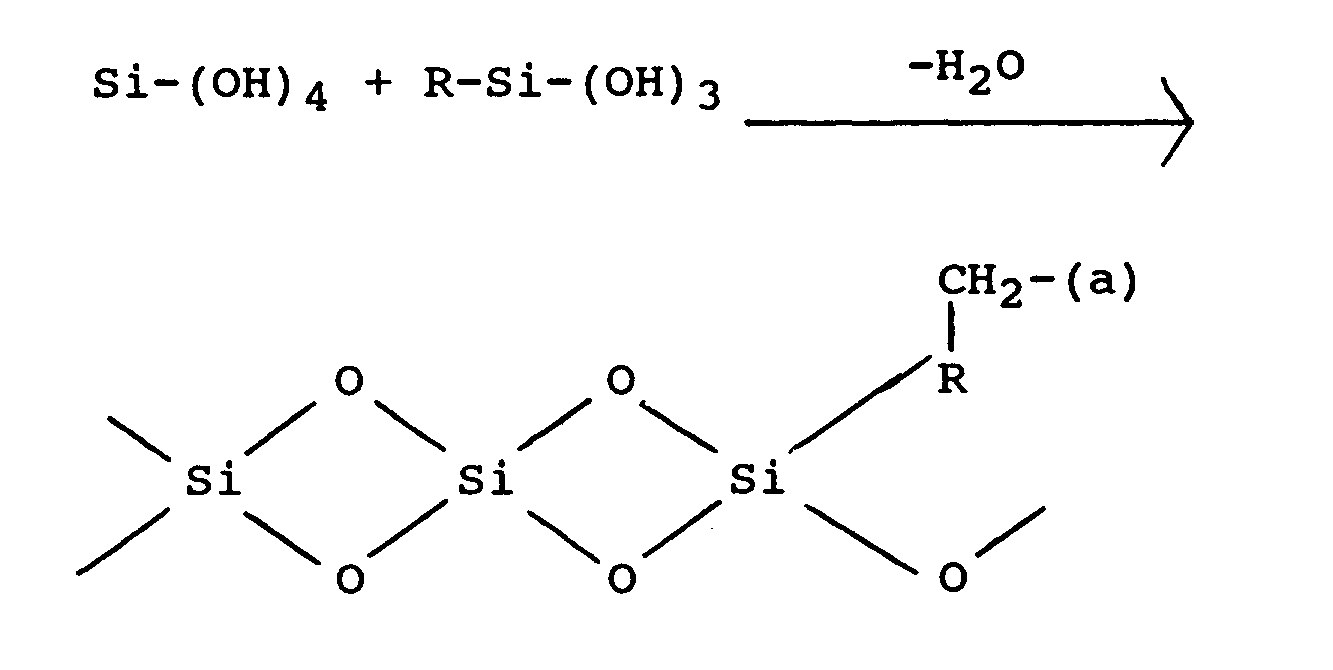
where R = epoxy, acrylate....
and a = multifunctional polymerizable monomer (epoxy, acrylate...)
Polymer/glass hybrids have advantages over all glass systems in that they can be applied as relatively thick coatings (76-127 µm), require modest cure energy, and exhibit outstanding performance as wear surfaces in flooring applications. Coating thicknesses of 1-2 µm have proven to be especially outstanding in physical property tests when applied over flooring substrates. - The present invention advances building and flooring materials art by providing a hard wear surface with excellent stain and gloss protection which can be bonded over a relatively soft surface. Since these transparent polymer/glass (organic/inorganic) compositions can be applied over clear, protective layers, there can be a wide range of applications for a wear surface which will not detract from the appearance of the support or surface being protected.
- The following examples illustrate the invention.
- For safety all preparatory work should be done in a hood. The tetraethylorthosilicate (TEOS) hydrolysis is carried out using a stoichiometric amount of water and is catalysed by keeping the pH of the reaction mixture at about 2 (normally 1 or 2 drops conc. HCl in a batch size using 100 ml. TEOS). The coupling agent hydrolysis is carried out separately and also uses a stoichiometric amount of water (one drop conc. HCl catalyst per 50 ml. batch size). There is an exotherm observed in both hydrolysis reactions. After the hydrolysis reactions are completed, the coupling agent and TEOS solutions are stirred for at least 30 minutes. After this time, the two solutions are combined in a two to one weight ratio of TEOS solution to coupling agent solution. The epoxy and epoxy photoinitiator if required are added. The solution is mixed well for 15 minutes and is then ready for coating after addition of the silicone oil surfactant. If dilutions are to be made, they are done at this point with an 80/20 volume per cent mixture of ethanol and water.
- For test purposes, a tile or resilient substrate having a typical filled or unfilled PVC plastisol composition was prepared by applying a U.V. curable, clear, protective coating, usually via a curtain-coater, at a thickness of 2-4 mils (51-102 µm) and cured via a dosage of 3 joules/cm² U.V. The coated flooring structure was then given a spray or dip application of the invention sufficient to give a 1-2 µm dry thickness of the invention and subsequently exposed to U.V. radiation.
- Stain protection was determined by comparing discoloration of control and invention test samples which were covered with various stain compositions and then wiped clean.
- Trafficked samples were abraded with dirt for 30, 60 and 90 minutes and comparative gloss measurements were taken to determine the effectiveness of the protective surface. The % reduction from the initial gloss reading can be taken as an indication of surface wear.
-
Tetraethylorthosilicate (TEOS) 93.4 g 3-glycidoxypropyltrimethoxysilane (GPTMOS) 55.0 g ERL-4221 Epoxy Monomer 10.0 g FX-512 photoinitiator 0.6 g Water (Acidified w 0.19% con. HCl) 46.0 g Ethyl Alcohol (abs.) 100 (ml.) Poly(dimethylsiloxane) 0.395 g
The ingredients designated ERL-4221 and FX-512 are trade names for the difunctional, cycloaliphatic epoxy monomer and arylonium salt and are marketed by Union Carbide and 3M Company, respectively. - The TEOS and 32.5 g water were combined in a beaker and let stir for 45 minutes. During this time, the GPTMOS was combined with 13.5 g water and stirred. After 45 minutes (or when the TEOS solution was clear), the TEOS and GPTMOS solutions were mixed and the remaining components were added as described above.
- A coating of 1-2 µm final thickness was obtained by a 4 : 1 dilution with an 80/20 volume per cent mixture of ethyl alcohol (abs.) and water followed by the spray application of approximately 1 mil (25.4 µm) wet of the diluted form of Example 1. After 5 minutes at 150°F (66°C) drying time, the coating was U.V. cured with a dose of 3 joules/cm².
- Table 1 and Table 2 contain comparative results for stain and gloss protection for the invention versus uncoated control tile.
TABLE 1 Test Sample 30 Min. % Gloss Retained 60 Min. % Gloss Retained 90 Min. % Gloss Retained Control 89 71 38 Invention 100 100 94 TABLE 2 Stain After Wiping Test Stain Invention Control Blue Marker None None Shoe Polish None Severe Ink None Moderate Hair Dye None Severe Iodine None Severe Driveway Sealer None Slight - A formulation was prepared as in Example 1 except that 4-vinyl cyclohexene dioxide was used as the epoxy monomer and diphenyliodonium hexafluorophosphate was used as the photoinitiator. After U.V. exposure and heat curing at 250°F (121°C) for 30 minutes, a clear, hard, abrasive-resistant coating was produced which had excellent resistance to household stains similar to Table 2.
- Coatings were prepared as in Example 1 except that TMOS or TPOS was used to replace TEOS as the acid hydrolysed silicate. After U.V. curing, the samples were heat cured at 250°F (121°C) for 30 minutes. These samples gave moderate stain versus severe stain for the control.
- Coatings were prepared as in Example 1 except that a cycloaliphatic epoxy/silane coupling agent was used. The coupling agent, 2-(3,4-epoxycyclohexyl)ethyl-trimethoxysilane, gave satisfactory coating compositions and was U.V. cured to produce satisfactory wear surfaces with properties similar to Tables 1 and 2 above.
- A composition containing acrylate monomer was prepared as follows:
Ingredient Amount (g.) Tetraethylorthosilicate (TEOS) 2.5 Hydroxypropyl acrylate 3.1 Methacryloxypropyltrimethoxysilane 2.5 Pentaerythritol triacrylate 10 Acidified Water (0.1 % HCl) 1.8 Benzophenone 0.15 2,2-dimethoxy-2-phenylacetophenone 0.15 DC-193 PDMS surfactant 1 drop - As in Example 1, the TEOS and silane coupling agent were separately acid hydrolysed before combination and addition of acrylate monomer, benzophenone photoinitiator and surfactant.
- When coated and tested in comparison with the composition of Example 1, the acrylate composition gave stain and gloss protection better than a control, but not as good as an epoxy formulation. Results are shown in Table 3.
TABLE 3 Sample Staining 90 Min. % Gloss Retained Control no coating Severe 15 % Example 1 epoxy monomer None 94 % Example 5 acrylate monomer Moderate to None 74 % - Coating compositions were prepared and tested as in Example 1 except using a surfactant selected from: Triton X-100, Surfynol 104-E, Aerosol OT, FC-120, Tergitol NP-27. While a satisfactory wear surface was produced, these tests did not produce the superior stain and gloss protection of Examples 1 to 5 wherein a silicone surfactant was incorporated in the composition.
- A coating composition was prepared and tested as in Example 1 except that a vinyl monomer, i.e., triethylene glycol divinyl ether, was substituted for the epoxy monomer. Fully equivalent wear and stain were obtained as illustrated in Tables 1 and 2.
- Coating compositions were prepared and tested as in Example 1 except that portions of TEOS were replaced with triethylborate (TEB). Test samples were cured at 3 joules/cm² U.V. exposure. The coating compositions were examined at intervals to determine shelf life. Table 4 contains comparative results for stain and gloss retention.
TABLE 4 TEOS TEB Age of Formulation Dye Stain % Gloss Retained (Control) (Uncoated) Severe 30 Example 1 - 7 days Formulation gelled 99.75 0.25 7 days Slight 99 99.5 0.5 7 days Slight 98 99 1.0 7 days Moderate 96 98.5 1.5 7 days Moderate 97
Claims (12)
- A polymer/glass hybrid surface covering comprising the reaction product of an acid-catalysed hydrolysis product of an inorganic metal alkoxide and an acid-catalysed hydrolysis product of a coupling agent having an inorganic metal alkoxide functionality and an organic functionality; provided that (a) the polymer/glass hybrid surface covering comprises the reaction product of an acid-catalysed hydrolysis product of an inorganic metal alkoxide, an acid-catalysed hydrolysis product of a coupling agent having an inorganic metal alkoxide functionality and an organic functionality, and a multifunctional organic monomer, the organic functionality of the multifunctional monomer and the organic functionality of the coupling agent being reactively compatible; or (b) the polymer/glass hybrid surface covering consists essentially of the reaction product of an acid-catalysed hydrolysis product of an inorganic metal alkoxide selected from the group consisting of tetramethylorthosilicate, tetraethylorthosilicate and tetrapropylorthosilicate, the hydrolysis of the alkoxide having taken place in the presence of a stoichiometric quantity of water, and an acid-catalysed hydrolysis product of a coupling agent having an inorganic metal alkoxide functionality and an organic functionality selected from the group consisting of acrylates, methacrylates, epoxides and amino-functionalities, the hydrolysis of the coupling agent having taken place in the presence of a stoichiometric quantity of water.
- The surface covering of claim 1, wherein the covering is defined under (a) and wherein the inorganic metal alkoxide is selected from aluminium, zirconium, silicon and titanium alkoxides.
- The surface covering of claim 2, wherein the inorganic metal alkoxide is selected from tetramethylorthosilicate, tetraethylorthosilicate and tetrapropylorthosilicate.
- The surface covering of any of claims 1 to 3, wherein the inorganic functionality of the coupling agent is selected from aluminium, zirconium, silicon and titanium alkoxides.
- The surface covering of claim 4, wherein the coupling agent is a trialkoxysilane.
- The surface covering of any one of claims 1 to 5, wherein an organic monomer is present, and wherein the organic monomer is an epoxy, acrylate, methacrylate or vinyl monomer.
- The surface covering of claim 1, wherein the covering is defined under (a) and which comprises on a weight basis the reaction product of(a) 10 to 70 per cent acid-catalysed hydrolysis product of at least one silicate selected from tetramethylorthosilicate, tetraethylorthosilicate and tetrapropylorthosilicate;(b) 1 to 70 per cent acid-catalysed hydrolysis product of an epoxy/silane coupling agent; and(c) 1 to 70 per cent difunctional epoxy monomer having at least one cyclohexene oxide functionality.
- A floor covering comprising the surface covering of any one of claims 1 to 7.
- A composition comprising an acid-catalysed hydrolysis product of an inorganic metal alkoxide and an acid-catalysed hydrolysis product of a coupling agent having an inorganic metal alkoxide functionality and an organic functionality; provided that (a) the composition comprises an acid-catalysed hydrolysis product of an inorganic metal alkoxide, an acid-catalysed hydrolysis product of a coupling agent having an inorganic metal alkoxide functionality and an organic functionality, and a multifunctional organic monomer, the organic functionality of the multifunctional monomer and the organic functionality of the coupling agent being reactively compatible; or (b) the composition consists essentially of an acid-catalysed hydrolysis product of an inorganic metal alkoxide selected from the group consisting of tetramethylorthosilicate, tetraethylorthosilicate and tetrapropylorthosilicate, the hydrolysis of the alkoxide having taken place in the presence of a stoichiometric quantity of water, and an acid-catalysed hydrolysis product of a coupling agent having an inorganic metal alkoxide functionality and an organic functionality selected from the group consisting of acrylates, methacrylates, epoxides and amino-functionalities, the hydrolysis of the coupling agent having taken place in the presence of a stoichiometric quantity of water.
- A composition as claimed in claim 9, consisting essentially of(a) an acid-catalysed hydrolysis product of an inorganic metal alkoxide;(b) an acid-catalysed hydrolysis product of a coupling agent having an inorganic metal alkoxide functionality and an organic functionality selected from acrylates, methacrylates, epoxides and vinyl- and amino-functionalities; and(c) a multifunctional organic monomer selected from epoxy and/or acrylate, methacrylate or vinyl monomers, advantageously one having at least one cycloaliphatic epoxide functionality.
- The composition of claim 10, wherein (a) is tetramethylorthosilicate, tetraethylorthosilicate and tetrapropylorthosilicate.
- A method of preparing a protective coating comprising(a) combining acid hydrolysed solutions (i) and (ii); (i) being a solution having a pH of at most 4 of a metal alkoxide, advantageously TMOS, TEOS or TPOS; and (ii) being a solution of an acid-catalysed hydrolysis product of a coupling agent having an inorganic metal alkoxide functionality and an organic functionality, advantageously an acrylate, methacrylate, epoxide or amino-functionality;(b) adding a multifunctional organic monomer having an organic functionality reactively compatible with the organic functionality of the coupling agent to form a composition; and(c) applying the composition, advantageously in a thickness of from 1 to 8 µm, over a base layer.
Priority Applications (1)
| Application Number | Priority Date | Filing Date | Title |
|---|---|---|---|
| DE1991603876 DE69103876T2 (en) | 1991-03-01 | 1991-03-01 | Coating composition. |
Applications Claiming Priority (1)
| Application Number | Priority Date | Filing Date | Title |
|---|---|---|---|
| US07/209,097 US5023140A (en) | 1988-06-20 | 1988-06-20 | Floor covering having a modified glass wear layer |
Publications (2)
| Publication Number | Publication Date |
|---|---|
| EP0501055A1 EP0501055A1 (en) | 1992-09-02 |
| EP0501055B1 true EP0501055B1 (en) | 1994-09-07 |
Family
ID=22777325
Family Applications (1)
| Application Number | Title | Priority Date | Filing Date |
|---|---|---|---|
| EP91301695A Expired - Lifetime EP0501055B1 (en) | 1988-06-20 | 1991-03-01 | Coating composition |
Country Status (3)
| Country | Link |
|---|---|
| US (1) | US5023140A (en) |
| EP (1) | EP0501055B1 (en) |
| CA (1) | CA1318441C (en) |
Cited By (1)
| Publication number | Priority date | Publication date | Assignee | Title |
|---|---|---|---|---|
| US9207373B2 (en) | 2007-04-10 | 2015-12-08 | Stoncor Group, Inc. | Methods for fabrication and highway marking usage of agglomerated retroreflective beads |
Families Citing this family (21)
| Publication number | Priority date | Publication date | Assignee | Title |
|---|---|---|---|---|
| US5800904A (en) * | 1991-12-27 | 1998-09-01 | Hallman; Robert A. | Embossable surface covering with inorganic wear layer |
| IT1254548B (en) * | 1992-03-23 | 1995-09-25 | THREE-COMPONENT WATER-BASED PAINTS, FOR GLASS FOR INDOOR USE. | |
| US5308694A (en) * | 1992-07-31 | 1994-05-03 | Tarkett Ab | Barrier layer for floor and wall coverings |
| US5739174A (en) * | 1993-12-15 | 1998-04-14 | Minnesota Mining And Manufacturing Company | Epoxysilicone photocurable composition comprising a sulfolene or isatin photosensitizer |
| JPH07207188A (en) * | 1993-12-15 | 1995-08-08 | Minnesota Mining & Mfg Co <3M> | Photocurable composition |
| CA2145948A1 (en) * | 1994-04-06 | 1995-10-07 | Wendell A. Ehrhart | Floor covering having a (meth)acrylated, highly ethoxylated, aromatic polyester wear layer |
| US5648407A (en) * | 1995-05-16 | 1997-07-15 | Minnesota Mining And Manufacturing Company | Curable resin sols and fiber-reinforced composites derived therefrom |
| JP2000501775A (en) * | 1996-09-24 | 2000-02-15 | フィリップス エレクトロニクス ネムローゼ フェンノートシャップ | Personal care appliances |
| DE19841977A1 (en) * | 1998-09-14 | 2000-02-03 | Herberts Gmbh | Coating composition comprising an inorganic-organic hybrid polymer and a binding agent, suitable for coating electrical conductors and has improved resistance to heat and high voltage. |
| US6413618B1 (en) | 1999-05-11 | 2002-07-02 | Congoleum Corporation | Laminated glass floor tile and flooring made therefrom and method for making same |
| US6472467B1 (en) | 1999-10-21 | 2002-10-29 | Dow Global Technologies Inc. | Inorganic/organic compositions |
| US6399670B1 (en) | 2000-01-21 | 2002-06-04 | Congoleum Corporation | Coating having macroscopic texture and process for making same |
| US6759096B2 (en) | 2001-09-24 | 2004-07-06 | Congoleum Corporation | Method for making differential gloss coverings |
| US6911263B2 (en) * | 2002-01-30 | 2005-06-28 | Awi Licensing Company | PET wear layer/sol gel top coat layer composites |
| JP2006521864A (en) | 2003-03-31 | 2006-09-28 | コーニンクレッカ フィリップス エレクトロニクス エヌ ヴィ | Medical equipment with coating |
| US20050079780A1 (en) * | 2003-10-14 | 2005-04-14 | Rowe Richard E. | Fiber wear layer for resilient flooring and other products |
| US7521410B2 (en) * | 2004-03-26 | 2009-04-21 | Arrowstar, Llc | Compositions and methods for imparting odor resistance and articles thereof |
| US20080057019A1 (en) * | 2006-09-06 | 2008-03-06 | Collier Robert B | Compositions and methods for imparting odor resistance and articles thereof |
| BE1019331A5 (en) | 2010-05-10 | 2012-06-05 | Flooring Ind Ltd Sarl | FLOOR PANEL AND METHODS FOR MANUFACTURING FLOOR PANELS. |
| JP7252467B2 (en) * | 2017-10-06 | 2023-04-05 | 株式会社スリーボンド | Surface modifier composition and bonding method |
| DE102020210680A1 (en) * | 2020-08-21 | 2022-02-24 | Fraunhofer-Gesellschaft zur Förderung der angewandten Forschung eingetragener Verein | Adhesion Promoting Composite, Method of Making an Adhesion Promoting Composite, Electrical Device, Method of Making an Electrical Device |
Citations (1)
| Publication number | Priority date | Publication date | Assignee | Title |
|---|---|---|---|---|
| GB2177093A (en) * | 1985-05-14 | 1987-01-14 | Nippon Oil Co Ltd | Photo-curable coating composition |
Family Cites Families (9)
| Publication number | Priority date | Publication date | Assignee | Title |
|---|---|---|---|---|
| US3811918A (en) * | 1971-12-20 | 1974-05-21 | Owens Illinois Inc | Process for producing protective glass coatings |
| US4346131A (en) * | 1979-08-10 | 1982-08-24 | Westinghouse Electric Corp. | Polymerized solutions for depositing optical oxide coatings |
| US4480072A (en) * | 1982-03-10 | 1984-10-30 | Union Carbide Corporation | Use of ethyl silicate as a crosslinker for hydroxylated polymers |
| DE3407087C3 (en) * | 1984-02-27 | 1994-07-07 | Fraunhofer Ges Forschung | Process and varnish for the production of scratch-resistant coatings |
| KR850006162A (en) * | 1984-03-30 | 1985-10-02 | 오오가와라 겐지로오 | Surface protectant |
| FR2581650B1 (en) * | 1985-05-13 | 1987-09-18 | Celliose Sa | HIGH-HARDNESS, ABRASION-RESISTANT VARNISH, PROCESS FOR THEIR PREPARATION, AND APPLICATION OF SUCH VARNISHES TO THE COATING OF SOLID SUBSTRATES |
| DE3671028D1 (en) * | 1985-11-07 | 1990-06-13 | Uvexs Inc | UV-curable polymer compounds based on epoxies and siloxanes. |
| US4731264A (en) * | 1986-10-03 | 1988-03-15 | Ppg Industries, Inc. | Sol-gel compositions containing silane and alumina |
| US5013608A (en) * | 1989-07-07 | 1991-05-07 | Swedlow, Inc. | Highly tintable abrasion resistant coatings |
-
1988
- 1988-06-20 US US07/209,097 patent/US5023140A/en not_active Expired - Lifetime
-
1989
- 1989-03-13 CA CA000593441A patent/CA1318441C/en not_active Expired - Fee Related
-
1991
- 1991-03-01 EP EP91301695A patent/EP0501055B1/en not_active Expired - Lifetime
Patent Citations (1)
| Publication number | Priority date | Publication date | Assignee | Title |
|---|---|---|---|---|
| GB2177093A (en) * | 1985-05-14 | 1987-01-14 | Nippon Oil Co Ltd | Photo-curable coating composition |
Non-Patent Citations (1)
| Title |
|---|
| Polymer Bulletin, Vol.24 (1990), pages 173-179 * |
Cited By (1)
| Publication number | Priority date | Publication date | Assignee | Title |
|---|---|---|---|---|
| US9207373B2 (en) | 2007-04-10 | 2015-12-08 | Stoncor Group, Inc. | Methods for fabrication and highway marking usage of agglomerated retroreflective beads |
Also Published As
| Publication number | Publication date |
|---|---|
| US5023140A (en) | 1991-06-11 |
| CA1318441C (en) | 1993-05-25 |
| EP0501055A1 (en) | 1992-09-02 |
Similar Documents
| Publication | Publication Date | Title |
|---|---|---|
| US5120811A (en) | Polymer/glass hybrid coating | |
| US5023140A (en) | Floor covering having a modified glass wear layer | |
| EP0263428B2 (en) | Organosiloxane/metal oxide coatings | |
| JP4959892B2 (en) | Coating composition providing an abrasion resistant and colorable coating | |
| US4814017A (en) | Aqueous organoalkoxysilane/metal oxide sol-gel compositions | |
| DE3751856T2 (en) | Organic-inorganic hybrid polymer | |
| US6911263B2 (en) | PET wear layer/sol gel top coat layer composites | |
| JPH1161029A (en) | Antifogging coating material, antifogging coating film and antifogging article | |
| EP0721435A1 (en) | A water-borne polysiloxane/polysilicate binder | |
| EP0241158B1 (en) | Thermal control coating composition | |
| JPH06256568A (en) | Hydraulic resin composition | |
| US3496119A (en) | Water-activated epoxy compositions | |
| JPWO2005095102A1 (en) | Article on which silica-based film is formed and method for producing the same | |
| JP3610627B2 (en) | Coating liquid, method for producing the same, and coating film | |
| WO2005071033A2 (en) | Method of production of polysilicate binder for adhesives and coatings, polysilicate binder, adhesive composition for adhesives and coating on its basis | |
| US4224213A (en) | Single package inorganic zinc rich paints having a silicate and titanate ester copolymer binder | |
| JP7504087B2 (en) | Resin composition, its manufacturing method, and multi-component curable resin composition | |
| JP3245521B2 (en) | Paint composition | |
| US20030114540A1 (en) | Method for producing sol-gel compositions with a reduced solvent content and improved storage properties, and the use thereof | |
| IE910739A1 (en) | Coating composition | |
| JPH028273A (en) | Silicon alkoxide-based coating material | |
| JPH05148453A (en) | Epoxy/glass coating composition | |
| DE69103876T2 (en) | Coating composition. | |
| JPH0236282A (en) | Silicon alkoxide-based coating material and production thereof | |
| WO2021145064A1 (en) | Resin composition, method for producing same, and multi-component curable resin composition |
Legal Events
| Date | Code | Title | Description |
|---|---|---|---|
| PUAI | Public reference made under article 153(3) epc to a published international application that has entered the european phase |
Free format text: ORIGINAL CODE: 0009012 |
|
| AK | Designated contracting states |
Kind code of ref document: A1 Designated state(s): DE FR GB IT NL SE |
|
| 17P | Request for examination filed |
Effective date: 19930209 |
|
| 17Q | First examination report despatched |
Effective date: 19930506 |
|
| GRAA | (expected) grant |
Free format text: ORIGINAL CODE: 0009210 |
|
| AK | Designated contracting states |
Kind code of ref document: B1 Designated state(s): DE FR GB IT NL SE |
|
| ITF | It: translation for a ep patent filed | ||
| REF | Corresponds to: |
Ref document number: 69103876 Country of ref document: DE Date of ref document: 19941013 |
|
| ET | Fr: translation filed | ||
| EAL | Se: european patent in force in sweden |
Ref document number: 91301695.2 |
|
| PLBE | No opposition filed within time limit |
Free format text: ORIGINAL CODE: 0009261 |
|
| STAA | Information on the status of an ep patent application or granted ep patent |
Free format text: STATUS: NO OPPOSITION FILED WITHIN TIME LIMIT |
|
| 26N | No opposition filed | ||
| PGFP | Annual fee paid to national office [announced via postgrant information from national office to epo] |
Ref country code: SE Payment date: 19980219 Year of fee payment: 8 |
|
| PGFP | Annual fee paid to national office [announced via postgrant information from national office to epo] |
Ref country code: FR Payment date: 19980221 Year of fee payment: 8 |
|
| PGFP | Annual fee paid to national office [announced via postgrant information from national office to epo] |
Ref country code: NL Payment date: 19980223 Year of fee payment: 8 Ref country code: DE Payment date: 19980223 Year of fee payment: 8 |
|
| PGFP | Annual fee paid to national office [announced via postgrant information from national office to epo] |
Ref country code: GB Payment date: 19980226 Year of fee payment: 8 |
|
| PG25 | Lapsed in a contracting state [announced via postgrant information from national office to epo] |
Ref country code: GB Free format text: LAPSE BECAUSE OF NON-PAYMENT OF DUE FEES Effective date: 19990301 |
|
| PG25 | Lapsed in a contracting state [announced via postgrant information from national office to epo] |
Ref country code: SE Free format text: LAPSE BECAUSE OF NON-PAYMENT OF DUE FEES Effective date: 19990302 |
|
| PG25 | Lapsed in a contracting state [announced via postgrant information from national office to epo] |
Ref country code: NL Free format text: LAPSE BECAUSE OF NON-PAYMENT OF DUE FEES Effective date: 19991001 |
|
| GBPC | Gb: european patent ceased through non-payment of renewal fee |
Effective date: 19990301 |
|
| EUG | Se: european patent has lapsed |
Ref document number: 91301695.2 |
|
| PG25 | Lapsed in a contracting state [announced via postgrant information from national office to epo] |
Ref country code: FR Free format text: LAPSE BECAUSE OF NON-PAYMENT OF DUE FEES Effective date: 19991130 |
|
| NLV4 | Nl: lapsed or anulled due to non-payment of the annual fee |
Effective date: 19991001 |
|
| EUG | Se: european patent has lapsed |
Ref document number: 91301695.2 |
|
| REG | Reference to a national code |
Ref country code: FR Ref legal event code: ST |
|
| PG25 | Lapsed in a contracting state [announced via postgrant information from national office to epo] |
Ref country code: DE Free format text: LAPSE BECAUSE OF NON-PAYMENT OF DUE FEES Effective date: 20000101 |
|
| PG25 | Lapsed in a contracting state [announced via postgrant information from national office to epo] |
Ref country code: IT Free format text: LAPSE BECAUSE OF NON-PAYMENT OF DUE FEES;WARNING: LAPSES OF ITALIAN PATENTS WITH EFFECTIVE DATE BEFORE 2007 MAY HAVE OCCURRED AT ANY TIME BEFORE 2007. THE CORRECT EFFECTIVE DATE MAY BE DIFFERENT FROM THE ONE RECORDED. Effective date: 20050301 |