EP0499812B1 - A composite protective body and its use - Google Patents
A composite protective body and its use Download PDFInfo
- Publication number
- EP0499812B1 EP0499812B1 EP92101004A EP92101004A EP0499812B1 EP 0499812 B1 EP0499812 B1 EP 0499812B1 EP 92101004 A EP92101004 A EP 92101004A EP 92101004 A EP92101004 A EP 92101004A EP 0499812 B1 EP0499812 B1 EP 0499812B1
- Authority
- EP
- European Patent Office
- Prior art keywords
- constituent
- bodies
- insert
- constituent bodies
- pliable
- Prior art date
- Legal status (The legal status is an assumption and is not a legal conclusion. Google has not performed a legal analysis and makes no representation as to the accuracy of the status listed.)
- Expired - Lifetime
Links
Images

Classifications
-
- F—MECHANICAL ENGINEERING; LIGHTING; HEATING; WEAPONS; BLASTING
- F41—WEAPONS
- F41H—ARMOUR; ARMOURED TURRETS; ARMOURED OR ARMED VEHICLES; MEANS OF ATTACK OR DEFENCE, e.g. CAMOUFLAGE, IN GENERAL
- F41H5/00—Armour; Armour plates
- F41H5/02—Plate construction
- F41H5/04—Plate construction composed of more than one layer
- F41H5/0492—Layered armour containing hard elements, e.g. plates, spheres, rods, separated from each other, the elements being connected to a further flexible layer or being embedded in a plastics or an elastomer matrix
-
- F—MECHANICAL ENGINEERING; LIGHTING; HEATING; WEAPONS; BLASTING
- F41—WEAPONS
- F41H—ARMOUR; ARMOURED TURRETS; ARMOURED OR ARMED VEHICLES; MEANS OF ATTACK OR DEFENCE, e.g. CAMOUFLAGE, IN GENERAL
- F41H5/00—Armour; Armour plates
- F41H5/02—Plate construction
- F41H5/04—Plate construction composed of more than one layer
- F41H5/0414—Layered armour containing ceramic material
- F41H5/0428—Ceramic layers in combination with additional layers made of fibres, fabrics or plastics
- F41H5/0435—Ceramic layers in combination with additional layers made of fibres, fabrics or plastics the additional layers being only fibre- or fabric-reinforced layers
-
- Y—GENERAL TAGGING OF NEW TECHNOLOGICAL DEVELOPMENTS; GENERAL TAGGING OF CROSS-SECTIONAL TECHNOLOGIES SPANNING OVER SEVERAL SECTIONS OF THE IPC; TECHNICAL SUBJECTS COVERED BY FORMER USPC CROSS-REFERENCE ART COLLECTIONS [XRACs] AND DIGESTS
- Y10—TECHNICAL SUBJECTS COVERED BY FORMER USPC
- Y10S—TECHNICAL SUBJECTS COVERED BY FORMER USPC CROSS-REFERENCE ART COLLECTIONS [XRACs] AND DIGESTS
- Y10S428/00—Stock material or miscellaneous articles
- Y10S428/911—Penetration resistant layer
Definitions
- the present invention is in the field of protection against threats such as kinetic missiles, e.g. in form of firearm bullets, against knife-thrusts and the like, and by one of its aspects aims at providing pliable composite protective bodies suitable for incorporation in protective garments such as bullet-proof vests. By another aspect the invention aims at providing an outer armour on enclosures such as, for example land vehicles, marine vessels and aircraft.
- the invention further concerns improved protective garments.
- Known protective garments such as bullet-proof vests, comprise as a rule a plurality of so-called ceramic ballistic plates in combination with a so-called ballistic material, e.g. soft panels made of KevlarTM, SpectraTM, AramidTM and the like.
- a so-called ballistic material e.g. soft panels made of KevlarTM, SpectraTM, AramidTM and the like.
- the ceramic plate insert which, depending on the intended use, may be flat or curved, the individual plates are densely laid out with neighbouring plates tightly bearing on each other.
- EP-A-208 499 discloses an armour component having a pair of layers of flexible high impact resistant material with at least two juxtaposed layers of hard beads between the flexible layers.
- the insert forming plates in known composite protective bodies of the kind specified are usually large relative to the diameter of the threatening object such as a kinetic energy missile, against which it is to afford protection, e.g. of the order of 5 cm2.
- the composite body has only one single layer of ceramic plates it affords a relatively low multi-hit capability since every hit destroys one of the plates leaving a relatively large unprotected area.
- the multi-hit capability is improved by provision of inserts with two or more mutually staggered overlapping layers of ceramic ballistic plates. However, this renders the vest relatively heavy and gives rise to significant discomfort of the wearer.
- ballistic material means a pliable woven or non-woven material capable of absorbing the kinetic energy of a missile such as a firearm bullet and thereby damping a missile to a large extent; and the term “size” when used in relation to kinetic energy missiles or ceramic bodies means width or diameter.
- the axisymmetric or centrosymmetric constituent glass or ceramic bodies of the insert employed in accordance with the invention may be of any suitable shape such as spherical, ellipsoidal, cylindrical, prismatic, pyramidal and the like, spherical bodies being preferred.
- the composite protective bodies according to the invention combine a relative light weight with a good multi-hit capability.
- the multi-hit capability is enhanced by the fact that the size of the ballistic bodies is commensurate with that of the threatening objects against which protection is to be afforded.
- the size of a body may be between 1/3 and twice the size of a threatening object such as a bullet.
- spherical ballistic glass or ceramic bodies having a diameter from 4 - 18 mm may afford adequate protection against all conventional small calibre firearms.
- a composite protective body according to the invention is placed with the insert turned towards the environment.
- an impinging kinetic missile such as a firearm bullet, is effectively deflected from its original trajectory and damped by the insert body or bodies which it hits to such an extent that it is subsequently captured by the soft ballistic material panel of the case.
- a composite protective body according to the invention for incorporation of a composite protective body according to the invention in a protective garment such as a bullet-proof vest, it may be fabricated in a shape most suitable for that purpose.
- a bullet-proof vest having front and back composite protective bodies made each in accordance with the invention and only one of which is shown.
- the vest 1 has a front composite protective body 2 comprising a case with a back panel 3 of a soft ballistic material such as KevlarTM and a front sheet 4, holding an insert comprising a plurality of spherical ceramic constituent bodies 5.
- the constituent ceramic bodies 5 are arranged in two rows with the constituent bodies 5 in each row being spaced from each other by a distance smaller than the diameter of a ceramic body 5 and the gaps between them being bridged by constituent bodies of the other row.
- Each of the constituent bodies 5 is glued to all surrounding constituent bodies.
- a composite protective body of the kind shown in Figs. 1 and 2 was subjected to a shooting test.
- the soft ballistic material panel 3 was 12 mm thick and made of KevlarTM while the front sheet 4 was of ordinary cloth.
- the ceramic spherical protective bodies 5 measured 10 mm in diameter and were made of alumina. All spherical constituent bodies were glued together in the manner specified by means of the thermoplastic-polyester HytrelTM. Armour piercing bullets fired from an automatic assault rifle AK-47 (known as Kalashnikov) from a distance of 10 metres were stopped and did not penetrate across the composite protective body.
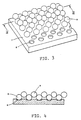
- FIGs. 3 and 4 show a sintering fixture for the preparation of a ceramic body insert according to the invention.
- the fixture 7 has a plurality of depressions 8 each capable of holding a ceramic or glass sphere 9.
- the first, bottom layer of ceramic spheres 9 is covered with a second, top layer of identical bodies such that each body 9 of the top layer bridges the gap between two bodies 9 of the bottom layer and likewise each body 9 of the lower layer bridges the gap between two bodies 9 of the upper one.
- Fig. 3 shows an intermediary phase in the arrangement of spheres 9 in sintering fixture 7.
- spheres 9 are first subjected to a treatment by which they are coated with suitable thermoplastic or thermosetting material, as will be described in Examples 1 and 2 below, and once placed in fixture 7 they are subjected to sintering in a suitable oven. After cooling, a cohesive two-layer insert structure of ceramic spherical bodies is withdrawn from the form and is ready for insertion in a case for forming a composite protective body according to the invention.
- Alumina spheres having a uniform diameter of 9.5 mm were heated to 160°C for 30 minutes and then immersed in a powder bed of the thermoplastic copolyester HytrelTM, whereby the alumina spheres were coated by a 0.5 mm thick uniform layer of the thermoplastic material.
- the coated spheres were placed in a sintering fixture of the kind illustrated in Figs. 3 and 4 and placed for 10 minutes in an oven for sintering at 160°C. After cooling a cohesive two-layer insert body of coated ceramic spheres was withdrawn from the sintering fixture. The insert was pliable and could be bent without damage at radius of curvature of 30° and more.
- the total thickness of the body was 16 mm. It was attached to a 12 mm thick AramidTM panel and a shooting test was performed as described hereinbefore.
- Cohesive insert bodies produced in this manner are ready for further use and processing in accordance with the teachings of this invention.
- Alumina spheres having a uniform diameter of 9.5 mm were placed into a sintering fixture of the kind illustrated in Figs. 3 and 4.
- Liquid room temperature vulcanising (RTV) silane was poured at room temperature onto the spheres.
- the sintering fixture was placed in an oven and heated for 30 minutes at 100°C.
- the resulting cohesive insert body was ready for further processing in accordance with the present invention.
Landscapes
- Engineering & Computer Science (AREA)
- Chemical & Material Sciences (AREA)
- Ceramic Engineering (AREA)
- General Engineering & Computer Science (AREA)
- Aiming, Guidance, Guns With A Light Source, Armor, Camouflage, And Targets (AREA)
- Laminated Bodies (AREA)
Description
- The present invention is in the field of protection against threats such as kinetic missiles, e.g. in form of firearm bullets, against knife-thrusts and the like, and by one of its aspects aims at providing pliable composite protective bodies suitable for incorporation in protective garments such as bullet-proof vests. By another aspect the invention aims at providing an outer armour on enclosures such as, for example land vehicles, marine vessels and aircraft.
- The invention further concerns improved protective garments.
- Known protective garments such as bullet-proof vests, comprise as a rule a plurality of so-called ceramic ballistic plates in combination with a so-called ballistic material, e.g. soft panels made of Kevlar™, Spectra™, Aramid™ and the like. In the ceramic plate insert which, depending on the intended use, may be flat or curved, the individual plates are densely laid out with neighbouring plates tightly bearing on each other.
- EP-A-208 499 discloses an armour component having a pair of layers of flexible high impact resistant material with at least two juxtaposed layers of hard beads between the flexible layers.
- The insert forming plates in known composite protective bodies of the kind specified are usually large relative to the diameter of the threatening object such as a kinetic energy missile, against which it is to afford protection, e.g. of the order of 5 cm². Where the composite body has only one single layer of ceramic plates it affords a relatively low multi-hit capability since every hit destroys one of the plates leaving a relatively large unprotected area. In some known bullet-proof vests the multi-hit capability is improved by provision of inserts with two or more mutually staggered overlapping layers of ceramic ballistic plates. However, this renders the vest relatively heavy and gives rise to significant discomfort of the wearer.
- It is the object of the present invention to provide an improved, relatively light-weight composite protective body of the kind specified.
- It is a further object of the present invention to provide an improved insert for a protective garment.
- It is yet another object of the invention to provide improved protective garments.
- In the following description and claims, the expression "ballistic material" means a pliable woven or non-woven material capable of absorbing the kinetic energy of a missile such as a firearm bullet and thereby damping a missile to a large extent; and the term "size" when used in relation to kinetic energy missiles or ceramic bodies means width or diameter.
- The above objects are solved with the features of the claims.
- The axisymmetric or centrosymmetric constituent glass or ceramic bodies of the insert employed in accordance with the invention, may be of any suitable shape such as spherical, ellipsoidal, cylindrical, prismatic, pyramidal and the like, spherical bodies being preferred.
- Due to the fact that in accordance with the invention the individual constituent bodies are spaced from each other with the gaps between constituent bodies in one layer being bridged by a constituent body of another layer, the composite protective bodies according to the invention combine a relative light weight with a good multi-hit capability. The multi-hit capability is enhanced by the fact that the size of the ballistic bodies is commensurate with that of the threatening objects against which protection is to be afforded. Typically, the size of a body may be between 1/3 and twice the size of a threatening object such as a bullet. For example, spherical ballistic glass or ceramic bodies having a diameter from 4 - 18 mm may afford adequate protection against all conventional small calibre firearms.
- In the following the invention will be described with reference to kinetic energy missiles such as firearm bullets as the threatening objects, it being understood that it is also effective against other threatening objects, e.g. thrusts of various cold weapons such as knives, daggers and the like.
- In use a composite protective body according to the invention is placed with the insert turned towards the environment. In operation, an impinging kinetic missile such as a firearm bullet, is effectively deflected from its original trajectory and damped by the insert body or bodies which it hits to such an extent that it is subsequently captured by the soft ballistic material panel of the case.
- For incorporation of a composite protective body according to the invention in a protective garment such as a bullet-proof vest, it may be fabricated in a shape most suitable for that purpose.
- For better understanding the invention will now be described, by way of example only and without limitation, with reference to the annexed drawings in which:
- Fig. 1 is a front view, partly broken open of a bullet-proof vest comprising a composite protective body according to the invention;
- Fig. 2 is a section along line II-II of Fig. 1: and
- Fig. 3 is a diagrammatic perspective illustration of a phase in the manufacturing process; and
- Fig. 4 is a section along lines IV-IV of Fig. 3.
- Referring first to Figs. 1 and 2, there is shown a bullet-proof vest having front and back composite protective bodies made each in accordance with the invention and only one of which is shown. As shown, the vest 1 has a front composite
protective body 2 comprising a case with aback panel 3 of a soft ballistic material such as Kevlar™ and a front sheet 4, holding an insert comprising a plurality of sphericalceramic constituent bodies 5. As seen in Fig. 2, the constituentceramic bodies 5 are arranged in two rows with theconstituent bodies 5 in each row being spaced from each other by a distance smaller than the diameter of aceramic body 5 and the gaps between them being bridged by constituent bodies of the other row. Each of theconstituent bodies 5 is glued to all surrounding constituent bodies. - A composite protective body of the kind shown in Figs. 1 and 2 was subjected to a shooting test. In the tested body the soft
ballistic material panel 3 was 12 mm thick and made of Kevlar™ while the front sheet 4 was of ordinary cloth. The ceramic sphericalprotective bodies 5 measured 10 mm in diameter and were made of alumina. All spherical constituent bodies were glued together in the manner specified by means of the thermoplastic-polyester Hytrel™. Armour piercing bullets fired from an automatic assault rifle AK-47 (known as Kalashnikov) from a distance of 10 metres were stopped and did not penetrate across the composite protective body. - Attention is now directed to Figs. 3 and 4 which show a sintering fixture for the preparation of a ceramic body insert according to the invention. The
fixture 7 has a plurality ofdepressions 8 each capable of holding a ceramic orglass sphere 9. As shown in Fig. 4, the first, bottom layer ofceramic spheres 9 is covered with a second, top layer of identical bodies such that eachbody 9 of the top layer bridges the gap between twobodies 9 of the bottom layer and likewise eachbody 9 of the lower layer bridges the gap between twobodies 9 of the upper one. Fig. 3 shows an intermediary phase in the arrangement ofspheres 9 in sinteringfixture 7. - In the course of production,
spheres 9 are first subjected to a treatment by which they are coated with suitable thermoplastic or thermosetting material, as will be described in Examples 1 and 2 below, and once placed infixture 7 they are subjected to sintering in a suitable oven. After cooling, a cohesive two-layer insert structure of ceramic spherical bodies is withdrawn from the form and is ready for insertion in a case for forming a composite protective body according to the invention. - The preparation of cohesive inserts of ceramic spheres of the kind referred to above is further described in the following non-limiting Examples.
- Alumina spheres having a uniform diameter of 9.5 mm were heated to 160°C for 30 minutes and then immersed in a powder bed of the thermoplastic copolyester Hytrel™, whereby the alumina spheres were coated by a 0.5 mm thick uniform layer of the thermoplastic material. Following cooling, the coated spheres were placed in a sintering fixture of the kind illustrated in Figs. 3 and 4 and placed for 10 minutes in an oven for sintering at 160°C. After cooling a cohesive two-layer insert body of coated ceramic spheres was withdrawn from the sintering fixture. The insert was pliable and could be bent without damage at radius of curvature of 30° and more.
- The total thickness of the body was 16 mm. It was attached to a 12 mm thick Aramid™ panel and a shooting test was performed as described hereinbefore.
- Cohesive insert bodies produced in this manner are ready for further use and processing in accordance with the teachings of this invention.
- Alumina spheres having a uniform diameter of 9.5 mm were placed into a sintering fixture of the kind illustrated in Figs. 3 and 4. Liquid room temperature vulcanising (RTV) silane was poured at room temperature onto the spheres. Following degassing in a manner known per se to remove trapped air, the sintering fixture was placed in an oven and heated for 30 minutes at 100°C. The resulting cohesive insert body was ready for further processing in accordance with the present invention.
Claims (5)
- A composite protective body (2) comprising a pliable flat case with at least one back panel (3) of a pliable woven or non-woven material capable of absorbing the kinetic energy of a missile and a front sheet (4) and an insert within said pliable flat case comprising a plurality of constituent bodies (5) of glass or ceramic material, wherein the constituent bodies (5) of the insert are of axisymmetrical or centrosymmetrical shape and of a size commensurate with that of the threatening object against which protection is to be afforded and are arranged in at least two superimposed layers characterized in that the front sheet (4) is of ordinary cloth material, in each of the layers the constituent bodies (5) are spaced from each other by a distance smaller than the size of a constituent body (5) with each constituent body (5) in one layer bridging a gap between two constituent bodies (5) of another layer, and in that each constituent body (5) of the insert is glued to all surrounding constituent bodies (5) by thermoplastic or thermosetting material.
- A composite protective body according to Claim 1, characterised in that said constituent bodies (5) are spherical.
- A cohesive pliable insert for incorporation in a protective garment, comprising a plurality of axisymmetrical or centrosymmetrical constituent bodies (5) of glass or ceramic material arranged in at least two layers characterized in that in each of the layers the constituent bodies are spaced from each other by a distance smaller than the size of a constituent body with each constituent body (5) in one layer bridging the gap between two constituent bodies (5) in another layer, and in that each constituent body (5) is glued to all surrounding constituent bodies (5) by thermoplastic or thermosetting material.
- An insert according to Claim 3, characterised in that said constituent bodies (5) are spherical.
- A protective garment (1) having a pliable flat case with a back panel (3) of a pliable woven or non-woven material capable of absorbing the kinetic energy of a missile and a front sheet (4), holding a cohesive pliable insert comprising a plurality of axisymmetrical or centrosymmetrical constituent bodies (5) of glass or ceramic material arranged in at least two layers characterized in that the front sheet (4) is of ordinary cloth material, in each of the layers the constituent bodies (5) are spaced from each other by a distance smaller than the size of a constituent body (5) with each constituent body (5) in one layer bridging the gap between two constituent bodies (5) in another layer, and in that each constituent body (5) is glued to all surrounding constituent bodies (5) by thermoplastic or thermosetting material.
Applications Claiming Priority (2)
| Application Number | Priority Date | Filing Date | Title |
|---|---|---|---|
| IL97282 | 1991-02-20 | ||
| IL9728291A IL97282A (en) | 1991-02-20 | 1991-02-20 | Composite protective body and its use |
Publications (2)
| Publication Number | Publication Date |
|---|---|
| EP0499812A1 EP0499812A1 (en) | 1992-08-26 |
| EP0499812B1 true EP0499812B1 (en) | 1995-07-19 |
Family
ID=11062117
Family Applications (1)
| Application Number | Title | Priority Date | Filing Date |
|---|---|---|---|
| EP92101004A Expired - Lifetime EP0499812B1 (en) | 1991-02-20 | 1992-01-22 | A composite protective body and its use |
Country Status (5)
| Country | Link |
|---|---|
| US (1) | US5134725A (en) |
| EP (1) | EP0499812B1 (en) |
| DE (1) | DE69203475T2 (en) |
| IE (1) | IE920088A1 (en) |
| IL (1) | IL97282A (en) |
Cited By (1)
| Publication number | Priority date | Publication date | Assignee | Title |
|---|---|---|---|---|
| RU2226253C2 (en) * | 2002-04-11 | 2004-03-27 | Подосинников Вячеслав Васильевич | Multi-layer inertial protection |
Families Citing this family (47)
| Publication number | Priority date | Publication date | Assignee | Title |
|---|---|---|---|---|
| GB2272272B (en) * | 1992-11-10 | 1996-07-24 | T & N Technology Ltd | Armour |
| US5736474A (en) * | 1993-03-25 | 1998-04-07 | Thomas; Howard L. | Multi-structure ballistic material |
| RU2116607C1 (en) * | 1995-12-04 | 1998-07-27 | Владимир Иванович Ковтун | Bulletproof flexible structure |
| US5738925A (en) * | 1996-04-10 | 1998-04-14 | Lockheed Martin Corporation | Ballistic armor having a flexible load distribution system |
| US5763813A (en) * | 1996-08-26 | 1998-06-09 | Kibbutz Kfar Etzion | Composite armor panel |
| US6203908B1 (en) | 1996-08-26 | 2001-03-20 | Michael Cohen | Composite armor |
| IL124543A (en) | 1998-05-19 | 2001-08-26 | Cohen Michael | Composite armor panel |
| US6289781B1 (en) | 1996-08-26 | 2001-09-18 | Michael Cohen | Composite armor plates and panel |
| US6112635A (en) * | 1996-08-26 | 2000-09-05 | Mofet Etzion | Composite armor panel |
| US6343385B1 (en) * | 1996-12-02 | 2002-02-05 | Jeffrey P. Katz | Impact absorbing protective apparatus for the frontal, temporal and occipital basilar skull |
| US5824940A (en) * | 1997-01-27 | 1998-10-20 | Alfred University | Ceramic bullet-proof fabric |
| NL1005731C2 (en) * | 1997-04-04 | 1998-10-07 | Zeffex Plastics Bv | Lightweight and flexible non-metallic stab resistant material. |
| US5915528A (en) * | 1997-12-23 | 1999-06-29 | Shmuelov; Elyahu | Protective stripe assemblies with concave-convex interfaces |
| DE19802242C2 (en) * | 1998-01-22 | 1999-11-11 | Akzo Nobel Nv | Stab and bullet protection clothing |
| US6185744B1 (en) | 1998-01-26 | 2001-02-13 | Mike Poholski | Thermal vest |
| ATE336705T1 (en) | 1998-03-10 | 2006-09-15 | Mofet Etzion | COMPOSITE ARMOR PLATE |
| CN1082655C (en) | 1998-03-30 | 2002-04-10 | 莫菲特埃特蔡恩公司 | Composite armor panel |
| IL124085A (en) | 1998-04-14 | 2001-06-14 | Cohen Michael | Composite armor panel |
| US6032300A (en) * | 1998-09-22 | 2000-03-07 | Brock Usa, Llc | Protective padding for sports gear |
| US5920915A (en) * | 1998-09-22 | 1999-07-13 | Brock Usa, Llc | Protective padding for sports gear |
| IL136707A0 (en) * | 2000-06-12 | 2003-06-24 | Mul T Lock Security Prod Ltd | Apparatus and method for prevention of bullet penetration |
| IL138897A0 (en) * | 2000-10-05 | 2004-08-31 | Cohen Michael | Composite armor panel |
| US7662468B2 (en) | 2000-10-06 | 2010-02-16 | Brock Usa, Llc | Composite materials made from pretreated, adhesive coated beads |
| US6826996B2 (en) | 2002-03-11 | 2004-12-07 | General Dynamics Land Systems, Inc. | Structural composite armor and method of manufacturing it |
| IL149591A (en) * | 2002-05-12 | 2009-09-22 | Moshe Ravid | Ballistic armor |
| US7700503B2 (en) | 2003-06-27 | 2010-04-20 | Auburn University | Layered ballistic-resistant material |
| US20050089678A1 (en) * | 2003-08-20 | 2005-04-28 | Mead Steven R. | Multi-layered floorig composite including an acoustic underlayment |
| US7244477B2 (en) | 2003-08-20 | 2007-07-17 | Brock Usa, Llc | Multi-layered sports playing field with a water draining, padding layer |
| WO2006050554A1 (en) * | 2004-11-11 | 2006-05-18 | Hornsby Comfy Hips Pty Limited | A shield for protecting a part of the human body |
| US20060284338A1 (en) * | 2005-01-24 | 2006-12-21 | The Brown Idea Group, Llc | Ballistics panel, structure, and associated methods |
| GB0506360D0 (en) | 2005-03-30 | 2005-05-04 | Secr Defence | A ceramic element for use in armour |
| US7904971B2 (en) * | 2005-05-19 | 2011-03-15 | Mine Safety Appliances Company | Protective padding and protective padding systems |
| US8220378B2 (en) * | 2005-06-21 | 2012-07-17 | Specialty Products, Inc. | Composite armor panel and method of manufacturing same |
| US20120312150A1 (en) * | 2005-06-21 | 2012-12-13 | United States Govemment, as represented by the Secretary of the Navy | Body armor of ceramic ball embedded polymer |
| US7500422B2 (en) * | 2005-12-16 | 2009-03-10 | Robert Mazur | Modular functional star-disc system |
| AT504712A1 (en) * | 2006-12-21 | 2008-07-15 | Steyr Daimler Puch Ag | METHOD FOR PRODUCING AN ADDITIONAL FUELING |
| US9347746B1 (en) | 2008-01-03 | 2016-05-24 | Great Lakes Armor Systems, Inc. | Armored energy-dispersion objects and method of making and using |
| US8096223B1 (en) * | 2008-01-03 | 2012-01-17 | Andrews Mark D | Multi-layer composite armor and method |
| WO2009149170A1 (en) * | 2008-06-03 | 2009-12-10 | Triton Systems, Inc. | Armor repair kit and methods related thereto |
| CN101331989B (en) * | 2008-08-05 | 2013-06-26 | 徐汉强 | Multifunctional air bead gel coat and manufacturing method thereof |
| RU2418259C1 (en) * | 2010-04-06 | 2011-05-10 | Владимир Николаевич Горбачев | Layer nanofibrous material for bullet-proof vest |
| US9846014B2 (en) * | 2013-12-03 | 2017-12-19 | The University Of Akron | Ballistic materials having a three-dimensional sphere structure |
| US10286623B2 (en) * | 2015-06-15 | 2019-05-14 | Lockheed Martin Corporation | Composite materials with tapered reinforcements |
| DE102017102975B4 (en) | 2016-02-17 | 2022-03-10 | BLüCHER GMBH | Ballistic protective outerwear and ballistic protective clothing unit |
| CN113959264B (en) * | 2021-10-21 | 2023-05-23 | 中国人民解放军国防科技大学 | Non-close-packed ceramic ball reinforced aluminum-based composite armor and preparation method thereof |
| CN113899249B (en) * | 2021-11-09 | 2023-07-04 | 中国人民解放军国防科技大学 | Metal-encapsulated ceramic ball composite armor, preparation method and anti-multiple-ejection light target plate |
| CN116793152B (en) * | 2023-06-25 | 2026-04-28 | 武汉理工大学 | Ceramic curved composite target plate |
Family Cites Families (14)
| Publication number | Priority date | Publication date | Assignee | Title |
|---|---|---|---|---|
| US3705558A (en) * | 1963-04-24 | 1972-12-12 | Gen Motors Corp | Armor |
| US3523057A (en) * | 1965-10-24 | 1970-08-04 | Schjeldahl Co G T | Ball and plastic armour plate |
| US4179979A (en) * | 1967-05-10 | 1979-12-25 | Goodyear Aerospace Corporation | Ballistic armor system |
| US3562810A (en) * | 1968-12-09 | 1971-02-16 | Davis Aircraft Prod Co | Protective material and garments formed therefrom |
| US3582988A (en) * | 1969-04-14 | 1971-06-08 | Richard A Armellino | Lightweight body armor |
| US3559210A (en) * | 1969-05-16 | 1971-02-02 | John V E Hansen | Composite ceramic body armor or shield |
| US4266297A (en) * | 1979-06-12 | 1981-05-12 | A & B Industries, Inc. | Bullet resistant ballistic panel carrier garment |
| US4413357A (en) * | 1979-11-07 | 1983-11-08 | Michael Sacks | Protective shields |
| US4507802A (en) * | 1983-05-03 | 1985-04-02 | Horace Small Manufacturing Company | Adaptive ballistic panel carrying garment |
| US4602385A (en) * | 1983-08-02 | 1986-07-29 | Warren James C | Shock absorbing, puncture resistant and thermal protective garment |
| US4578821A (en) * | 1984-06-27 | 1986-04-01 | Zufle Tim T | Body armor for women |
| CA1233684A (en) * | 1985-07-02 | 1988-03-08 | Trevor K. Groves | Armour component |
| US4905320A (en) * | 1988-11-10 | 1990-03-06 | Squyers Jr Thomas L | Protective body support |
| US5073985A (en) * | 1990-10-22 | 1991-12-24 | Point Blank Body Armor, Inc. | Protective body armor garment shell |
-
1991
- 1991-02-20 IL IL9728291A patent/IL97282A/en not_active IP Right Cessation
- 1991-04-11 US US07/683,881 patent/US5134725A/en not_active Expired - Lifetime
-
1992
- 1992-01-10 IE IE008892A patent/IE920088A1/en not_active Application Discontinuation
- 1992-01-22 EP EP92101004A patent/EP0499812B1/en not_active Expired - Lifetime
- 1992-01-22 DE DE69203475T patent/DE69203475T2/en not_active Expired - Fee Related
Cited By (1)
| Publication number | Priority date | Publication date | Assignee | Title |
|---|---|---|---|---|
| RU2226253C2 (en) * | 2002-04-11 | 2004-03-27 | Подосинников Вячеслав Васильевич | Multi-layer inertial protection |
Also Published As
| Publication number | Publication date |
|---|---|
| EP0499812A1 (en) | 1992-08-26 |
| IL97282A0 (en) | 1992-05-25 |
| DE69203475T2 (en) | 1996-02-29 |
| DE69203475D1 (en) | 1995-08-24 |
| IE920088A1 (en) | 1992-08-26 |
| US5134725A (en) | 1992-08-04 |
| IL97282A (en) | 1994-04-12 |
Similar Documents
| Publication | Publication Date | Title |
|---|---|---|
| EP0499812A1 (en) | A composite protective body and its use | |
| US5200256A (en) | Composite lightweight bullet proof panel for use on vessels, aircraft and the like | |
| CA2328214C (en) | Composite armor panel | |
| US5804757A (en) | Flexible, lightweight, compound body armor | |
| AU2008255529B2 (en) | Ballistic projectile armour | |
| US5763813A (en) | Composite armor panel | |
| US9395159B2 (en) | Embedded-monolith armor | |
| US8757041B1 (en) | Multi-layered angular armor system | |
| US20110008598A1 (en) | Protective panel | |
| US20170254625A1 (en) | Composite ballistic armor | |
| US20160231088A1 (en) | Composite body armor | |
| US20100126337A1 (en) | Vehicle Gunner's Protection Cuppola | |
| Quéfélec et al. | Ceramic-faced molded armor | |
| US20140060301A1 (en) | Advancement to the Effectiveness of Body Armor | |
| Mishra et al. | Materials and technologies for personal protection systems (PPSs) | |
| RU2801126C1 (en) | Ceramic composite armor panel | |
| RU2099666C1 (en) | Metal protective member of armored jacket | |
| RU2110748C1 (en) | Armour element | |
| Bhatnagar | Standards and specifications for lightweight ballistic materials | |
| Cegła | Ensuring the safety of armored combat vehicle crews in accordance with applicable ballistic standard | |
| US20140050875A1 (en) | Protective panel repair patch | |
| GB2090385A (en) | Armour plating with a multidirectional structure | |
| WO2010049951A1 (en) | Armor guard for resisting and deflecting objects having kinetic energy | |
| Broos et al. | Study on the ballistic performance of monolithic ceramic plates | |
| Anctil et al. | Performance evaluation of multi-threat body armour systems |
Legal Events
| Date | Code | Title | Description |
|---|---|---|---|
| PUAI | Public reference made under article 153(3) epc to a published international application that has entered the european phase |
Free format text: ORIGINAL CODE: 0009012 |
|
| AK | Designated contracting states |
Kind code of ref document: A1 Designated state(s): DE ES FR GB GR IT NL PT SE |
|
| 17P | Request for examination filed |
Effective date: 19920917 |
|
| 17Q | First examination report despatched |
Effective date: 19931112 |
|
| GRAA | (expected) grant |
Free format text: ORIGINAL CODE: 0009210 |
|
| AK | Designated contracting states |
Kind code of ref document: B1 Designated state(s): DE ES FR GB GR IT NL PT SE |
|
| PG25 | Lapsed in a contracting state [announced via postgrant information from national office to epo] |
Ref country code: IT Free format text: LAPSE BECAUSE OF FAILURE TO SUBMIT A TRANSLATION OF THE DESCRIPTION OR TO PAY THE FEE WITHIN THE PRE;WARNING: LAPSES OF ITALIAN PATENTS WITH EFFECTIVE DATE BEFORE 2007 MAY HAVE OCCURRED AT ANY TIME BEFORE 2007. THE CORRECT EFFECTIVE DATE MAY BE DIFFERENT FROM THE ONE RECORDED.SCRIBED TIME-LIMIT Effective date: 19950719 Ref country code: GR Free format text: LAPSE BECAUSE OF FAILURE TO SUBMIT A TRANSLATION OF THE DESCRIPTION OR TO PAY THE FEE WITHIN THE PRESCRIBED TIME-LIMIT Effective date: 19950719 Ref country code: ES Free format text: THE PATENT HAS BEEN ANNULLED BY A DECISION OF A NATIONAL AUTHORITY Effective date: 19950719 |
|
| REF | Corresponds to: |
Ref document number: 69203475 Country of ref document: DE Date of ref document: 19950824 |
|
| ET | Fr: translation filed | ||
| PG25 | Lapsed in a contracting state [announced via postgrant information from national office to epo] |
Ref country code: PT Effective date: 19951019 |
|
| PLBE | No opposition filed within time limit |
Free format text: ORIGINAL CODE: 0009261 |
|
| STAA | Information on the status of an ep patent application or granted ep patent |
Free format text: STATUS: NO OPPOSITION FILED WITHIN TIME LIMIT |
|
| 26N | No opposition filed | ||
| REG | Reference to a national code |
Ref country code: GB Ref legal event code: IF02 |
|
| NLS | Nl: assignments of ep-patents |
Owner name: PLASAN-SASA ISRAEL LIMITED PARTNERSHIP OF KIBBUTZ |
|
| REG | Reference to a national code |
Ref country code: GB Ref legal event code: 732E |
|
| REG | Reference to a national code |
Ref country code: FR Ref legal event code: TP |
|
| PGFP | Annual fee paid to national office [announced via postgrant information from national office to epo] |
Ref country code: SE Payment date: 20030107 Year of fee payment: 12 |
|
| PGFP | Annual fee paid to national office [announced via postgrant information from national office to epo] |
Ref country code: FR Payment date: 20030110 Year of fee payment: 12 |
|
| PGFP | Annual fee paid to national office [announced via postgrant information from national office to epo] |
Ref country code: GB Payment date: 20030122 Year of fee payment: 12 |
|
| PGFP | Annual fee paid to national office [announced via postgrant information from national office to epo] |
Ref country code: NL Payment date: 20030130 Year of fee payment: 12 Ref country code: DE Payment date: 20030130 Year of fee payment: 12 |
|
| PG25 | Lapsed in a contracting state [announced via postgrant information from national office to epo] |
Ref country code: GB Free format text: LAPSE BECAUSE OF NON-PAYMENT OF DUE FEES Effective date: 20040122 |
|
| PG25 | Lapsed in a contracting state [announced via postgrant information from national office to epo] |
Ref country code: SE Free format text: LAPSE BECAUSE OF NON-PAYMENT OF DUE FEES Effective date: 20040123 |
|
| PG25 | Lapsed in a contracting state [announced via postgrant information from national office to epo] |
Ref country code: NL Free format text: LAPSE BECAUSE OF NON-PAYMENT OF DUE FEES Effective date: 20040801 |
|
| PG25 | Lapsed in a contracting state [announced via postgrant information from national office to epo] |
Ref country code: DE Free format text: LAPSE BECAUSE OF NON-PAYMENT OF DUE FEES Effective date: 20040803 |
|
| EUG | Se: european patent has lapsed | ||
| GBPC | Gb: european patent ceased through non-payment of renewal fee |
Effective date: 20040122 |
|
| PG25 | Lapsed in a contracting state [announced via postgrant information from national office to epo] |
Ref country code: FR Free format text: LAPSE BECAUSE OF NON-PAYMENT OF DUE FEES Effective date: 20040930 |
|
| NLV4 | Nl: lapsed or anulled due to non-payment of the annual fee |
Effective date: 20040801 |
|
| REG | Reference to a national code |
Ref country code: FR Ref legal event code: ST |