EP0497313A1 - Allosamidin compounds and a process for production thereof - Google Patents
Allosamidin compounds and a process for production thereof Download PDFInfo
- Publication number
- EP0497313A1 EP0497313A1 EP92101468A EP92101468A EP0497313A1 EP 0497313 A1 EP0497313 A1 EP 0497313A1 EP 92101468 A EP92101468 A EP 92101468A EP 92101468 A EP92101468 A EP 92101468A EP 0497313 A1 EP0497313 A1 EP 0497313A1
- Authority
- EP
- European Patent Office
- Prior art keywords
- compounds
- aji9463c
- hydrogen
- medium
- aji9463b
- Prior art date
- Legal status (The legal status is an assumption and is not a legal conclusion. Google has not performed a legal analysis and makes no representation as to the accuracy of the status listed.)
- Ceased
Links
- MDWNFWDBQGOKNZ-XYUDZHFQSA-N allosamidin Chemical class O([C@@H]1[C@@H](CO)O[C@H]([C@@H]([C@@H]1O)NC(C)=O)O[C@H]1[C@H](O)[C@H]2N=C(O[C@H]2[C@@H]1CO)N(C)C)[C@@H]1O[C@H](CO)[C@@H](O)[C@@H](O)[C@H]1NC(C)=O MDWNFWDBQGOKNZ-XYUDZHFQSA-N 0.000 title claims abstract description 20
- 238000004519 manufacturing process Methods 0.000 title claims description 5
- 238000000034 method Methods 0.000 title description 9
- 150000001875 compounds Chemical class 0.000 claims abstract description 45
- 102000012286 Chitinases Human genes 0.000 claims abstract description 35
- 108010022172 Chitinases Proteins 0.000 claims abstract description 35
- 239000001257 hydrogen Substances 0.000 claims abstract description 26
- 229910052739 hydrogen Inorganic materials 0.000 claims abstract description 26
- 125000002496 methyl group Chemical group [H]C([H])([H])* 0.000 claims abstract description 24
- 125000002887 hydroxy group Chemical group [H]O* 0.000 claims abstract description 23
- 125000004435 hydrogen atom Chemical group [H]* 0.000 claims abstract description 15
- UFHFLCQGNIYNRP-UHFFFAOYSA-N Hydrogen Chemical compound [H][H] UFHFLCQGNIYNRP-UHFFFAOYSA-N 0.000 claims abstract description 8
- 239000003112 inhibitor Substances 0.000 claims abstract description 8
- 229940121375 antifungal agent Drugs 0.000 claims abstract description 7
- 239000003429 antifungal agent Substances 0.000 claims abstract description 7
- 239000000126 substance Substances 0.000 claims description 19
- 241000187747 Streptomyces Species 0.000 claims description 3
- 150000002431 hydrogen Chemical group 0.000 claims description 3
- 244000005700 microbiome Species 0.000 claims description 3
- 238000012258 culturing Methods 0.000 claims description 2
- 238000003306 harvesting Methods 0.000 claims description 2
- 239000008194 pharmaceutical composition Substances 0.000 claims description 2
- 230000002401 inhibitory effect Effects 0.000 abstract description 19
- 241000222122 Candida albicans Species 0.000 abstract description 18
- 229940095731 candida albicans Drugs 0.000 abstract description 15
- 230000003389 potentiating effect Effects 0.000 abstract description 10
- 230000007062 hydrolysis Effects 0.000 abstract description 6
- 238000006460 hydrolysis reaction Methods 0.000 abstract description 6
- -1 disaccharide compounds Chemical class 0.000 abstract description 4
- 230000036961 partial effect Effects 0.000 abstract description 4
- 239000002253 acid Substances 0.000 abstract 1
- 239000002609 medium Substances 0.000 description 61
- QTBSBXVTEAMEQO-UHFFFAOYSA-N Acetic acid Chemical compound CC(O)=O QTBSBXVTEAMEQO-UHFFFAOYSA-N 0.000 description 45
- LFQSCWFLJHTTHZ-UHFFFAOYSA-N Ethanol Chemical compound CCO LFQSCWFLJHTTHZ-UHFFFAOYSA-N 0.000 description 42
- 210000004027 cell Anatomy 0.000 description 27
- OKKJLVBELUTLKV-UHFFFAOYSA-N Methanol Chemical compound OC OKKJLVBELUTLKV-UHFFFAOYSA-N 0.000 description 21
- 239000000049 pigment Substances 0.000 description 19
- 239000000758 substrate Substances 0.000 description 18
- 150000002016 disaccharides Chemical class 0.000 description 17
- 229920001817 Agar Polymers 0.000 description 16
- PEDCQBHIVMGVHV-UHFFFAOYSA-N Glycerine Chemical compound OCC(O)CO PEDCQBHIVMGVHV-UHFFFAOYSA-N 0.000 description 16
- 239000008272 agar Substances 0.000 description 16
- XLYOFNOQVPJJNP-ZSJDYOACSA-N Heavy water Chemical compound [2H]O[2H] XLYOFNOQVPJJNP-ZSJDYOACSA-N 0.000 description 14
- WEVYAHXRMPXWCK-UHFFFAOYSA-N Acetonitrile Chemical compound CC#N WEVYAHXRMPXWCK-UHFFFAOYSA-N 0.000 description 12
- WQZGKKKJIJFFOK-GASJEMHNSA-N Glucose Natural products OC[C@H]1OC(O)[C@H](O)[C@@H](O)[C@@H]1O WQZGKKKJIJFFOK-GASJEMHNSA-N 0.000 description 12
- QTBSBXVTEAMEQO-GUEYOVJQSA-N acetic acid-d4 Chemical compound [2H]OC(=O)C([2H])([2H])[2H] QTBSBXVTEAMEQO-GUEYOVJQSA-N 0.000 description 12
- WQZGKKKJIJFFOK-VFUOTHLCSA-N beta-D-glucose Chemical compound OC[C@H]1O[C@@H](O)[C@H](O)[C@@H](O)[C@@H]1O WQZGKKKJIJFFOK-VFUOTHLCSA-N 0.000 description 12
- 238000010828 elution Methods 0.000 description 12
- 239000000284 extract Substances 0.000 description 12
- 239000000203 mixture Substances 0.000 description 12
- 239000012452 mother liquor Substances 0.000 description 12
- 239000000243 solution Substances 0.000 description 12
- 240000004808 Saccharomyces cerevisiae Species 0.000 description 11
- 235000014680 Saccharomyces cerevisiae Nutrition 0.000 description 11
- XLYOFNOQVPJJNP-UHFFFAOYSA-N water Chemical compound O XLYOFNOQVPJJNP-UHFFFAOYSA-N 0.000 description 10
- 230000001954 sterilising effect Effects 0.000 description 9
- 238000004659 sterilization and disinfection Methods 0.000 description 9
- 239000006228 supernatant Substances 0.000 description 9
- USFZMSVCRYTOJT-UHFFFAOYSA-N Ammonium acetate Chemical compound N.CC(O)=O USFZMSVCRYTOJT-UHFFFAOYSA-N 0.000 description 8
- 239000005695 Ammonium acetate Substances 0.000 description 8
- 241000187180 Streptomyces sp. Species 0.000 description 8
- CZMRCDWAGMRECN-UGDNZRGBSA-N Sucrose Chemical compound O[C@H]1[C@H](O)[C@@H](CO)O[C@@]1(CO)O[C@@H]1[C@H](O)[C@@H](O)[C@H](O)[C@@H](CO)O1 CZMRCDWAGMRECN-UGDNZRGBSA-N 0.000 description 8
- 229930006000 Sucrose Natural products 0.000 description 8
- 235000019257 ammonium acetate Nutrition 0.000 description 8
- 229940043376 ammonium acetate Drugs 0.000 description 8
- 239000000872 buffer Substances 0.000 description 8
- 239000008103 glucose Substances 0.000 description 8
- 238000002360 preparation method Methods 0.000 description 8
- 229960004793 sucrose Drugs 0.000 description 8
- OKTJSMMVPCPJKN-UHFFFAOYSA-N Carbon Chemical compound [C] OKTJSMMVPCPJKN-UHFFFAOYSA-N 0.000 description 7
- 102000004190 Enzymes Human genes 0.000 description 7
- 108090000790 Enzymes Proteins 0.000 description 7
- 108010010803 Gelatin Proteins 0.000 description 7
- 229920002472 Starch Polymers 0.000 description 7
- 239000007864 aqueous solution Substances 0.000 description 7
- 239000012141 concentrate Substances 0.000 description 7
- 235000008504 concentrate Nutrition 0.000 description 7
- 239000008273 gelatin Substances 0.000 description 7
- 229920000159 gelatin Polymers 0.000 description 7
- 235000019322 gelatine Nutrition 0.000 description 7
- 235000011852 gelatine desserts Nutrition 0.000 description 7
- 238000000655 nuclear magnetic resonance spectrum Methods 0.000 description 7
- 235000019698 starch Nutrition 0.000 description 7
- 239000008107 starch Substances 0.000 description 7
- 239000005720 sucrose Substances 0.000 description 7
- MDWNFWDBQGOKNZ-UHFFFAOYSA-N Allosamidin Natural products OCC1C2OC(N(C)C)=NC2C(O)C1OC(C(C1O)NC(C)=O)OC(CO)C1OC1OC(CO)C(O)C(O)C1NC(C)=O MDWNFWDBQGOKNZ-UHFFFAOYSA-N 0.000 description 6
- 241000233866 Fungi Species 0.000 description 6
- 238000010521 absorption reaction Methods 0.000 description 6
- 238000003556 assay Methods 0.000 description 6
- 238000006243 chemical reaction Methods 0.000 description 6
- KRKNYBCHXYNGOX-UHFFFAOYSA-N citric acid Chemical compound OC(=O)CC(O)(C(O)=O)CC(O)=O KRKNYBCHXYNGOX-UHFFFAOYSA-N 0.000 description 6
- 239000012153 distilled water Substances 0.000 description 6
- 235000011187 glycerol Nutrition 0.000 description 6
- BASFCYQUMIYNBI-UHFFFAOYSA-N platinum Chemical compound [Pt] BASFCYQUMIYNBI-UHFFFAOYSA-N 0.000 description 6
- 230000002829 reductive effect Effects 0.000 description 6
- 238000007711 solidification Methods 0.000 description 6
- 230000008023 solidification Effects 0.000 description 6
- 229920002101 Chitin Polymers 0.000 description 5
- FBGYTDUJVFGEFL-UHFFFAOYSA-N Methylallosamidin Natural products CN(C)C1=NC2C(O)C(OC3OC(CO)C(OC4OC(C)(CO)C(O)C(O)C4NC(=O)C)C(O)C3NC(=O)C)C(CO)C2O1 FBGYTDUJVFGEFL-UHFFFAOYSA-N 0.000 description 5
- 230000015572 biosynthetic process Effects 0.000 description 5
- 210000000692 cap cell Anatomy 0.000 description 5
- NYHHTEVXEUTBMH-AJPXZRRQSA-N n-[(2s,3r,4s,5s,6r)-2-[(2r,3s,4s,5r,6r)-6-[[(3ar,4r,5r,6s,6as)-4-hydroxy-6-(hydroxymethyl)-2-(methylamino)-4,5,6,6a-tetrahydro-3ah-cyclopenta[d][1,3]oxazol-5-yl]oxy]-5-acetamido-4-hydroxy-2-(hydroxymethyl)oxan-3-yl]oxy-4,5-dihydroxy-6-(hydroxymethyl)oxan- Chemical compound O([C@@H]1[C@@H](CO)O[C@H]([C@@H]([C@@H]1O)NC(C)=O)O[C@H]1[C@H](O)[C@H]2N=C(O[C@H]2[C@@H]1CO)NC)[C@@H]1O[C@H](CO)[C@@H](O)[C@@H](O)[C@H]1NC(C)=O NYHHTEVXEUTBMH-AJPXZRRQSA-N 0.000 description 5
- 239000000843 powder Substances 0.000 description 5
- DCXYFEDJOCDNAF-UHFFFAOYSA-N Asparagine Natural products OC(=O)C(N)CC(N)=O DCXYFEDJOCDNAF-UHFFFAOYSA-N 0.000 description 4
- 241000894006 Bacteria Species 0.000 description 4
- 241000238631 Hexapoda Species 0.000 description 4
- DCXYFEDJOCDNAF-REOHCLBHSA-N L-asparagine Chemical compound OC(=O)[C@@H](N)CC(N)=O DCXYFEDJOCDNAF-REOHCLBHSA-N 0.000 description 4
- OUYCCCASQSFEME-QMMMGPOBSA-N L-tyrosine Chemical compound OC(=O)[C@@H](N)CC1=CC=C(O)C=C1 OUYCCCASQSFEME-QMMMGPOBSA-N 0.000 description 4
- OVRNDRQMDRJTHS-UHFFFAOYSA-N N-acelyl-D-glucosamine Natural products CC(=O)NC1C(O)OC(CO)C(O)C1O OVRNDRQMDRJTHS-UHFFFAOYSA-N 0.000 description 4
- OVRNDRQMDRJTHS-FMDGEEDCSA-N N-acetyl-beta-D-glucosamine Chemical compound CC(=O)N[C@H]1[C@H](O)O[C@H](CO)[C@@H](O)[C@@H]1O OVRNDRQMDRJTHS-FMDGEEDCSA-N 0.000 description 4
- MBLBDJOUHNCFQT-LXGUWJNJSA-N N-acetylglucosamine Natural products CC(=O)N[C@@H](C=O)[C@@H](O)[C@H](O)[C@H](O)CO MBLBDJOUHNCFQT-LXGUWJNJSA-N 0.000 description 4
- 239000001888 Peptone Substances 0.000 description 4
- 108010080698 Peptones Proteins 0.000 description 4
- 101100397226 Schizosaccharomyces pombe (strain 972 / ATCC 24843) isp4 gene Proteins 0.000 description 4
- 101100397229 Schizosaccharomyces pombe (strain 972 / ATCC 24843) isp7 gene Proteins 0.000 description 4
- 241001557886 Trichoderma sp. Species 0.000 description 4
- 238000000862 absorption spectrum Methods 0.000 description 4
- 229960001230 asparagine Drugs 0.000 description 4
- 235000009582 asparagine Nutrition 0.000 description 4
- SRBFZHDQGSBBOR-UHFFFAOYSA-N beta-D-Pyranose-Lyxose Natural products OC1COC(O)C(O)C1O SRBFZHDQGSBBOR-UHFFFAOYSA-N 0.000 description 4
- OWMVSZAMULFTJU-UHFFFAOYSA-N bis-tris Chemical compound OCCN(CCO)C(CO)(CO)CO OWMVSZAMULFTJU-UHFFFAOYSA-N 0.000 description 4
- 229910052799 carbon Inorganic materials 0.000 description 4
- 239000003795 chemical substances by application Substances 0.000 description 4
- 230000000694 effects Effects 0.000 description 4
- 239000011159 matrix material Substances 0.000 description 4
- 229950006780 n-acetylglucosamine Drugs 0.000 description 4
- 239000006916 nutrient agar Substances 0.000 description 4
- 235000019319 peptone Nutrition 0.000 description 4
- 238000000425 proton nuclear magnetic resonance spectrum Methods 0.000 description 4
- OUYCCCASQSFEME-UHFFFAOYSA-N tyrosine Natural products OC(=O)C(N)CC1=CC=C(O)C=C1 OUYCCCASQSFEME-UHFFFAOYSA-N 0.000 description 4
- 206010003445 Ascites Diseases 0.000 description 3
- 206010006187 Breast cancer Diseases 0.000 description 3
- 208000026310 Breast neoplasm Diseases 0.000 description 3
- RFSUNEUAIZKAJO-ARQDHWQXSA-N Fructose Chemical compound OC[C@H]1O[C@](O)(CO)[C@@H](O)[C@@H]1O RFSUNEUAIZKAJO-ARQDHWQXSA-N 0.000 description 3
- VEXZGXHMUGYJMC-UHFFFAOYSA-N Hydrochloric acid Chemical compound Cl VEXZGXHMUGYJMC-UHFFFAOYSA-N 0.000 description 3
- VYPSYNLAJGMNEJ-UHFFFAOYSA-N Silicium dioxide Chemical compound O=[Si]=O VYPSYNLAJGMNEJ-UHFFFAOYSA-N 0.000 description 3
- MKJAYSJDHSEFRI-YMVPXFTJSA-N allosamizoline Chemical compound O[C@H]1[C@@H](O)[C@H](CO)[C@@H]2OC(N(C)C)=N[C@@H]21 MKJAYSJDHSEFRI-YMVPXFTJSA-N 0.000 description 3
- 239000003242 anti bacterial agent Substances 0.000 description 3
- 229940088710 antibiotic agent Drugs 0.000 description 3
- 229940041514 candida albicans extract Drugs 0.000 description 3
- 239000002775 capsule Substances 0.000 description 3
- 210000002421 cell wall Anatomy 0.000 description 3
- 238000000605 extraction Methods 0.000 description 3
- 238000001914 filtration Methods 0.000 description 3
- 239000000796 flavoring agent Substances 0.000 description 3
- 235000019634 flavors Nutrition 0.000 description 3
- 230000002538 fungal effect Effects 0.000 description 3
- 244000053095 fungal pathogen Species 0.000 description 3
- 238000004128 high performance liquid chromatography Methods 0.000 description 3
- 238000002955 isolation Methods 0.000 description 3
- 208000032839 leukemia Diseases 0.000 description 3
- 235000013372 meat Nutrition 0.000 description 3
- 230000008722 morphological abnormality Effects 0.000 description 3
- 229910052697 platinum Inorganic materials 0.000 description 3
- 239000003755 preservative agent Substances 0.000 description 3
- 238000000746 purification Methods 0.000 description 3
- 238000003756 stirring Methods 0.000 description 3
- 238000003786 synthesis reaction Methods 0.000 description 3
- 238000000108 ultra-filtration Methods 0.000 description 3
- 239000003981 vehicle Substances 0.000 description 3
- 239000012138 yeast extract Substances 0.000 description 3
- OWEGMIWEEQEYGQ-UHFFFAOYSA-N 100676-05-9 Natural products OC1C(O)C(O)C(CO)OC1OCC1C(O)C(O)C(O)C(OC2C(OC(O)C(O)C2O)CO)O1 OWEGMIWEEQEYGQ-UHFFFAOYSA-N 0.000 description 2
- IJGRMHOSHXDMSA-UHFFFAOYSA-N Atomic nitrogen Chemical compound N#N IJGRMHOSHXDMSA-UHFFFAOYSA-N 0.000 description 2
- VTYYLEPIZMXCLO-UHFFFAOYSA-L Calcium carbonate Chemical compound [Ca+2].[O-]C([O-])=O VTYYLEPIZMXCLO-UHFFFAOYSA-L 0.000 description 2
- RFSUNEUAIZKAJO-VRPWFDPXSA-N D-Fructose Natural products OC[C@H]1OC(O)(CO)[C@@H](O)[C@@H]1O RFSUNEUAIZKAJO-VRPWFDPXSA-N 0.000 description 2
- SRBFZHDQGSBBOR-IOVATXLUSA-N D-xylopyranose Chemical compound O[C@@H]1COC(O)[C@H](O)[C@H]1O SRBFZHDQGSBBOR-IOVATXLUSA-N 0.000 description 2
- SQUHHTBVTRBESD-UHFFFAOYSA-N Hexa-Ac-myo-Inositol Natural products CC(=O)OC1C(OC(C)=O)C(OC(C)=O)C(OC(C)=O)C(OC(C)=O)C1OC(C)=O SQUHHTBVTRBESD-UHFFFAOYSA-N 0.000 description 2
- 101000610620 Homo sapiens Putative serine protease 29 Proteins 0.000 description 2
- SRBFZHDQGSBBOR-HWQSCIPKSA-N L-arabinopyranose Chemical compound O[C@H]1COC(O)[C@H](O)[C@H]1O SRBFZHDQGSBBOR-HWQSCIPKSA-N 0.000 description 2
- CSNNHWWHGAXBCP-UHFFFAOYSA-L Magnesium sulfate Chemical compound [Mg+2].[O-][S+2]([O-])([O-])[O-] CSNNHWWHGAXBCP-UHFFFAOYSA-L 0.000 description 2
- GUBGYTABKSRVRQ-PICCSMPSSA-N Maltose Natural products O[C@@H]1[C@@H](O)[C@H](O)[C@@H](CO)O[C@@H]1O[C@@H]1[C@@H](CO)OC(O)[C@H](O)[C@H]1O GUBGYTABKSRVRQ-PICCSMPSSA-N 0.000 description 2
- 241001465754 Metazoa Species 0.000 description 2
- LRHPLDYGYMQRHN-UHFFFAOYSA-N N-Butanol Chemical compound CCCCO LRHPLDYGYMQRHN-UHFFFAOYSA-N 0.000 description 2
- DPZKQWBRRZRSHG-WKWWPMDXSA-N NC(C(=O)O)CCCC(C(=O)O)N.C([C@@H](O)[C@@H](O)[C@H](O)[C@H](O)CO)O Chemical compound NC(C(=O)O)CCCC(C(=O)O)N.C([C@@H](O)[C@@H](O)[C@H](O)[C@H](O)CO)O DPZKQWBRRZRSHG-WKWWPMDXSA-N 0.000 description 2
- 229910002651 NO3 Inorganic materials 0.000 description 2
- NHNBFGGVMKEFGY-UHFFFAOYSA-N Nitrate Chemical compound [O-][N+]([O-])=O NHNBFGGVMKEFGY-UHFFFAOYSA-N 0.000 description 2
- 102100040345 Putative serine protease 29 Human genes 0.000 description 2
- MUPFEKGTMRGPLJ-RMMQSMQOSA-N Raffinose Natural products O(C[C@H]1[C@@H](O)[C@H](O)[C@@H](O)[C@@H](O[C@@]2(CO)[C@H](O)[C@@H](O)[C@@H](CO)O2)O1)[C@@H]1[C@H](O)[C@@H](O)[C@@H](O)[C@@H](CO)O1 MUPFEKGTMRGPLJ-RMMQSMQOSA-N 0.000 description 2
- 101100397225 Schizosaccharomyces pombe (strain 972 / ATCC 24843) isp3 gene Proteins 0.000 description 2
- 229920005654 Sephadex Polymers 0.000 description 2
- 239000012507 Sephadex™ Substances 0.000 description 2
- MUPFEKGTMRGPLJ-UHFFFAOYSA-N UNPD196149 Natural products OC1C(O)C(CO)OC1(CO)OC1C(O)C(O)C(O)C(COC2C(C(O)C(O)C(CO)O2)O)O1 MUPFEKGTMRGPLJ-UHFFFAOYSA-N 0.000 description 2
- XSQUKJJJFZCRTK-UHFFFAOYSA-N Urea Chemical compound NC(N)=O XSQUKJJJFZCRTK-UHFFFAOYSA-N 0.000 description 2
- 239000013543 active substance Substances 0.000 description 2
- 150000001298 alcohols Chemical class 0.000 description 2
- 230000000721 bacterilogical effect Effects 0.000 description 2
- 239000011230 binding agent Substances 0.000 description 2
- 244000309466 calf Species 0.000 description 2
- 238000005119 centrifugation Methods 0.000 description 2
- 239000000470 constituent Substances 0.000 description 2
- 230000003013 cytotoxicity Effects 0.000 description 2
- 231100000135 cytotoxicity Toxicity 0.000 description 2
- 238000000354 decomposition reaction Methods 0.000 description 2
- 239000008121 dextrose Substances 0.000 description 2
- BNIILDVGGAEEIG-UHFFFAOYSA-L disodium hydrogen phosphate Chemical compound [Na+].[Na+].OP([O-])([O-])=O BNIILDVGGAEEIG-UHFFFAOYSA-L 0.000 description 2
- 230000001605 fetal effect Effects 0.000 description 2
- 239000012847 fine chemical Substances 0.000 description 2
- 235000003599 food sweetener Nutrition 0.000 description 2
- 238000005194 fractionation Methods 0.000 description 2
- 238000002523 gelfiltration Methods 0.000 description 2
- 230000009036 growth inhibition Effects 0.000 description 2
- 239000004615 ingredient Substances 0.000 description 2
- CDAISMWEOUEBRE-GPIVLXJGSA-N inositol Chemical compound O[C@H]1[C@H](O)[C@@H](O)[C@H](O)[C@H](O)[C@@H]1O CDAISMWEOUEBRE-GPIVLXJGSA-N 0.000 description 2
- 229960000367 inositol Drugs 0.000 description 2
- 239000006343 isp 5 medium Substances 0.000 description 2
- 239000007788 liquid Substances 0.000 description 2
- HQKMJHAJHXVSDF-UHFFFAOYSA-L magnesium stearate Chemical compound [Mg+2].CCCCCCCCCCCCCCCCCC([O-])=O.CCCCCCCCCCCCCCCCCC([O-])=O HQKMJHAJHXVSDF-UHFFFAOYSA-L 0.000 description 2
- 230000000877 morphologic effect Effects 0.000 description 2
- OVRNDRQMDRJTHS-IYWGXSQHSA-N n-[(3r,4s,5s,6r)-2,4,5-trihydroxy-6-(hydroxymethyl)oxan-3-yl]acetamide Chemical compound CC(=O)N[C@H]1C(O)O[C@H](CO)[C@@H](O)[C@H]1O OVRNDRQMDRJTHS-IYWGXSQHSA-N 0.000 description 2
- 229910052757 nitrogen Inorganic materials 0.000 description 2
- 239000006877 oatmeal agar Substances 0.000 description 2
- 238000012856 packing Methods 0.000 description 2
- 239000002245 particle Substances 0.000 description 2
- 239000000546 pharmaceutical excipient Substances 0.000 description 2
- 230000002335 preservative effect Effects 0.000 description 2
- 239000000047 product Substances 0.000 description 2
- MUPFEKGTMRGPLJ-ZQSKZDJDSA-N raffinose Chemical compound O[C@H]1[C@H](O)[C@@H](CO)O[C@@]1(CO)O[C@@H]1[C@H](O)[C@@H](O)[C@H](O)[C@@H](CO[C@@H]2[C@@H]([C@@H](O)[C@@H](O)[C@@H](CO)O2)O)O1 MUPFEKGTMRGPLJ-ZQSKZDJDSA-N 0.000 description 2
- 238000011160 research Methods 0.000 description 2
- 150000003839 salts Chemical class 0.000 description 2
- CDAISMWEOUEBRE-UHFFFAOYSA-N scyllo-inosotol Natural products OC1C(O)C(O)C(O)C(O)C1O CDAISMWEOUEBRE-UHFFFAOYSA-N 0.000 description 2
- 210000002966 serum Anatomy 0.000 description 2
- 235000020183 skimmed milk Nutrition 0.000 description 2
- 239000001509 sodium citrate Substances 0.000 description 2
- NLJMYIDDQXHKNR-UHFFFAOYSA-K sodium citrate Chemical compound O.O.[Na+].[Na+].[Na+].[O-]C(=O)CC(O)(CC([O-])=O)C([O-])=O NLJMYIDDQXHKNR-UHFFFAOYSA-K 0.000 description 2
- 239000002904 solvent Substances 0.000 description 2
- 235000000346 sugar Nutrition 0.000 description 2
- 239000000725 suspension Substances 0.000 description 2
- 239000003765 sweetening agent Substances 0.000 description 2
- 150000004043 trisaccharides Chemical group 0.000 description 2
- 235000015112 vegetable and seed oil Nutrition 0.000 description 2
- 239000008158 vegetable oil Substances 0.000 description 2
- 238000005406 washing Methods 0.000 description 2
- PSGQCCSGKGJLRL-UHFFFAOYSA-N 4-methyl-2h-chromen-2-one Chemical group C1=CC=CC2=C1OC(=O)C=C2C PSGQCCSGKGJLRL-UHFFFAOYSA-N 0.000 description 1
- UHPMCKVQTMMPCG-UHFFFAOYSA-N 5,8-dihydroxy-2-methoxy-6-methyl-7-(2-oxopropyl)naphthalene-1,4-dione Chemical compound CC1=C(CC(C)=O)C(O)=C2C(=O)C(OC)=CC(=O)C2=C1O UHPMCKVQTMMPCG-UHFFFAOYSA-N 0.000 description 1
- 244000215068 Acacia senegal Species 0.000 description 1
- GUBGYTABKSRVRQ-XLOQQCSPSA-N Alpha-Lactose Chemical compound O[C@@H]1[C@@H](O)[C@@H](O)[C@@H](CO)O[C@H]1O[C@@H]1[C@@H](CO)O[C@H](O)[C@H](O)[C@H]1O GUBGYTABKSRVRQ-XLOQQCSPSA-N 0.000 description 1
- 239000004254 Ammonium phosphate Substances 0.000 description 1
- 241000255789 Bombyx mori Species 0.000 description 1
- 241000167854 Bourreria succulenta Species 0.000 description 1
- 0 CCCCC(C(*(*)C1*I)OC(C(*)C2O)OC(C)C2O)OC1OC(C(CCC)C1OC(N(C)*)=NC11)*1O Chemical compound CCCCC(C(*(*)C1*I)OC(C(*)C2O)OC(C)C2O)OC1OC(C(CCC)C1OC(N(C)*)=NC11)*1O 0.000 description 1
- 241000222120 Candida <Saccharomycetales> Species 0.000 description 1
- 229940125842 Chitinase inhibitor Drugs 0.000 description 1
- 229920002261 Corn starch Polymers 0.000 description 1
- 229920000742 Cotton Polymers 0.000 description 1
- 229920001353 Dextrin Polymers 0.000 description 1
- 239000004375 Dextrin Substances 0.000 description 1
- QRLVDLBMBULFAL-UHFFFAOYSA-N Digitonin Natural products CC1CCC2(OC1)OC3C(O)C4C5CCC6CC(OC7OC(CO)C(OC8OC(CO)C(O)C(OC9OCC(O)C(O)C9OC%10OC(CO)C(O)C(OC%11OC(CO)C(O)C(O)C%11O)C%10O)C8O)C(O)C7O)C(O)CC6(C)C5CCC4(C)C3C2C QRLVDLBMBULFAL-UHFFFAOYSA-N 0.000 description 1
- 239000003109 Disodium ethylene diamine tetraacetate Substances 0.000 description 1
- ZGTMUACCHSMWAC-UHFFFAOYSA-L EDTA disodium salt (anhydrous) Chemical compound [Na+].[Na+].OC(=O)CN(CC([O-])=O)CCN(CC(O)=O)CC([O-])=O ZGTMUACCHSMWAC-UHFFFAOYSA-L 0.000 description 1
- LVGKNOAMLMIIKO-UHFFFAOYSA-N Elaidinsaeure-aethylester Natural products CCCCCCCCC=CCCCCCCCC(=O)OCC LVGKNOAMLMIIKO-UHFFFAOYSA-N 0.000 description 1
- 102100037815 Fas apoptotic inhibitory molecule 3 Human genes 0.000 description 1
- 229930091371 Fructose Natural products 0.000 description 1
- 239000005715 Fructose Substances 0.000 description 1
- 241000223218 Fusarium Species 0.000 description 1
- 108010068370 Glutens Proteins 0.000 description 1
- 244000068988 Glycine max Species 0.000 description 1
- 235000010469 Glycine max Nutrition 0.000 description 1
- 229920000084 Gum arabic Polymers 0.000 description 1
- 239000005909 Kieselgur Substances 0.000 description 1
- GUBGYTABKSRVRQ-QKKXKWKRSA-N Lactose Natural products OC[C@H]1O[C@@H](O[C@H]2[C@H](O)[C@@H](O)C(O)O[C@@H]2CO)[C@H](O)[C@@H](O)[C@H]1O GUBGYTABKSRVRQ-QKKXKWKRSA-N 0.000 description 1
- 241000124008 Mammalia Species 0.000 description 1
- 244000246386 Mentha pulegium Species 0.000 description 1
- 235000016257 Mentha pulegium Nutrition 0.000 description 1
- 235000004357 Mentha x piperita Nutrition 0.000 description 1
- 229920000168 Microcrystalline cellulose Polymers 0.000 description 1
- 208000031888 Mycoses Diseases 0.000 description 1
- 235000019482 Palm oil Nutrition 0.000 description 1
- 235000019483 Peanut oil Nutrition 0.000 description 1
- 239000012980 RPMI-1640 medium Substances 0.000 description 1
- 229920001800 Shellac Polymers 0.000 description 1
- 235000002597 Solanum melongena Nutrition 0.000 description 1
- 240000008042 Zea mays Species 0.000 description 1
- 235000005824 Zea mays ssp. parviglumis Nutrition 0.000 description 1
- 235000002017 Zea mays subsp mays Nutrition 0.000 description 1
- 239000000205 acacia gum Substances 0.000 description 1
- 235000010489 acacia gum Nutrition 0.000 description 1
- DHKHKXVYLBGOIT-UHFFFAOYSA-N acetaldehyde Diethyl Acetal Natural products CCOC(C)OCC DHKHKXVYLBGOIT-UHFFFAOYSA-N 0.000 description 1
- 150000001241 acetals Chemical class 0.000 description 1
- 239000003905 agrochemical Substances 0.000 description 1
- 239000000783 alginic acid Substances 0.000 description 1
- 235000010443 alginic acid Nutrition 0.000 description 1
- 229920000615 alginic acid Polymers 0.000 description 1
- 229960001126 alginic acid Drugs 0.000 description 1
- 150000004781 alginic acids Chemical class 0.000 description 1
- PNEYBMLMFCGWSK-UHFFFAOYSA-N aluminium oxide Inorganic materials [O-2].[O-2].[O-2].[Al+3].[Al+3] PNEYBMLMFCGWSK-UHFFFAOYSA-N 0.000 description 1
- 229910000148 ammonium phosphate Inorganic materials 0.000 description 1
- 235000019289 ammonium phosphates Nutrition 0.000 description 1
- BFNBIHQBYMNNAN-UHFFFAOYSA-N ammonium sulfate Chemical compound N.N.OS(O)(=O)=O BFNBIHQBYMNNAN-UHFFFAOYSA-N 0.000 description 1
- 229910052921 ammonium sulfate Inorganic materials 0.000 description 1
- 235000011130 ammonium sulphate Nutrition 0.000 description 1
- 239000002518 antifoaming agent Substances 0.000 description 1
- 239000003963 antioxidant agent Substances 0.000 description 1
- 230000003078 antioxidant effect Effects 0.000 description 1
- 239000011324 bead Substances 0.000 description 1
- 125000003236 benzoyl group Chemical group [H]C1=C([H])C([H])=C(C([H])=C1[H])C(*)=O 0.000 description 1
- 230000037396 body weight Effects 0.000 description 1
- 229910000019 calcium carbonate Inorganic materials 0.000 description 1
- 235000010216 calcium carbonate Nutrition 0.000 description 1
- 239000004202 carbamide Substances 0.000 description 1
- 235000013877 carbamide Nutrition 0.000 description 1
- 239000005018 casein Substances 0.000 description 1
- BECPQYXYKAMYBN-UHFFFAOYSA-N casein, tech. Chemical compound NCCCCC(C(O)=O)N=C(O)C(CC(O)=O)N=C(O)C(CCC(O)=N)N=C(O)C(CC(C)C)N=C(O)C(CCC(O)=O)N=C(O)C(CC(O)=O)N=C(O)C(CCC(O)=O)N=C(O)C(C(C)O)N=C(O)C(CCC(O)=N)N=C(O)C(CCC(O)=N)N=C(O)C(CCC(O)=N)N=C(O)C(CCC(O)=O)N=C(O)C(CCC(O)=O)N=C(O)C(COP(O)(O)=O)N=C(O)C(CCC(O)=N)N=C(O)C(N)CC1=CC=CC=C1 BECPQYXYKAMYBN-UHFFFAOYSA-N 0.000 description 1
- 235000021240 caseins Nutrition 0.000 description 1
- 230000034303 cell budding Effects 0.000 description 1
- 235000019693 cherries Nutrition 0.000 description 1
- 239000007958 cherry flavor Substances 0.000 description 1
- 239000007979 citrate buffer Substances 0.000 description 1
- 239000011248 coating agent Substances 0.000 description 1
- 238000004440 column chromatography Methods 0.000 description 1
- 235000005822 corn Nutrition 0.000 description 1
- 239000008120 corn starch Substances 0.000 description 1
- 239000002385 cottonseed oil Substances 0.000 description 1
- 235000012343 cottonseed oil Nutrition 0.000 description 1
- 238000002425 crystallisation Methods 0.000 description 1
- 230000008025 crystallization Effects 0.000 description 1
- 238000012136 culture method Methods 0.000 description 1
- 235000019425 dextrin Nutrition 0.000 description 1
- MNNHAPBLZZVQHP-UHFFFAOYSA-N diammonium hydrogen phosphate Chemical compound [NH4+].[NH4+].OP([O-])([O-])=O MNNHAPBLZZVQHP-UHFFFAOYSA-N 0.000 description 1
- 235000013681 dietary sucrose Nutrition 0.000 description 1
- UVYVLBIGDKGWPX-KUAJCENISA-N digitonin Chemical compound O([C@@H]1[C@@H]([C@]2(CC[C@@H]3[C@@]4(C)C[C@@H](O)[C@H](O[C@H]5[C@@H]([C@@H](O)[C@@H](O[C@H]6[C@@H]([C@@H](O[C@H]7[C@@H]([C@@H](O)[C@H](O)CO7)O)[C@H](O)[C@@H](CO)O6)O[C@H]6[C@@H]([C@@H](O[C@H]7[C@@H]([C@@H](O)[C@H](O)[C@@H](CO)O7)O)[C@@H](O)[C@@H](CO)O6)O)[C@@H](CO)O5)O)C[C@@H]4CC[C@H]3[C@@H]2[C@@H]1O)C)[C@@H]1C)[C@]11CC[C@@H](C)CO1 UVYVLBIGDKGWPX-KUAJCENISA-N 0.000 description 1
- UVYVLBIGDKGWPX-UHFFFAOYSA-N digitonine Natural products CC1C(C2(CCC3C4(C)CC(O)C(OC5C(C(O)C(OC6C(C(OC7C(C(O)C(O)CO7)O)C(O)C(CO)O6)OC6C(C(OC7C(C(O)C(O)C(CO)O7)O)C(O)C(CO)O6)O)C(CO)O5)O)CC4CCC3C2C2O)C)C2OC11CCC(C)CO1 UVYVLBIGDKGWPX-UHFFFAOYSA-N 0.000 description 1
- 238000007865 diluting Methods 0.000 description 1
- 201000010099 disease Diseases 0.000 description 1
- 208000037265 diseases, disorders, signs and symptoms Diseases 0.000 description 1
- 235000019301 disodium ethylene diamine tetraacetate Nutrition 0.000 description 1
- 229910000397 disodium phosphate Inorganic materials 0.000 description 1
- 235000019800 disodium phosphate Nutrition 0.000 description 1
- 238000004090 dissolution Methods 0.000 description 1
- 238000009826 distribution Methods 0.000 description 1
- 229940079593 drug Drugs 0.000 description 1
- 239000003814 drug Substances 0.000 description 1
- LVGKNOAMLMIIKO-QXMHVHEDSA-N ethyl oleate Chemical compound CCCCCCCC\C=C/CCCCCCCC(=O)OCC LVGKNOAMLMIIKO-QXMHVHEDSA-N 0.000 description 1
- 229940093471 ethyl oleate Drugs 0.000 description 1
- 239000003925 fat Substances 0.000 description 1
- 238000000855 fermentation Methods 0.000 description 1
- 230000004151 fermentation Effects 0.000 description 1
- 230000004992 fission Effects 0.000 description 1
- 238000005187 foaming Methods 0.000 description 1
- 235000021312 gluten Nutrition 0.000 description 1
- 150000002337 glycosamines Chemical class 0.000 description 1
- 239000008187 granular material Substances 0.000 description 1
- 238000000265 homogenisation Methods 0.000 description 1
- 235000001050 hortel pimenta Nutrition 0.000 description 1
- 239000000413 hydrolysate Substances 0.000 description 1
- 238000002347 injection Methods 0.000 description 1
- 239000007924 injection Substances 0.000 description 1
- 238000011835 investigation Methods 0.000 description 1
- 238000001696 ion exchange chromatographie Methods 0.000 description 1
- 238000004255 ion exchange chromatography Methods 0.000 description 1
- 125000000654 isopropylidene group Chemical group C(C)(C)=* 0.000 description 1
- 239000008101 lactose Substances 0.000 description 1
- 230000000670 limiting effect Effects 0.000 description 1
- XMGQYMWWDOXHJM-UHFFFAOYSA-N limonene Chemical compound CC(=C)C1CCC(C)=CC1 XMGQYMWWDOXHJM-UHFFFAOYSA-N 0.000 description 1
- 239000000314 lubricant Substances 0.000 description 1
- 235000019359 magnesium stearate Nutrition 0.000 description 1
- 229910052943 magnesium sulfate Inorganic materials 0.000 description 1
- 235000019341 magnesium sulphate Nutrition 0.000 description 1
- 239000000463 material Substances 0.000 description 1
- 230000004060 metabolic process Effects 0.000 description 1
- 235000010270 methyl p-hydroxybenzoate Nutrition 0.000 description 1
- 235000019813 microcrystalline cellulose Nutrition 0.000 description 1
- 239000008108 microcrystalline cellulose Substances 0.000 description 1
- 229940016286 microcrystalline cellulose Drugs 0.000 description 1
- 235000015097 nutrients Nutrition 0.000 description 1
- 239000003921 oil Substances 0.000 description 1
- 235000019198 oils Nutrition 0.000 description 1
- 235000014593 oils and fats Nutrition 0.000 description 1
- 239000007968 orange flavor Substances 0.000 description 1
- 150000002894 organic compounds Chemical class 0.000 description 1
- 239000002540 palm oil Substances 0.000 description 1
- 238000007911 parenteral administration Methods 0.000 description 1
- 239000000312 peanut oil Substances 0.000 description 1
- 239000000825 pharmaceutical preparation Substances 0.000 description 1
- 229920001296 polysiloxane Polymers 0.000 description 1
- 239000002244 precipitate Substances 0.000 description 1
- 235000010232 propyl p-hydroxybenzoate Nutrition 0.000 description 1
- 125000006239 protecting group Chemical group 0.000 description 1
- 238000001953 recrystallisation Methods 0.000 description 1
- 238000005070 sampling Methods 0.000 description 1
- 230000002784 sclerotic effect Effects 0.000 description 1
- 238000007789 sealing Methods 0.000 description 1
- 239000008159 sesame oil Substances 0.000 description 1
- 235000011803 sesame oil Nutrition 0.000 description 1
- 239000004208 shellac Substances 0.000 description 1
- ZLGIYFNHBLSMPS-ATJNOEHPSA-N shellac Chemical compound OCCCCCC(O)C(O)CCCCCCCC(O)=O.C1C23[C@H](C(O)=O)CCC2[C@](C)(CO)[C@@H]1C(C(O)=O)=C[C@@H]3O ZLGIYFNHBLSMPS-ATJNOEHPSA-N 0.000 description 1
- 229940113147 shellac Drugs 0.000 description 1
- 235000013874 shellac Nutrition 0.000 description 1
- 239000000741 silica gel Substances 0.000 description 1
- 229910002027 silica gel Inorganic materials 0.000 description 1
- FHHPUSMSKHSNKW-SMOYURAASA-M sodium deoxycholate Chemical compound [Na+].C([C@H]1CC2)[C@H](O)CC[C@]1(C)[C@@H]1[C@@H]2[C@@H]2CC[C@H]([C@@H](CCC([O-])=O)C)[C@@]2(C)[C@@H](O)C1 FHHPUSMSKHSNKW-SMOYURAASA-M 0.000 description 1
- CIJQGPVMMRXSQW-UHFFFAOYSA-M sodium;2-aminoacetic acid;hydroxide Chemical compound O.[Na+].NCC([O-])=O CIJQGPVMMRXSQW-UHFFFAOYSA-M 0.000 description 1
- 238000000638 solvent extraction Methods 0.000 description 1
- 238000001179 sorption measurement Methods 0.000 description 1
- 239000003381 stabilizer Substances 0.000 description 1
- 239000008174 sterile solution Substances 0.000 description 1
- 230000008961 swelling Effects 0.000 description 1
- 239000006188 syrup Substances 0.000 description 1
- 235000020357 syrup Nutrition 0.000 description 1
- 238000012360 testing method Methods 0.000 description 1
- 239000008215 water for injection Substances 0.000 description 1
- DGVVWUTYPXICAM-UHFFFAOYSA-N β‐Mercaptoethanol Chemical compound OCCS DGVVWUTYPXICAM-UHFFFAOYSA-N 0.000 description 1
Images


Classifications
-
- C—CHEMISTRY; METALLURGY
- C12—BIOCHEMISTRY; BEER; SPIRITS; WINE; VINEGAR; MICROBIOLOGY; ENZYMOLOGY; MUTATION OR GENETIC ENGINEERING
- C12P—FERMENTATION OR ENZYME-USING PROCESSES TO SYNTHESISE A DESIRED CHEMICAL COMPOUND OR COMPOSITION OR TO SEPARATE OPTICAL ISOMERS FROM A RACEMIC MIXTURE
- C12P19/00—Preparation of compounds containing saccharide radicals
- C12P19/44—Preparation of O-glycosides, e.g. glucosides
- C12P19/60—Preparation of O-glycosides, e.g. glucosides having an oxygen of the saccharide radical directly bound to a non-saccharide heterocyclic ring or a condensed ring system containing a non-saccharide heterocyclic ring, e.g. coumermycin, novobiocin
-
- A—HUMAN NECESSITIES
- A01—AGRICULTURE; FORESTRY; ANIMAL HUSBANDRY; HUNTING; TRAPPING; FISHING
- A01N—PRESERVATION OF BODIES OF HUMANS OR ANIMALS OR PLANTS OR PARTS THEREOF; BIOCIDES, e.g. AS DISINFECTANTS, AS PESTICIDES OR AS HERBICIDES; PEST REPELLANTS OR ATTRACTANTS; PLANT GROWTH REGULATORS
- A01N43/00—Biocides, pest repellants or attractants, or plant growth regulators containing heterocyclic compounds
- A01N43/72—Biocides, pest repellants or attractants, or plant growth regulators containing heterocyclic compounds having rings with nitrogen atoms and oxygen or sulfur atoms as ring hetero atoms
- A01N43/74—Biocides, pest repellants or attractants, or plant growth regulators containing heterocyclic compounds having rings with nitrogen atoms and oxygen or sulfur atoms as ring hetero atoms five-membered rings with one nitrogen atom and either one oxygen atom or one sulfur atom in positions 1,3
- A01N43/76—1,3-Oxazoles; Hydrogenated 1,3-oxazoles
-
- A—HUMAN NECESSITIES
- A61—MEDICAL OR VETERINARY SCIENCE; HYGIENE
- A61P—SPECIFIC THERAPEUTIC ACTIVITY OF CHEMICAL COMPOUNDS OR MEDICINAL PREPARATIONS
- A61P31/00—Antiinfectives, i.e. antibiotics, antiseptics, chemotherapeutics
- A61P31/04—Antibacterial agents
-
- A—HUMAN NECESSITIES
- A61—MEDICAL OR VETERINARY SCIENCE; HYGIENE
- A61P—SPECIFIC THERAPEUTIC ACTIVITY OF CHEMICAL COMPOUNDS OR MEDICINAL PREPARATIONS
- A61P31/00—Antiinfectives, i.e. antibiotics, antiseptics, chemotherapeutics
- A61P31/10—Antimycotics
-
- A—HUMAN NECESSITIES
- A61—MEDICAL OR VETERINARY SCIENCE; HYGIENE
- A61P—SPECIFIC THERAPEUTIC ACTIVITY OF CHEMICAL COMPOUNDS OR MEDICINAL PREPARATIONS
- A61P43/00—Drugs for specific purposes, not provided for in groups A61P1/00-A61P41/00
-
- C—CHEMISTRY; METALLURGY
- C07—ORGANIC CHEMISTRY
- C07H—SUGARS; DERIVATIVES THEREOF; NUCLEOSIDES; NUCLEOTIDES; NUCLEIC ACIDS
- C07H17/00—Compounds containing heterocyclic radicals directly attached to hetero atoms of saccharide radicals
Definitions
- the present invention relates to novel allosamidin compounds which are useful in the fields of agricultural chemicals, animal and human drugs, etc. and a process for the production thereof.
- Chitin is the main component of the cell wall.
- chitin is the principal component found in the exoskeletons of insects. It is known that the synthesis and decomposition of chitin are elaborately controlled also in the process where insects cast the skin and grow.
- Chitinase is the major enzyme which participates in the metabolism of chitin. It is thus expected that inhibitors of this enzyme could be a new type of antifungal agents or insect growth controlling agents.
- allosamidin and methylallosamidin are compounds found as inhibitors against silkworm-derived chitinase and strongly inhibit endo type chitinase of insects but showed a weak inhibitory activity against fungi-derived chitinase.
- Demethylallosamidin showed a potent inhibitory activity against chitinase from baker's yeast ( Saccharomyces cerevisiae ) but its inhibitory activity against chitinase of pathogenic fungi such as Candida albicans is insufficient. It is thus required to develop a more potent chitinase inhibitor.
- N-acetylallosamine 2-amino-2-desoxy-D-allose
- allosamizoline or demethylallosamizoline
- the present inventors searched for such compounds using as an activity index the inhibitory activity to chitinase derived from Candida albicans and as a result, have found that microorganisms belonging to the genus Streptomyces can produce novel allosamidin compounds, AJI9463A, AJI9463B and AJI9463C represented by chemical structure 1 shown below. Based on this finding, the present invention has been accomplished.
- the present invention relates to allosamidin compounds, AJI9463A, AJI9463B and AJI9463C represented by chemical structure 1 shown below: wherein in AJI9463A, R1 and R2 are hydrogen and R3 is hydroxy; in AJI9463B R1 and R3 are hydrogen and R2 is hydroxy; and in AJI9463C R1 is methyl, R2 is hydroxy and R3 is hydrogen.
- the process for preparing the compounds of the present invention comprises culturing in a suitable medium bacteria capable of producing these compounds, for example, bacteria belonging to the genus Streptomyces , specifically Streptomyces sp . AJ9463 (FERM BP-2801) or Streptomyces sp . AJ9472 (FERM BP- 3705), and harvesting the compounds from the culture broth.
- a suitable medium bacteria capable of producing these compounds, for example, bacteria belonging to the genus Streptomyces , specifically Streptomyces sp . AJ9463 (FERM BP-2801) or Streptomyces sp . AJ9472 (FERM BP- 3705)
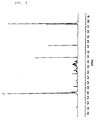
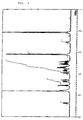
- Fig. 1 shows proton nuclear magnetic resonance spectrum of AJ9463A.
- Fig. 2 shows proton nuclear magnetic resonance spectrum of AJI9463B.
- Fig. 3 shows proton nuclear magnetic resonance spectrum of AJI9463C.
- Fig. 4 shows proton nuclear magnetic resonance spectrum of the partially hydrolyzed disaccharide of AJI9463C.
- the present inventors have made investigations of inhibitors against fungi-derived chitinase from naturally occurring substances. It has been discovered that allosamidin compounds, AJI9463A, AJI9463B and AJI9463C represented by the following chemical structure 1 produced by a certain allosamidin-producing bacteria, exhibit extremely potent inhibitory activity.
- Streptomyces sp . AJ9463 (FERM BP-2801) are as follows.
- substrate mycelium is branched on various nutrient agar media and grows well to form well extended aerial mycelium. No verticillate branching is noted.
- the shape of spore chains is mostly straight or a loose loop. Mature spores are oval and have a size of approximately 1 x (1.5 to 2) ⁇ m. The surface is smooth but wrinkled. Spores form chains of 10 to several tens and the boundary between spores is somewhat unclear. Sporangium, sclerotic granule, motile spore, etc. are not recognized.
- the color hue indication in various media shown below is in accordance with the color standard defined by Japanese Color Research Institute.
- Aerial mycelium is little noted on light brown substrate mycelium. Neither remarkable color nor soluble pigment is noted on the back surface.
- Grey aerial mycelium is scatteringly formed on light brown substrate mycelium. Neither remarkable color nor soluble pigment is noted on the back surface, but with slightly greyish yellow brown.
- Grey aerial mycelium is abundantly formed on greyish brown substrate mycelium. Neither remarkable color nor soluble pigment is noted on the back surface, but with slightly greyish brown.
- the bacteriological properties of Streptomyces sp . AJ9472 (FERM BP- 3705) are as follows.
- substrate mycelium is branched on various nutrient agar media and grows well to form well extended aerial mycelium. No verticillate branching is noted.
- the shape of spore chains is mostly straight or loose loop and spore chains are partly branched. Mature spores are oval or spherical and have a size of approximately 0.5 to 0.7 to 2 ⁇ m. The surface is smooth. Spores form chains of approximately 20 to 100 and the boundary between spores is somewhat clear . Sporangium, motile spore, etc. are not recognized.
- Color hue indication in various media shown below is in accordance with color standard defined by Japanese Color Research Institute.
- Brownish white aerial mycelium is abundantly formed on brown substrate mycelium. Light brown is noted on the back surface, and soluble pigment is light brown.
- Solidification is negative but peptonization is positive at 27°C. Solidification and peptonization are both negative at 37°C.
- the culture method is performed in a manner conventionally used to culture ordinary microorganisms but deep tank culture using a liquid medium is generally advantageous.
- the medium used to culture may be any medium as long as it contains nutrient sources that can be assimilated by the producing bacteria. That is, as the carbon sources, there may be used glucose, fructose, starch, dextrin, etc.; as the nitrogen sources there may be used meat extract, casein, gluten, yeast extract, soybean powder, corn steep liquor, urea, ammonium sulfate, ammonium phosphate, etc. In addition, there may be used inorganic salts such as sodium hydrogenphosphate, magnesium sulfate, calcium carbonate, etc., if necessary and desired. Upon culture , where foaming is vigorous, defoaming agents such as silicone compounds, higher alcohols, vegetable oils, etc. may also be added in small quantities.
- the culture is carried out preferably at 20 to 38 °C, most preferably at about 27°C.
- the time for the culture may be about 1 to about 10 days but may vary in an appropriate way depending upon conditions for culture.
- AJI9463A, AJI9463B and AJI9463C produced by culture are accumulated mainly in the cells. Therefore, these compounds may be generally isolated and purified from the cells separated by means of centrifugation, filtration, etc., using means used for isolation of, e.g., antibiotics.
- means for purification such as solvent extraction with lower alcohols such as methanol, n-butanol, etc.; adsorption column chromatography using silica gel, diatomaceous earth, Avicel, alumina, etc., gel filtration using TOYOPEARL HW40 (carrier for gel filtration manufactured by TOSO Co., Ltd.), etc.; various ion exchange chromatographies and HPLC; additionally countercurrent distribution, crystallization, recrystallization, etc. are used successively or in appropriate combination to isolate and purify these compounds.
- AJ9463A is a novel compound in which one of the hydroxy groups at the 6-position of N-acetylallosamidin in demethylallosamidin. It is revealed that this compound shows the most potent inhibitory activity to chitinase derived from Candida albicans as compared to any other compounds found heretofore.
- AJI9463B and AJI9463C are novel compounds where one of the two N-acetylallosamidins is replaced by N-acetylglucosamine. It is revealed that the inhibitory activity of these compounds against chitinase derived from Candida albicans is comparable to that of N-acetylallosamidin. Furthermore, N-acetylallosamidin is acetylated amino sugar present abundantly in the natural world and is considered advantageous in producing the allosamidins in an industrial scale.
- Isolation and purification from the hydrolysates may be effected by appropriately combining the means used for isolation and purification of antibiotics described above.
- allosamizoline is synthesized by, e.g., the method of Trost et al. (J. Amer. Chem. Soc., 112, 1261-1263 (1990)). After protecting the hydroxy groups at the 6- and 3-positions of allosamizoline either with a protective group such as benzoyl or by formation of an acetal such as isopropylidene, sugar such as N-acetylglucosamine, etc. may then be bound to the hydroxy group at the 4-position.
- a protective group such as benzoyl or by formation of an acetal such as isopropylidene
- sugar such as N-acetylglucosamine, etc.
- the allosamidin compounds represented by chemical structural formula 1 or 2 show a potent inhibitory activity against chitinase derived from Candida albicans . These compounds also affect the growth progress of various fungi including the genus Candida and the genus Fusarium to cause morphological abnormality.
- these compounds have low cytotoxicity and showed no growth arrest on mouse ascites breast cancer cells or human leukemia cells even though any of these compound is added in a concentration of 1 mg/ml.
- the resulting compositions may be utilized as, for example, antifungal agents.
- the antifungal agents comprising these compounds as the effective ingredient are useful for the treatment of fungal diseases, including human, in which fungi or yeast participates, and for the treatment of mammal. Fungal growth is inhibited or fungi can be terminated in the living body by preparations such as tablets, capsules or elixir in the case of oral administration; and in the case of parenteral administration, by administering sterile solutions or suspensions.
- the compounds of the present invention are used as the effective ingredient, the compounds may be administered to the patient (animal and human) requiring such treatment in a dose range of 10 to 1000 mg per patient. The dose may vary depending upon condition of disease, body weight of the patient and other factors known to one skilled in the art.
- the compounds may be used in the form of physiologically acceptable salts or mixtures thereof, and may be mixed with each other in a unit dose form required for preparing pharmaceutical preparations generally recognized, together with a physiologically acceptable vehicle, carrier, excipient, binder, preservative, stabilizer, flavor, etc.
- a physiologically acceptable vehicle carrier, excipient, binder, preservative, stabilizer, flavor, etc.
- the amount of the active substance in such compositions or preparations is set forth to obtain an appropriate amount indicated.
- chemicals which may be admixed to prepare tablets, capsules, etc. include the following compounds: binders such as gum arabic, corn starch or gelatin; excipients such as microcrystalline cellulose; swelling agents such as alginic acid, etc.; lubricants such as magnesium stearate, etc.; dissolution aids such as sodium desoxycholate, etc.; sweeteners such as sucrose, lactose, etc.; flavors such as peppermint, etc.; and in the case of capsules as preparation unit form, further liquid carrier such as oils and fats, in addition to the chemicals described above.
- binders such as gum arabic, corn starch or gelatin
- excipients such as microcrystalline cellulose
- swelling agents such as alginic acid, etc.
- lubricants such as magnesium stearate, etc.
- dissolution aids such as sodium desoxycholate, etc.
- sweeteners such as sucrose, lactose, etc.
- flavors such as peppermint, etc.
- tablets may be coated with Shellac or sucrose or with both of them.
- Syrup or elixir may contain the active compound, sucrose as a sweetener, methyl and propyl parabens as preservatives, pigments and flavors such as cherry or orange flavor.
- Sterile compositions for injection may be formulated in a conventional manner for preparing pharmaceutical compositions which comprise dissolving or suspending the active substance in a vehicle such as water for injection, in natural vegetable oil such as sesame oil, palm oil, peanut oil, cotton seed oil, etc. or in a synthetic fat vehicle such as ethyl oleate, etc.
- a buffer, a preservative, an antioxidant, etc. may also be incorporated, if necessary and desired.
- a medium, pH 7.2, composed of 1.5 g of glucose, 0.5 g of meat extract, 0.2 g of peptone, 0.1 g of yeast extract and 100 ml of water was prepared and charged in a Sakaguchi flask of 500 ml volume. After sterilization at 120°C for 20 minutes, one platinum loop of slant culture cake of Streptomyces sp . AJ9463 (FERM BP-2801) was inoculated on the medium and shake cultured at 28°C for 3 days to obtain primary seed mother liquor.
- a medium having the same composition as above was prepared in a volume of 3 liters and separately charged by 1 liter each in 3 Sakaguchi flasks each having 5 liter volume followed by sterilization at 120°C for 30 minutes. Each flask was charged with 20 ml of the primary seed mother liquor described above. The flasks were shaken at 28°C for 3 days to obtain secondary seed mother liquor. Furthermore, 150 liters of a medium having the same composition as above were prepared and charged in a culture tank followed by sterilization at 120°C for 30 minutes. The tank was charged with 3 liters of the secondary seed mother liquor described above followed by shake culture at 27°C for 66 hours. At this stage, the stirring velocity was 200 rpm and aerial rate was 38 l/min. The thus obtained culture broth was centrifuged by a sharpless centrifuging machine to recover the cells. The wet weight of the thus obtained cells was 2.6 kg.
- the whole volume was adsorbed onto a column of ⁇ 5.5 x 49 cm packed with activated carbon. After washing with 2 liters of distilled water, the column was eluted successively with 5 liters of 10% ethanol, 5 liters of 25% ethanol, 5 liters of 50% ethanol and 50% ethanol, whose pH was adjusted to 3.5 with acetic acid. The fraction eluted with 50% ethanol was combined with the fraction eluted with 50% ethanol whose pH was adjusted to 3.5 with acetic acid. The mixture was concentrated under reduced pressure to remove the ethanol. Distilled water was added to the concentrate until the whole volume was 5 liters. At this stage, the pH of the solution was 3.45.
- the solution was passed through a SP-Sephadex C-25 (manufactured by Pharmacia Fine Chemicals, Inc.) column of ⁇ 2 x 54 cm equilibrated with 50 mM ammonium acetate (pH 5.0) and then eluted with 50 mM ammonium acetate (pH 5.0).
- the active fraction was recovered and lyophilized.
- the lyophilized product was dissolved in 30 ml of 0.1 N acetic acid and then purified by high performance liquid chromatography using Capcell Pak ODS Column (Capcell Pak C18 SG120 column; ⁇ 20 x 250 mm, particle diameter of the packing agent, 5 ⁇ m, manufactured by SHISEIDO Co., Ltd.).
- Capcell Pak ODS Column Capcell Pak C18 SG120 column; ⁇ 20 x 250 mm, particle diameter of the packing agent, 5 ⁇ m, manufactured by SHISEIDO Co., Ltd.
- the aforesaid 0.1 N acetic acid solution was poured in 500 ⁇ l portions per time and the procedure was repeated for fractionation. Elution was performed by a linear gradient in which the acetonitrile concentration in 10 mM ammonium acetate aqueous solution (pH 8.9) was increased.
- a medium, pH 7.2, composed of 1.5 g of glucose, 0.5 g of meat extract, 0.2 g of peptone, 0.1 g of yeast extract and 100 ml of water was prepared and charged in a Sakaguchi flask of 500 ml volume. After sterilization at 120°C for 20 minutes, one platinum loop of slant culture cake of Streptomyces sp . AJ9472 (FERM BP-3705) was inoculated on the medium and shake cultured at 28°C for 3 days to obtain primary seed mother liquor.
- a medium having the same composition as above was prepared in a volume of 4 liters and separately charged by 1 liter each in 4 Sakaguchi flasks each having 5 liter volume followed by sterilization at 120°C for 30 minutes. Each flask was charged with 20 ml of the primary seed mother liquor described above. The flasks were shaken at 28°C for 3 days to obtain the secondary seed mother liquor. Furthermore, 200 liters of medium having the same composition as above were prepared and charged in a culture tank followed by sterilization at 120°C for 30 minutes. The tank was charged 4 liters of the secondary seed mother liquor described above followed by shake culture at 27°C for 66 hours. At this stage, a stirring velocity was 200 rpm and aerial rate was 50 l/min. The thus obtained culture broth was centrifuged by a sharpless centrifuging machine to recover the cells. The wet weight of the thus obtained cells was 4.5 kg.
- the whole volume was adsorbed onto a column of ⁇ 6 x 50 cm packed with activated carbon. After washing with 2.4 liters of distilled water, the column was eluted successively with 7 liters of 10% ethanol, 7 liters of 25% ethanol, 7 liters of 50% ethanol and 50% ethanol whose pH was adjusted to 3.5 with acetic acid. The fraction eluted with 50% ethanol was combined with the fraction eluted with 50% ethanol whose pH was adjusted to 3.5 with acetic acid. The mixture was concentrated under reduced pressure to remove the ethanol. Distilled water was added to the concentrate until the whole volume was 7 liters. At this stage, the pH of the solution was 3.45.
- the solution was passed through a SP-Sephadex C-25 (manufactured by Pharmacia Fine Chemicals, Inc.) column of ⁇ 2.4 x 60 cm equilibrated with 50 mM ammonium acetate (pH 5.0) and then eluted with 50 mM ammonium acetate (pH 5.0).
- the active fraction was recovered and lyophilized.
- the lyophilized product was dissolved in 40 ml of 0.1 N acetic acid and then purified by high performance liquid chromatography using Capcell Pak ODS Column (Capcell Pak C18 SG120 column; ⁇ 20 x 250 mm, particle diameter of the packing agent, 5 ⁇ m, manufactured by SHISEIDO Co., Ltd.).
- Capcell Pak ODS Column Capcell Pak C18 SG120 column; ⁇ 20 x 250 mm, particle diameter of the packing agent, 5 ⁇ m, manufactured by SHISEIDO Co., Ltd.
- the aforesaid 0.1 N acetic acid solution was poured in 500 ⁇ l portions per time and the procedure was repeated for fractionation. Elution was performed by a linear gradient in which the acetonitrile concentration in 10 mM ammonium acetate aqueous solution (pH 8.9) was increased.
- hydrolysis of AJI9463C is given as an example but other components can be prepared in a similar way.
- AJI9463C 12.6 mg, was charged in an eggplant flask of 20 ml volume and dissolved in 3 ml of 0.5 N hydrochloric acid. After sealing, the flask was heated at 70°C for 390 minutes on an oil bath.
- the reaction solution was purified by high performance liquid chromatography using Capcell Pak ODS column shown in Example (1) described above. The conditions for elution were the same as those described in Example (1) above.
- the elution time of the partial hydrolysate of AJI9463C was 32.8 minutes under the conditions.
- the chitinase from Candida albicans was prepared by the following method. Firstly, Sabouraud medium (pH 5.6) composed of 4 g of glucose, 1 g of polypeptone and 100 ml of water was prepared and charged in an Erlenmeyer flask of 500 ml volume. After sterilization at 120°C for 20 minutes, one platinum loop of slant culture cells of C . albicans ATCC 10231 was inoculated on the medium and then shake cultured at 37°C for 2 days to obtain the primary seed mother liquor.
- Sabouraud medium pH 5.6
- slant culture cells of C . albicans ATCC 10231 was inoculated on the medium and then shake cultured at 37°C for 2 days to obtain the primary seed mother liquor.
- 1 liter of a medium having the same composition as above was prepared and separately charged in portion of 100 ml in 10 Erlenmeyer flasks each having 500 ml volume followed by sterilization at 120°C for 20 minutes. Each flask was charged with 2 ml of the primary seed mother liquor described above. The flasks were shaken at 37°C for 2 days to obtain the secondary seed mother liquor. Furthermore, 50 liters of a medium having the same composition as described above were prepared and charged in a culture tank of 100 liter volume followed by sterilization at 120°C for 30 minutes. The tank was charged with 1 liter of the secondary seed mother liquor described above followed by shake culture at 37°C for 15 hours. At this stage,the stirring velocity was 140 rpm and the aerial rate was 100 l/min. The thus obtained culture broth was centrifuged by a sharpless centrifuging machine to recover the cells. The wet weight of the thus obtained cells was 250 g.
- the thus obtained cells were suspended in 800 ml of a buffer for cell homogenization (50 mM bis-Tris, 0.25 M saccharose, 1 mM disodium ethylenediaminetetraacetate, pH 6.5).
- the suspension was passed through a Dyno-mill disintegrator (beads: MK-2GX, 0.25-0.5 mm) twice to disrupt the cells and the supernatant was recovered.
- the supernatant was centrifuged at 9000 g for 30 minutes to recover the supernatant.
- the supernatant was further super-centrifuged at 152000 g for an hour to recover the supernatant.
- the supernatant was concentrated to about one-fifth of the volume by ultrafiltration (Toyo Ultrafilter UP-20) having the excluding limiting molecular weight of 20,000.
- the concentrate was used as the crude chitinase solution from Candida albicans in the following assay.
- the chitinase from baker's yeast was prepared by the following method. Firstly, 400 g of baker's yeast (manufactured by Kanegafuchi Chemical Industry Co., Ltd.) was suspended in buffer for enzyme extraction (0.1% digitonin: manufactured by Wako Pure Chemical Industry Co., Ltd.), 0.1% ⁇ -mercaptoethanol and 2 liters of 25 mM MES (manufactured by Nakarai Chemical Co., Ltd.) followed by shaking at 30°C for 2 hours at 120 spm to extract the enzyme. The extract was centrifuged at 12000 g for 10 minutes and the supernatant was recovered.
- the supernatant was concentrated to about one-fifth of the volume by ultrafiltration (UP-20).
- 800 ml of sodium citrate buffer (which was obtained by adding 0.15 M sodium citrate aqueous solution to 0.15 M citric acid aqueous solution and adjusting the pH to 3.0) was added to the concentrate, the formed precipitates were removed by centrifugation (0°C, 12000 g, 10 minutes).
- the supernatant was again concentrated by ultrafiltration (UP-20) to about 80 ml.
- the concentrate was used as the chitinase from baker's yeast in the following assay.
- the chitinase from Trichoderma sp was provided in the following assay after diluting commercially available Chitinase T-l (manufactured by Asahi Industry Co., Ltd.) with MclLvanine buffer (obtained by adding 0.2 M disodium hydrogenphosphate aqueous solution to 0.1 M citric acid aqueous solution and adjusting the pH to 5.2) to a concentration of 50 ⁇ g/ml.
- a vial bottle (volume of 20 ml) were charged 50 ⁇ l of the chitinase solution from Candida albicans prepared as described above, 50 ⁇ l of 100 ⁇ g/ml of 4-methylumbelliferyl ⁇ -D-N,N',N''-triacetylchitotrioside (hereinafter abbreviated as 4MBTC, SIGMA Co.) aqueous solution, 75 ⁇ l of 50 mM bis-Tris buffer (pH 6.5) and 25 ⁇ l of 0.1 N acetic acid. The reaction was carried out at 37°C for 30 minutes.
- 4MBTC 4-methylumbelliferyl ⁇ -D-N,N',N''-triacetylchitotrioside
- the reaction was carried out in a similar manner using 50 mM bis-Tris buffer (pH 6.5) instead of 50 ⁇ l of the enzyme solution.
- 50 mM bis-Tris buffer pH 6.5
- 0.5 M glycine-sodium hydroxide buffer pH 10.4
- the excited wavelength was 350 nm and fluorescent wavelength was 440 nm.
- the difference in the fluorescent intensity between the read-out data when the enzyme was added and blank read-out data was made chitinase activity.
- each compound was dissolved in 0.1 N acetic acid and 25 ⁇ l of the solution was added in place of 25 ⁇ l of 0.1 N acetic acid in the reaction system described above. Further in determining the inhibitory activity against chitinase of baker's yeast and Trichoderma sp . , the assay was performed by changing the buffer added in the reaction system described above from 50 mM bis-Tris buffer (pH 6.5) to 0.1 M citrate buffer (pH 3.0) to MclLvanine buffer (pH 5.2), respectively.
- the enzyme inhibitory activity (IC50: ⁇ g/ml) of AJI9463A, AJI9463B and AJI9463C and the partially hydrolyzed disaccharides thereof against the chitinase from Candida albicans , baker's yeast and Trichoderma sp . is shown in Table 1 described below.
- Table 1 Compound Chitinase Inhibitory Activity IC50 ( ⁇ g/ml) C. albicans S. cerevisiae Trichoderma sp.
- AJI9463A 0.6 0.4 1.3 AJI9463B 0.8 0.5 1.6 AJI9463C 3.4 31.3 0.8 Partially hydrolyzed disaccharide of AJI9463A 0.9 >200.0 >50.0 Partially hydrolyzed disaccharide of AJI9463B 1.0 >200.0 >50.0 Partially hydrolyzed disaccharide of AJI9463C 1.3 >200.0 >50.0 Allosamidin 6.2 33.8 0.8 Methylallosamidin 8.8 37.2 1.2
- Candida albicans (ATCC 10231) was precultured in a Sabouraud dextrose medium and inoculated on a medium containing 50 ⁇ g/ml each of AJI9463A, AJI9463B and AJI9463C and the partially hydrolyzed disaccharides thereof and a medium containing none of them in a definite amount. The change with time after subsequent culture was observed. The observation was microscopically made by sampling the medium at the time when the culture started, and 6 and 9 hours later. The culture was carried out at 37°C at 120 spm by charging 5 ml each of Sabouraud dextrose medium in a large test tube with cotton stopper.
- Mouse ascites breast cancer cell FM3A was inoculated on Dulbecco's modified MEM medium supplemented with 10% calf fetal serum in 1 x 10⁵ counts/ml and AJI9463A, AJI9463B AJI9463C and each of the partially hydrolyzed disaccharides thereof were added to the medium in 1 mg each/ml followed by stationary culture at 37°C for 4 days.
- the cultured mouse ascites breast cancer cell FM3A was microscopically observed but no growth inhibition was noted at all.
- Human leukemia cell K562 was inoculated on RPMI 1640 medium supplemented with 10% calf fetal serum in 1 x 10⁵ counts/ml and AJI9463A, AJI9463B and each of AJI9463C and the partially hydrolyzed disaccharides thereof was added to the medium in 1 mg each/ml followed by stationary culture at 37°C for 4 days.
- the cultured human leukemia cell K562 was microscopically observed but no growth inhibition was noted at all.
- the allosamidin compounds, AJI9463A, AJI9463B and AJI9463C of the present invention exhibit an extremely potent inhibitory activity against the chitinase derived from pathogenic fungi Candida albicans . Therefore the present invention can provide antifungal agents and chitinase inhibitors having an excellent effect. These compounds are produced by fermentation and thus readily mass-produced. Furthermore, AJI9463B and AJI9463C are considered to advantageous in mass production from a standpoint of chemical synthesis since these compounds have as the constituent component N-acetylglucosamine present in large quantities in the natural world.
- the compounds of chemical structure 2 have low molecular weights but exhibit an extremely potent inhibitory activity against the chitinase from Candida albicans . Therefore, the present invention can provide antifungal agents and chitinase inhibitors having an excellent effect which can be readily mass produced from an industrial view point.
Landscapes
- Chemical & Material Sciences (AREA)
- Life Sciences & Earth Sciences (AREA)
- Health & Medical Sciences (AREA)
- Organic Chemistry (AREA)
- General Health & Medical Sciences (AREA)
- Engineering & Computer Science (AREA)
- Wood Science & Technology (AREA)
- Zoology (AREA)
- Chemical Kinetics & Catalysis (AREA)
- General Chemical & Material Sciences (AREA)
- Biotechnology (AREA)
- Genetics & Genomics (AREA)
- Biochemistry (AREA)
- Veterinary Medicine (AREA)
- Medicinal Chemistry (AREA)
- Bioinformatics & Cheminformatics (AREA)
- Public Health (AREA)
- Animal Behavior & Ethology (AREA)
- Pharmacology & Pharmacy (AREA)
- Nuclear Medicine, Radiotherapy & Molecular Imaging (AREA)
- Environmental Sciences (AREA)
- Microbiology (AREA)
- Dentistry (AREA)
- Oncology (AREA)
- Communicable Diseases (AREA)
- Agronomy & Crop Science (AREA)
- Pest Control & Pesticides (AREA)
- Plant Pathology (AREA)
- Molecular Biology (AREA)
- General Engineering & Computer Science (AREA)
- Preparation Of Compounds By Using Micro-Organisms (AREA)
- Pharmaceuticals Containing Other Organic And Inorganic Compounds (AREA)
- Saccharide Compounds (AREA)
- Agricultural Chemicals And Associated Chemicals (AREA)
Abstract
Novel allosamidin compounds, AJI9463A, AJI9463B and AJI9463C represented by the following structural formula and pseudo disaccharide compounds obtained by partial hydrolysis of these compounds with an acid:
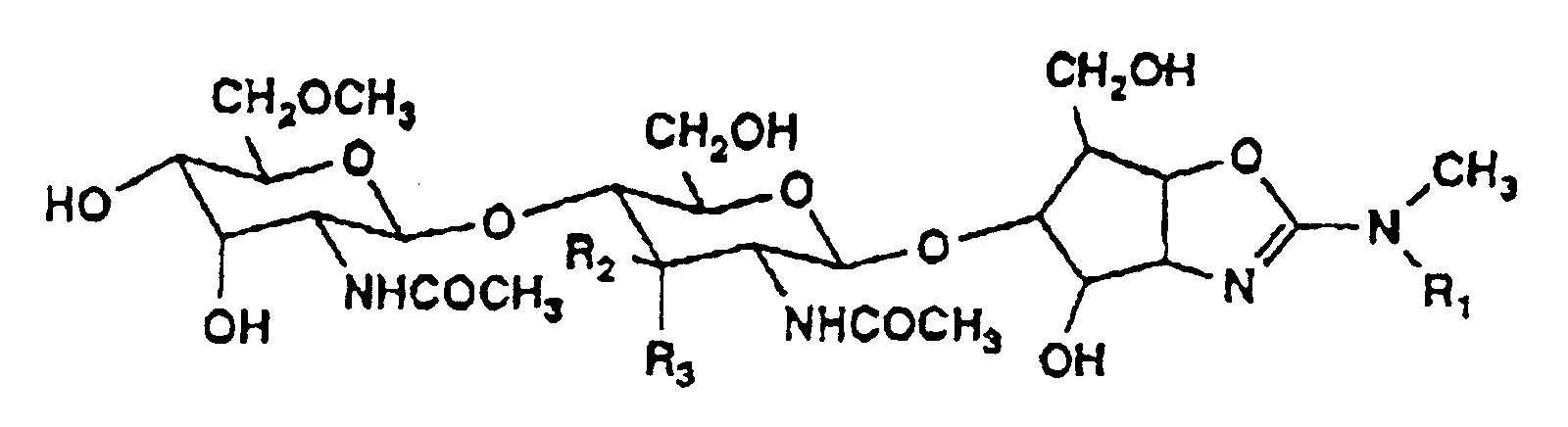
wherein in AJI9463A, R₁ and R₂ are hydrogen and R₃ is hydroxy; in AJI9463B R₁ and R₃ are hydrogen and R₂ is hydroxy; and in AJI9463C R₁ is methyl, R₂ is hydroxy and R₃ is hydrogen.
wherein in AJI9463A, R₁ and R₂ are hydrogen and R₃ is hydroxy; in AJI9463B R₁ and R₃ are hydrogen and R₂ is hydroxy; and in AJI9463C R₁ is methyl, R₂ is hydroxy and R₃ is hydrogen.
These compounds exhibit an extremely potent inhibitory activity against the chitinase from Candida albicans and can be utilized as potent antifungal agents and chitinase inhibitors.
Description
- The present invention relates to novel allosamidin compounds which are useful in the fields of agricultural chemicals, animal and human drugs, etc. and a process for the production thereof.
- Chitin is the main component of the cell wall.
- While fungi are repeatedly divided and proliferated, the synthesis and decomposition of chitin are well balanced. Secondly, chitin is the principal component found in the exoskeletons of insects. It is known that the synthesis and decomposition of chitin are elaborately controlled also in the process where insects cast the skin and grow.
- Chitinase is the major enzyme which participates in the metabolism of chitin. It is thus expected that inhibitors of this enzyme could be a new type of antifungal agents or insect growth controlling agents.
- Heretofore there are known 3 substances as chitinase inhibitors: allosamidin (S. Sakuda et al., J. Antibiotics, 40, 296-300, 1987), methylallosamidin (S. Sakuda et al., Preprint of 28Th Discussions and Lectures on Natural Organic Compounds, page 70, 1986) and demethylallosamidin (S. Sakuda et al., Agric. Biol. Chem., 54, 1333-1335, 1990).
- Among them, allosamidin and methylallosamidin are compounds found as inhibitors against silkworm-derived chitinase and strongly inhibit endo type chitinase of insects but showed a weak inhibitory activity against fungi-derived chitinase. Demethylallosamidin showed a potent inhibitory activity against chitinase from baker's yeast (Saccharomyces cerevisiae) but its inhibitory activity against chitinase of pathogenic fungi such as Candida albicans is insufficient. It is thus required to develop a more potent chitinase inhibitor.
- The three substances described above all have a pseudo trisaccharide structure composed of two 2-amino-2-desoxy-D-allose (N-acetylallosamine molecules and one allosamizoline (or demethylallosamizoline) molecules. N-acetylallosamine is a sugar found for the first time as a constituent of these compounds in the natural world but does not otherwise exist in the natural world. Accordingly, there was a problem to industrially synthesize and supply these compounds.
- In view of the actual situation it was considered to be important by the present inventors to investigate allosamidin compounds having a more potent inhibitory activity to chitinase of pathogenic fungi such as Candida albicans, etc. and being more readily synthesized.
- Thus, the present inventors searched for such compounds using as an activity index the inhibitory activity to chitinase derived from Candida albicans and as a result, have found that microorganisms belonging to the genus Streptomyces can produce novel allosamidin compounds, AJI9463A, AJI9463B and AJI9463C represented by chemical structure 1 shown below. Based on this finding, the present invention has been accomplished.
- The present invention relates to allosamidin compounds, AJI9463A, AJI9463B and AJI9463C represented by chemical structure 1 shown below:

wherein in AJI9463A, R₁ and R₂ are hydrogen and R₃ is hydroxy; in AJI9463B R₁ and R₃ are hydrogen and R₂ is hydroxy; and in AJI9463C R₁ is methyl, R₂ is hydroxy and R₃ is hydrogen. It further relates to allosamidin compounds represented by the following chemical structural formula 2 :
wherein R₁ represents hydrogen or methyl, and when R₁ is hydrogen, either R₂ or R₃ is hydrogen and another is hydroxy; when R₁ is methyl, R₂ is hydroxy and R₃ is hydrogen (hereafter referred to as partially hydrolyzed disaccharides of AJI9463A, AJI9463B and AJI9463C). - The process for preparing the compounds of the present invention, AJI9463A, AJI9463B and AJI9463C, comprises culturing in a suitable medium bacteria capable of producing these compounds, for example, bacteria belonging to the genus Streptomyces, specifically Streptomyces sp. AJ9463 (FERM BP-2801) or Streptomyces sp. AJ9472 (FERM BP- 3705), and harvesting the compounds from the culture broth.
- Fig. 1 shows proton nuclear magnetic resonance spectrum of AJ9463A.
- Fig. 2 shows proton nuclear magnetic resonance spectrum of AJI9463B.
- Fig. 3 shows proton nuclear magnetic resonance spectrum of AJI9463C.
- Fig. 4 shows proton nuclear magnetic resonance spectrum of the partially hydrolyzed disaccharide of AJI9463C.
- The present inventors have made investigations of inhibitors against fungi-derived chitinase from naturally occurring substances. It has been discovered that allosamidin compounds, AJI9463A, AJI9463B and AJI9463C represented by the following chemical structure 1 produced by a certain allosamidin-producing bacteria, exhibit extremely potent inhibitory activity.

- ( In AJI9463A, R₁ and R₂ are hydrogen and R₃ is hydroxy; in AJI9463B R₁ and R₃ are hydrogen and R₂ is hydroxy; and in AJI9463C R₁ is methyl, R₂ is hydroxy and R₃ is hydrogen.
- The bacteriological properties of Streptomyces sp. AJ9463 (FERM BP-2801) are as follows.
- Under microscopic observation, substrate mycelium is branched on various nutrient agar media and grows well to form well extended aerial mycelium. No verticillate branching is noted. The shape of spore chains is mostly straight or a loose loop. Mature spores are oval and have a size of approximately 1 x (1.5 to 2) µm. The surface is smooth but wrinkled. Spores form chains of 10 to several tens and the boundary between spores is somewhat unclear. Sporangium, sclerotic granule, motile spore, etc. are not recognized.
- The color hue indication in various media shown below is in accordance with the color standard defined by Japanese Color Research Institute.
- Moderate growth. Almost colorless substrate mycelium, on which light grey aerial mycelium is formed. Neither remarkable color nor soluble pigment is noted on the back surface.
- Good growth. Aerial mycelium is little noted on light brown substrate mycelium. Neither remarkable color nor soluble pigment is noted on the back surface.
- Moderate or poor growth. White or grey aerial mycelium is slightly formed on almost colorless substrate mycelium. Neither remarkable color nor soluble pigment is noted on the back surface.
- Good growth. White or grey or black aerial mycelium is scatteringly formed on greyish red brown substrate mycelium. Neither remarkable color nor soluble pigment is noted on the back surface.
- Moderate or poor growth. White to grey aerial mycelium is slightly formed on almost colorless substrate mycelium. Neither remarkable color nor soluble pigment is noted on the back surface.
- Good growth. Grey aerial mycelium is abundantly formed on light yellowish brown substrate mycelium. Neither remarkable color nor soluble pigment is noted on the back surface.
- Good growth. Grey aerial mycelium is scatteringly formed on light brown substrate mycelium. Neither remarkable color nor soluble pigment is noted on the back surface, but with slightly greyish yellow brown.
- Good growth. Grey aerial mycelium is abundantly formed on greyish brown substrate mycelium. Neither remarkable color nor soluble pigment is noted on the back surface, but with slightly greyish brown.
- It grows at 10 to 42°C.
- When cultured in glucose peptone gelatin medium at 20°C and 27°C, liquefaction of gelatin was noted at both temperatures.
- Positive on starch agar medium (ISP4 medium)
- Strong solidification is noted at 37°C but no peptonization is observed. At 27°C, no solidification is observed but strong peptonization is noted.
- Negative on tyrosine agar medium (ISP7 medium)
- good assimilation:
D-glucose, D-xylose, L-rammnose, raffinose
moderate assimilation:
D-fructose, sucrose
no assimilation:
L-arabinose, inositol, D-mannitol
2,6-Diaminopimelic acid contained in the cell wall was LL-type. - From the properties described above, it was revealed that this strain AJ9463 was Streptomyces sp.
- The bacteriological properties of Streptomyces sp. AJ9472 (FERM BP- 3705) are as follows.
- Under microscopic observation, substrate mycelium is branched on various nutrient agar media and grows well to form well extended aerial mycelium. No verticillate branching is noted. The shape of spore chains is mostly straight or loose loop and spore chains are partly branched. Mature spores are oval or spherical and have a size of approximately 0.5 to 0.7 to 2 µm. The surface is smooth. Spores form chains of approximately 20 to 100 and the boundary between spores is somewhat clear . Sporangium, motile spore, etc. are not recognized.
- Color hue indication in various media shown below is in accordance with color standard defined by Japanese Color Research Institute.
- Poor growth. White to brownish grey aerial mycelium is slightly formed on almost colorless substrate mycelium. Neither remarkable color nor soluble pigment is noted on the back surface.
- Moderate growth. White to brownish white aerial mycelium is formed well on almost colorless substrate mycelium. Neither remarkable color nor soluble pigment is noted on the back surface.
- Moderate or poor growth. White or brownish white aerial mycelium is slightly formed on almost colorless substrate mycelium Neither remarkable color nor soluble pigment is noted on the back surface.
- Moderate growth. White or brownish white aerial mycelium is abundantly formed on almost colorless substrate mycelium. Neither remarkable color nor soluble pigment is noted on the back surface.
- Good or moderate growth. White to brownish white aerial mycelium is moderately formed on almost colorless or yellowish grey substrate mycelium. Neither remarkable color nor soluble pigment is noted on the back surface.
- Good growth. White aerial mycelium is abundantly formed on light yellowish brown substrate mycelium. Neither remarkable color nor soluble pigment is noted on the back surface, but with somewhat light yellowish brown.
- Good growth. Brownish white aerial mycelium is abundantly formed on brown substrate mycelium. Light brown is noted on the back surface, and soluble pigment is light brown.
- Good growth. White or brownish white aerial mycelium is abundantly formed on almost colorless or yellowish grey substrate mycelium. Neither remarkable color nor soluble pigment is noted on the back surface.
- It grows at 10 to 42°C.
- When cultured in glucose peptone gelatin medium at 20°C and 27°C, liquefaction of gelatin was noted at both temperatures.
- Negative on starch agar medium (ISP4 medium)
- Solidification is negative but peptonization is positive at 27°C. Solidification and peptonization are both negative at 37°C.
- Negative on tyrosine agar medium (ISP7 medium)
- good assimilation:
D-glucose, L-rammnose,
moderate assimilation:
D-xylose, raffinose
no assimilation:
L-arabinose, D-fructose, sucrose, inositol, D-mannitol
2,6-Diaminopimelic acid contained in the cell wall was LL-type. - From the properties described above, it was revealed that this strain AJ9472 was Streptomyces sp.
- The culture method is performed in a manner conventionally used to culture ordinary microorganisms but deep tank culture using a liquid medium is generally advantageous. The medium used to culture may be any medium as long as it contains nutrient sources that can be assimilated by the producing bacteria. That is, as the carbon sources, there may be used glucose, fructose, starch, dextrin, etc.; as the nitrogen sources there may be used meat extract, casein, gluten, yeast extract, soybean powder, corn steep liquor, urea, ammonium sulfate, ammonium phosphate, etc. In addition, there may be used inorganic salts such as sodium hydrogenphosphate, magnesium sulfate, calcium carbonate, etc., if necessary and desired. Upon culture , where foaming is vigorous, defoaming agents such as silicone compounds, higher alcohols, vegetable oils, etc. may also be added in small quantities.
- The culture is carried out preferably at 20 to 38 °C, most preferably at about 27°C. The time for the culture may be about 1 to about 10 days but may vary in an appropriate way depending upon conditions for culture.
- AJI9463A, AJI9463B and AJI9463C produced by culture are accumulated mainly in the cells. Therefore, these compounds may be generally isolated and purified from the cells separated by means of centrifugation, filtration, etc., using means used for isolation of, e.g., antibiotics. Specifically, means for purification such as solvent extraction with lower alcohols such as methanol, n-butanol, etc.; adsorption column chromatography using silica gel, diatomaceous earth, Avicel, alumina, etc., gel filtration using TOYOPEARL HW40 (carrier for gel filtration manufactured by TOSO Co., Ltd.), etc.; various ion exchange chromatographies and HPLC; additionally countercurrent distribution, crystallization, recrystallization, etc. are used successively or in appropriate combination to isolate and purify these compounds.
- The thus isolated and purified allosamidin compounds, AJI9463A, AJI9463B and AJI9463C, have the following physicochemical properties.
-
- (a) External appearance: white powder
- (b) Molecular weight: 622 (FAB MS: m/z 623 (M + H)⁺, glycerol matrix)
- (c) Molecular formula: C₂₅H₄₂N₄O₁₄
- (d) UV absorption spectrum: terminal absorption in 0.1 N acetic acid
- (e) ¹H-nuclear magnetic resonance spectrum: Fig. 1 (600 MHz, in heavy water containing 3% CD₃COOD or acetic acid-d₄
- (f) ¹³C-nuclear magnetic resonance spectrum: It shows the following signals (δ) at 150 MHz, in heavy water containing 3% CD₃COOD or acetic acid-d₄ (provided that this compound takes a plurality of conformations in the solvent and shows a plurality of minor signals considered to be caused by the conformations) 174.6 (Q), 174.3 (Q), 162.4 (Q), 101.2 (CH), 99.9 (CH), 87.6 (CH), 85.5 (CH), 80.8 (CH), 77.5 (CH), 73.2 (CH), 72.7 (CH), 72.0 (CH), 70.6 (CH), 69.7 (CH), 67.1 (CH), 65.0 (CH), 61.5 (CH₂), 60.0 (CH₂), 59.3 (CH₃), 53.4 (CH), 53.2 (CH), 52.3 (CH), 29.0 (CH₃), 22.6 (CH₃), 22.6 (CH₃)
-
- (a) External appearance: white powder
- (b) Molecular weight: 622 (FAB MS: m/z 623 (M + H)⁺, glycerol matrix)
- (c) Molecular formula: C₂₅H₄₂N₄O₁₄
- (d) UV absorption spectrum: terminal absorption in 0.1 N acetic acid
- (e) ¹H-nuclear magnetic resonance spectrum: Fig. 2 (600 MHz, in heavy water containing 3% CD₃COOD or acetic acid-d₄
- (f) ¹³C-nuclear magnetic resonance spectrum: It shows the following signals (δ) at 150 MHz, in heavy water containing 3% CD₃COOD or acetic acid-d₄ (provided that this compound takes a plurality of conformations in the solvent and shows a plurality of minor other signals than those described below which are considered to be caused by the conformations) 175.0 (Q), 174.5 (Q), 162.4 (Q), 101.9 (CH), 100.6 (CH), 87.4 (CH), 85.5 (CH), 80.9 (CH), 80.7 (CH), 75.0 (CH), 73.2 (CH), 72.9 (CH), 72.1 (CH₂), 70.6 (CH), 67.3 (CH), 64.9 (CH), 60.9 (CH₂), 60.0 (CH₂), 59.3 (CH₃), 55.5 (CH), 53.3 (CH), 52.2 (CH), 29.0 (CH₃), 22.8(CH₃), 22.6 (CH₃)
-
- (a) External appearance: white powder
- (b) Molecular weight: 636 (FAB MS: m/z 637 (M + H)⁺, glycerol matrix)
- (c) Molecular formula: C₂₆H₄₄N₄O₁₄
- (d) UV absorption spectrum: terminal absorption in 0.1 N acetic acid
- (e) ¹H-nuclear magnetic resonance spectrum: Fig. 3 (400 MHz, in heavy water containing 0.5% CD₃COOD or acetic acid-d₄
- (f) ¹³C-nuclear magnetic resonance spectrum: It shows the following signals (δ) at 100 MHz, in heavy water containing 0.5% CD₃COOD or acetic acid-d₄ 175.1 (Q), 174.5 (Q), 161.2 (Q), 102.4 (CH), 100.6 (CH), 87.1 (CH), 85.5 (CH), 81.0 (CH), 80.9 (CH), 75.0 (CH), 73.1 (CH), 72.9 (CH), 72.1 (CH₂), 70.6 67.3 (CH), 64.9 (CH), 60.9 (CH₂), 59.7 (CH₂), 59.3 (CH₃), 55.6 (CH), 53.3 (CH), 51.9 (CH), 38.0 (CH₃), 22.8 (CH₃), 22.6 (CH₃)
- The structural formulae of these compounds are as described above; among them, AJ9463A is a novel compound in which one of the hydroxy groups at the 6-position of N-acetylallosamidin in demethylallosamidin. It is revealed that this compound shows the most potent inhibitory activity to chitinase derived from Candida albicans as compared to any other compounds found heretofore.
- Unlike known allosamidins, AJI9463B and AJI9463C are novel compounds where one of the two N-acetylallosamidins is replaced by N-acetylglucosamine. It is revealed that the inhibitory activity of these compounds against chitinase derived from Candida albicans is comparable to that of N-acetylallosamidin. Furthermore, N-acetylallosamidin is acetylated amino sugar present abundantly in the natural world and is considered advantageous in producing the allosamidins in an industrial scale.
- These compounds represented by chemical structural formula 1 can also be subjected to partial hydrolysis under mild conditions using diluted hydrochloric acid, whereby allosamidin compounds represented by the following chemical structural formula 2:

wherein R₁ represents hydrogen or methyl, and when R₁ is hydrogen, either R₂ or R₃ is hydrogen and another is hydroxy; when R₁ is methyl, R₂ is hydroxy and R₃ is hydrogen (hereafter referred to as partially hydrolyzed disaccharides of AJI9463A, AJI9463B and AJI9463C) are formed. - Isolation and purification from the hydrolysates may be effected by appropriately combining the means used for isolation and purification of antibiotics described above.
- These compounds represented by chemical
structural formula 2 are pseudo disaccharides. It is revealed that these compounds show an inhibitory activity against chitinase derived from Candida albicans which is comparable to the pseudo trisaccharides prior to the partial hydrolysis. In particular, it is expected that the compound of N-acetylglucosamine type in which R₂ is hydroxy and R₃ is hydrogen would easily be synthesized chemically and is considered to be important from an industrial viewpoint. - That is, allosamizoline is synthesized by, e.g., the method of Trost et al. (J. Amer. Chem. Soc., 112, 1261-1263 (1990)). After protecting the hydroxy groups at the 6- and 3-positions of allosamizoline either with a protective group such as benzoyl or by formation of an acetal such as isopropylidene, sugar such as N-acetylglucosamine, etc. may then be bound to the hydroxy group at the 4-position.
- As stated above, the allosamidin compounds represented by chemical
structural formula 1 or 2 show a potent inhibitory activity against chitinase derived from Candida albicans. These compounds also affect the growth progress of various fungi including the genus Candida and the genus Fusarium to cause morphological abnormality. - On the other hand, these compounds have low cytotoxicity and showed no growth arrest on mouse ascites breast cancer cells or human leukemia cells even though any of these compound is added in a concentration of 1 mg/ml.
- Therefore, by incorporating any of these compounds, the resulting compositions may be utilized as, for example, antifungal agents. The antifungal agents comprising these compounds as the effective ingredient are useful for the treatment of fungal diseases, including human, in which fungi or yeast participates, and for the treatment of mammal. Fungal growth is inhibited or fungi can be terminated in the living body by preparations such as tablets, capsules or elixir in the case of oral administration; and in the case of parenteral administration, by administering sterile solutions or suspensions. Where the compounds of the present invention are used as the effective ingredient, the compounds may be administered to the patient (animal and human) requiring such treatment in a dose range of 10 to 1000 mg per patient. The dose may vary depending upon condition of disease, body weight of the patient and other factors known to one skilled in the art.
- The compounds may be used in the form of physiologically acceptable salts or mixtures thereof, and may be mixed with each other in a unit dose form required for preparing pharmaceutical preparations generally recognized, together with a physiologically acceptable vehicle, carrier, excipient, binder, preservative, stabilizer, flavor, etc. The amount of the active substance in such compositions or preparations is set forth to obtain an appropriate amount indicated.
- Specific examples of chemicals which may be admixed to prepare tablets, capsules, etc. include the following compounds: binders such as gum arabic, corn starch or gelatin; excipients such as microcrystalline cellulose; swelling agents such as alginic acid, etc.; lubricants such as magnesium stearate, etc.; dissolution aids such as sodium desoxycholate, etc.; sweeteners such as sucrose, lactose, etc.; flavors such as peppermint, etc.; and in the case of capsules as preparation unit form, further liquid carrier such as oils and fats, in addition to the chemicals described above. Various other materials may be present as coating agents or for the purpose of changing physical shape of preparation unit by another method. For example, tablets may be coated with Shellac or sucrose or with both of them. Syrup or elixir may contain the active compound, sucrose as a sweetener, methyl and propyl parabens as preservatives, pigments and flavors such as cherry or orange flavor.
- Sterile compositions for injection may be formulated in a conventional manner for preparing pharmaceutical compositions which comprise dissolving or suspending the active substance in a vehicle such as water for injection, in natural vegetable oil such as sesame oil, palm oil, peanut oil, cotton seed oil, etc. or in a synthetic fat vehicle such as ethyl oleate, etc. A buffer, a preservative, an antioxidant, etc. may also be incorporated, if necessary and desired.
- A medium, pH 7.2, composed of 1.5 g of glucose, 0.5 g of meat extract, 0.2 g of peptone, 0.1 g of yeast extract and 100 ml of water was prepared and charged in a Sakaguchi flask of 500 ml volume. After sterilization at 120°C for 20 minutes, one platinum loop of slant culture cake of Streptomyces sp. AJ9463 (FERM BP-2801) was inoculated on the medium and shake cultured at 28°C for 3 days to obtain primary seed mother liquor. On the other hand, a medium having the same composition as above was prepared in a volume of 3 liters and separately charged by 1 liter each in 3 Sakaguchi flasks each having 5 liter volume followed by sterilization at 120°C for 30 minutes. Each flask was charged with 20 ml of the primary seed mother liquor described above. The flasks were shaken at 28°C for 3 days to obtain secondary seed mother liquor. Furthermore, 150 liters of a medium having the same composition as above were prepared and charged in a culture tank followed by sterilization at 120°C for 30 minutes. The tank was charged with 3 liters of the secondary seed mother liquor described above followed by shake culture at 27°C for 66 hours. At this stage, the stirring velocity was 200 rpm and aerial rate was 38 l/min. The thus obtained culture broth was centrifuged by a sharpless centrifuging machine to recover the cells. The wet weight of the thus obtained cells was 2.6 kg.
- To the thus obtained cells was added 15 liters of methanol to extract overnight. After Celite was added to the extract, filtration was performed through a funnel to separate the cells from the extract. Subsequently 8 liters of 80% methanol was added to the cells followed by extraction for 3 hours. The cells were separated from the extract through a funnel. The thus obtained extracts were combined and concentrated under reduced pressure. After methanol was removed, distilled water was added to make the
whole volume 6 liters. - The whole volume was adsorbed onto a column of ⌀5.5 x 49 cm packed with activated carbon. After washing with 2 liters of distilled water, the column was eluted successively with 5 liters of 10% ethanol, 5 liters of 25% ethanol, 5 liters of 50% ethanol and 50% ethanol, whose pH was adjusted to 3.5 with acetic acid. The fraction eluted with 50% ethanol was combined with the fraction eluted with 50% ethanol whose pH was adjusted to 3.5 with acetic acid. The mixture was concentrated under reduced pressure to remove the ethanol. Distilled water was added to the concentrate until the whole volume was 5 liters. At this stage, the pH of the solution was 3.45.
- The solution was passed through a SP-Sephadex C-25 (manufactured by Pharmacia Fine Chemicals, Inc.) column of ⌀2 x 54 cm equilibrated with 50 mM ammonium acetate (pH 5.0) and then eluted with 50 mM ammonium acetate (pH 5.0). The active fraction was recovered and lyophilized.
- The lyophilized product was dissolved in 30 ml of 0.1 N acetic acid and then purified by high performance liquid chromatography using Capcell Pak ODS Column (Capcell Pak C₁₈ SG120 column; ⌀20 x 250 mm, particle diameter of the packing agent, 5 µm, manufactured by SHISEIDO Co., Ltd.). The aforesaid 0.1 N acetic acid solution was poured in 500 µl portions per time and the procedure was repeated for fractionation. Elution was performed by a linear gradient in which the acetonitrile concentration in 10 mM ammonium acetate aqueous solution (pH 8.9) was increased. For the initial 2 minutes, elution was performed with 10 mM ammonium acetate and thereafter the acetonitrile concentration was linearly increased up to 40%. In this case, the flow rate was 5 ml/min. Each active component was detected by UV absorption at 220 nm. Elution time of each known component under the elution conditions described above was: 28.0 minutes in demethylallosamidin, 37.6 minutes in allosamidin and 41.2 minutes in methylallosamidin. In this case, elution time was 32.6 minutes, 31.2 minutes and 39.1 minutes in AJI9463A, AJI9463B and AJI9463C, respectively.
- Each component was fractionated and concentrated under reduced pressure. Each concentrate was then lyophilized. The yields of AJI9463A, AJI9463B and AJI9463C were 0.4 mg, 1.2 mg and 2.1 mg, respectively.
- A medium, pH 7.2, composed of 1.5 g of glucose, 0.5 g of meat extract, 0.2 g of peptone, 0.1 g of yeast extract and 100 ml of water was prepared and charged in a Sakaguchi flask of 500 ml volume. After sterilization at 120°C for 20 minutes, one platinum loop of slant culture cake of Streptomyces sp. AJ9472 (FERM BP-3705) was inoculated on the medium and shake cultured at 28°C for 3 days to obtain primary seed mother liquor. On the other hand, a medium having the same composition as above was prepared in a volume of 4 liters and separately charged by 1 liter each in 4 Sakaguchi flasks each having 5 liter volume followed by sterilization at 120°C for 30 minutes. Each flask was charged with 20 ml of the primary seed mother liquor described above. The flasks were shaken at 28°C for 3 days to obtain the secondary seed mother liquor. Furthermore, 200 liters of medium having the same composition as above were prepared and charged in a culture tank followed by sterilization at 120°C for 30 minutes. The tank was charged 4 liters of the secondary seed mother liquor described above followed by shake culture at 27°C for 66 hours. At this stage, a stirring velocity was 200 rpm and aerial rate was 50 l/min. The thus obtained culture broth was centrifuged by a sharpless centrifuging machine to recover the cells. The wet weight of the thus obtained cells was 4.5 kg.
- To the thus obtained cells was added 20 liters of methanol to extract overnight. After cellite was added to the extract, filtration was performed through a funnel to separate the cells from the extract. Subsequently 8 liters of 80% methanol was added to the cells followed by extraction for 3 hours. The cells were separated from the extract through a funnel. The thus obtained extracts were combined and concentrated under reduced pressure. After methanol was removed, distilled water was added to make the whole volume 8 liters.
- The whole volume was adsorbed onto a column of ⌀6 x 50 cm packed with activated carbon. After washing with 2.4 liters of distilled water, the column was eluted successively with 7 liters of 10% ethanol, 7 liters of 25% ethanol, 7 liters of 50% ethanol and 50% ethanol whose pH was adjusted to 3.5 with acetic acid. The fraction eluted with 50% ethanol was combined with the fraction eluted with 50% ethanol whose pH was adjusted to 3.5 with acetic acid. The mixture was concentrated under reduced pressure to remove the ethanol. Distilled water was added to the concentrate until the whole volume was 7 liters. At this stage, the pH of the solution was 3.45.
- The solution was passed through a SP-Sephadex C-25 (manufactured by Pharmacia Fine Chemicals, Inc.) column of ⌀2.4 x 60 cm equilibrated with 50 mM ammonium acetate (pH 5.0) and then eluted with 50 mM ammonium acetate (pH 5.0). The active fraction was recovered and lyophilized.
- The lyophilized product was dissolved in 40 ml of 0.1 N acetic acid and then purified by high performance liquid chromatography using Capcell Pak ODS Column (Capcell Pak C₁₈ SG120 column; ⌀20 x 250 mm, particle diameter of the packing agent, 5 µm, manufactured by SHISEIDO Co., Ltd.). The aforesaid 0.1 N acetic acid solution was poured in 500 µl portions per time and the procedure was repeated for fractionation. Elution was performed by a linear gradient in which the acetonitrile concentration in 10 mM ammonium acetate aqueous solution (pH 8.9) was increased. For the initial 2 minutes, elution was performed with 10 mM ammonium acetate and thereafter the acetonitrile concentration was linearly increased up to 40%. In this case, the flow rate was 5 ml/min. Each active component was detected by UV absorption at 220 nm. Elution time of each known component under the elution conditions described above was: 28.0 minutes in demethylallosamidin, 37.6 minutes in allosamidin and 41.2 minutes in methylallosamidin. In this case, elution time was 32.6 minutes, 31.2 minutes and 39.1 minutes in AJI9463A, AJI9463B and AJI9463C, respectively.
- Each component was fractionated and concentrated under reduced pressure. Each concentrate was then lyophilized. The yields of AJI9463A, AJI9463B and AJI9463C were 10.7 mg, 70.6 mg and 121.3 mg, respectively.
- In this embodiment, hydrolysis of AJI9463C is given as an example but other components can be prepared in a similar way.
- AJI9463C, 12.6 mg, was charged in an eggplant flask of 20 ml volume and dissolved in 3 ml of 0.5 N hydrochloric acid. After sealing, the flask was heated at 70°C for 390 minutes on an oil bath. The reaction solution was purified by high performance liquid chromatography using Capcell Pak ODS column shown in Example (1) described above. The conditions for elution were the same as those described in Example (1) above. The elution time of the partial hydrolysate of AJI9463C was 32.8 minutes under the conditions.
- The thus isolated and purified partially hydrolyzed disaccharide of AJI9463C (corresponding to the compound having chemical
structural formula 2, wherein R₁ is methyl, R₂ is hydroxy and R₃ is hydrogen) has the following physicochemical properties. - (a) External appearance: white powder
- (b) Molecular weight: 419 (FAB MS: m/z 420 (M + H)⁺, glycerol matrix)
- (c) Molecular formula: C₁₇H₂₉N₃O₉
- (d) UV absorption spectrum: terminal absorption in 0.1 N acetic acid
- (e) ¹H-nuclear magnetic resonance spectrum: Fig. 4 (400 MHz, in heavy water containing 0.5% )
- The chitinase from Candida albicans (C. albicans) was prepared by the following method. Firstly, Sabouraud medium (pH 5.6) composed of 4 g of glucose, 1 g of polypeptone and 100 ml of water was prepared and charged in an Erlenmeyer flask of 500 ml volume. After sterilization at 120°C for 20 minutes, one platinum loop of slant culture cells of C. albicans ATCC 10231 was inoculated on the medium and then shake cultured at 37°C for 2 days to obtain the primary seed mother liquor. On the other hand, 1 liter of a medium having the same composition as above was prepared and separately charged in portion of 100 ml in 10 Erlenmeyer flasks each having 500 ml volume followed by sterilization at 120°C for 20 minutes. Each flask was charged with 2 ml of the primary seed mother liquor described above. The flasks were shaken at 37°C for 2 days to obtain the secondary seed mother liquor. Furthermore, 50 liters of a medium having the same composition as described above were prepared and charged in a culture tank of 100 liter volume followed by sterilization at 120°C for 30 minutes. The tank was charged with 1 liter of the secondary seed mother liquor described above followed by shake culture at 37°C for 15 hours. At this stage,the stirring velocity was 140 rpm and the aerial rate was 100 l/min. The thus obtained culture broth was centrifuged by a sharpless centrifuging machine to recover the cells. The wet weight of the thus obtained cells was 250 g.
- The thus obtained cells were suspended in 800 ml of a buffer for cell homogenization (50 mM bis-Tris, 0.25 M saccharose, 1 mM disodium ethylenediaminetetraacetate, pH 6.5). The suspension was passed through a Dyno-mill disintegrator (beads: MK-2GX, 0.25-0.5 mm) twice to disrupt the cells and the supernatant was recovered. The supernatant was centrifuged at 9000 g for 30 minutes to recover the supernatant. The supernatant was further super-centrifuged at 152000 g for an hour to recover the supernatant. The supernatant was concentrated to about one-fifth of the volume by ultrafiltration (Toyo Ultrafilter UP-20) having the excluding limiting molecular weight of 20,000. The concentrate was used as the crude chitinase solution from Candida albicans in the following assay.
- The chitinase from baker's yeast (S. cerevisiae) was prepared by the following method. Firstly, 400 g of baker's yeast (manufactured by Kanegafuchi Chemical Industry Co., Ltd.) was suspended in buffer for enzyme extraction (0.1% digitonin: manufactured by Wako Pure Chemical Industry Co., Ltd.), 0.1% β-mercaptoethanol and 2 liters of 25 mM MES (manufactured by Nakarai Chemical Co., Ltd.) followed by shaking at 30°C for 2 hours at 120 spm to extract the enzyme. The extract was centrifuged at 12000 g for 10 minutes and the supernatant was recovered. The supernatant was concentrated to about one-fifth of the volume by ultrafiltration (UP-20). After 800 ml of sodium citrate buffer (which was obtained by adding 0.15 M sodium citrate aqueous solution to 0.15 M citric acid aqueous solution and adjusting the pH to 3.0) was added to the concentrate, the formed precipitates were removed by centrifugation (0°C, 12000 g, 10 minutes). The supernatant was again concentrated by ultrafiltration (UP-20) to about 80 ml. The concentrate was used as the chitinase from baker's yeast in the following assay.
- The chitinase from Trichoderma sp. was provided in the following assay after diluting commercially available Chitinase T-l (manufactured by Asahi Industry Co., Ltd.) with MclLvanine buffer (obtained by adding 0.2 M disodium hydrogenphosphate aqueous solution to 0.1 M citric acid aqueous solution and adjusting the pH to 5.2) to a concentration of 50 µg/ml.
- In a vial bottle (volume of 20 ml) were charged 50 µl of the chitinase solution from Candida albicans prepared as described above, 50 µl of 100 µg/ml of 4-methylumbelliferyl β-D-N,N',N''-triacetylchitotrioside (hereinafter abbreviated as 4MBTC, SIGMA Co.) aqueous solution, 75 µl of 50 mM bis-Tris buffer (pH 6.5) and 25 µl of 0.1 N acetic acid. The reaction was carried out at 37°C for 30 minutes. As a blank, the reaction was carried out in a similar manner using 50 mM bis-Tris buffer (pH 6.5) instead of 50 µl of the enzyme solution. After the reaction, 0.5 M glycine-sodium hydroxide buffer (pH 10.4) was added to make the
whole volume 5 ml. Then, the fluorescent intensity was determined with a fluorophotometer (manufactured by Hitachi Ltd., MPF-4). The excited wavelength was 350 nm and fluorescent wavelength was 440 nm. The difference in the fluorescent intensity between the read-out data when the enzyme was added and blank read-out data was made chitinase activity. - In determining the inhibitory activity of AJI9463A, AJI9463B and AJI9463C and the partially hydrolyzed disaccharides thereof, each compound was dissolved in 0.1 N acetic acid and 25 µl of the solution was added in place of 25 µl of 0.1 N acetic acid in the reaction system described above. Further in determining the inhibitory activity against chitinase of baker's yeast and Trichoderma sp. , the assay was performed by changing the buffer added in the reaction system described above from 50 mM bis-Tris buffer (pH 6.5) to 0.1 M citrate buffer (pH 3.0) to MclLvanine buffer (pH 5.2), respectively.
- The enzyme inhibitory activity (IC₅₀: µg/ml) of AJI9463A, AJI9463B and AJI9463C and the partially hydrolyzed disaccharides thereof against the chitinase from Candida albicans, baker's yeast and Trichoderma sp. is shown in Table 1 described below.
Table 1 Compound Chitinase Inhibitory Activity IC₅₀ (µg/ml) C. albicans S. cerevisiae Trichoderma sp. AJI9463A 0.6 0.4 1.3 AJI9463B 0.8 0.5 1.6 AJI9463C 3.4 31.3 0.8 Partially hydrolyzed disaccharide of AJI9463A 0.9 >200.0 >50.0 Partially hydrolyzed disaccharide of AJI9463B 1.0 >200.0 >50.0 Partially hydrolyzed disaccharide of AJI9463C 1.3 >200.0 >50.0 Allosamidin 6.2 33.8 0.8 Methylallosamidin 8.8 37.2 1.2 
- Candida albicans (ATCC 10231) was precultured in a Sabouraud dextrose medium and inoculated on a medium containing 50 µg/ml each of AJI9463A, AJI9463B and AJI9463C and the partially hydrolyzed disaccharides thereof and a medium containing none of them in a definite amount. The change with time after subsequent culture was observed. The observation was microscopically made by sampling the medium at the time when the culture started, and 6 and 9 hours later. The culture was carried out at 37°C at 120 spm by charging 5 ml each of Sabouraud dextrose medium in a large test tube with cotton stopper.
- As the result a tendency that fungal growth was somewhat inhibited 6 and 9 hours after was observed, where AJI9463A, AJI9463B and AJI9463C and the partially hydrolyzed disaccharides thereof were added. In addition, the fungal count in one group was clearly increased and the morphological abnormality, i.e. that fission of the cells after budding of yeast was inhibited was observed. This morphological abnormality was markedly observed especially 6 hours after the start of culture.
- Mouse ascites breast cancer cell FM3A was inoculated on Dulbecco's modified MEM medium supplemented with 10% calf fetal serum in 1 x 10⁵ counts/ml and AJI9463A, AJI9463B AJI9463C and each of the partially hydrolyzed disaccharides thereof were added to the medium in 1 mg each/ml followed by stationary culture at 37°C for 4 days. The cultured mouse ascites breast cancer cell FM3A was microscopically observed but no growth inhibition was noted at all.
- Human leukemia cell K562 was inoculated on RPMI 1640 medium supplemented with 10% calf fetal serum in 1 x 10⁵ counts/ml and AJI9463A, AJI9463B and each of AJI9463C and the partially hydrolyzed disaccharides thereof was added to the medium in 1 mg each/ml followed by stationary culture at 37°C for 4 days. The cultured human leukemia cell K562 was microscopically observed but no growth inhibition was noted at all.
- The allosamidin compounds, AJI9463A, AJI9463B and AJI9463C of the present invention exhibit an extremely potent inhibitory activity against the chitinase derived from pathogenic fungi Candida albicans. Therefore the present invention can provide antifungal agents and chitinase inhibitors having an excellent effect. These compounds are produced by fermentation and thus readily mass-produced. Furthermore, AJI9463B and AJI9463C are considered to advantageous in mass production from a standpoint of chemical synthesis since these compounds have as the constituent component N-acetylglucosamine present in large quantities in the natural world. On the other hand, the compounds of
chemical structure 2 have low molecular weights but exhibit an extremely potent inhibitory activity against the chitinase from Candida albicans. Therefore, the present invention can provide antifungal agents and chitinase inhibitors having an excellent effect which can be readily mass produced from an industrial view point.
Claims (5)
- Allosamidin compounds AJI9463A, AJI9463B and AJI9463C represented by the following chemical structure :
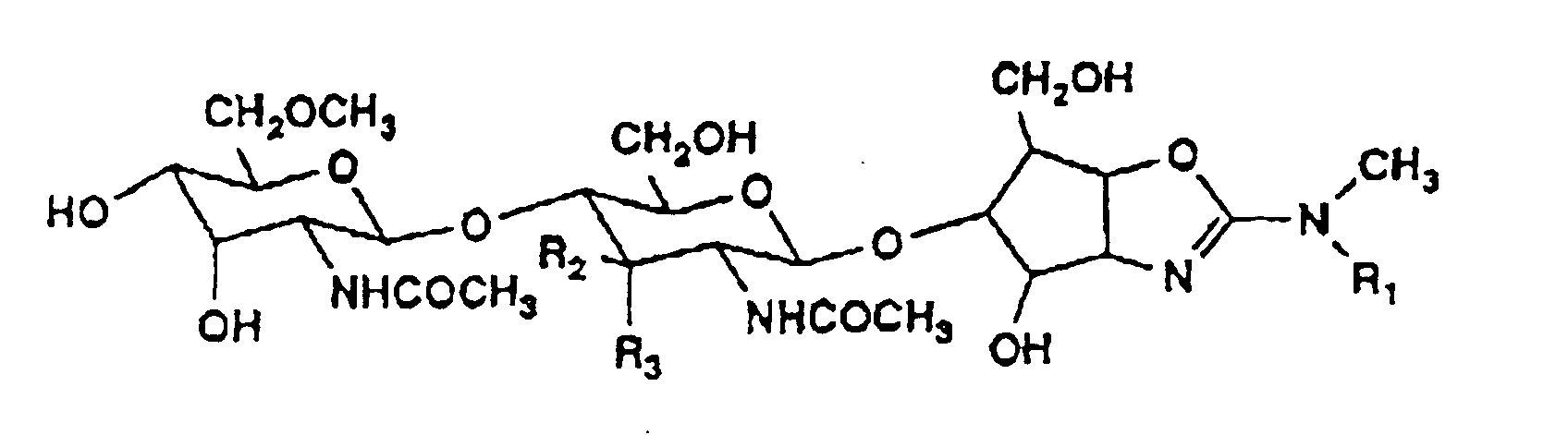
- Allosamidin compounds represented by the following chemical structure :

- A process for preparing compounds as claimed in claim 1, which comprises culturing a microorganism belonging to the genus Streptomyces and capable of producing compounds as claimed in claim 1 and harvesting said compounds from the culture broth.
- Use of the compounds as claimed in claim 1 or 2 as antifungal agents and chitinase inhibitors.
- Pharmaceutical composition comprising the compounds as claimed in claim 1 or 2 as active components.
Applications Claiming Priority (2)
| Application Number | Priority Date | Filing Date | Title |
|---|---|---|---|
| JP1102891 | 1991-01-31 | ||
| JP11028/91 | 1991-03-04 |
Publications (1)
| Publication Number | Publication Date |
|---|---|
| EP0497313A1 true EP0497313A1 (en) | 1992-08-05 |
Family
ID=11766637
Family Applications (1)
| Application Number | Title | Priority Date | Filing Date |
|---|---|---|---|
| EP92101468A Ceased EP0497313A1 (en) | 1991-01-31 | 1992-01-29 | Allosamidin compounds and a process for production thereof |
Country Status (3)
| Country | Link |
|---|---|
| US (1) | US5413991A (en) |
| EP (1) | EP0497313A1 (en) |
| JP (1) | JP3063930B2 (en) |
Cited By (1)
| Publication number | Priority date | Publication date | Assignee | Title |
|---|---|---|---|---|
| FR2924117A1 (en) * | 2007-11-28 | 2009-05-29 | Univ Picardie Jules Verne Etab | DISACCHARIDE TYPE COMPOUND, COMPOSITION CONTAINING SUCH COMPOUND, AND PROCESS FOR PRODUCING SUCH COMPOUND |
Families Citing this family (5)
| Publication number | Priority date | Publication date | Assignee | Title |
|---|---|---|---|---|
| EP0796101A4 (en) * | 1995-01-04 | 2000-10-11 | American Cyanamid Co | COMPOSITIONS AND METHODS FOR INHIBITING THE FORMATION OF CERTAIN FUNGAL CELL WALLS |
| US7214373B2 (en) * | 2001-07-24 | 2007-05-08 | Yale University | Methods, compositions and kits relating to chitinases and chitinase-like molecules and inflammatory disease |
| JP2005522203A (en) * | 2002-04-08 | 2005-07-28 | ペロス システムズ テクノロジーズ インコーポレイテッド | Composition for modulating physiological response or inducing immune response |
| US20050214297A1 (en) * | 2004-02-25 | 2005-09-29 | Medimmune, Inc. | Methods and compositions relating to chitinases and chitinase-like molecules and modulation of osteoclasts |
| EP1928496A4 (en) * | 2005-08-31 | 2011-01-05 | Medimmune Inc | C / CLP ANTAGONISTS AND METHODS OF USE |
Citations (1)
| Publication number | Priority date | Publication date | Assignee | Title |
|---|---|---|---|---|
| EP0395106A1 (en) * | 1989-04-27 | 1990-10-31 | Ajinomoto Co., Inc. | Demethylallosamidin and a process for production thereof |
Family Cites Families (1)
| Publication number | Priority date | Publication date | Assignee | Title |
|---|---|---|---|---|
| JPH0660192B2 (en) * | 1986-03-06 | 1994-08-10 | 三共株式会社 | Novel substance allosamidine, its manufacturing method and use |
-
1992
- 1992-01-21 JP JP4008102A patent/JP3063930B2/en not_active Expired - Lifetime
- 1992-01-29 EP EP92101468A patent/EP0497313A1/en not_active Ceased
- 1992-01-31 US US07/830,353 patent/US5413991A/en not_active Expired - Lifetime
Patent Citations (1)
| Publication number | Priority date | Publication date | Assignee | Title |
|---|---|---|---|---|
| EP0395106A1 (en) * | 1989-04-27 | 1990-10-31 | Ajinomoto Co., Inc. | Demethylallosamidin and a process for production thereof |
Non-Patent Citations (5)
| Title |
|---|
| AGRICULTURAL AND BIOLOGICAL CHEMISTRY. vol. 51, no. 12, December 1987, TOKYO JP pages 3251 - 3259; S.SAKUDA ET AL.: 'Structures of Allosamidins, Novel Insect Chitinase Inhibitors, Produced by Actinomycetes' * |
| AGRICULTURAL AND BIOLOGICAL CHEMISTRY. vol. 53, no. 10, October 1989, TOKYO JP pages 2825 - 2826; A.ISOGAI ET AL.: 'Structure of Demethylallosamidin as an Insect Chitinase Inhibitor' * |
| AGRICULTURAL AND BIOLOGICAL CHEMISTRY. vol. 54, no. 4, April 1990, TOKYO JP pages 1333 - 1335; S.SAKUDA ET AL.: 'Effects of Demethylallosamidin, a Potent Yeast Chitinase Inhibitor, on the Cell division of Yeast' * |
| JOURNAL OF ANTIBIOTICS. vol. 44, no. 7, July 1991, TOKYO JP pages 716 - 722; Y.NISHIMOTO ET AL.: 'Isolation and Characterization of New Allosamidins' * |
| PATENT ABSTRACTS OF JAPAN vol. 12, no. 70 (C-479)(2917) 4 March 1988 & JP-A-62 207 294 ( SANKYO CO. LTD. ) 11 September 1987 * |
Cited By (2)
| Publication number | Priority date | Publication date | Assignee | Title |
|---|---|---|---|---|
| FR2924117A1 (en) * | 2007-11-28 | 2009-05-29 | Univ Picardie Jules Verne Etab | DISACCHARIDE TYPE COMPOUND, COMPOSITION CONTAINING SUCH COMPOUND, AND PROCESS FOR PRODUCING SUCH COMPOUND |
| WO2009098400A1 (en) * | 2007-11-28 | 2009-08-13 | Universite De Picardie Jules Verne | Compound of the disaccharide type composition comprising and method for producing such a compound |
Also Published As
| Publication number | Publication date |
|---|---|
| JPH0559082A (en) | 1993-03-09 |
| JP3063930B2 (en) | 2000-07-12 |
| US5413991A (en) | 1995-05-09 |
Similar Documents
| Publication | Publication Date | Title |
|---|---|---|
| CA1334391C (en) | Immunosuppressant compound | |
| US6214340B1 (en) | Physiologically active substance sulphostin, process for producing the same, and use thereof | |
| JPH0753735B2 (en) | New immunosuppressant | |
| CA1340338C (en) | Glycopeptide antibiotic pa-45052 and the production thereof | |
| US5413991A (en) | Allosamidin compounds | |
| CA2064126A1 (en) | Compounds, named the "leustroducins", their preparation and their therapeutic uses | |
| EP0185456A2 (en) | CL-1577D and CL-1577E antibiotic/antitumor compounds, their production and use | |
| US5250563A (en) | Inhibitors of HIV protease | |
| EP0194784A2 (en) | CL-1577-B4 Compound, its production and use | |
| KR880002688B1 (en) | How to prepare antibiotics | |
| US5070191A (en) | Demethylallosamidin and a process for production thereof | |
| JP3063941B2 (en) | Didemethyl allosamidine and its production | |
| US3758681A (en) | Antifungal antibiotic a 9145 and process for production thereof | |
| EP0396400A1 (en) | Microbial transformation product | |
| JPH05331171A (en) | New metabolic product obtained from pseurochin f1/f2 aspergillus fumigatus, preparation thereof and its use | |
| EP0808843B1 (en) | Novel macrolide compound 0406 | |
| JP3490095B2 (en) | Antibiotic TKR2648 and method for producing the same | |
| JP3688446B2 (en) | New Terpene Compound 0406TP-1 | |
| JPH05331172A (en) | New metabolic product obtained from bioactive pseurochin a and d and aspergillus fumigatus, preparation thereof and its use | |
| US5270187A (en) | Microbial transformation product | |
| US5268370A (en) | Microbial transformation product of L-679,934 | |
| JP2653663B2 (en) | Immunostimulants and anticancer agents containing 1.3-dihydroxy-8-decene-5-one | |
| JP2002500876A (en) | Ustilipide, its preparation and use | |
| JPH01216927A (en) | Antitumor agent | |
| JP2990628B2 (en) | New plant growth regulating substance aji-302 and its production |
Legal Events
| Date | Code | Title | Description |
|---|---|---|---|
| PUAI | Public reference made under article 153(3) epc to a published international application that has entered the european phase |
Free format text: ORIGINAL CODE: 0009012 |
|
| AK | Designated contracting states |
Kind code of ref document: A1 Designated state(s): DE FR GB IT |
|
| 17P | Request for examination filed |
Effective date: 19930122 |
|
| 17Q | First examination report despatched |
Effective date: 19970120 |
|
| GRAG | Despatch of communication of intention to grant |
Free format text: ORIGINAL CODE: EPIDOS AGRA |
|
| STAA | Information on the status of an ep patent application or granted ep patent |
Free format text: STATUS: THE APPLICATION HAS BEEN REFUSED |
|
| 18R | Application refused |
Effective date: 19990125 |