EP0497303B1 - Carbamic acid derivatives and method for preparing the same - Google Patents
Carbamic acid derivatives and method for preparing the same Download PDFInfo
- Publication number
- EP0497303B1 EP0497303B1 EP92101449A EP92101449A EP0497303B1 EP 0497303 B1 EP0497303 B1 EP 0497303B1 EP 92101449 A EP92101449 A EP 92101449A EP 92101449 A EP92101449 A EP 92101449A EP 0497303 B1 EP0497303 B1 EP 0497303B1
- Authority
- EP
- European Patent Office
- Prior art keywords
- group
- general formula
- compound represented
- denotes
- preparing
- Prior art date
- Legal status (The legal status is an assumption and is not a legal conclusion. Google has not performed a legal analysis and makes no representation as to the accuracy of the status listed.)
- Expired - Lifetime
Links
Classifications
-
- C—CHEMISTRY; METALLURGY
- C07—ORGANIC CHEMISTRY
- C07D—HETEROCYCLIC COMPOUNDS
- C07D401/00—Heterocyclic compounds containing two or more hetero rings, having nitrogen atoms as the only ring hetero atoms, at least one ring being a six-membered ring with only one nitrogen atom
- C07D401/02—Heterocyclic compounds containing two or more hetero rings, having nitrogen atoms as the only ring hetero atoms, at least one ring being a six-membered ring with only one nitrogen atom containing two hetero rings
- C07D401/04—Heterocyclic compounds containing two or more hetero rings, having nitrogen atoms as the only ring hetero atoms, at least one ring being a six-membered ring with only one nitrogen atom containing two hetero rings directly linked by a ring-member-to-ring-member bond
-
- A—HUMAN NECESSITIES
- A61—MEDICAL OR VETERINARY SCIENCE; HYGIENE
- A61P—SPECIFIC THERAPEUTIC ACTIVITY OF CHEMICAL COMPOUNDS OR MEDICINAL PREPARATIONS
- A61P25/00—Drugs for disorders of the nervous system
- A61P25/28—Drugs for disorders of the nervous system for treating neurodegenerative disorders of the central nervous system, e.g. nootropic agents, cognition enhancers, drugs for treating Alzheimer's disease or other forms of dementia
-
- C—CHEMISTRY; METALLURGY
- C07—ORGANIC CHEMISTRY
- C07D—HETEROCYCLIC COMPOUNDS
- C07D211/00—Heterocyclic compounds containing hydrogenated pyridine rings, not condensed with other rings
- C07D211/04—Heterocyclic compounds containing hydrogenated pyridine rings, not condensed with other rings with only hydrogen or carbon atoms directly attached to the ring nitrogen atom
- C07D211/06—Heterocyclic compounds containing hydrogenated pyridine rings, not condensed with other rings with only hydrogen or carbon atoms directly attached to the ring nitrogen atom having no double bonds between ring members or between ring members and non-ring members
- C07D211/36—Heterocyclic compounds containing hydrogenated pyridine rings, not condensed with other rings with only hydrogen or carbon atoms directly attached to the ring nitrogen atom having no double bonds between ring members or between ring members and non-ring members with hetero atoms or with carbon atoms having three bonds to hetero atoms with at the most one bond to halogen, e.g. ester or nitrile radicals, directly attached to ring carbon atoms
- C07D211/60—Carbon atoms having three bonds to hetero atoms with at the most one bond to halogen, e.g. ester or nitrile radicals
-
- C—CHEMISTRY; METALLURGY
- C07—ORGANIC CHEMISTRY
- C07D—HETEROCYCLIC COMPOUNDS
- C07D401/00—Heterocyclic compounds containing two or more hetero rings, having nitrogen atoms as the only ring hetero atoms, at least one ring being a six-membered ring with only one nitrogen atom
- C07D401/14—Heterocyclic compounds containing two or more hetero rings, having nitrogen atoms as the only ring hetero atoms, at least one ring being a six-membered ring with only one nitrogen atom containing three or more hetero rings
-
- C—CHEMISTRY; METALLURGY
- C07—ORGANIC CHEMISTRY
- C07D—HETEROCYCLIC COMPOUNDS
- C07D417/00—Heterocyclic compounds containing two or more hetero rings, at least one ring having nitrogen and sulfur atoms as the only ring hetero atoms, not provided for by group C07D415/00
- C07D417/02—Heterocyclic compounds containing two or more hetero rings, at least one ring having nitrogen and sulfur atoms as the only ring hetero atoms, not provided for by group C07D415/00 containing two hetero rings
- C07D417/04—Heterocyclic compounds containing two or more hetero rings, at least one ring having nitrogen and sulfur atoms as the only ring hetero atoms, not provided for by group C07D415/00 containing two hetero rings directly linked by a ring-member-to-ring-member bond
-
- Y—GENERAL TAGGING OF NEW TECHNOLOGICAL DEVELOPMENTS; GENERAL TAGGING OF CROSS-SECTIONAL TECHNOLOGIES SPANNING OVER SEVERAL SECTIONS OF THE IPC; TECHNICAL SUBJECTS COVERED BY FORMER USPC CROSS-REFERENCE ART COLLECTIONS [XRACs] AND DIGESTS
- Y02—TECHNOLOGIES OR APPLICATIONS FOR MITIGATION OR ADAPTATION AGAINST CLIMATE CHANGE
- Y02P—CLIMATE CHANGE MITIGATION TECHNOLOGIES IN THE PRODUCTION OR PROCESSING OF GOODS
- Y02P20/00—Technologies relating to chemical industry
- Y02P20/50—Improvements relating to the production of bulk chemicals
- Y02P20/55—Design of synthesis routes, e.g. reducing the use of auxiliary or protecting groups
Definitions
- the present invention concerns carbamic acid derivatives or their pharmaceutically acceptable acid addition salts having anti-amnesic activity, methods for preparing them, and anti-dementia comprising the carbamic acid derivatives or their pharmaceutically acceptable acid addition salts as an active ingredient.
- dementia diseases such as Alzheimer type senile dementia have arisen as a great problem in medical as well as social field.
- Patients of dementia show symptom such as loss of intellectual ability, disturbance of memory, disturbance of abstract thinking, verbal aphasia, apraxia, disorientation and so on, and the disturbance of fundamental functions lies in that of formation of memory or expressing ability of hold memory.
- GB-A- 2 000 136 discloses 1-piperidino-phthalazines, a process for preparing same and their use as cardiac stimulants.
- GB-A- 2 021 108 discloses 4-amino-2-piperidino-quinazolines, a process for preparing same and their use as regulators for the cardiovascular system.
- EP-A-0 169 139 discloses piperidino group-containing carbamic acid derivatives wherein the nitrogen of the piperidino ring is substituted by Ar-A (wherein Ar represents a phenyl or naphthyl group and A represents a pyridyl, pyrimidyl or triazinyl group). Said derivatives are useful as anticonvulsive agents.
- the object of the present invention lies in providing a medicament for improving disturbance of memory which is effective to symptoms of dementia and having high safety factor, in considering the present status of patients of dementia as mentioned above.
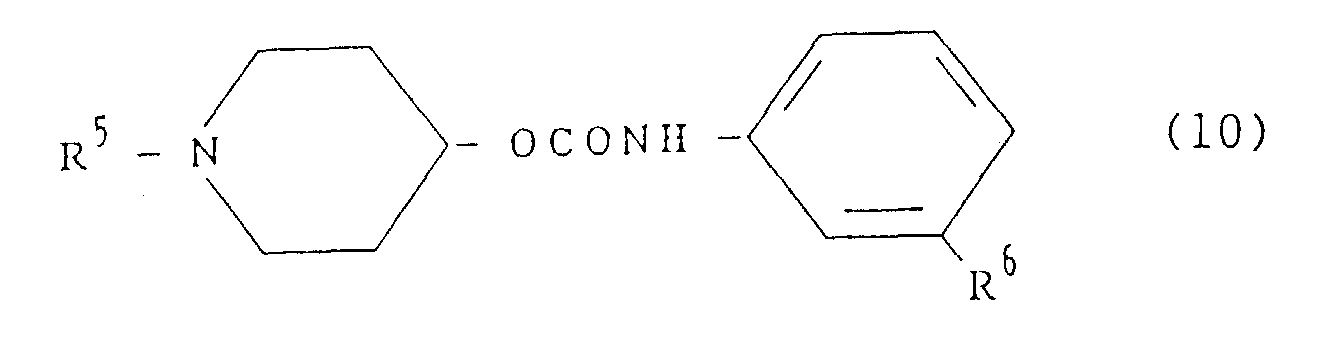
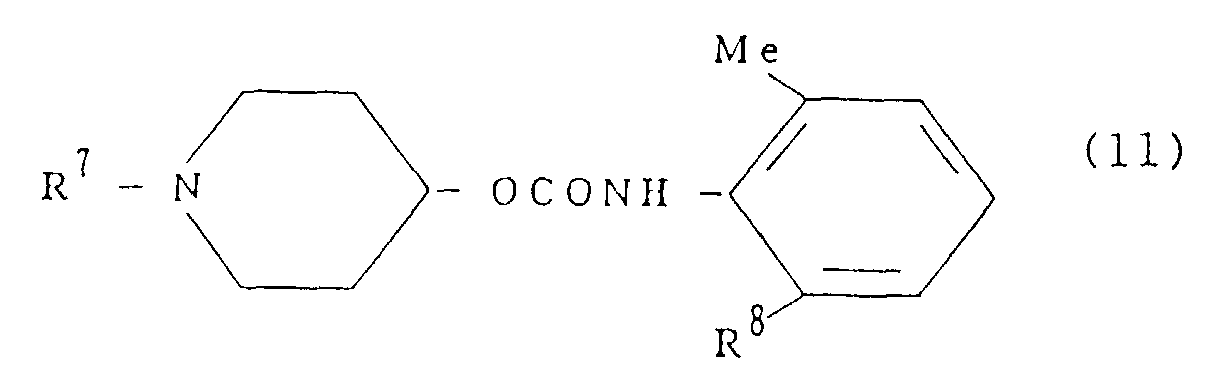
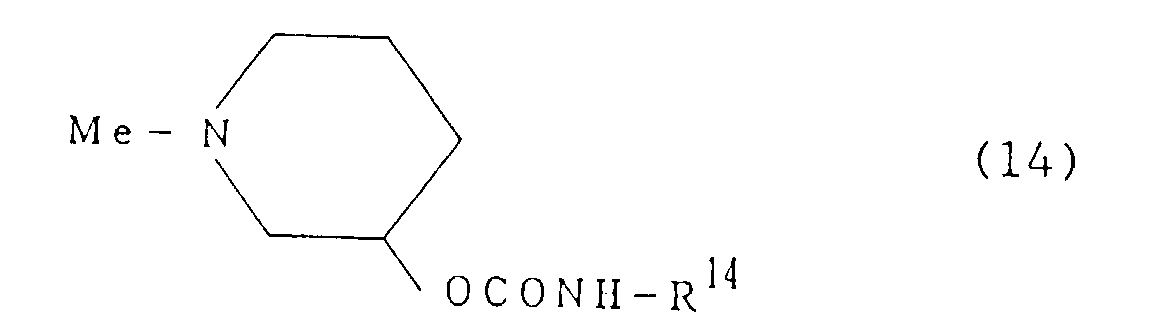
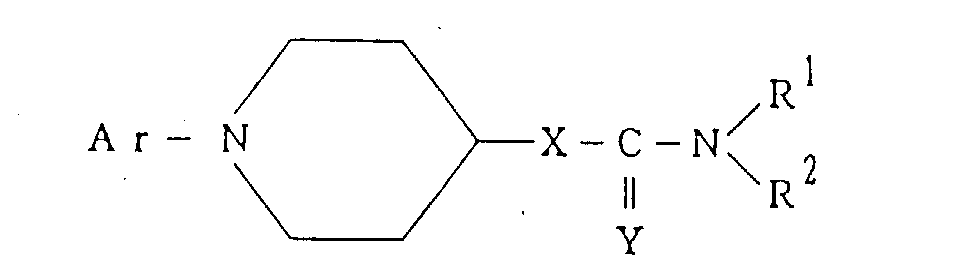
- carbamic acid derivatives of the present invention and acid addition salts thereof have an excellent anti-amnesic action. That is, the inventors of the present invention have found that carbamic acid derivatives represented by a general formula (1) wherein R 1 denotes a hydrogen atom or a C 1-6 alkyl group, R 2 denotes a C 1-6 Alkyl group which may be substituted with a halogen atom, a phenyl group which may have at least one substituent such as halogen atom, C 1-4 alkyl group, C 1-4 alkoxy group, C 1-4 alkylthio group, trifluoromethyl group, cyano group, nitro group, di(C 1-4 alkyl)amino group or C 1-4 alkoxycarbonyl group, a naphthyl group, or a pyridyl group or its benzene-condensed
- C 1-6 alkyl group in formula (1) a straight or branched chain having 1 - 6 carbon atoms such as methyl, ethyl, n-propyl and iso-propyl can be exemplified.
- halogen atom fluorine, chlorine, bromine and iodine atom
- C 1-4 alkoxy group a straight or branched chain of 1 - 4 carbon atoms such as methoxy, ethoxy or propoxy group
- C 1-4 alkoxycarbonyl group a group of 1 - 4 carbon atoms such as methoxycarbonyl or ethoxycarbonyl can be exemplified.
- Examples of the benzene-condensed ring of pyridyl group are quinolyl and isoquinolyl.
- the acid addition salts stand for a pharmaceutically acceptable salt such as, for example, hydrochloric acid, citric acid, succinic acid, fumaric acid or maleic acid.
- a protecting group of the amino group for example, a lower acyl group such as acetyl or propionyl group, an alkoxycarbonyl group such as methoxy carbonyl or t-butoxy carbonyl group can be exemplified.
- a halogen atom such as fluorine, chlorine, bromine or iodine
- sulfonyloxy group such as p-toluenesulfonyloxy group or methanesulfonyloxy group.
- a condensing agent for example, carbonyldiimidazoles such as N,N'-carbonyldiimidazole (CDI), N,N'-succinimidyl carbonate (DSC) or N,N'-thiocarbonyldiimidazole (TCDI), phosgene or its analogue such as, for example, trichloromethylchloroformate or triphosgene can be exemplified.
- CDI N,N'-carbonyldiimidazole
- DSC N,N'-succinimidyl carbonate
- TCDI N,N'-thiocarbonyldiimidazole
- phosgene or its analogue such as, for example, trichloromethylchloroformate or triphosgene
- the compound of the present invention can be prepared by the following preparative methods.
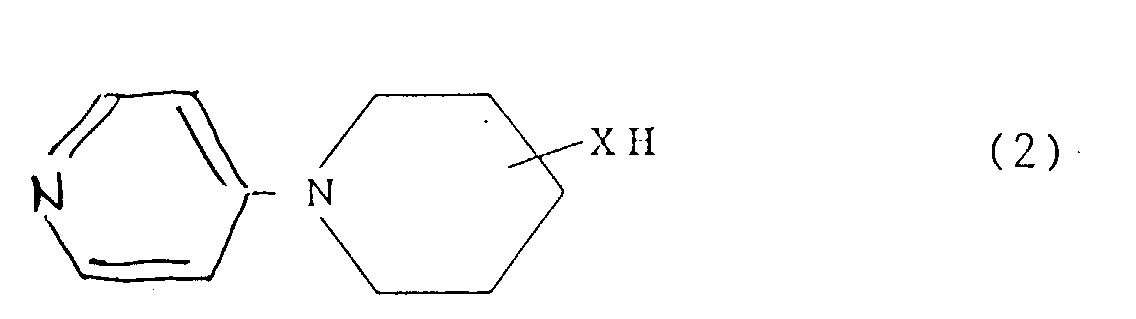
- a compound represented by the general formula (1) can be synthesized through the two processes below with employment of a compound represented by a general formula (2) wherein X is as mentioned above.
- the corresponding isocyanic acid ester or isothiocyanic acid ester includes also isocyanic acid ester or isothiocyanic acid ester synthesized in situ through Curtius rearrangement after allowing a corresponding carboxylic acid or thiocarboxylic acid to react with thionyl chloride, sodium azide successively, or with diphenylphosphorye azide (DPPA).
- DPPA diphenylphosphorye azide
- a part of the compounds represented by the general formula (2) is publicly known and can be synthesized according to Japanese Laid-open Publication No. Hei 2-83369 or Heterocycles, 16(11) , 1883 (1981).
- the compound represented by the general formula (1) can be also synthesized by allowing a compound of a general formula (5) to react with a compound of a general formula (6) in a suitable solvent, for example ethanol, isoamyl alcohol, tert-butanol, in the presence of a suitable base, for example sodium hydrogen carbonate, potassium carbonate, at a temperature of room temperature - boiling point of the solvent for 5 - 20 hours.
- a suitable solvent for example ethanol, isoamyl alcohol, tert-butanol
- a suitable base for example sodium hydrogen carbonate, potassium carbonate
- reaction can be enhanced by further adding sodium acetate, potassium iodide or sodium iodide.
- R 1 , R 2 , X and Y are as mentioned before and Z denotes an eliminating group.
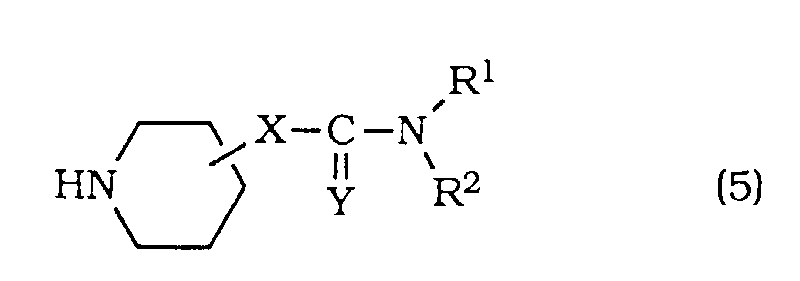
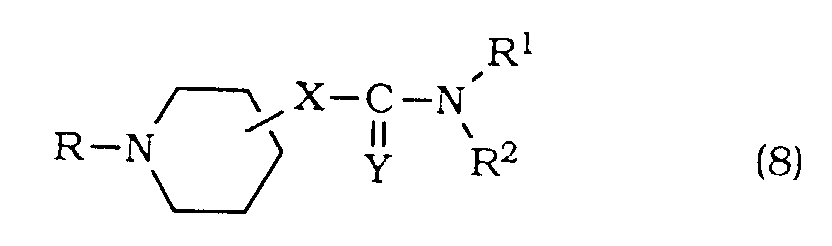
- the compound represented by the general formula (5) can be synthesized according to the following scheme. wherein R denotes a protecting group of amino group, and R 1 , R 2 , X and Y are as mentioned before. That is, the compound represented by the general formula (5) can be synthesized by converting a compound represented by the general formula (7) corresponding to a compound of hydroxy- or mercapto-piperidine, nitrogen atom of which is protected, into a compound of the general formula (8) according to the beforementioned method of (A) or (B), followed by eliminating the protecting group.
- the reaction of eliminating the protecting group can be conducted by effecting the reaction in a suitable solvent, for example ethanol, tetrahydrofuran or dimethylformamide, in the presence of acid such as, for example, hydrochloric acid or sulfuric acid at a temperature of room temperature - boiling temperature of the solvent for 1 - 10 hours.
- a suitable solvent for example ethanol, tetrahydrofuran or dimethylformamide
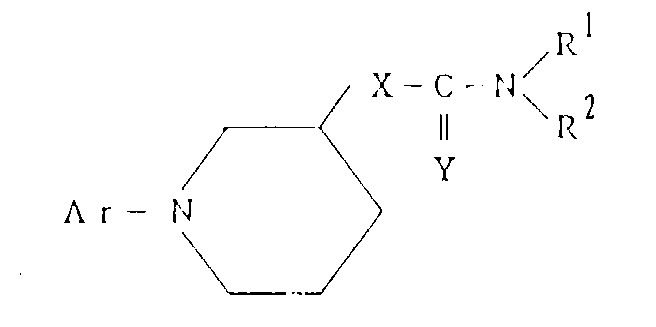
- the compounds of the general formula (1), (2), (5), (7), (8) and (9) may have asymmetric carbon depending on the position of substituent on piperidine ring and so there are two kinds of optical isomer basing on said asymmetric carbon, but each of them or their mixture are all involved in the scope of the invention.
- those of the synthesized carbamic acid ester can be obtained by, for example, the reaction with inorganic acid such as hydrochloric acid or with organic acid such as succinic acid.
- the reaction mixture was concentrated under reduced pressure, added with ca. 100 ml of hot water and the resulted insoluble matter was removed by filtration to give filtrate.
- To this filtrate was slowly added with potassium hydroxide under ice cooling with stirring to have pH value of more than 11, and was stirred, as it was, under ice cooling for 1 hour and further at room temperature for 1 hour.
- the precipitated crystal was collected through filtration and this crystal was recrystallized from acetonitrile to give the title compound (7.3 g) as colorless prism crystal, the spectrum data of which accorded with those obtained in (1).
- Example 57(1)-a from (S)-(+)-N-tert-butoxycarbonyl-3-piperidinol (Reference Example 4) was obtained (S)-(-)-N-tert-butoxycarbonyl-3-piperidyl 4-chlorophenylcarbamate (2.58 g) as colorless prism crystal.
- mice The experimental animals employed were the Std: ddy strain male mice (Japanese SLC) having body weight of 23 - 32 g (five weeks old).
- the apparatus used was a passive avoidance apparatus of a step-through type (made by O'Hara Co., Ltd.).
- each mouse was placed in the light compartment, a guillotine door of partition thereof was opened after 10 seconds, the guillotine door was closed as soon as the mouse moved into the dark compartment and an electric shock of 33 - 50 v was given for 1 second through the metal grid bars of the floor.
- an electric shock of 33 - 50 v was given for 1 second through the metal grid bars of the floor.
- the mouse was taken out and was accommodated in a container having volume of ca. 300 ml filled with carbon dioxide gas.
- Rate of improvement Latency of CO 2 -drug treated group - Latency of carbon dioxide exposed group Latency of non-dementia group - Latency of carbon dioxide exposed group x 100 Effect on amnesia induced by carbon dioxide Compound Dose (mg/kg) Number of animal Reaction latency(sec) Mean ⁇ S.E Rate of improvement (%)
- Example 2 10 20 150.7 ⁇ 27.1 42.9
- the carbamic acid derivatives of the present invention show excellent improving activity to disturbance of memory while the improving activity to disturbance of memory of the conventional treatment medicament to cerebrovascular disturbance (Nicardipine) and the conventional activating medicament to cerebral metabolism (Bifemelane, Indeloxazine) is vitiated or not enough. Accordingly, the compounds of the present invention are effective as anti-dementia medicament.
Landscapes
- Organic Chemistry (AREA)
- Chemical & Material Sciences (AREA)
- Health & Medical Sciences (AREA)
- Neurosurgery (AREA)
- Engineering & Computer Science (AREA)
- Bioinformatics & Cheminformatics (AREA)
- Biomedical Technology (AREA)
- Neurology (AREA)
- Medicinal Chemistry (AREA)
- General Health & Medical Sciences (AREA)
- Chemical Kinetics & Catalysis (AREA)
- General Chemical & Material Sciences (AREA)
- Hospice & Palliative Care (AREA)
- Nuclear Medicine, Radiotherapy & Molecular Imaging (AREA)
- Pharmacology & Pharmacy (AREA)
- Life Sciences & Earth Sciences (AREA)
- Animal Behavior & Ethology (AREA)
- Psychiatry (AREA)
- Public Health (AREA)
- Veterinary Medicine (AREA)
- Pharmaceuticals Containing Other Organic And Inorganic Compounds (AREA)
- Plural Heterocyclic Compounds (AREA)
- Hydrogenated Pyridines (AREA)
- Acyclic And Carbocyclic Compounds In Medicinal Compositions (AREA)
- Organic Low-Molecular-Weight Compounds And Preparation Thereof (AREA)
- Heterocyclic Carbon Compounds Containing A Hetero Ring Having Nitrogen And Oxygen As The Only Ring Hetero Atoms (AREA)
- Indole Compounds (AREA)
Description





- Melting point
- 233 - 234 °C
| Elementary analysis for C21H21N3 O2 | |||
| Calculated value | C: 72.60 | H: 6.09 | N: 12.10 |
| Observed value | C: 72.57 | H: 6.07 | N: 12.20 |
- Melting point
- 240 - 241 °C
| Elementary analysis for C17H18ClN3 O2 | |||
| Calculated value | C: 61.54 | H: 5.47 | N: 12.66 |
| Observed value | C: 61.57 | H: 5.44 | N: 12.59 |
- Melting point
- 268 - 270 °C
| Elementary analysis for C17H18ClN3 O2 · HCl | |||
| Calculated value | C: 55.45 | H: 5.20 | N: 11.41 |
| Observed value | C: 55.31 | H: 5.15 | N: 11.28 |
the mixture was added with triethylamine (1.17 ml) and then stirred at 0 °C for 1 hour. Afterwards, the mixture was dropwise added with a solution of 1-(4-pyridyl)-4-piperidinol (1.5 g) in methylene chloride (15 ml), further added with triethylamine (1.17 ml), and
react at 0 °C for 20 minutes, at room temperature for 1 hour after returning to room temperature and further by refluxing with heating for 2 hours. The reaction mixture was poured into water and extracted with methylene chloride. This organic layer was dried over anhydrous sodium sulfate, the solvent was distilled off under reduced pressure, and the obtained residue was purified through column chromatography (alumina, ethyl acetate: n-hexane = 5:3). The obtained crude crystal was washed with petroleum ether to give 1.27 g of the title compound of colorless powder crystal.
- Melting point
- 76 - 79 °C
| Elementary analysis for C18H20ClN3 O2 · 2/5H2 O | |||
| Calculated value | C: 61.24 | H: 5.94 | N: 11.90 |
| Observed value | C: 61.28 | H: 5.87 | N: 12.05 |
- Melting point
- 215 - 216 °C
| Elementary analysis for C17H19N2 O2 | |||
| Calculated value | C: 68.67 | H: 6.44 | N: 14.13 |
| Observed value | C: 68.40 | H: 6.42 | N: 14.16 |



- Melting point
- 160 - 161 °C
| Elementary analysis (%) for C17H23ClN2O4 | |||
| Calculated value | C: 57.54 | H: 6.53 | N: 7.89 |
| Observed value | C: 57.66 | H: 6.55 | N: 7.83 |
- Melting point
- 144 - 145 °C
| Elementary analysis (%) for C12H15ClN2 O2 | |||
| Calculated value | C: 56.59 | H: 5.94 | N: 11.00 |
| Observed value | C: 56.57 | H: 5.92 | N: 11.10 |
- Melting point
- 144 - 145 °C
| Elementary analysis (%) for C17H18ClN3 O2 | |||
| Calculated value | C: 61.54 | H: 5.47 | N: 12.66 |
| Observed value | C: 61.45 | H: 5.38 | N: 12.66 |
- Melting point
- 161 - 162 °C
| Elementary analysis for C17H23ClN2 O4 | |||
| Calculated value | C: 57.54 | H: 6.53 | N: 7.89 |
| Observed value | C: 57.73 | H: 6.57 | N: 7.90 |
Further, likewise as in Example 57(1)-b, from the obtained compound (2.3 g) was obtained the title compound (1.07 g) as colorless prism crystal.
- Melting point
- 143 - 144 °C
| Elementary analysis for C12H15ClN2 O2 | |||
| Calculated value | C: 56.59 | H: 5.94 | N: 11.00 |
| Observed value | C: 56.60 | H: 5.91 | N: 11.11 |
- Melting point
- 143 - 144 °C
| Elementary analysis (%) for C17H18ClN3 O2 | |||
| Calculated value | C: 61.54 | H: 5.47 | N: 12.66 |
| Observed value | C: 61.60 | H: 5.41 | N: 12.69 |
- Melting point
- 153 - 155 °C
| Elementary analysis for C15H20ClN2 O6 · H2 O | |||
| Calculated value | C: 47.56 | H: 6.12 | N: 7.40 |
| Observed value | C: 47.77 | H: 6.12 | N: 7.49 |
| Elementary analysis for C10H19NO3 | |||
| Calculated value | C: 59.68 | H: 9.52 | N: 6.96 |
| Observed value | C: 59.50 | H: 9.72 | N: 6.99 |
- Melting point
- 153 - 154 °C
| Elementary analysis for C15H20ClN2 O6 · H2 O | |||
| Calculated value | C: 47.56 | H: 6.12 | N: 7.40 |
| Observed value | C: 47.31 | H: 6.12 | N: 7.36 |
| Elementary analysis for C10H19NO3 | |||
| Calculated value | C: 59.68 | H: 9.52 | N: 6.96 |
| Observed value | C: 59.49 | H: 9.70 | N: 6.98 |
| Effect on amnesia induced by carbon dioxide | ||||
| Compound | Dose (mg/kg) | Number of animal | Reaction latency(sec) Mean±S.E | Rate of improvement (%) |
| Non-treated | - | 20 | 278.5±12.0 | |
| CO2 treated mouse | - | 20 | 54.8±15.2 | |
| Example 2 | 10 | 20 | 150.7±27.1 | 42.9 |
| Non-treated | - | 30 | 269.7±12.1 | |
| CO2 treated mouse | - | 30 | 103.6±18.5 | |
| Example 2 | 30 | 30 | 231.2±19.0 | 76.8 |
| Non-treated | - | 20 | 300.0± 0 | |
| CO2 treated mouse | - | 20 | 87.3±18.9 | |
| Example 49 | 10 | 20 | 154.0±27.2 | |
| 30 | 20 | 183.7±26.3 | 45.3 | |
| Non-treated | - | 10 | 300.0± 0 | |
| CO2 treated mouse | - | 10 | 170.4±32.1 | |
| Nicardipine | 5 | 10 | 92.9±28.1 | -59.8 |
| Non-treated | - | 19 | 282.5±12.1 | |
| CO2 treated mouse | - | 20 | 131.1±23.9 | |
| Bifemelane | 100 | 19 | 188.5±27.1 | 37.9 |
| Non-treated | - | 30 | 300.0± 0 | |
| CO2 treated mouse | - | 30 | 184.5±18.3 | |
| Indeloxazine | 40 | 30 | 219.3±17.8 | 30.1 |
| Non-treated | - | 10 | 300.0± 0 | |
| CO2 treated mouse | - | 10 | 152.9±37.8 | |
| Compound A | 100 | 10 | 175.3±36.7 | 15.2 |
Claims (8)
- A method for preparing carbamic acid derivatives represented by the general formula (I)wherein R1 denotes a hydrogen atom or a C1-6 alkyl group, R2 denotes a C1-6 alkyl group which may be substituted with a halogen atom, a phenyl group which may have at least one substituent such as a halogen atom, C1-4 alkyl group, C1-4 alkoxy group, C1-4 alkylthio group, trifluoromethyl group, cyano group, nitro group, di(C1-4 alkyl)amino group or C1-4 alkoxycarbonyl group, a naphthyl group, or a pyridyl group or its benzene-condensed ring, and X and Y, being the same or different, denote a sulfur atom or an oxygen atom, and their acid addition salts, characterized in that a compound represented by the general formula (2)
 wherein X is as defined above, is allowed to react with a compound represented by the general formula (3)
 wherein R1 and R2 are as defined above, in the presence of a condensing agent.
- The method for preparing the compounds as defined in claim 1 wherein R1 denotes a hydrogen atom characterized in that a compound represented by the general formula (2)wherein X is as defined in claim 1, is allowed to react with a compound represented by the general formula (4)

- The method for preparing the compounds as defined in claim 1, characterized in that a compound represented by the general formula (5)wherein R1, R2, X and Y are as defined in claim 1, is allowed to react with a compound represented by the general formula (6)
 wherein Z denotes an eliminating group.
- A method for preparing a compound represented by the general formula (8)wherein R1, R2, X and Y are as defined in claim 1 and R denotes a protecting group of the amino group, and its acid addition salts characterized in that a compound represented by the general formula (7)
 wherein R and X are as defined above, is allowed to react with a compound represented by the general formula (3)
 wherein R1 and R2 are as defined above, in the presence of a condensing agent.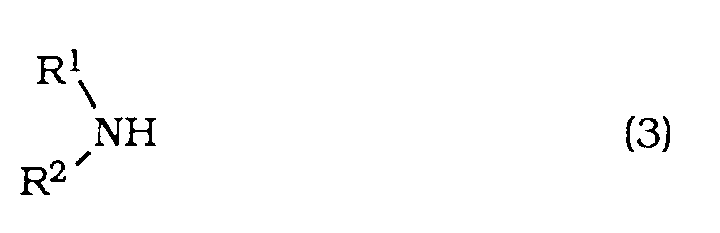
- A method for preparing a compound of the general formula (8) as defined in claim 4, wherein R1 denotes a hydrogen atom and its acid addition salts characterized in that a compound represented by the general formula (7)wherein R is as defined in claim 4 and X is as defined in claim 1, is allowed to react with a compound represented by the general formula (4)

- A method for preparing a compound represented by the general formula (5)wherein R1, R2, X and Y are as defined in claim 1, and its acid addition salts characterized in that a compound represented by the general formula (8)
 wherein R denotes a protecting group of the amino group, and R1, R2, X and Y are as defined above is subjected to eliminating the protecting group.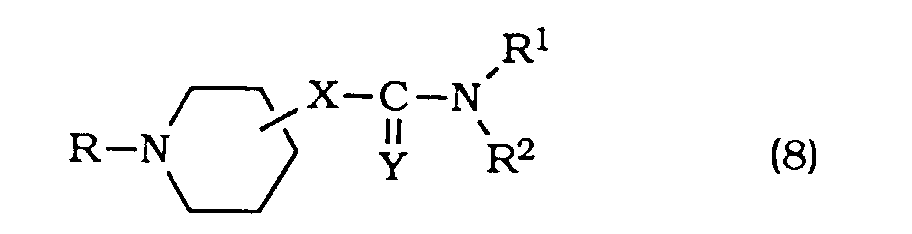
Applications Claiming Priority (4)
| Application Number | Priority Date | Filing Date | Title |
|---|---|---|---|
| JP31922/91 | 1991-01-31 | ||
| JP3192291 | 1991-01-31 | ||
| JP30071/92 | 1992-01-21 | ||
| JP03007192A JP3169188B2 (en) | 1991-01-31 | 1992-01-21 | Carbamic acid derivative and method for producing the same |
Publications (3)
| Publication Number | Publication Date |
|---|---|
| EP0497303A2 EP0497303A2 (en) | 1992-08-05 |
| EP0497303A3 EP0497303A3 (en) | 1992-09-23 |
| EP0497303B1 true EP0497303B1 (en) | 1998-05-27 |
Family
ID=26368350
Family Applications (1)
| Application Number | Title | Priority Date | Filing Date |
|---|---|---|---|
| EP92101449A Expired - Lifetime EP0497303B1 (en) | 1991-01-31 | 1992-01-29 | Carbamic acid derivatives and method for preparing the same |
Country Status (10)
| Country | Link |
|---|---|
| EP (1) | EP0497303B1 (en) |
| JP (1) | JP3169188B2 (en) |
| KR (1) | KR960009429B1 (en) |
| CN (1) | CN1054123C (en) |
| AU (1) | AU643590B2 (en) |
| CA (1) | CA2060393C (en) |
| DE (1) | DE69225625T2 (en) |
| ES (1) | ES2118094T3 (en) |
| HU (2) | HU222246B1 (en) |
| TW (1) | TW199889B (en) |
Families Citing this family (10)
| Publication number | Priority date | Publication date | Assignee | Title |
|---|---|---|---|---|
| EP0522914A1 (en) * | 1991-06-27 | 1993-01-13 | Synthelabo | 2-Piperidinylpyrimidin-4-carboxamide derivatives, their preparation and their application in therapy |
| SE9600683D0 (en) * | 1996-02-23 | 1996-02-23 | Astra Ab | Azabicyclic esters of carbamic acids useful in therapy |
| DE19750401A1 (en) * | 1997-11-14 | 1999-05-20 | Bayer Ag | New pesticidal and fungicidal bicyclic 4-aminopyridine derivatives |
| GB9822440D0 (en) * | 1998-10-14 | 1998-12-09 | Smithkline Beecham Plc | Medicaments |
| GB0218326D0 (en) * | 2002-08-07 | 2002-09-11 | Glaxo Group Ltd | Compounds |
| KR100477987B1 (en) | 2002-09-11 | 2005-03-23 | 삼성에스디아이 주식회사 | Positive electrode for lithium-sulfur battery, and lithium-sulfur battery comprising same |
| US20070004763A1 (en) * | 2005-06-10 | 2007-01-04 | Nand Baindur | Aminoquinoline and aminoquinazoline kinase modulators |
| FR2948368B1 (en) * | 2009-07-21 | 2011-07-22 | Servier Lab | NOVEL PIPERIDINE COMPOUNDS, PROCESS FOR THEIR PREPARATION AND PHARMACEUTICAL COMPOSITIONS CONTAINING THEM |
| AR102537A1 (en) * | 2014-11-05 | 2017-03-08 | Flexus Biosciences Inc | IMMUNOMODULATING AGENTS |
| JP2025528119A (en) * | 2022-08-08 | 2025-08-26 | エイジャックス セラピューティクス, インコーポレイテッド | Heterocyclic amide and urea compounds as JAK2 inhibitors |
Family Cites Families (3)
| Publication number | Priority date | Publication date | Assignee | Title |
|---|---|---|---|---|
| IN148482B (en) | 1977-06-03 | 1981-03-07 | Pfizer | |
| GB2021108B (en) * | 1978-05-18 | 1982-07-21 | Pfizer Ltd | 6,7 - di - 4 - amino - 2 - quinazolines |
| FR2567518B1 (en) * | 1984-07-11 | 1987-11-13 | Sanofi Sa | NOVEL NITROGEN HETEROCYCLIC CORE COMPOUNDS, THEIR PREPARATION AND THE MEDICINAL PRODUCTS CONTAINING THE SAME |
-
1992
- 1992-01-21 JP JP03007192A patent/JP3169188B2/en not_active Expired - Fee Related
- 1992-01-27 HU HU9200251A patent/HU222246B1/en not_active IP Right Cessation
- 1992-01-27 TW TW081100559A patent/TW199889B/zh active
- 1992-01-27 HU HU929200251D patent/HUT60260A/en unknown
- 1992-01-29 DE DE69225625T patent/DE69225625T2/en not_active Expired - Fee Related
- 1992-01-29 ES ES92101449T patent/ES2118094T3/en not_active Expired - Lifetime
- 1992-01-29 EP EP92101449A patent/EP0497303B1/en not_active Expired - Lifetime
- 1992-01-30 CA CA002060393A patent/CA2060393C/en not_active Expired - Fee Related
- 1992-01-30 KR KR92001383A patent/KR960009429B1/en not_active Expired - Fee Related
- 1992-01-30 AU AU10649/92A patent/AU643590B2/en not_active Ceased
- 1992-01-31 CN CN92100713A patent/CN1054123C/en not_active Expired - Fee Related
Also Published As
| Publication number | Publication date |
|---|---|
| DE69225625T2 (en) | 1999-01-28 |
| CN1054123C (en) | 2000-07-05 |
| KR920014798A (en) | 1992-08-25 |
| JP3169188B2 (en) | 2001-05-21 |
| DE69225625D1 (en) | 1998-07-02 |
| EP0497303A3 (en) | 1992-09-23 |
| HUT60260A (en) | 1992-08-28 |
| CA2060393A1 (en) | 1992-08-01 |
| HU9200251D0 (en) | 1992-04-28 |
| EP0497303A2 (en) | 1992-08-05 |
| KR960009429B1 (en) | 1996-07-19 |
| TW199889B (en) | 1993-02-11 |
| HU222246B1 (en) | 2003-05-28 |
| CN1064075A (en) | 1992-09-02 |
| AU643590B2 (en) | 1993-11-18 |
| AU1064992A (en) | 1992-08-06 |
| JPH0558999A (en) | 1993-03-09 |
| ES2118094T3 (en) | 1998-09-16 |
| CA2060393C (en) | 2002-03-12 |
Similar Documents
| Publication | Publication Date | Title |
|---|---|---|
| RU2059637C1 (en) | Heterocyclic derivatives of substituted 2-acylamino-5-thiazoles, methods of their synthesis, derivative of substituted 2-aminothiazole, derivatives of 2-amino-4-phenylthiazole | |
| AU2007212236B2 (en) | Piperidinyl derivatives as modulators of chemokine receptor activity | |
| RU2167152C2 (en) | N-substituted azaheterocyclic carboxylic acids or their pharmaceutically acceptable salts, method of their synthesis, pharmaceutical composition based on thereof and method of inhibition of neurogenic inflammation | |
| EP0527117B1 (en) | Substituted cyclopropylamino-1,3,5-triazines | |
| EP0468187B1 (en) | Cyclic amide derivatives | |
| EP4218934B1 (en) | Inhibiting ubiquitin-specific protease 30 (usp30) | |
| FI82242B (en) | FOERFARANDE FOER FRAMSTAELLNING AV NYA TERAPEUTISKT ANVAENDBARA 3- (PIPERIDINYL) -1H-INDAZOLDERIVAT. | |
| US5017573A (en) | Indazole-3-carboxylic acid derivatives | |
| US4711899A (en) | 2-(4-benzoyl-1-piperidyl)-1-phenylalkanol derivatives | |
| NZ232542A (en) | N-phenyl-n-(4-piperidinyl)amide derivatives; preparatory processes and pharmaceutical compositions | |
| EP0100200A1 (en) | 2-Substituted 4-amino-6,7-dimethoxyquinolines | |
| US20200165237A1 (en) | FIVE MEMBERED-AMINOHETEROCYCLE AND 5,6-or 6,6-MEMBERED BICYCLIC AMINOHETEROCYCLIC INHIBITORS OF ROCK FOR THE TREATMENT OF HEART FAILURE | |
| JP3169188B2 (en) | Carbamic acid derivative and method for producing the same | |
| US5300515A (en) | Carbamic acid derivatives and method for preparing the same | |
| EP0326106B1 (en) | Alkylene diamines | |
| CN114206836B (en) | New pyrrole compounds | |
| NZ243013A (en) | ((arylalkylpiperidin-4-yl)methyl)-2a,3,4,5-tetrahydro-1(2h)-acenaphthylen-1- one derivatives and pharmaceutical compositions thereof | |
| US5834482A (en) | Heterocyclic chemistry | |
| EP2060563A1 (en) | Cyclic aminoalkylcarboxamide derivative | |
| EP0719773B1 (en) | Imidazolidinone derivative, acid-addition salt thereof, and remedy for senile dementia | |
| JPH07133273A (en) | Optically active imidazolidinone derivative and method for producing the same | |
| US5550136A (en) | Methanoanthrancenyl piperidyl antipsychotics | |
| JPH0676377B2 (en) | Brain protectant | |
| KR101402969B1 (en) | New modafinil derivatives and a pharmaceutical composition for treating or preventing inflammation comprising modafinil derivatives | |
| JPH06192263A (en) | Amphoteric tricyclic compound |
Legal Events
| Date | Code | Title | Description |
|---|---|---|---|
| PUAI | Public reference made under article 153(3) epc to a published international application that has entered the european phase |
Free format text: ORIGINAL CODE: 0009012 |
|
| PUAL | Search report despatched |
Free format text: ORIGINAL CODE: 0009013 |
|
| AK | Designated contracting states |
Kind code of ref document: A2 Designated state(s): BE CH DE ES FR GB IT LI NL SE |
|
| AK | Designated contracting states |
Kind code of ref document: A3 Designated state(s): BE CH DE ES FR GB IT LI NL SE |
|
| 17P | Request for examination filed |
Effective date: 19930202 |
|
| 17Q | First examination report despatched |
Effective date: 19950824 |
|
| GRAG | Despatch of communication of intention to grant |
Free format text: ORIGINAL CODE: EPIDOS AGRA |
|
| GRAG | Despatch of communication of intention to grant |
Free format text: ORIGINAL CODE: EPIDOS AGRA |
|
| GRAH | Despatch of communication of intention to grant a patent |
Free format text: ORIGINAL CODE: EPIDOS IGRA |
|
| GRAH | Despatch of communication of intention to grant a patent |
Free format text: ORIGINAL CODE: EPIDOS IGRA |
|
| GRAA | (expected) grant |
Free format text: ORIGINAL CODE: 0009210 |
|
| AK | Designated contracting states |
Kind code of ref document: B1 Designated state(s): BE CH DE ES FR GB IT LI NL SE |
|
| REG | Reference to a national code |
Ref country code: CH Ref legal event code: NV Representative=s name: A. BRAUN, BRAUN, HERITIER, ESCHMANN AG PATENTANWAE Ref country code: CH Ref legal event code: EP |
|
| REF | Corresponds to: |
Ref document number: 69225625 Country of ref document: DE Date of ref document: 19980702 |
|
| ET | Fr: translation filed | ||
| ITF | It: translation for a ep patent filed | ||
| REG | Reference to a national code |
Ref country code: ES Ref legal event code: FG2A Ref document number: 2118094 Country of ref document: ES Kind code of ref document: T3 |
|
| PLBE | No opposition filed within time limit |
Free format text: ORIGINAL CODE: 0009261 |
|
| STAA | Information on the status of an ep patent application or granted ep patent |
Free format text: STATUS: NO OPPOSITION FILED WITHIN TIME LIMIT |
|
| 26N | No opposition filed | ||
| REG | Reference to a national code |
Ref country code: GB Ref legal event code: IF02 |
|
| PGFP | Annual fee paid to national office [announced via postgrant information from national office to epo] |
Ref country code: ES Payment date: 20030103 Year of fee payment: 12 |
|
| PGFP | Annual fee paid to national office [announced via postgrant information from national office to epo] |
Ref country code: SE Payment date: 20030113 Year of fee payment: 12 |
|
| PGFP | Annual fee paid to national office [announced via postgrant information from national office to epo] |
Ref country code: FR Payment date: 20030117 Year of fee payment: 12 |
|
| PGFP | Annual fee paid to national office [announced via postgrant information from national office to epo] |
Ref country code: BE Payment date: 20030122 Year of fee payment: 12 |
|
| PGFP | Annual fee paid to national office [announced via postgrant information from national office to epo] |
Ref country code: CH Payment date: 20030123 Year of fee payment: 12 |
|
| PGFP | Annual fee paid to national office [announced via postgrant information from national office to epo] |
Ref country code: GB Payment date: 20030129 Year of fee payment: 12 |
|
| PGFP | Annual fee paid to national office [announced via postgrant information from national office to epo] |
Ref country code: DE Payment date: 20030130 Year of fee payment: 12 |
|
| PGFP | Annual fee paid to national office [announced via postgrant information from national office to epo] |
Ref country code: NL Payment date: 20030131 Year of fee payment: 12 |
|
| PG25 | Lapsed in a contracting state [announced via postgrant information from national office to epo] |
Ref country code: GB Free format text: LAPSE BECAUSE OF NON-PAYMENT OF DUE FEES Effective date: 20040129 |
|
| PG25 | Lapsed in a contracting state [announced via postgrant information from national office to epo] |
Ref country code: SE Free format text: LAPSE BECAUSE OF NON-PAYMENT OF DUE FEES Effective date: 20040130 Ref country code: ES Free format text: LAPSE BECAUSE OF NON-PAYMENT OF DUE FEES Effective date: 20040130 |
|
| PG25 | Lapsed in a contracting state [announced via postgrant information from national office to epo] |
Ref country code: LI Free format text: LAPSE BECAUSE OF NON-PAYMENT OF DUE FEES Effective date: 20040131 Ref country code: CH Free format text: LAPSE BECAUSE OF NON-PAYMENT OF DUE FEES Effective date: 20040131 Ref country code: BE Free format text: LAPSE BECAUSE OF NON-PAYMENT OF DUE FEES Effective date: 20040131 |
|
| BERE | Be: lapsed |
Owner name: *KYORIN PHARMACEUTICAL CO. LTD Effective date: 20040131 |
|
| PG25 | Lapsed in a contracting state [announced via postgrant information from national office to epo] |
Ref country code: NL Free format text: LAPSE BECAUSE OF NON-PAYMENT OF DUE FEES Effective date: 20040801 |
|
| PG25 | Lapsed in a contracting state [announced via postgrant information from national office to epo] |
Ref country code: DE Free format text: LAPSE BECAUSE OF NON-PAYMENT OF DUE FEES Effective date: 20040803 |
|
| EUG | Se: european patent has lapsed | ||
| GBPC | Gb: european patent ceased through non-payment of renewal fee |
Effective date: 20040129 |
|
| REG | Reference to a national code |
Ref country code: CH Ref legal event code: PL |
|
| PG25 | Lapsed in a contracting state [announced via postgrant information from national office to epo] |
Ref country code: FR Free format text: LAPSE BECAUSE OF NON-PAYMENT OF DUE FEES Effective date: 20040930 |
|
| NLV4 | Nl: lapsed or anulled due to non-payment of the annual fee |
Effective date: 20040801 |
|
| REG | Reference to a national code |
Ref country code: FR Ref legal event code: ST |
|
| PG25 | Lapsed in a contracting state [announced via postgrant information from national office to epo] |
Ref country code: IT Free format text: LAPSE BECAUSE OF NON-PAYMENT OF DUE FEES;WARNING: LAPSES OF ITALIAN PATENTS WITH EFFECTIVE DATE BEFORE 2007 MAY HAVE OCCURRED AT ANY TIME BEFORE 2007. THE CORRECT EFFECTIVE DATE MAY BE DIFFERENT FROM THE ONE RECORDED. Effective date: 20050129 |
|
| REG | Reference to a national code |
Ref country code: ES Ref legal event code: FD2A Effective date: 20040130 |