EP0492509B1 - Vinyl polymer having (meth)acryloyl groups on the side chains and method for preparing same - Google Patents
Vinyl polymer having (meth)acryloyl groups on the side chains and method for preparing same Download PDFInfo
- Publication number
- EP0492509B1 EP0492509B1 EP91121967A EP91121967A EP0492509B1 EP 0492509 B1 EP0492509 B1 EP 0492509B1 EP 91121967 A EP91121967 A EP 91121967A EP 91121967 A EP91121967 A EP 91121967A EP 0492509 B1 EP0492509 B1 EP 0492509B1
- Authority
- EP
- European Patent Office
- Prior art keywords
- meth
- acrylate
- group
- general formula
- represented
- Prior art date
- Legal status (The legal status is an assumption and is not a legal conclusion. Google has not performed a legal analysis and makes no representation as to the accuracy of the status listed.)
- Expired - Lifetime
Links
- 125000003647 acryloyl group Chemical group O=C([*])C([H])=C([H])[H] 0.000 title claims description 93
- 229920002554 vinyl polymer Polymers 0.000 title claims description 70
- 238000000034 method Methods 0.000 title claims description 49
- NIXOWILDQLNWCW-UHFFFAOYSA-M Acrylate Chemical compound [O-]C(=O)C=C NIXOWILDQLNWCW-UHFFFAOYSA-M 0.000 claims description 193
- 239000000178 monomer Substances 0.000 claims description 87
- 125000004435 hydrogen atom Chemical group [H]* 0.000 claims description 46
- 125000004432 carbon atom Chemical group C* 0.000 claims description 44
- -1 2-ethylhexyl Chemical group 0.000 claims description 42
- 125000002496 methyl group Chemical group [H]C([H])([H])* 0.000 claims description 38
- YXFVVABEGXRONW-UHFFFAOYSA-N Toluene Chemical compound CC1=CC=CC=C1 YXFVVABEGXRONW-UHFFFAOYSA-N 0.000 claims description 33
- 238000006243 chemical reaction Methods 0.000 claims description 31
- LYCAIKOWRPUZTN-UHFFFAOYSA-N ethylene glycol Natural products OCCO LYCAIKOWRPUZTN-UHFFFAOYSA-N 0.000 claims description 29
- 239000002904 solvent Substances 0.000 claims description 28
- 125000000217 alkyl group Chemical group 0.000 claims description 27
- 125000001424 substituent group Chemical group 0.000 claims description 25
- UHOVQNZJYSORNB-UHFFFAOYSA-N Benzene Chemical compound C1=CC=CC=C1 UHOVQNZJYSORNB-UHFFFAOYSA-N 0.000 claims description 21
- VLKZOEOYAKHREP-UHFFFAOYSA-N n-Hexane Chemical compound CCCCCC VLKZOEOYAKHREP-UHFFFAOYSA-N 0.000 claims description 21
- PPBRXRYQALVLMV-UHFFFAOYSA-N Styrene Chemical compound C=CC1=CC=CC=C1 PPBRXRYQALVLMV-UHFFFAOYSA-N 0.000 claims description 20
- 125000006165 cyclic alkyl group Chemical group 0.000 claims description 17
- OKKJLVBELUTLKV-UHFFFAOYSA-N Methanol Chemical compound OC OKKJLVBELUTLKV-UHFFFAOYSA-N 0.000 claims description 15
- 150000002148 esters Chemical group 0.000 claims description 15
- OZAIFHULBGXAKX-UHFFFAOYSA-N 2-(2-cyanopropan-2-yldiazenyl)-2-methylpropanenitrile Chemical compound N#CC(C)(C)N=NC(C)(C)C#N OZAIFHULBGXAKX-UHFFFAOYSA-N 0.000 claims description 14
- IMNFDUFMRHMDMM-UHFFFAOYSA-N N-Heptane Chemical compound CCCCCCC IMNFDUFMRHMDMM-UHFFFAOYSA-N 0.000 claims description 10
- 125000003118 aryl group Chemical group 0.000 claims description 10
- WERYXYBDKMZEQL-UHFFFAOYSA-N butane-1,4-diol Chemical compound OCCCCO WERYXYBDKMZEQL-UHFFFAOYSA-N 0.000 claims description 10
- 238000007334 copolymerization reaction Methods 0.000 claims description 10
- WGCNASOHLSPBMP-UHFFFAOYSA-N hydroxyacetaldehyde Natural products OCC=O WGCNASOHLSPBMP-UHFFFAOYSA-N 0.000 claims description 10
- 150000005846 sugar alcohols Polymers 0.000 claims description 10
- ZWEHNKRNPOVVGH-UHFFFAOYSA-N 2-Butanone Chemical compound CCC(C)=O ZWEHNKRNPOVVGH-UHFFFAOYSA-N 0.000 claims description 9
- LFQSCWFLJHTTHZ-UHFFFAOYSA-N Ethanol Chemical compound CCO LFQSCWFLJHTTHZ-UHFFFAOYSA-N 0.000 claims description 9
- XEKOWRVHYACXOJ-UHFFFAOYSA-N Ethyl acetate Chemical compound CCOC(C)=O XEKOWRVHYACXOJ-UHFFFAOYSA-N 0.000 claims description 9
- DNIAPMSPPWPWGF-UHFFFAOYSA-N Propylene glycol Chemical compound CC(O)CO DNIAPMSPPWPWGF-UHFFFAOYSA-N 0.000 claims description 9
- MTHSVFCYNBDYFN-UHFFFAOYSA-N diethylene glycol Chemical compound OCCOCCO MTHSVFCYNBDYFN-UHFFFAOYSA-N 0.000 claims description 9
- XDTMQSROBMDMFD-UHFFFAOYSA-N Cyclohexane Chemical compound C1CCCCC1 XDTMQSROBMDMFD-UHFFFAOYSA-N 0.000 claims description 7
- CSCPPACGZOOCGX-UHFFFAOYSA-N Acetone Chemical compound CC(C)=O CSCPPACGZOOCGX-UHFFFAOYSA-N 0.000 claims description 6
- QIGBRXMKCJKVMJ-UHFFFAOYSA-N Hydroquinone Chemical compound OC1=CC=C(O)C=C1 QIGBRXMKCJKVMJ-UHFFFAOYSA-N 0.000 claims description 6
- WXZMFSXDPGVJKK-UHFFFAOYSA-N pentaerythritol Chemical compound OCC(CO)(CO)CO WXZMFSXDPGVJKK-UHFFFAOYSA-N 0.000 claims description 6
- 238000006116 polymerization reaction Methods 0.000 claims description 6
- CTQNGGLPUBDAKN-UHFFFAOYSA-N O-Xylene Chemical compound CC1=CC=CC=C1C CTQNGGLPUBDAKN-UHFFFAOYSA-N 0.000 claims description 5
- 125000000524 functional group Chemical group 0.000 claims description 5
- 239000008096 xylene Substances 0.000 claims description 5
- RYHBNJHYFVUHQT-UHFFFAOYSA-N 1,4-Dioxane Chemical compound C1COCCO1 RYHBNJHYFVUHQT-UHFFFAOYSA-N 0.000 claims description 4
- 239000004342 Benzoyl peroxide Substances 0.000 claims description 4
- 235000019400 benzoyl peroxide Nutrition 0.000 claims description 4
- 239000007795 chemical reaction product Substances 0.000 claims description 4
- NWVVVBRKAWDGAB-UHFFFAOYSA-N p-methoxyphenol Chemical compound COC1=CC=C(O)C=C1 NWVVVBRKAWDGAB-UHFFFAOYSA-N 0.000 claims description 4
- 229920000193 polymethacrylate Polymers 0.000 claims description 4
- 125000004079 stearyl group Chemical group [H]C([*])([H])C([H])([H])C([H])([H])C([H])([H])C([H])([H])C([H])([H])C([H])([H])C([H])([H])C([H])([H])C([H])([H])C([H])([H])C([H])([H])C([H])([H])C([H])([H])C([H])([H])C([H])([H])C([H])([H])C([H])([H])[H] 0.000 claims description 4
- DTGKSKDOIYIVQL-WEDXCCLWSA-N (+)-borneol Chemical group C1C[C@@]2(C)[C@@H](O)C[C@@H]1C2(C)C DTGKSKDOIYIVQL-WEDXCCLWSA-N 0.000 claims description 3
- ALVZNPYWJMLXKV-UHFFFAOYSA-N 1,9-Nonanediol Chemical compound OCCCCCCCCCO ALVZNPYWJMLXKV-UHFFFAOYSA-N 0.000 claims description 3
- WGYZMNBUZFHYRX-UHFFFAOYSA-N 1-(1-methoxypropan-2-yloxy)propan-2-ol Chemical compound COCC(C)OCC(C)O WGYZMNBUZFHYRX-UHFFFAOYSA-N 0.000 claims description 3
- HGZKHJMNVXLCHF-UHFFFAOYSA-N 1-[2-[2-(2-hydroxyethoxy)ethoxy]ethoxy]-2-phenylundecan-2-ol Chemical compound OCCOCCOCCOCC(O)(CCCCCCCCC)C1=CC=CC=C1 HGZKHJMNVXLCHF-UHFFFAOYSA-N 0.000 claims description 3
- SDXHBDVTZNMBEW-UHFFFAOYSA-N 1-ethoxy-2-(2-hydroxyethoxy)ethanol Chemical compound CCOC(O)COCCO SDXHBDVTZNMBEW-UHFFFAOYSA-N 0.000 claims description 3
- YHYCMHWTYHPIQS-UHFFFAOYSA-N 2-(2-hydroxyethoxy)-1-methoxyethanol Chemical compound COC(O)COCCO YHYCMHWTYHPIQS-UHFFFAOYSA-N 0.000 claims description 3
- HLIQLHSBZXDKLV-UHFFFAOYSA-N 2-(2-hydroxyethoxy)-1-phenoxyethanol Chemical compound OCCOCC(O)OC1=CC=CC=C1 HLIQLHSBZXDKLV-UHFFFAOYSA-N 0.000 claims description 3
- ZHCHRKVXJJJZFX-UHFFFAOYSA-N 2-[2-(2-hydroxyethoxy)ethoxy]-1-phenoxyethanol Chemical compound OCCOCCOCC(O)OC1=CC=CC=C1 ZHCHRKVXJJJZFX-UHFFFAOYSA-N 0.000 claims description 3
- TXBCBTDQIULDIA-UHFFFAOYSA-N 2-[[3-hydroxy-2,2-bis(hydroxymethyl)propoxy]methyl]-2-(hydroxymethyl)propane-1,3-diol Chemical compound OCC(CO)(CO)COCC(CO)(CO)CO TXBCBTDQIULDIA-UHFFFAOYSA-N 0.000 claims description 3
- POAOYUHQDCAZBD-UHFFFAOYSA-N 2-butoxyethanol Chemical compound CCCCOCCO POAOYUHQDCAZBD-UHFFFAOYSA-N 0.000 claims description 3
- QERPRBXFYXTKDD-UHFFFAOYSA-N 2-hexyl-2-(hydroxymethyl)propane-1,3-diol Chemical compound CCCCCCC(CO)(CO)CO QERPRBXFYXTKDD-UHFFFAOYSA-N 0.000 claims description 3
- MTUYDFBFJUJBPD-UHFFFAOYSA-N 2-nonyl-20-phenylicosane-1,2-diol Chemical compound CCCCCCCCCC(O)(CO)CCCCCCCCCCCCCCCCCCC1=CC=CC=C1 MTUYDFBFJUJBPD-UHFFFAOYSA-N 0.000 claims description 3
- DKIDEFUBRARXTE-UHFFFAOYSA-N 3-mercaptopropanoic acid Chemical compound OC(=O)CCS DKIDEFUBRARXTE-UHFFFAOYSA-N 0.000 claims description 3
- SXFJDZNJHVPHPH-UHFFFAOYSA-N 3-methylpentane-1,5-diol Chemical compound OCCC(C)CCO SXFJDZNJHVPHPH-UHFFFAOYSA-N 0.000 claims description 3
- OMPJBNCRMGITSC-UHFFFAOYSA-N Benzoylperoxide Chemical compound C=1C=CC=CC=1C(=O)OOC(=O)C1=CC=CC=C1 OMPJBNCRMGITSC-UHFFFAOYSA-N 0.000 claims description 3
- DKPFZGUDAPQIHT-UHFFFAOYSA-N Butyl acetate Natural products CCCCOC(C)=O DKPFZGUDAPQIHT-UHFFFAOYSA-N 0.000 claims description 3
- NLZUEZXRPGMBCV-UHFFFAOYSA-N Butylhydroxytoluene Chemical compound CC1=CC(C(C)(C)C)=C(O)C(C(C)(C)C)=C1 NLZUEZXRPGMBCV-UHFFFAOYSA-N 0.000 claims description 3
- SNRUBQQJIBEYMU-UHFFFAOYSA-N Dodecane Natural products CCCCCCCCCCCC SNRUBQQJIBEYMU-UHFFFAOYSA-N 0.000 claims description 3
- YIVJZNGAASQVEM-UHFFFAOYSA-N Lauroyl peroxide Chemical compound CCCCCCCCCCCC(=O)OOC(=O)CCCCCCCCCCC YIVJZNGAASQVEM-UHFFFAOYSA-N 0.000 claims description 3
- CERQOIWHTDAKMF-UHFFFAOYSA-N Methacrylic acid Chemical compound CC(=C)C(O)=O CERQOIWHTDAKMF-UHFFFAOYSA-N 0.000 claims description 3
- QVHMSMOUDQXMRS-UHFFFAOYSA-N PPG n4 Chemical compound CC(O)COC(C)COC(C)COC(C)CO QVHMSMOUDQXMRS-UHFFFAOYSA-N 0.000 claims description 3
- ALQSHHUCVQOPAS-UHFFFAOYSA-N Pentane-1,5-diol Chemical compound OCCCCCO ALQSHHUCVQOPAS-UHFFFAOYSA-N 0.000 claims description 3
- RVGRUAULSDPKGF-UHFFFAOYSA-N Poloxamer Chemical compound C1CO1.CC1CO1 RVGRUAULSDPKGF-UHFFFAOYSA-N 0.000 claims description 3
- ZJCCRDAZUWHFQH-UHFFFAOYSA-N Trimethylolpropane Chemical compound CCC(CO)(CO)CO ZJCCRDAZUWHFQH-UHFFFAOYSA-N 0.000 claims description 3
- 150000001298 alcohols Chemical class 0.000 claims description 3
- 239000012986 chain transfer agent Substances 0.000 claims description 3
- FOTKYAAJKYLFFN-UHFFFAOYSA-N decane-1,10-diol Chemical compound OCCCCCCCCCCO FOTKYAAJKYLFFN-UHFFFAOYSA-N 0.000 claims description 3
- 125000002704 decyl group Chemical group [H]C([H])([H])C([H])([H])C([H])([H])C([H])([H])C([H])([H])C([H])([H])C([H])([H])C([H])([H])C([H])([H])C([H])([H])* 0.000 claims description 3
- WNAHIZMDSQCWRP-UHFFFAOYSA-N dodecane-1-thiol Chemical compound CCCCCCCCCCCCS WNAHIZMDSQCWRP-UHFFFAOYSA-N 0.000 claims description 3
- 125000003438 dodecyl group Chemical group [H]C([H])([H])C([H])([H])C([H])([H])C([H])([H])C([H])([H])C([H])([H])C([H])([H])C([H])([H])C([H])([H])C([H])([H])C([H])([H])C([H])([H])* 0.000 claims description 3
- 150000002170 ethers Chemical class 0.000 claims description 3
- 125000003187 heptyl group Chemical group [H]C([*])([H])C([H])([H])C([H])([H])C([H])([H])C([H])([H])C([H])([H])C([H])([H])[H] 0.000 claims description 3
- XXMIOPMDWAUFGU-UHFFFAOYSA-N hexane-1,6-diol Chemical compound OCCCCCCO XXMIOPMDWAUFGU-UHFFFAOYSA-N 0.000 claims description 3
- FUZZWVXGSFPDMH-UHFFFAOYSA-N hexanoic acid Chemical compound CCCCCC(O)=O FUZZWVXGSFPDMH-UHFFFAOYSA-N 0.000 claims description 3
- 239000003112 inhibitor Substances 0.000 claims description 3
- 150000002576 ketones Chemical class 0.000 claims description 3
- 125000002960 margaryl group Chemical group [H]C([*])([H])C([H])([H])C([H])([H])C([H])([H])C([H])([H])C([H])([H])C([H])([H])C([H])([H])C([H])([H])C([H])([H])C([H])([H])C([H])([H])C([H])([H])C([H])([H])C([H])([H])C([H])([H])C([H])([H])[H] 0.000 claims description 3
- 125000001421 myristyl group Chemical group [H]C([*])([H])C([H])([H])C([H])([H])C([H])([H])C([H])([H])C([H])([H])C([H])([H])C([H])([H])C([H])([H])C([H])([H])C([H])([H])C([H])([H])C([H])([H])C([H])([H])[H] 0.000 claims description 3
- 125000001196 nonadecyl group Chemical group [H]C([*])([H])C([H])([H])C([H])([H])C([H])([H])C([H])([H])C([H])([H])C([H])([H])C([H])([H])C([H])([H])C([H])([H])C([H])([H])C([H])([H])C([H])([H])C([H])([H])C([H])([H])C([H])([H])C([H])([H])C([H])([H])C([H])([H])[H] 0.000 claims description 3
- 125000001400 nonyl group Chemical group [H]C([*])([H])C([H])([H])C([H])([H])C([H])([H])C([H])([H])C([H])([H])C([H])([H])C([H])([H])C([H])([H])[H] 0.000 claims description 3
- 125000002347 octyl group Chemical group [H]C([*])([H])C([H])([H])C([H])([H])C([H])([H])C([H])([H])C([H])([H])C([H])([H])C([H])([H])[H] 0.000 claims description 3
- 125000000913 palmityl group Chemical group [H]C([*])([H])C([H])([H])C([H])([H])C([H])([H])C([H])([H])C([H])([H])C([H])([H])C([H])([H])C([H])([H])C([H])([H])C([H])([H])C([H])([H])C([H])([H])C([H])([H])C([H])([H])C([H])([H])[H] 0.000 claims description 3
- 125000000864 peroxy group Chemical group O(O*)* 0.000 claims description 3
- 229920001223 polyethylene glycol Polymers 0.000 claims description 3
- UWHCKJMYHZGTIT-UHFFFAOYSA-N tetraethylene glycol Chemical compound OCCOCCOCCOCCO UWHCKJMYHZGTIT-UHFFFAOYSA-N 0.000 claims description 3
- 125000002889 tridecyl group Chemical group [H]C([*])([H])C([H])([H])C([H])([H])C([H])([H])C([H])([H])C([H])([H])C([H])([H])C([H])([H])C([H])([H])C([H])([H])C([H])([H])C([H])([H])C([H])([H])[H] 0.000 claims description 3
- ZIBGPFATKBEMQZ-UHFFFAOYSA-N triethylene glycol Chemical compound OCCOCCOCCO ZIBGPFATKBEMQZ-UHFFFAOYSA-N 0.000 claims description 3
- JLGLQAWTXXGVEM-UHFFFAOYSA-N triethylene glycol monomethyl ether Chemical compound COCCOCCOCCO JLGLQAWTXXGVEM-UHFFFAOYSA-N 0.000 claims description 3
- 125000002948 undecyl group Chemical group [H]C([*])([H])C([H])([H])C([H])([H])C([H])([H])C([H])([H])C([H])([H])C([H])([H])C([H])([H])C([H])([H])C([H])([H])C([H])([H])[H] 0.000 claims description 3
- 125000000391 vinyl group Chemical group [H]C([*])=C([H])[H] 0.000 claims description 3
- XTXRWKRVRITETP-UHFFFAOYSA-N Vinyl acetate Chemical compound CC(=O)OC=C XTXRWKRVRITETP-UHFFFAOYSA-N 0.000 claims description 2
- 125000000484 butyl group Chemical group [H]C([*])([H])C([H])([H])C([H])([H])C([H])([H])[H] 0.000 claims description 2
- 125000001495 ethyl group Chemical group [H]C([H])([H])C([H])([H])* 0.000 claims description 2
- 125000003055 glycidyl group Chemical group C(C1CO1)* 0.000 claims description 2
- LNCPIMCVTKXXOY-UHFFFAOYSA-N hexyl 2-methylprop-2-enoate Chemical compound CCCCCCOC(=O)C(C)=C LNCPIMCVTKXXOY-UHFFFAOYSA-N 0.000 claims description 2
- 125000004051 hexyl group Chemical group [H]C([H])([H])C([H])([H])C([H])([H])C([H])([H])C([H])([H])C([H])([H])* 0.000 claims description 2
- LNMQRPPRQDGUDR-UHFFFAOYSA-N hexyl prop-2-enoate Chemical compound CCCCCCOC(=O)C=C LNMQRPPRQDGUDR-UHFFFAOYSA-N 0.000 claims description 2
- 125000001147 pentyl group Chemical group C(CCCC)* 0.000 claims description 2
- 125000001436 propyl group Chemical group [H]C([*])([H])C([H])([H])C([H])([H])[H] 0.000 claims description 2
- 229910003896 H2xO Inorganic materials 0.000 claims 8
- 229910052799 carbon Inorganic materials 0.000 claims 2
- 239000003505 polymerization initiator Substances 0.000 claims 2
- 229920000642 polymer Polymers 0.000 description 97
- GMSCBRSQMRDRCD-UHFFFAOYSA-N dodecyl 2-methylprop-2-enoate Chemical compound CCCCCCCCCCCCOC(=O)C(C)=C GMSCBRSQMRDRCD-UHFFFAOYSA-N 0.000 description 25
- 238000005160 1H NMR spectroscopy Methods 0.000 description 24
- LTHJXDSHSVNJKG-UHFFFAOYSA-N 2-[2-[2-[2-(2-methylprop-2-enoyloxy)ethoxy]ethoxy]ethoxy]ethyl 2-methylprop-2-enoate Chemical compound CC(=C)C(=O)OCCOCCOCCOCCOC(=O)C(C)=C LTHJXDSHSVNJKG-UHFFFAOYSA-N 0.000 description 24
- 239000000853 adhesive Substances 0.000 description 11
- 230000001070 adhesive effect Effects 0.000 description 11
- 239000003795 chemical substances by application Substances 0.000 description 9
- OZAIFHULBGXAKX-VAWYXSNFSA-N AIBN Substances N#CC(C)(C)\N=N\C(C)(C)C#N OZAIFHULBGXAKX-VAWYXSNFSA-N 0.000 description 8
- DAKWPKUUDNSNPN-UHFFFAOYSA-N Trimethylolpropane triacrylate Chemical compound C=CC(=O)OCC(CC)(COC(=O)C=C)COC(=O)C=C DAKWPKUUDNSNPN-UHFFFAOYSA-N 0.000 description 8
- WYURNTSHIVDZCO-UHFFFAOYSA-N Tetrahydrofuran Chemical compound C1CCOC1 WYURNTSHIVDZCO-UHFFFAOYSA-N 0.000 description 6
- IAXXETNIOYFMLW-GYSYKLTISA-N [(1r,3r,4r)-4,7,7-trimethyl-3-bicyclo[2.2.1]heptanyl] 2-methylprop-2-enoate Chemical compound C1C[C@@]2(C)[C@H](OC(=O)C(=C)C)C[C@@H]1C2(C)C IAXXETNIOYFMLW-GYSYKLTISA-N 0.000 description 6
- 238000001879 gelation Methods 0.000 description 6
- 239000000463 material Substances 0.000 description 6
- 229920005989 resin Polymers 0.000 description 6
- 239000011347 resin Substances 0.000 description 6
- DBCAQXHNJOFNGC-UHFFFAOYSA-N 4-bromo-1,1,1-trifluorobutane Chemical compound FC(F)(F)CCCBr DBCAQXHNJOFNGC-UHFFFAOYSA-N 0.000 description 5
- STVZJERGLQHEKB-UHFFFAOYSA-N ethylene glycol dimethacrylate Substances CC(=C)C(=O)OCCOC(=O)C(C)=C STVZJERGLQHEKB-UHFFFAOYSA-N 0.000 description 5
- NIXOWILDQLNWCW-UHFFFAOYSA-N acrylic acid group Chemical group C(C=C)(=O)O NIXOWILDQLNWCW-UHFFFAOYSA-N 0.000 description 4
- 238000004026 adhesive bonding Methods 0.000 description 4
- FIHBHSQYSYVZQE-UHFFFAOYSA-N 6-prop-2-enoyloxyhexyl prop-2-enoate Chemical compound C=CC(=O)OCCCCCCOC(=O)C=C FIHBHSQYSYVZQE-UHFFFAOYSA-N 0.000 description 3
- 101001074560 Arabidopsis thaliana Aquaporin PIP1-2 Proteins 0.000 description 3
- 229920002799 BoPET Polymers 0.000 description 3
- 238000004132 cross linking Methods 0.000 description 3
- 229940119545 isobornyl methacrylate Drugs 0.000 description 3
- 238000005259 measurement Methods 0.000 description 3
- 230000001376 precipitating effect Effects 0.000 description 3
- 238000002360 preparation method Methods 0.000 description 3
- 230000003335 steric effect Effects 0.000 description 3
- YLQBMQCUIZJEEH-UHFFFAOYSA-N tetrahydrofuran Natural products C=1C=COC=1 YLQBMQCUIZJEEH-UHFFFAOYSA-N 0.000 description 3
- GOXQRTZXKQZDDN-UHFFFAOYSA-N 2-Ethylhexyl acrylate Chemical compound CCCCC(CC)COC(=O)C=C GOXQRTZXKQZDDN-UHFFFAOYSA-N 0.000 description 2
- HWSSEYVMGDIFMH-UHFFFAOYSA-N 2-[2-[2-(2-methylprop-2-enoyloxy)ethoxy]ethoxy]ethyl 2-methylprop-2-enoate Chemical compound CC(=C)C(=O)OCCOCCOCCOC(=O)C(C)=C HWSSEYVMGDIFMH-UHFFFAOYSA-N 0.000 description 2
- JTHZUSWLNCPZLX-UHFFFAOYSA-N 6-fluoro-3-methyl-2h-indazole Chemical compound FC1=CC=C2C(C)=NNC2=C1 JTHZUSWLNCPZLX-UHFFFAOYSA-N 0.000 description 2
- DXPPIEDUBFUSEZ-UHFFFAOYSA-N 6-methylheptyl prop-2-enoate Chemical compound CC(C)CCCCCOC(=O)C=C DXPPIEDUBFUSEZ-UHFFFAOYSA-N 0.000 description 2
- IJGRMHOSHXDMSA-UHFFFAOYSA-N Atomic nitrogen Chemical compound N#N IJGRMHOSHXDMSA-UHFFFAOYSA-N 0.000 description 2
- VVQNEPGJFQJSBK-UHFFFAOYSA-N Methyl methacrylate Chemical compound COC(=O)C(C)=C VVQNEPGJFQJSBK-UHFFFAOYSA-N 0.000 description 2
- HEDRZPFGACZZDS-MICDWDOJSA-N Trichloro(2H)methane Chemical compound [2H]C(Cl)(Cl)Cl HEDRZPFGACZZDS-MICDWDOJSA-N 0.000 description 2
- OKKRPWIIYQTPQF-UHFFFAOYSA-N Trimethylolpropane trimethacrylate Chemical compound CC(=C)C(=O)OCC(CC)(COC(=O)C(C)=C)COC(=O)C(C)=C OKKRPWIIYQTPQF-UHFFFAOYSA-N 0.000 description 2
- HVVWZTWDBSEWIH-UHFFFAOYSA-N [2-(hydroxymethyl)-3-prop-2-enoyloxy-2-(prop-2-enoyloxymethyl)propyl] prop-2-enoate Chemical compound C=CC(=O)OCC(CO)(COC(=O)C=C)COC(=O)C=C HVVWZTWDBSEWIH-UHFFFAOYSA-N 0.000 description 2
- 238000010521 absorption reaction Methods 0.000 description 2
- 150000001252 acrylic acid derivatives Chemical class 0.000 description 2
- 238000011161 development Methods 0.000 description 2
- 229910001873 dinitrogen Inorganic materials 0.000 description 2
- 229920000578 graft copolymer Polymers 0.000 description 2
- 230000001771 impaired effect Effects 0.000 description 2
- RBQRWNWVPQDTJJ-UHFFFAOYSA-N methacryloyloxyethyl isocyanate Chemical compound CC(=C)C(=O)OCCN=C=O RBQRWNWVPQDTJJ-UHFFFAOYSA-N 0.000 description 2
- FSAJWMJJORKPKS-UHFFFAOYSA-N octadecyl prop-2-enoate Chemical compound CCCCCCCCCCCCCCCCCCOC(=O)C=C FSAJWMJJORKPKS-UHFFFAOYSA-N 0.000 description 2
- 239000002244 precipitate Substances 0.000 description 2
- 239000000047 product Substances 0.000 description 2
- 238000000425 proton nuclear magnetic resonance spectrum Methods 0.000 description 2
- 230000009257 reactivity Effects 0.000 description 2
- 229920001187 thermosetting polymer Polymers 0.000 description 2
- ZDQNWDNMNKSMHI-UHFFFAOYSA-N 1-[2-(2-prop-2-enoyloxypropoxy)propoxy]propan-2-yl prop-2-enoate Chemical compound C=CC(=O)OC(C)COC(C)COCC(C)OC(=O)C=C ZDQNWDNMNKSMHI-UHFFFAOYSA-N 0.000 description 1
- LRZPQLZONWIQOJ-UHFFFAOYSA-N 10-(2-methylprop-2-enoyloxy)decyl 2-methylprop-2-enoate Chemical compound CC(=C)C(=O)OCCCCCCCCCCOC(=O)C(C)=C LRZPQLZONWIQOJ-UHFFFAOYSA-N 0.000 description 1
- CMCLUJRFBZBVSW-UHFFFAOYSA-N 2-(2-hydroxyethoxy)-1-methoxyethanol;prop-2-enoic acid Chemical compound OC(=O)C=C.COC(O)COCCO CMCLUJRFBZBVSW-UHFFFAOYSA-N 0.000 description 1
- SMZOUWXMTYCWNB-UHFFFAOYSA-N 2-(2-methoxy-5-methylphenyl)ethanamine Chemical compound COC1=CC=C(C)C=C1CCN SMZOUWXMTYCWNB-UHFFFAOYSA-N 0.000 description 1
- VQZPRWPZSLKYOV-UHFFFAOYSA-N 2-(4-nonylphenoxy)icosane-1,2-diol;prop-2-enoic acid Chemical compound OC(=O)C=C.CCCCCCCCCCCCCCCCCCC(O)(CO)OC1=CC=C(CCCCCCCCC)C=C1 VQZPRWPZSLKYOV-UHFFFAOYSA-N 0.000 description 1
- BIVJXJNCTSUKAT-UHFFFAOYSA-N 2-[2-[2-[2-(2-methylprop-2-enoyloxy)propoxy]propoxy]propoxy]propyl 2-methylprop-2-enoate Chemical compound CC(=C)C(=O)OCC(C)OCC(C)OCC(C)OCC(C)OC(=O)C(C)=C BIVJXJNCTSUKAT-UHFFFAOYSA-N 0.000 description 1
- RPTPTINIDBZHSA-UHFFFAOYSA-N 2-[2-[2-[2-[2-[2-[2-[2-(2-hydroxyethoxy)ethoxy]ethoxy]ethoxy]ethoxy]ethoxy]ethoxy]ethoxy]-1-methoxyethanol;2-methylprop-2-enoic acid Chemical compound CC(=C)C(O)=O.COC(O)COCCOCCOCCOCCOCCOCCOCCOCCO RPTPTINIDBZHSA-UHFFFAOYSA-N 0.000 description 1
- CMVNWVONJDMTSH-UHFFFAOYSA-N 7-bromo-2-methyl-1h-quinazolin-4-one Chemical compound C1=CC(Br)=CC2=NC(C)=NC(O)=C21 CMVNWVONJDMTSH-UHFFFAOYSA-N 0.000 description 1
- IAYPIBMASNFSPL-UHFFFAOYSA-N Ethylene oxide Chemical compound C1CO1 IAYPIBMASNFSPL-UHFFFAOYSA-N 0.000 description 1
- WOBHKFSMXKNTIM-UHFFFAOYSA-N Hydroxyethyl methacrylate Chemical compound CC(=C)C(=O)OCCO WOBHKFSMXKNTIM-UHFFFAOYSA-N 0.000 description 1
- GOOHAUXETOMSMM-UHFFFAOYSA-N Propylene oxide Chemical compound CC1CO1 GOOHAUXETOMSMM-UHFFFAOYSA-N 0.000 description 1
- MFPAJIDYCNPCMV-UHFFFAOYSA-N [3-methyl-5-(2-methylprop-2-enoyloxy)pentyl] 2-methylprop-2-enoate Chemical compound CC(=C)C(=O)OCCC(C)CCOC(=O)C(C)=C MFPAJIDYCNPCMV-UHFFFAOYSA-N 0.000 description 1
- 125000001931 aliphatic group Chemical group 0.000 description 1
- 230000003466 anti-cipated effect Effects 0.000 description 1
- 230000015572 biosynthetic process Effects 0.000 description 1
- 230000000903 blocking effect Effects 0.000 description 1
- 239000007810 chemical reaction solvent Substances 0.000 description 1
- 230000000052 comparative effect Effects 0.000 description 1
- 238000007796 conventional method Methods 0.000 description 1
- 238000001816 cooling Methods 0.000 description 1
- 238000003851 corona treatment Methods 0.000 description 1
- 238000005520 cutting process Methods 0.000 description 1
- GTBGXKPAKVYEKJ-UHFFFAOYSA-N decyl 2-methylprop-2-enoate Chemical compound CCCCCCCCCCOC(=O)C(C)=C GTBGXKPAKVYEKJ-UHFFFAOYSA-N 0.000 description 1
- 150000001993 dienes Chemical class 0.000 description 1
- 239000006185 dispersion Substances 0.000 description 1
- 238000002296 dynamic light scattering Methods 0.000 description 1
- 230000000694 effects Effects 0.000 description 1
- 125000003700 epoxy group Chemical group 0.000 description 1
- 239000012467 final product Substances 0.000 description 1
- VOZRXNHHFUQHIL-UHFFFAOYSA-N glycidyl methacrylate Chemical compound CC(=C)C(=O)OCC1CO1 VOZRXNHHFUQHIL-UHFFFAOYSA-N 0.000 description 1
- 239000000976 ink Substances 0.000 description 1
- 238000003402 intramolecular cyclocondensation reaction Methods 0.000 description 1
- 239000012567 medical material Substances 0.000 description 1
- 239000000155 melt Substances 0.000 description 1
- QSHDDOUJBYECFT-UHFFFAOYSA-N mercury Chemical compound [Hg] QSHDDOUJBYECFT-UHFFFAOYSA-N 0.000 description 1
- 229910052753 mercury Inorganic materials 0.000 description 1
- YDKNBNOOCSNPNS-UHFFFAOYSA-N methyl 1,3-benzoxazole-2-carboxylate Chemical compound C1=CC=C2OC(C(=O)OC)=NC2=C1 YDKNBNOOCSNPNS-UHFFFAOYSA-N 0.000 description 1
- 238000002156 mixing Methods 0.000 description 1
- 239000000203 mixture Substances 0.000 description 1
- 238000003541 multi-stage reaction Methods 0.000 description 1
- QJGQUHMNIGDVPM-UHFFFAOYSA-N nitrogen(.) Chemical compound [N] QJGQUHMNIGDVPM-UHFFFAOYSA-N 0.000 description 1
- 239000003973 paint Substances 0.000 description 1
- 230000000704 physical effect Effects 0.000 description 1
- 230000003863 physical function Effects 0.000 description 1
- 230000000379 polymerizing effect Effects 0.000 description 1
- 230000002028 premature Effects 0.000 description 1
- 238000012545 processing Methods 0.000 description 1
- 239000007870 radical polymerization initiator Substances 0.000 description 1
- 229920005604 random copolymer Polymers 0.000 description 1
- 239000013558 reference substance Substances 0.000 description 1
- 238000001226 reprecipitation Methods 0.000 description 1
- 239000012488 sample solution Substances 0.000 description 1
- 238000000926 separation method Methods 0.000 description 1
- 229910001220 stainless steel Inorganic materials 0.000 description 1
- 239000010935 stainless steel Substances 0.000 description 1
- 238000003756 stirring Methods 0.000 description 1
- 239000000126 substance Substances 0.000 description 1
- 238000003786 synthesis reaction Methods 0.000 description 1
- 239000000057 synthetic resin Substances 0.000 description 1
- 229920003002 synthetic resin Polymers 0.000 description 1
- 238000009281 ultraviolet germicidal irradiation Methods 0.000 description 1
Classifications
-
- C—CHEMISTRY; METALLURGY
- C08—ORGANIC MACROMOLECULAR COMPOUNDS; THEIR PREPARATION OR CHEMICAL WORKING-UP; COMPOSITIONS BASED THEREON
- C08F—MACROMOLECULAR COMPOUNDS OBTAINED BY REACTIONS ONLY INVOLVING CARBON-TO-CARBON UNSATURATED BONDS
- C08F220/00—Copolymers of compounds having one or more unsaturated aliphatic radicals, each having only one carbon-to-carbon double bond, and only one being terminated by only one carboxyl radical or a salt, anhydride ester, amide, imide or nitrile thereof
- C08F220/02—Monocarboxylic acids having less than ten carbon atoms; Derivatives thereof
- C08F220/10—Esters
- C08F220/12—Esters of monohydric alcohols or phenols
- C08F220/16—Esters of monohydric alcohols or phenols of phenols or of alcohols containing two or more carbon atoms
- C08F220/18—Esters of monohydric alcohols or phenols of phenols or of alcohols containing two or more carbon atoms with acrylic or methacrylic acids
- C08F220/1812—C12-(meth)acrylate, e.g. lauryl (meth)acrylate
-
- C—CHEMISTRY; METALLURGY
- C08—ORGANIC MACROMOLECULAR COMPOUNDS; THEIR PREPARATION OR CHEMICAL WORKING-UP; COMPOSITIONS BASED THEREON
- C08F—MACROMOLECULAR COMPOUNDS OBTAINED BY REACTIONS ONLY INVOLVING CARBON-TO-CARBON UNSATURATED BONDS
- C08F220/00—Copolymers of compounds having one or more unsaturated aliphatic radicals, each having only one carbon-to-carbon double bond, and only one being terminated by only one carboxyl radical or a salt, anhydride ester, amide, imide or nitrile thereof
- C08F220/02—Monocarboxylic acids having less than ten carbon atoms; Derivatives thereof
- C08F220/10—Esters
- C08F220/12—Esters of monohydric alcohols or phenols
- C08F220/16—Esters of monohydric alcohols or phenols of phenols or of alcohols containing two or more carbon atoms
- C08F220/18—Esters of monohydric alcohols or phenols of phenols or of alcohols containing two or more carbon atoms with acrylic or methacrylic acids
- C08F220/1818—C13or longer chain (meth)acrylate, e.g. stearyl (meth)acrylate
-
- C—CHEMISTRY; METALLURGY
- C08—ORGANIC MACROMOLECULAR COMPOUNDS; THEIR PREPARATION OR CHEMICAL WORKING-UP; COMPOSITIONS BASED THEREON
- C08F—MACROMOLECULAR COMPOUNDS OBTAINED BY REACTIONS ONLY INVOLVING CARBON-TO-CARBON UNSATURATED BONDS
- C08F220/00—Copolymers of compounds having one or more unsaturated aliphatic radicals, each having only one carbon-to-carbon double bond, and only one being terminated by only one carboxyl radical or a salt, anhydride ester, amide, imide or nitrile thereof
- C08F220/02—Monocarboxylic acids having less than ten carbon atoms; Derivatives thereof
- C08F220/10—Esters
- C08F220/12—Esters of monohydric alcohols or phenols
- C08F220/16—Esters of monohydric alcohols or phenols of phenols or of alcohols containing two or more carbon atoms
- C08F220/18—Esters of monohydric alcohols or phenols of phenols or of alcohols containing two or more carbon atoms with acrylic or methacrylic acids
- C08F220/1806—C6-(meth)acrylate, e.g. (cyclo)hexyl (meth)acrylate or phenyl (meth)acrylate
-
- C—CHEMISTRY; METALLURGY
- C08—ORGANIC MACROMOLECULAR COMPOUNDS; THEIR PREPARATION OR CHEMICAL WORKING-UP; COMPOSITIONS BASED THEREON
- C08F—MACROMOLECULAR COMPOUNDS OBTAINED BY REACTIONS ONLY INVOLVING CARBON-TO-CARBON UNSATURATED BONDS
- C08F220/00—Copolymers of compounds having one or more unsaturated aliphatic radicals, each having only one carbon-to-carbon double bond, and only one being terminated by only one carboxyl radical or a salt, anhydride ester, amide, imide or nitrile thereof
- C08F220/02—Monocarboxylic acids having less than ten carbon atoms; Derivatives thereof
- C08F220/10—Esters
- C08F220/12—Esters of monohydric alcohols or phenols
- C08F220/16—Esters of monohydric alcohols or phenols of phenols or of alcohols containing two or more carbon atoms
- C08F220/18—Esters of monohydric alcohols or phenols of phenols or of alcohols containing two or more carbon atoms with acrylic or methacrylic acids
- C08F220/1808—C8-(meth)acrylate, e.g. isooctyl (meth)acrylate or 2-ethylhexyl (meth)acrylate
-
- C—CHEMISTRY; METALLURGY
- C08—ORGANIC MACROMOLECULAR COMPOUNDS; THEIR PREPARATION OR CHEMICAL WORKING-UP; COMPOSITIONS BASED THEREON
- C08F—MACROMOLECULAR COMPOUNDS OBTAINED BY REACTIONS ONLY INVOLVING CARBON-TO-CARBON UNSATURATED BONDS
- C08F220/00—Copolymers of compounds having one or more unsaturated aliphatic radicals, each having only one carbon-to-carbon double bond, and only one being terminated by only one carboxyl radical or a salt, anhydride ester, amide, imide or nitrile thereof
- C08F220/02—Monocarboxylic acids having less than ten carbon atoms; Derivatives thereof
- C08F220/10—Esters
- C08F220/12—Esters of monohydric alcohols or phenols
- C08F220/16—Esters of monohydric alcohols or phenols of phenols or of alcohols containing two or more carbon atoms
- C08F220/18—Esters of monohydric alcohols or phenols of phenols or of alcohols containing two or more carbon atoms with acrylic or methacrylic acids
- C08F220/1811—C10or C11-(Meth)acrylate, e.g. isodecyl (meth)acrylate, isobornyl (meth)acrylate or 2-naphthyl (meth)acrylate
-
- C—CHEMISTRY; METALLURGY
- C08—ORGANIC MACROMOLECULAR COMPOUNDS; THEIR PREPARATION OR CHEMICAL WORKING-UP; COMPOSITIONS BASED THEREON
- C08F—MACROMOLECULAR COMPOUNDS OBTAINED BY REACTIONS ONLY INVOLVING CARBON-TO-CARBON UNSATURATED BONDS
- C08F222/00—Copolymers of compounds having one or more unsaturated aliphatic radicals, each having only one carbon-to-carbon double bond, and at least one being terminated by a carboxyl radical and containing at least one other carboxyl radical in the molecule; Salts, anhydrides, esters, amides, imides, or nitriles thereof
- C08F222/10—Esters
- C08F222/1006—Esters of polyhydric alcohols or polyhydric phenols
- C08F222/102—Esters of polyhydric alcohols or polyhydric phenols of dialcohols, e.g. ethylene glycol di(meth)acrylate or 1,4-butanediol dimethacrylate
-
- C—CHEMISTRY; METALLURGY
- C08—ORGANIC MACROMOLECULAR COMPOUNDS; THEIR PREPARATION OR CHEMICAL WORKING-UP; COMPOSITIONS BASED THEREON
- C08F—MACROMOLECULAR COMPOUNDS OBTAINED BY REACTIONS ONLY INVOLVING CARBON-TO-CARBON UNSATURATED BONDS
- C08F222/00—Copolymers of compounds having one or more unsaturated aliphatic radicals, each having only one carbon-to-carbon double bond, and at least one being terminated by a carboxyl radical and containing at least one other carboxyl radical in the molecule; Salts, anhydrides, esters, amides, imides, or nitriles thereof
- C08F222/10—Esters
- C08F222/1006—Esters of polyhydric alcohols or polyhydric phenols
- C08F222/103—Esters of polyhydric alcohols or polyhydric phenols of trialcohols, e.g. trimethylolpropane tri(meth)acrylate
Definitions
- the present invention relates to a vinyl polymer having (meth)acryloyl groups on the side chains which can be used as a material for making a variety of polymeric materials highly multi-functional and highly efficient as well as a method for preparing the same.
- (meth)acrylic monomers have widely been used in the fields of, for instance, paints, gluing agents, adhesives, inks, fiber-processing agents and synthetic resin plates because of their high reactivity, kinds of new (meth)acrylic monomers have likewise recently been increased year by year in proportion to the industrial importance thereof and the molecular weight of these monomers has also been increased along with the diversity in applications thereof.
- the Chemical Abstracts, vol. 104, no. 22, abstract no. 187076 (2/6/86) describes the polymerization of a (meth)acrylic monomer with a diene monomer, wherein both monomers have long-chain aliphatic moieties, for the preparation of nonaqueous dispersions.
- reactive oligomers or polymers having a plurality of (meth)acryloyl groups in the molecular chains per se are used as photohardenable or thermosetting resins or that it is easy for imparting new functions or processability to these oligomers or polymers if they are simultaneously used with other resins and thus they would be anticipated as functional polymeric materials used in a variety of industrial applications.
- the inventors of this invention have worked on the development of reactive oligomers or polymers of a new type having (meth)acryloyl groups in the molecule.
- reactive vinyl polymers having (meth)acryloyl groups on the side chains can easily be obtained by radical-copolymerizing certain kinds of monofunctional (meth)acrylates with polyfunctional (meth)acrylates under specific conditions in a solvent and thus have completed the present invention.
- the present invention shows that the radical copolymerization of a monofunctional (meth)acrylate with a polyfunctional (meth)acrylate need not lead to gelation.
- the crosslinking reaction between growing polymer radicals and (meth)acryloyl groups on the side chains of prepolymers can principally be controlled by introducing a group selected from the group consisting of long chain alkyl groups having 6 to 22 carbon atoms, cyclic alkyl groups having 6 to 22 carbon atoms and groups represented by the formula: -(C X H 2X O) l -(C y H 2y O) m -R3 into the substituent of the side chain on the (meth)acrylate monomer to make use of the steric effect of the introduced group.
- a vinyl polymer having (meth)acryloyl groups on the side chains which comprises repeating units represented by the following general formula (1) wherein the rate of subunit p ranges form 40 to 99.5 mole% and the rate of subunit q ranges from 60 to 0.5 mole% and which has a weight average molecular weight ranging from 2 ⁇ 103 to 107:
- R represents a hydrogen atom or a methyl group
- R1 represents a long chain alkyl group having 6 to 22 carbon atoms, a cyclic alkyl group having 6 to 22 carbon atoms or a group represented by the formula: -(C X H 2X O) l -(C y H 2y O) m -R3 (wherein R3 represents a hydrogen atom, an alkyl group or an aryl group);
- x and y each represents an integer ranging from 1 to 4; l and m each
- R2 may be a (meth)acryloyl group-containing group represented by the following general formula (2): wherein R represents a hydrogen atom or a methyl group; z represents an integer ranging from 2 to 10; and n is an integer ranging from 1 to 4 when z is an integer ranging from 2 to 3, n is 1 or 2 when z is 4 or n is 1 when z is an integer ranging from 5 to 10.
- the substituent R2 in the general formula (1) may also he a (meth)acryloyl group-containing group represented by the following general formula (3): wherein R represents a hydrogen atom or a methyl group; R4 represents an ester residue of a polyhydric alcohol having 1 to 12 carbon atoms; and a represents an integer ranging from 1 to 10.
- the vinyl polymer having (meth)acryloyl groups on the side chains represented by the general formula (1) according to the first aspect of the present invention can he prepared by radical-copolymerizing 40 to 99.5 mole% of at least one mono(meth)acrylate monomer represented by the following general formula (5): (wherein R represents a hydrogen atom or a methyl group; R1 represents a long chain alkyl group having 6 to 22 carbon atoms, a cyclic alkyl group having 6 to 22 carbon atoms or a group represented by the formula: -(C X H 2X O) l -(C y H 2y O) m -R3 (wherein R3 represents a hydrogen atom, an alkyl group or an aryl group); x and y each represents an integer ranging from 1 to 4; and l and m each represents 0 or an integer of not less than 1, provided that the sum of l and m is an integer of not less than 2) which has a single (meth)acrylo
- the monomer represented by the general formula (6) is at least one member selected from the group consisting of di(meth)acrylate monomers of the general formula (6) in which the substituent R2 is represented by the general formula (2): wherein R represents a hydrogen atom or a methyl group; z represents an integer ranging from 2 to 10; and n is an integer ranging from 1 to 4 when z is an integer ranging from 2 to 3, n is 1 or 2 when z is 4 or n is 1 when z is an integer ranging from 5 to 10; and poly(meth)acrylate monomers of the general formula (6) in which the substituent R2 is represented by the following general formula (3); wherein R represents a hydrogen atom or a methyl group; R4 represents an ester residue of a polyhydric alcohol having 1 to 12 carbon atoms; and a represents an integer ranging form 1 to 10.
- a vinyl polymer carrying (meth)acryloyl groups on the side chains which comprises repeating units represented by the following general formula (4) wherein p ranges form 40 to 99.5 mole%, q ranges form 60 to 0.5 mole% and r ranges form 0 to 59.5 mole% and which has a weight average molecular weight ranging from 2 ⁇ 103 to 107:
- R represents a hydrogen atom or a methyl group
- R1 represents a long chain alkyl group having 6 to 22 carbon atoms, a cyclic alkyl group having 6 to 22 carbon atoms or a group represented by the formula: -(C X H 2X O) l -(C y H 2y O) m -R3 (wherein R3 represents a hydrogen atom, an alkyl group or an aryl group);
- x and y each represents an integer ranging from 1 to
- the substituent R2 may be a (meth)acryloyl group-containing group represented by the following general formula (2); wherein R represents a hydrogen atom or a methyl group; z represents an integer ranging from 2 to 10; and n is an integer ranging from 1 to 4 when z is an integer ranging from 2 to 3, n is 1 or 2 when z is 4 or n is 1 when z is an integer ranging from 5 to 10.
- the substituent R2 in the general formula (4) may also he a (meth)acryloyl group-containing group represented by the following general formula (3); wherein R represents a hydrogen atom or a methyl group; R4 represents an ester residue of a polyhydric alcohol having 1 to 12 carbon atoms; and a represents an integer ranging from 1 to 10.
- the vinyl polymer having (meth)acryloyl groups on the side chains represented by the general formula (4) according to the second invention can he prepared by radical-copolymerizing 40 to 99.5 mole% of at least one mono(meth)acrylate monomer represented by the following general formula (5): (wherein R represents a hydrogen atom or a methyl group; R1 represents a long chain alkyl group having 6 to 22 carbon atoms, a cyclic alkyl group having 6 to 22 carbon atoms or a group represented by the formula: -(C X H 2X O) l -(C y H 2y O) m -R3 (wherein R3 represents a hydrogen atom, an alkyl group or an aryl group); x and y each represents an integer ranging from 1 to 4; and l and m each represents 0 or an integer of not less than 1, provided that the sum of l and m is an integer of not less than 2) which has a single (meth)acryloyl group
- the monomer represented by the general formula (6) is at least one member selected from the group consisting of di(meth)acrylate monomers of the general formula (6) in which the substituent R2 is represented by the general formula (2): wherein R represents a hydrogen atom or a methyl group; z represents an integer ranging from 2 to 10; and n is an integer ranging from 1 to 4 when z is an integer ranging from 2 to 3, n is 1 or 2 when z is 4 or n is 1 when z is an integer ranging from 5 to 10; and poly(meth)acrylate monomers of the general formula (6) in which the substituent R2 is represented by the following general formula (3): wherein R represents a hydrogen atom or a methyl group; R4 represents an ester residue of a polyhydric alcohol having 1 to 12 carbon atoms; and a represents an integer ranging from 1 to 10.
- the vinyl polymer according to the present invention comprises (meth)acryloyl groups on the side chains and is useful as photohardenable and thermosetting gluing agents or adhesives as well as a resin for gluing agents and adhesives because of the high reactivity of (meth)acryloyl groups on the side chain. Moreover, the vinyl polymer of the present invention is likewise useful as a functional polymeric material by mixing with other resins.
- the method for preparing the vinyl polymer carrying (meth)acryloyl groups on the side chains according to the present invention comprises simple reaction operations unlike the conventional methods which comprise complicated multistage reaction processes.
- the first aspect of the invention relates to a vinyl polymer having (meth)acryloyl groups on the side chains whose repeating units are represented by the foregoing general formula (1).
- the repeating unit represented by the general formula (1) can be formed by polymerizing corresponding monomers, i.
- R represents a hydrogen atom or a methyl group
- R1 represents a long chain alkyl group having 6 to 22 carbon atoms, a cyclic alkyl group having 6 to 22 carbon atoms or a group represented by the formula: -(C x H 2X O) l -(C y H 2y O) m -R3 (wherein R3 represents a hydrogen atom, an alkyl group or an aryl group);
- x and y each represents an integer ranging from 1 to 4;
- l and m each represents 0 or an integer of not less than 1, provided that the sum of l and m is an integer of not less than 2; and
- R2 represents a (meth)acryloyl group-containing group.
- the substituant R2 may be a (meth)acryloyl group-containing group represented by the following general formula (2): wherein R represents a hydrogen atom or a methyl group; z represents an integer ranging from 2 to 10; and n is an integer ranging from 1 to 4 when z is an integer ranging from 2 to 3, n is 1 or 2 when z is 4 or n is 1 when z is an integer ranging from 5 to 10.
- the substituent R2 in the general formula (6) may also he a (meth)acryloyl group-containing group represented by the following general formula (3): wherein R represents a hydrogen atom or a methyl group; R4 represents an ester residue of a polyhydric alcohol having 1 to 12 carbon atoms; and a represents an integer ranging from 1 to 10.
- the monomers represented by the general formula (5) include hexyl (meth)acrylate, heptyl (meth)acrylate, octyl (meth)acrylate, nonyl (meth)acrylate, decyl (meth)acrylate, undecyl (meth)acrylate, dodecyl (meth)acrylate, tridecyl (meth)acrylate, tetradecyl (meth)acrylate, hexadecyl (meth)acrylate, heptadecyl (meth)acrylate, octadecyl (meth)acrylate, nonadecyl (meth)acrylate, eicosa (meth)acrylate, uneicosa (meth)acrylate, doeicosa (meth)acrylate and isomers thereof such as 2-ethylhexyl (meth)acrylate and isononyl (meth)acrylate for those in which R1 is
- the monomers represented by the general formula (6) include those in which R2 is represented by the general formula (2) and those having R2 represented by the general formula (3). These monomers represented by the general formula (6) sometimes undergo intramolecular cyclization and crosslinking reactions during polymerization, but these reactions does not cause any trouble.
- the monomers represented by the general formula (6) include ethylene glycol di(meth)acrylate, diethylene glycol di(meth)acrylate, triethylene glycol di(meth)acrylate, tetraethylene glycol di(meth)acrylate, propylene glycol di(meth)acrylate, tetrapropylene glycol di(meth)acrylate, 1,4-butanediol di(meth)acrylate, di(tetramathylene glycol) di(meth)acrylate, 1,5-pentanediol di(meth)acrylate, 1,6-hexanediol di(meth)acrylate, 3-methyl-1,5-pentanediol di(meth)acrylate, 1,9-nonanediol di(meth)acrylate, 1,10-decanediol di(meth)acrylate and isomers thereof for those in which R2 is represented by the general formula (2); and trimethylolpropane
- the second aspect of the invention relates to a vinyl polymer having (meth)acryloyl groups on the side chains whose repeating units are represented by the foregoing general formula (4).
- the repeating unit represented by the general formula (4) can be obtained by copolymerizing the foregoing monomers represented by the general formulae (5), (6) and (7) respectively:
- R represents a hydrogen atom or a methyl group
- R1 represents a long chain alkyl group having 6 to 22 carbon atoms, a cyclic alkyl group having 6 to 22 carbon atoms or a group represented by the formula: -(C X H 2X O) l -(C y H 2y O) m -R3 (wherein R3 represents a hydrogen atom, an alkyl group or an aryl group);
- x and y each represents an integer ranging from 1 to 4;
- l and m each represents 0 or an integer of not less than 1, provided that the sum of l and m is
- R2 may be a (meth)acryloyl group-containing group represented by the following general formula (2): wherein R represents a hydrogen atom or a methyl group; z represents an integer ranging from 2 to 10; and n is an integer ranging from 1 to 4 when z is an integer ranging from 2 to 3, n is 1 or 2 when z is 4 or n is 1 when z is an integer ranging from 5 to 10.
- the substituent R2 in the general formula (6) may also be a (meth)acryloyl group-containing group represented by the following general formula (3); wherein R represents a hydrogen atom or a methyl group; R4 represents an ester residue of a polyhydric alcohol having 1 to 12 carbon atoms; and a represents an integer ranging from 1 to 10.
- Examples of the monomers represented by the general formula (7) include styrene, vinyl monomers such as vinyl acetate, (meth)acrylic acid, methyl (meth)acrylate, ethyl (meth)acrylate, propyl (meth)acrylate, butyl (meth)acrylate, pentyl (meth)acrylate, hexyl acrylate, glycidyl (meth)acrylate, isocyanatoethyl (meth)acrylate and isomers thereof.
- These monomers represented by the general formula (7) may be used alone or in any combination of at least two of them.
- the vinyl polymer having the repeating units represented by the general formula (1) (the first invention) can be prepared by adding 40 to 99.5 mole% of a monomer represented by the general formula (5) and 60 to 0.5 mole% of a monomer represented by the general formula (6) in a reactor and then radical-copolymerizing these monomers in a good solvent for the monomer represented by the general formula (5).
- the total monomer concentration in the reaction system should be limited to not more than 2 mole/l in order to prevent the gelation thereof.
- the vinyl polymer having the repeating units represented by the general formula (4) (the second aspect of the invention) can be prepared by adding 40 to 99.5 mole% of a monomer represented by the general formula (5), 60 to 0.5 mole% of a monomer represented by the general formula (6) and 0 to 59.5 mole% of a monomer represented by the general formula (7) in a reactor and then radical-copolymerizing these monomers in a good solvent for the monomer represented by the general formula (5).
- the total monomer concentration in the reaction system should be limited to not more than 2 mole/l in order to prevent the gelation thereof.
- solvents used in the copolymerization are those having low polarity such as benzene, toluene, xylene, hexane, cyclohexane and heptane for the monomer whose substituent R1 is a long chain alkyl group having 6 to 22 carbon atoms or a cyclic alkyl group having 6 to 22 carbon atoms; or those having high polarity such as alcohols, for instance, methanol and ethanol, ketones, for instance, acetone and methyl ethyl ketone, esters, for instance, ethyl acetate and butyl acetate, ethers, for instance, dioxane and ethylene glycol derivative solvents, for instance, ethylene glycol mono butyl ether in addition to the foregoing solvents having low polarity for the monomers of the formula (5) whose substituent R1 is a group represented by the general formula: -(C X H 2X O) l -
- radical polymerization initiators can be used and specific examples thereof include azo compounds such as 2,2'-azobisisobutyronitrile (hereinafter referred to as "AIBN”); and peroxy compounds such as lauroyl peroxide (hereinafter referred to as "LPO”) and benzoyl peroxide (hereinafter referred to as "BPO”) which may be used alone or in combination.
- AIBN 2,2'-azobisisobutyronitrile
- LPO lauroyl peroxide
- BPO benzoyl peroxide
- the reaction is carried out at a temperature which permits the practice of the radical-copolymerization, for instance, ranging from about 40 to 130°C.
- a chain transfer agent selected from the group consisting of lauryl mercaptan and mercaptopropionic acid can optionally be used to control the degree of polymerization of the resulting polymers.
- a heat polymerization inhibitor selected from the group consisting of p-methoxyphenol, hydroquinone and butylhydroxytoluene to the reaction product for the purpose of imparting shelf stability to the resulting reaction product after the completion of the reaction.
- the polymer produced is recovered by distilling off the reaction solvent under reduced pressure or by pouring the reaction solution in a precipitant to thus precipitate and purify the product.
- the monomers represented by the general formulae (5) and (6) are used in amounts ranging from 40 to 99.5 mole% and 60 to 0.5 mole% respectively. This is because, if the amount of the monomer (5) used is less than 40 mole%, the substituent R1 on the side chain of the monomer (5) does not show a sufficient steric effect and the resulting polymer becomes insoluble in the solvent in an early stage, in other words causes premature gelation.
- the monomers represented by the general formulae (5), (6) and (7) are used in amounts ranging from 40 to 99.5 mole%, 60 to 0.5 mole% and 0 to 59.5 mole% respectively. This is because, if the amounts of the monomers represented by the general formulae (5) and (6) are beyond the ranges defined above, the same problems as those described above arise. If the amount of the monomer represented by the general formula (7) exceeds the upper limit, the substituent R1 on the side chain of the monomer (5) does not show a sufficient steric effect and the resulting polymer accordingly causes gelation.
- the weight average molecular weight of the vinyl polymer according to the present invention in general ranges from 2 ⁇ 103 to 107 and preferably 5 ⁇ 103 to 106. This is because if it is less than 2 ⁇ 103, the number of the side chain: (meth)acryloyl group in the polymer is sometimes not more than 1 per polymer on the average since the resulting polymer has a small chain length. In other words, some of the resulting polymers do not contain any side chain: (meth)acryloyl group in the molecule. On the other hand, if it exceeds 107, the melt viscosity of the resulting polymer is substantially increased and correspondingly the processability thereof is greatly impaired or further the compatibility thereof with other resins is lowered.
- the weight average molecular weight of the vinyl polymer was determined at 30°C by means of Dynamic Light Scattering Photometer DLS 700 available from Otsuka Electric Co., Ltd. using tetrahydrofuran (THF) as a solvent.
- THF tetrahydrofuran
- 1H-NMR spectra were measured at 27 °C by means of an apparatus: GSX-400 available from NEC Corporation using CDCl3 as a solvent.
- the content of the side chain: (meth)acryloyl group in the resulting polymer was determined on the basis of the 1H-NMR spectra of a sample solution containing a known amount of a reference substance.
- Examples 1 to 11 and 18 to 21 relate to vinyl polymers whose repeating unit is represented by the general formula (1), while Examples 12 to 17 and 22 to 24 relate to vinyl polymers whose repeating unit is represented by the general formula (4).
- the reaction solution was cooled, the reaction was interrupted by the addition of 200 ppm of p-methoxyphenol and then the solution was poured in methanol as a precipitating agent to thus deposit the resulting polymer.
- the resulting polymer was again dissolved in benzene and then poured in methanol to again precipitate the polymer.
- the solvent was completely removed under reduced pressure to give 119g of the final product (yield 92%).
- the weight average molecular weight of this polymer was found to be 6.5 ⁇ 105.
- Example 2 The same procedures used in Example 1 were repeated except that 88.5g (0.48 mole) of 2-ethylhexyl acrylate (Light Acrylate EH-A; available from Kyoeisha Chemical Co., Ltd.) and 4.0g (0.02 mol) of ethylene glycol dimethacrylate (Light Ester EG; available from Kyoeisha Chemical Co., Ltd.) were substituted for the lauryl methacrylate and tetraethylene glycol dimethacrylate used in Example 1 respectively to give a purified polymer (84g; yield 91%).
- 2-ethylhexyl acrylate Light Acrylate EH-A
- ethylene glycol dimethacrylate Light Ester EG
- the weight average molecular weight of this polymer was found to be 3.8 ⁇ 105.
- Example 2 The same procedures used in Example 1 were repeated except that 284.2g (0.72 mole) of behenyl methacrylate and 8.5g (0.03 mole) of 1,10-decanediol dimethacrylate were substituted for the lauryl methacrylate and tetraethylene glycol dimethacrylate used in Example 1 respectively to give a purified polymer (269g; yield 92%).
- the weight average molecular weight of this polymer was found to be 7.5 ⁇ 105.
- Example 2 The same procedures used in Example 1 were repeated except that 80.9g (0.475 mole) of n-hexyl methacrylate and 5.0g (0.025 mole) of ethylene glycol dimethacrylate (Light Ester EG; available from Kyoeisha Chemical Co., Ltd.) were substituted for the lauryl methacrylate and tetraethylene glycol dimethacrylate used in Example 1 respectively to give a purified polymer (77g; yield 90%).
- the weight average molecular weight of this polymer was found to be 5.8 ⁇ 105.
- Example 2 The same procedures used in Example 1 were repeated except that 82.7g (0.475 mole) of methoxydiethylene glycol acrylate and 5.3g (0.025mole) of neopentyl glycol diacrylate were substituted for the lauryl methacrylate and tetraethylene glycol dimethacrylate used in Example 1 respectively, that dioxane was used as a solvent and that n-hexane was used as a solvent for reprecipitation to give a purified polymer (78g; yield 89%).
- the weight average molecular weight of this polymer was found to be 6.2 ⁇ 105.
- Example 2 The same procedures used in Example 1 were repeated except that 350.1g (0.705 mole) of methoxynonaethylene glycol methacrylate and 11.4g (0.045 mole) of 3-methyl-1,5-pentanediol dimethacrylate were substituted for the lauryl methacrylate and tetraethylene glycol dimethacrylate used in Example 1 respectively, that ethanol was used as a solvent and that n-hexane was used as a precipitating agent to give a purified polymer (325g; yield 90%).
- the weight average molecular weight of this polymer was found to be 8.6 ⁇ 105.
- Example 2 The same procedures used in Example 1 were repeated except that 306.3g (0.287 mole) of p-nonylphenoxy octadecylethylene glycol acrylate and 18.9g (0.063 mole) of tripropylene glycol diacrylate were substituted for the lauryl methacrylate and tetraethylene glycol dimethacrylate used in Example 1 respectively to give a purified polymer (236g; yield 92%).
- the weight average molecular weight of this polymer was found to be 2.4 ⁇ 105.
- Example 2 The same procedures used in Example 1 were repeated except that 406.6g (0.24 mole) of an ester of methacrylic acid with an alcohol having a molecular weight of about 1600 and obtained by blocking, with a stearyl group, one end of an EO-PO random copolymer which comprised 11 moles of ethylene oxide and 15 moles of propylene oxide, and 23.2g (0.06 mole) of tetrapropylene glycol dimethacrylate were substituted for the lauryl methacrylate and tetraethylene glycol dimethacrylate used in Example 1 respectively, that THF was used as a solvent and that n-hexane was used as a precipitating agent to give a purified polymer (391g; yield 91%).
- the weight average molecular weight of this polymer was found to be 4.8 ⁇ 105.
- Example 2 The same procedures used in Example 1 were repeated except that 3.0g (0.015 mole) of ethylene glycol dimethacrylate and 2.9g (0.01 mole) of triethylene glycol dimethacrylate (Light Ester 3 EG; available from Kyoeisha Chemical Co., Ltd.) were substituted for the tetraethylene glycol dimethacrylate used in Example 1 to give a purified polymer (127g; yield 91%).
- the weight average molecular weight of this polymer was found to be 9.2 ⁇ 105.
- Example 2 The same procedures used in Example 1 were repeated except that 46.4g (0.252 mole) of isooctyl acrylate (Light Acrylate I0-A; available from Kyoeisha Chemical Co., Ltd.) and 136.3g (0.42 mole) of stearyl acrylate (Light Acrylate S-A; available from Kyoeisha Chemical Co., Ltd.) were substituted for the lauryl methacrylate used in Example 1 and 6.3g (0.028 mole) of 1,6-hexanediol diacrylate (Light Acrylate 1,6 HX-A; available from Kyoeisha Chemical Co., Ltd.) was substituted for the tetraethylene glycol dimethacrylate used in Example 1 to give a purified polymer (166g; yield 88%).
- the weight average molecular weight of this polymer was found to be 7.1 ⁇ 105.
- Example 2 The same procedures used in Example 1 were repeated except that 105.5g (0.475 mole) of isobornyl methacrylate (Light Ester IB-X; available from Kyoeisha Chemical Co., Ltd.) was substituted for the lauryl methacrylate used in Example 1 and 7.4g (0.025 mole) of trimethylolpropane triacrylate (Light Acrylate TMP-A; available from Kyoeisha Chemical Co., Ltd.) was substituted for the tetraethylene glycol dimethacrylate used in Example 1 and that the reaction temperature was changed to 60 °C to give a purified polymer (99g; yield 88%).
- isobornyl methacrylate Light Ester IB-X; available from Kyoeisha Chemical Co., Ltd.
- TMP-A trimethylolpropane triacrylate
- the weight average molecular weight of this polymer was found to be 4.2 ⁇ 105.
- Example 2 The same procedures used in Example 1 were repeated except that 50.9g (0.2 mole) of lauryl methacrylate and 4.95g (0.025 mole) of ethylene glycol dimethacrylate instead of the tetraethylene glycol dimethacrylate used in Example 1 as well as 28.6g (0.275 mole) of styrene were used and that the reaction temperature was changed to 60 °C to give a purified polymer (80.2g; yield 89%).
- the weight average molecular weight of this polymer was found to be 4.5 ⁇ 105.
- Example 2 The same procedures used in Example 1 were repeated except that 101.8g (0.4 mole) of lauryl methacrylate and 14.8g (0.05 mole) of trimethylolpropane triacrylate instead of the tetraethylene glycol dimethacrylate used in Example 1 as well as 62.0g (0.595 mole) of styrene were used, that 6.6g of AIBN was used, that toluene was used as a solvent and that the reaction temperature was changed to 60 °C to give a purified polymer (163.0g; yield 88%).
- the weight average molecular weight of this polymer was found to be 5.0 ⁇ 105.
- Example 2 The same procedures used in Example 1 were repeated except that 57.2g (0.225mole) of lauryl methacrylate and 7.4g (0.025 mole) of trimethylolpropane triacrylate instead of the tetraethylene glycol dimethacrylate used in Example 1 as well as 15.7g (0.15 mole) of styrene and 10.0g (0.1 mole) of methyl methacrylate were used and that the reaction temperature was changed to 60 °C to give a purified polymer (83.8g: yield 89.5%).
- the weight average molecular weight of this polymer was found to be 4.2 ⁇ 105.
- Example 2 The same procedures used in Example 1 were repeated except that 101.8g (0.45 mole) of decyl methacrylate instead of the lauryl methacrylate used in Example 1 and 8.9g (0.03 mole) of pentaerythritol triacrylate instead of the tetraethylene glycol dimethacrylate used in Example 1 as well as 67.7g (0.52 mole) of 2-hydroxyethyl methacrylate were used, that 6.6g of AIBN was used, that toluene was used as a solvent and that the reaction temperature was changed to 60 °C to give a purified polymer (167.4g; yield 90.5%).
- the weight average molecular weight of this polymer was found to be 2.9 ⁇ 105.
- Example 2 The same procedures used in Example 1 were repeated except that 89.0g (0.35 mole) of lauryl methacrylate and 8.9g (0.03 mole) of pentaerythritol triacrylate instead of the tetraethylene glycol dimethacrylate used in Example 1 as well as 14.2g (0.1 mole) of glycidyl methacrylate and 3.6g (0.035 mole) of styrene were used, 4.0g of LPO was substituted for AIBN, toluene was used as a solvent and the reaction temperature was changed to 60°C to give a purified polymer (109.2g; yield 91.2%).
- peaks attributable to epoxy groups were observed upon the infrared (IR) absorption spectroscopic measurement of the polymer.
- the weight average molecular weight of this polymer was found to be 5.5 ⁇ 105.
- Example 2 The same procedures used in Example 1 were repeated except that 165.4g (0.65 mole) of lauryl methacrylate and 14.8g (0.05 mole) of trimethylolpropane triacrylate instead of the tetraethylene glycol dimethacrylate used in Example 1 as well as 31.0g (0.20 mole) of isocyanatoethyl methacrylate and 10.4g (0.10 mole) of styrene were used, 4.0g of LPO was substituted for AIBN, anhydrous toluene was used as a solvent and the reaction temperature was changed to 60°C to give a purified polymer (199.9g; yield 90.2%).
- peaks attributable to NCO moieties were observed upon the infrared (IR) absorption spectroscopic measurement of the polymer.
- the weight average molecular weight of this polymer was found to be 3.2 ⁇ 105.
- Example 2 The same procedures used in Example 1 were repeated except that 90.3g (0.49 mole) of 2-ethylhexyl acrylate (Light Acrylate EH-A; available from Kyoeisha Chemical Co., Ltd.) was substituted for the lauryl methacrylate used in Example 1 and that 3.4g (0.01 mole) of trimethylolpropane trimethacrylate (Light Ester TMP; available from Kyoeisha Chemical Co., Ltd.) and 4.7g (0.065 mole) of acrylic acid were substituted for the tetraethylene glycol dimethacrylate used in Example 1 to give a purified polymer (88g; yield 89%).
- 2-ethylhexyl acrylate Light Acrylate EH-A; available from Kyoeisha Chemical Co., Ltd.
- TMP trimethylolpropane trimethacrylate
- acrylic acid 4.7g (0.065 mole)
- the weight average molecular weight of this polymer was found to be 2.5 ⁇ 105.
- Example 2 The same procedures used in Example 1 were repeated except that 46.4g (0.252 mole) of isooctyl acrylate (Light Acrylate IO-A; available from Kyoeisha Chemical Co., Ltd.) and 136.2g (0.42 mole) of stearyl acrylate (Light Acrylate S-A; available from Kyoeisha Chemical Co., Ltd.) were substituted for the lauryl methacrylate used in Example 1 and that 6.3g (0.028 mole) of 1,6-hexanediol diacrylate (Light Acrylate 1.6 HX-A; available from Kyoeisha Chemical Co., Ltd.) was substituted for the tetraethylene glycol dimethacrylate used in Example 1 to give a purified polymer (166g; yield 88%).
- the weight average molecular weight of this polymer was found to be 7.1 ⁇ 105.
- Example 2 The same procedures used in Example 1 were repeated except that 89.0g (0.35 mole) of lauryl methacrylate and 7.4g (0.025 mole) of trimethylolpropane triacrylate (Light Acrylate TMP-A; available from Kyoeisha Chemical Co., Ltd.) instead of the tetraethylene glycol dimethacrylate used in Example 1 as well as 27.8g (0.125 mole) of isobornyl methacrylate (Light Ester IB-X; available from Kyoeisha Chemical Co., Ltd.) were used to give a purified polymer (116g; yield 91%).
- TMP-A trimethylolpropane triacrylate
- the weight average molecular weight of this polymer was found to be 9.8 ⁇ 104.
- Example 2 The same procedures used in Example 1 were repeated except that 105.5g (0.475 mole) of isobornyl methacrylate (Light Ester IB-X; available from Kyoeisha Chemical Co., Ltd.) was substituted for the lauryl methacrylate used in Example 1, 7.4g (0.025 mole) of trimethylolpropane triacrylate (Light Acrylate TMP-A; available from Kyoeisha Chemical Co., Ltd.) was substituted for the tetraethylene glycol dimethacrylate used in Example 1 and the reaction temperature was changed to 60 °C to give a purified polymer (99g; yield 88%).
- isobornyl methacrylate Light Ester IB-X; available from Kyoeisha Chemical Co., Ltd.
- TMP-A trimethylolpropane triacrylate
- the weight average molecular weight of this polymer was found to be 4.2 ⁇ 105.
- Example 2 The same procedures used in Example 1 were repeated except that 50.9g (0.2 mole) of lauryl methacrylate and 7.4g (0.025 mole) of ethylene glycol dimethacrylate instead of the tetraethylene glycol dimethacrylate used in Example 1 as well as 28.6g (0.275 mole) of styrene were used and the reaction temperature was changed to 60°C to give a purified polymer (80.2g; yield 89%).
- the weight average molecular weight of this polymer was found to be 4.5 ⁇ 105.
- Example 2 The same procedures used in Example 1 were repeated except that 101.8g (0.4 mole) of lauryl methacrylate and 14.8g (0.05 mole) of trimethylolpropane triacrylate instead of the tetraethylene glycol dimethacrylate used in Example 1 as well as 62.0g (0.595 mole) of styrene were used, 6.6g of AIBN was used, toluene was used as a solvent and the reaction temperature was changed to 60°C to give a purified polymer (163.0g; yield 88%).
- the weight average molecular weight of this polymer was found to be 5.0 ⁇ 105.
- Example 2 The same procedures used in Example 1 were repeated except that 165.4g (0.65 mole) of lauryl methacrylate and 14.8g (0.05 mole) of trimethylolpropane triacrylate instead of the tetraethylene glycol dimethacrylate used in Example 1 as well as 31.0g (0.20 mole) isocyanatoethyl methacrylate and 10.4g (0.10 mole) of styrene were used, 4.0g of LPO was substituted for AIBN, toluene was used as a solvent and the reaction temperature was changed to 60°C to give a purified polymer (199.9g; yield 90.2%).
- peaks attributable to NCO moieties were observed upon the infrared (IR) spectroscopic measurement of the polymer.
- the weight average molecular weight of this polymer was found to be 3.2 ⁇ 105.
- Example 20 The polymer obtained in Example 20 (100 parts by weight) and Darocure #1173 (available from Merk Company) (3.0 parts by weight) were sufficiently mixed and the resulting mixture was applied onto a PET film which had been subjected to the corona discharge treatment with a bar coater so that the thickness of the resulting coated layer was equal to 10 ⁇ .
- the adhesive strength thereof to the PET film was 3.5kg/25mm.
- the resulting assembly was irradiated with light rays from a high pressure mercury lamp (80W/cm) at a distance of 10cm to harden the coated layer (conveyor velocity 6m/min, 2 passes) and it was found that the adhesive strength of the adhesive irradiated with UV rays was 0.004kg/25mm.
- Example 20 is suitable for use as a paste resin for adhesives peelable through UV irradiation.
- the adhesive strength was determined by cutting out a specimen having a size of 2.5cm ⁇ 10cm from the PET film coated with the adhesive, adhering the specimen to a stainless steel plate at room temperature by moving a 2kg roll thereon for two times, allowing to stand for one week and determining the adhesive strength at 25 °C by peeling the adhered film at an angle of 180 ° at a pulling rate of 300mm/min.
- Example 2 The same procedures used in Example 1 were repeated except that 47.8g (0.475 mole) of methyl methacrylate (Light Ester M; available from Kyoeisha Chemical Co., Ltd.) was substituted for the lauryl methacrylate used in Example 1 to perform synthesis, but the viscosity of the reaction system increased during the reaction and the system caused gelation.
- methyl methacrylate Light Ester M; available from Kyoeisha Chemical Co., Ltd.
Landscapes
- Chemical & Material Sciences (AREA)
- Health & Medical Sciences (AREA)
- Chemical Kinetics & Catalysis (AREA)
- Medicinal Chemistry (AREA)
- Polymers & Plastics (AREA)
- Organic Chemistry (AREA)
- Addition Polymer Or Copolymer, Post-Treatments, Or Chemical Modifications (AREA)
- Macromonomer-Based Addition Polymer (AREA)
Description
- The present invention relates to a vinyl polymer having (meth)acryloyl groups on the side chains which can be used as a material for making a variety of polymeric materials highly multi-functional and highly efficient as well as a method for preparing the same.
- There have been used a variety of polymeric materials in wide variety of fields along with the recent marked progress in polymer industries. In particular, there have been conducted the development of more excellent materials over recent several years in order to satisfy the recent requirements for the improvement in quality, performance and functionality of industrial products.
- Under such circumstances, (meth)acrylic monomers have widely been used in the fields of, for instance, paints, gluing agents, adhesives, inks, fiber-processing agents and synthetic resin plates because of their high reactivity, kinds of new (meth)acrylic monomers have likewise recently been increased year by year in proportion to the industrial importance thereof and the molecular weight of these monomers has also been increased along with the diversity in applications thereof. The Chemical Abstracts, vol. 104, no. 22, abstract no. 187076 (2/6/86) for example describes the polymerization of a (meth)acrylic monomer with a diene monomer, wherein both monomers have long-chain aliphatic moieties, for the preparation of nonaqueous dispersions. For instance, there have been known a series of polymers having a relatively low molecular weight of the order of about 1000 to several tens of thousands and a (meth)acryloyl group at one end thereof (called "macromer" or macromonomer"). They can easily provide a variety of graft polymers if they are copolymerized with vinyl monomers. For this reason, these graft polymers have been investigated and applied to the fields which require any particular combination of physical properties and functions such as a microphase separation structure, amphiphatic properties and interfacial activity, i.e., in the fields of adhesives, gluing agents, compatibilizing agents and medical materials.
- On the other hand, it can he considered that reactive oligomers or polymers having a plurality of (meth)acryloyl groups in the molecular chains per se are used as photohardenable or thermosetting resins or that it is easy for imparting new functions or processability to these oligomers or polymers if they are simultaneously used with other resins and thus they would be anticipated as functional polymeric materials used in a variety of industrial applications.
- The inventors of this invention have worked on the development of reactive oligomers or polymers of a new type having (meth)acryloyl groups in the molecule. As a result, the inventors have found out that reactive vinyl polymers having (meth)acryloyl groups on the side chains can easily be obtained by radical-copolymerizing certain kinds of monofunctional (meth)acrylates with polyfunctional (meth)acrylates under specific conditions in a solvent and thus have completed the present invention.
- The present invention shows that the radical copolymerization of a monofunctional (meth)acrylate with a polyfunctional (meth)acrylate need not lead to gelation. More specifically, according to the present invention, the crosslinking reaction between growing polymer radicals and (meth)acryloyl groups on the side chains of prepolymers can principally be controlled by introducing a group selected from the group consisting of long chain alkyl groups having 6 to 22 carbon atoms, cyclic alkyl groups having 6 to 22 carbon atoms and groups represented by the formula: -(CXH2XO)l-(CyH2yO)m-R3 into the substituent of the side chain on the (meth)acrylate monomer to make use of the steric effect of the introduced group.
- According to an aspect of the present invention (first aspect of the invention), there is provided a vinyl polymer having (meth)acryloyl groups on the side chains, which comprises repeating units represented by the following general formula (1) wherein the rate of subunit p ranges form 40 to 99.5 mole% and the rate of subunit q ranges from 60 to 0.5 mole% and which has a weight average molecular weight ranging from 2 × 10³ to 10⁷:

In the foregoing general formula (1), R represents a hydrogen atom or a methyl group; R1 represents a long chain alkyl group having 6 to 22 carbon atoms, a cyclic alkyl group having 6 to 22 carbon atoms or a group represented by the formula: -(CXH2XO)l-(CyH2yO)m-R3 (wherein R3 represents a hydrogen atom, an alkyl group or an aryl group); x and y each represents an integer ranging from 1 to 4; l and m each represents 0 or an integer of not less than 1, provided that the sum of l and m is an integer of not less than 2; and R2 represents a (meth)acryloyl group-containing group. - In the foregoing general formula (1), R2 may be a (meth)acryloyl group-containing group represented by the following general formula (2):

wherein R represents a hydrogen atom or a methyl group; z represents an integer ranging from 2 to 10; and n is an integer ranging from 1 to 4 when z is an integer ranging from 2 to 3, n is 1 or 2 when z is 4 or n is 1 when z is an integer ranging from 5 to 10. The substituent R2 in the general formula (1) may also he a (meth)acryloyl group-containing group represented by the following general formula (3):
wherein R represents a hydrogen atom or a methyl group; R4 represents an ester residue of a polyhydric alcohol having 1 to 12 carbon atoms; and a represents an integer ranging from 1 to 10. - The vinyl polymer having (meth)acryloyl groups on the side chains represented by the general formula (1) according to the first aspect of the present invention can he prepared by radical-copolymerizing 40 to 99.5 mole% of at least one mono(meth)acrylate monomer represented by the following general formula (5):

(wherein R represents a hydrogen atom or a methyl group;
R1 represents a long chain alkyl group having 6 to 22 carbon atoms, a cyclic alkyl group having 6 to 22 carbon atoms or a group represented by the formula:
-(CXH2XO)l-(CyH2yO)m-R3 (wherein R3 represents a hydrogen atom, an alkyl group or an aryl group); x and y each represents an integer ranging from 1 to 4; and l and m each represents 0 or an integer of not less than 1, provided that the sum of l and m is an integer of not less than 2) which has a single (meth)acryloyl group and a molecular weight of not less than 160 with 60 to 0.5 mole% of at least one (meth)acrylate monomer represented by the following general formula (6):
(wherein R represents a hydrogen atom or a methyl group; and R2 represents a (meth)acryloyl group-containing group) which has a plurality of (meth)acryloyl groups and a molecular weight of not more than 700, in a good solvent for the mono(meth)acrylate monomer, wherein the total concentration of the monomers in the reaction system is limited to a level of not more than 2 mole/l. - The monomer represented by the general formula (6) is at least one member selected from the group consisting of di(meth)acrylate monomers of the general formula (6) in which the substituent R2 is represented by the general formula (2):

wherein R represents a hydrogen atom or a methyl group; z represents an integer ranging from 2 to 10; and n is an integer ranging from 1 to 4 when z is an integer ranging from 2 to 3, n is 1 or 2 when z is 4 or n is 1 when z is an integer ranging from 5 to 10; and poly(meth)acrylate monomers of the general formula (6) in which the substituent R2 is represented by the following general formula (3);
wherein R represents a hydrogen atom or a methyl group; R4 represents an ester residue of a polyhydric alcohol having 1 to 12 carbon atoms; and a represents an integer ranging form 1 to 10. - According to a second aspect of the present invention (second aspect of the invention), there is provided a vinyl polymer carrying (meth)acryloyl groups on the side chains, which comprises repeating units represented by the following general formula (4) wherein p ranges form 40 to 99.5 mole%, q ranges form 60 to 0.5 mole% and r ranges form 0 to 59.5 mole% and which has a weight average molecular weight ranging from 2 × 10³ to 10⁷:

In the foregoing general formula (4), R represents a hydrogen atom or a methyl group; R1 represents a long chain alkyl group having 6 to 22 carbon atoms, a cyclic alkyl group having 6 to 22 carbon atoms or a group represented by the formula: -(CXH2XO)l-(CyH2yO)m-R3 (wherein R3 represents a hydrogen atom, an alkyl group or an aryl group); x and y each represents an integer ranging from 1 to 4; l and m each represents 0 or an integer of not less than 1, provided that the sum of l and m is an integer of not less than 2; R2 represents a (meth)acryloyl group-containing group; and R5 represents a functional group having a molecular weight of less than 133. - In the foregoing general formula (4), the substituent R2 may be a (meth)acryloyl group-containing group represented by the following general formula (2);

wherein R represents a hydrogen atom or a methyl group; z represents an integer ranging from 2 to 10; and n is an integer ranging from 1 to 4 when z is an integer ranging from 2 to 3, n is 1 or 2 when z is 4 or n is 1 when z is an integer ranging from 5 to 10. The substituent R2 in the general formula (4) may also he a (meth)acryloyl group-containing group represented by the following general formula (3);
wherein R represents a hydrogen atom or a methyl group; R4 represents an ester residue of a polyhydric alcohol having 1 to 12 carbon atoms; and a represents an integer ranging from 1 to 10. - The vinyl polymer having (meth)acryloyl groups on the side chains represented by the general formula (4) according to the second invention can he prepared by radical-copolymerizing 40 to 99.5 mole% of at least one mono(meth)acrylate monomer represented by the following general formula (5):

(wherein R represents a hydrogen atom or a methyl group; R1 represents a long chain alkyl group having 6 to 22 carbon atoms, a cyclic alkyl group having 6 to 22 carbon atoms or a group represented by the formula:
-(CXH2XO)l-(CyH2yO)m-R3 (wherein R3 represents a hydrogen atom, an alkyl group or an aryl group); x and y each represents an integer ranging from 1 to 4; and l and m each represents 0 or an integer of not less than 1, provided that the sum of l and m is an integer of not less than 2) which has a single (meth)acryloyl group and a molecular weight of not less than 160g; 60 to 0.5 mole% of at least one (meth)acrylate monomer represented by the following general formula (6):
(wherein R represents a hydrogen atom or a methyl group; and R2 represents a (meth)acryloyl group-containing group) which has a plurality of (meth)acryloyl groups and a molecular weight of not more than 700; and 0 to 59.5 mole% of at least one vinyl compound or vinylidene compound represented by the following general formula (7):
(wherein R represents a hydrogen atom or a methyl group; and R5 represents a functional group having a molecular weight of less than 133) which has a molecular weight of not more than 160, in a good solvent for the mono(meth)acrylate monomer, wherein the total concentration of the monomers in the reaction system is limited to a level of not more than 2 mole/l. - The monomer represented by the general formula (6) is at least one member selected from the group consisting of di(meth)acrylate monomers of the general formula (6) in which the substituent R2 is represented by the general formula (2):

wherein R represents a hydrogen atom or a methyl group; z represents an integer ranging from 2 to 10; and n is an integer ranging from 1 to 4 when z is an integer ranging from 2 to 3, n is 1 or 2 when z is 4 or n is 1 when z is an integer ranging from 5 to 10; and poly(meth)acrylate monomers of the general formula (6) in which the substituent R2 is represented by the following general formula (3):
wherein R represents a hydrogen atom or a methyl group; R4 represents an ester residue of a polyhydric alcohol having 1 to 12 carbon atoms; and a represents an integer ranging from 1 to 10. - The vinyl polymer according to the present invention comprises (meth)acryloyl groups on the side chains and is useful as photohardenable and thermosetting gluing agents or adhesives as well as a resin for gluing agents and adhesives because of the high reactivity of (meth)acryloyl groups on the side chain. Moreover, the vinyl polymer of the present invention is likewise useful as a functional polymeric material by mixing with other resins. The method for preparing the vinyl polymer carrying (meth)acryloyl groups on the side chains according to the present invention comprises simple reaction operations unlike the conventional methods which comprise complicated multistage reaction processes.
- The first aspect of the invention relates to a vinyl polymer having (meth)acryloyl groups on the side chains whose repeating units are represented by the foregoing general formula (1). The repeating unit represented by the general formula (1) can be formed by polymerizing corresponding monomers, i. e., the monomers represented by the general formulae (5) and (6) respectively:

In the foregoing general formulae (5) and (6), R represents a hydrogen atom or a methyl group; R1 represents a long chain alkyl group having 6 to 22 carbon atoms, a cyclic alkyl group having 6 to 22 carbon atoms or a group represented by the formula: -(CxH2XO)l-(CyH2yO)m-R3 (wherein R3 represents a hydrogen atom, an alkyl group or an aryl group); x and y each represents an integer ranging from 1 to 4; l and m each represents 0 or an integer of not less than 1, provided that the sum of l and m is an integer of not less than 2; and R2 represents a (meth)acryloyl group-containing group. - In the foregoing general formula (6), the substituant R2 may be a (meth)acryloyl group-containing group represented by the following general formula (2):

wherein R represents a hydrogen atom or a methyl group; z represents an integer ranging from 2 to 10; and n is an integer ranging from 1 to 4 when z is an integer ranging from 2 to 3, n is 1 or 2 when z is 4 or n is 1 when z is an integer ranging from 5 to 10. - The substituent R2 in the general formula (6) may also he a (meth)acryloyl group-containing group represented by the following general formula (3):

wherein R represents a hydrogen atom or a methyl group; R4 represents an ester residue of a polyhydric alcohol having 1 to 12 carbon atoms; and a represents an integer ranging from 1 to 10. - Specific examples of the monomers represented by the general formula (5) include hexyl (meth)acrylate, heptyl (meth)acrylate, octyl (meth)acrylate, nonyl (meth)acrylate, decyl (meth)acrylate, undecyl (meth)acrylate, dodecyl (meth)acrylate, tridecyl (meth)acrylate, tetradecyl (meth)acrylate, hexadecyl (meth)acrylate, heptadecyl (meth)acrylate, octadecyl (meth)acrylate, nonadecyl (meth)acrylate, eicosa (meth)acrylate, uneicosa (meth)acrylate, doeicosa (meth)acrylate and isomers thereof such as 2-ethylhexyl (meth)acrylate and isononyl (meth)acrylate for those in which R1 is a long chain alkyl group having 6 to 22 carbon atoms; isobornyl (meth)acrylate, tricyclodecanyl (meth)acrylate and dimethyladamantyl (meth)acrylate for those in which R1 is a cyclic alkyl group having 6 to 22 carbon atoms; and methoxydiethylene glycol (meth)acrylate, ethoxydiethylene glycol (meth)acrylate, isooctyloxydiethylene glycol (meth)acrylate, phenoxydiethylene glycol (meth)acrylate, phenoxytriethylene glycol (meth)acrylate, methoxytriethylene glycol (meth)acrylate, methoxypolyethylene glycol (meth)acrylate, nonylphenyltetraethylene glycol (meth)acrylate, nonylphenyloctadecylethylene glycol (meth)acrylate, methoxydipropylene glycol (meth)acrylate, (meth)acrylate of 11:15 by molar ratio random adduct of ethylene oxide-propylene oxide one end of which is modified with a stearyloxy group and polytetramathylene glycol mono(meth)acrylate as well as isomers thereof for those in which R1 is a group represented by the formula: -(CXH2XO)l-(CyH2yO)m-R3.
- These monomers represented by the general formula (5) may be used alone or in any combination of at least two of them.
- The monomers represented by the general formula (6) include those in which R2 is represented by the general formula (2) and those having R2 represented by the general formula (3). These monomers represented by the general formula (6) sometimes undergo intramolecular cyclization and crosslinking reactions during polymerization, but these reactions does not cause any trouble.
- Specific examples of the monomers represented by the general formula (6) include ethylene glycol di(meth)acrylate, diethylene glycol di(meth)acrylate, triethylene glycol di(meth)acrylate, tetraethylene glycol di(meth)acrylate, propylene glycol di(meth)acrylate, tetrapropylene glycol di(meth)acrylate, 1,4-butanediol di(meth)acrylate, di(tetramathylene glycol) di(meth)acrylate, 1,5-pentanediol di(meth)acrylate, 1,6-hexanediol di(meth)acrylate, 3-methyl-1,5-pentanediol di(meth)acrylate, 1,9-nonanediol di(meth)acrylate, 1,10-decanediol di(meth)acrylate and isomers thereof for those in which R2 is represented by the general formula (2); and trimethylolpropane tri(meth)acrylate, pentaerythritol tri(meth)acrylate, pentaerythritol tetra (meth)acrylate, dipentaerythritol hexa(meth)acrylate, trimethylolheptane tri(meth)acrylate and isomers thereof for those in which R2 is represented by the general formula (3).
- These monomers represented by the general formula (6) may be used alone or in any combination of at least two of them.
- The second aspect of the invention relates to a vinyl polymer having (meth)acryloyl groups on the side chains whose repeating units are represented by the foregoing general formula (4). The repeating unit represented by the general formula (4) can be obtained by copolymerizing the foregoing monomers represented by the general formulae (5), (6) and (7) respectively:

In these formulae, R represents a hydrogen atom or a methyl group; R1 represents a long chain alkyl group having 6 to 22 carbon atoms, a cyclic alkyl group having 6 to 22 carbon atoms or a group represented by the formula: -(CXH2XO)l-(CyH2yO)m-R3 (wherein R3 represents a hydrogen atom, an alkyl group or an aryl group); x and y each represents an integer ranging from 1 to 4; l and m each represents 0 or an integer of not less than 1, provided that the sum of l and m is an integer of not less than 2; R2 represents a (meth)acryloyl group-containing group; and R5 is a functional group having a molecular weight of less than 133. - In the foregoing general formula (6), R2 may be a (meth)acryloyl group-containing group represented by the following general formula (2):

wherein R represents a hydrogen atom or a methyl group; z represents an integer ranging from 2 to 10; and n is an integer ranging from 1 to 4 when z is an integer ranging from 2 to 3, n is 1 or 2 when z is 4 or n is 1 when z is an integer ranging from 5 to 10. - The substituent R2 in the general formula (6) may also be a (meth)acryloyl group-containing group represented by the following general formula (3);

wherein R represents a hydrogen atom or a methyl group; R4 represents an ester residue of a polyhydric alcohol having 1 to 12 carbon atoms; and a represents an integer ranging from 1 to 10. - Specific examples of the monomers represented by the general formula (5) and (6) are the same as those already defined above.
- Examples of the monomers represented by the general formula (7) include styrene, vinyl monomers such as vinyl acetate, (meth)acrylic acid, methyl (meth)acrylate, ethyl (meth)acrylate, propyl (meth)acrylate, butyl (meth)acrylate, pentyl (meth)acrylate, hexyl acrylate, glycidyl (meth)acrylate, isocyanatoethyl (meth)acrylate and isomers thereof. These monomers represented by the general formula (7) may be used alone or in any combination of at least two of them.
- The vinyl polymer having the repeating units represented by the general formula (1) (the first invention) can be prepared by adding 40 to 99.5 mole% of a monomer represented by the general formula (5) and 60 to 0.5 mole% of a monomer represented by the general formula (6) in a reactor and then radical-copolymerizing these monomers in a good solvent for the monomer represented by the general formula (5). In this respect, the total monomer concentration in the reaction system should be limited to not more than 2 mole/l in order to prevent the gelation thereof.
- The vinyl polymer having the repeating units represented by the general formula (4) (the second aspect of the invention) can be prepared by adding 40 to 99.5 mole% of a monomer represented by the general formula (5), 60 to 0.5 mole% of a monomer represented by the general formula (6) and 0 to 59.5 mole% of a monomer represented by the general formula (7) in a reactor and then radical-copolymerizing these monomers in a good solvent for the monomer represented by the general formula (5). In this respect, the total monomer concentration in the reaction system should be limited to not more than 2 mole/l in order to prevent the gelation thereof.
- Examples of solvents used in the copolymerization are those having low polarity such as benzene, toluene, xylene, hexane, cyclohexane and heptane for the monomer whose substituent R1 is a long chain alkyl group having 6 to 22 carbon atoms or a cyclic alkyl group having 6 to 22 carbon atoms; or those having high polarity such as alcohols, for instance, methanol and ethanol, ketones, for instance, acetone and methyl ethyl ketone, esters, for instance, ethyl acetate and butyl acetate, ethers, for instance, dioxane and ethylene glycol derivative solvents, for instance, ethylene glycol mono butyl ether in addition to the foregoing solvents having low polarity for the monomers of the formula (5) whose substituent R1 is a group represented by the general formula: -(CXH2XO)l-(CyH2yO)m-R3.
- In the foregoing copolymerization, commonly known radical polymerization initiators can be used and specific examples thereof include azo compounds such as 2,2'-azobisisobutyronitrile (hereinafter referred to as "AIBN"); and peroxy compounds such as lauroyl peroxide (hereinafter referred to as "LPO") and benzoyl peroxide (hereinafter referred to as "BPO") which may be used alone or in combination.
- The reaction is carried out at a temperature which permits the practice of the radical-copolymerization, for instance, ranging from about 40 to 130°C.
- In addition, a chain transfer agent selected from the group consisting of lauryl mercaptan and mercaptopropionic acid can optionally be used to control the degree of polymerization of the resulting polymers.
- It is desirable to add a heat polymerization inhibitor selected from the group consisting of p-methoxyphenol, hydroquinone and butylhydroxytoluene to the reaction product for the purpose of imparting shelf stability to the resulting reaction product after the completion of the reaction.
- The polymer produced is recovered by distilling off the reaction solvent under reduced pressure or by pouring the reaction solution in a precipitant to thus precipitate and purify the product.
- In the preparation of the vinyl polymer whose repeating units are represented by the general formula (1) (the first aspect of the invention), the monomers represented by the general formulae (5) and (6) are used in amounts ranging from 40 to 99.5 mole% and 60 to 0.5 mole% respectively. This is because, if the amount of the monomer (5) used is less than 40 mole%, the substituent R1 on the side chain of the monomer (5) does not show a sufficient steric effect and the resulting polymer becomes insoluble in the solvent in an early stage, in other words causes premature gelation. On the other hand, if it is more than 99.5 mole% or the amount of the monomer represented by the general formula (6) is less than 0.5 mole% , polymers can easily be produced, but the resulting polymer does not contain a sufficient amount of (meth)acryloyl side chains required for effective crosslinking thereof through the application of, for instance, heat or light rays and, therefore, the industrial value thereof is greatly impaired.
- In the preparation of the vinyl polymer whose repeating units are represented by the general formula (4) (the second aspect of the invention), the monomers represented by the general formulae (5), (6) and (7) are used in amounts ranging from 40 to 99.5 mole%, 60 to 0.5 mole% and 0 to 59.5 mole% respectively. This is because, if the amounts of the monomers represented by the general formulae (5) and (6) are beyond the ranges defined above, the same problems as those described above arise. If the amount of the monomer represented by the general formula (7) exceeds the upper limit, the substituent R1 on the side chain of the monomer (5) does not show a sufficient steric effect and the resulting polymer accordingly causes gelation.
- The weight average molecular weight of the vinyl polymer according to the present invention in general ranges from 2 × 10³ to 10⁷ and preferably 5 × 10³ to 10⁶. This is because if it is less than 2 × 10³, the number of the side chain: (meth)acryloyl group in the polymer is sometimes not more than 1 per polymer on the average since the resulting polymer has a small chain length. In other words, some of the resulting polymers do not contain any side chain: (meth)acryloyl group in the molecule. On the other hand, if it exceeds 10⁷, the melt viscosity of the resulting polymer is substantially increased and correspondingly the processability thereof is greatly impaired or further the compatibility thereof with other resins is lowered.
- In this respect, the weight average molecular weight of the vinyl polymer was determined at 30°C by means of Dynamic Light Scattering Photometer DLS 700 available from Otsuka Electric Co., Ltd. using tetrahydrofuran (THF) as a solvent.
- The present invention will hereunder be explained in more detail with reference to the following non-limitative working Examples.
- In the following Examples, ¹H-NMR spectra were measured at 27 °C by means of an apparatus: GSX-400 available from NEC Corporation using CDCl₃ as a solvent. The content of the side chain: (meth)acryloyl group in the resulting polymer was determined on the basis of the ¹H-NMR spectra of a sample solution containing a known amount of a reference substance.
- Examples 1 to 11 and 18 to 21 relate to vinyl polymers whose repeating unit is represented by the general formula (1), while Examples 12 to 17 and 22 to 24 relate to vinyl polymers whose repeating unit is represented by the general formula (4).
- There were mixed 120.8g (0.475 mole) of lauryl methacrylate (Light Ester L; available from Kyoeisha Chemical Co., Ltd.), 8.3g (0.025 mole) of tetraethylene glycol dimethacrylate (Light Ester 4 EG; available from Kyoeisha Chemical Co., Ltd.) and 3.3g of AIBN and then benzene was added to obtain 1ℓ of a reaction solution. The resulting solution was charged in a 2ℓ volume 4-necked flask equipped with a stirring machine, a cooling tube, a thermometer and a tube for introducing nitrogen gas and radical copolymerization was performed at 50 °C for 10 hours in a nitrogen gas stream. After the completion of the copolymerization, the reaction solution was cooled, the reaction was interrupted by the addition of 200 ppm of p-methoxyphenol and then the solution was poured in methanol as a precipitating agent to thus deposit the resulting polymer. In order to purify or remove a trace amount of the unreacted monomers, the resulting polymer was again dissolved in benzene and then poured in methanol to again precipitate the polymer. The solvent was completely removed under reduced pressure to give 119g of the final product (yield 92%). The polymer was analyzed by 400 MHz ¹H-NMR spectroscopy and it was found out that peaks corresponding to the vinyl methylene proton =CH₂ of the side chain. methacryloyl group were detected at δ = 5.7 ppm and δ = 6.2 ppm in addition to the peak corresponding to lauryl methacrylate units as principal component. The weight average molecular weight of this polymer was found to be 6.5 × 10⁵.
- The same procedures used in Example 1 were repeated except that 88.5g (0.48 mole) of 2-ethylhexyl acrylate (Light Acrylate EH-A; available from Kyoeisha Chemical Co., Ltd.) and 4.0g (0.02 mol) of ethylene glycol dimethacrylate (Light Ester EG; available from Kyoeisha Chemical Co., Ltd.) were substituted for the lauryl methacrylate and tetraethylene glycol dimethacrylate used in Example 1 respectively to give a purified polymer (84g; yield 91%). The polymer thus obtained was analyzed by ¹H-NMR spectroscopy and it was found out that peaks corresponding to the vinyl methylene proton =CH₂ of the side chain: methacryloyl group were detected at δ = 5.7 ppm and δ = 6.2 ppm. The weight average molecular weight of this polymer was found to be 3.8 × 10⁵.
- The same procedures used in Example 1 were repeated except that 284.2g (0.72 mole) of behenyl methacrylate and 8.5g (0.03 mole) of 1,10-decanediol dimethacrylate were substituted for the lauryl methacrylate and tetraethylene glycol dimethacrylate used in Example 1 respectively to give a purified polymer (269g; yield 92%). The polymer thus obtained was analyzed by ¹H-NMR spectroscopy and it was found out that peaks corresponding to the vinyl methylene proton =CH₂ of the side chain: methacryloyl group were detected at δ = 5.7 ppm and δ = 6.2 ppm. The weight average molecular weight of this polymer was found to be 7.5 × 10⁵.
- The same procedures used in Example 1 were repeated except that 80.9g (0.475 mole) of n-hexyl methacrylate and 5.0g (0.025 mole) of ethylene glycol dimethacrylate (Light Ester EG; available from Kyoeisha Chemical Co., Ltd.) were substituted for the lauryl methacrylate and tetraethylene glycol dimethacrylate used in Example 1 respectively to give a purified polymer (77g; yield 90%). The polymer thus prepared was analyzed by ¹H-NMR spectroscopy and it was found out that peaks corresponding to the vinyl methylene proton =CH₂ of the side chain: methacryloyl group were detected at δ = 5.7 ppm and δ = 6.2 ppm. The weight average molecular weight of this polymer was found to be 5.8 × 10⁵.
- The same procedures used in Example 1 were repeated except that 82.7g (0.475 mole) of methoxydiethylene glycol acrylate and 5.3g (0.025mole) of neopentyl glycol diacrylate were substituted for the lauryl methacrylate and tetraethylene glycol dimethacrylate used in Example 1 respectively, that dioxane was used as a solvent and that n-hexane was used as a solvent for reprecipitation to give a purified polymer (78g; yield 89%). The polymer thus obtained was analyzed by ¹H-NMR spectroscopy and it was found out that peaks corresponding to the vinyl methylene proton =CH₂ of the side chain: acryloyl group were detected at δ = 5.9 ppm and δ = 6.5 ppm and a peak for vinyl methine proton =CH-was detected at δ = 6.2 ppm. The weight average molecular weight of this polymer was found to be 6.2 × 10⁵.
- The same procedures used in Example 1 were repeated except that 350.1g (0.705 mole) of methoxynonaethylene glycol methacrylate and 11.4g (0.045 mole) of 3-methyl-1,5-pentanediol dimethacrylate were substituted for the lauryl methacrylate and tetraethylene glycol dimethacrylate used in Example 1 respectively, that ethanol was used as a solvent and that n-hexane was used as a precipitating agent to give a purified polymer (325g; yield 90%). The polymer thus obtained was analyzed by ¹H-NMR spectroscopy and it was found out that peaks corresponding to the vinyl methylene proton =CH₂ of the side chain: methacryloyl group were detected at δ = 5.7 ppm and δ = 6.2 ppm. The weight average molecular weight of this polymer was found to be 8.6 × 10⁵.
- The same procedures used in Example 1 were repeated except that 306.3g (0.287 mole) of p-nonylphenoxy octadecylethylene glycol acrylate and 18.9g (0.063 mole) of tripropylene glycol diacrylate were substituted for the lauryl methacrylate and tetraethylene glycol dimethacrylate used in Example 1 respectively to give a purified polymer (236g; yield 92%). The polymer thus obtained was analyzed by ¹H-NMR spectroscopy and it was found out that peaks corresponding to the vinyl methylene proton =CH₂ of the side chain: acryloyl group were detected at δ = 5.9 ppm and δ = 6.5 ppm and a peak attributable to vinyl methine proton =CH- was detected at δ = 6.2 ppm. The weight average molecular weight of this polymer was found to be 2.4 × 10⁵.
- The same procedures used in Example 1 were repeated except that 406.6g (0.24 mole) of an ester of methacrylic acid with an alcohol having a molecular weight of about 1600 and obtained by blocking, with a stearyl group, one end of an EO-PO random copolymer which comprised 11 moles of ethylene oxide and 15 moles of propylene oxide, and 23.2g (0.06 mole) of tetrapropylene glycol dimethacrylate were substituted for the lauryl methacrylate and tetraethylene glycol dimethacrylate used in Example 1 respectively, that THF was used as a solvent and that n-hexane was used as a precipitating agent to give a purified polymer (391g; yield 91%). The polymer thus obtained was analyzed by ¹H-NMR spectroscopy and it was found out that peaks corresponding to the vinyl methylene proton =CH₂ of the side chain: methacryloyl group were detected at δ = 5.7 ppm and δ = 6.2 ppm. The weight average molecular weight of this polymer was found to be 4.8 × 10⁵.
- The same procedures used in Example 1 were repeated except that 3.0g (0.015 mole) of ethylene glycol dimethacrylate and 2.9g (0.01 mole) of triethylene glycol dimethacrylate (Light Ester 3 EG; available from Kyoeisha Chemical Co., Ltd.) were substituted for the tetraethylene glycol dimethacrylate used in Example 1 to give a purified polymer (127g; yield 91%). The polymer thus obtained was analyzed by ¹H-NMR spectroscopy and it was found out that peaks corresponding to the vinyl methylene proton =CH₂ of the side chain: methacryloyl group were detected at δ = 5.9 ppm and δ = 6.2 ppm. The weight average molecular weight of this polymer was found to be 9.2 × 10⁵.
- The same procedures used in Example 1 were repeated except that 46.4g (0.252 mole) of isooctyl acrylate (Light Acrylate I0-A; available from Kyoeisha Chemical Co., Ltd.) and 136.3g (0.42 mole) of stearyl acrylate (Light Acrylate S-A; available from Kyoeisha Chemical Co., Ltd.) were substituted for the lauryl methacrylate used in Example 1 and 6.3g (0.028 mole) of 1,6-hexanediol diacrylate (Light Acrylate 1,6 HX-A; available from Kyoeisha Chemical Co., Ltd.) was substituted for the tetraethylene glycol dimethacrylate used in Example 1 to give a purified polymer (166g; yield 88%). The polymer thus obtained was analyzed by ¹H-NMR spectroscopy and it was found out that peaks corresponding to the vinyl methylene proton =CH₂ of the side chain: acryloyl group were detected at δ = 5.9 ppm and δ = 6.5 ppm and a peak for vinyl methine proton =CH- was detected at δ = 6.2 ppm. The weight average molecular weight of this polymer was found to be 7.1 × 10⁵.
- The same procedures used in Example 1 were repeated except that 105.5g (0.475 mole) of isobornyl methacrylate (Light Ester IB-X; available from Kyoeisha Chemical Co., Ltd.) was substituted for the lauryl methacrylate used in Example 1 and 7.4g (0.025 mole) of trimethylolpropane triacrylate (Light Acrylate TMP-A; available from Kyoeisha Chemical Co., Ltd.) was substituted for the tetraethylene glycol dimethacrylate used in Example 1 and that the reaction temperature was changed to 60 °C to give a purified polymer (99g; yield 88%). The polymer thus prepared was analyzed by ¹H-NMR spectroscopy and it was found out that peaks corresponding to the vinyl methylene proton =CH₂ of the side chain: acryloyl group were detected at δ = 5.9 ppm and δ = 6.5 ppm and a peak for vinyl methine proton =CH- was detected at δ = 6.2 ppm. The weight average molecular weight of this polymer was found to be 4.2 × 10⁵.
- The same procedures used in Example 1 were repeated except that 50.9g (0.2 mole) of lauryl methacrylate and 4.95g (0.025 mole) of ethylene glycol dimethacrylate instead of the tetraethylene glycol dimethacrylate used in Example 1 as well as 28.6g (0.275 mole) of styrene were used and that the reaction temperature was changed to 60 °C to give a purified polymer (80.2g; yield 89%). The polymer thus obtained was analyzed by ¹H-NMR spectroscopy and it was found out that peaks corresponding to the vinyl methylene proton =CH₂ of the side chain: methacryloyl group were detected at δ = 5.7 ppm and δ = 6.2 ppm. The weight average molecular weight of this polymer was found to be 4.5 × 10⁵.
- The same procedures used in Example 1 were repeated except that 101.8g (0.4 mole) of lauryl methacrylate and 14.8g (0.05 mole) of trimethylolpropane triacrylate instead of the tetraethylene glycol dimethacrylate used in Example 1 as well as 62.0g (0.595 mole) of styrene were used, that 6.6g of AIBN was used, that toluene was used as a solvent and that the reaction temperature was changed to 60 °C to give a purified polymer (163.0g; yield 88%). The polymer thus obtained was analyzed by ¹H-NMR spectroscopy and it was found out that peaks corresponding to the vinyl methylene proton =CH₂ of the side chain: acryloyl group were detected at δ = 5.9 ppm and δ = 6.5 ppm and a peak for vinyl methine proton =CH- was detected at δ = 6.2 ppm. The weight average molecular weight of this polymer was found to be 5.0 × 10⁵.
- The same procedures used in Example 1 were repeated except that 57.2g (0.225mole) of lauryl methacrylate and 7.4g (0.025 mole) of trimethylolpropane triacrylate instead of the tetraethylene glycol dimethacrylate used in Example 1 as well as 15.7g (0.15 mole) of styrene and 10.0g (0.1 mole) of methyl methacrylate were used and that the reaction temperature was changed to 60 °C to give a purified polymer (83.8g: yield 89.5%). The polymer thus obtained was analyzed by ¹H-NMR spectroscopy and it was found out that peaks corresponding to the vinyl methylene proton =CH₂ of the side chain: acryloyl group were detected at δ = 5.9 ppm and δ = 6.5 ppm and a peak for vinyl methine proton =CH-was detected at δ = 6.2 ppm. The weight average molecular weight of this polymer was found to be 4.2 × 10⁵.
- The same procedures used in Example 1 were repeated except that 101.8g (0.45 mole) of decyl methacrylate instead of the lauryl methacrylate used in Example 1 and 8.9g (0.03 mole) of pentaerythritol triacrylate instead of the tetraethylene glycol dimethacrylate used in Example 1 as well as 67.7g (0.52 mole) of 2-hydroxyethyl methacrylate were used, that 6.6g of AIBN was used, that toluene was used as a solvent and that the reaction temperature was changed to 60 °C to give a purified polymer (167.4g; yield 90.5%). The polymer thus obtained was analyzed by ¹H-NMR spectroscopy and it was found out that peaks corresponding to the vinyl methylene proton =CH₂ of the side chain: acryloyl group were detected at δ = 5.9 ppm and δ = 6.5 ppm and a peak for vinyl methine proton =CH-was detected at δ = 6.2 ppm. The weight average molecular weight of this polymer was found to be 2.9 × 10⁵.
- The same procedures used in Example 1 were repeated except that 89.0g (0.35 mole) of lauryl methacrylate and 8.9g (0.03 mole) of pentaerythritol triacrylate instead of the tetraethylene glycol dimethacrylate used in Example 1 as well as 14.2g (0.1 mole) of glycidyl methacrylate and 3.6g (0.035 mole) of styrene were used, 4.0g of LPO was substituted for AIBN, toluene was used as a solvent and the reaction temperature was changed to 60°C to give a purified polymer (109.2g; yield 91.2%). The polymer thus obtained was analyzed by ¹H-NMR spectroscopy and it was found out that peaks corresponding to the vinyl methylene proton =CH₂ of the side chain; acryloyl group were detected at δ = 5.9 ppm and δ = 6.5 ppm and a peak for vinyl methine proton =CH- was detected at δ = 6.2 ppm. In addition, peaks attributable to epoxy groups were observed upon the infrared (IR) absorption spectroscopic measurement of the polymer. The weight average molecular weight of this polymer was found to be 5.5 × 10⁵.
- The same procedures used in Example 1 were repeated except that 165.4g (0.65 mole) of lauryl methacrylate and 14.8g (0.05 mole) of trimethylolpropane triacrylate instead of the tetraethylene glycol dimethacrylate used in Example 1 as well as 31.0g (0.20 mole) of isocyanatoethyl methacrylate and 10.4g (0.10 mole) of styrene were used, 4.0g of LPO was substituted for AIBN, anhydrous toluene was used as a solvent and the reaction temperature was changed to 60°C to give a purified polymer (199.9g; yield 90.2%). The polymer thus obtained was analyzed by ¹H-NMR spectroscopy and it was found out that peaks corresponding to the vinyl methylene proton =CH₂ of the side chain: acryloyl group were detected at δ = 5.9 ppm and δ = 6.5 ppm and a peak for vinyl methine proton =CH- was detected at δ = 6.2 ppm. In addition, peaks attributable to NCO moieties were observed upon the infrared (IR) absorption spectroscopic measurement of the polymer. The weight average molecular weight of this polymer was found to be 3.2 × 10⁵.
- The same procedures used in Example 1 were repeated except that 90.3g (0.49 mole) of 2-ethylhexyl acrylate (Light Acrylate EH-A; available from Kyoeisha Chemical Co., Ltd.) was substituted for the lauryl methacrylate used in Example 1 and that 3.4g (0.01 mole) of trimethylolpropane trimethacrylate (Light Ester TMP; available from Kyoeisha Chemical Co., Ltd.) and 4.7g (0.065 mole) of acrylic acid were substituted for the tetraethylene glycol dimethacrylate used in Example 1 to give a purified polymer (88g; yield 89%). The polymer thus obtained was analyzed by ¹H-NMR spectroscopy and it was found out that peaks corresponding to the vinyl methylene proton =CH₂ of the side chain: methacryloyl group were detected at δ = 5.7 ppm and δ = 6.2 ppm. The weight average molecular weight of this polymer was found to be 2.5 × 10⁵.
- The same procedures used in Example 1 were repeated except that 46.4g (0.252 mole) of isooctyl acrylate (Light Acrylate IO-A; available from Kyoeisha Chemical Co., Ltd.) and 136.2g (0.42 mole) of stearyl acrylate (Light Acrylate S-A; available from Kyoeisha Chemical Co., Ltd.) were substituted for the lauryl methacrylate used in Example 1 and that 6.3g (0.028 mole) of 1,6-hexanediol diacrylate (Light Acrylate 1.6 HX-A; available from Kyoeisha Chemical Co., Ltd.) was substituted for the tetraethylene glycol dimethacrylate used in Example 1 to give a purified polymer (166g; yield 88%). The polymer thus prepared was analyzed by ¹H-NMR spectroscopy and it was found out that peaks corresponding to the vinyl methylene proton =CH₂ of the side chain: acryloyl group were detected at δ = 5.9 ppm and δ = 6.5 ppm and a peak for vinyl methine proton =CH-was detected at δ = 6.2 ppm. The weight average molecular weight of this polymer was found to be 7.1 × 10⁵.
- The same procedures used in Example 1 were repeated except that 89.0g (0.35 mole) of lauryl methacrylate and 7.4g (0.025 mole) of trimethylolpropane triacrylate (Light Acrylate TMP-A; available from Kyoeisha Chemical Co., Ltd.) instead of the tetraethylene glycol dimethacrylate used in Example 1 as well as 27.8g (0.125 mole) of isobornyl methacrylate (Light Ester IB-X; available from Kyoeisha Chemical Co., Ltd.) were used to give a purified polymer (116g; yield 91%). The polymer thus prepared was analyzed by ¹H-NMR spectroscopy and it was found out that peaks corresponding to the vinyl methylene proton =CH₂ of the side chain: acryloyl group were detected at δ = 5.9 ppm and δ = 6.5 ppm and a peak for vinyl methine proton =CH-was detected at δ = 6.2 ppm. The weight average molecular weight of this polymer was found to be 9.8 × 10⁴.
- The same procedures used in Example 1 were repeated except that 105.5g (0.475 mole) of isobornyl methacrylate (Light Ester IB-X; available from Kyoeisha Chemical Co., Ltd.) was substituted for the lauryl methacrylate used in Example 1, 7.4g (0.025 mole) of trimethylolpropane triacrylate (Light Acrylate TMP-A; available from Kyoeisha Chemical Co., Ltd.) was substituted for the tetraethylene glycol dimethacrylate used in Example 1 and the reaction temperature was changed to 60 °C to give a purified polymer (99g; yield 88%). The polymer thus obtained was analyzed by ¹H-NMR spectroscopy and it was found out that peaks corresponding to the vinyl methylene proton =CH₂ of the side chain: acryloyl group were detected at δ = 5.9 ppm and δ = 6.5 ppm and a peak for vinyl methine proton =CH-was detected at δ = 6.2 ppm. The weight average molecular weight of this polymer was found to be 4.2 × 10⁵.
- The same procedures used in Example 1 were repeated except that 50.9g (0.2 mole) of lauryl methacrylate and 7.4g (0.025 mole) of ethylene glycol dimethacrylate instead of the tetraethylene glycol dimethacrylate used in Example 1 as well as 28.6g (0.275 mole) of styrene were used and the reaction temperature was changed to 60°C to give a purified polymer (80.2g; yield 89%). The polymer thus obtained was analyzed by ¹H-NMR spectroscopy and it was found out that peaks corresponding to the vinyl methylene proton =CH₂ of the side chain: methacryloyl group were detected at δ = 5.7 ppm and. δ = 6.2 ppm. The weight average molecular weight of this polymer was found to be 4.5 × 10⁵.
- The same procedures used in Example 1 were repeated except that 101.8g (0.4 mole) of lauryl methacrylate and 14.8g (0.05 mole) of trimethylolpropane triacrylate instead of the tetraethylene glycol dimethacrylate used in Example 1 as well as 62.0g (0.595 mole) of styrene were used, 6.6g of AIBN was used, toluene was used as a solvent and the reaction temperature was changed to 60°C to give a purified polymer (163.0g; yield 88%). The polymer thus obtained was analyzed by ¹H-NMR spectroscopy and it was found out that peaks corresponding to the vinyl methylene proton =CH₂ of the side chain: acryloyl group were detected at δ = 5.9 ppm and δ = 6.5 ppm and a peak for vinyl methine proton =CH-was detected at δ = 6.2 ppm. The weight average molecular weight of this polymer was found to be 5.0 × 10⁵.
- The same procedures used in Example 1 were repeated except that 165.4g (0.65 mole) of lauryl methacrylate and 14.8g (0.05 mole) of trimethylolpropane triacrylate instead of the tetraethylene glycol dimethacrylate used in Example 1 as well as 31.0g (0.20 mole) isocyanatoethyl methacrylate and 10.4g (0.10 mole) of styrene were used, 4.0g of LPO was substituted for AIBN, toluene was used as a solvent and the reaction temperature was changed to 60°C to give a purified polymer (199.9g; yield 90.2%). The polymer thus obtained was analyzed by ¹H-NMR spectroscopy and it was found out that peaks corresponding to the vinyl methylene proton =CH₂ of the side chain: acryloyl group were detected at δ = 5.9 ppm and δ = 6.5 ppm and a peak for vinyl methine proton =CH- was detected at δ = 6.2 ppm. In addition, peaks attributable to NCO moieties were observed upon the infrared (IR) spectroscopic measurement of the polymer. The weight average molecular weight of this polymer was found to be 3.2 × 10⁵.
- The polymer obtained in Example 20 (100 parts by weight) and Darocure #1173 (available from Merk Company) (3.0 parts by weight) were sufficiently mixed and the resulting mixture was applied onto a PET film which had been subjected to the corona discharge treatment with a bar coater so that the thickness of the resulting coated layer was equal to 10µ. The adhesive strength thereof to the PET film was 3.5kg/25mm. The resulting assembly was irradiated with light rays from a high pressure mercury lamp (80W/cm) at a distance of 10cm to harden the coated layer (conveyor velocity 6m/min, 2 passes) and it was found that the adhesive strength of the adhesive irradiated with UV rays was 0.004kg/25mm. This clearly indicates that the polymer of Example 20 is suitable for use as a paste resin for adhesives peelable through UV irradiation. In this Reference Example, the adhesive strength was determined by cutting out a specimen having a size of 2.5cm × 10cm from the PET film coated with the adhesive, adhering the specimen to a stainless steel plate at room temperature by moving a 2kg roll thereon for two times, allowing to stand for one week and determining the adhesive strength at 25 °C by peeling the adhered film at an angle of 180 ° at a pulling rate of 300mm/min.
- The same procedures used in Example 1 were repeated except that 47.8g (0.475 mole) of methyl methacrylate (Light Ester M; available from Kyoeisha Chemical Co., Ltd.) was substituted for the lauryl methacrylate used in Example 1 to perform synthesis, but the viscosity of the reaction system increased during the reaction and the system caused gelation.
Claims (27)
- A vinyl polymer having (meth)acryloyl groups on the side chains, comprising repeating units represented by the following general formula (1):

-(CxH2xO)l-(CyH2yO)m-R3 (wherein R3 represents a hydrogen atom, an alkyl group or an aryl group); x and y each represents an integer ranging from 1 to 4; l and m each represents O or an integer of not less than 1, provided that the sum of l and m is an integer of not less than 2; and R2 represents a (meth)acryloyl group-containing group, the rate of the subunit p ranging from 40 to 99.5 mole%, the rate of the subunit q ranging from 60 to 0.5 mole% and the vinyl polymer having a weight average molecular weight ranging from 2 × 10³ to 10⁷. - The vinyl polymer having (meth)acryloyl groups on the side chains according to claim 1 wherein, in the general formula (1), R2 is a (meth)acryloyl group-containing group represented by the following general formula (2):

- The vinyl polymer having (meth)acryloyl groups on the side chains according to claim 1 wherein, in the general formula (1), the substituent R2 is a (meth)acryloyl group-containing group represented by the following general formula (3):

- A vinyl polymer carrying (meth) acryloyl groups on the side chains, comprising repeating units represented by the following general formula (4):
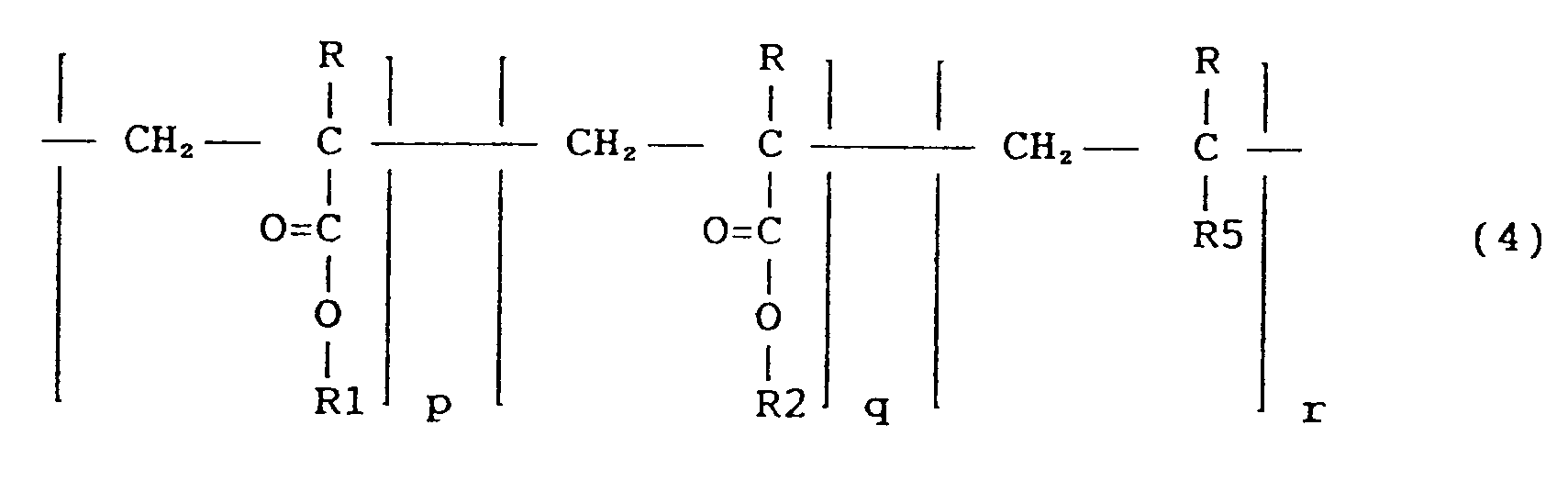
-(CxH2xO)l-(CyH2yO)m-R3 (wherein R3 represents a hydrogen atom, an alkyl group or an aryl group); x and y each represents an integer ranging from 1 to 4; l and m each represents O or an integer of not less than 1, provided that the sum of l and m is an integer of not less than 2; R2 represents a (meth)acryloyl group-containing group; and R5 represents a functional group having a molecular weight of less than 133, the rate of the subunit p ranging from 40 to 99.5 mole%, the rate of the subunit q ranging from 60 to 0.5 mole%, the rate of the subunit r ranging from 0 to 59.5 mole% and the vinyl polymer having a weight average molecular weight ranging from 2 × 10³ to 10⁷: - The vinyl polymer having (meth)acryloyl groups on the side chains according to claim 4 wherein, in the general formula (4), the substituent R2 is a (meth)acryloyl group-containing group represented by the following general formula (2):

- The vinyl polymer having (meth)acryloyl groups on the side chains according to claim 4 wherein, in the general formula (4), the substituent R2 is a (meth)acryloyl group-containing group represented by the following general formula (3):

- A method for preparing a vinyl polymer carrying (meth)acryloyl groups on the side chains, comprising the step of radical copolymerizing 40 to 99.5 mole% of at least one mono(meth)acrylate monomer represented by the following general formula (5):

-(CxH2xO)l-(CyH2yO)m-R3 (wherein R3 represents a hydrogen atom, an alkyl group or an aryl group); x and y each represents an integer ranging from 1 to 4; l and m each represents O or an integer of not less than 1, provided that the sum of l and m is an integer of not less than 2) which has a single (meth)acryloyl group and a molecular weight of not less than 160 with 60 to 0.5 mole% of at least one (meth)acrylate monomer represented by the following general formula (6):

- The method for preparing a vinyl polymer carrying (meth)acryloyl groups on the side chains according to claim 7 wherein the monomer represented by the general formula (6) is et least one member selected from the group consisting of di(meth)acrylate monomers of the general formula (6) in which the substituent R2 is represented by the general formula (2):


- The method for preparing a vinyl polymer carrying (meth)acryloyl groups on the side chains according to claim 7 wherein the monomer represented by the general formula (5) in which R1 is a long chain alkyl group having 6 to 22 carbon atoms is at least one member selected from the group consisting of hexyl (meth)acrylate, heptyl (meth)acrylate, octyl (meth)acrylate, nonyl (meth)acrylate, decyl (meth)acrylate, undecyl (meth)acrylate, dodecyl (meth)acrylate, tridecyl (meth)acrylate, tetradecyl (meth)acrylate, hexadecyl (meth)acrylate, heptadecyl (meth)acrylate, octadecyl (meth)acrylate, nonadecyl (meth)acrylate, eicosa (meth)acrylate, uneicosa (meth)acrylate, doeicosa (meth)acrylate and isomers thereof such as 2-ethylhexyl (meth)acrylate and isononyl (meth)acrylate.
- The method for preparing a vinyl polymer carrying (meth)acryloyl groups on the side chains according to claim 7 wherein the monomer represented by the general formula (5) in which R1 is a cyclic alkyl group having 6 to 22 carbon atoms is at least one member selected from the group consisting of isobornyl (meth)acrylate, tricyclodecanyl (meth)acrylate and dimethyladamantyl (meth)acrylate and isomers.
- The method for preparing a vinyl polymer carrying (meth)acryloyl groups on the side chains according to claim 7 wherein the monomer represented by the general formula (5) in which R1 is a group represented by the formula: -(CxH2xO)l-(CyH2yO)m-R3 is at least one member selected from the group consisting of methoxydiethylene glycol (meth)acrylate, ethoxydiethylene glycol (meth)acrylate, isooctyloxydiethylene glycol (meth)acrylate, phenoxydiethylene glycol (meth)acrylate, phenoxytriethylene glycol (meth)acrylate, methoxytriethylene glycol (meth)acrylate, methoxypolyethylene glycol (meth)acrylate, nonylphenyltetraethylene glycol (meth)acrylate, nonylphenyloctadecylethylene glycol (meth)acrylate, methoxydipropylene glycol (meth)acrylate, (meth)acrylate of 11:15 by molar ratio random adduct of ethylene oxide-propylene oxide one end of which is modified with a stearyloxy group and polytetramethylene glycol mono(meth)acrylate as well as isomers thereof.
- The method for preparing a vinyl polymer carrying (meth)acryloyl groups on the side chains according to claim 7 wherein the solvent is a member selected from the group consisting of benzene, toluene, xylene, hexane, cyclohexane and heptane for the monomer whose substituent R1 in the general formula (5) is a long chain alkyl group having 6 to 22 carbon atoms or a cyclic alkyl group having 6 to 22 carbon atoms; or a member selected from the group consisting of benzene, toluene, xylene, hexane, cyclohexane, heptane, alcohols such as methanol and ethanol, ketones, for instance, acetone and methyl ethyl ketone, esters, for instance, ethyl acetate and butyl acetate, ethers, for instance, dioxane and ethylene glycol derivative solvent, for instance, ethylene glycol mono butyl ether for the monomer whose substituent R1 in the general formula (5) is a group represented by the general formula: -(CxH2xO)l-(CyH2yO)m-R3.
- The method for preparing a vinyl polymer carrying (meth)acryloyl group on the side chains according to claim 7 wherein the reaction temperature during the radical copolymerization ranges from about 40 to 130°C , at least one polymerization initiator selected from the group consisting of azo compounds such as 2,2'-azobisisobutyronitrile and peroxy compounds such as lauroyl peroxide and benzoyl peroxide is used and a chain transfer agent selected from the group consisting of lauryl mercaptan and mercaptopropionic acid is optionally used.
- The method for preparing a vinyl polymer carrying (meth)acryloyl groups on the side chains according to claim 7 wherein after the radical copolymerization, a heat polymerization inhibitor selected from the group consisting of p-methoxyphenol, hydroquinone and butylhydroxytoluene to the reaction product.
- The method for preparing a vinyl polymer carrying (meth)acryloyl groups on the side chains according to claim 8 wherein the monomer represented by the general formula (6) in which R2 is represented by the general formula (2) is at least one member selected from the group consisting of ethylene glycol di(meth)acrylate, diethylene glycol di(meth)acrylate, triethylene glycol di(meth)acrylate, tetraethylene glycol di(meth)acrylate, propylene glycol di(meth)acrylate, tetrapropylene glycol di(meth)acrylate, 1,4-butanediol di(meth)acrylate, di(tetramethylene glycol) di(meth)acrylate, 1,5-pentanediol di(meth)acrylate, 1,6-hexanediol di(meth) acrylate, 3-methyl-1,5-pentanediol di(meth)acrylate, 1,9-nonanediol di(meth)acrylate, 1,10-decanediol di(meth)acrylate and isomers thereof.
- The method for preparing a vinyl polymer carrying (meth)acryloyl groups on the side chains according to claim 8 wherein the monomer represented by the general formula (6) in which R2 is represented by the general formula (3) is at least one member selected from the group consisting of trimethylolpropane tri(meth)acrylate, pentaerythritol tri(meth)acrylate, pentaerythritol tetra(meth)acrylate, dipentaerythritol hexa(meth)acrylate, trimethylolheptane tri(meth)acrylate and isomers thereof.
- A method for preparing a vinyl polymer carrying (meth)acryloyl groups on the side chains, comprising the step of radical-copolymerizing 40 to 99.5 mole% of at least one mono(meth)acrylate monomer represented by the following general formula (5):

-(CxH2xO)l -(CyH2yO)m-R3 (wherein R3 represents a hydrogen atom, an alkyl group or an aryl group); x and y each represents an integer ranging from 1 to 4; and l and m each represents O or an integer of not less than 1, provided that the sum of l and m is an integer of not less than 2) which has a single (meth)acryloyl group and a molecular weight of not less than 160; 60 to 0.5 mole% of at least one (meth)acrylate monomer represented by the following general formula (6):


- The method for preparing a vinyl polymer carrying (meth)acryloyl groups on the side chains according to claim 17 wherein the monomer represented by the general formula (6) is at least one member selected from the group consisting of di(meth)acrylate monomers of the general formula (6) in which the substituent R2 is represented by the general formula (2):


- The method for preparing a vinyl polymer carrying (meth)acryloyl groups on the side chains according to claim 17 wherein the monomer represented by the general formula (5) in which R1 is a long chain alkyl group having 6 to 22 carbon atoms is at least one member selected from the group consisting of hexyl methacrylate, heptyl (meth)acrylate, octyl (meth)acrylate, nonyl (meth)acrylate, decyl (meth)acrylate, undecyl (meth)acrylate, dodecyl (meth)acrylate, tridecyl (meth)acrylate, tetradecyl (meth)acrylate, hexadecyl (meth)acrylate, heptadecyl (meth)acrylate, octadecyl (meth)acrylate, nonadecyl (meth)acrylate, eicosa (meth)acrylate, uneicosa (meth)acrylate, doeicosa (meth)acrylate and isomers thereof such as 2-ethylhexyl (meth)acrylate and isononyl (meth)acrylate.
- The method for preparing a vinyl polymer carrying (meth)acryloyl groups on the side chains according to claim 17 wherein the monomer represented by the general formula (5) in which R1 is a cyclic alkyl group having 6 to 22 carbon atoms is at least one member selected from the group consisting of isobornyl (meth)acrylate, tricyclodecanyl (meth)acrylate and dimethyladamantyl (meth)acrylate and isomers.
- The method for preparing a vinyl polymer carrying (meth)acryloyl groups on the side chains according to claim 17 wherein the monomer represented by the general formula (5) in which R1 is a group represented by the formula: -(CxH2xO)l-(CyH2yO)m-R3 is at least one member selected from the group consisting of methoxydiethylene glycol (meth)acrylate, ethoxydiethylene glycol (meth)acrylate, isooctyloxydiethylene glycol (meth)acrylate, phenoxydiethylene glycol (meth)acrylate, phenoxytriethylene glycol (meth)acrylate, methoxytriethylene glycol (meth)acrylate, methoxypolyethylene glycol (meth)acrylate, nonylphenyltetraethylene glycol (meth)acrylate, nonylphenyloctadecylethylene glycol (meth)acrylate, methoxydipropylene glycol (meth)acrylate, (meth)acrylate of 11:15 by molar ratio random adduct of ethylene oxide-propylene oxide one end of which is modified with a stearyloxy group and polytetramethylene glycol mono(meth)acrylate as well as isomers thereof.
- The method for preparing a vinyl polymer carrying (meth)acryloyl groups on the side chains according to claim 17 wherein the monomer represented by the general formula (7) is at least one member selected from the group consisting of styrene, vinyl monomers such as vinyl acetate, (meth)acrylic acid, methyl (meth)acrylate, ethyl (meth)acrylate, propyl (meth)acrylate, butyl (meth)acrylate, pentyl (meth)acrylate, hexyl acrylate, glycidyl (meth)acrylate, isocyanatoethyl (meth)acrylate and isomers thereof.
- The method for preparing a vinyl polymer carrying (meth)acryloyl groups on the side chains according to claim 17 wherein the solvent is a member selected from the group consisting of benzene, toluene, xylene, hexane, cyclohexane and heptane for the monomer whose substituent R1 in the general formula (5) is a long chain alkyl group having 6 to 22 carbon atoms or a cyclic alkyl group having 6 to 22 carbon atoms; or a member selected from the group consisting of benzene, toluene, xylene, hexane, cyclohexane, heptane, alcohols such as methanol and ethanol, ketones, for instance, acetone and methyl ethyl ketone, esters, for instance, ethyl acetate and butyl acetate, ethers, for instance, dioxane and ethylene glycol derivative solvents, for instance, ethylene glycol mono butyl ether for the monomer whose substituent R1 in the general formula (5) is a group represented by the general formula: -(CxH2xO)l-(CyH2yO)m-R3.
- The method for preparing a vinyl polymer carrying (meth)acryloyl groups on the side chains according to claim 17 wherein the reaction temperature during the radical copolymerization ranges from about 40 to 130°C , at least one polymerization initiator selected from the group consisting of azo compounds such as 2,2'-azobisisobutyronitrile and peroxy compounds such as lauroyl peroxide and benzoyl peroxide is used and a chain transfer agent selected from the group consisting of lauryl mercaptan and mercaptopropionic acid is optionally used.
- The method for preparing a vinyl polymer carrying (meth)acryloyl groups on the side chains according to claim 17 wherein after the radical copolymerization, a heat polymerization inhibitor selected from the group consisting of p-methoxyphenol, hydroquinone or butylhydroxytoluene to the reaction product.
- The method for preparing a vinyl polymer carrying (meth)acryloyl groups on the side chains according to claim 18 wherein the monomer represented by the general formula (6) in which R2 is represented by the general formula (2) is at least one member selected from the group consisting of ethylene glycol di(meth)acrylate, diethylene glycol di(meth)acrylate, triethylene glycol di(meth)acrylate, tetraethylene glycol di(meth)acrylate, propylene glycol di(meth)acrylate, tetrapropylene glycol di(meth)acrylate, 1,4-butanediol di(meth)acrylate, di(tetramethylene glycol) di(meth)acrylate, 1,5-pentanediol di(meth)acrylate, 1,6-hexanediol di(meth)acrylate, 3-methyl-1,5-pentanediol di(meth)acrylate, 1,9-nonanediol di(meth)acrylate, 1,10-decanediol di(meth)acrylate and isomers thereof.
- The method for preparing a vinyl polymer carrying (meth)acryloyl groups on the side chains according to claim 18 wherein the monomer represented by the general formula (6) in which R2 is represented by the general formula (3) is at least one member selected from the group consisting of trimethylolpropane tri(meth)acrylate, pentaerythritol tri(meth)acrylate, pentaerythritol tetra(meth)acrylate, dipentaerythritol hexa(meth)acrylate, trimethylolheptane tri(meth)acrylate and isomers thereof.
Applications Claiming Priority (8)
| Application Number | Priority Date | Filing Date | Title |
|---|---|---|---|
| JP40661290 | 1990-12-26 | ||
| JP406612/90 | 1990-12-26 | ||
| JP406613/90 | 1990-12-26 | ||
| JP40661390 | 1990-12-26 | ||
| JP14866191A JPH04252214A (en) | 1990-12-26 | 1991-06-20 | Vinyl polymer having (meth)acryloyl group on side chain |
| JP14866291A JPH04252213A (en) | 1990-12-26 | 1991-06-20 | Production of vinyl polymer having (meth)acryloyl group on side chain |
| JP148661/91 | 1991-06-20 | ||
| JP148662/91 | 1991-06-20 |
Publications (2)
| Publication Number | Publication Date |
|---|---|
| EP0492509A1 EP0492509A1 (en) | 1992-07-01 |
| EP0492509B1 true EP0492509B1 (en) | 1995-09-20 |
Family
ID=27472882
Family Applications (1)
| Application Number | Title | Priority Date | Filing Date |
|---|---|---|---|
| EP91121967A Expired - Lifetime EP0492509B1 (en) | 1990-12-26 | 1991-12-20 | Vinyl polymer having (meth)acryloyl groups on the side chains and method for preparing same |
Country Status (3)
| Country | Link |
|---|---|
| US (1) | US5274063A (en) |
| EP (1) | EP0492509B1 (en) |
| DE (1) | DE69113230T2 (en) |
Families Citing this family (11)
| Publication number | Priority date | Publication date | Assignee | Title |
|---|---|---|---|---|
| JP3281490B2 (en) * | 1994-09-30 | 2002-05-13 | 日東電工株式会社 | Pressure-sensitive adhesive composition and pressure-sensitive adhesive sheet or sheet using the composition |
| ES2133944T3 (en) * | 1995-02-10 | 1999-09-16 | Minnesota Mining & Mfg | RETICULABLE CONTACT ADHESIVE AND PROCESS FOR THE PRODUCTION OF AN ARTICLE COATED WITH A RETICULATED CONTACT ADHESIVE. |
| DE19841559A1 (en) * | 1998-09-11 | 2000-03-23 | Goldschmidt Ag Th | Polyacrylic acid esters and their use as deaerators for lacquers and paints |
| US6340719B1 (en) | 1999-12-29 | 2002-01-22 | 3M-Innovative Properties Company | Crosslinking process |
| US6448301B1 (en) | 2000-09-08 | 2002-09-10 | 3M Innovative Properties Company | Crosslinkable polymeric compositions and use thereof |
| US6635690B2 (en) * | 2001-06-19 | 2003-10-21 | 3M Innovative Properties Company | Reactive oligomers |
| US20070191506A1 (en) * | 2006-02-13 | 2007-08-16 | 3M Innovative Properties Company | Curable compositions for optical articles |
| EP2087083A2 (en) * | 2006-11-08 | 2009-08-12 | The Lubrizol Corporation | Crosslinked polymer |
| CN109476774B (en) | 2016-07-11 | 2021-01-12 | 3M创新有限公司 | Polymeric materials using controlled free radical initiators and methods of making |
| JP7396276B2 (en) * | 2018-07-25 | 2023-12-12 | 株式会社レゾナック | Acrylic resin and its manufacturing method, resin composition set, heat storage material, and articles |
| CN116589640A (en) * | 2019-01-30 | 2023-08-15 | 株式会社大阪曹達 | Photocurable resin composition, ink and coating |
Family Cites Families (2)
| Publication number | Priority date | Publication date | Assignee | Title |
|---|---|---|---|---|
| JPS60250020A (en) * | 1984-05-25 | 1985-12-10 | Ricoh Co Ltd | Nonaqueous resin dispersion |
| JPS61231081A (en) * | 1985-04-06 | 1986-10-15 | Mitsui Toatsu Chem Inc | Waterproofing agent |
-
1991
- 1991-12-17 US US07/808,585 patent/US5274063A/en not_active Expired - Fee Related
- 1991-12-20 DE DE69113230T patent/DE69113230T2/en not_active Expired - Fee Related
- 1991-12-20 EP EP91121967A patent/EP0492509B1/en not_active Expired - Lifetime
Also Published As
| Publication number | Publication date |
|---|---|
| DE69113230T2 (en) | 1996-02-29 |
| DE69113230D1 (en) | 1995-10-26 |
| EP0492509A1 (en) | 1992-07-01 |
| US5274063A (en) | 1993-12-28 |
Similar Documents
| Publication | Publication Date | Title |
|---|---|---|
| US5093385A (en) | Method of accelerating photoiniferter polymerization, polymer produced thereby, and product produced therewith | |
| EP0104046B1 (en) | Acrylate copolymer pressure-sensitive adhesive composition and sheet materials coated therewith | |
| JP2873482B2 (en) | Photocrosslinkable resin composition | |
| US4554324A (en) | Acrylate copolymer pressure-sensitive adhesive composition and sheet materials coated therewith | |
| US5274063A (en) | Vinyl polymer having (meth)acryloyl groups on the side chains and method for preparing same | |
| TWI774874B (en) | (Meth)acrylic block copolymer and active energy ray curable composition containing the same | |
| EP1966249B1 (en) | Method of free radically polymerizing vinyl monomers | |
| US12116508B2 (en) | UV curable adhesive | |
| DE60116858T2 (en) | COMPOSITION | |
| EP2170963A2 (en) | Novel adducts useful as cure components for anaerobic curable compositions | |
| JP3385177B2 (en) | Star-shaped block polymer and method for producing the same | |
| Antoun et al. | Anionic polymerization of various methacrylates initiated with LiCl-complexed sBuLi | |
| KR0152388B1 (en) | Michael addition product of N-vinylformamide with acrylic and methacrylic esters | |
| JP6044720B2 (en) | Active energy ray-curable pressure-sensitive adhesive composition | |
| JPH04252214A (en) | Vinyl polymer having (meth)acryloyl group on side chain | |
| CN115135677B (en) | Compound and polymer composition containing the compound | |
| WO2010084913A1 (en) | Active energy beam curable resin composition | |
| JPH0339306A (en) | Production of novel polymer containing )meth)acryloyl group in side chain | |
| JPH04252213A (en) | Production of vinyl polymer having (meth)acryloyl group on side chain | |
| JPS62513A (en) | Photocurable resin composition | |
| JP3894804B2 (en) | Method for producing vinyl ether group-containing (meth) acrylic acid ester polymer | |
| JPH0627135B2 (en) | Method for producing methacrylic polymer having functional group at one end | |
| JPS62232408A (en) | Production of acrylic polymer having functional group on one terminal | |
| JP5136933B2 (en) | Method for producing acrylic copolymer | |
| JP2026018953A (en) | Copolymer, adhesive composition, and adhesive |
Legal Events
| Date | Code | Title | Description |
|---|---|---|---|
| PUAI | Public reference made under article 153(3) epc to a published international application that has entered the european phase |
Free format text: ORIGINAL CODE: 0009012 |
|
| AK | Designated contracting states |
Kind code of ref document: A1 Designated state(s): DE FR GB |
|
| 17P | Request for examination filed |
Effective date: 19920930 |
|
| 17Q | First examination report despatched |
Effective date: 19940628 |
|
| GRAA | (expected) grant |
Free format text: ORIGINAL CODE: 0009210 |
|
| AK | Designated contracting states |
Kind code of ref document: B1 Designated state(s): DE FR GB |
|
| ET | Fr: translation filed | ||
| REF | Corresponds to: |
Ref document number: 69113230 Country of ref document: DE Date of ref document: 19951026 |
|
| PLBE | No opposition filed within time limit |
Free format text: ORIGINAL CODE: 0009261 |
|
| STAA | Information on the status of an ep patent application or granted ep patent |
Free format text: STATUS: NO OPPOSITION FILED WITHIN TIME LIMIT |
|
| 26N | No opposition filed | ||
| PGFP | Annual fee paid to national office [announced via postgrant information from national office to epo] |
Ref country code: FR Payment date: 19971124 Year of fee payment: 7 |
|
| PGFP | Annual fee paid to national office [announced via postgrant information from national office to epo] |
Ref country code: GB Payment date: 19971127 Year of fee payment: 7 |
|
| PGFP | Annual fee paid to national office [announced via postgrant information from national office to epo] |
Ref country code: DE Payment date: 19980130 Year of fee payment: 7 |
|
| PG25 | Lapsed in a contracting state [announced via postgrant information from national office to epo] |
Ref country code: GB Free format text: LAPSE BECAUSE OF NON-PAYMENT OF DUE FEES Effective date: 19981220 |
|
| GBPC | Gb: european patent ceased through non-payment of renewal fee |
Effective date: 19981220 |
|
| PG25 | Lapsed in a contracting state [announced via postgrant information from national office to epo] |
Ref country code: FR Free format text: LAPSE BECAUSE OF NON-PAYMENT OF DUE FEES Effective date: 19990831 |
|
| REG | Reference to a national code |
Ref country code: FR Ref legal event code: ST |
|
| PG25 | Lapsed in a contracting state [announced via postgrant information from national office to epo] |
Ref country code: DE Free format text: LAPSE BECAUSE OF NON-PAYMENT OF DUE FEES Effective date: 19991001 |