EP0491793B1 - 2'-deoxy-4'-thioribonucleosides as antiviral and anticancer agents - Google Patents
2'-deoxy-4'-thioribonucleosides as antiviral and anticancer agents Download PDFInfo
- Publication number
- EP0491793B1 EP0491793B1 EP90913760A EP90913760A EP0491793B1 EP 0491793 B1 EP0491793 B1 EP 0491793B1 EP 90913760 A EP90913760 A EP 90913760A EP 90913760 A EP90913760 A EP 90913760A EP 0491793 B1 EP0491793 B1 EP 0491793B1
- Authority
- EP
- European Patent Office
- Prior art keywords
- deoxy
- toluoyl
- thio
- uracil
- compound
- Prior art date
- Legal status (The legal status is an assumption and is not a legal conclusion. Google has not performed a legal analysis and makes no representation as to the accuracy of the status listed.)
- Expired - Lifetime
Links
- 230000000840 anti-viral effect Effects 0.000 title abstract description 10
- 239000003443 antiviral agent Substances 0.000 title abstract description 4
- 239000002246 antineoplastic agent Substances 0.000 title abstract description 3
- 238000004519 manufacturing process Methods 0.000 claims abstract description 4
- 239000002342 ribonucleoside Substances 0.000 claims abstract 2
- 150000001875 compounds Chemical class 0.000 claims description 32
- ISAKRJDGNUQOIC-UHFFFAOYSA-N Uracil Chemical compound O=C1C=CNC(=O)N1 ISAKRJDGNUQOIC-UHFFFAOYSA-N 0.000 claims description 24
- 125000002496 methyl group Chemical group [H]C([H])([H])* 0.000 claims description 22
- RWQNBRDOKXIBIV-UHFFFAOYSA-N thymine Chemical compound CC1=CNC(=O)NC1=O RWQNBRDOKXIBIV-UHFFFAOYSA-N 0.000 claims description 19
- 229910052799 carbon Inorganic materials 0.000 claims description 14
- 125000006239 protecting group Chemical group 0.000 claims description 12
- OKTJSMMVPCPJKN-UHFFFAOYSA-N Carbon Chemical compound [C] OKTJSMMVPCPJKN-UHFFFAOYSA-N 0.000 claims description 11
- 229940035893 uracil Drugs 0.000 claims description 11
- CZPWVGJYEJSRLH-UHFFFAOYSA-N Pyrimidine Chemical group C1=CN=CN=C1 CZPWVGJYEJSRLH-UHFFFAOYSA-N 0.000 claims description 9
- 229910052739 hydrogen Inorganic materials 0.000 claims description 9
- 125000002252 acyl group Chemical group 0.000 claims description 8
- 229940113082 thymine Drugs 0.000 claims description 8
- 125000000623 heterocyclic group Chemical group 0.000 claims description 6
- FYADHXFMURLYQI-UHFFFAOYSA-N 1,2,4-triazine Chemical group C1=CN=NC=N1 FYADHXFMURLYQI-UHFFFAOYSA-N 0.000 claims description 5
- JIHQDMXYYFUGFV-UHFFFAOYSA-N 1,3,5-triazine Chemical group C1=NC=NC=N1 JIHQDMXYYFUGFV-UHFFFAOYSA-N 0.000 claims description 5
- 239000003814 drug Substances 0.000 claims description 5
- 239000001257 hydrogen Substances 0.000 claims description 5
- 241001465754 Metazoa Species 0.000 claims description 4
- 125000004435 hydrogen atom Chemical group [H]* 0.000 claims description 4
- UFHFLCQGNIYNRP-UHFFFAOYSA-N Hydrogen Chemical compound [H][H] UFHFLCQGNIYNRP-UHFFFAOYSA-N 0.000 claims description 3
- 206010028980 Neoplasm Diseases 0.000 claims description 3
- 201000011510 cancer Diseases 0.000 claims description 3
- 230000009385 viral infection Effects 0.000 claims description 3
- 208000036142 Viral infection Diseases 0.000 claims description 2
- 239000004215 Carbon black (E152) Substances 0.000 claims 1
- NYHBQMYGNKIUIF-UUOKFMHZSA-N Guanosine Chemical compound C1=NC=2C(=O)NC(N)=NC=2N1[C@@H]1O[C@H](CO)[C@@H](O)[C@H]1O NYHBQMYGNKIUIF-UUOKFMHZSA-N 0.000 claims 1
- 208000009889 Herpes Simplex Diseases 0.000 claims 1
- 229930195733 hydrocarbon Natural products 0.000 claims 1
- 150000002430 hydrocarbons Chemical class 0.000 claims 1
- 150000002431 hydrogen Chemical class 0.000 claims 1
- 239000000825 pharmaceutical preparation Substances 0.000 claims 1
- 125000000714 pyrimidinyl group Chemical group 0.000 claims 1
- 125000001424 substituent group Chemical group 0.000 claims 1
- 239000000543 intermediate Substances 0.000 abstract description 3
- OKKJLVBELUTLKV-UHFFFAOYSA-N Methanol Chemical compound OC OKKJLVBELUTLKV-UHFFFAOYSA-N 0.000 description 27
- 125000005425 toluyl group Chemical group 0.000 description 26
- HEDRZPFGACZZDS-UHFFFAOYSA-N Chloroform Chemical compound ClC(Cl)Cl HEDRZPFGACZZDS-UHFFFAOYSA-N 0.000 description 14
- LFQSCWFLJHTTHZ-UHFFFAOYSA-N Ethanol Chemical compound CCO LFQSCWFLJHTTHZ-UHFFFAOYSA-N 0.000 description 10
- 238000012360 testing method Methods 0.000 description 10
- 210000004027 cell Anatomy 0.000 description 9
- 241000700605 Viruses Species 0.000 description 8
- FFUAGWLWBBFQJT-UHFFFAOYSA-N hexamethyldisilazane Chemical compound C[Si](C)(C)N[Si](C)(C)C FFUAGWLWBBFQJT-UHFFFAOYSA-N 0.000 description 8
- 241000700588 Human alphaherpesvirus 1 Species 0.000 description 7
- IJOOHPMOJXWVHK-UHFFFAOYSA-N chlorotrimethylsilane Chemical compound C[Si](C)(C)Cl IJOOHPMOJXWVHK-UHFFFAOYSA-N 0.000 description 7
- 230000000120 cytopathologic effect Effects 0.000 description 7
- 238000002360 preparation method Methods 0.000 description 7
- WFDIJRYMOXRFFG-UHFFFAOYSA-N Acetic anhydride Chemical compound CC(=O)OC(C)=O WFDIJRYMOXRFFG-UHFFFAOYSA-N 0.000 description 6
- YMWUJEATGCHHMB-UHFFFAOYSA-N Dichloromethane Chemical compound ClCCl YMWUJEATGCHHMB-UHFFFAOYSA-N 0.000 description 6
- 241000701074 Human alphaherpesvirus 2 Species 0.000 description 6
- CSNNHWWHGAXBCP-UHFFFAOYSA-L Magnesium sulfate Chemical compound [Mg+2].[O-][S+2]([O-])([O-])[O-] CSNNHWWHGAXBCP-UHFFFAOYSA-L 0.000 description 6
- HEDRZPFGACZZDS-MICDWDOJSA-N Trichloro(2H)methane Chemical compound [2H]C(Cl)(Cl)Cl HEDRZPFGACZZDS-MICDWDOJSA-N 0.000 description 6
- 238000006243 chemical reaction Methods 0.000 description 6
- WORJEOGGNQDSOE-UHFFFAOYSA-N chloroform;methanol Chemical compound OC.ClC(Cl)Cl WORJEOGGNQDSOE-UHFFFAOYSA-N 0.000 description 6
- 239000000203 mixture Substances 0.000 description 6
- 239000000725 suspension Substances 0.000 description 6
- XLYOFNOQVPJJNP-UHFFFAOYSA-N water Substances O XLYOFNOQVPJJNP-UHFFFAOYSA-N 0.000 description 6
- 238000005160 1H NMR spectroscopy Methods 0.000 description 5
- 0 CN(C(N1)=O)N=C(*=C)*1=O Chemical compound CN(C(N1)=O)N=C(*=C)*1=O 0.000 description 5
- 230000015572 biosynthetic process Effects 0.000 description 5
- 239000002777 nucleoside Substances 0.000 description 5
- 238000003786 synthesis reaction Methods 0.000 description 5
- 239000005450 thionucleoside Substances 0.000 description 5
- 238000001644 13C nuclear magnetic resonance spectroscopy Methods 0.000 description 4
- KDCGOANMDULRCW-UHFFFAOYSA-N 7H-purine Chemical compound N1=CNC2=NC=NC2=C1 KDCGOANMDULRCW-UHFFFAOYSA-N 0.000 description 4
- VYPSYNLAJGMNEJ-UHFFFAOYSA-N Silicium dioxide Chemical compound O=[Si]=O VYPSYNLAJGMNEJ-UHFFFAOYSA-N 0.000 description 4
- WQDUMFSSJAZKTM-UHFFFAOYSA-N Sodium methoxide Chemical compound [Na+].[O-]C WQDUMFSSJAZKTM-UHFFFAOYSA-N 0.000 description 4
- QAOWNCQODCNURD-UHFFFAOYSA-N Sulfuric acid Chemical compound OS(O)(=O)=O QAOWNCQODCNURD-UHFFFAOYSA-N 0.000 description 4
- 231100000135 cytotoxicity Toxicity 0.000 description 4
- 230000003013 cytotoxicity Effects 0.000 description 4
- 229940079593 drug Drugs 0.000 description 4
- 239000000741 silica gel Substances 0.000 description 4
- 229910002027 silica gel Inorganic materials 0.000 description 4
- 239000007787 solid Substances 0.000 description 4
- 229910052717 sulfur Inorganic materials 0.000 description 4
- IVUDHNYLTWOARV-XLPZGREQSA-N 1-[(2r,4s,5r)-4-hydroxy-5-(hydroxymethyl)thiolan-2-yl]-5-methylpyrimidine-2,4-dione Chemical compound O=C1NC(=O)C(C)=CN1[C@@H]1S[C@H](CO)[C@@H](O)C1 IVUDHNYLTWOARV-XLPZGREQSA-N 0.000 description 3
- IVUDHNYLTWOARV-RNJXMRFFSA-N 1-[(2s,4s,5r)-4-hydroxy-5-(hydroxymethyl)thiolan-2-yl]-5-methylpyrimidine-2,4-dione Chemical compound O=C1NC(=O)C(C)=CN1[C@H]1S[C@H](CO)[C@@H](O)C1 IVUDHNYLTWOARV-RNJXMRFFSA-N 0.000 description 3
- UIIMBOGNXHQVGW-UHFFFAOYSA-M Sodium bicarbonate Chemical class [Na+].OC([O-])=O UIIMBOGNXHQVGW-UHFFFAOYSA-M 0.000 description 3
- OIRDTQYFTABQOQ-UHTZMRCNSA-N Vidarabine Chemical compound C1=NC=2C(N)=NC=NC=2N1[C@@H]1O[C@H](CO)[C@@H](O)[C@@H]1O OIRDTQYFTABQOQ-UHTZMRCNSA-N 0.000 description 3
- 230000000259 anti-tumor effect Effects 0.000 description 3
- -1 but not limited to Chemical class 0.000 description 3
- 229940126214 compound 3 Drugs 0.000 description 3
- OPTASPLRGRRNAP-UHFFFAOYSA-N cytosine Chemical compound NC=1C=CNC(=O)N=1 OPTASPLRGRRNAP-UHFFFAOYSA-N 0.000 description 3
- 239000000706 filtrate Substances 0.000 description 3
- 229910052943 magnesium sulfate Inorganic materials 0.000 description 3
- 238000000034 method Methods 0.000 description 3
- 230000007935 neutral effect Effects 0.000 description 3
- 150000003833 nucleoside derivatives Chemical class 0.000 description 3
- 239000011541 reaction mixture Substances 0.000 description 3
- 239000005051 trimethylchlorosilane Substances 0.000 description 3
- FTVLMFQEYACZNP-UHFFFAOYSA-N trimethylsilyl trifluoromethanesulfonate Chemical compound C[Si](C)(C)OS(=O)(=O)C(F)(F)F FTVLMFQEYACZNP-UHFFFAOYSA-N 0.000 description 3
- WSLDOOZREJYCGB-UHFFFAOYSA-N 1,2-Dichloroethane Chemical compound ClCCCl WSLDOOZREJYCGB-UHFFFAOYSA-N 0.000 description 2
- NWUYHJFMYQTDRP-UHFFFAOYSA-N 1,2-bis(ethenyl)benzene;1-ethenyl-2-ethylbenzene;styrene Chemical compound C=CC1=CC=CC=C1.CCC1=CC=CC=C1C=C.C=CC1=CC=CC=C1C=C NWUYHJFMYQTDRP-UHFFFAOYSA-N 0.000 description 2
- DDRFKXKKBYNNSO-FWHJPCMOSA-N 1-[(4s,5r)-4-hydroxy-5-(hydroxymethyl)thiolan-2-yl]pyrimidine-2,4-dione Chemical compound C1[C@H](O)[C@@H](CO)SC1N1C(=O)NC(=O)C=C1 DDRFKXKKBYNNSO-FWHJPCMOSA-N 0.000 description 2
- GEWRKGDRYZIFNP-UHFFFAOYSA-N 1h-1,3,5-triazine-2,4-dione Chemical compound OC1=NC=NC(O)=N1 GEWRKGDRYZIFNP-UHFFFAOYSA-N 0.000 description 2
- NQUVCRCCRXRJCK-UHFFFAOYSA-N 4-methylbenzoyl chloride Chemical compound CC1=CC=C(C(Cl)=O)C=C1 NQUVCRCCRXRJCK-UHFFFAOYSA-N 0.000 description 2
- QTBSBXVTEAMEQO-UHFFFAOYSA-N Acetic acid Chemical compound CC(O)=O QTBSBXVTEAMEQO-UHFFFAOYSA-N 0.000 description 2
- NOTFZGFABLVTIG-UHFFFAOYSA-N Cyclohexylethyl acetate Chemical compound CC(=O)OCCC1CCCCC1 NOTFZGFABLVTIG-UHFFFAOYSA-N 0.000 description 2
- JUJWROOIHBZHMG-UHFFFAOYSA-N Pyridine Chemical compound C1=CC=NC=C1 JUJWROOIHBZHMG-UHFFFAOYSA-N 0.000 description 2
- 241000700584 Simplexvirus Species 0.000 description 2
- TUCNEACPLKLKNU-UHFFFAOYSA-N acetyl Chemical compound C[C]=O TUCNEACPLKLKNU-UHFFFAOYSA-N 0.000 description 2
- MKUXAQIIEYXACX-UHFFFAOYSA-N aciclovir Chemical compound N1C(N)=NC(=O)C2=C1N(COCCO)C=N2 MKUXAQIIEYXACX-UHFFFAOYSA-N 0.000 description 2
- 229960004150 aciclovir Drugs 0.000 description 2
- 238000003556 assay Methods 0.000 description 2
- 238000004113 cell culture Methods 0.000 description 2
- 239000013553 cell monolayer Substances 0.000 description 2
- 238000007796 conventional method Methods 0.000 description 2
- 238000005859 coupling reaction Methods 0.000 description 2
- 238000002425 crystallisation Methods 0.000 description 2
- 230000008025 crystallization Effects 0.000 description 2
- 231100000263 cytotoxicity test Toxicity 0.000 description 2
- VILAVOFMIJHSJA-UHFFFAOYSA-N dicarbon monoxide Chemical compound [C]=C=O VILAVOFMIJHSJA-UHFFFAOYSA-N 0.000 description 2
- 235000019441 ethanol Nutrition 0.000 description 2
- 150000002243 furanoses Chemical group 0.000 description 2
- 230000002401 inhibitory effect Effects 0.000 description 2
- 230000005764 inhibitory process Effects 0.000 description 2
- 239000003456 ion exchange resin Substances 0.000 description 2
- 229920003303 ion-exchange polymer Polymers 0.000 description 2
- 239000010410 layer Substances 0.000 description 2
- QSSJZLPUHJDYKF-UHFFFAOYSA-N methyl 4-methylbenzoate Chemical compound COC(=O)C1=CC=C(C)C=C1 QSSJZLPUHJDYKF-UHFFFAOYSA-N 0.000 description 2
- 238000012986 modification Methods 0.000 description 2
- 230000004048 modification Effects 0.000 description 2
- 229910052757 nitrogen Inorganic materials 0.000 description 2
- 239000012044 organic layer Substances 0.000 description 2
- KJIFKLIQANRMOU-UHFFFAOYSA-N oxidanium;4-methylbenzenesulfonate Chemical compound O.CC1=CC=C(S(O)(=O)=O)C=C1 KJIFKLIQANRMOU-UHFFFAOYSA-N 0.000 description 2
- 150000002972 pentoses Chemical class 0.000 description 2
- 229920001467 poly(styrenesulfonates) Polymers 0.000 description 2
- 150000003230 pyrimidines Chemical class 0.000 description 2
- 239000011347 resin Substances 0.000 description 2
- 229920005989 resin Polymers 0.000 description 2
- 206010041823 squamous cell carcinoma Diseases 0.000 description 2
- RPCAIVBGHNPKNM-VPENINKCSA-N (2r,3r,4r)-2,3,5-trihydroxy-4-sulfanylpentanal Chemical compound OC[C@@H](S)[C@H](O)[C@@H](O)C=O RPCAIVBGHNPKNM-VPENINKCSA-N 0.000 description 1
- GHLJFOXCDYJZNB-BAJZRUMYSA-N (2r,3r,5s)-2-(6-aminopurin-9-yl)-5-(hydroxymethyl)thiolan-3-ol Chemical compound C1=NC=2C(N)=NC=NC=2N1[C@@H]1S[C@H](CO)C[C@H]1O GHLJFOXCDYJZNB-BAJZRUMYSA-N 0.000 description 1
- YKWOQANMACFLMW-JBMRGDGGSA-N (2r,3s,3as,9ar)-2-(hydroxymethyl)-6-imino-2,3,3a,9a-tetrahydrothieno[1,2][1,3]oxazolo[3,4-a]pyrimidin-3-ol;hydrochloride Chemical compound Cl.N=C1C=CN2[C@@H]3S[C@H](CO)[C@@H](O)[C@@H]3OC2=N1 YKWOQANMACFLMW-JBMRGDGGSA-N 0.000 description 1
- RPCAIVBGHNPKNM-WDCZJNDASA-N (2s,3s,4r)-2,3,5-trihydroxy-4-sulfanylpentanal Chemical compound OC[C@@H](S)[C@@H](O)[C@H](O)C=O RPCAIVBGHNPKNM-WDCZJNDASA-N 0.000 description 1
- JIHFSQHLECEOON-PYHARJCCSA-N (4s,5r)-5-(hydroxymethyl)thiolane-2,4-diol Chemical group OC[C@H]1SC(O)C[C@@H]1O JIHFSQHLECEOON-PYHARJCCSA-N 0.000 description 1
- SVYOXGBINYWSDQ-UHFFFAOYSA-N 1,4-dioxane;ethanol Chemical compound CCO.C1COCCO1 SVYOXGBINYWSDQ-UHFFFAOYSA-N 0.000 description 1
- XDQFBMPFEBUDIC-UHFFFAOYSA-N 1h-pyrimidine-2,4-dione Chemical compound O=C1C=CNC(=O)N1.O=C1C=CNC(=O)N1 XDQFBMPFEBUDIC-UHFFFAOYSA-N 0.000 description 1
- GAKJJSAXUFZQTL-CCXZUQQUSA-N 4-amino-1-[(2r,3s,4s,5r)-3,4-dihydroxy-5-(hydroxymethyl)thiolan-2-yl]pyrimidin-2-one Chemical compound O=C1N=C(N)C=CN1[C@H]1[C@@H](O)[C@H](O)[C@@H](CO)S1 GAKJJSAXUFZQTL-CCXZUQQUSA-N 0.000 description 1
- SVXNJCYYMRMXNM-UHFFFAOYSA-N 5-amino-2h-1,2,4-triazin-3-one Chemical compound NC=1C=NNC(=O)N=1 SVXNJCYYMRMXNM-UHFFFAOYSA-N 0.000 description 1
- AFBXRHFIVUFPES-UHFFFAOYSA-N 5-methyl-1h-pyrimidine-2,4-dione Chemical compound CC1=CNC(=O)NC1=O.CC1=CNC(=O)NC1=O AFBXRHFIVUFPES-UHFFFAOYSA-N 0.000 description 1
- OMJRFWRSVILQLV-UHFFFAOYSA-N 6-amino-5-methyl-1h-pyrimidin-2-one Chemical compound CC1=CNC(=O)N=C1N.CC1=CNC(=O)N=C1N OMJRFWRSVILQLV-UHFFFAOYSA-N 0.000 description 1
- BLXOKKRSHRJMEK-UHFFFAOYSA-N 7-ethyl-3-methyl-8-methylsulfanylpurine-2,6-dione Chemical compound CN1C(=O)NC(=O)C2=C1N=C(SC)N2CC BLXOKKRSHRJMEK-UHFFFAOYSA-N 0.000 description 1
- 229930024421 Adenine Natural products 0.000 description 1
- 208000026310 Breast neoplasm Diseases 0.000 description 1
- OZYYXMRVGUGBHR-UHFFFAOYSA-N C[O](C=C(C([I]=[IH])=N1)I)C1=O Chemical compound C[O](C=C(C([I]=[IH])=N1)I)C1=O OZYYXMRVGUGBHR-UHFFFAOYSA-N 0.000 description 1
- 201000009030 Carcinoma Diseases 0.000 description 1
- 208000006332 Choriocarcinoma Diseases 0.000 description 1
- IAZDPXIOMUYVGZ-WFGJKAKNSA-N Dimethyl sulfoxide Chemical compound [2H]C([2H])([2H])S(=O)C([2H])([2H])[2H] IAZDPXIOMUYVGZ-WFGJKAKNSA-N 0.000 description 1
- 208000007093 Leukemia L1210 Diseases 0.000 description 1
- 206010025323 Lymphomas Diseases 0.000 description 1
- 206010029260 Neuroblastoma Diseases 0.000 description 1
- VMHLLURERBWHNL-UHFFFAOYSA-M Sodium acetate Chemical compound [Na+].CC([O-])=O VMHLLURERBWHNL-UHFFFAOYSA-M 0.000 description 1
- NINIDFKCEFEMDL-UHFFFAOYSA-N Sulfur Chemical compound [S] NINIDFKCEFEMDL-UHFFFAOYSA-N 0.000 description 1
- 208000008383 Wilms tumor Diseases 0.000 description 1
- 230000002159 abnormal effect Effects 0.000 description 1
- 229960000583 acetic acid Drugs 0.000 description 1
- 238000005852 acetolysis reaction Methods 0.000 description 1
- 125000002777 acetyl group Chemical group [H]C([H])([H])C(*)=O 0.000 description 1
- 229960000643 adenine Drugs 0.000 description 1
- 230000004075 alteration Effects 0.000 description 1
- 229940040526 anhydrous sodium acetate Drugs 0.000 description 1
- 230000001093 anti-cancer Effects 0.000 description 1
- 239000008346 aqueous phase Substances 0.000 description 1
- OIRDTQYFTABQOQ-UHFFFAOYSA-N ara-adenosine Natural products Nc1ncnc2n(cnc12)C1OC(CO)C(O)C1O OIRDTQYFTABQOQ-UHFFFAOYSA-N 0.000 description 1
- QVGXLLKOCUKJST-UHFFFAOYSA-N atomic oxygen Chemical compound [O] QVGXLLKOCUKJST-UHFFFAOYSA-N 0.000 description 1
- 230000004071 biological effect Effects 0.000 description 1
- 210000000481 breast Anatomy 0.000 description 1
- 239000003054 catalyst Substances 0.000 description 1
- 230000010261 cell growth Effects 0.000 description 1
- 230000004663 cell proliferation Effects 0.000 description 1
- UXTMROKLAAOEQO-UHFFFAOYSA-N chloroform;ethanol Chemical compound CCO.ClC(Cl)Cl UXTMROKLAAOEQO-UHFFFAOYSA-N 0.000 description 1
- 230000005757 colony formation Effects 0.000 description 1
- 238000001816 cooling Methods 0.000 description 1
- 230000008878 coupling Effects 0.000 description 1
- 238000010168 coupling process Methods 0.000 description 1
- 229940104302 cytosine Drugs 0.000 description 1
- 231100000433 cytotoxic Toxicity 0.000 description 1
- 239000002254 cytotoxic agent Substances 0.000 description 1
- 229940127089 cytotoxic agent Drugs 0.000 description 1
- 230000001472 cytotoxic effect Effects 0.000 description 1
- 238000010586 diagram Methods 0.000 description 1
- 230000000694 effects Effects 0.000 description 1
- 239000000284 extract Substances 0.000 description 1
- 239000012362 glacial acetic acid Substances 0.000 description 1
- 230000012010 growth Effects 0.000 description 1
- 239000005457 ice water Substances 0.000 description 1
- 238000000338 in vitro Methods 0.000 description 1
- 238000011534 incubation Methods 0.000 description 1
- 208000015181 infectious disease Diseases 0.000 description 1
- 208000032839 leukemia Diseases 0.000 description 1
- 208000037841 lung tumor Diseases 0.000 description 1
- 210000004962 mammalian cell Anatomy 0.000 description 1
- 238000005259 measurement Methods 0.000 description 1
- 125000003835 nucleoside group Chemical group 0.000 description 1
- 101150032584 oxy-4 gene Proteins 0.000 description 1
- 229910052760 oxygen Inorganic materials 0.000 description 1
- 239000001301 oxygen Substances 0.000 description 1
- 239000002243 precursor Substances 0.000 description 1
- 230000000750 progressive effect Effects 0.000 description 1
- 230000004144 purine metabolism Effects 0.000 description 1
- UMJSCPRVCHMLSP-UHFFFAOYSA-N pyridine Natural products COC1=CC=CN=C1 UMJSCPRVCHMLSP-UHFFFAOYSA-N 0.000 description 1
- 230000004147 pyrimidine metabolism Effects 0.000 description 1
- 239000002718 pyrimidine nucleoside Substances 0.000 description 1
- 201000009410 rhabdomyosarcoma Diseases 0.000 description 1
- 239000011593 sulfur Substances 0.000 description 1
- 238000004114 suspension culture Methods 0.000 description 1
- 210000001550 testis Anatomy 0.000 description 1
- 231100001274 therapeutic index Toxicity 0.000 description 1
- 231100000816 toxic dose Toxicity 0.000 description 1
- 210000003501 vero cell Anatomy 0.000 description 1
Classifications
-
- C—CHEMISTRY; METALLURGY
- C07—ORGANIC CHEMISTRY
- C07H—SUGARS; DERIVATIVES THEREOF; NUCLEOSIDES; NUCLEOTIDES; NUCLEIC ACIDS
- C07H19/00—Compounds containing a hetero ring sharing one ring hetero atom with a saccharide radical; Nucleosides; Mononucleotides; Anhydro-derivatives thereof
- C07H19/02—Compounds containing a hetero ring sharing one ring hetero atom with a saccharide radical; Nucleosides; Mononucleotides; Anhydro-derivatives thereof sharing nitrogen
- C07H19/04—Heterocyclic radicals containing only nitrogen atoms as ring hetero atom
- C07H19/06—Pyrimidine radicals
-
- A—HUMAN NECESSITIES
- A61—MEDICAL OR VETERINARY SCIENCE; HYGIENE
- A61P—SPECIFIC THERAPEUTIC ACTIVITY OF CHEMICAL COMPOUNDS OR MEDICINAL PREPARATIONS
- A61P31/00—Antiinfectives, i.e. antibiotics, antiseptics, chemotherapeutics
- A61P31/12—Antivirals
-
- A—HUMAN NECESSITIES
- A61—MEDICAL OR VETERINARY SCIENCE; HYGIENE
- A61P—SPECIFIC THERAPEUTIC ACTIVITY OF CHEMICAL COMPOUNDS OR MEDICINAL PREPARATIONS
- A61P31/00—Antiinfectives, i.e. antibiotics, antiseptics, chemotherapeutics
- A61P31/12—Antivirals
- A61P31/20—Antivirals for DNA viruses
- A61P31/22—Antivirals for DNA viruses for herpes viruses
-
- A—HUMAN NECESSITIES
- A61—MEDICAL OR VETERINARY SCIENCE; HYGIENE
- A61P—SPECIFIC THERAPEUTIC ACTIVITY OF CHEMICAL COMPOUNDS OR MEDICINAL PREPARATIONS
- A61P35/00—Antineoplastic agents
-
- A—HUMAN NECESSITIES
- A61—MEDICAL OR VETERINARY SCIENCE; HYGIENE
- A61P—SPECIFIC THERAPEUTIC ACTIVITY OF CHEMICAL COMPOUNDS OR MEDICINAL PREPARATIONS
- A61P35/00—Antineoplastic agents
- A61P35/02—Antineoplastic agents specific for leukemia
-
- C—CHEMISTRY; METALLURGY
- C07—ORGANIC CHEMISTRY
- C07H—SUGARS; DERIVATIVES THEREOF; NUCLEOSIDES; NUCLEOTIDES; NUCLEIC ACIDS
- C07H19/00—Compounds containing a hetero ring sharing one ring hetero atom with a saccharide radical; Nucleosides; Mononucleotides; Anhydro-derivatives thereof
- C07H19/02—Compounds containing a hetero ring sharing one ring hetero atom with a saccharide radical; Nucleosides; Mononucleotides; Anhydro-derivatives thereof sharing nitrogen
- C07H19/04—Heterocyclic radicals containing only nitrogen atoms as ring hetero atom
-
- C—CHEMISTRY; METALLURGY
- C07—ORGANIC CHEMISTRY
- C07H—SUGARS; DERIVATIVES THEREOF; NUCLEOSIDES; NUCLEOTIDES; NUCLEIC ACIDS
- C07H19/00—Compounds containing a hetero ring sharing one ring hetero atom with a saccharide radical; Nucleosides; Mononucleotides; Anhydro-derivatives thereof
- C07H19/02—Compounds containing a hetero ring sharing one ring hetero atom with a saccharide radical; Nucleosides; Mononucleotides; Anhydro-derivatives thereof sharing nitrogen
- C07H19/04—Heterocyclic radicals containing only nitrogen atoms as ring hetero atom
- C07H19/16—Purine radicals
Definitions
- This invention relates to ⁇ -2'-deoxy-4'-thioribonucleosides and intermediates useful in their production, and to the use of ⁇ -2'-de oxy-4'-thioribonucleosides as antiviral and anticancer agents.
- a nucleoside is a molecule comprised of a pentose sugar in a furanose ring joined to a nitrogenous heterocyclic base that is a derivative of either purine or pyrimidine.
- a 4'-thionucleoside is a nucleoside wherein the furanose ring oxygen has been replaced by sulfur.
- a 2'-deoxy-4'-thioribonucleoside is a 4'-thionucleoside wherein the pentose sugar is 2'-deoxy-D-ribose.
- nucleoside shall also include compounds wherein the nitrogenous heterocyclic base is a base related to the pyrimidine base, but with a ring alteration, such nitrogenous heterocyclic bases including 5-azapyrimidines, 6-azapyrimidines, and 3-deazapyrimidines and shall also include compounds having acyl protecting groups at the 3' position, or the 5' position, or both, of the 2'-deoxy-D-ribose.
- Chem., 56, 794 (1977) disclose the synthesis of 9-(3-deoxy-4-thio- ⁇ -D-erythro-pentofuranosyl)adenine (4'-thiocordycepin).
- Reist, et al, J. Org. Chem., 33, 189 (1968) describe the synthesis of adenine nucleosides of 4-thio-D-xylose and 4-thio-D-arabinose.
- Ototani et al. J. Med.
- Chem., 17, 535 (1974) disclose the preparation and antitumor activity of 4' -thio-1- ⁇ -D-arabinofuranosylcytosine and 2,2'-anhydro-4'-thio-1- ⁇ -D-arabinofuranosylcytosine hydrochloride.
- EP 0 409 575 discloses anit-viral pyrimidine nucleosides wherein the sugar moiety is the 2-deoxy-4-thio-D-ribofuranose moiety.
- the general formulae disclosed in EP 0 409 575 comprises a multiplicity of compounds, inter alia a 5-methyl-uracil.
- a therapeutically effective amount of a 2'-deoxy-4'-thioribonucleoside as previously defined is used to be administered to a host animal, including man, afflicted with a viral infection, e.g., an infection caused by herpes simplex virus types 1 or 2.
- a therapeutically effective amount of a 2'-deoxy-4'-thioribonucleoside as previously defined is used to be administered to a host animal, including man, afflicted with cancer.
- cancer is meant any new and abnormal cell growth, specifically a new growth of tissue which is uncontrolled and progressive.
- Compounds of this invention may be used, for example, in the treatment of leukemias, epidermoid carcinoma, lymphomas, choriocarcinoma, Wilm's tumor, neuroblastoma, rhabdomyosarcoma, carcinoma of the testis, and breast and lung tumors.
- novel intermediates useful in the preparation of certain 2'-deoxy-4,'-thioribonucleosides are provided.
- the 2'-deoxy-4'-thioribonucleosides are prepared by coupling compound 3 with nitrogenous heterocyclic bases and then removing the toluoyl protecting groups.
- Compound 3 is coupled with a pyrimidine using the catalysts hexamethyldisilazane, trimethylchlorosilane, and trimethylsilyl trifluoromethanesulfonate (see Vorbruggen, et al, Chem. Ber., 114, 1234 (1981)).
- Compound 3 is coupled with a 5-azapyrimidine, 6-azapyrimidine and 3-deazapyrimidine in a similar manner.
- the coupling reaction provides both ⁇ and ⁇ nucleosides in most cases. Anomers may be separated by conventional methods.
- the compound of formula 3 can be combined with uracil to give the compound of formula 15
- the compound of formula 3 can also be combined with thymine to give the compound of formula 17
- acyl protecting groups besides the toluoyl protecting group may be used.
- conventional acyl protecting groups may be substituted.or added, using conventional methods, to the 3' position or 5' position, or both, of the 2'-deoxy-4'-thioribonucleosides.
- MeOH is methyl alcohol
- EtOH is ethyl alcohol
- Me 2 SO-d 6 is deuterated dimethyl sulfoxide (CD 3 ) 2 SO.
- reaction mixture was poured into an ice-water mixture, stirred for 1 hour, and then diluted with 500 mL of CHCl 3 to give a total volume of 1000 mL.
- the aqueous layer was extracted with CHCl 3 (2 x 100 mL).
- the combined organic extracts were washed with dilute sulfuric acid (200 mL), aqueous saturated sodium bicarbonate (2 x 200 mL) and water until neutral, dried over MgSO 4 , and evaporated to dryness.
- 1-(2-Deoxy-4-thio-3,5-di-O-toluoyl-D-ribofuranosyl)uracil (formula 15).
- HMDS hexamethyldisilazane
- TMSCl trimethylchlorosilane
- 1-(2-Deoxy-4-thio-D-ribofuranosyl)uracil (formula 16 ).
- a solution of 1-(2-deoxy-4-thio-3,5-di-O-toluoyl- ⁇ -D-ribofuranosyl) uracil (formula 15 ) (175 mg, 0.36 mmol) in anhydrous MeOH (30 mL) was stirred at room temperature with a freshly prepared solution of sodium methoxide (39 mg, 0.72 mmol) in MeOH (7.5 mL).
- a TLC aliquot at 2.5 hours showed complete reaction.
- the solution was rendered neutral with Dowex 50W-X8 (H + ) ion-exchange resin, the suspension filtered, and the resin was washed with MeOH.
- the results of these tests against herpes simplex virus, Type 1 and Type 2 are summarized in Table 1.
- the Virus Rating (VR) is a standard weighted measurement of antiviral activity which takes into account the degree of inhibition of virus-induced cytopathogenic effects (CPE) and the degree of cytotoxicity produced by the test compound, determined by a modification of the method of Ehrlich et al, Ann. N.Y. Acad. Sci. 130, 5-16 (1965) .
- the CPE-inhibition assays were designed to test seven 0.5 log 10 concentrations of each compound, beginning with 320 ⁇ g/mL, against HSV in triplicate 24-hour Vero cell monolayers in 96-well tissue culture plates. To each of the replicate cell cultures were dispensed 0.1 mL of the test compound solution (or suspension) and 0.1 mL of HSV suspension (diluted in medium to yield 32 CCID 50 units per 0.1 mL). Cell controls, untreated virus-infected controls and drug cytotoxicity controls were included in each assay. The plates were incubated at 37°C in a humidified atmosphere containing 2% CO 2 until 100% CPE were observed in the untreated virus control cultures. The cell monolayers were examined microscopically for drug cytotoxicity and for CPE. which was graded on a scale of 0-4 (0-100% CPE).
- the VR was calculated as 0.1 of the sum of the numerical differences between the recorded CPE grade of each test well and that of the corresponding virus control in the culture plate. Numerical differences between the scores of test wells containing a drug concentration which is partially cytotoxic and their corresponding virus controls were halved.
- a greater value of VR indicates greater antiviral activity.
- a compound with a VR of 1.0 or greater is considered to have significant antiviral activity with a high degree of reproducibility in confirmatory in vitro tests.
- a compound with a VR of 0.5-0.9 is considered to have possible or marginal activity; a compound with a VR of less than 0.5 is considered to be inactive.
- the MIC 50 (minimum inhibitory concentration, 50%) is the concentration of a test compound required for 50% inhibition of virus-induced cytopathogenic effect calculated by using a regression analysis program for semilog curve fitting.
- MTC minimum toxic concentration
- TI is the therapeutic index, calculated by dividing the minimum cytotoxic drug concentration (MTC) by the minimum inhibitory concentration, 50% (MIC 50 ). The results were compared with two commercial antiviral agents, acyclovir and 9- ⁇ -D-arabinofuranosyladenine (Ara-A).
- 2'-Deoxy-4'-thioribonucleosides were tested for antitumor activity against leukemia L1210 ("L1210”) cells and human epidermoid carcinoma No. 2 (“H.Ep.-2”) cells.
- Table 2 sets forth the results of cytotoxicity tests.
- the IC 50 is the concentration required to decrease cellular proliferation by 50% as compared to untreated controls.
- the cells were grown in suspension cultures and the number of cells present was determined at 24 and 48 hours.
- the values shown in Table 2 are 48 hour values.
- the IC 50 is the concentration required to reduce colony formation by 50% as compared to controls.
- One hundred cells in 10 mL of medium were placed in prescription bottles, and after 10 days incubation, the medium was decanted and the colonies were stained and counted.
- IC 50 value of less than 40 ⁇ g/mL indicates a compound of interest
- IC 50 value of less than 1 indicates a compound that is extremely effective.
- Table 2 all the compounds tested show an IC 50 value of less than 40 ⁇ g/mL with respect to either H.Ep.-2 or L1210 cells, or both.
- One compound, 1-(2-Deoxy-4-thio- ⁇ -D-ribofuranosyl) thymine shows an IC 50 value of much less than 1 ⁇ g/mL.
- IC 50 ( ⁇ g/mL) Compound H. Ep. -2 L1210 1- (2-Deoxy-4-thio- ⁇ -D-ribofuranosyl)thymine 0.075 0.025 1- (2-Deoxy-4-thio- ⁇ -D-ribofuranosyl)thymine 2.7 20
Landscapes
- Health & Medical Sciences (AREA)
- Chemical & Material Sciences (AREA)
- Life Sciences & Earth Sciences (AREA)
- Organic Chemistry (AREA)
- General Health & Medical Sciences (AREA)
- Medicinal Chemistry (AREA)
- Pharmacology & Pharmacy (AREA)
- Virology (AREA)
- Molecular Biology (AREA)
- Veterinary Medicine (AREA)
- Chemical Kinetics & Catalysis (AREA)
- General Chemical & Material Sciences (AREA)
- Engineering & Computer Science (AREA)
- Nuclear Medicine, Radiotherapy & Molecular Imaging (AREA)
- Biotechnology (AREA)
- Animal Behavior & Ethology (AREA)
- Public Health (AREA)
- Biochemistry (AREA)
- Oncology (AREA)
- Genetics & Genomics (AREA)
- Communicable Diseases (AREA)
- Hematology (AREA)
- Pharmaceuticals Containing Other Organic And Inorganic Compounds (AREA)
- Saccharide Compounds (AREA)
Abstract
Description
- This invention relates to β-2'-deoxy-4'-thioribonucleosides and intermediates useful in their production, and to the use of β-2'-de oxy-4'-thioribonucleosides as antiviral and anticancer agents.
- A nucleoside is a molecule comprised of a pentose sugar in a furanose ring joined to a nitrogenous heterocyclic base that is a derivative of either purine or pyrimidine. A 4'-thionucleoside is a nucleoside wherein the furanose ring oxygen has been replaced by sulfur. A 2'-deoxy-4'-thioribonucleoside is a 4'-thionucleoside wherein the pentose sugar is 2'-deoxy-D-ribose.
- As used herein, the terms "nucleoside", "4'-thionucleoside" and "2'-deoxy-4'-thioribonucleoside" shall also include compounds wherein the nitrogenous heterocyclic base is a base related to the pyrimidine base, but with a ring alteration, such nitrogenous heterocyclic bases including 5-azapyrimidines, 6-azapyrimidines, and 3-deazapyrimidines and shall also include compounds having acyl protecting groups at the 3' position, or the 5' position, or both, of the 2'-deoxy-D-ribose.
- Several 4'-thionucleosides have been reported in the literature. Reist, et al, J. Am. Chem. Soc., 86, 5658 (1964) disclose L and D forms of 4'-thioriboadenosine. Biological effects of 4'-thioriboadenosine are described in Miura, et al in Purine and Pyrimidine Metabolism in Man, V, Part B, (Plenum Publishing Corp., 1986) p. 667. Richie, et al, Can. J. Chem., 56, 794 (1977) disclose the synthesis of 9-(3-deoxy-4-thio-β-D-erythro-pentofuranosyl)adenine (4'-thiocordycepin). Reist, et al, J. Org. Chem., 33, 189 (1968) describe the synthesis of adenine nucleosides of 4-thio-D-xylose and 4-thio-D-arabinose. Ototani, et al. J. Med. Chem., 17, 535 (1974) disclose the preparation and antitumor activity of 4' -thio-1-β-D-arabinofuranosylcytosine and 2,2'-anhydro-4'-thio-1-β-D-arabinofuranosylcytosine hydrochloride.
- The description, preparation and use of specific 2'-deoxy-4'-thioribonucleosides is not found in the literature. Fu, et al, J. Org. Chem., 41, 3831 (1976) disclose a method for the preparation of anomeric methyl-2-deoxy-4-thio-D-erythro-pentofuranosides and suggest that the furanosides could be used as precursors for the synthesis of 2'-deoxy-4'-thionucleosides.
- The non-prepublished European patent application EP 0 409 575 discloses anit-viral pyrimidine nucleosides wherein the sugar moiety is the 2-deoxy-4-thio-D-ribofuranose moiety. The general formulae disclosed in EP 0 409 575 comprises a multiplicity of compounds, inter alia a 5-methyl-uracil.
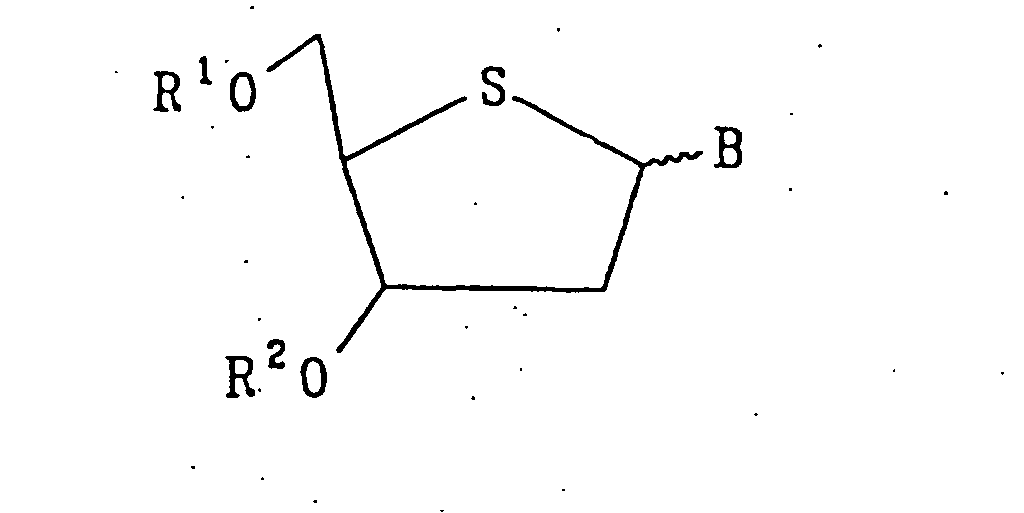
- It has now been found that certain 2'-deoxy-4'-thioribonucleosides have useful antiviral and anticancer activities. Thus, in accordance with this invention, there are provided novel β-2'-deoxy-4'-thioribonucleosides represented by the formulawherein:

- ~B indicates that B is beta, and
- B is a nitrogenous heterocyclic base selected from the group consisting of pyrimidine, 5-azapyrimidine, 6-azapyrimidine, 3-deazapyrimidine bases. By the term "pyrimidine base" is meant any, pyrimidine derivative including, but not limited to, uracil (2,4-dioxopyrimidine), thymine (5-methyl-2,4-dioxopyrimidine), cytosine (4-amino-2-oxopyrimidine), and 5-methylcytosine (4-amino-5-methyl-2-oxopyrimidine),. By the term "5-azapyrimidine base" is meant any 5-azapyrimidine derivative including, but not limited to, 5-aza-2,4-dioxopyrimidine and 4-amino-5-aza-2-oxopyrimicine. By the term "6-azapyrimidine base" is meant any 6-azapyrimidine derivative including, but not limited to, 5-aza-2,4-dioxopyrimidine, 4-amino-6-aza-2-oxopyrimidine, and derivatives having a methyl group attached to the C5 heterocyclic carbon. By the term "3-deazapyrimidine base" is meant any 3-deazapyrimidine derivative including, but not limited to, 3-deaza-2,4-dioxopyrimidine, 4-amino-3-deaza-2-oxopyrimidine, and derivatives having a methyl group attached to the C5 heterocyclic carbon.
- R1 and R2 in the above diagram may be the same or different and may be hydrogens or conventional acyl protecting groups.
-
- The invention may be illustrated by the following, wherein the compounds encompassed by the invention are represented by the formulawherein:
- ~B indicates that B is beta, and
- B is a member selected from the group consisting of the
following nitrogenous heterocyclic bases:


 where X9, X10, X11, X12, X13, X14 =H, or CH3,
and R1 and R2 can be the same or different and may be
hydrogen or acyl protecting groups, provided that it
is not uracil having a methyl group attached
to the C5 heterocyclic carbon.
where X9, X10, X11, X12, X13, X14 =H, or CH3,
and R1 and R2 can be the same or different and may be
hydrogen or acyl protecting groups, provided that it
is not uracil having a methyl group attached
to the C5 heterocyclic carbon. -
- Preferably, the nitrogenous heterocyclic base is selected from the group consisting of the following pyrimidine bases:where X17, X18 =H or CH3

- According to another aspect of this invention, a therapeutically effective amount of a 2'-deoxy-4'-thioribonucleoside as previously defined is used to be administered to a host animal, including man, afflicted with a viral infection, e.g., an infection caused by herpes simplex virus types 1 or 2.
- According to another aspect of this invention, a therapeutically effective amount of a 2'-deoxy-4'-thioribonucleoside as previously defined is used to be administered to a host animal, including man, afflicted with cancer. By the term "cancer" is meant any new and abnormal cell growth, specifically a new growth of tissue which is uncontrolled and progressive. Compounds of this invention may be used, for example, in the treatment of leukemias, epidermoid carcinoma, lymphomas, choriocarcinoma, Wilm's tumor, neuroblastoma, rhabdomyosarcoma, carcinoma of the testis, and breast and lung tumors.
- In accordance with still another aspect of this invention, there are provided novel intermediates useful in the preparation of certain 2'-deoxy-4,'-thioribonucleosides.
- The synthesis of the 2'-deoxy-4'-thioribonucleosides may be carried out by beginning with 1-O-methyl 2-deoxy-4-thio-α,β-D-ribofuranose of formula 1the preparation of which is described in Fu, et al, J. Org. Chem., 41, 3831 (1976), the disclosure of which is incorporated herein by reference. The compound of formula 1 is reacted with p-toluoyl chloride to give the compound of formula 2


- The methyl group is then replaced by an acetyl group to give the compound of formula 3

- The 2'-deoxy-4'-thioribonucleosides are prepared by coupling compound 3 with nitrogenous heterocyclic bases and then removing the toluoyl protecting groups. Compound 3 is coupled with a pyrimidine using the catalysts hexamethyldisilazane, trimethylchlorosilane, and trimethylsilyl trifluoromethanesulfonate (see Vorbruggen, et al, Chem. Ber., 114, 1234 (1981)). Compound 3 is coupled with a 5-azapyrimidine, 6-azapyrimidine and 3-deazapyrimidine in a similar manner. The coupling reaction provides both α and β nucleosides in most cases. Anomers may be separated by conventional methods.
- As examples of the preparation of pyrimidine compounds of this invention, the compound of formula 3 can be combined with uracil to give the compound of formula 15

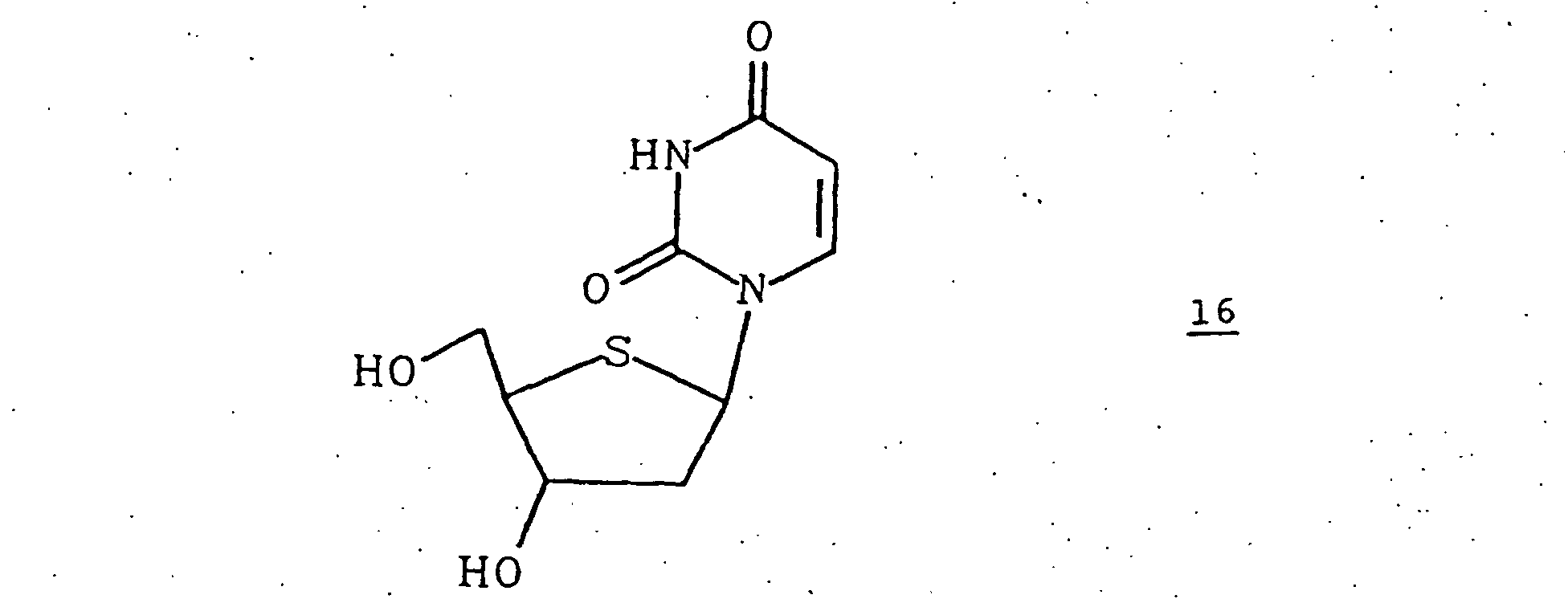
- Removal of the toluoyl protecting groups gives the compound of the formula 16
- The compound of formula 3 can also be combined with thymine to give the compound of formula 17

- Removal of the toluoyl protecting groups gives the compound of formula 18

- In carrying out the synthesis of 2'-deoxy-4'-thioribonucleosides of this invention, other acyl protecting groups besides the toluoyl protecting group may be used. Further, conventional acyl protecting groups may be substituted.or added, using conventional methods, to the 3' position or 5' position, or both, of the 2'-deoxy-4'-thioribonucleosides.
- The following examples illustrate the preparation of the compounds described above. In these examples, MeOH is methyl alcohol, EtOH is ethyl alcohol, and Me2SO-d6 is deuterated dimethyl sulfoxide (CD3)2SO.
- 1-O-Acetyl-2-deoxy-4-thio-3,5-di-O-p-toluoyl-α,β-D-ribofuranose (formula 3). To a solution of 1-O-methyl-2-deoxy-4-thio-α,β-D-ribofuranose (formula 1) (10 g, 60.97 mmol) in 250 mL of sieve-dried pyridine was added p-toluoyl chloride (23.57 g, 152.5 mmol) dropwise at 0-5°C. The cooling bath was removed. After the reaction stirred for 10 hours, the reaction was essentially complete as indicated by TLC (cyclohexane-ethylacetate 5:1). The reaction mixture was poured into an ice-water mixture, stirred for 1 hour, and then diluted with 500 mL of CHCl3 to give a total volume of 1000 mL. The aqueous layer was extracted with CHCl3 (2 x 100 mL). The combined organic extracts were washed with dilute sulfuric acid (200 mL), aqueous saturated sodium bicarbonate (2 x 200 mL) and water until neutral, dried over MgSO4, and evaporated to dryness. The residue was dissolved in CHCl3 (200 mL) and filtered through a 9.0 cm in diameter and 4 cm thick bed of silica gel, washed with CHCl3 (2 x 100 mL) and filtrate was evaporated to dryness to afford crude 1-O-methyl-2-deoxy-4-thio-3,5-di-O-p-toluoyl-α,β-D-ribofuranose (formula 2) as a dark brown solid (24 g) which was dissolved in a acetolysis mixture containing acetic anhydride (200 mL), glacial acetic acid (200 mL), p-toluene sulfonic acid monohydrate (2.4 g) and conc. sulfuric acid (10 mL) and warmed to 40°C for 1 hour, then was decomposed by the addition of anhydrous sodium acetate. The resulting mixture was evaporated to dryness in vacuo at a temperature below 30°C. The residue was partitioned between 500 mL of water and 300 mL of CHCl3. The aqueous phase was extracted with CHCl3 (2 x 100 mL). The combined CHCl3 layers were evaporated to dryness in vacuo, then several portions of methanol were added and removed in vacuo to eliminate the last traces of acetic anhydride. The residue was purified by a flash column containing 100 g of silica gel and eluted with 6:1 cyclohexane-ethylacetate and appropriate fractions were combined and evaporated to give a white solid, which was crystallized by 95% ethanol to give 1-O-acetyl-2-ceoxy-4-thio-3,5-di-O-p-toluoyl-α,β-D-ribofuranose, yield 18.26 g (70% from 1-O-methyl-2-deoxy-4-thio-α,β-D-ribofuranose) as a α,β mixture; MS z/e 429 (M + 1)+; 1H NMR (CDCl3, 300 MHz) δ 2.02 (s, 3, CH3CO), 2.04 (s, 3, CH3CO), 2.34 (s, 6, CH3 of toluoyl), 2.36 (s, 6, CH3 of toluoyl), 2.52-2.74 (m, 4, H-2), 3.92-4.06 (m, 2, H-4), 4.28-4.52 (m, 4, CH2), 5.64-5.74 (m, 2, H-3), 6.12 (dd, 1, H-1 of β, J = 3 and 6 Hz ) , 6.2 (d, 1, H-1 of α, J = 5.5 Hz), 7.24-7.36 (m, 4, meta CH's of toluoyl), 7.8-7.92 (m, 4, ortho CH's of toluoyl). Anal. (C23H24O6S), C, H, S.
- 1-(2-Deoxy-4-thio-3,5-di-O-toluoyl-D-ribofuranosyl)uracil (formula 15). To a suspension of 1-O-acetyl-2-deoxy-4-thio-3,5-di-O-p-toluoyl-α,β-D--ribofuranose (formula 3) (428 mg, 1.0 mmol) and uracil(2,4-dioxopyrimidine) (112.1 mg, 1.0 mmol) in anhydrous 1,2-dichloroethane (30 mL) were added consecutively hexamethyldisilazane (HMDS, 161.5 mg, 1.0 mmol) and trimethylchlorosilane (TMSCl, 108.6 mg, 1.0 mmol) and the mixture was stirred at room temperature. After 0.5 hours, the resulting solution was cooled to -78°C and trimethylsilyl trifluoromethanesulfonate (266.7 mg, 1.2 mmol) was added to it and stirred at the same temperature for another 1 hour, after which time the reaction was essentially complete. The reaction mixture was warmed to room temperature and concentrated to a small volume (5 mL), diluted with methylene chloride (about 50 mL), then washed with water (15 mL) followed by saturated sodium bicarbonate and finally with water. The organic layer was dried over MgSO4 and evaporated to dryness. The residue was purified by 50 g of silica gel with CHCl3-MeOH 98:2 to afford a solid, which was crystallized from EtOH-dioxane to give pure 1-(2-deoxy-4-thio-3,5-di-O-toluoyl-D-ribofuranosyl)uracil (192 mg, 40%); mp 118-120°C; TLC 98:2 CHCl3-MeOH; Rf 0.35; MS z/e 481 (M + 1)+; 1H NMR (CDCl3, 300 MHz) δ 2.40 (s, 6, CH3 of toluoyl), 2.54-2.60 (m, 1, H-2'), 2.86-2.96 (m, 1, H-2'), 4.20-4.26 (m, 1, H-4'), 4.36-4.52 (m, 2, H-5'), 5.68-5.72 (m, 2, H-3', H-5), 6.44 (br d, 1, H-6, J = 6 Hz), 7.26 (d, 2, H's of toluoyl, J = 8 Hz), 7.30 (d, 2, H's of toluoyl, J = 8 Hz), 7.96 (d, 2, H's of toluoyl, J = 8 Hz), 8.14 (d, 2, H's of toluoyl, J = 8 Hz), 9.48 (s, 1, H-3); 13C NMR (Me2SO-d6, 300 MHz) δ 42.148 (C-2' ) , 56.46 (C-4'), 63. 55 (C-1' ) , 64.96 (C-5'), 78.21 (C-3' ) , 101.94 (C-5) , 126.03, 126.55, 129.23, 129.27, 129.783, 129.63 (toluoyl ring carbon), 141.74 (C-6), 144.14, 144..73 (toluoyl ring carbon), 150.71 (C-2), 163.05 (C-4), 165.36, 166.07 (carbonyl carbon of toluoyl).
- 1-(2-Deoxy-4-thio-D-ribofuranosyl)uracil (formula 16). A solution of 1-(2-deoxy-4-thio-3,5-di-O-toluoyl-β-D-ribofuranosyl) uracil (formula 15) (175 mg, 0.36 mmol) in anhydrous MeOH (30 mL) was stirred at room temperature with a freshly prepared solution of sodium methoxide (39 mg, 0.72 mmol) in MeOH (7.5 mL). A TLC aliquot at 2.5 hours showed complete reaction. The solution was rendered neutral with Dowex 50W-X8 (H+) ion-exchange resin, the suspension filtered, and the resin was washed with MeOH. The filtrate was combined and evaporated to dryness, and methyl p-toluate was removed at 50°C/0.01 torr. Crystallization of the residue from absolute EtOH gave pure 1-(2-deoxy-4-thio-D-ribofuranosyl)uracil (75 mg, 85%), mp 190-192°C; TLC 9:1 CHCl3-MeOH, Rf 0.30; MS z/e 245 (M + 1)+, UV λmax PH 1 266 (9.24), pH 7 266 (9.52), pH 13 265 (8.72); 1H NMR (Me2SO-d6, 300 MHz) δ 2.0-2.28 (m, 1, H-2'), 2.44-2.54 (m, 1, H-2'), 3.30-3.38 (m, 1, H-5' ) , 3.40-3.48 (m, 1, H-5' ) , 3.50-3.58 (m, 1, h-4'), 4.32 (br dd, 1, H-3', J = 2 and 8.Hz), 5.66 (d, 1, H-6, J = 8 Hz), 6.14 (dd, 1, H-1', J = 3 and 7.5 Hz), 8.26 (d, 1, H-5, J = 8 Hz); 13C NMR (Me2SO-d6, 300 MHz) δ 42.16 (C-2), 60.01 (C-4'), 60.95 (C-1'), 63.57 (C-5'), 74.14 (C-3' ) , 101.16 (C-5, JC,H =175.24 Hz), 142.92 (C-6, JC,H = 181.88 Hz), 150.69 (C-2), 162.97 (C-4). Anal. (C9H12N4O2S) C, H, N, S.
- 1-(2-Deoxy-4-thio-3,5-di-O-toluoyl-β-D-ribofuranosyl)thymine (formula 17). To a suspension of 1-O-acetyl-2-deoxy-4-thio-3,5-di-O-p-toluoyl-α,β-D-ribofuranose (formula 3) (428 mg, 1.0 mmol), and thymine(5-methyl-2,4-dioxopyrimidine) (126 mg, 1.0 mmol) in anhydrous 1,2-dichloroethane (30 mL) were added consecutively hexamethyldisilazane (HMDS, 161.5 mg, 1.0 mmol), and trimethylchlorosilane (TMSC1, 108.6 mg, 1.0 mmol), and the mixture was stirred at room temperature after 0.5 hours. The resulting solution was cooled to -78°C and trimethylsilyl trifluoromethanesulfonate (266.7 mg, 1.2 mmol) was added to it and stirred at the same temperature for another 1.5 hours, after which time the reaction was essentially complete. The reaction mixture was warmed to room temperature and concentrated to a small volume (5 mL), diluted with methylene chloride (about 50 mL), then washed with water (15 mL) followed by saturated sodium bicarbonate and finally with water. The organic layer was dried over MgSO4 and evaporated to dryness. The residue was purified by 50 g of silica gel with CHCl3-MeOH 99:1 to afford a solid which was crystallized from EtOH-CHCl3 to give pure 1-(2-deoxy-4-thio-3,5-di-O-toluoyl-β-D-ribofuranosyl)thymine (173 mg, 35%); mp 178-182°C; TLC 98:2 CHCl3-MeOH, Rf 0.55; MS z/e 495 (M + 1)+; 1H NMR (CDCl, 300 MHz) δ 1.78 (s, 3, C-5, CH3'), 2.42 (s,3, CH3 of toluoyl) 2.43 (s, 3, CH3 of toluoyl), 2.36-2.44 (m, 1, H-2) , 3.98-4.04 (m, 1, H-4'), 4.12 (d, 2, H-5', J = 6 Hz), 5.76 (br t, 1, H-3'), 6.66 (dd, 1, H-1' , J = 6 and 9 Hz), 7.26 (d, 4, H's of toluoyl, J = 8 Hz), 7.56 (s, 1, H-6), 7.94 (d, 2, H's of toluoyl, J = 8 Hz), 7.96 (d, 2, H's of toluoyl, J = 8 Hz), 8.58 (s, 1, H-3); 13C NMR (CDCl3, 300 MHz) δ 12.41 (C-5, CH3), 21.69, 21.72 (CH3 's of toluoyl), 39.98 (C-2'), 53.13 (C-4', JC,H = 148.1 Hz), 61.27 (C-1' , JC,H = 163.3 Hz), 65.14 (C-5'), 77.13 (C-3'), 112.28 (C-5), 126.41, 126.58 (toluoyl ring carbon), 129.25, 129.35, 129.76, 129. 87 (toluoyl ring, carbon) , 135.4.6 (C-6, JC,H = 176.46 Hz) , 144. 38, 144.47 (toluoyl ring carbon) , 150.45 (C-2) , 162.90 (C-4), 165.61, 166.17 (carbonyl carbon of toluoyl).
- 1-(2'-Deoxy-4'-thio-β-D-ribofuranosyl)thymine (formula 18). A solution of 1-(2-deoxy-4-thio-3,5-di-O-toluoyl-β-D-ribofuranosyl) thymine (formula 17) (150 mg, 0.30 mmol) in anhydrous. MeOH (30 mL) was stirred at room temperature. with a freshly prepared solution of sodium methoxide (32.5 mg, 0.60 mmol) in MeOH (7.5 mL). A TLC aliquot at 3 hours showed complete reaction. The solution was rendered neutral with Dowex 50W-X8 (H+) ion-exchange resin, the suspension was filtered, and the resin was washed with MeOH. The filtrate was combined and evaporated to dryness, and methyl p-toluate was removed at 50°C/0.01 torr. Crystallization of the residue from absolute ETOH gave pure 1- (2'-deoxy-4'-thio-β-D-ribofuranosyl) thymine (61 mg, 78%), mp 213-215°C; TLC 9:1 CHCl3-MeOH, Rf 0.40; MS z/e 258 (M + 1)+, UV λmax pH 1 272 (10.3), pH 7 272 (10.2), pH 13 271 (10.3); 1H NMR (Me2 SO-d6, 300 MHz) δ 1.80 (C-5, CH3) , 2.10-2.24 (m, 2, H-2'), 3.24-3.32 (m, 1, H-4'), 3.50-3.66 (m, 2 H, H-5' ) , 4.38 (br s, 1, H-3') , 5.16 (br t, 1, 5'-OH), 5.24 (d, 1, 3'-OH, J = 4 Hz), 6.30 (dd, 1, H-1', J = 6.5 and 8 Hz) 7.32 (s, 1, H-6), 11.32 (br s, 1, H-3) ; 13C NMR (Me2SO-d6, 300 MHz) 6 12.16 (C-5, CH3)' 40.97 (C-2' , JC,H = 132.33 Hz) , 59.01 (C-4', JC,H = 143.4 Hz), 59.93 (C-1',JC,H = 167.74), 63.51 (C-5' ) , 73. 40 (C-3'), 109.82 (C-5) , 136.70 (C-6, JC,H = 179 Hz) , 150.59 (C-4) , 163.37 (C-2). Anal. (C10H13N2O6S) C, H, N, S.
- 2'-Deoxy-4'-thioribonucleosides were tested for antiviral activity against viruses that replicate in mammalian cells growing in cell culture. The results of these tests against herpes simplex virus, Type 1 and Type 2, are summarized in Table 1. The Virus Rating (VR) is a standard weighted measurement of antiviral activity which takes into account the degree of inhibition of virus-induced cytopathogenic effects (CPE) and the degree of cytotoxicity produced by the test compound, determined by a modification of the method of Ehrlich et al, Ann. N.Y. Acad. Sci. 130, 5-16 (1965) .
- The CPE-inhibition assays were designed to test seven 0.5 log10 concentrations of each compound, beginning with 320 µg/mL, against HSV in triplicate 24-hour Vero cell monolayers in 96-well tissue culture plates. To each of the replicate cell cultures were dispensed 0.1 mL of the test compound solution (or suspension) and 0.1 mL of HSV suspension (diluted in medium to yield 32 CCID50 units per 0.1 mL). Cell controls, untreated virus-infected controls and drug cytotoxicity controls were included in each assay. The plates were incubated at 37°C in a humidified atmosphere containing 2% CO2 until 100% CPE were observed in the untreated virus control cultures. The cell monolayers were examined microscopically for drug cytotoxicity and for CPE. which was graded on a scale of 0-4 (0-100% CPE).
- The VR was calculated as 0.1 of the sum of the numerical differences between the recorded CPE grade of each test well and that of the corresponding virus control in the culture plate. Numerical differences between the scores of test wells containing a drug concentration which is partially cytotoxic and their corresponding virus controls were halved.
- In tests carried out by this method, a greater value of VR indicates greater antiviral activity. A compound with a VR of 1.0 or greater is considered to have significant antiviral activity with a high degree of reproducibility in confirmatory in vitro tests. A compound with a VR of 0.5-0.9 is considered to have possible or marginal activity; a compound with a VR of less than 0.5 is considered to be inactive.
- The MIC50 (minimum inhibitory concentration, 50%) is the concentration of a test compound required for 50% inhibition of virus-induced cytopathogenic effect calculated by using a regression analysis program for semilog curve fitting. MTC (minimum toxic concentration) is the minimum drug concentration (µg/ml) causing any cytotoxicity. TI is the therapeutic index, calculated by dividing the minimum cytotoxic drug concentration (MTC) by the minimum inhibitory concentration, 50% (MIC50). The results were compared with two commercial antiviral agents, acyclovir and 9-β-D-arabinofuranosyladenine (Ara-A). The tests summarized in Table I show that definite antiviral activity against herpes simplex Type 1 is exhibited by two of the invention compounds, 1-(2-deoxy-4-thio-β-D-ribofuranosyl)thymine and 1-(2-deoxy-4-thio-α-D-ribofuranosyl)thymine.
Compound Virus VR MIC50 MIC TI 1-(2-Deoxy-4-thio-α-D-ribofuranosyl)-thymine HSV-1
HSV-21.4
0.3100.1
->257.2
>257.22.3
-1-(2-Deoxy-4-thio-β-D-ribofuranosyl)-thymine HSV-1
HSV-21. 3
0.10.8
-2.6
2.63.2
-Controls Acyclovir HSV-1
HSV-26.7
4.80.5
3.6>225.2
>225.2>441
63.2Ara-A HSV-1
HSV-21.8
1.115.2
39.384.8
84.85.6
2.2a/ HSV-1 (E377)
b/ HSV-2 (MS) - 2'-Deoxy-4'-thioribonucleosides were tested for antitumor activity against leukemia L1210 ("L1210") cells and human epidermoid carcinoma No. 2 ("H.Ep.-2") cells.
- Table 2 sets forth the results of cytotoxicity tests. For L1210 cells the IC50 is the concentration required to decrease cellular proliferation by 50% as compared to untreated controls. The cells were grown in suspension cultures and the number of cells present was determined at 24 and 48 hours. The values shown in Table 2 are 48 hour values.
- For H.Ep.-2 cells, the IC50 is the concentration required to reduce colony formation by 50% as compared to controls. One hundred cells in 10 mL of medium were placed in prescription bottles, and after 10 days incubation, the medium was decanted and the colonies were stained and counted.
- In the cytotoxicity tests, the lower the IC50 value, the greater the antitumor activity. An IC50 value of less than 40 µg/mL indicates a compound of interest, and an IC50 value of less than 1 indicates a compound that is extremely effective. As.shown in Table 2 below, all the compounds tested show an IC50 value of less than 40 µg/mL with respect to either H.Ep.-2 or L1210 cells, or both. One compound, 1-(2-Deoxy-4-thio-β-D-ribofuranosyl) thymine shows an IC50 value of much less than 1 µg/mL.
IC50 (µg/mL) Compound H. Ep. -2 L1210 1- (2-Deoxy-4-thio-β-D-ribofuranosyl)thymine 0.075 0.025 1- (2-Deoxy-4-thio-α-D-ribofuranosyl)thymine 2.7 20 - Although the invention has been described in considerable detail with specific reference to certain advantageous embodiments thereof, variations and modifications can be made without departing from the scope of the invention as defined in the appended claims.
Claims (12)
- A β-2'-deoxy-thioribonucleoside represented by the formula:which B is a pyrimidine, 5-azapyrimidine, 6-azapyrimidine or 3-deazapyrimidine base, and R1 and R2 may be the same or different and are hydrogens or acyl protecting groups wherein the substituent on C-5 of B is either hydrogen or a methyl group,
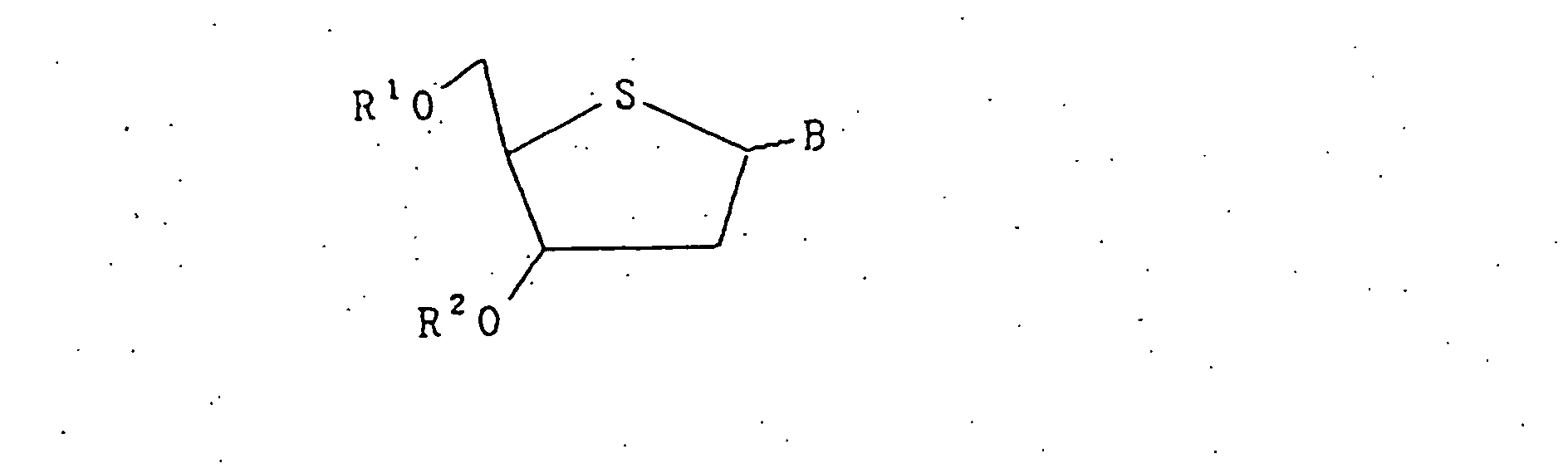
provided that when B is a pyrimidine base, it is not uracil having a methyl group attached to the C-5 heterocyclic carbon. - A β-2'-deoxy-thioribonucleoside represented by the formula:which B is of the following nitrogenous heterocyclic bases:


 where X9, X10, X11, X12 , X13, X14, are each hydrogen ,or methyl, and R1 and R2 can be the same or different and are hydrogen or acyl protecting groups, provided that it is not uracil having a methyl group attached to the C5 heterocyclic carbon.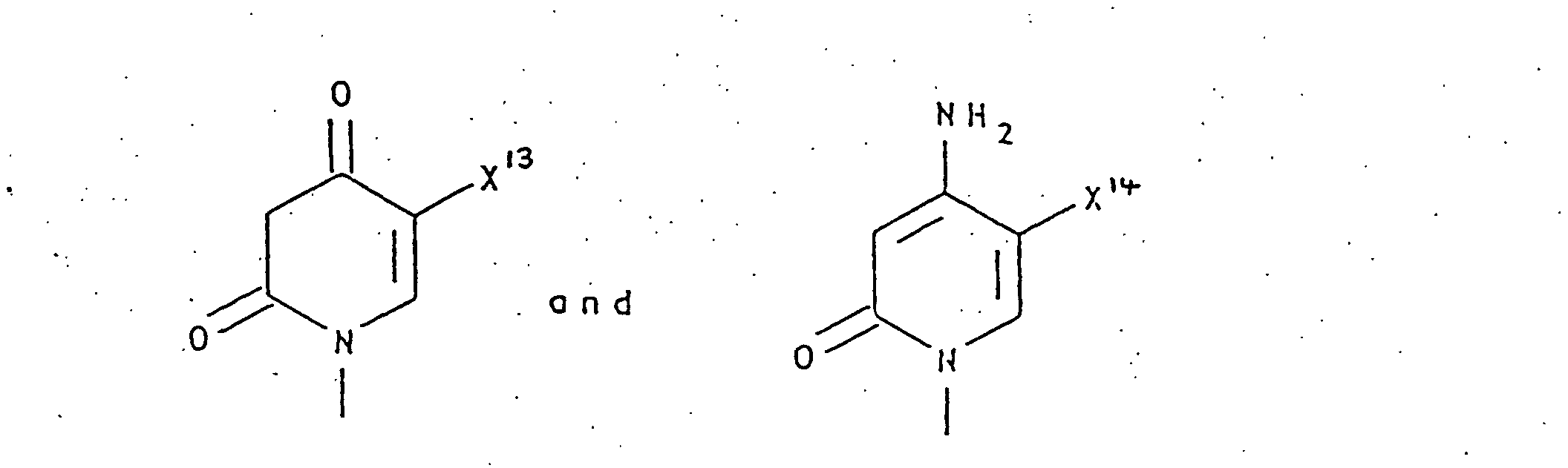
- The β-2'-deoxy-thioribonucleoside of claim 1, wherein B is a pyrimidine base.
- A β-2'-deoxy-4'-thioribonucleoside represented by the formula:which B is one of the following pyrimidine bases:
 where X17 and X18 are hydrocarbon, or methyl , and R1 and R2 may be the same or different and are hydrogens or acyl protecting groups provided that it is not uracil having a methyl attached to the C5 heterocyclic carbon.
- A ribonucleoside as claimed in any preceding claim which each of R1 and R2 is hydrogen.
- 1-(2-Deoxy-4-thip-β-D-ribofuranosyl) uracil.
- 1-(2-deoxy-4-thio-3,5-di-O-toluoyl-β-D-ribofuranosyl) uracil.
- 1- (2-deoxy-4-thio-3,5-di-O-toluoyl-β-D-ribofuranosyl) thymine.
- A pharmaceutical preparation comprising a therapeutically effective amount of a compound as claimed in any of claims 1 to 6.
- The use of a compound as claimed in any of claims 1 to 6 for the manufacture of a medicament for the treatment of a host animal having a viral infection.
- The use claimed in Claim 10 in which the virus infection is a herpes simplex virus infection.
- The use of a compound as claimed in any of claims 1 to 6 for the manufacture of a medicant for the treatment of an animal afflicted with cancer.
Applications Claiming Priority (3)
| Application Number | Priority Date | Filing Date | Title |
|---|---|---|---|
| US40804089A | 1989-09-15 | 1989-09-15 | |
| US408040 | 1989-09-15 | ||
| PCT/US1990/005252 WO1991004033A1 (en) | 1989-09-15 | 1990-09-14 | 2'-deoxy-4'-thioribonucleosides as antiviral and anticancer agents |
Publications (3)
| Publication Number | Publication Date |
|---|---|
| EP0491793A1 EP0491793A1 (en) | 1992-07-01 |
| EP0491793A4 EP0491793A4 (en) | 1993-03-03 |
| EP0491793B1 true EP0491793B1 (en) | 2005-11-30 |
Family
ID=23614604
Family Applications (1)
| Application Number | Title | Priority Date | Filing Date |
|---|---|---|---|
| EP90913760A Expired - Lifetime EP0491793B1 (en) | 1989-09-15 | 1990-09-14 | 2'-deoxy-4'-thioribonucleosides as antiviral and anticancer agents |
Country Status (7)
| Country | Link |
|---|---|
| EP (1) | EP0491793B1 (en) |
| JP (1) | JP3207852B2 (en) |
| AT (1) | ATE311399T1 (en) |
| AU (1) | AU6401490A (en) |
| DE (1) | DE69034209T2 (en) |
| ES (1) | ES2253732T3 (en) |
| WO (1) | WO1991004033A1 (en) |
Families Citing this family (8)
| Publication number | Priority date | Publication date | Assignee | Title |
|---|---|---|---|---|
| US5034506A (en) * | 1985-03-15 | 1991-07-23 | Anti-Gene Development Group | Uncharged morpholino-based polymers having achiral intersubunit linkages |
| IE902574A1 (en) * | 1989-07-17 | 1991-02-27 | Univ Birmingham | Antiviral pyrimidine nucleosides |
| AU4508493A (en) * | 1992-07-02 | 1994-01-31 | Wellcome Foundation Limited, The | Therapeutic nucleosides |
| MX9303985A (en) * | 1992-07-02 | 1994-02-28 | Wellcome Found | THERAPEUTIC NUCLEOSIDES. |
| GB9218810D0 (en) * | 1992-09-04 | 1992-10-21 | Univ Birmingham | Antiviral pyrimidine nucleosides |
| NZ509405A (en) * | 1998-07-23 | 2004-10-29 | Southern Res Inst | Preparation of 1-(4-thio-thioarabinofuranosyl) cytosine derivatives and their use as anticancer agents and DNA replication inhibitors |
| TW201340971A (en) * | 2012-03-09 | 2013-10-16 | Taiho Pharmaceutical Co Ltd | Dna-damaging agent |
| TW201343663A (en) * | 2012-03-16 | 2013-11-01 | Taiho Pharmaceutical Co Ltd | Novel pyrimidine nucleoside compound |
Citations (2)
| Publication number | Priority date | Publication date | Assignee | Title |
|---|---|---|---|---|
| WO1988008001A1 (en) * | 1987-04-16 | 1988-10-20 | Aktiebolaget Astra | Nucleosides and nucleoside analogues, pharmaceutical composition and processes for the preparation of the compounds |
| EP0316017A2 (en) * | 1987-11-12 | 1989-05-17 | Bristol-Myers Squibb Company | 2',3'-Dideoxy-2'-fluoronucleosides |
-
1990
- 1990-09-14 EP EP90913760A patent/EP0491793B1/en not_active Expired - Lifetime
- 1990-09-14 AT AT90913760T patent/ATE311399T1/en not_active IP Right Cessation
- 1990-09-14 WO PCT/US1990/005252 patent/WO1991004033A1/en not_active Ceased
- 1990-09-14 ES ES90913760T patent/ES2253732T3/en not_active Expired - Lifetime
- 1990-09-14 JP JP51308190A patent/JP3207852B2/en not_active Expired - Lifetime
- 1990-09-14 DE DE69034209T patent/DE69034209T2/en not_active Expired - Lifetime
- 1990-09-14 AU AU64014/90A patent/AU6401490A/en not_active Abandoned
Patent Citations (2)
| Publication number | Priority date | Publication date | Assignee | Title |
|---|---|---|---|---|
| WO1988008001A1 (en) * | 1987-04-16 | 1988-10-20 | Aktiebolaget Astra | Nucleosides and nucleoside analogues, pharmaceutical composition and processes for the preparation of the compounds |
| EP0316017A2 (en) * | 1987-11-12 | 1989-05-17 | Bristol-Myers Squibb Company | 2',3'-Dideoxy-2'-fluoronucleosides |
Non-Patent Citations (2)
| Title |
|---|
| FULMER SHEALY Y. ET AL: "Carbocyclic analogs of 5-fluorouracil nucleosides", J.MED.CHEM., vol. 24, no. 9, 1981, pages 1083 - 1086 * |
| J.CARBOHYDRATES. NUCLEOSIDES NUCLEOTIDES, vol. 5, no. 3, 1978, pages 187 - 224 * |
Also Published As
| Publication number | Publication date |
|---|---|
| WO1991004033A1 (en) | 1991-04-04 |
| JPH05500666A (en) | 1993-02-12 |
| DE69034209T2 (en) | 2006-08-10 |
| ATE311399T1 (en) | 2005-12-15 |
| JP3207852B2 (en) | 2001-09-10 |
| DE69034209D1 (en) | 2006-01-05 |
| AU6401490A (en) | 1991-04-18 |
| EP0491793A1 (en) | 1992-07-01 |
| EP0491793A4 (en) | 1993-03-03 |
| ES2253732T3 (en) | 2006-06-01 |
Similar Documents
| Publication | Publication Date | Title |
|---|---|---|
| US5591722A (en) | 2'-deoxy-4'-thioribonucleosides and their antiviral activity | |
| US5668113A (en) | Method of using 1,5-anhydrohexitol nucleoside analogues to treat viral infections | |
| US5952500A (en) | Nucleoside derivatives | |
| Mikhailopulo et al. | Synthesis and antiviral and cytostatic properties of 3'-deoxy-3'-fluoro-and 2'-azido-3'-fluoro-2', 3'-dideoxy-D-ribofuranosides of natural heterocyclic bases | |
| Shealy et al. | Carbocyclic analogs of 5-substituted uracil nucleosides. Synthesis and antiviral activity | |
| US4177348A (en) | Carbocyclic analogs of cytosine nucleosides | |
| US4396623A (en) | Carbocyclic analogs of uracil nucleosides as antiviral agents | |
| US4232154A (en) | Carbocyclic analogs of cytosine nucleosides exhibiting antiviral and antineoplasticactivity | |
| ES2253732T3 (en) | 2'-DEOXI-4'-TIORIBONUCLEOSIDS AS ANTIVIRAL AND ANTI-TARGET AGENTS. | |
| Baker et al. | Synthesis of Potential Anticancer Agents. VII. 2 Nucleosides Derived from L-Rhamnopyranose | |
| DE69624827T2 (en) | 5'-SUBSTITUTED-RIBOFURANOSYL BENZIMIDAZOLES AS ANTIVIRAL. | |
| Kazimierczuk et al. | Methylation of adenosine in strongly alkaline medium: Preparation and Properties of o'-methyl derivatives of adenosine and N6-methyladenosine | |
| US4730001A (en) | Carbocyclic analogues of amino and azido thymidines | |
| JPH06211890A (en) | 2'-deoxy-2'@(3754/24)s)-substituted alkylcytidine derivative | |
| EP0155164B1 (en) | Novel cyanoimidazole nucleoside derivatives | |
| US3872084A (en) | Purine nucleoside 3,5-cyclicphosphate compounds | |
| DE69533856T2 (en) | L-pyranosyl NUCLEOSIDES | |
| WO2000064918A1 (en) | METHOD FOR THE PRODUCTION OF 2-CHLORO-2'-DEOXYADENOSINE (CLADRIBINE) AND ITS 3,5-DI-O-p-TOLUOYL DERIVATIVE | |
| Horwitz et al. | In vitro biological evaluation of the R and S isomers of 1-(tetrahydrofuran-2-yl)-5-fluorouracil | |
| EP0416605B1 (en) | Novel oxetanocin derivatives and their salts as well as use thereof | |
| Cristalli et al. | 3, 7-Dideazapurine nucleosides. Synthesis and antitumor activity of 1-deazatubercidin and 2-chloro-2'-deoxy-3, 7-dideazaadenosine | |
| EP0445258B1 (en) | 5'-alkylphosphonylnucleosides as antivirals | |
| US20020052491A1 (en) | Method for the production of 2-chloro-2' -deoxyadenosine (cladribine) and its 3,5-di-O-p-toluoyl derivative | |
| US4992427A (en) | 2-substituted inosines and their use as antiviral agents | |
| US5574021A (en) | Methods of treatment using 2',3'-dideoxy-2',2'-difluoronucleosides |
Legal Events
| Date | Code | Title | Description |
|---|---|---|---|
| PUAI | Public reference made under article 153(3) epc to a published international application that has entered the european phase |
Free format text: ORIGINAL CODE: 0009012 |
|
| 17P | Request for examination filed |
Effective date: 19920312 |
|
| AK | Designated contracting states |
Kind code of ref document: A1 Designated state(s): AT BE CH DE DK ES FR GB IT LI LU NL SE |
|
| A4 | Supplementary search report drawn up and despatched |
Effective date: 19930112 |
|
| AK | Designated contracting states |
Kind code of ref document: A4 Designated state(s): AT BE CH DE DK ES FR GB IT LI LU NL SE |
|
| 17Q | First examination report despatched |
Effective date: 19950125 |
|
| GRAP | Despatch of communication of intention to grant a patent |
Free format text: ORIGINAL CODE: EPIDOSNIGR1 |
|
| GRAS | Grant fee paid |
Free format text: ORIGINAL CODE: EPIDOSNIGR3 |
|
| GRAA | (expected) grant |
Free format text: ORIGINAL CODE: 0009210 |
|
| AK | Designated contracting states |
Kind code of ref document: B1 Designated state(s): AT BE CH DE DK ES FR GB IT LI LU NL SE |
|
| PG25 | Lapsed in a contracting state [announced via postgrant information from national office to epo] |
Ref country code: AT Free format text: LAPSE BECAUSE OF FAILURE TO SUBMIT A TRANSLATION OF THE DESCRIPTION OR TO PAY THE FEE WITHIN THE PRESCRIBED TIME-LIMIT Effective date: 20051130 Ref country code: BE Free format text: LAPSE BECAUSE OF FAILURE TO SUBMIT A TRANSLATION OF THE DESCRIPTION OR TO PAY THE FEE WITHIN THE PRESCRIBED TIME-LIMIT Effective date: 20051130 Ref country code: CH Free format text: LAPSE BECAUSE OF FAILURE TO SUBMIT A TRANSLATION OF THE DESCRIPTION OR TO PAY THE FEE WITHIN THE PRESCRIBED TIME-LIMIT Effective date: 20051130 Ref country code: LI Free format text: LAPSE BECAUSE OF FAILURE TO SUBMIT A TRANSLATION OF THE DESCRIPTION OR TO PAY THE FEE WITHIN THE PRESCRIBED TIME-LIMIT Effective date: 20051130 Ref country code: NL Free format text: LAPSE BECAUSE OF FAILURE TO SUBMIT A TRANSLATION OF THE DESCRIPTION OR TO PAY THE FEE WITHIN THE PRESCRIBED TIME-LIMIT Effective date: 20051130 |
|
| REG | Reference to a national code |
Ref country code: GB Ref legal event code: FG4D Ref country code: CH Ref legal event code: EP |
|
| REF | Corresponds to: |
Ref document number: 69034209 Country of ref document: DE Date of ref document: 20060105 Kind code of ref document: P |
|
| PG25 | Lapsed in a contracting state [announced via postgrant information from national office to epo] |
Ref country code: SE Free format text: LAPSE BECAUSE OF FAILURE TO SUBMIT A TRANSLATION OF THE DESCRIPTION OR TO PAY THE FEE WITHIN THE PRESCRIBED TIME-LIMIT Effective date: 20060228 Ref country code: DK Free format text: LAPSE BECAUSE OF FAILURE TO SUBMIT A TRANSLATION OF THE DESCRIPTION OR TO PAY THE FEE WITHIN THE PRESCRIBED TIME-LIMIT Effective date: 20060228 |
|
| NLV1 | Nl: lapsed or annulled due to failure to fulfill the requirements of art. 29p and 29m of the patents act | ||
| REG | Reference to a national code |
Ref country code: ES Ref legal event code: FG2A Ref document number: 2253732 Country of ref document: ES Kind code of ref document: T3 |
|
| REG | Reference to a national code |
Ref country code: CH Ref legal event code: PL |
|
| ET | Fr: translation filed | ||
| PLBE | No opposition filed within time limit |
Free format text: ORIGINAL CODE: 0009261 |
|
| STAA | Information on the status of an ep patent application or granted ep patent |
Free format text: STATUS: NO OPPOSITION FILED WITHIN TIME LIMIT |
|
| 26N | No opposition filed |
Effective date: 20060831 |
|
| PG25 | Lapsed in a contracting state [announced via postgrant information from national office to epo] |
Ref country code: LU Free format text: LAPSE BECAUSE OF NON-PAYMENT OF DUE FEES Effective date: 20060914 |
|
| PGFP | Annual fee paid to national office [announced via postgrant information from national office to epo] |
Ref country code: ES Payment date: 20090915 Year of fee payment: 20 |
|
| PGFP | Annual fee paid to national office [announced via postgrant information from national office to epo] |
Ref country code: GB Payment date: 20090807 Year of fee payment: 20 |
|
| PGFP | Annual fee paid to national office [announced via postgrant information from national office to epo] |
Ref country code: DE Payment date: 20090930 Year of fee payment: 20 |
|
| PGFP | Annual fee paid to national office [announced via postgrant information from national office to epo] |
Ref country code: IT Payment date: 20090912 Year of fee payment: 20 |
|
| REG | Reference to a national code |
Ref country code: GB Ref legal event code: PE20 Expiry date: 20100913 |
|
| PG25 | Lapsed in a contracting state [announced via postgrant information from national office to epo] |
Ref country code: GB Free format text: LAPSE BECAUSE OF EXPIRATION OF PROTECTION Effective date: 20100913 |
|
| PGFP | Annual fee paid to national office [announced via postgrant information from national office to epo] |
Ref country code: FR Payment date: 20090916 Year of fee payment: 20 |
|
| REG | Reference to a national code |
Ref country code: ES Ref legal event code: FD2A Effective date: 20120206 |
|
| PG25 | Lapsed in a contracting state [announced via postgrant information from national office to epo] |
Ref country code: ES Free format text: LAPSE BECAUSE OF EXPIRATION OF PROTECTION Effective date: 20100915 |
|
| PG25 | Lapsed in a contracting state [announced via postgrant information from national office to epo] |
Ref country code: DE Free format text: LAPSE BECAUSE OF EXPIRATION OF PROTECTION Effective date: 20100914 |