EP0490919B1 - Cytoprotective compounds bearing unsaturated hydrocarbon groups having 16 to 20 carbon atoms - Google Patents
Cytoprotective compounds bearing unsaturated hydrocarbon groups having 16 to 20 carbon atoms Download PDFInfo
- Publication number
- EP0490919B1 EP0490919B1 EP90912813A EP90912813A EP0490919B1 EP 0490919 B1 EP0490919 B1 EP 0490919B1 EP 90912813 A EP90912813 A EP 90912813A EP 90912813 A EP90912813 A EP 90912813A EP 0490919 B1 EP0490919 B1 EP 0490919B1
- Authority
- EP
- European Patent Office
- Prior art keywords
- compound
- group
- compounds
- moiety
- pla
- Prior art date
- Legal status (The legal status is an assumption and is not a legal conclusion. Google has not performed a legal analysis and makes no representation as to the accuracy of the status listed.)
- Expired - Lifetime
Links
- 150000001875 compounds Chemical group 0.000 title claims abstract description 150
- 125000004432 carbon atom Chemical group C* 0.000 title claims abstract description 10
- 230000001120 cytoprotective effect Effects 0.000 title description 12
- 125000001183 hydrocarbyl group Chemical group 0.000 title 1
- 229930195735 unsaturated hydrocarbon Natural products 0.000 title 1
- 230000003078 antioxidant effect Effects 0.000 claims abstract description 36
- 239000003963 antioxidant agent Substances 0.000 claims abstract description 24
- 125000002887 hydroxy group Chemical group [H]O* 0.000 claims abstract description 22
- 125000003178 carboxy group Chemical group [H]OC(*)=O 0.000 claims abstract description 14
- 230000006378 damage Effects 0.000 claims description 57
- 206010061218 Inflammation Diseases 0.000 claims description 47
- 230000004054 inflammatory process Effects 0.000 claims description 47
- 208000027418 Wounds and injury Diseases 0.000 claims description 46
- 208000014674 injury Diseases 0.000 claims description 45
- 102000015439 Phospholipases Human genes 0.000 claims description 43
- 108010064785 Phospholipases Proteins 0.000 claims description 43
- 230000001404 mediated effect Effects 0.000 claims description 26
- ZIIUUSVHCHPIQD-UHFFFAOYSA-N 2,4,6-trimethyl-N-[3-(trifluoromethyl)phenyl]benzenesulfonamide Chemical compound CC1=CC(C)=CC(C)=C1S(=O)(=O)NC1=CC=CC(C(F)(F)F)=C1 ZIIUUSVHCHPIQD-UHFFFAOYSA-N 0.000 claims description 24
- 238000000034 method Methods 0.000 claims description 17
- 125000001931 aliphatic group Chemical group 0.000 claims description 15
- 238000009472 formulation Methods 0.000 claims description 15
- 239000000203 mixture Substances 0.000 claims description 15
- 238000004519 manufacturing process Methods 0.000 claims description 9
- 230000008569 process Effects 0.000 claims description 9
- JOXIMZWYDAKGHI-UHFFFAOYSA-N toluene-4-sulfonic acid Chemical compound CC1=CC=C(S(O)(=O)=O)C=C1 JOXIMZWYDAKGHI-UHFFFAOYSA-N 0.000 claims description 8
- 125000003277 amino group Chemical group 0.000 claims description 7
- 125000000472 sulfonyl group Chemical group *S(*)(=O)=O 0.000 claims description 7
- 239000003814 drug Substances 0.000 claims description 6
- 229910052739 hydrogen Inorganic materials 0.000 claims description 5
- 239000006210 lotion Substances 0.000 claims description 5
- 230000002378 acidificating effect Effects 0.000 claims description 4
- 239000000443 aerosol Substances 0.000 claims description 4
- 239000001257 hydrogen Substances 0.000 claims description 4
- 239000002674 ointment Substances 0.000 claims description 4
- 125000004178 (C1-C4) alkyl group Chemical group 0.000 claims description 3
- UFHFLCQGNIYNRP-UHFFFAOYSA-N Hydrogen Chemical compound [H][H] UFHFLCQGNIYNRP-UHFFFAOYSA-N 0.000 claims description 3
- 125000000129 anionic group Chemical group 0.000 claims description 3
- 125000002843 carboxylic acid group Chemical group 0.000 claims description 3
- 125000000449 nitro group Chemical group [O-][N+](*)=O 0.000 claims description 3
- 150000007524 organic acids Chemical group 0.000 claims description 3
- 238000002360 preparation method Methods 0.000 claims description 3
- 125000000542 sulfonic acid group Chemical group 0.000 claims description 3
- 150000001450 anions Chemical class 0.000 claims description 2
- 150000002431 hydrogen Chemical class 0.000 claims description 2
- 230000001225 therapeutic effect Effects 0.000 claims description 2
- 230000002401 inhibitory effect Effects 0.000 abstract description 34
- 238000007254 oxidation reaction Methods 0.000 abstract description 21
- 230000003647 oxidation Effects 0.000 abstract description 20
- XLYOFNOQVPJJNP-UHFFFAOYSA-N water Substances O XLYOFNOQVPJJNP-UHFFFAOYSA-N 0.000 abstract description 15
- 150000002632 lipids Chemical class 0.000 abstract description 6
- 210000004962 mammalian cell Anatomy 0.000 abstract description 2
- 102100026918 Phospholipase A2 Human genes 0.000 abstract 1
- 101710096328 Phospholipase A2 Proteins 0.000 abstract 1
- 230000000694 effects Effects 0.000 description 44
- 210000004027 cell Anatomy 0.000 description 40
- 239000012528 membrane Substances 0.000 description 34
- 125000000325 methylidene group Chemical group [H]C([H])=* 0.000 description 33
- 150000003254 radicals Chemical class 0.000 description 33
- 210000001519 tissue Anatomy 0.000 description 31
- 239000000194 fatty acid Substances 0.000 description 27
- YZXBAPSDXZZRGB-DOFZRALJSA-N arachidonic acid Chemical class CCCCC\C=C/C\C=C/C\C=C/C\C=C/CCCC(O)=O YZXBAPSDXZZRGB-DOFZRALJSA-N 0.000 description 26
- 235000014113 dietary fatty acids Nutrition 0.000 description 26
- 229930195729 fatty acid Natural products 0.000 description 26
- XEKOWRVHYACXOJ-UHFFFAOYSA-N Ethyl acetate Natural products CCOC(C)=O XEKOWRVHYACXOJ-UHFFFAOYSA-N 0.000 description 24
- 150000004665 fatty acids Chemical class 0.000 description 23
- 150000003904 phospholipids Chemical class 0.000 description 21
- 238000006243 chemical reaction Methods 0.000 description 20
- 210000000265 leukocyte Anatomy 0.000 description 19
- 229920000642 polymer Polymers 0.000 description 19
- 230000009471 action Effects 0.000 description 17
- 102000004190 Enzymes Human genes 0.000 description 16
- 108090000790 Enzymes Proteins 0.000 description 16
- 229940088598 enzyme Drugs 0.000 description 16
- 235000006708 antioxidants Nutrition 0.000 description 15
- 239000002253 acid Substances 0.000 description 14
- 230000003110 anti-inflammatory effect Effects 0.000 description 14
- 210000000170 cell membrane Anatomy 0.000 description 14
- 239000000047 product Substances 0.000 description 14
- 0 *(C(C1)C1C1CC1)C(C1)C11C2CCC1C2 Chemical compound *(C(C1)C1C1CC1)C(C1)C11C2CCC1C2 0.000 description 13
- 235000021342 arachidonic acid Nutrition 0.000 description 13
- 230000005764 inhibitory process Effects 0.000 description 13
- CSCPPACGZOOCGX-UHFFFAOYSA-N Acetone Chemical compound CC(C)=O CSCPPACGZOOCGX-UHFFFAOYSA-N 0.000 description 12
- ZMXDDKWLCZADIW-UHFFFAOYSA-N N,N-Dimethylformamide Chemical compound CN(C)C=O ZMXDDKWLCZADIW-UHFFFAOYSA-N 0.000 description 12
- 229940114079 arachidonic acid Drugs 0.000 description 12
- 230000015572 biosynthetic process Effects 0.000 description 12
- 230000015556 catabolic process Effects 0.000 description 12
- 230000001413 cellular effect Effects 0.000 description 12
- 239000003795 chemical substances by application Substances 0.000 description 12
- 239000000243 solution Substances 0.000 description 12
- YMWUJEATGCHHMB-UHFFFAOYSA-N Dichloromethane Chemical compound ClCCl YMWUJEATGCHHMB-UHFFFAOYSA-N 0.000 description 11
- 238000000338 in vitro Methods 0.000 description 11
- 208000015181 infectious disease Diseases 0.000 description 11
- YBHMPNRDOVPQIN-VSOYFRJCSA-N prostaglandin B1 Chemical compound CCCCC[C@H](O)\C=C\C1=C(CCCCCCC(O)=O)C(=O)CC1 YBHMPNRDOVPQIN-VSOYFRJCSA-N 0.000 description 11
- 102000004169 proteins and genes Human genes 0.000 description 11
- 108090000623 proteins and genes Proteins 0.000 description 11
- 239000013638 trimer Substances 0.000 description 11
- 241000282414 Homo sapiens Species 0.000 description 10
- QVGXLLKOCUKJST-UHFFFAOYSA-N atomic oxygen Chemical compound [O] QVGXLLKOCUKJST-UHFFFAOYSA-N 0.000 description 10
- 239000001301 oxygen Substances 0.000 description 10
- 229910052760 oxygen Inorganic materials 0.000 description 10
- 239000002904 solvent Substances 0.000 description 10
- -1 eicosanoid prostaglandin Chemical class 0.000 description 9
- 150000003180 prostaglandins Chemical class 0.000 description 9
- 239000007983 Tris buffer Substances 0.000 description 8
- 230000030833 cell death Effects 0.000 description 8
- 239000000539 dimer Substances 0.000 description 8
- 230000006870 function Effects 0.000 description 8
- 150000002617 leukotrienes Chemical class 0.000 description 8
- 239000000041 non-steroidal anti-inflammatory agent Substances 0.000 description 8
- 229940021182 non-steroidal anti-inflammatory drug Drugs 0.000 description 8
- 230000003389 potentiating effect Effects 0.000 description 8
- WBHHMMIMDMUBKC-XLNAKTSKSA-N ricinelaidic acid Chemical compound CCCCCC[C@@H](O)C\C=C\CCCCCCCC(O)=O WBHHMMIMDMUBKC-XLNAKTSKSA-N 0.000 description 8
- 230000004913 activation Effects 0.000 description 7
- 210000001772 blood platelet Anatomy 0.000 description 7
- 230000034994 death Effects 0.000 description 7
- 238000001914 filtration Methods 0.000 description 7
- 210000000224 granular leucocyte Anatomy 0.000 description 7
- 239000003358 phospholipase A2 inhibitor Substances 0.000 description 7
- 230000002792 vascular Effects 0.000 description 7
- SEQKRHFRPICQDD-UHFFFAOYSA-N N-tris(hydroxymethyl)methylglycine Chemical compound OCC(CO)(CO)[NH2+]CC([O-])=O SEQKRHFRPICQDD-UHFFFAOYSA-N 0.000 description 6
- YXFVVABEGXRONW-UHFFFAOYSA-N Toluene Chemical compound CC1=CC=CC=C1 YXFVVABEGXRONW-UHFFFAOYSA-N 0.000 description 6
- 229940114078 arachidonate Drugs 0.000 description 6
- 238000006731 degradation reaction Methods 0.000 description 6
- 230000032050 esterification Effects 0.000 description 6
- 238000005886 esterification reaction Methods 0.000 description 6
- 239000003112 inhibitor Substances 0.000 description 6
- 239000002207 metabolite Substances 0.000 description 6
- 239000000178 monomer Substances 0.000 description 6
- ZQPPMHVWECSIRJ-KTKRTIGZSA-N oleic acid group Chemical group C(CCCCCCC\C=C/CCCCCCCC)(=O)O ZQPPMHVWECSIRJ-KTKRTIGZSA-N 0.000 description 6
- 229940094443 oxytocics prostaglandins Drugs 0.000 description 6
- 239000011541 reaction mixture Substances 0.000 description 6
- 229960003656 ricinoleic acid Drugs 0.000 description 6
- FEUQNCSVHBHROZ-UHFFFAOYSA-N ricinoleic acid Natural products CCCCCCC(O[Si](C)(C)C)CC=CCCCCCCCC(=O)OC FEUQNCSVHBHROZ-UHFFFAOYSA-N 0.000 description 6
- 230000037390 scarring Effects 0.000 description 6
- 208000037816 tissue injury Diseases 0.000 description 6
- LENZDBCJOHFCAS-UHFFFAOYSA-N tris Chemical compound OCC(N)(CO)CO LENZDBCJOHFCAS-UHFFFAOYSA-N 0.000 description 6
- YZXBAPSDXZZRGB-DOFZRALJSA-M Arachidonate Chemical compound CCCCC\C=C/C\C=C/C\C=C/C\C=C/CCCC([O-])=O YZXBAPSDXZZRGB-DOFZRALJSA-M 0.000 description 5
- PEDCQBHIVMGVHV-UHFFFAOYSA-N Glycerine Chemical compound OCC(O)CO PEDCQBHIVMGVHV-UHFFFAOYSA-N 0.000 description 5
- 208000002193 Pain Diseases 0.000 description 5
- VYPSYNLAJGMNEJ-UHFFFAOYSA-N Silicium dioxide Chemical compound O=[Si]=O VYPSYNLAJGMNEJ-UHFFFAOYSA-N 0.000 description 5
- 210000004369 blood Anatomy 0.000 description 5
- 239000008280 blood Substances 0.000 description 5
- 239000003246 corticosteroid Substances 0.000 description 5
- 229960001334 corticosteroids Drugs 0.000 description 5
- 235000013305 food Nutrition 0.000 description 5
- 238000005805 hydroxylation reaction Methods 0.000 description 5
- 239000000463 material Substances 0.000 description 5
- 230000001681 protective effect Effects 0.000 description 5
- 230000008439 repair process Effects 0.000 description 5
- 239000000741 silica gel Substances 0.000 description 5
- 229910002027 silica gel Inorganic materials 0.000 description 5
- 230000004083 survival effect Effects 0.000 description 5
- HEDRZPFGACZZDS-UHFFFAOYSA-N Chloroform Chemical compound ClC(Cl)Cl HEDRZPFGACZZDS-UHFFFAOYSA-N 0.000 description 4
- RTZKZFJDLAIYFH-UHFFFAOYSA-N Diethyl ether Chemical compound CCOCC RTZKZFJDLAIYFH-UHFFFAOYSA-N 0.000 description 4
- LFQSCWFLJHTTHZ-UHFFFAOYSA-N Ethanol Chemical compound CCO LFQSCWFLJHTTHZ-UHFFFAOYSA-N 0.000 description 4
- 108090000862 Ion Channels Proteins 0.000 description 4
- 102000004310 Ion Channels Human genes 0.000 description 4
- CSNNHWWHGAXBCP-UHFFFAOYSA-L Magnesium sulfate Chemical compound [Mg+2].[O-][S+2]([O-])([O-])[O-] CSNNHWWHGAXBCP-UHFFFAOYSA-L 0.000 description 4
- 241000124008 Mammalia Species 0.000 description 4
- OKKJLVBELUTLKV-UHFFFAOYSA-N Methanol Chemical compound OC OKKJLVBELUTLKV-UHFFFAOYSA-N 0.000 description 4
- 108091005804 Peptidases Proteins 0.000 description 4
- 206010037660 Pyrexia Diseases 0.000 description 4
- 230000032683 aging Effects 0.000 description 4
- 208000006673 asthma Diseases 0.000 description 4
- 210000004204 blood vessel Anatomy 0.000 description 4
- 230000005779 cell damage Effects 0.000 description 4
- 208000037887 cell injury Diseases 0.000 description 4
- 230000000254 damaging effect Effects 0.000 description 4
- 230000007123 defense Effects 0.000 description 4
- 229940079593 drug Drugs 0.000 description 4
- 230000033444 hydroxylation Effects 0.000 description 4
- CGIGDMFJXJATDK-UHFFFAOYSA-N indomethacin Chemical compound CC1=C(CC(O)=O)C2=CC(OC)=CC=C2N1C(=O)C1=CC=C(Cl)C=C1 CGIGDMFJXJATDK-UHFFFAOYSA-N 0.000 description 4
- 230000002757 inflammatory effect Effects 0.000 description 4
- 208000028867 ischemia Diseases 0.000 description 4
- 238000012423 maintenance Methods 0.000 description 4
- 235000021313 oleic acid Nutrition 0.000 description 4
- 230000001575 pathological effect Effects 0.000 description 4
- 230000002633 protecting effect Effects 0.000 description 4
- 230000004044 response Effects 0.000 description 4
- 230000035939 shock Effects 0.000 description 4
- 231100000331 toxic Toxicity 0.000 description 4
- 230000002588 toxic effect Effects 0.000 description 4
- WRIDQFICGBMAFQ-UHFFFAOYSA-N (E)-8-Octadecenoic acid Natural products CCCCCCCCCC=CCCCCCCC(O)=O WRIDQFICGBMAFQ-UHFFFAOYSA-N 0.000 description 3
- MLQBTMWHIOYKKC-KTKRTIGZSA-N (z)-octadec-9-enoyl chloride Chemical compound CCCCCCCC\C=C/CCCCCCCC(Cl)=O MLQBTMWHIOYKKC-KTKRTIGZSA-N 0.000 description 3
- LQJBNNIYVWPHFW-UHFFFAOYSA-N 20:1omega9c fatty acid Natural products CCCCCCCCCCC=CCCCCCCCC(O)=O LQJBNNIYVWPHFW-UHFFFAOYSA-N 0.000 description 3
- QSBYPNXLFMSGKH-UHFFFAOYSA-N 9-Heptadecensaeure Natural products CCCCCCCC=CCCCCCCCC(O)=O QSBYPNXLFMSGKH-UHFFFAOYSA-N 0.000 description 3
- UHOVQNZJYSORNB-UHFFFAOYSA-N Benzene Chemical compound C1=CC=CC=C1 UHOVQNZJYSORNB-UHFFFAOYSA-N 0.000 description 3
- FEWJPZIEWOKRBE-JCYAYHJZSA-N Dextrotartaric acid Chemical compound OC(=O)[C@H](O)[C@@H](O)C(O)=O FEWJPZIEWOKRBE-JCYAYHJZSA-N 0.000 description 3
- IAZDPXIOMUYVGZ-UHFFFAOYSA-N Dimethylsulphoxide Chemical compound CS(C)=O IAZDPXIOMUYVGZ-UHFFFAOYSA-N 0.000 description 3
- 206010020751 Hypersensitivity Diseases 0.000 description 3
- 102000004895 Lipoproteins Human genes 0.000 description 3
- 108090001030 Lipoproteins Proteins 0.000 description 3
- ZQPPMHVWECSIRJ-UHFFFAOYSA-N Oleic acid Natural products CCCCCCCCC=CCCCCCCCC(O)=O ZQPPMHVWECSIRJ-UHFFFAOYSA-N 0.000 description 3
- 239000005642 Oleic acid Substances 0.000 description 3
- MUBZPKHOEPUJKR-UHFFFAOYSA-N Oxalic acid Chemical compound OC(=O)C(O)=O MUBZPKHOEPUJKR-UHFFFAOYSA-N 0.000 description 3
- 102000035195 Peptidases Human genes 0.000 description 3
- 102000004005 Prostaglandin-endoperoxide synthases Human genes 0.000 description 3
- 108090000459 Prostaglandin-endoperoxide synthases Proteins 0.000 description 3
- 239000004365 Protease Substances 0.000 description 3
- FAPWRFPIFSIZLT-UHFFFAOYSA-M Sodium chloride Chemical compound [Na+].[Cl-] FAPWRFPIFSIZLT-UHFFFAOYSA-M 0.000 description 3
- HEMHJVSKTPXQMS-UHFFFAOYSA-M Sodium hydroxide Chemical compound [OH-].[Na+] HEMHJVSKTPXQMS-UHFFFAOYSA-M 0.000 description 3
- 208000007536 Thrombosis Diseases 0.000 description 3
- 241000700605 Viruses Species 0.000 description 3
- 239000004480 active ingredient Substances 0.000 description 3
- 208000026935 allergic disease Diseases 0.000 description 3
- 230000007815 allergy Effects 0.000 description 3
- 150000001412 amines Chemical class 0.000 description 3
- 210000004556 brain Anatomy 0.000 description 3
- 229910052799 carbon Inorganic materials 0.000 description 3
- 230000008859 change Effects 0.000 description 3
- 230000009089 cytolysis Effects 0.000 description 3
- 201000010099 disease Diseases 0.000 description 3
- 208000037265 diseases, disorders, signs and symptoms Diseases 0.000 description 3
- 230000009977 dual effect Effects 0.000 description 3
- 210000003989 endothelium vascular Anatomy 0.000 description 3
- 230000004907 flux Effects 0.000 description 3
- 235000021588 free fatty acids Nutrition 0.000 description 3
- 230000035876 healing Effects 0.000 description 3
- 230000007062 hydrolysis Effects 0.000 description 3
- 238000006460 hydrolysis reaction Methods 0.000 description 3
- 239000005457 ice water Substances 0.000 description 3
- 230000028993 immune response Effects 0.000 description 3
- 238000011065 in-situ storage Methods 0.000 description 3
- 239000002198 insoluble material Substances 0.000 description 3
- QXJSBBXBKPUZAA-UHFFFAOYSA-N isooleic acid Natural products CCCCCCCC=CCCCCCCCCC(O)=O QXJSBBXBKPUZAA-UHFFFAOYSA-N 0.000 description 3
- 210000003205 muscle Anatomy 0.000 description 3
- 230000017074 necrotic cell death Effects 0.000 description 3
- 230000001590 oxidative effect Effects 0.000 description 3
- 230000001717 pathogenic effect Effects 0.000 description 3
- 239000003208 petroleum Substances 0.000 description 3
- 239000002243 precursor Substances 0.000 description 3
- 238000004321 preservation Methods 0.000 description 3
- 230000005855 radiation Effects 0.000 description 3
- 208000010110 spontaneous platelet aggregation Diseases 0.000 description 3
- 150000003431 steroids Chemical class 0.000 description 3
- 230000009885 systemic effect Effects 0.000 description 3
- VZCYOOQTPOCHFL-UHFFFAOYSA-N trans-butenedioic acid Natural products OC(=O)C=CC(O)=O VZCYOOQTPOCHFL-UHFFFAOYSA-N 0.000 description 3
- UYBWIEGTWASWSR-UHFFFAOYSA-N 1,3-diaminopropan-2-ol Chemical compound NCC(O)CN UYBWIEGTWASWSR-UHFFFAOYSA-N 0.000 description 2
- NGNBDVOYPDDBFK-UHFFFAOYSA-N 2-[2,4-di(pentan-2-yl)phenoxy]acetyl chloride Chemical group CCCC(C)C1=CC=C(OCC(Cl)=O)C(C(C)CCC)=C1 NGNBDVOYPDDBFK-UHFFFAOYSA-N 0.000 description 2
- VHYFNPMBLIVWCW-UHFFFAOYSA-N 4-Dimethylaminopyridine Chemical compound CN(C)C1=CC=NC=C1 VHYFNPMBLIVWCW-UHFFFAOYSA-N 0.000 description 2
- OYHQOLUKZRVURQ-HZJYTTRNSA-M 9-cis,12-cis-Octadecadienoate Chemical compound CCCCC\C=C/C\C=C/CCCCCCCC([O-])=O OYHQOLUKZRVURQ-HZJYTTRNSA-M 0.000 description 2
- 241000894006 Bacteria Species 0.000 description 2
- 206010016654 Fibrosis Diseases 0.000 description 2
- VZCYOOQTPOCHFL-OWOJBTEDSA-N Fumaric acid Chemical compound OC(=O)\C=C\C(O)=O VZCYOOQTPOCHFL-OWOJBTEDSA-N 0.000 description 2
- 208000032843 Hemorrhage Diseases 0.000 description 2
- HEFNNWSXXWATRW-UHFFFAOYSA-N Ibuprofen Chemical compound CC(C)CC1=CC=C(C(C)C(O)=O)C=C1 HEFNNWSXXWATRW-UHFFFAOYSA-N 0.000 description 2
- JOCBASBOOFNAJA-UHFFFAOYSA-N N-tris(hydroxymethyl)methyl-2-aminoethanesulfonic acid Chemical compound OCC(CO)(CO)NCCS(O)(=O)=O JOCBASBOOFNAJA-UHFFFAOYSA-N 0.000 description 2
- 241000224436 Naegleria Species 0.000 description 2
- 206010028980 Neoplasm Diseases 0.000 description 2
- OFOBLEOULBTSOW-UHFFFAOYSA-N Propanedioic acid Natural products OC(=O)CC(O)=O OFOBLEOULBTSOW-UHFFFAOYSA-N 0.000 description 2
- 241000606701 Rickettsia Species 0.000 description 2
- UIIMBOGNXHQVGW-UHFFFAOYSA-M Sodium bicarbonate Chemical compound [Na+].OC([O-])=O UIIMBOGNXHQVGW-UHFFFAOYSA-M 0.000 description 2
- 208000005392 Spasm Diseases 0.000 description 2
- QAOWNCQODCNURD-UHFFFAOYSA-N Sulfuric acid Chemical compound OS(O)(=O)=O QAOWNCQODCNURD-UHFFFAOYSA-N 0.000 description 2
- OUUQCZGPVNCOIJ-UHFFFAOYSA-M Superoxide Chemical compound [O-][O] OUUQCZGPVNCOIJ-UHFFFAOYSA-M 0.000 description 2
- UZMAPBJVXOGOFT-UHFFFAOYSA-N Syringetin Natural products COC1=C(O)C(OC)=CC(C2=C(C(=O)C3=C(O)C=C(O)C=C3O2)O)=C1 UZMAPBJVXOGOFT-UHFFFAOYSA-N 0.000 description 2
- 239000004809 Teflon Substances 0.000 description 2
- 229920006362 Teflon® Polymers 0.000 description 2
- 239000007997 Tricine buffer Substances 0.000 description 2
- 208000025865 Ulcer Diseases 0.000 description 2
- 239000011149 active material Substances 0.000 description 2
- 125000003545 alkoxy group Chemical group 0.000 description 2
- 102000015395 alpha 1-Antitrypsin Human genes 0.000 description 2
- 108010050122 alpha 1-Antitrypsin Proteins 0.000 description 2
- 229940024142 alpha 1-antitrypsin Drugs 0.000 description 2
- 239000002260 anti-inflammatory agent Substances 0.000 description 2
- 229940121363 anti-inflammatory agent Drugs 0.000 description 2
- 239000007864 aqueous solution Substances 0.000 description 2
- 230000001580 bacterial effect Effects 0.000 description 2
- 239000012620 biological material Substances 0.000 description 2
- 230000017531 blood circulation Effects 0.000 description 2
- 230000037396 body weight Effects 0.000 description 2
- 230000003915 cell function Effects 0.000 description 2
- 230000036755 cellular response Effects 0.000 description 2
- 239000013043 chemical agent Substances 0.000 description 2
- 239000013626 chemical specie Substances 0.000 description 2
- 231100000433 cytotoxic Toxicity 0.000 description 2
- 230000001472 cytotoxic effect Effects 0.000 description 2
- 230000007423 decrease Effects 0.000 description 2
- 230000004069 differentiation Effects 0.000 description 2
- KCFYHBSOLOXZIF-UHFFFAOYSA-N dihydrochrysin Natural products COC1=C(O)C(OC)=CC(C2OC3=CC(O)=CC(O)=C3C(=O)C2)=C1 KCFYHBSOLOXZIF-UHFFFAOYSA-N 0.000 description 2
- 210000002889 endothelial cell Anatomy 0.000 description 2
- 230000003511 endothelial effect Effects 0.000 description 2
- 210000003743 erythrocyte Anatomy 0.000 description 2
- 230000004761 fibrosis Effects 0.000 description 2
- 239000012530 fluid Substances 0.000 description 2
- 230000002496 gastric effect Effects 0.000 description 2
- 235000011187 glycerol Nutrition 0.000 description 2
- BXWNKGSJHAJOGX-UHFFFAOYSA-N hexadecan-1-ol Chemical compound CCCCCCCCCCCCCCCCO BXWNKGSJHAJOGX-UHFFFAOYSA-N 0.000 description 2
- 125000004356 hydroxy functional group Chemical group O* 0.000 description 2
- 229960001680 ibuprofen Drugs 0.000 description 2
- 229960000905 indomethacin Drugs 0.000 description 2
- 230000002458 infectious effect Effects 0.000 description 2
- 230000008595 infiltration Effects 0.000 description 2
- 238000001764 infiltration Methods 0.000 description 2
- 230000028709 inflammatory response Effects 0.000 description 2
- 239000004615 ingredient Substances 0.000 description 2
- 230000003993 interaction Effects 0.000 description 2
- 230000009545 invasion Effects 0.000 description 2
- 231100000636 lethal dose Toxicity 0.000 description 2
- 229940049918 linoleate Drugs 0.000 description 2
- 229910052943 magnesium sulfate Inorganic materials 0.000 description 2
- 238000003760 magnetic stirring Methods 0.000 description 2
- 206010025482 malaise Diseases 0.000 description 2
- 239000011976 maleic acid Substances 0.000 description 2
- 230000007246 mechanism Effects 0.000 description 2
- 229940049964 oleate Drugs 0.000 description 2
- KJIFKLIQANRMOU-UHFFFAOYSA-N oxidanium;4-methylbenzenesulfonate Chemical compound O.CC1=CC=C(S(O)(=O)=O)C=C1 KJIFKLIQANRMOU-UHFFFAOYSA-N 0.000 description 2
- 230000004792 oxidative damage Effects 0.000 description 2
- 244000052769 pathogen Species 0.000 description 2
- 230000007310 pathophysiology Effects 0.000 description 2
- 230000037361 pathway Effects 0.000 description 2
- 229940025511 phospholipid / protein Drugs 0.000 description 2
- 210000002381 plasma Anatomy 0.000 description 2
- 239000003755 preservative agent Substances 0.000 description 2
- 230000002265 prevention Effects 0.000 description 2
- 230000000770 proinflammatory effect Effects 0.000 description 2
- 238000011084 recovery Methods 0.000 description 2
- 230000002829 reductive effect Effects 0.000 description 2
- 230000001105 regulatory effect Effects 0.000 description 2
- 230000004043 responsiveness Effects 0.000 description 2
- 206010039073 rheumatoid arthritis Diseases 0.000 description 2
- CXMXRPHRNRROMY-UHFFFAOYSA-N sebacic acid Chemical compound OC(=O)CCCCCCCCC(O)=O CXMXRPHRNRROMY-UHFFFAOYSA-N 0.000 description 2
- 210000002460 smooth muscle Anatomy 0.000 description 2
- 239000003998 snake venom Substances 0.000 description 2
- 159000000000 sodium salts Chemical class 0.000 description 2
- 238000003756 stirring Methods 0.000 description 2
- 239000000126 substance Substances 0.000 description 2
- 239000000758 substrate Substances 0.000 description 2
- 230000008093 supporting effect Effects 0.000 description 2
- 230000003319 supportive effect Effects 0.000 description 2
- 230000008961 swelling Effects 0.000 description 2
- 238000003786 synthesis reaction Methods 0.000 description 2
- 229940095064 tartrate Drugs 0.000 description 2
- 239000003053 toxin Substances 0.000 description 2
- 231100000765 toxin Toxicity 0.000 description 2
- 108700012359 toxins Proteins 0.000 description 2
- 230000036269 ulceration Effects 0.000 description 2
- NYBCZSBDKXGAGM-DOFZRALJSA-N (5Z,8Z,11Z,14Z)-icosatetraen-1-ol Chemical compound CCCCC\C=C/C\C=C/C\C=C/C\C=C/CCCCO NYBCZSBDKXGAGM-DOFZRALJSA-N 0.000 description 1
- OOXRAGYSSZWMAE-DOFZRALJSA-N (5z,8z,11z,14z)-icosa-5,8,11,14-tetraen-1-amine Chemical compound CCCCC\C=C/C\C=C/C\C=C/C\C=C/CCCCN OOXRAGYSSZWMAE-DOFZRALJSA-N 0.000 description 1
- ALSTYHKOOCGGFT-KTKRTIGZSA-N (9Z)-octadecen-1-ol Chemical compound CCCCCCCC\C=C/CCCCCCCCO ALSTYHKOOCGGFT-KTKRTIGZSA-N 0.000 description 1
- JXNPEDYJTDQORS-HZJYTTRNSA-N (9Z,12Z)-octadecadien-1-ol Chemical compound CCCCC\C=C/C\C=C/CCCCCCCCO JXNPEDYJTDQORS-HZJYTTRNSA-N 0.000 description 1
- IKYKEVDKGZYRMQ-PDBXOOCHSA-N (9Z,12Z,15Z)-octadecatrien-1-ol Chemical compound CC\C=C/C\C=C/C\C=C/CCCCCCCCO IKYKEVDKGZYRMQ-PDBXOOCHSA-N 0.000 description 1
- GOLAKLHPPDDLST-HZJYTTRNSA-N (9z,12z)-octadeca-9,12-dien-1-amine Chemical compound CCCCC\C=C/C\C=C/CCCCCCCCN GOLAKLHPPDDLST-HZJYTTRNSA-N 0.000 description 1
- UDCGYHLLBVVETC-UPLUJXADSA-N (z)-12-hydroxyoctadec-9-enoic acid;(z,12r)-12-hydroxyoctadec-9-enoic acid Chemical compound CCCCCCC(O)C\C=C/CCCCCCCC(O)=O.CCCCCC[C@@H](O)C\C=C/CCCCCCCC(O)=O UDCGYHLLBVVETC-UPLUJXADSA-N 0.000 description 1
- QGLWBTPVKHMVHM-KTKRTIGZSA-N (z)-octadec-9-en-1-amine Chemical compound CCCCCCCC\C=C/CCCCCCCCN QGLWBTPVKHMVHM-KTKRTIGZSA-N 0.000 description 1
- 238000001644 13C nuclear magnetic resonance spectroscopy Methods 0.000 description 1
- HGUFODBRKLSHSI-UHFFFAOYSA-N 2,3,7,8-tetrachloro-dibenzo-p-dioxin Chemical compound O1C2=CC(Cl)=C(Cl)C=C2OC2=C1C=C(Cl)C(Cl)=C2 HGUFODBRKLSHSI-UHFFFAOYSA-N 0.000 description 1
- HVAUUPRFYPCOCA-AREMUKBSSA-N 2-O-acetyl-1-O-hexadecyl-sn-glycero-3-phosphocholine Chemical compound CCCCCCCCCCCCCCCCOC[C@@H](OC(C)=O)COP([O-])(=O)OCC[N+](C)(C)C HVAUUPRFYPCOCA-AREMUKBSSA-N 0.000 description 1
- IOAOAKDONABGPZ-UHFFFAOYSA-N 2-amino-2-ethylpropane-1,3-diol Chemical compound CCC(N)(CO)CO IOAOAKDONABGPZ-UHFFFAOYSA-N 0.000 description 1
- 102000009027 Albumins Human genes 0.000 description 1
- 108010088751 Albumins Proteins 0.000 description 1
- 241000224489 Amoeba Species 0.000 description 1
- 241000256844 Apis mellifera Species 0.000 description 1
- BSYNRYMUTXBXSQ-UHFFFAOYSA-N Aspirin Chemical compound CC(=O)OC1=CC=CC=C1C(O)=O BSYNRYMUTXBXSQ-UHFFFAOYSA-N 0.000 description 1
- FMMWHPNWAFZXNH-UHFFFAOYSA-N Benz[a]pyrene Chemical compound C1=C2C3=CC=CC=C3C=C(C=C3)C2=C2C3=CC=CC2=C1 FMMWHPNWAFZXNH-UHFFFAOYSA-N 0.000 description 1
- 108010017384 Blood Proteins Proteins 0.000 description 1
- 102000004506 Blood Proteins Human genes 0.000 description 1
- 208000009079 Bronchial Spasm Diseases 0.000 description 1
- 208000014181 Bronchial disease Diseases 0.000 description 1
- 206010006482 Bronchospasm Diseases 0.000 description 1
- OKTJSMMVPCPJKN-UHFFFAOYSA-N Carbon Chemical compound [C] OKTJSMMVPCPJKN-UHFFFAOYSA-N 0.000 description 1
- 208000005623 Carcinogenesis Diseases 0.000 description 1
- 102000008186 Collagen Human genes 0.000 description 1
- 108010035532 Collagen Proteins 0.000 description 1
- 102000004381 Complement C2 Human genes 0.000 description 1
- 108090000955 Complement C2 Proteins 0.000 description 1
- 206010010305 Confusional state Diseases 0.000 description 1
- 102000030914 Fatty Acid-Binding Human genes 0.000 description 1
- 241000233866 Fungi Species 0.000 description 1
- 108091006027 G proteins Proteins 0.000 description 1
- 102000030782 GTP binding Human genes 0.000 description 1
- 108091000058 GTP-Binding Proteins 0.000 description 1
- 206010018364 Glomerulonephritis Diseases 0.000 description 1
- 206010019233 Headaches Diseases 0.000 description 1
- 241000282412 Homo Species 0.000 description 1
- 206010020565 Hyperaemia Diseases 0.000 description 1
- 208000001953 Hypotension Diseases 0.000 description 1
- 102000008070 Interferon-gamma Human genes 0.000 description 1
- 108010074328 Interferon-gamma Proteins 0.000 description 1
- 108010002386 Interleukin-3 Proteins 0.000 description 1
- 208000003618 Intervertebral Disc Displacement Diseases 0.000 description 1
- SBDNJUWAMKYJOX-UHFFFAOYSA-N Meclofenamic Acid Chemical compound CC1=CC=C(Cl)C(NC=2C(=CC=CC=2)C(O)=O)=C1Cl SBDNJUWAMKYJOX-UHFFFAOYSA-N 0.000 description 1
- 206010027476 Metastases Diseases 0.000 description 1
- 241000257226 Muscidae Species 0.000 description 1
- 208000007101 Muscle Cramp Diseases 0.000 description 1
- 206010030113 Oedema Diseases 0.000 description 1
- 102000016387 Pancreatic elastase Human genes 0.000 description 1
- 108010067372 Pancreatic elastase Proteins 0.000 description 1
- 206010057249 Phagocytosis Diseases 0.000 description 1
- 108010003541 Platelet Activating Factor Proteins 0.000 description 1
- ZLMJMSJWJFRBEC-UHFFFAOYSA-N Potassium Chemical compound [K] ZLMJMSJWJFRBEC-UHFFFAOYSA-N 0.000 description 1
- NPYPAHLBTDXSSS-UHFFFAOYSA-N Potassium ion Chemical compound [K+] NPYPAHLBTDXSSS-UHFFFAOYSA-N 0.000 description 1
- 206010062237 Renal impairment Diseases 0.000 description 1
- 102100037486 Reverse transcriptase/ribonuclease H Human genes 0.000 description 1
- 201000007981 Reye syndrome Diseases 0.000 description 1
- 241000606651 Rickettsiales Species 0.000 description 1
- 241000270295 Serpentes Species 0.000 description 1
- WQDUMFSSJAZKTM-UHFFFAOYSA-N Sodium methoxide Chemical compound [Na+].[O-]C WQDUMFSSJAZKTM-UHFFFAOYSA-N 0.000 description 1
- 206010041277 Sodium retention Diseases 0.000 description 1
- 235000021355 Stearic acid Nutrition 0.000 description 1
- KDYFGRWQOYBRFD-UHFFFAOYSA-N Succinic acid Natural products OC(=O)CCC(O)=O KDYFGRWQOYBRFD-UHFFFAOYSA-N 0.000 description 1
- 206010042674 Swelling Diseases 0.000 description 1
- FEWJPZIEWOKRBE-UHFFFAOYSA-N Tartaric acid Natural products [H+].[H+].[O-]C(=O)C(O)C(O)C([O-])=O FEWJPZIEWOKRBE-UHFFFAOYSA-N 0.000 description 1
- GSEJCLTVZPLZKY-UHFFFAOYSA-N Triethanolamine Chemical compound OCCN(CCO)CCO GSEJCLTVZPLZKY-UHFFFAOYSA-N 0.000 description 1
- 102000014384 Type C Phospholipases Human genes 0.000 description 1
- 108010079194 Type C Phospholipases Proteins 0.000 description 1
- 208000024780 Urticaria Diseases 0.000 description 1
- 230000001594 aberrant effect Effects 0.000 description 1
- 229960001138 acetylsalicylic acid Drugs 0.000 description 1
- 230000001154 acute effect Effects 0.000 description 1
- 230000001464 adherent effect Effects 0.000 description 1
- 239000002671 adjuvant Substances 0.000 description 1
- 230000002411 adverse Effects 0.000 description 1
- 230000002776 aggregation Effects 0.000 description 1
- 238000004220 aggregation Methods 0.000 description 1
- 125000003158 alcohol group Chemical group 0.000 description 1
- 229940100198 alkylating agent Drugs 0.000 description 1
- 239000002168 alkylating agent Substances 0.000 description 1
- 230000004075 alteration Effects 0.000 description 1
- 150000001408 amides Chemical class 0.000 description 1
- 238000004458 analytical method Methods 0.000 description 1
- 150000008064 anhydrides Chemical class 0.000 description 1
- 238000010171 animal model Methods 0.000 description 1
- 229940045799 anthracyclines and related substance Drugs 0.000 description 1
- 229940124599 anti-inflammatory drug Drugs 0.000 description 1
- 238000013459 approach Methods 0.000 description 1
- 206010003246 arthritis Diseases 0.000 description 1
- 230000002238 attenuated effect Effects 0.000 description 1
- 230000001363 autoimmune Effects 0.000 description 1
- 239000003659 bee venom Substances 0.000 description 1
- 230000009286 beneficial effect Effects 0.000 description 1
- 230000008901 benefit Effects 0.000 description 1
- 239000000440 bentonite Substances 0.000 description 1
- 229910000278 bentonite Inorganic materials 0.000 description 1
- SVPXDRXYRYOSEX-UHFFFAOYSA-N bentoquatam Chemical compound O.O=[Si]=O.O=[Al]O[Al]=O SVPXDRXYRYOSEX-UHFFFAOYSA-N 0.000 description 1
- 239000012867 bioactive agent Substances 0.000 description 1
- 230000000975 bioactive effect Effects 0.000 description 1
- 230000008238 biochemical pathway Effects 0.000 description 1
- 230000000903 blocking effect Effects 0.000 description 1
- 230000023555 blood coagulation Effects 0.000 description 1
- 230000036772 blood pressure Effects 0.000 description 1
- 230000036770 blood supply Effects 0.000 description 1
- 210000000988 bone and bone Anatomy 0.000 description 1
- 210000002805 bone matrix Anatomy 0.000 description 1
- 230000005587 bubbling Effects 0.000 description 1
- KDYFGRWQOYBRFD-NUQCWPJISA-N butanedioic acid Chemical compound O[14C](=O)CC[14C](O)=O KDYFGRWQOYBRFD-NUQCWPJISA-N 0.000 description 1
- 201000011510 cancer Diseases 0.000 description 1
- 230000036952 cancer formation Effects 0.000 description 1
- VNWKTOKETHGBQD-AKLPVKDBSA-N carbane Chemical compound [15CH4] VNWKTOKETHGBQD-AKLPVKDBSA-N 0.000 description 1
- 150000001721 carbon Chemical group 0.000 description 1
- 231100000357 carcinogen Toxicity 0.000 description 1
- 231100000504 carcinogenesis Toxicity 0.000 description 1
- 239000003183 carcinogenic agent Substances 0.000 description 1
- 210000004413 cardiac myocyte Anatomy 0.000 description 1
- 235000010418 carrageenan Nutrition 0.000 description 1
- 229920001525 carrageenan Polymers 0.000 description 1
- 239000003054 catalyst Substances 0.000 description 1
- 230000008614 cellular interaction Effects 0.000 description 1
- 239000001913 cellulose Substances 0.000 description 1
- 229920002678 cellulose Polymers 0.000 description 1
- 229960000541 cetyl alcohol Drugs 0.000 description 1
- 239000003610 charcoal Substances 0.000 description 1
- 238000002512 chemotherapy Methods 0.000 description 1
- 238000004587 chromatography analysis Methods 0.000 description 1
- 230000001684 chronic effect Effects 0.000 description 1
- 230000004087 circulation Effects 0.000 description 1
- 230000001112 coagulating effect Effects 0.000 description 1
- 230000015271 coagulation Effects 0.000 description 1
- 238000005345 coagulation Methods 0.000 description 1
- 229920001436 collagen Polymers 0.000 description 1
- 230000000052 comparative effect Effects 0.000 description 1
- 230000001010 compromised effect Effects 0.000 description 1
- 238000013270 controlled release Methods 0.000 description 1
- 230000001276 controlling effect Effects 0.000 description 1
- 239000002537 cosmetic Substances 0.000 description 1
- 239000012043 crude product Substances 0.000 description 1
- 210000004292 cytoskeleton Anatomy 0.000 description 1
- 230000003013 cytotoxicity Effects 0.000 description 1
- 231100000135 cytotoxicity Toxicity 0.000 description 1
- 230000003247 decreasing effect Effects 0.000 description 1
- 238000004925 denaturation Methods 0.000 description 1
- 230000036425 denaturation Effects 0.000 description 1
- 230000001419 dependent effect Effects 0.000 description 1
- 238000013461 design Methods 0.000 description 1
- 230000001066 destructive effect Effects 0.000 description 1
- 238000011161 development Methods 0.000 description 1
- 230000018109 developmental process Effects 0.000 description 1
- 230000001904 diabetogenic effect Effects 0.000 description 1
- 238000009792 diffusion process Methods 0.000 description 1
- 230000029087 digestion Effects 0.000 description 1
- 229940042399 direct acting antivirals protease inhibitors Drugs 0.000 description 1
- 239000006185 dispersion Substances 0.000 description 1
- 238000004821 distillation Methods 0.000 description 1
- 238000009826 distribution Methods 0.000 description 1
- 231100000673 dose–response relationship Toxicity 0.000 description 1
- 238000009509 drug development Methods 0.000 description 1
- 230000004064 dysfunction Effects 0.000 description 1
- 239000003995 emulsifying agent Substances 0.000 description 1
- 239000000839 emulsion Substances 0.000 description 1
- 230000002124 endocrine Effects 0.000 description 1
- 210000004696 endometrium Anatomy 0.000 description 1
- 230000007613 environmental effect Effects 0.000 description 1
- 230000009088 enzymatic function Effects 0.000 description 1
- SRCZQMGIVIYBBJ-UHFFFAOYSA-N ethoxyethane;ethyl acetate Chemical compound CCOCC.CCOC(C)=O SRCZQMGIVIYBBJ-UHFFFAOYSA-N 0.000 description 1
- 206010016256 fatigue Diseases 0.000 description 1
- 235000019197 fats Nutrition 0.000 description 1
- 108091022862 fatty acid binding Proteins 0.000 description 1
- 150000002191 fatty alcohols Chemical class 0.000 description 1
- 210000002950 fibroblast Anatomy 0.000 description 1
- 239000000706 filtrate Substances 0.000 description 1
- 239000012467 final product Substances 0.000 description 1
- 238000009920 food preservation Methods 0.000 description 1
- 239000001530 fumaric acid Substances 0.000 description 1
- 230000005714 functional activity Effects 0.000 description 1
- 230000002538 fungal effect Effects 0.000 description 1
- 229940044627 gamma-interferon Drugs 0.000 description 1
- 239000007789 gas Substances 0.000 description 1
- 238000005469 granulation Methods 0.000 description 1
- 230000003179 granulation Effects 0.000 description 1
- 230000012010 growth Effects 0.000 description 1
- 230000003779 hair growth Effects 0.000 description 1
- 231100000869 headache Toxicity 0.000 description 1
- 230000013632 homeostatic process Effects 0.000 description 1
- 230000003054 hormonal effect Effects 0.000 description 1
- 229940088597 hormone Drugs 0.000 description 1
- 239000005556 hormone Substances 0.000 description 1
- 210000005260 human cell Anatomy 0.000 description 1
- 125000004435 hydrogen atom Chemical group [H]* 0.000 description 1
- 150000004679 hydroxides Chemical class 0.000 description 1
- 230000000521 hyperimmunizing effect Effects 0.000 description 1
- 230000036543 hypotension Effects 0.000 description 1
- 229960003444 immunosuppressant agent Drugs 0.000 description 1
- 239000003018 immunosuppressive agent Substances 0.000 description 1
- 239000012535 impurity Substances 0.000 description 1
- 238000001727 in vivo Methods 0.000 description 1
- 239000012678 infectious agent Substances 0.000 description 1
- 210000004969 inflammatory cell Anatomy 0.000 description 1
- 230000006749 inflammatory damage Effects 0.000 description 1
- 230000000266 injurious effect Effects 0.000 description 1
- 230000002452 interceptive effect Effects 0.000 description 1
- 238000007912 intraperitoneal administration Methods 0.000 description 1
- 208000037906 ischaemic injury Diseases 0.000 description 1
- 230000005977 kidney dysfunction Effects 0.000 description 1
- 230000002147 killing effect Effects 0.000 description 1
- 239000003199 leukotriene receptor blocking agent Substances 0.000 description 1
- 235000020778 linoleic acid Nutrition 0.000 description 1
- JXNPEDYJTDQORS-UHFFFAOYSA-N linoleyl alcohol Natural products CCCCCC=CCC=CCCCCCCCCO JXNPEDYJTDQORS-UHFFFAOYSA-N 0.000 description 1
- 230000003859 lipid peroxidation Effects 0.000 description 1
- 230000002366 lipolytic effect Effects 0.000 description 1
- 210000004072 lung Anatomy 0.000 description 1
- 206010025135 lupus erythematosus Diseases 0.000 description 1
- 230000003692 lymphatic flow Effects 0.000 description 1
- 230000002132 lysosomal effect Effects 0.000 description 1
- 235000019341 magnesium sulphate Nutrition 0.000 description 1
- VZCYOOQTPOCHFL-UPHRSURJSA-N maleic acid Chemical compound OC(=O)\C=C/C(O)=O VZCYOOQTPOCHFL-UPHRSURJSA-N 0.000 description 1
- FPYJFEHAWHCUMM-UHFFFAOYSA-N maleic anhydride Chemical compound O=C1OC(=O)C=C1 FPYJFEHAWHCUMM-UHFFFAOYSA-N 0.000 description 1
- 230000003211 malignant effect Effects 0.000 description 1
- 239000011159 matrix material Substances 0.000 description 1
- 229940013798 meclofenamate Drugs 0.000 description 1
- 230000004060 metabolic process Effects 0.000 description 1
- 150000004702 methyl esters Chemical class 0.000 description 1
- 210000002464 muscle smooth vascular Anatomy 0.000 description 1
- 239000003471 mutagenic agent Substances 0.000 description 1
- 231100000707 mutagenic chemical Toxicity 0.000 description 1
- 230000000869 mutational effect Effects 0.000 description 1
- 230000002107 myocardial effect Effects 0.000 description 1
- 210000004165 myocardium Anatomy 0.000 description 1
- PSHKMPUSSFXUIA-UHFFFAOYSA-N n,n-dimethylpyridin-2-amine Chemical compound CN(C)C1=CC=CC=N1 PSHKMPUSSFXUIA-UHFFFAOYSA-N 0.000 description 1
- 230000014508 negative regulation of coagulation Effects 0.000 description 1
- 239000002858 neurotransmitter agent Substances 0.000 description 1
- 235000016709 nutrition Nutrition 0.000 description 1
- QIQXTHQIDYTFRH-UHFFFAOYSA-N octadecanoic acid Chemical compound CCCCCCCCCCCCCCCCCC(O)=O QIQXTHQIDYTFRH-UHFFFAOYSA-N 0.000 description 1
- OQCDKBAXFALNLD-UHFFFAOYSA-N octadecanoic acid Natural products CCCCCCCC(C)CCCCCCCCC(O)=O OQCDKBAXFALNLD-UHFFFAOYSA-N 0.000 description 1
- 239000004533 oil dispersion Substances 0.000 description 1
- 239000003883 ointment base Substances 0.000 description 1
- 229940055577 oleyl alcohol Drugs 0.000 description 1
- XMLQWXUVTXCDDL-UHFFFAOYSA-N oleyl alcohol Natural products CCCCCCC=CCCCCCCCCCCO XMLQWXUVTXCDDL-UHFFFAOYSA-N 0.000 description 1
- 230000002669 organ and tissue protective effect Effects 0.000 description 1
- 210000003463 organelle Anatomy 0.000 description 1
- 239000003960 organic solvent Substances 0.000 description 1
- 230000003204 osmotic effect Effects 0.000 description 1
- 235000006408 oxalic acid Nutrition 0.000 description 1
- 238000006213 oxygenation reaction Methods 0.000 description 1
- FIKAKWIAUPDISJ-UHFFFAOYSA-L paraquat dichloride Chemical compound [Cl-].[Cl-].C1=C[N+](C)=CC=C1C1=CC=[N+](C)C=C1 FIKAKWIAUPDISJ-UHFFFAOYSA-L 0.000 description 1
- WXZMFSXDPGVJKK-UHFFFAOYSA-N pentaerythritol Chemical compound OCC(CO)(CO)CO WXZMFSXDPGVJKK-UHFFFAOYSA-N 0.000 description 1
- 239000000137 peptide hydrolase inhibitor Substances 0.000 description 1
- 230000035699 permeability Effects 0.000 description 1
- 238000005502 peroxidation Methods 0.000 description 1
- 150000002978 peroxides Chemical class 0.000 description 1
- 210000001539 phagocyte Anatomy 0.000 description 1
- 230000008782 phagocytosis Effects 0.000 description 1
- 230000000144 pharmacologic effect Effects 0.000 description 1
- WTJKGGKOPKCXLL-RRHRGVEJSA-N phosphatidylcholine Chemical group CCCCCCCCCCCCCCCC(=O)OC[C@H](COP([O-])(=O)OCC[N+](C)(C)C)OC(=O)CCCCCCCC=CCCCCCCCC WTJKGGKOPKCXLL-RRHRGVEJSA-N 0.000 description 1
- 239000003428 phospholipase inhibitor Substances 0.000 description 1
- 230000002186 photoactivation Effects 0.000 description 1
- 239000000049 pigment Substances 0.000 description 1
- 230000019612 pigmentation Effects 0.000 description 1
- 238000006116 polymerization reaction Methods 0.000 description 1
- 230000006513 positive regulation of mast cell proliferation Effects 0.000 description 1
- 239000011591 potassium Substances 0.000 description 1
- 229910052700 potassium Inorganic materials 0.000 description 1
- 239000002244 precipitate Substances 0.000 description 1
- 208000037920 primary disease Diseases 0.000 description 1
- 230000007112 pro inflammatory response Effects 0.000 description 1
- 230000003244 pro-oxidative effect Effects 0.000 description 1
- 230000002062 proliferating effect Effects 0.000 description 1
- 230000001737 promoting effect Effects 0.000 description 1
- 230000000644 propagated effect Effects 0.000 description 1
- 230000001902 propagating effect Effects 0.000 description 1
- 239000003380 propellant Substances 0.000 description 1
- 208000018299 prostration Diseases 0.000 description 1
- 230000017854 proteolysis Effects 0.000 description 1
- 229940024999 proteolytic enzymes for treatment of wounds and ulcers Drugs 0.000 description 1
- 238000007348 radical reaction Methods 0.000 description 1
- 238000001959 radiotherapy Methods 0.000 description 1
- 230000036647 reaction Effects 0.000 description 1
- 238000010992 reflux Methods 0.000 description 1
- 230000001850 reproductive effect Effects 0.000 description 1
- 230000000241 respiratory effect Effects 0.000 description 1
- 230000000717 retained effect Effects 0.000 description 1
- 230000002441 reversible effect Effects 0.000 description 1
- 201000003068 rheumatic fever Diseases 0.000 description 1
- 229940066675 ricinoleate Drugs 0.000 description 1
- WBHHMMIMDMUBKC-QJWNTBNXSA-M ricinoleate Chemical compound CCCCCC[C@@H](O)C\C=C/CCCCCCCC([O-])=O WBHHMMIMDMUBKC-QJWNTBNXSA-M 0.000 description 1
- 150000003839 salts Chemical class 0.000 description 1
- 210000001908 sarcoplasmic reticulum Anatomy 0.000 description 1
- 229920006395 saturated elastomer Polymers 0.000 description 1
- 235000003441 saturated fatty acids Nutrition 0.000 description 1
- 150000004671 saturated fatty acids Chemical class 0.000 description 1
- 239000002795 scorpion venom Substances 0.000 description 1
- 229910000030 sodium bicarbonate Inorganic materials 0.000 description 1
- 239000011780 sodium chloride Substances 0.000 description 1
- 238000001228 spectrum Methods 0.000 description 1
- 230000002269 spontaneous effect Effects 0.000 description 1
- 230000006641 stabilisation Effects 0.000 description 1
- 238000011105 stabilization Methods 0.000 description 1
- 230000000087 stabilizing effect Effects 0.000 description 1
- 239000007858 starting material Substances 0.000 description 1
- 239000008117 stearic acid Substances 0.000 description 1
- 230000001954 sterilising effect Effects 0.000 description 1
- 238000004659 sterilization and disinfection Methods 0.000 description 1
- 230000003637 steroidlike Effects 0.000 description 1
- 230000000638 stimulation Effects 0.000 description 1
- 238000006467 substitution reaction Methods 0.000 description 1
- 239000000375 suspending agent Substances 0.000 description 1
- 239000000725 suspension Substances 0.000 description 1
- 208000024891 symptom Diseases 0.000 description 1
- 210000001179 synovial fluid Anatomy 0.000 description 1
- 239000011975 tartaric acid Substances 0.000 description 1
- 235000002906 tartaric acid Nutrition 0.000 description 1
- 238000011287 therapeutic dose Methods 0.000 description 1
- 230000008719 thickening Effects 0.000 description 1
- RZWIIPASKMUIAC-VQTJNVASSA-N thromboxane Chemical compound CCCCCCCC[C@H]1OCCC[C@@H]1CCCCCCC RZWIIPASKMUIAC-VQTJNVASSA-N 0.000 description 1
- 230000000451 tissue damage Effects 0.000 description 1
- 231100000827 tissue damage Toxicity 0.000 description 1
- 230000019432 tissue death Effects 0.000 description 1
- 230000008733 trauma Effects 0.000 description 1
- 210000004881 tumor cell Anatomy 0.000 description 1
- 235000021122 unsaturated fatty acids Nutrition 0.000 description 1
- 150000004670 unsaturated fatty acids Chemical class 0.000 description 1
- 230000024883 vasodilation Effects 0.000 description 1
- 230000003612 virological effect Effects 0.000 description 1
- 230000009278 visceral effect Effects 0.000 description 1
- 239000011345 viscous material Substances 0.000 description 1
- 239000002023 wood Substances 0.000 description 1
- 230000037314 wound repair Effects 0.000 description 1
Images


Classifications
-
- C—CHEMISTRY; METALLURGY
- C11—ANIMAL OR VEGETABLE OILS, FATS, FATTY SUBSTANCES OR WAXES; FATTY ACIDS THEREFROM; DETERGENTS; CANDLES
- C11C—FATTY ACIDS FROM FATS, OILS OR WAXES; CANDLES; FATS, OILS OR FATTY ACIDS BY CHEMICAL MODIFICATION OF FATS, OILS, OR FATTY ACIDS OBTAINED THEREFROM
- C11C3/00—Fats, oils, or fatty acids by chemical modification of fats, oils, or fatty acids obtained therefrom
-
- A—HUMAN NECESSITIES
- A61—MEDICAL OR VETERINARY SCIENCE; HYGIENE
- A61P—SPECIFIC THERAPEUTIC ACTIVITY OF CHEMICAL COMPOUNDS OR MEDICINAL PREPARATIONS
- A61P29/00—Non-central analgesic, antipyretic or antiinflammatory agents, e.g. antirheumatic agents; Non-steroidal antiinflammatory drugs [NSAID]
-
- A—HUMAN NECESSITIES
- A61—MEDICAL OR VETERINARY SCIENCE; HYGIENE
- A61P—SPECIFIC THERAPEUTIC ACTIVITY OF CHEMICAL COMPOUNDS OR MEDICINAL PREPARATIONS
- A61P43/00—Drugs for specific purposes, not provided for in groups A61P1/00-A61P41/00
-
- C—CHEMISTRY; METALLURGY
- C07—ORGANIC CHEMISTRY
- C07C—ACYCLIC OR CARBOCYCLIC COMPOUNDS
- C07C219/00—Compounds containing amino and esterified hydroxy groups bound to the same carbon skeleton
- C07C219/02—Compounds containing amino and esterified hydroxy groups bound to the same carbon skeleton having esterified hydroxy groups and amino groups bound to acyclic carbon atoms of the same carbon skeleton
- C07C219/04—Compounds containing amino and esterified hydroxy groups bound to the same carbon skeleton having esterified hydroxy groups and amino groups bound to acyclic carbon atoms of the same carbon skeleton the carbon skeleton being acyclic and saturated
- C07C219/08—Compounds containing amino and esterified hydroxy groups bound to the same carbon skeleton having esterified hydroxy groups and amino groups bound to acyclic carbon atoms of the same carbon skeleton the carbon skeleton being acyclic and saturated having at least one of the hydroxy groups esterified by a carboxylic acid having the esterifying carboxyl group bound to an acyclic carbon atom of an acyclic unsaturated carbon skeleton
-
- C—CHEMISTRY; METALLURGY
- C07—ORGANIC CHEMISTRY
- C07C—ACYCLIC OR CARBOCYCLIC COMPOUNDS
- C07C233/00—Carboxylic acid amides
- C07C233/01—Carboxylic acid amides having carbon atoms of carboxamide groups bound to hydrogen atoms or to acyclic carbon atoms
- C07C233/16—Carboxylic acid amides having carbon atoms of carboxamide groups bound to hydrogen atoms or to acyclic carbon atoms having the nitrogen atom of at least one of the carboxamide groups bound to a carbon atom of a hydrocarbon radical substituted by singly-bound oxygen atoms
- C07C233/17—Carboxylic acid amides having carbon atoms of carboxamide groups bound to hydrogen atoms or to acyclic carbon atoms having the nitrogen atom of at least one of the carboxamide groups bound to a carbon atom of a hydrocarbon radical substituted by singly-bound oxygen atoms with the substituted hydrocarbon radical bound to the nitrogen atom of the carboxamide group by an acyclic carbon atom
- C07C233/20—Carboxylic acid amides having carbon atoms of carboxamide groups bound to hydrogen atoms or to acyclic carbon atoms having the nitrogen atom of at least one of the carboxamide groups bound to a carbon atom of a hydrocarbon radical substituted by singly-bound oxygen atoms with the substituted hydrocarbon radical bound to the nitrogen atom of the carboxamide group by an acyclic carbon atom having the carbon atom of the carboxamide group bound to a carbon atom of an acyclic unsaturated carbon skeleton
-
- C—CHEMISTRY; METALLURGY
- C07—ORGANIC CHEMISTRY
- C07C—ACYCLIC OR CARBOCYCLIC COMPOUNDS
- C07C233/00—Carboxylic acid amides
- C07C233/01—Carboxylic acid amides having carbon atoms of carboxamide groups bound to hydrogen atoms or to acyclic carbon atoms
- C07C233/34—Carboxylic acid amides having carbon atoms of carboxamide groups bound to hydrogen atoms or to acyclic carbon atoms having the nitrogen atom of at least one of the carboxamide groups bound to a carbon atom of a hydrocarbon radical substituted by amino groups
- C07C233/35—Carboxylic acid amides having carbon atoms of carboxamide groups bound to hydrogen atoms or to acyclic carbon atoms having the nitrogen atom of at least one of the carboxamide groups bound to a carbon atom of a hydrocarbon radical substituted by amino groups with the substituted hydrocarbon radical bound to the nitrogen atom of the carboxamide group by an acyclic carbon atom
- C07C233/38—Carboxylic acid amides having carbon atoms of carboxamide groups bound to hydrogen atoms or to acyclic carbon atoms having the nitrogen atom of at least one of the carboxamide groups bound to a carbon atom of a hydrocarbon radical substituted by amino groups with the substituted hydrocarbon radical bound to the nitrogen atom of the carboxamide group by an acyclic carbon atom having the carbon atom of the carboxamide group bound to a carbon atom of an acyclic unsaturated carbon skeleton
-
- C—CHEMISTRY; METALLURGY
- C07—ORGANIC CHEMISTRY
- C07C—ACYCLIC OR CARBOCYCLIC COMPOUNDS
- C07C233/00—Carboxylic acid amides
- C07C233/01—Carboxylic acid amides having carbon atoms of carboxamide groups bound to hydrogen atoms or to acyclic carbon atoms
- C07C233/45—Carboxylic acid amides having carbon atoms of carboxamide groups bound to hydrogen atoms or to acyclic carbon atoms having the nitrogen atom of at least one of the carboxamide groups bound to a carbon atom of a hydrocarbon radical substituted by carboxyl groups
- C07C233/46—Carboxylic acid amides having carbon atoms of carboxamide groups bound to hydrogen atoms or to acyclic carbon atoms having the nitrogen atom of at least one of the carboxamide groups bound to a carbon atom of a hydrocarbon radical substituted by carboxyl groups with the substituted hydrocarbon radical bound to the nitrogen atom of the carboxamide group by an acyclic carbon atom
- C07C233/49—Carboxylic acid amides having carbon atoms of carboxamide groups bound to hydrogen atoms or to acyclic carbon atoms having the nitrogen atom of at least one of the carboxamide groups bound to a carbon atom of a hydrocarbon radical substituted by carboxyl groups with the substituted hydrocarbon radical bound to the nitrogen atom of the carboxamide group by an acyclic carbon atom having the carbon atom of the carboxamide group bound to a carbon atom of an acyclic unsaturated carbon skeleton
-
- C—CHEMISTRY; METALLURGY
- C07—ORGANIC CHEMISTRY
- C07C—ACYCLIC OR CARBOCYCLIC COMPOUNDS
- C07C309/00—Sulfonic acids; Halides, esters, or anhydrides thereof
- C07C309/01—Sulfonic acids
- C07C309/02—Sulfonic acids having sulfo groups bound to acyclic carbon atoms
- C07C309/03—Sulfonic acids having sulfo groups bound to acyclic carbon atoms of an acyclic saturated carbon skeleton
- C07C309/13—Sulfonic acids having sulfo groups bound to acyclic carbon atoms of an acyclic saturated carbon skeleton containing nitrogen atoms, not being part of nitro or nitroso groups, bound to the carbon skeleton
- C07C309/14—Sulfonic acids having sulfo groups bound to acyclic carbon atoms of an acyclic saturated carbon skeleton containing nitrogen atoms, not being part of nitro or nitroso groups, bound to the carbon skeleton containing amino groups bound to the carbon skeleton
-
- C—CHEMISTRY; METALLURGY
- C07—ORGANIC CHEMISTRY
- C07C—ACYCLIC OR CARBOCYCLIC COMPOUNDS
- C07C69/00—Esters of carboxylic acids; Esters of carbonic or haloformic acids
- C07C69/66—Esters of carboxylic acids having esterified carboxylic groups bound to acyclic carbon atoms and having any of the groups OH, O—metal, —CHO, keto, ether, acyloxy, groups, groups, or in the acid moiety
- C07C69/73—Esters of carboxylic acids having esterified carboxylic groups bound to acyclic carbon atoms and having any of the groups OH, O—metal, —CHO, keto, ether, acyloxy, groups, groups, or in the acid moiety of unsaturated acids
- C07C69/732—Esters of carboxylic acids having esterified carboxylic groups bound to acyclic carbon atoms and having any of the groups OH, O—metal, —CHO, keto, ether, acyloxy, groups, groups, or in the acid moiety of unsaturated acids of unsaturated hydroxy carboxylic acids
-
- C—CHEMISTRY; METALLURGY
- C07—ORGANIC CHEMISTRY
- C07D—HETEROCYCLIC COMPOUNDS
- C07D207/00—Heterocyclic compounds containing five-membered rings not condensed with other rings, with one nitrogen atom as the only ring hetero atom
- C07D207/02—Heterocyclic compounds containing five-membered rings not condensed with other rings, with one nitrogen atom as the only ring hetero atom with only hydrogen or carbon atoms directly attached to the ring nitrogen atom
- C07D207/04—Heterocyclic compounds containing five-membered rings not condensed with other rings, with one nitrogen atom as the only ring hetero atom with only hydrogen or carbon atoms directly attached to the ring nitrogen atom having no double bonds between ring members or between ring members and non-ring members
- C07D207/10—Heterocyclic compounds containing five-membered rings not condensed with other rings, with one nitrogen atom as the only ring hetero atom with only hydrogen or carbon atoms directly attached to the ring nitrogen atom having no double bonds between ring members or between ring members and non-ring members with hetero atoms or with carbon atoms having three bonds to hetero atoms with at the most one bond to halogen, e.g. ester or nitrile radicals, directly attached to ring carbon atoms
- C07D207/16—Carbon atoms having three bonds to hetero atoms with at the most one bond to halogen, e.g. ester or nitrile radicals
-
- C—CHEMISTRY; METALLURGY
- C07—ORGANIC CHEMISTRY
- C07D—HETEROCYCLIC COMPOUNDS
- C07D307/00—Heterocyclic compounds containing five-membered rings having one oxygen atom as the only ring hetero atom
- C07D307/02—Heterocyclic compounds containing five-membered rings having one oxygen atom as the only ring hetero atom not condensed with other rings
- C07D307/04—Heterocyclic compounds containing five-membered rings having one oxygen atom as the only ring hetero atom not condensed with other rings having no double bonds between ring members or between ring members and non-ring members
- C07D307/18—Heterocyclic compounds containing five-membered rings having one oxygen atom as the only ring hetero atom not condensed with other rings having no double bonds between ring members or between ring members and non-ring members with hetero atoms or with carbon atoms having three bonds to hetero atoms with at the most one bond to halogen, e.g. ester or nitrile radicals, directly attached to ring carbon atoms
- C07D307/24—Carbon atoms having three bonds to hetero atoms with at the most one bond to halogen
-
- C—CHEMISTRY; METALLURGY
- C07—ORGANIC CHEMISTRY
- C07D—HETEROCYCLIC COMPOUNDS
- C07D333/00—Heterocyclic compounds containing five-membered rings having one sulfur atom as the only ring hetero atom
- C07D333/02—Heterocyclic compounds containing five-membered rings having one sulfur atom as the only ring hetero atom not condensed with other rings
- C07D333/04—Heterocyclic compounds containing five-membered rings having one sulfur atom as the only ring hetero atom not condensed with other rings not substituted on the ring sulphur atom
- C07D333/26—Heterocyclic compounds containing five-membered rings having one sulfur atom as the only ring hetero atom not condensed with other rings not substituted on the ring sulphur atom with hetero atoms or with carbon atoms having three bonds to hetero atoms with at the most one bond to halogen, e.g. ester or nitrile radicals, directly attached to ring carbon atoms
- C07D333/38—Carbon atoms having three bonds to hetero atoms with at the most one bond to halogen, e.g. ester or nitrile radicals
Definitions
- the present invention relates to methods and materials for protecting mammalian cells from injury due to intrinsic membrane lysis, oxidation and/or invasion by destructive agents.
- the invention relates to materials and methods for treating against and/or prophylactically inhibiting the injury causation.
- the invention relates to bioactive agents and the use thereof for treating or prophylactically inhibiting phospholipase mediated injury and/or injury due to oxidation.
- the invention provides agents for preventing and/or treating inflammation and cell destruction in mammalian tissue and for protection and preservation of biologic material such as food and tissue samples.
- the base structure of all living organisms is the cell which is structurally defined by its membranous lipoprotein envelope.
- the membranous network that holds the cell together maintains the ionic balance and provides the receptors to hormones and neurotransmitters that enable a cell to interact with its environment. This is pertinent to interaction with neighboring cells which enable isolated cells, tissues, or whole organisms to survive as both independent units and as participants in cellular interactions, in vitro and in vivo.
- Nutritional, kinetic, electro-physiological, excretory, and reproductive mechanisms are mediated through the self renewal of the lipoprotein membranes that bind the cell, its nucleus and organelles into a functional whole.
- the cell has a preordained life to live in accordance with the balance superimposed by the information provided by the nucleus and the environment.
- a cell has a date of conception and a circumstance mediated or preordained time to die.
- Cell death and/or injury is the result of both intrinsic and extrinsic factors and is key to the fate of the larger organism of which cells are a critical and necessary part.
- That which is good for the cell, that which maintains its capacity to respond to change to ionic fluxes that maintain membrane potential and to repair injury under normal conditions should be good for its host or supportive to in vitro biologic production (i.e., tissue culture, monoclonal antibody, enzyme or endocrine production of pertinence to biotechnology).
- in vitro biologic production i.e., tissue culture, monoclonal antibody, enzyme or endocrine production of pertinence to biotechnology.
- the integrity of cell membranes which maintain ionic flux, and electro-physiologic and/or hormonal or messenger responses is the key to cellular functional survival and longevity. Repair and resistance to injury is a function of the maintenance of lipoprotein membrane integrity.
- Factors which govern cell function, renewal, reproduction and death are controlled by their effects on the phospholipid/protein envelope or cytoskeleton.
- the cell membrane controls the cellular clocks and ionic fluxes which govern responsiveness and survival. Damage to phospholipid/proteins, with particular emphasis on lipid peroxidation, membrane oxidation and the action of phospholipases, governs resistance to injury, repair and host responses to environmental change and ionic and osmotic integrity.
- the most important presently used clinically effective anti-inflammatory drugs include the corticosteroids and the non-steroidal anti-inflammatory agents (NSAIAs). These drugs act to control inflammation and to minimize cell injury by regulating the breakdown of phospholipids or the action of the products of such breakdown leading to the formation of prostaglandins and leukotrienes which are produced in increased quantities in inflammation and promote cell dysfunction and injury.
- NSAIAs non-steroidal anti-inflammatory agents
- phospholipases may be activated by the generation of oxygen free radicals. This can establish a "vicious cycle" as phospholipase activation can release free radicals which, in turn, activate more phospholipases.
- free radicals are produced from fatty acids released by the action of phospholipases, which are converted to prostaglandins and leukotrienes. Fatty acids and free radicals are known to be prime mediators in the cascade of reactions that result in membrane injury, cell death and inflammation.
- phospholipases particularly phospholipase A 2 (PLA 2 )
- PKA 2 phospholipase A 2
- phospholipase inhibitors can modulate cell responses to membrane stimulation governing cell function.
- Phospholipids are the major structural building blocks of the cell membrane; they give rise to the barrier-structural and functional properties of membranes and their integrity is crucial to normal cell responsiveness and function. Phospholipid changes in cell membrane integrity, particularly changes in fatty acids at the 2 position, alter the fluidity of cell membranes, their receptor availability and the leakiness or availability of cellular contents to the external environment. The breakdown of phospholipid membranes results in "unraveling" or lysis of cells, or results in holes in the cell membrane, the disruption or enhancement of ion channels, or the loss of membrane bound receptors which destroys integrity and functional survival.
- PLA 2 phospholipase A 2
- PLA 2 phospholipase A 2
- fatty acids i.e., arachidonate
- PLA 2 products have effects on K ion channels and G proteins involved in second messenger cell responses involved in cell membrane homeostasis.
- These metabolites, fatty acids and free radicals are powerful mediators of pathophysiology which propagate injury and cell death or permit the nidation, survival and growth of pathogens or tumor cells.
- PLA 2 In addition to the intrinsic membrane-related tissue breakdown via the activation of PLA 2 , phospholipases, and particularly PLA 2 , are part of the normal defensive system of the body. PLA 2 is found in particularly high levels in human white blood cells (WBCs): polymorphonuclear leukocytes (PMNs) and phagocytic cells. WBCs play a role in resisting infection, but when these cells are mobilized to ward off injury and infection, PLA 2 is released from adherent and circulating WBCs and produces local tissue necrosis which increases the extent of initial injury. In addition, WBCs adhere to blood vessel walls where they release enzymes such as PLA 2 .
- WBCs white blood cells
- PMNs polymorphonuclear leukocytes
- phagocytic cells phagocytic cells
- WBCs also generate free radicals and thus promote damage to the vascular endothelium, lung alveoli or to tissue sites contiguous with WBC infiltration or concentration. Where inflammation is found, WBCs are usually present in abundance and the WBCs adhere to vascular endothelium, with release and activation of PLA 2 resulting in damage to vascular integrity during shock and ischemia. Thus, in spite of being a prime defensive system of the body against infection, WBCs can also damage the body by propagating injury and inflammation beyond their normal defensive role.
- Inflammation has been defined as the reaction of irritated and damaged tissues which still retain vitality. Inflammation is a process which, at one level, can go on to cell death, tissue necrosis and scarring and at another level, inflammation can be resolved with a return to normalcy and no apparent injury or with minimal changes, i.e., pigmentation, fibrosis or tissue thickening with collagen formation related to healing and scarring. The process is dynamic, with cell death as one consequence, and recovery, healing and scarring as another. For inflammation to occur as a process, cells must retain their vitality. Dead or severely compromised cells do not respond to inflammatory reactions. Injury in inflammation can also relate to the late results of fibrosis and scarring with the loss of blood vessels, tissue elasticity and cosmetic quality.
- Inflammation while a normal process of the body's resistance to injury and infection, can become aberrant leading to propagated injury with extensive scarring, tissue death and/or the death of the organism. Within certain limits, the inflammatory reaction is stereotyped and it cannot distinguish between those instances in which the process protects the host and those in which the host is harmed.
- inflammation is characterized by vasodilation, vascular leakage, enhanced lymphatic flow, platelet vascular adherence and clumping and WBC infiltration and vascular adherence and phagocytosis with slowing of blood flow, red cell aggregation resulting in the formation of blood clots.
- these local phenomena can be associated with pain, fever and swelling which can lead to local tissue destruction (granulation, caseation and necrosis) healing or scarring or to systemic symptoms of pain, fever, shock (prostration) hypotension, leading to death or recovery.
- inflammation has been described as related to: (1) atony of the muscle coat of the blood vessel wall; (2) increased resistance to blood flow related to friction and adhesiveness of blood elements (i.e., red blood cells, proteins, white blood cells, platelets); and (3) enhanced permeability, i.e., loss of red blood cells, white blood cells and blood fluid through the vascular wall.
- blood elements i.e., red blood cells, proteins, white blood cells, platelets
- enhanced permeability i.e., loss of red blood cells, white blood cells and blood fluid through the vascular wall.
- Inflammation can be mediated by humoral substances produced by tissue elements or infectious agents or by changes in pH (acidity) or oxygen concentration. Clinically, pain, fever, malaise, muscle, arterial and visceral spasm as well as headache and confusion states can accompany inflammation for whatever primary cause.
- the above events are often mediated by phospholipase activation, followed by fatty acid release and the formation of free radicals.
- These events can be endogenous to the matrix of the body, the supporting cells and tissues that are functionally or systemically integrated or related to specialized host defense mediating cells, i.e., induced by white blood cells or platelet activity which respond as part of the body's defenses and which release phospholipases or free radicals as part of their role in resistance to infection, or their place in the normal maintenance of coagulative or vascular integrity, i.e., the prevention of hemorrhage, thrombosis or ischemia.
- phospholipase activity can relate to exogenous enzyme activity released from infecting pathologic organisms such as viruses, bacteria, Rickettsia, protozoa, or fungi which posses phospholipase as factors intrinsic to their infectious activity.
- infecting organisms such as bacteria, viruses, Rickettsia, protozoa or their toxins can stimulate infected cells or the endogenous defense system to release phospholipases, i.e., PLA 2 , which can act locally or at distance sites to produce inflammation or tissue damage.
- Naegleria a pathogenic amoeba with affinity for the brain, destruction of brain membranes induced by phospholipases secreted by Naegleria can occur at sites in the brain distant from where the organism is localized.
- PLA 2 In regard to intrinsic effects of PLA 2 , the same is produced in extremely high concentration by inflamed collagenous spinal discs where its localized action is associated with severe pain and muscle spasm, as part of low back and cervical cord injury resulting in acute or chronic discomfort.
- Phospholipases released from infecting organisms or as a result of tissue injury can induce coagulation of blood proteins, producing ischemic injury at sites contiguous or distant to the primary disease.
- pathologic effects can be both local, regional or systemic. This is governed by the phospholipase enzyme released, the level of albumin, natural inhibitors of enzyme action, and factors of diffusion, circulation and tissue vulnerability based on intrinsic inhibitors or the susceptibility of previously damaged or oxidized membranes or proteins to phospholipase action.
- Immune responses can be both beneficial, protective or tissue damaging as can be seen in their being responsible for resistance or cure of infection, or on the other hand, capable of producing autoimmune phenomenon that results in allergy, i.e., asthma, urticaria, host versus graft disease, glomerular nephritis, rheumatic fever, lupus and rheumatoid arthritis.
- corticosteroids are effective anti-inflammatories, but must be used with caution clinically because they are powerful immunosuppressants and inhibitors of fibroblast activity necessary for wound and bone repair.
- corticosteroids are diabetogenic drugs and their toxic side effects involve interference with wound repair and bone matrix formation, and result in sodium retention, potassium loss and decreased resistance to infection.
- Corticosteroids also have effects on steroid formation, blood pressure, protein utilization, fat distribution, hair growth and body habitus.
- the clinically active NSAIAs such as aspirin, indomethacin, ibuprofen, etc., work by inhibiting the conversion of free fatty acids to prostaglandins.
- NSAIAs include gastric ulceration, kidney dysfunction and Reye's Syndrome, and metabolites of prostaglandin can be either damaging or protective to cells depending on the structure of the prostaglandin produced or utilized pharmacologically and the route of administration, cell or tissue effected.
- some of the NSAIAs including ibuprofen, indomethacin and meclofenamate, directly inhibit PLA 2 activity in vitro .
- leukotrienes are generated. These leukotrienes produced from membrane phospholipid breakdown, damage tissue through direct toxic action, effects on ionic channels, and associated free radical formation; or by indirect effects on vascular smooth muscle or vascular endothelial lining via platelet, WBC, endothelial (blood vessel lining) or smooth muscle constricting interactions.
- Leukotrienes are responsible for smooth muscle constriction leading to bronchospasm and the asthmatic attacks seen in allergy or infectious asthma. Thus, there is an ongoing active search for leukotriene inhibitors for clinical application in the treatment of allergy, asthma and tissue injury and inflammation.
- Free radicals produced by white blood cells, tissue injury or metabolic processes, are highly reactive chemical species which, in the case of tissue injury, are most often derived from respiratory oxygen. Oxygen, while necessary for energetics of life, is also a toxin which, as the chemically related superoxide, or as peroxides, can damage tissue instead of supporting it. Free radicals derived from oxygen are critical to damage produced by radiation, inflammation, ischemia (loss of blood supply) or through excess oxygen inhalation or exposure. As stated previously, free radicals are used by white blood cells to destroy infecting organisms, but can, under circumstances of shock, infection and ischemia, damage or destroy the tissue they were meant to protect.
- Free radicals induced by radiation, oxygen exposure, chemical agents (i.e., alkylating agents, dioxin, paraquat) or white blood cell reactions may be tissue damaging or important to mutational changes associated with aging, radiation or chemotherapy injury, the development of cancer and hyperimmune proliferative disease such as rheumatoid arthritis.
- these reactive chemical species can, through oxidation of proteins, enhance the vulnerability of proteins to protease digestion.
- PGBx a fatty acid polymer
- PGB x is a specific PLA 2 inhibitor and prevents the generation of free radicals.
- PGB x is capable of inhibiting inflammation induced by PLA 2 ; prevents arachidonate release from human PMNs and vascular endothelium and phospholipids; blocks the synthesis of eicosanoid prostaglandin precursors; protects lipids from auto-oxidation; and decreases endogenous lipid peroxide formation and oxidation of tissue homogenates.
- the PGB x compounds delay aging in houseflies, prolong survival and decrease the age-related pigment in cardiomyocytes, protect paramecia from benzpyrene photoactivation lysis, block the production of superoxide from PMN WBCs, protect the myocardium or myocardial cells from anthracycline or high oxygen tension pro-oxidant injury, block carrageenin and adjuvant induced inflammation and arthritis, block platelet aggregation and blood clotting, and interfere with cytotoxic immune response; block IL-3 leukokine stimulation of mast cell proliferation in vitro, and spontaneous gamma interferon C2 complement release. These compounds can screen out cytotoxic ultraviolet exposure and are systematically and orally active and stable to autoclaving and filtration sterilization.
- the present invention provides both lipid and/or water soluble, pharmacologically active, structurally defined compounds that are PLA 2 inhibitors having antioxidant properties and that are relatively pure or purifiable.
- the invention provides certain relatively pure bioactive compounds which are polymers and/or oligomers of fatty moieties that inhibit PLA 2 ; and which bind to the PLA 2 enzyme.
- the compounds of the invention possess at least two cis-double bonds to enhance anti-inflammatory and cytoprotective or tissue protective effects of the compounds by making them at least dually active.
- the compounds of the invention may be used for treating or prophylactically inhibiting phospholipase mediated injury and/or injury due to oxidation.
- the invention provides agents for preventing and/or treating inflammation and cell destruction in mammalian tissue and for protection and preservation of biologic material such as food, tissue samples and even wood or cellulose derived products.
- the compounds of the invention protect phospholipid cell membranes, as well as proteins from the effects of oxidative injury or aging. These compounds also inhibit free radical reactions and thereby stabilize proteins for maintenance of biologic half-life, anti-coagulant activity, and food preservation.
- the invention provides pharmacologically active, relatively pure or purifiable antioxidant, anti-phospholipid compounds that are chemically defined. These compounds are soluble and/or dispersible in a suitable carrier.
- the compounds have at least two fatty moieties and no active hydroxyl group. Each fatty moiety has from sixteen to twenty carbon atoms and at least one cis-unsaturated double bond.
- the compounds of the invention may have an acid group.
- the present invention provides an antioxidant, antiphospholipase compound having no active hydroxy group of the formula: R1 -Y1 -X1 Y2 - R2 wherein X1 is a divalent organic moiety which includes at least one acidic group, Y1 and Y2 are - O - or - NH -, R1 and R2 are selected independently from: or
- X1 is:
- the compound may also have the formula R - O - X - O - R wherein X is a divalent organic moiety which includes an active acid group and the R groups may be the same or different, and each may be or and X may be
- X2 is: and wherein Z1 is - O -, - S -, - CH 2 - or - NH -.
- the invention further provides an antioxidant, antiphospholipase compound having no active hydroxy group of the formula: wherein A1 is an organic or inorganic anionic moiety; wherein Q1 is -CH 2 - O - R5, hydrogen or a C 1 to C 4 aliphatic group; and wherein R1, R2 and R5 may be the same or different and each is a fatty moiety of sixteen to twenty carbon atoms and at least one cis-unsaturated double bond.
- R1, R2 and R5 are selected independently from: or
- A1 is an anion of p-toluene sulfonic acid.
- the invention also provides an antioxidant, antiphospholipase compound having no active hydroxy group of the formula: wherein each of R1, R2 and R5 is a fatty moiety of sixteen to twenty carbon atoms and at least one cis-unsaturated double bond, Z2 is a C 1 to C 5 aliphatic organic radical and A2 is an organic acid moiety.
- R1, R2 and R5 are selected independently from: or
- Z is - (CH 2 ) n -, and n is 1 to 5, preferably 2, optionally A2 is a carboxyl or sulfonyl, preferably a carboxyl group.
- n 2 and A2 is a sulfonyl group.
- a particularly preferred compound is:
- n is 2 and A2 is a sulfonyl group, or wherein Z2 is: and A2 is a carboxyl group.
- the invention further provides an antioxidant, antiphospholipase compound having no active hydroxy group of the formula: wherein each of R1, R2 and R5 is a fatty moiety and Z2 is a C 1 to C 5 aliphatic organic radical.
- R1, R2 and R5 are selected independently from: or
- the invention also provides an antioxidant, antiphospholipase compound having no active hydroxyl group of the formula: wherein each of R1, R2 and R5 is a fatty moiety and Z2 is a C 1 to C 5 aliphatic organic radical.
- R1, R2 and R5 are selected independently from: or
- the invention further provides an antioxidant, antiphospholipase compound having no active hydroxy group of the formula: wherein A3 is a C 1 - C 7 aliphatic group, Q2 is Z'- R6, a C 1 - C 4 alkyl group, a nitro group, an amino group, a carboxylic acid group, a sulfonic acid group, or hydrogen, Z3, Z4, Z5 and Z' are the same or different and each is - O - or - NH -, and each of R1, R2, R5 and R6 is a fatty moiety having from sixteen to twenty carbon atoms and at least one cis-unsaturated double bond.
- R1, R2, R5 and R6 may be selected independently from: or
- the invention also includes a compound as hereinbefore defined for use as a pharmaceutical.
- the invention provides a therapeutic formulation comprising a compound as hereinbefore defined for use in the treatment of phospholipase mediated injury and/or inflammation.
- the invention further provides a formulation comprising a compound as hereinbefore defined and a carrier, preferably said formulation being in the form of an ointment, lotion or aerosol.
- the invention also includes a process for the preparation of a formulation for the treatment of phospholipase mediated injury and/or inflammation, comprising formulating a compound as hereinbefore defined to provide a dosage thereof of from about 5 to about 100 mg/kg.
- the invention provides for the use of a compound as hereinbefore defined for the manufacture of a medicament for the treatment of phospholipase mediated injury and/or inflammation.
- Figures 4 through 7 illustrate structural configurations and reaction schemes for preparing various embodiments of the novel cytoprotective, pharmacologically antioxidant, anti-phospholipase active compounds of the invention.
- ricinoleic acid is a potent inflammatory agent and is used as such in experimental models or as an effective ingredient of caster oil's cathartic action.
- PLAT inhibition by radical-mediated oxidation of cis-unsaturated fatty acids may be an important means by which in situ PLA 2 s are activated to mediate tissue inflammation, differentiation, and cell death.
- arachidonic acid binds directly to purified PLA 2 from snake venom.
- the arachidonic acid is peroxidized by exposure to air at 37°C the arachidonic acid remains bound to the isolated PLA 2 but no longer inhibits in vitro PLA 2 activity.
- PLA 2 enzymic activity is restored, thereby increasing the level of "effective" enzyme.
- the net result when fatty acids are oxidized is an apparent activation of PLA 2 to induce membrane injury, inflammation, cytotoxicity and cell death. This shift from inactive to active form of PLA 2 signals the onset of the loss of phospholipid membrane structure.
- the observations illustrating the enhanced vulnerability of phospholipid membranes to phospholipase following oxidative and radical mediated changes in cell membranes and/or cis-fatty acids have been employed in accordance with the present invention in the design of novel anti-inflammatory and cytoprotective agents.
- the invention thus provides a biochemical and synthetic organic approach to controlling the expression of PLA 2 enzymes and is vital to the maintenance of membrane structure.
- a single cis-double bond in a fatty moiety compound is sufficient to inhibit PLA 2 activity in vitro and in situ .
- the addition of multiple double bonds provides the additional value of an increase in potent anti-oxidant activity along with PLA 2 inhibitory action.
- the present invention thus provides compounds characterized by both anti-PLA 2 and anti-oxidant activity to thereby maximize the anti-inflammatory and cytoprotective action which is the key to the clinical value of the compounds of the invention.
- the anti-oxidant action of these compounds protects proteins that become increasingly vunerable to attack by proteases due to oxidation.
- the cytoprotective PLA 2 inhibitors of the invention which have anti-oxidant activity as well, have value both in stabilizing membrane phospholipid and in inhibiting or preventing protein degradation or denaturation.
- the cytoprotective anti-inflammatory compounds are:
- polymers of PGB 1 inhibit a broad range of Ca ++ -dependent PLA 2 s, including snake, bee, and scorpion venom, and human PLA 2 s derived from synovial fluid, PMNs, platelets, plasma, sperm, endometrium, and herniated discs.
- PGB 1 (monomer) was not inhibitory while the dimer had 1/2 the maximal inhibitory activity.
- the inhibitory activity of the trimer is less than that of tetramer while the activity of the latter is equal to that of PGB x .
- polymerization of prostaglandin B 1 a metabolite of the cis-polyunsaturated fatty acid arachidonate, generates inhibitors of PLA 2 s.
- polymers of PGB 1 are equally effective at inhibiting the release of arachidonic acid and platelet activating factor from prelabelled human PMNs and endothelial cells which are reactions critical to the inflammatory response of these cells and which are mediated by endogenous PLA 2 activity.
- polymers of PGB 1 also have potent anti-oxidant activity.
- Arachidonic acid as noted above, contains 4 cis-unsaturated, methylene interrupted, double bonds which are particularly susceptible to oxidation.
- arachidonic acid is converted to prostaglandin B 1 by cyclo-oxygenase, an enzyme mediated oxygenation, two of the four original cis-double bonds are retained. These bonds remain in a methylene-interrupted configuration, which is the optimal orientation for their oxidation.
- the compounds of the present invention block arachidonic acid release from human PMNs and endothelial cells, a reaction mediated by cellular PLA 2 activity.
- the compounds of the invention are potent, reversible enzyme-targeted PLA 2 inhibitors, and as such these agents inhibit the pro-inflammatory response of the human PMN and other inflammatory cells by inhibition of cellular PLA 2 activity.
- the compounds of the invention inhibit free radical activity in cells and tissue involved in the inflammatory process.
- the compounds of the invention also are effective anti-oxidants. Oxidation of phospholipid and arachidonic acid is inhibited in a dose-dependent manner. This property not only protects membranes from radical mediated injury to stabilize function, but also prevents the preferential hydrolysis of oxidized phospholipid by cellular phospholipases. These results suggest that the compounds of the invention act to minimize inflammation at its onset and will also interrupt the process in progress.
- cis-unsaturated fatty moiety compounds to prevent oxidation of proteins will also suppress the expression of cell proteases by maintaining levels of endogenous protease inhibitors.
- These inhibitors such as ⁇ -1-anti-trypsin, are major components of plasma and their inhibitory activity is abolished by free radical mediated oxidation of -SH groups.
- the anti-oxidant activity of the cis-unsaturated fatty moiety compounds of the present invention stabilizes ⁇ -1-anti-trypsin via the anti-oxidant action.
- the anti-oxidant activity of cis-unsaturated fatty moiety compounds regulates the expression of both lipolytic and proteolytic enzymes (i.e., elastase) by preventing the oxidation of both substrate and endogenous inhibitors.
- the 12-hydroxylation of oleic acid yields ricinoleic acid.
- an inhibitory fatty acid is converted into a non-inhibitory hydroxylated derivative.
- the -OH moiety can be used to generate inhibitory compounds.
- the hydroxylated derivatives thus provide building block precursors for the synthesis of active cytoprotective agents with PLA 2 inhibiting activity. Indeed, when ricinoleate is polymerized by heat in sulfuric acid, the crude unfractionated product inhibits in vitro and in situ PLA 2 activity.
- the inactive non-inhibiting monomers are converted to extremely active PLA 2 inhibitors.
- active pro-inflammatory mediators are converted structurally to provide anti-inflammatory compounds.
- PLA 2 inhibitors such as derivatives of ricinoleic acid that do not have significant anti-oxidant activity have limited anti-inflammatory effect.
- the presence of the unsaturated bonds of the cis-unsaturated fatty moiety compounds enhances the anti-inflammatory activity. This indicates that inflammatory reactions may vary in their characteristics wherein some inflammatory response can be inhibited or attenuated by PLA 2 inhibition alone, while other reactions require anti-oxidant activity along with PLA 2 inhibition.
- the dual action of anti-PLA 2 and anti-oxidant activity is preferred.
- Polyunsaturated compounds constructed from unsaturated fatty acids and other unsaturated fatty compounds provide potent anti-oxidant activity as well as anti-PLA 2 action.
- the invention provides pharmacologically active, antiphospholipase compounds that are chemically defined and purifiable.
- the compounds of the invention are water soluble antioxidants.
- the preferred compounds have at least two fatty moieties and no active hydroxy group. Each fatty moiety should preferably have sixteen to twenty carbon atoms and at least one cis-unsaturated double bond.
- the compounds may also have at least one active acid group.
- the compound may be a derivative of ricinoleic acid having a structural configuration as set forth in Figure 1 of the drawings where R 1 is an alkoxy group which includes an active acid group and R 2 is an alkoxy group which includes one of the fatty moieties.
- the R 1 moiety may be obtained by esterification of the 12-position hydroxy group of ricinoleic acid with an acid group of a divalent acid such as sebacic acid, fumaric acid, maleic acid, oxalic acid or succinic acid
- the R 2 moiety may be obtained by esterification of the 1-position carboxy group of ricinoleic acid with the hydroxyl group of another ricinoleic acid molecule or of some other cis-unsaturated fatty alcohol such as, for example, oleyl alcohol, linoleyl alcohol, linolenyl alcohol, arachidonyl alcohol or cis-5, 8, 11, 14, 17-eicosapentaenoyl alcohol.
- the R 2 moiety may be obtained by amidification of the 1-position carboxy group of ricinoleic acid with the amine group of a cis-unsaturated fatty amine such as oleyl amine, linoleyl amine, linclenyl amine, arachidonyl amine or cis-5, 8, 11, 14, 17-eicosapentaenoyl amine.
- a cis-unsaturated fatty amine such as oleyl amine, linoleyl amine, linclenyl amine, arachidonyl amine or cis-5, 8, 11, 14, 17-eicosapentaenoyl amine.
- the structural configuration of the compound may be R 1 - O - X - O - R 2
- X is a divalent organic moiety which may include at least one active acid group and the groups R 1 and R 2 may be the same or different and each may, for example, be one of the following moieties: or
- X may be derived by esterification of the hydroxy group of tartaric acid whereby X will have the following structural configuration:
- X may be wherein Z may be - O -, - S -, - CH 2 - or - NH -.
- the compounds of this embodiment may be prepared using a reaction scheme as illustrated in Figure 4 where the produced compound is shown as having carboxyl groups at the 2 and 3 positions of the ring. However, as will be appreciated by those skilled in the art, the reaction scheme of Figure 4 may be conducted so as to provide any one of several isomeric compounds, i.e., with the carboxyl groups at the 2 and 3 positions as shown or alternatively with the carboxyl groups at the 1 and 2 positions, at the 1 and 3 positions or at the 1 and 4 positions.
- Each R - Y - moiety in the Figure 4 compound is represented by an R 1 group in the compound
- the invention contemplates a variety of configurations including, for example, dimers, trimers and tetramers. Dimers are illustrated in Figures 1, 2, 4 and 5, trimers are illustrated in Figures 1 and 3 and tetramers are illustrated in Figures 6 and 7.
- the compounds produced in accordance with Figure 5 may be linked together by esterification through one of the free acid groups.
- the acid groups may be converted to acid chloride groups and reacted with hydroxy or amine groups of a divalent compound having the form H - Y - R 1 - Y - H, wherein Y is - o - or - NH - and R 1 is a divalent preferably aliphatic, organic moiety.
- the R groups of the compound formed as illustrated in Figure 6 may be the same or different and may preferably be cis-unsaturated fatty moieties.
- the reaction scheme illustrated in Figure 7 may employ any one of the isomeric compounds that may be formed in accordance with the reaction scheme of Figure 4 as discussed above.
- the free acid groups of one of the Figure 4 isomeric compounds are converted to the acid chloride or anhydride and esterified with the hydroxy or amino groups of a bivalent organic moiety.
- the compounds of the invention include at least two cis-unsaturated C 16 - C 20 straight chain fatty moieties and have no active hydroxy group.
- each compound may also include at least one active acid group.
- novel water soluble and/or lipid soluble pharmacologically active, pure or purifiable antioxidant, antiphospholipase compounds provided in accordance with principles and concepts of the invention may be prepared as outlined in the following specific examples.
- A1 is an organic or inorganic anionic moiety
- Q 1 is - CH 2 - O - R 5 , a hydrogen molecule or a C 1 to C 4 aliphatic group
- R 1 , R 2 and R 5 may be the same or different and each is a fatty moiety.
- R groups may have one of the following structural formulations: or
- Example I A method for preparing a particularly preferred compound having the foregoing structural configuration is described in Example I .
- a p-toluene sulfonic acid salt of tris trioleate having the following structural configuration:
- the amine group of the Tris is protected from reacting with the fatty acid because it is in the form of a p-toluene sulfonate salt.
- the p-toluene sulfonic acid acts as a catalyst for the esterification between the alcohol functions on the Tris and the fatty acid.
- R 1 , R 2 and R 5 are a fatty moiety, wherein Z 2 may be a divalent C 1 to C 5 aliphatic organic radical, and wherein A 2 may be an organic acid moiety.
- R groups may have structural formulations as set forth in the preceding paragraph.
- Z 2 may be - (CH 2 ) n - (wherein n is 1 to 5), and A may be a carboxyl group or a sulfonyl group.
- the reaction mixture is stirred at room temperature for 24 hours.
- the methylene chloride is removed by rotoevaporation and the viscous oil obtained is transferred to a 250 ml beaker containing 100 ml acetone and 5 ml of H 2 O. This is vigorously stirred until a clear solution forms.
- the solution is refrigerated overnight and until a viscous material forms at the bottom of the beaker.
- the upper layer is recovered and the acetone rotoevaporated.
- the residue is stirred with 10 ml CHCl 3 for 15 minutes and the insoluble material is removed by filtration.
- the CHCl 3 is removed by rotoevaporation and the residual oil is then similarly treated with benzene to further remove impurities.
- the final product is a waxy-like material (0.82 gm 37%) having the following structural configuration:
- Example IV A method for preparing a compound within this group of compounds is set forth in Example IV below.
- a solution containing 15 ml of anhydrous CH 2 Cl 2 and 2.7 g (22.5 mmoles) of 4-dimethylaminopyridine is added to the reaction mixture and the resultant admixture is warmed to room temperature, and stirred for 22 hours.
- the admixture is filtered and the solvents are removed under reduced pressure.
- 200 ml of ethyl acetate is added to the residue and insoluble material is removed by filtration.
- the filtrate is washed with 100 ml portions of 5% NaHCO 3 aqueous solution (saturated with NaCl) three times.
- the ethyl acetate layer is dried over magnesium sulfate, and then the ethyl acetate is rotoevaporation to yield a crude product which is then purified by chromatography using a silica gel column (Aldrich, 230-400 mesh, 2.0 x 55 cm) and 8:2 petroleum ether (bp 60-90°C)-ethyl acetate as developing solvent. The fractions containing the product are combined and the solvent is evaporated.
- the product which may be referred to as an amide-diester lactone, shows only one spot on TLC, R f 0.44 (Aldrich pre-coated silica gel LC sheet: 8:2 petroleum etherethyl acetate) and has the following structural configuration:
- A3 is a C 1 - C 7 aliphatic group
- Q 2 may be - Z' - R 6 , a C 1 - C 4 alkyl group, a nitro group, an amino group, a carboxylic acid group, a sulfonic acid group, or a hydrogen atom
- the groups Z 3 , Z 4 , Z 5 and Z' which may be the same or different, are - O - or - NH -
- each of R 1 , R 2 , R 5 and R 6 are fatty moieties as described above.
- the compounds in this class may be prepared from multivalent hydroxides and amides by esterification and/or amidification using an appropriate fatty acid compound.
- Suitable starting materials include 2-amino-2-hydroxymethyl-1-hydroxybutane; 1,3-diamino-2-hydroxypropane; 1,3 dihydroxy-2-amino-2-hydroxymethylpropane; and 1,3 dihydroxy-2,2-dihydroxymethylpropane.
- One shortcoming of the compounds of this class is their relative lack of solubility in water.
- suitable dose forms may be prepared utilizing DMSO as a solvent.
- the ethyl acetate is washed with a saturated NaCl/H 2 O solution (3 times).
- the non-aqueous solution is dried over anhydrous MgSO 4 , filtered, and the solvent removed by rotoevaporation.
- the oil obtained is washed with 250 ml of methanol (4 times).
- the residue is taken up in 800 ml of ethyl acetate treated with 15 g of charcoal and filtered.
- the solution is passed through a silica gel column (3.0 x 10 cm) and the recovered solution is concentrated to yield a viscous light yellow oil (141.6 g). TLC gave one spot and the structure is verified by IR, H and 13 C NMR.
- the structural configuration is as follows:
- monomer, dimer and trimer in the foregoing list and as used throughout the present description define the number of C 16 to C 20 fatty moieties present in the particular molecule. That is to say, a monomer has one such fatty moiety, a dimer has two, a trimer has three, etc.
- the discovery of these dual properties, anti-phospholipase and anti-oxidant activities of these compounds establishes a sound scientific basis for the molecular action thereof in protecting the cell and its membrane from injury.
- the data set forth above confirms, with experimental results, that these compounds are potent anti-inflammatory and cytoprotective agents.
- the appropriate dosage of the cis-unsaturated fatty moiety compounds of the invention for treatment of mammals, including humans, against phospholipase mediated injury and/or inflammation should be in the range of from about 10 to about 100 mg per kg (mg/kg) of body weight when the compound is administered orally or intraperitoneally (IP).
- IP intraperitoneally
- the dosage should be approximately 50% of the oral or IP dosage to achieve the same level of the drug in the blood stream.
- a lethal dose may be in the range of about 100 to about 400 mg/kg in small mammals and the administered dose should thus be well below that level.
- the described dosage should also be appropriate for prevention of human platelet aggregation or blood thinning.
- therapeutic doses expressed in terms of amounts per kilogram of body weight or surface area may be extrapolated from mammal to mammal, including to human beings.
- the compounds of the present invention are particularly useful when applied topically to a wound.
- the compounds may be incorporated into conventional ointment, lotion or aerosol formulations.
- Ointments may be prepared by incorporating 0.1 to 10% of the compound as an oil or sodium salt into an ointment base containing emulsifying agents such as stearic acid, triethanolamine and/or cetyl alcohol, the formulation may also include ingredients such as glycerol, water and preservatives as required.
- Water based lotions may contain the compounds of the invention as an oil or as a sodium salt in amounts ranging from 0.1 to 5.0% by volume.
- Such lotions may contain glycerine and/or bentonite as suspending agents as is well known in the art.
- the compounds may also be incorporated into classical (one or two phase) or non-classical (aqueous emulsion) aerosol formulations.
- Such formulations include the compounds and an appropriate propellant carrier in which the compounds are dissolved or dispensed.
- the active ingredients are generally used as an oil dispersion or in solution in an organic solvent such as ethanol.
- the non-classical form the active ingredient is dissolved in water. In each case the concentration of the active ingredient in the carrier may be about 0.1 to 10% by weight or volume.
- the compounds of the invention may also be highly useful in the form of gauze bandages which have been coated or impregnated with a solution or dispersion of the active material.
- the cis-unsaturated straight chain fatty moiety compounds described above function pharmacologically at the site of inhibitory action for the arachidonate cascade, and preferentially effect stimulus-induced mobilization of arachidonate.
- Inhibition of PLA 2 depresses the production of both prostaglandins and leukotrienes in stimulated or inflamed cells.
- the polymers described above have a much more pronounced effect on stimulus-induced, than on controlled release of arachidonate indicating a selective effect on the former.
- the polymer compounds described above are capable of inhibiting the degradation of such lipids by lysosomal phospholipase C, indicating that these compounds can protect already damaged (oxidized) membranes.
- PLA 2 is present at widely different levels in a variety of human cells and fluids tested. Inflammation is associated with a significant rise in extracellular phospholipases, and the polymers of cis-unsaturated fatty moieties described above have the ability to inhibit these enzymes.
- Phospholipases are released from pathogenic invading organisms and the polymers described above act by inhibiting the action of these membrane-destructive enzymes produced by pathogens of bacterial, protozoal, viral, Rickettsial, helminthic and fungal origin.
- the action of the compounds of the invention in preventing inflammation or tissue injury is manifested by inhibition of PLA 2 at its source from infecting organisms or inhibition by blocking host responses to infection or injury.
- the polymers of unsaturated fatty moieties described above, by protecting lipid membranes and possessing anti-oxidant activity, are potent anti-oxidants for preservation, not only of living cells and tissues, but their action makes them effective as a preservatives of food, tissue and chemical agents subject to oxidative injury.
- the fatty moiety compounds of the invention may be used at concentrations of approximately 0.1 to 100 ⁇ M. These molarities are calculated as the molarity that would be obtained if the drug were dissolved in a weight of water which is the same as the weight of the food stuff to be preserved.
- concentrations of from about 0.1 to about 500 ⁇ M should be effective.
- the essence of the action of the polymers of cis-unsaturated straight chain fatty moieties described above is the role they play in resisting injury and permitting repair to phospholipid/protein membranes. They also play a protective role in the stabilization of proteins. These compounds clearly are cytoprotective agents which protect the cell membrane from toxic, pathogenic, or age mediated events in the cellular or supportive environment.
- the minimal dose of the unsaturated fatty moiety compounds of the invention depends upon-empirical considerations for relief from phospholipase mediated injury and/or inflammation or to accomplish the desired cytoprotective function. The maximum dose depends principally on the necessity of avoidance of undesired side-effects and lethal doses.
Landscapes
- Chemical & Material Sciences (AREA)
- Organic Chemistry (AREA)
- Health & Medical Sciences (AREA)
- Life Sciences & Earth Sciences (AREA)
- Chemical Kinetics & Catalysis (AREA)
- General Chemical & Material Sciences (AREA)
- Veterinary Medicine (AREA)
- Engineering & Computer Science (AREA)
- Medicinal Chemistry (AREA)
- Pharmacology & Pharmacy (AREA)
- Nuclear Medicine, Radiotherapy & Molecular Imaging (AREA)
- Animal Behavior & Ethology (AREA)
- General Health & Medical Sciences (AREA)
- Public Health (AREA)
- Oil, Petroleum & Natural Gas (AREA)
- Pain & Pain Management (AREA)
- Rheumatology (AREA)
- Bioinformatics & Cheminformatics (AREA)
- Wood Science & Technology (AREA)
- Pharmaceuticals Containing Other Organic And Inorganic Compounds (AREA)
- Acyclic And Carbocyclic Compounds In Medicinal Compositions (AREA)
- Fats And Perfumes (AREA)
- Carbon And Carbon Compounds (AREA)
- Disintegrating Or Milling (AREA)
- Organic Low-Molecular-Weight Compounds And Preparation Thereof (AREA)
- Heterocyclic Compounds Containing Sulfur Atoms (AREA)
- Furan Compounds (AREA)
- Heterocyclic Carbon Compounds Containing A Hetero Ring Having Nitrogen And Oxygen As The Only Ring Hetero Atoms (AREA)
- Pyrrole Compounds (AREA)
Abstract
Description
- The present invention relates to methods and materials for protecting mammalian cells from injury due to intrinsic membrane lysis, oxidation and/or invasion by destructive agents. In particular the invention relates to materials and methods for treating against and/or prophylactically inhibiting the injury causation. Even more particularly, the invention relates to bioactive agents and the use thereof for treating or prophylactically inhibiting phospholipase mediated injury and/or injury due to oxidation. In a specific sense the invention provides agents for preventing and/or treating inflammation and cell destruction in mammalian tissue and for protection and preservation of biologic material such as food and tissue samples.
- The base structure of all living organisms is the cell which is structurally defined by its membranous lipoprotein envelope. The membranous network that holds the cell together maintains the ionic balance and provides the receptors to hormones and neurotransmitters that enable a cell to interact with its environment. This is pertinent to interaction with neighboring cells which enable isolated cells, tissues, or whole organisms to survive as both independent units and as participants in cellular interactions, in vitro and in vivo. Nutritional, kinetic, electro-physiological, excretory, and reproductive mechanisms are mediated through the self renewal of the lipoprotein membranes that bind the cell, its nucleus and organelles into a functional whole.
- The cell has a preordained life to live in accordance with the balance superimposed by the information provided by the nucleus and the environment. A cell has a date of conception and a circumstance mediated or preordained time to die. The dictates of certain circumstances, i.e., physiological stimuli or pathologic injury, prescribe the manner of death and the time of death of cells. Cell death and/or injury is the result of both intrinsic and extrinsic factors and is key to the fate of the larger organism of which cells are a critical and necessary part.
- That which is good for the cell, that which maintains its capacity to respond to change to ionic fluxes that maintain membrane potential and to repair injury under normal conditions should be good for its host or supportive to in vitro biologic production (i.e., tissue culture, monoclonal antibody, enzyme or endocrine production of pertinence to biotechnology). The integrity of cell membranes which maintain ionic flux, and electro-physiologic and/or hormonal or messenger responses is the key to cellular functional survival and longevity. Repair and resistance to injury is a function of the maintenance of lipoprotein membrane integrity.
- Factors which govern cell function, renewal, reproduction and death are controlled by their effects on the phospholipid/protein envelope or cytoskeleton. The cell membrane controls the cellular clocks and ionic fluxes which govern responsiveness and survival. Damage to phospholipid/proteins, with particular emphasis on lipid peroxidation, membrane oxidation and the action of phospholipases, governs resistance to injury, repair and host responses to environmental change and ionic and osmotic integrity.
- Pathological events in a host under clinical circumstances result in massive cellular insult, initiated or mediated by loss of membrane integrity. The events are mediated by "death triggers" which digest and destroy cell membrane and propagate an injury by producing a cascade of cell membrane changes. Similar events in tissue culture are vital to the biologic availability of cells and cell products while still permitting cells to possess the capacity to respond to their environments or each other. By interfering with the cascade of external and internal events involving membrane integrity and toxic changes which lead to cell death, injury can be prevented, modified or reversed. This has been a major role of anti-inflammatory agents in the past.
- The most important presently used clinically effective anti-inflammatory drugs include the corticosteroids and the non-steroidal anti-inflammatory agents (NSAIAs). These drugs act to control inflammation and to minimize cell injury by regulating the breakdown of phospholipids or the action of the products of such breakdown leading to the formation of prostaglandins and leukotrienes which are produced in increased quantities in inflammation and promote cell dysfunction and injury.
- In addition, recent studies have demonstrated that cellular and extra cellular phospholipases may be activated by the generation of oxygen free radicals. This can establish a "vicious cycle" as phospholipase activation can release free radicals which, in turn, activate more phospholipases. In this regard, free radicals are produced from fatty acids released by the action of phospholipases, which are converted to prostaglandins and leukotrienes. Fatty acids and free radicals are known to be prime mediators in the cascade of reactions that result in membrane injury, cell death and inflammation.
- In addition to effects involving free radical formation, an additional role for phospholipases, particularly phospholipase A2 (PLA2), is that through their action promoting fatty acid release, as an example they produce arachidonic acid derivatives that promote potassium (K+) ion channel opening which governs the electrophysiologic and second messenger responses of the cell. Thus, phospholipase inhibitors can modulate cell responses to membrane stimulation governing cell function.
- One of the hallmarks of inflammation and cell injury is the breakdown of cellular membrane phospholipid. Phospholipids are the major structural building blocks of the cell membrane; they give rise to the barrier-structural and functional properties of membranes and their integrity is crucial to normal cell responsiveness and function. Phospholipid changes in cell membrane integrity, particularly changes in fatty acids at the 2 position, alter the fluidity of cell membranes, their receptor availability and the leakiness or availability of cellular contents to the external environment. The breakdown of phospholipid membranes results in "unraveling" or lysis of cells, or results in holes in the cell membrane, the disruption or enhancement of ion channels, or the loss of membrane bound receptors which destroys integrity and functional survival.
- During inflammation, phospholipases, from whatever source, that are normally under the control of natural suppressor systems, are activated to degrade membrane phospholipid which, in turn, generates oxygen free radicals. A key enzyme which is activated in inflammation is phospholipase A2 (PLA2) which acts on phospholipids as enzyme targets to release free fatty acids. These fatty acids (i.e., arachidonate) released by PLA2 are converted to potent biologically active metabolites, prostaglandins and leukotrienes, with the concomitant generation of oxygen free radicals. These PLA2 products have effects on K ion channels and G proteins involved in second messenger cell responses involved in cell membrane homeostasis. These metabolites, fatty acids and free radicals, are powerful mediators of pathophysiology which propagate injury and cell death or permit the nidation, survival and growth of pathogens or tumor cells.
- The role of phospholipases, particularly PLA2, as membrane targeted enzymes, make them veritable "death triggers" as the expression of their degradation activity results in further production of inflammatory mediators leading to further membrane injury which propagates damage within the cell itself or into adjacent tissue. Thus, the spread of injury from the initial site to contiguous or distant sites can be promoted by the activation and/or release of PLA2.
- In addition to the intrinsic membrane-related tissue breakdown via the activation of PLA2, phospholipases, and particularly PLA2, are part of the normal defensive system of the body. PLA2 is found in particularly high levels in human white blood cells (WBCs): polymorphonuclear leukocytes (PMNs) and phagocytic cells. WBCs play a role in resisting infection, but when these cells are mobilized to ward off injury and infection, PLA2 is released from adherent and circulating WBCs and produces local tissue necrosis which increases the extent of initial injury. In addition, WBCs adhere to blood vessel walls where they release enzymes such as PLA2. WBCs also generate free radicals and thus promote damage to the vascular endothelium, lung alveoli or to tissue sites contiguous with WBC infiltration or concentration. Where inflammation is found, WBCs are usually present in abundance and the WBCs adhere to vascular endothelium, with release and activation of PLA2 resulting in damage to vascular integrity during shock and ischemia. Thus, in spite of being a prime defensive system of the body against infection, WBCs can also damage the body by propagating injury and inflammation beyond their normal defensive role.
- The classic description of inflammation is "redness and swelling with heat and pain (Celsus, 100 AD)." Inflammation has been defined as the reaction of irritated and damaged tissues which still retain vitality. Inflammation is a process which, at one level, can go on to cell death, tissue necrosis and scarring and at another level, inflammation can be resolved with a return to normalcy and no apparent injury or with minimal changes, i.e., pigmentation, fibrosis or tissue thickening with collagen formation related to healing and scarring. The process is dynamic, with cell death as one consequence, and recovery, healing and scarring as another. For inflammation to occur as a process, cells must retain their vitality. Dead or severely compromised cells do not respond to inflammatory reactions. Injury in inflammation can also relate to the late results of fibrosis and scarring with the loss of blood vessels, tissue elasticity and cosmetic quality.
- Inflammation, while a normal process of the body's resistance to injury and infection, can become aberrant leading to propagated injury with extensive scarring, tissue death and/or the death of the organism. Within certain limits, the inflammatory reaction is stereotyped and it cannot distinguish between those instances in which the process protects the host and those in which the host is harmed.
- Microscopically, inflammation is characterized by vasodilation, vascular leakage, enhanced lymphatic flow, platelet vascular adherence and clumping and WBC infiltration and vascular adherence and phagocytosis with slowing of blood flow, red cell aggregation resulting in the formation of blood clots. Clinically, these local phenomena can be associated with pain, fever and swelling which can lead to local tissue destruction (granulation, caseation and necrosis) healing or scarring or to systemic symptoms of pain, fever, shock (prostration) hypotension, leading to death or recovery.
- Microscopically, inflammation has been described as related to: (1) atony of the muscle coat of the blood vessel wall; (2) increased resistance to blood flow related to friction and adhesiveness of blood elements (i.e., red blood cells, proteins, white blood cells, platelets); and (3) enhanced permeability, i.e., loss of red blood cells, white blood cells and blood fluid through the vascular wall.
- In physiological terms, these are described as hyperemia, edema, blood stasis, thrombosis, and hemorrhage. Inflammation can be mediated by humoral substances produced by tissue elements or infectious agents or by changes in pH (acidity) or oxygen concentration. Clinically, pain, fever, malaise, muscle, arterial and visceral spasm as well as headache and confusion states can accompany inflammation for whatever primary cause.
- The above events are often mediated by phospholipase activation, followed by fatty acid release and the formation of free radicals. These events can be endogenous to the matrix of the body, the supporting cells and tissues that are functionally or systemically integrated or related to specialized host defense mediating cells, i.e., induced by white blood cells or platelet activity which respond as part of the body's defenses and which release phospholipases or free radicals as part of their role in resistance to infection, or their place in the normal maintenance of coagulative or vascular integrity, i.e., the prevention of hemorrhage, thrombosis or ischemia.
- Alternatively, phospholipase activity can relate to exogenous enzyme activity released from infecting pathologic organisms such as viruses, bacteria, Rickettsia, protozoa, or fungi which posses phospholipase as factors intrinsic to their infectious activity. In this regard, infecting organisms such as bacteria, viruses, Rickettsia, protozoa or their toxins can stimulate infected cells or the endogenous defense system to release phospholipases, i.e., PLA2, which can act locally or at distance sites to produce inflammation or tissue damage. In the case of Naegleria, a pathogenic amoeba with affinity for the brain, destruction of brain membranes induced by phospholipases secreted by Naegleria can occur at sites in the brain distant from where the organism is localized.
- In regard to intrinsic effects of PLA2, the same is produced in extremely high concentration by inflamed collagenous spinal discs where its localized action is associated with severe pain and muscle spasm, as part of low back and cervical cord injury resulting in acute or chronic discomfort.
- Phospholipases released from infecting organisms or as a result of tissue injury can induce coagulation of blood proteins, producing ischemic injury at sites contiguous or distant to the primary disease. In considering the action of phospholipases, it must be recognized that their pathologic effects can be both local, regional or systemic. This is governed by the phospholipase enzyme released, the level of albumin, natural inhibitors of enzyme action, and factors of diffusion, circulation and tissue vulnerability based on intrinsic inhibitors or the susceptibility of previously damaged or oxidized membranes or proteins to phospholipase action.
- Inflammation is associated with trauma, infection and host defense reactions, i.e., fever, malaise and shock, related to direct bacterial or virus killing or associated immune responses. Immune responses can be both beneficial, protective or tissue damaging as can be seen in their being responsible for resistance or cure of infection, or on the other hand, capable of producing autoimmune phenomenon that results in allergy, i.e., asthma, urticaria, host versus graft disease, glomerular nephritis, rheumatic fever, lupus and rheumatoid arthritis.
- In regard to the current treatment of inflammation, corticosteroids are effective anti-inflammatories, but must be used with caution clinically because they are powerful immunosuppressants and inhibitors of fibroblast activity necessary for wound and bone repair. In addition, corticosteroids are diabetogenic drugs and their toxic side effects involve interference with wound repair and bone matrix formation, and result in sodium retention, potassium loss and decreased resistance to infection. Corticosteroids also have effects on steroid formation, blood pressure, protein utilization, fat distribution, hair growth and body habitus. Alternatively, the clinically active NSAIAs, such as aspirin, indomethacin, ibuprofen, etc., work by inhibiting the conversion of free fatty acids to prostaglandins. The side effects of NSAIAs include gastric ulceration, kidney dysfunction and Reye's Syndrome, and metabolites of prostaglandin can be either damaging or protective to cells depending on the structure of the prostaglandin produced or utilized pharmacologically and the route of administration, cell or tissue effected. In addition to effects on inhibition of cyclooxygenase, some of the NSAIAs, including ibuprofen, indomethacin and meclofenamate, directly inhibit PLA2 activity in vitro.
- As discussed previously, in conjunction with fatty acid release, as part of phospholipid cell membrane mediated injury produced by phospholipase activation, leukotrienes are generated. These leukotrienes produced from membrane phospholipid breakdown, damage tissue through direct toxic action, effects on ionic channels, and associated free radical formation; or by indirect effects on vascular smooth muscle or vascular endothelial lining via platelet, WBC, endothelial (blood vessel lining) or smooth muscle constricting interactions.
- Leukotrienes are responsible for smooth muscle constriction leading to bronchospasm and the asthmatic attacks seen in allergy or infectious asthma. Thus, there is an ongoing active search for leukotriene inhibitors for clinical application in the treatment of allergy, asthma and tissue injury and inflammation.
- Because the phospholipase activated biochemical pathway for the formation of prostaglandins and leukotrienes derived from free fatty acids is branched, inhibition of one branch of this pathway, as with NSAIAs, can create an imbalance in these reactive metabolites. This imbalance may actually aggravate inflammation and promote cell injury as evidenced by the gastric ulceration side effects of NSAIA's, which, along with pH changes have intraperitoneal inflammatory effects.
- Due to these adverse effects of both steroids and NSAIAs, there is currently much clinical medical interest in identifying phospholipase inhibiting agents that do not have steroidal side effects, but like corticosteroids modulate the first step leading to the production of injurious metabolites, fatty acids and free radicals.
- Free radicals, produced by white blood cells, tissue injury or metabolic processes, are highly reactive chemical species which, in the case of tissue injury, are most often derived from respiratory oxygen. Oxygen, while necessary for energetics of life, is also a toxin which, as the chemically related superoxide, or as peroxides, can damage tissue instead of supporting it. Free radicals derived from oxygen are critical to damage produced by radiation, inflammation, ischemia (loss of blood supply) or through excess oxygen inhalation or exposure. As stated previously, free radicals are used by white blood cells to destroy infecting organisms, but can, under circumstances of shock, infection and ischemia, damage or destroy the tissue they were meant to protect.
- Free radicals, induced by radiation, oxygen exposure, chemical agents (i.e., alkylating agents, dioxin, paraquat) or white blood cell reactions may be tissue damaging or important to mutational changes associated with aging, radiation or chemotherapy injury, the development of cancer and hyperimmune proliferative disease such as rheumatoid arthritis. In addition, these reactive chemical species can, through oxidation of proteins, enhance the vulnerability of proteins to protease digestion.
- W088/06445 discloses that PGBx, a fatty acid polymer, is a specific PLA2 inhibitor and prevents the generation of free radicals. PGBx is capable of inhibiting inflammation induced by PLA2; prevents arachidonate release from human PMNs and vascular endothelium and phospholipids; blocks the synthesis of eicosanoid prostaglandin precursors; protects lipids from auto-oxidation; and decreases endogenous lipid peroxide formation and oxidation of tissue homogenates.
- The PGBx compounds delay aging in houseflies, prolong survival and decrease the age-related pigment in cardiomyocytes, protect paramecia from benzpyrene photoactivation lysis, block the production of superoxide from PMN WBCs, protect the myocardium or myocardial cells from anthracycline or high oxygen tension pro-oxidant injury, block carrageenin and adjuvant induced inflammation and arthritis, block platelet aggregation and blood clotting, and interfere with cytotoxic immune response; block IL-3 leukokine stimulation of mast cell proliferation in vitro, and spontaneous gamma interferon C2 complement release. These compounds can screen out cytotoxic ultraviolet exposure and are systematically and orally active and stable to autoclaving and filtration sterilization.
- The general chemical structure of the PGBx and other oligomers disclosed in the above-identified '330 application has been hypothesized; however, the total defined chemistry required for satisfying regulatory agencies involved in drug development has remained obscure. Accordingly, what is still needed are pharmacologically active materials that are free of compounds having isomeric and/or structural variations.
- The present invention provides both lipid and/or water soluble, pharmacologically active, structurally defined compounds that are PLA2 inhibitors having antioxidant properties and that are relatively pure or purifiable. Thus, the invention provides certain relatively pure bioactive compounds which are polymers and/or oligomers of fatty moieties that inhibit PLA2; and which bind to the PLA2 enzyme. The compounds of the invention possess at least two cis-double bonds to enhance anti-inflammatory and cytoprotective or tissue protective effects of the compounds by making them at least dually active.
- The compounds of the invention may be used for treating or prophylactically inhibiting phospholipase mediated injury and/or injury due to oxidation. In a specific sense the invention provides agents for preventing and/or treating inflammation and cell destruction in mammalian tissue and for protection and preservation of biologic material such as food, tissue samples and even wood or cellulose derived products. The compounds of the invention protect phospholipid cell membranes, as well as proteins from the effects of oxidative injury or aging. These compounds also inhibit free radical reactions and thereby stabilize proteins for maintenance of biologic half-life, anti-coagulant activity, and food preservation.
- More specifically, the invention provides pharmacologically active, relatively pure or purifiable antioxidant, anti-phospholipid compounds that are chemically defined. These compounds are soluble and/or dispersible in a suitable carrier. In accordance with the invention, the compounds have at least two fatty moieties and no active hydroxyl group. Each fatty moiety has from sixteen to twenty carbon atoms and at least one cis-unsaturated double bond. In one preferred form, the compounds of the invention may have an acid group.
- Accordingly, the present invention provides an antioxidant, antiphospholipase compound having no active hydroxy group of the formula:



 or
or

- In preferred compounds X1 is:Thus, in accordance with the invention, the compound may also have the formula
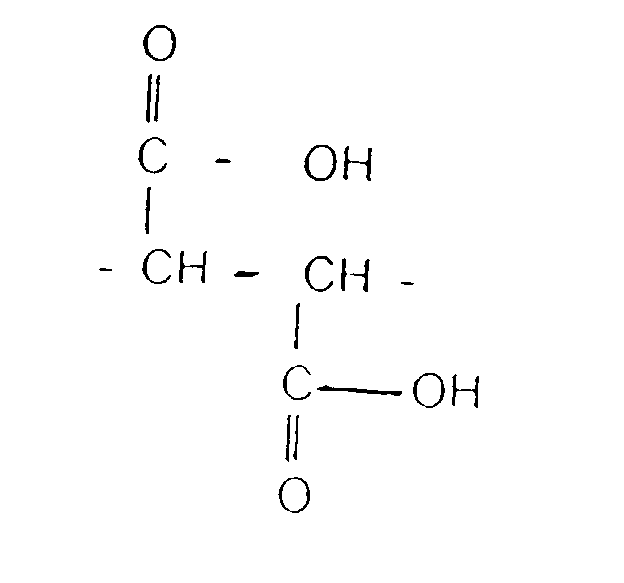




 or
or and X may be

- The invention also provides an antiphospholipase compound having no active hydroxy group of the formula:wherein X2 is a divalent organic moiety which includes at least one acidic group and R3 and R4 are selected independently from:
 and wherein Y' is - O - or - NH -.
- In preferred embodiments X2 is:and wherein Z1 is - O -, - S -, - CH2 - or - NH -.

- As yet a further alternative, the compound of the invention may have the formulawherein X is a divalent organic radical which includes an active acid group, the R groups may be the same or different and each R may be
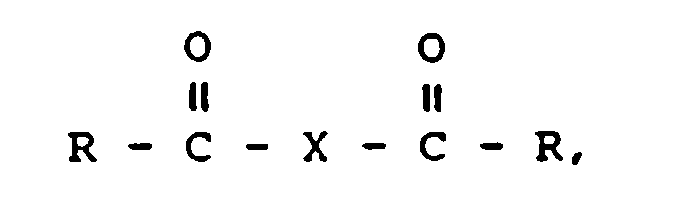 wherein Y is - O - or - NH -, and X may be
 and wherein Z is - O -, -S-, - CH2 - or - NH -.
- The invention further provides an antioxidant, antiphospholipase compound having no active hydroxy group of the formula:wherein A1 is an organic or inorganic anionic moiety; wherein Q1 is -CH2 - O - R5, hydrogen or a C1 to C4 aliphatic group; and wherein R1, R2 and R5 may be the same or different and each is a fatty moiety of sixteen to twenty carbon atoms and at least one cis-unsaturated double bond.
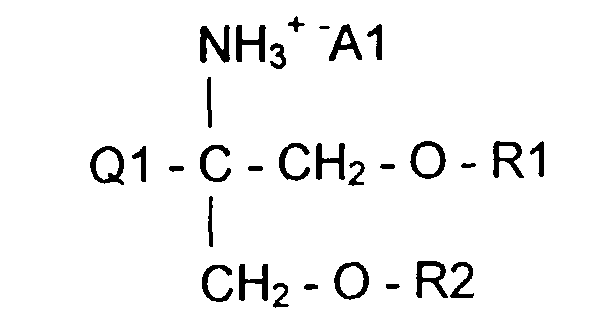
- In preferred compounds R1, R2 and R5 are selected independently from:


 or
or

- In other preferred compounds A1 is an anion of p-toluene sulfonic acid.
- The invention also provides an antioxidant, antiphospholipase compound having no active hydroxy group of the formula:wherein each of R1, R2 and R5 is a fatty moiety of sixteen to twenty carbon atoms and at least one cis-unsaturated double bond, Z2 is a C1 to C5 aliphatic organic radical and A2 is an organic acid moiety.

- In preferred compounds R1, R2 and R5 are selected independently from:


 or
or

- In other preferred compounds Z is - (CH2)n -, and n is 1 to 5, preferably 2, optionally A2 is a carboxyl or sulfonyl, preferably a carboxyl group.
- In one preferred embodiment n is 2 and A2 is a sulfonyl group.
- A particularly preferred compound is:

- In other preferred embodiments n is 2 and A2 is a sulfonyl group, or wherein Z2 is:and A2 is a carboxyl group.

- The invention further provides an antioxidant, antiphospholipase compound having no active hydroxy group of the formula:wherein each of R1, R2 and R5 is a fatty moiety and Z2 is a C1 to C5 aliphatic organic radical.
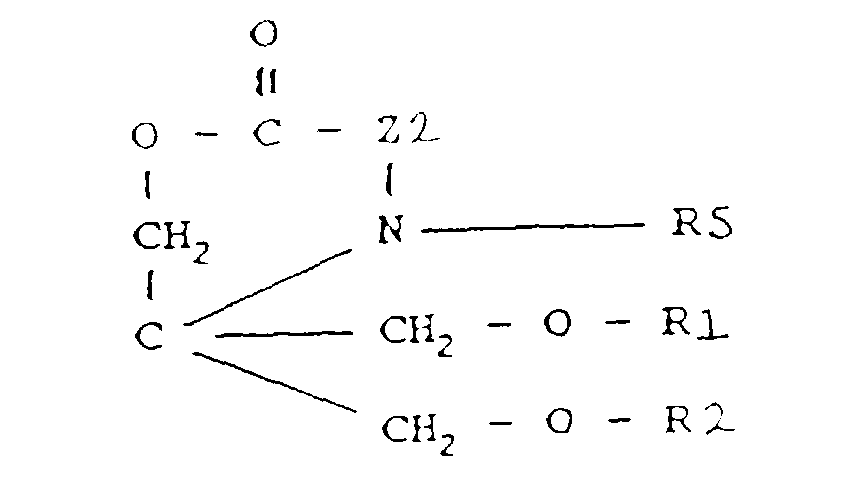
- In preferred compounds R1, R2 and R5 are selected independently from:


 or
or

- The invention also provides an antioxidant, antiphospholipase compound having no active hydroxyl group of the formula:wherein each of R1, R2 and R5 is a fatty moiety and Z2 is a C1 to C5 aliphatic organic radical.

- Preferably R1, R2 and R5 are selected independently from:


 or
or

- The invention further provides an antioxidant, antiphospholipase compound having no active hydroxy group of the formula:wherein A3 is a C1 - C7 aliphatic group, Q2 is Z'- R6, a C1 - C4 alkyl group, a nitro group, an amino group, a carboxylic acid group, a sulfonic acid group, or hydrogen, Z3, Z4, Z5 and Z' are the same or different and each is - O - or - NH -, and each of R1, R2, R5 and R6 is a fatty moiety having from sixteen to twenty carbon atoms and at least one cis-unsaturated double bond.
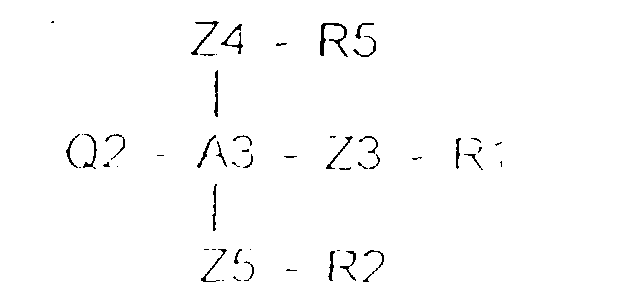
- Preferably the compound has the formula:R1, R2, R5 and R6 may be selected independently from:



 or
or

- The invention also includes a compound as hereinbefore defined for use as a pharmaceutical.
- The invention provides a therapeutic formulation comprising a compound as hereinbefore defined for use in the treatment of phospholipase mediated injury and/or inflammation.
- The invention further provides a formulation comprising a compound as hereinbefore defined and a carrier, preferably said formulation being in the form of an ointment, lotion or aerosol.
- The invention also includes a process for the preparation of a formulation for the treatment of phospholipase mediated injury and/or inflammation, comprising formulating a compound as hereinbefore defined to provide a dosage thereof of from about 5 to about 100 mg/kg.
- The invention provides for the use of a compound as hereinbefore defined for the manufacture of a medicament for the treatment of phospholipase mediated injury and/or inflammation.
- Figures 4 through 7 illustrate structural configurations and reaction schemes for preparing various embodiments of the novel cytoprotective, pharmacologically antioxidant, anti-phospholipase active compounds of the invention.
- In previous work by Ballou and Cheng (Proc. Natl. Acad. Sci. 80: 5203-5207, 1983, IBID 82: 371-375, 1985) and Marki and Franson (Biochem. Biophys. Acta 879:149-156, 1986) it has been reported that cis-unsaturated, but not saturated fatty acids, inhibit in vitro PLA2 activities derived from human platelets and human polymorphonuclear leucocytes (PMNs). PLA2 activity has been shown to be inhibited by oleic, linoleic, and arachidonic acids to approximately the same extent indicating that the presence of a single cis-double bond is as inhibitory as multiple cis-double bonds. In contrast, neither fatty acids containing trans-double bonds nor methyl esters of cis-unsaturated fatty acids are inhibitory of PLA2 activity. Thus, it has been hypothesized that the preferred structural characteristics for inhibition of in vitro PLA2 activity by unesterified fatty acids include at least one cis-double bond. As was illustrated above, oleic acid inhibits in vitro PLA2 activity due to the presence of a single cis-double bond at the C-9 position. However, recent studies have demonstrated that hydroxylation at the C-12 carbon atom to produce 12-hydroxy-oleic acid (ricinoleic acid) eliminates the inhibitory activity. Thus, despite the fact that the cis-double bond is intact, this hydroxylation substitution converts an inhibitory fatty acid to a non-inhibitory fatty acid. In fact, ricinoleic acid is a potent inflammatory agent and is used as such in experimental models or as an effective ingredient of caster oil's cathartic action.
- In support of this, a similar change occurs with arachidonic acid, a 20 carbon fatty acid with 4 cis-double bonds. This compound is an inhibitory cis-polyunsaturated fatty acid which is converted to prostaglandin B1 (PGB1) via the cyclo oxygenase pathway. The product PGB1 is markedly less inhibitory than the precursor arachidonic acid (by at least 2 orders of magnitude) presumably because it has acquired a hydroxyl group.
- Based on the above, it is evident that oxidative reactions can neutralize the PLA2 inhibitory effect of cis-unsaturated fatty acids. In fact, hydroxylation can make these fatty acids pro-inflammatory. Of physiologic and pharmacologic importance to this, data has been presented in the '330 application identified above to show that pro-oxidation of the sarcoplasmic reticulum of muscle predisposes the tissue to phospholipase degradation. The oxidation of phospholipid membranes enhances the vulnerability of cell membranes to phospholipase degradation. Phospholipid membranes that have been oxidized at particular sites may appear intact and maintain functional activity, but their oxidation makes them vulnerable to degradation and destruction by PLA2 or other phospholipases, from endogenous or exogenous sources.
- The reversal of PLAT inhibition by radical-mediated oxidation of cis-unsaturated fatty acids may be an important means by which in situ PLA2s are activated to mediate tissue inflammation, differentiation, and cell death. In support of this, it has been determined that arachidonic acid binds directly to purified PLA2 from snake venom. Moreover, when the arachidonic acid is peroxidized by exposure to air at 37°C the arachidonic acid remains bound to the isolated PLA2 but no longer inhibits in vitro PLA2 activity. These results are the focus of the discovery of the fact that cellular PLA2s are fatty acid binding proteins, and when the bound fatty acid is cis-unsaturated, the PLA2 will be inhibited. Furthermore, when cis-unsaturated fatty acids are oxidized, PLA2 enzymic activity is restored, thereby increasing the level of "effective" enzyme. The net result when fatty acids are oxidized is an apparent activation of PLA2 to induce membrane injury, inflammation, cytotoxicity and cell death. This shift from inactive to active form of PLA2 signals the onset of the loss of phospholipid membrane structure.
- In related studies, Jung et al. (Biochem. Biophys. Res. Commun. 130:559-566, 1985) have shown that the specific hydroxylation of carbon 15, but not carbon 5 or 12, of arachidonic acid esterified at the 2-position of phosphatidylcholine, increased pancreatic PLA2 mediated hydrolysis of the phospholipid by 170%. Thus, oxidative reactions of cis-unsaturated fatty acids not only "activate" PLA2 enzyme function by altering inhibitory fatty acids, but also can increase the susceptibility of the substrate phospholipid to hydrolysis induced by the enzyme.
- The observations illustrating the enhanced vulnerability of phospholipid membranes to phospholipase following oxidative and radical mediated changes in cell membranes and/or cis-fatty acids have been employed in accordance with the present invention in the design of novel anti-inflammatory and cytoprotective agents. The invention thus provides a biochemical and synthetic organic approach to controlling the expression of PLA2 enzymes and is vital to the maintenance of membrane structure.
- It is important to the understanding of the present disclosure to recognize that the number of available methylene interrupted cis-unsaturated double bonds is directly related to the susceptibility of fatty acids to oxidation. This governs the ability of cis-unsaturated fatty acids to act as anti-oxidants. This property, in conjunction with the anti-PLA2 activity of the fatty moiety compounds of the invention, markedly expands the scope of the anti-inflammatory and cytoprotective activity of the new agents disclosed herein. It is the property of the dual action of these compounds, i.e., their action as PLA2 inhibitors and their combined anti-oxidant activity, that provides the spectrum of anti-inflammatory activity in model systems that have direct applicability to cytoprotection and the control of inflammation and pathophysiology.
- In summary, a single cis-double bond in a fatty moiety compound is sufficient to inhibit PLA2 activity in vitro and in situ. The addition of multiple double bonds provides the additional value of an increase in potent anti-oxidant activity along with PLA2 inhibitory action. The present invention thus provides compounds characterized by both anti-PLA2 and anti-oxidant activity to thereby maximize the anti-inflammatory and cytoprotective action which is the key to the clinical value of the compounds of the invention.
- In addition to inhibiting PLA2 activity, the anti-oxidant action of these compounds protects proteins that become increasingly vunerable to attack by proteases due to oxidation. Thus, the cytoprotective PLA2 inhibitors of the invention, which have anti-oxidant activity as well, have value both in stabilizing membrane phospholipid and in inhibiting or preventing protein degradation or denaturation.
- In accordance with the invention, the cytoprotective anti-inflammatory compounds:
- (1) bind to the PLA2 enzyme;
- (2) are capable of being continuously hydroxylated to remove the inhibitory action and activate the enzyme without removal of the component from its PLA2 binding site;
- (3) are compounds containing fatty moieties which may have a free acid function or at least are preferably ionizable for water solubility and enhanced PLA2 inhibition;
- (4) include cis-double bonds in the fatty moieties to obtain the best PLA2 inhibition; and
- (5) possess anti-inflammatory activity as a result of inhibiting free radical activity.
-
- As reported in the cross-referenced patent applications identified above, prior studies have shown that polymers of PGB1, but not the monomer PGB1 itself, provide broad protection in a wide range of cell and tissue injury models. In contrast to the present disclosure, no basic mechanism underlying this generalized protective effect was identified. But it was clear from these previous studies that polymers or oligomers were more effective than monomers and that a free carboxyl function in the polymer may be desirable for optimum protective activity.
- In recent studies it has been determined that polymers of PGB1 inhibit a broad range of Ca++-dependent PLA2s, including snake, bee, and scorpion venom, and human PLA2s derived from synovial fluid, PMNs, platelets, plasma, sperm, endometrium, and herniated discs. At 10 µM concentrations, PGB1 (monomer) was not inhibitory while the dimer had 1/2 the maximal inhibitory activity. The inhibitory activity of the trimer is less than that of tetramer while the activity of the latter is equal to that of PGBx. Thus, polymerization of prostaglandin B1, a metabolite of the cis-polyunsaturated fatty acid arachidonate, generates inhibitors of PLA2s.
- Similarly, as reported in the cross-referenced applications, polymers of PGB1 are equally effective at inhibiting the release of arachidonic acid and platelet activating factor from prelabelled human PMNs and endothelial cells which are reactions critical to the inflammatory response of these cells and which are mediated by endogenous PLA2 activity.
- Of particular relevance to the present disclosure, is the fact that polymers of PGB1 also have potent anti-oxidant activity. Arachidonic acid, as noted above, contains 4 cis-unsaturated, methylene interrupted, double bonds which are particularly susceptible to oxidation. When arachidonic acid is converted to prostaglandin B1 by cyclo-oxygenase, an enzyme mediated oxygenation, two of the four original cis-double bonds are retained. These bonds remain in a methylene-interrupted configuration, which is the optimal orientation for their oxidation.
- The compounds of the present invention block arachidonic acid release from human PMNs and endothelial cells, a reaction mediated by cellular PLA2 activity. Thus, the compounds of the invention are potent, reversible enzyme-targeted PLA2 inhibitors, and as such these agents inhibit the pro-inflammatory response of the human PMN and other inflammatory cells by inhibition of cellular PLA2 activity. In addition, the compounds of the invention inhibit free radical activity in cells and tissue involved in the inflammatory process.
- The compounds of the invention also are effective anti-oxidants. Oxidation of phospholipid and arachidonic acid is inhibited in a dose-dependent manner. This property not only protects membranes from radical mediated injury to stabilize function, but also prevents the preferential hydrolysis of oxidized phospholipid by cellular phospholipases. These results suggest that the compounds of the invention act to minimize inflammation at its onset and will also interrupt the process in progress.
- The ability of cis-unsaturated fatty moiety compounds to prevent oxidation of proteins will also suppress the expression of cell proteases by maintaining levels of endogenous protease inhibitors. These inhibitors, such as α-1-anti-trypsin, are major components of plasma and their inhibitory activity is abolished by free radical mediated oxidation of -SH groups. The anti-oxidant activity of the cis-unsaturated fatty moiety compounds of the present invention stabilizes α-1-anti-trypsin via the anti-oxidant action. Thus, the anti-oxidant activity of cis-unsaturated fatty moiety compounds regulates the expression of both lipolytic and proteolytic enzymes (i.e., elastase) by preventing the oxidation of both substrate and endogenous inhibitors.
- The 12-hydroxylation of oleic acid yields ricinoleic acid. Thus, an inhibitory fatty acid is converted into a non-inhibitory hydroxylated derivative. However, the -OH moiety can be used to generate inhibitory compounds. The hydroxylated derivatives thus provide building block precursors for the synthesis of active cytoprotective agents with PLA2 inhibiting activity. Indeed, when ricinoleate is polymerized by heat in sulfuric acid, the crude unfractionated product inhibits in vitro and in situ PLA2 activity.
- In effect, the inactive non-inhibiting monomers are converted to extremely active PLA2 inhibitors. Moreover, active pro-inflammatory mediators are converted structurally to provide anti-inflammatory compounds.
- PLA2 inhibitors such as derivatives of ricinoleic acid that do not have significant anti-oxidant activity have limited anti-inflammatory effect. The presence of the unsaturated bonds of the cis-unsaturated fatty moiety compounds enhances the anti-inflammatory activity. This indicates that inflammatory reactions may vary in their characteristics wherein some inflammatory response can be inhibited or attenuated by PLA2 inhibition alone, while other reactions require anti-oxidant activity along with PLA2 inhibition. Thus, in accordance with the invention, to obtain broad spectrum anti-inflammatory action, the dual action of anti-PLA2 and anti-oxidant activity is preferred. Polyunsaturated compounds constructed from unsaturated fatty acids and other unsaturated fatty compounds provide potent anti-oxidant activity as well as anti-PLA2 action.
- In a general sense, the invention provides pharmacologically active, antiphospholipase compounds that are chemically defined and purifiable. Preferably the compounds of the invention are water soluble antioxidants. From a functional viewpoint, the preferred compounds have at least two fatty moieties and no active hydroxy group. Each fatty moiety should preferably have sixteen to twenty carbon atoms and at least one cis-unsaturated double bond. The compounds may also have at least one active acid group. In one preferred form, the compound may be a derivative of ricinoleic acid having a structural configuration as set forth in Figure 1 of the drawings where R1 is an alkoxy group which includes an active acid group and R2 is an alkoxy group which includes one of the fatty moieties. In one case the R1 moiety may be obtained by esterification of the 12-position hydroxy group of ricinoleic acid with an acid group of a divalent acid such as sebacic acid, fumaric acid, maleic acid, oxalic acid or succinic acid, and the R2 moiety may be obtained by esterification of the 1-position carboxy group of ricinoleic acid with the hydroxyl group of another ricinoleic acid molecule or of some other cis-unsaturated fatty alcohol such as, for example, oleyl alcohol, linoleyl alcohol, linolenyl alcohol, arachidonyl alcohol or cis-5, 8, 11, 14, 17-eicosapentaenoyl alcohol. Alternatively, the R2 moiety may be obtained by amidification of the 1-position carboxy group of ricinoleic acid with the amine group of a cis-unsaturated fatty amine such as oleyl amine, linoleyl amine, linclenyl amine, arachidonyl amine or cis-5, 8, 11, 14, 17-eicosapentaenoyl amine. Thus, for example, R2 may be a moiety having one of the following configurations:wherein Y may be - O - or - NH -.

- In accordance with another embodiment of the invention, the structural configuration of the compound may be
- Wherein X is a divalent organic moiety which may include at least one active acid group and the groups R1 and R2 may be the same or different and each may, for example, be one of the following moieties:




 or
or

- In this form of the invention, X may be derived by esterification of the hydroxy group of tartaric acid whereby X will have the following structural configuration:

- An appropriate reaction scheme for this procedure is illustrated in Figure 5. Eachmoiety in the Figure 5 compound is represented by an R1 group in the compound

- In yet another alternative form, the compounds of the invention may have the structurewherein X is a divalent organic moiety which may include an active acid group and the R1 groups, which may be the same or different, may, for example, be one of the following moieties:
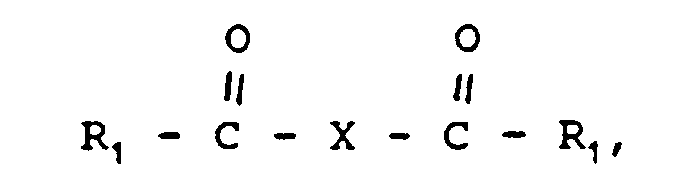 wherein Y is - O - or - NH -.
- In this embodiment, X may bewherein Z may be - O -, - S -, - CH2 - or - NH -. The compounds of this embodiment may be prepared using a reaction scheme as illustrated in Figure 4 where the produced compound is shown as having carboxyl groups at the 2 and 3 positions of the ring. However, as will be appreciated by those skilled in the art, the reaction scheme of Figure 4 may be conducted so as to provide any one of several isomeric compounds, i.e., with the carboxyl groups at the 2 and 3 positions as shown or alternatively with the carboxyl groups at the 1 and 2 positions, at the 1 and 3 positions or at the 1 and 4 positions. Each R - Y - moiety in the Figure 4 compound is represented by an R1 group in the compound

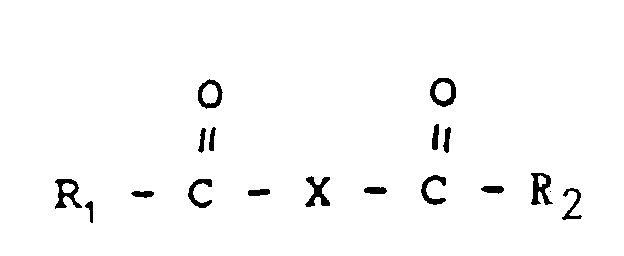
- The invention contemplates a variety of configurations including, for example, dimers, trimers and tetramers. Dimers are illustrated in Figures 1, 2, 4 and 5, trimers are illustrated in Figures 1 and 3 and tetramers are illustrated in Figures 6 and 7.
- With reference to Figure 6, the compounds produced in accordance with Figure 5 may be linked together by esterification through one of the free acid groups. Thus, the acid groups may be converted to acid chloride groups and reacted with hydroxy or amine groups of a divalent compound having the form
- The reaction scheme illustrated in Figure 7 may employ any one of the isomeric compounds that may be formed in accordance with the reaction scheme of Figure 4 as discussed above. Thus, the free acid groups of one of the Figure 4 isomeric compounds are converted to the acid chloride or anhydride and esterified with the hydroxy or amino groups of a bivalent organic moiety.
- In each case, the compounds of the invention include at least two cis-unsaturated C16 - C20 straight chain fatty moieties and have no active hydroxy group. Desirably, each compound may also include at least one active acid group.
- The novel water soluble and/or lipid soluble pharmacologically active, pure or purifiable antioxidant, antiphospholipase compounds provided in accordance with principles and concepts of the invention may be prepared as outlined in the following specific examples.
- In addition to the foregoing compounds additional compounds are included within the broad scope of the invention. Some of these compounds are defined structurally by the following generic formula:wherein A1 is an organic or inorganic anionic moiety; wherein Q1 is - CH2 - O - R5, a hydrogen molecule or a C1 to C4 aliphatic group; and wherein the groups R1, R2 and R5 may be the same or different and each is a fatty moiety.

- In this form of the invention the R groups may have one of the following structural formulations:


 or
or

- A method for preparing a particularly preferred compound having the foregoing structural configuration is described in Example I .
- 0.54 g (4.4 mmoles) of tris(hydroxymethyl)aminomethane (Tris, Aldrich), 5.0 g (17.7 mmoles) of oleic acid (Aldrich), and 1.26 g (6.6 mmoles) of p-toluenesulfonic acid monohydrate (Sigma) are mixed in 50 ml of toluene and placed in a 100 ml round-bottomed single-necked flask equipped with a Dean-Stark trap and a Teflon-coated magnetic stirring bar. After bubbling the reaction mixture with N2 gas for 10 minutes, the reaction mixture is heated to reflux. The reaction is continued until a stoichiometric amount of water is recovered (0.38 ml). After removal of a small amount of undissolved material by filtration, the toluene is removed by rotoevaporation to yield a white waxy product. This product is purified on a silica gel column (Aldrich 230-400 mesh, 2.0 x 55 cm) with 8:2 petroleum ether (bp 60-90°C) - ethyl acetate as developing solvent. After eluting with developing solvent the top uncolored layer is carefully removed and the product is extracted with ethyl acetate from the silica gel. The solvent is removed by rotoevaporation and the product is recovered as a p-toluene sulfonic acid salt of tris trioleate having the following structural configuration:In this procedure, the amine group of the Tris is protected from reacting with the fatty acid because it is in the form of a p-toluene sulfonate salt. Moreover, the p-toluene sulfonic acid acts as a catalyst for the esterification between the alcohol functions on the Tris and the fatty acid.

- Another class of compounds within the generic scope of the invention has the following general structural formulation:wherein each of R1, R2 and R5 is a fatty moiety, wherein Z2 may be a divalent C1 to C5 aliphatic organic radical, and wherein A2 may be an organic acid moiety. In this case also the R groups may have structural formulations as set forth in the preceding paragraph. Preferably Z2 may be - (CH2)n - (wherein n is 1 to 5),
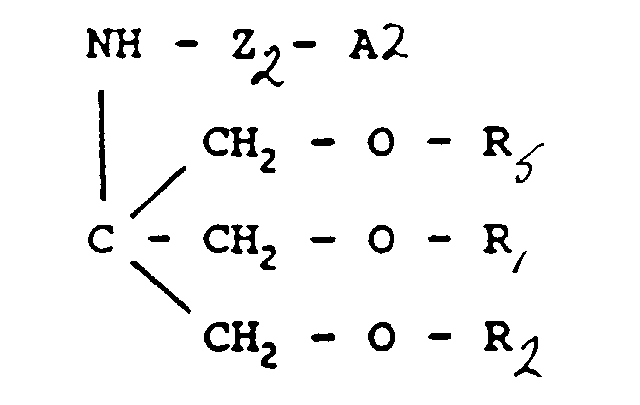 and A may be a carboxyl group or a sulfonyl group. Methods for preparing compounds within this group of compounds are set forth in Examples II and III below.
- To a 250 ml single-neck, round-bottom flask is added 1.0 g (4.36 mmoles) of 2-[tris(hydroxylmethyl)-methylamino]-1-ethanesulfonic acid (TES; Aldrich; 99% purity) and 25.0 ml of anhydrous dimethyl formamide (DMF). The flask contents are then cooled to 0°C in an ice-water bath. 5.25 g (17.45 mmoles) of oleoyl chloride (Aldrich, technical grade) is added dropwise over a 5 minute period. The reaction mixture is stirred at room temperature from 4 days. The DMF is removed by distillation at 40-45°C under reduced pressure. The residue is a viscous oil which is transferred to a flask containing 200 ml acetone and vigorously stirred until a slightly cloudy solution is formed. This solution is refrigerated overnight. The precipitate formed is collected by filtration and washed with distilled acetone (20 ml) five times. The product is dried in vacuo at room temperature for 24 h (2.32 g, 52%) and has the following structural configuration:

- 2.0 g (1.96 mmoles) of tris trioleate is dissolved in 10 ml of anhydrous CH2Cl2 in a 50 ml single-neck round-bottom flask. The solution is cooled to 0°C in an ice-water bath and 0.42 g (1.96 mmoles) of CH3ONa (Aldrich, 25% by weight in CH3OH) is added dropwise under vigorous stirring. After 30 minutes the solvents are removed by rotoevaporation and the residue dried in vacuo at room temperature for 24 hours. To this material, 10 ml of freshly distilled CH2Cl2 and 0.37 g (3.90 mmoles) of recrystallized maleic anhydride is added. The reaction mixture is stirred at room temperature for 24 hours. The methylene chloride is removed by rotoevaporation and the viscous oil obtained is transferred to a 250 ml beaker containing 100 ml acetone and 5 ml of H2O. This is vigorously stirred until a clear solution forms. The solution is refrigerated overnight and until a viscous material forms at the bottom of the beaker. The upper layer is recovered and the acetone rotoevaporated. The residue is stirred with 10 ml CHCl3 for 15 minutes and the insoluble material is removed by filtration. The CHCl3 is removed by rotoevaporation and the residual oil is then similarly treated with benzene to further remove impurities. The final product is a waxy-like material (0.82 gm 37%) having the following structural configuration:

- Yet another group of compounds within the generic scope of the invention may be described by the following generic structural configurationwherein each of R1, R2 and R5 is a fatty moiety and Z2 is a C1 to C5 aliphatic organic radical. In this form of the invention the groups R1, R2 and R5 are selected from.
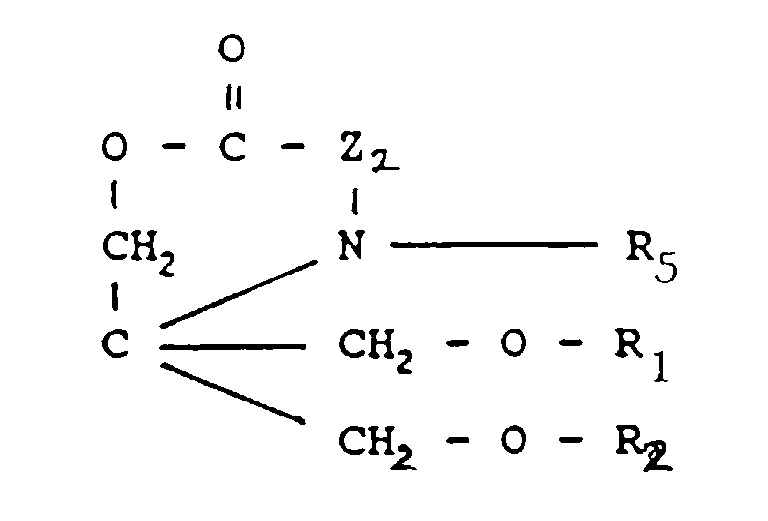


 or
or

- A method for preparing a compound within this group of compounds is set forth in Example IV below.
- 0.67 g (3.75 mmoles) of N-[tris(hydroxymethyl)methyl]glycine (Tricine; Aldrich) is suspended in 15 ml of anhydrous DMF and placed in a 100 ml round-bottom single-necked flask equipped with a Teflon-coated magnetic stirring bar. The suspension is cooled to 0°C in an ice-water bath, and 5.6 g (18.75 mmoles) of oleoyl chloride is added dropwise. A solution containing 15 ml of anhydrous CH2Cl2 and 2.7 g (22.5 mmoles) of 4-dimethylaminopyridine is added to the reaction mixture and the resultant admixture is warmed to room temperature, and stirred for 22 hours. The admixture is filtered and the solvents are removed under reduced pressure. 200 ml of ethyl acetate is added to the residue and insoluble material is removed by filtration. The filtrate is washed with 100 ml portions of 5% NaHCO3 aqueous solution (saturated with NaCl) three times. The ethyl acetate layer is dried over magnesium sulfate, and then the ethyl acetate is rotoevaporation to yield a crude product which is then purified by chromatography using a silica gel column (Aldrich, 230-400 mesh, 2.0 x 55 cm) and 8:2 petroleum ether (bp 60-90°C)-ethyl acetate as developing solvent. The fractions containing the product are combined and the solvent is evaporated. The product, which may be referred to as an amide-diester lactone, shows only one spot on TLC, Rf 0.44 (Aldrich pre-coated silica gel LC sheet: 8:2 petroleum etherethyl acetate) and has the following structural configuration:
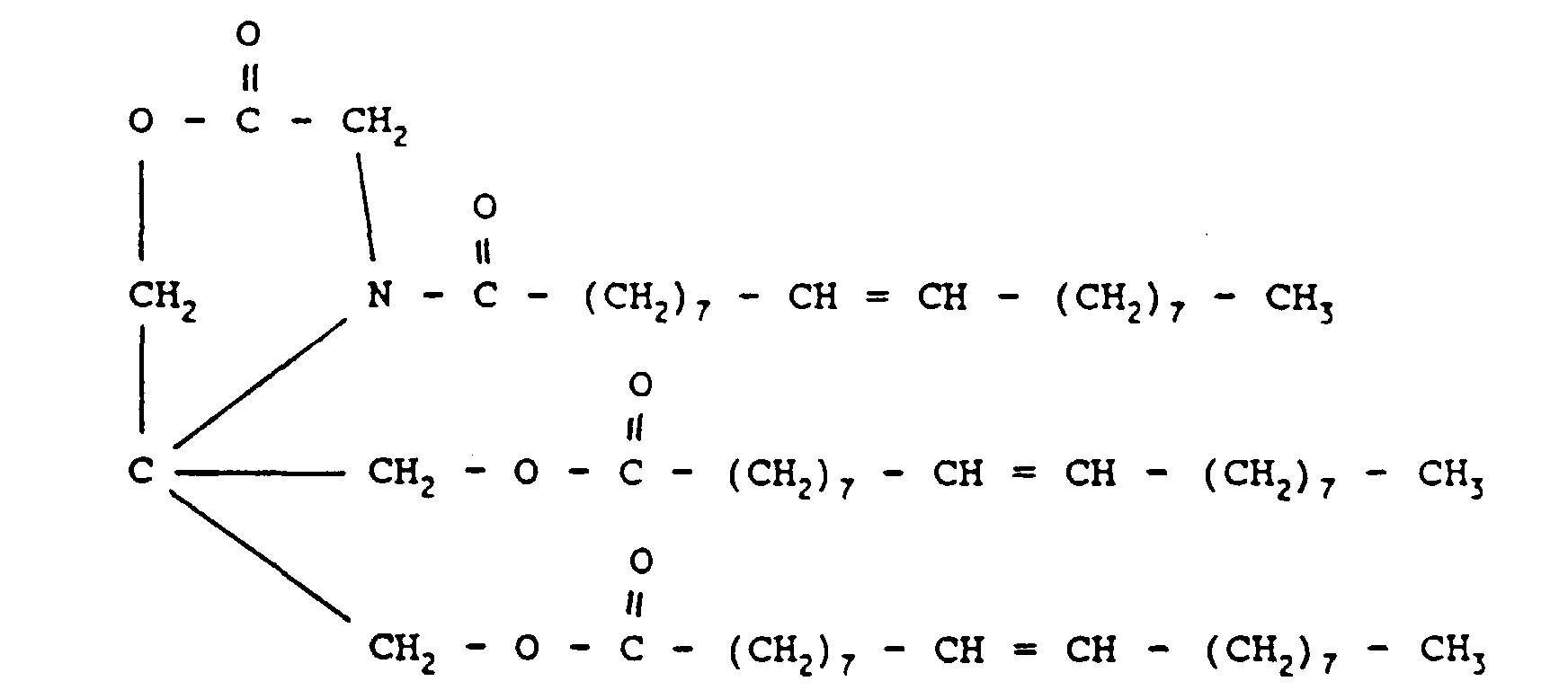
- If the foregoing product is contacted with NaOH during sample preparation, the ring opens to present an amide diester hydroxy acid compound having the following structural configuration:
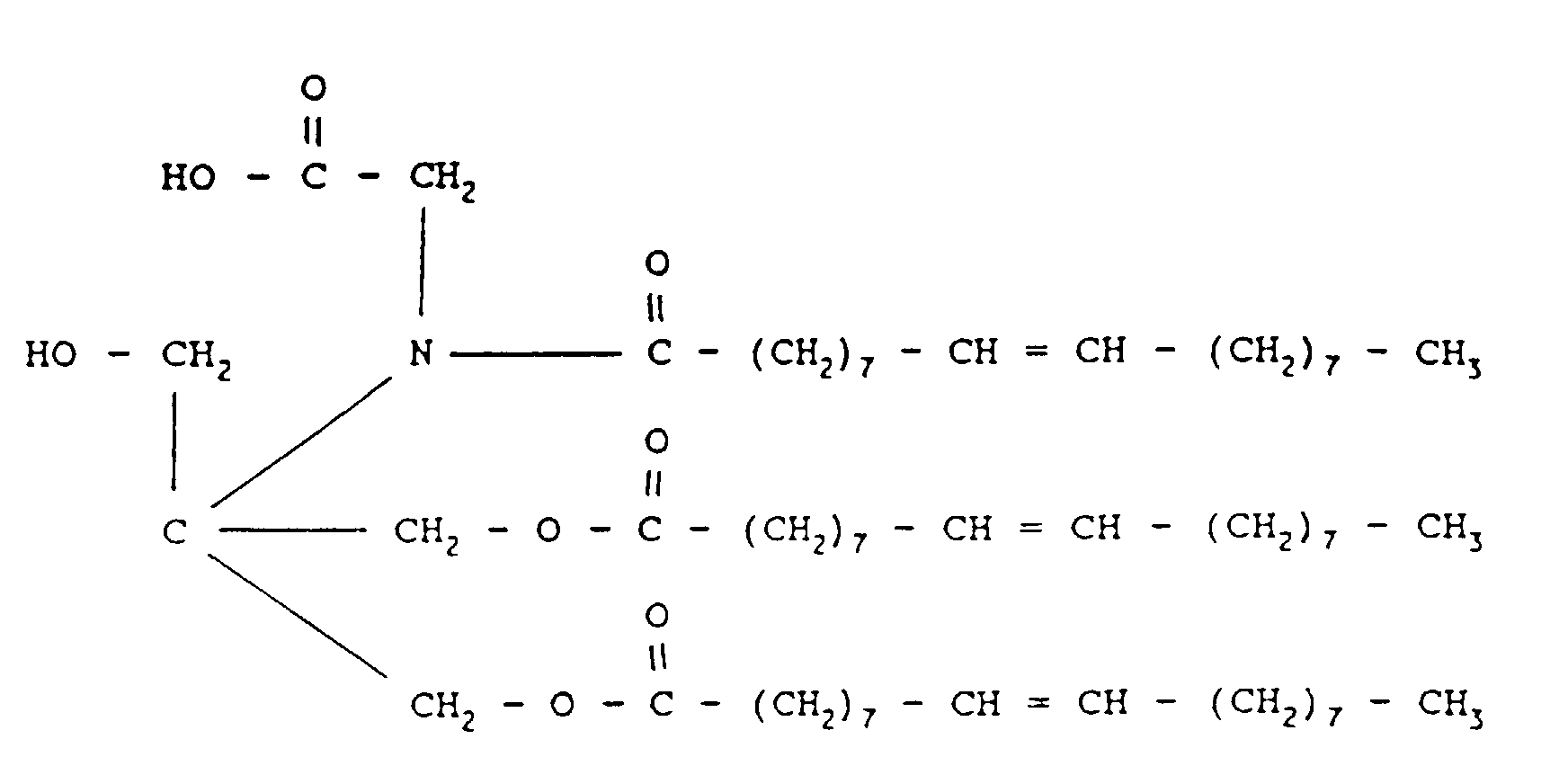
- Still another group of compounds which embody the concepts and principles of the invention may be described by the general formula:Wherein A3 is a C1 - C7 aliphatic group, Q2 may be - Z' - R6, a C1 - C4 alkyl group, a nitro group, an amino group, a carboxylic acid group, a sulfonic acid group, or a hydrogen atom, the groups Z3, Z4, Z5 and Z' which may be the same or different, are - O - or - NH -, and each of R1, R2, R5 and R6 are fatty moieties as described above.
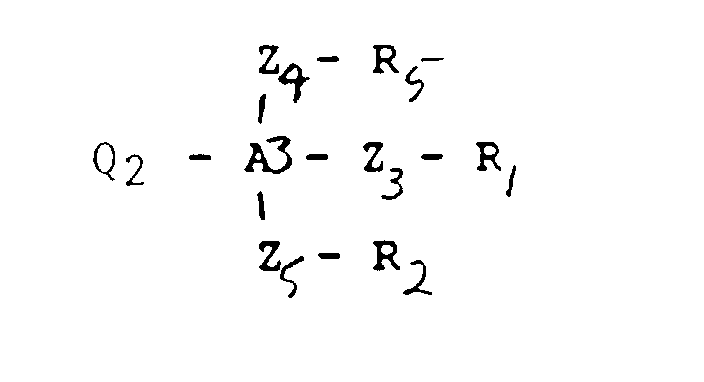
- Other compounds in the foregoing class of compounds may be represented by the following subgeneric structural formulas:
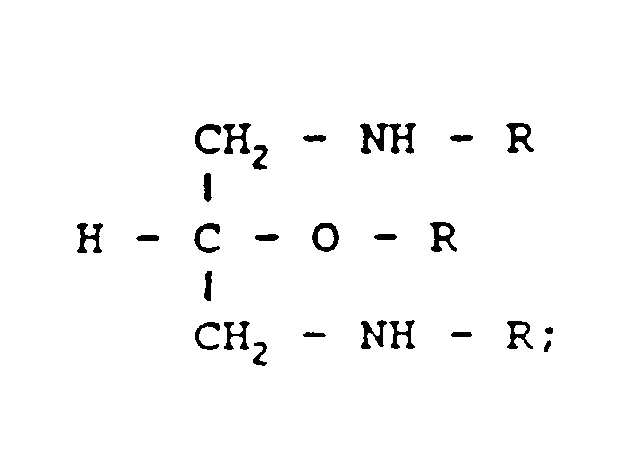
- As can be appreciated, the compounds in this class may be prepared from multivalent hydroxides and amides by esterification and/or amidification using an appropriate fatty acid compound. Suitable starting materials include 2-amino-2-hydroxymethyl-1-hydroxybutane; 1,3-diamino-2-hydroxypropane; 1,3 dihydroxy-2-amino-2-hydroxymethylpropane; and 1,3 dihydroxy-2,2-dihydroxymethylpropane. One shortcoming of the compounds of this class is their relative lack of solubility in water. However, suitable dose forms may be prepared utilizing DMSO as a solvent.
- A procedure for preparing a specific compound in this class is set forth in Example V
- In a 1 liter reaction flask, 20 g (0.22 mole) of 1,3 diamino-2-hydroxypropane are dissolved in 500 ml of CH2Cl2 containing 88.1 g (0.72 mole) dimethylaminopyridine. The solution is cooled in an ice bath while 213.6 g (0.71 mole) of oleoyl chloride (70%, Aldrich) is added with stirring over a 2 hour period. The reaction mixture is then stirred at room temperature for 70 hour. The precipitated salts are removed by filtration and the solvent is removed by rotoevaporation. The residual oil is dissolved in 600 ml of ethyl acetate and the insoluble material is removed by filtration. The ethyl acetate is washed with a saturated NaCl/H2O solution (3 times). The non-aqueous solution is dried over anhydrous MgSO4, filtered, and the solvent removed by rotoevaporation. The oil obtained is washed with 250 ml of methanol (4 times). The residue is taken up in 800 ml of ethyl acetate treated with 15 g of charcoal and filtered. The solution is passed through a silica gel column (3.0 x 10 cm) and the recovered solution is concentrated to yield a viscous light yellow oil (141.6 g). TLC gave one spot and the structure is verified by IR, H and 13C NMR. The structural configuration is as follows:

- The relative abilities of some of the compounds described above to perform as anti-oxidants and as anti-PLA2 agents is illustrated below in TABLE 6 wherein the polymers compared are as follows:
- PX-1
- (PGBx)
- PX-9
- (tartrate/linoleate/linoleate dimer)
- PX-10
- (tartrate/oleate/oleate dimer)
- PX-11
- (EXAMPLE IV trimer)
- PX-12
- (EXAMPLE I trimer)
- PX-13
- (EXAMPLE II trimer)
- PX-14
- (tris trilinoleate trimer)
- PX-15
- (tricine trilinoleate trimer)
- The terms monomer, dimer and trimer in the foregoing list and as used throughout the present description define the number of C16 to C20 fatty moieties present in the particular molecule. That is to say, a monomer has one such fatty moiety, a dimer has two, a trimer has three, etc.
Comparative Table: Fatty Moiety Polymers (PX) Compound Compound IC-50 Anti-Oxidant Activity IC-50 Anti-PLA2 Activity PX-1 40 uM 1-5 uM PX-9 100 uM 7.5 uM PX-10 60 uM 7.0 uM PX-11 145 uM 2.6 uM PX-12 50 uM 1.5 uM PX-13 60 uM 2.2 uM PX-14 70 uM 4.4 uM PX-15 nd 19.2 uM - The polymers (dimers, trimers, tetramers, etc.) of cis-unsaturated fatty acids and the other compounds having at least two cis-unsaturated straight chain fatty radicals, as described above, affect fundamental membrane phospholipid reactions of phospholipase-induced degradation and free radical peroxidation. The discovery of these dual properties, anti-phospholipase and anti-oxidant activities of these compounds establishes a sound scientific basis for the molecular action thereof in protecting the cell and its membrane from injury. The data set forth above confirms, with experimental results, that these compounds are potent anti-inflammatory and cytoprotective agents.
- The appropriate dosage of the cis-unsaturated fatty moiety compounds of the invention for treatment of mammals, including humans, against phospholipase mediated injury and/or inflammation should be in the range of from about 10 to about 100 mg per kg (mg/kg) of body weight when the compound is administered orally or intraperitoneally (IP). When administered intravenously, the dosage should be approximately 50% of the oral or IP dosage to achieve the same level of the drug in the blood stream. In this regard, it should be noted that a lethal dose may be in the range of about 100 to about 400 mg/kg in small mammals and the administered dose should thus be well below that level. The described dosage should also be appropriate for prevention of human platelet aggregation or blood thinning. As is known to those skilled in the art, therapeutic doses expressed in terms of amounts per kilogram of body weight or surface area may be extrapolated from mammal to mammal, including to human beings.
- The compounds of the present invention are particularly useful when applied topically to a wound. In this regard, the compounds may be incorporated into conventional ointment, lotion or aerosol formulations. Ointments may be prepared by incorporating 0.1 to 10% of the compound as an oil or sodium salt into an ointment base containing emulsifying agents such as stearic acid, triethanolamine and/or cetyl alcohol, the formulation may also include ingredients such as glycerol, water and preservatives as required.
- Water based lotions may contain the compounds of the invention as an oil or as a sodium salt in amounts ranging from 0.1 to 5.0% by volume. Such lotions may contain glycerine and/or bentonite as suspending agents as is well known in the art.
- The compounds may also be incorporated into classical (one or two phase) or non-classical (aqueous emulsion) aerosol formulations. Such formulations include the compounds and an appropriate propellant carrier in which the compounds are dissolved or dispensed. In the classical form the active ingredients are generally used as an oil dispersion or in solution in an organic solvent such as ethanol. In the non-classical form the active ingredient is dissolved in water. In each case the concentration of the active ingredient in the carrier may be about 0.1 to 10% by weight or volume.
- The compounds of the invention may also be highly useful in the form of gauze bandages which have been coated or impregnated with a solution or dispersion of the active material.
- Of particular advantage is the fact that the cis-unsaturated straight chain fatty moiety compounds described above function pharmacologically at the site of inhibitory action for the arachidonate cascade, and preferentially effect stimulus-induced mobilization of arachidonate. Inhibition of PLA2 depresses the production of both prostaglandins and leukotrienes in stimulated or inflamed cells. Importantly, the polymers described above have a much more pronounced effect on stimulus-induced, than on controlled release of arachidonate indicating a selective effect on the former. Moreover, when phospholipids are peroxidized, the polymer compounds described above are capable of inhibiting the degradation of such lipids by lysosomal phospholipase C, indicating that these compounds can protect already damaged (oxidized) membranes.
- Thus, multiple actions are responsible for the anti-inflammatory activity of the fatty moiety compounds of the invention, and on the basis of inflammatory models, it is evident that these compounds can effectively rival or replace both currently available steroids and NSAIAs in the treatment of inflammation, making the polymerized cis-unsaturated straight chain fatty moiety compounds of the invention candidates for clinical application and usefulness in localized and systemic injury and disease.
- The fact that production of the prostaglandin, thromboxane, from free arachidonic acid is required for platelet function indicates that the unsaturated fatty moiety polymers described above should affect the platelet aggregation release reaction.
- PLA2 is present at widely different levels in a variety of human cells and fluids tested. Inflammation is associated with a significant rise in extracellular phospholipases, and the polymers of cis-unsaturated fatty moieties described above have the ability to inhibit these enzymes.
- Phospholipases are released from pathogenic invading organisms and the polymers described above act by inhibiting the action of these membrane-destructive enzymes produced by pathogens of bacterial, protozoal, viral, Rickettsial, helminthic and fungal origin. The action of the compounds of the invention in preventing inflammation or tissue injury is manifested by inhibition of PLA2 at its source from infecting organisms or inhibition by blocking host responses to infection or injury.
- In addition, there is evidence that tumor metastases or invasion is associated with endogenous activity on the part of malignant cells and the expression of phospholipases and their inhibition can play a role in the control of differentiation and functional integrity as well as the processes of carcinogenesis and aging. In the latter case, the polymers of unsaturated fatty moieties described above prolong life in animal models and minimize membrane alterations in living organisms produced by carcinogens (mutagens) and photo-oxidizers which are radiation-like in their cell damaging activity.
- The polymers of unsaturated fatty moieties described above, by protecting lipid membranes and possessing anti-oxidant activity, are potent anti-oxidants for preservation, not only of living cells and tissues, but their action makes them effective as a preservatives of food, tissue and chemical agents subject to oxidative injury. For purposes of protecting and preserving food subject to oxidation injury, the fatty moiety compounds of the invention may be used at concentrations of approximately 0.1 to 100 µM. These molarities are calculated as the molarity that would be obtained if the drug were dissolved in a weight of water which is the same as the weight of the food stuff to be preserved. For example, in vitro, anti-oxidant and/or anti-phospholipase applications, concentrations of from about 0.1 to about 500 µM should be effective.
- The essence of the action of the polymers of cis-unsaturated straight chain fatty moieties described above is the role they play in resisting injury and permitting repair to phospholipid/protein membranes. They also play a protective role in the stabilization of proteins. These compounds clearly are cytoprotective agents which protect the cell membrane from toxic, pathogenic, or age mediated events in the cellular or supportive environment. In final analysis, the minimal dose of the unsaturated fatty moiety compounds of the invention depends upon-empirical considerations for relief from phospholipase mediated injury and/or inflammation or to accomplish the desired cytoprotective function. The maximum dose depends principally on the necessity of avoidance of undesired side-effects and lethal doses.
Claims (26)
- An antioxidant, antiphospholipase compound having no active hydroxy group of the formula:



 or
or

- A compound as claimed in claim 1, wherein X1 is:

- An antioxidant, antiphospholipase compound having no active hydroxy group of the formula:wherein X2 is a divalent organic moiety which includes at least one acidic group and R3 and R4 are selected independently from:
 and wherein Y' is - O - or - NH -.
- A compound as claimed in claim 3, wherein X2 is:and wherein Z1 is - O -, - S -, - CH2 - or - NH -.

- An antioxidant, antiphospholipase compound having no active hydroxy group of the formula:wherein A1 is an organic or inorganic anionic moiety; wherein Q1 is -CH2 - O - R5, hydrogen or a C1 to C4 aliphatic group; and wherein R1, R2 and R5 may be the same or different and each is a fatty moiety of sixteen to twenty carbon atoms and at least one cis-unsaturated double bond.
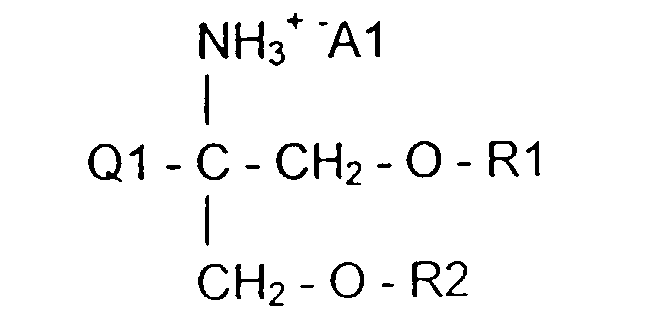
- A compound as claimed in claim 5, wherein R1, R2 and R5 are selected independently from:


 or
or

- An antioxidant, antiphospholipase compound as claimed in claim 6, wherein A1 is an anion of p-toluene sulfonic acid.
- An antioxidant, antiphospholipase compound having no active hydroxy group of the formula:wherein each of R1, R2 and R5 is a fatty moiety of sixteen to twenty carbon atoms and at least one cis-unsaturated double bond, Z2 is a C1 to C5 aliphatic organic radical and A2 is an organic acid moiety.

- A compound as claimed in claim 8, wherein R1, R2 and R5 are selected independently from:


 or
or

- A compound as claimed in claim 9, wherein Z is - (CH2)n -, and n is 1 to 5, preferably 2.
- A compound as claimed in any of claims 8 to 10, wherein A2 is a carboxyl or sulfonyl, preferably a carboxyl group.
- A compound as claimed in claim 10, wherein n is 2 and A is a sulfonyl group.
- A compound as claimed in claim 12, of the formula:

- A compound as claimed in any of claims 8 to 10, wherein n is 2 and A2 is a sulfonyl group, or wherein Z2 is:and A2 is a carboxyl group.

- An antioxidant, antiphospholipase compound having no active hydroxy group of the formula:wherein each of R1, R2 and R5 is a fatty moiety and Z2 is a C1 to C5 aliphatic organic radical.
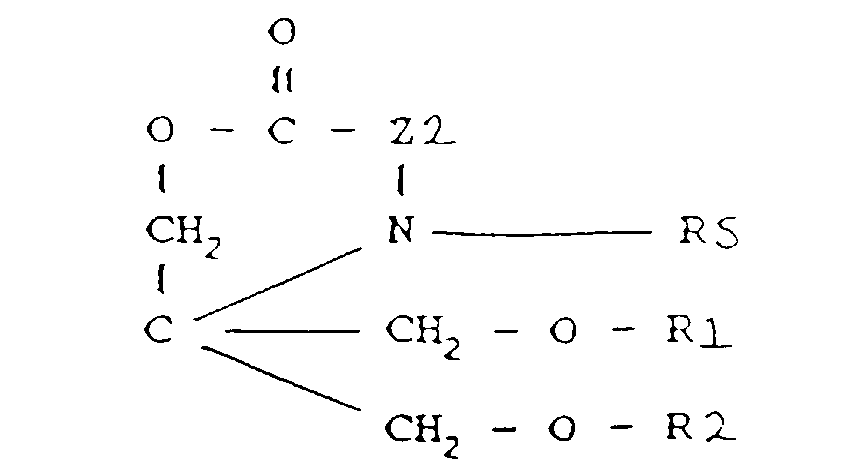
- A compound as claimed in claim 15, wherein R1, R2 and R5 are selected independently from:


 or
or

- An antioxidant, antiphospholipase compound having no active hydroxyl group of the formula:wherein each of R1, R2 and R5 is a fatty moiety and Z2 is a C1 to C5 aliphatic organic radical.
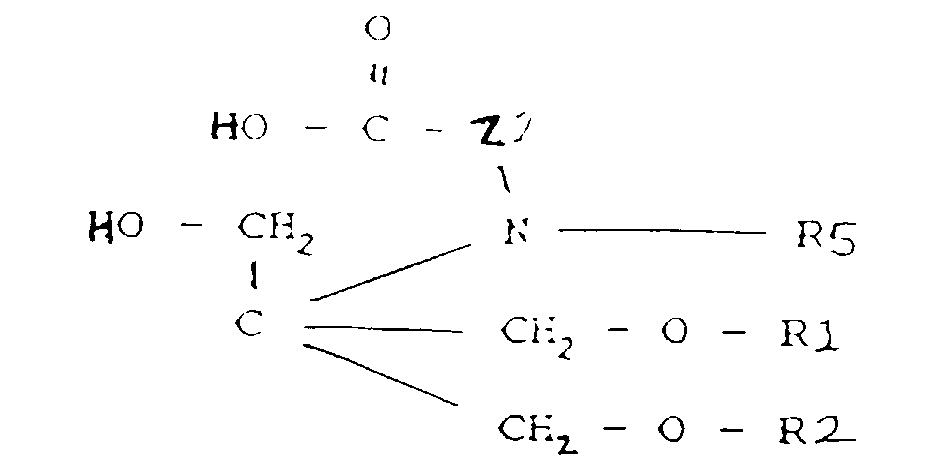
- A compound as claimed in claim 17, wherein R1, R2 and R5 are selected independently from:


 or
or

- An antioxidant, antiphospholipase compound having no active hydroxy group of the formula:wherein A3 is a C1 - C7 aliphatic group, Q2 is Z - R6, a C1 - C4 alkyl group, a nitro group, an amino group, a carboxylic acid group, a sulfonic acid group, or hydrogen, Z3, Z4, Z5 and Z' are the same or different and each is - O - or - NH- , and each of R1, R2, R5 and R6 is a fatty moiety having from sixteen to twenty carbon atoms and at least one cis-unsaturated double bond.
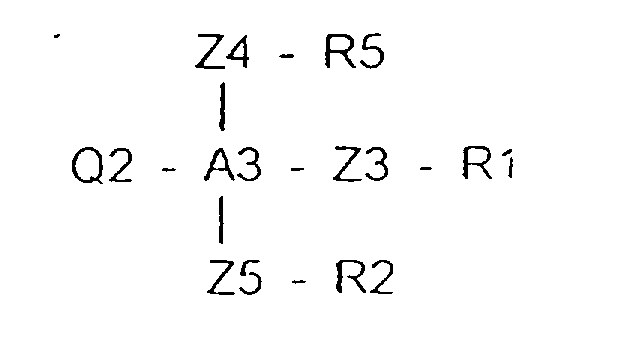
- A compound as claimed in claim 19 of the formula:
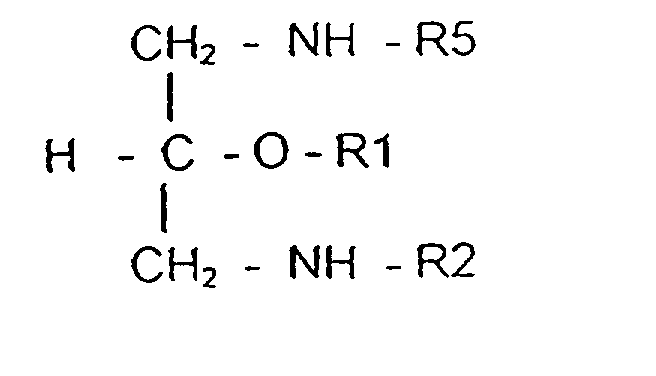
- A compound as claimed in claim 19 or claim 20, wherein R1, R2, R5 and R6 are selected independently from:


 or
or

- A compound as defined in any one of claims 1 to 21 for use as a pharmaceutical.
- A therapeutic formulation comprising a compound as defined in any one of claims 1 to 21 for use in the treatment of phospholipase mediated injury and/or inflammation.
- A formulation comprising a compound as defined in any one of claims 1 to 21 and a carrier, preferably said formulation being in the form of an ointment, lotion or aerosol.
- A process for the preparation of a formulation for the treatment of phospholipase mediated injury and/or inflammation, comprising formulating a compound as defined in any one of claims 1 to 21 to provide a dosage thereof of from about 5 to about 100 mg/kg.
- The use of a compound as defined in any one of claims 1 to 21 for the manufacture of a medicament for the treatment of phospholipase mediated injury and/or inflammation.
Applications Claiming Priority (3)
| Application Number | Priority Date | Filing Date | Title |
|---|---|---|---|
| US39994189A | 1989-08-29 | 1989-08-29 | |
| US399941 | 1989-08-29 | ||
| PCT/US1990/004615 WO1991003512A1 (en) | 1989-08-29 | 1990-08-16 | Cytoprotective fatty moiety compounds |
Publications (3)
| Publication Number | Publication Date |
|---|---|
| EP0490919A1 EP0490919A1 (en) | 1992-06-24 |
| EP0490919A4 EP0490919A4 (en) | 1993-04-21 |
| EP0490919B1 true EP0490919B1 (en) | 2001-01-17 |
Family
ID=23581561
Family Applications (1)
| Application Number | Title | Priority Date | Filing Date |
|---|---|---|---|
| EP90912813A Expired - Lifetime EP0490919B1 (en) | 1989-08-29 | 1990-08-16 | Cytoprotective compounds bearing unsaturated hydrocarbon groups having 16 to 20 carbon atoms |
Country Status (6)
| Country | Link |
|---|---|
| EP (1) | EP0490919B1 (en) |
| JP (1) | JP3096303B2 (en) |
| AT (1) | ATE198757T1 (en) |
| CA (1) | CA2064783C (en) |
| DE (1) | DE69033693T2 (en) |
| WO (1) | WO1991003512A1 (en) |
Families Citing this family (9)
| Publication number | Priority date | Publication date | Assignee | Title |
|---|---|---|---|---|
| US5659049A (en) * | 1988-02-18 | 1997-08-19 | Virginia Commonwealth University | Antioxidant, antiphospholipase derivatives of ricinoleic acid |
| US5583198A (en) * | 1989-12-22 | 1996-12-10 | Commonwealth Scientific And Industrial Research Organization | Amino acids, peptides or derivatives thereof coupled to fats |
| GB2279948A (en) * | 1993-05-07 | 1995-01-18 | Unilever Plc | Ricinoleic acid derivative |
| US5473103A (en) * | 1993-12-16 | 1995-12-05 | Yissum Research Development Co. Of The Hebrew University Of Jerusalem | Biopolymers derived from hydrolyzable diacid fats |
| AU1820995A (en) * | 1995-01-18 | 1996-08-07 | Yissum Research Development Company Of The Hebrew University Of Jerusalem | Biopolymers derived from hydrolyzable diacid fats |
| US5859271A (en) | 1996-04-15 | 1999-01-12 | Virginia Commonwealth University | Cytoprotective compounds |
| IT1295658B1 (en) * | 1997-09-29 | 1999-05-24 | Menarini Ricerche Spa | PHARMACEUTICAL COMPOSITIONS CONTAINING RICINOLEIC ACID AND THEIR USE FOR ANTI-FLAMMATORY AND ANALGESIC THERAPY |
| US10167253B2 (en) | 2015-06-24 | 2019-01-01 | Nitto Denko Corporation | Ionizable compounds and compositions and uses thereof |
| KR20230092914A (en) * | 2020-09-23 | 2023-06-26 | 트랜슬레이트 바이오 인코포레이티드 | TES-based cationic lipids |
Family Cites Families (3)
| Publication number | Priority date | Publication date | Assignee | Title |
|---|---|---|---|---|
| US4153808A (en) * | 1973-12-28 | 1979-05-08 | Polis B David | Novel prostaglandin derivatives, certain in vivo and in vitro effects thereof and processes for the preparation of same |
| US4245111A (en) * | 1979-04-02 | 1981-01-13 | The United States Of America As Represented By The Secretary Of The Navy | Method of preparing prostaglandin B1 derivatives |
| WO1988006445A1 (en) * | 1987-02-24 | 1988-09-07 | William Regelson | Prostaglandin b1, macromolecules as anti-inflammatory agents |
-
1990
- 1990-08-16 AT AT90912813T patent/ATE198757T1/en not_active IP Right Cessation
- 1990-08-16 CA CA002064783A patent/CA2064783C/en not_active Expired - Fee Related
- 1990-08-16 JP JP02512254A patent/JP3096303B2/en not_active Expired - Fee Related
- 1990-08-16 DE DE69033693T patent/DE69033693T2/en not_active Expired - Fee Related
- 1990-08-16 EP EP90912813A patent/EP0490919B1/en not_active Expired - Lifetime
- 1990-08-16 WO PCT/US1990/004615 patent/WO1991003512A1/en not_active Ceased
Also Published As
| Publication number | Publication date |
|---|---|
| AU6289390A (en) | 1991-04-08 |
| DE69033693D1 (en) | 2001-02-22 |
| CA2064783C (en) | 2002-12-17 |
| ATE198757T1 (en) | 2001-02-15 |
| WO1991003512A1 (en) | 1991-03-21 |
| EP0490919A1 (en) | 1992-06-24 |
| JP3096303B2 (en) | 2000-10-10 |
| EP0490919A4 (en) | 1993-04-21 |
| CA2064783A1 (en) | 1991-03-01 |
| DE69033693T2 (en) | 2001-08-23 |
| AU653709B2 (en) | 1994-10-13 |
| JPH05502015A (en) | 1993-04-15 |
Similar Documents
| Publication | Publication Date | Title |
|---|---|---|
| FI119474B (en) | Esters and amides of non-steroidal anti-inflammatory carboxylic acids which can be used as antioxidants, 5-lipoxygenase inhibitors and non-steroidal anti-inflammatory products | |
| US5262439A (en) | Soluble analogs of probucol | |
| US6020510A (en) | Cytoprotective compounds | |
| EP0476682B1 (en) | Isoprenoid phospholipase A2 inhibitors and preparations comprising same | |
| US6020489A (en) | Cytoprotective fatty moiety compounds | |
| CA2064783C (en) | Cytoprotective fatty moiety compounds | |
| US6147114A (en) | Highly water-soluble metalloproteinase inhibitors | |
| US5690957A (en) | Prostaglandin derivatives | |
| AU653709C (en) | Cytoprotective fatty moiety compounds | |
| EP0751928B1 (en) | Dl- di- or tri-hydroxyphenylglycine alkyl esters for the treatment of inflammatory and allergic conditions | |
| CA2252084C (en) | Cytoprotective compounds | |
| EP1299400B1 (en) | Novel cytotoxic compounds and their use | |
| FR2850969A1 (en) | New acylated aminopropane diols and their analogs, useful in the treatment of cerebral vascular disorders especially cerebral ischemia and cerebral vascular accidents | |
| KR100378481B1 (en) | Esters and amides of non-steroidal anti-inflammatory carboxylic acids which may be used as anti-oxidants, 5-lipoxygenase inhibitors and non-steroidal anti-inflammatory products |
Legal Events
| Date | Code | Title | Description |
|---|---|---|---|
| PUAI | Public reference made under article 153(3) epc to a published international application that has entered the european phase |
Free format text: ORIGINAL CODE: 0009012 |
|
| 17P | Request for examination filed |
Effective date: 19920326 |
|
| AK | Designated contracting states |
Kind code of ref document: A1 Designated state(s): AT BE CH DE DK ES FR GB IT LI LU NL SE |
|
| A4 | Supplementary search report drawn up and despatched |
Effective date: 19930303 |
|
| AK | Designated contracting states |
Kind code of ref document: A4 Designated state(s): AT BE CH DE DK ES FR GB IT LI LU NL SE |
|
| 17Q | First examination report despatched |
Effective date: 19950713 |
|
| RIN1 | Information on inventor provided before grant (corrected) |
Inventor name: OTTENBRITE, RAPHAEL, M. Inventor name: FRANSON, RICHARD, C. |
|
| GRAG | Despatch of communication of intention to grant |
Free format text: ORIGINAL CODE: EPIDOS AGRA |
|
| GRAG | Despatch of communication of intention to grant |
Free format text: ORIGINAL CODE: EPIDOS AGRA |
|
| GRAG | Despatch of communication of intention to grant |
Free format text: ORIGINAL CODE: EPIDOS AGRA |
|
| GRAH | Despatch of communication of intention to grant a patent |
Free format text: ORIGINAL CODE: EPIDOS IGRA |
|
| GRAH | Despatch of communication of intention to grant a patent |
Free format text: ORIGINAL CODE: EPIDOS IGRA |
|
| GRAA | (expected) grant |
Free format text: ORIGINAL CODE: 0009210 |
|
| AK | Designated contracting states |
Kind code of ref document: B1 Designated state(s): AT BE CH DE DK ES FR GB IT LI LU NL SE |
|
| PG25 | Lapsed in a contracting state [announced via postgrant information from national office to epo] |
Ref country code: IT Free format text: LAPSE BECAUSE OF FAILURE TO SUBMIT A TRANSLATION OF THE DESCRIPTION OR TO PAY THE FEE WITHIN THE PRE;WARNING: LAPSES OF ITALIAN PATENTS WITH EFFECTIVE DATE BEFORE 2007 MAY HAVE OCCURRED AT ANY TIME BEFORE 2007. THE CORRECT EFFECTIVE DATE MAY BE DIFFERENT FROM THE ONE RECORDED.SCRIBED TIME-LIMIT Effective date: 20010117 Ref country code: NL Free format text: LAPSE BECAUSE OF FAILURE TO SUBMIT A TRANSLATION OF THE DESCRIPTION OR TO PAY THE FEE WITHIN THE PRESCRIBED TIME-LIMIT Effective date: 20010117 Ref country code: ES Free format text: THE PATENT HAS BEEN ANNULLED BY A DECISION OF A NATIONAL AUTHORITY Effective date: 20010117 Ref country code: SE Free format text: THE PATENT HAS BEEN ANNULLED BY A DECISION OF A NATIONAL AUTHORITY Effective date: 20010117 Ref country code: AT Free format text: LAPSE BECAUSE OF FAILURE TO SUBMIT A TRANSLATION OF THE DESCRIPTION OR TO PAY THE FEE WITHIN THE PRESCRIBED TIME-LIMIT Effective date: 20010117 Ref country code: BE Free format text: LAPSE BECAUSE OF FAILURE TO SUBMIT A TRANSLATION OF THE DESCRIPTION OR TO PAY THE FEE WITHIN THE PRESCRIBED TIME-LIMIT Effective date: 20010117 |
|
| REF | Corresponds to: |
Ref document number: 198757 Country of ref document: AT Date of ref document: 20010215 Kind code of ref document: T |
|
| REG | Reference to a national code |
Ref country code: CH Ref legal event code: EP |
|
| REF | Corresponds to: |
Ref document number: 69033693 Country of ref document: DE Date of ref document: 20010222 |
|
| PG25 | Lapsed in a contracting state [announced via postgrant information from national office to epo] |
Ref country code: DK Free format text: LAPSE BECAUSE OF FAILURE TO SUBMIT A TRANSLATION OF THE DESCRIPTION OR TO PAY THE FEE WITHIN THE PRESCRIBED TIME-LIMIT Effective date: 20010417 |
|
| REG | Reference to a national code |
Ref country code: CH Ref legal event code: NV Representative=s name: KIRKER & CIE SA |
|
| ET | Fr: translation filed | ||
| NLV1 | Nl: lapsed or annulled due to failure to fulfill the requirements of art. 29p and 29m of the patents act | ||
| PG25 | Lapsed in a contracting state [announced via postgrant information from national office to epo] |
Ref country code: LU Free format text: LAPSE BECAUSE OF NON-PAYMENT OF DUE FEES Effective date: 20010816 |
|
| PLBE | No opposition filed within time limit |
Free format text: ORIGINAL CODE: 0009261 |
|
| STAA | Information on the status of an ep patent application or granted ep patent |
Free format text: STATUS: NO OPPOSITION FILED WITHIN TIME LIMIT |
|
| REG | Reference to a national code |
Ref country code: GB Ref legal event code: IF02 |
|
| 26N | No opposition filed | ||
| PGFP | Annual fee paid to national office [announced via postgrant information from national office to epo] |
Ref country code: GB Payment date: 20020815 Year of fee payment: 13 |
|
| PGFP | Annual fee paid to national office [announced via postgrant information from national office to epo] |
Ref country code: DE Payment date: 20020824 Year of fee payment: 13 |
|
| PGFP | Annual fee paid to national office [announced via postgrant information from national office to epo] |
Ref country code: FR Payment date: 20020828 Year of fee payment: 13 |
|
| PGFP | Annual fee paid to national office [announced via postgrant information from national office to epo] |
Ref country code: CH Payment date: 20021107 Year of fee payment: 13 |
|
| PG25 | Lapsed in a contracting state [announced via postgrant information from national office to epo] |
Ref country code: GB Free format text: LAPSE BECAUSE OF NON-PAYMENT OF DUE FEES Effective date: 20030816 |
|
| PG25 | Lapsed in a contracting state [announced via postgrant information from national office to epo] |
Ref country code: CH Free format text: LAPSE BECAUSE OF NON-PAYMENT OF DUE FEES Effective date: 20030831 Ref country code: LI Free format text: LAPSE BECAUSE OF NON-PAYMENT OF DUE FEES Effective date: 20030831 |
|
| PG25 | Lapsed in a contracting state [announced via postgrant information from national office to epo] |
Ref country code: DE Free format text: LAPSE BECAUSE OF NON-PAYMENT OF DUE FEES Effective date: 20040302 |
|
| GBPC | Gb: european patent ceased through non-payment of renewal fee |
Effective date: 20030816 |
|
| REG | Reference to a national code |
Ref country code: CH Ref legal event code: PL |
|
| PG25 | Lapsed in a contracting state [announced via postgrant information from national office to epo] |
Ref country code: FR Free format text: LAPSE BECAUSE OF NON-PAYMENT OF DUE FEES Effective date: 20040430 |
|
| REG | Reference to a national code |
Ref country code: FR Ref legal event code: ST |