EP0489756B1 - Process for the preparation of halogenated 2,2-bis(trifluoromethyl)-1,3-dioxolanes - Google Patents
Process for the preparation of halogenated 2,2-bis(trifluoromethyl)-1,3-dioxolanes Download PDFInfo
- Publication number
- EP0489756B1 EP0489756B1 EP90911888A EP90911888A EP0489756B1 EP 0489756 B1 EP0489756 B1 EP 0489756B1 EP 90911888 A EP90911888 A EP 90911888A EP 90911888 A EP90911888 A EP 90911888A EP 0489756 B1 EP0489756 B1 EP 0489756B1
- Authority
- EP
- European Patent Office
- Prior art keywords
- perhaloalkyl
- bis
- dioxolane
- catalyst
- process according
- Prior art date
- Legal status (The legal status is an assumption and is not a legal conclusion. Google has not performed a legal analysis and makes no representation as to the accuracy of the status listed.)
- Expired - Lifetime
Links
- 238000000034 method Methods 0.000 title claims abstract description 44
- 238000002360 preparation method Methods 0.000 title claims description 12
- PQNNUQKDERZMPQ-UHFFFAOYSA-N 2,2-bis(trifluoromethyl)-1,3-dioxolane Chemical class FC(F)(F)C1(C(F)(F)F)OCCO1 PQNNUQKDERZMPQ-UHFFFAOYSA-N 0.000 title description 13
- 239000003054 catalyst Substances 0.000 claims abstract description 47
- QDOXWKRWXJOMAK-UHFFFAOYSA-N dichromium trioxide Chemical compound O=[Cr]O[Cr]=O QDOXWKRWXJOMAK-UHFFFAOYSA-N 0.000 claims abstract description 26
- 229910052731 fluorine Inorganic materials 0.000 claims abstract description 25
- 238000004519 manufacturing process Methods 0.000 claims abstract description 22
- 229910052801 chlorine Inorganic materials 0.000 claims abstract description 16
- 229910052742 iron Inorganic materials 0.000 claims abstract description 15
- 229910052759 nickel Inorganic materials 0.000 claims abstract description 15
- 229910052746 lanthanum Inorganic materials 0.000 claims abstract description 14
- 229910052718 tin Inorganic materials 0.000 claims abstract description 14
- 229910052725 zinc Inorganic materials 0.000 claims abstract description 11
- 229910052802 copper Inorganic materials 0.000 claims abstract description 10
- 238000003682 fluorination reaction Methods 0.000 claims description 24
- 229910052799 carbon Inorganic materials 0.000 claims description 21
- 238000005660 chlorination reaction Methods 0.000 claims description 21
- XKTYXVDYIKIYJP-UHFFFAOYSA-N 3h-dioxole Chemical compound C1OOC=C1 XKTYXVDYIKIYJP-UHFFFAOYSA-N 0.000 claims description 18
- 239000000460 chlorine Substances 0.000 claims description 17
- 238000006243 chemical reaction Methods 0.000 claims description 12
- 150000001875 compounds Chemical class 0.000 claims description 11
- 125000001153 fluoro group Chemical group F* 0.000 claims description 11
- ABADUMLIAZCWJD-UHFFFAOYSA-N 1,3-dioxole Chemical compound C1OC=CO1 ABADUMLIAZCWJD-UHFFFAOYSA-N 0.000 claims description 10
- 239000000203 mixture Substances 0.000 claims description 10
- BFKJFAAPBSQJPD-UHFFFAOYSA-N tetrafluoroethene Chemical group FC(F)=C(F)F BFKJFAAPBSQJPD-UHFFFAOYSA-N 0.000 claims description 10
- 229920000642 polymer Polymers 0.000 claims description 9
- DYLIWHYUXAJDOJ-OWOJBTEDSA-N (e)-4-(6-aminopurin-9-yl)but-2-en-1-ol Chemical compound NC1=NC=NC2=C1N=CN2C\C=C\CO DYLIWHYUXAJDOJ-OWOJBTEDSA-N 0.000 claims description 8
- OKTJSMMVPCPJKN-UHFFFAOYSA-N Carbon Chemical compound [C] OKTJSMMVPCPJKN-UHFFFAOYSA-N 0.000 claims description 8
- 229910052804 chromium Inorganic materials 0.000 claims description 8
- 239000011737 fluorine Substances 0.000 claims description 7
- 239000000178 monomer Substances 0.000 claims description 7
- BQCIDUSAKPWEOX-UHFFFAOYSA-N 1,1-Difluoroethene Chemical compound FC(F)=C BQCIDUSAKPWEOX-UHFFFAOYSA-N 0.000 claims description 6
- 229910021592 Copper(II) chloride Inorganic materials 0.000 claims description 6
- ORTQZVOHEJQUHG-UHFFFAOYSA-L copper(II) chloride Chemical group Cl[Cu]Cl ORTQZVOHEJQUHG-UHFFFAOYSA-L 0.000 claims description 6
- 229910001510 metal chloride Inorganic materials 0.000 claims description 5
- 238000007334 copolymerization reaction Methods 0.000 claims description 3
- 230000035484 reaction time Effects 0.000 claims description 3
- 150000001721 carbon Chemical group 0.000 claims 9
- ZAMOUSCENKQFHK-UHFFFAOYSA-N Chlorine atom Chemical compound [Cl] ZAMOUSCENKQFHK-UHFFFAOYSA-N 0.000 claims 2
- 229910052727 yttrium Inorganic materials 0.000 claims 2
- PXGOKWXKJXAPGV-UHFFFAOYSA-N Fluorine Chemical compound FF PXGOKWXKJXAPGV-UHFFFAOYSA-N 0.000 claims 1
- 230000002708 enhancing effect Effects 0.000 claims 1
- RSNKMTZZWVFGES-UHFFFAOYSA-N 4,4,5,5-tetrachloro-2,2-bis(trifluoromethyl)-1,3-dioxolane Chemical class FC(F)(F)C1(C(F)(F)F)OC(Cl)(Cl)C(Cl)(Cl)O1 RSNKMTZZWVFGES-UHFFFAOYSA-N 0.000 abstract description 9
- KZBUYRJDOAKODT-UHFFFAOYSA-N Chlorine Chemical compound ClCl KZBUYRJDOAKODT-UHFFFAOYSA-N 0.000 description 17
- XLYOFNOQVPJJNP-UHFFFAOYSA-N water Substances O XLYOFNOQVPJJNP-UHFFFAOYSA-N 0.000 description 14
- 229920001577 copolymer Polymers 0.000 description 12
- -1 lithium aluminum hydride Chemical compound 0.000 description 11
- 229910052751 metal Inorganic materials 0.000 description 11
- 239000002184 metal Substances 0.000 description 11
- IJGRMHOSHXDMSA-UHFFFAOYSA-N Atomic nitrogen Chemical compound N#N IJGRMHOSHXDMSA-UHFFFAOYSA-N 0.000 description 8
- 239000000047 product Substances 0.000 description 8
- PXHVJJICTQNCMI-UHFFFAOYSA-N nickel Substances [Ni] PXHVJJICTQNCMI-UHFFFAOYSA-N 0.000 description 7
- YCKRFDGAMUMZLT-UHFFFAOYSA-N Fluorine atom Chemical compound [F] YCKRFDGAMUMZLT-UHFFFAOYSA-N 0.000 description 6
- KWYUFKZDYYNOTN-UHFFFAOYSA-M Potassium hydroxide Chemical compound [OH-].[K+] KWYUFKZDYYNOTN-UHFFFAOYSA-M 0.000 description 6
- 229910001873 dinitrogen Inorganic materials 0.000 description 6
- 239000000126 substance Substances 0.000 description 6
- KRHYYFGTRYWZRS-UHFFFAOYSA-N Fluorane Chemical compound F KRHYYFGTRYWZRS-UHFFFAOYSA-N 0.000 description 5
- 239000011651 chromium Substances 0.000 description 5
- 229920001519 homopolymer Polymers 0.000 description 5
- 229910000040 hydrogen fluoride Inorganic materials 0.000 description 5
- 150000004820 halides Chemical class 0.000 description 4
- 239000005457 ice water Substances 0.000 description 4
- 239000000463 material Substances 0.000 description 4
- 239000011592 zinc chloride Substances 0.000 description 4
- 235000005074 zinc chloride Nutrition 0.000 description 4
- JIAARYAFYJHUJI-UHFFFAOYSA-L zinc dichloride Chemical compound [Cl-].[Cl-].[Zn+2] JIAARYAFYJHUJI-UHFFFAOYSA-L 0.000 description 4
- AJDIZQLSFPQPEY-UHFFFAOYSA-N 1,1,2-Trichlorotrifluoroethane Chemical compound FC(F)(Cl)C(F)(Cl)Cl AJDIZQLSFPQPEY-UHFFFAOYSA-N 0.000 description 3
- MIZLGWKEZAPEFJ-UHFFFAOYSA-N 1,1,2-trifluoroethene Chemical group FC=C(F)F MIZLGWKEZAPEFJ-UHFFFAOYSA-N 0.000 description 3
- YSYRISKCBOPJRG-UHFFFAOYSA-N 4,5-difluoro-2,2-bis(trifluoromethyl)-1,3-dioxole Chemical compound FC1=C(F)OC(C(F)(F)F)(C(F)(F)F)O1 YSYRISKCBOPJRG-UHFFFAOYSA-N 0.000 description 3
- VEXZGXHMUGYJMC-UHFFFAOYSA-N Hydrochloric acid Chemical compound Cl VEXZGXHMUGYJMC-UHFFFAOYSA-N 0.000 description 3
- 229910021578 Iron(III) chloride Inorganic materials 0.000 description 3
- 229910002249 LaCl3 Inorganic materials 0.000 description 3
- 229910021626 Tin(II) chloride Inorganic materials 0.000 description 3
- HXELGNKCCDGMMN-UHFFFAOYSA-N [F].[Cl] Chemical group [F].[Cl] HXELGNKCCDGMMN-UHFFFAOYSA-N 0.000 description 3
- 150000001805 chlorine compounds Chemical class 0.000 description 3
- UUAGAQFQZIEFAH-UHFFFAOYSA-N chlorotrifluoroethylene Chemical group FC(F)=C(F)Cl UUAGAQFQZIEFAH-UHFFFAOYSA-N 0.000 description 3
- 238000005253 cladding Methods 0.000 description 3
- 230000000694 effects Effects 0.000 description 3
- XUCNUKMRBVNAPB-UHFFFAOYSA-N fluoroethene Chemical compound FC=C XUCNUKMRBVNAPB-UHFFFAOYSA-N 0.000 description 3
- 239000007789 gas Substances 0.000 description 3
- HCDGVLDPFQMKDK-UHFFFAOYSA-N hexafluoropropylene Chemical compound FC(F)=C(F)C(F)(F)F HCDGVLDPFQMKDK-UHFFFAOYSA-N 0.000 description 3
- 239000000543 intermediate Substances 0.000 description 3
- RBTARNINKXHZNM-UHFFFAOYSA-K iron trichloride Chemical compound Cl[Fe](Cl)Cl RBTARNINKXHZNM-UHFFFAOYSA-K 0.000 description 3
- ICAKDTKJOYSXGC-UHFFFAOYSA-K lanthanum(iii) chloride Chemical compound Cl[La](Cl)Cl ICAKDTKJOYSXGC-UHFFFAOYSA-K 0.000 description 3
- 150000002739 metals Chemical class 0.000 description 3
- 125000002496 methyl group Chemical group [H]C([H])([H])* 0.000 description 3
- 239000013307 optical fiber Substances 0.000 description 3
- 239000008188 pellet Substances 0.000 description 3
- 125000002577 pseudohalo group Chemical group 0.000 description 3
- 239000011541 reaction mixture Substances 0.000 description 3
- 235000011150 stannous chloride Nutrition 0.000 description 3
- 229920001897 terpolymer Polymers 0.000 description 3
- AXZWODMDQAVCJE-UHFFFAOYSA-L tin(II) chloride (anhydrous) Chemical compound [Cl-].[Cl-].[Sn+2] AXZWODMDQAVCJE-UHFFFAOYSA-L 0.000 description 3
- 239000012808 vapor phase Substances 0.000 description 3
- QTBSBXVTEAMEQO-UHFFFAOYSA-M Acetate Chemical compound CC([O-])=O QTBSBXVTEAMEQO-UHFFFAOYSA-M 0.000 description 2
- 0 C[C@@]1C*CCC1 Chemical compound C[C@@]1C*CCC1 0.000 description 2
- 229910021580 Cobalt(II) chloride Inorganic materials 0.000 description 2
- 229910002651 NO3 Inorganic materials 0.000 description 2
- 229910000990 Ni alloy Inorganic materials 0.000 description 2
- 229910021586 Nickel(II) chloride Inorganic materials 0.000 description 2
- NHNBFGGVMKEFGY-UHFFFAOYSA-N Nitrate Chemical compound [O-][N+]([O-])=O NHNBFGGVMKEFGY-UHFFFAOYSA-N 0.000 description 2
- 239000004721 Polyphenylene oxide Substances 0.000 description 2
- XBDQKXXYIPTUBI-UHFFFAOYSA-M Propionate Chemical compound CCC([O-])=O XBDQKXXYIPTUBI-UHFFFAOYSA-M 0.000 description 2
- QAOWNCQODCNURD-UHFFFAOYSA-L Sulfate Chemical compound [O-]S([O-])(=O)=O QAOWNCQODCNURD-UHFFFAOYSA-L 0.000 description 2
- WYURNTSHIVDZCO-UHFFFAOYSA-N Tetrahydrofuran Chemical compound C1CCOC1 WYURNTSHIVDZCO-UHFFFAOYSA-N 0.000 description 2
- 150000001336 alkenes Chemical class 0.000 description 2
- VMPVEPPRYRXYNP-UHFFFAOYSA-I antimony(5+);pentachloride Chemical compound Cl[Sb](Cl)(Cl)(Cl)Cl VMPVEPPRYRXYNP-UHFFFAOYSA-I 0.000 description 2
- 230000015572 biosynthetic process Effects 0.000 description 2
- 125000004432 carbon atom Chemical group C* 0.000 description 2
- 238000000576 coating method Methods 0.000 description 2
- 238000005260 corrosion Methods 0.000 description 2
- 230000007797 corrosion Effects 0.000 description 2
- 230000003247 decreasing effect Effects 0.000 description 2
- 238000005695 dehalogenation reaction Methods 0.000 description 2
- 238000004821 distillation Methods 0.000 description 2
- 229920013728 elastomeric terpolymer Polymers 0.000 description 2
- 229920002313 fluoropolymer Polymers 0.000 description 2
- 239000004811 fluoropolymer Substances 0.000 description 2
- 238000010438 heat treatment Methods 0.000 description 2
- 239000001307 helium Substances 0.000 description 2
- 229910052734 helium Inorganic materials 0.000 description 2
- SWQJXJOGLNCZEY-UHFFFAOYSA-N helium atom Chemical compound [He] SWQJXJOGLNCZEY-UHFFFAOYSA-N 0.000 description 2
- 229910001026 inconel Inorganic materials 0.000 description 2
- 239000007788 liquid Substances 0.000 description 2
- 239000007791 liquid phase Substances 0.000 description 2
- PQIOSYKVBBWRRI-UHFFFAOYSA-N methylphosphonyl difluoride Chemical group CP(F)(F)=O PQIOSYKVBBWRRI-UHFFFAOYSA-N 0.000 description 2
- QMMRZOWCJAIUJA-UHFFFAOYSA-L nickel dichloride Chemical compound Cl[Ni]Cl QMMRZOWCJAIUJA-UHFFFAOYSA-L 0.000 description 2
- 230000003287 optical effect Effects 0.000 description 2
- 239000004033 plastic Substances 0.000 description 2
- 229920003023 plastic Polymers 0.000 description 2
- 229920000570 polyether Polymers 0.000 description 2
- 238000006116 polymerization reaction Methods 0.000 description 2
- 239000002243 precursor Substances 0.000 description 2
- 150000003839 salts Chemical class 0.000 description 2
- 239000004576 sand Substances 0.000 description 2
- 238000003786 synthesis reaction Methods 0.000 description 2
- 125000000391 vinyl group Chemical group [H]C([*])=C([H])[H] 0.000 description 2
- BOSAWIQFTJIYIS-UHFFFAOYSA-N 1,1,1-trichloro-2,2,2-trifluoroethane Chemical compound FC(F)(F)C(Cl)(Cl)Cl BOSAWIQFTJIYIS-UHFFFAOYSA-N 0.000 description 1
- BAMUEXIPKSRTBS-UHFFFAOYSA-N 1,1-dichloro-1,2,2,2-tetrafluoroethane Chemical compound FC(F)(F)C(F)(Cl)Cl BAMUEXIPKSRTBS-UHFFFAOYSA-N 0.000 description 1
- PAAZPARNPHGIKF-UHFFFAOYSA-N 1,2-dibromoethane Chemical compound BrCCBr PAAZPARNPHGIKF-UHFFFAOYSA-N 0.000 description 1
- WNXJIVFYUVYPPR-UHFFFAOYSA-N 1,3-dioxolane Chemical class C1COCO1 WNXJIVFYUVYPPR-UHFFFAOYSA-N 0.000 description 1
- HFNSTEOEZJBXIF-UHFFFAOYSA-N 2,2,4,5-tetrafluoro-1,3-dioxole Chemical compound FC1=C(F)OC(F)(F)O1 HFNSTEOEZJBXIF-UHFFFAOYSA-N 0.000 description 1
- SZIFAVKTNFCBPC-UHFFFAOYSA-N 2-chloroethanol Chemical compound OCCCl SZIFAVKTNFCBPC-UHFFFAOYSA-N 0.000 description 1
- FDMFUZHCIRHGRG-UHFFFAOYSA-N 3,3,3-trifluoroprop-1-ene Chemical compound FC(F)(F)C=C FDMFUZHCIRHGRG-UHFFFAOYSA-N 0.000 description 1
- CVPPQHSUWAKLPN-UHFFFAOYSA-N 4,4,5-trichloro-5-fluoro-2,2-bis(trifluoromethyl)-1,3-dioxolane Chemical compound FC(F)(F)C1(C(F)(F)F)OC(F)(Cl)C(Cl)(Cl)O1 CVPPQHSUWAKLPN-UHFFFAOYSA-N 0.000 description 1
- FSXIQVVWOCLXGI-UHFFFAOYSA-N 4,5-dichloro-1,3-dioxolane Chemical class ClC1OCOC1Cl FSXIQVVWOCLXGI-UHFFFAOYSA-N 0.000 description 1
- SQZATTZYZHORKR-UHFFFAOYSA-N 4,5-dichloro-2,2-bis(trifluoromethyl)-1,3-dioxolane Chemical compound FC(F)(F)C1(C(F)(F)F)OC(Cl)C(Cl)O1 SQZATTZYZHORKR-UHFFFAOYSA-N 0.000 description 1
- PQTSJAIWJYMBOX-UHFFFAOYSA-N 4,5-dichloro-4,5-difluoro-2,2-bis(trifluoromethyl)-1,3-dioxolane Chemical compound FC(F)(F)C1(C(F)(F)F)OC(F)(Cl)C(F)(Cl)O1 PQTSJAIWJYMBOX-UHFFFAOYSA-N 0.000 description 1
- MFDMQPZZVVQKGX-UHFFFAOYSA-N 4-chloro-2,2-bis(trifluoromethyl)-1,3-dioxolane Chemical compound FC(F)(F)C1(C(F)(F)F)OCC(Cl)O1 MFDMQPZZVVQKGX-UHFFFAOYSA-N 0.000 description 1
- 229910021556 Chromium(III) chloride Inorganic materials 0.000 description 1
- VGGSQFUCUMXWEO-UHFFFAOYSA-N Ethene Chemical compound C=C VGGSQFUCUMXWEO-UHFFFAOYSA-N 0.000 description 1
- 239000005977 Ethylene Substances 0.000 description 1
- VQTUBCCKSQIDNK-UHFFFAOYSA-N Isobutene Chemical group CC(C)=C VQTUBCCKSQIDNK-UHFFFAOYSA-N 0.000 description 1
- 229910018957 MClx Inorganic materials 0.000 description 1
- FYYHWMGAXLPEAU-UHFFFAOYSA-N Magnesium Chemical compound [Mg] FYYHWMGAXLPEAU-UHFFFAOYSA-N 0.000 description 1
- 125000000217 alkyl group Chemical group 0.000 description 1
- 229910052782 aluminium Inorganic materials 0.000 description 1
- 229920006125 amorphous polymer Polymers 0.000 description 1
- 229920006127 amorphous resin Polymers 0.000 description 1
- 238000004458 analytical method Methods 0.000 description 1
- 150000001450 anions Chemical class 0.000 description 1
- 229910052787 antimony Inorganic materials 0.000 description 1
- FAPDDOBMIUGHIN-UHFFFAOYSA-K antimony trichloride Chemical compound Cl[Sb](Cl)Cl FAPDDOBMIUGHIN-UHFFFAOYSA-K 0.000 description 1
- GUNJVIDCYZYFGV-UHFFFAOYSA-K antimony trifluoride Chemical compound F[Sb](F)F GUNJVIDCYZYFGV-UHFFFAOYSA-K 0.000 description 1
- 238000000149 argon plasma sintering Methods 0.000 description 1
- 229910052788 barium Inorganic materials 0.000 description 1
- 238000009835 boiling Methods 0.000 description 1
- 150000001649 bromium compounds Chemical class 0.000 description 1
- 229910052791 calcium Inorganic materials 0.000 description 1
- 239000011575 calcium Substances 0.000 description 1
- 230000003197 catalytic effect Effects 0.000 description 1
- 238000004587 chromatography analysis Methods 0.000 description 1
- QSWDMMVNRMROPK-UHFFFAOYSA-K chromium(3+) trichloride Chemical compound [Cl-].[Cl-].[Cl-].[Cr+3] QSWDMMVNRMROPK-UHFFFAOYSA-K 0.000 description 1
- 239000011636 chromium(III) chloride Substances 0.000 description 1
- 235000007831 chromium(III) chloride Nutrition 0.000 description 1
- 230000000052 comparative effect Effects 0.000 description 1
- MPTQRFCYZCXJFQ-UHFFFAOYSA-L copper(II) chloride dihydrate Chemical compound O.O.[Cl-].[Cl-].[Cu+2] MPTQRFCYZCXJFQ-UHFFFAOYSA-L 0.000 description 1
- 239000012043 crude product Substances 0.000 description 1
- 150000001913 cyanates Chemical class 0.000 description 1
- 230000000382 dechlorinating effect Effects 0.000 description 1
- RTZKZFJDLAIYFH-UHFFFAOYSA-N ether Substances CCOCC RTZKZFJDLAIYFH-UHFFFAOYSA-N 0.000 description 1
- 150000002170 ethers Chemical class 0.000 description 1
- 239000000835 fiber Substances 0.000 description 1
- 150000002222 fluorine compounds Chemical class 0.000 description 1
- 238000005194 fractionation Methods 0.000 description 1
- 239000011521 glass Substances 0.000 description 1
- 230000009477 glass transition Effects 0.000 description 1
- 239000008187 granular material Substances 0.000 description 1
- VBZWSGALLODQNC-UHFFFAOYSA-N hexafluoroacetone Chemical compound FC(F)(F)C(=O)C(F)(F)F VBZWSGALLODQNC-UHFFFAOYSA-N 0.000 description 1
- NQXWGWZJXJUMQB-UHFFFAOYSA-K iron trichloride hexahydrate Chemical compound O.O.O.O.O.O.[Cl-].Cl[Fe+]Cl NQXWGWZJXJUMQB-UHFFFAOYSA-K 0.000 description 1
- 238000002955 isolation Methods 0.000 description 1
- 238000006317 isomerization reaction Methods 0.000 description 1
- 239000012280 lithium aluminium hydride Substances 0.000 description 1
- 229910052749 magnesium Inorganic materials 0.000 description 1
- 239000011777 magnesium Substances 0.000 description 1
- 229910052748 manganese Inorganic materials 0.000 description 1
- VNWKTOKETHGBQD-UHFFFAOYSA-N methane Chemical compound C VNWKTOKETHGBQD-UHFFFAOYSA-N 0.000 description 1
- 125000000956 methoxy group Chemical group [H]C([H])([H])O* 0.000 description 1
- 229910052758 niobium Inorganic materials 0.000 description 1
- 150000002825 nitriles Chemical class 0.000 description 1
- 229910052757 nitrogen Inorganic materials 0.000 description 1
- 125000004430 oxygen atom Chemical group O* 0.000 description 1
- 125000005010 perfluoroalkyl group Chemical group 0.000 description 1
- 230000000704 physical effect Effects 0.000 description 1
- 239000000843 powder Substances 0.000 description 1
- 150000003254 radicals Chemical class 0.000 description 1
- 239000000376 reactant Substances 0.000 description 1
- 230000008707 rearrangement Effects 0.000 description 1
- 239000002904 solvent Substances 0.000 description 1
- 239000007858 starting material Substances 0.000 description 1
- 238000003756 stirring Methods 0.000 description 1
- 229910052712 strontium Inorganic materials 0.000 description 1
- YLQBMQCUIZJEEH-UHFFFAOYSA-N tetrahydrofuran Natural products C=1C=COC=1 YLQBMQCUIZJEEH-UHFFFAOYSA-N 0.000 description 1
- 150000003567 thiocyanates Chemical class 0.000 description 1
- FWPIDFUJEMBDLS-UHFFFAOYSA-L tin(II) chloride dihydrate Chemical compound O.O.Cl[Sn]Cl FWPIDFUJEMBDLS-UHFFFAOYSA-L 0.000 description 1
- XJDNKRIXUMDJCW-UHFFFAOYSA-J titanium tetrachloride Chemical compound Cl[Ti](Cl)(Cl)Cl XJDNKRIXUMDJCW-UHFFFAOYSA-J 0.000 description 1
- 125000002023 trifluoromethyl group Chemical group FC(F)(F)* 0.000 description 1
- 229920002554 vinyl polymer Polymers 0.000 description 1
Classifications
-
- C—CHEMISTRY; METALLURGY
- C07—ORGANIC CHEMISTRY
- C07D—HETEROCYCLIC COMPOUNDS
- C07D317/00—Heterocyclic compounds containing five-membered rings having two oxygen atoms as the only ring hetero atoms
- C07D317/08—Heterocyclic compounds containing five-membered rings having two oxygen atoms as the only ring hetero atoms having the hetero atoms in positions 1 and 3
- C07D317/10—Heterocyclic compounds containing five-membered rings having two oxygen atoms as the only ring hetero atoms having the hetero atoms in positions 1 and 3 not condensed with other rings
- C07D317/32—Heterocyclic compounds containing five-membered rings having two oxygen atoms as the only ring hetero atoms having the hetero atoms in positions 1 and 3 not condensed with other rings with hetero atoms or with carbon atoms having three bonds to hetero atoms with at the most one bond to halogen, e.g. ester or nitrile radicals, directly attached to ring carbon atoms
- C07D317/42—Halogen atoms or nitro radicals
Definitions
- the invention concerns a catalytic process for the preparation of halogenated 2,2-bis(trifluoromethyl)-1,3-dioxolanes.
- 2,2-Bis(trifluoromethyl)-1,3-dioxolane is a known compound which may be halogenated according to a number of known methods to produce various halo-isomers at the 4,5 or 4 and 5 positions.
- U.S. Patent No. 2,925,424 describes a batch photochemical chlorination of 2,2-bis(trifluoromethyl)-1,3-dioxolane. The reaction was conducted at 50°C for 2.5 hours. A 68% yield of 2,2-bis(trifluoromethyl)-4,4,5,5-tetrachloro-1,3-dioxolane was obtained upon fractionation of crude product. See Example 9.
- U.S. Patent No. 4,535,175 discloses a batch photochemical chlorination of 2,2-bis(trifluoromethyl)-1,3-dioxolane to yield a mixture of di-, tri- and tetrachloro derivatives. The reaction proceeds rather slowly.
- Example 1 of the patent details the production of 2,2-bis(trifluoromethyl)-4,4,5-trichloro-5-fluoro-1,3-dioxolane by reacting 2,2-bis(trifluoromethyl)-4,4,5,5,-tetrachloro-1,3-dioxolane, HF and antimony chloride at 70°C for 5 hours.
- DE-A 3,842,986 discloses a process for preparing dioxoles by dechlorinating perhalogenated 4,5-dichloro-1,3-dioxolanes in the presence of lithium aluminum hydride and titanium chloride.
- EP-A 317,981 discloses a process for preparing 1,1-dichloro-1,2,2,2-tetrafluoroethane by isomerization of 1,1,2-trichloro-1,2,2-trifluoroethane to 1,1,1-trichloro-2,2,2-trifluoroethane followed by fluorination of the latter with HF in the presence of a halide or oxide containing at least one element selected from Al, Cr, Mg, Ca, Sr, Ba, Fe, Ni, Co, Sb, Nb or Mn.
- U.S. Patent No. 3,794,791 discloses a batch photochlorination of 2,2-bis(trifluoromethyl)-1,3-dioxolane at -15°C.
- Example 1 describes the synthesis of 2,2-bis(trifluoromethyl)-4-chloro-1,3-dioxolane.
- Example 2 of the patent describes the synthesis of 2,2-bis(trifluoromethyl)-4,5-dichloro-1,3-dioxolane.
- G.B. 1,361,346 discloses the preparation of 2,2-bis(trifluoromethyl)-4,5-dichloro-4,5-difluoro-1,3-dioxolane by fluorinating 2,2-bis(trifluoromethyl)-4,4,5,5,-tetrachloro-1,3-dioxolane with SbF3/SbC15 at 120°C.
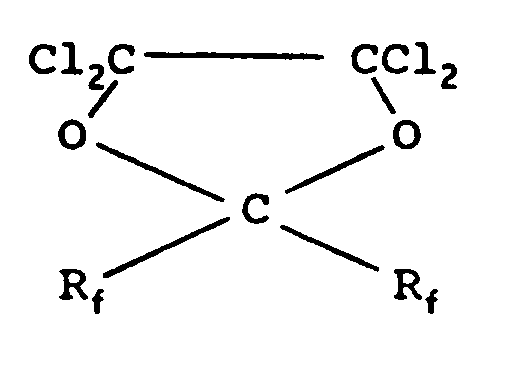
- the invention provides a process for the preparation of 2,2-bis(perhaloalkyl)-4,4,5,5-tetrachloro-1,3-dioxolane by chlorinating 2,2-bis(perhaloalkyl)-1,3-dioxolane with a source of chlorine in the presence of a catalyst which contains at least one of La, Ni, Sn, Zn Co, Fe, or Cu.
- the invention also provides a process for the preparation of fluorinated 2,2-bis(perhaloalkyl)-1,3-dioxolanes of the formula wherein X is Cl, each Y is independently Cl or F and at least one Y is F, and each R f is independently perhaloalkyl in which the alpha carbon is substituted by at least one fluorine atom.
- the process comprises fluorinating 2,2-bis(perhaloalkyl)-4,4,5,5-tetrachloro-1,3-dioxolane with a source of fluorine under fluorination conditions, so as to effect fluorine-chlorine exchange, in the presence of a catalyst which is a catalyst as noted above in the chlorination reaction or is chromium (III) oxide, i.e., Cr2O3 or one or more of a metal supported on carbon wherein the metals are chosen from Cr, Co, La, Fe, Ni, Cu, Sn, or Zn.
- a catalyst which is a catalyst as noted above in the chlorination reaction or is chromium (III) oxide, i.e., Cr2O3 or one or more of a metal supported on carbon wherein the metals are chosen from Cr, Co, La, Fe, Ni, Cu, Sn, or Zn.
- R f is trifluoromethyl.
- the 2,2-bis(perhaloalkyl)-1,3-dioxolane starting material for the chlorination is a known compound which may be readily prepared by reacting perfluoroacetone and ethylene chlorohydrin under basic conditions as described in U.S. Patent No. 2,925,424.
- the chlorination is preferably conducted in the vapor phase, and is preferably conducted continuously. However, the reaction may be conducted in the liquid phase using the reactants as solvents, at the same temperatures noted for the vapor phase, under autogenous pressure. Preferred temperatures for the reaction are 250° - 300°C.
- the molar ratio of chlorine to 2,2-bis(perhaloalkyl)-1,3-dioxolane is preferably about 4:1 to 10:1, more preferably about 4:1 to 5:1.
- the reaction time is generally about 1 to 120 seconds, and is preferably about 30 to 60 seconds.
- the reaction pressure is preferably about 1 to 20 atmospheres, more preferably about 10 to 20 atmospheres.
- the preferred source of chlorine is chlorine gas.
- the catalyst metal may be in the form of any soluble compound of the metal such as the oxide, oxyhalide, halide, pseudohalide, nitrate, sulfate, or organic salt such as acetate and propionate.
- the halides include chlorides, fluorides and bromides.
- the pseudohalides include cyanides, cyanates and thiocyanates.
- the form of the catalyst is not critical and may be pellets, powders or granules.
- the catalysts are used in a fixed bed; however, fluidized bed reactors may also be used.
- the catalysts are in the form of their chlorides, and preferably are supported on carbon.
- the preferred catalyst for the chlorination is CuCl2/C.
- the desired amount of metal chloride was dissolved in water (35 to 75 mL) and the entire solution poured over 40 g of commercial carbon granules (Girdler 411, 0.32 cm pellets). The resulting mixture was allowed to stand at room temperature for one hour and was then placed in a vacuum oven at 110°C for 16 to 24 hours to remove the water.
- the catalyst was then pretreated by heating in an atmosphere of nitrogen gas at 400°C followed by heating in HF at 400°C prior to its use as a fluorination catalyst.
- the catalyst was heated in an atmosphere of nitrogen gas at 400°C followed by adjusting the temperature to the desired value and treatment with chlorine gas.
- 0.1 - 30% b.w. based on the support of active metal is incorporated in the catalyst.
- Cr2O3 is commercially available and was treated with HF as described above prior to its use as a fluorination catalyst.
- the catalysts having differing anions are prepared analogously.
- the fluorination is preferably conducted in the vapor phase, and is preferably conducted continuously.
- the reaction may be conducted in the liquid phase as indicated for the chlorination.
- the reaction temperature is preferably 150° to 350°C, more preferably 150° to 200°C.
- the preferred source of fluorine is HF.
- the molar ratio of HF to 2,2-bis(perhaloalkyl)-4,4,5,5-tetrachloro-1,3-dioxolane is preferably about 2:1 to 10:1, more preferably about 2:1 to 5:1.
- Preferred reaction time is about 1 to 120 seconds, more preferably about 30 to 60 seconds.
- the preferred catalyst for the fluorination is Cr, more preferably unsupported Cr2O3.
- the production of the fluoro-compounds may be conducted in two steps, with, e.g., isolation of a 2,2-bis(perhaloalkyl)-4,4,5,5-tetrachloro-1,3-dioxolane intermediate, or may be conducted in one enclosure with the addition of the fluorine source preferably after substantial completion of the first reaction.
- the catalysts of the invention are extremely active and selective.
- the ratio of trans to cis isomers is desirably high.
- the products of the process of the invention are useful as intermediates in the production of perhalodioxoles of the formula by dehalogenation of the appropriate precursor according to conventional processes, for example, as disclosed in U.S. Patent Nos. 4,535,175, 3,865,845, and 3,978,030.
- trans-2,2-bis(perhaloalkyl)-4,5-difluoro-4,5-dichloro-1,3-dioxolane is used to produce the dioxole.
- a multi-plate distillation column may be used to separate the cis and trans isomers.
- the cis isomer as well as 2,2-bis(perhaloalkyl)-4,4,5,5-tetrachloro-1,3-dioxolane and -4-fluoro-4,5,5-trichloro-1,3-dioxolane are recycled to the fluorination step.
- the dioxole in turn may be used to prepare homopolymers and copolymers which possess advantageous properties such as chemical inertness to hydrogen fluoride, optical clarity and film-forming ability.
- the dioxoles may be copolymerized under standard polymerization conditions with tetrafluoroethylene to form crystalline copolymers suitable for use as a dielectric in electronic equipment.
- the dioxole is employed in an amount of about 12 mole % or less.
- Polymers having more than about 12% dioxole are more generally amorphous, and are soluble in various organic liquids, e.g., 1,1,2-trichloro-1,2,2-trifluoroethane. These polymers are useful in the production of chemically inert, stain and weather resistant coatings and finishes.
- dioxoles may be reacted with vinylidene fluoride or tetrafluoroethylene to produce plastic and/or elastomeric terpolymers useful in the production of corrosion-resistant seals, gaskets or linings.
- the dioxoles may be homopolymerized to produce amorphous resins suitable for use as transparent glazing materials and sight glasses in apparatuses employed in handling chemically corrosive materials.
- the amorphous polymers are useful in the production of optical fiber cladding materials, e.g., in accordance with U.S. Patent Nos. 4,530,569 and 4,754,009.
- a good polymeric cladding material for optical fibers should be completely amorphous because crystallites present in polymers would cause light scattering. Further, it should have a high glass transition temperature, Tg, especially if intended for use at high temperatures because above its Tg, it would lose some of its desirable physical properties; and, in particular, it would be unable to maintain good bonding to the fiber core.
- Tg glass transition temperature
- a desirable Tg would be above 85°C, preferably above 120°C.
- the Tg also increases, although not necessarily in a linear fraction.
- a homopolymer of dioxole appears to be amorphous and has a high Tg.
- dioxole is a much more expensive monomer than tetrafluoroethylene so that use of dioxole homopolymers, rather than of dioxole/tetrafluoroethylene copolymers, is economically much less attractive.
- the copolymers are easier to fabricate.
- the dipolymers have low refractive indices, which is a particularly desirable feature for optical fiber cladding.
- films of these copolymers are clear and transparent, compared with hazy or translucent films of crystalline polymers. For this reason, the amorphous copolymers of the present invention are suitable for such applications as, for example, windows for chemical reactors, especially for processes using or manufacturing hydrogen fluoride.
- Amorphous terpolymers can be made by copolymerizing certain ethylenically unsaturated monomers with perfluoro-2,2-dimethyl-1,3-dioxole and tetrafluoroethylene. These include selected olefins, vinyl compounds, and perfluoromonomers. Typical olefins are, for example, ethylene, propylene, 1-butene, isobutylene, trifluoropropene, and trifluoroethylene. Vinyl monomers can be, for example, vinyl fluoride, vinylidene fluoride, and chlorotrifluoroethylene.
- Perfluoromonomers may be of different chemical types, for example, perfluoropropene, perfluoro(1,3-dioxole), perfluoro(alkyl vinyl ethers), methyl 3-[1-[difluoro(trifluoroethenyl)oxy]methyl]-1,2,2,2-tetrafluoroethoxy]-2,2,3,3-tetrafluoropropanoate and 2-[1-[difluoro[(trifluoroethenyl)oxy]methyl]-1,2,2,2-tetrafluorooethoxy]-1,1,2,2-tetrafluoroethanesulfonyl fluoride
- the proportion of dioxole in the amorphous terpolymers of this invention should preferably be at least 12 mole percent of the tetrafluoroethylene content, while the mole percent content of the third monomer should be the smallest of all three monomers. Outside these limits, either an amorphous terpolymer may not be obtained; or, if made, its maximum tensile modulus and strength may not be realized.
- Copolymerization is carried out in the presence of a free radical generator, preferably at a slightly elevated temperature, for example, 55°-65°C. Well-agitated pressure equipment should be used.
- the reactor (0.5 inch ID Inconel ⁇ /nickel alloy pipe) was charged with the designated amount of catalyst, sealed and placed into a sand bath. The bath was heated to 400°C, at which time nitrogen gas at a flow rate of 50 ml/minute was passed through the reactor to remove all traces of water. Chlorine gas at a flow rate of 25.7 cc/min was passed through the reactor and the temperature adjusted to the desired value. The flow of nitrogen gas was turned off and the flow of D456 started. The flow of chlorine and D456 were adjusted to give the desired molar ratio.
- the reactor effluent was scrubbed with aqueous potassium hydroxide to remove Cl2, HCl and HF and sampled on line by a HP 5890 gas chromatograph using a 5 foot Krytox ⁇ perfluorinated polyether column. Conditions were 70°C for 3 minutes followed by temperature programming to 180°C at a rate of 6°C/minute. Helium flow was 35 cc/minute.
- the reactor (0.5 inch ID Inconel ⁇ nickel alloy pipe) was charged with the designated amount of catalyst, sealed and placed into a sand bath. The bath was heated to 400°C, at which time nitrogen gas at a flow rate of 50 ml/minute was passed through the reactor to remove all traces of water. The temperature was lowered to 200°C, and HF and nitrogen gas (1:4 molar ratio) was passed through the reactor, and the nitrogen flow was decreased with time until neat HF was being passed through the reactor. At this point, the temperature is raised to 350°C and maintained there for 15 to 30 minutes. The temperature is then decreased to the desired temperature, and the D416 flow is started. The flow of HF and D416 were adjusted to give the desired molar ratio.
- the reactor effluent was scrubbed with aqueous potassium hydroxide to remove Cl2, HCl and HF and sampled on line by a HP 5890 gas chromatograph using a 5 foot Krytox ⁇ perfluorinated polyether column. Conditions were 70°C for 3 minutes followed by temperature programming to 180°C at a rate of 6°C/minute. Helium flow was 35 cc/minute.
- step a provides a process for the preparation of 2,2-bis(perhaloalkyl)-4,4,5,5-tetrachloro-1,3-dioxolane by chlorinating 2,2-bis(perhaloalkyl)-1,3-dioxolane with a source of chlorine in the presence of a catalyst which contains at least one of La, Ni, Sn, Zn, Co, Fe, or Cu.
- the step b also provides a process for the preparation of fluorinated 2,2-bis(perhaloalkyl)-1,3-dioxolanes of the formula wherein X is C1, each Y is independently C1 or F and at least one Y is F, and each R f is independently perhaloalkyl in which the alpha carbon is substituted by at least one fluorine atom.
- Claim 4 includes the steps of claim 3 and also fluorinating 2,2-bis(perhaloalkyl)-4,4,5,5-tetrachloro-1,3-dioxolane with a source of fluorine under fluorination conditions, so as to effect fluorine-chlorine exchange, in the presence of a catalyst which is a catalyst as noted above in the chlorination reaction or is chromium (III) oxide, i.e., Cr203 or one or more of a metal supported on carbon wherein the metals are chosen from Cr, Co, La, Fe, Ni, Cu, Sn, or Zn.
- a catalyst which is a catalyst as noted above in the chlorination reaction or is chromium (III) oxide, i.e., Cr203 or one or more of a metal supported on carbon wherein the metals are chosen from Cr, Co, La, Fe, Ni, Cu, Sn, or Zn.
- the catalyst of claim 1 is further defined in claim 5 as a metal chloride.
- the catalyst metal may be in the form of any soluble compound of the metal such as the oxide, oxyhalide, halide, pseudohalide, nitrate, sulfate, or organic salt such as acetate and propionate.
- the catalysts are in the form of their chlorides, and preferably, as stated in claim 6, the catalysts are supported on carbon.
- the preferred catalyst for the chlorination is CuC1 2/ C.
- Claims 14, 15 and 19 provide a process for the preparation of 2,2-bis(perhaloalkyl)-4,4,5,5,5-tetrachloro-1,3-dioxolane by chlorinating 2,2-bis(perhaloalkyl)-1,3-dioxolane with a source of chlorine in the presence of a catalyst which contains at least one of La, Ni, Sn, Zn, Co, Fe, or Cu.
- the process comprises fluorinating 2,2-bis(perhaloalkyl)-4,4,5,5-tetrachloro-1,3-dioxolane with a source of fluorine under fluorination conditions to effect fluorine-chlorine exchange, in the presence of a catalyst which is a catalyst as noted above in the chlorination reaction or is chromium (III) oxide, i.e., Cr203 or one or more of a metal supported on carbon wherein the metals are chosen from Cr, Co, La, Fe, Ni, Cu, Sn, or Zn.
- a catalyst which is a catalyst as noted above in the chlorination reaction or is chromium (III) oxide, i.e., Cr203 or one or more of a metal supported on carbon wherein the metals are chosen from Cr, Co, La, Fe, Ni, Cu, Sn, or Zn.
- the products of the process for the invention are useful as intermediates in the production or perhalodioxoles of the formula by dehalogenation of the appropriate precursor according to conventional processes, for example, as disclosed in U.S. Patent Nos. 4,535,175, 3,865,845, and 3,978,030.
- trans-2,2-bis(perhaloalkyl)-4,5-difluoro-4,5-dichloro-1,3-dioxolane is used to produce the dioxole.
- a multi-plate distillation column may be used to separate the cis and trans isomers. This use of the trans isomer is set forth in claims 16, 17, 18 and 20.
- the dioxole in turn may be used to prepare homopolymers and copolymers which possess advantageous properties such as chemical inertness to hydrogen fluoride, optical clarity and film-forming ability.
- the dioxoles may be copolymerized under standard polymerization conditions with tetrafluoroethylene to form crystalline copolymers suitable for use as a dielectric in electronic equipment.
- the dioxole is employed in an amount of about 12 mole % or less.
- Polymers having more than about 12% dioxole are more generally amorphous, and are soluble in various organic liquids, e.g., 1,1,2-trichloro-1,2,2-trifluoroethane. These polymers are useful in the production of chemically inert, stain and weather resistant coatings and finishes.
- dioxoles may be reacted with vinylidene fluoride or tetrafluoroethylene to produce plastic and/or elastomeric terpolymers useful in the production of corrosion-resistant seals, gaskets or linings.
- Homopolymers and copolymers are set forth in claim 21.
Landscapes
- Chemical & Material Sciences (AREA)
- Organic Chemistry (AREA)
- Low-Molecular Organic Synthesis Reactions Using Catalysts (AREA)
- Organic Low-Molecular-Weight Compounds And Preparation Thereof (AREA)
Abstract
Description
- The invention concerns a catalytic process for the preparation of halogenated 2,2-bis(trifluoromethyl)-1,3-dioxolanes.
- 2,2-Bis(trifluoromethyl)-1,3-dioxolane is a known compound which may be halogenated according to a number of known methods to produce various halo-isomers at the 4,5 or 4 and 5 positions. For example, U.S. Patent No. 2,925,424 describes a batch photochemical chlorination of 2,2-bis(trifluoromethyl)-1,3-dioxolane. The reaction was conducted at 50°C for 2.5 hours. A 68% yield of 2,2-bis(trifluoromethyl)-4,4,5,5-tetrachloro-1,3-dioxolane was obtained upon fractionation of crude product. See Example 9.
- U.S. Patent No. 4,535,175 discloses a batch photochemical chlorination of 2,2-bis(trifluoromethyl)-1,3-dioxolane to yield a mixture of di-, tri- and tetrachloro derivatives. The reaction proceeds rather slowly. Example 1 of the patent details the production of 2,2-bis(trifluoromethyl)-4,4,5-trichloro-5-fluoro-1,3-dioxolane by reacting 2,2-bis(trifluoromethyl)-4,4,5,5,-tetrachloro-1,3-dioxolane, HF and antimony chloride at 70°C for 5 hours.
- DE-A 3,842,986, discloses a process for preparing dioxoles by dechlorinating perhalogenated 4,5-dichloro-1,3-dioxolanes in the presence of lithium aluminum hydride and titanium chloride.
- EP-A 317,981 discloses a process for preparing 1,1-dichloro-1,2,2,2-tetrafluoroethane by isomerization of 1,1,2-trichloro-1,2,2-trifluoroethane to 1,1,1-trichloro-2,2,2-trifluoroethane followed by fluorination of the latter with HF in the presence of a halide or oxide containing at least one element selected from Al, Cr, Mg, Ca, Sr, Ba, Fe, Ni, Co, Sb, Nb or Mn.
- R. D. Bagnall et al., J. Fluorine Chem., 9, 359-375 (1977) disclose the preparation of various fluorinated 1,3-dioxolane derivatives, including 2,2-bis-trifluoromethyl- 1,3-dioxolanes wherein F, Cl or a combination thereof occupy the 4- and 5-positions. Di-, tri- and tetrachloro derivatives are fluorinated with SbF₃Cl₂ or SbF₃-SbCl₅ mixture.
- U.S. Patent No. 3,794,791 discloses a batch photochlorination of 2,2-bis(trifluoromethyl)-1,3-dioxolane at -15°C. Example 1 describes the synthesis of 2,2-bis(trifluoromethyl)-4-chloro-1,3-dioxolane. Example 2 of the patent describes the synthesis of 2,2-bis(trifluoromethyl)-4,5-dichloro-1,3-dioxolane.
- G.B. 1,361,346 discloses the preparation of 2,2-bis(trifluoromethyl)-4,5-dichloro-4,5-difluoro-1,3-dioxolane by fluorinating 2,2-bis(trifluoromethyl)-4,4,5,5,-tetrachloro-1,3-dioxolane with SbF₃/SbC1₅ at 120°C.
- The invention provides a process for the preparation of 2,2-bis(perhaloalkyl)-4,4,5,5-tetrachloro-1,3-dioxolane by chlorinating 2,2-bis(perhaloalkyl)-1,3-dioxolane with a source of chlorine in the presence of a catalyst which contains at least one of La, Ni, Sn, Zn Co, Fe, or Cu.
- The invention also provides a process for the preparation of fluorinated 2,2-bis(perhaloalkyl)-1,3-dioxolanes of the formula

wherein X is Cl, each Y is independently Cl or F and at least one Y is F, and each Rf is independently perhaloalkyl in which the alpha carbon is substituted by at least one fluorine atom. - The process comprises fluorinating 2,2-bis(perhaloalkyl)-4,4,5,5-tetrachloro-1,3-dioxolane with a source of fluorine under fluorination conditions, so as to effect fluorine-chlorine exchange, in the presence of a catalyst which is a catalyst as noted above in the chlorination reaction or is chromium (III) oxide, i.e., Cr₂O₃ or one or more of a metal supported on carbon wherein the metals are chosen from Cr, Co, La, Fe, Ni, Cu, Sn, or Zn.
- Preferably, Rf is trifluoromethyl. The 2,2-bis(perhaloalkyl)-1,3-dioxolane starting material for the chlorination is a known compound which may be readily prepared by reacting perfluoroacetone and ethylene chlorohydrin under basic conditions as described in U.S. Patent No. 2,925,424.
- The chlorination is preferably conducted in the vapor phase, and is preferably conducted continuously. However, the reaction may be conducted in the liquid phase using the reactants as solvents, at the same temperatures noted for the vapor phase, under autogenous pressure. Preferred temperatures for the reaction are 250° - 300°C. The molar ratio of chlorine to 2,2-bis(perhaloalkyl)-1,3-dioxolane is preferably about 4:1 to 10:1, more preferably about 4:1 to 5:1. The reaction time is generally about 1 to 120 seconds, and is preferably about 30 to 60 seconds. The reaction pressure is preferably about 1 to 20 atmospheres, more preferably about 10 to 20 atmospheres. The preferred source of chlorine is chlorine gas. The catalyst metal may be in the form of any soluble compound of the metal such as the oxide, oxyhalide, halide, pseudohalide, nitrate, sulfate, or organic salt such as acetate and propionate. The halides include chlorides, fluorides and bromides. The pseudohalides include cyanides, cyanates and thiocyanates. The form of the catalyst is not critical and may be pellets, powders or granules. Preferably, the catalysts are used in a fixed bed; however, fluidized bed reactors may also be used. Preferably, the catalysts are in the form of their chlorides, and preferably are supported on carbon. The preferred catalyst for the chlorination is CuCl₂/C.
- The desired amount of metal chloride was dissolved in water (35 to 75 mL) and the entire solution poured over 40 g of commercial carbon granules (Girdler 411, 0.32 cm pellets). The resulting mixture was allowed to stand at room temperature for one hour and was then placed in a vacuum oven at 110°C for 16 to 24 hours to remove the water. The catalyst was then pretreated by heating in an atmosphere of nitrogen gas at 400°C followed by heating in HF at 400°C prior to its use as a fluorination catalyst. For chlorination reactions, the catalyst was heated in an atmosphere of nitrogen gas at 400°C followed by adjusting the temperature to the desired value and treatment with chlorine gas. Preferably, 0.1 - 30% b.w. based on the support of active metal is incorporated in the catalyst.
- The following catalysts were prepared by the general procedure for MClx/C:
CoCl₂/C 35 g CoCl₂.6H₂O/35 mL H₂O FeCl₃/C 39.7 g FeCl₃.6H₂O/35 mL H₂O ZnCl₂/C 20.44 g ZnCl₂/75 mL H₂O NiCl₂/C 34.94 g NiCl₂2.6H₂O/35 mL H₂O LaCl₃/C 62.43 g LaCl3.7H₂I/75 mL H₂O CrCl₃/C 39.17 g CrCl₃.6H₂O/60 mL H₂O SnCl₂/C 38.36 g SnCl₂.2H₂O/70 mL H₂O CuCl₂/C 25.06 g CuCl₂.2H₂O/70 mL H₂O - Cr₂O₃ is commercially available and was treated with HF as described above prior to its use as a fluorination catalyst.
- The catalysts having differing anions are prepared analogously.
- The fluorination is preferably conducted in the vapor phase, and is preferably conducted continuously. The reaction may be conducted in the liquid phase as indicated for the chlorination. The reaction temperature is preferably 150° to 350°C, more preferably 150° to 200°C. The preferred source of fluorine is HF. The molar ratio of HF to 2,2-bis(perhaloalkyl)-4,4,5,5-tetrachloro-1,3-dioxolane is preferably about 2:1 to 10:1, more preferably about 2:1 to 5:1. Preferred reaction time is about 1 to 120 seconds, more preferably about 30 to 60 seconds. The preferred catalyst for the fluorination is Cr, more preferably unsupported Cr₂O₃.
- The production of the fluoro-compounds may be conducted in two steps, with, e.g., isolation of a 2,2-bis(perhaloalkyl)-4,4,5,5-tetrachloro-1,3-dioxolane intermediate, or may be conducted in one enclosure with the addition of the fluorine source preferably after substantial completion of the first reaction.
- The catalysts of the invention are extremely active and selective. In the fluorination, where Cr₂O₃ is the catalyst, the ratio of trans to cis isomers is desirably high.
- The products of the process of the invention are useful as intermediates in the production of perhalodioxoles of the formula

by dehalogenation of the appropriate precursor according to conventional processes, for example, as disclosed in U.S. Patent Nos. 4,535,175, 3,865,845, and 3,978,030. - Preferably, trans-2,2-bis(perhaloalkyl)-4,5-difluoro-4,5-dichloro-1,3-dioxolane is used to produce the dioxole. A multi-plate distillation column may be used to separate the cis and trans isomers. Preferably, the cis isomer as well as 2,2-bis(perhaloalkyl)-4,4,5,5-tetrachloro-1,3-dioxolane and -4-fluoro-4,5,5-trichloro-1,3-dioxolane are recycled to the fluorination step.
- The dioxole in turn may be used to prepare homopolymers and copolymers which possess advantageous properties such as chemical inertness to hydrogen fluoride, optical clarity and film-forming ability.
- For example, the dioxoles may be copolymerized under standard polymerization conditions with tetrafluoroethylene to form crystalline copolymers suitable for use as a dielectric in electronic equipment. Preferably, in these applications the dioxole is employed in an amount of about 12 mole % or less.
- Polymers having more than about 12% dioxole are more generally amorphous, and are soluble in various organic liquids, e.g., 1,1,2-trichloro-1,2,2-trifluoroethane. These polymers are useful in the production of chemically inert, stain and weather resistant coatings and finishes.
- Further, the dioxoles may be reacted with vinylidene fluoride or tetrafluoroethylene to produce plastic and/or elastomeric terpolymers useful in the production of corrosion-resistant seals, gaskets or linings.
- Finally, the dioxoles may be homopolymerized to produce amorphous resins suitable for use as transparent glazing materials and sight glasses in apparatuses employed in handling chemically corrosive materials.
- In particular, the amorphous polymers are useful in the production of optical fiber cladding materials, e.g., in accordance with U.S. Patent Nos. 4,530,569 and 4,754,009.
- Various fluoropolymers have been proposed from time to time for this purpose, mainly because of their good performance under a variety of temperature and atmospheric conditions and resistance to many chemicals. A good polymeric cladding material for optical fibers should be completely amorphous because crystallites present in polymers would cause light scattering. Further, it should have a high glass transition temperature, Tg, especially if intended for use at high temperatures because above its Tg, it would lose some of its desirable physical properties; and, in particular, it would be unable to maintain good bonding to the fiber core. A desirable Tg would be above 85°C, preferably above 120°C.
- As the amount of dioxole in the copolymer increases, the Tg also increases, although not necessarily in a linear fraction.
- A homopolymer of dioxole appears to be amorphous and has a high Tg. However, dioxole is a much more expensive monomer than tetrafluoroethylene so that use of dioxole homopolymers, rather than of dioxole/tetrafluoroethylene copolymers, is economically much less attractive. Furthermore, the copolymers are easier to fabricate. The dipolymers have low refractive indices, which is a particularly desirable feature for optical fiber cladding. Furthermore, films of these copolymers are clear and transparent, compared with hazy or translucent films of crystalline polymers. For this reason, the amorphous copolymers of the present invention are suitable for such applications as, for example, windows for chemical reactors, especially for processes using or manufacturing hydrogen fluoride.
- Amorphous terpolymers can be made by copolymerizing certain ethylenically unsaturated monomers with perfluoro-2,2-dimethyl-1,3-dioxole and tetrafluoroethylene. These include selected olefins, vinyl compounds, and perfluoromonomers. Typical olefins are, for example, ethylene, propylene, 1-butene, isobutylene, trifluoropropene, and trifluoroethylene. Vinyl monomers can be, for example, vinyl fluoride, vinylidene fluoride, and chlorotrifluoroethylene. Perfluoromonomers may be of different chemical types, for example, perfluoropropene, perfluoro(1,3-dioxole), perfluoro(alkyl vinyl ethers), methyl 3-[1-[difluoro(trifluoroethenyl)oxy]methyl]-1,2,2,2-tetrafluoroethoxy]-2,2,3,3-tetrafluoropropanoate

and 2-[1-[difluoro[(trifluoroethenyl)oxy]methyl]-1,2,2,2-tetrafluorooethoxy]-1,1,2,2-tetrafluoroethanesulfonyl fluoride
- The proportion of dioxole in the amorphous terpolymers of this invention should preferably be at least 12 mole percent of the tetrafluoroethylene content, while the mole percent content of the third monomer should be the smallest of all three monomers. Outside these limits, either an amorphous terpolymer may not be obtained; or, if made, its maximum tensile modulus and strength may not be realized.
- Copolymerization is carried out in the presence of a free radical generator, preferably at a slightly elevated temperature, for example, 55°-65°C. Well-agitated pressure equipment should be used.
- In addition to tetrafluoroethylene, amorphous copolymers may be fabricated from the dioxole and chlorotrifluoroethylene; vinylidene fluoride; hexafluoropropylene; trifluoroethylene; perfluoro(alkyl vinyl ethers) of the formula CF₂=CFORF, where RF is a normal perfluoroalkyl radical having 1-3 carbon atoms; fluorovinyl ethers of the formula CF₂=CFOQZ, where Q is a perfluorinated alkylene radical containing 0-5 ether oxygen atoms, wherein the sum of the C and O atoms in Q is 2 to 10, and Z is a group selected from the class consisting of -CN, -COF, and -OCH₃, where R is a Cl-C4 alkyl; vinyl fluoride; and (perfluoroalkyl)ethylene, R f CH=CH₂, where R f is a Cl-C8 normal perfluoroalkyl radical.
- The maximum preferred mole percentage of the comonomer in the copolymers are as follows:
for tetrafluoroethylene, 35;
for chlorotrifluoroethylene, 30
for vinylidene fluoride, 20;
for hexafluoropropylene, 5;
for trifluoroethylene, 30;
for CF₂=CFORF, 30;
for CF₂=CFOQZ, 20;
for vinyl fluoride, 25; and
for R f CH=CH₂, 10. - Without further elaboration, it is believed that one skilled in the art can, using the preceding description, utilize the present invention to its fullest extent. The following preferred specific embodiments are, therefore, to be construed as merely illustrative and not limitative of the remainder of the disclosure in any way whatsoever.
- In the preceding text and the following examples, all temperatures are set forth uncorrected in degrees Celsius and all parts and percentages are by weight, unless otherwise indicated. Amounts of compounds listed in the Tables are given in area %. C.T. represents contact time.
- In the following examples, the numbers identifying the compounds in the tables are as follows:
D456 - 2,2-Bis(trifluoromethyl)-1,3-dioxolane
D436 - 2,2-Bis(trifluoromethyl)-4,5-dichloro-1,3-dioxolane
D436a - 2,2-Bis(trifluoromethyl)-4,4-dichloro-1,3-dioxolane
D426 - 2,2-Bis(trifluoromethyl)-4,4,5-trichloro-1,3-dioxolane
D416 - 2,2-Bis(trifluoromethyl)-4,4,5,5-tetrachloro-1,3-dioxolane
D417 - 2,2-Bis(trifluoromethyl)-4-fluoro-4,5,5-trichloro-1,3-dioxolane
D418a - 2,2-Bis(trifluoromethyl)-4,4-difluoro-5,5-dichloro-1,3-dioxolane
D418 - 2,2-Bis(trifluoromethyl)-4,5-dichloro-4,5-difluoro-1,3-dioxolane
D419 - 2,2-Bis(trifluoromethyl)-4,4,5-trifluoro-5-chloro-1,3-dioxolane. - The reactor (0.5 inch ID Inconel\/nickel alloy pipe) was charged with the designated amount of catalyst, sealed and placed into a sand bath. The bath was heated to 400°C, at which time nitrogen gas at a flow rate of 50 ml/minute was passed through the reactor to remove all traces of water. Chlorine gas at a flow rate of 25.7 cc/min was passed through the reactor and the temperature adjusted to the desired value. The flow of nitrogen gas was turned off and the flow of D456 started. The flow of chlorine and D456 were adjusted to give the desired molar ratio.
- The reactor effluent was scrubbed with aqueous potassium hydroxide to remove Cl₂, HCl and HF and sampled on line by a HP 5890 gas chromatograph using a 5 foot Krytox\ perfluorinated polyether column. Conditions were 70°C for 3 minutes followed by temperature programming to 180°C at a rate of 6°C/minute. Helium flow was 35 cc/minute.
- The reactor (0.5 inch ID Inconel\ nickel alloy pipe) was charged with the designated amount of catalyst, sealed and placed into a sand bath. The bath was heated to 400°C, at which time nitrogen gas at a flow rate of 50 ml/minute was passed through the reactor to remove all traces of water. The temperature was lowered to 200°C, and HF and nitrogen gas (1:4 molar ratio) was passed through the reactor, and the nitrogen flow was decreased with time until neat HF was being passed through the reactor. At this point, the temperature is raised to 350°C and maintained there for 15 to 30 minutes. The temperature is then decreased to the desired temperature, and the D416 flow is started. The flow of HF and D416 were adjusted to give the desired molar ratio.
- The reactor effluent was scrubbed with aqueous potassium hydroxide to remove Cl₂, HCl and HF and sampled on line by a HP 5890 gas chromatograph using a 5 foot Krytox\ perfluorinated polyether column. Conditions were 70°C for 3 minutes followed by temperature programming to 180°C at a rate of 6°C/minute. Helium flow was 35 cc/minute.
-
CuCl₂/C 19.7 grams (30 cc) Exp Temp Cl₂/D456 C.T. D436 D426 D416 Unk 1 225 6/1 30 14 40 43 3 2 235 6/1 30 5 29 62 3 3 245 6/1 30 3 21 74 2 4 255 6/1 30 1 9 88 2 5 265 6/1 30 0 5 93 2 6 195 6/1 60 43 33 16 8 7 205 6/1 60 25 44 24 5 8 215 6/1 60 10 44 42 4 9 225 6/1 60 5 34 57 3 10 235 6/1 60 1 18 80 1 11 245 6/1 60 0 7 90 3 12 255 6/1 60 0 2 95 3 13 265 6/1 60 0 0 97 3 14 275 6/1 60 0 0 96 4 15 285 6/1 60 0 0 95 5 16 285 4/1 60 0 1 95 4 - The conversion of D456 to products was 100%, as shown in the Table.
-
CuCl₂/C 19.7 grams (30 cc) Exp Temp Cl₂/D456 C.T. D426 D416 D417 Unk 17 265 6/1 60 1 97 0 2 18 265 6/1 60 1 97 0 1 19 265 6/1 60 1 97 0 3 20 265 5/1 75 1 97 1 0 21 265 4/1 75 3 95 0 2 22 265 5/1 60 2 95 0 3 23 275 5/1 60 0 97 0 2 - The conversion of D456 to products was 100%, as shown in the Table.
-
LaCl₃/C 4.25 grams (5 cc) Exp Temp Cl₂/D456 C.T. D456 D436 D426 D416 D417 Unk 24 200 6/1 10 3 74 12 10 0 1 25 225 6/1 10 4 64 11 18 0 3 26 250 6/1 10 1 43 9 43 1 2 27 275 6/1 10 0 22 6 67 1 4 28 300 6/1 10 0 9 3 72 3 13 -
SnCl₂/C 4.0 grams (5 cc) Exp Temp Cl₂/D456 C.T. D436 D426 D416 D417 Unk 29 225 6/1 10 36 37 23 0 3 30 250 6/1 10 13 29 53 1 4 31 275 6/1 10 2 8 74 2 9 32 275 5/1 10 2 9 70 2 12 - The conversion of D456 to products was 100%, as shown in the Table.
-
FeCl₃/C 3.4 grams (5 cc) Exp Temp Cl₂/D456 C.T. D456 D436 D426 D416 D417 Unk 33 200 6/1 10 11 36 2 8 0 43 34 150 6/1 10 36 51 1 0 0 12 35 200 6/1 1 67 21 1 1 1 9 36 250 6/1 1 37 25 1 6 0 31 37 250 4/1 1 42 19 1 5 0 33 -
ZnCl₂/C 3.8 grams (5 cc) Exp Temp Cl₂/D456 C.T. D456 D436 D426 D416 D417 Unk 38 200 6/1 10 27 62 5 4 0 2 39 225 6/1 10 15 70 10 4 0 1 40 250 6/1 10 7 66 15 11 0 1 41 275 6/1 10 1 28 13 50 2 6 -
Cr₂O₃ 28.9 g (30 cc) -12 + 20 mesh Exp Temp HF/D416/HCl C.T. D419 tD418 cD418 D418a D417 D416 Unk 42 175 2/1/0 60 2 74 18 0 4 0 1 43 200 2/1/0 60 37 10 3 36 10 1 0 44 165 2/1/0 60 19 37 9 13 20 1 1 45 175 2/1/0 60 15 62 16 2 5 0 0 46 175 3/1/0 45 3 77 19 0 0 0 1 47 175 3/1/4 45 13 66 18 1 2 0 0 48 175 4/1/4 40 4 75 20 0 2 0 0 49 175 5/1/4 35 3 75 20 0 1 0 1 50 175 5/1/4 40 3 75 20 0 1 0 1 51 175 5/1/4 40 4 74 20 0 1 0 1 t = trans
c = cis -
CoCl₂/C 12.3 g (30 cc) Exp Temp HF/D416 C.T. tD418 cD418 D417 Unk 52 200 10/1/0 30 44 35 8 7 53 200 5/1/0 60 39 33 16 6 54 165 10/1/0 30 47 37 8 3 -
Cr₂O₃ 14.4 g (15 cc) -12 + 20 mesh Exp Temp HF/D416 C.T. D419 tD418 cD418 D417 Unk 55 200 3/1/0 30 1 72 22 0 5 56 200 3/1/0 30 0 71 26 0 3 57 210 3/1/0 30 1 73 24 0 2 58 220 3/1/0 30 1 72 24 0 3 59 230 3/1/0 30 1 73 23 1 2 -
LaCl₃/C 4.25 g (5 cc) Exp Temp HF/D416 C.T. tD418 cD418 D417 D416 Unk 60 225 2/1/0 10 2 4 85 3 6 61 250 2/1/0 10 14 13 67 0 5 62 275 2/1/0 10 26 27 0 0 4 63 300 2/1/0 10 34 33 26 0 7 64 300 2/1/0 20 43 35 11 0 10 65 300 2/1/0 20 44 36 9 0 11 66 250 2/1/0 40 41 38 14 0 7 67 250 2/1/0 40 38 35 20 0 7 68 300 2/1/0 40 46 31 4 0 11 -
FeCl₃/C 3.4 g (5 cc) Exp Temp HF/D416 C.T. tD418 cD418 D417 D416 Unk 69 200 2/1/0 5 0 0 24 71 5 70 225 2/1/0 5 0 0 42 54 8 71 275 2/1/0 10 7 8 76 1 8 72 275 3/1/0 10 9 10 70 0 11 -
NiCl₂/C 1.66 g (3 cc) 1/8-inch Pellets Exp Temp HF/D416 C.T. tD418 cD418 D417 D416 Unk 73 200 2/1/0 5 0 0 5 91 4 74 220 2/1/0 5 0 0 7 88 5 75 240 2/1/0 5 0 0 13 80 7 76 260 2/1/0 5 0 0 31 61 6 77 280 2/1/0 5 1 2 45 39 10 78 280 4/1/0 5 5 4 66 10 13 79 325 4/1/0 5 8 7 34 2 48 -
CuCl₂/C 19.7 g (30 cc) Exp Temp HF/D416 C.T. tD418 cD418 D417 D416 Unk 80 200 3/1/0 30 2 2 66 13 16 81 200 3/1/0 30 6 5 73 3 13 82 250 3/1/0 30 4 4 85 0 5 83 250 3/1/0 30 4 4 85 0 6 -
SnCl₂/C 4.0 g (5 cc) Exp Temp HF/D416 C.T. tD418 cD418 D417 D416 Unk 84 275 2/1/0 10 9 10 74 2 5 85 275 2/1/0 20 19 17 60 0 4 -
ZnCl₂/C 3.8 g (5 cc) Exp Temp HF/D416 C.T. tD418 cD418 D417 D416 Unk 86 300 2/1/0 10 6 7 73 10 4 87 250 2/1/0 10 1 2 53 44 1 - A mixture of 150 g D-418 (65.5% trans isomer), 6.0 g antimony pentachloride, and 20 g anhydrous hydrogen fluoride was heated at 100° for one hour and 135° for five hours. The reaction mixture was added to ice/ice water and the lower layer washed with 400 ml ice water to give 139.3 g of product. Analysis showed this product to contain 1.3 g D-419 and 138.0 g D-418 (79.8% trans isomer). Thus the amount of trans D-418 rose from 98.3 g to 110.1 g, while the amount of cis isomer fell from 51.7 to 27.9 g.
- A mixture of 40.5 g D-418 (53.5% trans isomer), 4.0 g antimony pentachloride, and 20 g anhydrous hydrogen fluoride was heated at 100° for one hour and 135° for four hours. The reaction mixture was added to ice/ice water and the lower layer separated to give 35.4 g of product containing 26.7 g trans D-418 and 8.5 g cis D-418 (78.4% trans isomer). Thus the amount of trans D-418 rose from 21.7 g to 26.7 g, while the amount of cis D-418 declined from 18.8 g to 8.5. g.
- A mixture of 24.9 g magnesium turnings and 395 ml tetrahydrofuran was heated 60°. After addition of 2.75 ml, 1,2-dibromoethane approximately 4.5 g bis-2,2-trifluoromethyl-4,5-dichloro-4,5-difluoro-1,3-dioxolane (D418) was added. The reaction mixture was cooled to 35-40° and a total of 133 g cis/trans D418 added. After stirring for 15 minutes, the mixture was distilled until the pot temperature reached 70°. The distillate boiling to 45° was washed with 100 ml of ice water. Gas chromatographic analysis of the lower layer showed it to be greater than 99% PDD.
Percent Trans Isomer in Starting D418 Yield of PDD Percent 97.7 60.7 83.6 51.7 64.7 40.2 - Claim 3, step a provides a process for the preparation of 2,2-bis(perhaloalkyl)-4,4,5,5-tetrachloro-1,3-dioxolane by chlorinating 2,2-bis(perhaloalkyl)-1,3-dioxolane with a source of chlorine in the presence of a catalyst which contains at least one of La, Ni, Sn, Zn, Co, Fe, or Cu.
- The step b also provides a process for the preparation of fluorinated 2,2-bis(perhaloalkyl)-1,3-dioxolanes of the formula

wherein X is C1, each Y is independently C1 or F and at least one Y is F, and each Rf is independently perhaloalkyl in which the alpha carbon is substituted by at least one fluorine atom. - Claim 4 includes the steps of claim 3 and also fluorinating 2,2-bis(perhaloalkyl)-4,4,5,5-tetrachloro-1,3-dioxolane with a source of fluorine under fluorination conditions, so as to effect fluorine-chlorine exchange, in the presence of a catalyst which is a catalyst as noted above in the chlorination reaction or is chromium (III) oxide, i.e., Cr₂0₃ or one or more of a metal supported on carbon wherein the metals are chosen from Cr, Co, La, Fe, Ni, Cu, Sn, or Zn.
- The catalyst of claim 1 is further defined in claim 5 as a metal chloride. The catalyst metal may be in the form of any soluble compound of the metal such as the oxide, oxyhalide, halide, pseudohalide, nitrate, sulfate, or organic salt such as acetate and propionate. Preferably, the catalysts are in the form of their chlorides, and preferably, as stated in claim 6, the catalysts are supported on carbon. The preferred catalyst for the chlorination is CuC12/C.
- Claims 14, 15 and 19 provide a process for the preparation of 2,2-bis(perhaloalkyl)-4,4,5,5,5-tetrachloro-1,3-dioxolane by chlorinating 2,2-bis(perhaloalkyl)-1,3-dioxolane with a source of chlorine in the presence of a catalyst which contains at least one of La, Ni, Sn, Zn, Co, Fe, or Cu.
- The process comprises fluorinating 2,2-bis(perhaloalkyl)-4,4,5,5-tetrachloro-1,3-dioxolane with a source of fluorine under fluorination conditions to effect fluorine-chlorine exchange, in the presence of a catalyst which is a catalyst as noted above in the chlorination reaction or is chromium (III) oxide, i.e., Cr₂0₃ or one or more of a metal supported on carbon wherein the metals are chosen from Cr, Co, La, Fe, Ni, Cu, Sn, or Zn.
- The products of the process for the invention are useful as intermediates in the production or perhalodioxoles of the formula

by dehalogenation of the appropriate precursor according to conventional processes, for example, as disclosed in U.S. Patent Nos. 4,535,175, 3,865,845, and 3,978,030. - Preferably, trans-2,2-bis(perhaloalkyl)-4,5-difluoro-4,5-dichloro-1,3-dioxolane is used to produce the dioxole. A multi-plate distillation column may be used to separate the cis and trans isomers. This use of the trans isomer is set forth in claims 16, 17, 18 and 20.
- The dioxole in turn may be used to prepare homopolymers and copolymers which possess advantageous properties such as chemical inertness to hydrogen fluoride, optical clarity and film-forming ability.
- For example, the dioxoles may be copolymerized under standard polymerization conditions with tetrafluoroethylene to form crystalline copolymers suitable for use as a dielectric in electronic equipment. Preferably, in these applications the dioxole is employed in an amount of about 12 mole % or less.
- Polymers having more than about 12% dioxole are more generally amorphous, and are soluble in various organic liquids, e.g., 1,1,2-trichloro-1,2,2-trifluoroethane. These polymers are useful in the production of chemically inert, stain and weather resistant coatings and finishes.
- Further, the dioxoles may be reacted with vinylidene fluoride or tetrafluoroethylene to produce plastic and/or elastomeric terpolymers useful in the production of corrosion-resistant seals, gaskets or linings. Homopolymers and copolymers are set forth in claim 21.
- Various fluoropolymers as set forth in claim 22 have been proposed from time to time for this purpose, mainly because of their good performance under a variety of temperature and atmospheric conditions and resistance to many chemicals.
Claims (22)
- A process for the production of a halogenated 2,2-bis(perhaloalkyl)-1,3-dioxolane of the formula

- A process for the production of a halogenated 2,2-bis(perhaloalkyl)-1,3-dioxolane of the formula

- In a process for the production of a halogenated 2,2-bis(perhaloalkyl)-1,3-dioxolane comprising(a) chlorinating 2,2-bis(perhaloalkyl)-1,3-dioxolane to produce a compound of the formula
 (b) fluorinating the product compound of (a) to produce a compound of the formulathe improvement comprising conducting the chlorination in (a) in the presence of a catalyst which is at least one of La, Ni, Sn, Zn, Fe, Co or Cu.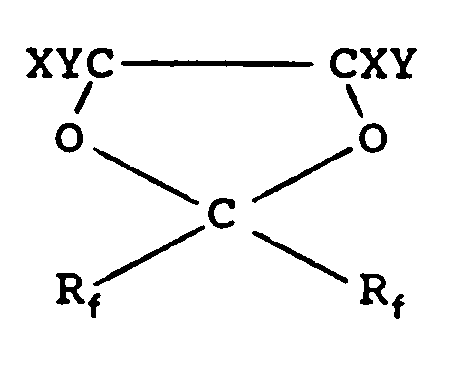
- In a process for the production of a halogenated 2,2-bis(perhaloalkyl)-1,3-dioxolane comprising(a) chlorinating 2,2-bis(perhaloalkyl)-1,3-dioxolane, and(b) fluorinating the product compound of (a) to produce a compound of the formulathe improvement comprising conducing the fluorination in (b) in the presence of a catalyst which is at least one of Cr, La, Ni, Sn, Zn, Fe, Co or Cu.

- A process according to claim 1, wherein the catalyst is in the form of a supported metal chloride.
- A process according to claim 5, wherein the catalyst is in the form of metal chloride supported on carbon.
- A process according to claim 2, wherein the catalyst is in the form of a supported metal chloride.
- A process according to claim 2, wherein the catalyst is Cr₂O₃.
- A process according to claim 3, wherein the catalyst in (b) is Cr₂O₃.
- A process according to claim 1, wherein the catalyst is CuCl₂/C.
- A process according to claim 1, wherein the temperature is about 250-300°C, the ratio of chlorine to 2,2-bis(perhaloalkyl)-1,3-dioxolane is about 4:1-10:1, the reaction time is about 1-120 sec, and the reaction pressure is about 1-20 atm.
- A process according to claim 1, wherein Rf is CF₃.
- A process according to claim 2, wherein Rf is CF₃.
- In a process for the production of 2,2-bis(perhaloalkyl)-1,3-dioxole of the formula

the improvement comprising conducting the chlorination in the presence of a catalyst which is at least one of La, Ni, Sn, Zn Fe, Co or Cu. - A process according to claim 14, wherein the improvement further comprises conducting the fluorination in the presence of a catalyst which is at least one of Cr, La, Ni, Sn, Zn, Fe, Co or Cu.
- A process according to claim 14, wherein the improvement further comprises, prior to dehalogenating, separating trans-2,2-bis(perhaloalkyl)-4,5-difluoro-4,5-dichloro-1,3-dioxolane and dehalogenating substantially only said isomer.
- A process according to claim 15, wherein the improvement further comprises, prior to dehalogenating, separating trans-2,2-bis(perhaloalkyl)-4,5-difluoro-4,5-dichloro-1,3-dioxolane and dehalogenating substantially only said isomer.
- A process for the production of a 2,2-bis(perhaloalkyl)-1,3-dioxole of the formula

- In a process for the production of 2,2,-bis(perhaloalkyl)-1,3-dioxole of the formula

the improvement comprises conducting the fluorination in the presence of a catalyst which is at least one of Cr, La, Ni, Sn, Zn, Fe, Co or Cu. - In a process for the preparation of a polymer formed from monomers which comprise 2,2-bis(perhaloalkyl)-1,3-dioxoles of the formula

- A process according to claim 20, wherein the polymer is produced by homopolymerization of the dioxole, copolymerization of the dioxole with tetrafluoroethylene or copolymerization of the dioxole with vinylidene fluoride.
- In a process for the preparation of a polymer formed from monomers which comprise 2,2-bis(perhaloalkyl)-1,3-dioxoles of the formula

Applications Claiming Priority (3)
| Application Number | Priority Date | Filing Date | Title |
|---|---|---|---|
| US39910089A | 1989-08-28 | 1989-08-28 | |
| US399100 | 1989-08-28 | ||
| PCT/US1990/004505 WO1991003472A2 (en) | 1989-08-28 | 1990-08-16 | Process for the preparation of halogenated 2,2-bis(trifluoromethyl)-1,3-dioxolanes |
Publications (2)
| Publication Number | Publication Date |
|---|---|
| EP0489756A1 EP0489756A1 (en) | 1992-06-17 |
| EP0489756B1 true EP0489756B1 (en) | 1995-12-13 |
Family
ID=23578145
Family Applications (1)
| Application Number | Title | Priority Date | Filing Date |
|---|---|---|---|
| EP90911888A Expired - Lifetime EP0489756B1 (en) | 1989-08-28 | 1990-08-16 | Process for the preparation of halogenated 2,2-bis(trifluoromethyl)-1,3-dioxolanes |
Country Status (5)
| Country | Link |
|---|---|
| EP (1) | EP0489756B1 (en) |
| JP (2) | JPH07609B2 (en) |
| CA (1) | CA2060193A1 (en) |
| DE (1) | DE69024220T2 (en) |
| WO (1) | WO1991003472A2 (en) |
Families Citing this family (12)
| Publication number | Priority date | Publication date | Assignee | Title |
|---|---|---|---|---|
| US5658772A (en) * | 1989-12-22 | 1997-08-19 | E. I. Du Pont De Nemours And Company | Site-specific recombination of DNA in plant cells |
| IT1244709B (en) * | 1991-02-07 | 1994-08-08 | Ausimont Spa | 1.3-DIOXIDE PREPARATION PROCESS |
| IT1264662B1 (en) * | 1993-07-05 | 1996-10-04 | Ausimont Spa | PERFLURODIOSSOLS THEIR HOMOPOLYMERS AND COPOLYMERS AND THEIR USE FOR THE COATING OF ELECTRIC CABLES |
| US5523422A (en) * | 1994-10-14 | 1996-06-04 | E. I. Du Pont De Nemours And Company | Monomer precursor isomerization |
| US6469185B1 (en) | 1998-02-17 | 2002-10-22 | Ausimont S.P.A. | Perfluorodioxoles |
| IT1298257B1 (en) | 1998-02-17 | 1999-12-20 | Ausimont Spa | perfluorodioxols |
| US9868684B2 (en) * | 2011-02-04 | 2018-01-16 | Solvay Specialty Polymers Italy S.P.A. | Method for manufacturing perfluorovinylethers |
| CN104583246B (en) * | 2012-06-20 | 2016-08-24 | 索尔维特殊聚合物意大利有限公司 | tetrafluoroethylene copolymer |
| CN107353276B (en) * | 2016-05-09 | 2021-03-26 | 浙江省化工研究院有限公司 | Method for preparing halogenated 2, 2-di (perfluorinated substituent) -1, 3-dioxolane compound |
| CN111655676B (en) * | 2018-02-01 | 2023-09-15 | Agc株式会社 | Method for producing 1,3-dioxolane compound and perfluoro(2,2-dimethyl-1,3-dioxole) |
| CN109867655B (en) * | 2019-03-05 | 2020-11-17 | 浙江省化工研究院有限公司 | Synthesis method of 4, 5-difluoro-2, 2-di (per-fluoro substituent) -1, 3-dioxane allyl compound |
| CN110003165B (en) * | 2019-03-28 | 2020-07-07 | 浙江省化工研究院有限公司 | A kind of synthetic method of chloro-2,2-bis (perfluoro substituent)-1,3-dioxolane compounds |
Family Cites Families (9)
| Publication number | Priority date | Publication date | Assignee | Title |
|---|---|---|---|---|
| US3865845A (en) * | 1971-02-24 | 1975-02-11 | Paul Raphael Resnick | Fluorinated dioxoles |
| CA955951A (en) * | 1971-02-24 | 1974-10-08 | E. I. Du Pont De Nemours And Company | Fluorinated dioxoles and process for their preparation |
| US3978030A (en) | 1973-08-01 | 1976-08-31 | E. I. Du Pont De Nemours And Company | Polymers of fluorinated dioxoles |
| US4393227A (en) | 1981-08-12 | 1983-07-12 | E. I. Du Pont De Nemours And Company | Process for dechlorinating organic compounds |
| US4429143A (en) * | 1981-09-28 | 1984-01-31 | E. I. Du Pont De Nemours & Co. | Cyclic monomers derived from trifluoropyruvate esters |
| US4535175A (en) * | 1984-04-18 | 1985-08-13 | E. I. Du Pont De Nemours And Company | Fluorodioxoles |
| DE3603103A1 (en) * | 1986-02-01 | 1987-08-06 | Hoechst Ag | SOLID CATALYST FOR THE PRODUCTION OF CHLORINE FLUORINE HYDROGEN |
| JPH0788326B2 (en) * | 1987-11-26 | 1995-09-27 | 旭硝子株式会社 | Method for producing 1,1-dichloro-1,2,2,2-tetrafluoroethane |
| US4908461A (en) * | 1987-12-21 | 1990-03-13 | E. I. Du Pont De Nemours And Company | Process for dechlorinating 4,5-dichlorofluorodioxolanes to obtain fluorodioxoles |
-
1990
- 1990-08-16 JP JP2511359A patent/JPH07609B2/en not_active Expired - Fee Related
- 1990-08-16 WO PCT/US1990/004505 patent/WO1991003472A2/en not_active Ceased
- 1990-08-16 CA CA 2060193 patent/CA2060193A1/en not_active Abandoned
- 1990-08-16 DE DE69024220T patent/DE69024220T2/en not_active Expired - Fee Related
- 1990-08-16 EP EP90911888A patent/EP0489756B1/en not_active Expired - Lifetime
-
1994
- 1994-05-25 JP JP6133896A patent/JP2763860B2/en not_active Expired - Fee Related
Also Published As
| Publication number | Publication date |
|---|---|
| EP0489756A1 (en) | 1992-06-17 |
| JPH07138252A (en) | 1995-05-30 |
| DE69024220D1 (en) | 1996-01-25 |
| JP2763860B2 (en) | 1998-06-11 |
| CA2060193A1 (en) | 1991-03-01 |
| WO1991003472A2 (en) | 1991-03-21 |
| JPH07609B2 (en) | 1995-01-11 |
| DE69024220T2 (en) | 1996-07-25 |
| JPH04503816A (en) | 1992-07-09 |
| WO1991003472A3 (en) | 1991-04-18 |
Similar Documents
| Publication | Publication Date | Title |
|---|---|---|
| US4429143A (en) | Cyclic monomers derived from trifluoropyruvate esters | |
| CA1197347A (en) | Perfluorodioxole and its polymers | |
| US4565855A (en) | Polymers of dioxolanes | |
| US3978030A (en) | Polymers of fluorinated dioxoles | |
| US4558141A (en) | Perfluorodioxole and its polymers | |
| EP0095077B1 (en) | Novel fluorodioxoles and fluorodioxole polymers | |
| US4594399A (en) | Cyclic monomers derived from trifluoropyruvate esters, amended to polymers and polymer films from dioxoles | |
| US4485250A (en) | Perfluorodioxole and its polymers | |
| JP2763860B2 (en) | Method for producing halogenated 2,2-bis (perhaloalkyl) -1,3-dioxolane | |
| US4535175A (en) | Fluorodioxoles | |
| US4496750A (en) | Cyclic monomers derived from trifluoropyruvate esters | |
| EP0491872B1 (en) | Polyhalodihydrodioxins and polyhalodioxoles | |
| US5286824A (en) | Process for the preparation of halogenated 2,2-bis(trifluoromethyl)-1,3-dioxolanes | |
| US4533741A (en) | 4,5-Dichloro-2,2,4,5,-tetrafluoro-1,3-dioxolane | |
| JP3953098B2 (en) | Monomer precursor isomerization | |
| CA1198119A (en) | 4,5-dichloro-2,2,4,5 tetrafluoro-1,3-dioxolane | |
| CA1258737A (en) | Cyclic monomers derived from trifluoropyruvate esters |
Legal Events
| Date | Code | Title | Description |
|---|---|---|---|
| PUAI | Public reference made under article 153(3) epc to a published international application that has entered the european phase |
Free format text: ORIGINAL CODE: 0009012 |
|
| 17P | Request for examination filed |
Effective date: 19920309 |
|
| AK | Designated contracting states |
Kind code of ref document: A1 Designated state(s): DE FR GB IT |
|
| 17Q | First examination report despatched |
Effective date: 19930611 |
|
| GRAA | (expected) grant |
Free format text: ORIGINAL CODE: 0009210 |
|
| AK | Designated contracting states |
Kind code of ref document: B1 Designated state(s): DE FR GB IT |
|
| REF | Corresponds to: |
Ref document number: 69024220 Country of ref document: DE Date of ref document: 19960125 |
|
| ITF | It: translation for a ep patent filed | ||
| ET | Fr: translation filed | ||
| PLBE | No opposition filed within time limit |
Free format text: ORIGINAL CODE: 0009261 |
|
| STAA | Information on the status of an ep patent application or granted ep patent |
Free format text: STATUS: NO OPPOSITION FILED WITHIN TIME LIMIT |
|
| 26N | No opposition filed | ||
| PGFP | Annual fee paid to national office [announced via postgrant information from national office to epo] |
Ref country code: FR Payment date: 19980602 Year of fee payment: 9 |
|
| PGFP | Annual fee paid to national office [announced via postgrant information from national office to epo] |
Ref country code: DE Payment date: 19980605 Year of fee payment: 9 |
|
| PGFP | Annual fee paid to national office [announced via postgrant information from national office to epo] |
Ref country code: GB Payment date: 19980625 Year of fee payment: 9 |
|
| PG25 | Lapsed in a contracting state [announced via postgrant information from national office to epo] |
Ref country code: GB Free format text: LAPSE BECAUSE OF NON-PAYMENT OF DUE FEES Effective date: 19990816 |
|
| GBPC | Gb: european patent ceased through non-payment of renewal fee |
Effective date: 19990816 |
|
| PG25 | Lapsed in a contracting state [announced via postgrant information from national office to epo] |
Ref country code: FR Free format text: LAPSE BECAUSE OF NON-PAYMENT OF DUE FEES Effective date: 20000428 |
|
| PG25 | Lapsed in a contracting state [announced via postgrant information from national office to epo] |
Ref country code: DE Free format text: LAPSE BECAUSE OF NON-PAYMENT OF DUE FEES Effective date: 20000601 |
|
| REG | Reference to a national code |
Ref country code: FR Ref legal event code: ST |
|
| PGFP | Annual fee paid to national office [announced via postgrant information from national office to epo] |
Ref country code: IT Payment date: 20090814 Year of fee payment: 20 |