EP0489663A1 - Thiazolidine-2,4-dione compound, method for production thereof, and medicine containing the compound for cure diabetic complications - Google Patents
Thiazolidine-2,4-dione compound, method for production thereof, and medicine containing the compound for cure diabetic complications Download PDFInfo
- Publication number
- EP0489663A1 EP0489663A1 EP91403312A EP91403312A EP0489663A1 EP 0489663 A1 EP0489663 A1 EP 0489663A1 EP 91403312 A EP91403312 A EP 91403312A EP 91403312 A EP91403312 A EP 91403312A EP 0489663 A1 EP0489663 A1 EP 0489663A1
- Authority
- EP
- European Patent Office
- Prior art keywords
- thiazolidine
- dione
- compound
- propenoyl
- benzyl
- Prior art date
- Legal status (The legal status is an assumption and is not a legal conclusion. Google has not performed a legal analysis and makes no representation as to the accuracy of the status listed.)
- Withdrawn
Links
- -1 Thiazolidine-2,4-dione compound Chemical class 0.000 title claims abstract description 29
- 150000001875 compounds Chemical class 0.000 title claims abstract description 27
- 239000003814 drug Substances 0.000 title claims description 24
- 208000002249 Diabetes Complications Diseases 0.000 title claims description 12
- 206010012655 Diabetic complications Diseases 0.000 title claims description 12
- 238000004519 manufacturing process Methods 0.000 title claims description 7
- 125000002496 methyl group Chemical group [H]C([H])([H])* 0.000 claims abstract description 11
- 125000004435 hydrogen atom Chemical group [H]* 0.000 claims abstract description 9
- 238000006243 chemical reaction Methods 0.000 claims description 16
- 238000000034 method Methods 0.000 claims description 15
- 125000004184 methoxymethyl group Chemical group [H]C([H])([H])OC([H])([H])* 0.000 claims description 9
- 239000007795 chemical reaction product Substances 0.000 claims description 5
- 239000000203 mixture Substances 0.000 claims description 5
- HUMNYLRZRPPJDN-UHFFFAOYSA-N benzenecarboxaldehyde Natural products O=CC1=CC=CC=C1 HUMNYLRZRPPJDN-UHFFFAOYSA-N 0.000 claims description 4
- 125000001797 benzyl group Chemical group [H]C1=C([H])C([H])=C(C([H])=C1[H])C([H])([H])* 0.000 claims description 4
- QNGNSVIICDLXHT-UHFFFAOYSA-N para-ethylbenzaldehyde Natural products CCC1=CC=C(C=O)C=C1 QNGNSVIICDLXHT-UHFFFAOYSA-N 0.000 claims description 4
- VJYVEDPHRHCYRN-UHFFFAOYSA-N 5-[[2-[3-(3,4-dihydroxyphenyl)prop-2-enoyl]phenyl]methyl]-1,3-thiazolidine-2,4-dione Chemical compound C1=C(O)C(O)=CC=C1C=CC(=O)C1=CC=CC=C1CC1C(=O)NC(=O)S1 VJYVEDPHRHCYRN-UHFFFAOYSA-N 0.000 claims description 3
- NGRSUEGDFRXGSV-UHFFFAOYSA-N 5-[[4-[3-(3,4-dihydroxyphenyl)prop-2-enoyl]phenyl]methyl]-1,3-thiazolidine-2,4-dione Chemical compound C1=C(O)C(O)=CC=C1C=CC(=O)C(C=C1)=CC=C1CC1C(=O)NC(=O)S1 NGRSUEGDFRXGSV-UHFFFAOYSA-N 0.000 claims description 3
- 239000003937 drug carrier Substances 0.000 claims description 3
- UYHHCJITMWIQNM-UHFFFAOYSA-N 5-[[3-[3-(4-hydroxy-3-methylphenyl)prop-2-enoyl]phenyl]methyl]-1,3-thiazolidine-2,4-dione Chemical compound C1=C(O)C(C)=CC(C=CC(=O)C=2C=C(CC3C(NC(=O)S3)=O)C=CC=2)=C1 UYHHCJITMWIQNM-UHFFFAOYSA-N 0.000 claims 2
- HCCDSFPHKROEJB-UHFFFAOYSA-N 5-[[4-[3-(4-hydroxy-3-methoxyphenyl)prop-2-enyl]phenyl]methyl]-1,3-thiazolidine-2,4-dione Chemical compound OC1=C(C=C(C=C1)C=CCC1=CC=C(C=C1)CC1C(NC(S1)=O)=O)OC HCCDSFPHKROEJB-UHFFFAOYSA-N 0.000 claims 1
- JDKTXMIUMSRTBZ-UHFFFAOYSA-N COC1(CC(=CC=C1O)C=CC(=O)C1=CC=C(CC2C(NC(S2)=O)=O)C=C1)OC Chemical compound COC1(CC(=CC=C1O)C=CC(=O)C1=CC=C(CC2C(NC(S2)=O)=O)C=C1)OC JDKTXMIUMSRTBZ-UHFFFAOYSA-N 0.000 claims 1
- 210000004369 blood Anatomy 0.000 abstract description 17
- 239000008280 blood Substances 0.000 abstract description 17
- 102000016912 Aldehyde Reductase Human genes 0.000 abstract description 14
- 108010053754 Aldehyde reductase Proteins 0.000 abstract description 14
- 208000017169 kidney disease Diseases 0.000 abstract description 7
- 208000017442 Retinal disease Diseases 0.000 abstract description 6
- 206010038923 Retinopathy Diseases 0.000 abstract description 6
- 208000015238 neurotic disease Diseases 0.000 abstract description 5
- XEKOWRVHYACXOJ-UHFFFAOYSA-N Ethyl acetate Chemical compound CCOC(C)=O XEKOWRVHYACXOJ-UHFFFAOYSA-N 0.000 description 27
- OKKJLVBELUTLKV-UHFFFAOYSA-N Methanol Chemical compound OC OKKJLVBELUTLKV-UHFFFAOYSA-N 0.000 description 21
- 241000700159 Rattus Species 0.000 description 20
- VEXZGXHMUGYJMC-UHFFFAOYSA-N Hydrochloric acid Chemical compound Cl VEXZGXHMUGYJMC-UHFFFAOYSA-N 0.000 description 16
- LFQSCWFLJHTTHZ-UHFFFAOYSA-N Ethanol Chemical compound CCO LFQSCWFLJHTTHZ-UHFFFAOYSA-N 0.000 description 15
- XLYOFNOQVPJJNP-UHFFFAOYSA-N water Substances O XLYOFNOQVPJJNP-UHFFFAOYSA-N 0.000 description 14
- FBPFZTCFMRRESA-FSIIMWSLSA-N D-Glucitol Natural products OC[C@H](O)[C@H](O)[C@@H](O)[C@H](O)CO FBPFZTCFMRRESA-FSIIMWSLSA-N 0.000 description 11
- FBPFZTCFMRRESA-JGWLITMVSA-N D-glucitol Chemical compound OC[C@H](O)[C@@H](O)[C@H](O)[C@H](O)CO FBPFZTCFMRRESA-JGWLITMVSA-N 0.000 description 11
- 206010012601 diabetes mellitus Diseases 0.000 description 11
- 239000000243 solution Substances 0.000 description 11
- 239000000600 sorbitol Substances 0.000 description 11
- 239000002904 solvent Substances 0.000 description 9
- FAPWRFPIFSIZLT-UHFFFAOYSA-M Sodium chloride Chemical compound [Na+].[Cl-] FAPWRFPIFSIZLT-UHFFFAOYSA-M 0.000 description 8
- 239000011369 resultant mixture Substances 0.000 description 8
- CSNNHWWHGAXBCP-UHFFFAOYSA-L Magnesium sulfate Chemical compound [Mg+2].[O-][S+2]([O-])([O-])[O-] CSNNHWWHGAXBCP-UHFFFAOYSA-L 0.000 description 7
- 238000004440 column chromatography Methods 0.000 description 7
- MNQZXJOMYWMBOU-UHFFFAOYSA-N glyceraldehyde Chemical compound OCC(O)C=O MNQZXJOMYWMBOU-UHFFFAOYSA-N 0.000 description 7
- 230000002401 inhibitory effect Effects 0.000 description 7
- 229920005862 polyol Polymers 0.000 description 7
- 150000003077 polyols Chemical class 0.000 description 7
- CSCPPACGZOOCGX-UHFFFAOYSA-N Acetone Chemical compound CC(C)=O CSCPPACGZOOCGX-UHFFFAOYSA-N 0.000 description 6
- HEMHJVSKTPXQMS-UHFFFAOYSA-M Sodium hydroxide Chemical compound [OH-].[Na+] HEMHJVSKTPXQMS-UHFFFAOYSA-M 0.000 description 6
- KWYUFKZDYYNOTN-UHFFFAOYSA-M Potassium hydroxide Chemical compound [OH-].[K+] KWYUFKZDYYNOTN-UHFFFAOYSA-M 0.000 description 5
- 238000009825 accumulation Methods 0.000 description 5
- 238000004821 distillation Methods 0.000 description 5
- 230000000694 effects Effects 0.000 description 5
- OAYLNYINCPYISS-UHFFFAOYSA-N ethyl acetate;hexane Chemical compound CCCCCC.CCOC(C)=O OAYLNYINCPYISS-UHFFFAOYSA-N 0.000 description 5
- 229920006395 saturated elastomer Polymers 0.000 description 5
- 208000002177 Cataract Diseases 0.000 description 4
- IAZDPXIOMUYVGZ-WFGJKAKNSA-N Dimethyl sulfoxide Chemical compound [2H]C([2H])([2H])S(=O)C([2H])([2H])[2H] IAZDPXIOMUYVGZ-WFGJKAKNSA-N 0.000 description 4
- UIIMBOGNXHQVGW-UHFFFAOYSA-M Sodium bicarbonate Chemical compound [Na+].OC([O-])=O UIIMBOGNXHQVGW-UHFFFAOYSA-M 0.000 description 4
- XJLXINKUBYWONI-DQQFMEOOSA-N [[(2r,3r,4r,5r)-5-(6-aminopurin-9-yl)-3-hydroxy-4-phosphonooxyoxolan-2-yl]methoxy-hydroxyphosphoryl] [(2s,3r,4s,5s)-5-(3-carbamoylpyridin-1-ium-1-yl)-3,4-dihydroxyoxolan-2-yl]methyl phosphate Chemical compound NC(=O)C1=CC=C[N+]([C@@H]2[C@H]([C@@H](O)[C@H](COP([O-])(=O)OP(O)(=O)OC[C@@H]3[C@H]([C@@H](OP(O)(O)=O)[C@@H](O3)N3C4=NC=NC(N)=C4N=C3)O)O2)O)=C1 XJLXINKUBYWONI-DQQFMEOOSA-N 0.000 description 4
- BERDEBHAJNAUOM-UHFFFAOYSA-N copper(i) oxide Chemical compound [Cu]O[Cu] BERDEBHAJNAUOM-UHFFFAOYSA-N 0.000 description 4
- 238000010438 heat treatment Methods 0.000 description 4
- LPXPTNMVRIOKMN-UHFFFAOYSA-M sodium nitrite Chemical compound [Na+].[O-]N=O LPXPTNMVRIOKMN-UHFFFAOYSA-M 0.000 description 4
- UMGDCJDMYOKAJW-UHFFFAOYSA-N thiourea Chemical compound NC(N)=S UMGDCJDMYOKAJW-UHFFFAOYSA-N 0.000 description 4
- KNKIXXJBMGWXCY-UHFFFAOYSA-N 5-[(4-acetylphenyl)methyl]-1,3-thiazolidine-2,4-dione Chemical compound C1=CC(C(=O)C)=CC=C1CC1C(=O)NC(=O)S1 KNKIXXJBMGWXCY-UHFFFAOYSA-N 0.000 description 3
- QTBSBXVTEAMEQO-UHFFFAOYSA-N Acetic acid Chemical compound CC(O)=O QTBSBXVTEAMEQO-UHFFFAOYSA-N 0.000 description 3
- 101150041968 CDC13 gene Proteins 0.000 description 3
- LYCAIKOWRPUZTN-UHFFFAOYSA-N Ethylene glycol Chemical compound OCCO LYCAIKOWRPUZTN-UHFFFAOYSA-N 0.000 description 3
- WMFOQBRAJBCJND-UHFFFAOYSA-M Lithium hydroxide Chemical compound [Li+].[OH-] WMFOQBRAJBCJND-UHFFFAOYSA-M 0.000 description 3
- HEDRZPFGACZZDS-MICDWDOJSA-N Trichloro(2H)methane Chemical compound [2H]C(Cl)(Cl)Cl HEDRZPFGACZZDS-MICDWDOJSA-N 0.000 description 3
- 230000000881 depressing effect Effects 0.000 description 3
- RAXXELZNTBOGNW-UHFFFAOYSA-N imidazole Natural products C1=CNC=N1 RAXXELZNTBOGNW-UHFFFAOYSA-N 0.000 description 3
- 230000005764 inhibitory process Effects 0.000 description 3
- 239000010410 layer Substances 0.000 description 3
- 239000000546 pharmaceutical excipient Substances 0.000 description 3
- 239000011541 reaction mixture Substances 0.000 description 3
- QWQRYWWOQOUPQQ-UHFFFAOYSA-N 3-methoxy-4-(methoxymethoxy)benzaldehyde Chemical compound COCOC1=CC=C(C=O)C=C1OC QWQRYWWOQOUPQQ-UHFFFAOYSA-N 0.000 description 2
- XSHPKGYSRNTQBW-UHFFFAOYSA-N 5-[(3-acetylphenyl)methyl]-1,3-thiazolidine-2,4-dione Chemical compound CC(=O)C1=CC=CC(CC2C(NC(=O)S2)=O)=C1 XSHPKGYSRNTQBW-UHFFFAOYSA-N 0.000 description 2
- WVNKDIATHWMVKZ-UHFFFAOYSA-N 5-[[3-[3-(4-hydroxy-3-methoxyphenyl)prop-2-enoyl]phenyl]methyl]-1,3-thiazolidine-2,4-dione Chemical compound C1=C(O)C(OC)=CC(C=CC(=O)C=2C=C(CC3C(NC(=O)S3)=O)C=CC=2)=C1 WVNKDIATHWMVKZ-UHFFFAOYSA-N 0.000 description 2
- MNYZVQRIQKTZQN-UHFFFAOYSA-N 5-[[4-[3-(4-hydroxy-3-methoxyphenyl)prop-2-enoyl]phenyl]methyl]-1,3-thiazolidine-2,4-dione Chemical compound C1=C(O)C(OC)=CC(C=CC(=O)C=2C=CC(CC3C(NC(=O)S3)=O)=CC=2)=C1 MNYZVQRIQKTZQN-UHFFFAOYSA-N 0.000 description 2
- 244000215068 Acacia senegal Species 0.000 description 2
- VTYYLEPIZMXCLO-UHFFFAOYSA-L Calcium carbonate Chemical compound [Ca+2].[O-]C([O-])=O VTYYLEPIZMXCLO-UHFFFAOYSA-L 0.000 description 2
- HEDRZPFGACZZDS-UHFFFAOYSA-N Chloroform Chemical compound ClC(Cl)Cl HEDRZPFGACZZDS-UHFFFAOYSA-N 0.000 description 2
- 102000004190 Enzymes Human genes 0.000 description 2
- 108090000790 Enzymes Proteins 0.000 description 2
- JIGUQPWFLRLWPJ-UHFFFAOYSA-N Ethyl acrylate Chemical compound CCOC(=O)C=C JIGUQPWFLRLWPJ-UHFFFAOYSA-N 0.000 description 2
- WQZGKKKJIJFFOK-GASJEMHNSA-N Glucose Natural products OC[C@H]1OC(O)[C@H](O)[C@@H](O)[C@@H]1O WQZGKKKJIJFFOK-GASJEMHNSA-N 0.000 description 2
- 229920000084 Gum arabic Polymers 0.000 description 2
- HTTJABKRGRZYRN-UHFFFAOYSA-N Heparin Chemical compound OC1C(NC(=O)C)C(O)OC(COS(O)(=O)=O)C1OC1C(OS(O)(=O)=O)C(O)C(OC2C(C(OS(O)(=O)=O)C(OC3C(C(O)C(O)C(O3)C(O)=O)OS(O)(=O)=O)C(CO)O2)NS(O)(=O)=O)C(C(O)=O)O1 HTTJABKRGRZYRN-UHFFFAOYSA-N 0.000 description 2
- KFZMGEQAYNKOFK-UHFFFAOYSA-N Isopropanol Chemical compound CC(C)O KFZMGEQAYNKOFK-UHFFFAOYSA-N 0.000 description 2
- GUBGYTABKSRVRQ-QKKXKWKRSA-N Lactose Chemical compound OC[C@H]1O[C@@H](O[C@H]2[C@H](O)[C@@H](O)C(O)O[C@@H]2CO)[C@H](O)[C@@H](O)[C@H]1O GUBGYTABKSRVRQ-QKKXKWKRSA-N 0.000 description 2
- NBIIXXVUZAFLBC-UHFFFAOYSA-N Phosphoric acid Chemical compound OP(O)(O)=O NBIIXXVUZAFLBC-UHFFFAOYSA-N 0.000 description 2
- VMHLLURERBWHNL-UHFFFAOYSA-M Sodium acetate Chemical compound [Na+].CC([O-])=O VMHLLURERBWHNL-UHFFFAOYSA-M 0.000 description 2
- WYURNTSHIVDZCO-UHFFFAOYSA-N Tetrahydrofuran Chemical compound C1CCOC1 WYURNTSHIVDZCO-UHFFFAOYSA-N 0.000 description 2
- XSQUKJJJFZCRTK-UHFFFAOYSA-N Urea Natural products NC(N)=O XSQUKJJJFZCRTK-UHFFFAOYSA-N 0.000 description 2
- 239000000205 acacia gum Substances 0.000 description 2
- 235000010489 acacia gum Nutrition 0.000 description 2
- 230000007059 acute toxicity Effects 0.000 description 2
- 231100000403 acute toxicity Toxicity 0.000 description 2
- 150000001323 aldoses Chemical class 0.000 description 2
- WQZGKKKJIJFFOK-PHYPRBDBSA-N alpha-D-galactose Chemical compound OC[C@H]1O[C@H](O)[C@H](O)[C@@H](O)[C@H]1O WQZGKKKJIJFFOK-PHYPRBDBSA-N 0.000 description 2
- 239000007864 aqueous solution Substances 0.000 description 2
- WORJEOGGNQDSOE-UHFFFAOYSA-N chloroform;methanol Chemical compound OC.ClC(Cl)Cl WORJEOGGNQDSOE-UHFFFAOYSA-N 0.000 description 2
- 229940125904 compound 1 Drugs 0.000 description 2
- 229940125782 compound 2 Drugs 0.000 description 2
- 229940126214 compound 3 Drugs 0.000 description 2
- 239000012141 concentrate Substances 0.000 description 2
- 210000000695 crystalline len Anatomy 0.000 description 2
- XBDQKXXYIPTUBI-UHFFFAOYSA-N dimethylselenoniopropionate Natural products CCC(O)=O XBDQKXXYIPTUBI-UHFFFAOYSA-N 0.000 description 2
- 210000003743 erythrocyte Anatomy 0.000 description 2
- MHORPCPCVYBIBQ-UHFFFAOYSA-N ethyl 3-(3-acetylphenyl)-2-bromopropanoate Chemical compound CCOC(=O)C(Br)CC1=CC=CC(C(C)=O)=C1 MHORPCPCVYBIBQ-UHFFFAOYSA-N 0.000 description 2
- KBKVXJZHLOZICJ-UHFFFAOYSA-N ethyl 3-(4-acetylphenyl)-2-chloropropanoate Chemical compound CCOC(=O)C(Cl)CC1=CC=C(C(C)=O)C=C1 KBKVXJZHLOZICJ-UHFFFAOYSA-N 0.000 description 2
- 229930182830 galactose Natural products 0.000 description 2
- 229960002897 heparin Drugs 0.000 description 2
- 229920000669 heparin Polymers 0.000 description 2
- NOESYZHRGYRDHS-UHFFFAOYSA-N insulin Chemical compound N1C(=O)C(NC(=O)C(CCC(N)=O)NC(=O)C(CCC(O)=O)NC(=O)C(C(C)C)NC(=O)C(NC(=O)CN)C(C)CC)CSSCC(C(NC(CO)C(=O)NC(CC(C)C)C(=O)NC(CC=2C=CC(O)=CC=2)C(=O)NC(CCC(N)=O)C(=O)NC(CC(C)C)C(=O)NC(CCC(O)=O)C(=O)NC(CC(N)=O)C(=O)NC(CC=2C=CC(O)=CC=2)C(=O)NC(CSSCC(NC(=O)C(C(C)C)NC(=O)C(CC(C)C)NC(=O)C(CC=2C=CC(O)=CC=2)NC(=O)C(CC(C)C)NC(=O)C(C)NC(=O)C(CCC(O)=O)NC(=O)C(C(C)C)NC(=O)C(CC(C)C)NC(=O)C(CC=2NC=NC=2)NC(=O)C(CO)NC(=O)CNC2=O)C(=O)NCC(=O)NC(CCC(O)=O)C(=O)NC(CCCNC(N)=N)C(=O)NCC(=O)NC(CC=3C=CC=CC=3)C(=O)NC(CC=3C=CC=CC=3)C(=O)NC(CC=3C=CC(O)=CC=3)C(=O)NC(C(C)O)C(=O)N3C(CCC3)C(=O)NC(CCCCN)C(=O)NC(C)C(O)=O)C(=O)NC(CC(N)=O)C(O)=O)=O)NC(=O)C(C(C)CC)NC(=O)C(CO)NC(=O)C(C(C)O)NC(=O)C1CSSCC2NC(=O)C(CC(C)C)NC(=O)C(NC(=O)C(CCC(N)=O)NC(=O)C(CC(N)=O)NC(=O)C(NC(=O)C(N)CC=1C=CC=CC=1)C(C)C)CC1=CN=CN1 NOESYZHRGYRDHS-UHFFFAOYSA-N 0.000 description 2
- HQKMJHAJHXVSDF-UHFFFAOYSA-L magnesium stearate Chemical compound [Mg+2].CCCCCCCCCCCCCCCCCC([O-])=O.CCCCCCCCCCCCCCCCCC([O-])=O HQKMJHAJHXVSDF-UHFFFAOYSA-L 0.000 description 2
- 230000004060 metabolic process Effects 0.000 description 2
- BDAGIHXWWSANSR-UHFFFAOYSA-N methanoic acid Natural products OC=O BDAGIHXWWSANSR-UHFFFAOYSA-N 0.000 description 2
- 239000012044 organic layer Substances 0.000 description 2
- 239000003960 organic solvent Substances 0.000 description 2
- PNJWIWWMYCMZRO-UHFFFAOYSA-N pent‐4‐en‐2‐one Natural products CC(=O)CC=C PNJWIWWMYCMZRO-UHFFFAOYSA-N 0.000 description 2
- 239000008194 pharmaceutical composition Substances 0.000 description 2
- 239000000047 product Substances 0.000 description 2
- 239000001632 sodium acetate Substances 0.000 description 2
- 235000017281 sodium acetate Nutrition 0.000 description 2
- 235000017557 sodium bicarbonate Nutrition 0.000 description 2
- 229910000030 sodium bicarbonate Inorganic materials 0.000 description 2
- 235000010288 sodium nitrite Nutrition 0.000 description 2
- CZDYPVPMEAXLPK-UHFFFAOYSA-N tetramethylsilane Chemical compound C[Si](C)(C)C CZDYPVPMEAXLPK-UHFFFAOYSA-N 0.000 description 2
- 210000003462 vein Anatomy 0.000 description 2
- GPRYKVSEZCQIHD-UHFFFAOYSA-N 1-(4-aminophenyl)ethanone Chemical compound CC(=O)C1=CC=C(N)C=C1 GPRYKVSEZCQIHD-UHFFFAOYSA-N 0.000 description 1
- POAOYUHQDCAZBD-UHFFFAOYSA-N 2-butoxyethanol Chemical compound CCCCOCCO POAOYUHQDCAZBD-UHFFFAOYSA-N 0.000 description 1
- ZNQVEEAIQZEUHB-UHFFFAOYSA-N 2-ethoxyethanol Chemical compound CCOCCO ZNQVEEAIQZEUHB-UHFFFAOYSA-N 0.000 description 1
- CKQHAYFOPRIUOM-UHFFFAOYSA-N 3'-Aminoacetophenone Chemical compound CC(=O)C1=CC=CC(N)=C1 CKQHAYFOPRIUOM-UHFFFAOYSA-N 0.000 description 1
- RYTSFSLVJDNOHI-UHFFFAOYSA-N 3,4-bis(methoxymethoxy)benzaldehyde Chemical compound COCOC1=CC=C(C=O)C=C1OCOC RYTSFSLVJDNOHI-UHFFFAOYSA-N 0.000 description 1
- BMYNFMYTOJXKLE-UHFFFAOYSA-N 3-azaniumyl-2-hydroxypropanoate Chemical compound NCC(O)C(O)=O BMYNFMYTOJXKLE-UHFFFAOYSA-N 0.000 description 1
- OSWFIVFLDKOXQC-UHFFFAOYSA-N 4-(3-methoxyphenyl)aniline Chemical compound COC1=CC=CC(C=2C=CC(N)=CC=2)=C1 OSWFIVFLDKOXQC-UHFFFAOYSA-N 0.000 description 1
- UGYDOQCHINWEQG-UHFFFAOYSA-N 5-[[2-[3-(4-hydroxy-3-methoxyphenyl)prop-2-enoyl]phenyl]methyl]-1,3-thiazolidine-2,4-dione Chemical compound C1=C(O)C(OC)=CC(C=CC(=O)C=2C(=CC=CC=2)CC2C(NC(=O)S2)=O)=C1 UGYDOQCHINWEQG-UHFFFAOYSA-N 0.000 description 1
- GBFFQKZPBKMJIY-UHFFFAOYSA-N 5-[[3-[3-(3,4-dihydroxyphenyl)prop-2-enoyl]phenyl]methyl]-1,3-thiazolidine-2,4-dione Chemical compound C1=C(O)C(O)=CC=C1C=CC(=O)C1=CC=CC(CC2C(NC(=O)S2)=O)=C1 GBFFQKZPBKMJIY-UHFFFAOYSA-N 0.000 description 1
- DATUWQSWGDUGIE-UHFFFAOYSA-N 5-[[3-[3-[3-methoxy-4-(methoxymethoxy)phenyl]prop-2-enoyl]phenyl]methyl]-1,3-thiazolidine-2,4-dione Chemical compound COC=1C=C(C=CC1OCOC)C=CC(=O)C=1C=C(CC2C(NC(S2)=O)=O)C=CC1 DATUWQSWGDUGIE-UHFFFAOYSA-N 0.000 description 1
- ZONDRXKTUUDRNU-UHFFFAOYSA-N 5-[[4-[3-[3,4-bis(methoxymethoxy)phenyl]prop-2-enoyl]phenyl]methyl]-1,3-thiazolidine-2,4-dione Chemical compound COCOC=1C=C(C=CC1OCOC)C=CC(=O)C1=CC=C(CC2C(NC(S2)=O)=O)C=C1 ZONDRXKTUUDRNU-UHFFFAOYSA-N 0.000 description 1
- JNJNBCYKWIJVST-UHFFFAOYSA-N 5-[[4-[3-[3-methoxy-4-(methoxymethoxy)phenyl]prop-2-enoyl]phenyl]methyl]-1,3-thiazolidine-2,4-dione Chemical compound C1=C(OC)C(OCOC)=CC=C1C=CC(=O)C(C=C1)=CC=C1CC1C(=O)NC(=O)S1 JNJNBCYKWIJVST-UHFFFAOYSA-N 0.000 description 1
- 206010002091 Anaesthesia Diseases 0.000 description 1
- FBPFZTCFMRRESA-KVTDHHQDSA-N D-Mannitol Chemical compound OC[C@@H](O)[C@@H](O)[C@H](O)[C@H](O)CO FBPFZTCFMRRESA-KVTDHHQDSA-N 0.000 description 1
- 239000004375 Dextrin Substances 0.000 description 1
- 229920001353 Dextrin Polymers 0.000 description 1
- 229930091371 Fructose Natural products 0.000 description 1
- RFSUNEUAIZKAJO-ARQDHWQXSA-N Fructose Chemical compound OC[C@H]1O[C@](O)(CO)[C@@H](O)[C@@H]1O RFSUNEUAIZKAJO-ARQDHWQXSA-N 0.000 description 1
- 239000005715 Fructose Substances 0.000 description 1
- 102000004877 Insulin Human genes 0.000 description 1
- 108090001061 Insulin Proteins 0.000 description 1
- 208000007976 Ketosis Diseases 0.000 description 1
- 229930195725 Mannitol Natural products 0.000 description 1
- 241000699670 Mus sp. Species 0.000 description 1
- LRHPLDYGYMQRHN-UHFFFAOYSA-N N-Butanol Chemical class CCCCO LRHPLDYGYMQRHN-UHFFFAOYSA-N 0.000 description 1
- GRYLNZFGIOXLOG-UHFFFAOYSA-N Nitric acid Chemical compound O[N+]([O-])=O GRYLNZFGIOXLOG-UHFFFAOYSA-N 0.000 description 1
- 229920002472 Starch Polymers 0.000 description 1
- ZSJLQEPLLKMAKR-UHFFFAOYSA-N Streptozotocin Natural products O=NN(C)C(=O)NC1C(O)OC(CO)C(O)C1O ZSJLQEPLLKMAKR-UHFFFAOYSA-N 0.000 description 1
- 230000005856 abnormality Effects 0.000 description 1
- 235000011054 acetic acid Nutrition 0.000 description 1
- 239000002253 acid Substances 0.000 description 1
- 239000000783 alginic acid Substances 0.000 description 1
- 235000010443 alginic acid Nutrition 0.000 description 1
- 229920000615 alginic acid Polymers 0.000 description 1
- 229960001126 alginic acid Drugs 0.000 description 1
- 150000004781 alginic acids Chemical class 0.000 description 1
- 229910000147 aluminium phosphate Inorganic materials 0.000 description 1
- 230000037005 anaesthesia Effects 0.000 description 1
- 210000000702 aorta abdominal Anatomy 0.000 description 1
- WQZGKKKJIJFFOK-VFUOTHLCSA-N beta-D-glucose Chemical compound OC[C@H]1O[C@@H](O)[C@H](O)[C@@H](O)[C@@H]1O WQZGKKKJIJFFOK-VFUOTHLCSA-N 0.000 description 1
- 229910000019 calcium carbonate Inorganic materials 0.000 description 1
- 235000010216 calcium carbonate Nutrition 0.000 description 1
- 239000001506 calcium phosphate Substances 0.000 description 1
- 229910000389 calcium phosphate Inorganic materials 0.000 description 1
- 235000011010 calcium phosphates Nutrition 0.000 description 1
- 239000002775 capsule Substances 0.000 description 1
- 210000004027 cell Anatomy 0.000 description 1
- 230000035567 cellular accumulation Effects 0.000 description 1
- 239000003795 chemical substances by application Substances 0.000 description 1
- 230000007423 decrease Effects 0.000 description 1
- 230000007812 deficiency Effects 0.000 description 1
- 230000000994 depressogenic effect Effects 0.000 description 1
- 235000019425 dextrin Nutrition 0.000 description 1
- 201000010099 disease Diseases 0.000 description 1
- 208000037265 diseases, disorders, signs and symptoms Diseases 0.000 description 1
- 239000008298 dragée Substances 0.000 description 1
- 229940079593 drug Drugs 0.000 description 1
- 239000000839 emulsion Substances 0.000 description 1
- 230000005284 excitation Effects 0.000 description 1
- 239000000706 filtrate Substances 0.000 description 1
- 235000019253 formic acid Nutrition 0.000 description 1
- 239000008103 glucose Substances 0.000 description 1
- 239000008187 granular material Substances 0.000 description 1
- 238000002347 injection Methods 0.000 description 1
- 239000007924 injection Substances 0.000 description 1
- 229940125396 insulin Drugs 0.000 description 1
- 238000010253 intravenous injection Methods 0.000 description 1
- 150000002584 ketoses Chemical class 0.000 description 1
- INHCSSUBVCNVSK-UHFFFAOYSA-L lithium sulfate Inorganic materials [Li+].[Li+].[O-]S([O-])(=O)=O INHCSSUBVCNVSK-UHFFFAOYSA-L 0.000 description 1
- 235000019359 magnesium stearate Nutrition 0.000 description 1
- 239000000594 mannitol Substances 0.000 description 1
- 235000010355 mannitol Nutrition 0.000 description 1
- 230000002503 metabolic effect Effects 0.000 description 1
- 238000012986 modification Methods 0.000 description 1
- 230000004048 modification Effects 0.000 description 1
- 201000001119 neuropathy Diseases 0.000 description 1
- 230000007823 neuropathy Effects 0.000 description 1
- 229930027945 nicotinamide-adenine dinucleotide Natural products 0.000 description 1
- 229910017604 nitric acid Inorganic materials 0.000 description 1
- 208000033808 peripheral neuropathy Diseases 0.000 description 1
- 235000011007 phosphoric acid Nutrition 0.000 description 1
- 239000002504 physiological saline solution Substances 0.000 description 1
- 239000008057 potassium phosphate buffer Substances 0.000 description 1
- ASHGTUMKRVIOLH-UHFFFAOYSA-L potassium;sodium;hydrogen phosphate Chemical compound [Na+].[K+].OP([O-])([O-])=O ASHGTUMKRVIOLH-UHFFFAOYSA-L 0.000 description 1
- 239000000843 powder Substances 0.000 description 1
- 235000019260 propionic acid Nutrition 0.000 description 1
- IUVKMZGDUIUOCP-BTNSXGMBSA-N quinbolone Chemical compound O([C@H]1CC[C@H]2[C@H]3[C@@H]([C@]4(C=CC(=O)C=C4CC3)C)CC[C@@]21C)C1=CCCC1 IUVKMZGDUIUOCP-BTNSXGMBSA-N 0.000 description 1
- 239000000376 reactant Substances 0.000 description 1
- 239000008107 starch Substances 0.000 description 1
- 235000019698 starch Nutrition 0.000 description 1
- ZSJLQEPLLKMAKR-GKHCUFPYSA-N streptozocin Chemical compound O=NN(C)C(=O)N[C@H]1[C@@H](O)O[C@H](CO)[C@@H](O)[C@@H]1O ZSJLQEPLLKMAKR-GKHCUFPYSA-N 0.000 description 1
- 229960001052 streptozocin Drugs 0.000 description 1
- 239000000126 substance Substances 0.000 description 1
- 239000000758 substrate Substances 0.000 description 1
- 239000007940 sugar coated tablet Substances 0.000 description 1
- 239000000725 suspension Substances 0.000 description 1
- 208000024891 symptom Diseases 0.000 description 1
- 239000003826 tablet Substances 0.000 description 1
- 239000000454 talc Substances 0.000 description 1
- 229910052623 talc Inorganic materials 0.000 description 1
- 235000012222 talc Nutrition 0.000 description 1
- RBTVSNLYYIMMKS-UHFFFAOYSA-N tert-butyl 3-aminoazetidine-1-carboxylate;hydrochloride Chemical compound Cl.CC(C)(C)OC(=O)N1CC(N)C1 RBTVSNLYYIMMKS-UHFFFAOYSA-N 0.000 description 1
- YLQBMQCUIZJEEH-UHFFFAOYSA-N tetrahydrofuran Natural products C=1C=COC=1 YLQBMQCUIZJEEH-UHFFFAOYSA-N 0.000 description 1
- 150000001467 thiazolidinediones Chemical class 0.000 description 1
- QORWJWZARLRLPR-UHFFFAOYSA-H tricalcium bis(phosphate) Chemical compound [Ca+2].[Ca+2].[Ca+2].[O-]P([O-])([O-])=O.[O-]P([O-])([O-])=O QORWJWZARLRLPR-UHFFFAOYSA-H 0.000 description 1
Classifications
-
- C—CHEMISTRY; METALLURGY
- C07—ORGANIC CHEMISTRY
- C07D—HETEROCYCLIC COMPOUNDS
- C07D277/00—Heterocyclic compounds containing 1,3-thiazole or hydrogenated 1,3-thiazole rings
- C07D277/02—Heterocyclic compounds containing 1,3-thiazole or hydrogenated 1,3-thiazole rings not condensed with other rings
- C07D277/20—Heterocyclic compounds containing 1,3-thiazole or hydrogenated 1,3-thiazole rings not condensed with other rings having two or three double bonds between ring members or between ring members and non-ring members
- C07D277/32—Heterocyclic compounds containing 1,3-thiazole or hydrogenated 1,3-thiazole rings not condensed with other rings having two or three double bonds between ring members or between ring members and non-ring members with hetero atoms or with carbon atoms having three bonds to hetero atoms with at the most one bond to halogen, e.g. ester or nitrile radicals, directly attached to ring carbon atoms
- C07D277/34—Oxygen atoms
-
- A—HUMAN NECESSITIES
- A61—MEDICAL OR VETERINARY SCIENCE; HYGIENE
- A61P—SPECIFIC THERAPEUTIC ACTIVITY OF CHEMICAL COMPOUNDS OR MEDICINAL PREPARATIONS
- A61P3/00—Drugs for disorders of the metabolism
- A61P3/08—Drugs for disorders of the metabolism for glucose homeostasis
-
- A—HUMAN NECESSITIES
- A61—MEDICAL OR VETERINARY SCIENCE; HYGIENE
- A61P—SPECIFIC THERAPEUTIC ACTIVITY OF CHEMICAL COMPOUNDS OR MEDICINAL PREPARATIONS
- A61P3/00—Drugs for disorders of the metabolism
- A61P3/08—Drugs for disorders of the metabolism for glucose homeostasis
- A61P3/10—Drugs for disorders of the metabolism for glucose homeostasis for hyperglycaemia, e.g. antidiabetics
-
- A—HUMAN NECESSITIES
- A61—MEDICAL OR VETERINARY SCIENCE; HYGIENE
- A61P—SPECIFIC THERAPEUTIC ACTIVITY OF CHEMICAL COMPOUNDS OR MEDICINAL PREPARATIONS
- A61P43/00—Drugs for specific purposes, not provided for in groups A61P1/00-A61P41/00
Definitions
- This invention relates to a novel thiazolidine-2,4-dione compound, a method for the production thereof, and a medicine containing the compound for the cure of diabetic complications. More particularly, it relates to a novel thiazolidine-2,4-dione compound combining an aldose reductase inhibiting action and a blood sugar depressing action which are useful for the cure of various complicated diseases involving cataract, retinopathy, neurotic disorder(neuropathy), and renal disorder(nephropathy).
- the complex abnormality of various metabolisms induced by the deficiency in the action of insulin has no negligible participation in the onset of cataract, retinopathy, neurotic disorder, and renal disorder complicated with diabetes.
- the polyol path occupies a large proportion to all the metabolic paths of interest and the participation of this particular path is thought to be very logical.
- This polyol path consists in effecting the metabolism of an aldose such as glucose or galactose into a ketose such as fructose via a polyol such as sorbitol or galactose, for example.
- this polyol path exists in an advanced state and the consequent cellular accumulation of sorbitol is regarded as a problem.
- the enzyme which catalyzes the conversion of aldose to polyol as the first step in the polyol path is called an aldose reductase. It is thought to constitute the velocity-controlling enzyme of this path. It has been reported that a measure to inhibit the action of this aldose reductate and decelerate the production and accumulation of sorbitol is effective in curing various complications of diabetes. Thus, efforts have been extensively devoted to the development of medicines which inhibit the action of aldose reductase.
- Thiazolidine dione compounds of a certain sort have been heretofore known as a blood sugar depressant EP-A-0 332 331. It has not yet been known that these compounds are possessed of an action to inhibit an aldose reductase.
- aldose reductase inhibiting agents which have been heretofore known to the art indeed are capable of decelerating the production and accumulation of sorbitol, they are devoid of an action to correct the state of high blood sugar which is the basic cause for diabetic complications. Thus, they are prominently effective in curing cataract and neurotic disorder which are thought to bear heavily on the polyol path and yet fail to manifest any conspicuous effect in curing renal disorder and retinopathy whose causes defy unique elucidation. In the circumstances, therefore, an earnest desire has been expressed for the development of a medicine which combines the action of inhibiting an aldose reductase and the action of depressing blood sugar and manifests an extensive effect in the cure of various diabetic complications.
- An object of this invention is to provide a novel thiazolidine-2,4-dione compound, a method for the production thereof, and a medicine containing the compound and used for the cure of diabetic complications.
- Another object of this invention is to provide a medicine which combines an aldose reductase inhibiting action and a blood sugar depressing action and manifests an extensive effect in the cure of various diabetic complications.
- thiazolidine-2,4-dione compound represented by the general formula I: wherein R1 is a hydrogen atom or a methyl group.
- the objects are accomplished by a method for the production of a thiazolidine-2,4-dione compound represented by the general formula I: wherein R1 is a hydrogen atom or a methyl group, by causing a thiazolidine compound represented by the formula II: to react with a benzaldehyde compound represented by the general formula III: wherein R2 is a methyl group when R1 is a methyl group or a methoxymethyl group when R1 is a hydrogen atom, in the presence of a base and subjecting the methoxymethyl group of the resultant reaction product to a reaction for denuding(deprotecting) the methoxymethyl group of protection.
- a medicine which has as an active component thereof a thiazolidine-2,4-dione compound represented by the general formula I mentioned above and is used for the cure of diabetic complications.
- a pharmaceutical composition for diabetic complications which the pharmaceutical composition comprises a thiazolidine-2,4-dione compound represented by the general formula I mentioned above and a pharmaceutically acceptable carrier.
- the thiazolidine-2,4-dione compound contemplated by the present invention is a novel compound represented by the general formula I, wherein R1 is a hydrogen atom or a methyl group.
- Representative examples of this compound are 5- ⁇ 4-[3-(3,4-dihydroxyphenyl)-2-propenoyl]benzyl ⁇ thiazolidine-2,4-dione, 5- ⁇ 4-[3-(4-hydroxy-3-methoxyphenyl)-2-propenoyl]benzyl ⁇ thiazolidine-2,4-dione, 5- ⁇ 3-[3-(3,4-dihydroxyphenyl)-2-propenoyl]benzyl ⁇ thiazolidine-2,4-dione, 5- ⁇ 3-[3-(4-hydroxy-3-methoxyphenyl)-2-propenoyl] benzyl ⁇ thiazolidine-2,4-dione, 5- ⁇ 2-[3-(3,4-dihydroxyphenyl)-2-propenoy
- the thiazolidine-2,4-dione compound represented by the general formula I is produced by causing a thiazolidine compound represented by the formula II to react with a benzaldehyde compound represented by the general formula III in the presence of a base, preferably in an organic solvent, and subjecting the methoxymethyl group of the resultant reaction product to a reaction for deprotecting the methoxymethyl group of protection.
- the amount of the benzaldehyde compound represented by the general formula III is in the range of from 1 to 3 mols, preferably from 1 to 1.2 mols, per mol of the thiazolidine compound represented by the formula II.
- This reaction is carried out with the reactants kept stirred at a temperature in the range of from 20 to 80°C, preferably from 25 to 30°C, for a period in the range of from 5 to 24 hours, preferably from 5 to 10 hours.
- the bases which are usable for this reaction include sodium hydroxide, potassium hydroxide, lithium hydroxide, for example.
- the amount of the base to be used is in the range of from 200 to 300 % by weight, preferably from 250 to 300 % by weight, based on the amount of the thiazolidine compound represented by the formula II.
- the organic solvents which are usable in the reaction include methanol, ethanol, isopropanol, butanols, ethylene glycol, ethylene glycol monoethyl ether, and ethylene glycol monobutyl ether, for example.
- the resulstant reaction product is separated from the reaction mixture by following the conventional procedure.
- the thiazolidine-2,4-dione compound represented by the general formula I can be obtained by subjecting the methoxymethyl group of the reaction product to a reaction by the conventional procedure for denuding the methoxymethyl group of protection in the presence of an acid such as hydrochloric acid, nitric acid, phosphoric acid, formic acid, acetic acid, or propionic acid.
- the thiazolidine-2,4-dione compound of this invention is effective in curing various complications of diabetes as with cataract, retinopathy, neurotic disorder, and renal disorder.
- the dosage of this compound to be used as a medicine is variable with the symptom, the daily dose is generally in the range of from 1 to 100 mg, preferably from 5 to 50 mg per adult. This daily dose is desired to be administered either wholly at once or as divided in two or three portions, depending on the sympsom.
- the medicine may be used in a desired form fit for administration.
- the oral administration is particularly desirable, the administration by intravenous injection is permissible.
- the medicine of this invention for the cure of a diabetic complication is characterized by containing the aforementioned thiazolidine-2,4-dione compound.
- the medicine of this invention for the cure of a diabetic complication can be used in a varying form which is produced by mixing the aforementioned thiazolidine-2,4-dione compound with an essential component or mixing this compound as one felicitous component with a pharmaceutical carrier or an excipient and preparing the resultant mixture in the form of tablet, sugar-coated tablet, powder, capsule, granules, suspension, emulsion, or injection.
- the compounds which are effectively usable as a carrier or an excipient include calcium carbonate, calcium phosphate, starch, grape sugar, milk sugar, dextrin, alginic acid, mannitol, talc, and magnesium stearate, for example.
- the amount of the carrier or excipient to be used is in the range of from 0 to 99 times, preferably from 0 to 10 times, the weight of the thiazolidine-2,4-dione compound represented by the general formula I.
- a solution of 15 g of p-aminoacetophenone in 300 ml of acetone was combined with 70 ml of water and 31 ml of 12N hydrochloric acid and the resultant mixture was stirred for 30 minutes with 21 ml of an aqueous solution containing 10.11 g of sodium nitrite added dropwise in advance thereto at 5°C.
- the produced reaction solution and 87.6 ml of ethyl acrylate added dropwise thereto and 1.59 g of copper (I) oxide added piecemeal thereto at 40°C were stirred for 1.5 hours.
- the resultant mixture was combined with water, extracted from ethyl acetate, washed with a saturated aqueous saline solution, dried with anhydrous magnesium sulfate, and distilled under a vacuum to expel the solvent. The residue of the distillation was subjected to flush column chromatography. From the ethyl acetate-n-hexane (1 : 10) fraction of the eluate, 21.35 g of ethyl-2-chloro-3-(4-acetylphenyl)propionate aimed at was obtained.
- the ethyl acetate layer was washed sequentially with water and a saturated aqueous saline solution, dried with anhydrous magnesium sulfate, and then distilled under a vacuum to expel the solvent. The resultant residue was subjected to flush column chromatography. From the ethyl acetate-n-hexane (1 : 2) fraction of the eluate, 5.46 g of 5-(4-acetylbenzyl)thiazolidine-2,4-dione aimed at was obtained.
- the ethyl acetate layer was washed sequentially with water and a saturated aqueous saline solution, dried with anhydrous magnesium sulfate, and then distilled under a vacuum to expel the solvent. The resultant residue was subjected to flush column chromatography. From the ethyl acetate-n-hexane (1 : 1) fraction of the eluate, 4.90 g of 5-(3-acetylbenzyl)thiazolidine-2,4-dione aimed at was obtained.
- aldose reductase was prepared by following the Hyman et al's method [J. Biol. Chem., 240, 877-882 (1965)] with necessary modifications.
- the aldose reductase activity was determined by the Dufrane et al's method [Biochem. Med., 32, 99-105 (1984)].
- the NADP (oxide type nicotinamide adenine dinucleotide phosphate) produced by the reaction in the reaction mixture was converted into a fluorescent substance by the addition thereto of 0.5 ml of 6N sodium hydroxide containing 10 mM imidazole. After the elapse of 60 minutes following the conversion, the produced reaction mixture was tested for intensity of fluorescence. The intensity of fluorescence was determined by the use of a fluorescence tester (produced by Corona Denki K.K. and marketed under trademark designation of "MTP-100F Corona Microplate Reader") under the conditions of 360 nm of excitation wavelength and 460 nm of fluorescent wavelength.
- a fluorescence tester produced by Corona Denki K.K. and marketed under trademark designation of "MTP-100F Corona Microplate Reader
- the intensity of fluorescence determined by repeating the procedure described above, except ethanol was added in the place of the sample was used as a control value.
- concentration of the sample required for inhibiting 50% of the aldose reductase activity due to a decline of the intensity of fluorescence i.e. 50% inhibition concentration: IC50 value
- mice each of five three-week old Wistar type male rats were used for the test.
- streptozotocin was administered at a concentration of 65 mg/kg via the tail vein.
- those whose blood sugar values fell in the range of from 250 to 650 mg/dl one week after the administration were designated as diabetic rats.
- Compound 4 represented by the formula VII was used as a control medicine.
- the five groups i.e. the group of untreated diabetic rats, the group of rats subjected to administration of control medicine (50 mg/kg x 2/day), the group of rats subjected to administration of sample (100 mg/kg/day), and the group of normal rats, were tested.
- a given medicine was suspended in 5% gum arabic and orally administered continually for four days after the elapse of two weeks following the onset of diabetes.
- a 5% gum arabic solution of a given medicine was administered in a ratio of 10 ml/kg. After the elapse of three hours following the administration, the blood was extracted from each rat with the aid of heparin via the tail vein (for the determination of blood sugar) and the abdominal aorta.
- red blood cells were separated from the blood extracted with heparin and washed three times with a physiological saline solution at 4 °C to obtain packed red cells (PRC).
- the PRC was tested for sorbitol content by the Malon et al's method [Diabetes, 29, 861-864 (1980)].
- the determination of the blood sugar value was carried out by the alucose-oxidase method.
- Blood sugar drop ratio (%) (1 - [(Average blood sugar value of the group of rats subjected to administration of sample or control medicine - Average blood sugar value of the group of normal rats)/(Average blood sugar value of the group of untreated diabetic rats - Average blood sugar value of the group of normal rats)]) x 100
- Sorbitol accumulation inhibition ratio (%) (1 - [Average sorbitol value of the group of rats subjected to administration of sample or control medicine - Average sorbitolvalue of the group of normal control rats)/(Average sorbitol value of the group of untreated diabetic rats - Average sorbitol value of the group of normal control rats)]) x 100
- the compounds 1, 2 and 3 of this invention were tested for acute toxicity by oral administration thereof to ICR type male mice (five-week old). Their LD50 values were found to be not less than 1,000 mg/kg, indicating that their safety is high as compared with the therapeutic dosage.
Landscapes
- Health & Medical Sciences (AREA)
- Chemical & Material Sciences (AREA)
- Organic Chemistry (AREA)
- Diabetes (AREA)
- General Chemical & Material Sciences (AREA)
- General Health & Medical Sciences (AREA)
- Veterinary Medicine (AREA)
- Public Health (AREA)
- Engineering & Computer Science (AREA)
- Chemical Kinetics & Catalysis (AREA)
- Bioinformatics & Cheminformatics (AREA)
- Medicinal Chemistry (AREA)
- Nuclear Medicine, Radiotherapy & Molecular Imaging (AREA)
- Animal Behavior & Ethology (AREA)
- Pharmacology & Pharmacy (AREA)
- Life Sciences & Earth Sciences (AREA)
- Emergency Medicine (AREA)
- Endocrinology (AREA)
- Obesity (AREA)
- Hematology (AREA)
- Pharmaceuticals Containing Other Organic And Inorganic Compounds (AREA)
- Thiazole And Isothizaole Compounds (AREA)
Abstract
A novel compound is proposed which is effective in curing various complications as with catarat, retinopathy, neurotic disorder, and renal disorder. The thiazolidine-2,4-dione compound represented by the following general formula I combines an action to inhibit aldose reductase and an action to depress blood sugar and manifests an efficacy in the cure of various complications as with catarat, retinopathy, neurotic diorder, and renal disorder.

wherein R¹ is a hydrogen atom or a methyl group.
wherein R¹ is a hydrogen atom or a methyl group.
Description
- This invention relates to a novel thiazolidine-2,4-dione compound, a method for the production thereof, and a medicine containing the compound for the cure of diabetic complications. More particularly, it relates to a novel thiazolidine-2,4-dione compound combining an aldose reductase inhibiting action and a blood sugar depressing action which are useful for the cure of various complicated diseases involving cataract, retinopathy, neurotic disorder(neuropathy), and renal disorder(nephropathy).
- The complex abnormality of various metabolisms induced by the deficiency in the action of insulin has no negligible participation in the onset of cataract, retinopathy, neurotic disorder, and renal disorder complicated with diabetes. The polyol path occupies a large proportion to all the metabolic paths of interest and the participation of this particular path is thought to be very logical. This polyol path consists in effecting the metabolism of an aldose such as glucose or galactose into a ketose such as fructose via a polyol such as sorbitol or galactose, for example.
- In the diabetic patients, this polyol path exists in an advanced state and the consequent cellular accumulation of sorbitol is regarded as a problem. The enzyme which catalyzes the conversion of aldose to polyol as the first step in the polyol path is called an aldose reductase. It is thought to constitute the velocity-controlling enzyme of this path. It has been reported that a measure to inhibit the action of this aldose reductate and decelerate the production and accumulation of sorbitol is effective in curing various complications of diabetes. Thus, efforts have been extensively devoted to the development of medicines which inhibit the action of aldose reductase.
- Thiazolidine dione compounds of a certain sort have been heretofore known as a blood sugar depressant EP-A-0 332 331. It has not yet been known that these compounds are possessed of an action to inhibit an aldose reductase.
- Though the aldose reductase inhibiting agents which have been heretofore known to the art indeed are capable of decelerating the production and accumulation of sorbitol, they are devoid of an action to correct the state of high blood sugar which is the basic cause for diabetic complications. Thus, they are prominently effective in curing cataract and neurotic disorder which are thought to bear heavily on the polyol path and yet fail to manifest any conspicuous effect in curing renal disorder and retinopathy whose causes defy unique elucidation. In the circumstances, therefore, an earnest desire has been expressed for the development of a medicine which combines the action of inhibiting an aldose reductase and the action of depressing blood sugar and manifests an extensive effect in the cure of various diabetic complications.
- An object of this invention, therefore, is to provide a novel thiazolidine-2,4-dione compound, a method for the production thereof, and a medicine containing the compound and used for the cure of diabetic complications.
- Another object of this invention is to provide a medicine which combines an aldose reductase inhibiting action and a blood sugar depressing action and manifests an extensive effect in the cure of various diabetic complications.
- The objects described above are accomplished by a thiazolidine-2,4-dione compound represented by the general formula I:
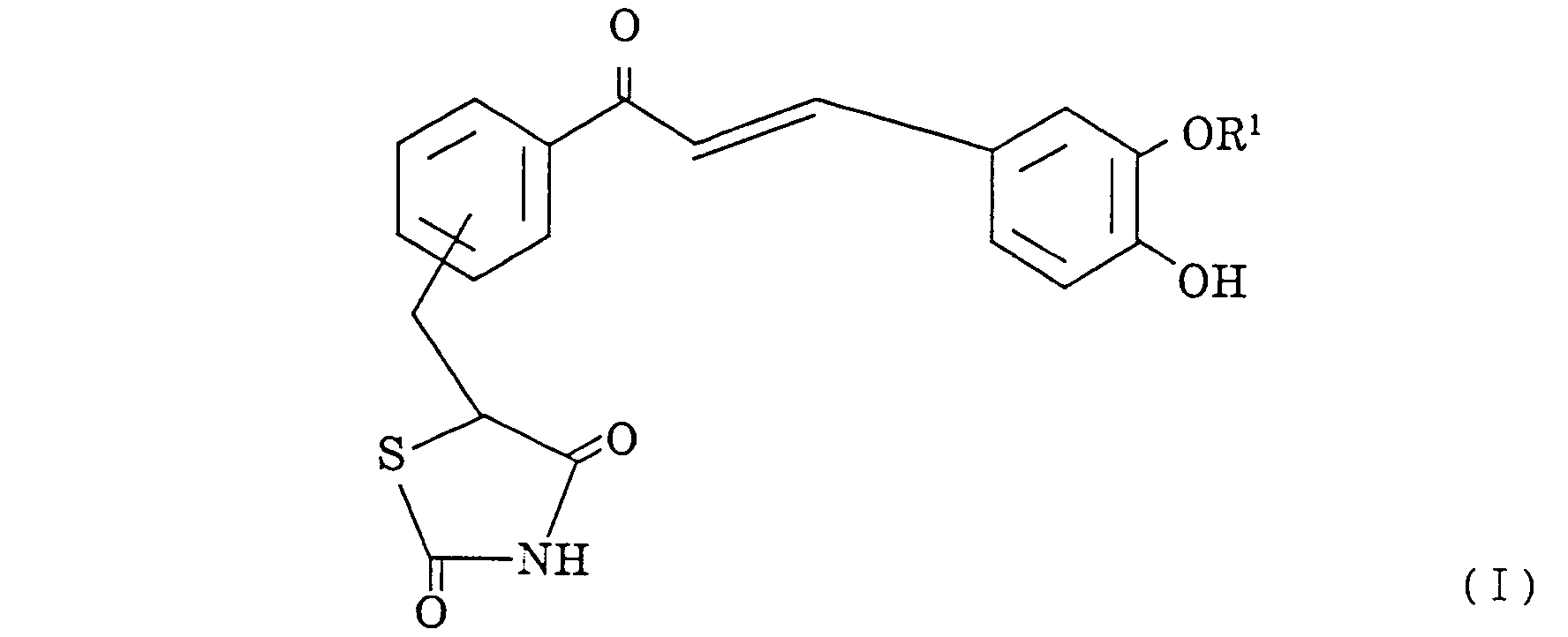
wherein R¹ is a hydrogen atom or a methyl group. - The objects are accomplished by a method for the production of a thiazolidine-2,4-dione compound represented by the general formula I:
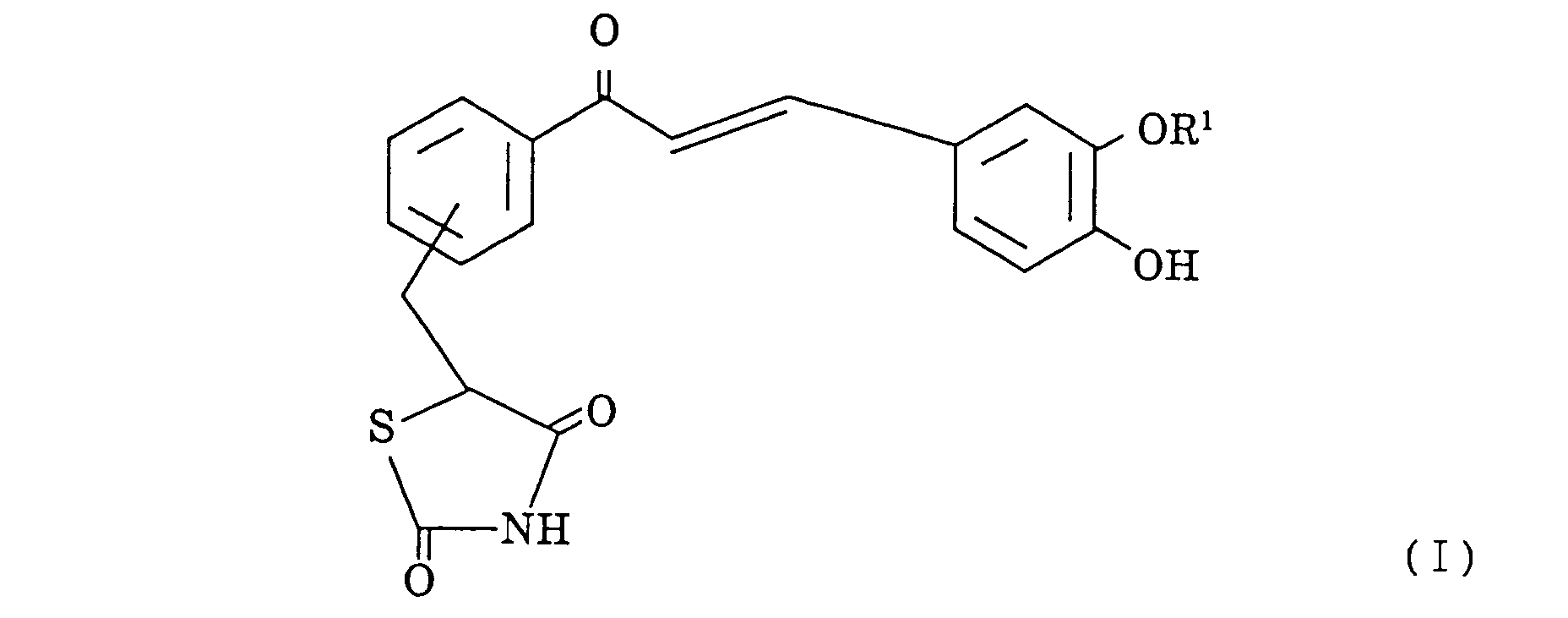
wherein R¹ is a hydrogen atom or a methyl group, by causing a thiazolidine compound represented by the formula II:
to react with a benzaldehyde compound represented by the general formula III:
wherein R² is a methyl group when R¹ is a methyl group or a methoxymethyl group when R¹ is a hydrogen atom, in the presence of a base and subjecting the methoxymethyl group of the resultant reaction product to a reaction for denuding(deprotecting) the methoxymethyl group of protection. - The objects are further accomplished by a medicine which has as an active component thereof a thiazolidine-2,4-dione compound represented by the general formula I mentioned above and is used for the cure of diabetic complications.
- The objects are further accomplished by a pharmaceutical composition for diabetic complications, which the pharmaceutical composition comprises a thiazolidine-2,4-dione compound represented by the general formula I mentioned above and a pharmaceutically acceptable carrier.
- The thiazolidine-2,4-dione compound contemplated by the present invention is a novel compound represented by the general formula I, wherein R¹ is a hydrogen atom or a methyl group. Representative examples of this compound are 5-{4-[3-(3,4-dihydroxyphenyl)-2-propenoyl]benzyl}thiazolidine-2,4-dione, 5-{4-[3-(4-hydroxy-3-methoxyphenyl)-2-propenoyl]benzyl}thiazolidine-2,4-dione, 5-{3-[3-(3,4-dihydroxyphenyl)-2-propenoyl]benzyl}thiazolidine-2,4-dione, 5-{3-[3-(4-hydroxy-3-methoxyphenyl)-2-propenoyl] benzyl}thiazolidine-2,4-dione, 5-{2-[3-(3,4-dihydroxyphenyl)-2-propenoyl] benzyl} thiazolidine-2,4-dione, and 5-{2-[3-(4-hydroxy-3-methoxyphenyl)-2-propenoyl]benzyl}thiazolidine-2, 4-dione.
- The thiazolidine-2,4-dione compound represented by the general formula I is produced by causing a thiazolidine compound represented by the formula II to react with a benzaldehyde compound represented by the general formula III in the presence of a base, preferably in an organic solvent, and subjecting the methoxymethyl group of the resultant reaction product to a reaction for deprotecting the methoxymethyl group of protection.
- For use in the reaction mentioned above, the amount of the benzaldehyde compound represented by the general formula III is in the range of from 1 to 3 mols, preferably from 1 to 1.2 mols, per mol of the thiazolidine compound represented by the formula II. This reaction is carried out with the reactants kept stirred at a temperature in the range of from 20 to 80°C, preferably from 25 to 30°C, for a period in the range of from 5 to 24 hours, preferably from 5 to 10 hours. The bases which are usable for this reaction include sodium hydroxide, potassium hydroxide, lithium hydroxide, for example. The amount of the base to be used is in the range of from 200 to 300 % by weight, preferably from 250 to 300 % by weight, based on the amount of the thiazolidine compound represented by the formula II. The organic solvents which are usable in the reaction include methanol, ethanol, isopropanol, butanols, ethylene glycol, ethylene glycol monoethyl ether, and ethylene glycol monobutyl ether, for example.
- After the reaction is completed, the resulstant reaction product is separated from the reaction mixture by following the conventional procedure. From the separated product, the thiazolidine-2,4-dione compound represented by the general formula I can be obtained by subjecting the methoxymethyl group of the reaction product to a reaction by the conventional procedure for denuding the methoxymethyl group of protection in the presence of an acid such as hydrochloric acid, nitric acid, phosphoric acid, formic acid, acetic acid, or propionic acid.
- The thiazolidine-2,4-dione compound of this invention is effective in curing various complications of diabetes as with cataract, retinopathy, neurotic disorder, and renal disorder. Though the dosage of this compound to be used as a medicine is variable with the symptom, the daily dose is generally in the range of from 1 to 100 mg, preferably from 5 to 50 mg per adult. This daily dose is desired to be administered either wholly at once or as divided in two or three portions, depending on the sympsom. As respects the manner of administration, the medicine may be used in a desired form fit for administration. Though the oral administration is particularly desirable, the administration by intravenous injection is permissible.
- The medicine of this invention for the cure of a diabetic complication is characterized by containing the aforementioned thiazolidine-2,4-dione compound.
- The medicine of this invention for the cure of a diabetic complication can be used in a varying form which is produced by mixing the aforementioned thiazolidine-2,4-dione compound with an efficaceous component or mixing this compound as one efficaceous component with a pharmaceutical carrier or an excipient and preparing the resultant mixture in the form of tablet, sugar-coated tablet, powder, capsule, granules, suspension, emulsion, or injection. The compounds which are effectively usable as a carrier or an excipient include calcium carbonate, calcium phosphate, starch, grape sugar, milk sugar, dextrin, alginic acid, mannitol, talc, and magnesium stearate, for example. The amount of the carrier or excipient to be used is in the range of from 0 to 99 times, preferably from 0 to 10 times, the weight of the thiazolidine-2,4-dione compound represented by the general formula I.
- Now, the present invention will be described more specifically below with reference to working examples.
- A solution of 15 g of p-aminoacetophenone in 300 ml of acetone was combined with 70 ml of water and 31 ml of 12N hydrochloric acid and the resultant mixture was stirred for 30 minutes with 21 ml of an aqueous solution containing 10.11 g of sodium nitrite added dropwise in advance thereto at 5°C. The produced reaction solution and 87.6 ml of ethyl acrylate added dropwise thereto and 1.59 g of copper (I) oxide added piecemeal thereto at 40°C were stirred for 1.5 hours. The resultant mixture was combined with water, extracted from ethyl acetate, washed with a saturated aqueous saline solution, dried with anhydrous magnesium sulfate, and distilled under a vacuum to expel the solvent. The residue of the distillation was subjected to flush column chromatography. From the ethyl acetate-n-hexane (1 : 10) fraction of the eluate, 21.35 g of ethyl-2-chloro-3-(4-acetylphenyl)propionate aimed at was obtained.
- A solution of 11.16 g of ethyl-2-chloro-3-(4-acetylphenyl)propionate in 190 ml of ethanol and 3.34 g of thiourea and 3.60 g of sodium acetate added thereto were refluxed by heating for a whole day and night. The refluxed mixture was distilled under a vacuum to expel the solvent. The residue of the distillation was combined with water, filtered, and washed with water. The produced residue and 2N hydrochloric acid added thereto were refluxed by heating for 2.5 hours. The refluxed mixture was neutralized with sodium hydrogen carbonate as kept cooled with ice and extracted from ethyl acetate. The ethyl acetate layer was washed sequentially with water and a saturated aqueous saline solution, dried with anhydrous magnesium sulfate, and then distilled under a vacuum to expel the solvent. The resultant residue was subjected to flush column chromatography. From the ethyl acetate-n-hexane (1 : 2) fraction of the eluate, 5.46 g of 5-(4-acetylbenzyl)thiazolidine-2,4-dione aimed at was obtained. A solution of 5.44 g of 5-(4-acetylbenzyl)thiazolidine-2,4-dione and 5.89 g of 3,4-dimethoxymethoxybenzaldehyde in 106 ml of a methanol 10% potassium hydroxide solution was stirred at room temperature for a whole day and night. The resultant mixture was neutralized with 6N hydrochloric acid as kept cooled with ice and distilled under a vacuum to expel methanol. The residue of this distillation was combined with water and extracted from ethyl acetate. The ethyl acetate layer was washed with a saturated saline solution, dried with anhydrous magnesium sulfate, and distilled under a vacuum to expel the solvent. The produced residue was subjected to flush column chromatography. From the ethyl acetate-n-hexane (1 : 2) fraction of the eluate, 4.47 g of 5-{4-[3-(3,4-dimethoxymethoxyphenyl)-2-propenoyl]benzyl}thiazolidine-2,4-dione was produced.
- A solution of 4.47 g of 5-{4-[3-(3,4-dimethoxymethoxyphenyl-2-propenoyl]benzyl}thiazolidine-2,4-dione in 30 ml of methanol and 30 ml of tetrahydrofuran and 30 ml of 6N hydrochloric acid added thereto were stirred at 60 C for three hours. The resultant mixture was neutralized with sodium hydrogen carbonate as kept cooled with ice and distilled under a vacuum to expel the solvent. The produced residue was combined with methanol and filtered. The filtrate was concentrated under a vacuum. The resultant concentrate was subjected to flush column chromatography. From the chloroform-methanol (20 : 1) fraction of the eluate, 1.55 g of 5-{4-[3-(3,4-dihydroxyphenyl)-2-propenoyl]benzyl}thiazolidine-2,4-dione (Compound 1) was obtained. The NMR data of this compound support the structure of Formula IV.
NMR (CDC1₃, DMSO-d₆, TMS) : δ (ppm)
3.05∼3.52 (2H, m),
4.57 (1H, double d, J=9 and 4Hz), 6.68∼8.12 (9H, m)
- From 5 g of 5-(4-acetylbenzyl)thiazolidine-2,4-dione and 4.72 g of 3-methoxy-4-methoxymethoxybenzaldehyde, 6.20 g of 5-{4-[3-(3-methoxy-4-methoxymethoxyphenyl)-2-propenoyl]benzyl}thiazolidine-2,4-dione was obtained by following the procedure of Example 1. This product was subjected to the same reaction as in Example 1 to produce 3.74 g of 5-{4-[3-(4-hydroxy-3-methoxyphenyl)-2-propenoyl]benzyl}thiazolidine-2,4-dione (Compound 2) was obtained. The NMR data of this compound support the structure of Formula V.
NMR (CDC1₃, DMSO-d₆, TMS) : δ (ppm)
3.05∼3.52 (2H, m),
4.57 (1H, double d, J=9 and 4Hz), 6.68∼8.12 (9H, m)
- solution of 5 g of m-aminoacetophenone in 100 ml of acetone was combined with 25 ml of water and 15 ml of 47% hydrobromic acid and the resultant mixture was stirred for 30 minutes with 10 ml of an aqueous solution containing 3.32 g of sodium nitrite added dropwise in advance thereto at 5 C. The produced reaction solution and 28 ml of ethyl acrylate added dropwise thereto and 0.53 g of copper (I) oxide added piecemeal thereto at 40 °C were stirred for 2 hours. The resultant mixture was combined with water, extracted with ethyl acetate. An organic layer was washed with water and a saturated aqueous saline solution, dried with anhydrous magnesium sulfate, and distilled under a vacuum to expel the solvent to obtain ethyl 2-bromo-3-(3-acetylphenyl)propionate.
- A solution of ethyl 2-bromo-3-(3-acetylphenyl)propionate in 150 ml of ethanol and 2.67 g of thiourea and 3.03 g of sodium acetate added thereto were refluxed by heating for 5 hours. The refluxed mixture was distilled under a vacuum to expel the solvent. The residue of the distillation was combined with water, extracted with chloroform, washed with water and a saturated aqueous saline solution, and dried with anhydrous magnesium sulfate. The produced residue and 2N hydrochloric acid added thereto were refluxed by heating for 3 hours. The refluxed mixture was cooled and extracted with ethyl acetate. The ethyl acetate layer was washed sequentially with water and a saturated aqueous saline solution, dried with anhydrous magnesium sulfate, and then distilled under a vacuum to expel the solvent. The resultant residue was subjected to flush column chromatography. From the ethyl acetate-n-hexane (1 : 1) fraction of the eluate, 4.90 g of 5-(3-acetylbenzyl)thiazolidine-2,4-dione aimed at was obtained. A solution of 25.0 g of 5-(3-acetylbenzyl)thiazolidine-2,4-dione and 19.7 g of 3-methoxy-4-methoxymethoxybenzaldehyde in 400 ml of a methanol 10% potassium hydroxide solution was stirred at room temperature for 2.5 hours. The resultant mixture was neutralized with 2N hydrochloric acid as kept cooled with ice and distilled under a vacuum to expel methanol. The residue of this distillation was combined with water and a saturated saline solution and extracted with ethyl acetate. An organic layer was washed with water and the saturated saline solution, dried with anhydrous magnesium sulfate, and distilled under a vacuum to expel the solvent. The produced residue was subjected to flush column chromatography. From the ethyl acetate-n-hexane (2 : 1) fraction of the eluate, 23.1 g of 5-(3-[3-(3-methoxy-4-methoxymethoxyphenyl)-2-propenoyl]benzyl} thiazolidine-2,4-dione was produced.
- The resultant concentrate was subjected to flush column chromatography by a similar method to Example 1. From the chloroform-methanol (20 : 1) fraction of the 13.6 g of 5-{3-[3-(4-hydroxy-3-methoxyphenyl)-2-propenoyl] benzyl} thiazolidine-2,4-dione (Compound 3) was obtained. The NMR data of this compound support the structure of Formula VI.
NMR (CDC1₃, TMS) : δ (ppm)
3.05∼3.73 (2H, m), 3.88 (1H, s),
4.51 (1H, d d, J=9 and 4Hz), 6.68∼6.98 (9H, m)
- A five-week old Wistar type male rat was sacrificed under anesthesia and immediately dissected to remove crystalline lens. From the crystalline lens, aldose reductase was prepared by following the Hyman et al's method [J. Biol. Chem., 240, 877-882 (1965)] with necessary modifications.
- The aldose reductase activity was determined by the Dufrane et al's method [Biochem. Med., 32, 99-105 (1984)].
- In 400 µl of a 135 mM sodium-potassium phosphate buffer solution (pH 7.0) prepared in advance so as to contain 100 mM lithium sulfate, 0.03 mM NADPH (reducing type nicotinamide adenine dinucleotide phosphate), and 0.1 mM DL-glyceraldehyde as a substrate, 50 µl of the aforementioned aldose reductase and 50 µl of a sample of a varying concentration (having Compound 1, or Compound 2, or Compound 3 dissolved in ethanol) added thereto were left reacting at 30 °C for 30 minutes. Then, the reaction was stopped by addition of 0.15 ml of 0.5N hydrochloric acid. The NADP (oxide type nicotinamide adenine dinucleotide phosphate) produced by the reaction in the reaction mixture was converted into a fluorescent substance by the addition thereto of 0.5 ml of 6N sodium hydroxide containing 10 mM imidazole. After the elapse of 60 minutes following the conversion, the produced reaction mixture was tested for intensity of fluorescence. The intensity of fluorescence was determined by the use of a fluorescence tester (produced by Corona Denki K.K. and marketed under trademark designation of "MTP-100F Corona Microplate Reader") under the conditions of 360 nm of excitation wavelength and 460 nm of fluorescent wavelength. The intensity of fluorescence determined by repeating the procedure described above, except ethanol was added in the place of the sample was used as a control value. As the aldose reductase inhibiting activity of a sample, the concentration of the sample required for inhibiting 50% of the aldose reductase activity due to a decline of the intensity of fluorescence (i.e. 50% inhibition concentration: IC₅₀ value) was obtained. The results are shown in Table 1.

- Groups each of five three-week old Wistar type male rats were used for the test. To the rats, streptozotocin was administered at a concentration of 65 mg/kg via the tail vein. Of these rats, those whose blood sugar values fell in the range of from 250 to 650 mg/dl one week after the administration were designated as diabetic rats. As a control medicine, Compound 4 represented by the formula VII was used.

- The five groups, i.e. the group of untreated diabetic rats, the group of rats subjected to administration of control medicine (50 mg/kg x 2/day), the group of rats subjected to administration of sample (100 mg/kg/day), and the group of normal rats, were tested. A given medicine was suspended in 5% gum arabic and orally administered continually for four days after the elapse of two weeks following the onset of diabetes. To the group of untreated diabetic rats and the group of normal rats, a 5% gum arabic solution of a given medicine was administered in a ratio of 10 ml/kg. After the elapse of three hours following the administration, the blood was extracted from each rat with the aid of heparin via the tail vein (for the determination of blood sugar) and the abdominal aorta.
- The red blood cells were separated from the blood extracted with heparin and washed three times with a physiological saline solution at 4 °C to obtain packed red cells (PRC).
- The PRC was tested for sorbitol content by the Malon et al's method [Diabetes, 29, 861-864 (1980)]. The determination of the blood sugar value was carried out by the alucose-oxidase method.
- The blood sugar drop ratio and the sorbitol accumulation inhibition ratio were calculated in accordance with Formula I and Formula 2. The results are shown in table 2

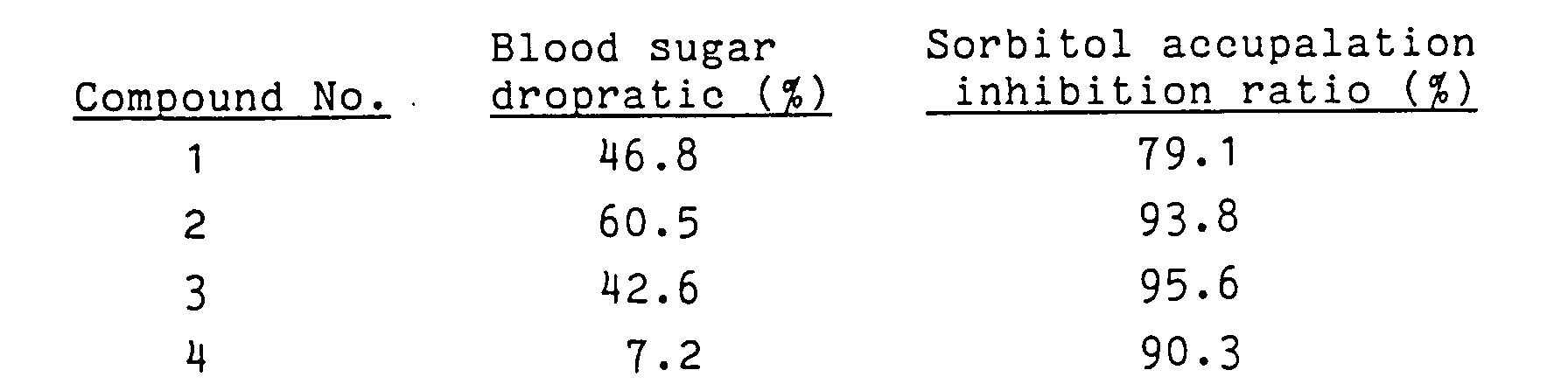
- Blood sugar drop ratio (%) = (1 - [(Average blood sugar value of the group of rats subjected to administration of sample or control medicine - Average blood sugar value of the group of normal rats)/(Average blood sugar value of the group of untreated diabetic rats - Average blood sugar value of the group of normal rats)]) x 100
- Sorbitol accumulation inhibition ratio (%) = (1 - [Average sorbitol value of the group of rats subjected to administration of sample or control medicine - Average sorbitolvalue of the group of normal control rats)/(Average sorbitol value of the group of untreated diabetic rats - Average sorbitol value of the group of normal control rats)]) x 100
- The compounds 1, 2 and 3 of this invention were tested for acute toxicity by oral administration thereof to ICR type male mice (five-week old). Their LD₅₀ values were found to be not less than 1,000 mg/kg, indicating that their safety is high as compared with the efficaceous dosage.
Claims (18)
- A thiazolidine-2,4-dione compound represented by the general formula I:

- A compound according to claim 1, which is 5-{4-[3-(3,4-dihydroxyphenyl)-2-propenoyl]benzyl}thiazolidine-2,4-dione.
- A compound according to claim 1, which is 5-{4-[3-(4-hydroxy-3-methoxyphenyl)-2-propenyl]phenylmethyl}thiazolidine-2,4-dione.
- A compound according to claim 1, which is 5-{3-[3-(3,4-dihydroxyphenyl)-2-propenoyl]benxyl}thiaxolidine-2,4-dione.
- A compound according to claim 1, which is 5-{3-[3-(4-hydroxy-3-methylphenyl)-2-propenoyl]benzyl}thiazolidine-2, 4-dione.
- A compound according to claim 1, which is 5-{2-[3-(3,4-dihydroxyphenyl)-2-propenoyl]benzyl}thiazolidine-2,4-dione.
- A compound according to claim 1, which is 5-{2-[3-(4-hydroxy-3-methylphenyl)-2-propenoyl]benzyl}thiaxolidine.
- A method for the production of a thiazolidine-2,4-dione compound represented by the general formula I:


- A method according to claim 8, wherein R¹ is a hydrogen atom.
- A method according to claim 8, wherein R¹ is a methyl group.
- A medicine for the cure of a diabetic complication, having as an active component thereof a thiazolidine-2,4-dione compound represented by the general formula I.
- A medicine according to claim 11, wherein said compound is 5-{4-[3-(3,4-dihydroxyphenyl)-2-propenoyl]benzyl}thiazolidone-2,4-dione.
- A medicine according to claim 11, wherein said compound is 5-{4-[3-(3-methoxy-4-hydroxy-3-methoxyphenyl)-2-propenoyl]benzyl}thiazolidine-2,4-dione.
- A medicine according to claim 11, wherein said compound is 5-{3-[3-(3,4-dihydroxyphenyl)-2-propenoyl]benxyl}thiaxolidine-2,4-dione.
- A medicine according to claim 11, wherein said compound is 5-{3-[3-(4-hydroxy-3-methylphenyl)-2-propenoyl]benzyl}thiazolidine-2,4-dione.
- A medicine according to claim 11, wherein said compound is 5-{2-[3-(3,4-dihydroxyphenyl)-2-propenoyl]benzyl}thiazolidine-2,4-dione.
- A medicine according to claim 11, wherein said compound is 5-{2-[3-(4-hydroxy-3-methylphenyl)-2-propenoyl]benzyl}thiaxolidine.
- A phrmaceutical composition for the cure of a diabetic complication, comprising a thiazolidine-2,4-dione compound represented by the general formula I and a pharmaceutically acceptable carrier.
Applications Claiming Priority (2)
| Application Number | Priority Date | Filing Date | Title |
|---|---|---|---|
| JP413602/90 | 1990-12-06 | ||
| JP2413602A JPH04210683A (en) | 1990-12-06 | 1990-12-06 | Thiazolidine-2,4-dione derivative and treating agent for diabetic complication containing the same derivative |
Publications (1)
| Publication Number | Publication Date |
|---|---|
| EP0489663A1 true EP0489663A1 (en) | 1992-06-10 |
Family
ID=18522202
Family Applications (1)
| Application Number | Title | Priority Date | Filing Date |
|---|---|---|---|
| EP91403312A Withdrawn EP0489663A1 (en) | 1990-12-06 | 1991-12-06 | Thiazolidine-2,4-dione compound, method for production thereof, and medicine containing the compound for cure diabetic complications |
Country Status (3)
| Country | Link |
|---|---|
| US (1) | US5225426A (en) |
| EP (1) | EP0489663A1 (en) |
| JP (1) | JPH04210683A (en) |
Cited By (13)
| Publication number | Priority date | Publication date | Assignee | Title |
|---|---|---|---|---|
| EP1135128A4 (en) * | 1998-11-12 | 2003-07-16 | Smithkline Beecham Corp | Novel method of treatment |
| US6756360B1 (en) | 1998-12-24 | 2004-06-29 | Metabasis Therapeutics, Inc. | Combination of FBPase inhibitors and insulin sensitizers for the treatment of diabetes |
| BG64785B1 (en) * | 1997-07-18 | 2006-04-28 | Smithkline Beecham P.L.C. | Combination of thiazolidinedione, means increasing the insulin secretion and biguanide, pharmaceutical composition and usage thereof |
| BG64817B1 (en) * | 1997-06-18 | 2006-05-31 | Smithkline Beecham P.L.C. | Combination of thiazolidinedion and sulphonylurea, composition and usage thereof |
| BG64818B1 (en) * | 1997-06-18 | 2006-05-31 | Smithkline Beecham P.L.C. | Combination of thiazolidinedione and metformin, composition and administration thereof |
| BG64892B1 (en) * | 1997-07-18 | 2006-08-31 | Smithkline Beecham P.L.C. | Combination of thiazolidinedione and sulphonylurea, pharmaceutical composition and usage thereof |
| BG65351B1 (en) * | 1998-11-12 | 2008-03-31 | Smithkline Beecham P.L.C. | Modified release pharmaceutical composition |
| EP1917962A1 (en) | 1998-11-12 | 2008-05-07 | Smithkline Beecham Plc | Pharmaceutical composition for modified release insulin sensitiser |
| EP2036554A1 (en) | 2000-06-19 | 2009-03-18 | SmithKline Beecham plc | Combinations of dipeptidyl peptidase iv inhibitors and other antidiabetic agents for the treatment for diabetes mellitus |
| US7563774B2 (en) | 2000-06-29 | 2009-07-21 | Metabasis Therapeutics, Inc. | Combination of FBPase inhibitors and antidiabetic agents useful for the treatment of diabetes |
| WO2016071727A1 (en) | 2014-11-04 | 2016-05-12 | INSERM (Institut National de la Santé et de la Recherche Médicale) | Methods for the prevention and the treatment of rapidly progressive glomerulonephritis |
| US9579335B2 (en) | 2010-10-19 | 2017-02-28 | Indiana University Research And Technology Corporation | Treatment of cystic diseases |
| KR20190102709A (en) * | 2018-02-27 | 2019-09-04 | 가천대학교 산학협력단 | Pharmaceutical composition comprising 3-Bromo-4,5-dihydroxybenzaldehyde for prevention or treatment of diabetes mellitus |
Families Citing this family (6)
| Publication number | Priority date | Publication date | Assignee | Title |
|---|---|---|---|---|
| DE4241407A1 (en) * | 1992-12-09 | 1994-06-16 | Bosch Gmbh Robert | Drum or barrel commutator for electrical machines - has commutator bars with grooves having associated reduced diameter bore-holes filled with surface coating material in one piece |
| JP3408347B2 (en) | 1994-06-08 | 2003-05-19 | 高砂香料工業株式会社 | Optically active block copolymerized polyester and method for producing the same |
| US7407978B2 (en) * | 1999-04-06 | 2008-08-05 | Theracos, Inc. | Heterocyclic analogs of diphenylethylene compounds |
| US8216609B2 (en) * | 2002-08-05 | 2012-07-10 | Torrent Pharmaceuticals Limited | Modified release composition of highly soluble drugs |
| US8268352B2 (en) * | 2002-08-05 | 2012-09-18 | Torrent Pharmaceuticals Limited | Modified release composition for highly soluble drugs |
| CA2882853C (en) | 2012-04-20 | 2021-11-23 | Vineet Gupta | Compounds and methods for regulating integrins |
Citations (2)
| Publication number | Priority date | Publication date | Assignee | Title |
|---|---|---|---|---|
| EP0117035A2 (en) * | 1983-01-17 | 1984-08-29 | Pfizer Inc. | Aldose reductase inhibiting 5-(2-alkoxyphenyl)thiazolidinediones |
| EP0332331A2 (en) * | 1988-03-08 | 1989-09-13 | Pfizer Inc. | Thiazolidinedione hypoglycemic agents |
Family Cites Families (3)
| Publication number | Priority date | Publication date | Assignee | Title |
|---|---|---|---|---|
| JPS5522636A (en) * | 1978-08-04 | 1980-02-18 | Takeda Chem Ind Ltd | Thiazoliding derivative |
| CN1003445B (en) * | 1984-10-03 | 1989-03-01 | 武田药品工业株式会社 | Thiazolidinedione derivatives, their preparation methods and uses |
| FI91869C (en) * | 1987-03-18 | 1994-08-25 | Tanabe Seiyaku Co | Process for the preparation of benzoxazole derivatives as antidiabetic agents |
-
1990
- 1990-12-06 JP JP2413602A patent/JPH04210683A/en active Pending
-
1991
- 1991-12-04 US US07/802,308 patent/US5225426A/en not_active Expired - Lifetime
- 1991-12-06 EP EP91403312A patent/EP0489663A1/en not_active Withdrawn
Patent Citations (2)
| Publication number | Priority date | Publication date | Assignee | Title |
|---|---|---|---|---|
| EP0117035A2 (en) * | 1983-01-17 | 1984-08-29 | Pfizer Inc. | Aldose reductase inhibiting 5-(2-alkoxyphenyl)thiazolidinediones |
| EP0332331A2 (en) * | 1988-03-08 | 1989-09-13 | Pfizer Inc. | Thiazolidinedione hypoglycemic agents |
Non-Patent Citations (1)
| Title |
|---|
| CHEMICAL ABSTRACTS, vol. 111, no. 23, 4 December 1989, Columbus, Ohio, US; abstract no. 214230J, page 564 ; * |
Cited By (18)
| Publication number | Priority date | Publication date | Assignee | Title |
|---|---|---|---|---|
| EP2266576A1 (en) | 1997-06-18 | 2010-12-29 | SmithKline Beecham Limited | Treatment of diabetes with thiazolidinedione and sulphonylurea |
| BG64817B1 (en) * | 1997-06-18 | 2006-05-31 | Smithkline Beecham P.L.C. | Combination of thiazolidinedion and sulphonylurea, composition and usage thereof |
| BG64818B1 (en) * | 1997-06-18 | 2006-05-31 | Smithkline Beecham P.L.C. | Combination of thiazolidinedione and metformin, composition and administration thereof |
| BG64892B1 (en) * | 1997-07-18 | 2006-08-31 | Smithkline Beecham P.L.C. | Combination of thiazolidinedione and sulphonylurea, pharmaceutical composition and usage thereof |
| BG64785B1 (en) * | 1997-07-18 | 2006-04-28 | Smithkline Beecham P.L.C. | Combination of thiazolidinedione, means increasing the insulin secretion and biguanide, pharmaceutical composition and usage thereof |
| EP1917962A1 (en) | 1998-11-12 | 2008-05-07 | Smithkline Beecham Plc | Pharmaceutical composition for modified release insulin sensitiser |
| EP1759698A1 (en) * | 1998-11-12 | 2007-03-07 | SmithKline Beecham Corporation | Novel method of treatment |
| BG65351B1 (en) * | 1998-11-12 | 2008-03-31 | Smithkline Beecham P.L.C. | Modified release pharmaceutical composition |
| EP1135128A4 (en) * | 1998-11-12 | 2003-07-16 | Smithkline Beecham Corp | Novel method of treatment |
| BG65444B1 (en) * | 1998-11-12 | 2008-08-29 | Smithkline Beecham P.L.C. | Pharmaceutical composition for a single daily dose |
| EP1992337A1 (en) | 1998-11-12 | 2008-11-19 | Smithkline Beecham Plc | Novel modified release composition and use |
| BG65577B1 (en) * | 1998-11-12 | 2009-01-30 | Smithkline Beecham Corporation | Continuous release pharmaceutical composition and use thereof |
| US6756360B1 (en) | 1998-12-24 | 2004-06-29 | Metabasis Therapeutics, Inc. | Combination of FBPase inhibitors and insulin sensitizers for the treatment of diabetes |
| EP2036554A1 (en) | 2000-06-19 | 2009-03-18 | SmithKline Beecham plc | Combinations of dipeptidyl peptidase iv inhibitors and other antidiabetic agents for the treatment for diabetes mellitus |
| US7563774B2 (en) | 2000-06-29 | 2009-07-21 | Metabasis Therapeutics, Inc. | Combination of FBPase inhibitors and antidiabetic agents useful for the treatment of diabetes |
| US9579335B2 (en) | 2010-10-19 | 2017-02-28 | Indiana University Research And Technology Corporation | Treatment of cystic diseases |
| WO2016071727A1 (en) | 2014-11-04 | 2016-05-12 | INSERM (Institut National de la Santé et de la Recherche Médicale) | Methods for the prevention and the treatment of rapidly progressive glomerulonephritis |
| KR20190102709A (en) * | 2018-02-27 | 2019-09-04 | 가천대학교 산학협력단 | Pharmaceutical composition comprising 3-Bromo-4,5-dihydroxybenzaldehyde for prevention or treatment of diabetes mellitus |
Also Published As
| Publication number | Publication date |
|---|---|
| JPH04210683A (en) | 1992-07-31 |
| US5225426A (en) | 1993-07-06 |
Similar Documents
| Publication | Publication Date | Title |
|---|---|---|
| US5225426A (en) | Thiazolidine-2,4-dione compound and method of treatment of diabetic complications | |
| EP0629602B1 (en) | 3,4-Dihydroxychalcone derivatives | |
| DE60019919T2 (en) | HYDROCHLORIDE CONDENSED HETEROCYCLES | |
| US4336397A (en) | 2,4-Dioxo-4-substituted-1-butanoic acid derivatives useful in treating urinary tract calcium oxalate lithiasis | |
| FR2889190A1 (en) | New imidazole carboxamides, useful to treat e.g. pathologies associated with the insulin resistance syndrome, are fructose-1,6-biphosphatase inhibitors | |
| US5045543A (en) | 5-amino or substituted amino 1,2,3-triazoles useful as antimetastatic agents | |
| US4387101A (en) | Thiazolidine derivatives and their use | |
| EP0325936A2 (en) | Aminoguanidine derivatives and inhibitory agents on maillard reaction containing them as active ingredients | |
| HK1007050B (en) | Thiazolidine compounds containing a quinone group, their preparation and their therapeutic uses | |
| HK1007050A1 (en) | Thiazolidine compounds containing a quinone group, their preparation and their therapeutic uses | |
| EP0339496A2 (en) | Aminoguanidine derivatives | |
| JP2876129B2 (en) | 7-carboxymethoxy-4-phenylcoumarin derivatives and their preparation and use | |
| US4267339A (en) | Imidazo(2,1-B)thiazoles | |
| HU180149B (en) | Process for producing 1-bracket-2,4-alkadine-1-yl-bracket closed-2-hydroxy-methyl-3,4,5-trihydroxy-piperidine derivatives and pharmaceutical compositions containing them as active agents | |
| US4760078A (en) | Immunomodulator 1,2-dithiol-3-thione derivative composition, use method and process of producing the same | |
| KR850000318B1 (en) | Method for preparing bisglucosyl molarine derivative | |
| EP0444199B1 (en) | Ascorbic acid derivatives | |
| JPH0755902B2 (en) | Aldo-reductase inhibitor | |
| DE3883164T2 (en) | Rhodanine derivatives, processes for their preparation, their use and pharmaceutical compositions containing them. | |
| JP2876144B2 (en) | 3-Phenylcoumarin-7-yloxyacetic acid derivatives and their preparation and use | |
| JP3093170B2 (en) | Hydroquinone derivatives and their pharmaceutical uses | |
| US4137320A (en) | Pharmaceutical compositions containing imidazo(2,1-b)thiazoles and process for reducing blood sugar levels therewith | |
| EP0193855B1 (en) | Hydantoin derivatives, processes for preparing them and pharmaceutical compositions containing them | |
| EP0196330B1 (en) | Use of pyrrothine derivatives | |
| EP0677293A1 (en) | Pharmaceutical use of terpyridine derivative |
Legal Events
| Date | Code | Title | Description |
|---|---|---|---|
| PUAI | Public reference made under article 153(3) epc to a published international application that has entered the european phase |
Free format text: ORIGINAL CODE: 0009012 |
|
| 17P | Request for examination filed |
Effective date: 19911211 |
|
| AK | Designated contracting states |
Kind code of ref document: A1 Designated state(s): BE CH DE FR GB IT LI NL SE |
|
| 17Q | First examination report despatched |
Effective date: 19950223 |
|
| STAA | Information on the status of an ep patent application or granted ep patent |
Free format text: STATUS: THE APPLICATION IS DEEMED TO BE WITHDRAWN |
|
| 18D | Application deemed to be withdrawn |
Effective date: 19950706 |