EP0489284A2 - Alpha olefins functionalized polymers - Google Patents
Alpha olefins functionalized polymers Download PDFInfo
- Publication number
- EP0489284A2 EP0489284A2 EP91119347A EP91119347A EP0489284A2 EP 0489284 A2 EP0489284 A2 EP 0489284A2 EP 91119347 A EP91119347 A EP 91119347A EP 91119347 A EP91119347 A EP 91119347A EP 0489284 A2 EP0489284 A2 EP 0489284A2
- Authority
- EP
- European Patent Office
- Prior art keywords
- polymer
- groups
- moles
- propylene
- preparing
- Prior art date
- Legal status (The legal status is an assumption and is not a legal conclusion. Google has not performed a legal analysis and makes no representation as to the accuracy of the status listed.)
- Withdrawn
Links
- 0 **[N+](c(cccc1)c1N=O)[O-] Chemical compound **[N+](c(cccc1)c1N=O)[O-] 0.000 description 1
- RLARUBPTQYKZKA-UHFFFAOYSA-N CCCN(C(c1c2cccc1)=O)C2=O Chemical compound CCCN(C(c1c2cccc1)=O)C2=O RLARUBPTQYKZKA-UHFFFAOYSA-N 0.000 description 1
Classifications
-
- C—CHEMISTRY; METALLURGY
- C08—ORGANIC MACROMOLECULAR COMPOUNDS; THEIR PREPARATION OR CHEMICAL WORKING-UP; COMPOSITIONS BASED THEREON
- C08F—MACROMOLECULAR COMPOUNDS OBTAINED BY REACTIONS ONLY INVOLVING CARBON-TO-CARBON UNSATURATED BONDS
- C08F210/00—Copolymers of unsaturated aliphatic hydrocarbons having only one carbon-to-carbon double bond
-
- C—CHEMISTRY; METALLURGY
- C08—ORGANIC MACROMOLECULAR COMPOUNDS; THEIR PREPARATION OR CHEMICAL WORKING-UP; COMPOSITIONS BASED THEREON
- C08F—MACROMOLECULAR COMPOUNDS OBTAINED BY REACTIONS ONLY INVOLVING CARBON-TO-CARBON UNSATURATED BONDS
- C08F210/00—Copolymers of unsaturated aliphatic hydrocarbons having only one carbon-to-carbon double bond
- C08F210/04—Monomers containing three or four carbon atoms
- C08F210/06—Propene
-
- C—CHEMISTRY; METALLURGY
- C08—ORGANIC MACROMOLECULAR COMPOUNDS; THEIR PREPARATION OR CHEMICAL WORKING-UP; COMPOSITIONS BASED THEREON
- C08F—MACROMOLECULAR COMPOUNDS OBTAINED BY REACTIONS ONLY INVOLVING CARBON-TO-CARBON UNSATURATED BONDS
- C08F210/00—Copolymers of unsaturated aliphatic hydrocarbons having only one carbon-to-carbon double bond
- C08F210/16—Copolymers of ethene with alpha-alkenes, e.g. EP rubbers
Definitions
- the present invention relates to alpha-olefin copolymers containing, inserted in the chain, monomeric units derived from halogenated a-olefin, and the functionalized polymers obtained from said alpha-olefin copolymers containing halogenated a-olefins by means of dehydrohalogenation reactions, or substitution of the halogen atoms with functional groups.
- Another way of introducing polar groups is to graft unsaturated polar molecules to pre-formed polyolefins in the presence of peroxides; however polymers containing low amounts of non homogeneously distributed polar groups are generally obtained according to this technique.
- R 1 is a C1-18 alkyl, C3 - 18 cycloalkyl, C 6 - 18 aryl or C 7-C18 aralkyl radical.
- the content of the functionalized monomeric units in the (co)polymers can be from 0.1 to 40% moles, preferably from 1 to 15% moles.
- the dehydrohalogenation reaction of said (co)polymers brings about the formation of double bonds; while substitution of the halogen atoms by suitable reactions allows the introduction of functional groups, such as -OCOR', -OR 1 , -OH, -COOR', -COOH, where R 1 has the same meaning as above.
- terpolymers containing iodobutene is carried out by polymerizing ethylene, propylene, and iodobutene mixtures according to known methods.
- the preparation of ethylenepropylene elastomeric copolymers is carried out preferably by catalysts obtained from vanadium compounds, such as vanadium acetylacetonate and Al-dialkyl halides. lodobutene units are found homogeneously distributed in the chains of the thus obtained terpolymers.
- Elastomeric terpolymers usually obtained by polymerizing ethylene, propylene and butadiene, wherein butadiene units are mainly bonded through carbon atoms 1 and 4, are known in the art. Due to the (1,4) enchainment the butadiene units causes such terpolymers to have double bonds inserted in the chains and therefore to have low resistance to oxidation and particularly to ozone.
- Elastomeric terpolymers comprising from 30 to 70% moles of ethylene, 70 to 30% of propylene, and up to 15% of 1,2 enchainment butadiene, can be easily obtained according to the present invention and represent a new class of highly ozone resistant elastomers.
- Another object of the present invention is the preparation of polyolefins containing functional groups by substitution reaction of halogen atoms in the a-olefin/a- -haloolefin copolymers with suitable organic metal salts, for instance organic alkaline metal salts.
- the halogen atom, particularly the iodine atom substitution reaction is carried out according to known techniques, for example by dissolving the polymer in an aliphatic, a cycloaliphatic, or preferably an aromatic hydrocarbon, and reacting the polymer with an organic salt of an alkaline metal, preferably potassium, used in large excess with respect to the iodine atoms and solubilized in the reaction medium with crown ethers and optionally with aliphatic alcohols such as butyl alcohol.
- an alkaline metal preferably potassium
- crown ethers examples include 1,4,7,10,13,16-hexaoxacyclooctadecane (18-crown-6); 2,3,11,12-dibenzo-1,4,7,10,13,16-hexaoxacyclooctadeca-2,11-diene (dibenzo-18-crown-6); 2,3,11,12-dicyclohexyl-1,4,7,10,13,16-hexaoxacyclooctadecane (dicyclohexyl-18-crown-6).
- the corresponding potassium salts can be used: potassium t-butoxide, potassium acetate, potassium phenoxide, potassium phtalimide, potassium etilmalonate.
- the functionalized polymers of the invention thanks to their improved performances of permeability, compatibility, adhesion and dyeability, can be usefully employed, for instance, for the production of gas- barrier films and sheets, food packaging films, anticorrosive metal coatings and compatibilizing components for polyolefin blends, for instance with polyamides, polyesters, polyphenylene ethers.
- Table 1 shows the data relative to the polymerization. At the end of the reaction the polymer was precipitated from the solution by methanol addition.
- lodobutene was added, and then, under propylene atmosphere, the solid catalyst component, prepared by grinding the MgC1 2 together with ethylbenzoate and subsequent reaction at 80°C with TiCI 4 in excess.
Landscapes
- Chemical & Material Sciences (AREA)
- Health & Medical Sciences (AREA)
- Chemical Kinetics & Catalysis (AREA)
- Medicinal Chemistry (AREA)
- Polymers & Plastics (AREA)
- Organic Chemistry (AREA)
- Addition Polymer Or Copolymer, Post-Treatments, Or Chemical Modifications (AREA)
Abstract
Disclosed are polymers and copolymers of CH2 =CHR alpha olefins where R is hydrogen or a 1-6 carbon atoms alkyl radical, containing in the chain from 0,1 to 40% moles of monomeric units

where X is a group selected from
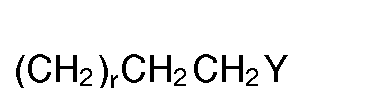




where r = 0 - 10, Y is a halogen atom, R1 is a hydrocarbon radical with 1-18 carbon atoms.
Description
- The present invention relates to alpha-olefin copolymers containing, inserted in the chain, monomeric units derived from halogenated a-olefin, and the functionalized polymers obtained from said alpha-olefin copolymers containing halogenated a-olefins by means of dehydrohalogenation reactions, or substitution of the halogen atoms with functional groups.
- It is known that the introduction of functional groups in the olefin polymers can improve their chemical- physical properties, such as gas impermeability, compatibility to polar polymers, adhesiveness to metals, dyeability. Also it is known how difficult it is to prepare olefin copolymers with functionalized monomers containing nitrogen or oxygen atoms, by using Ziegler-Natta catalysts. The preferred interaction of the Lewis acids present in such catalysts with the heteroatoms of the polar monomer causes the poisoning and deactivation of the catalytic sites. As cited in the literature, the copolymerization of a-olefins with polar monomers requires either a pretreatment of the polar monomer with an organometallic AI compound, as in U.S. Pat. 3,492,277 (1970), or the use of monomers containing ester groups, less reactive with Ziegler-Natta catalysts, (Japanese applications 57-152767, 57-188976, 57-188997 and U.S. Pat 4,518,757). The content of linked ester groups is less than 5% moles, and higher levels can only be reached by using esters which are particularly hindered. Said processes are carried out under particular conditions, such as long polymerization times; the corresponding free acids are then obtained by hydrolysis of the ester groups (U.S. Pat. 4,523,929 and U.S. Pat. 4,586,937).
- Functionalized polymers obtained by Ziegler-Natta catalysts are described in U.S. Pat. 4,734,472, where a-",-dienes, previously reacted with boranes, are used as monomers. Further treatments of said intermediate polymers bring about the final polymers containing -OH, -CHO, -COOH, and -NH2 groups.
- Another way of introducing polar groups is to graft unsaturated polar molecules to pre-formed polyolefins in the presence of peroxides; however polymers containing low amounts of non homogeneously distributed polar groups are generally obtained according to this technique.
- Now it has been found that it is possible to introduce monomeric units containing functional groups in the chain of polymers and copolymers of CH2 = CHR olefins where R is hydrogen or a 1-6 carbon alkyl radical, by starting with copolymers of said alpha olefins containing units deriving from halo-olefins distributed in the chain, and then dehydrohalogenating or substituting the halogen atom with a functional group.
- In particular, the present invention relates to a polymer of CH2 = CHR a-olefins where R is hydrogen or a 1-6 carbon atom alkyl radical containing in the chain up to 40% moles of monomer units of the formula


- where r = 0 - 10, Y is a halogen atom, R1 is a C1-18 alkyl, C3-18 cycloalkyl, C6-18 aryl or C7-C18 aralkyl radical.
- The content of the functionalized monomeric units in the (co)polymers can be from 0.1 to 40% moles, preferably from 1 to 15% moles.
- The dehydrohalogenation reaction of said (co)polymers brings about the formation of double bonds; while substitution of the halogen atoms by suitable reactions allows the introduction of functional groups, such as -OCOR', -OR1, -OH, -COOR', -COOH, where R1 has the same meaning as above.
- The (co)polymers containing halogenated a-olefin units are prepared by polymerization, according to known methods, of a CH2 = CHR olefin or mixtures thereof with halogenated a-olefins, in the presence of Ziegler-Natta type catalyst systems obtained from transition metal compounds of groups IV to VIII of the Periodic System, preferably vanadium or titanium, and organoaluminum compounds, preferably trial- kylaluminum compounds or dialkylaluminum halides.
- When starting with elastomeric terpolymers of ethylene and propylene with 1-iodo-3-butene, the dehydrohalogenation reaction on the copolymer brings about the formation of ethylene/propylene/butadiene terpolymers where the butadiene units are bonded exclusively of the 1,2 enchainment type.
- The preparation of terpolymers containing iodobutene is carried out by polymerizing ethylene, propylene, and iodobutene mixtures according to known methods. In particular, the preparation of ethylenepropylene elastomeric copolymers is carried out preferably by catalysts obtained from vanadium compounds, such as vanadium acetylacetonate and Al-dialkyl halides. lodobutene units are found homogeneously distributed in the chains of the thus obtained terpolymers.
- Elastomeric terpolymers usually obtained by polymerizing ethylene, propylene and butadiene, wherein butadiene units are mainly bonded through carbon atoms 1 and 4, are known in the art. Due to the (1,4) enchainment the butadiene units causes such terpolymers to have double bonds inserted in the chains and therefore to have low resistance to oxidation and particularly to ozone.
- Elastomeric terpolymers comprising from 30 to 70% moles of ethylene, 70 to 30% of propylene, and up to 15% of 1,2 enchainment butadiene, can be easily obtained according to the present invention and represent a new class of highly ozone resistant elastomers.
- Furthermore, according to the present invention, by copolymerizing propylene with iodobutene in the presence of stereospecific catalyst systems, and then subjecting the copolymers obtained to dehydrohalogenation, new highly crystalline polymers containing 1,2-butadiene units can be also obtained.
- For example, it is possible to obtain polymers having a high isotactic index (higher than 90%). It is known to polymerize propylene and butadiene by catalysts obtained from titanium halides supported on magnesium chloride, and from aluminum alkyls in the presence of Lewis bases. However in such copolymers butadiene units are only partially of the 1,2-enchainment type (U.S.P. 4,602,077).
- As above mentioned, another object of the present invention is the preparation of polyolefins containing functional groups by substitution reaction of halogen atoms in the a-olefin/a- -haloolefin copolymers with suitable organic metal salts, for instance organic alkaline metal salts.
- The halogen atom, particularly the iodine atom substitution reaction is carried out according to known techniques, for example by dissolving the polymer in an aliphatic, a cycloaliphatic, or preferably an aromatic hydrocarbon, and reacting the polymer with an organic salt of an alkaline metal, preferably potassium, used in large excess with respect to the iodine atoms and solubilized in the reaction medium with crown ethers and optionally with aliphatic alcohols such as butyl alcohol.
- Examples of suitable crown ethers are : 1,4,7,10,13,16-hexaoxacyclooctadecane (18-crown-6); 2,3,11,12-dibenzo-1,4,7,10,13,16-hexaoxacyclooctadeca-2,11-diene (dibenzo-18-crown-6); 2,3,11,12-dicyclohexyl-1,4,7,10,13,16-hexaoxacyclooctadecane (dicyclohexyl-18-crown-6).
- For instance, in order to substitute iodine atoms with -OR, -OCOR, -N(CO)2CsH4, -CH(COOR)2 containing groups, the corresponding potassium salts can be used: potassium t-butoxide, potassium acetate, potassium phenoxide, potassium phtalimide, potassium etilmalonate.
- The functionalized polymers of the invention, thanks to their improved performances of permeability, compatibility, adhesion and dyeability, can be usefully employed, for instance, for the production of gas- barrier films and sheets, food packaging films, anticorrosive metal coatings and compatibilizing components for polyolefin blends, for instance with polyamides, polyesters, polyphenylene ethers.
- The following examples are given to illustrate and not limit the invention.
- Into a 2 liter glass autoclave heated at the desidered temperature, toluene, 1-iodo-3-butene, V-(acetylacetonate)3 andAlEt21 were introduced under nitrogen flow. A continuous constant ratio ethylene/propylene flow was then introduced .
- Table 1 shows the data relative to the polymerization. At the end of the reaction the polymer was precipitated from the solution by methanol addition.
- Into a 2 liter glass autoclave heated at the desired temperature, were introduced under nitrogen flow heptane and the mixture of Al-alkyl and silane (external donor).
- lodobutene was added, and then, under propylene atmosphere, the solid catalyst component, prepared by grinding the MgC12 together with ethylbenzoate and subsequent reaction at 80°C with TiCI4 in excess.
- Propylene pressure was then raised to the desired level. Polymerization data are reported in Tables 2 and 3. The polymer was isolated after excess methanol addition.
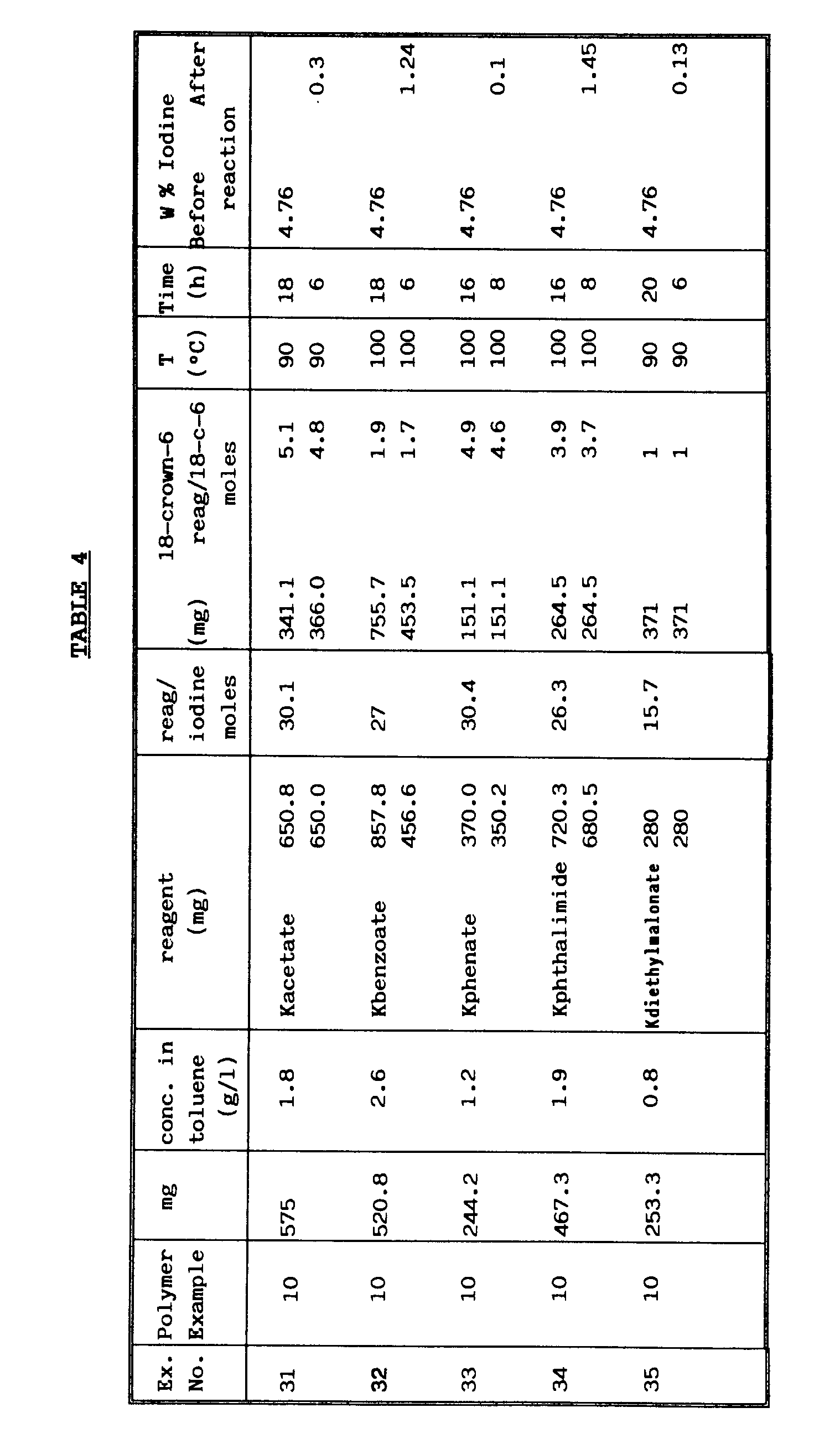
- Polymers obtained from examples 1-10 were dissolved in toluene at 90°C and a t-C4H9OK/toluene solution together with the 18-crown-6 ether are then added (examples 22-30). Polymers from examples 11-21 were kept into boiling toluene or xylene and the toluene solution of potassium compound and 18-crown-6 ether was then added (examples 31-42). The reaction was stopped by methanol addition. Reaction conditions and results obtained are shown in tables 3, 4 and 5.



Claims (10)
1. A polymer of CH2 =CHR a-olefins where R is hydrogen or a 1-6 carbon atom alkyl radical containing in the chain up to 40% moles of monomer units of the formula

wherein X is a group selected from the group consisting of


where r = 0 - 10, Y is a halogen atom, R1 is a C1-18 alkyl, C3-18 cycloalkyl, C6-18 aryl or C7-C18 aralkyl radical.
2. The polymer according to claim 1 where r is equal to 2 and Y = iodine.
3. The polymer of claim 1, wherein said polymer is an elastomeric terpolymer of ethylene with propylene and iodobutene containing 30-70% moles of ethylene, 70-30% moles of propylene, and 1 to 10% moles of -CH2-CH21 groups.
4. The polymer according to claim 3 wherein the -CH2 -CH21 groups are substituted by -CH = CH2 groups.
5. The polymer according to claim 3 wherein the -CH2-CH21 groups are substitued by -CH2-CH2OCOR1,


6. The polymer of claim 1, wherein the a-olefin is propylene, said polymer having a crystalline structure and containing 1 to 20% moles of

monomer units.
7. A process for preparing the polymer according to claim 1, wherein X is -CH2-CH21, comprising polymerizing an a-olefin or a mixture of a-olefins with 1-iodo-3-butene in the presence of a Ziegler-Natta catalyst.
8. A process for preparing the polymer according to claim 1 wherein X is -CH = CH2, comprising subjecting a polymer containing -CH2-CH21 groups to dehydrohalogenation.
9. A process for preparing the polymer according to claim 1 wherein X is selected from the group consisting of -CH2-CH2-0-COCH3; -CH2-CH2-O-COC6H5, -CH2-CH2-OC6H5; -CH2-CH2-CH(COOC2H5)2;

and

said process comprising subjecting a polymer containing -CH2-CH21 groups to a substitution reaction with a potassium salt selected from the group consisting of CH3COOK, C6H5COOK, C6H5OK, KCH-


10. A process for preparing the polymer of claim 1 wherein X is -CH2-CH2-OH or -CH2-CH2-CH(COOH)2, comprising subjecting a polymer containing -CH2-CH2-OCOR1 or -CH2 -CH2-CH(COOR1)2 groups to hydrolysis.
Applications Claiming Priority (2)
| Application Number | Priority Date | Filing Date | Title |
|---|---|---|---|
| IT2203990 | 1990-11-13 | ||
| IT02203990A IT1245847B (en) | 1990-11-13 | 1990-11-13 | FUNCTIONALIZED POLYMERS OF ALPHA OLEFINS. |
Publications (2)
| Publication Number | Publication Date |
|---|---|
| EP0489284A2 true EP0489284A2 (en) | 1992-06-10 |
| EP0489284A3 EP0489284A3 (en) | 1993-04-14 |
Family
ID=11190573
Family Applications (1)
| Application Number | Title | Priority Date | Filing Date |
|---|---|---|---|
| EP19910119347 Withdrawn EP0489284A3 (en) | 1990-11-13 | 1991-11-13 | Alpha olefins functionalized polymers |
Country Status (6)
| Country | Link |
|---|---|
| US (1) | US5369186A (en) |
| EP (1) | EP0489284A3 (en) |
| JP (1) | JPH0625322A (en) |
| AU (1) | AU8783391A (en) |
| CA (1) | CA2055312A1 (en) |
| IT (1) | IT1245847B (en) |
Cited By (3)
| Publication number | Priority date | Publication date | Assignee | Title |
|---|---|---|---|---|
| WO2010109018A1 (en) | 2009-03-27 | 2010-09-30 | Henkel Ag & Co. Kgaa | Adhesives made from polymer systems |
| WO2012068576A2 (en) | 2010-11-19 | 2012-05-24 | Henkel Ag & Co. Kgaa | Adhesive compositions and use thereof |
| US9376597B2 (en) | 2010-11-19 | 2016-06-28 | Henkel Ag & Co. Kgaa | Adhesive composition and use thereof |
Families Citing this family (1)
| Publication number | Priority date | Publication date | Assignee | Title |
|---|---|---|---|---|
| ZA976110B (en) | 1996-07-12 | 1999-01-11 | Dow Chemical Co | Elastomers processes for their manufacture and articles made from these elastomers |
Family Cites Families (15)
| Publication number | Priority date | Publication date | Assignee | Title |
|---|---|---|---|---|
| BE595557A (en) * | 1959-09-30 | |||
| NL6517178A (en) * | 1965-01-14 | 1966-07-15 | Hoechst Ag | |
| GB1198651A (en) * | 1967-01-31 | 1970-07-15 | Ici Ltd | Olefine Copolymers Containing Polar Groups and Process for Their Preparation. |
| US3796687A (en) * | 1969-06-02 | 1974-03-12 | Du Pont | Functionally substituted terpolymers and tetrapolymers of alpha-olefins and process for manufacturing functional substituted copolymers |
| FR2145762A5 (en) * | 1971-07-09 | 1973-02-23 | Du Pont | Sulphur-vulcanisable elastomers - based on amorphous ethylene/propylene/diene polymer with residual unsatn |
| JPS58196220A (en) * | 1982-05-12 | 1983-11-15 | Ricoh Co Ltd | Nonaqueous type resin dispersion and preparation thereof |
| JPS5943003A (en) * | 1982-09-03 | 1984-03-09 | Toa Nenryo Kogyo Kk | Production of copolymer |
| JPS5980413A (en) * | 1982-10-29 | 1984-05-09 | Toa Nenryo Kogyo Kk | Preparation of copolymer |
| US4586937A (en) * | 1983-12-23 | 1986-05-06 | Exxon Research And Engineering Co. | Antimisting system for hydrocarbon fluids |
| DE3446781A1 (en) * | 1983-12-23 | 1985-07-04 | Exxon Research And Engineering Co., Florham Park, N.J. | Copolymers, and process for adjusting the viscosity of organic liquids and compositions |
| US4523929A (en) * | 1983-12-23 | 1985-06-18 | Exxon Research & Engineering Co. | Antimisting system for hydrocarbon fluids |
| US4518757A (en) * | 1983-12-23 | 1985-05-21 | Exxon Research & Engineering Co. | Drag reduction agent for hydrocarbon liquid |
| IT1213199B (en) * | 1984-07-30 | 1989-12-14 | Himont Inc | PLASTIC COPOLYMERS OF PROPYLENE WITH LINEAR DIENAS WITH DOUBLE CONJUGATED LINKS AND PROCEDURE FOR THEIR PREPARATION. |
| US4734472A (en) * | 1986-12-24 | 1988-03-29 | Exxon Research And Engineering Company | Method for preparing functional alpha-olefin polymers and copolymers |
| EP0274912B1 (en) * | 1987-01-02 | 1993-02-24 | Exxon Research And Engineering Company | Process for preparing polyalcohol copolymers |
-
1990
- 1990-11-13 IT IT02203990A patent/IT1245847B/en active IP Right Grant
-
1991
- 1991-11-12 CA CA002055312A patent/CA2055312A1/en not_active Abandoned
- 1991-11-12 US US07/790,630 patent/US5369186A/en not_active Expired - Fee Related
- 1991-11-13 AU AU87833/91A patent/AU8783391A/en not_active Abandoned
- 1991-11-13 JP JP3325265A patent/JPH0625322A/en active Pending
- 1991-11-13 EP EP19910119347 patent/EP0489284A3/en not_active Withdrawn
Cited By (8)
| Publication number | Priority date | Publication date | Assignee | Title |
|---|---|---|---|---|
| WO2010109018A1 (en) | 2009-03-27 | 2010-09-30 | Henkel Ag & Co. Kgaa | Adhesives made from polymer systems |
| US8853329B2 (en) | 2009-03-27 | 2014-10-07 | Henkel Ag & Co. Kgaa | Adhesives made from polymer systems |
| US9290680B2 (en) | 2009-03-27 | 2016-03-22 | Henkel Ag & Co. Kgaa | Adhesives made from polymer systems |
| WO2012068576A2 (en) | 2010-11-19 | 2012-05-24 | Henkel Ag & Co. Kgaa | Adhesive compositions and use thereof |
| US9376597B2 (en) | 2010-11-19 | 2016-06-28 | Henkel Ag & Co. Kgaa | Adhesive composition and use thereof |
| US9783703B2 (en) | 2010-11-19 | 2017-10-10 | Henkel Ag & Co. Kgaa | Adhesive compositions and use thereof |
| EP3480273A1 (en) | 2010-11-19 | 2019-05-08 | Henkel AG & Co. KGaA | Adhesive compositions and use thereof |
| US10619078B2 (en) | 2010-11-19 | 2020-04-14 | Henkel Ag & Co. Kgaa | Adhesive compositions and use thereof |
Also Published As
| Publication number | Publication date |
|---|---|
| IT9022039A1 (en) | 1992-05-13 |
| JPH0625322A (en) | 1994-02-01 |
| IT9022039A0 (en) | 1990-11-13 |
| EP0489284A3 (en) | 1993-04-14 |
| CA2055312A1 (en) | 1992-05-14 |
| IT1245847B (en) | 1994-10-25 |
| US5369186A (en) | 1994-11-29 |
| AU8783391A (en) | 1992-05-14 |
Similar Documents
| Publication | Publication Date | Title |
|---|---|---|
| EP0743960B1 (en) | Dual donor catalyst system for the polymerization of olefins | |
| FI92834C (en) | Solid Catalyst Complex Useful in Stereospecific Polymerization Alpha-Olefins, Process for its Preparation, and Process for Polymerizing Alpha-Olefins in the Presence of This Catalyst Complex | |
| US6566294B2 (en) | Multi-donor catalyst system for the polymerization of olefins | |
| US5286800A (en) | Olefin graft copolymers prepared using borane-containing olefin backbone polymers | |
| US6686433B1 (en) | Dual donor catalyst system for the polymerization of olefins | |
| US4210735A (en) | Process for the polymerization of α-olefins | |
| US6586543B1 (en) | Process for the preparation of substantially amorphous poly-α-olefins | |
| US5369186A (en) | Alpha olefins functionalized polymers | |
| EP0478117B1 (en) | Process for preparing propylene block copolymers | |
| JPH0122284B2 (en) | ||
| US4602077A (en) | Plastic copolymers of propylene with linear dienes having conjugated double-bonds and process for preparing same | |
| JPH0410889B2 (en) | ||
| US5194415A (en) | Catalysts containing poly(3-ethyl-1-hexene) and uses thereof | |
| US3681309A (en) | Novel process for copolymerizing ethylene,a c3-c10 alpha olefin and a 5,6-dimethylene 2-norbornene | |
| US3600367A (en) | Process and catalysts which are supported on partially unsaturated macromolecular compounds for the polymerization and copolymerization of olefins and the resultant polymers and copolymers | |
| JP2610840B2 (en) | Method for producing propylene copolymer | |
| US3528958A (en) | Modified olefin polymers of improved properties | |
| EP0368677A2 (en) | Process for producing propylene block copolymer | |
| US5955554A (en) | Process for polymerization and copolymerization of olefins | |
| SU297193A1 (en) | METHOD OF OBTAINING POLYOLEFINS | |
| US4851378A (en) | Olefin polymerization of copolymerization catalyst components | |
| JP3279675B2 (en) | Method for producing α-olefin polymer | |
| EP0878485B1 (en) | A process for polymerization of olefins | |
| EP0501672B1 (en) | Polymerization catalyst and process | |
| CA1120198A (en) | Method for preparing isotactic high molecular weight polymers |
Legal Events
| Date | Code | Title | Description |
|---|---|---|---|
| PUAI | Public reference made under article 153(3) epc to a published international application that has entered the european phase |
Free format text: ORIGINAL CODE: 0009012 |
|
| AK | Designated contracting states |
Kind code of ref document: A2 Designated state(s): DE ES FR GB IT NL SE |
|
| PUAL | Search report despatched |
Free format text: ORIGINAL CODE: 0009013 |
|
| AK | Designated contracting states |
Kind code of ref document: A3 Designated state(s): DE ES FR GB IT NL SE |
|
| STAA | Information on the status of an ep patent application or granted ep patent |
Free format text: STATUS: THE APPLICATION IS DEEMED TO BE WITHDRAWN |
|
| 18D | Application deemed to be withdrawn |
Effective date: 19931015 |