EP0489211A1 - Jet impingement reactor - Google Patents
Jet impingement reactor Download PDFInfo
- Publication number
- EP0489211A1 EP0489211A1 EP90403456A EP90403456A EP0489211A1 EP 0489211 A1 EP0489211 A1 EP 0489211A1 EP 90403456 A EP90403456 A EP 90403456A EP 90403456 A EP90403456 A EP 90403456A EP 0489211 A1 EP0489211 A1 EP 0489211A1
- Authority
- EP
- European Patent Office
- Prior art keywords
- openings
- baffle
- reactants
- inlet
- vessel
- Prior art date
- Legal status (The legal status is an assumption and is not a legal conclusion. Google has not performed a legal analysis and makes no representation as to the accuracy of the status listed.)
- Granted
Links
Images



Classifications
-
- B—PERFORMING OPERATIONS; TRANSPORTING
- B01—PHYSICAL OR CHEMICAL PROCESSES OR APPARATUS IN GENERAL
- B01J—CHEMICAL OR PHYSICAL PROCESSES, e.g. CATALYSIS OR COLLOID CHEMISTRY; THEIR RELEVANT APPARATUS
- B01J14/00—Chemical processes in general for reacting liquids with liquids; Apparatus specially adapted therefor
-
- B—PERFORMING OPERATIONS; TRANSPORTING
- B01—PHYSICAL OR CHEMICAL PROCESSES OR APPARATUS IN GENERAL
- B01F—MIXING, e.g. DISSOLVING, EMULSIFYING OR DISPERSING
- B01F25/00—Flow mixers; Mixers for falling materials, e.g. solid particles
- B01F25/20—Jet mixers, i.e. mixers using high-speed fluid streams
- B01F25/23—Mixing by intersecting jets
-
- B—PERFORMING OPERATIONS; TRANSPORTING
- B01—PHYSICAL OR CHEMICAL PROCESSES OR APPARATUS IN GENERAL
- B01F—MIXING, e.g. DISSOLVING, EMULSIFYING OR DISPERSING
- B01F25/00—Flow mixers; Mixers for falling materials, e.g. solid particles
- B01F25/40—Static mixers
- B01F25/42—Static mixers in which the mixing is affected by moving the components jointly in changing directions, e.g. in tubes provided with baffles or obstructions
- B01F25/43—Mixing tubes, e.g. wherein the material is moved in a radial or partly reversed direction
-
- B—PERFORMING OPERATIONS; TRANSPORTING
- B01—PHYSICAL OR CHEMICAL PROCESSES OR APPARATUS IN GENERAL
- B01F—MIXING, e.g. DISSOLVING, EMULSIFYING OR DISPERSING
- B01F25/00—Flow mixers; Mixers for falling materials, e.g. solid particles
- B01F25/40—Static mixers
- B01F25/45—Mixers in which the materials to be mixed are pressed together through orifices or interstitial spaces, e.g. between beads
-
- B—PERFORMING OPERATIONS; TRANSPORTING
- B01—PHYSICAL OR CHEMICAL PROCESSES OR APPARATUS IN GENERAL
- B01F—MIXING, e.g. DISSOLVING, EMULSIFYING OR DISPERSING
- B01F25/00—Flow mixers; Mixers for falling materials, e.g. solid particles
- B01F25/40—Static mixers
- B01F25/45—Mixers in which the materials to be mixed are pressed together through orifices or interstitial spaces, e.g. between beads
- B01F25/452—Mixers in which the materials to be mixed are pressed together through orifices or interstitial spaces, e.g. between beads characterised by elements provided with orifices or interstitial spaces
- B01F25/4521—Mixers in which the materials to be mixed are pressed together through orifices or interstitial spaces, e.g. between beads characterised by elements provided with orifices or interstitial spaces the components being pressed through orifices in elements, e.g. flat plates or cylinders, which obstruct the whole diameter of the tube
-
- B—PERFORMING OPERATIONS; TRANSPORTING
- B01—PHYSICAL OR CHEMICAL PROCESSES OR APPARATUS IN GENERAL
- B01F—MIXING, e.g. DISSOLVING, EMULSIFYING OR DISPERSING
- B01F25/00—Flow mixers; Mixers for falling materials, e.g. solid particles
- B01F25/40—Static mixers
- B01F25/45—Mixers in which the materials to be mixed are pressed together through orifices or interstitial spaces, e.g. between beads
- B01F25/452—Mixers in which the materials to be mixed are pressed together through orifices or interstitial spaces, e.g. between beads characterised by elements provided with orifices or interstitial spaces
- B01F25/4521—Mixers in which the materials to be mixed are pressed together through orifices or interstitial spaces, e.g. between beads characterised by elements provided with orifices or interstitial spaces the components being pressed through orifices in elements, e.g. flat plates or cylinders, which obstruct the whole diameter of the tube
- B01F25/45211—Mixers in which the materials to be mixed are pressed together through orifices or interstitial spaces, e.g. between beads characterised by elements provided with orifices or interstitial spaces the components being pressed through orifices in elements, e.g. flat plates or cylinders, which obstruct the whole diameter of the tube the elements being cylinders or cones which obstruct the whole diameter of the tube, the flow changing from axial in radial and again in axial
-
- B—PERFORMING OPERATIONS; TRANSPORTING
- B01—PHYSICAL OR CHEMICAL PROCESSES OR APPARATUS IN GENERAL
- B01J—CHEMICAL OR PHYSICAL PROCESSES, e.g. CATALYSIS OR COLLOID CHEMISTRY; THEIR RELEVANT APPARATUS
- B01J19/00—Chemical, physical or physico-chemical processes in general; Their relevant apparatus
- B01J19/24—Stationary reactors without moving elements inside
- B01J19/2415—Tubular reactors
-
- B—PERFORMING OPERATIONS; TRANSPORTING
- B01—PHYSICAL OR CHEMICAL PROCESSES OR APPARATUS IN GENERAL
- B01J—CHEMICAL OR PHYSICAL PROCESSES, e.g. CATALYSIS OR COLLOID CHEMISTRY; THEIR RELEVANT APPARATUS
- B01J19/00—Chemical, physical or physico-chemical processes in general; Their relevant apparatus
- B01J19/26—Nozzle-type reactors, i.e. the distribution of the initial reactants within the reactor is effected by their introduction or injection through nozzles
-
- B—PERFORMING OPERATIONS; TRANSPORTING
- B01—PHYSICAL OR CHEMICAL PROCESSES OR APPARATUS IN GENERAL
- B01F—MIXING, e.g. DISSOLVING, EMULSIFYING OR DISPERSING
- B01F25/00—Flow mixers; Mixers for falling materials, e.g. solid particles
- B01F2025/91—Direction of flow or arrangement of feed and discharge openings
- B01F2025/911—Axial flow
-
- B—PERFORMING OPERATIONS; TRANSPORTING
- B01—PHYSICAL OR CHEMICAL PROCESSES OR APPARATUS IN GENERAL
- B01F—MIXING, e.g. DISSOLVING, EMULSIFYING OR DISPERSING
- B01F25/00—Flow mixers; Mixers for falling materials, e.g. solid particles
- B01F2025/91—Direction of flow or arrangement of feed and discharge openings
- B01F2025/912—Radial flow
Definitions
- This invention relates to an apparatus to allow a reaction in the liquid phase and to a method for conducting a reaction.
- the invention finds application in reactions where the reactants are immiscible.
- the invention is of particular application in the nitration of aromatic hydrocarbons using mixed acids in aqueous solution.
- Prior art devices for handling fluids are well known, however, these devices are generally limited to performing mixing and blending operations.
- U.S. Patent 4,514,095 to Ehrfeld et al. discloses a motionless mixer in which a series of discs are arranged so that fluid passing through the mixer is divided into a number of streams whereupon the streams are recombined to thoroughly blend the fluid.
- U.S. Patent 4,043,539 to Gilmer et al. teaches a static-type mixer comprising a conduit that separates a fluid or fluids to be mixed into a series of parallel streams. A portion of the fluid is diverted laterally from a main passage and the remainder of the flow is then reversed to rejoin the diverted portion in order to produce a mixing effect.
- U.S. Patent 4,043,539 to Leffelman also teaches a static mixing device comprising a cylinder having an inlet and outlet and a plurality of hollow spheres with openings therethrough mounted within the cylinder. Fluids flowing through the cylinder are mixed in the turbulent flow that is created about the spheres.
- U.S. Patent 4,361,407 to Pelligrini discloses a further example of a stationary mixing device that uses a series of separable stages in which are formed cavities and alignable holes to define passages for the flow of fluids to be mixed. Fluids are divided and recombined in the passages to create an essentially homogeneous mixture after passing through several of the stages.
- the devices of the prior art are essentially concerned with mixing or blending of miscible fluids.
- the apparatus and method of the present application is concerned with accelerating reactions between immiscible fluids that have been previously mixed.
- the apparatus of the present application accepts a flowing fluid comprising two or more immiscible and reactive liquids and uses the energy from the flow of the fluid to create a high shear on the fluid that breaks up a portion of the flow into small droplets having a large exposed surface area. These small droplets provide a greatly increased surface area for chemical reaction between the liquids thereby greatly accelerating the reaction rate.
- the shearing action is achieved by passing the fluid through sharp edges holes, and by impinging the resulting jets against a surface or against other jets or a slower moving fluid.
- the present invention provides an apparatus to allow reaction in the liquid phase and comprising: a vessel having a longitudinal axis; a baffle in the vessel; a plurality of first openings in the baffle through each of which a liquid passes as a jet, neighboring openings being spaced to allow impingement of the jets.
- the present invention is a method of conducting a reaction between at least two reactants in the liquid phase comprising: passing a liquid containing the reactants through a plurality of adjacent spaced openings to create a series of impinging jets.
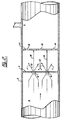
- FIG. 1 shows an apparatus according to the present invention.
- FIG 1 shows a reactor comprising a vessel 2 in the form of an open-ended cylinder. There is a baffle 4 in the vessel 2 and a plurality of first openings 6 in the baffle 4. Through each of these openings 6, a liquid 8, passing through the vessel 2, passes as a jet 10. The openings 6 are arranged sufficiently close to allow impingement of the jets 10, as schematically illustrated by the arrows 12 in Figure 1.
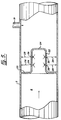
- FIG 2 shows the presence of a second baffle 14, spaced downstream from the first baffle 4.
- the second openings 16 are arranged so that the first and second openings 6 and 16 are not aligned.
- the jets 10 from the first openings impinge on the second baffle 14 as shown by the arrows 18 in Figure 2.
- the first and second openings 6 and 16 are both arranged to direct the jets 10 longitudinally of the apparatus.
- the first and second baffles 4 and 14 extend transversely of the vessel 2.
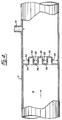
- Figure 3 illustrates an embodiment of the invention in which the baffle 20 comprises an annulus extending inwardly from the periphery of the vessel 2.
- a cylinder 22 extends longitudinally of the vessel 2, from the inner periphery of the annular baffle 20, to terminate in a closure 24 that is parallel to the annular baffle 20.
- Openings 26 are formed in the cylinder 22 so that jets 28 are directed by the openings 26 transverse of the vessel 2.
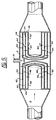
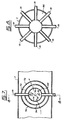
- Figure 5 illustrates an apparatus in which there is a plurality of generally coaxial cylinders 38, 40 and 42, each extending from an annular wall 44 extending from the periphery of vessel 2. Openings 44, 48 and 50 are arranged so that the liquid 8 flowing through an opening in an inner cylinder impinges on the wall of an outer cylinder before it can pass through openings in that outer cylinder.
- Figure 5 also illustrates a particular embodiment of the invention in which there are opposed cylinders.
- Figure 5 also shows cylinders 52, 54 and 56 extending from annular wall 58 towards wall 44. Openings 60, 62 and 64 are formed in cylinders 52, 54 and 56.
- FIG. 6 illustrates an embodiment of the invention in which baffles 66 are formed as generally concentric spheres 68, 70 and 72 each having inlet openings 74 and outlet openings 76 arranged so that liquid flowing in the vessel 2 must pass through the inlets 74, to the inner spheres 68, then outwardly.
- Reactants can be added to the embodiment of Figure 6 through inlet 19.
- An inlet system that uses a multiplicity of pipes distributed radially around reactor vessel 2 may be also be used.
- the location of the inlet pipes 19 may also be between stages of the concentric spheres, as shown in Figure 7.
- Figure 8 shows a sectional view through the multiple delivery pipes 19 to demonstrate the arrangement of the pipes through the vessel walls and into the concentric spheres.
- the number and size of the inlet pipes 19 are arranged to ensure a very high velocity jet, with very small droplets entering the reactor.
- Figure 9 illustrates an embodiment of the invention resembling that of Figure 7 and common reference numerals are used where appropriate. However, Figure 9 also shows the use of semi-spherical baffles 78 arranged concentrically around the sphere 68.
- the sphere 68 on the left of Figure 9 has two semi-spherical baffles. On the right of Figure 9 there are two spherical baffles 68 and 70 and one semi-spherical baffle 78, downstream of the pair of spherical baffles 68 and 70.
- Figure 10 also shows the relationship of the embodiment of Figure 9 to the embodiment of Figure 7 in showing multiple inlet pipes 19 extending through the vessel walls and into the sphere 68.
- the local velocity of each stage can be made sufficiently high to create conditions necessary for a nitration reaction between an aromatic hydrocarbon and mixed acid in the liquid 8 to take place independently from the bulk velocities of the reactants passing through the apparatus.
- the proportions of the apparatus can be adjusted, using simple experimental techniques, to achieve a wide range of intensive agitation and residence time.
- the apparatus can be used either as a single unit or as a number of units connected in series or in conjunction with one or more continuously stirred tank reactors.
- the apparatus of the invention is immediately of use in the adiabatic mononitration of benzene because of the large scale manufacture of this product.
- the invention can also be used in the nitration of other aromatic hydrocarbons or halogen substituted aromatic hydrocarbons.
- the particular benefit provided by the present invention is the degree of agitation that is available. This ensures that the reaction rate and conversion efficiency of the reactor are high.
- the desired high agitation is accomplished by causing the jets containing the liquid 8 of aromatic hydrocarbon and mixed acids to be directed towards each other so as to provide varying degrees of impingement of the jets.
- This impingement, or interplay, of the jet produces high shear rates in the liquid, much higher for example than provided by propeller blades in a conventional stirred tank reactor or than of the shearing rates in a static mixer reactor.
- a certain portion of the jet streams will directly impinge so as to bring droplets of the dispersed phase into direct contact and further enhance the reaction.
- the direct impingement of the jets, along with the relative shear between the jets will produce a constant supply of fresh interface between the reacting components, thereby enhancing the reaction rate and overall conversion efficiency of the reactor.
- An additional benefit provided by the present invention is the ability to add reactants in a high velocity jet directly into a region of high-intensity mixing as shown by the inlet system of Figures 7 and 8.
- the high velocity produces a jet of small droplets having a high surface area to mass ratio, thereby promoting the overall conversion of the reactants.
- the jets are turned so that they impinge on the wall of the reactor.
- the impingement, shearing and mixing of the components is further enhanced by the requirement of the fluid to turn back into the main fluid direction, as shown by the arrows.
- Such an arrangement can also be repeated in stages to the desired degree of reaction.
- the multiplicity of lateral jets ensures that some of the liquid jets will impinge directly on each other, achieving the highest possible degree of agitation and therefore reaction rate.
- the arrangement of annular walls and cylinders shown in Figure 4 can be repeated downstream for further conversion, if required. Further reactants can be added through inlet 19 prior to each stage as discussed above for Figure 2.
- Figures 1 to 4 show the flow direction to be axial, but the same principles can also be used if the flow arrangement be radial as shown by the cylindrical arrangement of Figure 5, and the spherical arrangement of Figure 6.
- the flow issues outwardly through a series of cylinders.
- the successive outward cylinders are preferably arranged so that the openings are not in line, producing the maximum benefit of reaction as discussed for Figure 2.
- the same arrangement can be used equally with the flow passing radially inwardly through the cylindrical shells.
- reactants may be added between the two stages through inlet 19.
- the first stage is defined by cylinders 38, 40 and 42 and the second by cylinders 52, 54 and 56. Again this reactant addition between stages improves conversion.
- the reactants are introduced directly between the concentric spheres shown through a plurality of inlet pipes 19 arranged radially about vessel 2.
- the size and number of the inlets is chosen appropriately so that the reactant jet velocity is very high. This promotes the formation of small droplets of reactant which leads to high overall reaction rates and high conversion efficiency.
- Figures 9 and 10 show that hemispheres may be used to achieve the same effect as spheres. Hemispheres may be arranged in any combination or number on the upstream or the downstream side of the spheres. The preferred arrangement depends on the degree of reaction desired and would be determined for any particular set of reaction conditions by routine experiment.
- Figure 10 shows that the arrangement that includes inlet pipes is also compatible with the semi-spherical arrangement shown in Figure 9.
- the vessels 2 can be cylinders of a diameter within the range 6 to 12 inches.
- the openings 6, 16, 26 and 32 may have a diameter of about 1/2 inch. They are symmetrically arranged in walls 4 and 14.
- Flow rates can, for example, be in the range of 100 to 800 U.S. gallons per minute.
- the end pipes shown may, for example, have diameters of about 8 inches.
- the vessels 2 have, for example, diameters of about 12 inches.
- Openings 60, 62, 64, 74 and 76 have diameters, for example, in the range 1/4 to 1/2 inch.
- the inlet pipes 19 may be 1/16 to 5/16 inch with any number of such inlets, for example, 32, disposed radially about the reactor vessel. This embodiment could be used, for example, if only the aromatic hydrocarbon is being added through the inlets.
- the apparatus may be made of glass lined steel, as in the prior art, but preferably are made from zirconium or tantalum or any suitable corrosion-resistant material.
Landscapes
- Chemical & Material Sciences (AREA)
- Chemical Kinetics & Catalysis (AREA)
- Dispersion Chemistry (AREA)
- Organic Chemistry (AREA)
- Organic Low-Molecular-Weight Compounds And Preparation Thereof (AREA)
- Physical Or Chemical Processes And Apparatus (AREA)
- Vibration Dampers (AREA)
Abstract
Description
- This invention relates to an apparatus to allow a reaction in the liquid phase and to a method for conducting a reaction. The invention finds application in reactions where the reactants are immiscible. The invention is of particular application in the nitration of aromatic hydrocarbons using mixed acids in aqueous solution.
- It is known that vigorous agitation is required for nitration reactions between an aromatic hydrocarbon and a mixture of sulfuric acid and nitric acid, commonly called mixed acid. Most of the known nitration processes using mixed acid use reactions vessels that incorporate agitation. These reactions are notoriously dangerous. They are highly exothermic and potentially explosive but it is well known that the risks inherent with these processes can be reduced if the charge of unreacted components can be made small.
- It is also well known that the formation of undesirable by-products is increased as residence time within the apparatus is increased. For example, in processes for the manufacture of mononitrobenzene, United States Patent 4,021,498 to Alexanderson recognized that a reaction time of 0.5 to 3 minutes was preferred and United States Patent 2,256,999 to Castner indicates a complete reaction in about 10 minutes. It is not as well known that by-product production also increases with temperature.
- It has, however, been found that when such processes are scaled up the efficiency of the reactant conversion is often less than that achieved on a small scale. This reduction in efficiency is commonly overcome by adding further conventional stirred tank reactors to the system. This has the effect of increasing the residence time, which increases the charge of unreacted and reacted components and increases the formation of undesirable by-products. Inevitably, the continuous stirred tank reactor, when operated in a manner necessary to provide the desired vigorous agitation, is subject to wear and mechanical breakdown.
- United States Patent 4,453,027 to Vaidyanathan teaches that halobenzenes can be nitrated in a tubular reactor of the static-mixer type. It has been found, however, that the efficiency of these static-mixers is also reduced when scaled up to sizes practical for large scale production. This is probably due to the comparatively low velocities available within the constraints of space and residence time.
- It is therefore recognized that a need exists for apparatus that permits nitration processes to operate efficiently and safely in large commercial applications.
- Prior art devices for handling fluids are well known, however, these devices are generally limited to performing mixing and blending operations.
- U.S. Patent 4,514,095 to Ehrfeld et al. discloses a motionless mixer in which a series of discs are arranged so that fluid passing through the mixer is divided into a number of streams whereupon the streams are recombined to thoroughly blend the fluid.
- U.S. Patent 4,043,539 to Gilmer et al. teaches a static-type mixer comprising a conduit that separates a fluid or fluids to be mixed into a series of parallel streams. A portion of the fluid is diverted laterally from a main passage and the remainder of the flow is then reversed to rejoin the diverted portion in order to produce a mixing effect.
- U.S. Patent 4,043,539 to Leffelman also teaches a static mixing device comprising a cylinder having an inlet and outlet and a plurality of hollow spheres with openings therethrough mounted within the cylinder. Fluids flowing through the cylinder are mixed in the turbulent flow that is created about the spheres.
- U.S. Patent 4,361,407 to Pelligrini discloses a further example of a stationary mixing device that uses a series of separable stages in which are formed cavities and alignable holes to define passages for the flow of fluids to be mixed. Fluids are divided and recombined in the passages to create an essentially homogeneous mixture after passing through several of the stages.
- The devices of the prior art are essentially concerned with mixing or blending of miscible fluids. In contrast, the apparatus and method of the present application is concerned with accelerating reactions between immiscible fluids that have been previously mixed. The apparatus of the present application accepts a flowing fluid comprising two or more immiscible and reactive liquids and uses the energy from the flow of the fluid to create a high shear on the fluid that breaks up a portion of the flow into small droplets having a large exposed surface area. These small droplets provide a greatly increased surface area for chemical reaction between the liquids thereby greatly accelerating the reaction rate. The shearing action is achieved by passing the fluid through sharp edges holes, and by impinging the resulting jets against a surface or against other jets or a slower moving fluid.
- Accordingly, the present invention provides an apparatus to allow reaction in the liquid phase and comprising:
a vessel having a longitudinal axis; a baffle in the vessel;
a plurality of first openings in the baffle through each of which a liquid passes as a jet, neighboring openings being spaced to allow impingement of the jets. - In a further aspect the present invention is a method of conducting a reaction between at least two reactants in the liquid phase comprising:
passing a liquid containing the reactants through a plurality of adjacent spaced openings to create a series of impinging jets. - Aspects of the invention are illustrated, by way of example, in the accompanying drawings in which:
- Figure 1 is a side elevation, partially in section, of an apparatus according to the present invention;
- Figure 2 is a view similar to Figure 1 of a further embodiment of the present invention;
- Figure 3 is a section through yet a further embodiment of the invention;
- Figure 4 shows a development of the embodiment of Figure 3;
- Figure 5 is a section of a further apparatus according to the present invention;
- Figure 6 illustrates yet a further embodiment of the present invention;
- Figure 7 shows an inlet system for introducing reactants into the apparatus of the present invention;
- Figure 8 is a section view through the inlet system taken along line 8-8 of Figure 7;
- Figure 9 is a side elevation, in section, of a further embodiment of the present invention; and
- Figure 10 is a detail of a variation of the Figure 9 embodiment.
- Each drawing shows an apparatus according to the present invention.
- Figure 1 shows a reactor comprising a
vessel 2 in the form of an open-ended cylinder. There is a baffle 4 in thevessel 2 and a plurality offirst openings 6 in the baffle 4. Through each of theseopenings 6, aliquid 8, passing through thevessel 2, passes as a jet 10. Theopenings 6 are arranged sufficiently close to allow impingement of the jets 10, as schematically illustrated by thearrows 12 in Figure 1. - Figure 2 shows the presence of a
second baffle 14, spaced downstream from the first baffle 4. There is a plurality ofsecond openings 16 in thesecond baffle 14. Thesecond openings 16 are arranged so that the first andsecond openings second baffle 14 as shown by thearrows 18 in Figure 2. There is an inlet for further reactants at 19 and further baffles, with openings, are placed downstream to provide a further reaction location. - In the embodiments of Figures 1 and 2, the first and
second openings second baffles 4 and 14 extend transversely of thevessel 2. However, Figure 3 illustrates an embodiment of the invention in which thebaffle 20 comprises an annulus extending inwardly from the periphery of thevessel 2. A cylinder 22 extends longitudinally of thevessel 2, from the inner periphery of theannular baffle 20, to terminate in aclosure 24 that is parallel to theannular baffle 20.Openings 26 are formed in the cylinder 22 so thatjets 28 are directed by theopenings 26 transverse of thevessel 2. In the embodiment of Figure 4 there is a plurality ofcylinders 30, each havingfirst openings 32, extending fromannular walls inlet 19 for further reactants is present in Figures 3 and 4 and there will be a further reaction location downstream. - Figure 5 illustrates an apparatus in which there is a plurality of generally
coaxial cylinders annular wall 44 extending from the periphery ofvessel 2.Openings liquid 8 flowing through an opening in an inner cylinder impinges on the wall of an outer cylinder before it can pass through openings in that outer cylinder. - Figure 5 also illustrates a particular embodiment of the invention in which there are opposed cylinders. Thus Figure 5 also shows
cylinders annular wall 58 towardswall 44.Openings cylinders - Figure 6 illustrates an embodiment of the invention in which baffles 66 are formed as generally
concentric spheres inlet openings 74 andoutlet openings 76 arranged so that liquid flowing in thevessel 2 must pass through theinlets 74, to theinner spheres 68, then outwardly. - Reactants can be added to the embodiment of Figure 6 through
inlet 19. An inlet system that uses a multiplicity of pipes distributed radially aroundreactor vessel 2 may be also be used. The location of theinlet pipes 19 may also be between stages of the concentric spheres, as shown in Figure 7. Figure 8 shows a sectional view through themultiple delivery pipes 19 to demonstrate the arrangement of the pipes through the vessel walls and into the concentric spheres. The number and size of theinlet pipes 19 are arranged to ensure a very high velocity jet, with very small droplets entering the reactor. - Figure 9 illustrates an embodiment of the invention resembling that of Figure 7 and common reference numerals are used where appropriate. However, Figure 9 also shows the use of
semi-spherical baffles 78 arranged concentrically around thesphere 68. - The
sphere 68 on the left of Figure 9 has two semi-spherical baffles. On the right of Figure 9 there are twospherical baffles semi-spherical baffle 78, downstream of the pair ofspherical baffles - Figure 10 also shows the relationship of the embodiment of Figure 9 to the embodiment of Figure 7 in showing
multiple inlet pipes 19 extending through the vessel walls and into thesphere 68. - Using the apparatus of the present invention the local velocity of each stage can be made sufficiently high to create conditions necessary for a nitration reaction between an aromatic hydrocarbon and mixed acid in the
liquid 8 to take place independently from the bulk velocities of the reactants passing through the apparatus. The proportions of the apparatus can be adjusted, using simple experimental techniques, to achieve a wide range of intensive agitation and residence time. - The apparatus can be used either as a single unit or as a number of units connected in series or in conjunction with one or more continuously stirred tank reactors.
- The apparatus of the invention is immediately of use in the adiabatic mononitration of benzene because of the large scale manufacture of this product. However, the invention can also be used in the nitration of other aromatic hydrocarbons or halogen substituted aromatic hydrocarbons.
- The particular benefit provided by the present invention is the degree of agitation that is available. This ensures that the reaction rate and conversion efficiency of the reactor are high. The desired high agitation is accomplished by causing the jets containing the
liquid 8 of aromatic hydrocarbon and mixed acids to be directed towards each other so as to provide varying degrees of impingement of the jets. This impingement, or interplay, of the jet produces high shear rates in the liquid, much higher for example than provided by propeller blades in a conventional stirred tank reactor or than of the shearing rates in a static mixer reactor. In addition to the shear between the jets a certain portion of the jet streams will directly impinge so as to bring droplets of the dispersed phase into direct contact and further enhance the reaction. The direct impingement of the jets, along with the relative shear between the jets, will produce a constant supply of fresh interface between the reacting components, thereby enhancing the reaction rate and overall conversion efficiency of the reactor. - An additional benefit provided by the present invention is the ability to add reactants in a high velocity jet directly into a region of high-intensity mixing as shown by the inlet system of Figures 7 and 8. The high velocity produces a jet of small droplets having a high surface area to mass ratio, thereby promoting the overall conversion of the reactants.
- The particular arrangement used to bring about jet impingement will vary according to the rate of reaction required. In the simplest form, as shown in Figures 1 and 2, the lowest degree of impingement is provided. The liquid jets are disposed parallel. The impingement occurs when the jets spread and combine in a downstream direction. Impingement is due to lateral components of the turbulent velocity in the jets.
- The embodiment of Figure 2, with its downstream impingement plate, causes the jets to change direction and impinge more directly. The provision of orifices in the second plate ensures a second stage of reaction. Further amounts of reactants can then be introduced through
inlet 19 to increase the efficiency of conversion and minimize by-product formation. That is, still further stages or reaction locations can be arranged, depending on the degree of reaction required. - In the Figure 3 embodiment the jets are turned so that they impinge on the wall of the reactor. In this embodiment the impingement, shearing and mixing of the components is further enhanced by the requirement of the fluid to turn back into the main fluid direction, as shown by the arrows. Such an arrangement can also be repeated in stages to the desired degree of reaction.
- In the embodiment of Figure 4, the multiplicity of lateral jets ensures that some of the liquid jets will impinge directly on each other, achieving the highest possible degree of agitation and therefore reaction rate. The arrangement of annular walls and cylinders shown in Figure 4 can be repeated downstream for further conversion, if required. Further reactants can be added through
inlet 19 prior to each stage as discussed above for Figure 2. - Figures 1 to 4 show the flow direction to be axial, but the same principles can also be used if the flow arrangement be radial as shown by the cylindrical arrangement of Figure 5, and the spherical arrangement of Figure 6.
- In Figure 5 the flow issues outwardly through a series of cylinders. The successive outward cylinders are preferably arranged so that the openings are not in line, producing the maximum benefit of reaction as discussed for Figure 2. The same arrangement can be used equally with the flow passing radially inwardly through the cylindrical shells. Again reactants may be added between the two stages through
inlet 19. The first stage is defined bycylinders cylinders - In Figure 6 the flow issues outward through a series of spheres, each with openings to produce jets. The openings are successively offset to produce maximum reactions as in the case of Figure 2. Flow can also be directed radially inward, that is opposite to that shown in Figure 6, and combination of radial inflow and outflow can be combined to form a compact stage. Many more stages can be added in the continuation of this principle.
- In Figure 7, the reactants are introduced directly between the concentric spheres shown through a plurality of
inlet pipes 19 arranged radially aboutvessel 2. The size and number of the inlets is chosen appropriately so that the reactant jet velocity is very high. This promotes the formation of small droplets of reactant which leads to high overall reaction rates and high conversion efficiency. - Figures 9 and 10 show that hemispheres may be used to achieve the same effect as spheres. Hemispheres may be arranged in any combination or number on the upstream or the downstream side of the spheres. The preferred arrangement depends on the degree of reaction desired and would be determined for any particular set of reaction conditions by routine experiment. Figure 10 shows that the arrangement that includes inlet pipes is also compatible with the semi-spherical arrangement shown in Figure 9.
- A virtue of the apparatus according to the invention is compactness where the prior art equipment can be massive. Thus, in the embodiments of Figures 1 to 4, the
vessels 2 can be cylinders of a diameter within therange 6 to 12 inches. Theopenings walls 4 and 14. - Flow rates can, for example, be in the range of 100 to 800 U.S. gallons per minute.
- In the embodiment of Figures 5 and 6 the end pipes shown may, for example, have diameters of about 8 inches. The
vessels 2 have, for example, diameters of about 12 inches.Openings - In the embodiment of Figure 7, the
inlet pipes 19 may be 1/16 to 5/16 inch with any number of such inlets, for example, 32, disposed radially about the reactor vessel. This embodiment could be used, for example, if only the aromatic hydrocarbon is being added through the inlets. - The apparatus may be made of glass lined steel, as in the prior art, but preferably are made from zirconium or tantalum or any suitable corrosion-resistant material.
Claims (26)
- Apparatus to allow reaction in the liquid phase and comprising:
a vessel having a longitudinal axis; a baffle in the vessel;
a plurality of first openings in the baffle through each of which a liquid passes as a jet, neighboring openings being spaced to allow impingement of the jets. - Apparatus as claimed in claim 1 including a second baffle;
a plurality of second openings in the second baffle arranged so that the first and second openings are not aligned so that the jets from the first openings impinge on the second baffle. - Apparatus as claimed in claim 1 in which the first openings extend through the baffle parallel to the longitudinal axis of the vessel such that the openings direct the jets longitudinally of the apparatus.
- Apparatus as claimed in claim 1 in which the baffle is a plate extending transversely of the longitudinal axis of the vessel.
- Apparatus as claimed in claim 1 in which the first openings extend through the baffle at an angle to the longitudinal axis of the vessel such that the openings direct the jets transversely of the apparatus.
- Apparatus as claimed in claim 5 in which said vessel has an outer wall and the baffle comprises an annular wall extending inwardly from the periphery of the outer wall, said annular wall having an inner peripheral edge;
a cylindrical portion having longitudinal walls extending along the longitudinal axis of the vessel from the inner peripheral edge of the annular wall and terminating in a closure parallel to the annular wall, the first openings being formed in the longitudinal walls. - Apparatus as claimed in claim 6 having a plurality of cylindrical portions, each having first openings.
- Apparatus as claimed in claim 6 having a plurality of generally coaxial cylindrical portions.
- Apparatus as claimed in claim 7 having opposed cylindrical portions, each comprising a plurality of generally coaxial cylinders extending towards each other from remote annular walls.
- Apparatus as claimed in claim 1 in which the baffle is generally spherical.
- Apparatus as claimed in claim 10 having a plurality of spheres of different diameters, arranged one within the other, each sphere formed with a plurality of first openings acting as inlets and a second plurality of openings acting as outlets.
- Apparatus as claimed in claim 1 including a plurality of stages, each stage comprising at least one baffle with a plurality of openings;
an inlet for further reactants between each stage. - Apparatus as claimed in claim 12 in which each stage comprises a plurality of baffles.
- Apparatus as claimed in claim 1 including an inlet for introducing reactants,
- Apparatus as claimed in claim 14 in which said inlet comprises a plurality of pipes arranged radially about said vessel.
- Apparatus as claimed in claim 11 including an inlet for introducing reactants, said inlet comprising a plurality of pipes arranged radially and extending through said spheres.
- Apparatus as claimed in claim 16 in which said inlet pipes open into the sphere having the smallest diameter.
- Apparatus as claimed in claim 10 in which the generally spherical baffle has at least one semi-spherical baffle concentric with it.
- Apparatus as claimed in claim 18 in which the semi-spherical baffle is upstream relative to the spherical baffle.
- Apparatus as claimed in claim 18 including an inlet for introducing reactants, said inlet comprising a plurality of pipes arranged radially and extending into said sphere.
- Apparatus as claimed in claim 11 in which the plurality of spheres has at least one semi-spherical baffle associated with it.
- A method of conducting a reaction between at least two reactants in the liquid phase comprising:
passing a liquid containing the reactants through a plurality of adjacent spaced openings to create a series of impinging jets. - A method as claimed in claim 22 including introducing the reactants through inlet pipes arranged to produce a high velocity jet of small droplets.
- A method as claimed in claim 23 in which only some reactants are introduced through inlet pipes.
- A method as claimed in claim 22 in which the reactants are immiscible.
- A method as claimed in claim 22 in which the reaction is nitration and one of the reactants is nitric acid.
Priority Applications (5)
| Application Number | Priority Date | Filing Date | Title |
|---|---|---|---|
| US07/405,930 US4994242A (en) | 1988-08-15 | 1989-09-12 | Jet impingement reactor |
| AT90403456T ATE134531T1 (en) | 1988-08-15 | 1990-12-05 | JET IMPACT REACTOR |
| EP90403456A EP0489211B1 (en) | 1988-08-15 | 1990-12-05 | Jet impingement reactor |
| ES90403456T ES2085342T3 (en) | 1988-08-15 | 1990-12-05 | JET SHOCK REACTOR. |
| DE69025615T DE69025615T2 (en) | 1988-08-15 | 1990-12-05 | Jet impact reactor |
Applications Claiming Priority (2)
| Application Number | Priority Date | Filing Date | Title |
|---|---|---|---|
| US23233988A | 1988-08-15 | 1988-08-15 | |
| EP90403456A EP0489211B1 (en) | 1988-08-15 | 1990-12-05 | Jet impingement reactor |
Publications (2)
| Publication Number | Publication Date |
|---|---|
| EP0489211A1 true EP0489211A1 (en) | 1992-06-10 |
| EP0489211B1 EP0489211B1 (en) | 1996-02-28 |
Family
ID=26925895
Family Applications (1)
| Application Number | Title | Priority Date | Filing Date |
|---|---|---|---|
| EP90403456A Expired - Lifetime EP0489211B1 (en) | 1988-08-15 | 1990-12-05 | Jet impingement reactor |
Country Status (5)
| Country | Link |
|---|---|
| US (1) | US4994242A (en) |
| EP (1) | EP0489211B1 (en) |
| AT (1) | ATE134531T1 (en) |
| DE (1) | DE69025615T2 (en) |
| ES (1) | ES2085342T3 (en) |
Cited By (22)
| Publication number | Priority date | Publication date | Assignee | Title |
|---|---|---|---|---|
| WO1995002448A1 (en) * | 1993-07-14 | 1995-01-26 | Sinvent A/S | Apparatus for mixing the components of a fluid flow |
| DE4433439A1 (en) * | 1994-09-20 | 1996-03-21 | Kernforschungsz Karlsruhe | Mixing fluids using adjacent micro structures generating diffusion or turbulence |
| WO1998011983A1 (en) * | 1996-09-19 | 1998-03-26 | Oleg Vyacheslavovich Kozyuk | Method for changing the qualitative and quantitative composition of a mixture of liquid hydrocarbons based on the effects of cavitation |
| US5733577A (en) * | 1994-06-14 | 1998-03-31 | Fuisz Technologies Ltd. | Delivery of controlled-release system (s) |
| US5931771A (en) * | 1997-12-24 | 1999-08-03 | Kozyuk; Oleg V. | Method and apparatus for producing ultra-thin emulsions and dispersions |
| US5937906A (en) * | 1997-05-06 | 1999-08-17 | Kozyuk; Oleg V. | Method and apparatus for conducting sonochemical reactions and processes using hydrodynamic cavitation |
| EP0947239A3 (en) * | 1998-03-27 | 2000-07-12 | Bayer Ag | Static mixer |
| EP0947238A3 (en) * | 1998-03-30 | 2000-07-19 | Innovative Engineering Solutions, INC. | Apparatus for oxidizing and removing matter from a hazardous gas flow |
| WO2001064333A3 (en) * | 2000-03-02 | 2002-02-21 | Dow Chemical Co | Tubular reactor, process for conducting liquid/liquid multiphase reactions in a tubular reactor, and a process for ring-nitrating aromatic compounds |
| US6365555B1 (en) * | 1999-10-25 | 2002-04-02 | Worcester Polytechnic Institute | Method of preparing metal containing compounds using hydrodynamic cavitation |
| DE102004038555B3 (en) * | 2004-08-06 | 2005-08-04 | Plinke Gmbh | Microreactor for nitration with a mixture of nitric and sulfuric acids comprises polytetrafluoroethylene components that can be connected to polytetrafluoroethylene tubes with clamping nuts |
| EP1634640A3 (en) * | 2004-09-10 | 2007-03-28 | M-Il.L.C., | Apparatus and method for homogenizing two or more fluids of different densities |
| WO2008071683A1 (en) * | 2006-12-13 | 2008-06-19 | Emitec Gesellschaft Für Emissionstechnologie | Flow distributor for an exhaust gas system |
| EP2168942A1 (en) | 2008-09-24 | 2010-03-31 | Bayer MaterialScience AG | Method for continuous production of Nitrobenzol |
| DE102009005324A1 (en) | 2009-01-16 | 2010-07-22 | Plinke Gmbh | Adiabatic nitration of benzene, comprises reacting nitric acid and benzene in presence of sulfuric acid to nitrobenzene, concentrating the diluted sulfuric acid, cooling and purifying crude nitrobenzene and distilling washed nitrobenzene |
| EP2158180A4 (en) * | 2007-06-27 | 2011-11-23 | H R D Corp | System and process for production of nitrobenzene |
| WO2012160072A1 (en) | 2011-05-24 | 2012-11-29 | Basf Se | Process for preparing polyisocyanates from biomass |
| US8697913B2 (en) | 2009-06-17 | 2014-04-15 | Huntsman International Llc | Chemical installation |
| US8827544B2 (en) | 2007-03-15 | 2014-09-09 | Dow Global Technologies Llc | Mixer for continuous flow reactor, continuous flow reactor, method of forming such a mixer, and method of operating such a reactor |
| US8933262B2 (en) | 2011-05-24 | 2015-01-13 | Basf Se | Process for preparing polyisocyanates from biomass |
| WO2018141451A1 (en) | 2017-02-03 | 2018-08-09 | Josef Meissner Gmbh & Co. Kg | Method and system for adiabatic nitriding of aromates |
| WO2022106041A1 (en) * | 2020-11-23 | 2022-05-27 | Wacker Chemie Ag | Process for preparing aqueous polymer dispersions in a tubular reactor |
Families Citing this family (23)
| Publication number | Priority date | Publication date | Assignee | Title |
|---|---|---|---|---|
| US5246673A (en) * | 1988-12-21 | 1993-09-21 | Troy Investments Inc. | Delta singlet oxygen continuous reactor |
| US5313009A (en) * | 1990-01-04 | 1994-05-17 | Nrm International Technologies C.V. | Nitration process |
| US5333952A (en) * | 1993-08-17 | 1994-08-02 | Perdue John L | Chemical mixing chamber |
| DE4437047A1 (en) | 1994-10-17 | 1996-04-18 | Bayer Ag | Process for the dinitration of aromatic compounds |
| DE19604289C2 (en) * | 1996-02-07 | 1998-04-23 | Danfoss As | Micromixer |
| US5743638A (en) * | 1996-07-30 | 1998-04-28 | Q-Jet, Dsi | Dual control mixing jet cooker |
| EP0916391B1 (en) * | 1997-11-13 | 2003-06-11 | Haldor Topsoe A/S | Mixing device and flue gas channel provided therewith |
| US6849189B2 (en) * | 2002-10-28 | 2005-02-01 | Mote Marine Laboratory | Horizontal reaction chamber comprised of nested, concentric tubes for use in water purification |
| US20060153754A1 (en) * | 2004-10-26 | 2006-07-13 | Hauptmann Edward G | Dispersion-intensified, coalescence-intensified chemical reactor and method |
| EP2014641A3 (en) * | 2007-06-06 | 2009-03-18 | Huntsman International Llc | Process for preparing mixtures of diphenylmethane diisocyanates and polyphenyl polymethylene polyisocyanates |
| DE102007059513A1 (en) | 2007-12-11 | 2009-06-18 | Bayer Materialscience Ag | Process for the preparation of nitrobenzene by adiabatic nitration |
| JP5332916B2 (en) * | 2009-06-03 | 2013-11-06 | 株式会社デンソー | Silicon carbide single crystal manufacturing equipment |
| DE102010006984A1 (en) | 2010-02-05 | 2011-08-11 | Bayer MaterialScience AG, 51373 | Process for the continuous production of nitrobenzene |
| JP5818287B2 (en) | 2011-05-19 | 2015-11-18 | ヨーゼフ マイスナー ゲーエムベーハー ウント コー カーゲー | Method and apparatus for purifying nitration products |
| KR20190004835A (en) * | 2013-06-13 | 2019-01-14 | 시그마 테크놀로지 유겐가이샤 | Micro and nano bubble generating method, generating nozzle, and generating device |
| JP6403528B2 (en) * | 2014-10-03 | 2018-10-10 | 旭有機材株式会社 | Fluid mixer and device using fluid mixer |
| US9885375B2 (en) * | 2015-02-18 | 2018-02-06 | Badger Meter, Inc. | Flow conditioner |
| MX2018004407A (en) | 2015-10-14 | 2018-08-01 | Arisdyne Systems Inc | Method for reducing neutral oil losses during neutralization step. |
| US20170362987A1 (en) * | 2016-06-20 | 2017-12-21 | Electro-Motive Diesel | Engine system having mixing mechanism for exhaust and injected fluid and engine exhaust treatment strategy |
| KR102593920B1 (en) | 2018-07-24 | 2023-10-26 | 노람 엔지니어링 앤드 콘스트럭터스 엘티디. | Nitrogen reactor and method |
| GB201818709D0 (en) * | 2018-11-16 | 2019-01-02 | Fujifilm Diosynth Biotechnologies Uk Ltd | Mixer |
| US20230219044A1 (en) * | 2020-06-10 | 2023-07-13 | The Johns Hopkins University | Axisymmetric confined impinging jet mixer |
| KR20250026349A (en) | 2022-06-28 | 2025-02-25 | 바스프 에스이 | Method for producing nitrobenzene |
Citations (5)
| Publication number | Priority date | Publication date | Assignee | Title |
|---|---|---|---|---|
| US1698432A (en) * | 1926-01-08 | 1929-01-08 | Standard Oil Co | Orifice mixer |
| DE1039049B (en) * | 1951-11-06 | 1958-09-18 | Nitroglycerin Ab | Process for the production of nitric acid esters and organic nitro compounds |
| US4043539A (en) * | 1975-03-28 | 1977-08-23 | Texaco Inc. | Method and apparatus for static type fluid mixing |
| US4136976A (en) * | 1977-05-23 | 1979-01-30 | Nalco Chemical Company | Static mixing device |
| US4596699A (en) * | 1978-05-02 | 1986-06-24 | Societe Nationale Elf Aquitaine (Production) | Apparatus for burning hydrogen sulphide |
Family Cites Families (7)
| Publication number | Priority date | Publication date | Assignee | Title |
|---|---|---|---|---|
| US4208136A (en) * | 1978-12-01 | 1980-06-17 | Komax Systems, Inc. | Static mixing apparatus |
| IT1128825B (en) * | 1980-06-27 | 1986-06-04 | Fiat Ricerche | STATIC MIXING DEVICE SUITABLE FOR MIXING TWO OR MORE COMPONENTS INTO THE LIQUID OR SEMI-LIQUID STATE |
| US4398563A (en) * | 1981-09-28 | 1983-08-16 | Vacco Industries | Multi-tube flow restrictor |
| NL8303350A (en) * | 1982-11-06 | 1984-06-01 | Kernforschungsz Karlsruhe | STATIC MIXER. |
| US4669890A (en) * | 1985-03-25 | 1987-06-02 | Uop Inc. | Mixing device for vertical flow fluid-solid contacting |
| US4647212A (en) * | 1986-03-11 | 1987-03-03 | Act Laboratories, Inc. | Continuous, static mixing apparatus |
| US4786185A (en) * | 1988-02-29 | 1988-11-22 | Phillips Petroleum Company | Apparatus and method for affecting the flow paths of fluid flowing in a pipe |
-
1989
- 1989-09-12 US US07/405,930 patent/US4994242A/en not_active Expired - Lifetime
-
1990
- 1990-12-05 DE DE69025615T patent/DE69025615T2/en not_active Expired - Lifetime
- 1990-12-05 AT AT90403456T patent/ATE134531T1/en not_active IP Right Cessation
- 1990-12-05 EP EP90403456A patent/EP0489211B1/en not_active Expired - Lifetime
- 1990-12-05 ES ES90403456T patent/ES2085342T3/en not_active Expired - Lifetime
Patent Citations (5)
| Publication number | Priority date | Publication date | Assignee | Title |
|---|---|---|---|---|
| US1698432A (en) * | 1926-01-08 | 1929-01-08 | Standard Oil Co | Orifice mixer |
| DE1039049B (en) * | 1951-11-06 | 1958-09-18 | Nitroglycerin Ab | Process for the production of nitric acid esters and organic nitro compounds |
| US4043539A (en) * | 1975-03-28 | 1977-08-23 | Texaco Inc. | Method and apparatus for static type fluid mixing |
| US4136976A (en) * | 1977-05-23 | 1979-01-30 | Nalco Chemical Company | Static mixing device |
| US4596699A (en) * | 1978-05-02 | 1986-06-24 | Societe Nationale Elf Aquitaine (Production) | Apparatus for burning hydrogen sulphide |
Non-Patent Citations (1)
| Title |
|---|
| PATENT ABSTRACTS OF JAPAN, vol. 7, no. 100 (C-164)[1245], 28th April 1983; & JP-A-58 27 626 (NITSUKOOAAMUZU K.K.) 18-02-1983 * |
Cited By (35)
| Publication number | Priority date | Publication date | Assignee | Title |
|---|---|---|---|---|
| CN1047740C (en) * | 1993-07-14 | 1999-12-29 | 新文特公司 | Mixing device for components in a fluid stream |
| WO1995002448A1 (en) * | 1993-07-14 | 1995-01-26 | Sinvent A/S | Apparatus for mixing the components of a fluid flow |
| US5733577A (en) * | 1994-06-14 | 1998-03-31 | Fuisz Technologies Ltd. | Delivery of controlled-release system (s) |
| DE4433439A1 (en) * | 1994-09-20 | 1996-03-21 | Kernforschungsz Karlsruhe | Mixing fluids using adjacent micro structures generating diffusion or turbulence |
| WO1998011983A1 (en) * | 1996-09-19 | 1998-03-26 | Oleg Vyacheslavovich Kozyuk | Method for changing the qualitative and quantitative composition of a mixture of liquid hydrocarbons based on the effects of cavitation |
| US5937906A (en) * | 1997-05-06 | 1999-08-17 | Kozyuk; Oleg V. | Method and apparatus for conducting sonochemical reactions and processes using hydrodynamic cavitation |
| US6035897A (en) * | 1997-05-06 | 2000-03-14 | Kozyuk; Oleg Vyacheslavovich | Method and apparatus for conducting sonochemical reactions and processes using hydrodynamic cavitation |
| US5931771A (en) * | 1997-12-24 | 1999-08-03 | Kozyuk; Oleg V. | Method and apparatus for producing ultra-thin emulsions and dispersions |
| EP0947239A3 (en) * | 1998-03-27 | 2000-07-12 | Bayer Ag | Static mixer |
| US7390121B2 (en) | 1998-03-27 | 2008-06-24 | Bayer Aktiengesellschaft | Static mixer module |
| EP0947238A3 (en) * | 1998-03-30 | 2000-07-19 | Innovative Engineering Solutions, INC. | Apparatus for oxidizing and removing matter from a hazardous gas flow |
| US6869586B1 (en) | 1999-10-25 | 2005-03-22 | Five Star Technologies, Inc. | Method of preparing metal containing compounds using hydrodynamic cavitation |
| US6365555B1 (en) * | 1999-10-25 | 2002-04-02 | Worcester Polytechnic Institute | Method of preparing metal containing compounds using hydrodynamic cavitation |
| US7303732B2 (en) | 2000-03-02 | 2007-12-04 | Dow Global Technologies Inc. | Tubular reactor having static mixing elements separated by coalescing zones |
| US6506949B2 (en) | 2000-03-02 | 2003-01-14 | Dow Global Technologies, Inc. | Process for ring nitrating aromatic compounds in a tubular reactor having static mixing elements separated by coalescing zones |
| WO2001064333A3 (en) * | 2000-03-02 | 2002-02-21 | Dow Chemical Co | Tubular reactor, process for conducting liquid/liquid multiphase reactions in a tubular reactor, and a process for ring-nitrating aromatic compounds |
| DE102004038555B3 (en) * | 2004-08-06 | 2005-08-04 | Plinke Gmbh | Microreactor for nitration with a mixture of nitric and sulfuric acids comprises polytetrafluoroethylene components that can be connected to polytetrafluoroethylene tubes with clamping nuts |
| US8702299B2 (en) | 2004-09-10 | 2014-04-22 | M-I L.L.C. | Apparatus and method for homogenizing two or more fluids of different densities |
| EP1634640A3 (en) * | 2004-09-10 | 2007-03-28 | M-Il.L.C., | Apparatus and method for homogenizing two or more fluids of different densities |
| US8079751B2 (en) | 2004-09-10 | 2011-12-20 | M-I L.L.C. | Apparatus for homogenizing two or more fluids of different densities |
| WO2008071683A1 (en) * | 2006-12-13 | 2008-06-19 | Emitec Gesellschaft Für Emissionstechnologie | Flow distributor for an exhaust gas system |
| US8827544B2 (en) | 2007-03-15 | 2014-09-09 | Dow Global Technologies Llc | Mixer for continuous flow reactor, continuous flow reactor, method of forming such a mixer, and method of operating such a reactor |
| EP2158180A4 (en) * | 2007-06-27 | 2011-11-23 | H R D Corp | System and process for production of nitrobenzene |
| EP2168942A1 (en) | 2008-09-24 | 2010-03-31 | Bayer MaterialScience AG | Method for continuous production of Nitrobenzol |
| DE102009005324A1 (en) | 2009-01-16 | 2010-07-22 | Plinke Gmbh | Adiabatic nitration of benzene, comprises reacting nitric acid and benzene in presence of sulfuric acid to nitrobenzene, concentrating the diluted sulfuric acid, cooling and purifying crude nitrobenzene and distilling washed nitrobenzene |
| US8697913B2 (en) | 2009-06-17 | 2014-04-15 | Huntsman International Llc | Chemical installation |
| US9102586B2 (en) | 2009-06-17 | 2015-08-11 | Huntsman International Llc | Method for producing DADPM |
| WO2012160072A1 (en) | 2011-05-24 | 2012-11-29 | Basf Se | Process for preparing polyisocyanates from biomass |
| US8933262B2 (en) | 2011-05-24 | 2015-01-13 | Basf Se | Process for preparing polyisocyanates from biomass |
| WO2018141451A1 (en) | 2017-02-03 | 2018-08-09 | Josef Meissner Gmbh & Co. Kg | Method and system for adiabatic nitriding of aromates |
| DE102017110084A1 (en) | 2017-02-03 | 2018-08-09 | Josef Meissner Gmbh & Co. Kg | Process and plant for the adiabatic nitration of aromatics |
| DE102017110084B4 (en) | 2017-02-03 | 2019-07-04 | Josef Meissner Gmbh & Co. Kg | Process and plant for the adiabatic nitration of aromatics |
| DE102017110084C5 (en) | 2017-02-03 | 2026-02-26 | Josef Meissner Gmbh & Co. Kg | Uses of nitroaromatics in the adiabatic nitration of aromatics |
| WO2022106041A1 (en) * | 2020-11-23 | 2022-05-27 | Wacker Chemie Ag | Process for preparing aqueous polymer dispersions in a tubular reactor |
| US12565553B2 (en) | 2020-11-23 | 2026-03-03 | Wacker Chemie Ag | Process for preparing aqueous polymer dispersions in a tubular reactor |
Also Published As
| Publication number | Publication date |
|---|---|
| US4994242A (en) | 1991-02-19 |
| DE69025615D1 (en) | 1996-04-04 |
| DE69025615T2 (en) | 1996-09-12 |
| ATE134531T1 (en) | 1996-03-15 |
| ES2085342T3 (en) | 1996-06-01 |
| EP0489211B1 (en) | 1996-02-28 |
Similar Documents
| Publication | Publication Date | Title |
|---|---|---|
| EP0489211B1 (en) | Jet impingement reactor | |
| US6562247B2 (en) | Process for conducting liquid/liquid multiphase reactions in a tubular reactor having static mixing elements separated by coalescing zones | |
| US5616818A (en) | Process for the polynitration of aromatic compounds | |
| US4973770A (en) | Manufacture of organic nitro compounds | |
| US5763697A (en) | Process for the nitration of aromatic compounds | |
| EP2043770B1 (en) | Mixing apparatus and process | |
| US9138694B2 (en) | Mixing apparatus | |
| SE439885B (en) | SET FOR MIXING ATMINSTONE TWO FLUIDS AND PLATE MIXERS HERE | |
| CN110237794B (en) | Ultrasonic enhanced jet reactor | |
| NZ267029A (en) | Passive reactor; multiphase, staged, reactor has stages defining a flow path for substances to be reacted, the flow path being curved | |
| US7922981B2 (en) | Dispersion-intensified, coalescence-intensified chemical reactor and method | |
| CN113332947A (en) | High flow ratio rapid mixer and annular reaction system using same | |
| EP2158180B1 (en) | System and process for production of nitrobenzene | |
| CA2036174C (en) | Jet-impingement reactor | |
| EP3826763B1 (en) | Nitration reactor and method | |
| US20140072481A1 (en) | Catalytic static mixing reactor | |
| RU2348451C2 (en) | Process vessel for gas-liquid catalytic reactions (versions) | |
| EP1501626B1 (en) | Device and method of creating hydrodynamic cavitation in fluids | |
| CN222019547U (en) | Synthetic reactor suitable for polycarbonate preparation | |
| RU2082486C1 (en) | Mixer-reactor | |
| WO2022119477A1 (en) | Static mixer for breaking down gas bubbles in a gas-liquid mixture | |
| SU1294369A1 (en) | Reaction vessel | |
| SU1678436A1 (en) | Chemical reactor | |
| SU975046A1 (en) | Static vane-type mixer | |
| CN121944872A (en) | Multiphase micro-hybrid structure |
Legal Events
| Date | Code | Title | Description |
|---|---|---|---|
| PUAI | Public reference made under article 153(3) epc to a published international application that has entered the european phase |
Free format text: ORIGINAL CODE: 0009012 |
|
| AK | Designated contracting states |
Kind code of ref document: A1 Designated state(s): AT BE CH DE DK ES FR GB GR IT LI LU NL SE |
|
| 17P | Request for examination filed |
Effective date: 19921202 |
|
| RAP1 | Party data changed (applicant data changed or rights of an application transferred) |
Owner name: NRM INTERNATIONAL TECHNOLOGIES C.V. |
|
| 17Q | First examination report despatched |
Effective date: 19940113 |
|
| GRAA | (expected) grant |
Free format text: ORIGINAL CODE: 0009210 |
|
| AK | Designated contracting states |
Kind code of ref document: B1 Designated state(s): AT BE CH DE DK ES FR GB GR IT LI LU NL SE |
|
| PG25 | Lapsed in a contracting state [announced via postgrant information from national office to epo] |
Ref country code: AT Effective date: 19960228 Ref country code: DK Effective date: 19960228 Ref country code: LI Effective date: 19960228 Ref country code: GR Free format text: LAPSE BECAUSE OF FAILURE TO SUBMIT A TRANSLATION OF THE DESCRIPTION OR TO PAY THE FEE WITHIN THE PRESCRIBED TIME-LIMIT Effective date: 19960228 Ref country code: CH Effective date: 19960228 |
|
| REF | Corresponds to: |
Ref document number: 134531 Country of ref document: AT Date of ref document: 19960315 Kind code of ref document: T |
|
| REF | Corresponds to: |
Ref document number: 69025615 Country of ref document: DE Date of ref document: 19960404 |
|
| ET | Fr: translation filed | ||
| ITF | It: translation for a ep patent filed | ||
| PG25 | Lapsed in a contracting state [announced via postgrant information from national office to epo] |
Ref country code: SE Effective date: 19960531 |
|
| REG | Reference to a national code |
Ref country code: ES Ref legal event code: FG2A Ref document number: 2085342 Country of ref document: ES Kind code of ref document: T3 |
|
| REG | Reference to a national code |
Ref country code: CH Ref legal event code: PL |
|
| PG25 | Lapsed in a contracting state [announced via postgrant information from national office to epo] |
Ref country code: LU Free format text: LAPSE BECAUSE OF NON-PAYMENT OF DUE FEES Effective date: 19961231 |
|
| PLBE | No opposition filed within time limit |
Free format text: ORIGINAL CODE: 0009261 |
|
| STAA | Information on the status of an ep patent application or granted ep patent |
Free format text: STATUS: NO OPPOSITION FILED WITHIN TIME LIMIT |
|
| 26N | No opposition filed | ||
| REG | Reference to a national code |
Ref country code: FR Ref legal event code: CA |
|
| REG | Reference to a national code |
Ref country code: GB Ref legal event code: IF02 |
|
| NLS | Nl: assignments of ep-patents |
Owner name: NORAM INTERNATIONAL LIMITED Effective date: 20090211 |
|
| PGFP | Annual fee paid to national office [announced via postgrant information from national office to epo] |
Ref country code: BE Payment date: 20090819 Year of fee payment: 20 Ref country code: NL Payment date: 20091222 Year of fee payment: 20 |
|
| PGFP | Annual fee paid to national office [announced via postgrant information from national office to epo] |
Ref country code: IT Payment date: 20091215 Year of fee payment: 20 Ref country code: GB Payment date: 20091020 Year of fee payment: 20 Ref country code: ES Payment date: 20100201 Year of fee payment: 20 |
|
| PGFP | Annual fee paid to national office [announced via postgrant information from national office to epo] |
Ref country code: DE Payment date: 20091208 Year of fee payment: 20 |
|
| REG | Reference to a national code |
Ref country code: NL Ref legal event code: V4 Effective date: 20101205 |
|
| REG | Reference to a national code |
Ref country code: GB Ref legal event code: PE20 Expiry date: 20101204 |
|
| BE20 | Be: patent expired |
Owner name: *NRM INTERNATIONAL TECHNOLOGIES C.V. Effective date: 20101205 |
|
| PG25 | Lapsed in a contracting state [announced via postgrant information from national office to epo] |
Ref country code: NL Free format text: LAPSE BECAUSE OF EXPIRATION OF PROTECTION Effective date: 20101205 Ref country code: GB Free format text: LAPSE BECAUSE OF EXPIRATION OF PROTECTION Effective date: 20101204 |
|
| PGFP | Annual fee paid to national office [announced via postgrant information from national office to epo] |
Ref country code: FR Payment date: 20090914 Year of fee payment: 20 |
|
| PG25 | Lapsed in a contracting state [announced via postgrant information from national office to epo] |
Ref country code: DE Free format text: LAPSE BECAUSE OF EXPIRATION OF PROTECTION Effective date: 20101205 |
|
| REG | Reference to a national code |
Ref country code: ES Ref legal event code: FD2A Effective date: 20130801 |
|
| PG25 | Lapsed in a contracting state [announced via postgrant information from national office to epo] |
Ref country code: ES Free format text: LAPSE BECAUSE OF EXPIRATION OF PROTECTION Effective date: 20101206 |