EP0488690B1 - Process for making catalyst compositions - Google Patents
Process for making catalyst compositions Download PDFInfo
- Publication number
- EP0488690B1 EP0488690B1 EP91310961A EP91310961A EP0488690B1 EP 0488690 B1 EP0488690 B1 EP 0488690B1 EP 91310961 A EP91310961 A EP 91310961A EP 91310961 A EP91310961 A EP 91310961A EP 0488690 B1 EP0488690 B1 EP 0488690B1
- Authority
- EP
- European Patent Office
- Prior art keywords
- metal
- trapping agent
- aqueous solution
- catalyst composition
- alkaline earth
- Prior art date
- Legal status (The legal status is an assumption and is not a legal conclusion. Google has not performed a legal analysis and makes no representation as to the accuracy of the status listed.)
- Expired - Lifetime
Links
- 239000003054 catalyst Substances 0.000 title claims description 90
- 239000000203 mixture Substances 0.000 title claims description 64
- 238000000034 method Methods 0.000 title claims description 28
- 229910052751 metal Inorganic materials 0.000 claims description 49
- 239000002184 metal Substances 0.000 claims description 49
- 239000003795 chemical substances by application Substances 0.000 claims description 36
- 239000010457 zeolite Substances 0.000 claims description 34
- 229910021536 Zeolite Inorganic materials 0.000 claims description 33
- HNPSIPDUKPIQMN-UHFFFAOYSA-N dioxosilane;oxo(oxoalumanyloxy)alumane Chemical compound O=[Si]=O.O=[Al]O[Al]=O HNPSIPDUKPIQMN-UHFFFAOYSA-N 0.000 claims description 31
- 229910052698 phosphorus Inorganic materials 0.000 claims description 29
- 239000011574 phosphorus Substances 0.000 claims description 29
- OAICVXFJPJFONN-UHFFFAOYSA-N Phosphorus Chemical compound [P] OAICVXFJPJFONN-UHFFFAOYSA-N 0.000 claims description 28
- 239000007864 aqueous solution Substances 0.000 claims description 27
- NBIIXXVUZAFLBC-UHFFFAOYSA-N Phosphoric acid Chemical compound OP(O)(O)=O NBIIXXVUZAFLBC-UHFFFAOYSA-N 0.000 claims description 26
- 229910052784 alkaline earth metal Inorganic materials 0.000 claims description 25
- 150000001342 alkaline earth metals Chemical class 0.000 claims description 25
- PNEYBMLMFCGWSK-UHFFFAOYSA-N aluminium oxide Inorganic materials [O-2].[O-2].[O-2].[Al+3].[Al+3] PNEYBMLMFCGWSK-UHFFFAOYSA-N 0.000 claims description 25
- 239000011159 matrix material Substances 0.000 claims description 25
- 239000002243 precursor Substances 0.000 claims description 21
- CPLXHLVBOLITMK-UHFFFAOYSA-N Magnesium oxide Chemical compound [Mg]=O CPLXHLVBOLITMK-UHFFFAOYSA-N 0.000 claims description 20
- 229910052809 inorganic oxide Inorganic materials 0.000 claims description 20
- 150000002500 ions Chemical class 0.000 claims description 20
- 229910000147 aluminium phosphate Inorganic materials 0.000 claims description 13
- 229910000323 aluminium silicate Inorganic materials 0.000 claims description 13
- 239000000395 magnesium oxide Substances 0.000 claims description 13
- 238000004523 catalytic cracking Methods 0.000 claims description 12
- 238000002360 preparation method Methods 0.000 claims description 11
- 238000001354 calcination Methods 0.000 claims description 10
- 229910000287 alkaline earth metal oxide Inorganic materials 0.000 claims description 7
- 239000000243 solution Substances 0.000 claims description 6
- MNNHAPBLZZVQHP-UHFFFAOYSA-N diammonium hydrogen phosphate Chemical compound [NH4+].[NH4+].OP([O-])([O-])=O MNNHAPBLZZVQHP-UHFFFAOYSA-N 0.000 claims description 5
- 238000001694 spray drying Methods 0.000 claims description 5
- UAMZXLIURMNTHD-UHFFFAOYSA-N dialuminum;magnesium;oxygen(2-) Chemical compound [O-2].[O-2].[O-2].[O-2].[Mg+2].[Al+3].[Al+3] UAMZXLIURMNTHD-UHFFFAOYSA-N 0.000 claims description 4
- 239000004254 Ammonium phosphate Substances 0.000 claims description 3
- 229910000148 ammonium phosphate Inorganic materials 0.000 claims description 3
- 235000019289 ammonium phosphates Nutrition 0.000 claims description 3
- 150000002148 esters Chemical class 0.000 claims 1
- 239000002002 slurry Substances 0.000 description 24
- VYPSYNLAJGMNEJ-UHFFFAOYSA-N Silicium dioxide Chemical compound O=[Si]=O VYPSYNLAJGMNEJ-UHFFFAOYSA-N 0.000 description 22
- 239000002245 particle Substances 0.000 description 20
- MCMNRKCIXSYSNV-UHFFFAOYSA-N Zirconium dioxide Chemical compound O=[Zr]=O MCMNRKCIXSYSNV-UHFFFAOYSA-N 0.000 description 15
- 239000011575 calcium Substances 0.000 description 12
- 239000000377 silicon dioxide Substances 0.000 description 12
- GWEVSGVZZGPLCZ-UHFFFAOYSA-N Titan oxide Chemical compound O=[Ti]=O GWEVSGVZZGPLCZ-UHFFFAOYSA-N 0.000 description 10
- 229910052593 corundum Inorganic materials 0.000 description 9
- 229910052720 vanadium Inorganic materials 0.000 description 9
- 229910001845 yogo sapphire Inorganic materials 0.000 description 9
- 238000006243 chemical reaction Methods 0.000 description 8
- 239000000356 contaminant Substances 0.000 description 8
- LEONUFNNVUYDNQ-UHFFFAOYSA-N vanadium atom Chemical compound [V] LEONUFNNVUYDNQ-UHFFFAOYSA-N 0.000 description 8
- PXHVJJICTQNCMI-UHFFFAOYSA-N Nickel Chemical compound [Ni] PXHVJJICTQNCMI-UHFFFAOYSA-N 0.000 description 7
- 239000000378 calcium silicate Substances 0.000 description 7
- 235000012241 calcium silicate Nutrition 0.000 description 7
- 229960003340 calcium silicate Drugs 0.000 description 7
- 229910052918 calcium silicate Inorganic materials 0.000 description 7
- OYACROKNLOSFPA-UHFFFAOYSA-N calcium;dioxido(oxo)silane Chemical compound [Ca+2].[O-][Si]([O-])=O OYACROKNLOSFPA-UHFFFAOYSA-N 0.000 description 7
- 229910052681 coesite Inorganic materials 0.000 description 7
- 229910052906 cristobalite Inorganic materials 0.000 description 7
- 229910052682 stishovite Inorganic materials 0.000 description 7
- 229910052905 tridymite Inorganic materials 0.000 description 7
- VTYYLEPIZMXCLO-UHFFFAOYSA-L Calcium carbonate Chemical compound [Ca+2].[O-]C([O-])=O VTYYLEPIZMXCLO-UHFFFAOYSA-L 0.000 description 6
- 239000004215 Carbon black (E152) Substances 0.000 description 6
- 238000005336 cracking Methods 0.000 description 6
- 229930195733 hydrocarbon Natural products 0.000 description 6
- 150000002430 hydrocarbons Chemical class 0.000 description 6
- XLYOFNOQVPJJNP-UHFFFAOYSA-N water Substances O XLYOFNOQVPJJNP-UHFFFAOYSA-N 0.000 description 6
- XFWJKVMFIVXPKK-UHFFFAOYSA-N calcium;oxido(oxo)alumane Chemical compound [Ca+2].[O-][Al]=O.[O-][Al]=O XFWJKVMFIVXPKK-UHFFFAOYSA-N 0.000 description 5
- 230000000052 comparative effect Effects 0.000 description 5
- 230000000694 effects Effects 0.000 description 5
- 238000010828 elution Methods 0.000 description 5
- 235000012239 silicon dioxide Nutrition 0.000 description 5
- 239000007921 spray Substances 0.000 description 5
- 238000012360 testing method Methods 0.000 description 5
- 238000002441 X-ray diffraction Methods 0.000 description 4
- 229910052791 calcium Inorganic materials 0.000 description 4
- 230000007423 decrease Effects 0.000 description 4
- 239000011777 magnesium Substances 0.000 description 4
- 150000002739 metals Chemical class 0.000 description 4
- DJOYTAUERRJRAT-UHFFFAOYSA-N 2-(n-methyl-4-nitroanilino)acetonitrile Chemical compound N#CCN(C)C1=CC=C([N+]([O-])=O)C=C1 DJOYTAUERRJRAT-UHFFFAOYSA-N 0.000 description 3
- 239000005995 Aluminium silicate Substances 0.000 description 3
- UHOVQNZJYSORNB-UHFFFAOYSA-N Benzene Chemical compound C1=CC=CC=C1 UHOVQNZJYSORNB-UHFFFAOYSA-N 0.000 description 3
- 229910002974 CaO–SiO2 Inorganic materials 0.000 description 3
- OYPRJOBELJOOCE-UHFFFAOYSA-N Calcium Chemical compound [Ca] OYPRJOBELJOOCE-UHFFFAOYSA-N 0.000 description 3
- 229910019142 PO4 Inorganic materials 0.000 description 3
- 238000013019 agitation Methods 0.000 description 3
- 235000012211 aluminium silicate Nutrition 0.000 description 3
- 150000001875 compounds Chemical class 0.000 description 3
- 239000008367 deionised water Substances 0.000 description 3
- 229910021641 deionized water Inorganic materials 0.000 description 3
- 230000002939 deleterious effect Effects 0.000 description 3
- 238000005342 ion exchange Methods 0.000 description 3
- NLYAJNPCOHFWQQ-UHFFFAOYSA-N kaolin Chemical compound O.O.O=[Al]O[Si](=O)O[Si](=O)O[Al]=O NLYAJNPCOHFWQQ-UHFFFAOYSA-N 0.000 description 3
- 239000004005 microsphere Substances 0.000 description 3
- 229910052759 nickel Inorganic materials 0.000 description 3
- TVMXDCGIABBOFY-UHFFFAOYSA-N octane Chemical compound CCCCCCCC TVMXDCGIABBOFY-UHFFFAOYSA-N 0.000 description 3
- 239000003208 petroleum Substances 0.000 description 3
- 239000010452 phosphate Substances 0.000 description 3
- NBIIXXVUZAFLBC-UHFFFAOYSA-K phosphate Chemical compound [O-]P([O-])([O-])=O NBIIXXVUZAFLBC-UHFFFAOYSA-K 0.000 description 3
- 239000007787 solid Substances 0.000 description 3
- 238000003756 stirring Methods 0.000 description 3
- HAIMOVORXAUUQK-UHFFFAOYSA-J zirconium(iv) hydroxide Chemical compound [OH-].[OH-].[OH-].[OH-].[Zr+4] HAIMOVORXAUUQK-UHFFFAOYSA-J 0.000 description 3
- QGZKDVFQNNGYKY-UHFFFAOYSA-N Ammonia Chemical compound N QGZKDVFQNNGYKY-UHFFFAOYSA-N 0.000 description 2
- TWRXJAOTZQYOKJ-UHFFFAOYSA-L Magnesium chloride Chemical compound [Mg+2].[Cl-].[Cl-] TWRXJAOTZQYOKJ-UHFFFAOYSA-L 0.000 description 2
- 229910020442 SiO2—TiO2 Inorganic materials 0.000 description 2
- 150000001341 alkaline earth metal compounds Chemical class 0.000 description 2
- AYJRCSIUFZENHW-UHFFFAOYSA-L barium carbonate Chemical compound [Ba+2].[O-]C([O-])=O AYJRCSIUFZENHW-UHFFFAOYSA-L 0.000 description 2
- 229910000019 calcium carbonate Inorganic materials 0.000 description 2
- 235000010216 calcium carbonate Nutrition 0.000 description 2
- 239000004927 clay Substances 0.000 description 2
- 239000013078 crystal Substances 0.000 description 2
- 238000011067 equilibration Methods 0.000 description 2
- 239000000499 gel Substances 0.000 description 2
- 230000007062 hydrolysis Effects 0.000 description 2
- 238000006460 hydrolysis reaction Methods 0.000 description 2
- 239000000725 suspension Substances 0.000 description 2
- 239000010456 wollastonite Substances 0.000 description 2
- 229910052882 wollastonite Inorganic materials 0.000 description 2
- 229910052726 zirconium Inorganic materials 0.000 description 2
- 150000003754 zirconium Chemical class 0.000 description 2
- 229910016341 Al2O3 ZrO2 Inorganic materials 0.000 description 1
- QGZKDVFQNNGYKY-UHFFFAOYSA-O Ammonium Chemical compound [NH4+] QGZKDVFQNNGYKY-UHFFFAOYSA-O 0.000 description 1
- ATRRKUHOCOJYRX-UHFFFAOYSA-N Ammonium bicarbonate Chemical compound [NH4+].OC([O-])=O ATRRKUHOCOJYRX-UHFFFAOYSA-N 0.000 description 1
- 229910000013 Ammonium bicarbonate Inorganic materials 0.000 description 1
- UXVMQQNJUSDDNG-UHFFFAOYSA-L Calcium chloride Chemical compound [Cl-].[Cl-].[Ca+2] UXVMQQNJUSDDNG-UHFFFAOYSA-L 0.000 description 1
- 229910017970 MgO-SiO2 Inorganic materials 0.000 description 1
- 241000283984 Rodentia Species 0.000 description 1
- 239000004113 Sepiolite Substances 0.000 description 1
- QCWXUUIWCKQGHC-UHFFFAOYSA-N Zirconium Chemical compound [Zr] QCWXUUIWCKQGHC-UHFFFAOYSA-N 0.000 description 1
- 239000002253 acid Substances 0.000 description 1
- 230000002411 adverse Effects 0.000 description 1
- 230000032683 aging Effects 0.000 description 1
- 229910052782 aluminium Inorganic materials 0.000 description 1
- HPTYUNKZVDYXLP-UHFFFAOYSA-N aluminum;trihydroxy(trihydroxysilyloxy)silane;hydrate Chemical compound O.[Al].[Al].O[Si](O)(O)O[Si](O)(O)O HPTYUNKZVDYXLP-UHFFFAOYSA-N 0.000 description 1
- 235000012538 ammonium bicarbonate Nutrition 0.000 description 1
- 239000001099 ammonium carbonate Substances 0.000 description 1
- -1 ammonium ions Chemical class 0.000 description 1
- 229910052788 barium Inorganic materials 0.000 description 1
- 229910001626 barium chloride Inorganic materials 0.000 description 1
- WDIHJSXYQDMJHN-UHFFFAOYSA-L barium chloride Chemical compound [Cl-].[Cl-].[Ba+2] WDIHJSXYQDMJHN-UHFFFAOYSA-L 0.000 description 1
- 229910001570 bauxite Inorganic materials 0.000 description 1
- 239000001110 calcium chloride Substances 0.000 description 1
- 229910001628 calcium chloride Inorganic materials 0.000 description 1
- 150000001768 cations Chemical class 0.000 description 1
- 230000006378 damage Effects 0.000 description 1
- GUJOJGAPFQRJSV-UHFFFAOYSA-N dialuminum;dioxosilane;oxygen(2-);hydrate Chemical compound O.[O-2].[O-2].[O-2].[Al+3].[Al+3].O=[Si]=O.O=[Si]=O.O=[Si]=O.O=[Si]=O GUJOJGAPFQRJSV-UHFFFAOYSA-N 0.000 description 1
- 239000010419 fine particle Substances 0.000 description 1
- 239000007789 gas Substances 0.000 description 1
- 229910052621 halloysite Inorganic materials 0.000 description 1
- 239000000017 hydrogel Substances 0.000 description 1
- 229910052739 hydrogen Inorganic materials 0.000 description 1
- 150000002431 hydrogen Chemical class 0.000 description 1
- 239000001257 hydrogen Substances 0.000 description 1
- 230000003100 immobilizing effect Effects 0.000 description 1
- 229910052500 inorganic mineral Inorganic materials 0.000 description 1
- YDZQQRWRVYGNER-UHFFFAOYSA-N iron;titanium;trihydrate Chemical group O.O.O.[Ti].[Fe] YDZQQRWRVYGNER-UHFFFAOYSA-N 0.000 description 1
- 229910052749 magnesium Inorganic materials 0.000 description 1
- ZLNQQNXFFQJAID-UHFFFAOYSA-L magnesium carbonate Chemical compound [Mg+2].[O-]C([O-])=O ZLNQQNXFFQJAID-UHFFFAOYSA-L 0.000 description 1
- 239000001095 magnesium carbonate Substances 0.000 description 1
- 229910000021 magnesium carbonate Inorganic materials 0.000 description 1
- 229910001629 magnesium chloride Inorganic materials 0.000 description 1
- 159000000003 magnesium salts Chemical class 0.000 description 1
- 239000011707 mineral Substances 0.000 description 1
- 235000010755 mineral Nutrition 0.000 description 1
- 238000002156 mixing Methods 0.000 description 1
- 229910052901 montmorillonite Inorganic materials 0.000 description 1
- 229910052680 mordenite Inorganic materials 0.000 description 1
- UIEKYBOPAVTZKW-UHFFFAOYSA-L naphthalene-2-carboxylate;nickel(2+) Chemical compound [Ni+2].C1=CC=CC2=CC(C(=O)[O-])=CC=C21.C1=CC=CC2=CC(C(=O)[O-])=CC=C21 UIEKYBOPAVTZKW-UHFFFAOYSA-L 0.000 description 1
- RVTZCBVAJQQJTK-UHFFFAOYSA-N oxygen(2-);zirconium(4+) Chemical compound [O-2].[O-2].[Zr+4] RVTZCBVAJQQJTK-UHFFFAOYSA-N 0.000 description 1
- 239000011236 particulate material Substances 0.000 description 1
- 230000000737 periodic effect Effects 0.000 description 1
- 150000003014 phosphoric acid esters Chemical class 0.000 description 1
- 150000003017 phosphorus Chemical class 0.000 description 1
- 230000000704 physical effect Effects 0.000 description 1
- 230000036314 physical performance Effects 0.000 description 1
- 235000019353 potassium silicate Nutrition 0.000 description 1
- 229910052761 rare earth metal Inorganic materials 0.000 description 1
- 229910052624 sepiolite Inorganic materials 0.000 description 1
- 235000019355 sepiolite Nutrition 0.000 description 1
- RMAQACBXLXPBSY-UHFFFAOYSA-N silicic acid Chemical compound O[Si](O)(O)O RMAQACBXLXPBSY-UHFFFAOYSA-N 0.000 description 1
- 229910052710 silicon Inorganic materials 0.000 description 1
- NTHWMYGWWRZVTN-UHFFFAOYSA-N sodium silicate Chemical compound [Na+].[Na+].[O-][Si]([O-])=O NTHWMYGWWRZVTN-UHFFFAOYSA-N 0.000 description 1
- 238000013112 stability test Methods 0.000 description 1
- 229910052712 strontium Inorganic materials 0.000 description 1
- 239000000126 substance Substances 0.000 description 1
- 239000000454 talc Substances 0.000 description 1
- 229910052623 talc Inorganic materials 0.000 description 1
- 239000010936 titanium Substances 0.000 description 1
- 229910052719 titanium Inorganic materials 0.000 description 1
- OGIDPMRJRNCKJF-UHFFFAOYSA-N titanium oxide Inorganic materials [Ti]=O OGIDPMRJRNCKJF-UHFFFAOYSA-N 0.000 description 1
- 238000004448 titration Methods 0.000 description 1
- VLPFTAMPNXLGLX-UHFFFAOYSA-N trioctanoin Chemical compound CCCCCCCC(=O)OCC(OC(=O)CCCCCCC)COC(=O)CCCCCCC VLPFTAMPNXLGLX-UHFFFAOYSA-N 0.000 description 1
- 238000005406 washing Methods 0.000 description 1
- 229910001928 zirconium oxide Inorganic materials 0.000 description 1
Images

Classifications
-
- B—PERFORMING OPERATIONS; TRANSPORTING
- B01—PHYSICAL OR CHEMICAL PROCESSES OR APPARATUS IN GENERAL
- B01J—CHEMICAL OR PHYSICAL PROCESSES, e.g. CATALYSIS OR COLLOID CHEMISTRY; THEIR RELEVANT APPARATUS
- B01J29/00—Catalysts comprising molecular sieves
- B01J29/04—Catalysts comprising molecular sieves having base-exchange properties, e.g. crystalline zeolites
- B01J29/06—Crystalline aluminosilicate zeolites; Isomorphous compounds thereof
- B01J29/08—Crystalline aluminosilicate zeolites; Isomorphous compounds thereof of the faujasite type, e.g. type X or Y
- B01J29/084—Y-type faujasite
-
- B—PERFORMING OPERATIONS; TRANSPORTING
- B01—PHYSICAL OR CHEMICAL PROCESSES OR APPARATUS IN GENERAL
- B01J—CHEMICAL OR PHYSICAL PROCESSES, e.g. CATALYSIS OR COLLOID CHEMISTRY; THEIR RELEVANT APPARATUS
- B01J37/00—Processes, in general, for preparing catalysts; Processes, in general, for activation of catalysts
- B01J37/28—Phosphorising
-
- C—CHEMISTRY; METALLURGY
- C10—PETROLEUM, GAS OR COKE INDUSTRIES; TECHNICAL GASES CONTAINING CARBON MONOXIDE; FUELS; LUBRICANTS; PEAT
- C10G—CRACKING HYDROCARBON OILS; PRODUCTION OF LIQUID HYDROCARBON MIXTURES, e.g. BY DESTRUCTIVE HYDROGENATION, OLIGOMERISATION, POLYMERISATION; RECOVERY OF HYDROCARBON OILS FROM OIL-SHALE, OIL-SAND, OR GASES; REFINING MIXTURES MAINLY CONSISTING OF HYDROCARBONS; REFORMING OF NAPHTHA; MINERAL WAXES
- C10G11/00—Catalytic cracking, in the absence of hydrogen, of hydrocarbon oils
- C10G11/02—Catalytic cracking, in the absence of hydrogen, of hydrocarbon oils characterised by the catalyst used
- C10G11/04—Oxides
- C10G11/05—Crystalline alumino-silicates, e.g. molecular sieves
-
- B—PERFORMING OPERATIONS; TRANSPORTING
- B01—PHYSICAL OR CHEMICAL PROCESSES OR APPARATUS IN GENERAL
- B01J—CHEMICAL OR PHYSICAL PROCESSES, e.g. CATALYSIS OR COLLOID CHEMISTRY; THEIR RELEVANT APPARATUS
- B01J2229/00—Aspects of molecular sieve catalysts not covered by B01J29/00
- B01J2229/30—After treatment, characterised by the means used
- B01J2229/36—Steaming
-
- B—PERFORMING OPERATIONS; TRANSPORTING
- B01—PHYSICAL OR CHEMICAL PROCESSES OR APPARATUS IN GENERAL
- B01J—CHEMICAL OR PHYSICAL PROCESSES, e.g. CATALYSIS OR COLLOID CHEMISTRY; THEIR RELEVANT APPARATUS
- B01J2229/00—Aspects of molecular sieve catalysts not covered by B01J29/00
- B01J2229/30—After treatment, characterised by the means used
- B01J2229/40—Special temperature treatment, i.e. other than just for template removal
-
- B—PERFORMING OPERATIONS; TRANSPORTING
- B01—PHYSICAL OR CHEMICAL PROCESSES OR APPARATUS IN GENERAL
- B01J—CHEMICAL OR PHYSICAL PROCESSES, e.g. CATALYSIS OR COLLOID CHEMISTRY; THEIR RELEVANT APPARATUS
- B01J2229/00—Aspects of molecular sieve catalysts not covered by B01J29/00
- B01J2229/30—After treatment, characterised by the means used
- B01J2229/42—Addition of matrix or binder particles
-
- Y—GENERAL TAGGING OF NEW TECHNOLOGICAL DEVELOPMENTS; GENERAL TAGGING OF CROSS-SECTIONAL TECHNOLOGIES SPANNING OVER SEVERAL SECTIONS OF THE IPC; TECHNICAL SUBJECTS COVERED BY FORMER USPC CROSS-REFERENCE ART COLLECTIONS [XRACs] AND DIGESTS
- Y10—TECHNICAL SUBJECTS COVERED BY FORMER USPC
- Y10S—TECHNICAL SUBJECTS COVERED BY FORMER USPC CROSS-REFERENCE ART COLLECTIONS [XRACs] AND DIGESTS
- Y10S502/00—Catalyst, solid sorbent, or support therefor: product or process of making
- Y10S502/521—Metal contaminant passivation
Definitions
- This invention relates to a process for the preparation of catalyst compositions useful for the cracking or conversion of hydrocarbon feedstocks containing vanadium and other contaminating metals which have a deleterious effect upon the activity and selectivity of the catalyst.
- the alkaline earth metal compounds are known for their good ability to render metal contaminants inert, but have the problem that the alkaline earth metal dispersed in an inorganic oxide matrix tends to mobilize during the course of catalytic cracking reaction and cause a zeolite such as a crystalline aluminosilicate zeolite to decline in its thermal stability and undergo destruction of its crystalline structure, or further tends to be incorporated by ion exchange into the zeolite thereby inviting considerable decrease in the octane number of catalytically cracked gasoline products.
- a zeolite such as a crystalline aluminosilicate zeolite
- alkaline earth metals admixed with an inorganic oxide matrix precursor in the preparation of a crystalline aluminosilicate zeolite catalyst are prone to elute and ion-exchange with the zeolite or react with the precursor to adversely affect the physical properties and performance of the resultant catalyst.
- the present invention seeks to provide an improved process for the preparation of a catalyst composition for use in the catalytic cracking of hydrocarbon feedstocks which incorporates a metal trapping agent capable of passivating or immobilizing metal contaminants present in the feedstock during the catalytic cracking thereof.
- the invention is aimed at sustaining the intrinsic advantageous capabilities of an alkaline earth metal used as a metal trapping component to combat the attack of vanadium and other contaminating metal deposits on the catalyst so that the deleterious effects of the contaminant metals can be effectively eliminated.
- the invention therefore provides a process useful for preparing a catalyst composition which is tailored to hold reactive mobilization of the alkaline earth metal components to an absolute minimum.
- EP-A-0188841 there is disclosed a method for preparing a catalyst composition comprising the steps of : impregnating alumina particles with a phosphorus component along with or without an auxiliary component such as alkaline earth metals; calcining the impregnated alumina particles at 250C° to 850C°; adding the calcined alumina particles and a crystalline zeolite to an aqueous slurry of a porous inorganic oxide matrix precursor; and spray-drying the resulting slurry.
- US-A-3507778 discloses a process for cracking a petroleum feedstock in the presence of a crystalline zeolite catalyst in combination with a phosphate promoted silica-magnesia catalyst.
- the phosphate promoted silica-magnesia catalyst is prepared by blending a phosphate and a magnesium salt with a silica hydrosol or hydrogel.
- a process for the preparation of a catalytic cracking catalyst composition which comprises the steps of: calcinating a metal trapping agent at a temperature above 850°C and treating the metal trapping agent with a phosphoric ion-containing aqueous solution, the metal trapping agent being comprised of a mixture of precursors of an alkaline earth metal oxide and a refractory oxide excluding a combination of magnesia and alumina; making an admixture of the metal trapping agent with a crystalline aluminosilicate zeolite and a precursor of an inorganic oxide matrix excluding alumina-magnesia matrix; and spray-drying the admixture into a particulate product wherein treatment with said phosphoric ion-containing aqueous solution is conducted so that said phosphoric ion-containing aqueous solution in terms of phosphorus (P) and said alkaline earth metal precursor in terms of metal (M) remain by an
- a process for the preparation of a catalytic cracking catalyst composition which comprises the steps of: calcinating a metal trapping agent at a temperature above 850°C, the trapping agent being comprised of a mixture of precursors of an alkaline earth metal oxide and a refractory oxide excluding a combination of magnesia and alumina; making an admixture of the trapping agent with a crystalline aluminosilicate zeolite and a precursor of an inorganic oxide matrix excluding alumina-magnesia matrix; spray-drying the admixture into a particulate product; and treating the particulate product with a phosphoric ion-containing aqueous solution wherein treatment with said phosphoric ion-containing aqueous solution is conducted so that said phosphoric ion-containing aqueous solution in terms of phosphorus (P) and said alkaline earth metal precursor in terms of metal (M) remain by an atomic
- the catalyst compositions provided by processes in accordance with the invention find effective application as a cracking catalyst typically in the refinery process for the conversion of petroleum-derived heavy hydrocarbon feedstocks to gasoline and other light distillates.
- Crystalline aluminosilicate zeolites used in the invention include X-zeolite, Y-zeolite, ZSM-zeolite and mordenite, either natural or synthetic, which are exchanged with cations of hydrogen, ammonium or polyvalent metals as practiced in the usual process for preparation of cracking catalysts.
- Y-zeolite and particularly ultra-stable Y-zeolite are preferred as they are highly hydrothermally stable.
- metal trapping agent designates a mixture obtained from precursors of an alkaline earth metal oxide and a refractory oxide excluding a combination of magnesia and alumina. It may be in the form of a complexed oxide or a crystalline compound. The metal trapping agent may be also admixed with sepiolite, talc, wollastonite and like minerals.
- Alkaline earth metals eligible for the purpose of the invention are Group II-A elements of the Periodic Table such as Mg, Ca, Sr and Ba.
- the element to be oxidized to provide a refractory oxide precursor is one selected from the group of Si, Al, Ti and Zr.
- the alkaline earth metal oxide forming one part of the metal trapping agent of the invention thus includes MgO, CaO, SrO and BaO
- the refractory oxide forming the other part of the trapping agent thus includes SiO2, Al2O3, TiO2, ZrO2, SiO2-Al2O3, SiO2-TiO2, SiO2-ZrO2, Al2O3-ZrO2, TiO2-ZrO2, Al2O3-TiO2 and ZiO2-Al2O3-TiO2.
- the alkaline earth metal oxide is used relative to the refractory oxide preferably in a molar ratio of 0.3 - 1.5.
- Typical examples of the metal trapping agent include admixtures of MgO-SiO2, CaO-SiO2, SrO-SiO2, BaO-SiO2, CaO-Al2O3, SrO-TiO2, BaO-ZrO2, MgO-SiO2-Al2O3, CaO-SiO2-TiO2, SrO-Al2O3, BaO-Al2O3, MgO-TiO2, CaO-TiO2, BaO-TiO2, MgO-ZrO2, CaO-ZrO2, CaO-ZrO2, CaO-SiO2-Al2O3, MgO-CaO-SiO2, MgO-CaO-Al2O3 and MgO-CaO-Al2O3-TiO2.
- the metal trapping agent is desirably in the form of fine particles having an average particle size of less than 60 microns, preferably in the range of 0.1 - 50 microns, more preferably in the range of 0.1 - 30 microns.
- the phosphoric ion-containing aqueous solution serves to prevent a decline in the hydrothermal stability of the catalyst composition which would otherwise result from the alkaline earth metal intruding into the crystalline structure of the aluminosilicate zeolite during the catalytic cracking reaction.
- the phosphoric ion-containing aqueous solution includes an aqueous solution of phosphoric acid, ammonium hydrogen phosphate, ammonium phosphate and phosphoric acid ester as well as mixtures thereof.
- the phosphoric ion-containing aqueous solution is added in an amount such that it remains in the catalyst composition in terms of phosphorus (P) relative to the alkaline earth metal (M) at an atomic ratio P/M of 0.05 - 1.2, preferably 0.10 - 1.0. Ratios smaller than 0.05 would produce no appreciable effect and those larger than 1.2 would result in the majority of the alkaline earth metal being bonded to phosphorus at the sacrifice of its passivating effect upon metal contaminants.
- This amount of the alkaline earth metal represents a total of this and other alkaline earth metals which may be present in an inorganic oxide matrix used in the invention.
- the inorganic oxide matrix referred to herein is a typical matrix component for a cracking catalyst which may be derived from a sol or gel precursor of silica, silica-alumina, alumina, silica-magnesia, phosphorus-alumina, silica-zirconia and silica-magnesia-alumina.
- matrix components include inorganic oxides other than those in the metal trapping agent such as kaolin, halloysite and montmorillonite.
- Catalyst composition Amount 1 aluminosilicate zeolite 5 - 50 wt%, preferably 5 - 40 wt% 2) metal trapping agent 3 - 50 wt%, preferably 5 - 30 wt% 3) inorganic oxide matrix 10 - 90 wt%, preferably 20 - 90 wt% 4) Phosphorus (P)/alkaline earth metal (M) by atomic rato 0.05 - 1.2, preferably 0.10 - 1.0
- the catalyst composition is prepared according to the invention generally as follows.
- a slurry of a precursor of inorganic oxide matrix such as silica hydrosol and silica-alumina hydrosol, a crystalline aluminosilicate zeolite and a metal trapping agent is prepared.
- the slurry is spray dried in the usual manner, in which instance the metal trapping agent is calcined at a temperature above 850°C, preferably above 900°C, more preferably above 1,000°C for a period of longer than 0.2 hour, preferably longer than 0.5 - 10 hours, followed by contacting with a phosphoric ion-containing aqueous solution. This contacting may be conducted before, during or after the metal trapping agent is mixed with the inorganic oxide matrix precursor.
- the metal trapping agent is calcined at above 850°C and thereafter contacted with the phosphoric ion-containing aqueous solution, followed by addition together with the crystalline aluminosilicate zeolite to disperse uniformly in the inorganic oxide matrix precursor.
- the resulting slurry is then spray dried.
- the spray-dried particles may be contacted with the phosphoric ion-containing solution.
- this alternative procedure is not desirable where the deleterious effects by elution of the alkaline earth metal from the metal trapping agent are held to an absolute minimum.
- the metal trapping agent having been subjected to calcination at temperatures exceeding 850°C results with its alkaline earth metal component eluting to an absolute minimum when suspended in water or weak acid solution. It has also been found that the metal trapping agent having been treated with phosphoric ion results with a predetermined amount of its alkaline earth metal component held immobilized by bonding to the phosphorus component thereby precluding the possibility that the crystalline aluminosilicate zeolite would otherwise be structurally destroyed due to declined hydrothermal stability during the preparation or use of the catalyst composition.
- elution of an alkaline earth metal from the catalyst composition takes place in an amount of less than 6.0 percent by weight, preferably less than 5.0 percent by weight in terms of oxide based on the weight of total alkaline earth metals in the catalyst composition as determined by the following elution test.
- This test is conducted in which a sample catalyst calcined at 600°C for one hour is suspended in five times by weight of deionized water in a beaker, followed by titration of a 1N-HCl solution to adjust the pH of the suspension to 3.0 (at 30°C) within one minute and maintaining this pH value with agitation for twenty minutes at 30°C, and the suspension is then immediately filtered and washed with deionized water thereby determining the amount of alkaline earth metal which has eluted from the catalyst composition.
- the catalyst composition is spray dried into a particulate form, washed, further re-washed if required and dried or dried and calcined as the case may be.
- the catalyst composition may be added with rare earth elements if desired.
- the catalysts may be equally used where the hydrocarbon feedstock is free of contaminating metals and under conventional cracking conditions.
- This example features the use of CaO-SiO2-P based metal trapping agent.
- 113 grams of CaCO3 of aragonite structure and 400 grams of silica sol (30 wt% concentration, tradenamed SI-550 manufactured by Catalysts & Chemicals Industries Co., Ltd., Japan) were mixed with stirring.
- the resulting admixture was dried at 120°C for 15 hours to prepare a dried product (X).
- Part of this product (X) was calcined at 1,000°C for one hour to obtain a solid mass which was thereafter pulverized into microspheres having an average particle size of 30 microns.
- the resulting particulate product i.e.
- crystalline calciumsilicate had a CaO/SiO2 molar ratio of 0.35 and showed a peak by X-ray diffraction analysis corresponding to a beta-wollastonite crystal.
- To 50 grams of the resultant calciumsilicate were added 50 grams of deionized water to prepare a 50% slurry which was then admixed under agitation with 25% phosphoric acid. The slurry had a pH of 3.0.
- P/Ca atomic ratios in the finished catalyst compositions of below 0.05 do not produce an appreciable effect, and Catalysts A and B above do not correspond to the invention.
- P/Ca ratios of phosphoric acid/calciumsilicate slurry blend above 1.5 are indicative of considerable elution of phosphorus during washing of the catalyst.
- This example features the use of CaO-A1203-P based metal trapping agent.
- 100 grams of particulate CaCO3 of aragonite structure and 118 grams of particulate bauxite containing 86.6 percent by weight of A1203 were mixed with stirring.
- the resulting admixture was calcined at 1,380°C for one hour, allowed to melt and then cool to provide a solid mass.
- the mass was pulverized into microspheres having an average particle size of 30 microns.
- the resulting calciumaluminate particulate product had a CaO/Al2O3 molar ratio of 1.0 and showed a peak by X-ray diffraction analysis corresponding to a calciumaluminate crystal.
- Example 2 The procedure of Inventive Example 1 was followed in adding 25% phosphoric acid aqueous solution to a slurry of calciumaluminate to make a P/Ca atomic ratio of 0.4. This slurry was admixed with silica hydrosol, NH4Y-zeolite and kaolin clay. The resulting blended slurry was spray dried into microspheres and washed, followed by treatment with aqueous ammonium phosphate, and thereafter dried to provide a catalytic cracking catalyst composition. This composition was analyzed to show the presence of 35 percent by weight of NH4Y-zeolite, 10 percent by weight of calciumaluminate, 1.37 percent by weight of phosphorus (P2O5) and 53.6 percent by weight of inorganic oxide matrix. Its average particle size was 68 microns. This catalyst composition is designated herein as Catalyst H which had an atomic P/Ca ratio of 0.34.
- This example deals with the use of MgO-SiO2-ZrO3-P based trapping agent.
- a slurry of zirconium tetrahydroxide derived from hydrolysis of an aqueous zirconium salt was admixed with MgCl2 aqueous solution and water-glass of 28.2% SiO2 (JIS 3) with stirring, followed by addition of 15% aqueous NH3 to adjust the slurry to a pH of 10.
- the resulting blended gel was subjected to ageing at 80°C for one hour and washed with warm water to provide a cake.
- This cake was dried at 120°C for 15 hours, thereafter pulverized to an average particle size of 35 microns and calcined at 950°C for 5 hours to prepare a complex oxide of MgO-SiO2-ZrO2 which had a MgO/SiO2/ZrO2 atomic ratio of 0.5/1.0/0.3.
- a slurry of the above complex oxide was added with 25% phosphoric acid aqueous solution to make a P/Mg atomic ratio of 0.5.
- the procedure of Inventive Example 1 was followed in preparing a catalyst composition except for the use of phosphorus-treated SiO2-ZrO2-MgO complex oxide.
- the resulting catalyst composition was analyzed to show the presence of 10 wt% of SiO2-ZrO2-MgO, 35 wt% of NH4Y-zeolite, 1.60 wt% of phosphorus (P2O5) and 53.4 wt% of inorganic oxide matrix. Its average particle size was 68 microns.
- the catalyst composition obtained in this example is designated herein as Catalyst I which had a P/Mg atomic ratio of 0.48.
- This example is directed to the use of MgO-TiO2-P based metal trapping agent.
- a mixture of magnesium carbonate and titanium oxide in a molar ratio of 1:1 was heat-treated at 1,150°C for 15 hours to provide a complex oxide which partially exhibited an X-ray diffraction peak analogous to an ilmenite structure.
- a slurry of this complex oxide was prepared and added with 25 % phosphoric acid aqueous solution to provide a P/Mg atomic ratio of 0.5.
- the procedure of Inventive Example 1 was followed in preparing a catalyst composition except for the use of phosphorus-treated TiO2-MgO.
- the resultant catalyst composition contained 10 wt% of complex oxide, 35 wt% of NH4Y-zeolite, 2.75 wt% of phosphorus and 52.2 wt% of inorganic oxide matrix, and had an average particle size of 68 microns.
- This composition is designated herein as Catalyst J.
- This example is directed to the use of BaO-ZrO2-P based metal trapping agent.
- a slurry of zirconium tetrahydroxide derived from hydrolysis of an aqueous zirconium salt was added with aqueous BaCl2 and adjusted in pH to 10.5 with addition of aqueous NH3 under agitation.
- Aqueous ammonium bicarbonate was added to prepare a slurry blend of zirconium tetrahydroxide and barium carbonate.
- the slurry was dehydrated, washed with warm water, dried at 110°C and further calcined at 950°C for 5 hours thereby providing a BaO-ZrO2 complex oxide which contained 55 wt% of BaO in terms of oxide.
- a slurry of BaO-ZrO2 complex oxide was prepared and adjusted in P/Ba atomic ratio to 0.5 with addition of 25 % phosphoric acid aqueous solution. Except for the use of this phosphorus-treated complex oxide, the procedure of Inventive Example 1 was followed in preparing a catalyst composition which analytically revealed the presence of 10 wt% of BaO-ZrO2 complex oxide, 35 wt% of NH4Y-zeolite, 1.14 wt% of phosphorus (P2O5) and 53.9 wt% of inorganic oxide matrix and which had an average particle size of 68 microns. This composition is designated herein as Catalyst K.
- This example features the use of CaO-ZrO2-P based metal trapping agent.
- a calcium zirconate was prepared by reacting zirconium oxide with calcium chloride at 1,000°C for 25 hours. It had a calcium/zirconium molar ratio of 1:1.
- a slurry of this compound was adjusted in P/Ca atomic ratio to 0.5 with addition of 25% phosphoric acid aqueous solution.
- Example 1 Except for the use of this slurry, the procedure of Inventive Example 1 was followed in preparing a catalyst composition which was analyzed to show the presence of 10 wt% of calcium zirconate, 35 wt% of NH4Y-zeolite, 1.83 wt% of phosphorus (P2O5) and 53.2 wt% of inorganic oxide matrix and which had an average particle size of 68 microns.
- This composition is designated herein as Catalyst L.
- a dry product (X) of calciumsilicate obtained in Inventive Example 1 was subjected to calcination at 600°C for 3 hours.
- the resulting solid mass was pulverized to an average particle size of 30 microns, and thereafter analyzed by X-ray diffraction to show the particles in amorphous state.
- the amorphous particulate material thus obtained was treated as in the procedure of Inventive Example 1 to provide a catalyst composition which contained 10 wt% of CaO-SiO2 oxide. This composition is herein designated as Catalyst M.
- the procedure of Inventive Example 1 was followed in preparing a catalyst composition except that theta-alumina particles of an average particle size of 10 microns derived from calcinating gamma-alumina at 900°C were used in place of crystalline calciumaluminate.
- the catalyst composition obtained in this example contained 10 wt% of theta-alumina particles and 1.0 wt% of phosphorus (P2O5) and is herein designated Catalyst N.
- the procedure of Inventive Example 5 for catalyst preparation was followed except that BaO-ZrO2 complex oxide was not treated with phosphoric acid aqueous solution.
- the catalyst composition obtained in this example is herein designated as Catalyst K-2.
- Catalyst L-2 The procedure of Inventive Example 6 was followed for catalyst preparation except that calcium zirconate was not treated with phosphoric acid aqueous solution.
- the catalyst composition obtained in this example is herein designated as Catalyst L-2.
- the test catalyst initially calcined at 600°C for one hour, was dipped in a benzene solution of nickel naphthenate and vanadium naphthenate and dried at 110°C, followed by calcination at 600°C for 1.5 hours. For pseudo-equilibration, each catalyst was treated with steam at 770°C for 6 hours and again calcined at 600°C for one hour.
Landscapes
- Chemical & Material Sciences (AREA)
- Engineering & Computer Science (AREA)
- Organic Chemistry (AREA)
- Chemical Kinetics & Catalysis (AREA)
- Crystallography & Structural Chemistry (AREA)
- Materials Engineering (AREA)
- Oil, Petroleum & Natural Gas (AREA)
- General Chemical & Material Sciences (AREA)
- Catalysts (AREA)
- Production Of Liquid Hydrocarbon Mixture For Refining Petroleum (AREA)
Description
- This invention relates to a process for the preparation of catalyst compositions useful for the cracking or conversion of hydrocarbon feedstocks containing vanadium and other contaminating metals which have a deleterious effect upon the activity and selectivity of the catalyst.
- It is widely recognized that metal contaminants such as notable vanadium present in heavy petroleum-derived hydrocarbon feedstocks react with the active components of crystalline zeolite catalysts and destroy their crystalline structure, leading to severely reduced catylytic activity. It has been proposed to use various compounds such as typically alkaline earth metalcompounds to passivate or immobilize vanadium and other metal contaminants deposited on the catalyst as disclosed in for example Japanese Laid-Open Patent Publications 61-149241 and 62-38242.
- The alkaline earth metal compounds are known for their good ability to render metal contaminants inert, but have the problem that the alkaline earth metal dispersed in an inorganic oxide matrix tends to mobilize during the course of catalytic cracking reaction and cause a zeolite such as a crystalline aluminosilicate zeolite to decline in its thermal stability and undergo destruction of its crystalline structure, or further tends to be incorporated by ion exchange into the zeolite thereby inviting considerable decrease in the octane number of catalytically cracked gasoline products. Furthermore, some of the alkaline earth metals admixed with an inorganic oxide matrix precursor in the preparation of a crystalline aluminosilicate zeolite catalyst are prone to elute and ion-exchange with the zeolite or react with the precursor to adversely affect the physical properties and performance of the resultant catalyst.
- With the foregoing problems of the prior art in view, the present invention seeks to provide an improved process for the preparation of a catalyst composition for use in the catalytic cracking of hydrocarbon feedstocks which incorporates a metal trapping agent capable of passivating or immobilizing metal contaminants present in the feedstock during the catalytic cracking thereof.
- More specifically, the invention is aimed at sustaining the intrinsic advantageous capabilities of an alkaline earth metal used as a metal trapping component to combat the attack of vanadium and other contaminating metal deposits on the catalyst so that the deleterious effects of the contaminant metals can be effectively eliminated.
- The invention therefore provides a process useful for preparing a catalyst composition which is tailored to hold reactive mobilization of the alkaline earth metal components to an absolute minimum.
- The foregoing and other objects and features of the invention will appear manifest upon reading the following detailed description.
- In EP-A-0188841 there is disclosed a method for preparing a catalyst composition comprising the steps of : impregnating alumina particles with a phosphorus component along with or without an auxiliary component such as alkaline earth metals; calcining the impregnated alumina particles at 250C° to 850C°; adding the calcined alumina particles and a crystalline zeolite to an aqueous slurry of a porous inorganic oxide matrix precursor; and spray-drying the resulting slurry.
- US-A-3507778 discloses a process for cracking a petroleum feedstock in the presence of a crystalline zeolite catalyst in combination with a phosphate promoted silica-magnesia catalyst. The phosphate promoted silica-magnesia catalyst is prepared by blending a phosphate and a magnesium salt with a silica hydrosol or hydrogel.
- According to a first aspect of the invention, there is provided a process for the preparation of a catalytic cracking catalyst composition which comprises the steps of: calcinating a metal trapping agent at a temperature above 850°C and treating the metal trapping agent with a phosphoric ion-containing aqueous solution, the metal trapping agent being comprised of a mixture of precursors of an alkaline earth metal oxide and a refractory oxide excluding a combination of magnesia and alumina; making an admixture of the metal trapping agent with a crystalline aluminosilicate zeolite and a precursor of an inorganic oxide matrix excluding alumina-magnesia matrix; and spray-drying the admixture into a particulate product wherein treatment with said phosphoric ion-containing aqueous solution is conducted so that said phosphoric ion-containing aqueous solution in terms of phosphorus (P) and said alkaline earth metal precursor in terms of metal (M) remain by an atomic ratio (P/M) of 0.05 - 1.2 in said catalyst composition.
- According to a second aspect of the invention, there is provided a process for the preparation of a catalytic cracking catalyst composition which comprises the steps of: calcinating a metal trapping agent at a temperature above 850°C, the trapping agent being comprised of a mixture of precursors of an alkaline earth metal oxide and a refractory oxide excluding a combination of magnesia and alumina; making an admixture of the trapping agent with a crystalline aluminosilicate zeolite and a precursor of an inorganic oxide matrix excluding alumina-magnesia matrix; spray-drying the admixture into a particulate product; and treating the particulate product with a phosphoric ion-containing aqueous solution wherein treatment with said phosphoric ion-containing aqueous solution is conducted so that said phosphoric ion-containing aqueous solution in terms of phosphorus (P) and said alkaline earth metal precursor in terms of metal (M) remain by an atomic ratio (P/M) of 0.05 - 1.2 in said catalyst composition.
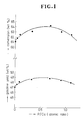
- Figure 1 is a graph utilized to show metal tolerances of the catalyst composition obtained in Inventive Example 1, in which phosphorus (P)/calcium (Ca) atomic ratios in the catalyst composition are plotted against gasoline yields and conversion rates, respectively, that are available from catalytic cracking where 10,000 ppm of vanadium and nickel were deposited on the catalyst; and
- Figure 2 is a graph similar to Figure 1 but showing the results of hydrothermal stability test of the catalyst obtained in Inventive Example 1 where the catalyst composition was treated with steam at 810°C.
- The catalyst compositions provided by processes in accordance with the invention find effective application as a cracking catalyst typically in the refinery process for the conversion of petroleum-derived heavy hydrocarbon feedstocks to gasoline and other light distillates.
- Crystalline aluminosilicate zeolites used in the invention include X-zeolite, Y-zeolite, ZSM-zeolite and mordenite, either natural or synthetic, which are exchanged with cations of hydrogen, ammonium or polyvalent metals as practiced in the usual process for preparation of cracking catalysts. Y-zeolite and particularly ultra-stable Y-zeolite are preferred as they are highly hydrothermally stable.
- The term metal trapping agent as used herein designates a mixture obtained from precursors of an alkaline earth metal oxide and a refractory oxide excluding a combination of magnesia and alumina. It may be in the form of a complexed oxide or a crystalline compound. The metal trapping agent may be also admixed with sepiolite, talc, wollastonite and like minerals. Alkaline earth metals eligible for the purpose of the invention are Group II-A elements of the Periodic Table such as Mg, Ca, Sr and Ba. The element to be oxidized to provide a refractory oxide precursor is one selected from the group of Si, Al, Ti and Zr.
- The alkaline earth metal oxide forming one part of the metal trapping agent of the invention thus includes MgO, CaO, SrO and BaO, and the refractory oxide forming the other part of the trapping agent thus includes SiO₂, Al₂O₃, TiO₂, ZrO₂, SiO₂-Al₂O₃, SiO₂-TiO₂, SiO₂-ZrO₂, Al₂O₃-ZrO₂, TiO₂-ZrO₂, Al₂O₃-TiO₂ and ZiO₂-Al₂O₃-TiO₂. The alkaline earth metal oxide is used relative to the refractory oxide preferably in a molar ratio of 0.3 - 1.5.
- Typical examples of the metal trapping agent include admixtures of MgO-SiO₂, CaO-SiO₂, SrO-SiO₂, BaO-SiO₂, CaO-Al₂O₃, SrO-TiO₂, BaO-ZrO₂, MgO-SiO₂-Al₂O₃, CaO-SiO₂-TiO₂, SrO-Al₂O₃, BaO-Al₂O₃, MgO-TiO₂, CaO-TiO₂, BaO-TiO₂, MgO-ZrO₂, CaO-ZrO₂, CaO-SiO₂-Al₂O₃, MgO-CaO-SiO₂, MgO-CaO-Al₂O₃ and MgO-CaO-Al₂O₃-TiO₂.
- The metal trapping agent is desirably in the form of fine particles having an average particle size of less than 60 microns, preferably in the range of 0.1 - 50 microns, more preferably in the range of 0.1 - 30 microns.
- It has been found that the use of a phosphoric ion-containing aqueous solution serves to prevent a decline in the hydrothermal stability of the catalyst composition which would otherwise result from the alkaline earth metal intruding into the crystalline structure of the aluminosilicate zeolite during the catalytic cracking reaction. The phosphoric ion-containing aqueous solution includes an aqueous solution of phosphoric acid, ammonium hydrogen phosphate, ammonium phosphate and phosphoric acid ester as well as mixtures thereof. According to the invention, the phosphoric ion-containing aqueous solution is added in an amount such that it remains in the catalyst composition in terms of phosphorus (P) relative to the alkaline earth metal (M) at an atomic ratio P/M of 0.05 - 1.2, preferably 0.10 - 1.0. Ratios smaller than 0.05 would produce no appreciable effect and those larger than 1.2 would result in the majority of the alkaline earth metal being bonded to phosphorus at the sacrifice of its passivating effect upon metal contaminants. This amount of the alkaline earth metal represents a total of this and other alkaline earth metals which may be present in an inorganic oxide matrix used in the invention.
- The inorganic oxide matrix referred to herein is a typical matrix component for a cracking catalyst which may be derived from a sol or gel precursor of silica, silica-alumina, alumina, silica-magnesia, phosphorus-alumina, silica-zirconia and silica-magnesia-alumina. Such matrix components include inorganic oxides other than those in the metal trapping agent such as kaolin, halloysite and montmorillonite.
- The various components and their respective quantities used in the catalyst composition are tabulated below
Catalyst composition Amount 1) aluminosilicate zeolite 5 - 50 wt%, preferably 5 - 40 wt% 2) metal trapping agent 3 - 50 wt%, preferably 5 - 30 wt% 3) inorganic oxide matrix 10 - 90 wt%, preferably 20 - 90 wt% 4) Phosphorus (P)/alkaline earth metal (M) by atomic rato 0.05 - 1.2, preferably 0.10 - 1.0 - The catalyst composition is prepared according to the invention generally as follows. A slurry of a precursor of inorganic oxide matrix such as silica hydrosol and silica-alumina hydrosol, a crystalline aluminosilicate zeolite and a metal trapping agent is prepared. The slurry is spray dried in the usual manner, in which instance the metal trapping agent is calcined at a temperature above 850°C, preferably above 900°C, more preferably above 1,000°C for a period of longer than 0.2 hour, preferably longer than 0.5 - 10 hours, followed by contacting with a phosphoric ion-containing aqueous solution. This contacting may be conducted before, during or after the metal trapping agent is mixed with the inorganic oxide matrix precursor. For instance, the metal trapping agent is calcined at above 850°C and thereafter contacted with the phosphoric ion-containing aqueous solution, followed by addition together with the crystalline aluminosilicate zeolite to disperse uniformly in the inorganic oxide matrix precursor. The resulting slurry is then spray dried. Alternatively, the spray-dried particles may be contacted with the phosphoric ion-containing solution. However, this alternative procedure is not desirable where the deleterious effects by elution of the alkaline earth metal from the metal trapping agent are held to an absolute minimum.
- It has now been found that the metal trapping agent having been subjected to calcination at temperatures exceeding 850°C results with its alkaline earth metal component eluting to an absolute minimum when suspended in water or weak acid solution. It has also been found that the metal trapping agent having been treated with phosphoric ion results with a predetermined amount of its alkaline earth metal component held immobilized by bonding to the phosphorus component thereby precluding the possibility that the crystalline aluminosilicate zeolite would otherwise be structurally destroyed due to declined hydrothermal stability during the preparation or use of the catalyst composition. If the alkaline earth metal elutes in objectionally large quantities, part of the elute undergoes ion exchange with the zeolite to deteriorate the hydrothermal stability of the resultant catalyst or bring about a decrease in the octane number of catalytically cracked gasoline.
- According to an important feature of the invention, elution of an alkaline earth metal from the catalyst composition takes place in an amount of less than 6.0 percent by weight, preferably less than 5.0 percent by weight in terms of oxide based on the weight of total alkaline earth metals in the catalyst composition as determined by the following elution test. This test is conducted in which a sample catalyst calcined at 600°C for one hour is suspended in five times by weight of deionized water in a beaker, followed by titration of a 1N-HCl solution to adjust the pH of the suspension to 3.0 (at 30°C) within one minute and maintaining this pH value with agitation for twenty minutes at 30°C, and the suspension is then immediately filtered and washed with deionized water thereby determining the amount of alkaline earth metal which has eluted from the catalyst composition.
- According to the process of the invention, the catalyst composition is spray dried into a particulate form, washed, further re-washed if required and dried or dried and calcined as the case may be.
- The catalyst composition may be added with rare earth elements if desired.
- The advantages of the invention demonstrated by minimum elution, hence less mobilization of alkaline earth metals, enhanced hydrothermal stability and increased octane number of gasoline product contribute the effective use of the inventive catalysts particularly in the catalytic cracking of heavy hydrocarbon feedstock containing vanadium and other metal contaminants.
- The catalysts may be equally used where the hydrocarbon feedstock is free of contaminating metals and under conventional cracking conditions.
- The invention will be further described by way of the following examples.
- This example features the use of CaO-SiO₂-P based metal trapping agent. 113 grams of CaCO₃ of aragonite structure and 400 grams of silica sol (30 wt% concentration, tradenamed SI-550 manufactured by Catalysts & Chemicals Industries Co., Ltd., Japan) were mixed with stirring. The resulting admixture was dried at 120°C for 15 hours to prepare a dried product (X). Part of this product (X) was calcined at 1,000°C for one hour to obtain a solid mass which was thereafter pulverized into microspheres having an average particle size of 30 microns. The resulting particulate product, i.e. crystalline calciumsilicate had a CaO/SiO₂ molar ratio of 0.35 and showed a peak by X-ray diffraction analysis corresponding to a beta-wollastonite crystal. To 50 grams of the resultant calciumsilicate were added 50 grams of deionized water to prepare a 50% slurry which was then admixed under agitation with 25% phosphoric acid. The slurry had a pH of 3.0.
- To 4,000 grams of silica hydrosol containing 5 percent by weight of SiO₂ were added 350 grams (dry base) of crystalline aluminosilicate Y-zeolite (NH₄Y-zeolite) exchanged at 95% with ammonium ions and 250 grams (dry base) of kaolin clay. This admixture was blended with the calciumsilicate slurry. The resultant slurry blend was spray dried, washed and dried thereby producing a catalytic cracking catalyst composition. The resulting composition was analyzed to show the presence of 10 percent by weight of crystalline calciumsilicate particles, 35 percent by weight of NH₄Y-zeolite, 1.03 percent by weight of phosphorus (P₂O₅) and 54.0 percent by weight of inorganic oxide matrix. Its average particle size was 68 microns. This catalyst composition is designated herein as Catalyst D which had an atomic ratio of phosphorus (P) to alkaline earth metal (Ca) of 0.33.
- The above procedure of preparing a catalyst was followed except that 25% phosphoric acid solution was added to a slurry of calciumsilicate in an amount tailored to meet with a phosphorus/calcium atomic ratio of 0 (no phosphoric acid added), 0.05, 0.1, 0.75, 1.0 and 1.5, respectively. There were produced a total of six different catalysts designated herein as Catalysts, A,B,C,E,F and G, respectively, each of which contained 35 percent by weight of NH₄Y-zeolite. The P/Ca atomic ratios in the finished catalyst compositions A-G (except D) are 0, 0.04, 0.09, 0.68, 0.9 and 1.1, respectively. P/Ca atomic ratios in the finished catalyst compositions of below 0.05 do not produce an appreciable effect, and Catalysts A and B above do not correspond to the invention. P/Ca ratios of phosphoric acid/calciumsilicate slurry blend above 1.5 are indicative of considerable elution of phosphorus during washing of the catalyst.
- This example features the use of CaO-A1₂0₃-P based metal trapping agent. 100 grams of particulate CaCO₃ of aragonite structure and 118 grams of particulate bauxite containing 86.6 percent by weight of A1₂0₃ were mixed with stirring. The resulting admixture was calcined at 1,380°C for one hour, allowed to melt and then cool to provide a solid mass. The mass was pulverized into microspheres having an average particle size of 30 microns. The resulting calciumaluminate particulate product had a CaO/Al₂O₃ molar ratio of 1.0 and showed a peak by X-ray diffraction analysis corresponding to a calciumaluminate crystal. The procedure of Inventive Example 1 was followed in adding 25% phosphoric acid aqueous solution to a slurry of calciumaluminate to make a P/Ca atomic ratio of 0.4. This slurry was admixed with silica hydrosol, NH₄Y-zeolite and kaolin clay. The resulting blended slurry was spray dried into microspheres and washed, followed by treatment with aqueous ammonium phosphate, and thereafter dried to provide a catalytic cracking catalyst composition. This composition was analyzed to show the presence of 35 percent by weight of NH₄Y-zeolite, 10 percent by weight of calciumaluminate, 1.37 percent by weight of phosphorus (P₂O₅) and 53.6 percent by weight of inorganic oxide matrix. Its average particle size was 68 microns. This catalyst composition is designated herein as Catalyst H which had an atomic P/Ca ratio of 0.34.
- This example deals with the use of MgO-SiO₂-ZrO₃-P based trapping agent. A slurry of zirconium tetrahydroxide derived from hydrolysis of an aqueous zirconium salt was admixed with MgCl₂ aqueous solution and water-glass of 28.2% SiO₂ (JIS 3) with stirring, followed by addition of 15% aqueous NH₃ to adjust the slurry to a pH of 10. The resulting blended gel was subjected to ageing at 80°C for one hour and washed with warm water to provide a cake. This cake was dried at 120°C for 15 hours, thereafter pulverized to an average particle size of 35 microns and calcined at 950°C for 5 hours to prepare a complex oxide of MgO-SiO₂-ZrO₂ which had a MgO/SiO₂/ZrO₂ atomic ratio of 0.5/1.0/0.3. In a manner similar to the procedure of Inventive Example 1, a slurry of the above complex oxide was added with 25% phosphoric acid aqueous solution to make a P/Mg atomic ratio of 0.5. The procedure of Inventive Example 1 was followed in preparing a catalyst composition except for the use of phosphorus-treated SiO₂-ZrO₂-MgO complex oxide. The resulting catalyst composition was analyzed to show the presence of 10 wt% of SiO₂-ZrO₂-MgO, 35 wt% of NH₄Y-zeolite, 1.60 wt% of phosphorus (P₂O₅) and 53.4 wt% of inorganic oxide matrix. Its average particle size was 68 microns. The catalyst composition obtained in this example is designated herein as Catalyst I which had a P/Mg atomic ratio of 0.48.
- This example is directed to the use of MgO-TiO₂-P based metal trapping agent. A mixture of magnesium carbonate and titanium oxide in a molar ratio of 1:1 was heat-treated at 1,150°C for 15 hours to provide a complex oxide which partially exhibited an X-ray diffraction peak analogous to an ilmenite structure. In a manner similar to Inventive Example 1, a slurry of this complex oxide was prepared and added with 25 % phosphoric acid aqueous solution to provide a P/Mg atomic ratio of 0.5. The procedure of Inventive Example 1 was followed in preparing a catalyst composition except for the use of phosphorus-treated TiO₂-MgO. The resultant catalyst composition contained 10 wt% of complex oxide, 35 wt% of NH₄Y-zeolite, 2.75 wt% of phosphorus and 52.2 wt% of inorganic oxide matrix, and had an average particle size of 68 microns. This composition is designated herein as Catalyst J.
- This example is directed to the use of BaO-ZrO₂-P based metal trapping agent. A slurry of zirconium tetrahydroxide derived from hydrolysis of an aqueous zirconium salt was added with aqueous BaCl₂ and adjusted in pH to 10.5 with addition of aqueous NH₃ under agitation. Aqueous ammonium bicarbonate was added to prepare a slurry blend of zirconium tetrahydroxide and barium carbonate. The slurry was dehydrated, washed with warm water, dried at 110°C and further calcined at 950°C for 5 hours thereby providing a BaO-ZrO₂ complex oxide which contained 55 wt% of BaO in terms of oxide. In a manner similar to Inventive Example 1, a slurry of BaO-ZrO₂ complex oxide was prepared and adjusted in P/Ba atomic ratio to 0.5 with addition of 25 % phosphoric acid aqueous solution. Except for the use of this phosphorus-treated complex oxide, the procedure of Inventive Example 1 was followed in preparing a catalyst composition which analytically revealed the presence of 10 wt% of BaO-ZrO₂ complex oxide, 35 wt% of NH₄Y-zeolite, 1.14 wt% of phosphorus (P₂O₅) and 53.9 wt% of inorganic oxide matrix and which had an average particle size of 68 microns. This composition is designated herein as Catalyst K.
- This example features the use of CaO-ZrO₂-P based metal trapping agent. A calcium zirconate was prepared by reacting zirconium oxide with calcium chloride at 1,000°C for 25 hours. It had a calcium/zirconium molar ratio of 1:1. In a manner similar to Inventive Example 1, a slurry of this compound was adjusted in P/Ca atomic ratio to 0.5 with addition of 25% phosphoric acid aqueous solution. Except for the use of this slurry, the procedure of Inventive Example 1 was followed in preparing a catalyst composition which was analyzed to show the presence of 10 wt% of calcium zirconate, 35 wt% of NH₄Y-zeolite, 1.83 wt% of phosphorus (P₂O₅) and 53.2 wt% of inorganic oxide matrix and which had an average particle size of 68 microns. This composition is designated herein as Catalyst L.
- Part of a dry product (X) of calciumsilicate obtained in Inventive Example 1 was subjected to calcination at 600°C for 3 hours. The resulting solid mass was pulverized to an average particle size of 30 microns, and thereafter analyzed by X-ray diffraction to show the particles in amorphous state. The amorphous particulate material thus obtained was treated as in the procedure of Inventive Example 1 to provide a catalyst composition which contained 10 wt% of CaO-SiO₂ oxide. This composition is herein designated as Catalyst M.
- The procedure of Inventive Example 1 was followed in preparing a catalyst composition except that theta-alumina particles of an average particle size of 10 microns derived from calcinating gamma-alumina at 900°C were used in place of crystalline calciumaluminate. The catalyst composition obtained in this example contained 10 wt% of theta-alumina particles and 1.0 wt% of phosphorus (P₂O₅) and is herein designated Catalyst N.
- The procedure of Inventive Example 5 for catalyst preparation was followed except that BaO-ZrO₂ complex oxide was not treated with phosphoric acid aqueous solution. The catalyst composition obtained in this example is herein designated as Catalyst K-2.
- The procedure of Inventive Example 6 was followed for catalyst preparation except that calcium zirconate was not treated with phosphoric acid aqueous solution. The catalyst composition obtained in this example is herein designated as Catalyst L-2.
- Catalysts A - N, K-2 and L-2 obtained in the respective Inventive and Comparative Examples were subjected to quality-test according to ASTM MAT in which 10,000 ppm of nickel and vanadium (V/Ni = 2) were deposited on each catalyst to check metal tolerances. The test catalyst, initially calcined at 600°C for one hour, was dipped in a benzene solution of nickel naphthenate and vanadium naphthenate and dried at 110°C, followed by calcination at 600°C for 1.5 hours. For pseudo-equilibration, each catalyst was treated with steam at 770°C for 6 hours and again calcined at 600°C for one hour. Those catalysts which were not deposited with nickel and vanadium were also subjected to pseudo-equilibration by steam treatment at 770°C and 810°C, respectively, for 6 hours and subsequently by calcination at 600°C for one hour. The respective catalysts thus pretreated were tested in accordance with ASTM MAT with the results shown in Tables 1 and 2 and in Figures 1 and 2. Reaction conditions were as follows:
Feedstock oil desulfurized vacuum gas oil Reaction temperature 482°C Space velocity 16 hr⁻¹ Catalyst/oil ratio 3 (by weight) 


- As appears clear from the test results depicted in Tables 1 and 2 as well as Figures 1 and 2, the catalyst compositions provided in accordance with processes according to the invention exhibit high contaminant metal tolerances, improved hydrothermal stability, increased conversion and gasoline yields.
- The invention has been described with respect to the above various specific examples, but it is to be understood that the present invention is not limited thereto and that it can be otherwise practiced within the scope of the appended claims.
Claims (3)
- A process for the preparation of a catalytic cracking catalyst composition which comprises the steps of: calcinating a metal trapping agent at a temperature above 850°C and treating said metal trapping agent with a phosphoric ion-containing aqueous solution, said metal trapping agent being comprised of a mixture of precursors of an alkaline earth metal oxide and a refractory oxide excluding a combination of magnesia and alumina; making an admixture of said metal trapping agent with a crystalline aluminosilicate zeolite and a precursor of an inorganic oxide matrix excluding alumina-magnesia matrix; and spray-drying said admixture into a particulate product, wherein treatment with said phosphoric ion-containing aqueous solution is conducted so that said phosphoric ion-containing aqueous solution in terms of phosphorus (P) and said alkaline earth metal precursor in terms of metal (M) remain by an atomic ratio (P/M) of 0.05 - 1.2 in said catalyst composition.
- A process for the preparation of a catalytic cracking catalyst composition which comprises the steps of: calcinating a metal trapping agent at a temperature above 850°C, said trapping agent being comprised of a mixture of precursors of an alkaline earth metal oxide and a refractory oxide excluding a combination of magnesia and alumina; making an admixture of said trapping agent with a crystalline aluminosilicate zeolite and a precursor of an inorganic oxide matrix excluding alumina-magnesia matrix; spray-drying said admixture into a particulate product; and treating said particulate product with a phosphoric ion-containing aqueous solution, wherein treatment with said phosphoric ion-containing aqueous solution is conducted so that said phosphoric ion-containing aqueous solution in terms of phosphorus (P) and said alkaline earth metal precursor in terms of metal (M) remain by an atomic ratio (P/M) of 0.05 - 1.2 in said catalyst composition.
- A process according to claim 1 or 2, wherein said phosphoric ion-containing aqueous solution is selected from the group of aqeous solutions of phosphoric acid, ammonium hydrogen phosphate, ammonium phosphate, phosphoric ester and mixtures thereof.
Applications Claiming Priority (2)
| Application Number | Priority Date | Filing Date | Title |
|---|---|---|---|
| JP2336409A JP2827168B2 (en) | 1990-11-30 | 1990-11-30 | Method for producing catalyst composition for catalytic cracking of hydrocarbons |
| JP336409/90 | 1990-11-30 |
Publications (2)
| Publication Number | Publication Date |
|---|---|
| EP0488690A1 EP0488690A1 (en) | 1992-06-03 |
| EP0488690B1 true EP0488690B1 (en) | 1995-05-31 |
Family
ID=18298836
Family Applications (1)
| Application Number | Title | Priority Date | Filing Date |
|---|---|---|---|
| EP91310961A Expired - Lifetime EP0488690B1 (en) | 1990-11-30 | 1991-11-27 | Process for making catalyst compositions |
Country Status (5)
| Country | Link |
|---|---|
| US (1) | US5194411A (en) |
| EP (1) | EP0488690B1 (en) |
| JP (1) | JP2827168B2 (en) |
| AU (1) | AU640833B2 (en) |
| ID (1) | ID862B (en) |
Families Citing this family (12)
| Publication number | Priority date | Publication date | Assignee | Title |
|---|---|---|---|---|
| US5371055A (en) * | 1988-07-07 | 1994-12-06 | W. R. Grace & Co.-Conn. | Increasing metal-tolerance of FCC catalyst by sulfur oxide removal |
| JPH05123578A (en) * | 1991-11-06 | 1993-05-21 | Nippon Oil Co Ltd | Process for producing hydrocarbon conversion catalyst |
| EP0706823A1 (en) * | 1994-09-30 | 1996-04-17 | Hoechst Aktiengesellschaft | More easily regenerable zeolitic catalyst |
| CN1248994C (en) | 2001-07-02 | 2006-04-05 | 埃克森美孚化学专利公司 | Inhibiting catalyst coke formation in the manufacture of an olefin |
| GB0127517D0 (en) * | 2001-11-16 | 2002-01-09 | Statoil Asa | Catalysts |
| US6872680B2 (en) | 2002-03-20 | 2005-03-29 | Exxonmobil Chemical Patents Inc. | Molecular sieve catalyst composition, its making and use in conversion processes |
| US7271123B2 (en) | 2002-03-20 | 2007-09-18 | Exxonmobil Chemical Patents Inc. | Molecular sieve catalyst composition, its making and use in conversion process |
| US20060040823A1 (en) * | 2004-08-18 | 2006-02-23 | Stockwell David M | Catalyst for NOx and/or SOx control |
| CN100478420C (en) * | 2004-09-15 | 2009-04-15 | 中国石油化工股份有限公司 | Catalytic cracking aid and its preparing method |
| BRPI0615996B8 (en) * | 2005-10-07 | 2017-02-07 | Korea Res Inst Chemical Tech | hydrothermal stable porous molecular sieve catalyst preparation method |
| JP5954970B2 (en) * | 2011-11-29 | 2016-07-20 | 日揮触媒化成株式会社 | Hydrocarbon catalytic cracking catalyst and process for producing the same |
| KR20160003200A (en) * | 2013-05-28 | 2016-01-08 | 닛키 쇼쿠바이카세이 가부시키가이샤 | Catalyst for catalytic cracking of hydrocarbon, and process for producing same |
Family Cites Families (11)
| Publication number | Priority date | Publication date | Assignee | Title |
|---|---|---|---|---|
| US3507773A (en) * | 1966-12-27 | 1970-04-21 | Kimberly Clark Co | Electrode for use in electrolytes |
| US3507778A (en) * | 1967-09-05 | 1970-04-21 | Exxon Research Engineering Co | Cracking petroleum fractions with a crystalline zeolite catalyst in combination with a phosphate promoted silica-magnesia catalyst |
| US3852188A (en) * | 1971-10-05 | 1974-12-03 | Exxon Research Engineering Co | Hydrocarbon cracking in a regenerable molten media |
| US4158621A (en) * | 1978-07-21 | 1979-06-19 | Gulf Research & Development Company | Process for increasing gasoline yield and quality during catalytic cracking of high metals content charge stocks using an alumina-aluminum phosphate-silica-zeolite catalyst |
| US4451355A (en) * | 1983-09-28 | 1984-05-29 | Gulf Research & Development Company | Vanadium passivation in a hydrocarbon catalytic cracking process |
| EP0188841B2 (en) * | 1984-12-21 | 1992-01-15 | Catalysts & Chemicals Industries Co., Ltd. | Hydrocarbon catalytic cracking catalyst compositions and method therefor |
| DE3686444T2 (en) * | 1985-06-03 | 1993-02-18 | Onoda Cement Co Ltd | N-FLUORPYRIDINIUM SALTS AND METHOD FOR PRODUCING THE SAME. |
| GB8514209D0 (en) * | 1985-06-05 | 1985-07-10 | Unilever Plc | Catalyst additives |
| US4765884A (en) * | 1987-07-02 | 1988-08-23 | Phillips Petroleum Company | Cracking catalyst and process |
| GB8718108D0 (en) * | 1987-07-30 | 1987-09-03 | Unilever Plc | Petroleum catalysts |
| US4919787A (en) * | 1987-12-28 | 1990-04-24 | Mobil Oil Corporation | Metal passivating agents |
-
1990
- 1990-11-30 JP JP2336409A patent/JP2827168B2/en not_active Expired - Fee Related
-
1991
- 1991-11-21 US US07/795,587 patent/US5194411A/en not_active Expired - Fee Related
- 1991-11-22 AU AU88066/91A patent/AU640833B2/en not_active Ceased
- 1991-11-27 EP EP91310961A patent/EP0488690B1/en not_active Expired - Lifetime
- 1991-11-30 ID IDP103491A patent/ID862B/en unknown
Also Published As
| Publication number | Publication date |
|---|---|
| AU8806691A (en) | 1992-06-04 |
| AU640833B2 (en) | 1993-09-02 |
| EP0488690A1 (en) | 1992-06-03 |
| ID862B (en) | 1996-08-07 |
| US5194411A (en) | 1993-03-16 |
| JP2827168B2 (en) | 1998-11-18 |
| JPH04200744A (en) | 1992-07-21 |
Similar Documents
| Publication | Publication Date | Title |
|---|---|---|
| US4454241A (en) | Phosphorus-containing catalyst | |
| USRE35166E (en) | Catalyst | |
| CA1160200A (en) | Catalyst preparation | |
| US5194411A (en) | Catalyst compositions and process for making the same | |
| JPH07106317B2 (en) | Process for producing catalyst composition for catalytic cracking of hydrocarbon oil | |
| EP0176150B1 (en) | Catalytic cracking, process for heavy oil | |
| US4704375A (en) | Vanadium passivating agent for use in a cracking catalyst | |
| US4816135A (en) | Cracking heavy hydrocarbon feedstocks with a catalyst comprising an anatase vanadium passivating agent | |
| US4843052A (en) | Acid-reacted metakaolin catalyst and catalyst support compositions | |
| KR100272870B1 (en) | Catalytic cracking catalysts and additives | |
| CA1171054A (en) | Hydrocarbon conversion catalysts and processes utilizing the same | |
| EP0188841B1 (en) | Hydrocarbon catalytic cracking catalyst compositions and method therefor | |
| US4376039A (en) | Hydrocarbon conversion catalysts and processes utilizing the same | |
| US4894354A (en) | Method of making a conversion catalyst having an anatase vanadium passivating agent for treating a heavy hydrocarbon feedstock | |
| CA1226269A (en) | Catalytic cracking catalyst and process | |
| US4940531A (en) | Catalytic cracking process employing an acid-reacted metakaolin catalyst | |
| US4847225A (en) | Catalysts and catalyst supports | |
| CA1211425A (en) | Catalysts and catalyst supports | |
| CA1131193A (en) | Octane improvement cracking catalyst | |
| GB2109696A (en) | Method for preparing a zeolite- containing fluid cracking catalyst | |
| CA1045069A (en) | Hydrocarbon cracking process | |
| EP0157545B1 (en) | Method for preparing hydrocarbon catalytic cracking catalyst compositions | |
| AU602163B2 (en) | Catalytic cracking of metal contaminated feedstock | |
| EP0208868A1 (en) | Catalytic cracking catalyst and process | |
| US4749672A (en) | Catalysts and catalyst supports |
Legal Events
| Date | Code | Title | Description |
|---|---|---|---|
| PUAI | Public reference made under article 153(3) epc to a published international application that has entered the european phase |
Free format text: ORIGINAL CODE: 0009012 |
|
| AK | Designated contracting states |
Kind code of ref document: A1 Designated state(s): FR GB NL |
|
| 17P | Request for examination filed |
Effective date: 19920908 |
|
| 17Q | First examination report despatched |
Effective date: 19930120 |
|
| GRAA | (expected) grant |
Free format text: ORIGINAL CODE: 0009210 |
|
| AK | Designated contracting states |
Kind code of ref document: B1 Designated state(s): FR GB NL |
|
| ET | Fr: translation filed | ||
| PLBE | No opposition filed within time limit |
Free format text: ORIGINAL CODE: 0009261 |
|
| STAA | Information on the status of an ep patent application or granted ep patent |
Free format text: STATUS: NO OPPOSITION FILED WITHIN TIME LIMIT |
|
| 26N | No opposition filed | ||
| REG | Reference to a national code |
Ref country code: GB Ref legal event code: IF02 |
|
| PGFP | Annual fee paid to national office [announced via postgrant information from national office to epo] |
Ref country code: NL Payment date: 20031105 Year of fee payment: 13 |
|
| PGFP | Annual fee paid to national office [announced via postgrant information from national office to epo] |
Ref country code: FR Payment date: 20031110 Year of fee payment: 13 |
|
| PGFP | Annual fee paid to national office [announced via postgrant information from national office to epo] |
Ref country code: GB Payment date: 20031126 Year of fee payment: 13 |
|
| PG25 | Lapsed in a contracting state [announced via postgrant information from national office to epo] |
Ref country code: GB Free format text: LAPSE BECAUSE OF NON-PAYMENT OF DUE FEES Effective date: 20041127 |
|
| PG25 | Lapsed in a contracting state [announced via postgrant information from national office to epo] |
Ref country code: NL Free format text: LAPSE BECAUSE OF NON-PAYMENT OF DUE FEES Effective date: 20050601 |
|
| GBPC | Gb: european patent ceased through non-payment of renewal fee |
Effective date: 20041127 |
|
| PG25 | Lapsed in a contracting state [announced via postgrant information from national office to epo] |
Ref country code: FR Free format text: LAPSE BECAUSE OF NON-PAYMENT OF DUE FEES Effective date: 20050729 |
|
| NLV4 | Nl: lapsed or anulled due to non-payment of the annual fee |
Effective date: 20050601 |
|
| REG | Reference to a national code |
Ref country code: FR Ref legal event code: ST |