EP0488275B1 - Resin-impregnated superconducting magnet coil and process for its production - Google Patents
Resin-impregnated superconducting magnet coil and process for its production Download PDFInfo
- Publication number
- EP0488275B1 EP0488275B1 EP91120374A EP91120374A EP0488275B1 EP 0488275 B1 EP0488275 B1 EP 0488275B1 EP 91120374 A EP91120374 A EP 91120374A EP 91120374 A EP91120374 A EP 91120374A EP 0488275 B1 EP0488275 B1 EP 0488275B1
- Authority
- EP
- European Patent Office
- Prior art keywords
- coil
- bisphenol
- superconducting
- diglycidyl ethers
- superconducting magnet
- Prior art date
- Legal status (The legal status is an assumption and is not a legal conclusion. Google has not performed a legal analysis and makes no representation as to the accuracy of the status listed.)
- Expired - Lifetime
Links
- 238000000034 method Methods 0.000 title claims description 26
- 230000008569 process Effects 0.000 title claims description 12
- 238000004519 manufacturing process Methods 0.000 title description 11
- GYZLOYUZLJXAJU-UHFFFAOYSA-N diglycidyl ether Chemical class C1OC1COCC1CO1 GYZLOYUZLJXAJU-UHFFFAOYSA-N 0.000 claims description 58
- 239000003822 epoxy resin Substances 0.000 claims description 53
- 229920000647 polyepoxide Polymers 0.000 claims description 53
- IISBACLAFKSPIT-UHFFFAOYSA-N bisphenol A Chemical compound C=1C=C(O)C=CC=1C(C)(C)C1=CC=C(O)C=C1 IISBACLAFKSPIT-UHFFFAOYSA-N 0.000 claims description 52
- 239000011342 resin composition Substances 0.000 claims description 41
- 230000009477 glass transition Effects 0.000 claims description 26
- PXKLMJQFEQBVLD-UHFFFAOYSA-N bisphenol F Chemical compound C1=CC(O)=CC=C1CC1=CC=C(O)C=C1 PXKLMJQFEQBVLD-UHFFFAOYSA-N 0.000 claims description 20
- 230000008646 thermal stress Effects 0.000 claims description 17
- -1 imide compound Chemical class 0.000 claims description 16
- 238000010791 quenching Methods 0.000 claims description 16
- 239000002887 superconductor Substances 0.000 claims description 13
- 229930185605 Bisphenol Natural products 0.000 claims description 9
- ZFVMWEVVKGLCIJ-UHFFFAOYSA-N bisphenol AF Chemical compound C1=CC(O)=CC=C1C(C(F)(F)F)(C(F)(F)F)C1=CC=C(O)C=C1 ZFVMWEVVKGLCIJ-UHFFFAOYSA-N 0.000 claims description 9
- 239000003054 catalyst Substances 0.000 claims description 9
- 239000000203 mixture Substances 0.000 claims description 9
- 229910052782 aluminium Inorganic materials 0.000 claims description 8
- 239000010949 copper Substances 0.000 claims description 8
- XAGFODPZIPBFFR-UHFFFAOYSA-N aluminium Chemical compound [Al] XAGFODPZIPBFFR-UHFFFAOYSA-N 0.000 claims description 7
- 239000002131 composite material Substances 0.000 claims description 7
- 229910052802 copper Inorganic materials 0.000 claims description 7
- RYGMFSIKBFXOCR-UHFFFAOYSA-N Copper Chemical compound [Cu] RYGMFSIKBFXOCR-UHFFFAOYSA-N 0.000 claims description 6
- 238000005470 impregnation Methods 0.000 claims description 6
- 239000003381 stabilizer Substances 0.000 claims description 5
- 238000004804 winding Methods 0.000 claims description 5
- 229910020012 Nb—Ti Inorganic materials 0.000 claims description 4
- 229910045601 alloy Inorganic materials 0.000 claims description 4
- 239000000956 alloy Substances 0.000 claims description 4
- 229920000728 polyester Polymers 0.000 claims description 3
- 239000007822 coupling agent Substances 0.000 claims description 2
- 238000010438 heat treatment Methods 0.000 claims description 2
- 238000004381 surface treatment Methods 0.000 claims description 2
- 239000004952 Polyamide Substances 0.000 claims 3
- 239000004962 Polyamide-imide Substances 0.000 claims 3
- 229920002647 polyamide Polymers 0.000 claims 3
- 229920002312 polyamide-imide Polymers 0.000 claims 3
- 229920001721 polyimide Polymers 0.000 claims 3
- 239000004642 Polyimide Substances 0.000 claims 2
- 229920002635 polyurethane Polymers 0.000 claims 2
- 239000004814 polyurethane Substances 0.000 claims 2
- 229920002037 poly(vinyl butyral) polymer Polymers 0.000 claims 1
- 229920006267 polyester film Polymers 0.000 claims 1
- 229920000642 polymer Polymers 0.000 claims 1
- 229920006264 polyurethane film Polymers 0.000 claims 1
- 229920002554 vinyl polymer Polymers 0.000 claims 1
- 229920005989 resin Polymers 0.000 description 41
- 239000011347 resin Substances 0.000 description 41
- 239000000047 product Substances 0.000 description 26
- 239000004593 Epoxy Substances 0.000 description 25
- LNEPOXFFQSENCJ-UHFFFAOYSA-N haloperidol Chemical compound C1CC(O)(C=2C=CC(Cl)=CC=2)CCN1CCCC(=O)C1=CC=C(F)C=C1 LNEPOXFFQSENCJ-UHFFFAOYSA-N 0.000 description 24
- 229920003192 poly(bis maleimide) Polymers 0.000 description 22
- 238000001723 curing Methods 0.000 description 21
- 239000007788 liquid Substances 0.000 description 16
- 239000001307 helium Substances 0.000 description 15
- 229910052734 helium Inorganic materials 0.000 description 15
- SWQJXJOGLNCZEY-UHFFFAOYSA-N helium atom Chemical compound [He] SWQJXJOGLNCZEY-UHFFFAOYSA-N 0.000 description 15
- ZMANZCXQSJIPKH-UHFFFAOYSA-N Triethylamine Chemical compound CCN(CC)CC ZMANZCXQSJIPKH-UHFFFAOYSA-N 0.000 description 14
- 230000035882 stress Effects 0.000 description 13
- RAXXELZNTBOGNW-UHFFFAOYSA-N imidazole Natural products C1=CNC=N1 RAXXELZNTBOGNW-UHFFFAOYSA-N 0.000 description 12
- 150000001412 amines Chemical class 0.000 description 9
- 150000008065 acid anhydrides Chemical class 0.000 description 8
- WTEOIRVLGSZEPR-UHFFFAOYSA-N boron trifluoride Chemical compound FB(F)F WTEOIRVLGSZEPR-UHFFFAOYSA-N 0.000 description 8
- 230000000052 comparative effect Effects 0.000 description 8
- 150000001875 compounds Chemical class 0.000 description 8
- 239000007983 Tris buffer Substances 0.000 description 7
- 238000005452 bending Methods 0.000 description 7
- SJRJJKPEHAURKC-UHFFFAOYSA-N N-Methylmorpholine Chemical compound CN1CCOCC1 SJRJJKPEHAURKC-UHFFFAOYSA-N 0.000 description 6
- ATUOYWHBWRKTHZ-UHFFFAOYSA-N Propane Chemical compound CCC ATUOYWHBWRKTHZ-UHFFFAOYSA-N 0.000 description 6
- RIOQSEWOXXDEQQ-UHFFFAOYSA-N triphenylphosphine Chemical compound C1=CC=CC=C1P(C=1C=CC=CC=1)C1=CC=CC=C1 RIOQSEWOXXDEQQ-UHFFFAOYSA-N 0.000 description 6
- UPMLOUAZCHDJJD-UHFFFAOYSA-N 4,4'-Diphenylmethane Diisocyanate Chemical compound C1=CC(N=C=O)=CC=C1CC1=CC=C(N=C=O)C=C1 UPMLOUAZCHDJJD-UHFFFAOYSA-N 0.000 description 5
- 229910052751 metal Inorganic materials 0.000 description 5
- 239000002184 metal Substances 0.000 description 5
- 229920001451 polypropylene glycol Polymers 0.000 description 5
- XQUPVDVFXZDTLT-UHFFFAOYSA-N 1-[4-[[4-(2,5-dioxopyrrol-1-yl)phenyl]methyl]phenyl]pyrrole-2,5-dione Chemical compound O=C1C=CC(=O)N1C(C=C1)=CC=C1CC1=CC=C(N2C(C=CC2=O)=O)C=C1 XQUPVDVFXZDTLT-UHFFFAOYSA-N 0.000 description 4
- ULKLGIFJWFIQFF-UHFFFAOYSA-N 5K8XI641G3 Chemical compound CCC1=NC=C(C)N1 ULKLGIFJWFIQFF-UHFFFAOYSA-N 0.000 description 4
- LCFVJGUPQDGYKZ-UHFFFAOYSA-N Bisphenol A diglycidyl ether Chemical compound C=1C=C(OCC2OC2)C=CC=1C(C)(C)C(C=C1)=CC=C1OCC1CO1 LCFVJGUPQDGYKZ-UHFFFAOYSA-N 0.000 description 4
- OAKJQQAXSVQMHS-UHFFFAOYSA-N Hydrazine Chemical compound NN OAKJQQAXSVQMHS-UHFFFAOYSA-N 0.000 description 4
- PEEHTFAAVSWFBL-UHFFFAOYSA-N Maleimide Chemical compound O=C1NC(=O)C=C1 PEEHTFAAVSWFBL-UHFFFAOYSA-N 0.000 description 4
- 150000001335 aliphatic alkanes Chemical class 0.000 description 4
- 239000003795 chemical substances by application Substances 0.000 description 4
- 239000004020 conductor Substances 0.000 description 4
- 239000000463 material Substances 0.000 description 4
- 239000013034 phenoxy resin Substances 0.000 description 4
- 229920006287 phenoxy resin Polymers 0.000 description 4
- 239000001294 propane Substances 0.000 description 4
- YXALYBMHAYZKAP-UHFFFAOYSA-N 7-oxabicyclo[4.1.0]heptan-4-ylmethyl 7-oxabicyclo[4.1.0]heptane-4-carboxylate Chemical compound C1CC2OC2CC1C(=O)OCC1CC2OC2CC1 YXALYBMHAYZKAP-UHFFFAOYSA-N 0.000 description 3
- 229910015900 BF3 Inorganic materials 0.000 description 3
- LYCAIKOWRPUZTN-UHFFFAOYSA-N Ethylene glycol Chemical compound OCCO LYCAIKOWRPUZTN-UHFFFAOYSA-N 0.000 description 3
- PEDCQBHIVMGVHV-UHFFFAOYSA-N Glycerine Chemical compound OCC(O)CO PEDCQBHIVMGVHV-UHFFFAOYSA-N 0.000 description 3
- 125000000217 alkyl group Chemical group 0.000 description 3
- 125000002947 alkylene group Chemical group 0.000 description 3
- 238000001816 cooling Methods 0.000 description 3
- 210000003298 dental enamel Anatomy 0.000 description 3
- MTHSVFCYNBDYFN-UHFFFAOYSA-N diethylene glycol Chemical compound OCCOCCO MTHSVFCYNBDYFN-UHFFFAOYSA-N 0.000 description 3
- USIUVYZYUHIAEV-UHFFFAOYSA-N diphenyl ether Chemical compound C=1C=CC=CC=1OC1=CC=CC=C1 USIUVYZYUHIAEV-UHFFFAOYSA-N 0.000 description 3
- 150000002460 imidazoles Chemical class 0.000 description 3
- 150000003949 imides Chemical class 0.000 description 3
- 239000011159 matrix material Substances 0.000 description 3
- 239000003094 microcapsule Substances 0.000 description 3
- NFHFRUOZVGFOOS-UHFFFAOYSA-N palladium;triphenylphosphane Chemical compound [Pd].C1=CC=CC=C1P(C=1C=CC=CC=1)C1=CC=CC=C1.C1=CC=CC=C1P(C=1C=CC=CC=1)C1=CC=CC=C1.C1=CC=CC=C1P(C=1C=CC=CC=1)C1=CC=CC=C1.C1=CC=CC=C1P(C=1C=CC=CC=1)C1=CC=CC=C1 NFHFRUOZVGFOOS-UHFFFAOYSA-N 0.000 description 3
- 229920002857 polybutadiene Polymers 0.000 description 3
- 229920001610 polycaprolactone Polymers 0.000 description 3
- 229920001223 polyethylene glycol Polymers 0.000 description 3
- 229920005862 polyol Polymers 0.000 description 3
- 150000003077 polyols Chemical class 0.000 description 3
- 150000003839 salts Chemical class 0.000 description 3
- 239000011734 sodium Substances 0.000 description 3
- 229920001187 thermosetting polymer Polymers 0.000 description 3
- CHJMFFKHPHCQIJ-UHFFFAOYSA-L zinc;octanoate Chemical compound [Zn+2].CCCCCCCC([O-])=O.CCCCCCCC([O-])=O CHJMFFKHPHCQIJ-UHFFFAOYSA-L 0.000 description 3
- PYVHLZLQVWXBDZ-UHFFFAOYSA-N 1-[6-(2,5-dioxopyrrol-1-yl)hexyl]pyrrole-2,5-dione Chemical compound O=C1C=CC(=O)N1CCCCCCN1C(=O)C=CC1=O PYVHLZLQVWXBDZ-UHFFFAOYSA-N 0.000 description 2
- 150000003923 2,5-pyrrolediones Chemical class 0.000 description 2
- RDIGYBZNNOGMHU-UHFFFAOYSA-N 3-amino-2,4,5-tris(oxiran-2-ylmethyl)phenol Chemical compound OC1=CC(CC2OC2)=C(CC2OC2)C(N)=C1CC1CO1 RDIGYBZNNOGMHU-UHFFFAOYSA-N 0.000 description 2
- YAXXOCZAXKLLCV-UHFFFAOYSA-N 3-dodecyloxolane-2,5-dione Chemical class CCCCCCCCCCCCC1CC(=O)OC1=O YAXXOCZAXKLLCV-UHFFFAOYSA-N 0.000 description 2
- VPWNQTHUCYMVMZ-UHFFFAOYSA-N 4,4'-sulfonyldiphenol Chemical class C1=CC(O)=CC=C1S(=O)(=O)C1=CC=C(O)C=C1 VPWNQTHUCYMVMZ-UHFFFAOYSA-N 0.000 description 2
- WOCGGVRGNIEDSZ-UHFFFAOYSA-N 4-[2-(4-hydroxy-3-prop-2-enylphenyl)propan-2-yl]-2-prop-2-enylphenol Chemical compound C=1C=C(O)C(CC=C)=CC=1C(C)(C)C1=CC=C(O)C(CC=C)=C1 WOCGGVRGNIEDSZ-UHFFFAOYSA-N 0.000 description 2
- CXXSQMDHHYTRKY-UHFFFAOYSA-N 4-amino-2,3,5-tris(oxiran-2-ylmethyl)phenol Chemical compound C1=C(O)C(CC2OC2)=C(CC2OC2)C(N)=C1CC1CO1 CXXSQMDHHYTRKY-UHFFFAOYSA-N 0.000 description 2
- MWSKJDNQKGCKPA-UHFFFAOYSA-N 6-methyl-3a,4,5,7a-tetrahydro-2-benzofuran-1,3-dione Chemical compound C1CC(C)=CC2C(=O)OC(=O)C12 MWSKJDNQKGCKPA-UHFFFAOYSA-N 0.000 description 2
- PAYRUJLWNCNPSJ-UHFFFAOYSA-N Aniline Chemical compound NC1=CC=CC=C1 PAYRUJLWNCNPSJ-UHFFFAOYSA-N 0.000 description 2
- 229910000570 Cupronickel Inorganic materials 0.000 description 2
- WSFSSNUMVMOOMR-UHFFFAOYSA-N Formaldehyde Chemical compound O=C WSFSSNUMVMOOMR-UHFFFAOYSA-N 0.000 description 2
- DGAQECJNVWCQMB-PUAWFVPOSA-M Ilexoside XXIX Chemical compound C[C@@H]1CC[C@@]2(CC[C@@]3(C(=CC[C@H]4[C@]3(CC[C@@H]5[C@@]4(CC[C@@H](C5(C)C)OS(=O)(=O)[O-])C)C)[C@@H]2[C@]1(C)O)C)C(=O)O[C@H]6[C@@H]([C@H]([C@@H]([C@H](O6)CO)O)O)O.[Na+] DGAQECJNVWCQMB-PUAWFVPOSA-M 0.000 description 2
- UFWIBTONFRDIAS-UHFFFAOYSA-N Naphthalene Chemical compound C1=CC=CC2=CC=CC=C21 UFWIBTONFRDIAS-UHFFFAOYSA-N 0.000 description 2
- GLUUGHFHXGJENI-UHFFFAOYSA-N Piperazine Chemical compound C1CNCCN1 GLUUGHFHXGJENI-UHFFFAOYSA-N 0.000 description 2
- 239000004721 Polyphenylene oxide Substances 0.000 description 2
- JUJWROOIHBZHMG-UHFFFAOYSA-N Pyridine Chemical compound C1=CC=NC=C1 JUJWROOIHBZHMG-UHFFFAOYSA-N 0.000 description 2
- OCBHHZMJRVXXQK-UHFFFAOYSA-M benzyl-dimethyl-tetradecylazanium;chloride Chemical compound [Cl-].CCCCCCCCCCCCCC[N+](C)(C)CC1=CC=CC=C1 OCBHHZMJRVXXQK-UHFFFAOYSA-M 0.000 description 2
- 230000001588 bifunctional effect Effects 0.000 description 2
- WERYXYBDKMZEQL-UHFFFAOYSA-N butane-1,4-diol Chemical compound OCCCCO WERYXYBDKMZEQL-UHFFFAOYSA-N 0.000 description 2
- 150000001718 carbodiimides Chemical class 0.000 description 2
- 238000006243 chemical reaction Methods 0.000 description 2
- 239000007795 chemical reaction product Substances 0.000 description 2
- 150000001868 cobalt Chemical class 0.000 description 2
- 238000005336 cracking Methods 0.000 description 2
- OZLBDYMWFAHSOQ-UHFFFAOYSA-N diphenyliodanium Chemical class C=1C=CC=CC=1[I+]C1=CC=CC=C1 OZLBDYMWFAHSOQ-UHFFFAOYSA-N 0.000 description 2
- 238000004146 energy storage Methods 0.000 description 2
- 230000004927 fusion Effects 0.000 description 2
- IQPQWNKOIGAROB-UHFFFAOYSA-N isocyanate group Chemical group [N-]=C=O IQPQWNKOIGAROB-UHFFFAOYSA-N 0.000 description 2
- FPYJFEHAWHCUMM-UHFFFAOYSA-N maleic anhydride Chemical compound O=C1OC(=O)C=C1 FPYJFEHAWHCUMM-UHFFFAOYSA-N 0.000 description 2
- VNWKTOKETHGBQD-UHFFFAOYSA-N methane Chemical compound C VNWKTOKETHGBQD-UHFFFAOYSA-N 0.000 description 2
- VYKXQOYUCMREIS-UHFFFAOYSA-N methylhexahydrophthalic anhydride Chemical compound C1CCCC2C(=O)OC(=O)C21C VYKXQOYUCMREIS-UHFFFAOYSA-N 0.000 description 2
- LQERIDTXQFOHKA-UHFFFAOYSA-N nonadecane Chemical compound CCCCCCCCCCCCCCCCCCC LQERIDTXQFOHKA-UHFFFAOYSA-N 0.000 description 2
- WWZKQHOCKIZLMA-UHFFFAOYSA-N octanoic acid Chemical class CCCCCCCC(O)=O WWZKQHOCKIZLMA-UHFFFAOYSA-N 0.000 description 2
- 239000002245 particle Substances 0.000 description 2
- 239000004014 plasticizer Substances 0.000 description 2
- 229920000768 polyamine Polymers 0.000 description 2
- 150000003242 quaternary ammonium salts Chemical class 0.000 description 2
- 230000009467 reduction Effects 0.000 description 2
- 229910052708 sodium Inorganic materials 0.000 description 2
- IMNIMPAHZVJRPE-UHFFFAOYSA-N triethylenediamine Chemical compound C1CN2CCN1CC2 IMNIMPAHZVJRPE-UHFFFAOYSA-N 0.000 description 2
- GETQZCLCWQTVFV-UHFFFAOYSA-N trimethylamine Chemical compound CN(C)C GETQZCLCWQTVFV-UHFFFAOYSA-N 0.000 description 2
- PAPBSGBWRJIAAV-UHFFFAOYSA-N ε-Caprolactone Chemical compound O=C1CCCCCO1 PAPBSGBWRJIAAV-UHFFFAOYSA-N 0.000 description 2
- LTVUCOSIZFEASK-MPXCPUAZSA-N (3ar,4s,7r,7as)-3a-methyl-3a,4,7,7a-tetrahydro-4,7-methano-2-benzofuran-1,3-dione Chemical compound C([C@H]1C=C2)[C@H]2[C@H]2[C@]1(C)C(=O)OC2=O LTVUCOSIZFEASK-MPXCPUAZSA-N 0.000 description 1
- KNDQHSIWLOJIGP-UMRXKNAASA-N (3ar,4s,7r,7as)-rel-3a,4,7,7a-tetrahydro-4,7-methanoisobenzofuran-1,3-dione Chemical compound O=C1OC(=O)[C@@H]2[C@H]1[C@]1([H])C=C[C@@]2([H])C1 KNDQHSIWLOJIGP-UMRXKNAASA-N 0.000 description 1
- MUTGBJKUEZFXGO-OLQVQODUSA-N (3as,7ar)-3a,4,5,6,7,7a-hexahydro-2-benzofuran-1,3-dione Chemical compound C1CCC[C@@H]2C(=O)OC(=O)[C@@H]21 MUTGBJKUEZFXGO-OLQVQODUSA-N 0.000 description 1
- KMOUUZVZFBCRAM-OLQVQODUSA-N (3as,7ar)-3a,4,7,7a-tetrahydro-2-benzofuran-1,3-dione Chemical compound C1C=CC[C@@H]2C(=O)OC(=O)[C@@H]21 KMOUUZVZFBCRAM-OLQVQODUSA-N 0.000 description 1
- CIRMGZKUSBCWRL-LHLOQNFPSA-N (e)-10-[2-(7-carboxyheptyl)-5,6-dihexylcyclohex-3-en-1-yl]dec-9-enoic acid Chemical compound CCCCCCC1C=CC(CCCCCCCC(O)=O)C(\C=C\CCCCCCCC(O)=O)C1CCCCCC CIRMGZKUSBCWRL-LHLOQNFPSA-N 0.000 description 1
- HCNHNBLSNVSJTJ-UHFFFAOYSA-N 1,1-Bis(4-hydroxyphenyl)ethane Chemical compound C=1C=C(O)C=CC=1C(C)C1=CC=C(O)C=C1 HCNHNBLSNVSJTJ-UHFFFAOYSA-N 0.000 description 1
- NJPAJFFEXRMGDR-UHFFFAOYSA-N 1,2,3,4,8,9,10,10a-octahydropyrimido[1,2-a]azepine;benzo[a]anthracen-7-yloxyboronic acid Chemical compound C1CCC=CN2CCCNC21.C1=CC2=CC=CC=C2C2=C1C(OB(O)O)=C(C=CC=C1)C1=C2 NJPAJFFEXRMGDR-UHFFFAOYSA-N 0.000 description 1
- URFNSYWAGGETFK-UHFFFAOYSA-N 1,2-bis(4-hydroxyphenyl)ethane Natural products C1=CC(O)=CC=C1CCC1=CC=C(O)C=C1 URFNSYWAGGETFK-UHFFFAOYSA-N 0.000 description 1
- DDHYZBVBQZYMTO-UHFFFAOYSA-N 1-(dimethylamino)pentan-1-ol Chemical compound CCCCC(O)N(C)C DDHYZBVBQZYMTO-UHFFFAOYSA-N 0.000 description 1
- HYYJOCXNESGFSB-UHFFFAOYSA-N 1-(oxiran-2-yl)-n-(oxiran-2-ylmethyl)methanamine Chemical compound C1OC1CNCC1CO1 HYYJOCXNESGFSB-UHFFFAOYSA-N 0.000 description 1
- PVOAHINGSUIXLS-UHFFFAOYSA-N 1-Methylpiperazine Chemical compound CN1CCNCC1 PVOAHINGSUIXLS-UHFFFAOYSA-N 0.000 description 1
- OEUTXEVXKFXZPB-UHFFFAOYSA-N 1-[12-(2,5-dioxopyrrol-1-yl)dodecyl]pyrrole-2,5-dione Chemical compound O=C1C=CC(=O)N1CCCCCCCCCCCCN1C(=O)C=CC1=O OEUTXEVXKFXZPB-UHFFFAOYSA-N 0.000 description 1
- PUKLCKVOVCZYKF-UHFFFAOYSA-N 1-[2-(2,5-dioxopyrrol-1-yl)ethyl]pyrrole-2,5-dione Chemical compound O=C1C=CC(=O)N1CCN1C(=O)C=CC1=O PUKLCKVOVCZYKF-UHFFFAOYSA-N 0.000 description 1
- FERLGYOHRKHQJP-UHFFFAOYSA-N 1-[2-[2-[2-(2,5-dioxopyrrol-1-yl)ethoxy]ethoxy]ethyl]pyrrole-2,5-dione Chemical compound O=C1C=CC(=O)N1CCOCCOCCN1C(=O)C=CC1=O FERLGYOHRKHQJP-UHFFFAOYSA-N 0.000 description 1
- LNAIBNHJQKDBNR-UHFFFAOYSA-N 1-[3-(2,5-dioxopyrrol-1-yl)-2-methylphenyl]pyrrole-2,5-dione Chemical compound CC1=C(N2C(C=CC2=O)=O)C=CC=C1N1C(=O)C=CC1=O LNAIBNHJQKDBNR-UHFFFAOYSA-N 0.000 description 1
- FJKKJQRXSPFNPM-UHFFFAOYSA-N 1-[3-(2,5-dioxopyrrol-1-yl)-4-methylphenyl]pyrrole-2,5-dione Chemical compound CC1=CC=C(N2C(C=CC2=O)=O)C=C1N1C(=O)C=CC1=O FJKKJQRXSPFNPM-UHFFFAOYSA-N 0.000 description 1
- SIABDEKAVHRTFN-UHFFFAOYSA-N 1-[3-(2,5-dioxopyrrol-1-yl)-5-methoxyphenyl]pyrrole-2,5-dione Chemical compound C=1C(OC)=CC(N2C(C=CC2=O)=O)=CC=1N1C(=O)C=CC1=O SIABDEKAVHRTFN-UHFFFAOYSA-N 0.000 description 1
- IPJGAEWUPXWFPL-UHFFFAOYSA-N 1-[3-(2,5-dioxopyrrol-1-yl)phenyl]pyrrole-2,5-dione Chemical compound O=C1C=CC(=O)N1C1=CC=CC(N2C(C=CC2=O)=O)=C1 IPJGAEWUPXWFPL-UHFFFAOYSA-N 0.000 description 1
- GRKKVHFJGMDVGW-UHFFFAOYSA-N 1-[3-[3-[3-(2,5-dioxopyrrol-1-yl)propoxy]propoxy]propyl]pyrrole-2,5-dione Chemical compound O=C1C=CC(=O)N1CCCOCCCOCCCN1C(=O)C=CC1=O GRKKVHFJGMDVGW-UHFFFAOYSA-N 0.000 description 1
- AQGZJQNZNONGKY-UHFFFAOYSA-N 1-[4-(2,5-dioxopyrrol-1-yl)phenyl]pyrrole-2,5-dione Chemical compound O=C1C=CC(=O)N1C1=CC=C(N2C(C=CC2=O)=O)C=C1 AQGZJQNZNONGKY-UHFFFAOYSA-N 0.000 description 1
- RIJSFLCTBDHBBS-UHFFFAOYSA-N 1-[6-(2,5-dioxopyrrol-1-yl)pyridin-2-yl]pyrrole-2,5-dione Chemical compound O=C1C=CC(=O)N1C1=CC=CC(N2C(C=CC2=O)=O)=N1 RIJSFLCTBDHBBS-UHFFFAOYSA-N 0.000 description 1
- LYCKDYZIIOVFCX-UHFFFAOYSA-N 1-[[3-[(2,5-dioxopyrrol-1-yl)methyl]phenyl]methyl]pyrrole-2,5-dione Chemical compound O=C1C=CC(=O)N1CC1=CC=CC(CN2C(C=CC2=O)=O)=C1 LYCKDYZIIOVFCX-UHFFFAOYSA-N 0.000 description 1
- XFRPTDABLAIJMY-UHFFFAOYSA-N 1-[[4-[(2,5-dioxopyrrol-1-yl)methyl]phenyl]methyl]pyrrole-2,5-dione Chemical compound O=C1C=CC(=O)N1CC(C=C1)=CC=C1CN1C(=O)C=CC1=O XFRPTDABLAIJMY-UHFFFAOYSA-N 0.000 description 1
- FBHPRUXJQNWTEW-UHFFFAOYSA-N 1-benzyl-2-methylimidazole Chemical compound CC1=NC=CN1CC1=CC=CC=C1 FBHPRUXJQNWTEW-UHFFFAOYSA-N 0.000 description 1
- YTIPFUNXZCIVBV-UHFFFAOYSA-N 1-butyl-1,2,3,3-tetramethylguanidine Chemical compound CCCCN(C)C(=NC)N(C)C YTIPFUNXZCIVBV-UHFFFAOYSA-N 0.000 description 1
- MCMFEZDRQOJKMN-UHFFFAOYSA-N 1-butylimidazole Chemical compound CCCCN1C=CN=C1 MCMFEZDRQOJKMN-UHFFFAOYSA-N 0.000 description 1
- AXFVIWBTKYFOCY-UHFFFAOYSA-N 1-n,1-n,3-n,3-n-tetramethylbutane-1,3-diamine Chemical compound CN(C)C(C)CCN(C)C AXFVIWBTKYFOCY-UHFFFAOYSA-N 0.000 description 1
- GQHTUMJGOHRCHB-UHFFFAOYSA-N 2,3,4,6,7,8,9,10-octahydropyrimido[1,2-a]azepine Chemical compound C1CCCCN2CCCN=C21 GQHTUMJGOHRCHB-UHFFFAOYSA-N 0.000 description 1
- XTNHVTIXTMOWGU-UHFFFAOYSA-N 2,3,4-triaminophenol Chemical compound NC1=CC=C(O)C(N)=C1N XTNHVTIXTMOWGU-UHFFFAOYSA-N 0.000 description 1
- NSLGTURBUQTORQ-UHFFFAOYSA-N 2,3-dimethyl-4-[tris(4-hydroxy-2,3-dimethylphenyl)methyl]phenol Chemical compound C1=C(O)C(C)=C(C)C(C(C=2C(=C(C)C(O)=CC=2)C)(C=2C(=C(C)C(O)=CC=2)C)C=2C(=C(C)C(O)=CC=2)C)=C1 NSLGTURBUQTORQ-UHFFFAOYSA-N 0.000 description 1
- AHDSRXYHVZECER-UHFFFAOYSA-N 2,4,6-tris[(dimethylamino)methyl]phenol Chemical compound CN(C)CC1=CC(CN(C)C)=C(O)C(CN(C)C)=C1 AHDSRXYHVZECER-UHFFFAOYSA-N 0.000 description 1
- STMDPCBYJCIZOD-UHFFFAOYSA-N 2-(2,4-dinitroanilino)-4-methylpentanoic acid Chemical compound CC(C)CC(C(O)=O)NC1=CC=C([N+]([O-])=O)C=C1[N+]([O-])=O STMDPCBYJCIZOD-UHFFFAOYSA-N 0.000 description 1
- YSUQLAYJZDEMOT-UHFFFAOYSA-N 2-(butoxymethyl)oxirane Chemical compound CCCCOCC1CO1 YSUQLAYJZDEMOT-UHFFFAOYSA-N 0.000 description 1
- FALRKNHUBBKYCC-UHFFFAOYSA-N 2-(chloromethyl)pyridine-3-carbonitrile Chemical compound ClCC1=NC=CC=C1C#N FALRKNHUBBKYCC-UHFFFAOYSA-N 0.000 description 1
- PQAMFDRRWURCFQ-UHFFFAOYSA-N 2-ethyl-1h-imidazole Chemical compound CCC1=NC=CN1 PQAMFDRRWURCFQ-UHFFFAOYSA-N 0.000 description 1
- YTWBFUCJVWKCCK-UHFFFAOYSA-N 2-heptadecyl-1h-imidazole Chemical compound CCCCCCCCCCCCCCCCCC1=NC=CN1 YTWBFUCJVWKCCK-UHFFFAOYSA-N 0.000 description 1
- LXBGSDVWAMZHDD-UHFFFAOYSA-N 2-methyl-1h-imidazole Chemical compound CC1=NC=CN1 LXBGSDVWAMZHDD-UHFFFAOYSA-N 0.000 description 1
- QTWJRLJHJPIABL-UHFFFAOYSA-N 2-methylphenol;3-methylphenol;4-methylphenol Chemical compound CC1=CC=C(O)C=C1.CC1=CC=CC(O)=C1.CC1=CC=CC=C1O QTWJRLJHJPIABL-UHFFFAOYSA-N 0.000 description 1
- LLEASVZEQBICSN-UHFFFAOYSA-N 2-undecyl-1h-imidazole Chemical compound CCCCCCCCCCCC1=NC=CN1 LLEASVZEQBICSN-UHFFFAOYSA-N 0.000 description 1
- UIDDPPKZYZTEGS-UHFFFAOYSA-N 3-(2-ethyl-4-methylimidazol-1-yl)propanenitrile Chemical compound CCC1=NC(C)=CN1CCC#N UIDDPPKZYZTEGS-UHFFFAOYSA-N 0.000 description 1
- SESYNEDUKZDRJL-UHFFFAOYSA-N 3-(2-methylimidazol-1-yl)propanenitrile Chemical compound CC1=NC=CN1CCC#N SESYNEDUKZDRJL-UHFFFAOYSA-N 0.000 description 1
- RIGJHQFSJDRFFJ-UHFFFAOYSA-N 3-(2-methylphenyl)pyrrole-2,5-dione Chemical compound CC1=CC=CC=C1C1=CC(=O)NC1=O RIGJHQFSJDRFFJ-UHFFFAOYSA-N 0.000 description 1
- BVYPJEBKDLFIDL-UHFFFAOYSA-N 3-(2-phenylimidazol-1-yl)propanenitrile Chemical compound N#CCCN1C=CN=C1C1=CC=CC=C1 BVYPJEBKDLFIDL-UHFFFAOYSA-N 0.000 description 1
- HNNQYHFROJDYHQ-UHFFFAOYSA-N 3-(4-ethylcyclohexyl)propanoic acid 3-(3-ethylcyclopentyl)propanoic acid Chemical class CCC1CCC(CCC(O)=O)C1.CCC1CCC(CCC(O)=O)CC1 HNNQYHFROJDYHQ-UHFFFAOYSA-N 0.000 description 1
- ZJFCVUTYZHUNSW-UHFFFAOYSA-N 3-octadecyloxolane-2,5-dione Chemical compound CCCCCCCCCCCCCCCCCCC1CC(=O)OC1=O ZJFCVUTYZHUNSW-UHFFFAOYSA-N 0.000 description 1
- IYMZEPRSPLASMS-UHFFFAOYSA-N 3-phenylpyrrole-2,5-dione Chemical compound O=C1NC(=O)C(C=2C=CC=CC=2)=C1 IYMZEPRSPLASMS-UHFFFAOYSA-N 0.000 description 1
- BZLBFORVWYJFCJ-UHFFFAOYSA-N 4,4,4-triphenylbutylphosphane Chemical compound C=1C=CC=CC=1C(C=1C=CC=CC=1)(CCCP)C1=CC=CC=C1 BZLBFORVWYJFCJ-UHFFFAOYSA-N 0.000 description 1
- DCTFHKREOKVMKF-UHFFFAOYSA-N 4-(3-methyloxiran-2-yl)-7-oxabicyclo[4.1.0]heptane Chemical compound CC1OC1C1CC2OC2CC1 DCTFHKREOKVMKF-UHFFFAOYSA-N 0.000 description 1
- RFWMGTOKVSBWBU-UHFFFAOYSA-N 4-[1,1,1-tris(4-hydroxyphenyl)heptan-2-yl]phenol Chemical compound C=1C=C(O)C=CC=1C(C=1C=CC(O)=CC=1)(C=1C=CC(O)=CC=1)C(CCCCC)C1=CC=C(O)C=C1 RFWMGTOKVSBWBU-UHFFFAOYSA-N 0.000 description 1
- QRFMWHGXJGHETJ-UHFFFAOYSA-N 4-[1,1,1-tris(4-hydroxyphenyl)hexan-2-yl]phenol Chemical compound C=1C=C(O)C=CC=1C(C=1C=CC(O)=CC=1)(C=1C=CC(O)=CC=1)C(CCCC)C1=CC=C(O)C=C1 QRFMWHGXJGHETJ-UHFFFAOYSA-N 0.000 description 1
- FKKOTURIFZVDNM-UHFFFAOYSA-N 4-[1,1,1-tris(4-hydroxyphenyl)nonan-2-yl]phenol Chemical compound C=1C=C(O)C=CC=1C(C=1C=CC(O)=CC=1)(C=1C=CC(O)=CC=1)C(CCCCCCC)C1=CC=C(O)C=C1 FKKOTURIFZVDNM-UHFFFAOYSA-N 0.000 description 1
- DVUZUXYOAFJJKY-UHFFFAOYSA-N 4-[1,1,1-tris(4-hydroxyphenyl)octan-2-yl]phenol Chemical compound C=1C=C(O)C=CC=1C(C=1C=CC(O)=CC=1)(C=1C=CC(O)=CC=1)C(CCCCCC)C1=CC=C(O)C=C1 DVUZUXYOAFJJKY-UHFFFAOYSA-N 0.000 description 1
- MCPYEDOMMQMNOD-UHFFFAOYSA-N 4-[1,1,1-tris(4-hydroxyphenyl)propan-2-yl]phenol Chemical compound C=1C=C(O)C=CC=1C(C=1C=CC(O)=CC=1)(C=1C=CC(O)=CC=1)C(C)C1=CC=C(O)C=C1 MCPYEDOMMQMNOD-UHFFFAOYSA-N 0.000 description 1
- DVJDHNJKCNMAED-UHFFFAOYSA-N 4-[1,1-bis(4-hydroxyphenyl)butyl]phenol Chemical compound C=1C=C(O)C=CC=1C(C=1C=CC(O)=CC=1)(CCC)C1=CC=C(O)C=C1 DVJDHNJKCNMAED-UHFFFAOYSA-N 0.000 description 1
- BRPSWMCDEYMRPE-UHFFFAOYSA-N 4-[1,1-bis(4-hydroxyphenyl)ethyl]phenol Chemical compound C=1C=C(O)C=CC=1C(C=1C=CC(O)=CC=1)(C)C1=CC=C(O)C=C1 BRPSWMCDEYMRPE-UHFFFAOYSA-N 0.000 description 1
- ZZBDBIMYAMWYDY-UHFFFAOYSA-N 4-[1,1-bis(4-hydroxyphenyl)heptyl]phenol Chemical compound C=1C=C(O)C=CC=1C(C=1C=CC(O)=CC=1)(CCCCCC)C1=CC=C(O)C=C1 ZZBDBIMYAMWYDY-UHFFFAOYSA-N 0.000 description 1
- VGKUFHCYQHVQKJ-UHFFFAOYSA-N 4-[1,1-bis(4-hydroxyphenyl)hexyl]phenol Chemical compound C=1C=C(O)C=CC=1C(C=1C=CC(O)=CC=1)(CCCCC)C1=CC=C(O)C=C1 VGKUFHCYQHVQKJ-UHFFFAOYSA-N 0.000 description 1
- XWZSBGDEVMOSMY-UHFFFAOYSA-N 4-[1,1-bis(4-hydroxyphenyl)nonyl]phenol Chemical compound C=1C=C(O)C=CC=1C(C=1C=CC(O)=CC=1)(CCCCCCCC)C1=CC=C(O)C=C1 XWZSBGDEVMOSMY-UHFFFAOYSA-N 0.000 description 1
- SGGYDBDQRIKRHM-UHFFFAOYSA-N 4-[1,1-bis(4-hydroxyphenyl)octyl]phenol Chemical compound C=1C=C(O)C=CC=1C(C=1C=CC(O)=CC=1)(CCCCCCC)C1=CC=C(O)C=C1 SGGYDBDQRIKRHM-UHFFFAOYSA-N 0.000 description 1
- OLOKQMKXSWPVKZ-UHFFFAOYSA-N 4-[1,1-bis(4-hydroxyphenyl)propyl]phenol Chemical compound C=1C=C(O)C=CC=1C(C=1C=CC(O)=CC=1)(CC)C1=CC=C(O)C=C1 OLOKQMKXSWPVKZ-UHFFFAOYSA-N 0.000 description 1
- UHUUGQDYCYKQTC-UHFFFAOYSA-N 4-[2,2,2-tris(4-hydroxyphenyl)ethyl]phenol Chemical compound C1=CC(O)=CC=C1CC(C=1C=CC(O)=CC=1)(C=1C=CC(O)=CC=1)C1=CC=C(O)C=C1 UHUUGQDYCYKQTC-UHFFFAOYSA-N 0.000 description 1
- VRCKNSDXTGFIHV-UHFFFAOYSA-N 4-[2,3,3-tris(4-hydroxyphenyl)butan-2-yl]phenol Chemical compound C=1C=C(O)C=CC=1C(C(C)(C=1C=CC(O)=CC=1)C=1C=CC(O)=CC=1)(C)C1=CC=C(O)C=C1 VRCKNSDXTGFIHV-UHFFFAOYSA-N 0.000 description 1
- BSEGJZMAKYFXMI-UHFFFAOYSA-N 4-[bis(4-hydroxy-2,3-dimethylphenyl)methyl]-2,3-dimethylphenol Chemical compound CC1=C(O)C=CC(C(C=2C(=C(C)C(O)=CC=2)C)C=2C(=C(C)C(O)=CC=2)C)=C1C BSEGJZMAKYFXMI-UHFFFAOYSA-N 0.000 description 1
- WFCQTAXSWSWIHS-UHFFFAOYSA-N 4-[bis(4-hydroxyphenyl)methyl]phenol Chemical compound C1=CC(O)=CC=C1C(C=1C=CC(O)=CC=1)C1=CC=C(O)C=C1 WFCQTAXSWSWIHS-UHFFFAOYSA-N 0.000 description 1
- BOCLKUCIZOXUEY-UHFFFAOYSA-N 4-[tris(4-hydroxyphenyl)methyl]phenol Chemical compound C1=CC(O)=CC=C1C(C=1C=CC(O)=CC=1)(C=1C=CC(O)=CC=1)C1=CC=C(O)C=C1 BOCLKUCIZOXUEY-UHFFFAOYSA-N 0.000 description 1
- 125000004203 4-hydroxyphenyl group Chemical group [H]OC1=C([H])C([H])=C(*)C([H])=C1[H] 0.000 description 1
- VQVIHDPBMFABCQ-UHFFFAOYSA-N 5-(1,3-dioxo-2-benzofuran-5-carbonyl)-2-benzofuran-1,3-dione Chemical compound C1=C2C(=O)OC(=O)C2=CC(C(C=2C=C3C(=O)OC(=O)C3=CC=2)=O)=C1 VQVIHDPBMFABCQ-UHFFFAOYSA-N 0.000 description 1
- RIAHASMJDOMQER-UHFFFAOYSA-N 5-ethyl-2-methyl-1h-imidazole Chemical compound CCC1=CN=C(C)N1 RIAHASMJDOMQER-UHFFFAOYSA-N 0.000 description 1
- JEPGBBAIDSTVDE-UHFFFAOYSA-N 5-methyl-6-[(4-methyl-7-oxabicyclo[4.1.0]heptan-3-yl)methyl]-7-oxabicyclo[4.1.0]heptane-3-carboxylic acid Chemical compound CC1CC2C(O2)CC1CC34C(CC(CC3O4)C(=O)O)C JEPGBBAIDSTVDE-UHFFFAOYSA-N 0.000 description 1
- 239000004925 Acrylic resin Substances 0.000 description 1
- 229920000178 Acrylic resin Polymers 0.000 description 1
- CPELXLSAUQHCOX-UHFFFAOYSA-M Bromide Chemical compound [Br-] CPELXLSAUQHCOX-UHFFFAOYSA-M 0.000 description 1
- NQGLADUZZLWXCI-UHFFFAOYSA-K C(C)(=O)C(C(CC(=O)[O-])=O)(C(C)=O)C(C)=O.[Al+3].C(C)(=O)C(C(CC(=O)[O-])=O)(C(C)=O)C(C)=O.C(C)(=O)C(C(CC(=O)[O-])=O)(C(C)=O)C(C)=O Chemical compound C(C)(=O)C(C(CC(=O)[O-])=O)(C(C)=O)C(C)=O.[Al+3].C(C)(=O)C(C(CC(=O)[O-])=O)(C(C)=O)C(C)=O.C(C)(=O)C(C(CC(=O)[O-])=O)(C(C)=O)C(C)=O NQGLADUZZLWXCI-UHFFFAOYSA-K 0.000 description 1
- LZZYPRNAOMGNLH-UHFFFAOYSA-M Cetrimonium bromide Chemical compound [Br-].CCCCCCCCCCCCCCCC[N+](C)(C)C LZZYPRNAOMGNLH-UHFFFAOYSA-M 0.000 description 1
- VEXZGXHMUGYJMC-UHFFFAOYSA-M Chloride anion Chemical compound [Cl-] VEXZGXHMUGYJMC-UHFFFAOYSA-M 0.000 description 1
- RWSOTUBLDIXVET-UHFFFAOYSA-N Dihydrogen sulfide Chemical class S RWSOTUBLDIXVET-UHFFFAOYSA-N 0.000 description 1
- BRLQWZUYTZBJKN-UHFFFAOYSA-N Epichlorohydrin Chemical compound ClCC1CO1 BRLQWZUYTZBJKN-UHFFFAOYSA-N 0.000 description 1
- JOYRKODLDBILNP-UHFFFAOYSA-N Ethyl urethane Chemical compound CCOC(N)=O JOYRKODLDBILNP-UHFFFAOYSA-N 0.000 description 1
- IAYPIBMASNFSPL-UHFFFAOYSA-N Ethylene oxide Chemical class C1CO1 IAYPIBMASNFSPL-UHFFFAOYSA-N 0.000 description 1
- UEEJHVSXFDXPFK-UHFFFAOYSA-N N-dimethylaminoethanol Chemical compound CN(C)CCO UEEJHVSXFDXPFK-UHFFFAOYSA-N 0.000 description 1
- 229910019142 PO4 Inorganic materials 0.000 description 1
- FQYUMYWMJTYZTK-UHFFFAOYSA-N Phenyl glycidyl ether Chemical compound C1OC1COC1=CC=CC=C1 FQYUMYWMJTYZTK-UHFFFAOYSA-N 0.000 description 1
- 241000920340 Pion Species 0.000 description 1
- 239000005062 Polybutadiene Substances 0.000 description 1
- 239000002202 Polyethylene glycol Substances 0.000 description 1
- GOOHAUXETOMSMM-UHFFFAOYSA-N Propylene oxide Chemical class CC1CO1 GOOHAUXETOMSMM-UHFFFAOYSA-N 0.000 description 1
- KZTYYGOKRVBIMI-UHFFFAOYSA-N S-phenyl benzenesulfonothioate Natural products C=1C=CC=CC=1S(=O)(=O)C1=CC=CC=C1 KZTYYGOKRVBIMI-UHFFFAOYSA-N 0.000 description 1
- VBIIFPGSPJYLRR-UHFFFAOYSA-M Stearyltrimethylammonium chloride Chemical compound [Cl-].CCCCCCCCCCCCCCCCCC[N+](C)(C)C VBIIFPGSPJYLRR-UHFFFAOYSA-M 0.000 description 1
- AWMVMTVKBNGEAK-UHFFFAOYSA-N Styrene oxide Chemical compound C1OC1C1=CC=CC=C1 AWMVMTVKBNGEAK-UHFFFAOYSA-N 0.000 description 1
- 239000002253 acid Substances 0.000 description 1
- 230000009471 action Effects 0.000 description 1
- OBETXYAYXDNJHR-UHFFFAOYSA-N alpha-ethylcaproic acid Natural products CCCCC(CC)C(O)=O OBETXYAYXDNJHR-UHFFFAOYSA-N 0.000 description 1
- UBGVHKXCHHMPRK-UHFFFAOYSA-N benzotriazol-2-ide;tetrabutylphosphanium Chemical compound C1=CC=CC2=N[N-]N=C21.CCCC[P+](CCCC)(CCCC)CCCC UBGVHKXCHHMPRK-UHFFFAOYSA-N 0.000 description 1
- VZWMKHUMEIECPK-UHFFFAOYSA-M benzyl-dimethyl-octadecylazanium;bromide Chemical compound [Br-].CCCCCCCCCCCCCCCCCC[N+](C)(C)CC1=CC=CC=C1 VZWMKHUMEIECPK-UHFFFAOYSA-M 0.000 description 1
- WNBGYVXHFTYOBY-UHFFFAOYSA-N benzyl-dimethyl-tetradecylazanium Chemical compound CCCCCCCCCCCCCC[N+](C)(C)CC1=CC=CC=C1 WNBGYVXHFTYOBY-UHFFFAOYSA-N 0.000 description 1
- XFBTWIOCKNNLEK-UHFFFAOYSA-M benzyl-dimethyl-tetradecylazanium;iodide Chemical compound [I-].CCCCCCCCCCCCCC[N+](C)(C)CC1=CC=CC=C1 XFBTWIOCKNNLEK-UHFFFAOYSA-M 0.000 description 1
- 150000001642 boronic acid derivatives Chemical class 0.000 description 1
- 239000001273 butane Substances 0.000 description 1
- 239000011203 carbon fibre reinforced carbon Substances 0.000 description 1
- 125000003178 carboxy group Chemical group [H]OC(*)=O 0.000 description 1
- WOWHHFRSBJGXCM-UHFFFAOYSA-M cetyltrimethylammonium chloride Chemical compound [Cl-].CCCCCCCCCCCCCCCC[N+](C)(C)C WOWHHFRSBJGXCM-UHFFFAOYSA-M 0.000 description 1
- 230000008859 change Effects 0.000 description 1
- 229910017052 cobalt Inorganic materials 0.000 description 1
- 239000010941 cobalt Substances 0.000 description 1
- GUTLYIVDDKVIGB-UHFFFAOYSA-N cobalt atom Chemical compound [Co] GUTLYIVDDKVIGB-UHFFFAOYSA-N 0.000 description 1
- 239000002826 coolant Substances 0.000 description 1
- 229930003836 cresol Natural products 0.000 description 1
- 150000007973 cyanuric acids Chemical class 0.000 description 1
- AVKNGPAMCBSNSO-UHFFFAOYSA-N cyclohexylmethanamine Chemical compound NCC1CCCCC1 AVKNGPAMCBSNSO-UHFFFAOYSA-N 0.000 description 1
- 229960002887 deanol Drugs 0.000 description 1
- 230000001419 dependent effect Effects 0.000 description 1
- CSNHNGDROQRZKT-DSVPTQILSA-M dimethyl-[(2,3,4,5,6-pentadeuteriophenyl)methyl]-tetradecylazanium bromide Chemical compound [Br-].C(C1=C(C(=C(C(=C1[2H])[2H])[2H])[2H])[2H])[N+](CCCCCCCCCCCCCC)(C)C CSNHNGDROQRZKT-DSVPTQILSA-M 0.000 description 1
- DDXLVDQZPFLQMZ-UHFFFAOYSA-M dodecyl(trimethyl)azanium;chloride Chemical compound [Cl-].CCCCCCCCCCCC[N+](C)(C)C DDXLVDQZPFLQMZ-UHFFFAOYSA-M 0.000 description 1
- YIFWXQBNRQNUON-UHFFFAOYSA-M dodecyl(trimethyl)azanium;iodide Chemical compound [I-].CCCCCCCCCCCC[N+](C)(C)C YIFWXQBNRQNUON-UHFFFAOYSA-M 0.000 description 1
- XJWSAJYUBXQQDR-UHFFFAOYSA-M dodecyltrimethylammonium bromide Chemical compound [Br-].CCCCCCCCCCCC[N+](C)(C)C XJWSAJYUBXQQDR-UHFFFAOYSA-M 0.000 description 1
- 230000000694 effects Effects 0.000 description 1
- 125000003700 epoxy group Chemical group 0.000 description 1
- 238000007667 floating Methods 0.000 description 1
- 238000013007 heat curing Methods 0.000 description 1
- LGPJVNLAZILZGQ-UHFFFAOYSA-M hexadecyl(trimethyl)azanium;iodide Chemical compound [I-].CCCCCCCCCCCCCCCC[N+](C)(C)C LGPJVNLAZILZGQ-UHFFFAOYSA-M 0.000 description 1
- 125000002887 hydroxy group Chemical group [H]O* 0.000 description 1
- 229910000765 intermetallic Inorganic materials 0.000 description 1
- LTRVAZKHJRYLRJ-UHFFFAOYSA-N lithium;butan-1-olate Chemical compound [Li+].CCCC[O-] LTRVAZKHJRYLRJ-UHFFFAOYSA-N 0.000 description 1
- 238000005259 measurement Methods 0.000 description 1
- LAQFLZHBVPULPL-UHFFFAOYSA-N methyl(phenyl)silicon Chemical compound C[Si]C1=CC=CC=C1 LAQFLZHBVPULPL-UHFFFAOYSA-N 0.000 description 1
- IJDNQMDRQITEOD-UHFFFAOYSA-N n-butane Chemical compound CCCC IJDNQMDRQITEOD-UHFFFAOYSA-N 0.000 description 1
- OFBQJSOFQDEBGM-UHFFFAOYSA-N n-pentane Natural products CCCCC OFBQJSOFQDEBGM-UHFFFAOYSA-N 0.000 description 1
- SLCVBVWXLSEKPL-UHFFFAOYSA-N neopentyl glycol Chemical compound OCC(C)(C)CO SLCVBVWXLSEKPL-UHFFFAOYSA-N 0.000 description 1
- 229910000657 niobium-tin Inorganic materials 0.000 description 1
- 229920003986 novolac Polymers 0.000 description 1
- XNGIFLGASWRNHJ-UHFFFAOYSA-N o-dicarboxybenzene Natural products OC(=O)C1=CC=CC=C1C(O)=O XNGIFLGASWRNHJ-UHFFFAOYSA-N 0.000 description 1
- AFEQENGXSMURHA-UHFFFAOYSA-N oxiran-2-ylmethanamine Chemical class NCC1CO1 AFEQENGXSMURHA-UHFFFAOYSA-N 0.000 description 1
- ISWSIDIOOBJBQZ-UHFFFAOYSA-N phenol group Chemical group C1(=CC=CC=C1)O ISWSIDIOOBJBQZ-UHFFFAOYSA-N 0.000 description 1
- 150000002989 phenols Chemical class 0.000 description 1
- IGALFTFNPPBUDN-UHFFFAOYSA-N phenyl-[2,3,4,5-tetrakis(oxiran-2-ylmethyl)phenyl]methanediamine Chemical compound C=1C(CC2OC2)=C(CC2OC2)C(CC2OC2)=C(CC2OC2)C=1C(N)(N)C1=CC=CC=C1 IGALFTFNPPBUDN-UHFFFAOYSA-N 0.000 description 1
- NBIIXXVUZAFLBC-UHFFFAOYSA-K phosphate Chemical compound [O-]P([O-])([O-])=O NBIIXXVUZAFLBC-UHFFFAOYSA-K 0.000 description 1
- 239000010452 phosphate Substances 0.000 description 1
- 238000013001 point bending Methods 0.000 description 1
- 239000004632 polycaprolactone Substances 0.000 description 1
- 238000012643 polycondensation polymerization Methods 0.000 description 1
- 229920000570 polyether Polymers 0.000 description 1
- 238000006116 polymerization reaction Methods 0.000 description 1
- 229920006295 polythiol Polymers 0.000 description 1
- 230000002028 premature Effects 0.000 description 1
- UMJSCPRVCHMLSP-UHFFFAOYSA-N pyridine Natural products COC1=CC=CN=C1 UMJSCPRVCHMLSP-UHFFFAOYSA-N 0.000 description 1
- LMHHRCOWPQNFTF-UHFFFAOYSA-N s-propan-2-yl azepane-1-carbothioate Chemical compound CC(C)SC(=O)N1CCCCCC1 LMHHRCOWPQNFTF-UHFFFAOYSA-N 0.000 description 1
- 229920002379 silicone rubber Polymers 0.000 description 1
- 239000004945 silicone rubber Substances 0.000 description 1
- 229940014800 succinic anhydride Drugs 0.000 description 1
- 150000003512 tertiary amines Chemical class 0.000 description 1
- 238000002560 therapeutic procedure Methods 0.000 description 1
- 230000000930 thermomechanical effect Effects 0.000 description 1
- 229920002803 thermoplastic polyurethane Polymers 0.000 description 1
- AYEKOFBPNLCAJY-UHFFFAOYSA-O thiamine pyrophosphate Chemical compound CC1=C(CCOP(O)(=O)OP(O)(O)=O)SC=[N+]1CC1=CN=C(C)N=C1N AYEKOFBPNLCAJY-UHFFFAOYSA-O 0.000 description 1
- DVKJHBMWWAPEIU-UHFFFAOYSA-N toluene 2,4-diisocyanate Chemical compound CC1=CC=C(N=C=O)C=C1N=C=O DVKJHBMWWAPEIU-UHFFFAOYSA-N 0.000 description 1
- RUELTTOHQODFPA-UHFFFAOYSA-N toluene 2,6-diisocyanate Chemical compound CC1=C(N=C=O)C=CC=C1N=C=O RUELTTOHQODFPA-UHFFFAOYSA-N 0.000 description 1
- 230000007704 transition Effects 0.000 description 1
- ZIBGPFATKBEMQZ-UHFFFAOYSA-N triethylene glycol Chemical compound OCCOCCOCCO ZIBGPFATKBEMQZ-UHFFFAOYSA-N 0.000 description 1
- 125000005590 trimellitic acid group Chemical class 0.000 description 1
- 229920006305 unsaturated polyester Polymers 0.000 description 1
- 229910000999 vanadium-gallium Inorganic materials 0.000 description 1
- 239000011800 void material Substances 0.000 description 1
Images

Classifications
-
- H—ELECTRICITY
- H01—ELECTRIC ELEMENTS
- H01F—MAGNETS; INDUCTANCES; TRANSFORMERS; SELECTION OF MATERIALS FOR THEIR MAGNETIC PROPERTIES
- H01F6/00—Superconducting magnets; Superconducting coils
- H01F6/06—Coils, e.g. winding, insulating, terminating or casing arrangements therefor
-
- Y—GENERAL TAGGING OF NEW TECHNOLOGICAL DEVELOPMENTS; GENERAL TAGGING OF CROSS-SECTIONAL TECHNOLOGIES SPANNING OVER SEVERAL SECTIONS OF THE IPC; TECHNICAL SUBJECTS COVERED BY FORMER USPC CROSS-REFERENCE ART COLLECTIONS [XRACs] AND DIGESTS
- Y10—TECHNICAL SUBJECTS COVERED BY FORMER USPC
- Y10S—TECHNICAL SUBJECTS COVERED BY FORMER USPC CROSS-REFERENCE ART COLLECTIONS [XRACs] AND DIGESTS
- Y10S428/00—Stock material or miscellaneous articles
- Y10S428/922—Static electricity metal bleed-off metallic stock
- Y10S428/9265—Special properties
- Y10S428/93—Electric superconducting
-
- Y—GENERAL TAGGING OF NEW TECHNOLOGICAL DEVELOPMENTS; GENERAL TAGGING OF CROSS-SECTIONAL TECHNOLOGIES SPANNING OVER SEVERAL SECTIONS OF THE IPC; TECHNICAL SUBJECTS COVERED BY FORMER USPC CROSS-REFERENCE ART COLLECTIONS [XRACs] AND DIGESTS
- Y10—TECHNICAL SUBJECTS COVERED BY FORMER USPC
- Y10S—TECHNICAL SUBJECTS COVERED BY FORMER USPC CROSS-REFERENCE ART COLLECTIONS [XRACs] AND DIGESTS
- Y10S505/00—Superconductor technology: apparatus, material, process
- Y10S505/70—High TC, above 30 k, superconducting device, article, or structured stock
- Y10S505/704—Wire, fiber, or cable
- Y10S505/705—Magnetic coil
-
- Y—GENERAL TAGGING OF NEW TECHNOLOGICAL DEVELOPMENTS; GENERAL TAGGING OF CROSS-SECTIONAL TECHNOLOGIES SPANNING OVER SEVERAL SECTIONS OF THE IPC; TECHNICAL SUBJECTS COVERED BY FORMER USPC CROSS-REFERENCE ART COLLECTIONS [XRACs] AND DIGESTS
- Y10—TECHNICAL SUBJECTS COVERED BY FORMER USPC
- Y10S—TECHNICAL SUBJECTS COVERED BY FORMER USPC CROSS-REFERENCE ART COLLECTIONS [XRACs] AND DIGESTS
- Y10S505/00—Superconductor technology: apparatus, material, process
- Y10S505/80—Material per se process of making same
- Y10S505/812—Stock
- Y10S505/813—Wire, tape, or film
-
- Y—GENERAL TAGGING OF NEW TECHNOLOGICAL DEVELOPMENTS; GENERAL TAGGING OF CROSS-SECTIONAL TECHNOLOGIES SPANNING OVER SEVERAL SECTIONS OF THE IPC; TECHNICAL SUBJECTS COVERED BY FORMER USPC CROSS-REFERENCE ART COLLECTIONS [XRACs] AND DIGESTS
- Y10—TECHNICAL SUBJECTS COVERED BY FORMER USPC
- Y10S—TECHNICAL SUBJECTS COVERED BY FORMER USPC CROSS-REFERENCE ART COLLECTIONS [XRACs] AND DIGESTS
- Y10S505/00—Superconductor technology: apparatus, material, process
- Y10S505/825—Apparatus per se, device per se, or process of making or operating same
- Y10S505/884—Conductor
-
- Y—GENERAL TAGGING OF NEW TECHNOLOGICAL DEVELOPMENTS; GENERAL TAGGING OF CROSS-SECTIONAL TECHNOLOGIES SPANNING OVER SEVERAL SECTIONS OF THE IPC; TECHNICAL SUBJECTS COVERED BY FORMER USPC CROSS-REFERENCE ART COLLECTIONS [XRACs] AND DIGESTS
- Y10—TECHNICAL SUBJECTS COVERED BY FORMER USPC
- Y10S—TECHNICAL SUBJECTS COVERED BY FORMER USPC CROSS-REFERENCE ART COLLECTIONS [XRACs] AND DIGESTS
- Y10S505/00—Superconductor technology: apparatus, material, process
- Y10S505/825—Apparatus per se, device per se, or process of making or operating same
- Y10S505/884—Conductor
- Y10S505/887—Conductor structure
-
- Y—GENERAL TAGGING OF NEW TECHNOLOGICAL DEVELOPMENTS; GENERAL TAGGING OF CROSS-SECTIONAL TECHNOLOGIES SPANNING OVER SEVERAL SECTIONS OF THE IPC; TECHNICAL SUBJECTS COVERED BY FORMER USPC CROSS-REFERENCE ART COLLECTIONS [XRACs] AND DIGESTS
- Y10—TECHNICAL SUBJECTS COVERED BY FORMER USPC
- Y10T—TECHNICAL SUBJECTS COVERED BY FORMER US CLASSIFICATION
- Y10T428/00—Stock material or miscellaneous articles
- Y10T428/31504—Composite [nonstructural laminate]
- Y10T428/31678—Of metal
-
- Y—GENERAL TAGGING OF NEW TECHNOLOGICAL DEVELOPMENTS; GENERAL TAGGING OF CROSS-SECTIONAL TECHNOLOGIES SPANNING OVER SEVERAL SECTIONS OF THE IPC; TECHNICAL SUBJECTS COVERED BY FORMER USPC CROSS-REFERENCE ART COLLECTIONS [XRACs] AND DIGESTS
- Y10—TECHNICAL SUBJECTS COVERED BY FORMER USPC
- Y10T—TECHNICAL SUBJECTS COVERED BY FORMER US CLASSIFICATION
- Y10T428/00—Stock material or miscellaneous articles
- Y10T428/31504—Composite [nonstructural laminate]
- Y10T428/31678—Of metal
- Y10T428/31681—Next to polyester, polyamide or polyimide [e.g., alkyd, glue, or nylon, etc.]
-
- Y—GENERAL TAGGING OF NEW TECHNOLOGICAL DEVELOPMENTS; GENERAL TAGGING OF CROSS-SECTIONAL TECHNOLOGIES SPANNING OVER SEVERAL SECTIONS OF THE IPC; TECHNICAL SUBJECTS COVERED BY FORMER USPC CROSS-REFERENCE ART COLLECTIONS [XRACs] AND DIGESTS
- Y10—TECHNICAL SUBJECTS COVERED BY FORMER USPC
- Y10T—TECHNICAL SUBJECTS COVERED BY FORMER US CLASSIFICATION
- Y10T428/00—Stock material or miscellaneous articles
- Y10T428/31504—Composite [nonstructural laminate]
- Y10T428/31721—Of polyimide
-
- Y—GENERAL TAGGING OF NEW TECHNOLOGICAL DEVELOPMENTS; GENERAL TAGGING OF CROSS-SECTIONAL TECHNOLOGIES SPANNING OVER SEVERAL SECTIONS OF THE IPC; TECHNICAL SUBJECTS COVERED BY FORMER USPC CROSS-REFERENCE ART COLLECTIONS [XRACs] AND DIGESTS
- Y10—TECHNICAL SUBJECTS COVERED BY FORMER USPC
- Y10T—TECHNICAL SUBJECTS COVERED BY FORMER US CLASSIFICATION
- Y10T428/00—Stock material or miscellaneous articles
- Y10T428/31504—Composite [nonstructural laminate]
- Y10T428/31725—Of polyamide
Definitions
- the present invention relates to a superconducting magnet coil, the insulating layer thereof and a process for making them.
- the superconducting wires contained in the coil cause a temperature increase incurred by frictional heat or the like when the superconducting wires are moved by an electromagnetic force or a mechanical force.
- the magnet may shift from the superconducting state to the state of normal conduction. This phenomenon is called "quench”.
- the gap between the wires of the coil is filled with a resin such as an epoxy resin or the like to fix the wires.
- the resins such as epoxy resins or the like, used for filling the coil gaps usually have a thermal shrinkage factor of 1.8 to 3.0 % when cooled from the glass transition temperature to liquid helium temperature, i.e. 4.2 K. Meanwhile, the superconducting wires have a thermal shrinkage factor of about 0.3 to 0.4 % under the same condition.
- a superconducting magnet coil comprising superconducting wires and a resin used for filling the gaps between the wires is cooled to liquid helium temperature, i.e. 4.2 K
- a residual thermal stress appears due to the difference in the thermal shrinkage factors of the superconducting wires and of the resin.
- the present invention has been made in view of the above situation.
- the object of the present invention is to provide a superconducting magnet coil which is resistant to microcrack generation of the impregnant resin and causes substantially no quench during operation, an insulating layer thereof, and a process for making them.
- the superconducting magnet coil of the present invention comprises
- the process of the present invention for producing the superconducting magnet coils comprises the following steps:
- the insulating layer of a superconducting magnet coil of the present invention comprises
- the insulating layer of the present invention is obtained by impregnation of a coil of superconducting wire with the curable resin composition and curing of the resin composition.
- the cured product of the curable resin composition with which the coil has been impregnated preferably undergoes a thermal stress of 0 to 98.1 MPa (0 to 10 kg/mm 2 ) when cooled from the glass transition temperature to 4.2 K and resists to quench during superconducting operation.
- the curable resin composition comprises (i) at least one epoxy resin selected from diglycidyl ether of bisphenol A, diglycidyl ether of bisphenol F and diglycidyl ether of bisphenol AF, all having a number-average molecular weight of 350-1,000, (ii) a flexibilizer and (iii) a curing catalyst.
- step (b) includes the steps of covering the outer surface of the coil with a release film or a perforated film, placing the film-covered coil in a mold, and effecting vacuum impregnation, and, if necessary, pressure impregnation, of the coil with the curable resin composition.
- step (c) includes the step of curing the composition under pressure, and, if necessary, further comprises the step of clamping the curable-resin-composition-impregnated coil before the step of curing.
- the superconducting wire has a composite structure
- step (a) the composite superconductor wire is subjected to surface treatment with a coupling agent before winding.
- the curable resin composition according to the present invention can also be preferably used in switches for permanent current which are required in superconducting magnet coils for linear motor cars, MRI, energy storage and nuclear fusion devices.
- Fig. 1 is a perspective view of a race track-shaped, round superconducting magnet coil 1.
- Fig. 2 is a cross-sectional view of the coil of Fig. 1 when cut at the line II-II'.
- Fig. 3 is a fragmentary enlarged view of Fig. 2 of a conventional race track-shaped superconducting magnet coil.
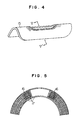
- Fig. 4 is a perspective view of a saddle-shaped superconducting magnet coil.
- Fig. 5 is a cross-sectional view of the coil of Fig. 4 when cut at line V-V'.
- the superconducting wire used in the present invention has no particular restriction and can be any wire as long as it may have superconductivity.
- alloy superconductors such as Nb-Ti and the like
- intermetallic compound superconductors such as Nb 3 Sn, Nb 3 Al, V 3 Ga and the like
- oxide superconductors such as LaBaCuO, YBaCuO and the like.
- the superconducting wire has a composite structure comprising (a) the above superconductor and (b) a metal of normal conduction such as Cu, cupro-nickel (CuNi), CuNi-Cu, Al or the like.
- the superconducting wire includes an ultrafine multiconductor wire obtained by embedding a large number of thin filament-like superconducting wires into a metal of normal conduction as a matrix, a straight twisted wire obtained by binding a large number of superconducting material wires into a straight bundle and twisting the bundle with the straightness being maintained, a straight wire obtained by embedding a straight superconducting material wire into a straight normal conductor, and an internal cooling type conductor having inside a passage for cooling medium.
- the resin for impregnation of superconducting magnet coils used in the present invention has no particular restriction and can be any resin as long as it can give a cured product having a thermal shrinkage factor of 1.5-0.3 % when cooled from the glass transition temperature to liquid helium temperatur, i.e. 4.2 K, a bend-breaking strain of 2.9-3.9 % at 4.2 K and a modulus of 4,900 to 9,810 MPa (500-1,000 kg/mm 2 ) at 4.2 K, and particularly a cured product having a thermal shrinkage factor of 1.0-0.3 % when cooled from the glass transition temperature to liquid helium temperature, i.e. 4.2 K, a bend-breaking strain of 2.9-3.9 % at 4.2 K and a modulus of 4,900 to 9,810 MPa (500-1,000 kg/mm 2 ) at 4.2 K.
- the stress applied to the superconducting magnet during the superconducting operation surpasses the strength of the cured product.
- the stress applied to the superconducting magnet during the superconducting operation surpasses the strength of the cured product due to the difference in thermal shrinkage factor between the cured product and the superconductor of the magnet.
- the glass transition temperature tends to be lower than room temperature and, when the superconducting magnet has been returned to room temperature, in the cured product cracks are generated due to the low strength; when the magnet is recooled to 4.2 K and reoperated, the cracks become nuclei of further crack generation, and the superconducting magnet causes quench.
- the cured product has low adhesion to the superconductor and, after the cooling or during the operation of the superconducting magnet, peeling takes place between the superconductor and the cured product. As a result, the thermal conductivity between them is reduced, even slight cracking leads to a temperature increase, and the superconducting magnet tends to incur quench.
- thermosetting resin for increasing the bend-breaking strain of a thermosetting resin, that is, for toughening a thermosetting resin
- a thermosetting resin for example, there are (1) a method of subjecting an epoxy resin to preliminary polymerization to obtain an epoxy resin having a higher molecular weight between crosslinked sites, (2) a method of adding a flexibilizer (e.g.
- a method of introducing a soft molecular skeleton into an epoxy resin by using a curing agent such as elastomer-modified epoxy resins, long-chain epoxy resins, long-chain amines, acid anhydrides, mercaptans or the like (4) a method of using an internal plasticizer such as branched epoxy resins, polyamide-amines, dodecyl succinic anhydrides or the like, (5) a method of using, in combination with an epoxy resin, a monofunctional epoxy resin to give rise to internal plasticization, (6) a method of using an epoxy resin as a main component and a curing agent in proportions deviating from the stoichiometric amounts to give rise to internal plasticization, (7) a method of adding a plasticizer (e.g.
- phthalic acid ester to give rise to external plasticization
- (8) a method of dispersing butadiene rubber particles, silicone rubber particles or the like in an epoxy resin to form an islands-in-the-sea structure
- (9) a method of introducing, into an epoxy resin, an acrylic resin, an urethane resin, a polycaprolactone, an unsaturated polyester or the like to form an interpenetrating network structure (IPN structure)
- IPN structure interpenetrating network structure
- 10) a method of adding, to an epoxy resin, a polyether having a molecular weight of 1,000-5,000 to form a microvoid structure, and so forth.
- the methods (1) and (2) are preferable in view of the low thermal shrinkage and high toughness of the improved epoxy resin.
- the improved epoxy resin obtained according to the above method are epoxy resins obtained by curing an epoxy resin of high molecular weight with an acid anhydride, epoxy resins obtained by curing an epoxy resin of high molecular weight with a catalyst alone, epoxy resins obtained by adding a flexibilizer to an epoxy resin and curing the resin with an acid anhydride, epoxy resins obtained by adding a flexibilizer to an epoxy resin and curing the resin with a catalyst alone, and maleimide resins obtained by adding a flexibilizer.
- the epoxy resin usable in the present invention can be any epoxy resin as long as it has at least two epoxy groups in the molecule.
- Such epoxy resins are, for example, bifunctional epoxy resins such as diglycidyl ether of bisphenol A, diglycidyl ether of bisphenol F, diglycidyl ether of bisphenol AF, diglycidyl ether of bisphenol AD, diglycidyl ether of hydrogenated bisphenol A, diglycidyl ether of 2,2-(4-hydroxyphenyl)nonadecane, 4,4'-bis(2,3-epoxypropyl)diphenyl ether, 3,4-epoxycyclohexylmethyl-(3,4-epoxy)-cyclohexanecarboxylate, 4-(1,2-epoxypropyl)-1,2-epoxycyclohexane, 2-(3,4-epoxy)-cyclohexyl-5,5-spiro(3,4-epoxy)-cyclohexane
- tetraglycidyldiaminodiphenylmethane triglycidyl-p-aminophenol, triglycidyl-m-aminophenol, diglycidylamine, tetraglycidyl-m-xylylenediamine, tetraglycidyl-bis(aminomethylcyclohexane), phenolic novolac type epoxy resins, cresol type epoxy resins, and the like.
- a polyfunctional epoxy resin obtained by reacting epichlorohydrin with at least two polyhydric phenols selected from (a) bis(4-hydroxyphenyl)methane, (b) bis(4-hydroxyphenyl)ethane, (c) bis(4-hydroxyphenyl)propane, (d) tris(4-hydroxyphenyl)alkanes and (e) tetrakis(4-hydroxyphenyl)alkanes, because the resin has a low viscosity before curing and gives easy working.
- tris(4-hydroxyphenyl)alkanes are tris(4-hydroxyphenyl)methane, tris(4-hydroxyphenyl)ethane, tris(4-hydroxyphenyl)propane, tris(4-hydroxyphenyl)butane, tris(4-hydroxyphenyl)hexane, tris(4-hydroxyphenyl)heptane, tris(4-hydroxyphenyl)octane, tris(4-hydroxyphenyl)nonane, etc.
- tris(4-hydroxyphenyl)alkane derivatives such as tris(4-hydroxydimethylphenyl)methane and the like.
- tetrakis(4-hydroxyphenyl)alkane examples include tetrakis(4-hydroxyphenyl)methane, tetrakis(4-hydroxyphenyl)ethane, tetrakis(4-hydroxyphenyl)propane, tetrakis(4-hydroxyphenyl)butane, tetrakis(4-hydroxyphenyl)hexane, tetrakis(4-hydroxyphenyl) heptane, tetrakis(4-hydroxyphenyl)octane, tetrakis(4-hydroxyphenyl)nonane and the like.
- tetrakis(4-hydroxyphenyl)alkane derivatives such as tetrakis(4-hydroxydimethylphenyl)methane and the like.
- useful are diglycidyl ether of bisphenol A, diglycidyl ether of bisphenol F, diglycidyl ether of bisphenol AF, diglycidyl ether of bisphenol AD, and diglycidyl ethers of higher-molecular-weight bisphenols A, F, AF and AD, because they have a low thermal shrinkage factor.
- the above polyfunctinal epoxy resins may be used in combination of two or more. If necessary, the polyfunctional epoxy resin may be mixed with a monofunctional epoxy resin such as butyl glycidyl ether, styrene oxide, phenyl glycidyl ether, allyl glycidyl ether or the like in order to obtain a lower viscosity.
- the amount of the monofunctional epoxy resin added should be small because, in general, the monofunctional epoxy resin has an effect for viscosity reduction but brings about an increase in the thermal shrinkage factor.
- the acid anhydride used in the present invention has no particular restriction and can be any ordinary acid anhydride.
- Such acid anhydrides are e.g. methylhexahydrophthalic anhydride, hexahydrophthalic anhydride, methyltetrahydrophthalic anhydride, tetrahydrophthalic anhydride, nadic anhydride, methylnadic anhydride, dodecylsuccinic anhydride, succinic anhydride, octadecylsuccinic anhydride, maleic anhydride, benzophenonetetracarboxylic anhydride, ethylene glycol bis(anhydrotrimellitate), glycerol tris(anhydrotrimellitate), etc. They can be used alone or in combination of two or more.
- the maleimide used in the present invention can be any maleimide as long as it is an unsaturated imide containing in the molecule the group having the formula (I), wherein D is a bivalent group containing a carbon-carbon double bond.
- unsaturated imides are, for example, bifunctional maleimides such as N,N'-ethylenebismaleimide, N,N'-hexamethylene-bismaleimide, N,N'-dodecamethylene-bismaleimide, N,N'-m-xylylene-bismaleimide, N,N'-p-xylylene-bismaleimide, N,N'-1,3-bismethylenecyclohexane-bismaleimide.
- the flexibilizer used in the present invention can be any flexibility-imparting agent as long as it can impart flexibility, toughness and adhesion.
- Such flexibilizers are, for example, diglycidyl ether of linoleic acid dimer, diglycidyl ethers of polyethylene glycols, diglycidyl ethers of polypropylene glycols diglycidyl ethers of alkylene oxide adducts of bisphenol A, urethane-modified epoxy resins polybutadiene-modified epoxy resins, polyethylene glycols, polypropylene glycols, polyols (e.g.
- the flexibilizer may be a low viscosity compound such as caprolactone or the like, which is polymerized at the time of curing of the impregnant resin and thereby exhibits flexibility.
- polyols, phenoxy resins or polycaprolactones are preferable in view of the high toughness and low thermal expansion.
- the catalyst used in the present invention has no particular restriction and can be any compound as long as it has an action of accelerating the reaction of an epoxy resin or a maleimide.
- Such compounds are, for example, tertiary amines such as trimethylamine, triethylamine, tetramethylbutanediamine, triethylenediamine and the like; amines such as dimethylaminoethanol, dimethylaminopentanol, tris(dimethylaminomethyl)phenol, N-methylmorpholine and the like; quaternary ammonium salts such as cetyltrimethylammonium bromide, cetyltrimethylammonium chloride, cetyltrimethylammonium iodide, dodecyltrimethylammonium bromide, dodecyltrimethylammonium chloride, dodecyltrimethylammonium iodide, benzyldimethyltetradecylammonium chloride, benzyldimethyltetradec
- cobalt, manganese, iron) salts of octanoic acid or naphthenic acid particularly useful are quaternary ammonium salts, metal salts between (a) an amine or imidazole and (b) zinc octanoate, a cobalt salt or the like, amine tetraphenyl borates, complexes between boron trifluoride and an amine or imidazole, diphenyliodonium salt of HAsF 6 , aliphatic sulfonium salts, amineimides, microcapsules of amines or imidazoles, etc., because they are relatively stable at room temperature but can cause a reaction easily at elevated temperatures, that is, they are latent curing catalysts.
- These curing agents are added ordinarily in an amount of 0.1-10% by weight based on the polyfunctional epoxy resin.
- the stress which a superconducting magnet coil undergoes during operation of the superconducting magnet includes the residual stress generated at the time of production, the thermal stress applied during cooling and the electromagnetic force applied during operation.
- the thermal stress ⁇ applied to the cured resin of a superconducting magnet coil when the coil after production is cooled to liquid helium temperature, i.e 4.2 K, can be represented by the following formula: wherein ⁇ R is the thermal expansion coefficient of the cured resin; ⁇ S is the thermal expansion coefficient of the superconducting wire of the coil; E is the modulus of the cured resin; and T is the curing temperature of the resin used for obtaining the cured resin.
- the thermal stress applied to the cured resin of superconducting magnet coil when the coil after production is cooled to 4.2 K can be substantially represented by the following formula (1) holding for when the coil after production is cooled from the glass transition temperature of the cured resin to 4.2 K:
- the thermal stress ⁇ applied to the cured resin of superconducting magnet coil when the coil after production is cured to 4.2 K is roughly calculated from the above formula (1), using assumptions that the thermal shrinkage factor of the cured resin when cooled from the glass transition temperature Tg to 4.2 K be 2.0%, the thermal shrinkage factor of the superconducting wire of the coil when cooled under the same condition be 0.3% and the modulus of the cured resin be 9,810 MPa (1,000 kg/mm 2 ) at 4.2 K; the rough calculation gives a thermal stress ⁇ of about 167 MPa (17 kg/mm 2 ). Meanwhile, cured epoxy resins ordinarily have a strengh of 167-196 MPa (17-20 kg/mm 2 ) at 4.2 K.
- the thermal stress ⁇ plus the residual stress generated at the time of coil production allow the cured resin to form microcracks of several micrometers ; the releasing energy of the stress of the cured resin gives rise to a temperature increase of several degress at the peripheries of the microcracks; as a result, the resistance of the superconducting wire is increased rapidly, and there occurs a transition from the superconducting state to a state of normal conduction, I,e the so-called quench phenomenon.
- the thermal stress ⁇ applied to the cured resin of superconducting magnet coil when the coil after production is cooled to 4.2 K is roughly calculated from the formula (1), using a thermal shrinkage factor of the cured resin of 1.5% when cooled to 4.2 K and a modulus of the cured resin of 9,810 MPa (1,000 kg/mm 2 ) at 4.2 K; the rough calculation gives a thermal stress ⁇ of about 118 MPa (12 kg/mm 2 ).
- an electromagnetic force of about 39 MPa (4 kg/mm 2 ) is repeatedly applied to the above thermal stress during operation at 4.2 K, the total stress becomes about 157 MPa (16 kg/mm 2 ).
- cured epoxy resins ordinarily have a strength of 167-196 MPa (17-20 kg/mm 2 ) at 4.2 K. Therefore, on calculation, this strength can withstand the thermal stress applied to the cured resin of superconducting magnet coil when cooled to 4.2 K and the electromagnetic force repeatedly applied to the cured resin during operation.
- thermosetting resin composition giving a cured product having a thermal shrinkage factor of 1.0-0.3% when cooled from the glass transition temperature to a liquid helium temperature, i.e. 4.2 K, a bend-breaking strain of 2.9-3.9% and a modulus of 4,900-9,810 MPA (500-1,000 kg/mm 2 ), quench can be prevented with a large allowance even in superconducting operation at 4.2 K in which an electromagnetic force is applied.
- thermomechanical analyzer having a sample system provided in a cryostat which can cool a sample to a very low temperature and a measurement system containing a differential transformer with which the change of the dimensions of the sample detected by a detecting rod can be measured.
- the determination of the bending properties was carried out by immersing the sample in liquid helium using a conventional bend test apparatus equipped with a cryostat which can cool the sample to a very low temperature.
- the size of the sample was 80 mm x 9 mm x 5 mm.
- the conditions of the determination were:
- each of the resin compositions shown in Tables 1-1 to 1-13 was thoroughly stirred, placed in a mold, and heat-cured under the curing conditions shown in Tables 1-1 to 1-13.
- Each of the resulting cured products was measured for thermal shrinkage factor when cooled from the glass transition temperature to 4.2 K, and the results are shown in Tables 1-1 to 1-13.
- Each cured product was also measured for bending properties at 4.2 K, and the bending strain and bending modulus are shown in Tables 1-1 to 1-13.
- Fig. 1 is a perspective view showing the superconducting magnet coils thus prepared.
- Fig. 2 is a cross-sectional view of the coil of Fig. 1 when cut at the line II-II'.
- the cured product 3 of the curable resin composition filled the space between the conductors 2, and any unfilled portion (e.g. void) was not observed.
- These coils were cooled to 4.2 K.
- FIG. 3 in each of the coils impregnated with each of the curable resin compositions of Comparative Examples 1-6, cracks were generated in the cured resin composition 3; the cracks reached even the enamel insulating layer 5 of each conductor 2, which caused even the peeling 6 of the enamel insulating layer 5. Meanwhile, in the coils impregnated with each of the curable resin compositions of Examples 1-65, neither cracking of the cured resin composition nor peeling of the enamel insulating layer was observed.
- Superconducting wires were wound to form coils of the same material and the same shape.
- the coils were impregnated with each of the curable resin compositions of examples 1-65 and Comparative Examples 1-6, and the impregnated coils were heat-cured under given curing conditions to prepare saddle-shaped superconducting magnet coils.
- Fig. 4 is a perspective view showing the superconducting magnet coils thus prepared.
- Fig. 5 is a cross-sectional view of the coil of Fig. 4 when cut at line V-V' saddle-shaped superconducting magnet coils 15 were cooled to 4.2 K.
- cracks were generated in the cured resin composition. Meanwhile, in the coils impregnated with each of the curable resin compositions of Examples 1-65, no crack was observed.
- Each of the resin compositions shown in Tables 2-1 to 2-11 was thoroughly stirred, placed in a mold, and heat-cured under the curing conditions shown in Tables 2-1 to 2-11.
- Each of the resulting cured products was measured for the thermal shrinkage factor when cooled from the glass transition temperature to 4.2 K, and the results are shown in Tables 2-1 to 2-11.
- Each cured product was also measured for the bending properties at 4.2 K, and the bending strain and bending modulus are shown in Tables 2-1 to 2-11.
- a curable resin composition giving a cured product having a thermal shrinkage factor of 1.5-0.3% when cooled from the glass transition temperature to liquid helium temperature, i.e. 4.2 K, a bend-breaking strain of 2.9-3.9% at 4.2 K and a modulus of 4,900 to 9,810 MPa (500-1,000 kg/mm 2 ) at 4.2 K, particularly a cured product having a thermal shrinkage factor of 1.0-0.3% when cooled from the glass transition temperature to liquid helium temperature, i.e.
Landscapes
- Engineering & Computer Science (AREA)
- Power Engineering (AREA)
- Epoxy Resins (AREA)
- Compositions Of Macromolecular Compounds (AREA)
- Organic Insulating Materials (AREA)
- Insulating Of Coils (AREA)
Description
- The present invention relates to a superconducting magnet coil, the insulating layer thereof and a process for making them.
- In superconducting magnet coils used, by being dipped in liquid helium, in linear motor cars, superconducting electromagnetic propulsion vessels, nuclear fusion reactors, superconducting generators, MRI, pion applicators (for therapy), electron microscopes, energy storage apparatuses, etc., the superconducting wires contained in the coil cause a temperature increase incurred by frictional heat or the like when the superconducting wires are moved by an electromagnetic force or a mechanical force. As a result, the magnet may shift from the superconducting state to the state of normal conduction. This phenomenon is called "quench". Hence, in some cases the gap between the wires of the coil is filled with a resin such as an epoxy resin or the like to fix the wires.
- The resins such as epoxy resins or the like, used for filling the coil gaps usually have a thermal shrinkage factor of 1.8 to 3.0 % when cooled from the glass transition temperature to liquid helium temperature, i.e. 4.2 K. Meanwhile, the superconducting wires have a thermal shrinkage factor of about 0.3 to 0.4 % under the same condition. When a superconducting magnet coil comprising superconducting wires and a resin used for filling the gaps between the wires is cooled to liquid helium temperature, i.e. 4.2 K, a residual thermal stress appears due to the difference in the thermal shrinkage factors of the superconducting wires and of the resin. As a result, impregnating resins such as epoxy resins or the like get very brittle, and microcracks of several micrometers appear in the resin, due to electromagnetic or mechanical forces a temperature increase of several degrees is induced at the peripheries of the microcracks due to the releasing energy of the residual thermal stress of the resin, and the superconducting wires show a sharp rise in resistance. Finally, the superconducting magnet coil shifts from the superconducting state to the state of normal conduction and causes the undesirable quench phenomenon.
- In Cryogenics 25 (1985) 307-316 it is disclosed that the premature quench in a composite made of a copper matrix, NbTi filaments and an epoxy matrix can be avoided by minimizing the shear stresses induced by the Lorentz forces during the energization of the magnet. The reduction of the shear stresses is achieved according to this prior art by letting the whole winding body separate from the coil form ("floating coil" concept) and take its natural shape as the magnet is energized.
- In this document, properties of the epoxy resin used at 4.2 K are indicated, inter alia the Young modulus which is 8000 MPa (815 kg/mm2) .
- The present invention has been made in view of the above situation. The object of the present invention is to provide a superconducting magnet coil which is resistant to microcrack generation of the impregnant resin and causes substantially no quench during operation, an insulating layer thereof, and a process for making them.
- The above object is achieved according to the independent claims. The dependent claims relate to prefered embodiments.
- The superconducting magnet coil of the present invention comprises
- a coil of a superconducting wire having a thermal shrinkage factor of 0.3 to 0.4 % when cooled to 4.2 K, and
- a cured product of a curable resin composition with which the coil has been impregnated, having
- a modulus of 4,900 to 9,810 Mpa (500 to 1000 kg/mm2) at 4.2 K,
- a thermal shrinkage factor of 1.5 to 0.3 % and particularly of 1.0 to 0.3 %, when cooled from the glass transition temperature to 4.2 K, and
- a bend-breaking strain of 2.9 to 3.9 %, and preferably 3.2 to 3.9 %, at 4.2 K.
- The process of the present invention for producing the superconducting magnet coils comprises the following steps:
- (a) winding a superconducting wire having a thermal shrinkage factor of 0.3 to 0.4 % when cooled to 4.2 K to form a coil,
- (b) filling the gaps between the superconductors of the coil with a curable resin composition having a viscosity of 10-3 to 1 Pa·s (0.01 to 10 Poise) at the time of filling to obtain a coil impregnated with the curable resin composition, and
- (c) heating the impregnated coil to cure the composition and obtain a cured product having a modulus of 4,900 to 9,810 Mpa (500 to 1,000 kg/mm2), a thermal shrinkage factor of 1.5 to 0.3 %, and particularly of 1.0 to 0.3 %, when cooled from the glass transition temperature to 4.2 K, and a bend-breaking strain of 2.9 to 3.9 % at 4.2 K.
- In accordance with the above, the insulating layer of a superconducting magnet coil of the present invention comprises
- (a) a coil of a superconducting wire having a thermal shrinkage factor of 0.3 to 0.4 % when cooled to 4.2 K, and comprising a plurality of thin superconducting wires and a stabilizer selected from copper and aluminum which is thermally or electrically in contact with the superconducting wires,
and - (b) a cured product of a curable resin composition with which the coil has been impregnated, having a modulus of 4,900 to 9,810 Mpa (500 to 1000 kg/mm2) at 4.2 K, a thermal shrinkage factor of 1.5 to 0.3 % when cooled from the glass transition temperature to 4.2 K, and a bend-breaking strain of 2.9 to 3.9 % at 4.2 K.
- The insulating layer of the present invention is obtained by impregnation of a coil of superconducting wire with the curable resin composition and curing of the resin composition.
- According to the present invention, the cured product of the curable resin composition with which the coil has been impregnated, preferably undergoes a thermal stress of 0 to 98.1 MPa (0 to 10 kg/mm2) when cooled from the glass transition temperature to 4.2 K and resists to quench during superconducting operation.
- According to a prefered embodiment of the process for producing the superconducting magnet coil the curable resin composition comprises (i) at least one epoxy resin selected from diglycidyl ether of bisphenol A, diglycidyl ether of bisphenol F and diglycidyl ether of bisphenol AF, all having a number-average molecular weight of 350-1,000, (ii) a flexibilizer and (iii) a curing catalyst.
- In accordance with another prefered embodiment, step (b) includes the steps of covering the outer surface of the coil with a release film or a perforated film, placing the film-covered coil in a mold, and effecting vacuum impregnation, and, if necessary, pressure impregnation, of the coil with the curable resin composition.
- Preferably, step (c) includes the step of curing the composition under pressure, and, if necessary, further comprises the step of clamping the curable-resin-composition-impregnated coil before the step of curing.
- According to get another prefered embodiment, the superconducting wire has a composite structure
- (a) a plurality of thin superconducting wires and
- (b) a stabilizer selected from copper and aluminum which is in thermal or electrical contact with the wires.
- Preferably, in step (a), the composite superconductor wire is subjected to surface treatment with a coupling agent before winding.
- The curable resin composition according to the present invention can also be preferably used in switches for permanent current which are required in superconducting magnet coils for linear motor cars, MRI, energy storage and nuclear fusion devices.
- Fig. 1 is a perspective view of a race track-shaped, round superconducting magnet coil 1.
- Fig. 2 is a cross-sectional view of the coil of Fig. 1 when cut at the line II-II'.
- Fig. 3 is a fragmentary enlarged view of Fig. 2 of a conventional race track-shaped superconducting magnet coil.
- Fig. 4 is a perspective view of a saddle-shaped superconducting magnet coil.
- Fig. 5 is a cross-sectional view of the coil of Fig. 4 when cut at line V-V'.
- The superconducting wire used in the present invention has no particular restriction and can be any wire as long as it may have superconductivity. There can be mentioned, for example, alloy superconductors such as Nb-Ti and the like; intermetallic compound superconductors such as Nb3Sn, Nb3Al, V3Ga and the like; and oxide superconductors such as LaBaCuO, YBaCuO and the like. Ordinarily, the superconducting wire has a composite structure comprising (a) the above superconductor and (b) a metal of normal conduction such as Cu, cupro-nickel (CuNi), CuNi-Cu, Al or the like. That is, the superconducting wire includes an ultrafine multiconductor wire obtained by embedding a large number of thin filament-like superconducting wires into a metal of normal conduction as a matrix, a straight twisted wire obtained by binding a large number of superconducting material wires into a straight bundle and twisting the bundle with the straightness being maintained, a straight wire obtained by embedding a straight superconducting material wire into a straight normal conductor, and an internal cooling type conductor having inside a passage for cooling medium.
- The resin for impregnation of superconducting magnet coils used in the present invention has no particular restriction and can be any resin as long as it can give a cured product having a thermal shrinkage factor of 1.5-0.3 % when cooled from the glass transition temperature to liquid helium temperatur, i.e. 4.2 K, a bend-breaking strain of 2.9-3.9 % at 4.2 K and a modulus of 4,900 to 9,810 MPa (500-1,000 kg/mm2) at 4.2 K, and particularly a cured product having a thermal shrinkage factor of 1.0-0.3 % when cooled from the glass transition temperature to liquid helium temperature, i.e. 4.2 K, a bend-breaking strain of 2.9-3.9 % at 4.2 K and a modulus of 4,900 to 9,810 MPa (500-1,000 kg/mm2) at 4.2 K.
- When the cured product of the resin has a thermal shrinkage factor larger than 1.5 % and a modulus larger than 9,810 Mpa (1,000 kg/mm2), the stress applied to the superconducting magnet during the superconducting operation surpasses the strength of the cured product. As a result, in the cured product cracks are generated, and quench occurs due to the releasing energy of the stress. When the cured product has a thermal shrinkage factor smaller than 0.3 %, the stress applied to the superconducting magnet during the superconducting operation surpasses the strength of the cured product due to the difference in thermal shrinkage factor between the cured product and the superconductor of the magnet. As a result, in the cured product cracks are generated, and quench tends to occur due to the releasing energy of the stress. When the modulus is smaller than 4,900 MPa (500 kg/mm2), the glass transition temperature tends to be lower than room temperature and, when the superconducting magnet has been returned to room temperature, in the cured product cracks are generated due to the low strength; when the magnet is recooled to 4.2 K and reoperated, the cracks become nuclei of further crack generation, and the superconducting magnet causes quench. When the bend-breaking strain is smaller than 2.9%, the cured product has low adhesion to the superconductor and, after the cooling or during the operation of the superconducting magnet, peeling takes place between the superconductor and the cured product. As a result, the thermal conductivity between them is reduced, even slight cracking leads to a temperature increase, and the superconducting magnet tends to incur quench.
- For increasing the bend-breaking strain of a thermosetting resin, that is, for toughening a thermosetting resin, there are a number of methods available In the case of an epoxy resin, for example, there are (1) a method of subjecting an epoxy resin to preliminary polymerization to obtain an epoxy resin having a higher molecular weight between crosslinked sites, (2) a method of adding a flexibilizer (e.g. polyol, phenoxy resin) to an epoxy resin to increase the specific volume of the latter, (3) a method of introducing a soft molecular skeleton into an epoxy resin by using a curing agent such as elastomer-modified epoxy resins, long-chain epoxy resins, long-chain amines, acid anhydrides, mercaptans or the like, (4) a method of using an internal plasticizer such as branched epoxy resins, polyamide-amines, dodecyl succinic anhydrides or the like, (5) a method of using, in combination with an epoxy resin, a monofunctional epoxy resin to give rise to internal plasticization, (6) a method of using an epoxy resin as a main component and a curing agent in proportions deviating from the stoichiometric amounts to give rise to internal plasticization, (7) a method of adding a plasticizer (e.g. phthalic acid ester) to give rise to external plasticization, (8) a method of dispersing butadiene rubber particles, silicone rubber particles or the like in an epoxy resin to form an islands-in-the-sea structure, (9) a method of introducing, into an epoxy resin, an acrylic resin, an urethane resin, a polycaprolactone, an unsaturated polyester or the like to form an interpenetrating network structure (IPN structure), (10) a method of adding, to an epoxy resin, a polyether having a molecular weight of 1,000-5,000 to form a microvoid structure, and so forth. Of these methods, the methods (1) and (2) are preferable in view of the low thermal shrinkage and high toughness of the improved epoxy resin.
- Specific examples of the improved epoxy resin obtained according to the above method are epoxy resins obtained by curing an epoxy resin of high molecular weight with an acid anhydride, epoxy resins obtained by curing an epoxy resin of high molecular weight with a catalyst alone, epoxy resins obtained by adding a flexibilizer to an epoxy resin and curing the resin with an acid anhydride, epoxy resins obtained by adding a flexibilizer to an epoxy resin and curing the resin with a catalyst alone, and maleimide resins obtained by adding a flexibilizer.
- The epoxy resin usable in the present invention can be any epoxy resin as long as it has at least two epoxy groups in the molecule. Such epoxy resins are, for example, bifunctional epoxy resins such as diglycidyl ether of bisphenol A, diglycidyl ether of bisphenol F, diglycidyl ether of bisphenol AF, diglycidyl ether of bisphenol AD, diglycidyl ether of hydrogenated bisphenol A, diglycidyl ether of 2,2-(4-hydroxyphenyl)nonadecane, 4,4'-bis(2,3-epoxypropyl)diphenyl ether, 3,4-epoxycyclohexylmethyl-(3,4-epoxy)-cyclohexanecarboxylate, 4-(1,2-epoxypropyl)-1,2-epoxycyclohexane, 2-(3,4-epoxy)-cyclohexyl-5,5-spiro(3,4-epoxy)-cyclohexane-m-dioxane, 3,4-epoxy-6-methylcyclohexylmethyl-4-epoxy-6-methylcyclohexanecarboxylate, butadiene-modified epoxy resins, urethane-modified epoxy resins, thiol-modified epoxy resins, diglycidyl ether of diethylene glycol, diglycidyl ether of triethylene glycol, diglycidyl ether of polyethylene glycol, diglycidyl ether of polypropylene glycol, diglycidyl ether of 1,4-butanediol, diglycidyl ether of neopentyl glycol, diglycidyl ethers of propylene oxide adducts of bisphenol A, diglycidyl ethers of ethylene oxide adducts of bisphenol A, and the like; trifunctional epoxy resins such as tris[p-tris[p-(2,3-epoxypropoxy)-phenyl]methane, 1,1,3-tris[p-(2,3-epoxypopoxy)-phenyl]butane and the like; and polyfunctional epoxy resins such as glycidylamines (e.g. tetraglycidyldiaminodiphenylmethane, triglycidyl-p-aminophenol, triglycidyl-m-aminophenol, diglycidylamine, tetraglycidyl-m-xylylenediamine, tetraglycidyl-bis(aminomethylcyclohexane), phenolic novolac type epoxy resins, cresol type epoxy resins, and the like. It is also possible to use a polyfunctional epoxy resin obtained by reacting epichlorohydrin with at least two polyhydric phenols selected from (a) bis(4-hydroxyphenyl)methane, (b) bis(4-hydroxyphenyl)ethane, (c) bis(4-hydroxyphenyl)propane, (d) tris(4-hydroxyphenyl)alkanes and (e) tetrakis(4-hydroxyphenyl)alkanes, because the resin has a low viscosity before curing and gives easy working. Specific examples of tris(4-hydroxyphenyl)alkanes are tris(4-hydroxyphenyl)methane, tris(4-hydroxyphenyl)ethane, tris(4-hydroxyphenyl)propane, tris(4-hydroxyphenyl)butane, tris(4-hydroxyphenyl)hexane, tris(4-hydroxyphenyl)heptane, tris(4-hydroxyphenyl)octane, tris(4-hydroxyphenyl)nonane, etc. There can also be used tris(4-hydroxyphenyl)alkane derivatives such as tris(4-hydroxydimethylphenyl)methane and the like.
- Specific examples of tetrakis(4-hydroxyphenyl)alkane are tetrakis(4-hydroxyphenyl)methane, tetrakis(4-hydroxyphenyl)ethane, tetrakis(4-hydroxyphenyl)propane, tetrakis(4-hydroxyphenyl)butane, tetrakis(4-hydroxyphenyl)hexane, tetrakis(4-hydroxyphenyl) heptane, tetrakis(4-hydroxyphenyl)octane, tetrakis(4-hydroxyphenyl)nonane and the like. It is also possible to use tetrakis(4-hydroxyphenyl)alkane derivatives such as tetrakis(4-hydroxydimethylphenyl)methane and the like. Of these, useful are diglycidyl ether of bisphenol A, diglycidyl ether of bisphenol F, diglycidyl ether of bisphenol AF, diglycidyl ether of bisphenol AD, and diglycidyl ethers of higher-molecular-weight bisphenols A, F, AF and AD, because they have a low thermal shrinkage factor. Particularly preferable are diglycidyl ethers of higher-molecular-weight bisphenols A, F, AF and AD wherein the number n of the repeating units has a value of 2-18. The above polyfunctinal epoxy resins may be used in combination of two or more. If necessary, the polyfunctional epoxy resin may be mixed with a monofunctional epoxy resin such as butyl glycidyl ether, styrene oxide, phenyl glycidyl ether, allyl glycidyl ether or the like in order to obtain a lower viscosity. However, the amount of the monofunctional epoxy resin added should be small because, in general, the monofunctional epoxy resin has an effect for viscosity reduction but brings about an increase in the thermal shrinkage factor.
- The acid anhydride used in the present invention has no particular restriction and can be any ordinary acid anhydride. Such acid anhydrides are e.g. methylhexahydrophthalic anhydride, hexahydrophthalic anhydride, methyltetrahydrophthalic anhydride, tetrahydrophthalic anhydride, nadic anhydride, methylnadic anhydride, dodecylsuccinic anhydride, succinic anhydride, octadecylsuccinic anhydride, maleic anhydride, benzophenonetetracarboxylic anhydride, ethylene glycol bis(anhydrotrimellitate), glycerol tris(anhydrotrimellitate), etc. They can be used alone or in combination of two or more.
- The maleimide used in the present invention can be any maleimide as long as it is an unsaturated imide containing in the molecule the group having the formula (I),

- The flexibilizer used in the present invention can be any flexibility-imparting agent as long as it can impart flexibility, toughness and adhesion. Such flexibilizers are, for example, diglycidyl ether of linoleic acid dimer, diglycidyl ethers of polyethylene glycols, diglycidyl ethers of polypropylene glycols diglycidyl ethers of alkylene oxide adducts of bisphenol A, urethane-modified epoxy resins polybutadiene-modified epoxy resins, polyethylene glycols, polypropylene glycols, polyols (e.g. hydroxyl group-terminated polyesters), polybutadienes, alkylene oxide adducts of bisphenol A, polythiols, urethane prepolymers, polycarboxyl compounds phenoxy resins and polycaprolactones. The flexibilizer may be a low viscosity compound such as caprolactone or the like, which is polymerized at the time of curing of the impregnant resin and thereby exhibits flexibility. Of the above flexibilizers, polyols, phenoxy resins or polycaprolactones are preferable in view of the high toughness and low thermal expansion.
- The catalyst used in the present invention has no particular restriction and can be any compound as long as it has an action of accelerating the reaction of an epoxy resin or a maleimide. Such compounds are, for example, tertiary amines such as trimethylamine, triethylamine, tetramethylbutanediamine, triethylenediamine and the like; amines such as dimethylaminoethanol, dimethylaminopentanol, tris(dimethylaminomethyl)phenol, N-methylmorpholine and the like; quaternary ammonium salts such as cetyltrimethylammonium bromide, cetyltrimethylammonium chloride, cetyltrimethylammonium iodide, dodecyltrimethylammonium bromide, dodecyltrimethylammonium chloride, dodecyltrimethylammonium iodide, benzyldimethyltetradecylammonium chloride, benzyldimethyltetradecylammonium bromide, allyldodecyltrimethylammonium bromide, benzyldimethylstearylammonium bromide, stearyltrimethylammonium chloride, benzyldimethyltetradecylammonium acetylate and the like; imidazoles such as 2-methylimidazole, 2-ethylimidazole, 2-undecylimidazole, 2-heptadecylimidazole, 2-methyl-4-ethylimidazole, 1-butylimidazole, l-propyl-2-methylimidazole, 1-benzyl-2-methylimidazole, l-cycanoethyl-2-phenylimidazole, 1-cyanoethyl-2-methylimidazole, l-cyanoethyl-2-undecylimidazole, l-azine-2-methylimidazole, 1-azine-2-undecylimidazole and the like; microcapsules of amines or imidazoles; metal salts between (a) an amine or imidazole and (b) zinc octanoate, a cobalt salt or the like; 1,8-diaza-bicyclo[5.4.0]-undecene-7; N-methylpiperazine; tetramethylbutylguanidine; amine tetraphenylborates such as triethylammoniumtetraphenylborate, 2-ethyl-4-methyltetraphenylborate, 1,8-diazabicyclo-[5.4.0]-undecene-7-tetraphenylborate and the like; triphenylphosphine; triphenylphosphoniumtetraphenylborate; aluminumtrialkylacetoacetates; aluminum trisacetylacetoacetate; aluminum alcoholates; aluminum acylates; sodium alcoholates; boron trifluoride; complexes between boron trifluoride and an amine or imidazole; diphenyliodonium salt of HAsF6; aliphatic sulfonium salts; amineimides obtained by reacting an alkyl monocarboxylate with a hydrazine and a monoepoxy compound; and metal (e.g. cobalt, manganese, iron) salts of octanoic acid or naphthenic acid. Of these, particularly useful are quaternary ammonium salts, metal salts between (a) an amine or imidazole and (b) zinc octanoate, a cobalt salt or the like, amine tetraphenyl borates, complexes between boron trifluoride and an amine or imidazole, diphenyliodonium salt of HAsF6, aliphatic sulfonium salts, amineimides, microcapsules of amines or imidazoles, etc., because they are relatively stable at room temperature but can cause a reaction easily at elevated temperatures, that is, they are latent curing catalysts. These curing agents are added ordinarily in an amount of 0.1-10% by weight based on the polyfunctional epoxy resin.
- The stress which a superconducting magnet coil undergoes during operation of the superconducting magnet, includes the residual stress generated at the time of production, the thermal stress applied during cooling and the electromagnetic force applied during operation. First, description is made of the thermal stress applied to the cured resin of a superconducting magnet coil when the coil after production is cooled to liquid helium temperature, i.e. 4.2 K.
- The thermal stress σ applied to the cured resin of a superconducting magnet coil when the coil after production is cooled to liquid helium temperature, i.e 4.2 K, can be represented by the following formula:


- Now, the thermal stress σ applied to the cured resin of superconducting magnet coil when the coil after production is cured to 4.2 K, is roughly calculated from the above formula (1), using assumptions that the thermal shrinkage factor of the cured resin when cooled from the glass transition temperature Tg to 4.2 K be 2.0%, the thermal shrinkage factor of the superconducting wire of the coil when cooled under the same condition be 0.3% and the modulus of the cured resin be 9,810 MPa (1,000 kg/mm2) at 4.2 K; the rough calculation gives a thermal stress σ of about 167 MPa (17 kg/mm2). Meanwhile, cured epoxy resins ordinarily have a strengh of 167-196 MPa (17-20 kg/mm2) at 4.2 K. Accordingly, when the superconducting magnet coil after production is cooled to liquid helium temperature, i.e. 4.2 K, the thermal stress σ plus the residual stress generated at the time of coil production allow the cured resin to form microcracks of several micrometers ; the releasing energy of the stress of the cured resin gives rise to a temperature increase of several degress at the peripheries of the microcracks; as a result, the resistance of the superconducting wire is increased rapidly, and there occurs a transition from the superconducting state to a state of normal conduction, I,e the so-called quench phenomenon. In superconducting magnet coils used in linear motor cars, MRI, etc., further an electromagnetic force of at least about 39 MPa (4 kg/mm2) is repeatedly applied during operation at 4.2 K. This force plus the above-mentioned thermal stress and residual stress allow the cured resin to form cracks, and the releasing energy of the stress gives rise to the quench phenomenon.
- The thermal stress σ applied to the cured resin of superconducting magnet coil when the coil after production is cooled to 4.2 K, is roughly calculated from the formula (1), using a thermal shrinkage factor of the cured resin of 1.5% when cooled to 4.2 K and a modulus of the cured resin of 9,810 MPa (1,000 kg/mm2) at 4.2 K; the rough calculation gives a thermal stress σ of about 118 MPa (12 kg/mm2). When an electromagnetic force of about 39 MPa (4 kg/mm2) is repeatedly applied to the above thermal stress during operation at 4.2 K, the total stress becomes about 157 MPa (16 kg/mm2).
- Meanwhile, cured epoxy resins ordinarily have a strength of 167-196 MPa (17-20 kg/mm2) at 4.2 K. Therefore, on calculation, this strength can withstand the thermal stress applied to the cured resin of superconducting magnet coil when cooled to 4.2 K and the electromagnetic force repeatedly applied to the cured resin during operation.
- Various impregnant resins of different thermal shrinkage factors for superconducting magnet coils were actually tested. The tests indicated that when there is used, as an impregnant resin for superconducting magnet coil, a curable resin composition giving a cured product having a thermal shrinkage factor of 1.5-0.3% when cooled from the glass transition temperature to liquid helium temperature, i.e. 4.2 K, a bend-breaking strain of 2.9-3.9% at 4.2 K and a modulus of 4,900-9,810 MPa (500-1,000 kg/mm2) at 4.2 K, the cured resin composition of the superconducting magnet coil generates no cracks when cooled to liquid helium temperature, i.e. 4.2 K. The tests also indicated that no quench appears even in a superconducting operation at 4.2 K wherein an electromagnetic force is further applied.
- When there is used, in particular, a thermosetting resin composition giving a cured product having a thermal shrinkage factor of 1.0-0.3% when cooled from the glass transition temperature to a liquid helium temperature, i.e. 4.2 K, a bend-breaking strain of 2.9-3.9% and a modulus of 4,900-9,810 MPA (500-1,000 kg/mm2), quench can be prevented with a large allowance even in superconducting operation at 4.2 K in which an electromagnetic force is applied.
- The present invention is hereinafter described more specifically by way of Examples. However, the present invention is by no means restricted to these Examples.
- The determination of thermal shrinkage was carried out with a thermomechanical analyzer (TMA) having a sample system provided in a cryostat which can cool a sample to a very low temperature and a measurement system containing a differential transformer with which the change of the dimensions of the sample detected by a detecting rod can be measured.
- The determination of the bending properties was carried out by immersing the sample in liquid helium using a conventional bend test apparatus equipped with a cryostat which can cool the sample to a very low temperature. The size of the sample was 80 mm x 9 mm x 5 mm. The conditions of the determination were:
- length between supports: 60 mm
- head speed: 2 mm/min
- three-point bending.
- In the Examples, the abbreviations used for polyfunctional epoxy resins, flexibilizers, curing catalysts and bismaleimides are as follows.
- DER-332:
- diglycidyl ether of bisphenol A (epoxy equivalent: 175)
- EP-825:
- diglycidyl ether of bisphenol A (epoxy equivalent: 178)
- EP-827:
- diglycidyl ether of bisphenol A (epoxy equlvalent: 185)
- EP-828:
- diglycidyl ether of bisphenol A (epoxy equivalent: 189)
- EP-1001:
- diglycidyl ether of bisphenol A (epoxy equivalent: 472)
- EP-1002:
- diglycidyl ether of bisphenol A (epoxy equivalent: 636)
- EP-1003:
- diglycidyl ether of bisphenol A (epoxy equivalent: 745)
- EP-1055:
- diglycidyl ether of bisphenol A (epoxy equivalent: 865)
- EP-1004AF:
- diglycidyl ether of bisphenol A (epoxy equivalent: 975)
- EP-1007:
- diglycidyl ether of bisphenol A (epoxy equivalent: 2006)
- EP-1009:
- diglycidyl ether of bisphenol A (epoxy equivalent: 2473)
- EP-1010:
- diglycidyl ether of bisphenol A (epoxy equivalent: 2785)
- EP-807:
- diglycidyl ether of bisphenol F (epoxy equivalent: 170)
- PY-302-2:
- diglycidyl ether of bisphenol AF (epoxy equivalent: 175)
- DGEBAD:
- diglycidyl ether of bisphenol AD (epoxy equivalent: 173)
- HP-4032:
- 2,7-diglycidyl ether naphthalene (epoxy equivalent: 150)
- TGADPM:
- tetraglycidylaminodiphenylmethane
- TTGmAP:
- tetraglycidyl-m-xylylenediamine
- TGpAP:
- triglycidyl-p-aminophenol
- TGmAP:
- triglycidyl-m-aminophenol
- CEL-2021:
- 3,4-epoxycyclohexylmethyl-(3,4-epoxy)-cyclohexane carboxylate (epoxy equivalent: 138)
- LS-108:
- bis-2,2'-(4,4'-[2-(2,3-epoxy)-propoxy-3-butoxypropoxy]-phenyl}propane (epoxy equivalent: 2100)
- LS-402:
- bis-2,2'-{4,4'-[2-(2,3-epoxy)propoxy-3-butoxypropoxy]-phenyl}propane (epoxy equivalent: 4600)
- HN-5500:
- methylhexahydrophthalic anhydride (acid anhydride equivalent: 168)
- HN-2200:
- methyltetrahydrophthalic anhydride (acid anhydride equivalent: 166)
- iPA-Na:
- sodium isopropylate
- BTPP-K :
- tetraphenylborate of triphenylbutylphosphine
- 2E4MZ-K:
- tetraphenylborate of 2-ethyl-4-methylimidazole
- 2E4MZ-CN-K:
- tetraphenylborate of l-cyanoethyl-2-ethyl-4-methylimidazole
- TEA-K:
- tetraphenylborate of triethylamine
- TPP-K:
- tetraphenylborate of triphenylphosphine
- TPP:
- triphenylphosphine
- IOZ:
- salt between 2-ethyl-4-methylimidazole and zinc octanoate
- DY063:
- alkyl alkoholate
- YPH-201:
- an amineimide obtained by reacting an alkyl monocarboxylate with a hydrazine and a monoepoxy compound (YPH-201 manufactured by Yuka Shell Epoxy K.K.)
- CP-66:
- an aliphatic sulfonium salt of a protonic acid (ADEKA OPTON CP-66 manufactured by ASAHI DENKA KOGYO K.K.)
- PX-4BT:
- tetrabutylphosphonium benzotriazolate
- BF3-400:
- boron trifluoride salt of piperazine
- BF3-100:
- boron trifluoride salt of triethylamine
- 2E4MZ-CNS:
- trimellitic acid salt of 2-ethyl-4-methylimidazole
- 2E4MZ-OK:
- isocyanuric acid salt of 2-ethyl-4-methylimidazole
- MC-CllZ-AZINE:
- microcapsule of 1-azine-2-undecylimidazole
- 2E4MZ-CN:
- 1-cyanoethyl-2-ethyl-4-methylimidazole
- BDMTDAC:
- benzyldimethyltetradecylammonium chloride
- BDMTDAI:
- benzyldimethyltetradecylammonium iodide
- HMBMI:
- N,N'-hexamethylene-bismaleimide
- BMI:
- N,N'-4,4'-diphenylmethane-bismaleimide
- DMBMI:
- N,N'-(3,3'-dimethyl)-4,4'-diphenylmethane-bismaleimide
- DAPPBMI:
- N,N'-bismaleimide of 2,2'-bis[4-(4-aminophenoxy)-phenyl]propane
- PMI:
- N,N'-polymaleimide of a reaction product (a polyamine compound) between aniline and formalin
- DABPA:
- diallylbisphenol A
- PPG:
- polypropylene glycol
- KR:
- ε-caprolactone
- DGEAOBA:
- diglycidyl ether of an alkylene oxide adduct of bisphenol A
- PPO:
- phenoxy resin
- CTBN:
- acrylonitrile-modified carboxyl group-terminated polybutadiene rubber
- 2PZCN:
- 1-cyanoethyl-2-phenylimidazole
- LBO:
- lithium butoxide
- PZ:
- pyridine
- TEA:
- triethylamine
- M2-100:
- benzalkyonium chloride
- N-MM:
- N-methylmorpholine
- MDI:
- 4,4'-diphenylmethane diisocyanate, equivalent: 125
- LMDI:
- a mixture of MDI, an MDI derivative whose isocyanate group has been converted to carbodiimide and an MDI derivative whose isocyanate groups have been converted to carbodiimide, which mixture is liquid at room temperature, equivalent: about 140
- TDI:
- a mixture of 80% of 2,4-tolylene diisocyanate and 20% of 2,6-tolylene diisocyanate,
equivalent: 87 - KR2019:
- a resin obtained by condensation polymerization of methylphenylsilicone,
- Each of the resin compositions shown in Tables 1-1 to 1-13 was thoroughly stirred, placed in a mold, and heat-cured under the curing conditions shown in Tables 1-1 to 1-13. Each of the resulting cured products was measured for thermal shrinkage factor when cooled from the glass transition temperature to 4.2 K, and the results are shown in Tables 1-1 to 1-13. Each cured product was also measured for bending properties at 4.2 K, and the bending strain and bending modulus are shown in Tables 1-1 to 1-13. All of the curable resin compositions of Examples 1-65 according to the present invention, when cured, had a thermal shrinkage factor of 1.5-0.3% when cooled from the glass transition temperature to 4.2 K, a bend-breaking strain of 2.9-3.9% at 4.2 K and a modulus of 4,900-9,810 MPa (500-1,000kg/mm2) at 4.2 K.
- Superconducting wires were wound to form coils of the same material and the same shape. The coils were impregnated with the curable resin compositions of Examples 1-65 and Comparative Examples 1-6, and the impregnated coils were heat-cured under given curing conditions to prepare small race track-shaped superconducting magnet coils. Switches for permanent current were also prepared by impregnation with each of the curable resin compositions of Examples 1-65 and Comparative Examples 1-6 and subsequent heat-curing under given curing conditions. Fig. 1 is a perspective view showing the superconducting magnet coils thus prepared. Fig. 2 is a cross-sectional view of the coil of Fig. 1 when cut at the line II-II'. In any or the coils, the cured
product 3 of the curable resin composition filled the space between theconductors 2, and any unfilled portion (e.g. void) was not observed. These coils were cooled to 4.2 K. As shown in Fig. 3, in each of the coils impregnated with each of the curable resin compositions of Comparative Examples 1-6, cracks were generated in the curedresin composition 3; the cracks reached even theenamel insulating layer 5 of eachconductor 2, which caused even the peeling 6 of theenamel insulating layer 5. Meanwhile, in the coils impregnated with each of the curable resin compositions of Examples 1-65, neither cracking of the cured resin composition nor peeling of the enamel insulating layer was observed. - Superconducting wires were wound to form coils of the same material and the same shape. The coils were impregnated with each of the curable resin compositions of examples 1-65 and Comparative Examples 1-6, and the impregnated coils were heat-cured under given curing conditions to prepare saddle-shaped superconducting magnet coils. Fig. 4 is a perspective view showing the superconducting magnet coils thus prepared. Fig. 5 is a cross-sectional view of the coil of Fig. 4 when cut at line V-V' saddle-shaped superconducting magnet coils 15 were cooled to 4.2 K. In the coils impregnated with each of the curable resin compositions of Comparative Examples 1-6, cracks were generated in the cured resin composition. Meanwhile, in the coils impregnated with each of the curable resin compositions of Examples 1-65, no crack was observed.


- Each of the resin compositions shown in Tables 2-1 to 2-11 was thoroughly stirred, placed in a mold, and heat-cured under the curing conditions shown in Tables 2-1 to 2-11. Each of the resulting cured products was measured for the thermal shrinkage factor when cooled from the glass transition temperature to 4.2 K, and the results are shown in Tables 2-1 to 2-11. Each cured product was also measured for the bending properties at 4.2 K, and the bending strain and bending modulus are shown in Tables 2-1 to 2-11. All of the curable resin compositions of Examples 68-115 according to the present invention, when cured, had a thermal shrinkage factor of 1.8-0.3% when cooled from the glass transition temperature to 4.2 K, a bend-breaking strain of 3.5-4.5% at 4.2 K and a modulus of 4,900-9,810 MPa (500-1,000 kg/mm2) at 4.2 K.


- As described above, in a superconducting magnet coil impregnated with a curable resin composition giving a cured product having a thermal shrinkage factor of 1.5-0.3% when cooled from the glass transition temperature to liquid helium temperature, i.e. 4.2 K, a bend-breaking strain of 2.9-3.9% at 4.2 K and a modulus of 4,900 to 9,810 MPa (500-1,000 kg/mm2) at 4.2 K, particularly a cured product having a thermal shrinkage factor of 1.0-0.3% when cooled from the glass transition temperature to liquid helium temperature, i.e. 4.2 K, a bend-breaking strain of 2.9-3.9% at 4.2 K and a modulus of 4900-9,810 MPa (500-1,000 kg/mm2) at 4.2 K, no microcracks are generated in the cured product when the superconducting magnet coil after production is cooled to liquid helium temperature, i.e. 4.2 K. Such a superconducting magnet coil causes substantially no quench even during an operation in which an electromagnetic force is applied.
Claims (24)
- Superconducting magnet coil (1) comprising- a coil of a superconducting wire (2) having a thermal shrinkage factor of 0.3 to 0.4 % when cooled to 4.2 K, and- a cured product (3) of a curable resin composition with which the coil has been impregnated, having- a modulus of 4,900 to 9,810 MPa (500 to 1000 kg/mm2) at 4.2 K,- a thermal shrinkage factor of 1.5 to 0.3 % when cooled from the glass transition temperature to 4.2 K, and- a bend-breaking strain of 2.9 to 3.9 % at 4.2 K.
- Superconducting magnet coil (1) according to claim 1,
characterized in that
the cured resin composition has a bend-breaking strain of 3.2-3.9 % at 4.2 K. - Superconducting magnet coil (1) according to claim 1 and/or 2,
characterized in that
the superconducting wire (2) is covered with one or more polymers selected from polyvinyl formal, polyvinyl butyral, polyesters, polyurethanes, polyamides, polyamide-imides and polyimides. - Superconducting magnet coil (1) according to one or several of claims 1 to 3,
characterized in that
the superconducting wire (2) is covered with at least one film selected from polyester films, polyurethane films, polyamide films, polyamide-imide films and polyimide films. - Superconducting magnet coil (1) according to one or several of claims 1 to 4,
characterized in that
the superconducting wire (2) is made of a Nb-Ti type alloy. - Superconducting magnet coil (1) according to one or several of claims 1 to 5,
characterized in that
the curable resin composition comprises at least one epoxy resin selected from diglycidyl ethers of bisphenol A, diglycidyl ethers of bisphenol F, diglycidyl ethers of bisphenol AF and diglycidyl ethers of bisphenol AD, all having a number-average molecular weight of 1,000 to 50,000. - Superconducting magnet coil (1) according to one or several of claims 1 to 6,
characterized in that
the curable resin composition comprises(a) at least one epoxy resin selected from diglycidyl ethers of bisphenol A, diglycidyl ethers of bisphenol F, diglycidyl ethers of bisphenol AF and diglycidyl ethers of bisphenol AD, all having a number-average molecular weight of 1,000 to 50,000,(b) a flexibilizer, and(c) a curing catalyst. - Superconducting magnet coil (1) according to one or several of claims 1 to 7,
characterized in that
the curable resin composition comprises an unsaturated imide compound. - Superconducting magnet coil (1) according to one or several of claims 1 to 8,
characterized in that
the cured product (3) undergoes a thermal stress of 0 to 98.1 MPa (0 to 10 kg/mm2) when cooled from the glass transition temperature to 4.2 K and resists to quench during superconducting operation. - Superconducting magnet coil (1) according to one or several of claims 1 to 9,
characterized in that
the superconducting wire (2) has a composite structure comprising(a) the superconductor
and(b) a stabilizer selected from copper and aluminum which is thermally or electrically in contact with the superconducting wire (2). - Superconducting magnet coil according to one or several of claims 1 to 10,
characterized in that
the superconducting wire (2) comprises a plurality of thin superconducting wires. - Superconducting magnet coil (1) according to claim 10 and/or 11,
characterized in that
the wires each are made of a Nb-Ti type alloy and are covered with at least one film selected from films of polyesters, polyurethanes, polyamides, polyamide-imides and polyimides. - Superconducting magnet coil (1) according to one or several of claims 10 to 12,
characterized in that
the resin composition comprises at least one epoxy resin selected from diglycidyl ethers of bisphenol A, diglycidyl ethers of bisphenol F, diglycidyl ethers of bisphenol AF and diglycidyl ethers of bisphenol AD, all having a number-average molecular weight of 1,000 to 50,000. - Superconducting magnet coil (1) according to one or several of claims 10 to 13,
characterized in that
the cured product (3) undergoes a thermal stress of 0 to 98.1 MPa (0 to 10 kg/mm2) when cooled from the glass transition temperature to 4.2 K and resists to quench during the superconducting operation. - Process for producing the superconducting magnet coils (1) according to claims 1 to 14, comprising the following steps:(a) winding a superconducting wire (2) having a thermal shrinkage factor of 0.3 to 0.4 % when cooled to 4.2 K to form a coil,(b) filling the gaps between the superconductors of the coil with a curable resin composition having a viscosity of 10-3 to 1 Pa·s (0.01 to 10 Poise) at the time of filling to obtain a coil impregnated with the curable resin composition, and(c) heating the impregnated coil to cure the composition and obtain a cured product having a modulus of 4,900 to 9,810 MPa (500 to 1,000 kg/mm2), a thermal shrinkage factor of 1.5 to 0.3 % when cooled from the glass transition temperature to 4.2 K, and a bend-breaking strain of 2.9 to 3.9 % at 4.2 K.
- Process according to claim 15,
characterized in that
the cured product (3) of the composition has a thermal shrinkage factor of 1.0 to 0.3 % when cooled from the glass transition temperature to 4.2 K. - Process according to claim 15 and/or 16,
characterized in that
in step (b) the coil is impregnated with a curable resin composition comprising at least one epoxy resin selected from diglycidyl ethers of bisphenol A, diglycidyl ethers of bisphenol F and diglycidyl ethers of bisphenol AF, all having a number-average molecular weight of 350 to 1,000, and a curing catalyst. - Process according to one or several of claims 15 to 17,
characterized in that- step (b) comprises the following steps:- covering the outer surface of the coil with a release film,- placing the film-covered coil in a mold, and- effecting the impregnation of the coil with the curable resin composition under vacuum, and- in step (c) the composition is cured under pressure. - Process according to one or several of claims 15 to 18,
characterized in that
in step (b) the outer surface of the coil is covered with a perforated film. - Process according to one or several of claims 15 to 19,
characterized in that
step (c) includes the steps of clamping the impregnated coil and curing the composition under pressure. - Process according to one or several of claims 15 to 20,
characterized in thatin step (a) a composite superconductor wire (2) comprising a plurality of thin superconducting wires and a stabilizer selected from copper and aluminum which is thermally or electrically in contact with the superconducting wires is used to form the coil,and the composite superconductor wire (2) is subjected to a surface treatment with a coupling agent before winding. - An insulating layer (5) of a superconducting magnet coil (1), comprising(a) a coil of a superconducting wire (2) having a thermal shrinkage factor of 0.3 to 0.4 % when cooled to 4.2 K, and comprising a plurality of thin superconducting wires and a stabilizer selected from copper and aluminum which is thermally or electrically in contact with the superconducting wires,
and(b) a cured product (3) of a curable resin composition with which the coil has been impregnated, having a modulus of 4,900 to 9,810 MPa (500 to 1,000 kg/mm2) at 4.2 K, a thermal shrinkage factor of 1.5 to 0.3 % when cooled from the glass transition temperature to 4.2 K, and a bend-breaking strain of 2.9 to 3.9 % at 4.2 K. - The insulating layer (5) according to claim 22,
characterized in that
the superconducting wires are made of a Nb-Ti type alloy. - The insulating layer (5) according to claim 22 and/or 23,
characterized in that
the cured product (3) is made of a resin composition comprising at least one epoxy resin selected from diglycidyl ethers of bisphenol A, diglycidyl ethers of bisphenol F, diglycidyl ethers of bisphenol AF and diglycidyl ethers of bisphenol AD, all having a number-averge molecular weight of 1,000 to 50,000.
Applications Claiming Priority (2)
| Application Number | Priority Date | Filing Date | Title |
|---|---|---|---|
| JP2329058A JP2786330B2 (en) | 1990-11-30 | 1990-11-30 | Superconducting magnet coil and curable resin composition used for the magnet coil |
| JP329058/90 | 1990-11-30 |
Publications (3)
| Publication Number | Publication Date |
|---|---|
| EP0488275A2 EP0488275A2 (en) | 1992-06-03 |
| EP0488275A3 EP0488275A3 (en) | 1992-10-21 |
| EP0488275B1 true EP0488275B1 (en) | 1997-04-02 |
Family
ID=18217141
Family Applications (1)
| Application Number | Title | Priority Date | Filing Date |
|---|---|---|---|
| EP91120374A Expired - Lifetime EP0488275B1 (en) | 1990-11-30 | 1991-11-28 | Resin-impregnated superconducting magnet coil and process for its production |
Country Status (5)
| Country | Link |
|---|---|
| US (2) | US5384197A (en) |
| EP (1) | EP0488275B1 (en) |
| JP (1) | JP2786330B2 (en) |
| CA (1) | CA2056323C (en) |
| DE (1) | DE69125455T2 (en) |
Families Citing this family (53)
| Publication number | Priority date | Publication date | Assignee | Title |
|---|---|---|---|---|
| JP2982346B2 (en) * | 1991-04-02 | 1999-11-22 | 住友電気工業株式会社 | High temperature superconducting coil |
| JP2776180B2 (en) * | 1992-12-18 | 1998-07-16 | 株式会社日立製作所 | Superconducting magnet, superconducting magnet coil and method of manufacturing the same |
| US5531015A (en) | 1994-01-28 | 1996-07-02 | American Superconductor Corporation | Method of making superconducting wind-and-react coils |
| FR2717298B1 (en) * | 1994-03-10 | 1996-05-31 | Toyo Boseki | Fiber-reinforced plastic, superconductive winding element made from said plastic and superconductive winding device. |
| AU1962995A (en) * | 1994-03-23 | 1995-10-09 | Dsm N.V. | Coated superconducting wire |
| US5672921A (en) * | 1995-03-13 | 1997-09-30 | General Electric Company | Superconducting field winding assemblage for an electrical machine |
| US5683059A (en) * | 1995-04-24 | 1997-11-04 | Toyo Boseki Kabushiki Kaisha | Bobbin for superconducting coils |
| US6124775A (en) * | 1997-03-05 | 2000-09-26 | Kelsey-Hayes Company | Bobbinless solenoid coil |
| US6002316A (en) * | 1998-05-13 | 1999-12-14 | The Texas A&M University System | Superconducting coil and method of stress management in a superconducting coil |
| DE19856607C1 (en) | 1998-12-08 | 2000-03-02 | Siemens Ag | Resistive current limiter used in alternating current supply networks has a conducting path containing a metal oxide high temperature superconducting material on a support with a plastic covering layer |
| JP3144675B2 (en) * | 1998-12-18 | 2001-03-12 | 財団法人国際超電導産業技術研究センター | Oxide superconductor and manufacturing method thereof |
| US6795720B2 (en) * | 2001-08-24 | 2004-09-21 | General Electric Company | High temperature superconducting synchronous rotor coil having multi-piece rotor core |
| JP4185693B2 (en) * | 2002-02-21 | 2008-11-26 | ソニーケミカル&インフォメーションデバイス株式会社 | Manufacturing method of electrical device |
| JP3858221B2 (en) * | 2002-06-12 | 2006-12-13 | 財団法人国際超電導産業技術研究センター | Superconducting magnet made of high-temperature superconducting bulk material and method for producing the same |
| CN101061759B (en) | 2004-07-21 | 2011-05-25 | 斯蒂尔瑞弗系统有限公司 | Programmable RF Waveform Generator for Synchrocyclotrons |
| DE102004040754A1 (en) * | 2004-08-23 | 2006-03-09 | Siemens Ag | Rectangular coil of ribbon-shaped superconductors with HochTc superconductor material and use thereof |
| EP2389977A3 (en) | 2005-11-18 | 2012-01-25 | Still River Systems, Inc. | Charged particle radiation therapy |
| WO2007130164A2 (en) * | 2006-01-19 | 2007-11-15 | Massachusetts Institute Of Technology | High-field superconducting synchrocyclotron |
| JP4757129B2 (en) * | 2006-07-20 | 2011-08-24 | 三菱電機株式会社 | Superconducting magnet |
| ES2386469T3 (en) * | 2006-08-25 | 2012-08-21 | Nexans | High temperature superconductor controlled rapid cooling |
| US8581523B2 (en) | 2007-11-30 | 2013-11-12 | Mevion Medical Systems, Inc. | Interrupted particle source |
| US8933650B2 (en) | 2007-11-30 | 2015-01-13 | Mevion Medical Systems, Inc. | Matching a resonant frequency of a resonant cavity to a frequency of an input voltage |
| DE102010040272B4 (en) | 2010-09-06 | 2018-04-19 | Siemens Aktiengesellschaft | High temperature superconductor (HTS) coil |
| JP5924836B2 (en) * | 2011-10-24 | 2016-05-25 | 国立研究開発法人理化学研究所 | High temperature superconducting coated wire and high temperature superconducting coil having the same |
| JP6254600B2 (en) | 2012-09-28 | 2017-12-27 | メビオン・メディカル・システムズ・インコーポレーテッド | Particle accelerator |
| JP6121544B2 (en) | 2012-09-28 | 2017-04-26 | メビオン・メディカル・システムズ・インコーポレーテッド | Particle beam focusing |
| CN108770178B (en) | 2012-09-28 | 2021-04-16 | 迈胜医疗设备有限公司 | Magnetic Field Regenerator |
| US10254739B2 (en) | 2012-09-28 | 2019-04-09 | Mevion Medical Systems, Inc. | Coil positioning system |
| ES2739634T3 (en) | 2012-09-28 | 2020-02-03 | Mevion Medical Systems Inc | Particle therapy control |
| JP6523957B2 (en) | 2012-09-28 | 2019-06-05 | メビオン・メディカル・システムズ・インコーポレーテッド | Magnetic shim for changing the magnetic field |
| CN104813749B (en) | 2012-09-28 | 2019-07-02 | 梅维昂医疗系统股份有限公司 | Control the intensity of the particle beam |
| TW201422278A (en) | 2012-09-28 | 2014-06-16 | Mevion Medical Systems Inc | Control system for a particle accelerator |
| EP2900325B1 (en) | 2012-09-28 | 2018-01-03 | Mevion Medical Systems, Inc. | Adjusting energy of a particle beam |
| US9240681B2 (en) | 2012-12-27 | 2016-01-19 | General Electric Company | Superconducting coil system and methods of assembling the same |
| JP5771751B2 (en) * | 2013-02-25 | 2015-09-02 | 株式会社フジクラ | High temperature superconducting coil and superconducting equipment |
| US8791656B1 (en) | 2013-05-31 | 2014-07-29 | Mevion Medical Systems, Inc. | Active return system |
| US9730308B2 (en) | 2013-06-12 | 2017-08-08 | Mevion Medical Systems, Inc. | Particle accelerator that produces charged particles having variable energies |
| ES2768659T3 (en) | 2013-09-27 | 2020-06-23 | Mevion Medical Systems Inc | Particle beam scanning |
| US9962560B2 (en) | 2013-12-20 | 2018-05-08 | Mevion Medical Systems, Inc. | Collimator and energy degrader |
| US10675487B2 (en) | 2013-12-20 | 2020-06-09 | Mevion Medical Systems, Inc. | Energy degrader enabling high-speed energy switching |
| US9661736B2 (en) | 2014-02-20 | 2017-05-23 | Mevion Medical Systems, Inc. | Scanning system for a particle therapy system |
| US9950194B2 (en) | 2014-09-09 | 2018-04-24 | Mevion Medical Systems, Inc. | Patient positioning system |
| US10786689B2 (en) | 2015-11-10 | 2020-09-29 | Mevion Medical Systems, Inc. | Adaptive aperture |
| WO2018009779A1 (en) | 2016-07-08 | 2018-01-11 | Mevion Medical Systems, Inc. | Treatment planning |
| US11103730B2 (en) | 2017-02-23 | 2021-08-31 | Mevion Medical Systems, Inc. | Automated treatment in particle therapy |
| WO2019006253A1 (en) | 2017-06-30 | 2019-01-03 | Mevion Medical Systems, Inc. | Configurable collimator controlled using linear motors |
| US11070123B2 (en) * | 2017-07-07 | 2021-07-20 | The Boeing Compan | Energy storage and energy storage device |
| WO2019205066A1 (en) * | 2018-04-27 | 2019-10-31 | Henkel IP & Holding GmbH | Curable compositions |
| WO2020066908A1 (en) * | 2018-09-28 | 2020-04-02 | 古河電気工業株式会社 | Compound superconducting twisted wire and rewinding method for compound superconducting twisted wire |
| EP3934752A1 (en) | 2019-03-08 | 2022-01-12 | Mevion Medical Systems, Inc. | Delivery of radiation by column and generating a treatment plan therefor |
| JP7510888B2 (en) * | 2021-01-22 | 2024-07-04 | Tdk株式会社 | Multilayer coil component and manufacturing method thereof |
| CN113808836B (en) * | 2021-08-24 | 2023-02-10 | 绵阳讯恒自动化设备有限公司 | Production line and production process of bent PIN network transformer |
| CN115058099B (en) * | 2022-08-18 | 2022-11-11 | 北京玻钢院复合材料有限公司 | Epoxy resin composition with two-phase sea-island structure, composite material and preparation method of epoxy resin composition |
Family Cites Families (11)
| Publication number | Priority date | Publication date | Assignee | Title |
|---|---|---|---|---|
| FR1441588A (en) * | 1965-04-21 | 1966-06-10 | Commissariat Energie Atomique | Process for impregnating superconducting coils using a heterogeneous impregnation |
| US4549156A (en) * | 1981-10-08 | 1985-10-22 | Tokyo Shibaura Denki Kabushiki Kaisha | Superconducting magnet |
| JPS58163251A (en) * | 1982-03-24 | 1983-09-28 | Fuji Electric Corp Res & Dev Ltd | Manufacture of entirely-impregnated rotary machine |
| JPS59208704A (en) * | 1983-05-12 | 1984-11-27 | Toshiba Corp | Compound superconductive coil |
| US4745505A (en) * | 1983-07-04 | 1988-05-17 | U.S. Philips Corporation | Magnetic head with a modified gap filler |
| JPS6154851A (en) * | 1984-08-23 | 1986-03-19 | Fuji Electric Corp Res & Dev Ltd | Insulating method of field coil |
| JPS63261704A (en) * | 1987-04-20 | 1988-10-28 | Toshiba Corp | Insulated coil |
| EP0304403A3 (en) * | 1987-08-21 | 1990-12-12 | Ciba-Geigy Ag | Plastic composition containing superconductors |
| US5047741A (en) * | 1989-08-17 | 1991-09-10 | General Electric Company | Epoxy-impregnated superconductive tape coils |
| US5168259A (en) * | 1989-09-19 | 1992-12-01 | Semiconductor Energy Laboratory Co., Ltd. | Superconducting coil |
| JP2522588B2 (en) * | 1990-06-23 | 1996-08-07 | 株式会社日立製作所 | Epoxy resin composition for linear coil ground coil and ground coil molded with the composition |
-
1990
- 1990-11-30 JP JP2329058A patent/JP2786330B2/en not_active Expired - Fee Related
-
1991
- 1991-11-27 CA CA002056323A patent/CA2056323C/en not_active Expired - Fee Related
- 1991-11-28 DE DE69125455T patent/DE69125455T2/en not_active Expired - Fee Related
- 1991-11-28 EP EP91120374A patent/EP0488275B1/en not_active Expired - Lifetime
-
1993
- 1993-12-22 US US08/171,780 patent/US5384197A/en not_active Expired - Fee Related
-
1995
- 1995-01-20 US US08/375,660 patent/US5538942A/en not_active Expired - Fee Related
Non-Patent Citations (1)
| Title |
|---|
| 61 272 902 * |
Also Published As
| Publication number | Publication date |
|---|---|
| CA2056323A1 (en) | 1992-05-31 |
| US5538942A (en) | 1996-07-23 |
| US5384197A (en) | 1995-01-24 |
| EP0488275A2 (en) | 1992-06-03 |
| JPH04206506A (en) | 1992-07-28 |
| DE69125455D1 (en) | 1997-05-07 |
| EP0488275A3 (en) | 1992-10-21 |
| CA2056323C (en) | 1996-08-27 |
| JP2786330B2 (en) | 1998-08-13 |
| DE69125455T2 (en) | 1997-12-11 |
Similar Documents
| Publication | Publication Date | Title |
|---|---|---|
| US5384197A (en) | Superconducting magnet coil and curable resin composition used therein | |
| EP0602647B1 (en) | Superconducting magnet, superconducting magnet coil, and manufacturing method thereof | |
| US5324767A (en) | Thermosetting resin composition for casting high-voltage coil, and molded coil and panel formed by casting and curing the composition | |
| EP0810249B1 (en) | Thermosetting resin composition, electrically insulated coil, electric rotating machine and method for producing same | |
| US5939472A (en) | Epoxy resin composition for molding having improved mechanical properties and crack resistance | |
| JP5924836B2 (en) | High temperature superconducting coated wire and high temperature superconducting coil having the same | |
| US4582723A (en) | Heat-hardenable reaction resin mixtures for impregnating and embedding | |
| Nagaya et al. | Development of high strength pancake coil with stress controlling structure by REBCO coated conductor | |
| JPH0817060B2 (en) | Electrically insulated coil, rotating electric machine, and manufacturing method thereof | |
| US20230101820A1 (en) | Partitioned Superconducting Cable | |
| US4222802A (en) | Process for producing electric windings | |
| JP7123828B2 (en) | Superconducting coil conductor and method for manufacturing superconducting coil conductor | |
| JP2936847B2 (en) | Superconducting magnet coil and thermosetting resin composition used for the superconducting magnet | |
| JP2776379B2 (en) | Superconducting magnet coil | |
| US9890277B2 (en) | Liquid thermosetting resin composition for insulating stator coil of rotating electric machine | |
| US5276073A (en) | Thermosetting resin composition comprising maleimide, anhydride, epoxy resin and wollastonite | |
| JPH0627182B2 (en) | Liquid epoxy resin composition suitable for impregnation | |
| Wenger et al. | Towards a 1 m high field Nb/sub 3/Sn dipole magnet of the ELIN-CERN collaboration for the LHC-project-development and technological aspects | |
| Libeyre et al. | Requirements for qualification of manufacture of the ITER Central Solenoid and Correction Coils | |
| JP3777629B2 (en) | Superconducting magnet | |
| Mitsui | Electrical insulation technology for superconducting magnets in Japan | |
| JPH0963366A (en) | Insulation-covered superconducting wire rod and its manufacture | |
| Ageyev et al. | Study of the models of superconducting dipole magnet for the UNK | |
| Palmer et al. | Status reports on ISABELLE magnets | |
| JPH083337A (en) | Prepreg |
Legal Events
| Date | Code | Title | Description |
|---|---|---|---|
| PUAI | Public reference made under article 153(3) epc to a published international application that has entered the european phase |
Free format text: ORIGINAL CODE: 0009012 |
|
| AK | Designated contracting states |
Kind code of ref document: A2 Designated state(s): CH DE FR GB LI NL |
|
| PUAL | Search report despatched |
Free format text: ORIGINAL CODE: 0009013 |
|
| AK | Designated contracting states |
Kind code of ref document: A3 Designated state(s): CH DE FR GB LI NL |
|
| 17P | Request for examination filed |
Effective date: 19920911 |
|
| 17Q | First examination report despatched |
Effective date: 19931103 |
|
| GRAG | Despatch of communication of intention to grant |
Free format text: ORIGINAL CODE: EPIDOS AGRA |
|
| GRAH | Despatch of communication of intention to grant a patent |
Free format text: ORIGINAL CODE: EPIDOS IGRA |
|
| GRAH | Despatch of communication of intention to grant a patent |
Free format text: ORIGINAL CODE: EPIDOS IGRA |
|
| GRAA | (expected) grant |
Free format text: ORIGINAL CODE: 0009210 |
|
| AK | Designated contracting states |
Kind code of ref document: B1 Designated state(s): CH DE FR GB LI NL |
|
| REG | Reference to a national code |
Ref country code: CH Ref legal event code: NV Representative=s name: TROESCH SCHEIDEGGER WERNER AG Ref country code: CH Ref legal event code: EP |
|
| REF | Corresponds to: |
Ref document number: 69125455 Country of ref document: DE Date of ref document: 19970507 |
|
| ET | Fr: translation filed | ||
| PLBE | No opposition filed within time limit |
Free format text: ORIGINAL CODE: 0009261 |
|
| STAA | Information on the status of an ep patent application or granted ep patent |
Free format text: STATUS: NO OPPOSITION FILED WITHIN TIME LIMIT |
|
| 26N | No opposition filed | ||
| PGFP | Annual fee paid to national office [announced via postgrant information from national office to epo] |
Ref country code: CH Payment date: 20011001 Year of fee payment: 11 |
|
| PGFP | Annual fee paid to national office [announced via postgrant information from national office to epo] |
Ref country code: FR Payment date: 20011022 Year of fee payment: 11 |
|
| PGFP | Annual fee paid to national office [announced via postgrant information from national office to epo] |
Ref country code: NL Payment date: 20011026 Year of fee payment: 11 |
|
| PGFP | Annual fee paid to national office [announced via postgrant information from national office to epo] |
Ref country code: GB Payment date: 20011116 Year of fee payment: 11 |
|
| PGFP | Annual fee paid to national office [announced via postgrant information from national office to epo] |
Ref country code: DE Payment date: 20011230 Year of fee payment: 11 |
|
| REG | Reference to a national code |
Ref country code: GB Ref legal event code: IF02 |
|
| PG25 | Lapsed in a contracting state [announced via postgrant information from national office to epo] |
Ref country code: GB Free format text: LAPSE BECAUSE OF NON-PAYMENT OF DUE FEES Effective date: 20021128 |
|
| PG25 | Lapsed in a contracting state [announced via postgrant information from national office to epo] |
Ref country code: LI Free format text: LAPSE BECAUSE OF NON-PAYMENT OF DUE FEES Effective date: 20021130 Ref country code: CH Free format text: LAPSE BECAUSE OF NON-PAYMENT OF DUE FEES Effective date: 20021130 |
|
| PG25 | Lapsed in a contracting state [announced via postgrant information from national office to epo] |
Ref country code: NL Free format text: LAPSE BECAUSE OF NON-PAYMENT OF DUE FEES Effective date: 20030601 |
|
| PG25 | Lapsed in a contracting state [announced via postgrant information from national office to epo] |
Ref country code: DE Free format text: LAPSE BECAUSE OF NON-PAYMENT OF DUE FEES Effective date: 20030603 |
|
| REG | Reference to a national code |
Ref country code: CH Ref legal event code: PL |
|
| GBPC | Gb: european patent ceased through non-payment of renewal fee | ||
| PG25 | Lapsed in a contracting state [announced via postgrant information from national office to epo] |
Ref country code: FR Free format text: LAPSE BECAUSE OF NON-PAYMENT OF DUE FEES Effective date: 20030731 |
|
| NLV4 | Nl: lapsed or anulled due to non-payment of the annual fee |
Effective date: 20030601 |
|
| REG | Reference to a national code |
Ref country code: FR Ref legal event code: ST |