EP0487930B1 - Benzo[C]phenanthridinium derivatives - Google Patents
Benzo[C]phenanthridinium derivatives Download PDFInfo
- Publication number
- EP0487930B1 EP0487930B1 EP91118676A EP91118676A EP0487930B1 EP 0487930 B1 EP0487930 B1 EP 0487930B1 EP 91118676 A EP91118676 A EP 91118676A EP 91118676 A EP91118676 A EP 91118676A EP 0487930 B1 EP0487930 B1 EP 0487930B1
- Authority
- EP
- European Patent Office
- Prior art keywords
- compound
- benzo
- phenanthridinium
- methoxy
- group
- Prior art date
- Legal status (The legal status is an assumption and is not a legal conclusion. Google has not performed a legal analysis and makes no representation as to the accuracy of the status listed.)
- Expired - Lifetime
Links
- XPDJLGHACUMTKU-UHFFFAOYSA-N benzo[c]phenanthridine Chemical class C1=CC=CC2=CN=C3C4=CC=CC=C4C=CC3=C21 XPDJLGHACUMTKU-UHFFFAOYSA-N 0.000 title claims description 23
- 150000001875 compounds Chemical class 0.000 claims description 166
- -1 methylenedioxy group Chemical group 0.000 claims description 34
- 125000003545 alkoxy group Chemical group 0.000 claims description 11
- 125000002887 hydroxy group Chemical group [H]O* 0.000 claims description 11
- 125000004435 hydrogen atom Chemical group [H]* 0.000 claims description 10
- 239000008194 pharmaceutical composition Substances 0.000 claims description 9
- 125000006527 (C1-C5) alkyl group Chemical group 0.000 claims description 8
- CSHFAEFWVIKQGQ-UHFFFAOYSA-N hydron;2-methoxy-12-methyl-[1,3]benzodioxolo[5,6-c]phenanthridin-12-ium-1-ol;sulfate Chemical compound OS([O-])(=O)=O.C1=C2OCOC2=CC2=CC=C3C4=CC=C(OC)C(O)=C4C=[N+](C)C3=C21 CSHFAEFWVIKQGQ-UHFFFAOYSA-N 0.000 claims description 8
- 230000000259 anti-tumor effect Effects 0.000 claims description 5
- TUCDUXMKCRYSMX-UHFFFAOYSA-N hydron;8-methoxy-5-methylbenzo[c]phenanthridin-5-ium-7-ol;sulfate Chemical compound OS([O-])(=O)=O.C1=CC=CC2=CC=C3C4=CC=C(OC)C(O)=C4C=[N+](C)C3=C21 TUCDUXMKCRYSMX-UHFFFAOYSA-N 0.000 claims description 5
- 125000001449 isopropyl group Chemical group [H]C([H])([H])C([H])(*)C([H])([H])[H] 0.000 claims description 4
- 239000004615 ingredient Substances 0.000 claims description 3
- RPCHQGDMSZVGOD-UHFFFAOYSA-N 12-ethyl-2-methoxy-[1,3]benzodioxolo[5,6-c]phenanthridin-12-ium-1-ol;hydron;sulfate Chemical compound OS([O-])(=O)=O.C1=C2OCOC2=CC2=C3[N+](CC)=CC4=C(O)C(OC)=CC=C4C3=CC=C21 RPCHQGDMSZVGOD-UHFFFAOYSA-N 0.000 claims description 2
- 239000000654 additive Substances 0.000 claims 1
- 229940127218 antiplatelet drug Drugs 0.000 claims 1
- 239000003937 drug carrier Substances 0.000 claims 1
- 125000003253 isopropoxy group Chemical group [H]C([H])([H])C([H])(O*)C([H])([H])[H] 0.000 claims 1
- IOLCXVTUBQKXJR-UHFFFAOYSA-M potassium bromide Chemical compound [K+].[Br-] IOLCXVTUBQKXJR-UHFFFAOYSA-M 0.000 description 38
- YXFVVABEGXRONW-UHFFFAOYSA-N Toluene Chemical compound CC1=CC=CC=C1 YXFVVABEGXRONW-UHFFFAOYSA-N 0.000 description 33
- 239000000243 solution Substances 0.000 description 30
- 238000006243 chemical reaction Methods 0.000 description 29
- HEDRZPFGACZZDS-MICDWDOJSA-N Trichloro(2H)methane Chemical compound [2H]C(Cl)(Cl)Cl HEDRZPFGACZZDS-MICDWDOJSA-N 0.000 description 26
- 230000015572 biosynthetic process Effects 0.000 description 23
- 239000000843 powder Substances 0.000 description 23
- 238000003786 synthesis reaction Methods 0.000 description 23
- 238000005160 1H NMR spectroscopy Methods 0.000 description 20
- QAOWNCQODCNURD-UHFFFAOYSA-N Sulfuric acid Chemical compound OS(O)(=O)=O QAOWNCQODCNURD-UHFFFAOYSA-N 0.000 description 20
- UHOVQNZJYSORNB-UHFFFAOYSA-N Benzene Chemical compound C1=CC=CC=C1 UHOVQNZJYSORNB-UHFFFAOYSA-N 0.000 description 15
- YMWUJEATGCHHMB-UHFFFAOYSA-N Dichloromethane Chemical compound ClCCl YMWUJEATGCHHMB-UHFFFAOYSA-N 0.000 description 15
- OKKJLVBELUTLKV-UHFFFAOYSA-N Methanol Chemical compound OC OKKJLVBELUTLKV-UHFFFAOYSA-N 0.000 description 15
- 239000000203 mixture Substances 0.000 description 15
- 239000011541 reaction mixture Substances 0.000 description 15
- 230000000694 effects Effects 0.000 description 14
- XLYOFNOQVPJJNP-UHFFFAOYSA-N water Substances O XLYOFNOQVPJJNP-UHFFFAOYSA-N 0.000 description 14
- IAZDPXIOMUYVGZ-WFGJKAKNSA-N Dimethyl sulfoxide Chemical compound [2H]C([2H])([2H])S(=O)C([2H])([2H])[2H] IAZDPXIOMUYVGZ-WFGJKAKNSA-N 0.000 description 12
- 238000000034 method Methods 0.000 description 12
- 229940079593 drug Drugs 0.000 description 11
- 239000003814 drug Substances 0.000 description 11
- 125000006239 protecting group Chemical group 0.000 description 11
- VEXZGXHMUGYJMC-UHFFFAOYSA-N Hydrochloric acid Chemical compound Cl VEXZGXHMUGYJMC-UHFFFAOYSA-N 0.000 description 10
- 239000002253 acid Substances 0.000 description 10
- 238000001644 13C nuclear magnetic resonance spectroscopy Methods 0.000 description 9
- JSGMFWXYGVRZPN-UHFFFAOYSA-N 2-methoxy-1-phenylmethoxy-[1,3]benzodioxolo[5,6-c]phenanthridine Chemical compound COC1=CC=C(C2=C(C3=CC=4OCOC=4C=C3C=C2)N=C2)C2=C1OCC1=CC=CC=C1 JSGMFWXYGVRZPN-UHFFFAOYSA-N 0.000 description 9
- QTBSBXVTEAMEQO-UHFFFAOYSA-N Acetic acid Chemical compound CC(O)=O QTBSBXVTEAMEQO-UHFFFAOYSA-N 0.000 description 9
- ZMXDDKWLCZADIW-UHFFFAOYSA-N N,N-Dimethylformamide Chemical compound CN(C)C=O ZMXDDKWLCZADIW-UHFFFAOYSA-N 0.000 description 9
- 150000003839 salts Chemical group 0.000 description 9
- CSCPPACGZOOCGX-UHFFFAOYSA-N Acetone Chemical compound CC(C)=O CSCPPACGZOOCGX-UHFFFAOYSA-N 0.000 description 8
- HEDRZPFGACZZDS-UHFFFAOYSA-N Chloroform Chemical compound ClC(Cl)Cl HEDRZPFGACZZDS-UHFFFAOYSA-N 0.000 description 8
- 210000001772 blood platelet Anatomy 0.000 description 8
- 238000001914 filtration Methods 0.000 description 8
- 229910052739 hydrogen Inorganic materials 0.000 description 8
- 239000001257 hydrogen Substances 0.000 description 8
- FQJJJGVUFPONOK-UHFFFAOYSA-N 8-methoxy-7-phenylmethoxybenzo[c]phenanthridine Chemical compound COC1=CC=C(C2=CC=C3C=CC=CC3=C2N=C2)C2=C1OCC1=CC=CC=C1 FQJJJGVUFPONOK-UHFFFAOYSA-N 0.000 description 7
- RTZKZFJDLAIYFH-UHFFFAOYSA-N Diethyl ether Chemical compound CCOCC RTZKZFJDLAIYFH-UHFFFAOYSA-N 0.000 description 7
- 238000002360 preparation method Methods 0.000 description 7
- 230000008569 process Effects 0.000 description 7
- 238000010898 silica gel chromatography Methods 0.000 description 7
- XEKOWRVHYACXOJ-UHFFFAOYSA-N Ethyl acetate Chemical compound CCOC(C)=O XEKOWRVHYACXOJ-UHFFFAOYSA-N 0.000 description 6
- PMZURENOXWZQFD-UHFFFAOYSA-L Sodium Sulfate Chemical compound [Na+].[Na+].[O-]S([O-])(=O)=O PMZURENOXWZQFD-UHFFFAOYSA-L 0.000 description 6
- UIIMBOGNXHQVGW-UHFFFAOYSA-M Sodium bicarbonate Chemical compound [Na+].OC([O-])=O UIIMBOGNXHQVGW-UHFFFAOYSA-M 0.000 description 6
- 239000002168 alkylating agent Substances 0.000 description 6
- 229940100198 alkylating agent Drugs 0.000 description 6
- 239000007864 aqueous solution Substances 0.000 description 6
- 239000003054 catalyst Substances 0.000 description 6
- 238000010438 heat treatment Methods 0.000 description 6
- NUJOXMJBOLGQSY-UHFFFAOYSA-N manganese dioxide Chemical compound O=[Mn]=O NUJOXMJBOLGQSY-UHFFFAOYSA-N 0.000 description 6
- 238000004519 manufacturing process Methods 0.000 description 6
- VLKZOEOYAKHREP-UHFFFAOYSA-N n-Hexane Chemical compound CCCCCC VLKZOEOYAKHREP-UHFFFAOYSA-N 0.000 description 6
- 239000003208 petroleum Substances 0.000 description 6
- 239000002244 precipitate Substances 0.000 description 6
- QZAYGJVTTNCVMB-UHFFFAOYSA-N serotonin Chemical compound C1=C(O)C=C2C(CCN)=CNC2=C1 QZAYGJVTTNCVMB-UHFFFAOYSA-N 0.000 description 6
- 208000010110 spontaneous platelet aggregation Diseases 0.000 description 6
- BONZUBOOGNLLPJ-UHFFFAOYSA-N 6-bromo-3-methoxy-2-phenylmethoxybenzaldehyde Chemical compound COC1=CC=C(Br)C(C=O)=C1OCC1=CC=CC=C1 BONZUBOOGNLLPJ-UHFFFAOYSA-N 0.000 description 5
- 229940125904 compound 1 Drugs 0.000 description 5
- 239000002178 crystalline material Substances 0.000 description 5
- 230000005764 inhibitory process Effects 0.000 description 5
- 239000007924 injection Substances 0.000 description 5
- 238000002347 injection Methods 0.000 description 5
- 239000000047 product Substances 0.000 description 5
- 239000011343 solid material Substances 0.000 description 5
- 239000007858 starting material Substances 0.000 description 5
- HZNVUJQVZSTENZ-UHFFFAOYSA-N 2,3-dichloro-5,6-dicyano-1,4-benzoquinone Chemical compound ClC1=C(Cl)C(=O)C(C#N)=C(C#N)C1=O HZNVUJQVZSTENZ-UHFFFAOYSA-N 0.000 description 4
- UJMSTIFGCZITAG-UHFFFAOYSA-N 2-ethoxy-12-ethyl-[1,3]benzodioxolo[5,6-c]phenanthridin-12-ium-1-ol;hydron;sulfate Chemical compound OS([O-])(=O)=O.C1=C2OCOC2=CC2=CC=C3C4=CC=C(OCC)C(O)=C4C=[N+](CC)C3=C21 UJMSTIFGCZITAG-UHFFFAOYSA-N 0.000 description 4
- OVCUUPSQXJDKQQ-UHFFFAOYSA-N 5-ethyl-8-methoxybenzo[c]phenanthridin-5-ium-7-ol;hydron;sulfate Chemical compound OS([O-])(=O)=O.C1=CC=CC2=C3[N+](CC)=CC4=C(O)C(OC)=CC=C4C3=CC=C21 OVCUUPSQXJDKQQ-UHFFFAOYSA-N 0.000 description 4
- 239000004215 Carbon black (E152) Substances 0.000 description 4
- OKKJLVBELUTLKV-MZCSYVLQSA-N Deuterated methanol Chemical compound [2H]OC([2H])([2H])[2H] OKKJLVBELUTLKV-MZCSYVLQSA-N 0.000 description 4
- LFQSCWFLJHTTHZ-UHFFFAOYSA-N Ethanol Chemical compound CCO LFQSCWFLJHTTHZ-UHFFFAOYSA-N 0.000 description 4
- 238000007126 N-alkylation reaction Methods 0.000 description 4
- 206010028980 Neoplasm Diseases 0.000 description 4
- 125000000217 alkyl group Chemical group 0.000 description 4
- 150000001350 alkyl halides Chemical class 0.000 description 4
- 125000001797 benzyl group Chemical group [H]C1=C([H])C([H])=C(C([H])=C1[H])C([H])([H])* 0.000 description 4
- XJHCXCQVJFPJIK-UHFFFAOYSA-M caesium fluoride Chemical compound [F-].[Cs+] XJHCXCQVJFPJIK-UHFFFAOYSA-M 0.000 description 4
- 229940125782 compound 2 Drugs 0.000 description 4
- 239000000463 material Substances 0.000 description 4
- 239000003960 organic solvent Substances 0.000 description 4
- RDOWQLZANAYVLL-UHFFFAOYSA-N phenanthrridine Natural products C1=CC=C2C3=CC=CC=C3C=NC2=C1 RDOWQLZANAYVLL-UHFFFAOYSA-N 0.000 description 4
- 210000004881 tumor cell Anatomy 0.000 description 4
- RUFPHBVGCFYCNW-UHFFFAOYSA-N 1-naphthylamine Chemical compound C1=CC=C2C(N)=CC=CC2=C1 RUFPHBVGCFYCNW-UHFFFAOYSA-N 0.000 description 3
- LDYYFPIQYNIWIW-UHFFFAOYSA-N 5-nitronaphthalene-2,3-diol Chemical compound C1=CC([N+]([O-])=O)=C2C=C(O)C(O)=CC2=C1 LDYYFPIQYNIWIW-UHFFFAOYSA-N 0.000 description 3
- KDLHZDBZIXYQEI-UHFFFAOYSA-N Palladium Chemical compound [Pd] KDLHZDBZIXYQEI-UHFFFAOYSA-N 0.000 description 3
- 206010050661 Platelet aggregation inhibition Diseases 0.000 description 3
- 125000003277 amino group Chemical group 0.000 description 3
- 239000003708 ampul Substances 0.000 description 3
- 210000004027 cell Anatomy 0.000 description 3
- 239000003638 chemical reducing agent Substances 0.000 description 3
- 239000003795 chemical substances by application Substances 0.000 description 3
- 239000012153 distilled water Substances 0.000 description 3
- 239000000706 filtrate Substances 0.000 description 3
- 230000014509 gene expression Effects 0.000 description 3
- 230000009036 growth inhibition Effects 0.000 description 3
- 150000002430 hydrocarbons Chemical class 0.000 description 3
- PVTOGAWRKYBKCQ-UHFFFAOYSA-N hydron;2-methoxy-12-propyl-[1,3]benzodioxolo[5,6-c]phenanthridin-12-ium-1-ol;sulfate Chemical compound [H+].[O-]S([O-])(=O)=O.C1=C2OCOC2=CC2=C3[N+](CCC)=CC4=C(O)C(OC)=CC=C4C3=CC=C21 PVTOGAWRKYBKCQ-UHFFFAOYSA-N 0.000 description 3
- 239000005457 ice water Substances 0.000 description 3
- 230000002401 inhibitory effect Effects 0.000 description 3
- VUQUOGPMUUJORT-UHFFFAOYSA-N methyl 4-methylbenzenesulfonate Chemical compound COS(=O)(=O)C1=CC=C(C)C=C1 VUQUOGPMUUJORT-UHFFFAOYSA-N 0.000 description 3
- 239000000825 pharmaceutical preparation Substances 0.000 description 3
- 210000004623 platelet-rich plasma Anatomy 0.000 description 3
- 239000002798 polar solvent Substances 0.000 description 3
- BWHMMNNQKKPAPP-UHFFFAOYSA-L potassium carbonate Chemical compound [K+].[K+].[O-]C([O-])=O BWHMMNNQKKPAPP-UHFFFAOYSA-L 0.000 description 3
- 239000000376 reactant Substances 0.000 description 3
- 238000007363 ring formation reaction Methods 0.000 description 3
- 229940076279 serotonin Drugs 0.000 description 3
- 229910000030 sodium bicarbonate Inorganic materials 0.000 description 3
- 235000017557 sodium bicarbonate Nutrition 0.000 description 3
- 239000002904 solvent Substances 0.000 description 3
- KXCAEQNNTZANTK-UHFFFAOYSA-N stannane Chemical class [SnH4] KXCAEQNNTZANTK-UHFFFAOYSA-N 0.000 description 3
- DBGVGMSCBYYSLD-UHFFFAOYSA-N tributylstannane Chemical compound CCCC[SnH](CCCC)CCCC DBGVGMSCBYYSLD-UHFFFAOYSA-N 0.000 description 3
- OZAIFHULBGXAKX-UHFFFAOYSA-N 2-(2-cyanopropan-2-yldiazenyl)-2-methylpropanenitrile Chemical compound N#CC(C)(C)N=NC(C)(C)C#N OZAIFHULBGXAKX-UHFFFAOYSA-N 0.000 description 2
- CUXBKFBSLWHZGW-UHFFFAOYSA-N 2-methoxy-12-methyl-[1,3]benzodioxolo[5,6-c]phenanthridin-12-ium-1-ol;chloride Chemical compound [Cl-].C1=CC2=CC=3OCOC=3C=C2C2=C1C1=CC=C(OC)C(O)=C1C=[N+]2C CUXBKFBSLWHZGW-UHFFFAOYSA-N 0.000 description 2
- YOVBORLWBMMPIJ-UHFFFAOYSA-N 5-nitrobenzo[f][1,3]benzodioxole Chemical compound C1=C2C([N+](=O)[O-])=CC=CC2=CC2=C1OCO2 YOVBORLWBMMPIJ-UHFFFAOYSA-N 0.000 description 2
- CURLTUGMZLYLDI-UHFFFAOYSA-N Carbon dioxide Chemical compound O=C=O CURLTUGMZLYLDI-UHFFFAOYSA-N 0.000 description 2
- VEXZGXHMUGYJMC-UHFFFAOYSA-M Chloride anion Chemical compound [Cl-] VEXZGXHMUGYJMC-UHFFFAOYSA-M 0.000 description 2
- ROSDSFDQCJNGOL-UHFFFAOYSA-N Dimethylamine Chemical compound CNC ROSDSFDQCJNGOL-UHFFFAOYSA-N 0.000 description 2
- LYCAIKOWRPUZTN-UHFFFAOYSA-N Ethylene glycol Chemical compound OCCO LYCAIKOWRPUZTN-UHFFFAOYSA-N 0.000 description 2
- 206010027476 Metastases Diseases 0.000 description 2
- 241000699670 Mus sp. Species 0.000 description 2
- CTQNGGLPUBDAKN-UHFFFAOYSA-N O-Xylene Chemical compound CC1=CC=CC=C1C CTQNGGLPUBDAKN-UHFFFAOYSA-N 0.000 description 2
- 206010033128 Ovarian cancer Diseases 0.000 description 2
- 206010061535 Ovarian neoplasm Diseases 0.000 description 2
- 206010041067 Small cell lung cancer Diseases 0.000 description 2
- 238000010306 acid treatment Methods 0.000 description 2
- 150000008043 acidic salts Chemical class 0.000 description 2
- 239000002246 antineoplastic agent Substances 0.000 description 2
- 238000005899 aromatization reaction Methods 0.000 description 2
- 239000012752 auxiliary agent Substances 0.000 description 2
- 244000309464 bull Species 0.000 description 2
- 201000011510 cancer Diseases 0.000 description 2
- 230000008859 change Effects 0.000 description 2
- 239000002026 chloroform extract Substances 0.000 description 2
- WORJEOGGNQDSOE-UHFFFAOYSA-N chloroform;methanol Chemical compound OC.ClC(Cl)Cl WORJEOGGNQDSOE-UHFFFAOYSA-N 0.000 description 2
- 239000007859 condensation product Substances 0.000 description 2
- 238000001816 cooling Methods 0.000 description 2
- 239000013078 crystal Substances 0.000 description 2
- 238000000354 decomposition reaction Methods 0.000 description 2
- SRCZQMGIVIYBBJ-UHFFFAOYSA-N ethoxyethane;ethyl acetate Chemical compound CCOCC.CCOC(C)=O SRCZQMGIVIYBBJ-UHFFFAOYSA-N 0.000 description 2
- 125000001495 ethyl group Chemical group [H]C([H])([H])C([H])([H])* 0.000 description 2
- UVECLJDRPFNRRQ-UHFFFAOYSA-N ethyl trifluoromethanesulfonate Chemical compound CCOS(=O)(=O)C(F)(F)F UVECLJDRPFNRRQ-UHFFFAOYSA-N 0.000 description 2
- 125000005843 halogen group Chemical group 0.000 description 2
- 150000004678 hydrides Chemical class 0.000 description 2
- 229930195733 hydrocarbon Natural products 0.000 description 2
- QAOWNCQODCNURD-UHFFFAOYSA-M hydrogensulfate Chemical compound OS([O-])(=O)=O QAOWNCQODCNURD-UHFFFAOYSA-M 0.000 description 2
- 239000010410 layer Substances 0.000 description 2
- 239000012528 membrane Substances 0.000 description 2
- 230000009401 metastasis Effects 0.000 description 2
- 125000002496 methyl group Chemical group [H]C([H])([H])* 0.000 description 2
- 239000012452 mother liquor Substances 0.000 description 2
- 125000004123 n-propyl group Chemical group [H]C([H])([H])C([H])([H])C([H])([H])* 0.000 description 2
- 125000000449 nitro group Chemical group [O-][N+](*)=O 0.000 description 2
- 239000007800 oxidant agent Substances 0.000 description 2
- 230000001590 oxidative effect Effects 0.000 description 2
- 239000000049 pigment Substances 0.000 description 2
- 230000010118 platelet activation Effects 0.000 description 2
- NROKBHXJSPEDAR-UHFFFAOYSA-M potassium fluoride Chemical compound [F-].[K+] NROKBHXJSPEDAR-UHFFFAOYSA-M 0.000 description 2
- JMDLKZAOPNULRB-UHFFFAOYSA-N propyl 2-nitrobenzenesulfonate Chemical compound CCCOS(=O)(=O)C1=CC=CC=C1[N+]([O-])=O JMDLKZAOPNULRB-UHFFFAOYSA-N 0.000 description 2
- 230000035484 reaction time Effects 0.000 description 2
- 208000000587 small cell lung carcinoma Diseases 0.000 description 2
- BEOOHQFXGBMRKU-UHFFFAOYSA-N sodium cyanoborohydride Chemical compound [Na+].[B-]C#N BEOOHQFXGBMRKU-UHFFFAOYSA-N 0.000 description 2
- JOXIMZWYDAKGHI-UHFFFAOYSA-N toluene-4-sulfonic acid Chemical compound CC1=CC=C(S(O)(=O)=O)C=C1 JOXIMZWYDAKGHI-UHFFFAOYSA-N 0.000 description 2
- 239000008096 xylene Substances 0.000 description 2
- NWZSZGALRFJKBT-KNIFDHDWSA-N (2s)-2,6-diaminohexanoic acid;(2s)-2-hydroxybutanedioic acid Chemical compound OC(=O)[C@@H](O)CC(O)=O.NCCCC[C@H](N)C(O)=O NWZSZGALRFJKBT-KNIFDHDWSA-N 0.000 description 1
- 125000006273 (C1-C3) alkyl group Chemical group 0.000 description 1
- 125000006274 (C1-C3)alkoxy group Chemical group 0.000 description 1
- 125000004178 (C1-C4) alkyl group Chemical group 0.000 description 1
- 125000004916 (C1-C6) alkylcarbonyl group Chemical group 0.000 description 1
- RELYXHNRGKSNJL-UHFFFAOYSA-N 12-ethyl-2-methoxy-[1,3]benzodioxolo[5,6-c]phenanthridin-12-ium-1-ol;chloride Chemical compound [Cl-].C1=C2OCOC2=CC2=C3[N+](CC)=CC4=C(O)C(OC)=CC=C4C3=CC=C21 RELYXHNRGKSNJL-UHFFFAOYSA-N 0.000 description 1
- VHYPDGNSDGGNQU-UHFFFAOYSA-N 2,8-dimethoxy-7-phenylmethoxy-3-propan-2-yloxybenzo[c]phenanthridine Chemical compound COC1=CC=C(C2=C(C3=CC(OC(C)C)=C(OC)C=C3C=C2)N=C2)C2=C1OCC1=CC=CC=C1 VHYPDGNSDGGNQU-UHFFFAOYSA-N 0.000 description 1
- AVTLBBWTUPQRAY-UHFFFAOYSA-N 2-(2-cyanobutan-2-yldiazenyl)-2-methylbutanenitrile Chemical compound CCC(C)(C#N)N=NC(C)(CC)C#N AVTLBBWTUPQRAY-UHFFFAOYSA-N 0.000 description 1
- WYGWHHGCAGTUCH-UHFFFAOYSA-N 2-[(2-cyano-4-methylpentan-2-yl)diazenyl]-2,4-dimethylpentanenitrile Chemical compound CC(C)CC(C)(C#N)N=NC(C)(C#N)CC(C)C WYGWHHGCAGTUCH-UHFFFAOYSA-N 0.000 description 1
- NAMYKGVDVNBCFQ-UHFFFAOYSA-N 2-bromopropane Chemical compound CC(C)Br NAMYKGVDVNBCFQ-UHFFFAOYSA-N 0.000 description 1
- GTLNZHFPBCEOPR-UHFFFAOYSA-N 2-ethoxy-12-methyl-[1,3]benzodioxolo[5,6-c]phenanthridin-12-ium-1-ol;hydron;sulfate Chemical compound OS([O-])(=O)=O.C1=C2OCOC2=CC2=CC=C3C4=CC=C(OCC)C(O)=C4C=[N+](C)C3=C21 GTLNZHFPBCEOPR-UHFFFAOYSA-N 0.000 description 1
- MNRVXQHMQREIFP-UHFFFAOYSA-N 2-methoxy-1-propan-2-yloxy-[1,3]benzodioxolo[5,6-c]phenanthridine Chemical compound C1=CC2=CC=3OCOC=3C=C2C2=C1C1=CC=C(OC)C(OC(C)C)=C1C=N2 MNRVXQHMQREIFP-UHFFFAOYSA-N 0.000 description 1
- WSPWQYDPRUGZSN-UHFFFAOYSA-N 3,8-dimethoxy-7-phenylmethoxy-2-propan-2-yloxybenzo[c]phenanthridine Chemical compound COC1=CC=C(C2=C(C3=CC(OC)=C(OC(C)C)C=C3C=C2)N=C2)C2=C1OCC1=CC=CC=C1 WSPWQYDPRUGZSN-UHFFFAOYSA-N 0.000 description 1
- CKZLDOAEKYATDS-UHFFFAOYSA-N 3-methoxy-6-propan-2-yloxynaphthalen-1-amine Chemical compound C1=CC(OC(C)C)=CC2=CC(OC)=CC(N)=C21 CKZLDOAEKYATDS-UHFFFAOYSA-N 0.000 description 1
- ITQFQCFPRGHUQI-UHFFFAOYSA-N 6,7-di(propan-2-yloxy)naphthalen-1-amine Chemical compound C1=CC(N)=C2C=C(OC(C)C)C(OC(C)C)=CC2=C1 ITQFQCFPRGHUQI-UHFFFAOYSA-N 0.000 description 1
- NNQROXJBOLABKV-UHFFFAOYSA-N 6-methoxy-7-propan-2-yloxynaphthalen-1-amine Chemical compound C1=CC(N)=C2C=C(OC(C)C)C(OC)=CC2=C1 NNQROXJBOLABKV-UHFFFAOYSA-N 0.000 description 1
- BAXUCCDRLSZODF-UHFFFAOYSA-N 8-methoxy-5-methylbenzo[c]phenanthridin-5-ium-7-ol;chloride Chemical compound [Cl-].C1=CC=CC2=CC=C3C4=CC=C(OC)C(O)=C4C=[N+](C)C3=C21 BAXUCCDRLSZODF-UHFFFAOYSA-N 0.000 description 1
- SGMPZDRFRJJOIE-UHFFFAOYSA-N 8-methoxy-7-phenylmethoxy-2,3-di(propan-2-yloxy)benzo[c]phenanthridine Chemical compound COC1=CC=C(C2=C(C3=CC(OC(C)C)=C(OC(C)C)C=C3C=C2)N=C2)C2=C1OCC1=CC=CC=C1 SGMPZDRFRJJOIE-UHFFFAOYSA-N 0.000 description 1
- 239000004342 Benzoyl peroxide Substances 0.000 description 1
- OMPJBNCRMGITSC-UHFFFAOYSA-N Benzoylperoxide Chemical compound C=1C=CC=CC=1C(=O)OOC(=O)C1=CC=CC=C1 OMPJBNCRMGITSC-UHFFFAOYSA-N 0.000 description 1
- WKBOTKDWSSQWDR-UHFFFAOYSA-N Bromine atom Chemical group [Br] WKBOTKDWSSQWDR-UHFFFAOYSA-N 0.000 description 1
- 0 CCc1c([*-])c(OC)ccc1C(C=C1)C(N(*)C2CCCCC2)=C(C=C2N)C1=CC2=N Chemical compound CCc1c([*-])c(OC)ccc1C(C=C1)C(N(*)C2CCCCC2)=C(C=C2N)C1=CC2=N 0.000 description 1
- 201000009030 Carcinoma Diseases 0.000 description 1
- 208000020446 Cardiac disease Diseases 0.000 description 1
- KCXVZYZYPLLWCC-UHFFFAOYSA-N EDTA Chemical compound OC(=O)CN(CC(O)=O)CCN(CC(O)=O)CC(O)=O KCXVZYZYPLLWCC-UHFFFAOYSA-N 0.000 description 1
- RSCIYYHIBVZXDI-UHFFFAOYSA-O Fagaridine Chemical compound C1=C2OCOC2=CC2=CC=C3C4=CC=C(OC)C(O)=C4C=[N+](C)C3=C21 RSCIYYHIBVZXDI-UHFFFAOYSA-O 0.000 description 1
- 241000283973 Oryctolagus cuniculus Species 0.000 description 1
- NBIIXXVUZAFLBC-UHFFFAOYSA-N Phosphoric acid Chemical compound OP(O)(O)=O NBIIXXVUZAFLBC-UHFFFAOYSA-N 0.000 description 1
- JUJWROOIHBZHMG-UHFFFAOYSA-N Pyridine Chemical group C1=CC=NC=C1 JUJWROOIHBZHMG-UHFFFAOYSA-N 0.000 description 1
- VYPSYNLAJGMNEJ-UHFFFAOYSA-N Silicium dioxide Chemical compound O=[Si]=O VYPSYNLAJGMNEJ-UHFFFAOYSA-N 0.000 description 1
- 208000005718 Stomach Neoplasms Diseases 0.000 description 1
- 208000007536 Thrombosis Diseases 0.000 description 1
- 238000002835 absorbance Methods 0.000 description 1
- 125000002777 acetyl group Chemical group [H]C([H])([H])C(*)=O 0.000 description 1
- WRYNUJYAXVDTCB-UHFFFAOYSA-M acetyloxymercury Chemical compound CC(=O)O[Hg] WRYNUJYAXVDTCB-UHFFFAOYSA-M 0.000 description 1
- 230000002378 acidificating effect Effects 0.000 description 1
- 150000007513 acids Chemical class 0.000 description 1
- 230000009471 action Effects 0.000 description 1
- 231100000215 acute (single dose) toxicity testing Toxicity 0.000 description 1
- 231100000403 acute toxicity Toxicity 0.000 description 1
- 230000007059 acute toxicity Effects 0.000 description 1
- 238000011047 acute toxicity test Methods 0.000 description 1
- 125000002252 acyl group Chemical group 0.000 description 1
- 125000003172 aldehyde group Chemical group 0.000 description 1
- 229910052783 alkali metal Inorganic materials 0.000 description 1
- 150000001340 alkali metals Chemical class 0.000 description 1
- 229930013930 alkaloid Natural products 0.000 description 1
- 229940045714 alkyl sulfonate alkylating agent Drugs 0.000 description 1
- 230000029936 alkylation Effects 0.000 description 1
- 238000005804 alkylation reaction Methods 0.000 description 1
- 239000005557 antagonist Substances 0.000 description 1
- 239000003242 anti bacterial agent Substances 0.000 description 1
- 230000002421 anti-septic effect Effects 0.000 description 1
- 229940088710 antibiotic agent Drugs 0.000 description 1
- 238000010533 azeotropic distillation Methods 0.000 description 1
- 230000008901 benefit Effects 0.000 description 1
- SRSXLGNVWSONIS-UHFFFAOYSA-N benzenesulfonic acid Chemical class OS(=O)(=O)C1=CC=CC=C1 SRSXLGNVWSONIS-UHFFFAOYSA-N 0.000 description 1
- AGPMRJMONHLOAF-UHFFFAOYSA-N benzo[f][1,3]benzodioxol-5-amine Chemical compound C1=C2C(N)=CC=CC2=CC2=C1OCO2 AGPMRJMONHLOAF-UHFFFAOYSA-N 0.000 description 1
- 125000003236 benzoyl group Chemical group [H]C1=C([H])C([H])=C(C([H])=C1[H])C(*)=O 0.000 description 1
- 235000019400 benzoyl peroxide Nutrition 0.000 description 1
- YBHILYKTIRIUTE-UHFFFAOYSA-N berberine Chemical compound C1=C2CC[N+]3=CC4=C(OC)C(OC)=CC=C4C=C3C2=CC2=C1OCO2 YBHILYKTIRIUTE-UHFFFAOYSA-N 0.000 description 1
- 229940093265 berberine Drugs 0.000 description 1
- QISXPYZVZJBNDM-UHFFFAOYSA-N berberine Natural products COc1ccc2C=C3N(Cc2c1OC)C=Cc4cc5OCOc5cc34 QISXPYZVZJBNDM-UHFFFAOYSA-N 0.000 description 1
- 239000006227 byproduct Substances 0.000 description 1
- 239000001569 carbon dioxide Substances 0.000 description 1
- 229910002092 carbon dioxide Inorganic materials 0.000 description 1
- 150000004649 carbonic acid derivatives Chemical class 0.000 description 1
- 238000005119 centrifugation Methods 0.000 description 1
- 206010008118 cerebral infarction Diseases 0.000 description 1
- 239000003153 chemical reaction reagent Substances 0.000 description 1
- 229940044683 chemotherapy drug Drugs 0.000 description 1
- 150000001805 chlorine compounds Chemical class 0.000 description 1
- 230000015271 coagulation Effects 0.000 description 1
- 238000005345 coagulation Methods 0.000 description 1
- 238000009833 condensation Methods 0.000 description 1
- 230000005494 condensation Effects 0.000 description 1
- 238000006482 condensation reaction Methods 0.000 description 1
- 210000000448 cultured tumor cell Anatomy 0.000 description 1
- 230000018044 dehydration Effects 0.000 description 1
- 238000006297 dehydration reaction Methods 0.000 description 1
- FJBFPHVGVWTDIP-UHFFFAOYSA-N dibromomethane Chemical compound BrCBr FJBFPHVGVWTDIP-UHFFFAOYSA-N 0.000 description 1
- WCRDXYSYPCEIAK-UHFFFAOYSA-N dibutylstannane Chemical compound CCCC[SnH2]CCCC WCRDXYSYPCEIAK-UHFFFAOYSA-N 0.000 description 1
- WGLUMOCWFMKWIL-UHFFFAOYSA-N dichloromethane;methanol Chemical compound OC.ClCCl WGLUMOCWFMKWIL-UHFFFAOYSA-N 0.000 description 1
- ZKCZXVODRKOWIY-UHFFFAOYSA-N diphenylstannane Chemical compound C=1C=CC=CC=1[SnH2]C1=CC=CC=C1 ZKCZXVODRKOWIY-UHFFFAOYSA-N 0.000 description 1
- 230000008030 elimination Effects 0.000 description 1
- 238000003379 elimination reaction Methods 0.000 description 1
- 239000003480 eluent Substances 0.000 description 1
- 239000003995 emulsifying agent Substances 0.000 description 1
- OXYBWFDZZUOBPR-UHFFFAOYSA-N ethyl 2,4-dinitrobenzenesulfonate Chemical compound CCOS(=O)(=O)C1=CC=C([N+]([O-])=O)C=C1[N+]([O-])=O OXYBWFDZZUOBPR-UHFFFAOYSA-N 0.000 description 1
- 239000000284 extract Substances 0.000 description 1
- 238000000605 extraction Methods 0.000 description 1
- 150000004673 fluoride salts Chemical class 0.000 description 1
- 238000005194 fractionation Methods 0.000 description 1
- 239000013505 freshwater Substances 0.000 description 1
- 206010017758 gastric cancer Diseases 0.000 description 1
- 239000008187 granular material Substances 0.000 description 1
- 208000019622 heart disease Diseases 0.000 description 1
- IKDUDTNKRLTJSI-UHFFFAOYSA-N hydrazine monohydrate Substances O.NN IKDUDTNKRLTJSI-UHFFFAOYSA-N 0.000 description 1
- 150000002431 hydrogen Chemical class 0.000 description 1
- 239000012433 hydrogen halide Substances 0.000 description 1
- 229910000039 hydrogen halide Inorganic materials 0.000 description 1
- XMBWDFGMSWQBCA-UHFFFAOYSA-N hydrogen iodide Chemical compound I XMBWDFGMSWQBCA-UHFFFAOYSA-N 0.000 description 1
- XLYOFNOQVPJJNP-UHFFFAOYSA-M hydroxide Chemical compound [OH-] XLYOFNOQVPJJNP-UHFFFAOYSA-M 0.000 description 1
- 238000011534 incubation Methods 0.000 description 1
- 239000000411 inducer Substances 0.000 description 1
- 239000003999 initiator Substances 0.000 description 1
- HVTICUPFWKNHNG-UHFFFAOYSA-N iodoethane Chemical compound CCI HVTICUPFWKNHNG-UHFFFAOYSA-N 0.000 description 1
- INQOMBQAUSQDDS-UHFFFAOYSA-N iodomethane Chemical compound IC INQOMBQAUSQDDS-UHFFFAOYSA-N 0.000 description 1
- 125000000959 isobutyl group Chemical group [H]C([H])([H])C([H])(C([H])([H])[H])C([H])([H])* 0.000 description 1
- ACKFDYCQCBEDNU-UHFFFAOYSA-J lead(2+);tetraacetate Chemical compound [Pb+2].CC([O-])=O.CC([O-])=O.CC([O-])=O.CC([O-])=O ACKFDYCQCBEDNU-UHFFFAOYSA-J 0.000 description 1
- 231100000518 lethal Toxicity 0.000 description 1
- 230000001665 lethal effect Effects 0.000 description 1
- XGZVUEUWXADBQD-UHFFFAOYSA-L lithium carbonate Chemical compound [Li+].[Li+].[O-]C([O-])=O XGZVUEUWXADBQD-UHFFFAOYSA-L 0.000 description 1
- 229910052808 lithium carbonate Inorganic materials 0.000 description 1
- 150000002697 manganese compounds Chemical class 0.000 description 1
- 238000005259 measurement Methods 0.000 description 1
- 230000004060 metabolic process Effects 0.000 description 1
- BRRWEJXLJPHMBE-UHFFFAOYSA-N methyl 2-nitrobenzenesulfonate Chemical compound COS(=O)(=O)C1=CC=CC=C1[N+]([O-])=O BRRWEJXLJPHMBE-UHFFFAOYSA-N 0.000 description 1
- CXKWCBBOMKCUKX-UHFFFAOYSA-M methylene blue Chemical compound [Cl-].C1=CC(N(C)C)=CC2=[S+]C3=CC(N(C)C)=CC=C3N=C21 CXKWCBBOMKCUKX-UHFFFAOYSA-M 0.000 description 1
- 229960000907 methylthioninium chloride Drugs 0.000 description 1
- 125000004108 n-butyl group Chemical group [H]C([H])([H])C([H])([H])C([H])([H])C([H])([H])* 0.000 description 1
- 150000005002 naphthylamines Chemical class 0.000 description 1
- 150000007523 nucleic acids Chemical class 0.000 description 1
- 102000039446 nucleic acids Human genes 0.000 description 1
- 108020004707 nucleic acids Proteins 0.000 description 1
- 239000012044 organic layer Substances 0.000 description 1
- 125000004115 pentoxy group Chemical group [*]OC([H])([H])C([H])([H])C([H])([H])C(C([H])([H])[H])([H])[H] 0.000 description 1
- 125000001147 pentyl group Chemical group C(CCCC)* 0.000 description 1
- ZWLUXSQADUDCSB-UHFFFAOYSA-N phthalaldehyde Chemical compound O=CC1=CC=CC=C1C=O ZWLUXSQADUDCSB-UHFFFAOYSA-N 0.000 description 1
- 230000000704 physical effect Effects 0.000 description 1
- 239000002504 physiological saline solution Substances 0.000 description 1
- 229910000027 potassium carbonate Inorganic materials 0.000 description 1
- 239000011698 potassium fluoride Substances 0.000 description 1
- 235000003270 potassium fluoride Nutrition 0.000 description 1
- 230000003389 potentiating effect Effects 0.000 description 1
- 230000001681 protective effect Effects 0.000 description 1
- 238000007348 radical reaction Methods 0.000 description 1
- 230000011514 reflex Effects 0.000 description 1
- 238000010992 reflux Methods 0.000 description 1
- 239000011369 resultant mixture Substances 0.000 description 1
- 239000000741 silica gel Substances 0.000 description 1
- 229910002027 silica gel Inorganic materials 0.000 description 1
- CDBYLPFSWZWCQE-UHFFFAOYSA-L sodium carbonate Substances [Na+].[Na+].[O-]C([O-])=O CDBYLPFSWZWCQE-UHFFFAOYSA-L 0.000 description 1
- 229910000029 sodium carbonate Inorganic materials 0.000 description 1
- 239000003381 stabilizer Substances 0.000 description 1
- 238000003756 stirring Methods 0.000 description 1
- 201000011549 stomach cancer Diseases 0.000 description 1
- 238000003860 storage Methods 0.000 description 1
- 239000000126 substance Substances 0.000 description 1
- BDHFUVZGWQCTTF-UHFFFAOYSA-M sulfonate Chemical compound [O-]S(=O)=O BDHFUVZGWQCTTF-UHFFFAOYSA-M 0.000 description 1
- 150000003871 sulfonates Chemical class 0.000 description 1
- 150000003467 sulfuric acid derivatives Chemical class 0.000 description 1
- 239000006228 supernatant Substances 0.000 description 1
- 239000000829 suppository Substances 0.000 description 1
- 125000000999 tert-butyl group Chemical group [H]C([H])([H])C(*)(C([H])([H])[H])C([H])([H])[H] 0.000 description 1
- 238000010998 test method Methods 0.000 description 1
- 150000003606 tin compounds Chemical class 0.000 description 1
- 229910000083 tin tetrahydride Inorganic materials 0.000 description 1
- 231100000419 toxicity Toxicity 0.000 description 1
- 230000001988 toxicity Effects 0.000 description 1
- CPRPKIMXLHBUGA-UHFFFAOYSA-N triethyltin Chemical compound CC[Sn](CC)CC CPRPKIMXLHBUGA-UHFFFAOYSA-N 0.000 description 1
- UKHQRARQNZOXRL-UHFFFAOYSA-N trimethyltin Chemical compound C[SnH](C)C UKHQRARQNZOXRL-UHFFFAOYSA-N 0.000 description 1
- NFHRNKANAAGQOH-UHFFFAOYSA-N triphenylstannane Chemical compound C1=CC=CC=C1[SnH](C=1C=CC=CC=1)C1=CC=CC=C1 NFHRNKANAAGQOH-UHFFFAOYSA-N 0.000 description 1
- 238000005303 weighing Methods 0.000 description 1
Classifications
-
- C—CHEMISTRY; METALLURGY
- C07—ORGANIC CHEMISTRY
- C07D—HETEROCYCLIC COMPOUNDS
- C07D217/00—Heterocyclic compounds containing isoquinoline or hydrogenated isoquinoline ring systems
- C07D217/02—Heterocyclic compounds containing isoquinoline or hydrogenated isoquinoline ring systems with only hydrogen atoms or radicals containing only carbon and hydrogen atoms, directly attached to carbon atoms of the nitrogen-containing ring; Alkylene-bis-isoquinolines
-
- C—CHEMISTRY; METALLURGY
- C07—ORGANIC CHEMISTRY
- C07D—HETEROCYCLIC COMPOUNDS
- C07D491/00—Heterocyclic compounds containing in the condensed ring system both one or more rings having oxygen atoms as the only ring hetero atoms and one or more rings having nitrogen atoms as the only ring hetero atoms, not provided for by groups C07D451/00 - C07D459/00, C07D463/00, C07D477/00 or C07D489/00
- C07D491/02—Heterocyclic compounds containing in the condensed ring system both one or more rings having oxygen atoms as the only ring hetero atoms and one or more rings having nitrogen atoms as the only ring hetero atoms, not provided for by groups C07D451/00 - C07D459/00, C07D463/00, C07D477/00 or C07D489/00 in which the condensed system contains two hetero rings
- C07D491/04—Ortho-condensed systems
-
- A—HUMAN NECESSITIES
- A61—MEDICAL OR VETERINARY SCIENCE; HYGIENE
- A61P—SPECIFIC THERAPEUTIC ACTIVITY OF CHEMICAL COMPOUNDS OR MEDICINAL PREPARATIONS
- A61P35/00—Antineoplastic agents
-
- A—HUMAN NECESSITIES
- A61—MEDICAL OR VETERINARY SCIENCE; HYGIENE
- A61P—SPECIFIC THERAPEUTIC ACTIVITY OF CHEMICAL COMPOUNDS OR MEDICINAL PREPARATIONS
- A61P7/00—Drugs for disorders of the blood or the extracellular fluid
- A61P7/02—Antithrombotic agents; Anticoagulants; Platelet aggregation inhibitors
-
- C—CHEMISTRY; METALLURGY
- C07—ORGANIC CHEMISTRY
- C07D—HETEROCYCLIC COMPOUNDS
- C07D221/00—Heterocyclic compounds containing six-membered rings having one nitrogen atom as the only ring hetero atom, not provided for by groups C07D211/00 - C07D219/00
- C07D221/02—Heterocyclic compounds containing six-membered rings having one nitrogen atom as the only ring hetero atom, not provided for by groups C07D211/00 - C07D219/00 condensed with carbocyclic rings or ring systems
- C07D221/04—Ortho- or peri-condensed ring systems
- C07D221/18—Ring systems of four or more rings
-
- Y—GENERAL TAGGING OF NEW TECHNOLOGICAL DEVELOPMENTS; GENERAL TAGGING OF CROSS-SECTIONAL TECHNOLOGIES SPANNING OVER SEVERAL SECTIONS OF THE IPC; TECHNICAL SUBJECTS COVERED BY FORMER USPC CROSS-REFERENCE ART COLLECTIONS [XRACs] AND DIGESTS
- Y02—TECHNOLOGIES OR APPLICATIONS FOR MITIGATION OR ADAPTATION AGAINST CLIMATE CHANGE
- Y02P—CLIMATE CHANGE MITIGATION TECHNOLOGIES IN THE PRODUCTION OR PROCESSING OF GOODS
- Y02P20/00—Technologies relating to chemical industry
- Y02P20/50—Improvements relating to the production of bulk chemicals
- Y02P20/55—Design of synthesis routes, e.g. reducing the use of auxiliary or protecting groups
Definitions
- the present invention relates to benzo[c]phenanthridinium derivatives of the general formula A', which have antitumor activities and blood platelet aggregation inhibition activities and therefore may be expected as useful medicines.
- the invention also relates to a pharmaceutical composition containing said derivatives as effective ingredients.
- alkylating agents nucleic acid metabolism antagonists, antibiotics, plant alkaloids and the like have been used as chemotherapeutic drugs for patients with cancers.
- a thrombosis is caused by the cohesion and the coagulation of blood platelets, and has a relation with cerebral infarcts, cardiac disorders, cancerous DIC, etc., and also with a metastasis of cancers.
- 2,3-(methylenedioxy)-5-methyl-7-hydroxy-8-methoxy-benzo[c]phenanthridinium chloride or iodide is a known compound described in Chem. Pharm. Bull., 33 , 1763 (1985). It is also known from the disclosures of Japanese Patent Application KOKAI Nos. 2-243628 and 3-184916 that this compound has blood platelet aggregation inhibition activities and antitumor activities. Furthermore, Chem. Pharm. Bull., 33, 1763 (1985) describes a method for preparing the compound, wherein use is made of berberine as the starting material, which is treated in more than ten steps to obtain the aimed compound.
- EP-A-0 432 630 published on 19.06.91 discloses 7-hydroxy-8-methoxy-5-methyl-2,3-methylenedioxybenzo[c]phenanthridinium acid quaternary salts useful as antifumor agents.
- the invention relates to a benzo[c]phenanthridinium derivative having the general formula A': wherein
- the invention also provides a pharmaceutical composition for the use as an antitumor agent comprising, as effective ingredient, a benzo[c]phenanthridinium derivative of the general formula A': wherein
- the above-defined hydrogen salts according to the invention have excellent stability, and therefore they have an advantage in formulating a pharmaceutical preparations thereof.
- C 1 - C 5 alkoxy groups there may be mentioned methoxy, ethoxy, n-propoxy, i-propoxy, n-butoxy, i-butoxy, t-butoxy and pentoxy groups and the like.
- C 1 -C 3 alkoxy groups such as methoxy, ethoxy, n-propoxy and i-propoxy groups.
- Examples of C 1 - C 5 alkyl groups are methyl, ethyl, n-propyl, i-propyl, n-butyl, i-butyl, t-butyl and pentyl groups, etc.
- C 1 -C 3 alkyl groups such as methyl, ethyl, n-propyl and i-propyl groups.
- the compounds of the general formula C are novel compounds and may be prepared for instance, in a manner shown below.
- the starting material is 2,3-dihydroxy-5-nitronaphthalene which is a known compound [Collection Czechoslovak. Chem. Commun., 53, 3184 (1988)].
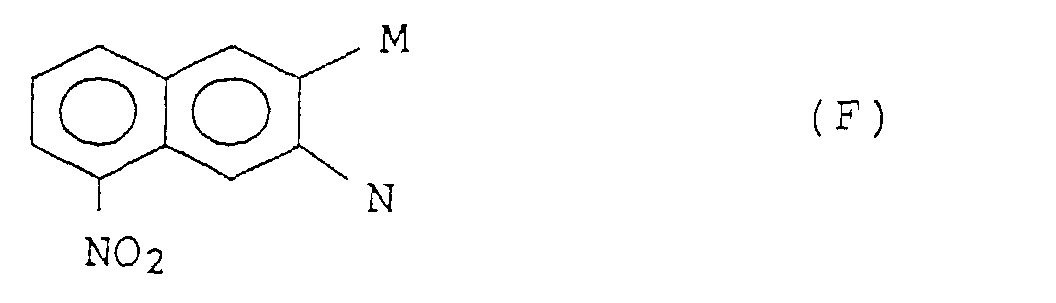
- the starting material is converted into a nitronaphthalene compound of the formula F: wherein M and N individually represent a hydroxyl or C 1 - C 5 alkoxy group, or M and N together form a methylenedioxy group.
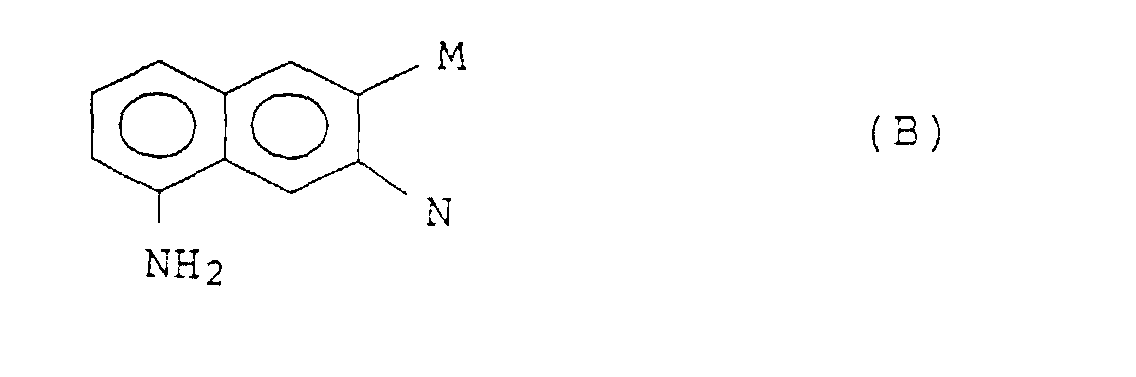
- the compound of the formula F is reduced to a compound of the formula B: wherein M and N individually represent a hydroxyl or C 1 - C 5 alkoxy group, or M and N simultaneously represent a hydrogen atom or together form a methylenedioxy group.
- the 5-amino naphthalene, a compound of the formula B is a known compound and is commercially available (Merck Index, 10 , 6250).
- the naphthylamine of formula B is condensed with 2-(protected hydroxy)-3-methoxy-6-halogenobenzaldehyde under dehydration conditions to form a condensation product which is a Schiff's base. Thereafter, the Schiff's base is selectively reduced so as to obtain the compound of formula C.
- such compounds may be prepared by a process, wherein 2,3-dihydroxy-5-nitronaphthalene is dissolved in a non-aqueous polar solvent such as dimethyl formamide or the like, and then alkylated by reacting with an alkyl halide such as methyl iodide, ethyl iodide, isopropyl bromide or the like, in the presence of an alkaline catalyst, for instance, Li 2 CO 3 or K 2 CO 3 at a temperature of from 50 to 100°C for 10 to 20 hours.
- a non-aqueous polar solvent such as dimethyl formamide or the like
- Compounds of the general formula B can be obtained by reducing the nitro group of compounds, having the general formula F, to an amino group.
- a preferred method comprises heating the reactant in ethanol in the presence of a 5 or 10% palladium/carbon catalyst under reflux.
- 2,3-methylenedioxy-5-aminonaphthalene may also be obtained by a known process described in J. Org. Chem., 53, 1708 (1988), although said known process has many steps, and produces the aimed compound in a low yield.
- Chem., 53, 1708(1988)) by heating the reactants in toluene or benzene to a temperature of from 80 to 110°C for 1-3 hours and then by concentrating the reaction mixture in such a manner that the water, which has been produced as by-product by the condensation of the amino group with the aldehyde group, is effectively removed from the reaction system by an azeotropic distillation with toluene or benzene. It is preferred that, after the concentration, the resulting residue is admixed with fresh toluene or benzene, and then again subjected to a heating/concentration operation. By repeating 2-4 times the heating/concentration operation, it is possible to obtain a dehydrated condensate product (Schiff's base) in a substantially quantitative yield.
- the double bond of the condensed portion of the dehydrated condensate product is subjected to a reducing reaction to form the aimed compounds of the general formula C.
- a reducing reaction use may be made of any reducing agents which can reduce a CN double bond.
- this reaction is performed in the presence of sodium cyanoborohydride or dimethylamine borone as reducing agent at a low reaction temperature of from -10 to 40°C.
- a compound of the general formula C is subjected to a ring closure reaction (condensation reaction by elimination of hydrogen halide) in the presence of organic tin hydrides in an organic solvent.
- organic tin hydrides are tri-hydrocarbon (C 1 -C 6 )tin hydrides, e.g. triphenyltin hydride, tri-n-butyltin hydride, triethyltin hydride or trimethyltin hydride, or di-hydrocarbon (C 1 -C 6 )tin hydrides e.g. diphenyltin hydride or di-n-butyltin hydride.
- tri-n-butyltin hydride is more preferable, and usually used.
- an organic solvent preferably C 6 -C 10 hydrocarbon solvent, for example toluene, xylene or benzene, and preferably admixed with a radical reaction initiator such as 2,2'-azobis(isobutyronitrile), 2,2'-azobis(2-methylbutyronitrile), 2,2'-azobis(2,4-dimethylvaleronitrile), benzoyl peroxide or the like.
- the reaction mixture is heated to a temperature of from 60 to 150°C, preferably 80 to 130°C for 2 minutes to 4 hours, preferably 5 minutes to 1 hour to complete the ring closure reaction. Thereafter, preferably without separating the condensation product from reaction mixture, an oxidative aromatization reaction of the closed ring is carried out in the presence of an oxidizing agent at a temperature between 0 and 100°C preferably 10 and 40°C for 1 to 120 minutes, preferably 5 to 50 minutes, to obtain the compound of the general formula D.
- oxidizing agents can be used for this reaction, and include, for example, manganese dioxide, lead tetraacetate, mercury acetate and dichloro dicyanobenzoquinone (DDQ), preferably active manganese dioxide.
- DDQ dichloro dicyanobenzoquinone
- any kinds of protective groups for hydroxyl groups may be employed without any specific limitations, for example, acyl (C 2 -C 8 ) groups such as acetyl and benzoyl, and C 1 -C 6 alkyl carbonyl and C 3 -C 10 hydrocarbon groups such as branched alkyl (C 3 -C 6 ) groups and substituted or unsubstituted benzyl.
- the preferable protective groups are benzyl series protective groups such as substituted or unsubstituted benzyl groups, or branched alkyl (C 3 -C 5 ) groups.
- a benzo[c]phenanthridine compound of the general formula D is subjected to an N-alkylation reaction, then the protective groups are removed from the compound, and thereafter an acid treatment is conducted to produce a benzo[c]phenanthridinium derivative of the general formula A'.
- the compound of the general formula D and an alkylating agent may be dissolved in an organic solvent, for example, C 6 -C 10 hydrocarbon solvent such as dry toluene, dry benzene, dry xylene or the like, or may be used in the absence of any solvents.
- organic solvent for example, C 6 -C 10 hydrocarbon solvent such as dry toluene, dry benzene, dry xylene or the like, or may be used in the absence of any solvents.
- organic solvent for example, C 6 -C 10 hydrocarbon solvent such as dry toluene, dry benzene, dry xylene or the like, or may be used in the absence of any solvents.
- organic solvent for example, C 6 -C 10 hydrocarbon solvent such as dry toluene, dry benzene, dry xylene or the like, or may be used in the absence of any solvents.
- salts such as alkalimetal halogenides or carbonates, preferably potassium bromide, anhydr
- the reaction temperature is usually 50° to 180°C, preferably 100 to 150°C.
- the reaction time is usually 1-24 hr, preferably 2 to 10 hr.
- alkylating agents for the above reaction use may be made of any of conventional agents customarily employed for N-alkylation reactions of pyridine rings.
- preferred alkylating agents include (C 1 -C 4 )alkyl sulfonates used for an alkylation such as C 1 - C 5 alkyl substituted benzensulfonates (for example, C 1 - C 5 alkyl p-toluenesulfonates, and more highly reactive agents such as C 1 - C 5 alkyl 2,4-dinitro-benzenesulfonates and C 1 - C 5 alkyl 2-nitrobenzenesulfonates) or C 1 - C 5 alkyl trihalogenomethane sulfonates.
- the alkylating agents are, for example, methyl p-toluensulfonate, ethyl 2,4-dinitrobenzenesulfonate, methyl 2-nitrobenzenesulfonate, n-propyl 2-nitrobenzenesulfonate and methylirifluoromethane sulfonate.
- the protective group removal operation is carried out in consideration of the kinds of the protective groups to be removed. For instance, in the case of benzyl series protective groups or isopropyl group, such groups may be removed by heating at 60° to 150°C, preferably 80 to 120°C under acidic conditions, e.g. in the presence of concentrated hydrochloric acid.
- the reaction time is usually 0.1 to 10 hr preferably 0.5 to 3 hr.
- an acid treatment of the compound is carried out, for instance, in a manner, wherein the compound is dissolved in a small amount of a polar solvent such as methanol or the like, and then admixed with an acid, for example, hydrochloric acid, sulfuric acid or p-toluenesulfonic acid diluted with water.
- a polar solvent such as methanol or the like
- an acid for example, hydrochloric acid, sulfuric acid or p-toluenesulfonic acid diluted with water.
- the pH of the solution must be below pH 4.
- An amount of an acid is usually about 1 to 3 mols per 1 mol of the compound.
- an organic solvent such as acetone, which is highly miscible with water, is added to the reaction solution to form salts as precipitates, and the reaction solution is dried, so that the compound of the general formula A' is obtained as yellow powder.
- the compounds according to the invention have characteristic chemical properties as explained below.
- benzo[c]phenanthridinium derivatives of the general formula A When the benzo[c]phenanthridinium derivatives of the general formula A is treated with a base, then compound will release 1 equivalent of the acid from the molecule. Therefore, it is considered that the compound may also have a form with an intramolecular zwitterion structure represented by the following formula E: wherein M and N individually represent a hydroxyl or C 1 - C 5 alkyl group, or M and N simultaneously represent a hydrogen atom or together form a methylenedioxy group; and R represents a C 1 - C 5 alkyl group.
- the compounds of the general formula E may also be treated with acids to convert them into the compounds of the general formula A'.
- the quaternary salt structure represented by the general formula A' is present in the solution having below pH about 4, while the intramolecular salt structure represented by the general formula E is present in the solution having higher than pH about 4. Therefore, the compound of formula A' can be obtained when the compound is precipitated from the solution of which the pH is below about 4.
- the acidic salts i.e. hydrogen salts: X - represents hydrogen acid residue
- protons hydrogen atoms
- the hydrogen sulfate salt compound has a lower pH, and therefore it is recognized that said compound has a higher resistance to foreign basic materials and is more stable accordingly.
- There are no disadvantages in the pharmaceutical activities of such compounds when they have the form of hydrogen salts such as hydrogen sulfate salts. Therefore, the hydrogen salt compounds are practically useful as medicines in view of the enhanced stability thereof.
- the benzo[c]phenanthridinium derivatives according to the invention have a growth inhibition activity against various cultured tumor cells as shown below. Furthermore, the derivatives also have an activity for inhibiting a blood platelet aggregation caused by platelet activation factors.
- Various tumor cells were cultured at 37°C for 24 hours in 5% gaseous carbon dioxide, and then subjected to an action of a test drug for 2-4 days. After that, the cells were stained with 0.05% Methylene Blue. The pigment were extracted from the stained cells. The growth inhibition rate of the cells was determined based on absorbance of the extracted pigment at 660 nm, and the 50% growth inhibitory concentration (IC 50 ) was calculated. The test results are shown in Table 4.
- HeLa S3 carcinoma colli
- MMI ovarian cancer
- SHIN-3 ovarian cancer
- N-231 small cell lung cancer
- Lu-130 small cell lung cancer
- Nakajima gastric cancer
- the expression "n.t.” represents "not tested”.
- Platelet-rich plasma PRP was collected from Japanese albino rabbits (weighing 3-4 kg). As a platelet aggregation inducer, platelet activation factor (PAF) was used in a final concentration of 10 -7 M. A test drug was added to PRP. After incubation for a definite period of time, PAF was added to cause a platelet aggregation reaction. The reaction was terminated with EDTA. After a centrifugation, the supernatant was removed to obtain platelet precipitates.
- PAF platelet activation factor
- Test drug Compound No.
- Concentration ( ⁇ g/ml) Inhibition rate %)
- A-1 (X - HSO 4 - ) 100 96.5 50 74.1 25 49.6 12.5 25.2
- A-4 (X - HSO 4 - ) 100 46.4 50 26.5 25 10.9
- test drugs showed a potent inhibition activity on platelet aggregation.
- the compounds according to the invention were intravenously administered to female CDF 1 mice of 6 weeks age. The mice survived in a dose of 100 mg/kg without showing any lethal toxicity.
- the benzo[c]phenanthridinium derivatives of the general formula A' according to the invention When used as drugs, then these compounds may be formulated into pharmaceutical preparations, and such preparations may be applied in various conventional manners. That is, the preparations may be applied parenterally, orally, intrarectally, etc.
- the preparations may take the form of an injection, a powder, a granulate, a tablet, a suppository, etc.
- auxiliary agents for drugs namely, carrier and other aids, for example, a stabilizer, an antiseptic, a pain killer, an emulsifying agent, etc. may be used, if necessary and desired.
- the content of the benzo[c]phenanthridinium derivatives, having the general formula A' may be varied over a wide range depending upon the form of preparations.
- the compositions may contain the derivatives of the general formula A' in an amount of from 0.01 to 100% by weight, preferably from 0.1 to 50% by weight.
- the balance is a carrier and other auxiliary agents used for conventional pharmaceutical compositions.
- a dose of the benzo[c]phenanthridinium derivatives, having the general formula A, varies depending on conditions of patients, but generally is approximately 50 to 500 mg per day for adult.
- the benzo[c]phenanthridinium derivatives of the general formula A' according to the invention have not only an antitumor activity against various tumor cells, but also an inhibition activity on platelet aggregation, the latter activity being considered to have a relation with an activity for inhibiting a metastasis of cancer. So, it is expected that the compounds according to the invention may be effectively used as drugs for the treatment of cancer.
- the compounds according to the invention are used in the form of salts, it is advantageous to use hydrogen salts of the compounds for the reason that the hydrogen salts of the compounds serve to enhance the stability of pharmaceutical preparations containing the compounds.
- the extract solution was dried over anhydrous sodium sulfate, filtered, and concentrated.
- the resultant residue was recrystallized from ethyl acetate, so that 10.7 g of the first crystals and 1.82 g of the second crystals were obtained.
- the mother liquor was concentrated and refined by a silica gel column chromatography, wherein use was made, as eluent, of a petroleum ether-ethyl acetate mixture (9:1), whereby 2.00 g of the crystalline material was obtained.
- the total amount of compound 1 formed was 14.55 g (yield: 71%).
- Compound 1 yellow powder.
- IR(KBr), (cm -1 ) 3032, 3004, 2964, 2944, 2910, 2875, 2840, 1640, 1616, 1595, 1578, 1533, 1495, 1460(vs), 1440(s), 1394, 1378, 1358, 1324, 1284(s), 1277(s), 1251(s), 1223, 1202(s), 1169, 1136, 1112, 1081(s), 1040(s), 991, 968, 958, 949, 920, 904, 875, 850, 845, 830, 795, 759, 750, 697, 686, 667.
- reaction mixture was admixed with 5 ml of acetic acid and 2.5 ml of concentrated hydrochloric acid, and heated to 100°C for 2 hours. After that, the reaction mixture was diluted with water, and neutralized by portionwise adding sodium hydrogen carbonate. The reaction mixture was extracted with methylene chloride, dried over anhydrous sodium sulfate, filtered and concentrated. Then the reaction mixture was subjected to a silica gel column chromatography, wherein use was made, as eluant, of a methylene chloride-methanol mixture (9:1). The fractions, which contained a pure compound E-0, were collected and concentrated.
- the concentrated product, containing compound E-0 was gradually added to a dilute aqueous sulfuric acid solution containing 5 ml of a 0.5 M aqueous sulfuric acid solution, 25 ml of water and ice.
- the resulting mixture was concentrated, and then admixed with 5 ml of fresh water to dissolve a large portion of compound A-0 in the water.
- the aqueous solution thus obtained was gradually admixed with 200 ml of acetone to form a yellow precipitate, which was then separated by filtration, and dried in vacuum, whereby 750 mg of compound A-0 was obtained (yield: 71.2%).
- the chloroform extract layer was dried over anhydrous sodium sulfate, filtered, and concentrated under reduced pressure.
- the resultant residue was refined by a silica gel chromatography, wherein use was made, as eluant, of a chloroform-methanol mixture (9:1).
- the main fractions were collected and concentrated to obtain a dark violet solid material, which was compound E-7 having a structure represented by the general formula E.
- compound E-7 was dissolved in a small amount of methanol, and the solution thus obtained was acidified by portionwise adding thereto a dilute aqueous solution of sulfuric acid in an amount of from 1.0 to 2.0 mol per 1 mol of the compound, so that the color of the solution of the compound was changed into yellow or orange.
- the starting material used here was compound E-8 prepared according to a method described in J. Org. Chem., 53 , 1708-1713 (1988).
- Compound E-8 was subjected to a reaction operation to form compound A-4, in a manner similar to that of Example 2 directed to the conversion of compound E-1 into the corresponding hydrogen sulfate salt.
- Compound A-4 was obtained in a yield of 99.0%.
- Compound A-4: yellow powder (X - HSO 4 - ).
Landscapes
- Chemical & Material Sciences (AREA)
- Organic Chemistry (AREA)
- Health & Medical Sciences (AREA)
- General Health & Medical Sciences (AREA)
- Veterinary Medicine (AREA)
- Medicinal Chemistry (AREA)
- Nuclear Medicine, Radiotherapy & Molecular Imaging (AREA)
- Pharmacology & Pharmacy (AREA)
- Life Sciences & Earth Sciences (AREA)
- Animal Behavior & Ethology (AREA)
- Chemical Kinetics & Catalysis (AREA)
- Public Health (AREA)
- General Chemical & Material Sciences (AREA)
- Engineering & Computer Science (AREA)
- Bioinformatics & Cheminformatics (AREA)
- Diabetes (AREA)
- Hematology (AREA)
- Pharmaceuticals Containing Other Organic And Inorganic Compounds (AREA)
- Other In-Based Heterocyclic Compounds (AREA)
- Nitrogen Condensed Heterocyclic Rings (AREA)
- Organic Low-Molecular-Weight Compounds And Preparation Thereof (AREA)
Description
- The present invention relates to benzo[c]phenanthridinium derivatives of the general formula A', which have antitumor activities and blood platelet aggregation inhibition activities and therefore may be expected as useful medicines. The invention also relates to a pharmaceutical composition containing said derivatives as effective ingredients.
- Nowadays, alkylating agents, nucleic acid metabolism antagonists, antibiotics, plant alkaloids and the like have been used as chemotherapeutic drugs for patients with cancers.
- It is also known that a thrombosis is caused by the cohesion and the coagulation of blood platelets, and has a relation with cerebral infarcts, cardiac disorders, cancerous DIC, etc., and also with a metastasis of cancers.
- 2,3-(methylenedioxy)-5-methyl-7-hydroxy-8-methoxy-benzo[c]phenanthridinium chloride or iodide is a known compound described in Chem. Pharm. Bull., 33, 1763 (1985). It is also known from the disclosures of Japanese Patent Application KOKAI Nos. 2-243628 and 3-184916 that this compound has blood platelet aggregation inhibition activities and antitumor activities. Furthermore, Chem. Pharm. Bull., 33, 1763 (1985) describes a method for preparing the compound, wherein use is made of berberine as the starting material, which is treated in more than ten steps to obtain the aimed compound.
- Furthermore, 5-methyl-7-hydroxy-8-methoxy-benzo[c]phenanthridinium chloride or hydroxide having the general formula A, wherein M and N each are a hydrogen atom and X- is Cl- or OH-, is a known compound described in J. Org. Chem., 53, 1708-1713 (1988).
- EP-A-0 432 630 published on 19.06.91 discloses 7-hydroxy-8-methoxy-5-methyl-2,3-methylenedioxybenzo[c]phenanthridinium acid quaternary salts useful as antifumor agents.
- The present inventors have made many studies on benzo[c]phenanthridinium derivatives having the general formula A':wherein M and N individually represent a hydroxyl of a C1 - C5 alkoxy group, or M and N simultaneously represent a hydrogen atom or together form a methylenedioxy group; X- represents HSO4 - or H2PO4 - ; and R represents a C1 - C5 alkyl group.

- It has been found that these novel benzo[c]phenanthridinium derivatives have antitumor activities and blood platelet aggregation inhibition activities. The stability of the compounds according to the invention is increased due to their conversion into their HSO4 - or H2PO4 --salts so that such hydrogen salts of the compounds have a merit in preparing pharmaceutical formulation thereof.
- Therefore, the invention relates to a benzo[c]phenanthridinium derivative having the general formula A':wherein
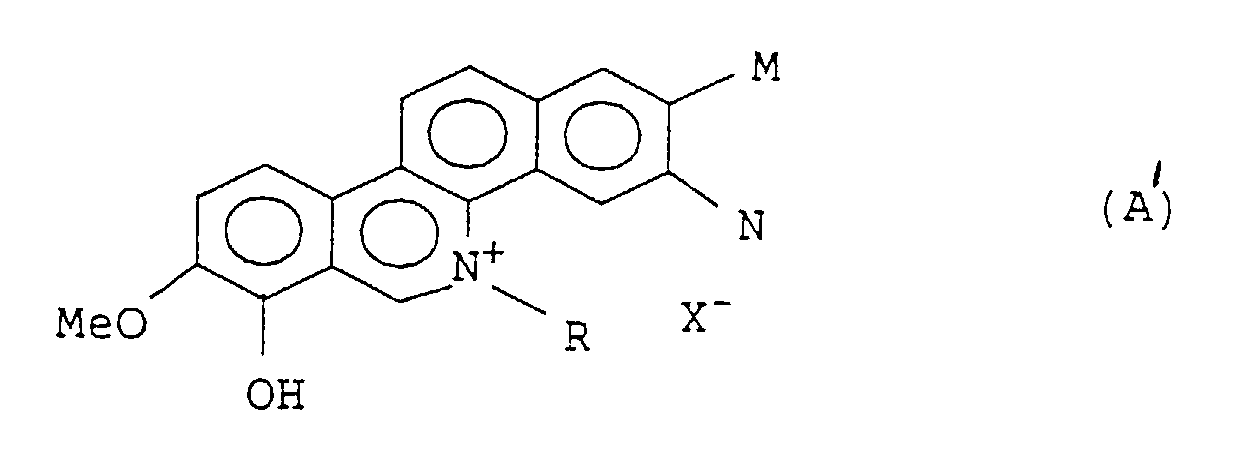
- M and N individually represent a hydroxyl or C1 - C5 alkoxy group, or M and N simultaneously represent a hydrogen atom or together form a methylenedioxy group;
- X- represents HSO4 - or H2PO4 -
; and R represents a C1 - C5 alkyl group. These compounds
can be obtained according to a method, wherein a compound of the general formula C:
wherein
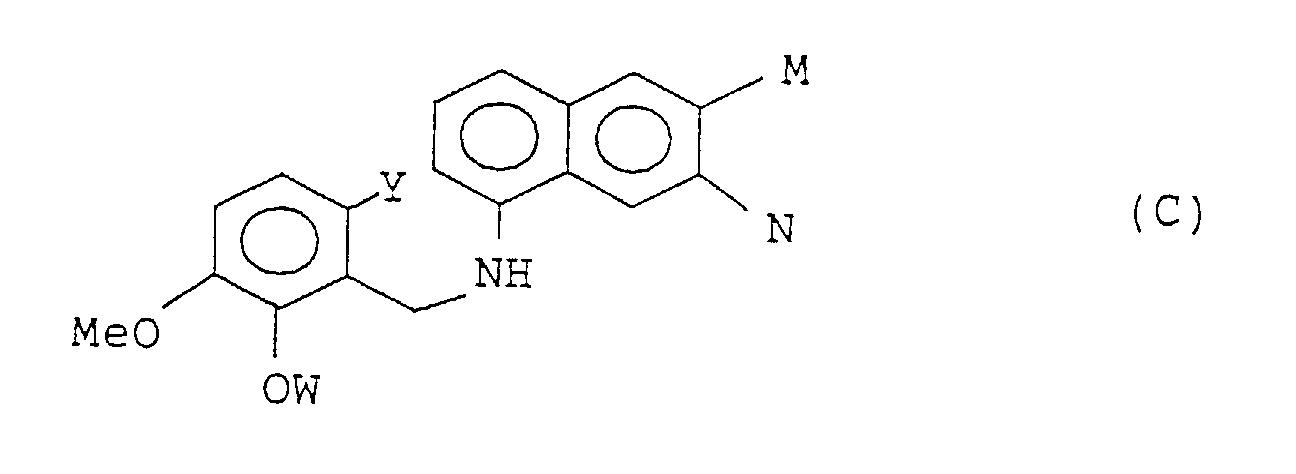
- M and N individually represent a hydroxyl or C1 - C5 alkoxy group, or M and N simultaneously represent a hydrogen atom or together form a methylenedioxy group;
- Y represents a halogen atom; and W represents a
protective group, is subjected to a ring closure
reaction in the presence of an organic tin compound, and
then to an oxidative aromatization reaction to obtain a
compound of the general formula D.
wherein

- M and N individually represent a hydroxyl or C1 - C5 alkoxy group, or M and N simultaneously represent a hydrogen atom or together form a methylenedioxy group;
- and W represents a protective group, and
- that the compound D thus formed is reacted with an N-alkylating agent to effect an N-alkylation of said compound; and
- that the N-alkylated compound thus formed is subjected to a protective group-removing operation and treated with H2SO4 or H3PO4 to form the aimed salt type product.
-
- The invention also provides a pharmaceutical composition for the use as an antitumor agent comprising, as effective ingredient, a benzo[c]phenanthridinium derivative of the general formula A':wherein

- M and N individually represent a hydroxyl or C1 - C5 alkoxy group, or M and N simultaneously represent a hydrogen atom or together form a methylenedioxy group;
- X- represents HSO4- or H2PO4 - ; and R represents a C1 - C5 alkyl group.
-
- The above-defined hydrogen salts according to the invention have excellent stability, and therefore they have an advantage in formulating a pharmaceutical preparations thereof.
- As examples of C1 - C5 alkoxy groups, there may be mentioned methoxy, ethoxy, n-propoxy, i-propoxy, n-butoxy, i-butoxy, t-butoxy and pentoxy groups and the like. Preferred are C1-C3 alkoxy groups such as methoxy, ethoxy, n-propoxy and i-propoxy groups. Examples of C1 - C5 alkyl groups are methyl, ethyl, n-propyl, i-propyl, n-butyl, i-butyl, t-butyl and pentyl groups, etc. Preferred are C1-C3 alkyl groups such as methyl, ethyl, n-propyl and i-propyl groups.
- The compounds of the general formula C are novel compounds and may be prepared for instance, in a manner shown below.
- The starting material is 2,3-dihydroxy-5-nitronaphthalene which is a known compound [Collection Czechoslovak. Chem. Commun., 53, 3184 (1988)]. The starting material is converted into a nitronaphthalene compound of the formula F:wherein M and N individually represent a hydroxyl or C1 - C5 alkoxy group, or M and N together form a methylenedioxy group.
- Then, the compound of the formula F is reduced to a compound of the formula B:wherein M and N individually represent a hydroxyl or C1 - C5 alkoxy group, or M and N simultaneously represent a hydrogen atom or together form a methylenedioxy group. The 5-amino naphthalene, a compound of the formula B, is a known compound and is commercially available (Merck Index, 10, 6250).
- The naphthylamine of formula B is condensed with 2-(protected hydroxy)-3-methoxy-6-halogenobenzaldehyde under dehydration conditions to form a condensation product which is a Schiff's base. Thereafter, the Schiff's base is selectively reduced so as to obtain the compound of formula C.
- Next, a more detailed explanation will be made on the process mentioned above.
- Compounds of the general formula F, wherein M and N together form a methylenedioxy group, can be produced by a process, wherein 2,3-dihydzoxy-5-nitronaphthalene is dissolved in a non-aqueous polar solvent such as dimethyl formamide or the like, and then reacted under heating at a temperature of from 60 to 110°C with a dihalogenomethane, preferably dichloromethane or dibromomethane, in the presence of a fluoride salt, preferably cesium fluoride or potassium fluoride as catalyst, to obtain 2,3-(methylenedioxy)-5-nitronaphthalene (compound 1).
- In the case of compounds of the general formula F, wherein M and N individually represent a hydroxyl or C1 - C5 alkoxy group, such compounds may be prepared by a process, wherein 2,3-dihydroxy-5-nitronaphthalene is dissolved in a non-aqueous polar solvent such as dimethyl formamide or the like, and then alkylated by reacting with an alkyl halide such as methyl iodide, ethyl iodide, isopropyl bromide or the like, in the presence of an alkaline catalyst, for instance, Li2CO3 or K2CO3 at a temperature of from 50 to 100°C for 10 to 20 hours. When 1 mol of alkyl halide is reacted with the 2,3-dihydroxy-5-nitronaphthalene, two kinds of monoalkoxy compounds will be obtained. For the production of dialkoxy compounds, use should preferably be made of at least 2 mol of alkyl halides. If it is desired to produce a C1 - C5 alkoxy-substituted compound, wherein N and M are different from each other, then a process may be conducted, wherein a monoalkoxy compound, which has been isolated by means of a fractionation, is further reacted with an alkyl halide.
- Compounds of the general formula B can be obtained by reducing the nitro group of compounds, having the general formula F, to an amino group. For carrying out this reaction, it is possible to use any reducing agents customarily employed in reducing a nitro group to an amino group. A preferred method comprises heating the reactant in ethanol in the presence of a 5 or 10% palladium/carbon catalyst under reflux.
- 2,3-methylenedioxy-5-aminonaphthalene may also be obtained by a known process described in J. Org. Chem., 53, 1708 (1988), although said known process has many steps, and produces the aimed compound in a low yield.
- For this synthesis naphthylamine compounds of the general formula B are reacted with 2-(protected oxy)-3-methoxy-6-halogenobenzaldehyde (which can be produced by a known method described, for instance, in J. C. S. Perkin I, 1221 (1976) and J. Org. Chem., 53, 1708(1988)) by heating the reactants in toluene or benzene to a temperature of from 80 to 110°C for 1-3 hours and then by concentrating the reaction mixture in such a manner that the water, which has been produced as by-product by the condensation of the amino group with the aldehyde group, is effectively removed from the reaction system by an azeotropic distillation with toluene or benzene. It is preferred that, after the concentration, the resulting residue is admixed with fresh toluene or benzene, and then again subjected to a heating/concentration operation. By repeating 2-4 times the heating/concentration operation, it is possible to obtain a dehydrated condensate product (Schiff's base) in a substantially quantitative yield.
- Then, the double bond of the condensed portion of the dehydrated condensate product is subjected to a reducing reaction to form the aimed compounds of the general formula C. In carrying out the reducing reaction, use may be made of any reducing agents which can reduce a CN double bond. Preferably, this reaction is performed in the presence of sodium cyanoborohydride or dimethylamine borone as reducing agent at a low reaction temperature of from -10 to 40°C.
- Next, the detailed processes are explained.
- A compound of the general formula C is subjected to a ring closure reaction (condensation reaction by elimination of hydrogen halide) in the presence of organic tin hydrides in an organic solvent. The preferable organic tin hydrides are tri-hydrocarbon (C1-C6)tin hydrides, e.g. triphenyltin hydride, tri-n-butyltin hydride, triethyltin hydride or trimethyltin hydride, or di-hydrocarbon (C1-C6)tin hydrides e.g. diphenyltin hydride or di-n-butyltin hydride. In general, tri-n-butyltin hydride is more preferable, and usually used. In carrying out this reaction, 1-6 equivalents, preferably 2-3 equivalents of organic tin hydride are dissolved in an organic solvent, preferably C6-C10 hydrocarbon solvent, for example toluene, xylene or benzene, and preferably admixed with a radical reaction initiator such as 2,2'-azobis(isobutyronitrile), 2,2'-azobis(2-methylbutyronitrile), 2,2'-azobis(2,4-dimethylvaleronitrile), benzoyl peroxide or the like. The reaction mixture is heated to a temperature of from 60 to 150°C, preferably 80 to 130°C for 2 minutes to 4 hours, preferably 5 minutes to 1 hour to complete the ring closure reaction. Thereafter, preferably without separating the condensation product from reaction mixture, an oxidative aromatization reaction of the closed ring is carried out in the presence of an oxidizing agent at a temperature between 0 and 100°C preferably 10 and 40°C for 1 to 120 minutes, preferably 5 to 50 minutes, to obtain the compound of the general formula D.
- Various oxidizing agents can be used for this reaction, and include, for example, manganese dioxide, lead tetraacetate, mercury acetate and dichloro dicyanobenzoquinone (DDQ), preferably active manganese dioxide.
- By the above-mentioned reactions, the skeletons of benzo[c]phenanthridine will be formed.
- As the halogen atom in the general formula C, use is generally made of a bromine atom. Referring to the protective groups W in the general formulas C and D, any kinds of protective groups for hydroxyl groups may be employed without any specific limitations, for example, acyl (C2-C8) groups such as acetyl and benzoyl, and C1-C6 alkyl carbonyl and C3-C10 hydrocarbon groups such as branched alkyl (C3-C6) groups and substituted or unsubstituted benzyl. The preferable protective groups are benzyl series protective groups such as substituted or unsubstituted benzyl groups, or branched alkyl (C3-C5) groups.
- A benzo[c]phenanthridine compound of the general formula D is subjected to an N-alkylation reaction, then the protective groups are removed from the compound, and thereafter an acid treatment is conducted to produce a benzo[c]phenanthridinium derivative of the general formula A'.
- In effecting the N-alkylation, the compound of the general formula D and an alkylating agent may be dissolved in an organic solvent, for example, C6-C10 hydrocarbon solvent such as dry toluene, dry benzene, dry xylene or the like, or may be used in the absence of any solvents. These reactants are heated in the absence of catalysts or in the presence of salts such as alkalimetal halogenides or carbonates, preferably potassium bromide, anhydrous potassium carbonate, anhydrous sodium carbonate and the like.
- The reaction temperature is usually 50° to 180°C, preferably 100 to 150°C. The reaction time is usually 1-24 hr, preferably 2 to 10 hr.
- As the alkylating agents for the above reaction, use may be made of any of conventional agents customarily employed for N-alkylation reactions of pyridine rings. Examples of preferred alkylating agents include (C1-C4)alkyl sulfonates used for an alkylation such as C1 - C5 alkyl substituted benzensulfonates (for example, C1 - C5 alkyl p-toluenesulfonates, and more highly reactive agents such as C1 - C5 alkyl 2,4-dinitro-benzenesulfonates and C1 - C5 alkyl 2-nitrobenzenesulfonates) or C1 - C5 alkyl trihalogenomethane sulfonates. The alkylating agents are, for example, methyl p-toluensulfonate, ethyl 2,4-dinitrobenzenesulfonate, methyl 2-nitrobenzenesulfonate, n-propyl 2-nitrobenzenesulfonate and methylirifluoromethane sulfonate.
- The protective group removal operation is carried out in consideration of the kinds of the protective groups to be removed. For instance, in the case of benzyl series protective groups or isopropyl group, such groups may be removed by heating at 60° to 150°C, preferably 80 to 120°C under acidic conditions, e.g. in the presence of concentrated hydrochloric acid. The reaction time is usually 0.1 to 10 hr preferably 0.5 to 3 hr.
- After the protective groups have been removed from the compound, an acid treatment of the compound is carried out, for instance, in a manner, wherein the compound is dissolved in a small amount of a polar solvent such as methanol or the like, and then admixed with an acid, for example, hydrochloric acid, sulfuric acid or p-toluenesulfonic acid diluted with water. The pH of the solution must be below pH 4. An amount of an acid is usually about 1 to 3 mols per 1 mol of the compound. Furthermore, an organic solvent such as acetone, which is highly miscible with water, is added to the reaction solution to form salts as precipitates, and the reaction solution is dried, so that the compound of the general formula A' is obtained as yellow powder.
- If sulfuric acid is used in a molar amount 1.0-2.5 times larger than the quantitative amount, then a hydrogen sulfate salt (wherein X- is HSO4 -) will be formed. If sulfuric acid is employed in a half amount, then a normal type sulfate salt (wherein X- is 1/2 SO4 2-) will be formed (not contained in the invention).
- The compounds according to the invention have characteristic chemical properties as explained below. When the benzo[c]phenanthridinium derivatives of the general formula A is treated with a base, then compound will release 1 equivalent of the acid from the molecule. Therefore, it is considered that the compound may also have a form with an intramolecular zwitterion structure represented by the following formula E:wherein M and N individually represent a hydroxyl or C1 - C5 alkyl group, or M and N simultaneously represent a hydrogen atom or together form a methylenedioxy group; and R represents a C1 - C5 alkyl group.

- Alternatively, the compounds of the general formula E may also be treated with acids to convert them into the compounds of the general formula A'. The quaternary salt structure represented by the general formula A' is present in the solution having below pH about 4, while the intramolecular salt structure represented by the general formula E is present in the solution having higher than pH about 4. Therefore, the compound of formula A' can be obtained when the compound is precipitated from the solution of which the pH is below about 4.
- As for the stability of the salt type compounds according to the invention, the acidic salts (i.e. hydrogen salts: X- represents hydrogen acid residue), which still contain protons (hydrogen atoms), have a resistance to foreign basic materials. Therefore, the acidic salts according to the invention are more stable than the normal salts containing no protons.
- For example, even in the case of 2,3-(methylenedioxy)-5-methyl-7-hydroxy-8-methoxy-benzo[c]phenanthridinium chloride (not included in the invention) which seems to have relatively good properties (stability), there is a problem that, when it is stored at room temperature for a long period of time, it will be gradually decomposed. This compound is a powdery material having a yellowish color immediately after the production thereof. It gradually changes its color into brown. After 3 months from the production thereof, the compound has a dark blackish brown color and also has properties different from those initially observed. This is because a decomposition product, which is difficultly soluble in water, has been formed during the storage of the compound. So, it is not considered that the compound has properties suitable for formulating into a phamaceutical preparation.
- 2,3-(methylenedioxy)-5-methyl-7-hydroxy-8-ethoxy-benzo[c]phenanthridinium hydrogen sulfate (compound A-0), wherein the acid residue X- is a hydrogen sulfate ion HSO4 -, is a compound according to the invention, and can be obtained as yellow powder. When this compound is stored at room temperature for 1 month, there is no change in its color, and therefore the compound is virtually different in this point from the above-mentioned chloride compound, wherein the acid residue X- is a chloride ion Cl-. Furthermore, there are observed no color change and no decomposition in the case of the compound according to the invention having a form of yellow powder, even after it has been stored for 3 months from the production thereof. A 0.5 µM aqueous solution of 2,3-(methylenedioxy)-5-ethyl-7-hydroxy-8-methoxy-benzo[c]phenanthridinium chloride, wherein the acid residue X- is a chloride ion Cl-, has a pH of 4.3. On the other hand, a 0.5 µM aqueous solution of 2,3-(methylenedioxy)-5-methyl-7-hydroxy-8-methoxy-benzo[c]phenanthridinium hydrogen sulfate according to the invention, wherein the acid residue X- is a hydrogen sulfate ion HSO4 -, has a pH of 3.9. Thus, the hydrogen sulfate salt compound has a lower pH, and therefore it is recognized that said compound has a higher resistance to foreign basic materials and is more stable accordingly. There are no disadvantages in the pharmaceutical activities of such compounds when they have the form of hydrogen salts such as hydrogen sulfate salts. Therefore, the hydrogen salt compounds are practically useful as medicines in view of the enhanced stability thereof.
- Next, representative examples of benzo[c]phenanthridinium derivatives of the general formula A' are shown in Table 1.
Compound No. Compound A-0 2,3-(Methylenedioxy)-5-methyl-7-hydroxy-8-methoxybenzo[c]phenanthridinium salt A-1 2,3-(methylenedioxy)-5-ethyl-7-hydroxy-8-methoxybenzo[c]phenanthridinium salt A-2 2,3-(Methylenedioxy)-5-(n-propyl)-7-hydroxy-8-methoxy-benzo[c]phenanthridinium salt A-3 5-Ethyl-7-hydroxy-8-methoxy-benzo[c]phenan-thridinium salt A-4 5-Methyl-7-hydroxy-8-methoxy-benzo[c]phenan-thridinium salt - Representative examples of the intermediate compounds, having the general formula D, are shown in Table 2.
Compound No. Compound D-1 2,3-(Methylenedioxy)-7-benzyloxy-8-methoxy-benzo[c]phenanthridine D-2 2,3-(Methylenedioxy)-7-isopropoxy-8-methoxy-benzo[c]phenanthridine D-3 2,8-Dimethoxy-3-isopropoxy-7-benzyloxy-benzo[c]phenanthridine D-4 2-Isopropoxy-3,8-dimethoxy-7-benzyloxy-benzo[c]phenanthridine D-6 2,3-Diisopropoxy-7-benzyloxy-8-methoxy-benzo[c]phenanthridine D-7 7-Benzyloxy-8-methoxy-benzo[c]phenanthridine - Representative examples of the intermediate compounds, having the general formula C, are shown in Table 3.
Compound No. Compound C-1 N-[(2'-benzyloxy)-3'-methoxy-6'-bromobenzyl]-6,7-(methylenedioxy)-1-naphthylamine C-3 N-[(2'-benzyloxy)-3'-methoxy-6'-bromobenzyl]-6-methoxy-7-isopropoxy-1-naphthylamine C-4 N-[(2'-benzyloxy)-3'-methoxy-6'-bromobenzyl]-6-isopropoxy-7-methoxy-1-naphthylamine C-6 N-[(2'-benzyloxy)-3'-methoxy-6'-bromobenzyl]-6,7-diisopropoxy-1-naphthylamine C-7 N-[(2'-benzyloxy)-3'-methoxy-6'-bromobenzyl]-1-naphthylamine - Now, the Pharmaceutical Test Examples are shown. The benzo[c]phenanthridinium derivatives according to the invention have a growth inhibition activity against various cultured tumor cells as shown below. Furthermore, the derivatives also have an activity for inhibiting a blood platelet aggregation caused by platelet activation factors.
- Various tumor cells were cultured at 37°C for 24 hours in 5% gaseous carbon dioxide, and then subjected to an action of a test drug for 2-4 days. After that, the cells were stained with 0.05% Methylene Blue. The pigment were extracted from the stained cells. The growth inhibition rate of the cells was determined based on absorbance of the extracted pigment at 660 nm, and the 50% growth inhibitory concentration (IC50) was calculated. The test results are shown in Table 4.In this table, the abbreviated expressions have the following tumor cells: HeLa S3 = carcinoma colli; MMI = ovarian cancer; SHIN-3 = ovarian cancer; N-231 = small cell lung cancer; Lu-130 = small cell lung cancer; Nakajima = gastric cancer; and the expression "n.t." represents "not tested". These tests were conducted according to a simultaneous comparison test method, except the case of HeLa S3.
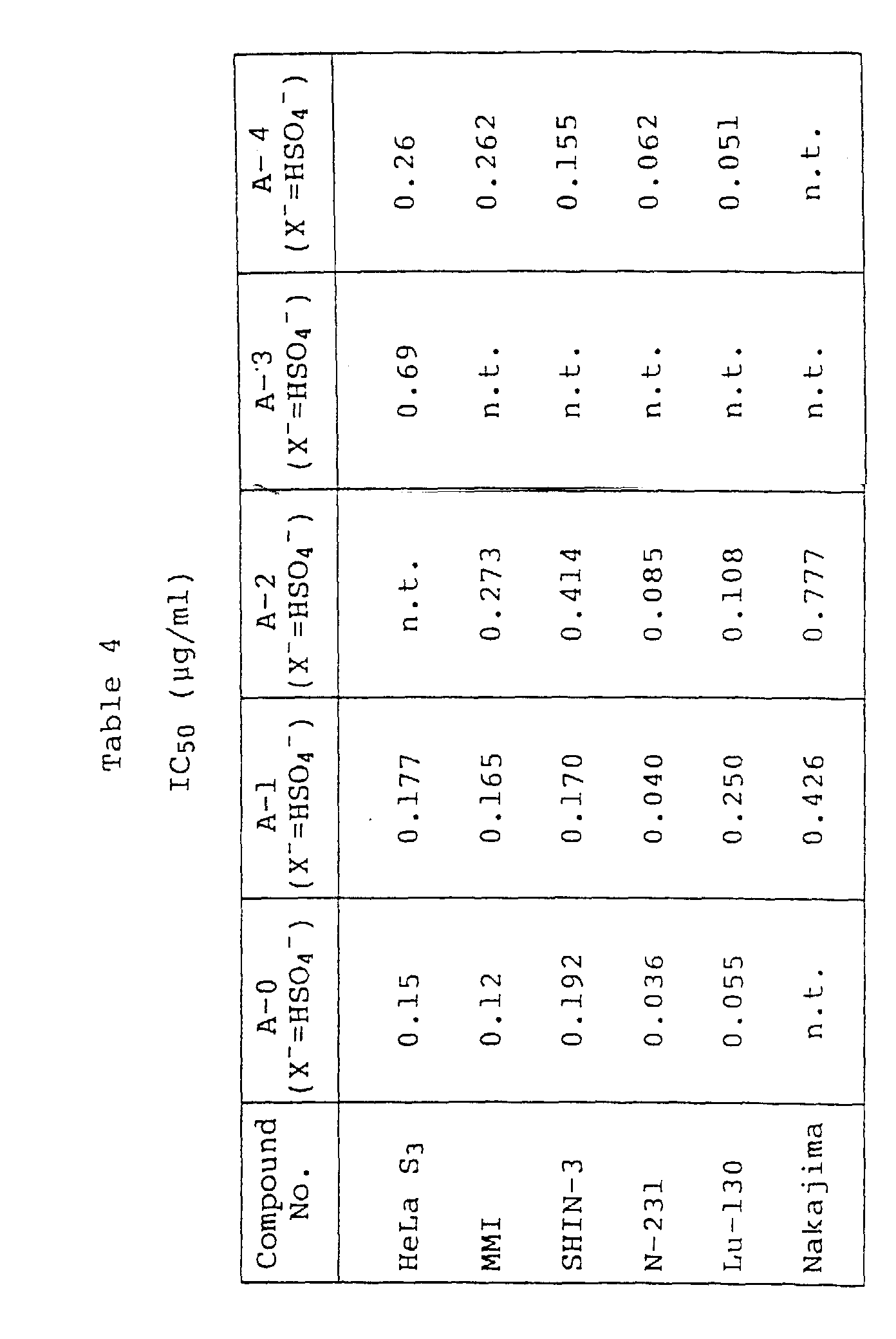
- Platelet-rich plasma (PRP) was collected from Japanese albino rabbits (weighing 3-4 kg). As a platelet aggregation inducer, platelet activation factor (PAF) was used in a final concentration of 10-7 M. A test drug was added to PRP. After incubation for a definite period of time, PAF was added to cause a platelet aggregation reaction. The reaction was terminated with EDTA. After a centrifugation, the supernatant was removed to obtain platelet precipitates. Distilled water was added to the platelet precipitates, whereby the serotonin remained in the platelet was reacted with an orthophthalaldehyde reagent to form a serotonin-orthophthaladehyde condensate. The condensate was measured at an excited wavelength of 360 nm and at a measurement wavelength of 475 nm. Anti-PAF activity of the test drug was determined by the following equation.
- The test results of several compounds are shown in Table 5.
Test drug (Compound No.) Concentration (µg/ml) Inhibition rate (%) A-1 (X-=HSO4 -) 100 96.5 50 74.1 25 49.6 12.5 25.2 A-4 (X-=HSO4 -) 100 46.4 50 26.5 25 10.9 Physiological saline - 0.0 - As is clear from Table 5, the test drugs showed a potent inhibition activity on platelet aggregation.
- In the acute toxicity test, the compounds according to the invention were intravenously administered to female CDF1 mice of 6 weeks age. The mice survived in a dose of 100 mg/kg without showing any lethal toxicity.
- When the benzo[c]phenanthridinium derivatives of the general formula A' according to the invention are used as drugs, then these compounds may be formulated into pharmaceutical preparations, and such preparations may be applied in various conventional manners. That is, the preparations may be applied parenterally, orally, intrarectally, etc. The preparations may take the form of an injection, a powder, a granulate, a tablet, a suppository, etc. In preparing the pharmaceutical compositions, a variety of auxiliary agents for drugs, namely, carrier and other aids, for example, a stabilizer, an antiseptic, a pain killer, an emulsifying agent, etc. may be used, if necessary and desired.
- In the pharmaceutical compositions, the content of the benzo[c]phenanthridinium derivatives, having the general formula A', may be varied over a wide range depending upon the form of preparations. Generally, the compositions may contain the derivatives of the general formula A' in an amount of from 0.01 to 100% by weight, preferably from 0.1 to 50% by weight. The balance is a carrier and other auxiliary agents used for conventional pharmaceutical compositions.
- A dose of the benzo[c]phenanthridinium derivatives, having the general formula A, varies depending on conditions of patients, but generally is approximately 50 to 500 mg per day for adult.
- From the test data shown above, it can be said that the benzo[c]phenanthridinium derivatives of the general formula A' according to the invention have not only an antitumor activity against various tumor cells, but also an inhibition activity on platelet aggregation, the latter activity being considered to have a relation with an activity for inhibiting a metastasis of cancer. So, it is expected that the compounds according to the invention may be effectively used as drugs for the treatment of cancer. When the compounds according to the invention are used in the form of salts, it is advantageous to use hydrogen salts of the compounds for the reason that the hydrogen salts of the compounds serve to enhance the stability of pharmaceutical preparations containing the compounds.
- Now, a detailed explanation will be made about the production of several representative benzo[c]phenanthridinium derivatives having the general formula A', by the Examples shown below. However, it should be noted that the scope of the invention is not restricted only to these Examples.
- 19.3 g (0.094 mol) of 2,3-(dihydroxy)-5-nitronaphthalene as the starting material and 71.5 g (0.47 mol) of cesium fluoride were added to 290 ml of dry dimethyl formamide. The resulting mixture was stirred to form a solution. The solution was admixed with 6.63 ml (0.103 mol) of dichloromethane, and heated to 110°C. After that, the operation of adding the same amount of dichloromethane was repeated four times at an interval of 1 hour, and then the reaction mixture was heated for 2 hours to complete the reaction. After cooling, the reaction mixture was diluted with water, and extracted with diethyl ether. The extract solution was dried over anhydrous sodium sulfate, filtered, and concentrated. The resultant residue was recrystallized from ethyl acetate, so that 10.7 g of the first crystals and 1.82 g of the second crystals were obtained. Furthermore, the mother liquor was concentrated and refined by a silica gel column chromatography, wherein use was made, as eluent, of a petroleum ether-ethyl acetate mixture (9:1), whereby 2.00 g of the crystalline material was obtained. The total amount of compound 1 formed was 14.55 g (yield: 71%).
Compound 1: yellow powder.
1H-NMR(200 MHz), DMSO-d6, ppm:
6.26 (s, 2H), 7.52 (t, J=8.0Hz, 1H), 7.58 (s, 1H), 7.74 (s, 1H), 8.55 (br d, J=8.0Hz, 2H). - 4.687 g (0.0216 mol) of compound 1 were dissolved in 200 ml of ethanol. The resulting solution was admixed with 10 ml of hydrazine hydrate and 1 g of a 5% palladium/carbon catalyst, and heated under reflex for 80 minutes. After cooling, the palladium/carbon catalyst was filtered off, and the filtrate was concentrated. The crude crystalline material thus formed was refined by a silica gel column chromatography, wherein use was made, as eluant, of a petroleum ether-ethyl acetate mixture (1:2), so that 3.566 g of compound 2 was obtained (yield: 88%).
Compound 2: light yellowish brown powder.
1H-NMR(200 MHz), DMSO-d6, ppm:
6.07 (s, 2H), 5.44 (br s, 2H), 6.54 (dd, J=7.2 & 1.5Hz, 1H), 6.92 (br d, J=8.0Hz, 1H), 7.02 (dd, J=8.0 & 7.2Hz, 1H), 7.12 (s, 1H), 7.47 (s, 1H). - 3.548 g (18.95 mmol) of compound 2 and 6.304 g (19.63 mmol) of 2-(benzyloxy)-3-methoxy-6-bromobenzaldehyde were dissolved in 100 ml of toluene. The resulting solution was heated to 110°C for 1 hour, and then concentrated under reduced pressure in a rotary evaporator. The residue thus obtained was admixed with 80 ml of fresh toluene, and the resulting mixture was heated for 1 hour, and then concentrated under reduced pressure in the same manner as above. The resultant residue (Schiff's base) was admixed with 50 ml of toluene, and cooled in an ice water bath. Then, a solution of 1.31 g (20.85 mmol) of sodium cyanoborohydride in 50 ml of methanol was dropwise added to the cooled solution under stirring over a period of 45 minutes. After 1 hour, the reaction mixture was admixed with water, and extracted with chloroform. The organic layer was dried over anhydrous sodium sulfate, then filtered and thereafter concentrated. The resulting residue was dissolved in a small amount of chloroform, and then admixed portionwise with the same quantity of petroleum ether to precipitate a crystalline material, which was then separated by filtration, and dried, so that 5.674 g of compound C-1 were obtained. The mother liquor was concentrated, and refined by a silica gel column chromatography, wherein use was made, as eluant, of a petroleum ether-chloroform-ethyl acetate mixture (16:4:1), so that 1.415 g of compound C-1 was obtained. The total amount of compound C-1 formed was 7.089 g (yield: 76%).
Compound C-1: white powder.
1H-NMR(200 MHz), CDCl3, (ppm):
3.90 (s, 3H), 4.37 (br, 1H), 4.48 (s, 2H), 5.04 (s, 2H), 5.99 (s, 2H), 6.74 (dd, J=7.4 & 1.2Hz, 1H), 6.82 (d, J=8.8Hz, 1H), 7.05 (s, 1H), 7.07 (s, 1H), 7.11 (br d, J=8.0Hz, 1H), 7.33 (d, J=8.8Hz, 1H), 7.18-7.37 (m, 6H).
IR(KBr), (cm-1):
3396, 3096, 3064, 3038, 2998, 2944, 2906, 2845, 1621, 1603, 1573, 1538(s), 1501, 1464(vs), 1435, 1400, 1393, 1371, 1316, 1285(s), 1271(s), 1251(s), 1218, 1202, 1194, 1173, 1144, 1131, 1099, 1072, 1040(s), 993, 960, 948, 916, 907, 862, 831, 795, 778, 757, 739, 687. - 463 mg of 2-methoxy-3-isopropoxy-5-naphthylamine and 707 mg of 2-(benzyloxy)-3-methoxy-6-bromobenzaldehyde were subjected to a reaction operation in a manner similar to that shown in Example 3. 970 mg of compound C-3 was obtained in a yield of 90%.
Compound C-3: white powder.
1H-NMR(200 MHz), CDCl3, (ppm):
1.36 (d, J=6.0Hz, 6H), 3.88 (s, 3H), 3.94 (s, 3H), 4.53 (s, 2H), 4.57 (septet, J=6.0Hz, 1H), 4.58 (br, 1H), 5.03 (s, 2H), 6.75 (dd, J=7.5 & 1.0Hz, 1H), 6.80 (d, J=9.0Hz, 1H), 7.08 (s, 1H), 7.09 (s, 1H), 7.13 (br d, J=7.5Hz, 1H), 7.22 (t, J=7.5Hz, 1H), 7.24-7.31 (m, 3H), 7.32 (d, J=9.0Hz, 1H), 7.34-7.41 (m, 2H). - 463 mg of 2-isopropoxy-7-methoxy-5-naphthylamine and 481 mg of 2-(benzyloxy)-3-methoxy-6-bromobenzaldehyde were subjected to a reaction operation in a manner similar to that of Example 3 to obtain 800 mg of compound C-4 (yield: 99%).
Compound C-4: white powder.
1H-NMR(200 MHz), CDCl3, (ppm):
1.43 (d, J=6.0Hz, 6H), 3.84 (s, 3H), 3.89 (s, 3H), 4.54 (s, 2H), 4.60 (br, 1F), 4.69 (septet, J=6.0Hz, 1H), 5.04 (s, 2H), 6.76 (dd, J=7.5 & 1.0Hz, 1H), 6.81 (d, J=9.0Hz, 1H), 6.97 (s, 1H), 7.105 (s, 1H), 7.113 (br d, J=7.5Hz, 1H), 7.22 (t, J=7.5Hz, 1h), 7.24-7.30 (m, 3H), 7.33 (d, J=9.0Hz, 1H), 7.32-7.41 (m, 2H). - 406 mg of 2,3-diisopropoxy-5-naphthylamine and 707 mg of 2-(benzyloxy)-3-methoxy-6-bromobenzaldehyde were subjected to a reaction operation in a manner similar to that of Example 3 to obtain 756 mg of compound C-6 (yield: 89%).
Compound C-6: white powder.
1H-NMR(200 MHz), CDCl3, (ppm):
1.32 (d, J=6.1Hz, 6H), 1.39 (d, J=6.1Hz, 6H), 3.88 (s, 3H), 4.49 (septet, J=6.1Hz, 1H), 4.51 (s, 2H), 4.55 (br, 1H), 4.61 (septet, J=6.1Hz, 1H), 5.03 (s, 2H), 6.72 (dd, J=7.5 & 1.1Hz, 1H), 6.80 (d, J=8.8Hz, 1H), 7.08-7.40 (m, 10H).
IR(KBr), (cm-1):
3420, 2978, 2936, 1626, 1595, 1581, 1522, 1468(s), 1437, 1383, 1334, 1277, 1253(s), 1215, 1182, 1159, 1139, 1112, 1079, 1012, 982, 954, 925, 860, 840, 800, 773, 735, 695. - 1.718 g of 5-naphthylamine and 4.239 g of 2-(benzyloxy)-3-methoxy-6-bromobenzaldehyde were subjected to a reaction operation in a manner similar to that of Example 3 to obtain 3.71 g of compound C-7 (yield: 62.7%).
Compound C-7: white powder.
1H-NMR(200 MHz), CDCl3, (ppm):
3.90 (s, 3H), 4.52 (s, 2H), 4.80 (br, 1H), 5.06 (s, 2H), 6.80-6.85 (m, 2H), 7.22-7.47 (m, 10H), 7.68-7.81 (m, 2H)
IR(KBr), (cm-1):
3999(s), 3070, 2944, 2856, 1626, 1581(s), 1531, 1481, 1467(s), 1432, 1410, 1372, 1355, 1336, 1296, 1272(s), 1227, 1215, 1200, 1178, 1144, 1109, 1088, 1073(s), 983, 959, 911, 865, 795, 783, 764(s), 741, 690. - 1.968 g (4 mmol) of compound C-1 and 2.91 g (10 mmol) of tributyltin hydride were dissolved in 100 ml of toluene, and the resulting solution was heated to 110°C. To this solution, 0.8 g of 2,2'-azobis(isobutyronitrile) were added. After 30 minutes, the reaction solution was cooled to room temperature, then admixed with 2 g of active manganese dioxide, and stirred for 20 minutes. Next, the manganese compound was separated off by filtration, and the filtrate was concentrated under reduced pressure. The residue thus obtained was passed through a silica gel column, wherein use was made, as eluant, of a chloroform-petroleum ether mixture (3:2). The main fractions were collected and concentrated to obtain a crude crystalline material, which was then admixed with 25 ml of ethyl acetate, and heated under shaking. This solution was gradually admixed with 200 ml of hexane, and a crystalline material thus formed was separated by filtration, washed in hexane and dried to give 1.018 g of compound D-1. Furthermore, the filtrate was concentrated, and refined by a silica gel column chromatography, wherein use was made, as eluant, of a petroleum ether-chloroform-ethyl acetate mixture (16:4:1), so that 0.183 g of compound D-1 was further obtained. The total amount of compound D-1 produced was 1.201 g (yield: 73%).
Compound D-1: light yellowish white powder.
1H-NMR(200 MHz), CDCl3, (ppm):
4.07 (s, 3H), 5.32 (s, 2H), 6.13 (s, 2H), 7.26 (s, 1H), 7.34-7.46 (m, 3H), 7.58 (dd, J=8.0 & 1.6Hz, 2H), 7.61 (d, J=9.0Hz, 1H), 7.84 (d, J=9.0Hz, 1H), 8.34 (d, J=9.0Hz, 1H), 8.36 (d, J=9.0Hz, 1H), 8.69 (s, 1H), 9.75 (s, 1H).
13C-NMR(50 MHz), CDCl3, (ppm):
50.03(q), 76.21(t), 101.62(t), 102.46(d), 104.68(d), 118.57(d), 118.69(d), 119.02(d), 120.27(s), 122.48(s), 127.40(d), 128.43(s), 128.67(d), 128.87(d)x2, 128.96(d)x2, 129.51(s), 130.11(s), 137.59(s), 140.37(s), 144.38(s), 147.22(d), 148.71(s), 148.89(s), 149.91(s).
IR(KBr), (cm-1) :
3032, 3004, 2964, 2944, 2910, 2875, 2840, 1640, 1616, 1595, 1578, 1533, 1495, 1460(vs), 1440(s), 1394, 1378, 1358, 1324, 1284(s), 1277(s), 1251(s), 1223, 1202(s), 1169, 1136, 1112, 1081(s), 1040(s), 991, 968, 958, 949, 920, 904, 875, 850, 845, 830, 795, 759, 750, 697, 686, 667. - 886 mg of compound C-3 were subjected to a reaction operation in a manner similar to that of Example 8. 512 mg of compound D-3 was obtained (yield: 68%).
Compound D-3: light yellowish white powder.
1H-NMR(200 MHz), CDCl3, (ppm):
1.54 (d, J=6.1Hz, 6h), 4.04 (s, 3H), 4.06 (s, 3H), 5.05 (septet, J=6.1Hz, 1H), 5.31 (s, 2H), 7.28 (s, 1H), 7.34-7.47 (m, 3H), 7.55-7.61 (m, 2H), 7.59 (d, J=9.0Hz, 1H), 7.86 (d, J=9.0Hz, 1H), 8.33 (d, J=9.0Hz, 1H), 8.35 (d, J=9.0Hz, 1H), 8.77 (s, 1H), 9.77 (s, 1H)
IR(KBr), (cm-1):
2976, 2938, 2838, 1618, 1576, 1525, 1509, 1479, 1461, 1434, 1411, 1389, 1372, 1351, 1324, 1282, 1265(s), 1218, 1203, 1168, 1143, 1115, 1080, 1068, 1026, 981, 953, 929, 915, 880, 856, 842, 830, 797, 759, 747, 698, 685 - 720 mg of compound C-4 were subjected to a reaction operation in a manner similar to that of Example 8. 320 mg of compound D-4 was obtained (yield: 53%).
Compound D-4: light yellowish white powder.
1H-NMR(200 MHz), CDCl3, (ppm):
1.51 (d, J=6.0Hz, 6H), 4.07 (s, 3H), 4.17 (s, 3H), 4.80 (septet, J=6.0Hz, 1H), 5.32 (s, 2H), 7.32 (s, 1H), 7.34-7.47 (m, 3H), 7.55-7.62 (m, 2H), 7.62 (d, J=9.0Hz, 1H), 7.86 (d, J=9.0Hz, 1H), 8.36 (d, J=9.0Hz, 1H), 8.39 (d, J=9.0Hz, 1H), 8.72 (s, 1H), 9.79 (s, 1H).
IR(KBr), (cm-1):
2976, 2938, 2840, 1618, 1578, 1527, 1509, 1478, 1456, 1435, 1409, 1389, 1375, 1355, 1325, 1267(s), 1220, 1191, 1177, 1163, 1140, 1112, 1083, 1067, 1021, 995, 973, 942, 911, 872, 849, 830, 804, 772, 759, 749, 698. - 692 mg of compound C-6 were subjected to a reaction operation in a manner similar to that of Example 8. 379 mg of compound D-6 was obtained (yield: 64%).
Compound D-6: light yellowish white powder.
1H-NMR (200 MHz), CDCl3, (ppm):
1.45 (d, J=6.1Hz, 6H), 1.49 (d, J=6.1Hz, 6H), 4.04 (s, 3H), 4.69 (septet, J=6.1Hz, 1H), 4.92 (septet, J=6.0Hz, 1H), 5.31 (s, 2H), 7.34-7.46 (m, 3H), 7.36 (s, 1H), 7.55-7.62 (m, 2H), 7.58 (d, J=9.0Hz, 1H), 7.83 (d, J=9.0Hz, 1H), 8.31 (d, J=9.0Hz, 1H), 8.34 (d, J=9.0Hz, 1H), 8.78 (s, 1H), 9.77 (s, 1H).
IR(KBr), (cm-1):
2976, 2932, 1617, 1576, 1527, 1507, 1463, 1439, 1413, 1385, 1373, 1355, 1323, 1265(s), 1216, 1180, 1166, 1139, 1113, 1086, 1066, 998, 952, 932, 910, 876, 856, 831, 800, 743, 697. - 3.71 g of compound C-7 were subjected to a reaction operation in a manner similar to that of Example 8. 1.387 g of compound D-7 was obtained (yield: 46%).
Compound D-7: light yellowish white powder.
1H-NMR (200 MHz), CDCl3, (ppm):
4.08 (s, 3H), 5.34 (s, 2H), 7.34-7.47 (m, 3H), 7.55-7.61 (m, 2H), 7.64 (d, J=9.0Hz, 1H), 7.61-7.71 (m, 1H), 7.71-7.81 (m, 1H), 7.97 (dd', J=8.0 & 1.3Hz, 1H), 8.00 (d, J=9.0Hz, 1H), 8.41 (d, J=9.0Hz, 1H), 8.48 (d, J=9.0Hz, 1H), 9.36 (dd, J=8.0 & 1.0Hz, 1H), 9.84 (s, 1H).
IR(KBr), (cm-1):
3025, 2985, 2925, 2870, 2830, 1617, 1574, 1525, 1464, 1442, 1425, 1355, 1332, 1291(s), 1281(s), 1261, 1236, 1204, 1177, 1154, 1138, 1079(s), 1024, 986, 958, 934, 901, 868, 843, 834, 809(s), 816, 744, 721, 695. - The following Examples relate to the production of compounds having the general formula A'. These compounds may also be present in another form represented by the general formula E. So, the physical properties of the latter isomers are also given in the Examples, as far as such data were obtained.
- 1.00 g (2.44 mmol) of compound D-1, 4.55 g (24.4 mmol) of methyl p-toluenesulfonate and 2.91 g (24.5 mmol) of KBr were sufficiently mixed with one another with the aid of a magnetic stirrer. The resulting mixture was then heated to 130°C for 5.5 hours, diluted with water, extracted with methylene chloride, dried over anhydrous sodium sulfate, filtered, and concentrated. The concentrated residual material thus obtained was again admixed with 4.55 g of methyl p-toluenesulfonate and 2.91 g of powdery KBr with the aid of a magnetic stirrer, and then heated to 130°C for 3 hours.
- Next, the reaction mixture was admixed with 5 ml of acetic acid and 2.5 ml of concentrated hydrochloric acid, and heated to 100°C for 2 hours. After that, the reaction mixture was diluted with water, and neutralized by portionwise adding sodium hydrogen carbonate. The reaction mixture was extracted with methylene chloride, dried over anhydrous sodium sulfate, filtered and concentrated. Then the reaction mixture was subjected to a silica gel column chromatography, wherein use was made, as eluant, of a methylene chloride-methanol mixture (9:1). The fractions, which contained a pure compound E-0, were collected and concentrated.
- The concentrated product, containing compound E-0, was gradually added to a dilute aqueous sulfuric acid solution containing 5 ml of a 0.5 M aqueous sulfuric acid solution, 25 ml of water and ice. The resulting mixture was concentrated, and then admixed with 5 ml of fresh water to dissolve a large portion of compound A-0 in the water. Thereafter, the aqueous solution thus obtained was gradually admixed with 200 ml of acetone to form a yellow precipitate, which was then separated by filtration, and dried in vacuum, whereby 750 mg of compound A-0 was obtained (yield: 71.2%).
Compound E-0: dark violet solid material
1H-NMR(200 MHz), DMSO-d6, (ppm):
3.76 (s, 3H), 4.41 (s, 3H), 6.25 (s, 2H), 7.04 (d, J=8.0Hz, 1H), 7.20 (d, J=8.0Hz, 1H), 7.55 (s, 1H), 7.90 (d, J=9.0Hz, 1H), 7.98 (s, 1H), 8.27 (d, J=9.0Hz, 1H), 9.02 (s, 1H).
13C-NMR(50 MHz), DMSO-d6, (ppm):
48.65(q), 55.59(q), 100.04(d), 102.29(t), 103.22(d), 105.52(d), 118.54(s), 119.13(d), 119.36(s), 120.64(s), 125.41(s), 127.04(d), 128.30(d), 131.48(s), 131.63(s), 147.90(s), 148,09(s), 151.06(d), 151.21(s), 168.30(s)
IR(KBr), (cm-1):
3050, 2964, 2910, 2834, 1625(s), 1584, 1559, 1538(s), 1511(s), 1501(s), 1474(s), 1459, 1417, 1372(s), 1336, 1287, 1256(vs), 1245(vs), 1207, 1180, 1145, 1122, 1114, 1098, 1042(s), 968, 940, 922, 891, 872, 864, 855, 828, 804, 790, 764, 745, 710, 680, 660.
Compound A-0: yellow powder (X-=HSO4 -)
1H-NMR (200 MHz), D2O, (ppm):
3.62 (s, 3H), 3.94 (br s, 3H), 5.95 (br s, 2H), 6.39 (s, 1H), 6.78 (s, 1H), 6.86 (d, J=9.OHz, 1H), 6.94 (d, J=9.0Hz, 1H), 7.02 (d, J=9.0Hz, 1H), 7.06 (d, J=9.0Hz, 1H), 8.56 (s, 1H)
13C-NMR(50 MHz), D2O, (ppm):
54.93(q), 58.96(q), 105.51(d), 106.16(t), 108.33(d), 115.55(d) & (s), 119.54(d), 121.05(s), 125.69(s), 125.81(d), 127.67(s), 131.13(s), 133.47(d), 133.90(s), 146.94(s), 147.97(s), 150.79(s), 151.54(d) & (s)
IR(KBr), (cm-1):
3476, 3040, 3010, 2950, 1628, 1603, 1585, 1549, 1493(s), 1478(s), 1466, 1447, 1415, 1373, 1353, 1338, 1297(s), 1279(s), 1260(s), 1218(s), 1191(s), 1156, 1112, 1096, 1053, 1038(s), 967, 919, 865, 847, 830, 778, 764, 751, 709. - 1.433 g (3.5 mmol) of 2,3-(methylenedioxy)-7-benzyloxy-8-methoxy-benzo[c]phenanthridine (compound D-1) was admixed with 0.906 ml (3.7 mmol) of ethyl trifluoromethanesulfonate and 10 ml of dry toluene, and heated to 100°C for 4.5 hours. Thereafter, the resultant mixture was admixed with 10 ml of acetic acid and 5 ml of concentrated hydrochloric acid, and heated to 100°C for 1 hour. After that, the reaction mixture was diluted by gradually adding the reaction mixture to ice water. The reaction mixture was then neutralized by portionwise adding sodium hydrogen carbonate. Thereafter, an extraction operation was effected with chloroform. The chloroform extract layer was dried over anhydrous sodium sulfate, filtered, and concentrated under reduced pressure. The residue thus obtained was refined by a silica gel chromatography, wherein use was made, as eluant, of a chloroform-methanol mixture (9:1). The main fractions were collected and concentrated to obtain a dark violet solid material, which was compound E-1 having a structure represented by the general formula E. Then, compound E-1 was dissolved in a small amount of methanol, and the resulting solution was acidified by gradually adding thereto a dilute aqueous sulfuric acid solution in an amount of from 1.0 to 2.0 mol per 1 mol of compound E-1. By this treatment, the color of the solution was changed into yellow or orange. Thereafter, the solution was concentrated under reduced pressure, and the concentrated aqueous solution was portionwise added with acetone under shaking to form a precipitate, which was separated by filtration and dried, so that compound A-1, wherein X- = HSO4 -, was obtained as yellow powder in an amount of 1.171 g (yield: 75.1%).
Compound E-1: dark violet solid material.
1H-NMR(200 MHz), CDCl3 + CD3OD (1:1), (ppm):
1.65 (t, J=7.2Hz, 3H), 3.95 (s, 3H), 4.83 (q, J=7.2Hz, 2H), 6.19 (s, 2H), 7.30 (s, 1H), 7.30 (d, J=8.2Hz, 1H), 7.44 (d, J=8.2Hz, 1H), 7.56 (s, 1H), 7.81 (d, J=8.9Hz, 1H), 8.18 (d, J=8.9Hz, 1H), 9.36 (s, 1H)
13C-NMR(50 MHz), CDCl3 + CD3OD (1:1), (ppm):
16.65(q), 54.90(t), 56.36(q), 102.71(d), 103.14(t), 103.54(d), 106.56(d), 119.61(d), 119.77(s), 120.94(d), 121.47(s), 127.20(s), 128.10(s), 129.37(d), 131.33(s), 132.58(s), 149.29(s), 149.71(s), 150.84(d), 152.12(s), 168.45(s).
IR(KBr), (cm-1):
2970, 2918, 1623(s), 1582, 1558, 1534(s), 1502(s), 1475(s), 1460(s), 1376(s), 1345, 1300, 1285, 1250(vs), 1189, 1142, 1115, 1099, 1036(s), 941, 864, 794, 761, 736, 707, 673, 664.
Compound A-1: yellow powder (X- = HSO4 -)
1H-NMR(200 MHz), D2O, (ppm):
1.64 (br t, J=6.3Hz, 3H), 3.63 (s, 3H), 4.27 (br m, 2H), 6.02 (br s, 2H), 6.45 (s, 1H), 6.55 (br s, 1H), 6.81 (d, J=9.0Hz, 1H), 6.95 (br, s, 2H), 7.05 (d, J=9.0Hz, 1H), 8.79 (s, 1H).
13C-NMR(50 MHz), D2O, (ppm):
19.32(q), 58.78(q), 59.43(t), 104.40(d), 105.92(t), 108.03(d), 115.24(d), 115.63(s), 119.17(d), 120.05(s), 125.49(s) & (d), 127.39(s), 130.66(s), 132.96(d), 133.33(s), 146.54(s), 147.55(s), 150.25(d), 150.59(s), 151.46(s).
IR(KBr), (cm-1):
3364, 3040, 2970, 2930, 2888, 1622, 1602, 1550, 1491(s), 1474(s), 1453, 1412, 1383, 1348, 1334, 1300, 1279(s), 1260(s), 1223(s), 1217(s), 1158, 1128, 1115, 1103, 1080, 1042(s), 942, 925, 884, 825, 771. - Compound D- 1 and n-propyl 2-nitrobenzene-sulfonate were subjected to a reaction operation in a manner similar to that of Example 14 to produce compound E-2, which was then treated with dilute sulfuric acid in the presence of methanol, whereby compound A-2, wherein X- = HSO4 -, was obtained.
Compound A-2: yellow powder (X- = HSO4 -)
1H-NMR(200 MHz), D2O, (ppm):
0.97 (br t, J=7.1Hz, 3H), 1.95 (br m, 2H), 3.79 (s, 3H), 4.22 (br m, 2H), 6.12 (br s, 2H), 6.55 (br s, 1H), 6.65 (s, 1H), 7.10 (d, J=9.0Hz, 1H), 7.16 (d, J=9.0Hz, 1H), 7.26 (d, J=9.0Hz, 1H), 7.30 (d, J=9.0Hz, 1H), 8.97 (s, 1H)
13C-NMR(50 MHz) D2O, (ppm)
l2.40(q) , 27.92(t), 59.22(q), 65.30(t), 104.49(d), 106.31(t), 108.62(d), 116.05(d), 116.30(s), 120.09(d), 120.79(s), 126.27(d), 126.40(s), 128.26(s), 131.31(s), 133.53(d), 134.08(s), 147.41(s), 148.36(s), 151.10(d), 151.27(s), 152.02(s)
IR(KBr), (cm-1):
3394, 3064, 2982, 1647, 1620, 1602, 1581, 1550, 1493(s), 1472(s), 1417, 1387, 1375, 1355, 1302(s), 1277(s), 1257(s), 1215(s), 1172(s), 1155, 1139, 1117, 1105, 1082, 1062, 1039(s), 1001, 971, 934, 926, 886, 855(s), 829, 811, 790, 759, 707 - 183 mg (0.5 mmol) of 7-benzyloxy-8-methoxybenzo[c]phenanthridine (compound D-7) were admixed with 0.13 ml (1.0 mmol) of ethyl trifluoromethanesulfonate and 0.9 ml of dry toluene, and the resulting mixture was heated to 100°C for 5 hours. After that, the mixture was admixed with 4 ml of acetic acid and 1 ml of concentrated hydrochloric acid, and heated to 100°C for 1 hour. Thereafter, the reaction mixture was gradually added to ice water. The reaction mixture thus diluted was neutralized by portionwise adding thereto sodium hydrogen carbonate, and then extracted with chloroform. The chloroform extract layer was dried over anhydrous sodium sulfate, filtered, and concentrated under reduced pressure. The resultant residue was refined by a silica gel chromatography, wherein use was made, as eluant, of a chloroform-methanol mixture (9:1). The main fractions were collected and concentrated to obtain a dark violet solid material, which was compound E-7 having a structure represented by the general formula E. Next, compound E-7 was dissolved in a small amount of methanol, and the solution thus obtained was acidified by portionwise adding thereto a dilute aqueous solution of sulfuric acid in an amount of from 1.0 to 2.0 mol per 1 mol of the compound, so that the color of the solution of the compound was changed into yellow or orange. The aqueous solution of the compound was then concentrated under reduced pressure. Acetone was added portionwise to the concentrated solution under shaking to form a precipitate, which was separated by filtration, and dried, so that the aimed compound A-3, wherein X- = HSO4 -, was obtained as yellow powder in an amount or 160 mg (yield: 79.7%).
Compound E-7: dark violet solid material.
1H-NMR (200 MHz), DMSO-d6, (ppm):
1.45 (t, J=7.1Hz, 3H), 3.78 (s, 3H), 4.82 (q, J=7.1Hz, 2H), 7.10 (d, J=8.0Hz, 1H), 7.21 (d, J=8.0Hz, 1H), 7.63-7.76 (m, 2H), 8.03 (d, J=8.8Hz, 1H), 8.08-8.14 (m, 1H), 8.32-8.41 (m, 1H), 8.40 (d, J=8.8Hz, 1H), 9.11 (s, 1H),
13C-NMR(50 MHz), DMSO-d6, (ppm):
15.96(q), 53.13(t), 55.23(q), 99.29(d), 117.77(d), 118.88(s), 120.57(d), 123.89(s), 124.56(d), 126.38(s), 126.54(s), 126.61(d), 126.68(f), 128.08(d), 128.86(d), 130.38(s), 133.47(s), 148.66(d), 151.53(s), 169.42(s).
IR(KBr), (cm-1):
3039, 2986, 2938, 2832, 1628(s), 1614(s), 1557(s), 1530(s), 1510(s), 1495, 1474, 1456, 1423, 1386, 1377(s), 1354, 1345, 1335, 1317, 1287, 1266(s), 1245(s), 1239(s), 1194, 1155, 1139, 1101(s), 1075, 1061, 1046, 977, 945, 923, 907, 871, 823, 798, 792, 774(s), 752, 691, 675.
Compound A-3: yellow powder (X- = HSO4 -)
1H-NMR(200 MHz), D2O, (ppm):
1.72 (t, J=7.0Hz, 3H), 3.56 (s, 3H), 4.52 (br q, J=7.0Hz, 2H), 6.95 & 7.05 (AB, JAB=9.2Hz, each 1H), 7.21 (br s, 2H), 7.32-7.50 (m, 2H), 7.38 (br d, J=7.9Hz, 1H), 7.59 (br d, J=7.9Hz, 1H), 8.96 (s, 1H)
13C-NMR(50 MHz) , D2O, (ppm):
19.21(q), 58.82(q), 59.83(t), 115.65(d), 116.24(s), 120.59(d), 124.28(s), 125.66(d), 127.01(s) & (d), 127.52(s), 131.05(d), 131.38(s) & (d), 132.25(d), 134.28(d), 135.72(s), 146.64(s), 147.90(s), 150.21(d)
IR(KBr), (cm-1):
3419, 3052, 1614, 1583, 1540, 1497, 1468, 1446, 1431, 1384, 1361, 1341, 1302(s), 1277(s), 1216(s), 1164, 1150, 1143, 1130, 1086, 1059, 985, 921, 854, 821, 767, 695 - The starting material used here was compound E-8 prepared according to a method described in J. Org. Chem., 53, 1708-1713 (1988). Compound E-8 was subjected to a reaction operation to form compound A-4, in a manner similar to that of Example 2 directed to the conversion of compound E-1 into the corresponding hydrogen sulfate salt. Compound A-4 was obtained in a yield of 99.0%.
Compound A-4: yellow powder (X- = HSO4 -).
1H-NMR(200 MHz), D2O, (ppm):
3.42 (s, 3H), 4.08 (s, 3H), 6.79 & 6.85 (AB, JAB=9.1Hz, each 1H), 7.03 (br s, 2H), 7.16-7.24 (m, 1H), 7.24-7.34 (m, 2H), 7.63-7.73 (m, 1H), 8.61 (s, 1H).
13C-NMR(50 MHz), D2O, (ppm):
54.98(q), 58.81(q), 115.64(d), 115.87(s), 120.58(d), 124.93(s), 125.69(d), 126.84(s), 127.36(s), 127.98(d), 131.01(d), 131.60(d) & (s), 132.41(d), 134.66(d), 136.01(s), 146.82(s), 148.09(s), 151.29(d).
IR(KBr), (cm-1):
3480, 3000, 2950, 1624, 1617, 1583, 1537, 1488, 1463, 1450, 1430, 1381, 1359, 1339, 1318, 1295(s), 1278(s), 1263, 1241, 1228(s), 1196, 1182, 1167, 1143, 1112(s), 1085, 1066, 982, 922, 914, 875, 853, 823(s), 783, 766, 751, 702, 692, 670. - 1 g of 2,3-(methylenedioxy)-5-methyl-7-hydroxy-8-methoxy-benzo[c]phenanthridinium hydrogen sulfate salt (compound A-0), wherein X- = HSO4 -, 1 g of polysolvate and 1 g of Macrogol 400 were dissolved in 100 g of distilled water for injection, to form a solution. After filtering through a membrane filter, the solution was separately charged in ampules, and lyophilized in a conventional manner to give a preparation for injection containing 50 mg of compound A-0 per ampule.
- 1 g of 2,3-(methylenedioxy)-5-ethyl-7-hydroxy-8-methoxy-benzo[c]phenanthridinium hydrogen sulfate salt (compound A-1), wherein X- = HSO4 -, 1 g of polysolvate and 1 g of Macrogol 400 were dissolved in 100 a of distilled water for injection, to form a solution. After filtering through a membrane filter, the solution was separately charged in ampoules, and lyophilized in a conventional manner to give a preparation for injection containing 50 mg of compound A-1 per ampoule.
Claims (8)
- A benzo[c] phenanthridinium derivative of the general formula A':wherein M and N individually represent a hydroxyl or a C1 - C5 alkoxy group, or M and N simultaneously represent a hydrogen atom or together form a methylenedioxy group, X- represents HSO4- or H2PO4 -, and R represents a C1 - C5 alkyl group.

- The benzo [c] phenanthridinium derivative according to claim 1 wherein the C1 - C5 alkoxy group is a selected from the group consisting of the methoxy-, the ethoxy-, the n-propoxy- and the iso-propoxy-group.
- The benzo [c] phenanthridinium derivative according to claim 1 wherein M and N together form a methylenedioxy group.
- The benzo [c] phenanthridinium derivative according to claim 3 wherein the C1 - C5 alkyl group is selected from the group consisting of the methyl-, the ethyl-, the n-propyl- and the iso-propyl-group.
- The benzo [c] phenanthridinium derivative of formula A' according to claim 1 being 2,3-(methylenedioxy)-5-methyl-7-hydroxy-8-methoxy-benzo [c] phenanthridinium hydrogen sulfate salt.
- The benzo [c] phenanthridinium derivative of formula A' according to claim 1 being 2,3-(methylenedioxy)-5-ethyl-7-hydroxy-8-methoxy-benzo [c] phenanthridinium hydrogen sulfate salt.
- The benzo [c] phenanthridinium derivative of formula A' according to claim 1 being 5-methyl-7-hydroxy-8-methoxy-benzo [c] phenanthridinium hydrogen sulfate salt.
- A pharmaceutical composition for the use as an antitumor or anti-platelet agent comprising as effective ingredient a compound according to one of the previous claims and pharmaceutically acceptable carriers and/or additives.
Applications Claiming Priority (6)
| Application Number | Priority Date | Filing Date | Title |
|---|---|---|---|
| JP299844/90 | 1990-11-07 | ||
| JP2299844A JPH04173789A (en) | 1990-11-07 | 1990-11-07 | Production of benzo(c)phenanthridinium derivative |
| JP165174/91 | 1991-06-11 | ||
| JP16517491 | 1991-06-11 | ||
| JP3165175A JPH05148239A (en) | 1991-06-11 | 1991-06-11 | Benzo(c)phenanthridinium derivative and its use |
| JP165175/91 | 1991-06-11 |
Publications (2)
| Publication Number | Publication Date |
|---|---|
| EP0487930A1 EP0487930A1 (en) | 1992-06-03 |
| EP0487930B1 true EP0487930B1 (en) | 1999-03-24 |
Family
ID=27322446
Family Applications (1)
| Application Number | Title | Priority Date | Filing Date |
|---|---|---|---|
| EP91118676A Expired - Lifetime EP0487930B1 (en) | 1990-11-07 | 1991-11-01 | Benzo[C]phenanthridinium derivatives |
Country Status (10)
| Country | Link |
|---|---|
| EP (1) | EP0487930B1 (en) |
| JP (1) | JP2748061B2 (en) |
| KR (1) | KR100199299B1 (en) |
| AU (1) | AU640831B2 (en) |
| CA (1) | CA2054569A1 (en) |
| CZ (1) | CZ282419B6 (en) |
| DE (1) | DE69131037T2 (en) |
| ES (1) | ES2129023T3 (en) |
| HU (1) | HUT60248A (en) |
| RU (1) | RU2073674C1 (en) |
Families Citing this family (6)
| Publication number | Priority date | Publication date | Assignee | Title |
|---|---|---|---|---|
| ATE209915T1 (en) * | 1995-08-18 | 2001-12-15 | Purdue Research Foundation | NEW CONDENSED ISOCHINOLINES AS DOPAMINE RECEPTOR LIGANDS |
| US5726186A (en) * | 1995-09-08 | 1998-03-10 | Eli Lilly And Company | Pentacyclic compounds, intermediates, processes, compositions, and methods |
| DE19538088A1 (en) * | 1995-10-13 | 1997-04-17 | Bernd Prof Dr Clement | Phenanthridine derivatives and their preparation |
| TW460464B (en) | 1996-11-25 | 2001-10-21 | Nippon Kayaku Kk | Novel phenanthridinium derivative having an anti-tumor activity and pharmaceutical composition containing the same |
| US20160009727A1 (en) * | 2013-03-15 | 2016-01-14 | Lixte Biotechnology, Inc. | Sanguinarine analog pp2c inhibitors for cancer treatment |
| KR20190094054A (en) | 2018-02-02 | 2019-08-12 | 황현석 | Pallet manufacturing method using waste plate and pallet manufactured by the same |
Family Cites Families (3)
| Publication number | Priority date | Publication date | Assignee | Title |
|---|---|---|---|---|
| JPH02243629A (en) * | 1989-03-16 | 1990-09-27 | Nippon Kayaku Co Ltd | Conquering agent of multiple drug resistance |
| JPH02243628A (en) * | 1989-03-16 | 1990-09-27 | Nippon Kayaku Co Ltd | Inhibitor of blood platelet aggregation |
| JP2528370B2 (en) * | 1989-12-13 | 1996-08-28 | 日本化薬株式会社 | Antitumor agent |
-
1991
- 1991-10-30 CA CA002054569A patent/CA2054569A1/en not_active Abandoned
- 1991-11-01 AU AU86979/91A patent/AU640831B2/en not_active Ceased
- 1991-11-01 ES ES91118676T patent/ES2129023T3/en not_active Expired - Lifetime
- 1991-11-01 EP EP91118676A patent/EP0487930B1/en not_active Expired - Lifetime
- 1991-11-01 DE DE69131037T patent/DE69131037T2/en not_active Expired - Fee Related
- 1991-11-04 KR KR1019910019526A patent/KR100199299B1/en not_active Expired - Fee Related
- 1991-11-06 RU SU915010061A patent/RU2073674C1/en active
- 1991-11-06 JP JP3317299A patent/JP2748061B2/en not_active Expired - Fee Related
- 1991-11-06 HU HU913489A patent/HUT60248A/en unknown
- 1991-11-07 CZ CS913385A patent/CZ282419B6/en not_active IP Right Cessation
Also Published As
| Publication number | Publication date |
|---|---|
| JPH05208959A (en) | 1993-08-20 |
| JP2748061B2 (en) | 1998-05-06 |
| CA2054569A1 (en) | 1992-05-08 |
| AU8697991A (en) | 1992-05-14 |
| KR100199299B1 (en) | 1999-06-15 |
| CZ282419B6 (en) | 1997-07-16 |
| DE69131037D1 (en) | 1999-04-29 |
| RU2073674C1 (en) | 1997-02-20 |
| EP0487930A1 (en) | 1992-06-03 |
| CS338591A3 (en) | 1992-05-13 |
| DE69131037T2 (en) | 1999-07-15 |
| AU640831B2 (en) | 1993-09-02 |
| HUT60248A (en) | 1992-08-28 |
| KR920009800A (en) | 1992-06-25 |
| HU913489D0 (en) | 1992-01-28 |
| ES2129023T3 (en) | 1999-06-01 |
Similar Documents
| Publication | Publication Date | Title |
|---|---|---|
| US5747502A (en) | Process for preparing benzo c!phenanthridinium derivatives, novel compounds prepared by said process, and antitumor agents | |
| EP0278176A2 (en) | Compounds having antitumour and antibacterial properties | |
| JPS6345282A (en) | Rifamycin derivative having both acyl group and substituted alkyl group | |
| AU640831B2 (en) | Process for preparing benzo(c)phenanthridinium derivatives, and novel compounds prepared by said process | |
| US8501803B2 (en) | Garcinia derivative, its preparing method and medicinal use | |
| EP0536208B1 (en) | 1,2-dihydro-3h-dibenzisoquinoline-1,3-dione anticancer agents | |
| CA2007529A1 (en) | 3-phenyl-5, 6-dihydrobenz [c] acridine-7-carboxylic acids and related compounds as cancer chemotherapeutic agents | |
| CA2271940C (en) | Novel phenanthridinium derivatives | |
| JPS6183163A (en) | Antitumoral | |
| PL188075B1 (en) | Novel water-soluble c-ring analogues of 20 (s)- camptotecin | |
| JP2524314B2 (en) | Process for producing benzo [c] phenanthridine derivative | |
| JP2930199B2 (en) | Benzo [c] phenanthrydinium derivative | |
| JPH01221364A (en) | HIV reverse transcriptase inhibitor and antitumor agent | |
| WO1991005770A1 (en) | Potential anticancer agents derived from acridine | |
| CA2227513C (en) | New ellipticine derivatives, their preparation process and the pharmaceutical compositions containing them | |
| CN121717801A (en) | 1, 6-Naphthyridine amine compound and preparation method and application thereof | |
| JPH01156918A (en) | anticancer drug | |
| IE43551B1 (en) | Naphthyridine derivatives | |
| WO1994005641A1 (en) | 4-SUBSTITUTED 6,9,-BIS (SUBSTITUTED-AMINO) BENZO [g] ISOQUINOLINE-5,10,DIONES | |
| JPH05148239A (en) | Benzo(c)phenanthridinium derivative and its use | |
| JP2001002647A (en) | Benzophenanthridinium derivative | |
| JPH10152474A (en) | Phenanthridinium derivative |
Legal Events
| Date | Code | Title | Description |
|---|---|---|---|
| PUAI | Public reference made under article 153(3) epc to a published international application that has entered the european phase |
Free format text: ORIGINAL CODE: 0009012 |
|
| AK | Designated contracting states |
Kind code of ref document: A1 Designated state(s): DE ES FR GB IT NL SE |
|
| 17P | Request for examination filed |
Effective date: 19921014 |
|
| 17Q | First examination report despatched |
Effective date: 19950530 |
|
| GRAG | Despatch of communication of intention to grant |
Free format text: ORIGINAL CODE: EPIDOS AGRA |
|
| GRAG | Despatch of communication of intention to grant |
Free format text: ORIGINAL CODE: EPIDOS AGRA |
|
| GRAG | Despatch of communication of intention to grant |
Free format text: ORIGINAL CODE: EPIDOS AGRA |
|
| GRAH | Despatch of communication of intention to grant a patent |
Free format text: ORIGINAL CODE: EPIDOS IGRA |
|
| GRAH | Despatch of communication of intention to grant a patent |
Free format text: ORIGINAL CODE: EPIDOS IGRA |
|
| GRAA | (expected) grant |
Free format text: ORIGINAL CODE: 0009210 |
|
| ITF | It: translation for a ep patent filed | ||
| AK | Designated contracting states |
Kind code of ref document: B1 Designated state(s): DE ES FR GB IT NL SE |
|
| REF | Corresponds to: |
Ref document number: 69131037 Country of ref document: DE Date of ref document: 19990429 |
|
| REG | Reference to a national code |
Ref country code: ES Ref legal event code: FG2A Ref document number: 2129023 Country of ref document: ES Kind code of ref document: T3 |
|
| ET | Fr: translation filed | ||
| PGFP | Annual fee paid to national office [announced via postgrant information from national office to epo] |
Ref country code: SE Payment date: 19990908 Year of fee payment: 9 |
|
| PGFP | Annual fee paid to national office [announced via postgrant information from national office to epo] |
Ref country code: GB Payment date: 19991027 Year of fee payment: 9 |
|
| PGFP | Annual fee paid to national office [announced via postgrant information from national office to epo] |
Ref country code: FR Payment date: 19991029 Year of fee payment: 9 |
|
| PGFP | Annual fee paid to national office [announced via postgrant information from national office to epo] |
Ref country code: ES Payment date: 19991104 Year of fee payment: 9 |
|
| PGFP | Annual fee paid to national office [announced via postgrant information from national office to epo] |
Ref country code: NL Payment date: 19991130 Year of fee payment: 9 |
|
| PGFP | Annual fee paid to national office [announced via postgrant information from national office to epo] |
Ref country code: DE Payment date: 20000115 Year of fee payment: 9 |
|
| PLBE | No opposition filed within time limit |
Free format text: ORIGINAL CODE: 0009261 |
|
| STAA | Information on the status of an ep patent application or granted ep patent |
Free format text: STATUS: NO OPPOSITION FILED WITHIN TIME LIMIT |
|
| 26N | No opposition filed | ||
| PG25 | Lapsed in a contracting state [announced via postgrant information from national office to epo] |
Ref country code: GB Free format text: LAPSE BECAUSE OF NON-PAYMENT OF DUE FEES Effective date: 20001101 |
|
| PG25 | Lapsed in a contracting state [announced via postgrant information from national office to epo] |
Ref country code: ES Free format text: LAPSE BECAUSE OF NON-PAYMENT OF DUE FEES Effective date: 20001102 |
|
| PG25 | Lapsed in a contracting state [announced via postgrant information from national office to epo] |
Ref country code: SE Free format text: THE PATENT HAS BEEN ANNULLED BY A DECISION OF A NATIONAL AUTHORITY Effective date: 20001129 |
|
| PG25 | Lapsed in a contracting state [announced via postgrant information from national office to epo] |
Ref country code: NL Free format text: LAPSE BECAUSE OF NON-PAYMENT OF DUE FEES Effective date: 20010601 |
|
| GBPC | Gb: european patent ceased through non-payment of renewal fee |
Effective date: 20001101 |
|
| EUG | Se: european patent has lapsed |
Ref document number: 91118676.5 |
|
| PG25 | Lapsed in a contracting state [announced via postgrant information from national office to epo] |
Ref country code: FR Free format text: LAPSE BECAUSE OF NON-PAYMENT OF DUE FEES Effective date: 20010731 |
|
| NLV4 | Nl: lapsed or anulled due to non-payment of the annual fee |
Effective date: 20010601 |
|
| PG25 | Lapsed in a contracting state [announced via postgrant information from national office to epo] |
Ref country code: DE Free format text: LAPSE BECAUSE OF NON-PAYMENT OF DUE FEES Effective date: 20010801 |
|
| REG | Reference to a national code |
Ref country code: FR Ref legal event code: ST |
|
| REG | Reference to a national code |
Ref country code: ES Ref legal event code: FD2A Effective date: 20011214 |
|
| PG25 | Lapsed in a contracting state [announced via postgrant information from national office to epo] |
Ref country code: IT Free format text: LAPSE BECAUSE OF NON-PAYMENT OF DUE FEES;WARNING: LAPSES OF ITALIAN PATENTS WITH EFFECTIVE DATE BEFORE 2007 MAY HAVE OCCURRED AT ANY TIME BEFORE 2007. THE CORRECT EFFECTIVE DATE MAY BE DIFFERENT FROM THE ONE RECORDED. Effective date: 20051101 |