EP0485170B1 - Enhanced flavors using menthone ketals - Google Patents
Enhanced flavors using menthone ketals Download PDFInfo
- Publication number
- EP0485170B1 EP0485170B1 EP91310223A EP91310223A EP0485170B1 EP 0485170 B1 EP0485170 B1 EP 0485170B1 EP 91310223 A EP91310223 A EP 91310223A EP 91310223 A EP91310223 A EP 91310223A EP 0485170 B1 EP0485170 B1 EP 0485170B1
- Authority
- EP
- European Patent Office
- Prior art keywords
- composition
- menthone
- ketal
- flavour
- ingredients
- Prior art date
- Legal status (The legal status is an assumption and is not a legal conclusion. Google has not performed a legal analysis and makes no representation as to the accuracy of the status listed.)
- Expired - Lifetime
Links
- 0 CC(C)C(CC*(C)C1)[C@]1(ON)ONN*(C)C Chemical compound CC(C)C(CC*(C)C1)[C@]1(ON)ONN*(C)C 0.000 description 2
Images




Classifications
-
- A—HUMAN NECESSITIES
- A23—FOODS OR FOODSTUFFS; TREATMENT THEREOF, NOT COVERED BY OTHER CLASSES
- A23G—COCOA; COCOA PRODUCTS, e.g. CHOCOLATE; SUBSTITUTES FOR COCOA OR COCOA PRODUCTS; CONFECTIONERY; CHEWING GUM; ICE-CREAM; PREPARATION THEREOF
- A23G4/00—Chewing gum
- A23G4/06—Chewing gum characterised by the composition containing organic or inorganic compounds
-
- A—HUMAN NECESSITIES
- A23—FOODS OR FOODSTUFFS; TREATMENT THEREOF, NOT COVERED BY OTHER CLASSES
- A23L—FOODS, FOODSTUFFS OR NON-ALCOHOLIC BEVERAGES, NOT OTHERWISE PROVIDED FOR; PREPARATION OR TREATMENT THEREOF
- A23L27/00—Spices; Flavouring agents or condiments; Artificial sweetening agents; Table salts; Dietetic salt substitutes; Preparation or treatment thereof
- A23L27/20—Synthetic spices, flavouring agents or condiments
- A23L27/203—Alicyclic compounds
-
- A—HUMAN NECESSITIES
- A23—FOODS OR FOODSTUFFS; TREATMENT THEREOF, NOT COVERED BY OTHER CLASSES
- A23L—FOODS, FOODSTUFFS OR NON-ALCOHOLIC BEVERAGES, NOT OTHERWISE PROVIDED FOR; PREPARATION OR TREATMENT THEREOF
- A23L27/00—Spices; Flavouring agents or condiments; Artificial sweetening agents; Table salts; Dietetic salt substitutes; Preparation or treatment thereof
- A23L27/20—Synthetic spices, flavouring agents or condiments
- A23L27/205—Heterocyclic compounds
- A23L27/2052—Heterocyclic compounds having oxygen or sulfur as the only hetero atoms
-
- A—HUMAN NECESSITIES
- A61—MEDICAL OR VETERINARY SCIENCE; HYGIENE
- A61K—PREPARATIONS FOR MEDICAL, DENTAL OR TOILETRY PURPOSES
- A61K8/00—Cosmetics or similar toiletry preparations
- A61K8/18—Cosmetics or similar toiletry preparations characterised by the composition
- A61K8/30—Cosmetics or similar toiletry preparations characterised by the composition containing organic compounds
- A61K8/33—Cosmetics or similar toiletry preparations characterised by the composition containing organic compounds containing oxygen
-
- A—HUMAN NECESSITIES
- A61—MEDICAL OR VETERINARY SCIENCE; HYGIENE
- A61K—PREPARATIONS FOR MEDICAL, DENTAL OR TOILETRY PURPOSES
- A61K8/00—Cosmetics or similar toiletry preparations
- A61K8/18—Cosmetics or similar toiletry preparations characterised by the composition
- A61K8/30—Cosmetics or similar toiletry preparations characterised by the composition containing organic compounds
- A61K8/49—Cosmetics or similar toiletry preparations characterised by the composition containing organic compounds containing heterocyclic compounds
- A61K8/4973—Cosmetics or similar toiletry preparations characterised by the composition containing organic compounds containing heterocyclic compounds with oxygen as the only hetero atom
- A61K8/498—Cosmetics or similar toiletry preparations characterised by the composition containing organic compounds containing heterocyclic compounds with oxygen as the only hetero atom having 6-membered rings or their condensed derivatives, e.g. coumarin
-
- A—HUMAN NECESSITIES
- A61—MEDICAL OR VETERINARY SCIENCE; HYGIENE
- A61Q—SPECIFIC USE OF COSMETICS OR SIMILAR TOILETRY PREPARATIONS
- A61Q11/00—Preparations for care of the teeth, of the oral cavity or of dentures; Dentifrices, e.g. toothpastes; Mouth rinses
Definitions
- the present invention relates to the use of menthone ketal compounds as flavor ingredients. More particularly, the present invention relates to the use of menthone ketals to enhance flavors in oral compositions, chewing gum and low moisture consumable items.
- menthone ketals are used as flavor ingredients.
- menthone-glycerol ketal enhances and modifies flavors, particularly mint flavors, and provides a refreshing and cooling taste to the consumer.
- menthone-propylene glycol ketal provides sweet minty, eucalyptus and licorice notes as well as enhancing and modifing mint and other flavors. This compound further provides a cooling effect, although less intensive than that of methone-glycerol ketal.
- Such attributes are useful in chewing gum, pharmaceuticals, and other low moisture foods and oral compositions for example toothpaste and mouthwash.
- Another embodiment of the present invention is a method of preparing chewing gum and other low moisture consumable items which includes adding menthone ketal to enhance and modify flavors.
- a further embodiment of the present invention is a chewing gum composition which includes gum base, softener, sweetener, and menthone ketal as a flavor ingredient.
- the present invention is also an oral composition, pharmaceutical, or low moisture food which includes menthone ketal as a flavor ingredient.
- a method of preparing an oral composition having enhanced flavour which comprises adding flavour ingredients to said composition so that the flavour ingredients comprise 0.001% to 5% by weight of the composition, said flavour ingredients comprising a menthone ketal.
- the present invention provides a relatively simple and inexpensive method for enhancing and modifying flavors.
- the present invention can be carried out in a short time, using simple and inexpensive equipment.
- the present invention is also well suited for batch processing.
- menthone ketal contemplates all compounds formed in the chemical reaction of menthone with alcohols containing 1 to 8 carbons or polyols containing 2 to 8 carbons and all structural and optical isomers thereof. It should be further noted that the phrases “menthone-glycerol ketal” and “menthone-propylene glycol ketal” as used in this application refer to all structural and optical isomers of these respective compounds.
- FIGURE 1 shows the results of mass spectroscopy of menthone-glycerol ketal, the structural isomer designated "I" herein.
- FIGURE 2 shows the results of mass spectroscopy of menthone-glycerol ketal, the structural isomer designated "II" herein.
- FIGURE 3 shows the results of mass spectroscopy of menthone-glycerol ketal, the structural isomer designated "III" herein.
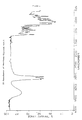
- FIGURE 4 shows the results of infrared spectroscopy of menthone-glycerol ketal.
- FIGURE 5 shows the results of mass spectroscopy of an isomer of menthone-propylene glycol ketal at Peak 1.
- FIGURE 6 shows the results of mass spectroscopy of an isomer of menthone-propylene glycol ketal at Peak 2.
- FIGURE 7 shows the results of mass spectroscopy of an isomer of menthone-propylene glycol ketal at Peak 3.
- FIGURE 8 shows the results of mass spectroscopy of an isomer of menthone-propylene glycol ketal at Peak 4.
- FIGURE 9 shows the results of infrared spectroscopy of menthone-propylene glycol ketal.
- Ketals are typically produced by the chemical reaction of a ketone with an alcohol. Cyclic ketals are formed when the ketone is reacted with a di- (or higher) functional alcohol, ie. an alcohol containing 2 or more hydroxy groups.
- the present invention contemplates the use of menthone ketals which can be produced by reacting menthone with an alcohol containing 1 to 8 carbons or a polyol containing 2 to 8 carbons to form a compound of formulae: wherein R1 and R2 are alkyl groups; R3 is a hydroxy, lower alkoxy, or lower alkyl group; and n is an integer of 0 or 1.
- menthone-glycerol ketal Two cyclic menthone ketals, menthone-glycerol ketal and menthone-propylene glycol ketal, are particularly useful as flavorings. Both are not known to occur in nature, and both have isomers.
- Menthone-glycerol ketal is formed in the chemical reaction of menthone with glycerol. This reaction produces three structural isomers (designated I, II, and III below) having the following structures:
- carbons 1, 3, 6, and 4′ (structure I) or 5′ (structure II) are chiral centers. Carbons 3 and 6 have a predetermined configuration when the starting material is optically pure l-menthone. However, impurities such as d-menthone and isomenthone which have different configurations of the 3 and 6 carbons are likely to be present in the starting material.
- the configuration of the remaining chiral center (carbons 4′ or 5′) is also fixed during the reaction and results in two optical isomers of each structural isomer, resulting in six distinct products.
- the starting material is a racemic mixture of d- and l-menthone and isomenthone (ie. four different isomers)
- the product will contain 24 different isomers.
- Menthone-glycerol ketal is synthesized according to the method described in Example 1 and then analyzed. A variety of known methods may be used to determine identity, including capillary gas chromatography, gas chromatography/mass spectroscopy, and infrared spectroscopy. Capillary gas liquid chromatography analysis indicated that the menthone-glycerol ketal produced was 93% pure with an overall yield of 44% (40g).
- menthone-propylene glycol ketal Another cyclic menthone ketal, menthone-propylene glycol ketal, is formed by the chemical reaction of menthone with 1,2-propylene glycol.
- the menthone-propylene glycol ketal produced has two positional structural isomers (designated I and II below) having the following structures:
- Carbons 1, 3, 6, and 4 (structure I) or 5 (structure II) in structures I and II are chiral centers. Carbons 3 and 6 have a predetermined configuration when the starting material is optically pure l-menthone. However, impurities such as d-menthone and isomenthone which have different configuration of the 3 and 6 carbons are likely to be present in the starting material.
- the configuration of the remaining chiral center (carbons 4 or 5) is also fixed during the reaction and results in two optical isomers of each structural isomer, resulting in four distinct products.
- the starting material is a racemic mixture of d- and l-menthone and isomenthone (ie. four different isomers)
- the product will contain 16 different isomers.
- Menthone-propylene glycol ketal is synthesized according to the method described in Example 4 and then analyzed. Capillary gas liquid chromatography analysis indicated that the menthone-propylene glycol ketal produced was 95% pure with an overall yield of 83% (70g).
- the present invention contemplates the blending of menthone ketals with many flavor ingredients, including but not limited to, citrus oils, fruit essences, and spice blends, both natural and synthetic. Those skilled in the art will recognize that natural and artificial flavor ingredients may be combined with menthone ketals in any manner. More particularly, the present invention contemplates the blending of menthone ketals with mint flavors, including peppermint oil, spearmint oil, and oil of wintergreen. All such flavor ingredients and blends are contemplated for use in the present invention.
- such flavor mixtures are added to chewing gum.
- Flavor ingredients in chewing gum comprise about 0.25% to about 5% by weight of gum.
- optimum levels of menthone ketals are preferably determined by sensory testing. The amount of any given menthone ketal added may vary from about .001% to about 1%. Preferably, the level of menthone ketals is about 0.1% to about 50% of the total flavor added.
- a chewing gum comprises a water-soluble bulk portion, a water-insoluble chewable gum base portion and typically, water-insoluble flavor ingredients.
- the water-soluble bulk portion dissipates with a portion of the flavor over time during chewing.
- the gum base portion is retained in the mouth throughout the chew.
- the insoluble gum base generally comprises elastomers, resins, fats and oils, waxes, softeners and inorganic fillers.
- the insoluble gum base constitutes between about 5% to about 95% of the gum, and more preferably about 20% to 30%. All percent values represent weight percent.
- the gum base typically also includes a filler component.
- the filler component may be calcium carbonate, magnesium carbonate, talc, dicalcium phosphate, and the like.
- the filler may constitute between about 5% to about 60% of the gum base.
- the filler comprises about 5% to 50% of the chewing gum base.
- the gum base also contains softeners, including glycerol monostearate and glycerol triacetate.
- gum bases may also contain additional ingredients such as antioxidants, colors, and emulsifiers. The present invention contemplates using any commercially acceptable gum base.
- the water-soluble portion of chewing gum may further comprise softeners, sweeteners, and flavors and combinations thereof.
- the softeners are added to the chewing gum to optimize the chewing ability and mouth feel of the gum.
- Softeners also known in the art as plasticizers, generally constitute about 0.1% to about 15% of the chewing gum.
- Softeners contemplated by the present invention include glycerin, lecithin and combinations thereof.
- Aqueous sweetener solutions such as those containing sorbitol, hydrogenated starch hydrolysates, corn syrup, and combinations thereof may be used as softeners and binding agents in gum.
- Sweeteners contemplated by the present invention for use in chewing gum include both sugar and sugarless components.
- Sugar sweeteners generally include saccharide-containing components commonly known in the art and include, but are not limited to, sucrose, dextrose, maltose, dextrin, dried invert sugar, fructose, levulose, galactose, corn syrup solids and the like, alone or in any combination.
- Sugarless sweeteners include components with sweetening characteristics but are devoid of the commonly known sugars and comprise, but are not limited to, sugar alcohols such as sorbitol, mannitol, xylitol, hydrogenated starch hydrolysates, maltitol, and the like, alone or in any combination.
- high intensity sweeteners such as aspartame, sucralose, cyclamate, acesulfame-K, dihydrochalones, glycyrrhizin, alitame, and saccharin, and the food acceptable salts thereof.
- any combination of sugar/sugarless sweeteners may be employed in the chewing gum.
- a sweetener may be present in a chewing gum in whole or in part as a water-soluble bulking agent, and that the softener may be combined with a sweetener such as an aqueous sweetener solution.
- chewing gum is manufactured by sequentially adding the various chewing gum ingredients to any commercially available mixer known in the art. After the ingredients have been thoroughly mixed, the gum mass is discharged from the mixer and shaped into the desired forms such as by rolling into sheets and cutting into sticks, extruding into chunks, or casting into pellets.
- the ingredients are mixed by first melting the gum base and adding it to the running mixer. The base may also be melted in the mixer itself. Color may also be added at this time. A softener such as glycerin may then be added next along with the syrup and a portion of bulking agent. Further portions of the bulking agents may be added to the mixer.
- the flavor ingredients are added to the gum mixture near the end of the mixing process. The entire mixing procedure takes from about 5 minutes to 15 minutes, however, longer mixing times may be required. Those persons skilled in the art will recognize that many variations of the above described procedure may be followed.
- menthone ketals may be used to flavor a variety of other products, including foodstuffs with a low moisture content, such as candies, dry beverage, gelatin, and pudding mixes, drugs, and other oral compositions such as toothpaste and mouthwash.
- foodstuffs with a low moisture content such as candies, dry beverage, gelatin, and pudding mixes, drugs, and other oral compositions such as toothpaste and mouthwash.
- the formulation of the food is less than 2% by weight water.
- the flavor comprises about .001% to about 2% of the oral composition.
- Menthone-glycerol ketal is a clear, viscous liquid with a slight yellow tint. The observed boiling point is 135°C at 2.0mm Hg (approximately 295 C at 760mm Hg).
- the synthesis of menthone-glycerol ketal was performed as follows:
- the flavor of menthone-glycerol ketal was evaluated by sensory testing.
- a solution was prepared dissolving 0.1ml of the described ketal in 10ml of ethanol. Next, 1ml of this mixture was added to 100ml of 5% aqueous sucrose solution.
- the flavor used in the above formula was a peppermint oil. A fraction of the peppermint oil in the four different batches was replaced with 0, 5, 10, or 20% menthone-glycerol ketal. After blending and drying, the gum was cut into uniform pieces for testing.
- the gums were evaluated by three trained panelists. While chewing each piece, each panelist recorded his or her sensations. The panelists reported that the 10% and 20% menthone-glycerol ketal gums had longer-lasting sweetness, creamy flavor similar to Doublemint® gum, and higher cooling effect.
- Menthone-propylene glycol ketal is a colorless liquid with an observed boiling point at 72 C at 0.6mm Hg (approximately 245 C at 760mm Hg).
- the synthesis and analysis of menthone-propylene glycol ketal was performed as described in Example 1 except that 20g (0.26 mol) 99+% 1,2-propylene glycol was added in Step 1 instead of 20g glycerol. Also, in Step 3, the fraction at 0.6mm - 1.0mm Hg and 71-73 C was collected. Approximately 70g of menthone-propylene glycol ketal was recovered with 95% purity. The structure was confirmed by GC-MS and FT-IR.
- the flavor of menthone-propylene glycol ketal was evaluated by trained panelists. First, 0.1ml of the ketal was dissolved in 10ml of ethanol. Next, 1ml of the resulting solution was added to 100ml of 5% aqueous sucrose solution.
- the gums were evaluated by four trained panelists. While chewing each piece, each panelist recorded his or her sensations. Three panelists reported enhanced cooling effect and one panelist reported lingering sweetness even at five minutes. Another panelist noted a sweet creamy flavor.
Landscapes
- Health & Medical Sciences (AREA)
- Life Sciences & Earth Sciences (AREA)
- Chemical & Material Sciences (AREA)
- General Health & Medical Sciences (AREA)
- Public Health (AREA)
- Food Science & Technology (AREA)
- Polymers & Plastics (AREA)
- Veterinary Medicine (AREA)
- Engineering & Computer Science (AREA)
- Animal Behavior & Ethology (AREA)
- Epidemiology (AREA)
- Nutrition Science (AREA)
- Birds (AREA)
- Oral & Maxillofacial Surgery (AREA)
- Emergency Medicine (AREA)
- Inorganic Chemistry (AREA)
- Confectionery (AREA)
- Cosmetics (AREA)
- Medicinal Preparation (AREA)
- Acyclic And Carbocyclic Compounds In Medicinal Compositions (AREA)
Description
- The present invention relates to the use of menthone ketal compounds as flavor ingredients. More particularly, the present invention relates to the use of menthone ketals to enhance flavors in oral compositions, chewing gum and low moisture consumable items.
- Efforts have been undertaken to improve and optimize flavor attributes of consumable items, including chewing gum. Difficulties often arise when altering ingredients in such items. Implementing ingredient changes, even those that involve small amounts of flavor ingredients, may cause variation in other characteristics of the composition. These characteristics include texture, sweetness, processability, and flavor-release attributes.
- The aforementioned difficulties are especially true in chewing gum compositions which are complex systems, containing a gum base, bulking and sweetening ingredients, plasticizers, colors, fillers and many other ingredients. Reformulation of these compositions is very costly and time consuming.
- In accordance with one embodiment of the present invention, menthone ketals are used as flavor ingredients. One compound disclosed herein, menthone-glycerol ketal, enhances and modifies flavors, particularly mint flavors, and provides a refreshing and cooling taste to the consumer. Another compound disclosed herein, menthone-propylene glycol ketal, provides sweet minty, eucalyptus and licorice notes as well as enhancing and modifing mint and other flavors. This compound further provides a cooling effect, although less intensive than that of methone-glycerol ketal. Such attributes are useful in chewing gum, pharmaceuticals, and other low moisture foods and oral compositions for example toothpaste and mouthwash.
- Another embodiment of the present invention is a method of preparing chewing gum and other low moisture consumable items which includes adding menthone ketal to enhance and modify flavors.
- A further embodiment of the present invention is a chewing gum composition which includes gum base, softener, sweetener, and menthone ketal as a flavor ingredient.
- The present invention is also an oral composition, pharmaceutical, or low moisture food which includes menthone ketal as a flavor ingredient.
- According to one embodiment of the present invention there is provided a method of preparing an oral composition having enhanced flavour which comprises adding flavour ingredients to said composition so that the flavour ingredients comprise 0.001% to 5% by weight of the composition, said flavour ingredients comprising a menthone ketal.
- The present invention provides a relatively simple and inexpensive method for enhancing and modifying flavors. In particular, the present invention can be carried out in a short time, using simple and inexpensive equipment. The present invention is also well suited for batch processing.
- The phrase "menthone ketal," as used herein, contemplates all compounds formed in the chemical reaction of menthone with alcohols containing 1 to 8 carbons or polyols containing 2 to 8 carbons and all structural and optical isomers thereof. It should be further noted that the phrases "menthone-glycerol ketal" and "menthone-propylene glycol ketal" as used in this application refer to all structural and optical isomers of these respective compounds.
-
- FIGURE 1 shows the results of mass spectroscopy of menthone-glycerol ketal, the structural isomer designated "I" herein.
- FIGURE 2 shows the results of mass spectroscopy of menthone-glycerol ketal, the structural isomer designated "II" herein.
- FIGURE 3 shows the results of mass spectroscopy of menthone-glycerol ketal, the structural isomer designated "III" herein.
- FIGURE 4 shows the results of infrared spectroscopy of menthone-glycerol ketal.
- FIGURE 5 shows the results of mass spectroscopy of an isomer of menthone-propylene glycol ketal at Peak 1.
- FIGURE 6 shows the results of mass spectroscopy of an isomer of menthone-propylene glycol ketal at Peak 2.
- FIGURE 7 shows the results of mass spectroscopy of an isomer of menthone-propylene glycol ketal at Peak 3.
- FIGURE 8 shows the results of mass spectroscopy of an isomer of menthone-propylene glycol ketal at Peak 4.
- FIGURE 9 shows the results of infrared spectroscopy of menthone-propylene glycol ketal.
- Ketals are typically produced by the chemical reaction of a ketone with an alcohol. Cyclic ketals are formed when the ketone is reacted with a di- (or higher) functional alcohol, ie. an alcohol containing 2 or more hydroxy groups.
- The present invention contemplates the use of menthone ketals which can be produced by reacting menthone with an alcohol containing 1 to 8 carbons or a polyol containing 2 to 8 carbons to form a compound of formulae:

wherein R₁ and R₂ are alkyl groups; R₃ is a hydroxy, lower alkoxy, or lower alkyl group; and n is an integer of 0 or 1. - Two cyclic menthone ketals, menthone-glycerol ketal and menthone-propylene glycol ketal, are particularly useful as flavorings. Both are not known to occur in nature, and both have isomers.
- Menthone-glycerol ketal is formed in the chemical reaction of menthone with glycerol. This reaction produces three structural isomers (designated I, II, and III below) having the following structures:

- In structures I and II,
carbons Carbons 3 and 6 have a predetermined configuration when the starting material is optically pure l-menthone. However, impurities such as d-menthone and isomenthone which have different configurations of the 3 and 6 carbons are likely to be present in the starting material. - The configuration of
carbon 1, which is fixed during the reaction, determines which positional structural isomer will be formed when the product is a dioxalane (structures I and II), but is not chiral in the dioxane isomer (structure III). The configuration of the remaining chiral center (carbons 4′ or 5′) is also fixed during the reaction and results in two optical isomers of each structural isomer, resulting in six distinct products. Where the starting material is a racemic mixture of d- and l-menthone and isomenthone (ie. four different isomers), the product will contain 24 different isomers. - Menthone-glycerol ketal is synthesized according to the method described in Example 1 and then analyzed. A variety of known methods may be used to determine identity, including capillary gas chromatography, gas chromatography/mass spectroscopy, and infrared spectroscopy. Capillary gas liquid chromatography analysis indicated that the menthone-glycerol ketal produced was 93% pure with an overall yield of 44% (40g).
- The results of mass spectroscopy for the menthone-glycerol ketal produced in Example 1 are shown in Figures 1, 2, and 3. As these figures demonstrate, all three structural isomers (designated I-III above) have the same mass spectral profile. These mass spectral profiles confirm the expected molecular weight of menthone-glycerol ketal to be 228 g/mol. The results of infrared spectroscopy are shown in Figure 4. The peaks at 1039.13cm⁻¹ and 1094.36 cm⁻¹ are characteristic of C-O-C-O-C absorption of ketals. The broad peak at about 3400 cm⁻¹ is due to O-H stretching. The fairly strong peak at 1109.23 cm⁻¹ could be C-O stretching of a secondary alcohol.
- Another cyclic menthone ketal, menthone-propylene glycol ketal, is formed by the chemical reaction of menthone with 1,2-propylene glycol. The menthone-propylene glycol ketal produced has two positional structural isomers (designated I and II below) having the following structures:

-
Carbons Carbons 3 and 6 have a predetermined configuration when the starting material is optically pure l-menthone. However, impurities such as d-menthone and isomenthone which have different configuration of the 3 and 6 carbons are likely to be present in the starting material. - The configuration of
carbon 1, which is fixed during the reaction, determines which positional structural isomer will be formed. The configuration of the remaining chiral center (carbons 4 or 5) is also fixed during the reaction and results in two optical isomers of each structural isomer, resulting in four distinct products. Where the starting material is a racemic mixture of d- and l-menthone and isomenthone (ie. four different isomers), the product will contain 16 different isomers. - Menthone-propylene glycol ketal is synthesized according to the method described in Example 4 and then analyzed. Capillary gas liquid chromatography analysis indicated that the menthone-propylene glycol ketal produced was 95% pure with an overall yield of 83% (70g).
- The results of mass spectroscopy for the menthone-propylene glycol ketal produced in Example 4 are shown in Figures 5, 6, 7 and 8. As these figures demonstrate, four isomers were present having the same mass spectral profile. These mass spectral profiles confirm the ketal structure and expected molecular weight of menthone-propylene glycol ketal to be 212 g/mol. The results of infrared spectroscopy are shown in Figure 9. The peaks at 1041.4cm⁻¹, 1079 cm⁻¹, .95 cm⁻¹, 1137.995 cm⁻¹ and 1163.7 cm⁻¹ are characteristic of C-O-C-O-C absorption for ketals. No alcohol peaks are apparent. The fairly weak peak at 1713.3 cm⁻¹ due to C-O stretching is a result of trace amounts of menthone (about 5%) in the sample.
- The present invention contemplates the blending of menthone ketals with many flavor ingredients, including but not limited to, citrus oils, fruit essences, and spice blends, both natural and synthetic. Those skilled in the art will recognize that natural and artificial flavor ingredients may be combined with menthone ketals in any manner. More particularly, the present invention contemplates the blending of menthone ketals with mint flavors, including peppermint oil, spearmint oil, and oil of wintergreen. All such flavor ingredients and blends are contemplated for use in the present invention.
- In a presently preferred embodiment, such flavor mixtures are added to chewing gum. Flavor ingredients in chewing gum comprise about 0.25% to about 5% by weight of gum. When used in chewing gum, optimum levels of menthone ketals are preferably determined by sensory testing. The amount of any given menthone ketal added may vary from about .001% to about 1%. Preferably, the level of menthone ketals is about 0.1% to about 50% of the total flavor added.
- In general, a chewing gum comprises a water-soluble bulk portion, a water-insoluble chewable gum base portion and typically, water-insoluble flavor ingredients. The water-soluble bulk portion dissipates with a portion of the flavor over time during chewing. The gum base portion is retained in the mouth throughout the chew.
- The insoluble gum base generally comprises elastomers, resins, fats and oils, waxes, softeners and inorganic fillers. The insoluble gum base constitutes between about 5% to about 95% of the gum, and more preferably about 20% to 30%. All percent values represent weight percent.
- The gum base typically also includes a filler component. The filler component may be calcium carbonate, magnesium carbonate, talc, dicalcium phosphate, and the like. The filler may constitute between about 5% to about 60% of the gum base. Preferably, the filler comprises about 5% to 50% of the chewing gum base. The gum base also contains softeners, including glycerol monostearate and glycerol triacetate. Further, gum bases may also contain additional ingredients such as antioxidants, colors, and emulsifiers. The present invention contemplates using any commercially acceptable gum base.
- The water-soluble portion of chewing gum may further comprise softeners, sweeteners, and flavors and combinations thereof. The softeners are added to the chewing gum to optimize the chewing ability and mouth feel of the gum. Softeners, also known in the art as plasticizers, generally constitute about 0.1% to about 15% of the chewing gum. Softeners contemplated by the present invention include glycerin, lecithin and combinations thereof. Aqueous sweetener solutions such as those containing sorbitol, hydrogenated starch hydrolysates, corn syrup, and combinations thereof may be used as softeners and binding agents in gum.
- Sweeteners contemplated by the present invention for use in chewing gum include both sugar and sugarless components. Sugar sweeteners generally include saccharide-containing components commonly known in the art and include, but are not limited to, sucrose, dextrose, maltose, dextrin, dried invert sugar, fructose, levulose, galactose, corn syrup solids and the like, alone or in any combination. Sugarless sweeteners include components with sweetening characteristics but are devoid of the commonly known sugars and comprise, but are not limited to, sugar alcohols such as sorbitol, mannitol, xylitol, hydrogenated starch hydrolysates, maltitol, and the like, alone or in any combination. Also contemplated for direct addition to the gum are high intensity sweeteners such as aspartame, sucralose, cyclamate, acesulfame-K, dihydrochalones, glycyrrhizin, alitame, and saccharin, and the food acceptable salts thereof.
- Those persons skilled in the art will recognize that any combination of sugar/sugarless sweeteners may be employed in the chewing gum. Further, those skilled in the art will recognize a sweetener may be present in a chewing gum in whole or in part as a water-soluble bulking agent, and that the softener may be combined with a sweetener such as an aqueous sweetener solution.
- In general, chewing gum is manufactured by sequentially adding the various chewing gum ingredients to any commercially available mixer known in the art. After the ingredients have been thoroughly mixed, the gum mass is discharged from the mixer and shaped into the desired forms such as by rolling into sheets and cutting into sticks, extruding into chunks, or casting into pellets. Generally, the ingredients are mixed by first melting the gum base and adding it to the running mixer. The base may also be melted in the mixer itself. Color may also be added at this time. A softener such as glycerin may then be added next along with the syrup and a portion of bulking agent. Further portions of the bulking agents may be added to the mixer. Preferably, the flavor ingredients are added to the gum mixture near the end of the mixing process. The entire mixing procedure takes from about 5 minutes to 15 minutes, however, longer mixing times may be required. Those persons skilled in the art will recognize that many variations of the above described procedure may be followed.
- In another embodiment, menthone ketals may be used to flavor a variety of other products, including foodstuffs with a low moisture content, such as candies, dry beverage, gelatin, and pudding mixes, drugs, and other oral compositions such as toothpaste and mouthwash. Preferably, the formulation of the food is less than 2% by weight water. Preferably, the flavor comprises about .001% to about 2% of the oral composition.
- Further details of the invention will become apparent from the following examples which, when taken into conjunction with the accompanying figures, disclose presently preferred embodiments of the present invention.
- Menthone-glycerol ketal is a clear, viscous liquid with a slight yellow tint. The observed boiling point is 135°C at 2.0mm Hg (approximately 295 C at 760mm Hg). The synthesis of menthone-glycerol ketal was performed as follows:
- 1. A 250ml roundbottom flask was equipped with a stirring bar, Dean-Stark trap, and cold water condenser. A mixture comprising 30g (0.2 mol) 95% l-menthone, 20g (0.22 mol) 98% glycerol, 2g (0.01 mol) 99% p-toluene sulfonic acid, and approximately 100ml HPLC grade toluene was added to the flask and placed on a stir plate.
- 2. The mixture was refluxed for 4-5 hours (approximately 3.4ml of water collected). The mixture was then cooled to room temperature, transferred to a separatory funnel, and extracted twice with 50ml of 0.1M sodium hydroxide. At this stage, the excess catalyst, p-toluene sulfonic acid, was removed.
- 3. The aqueous layer was then decanted from the organic layer and discarded. The excess toluene was boiled off using a rotary evaporator (ROTOVAC). The above steps were repeated and the oils combined. Finally, the oil was dried with anhydrous sodium sulfate and distilled in-vacuo. The fraction at 2.0mm Hg and 135-140 C was collected.
- 4. A sample of the ketal was analyzed by capillary gas chromatography. Identification was confirmed by gas chromatography/mass spectroscopy and FT-IR. Approximately 40g of the ketal was recovered with 93% purity.
- The flavor of menthone-glycerol ketal was evaluated by sensory testing. A solution was prepared dissolving 0.1ml of the described ketal in 10ml of ethanol. Next, 1ml of this mixture was added to 100ml of 5% aqueous sucrose solution.
- Five experienced flavor panelists evaluated the flavor of the solution by swishing 10ml in their mouths for 10 seconds, then expectorating the solution. All five panelists reported the cooling effect of the solution, with three of the five panelists making a second mention of the cooling property.
- Four laboratory-scale batches of gum were prepared and were chewed by experienced panelists. The batches of gum were prepared according to the following formula:
Ingredient % By Weight Sugar 54.451 Base 20.17 Syrup 13.32 Glycerin 1.29 Dextrose 9.89 Flavor 0.879 100.000 - The flavor used in the above formula was a peppermint oil. A fraction of the peppermint oil in the four different batches was replaced with 0, 5, 10, or 20% menthone-glycerol ketal. After blending and drying, the gum was cut into uniform pieces for testing.
- The gums were evaluated by three trained panelists. While chewing each piece, each panelist recorded his or her sensations. The panelists reported that the 10% and 20% menthone-glycerol ketal gums had longer-lasting sweetness, creamy flavor similar to Doublemint® gum, and higher cooling effect.
- Menthone-propylene glycol ketal is a colorless liquid with an observed boiling point at 72 C at 0.6mm Hg (approximately 245 C at 760mm Hg). The synthesis and analysis of menthone-propylene glycol ketal was performed as described in Example 1 except that 20g (0.26 mol) 99+% 1,2-propylene glycol was added in
Step 1 instead of 20g glycerol. Also, inStep 3, the fraction at 0.6mm - 1.0mm Hg and 71-73 C was collected. Approximately 70g of menthone-propylene glycol ketal was recovered with 95% purity. The structure was confirmed by GC-MS and FT-IR. - The flavor of menthone-propylene glycol ketal was evaluated by trained panelists. First, 0.1ml of the ketal was dissolved in 10ml of ethanol. Next, 1ml of the resulting solution was added to 100ml of 5% aqueous sucrose solution.
- Five experienced flavor panelists evaluated the flavor of the solution by swishing 10ml in their mouths for 10 seconds, then expectorating the solution. Three of the five panelists reported eucalyptus and minty notes, while two of the five panelists reported both a licorice note and a sweet taste.
- Four laboratory-scale batches of gum were prepared as described in Example 3 except that fractions of the peppermint oil was replaced with 0, 5, 10, or 20% menthone-propylene glycol ketal.
- The gums were evaluated by four trained panelists. While chewing each piece, each panelist recorded his or her sensations. Three panelists reported enhanced cooling effect and one panelist reported lingering sweetness even at five minutes. Another panelist noted a sweet creamy flavor.
- In summary, a relatively simple and inexpensive method has been described for enhancing and modifying flavors in chewing gum, pharmaceuticals, and low moisture foods and oral products such as toothpaste and mouthwash, using menthone ketals. Although specific embodiments and examples have been described herein, it should be born in mind that these have been provided by way of explanation and illustration and that the present invention is not limited thereby.
Claims (28)
- A method of preparing an oral composition having enhanced flavour which comprises adding flavour ingredients to said composition so that the flavour ingredients comprise 0.001% to 5% by weight of the composition, said flavour ingredients comprising a menthone ketal.
- A method as claimed in claim 1 wherein the composition is a low moisture food, low moisture pharmaceutical or other low moisture oral composition.
- A method as claimed in claim 1 or claim 2 wherein the flavour ingredients comprise 0.001% to 2% by weight of the composition.
- A method as claimed in any one of claims 1 to 3 wherein menthone ketal is present at a level of from 0.1% to 50% by weight of the flavour ingredients.
- A method as claimed in any one of claims 1 to 4 wherein said enhanced flavour in said composition is characterised as a cooling effect.
- A method as claimed in any one of claims 1 to 5 in which the menthone ketal is a compound of the formula:

- A method as claimed in any one of claims 1 to 6 in which the menthone ketal is a compound of the formula:

- A method as claimed in any one of claims 1 to 7 wherein said composition is a chewing gum comprising the following additional steps:
providing gum ingredients comprising gum base, softener, and sweetener ingredients, and
mixing the flavour ingredients with the gum ingredients. - A method as claimed in claim 8 wherein the flavour ingredients comprise from 0.25% to 5% by weight of the chewing gum composition.
- A flavouring agent characterised by comprising 0.1% to 50% by weight menthone ketal.
- A pharmaceutical, food, toothpaste or mouthwash having enhanced flavour comprising 0.001% to 5% by weight of the composition flavour ingredients, characterised in that the flavour ingredients comprise a menthone ketal.
- A composition as claimed in claim 11 wherein the composition is a low moisture food, low moisture pharmaceutical or other low moisture oral composition.
- A composition as claimed in claim 11 or claim 12 wherein the flavour ingredients comprise 0.001% to 2% by weight of the composition.
- A composition as claimed in claims 11 to 13 wherein menthone ketal is present at a level from 0.1% to 50% by weight of the flavour ingredients.
- A composition as claimed in any one of claims 11 to 14 wherein said composition is characterised as a cooling effect.
- A composition as claimed in any one of claims 11 to 15 wherein said composition is a toothpaste.
- A composition as claimed in any one of claims 11 to 15 wherein said composition is a mouthwash.
- A composition as claimed in any one of claims 11 to 15 wherein said composition is a chewing gum comprising gum base softener, sweetener and said flavour ingredients.
- A chewing gum composition as claimed in claim 18 in which the flavour ingredients comprise 0.25% to 5% by weight of the chewing gum composition.
- A composition as claimed in any one of claims 11 to 19 in which the menthone ketal is a compound of the formula:

- A composition as claimed in any one of claims 11 to 19 in which the menthone ketal is a compound of the formula:

- A composition as claimed in claim 21 wherein R₃ is 5'-hydroxy and n is 1.
- A composition as claimed in claim 21 wherein R₃ is methoxy or methyl, and n is 0.
- A composition as claimed in claim 21 wherein R₃ is 5'-methoxy.
- A composition as claimed in claim 21 wherein R₃ is 4'-methoxy.
- A composition as claimed in claim 21 wherein R₃ is 4'-methyl.
- A composition as claimed in claim 21 wherein R₃ is 5'-methyl.
- Use of a menthone ketal to enhance the flavour of a chewing gum composition, food, pharmaceutical, toothpaste or mouthwash.
Applications Claiming Priority (2)
| Application Number | Priority Date | Filing Date | Title |
|---|---|---|---|
| US60987990A | 1990-11-06 | 1990-11-06 | |
| US609879 | 1990-11-06 |
Publications (2)
| Publication Number | Publication Date |
|---|---|
| EP0485170A1 EP0485170A1 (en) | 1992-05-13 |
| EP0485170B1 true EP0485170B1 (en) | 1995-09-13 |
Family
ID=24442724
Family Applications (1)
| Application Number | Title | Priority Date | Filing Date |
|---|---|---|---|
| EP91310223A Expired - Lifetime EP0485170B1 (en) | 1990-11-06 | 1991-11-05 | Enhanced flavors using menthone ketals |
Country Status (8)
| Country | Link |
|---|---|
| US (1) | US5977166A (en) |
| EP (1) | EP0485170B1 (en) |
| AU (1) | AU636516B2 (en) |
| CA (1) | CA2054967C (en) |
| DE (2) | DE69112991T2 (en) |
| DK (1) | DK0485170T3 (en) |
| ES (1) | ES2078457T3 (en) |
| FI (1) | FI915219A7 (en) |
Cited By (1)
| Publication number | Priority date | Publication date | Assignee | Title |
|---|---|---|---|---|
| EP2695597A1 (en) | 2012-08-07 | 2014-02-12 | Symrise AG | Cosmetic compositions |
Families Citing this family (54)
| Publication number | Priority date | Publication date | Assignee | Title |
|---|---|---|---|---|
| DE69112991T2 (en) * | 1990-11-06 | 1996-03-21 | Wrigley W M Jun Co | Use of menthol ketals as flavor enhancers. |
| DE4110973A1 (en) * | 1991-04-05 | 1992-10-08 | Haarmann & Reimer Gmbh | MEDIUM WITH A PHYSIOLOGICAL COOLING EFFECT AND EFFECTIVE COMPOUNDS SUITABLE FOR THIS MEDIUM |
| AU4116993A (en) * | 1992-05-18 | 1993-12-13 | Procter & Gamble Company, The | Coolant compositions |
| AU704226B2 (en) * | 1992-05-18 | 1999-04-15 | Procter & Gamble Company, The | Coolant compositions |
| PH31445A (en) * | 1994-04-12 | 1998-11-03 | Wrigley W M Jun Co | Fruit flavored chewing gum with prolonged flavor intensity. |
| US5429827A (en) * | 1994-04-12 | 1995-07-04 | Wm. Wrigley Jr. Company | Method of making improved gum base for fruit-flavored chewing gum |
| US5413799A (en) * | 1994-04-12 | 1995-05-09 | Wm. Wrigley Jr. Company | Method of making fruit-flavored chewing with prolonged flavor intensity |
| KR970064588A (en) * | 1996-03-11 | 1997-10-13 | 성재갑 | Oral liquid composition improving exhilaration and persistence |
| KR970064589A (en) * | 1996-03-11 | 1997-10-13 | 성재갑 | Dentifrice composition promoting exhilaration and persistence |
| AU4428197A (en) * | 1997-09-18 | 1999-04-05 | Wm. Wrigley Jr. Company | Chewing gum containing physiological cooling agents |
| US6627233B1 (en) | 1997-09-18 | 2003-09-30 | Wm. Wrigley Jr. Company | Chewing gum containing physiological cooling agents |
| US20020098264A1 (en) * | 1998-11-27 | 2002-07-25 | Cherukuri Subraman R. | Medicated chewing gum delivery system for nicotine |
| US6358060B2 (en) | 1998-09-03 | 2002-03-19 | Jsr Llc | Two-stage transmucosal medicine delivery system for symptom relief |
| EP1682641B1 (en) * | 2003-11-04 | 2007-06-27 | Firmenich Sa | Flavor ingredients for cooling preparations |
| US9101160B2 (en) | 2005-11-23 | 2015-08-11 | The Coca-Cola Company | Condiments with high-potency sweetener |
| US8642016B2 (en) | 2006-07-21 | 2014-02-04 | Jsrnti, Llc | Medicinal delivery system, and related methods |
| US8017168B2 (en) | 2006-11-02 | 2011-09-13 | The Coca-Cola Company | High-potency sweetener composition with rubisco protein, rubiscolin, rubiscolin derivatives, ace inhibitory peptides, and combinations thereof, and compositions sweetened therewith |
| CA2731965A1 (en) * | 2008-08-15 | 2010-02-18 | The Procter & Gamble Company | Solution of menthane carboxamides for use in consumer products |
| MX2011001724A (en) | 2008-08-15 | 2011-03-21 | Procter & Gamble | Synthesis of cyclohexane derivatives useful as sensates in consumer products. |
| EP2346475B2 (en) | 2008-11-20 | 2023-04-19 | The Procter & Gamble Company | Personal care compositions providing enhanced cooling sensation |
| JP2013535450A (en) | 2010-07-19 | 2013-09-12 | ザ プロクター アンド ギャンブル カンパニー | Compositions containing derivatives of essential oil compounds and use in personal care products |
| CN103140209B (en) | 2010-10-01 | 2017-10-13 | 宝洁公司 | Oral care composition with improved local flavor |
| US20130042482A1 (en) | 2011-08-16 | 2013-02-21 | Valerie Jean Bradford | Skin Engaging Member Comprising An Anti-Irritation Agent |
| RU2578465C2 (en) | 2011-09-01 | 2016-03-27 | Дзе Проктер Энд Гэмбл Компани | Compositions for oral care with improved rheology |
| EP2620137B1 (en) * | 2012-01-30 | 2017-11-15 | Symrise AG | Compositions |
| US20130315843A1 (en) | 2012-05-25 | 2013-11-28 | The Procter & Gamble Company | Composition for reduction of trpa1 and trpv1 sensations |
| RU2015105518A (en) | 2012-09-28 | 2016-11-20 | Дзе Жиллетт Компани | The skin contact element of the shaving aid containing at least one heat-resistant substance that has a sensory effect |
| RU2664731C2 (en) | 2012-09-28 | 2018-08-22 | Дзе Жиллетт Компани | Skin engaging member comprising at least one thermally resilient sensate |
| US9884130B2 (en) | 2013-11-13 | 2018-02-06 | The Procter & Gamble Company | Compositions for delivery of oral comfort sensations |
| EP3110510A1 (en) | 2014-02-27 | 2017-01-04 | The Procter & Gamble Company | Oral care compositions with a reduced bitter taste perception |
| US20150272847A1 (en) | 2014-03-26 | 2015-10-01 | The Gillette Company | Skin Engaging Shaving Aid Comprising A Thermally Resilient Sensate And A TRPA1 Receptor Inhibitor |
| US20150273711A1 (en) | 2014-03-26 | 2015-10-01 | The Gillette Company | Razor Comprising A Molded Shaving Aid Composition Comprising A Thermally Resilient Sensate |
| RU2016138746A (en) | 2014-04-23 | 2018-05-24 | Дзе Проктер Энд Гэмбл Компани | Cooling cyclohexanecarboxamide |
| WO2016025414A1 (en) | 2014-08-15 | 2016-02-18 | The Procter & Gamble Company | Oral care compositions and regimens |
| CN114191317A (en) | 2014-08-15 | 2022-03-18 | 宝洁公司 | Oral care compositions with enhanced sensory experience |
| CN106659649A (en) | 2014-08-15 | 2017-05-10 | 宝洁公司 | tooth powder with bulking chemicals |
| BR112017011022B1 (en) | 2014-11-26 | 2021-02-17 | The Gillette Company Llc | hair removal device and process of forming a skin-engaging member |
| US9951295B2 (en) | 2015-02-19 | 2018-04-24 | The Procter & Gamble Company | Compositions for deposition on biological surfaces |
| EP3381453A3 (en) | 2015-04-09 | 2018-12-12 | The Procter & Gamble Company | Reduction in cpc taste aversion by reducing cpc activation of trpa1 receptors, tprv1 receptors, or both |
| JP2018533567A (en) | 2015-10-22 | 2018-11-15 | ザ プロクター アンド ギャンブル カンパニー | Chromatographic separation method |
| AU2016342264A1 (en) | 2015-10-22 | 2018-04-05 | The Procter & Gamble Company | Synthesis of cyclohexane carboxamide derivatives useful as sensates in consumer products |
| WO2017106279A1 (en) | 2015-12-18 | 2017-06-22 | The Procter & Gamble Company | Synthesis of cyclohexane ester derivatives useful as sensates in consumer products |
| BR112018069841A2 (en) | 2016-04-01 | 2019-01-29 | Procter & Gamble | mouthwash compositions containing a gel mesh phase |
| WO2017173196A1 (en) | 2016-04-01 | 2017-10-05 | The Procter & Gamble Company | Oral care compositions containing gel networks and potassium nitrate |
| US10925820B2 (en) | 2016-04-01 | 2021-02-23 | The Procter & Gamble Company | Oral care compositions with an effective flavor display |
| BR112018069874A2 (en) | 2016-04-01 | 2019-02-05 | Procter & Gamble | mouthwash compositions containing a potassium nitrate gel mesh phase |
| EP3435960A1 (en) | 2016-04-01 | 2019-02-06 | The Procter and Gamble Company | Oral care compositions containing potassium nitrate and peroxide |
| US20170334082A1 (en) | 2016-05-18 | 2017-11-23 | The Gillette Company Llc | Skin Engaging Member Comprising Ethylene Vinyl Acetate |
| US11198972B2 (en) | 2016-10-25 | 2021-12-14 | The Procter & Gamble Company | Fibrous structures |
| WO2018081191A1 (en) | 2016-10-25 | 2018-05-03 | The Procter & Gamble Company | Differential pillow height fibrous structures |
| WO2018085479A1 (en) | 2016-11-03 | 2018-05-11 | The Gillette Company Llc | Skin engaging member comprising ethylene vinyl acetate |
| AU2017362347B2 (en) | 2016-11-17 | 2020-09-03 | The Gillette Company Llc | Skin engaging member comprising ethylene vinyl acetate and a fragrance |
| US20220096363A1 (en) | 2020-09-28 | 2022-03-31 | The Procter & Gamble Company | Oral Care Composition Comprising Hops And Flavor |
| JP2024516018A (en) | 2021-05-11 | 2024-04-11 | ザ プロクター アンド ギャンブル カンパニー | Oral care compositions containing block copolymers |
Family Cites Families (47)
| Publication number | Priority date | Publication date | Assignee | Title |
|---|---|---|---|---|
| US3257480A (en) * | 1962-08-03 | 1966-06-21 | Carlisle Chemical Works | Acetal and ketal phosphites |
| GB1047425A (en) * | 1962-08-03 | |||
| US3349150A (en) * | 1962-08-03 | 1967-10-24 | Carlisle Chemical Works | Polyether diphosphonates |
| US3206474A (en) * | 1962-08-03 | 1965-09-14 | Carlisle Chemical Works | Acetal and ketal phosphonates |
| FR1478800A (en) * | 1965-05-05 | 1967-07-13 | ||
| US3737463A (en) * | 1968-10-29 | 1973-06-05 | Dow Chemical Co | Resolution of optically active propylene glycol and certain ketones |
| US3830930A (en) * | 1969-05-14 | 1974-08-20 | Nickstadt Moeller Inc | Labial compositions containing menthyl keto esters |
| DE2022369B2 (en) * | 1970-05-08 | 1972-03-02 | Joh Andre Sebald GmbH, 3200 Hildes heim | Cosmetic products and room sprays contain 1 Menthyl ethyl carbonate |
| US4150052A (en) * | 1971-02-04 | 1979-04-17 | Wilkinson Sword Limited | N-substituted paramenthane carboxamides |
| PH10359A (en) * | 1971-02-04 | 1977-01-05 | Wilkinson Sword Ltd | N-substituted-p-methane-3-carboxamides having physiological cooling activity and compositions containing them |
| US4178459A (en) * | 1971-02-04 | 1979-12-11 | Wilkinson Sword Limited | N-Substituted paramenthane carboxamides |
| US4193936A (en) * | 1971-02-04 | 1980-03-18 | Wilkinson Sword Limited | N-substituted paramenthane carboxamides |
| US4136163A (en) * | 1971-02-04 | 1979-01-23 | Wilkinson Sword Limited | P-menthane carboxamides having a physiological cooling effect |
| US4190643A (en) * | 1971-02-04 | 1980-02-26 | Wilkinson Sword Limited | Compositions having a physiological cooling effect |
| US4059118A (en) * | 1972-01-28 | 1977-11-22 | Wilkinson Sword Limited | Tobacco and tobacco-containing manufactures containing an ingredient having physiological cooling activity |
| US4157384A (en) * | 1972-01-28 | 1979-06-05 | Wilkinson Sword Limited | Compositions having a physiological cooling effect |
| US4033994A (en) * | 1972-01-28 | 1977-07-05 | Wilkinson Sword Limited | Substituted p-menthanes |
| GB1421743A (en) * | 1972-04-18 | 1976-01-21 | Wilkinson Sword Ltd | Ingestible topical and other compositions |
| US4153679A (en) * | 1972-04-18 | 1979-05-08 | Wilkinson Sword Limited | Acyclic carboxamides having a physiological cooling effect |
| CA1027347A (en) * | 1972-07-20 | 1978-03-07 | David G. Rowsell | Compounds having a physiological cooling effect and compositions containing them |
| GB1436329A (en) * | 1972-08-07 | 1976-05-19 | Unilever Ltd | Esters of menthol and a heterocyclic carboxylic acid and their use in cosmetic preparations |
| GB1434728A (en) * | 1972-09-27 | 1976-05-05 | Wilkinson Sword Ltd | Compositions and articles containing phospine oxides having a physiological cooling effect and phosphine oxides for use therein |
| US4206301A (en) * | 1972-09-28 | 1980-06-03 | Seymour Yolles | Sustained flavor release composition |
| US3818107A (en) * | 1972-09-28 | 1974-06-18 | Brook D | Chewing gum with sustained flavor release compositions |
| US4070449A (en) * | 1972-10-24 | 1978-01-24 | Wilkinson Sword Limited | Compounds having a physiological cooling effect and compositions containing them |
| US3857964A (en) * | 1973-02-09 | 1974-12-31 | Brook D | Controlled release flavor compositions |
| GB1422998A (en) * | 1973-03-22 | 1976-01-28 | Wilkinson Sword Ltd | Cyclohexanecarboxamides having a physiological cooling effect and compositions containing them |
| US4296093A (en) * | 1973-04-16 | 1981-10-20 | Wilkinson Sword Limited | Cyclic carboxamides having a physiological cooling effect |
| LU68016A1 (en) * | 1973-07-13 | 1975-04-11 | ||
| DE2608226A1 (en) * | 1976-02-28 | 1977-09-08 | Haarmann & Reimer Gmbh | AGENTS WITH PHYSIOLOGICAL COOLING EFFECT |
| US4296137A (en) * | 1980-08-07 | 1981-10-20 | International Flavors & Fragrances Inc. | Flavoring with 1-ethoxy-1-ethanol acetate |
| US4296138A (en) * | 1980-08-07 | 1981-10-20 | International Flavors & Fragrances Inc. | Flavoring with 1-n-butoxy-1-ethanol acetate |
| US4347857A (en) * | 1980-08-07 | 1982-09-07 | International Flavors & Fragrances Inc. | 1-Ethoxy-1-ethanol acetate and uses thereof for augmenting or enhancing the aroma or taste of consumable materials |
| US4348416A (en) * | 1980-08-07 | 1982-09-07 | International Flavors & Fragrances Inc. | Flavoring with 1-ethoxy-1-ethanol acetate - acetaldehyde mixtures |
| US4419280A (en) * | 1980-08-07 | 1983-12-06 | International Flavors & Fragrances Inc. | 1-Ethoxy-1-ethanol acetate and uses thereof for augmenting or enhancing aroma or taste of consumable materials |
| US4339341A (en) * | 1980-08-07 | 1982-07-13 | International Flavors & Fragrances Inc. | Process for augmenting or enhancing the aroma of a detergent using 1-ethoxy-1-ethanol acetate |
| US4330417A (en) * | 1980-08-07 | 1982-05-18 | International Flavors & Fragrances Inc. | 1-N-Butoxy-1-ethanol acetate and uses thereof for augmenting or enhancing the aroma or taste of consumable materials |
| US4341646A (en) * | 1980-08-07 | 1982-07-27 | International Flavors & Fragrances Inc. | 1-Ethoxy-1-ethanol acetate and uses thereof for augmenting or enhancing the aroma of taste of consumable materials |
| US4357315A (en) * | 1980-08-07 | 1982-11-02 | International Flavors & Fragrances Inc. | Use of 1-ethoxy-1-ethanol acetate for augmenting or enhancing the taste of toothpaste |
| US4387036A (en) * | 1981-07-29 | 1983-06-07 | International Flavors & Fragrances Inc. | 1-Ethoxy-1-ethanol acetate-acetaldehyde mixtures for augmenting or enhancing the aroma of detergents |
| US4405510A (en) * | 1981-07-29 | 1983-09-20 | International Flavors & Fragrances Inc. | 1-Ethoxy-1-ethanol acetate-acetaldehyde mixtures and uses thereof for augmenting or enhancing the aroma or taste of consumable materials |
| US4421125A (en) * | 1981-07-29 | 1983-12-20 | International Flavors & Fragrances Inc. | Smoking tobacco composition or smoking tobacco article containing 1-ethoxy-1-ethanol acetate and acetaldehyde |
| JPS5888334A (en) * | 1981-11-20 | 1983-05-26 | Takasago Corp | 3-l-menthoxypropane-1,2-diol |
| US4780324A (en) * | 1987-06-23 | 1988-10-25 | Warner-Lambert Company | Chewing gum with long lasting softness |
| DE69112991T2 (en) * | 1990-11-06 | 1996-03-21 | Wrigley W M Jun Co | Use of menthol ketals as flavor enhancers. |
| US5348750A (en) * | 1990-11-06 | 1994-09-20 | Wm. Wrigley Jr. Company | Enhanced flavors using menthone ketals |
| DE4110973A1 (en) * | 1991-04-05 | 1992-10-08 | Haarmann & Reimer Gmbh | MEDIUM WITH A PHYSIOLOGICAL COOLING EFFECT AND EFFECTIVE COMPOUNDS SUITABLE FOR THIS MEDIUM |
-
1991
- 1991-11-05 DE DE69112991T patent/DE69112991T2/en not_active Expired - Lifetime
- 1991-11-05 AU AU87020/91A patent/AU636516B2/en not_active Expired
- 1991-11-05 CA CA002054967A patent/CA2054967C/en not_active Expired - Lifetime
- 1991-11-05 EP EP91310223A patent/EP0485170B1/en not_active Expired - Lifetime
- 1991-11-05 DE DE199191310223T patent/DE485170T1/en active Pending
- 1991-11-05 FI FI915219A patent/FI915219A7/en unknown
- 1991-11-05 DK DK91310223.2T patent/DK0485170T3/en active
- 1991-11-05 ES ES91310223T patent/ES2078457T3/en not_active Expired - Lifetime
-
1993
- 1993-03-24 US US08/036,473 patent/US5977166A/en not_active Expired - Lifetime
Cited By (1)
| Publication number | Priority date | Publication date | Assignee | Title |
|---|---|---|---|---|
| EP2695597A1 (en) | 2012-08-07 | 2014-02-12 | Symrise AG | Cosmetic compositions |
Also Published As
| Publication number | Publication date |
|---|---|
| FI915219A0 (en) | 1991-11-05 |
| FI915219L (en) | 1992-05-07 |
| CA2054967C (en) | 1997-10-07 |
| AU636516B2 (en) | 1993-04-29 |
| CA2054967A1 (en) | 1992-05-07 |
| FI915219A7 (en) | 1992-05-07 |
| DE69112991T2 (en) | 1996-03-21 |
| EP0485170A1 (en) | 1992-05-13 |
| DK0485170T3 (en) | 1995-12-11 |
| AU8702091A (en) | 1992-05-14 |
| DE485170T1 (en) | 1993-09-23 |
| DE69112991D1 (en) | 1995-10-19 |
| US5977166A (en) | 1999-11-02 |
| ES2078457T3 (en) | 1995-12-16 |
Similar Documents
| Publication | Publication Date | Title |
|---|---|---|
| US5977166A (en) | Enhanced flavors using menthone ketals | |
| US5348750A (en) | Enhanced flavors using menthone ketals | |
| EP0467576B1 (en) | Method of prolonging flavor in chewing gum by the use of cinnamic aldehyde propylene glycol acetal | |
| US7025999B2 (en) | Chewing gum having prolonged sensory benefits | |
| US4382963A (en) | Low-calorie, sugar-free chewing gum containing polydextrose | |
| US4822597A (en) | Anesthetic-containing chewing gum compositions | |
| AU654732B2 (en) | Cooling agent/cyclodextrin complex for improved flavor release | |
| FI100579B (en) | Chewing gum composition and process for its preparation | |
| US20050202118A1 (en) | Chewing gum products containing trigeminal stimulant and method of making the same | |
| RU2366262C2 (en) | Confectionery products containing physiological cooling agents mixture | |
| US4476142A (en) | Peppermint oil flavored compositions | |
| EP1003383B2 (en) | Enhanced flavoring compositions containing n-ethyl-p-menthane-3-carboxamide and method of making and using same | |
| JPH04500757A (en) | Spearmint-enriched peppermint flavored chewing gum with improved stability | |
| EP0314758B1 (en) | Chewing gum having a controlled sweetness | |
| US5167972A (en) | Method of stabilizing peptide sweeteners in cinnamon-flavored chewing gums and confections | |
| EP0616495B1 (en) | Chewing gum utilizing codried 3-1-menthoxypropane-1,2-diol | |
| HUT77795A (en) | Breath-freshening edible compositions comprising menthol and an n-substituted-p-menthane carboxamide and methods for preparing same | |
| JPH0148739B2 (en) | ||
| US5795616A (en) | Enhanced flavors using 2'-hydroxypropiophenone | |
| EP0123742B1 (en) | Low-calorie, sugar-free chewing gum containing polydextrose | |
| WO1998031242A1 (en) | Enhanced flavors using 2'-hydroxypropiophenone | |
| US5277919A (en) | Method of stabilizing peptide sweeteners in chewing gums and confections with benzaldehyde acetals | |
| CA2046526C (en) | Method of stabilizing peptide sweeteners in cinnamon-flavored chewing gums and confections | |
| EP0206991A2 (en) | Monofluorophosphate containing chewing gum composition | |
| MXPA99011680A (en) | Enhanced flavoring compositions containing n-ethyl-p-menthane-3-carboxamide and method of making and using same |
Legal Events
| Date | Code | Title | Description |
|---|---|---|---|
| PUAI | Public reference made under article 153(3) epc to a published international application that has entered the european phase |
Free format text: ORIGINAL CODE: 0009012 |
|
| AK | Designated contracting states |
Kind code of ref document: A1 Designated state(s): DE DK ES FR GB NL |
|
| 17P | Request for examination filed |
Effective date: 19920817 |
|
| EL | Fr: translation of claims filed | ||
| DET | De: translation of patent claims | ||
| 17Q | First examination report despatched |
Effective date: 19930927 |
|
| GRAA | (expected) grant |
Free format text: ORIGINAL CODE: 0009210 |
|
| AK | Designated contracting states |
Kind code of ref document: B1 Designated state(s): DE DK ES FR GB NL |
|
| REF | Corresponds to: |
Ref document number: 69112991 Country of ref document: DE Date of ref document: 19951019 |
|
| ET | Fr: translation filed | ||
| PGFP | Annual fee paid to national office [announced via postgrant information from national office to epo] |
Ref country code: NL Payment date: 19951129 Year of fee payment: 5 |
|
| NLR4 | Nl: receipt of corrected translation in the netherlands language at the initiative of the proprietor of the patent | ||
| REG | Reference to a national code |
Ref country code: DK Ref legal event code: T3 |
|
| REG | Reference to a national code |
Ref country code: ES Ref legal event code: FG2A Ref document number: 2078457 Country of ref document: ES Kind code of ref document: T3 |
|
| PLBE | No opposition filed within time limit |
Free format text: ORIGINAL CODE: 0009261 |
|
| STAA | Information on the status of an ep patent application or granted ep patent |
Free format text: STATUS: NO OPPOSITION FILED WITHIN TIME LIMIT |
|
| 26N | No opposition filed | ||
| PG25 | Lapsed in a contracting state [announced via postgrant information from national office to epo] |
Ref country code: NL Effective date: 19970601 |
|
| NLV4 | Nl: lapsed or anulled due to non-payment of the annual fee |
Effective date: 19970601 |
|
| REG | Reference to a national code |
Ref country code: GB Ref legal event code: IF02 |
|
| PGFP | Annual fee paid to national office [announced via postgrant information from national office to epo] |
Ref country code: FR Payment date: 20101202 Year of fee payment: 20 Ref country code: DK Payment date: 20101125 Year of fee payment: 20 |
|
| PGFP | Annual fee paid to national office [announced via postgrant information from national office to epo] |
Ref country code: DE Payment date: 20101126 Year of fee payment: 20 |
|
| PGFP | Annual fee paid to national office [announced via postgrant information from national office to epo] |
Ref country code: GB Payment date: 20101124 Year of fee payment: 20 |
|
| PGFP | Annual fee paid to national office [announced via postgrant information from national office to epo] |
Ref country code: ES Payment date: 20101125 Year of fee payment: 20 |
|
| REG | Reference to a national code |
Ref country code: DE Ref legal event code: R071 Ref document number: 69112991 Country of ref document: DE |
|
| REG | Reference to a national code |
Ref country code: DE Ref legal event code: R071 Ref document number: 69112991 Country of ref document: DE |
|
| REG | Reference to a national code |
Ref country code: DK Ref legal event code: EUP |
|
| REG | Reference to a national code |
Ref country code: GB Ref legal event code: PE20 Expiry date: 20111104 |
|
| PG25 | Lapsed in a contracting state [announced via postgrant information from national office to epo] |
Ref country code: GB Free format text: LAPSE BECAUSE OF EXPIRATION OF PROTECTION Effective date: 20111104 |
|
| PG25 | Lapsed in a contracting state [announced via postgrant information from national office to epo] |
Ref country code: DE Free format text: LAPSE BECAUSE OF EXPIRATION OF PROTECTION Effective date: 20111106 |
|
| REG | Reference to a national code |
Ref country code: ES Ref legal event code: FD2A Effective date: 20140827 |
|
| PG25 | Lapsed in a contracting state [announced via postgrant information from national office to epo] |
Ref country code: ES Free format text: LAPSE BECAUSE OF EXPIRATION OF PROTECTION Effective date: 20111106 |