EP0484909A1 - Method of forming cyan image with cyan dye forming coupler, and silver halide color photographic material containing the cyan dye forming coupler - Google Patents
Method of forming cyan image with cyan dye forming coupler, and silver halide color photographic material containing the cyan dye forming coupler Download PDFInfo
- Publication number
- EP0484909A1 EP0484909A1 EP91118920A EP91118920A EP0484909A1 EP 0484909 A1 EP0484909 A1 EP 0484909A1 EP 91118920 A EP91118920 A EP 91118920A EP 91118920 A EP91118920 A EP 91118920A EP 0484909 A1 EP0484909 A1 EP 0484909A1
- Authority
- EP
- European Patent Office
- Prior art keywords
- group
- cyan dye
- aromatic
- forming
- silver halide
- Prior art date
- Legal status (The legal status is an assumption and is not a legal conclusion. Google has not performed a legal analysis and makes no representation as to the accuracy of the status listed.)
- Granted
Links
- -1 silver halide Chemical class 0.000 title claims abstract description 132
- 239000000463 material Substances 0.000 title claims abstract description 84
- 238000000034 method Methods 0.000 title claims abstract description 69
- 229910052709 silver Inorganic materials 0.000 title claims abstract description 60
- 239000004332 silver Substances 0.000 title claims abstract description 60
- 239000000839 emulsion Substances 0.000 claims abstract description 60
- 239000003795 chemical substances by application Substances 0.000 claims abstract description 30
- 125000001424 substituent group Chemical group 0.000 claims abstract description 30
- 125000005843 halogen group Chemical group 0.000 claims abstract description 13
- 125000004435 hydrogen atom Chemical group [H]* 0.000 claims abstract description 13
- 238000005859 coupling reaction Methods 0.000 claims abstract description 7
- 230000003647 oxidation Effects 0.000 claims abstract description 7
- 238000007254 oxidation reaction Methods 0.000 claims abstract description 7
- 239000000243 solution Substances 0.000 claims description 63
- 238000011161 development Methods 0.000 claims description 24
- 238000010521 absorption reaction Methods 0.000 claims description 21
- 125000003118 aryl group Chemical group 0.000 claims description 20
- 125000001931 aliphatic group Chemical group 0.000 claims description 14
- 125000000623 heterocyclic group Chemical group 0.000 claims description 14
- 125000004093 cyano group Chemical group *C#N 0.000 claims description 13
- 125000003545 alkoxy group Chemical group 0.000 claims description 11
- 125000004104 aryloxy group Chemical group 0.000 claims description 10
- 125000003917 carbamoyl group Chemical group [H]N([H])C(*)=O 0.000 claims description 10
- 125000001951 carbamoylamino group Chemical group C(N)(=O)N* 0.000 claims description 10
- 125000003178 carboxy group Chemical group [H]OC(*)=O 0.000 claims description 10
- 125000000449 nitro group Chemical group [O-][N+](*)=O 0.000 claims description 10
- 125000002252 acyl group Chemical group 0.000 claims description 9
- 125000004453 alkoxycarbonyl group Chemical group 0.000 claims description 9
- 125000002887 hydroxy group Chemical group [H]O* 0.000 claims description 9
- 125000004442 acylamino group Chemical group 0.000 claims description 8
- 125000003277 amino group Chemical group 0.000 claims description 8
- 125000004397 aminosulfonyl group Chemical group NS(=O)(=O)* 0.000 claims description 8
- 125000000217 alkyl group Chemical group 0.000 claims description 6
- 125000004414 alkyl thio group Chemical group 0.000 claims description 5
- 125000003710 aryl alkyl group Chemical group 0.000 claims description 5
- 125000005110 aryl thio group Chemical group 0.000 claims description 5
- 125000004432 carbon atom Chemical group C* 0.000 claims description 5
- 125000004433 nitrogen atom Chemical group N* 0.000 claims description 5
- JOYRKODLDBILNP-UHFFFAOYSA-N urethane group Chemical group NC(=O)OCC JOYRKODLDBILNP-UHFFFAOYSA-N 0.000 claims description 5
- 125000003368 amide group Chemical group 0.000 claims description 4
- 125000004185 ester group Chemical group 0.000 claims description 4
- 125000004430 oxygen atom Chemical group O* 0.000 claims description 4
- 125000005010 perfluoroalkyl group Chemical group 0.000 claims description 4
- 125000004434 sulfur atom Chemical group 0.000 claims description 4
- 125000004423 acyloxy group Chemical group 0.000 claims description 3
- 125000003302 alkenyloxy group Chemical group 0.000 claims description 3
- 239000007864 aqueous solution Substances 0.000 claims description 3
- 229910052799 carbon Inorganic materials 0.000 claims description 3
- 125000000020 sulfo group Chemical group O=S(=O)([*])O[H] 0.000 claims description 3
- 125000003341 7 membered heterocyclic group Chemical group 0.000 claims description 2
- 125000005194 alkoxycarbonyloxy group Chemical group 0.000 claims description 2
- 125000005200 aryloxy carbonyloxy group Chemical group 0.000 claims description 2
- 125000000751 azo group Chemical group [*]N=N[*] 0.000 claims description 2
- QJGQUHMNIGDVPM-UHFFFAOYSA-N nitrogen group Chemical group [N] QJGQUHMNIGDVPM-UHFFFAOYSA-N 0.000 claims description 2
- 229910052760 oxygen Inorganic materials 0.000 claims description 2
- 125000001476 phosphono group Chemical group [H]OP(*)(=O)O[H] 0.000 claims description 2
- 125000005420 sulfonamido group Chemical group S(=O)(=O)(N*)* 0.000 claims description 2
- 150000001875 compounds Chemical class 0.000 description 43
- XLYOFNOQVPJJNP-UHFFFAOYSA-N water Substances O XLYOFNOQVPJJNP-UHFFFAOYSA-N 0.000 description 39
- 239000010410 layer Substances 0.000 description 38
- 238000012545 processing Methods 0.000 description 38
- 239000000975 dye Substances 0.000 description 36
- XEKOWRVHYACXOJ-UHFFFAOYSA-N Ethyl acetate Chemical compound CCOC(C)=O XEKOWRVHYACXOJ-UHFFFAOYSA-N 0.000 description 33
- 239000000203 mixture Substances 0.000 description 28
- 238000004061 bleaching Methods 0.000 description 25
- 229910052736 halogen Inorganic materials 0.000 description 20
- 150000002367 halogens Chemical class 0.000 description 20
- LFQSCWFLJHTTHZ-UHFFFAOYSA-N Ethanol Chemical compound CCO LFQSCWFLJHTTHZ-UHFFFAOYSA-N 0.000 description 15
- QTBSBXVTEAMEQO-UHFFFAOYSA-N Acetic acid Chemical compound CC(O)=O QTBSBXVTEAMEQO-UHFFFAOYSA-N 0.000 description 13
- WSFSSNUMVMOOMR-UHFFFAOYSA-N Formaldehyde Chemical compound O=C WSFSSNUMVMOOMR-UHFFFAOYSA-N 0.000 description 12
- HEMHJVSKTPXQMS-UHFFFAOYSA-M Sodium hydroxide Chemical compound [OH-].[Na+] HEMHJVSKTPXQMS-UHFFFAOYSA-M 0.000 description 12
- 239000002253 acid Substances 0.000 description 12
- IOLCXVTUBQKXJR-UHFFFAOYSA-M potassium bromide Chemical compound [K+].[Br-] IOLCXVTUBQKXJR-UHFFFAOYSA-M 0.000 description 12
- GEHJYWRUCIMESM-UHFFFAOYSA-L sodium sulfite Chemical compound [Na+].[Na+].[O-]S([O-])=O GEHJYWRUCIMESM-UHFFFAOYSA-L 0.000 description 12
- 239000006185 dispersion Substances 0.000 description 11
- 239000003960 organic solvent Substances 0.000 description 11
- 230000008569 process Effects 0.000 description 11
- 229910021607 Silver chloride Inorganic materials 0.000 description 10
- HKZLPVFGJNLROG-UHFFFAOYSA-M silver monochloride Chemical compound [Cl-].[Ag+] HKZLPVFGJNLROG-UHFFFAOYSA-M 0.000 description 10
- WVDDGKGOMKODPV-UHFFFAOYSA-N Benzyl alcohol Chemical compound OCC1=CC=CC=C1 WVDDGKGOMKODPV-UHFFFAOYSA-N 0.000 description 9
- 108010010803 Gelatin Proteins 0.000 description 9
- 238000009835 boiling Methods 0.000 description 9
- 239000008273 gelatin Substances 0.000 description 9
- 229920000159 gelatin Polymers 0.000 description 9
- 235000019322 gelatine Nutrition 0.000 description 9
- 235000011852 gelatine desserts Nutrition 0.000 description 9
- NLKNQRATVPKPDG-UHFFFAOYSA-M potassium iodide Chemical compound [K+].[I-] NLKNQRATVPKPDG-UHFFFAOYSA-M 0.000 description 9
- 239000008237 rinsing water Substances 0.000 description 9
- XEEYBQQBJWHFJM-UHFFFAOYSA-N Iron Chemical compound [Fe] XEEYBQQBJWHFJM-UHFFFAOYSA-N 0.000 description 8
- 150000007513 acids Chemical class 0.000 description 8
- 238000011160 research Methods 0.000 description 8
- 150000003839 salts Chemical class 0.000 description 8
- ISWSIDIOOBJBQZ-UHFFFAOYSA-N Phenol Chemical compound OC1=CC=CC=C1 ISWSIDIOOBJBQZ-UHFFFAOYSA-N 0.000 description 7
- 239000003112 inhibitor Substances 0.000 description 7
- 229910052751 metal Inorganic materials 0.000 description 7
- 239000002184 metal Substances 0.000 description 7
- 230000000087 stabilizing effect Effects 0.000 description 7
- AVXURJPOCDRRFD-UHFFFAOYSA-N Hydroxylamine Chemical compound ON AVXURJPOCDRRFD-UHFFFAOYSA-N 0.000 description 6
- 239000000654 additive Substances 0.000 description 6
- DOIRQSBPFJWKBE-UHFFFAOYSA-N dibutyl phthalate Chemical compound CCCCOC(=O)C1=CC=CC=C1C(=O)OCCCC DOIRQSBPFJWKBE-UHFFFAOYSA-N 0.000 description 6
- 230000000694 effects Effects 0.000 description 6
- BWHMMNNQKKPAPP-UHFFFAOYSA-L potassium carbonate Chemical compound [K+].[K+].[O-]C([O-])=O BWHMMNNQKKPAPP-UHFFFAOYSA-L 0.000 description 6
- 235000010265 sodium sulphite Nutrition 0.000 description 6
- 239000002904 solvent Substances 0.000 description 6
- 230000006641 stabilisation Effects 0.000 description 6
- 238000011105 stabilization Methods 0.000 description 6
- JKFYKCYQEWQPTM-UHFFFAOYSA-N 2-azaniumyl-2-(4-fluorophenyl)acetate Chemical compound OC(=O)C(N)C1=CC=C(F)C=C1 JKFYKCYQEWQPTM-UHFFFAOYSA-N 0.000 description 5
- KCXVZYZYPLLWCC-UHFFFAOYSA-N EDTA Chemical compound OC(=O)CN(CC(O)=O)CCN(CC(O)=O)CC(O)=O KCXVZYZYPLLWCC-UHFFFAOYSA-N 0.000 description 5
- VTLYFUHAOXGGBS-UHFFFAOYSA-N Fe3+ Chemical compound [Fe+3] VTLYFUHAOXGGBS-UHFFFAOYSA-N 0.000 description 5
- 229910021612 Silver iodide Inorganic materials 0.000 description 5
- 229960000583 acetic acid Drugs 0.000 description 5
- 238000006243 chemical reaction Methods 0.000 description 5
- 239000000460 chlorine Substances 0.000 description 5
- 229910052801 chlorine Inorganic materials 0.000 description 5
- 239000002131 composite material Substances 0.000 description 5
- 238000004821 distillation Methods 0.000 description 5
- 229960001484 edetic acid Drugs 0.000 description 5
- 238000005562 fading Methods 0.000 description 5
- 238000004519 manufacturing process Methods 0.000 description 5
- 230000003641 microbiacidal effect Effects 0.000 description 5
- 229940124561 microbicide Drugs 0.000 description 5
- 239000002855 microbicide agent Substances 0.000 description 5
- 239000000047 product Substances 0.000 description 5
- ADZWSOLPGZMUMY-UHFFFAOYSA-M silver bromide Chemical compound [Ag]Br ADZWSOLPGZMUMY-UHFFFAOYSA-M 0.000 description 5
- 229940045105 silver iodide Drugs 0.000 description 5
- 239000003381 stabilizer Substances 0.000 description 5
- 239000004094 surface-active agent Substances 0.000 description 5
- 238000005406 washing Methods 0.000 description 5
- KJCVRFUGPWSIIH-UHFFFAOYSA-N 1-naphthol Chemical compound C1=CC=C2C(O)=CC=CC2=C1 KJCVRFUGPWSIIH-UHFFFAOYSA-N 0.000 description 4
- CDAWCLOXVUBKRW-UHFFFAOYSA-N 2-aminophenol Chemical class NC1=CC=CC=C1O CDAWCLOXVUBKRW-UHFFFAOYSA-N 0.000 description 4
- LSNNMFCWUKXFEE-UHFFFAOYSA-M Bisulfite Chemical compound OS([O-])=O LSNNMFCWUKXFEE-UHFFFAOYSA-M 0.000 description 4
- ZAMOUSCENKQFHK-UHFFFAOYSA-N Chlorine atom Chemical compound [Cl] ZAMOUSCENKQFHK-UHFFFAOYSA-N 0.000 description 4
- RTZKZFJDLAIYFH-UHFFFAOYSA-N Diethyl ether Chemical class CCOCC RTZKZFJDLAIYFH-UHFFFAOYSA-N 0.000 description 4
- DBVJJBKOTRCVKF-UHFFFAOYSA-N Etidronic acid Chemical compound OP(=O)(O)C(O)(C)P(O)(O)=O DBVJJBKOTRCVKF-UHFFFAOYSA-N 0.000 description 4
- 229910019142 PO4 Inorganic materials 0.000 description 4
- SJOOOZPMQAWAOP-UHFFFAOYSA-N [Ag].BrCl Chemical compound [Ag].BrCl SJOOOZPMQAWAOP-UHFFFAOYSA-N 0.000 description 4
- 238000005282 brightening Methods 0.000 description 4
- 239000013078 crystal Substances 0.000 description 4
- 230000003028 elevating effect Effects 0.000 description 4
- 150000004694 iodide salts Chemical class 0.000 description 4
- 229910052742 iron Inorganic materials 0.000 description 4
- 230000014759 maintenance of location Effects 0.000 description 4
- VLKZOEOYAKHREP-UHFFFAOYSA-N n-Hexane Chemical compound CCCCCC VLKZOEOYAKHREP-UHFFFAOYSA-N 0.000 description 4
- 229910052757 nitrogen Inorganic materials 0.000 description 4
- 239000002667 nucleating agent Substances 0.000 description 4
- 239000006174 pH buffer Substances 0.000 description 4
- 150000002989 phenols Chemical class 0.000 description 4
- 235000021317 phosphate Nutrition 0.000 description 4
- 238000002360 preparation method Methods 0.000 description 4
- 239000003755 preservative agent Substances 0.000 description 4
- 239000012487 rinsing solution Substances 0.000 description 4
- ZUNKMNLKJXRCDM-UHFFFAOYSA-N silver bromoiodide Chemical group [Ag].IBr ZUNKMNLKJXRCDM-UHFFFAOYSA-N 0.000 description 4
- 239000000126 substance Substances 0.000 description 4
- 150000005208 1,4-dihydroxybenzenes Chemical class 0.000 description 3
- ZWEHNKRNPOVVGH-UHFFFAOYSA-N 2-Butanone Chemical compound CCC(C)=O ZWEHNKRNPOVVGH-UHFFFAOYSA-N 0.000 description 3
- QGZKDVFQNNGYKY-UHFFFAOYSA-N Ammonia Chemical compound N QGZKDVFQNNGYKY-UHFFFAOYSA-N 0.000 description 3
- QGZKDVFQNNGYKY-UHFFFAOYSA-O Ammonium Chemical compound [NH4+] QGZKDVFQNNGYKY-UHFFFAOYSA-O 0.000 description 3
- 229920002284 Cellulose triacetate Polymers 0.000 description 3
- LYCAIKOWRPUZTN-UHFFFAOYSA-N Ethylene glycol Chemical compound OCCO LYCAIKOWRPUZTN-UHFFFAOYSA-N 0.000 description 3
- VEXZGXHMUGYJMC-UHFFFAOYSA-N Hydrochloric acid Chemical compound Cl VEXZGXHMUGYJMC-UHFFFAOYSA-N 0.000 description 3
- OKKJLVBELUTLKV-UHFFFAOYSA-N Methanol Chemical compound OC OKKJLVBELUTLKV-UHFFFAOYSA-N 0.000 description 3
- ZMXDDKWLCZADIW-UHFFFAOYSA-N N,N-Dimethylformamide Chemical compound CN(C)C=O ZMXDDKWLCZADIW-UHFFFAOYSA-N 0.000 description 3
- QPCDCPDFJACHGM-UHFFFAOYSA-N N,N-bis{2-[bis(carboxymethyl)amino]ethyl}glycine Chemical compound OC(=O)CN(CC(O)=O)CCN(CC(=O)O)CCN(CC(O)=O)CC(O)=O QPCDCPDFJACHGM-UHFFFAOYSA-N 0.000 description 3
- KWYUFKZDYYNOTN-UHFFFAOYSA-M Potassium hydroxide Chemical compound [OH-].[K+] KWYUFKZDYYNOTN-UHFFFAOYSA-M 0.000 description 3
- NNLVGZFZQQXQNW-ADJNRHBOSA-N [(2r,3r,4s,5r,6s)-4,5-diacetyloxy-3-[(2s,3r,4s,5r,6r)-3,4,5-triacetyloxy-6-(acetyloxymethyl)oxan-2-yl]oxy-6-[(2r,3r,4s,5r,6s)-4,5,6-triacetyloxy-2-(acetyloxymethyl)oxan-3-yl]oxyoxan-2-yl]methyl acetate Chemical compound O([C@@H]1O[C@@H]([C@H]([C@H](OC(C)=O)[C@H]1OC(C)=O)O[C@H]1[C@@H]([C@@H](OC(C)=O)[C@H](OC(C)=O)[C@@H](COC(C)=O)O1)OC(C)=O)COC(=O)C)[C@@H]1[C@@H](COC(C)=O)O[C@@H](OC(C)=O)[C@H](OC(C)=O)[C@H]1OC(C)=O NNLVGZFZQQXQNW-ADJNRHBOSA-N 0.000 description 3
- 239000002250 absorbent Substances 0.000 description 3
- 230000002745 absorbent Effects 0.000 description 3
- 238000013019 agitation Methods 0.000 description 3
- 150000001412 amines Chemical class 0.000 description 3
- XYXNTHIYBIDHGM-UHFFFAOYSA-N ammonium thiosulfate Chemical compound [NH4+].[NH4+].[O-]S([O-])(=O)=S XYXNTHIYBIDHGM-UHFFFAOYSA-N 0.000 description 3
- 235000019445 benzyl alcohol Nutrition 0.000 description 3
- 230000015572 biosynthetic process Effects 0.000 description 3
- 229910052794 bromium Inorganic materials 0.000 description 3
- 239000011248 coating agent Substances 0.000 description 3
- 239000008199 coating composition Substances 0.000 description 3
- 238000000576 coating method Methods 0.000 description 3
- 239000000084 colloidal system Substances 0.000 description 3
- MTHSVFCYNBDYFN-UHFFFAOYSA-N diethylene glycol Chemical compound OCCOCCO MTHSVFCYNBDYFN-UHFFFAOYSA-N 0.000 description 3
- 238000009826 distribution Methods 0.000 description 3
- 238000001035 drying Methods 0.000 description 3
- 238000004945 emulsification Methods 0.000 description 3
- 229910052731 fluorine Inorganic materials 0.000 description 3
- LNTHITQWFMADLM-UHFFFAOYSA-N gallic acid Chemical class OC(=O)C1=CC(O)=C(O)C(O)=C1 LNTHITQWFMADLM-UHFFFAOYSA-N 0.000 description 3
- 150000002429 hydrazines Chemical class 0.000 description 3
- 125000002883 imidazolyl group Chemical group 0.000 description 3
- 230000006872 improvement Effects 0.000 description 3
- 239000004816 latex Substances 0.000 description 3
- 229920000126 latex Polymers 0.000 description 3
- 125000001624 naphthyl group Chemical group 0.000 description 3
- 229960003330 pentetic acid Drugs 0.000 description 3
- CMCWWLVWPDLCRM-UHFFFAOYSA-N phenidone Chemical compound N1C(=O)CCN1C1=CC=CC=C1 CMCWWLVWPDLCRM-UHFFFAOYSA-N 0.000 description 3
- 125000001997 phenyl group Chemical group [H]C1=C([H])C([H])=C(*)C([H])=C1[H] 0.000 description 3
- 229910000027 potassium carbonate Inorganic materials 0.000 description 3
- 239000002243 precursor Substances 0.000 description 3
- 238000003672 processing method Methods 0.000 description 3
- 239000011541 reaction mixture Substances 0.000 description 3
- 229920005989 resin Polymers 0.000 description 3
- 239000011347 resin Substances 0.000 description 3
- 230000005070 ripening Effects 0.000 description 3
- LSNNMFCWUKXFEE-UHFFFAOYSA-L sulfite Chemical class [O-]S([O-])=O LSNNMFCWUKXFEE-UHFFFAOYSA-L 0.000 description 3
- 150000004764 thiosulfuric acid derivatives Chemical class 0.000 description 3
- 150000003585 thioureas Chemical class 0.000 description 3
- FTNJQNQLEGKTGD-UHFFFAOYSA-N 1,3-benzodioxole Chemical class C1=CC=C2OCOC2=C1 FTNJQNQLEGKTGD-UHFFFAOYSA-N 0.000 description 2
- WNWHHMBRJJOGFJ-UHFFFAOYSA-N 16-methylheptadecan-1-ol Chemical compound CC(C)CCCCCCCCCCCCCCCO WNWHHMBRJJOGFJ-UHFFFAOYSA-N 0.000 description 2
- WMVJWKURWRGJCI-UHFFFAOYSA-N 2,4-bis(2-methylbutan-2-yl)phenol Chemical compound CCC(C)(C)C1=CC=C(O)C(C(C)(C)CC)=C1 WMVJWKURWRGJCI-UHFFFAOYSA-N 0.000 description 2
- DXYYSGDWQCSKKO-UHFFFAOYSA-N 2-methylbenzothiazole Chemical compound C1=CC=C2SC(C)=NC2=C1 DXYYSGDWQCSKKO-UHFFFAOYSA-N 0.000 description 2
- PLIKAWJENQZMHA-UHFFFAOYSA-N 4-aminophenol Chemical compound NC1=CC=C(O)C=C1 PLIKAWJENQZMHA-UHFFFAOYSA-N 0.000 description 2
- NLXLAEXVIDQMFP-UHFFFAOYSA-N Ammonia chloride Chemical compound [NH4+].[Cl-] NLXLAEXVIDQMFP-UHFFFAOYSA-N 0.000 description 2
- CIWBSHSKHKDKBQ-JLAZNSOCSA-N Ascorbic acid Chemical compound OC[C@H](O)[C@H]1OC(=O)C(O)=C1O CIWBSHSKHKDKBQ-JLAZNSOCSA-N 0.000 description 2
- 229930185605 Bisphenol Natural products 0.000 description 2
- CPELXLSAUQHCOX-UHFFFAOYSA-M Bromide Chemical compound [Br-] CPELXLSAUQHCOX-UHFFFAOYSA-M 0.000 description 2
- WKBOTKDWSSQWDR-UHFFFAOYSA-N Bromine atom Chemical compound [Br] WKBOTKDWSSQWDR-UHFFFAOYSA-N 0.000 description 2
- VTYYLEPIZMXCLO-UHFFFAOYSA-L Calcium carbonate Chemical compound [Ca+2].[O-]C([O-])=O VTYYLEPIZMXCLO-UHFFFAOYSA-L 0.000 description 2
- BHPQYMZQTOCNFJ-UHFFFAOYSA-N Calcium cation Chemical compound [Ca+2] BHPQYMZQTOCNFJ-UHFFFAOYSA-N 0.000 description 2
- HEDRZPFGACZZDS-UHFFFAOYSA-N Chloroform Chemical compound ClC(Cl)Cl HEDRZPFGACZZDS-UHFFFAOYSA-N 0.000 description 2
- IAZDPXIOMUYVGZ-UHFFFAOYSA-N Dimethylsulphoxide Chemical compound CS(C)=O IAZDPXIOMUYVGZ-UHFFFAOYSA-N 0.000 description 2
- 239000003109 Disodium ethylene diamine tetraacetate Substances 0.000 description 2
- ZGTMUACCHSMWAC-UHFFFAOYSA-L EDTA disodium salt (anhydrous) Chemical compound [Na+].[Na+].OC(=O)CN(CC([O-])=O)CCN(CC(O)=O)CC([O-])=O ZGTMUACCHSMWAC-UHFFFAOYSA-L 0.000 description 2
- PXGOKWXKJXAPGV-UHFFFAOYSA-N Fluorine Chemical compound FF PXGOKWXKJXAPGV-UHFFFAOYSA-N 0.000 description 2
- OAKJQQAXSVQMHS-UHFFFAOYSA-N Hydrazine Chemical class NN OAKJQQAXSVQMHS-UHFFFAOYSA-N 0.000 description 2
- QIGBRXMKCJKVMJ-UHFFFAOYSA-N Hydroquinone Chemical compound OC1=CC=C(O)C=C1 QIGBRXMKCJKVMJ-UHFFFAOYSA-N 0.000 description 2
- DGAQECJNVWCQMB-PUAWFVPOSA-M Ilexoside XXIX Chemical compound C[C@@H]1CC[C@@]2(CC[C@@]3(C(=CC[C@H]4[C@]3(CC[C@@H]5[C@@]4(CC[C@@H](C5(C)C)OS(=O)(=O)[O-])C)C)[C@@H]2[C@]1(C)O)C)C(=O)O[C@H]6[C@@H]([C@H]([C@@H]([C@H](O6)CO)O)O)O.[Na+] DGAQECJNVWCQMB-PUAWFVPOSA-M 0.000 description 2
- JLVVSXFLKOJNIY-UHFFFAOYSA-N Magnesium ion Chemical compound [Mg+2] JLVVSXFLKOJNIY-UHFFFAOYSA-N 0.000 description 2
- CWNSVVHTTQBGQB-UHFFFAOYSA-N N,N-Diethyldodecanamide Chemical compound CCCCCCCCCCCC(=O)N(CC)CC CWNSVVHTTQBGQB-UHFFFAOYSA-N 0.000 description 2
- 239000000020 Nitrocellulose Substances 0.000 description 2
- KDLHZDBZIXYQEI-UHFFFAOYSA-N Palladium Chemical compound [Pd] KDLHZDBZIXYQEI-UHFFFAOYSA-N 0.000 description 2
- WCUXLLCKKVVCTQ-UHFFFAOYSA-M Potassium chloride Chemical compound [Cl-].[K+] WCUXLLCKKVVCTQ-UHFFFAOYSA-M 0.000 description 2
- BQCADISMDOOEFD-UHFFFAOYSA-N Silver Chemical compound [Ag] BQCADISMDOOEFD-UHFFFAOYSA-N 0.000 description 2
- CDBYLPFSWZWCQE-UHFFFAOYSA-L Sodium Carbonate Chemical compound [Na+].[Na+].[O-]C([O-])=O CDBYLPFSWZWCQE-UHFFFAOYSA-L 0.000 description 2
- WQDUMFSSJAZKTM-UHFFFAOYSA-N Sodium methoxide Chemical compound [Na+].[O-]C WQDUMFSSJAZKTM-UHFFFAOYSA-N 0.000 description 2
- ZFOZVQLOBQUTQQ-UHFFFAOYSA-N Tributyl citrate Chemical compound CCCCOC(=O)CC(O)(C(=O)OCCCC)CC(=O)OCCCC ZFOZVQLOBQUTQQ-UHFFFAOYSA-N 0.000 description 2
- GSEJCLTVZPLZKY-UHFFFAOYSA-N Triethanolamine Chemical compound OCCN(CCO)CCO GSEJCLTVZPLZKY-UHFFFAOYSA-N 0.000 description 2
- 235000010724 Wisteria floribunda Nutrition 0.000 description 2
- XLOMVQKBTHCTTD-UHFFFAOYSA-N Zinc monoxide Chemical compound [Zn]=O XLOMVQKBTHCTTD-UHFFFAOYSA-N 0.000 description 2
- FJWGYAHXMCUOOM-QHOUIDNNSA-N [(2s,3r,4s,5r,6r)-2-[(2r,3r,4s,5r,6s)-4,5-dinitrooxy-2-(nitrooxymethyl)-6-[(2r,3r,4s,5r,6s)-4,5,6-trinitrooxy-2-(nitrooxymethyl)oxan-3-yl]oxyoxan-3-yl]oxy-3,5-dinitrooxy-6-(nitrooxymethyl)oxan-4-yl] nitrate Chemical compound O([C@@H]1O[C@@H]([C@H]([C@H](O[N+]([O-])=O)[C@H]1O[N+]([O-])=O)O[C@H]1[C@@H]([C@@H](O[N+]([O-])=O)[C@H](O[N+]([O-])=O)[C@@H](CO[N+]([O-])=O)O1)O[N+]([O-])=O)CO[N+](=O)[O-])[C@@H]1[C@@H](CO[N+]([O-])=O)O[C@@H](O[N+]([O-])=O)[C@H](O[N+]([O-])=O)[C@H]1O[N+]([O-])=O FJWGYAHXMCUOOM-QHOUIDNNSA-N 0.000 description 2
- 125000002777 acetyl group Chemical group [H]C([H])([H])C(*)=O 0.000 description 2
- 150000001299 aldehydes Chemical class 0.000 description 2
- 150000001408 amides Chemical class 0.000 description 2
- SWLVFNYSXGMGBS-UHFFFAOYSA-N ammonium bromide Chemical compound [NH4+].[Br-] SWLVFNYSXGMGBS-UHFFFAOYSA-N 0.000 description 2
- 125000003354 benzotriazolyl group Chemical class N1N=NC2=C1C=CC=C2* 0.000 description 2
- 125000003236 benzoyl group Chemical group [H]C1=C([H])C([H])=C(C([H])=C1[H])C(*)=O 0.000 description 2
- BJQHLKABXJIVAM-UHFFFAOYSA-N bis(2-ethylhexyl) phthalate Chemical compound CCCCC(CC)COC(=O)C1=CC=CC=C1C(=O)OCC(CC)CCCC BJQHLKABXJIVAM-UHFFFAOYSA-N 0.000 description 2
- KGBXLFKZBHKPEV-UHFFFAOYSA-N boric acid Chemical compound OB(O)O KGBXLFKZBHKPEV-UHFFFAOYSA-N 0.000 description 2
- 239000004327 boric acid Substances 0.000 description 2
- GDTBXPJZTBHREO-UHFFFAOYSA-N bromine Substances BrBr GDTBXPJZTBHREO-UHFFFAOYSA-N 0.000 description 2
- 229910001424 calcium ion Inorganic materials 0.000 description 2
- OSGAYBCDTDRGGQ-UHFFFAOYSA-L calcium sulfate Chemical compound [Ca+2].[O-]S([O-])(=O)=O OSGAYBCDTDRGGQ-UHFFFAOYSA-L 0.000 description 2
- 239000002738 chelating agent Substances 0.000 description 2
- 229920001429 chelating resin Polymers 0.000 description 2
- QTMDXZNDVAMKGV-UHFFFAOYSA-L copper(ii) bromide Chemical compound [Cu+2].[Br-].[Br-] QTMDXZNDVAMKGV-UHFFFAOYSA-L 0.000 description 2
- 230000008878 coupling Effects 0.000 description 2
- 238000010168 coupling process Methods 0.000 description 2
- JHIVVAPYMSGYDF-UHFFFAOYSA-N cyclohexanone Chemical compound O=C1CCCCC1 JHIVVAPYMSGYDF-UHFFFAOYSA-N 0.000 description 2
- 150000004683 dihydrates Chemical class 0.000 description 2
- XBDQKXXYIPTUBI-UHFFFAOYSA-N dimethylselenoniopropionate Natural products CCC(O)=O XBDQKXXYIPTUBI-UHFFFAOYSA-N 0.000 description 2
- ASMQGLCHMVWBQR-UHFFFAOYSA-M diphenyl phosphate Chemical compound C=1C=CC=CC=1OP(=O)([O-])OC1=CC=CC=C1 ASMQGLCHMVWBQR-UHFFFAOYSA-M 0.000 description 2
- 235000019301 disodium ethylene diamine tetraacetate Nutrition 0.000 description 2
- 239000003480 eluent Substances 0.000 description 2
- FKRCODPIKNYEAC-UHFFFAOYSA-N ethyl propionate Chemical compound CCOC(=O)CC FKRCODPIKNYEAC-UHFFFAOYSA-N 0.000 description 2
- 238000011156 evaluation Methods 0.000 description 2
- 239000000284 extract Substances 0.000 description 2
- 239000007850 fluorescent dye Substances 0.000 description 2
- 239000011737 fluorine Substances 0.000 description 2
- 239000000417 fungicide Substances 0.000 description 2
- 239000012362 glacial acetic acid Substances 0.000 description 2
- 150000002391 heterocyclic compounds Chemical class 0.000 description 2
- VKYKSIONXSXAKP-UHFFFAOYSA-N hexamethylenetetramine Chemical compound C1N(C2)CN3CN1CN2C3 VKYKSIONXSXAKP-UHFFFAOYSA-N 0.000 description 2
- 230000002209 hydrophobic effect Effects 0.000 description 2
- 239000011777 magnesium Substances 0.000 description 2
- 229910001425 magnesium ion Inorganic materials 0.000 description 2
- 125000004170 methylsulfonyl group Chemical group [H]C([H])([H])S(*)(=O)=O 0.000 description 2
- 150000002815 nickel Chemical class 0.000 description 2
- 229920001220 nitrocellulos Polymers 0.000 description 2
- 150000007524 organic acids Chemical class 0.000 description 2
- 125000005561 phenanthryl group Chemical group 0.000 description 2
- WVDDGKGOMKODPV-ZQBYOMGUSA-N phenyl(114C)methanol Chemical compound O[14CH2]C1=CC=CC=C1 WVDDGKGOMKODPV-ZQBYOMGUSA-N 0.000 description 2
- 125000003170 phenylsulfonyl group Chemical group C1(=CC=CC=C1)S(=O)(=O)* 0.000 description 2
- 150000003013 phosphoric acid derivatives Chemical class 0.000 description 2
- BASFCYQUMIYNBI-UHFFFAOYSA-N platinum Chemical compound [Pt] BASFCYQUMIYNBI-UHFFFAOYSA-N 0.000 description 2
- 229920000139 polyethylene terephthalate Polymers 0.000 description 2
- 239000005020 polyethylene terephthalate Substances 0.000 description 2
- 229920000642 polymer Polymers 0.000 description 2
- 230000002335 preservative effect Effects 0.000 description 2
- 230000001737 promoting effect Effects 0.000 description 2
- GZTPJDLYPMPRDF-UHFFFAOYSA-N pyrrolo[3,2-c]pyrazole Chemical compound N1=NC2=CC=NC2=C1 GZTPJDLYPMPRDF-UHFFFAOYSA-N 0.000 description 2
- 125000000168 pyrrolyl group Chemical group 0.000 description 2
- 229920006395 saturated elastomer Polymers 0.000 description 2
- 230000035945 sensitivity Effects 0.000 description 2
- 238000010898 silica gel chromatography Methods 0.000 description 2
- 229910052708 sodium Inorganic materials 0.000 description 2
- 239000011734 sodium Substances 0.000 description 2
- 230000003595 spectral effect Effects 0.000 description 2
- 238000003786 synthesis reaction Methods 0.000 description 2
- 238000012360 testing method Methods 0.000 description 2
- KSYNLCYTMRMCGG-UHFFFAOYSA-J tetrasodium;2-[2-[bis(carboxylatomethyl)amino]ethyl-(carboxylatomethyl)amino]acetate;dihydrate Chemical compound O.O.[Na+].[Na+].[Na+].[Na+].[O-]C(=O)CN(CC([O-])=O)CCN(CC([O-])=O)CC([O-])=O KSYNLCYTMRMCGG-UHFFFAOYSA-J 0.000 description 2
- 150000003567 thiocyanates Chemical class 0.000 description 2
- 150000003568 thioethers Chemical class 0.000 description 2
- 125000003396 thiol group Chemical group [H]S* 0.000 description 2
- FYSNRJHAOHDILO-UHFFFAOYSA-N thionyl chloride Chemical compound ClS(Cl)=O FYSNRJHAOHDILO-UHFFFAOYSA-N 0.000 description 2
- FWPIDFUJEMBDLS-UHFFFAOYSA-L tin(II) chloride dihydrate Chemical compound O.O.Cl[Sn]Cl FWPIDFUJEMBDLS-UHFFFAOYSA-L 0.000 description 2
- GVEYRUKUJCHJSR-UHFFFAOYSA-N (4-azaniumyl-3-methylphenyl)-ethyl-(2-hydroxyethyl)azanium;sulfate Chemical compound OS(O)(=O)=O.OCCN(CC)C1=CC=C(N)C(C)=C1 GVEYRUKUJCHJSR-UHFFFAOYSA-N 0.000 description 1
- NWUYHJFMYQTDRP-UHFFFAOYSA-N 1,2-bis(ethenyl)benzene;1-ethenyl-2-ethylbenzene;styrene Chemical compound C=CC1=CC=CC=C1.CCC1=CC=CC=C1C=C.C=CC1=CC=CC=C1C=C NWUYHJFMYQTDRP-UHFFFAOYSA-N 0.000 description 1
- IAUKWGFWINVWKS-UHFFFAOYSA-N 1,2-di(propan-2-yl)naphthalene Chemical compound C1=CC=CC2=C(C(C)C)C(C(C)C)=CC=C21 IAUKWGFWINVWKS-UHFFFAOYSA-N 0.000 description 1
- TXVWTOBHDDIASC-UHFFFAOYSA-N 1,2-diphenylethene-1,2-diamine Chemical group C=1C=CC=CC=1C(N)=C(N)C1=CC=CC=C1 TXVWTOBHDDIASC-UHFFFAOYSA-N 0.000 description 1
- JLHMJWHSBYZWJJ-UHFFFAOYSA-N 1,2-thiazole 1-oxide Chemical class O=S1C=CC=N1 JLHMJWHSBYZWJJ-UHFFFAOYSA-N 0.000 description 1
- BCMCBBGGLRIHSE-UHFFFAOYSA-N 1,3-benzoxazole Chemical class C1=CC=C2OC=NC2=C1 BCMCBBGGLRIHSE-UHFFFAOYSA-N 0.000 description 1
- AMBLIDWNRBBNHW-UHFFFAOYSA-N 1,3-dichloro-5-hydroxy-1,3,5-triazinane;sodium Chemical compound [Na].ON1CN(Cl)CN(Cl)C1 AMBLIDWNRBBNHW-UHFFFAOYSA-N 0.000 description 1
- ZRHUHDUEXWHZMA-UHFFFAOYSA-N 1,4-dihydropyrazol-5-one Chemical class O=C1CC=NN1 ZRHUHDUEXWHZMA-UHFFFAOYSA-N 0.000 description 1
- CBCKQZAAMUWICA-UHFFFAOYSA-N 1,4-phenylenediamine Chemical compound NC1=CC=C(N)C=C1 CBCKQZAAMUWICA-UHFFFAOYSA-N 0.000 description 1
- YXZYQUDWDLUESA-UHFFFAOYSA-N 1-(4,4-dihexoxycyclohexa-1,5-dien-1-yl)-2-hydroxy-2-phenylethanone Chemical compound C1=CC(OCCCCCC)(OCCCCCC)CC=C1C(=O)C(O)C1=CC=CC=C1 YXZYQUDWDLUESA-UHFFFAOYSA-N 0.000 description 1
- YGDWUQFZMXWDKE-UHFFFAOYSA-N 1-oxido-1,3-thiazole Chemical class [O-]S1=CN=C=C1 YGDWUQFZMXWDKE-UHFFFAOYSA-N 0.000 description 1
- RWKSBJVOQGKDFZ-UHFFFAOYSA-N 16-methylheptadecyl 2-hydroxypropanoate Chemical compound CC(C)CCCCCCCCCCCCCCCOC(=O)C(C)O RWKSBJVOQGKDFZ-UHFFFAOYSA-N 0.000 description 1
- VZYDKJOUEPFKMW-UHFFFAOYSA-N 2,3-dihydroxybenzenesulfonic acid Chemical class OC1=CC=CC(S(O)(=O)=O)=C1O VZYDKJOUEPFKMW-UHFFFAOYSA-N 0.000 description 1
- ATCRIUVQKHMXSH-UHFFFAOYSA-M 2,4-dichlorobenzoate Chemical compound [O-]C(=O)C1=CC=C(Cl)C=C1Cl ATCRIUVQKHMXSH-UHFFFAOYSA-M 0.000 description 1
- IKQCSJBQLWJEPU-UHFFFAOYSA-N 2,5-dihydroxybenzenesulfonic acid Chemical compound OC1=CC=C(O)C(S(O)(=O)=O)=C1 IKQCSJBQLWJEPU-UHFFFAOYSA-N 0.000 description 1
- PAWQVTBBRAZDMG-UHFFFAOYSA-N 2-(3-bromo-2-fluorophenyl)acetic acid Chemical compound OC(=O)CC1=CC=CC(Br)=C1F PAWQVTBBRAZDMG-UHFFFAOYSA-N 0.000 description 1
- QEHALXBDUPEXTE-UHFFFAOYSA-N 2-(4,5-diphenyl-1h-imidazol-2-yl)acetonitrile Chemical compound N1C(CC#N)=NC(C=2C=CC=CC=2)=C1C1=CC=CC=C1 QEHALXBDUPEXTE-UHFFFAOYSA-N 0.000 description 1
- QTLHLXYADXCVCF-UHFFFAOYSA-N 2-(4-amino-n-ethyl-3-methylanilino)ethanol Chemical compound OCCN(CC)C1=CC=C(N)C(C)=C1 QTLHLXYADXCVCF-UHFFFAOYSA-N 0.000 description 1
- VTIMKVIDORQQFA-UHFFFAOYSA-N 2-Ethylhexyl-4-hydroxybenzoate Chemical compound CCCCC(CC)COC(=O)C1=CC=C(O)C=C1 VTIMKVIDORQQFA-UHFFFAOYSA-N 0.000 description 1
- RNMCCPMYXUKHAZ-UHFFFAOYSA-N 2-[3,3-diamino-1,2,2-tris(carboxymethyl)cyclohexyl]acetic acid Chemical compound NC1(N)CCCC(CC(O)=O)(CC(O)=O)C1(CC(O)=O)CC(O)=O RNMCCPMYXUKHAZ-UHFFFAOYSA-N 0.000 description 1
- DMQQXDPCRUGSQB-UHFFFAOYSA-N 2-[3-[bis(carboxymethyl)amino]propyl-(carboxymethyl)amino]acetic acid Chemical compound OC(=O)CN(CC(O)=O)CCCN(CC(O)=O)CC(O)=O DMQQXDPCRUGSQB-UHFFFAOYSA-N 0.000 description 1
- QQQMJWSOHKTWDZ-UHFFFAOYSA-N 2-[amino(carboxymethyl)amino]acetic acid Chemical compound OC(=O)CN(N)CC(O)=O QQQMJWSOHKTWDZ-UHFFFAOYSA-N 0.000 description 1
- XPOXIENTTZMLSE-UHFFFAOYSA-N 2-amino-1h-pyrrole-3,4-dicarbonitrile Chemical compound NC=1NC=C(C#N)C=1C#N XPOXIENTTZMLSE-UHFFFAOYSA-N 0.000 description 1
- BJCIHMAOTRVTJI-UHFFFAOYSA-N 2-butoxy-n,n-dibutyl-5-(2,4,4-trimethylpentan-2-yl)aniline Chemical compound CCCCOC1=CC=C(C(C)(C)CC(C)(C)C)C=C1N(CCCC)CCCC BJCIHMAOTRVTJI-UHFFFAOYSA-N 0.000 description 1
- SVONRAPFKPVNKG-UHFFFAOYSA-N 2-ethoxyethyl acetate Chemical compound CCOCCOC(C)=O SVONRAPFKPVNKG-UHFFFAOYSA-N 0.000 description 1
- UADWUILHKRXHMM-UHFFFAOYSA-N 2-ethylhexyl benzoate Chemical compound CCCCC(CC)COC(=O)C1=CC=CC=C1 UADWUILHKRXHMM-UHFFFAOYSA-N 0.000 description 1
- 229940106004 2-ethylhexyl benzoate Drugs 0.000 description 1
- 125000002941 2-furyl group Chemical group O1C([*])=C([H])C([H])=C1[H] 0.000 description 1
- OGJDIJKJFYOENF-UHFFFAOYSA-N 2-hexyldecyl tetradecanoate Chemical compound CCCCCCCCCCCCCC(=O)OCC(CCCCCC)CCCCCCCC OGJDIJKJFYOENF-UHFFFAOYSA-N 0.000 description 1
- LDZYRENCLPUXAX-UHFFFAOYSA-N 2-methyl-1h-benzimidazole Chemical compound C1=CC=C2NC(C)=NC2=C1 LDZYRENCLPUXAX-UHFFFAOYSA-N 0.000 description 1
- QCDWFXQBSFUVSP-UHFFFAOYSA-N 2-phenoxyethanol Chemical compound OCCOC1=CC=CC=C1 QCDWFXQBSFUVSP-UHFFFAOYSA-N 0.000 description 1
- 125000003903 2-propenyl group Chemical group [H]C([*])([H])C([H])=C([H])[H] 0.000 description 1
- 125000001494 2-propynyl group Chemical group [H]C#CC([H])([H])* 0.000 description 1
- 125000000175 2-thienyl group Chemical group S1C([*])=C([H])C([H])=C1[H] 0.000 description 1
- 125000003349 3-pyridyl group Chemical group N1=C([H])C([*])=C([H])C([H])=C1[H] 0.000 description 1
- VPWNQTHUCYMVMZ-UHFFFAOYSA-N 4,4'-sulfonyldiphenol Chemical class C1=CC(O)=CC=C1S(=O)(=O)C1=CC=C(O)C=C1 VPWNQTHUCYMVMZ-UHFFFAOYSA-N 0.000 description 1
- CPHGOBGXZQKCKI-UHFFFAOYSA-N 4,5-diphenyl-1h-imidazole Chemical compound N1C=NC(C=2C=CC=CC=2)=C1C1=CC=CC=C1 CPHGOBGXZQKCKI-UHFFFAOYSA-N 0.000 description 1
- YLNKRLLYLJYWEN-UHFFFAOYSA-N 4-(2,2-dibutoxyethoxy)-4-oxobutanoic acid Chemical compound CCCCOC(OCCCC)COC(=O)CCC(O)=O YLNKRLLYLJYWEN-UHFFFAOYSA-N 0.000 description 1
- OBHJFVGYIQKBGY-UHFFFAOYSA-N 4-(4-dodecoxyphenyl)sulfonylphenol Chemical compound C1=CC(OCCCCCCCCCCCC)=CC=C1S(=O)(=O)C1=CC=C(O)C=C1 OBHJFVGYIQKBGY-UHFFFAOYSA-N 0.000 description 1
- DSVIHYOAKPVFEH-UHFFFAOYSA-N 4-(hydroxymethyl)-4-methyl-1-phenylpyrazolidin-3-one Chemical compound N1C(=O)C(C)(CO)CN1C1=CC=CC=C1 DSVIHYOAKPVFEH-UHFFFAOYSA-N 0.000 description 1
- ZNBNBTIDJSKEAM-UHFFFAOYSA-N 4-[7-hydroxy-2-[5-[5-[6-hydroxy-6-(hydroxymethyl)-3,5-dimethyloxan-2-yl]-3-methyloxolan-2-yl]-5-methyloxolan-2-yl]-2,8-dimethyl-1,10-dioxaspiro[4.5]decan-9-yl]-2-methyl-3-propanoyloxypentanoic acid Chemical compound C1C(O)C(C)C(C(C)C(OC(=O)CC)C(C)C(O)=O)OC11OC(C)(C2OC(C)(CC2)C2C(CC(O2)C2C(CC(C)C(O)(CO)O2)C)C)CC1 ZNBNBTIDJSKEAM-UHFFFAOYSA-N 0.000 description 1
- OSDLLIBGSJNGJE-UHFFFAOYSA-N 4-chloro-3,5-dimethylphenol Chemical compound CC1=CC(O)=CC(C)=C1Cl OSDLLIBGSJNGJE-UHFFFAOYSA-N 0.000 description 1
- FHXJDKPJCDJBEM-UHFFFAOYSA-N 4-dodecoxyphenol Chemical compound CCCCCCCCCCCCOC1=CC=C(O)C=C1 FHXJDKPJCDJBEM-UHFFFAOYSA-N 0.000 description 1
- ZFIQGRISGKSVAG-UHFFFAOYSA-N 4-methylaminophenol Chemical compound CNC1=CC=C(O)C=C1 ZFIQGRISGKSVAG-UHFFFAOYSA-N 0.000 description 1
- XBTWVJKPQPQTDW-UHFFFAOYSA-N 4-n,4-n-diethyl-2-methylbenzene-1,4-diamine Chemical compound CCN(CC)C1=CC=C(N)C(C)=C1 XBTWVJKPQPQTDW-UHFFFAOYSA-N 0.000 description 1
- HTWYQWIUDKJUHW-UHFFFAOYSA-N 4-n-ethyl-2-methyl-4-n-(2-methylsulfonylethyl)benzene-1,4-diamine Chemical compound CS(=O)(=O)CCN(CC)C1=CC=C(N)C(C)=C1 HTWYQWIUDKJUHW-UHFFFAOYSA-N 0.000 description 1
- REJHVSOVQBJEBF-UHFFFAOYSA-N 5-azaniumyl-2-[2-(4-azaniumyl-2-sulfonatophenyl)ethenyl]benzenesulfonate Chemical class OS(=O)(=O)C1=CC(N)=CC=C1C=CC1=CC=C(N)C=C1S(O)(=O)=O REJHVSOVQBJEBF-UHFFFAOYSA-N 0.000 description 1
- UJUCBOIXAMPUQL-UHFFFAOYSA-N 7-aminothieno[2,3-b]pyrazine-6-carboxylic acid Chemical compound C1=CN=C2C(N)=C(C(O)=O)SC2=N1 UJUCBOIXAMPUQL-UHFFFAOYSA-N 0.000 description 1
- CLENKVQTZCLNQS-UHFFFAOYSA-N 9-propylheptadecan-9-yl dihydrogen phosphate Chemical compound CCCCCCCCC(CCC)(OP(O)(O)=O)CCCCCCCC CLENKVQTZCLNQS-UHFFFAOYSA-N 0.000 description 1
- VHUUQVKOLVNVRT-UHFFFAOYSA-N Ammonium hydroxide Chemical compound [NH4+].[OH-] VHUUQVKOLVNVRT-UHFFFAOYSA-N 0.000 description 1
- KAKZBPTYRLMSJV-UHFFFAOYSA-N Butadiene Chemical class C=CC=C KAKZBPTYRLMSJV-UHFFFAOYSA-N 0.000 description 1
- DKPFZGUDAPQIHT-UHFFFAOYSA-N Butyl acetate Natural products CCCCOC(C)=O DKPFZGUDAPQIHT-UHFFFAOYSA-N 0.000 description 1
- QFOHBWFCKVYLES-UHFFFAOYSA-N Butylparaben Chemical compound CCCCOC(=O)C1=CC=C(O)C=C1 QFOHBWFCKVYLES-UHFFFAOYSA-N 0.000 description 1
- CSGQJHQYWJLPKY-UHFFFAOYSA-N CITRAZINIC ACID Chemical compound OC(=O)C=1C=C(O)NC(=O)C=1 CSGQJHQYWJLPKY-UHFFFAOYSA-N 0.000 description 1
- OYPRJOBELJOOCE-UHFFFAOYSA-N Calcium Chemical compound [Ca] OYPRJOBELJOOCE-UHFFFAOYSA-N 0.000 description 1
- OKTJSMMVPCPJKN-UHFFFAOYSA-N Carbon Chemical compound [C] OKTJSMMVPCPJKN-UHFFFAOYSA-N 0.000 description 1
- RYGMFSIKBFXOCR-UHFFFAOYSA-N Copper Chemical class [Cu] RYGMFSIKBFXOCR-UHFFFAOYSA-N 0.000 description 1
- 229910021590 Copper(II) bromide Inorganic materials 0.000 description 1
- 239000004803 Di-2ethylhexylphthalate Substances 0.000 description 1
- PGIBJVOPLXHHGS-UHFFFAOYSA-N Di-n-decyl phthalate Chemical compound CCCCCCCCCCOC(=O)C1=CC=CC=C1C(=O)OCCCCCCCCCC PGIBJVOPLXHHGS-UHFFFAOYSA-N 0.000 description 1
- MQIUGAXCHLFZKX-UHFFFAOYSA-N Di-n-octyl phthalate Natural products CCCCCCCCOC(=O)C1=CC=CC=C1C(=O)OCCCCCCCC MQIUGAXCHLFZKX-UHFFFAOYSA-N 0.000 description 1
- PQUCIEFHOVEZAU-UHFFFAOYSA-N Diammonium sulfite Chemical compound [NH4+].[NH4+].[O-]S([O-])=O PQUCIEFHOVEZAU-UHFFFAOYSA-N 0.000 description 1
- VOWAEIGWURALJQ-UHFFFAOYSA-N Dicyclohexyl phthalate Chemical compound C=1C=CC=C(C(=O)OC2CCCCC2)C=1C(=O)OC1CCCCC1 VOWAEIGWURALJQ-UHFFFAOYSA-N 0.000 description 1
- 229920001174 Diethylhydroxylamine Polymers 0.000 description 1
- SNRUBQQJIBEYMU-UHFFFAOYSA-N Dodecane Natural products CCCCCCCCCCCC SNRUBQQJIBEYMU-UHFFFAOYSA-N 0.000 description 1
- SXRSQZLOMIGNAQ-UHFFFAOYSA-N Glutaraldehyde Chemical compound O=CCCCC=O SXRSQZLOMIGNAQ-UHFFFAOYSA-N 0.000 description 1
- 150000000996 L-ascorbic acids Chemical class 0.000 description 1
- FYYHWMGAXLPEAU-UHFFFAOYSA-N Magnesium Chemical compound [Mg] FYYHWMGAXLPEAU-UHFFFAOYSA-N 0.000 description 1
- KWYHDKDOAIKMQN-UHFFFAOYSA-N N,N,N',N'-tetramethylethylenediamine Chemical compound CN(C)CCN(C)C KWYHDKDOAIKMQN-UHFFFAOYSA-N 0.000 description 1
- FXHOOIRPVKKKFG-UHFFFAOYSA-N N,N-Dimethylacetamide Chemical compound CN(C)C(C)=O FXHOOIRPVKKKFG-UHFFFAOYSA-N 0.000 description 1
- JYXGIOKAKDAARW-UHFFFAOYSA-N N-(2-hydroxyethyl)iminodiacetic acid Chemical compound OCCN(CC(O)=O)CC(O)=O JYXGIOKAKDAARW-UHFFFAOYSA-N 0.000 description 1
- PXHVJJICTQNCMI-UHFFFAOYSA-N Nickel Chemical compound [Ni] PXHVJJICTQNCMI-UHFFFAOYSA-N 0.000 description 1
- GRYLNZFGIOXLOG-UHFFFAOYSA-N Nitric acid Chemical compound O[N+]([O-])=O GRYLNZFGIOXLOG-UHFFFAOYSA-N 0.000 description 1
- CGSLYBDCEGBZCG-UHFFFAOYSA-N Octicizer Chemical compound C=1C=CC=CC=1OP(=O)(OCC(CC)CCCC)OC1=CC=CC=C1 CGSLYBDCEGBZCG-UHFFFAOYSA-N 0.000 description 1
- AVKHCKXGKPAGEI-UHFFFAOYSA-N Phenicarbazide Chemical class NC(=O)NNC1=CC=CC=C1 AVKHCKXGKPAGEI-UHFFFAOYSA-N 0.000 description 1
- ABLZXFCXXLZCGV-UHFFFAOYSA-N Phosphorous acid Chemical class OP(O)=O ABLZXFCXXLZCGV-UHFFFAOYSA-N 0.000 description 1
- 229920003171 Poly (ethylene oxide) Polymers 0.000 description 1
- 239000004952 Polyamide Substances 0.000 description 1
- 239000004698 Polyethylene Substances 0.000 description 1
- 239000002202 Polyethylene glycol Substances 0.000 description 1
- 229920000388 Polyphosphate Polymers 0.000 description 1
- 239000004743 Polypropylene Substances 0.000 description 1
- 239000004793 Polystyrene Substances 0.000 description 1
- 239000007868 Raney catalyst Substances 0.000 description 1
- 229910000564 Raney nickel Inorganic materials 0.000 description 1
- KJTLSVCANCCWHF-UHFFFAOYSA-N Ruthenium Chemical compound [Ru] KJTLSVCANCCWHF-UHFFFAOYSA-N 0.000 description 1
- 239000002262 Schiff base Substances 0.000 description 1
- PMZURENOXWZQFD-UHFFFAOYSA-L Sodium Sulfate Chemical compound [Na+].[Na+].[O-]S([O-])(=O)=O PMZURENOXWZQFD-UHFFFAOYSA-L 0.000 description 1
- DWAQJAXMDSEUJJ-UHFFFAOYSA-M Sodium bisulfite Chemical compound [Na+].OS([O-])=O DWAQJAXMDSEUJJ-UHFFFAOYSA-M 0.000 description 1
- QAOWNCQODCNURD-UHFFFAOYSA-L Sulfate Chemical compound [O-]S([O-])(=O)=O QAOWNCQODCNURD-UHFFFAOYSA-L 0.000 description 1
- LSNNMFCWUKXFEE-UHFFFAOYSA-N Sulfurous acid Chemical class OS(O)=O LSNNMFCWUKXFEE-UHFFFAOYSA-N 0.000 description 1
- YSMRWXYRXBRSND-UHFFFAOYSA-N TOTP Chemical compound CC1=CC=CC=C1OP(=O)(OC=1C(=CC=CC=1)C)OC1=CC=CC=C1C YSMRWXYRXBRSND-UHFFFAOYSA-N 0.000 description 1
- ZMZDMBWJUHKJPS-UHFFFAOYSA-M Thiocyanate anion Chemical compound [S-]C#N ZMZDMBWJUHKJPS-UHFFFAOYSA-M 0.000 description 1
- GWEVSGVZZGPLCZ-UHFFFAOYSA-N Titan oxide Chemical compound O=[Ti]=O GWEVSGVZZGPLCZ-UHFFFAOYSA-N 0.000 description 1
- BZHJMEDXRYGGRV-UHFFFAOYSA-N Vinyl chloride Chemical compound ClC=C BZHJMEDXRYGGRV-UHFFFAOYSA-N 0.000 description 1
- HCHKCACWOHOZIP-UHFFFAOYSA-N Zinc Chemical class [Zn] HCHKCACWOHOZIP-UHFFFAOYSA-N 0.000 description 1
- VDEKZRMFBLPJOD-UHFFFAOYSA-N [dihydroxy(oxo)-$l^{6}-sulfanylidene]methanone Chemical class OS(O)(=O)=C=O VDEKZRMFBLPJOD-UHFFFAOYSA-N 0.000 description 1
- 238000009825 accumulation Methods 0.000 description 1
- 230000002378 acidificating effect Effects 0.000 description 1
- 239000012190 activator Substances 0.000 description 1
- 150000001298 alcohols Chemical class 0.000 description 1
- 150000007933 aliphatic carboxylic acids Chemical class 0.000 description 1
- 229910000288 alkali metal carbonate Inorganic materials 0.000 description 1
- 150000008041 alkali metal carbonates Chemical class 0.000 description 1
- 239000012670 alkaline solution Substances 0.000 description 1
- 125000003342 alkenyl group Chemical group 0.000 description 1
- 125000005138 alkoxysulfonyl group Chemical group 0.000 description 1
- 230000002152 alkylating effect Effects 0.000 description 1
- 125000000304 alkynyl group Chemical group 0.000 description 1
- 229910021529 ammonia Inorganic materials 0.000 description 1
- 235000019270 ammonium chloride Nutrition 0.000 description 1
- BFNBIHQBYMNNAN-UHFFFAOYSA-N ammonium sulfate Chemical compound N.N.OS(O)(=O)=O BFNBIHQBYMNNAN-UHFFFAOYSA-N 0.000 description 1
- 229910052921 ammonium sulfate Inorganic materials 0.000 description 1
- 235000011130 ammonium sulphate Nutrition 0.000 description 1
- 150000001448 anilines Chemical class 0.000 description 1
- 239000003957 anion exchange resin Substances 0.000 description 1
- 230000000844 anti-bacterial effect Effects 0.000 description 1
- 230000002421 anti-septic effect Effects 0.000 description 1
- 239000002518 antifoaming agent Substances 0.000 description 1
- 239000003963 antioxidant agent Substances 0.000 description 1
- 235000006708 antioxidants Nutrition 0.000 description 1
- 229940064004 antiseptic throat preparations Drugs 0.000 description 1
- 125000005161 aryl oxy carbonyl group Chemical group 0.000 description 1
- 125000005142 aryl oxy sulfonyl group Chemical group 0.000 description 1
- 235000010323 ascorbic acid Nutrition 0.000 description 1
- 229960005070 ascorbic acid Drugs 0.000 description 1
- 239000011668 ascorbic acid Substances 0.000 description 1
- 125000004429 atom Chemical group 0.000 description 1
- 239000003899 bactericide agent Substances 0.000 description 1
- QVQLCTNNEUAWMS-UHFFFAOYSA-N barium oxide Chemical compound [Ba]=O QVQLCTNNEUAWMS-UHFFFAOYSA-N 0.000 description 1
- 229910001864 baryta Inorganic materials 0.000 description 1
- 239000002585 base Substances 0.000 description 1
- 150000001556 benzimidazoles Chemical class 0.000 description 1
- DMSMPAJRVJJAGA-UHFFFAOYSA-N benzo[d]isothiazol-3-one Chemical compound C1=CC=C2C(=O)NSC2=C1 DMSMPAJRVJJAGA-UHFFFAOYSA-N 0.000 description 1
- UADWUILHKRXHMM-ZDUSSCGKSA-N benzoflex 181 Natural products CCCC[C@H](CC)COC(=O)C1=CC=CC=C1 UADWUILHKRXHMM-ZDUSSCGKSA-N 0.000 description 1
- 150000001558 benzoic acid derivatives Chemical class 0.000 description 1
- 150000008366 benzophenones Chemical class 0.000 description 1
- IOJUPLGTWVMSFF-UHFFFAOYSA-N benzothiazole Chemical class C1=CC=C2SC=NC2=C1 IOJUPLGTWVMSFF-UHFFFAOYSA-N 0.000 description 1
- 239000011230 binding agent Substances 0.000 description 1
- WMNULTDOANGXRT-UHFFFAOYSA-N bis(2-ethylhexyl) butanedioate Chemical compound CCCCC(CC)COC(=O)CCC(=O)OCC(CC)CCCC WMNULTDOANGXRT-UHFFFAOYSA-N 0.000 description 1
- SEBKNCYVSZUHCC-UHFFFAOYSA-N bis(3-ethylpentan-3-yl) benzene-1,2-dicarboxylate Chemical compound CCC(CC)(CC)OC(=O)C1=CC=CC=C1C(=O)OC(CC)(CC)CC SEBKNCYVSZUHCC-UHFFFAOYSA-N 0.000 description 1
- UEJPXAVHAFEXQR-UHFFFAOYSA-N bis[2,4-bis(2-methylbutan-2-yl)phenyl] benzene-1,3-dicarboxylate Chemical compound CCC(C)(C)C1=CC(C(C)(C)CC)=CC=C1OC(=O)C1=CC=CC(C(=O)OC=2C(=CC(=CC=2)C(C)(C)CC)C(C)(C)CC)=C1 UEJPXAVHAFEXQR-UHFFFAOYSA-N 0.000 description 1
- 239000007844 bleaching agent Substances 0.000 description 1
- MOOAHMCRPCTRLV-UHFFFAOYSA-N boron sodium Chemical compound [B].[Na] MOOAHMCRPCTRLV-UHFFFAOYSA-N 0.000 description 1
- 150000001642 boronic acid derivatives Chemical class 0.000 description 1
- 150000001649 bromium compounds Chemical class 0.000 description 1
- 239000000872 buffer Substances 0.000 description 1
- 125000004744 butyloxycarbonyl group Chemical group 0.000 description 1
- 229910052793 cadmium Inorganic materials 0.000 description 1
- BDOSMKKIYDKNTQ-UHFFFAOYSA-N cadmium atom Chemical class [Cd] BDOSMKKIYDKNTQ-UHFFFAOYSA-N 0.000 description 1
- 239000011575 calcium Substances 0.000 description 1
- 229910052791 calcium Inorganic materials 0.000 description 1
- 229910000019 calcium carbonate Inorganic materials 0.000 description 1
- 150000001721 carbon Chemical group 0.000 description 1
- 150000001735 carboxylic acids Chemical class 0.000 description 1
- 239000003729 cation exchange resin Substances 0.000 description 1
- 230000008859 change Effects 0.000 description 1
- 150000001805 chlorine compounds Chemical class 0.000 description 1
- 238000004040 coloring Methods 0.000 description 1
- 230000000295 complement effect Effects 0.000 description 1
- 238000009833 condensation Methods 0.000 description 1
- 230000005494 condensation Effects 0.000 description 1
- 229910052802 copper Inorganic materials 0.000 description 1
- 239000010949 copper Chemical class 0.000 description 1
- 238000005260 corrosion Methods 0.000 description 1
- 230000007797 corrosion Effects 0.000 description 1
- 230000001808 coupling effect Effects 0.000 description 1
- 125000004122 cyclic group Chemical group 0.000 description 1
- 125000000753 cycloalkyl group Chemical group 0.000 description 1
- 125000000113 cyclohexyl group Chemical group [H]C1([H])C([H])([H])C([H])([H])C([H])(*)C([H])([H])C1([H])[H] 0.000 description 1
- 125000001511 cyclopentyl group Chemical group [H]C1([H])C([H])([H])C([H])([H])C([H])(*)C1([H])[H] 0.000 description 1
- 230000003247 decreasing effect Effects 0.000 description 1
- 230000006866 deterioration Effects 0.000 description 1
- SEGLCEQVOFDUPX-UHFFFAOYSA-N di-(2-ethylhexyl)phosphoric acid Chemical compound CCCCC(CC)COP(O)(=O)OCC(CC)CCCC SEGLCEQVOFDUPX-UHFFFAOYSA-N 0.000 description 1
- CEJLBZWIKQJOAT-UHFFFAOYSA-N dichloroisocyanuric acid Chemical compound ClN1C(=O)NC(=O)N(Cl)C1=O CEJLBZWIKQJOAT-UHFFFAOYSA-N 0.000 description 1
- ZBCBWPMODOFKDW-UHFFFAOYSA-N diethanolamine Chemical compound OCCNCCO ZBCBWPMODOFKDW-UHFFFAOYSA-N 0.000 description 1
- FVCOIAYSJZGECG-UHFFFAOYSA-N diethylhydroxylamine Chemical compound CCN(O)CC FVCOIAYSJZGECG-UHFFFAOYSA-N 0.000 description 1
- MQRJBSHKWOFOGF-UHFFFAOYSA-L disodium;carbonate;hydrate Chemical compound O.[Na+].[Na+].[O-]C([O-])=O MQRJBSHKWOFOGF-UHFFFAOYSA-L 0.000 description 1
- 239000004815 dispersion polymer Substances 0.000 description 1
- 238000010494 dissociation reaction Methods 0.000 description 1
- 230000005593 dissociations Effects 0.000 description 1
- 239000012153 distilled water Substances 0.000 description 1
- BAYSQTBAJQRACX-UHFFFAOYSA-N dodecyl 4-hydroxybenzoate Chemical compound CCCCCCCCCCCCOC(=O)C1=CC=C(O)C=C1 BAYSQTBAJQRACX-UHFFFAOYSA-N 0.000 description 1
- GVGUFUZHNYFZLC-UHFFFAOYSA-N dodecyl benzenesulfonate;sodium Chemical compound [Na].CCCCCCCCCCCCOS(=O)(=O)C1=CC=CC=C1 GVGUFUZHNYFZLC-UHFFFAOYSA-N 0.000 description 1
- DLAHAXOYRFRPFQ-UHFFFAOYSA-N dodecyl benzoate Chemical compound CCCCCCCCCCCCOC(=O)C1=CC=CC=C1 DLAHAXOYRFRPFQ-UHFFFAOYSA-N 0.000 description 1
- 229940106055 dodecyl benzoate Drugs 0.000 description 1
- 125000003438 dodecyl group Chemical group [H]C([H])([H])C([H])([H])C([H])([H])C([H])([H])C([H])([H])C([H])([H])C([H])([H])C([H])([H])C([H])([H])C([H])([H])C([H])([H])C([H])([H])* 0.000 description 1
- KWKXNDCHNDYVRT-UHFFFAOYSA-N dodecylbenzene Chemical compound CCCCCCCCCCCCC1=CC=CC=C1 KWKXNDCHNDYVRT-UHFFFAOYSA-N 0.000 description 1
- PZZHMLOHNYWKIK-UHFFFAOYSA-N eddha Chemical compound C=1C=CC=C(O)C=1C(C(=O)O)NCCNC(C(O)=O)C1=CC=CC=C1O PZZHMLOHNYWKIK-UHFFFAOYSA-N 0.000 description 1
- 150000002148 esters Chemical class 0.000 description 1
- 125000003754 ethoxycarbonyl group Chemical group C(=O)(OCC)* 0.000 description 1
- 125000001495 ethyl group Chemical group [H]C([H])([H])C([H])([H])* 0.000 description 1
- 238000001704 evaporation Methods 0.000 description 1
- 230000008020 evaporation Effects 0.000 description 1
- 239000000706 filtrate Substances 0.000 description 1
- 238000001914 filtration Methods 0.000 description 1
- 238000007667 floating Methods 0.000 description 1
- 125000002485 formyl group Chemical group [H]C(*)=O 0.000 description 1
- 230000000855 fungicidal effect Effects 0.000 description 1
- 239000007789 gas Substances 0.000 description 1
- 239000011521 glass Substances 0.000 description 1
- 229940093915 gynecological organic acid Drugs 0.000 description 1
- 125000005842 heteroatom Chemical group 0.000 description 1
- 239000004312 hexamethylene tetramine Substances 0.000 description 1
- 235000010299 hexamethylene tetramine Nutrition 0.000 description 1
- FUZZWVXGSFPDMH-UHFFFAOYSA-N hexanoic acid Chemical compound CCCCCC(O)=O FUZZWVXGSFPDMH-UHFFFAOYSA-N 0.000 description 1
- 150000003840 hydrochlorides Chemical class 0.000 description 1
- 150000002443 hydroxylamines Chemical class 0.000 description 1
- 229910000378 hydroxylammonium sulfate Inorganic materials 0.000 description 1
- 239000005457 ice water Substances 0.000 description 1
- RAXXELZNTBOGNW-UHFFFAOYSA-N imidazole Substances C1=CNC=N1 RAXXELZNTBOGNW-UHFFFAOYSA-N 0.000 description 1
- 238000005470 impregnation Methods 0.000 description 1
- 230000001976 improved effect Effects 0.000 description 1
- 239000012535 impurity Substances 0.000 description 1
- 238000010348 incorporation Methods 0.000 description 1
- 230000001939 inductive effect Effects 0.000 description 1
- 229910052741 iridium Inorganic materials 0.000 description 1
- GKOZUEZYRPOHIO-UHFFFAOYSA-N iridium atom Chemical compound [Ir] GKOZUEZYRPOHIO-UHFFFAOYSA-N 0.000 description 1
- FBAFATDZDUQKNH-UHFFFAOYSA-M iron chloride Chemical compound [Cl-].[Fe] FBAFATDZDUQKNH-UHFFFAOYSA-M 0.000 description 1
- 159000000014 iron salts Chemical class 0.000 description 1
- 230000001788 irregular Effects 0.000 description 1
- 125000001449 isopropyl group Chemical group [H]C([H])([H])C([H])(*)C([H])([H])[H] 0.000 description 1
- 150000002576 ketones Chemical class 0.000 description 1
- 239000011133 lead Chemical class 0.000 description 1
- 229910000464 lead oxide Inorganic materials 0.000 description 1
- 239000003446 ligand Substances 0.000 description 1
- 239000007788 liquid Substances 0.000 description 1
- 229910052749 magnesium Inorganic materials 0.000 description 1
- 229910021645 metal ion Inorganic materials 0.000 description 1
- 150000002739 metals Chemical class 0.000 description 1
- 125000001160 methoxycarbonyl group Chemical group [H]C([H])([H])OC(*)=O 0.000 description 1
- 125000002496 methyl group Chemical group [H]C([H])([H])* 0.000 description 1
- 238000002156 mixing Methods 0.000 description 1
- 238000012986 modification Methods 0.000 description 1
- 230000004048 modification Effects 0.000 description 1
- PJUIMOJAAPLTRJ-UHFFFAOYSA-N monothioglycerol Chemical compound OCC(O)CS PJUIMOJAAPLTRJ-UHFFFAOYSA-N 0.000 description 1
- NPKFETRYYSUTEC-UHFFFAOYSA-N n-[2-(4-amino-n-ethyl-3-methylanilino)ethyl]methanesulfonamide Chemical compound CS(=O)(=O)NCCN(CC)C1=CC=C(N)C(C)=C1 NPKFETRYYSUTEC-UHFFFAOYSA-N 0.000 description 1
- CLJDCQWROXMJAZ-UHFFFAOYSA-N n-[2-(4-amino-n-ethyl-3-methylanilino)ethyl]methanesulfonamide;sulfuric acid Chemical compound OS(O)(=O)=O.CS(=O)(=O)NCCN(CC)C1=CC=C(N)C(C)=C1 CLJDCQWROXMJAZ-UHFFFAOYSA-N 0.000 description 1
- 238000006386 neutralization reaction Methods 0.000 description 1
- MGFYIUFZLHCRTH-UHFFFAOYSA-N nitrilotriacetic acid Chemical compound OC(=O)CN(CC(O)=O)CC(O)=O MGFYIUFZLHCRTH-UHFFFAOYSA-N 0.000 description 1
- 230000006911 nucleation Effects 0.000 description 1
- 238000010899 nucleation Methods 0.000 description 1
- 235000005985 organic acids Nutrition 0.000 description 1
- 229910052762 osmium Inorganic materials 0.000 description 1
- SYQBFIAQOQZEGI-UHFFFAOYSA-N osmium atom Chemical compound [Os] SYQBFIAQOQZEGI-UHFFFAOYSA-N 0.000 description 1
- 238000005691 oxidative coupling reaction Methods 0.000 description 1
- YEXPOXQUZXUXJW-UHFFFAOYSA-N oxolead Chemical compound [Pb]=O YEXPOXQUZXUXJW-UHFFFAOYSA-N 0.000 description 1
- QUBQYFYWUJJAAK-UHFFFAOYSA-N oxymethurea Chemical compound OCNC(=O)NCO QUBQYFYWUJJAAK-UHFFFAOYSA-N 0.000 description 1
- 229950005308 oxymethurea Drugs 0.000 description 1
- 125000003854 p-chlorophenyl group Chemical group [H]C1=C([H])C(*)=C([H])C([H])=C1Cl 0.000 description 1
- 150000004989 p-phenylenediamines Chemical class 0.000 description 1
- 229910052763 palladium Inorganic materials 0.000 description 1
- 230000000737 periodic effect Effects 0.000 description 1
- 150000004965 peroxy acids Chemical class 0.000 description 1
- JRKICGRDRMAZLK-UHFFFAOYSA-L persulfate group Chemical group S(=O)(=O)([O-])OOS(=O)(=O)[O-] JRKICGRDRMAZLK-UHFFFAOYSA-L 0.000 description 1
- 125000006678 phenoxycarbonyl group Chemical group 0.000 description 1
- 229960005323 phenoxyethanol Drugs 0.000 description 1
- 239000010452 phosphate Substances 0.000 description 1
- 125000002467 phosphate group Chemical group [H]OP(=O)(O[H])O[*] 0.000 description 1
- 150000003009 phosphonic acids Chemical class 0.000 description 1
- ZJAOAACCNHFJAH-UHFFFAOYSA-N phosphonoformic acid Chemical class OC(=O)P(O)(O)=O ZJAOAACCNHFJAH-UHFFFAOYSA-N 0.000 description 1
- PTMHPRAIXMAOOB-UHFFFAOYSA-N phosphoramidic acid Chemical class NP(O)(O)=O PTMHPRAIXMAOOB-UHFFFAOYSA-N 0.000 description 1
- 235000011007 phosphoric acid Nutrition 0.000 description 1
- 150000003016 phosphoric acids Chemical class 0.000 description 1
- 125000005498 phthalate group Chemical class 0.000 description 1
- 229910052697 platinum Inorganic materials 0.000 description 1
- 229920002647 polyamide Polymers 0.000 description 1
- 229920000768 polyamine Polymers 0.000 description 1
- 229920006289 polycarbonate film Polymers 0.000 description 1
- 229920006267 polyester film Polymers 0.000 description 1
- 229920000573 polyethylene Polymers 0.000 description 1
- 229920001223 polyethylene glycol Polymers 0.000 description 1
- 238000006116 polymerization reaction Methods 0.000 description 1
- 239000001205 polyphosphate Substances 0.000 description 1
- 235000011176 polyphosphates Nutrition 0.000 description 1
- 229920001155 polypropylene Polymers 0.000 description 1
- 229920002223 polystyrene Polymers 0.000 description 1
- 239000001267 polyvinylpyrrolidone Substances 0.000 description 1
- 229920000036 polyvinylpyrrolidone Polymers 0.000 description 1
- 235000013855 polyvinylpyrrolidone Nutrition 0.000 description 1
- 239000001103 potassium chloride Substances 0.000 description 1
- 235000011164 potassium chloride Nutrition 0.000 description 1
- LPNYRYFBWFDTMA-UHFFFAOYSA-N potassium tert-butoxide Chemical compound [K+].CC(C)(C)[O-] LPNYRYFBWFDTMA-UHFFFAOYSA-N 0.000 description 1
- ZNNZYHKDIALBAK-UHFFFAOYSA-M potassium thiocyanate Chemical compound [K+].[S-]C#N ZNNZYHKDIALBAK-UHFFFAOYSA-M 0.000 description 1
- 229940116357 potassium thiocyanate Drugs 0.000 description 1
- 235000019260 propionic acid Nutrition 0.000 description 1
- 230000001681 protective effect Effects 0.000 description 1
- 239000011241 protective layer Substances 0.000 description 1
- 125000003226 pyrazolyl group Chemical group 0.000 description 1
- MHOZZUICEDXVGD-UHFFFAOYSA-N pyrrolo[2,3-d]imidazole Chemical compound C1=NC2=CC=NC2=N1 MHOZZUICEDXVGD-UHFFFAOYSA-N 0.000 description 1
- 150000003242 quaternary ammonium salts Chemical class 0.000 description 1
- IUVKMZGDUIUOCP-BTNSXGMBSA-N quinbolone Chemical compound O([C@H]1CC[C@H]2[C@H]3[C@@H]([C@]4(C=CC(=O)C=C4CC3)C)CC[C@@]21C)C1=CCCC1 IUVKMZGDUIUOCP-BTNSXGMBSA-N 0.000 description 1
- 150000004053 quinones Chemical class 0.000 description 1
- 238000011084 recovery Methods 0.000 description 1
- 238000002310 reflectometry Methods 0.000 description 1
- 238000010992 reflux Methods 0.000 description 1
- 229910052703 rhodium Inorganic materials 0.000 description 1
- 239000010948 rhodium Substances 0.000 description 1
- MHOVAHRLVXNVSD-UHFFFAOYSA-N rhodium atom Chemical compound [Rh] MHOVAHRLVXNVSD-UHFFFAOYSA-N 0.000 description 1
- 229910052707 ruthenium Inorganic materials 0.000 description 1
- 230000001235 sensitizing effect Effects 0.000 description 1
- 229910000029 sodium carbonate Inorganic materials 0.000 description 1
- 229940001593 sodium carbonate Drugs 0.000 description 1
- 229940076133 sodium carbonate monohydrate Drugs 0.000 description 1
- 229940080264 sodium dodecylbenzenesulfonate Drugs 0.000 description 1
- 235000010267 sodium hydrogen sulphite Nutrition 0.000 description 1
- 229910052938 sodium sulfate Inorganic materials 0.000 description 1
- 235000011152 sodium sulphate Nutrition 0.000 description 1
- AKHNMLFCWUSKQB-UHFFFAOYSA-L sodium thiosulfate Chemical compound [Na+].[Na+].[O-]S([O-])(=O)=S AKHNMLFCWUSKQB-UHFFFAOYSA-L 0.000 description 1
- 235000019345 sodium thiosulphate Nutrition 0.000 description 1
- 125000004079 stearyl group Chemical group [H]C([*])([H])C([H])([H])C([H])([H])C([H])([H])C([H])([H])C([H])([H])C([H])([H])C([H])([H])C([H])([H])C([H])([H])C([H])([H])C([H])([H])C([H])([H])C([H])([H])C([H])([H])C([H])([H])C([H])([H])C([H])([H])[H] 0.000 description 1
- 150000003455 sulfinic acids Chemical class 0.000 description 1
- 150000003467 sulfuric acid derivatives Chemical class 0.000 description 1
- 125000000999 tert-butyl group Chemical group [H]C([H])([H])C(*)(C([H])([H])[H])C([H])([H])[H] 0.000 description 1
- NLDYACGHTUPAQU-UHFFFAOYSA-N tetracyanoethylene Chemical group N#CC(C#N)=C(C#N)C#N NLDYACGHTUPAQU-UHFFFAOYSA-N 0.000 description 1
- 229910052716 thallium Chemical class 0.000 description 1
- BKVIYDNLLOSFOA-UHFFFAOYSA-N thallium Chemical class [Tl] BKVIYDNLLOSFOA-UHFFFAOYSA-N 0.000 description 1
- WJCNZQLZVWNLKY-UHFFFAOYSA-N thiabendazole Chemical compound S1C=NC(C=2NC3=CC=CC=C3N=2)=C1 WJCNZQLZVWNLKY-UHFFFAOYSA-N 0.000 description 1
- 235000010296 thiabendazole Nutrition 0.000 description 1
- 150000003548 thiazolidines Chemical class 0.000 description 1
- 125000004149 thio group Chemical group *S* 0.000 description 1
- OGIDPMRJRNCKJF-UHFFFAOYSA-N titanium oxide Inorganic materials [Ti]=O OGIDPMRJRNCKJF-UHFFFAOYSA-N 0.000 description 1
- JOXIMZWYDAKGHI-UHFFFAOYSA-N toluene-4-sulfonic acid Chemical class CC1=CC=C(S(O)(=O)=O)C=C1 JOXIMZWYDAKGHI-UHFFFAOYSA-N 0.000 description 1
- 125000005147 toluenesulfonyl group Chemical group C=1(C(=CC=CC1)S(=O)(=O)*)C 0.000 description 1
- WBYWAXJHAXSJNI-VOTSOKGWSA-M trans-cinnamate Chemical class [O-]C(=O)\C=C\C1=CC=CC=C1 WBYWAXJHAXSJNI-VOTSOKGWSA-M 0.000 description 1
- 125000001425 triazolyl group Chemical group 0.000 description 1
- NJPOTNJJCSJJPJ-UHFFFAOYSA-N tributyl benzene-1,3,5-tricarboxylate Chemical compound CCCCOC(=O)C1=CC(C(=O)OCCCC)=CC(C(=O)OCCCC)=C1 NJPOTNJJCSJJPJ-UHFFFAOYSA-N 0.000 description 1
- IELLVVGAXDLVSW-UHFFFAOYSA-N tricyclohexyl phosphate Chemical compound C1CCCCC1OP(OC1CCCCC1)(=O)OC1CCCCC1 IELLVVGAXDLVSW-UHFFFAOYSA-N 0.000 description 1
- OHRVKCZTBPSUIK-UHFFFAOYSA-N tridodecyl phosphate Chemical compound CCCCCCCCCCCCOP(=O)(OCCCCCCCCCCCC)OCCCCCCCCCCCC OHRVKCZTBPSUIK-UHFFFAOYSA-N 0.000 description 1
- ZIBGPFATKBEMQZ-UHFFFAOYSA-N triethylene glycol Chemical compound OCCOCCOCCO ZIBGPFATKBEMQZ-UHFFFAOYSA-N 0.000 description 1
- 125000001889 triflyl group Chemical group FC(F)(F)S(*)(=O)=O 0.000 description 1
- APVVRLGIFCYZHJ-UHFFFAOYSA-N trioctyl 2-hydroxypropane-1,2,3-tricarboxylate Chemical compound CCCCCCCCOC(=O)CC(O)(C(=O)OCCCCCCCC)CC(=O)OCCCCCCCC APVVRLGIFCYZHJ-UHFFFAOYSA-N 0.000 description 1
- XZZNDPSIHUTMOC-UHFFFAOYSA-N triphenyl phosphate Chemical compound C=1C=CC=CC=1OP(OC=1C=CC=CC=1)(=O)OC1=CC=CC=C1 XZZNDPSIHUTMOC-UHFFFAOYSA-N 0.000 description 1
- 150000003673 urethanes Chemical class 0.000 description 1
- 125000000391 vinyl group Chemical group [H]C([*])=C([H])[H] 0.000 description 1
- 229920002554 vinyl polymer Polymers 0.000 description 1
- 229910052725 zinc Inorganic materials 0.000 description 1
- 239000011701 zinc Chemical class 0.000 description 1
- 239000011787 zinc oxide Substances 0.000 description 1
Classifications
-
- G—PHYSICS
- G03—PHOTOGRAPHY; CINEMATOGRAPHY; ANALOGOUS TECHNIQUES USING WAVES OTHER THAN OPTICAL WAVES; ELECTROGRAPHY; HOLOGRAPHY
- G03C—PHOTOSENSITIVE MATERIALS FOR PHOTOGRAPHIC PURPOSES; PHOTOGRAPHIC PROCESSES, e.g. CINE, X-RAY, COLOUR, STEREO-PHOTOGRAPHIC PROCESSES; AUXILIARY PROCESSES IN PHOTOGRAPHY
- G03C7/00—Multicolour photographic processes or agents therefor; Regeneration of such processing agents; Photosensitive materials for multicolour processes
- G03C7/30—Colour processes using colour-coupling substances; Materials therefor; Preparing or processing such materials
- G03C7/32—Colour coupling substances
- G03C7/36—Couplers containing compounds with active methylene groups
- G03C7/38—Couplers containing compounds with active methylene groups in rings
- G03C7/381—Heterocyclic compounds
- G03C7/382—Heterocyclic compounds with two heterocyclic rings
- G03C7/3825—Heterocyclic compounds with two heterocyclic rings the nuclei containing only nitrogen as hetero atoms
Definitions
- the present invention relates to a method of forming a cyan dye image with a novel cyan dye coupler and a silver halide color photographic material containing such a coupler.
- JP-A-63-226653 (corresponding to U.S. Patent 4,818,672) mentions diphenylimidazole couplers; and JP-A-63-199352, 63-250649 (corresponding to U.S. Patent 4,916,051), 63-250650 (corresponding to U.S. Patent 4,916,051), 64-554 (corresponding to U.S. Patent 4,873,183), 64-555 (corresponding to U.S. Patent 4,873,183), 1-105250 and 1-105251 mention pyrazoloazole couplers.
- JP-A as used herein means an "unexamined published Japanese patent application”.
- couplers have a drawback that the dyes to be formed therefrom absorb short-wave lights and are hardly fast to heat and light. In addition, they have another serious problem for practical use in that the coupling activity of the couplers is small.
- JP-A-62-278552 mentions pyrroloimidazole magenta couplers.
- the couplers from dyes which abnsorb short-wave lights as they have no electron-attracting group at the 6- and 7-positions, and they could not be cyan couplers.
- a first object of the present invention is to provide a method of forming a cyan dye image which has an excellent color reproducibility and has an excellent color fastness, the method being therefore free from the above-mentioned problems of the conventional cyan couplers.
- a second object of the present invention is to provide a silver halide color photographic material which forms a fast color image with an excellent color reproducibility, the material being therefore free from the above-mentioned problems of the conventional cyan couplers.
- a method comprising developing an exposed silver halide color photographic material comprising a support and a photosensitive silver halide emulsion with a color developing solution containing an aromatic primary amine color developing agent in the presence of a cyan coupler represented by formula (I): where EWG1 and EWG2 each represents an electron attractive group having a Hammett's substituent constant ⁇ p value of at least 0.30; R1 represents a hydrogen atom or a substituent; R2 represents a substituent; X represents a hydrogen atom or a group capable of splitting off by a coupling reaction with an oxidation product of an aromatic primary amine color developing agent (hereinafter referred to as a "split-off group"); and R1 and R2 may be bonded to each other to form a ring; and provided that R2 must not be a halogen atom.
- a cyan coupler represented by formula (I): where EWG1 and EWG2 each represents an electron attractive group having a Hammett's substituent
- a silver halide color photographic material comprising a support and at least one silver halide emulsion layer containing at least one cyan dye forming coupler represented by formula (I).
- EWG1 and EWG2 each represents an electron attracting group having a Hammett's substituent constant ⁇ p value of at least 0.30, preferably the ⁇ p value of at least one of EWG1 and EWG2 is at least 0.50, and the ⁇ p value preferably not more than 1.0 and more preferably not more than 0.75.
- EWG1 and EWG2 do not split off from the coupler by a reaction with an oxidation product of an aromatic primary amine compound.
- the Hammett's substituent constant ⁇ p value as referred to herein, the value as described in Hansch, C. Leo et al's report (for example, J. Med. Chem. , 16 , 1207 (1973); ibid. , 20 , 304 (1977)) is preferably employed.
- a cyano group preferably C1 ⁇ 20; e.g., formyl, acetyl, benzoyl
- a carbamoyl group preferably C1 ⁇ 18; e.g., carbamoyl, methylcarbamoyl, octylcarbamoyl, o-tetradecoxyphenylcarbamoyl
- a phosphono group preferably C2 ⁇ 12
- an alkoxycarbonyl group preferably C2 ⁇ 19; e.g., methoxycarbonyl, ethoxycarbonyl, diphenylmethylcarbonyl
- a phosphoryl group preferably C2 ⁇ 36; e.g., dimethoxyphosphoryl, diphenylphosphoryl
- these groups may be substituted with at least one of substituents such as a halogen atom (e.g., F, Cl and Br), a hydroxy group, a cyano group, a carboxy group, an alkyl group, a cycloalkyl group, an aralkyl group, an aryl group, a heterocyclic group, an alkoxy group, an aryloxy group, an amino group, an acylamino group, an aliphatic- or an aromatic-sulfonylamino group, an acyl group, an aliphatic- or an aromatic-sulfonyl group, a carbamoyl group, a sulfamoyl group, a ureido group, an urethane group, an alkylthio group, an arylthio group, a nitro group, and an alkoxycarbonyl group.
- substituents such as a halogen atom (e.g., F, Cl and Br
- a cyano group preferred are a cyano group, an aliphatic- or aromatic-sulfonyl group, an aliphatic- or aromatic-acyl group, a perfluoroalkyl group, an aliphatic- or aromatic-carbamoyl group, and an alkoxycarbonyl group. More preferred are a cyano group, a perfluoroalkyl group, and an aliphatic or aromatic carbamoyl group.
- a heterocyclic group is (unless otherwise indicated) preferably a 5 to 7-membered heterocyclic group containing at least one of N, O and S atoms with the proviso that the total numbers of N atom, O atom and S atom are 1 to 4, 0 to 1, and 0 to 1, respectively; and an acyl moiety represents an aliphatic- or aromatic- acyl moiety.
- R2 is, for example, an aliphatic group having from 1 to 36 carbon atoms, an aromatic group preferably having from 6 to 36 carbon atoms (e.g., phenyl, 4-chlorophenyl, 4-hexyloxyphenyl, naphthyl; number of substituents is 0 to 5 which may be substituted at any position), a heterocyclic group (preferably C0 ⁇ 36; e.g., 3-pyridyl, 2-furyl, 2-thienyl), an alkoxy group (preferably C1 ⁇ 36; e.g., methoxy, 2-methoxyethoxy), an aryloxy group (preferably C6 ⁇ 36; e.g., 2,4-di-tert-amylphenoxy, 2-chlorophenoxy, 4-cyanophenoxy), an alkenyloxy group (preferably C2 ⁇ 36; e.g., 2-propenyloxy), an amino group (preferably C0 ⁇ 36; e.g., butylamino,
- R1 and R2 may be bonded to each other to form a ring such as an aromatic ring (e.g., phenyl, naphthyl, phenanthryl which may be substituted).
- aromatic ring e.g., phenyl, naphthyl, phenanthryl which may be substituted.
- R1 represents a halogen atom (e.g., chlorine, fluorine, bromine) or a hydrogen atom, in addition to the substituents which were described for R2.
- R1 and R2 independently represent an aliphatic group, an aromatic group, a heterocyclic group, a cyano group or an alkoxy group.
- an aliphatic group represents a linear, branched or cyclic aliphatic hydrocarbon group, which includes saturated or unsaturated groups, such as alkyl, alkenyl and alkynyl groups, and substituted or unsubstituted groups.
- aromatic group represents, for example, substituted or unsubstituted phenyl, naphthyl or phenanthryl group.
- X represents a hydrogen atom or a split-off group.
- a halogen atom e.g., fluorine, chlorine, bromine
- an alkoxy group e.g., ethoxy, dodecyloxy, methoxyethylcarbamoylmethoxy, carboxypropoxy, methylsulfonylethoxy
- an aryloxy group e.g., 4-chlorophenoxy, 4-methoxyphenoxy, 4-carboxyphenoxy
- an acyloxy group e.g., acetoxy, tetradecanoyloxy, benzoyloxy
- an aliphatic or aromatic sulfonyloxy group e.g., methanesulfonyloxy, toluenesulfonyloxy
- an acylamino group e.g., dichloroacetylamino, heptafluorobutyrylamino
- X may also be a split-off group which is bonded to the remainder of formula (I) via a carbon atom.
- a split-off group there are mentioned residues of bis-type couplers to be obtained by condensation of 4-equivalent couplers with aldehydes or ketones.
- the split-off group for use in the present invention can contain a photographically useful group such as a development inhibitor or a development accelerator.
- the coupler of the present invention is able to provide a dye having a maximum obsorption wavelength of about 580 to 720 nm by reacting the coupler with an aromatic primary amine color developing agent.
- Couplers of formula (I) can be used as either so-called coupler-in-emulsion type couplers which are incorporated into silver halide color photographic materials or so-called coupler-in-developer type couplers which are incorporated into color developers. Where they are used as coupler-in-emulsion type couplers, at least one of R1, R2, EWG1, EWG2 and X has a total carbon number of from 10 to 50.
- Couplers (1) to (34) Specific examples of cyan couplers of formula (I) of the present invention are set forth below, as Couplers (1) to (34), which, however, are not limitative.
- 1H-pyrrolo[1,2-b]-imidazole compounds of the present invention are produced by two methods; one method comprising first forming an imidazole ring skeleton and thereafter condensing a pyrrole ring moiety thereto, and the other method comprising first forming a pyrrole ring skeleton and thereafter condensing an imidazole ring moiety thereto. Specific examples of each of these two methods will be mentioned below.
- the other compounds of the present invention can be produced by either of the above-mentioned two production routes.
- the split-off group may be introduced into the couplers of formula (I) by a method of reaction with an appropriate halide compound or by methods described in U.S. Patents 3,926,631, 3,419,391, 3,725,067, 3,227,554, and JP-A-57-70817, and JP-B-56-45135 and 57-36577. (The term "JP-B" as used herein means an "examined Japanese patent publication”.)
- the dyes obtained by oxidative coupling of Couplers (1) and (3) of the present invention and 2-methyl-4-(N-ethyl-N-methanesulfonylethylamino)aniline had a ⁇ max value of 620 and 642 nm, respectively, in ethyl acetate and showed an absorption characteristic with a sharp toe in a short-wave range.
- Cyan dyes forming couplers of formula (I) of the present invention can be incorporated into silver halide color photographic materials as so-called coupler-in-emulsion type couplers; or alternatively, they may also be incorporated into color developers as so-called coupler-in-developer type couplers.
- the former type of incorporating cyan coupler of formula (I) of the present invention into photographic materials is preferred, in view of the stability of the quality of the materials to be processed and of the simplicity and rapid processability of the materials.
- R, R' and R'' each represent a hydrogen atom or a substituent.
- a coupler of formula (I) of the present invention is incorporated into a silver halide photographic material
- at least one layer containing a coupler of formula (I) may be provided on a support.
- the layer of containing a coupler of formula (I) may be a hydrophilic colloid layer on a support.
- An ordinary color photographic material may have at least one blue-sensitive silver halide emulsion layer, at least one green-sensitive silver halide emulsion layer and at least one red-sensitive silver halide emulsion layer in this order on a support, but the order of the layer constitution may be different from it.
- an infrared-sensitive silver halide emulsion layer may be substituted for at least one of the above light-sensitive emulsion layers.
- Each of the light-sensitive emulsion layers may contain a silver halide emulsion having a sensitivity to a light of the corresponding wavelength range and a color coupler for forming a dye which is complementary to the light to which the emulsion is sensitive, whereby color reproduction by a subtractive color photographic process is possible in the respective emulsion layers.
- the relationship between the light-sensitive emulsion layer and the color hue of the dye to be formed from the color coupler present therein is not limited to only the above-mentioned constitution.
- the coupler of formula (I) of the present invention is especially preferably incorporated into a red-sensitive silver halide emulsion layer in preparing a color photographic material.
- the amount of the coupler of formula (I) to be in a photographic material is preferably from 1 x 10 ⁇ 3 mol to 1 mol, more preferably from 2 x 10 ⁇ 3 mol to 3 x 10 ⁇ 1 mol.
- the coupler of formula (I) of the present invention is soluble in an alkaline aqueous solution
- it may be dissolved in an alkaline aqueous solution along with a developing agent and other additives and can be used for coupler-in-developer development in forming a color image.
- the amount of the coupler to be added may be from 0.0005 to 0.05 mol, preferably from 0.005 to 0.02 mol, per liter of color developer.
- the coupler of formula (I) of the present invention can be incorporated into a photographic material by various known dispersion methods.
- a coupler of formula (I) is dissolved in a high boiling point organic solvent (if necessary, along with a low boiling point organic solvent), the resulting solution is dispersed in an aqueous gelatin solution by emulsification and the dispersion is added to a silver halide emulsion.
- a latex despersion method is another method for incoporating a coupler of formula (I) into a photographic material. Details and specific examples of a step of dispersing a latex, as one example of a polymer dispersion method, and the effect of such a dispersion method, as well as examples of a latex usable for impregnation in the method are described in U.S. Patent 4,199,363, German Patent OLS Nos. 2,541,274 and 2,541,230, JP-B-53-41091 and European Patent Laid-Open No. 029104. The details of a dispersion method with an organic solvent-soluble polymer are described in PCT WO88/00723.
- phthalates e.g., dibutyl phthalate, dioctyl phthalate, dicyclohexyl phthalate, di-2-ethylhexyl phthalate, decyl phthalate, bis(2,4-di-tert-amylphenyl) isophthalate, bis(1,1-diethylpropyl) phthalate), phosphates and phosphonates (e.g., diphenyl phosphate, triphenyl phosphate, tricresyl phosphate, 2-ethylhexyl-diphenyl phosphate, dioctylbutyl phosphate, tricyclohexyl phosphate, tri-2-ethylhexyl phosphate, tridodecyl phosphate, di-2-ethylhexylpheny
- phosphonates e.g., diphenyl phosphate, triphenyl phosphate, tricre
- an organic solvent having a boiling point of from about 30°C to about 160°C can be used.
- examples of such an auxiliary solvent are ethyl acetate, butyl acetate, ethyl propionate, methyl ethyl ketone, cyclohexanone, 2-ethoxyethyl acetate, and dimethylformamide.
- so-called polar high boiling point organic solvents are preferably used with the couplers of the present invention.
- high boiling point organic solvent amides which can be used with the couplers of the present invention, in addition to the above-mentioned ones, those described in U.S. Patents 2,322,027, 4,127,413 and 4,745,049 are referred to.
- high boiling point organic solvents having a specific inductive capacity (as measured at 25°C and 10 Hz) of about 6.5 or more, preferably from 5 to 6.5 are preferred.
- the high boiling point organic solvent is used in an amount of from 0 to 2.0 times by weight, preferably from 0 to 1.0 time by weight, to the coupler.
- the couplers of formula (I) of the present invention can be applied to, for example, color papers, color reversal papers, direct positive color photographic materials, color negative films, color positive films, and color reversal films.
- application to color photographic materials having a reflective support for example, color papers or color reversal papers is preferred.
- the silver halide emulsion to be used in the present invention may have any halogen composition of silver iodobromide, silver iodochlorobromide, silver bromide, silver chlorobromide or silver chloride.
- the preferred halogen composition varies, depending upon the kind of the photographic material to which the coupler of the invention is applied.
- a silver chlorobromide emulsion is preferred.
- a silver iodobromide emulsion having a silver iodide content of from 0.5 to 30 mol% (preferably, from 2 to 25 mol%) is preferred.
- a silver bromide or silver chlorobromide emulsion is preferred.
- a so-called high silver chloride emulsion having a high silver chloride content is preferred.
- the silver chloride content in such as high silver chloride emulsion is preferably 90 mol% or more, more preferably 95 mol% or more.
- a silver bromide localized phase is in the inside and/or surface of the silver halide grain in the form of a layered or non-layered structure.
- the halogen composition in the localized phase is preferably such that the silver bromide content therein is at least 10 mol% or more, more preferably more than 20 mol%.
- the localized phase may be in the inside of the grain or on the edges, corners or planes of the surface of the grain. As one preferred embodiment, the localized phase may be grown epitaxially on the corners of the grain.
- a silver chlorobromide or silver chloride which does not substantially contain silver iodide is preferably used.
- does not substantially contain silver iodide means that the silver iodide content in the silver halide is 1 mol% or less, preferably 0.2 mol% or less.
- the halogen composition of the grains in the emulsion for use in the present invention may differ from grain to grain.
- the emulsion contains grains each having the same halogen composition, as the property of the grains may easily be homogenized.
- the halogen composition distribution of the grains in the silver halide emulsion for use in the present invention may be a so-called uniform halogen composition structure where any part of the grain has the same halogen composition; or the grain may have a so-called laminate structure where the halogen composition of the core of the inside of the grain is different from that of the shell (which may be one layer or plural layers) surrounding the core; or the grain may have a composite halogen composition structure where the inside or surface of the grain has a non-layered different halogen composition part (for example, when such a non-layered different halogen composition parts are on the surface of the grain, it may be on the edge, corner or plane of the grain as a conjugated structure).
- any of such halogen compositions may properly be selected.
- the laminate or composite halogen composition structure grains are advantageously employed, rather than uniform halogen composition structure grains.
- Such laminate or composite halogen composition structure grains are also preferred for preventing generation of pressure marks.
- the boundary between the different halogen composition parts may be a definite one or may also be an indefinite one as the result of formation of a mixed crystal structure of the different halogen compositions. If desired, the boundary between them may a positive continuous structural change.
- the silver halide grains constituting the silver halide emulsion used in the present invention may have an average grain size of preferably from 0.1 ⁇ m to 2 ⁇ m, especially preferably from 0.15 ⁇ m to 1.5 ⁇ m.
- the grain size indicates a diameter of a circle having an area equivalent to the projected area of the grain, and the average grain size indicates a number average value to be obtained from the measured grain sizes.
- the grain size distribution of the emulsion is preferably that of a so-called monodispersed emulsion having a fluctuation co-efficient (to be obtained by dividing the standard deviation of the grain size distribution by the mean grain size) of 20% or less, preferably 15% or less.
- two or more monodispersed emulsions may be blended to form a mixed emulsion in one layer, or two or more monodispersed emulsions may be separately coated in different layers to form plural layers. Such blending or separate coating is preferably effected for the purpose.
- the form of the silver halide grains constituting the silver halide emulsion of the present invention may be a regular crystalline form such as a cubic, tetradecahedral or octahedral crystalline form, or an irregular crystalline form such as spherical or tabular crystalline forms, or may be composite crystalline forms composed them.
- the grains may also be tabular grains.
- the silver halide emulsion for use in the present invention may be either a so-called surface latent image type emulsion for forming a latent image essentially on the surface of the grain or a so-called internal latent image type emulsion for forming a latent image essentially in the inside of the grain.
- the silver halide photographic emulsion for use in the present invention can be produced by various known methods, for example, by the methods described in Research Disclosure (RD) No. 17643 (December, 1978), pages 22 to 23, "I. Emulsion Preparation and Types", ibid. , No. 18716 (November, 1979), page 648; P. Glafkides, Chemie et Phisique Photographique (published by Paul Montel, 1967); F. Duffin, Photographic Emulsion Chemistry (published by Focal Press, 1966); and V.L. Zelikman et al., Making and Coating Photographic Emulsion (published by Focal Press, 1964).
- Monodispersed emulsions as prepared by the methods described in U.S. Patents 3,574,628 and 3,655,394 and British Patent 1,413,748 are also preferably employed in the present invention.
- Tabular grains having an aspect ratio of about 5 or more may also be employed in the present invention. Such tabular grains may easily be prepared by known methods, for example, by the methods described in Gutoff, Photographic Science and Engineering , Vol. 14, pages 248 to 257 (1970); and U.S. Patents 4,434,226, 4,414,310, 4,433,048 and 4,439,520 and British Patent 2,112,157.
- the crystal structure of the silver halide grains for use in the present invention may be a structure in which different halogen compositions are present in the inside of the grain and the surface part thereof, or may be a layered structure.
- the silver halide grains may be composed of different silver halide compositions bonded by epitaxial junction. If desired, the silver halide grains may be joined with compounds other than silver halides, such as silver rhodanide or lead oxide.
- a mixture comprising silver halide grains having different crystalline forms may also be used.
- the silver halide emulsion for use in the present invention may generally be physically ripened, chemically ripened or spectrally sensitized.
- Various polyvalent metal ion impurities may be introduced into the silver halide grains for use in the present invention, during the step of forming the grains or the step of physically ripening them.
- compounds there are mentioned salts of cadmium, zinc, lead, copper or thallium, as well as salts or complex salts of VIII Group elements (in the Periodic Table) of iron, ruthenium, rhodium, palladium, osmium, iridium or platinum.
- Additives usable in physical ripening, chemical ripening and spectral sensitizing steps applicable to the silver halide emulsions for use in the present invention are described in Research Disclosure Nos. 17643, 18716 and 307105, and the relevant parts therein are mentioned below. Other known additives which may be used in the present invention are also described in these Research Disclosure , and the relevant parts therein are also mentioned below.
- yellow couplers for example, those described in U.S. Patents 3,933,501, 4,022,620, 4,326,024, 4,401,752, 4,248,961, JP-B-58-10739, British Patents 1,425,020, 1,476,760, U.S. Patents 3,973,968, 4,314,023, 4,511,649, and European Patent 249,473A are preferred.
- yellow couplers which have a maximum absorption wavelength in a short-wave range and have a sharply decreasing absorption in a long-wave range exceeding 500 nm are combined with the couplers of formula (I) of the present invention, in view of the color reproducibility of the combined couplers.
- Such yellow couplers are described in, for example, JP-A-63-123047 and 1-173499.
- magenta couplers 5-pyrazolone compounds and pyrazoloazole compounds are preferred.
- cyan couplers phenol couplers and naphthol couplers are preferred.
- Colored couplers for correcting the unwanted absorption of colored dyes may also be used in the present invention.
- colored couplers those described in RD No. 17643, Item VII-G, U.S. Patent 4,163,670, JP-B-57-39413, U.S. Patents 4,004,929, 4,138,258, and British Patent 1,146,368 are preferred.
- couplers for correcting the unwanted absorption of a colored dye by a fluorescent dye which is released during coupling as described in U.S. Patent 4,774,181, as well as couplers having a dye precursor group capable of reacting with a developing agent to form a dyes, as a split-off group, as described in U.S. Patent 4,777,120 are also preferably used.
- Couplers capable of forming colored dyes having a suitable degree of pertinent diffusibility may also be used, and those described in U.S. Patent 4,366,237, British Patent 2,125,570, European Patent 96,570, and West German Patent (OLS) No. 3,234,533 are preferred.
- Polymerized dye-forming couplers may also be used, and typical examples of such couplers are described in U.S. Patents 3,451,820, 4,080,211, 4,367,282, 4,409,320, 4,576,910, and British Patent 2,102,173.
- Couplers capable of releasing a photographically useful residue on coupling may also be used in the present invention.
- DIR couplers which release a development inhibitor are described in the patent publications referred to in the above-mentioned RD No. 17643, Item VII-F, and are described in JP-A-57-151944, 57-154234, 60-184248 and 63-37346, and U.S. Patents 4,248,962 and 4,782,012 are preferred.
- Couplers for imagewise releasing a nucleating agent or development accelerator during development are described in British Patents 2,097,140 and 2,131,188, and JP-A-59-157638 and 59-170840 are preferred.
- couplers which may be incorporated into the photographic materials of the present invention
- competing couplers described in U.S. Patent 4,130,427; poly-valent couplers described in U.S. Patents 4,283,472, 4,338,393 and 4,310,618; DIR redox compound-releasing couplers, DIR coupler-releasing couplers, DIR coupler-releasing redox compounds and DIR redox-releasing redox compounds described in JP-A-60-185950 and 62-24252; couplers for releasing a dye which recolors after being released from the coupler, as described in European Patent 173,302A; bleaching accelerator-releasing couplers as described in RD Nos.
- the standard amount of couplers which may be used together with the coupler of formula (I) of the present invention is from 0.001 to 1 mol per mol of silver halide. Preferably, it is from 0.01 to 0.5 mol for yellow couplers; from 0.003 to 0.3 mol for magenta couplers. Cyan couplers are used in an amount such as that the effects of the present invention are not hindered. The amount is preferably within the range of from 0.002 to 0.3 mol.
- Such couplers may be incorporated into the photographic material of the present invention by various known dispersion methods mentioned above.
- the photographic material of the present invention may further contain hydroquinone derivatives, aminophenol derivatives, gallic acid derivatives and ascorbic acid derivatives, as a color fogging inhibitor.
- the photographic material of the present invention may also contain various anti-fading agents.
- organic anti-fading agents for cyan, magenta and/or yellow images usable in the present invention, there are mentioned hindered phenols such as hydroquinones, 6-hydroxychromans, 5-hydroxycoumarans, spirochromans, p-alkoxyphenols and bisphenols, and gallic acid derivatives, methylenedioxybenzenes, aminophenols, hindered amines and ether or ester derivatives formed by silylating or alkylating the phenolic hydroxyl group of the compounds.
- metal complexes such as (bissalicylaldoximato)nickel complexes and (bis-N,N-dialkyldithiocarbamato)nickel complexes may also be used.
- organic anti-fading agents usable in the present invention
- hydroquinones described in U.S. Patents 2,360,290, 2,418,613, 2,700,453, 2,701,197, 2,728,659, 2,732,300, 2,735,765, 3,982,944 and 4,430,425, British Patent 1,363,921, U.S. Patents 2,710,801 and 2,816,028; 6-hydroxychromans, 5-hydroxychromans and spirochromans described in U.S. Patents 3,432,300, 3,573,050, 3,574,627, 3,698,909 and 3,764,337, and JP-A-52-152225; spiroindanes described in U.S.
- Patent 4,360,589 p-alkoxyphenols described in U.S. Patent 2,735,765, British Patent 2,066,975, JP-A-59-10539, and JP-B-57-19765; hindered phenols described in U.S. Patents 3,700,455 and 4,228,235, JP-A-52-72224, and JP-B-52-6623; gallic acid derivatives described in U.S. Patent 3,457,079; methylenedioxybenzenes described in U.S. Patent 4,332,886; aminophenols described in JP-B-56-21144; hindered amines described in U.S.
- the compounds are incorporated into the light-sensitive layers by co-emulsifying them with the corresponding color couplers generally in an amount of from 5 to 100% by weight with respect to couler.
- incorporation of an ultraviolet absorbent into the cyan coloring layer and the both adjacent layers is effective.
- ultraviolet absorbents usable for this purpose, there are mentioned aryl group-substituted benzotriazole compounds (for example, those described in U.S. Patent 3,533,794), 4-thiazolidones (for example, those described in U.S. Patents 3,314,794 and 3,352,681), benzophenone compounds (for example, those described in JP-A-46-2784), cinnamate compounds (for example, those described in U.S. Patents 3,705,805 and 3,707,395), butadiene compounds (for example, those described in U.S. Patent 4,045,229), and benzoxazole compounds (for example, those described in U.S. Patents 3,406,070 and 4,271,307).
- Ultraviolet absorbing couplers for example, ⁇ -naphthol cyan dye forming couplers
- ultraviolet absorbing polymers may also be used. Such ultraviolet absorbents may be mordanted in particular layers.
- aryl group-substituted benzotriazole compounds are preferred.
- Gelatin is advantageously used as a binder or protective colloid in the emulsion layers constituting the photographic material of the present invention. Any other hydrophilic colloid may also be used singly or along with gelatin.
- Gelatin for use in the present invention may be either a lime-processed one or an acid-processed one.
- the details of producing gelatin are described in Arther Vais, The Macromolecular Chemistry of Gelatin (published by Academic Press, 1964).
- the photographic material of the present invention can contain various antiseptics and fungicides, such as 1,2-benzisothiazolin-3-one, n-butyl p-hydroxybenzoate, phenol, 4-chloro-3,5-dimethylphenol, 2-phenoxyethanol, and 2-(4-thiazolyl)benzimidazole, as described in JP-A-63-257747, 62-272248 and 1-80941.
- various antiseptics and fungicides such as 1,2-benzisothiazolin-3-one, n-butyl p-hydroxybenzoate, phenol, 4-chloro-3,5-dimethylphenol, 2-phenoxyethanol, and 2-(4-thiazolyl)benzimidazole, as described in JP-A-63-257747, 62-272248 and 1-80941.
- the photographic material of the present invention is a direct positive color photographic material
- it may contain a nucleating agent, such as hydrazine compounds or quaternary heterocyclic compounds as described in Research Disclosure No. 22534 (January, 1983), as well as a nucleation accelerator for promoting the effect of such a nucleating agent.
- a transparent film such as cellulose nitrate film or polyethylene terephthalate film, or a reflective support, which is generally used in preparing ordinary photographic materials, can be used.
- a reflective support is more preferred.
- a “reflective support” which is advantageously used in the present invention is one capable of elevating the reflectivity of the photographic material to thereby sharpen the color image which is formed in the silver halide emulsion layer.
- a reflective support includes one which is prepared by coating a hydrophobic resin containing a photo-reflecting substance, such as titanium oxide, zinc oxide, calcium carbonate or calcium sulfate, as dispersed therein, on a support base; and one which is formed from a hydrophobic resin which itself contains the above-mentioned photo-reflective substance which is dispersed therein.
- baryta paper for instance, there are mentioned baryta paper; polyethylene-coated paper; polypropylene synthetic paper; and a transparent support (such as glass plate, polyester films such as polyethylene terephthalate, cellulose triacetate or cellulose nitrate film, polyamide films, polycarbonate films, polystyrene films, vinyl chloride resin films) which is coated with a reflective layer or containing a reflective substance.
- a transparent support such as glass plate, polyester films such as polyethylene terephthalate, cellulose triacetate or cellulose nitrate film, polyamide films, polycarbonate films, polystyrene films, vinyl chloride resin films
- the photographic material of the present invention may be processed in accordance with any ordinary photographic processing methods, for example, by the methods described in the above-mentioned Research Disclosure No. 17643, pages 28 to 29 and ibid. , No. 18716, page 615, from left to right column.
- the material is subjected to color development comprising a color developing step, a desilvering step and a rinsing step.
- the process comprises a black-and-white developing step, a water-washing or rinsing step, a reversal step and a color developing step.
- a combined bleach-fixing with a bleach-fixing solution may also be effected.
- the bleaching step, fixing step and bleach-fixing step may be combined in any desired order.
- stabilization may be effected.
- the photographic material may be processed by a mono-bath process of using a mono-bath developing and bleach-fixing solution where color development, bleaching and fixation are effected in one bath.
- any one or more processing step selected from a pre-hardening step, a step for neutralization thereof, a stopping and fixing step, a post-hardening step, an adjusting step and an intensifying step may be carried out. Between these steps, any desired intermideiate-water-washing step may be provided. In place of the color development step, a so-called activator processing step may also be effected.
- the color developer to be used for developing the photographic material of the present invention is an aqueous alkaline solution containing an aromatic primary amine color developing agent as a main component.
- an aromatic primary amine color developing agent aminophenol compounds are useful, but p-phenylenediamine compounds are more preferably used.
- the color developer generally contains a pH buffer such as alkali metal carbonates, borates or phosphates; and a development inhibitor or an antifoggant such as chlorides, bromides, iodides, benzimidazoles, benzothiazoles or mercapto compounds.
- a pH buffer such as alkali metal carbonates, borates or phosphates
- a development inhibitor or an antifoggant such as chlorides, bromides, iodides, benzimidazoles, benzothiazoles or mercapto compounds.
- it may also contain various preservatives, such as hydroxylamine, diethylhydroxylamine, sulfites, hydrazines (e.g., N,N-bis-carboxymethylhydrazine), phenylsemicarbazides, triethanolamine, and catechol-sulfonic acids; organic solvents such as ethylene glycol or diethylene glycol; development accelerators such as benzyl alcohol, polyethylene glycol, quaternary ammonium salts or amines; dye forming couplers; competing couplers; auxiliary developing agents such as 1-phenyl-3-pyrazolidone; nucleating agents such as sodium boronhydride or hydrazine compounds; tackifiers; various chelating agents such as aminopolycarboxylic acids, aminopolyphosphonic acids, alkylphosphonic acids or phosphonocarboxylic acids (e.g., ethylenediamine-tetraacetic acid, nitrilotriacetic acid, diethylene
- the color developer for use in the present invention is desired to substantially not contain benzyl alcohol.
- the color developer substantially not containing benzyl alcohol is one containing benzyl alcohol, preferably in an amount of 2 ml/liter or less, more preferably 0.5 ml/liter or less, most preferably is one containing no benzyl alcohol.
- the color developer for use in the present invention is desired to substantially not contain sulfite ion.
- the color developer substantially not containing sulfite ion is one containing sulfite ion preferably in an amount of 3.0 x 10 ⁇ 3 mol/liter or less, and more preferably is one containing no sulfite ion.
- the color developer for use in the present invention is desired to substantially not contain hydroxylamine.
- the color developer substantially not containing hydroxylamine is one containing hydroxylamine preferably in an amount of 5.0 x 10 ⁇ 3 mol/liter or less, and more preferably is one containing no hydroxylamine.
- the color developer for use in the present invention desirably contains an organic preservative (for example, hydroxylamine derivatives or hydrazine derivatives), except hydroxylamine.
- the color developer generally has a pH value of from 9 to 12.
- a color reversal process which can be applied to the photographic material of the present invention generally comprises a black-and-white processing step, a water-washing or rinsing step, a reversal processing step and a color development step.
- the reversal processing step may use a reversal bath containing a foggant or may be effected by photo-reversal treatment. If desired, such a foggant may be incorporated into a color developer to omit the reversal processing step.
- the black-and-white developer to be used in the black-and-white processing step may be any conventional one usable for processing ordinary black-and-white photographic materials, and it may contain any additives generally applicable to ordinary black-and-white developers.
- developing agents such as 1-phenyl-3-pyrazolidone, N-methyl-p-aminophenol and hydroquinone; preservatives such as sulfites; pH buffers comprised of water-soluble acids such as acetic acid or boric acid; pH buffers or development accelerators comprised of water-soluble alkaline materials such as sodium hydroxide, sodium carbonate or potassium carbonate; inorganic or organic development inhibitors such as potassium bromide, 2-methylbenzimidazole or methylbenzothiazole; water softeners such as ethylenediaminetetraacetic acid or polyphosphates; antioxidants such as ascorbic acid or diethanolamine; organic solvents such as triethylene glycol or cellosolves; and surface over-development inhibitors such as trace amounts of iodides or mercapto compounds; Where the amount of replenisher to such a developer is reduced, it is desired that evaporation or aerial oxidation of the processing solution is prevented by reducing the contact area between the surface of the
- a surface-shielding material such as a floating lid, may be provided on the surface of the processing solution in the processing tank. It is preferred that the technique is employed not only in the color development and black-and-white development steps, but also in all the successive steps.
- a recovery means for preventing accumulation of bromide ions in the developer tank may also be employed so as to reduce the amount of replenisher to be added to the tank.
- the color development time is generally set between 2 minutes and 5 minutes. However, by elevating the processing temperature and elevating the pH value of the processing solution (developer) and further elevating the concentration of the color developing agent in the developer, the processing time may further be shortened.
- the photographic emulsion layer is, after being color-developed, desilvered. Desilvering is effected by simultaneous or separate bleaching and fixing. Simultaneous bleaching and fixing is called bleach-fixing. In order to further accelerate the processing, bleach-fixing may be effected after bleaching. If desired, a bleach-fixing bath comprising two tanks which are connected in series may be used; or fixing may be effected before bleach-fixing; or bleach-fixing may be effected after bleaching.
- the processing systems may be selected and employed in accordance with the intended purpose. In processing the photographic material of the present invention, it is advantageous that the material is color-developed and then immediately bleach-fixed so as to more efficiently attain the effect of the present invention.
- bleaching agents which can be used in the bleaching solution or bleach-fixing solution usable in the present invention
- compounds of polyvalent metals such as iron(III); peracids; quinones; and iron salts.
- specific examples of such agents are iron chloride; ferricyanides; bichromates; organic complexes of iron(III) (for example, metal complexes of aminopolycarboxylic acids such as ethylenediaminetetraacetic acid, diethylenetriaminepentaacetic acid, 1,3-diaminopropanetetraacetic acid); and persulfates. From among these materials, aminopolycarboxylato/iron(III) complexes are preferred so as to efficiently display the effect of the present invention.
- Aminopolycarboxylato/iron(III) complexes are useful both in a bleaching solution and especially in a bleach-fixing solution.
- the bleaching solution or bleach-fixing solution containing such an aminopolycarboxylato/iron(III) complex is used under the condition of a pH of from 3.5 to 8.
- the bleaching solution or bleach-fixing solution may contain various known additives, for example, a rehalogenating agent such as ammonium bromide or ammonium chloride; a pH buffer such as ammonium nitrate; and a metal corrosion inhibitor such as ammonium sulfate.
- a rehalogenating agent such as ammonium bromide or ammonium chloride
- a pH buffer such as ammonium nitrate
- a metal corrosion inhibitor such as ammonium sulfate.
- the bleaching solution or bleach-fixing solution preferably contains an organic acid for the purpose of preventing bleaching stains, in addition to the above-mentioned compounds.
- organic acids for this purpose are compounds having an acid dissociation constant (pKa) of from 2 to 5.5. Specifically, acetic acid and propionic acid are preferred.
- thiosulfates As a fixing agent which can be used in the fixing solution or bleach-fixing solution to be used in the present invention, there are mentioned thiosulfates, thiocyanates, thioether compounds, thioureas, and a large amount of iodides. Generally used are thiosulfates. In particular, ammonium thiosulfate is most widely used. In addition, a combination of thiosulfates and thiocyanates, thioether compounds or thioureas is also preferred.
- the fixing solution of bleach-fixing solution may contain a preservative such as sulfites, bisulfites, carbonyl-bisulfite adducts, or sulfinic acid compounds described in European Patent 294,769A.
- a preservative such as sulfites, bisulfites, carbonyl-bisulfite adducts, or sulfinic acid compounds described in European Patent 294,769A.
- various amino-polycarboxylic acids or organic phosphonic acids e.g., 1-hydroxyethylidene-1,1-diphosphonic acid, N,N,N',N'-ethylenediamine-tetraphosphonic acid
- the fixing solution or bleach-fixing solution may further contain various fluorescent brightening agents, defoaming agents, surfactants, polyvinyl pyrrolidone and methanol.
- the bleaching solution and bleach-fixing solution and the pre-bath thereof may optionally contain a bleaching accelerator.
- a bleaching accelerator As specific examples of usable bleaching accelerators, there are mentioned compounds having a mercapto group or disulfido group as described in U.S. Patent 3,893,858, German Patents 1,290,812 and 2,059,988, JP-A-53-32736, 53-57831, 53-37418, 53-72623, 53-95630, 53-95631, 53-104232, 53-124424, 53-141623 and 53-28426, and Research Disclosure No.
- the total desilvering time is desired to be as short as possible within the range where desilvering failure does not occur.
- the preferred time is from one minute to 3 minutes.
- the processing temperature may be within the range between 25°C and 50°C, preferably between 35°C and 45°C.
- agitation of the system is reinforced as much as possible.
- a specific means for accelerating the agitation there is mentioned a method of forcing a jet stream of the processing solution onto the emulsion-coated surface of the photographic material being processed, as described in JP-A-62-183460.
- Such an agitation accelerating means is effective in processing steps which use a bleaching solution, a bleach-fixing solution and a fixing solution.
- the photographic material of the present invention is generally rinsed with water, after being desilvered as mentioned above.
- stabilization may also be effected.
- any known methods as described, for example, in JP-A-57-8543, 58-14834 and 60-220345 may be employed.
- a combined rinsing (with water) - stabilization step may be effected, in which a stabilizing bath containing a dye-stabilizing agent and a surfactant is used as the final bath. This combinded step is conveniently applied to picture-taking color photographic materials.
- the rinsing solution and stabilizing solution applicable to the photographic material of the present invention may contain a water softener such as inorganic phosphoric acids, polyaminocarboxylic acids or organic aminophosphonic acids; a microbicide such as isothiazolone compounds or thiabendazoles, or a chlorine-containing microbicide such as sodium chloroisocyanurate; a metal salt such as Mg salts, Al salts or Bi salts; a surfactant; a hardening agent; and a bactericide.
- a water softener such as inorganic phosphoric acids, polyaminocarboxylic acids or organic aminophosphonic acids
- a microbicide such as isothiazolone compounds or thiabendazoles, or a chlorine-containing microbicide such as sodium chloroisocyanurate
- a metal salt such as Mg salts, Al salts or Bi salts
- surfactant a hardening agent
- the amount of the rinsing water to be used in the rinsing step may be set in a broad range, depending upon the properties of the photographic material being processed (for example, the components of the material, such as couplers, etc.), the use of the material, the temperature of the rinsing water, the number of the rinsing tanks (the number of the rinsing stages), the replenishment system of either countercurrent type or co-current type, and other various conditions.
- the relationship between the number of the rinsing tanks and the rinsing water in a multi-stage countercurrent rinsing system may be obtained in accordance with the method described in Journal of the Society of Motion Picture and Television Engineers , Vol. 64, pages 248 to 253 (May, 1955).
- the method of reducing the amounts of calcium ions and magnesium ions in the rinsing water, as described in JP-A-62-288838, may be used extremely effectively.
- the rinsing water has a pH value of from 4 to 9, preferably from 5 to 8.
- the temperature of the rinsing water and the rinsing time may also be set variously, depending upon the property and use of the photographic material being processed. In general, the rinsing temperature is from 15°C to 45°C and the rinsing time is from 20 seconds to 10 minutes; preferably, the former is from 25°C to 40°C and the latter is from 30 seconds to 5 minutes.
- the dye stabilizing agent which may be in the stabilizing solution, there are mentioned aldehydes such as formalin and glutaraldehyde; N-methylol compounds such as dimethylolurea; hexamethylenetetramine; and aldehyde-sulfite adducts.
- the stabilizer may further contain a pH adjusting buffer such as boric acid or sodium hydroxide; a chelating agent such as 1-hydroxyethylidene-1,1-diphosphonic acid or ethylenediaminetetraacetic acid; an anti-sulfiding such as alkanolamines; a fluorescent brightening agent; and a fungicide.
- a pH adjusting buffer such as boric acid or sodium hydroxide
- a chelating agent such as 1-hydroxyethylidene-1,1-diphosphonic acid or ethylenediaminetetraacetic acid
- an anti-sulfiding such as alkanolamines
- a fluorescent brightening agent
- the overflow liquid to be derived by replenishment to the above-mentioned rinsing solution and/or the stabilizing solution may be re-circulated to the other baths, such as the previous desilvering bath.
- the photographic material of the present invention can contain a color developing agent for the purpose of simply and rapidly processing the material.
- various precursors of color developing materials are incorporated into the material.
- usable precursors there are mentioned indoaniline compounds described in U.S. Patent 3,342,597, Schiff base compounds described in U.S. Patent 3,342,599, Research Disclosure No. 14850 and ibid. , No. 15159, aldole compounds described in Research Disclosure No. 13924, metal complexes described in U.S. Patent 3,719,492, and urethane compounds described in JP-A-53-135628.
- the photographic material of the present invention may contain, if desired, various 1-phenyl-3-pyrazolidones for the purpose of promoting the color developability thereof.
- Specific examples of compounds usable for the purpose are described in JP-A-56-64339, 57-144547 and 58-115438.
- the processing solutions are used at a temperature between 10°C and 50°C.
- the standard processing temperature is between 33°C and 38°C.
- the processing temperature may be elevated higher so as to promote the processing step or to shorten the processing time or it may be lowered so as to improve the image quality of the image to be formed or to promote the stability of the processing solutions being used.
- Sample No. 101 Two layers mentioned below were formed on a cellulose triacetate film support to prepare a photographic material sample which is designated as Sample No. 101.
- a coating composition for the first layer was prepared as mentioned below.
- cyan coupler (A-1) and 0.62 g of dibutyl phthalate were completely dissolved in 10.0 cc of ethyl acetate.
- the coupler containing ethyl acetate solution was added to 42 g of an aqueous 10 % gelatin solution (containing 7 g/liter of sodium dodecylbenzenesulfonate) and dispersed by emulsification with a homogenizer. After dispersion and emulsification, distilled water was added to the resulting dispersion to make the whole to be 100 g.
- a coating composition for the first layer 100 g of the dispersion and 8.2 g of a high silver chloride emulsion (AgBrCl emulsion having a silver bromide content of 0.5 mol%) were blended to prepare a coating composition for the first layer, which contained the components mentioned below.
- a gelatin hardening agent used was 1-hydroxy-3,5-dichloro-s-triazine sodium salt.
- the layers contained the components mentioned below.
- Second Layer (Protective Layer):
- Samples Nos. 102 to 107 were prepared in the same manner as above, except that the cyan coupler (A-1) in Sample No. 101 was replaced by the same molar amount of the coupler as indicated in Table 1 below.
- Samples Nos. 101 to 107 thus prepared were wedgewise exposed with a white light and then processed in accordance with the process mentioned below.
- the processed samples were evaluated with respect to the color hue and the heat-fastness of the image formed.
- the processing solutions used had the following compositions.
- Ion-exchanged Water having calcium and magnesium contents of each 3 ppm or less.
- the couplers of the present invention form dyes having a small side absorption and having a sharp toe in the short-wave side, and the dyes from the couplers had a high heat-fastness.
- Samples Nos. 201 to 207 were prepared in the same manner as in Example 1, except that a silver iodobromide emulsion (having a silver iodide content of 8.0 mol%) was used in place of the high silver chloride emulsion in Samples Nos. 101 to 107, respectively.
- the samples thus prepared were processed in accordance with the process mentioned below, and they were evaluated in the same manner as in Example 1.
- the processing solutions used above had the following compositions.
- Diethylenetriaminepentaacetic Acid 1.0 g 1-Hydroxyethylidene-1,1-diphosphonic Acid 3.0 g Sodium Sulfite 4.0 g Potassium Carbonate 30.0 g Potassium Bromide 1.4 g Potassium Iodide 1.5 mg Hydroxylamine Sulfate 2.4 g 4-[N-ethyl-N- ⁇ -hydroxyethylamino]-2-methylaniline Sulfate 4.5 g Water to make 1.0 liter pH 10.05
- a city water was passed through a mixed bed type column filled with an H-type strong acidic cation-exchange resin (Amberlite IR-120B, produced by Rohm & Haas Co.) and an OH-type strong basic anion-exchange resin (Amberlite IRA-400, produced by Rohm & Haas Co.) so that both the calcium ion concentration and the magnesium ion concentration in the water were reduced to not more than 3 mg/liter, individually.
- 20 mg/liter of sodium dichloroisocyanurate and 0.15 g/liter of sodium sulfate were added to the resulting water, which had a pH falling of from 6.5 to 7.5. This was used as the rinsing water.
- the couplers of the present invention when present in a silver iodobromide photographic material (Samples Nos. 202 to 207) gave dyes having a small side absorption and having a sharp toe in the short-wave side, and the dyes from the couplers had a high heat-fastness.
- Example 2 The same samples as those in Example 2 were processed in accordance with the process mentioned below, and the processed samples were tested and evaluated in the same manner as in Example 2.
- the processing solutions used above had the following compositions.
- Example 7 The same rinsing water as used in Example 7 was used.
- the couplers of the present invention form dyes having a small side absorption and having a sharp toe in the short-wave side, and the dyes from the couplers had a high heat-fastness.
- the color photographic material sample thus prepared was processed in accordance with the process of Example 2.
- the processed sample was then evaluated in the same manner as in Example 1. As a result, the sample showed an excellent color reproducibility (especially in reproduction of green color) and the image formed had an excellent heat-fastness.
- the new cyan couplers of formula (I) of the present invention give excellent cyan dyes and cyan images having satisfactory absorption characteristic and color fastness. They can be used for forming photographic cyan images and, in particular, can be incorporated into silver halide color photographic materials.
Landscapes
- Physics & Mathematics (AREA)
- General Physics & Mathematics (AREA)
- Silver Salt Photography Or Processing Solution Therefor (AREA)
Abstract

wherein EWG₁ and EWG₂ each represents an electron attractive group having a Hammett's substituent constant σp value of at least 0.30 or;
R₁ represents a hydrogen atom or a substituent;
R₂ represents a substituent;
X represents a hydrogen atom or a group capable of splitting off by a coupling reaction with an oxidation product of an aromatic primary amine color developing agent;
R₁ and R₂ may be bonded to each other to form a ring; provided that R₂ must not be a halogen atom; and a silver halide color photographic material containing the cyan dye forming coupler.
Description
- The present invention relates to a method of forming a cyan dye image with a novel cyan dye coupler and a silver halide color photographic material containing such a coupler.
- In processing a silver halide color photographic material containing yellow, magenta and cyan dye forming couplers, a system of forming a color image by a subtractive color process using a coupling reaction of the coupler with an oxidation product of an aromatic primary amine developing agent to form the corresponding dyes is most widely utilized.
- Recently, studies for improvement of dye forming couplers have been effected actively in the technical field of preparing silver halide color photographic materials for the purpose of improving the color reproducibility and of improving the fastness of the images. However, it is hard to say that sufficient improvement has heretofore been attained because of the limitation of color developing agents. Regarding cyan couplers, phenol or naphthol couplers have been used essentially up to this time. However, the dyes to be formed from these couplers often have an unwanted absorption in the blue and green ranges, which is a great bar to improvement of the color reproducibility.
- Recently, studies of new cyan dye forming couplers having a skeleton of a nitrogen-containing heterocyclic structure have been carried out actively, and various heterocyclic compounds have been proposed. For instance, JP-A-63-226653 (corresponding to U.S. Patent 4,818,672) mentions diphenylimidazole couplers; and JP-A-63-199352, 63-250649 (corresponding to U.S. Patent 4,916,051), 63-250650 (corresponding to U.S. Patent 4,916,051), 64-554 (corresponding to U.S. Patent 4,873,183), 64-555 (corresponding to U.S. Patent 4,873,183), 1-105250 and 1-105251 mention pyrazoloazole couplers. (The term "JP-A" as used herein means an "unexamined published Japanese patent application".) All of these couplers are said to have an improved color reproducibility, and they are characterized by an excellent absorption characteristic.
- However, these couplers have a drawback that the dyes to be formed therefrom absorb short-wave lights and are hardly fast to heat and light. In addition, they have another serious problem for practical use in that the coupling activity of the couplers is small.
- JP-A-62-278552 mentions pyrroloimidazole magenta couplers. However, the couplers from dyes which abnsorb short-wave lights, as they have no electron-attracting group at the 6- and 7-positions, and they could not be cyan couplers.
- A first object of the present invention is to provide a method of forming a cyan dye image which has an excellent color reproducibility and has an excellent color fastness, the method being therefore free from the above-mentioned problems of the conventional cyan couplers.
- A second object of the present invention is to provide a silver halide color photographic material which forms a fast color image with an excellent color reproducibility, the material being therefore free from the above-mentioned problems of the conventional cyan couplers.
- The above and other objects of the present invention can be attained by a method comprising developing an exposed silver halide color photographic material comprising a support and a photosensitive silver halide emulsion with a color developing solution containing an aromatic primary amine color developing agent in the presence of a cyan coupler represented by formula (I):

where EWG₁ and EWG₂ each represents an electron attractive group having a Hammett's substituent constant σp value of at least 0.30;
R₁ represents a hydrogen atom or a substituent;
R₂ represents a substituent;
X represents a hydrogen atom or a group capable of splitting off by a coupling reaction with an oxidation product of an aromatic primary amine color developing agent (hereinafter referred to as a "split-off group"); and
R₁ and R₂ may be bonded to each other to form a ring; and provided that R₂ must not be a halogen atom. - There is further provided in accordance with the present invention a silver halide color photographic material comprising a support and at least one silver halide emulsion layer containing at least one cyan dye forming coupler represented by formula (I).
- In formula (I), EWG₁ and EWG₂ each represents an electron attracting group having a Hammett's substituent constant σp value of at least 0.30, preferably the σp value of at least one of EWG₁ and EWG₂ is at least 0.50, and the σp value preferably not more than 1.0 and more preferably not more than 0.75. EWG₁ and EWG₂ do not split off from the coupler by a reaction with an oxidation product of an aromatic primary amine compound.
- As the Hammett's substituent constant σp value as referred to herein, the value as described in Hansch, C. Leo et al's report (for example, J. Med. Chem., 16, 1207 (1973); ibid., 20, 304 (1977)) is preferably employed.
- As the electron attractive group (including atom) having a Hammett's substituent constant σp value of 0.30 or more, there are preferably mentioned a cyano group, a nitro group, an aliphatic- or aromatic-acyl group (preferably C₁₋₂₀; e.g., formyl, acetyl, benzoyl), a carbamoyl group (preferably C₁₋₁₈; e.g., carbamoyl, methylcarbamoyl, octylcarbamoyl, o-tetradecoxyphenylcarbamoyl), a phosphono group (preferably C₂₋₁₂), an alkoxycarbonyl group (preferably C₂₋₁₉; e.g., methoxycarbonyl, ethoxycarbonyl, diphenylmethylcarbonyl), a phosphoryl group (preferably C₂₋₃₆; e.g., dimethoxyphosphoryl, diphenylphosphoryl), a sulfamoyl group (preferably C₀₋₂₄; e.g., N-ethylsulfamoyl, N,N-dipropylsulfamoyl), an aliphatic- or aromatic-sulfonyl group (preferably C₁₋₃₀; e.g., trifluoromethanesulfonyl, difluoromethanesulfonyl, methanesulfonyl, hexadecanesulfonyl, benzenesulfonyl, toluenesulfonyl), and a perfluoroalkyl group (preferably C₁₋₈). As shown above in examples, these groups may be substituted with at least one of substituents such as a halogen atom (e.g., F, Cl and Br), a hydroxy group, a cyano group, a carboxy group, an alkyl group, a cycloalkyl group, an aralkyl group, an aryl group, a heterocyclic group, an alkoxy group, an aryloxy group, an amino group, an acylamino group, an aliphatic- or an aromatic-sulfonylamino group, an acyl group, an aliphatic- or an aromatic-sulfonyl group, a carbamoyl group, a sulfamoyl group, a ureido group, an urethane group, an alkylthio group, an arylthio group, a nitro group, and an alkoxycarbonyl group. These substituents may be further substituted with at least one of the above described substituents.
- Of them, preferred are a cyano group, an aliphatic- or aromatic-sulfonyl group, an aliphatic- or aromatic-acyl group, a perfluoroalkyl group, an aliphatic- or aromatic-carbamoyl group, and an alkoxycarbonyl group. More preferred are a cyano group, a perfluoroalkyl group, and an aliphatic or aromatic carbamoyl group.
- In the present invention a heterocyclic group is (unless otherwise indicated) preferably a 5 to 7-membered heterocyclic group containing at least one of N, O and S atoms with the proviso that the total numbers of N atom, O atom and S atom are 1 to 4, 0 to 1, and 0 to 1, respectively; and an acyl moiety represents an aliphatic- or aromatic- acyl moiety.
- R₂ is, for example, an aliphatic group having from 1 to 36 carbon atoms, an aromatic group preferably having from 6 to 36 carbon atoms (e.g., phenyl, 4-chlorophenyl, 4-hexyloxyphenyl, naphthyl; number of substituents is 0 to 5 which may be substituted at any position), a heterocyclic group (preferably C₀₋₃₆; e.g., 3-pyridyl, 2-furyl, 2-thienyl), an alkoxy group (preferably C₁₋₃₆; e.g., methoxy, 2-methoxyethoxy), an aryloxy group (preferably C₆₋₃₆; e.g., 2,4-di-tert-amylphenoxy, 2-chlorophenoxy, 4-cyanophenoxy), an alkenyloxy group (preferably C₂₋₃₆; e.g., 2-propenyloxy), an amino group (preferably C₀₋₃₆; e.g., butylamino, dimethylamino, anilino, N-methylanilino), an acyl group (preferably C₂₋₃₆; e.g., acetyl, benzoyl), an ester group (in the present invention an ester group represents an alkoxycarbonyl group, an aryloxycarbonyl group, an acyloxy group, an alkoxysulfonyl group, an aryloxysulfonyl group, an aliphatic or aromatic sulfonyloxy group; preferably having C₂₋₃₆; e.g., butoxycarbonyl, phenoxycarbonyl, acetoxy, benzoyloxy, butoxysulfonyl, toluenesulfonyloxy), an amido group (in the present invention an amido group represents an acylamino group, an alipahtic- or aromatic-sulfonylamino group, a carbamoyl group or a sulfamoyl group; preferably having C₁₋₃₆; e.g., acetylamino, ethylcarbamoyl, dimethylcarbamoyl, methanesulfonamido, butylsulfamoyl), a sulfamoylamino group (preferably having C₁₋₃₆; e.g., dipropylsulfamoylamino), an imido group (preferably having C₁₋₃₆; e.g., succinimido, hydantoinyl), an ureido group (preferably having C₁₋₃₆; e.g., phenylureido, dimethylureido), an aliphatic- or aromatic-sulfonyl group (preferably having C₁₋₃₆; e.g., methanesulfonyl, phenylsulfonyl), an aliphatic- or aromatic-thio group (preferably having C₁₋₃₆; e.g., ethylthio, phenylthio), a hydroxyl group, a cyano group, a carboxyl group, a nitro group or a sulfo group. As shown above in examples, these groups may be substituted with at least one of substituents disclosed for the electron attracting group having σp of 0.30 or more.
- R₁ and R₂ may be bonded to each other to form a ring such as an aromatic ring (e.g., phenyl, naphthyl, phenanthryl which may be substituted).
- R₁ represents a halogen atom (e.g., chlorine, fluorine, bromine) or a hydrogen atom, in addition to the substituents which were described for R₂. Preferably, R₁ and R₂ independently represent an aliphatic group, an aromatic group, a heterocyclic group, a cyano group or an alkoxy group.
- In the present invention, an aliphatic group represents a linear, branched or cyclic aliphatic hydrocarbon group, which includes saturated or unsaturated groups, such as alkyl, alkenyl and alkynyl groups, and substituted or unsubstituted groups. Specific examples of these groups are methyl, ethyl, dodecyl, octadecyl, eicosenyl, iso-propyl, tert-butyl, tert-octyl, tert-dodecyl, cyclohexyl, cyclopentyl, allyl, vinyl, 2-hexadecenyl and propargyl groups; and aromatic group represents, for example, substituted or unsubstituted phenyl, naphthyl or phenanthryl group.
- X represents a hydrogen atom or a split-off group.
- As specific examples of the split-off group, there are mentioned a halogen atom (e.g., fluorine, chlorine, bromine), an alkoxy group (e.g., ethoxy, dodecyloxy, methoxyethylcarbamoylmethoxy, carboxypropoxy, methylsulfonylethoxy), an aryloxy group (e.g., 4-chlorophenoxy, 4-methoxyphenoxy, 4-carboxyphenoxy), an acyloxy group (e.g., acetoxy, tetradecanoyloxy, benzoyloxy), an aliphatic or aromatic sulfonyloxy group (e.g., methanesulfonyloxy, toluenesulfonyloxy), an acylamino group (e.g., dichloroacetylamino, heptafluorobutyrylamino), an aliphatic or aromatic sulfonamido group (e.g., methanesulfonamido, p-toluenesulfonamido), an alkoxycarbonyloxy group (e.g., ethoxycarbonyloxy, benzyloxycarbonyloxy), an aryloxycarbonyloxy group (e.g., phenoxycarbonyloxy), an aliphatic, aromatic or heterocyclic thio group (e.g., ethylthio, phenylthio, tetrazolylthio), a carbamoylamino group (e.g., N-methylcarbamoylamino, N-phenylcarbamoylamino), a 5-membered or 6-membered nitrogen-containing heterocyclic group (preferably containing 1 to 4 nitrogen atoms as hetero atom; e.g., imidazolyl, pyrazolyl, triazolyl, 1,2-dihydro-2-oxo-1-pyridyl), an imido group (e.g., succinimido, hydantoinyl), an aromatic azo group (e.g., phenylazo), and a carboxyl group. These groups may optionally be substituted by one or more substituents which can be selected from those mentioned for R₁. X may also be a split-off group which is bonded to the remainder of formula (I) via a carbon atom. As examples of such a split-off group, there are mentioned residues of bis-type couplers to be obtained by condensation of 4-equivalent couplers with aldehydes or ketones. The split-off group for use in the present invention can contain a photographically useful group such as a development inhibitor or a development accelerator.
- The coupler of the present invention is able to provide a dye having a maximum obsorption wavelength of about 580 to 720 nm by reacting the coupler with an aromatic primary amine color developing agent.
- Couplers of formula (I) can be used as either so-called coupler-in-emulsion type couplers which are incorporated into silver halide color photographic materials or so-called coupler-in-developer type couplers which are incorporated into color developers. Where they are used as coupler-in-emulsion type couplers, at least one of R₁, R₂, EWG₁, EWG₂ and X has a total carbon number of from 10 to 50.
- Specific examples of cyan couplers of formula (I) of the present invention are set forth below, as Couplers (1) to (34), which, however, are not limitative.


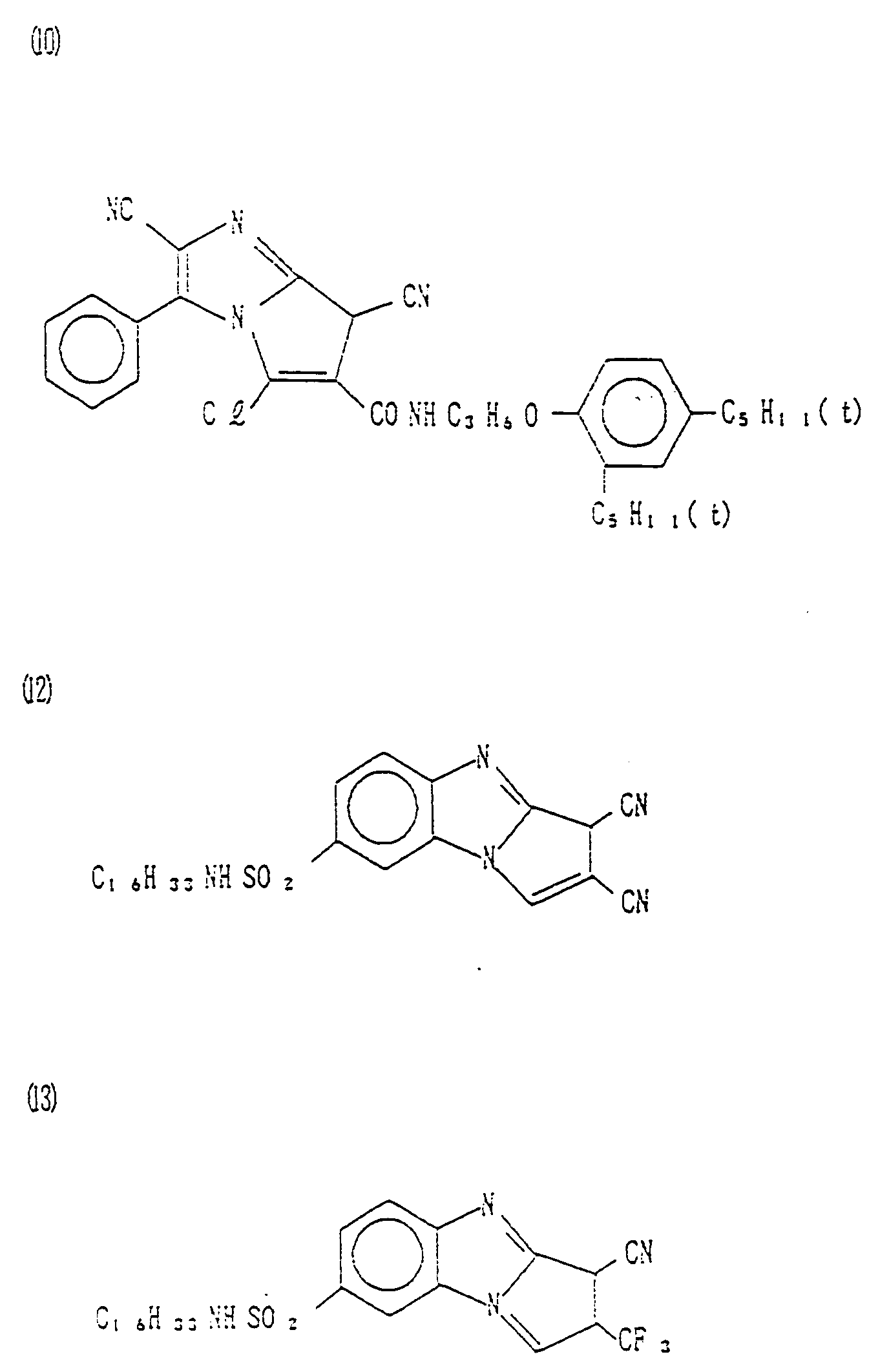


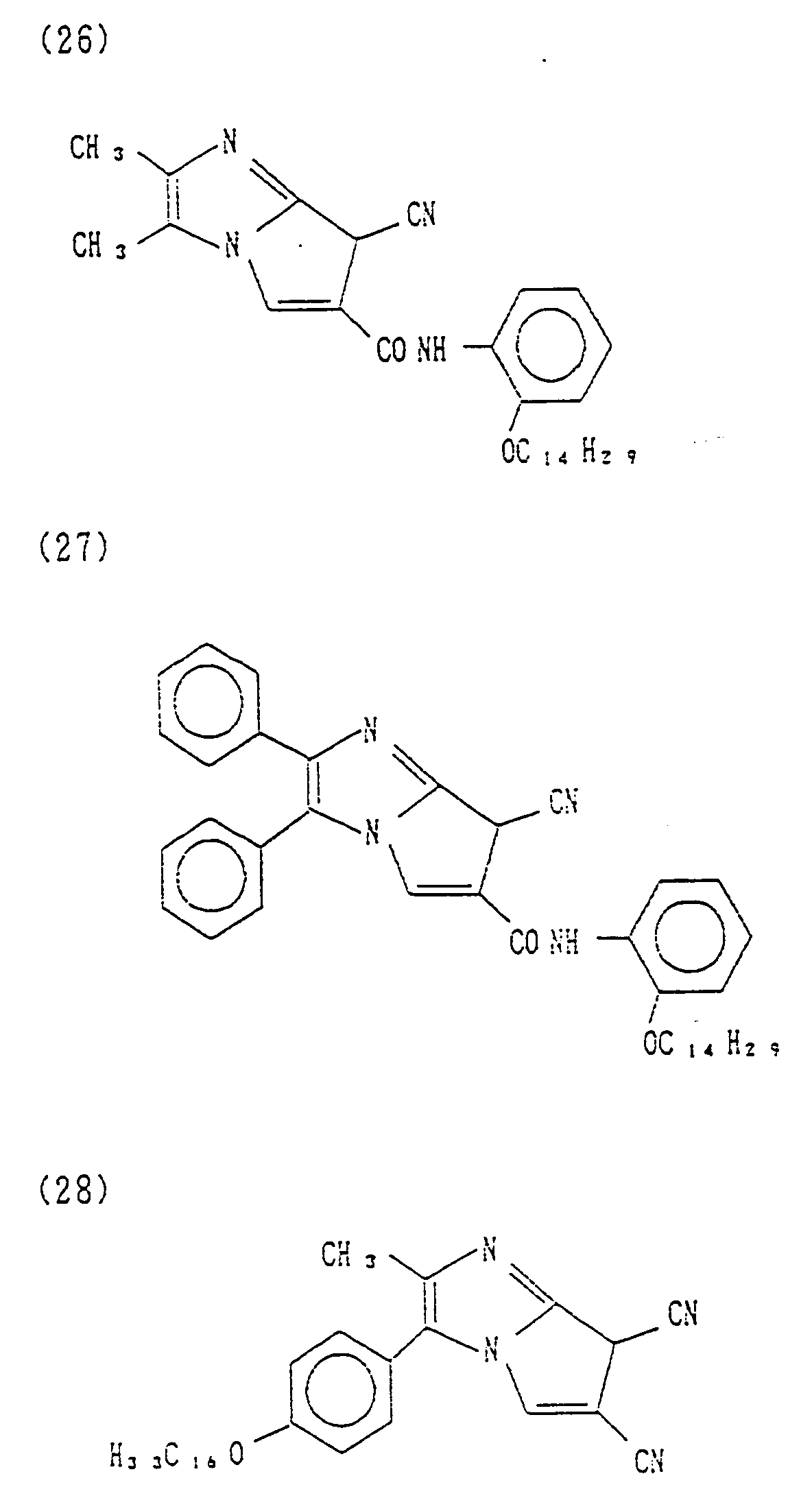


- Next, methods of producing dye forming couplers of formula (I) of the present invention will be mentioned below.
- 1H-pyrrolo[1,2-b]-imidazole compounds of the present invention are produced by two methods; one method comprising first forming an imidazole ring skeleton and thereafter condensing a pyrrole ring moiety thereto, and the other method comprising first forming a pyrrole ring skeleton and thereafter condensing an imidazole ring moiety thereto. Specific examples of each of these two methods will be mentioned below.
-

- In accordance with the process described in Journal of Organic Chemistry, Vol. 29, 3459 (1964), 30 g of Compound (A) was brominated with an equivalent amount of cupric bromide in 200 ml of chloroform to obtain 25.8 g of Compound (B).
- On the other hand, 21.1 g of 1,2-diamino-1,2-diphenylethylene (Compound (C)) and 22.3 g of malonnitrile monoimidate hydrochloride (Compound (D)) were added to 500 ml of ethanol which was saturated with ammonia, and heated at 50°C for 6 hours. After standing to cool to room temperature, ethanol was removed by distillation under reduced pressure, 100 ml of 50 % ethanol was added to the residue, and the crystal formed was taken out by filtration to obtain 18.5 g of 4,5-diphenyl-2-cyanomethylimidazole (Compound (E)).
- 13.0 g of Compound (E) and 25.8 g of Compound (B) were dissolved in 150 ml of dimethylacetamide, and 20 g of methanolic sodium methoxide (28 %) was dropwise added thereto at room temperature. The whole was stirred for 2 hours at room temperature, and the reaction solution was poured into a cold diluted hydrochloric acid, which was then extracted with ethyl acetate. The extract was washed with water and dried, and the solvent was removed by distillation under reduced pressure. The residue was purified by silica gel chromatography (with an eluent of n-hexane/ethyl acetate of 2/1 by volume) to obtain 10.6 g of a white crystal of Coupler (1).
-

- In accordance with the process described in J. Am. Chem. Soc., 80, 2822, Compound (F) was produced from tetracyanoethylene.
- 16.3 g of Compound (F) was dissolved in 400 ml of ethanol, and 40 g of a fresh Raney nickel was added thereto and heated under reflux for 2 hours.
- The reaction mixture was filtered while hot, and the residue was washed with 200 ml of a hot ethanol. The solvent was removed from the filtrate by distillation under reduced pressure to obtain 12.5 g of 2-amino-3,4-dicyanopyrrole (G).
- 21.6 g of Compound (H) obtained by reaction of 4,4-dihexyloxybenzoin and thionyl chloride and 6.6 g of Compound (G) were dissolved in 100 ml of dimethylsulfoxide, and 6.1 g of potassium t-butoxide was added thereto little by little at room temperature. The whole was stirred at 50°C for 2 hours and then left to cool to room temperature, and the reaction mixture then was poured into a cold diluted hydrochloric acid, which was then extracted with ethyl acetate. The extract was washed with water and dried, and ethyl acetate was removed by distillation. 100 ml of acetic acid was added to the residue, which was then heated at 80°C for 5 hours. The reaction mixture was poured into an ice-water and then extracted with ethyl acetate. After washing with water and drying, ethyl acetate was removed by distillation. The resulting residue was purified by silica gel chromatography (with an eluent of n-hexane/ethyl acetate of 1/1 by volume) to obtain 11.8 g of Compound (3) of the present invention.
- The other compounds of the present invention can be produced by either of the above-mentioned two production routes. The split-off group may be introduced into the couplers of formula (I) by a method of reaction with an appropriate halide compound or by methods described in U.S. Patents 3,926,631, 3,419,391, 3,725,067, 3,227,554, and JP-A-57-70817, and JP-B-56-45135 and 57-36577. (The term "JP-B" as used herein means an "examined Japanese patent publication".)
- The dyes obtained by oxidative coupling of Couplers (1) and (3) of the present invention and 2-methyl-4-(N-ethyl-N-methanesulfonylethylamino)aniline had a λmax value of 620 and 642 nm, respectively, in ethyl acetate and showed an absorption characteristic with a sharp toe in a short-wave range.
- Cyan dyes forming couplers of formula (I) of the present invention can be incorporated into silver halide color photographic materials as so-called coupler-in-emulsion type couplers; or alternatively, they may also be incorporated into color developers as so-called coupler-in-developer type couplers. The former type of incorporating cyan coupler of formula (I) of the present invention into photographic materials is preferred, in view of the stability of the quality of the materials to be processed and of the simplicity and rapid processability of the materials.
- One example of a reaction scheme of using a p-phenylenediamine developing agent is mentioned below.

(R, R' and R'' each represent a hydrogen atom or a substituent.) - Where a coupler of formula (I) of the present invention is incorporated into a silver halide photographic material, at least one layer containing a coupler of formula (I) may be provided on a support. The layer of containing a coupler of formula (I) may be a hydrophilic colloid layer on a support. An ordinary color photographic material may have at least one blue-sensitive silver halide emulsion layer, at least one green-sensitive silver halide emulsion layer and at least one red-sensitive silver halide emulsion layer in this order on a support, but the order of the layer constitution may be different from it. If desired, an infrared-sensitive silver halide emulsion layer may be substituted for at least one of the above light-sensitive emulsion layers. Each of the light-sensitive emulsion layers may contain a silver halide emulsion having a sensitivity to a light of the corresponding wavelength range and a color coupler for forming a dye which is complementary to the light to which the emulsion is sensitive, whereby color reproduction by a subtractive color photographic process is possible in the respective emulsion layers. However, the relationship between the light-sensitive emulsion layer and the color hue of the dye to be formed from the color coupler present therein is not limited to only the above-mentioned constitution.
- The coupler of formula (I) of the present invention is especially preferably incorporated into a red-sensitive silver halide emulsion layer in preparing a color photographic material.
- The amount of the coupler of formula (I) to be in a photographic material is preferably from 1 x 10⁻³ mol to 1 mol, more preferably from 2 x 10⁻³ mol to 3 x 10⁻¹ mol.
- Where the coupler of formula (I) of the present invention is soluble in an alkaline aqueous solution, it may be dissolved in an alkaline aqueous solution along with a developing agent and other additives and can be used for coupler-in-developer development in forming a color image. In this case, the amount of the coupler to be added may be from 0.0005 to 0.05 mol, preferably from 0.005 to 0.02 mol, per liter of color developer.
- The coupler of formula (I) of the present invention can be incorporated into a photographic material by various known dispersion methods. As one preferred example, there is mentioned an oil-in-water dispersion method where a coupler of formula (I) is dissolved in a high boiling point organic solvent (if necessary, along with a low boiling point organic solvent), the resulting solution is dispersed in an aqueous gelatin solution by emulsification and the dispersion is added to a silver halide emulsion.
- Examples of high boiling point organic solvents usable in such an oil-in-water dispersion method are described in U.S. Patent 2,322,027.
- A latex despersion method is another method for incoporating a coupler of formula (I) into a photographic material. Details and specific examples of a step of dispersing a latex, as one example of a polymer dispersion method, and the effect of such a dispersion method, as well as examples of a latex usable for impregnation in the method are described in U.S. Patent 4,199,363, German Patent OLS Nos. 2,541,274 and 2,541,230, JP-B-53-41091 and European Patent Laid-Open No. 029104. The details of a dispersion method with an organic solvent-soluble polymer are described in PCT WO88/00723.
- As examples of high boiling point organic solvents usable in the above-mentioned oil-in-water dispersion method, there are mentioned phthalates (e.g., dibutyl phthalate, dioctyl phthalate, dicyclohexyl phthalate, di-2-ethylhexyl phthalate, decyl phthalate, bis(2,4-di-tert-amylphenyl) isophthalate, bis(1,1-diethylpropyl) phthalate), phosphates and phosphonates (e.g., diphenyl phosphate, triphenyl phosphate, tricresyl phosphate, 2-ethylhexyl-diphenyl phosphate, dioctylbutyl phosphate, tricyclohexyl phosphate, tri-2-ethylhexyl phosphate, tridodecyl phosphate, di-2-ethylhexylphenyl phosphonate), benzoates (e.g., 2-ethylhexyl benzoate, 2,4-dichlorobenzoate, dodecyl benzoate, 2-ethylhexyl p-hydroxybenzoate), amides (e.g., N,N-diethyldodecanamide, N,N-diethyllaurylamide), alcohols or phenols (e.g., isostearyl alcohol, 2,4-di-tert-amylphenol), aliphatic esters (e.g., dibutoxyethyl succinate, di-2-ethylhexyl succinate, 2-hexyldecyl tetradecanoate, tributyl citrate, diethyl azelate, isostearyl lactate, trioctyl citrate), aniline derivatives (e.g., N,N-dibutyl-2-butoxy-5-tert-octylaniline), chlorinated paraffins (e.g., paraffins having a chlorine content of from 10 % to 80 %), trimesates (e.g., tributyl trimesate), dodecylbenzene, diisopropylnaphthalene, phenols (e.g., 2,4-di-tert-amylphenol, 4-dodecyloxyphenol, 4-dodecyloxycarbonylphenol, 4-(4-dodecyloxyphenylsulfonyl)phenol), carboxylic acids (e.g., 2-(2,4-di-tert-amylphenoxybutyric acid, 2-ethoxyoctandedecanoic acid), and alkyl phosphates (e.g., di-(2-ethylhexyl) phosphate, diphenyl phosphate). As an auxiliary solvent, if desired, an organic solvent having a boiling point of from about 30°C to about 160°C can be used. Examples of such an auxiliary solvent are ethyl acetate, butyl acetate, ethyl propionate, methyl ethyl ketone, cyclohexanone, 2-ethoxyethyl acetate, and dimethylformamide.
- Above all, so-called polar high boiling point organic solvents are preferably used with the couplers of the present invention. As examples of high boiling point organic solvent amides which can be used with the couplers of the present invention, in addition to the above-mentioned ones, those described in U.S. Patents 2,322,027, 4,127,413 and 4,745,049 are referred to. Above all, high boiling point organic solvents having a specific inductive capacity (as measured at 25°C and 10 Hz) of about 6.5 or more, preferably from 5 to 6.5 are preferred.
- The high boiling point organic solvent is used in an amount of from 0 to 2.0 times by weight, preferably from 0 to 1.0 time by weight, to the coupler.
- The couplers of formula (I) of the present invention can be applied to, for example, color papers, color reversal papers, direct positive color photographic materials, color negative films, color positive films, and color reversal films. In particular, application to color photographic materials having a reflective support (for example, color papers or color reversal papers) is preferred.
- The silver halide emulsion to be used in the present invention may have any halogen composition of silver iodobromide, silver iodochlorobromide, silver bromide, silver chlorobromide or silver chloride.
- The preferred halogen composition varies, depending upon the kind of the photographic material to which the coupler of the invention is applied. For a color paper, a silver chlorobromide emulsion is preferred. For a picture-taking photographic material such as a color negative film or color reversal film, a silver iodobromide emulsion having a silver iodide content of from 0.5 to 30 mol% (preferably, from 2 to 25 mol%) is preferred. For a direct positive color photographic material, a silver bromide or silver chlorobromide emulsion is preferred. For a color paper photographic material for rapid processing, a so-called high silver chloride emulsion having a high silver chloride content is preferred. The silver chloride content in such as high silver chloride emulsion is preferably 90 mol% or more, more preferably 95 mol% or more.
- In such a high silver chloride emulsion, it is preferred that a silver bromide localized phase is in the inside and/or surface of the silver halide grain in the form of a layered or non-layered structure. The halogen composition in the localized phase is preferably such that the silver bromide content therein is at least 10 mol% or more, more preferably more than 20 mol%. The localized phase may be in the inside of the grain or on the edges, corners or planes of the surface of the grain. As one preferred embodiment, the localized phase may be grown epitaxially on the corners of the grain.
- In the present invention, a silver chlorobromide or silver chloride which does not substantially contain silver iodide is preferably used. The term "does not substantially contain silver iodide" as referred to herein means that the silver iodide content in the silver halide is 1 mol% or less, preferably 0.2 mol% or less.
- The halogen composition of the grains in the emulsion for use in the present invention may differ from grain to grain. Preferably, however, the emulsion contains grains each having the same halogen composition, as the property of the grains may easily be homogenized. The halogen composition distribution of the grains in the silver halide emulsion for use in the present invention may be a so-called uniform halogen composition structure where any part of the grain has the same halogen composition; or the grain may have a so-called laminate structure where the halogen composition of the core of the inside of the grain is different from that of the shell (which may be one layer or plural layers) surrounding the core; or the grain may have a composite halogen composition structure where the inside or surface of the grain has a non-layered different halogen composition part (for example, when such a non-layered different halogen composition parts are on the surface of the grain, it may be on the edge, corner or plane of the grain as a conjugated structure). Any of such halogen compositions may properly be selected. In order to obtain a high sensitivity photographic material, the laminate or composite halogen composition structure grains are advantageously employed, rather than uniform halogen composition structure grains. Such laminate or composite halogen composition structure grains are also preferred for preventing generation of pressure marks. In the case of laminate or composite halogen composition structure grains, the boundary between the different halogen composition parts may be a definite one or may also be an indefinite one as the result of formation of a mixed crystal structure of the different halogen compositions. If desired, the boundary between them may a positive continuous structural change.
- The silver halide grains constituting the silver halide emulsion used in the present invention may have an average grain size of preferably from 0.1 µm to 2 µm, especially preferably from 0.15 µm to 1.5 µm. (The grain size indicates a diameter of a circle having an area equivalent to the projected area of the grain, and the average grain size indicates a number average value to be obtained from the measured grain sizes.) The grain size distribution of the emulsion is preferably that of a so-called monodispersed emulsion having a fluctuation co-efficient (to be obtained by dividing the standard deviation of the grain size distribution by the mean grain size) of 20% or less, preferably 15% or less. For the purpose of obtaining a broad latitude, two or more monodispersed emulsions may be blended to form a mixed emulsion in one layer, or two or more monodispersed emulsions may be separately coated in different layers to form plural layers. Such blending or separate coating is preferably effected for the purpose.
- The form of the silver halide grains constituting the silver halide emulsion of the present invention may be a regular crystalline form such as a cubic, tetradecahedral or octahedral crystalline form, or an irregular crystalline form such as spherical or tabular crystalline forms, or may be composite crystalline forms composed them. The grains may also be tabular grains.
- The silver halide emulsion for use in the present invention may be either a so-called surface latent image type emulsion for forming a latent image essentially on the surface of the grain or a so-called internal latent image type emulsion for forming a latent image essentially in the inside of the grain.
- The silver halide photographic emulsion for use in the present invention can be produced by various known methods, for example, by the methods described in Research Disclosure (RD) No. 17643 (December, 1978), pages 22 to 23, "I. Emulsion Preparation and Types", ibid., No. 18716 (November, 1979), page 648; P. Glafkides, Chemie et Phisique Photographique (published by Paul Montel, 1967); F. Duffin, Photographic Emulsion Chemistry (published by Focal Press, 1966); and V.L. Zelikman et al., Making and Coating Photographic Emulsion (published by Focal Press, 1964).
- Monodispersed emulsions as prepared by the methods described in U.S. Patents 3,574,628 and 3,655,394 and British Patent 1,413,748 are also preferably employed in the present invention.
- Tabular grains having an aspect ratio of about 5 or more may also be employed in the present invention. Such tabular grains may easily be prepared by known methods, for example, by the methods described in Gutoff, Photographic Science and Engineering, Vol. 14, pages 248 to 257 (1970); and U.S. Patents 4,434,226, 4,414,310, 4,433,048 and 4,439,520 and British Patent 2,112,157.
- The crystal structure of the silver halide grains for use in the present invention may be a structure in which different halogen compositions are present in the inside of the grain and the surface part thereof, or may be a layered structure. The silver halide grains may be composed of different silver halide compositions bonded by epitaxial junction. If desired, the silver halide grains may be joined with compounds other than silver halides, such as silver rhodanide or lead oxide.
- A mixture comprising silver halide grains having different crystalline forms may also be used.
- The silver halide emulsion for use in the present invention may generally be physically ripened, chemically ripened or spectrally sensitized.
- Various polyvalent metal ion impurities may be introduced into the silver halide grains for use in the present invention, during the step of forming the grains or the step of physically ripening them. As examples of compounds, there are mentioned salts of cadmium, zinc, lead, copper or thallium, as well as salts or complex salts of VIII Group elements (in the Periodic Table) of iron, ruthenium, rhodium, palladium, osmium, iridium or platinum.
- Additives usable in physical ripening, chemical ripening and spectral sensitizing steps applicable to the silver halide emulsions for use in the present invention are described in Research Disclosure Nos. 17643, 18716 and 307105, and the relevant parts therein are mentioned below. Other known additives which may be used in the present invention are also described in these Research Disclosure, and the relevant parts therein are also mentioned below.


- In order to prevent deterioration of the photographic property of the photographic material of the invention by formaldehyde gas, compounds capable of reacting with formaldehyde so as to fix it, for example, those described in U.S. Patents 4,411,987 and 4,435,503, are preferably incorporated into the material.
- Various color couplers can be incorporated into the photographic material of the present invention, and examples of usable color couplers are described in patent publications as referred to in the above-mentioned RD No. 17643, Item VII-C to G and RD No. 307105, Item VII-C to G.
- As yellow couplers, for example, those described in U.S. Patents 3,933,501, 4,022,620, 4,326,024, 4,401,752, 4,248,961, JP-B-58-10739, British Patents 1,425,020, 1,476,760, U.S. Patents 3,973,968, 4,314,023, 4,511,649, and European Patent 249,473A are preferred.
- It is preferred that yellow couplers which have a maximum absorption wavelength in a short-wave range and have a sharply decreasing absorption in a long-wave range exceeding 500 nm are combined with the couplers of formula (I) of the present invention, in view of the color reproducibility of the combined couplers. Such yellow couplers are described in, for example, JP-A-63-123047 and 1-173499.
- As magenta couplers, 5-pyrazolone compounds and pyrazoloazole compounds are preferred. For instance, those described in U.S. Patents 4,310,619, 4,351,897, European Patent 73,636, U.S.Patents 3,061,432, 3,725,067, RD No. 24220 (June, 1984), JP-A-60-33552, RD No. 24230 (June, 1984), JP-A-60-43659, 61-72238, 60-35730, 55-118034, 60-185951, U.S. Patents 4,500,630, 4,540,654, 4,556,630, and WO(PCT)88/04795 are preferred.
- As cyan couplers, phenol couplers and naphthol couplers are preferred. For instance, those described in U.S. Patents 4,052,212, 4,146,396, 4,228,233, 4,296,200, 2,369,929, 2,801,171, 2,771,162, 2,895,826, 3,772,002, 3,758,308, 4,334,011, 4,327,173, West German Patent (OLS) No. 3,329,729, European Patents 121,365A, 249,453A, U.S. Patents 3,446,622, 4,333,999, 4,775,616, 4,451,559, 4,427,767, 4,690,889, 4,254,212, 4,296,199, and JP-A-61-42658 are preferred.
- Colored couplers for correcting the unwanted absorption of colored dyes may also be used in the present invention. As such colored couplers, those described in RD No. 17643, Item VII-G, U.S. Patent 4,163,670, JP-B-57-39413, U.S. Patents 4,004,929, 4,138,258, and British Patent 1,146,368 are preferred. Additionally, couplers for correcting the unwanted absorption of a colored dye by a fluorescent dye which is released during coupling, as described in U.S. Patent 4,774,181, as well as couplers having a dye precursor group capable of reacting with a developing agent to form a dyes, as a split-off group, as described in U.S. Patent 4,777,120 are also preferably used.
- Couplers capable of forming colored dyes having a suitable degree of pertinent diffusibility may also be used, and those described in U.S. Patent 4,366,237, British Patent 2,125,570, European Patent 96,570, and West German Patent (OLS) No. 3,234,533 are preferred.
- Polymerized dye-forming couplers may also be used, and typical examples of such couplers are described in U.S. Patents 3,451,820, 4,080,211, 4,367,282, 4,409,320, 4,576,910, and British Patent 2,102,173.
- Couplers capable of releasing a photographically useful residue on coupling may also be used in the present invention. For instance, DIR couplers which release a development inhibitor are described in the patent publications referred to in the above-mentioned RD No. 17643, Item VII-F, and are described in JP-A-57-151944, 57-154234, 60-184248 and 63-37346, and U.S. Patents 4,248,962 and 4,782,012 are preferred.
- Couplers for imagewise releasing a nucleating agent or development accelerator during development are described in British Patents 2,097,140 and 2,131,188, and JP-A-59-157638 and 59-170840 are preferred.
- Additionally, as examples of other couplers which may be incorporated into the photographic materials of the present invention, there are further mentioned competing couplers described in U.S. Patent 4,130,427; poly-valent couplers described in U.S. Patents 4,283,472, 4,338,393 and 4,310,618; DIR redox compound-releasing couplers, DIR coupler-releasing couplers, DIR coupler-releasing redox compounds and DIR redox-releasing redox compounds described in JP-A-60-185950 and 62-24252; couplers for releasing a dye which recolors after being released from the coupler, as described in European Patent 173,302A; bleaching accelerator-releasing couplers as described in RD Nos. 11449 and 24241, and JP-A-61-201247; ligand-releasing couplers described in U.S. Patent 4,553,477; leuco dye-releasing couplers described in JP-A-63-75747; and couplers which release a fluorescent dye as described in U.S. Patent 4,774,181.
- The standard amount of couplers which may be used together with the coupler of formula (I) of the present invention is from 0.001 to 1 mol per mol of silver halide. Preferably, it is from 0.01 to 0.5 mol for yellow couplers; from 0.003 to 0.3 mol for magenta couplers. Cyan couplers are used in an amount such as that the effects of the present invention are not hindered. The amount is preferably within the range of from 0.002 to 0.3 mol.
- Such couplers may be incorporated into the photographic material of the present invention by various known dispersion methods mentioned above.
- The photographic material of the present invention may further contain hydroquinone derivatives, aminophenol derivatives, gallic acid derivatives and ascorbic acid derivatives, as a color fogging inhibitor.
- The photographic material of the present invention may also contain various anti-fading agents. As typical organic anti-fading agents for cyan, magenta and/or yellow images usable in the present invention, there are mentioned hindered phenols such as hydroquinones, 6-hydroxychromans, 5-hydroxycoumarans, spirochromans, p-alkoxyphenols and bisphenols, and gallic acid derivatives, methylenedioxybenzenes, aminophenols, hindered amines and ether or ester derivatives formed by silylating or alkylating the phenolic hydroxyl group of the compounds. In addition, metal complexes such as (bissalicylaldoximato)nickel complexes and (bis-N,N-dialkyldithiocarbamato)nickel complexes may also be used.
- As specific examples of organic anti-fading agents usable in the present invention, there are mentioned hydroquinones described in U.S. Patents 2,360,290, 2,418,613, 2,700,453, 2,701,197, 2,728,659, 2,732,300, 2,735,765, 3,982,944 and 4,430,425, British Patent 1,363,921, U.S. Patents 2,710,801 and 2,816,028; 6-hydroxychromans, 5-hydroxychromans and spirochromans described in U.S. Patents 3,432,300, 3,573,050, 3,574,627, 3,698,909 and 3,764,337, and JP-A-52-152225; spiroindanes described in U.S. Patent 4,360,589; p-alkoxyphenols described in U.S. Patent 2,735,765, British Patent 2,066,975, JP-A-59-10539, and JP-B-57-19765; hindered phenols described in U.S. Patents 3,700,455 and 4,228,235, JP-A-52-72224, and JP-B-52-6623; gallic acid derivatives described in U.S. Patent 3,457,079; methylenedioxybenzenes described in U.S. Patent 4,332,886; aminophenols described in JP-B-56-21144; hindered amines described in U.S. Patents 3,336,135 and 4,268,593, British Patents 1,326,889, 1,354,313 and 1,410,846, JP-B-51-1420, and JP-A-58-114036, 59-53846 and 59-78344; and metal complexes described in U.S. Patents 4,050,938 and 4,241,155, and British Patent 2,027,731(A). The compounds are incorporated into the light-sensitive layers by co-emulsifying them with the corresponding color couplers generally in an amount of from 5 to 100% by weight with respect to couler.
- For the purpose of preventing cyan color images from fading by heat and especially by light, incorporation of an ultraviolet absorbent into the cyan coloring layer and the both adjacent layers is effective.
- As examples of ultraviolet absorbents usable for this purpose, there are mentioned aryl group-substituted benzotriazole compounds (for example, those described in U.S. Patent 3,533,794), 4-thiazolidones (for example, those described in U.S. Patents 3,314,794 and 3,352,681), benzophenone compounds (for example, those described in JP-A-46-2784), cinnamate compounds (for example, those described in U.S. Patents 3,705,805 and 3,707,395), butadiene compounds (for example, those described in U.S. Patent 4,045,229), and benzoxazole compounds (for example, those described in U.S. Patents 3,406,070 and 4,271,307). Ultraviolet absorbing couplers (for example, α-naphthol cyan dye forming couplers) and ultraviolet absorbing polymers may also be used. Such ultraviolet absorbents may be mordanted in particular layers.
- From among these compounds, aryl group-substituted benzotriazole compounds are preferred.
- Gelatin is advantageously used as a binder or protective colloid in the emulsion layers constituting the photographic material of the present invention. Any other hydrophilic colloid may also be used singly or along with gelatin.
- Gelatin for use in the present invention may be either a lime-processed one or an acid-processed one. The details of producing gelatin are described in Arther Vais, The Macromolecular Chemistry of Gelatin (published by Academic Press, 1964).
- The photographic material of the present invention can contain various antiseptics and fungicides, such as 1,2-benzisothiazolin-3-one, n-butyl p-hydroxybenzoate, phenol, 4-chloro-3,5-dimethylphenol, 2-phenoxyethanol, and 2-(4-thiazolyl)benzimidazole, as described in JP-A-63-257747, 62-272248 and 1-80941.
- Where the photographic material of the present invention is a direct positive color photographic material, it may contain a nucleating agent, such as hydrazine compounds or quaternary heterocyclic compounds as described in Research Disclosure No. 22534 (January, 1983), as well as a nucleation accelerator for promoting the effect of such a nucleating agent.
- As the support to be used in the photographic material of the present invention, a transparent film such as cellulose nitrate film or polyethylene terephthalate film, or a reflective support, which is generally used in preparing ordinary photographic materials, can be used. In view of the object of the present invention, a reflective support is more preferred.
- A "reflective support" which is advantageously used in the present invention is one capable of elevating the reflectivity of the photographic material to thereby sharpen the color image which is formed in the silver halide emulsion layer. Such a reflective support includes one which is prepared by coating a hydrophobic resin containing a photo-reflecting substance, such as titanium oxide, zinc oxide, calcium carbonate or calcium sulfate, as dispersed therein, on a support base; and one which is formed from a hydrophobic resin which itself contains the above-mentioned photo-reflective substance which is dispersed therein. For instance, there are mentioned baryta paper; polyethylene-coated paper; polypropylene synthetic paper; and a transparent support (such as glass plate, polyester films such as polyethylene terephthalate, cellulose triacetate or cellulose nitrate film, polyamide films, polycarbonate films, polystyrene films, vinyl chloride resin films) which is coated with a reflective layer or containing a reflective substance.
- The photographic material of the present invention may be processed in accordance with any ordinary photographic processing methods, for example, by the methods described in the above-mentioned Research Disclosure No. 17643, pages 28 to 29 and ibid., No. 18716, page 615, from left to right column. For instance, the material is subjected to color development comprising a color developing step, a desilvering step and a rinsing step. Where the material is subjected to reversal development, the process comprises a black-and-white developing step, a water-washing or rinsing step, a reversal step and a color developing step. In the desilvering step, in place of bleaching with a bleaching solution and fixing with a fixing solution, a combined bleach-fixing with a bleach-fixing solution may also be effected. The bleaching step, fixing step and bleach-fixing step may be combined in any desired order. In place of a water-washing step, stabilization may be effected. If desired, the photographic material may be processed by a mono-bath process of using a mono-bath developing and bleach-fixing solution where color development, bleaching and fixation are effected in one bath. In combination with these processing steps, any one or more processing step selected from a pre-hardening step, a step for neutralization thereof, a stopping and fixing step, a post-hardening step, an adjusting step and an intensifying step may be carried out. Between these steps, any desired intermideiate-water-washing step may be provided. In place of the color development step, a so-called activator processing step may also be effected.
- The color developer to be used for developing the photographic material of the present invention is an aqueous alkaline solution containing an aromatic primary amine color developing agent as a main component. As the color developing agent, aminophenol compounds are useful, but p-phenylenediamine compounds are more preferably used. As specific examples of such compounds, there are mentioned 3-methyl-4-amino-N,N-diethylaniline, 3-methyl-4-amino-N-ethyl-N-β-hydroxyethylaniline, 4-amino-N-ehtyl-N-β-hydroxyethylaniline, 3-methyl-4-amino-N-ethyl-N-β-methanesulfonamidoethylaniline, 3-methyl-4-amino-N-ethyl-β-methoxyethylanilne, and sulfates, hydrochlorides and p-toluenesulfonates of the compounds. These compounds may be used singly or in combination of two or more of them, in accordance with the intended purpose.
- The color developer generally contains a pH buffer such as alkali metal carbonates, borates or phosphates; and a development inhibitor or an antifoggant such as chlorides, bromides, iodides, benzimidazoles, benzothiazoles or mercapto compounds. If desired, it may also contain various preservatives, such as hydroxylamine, diethylhydroxylamine, sulfites, hydrazines (e.g., N,N-bis-carboxymethylhydrazine), phenylsemicarbazides, triethanolamine, and catechol-sulfonic acids; organic solvents such as ethylene glycol or diethylene glycol; development accelerators such as benzyl alcohol, polyethylene glycol, quaternary ammonium salts or amines; dye forming couplers; competing couplers; auxiliary developing agents such as 1-phenyl-3-pyrazolidone; nucleating agents such as sodium boronhydride or hydrazine compounds; tackifiers; various chelating agents such as aminopolycarboxylic acids, aminopolyphosphonic acids, alkylphosphonic acids or phosphonocarboxylic acids (e.g., ethylenediamine-tetraacetic acid, nitrilotriacetic acid, diethylenetriamine-pentaacetic acid, cyclohexanediamine-tetraacetic acid, hydroxyethylimino-diacetic acid, 1-hydroxyethylidene-1,1-diphosphonic acid, nitrilo-N,N,N-trimethylene-phosphonic acid, ethylenediamine-N,N,N,N-tetramethylenephosphonic acid, ethylenediamine-di(o-hydroxyphenylacetic acid) and salts thereof); fluorescent brightening agents such as 4,4'-diamino-2,2'-disulfostilbene compounds; and various surfactants such as alkylsulfonic acids, arylsulfonic acid, aliphatic carboxylic acids and aromatic carboxylic acids.
- The color developer for use in the present invention is desired to substantially not contain benzyl alcohol. The color developer substantially not containing benzyl alcohol is one containing benzyl alcohol, preferably in an amount of 2 ml/liter or less, more preferably 0.5 ml/liter or less, most preferably is one containing no benzyl alcohol.
- The color developer for use in the present invention is desired to substantially not contain sulfite ion. The color developer substantially not containing sulfite ion is one containing sulfite ion preferably in an amount of 3.0 x 10⁻³ mol/liter or less, and more preferably is one containing no sulfite ion.
- The color developer for use in the present invention is desired to substantially not contain hydroxylamine. The color developer substantially not containing hydroxylamine is one containing hydroxylamine preferably in an amount of 5.0 x 10⁻³ mol/liter or less, and more preferably is one containing no hydroxylamine. The color developer for use in the present invention desirably contains an organic preservative (for example, hydroxylamine derivatives or hydrazine derivatives), except hydroxylamine.
- The color developer generally has a pH value of from 9 to 12.
- A color reversal process which can be applied to the photographic material of the present invention generally comprises a black-and-white processing step, a water-washing or rinsing step, a reversal processing step and a color development step. The reversal processing step may use a reversal bath containing a foggant or may be effected by photo-reversal treatment. If desired, such a foggant may be incorporated into a color developer to omit the reversal processing step.
- The black-and-white developer to be used in the black-and-white processing step may be any conventional one usable for processing ordinary black-and-white photographic materials, and it may contain any additives generally applicable to ordinary black-and-white developers.
- As typical additives, there are mentioned developing agents such as 1-phenyl-3-pyrazolidone, N-methyl-p-aminophenol and hydroquinone; preservatives such as sulfites; pH buffers comprised of water-soluble acids such as acetic acid or boric acid; pH buffers or development accelerators comprised of water-soluble alkaline materials such as sodium hydroxide, sodium carbonate or potassium carbonate; inorganic or organic development inhibitors such as potassium bromide, 2-methylbenzimidazole or methylbenzothiazole; water softeners such as ethylenediaminetetraacetic acid or polyphosphates; antioxidants such as ascorbic acid or diethanolamine; organic solvents such as triethylene glycol or cellosolves; and surface over-development inhibitors such as trace amounts of iodides or mercapto compounds;
Where the amount of replenisher to such a developer is reduced, it is desired that evaporation or aerial oxidation of the processing solution is prevented by reducing the contact area between the surface of the processing tank and air. As a method of reducing the contact area between the surface of the processing tank and air, a surface-shielding material, such as a floating lid, may be provided on the surface of the processing solution in the processing tank. It is preferred that the technique is employed not only in the color development and black-and-white development steps, but also in all the successive steps. In addition, a recovery means for preventing accumulation of bromide ions in the developer tank may also be employed so as to reduce the amount of replenisher to be added to the tank. - The color development time is generally set between 2 minutes and 5 minutes. However, by elevating the processing temperature and elevating the pH value of the processing solution (developer) and further elevating the concentration of the color developing agent in the developer, the processing time may further be shortened.
- The photographic emulsion layer is, after being color-developed, desilvered. Desilvering is effected by simultaneous or separate bleaching and fixing. Simultaneous bleaching and fixing is called bleach-fixing. In order to further accelerate the processing, bleach-fixing may be effected after bleaching. If desired, a bleach-fixing bath comprising two tanks which are connected in series may be used; or fixing may be effected before bleach-fixing; or bleach-fixing may be effected after bleaching. The processing systems may be selected and employed in accordance with the intended purpose. In processing the photographic material of the present invention, it is advantageous that the material is color-developed and then immediately bleach-fixed so as to more efficiently attain the effect of the present invention.
- As bleaching agents which can be used in the bleaching solution or bleach-fixing solution usable in the present invention, there are mentioned compounds of polyvalent metals such as iron(III); peracids; quinones; and iron salts. Specific examples of such agents are iron chloride; ferricyanides; bichromates; organic complexes of iron(III) (for example, metal complexes of aminopolycarboxylic acids such as ethylenediaminetetraacetic acid, diethylenetriaminepentaacetic acid, 1,3-diaminopropanetetraacetic acid); and persulfates. From among these materials, aminopolycarboxylato/iron(III) complexes are preferred so as to efficiently display the effect of the present invention. Aminopolycarboxylato/iron(III) complexes are useful both in a bleaching solution and especially in a bleach-fixing solution. The bleaching solution or bleach-fixing solution containing such an aminopolycarboxylato/iron(III) complex is used under the condition of a pH of from 3.5 to 8.
- The bleaching solution or bleach-fixing solution may contain various known additives, for example, a rehalogenating agent such as ammonium bromide or ammonium chloride; a pH buffer such as ammonium nitrate; and a metal corrosion inhibitor such as ammonium sulfate.
- The bleaching solution or bleach-fixing solution preferably contains an organic acid for the purpose of preventing bleaching stains, in addition to the above-mentioned compounds. Especially preferred organic acids for this purpose are compounds having an acid dissociation constant (pKa) of from 2 to 5.5. Specifically, acetic acid and propionic acid are preferred.
- As a fixing agent which can be used in the fixing solution or bleach-fixing solution to be used in the present invention, there are mentioned thiosulfates, thiocyanates, thioether compounds, thioureas, and a large amount of iodides. Generally used are thiosulfates. In particular, ammonium thiosulfate is most widely used. In addition, a combination of thiosulfates and thiocyanates, thioether compounds or thioureas is also preferred.
- The fixing solution of bleach-fixing solution may contain a preservative such as sulfites, bisulfites, carbonyl-bisulfite adducts, or sulfinic acid compounds described in European Patent 294,769A. In addition, it is preferred to add various amino-polycarboxylic acids or organic phosphonic acids (e.g., 1-hydroxyethylidene-1,1-diphosphonic acid, N,N,N',N'-ethylenediamine-tetraphosphonic acid) to the fixing solution or bleach-fixing solution for the purpose of stabilizing the solution.
- The fixing solution or bleach-fixing solution may further contain various fluorescent brightening agents, defoaming agents, surfactants, polyvinyl pyrrolidone and methanol.
- The bleaching solution and bleach-fixing solution and the pre-bath thereof may optionally contain a bleaching accelerator. As specific examples of usable bleaching accelerators, there are mentioned compounds having a mercapto group or disulfido group as described in U.S. Patent 3,893,858, German Patents 1,290,812 and 2,059,988, JP-A-53-32736, 53-57831, 53-37418, 53-72623, 53-95630, 53-95631, 53-104232, 53-124424, 53-141623 and 53-28426, and Research Disclosure No. 17129 (July, 1978); thiazolidine derivatives described in JP-A-50-140129; thiourea derivatives described in JP-B-45-8506, JP-A-52-20832 and 53-32735, and U.S. Patent 3,706,561; iodides described in German Patent 1,127,715, and JP-A-58-16235; polyoxyethylene compounds described in German Patents 966,410 and 2,748,430; polyamine compounds described in JP-B-45-8836; compounds described in JP-A-49-42434, 49-59644, 53-94927, 54-35727, 55-26506 and 58-163940; and bromide ions. Among these compounds, compounds having a mercapto group or disulfido group are preferred as having a large accelerating effect, and in particular, those described in U.S. Patent 3,893,858, German Patent 1,290,812 and JP-A-53-95630 are especially preferred. In addition, compounds described in U.S. Patent 4,552,834 are also preferred. Such a bleaching accelerator may be added to the photographic material. Where the photographic material of the present invention is a picture-taking color photographic material and it is bleach-fixed, the above-mentioned bleaching accelerators are especially effective.
- The total desilvering time is desired to be as short as possible within the range where desilvering failure does not occur. The preferred time is from one minute to 3 minutes. The processing temperature may be within the range between 25°C and 50°C, preferably between 35°C and 45°C.
- In the desilvering step, it is desired that agitation of the system is reinforced as much as possible. As a specific means for accelerating the agitation, there is mentioned a method of forcing a jet stream of the processing solution onto the emulsion-coated surface of the photographic material being processed, as described in JP-A-62-183460. Such an agitation accelerating means is effective in processing steps which use a bleaching solution, a bleach-fixing solution and a fixing solution.
- The photographic material of the present invention is generally rinsed with water, after being desilvered as mentioned above. In place of rinsing with water, stabilization may also be effected. In the stabilization step, any known methods as described, for example, in JP-A-57-8543, 58-14834 and 60-220345 may be employed. If desired, a combined rinsing (with water) - stabilization step may be effected, in which a stabilizing bath containing a dye-stabilizing agent and a surfactant is used as the final bath. This combinded step is conveniently applied to picture-taking color photographic materials.
- The rinsing solution and stabilizing solution applicable to the photographic material of the present invention may contain a water softener such as inorganic phosphoric acids, polyaminocarboxylic acids or organic aminophosphonic acids; a microbicide such as isothiazolone compounds or thiabendazoles, or a chlorine-containing microbicide such as sodium chloroisocyanurate; a metal salt such as Mg salts, Al salts or Bi salts; a surfactant; a hardening agent; and a bactericide.
- The amount of the rinsing water to be used in the rinsing step may be set in a broad range, depending upon the properties of the photographic material being processed (for example, the components of the material, such as couplers, etc.), the use of the material, the temperature of the rinsing water, the number of the rinsing tanks (the number of the rinsing stages), the replenishment system of either countercurrent type or co-current type, and other various conditions. The relationship between the number of the rinsing tanks and the rinsing water in a multi-stage countercurrent rinsing system may be obtained in accordance with the method described in Journal of the Society of Motion Picture and Television Engineers, Vol. 64, pages 248 to 253 (May, 1955). The method of reducing the amounts of calcium ions and magnesium ions in the rinsing water, as described in JP-A-62-288838, may be used extremely effectively.
- The rinsing water has a pH value of from 4 to 9, preferably from 5 to 8. The temperature of the rinsing water and the rinsing time may also be set variously, depending upon the property and use of the photographic material being processed. In general, the rinsing temperature is from 15°C to 45°C and the rinsing time is from 20 seconds to 10 minutes; preferably, the former is from 25°C to 40°C and the latter is from 30 seconds to 5 minutes.
- As the dye stabilizing agent which may be in the stabilizing solution, there are mentioned aldehydes such as formalin and glutaraldehyde; N-methylol compounds such as dimethylolurea; hexamethylenetetramine; and aldehyde-sulfite adducts. The stabilizer may further contain a pH adjusting buffer such as boric acid or sodium hydroxide; a chelating agent such as 1-hydroxyethylidene-1,1-diphosphonic acid or ethylenediaminetetraacetic acid; an anti-sulfiding such as alkanolamines; a fluorescent brightening agent; and a fungicide.
- The overflow liquid to be derived by replenishment to the above-mentioned rinsing solution and/or the stabilizing solution may be re-circulated to the other baths, such as the previous desilvering bath.
- The photographic material of the present invention can contain a color developing agent for the purpose of simply and rapidly processing the material. Preferably, various precursors of color developing materials are incorporated into the material. For instance, as examples of usable precursors, there are mentioned indoaniline compounds described in U.S. Patent 3,342,597, Schiff base compounds described in U.S. Patent 3,342,599, Research Disclosure No. 14850 and ibid., No. 15159, aldole compounds described in Research Disclosure No. 13924, metal complexes described in U.S. Patent 3,719,492, and urethane compounds described in JP-A-53-135628.
- The photographic material of the present invention may contain, if desired, various 1-phenyl-3-pyrazolidones for the purpose of promoting the color developability thereof. Specific examples of compounds usable for the purpose are described in JP-A-56-64339, 57-144547 and 58-115438.
- In processing the photographic material of the present invention, the processing solutions are used at a temperature between 10°C and 50°C. In general, the standard processing temperature is between 33°C and 38°C. The processing temperature may be elevated higher so as to promote the processing step or to shorten the processing time or it may be lowered so as to improve the image quality of the image to be formed or to promote the stability of the processing solutions being used.
- The present invention will be explained in more detail by way of the following examples, which, however, are not intended to restrict the scope of the present invention.
- Two layers mentioned below were formed on a cellulose triacetate film support to prepare a photographic material sample which is designated as Sample No. 101. A coating composition for the first layer was prepared as mentioned below.
- 1.01 g of cyan coupler (A-1) and 0.62 g of dibutyl phthalate were completely dissolved in 10.0 cc of ethyl acetate. The coupler containing ethyl acetate solution was added to 42 g of an aqueous 10 % gelatin solution (containing 7 g/liter of sodium dodecylbenzenesulfonate) and dispersed by emulsification with a homogenizer. After dispersion and emulsification, distilled water was added to the resulting dispersion to make the whole to be 100 g. 100 g of the dispersion and 8.2 g of a high silver chloride emulsion (AgBrCl emulsion having a silver bromide content of 0.5 mol%) were blended to prepare a coating composition for the first layer, which contained the components mentioned below. As a gelatin hardening agent used was 1-hydroxy-3,5-dichloro-s-triazine sodium salt.
- The layers contained the components mentioned below.
- Cellulose Triacetate Film
-
Silver Halide in High Silver Chloride Emulsion 0.29 g/m² as Ag Gelatin 2.60 g/m² Cyan Coupler (A-1) 0.49 g/m² Dibutyl Phthalate 0.30 g/m² -

- Samples Nos. 102 to 107 were prepared in the same manner as above, except that the cyan coupler (A-1) in Sample No. 101 was replaced by the same molar amount of the coupler as indicated in Table 1 below.
-

- Samples Nos. 101 to 107 thus prepared were wedgewise exposed with a white light and then processed in accordance with the process mentioned below.
- The processed samples were evaluated with respect to the color hue and the heat-fastness of the image formed.
- The spectral absorption of the maximum density part of the processed sample was measured. The side absorption and the sharpness of the toe in the short-wave side were obtained in accordance with the following formulae. From the values obtained, the color hue of the processed sample was evaluated. For both values, the smaller, the better.


- The processed samples were subjected to a fading test by storing them at 80°C for 2 weeks, whereupon the cyan density (DR) at the part having a cyan density of 1.0 before the test was measured. A color retention percentage was obtained from the following formula, and the heat-fastness of each sample was determined on the basis of the color retention value obtained. The larger the color retention percentage the better.

- Results thus obtained are shown in Table 1.

- The processing solutions used had the following compositions.
-
Water 800 ml Ethylenediamine-N,N,N,N-tetramethylenephosphonic Acid 3.0 g Triethanolamine 8.0 g Potassium Chloride 3.1 g Potassium Bromide 0.015 g Potassium Carbonate 25 g Hydrazinodiacetic Acid 5.0 g N-ethyl-N-(β-methanesulfonamidoethyl)-3-methyl-4-minoaniline Sulfate 5.0 g Fluorescent Brightening Agent (WHITEX-4, product by Sumitomo) 2.0 g Water to make 1000 ml pH (with potassium hydroxide) 10.05 -
Water 400 ml Ammonium Thiosulfate Solution (700 g/liter) 100 ml Ammonium Sulfite 45 g Ammonium Ethylenediaminetetraacetato/Iron(III) 55 g Ethylenediaminetetraacetic Acid 3 g Ammonium Bromide 30 g Nitric Acid (67 %) 27 g Water to make 1000 ml pH 6.2 - Ion-exchanged Water (having calcium and magnesium contents of each 3 ppm or less).

- As is obvious from the results in Table 1 above, the couplers of the present invention form dyes having a small side absorption and having a sharp toe in the short-wave side, and the dyes from the couplers had a high heat-fastness.
- Samples Nos. 201 to 207 were prepared in the same manner as in Example 1, except that a silver iodobromide emulsion (having a silver iodide content of 8.0 mol%) was used in place of the high silver chloride emulsion in Samples Nos. 101 to 107, respectively. The samples thus prepared were processed in accordance with the process mentioned below, and they were evaluated in the same manner as in Example 1.
- The results obtained are shown in Table 2 below.
-
Processing Step Time Temperature Color Development 3 min 15 sec 38°C Bleaching 1 min 00 sec 38°C Bleach-Fixing 3 min 15 sec 38°C Rinsing (1) 0 min 40 sec 35°C Rinsing (2) 1 min 00 sec 35°C Stabilization 0 min 40 sec 38°C Drying 1 min 15 sec 55°C - The processing solutions used above had the following compositions.
-
Diethylenetriaminepentaacetic Acid 1.0 g 1-Hydroxyethylidene-1,1-diphosphonic Acid 3.0 g Sodium Sulfite 4.0 g Potassium Carbonate 30.0 g Potassium Bromide 1.4 g Potassium Iodide 1.5 mg Hydroxylamine Sulfate 2.4 g 4-[N-ethyl-N-β-hydroxyethylamino]-2-methylaniline Sulfate 4.5 g Water to make 1.0 liter pH 10.05 -
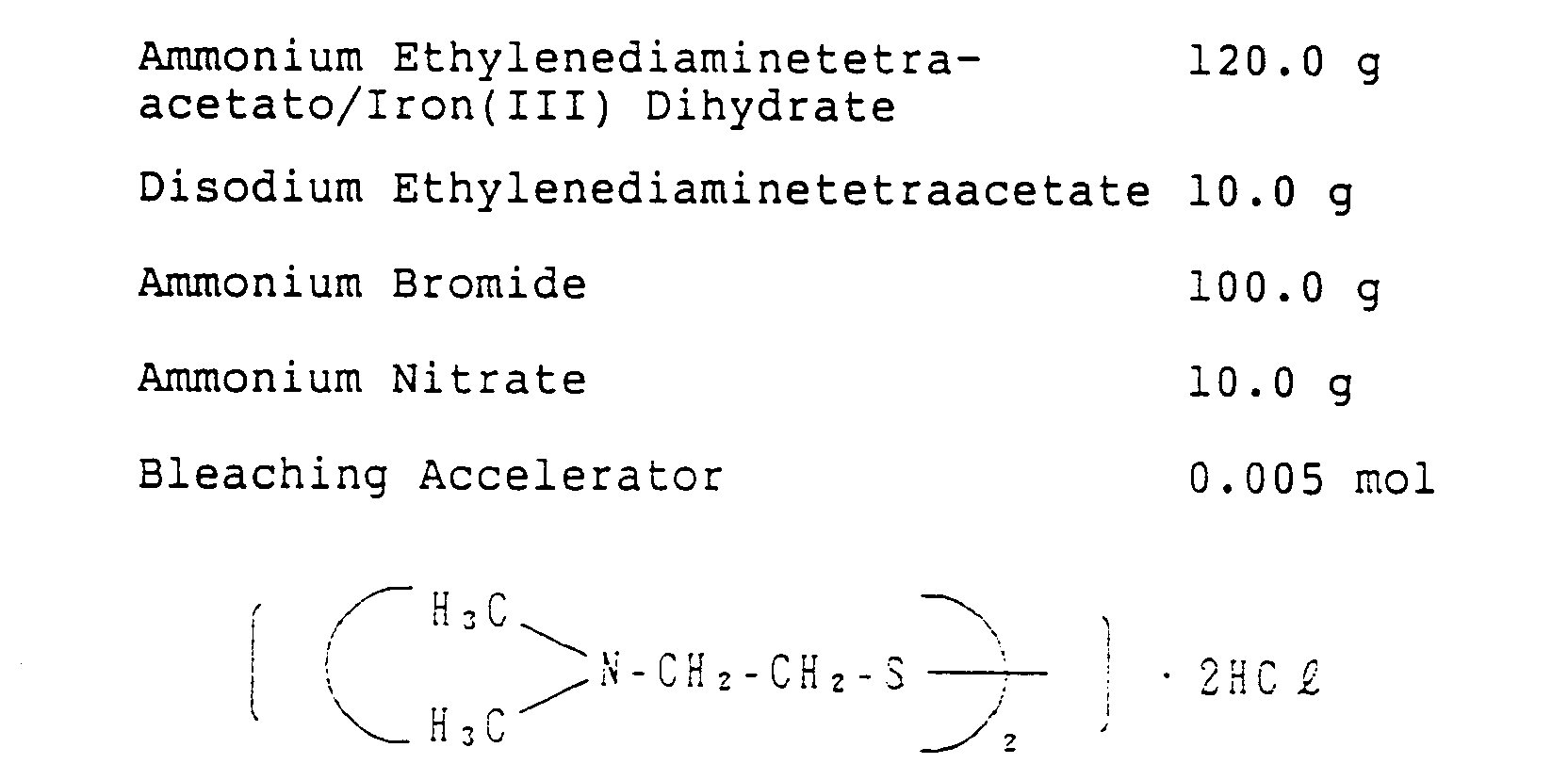

-
Ammonium Ethylenediaminetetraacetato/Iron(III) Dihydrate 50.0 g Disodium Ethylenediaminetetraacetate 5.0 g Sodium Sulfite 12.0 g Aqueous Ammonium Thiosulfate Solution (70 %) 240.0 ml Aqueous Ammonia (27 %) 6.0 ml Water to make 1.0 liter pH 7.2 - A city water was passed through a mixed bed type column filled with an H-type strong acidic cation-exchange resin (Amberlite IR-120B, produced by Rohm & Haas Co.) and an OH-type strong basic anion-exchange resin (Amberlite IRA-400, produced by Rohm & Haas Co.) so that both the calcium ion concentration and the magnesium ion concentration in the water were reduced to not more than 3 mg/liter, individually. Next, 20 mg/liter of sodium dichloroisocyanurate and 0.15 g/liter of sodium sulfate were added to the resulting water, which had a pH falling of from 6.5 to 7.5. This was used as the rinsing water.
-
Formalin 2.0 ml Polyoxyethylene-p-monononylphenyl Ether (average polymerization degree 10) 0.3 g Disodium Ethylenediaminetetraacetate 0.05 g Water to make 1.0 liter pH 5.0 to 8.0 
- As is obvious from the results in Table 2 above, the couplers of the present invention when present in a silver iodobromide photographic material (Samples Nos. 202 to 207) gave dyes having a small side absorption and having a sharp toe in the short-wave side, and the dyes from the couplers had a high heat-fastness.
- The same samples as those in Example 2 were processed in accordance with the process mentioned below, and the processed samples were tested and evaluated in the same manner as in Example 2.
- The results obtained are shown in Table 3 below.
-
Step Time Temperature First Development 6 min 38°C Rinsing with water 2 min 38°C Reversal 2 min 38°C Color Development 6 min 38°C Adjustment 2 min 38°C Bleaching 6 min 38°C Fixing 4 min 38°C Rinsing with water 4 min 38°C Stabilization 1 min room temperature Drying - The processing solutions used above had the following compositions.
-
Water 700 ml Pentasodium Nitrilo-N,N,N-trimethylenephosphonate 2 g Sodium Sulfite 20 g Hydroquinone Monosulfonate 30 g Sodium Carbonate Monohydrate 30 g 1-Phenyl-4-methyl-4-hydroxymethyl-3-pyrazolidone 2 g Potassium Bromide 2.5 g Potassium Thiocyanate 1.2 g Potassium Iodide (0.1 % solution) 2 ml Water to make 1000 ml pH 9.60 -
Water 700 ml Pentasodium Nitrilo-N,N,N-trimethylenephosphonate 3 g Stannous Chloride Dihydrate 1 g P-aminophenol 0.1 g Sodium Hydroxide 8 g Glacial Acetic Acid 15 ml Water to make 1000 ml pH 6.00 -
Water 700 ml Pentasodium Nitrilo-N,N,N-trimethylenephosphonate 3 g Sodium Sulfite 7 g Sodium Tertiary Phosphate 12-Hydrate 36 g Potassium Bromide 1 g Potassium Iodide (0.1 % solution) 90 ml Sodium Hydroxide 3 g Citrazinic Acid 1.5 g N-ethyl-N-(β-methanesulfonamido-ethyl)-3-methyl-4-aminoaniline Sulfate 11 g 3,6-Dithiooctane-1,8-diol 1 g Water to make 1000 ml pH 11.80 -
Water 700 ml Sodium Sulfite 12 g Sodium Ethylenediaminetetra acetate Dihydrate 8 g Thioglycerine 0.4 ml Glacial Acetic Acid 3 ml Water to make 1000 ml pH 6.60 -
-
Water 800 ml Sodium Ethylenediaminetetraacetate Dihydrate 2 g Ammonium Ethylenediaminetetraacetato/Iron(III) Dihydrate 120 g Potassium Bromide 100 g Water to make 1000 ml pH 5.70 -
Water 800 ml Sodium Thiosulfate 80.0 g Sodium Sulfite 5.0 g Sodium Bisulfite 5.0 g Water to make 1000 ml pH 6.60 - The same rinsing water as used in Example 7 was used.
-
Water 800 ml Formalin (37 wt.%) 5.0 ml Fuji Drywell (surfactant, product by Fuji Photo Film Co.) 5.0 ml Water to make 1000 ml 
- As is obvious from the results in Table 3 above, the couplers of the present invention form dyes having a small side absorption and having a sharp toe in the short-wave side, and the dyes from the couplers had a high heat-fastness.
- As a silver halide color photographic sample, there was used Sample No. 214 (multi-layered color paper) of Example 2 of European Patent EP 0,355,660A2 (corresponding to JP-A-2-139544, US Ser. No. 07/393,747), except that as a bisphenol compound, (III-10) was used in place of (III-23) of EPO 355660A2, and yellow coupler (ExY), image stabilizer (Cpd-8), solvent (Solv-6) and oxonole dyes were replaced by the following compounds, and the following microbicide Compounds Cpd-10 and Cpd-11 were incorporated, and cyan couplers in the fifth layer (red-sensitive emulsion layer) were replaced by the same molar amounts of Couplers (2), (3), (9), (12), (13) and (15) of the present invention.
- 1/1 (by mol) mixture of the following compounds:
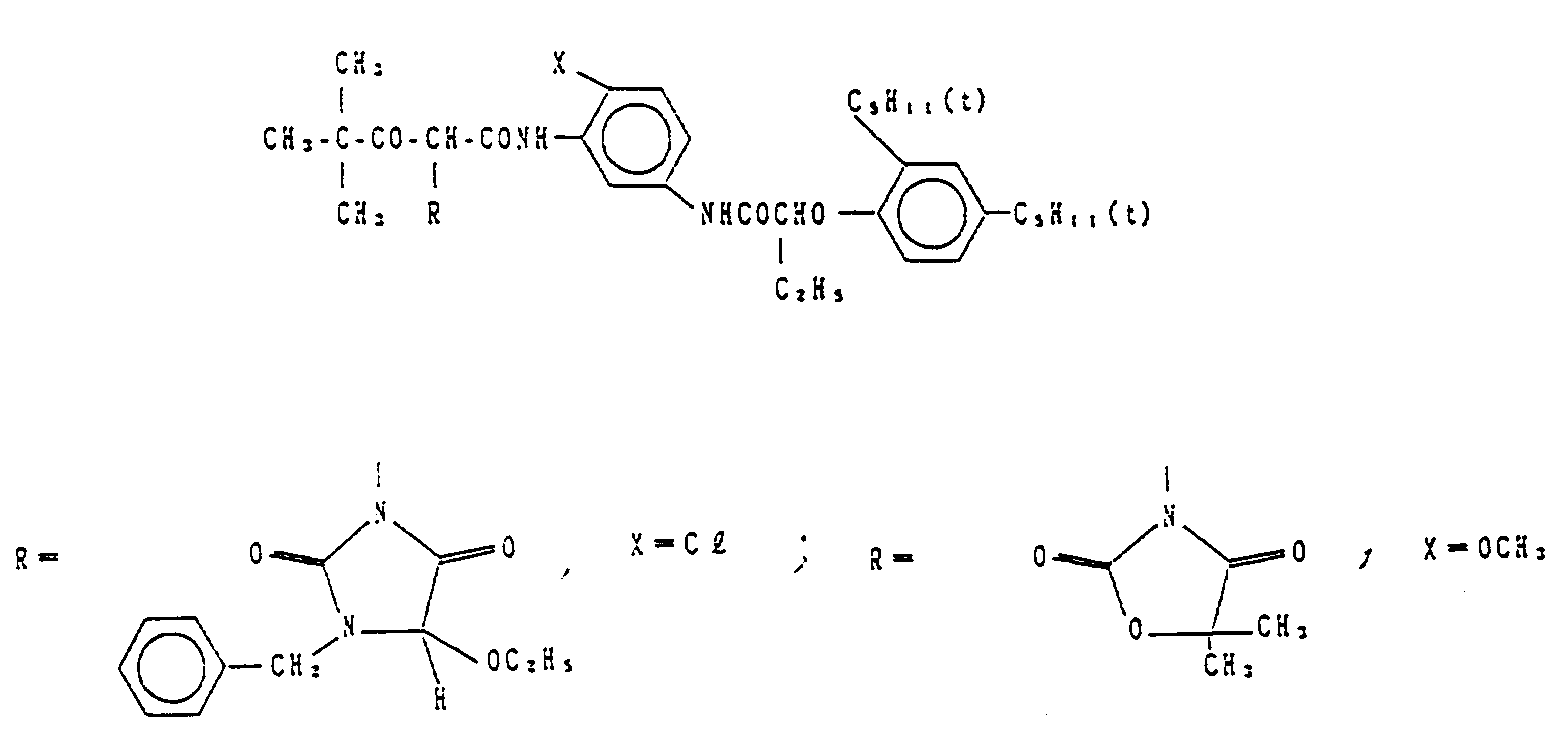
- 1/1 (by mol) mixture of the following compounds:

-

-

- 9/1 (by weight) mixture of the following compounds:
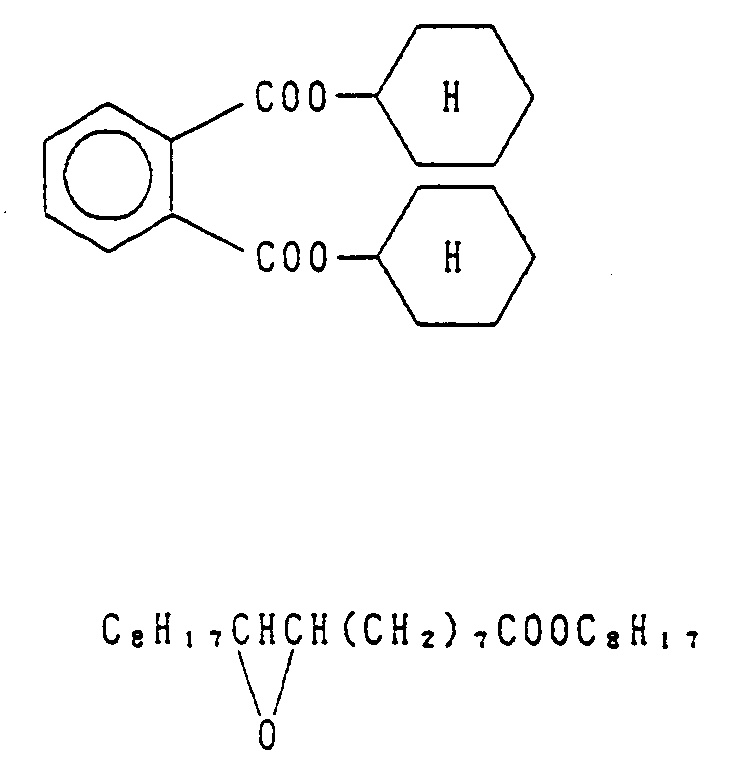
-


- The color photographic material sample thus prepared was processed in accordance with the process of Example 2.
- The processed sample was then evaluated in the same manner as in Example 1. As a result, the sample showed an excellent color reproducibility (especially in reproduction of green color) and the image formed had an excellent heat-fastness.
- As will be understood from the above-mentioned explanation, the new cyan couplers of formula (I) of the present invention give excellent cyan dyes and cyan images having satisfactory absorption characteristic and color fastness. They can be used for forming photographic cyan images and, in particular, can be incorporated into silver halide color photographic materials.
- While the invention has been described in detail and with reference to specific embodiments thereof, it will be apparent to one skilled in the art that various changes and modifications can be made therein without departing from the spirit and scope thereof.
Claims (20)
- A method of forming a cyan dye image in an exposed silver halide color photographic material comprising a support and a photosensitive silver halide emulsion, said method comprising developing the exposed silver halide color photographic material with a color developing solution containing an aromatic primary amine color developing agent in the presence of a cyan coupler represented by formula (I):

R₁ represents a hydrogen atom or a substituent;
R₂ represents a substituent;
X represents a hydrogen atom or a group capable of splitting off by a coupling reaction with an oxidation product of an aromatic primary amine color developing agent;
R₁ and R₂ may be bonded to each other to form a ring; and provided that R₂ must not be a halogen atom. - The method of forming a cyan dye image as in claim 1, wherein said σp value is at least 0.50.
- The method of forming a cyan dye image as in claim 1, wherein said σp value is not more than 1.0.
- The method of forming a cyan dye image as in claim 1, wherein said σp value is not more than 0.70.
- The method of forming a cyan dye image as in claim 1, wherein EWG₁, and EWG₂ each represents a cyano group, a nitro group, an aliphatic- or aromatic-acyl group, a carbamoyl group, a phosphono group, an alkoxycarbonyl group, a phosphoryl group, a sulfamoyl group, an aliphatic- or aromatic-sulfonyl group, or a perfluoroalkyl group, or substituted groups thereof.
- The method of forming a cyan dye image as in claim 5, wherein the substituent of said substituted groups is at least one group selected from the group consisting of a halogen atom, a hydroxy group, a cyano group, a carboxy group, an alkyl group, a cyoloalkyl group, an aralkyl group, an aryl group, a heterocyclic group, an alkoxy group, an aryloxy group, an amino group, an acylamino group, an aliphatic- or an aromatic- sulfonylamino group, an acyl group, an aliphaic- or an aromatic- sulfonyl group, a carbamoyl group, a sulfamoyl group, a ureido group, an urethane group, an alkylthio group, an arylthio group, a nitro group, and an alkoxycarbonyl group, and substituted groups thereof which are substituted with at least one of them.
- The method of forming a cyan dye image as in claim 6, wherein said heterocyclic group is a 5 to 7-membered heterocyclic group containing at least one of N, O and S atoms with the proviso that the total numbers of N atom, O atom and S atom are 1 to 4, 0 to 1, and 0 to 1, respectively.
- The method of forming a cyan dye image as in claim 1, wherein R₁ represents hydrogen atom, a halogen atom, an aliphatic group having from 1 to 36 carbon atoms, an aromatic group, a heterocyclic group, an alkoxy group, an aryloxy group, an alkenyloxy group, an amino group, an acyl group, an ester group, an amido group, a sulfamoylamino group, an imido group, an ureido group, an aliphatic- or aromatic-sulfonyl group, an aliphatic- or aromatic-thio group, a hydroxyl group, a cyano group, a carboxyl group, a nitro group, or a sulfo group; or substituted groups thereof; and R₁ and R₂ may be bonded to each other to form a ring.
- The method of forming a cyan dye image as in claim 8, wherein the substituent of said substituted groups is at least one group selected from the group consisting of a halogen atom, a hydroxy group, a cyano group, a carboxy group, an alkyl group, a cyoloalkyl group, an aralkyl group, an aryl group, a heterocyclic group, an alkoxy group, an aryloxy group, an amino group, an acylamino group, an aliphatic- or an aromatic- sulfonylamino group, an acyl group, an aliphaic- or an aromatic- sulfonyl group, a carbamoyl group, a sulfamoyl group, a ureido group, an urethane group, an alkylthio group, an arylthio group, a nitro group, and an alkoxycarbonyl group, and substituted groups thereof which are substituted with at least one of the above described substituents.
- The method of forming a cyan dye image as in claim 1, R₂ represents an aliphatic group having from 1 to 36 carbon atoms, an aromatic group, a heterocyclic group, an alkoxy group, an aryloxy group, an alkenyloxy group, an amino group, an acyl group, an ester group, an amido group, a sulfamoylamino group, an imido group, an ureido group, an aliphatic- or aromatic-sulfonyl group, an aliphatic- or aromatic-thio group, a hydroxyl group, a cyano group, a carboxyl group, a nitro group, or a sulfo group; or substituted groups thereof; and R₁ and R₂ may be bonded to each other to form a ring.
- The method of forming a cyan dye image as in claim 10, wherein the substituent of said substituted groups is at least one group selected from the group consisting of a halogen atom, a hydroxy group, a cyano group, a carboxy group, an alkyl group, a cyoloalkyl group, an aralkyl group, an aryl group, a heterocyclic group, an alkoxy group, an aryloxy group, an amino group, an acylamino group, an aliphatic- or an aromatic- sulfonylamino group, an acyl group, an aliphaic- or an aromatic- sulfonyl group, a carbamoyl group, a sulfamoyl group, a ureido group, an urethane group, an alkylthio group, an arylthio group, a nitro group, and an alkoxycarbonyl group, and substituted groups thereof which are substituted with at least one of the above described substituents.
- The method of forming a cyan dye image as in claim 1, wherein X represents a hydrogen atom, a halogen atom , an alkoxy group, an aryloxy group, an acyloxy group, an aliphatic- or aromatic-sulfonyloxy group, an acylamino group, an aliphatic or aromatic sulfonamido group, an alkoxycarbonyloxy group, an aryloxycarbonyloxy group, an aliphatic-, aromatic- or heterocyclic-thio group, a carbamoylamino group, a 5-membered or 6-membered nitrogen-containing heterocyclic group, an imido group, an aromayic azo group, or a carboxyl group; substituted groups thereof; or a group which is bonded to the remainder of formula (I) via a carbon atom to form a bis-type coupler.
- The method of forming a cyan dye image as in claim 12, wherein the substituent of said substituted groups is at least one group selected from the group consisting of a halogen atom, a hydroxy group, a cyano group, a carboxy group, an alkyl group, a cyoloalkyl group, an aralkyl group, an aryl group, a heterocyclic group, an alkoxy group, an aryloxy group, an amino group, an acylamino group, an aliphatic- or an aromatic- sulfonylamino group, an acyl group, an aliphaic- or an aromatic- sulfonyl group, a carbamoyl group, a sulfamoyl group, a ureido group, an urethane group, an alkylthio group, an arylthio group, a nitro group, and an alkoxycarbonyl group, and substituted groups thereof which are substituted with at least one of the above described substituents.
- The method of forming a cyan dye image as in claim 1, wherein the cyan dye has a maximum absorption wavelength of 580 to 720 nm.
- The method of forming a cyan dye image as in claim 1, wherein said cyan dye forming coupler is incorporated in a silver halide color photographic material.
- The method of forming a cyan dye image as in claim 15, wherein said cyan dye forming coupler is an alkaline aqueous solution soluble coupler and is incorporated in a color developing solution for development of a silver halide color photographic material.
- The method of forming a cyan dye image as in claim 1, wherein said cyan dye forming coupler is incorporated in a silver halide color photographic material in an amount of 1 x 10⁻³ to 1 mol per mol of silver halide.
- The method of forming a cyan dye image as in claim 15, wherein said cyan dye forming coupler is incorporated in a color developing solution for development of a silver halide color photographic material in an amount of 0.0005 to 0.05 mol per liter of the color developing solution.
- A silver halide color photographic material comprising a support and at least one photosensitive silver halide emulsion layer containing at least one cyan dye forming coupler represented by formula (I):

R₁ represents a hydrogen atom or a substituent;
R₂ represents a substituent;
X represents a hydrogen atom or a group capable of splitting off by a coupling reaction with an oxidation product of an aromatic primary amine compound; R₁ and R₂ may be bonded to each other to form a ring; and provided that R₂ must not be a halogen atom. - The silver halide color photographic material as in claim 19, wherein said emulsion layer is a red-sensitive emulsion layer.
Applications Claiming Priority (2)
| Application Number | Priority Date | Filing Date | Title |
|---|---|---|---|
| JP2302078A JP2588795B2 (en) | 1990-11-07 | 1990-11-07 | Novel cyan dye-forming coupler, cyan image forming method, and silver halide color photographic light-sensitive material containing the coupler |
| JP302078/90 | 1990-11-07 |
Publications (2)
| Publication Number | Publication Date |
|---|---|
| EP0484909A1 true EP0484909A1 (en) | 1992-05-13 |
| EP0484909B1 EP0484909B1 (en) | 1996-10-23 |
Family
ID=17904658
Family Applications (1)
| Application Number | Title | Priority Date | Filing Date |
|---|---|---|---|
| EP91118920A Expired - Lifetime EP0484909B1 (en) | 1990-11-07 | 1991-11-06 | Method of forming cyan image with cyan dye forming coupler, and silver halide color photographic material containing the cyan dye forming coupler |
Country Status (4)
| Country | Link |
|---|---|
| US (1) | US5215871A (en) |
| EP (1) | EP0484909B1 (en) |
| JP (1) | JP2588795B2 (en) |
| DE (1) | DE69122836T2 (en) |
Cited By (9)
| Publication number | Priority date | Publication date | Assignee | Title |
|---|---|---|---|---|
| EP0569979A1 (en) * | 1992-05-14 | 1993-11-18 | Fuji Photo Film Co., Ltd. | Silver halide color photographic light-sensitive material |
| EP0572029A1 (en) * | 1992-05-29 | 1993-12-01 | Fuji Photo Film Co., Ltd. | Silver halide color photographic light-sensitive material |
| EP0573008A1 (en) * | 1992-06-02 | 1993-12-08 | Fuji Photo Film Co., Ltd. | Silver halide color photographic material |
| EP0574948A1 (en) * | 1992-06-19 | 1993-12-22 | Fuji Photo Film Co., Ltd. | Silver halide color photographic photosensitive materials |
| EP0578173A1 (en) | 1992-07-06 | 1994-01-12 | Fuji Photo Film Co., Ltd. | Silver halide color photographic material and method for forming a color image |
| EP0608133A1 (en) * | 1993-01-21 | 1994-07-27 | Konica Corporation | A silver halide color photographic material |
| US5366856A (en) * | 1992-05-26 | 1994-11-22 | Fuji Photo Film Co., Ltd. | Silver halide color photosensitive materials |
| EP0578248A3 (en) * | 1992-07-09 | 1995-03-29 | Fuji Photo Film Co Ltd | Silver halide color photographic light-sensitive material. |
| EP1914594A2 (en) | 2004-01-30 | 2008-04-23 | FUJIFILM Corporation | Silver halide color photographic light-sensitive material and color image-forming method |
Families Citing this family (12)
| Publication number | Priority date | Publication date | Assignee | Title |
|---|---|---|---|---|
| JP2588795B2 (en) | 1990-11-07 | 1997-03-12 | 富士写真フイルム株式会社 | Novel cyan dye-forming coupler, cyan image forming method, and silver halide color photographic light-sensitive material containing the coupler |
| JP2687265B2 (en) * | 1991-11-27 | 1997-12-08 | 富士写真フイルム株式会社 | Silver halide color photographic materials |
| JPH05232651A (en) * | 1992-02-21 | 1993-09-10 | Fuji Photo Film Co Ltd | Silver halide color photographic sensitive material |
| JP2879493B2 (en) * | 1992-04-27 | 1999-04-05 | 富士写真フイルム株式会社 | Silver halide color photographic materials |
| JP3101848B2 (en) | 1992-05-15 | 2000-10-23 | 富士写真フイルム株式会社 | Silver halide color photographic materials |
| JP2879497B2 (en) * | 1992-05-21 | 1999-04-05 | 富士写真フイルム株式会社 | Silver halide color photographic materials |
| JP2890224B2 (en) * | 1992-06-02 | 1999-05-10 | 富士写真フイルム株式会社 | Silver halide color photographic materials |
| US5441863A (en) * | 1994-07-28 | 1995-08-15 | Eastman Kodak Company | Photographic elements with heterocyclic cyan dye-forming couplers |
| JPH09152696A (en) | 1995-11-30 | 1997-06-10 | Fuji Photo Film Co Ltd | Silver halide color photographic sensitive material |
| US6962610B2 (en) | 2002-09-13 | 2005-11-08 | Kao Corporation | Hair dye composition |
| US8034895B2 (en) * | 2004-02-04 | 2011-10-11 | Université de Montréal | Conjugated thiophenes having conducting properties and synthesis of same |
| EP3747956A4 (en) | 2018-01-31 | 2021-08-18 | FUJIFILM Corporation | Staining composition, stained article, and azo dye |
Citations (2)
| Publication number | Priority date | Publication date | Assignee | Title |
|---|---|---|---|---|
| EP0119741A2 (en) * | 1983-02-15 | 1984-09-26 | Fuji Photo Film Co., Ltd. | Method of producing magenta images in silver halide colour photographic materials |
| EP0269436A2 (en) * | 1986-11-25 | 1988-06-01 | Konica Corporation | Silver halide color photographic light-sensitive material containing pyrazoloazole type cyan coupler |
Family Cites Families (4)
| Publication number | Priority date | Publication date | Assignee | Title |
|---|---|---|---|---|
| JPS62278552A (en) * | 1986-05-27 | 1987-12-03 | Konica Corp | Silver halide color photosensitive material |
| JPH0833629B2 (en) * | 1986-06-11 | 1996-03-29 | コニカ株式会社 | A silver halide photographic light-sensitive material suitable for rapid processing and capable of obtaining a dye image excellent in light fastness. |
| JPS63141057A (en) * | 1986-12-03 | 1988-06-13 | Konica Corp | Method for processing silver halide color photographic sensitive material having excellent rapid processing property |
| JP2588795B2 (en) | 1990-11-07 | 1997-03-12 | 富士写真フイルム株式会社 | Novel cyan dye-forming coupler, cyan image forming method, and silver halide color photographic light-sensitive material containing the coupler |
-
1990
- 1990-11-07 JP JP2302078A patent/JP2588795B2/en not_active Expired - Fee Related
-
1991
- 1991-11-06 EP EP91118920A patent/EP0484909B1/en not_active Expired - Lifetime
- 1991-11-06 DE DE69122836T patent/DE69122836T2/en not_active Expired - Fee Related
- 1991-11-07 US US07/789,020 patent/US5215871A/en not_active Expired - Lifetime
Patent Citations (2)
| Publication number | Priority date | Publication date | Assignee | Title |
|---|---|---|---|---|
| EP0119741A2 (en) * | 1983-02-15 | 1984-09-26 | Fuji Photo Film Co., Ltd. | Method of producing magenta images in silver halide colour photographic materials |
| EP0269436A2 (en) * | 1986-11-25 | 1988-06-01 | Konica Corporation | Silver halide color photographic light-sensitive material containing pyrazoloazole type cyan coupler |
Non-Patent Citations (1)
| Title |
|---|
| PATENT ABSTRACTS OF JAPAN vol. 12, no. 166 (P-704)(3013) 19 May 1988 & JP-A-62 279 339 ( KONISHIROKU ) 4 December 1987 * |
Cited By (13)
| Publication number | Priority date | Publication date | Assignee | Title |
|---|---|---|---|---|
| US5639590A (en) * | 1992-05-14 | 1997-06-17 | Fuji Photo Film Co., Ltd. | Silver halide color photographic light-sensitive material |
| EP0569979A1 (en) * | 1992-05-14 | 1993-11-18 | Fuji Photo Film Co., Ltd. | Silver halide color photographic light-sensitive material |
| US5366856A (en) * | 1992-05-26 | 1994-11-22 | Fuji Photo Film Co., Ltd. | Silver halide color photosensitive materials |
| EP0572029A1 (en) * | 1992-05-29 | 1993-12-01 | Fuji Photo Film Co., Ltd. | Silver halide color photographic light-sensitive material |
| US5547825A (en) * | 1992-06-02 | 1996-08-20 | Fuji Photo Film Co., Ltd. | Silver halide color photographic material |
| EP0573008A1 (en) * | 1992-06-02 | 1993-12-08 | Fuji Photo Film Co., Ltd. | Silver halide color photographic material |
| US5543282A (en) * | 1992-06-19 | 1996-08-06 | Fuji Photo Film Co., Ltd. | Silver halide color photographic photosensitive materials comprising heterocyclic cyan couplers |
| EP0574948A1 (en) * | 1992-06-19 | 1993-12-22 | Fuji Photo Film Co., Ltd. | Silver halide color photographic photosensitive materials |
| EP0578173A1 (en) | 1992-07-06 | 1994-01-12 | Fuji Photo Film Co., Ltd. | Silver halide color photographic material and method for forming a color image |
| EP0578248A3 (en) * | 1992-07-09 | 1995-03-29 | Fuji Photo Film Co Ltd | Silver halide color photographic light-sensitive material. |
| EP0736805A3 (en) * | 1992-07-09 | 1996-11-20 | Fuji Photo Film Co., Ltd. | Silver halide color photographic light-sensitive material |
| EP0608133A1 (en) * | 1993-01-21 | 1994-07-27 | Konica Corporation | A silver halide color photographic material |
| EP1914594A2 (en) | 2004-01-30 | 2008-04-23 | FUJIFILM Corporation | Silver halide color photographic light-sensitive material and color image-forming method |
Also Published As
| Publication number | Publication date |
|---|---|
| US5215871A (en) | 1993-06-01 |
| JP2588795B2 (en) | 1997-03-12 |
| DE69122836T2 (en) | 1997-03-06 |
| DE69122836D1 (en) | 1996-11-28 |
| EP0484909B1 (en) | 1996-10-23 |
| JPH04174429A (en) | 1992-06-22 |
Similar Documents
| Publication | Publication Date | Title |
|---|---|---|
| EP0484909B1 (en) | Method of forming cyan image with cyan dye forming coupler, and silver halide color photographic material containing the cyan dye forming coupler | |
| EP0456226B1 (en) | Dye forming coupler and silver halide color photographic material containing the same and method for forming color image | |
| JP2684267B2 (en) | Cyan image forming method and silver halide color photographic light-sensitive material | |
| JP2684265B2 (en) | Cyan image forming method and silver halide color photographic light-sensitive material | |
| EP0447969B1 (en) | Yellow dye-forming coupler and silver halide color photographic material containing same | |
| JP2597917B2 (en) | Novel dye-forming coupler and silver halide color photographic material using the same | |
| US5272051A (en) | Silver halide color photographic material | |
| JP2592353B2 (en) | Novel dye-forming coupler, color image forming method using the same, and silver halide color photographic light-sensitive material | |
| US5206130A (en) | Cyan coupler, cyan image forming method using the same and silver halide color photographic material containing the same | |
| JPH04179949A (en) | New dye forming coupler and silver halide color photographic sensitive material using the same | |
| JP2671058B2 (en) | Novel dye-forming coupler and silver halide color photographic light-sensitive material containing the coupler | |
| JP2578254B2 (en) | Novel dye-forming coupler and silver halide color photographic light-sensitive material containing the coupler | |
| JP2699024B2 (en) | Novel dye-forming coupler and silver halide color photographic light-sensitive material containing the coupler | |
| JP2592354B2 (en) | Novel dye-forming coupler and silver halide color photographic material using the same | |
| JP2592352B2 (en) | Novel dye-forming coupler and silver halide color photographic light-sensitive material using the coupler | |
| JP2578255B2 (en) | Novel dye-forming coupler, color image forming method using the coupler, and silver halide color photographic material | |
| JP2860417B2 (en) | Silver halide color photographic materials | |
| JP2618533B2 (en) | Silver halide color photographic light-sensitive material and silver halide color image forming method | |
| JPH04194847A (en) | Silver halide color photosensitive material | |
| JP2943943B2 (en) | Silver halide color photographic materials | |
| JPH063782A (en) | Silver halide color photographic sensitive material | |
| JPH04184437A (en) | Color image forming method and silver halide color photographic sensitive material | |
| JPH04182645A (en) | Silver halide color photographic sensitive material | |
| JPH06186710A (en) | Silver halide color photographic sensitive material | |
| JPH04188136A (en) | Cyanic coloring matter forming coupler and silver halide color photosensitive material containing it |
Legal Events
| Date | Code | Title | Description |
|---|---|---|---|
| PUAI | Public reference made under article 153(3) epc to a published international application that has entered the european phase |
Free format text: ORIGINAL CODE: 0009012 |
|
| AK | Designated contracting states |
Kind code of ref document: A1 Designated state(s): CH DE FR GB IT LI NL |
|
| 17P | Request for examination filed |
Effective date: 19920402 |
|
| 17Q | First examination report despatched |
Effective date: 19950714 |
|
| GRAG | Despatch of communication of intention to grant |
Free format text: ORIGINAL CODE: EPIDOS AGRA |
|
| GRAH | Despatch of communication of intention to grant a patent |
Free format text: ORIGINAL CODE: EPIDOS IGRA |
|
| GRAH | Despatch of communication of intention to grant a patent |
Free format text: ORIGINAL CODE: EPIDOS IGRA |
|
| GRAA | (expected) grant |
Free format text: ORIGINAL CODE: 0009210 |
|
| AK | Designated contracting states |
Kind code of ref document: B1 Designated state(s): CH DE FR GB IT LI NL |
|
| PG25 | Lapsed in a contracting state [announced via postgrant information from national office to epo] |
Ref country code: FR Effective date: 19961023 Ref country code: IT Free format text: LAPSE BECAUSE OF FAILURE TO SUBMIT A TRANSLATION OF THE DESCRIPTION OR TO PAY THE FEE WITHIN THE PRE;WARNING: LAPSES OF ITALIAN PATENTS WITH EFFECTIVE DATE BEFORE 2007 MAY HAVE OCCURRED AT ANY TIME BEFORE 2007. THE CORRECT EFFECTIVE DATE MAY BE DIFFERENT FROM THE ONE RECORDED.SCRIBED TIME-LIMIT Effective date: 19961023 Ref country code: NL Free format text: LAPSE BECAUSE OF FAILURE TO SUBMIT A TRANSLATION OF THE DESCRIPTION OR TO PAY THE FEE WITHIN THE PRESCRIBED TIME-LIMIT Effective date: 19961023 Ref country code: LI Free format text: LAPSE BECAUSE OF FAILURE TO SUBMIT A TRANSLATION OF THE DESCRIPTION OR TO PAY THE FEE WITHIN THE PRESCRIBED TIME-LIMIT Effective date: 19961023 Ref country code: CH Free format text: LAPSE BECAUSE OF FAILURE TO SUBMIT A TRANSLATION OF THE DESCRIPTION OR TO PAY THE FEE WITHIN THE PRESCRIBED TIME-LIMIT Effective date: 19961023 |
|
| REF | Corresponds to: |
Ref document number: 69122836 Country of ref document: DE Date of ref document: 19961128 |
|
| EN | Fr: translation not filed | ||
| NLV1 | Nl: lapsed or annulled due to failure to fulfill the requirements of art. 29p and 29m of the patents act | ||
| REG | Reference to a national code |
Ref country code: CH Ref legal event code: PL |
|
| PLBE | No opposition filed within time limit |
Free format text: ORIGINAL CODE: 0009261 |
|
| STAA | Information on the status of an ep patent application or granted ep patent |
Free format text: STATUS: NO OPPOSITION FILED WITHIN TIME LIMIT |
|
| 26N | No opposition filed | ||
| REG | Reference to a national code |
Ref country code: GB Ref legal event code: IF02 |
|
| PGFP | Annual fee paid to national office [announced via postgrant information from national office to epo] |
Ref country code: DE Payment date: 20041104 Year of fee payment: 14 Ref country code: GB Payment date: 20041104 Year of fee payment: 14 |
|
| PG25 | Lapsed in a contracting state [announced via postgrant information from national office to epo] |
Ref country code: GB Free format text: LAPSE BECAUSE OF NON-PAYMENT OF DUE FEES Effective date: 20051106 |
|
| PG25 | Lapsed in a contracting state [announced via postgrant information from national office to epo] |
Ref country code: DE Free format text: LAPSE BECAUSE OF NON-PAYMENT OF DUE FEES Effective date: 20060601 |
|
| GBPC | Gb: european patent ceased through non-payment of renewal fee |
Effective date: 20051106 |