EP0484742B1 - 2-Chloropropionaldehyde trimer and production process thereof - Google Patents
2-Chloropropionaldehyde trimer and production process thereof Download PDFInfo
- Publication number
- EP0484742B1 EP0484742B1 EP91118068A EP91118068A EP0484742B1 EP 0484742 B1 EP0484742 B1 EP 0484742B1 EP 91118068 A EP91118068 A EP 91118068A EP 91118068 A EP91118068 A EP 91118068A EP 0484742 B1 EP0484742 B1 EP 0484742B1
- Authority
- EP
- European Patent Office
- Prior art keywords
- cpa
- trimer
- chloropropionaldehyde
- mixture
- reaction
- Prior art date
- Legal status (The legal status is an assumption and is not a legal conclusion. Google has not performed a legal analysis and makes no representation as to the accuracy of the status listed.)
- Expired - Lifetime
Links
- UAARVZGODBESIF-UHFFFAOYSA-N 2-chloropropanal Chemical compound CC(Cl)C=O UAARVZGODBESIF-UHFFFAOYSA-N 0.000 title claims description 88
- 239000013638 trimer Substances 0.000 title claims description 38
- 238000004519 manufacturing process Methods 0.000 title description 4
- 239000000203 mixture Substances 0.000 claims description 41
- QAOWNCQODCNURD-UHFFFAOYSA-N sulfuric acid Substances OS(O)(=O)=O QAOWNCQODCNURD-UHFFFAOYSA-N 0.000 claims description 22
- 238000006243 chemical reaction Methods 0.000 claims description 20
- 239000003960 organic solvent Substances 0.000 claims description 18
- 239000011541 reaction mixture Substances 0.000 claims description 18
- 238000005660 chlorination reaction Methods 0.000 claims description 16
- NBBJYMSMWIIQGU-UHFFFAOYSA-N Propionic aldehyde Chemical compound CCC=O NBBJYMSMWIIQGU-UHFFFAOYSA-N 0.000 claims description 14
- 238000009835 boiling Methods 0.000 claims description 14
- 238000003756 stirring Methods 0.000 claims description 8
- -1 alicyclic hydrocarbon Chemical class 0.000 claims description 7
- ZTQSAGDEMFDKMZ-UHFFFAOYSA-N butyric aldehyde Natural products CCCC=O ZTQSAGDEMFDKMZ-UHFFFAOYSA-N 0.000 claims description 7
- 239000013078 crystal Substances 0.000 claims description 7
- XLYOFNOQVPJJNP-UHFFFAOYSA-N water Substances O XLYOFNOQVPJJNP-UHFFFAOYSA-N 0.000 claims description 7
- 238000000034 method Methods 0.000 claims description 6
- VZGDMQKNWNREIO-UHFFFAOYSA-N tetrachloromethane Chemical compound ClC(Cl)(Cl)Cl VZGDMQKNWNREIO-UHFFFAOYSA-N 0.000 claims description 6
- 150000001338 aliphatic hydrocarbons Chemical class 0.000 claims description 2
- 150000004945 aromatic hydrocarbons Chemical class 0.000 claims description 2
- 229930195733 hydrocarbon Natural products 0.000 claims description 2
- 239000004215 Carbon black (E152) Substances 0.000 claims 1
- VLKZOEOYAKHREP-UHFFFAOYSA-N n-Hexane Chemical compound CCCCCC VLKZOEOYAKHREP-UHFFFAOYSA-N 0.000 description 21
- HEMHJVSKTPXQMS-UHFFFAOYSA-M Sodium hydroxide Chemical compound [OH-].[Na+] HEMHJVSKTPXQMS-UHFFFAOYSA-M 0.000 description 15
- 238000004821 distillation Methods 0.000 description 14
- UHOVQNZJYSORNB-UHFFFAOYSA-N Benzene Chemical compound C1=CC=CC=C1 UHOVQNZJYSORNB-UHFFFAOYSA-N 0.000 description 12
- 238000005829 trimerization reaction Methods 0.000 description 12
- 239000000243 solution Substances 0.000 description 10
- 150000001875 compounds Chemical class 0.000 description 9
- 239000000463 material Substances 0.000 description 7
- 239000002904 solvent Substances 0.000 description 7
- 238000003786 synthesis reaction Methods 0.000 description 7
- 230000015572 biosynthetic process Effects 0.000 description 6
- 239000002994 raw material Substances 0.000 description 6
- 239000012044 organic layer Substances 0.000 description 5
- HEDRZPFGACZZDS-MICDWDOJSA-N Trichloro(2H)methane Chemical compound [2H]C(Cl)(Cl)Cl HEDRZPFGACZZDS-MICDWDOJSA-N 0.000 description 4
- KZBUYRJDOAKODT-UHFFFAOYSA-N Chlorine Chemical compound ClCl KZBUYRJDOAKODT-UHFFFAOYSA-N 0.000 description 3
- 238000004458 analytical method Methods 0.000 description 3
- 238000010533 azeotropic distillation Methods 0.000 description 3
- 238000004817 gas chromatography Methods 0.000 description 3
- 239000010410 layer Substances 0.000 description 3
- 238000005160 1H NMR spectroscopy Methods 0.000 description 2
- QSKPIOLLBIHNAC-UHFFFAOYSA-N 2-chloro-acetaldehyde Chemical compound ClCC=O QSKPIOLLBIHNAC-UHFFFAOYSA-N 0.000 description 2
- AMIMRNSIRUDHCM-UHFFFAOYSA-N Isopropylaldehyde Chemical compound CC(C)C=O AMIMRNSIRUDHCM-UHFFFAOYSA-N 0.000 description 2
- CSNNHWWHGAXBCP-UHFFFAOYSA-L Magnesium sulfate Chemical compound [Mg+2].[O-][S+2]([O-])([O-])[O-] CSNNHWWHGAXBCP-UHFFFAOYSA-L 0.000 description 2
- 238000001816 cooling Methods 0.000 description 2
- 238000000921 elemental analysis Methods 0.000 description 2
- 238000002844 melting Methods 0.000 description 2
- 230000008018 melting Effects 0.000 description 2
- JOXIMZWYDAKGHI-UHFFFAOYSA-N toluene-4-sulfonic acid Chemical compound CC1=CC=C(S(O)(=O)=O)C=C1 JOXIMZWYDAKGHI-UHFFFAOYSA-N 0.000 description 2
- XDTMQSROBMDMFD-UHFFFAOYSA-N Cyclohexane Chemical compound C1CCCCC1 XDTMQSROBMDMFD-UHFFFAOYSA-N 0.000 description 1
- VEXZGXHMUGYJMC-UHFFFAOYSA-N Hydrochloric acid Chemical compound Cl VEXZGXHMUGYJMC-UHFFFAOYSA-N 0.000 description 1
- 238000005481 NMR spectroscopy Methods 0.000 description 1
- 239000003377 acid catalyst Substances 0.000 description 1
- 239000003905 agrochemical Substances 0.000 description 1
- 239000007864 aqueous solution Substances 0.000 description 1
- 238000007664 blowing Methods 0.000 description 1
- 239000003054 catalyst Substances 0.000 description 1
- 239000002274 desiccant Substances 0.000 description 1
- 239000003814 drug Substances 0.000 description 1
- 238000001035 drying Methods 0.000 description 1
- 238000001914 filtration Methods 0.000 description 1
- 238000002290 gas chromatography-mass spectrometry Methods 0.000 description 1
- 229910000041 hydrogen chloride Inorganic materials 0.000 description 1
- IXCSERBJSXMMFS-UHFFFAOYSA-N hydrogen chloride Substances Cl.Cl IXCSERBJSXMMFS-UHFFFAOYSA-N 0.000 description 1
- 239000007788 liquid Substances 0.000 description 1
- 229910052943 magnesium sulfate Inorganic materials 0.000 description 1
- 235000019341 magnesium sulphate Nutrition 0.000 description 1
- 230000008450 motivation Effects 0.000 description 1
- 230000000704 physical effect Effects 0.000 description 1
Classifications
-
- C—CHEMISTRY; METALLURGY
- C07—ORGANIC CHEMISTRY
- C07D—HETEROCYCLIC COMPOUNDS
- C07D323/00—Heterocyclic compounds containing more than two oxygen atoms as the only ring hetero atoms
- C07D323/04—Six-membered rings
-
- C—CHEMISTRY; METALLURGY
- C07—ORGANIC CHEMISTRY
- C07C—ACYCLIC OR CARBOCYCLIC COMPOUNDS
- C07C45/00—Preparation of compounds having >C = O groups bound only to carbon or hydrogen atoms; Preparation of chelates of such compounds
- C07C45/51—Preparation of compounds having >C = O groups bound only to carbon or hydrogen atoms; Preparation of chelates of such compounds by pyrolysis, rearrangement or decomposition
- C07C45/55—Preparation of compounds having >C = O groups bound only to carbon or hydrogen atoms; Preparation of chelates of such compounds by pyrolysis, rearrangement or decomposition of oligo- or polymeric oxo-compounds
-
- C—CHEMISTRY; METALLURGY
- C07—ORGANIC CHEMISTRY
- C07C—ACYCLIC OR CARBOCYCLIC COMPOUNDS
- C07C45/00—Preparation of compounds having >C = O groups bound only to carbon or hydrogen atoms; Preparation of chelates of such compounds
- C07C45/61—Preparation of compounds having >C = O groups bound only to carbon or hydrogen atoms; Preparation of chelates of such compounds by reactions not involving the formation of >C = O groups
- C07C45/63—Preparation of compounds having >C = O groups bound only to carbon or hydrogen atoms; Preparation of chelates of such compounds by reactions not involving the formation of >C = O groups by introduction of halogen; by substitution of halogen atoms by other halogen atoms
Definitions
- the present invention relates to a novel compound, 2-chloropropionaldehyde trimer and the production process thereof.
- CPA 2-Chloropropionaldehyde
- MCA monochloroacetaldehyde
- An object of this invention is, therefore, to provide a novel compound, CPA trimer which can be stably stored and can be easily converted into CPA at use.
- Another object of this invention is to provide a production process of the foregoing novel CPA trimer.
- a process of producing the CPA trimer shown by the foregoing formula which comprises adding concentrated sulfuric acid to an organic solvent containing CPA and stirring the mixture at a temperature of from -5°C to 15°C to carry out the reaction.
- the CPA trimer of the present invention is a white crystalline novel compound shown by the foregoing formula and the physical property values thereof are as follows;
- the CPA trimer is produced by adding concentrated sulfuric acid to an organic solvent containing CPA and stirring the mixture at a temperature of from -5°C to 15°C to carry out the reaction.
- an organic solvent containing CPA a solution obtained by distilling a chlorinated reaction mixture containing CPA obtained by chlorinating propionaldehyde at a temperature lower than the normal-pressure boiling point of CPA and taking out CPA distilled as a mixture thereof with an organic solvent can be used.
- sulfuric acid To the solution is added sulfuric acid and the reaction is carried out by stirring the mixture at a temperature of from -5 °C to 15°C to provide the CPA trimer.
- the reaction mixture containing the CPA trimer obtained may be washed with water, concentrated, and then cooled to deposit the CPA trimer, which may be separated.
- the chlorination reaction of propionaldehyde is carried by blowing a chlorine gas into propionaldehyde in an amount of from 0.7 to 0.8 mol per mol of propionaldehyde while maintaining the reaction temperature of from 0°C to 20°C, and preferably from 2°C to 10°C, whereby a chlorination reaction mixture containing at least 60% CPA can be obtained.
- reaction temperature for the chlorination is lower than 0°C, the reaction rate is slow, which is unsuitable for practical purpose. On the other hand, if the reaction temperature is higher than 20°C, undesirable polychlorination products and high boiling materials are liable to form.
- the chlorination reaction mixture obtained as described above is distilled to recover CPA and it is important that the distillation temperature in this case is lower than the normal pressure boiling point (86°C) of CPA. If the reaction mixture is distilled at the normal pressure boiling temperature, high boiling materials are formed, whereby the amount of the distillate is reduced and the concentration of CPA in the distillate is undesirably reduced. Furthermore, when the distillate is subjected to a trimerization reaction, the yield and the purity of the CPA trimer obtained are undesirably low.
- CPA distilled by the foregoing distillation is recovered as a mixture with an organic solvent.
- the chlorination reaction mixture is distilled under reduced pressure, an organic solvent dissolving CPA is previously placed in a receiving vessel, and the CPA distilled is immediately recovered as a mixture with the organic solvent in the vessel.
- the amount of the organic solvent being placed in the receiving vessel is such that the concentration of CPA is not over 80% by weight, and preferably not over 70% by weight. If the concentration of CPA in the mixture is higher, CPA is liable to change into a high boiling material and hence can not be stably stored. There may be some difference depending upon the organic solvent being used, thus when the concentration of CPA is not higher than 70% by weight, CPA can almost stably exist if the time is short.
- an azeotropic solvent having a boiling point lower than that of CPA such as benzene, carbon tetrachloride, etc.
- CPA can be azeotropically distilled.
- the azeotropic solvent is gradually added when the chlorinated mixture being distilled is heated to a temperature of about 10°C lower than the boiling point of the azeotropic solvent.
- the organic solvent being used in the distillation does not, as a matter of course, react with CPA and does not readily react with sulfuric acid being used in the subsequent trimerization reaction.
- An organic solvent having a low boiling point is more preferably used.
- the preferred organic solvent are aromatic hydrocarbons such as benzene, etc., aliphatic hydrocarbons such as hexane, etc., alicyclic hydrocarbons such as cyclohexane, etc., and carbon tetrachloride.
- the concentration of CPA in the mixture is from 5 to 70% by weight, and preferably from 10 to 60% by weight.
- concentrated sulfuric acid is added to the mixture and the reaction is carried out by stirring the mixture at a temperature of from -5 °C to 15°C, and preferably from 0°C to 10°C, a CPA trimer is formed.
- the amount of concentrated sulfuric acid being added as a catalyst is from 3 to 30% by weight, and preferably from 5 to 28% weight to the foregoing mixture.
- the trimerization reaction of CPA does not proceed sufficiently, while if the amount thereof is larger than 30% by weight, a large amount of high boiling materials are by-produced and the yield of the CPA trimer is reduced.
- the trimerization of CPA is carried out and the CPA trimer formed exists as a solution in the organic solvent.
- the sulfuric acid component is removed from the reaction mixture, the organic layer formed is washed with water or preferably washed with an aqueous sodium hydroxide solution and water, and after drying it with a drying agent such as magnesium sulfate, etc., the organic layer is concentrated and cooled to deposit and separate a CPA trimer.
- the CPA trimer having a purity of at least 95% is obtained.
- the product is purified by recrystallizing from a solvent such as hexane, etc.
- the CPA trimer can be obtained as the crystals thereof having a purity of at least 99%.
- the CPA trimer thus obtained can be stably stored for a long period of time at normal temperature.
- the CPA trimer can be supplied to a reaction with other compound as it is and also when the CPA trimer is heated to a temperature of from 120°C to 130°C at normal pressure in the existence of an acid catalyst such as p-toluenesulfonic acid, etc., pure CPA can be formed.
- CPA trimer of this invention by depolymerizing the CPA trimer of this invention, high-pure CPA can be obtained. Also, the reaction of using CPA as a raw material can be carried out independently from the production of unstable CPA, whereby the utilization of CPA as a synthetic raw material can be remarkably facilitated.
- the distillate was composed of 38.8% by weight CPA, 57.3% by weight benzene and a slight amount of high boiling materials.
- the distilled amount was 66% of the raw material chlorinated mixture and CPA obtained was 710 g.
- the synthesis of the trimer using the distillate was carried out by using a two liter three neck distillation flask equipped with a stirrer and a thermometer. After cooling 1450 g of the distillate having the foregoing composition to 2°C, 70 ml (8.9% by weight to the distillate being charged for the reaction) of concentrated sulfuric acid of 96% was gradually added thereto over a period of one hour and while keeping at a temperature of lower than 5°C, the mixture was stirred for 2 hours to perform the trimerization reaction.
- the reaction mixture obtained was allowed to stand, the sulfuric acid layer formed was removed, and the organic layer formed was collected and washed with water and an aqueous 10% sodium hydroxide solution. Then, after removing the solvent from the organic solution obtained under reduced pressure (20 mm Hg), the residue was allowed to stand at room temperature to provide 342 g of white crystals of the CPA trimer having a purity of 99.2%.
- the synthesis yield of the CPA trimer obtained was 60.3% to CPA in the distillate used for the trimerization reaction.
- the crystals formed were recovered by filtration and recrystallized using 300 ml of hexane to provide 312 g of white crystals of the CPA trimer having a purity of 99.8%.
- the synthesis of a CPA trimer using the mixture was carried out by using a 500 ml three neck distillation flask equipped with a stirrer and a thermometer. That is, 300 g of the mixture having the foregoing composition was cooled to 5 °C in the flask and 15 ml (9.2% by weight to the mixture charged for the reaction) of concentrated sulfuric acid of 96% was gradually added to the mixture with stirring over a period of one hour and while keeping the temperature below 3°C, the mixture was stirred for 2.5 hours to carry out the trimerization reaction.
- the reaction mixture obtained was allowed to stand, a sulfuric acid layer formed was removed, and an organic layer formed was washed with water and an aqueous 10% sodium hydroxide solution. Then, after distilling off the solvent from the solution formed under reduced pressure (20 mmHg), the residue was allowed to stand at room temperature to provide 96.2 g of white crystals of a CPA trimer having a purity of 99.5%.
- the synthesis yield of the CPA trimer was 64.7% to CPA in the mixture used for the trimerization reaction.
Landscapes
- Chemical & Material Sciences (AREA)
- Organic Chemistry (AREA)
- Chemical Kinetics & Catalysis (AREA)
- Organic Low-Molecular-Weight Compounds And Preparation Thereof (AREA)
Description
- The present invention relates to a novel compound, 2-chloropropionaldehyde trimer and the production process thereof.
- 2-Chloropropionaldehyde (hereinafter, is referred to as CPA) is a useful compound as a raw material for the organic synthesis of medicaments, agricultural chemicals, etc. However, since the compound is a very unstable compound, it can not be stably stored for a long period of time. Accordingly, in the case of using the compound, it must be prepared each time just prior to use and immediately supplied for a reaction, and hence the use of the compound is very troublesome.
- It has already been known that monochloroacetaldehyde (MCA) shows a critical stability and can be trimerized; cf. EP-A-0 368 613 and US-A-3 560 526. Further GB-A-1 456 756 describes a trimerization of isobutyraldehyde. This prior art has, however, not yet given any motivation for the field of 2-chloropropionaldehyde.
- An object of this invention is, therefore, to provide a novel compound, CPA trimer which can be stably stored and can be easily converted into CPA at use.
- Other object of this invention is to provide a production process of the foregoing novel CPA trimer.
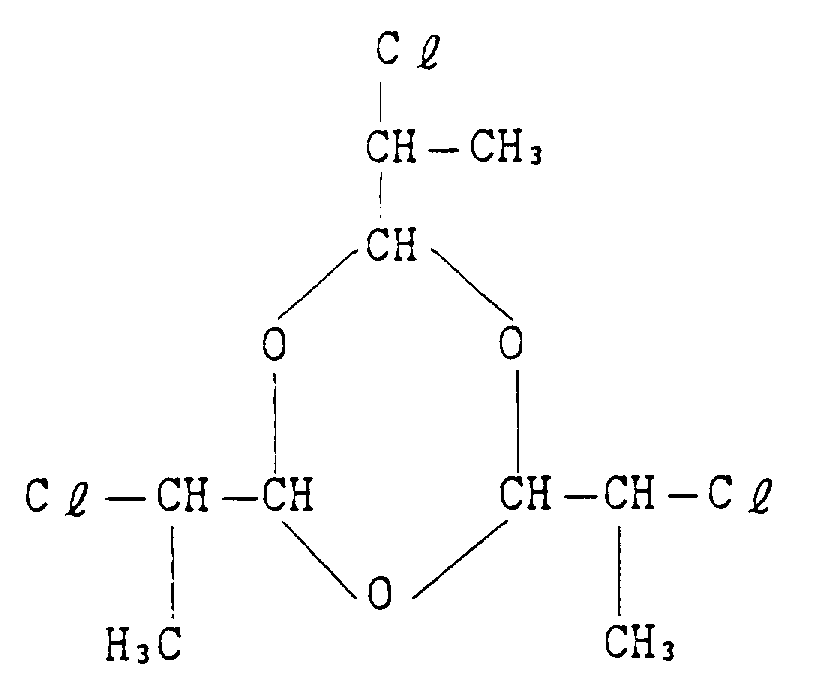
- That is, according to the present invention, there is provided a 2-chloropropionaldehyde (CPA) trimer shown by the following formula;

- Furthermore, according to another embodiment of the present invention, there is provided a process of producing the CPA trimer shown by the foregoing formula, which comprises adding concentrated sulfuric acid to an organic solvent containing CPA and stirring the mixture at a temperature of from -5°C to 15°C to carry out the reaction.
- The CPA trimer of the present invention is a white crystalline novel compound shown by the foregoing formula and the physical property values thereof are as follows;
-
- ¹H NMR (60 MHz, CDCl₃);
- 4.9 ppm (1H, d, -CHO)
- 4.0 ppm (1H, m, -CH-)
- 1.5 ppm (3H, d, -CH₃)
- Molecular weight (Mass): 276
- IR: 1084 cm ⁻¹ (C-O stretching)
- Melting point: 55.1 °C
- The CPA trimer is produced by adding concentrated sulfuric acid to an organic solvent containing CPA and stirring the mixture at a temperature of from -5°C to 15°C to carry out the reaction.
- As an organic solvent containing CPA, a solution obtained by distilling a chlorinated reaction mixture containing CPA obtained by chlorinating propionaldehyde at a temperature lower than the normal-pressure boiling point of CPA and taking out CPA distilled as a mixture thereof with an organic solvent can be used. To the solution is added sulfuric acid and the reaction is carried out by stirring the mixture at a temperature of from -5 °C to 15°C to provide the CPA trimer. The reaction mixture containing the CPA trimer obtained may be washed with water, concentrated, and then cooled to deposit the CPA trimer, which may be separated.
- The chlorination reaction of propionaldehyde is carried by blowing a chlorine gas into propionaldehyde in an amount of from 0.7 to 0.8 mol per mol of propionaldehyde while maintaining the reaction temperature of from 0°C to 20°C, and preferably from 2°C to 10°C, whereby a chlorination reaction mixture containing at least 60% CPA can be obtained.
- If the reaction temperature for the chlorination is lower than 0°C, the reaction rate is slow, which is unsuitable for practical purpose. On the other hand, if the reaction temperature is higher than 20°C, undesirable polychlorination products and high boiling materials are liable to form.
- The chlorination reaction mixture obtained as described above is distilled to recover CPA and it is important that the distillation temperature in this case is lower than the normal pressure boiling point (86°C) of CPA. If the reaction mixture is distilled at the normal pressure boiling temperature, high boiling materials are formed, whereby the amount of the distillate is reduced and the concentration of CPA in the distillate is undesirably reduced. Furthermore, when the distillate is subjected to a trimerization reaction, the yield and the purity of the CPA trimer obtained are undesirably low.
- Also, since CPA is very unstable and undergoes change in a short period of time, CPA distilled by the foregoing distillation is recovered as a mixture with an organic solvent. Practically, the chlorination reaction mixture is distilled under reduced pressure, an organic solvent dissolving CPA is previously placed in a receiving vessel, and the CPA distilled is immediately recovered as a mixture with the organic solvent in the vessel.
- The amount of the organic solvent being placed in the receiving vessel is such that the concentration of CPA is not over 80% by weight, and preferably not over 70% by weight. If the concentration of CPA in the mixture is higher, CPA is liable to change into a high boiling material and hence can not be stably stored. There may be some difference depending upon the organic solvent being used, thus when the concentration of CPA is not higher than 70% by weight, CPA can almost stably exist if the time is short.
- In other method, an azeotropic solvent having a boiling point lower than that of CPA, such as benzene, carbon tetrachloride, etc., is added to the chlorination reaction mixture and CPA can be azeotropically distilled. In this case, it is preferable that the azeotropic solvent is gradually added when the chlorinated mixture being distilled is heated to a temperature of about 10°C lower than the boiling point of the azeotropic solvent.
- It is preferred that the organic solvent being used in the distillation does not, as a matter of course, react with CPA and does not readily react with sulfuric acid being used in the subsequent trimerization reaction. An organic solvent having a low boiling point is more preferably used. Examples of the preferred organic solvent are aromatic hydrocarbons such as benzene, etc., aliphatic hydrocarbons such as hexane, etc., alicyclic hydrocarbons such as cyclohexane, etc., and carbon tetrachloride.
- CPA thus obtained as a mixture with the organic solvent is then subjected to a trimerization reaction and in this case, it is desirable that the concentration of CPA in the mixture is from 5 to 70% by weight, and preferably from 10 to 60% by weight. When concentrated sulfuric acid is added to the mixture and the reaction is carried out by stirring the mixture at a temperature of from -5 °C to 15°C, and preferably from 0°C to 10°C, a CPA trimer is formed. At the reaction, the amount of concentrated sulfuric acid being added as a catalyst is from 3 to 30% by weight, and preferably from 5 to 28% weight to the foregoing mixture. If the amount of concentrated sulfuric acid is less than 3% by weight, the trimerization reaction of CPA does not proceed sufficiently, while if the amount thereof is larger than 30% by weight, a large amount of high boiling materials are by-produced and the yield of the CPA trimer is reduced.
- By reacting as described above, the trimerization of CPA is carried out and the CPA trimer formed exists as a solution in the organic solvent. If necessary, the sulfuric acid component is removed from the reaction mixture, the organic layer formed is washed with water or preferably washed with an aqueous sodium hydroxide solution and water, and after drying it with a drying agent such as magnesium sulfate, etc., the organic layer is concentrated and cooled to deposit and separate a CPA trimer. Thus, the CPA trimer having a purity of at least 95% is obtained. Furthermore, when the product is purified by recrystallizing from a solvent such as hexane, etc., the CPA trimer can be obtained as the crystals thereof having a purity of at least 99%.
- The CPA trimer thus obtained can be stably stored for a long period of time at normal temperature. The CPA trimer can be supplied to a reaction with other compound as it is and also when the CPA trimer is heated to a temperature of from 120°C to 130°C at normal pressure in the existence of an acid catalyst such as p-toluenesulfonic acid, etc., pure CPA can be formed.
- Accordingly, by depolymerizing the CPA trimer of this invention, high-pure CPA can be obtained. Also, the reaction of using CPA as a raw material can be carried out independently from the production of unstable CPA, whereby the utilization of CPA as a synthetic raw material can be remarkably facilitated.
- Then, the invention is more practically explained by referring to the following examples and comparison examples but the invention is not limited to these examples.
- In a two liter three neck distillation flask equipped with a stirrer, a refux condenser and a thermometer was placed 800 g of propionaldehyde and it was kept at 5°C. Into the propionaldehyde was introduced a chlorine gas at 100 ml/min. to initiate the chlorination reaction. Thereafter, while the reaction temperature was kept at 5 °C ± 1°C, 10.5 mol of a chlorine gas was introduced therein at a rate of from 200 ml/min. to 800 ml/min. Hydrogen chloride formed was introduced into an aqueous solution of sodium hydroxide.
- Then, while 1050 g of benzene was added to 1180 g of the chlorination reaction mixture at a rate of about 3.0 g/min. from a liquid temperature of 70°C, an azeotropic distillation was carried out and 1830 g of a distillate was obtained at a distilled temperature of from 71°C to 81°C.
- As the result of analyzing the composition of the distillate by gas chromatography, it was confirmed that the distillate was composed of 38.8% by weight CPA, 57.3% by weight benzene and a slight amount of high boiling materials. The distilled amount was 66% of the raw material chlorinated mixture and CPA obtained was 710 g.
- The synthesis of the trimer using the distillate was carried out by using a two liter three neck distillation flask equipped with a stirrer and a thermometer. After cooling 1450 g of the distillate having the foregoing composition to 2°C, 70 ml (8.9% by weight to the distillate being charged for the reaction) of concentrated sulfuric acid of 96% was gradually added thereto over a period of one hour and while keeping at a temperature of lower than 5°C, the mixture was stirred for 2 hours to perform the trimerization reaction.
- After the reaction was over, the reaction mixture obtained was allowed to stand, the sulfuric acid layer formed was removed, and the organic layer formed was collected and washed with water and an aqueous 10% sodium hydroxide solution. Then, after removing the solvent from the organic solution obtained under reduced pressure (20 mm Hg), the residue was allowed to stand at room temperature to provide 342 g of white crystals of the CPA trimer having a purity of 99.2%. The synthesis yield of the CPA trimer obtained was 60.3% to CPA in the distillate used for the trimerization reaction. The crystals formed were recovered by filtration and recrystallized using 300 ml of hexane to provide 312 g of white crystals of the CPA trimer having a purity of 99.8%.
- By NMR, GC-MS, IR and the elemental analysis, the structure was confirmed to be the CPA trimer shown by the following formula, wherein a 6-membered ring was formed by 3 molecules of CPA.
- Then, the analysis values are shown below.
- ¹H NMR (60 MHz, CDCl₃);
- 4.9 ppm (1H, d, -CHO)
- 4.0 ppm (1H, m, -CH-)
- 1.5 ppm (3H, d, -CH₃)
- Molecular weight (Mass): 276
- IR: 1084 cm ⁻¹ (C-O stretching)
- Elemental Analysis: (weight %)
- In place of the azeotropic distillation of the chlorination reaction mixture obtained by the chlorination condition shown in Example 1, a distillation under reduced pressure was carried out.
- That is, 250 g of the chlorination reaction mixture was charged in a 300 ml three neck distillation flask and the distillation was carried out at 300 mmHg. The distillate formed was directly dissolved in 150 g of hexane previously placed in a 500 ml vessel to provide 328 g of a mixture with hexane.
- As the result of the analysis of the composition of the mixture by gas chromatography, it was confirmed that the mixture was composed of 49.3% by weight CPA, 45.2% by weight hexane and a slight amount of high boiling materials. The distilled amount was 71% of the raw material chlorinated mixture and the amount of CPA was 161.7 g.
- The synthesis of a CPA trimer using the mixture was carried out by using a 500 ml three neck distillation flask equipped with a stirrer and a thermometer. That is, 300 g of the mixture having the foregoing composition was cooled to 5 °C in the flask and 15 ml (9.2% by weight to the mixture charged for the reaction) of concentrated sulfuric acid of 96% was gradually added to the mixture with stirring over a period of one hour and while keeping the temperature below 3°C, the mixture was stirred for 2.5 hours to carry out the trimerization reaction.
- After the reaction was over, the reaction mixture obtained was allowed to stand, a sulfuric acid layer formed was removed, and an organic layer formed was washed with water and an aqueous 10% sodium hydroxide solution. Then, after distilling off the solvent from the solution formed under reduced pressure (20 mmHg), the residue was allowed to stand at room temperature to provide 96.2 g of white crystals of a CPA trimer having a purity of 99.5%. The synthesis yield of the CPA trimer was 64.7% to CPA in the mixture used for the trimerization reaction.
- In place of the azeotropic distillation of the chlorination reaction mixture obtained under the chlorination condition shown in Example 1 and the distillation under reduced pressure shown in Example 2, a normal pressure distillation was carried out.
- That is, 125 g of the chlorination reaction mixture was charged in a 200 ml three neck distillation flask and by carrying out a distillation at normal pressure, 52.6 g of a distillate was obtained.
- As the result of carrying out the analysis of the composition of the distillate by gas chromatography, it was confirmed that the distillate was composed of 56.2% by weight CPA and a large amount of high boiling materials. The distilled amount was 42% of the raw material chlorination mixture and the amount of CPA obtained was 29.6 g.
- The synthesis of a CPA trimer using the distillate was carried out by using a 200 ml three neck distillation flask equipped with a stirrer and a thermometer. Thus, 50.2 g of the distillate having the foregoing composition was placed in the flask, 100 g of hexane was immediately added to the distillate, and after cooling the mixture to 3°C, 8 ml (9.8% by weight to the mixture charged for the reaction) of concentrated sulfuric acid of 96% was gradually added to the mixture with stirring over a period of one hour. Then, while keeping the mixture at a temperature below 2°C, the mixture was stirred for 2 hours to carry out the trimerization reaction.
- After the reaction was over, the reaction mixture was allowed to stand, a sulfuric acid layer formed was removed and an organic layer formed was washed with water and an aqueous 10% sodium hydroxide solution. Then, after distilling off the solvent from the solution obtained under reduced pressure (20 mmHg), the residue was allowed to stand at room temperature to provide 12.7 g of white crystals of a CPA trimer having a purity of 92.5%. The synthesis yield of the CPA trimer was 41.6% to CPA in the mixture used for the trimerization reaction.
| C | H | O | |
| Found: | 38.9% | 5.4% | 17.1% |
| Calculated: | 38.94% | 5.45% | 17.29% |
| Melting Point: | 55.1 °C |
Claims (5)
- A 2-chloropropionaldehyde trimer shown by the following formula;

- A process of producing a 2-chloropropionaldehyde trimer, which comprises adding concentrated sulfuric acid to an organic solvent containing 2-chloropropionaldehyde and stirring the mixture at a temperature of from -5°C to 15°C to carry out the reaction.
- The process of producing a 2-chloropropionaldehyde trimer as in claim 2, wherein the organic solvent containing 2-chloropropionaldehyde is a mixture obtained by distilling a chlorination reaction mixture containing 2-chloropropionaldehyde obtained by chlorinating propionaldehyde at a temperature lower than the normai pressure boiling point of 2-chloropropionaldehyde, and recovering 2-chloropropionaldehyde distilled as a mixture with an organic solvent.
- The process of producing a 2-chloropropionaldehyde trimer as in claim 3, wherein the reaction mixture obtained by adding concentrated sulfuric acid and stirring at a temperature of from -5°C to 15°C is washed with water, concentrated, and cooled to deposit crystals, which are recovered by separating.
- The process of producing a 2-chloropropionaldehyde trimer as in claim 4, wherein the organic solvent is selected from an aliphatic hydrocarbon, an alicyclic hydrocarbon, an aromatic hydrocarbon and carbon tetrachloride.
Applications Claiming Priority (2)
| Application Number | Priority Date | Filing Date | Title |
|---|---|---|---|
| JP2303097A JP3001626B2 (en) | 1990-11-08 | 1990-11-08 | 2-Chloropropionaldehyde trimer and method for producing the same |
| JP303097/90 | 1990-11-08 |
Publications (2)
| Publication Number | Publication Date |
|---|---|
| EP0484742A1 EP0484742A1 (en) | 1992-05-13 |
| EP0484742B1 true EP0484742B1 (en) | 1996-02-14 |
Family
ID=17916859
Family Applications (1)
| Application Number | Title | Priority Date | Filing Date |
|---|---|---|---|
| EP91118068A Expired - Lifetime EP0484742B1 (en) | 1990-11-08 | 1991-10-23 | 2-Chloropropionaldehyde trimer and production process thereof |
Country Status (4)
| Country | Link |
|---|---|
| US (1) | US5274131A (en) |
| EP (1) | EP0484742B1 (en) |
| JP (1) | JP3001626B2 (en) |
| DE (1) | DE69117137T2 (en) |
Families Citing this family (2)
| Publication number | Priority date | Publication date | Assignee | Title |
|---|---|---|---|---|
| JPH06306071A (en) * | 1993-04-21 | 1994-11-01 | Kureha Chem Ind Co Ltd | Production of aliphatic aldehyde trimer |
| JP2003510302A (en) * | 1999-09-25 | 2003-03-18 | 呉羽化学工業株式会社 | Method for producing 2-chloropropionaldehyde and use thereof |
Family Cites Families (6)
| Publication number | Priority date | Publication date | Assignee | Title |
|---|---|---|---|---|
| CA665062A (en) * | 1963-06-18 | Shell Oil Company | Process for polymerizing diolefins and resulting products | |
| US3560526A (en) * | 1968-08-02 | 1971-02-02 | Olin Mathieson | Substituted trioxanes |
| US3981889A (en) * | 1973-06-04 | 1976-09-21 | Ogawa & Co., Ltd. | Method of manufacturing cis,cis-2,4,6-triisopropyl-1,3,5-trioxane |
| DE2912767A1 (en) * | 1979-03-30 | 1980-10-09 | Hoechst Ag | METHOD FOR THE CONTINUOUS PRODUCTION OF TRIOXANE |
| JPS59186976A (en) * | 1983-04-07 | 1984-10-23 | Mitsui Petrochem Ind Ltd | Production of trioxane |
| JPH02223575A (en) * | 1988-11-09 | 1990-09-05 | Kureha Chem Ind Co Ltd | Production of monochloroacetaldehyde trimer |
-
1990
- 1990-11-08 JP JP2303097A patent/JP3001626B2/en not_active Expired - Fee Related
-
1991
- 1991-10-22 US US07/781,101 patent/US5274131A/en not_active Expired - Fee Related
- 1991-10-23 DE DE69117137T patent/DE69117137T2/en not_active Expired - Lifetime
- 1991-10-23 EP EP91118068A patent/EP0484742B1/en not_active Expired - Lifetime
Also Published As
| Publication number | Publication date |
|---|---|
| JP3001626B2 (en) | 2000-01-24 |
| EP0484742A1 (en) | 1992-05-13 |
| JPH04173785A (en) | 1992-06-22 |
| DE69117137T2 (en) | 1996-08-22 |
| DE69117137D1 (en) | 1996-03-28 |
| US5274131A (en) | 1993-12-28 |
Similar Documents
| Publication | Publication Date | Title |
|---|---|---|
| EP0368613B1 (en) | Method for preparing monochloroacetaldehyde trimer | |
| US7456322B2 (en) | Process for preparing 1,3-dibromoacetone, 1-3-dichloroacetone and epichlorohydrin | |
| GB1583087A (en) | Process for preparing phthaloyl dichlorides | |
| EP0256559A2 (en) | Process for producing di-tertiary-butyl dicarbonate | |
| US5393888A (en) | Non-catalytic liquid phase conversion of butyrolactone and ammonia to 2-pyrrolidone product in high yield and selectivity | |
| US3993651A (en) | Triethylenediamine recovery | |
| US5274131A (en) | 2-chloropropionaldehyde trimer and production process thereof | |
| US4326068A (en) | Process of preparing hexafluorothioacetone dimer | |
| EP0267761B1 (en) | Preparation process of 4,4'-dihydroxybiphenyl | |
| US5264633A (en) | Process for the preparation of 1,4-bis(4-hydroxybenzoyl)benzene | |
| US6087499A (en) | Process for producing 5-perfluoroalkyluracil derivatives | |
| US5770780A (en) | Process for preparing alkyl halides | |
| EP0457149B1 (en) | Process of producing dichloroacetaldehyde trimer | |
| US4992585A (en) | Process for producing α-chloroacetoacetic acid monomethylamide | |
| US4010160A (en) | Process for the manufacture of 1,3-bis-(β-ethylhexyl)-5-amino-5-methyl-hexahydropyrimidine | |
| US3842115A (en) | Process for purifying diaminomaleonitrile | |
| US3408408A (en) | Process for preparing bis-(3, 5, 6-trichloro-2-hydroxyphenyl) methane | |
| GB2161802A (en) | Process for producing N-chlorosulfenyl compounds | |
| KR100654923B1 (en) | Process for continuously preparing high purity optically active amide | |
| IE42100B1 (en) | Process for the preparation of 2,2,2-trichloroethyl chloroformate | |
| JP2826576B2 (en) | Preparation of 2-chloroterephthaloyl chloride | |
| US4587353A (en) | Process for producing N-chlorosulfenyl compounds | |
| US5003105A (en) | Preparation of 2-chloroterephthaloyl chloride | |
| NO161173B (en) | PROCEDURE FOR THE PREPARATION OF PURE HYDRATES OF FLUORAL AND OF HEXAL FLUORACETON. | |
| US5416226A (en) | Process for the manufacture of trimers of aliphatic aldehyde with chlorinated 2-position |
Legal Events
| Date | Code | Title | Description |
|---|---|---|---|
| PUAI | Public reference made under article 153(3) epc to a published international application that has entered the european phase |
Free format text: ORIGINAL CODE: 0009012 |
|
| 17P | Request for examination filed |
Effective date: 19911023 |
|
| AK | Designated contracting states |
Kind code of ref document: A1 Designated state(s): DE GB |
|
| 17Q | First examination report despatched |
Effective date: 19940822 |
|
| GRAA | (expected) grant |
Free format text: ORIGINAL CODE: 0009210 |
|
| AK | Designated contracting states |
Kind code of ref document: B1 Designated state(s): DE GB |
|
| REF | Corresponds to: |
Ref document number: 69117137 Country of ref document: DE Date of ref document: 19960328 |
|
| PLBE | No opposition filed within time limit |
Free format text: ORIGINAL CODE: 0009261 |
|
| STAA | Information on the status of an ep patent application or granted ep patent |
Free format text: STATUS: NO OPPOSITION FILED WITHIN TIME LIMIT |
|
| 26N | No opposition filed | ||
| PGFP | Annual fee paid to national office [announced via postgrant information from national office to epo] |
Ref country code: DE Payment date: 20001016 Year of fee payment: 10 |
|
| PGFP | Annual fee paid to national office [announced via postgrant information from national office to epo] |
Ref country code: GB Payment date: 20001018 Year of fee payment: 10 |
|
| PG25 | Lapsed in a contracting state [announced via postgrant information from national office to epo] |
Ref country code: GB Free format text: LAPSE BECAUSE OF NON-PAYMENT OF DUE FEES Effective date: 20011023 |
|
| REG | Reference to a national code |
Ref country code: GB Ref legal event code: IF02 |
|
| GBPC | Gb: european patent ceased through non-payment of renewal fee |
Effective date: 20011023 |
|
| PG25 | Lapsed in a contracting state [announced via postgrant information from national office to epo] |
Ref country code: DE Free format text: LAPSE BECAUSE OF THE APPLICANT RENOUNCES Effective date: 20020703 |