EP0484165B1 - Pesticidal 1-arylimidazoles - Google Patents
Pesticidal 1-arylimidazoles Download PDFInfo
- Publication number
- EP0484165B1 EP0484165B1 EP91310094A EP91310094A EP0484165B1 EP 0484165 B1 EP0484165 B1 EP 0484165B1 EP 91310094 A EP91310094 A EP 91310094A EP 91310094 A EP91310094 A EP 91310094A EP 0484165 B1 EP0484165 B1 EP 0484165B1
- Authority
- EP
- European Patent Office
- Prior art keywords
- compound
- formula
- dichloro
- fluorophenyl
- spp
- Prior art date
- Legal status (The legal status is an assumption and is not a legal conclusion. Google has not performed a legal analysis and makes no representation as to the accuracy of the status listed.)
- Expired - Lifetime
Links
- 230000000361 pesticidal effect Effects 0.000 title description 11
- 150000001875 compounds Chemical class 0.000 claims abstract description 241
- 239000000203 mixture Substances 0.000 claims abstract description 139
- 238000000034 method Methods 0.000 claims abstract description 94
- 241000238421 Arthropoda Species 0.000 claims abstract description 45
- 241000238876 Acari Species 0.000 claims abstract description 30
- 241000244206 Nematoda Species 0.000 claims abstract description 28
- 244000000013 helminth Species 0.000 claims abstract description 22
- 230000008569 process Effects 0.000 claims abstract description 18
- 241000238631 Hexapoda Species 0.000 claims abstract description 17
- 125000001424 substituent group Chemical group 0.000 claims abstract description 10
- 241001124076 Aphididae Species 0.000 claims abstract description 9
- 229910052739 hydrogen Inorganic materials 0.000 claims abstract description 9
- 241000196324 Embryophyta Species 0.000 claims description 51
- 241000607479 Yersinia pestis Species 0.000 claims description 47
- -1 sulfenyl halide Chemical class 0.000 claims description 43
- 239000004480 active ingredient Substances 0.000 claims description 38
- 238000002360 preparation method Methods 0.000 claims description 31
- 241001465754 Metazoa Species 0.000 claims description 29
- 239000002689 soil Substances 0.000 claims description 29
- 238000006243 chemical reaction Methods 0.000 claims description 23
- 239000007787 solid Substances 0.000 claims description 21
- 238000011282 treatment Methods 0.000 claims description 20
- 239000007788 liquid Substances 0.000 claims description 19
- 229910052794 bromium Inorganic materials 0.000 claims description 16
- 125000002883 imidazolyl group Chemical group 0.000 claims description 13
- 239000003795 chemical substances by application Substances 0.000 claims description 12
- 108010034145 Helminth Proteins Proteins 0.000 claims description 11
- 229910052801 chlorine Inorganic materials 0.000 claims description 11
- BAPZCSMFCUVUHW-UHFFFAOYSA-N dichloro(fluoro)methane Chemical group F[C](Cl)Cl BAPZCSMFCUVUHW-UHFFFAOYSA-N 0.000 claims description 9
- 244000144972 livestock Species 0.000 claims description 9
- 241000251539 Vertebrata <Metazoa> Species 0.000 claims description 8
- 239000003638 chemical reducing agent Substances 0.000 claims description 8
- QPAXMPYBNSHKAK-UHFFFAOYSA-N chloro(difluoro)methane Chemical group F[C](F)Cl QPAXMPYBNSHKAK-UHFFFAOYSA-N 0.000 claims description 8
- 229910052751 metal Inorganic materials 0.000 claims description 8
- 239000002184 metal Substances 0.000 claims description 8
- 125000002924 primary amino group Chemical group [H]N([H])* 0.000 claims description 8
- 239000004094 surface-active agent Substances 0.000 claims description 8
- 125000004435 hydrogen atom Chemical group [H]* 0.000 claims description 7
- BWGNESOTFCXPMA-UHFFFAOYSA-N Dihydrogen disulfide Chemical compound SS BWGNESOTFCXPMA-UHFFFAOYSA-N 0.000 claims description 6
- 239000002253 acid Substances 0.000 claims description 6
- 230000005180 public health Effects 0.000 claims description 6
- WKBOTKDWSSQWDR-UHFFFAOYSA-N Bromine atom Chemical compound [Br] WKBOTKDWSSQWDR-UHFFFAOYSA-N 0.000 claims description 5
- GDTBXPJZTBHREO-UHFFFAOYSA-N bromine Substances BrBr GDTBXPJZTBHREO-UHFFFAOYSA-N 0.000 claims description 5
- 239000003814 drug Substances 0.000 claims description 5
- 125000005031 thiocyano group Chemical group S(C#N)* 0.000 claims description 5
- 239000000969 carrier Substances 0.000 claims description 4
- 239000012954 diazonium Substances 0.000 claims description 4
- 150000001989 diazonium salts Chemical class 0.000 claims description 4
- 239000003085 diluting agent Substances 0.000 claims description 4
- XEQDIDHZGKZDEJ-UHFFFAOYSA-N 4-chloro-1-(2,6-dichloro-4-fluorophenyl)-2-(difluoromethylsulfanyl)-5-methylsulfanylimidazole Chemical compound CSC1=C(Cl)N=C(SC(F)F)N1C1=C(Cl)C=C(F)C=C1Cl XEQDIDHZGKZDEJ-UHFFFAOYSA-N 0.000 claims description 3
- LMBSGZGGBZTKOP-UHFFFAOYSA-N 5-bromo-1-(2,6-dichloro-4-fluorophenyl)-4-(trifluoromethylsulfanyl)imidazole Chemical compound ClC1=CC(F)=CC(Cl)=C1N1C(Br)=C(SC(F)(F)F)N=C1 LMBSGZGGBZTKOP-UHFFFAOYSA-N 0.000 claims description 3
- WDMDYWZDHMAQDN-UHFFFAOYSA-N 5-bromo-1-(2,6-dichloro-4-fluorophenyl)-4-(trifluoromethylsulfonyl)imidazole Chemical compound ClC1=CC(F)=CC(Cl)=C1N1C(Br)=C(S(=O)(=O)C(F)(F)F)N=C1 WDMDYWZDHMAQDN-UHFFFAOYSA-N 0.000 claims description 3
- UVMIAHSJKIRUSA-UHFFFAOYSA-N 5-bromo-4-chloro-1-(2,6-dibromo-4-fluorophenyl)-2-(difluoromethylsulfanyl)imidazole Chemical compound FC(F)SC1=NC(Cl)=C(Br)N1C1=C(Br)C=C(F)C=C1Br UVMIAHSJKIRUSA-UHFFFAOYSA-N 0.000 claims description 3
- WFKWFAPZPDMCFS-UHFFFAOYSA-N 5-bromo-4-chloro-1-(2,6-dichloro-4-fluorophenyl)-2-(difluoromethylsulfanyl)imidazole Chemical compound FC(F)SC1=NC(Cl)=C(Br)N1C1=C(Cl)C=C(F)C=C1Cl WFKWFAPZPDMCFS-UHFFFAOYSA-N 0.000 claims description 3
- ZMZDMBWJUHKJPS-UHFFFAOYSA-M Thiocyanate anion Chemical compound [S-]C#N ZMZDMBWJUHKJPS-UHFFFAOYSA-M 0.000 claims description 3
- YYJNOYZRYGDPNH-MFKUBSTISA-N fenpyroximate Chemical compound C=1C=C(C(=O)OC(C)(C)C)C=CC=1CO/N=C/C=1C(C)=NN(C)C=1OC1=CC=CC=C1 YYJNOYZRYGDPNH-MFKUBSTISA-N 0.000 claims description 3
- ZMZDMBWJUHKJPS-UHFFFAOYSA-N hydrogen thiocyanate Natural products SC#N ZMZDMBWJUHKJPS-UHFFFAOYSA-N 0.000 claims description 3
- 238000012423 maintenance Methods 0.000 claims description 3
- 230000003071 parasitic effect Effects 0.000 claims description 3
- 125000002023 trifluoromethyl group Chemical group FC(F)(F)* 0.000 claims description 3
- INZOQZXRYLWRHH-UHFFFAOYSA-N 5-bromo-1-(2,6-dichloro-4-fluorophenyl)-4-(trifluoromethylsulfinyl)imidazole Chemical compound ClC1=CC(F)=CC(Cl)=C1N1C(Br)=C(S(=O)C(F)(F)F)N=C1 INZOQZXRYLWRHH-UHFFFAOYSA-N 0.000 claims description 2
- PYQNNZJEEUGTKY-UHFFFAOYSA-N 5-bromo-4-chloro-1-(2,6-dichloro-4-fluorophenyl)-2-(difluoromethylsulfinyl)imidazole Chemical compound FC(F)S(=O)C1=NC(Cl)=C(Br)N1C1=C(Cl)C=C(F)C=C1Cl PYQNNZJEEUGTKY-UHFFFAOYSA-N 0.000 claims description 2
- KLPXTXHFWYVCRV-UHFFFAOYSA-N 5-bromo-4-chloro-1-(2,6-dichloro-4-fluorophenyl)-2-(difluoromethylsulfonyl)imidazole Chemical compound FC(F)S(=O)(=O)C1=NC(Cl)=C(Br)N1C1=C(Cl)C=C(F)C=C1Cl KLPXTXHFWYVCRV-UHFFFAOYSA-N 0.000 claims description 2
- JXVRFFHYCLOBLD-UHFFFAOYSA-N 5-chloro-1-(2,6-dichloro-4-fluorophenyl)-4-(trifluoromethylsulfinyl)imidazole Chemical compound ClC1=CC(F)=CC(Cl)=C1N1C(Cl)=C(S(=O)C(F)(F)F)N=C1 JXVRFFHYCLOBLD-UHFFFAOYSA-N 0.000 claims description 2
- 239000002671 adjuvant Substances 0.000 claims description 2
- 125000003277 amino group Chemical group 0.000 claims description 2
- 239000012430 organic reaction media Substances 0.000 claims description 2
- 230000007717 exclusion Effects 0.000 claims 1
- 238000002560 therapeutic procedure Methods 0.000 claims 1
- 125000000217 alkyl group Chemical group 0.000 abstract description 6
- 239000001257 hydrogen Substances 0.000 abstract description 6
- 229910052736 halogen Inorganic materials 0.000 abstract description 5
- 150000002367 halogens Chemical group 0.000 abstract description 5
- 125000003545 alkoxy group Chemical group 0.000 abstract description 2
- UFHFLCQGNIYNRP-UHFFFAOYSA-N Hydrogen Chemical compound [H][H] UFHFLCQGNIYNRP-UHFFFAOYSA-N 0.000 abstract 2
- 125000004647 alkyl sulfenyl group Chemical group 0.000 abstract 2
- 125000001188 haloalkyl group Chemical group 0.000 abstract 2
- 150000002431 hydrogen Chemical group 0.000 abstract 2
- 125000004644 alkyl sulfinyl group Chemical group 0.000 abstract 1
- 125000004390 alkyl sulfonyl group Chemical group 0.000 abstract 1
- 125000004438 haloalkoxy group Chemical group 0.000 abstract 1
- YMWUJEATGCHHMB-UHFFFAOYSA-N Dichloromethane Chemical compound ClCCl YMWUJEATGCHHMB-UHFFFAOYSA-N 0.000 description 54
- XLYOFNOQVPJJNP-UHFFFAOYSA-N water Substances O XLYOFNOQVPJJNP-UHFFFAOYSA-N 0.000 description 46
- 238000012360 testing method Methods 0.000 description 45
- 239000000243 solution Substances 0.000 description 41
- VLKZOEOYAKHREP-UHFFFAOYSA-N n-Hexane Chemical compound CCCCCC VLKZOEOYAKHREP-UHFFFAOYSA-N 0.000 description 36
- XEKOWRVHYACXOJ-UHFFFAOYSA-N Ethyl acetate Chemical compound CCOC(C)=O XEKOWRVHYACXOJ-UHFFFAOYSA-N 0.000 description 33
- 239000000543 intermediate Substances 0.000 description 33
- 239000000047 product Substances 0.000 description 25
- 239000002904 solvent Substances 0.000 description 25
- 238000009472 formulation Methods 0.000 description 21
- VYPSYNLAJGMNEJ-UHFFFAOYSA-N Silicium dioxide Chemical compound O=[Si]=O VYPSYNLAJGMNEJ-UHFFFAOYSA-N 0.000 description 20
- WYURNTSHIVDZCO-UHFFFAOYSA-N Tetrahydrofuran Chemical compound C1CCOC1 WYURNTSHIVDZCO-UHFFFAOYSA-N 0.000 description 20
- 239000000843 powder Substances 0.000 description 17
- 239000008187 granular material Substances 0.000 description 16
- RAXXELZNTBOGNW-UHFFFAOYSA-N imidazole Natural products C1=CNC=N1 RAXXELZNTBOGNW-UHFFFAOYSA-N 0.000 description 16
- OKKJLVBELUTLKV-UHFFFAOYSA-N Methanol Chemical compound OC OKKJLVBELUTLKV-UHFFFAOYSA-N 0.000 description 15
- ZMXDDKWLCZADIW-UHFFFAOYSA-N N,N-Dimethylformamide Chemical compound CN(C)C=O ZMXDDKWLCZADIW-UHFFFAOYSA-N 0.000 description 15
- 239000007921 spray Substances 0.000 description 14
- RTZKZFJDLAIYFH-UHFFFAOYSA-N Diethyl ether Chemical compound CCOCC RTZKZFJDLAIYFH-UHFFFAOYSA-N 0.000 description 13
- 241000255925 Diptera Species 0.000 description 12
- 241001521235 Spodoptera eridania Species 0.000 description 12
- 239000000725 suspension Substances 0.000 description 12
- 239000003995 emulsifying agent Substances 0.000 description 11
- 239000004615 ingredient Substances 0.000 description 11
- 239000002917 insecticide Substances 0.000 description 11
- 239000012044 organic layer Substances 0.000 description 11
- 238000005507 spraying Methods 0.000 description 11
- 239000000126 substance Substances 0.000 description 11
- 230000009885 systemic effect Effects 0.000 description 11
- HEDRZPFGACZZDS-UHFFFAOYSA-N Chloroform Chemical compound ClC(Cl)Cl HEDRZPFGACZZDS-UHFFFAOYSA-N 0.000 description 10
- 241000254173 Coleoptera Species 0.000 description 10
- MHAJPDPJQMAIIY-UHFFFAOYSA-N Hydrogen peroxide Chemical compound OO MHAJPDPJQMAIIY-UHFFFAOYSA-N 0.000 description 10
- 239000012299 nitrogen atmosphere Substances 0.000 description 10
- 150000003839 salts Chemical class 0.000 description 10
- CSCPPACGZOOCGX-UHFFFAOYSA-N Acetone Chemical compound CC(C)=O CSCPPACGZOOCGX-UHFFFAOYSA-N 0.000 description 9
- 240000003768 Solanum lycopersicum Species 0.000 description 9
- 239000000839 emulsion Substances 0.000 description 9
- 206010061217 Infestation Diseases 0.000 description 8
- PMZURENOXWZQFD-UHFFFAOYSA-L Sodium Sulfate Chemical compound [Na+].[Na+].[O-]S([O-])(=O)=O PMZURENOXWZQFD-UHFFFAOYSA-L 0.000 description 8
- HEDRZPFGACZZDS-MICDWDOJSA-N Trichloro(2H)methane Chemical compound [2H]C(Cl)(Cl)Cl HEDRZPFGACZZDS-MICDWDOJSA-N 0.000 description 8
- 240000008042 Zea mays Species 0.000 description 8
- 235000002017 Zea mays subsp mays Nutrition 0.000 description 8
- 230000015572 biosynthetic process Effects 0.000 description 8
- 230000000694 effects Effects 0.000 description 8
- 235000013601 eggs Nutrition 0.000 description 8
- 239000003921 oil Substances 0.000 description 8
- 239000003960 organic solvent Substances 0.000 description 8
- QFMDFTQOJHFVNR-UHFFFAOYSA-N 1-[2,2-dichloro-1-(4-ethylphenyl)ethyl]-4-ethylbenzene Chemical compound C1=CC(CC)=CC=C1C(C(Cl)Cl)C1=CC=C(CC)C=C1 QFMDFTQOJHFVNR-UHFFFAOYSA-N 0.000 description 7
- 238000005160 1H NMR spectroscopy Methods 0.000 description 7
- IAZDPXIOMUYVGZ-UHFFFAOYSA-N Dimethylsulphoxide Chemical compound CS(C)=O IAZDPXIOMUYVGZ-UHFFFAOYSA-N 0.000 description 7
- 235000007688 Lycopersicon esculentum Nutrition 0.000 description 7
- 241000243786 Meloidogyne incognita Species 0.000 description 7
- 241001454293 Tetranychus urticae Species 0.000 description 7
- 235000019198 oils Nutrition 0.000 description 7
- 241000894007 species Species 0.000 description 7
- YLQBMQCUIZJEEH-UHFFFAOYSA-N tetrahydrofuran Natural products C=1C=COC=1 YLQBMQCUIZJEEH-UHFFFAOYSA-N 0.000 description 7
- 0 *c(nc1)c(N)[n]1-c(c(*)c1)c(*)cc1F Chemical compound *c(nc1)c(N)[n]1-c(c(*)c1)c(*)cc1F 0.000 description 6
- WEVYAHXRMPXWCK-UHFFFAOYSA-N Acetonitrile Chemical compound CC#N WEVYAHXRMPXWCK-UHFFFAOYSA-N 0.000 description 6
- 241000462639 Epilachna varivestis Species 0.000 description 6
- LFQSCWFLJHTTHZ-UHFFFAOYSA-N Ethanol Chemical compound CCO LFQSCWFLJHTTHZ-UHFFFAOYSA-N 0.000 description 6
- 241000256602 Isoptera Species 0.000 description 6
- 241000258916 Leptinotarsa decemlineata Species 0.000 description 6
- SECXISVLQFMRJM-UHFFFAOYSA-N N-Methylpyrrolidone Chemical compound CN1CCCC1=O SECXISVLQFMRJM-UHFFFAOYSA-N 0.000 description 6
- UIIMBOGNXHQVGW-UHFFFAOYSA-M Sodium bicarbonate Chemical compound [Na+].OC([O-])=O UIIMBOGNXHQVGW-UHFFFAOYSA-M 0.000 description 6
- WQDUMFSSJAZKTM-UHFFFAOYSA-N Sodium methoxide Chemical compound [Na+].[O-]C WQDUMFSSJAZKTM-UHFFFAOYSA-N 0.000 description 6
- YXFVVABEGXRONW-UHFFFAOYSA-N Toluene Chemical compound CC1=CC=CC=C1 YXFVVABEGXRONW-UHFFFAOYSA-N 0.000 description 6
- DTQVDTLACAAQTR-UHFFFAOYSA-N Trifluoroacetic acid Chemical compound OC(=O)C(F)(F)F DTQVDTLACAAQTR-UHFFFAOYSA-N 0.000 description 6
- 235000005824 Zea mays ssp. parviglumis Nutrition 0.000 description 6
- 239000000642 acaricide Substances 0.000 description 6
- 239000000853 adhesive Substances 0.000 description 6
- 230000001070 adhesive effect Effects 0.000 description 6
- 239000002585 base Substances 0.000 description 6
- 235000005822 corn Nutrition 0.000 description 6
- 201000010099 disease Diseases 0.000 description 6
- 208000037265 diseases, disorders, signs and symptoms Diseases 0.000 description 6
- 239000004495 emulsifiable concentrate Substances 0.000 description 6
- 208000015181 infectious disease Diseases 0.000 description 6
- 238000003786 synthesis reaction Methods 0.000 description 6
- BHJCNPNAKGLORZ-UHFFFAOYSA-N 3-[2,6-dichloro-4-(trifluoromethyl)phenyl]-5-(trifluoromethylsulfanyl)imidazol-4-amine Chemical compound NC1=C(SC(F)(F)F)N=CN1C1=C(Cl)C=C(C(F)(F)F)C=C1Cl BHJCNPNAKGLORZ-UHFFFAOYSA-N 0.000 description 5
- 241001600408 Aphis gossypii Species 0.000 description 5
- 229920000742 Cotton Polymers 0.000 description 5
- LYCAIKOWRPUZTN-UHFFFAOYSA-N Ethylene glycol Chemical compound OCCO LYCAIKOWRPUZTN-UHFFFAOYSA-N 0.000 description 5
- 241000257303 Hymenoptera Species 0.000 description 5
- 244000046052 Phaseolus vulgaris Species 0.000 description 5
- 239000000654 additive Substances 0.000 description 5
- 235000013339 cereals Nutrition 0.000 description 5
- 239000003086 colorant Substances 0.000 description 5
- 239000002270 dispersing agent Substances 0.000 description 5
- 239000006185 dispersion Substances 0.000 description 5
- 238000011156 evaluation Methods 0.000 description 5
- 239000005645 nematicide Substances 0.000 description 5
- 238000010992 reflux Methods 0.000 description 5
- 239000003381 stabilizer Substances 0.000 description 5
- IOGXOCVLYRDXLW-UHFFFAOYSA-N tert-butyl nitrite Chemical compound CC(C)(C)ON=O IOGXOCVLYRDXLW-UHFFFAOYSA-N 0.000 description 5
- QGZKDVFQNNGYKY-UHFFFAOYSA-N Ammonia Chemical compound N QGZKDVFQNNGYKY-UHFFFAOYSA-N 0.000 description 4
- 241000489976 Diabrotica undecimpunctata howardi Species 0.000 description 4
- 241000219146 Gossypium Species 0.000 description 4
- 241000258937 Hemiptera Species 0.000 description 4
- 241000257159 Musca domestica Species 0.000 description 4
- 241000257226 Muscidae Species 0.000 description 4
- 241000238814 Orthoptera Species 0.000 description 4
- 241001147398 Ostrinia nubilalis Species 0.000 description 4
- KFSLWBXXFJQRDL-UHFFFAOYSA-N Peracetic acid Chemical compound CC(=O)OO KFSLWBXXFJQRDL-UHFFFAOYSA-N 0.000 description 4
- JUJWROOIHBZHMG-UHFFFAOYSA-N Pyridine Chemical compound C1=CC=NC=C1 JUJWROOIHBZHMG-UHFFFAOYSA-N 0.000 description 4
- 240000003829 Sorghum propinquum Species 0.000 description 4
- 150000001298 alcohols Chemical class 0.000 description 4
- 239000003513 alkali Substances 0.000 description 4
- 150000001412 amines Chemical class 0.000 description 4
- 238000004440 column chromatography Methods 0.000 description 4
- 229960001760 dimethyl sulfoxide Drugs 0.000 description 4
- GRWZHXKQBITJKP-UHFFFAOYSA-L dithionite(2-) Chemical compound [O-]S(=O)S([O-])=O GRWZHXKQBITJKP-UHFFFAOYSA-L 0.000 description 4
- 235000020188 drinking water Nutrition 0.000 description 4
- 239000003651 drinking water Substances 0.000 description 4
- 238000003818 flash chromatography Methods 0.000 description 4
- 239000006260 foam Substances 0.000 description 4
- 235000013305 food Nutrition 0.000 description 4
- 229910052500 inorganic mineral Inorganic materials 0.000 description 4
- 230000002262 irrigation Effects 0.000 description 4
- 238000003973 irrigation Methods 0.000 description 4
- 235000010755 mineral Nutrition 0.000 description 4
- 230000001069 nematicidal effect Effects 0.000 description 4
- 229910052757 nitrogen Inorganic materials 0.000 description 4
- 230000003647 oxidation Effects 0.000 description 4
- 238000007254 oxidation reaction Methods 0.000 description 4
- 230000000149 penetrating effect Effects 0.000 description 4
- 229920003023 plastic Polymers 0.000 description 4
- 239000004033 plastic Substances 0.000 description 4
- 239000004540 pour-on Substances 0.000 description 4
- 239000000741 silica gel Substances 0.000 description 4
- 229910002027 silica gel Inorganic materials 0.000 description 4
- 238000010998 test method Methods 0.000 description 4
- RIOQSEWOXXDEQQ-UHFFFAOYSA-N triphenylphosphine Chemical compound C1=CC=CC=C1P(C=1C=CC=CC=1)C1=CC=CC=C1 RIOQSEWOXXDEQQ-UHFFFAOYSA-N 0.000 description 4
- 239000004562 water dispersible granule Substances 0.000 description 4
- 239000004563 wettable powder Substances 0.000 description 4
- 239000000080 wetting agent Substances 0.000 description 4
- NAWXUBYGYWOOIX-SFHVURJKSA-N (2s)-2-[[4-[2-(2,4-diaminoquinazolin-6-yl)ethyl]benzoyl]amino]-4-methylidenepentanedioic acid Chemical compound C1=CC2=NC(N)=NC(N)=C2C=C1CCC1=CC=C(C(=O)N[C@@H](CC(=C)C(O)=O)C(O)=O)C=C1 NAWXUBYGYWOOIX-SFHVURJKSA-N 0.000 description 3
- ZWEHNKRNPOVVGH-UHFFFAOYSA-N 2-Butanone Chemical compound CCC(C)=O ZWEHNKRNPOVVGH-UHFFFAOYSA-N 0.000 description 3
- QJNPMBJPNNMBAT-UHFFFAOYSA-N 2-chloro-1-[2,6-dichloro-4-(trifluoromethyl)phenyl]-4-(trifluoromethylsulfanyl)imidazole Chemical compound ClC1=NC(SC(F)(F)F)=CN1C1=C(Cl)C=C(C(F)(F)F)C=C1Cl QJNPMBJPNNMBAT-UHFFFAOYSA-N 0.000 description 3
- NJJGZVFSCQSOOY-UHFFFAOYSA-N 2-chloro-3-[2,6-dichloro-4-(trifluoromethyl)phenyl]-5-(trifluoromethylsulfanyl)imidazol-4-amine Chemical compound NC1=C(SC(F)(F)F)N=C(Cl)N1C1=C(Cl)C=C(C(F)(F)F)C=C1Cl NJJGZVFSCQSOOY-UHFFFAOYSA-N 0.000 description 3
- QRZMXADUXZADTF-UHFFFAOYSA-N 4-aminoimidazole Chemical compound NC1=CNC=N1 QRZMXADUXZADTF-UHFFFAOYSA-N 0.000 description 3
- 229910002012 Aerosil® Inorganic materials 0.000 description 3
- 241000569145 Aphis nasturtii Species 0.000 description 3
- UHOVQNZJYSORNB-UHFFFAOYSA-N Benzene Chemical compound C1=CC=CC=C1 UHOVQNZJYSORNB-UHFFFAOYSA-N 0.000 description 3
- 241001674044 Blattodea Species 0.000 description 3
- 241000254171 Curculionidae Species 0.000 description 3
- 241001635274 Cydia pomonella Species 0.000 description 3
- IAYPIBMASNFSPL-UHFFFAOYSA-N Ethylene oxide Chemical compound C1CO1 IAYPIBMASNFSPL-UHFFFAOYSA-N 0.000 description 3
- 239000005949 Malathion Substances 0.000 description 3
- 235000002637 Nicotiana tabacum Nutrition 0.000 description 3
- 244000061176 Nicotiana tabacum Species 0.000 description 3
- 241001401861 Phorodon humuli Species 0.000 description 3
- 241000500437 Plutella xylostella Species 0.000 description 3
- DWAQJAXMDSEUJJ-UHFFFAOYSA-M Sodium bisulfite Chemical compound [Na+].OS([O-])=O DWAQJAXMDSEUJJ-UHFFFAOYSA-M 0.000 description 3
- HEMHJVSKTPXQMS-UHFFFAOYSA-M Sodium hydroxide Chemical compound [OH-].[Na+] HEMHJVSKTPXQMS-UHFFFAOYSA-M 0.000 description 3
- 235000011684 Sorghum saccharatum Nutrition 0.000 description 3
- ZMANZCXQSJIPKH-UHFFFAOYSA-N Triethylamine Chemical compound CCN(CC)CC ZMANZCXQSJIPKH-UHFFFAOYSA-N 0.000 description 3
- HCHKCACWOHOZIP-UHFFFAOYSA-N Zinc Chemical compound [Zn] HCHKCACWOHOZIP-UHFFFAOYSA-N 0.000 description 3
- 150000007513 acids Chemical class 0.000 description 3
- 239000000443 aerosol Substances 0.000 description 3
- 229910052782 aluminium Inorganic materials 0.000 description 3
- XAGFODPZIPBFFR-UHFFFAOYSA-N aluminium Chemical compound [Al] XAGFODPZIPBFFR-UHFFFAOYSA-N 0.000 description 3
- 239000007864 aqueous solution Substances 0.000 description 3
- 125000003118 aryl group Chemical group 0.000 description 3
- 239000008280 blood Substances 0.000 description 3
- 210000004369 blood Anatomy 0.000 description 3
- 230000037396 body weight Effects 0.000 description 3
- 229910052799 carbon Inorganic materials 0.000 description 3
- 239000003153 chemical reaction reagent Substances 0.000 description 3
- 239000012141 concentrate Substances 0.000 description 3
- 230000001276 controlling effect Effects 0.000 description 3
- JXSJBGJIGXNWCI-UHFFFAOYSA-N diethyl 2-[(dimethoxyphosphorothioyl)thio]succinate Chemical compound CCOC(=O)CC(SP(=S)(OC)OC)C(=O)OCC JXSJBGJIGXNWCI-UHFFFAOYSA-N 0.000 description 3
- UAOMVDZJSHZZME-UHFFFAOYSA-N diisopropylamine Chemical compound CC(C)NC(C)C UAOMVDZJSHZZME-UHFFFAOYSA-N 0.000 description 3
- 238000010790 dilution Methods 0.000 description 3
- 239000012895 dilution Substances 0.000 description 3
- 238000010410 dusting Methods 0.000 description 3
- 150000002148 esters Chemical class 0.000 description 3
- 210000003608 fece Anatomy 0.000 description 3
- 239000000945 filler Substances 0.000 description 3
- 235000013312 flour Nutrition 0.000 description 3
- 230000009969 flowable effect Effects 0.000 description 3
- 239000000417 fungicide Substances 0.000 description 3
- 125000005843 halogen group Chemical group 0.000 description 3
- SBGKURINHGJRFN-UHFFFAOYSA-N hydroxymethanesulfinic acid Chemical compound OCS(O)=O SBGKURINHGJRFN-UHFFFAOYSA-N 0.000 description 3
- 229960000453 malathion Drugs 0.000 description 3
- 239000011572 manganese Substances 0.000 description 3
- 238000002844 melting Methods 0.000 description 3
- 230000008018 melting Effects 0.000 description 3
- 239000011707 mineral Substances 0.000 description 3
- 230000003129 miticidal effect Effects 0.000 description 3
- 125000004433 nitrogen atom Chemical group N* 0.000 description 3
- 238000005580 one pot reaction Methods 0.000 description 3
- 239000002420 orchard Substances 0.000 description 3
- 239000002245 particle Substances 0.000 description 3
- 239000008188 pellet Substances 0.000 description 3
- 239000000575 pesticide Substances 0.000 description 3
- 229920002451 polyvinyl alcohol Polymers 0.000 description 3
- 238000012746 preparative thin layer chromatography Methods 0.000 description 3
- 239000003755 preservative agent Substances 0.000 description 3
- 238000000746 purification Methods 0.000 description 3
- 238000012216 screening Methods 0.000 description 3
- 239000000377 silicon dioxide Substances 0.000 description 3
- 229910000030 sodium bicarbonate Inorganic materials 0.000 description 3
- 235000017557 sodium bicarbonate Nutrition 0.000 description 3
- 235000010267 sodium hydrogen sulphite Nutrition 0.000 description 3
- 239000004550 soluble concentrate Substances 0.000 description 3
- 230000000638 stimulation Effects 0.000 description 3
- 150000003457 sulfones Chemical class 0.000 description 3
- 150000003462 sulfoxides Chemical class 0.000 description 3
- 239000001993 wax Substances 0.000 description 3
- 239000011701 zinc Substances 0.000 description 3
- 229910052725 zinc Inorganic materials 0.000 description 3
- ITNMAZSPBLRJLU-UHFFFAOYSA-N 2,6-dichloro-4-(trifluoromethyl)aniline Chemical compound NC1=C(Cl)C=C(C(F)(F)F)C=C1Cl ITNMAZSPBLRJLU-UHFFFAOYSA-N 0.000 description 2
- XLLIQLLCWZCATF-UHFFFAOYSA-N 2-methoxyethyl acetate Chemical compound COCCOC(C)=O XLLIQLLCWZCATF-UHFFFAOYSA-N 0.000 description 2
- IKERBHQKRSDPFM-UHFFFAOYSA-N 3-[2,6-dichloro-4-(trifluoromethyl)phenyl]imidazol-4-amine Chemical compound NC1=CN=CN1C1=C(Cl)C=C(C(F)(F)F)C=C1Cl IKERBHQKRSDPFM-UHFFFAOYSA-N 0.000 description 2
- WIBROJGYJNSXCM-UHFFFAOYSA-N 4-chloro-1-[2,6-dichloro-4-(trifluoromethyl)phenyl]-5-(difluoromethylsulfanyl)-2-methylimidazole Chemical compound CC1=NC(Cl)=C(SC(F)F)N1C1=C(Cl)C=C(C(F)(F)F)C=C1Cl WIBROJGYJNSXCM-UHFFFAOYSA-N 0.000 description 2
- 241001143309 Acanthoscelides obtectus Species 0.000 description 2
- 241000256111 Aedes <genus> Species 0.000 description 2
- 241001136249 Agriotes lineatus Species 0.000 description 2
- PAYRUJLWNCNPSJ-UHFFFAOYSA-N Aniline Chemical compound NC1=CC=CC=C1 PAYRUJLWNCNPSJ-UHFFFAOYSA-N 0.000 description 2
- 241000256186 Anopheles <genus> Species 0.000 description 2
- 241001640910 Anthrenus Species 0.000 description 2
- 206010060969 Arthropod infestation Diseases 0.000 description 2
- IJGRMHOSHXDMSA-UHFFFAOYSA-N Atomic nitrogen Chemical compound N#N IJGRMHOSHXDMSA-UHFFFAOYSA-N 0.000 description 2
- 241000726103 Atta Species 0.000 description 2
- 241000271566 Aves Species 0.000 description 2
- 241000283690 Bos taurus Species 0.000 description 2
- 239000004215 Carbon black (E152) Substances 0.000 description 2
- CURLTUGMZLYLDI-UHFFFAOYSA-N Carbon dioxide Chemical compound O=C=O CURLTUGMZLYLDI-UHFFFAOYSA-N 0.000 description 2
- 241000426497 Chilo suppressalis Species 0.000 description 2
- 241000255930 Chironomidae Species 0.000 description 2
- 239000005944 Chlorpyrifos Substances 0.000 description 2
- 208000003495 Coccidiosis Diseases 0.000 description 2
- 235000013162 Cocos nucifera Nutrition 0.000 description 2
- 244000060011 Cocos nucifera Species 0.000 description 2
- 241001427559 Collembola Species 0.000 description 2
- 241001509964 Coptotermes Species 0.000 description 2
- 239000005946 Cypermethrin Substances 0.000 description 2
- 241000268912 Damalinia Species 0.000 description 2
- 241001124144 Dermaptera Species 0.000 description 2
- OKKJLVBELUTLKV-MZCSYVLQSA-N Deuterated methanol Chemical compound [2H]OC([2H])([2H])[2H] OKKJLVBELUTLKV-MZCSYVLQSA-N 0.000 description 2
- 241000489975 Diabrotica Species 0.000 description 2
- 241000399949 Ditylenchus dipsaci Species 0.000 description 2
- 241000353522 Earias insulana Species 0.000 description 2
- 241000223924 Eimeria Species 0.000 description 2
- 241000122098 Ephestia kuehniella Species 0.000 description 2
- ZHNUHDYFZUAESO-UHFFFAOYSA-N Formamide Chemical compound NC=O ZHNUHDYFZUAESO-UHFFFAOYSA-N 0.000 description 2
- 241001660203 Gasterophilus Species 0.000 description 2
- 241000256244 Heliothis virescens Species 0.000 description 2
- VEXZGXHMUGYJMC-UHFFFAOYSA-N Hydrochloric acid Chemical compound Cl VEXZGXHMUGYJMC-UHFFFAOYSA-N 0.000 description 2
- 241000257176 Hypoderma <fly> Species 0.000 description 2
- 241000577496 Hypothenemus hampei Species 0.000 description 2
- XEEYBQQBJWHFJM-UHFFFAOYSA-N Iron Chemical class [Fe] XEEYBQQBJWHFJM-UHFFFAOYSA-N 0.000 description 2
- 206010023076 Isosporiasis Diseases 0.000 description 2
- 241000255777 Lepidoptera Species 0.000 description 2
- 241001113970 Linognathus Species 0.000 description 2
- 241000966204 Lissorhoptrus oryzophilus Species 0.000 description 2
- 241000732113 Mamestra configurata Species 0.000 description 2
- PWHULOQIROXLJO-UHFFFAOYSA-N Manganese Chemical compound [Mn] PWHULOQIROXLJO-UHFFFAOYSA-N 0.000 description 2
- 241000766511 Meligethes Species 0.000 description 2
- 241000254099 Melolontha melolontha Species 0.000 description 2
- 241000257229 Musca <genus> Species 0.000 description 2
- 201000007224 Myeloproliferative neoplasm Diseases 0.000 description 2
- LRHPLDYGYMQRHN-UHFFFAOYSA-N N-Butanol Chemical compound CCCCO LRHPLDYGYMQRHN-UHFFFAOYSA-N 0.000 description 2
- 241000256259 Noctuidae Species 0.000 description 2
- 241000238887 Ornithodoros Species 0.000 description 2
- 240000007594 Oryza sativa Species 0.000 description 2
- 235000007164 Oryza sativa Nutrition 0.000 description 2
- 241000118205 Ovicides Species 0.000 description 2
- 241000488583 Panonychus ulmi Species 0.000 description 2
- 241001494479 Pecora Species 0.000 description 2
- 241000721451 Pectinophora gossypiella Species 0.000 description 2
- 241000238661 Periplaneta Species 0.000 description 2
- 241001608567 Phaedon cochleariae Species 0.000 description 2
- 239000004372 Polyvinyl alcohol Substances 0.000 description 2
- 241001481703 Rhipicephalus <genus> Species 0.000 description 2
- 241000282849 Ruminantia Species 0.000 description 2
- 241000256108 Simulium <genus> Species 0.000 description 2
- 241000258242 Siphonaptera Species 0.000 description 2
- 241000254181 Sitophilus Species 0.000 description 2
- 241000254179 Sitophilus granarius Species 0.000 description 2
- 241000256248 Spodoptera Species 0.000 description 2
- IDCBOTIENDVCBQ-UHFFFAOYSA-N TEPP Chemical compound CCOP(=O)(OCC)OP(=O)(OCC)OCC IDCBOTIENDVCBQ-UHFFFAOYSA-N 0.000 description 2
- 241000255628 Tabanidae Species 0.000 description 2
- 241001414833 Triatoma Species 0.000 description 2
- 241000254086 Tribolium <beetle> Species 0.000 description 2
- 241000255993 Trichoplusia ni Species 0.000 description 2
- 235000021307 Triticum Nutrition 0.000 description 2
- 244000098338 Triticum aestivum Species 0.000 description 2
- 235000016383 Zea mays subsp huehuetenangensis Nutrition 0.000 description 2
- 230000009471 action Effects 0.000 description 2
- 229910001854 alkali hydroxide Inorganic materials 0.000 description 2
- 150000008044 alkali metal hydroxides Chemical class 0.000 description 2
- 229910052784 alkaline earth metal Inorganic materials 0.000 description 2
- 125000002877 alkyl aryl group Chemical group 0.000 description 2
- 235000012211 aluminium silicate Nutrition 0.000 description 2
- DFNYGALUNNFWKJ-UHFFFAOYSA-N aminoacetonitrile Chemical compound NCC#N DFNYGALUNNFWKJ-UHFFFAOYSA-N 0.000 description 2
- 229910021529 ammonia Inorganic materials 0.000 description 2
- 230000000507 anthelmentic effect Effects 0.000 description 2
- 239000000921 anthelmintic agent Substances 0.000 description 2
- 229940124339 anthelmintic agent Drugs 0.000 description 2
- 230000001165 anti-coccidial effect Effects 0.000 description 2
- 230000001887 anti-feedant effect Effects 0.000 description 2
- 229940124536 anticoccidial agent Drugs 0.000 description 2
- 239000002518 antifoaming agent Substances 0.000 description 2
- 239000011230 binding agent Substances 0.000 description 2
- DIKBFYAXUHHXCS-UHFFFAOYSA-N bromoform Chemical compound BrC(Br)Br DIKBFYAXUHHXCS-UHFFFAOYSA-N 0.000 description 2
- 229910052793 cadmium Inorganic materials 0.000 description 2
- BDOSMKKIYDKNTQ-UHFFFAOYSA-N cadmium atom Chemical compound [Cd] BDOSMKKIYDKNTQ-UHFFFAOYSA-N 0.000 description 2
- 239000002775 capsule Substances 0.000 description 2
- 239000003054 catalyst Substances 0.000 description 2
- 150000008280 chlorinated hydrocarbons Chemical class 0.000 description 2
- URCLXLVQHAJFSJ-UHFFFAOYSA-N chlorosulfonyl hypochlorite Chemical compound ClOS(Cl)(=O)=O URCLXLVQHAJFSJ-UHFFFAOYSA-N 0.000 description 2
- SBPBAQFWLVIOKP-UHFFFAOYSA-N chlorpyrifos Chemical compound CCOP(=S)(OCC)OC1=NC(Cl)=C(Cl)C=C1Cl SBPBAQFWLVIOKP-UHFFFAOYSA-N 0.000 description 2
- 230000007797 corrosion Effects 0.000 description 2
- 238000005260 corrosion Methods 0.000 description 2
- 239000006071 cream Substances 0.000 description 2
- 239000012043 crude product Substances 0.000 description 2
- JHIVVAPYMSGYDF-UHFFFAOYSA-N cyclohexanone Chemical compound O=C1CCCCC1 JHIVVAPYMSGYDF-UHFFFAOYSA-N 0.000 description 2
- 229960005424 cypermethrin Drugs 0.000 description 2
- KAATUXNTWXVJKI-UHFFFAOYSA-N cypermethrin Chemical compound CC1(C)C(C=C(Cl)Cl)C1C(=O)OC(C#N)C1=CC=CC(OC=2C=CC=CC=2)=C1 KAATUXNTWXVJKI-UHFFFAOYSA-N 0.000 description 2
- GUJOJGAPFQRJSV-UHFFFAOYSA-N dialuminum;dioxosilane;oxygen(2-);hydrate Chemical compound O.[O-2].[O-2].[O-2].[Al+3].[Al+3].O=[Si]=O.O=[Si]=O.O=[Si]=O.O=[Si]=O GUJOJGAPFQRJSV-UHFFFAOYSA-N 0.000 description 2
- JSYGRUBHOCKMGQ-UHFFFAOYSA-N dichloramine Chemical compound ClNCl JSYGRUBHOCKMGQ-UHFFFAOYSA-N 0.000 description 2
- UOAMTSKGCBMZTC-UHFFFAOYSA-N dicofol Chemical compound C=1C=C(Cl)C=CC=1C(C(Cl)(Cl)Cl)(O)C1=CC=C(Cl)C=C1 UOAMTSKGCBMZTC-UHFFFAOYSA-N 0.000 description 2
- 235000014113 dietary fatty acids Nutrition 0.000 description 2
- 235000015872 dietary supplement Nutrition 0.000 description 2
- WQOXQRCZOLPYPM-UHFFFAOYSA-N dimethyl disulfide Chemical compound CSSC WQOXQRCZOLPYPM-UHFFFAOYSA-N 0.000 description 2
- 238000007598 dipping method Methods 0.000 description 2
- 235000013399 edible fruits Nutrition 0.000 description 2
- 150000002170 ethers Chemical class 0.000 description 2
- ARIUNKRPYAAUQE-UHFFFAOYSA-N ethyl n-[2,6-dichloro-4-(trifluoromethyl)phenyl]methanimidate Chemical compound CCOC=NC1=C(Cl)C=C(C(F)(F)F)C=C1Cl ARIUNKRPYAAUQE-UHFFFAOYSA-N 0.000 description 2
- 238000001125 extrusion Methods 0.000 description 2
- 239000000194 fatty acid Substances 0.000 description 2
- 229930195729 fatty acid Natural products 0.000 description 2
- 150000004665 fatty acids Chemical class 0.000 description 2
- NYPJDWWKZLNGGM-UHFFFAOYSA-N fenvalerate Chemical compound C=1C=C(Cl)C=CC=1C(C(C)C)C(=O)OC(C#N)C(C=1)=CC=CC=1OC1=CC=CC=C1 NYPJDWWKZLNGGM-UHFFFAOYSA-N 0.000 description 2
- 239000003337 fertilizer Substances 0.000 description 2
- 230000037406 food intake Effects 0.000 description 2
- 239000004459 forage Substances 0.000 description 2
- 210000001035 gastrointestinal tract Anatomy 0.000 description 2
- 238000005469 granulation Methods 0.000 description 2
- 230000003179 granulation Effects 0.000 description 2
- 238000000227 grinding Methods 0.000 description 2
- 238000010438 heat treatment Methods 0.000 description 2
- 239000004009 herbicide Substances 0.000 description 2
- 238000003898 horticulture Methods 0.000 description 2
- 150000004678 hydrides Chemical class 0.000 description 2
- 229930195733 hydrocarbon Natural products 0.000 description 2
- 150000002430 hydrocarbons Chemical class 0.000 description 2
- XLYOFNOQVPJJNP-UHFFFAOYSA-M hydroxide Chemical compound [OH-] XLYOFNOQVPJJNP-UHFFFAOYSA-M 0.000 description 2
- 150000002460 imidazoles Chemical class 0.000 description 2
- 239000003112 inhibitor Substances 0.000 description 2
- 230000000749 insecticidal effect Effects 0.000 description 2
- HJOVHMDZYOCNQW-UHFFFAOYSA-N isophorone Chemical compound CC1=CC(=O)CC(C)(C)C1 HJOVHMDZYOCNQW-UHFFFAOYSA-N 0.000 description 2
- NLYAJNPCOHFWQQ-UHFFFAOYSA-N kaolin Chemical compound O.O.O=[Al]O[Si](=O)O[Si](=O)O[Al]=O NLYAJNPCOHFWQQ-UHFFFAOYSA-N 0.000 description 2
- 235000009973 maize Nutrition 0.000 description 2
- 229910052748 manganese Inorganic materials 0.000 description 2
- 238000004519 manufacturing process Methods 0.000 description 2
- 238000002156 mixing Methods 0.000 description 2
- 238000012986 modification Methods 0.000 description 2
- 230000004048 modification Effects 0.000 description 2
- 229910052901 montmorillonite Inorganic materials 0.000 description 2
- DBBGVUMDZIJRHX-UHFFFAOYSA-N n-[2,6-dichloro-4-(trifluoromethyl)phenyl]acetamide Chemical compound CC(=O)NC1=C(Cl)C=C(C(F)(F)F)C=C1Cl DBBGVUMDZIJRHX-UHFFFAOYSA-N 0.000 description 2
- 235000014571 nuts Nutrition 0.000 description 2
- 238000007911 parenteral administration Methods 0.000 description 2
- 239000006072 paste Substances 0.000 description 2
- 150000002989 phenols Chemical class 0.000 description 2
- 125000001997 phenyl group Chemical group [H]C1=C([H])C([H])=C(*)C([H])=C1[H] 0.000 description 2
- 239000005648 plant growth regulator Substances 0.000 description 2
- 244000144977 poultry Species 0.000 description 2
- 235000013594 poultry meat Nutrition 0.000 description 2
- 125000006239 protecting group Chemical group 0.000 description 2
- UMJSCPRVCHMLSP-UHFFFAOYSA-N pyridine Natural products COC1=CC=CN=C1 UMJSCPRVCHMLSP-UHFFFAOYSA-N 0.000 description 2
- 238000010791 quenching Methods 0.000 description 2
- 230000000171 quenching effect Effects 0.000 description 2
- 239000000376 reactant Substances 0.000 description 2
- 239000011541 reaction mixture Substances 0.000 description 2
- 230000002829 reductive effect Effects 0.000 description 2
- 239000005871 repellent Substances 0.000 description 2
- 230000002940 repellent Effects 0.000 description 2
- 229920005989 resin Polymers 0.000 description 2
- 239000011347 resin Substances 0.000 description 2
- 235000009566 rice Nutrition 0.000 description 2
- 238000007363 ring formation reaction Methods 0.000 description 2
- 229920006395 saturated elastomer Polymers 0.000 description 2
- 239000002453 shampoo Substances 0.000 description 2
- 150000004760 silicates Chemical class 0.000 description 2
- 235000012239 silicon dioxide Nutrition 0.000 description 2
- 238000000527 sonication Methods 0.000 description 2
- 235000013599 spices Nutrition 0.000 description 2
- 239000011550 stock solution Substances 0.000 description 2
- 238000006467 substitution reaction Methods 0.000 description 2
- 239000005720 sucrose Substances 0.000 description 2
- JXHJNEJVUNHLKO-UHFFFAOYSA-N sulprofos Chemical compound CCCSP(=S)(OCC)OC1=CC=C(SC)C=C1 JXHJNEJVUNHLKO-UHFFFAOYSA-N 0.000 description 2
- 239000004546 suspension concentrate Substances 0.000 description 2
- 239000000454 talc Substances 0.000 description 2
- 229910052623 talc Inorganic materials 0.000 description 2
- XLNZEKHULJKQBA-UHFFFAOYSA-N terbufos Chemical compound CCOP(=S)(OCC)SCSC(C)(C)C XLNZEKHULJKQBA-UHFFFAOYSA-N 0.000 description 2
- 150000003512 tertiary amines Chemical class 0.000 description 2
- VZGDMQKNWNREIO-UHFFFAOYSA-N tetrachloromethane Chemical compound ClC(Cl)(Cl)Cl VZGDMQKNWNREIO-UHFFFAOYSA-N 0.000 description 2
- 239000004753 textile Substances 0.000 description 2
- 239000013008 thixotropic agent Substances 0.000 description 2
- JOXIMZWYDAKGHI-UHFFFAOYSA-N toluene-4-sulfonic acid Chemical compound CC1=CC=C(S(O)(=O)=O)C=C1 JOXIMZWYDAKGHI-UHFFFAOYSA-N 0.000 description 2
- 238000011200 topical administration Methods 0.000 description 2
- 230000000699 topical effect Effects 0.000 description 2
- 231100000419 toxicity Toxicity 0.000 description 2
- 230000001988 toxicity Effects 0.000 description 2
- 239000011573 trace mineral Substances 0.000 description 2
- 235000013619 trace mineral Nutrition 0.000 description 2
- GPRLSGONYQIRFK-MNYXATJNSA-N triton Chemical compound [3H+] GPRLSGONYQIRFK-MNYXATJNSA-N 0.000 description 2
- 235000013311 vegetables Nutrition 0.000 description 2
- 239000010455 vermiculite Substances 0.000 description 2
- 229910052902 vermiculite Inorganic materials 0.000 description 2
- 235000019354 vermiculite Nutrition 0.000 description 2
- 229920001285 xanthan gum Polymers 0.000 description 2
- XGWIJUOSCAQSSV-XHDPSFHLSA-N (S,S)-hexythiazox Chemical compound S([C@H]([C@@H]1C)C=2C=CC(Cl)=CC=2)C(=O)N1C(=O)NC1CCCCC1 XGWIJUOSCAQSSV-XHDPSFHLSA-N 0.000 description 1
- UOCLXMDMGBRAIB-UHFFFAOYSA-N 1,1,1-trichloroethane Chemical compound CC(Cl)(Cl)Cl UOCLXMDMGBRAIB-UHFFFAOYSA-N 0.000 description 1
- CSNIZNHTOVFARY-UHFFFAOYSA-N 1,2-benzothiazole Chemical compound C1=CC=C2C=NSC2=C1 CSNIZNHTOVFARY-UHFFFAOYSA-N 0.000 description 1
- KEQGZUUPPQEDPF-UHFFFAOYSA-N 1,3-dichloro-5,5-dimethylimidazolidine-2,4-dione Chemical compound CC1(C)N(Cl)C(=O)N(Cl)C1=O KEQGZUUPPQEDPF-UHFFFAOYSA-N 0.000 description 1
- RYHBNJHYFVUHQT-UHFFFAOYSA-N 1,4-Dioxane Chemical compound C1COCCO1 RYHBNJHYFVUHQT-UHFFFAOYSA-N 0.000 description 1
- TZOVOULUMXXLOJ-UHFFFAOYSA-N 1-methyl-4-[(4-methylphenyl)disulfanyl]benzene Chemical compound C1=CC(C)=CC=C1SSC1=CC=C(C)C=C1 TZOVOULUMXXLOJ-UHFFFAOYSA-N 0.000 description 1
- SEULWJSKCVACTH-UHFFFAOYSA-N 1-phenylimidazole Chemical class C1=NC=CN1C1=CC=CC=C1 SEULWJSKCVACTH-UHFFFAOYSA-N 0.000 description 1
- XYPISWUKQGWYGX-UHFFFAOYSA-N 2,2,2-trifluoroethaneperoxoic acid Chemical compound OOC(=O)C(F)(F)F XYPISWUKQGWYGX-UHFFFAOYSA-N 0.000 description 1
- TVFWYUWNQVRQRG-UHFFFAOYSA-N 2,3,4-tris(2-phenylethenyl)phenol Chemical compound C=1C=CC=CC=1C=CC1=C(C=CC=2C=CC=CC=2)C(O)=CC=C1C=CC1=CC=CC=C1 TVFWYUWNQVRQRG-UHFFFAOYSA-N 0.000 description 1
- XFKYKTBPRBZDFG-UHFFFAOYSA-N 2-aminoacetonitrile;hydrochloride Chemical compound Cl.NCC#N XFKYKTBPRBZDFG-UHFFFAOYSA-N 0.000 description 1
- DZYRCTRDLRLXGG-UHFFFAOYSA-N 2-bromo-3-[2,6-dichloro-4-(trifluoromethyl)phenyl]-5-(trifluoromethylsulfanyl)imidazol-4-amine Chemical compound NC1=C(SC(F)(F)F)N=C(Br)N1C1=C(Cl)C=C(C(F)(F)F)C=C1Cl DZYRCTRDLRLXGG-UHFFFAOYSA-N 0.000 description 1
- XXPDTVUEVHTVPW-UHFFFAOYSA-N 2-bromo-4-chloro-1-[2,6-dichloro-4-(trifluoromethyl)phenyl]-5-(difluoromethylsulfonyl)imidazole Chemical compound FC(F)S(=O)(=O)C1=C(Cl)N=C(Br)N1C1=C(Cl)C=C(C(F)(F)F)C=C1Cl XXPDTVUEVHTVPW-UHFFFAOYSA-N 0.000 description 1
- SDDIHPXDXRINNN-UHFFFAOYSA-N 2-bromo-4-chloro-1-[2-chloro-6-methylsulfanyl-4-(trifluoromethyl)phenyl]-5-(difluoromethylsulfonyl)imidazole Chemical compound CSC1=CC(C(F)(F)F)=CC(Cl)=C1N1C(S(=O)(=O)C(F)F)=C(Cl)N=C1Br SDDIHPXDXRINNN-UHFFFAOYSA-N 0.000 description 1
- JWCRZLABUKAQDI-UHFFFAOYSA-N 2-chloro-1-[2,6-dichloro-4-(trifluoromethyl)phenyl]-4-(trifluoromethylsulfinyl)imidazole Chemical compound ClC1=CC(C(F)(F)F)=CC(Cl)=C1N1C(Cl)=NC(S(=O)C(F)(F)F)=C1 JWCRZLABUKAQDI-UHFFFAOYSA-N 0.000 description 1
- LFPYUAPDBGDNMS-UHFFFAOYSA-N 2-chloro-1-[2,6-dichloro-4-(trifluoromethyl)phenyl]-4-(trifluoromethylsulfonyl)imidazole Chemical compound ClC1=CC(C(F)(F)F)=CC(Cl)=C1N1C(Cl)=NC(S(=O)(=O)C(F)(F)F)=C1 LFPYUAPDBGDNMS-UHFFFAOYSA-N 0.000 description 1
- LRBYJYUIZZFMGK-UHFFFAOYSA-N 2-chloro-1-[2,6-dichloro-4-(trifluoromethyl)phenyl]-5-methylsulfanyl-4-(trifluoromethylsulfanyl)imidazole Chemical compound CSC1=C(SC(F)(F)F)N=C(Cl)N1C1=C(Cl)C=C(C(F)(F)F)C=C1Cl LRBYJYUIZZFMGK-UHFFFAOYSA-N 0.000 description 1
- DYBIGIADVHIODH-UHFFFAOYSA-N 2-nonylphenol;oxirane Chemical compound C1CO1.CCCCCCCCCC1=CC=CC=C1O DYBIGIADVHIODH-UHFFFAOYSA-N 0.000 description 1
- RLKDZKGRMRWQNG-UHFFFAOYSA-N 3-[2,6-dichloro-4-(trifluoromethyl)phenyl]-2-methylimidazol-4-amine Chemical compound CC1=NC=C(N)N1C1=C(Cl)C=C(C(F)(F)F)C=C1Cl RLKDZKGRMRWQNG-UHFFFAOYSA-N 0.000 description 1
- NHQDETIJWKXCTC-UHFFFAOYSA-N 3-chloroperbenzoic acid Chemical compound OOC(=O)C1=CC=CC(Cl)=C1 NHQDETIJWKXCTC-UHFFFAOYSA-N 0.000 description 1
- QCQCHGYLTSGIGX-GHXANHINSA-N 4-[[(3ar,5ar,5br,7ar,9s,11ar,11br,13as)-5a,5b,8,8,11a-pentamethyl-3a-[(5-methylpyridine-3-carbonyl)amino]-2-oxo-1-propan-2-yl-4,5,6,7,7a,9,10,11,11b,12,13,13a-dodecahydro-3h-cyclopenta[a]chrysen-9-yl]oxy]-2,2-dimethyl-4-oxobutanoic acid Chemical compound N([C@@]12CC[C@@]3(C)[C@]4(C)CC[C@H]5C(C)(C)[C@@H](OC(=O)CC(C)(C)C(O)=O)CC[C@]5(C)[C@H]4CC[C@@H]3C1=C(C(C2)=O)C(C)C)C(=O)C1=CN=CC(C)=C1 QCQCHGYLTSGIGX-GHXANHINSA-N 0.000 description 1
- QLYFQPVGLWPCLP-UHFFFAOYSA-N 5-bromo-1-[2,6-dichloro-4-(trifluoromethyl)phenyl]-4-(trifluoromethylsulfanyl)imidazole Chemical compound BrC1=C(SC(F)(F)F)N=CN1C1=C(Cl)C=C(C(F)(F)F)C=C1Cl QLYFQPVGLWPCLP-UHFFFAOYSA-N 0.000 description 1
- BJNHAJBSDHGQTJ-UHFFFAOYSA-N 5-chloro-3-[2,6-dichloro-4-(trifluoromethyl)phenyl]-2-(difluoromethylsulfanyl)-2-methyl-1h-imidazol-4-amine Chemical compound FC(F)SC1(C)NC(Cl)=C(N)N1C1=C(Cl)C=C(C(F)(F)F)C=C1Cl BJNHAJBSDHGQTJ-UHFFFAOYSA-N 0.000 description 1
- 239000005660 Abamectin Substances 0.000 description 1
- 241000916768 Acalymma Species 0.000 description 1
- 241000934067 Acarus Species 0.000 description 1
- 241000238819 Acheta Species 0.000 description 1
- 241000238818 Acheta domesticus Species 0.000 description 1
- 235000009436 Actinidia deliciosa Nutrition 0.000 description 1
- 244000298697 Actinidia deliciosa Species 0.000 description 1
- 241000251468 Actinopterygii Species 0.000 description 1
- 241001516607 Adelges Species 0.000 description 1
- 241001164222 Aeneolamia Species 0.000 description 1
- 241000902874 Agelastica alni Species 0.000 description 1
- 241001136265 Agriotes Species 0.000 description 1
- 241001368048 Agrochola Species 0.000 description 1
- 241000218473 Agrotis Species 0.000 description 1
- RGCKGOZRHPZPFP-UHFFFAOYSA-N Alizarin Natural products C1=CC=C2C(=O)C3=C(O)C(O)=CC=C3C(=O)C2=C1 RGCKGOZRHPZPFP-UHFFFAOYSA-N 0.000 description 1
- 244000291564 Allium cepa Species 0.000 description 1
- 235000002732 Allium cepa var. cepa Nutrition 0.000 description 1
- 241000902876 Alticini Species 0.000 description 1
- 241000238679 Amblyomma Species 0.000 description 1
- NLXLAEXVIDQMFP-UHFFFAOYSA-N Ammonia chloride Chemical compound [NH4+].[Cl-] NLXLAEXVIDQMFP-UHFFFAOYSA-N 0.000 description 1
- 241001398046 Amphimallon solstitiale Species 0.000 description 1
- 241000411449 Anobium punctatum Species 0.000 description 1
- 241001427556 Anoplura Species 0.000 description 1
- 240000002339 Anredera cordifolia Species 0.000 description 1
- 241000254177 Anthonomus Species 0.000 description 1
- 241000254175 Anthonomus grandis Species 0.000 description 1
- 241000396431 Anthrenus scrophulariae Species 0.000 description 1
- 241001414827 Aonidiella Species 0.000 description 1
- 241000294569 Aphelenchoides Species 0.000 description 1
- 241000134843 Aphelenchoides besseyi Species 0.000 description 1
- 241000680417 Aphelenchoides ritzemabosi Species 0.000 description 1
- 241001600407 Aphis <genus> Species 0.000 description 1
- 241001425390 Aphis fabae Species 0.000 description 1
- 241001095118 Aphis pomi Species 0.000 description 1
- 235000003276 Apios tuberosa Nutrition 0.000 description 1
- 235000010777 Arachis hypogaea Nutrition 0.000 description 1
- 244000105624 Arachis hypogaea Species 0.000 description 1
- 235000010744 Arachis villosulicarpa Nutrition 0.000 description 1
- 241001002469 Archips Species 0.000 description 1
- 241001162025 Archips podana Species 0.000 description 1
- 241000722809 Armadillidium vulgare Species 0.000 description 1
- 241000319476 Asellus Species 0.000 description 1
- 241000387321 Aspidiotus nerii Species 0.000 description 1
- 241001503479 Athalia Species 0.000 description 1
- 241000940781 Atherigona Species 0.000 description 1
- 241001174347 Atomaria Species 0.000 description 1
- 241000219307 Atriplex rosea Species 0.000 description 1
- 241000131286 Attagenus Species 0.000 description 1
- 241001490249 Bactrocera oleae Species 0.000 description 1
- 241000580217 Belonolaimus Species 0.000 description 1
- 241000254123 Bemisia Species 0.000 description 1
- 241000219310 Beta vulgaris subsp. vulgaris Species 0.000 description 1
- 241001142392 Bibio Species 0.000 description 1
- 241001573714 Blaniulus Species 0.000 description 1
- 241000238662 Blatta orientalis Species 0.000 description 1
- 241000238658 Blattella Species 0.000 description 1
- 241000238657 Blattella germanica Species 0.000 description 1
- ZOXJGFHDIHLPTG-UHFFFAOYSA-N Boron Chemical compound [B] ZOXJGFHDIHLPTG-UHFFFAOYSA-N 0.000 description 1
- 240000002791 Brassica napus Species 0.000 description 1
- 235000006008 Brassica napus var napus Nutrition 0.000 description 1
- 241000982105 Brevicoryne brassicae Species 0.000 description 1
- 235000004936 Bromus mango Nutrition 0.000 description 1
- 241000488564 Bryobia Species 0.000 description 1
- 241001517925 Bucculatrix Species 0.000 description 1
- 241001491790 Bupalus piniaria Species 0.000 description 1
- FIPWRIJSWJWJAI-UHFFFAOYSA-N Butyl carbitol 6-propylpiperonyl ether Chemical compound C1=C(CCC)C(COCCOCCOCCCC)=CC2=C1OCO2 FIPWRIJSWJWJAI-UHFFFAOYSA-N 0.000 description 1
- 229910021532 Calcite Inorganic materials 0.000 description 1
- 241000257163 Calliphora vicina Species 0.000 description 1
- 241000282472 Canis lupus familiaris Species 0.000 description 1
- 241000283707 Capra Species 0.000 description 1
- 235000002566 Capsicum Nutrition 0.000 description 1
- OKTJSMMVPCPJKN-UHFFFAOYSA-N Carbon Chemical compound [C] OKTJSMMVPCPJKN-UHFFFAOYSA-N 0.000 description 1
- BVKZGUZCCUSVTD-UHFFFAOYSA-L Carbonate Chemical compound [O-]C([O-])=O BVKZGUZCCUSVTD-UHFFFAOYSA-L 0.000 description 1
- 229920002134 Carboxymethyl cellulose Polymers 0.000 description 1
- 241000717851 Cephus Species 0.000 description 1
- 241000255580 Ceratitis <genus> Species 0.000 description 1
- 241000255579 Ceratitis capitata Species 0.000 description 1
- 241001098608 Ceratophyllus Species 0.000 description 1
- 241000134426 Ceratopogonidae Species 0.000 description 1
- 241001156313 Ceutorhynchus Species 0.000 description 1
- 241000426499 Chilo Species 0.000 description 1
- 241000258920 Chilopoda Species 0.000 description 1
- VEXZGXHMUGYJMC-UHFFFAOYSA-M Chloride anion Chemical compound [Cl-] VEXZGXHMUGYJMC-UHFFFAOYSA-M 0.000 description 1
- 241000088885 Chlorops Species 0.000 description 1
- 241000359266 Chorioptes Species 0.000 description 1
- 241000255942 Choristoneura fumiferana Species 0.000 description 1
- 241001327638 Cimex lectularius Species 0.000 description 1
- 241000207199 Citrus Species 0.000 description 1
- 241001478240 Coccus Species 0.000 description 1
- 240000007154 Coffea arabica Species 0.000 description 1
- 241000683561 Conoderus Species 0.000 description 1
- 241001126268 Cooperia Species 0.000 description 1
- RYGMFSIKBFXOCR-UHFFFAOYSA-N Copper Chemical compound [Cu] RYGMFSIKBFXOCR-UHFFFAOYSA-N 0.000 description 1
- 241001212536 Cosmopolites Species 0.000 description 1
- 241000500845 Costelytra zealandica Species 0.000 description 1
- 241001267662 Criconemoides Species 0.000 description 1
- 241000238424 Crustacea Species 0.000 description 1
- 241001094916 Cryptomyzus ribis Species 0.000 description 1
- 241000258922 Ctenocephalides Species 0.000 description 1
- 240000008067 Cucumis sativus Species 0.000 description 1
- 235000010799 Cucumis sativus var sativus Nutrition 0.000 description 1
- 241000256054 Culex <genus> Species 0.000 description 1
- 241000256113 Culicidae Species 0.000 description 1
- 241000692095 Cuterebra Species 0.000 description 1
- 206010011732 Cyst Diseases 0.000 description 1
- 241001414890 Delia Species 0.000 description 1
- 239000005892 Deltamethrin Substances 0.000 description 1
- 241001128004 Demodex Species 0.000 description 1
- 241001480824 Dermacentor Species 0.000 description 1
- 241001641895 Dermestes Species 0.000 description 1
- 241000214908 Dermolepida Species 0.000 description 1
- MQIUGAXCHLFZKX-UHFFFAOYSA-N Di-n-octyl phthalate Natural products CCCCCCCCOC(=O)C1=CC=CC=C1C(=O)OCCCCCCCC MQIUGAXCHLFZKX-UHFFFAOYSA-N 0.000 description 1
- 241000122105 Diatraea Species 0.000 description 1
- 241000709823 Dictyoptera <beetle genus> Species 0.000 description 1
- 241000258963 Diplopoda Species 0.000 description 1
- 241000511318 Diprion Species 0.000 description 1
- 241000399934 Ditylenchus Species 0.000 description 1
- 241001517923 Douglasiidae Species 0.000 description 1
- 241000255601 Drosophila melanogaster Species 0.000 description 1
- 241001425477 Dysdercus Species 0.000 description 1
- 239000001692 EU approved anti-caking agent Substances 0.000 description 1
- 239000004150 EU approved colour Substances 0.000 description 1
- 241000241133 Earias Species 0.000 description 1
- 241000223931 Eimeria acervulina Species 0.000 description 1
- 241000499566 Eimeria brunetti Species 0.000 description 1
- 241000223934 Eimeria maxima Species 0.000 description 1
- 241000499563 Eimeria necatrix Species 0.000 description 1
- 241000223932 Eimeria tenella Species 0.000 description 1
- 241000551596 Eleodes hispilabris Species 0.000 description 1
- 241000995023 Empoasca Species 0.000 description 1
- 241000224432 Entamoeba histolytica Species 0.000 description 1
- 241000630736 Ephestia Species 0.000 description 1
- 241000303278 Epitrix Species 0.000 description 1
- 241000283073 Equus caballus Species 0.000 description 1
- 241001558857 Eriophyes Species 0.000 description 1
- 241001221110 Eriophyidae Species 0.000 description 1
- 241000917107 Eriosoma lanigerum Species 0.000 description 1
- IMROMDMJAWUWLK-UHFFFAOYSA-N Ethenol Chemical compound OC=C IMROMDMJAWUWLK-UHFFFAOYSA-N 0.000 description 1
- 241000060469 Eupoecilia ambiguella Species 0.000 description 1
- 241000483001 Euproctis chrysorrhoea Species 0.000 description 1
- 241000515838 Eurygaster Species 0.000 description 1
- 241000239245 Euscelis Species 0.000 description 1
- 241001488207 Eutrombicula Species 0.000 description 1
- 241001585293 Euxoa Species 0.000 description 1
- 241000371383 Fannia Species 0.000 description 1
- 241000282326 Felis catus Species 0.000 description 1
- 241000233488 Feltia Species 0.000 description 1
- PXGOKWXKJXAPGV-UHFFFAOYSA-N Fluorine Chemical compound FF PXGOKWXKJXAPGV-UHFFFAOYSA-N 0.000 description 1
- 241000189565 Frankliniella Species 0.000 description 1
- 241000074748 Gagrella grandis Species 0.000 description 1
- 241000255896 Galleria mellonella Species 0.000 description 1
- 241000287828 Gallus gallus Species 0.000 description 1
- 241000723283 Geophilus carpophagus Species 0.000 description 1
- 241000224466 Giardia Species 0.000 description 1
- 241001043186 Gibbium Species 0.000 description 1
- 241001442498 Globodera Species 0.000 description 1
- 241000482313 Globodera ellingtonae Species 0.000 description 1
- 241001442497 Globodera rostochiensis Species 0.000 description 1
- 235000010469 Glycine max Nutrition 0.000 description 1
- 244000068988 Glycine max Species 0.000 description 1
- 241000890029 Gonocephalum Species 0.000 description 1
- 235000004341 Gossypium herbaceum Nutrition 0.000 description 1
- 240000002024 Gossypium herbaceum Species 0.000 description 1
- 241001243091 Gryllotalpa Species 0.000 description 1
- 241000238821 Gryllus Species 0.000 description 1
- 241001480796 Haemaphysalis Species 0.000 description 1
- 241000790933 Haematopinus Species 0.000 description 1
- 241000243974 Haemonchus contortus Species 0.000 description 1
- 241001201676 Hedya nubiferana Species 0.000 description 1
- 241001148481 Helicotylenchus Species 0.000 description 1
- 241001445511 Helicotylenchus multicinctus Species 0.000 description 1
- 241001147381 Helicoverpa armigera Species 0.000 description 1
- 241000255967 Helicoverpa zea Species 0.000 description 1
- 241000256257 Heliothis Species 0.000 description 1
- 241000678550 Helopeltis Species 0.000 description 1
- 241001267658 Hemicycliophora Species 0.000 description 1
- 241000458093 Hemicycliophora gracilis Species 0.000 description 1
- 208000032843 Hemorrhage Diseases 0.000 description 1
- 241001659688 Hercinothrips femoralis Species 0.000 description 1
- 241001480224 Heterodera Species 0.000 description 1
- 241001481225 Heterodera avenae Species 0.000 description 1
- 241001227244 Heteronychus Species 0.000 description 1
- 241001466007 Heteroptera Species 0.000 description 1
- 241000590466 Heterotermes Species 0.000 description 1
- 239000005661 Hexythiazox Substances 0.000 description 1
- 241001201623 Hofmannophila pseudospretella Species 0.000 description 1
- 101000834981 Homo sapiens Testis, prostate and placenta-expressed protein Proteins 0.000 description 1
- 241000679711 Homona Species 0.000 description 1
- 241001540513 Hoplolaimus Species 0.000 description 1
- 241001540500 Hoplolaimus galeatus Species 0.000 description 1
- 241001480803 Hyalomma Species 0.000 description 1
- 241001251909 Hyalopterus pruni Species 0.000 description 1
- 241001253669 Hylesinus Species 0.000 description 1
- 241000832180 Hylotrupes bajulus Species 0.000 description 1
- 241001464384 Hymenolepis nana Species 0.000 description 1
- 241001508566 Hypera postica Species 0.000 description 1
- 239000005867 Iprodione Substances 0.000 description 1
- 241001495069 Ischnocera Species 0.000 description 1
- 241001149911 Isopoda Species 0.000 description 1
- 241000238681 Ixodes Species 0.000 description 1
- 241000758791 Juglandaceae Species 0.000 description 1
- 239000005909 Kieselgur Substances 0.000 description 1
- 235000003228 Lactuca sativa Nutrition 0.000 description 1
- 240000008415 Lactuca sativa Species 0.000 description 1
- 241001470017 Laodelphax striatella Species 0.000 description 1
- 241000256686 Lasius <genus> Species 0.000 description 1
- 241001142635 Lema Species 0.000 description 1
- 241000500881 Lepisma Species 0.000 description 1
- 241000683448 Limonius Species 0.000 description 1
- 241000254023 Locusta Species 0.000 description 1
- 241000254025 Locusta migratoria migratorioides Species 0.000 description 1
- 241001220360 Longidorus Species 0.000 description 1
- 241001220357 Longidorus elongatus Species 0.000 description 1
- 241000257162 Lucilia <blowfly> Species 0.000 description 1
- 241001177134 Lyctus Species 0.000 description 1
- 241001414826 Lygus Species 0.000 description 1
- 241000721696 Lymantria Species 0.000 description 1
- 241000255685 Malacosoma neustria Species 0.000 description 1
- 235000014826 Mangifera indica Nutrition 0.000 description 1
- 240000007228 Mangifera indica Species 0.000 description 1
- 235000010624 Medicago sativa Nutrition 0.000 description 1
- 240000004658 Medicago sativa Species 0.000 description 1
- 241000171293 Megoura viciae Species 0.000 description 1
- 241001415015 Melanoplus differentialis Species 0.000 description 1
- 241001143352 Meloidogyne Species 0.000 description 1
- 241000243785 Meloidogyne javanica Species 0.000 description 1
- 239000005916 Methomyl Substances 0.000 description 1
- NTIZESTWPVYFNL-UHFFFAOYSA-N Methyl isobutyl ketone Chemical compound CC(C)CC(C)=O NTIZESTWPVYFNL-UHFFFAOYSA-N 0.000 description 1
- UIHCLUNTQKBZGK-UHFFFAOYSA-N Methyl isobutyl ketone Natural products CCC(C)C(C)=O UIHCLUNTQKBZGK-UHFFFAOYSA-N 0.000 description 1
- ZOKXTWBITQBERF-UHFFFAOYSA-N Molybdenum Chemical compound [Mo] ZOKXTWBITQBERF-UHFFFAOYSA-N 0.000 description 1
- 241000555285 Monomorium Species 0.000 description 1
- 241000952627 Monomorium pharaonis Species 0.000 description 1
- 240000005561 Musa balbisiana Species 0.000 description 1
- 235000018290 Musa x paradisiaca Nutrition 0.000 description 1
- 241000204031 Mycoplasma Species 0.000 description 1
- 208000031888 Mycoses Diseases 0.000 description 1
- 208000006123 Myiasis Diseases 0.000 description 1
- 241001477931 Mythimna unipuncta Species 0.000 description 1
- 241000721623 Myzus Species 0.000 description 1
- FXHOOIRPVKKKFG-UHFFFAOYSA-N N,N-Dimethylacetamide Chemical compound CN(C)C(C)=O FXHOOIRPVKKKFG-UHFFFAOYSA-N 0.000 description 1
- 238000005481 NMR spectroscopy Methods 0.000 description 1
- 241001137882 Nematodirus Species 0.000 description 1
- 241000359016 Nephotettix Species 0.000 description 1
- 241000358422 Nephotettix cincticeps Species 0.000 description 1
- 241000615716 Nephotettix nigropictus Species 0.000 description 1
- 241001671714 Nezara Species 0.000 description 1
- 241001556090 Nilaparvata Species 0.000 description 1
- 241001126259 Nippostrongylus brasiliensis Species 0.000 description 1
- 241001385053 Niptus Species 0.000 description 1
- IOVCWXUNBOPUCH-UHFFFAOYSA-M Nitrite anion Chemical compound [O-]N=O IOVCWXUNBOPUCH-UHFFFAOYSA-M 0.000 description 1
- 239000012425 OXONE® Substances 0.000 description 1
- 241000866537 Odontotermes Species 0.000 description 1
- 241000207836 Olea <angiosperm> Species 0.000 description 1
- 241000131095 Oniscidea Species 0.000 description 1
- 241000384105 Oniscus Species 0.000 description 1
- 241000963706 Onychiurus Species 0.000 description 1
- 241001491877 Operophtera brumata Species 0.000 description 1
- 241000273340 Ornithonyssus Species 0.000 description 1
- 241000283973 Oryctolagus cuniculus Species 0.000 description 1
- 241000131101 Oryzaephilus surinamensis Species 0.000 description 1
- 241000975417 Oscinella frit Species 0.000 description 1
- 241001147397 Ostrinia Species 0.000 description 1
- 239000005950 Oxamyl Substances 0.000 description 1
- 241000660935 Oxycarenus Species 0.000 description 1
- 229910019142 PO4 Inorganic materials 0.000 description 1
- 235000019482 Palm oil Nutrition 0.000 description 1
- 241000486438 Panolis flammea Species 0.000 description 1
- 241000488585 Panonychus Species 0.000 description 1
- 241001450657 Parthenolecanium corni Species 0.000 description 1
- 241000721452 Pectinophora Species 0.000 description 1
- 241000517306 Pediculus humanus corporis Species 0.000 description 1
- 241000721454 Pemphigus Species 0.000 description 1
- 241000238675 Periplaneta americana Species 0.000 description 1
- 241001253325 Perkinsiella Species 0.000 description 1
- 244000025272 Persea americana Species 0.000 description 1
- 235000008673 Persea americana Nutrition 0.000 description 1
- 235000010627 Phaseolus vulgaris Nutrition 0.000 description 1
- 241000257149 Phormia Species 0.000 description 1
- 241001674048 Phthiraptera Species 0.000 description 1
- 241001525654 Phyllocnistis citrella Species 0.000 description 1
- 241001517955 Phyllonorycter blancardella Species 0.000 description 1
- 241001516577 Phylloxera Species 0.000 description 1
- 241000913072 Phytomyza Species 0.000 description 1
- 241000255972 Pieris <butterfly> Species 0.000 description 1
- 241000255969 Pieris brassicae Species 0.000 description 1
- 241000690748 Piesma Species 0.000 description 1
- 241000758706 Piperaceae Species 0.000 description 1
- 239000005923 Pirimicarb Substances 0.000 description 1
- 239000005924 Pirimiphos-methyl Substances 0.000 description 1
- 241000224016 Plasmodium Species 0.000 description 1
- 241000256835 Polistes Species 0.000 description 1
- 239000004721 Polyphenylene oxide Substances 0.000 description 1
- 241000254103 Popillia Species 0.000 description 1
- 241000908127 Porcellio scaber Species 0.000 description 1
- 241001311138 Porina Species 0.000 description 1
- 208000027954 Poultry disease Diseases 0.000 description 1
- 241000193943 Pratylenchus Species 0.000 description 1
- 241001148486 Pratylenchus pratensis Species 0.000 description 1
- 235000005805 Prunus cerasus Nutrition 0.000 description 1
- 241001649229 Psoroptes Species 0.000 description 1
- 241000526145 Psylla Species 0.000 description 1
- 241001160824 Psylliodes Species 0.000 description 1
- 241001180370 Psylliodes chrysocephalus Species 0.000 description 1
- 241001105129 Ptinus Species 0.000 description 1
- 241000932787 Pyrilla Species 0.000 description 1
- 241000201377 Radopholus Species 0.000 description 1
- 241000201375 Radopholus similis Species 0.000 description 1
- 241001509970 Reticulitermes <genus> Species 0.000 description 1
- 241001481704 Rhipicephalus appendiculatus Species 0.000 description 1
- 241000238680 Rhipicephalus microplus Species 0.000 description 1
- 241000722249 Rhodnius prolixus Species 0.000 description 1
- 241000125167 Rhopalosiphum padi Species 0.000 description 1
- 241000344244 Rhynchophorus Species 0.000 description 1
- 241001510236 Rhyparobia maderae Species 0.000 description 1
- 241000314691 Rhysamphichloris similis Species 0.000 description 1
- 241000318997 Rhyzopertha dominica Species 0.000 description 1
- 241001540480 Rotylenchulus Species 0.000 description 1
- 241000702971 Rotylenchulus reniformis Species 0.000 description 1
- 241000855013 Rotylenchus Species 0.000 description 1
- 241000710331 Rotylenchus robustus Species 0.000 description 1
- 240000000111 Saccharum officinarum Species 0.000 description 1
- 235000007201 Saccharum officinarum Nutrition 0.000 description 1
- 241000316887 Saissetia oleae Species 0.000 description 1
- 241000257190 Sarcophaga <genus> Species 0.000 description 1
- 241000509416 Sarcoptes Species 0.000 description 1
- 241000509427 Sarcoptes scabiei Species 0.000 description 1
- 241000254026 Schistocerca Species 0.000 description 1
- 241000253973 Schistocerca gregaria Species 0.000 description 1
- 241001183191 Sclerophthora macrospora Species 0.000 description 1
- 241000545593 Scolytinae Species 0.000 description 1
- 241000332477 Scutellonema bradys Species 0.000 description 1
- 241001157779 Scutigera Species 0.000 description 1
- 241000883293 Scutigerella Species 0.000 description 1
- 240000005319 Sedum acre Species 0.000 description 1
- 239000004113 Sepiolite Substances 0.000 description 1
- WABPPBHOPMUJHV-UHFFFAOYSA-N Sesamex Chemical compound CCOCCOCCOC(C)OC1=CC=C2OCOC2=C1 WABPPBHOPMUJHV-UHFFFAOYSA-N 0.000 description 1
- 241000256103 Simuliidae Species 0.000 description 1
- 241000180219 Sitobion avenae Species 0.000 description 1
- 241001562126 Sminthurus Species 0.000 description 1
- 229920002125 Sokalan® Polymers 0.000 description 1
- 235000002595 Solanum tuberosum Nutrition 0.000 description 1
- 244000061456 Solanum tuberosum Species 0.000 description 1
- 241001492664 Solenopsis <angiosperm> Species 0.000 description 1
- 241000277984 Sparganothis pilleriana Species 0.000 description 1
- 241000931755 Spodoptera exempta Species 0.000 description 1
- 241000256251 Spodoptera frugiperda Species 0.000 description 1
- 241000256250 Spodoptera littoralis Species 0.000 description 1
- 241000985245 Spodoptera litura Species 0.000 description 1
- 235000009184 Spondias indica Nutrition 0.000 description 1
- 240000003949 Sporobolus virginicus Species 0.000 description 1
- 241001494139 Stomoxys Species 0.000 description 1
- 241001481656 Stratiomyidae Species 0.000 description 1
- CZMRCDWAGMRECN-UGDNZRGBSA-N Sucrose Chemical compound O[C@H]1[C@H](O)[C@@H](CO)O[C@@]1(CO)O[C@@H]1[C@H](O)[C@@H](O)[C@H](O)[C@@H](CO)O1 CZMRCDWAGMRECN-UGDNZRGBSA-N 0.000 description 1
- 229930006000 Sucrose Natural products 0.000 description 1
- 235000021536 Sugar beet Nutrition 0.000 description 1
- 241000282887 Suidae Species 0.000 description 1
- QAOWNCQODCNURD-UHFFFAOYSA-L Sulfate Chemical compound [O-]S([O-])(=O)=O QAOWNCQODCNURD-UHFFFAOYSA-L 0.000 description 1
- ULUAUXLGCMPNKK-UHFFFAOYSA-N Sulfobutanedioic acid Chemical class OC(=O)CC(C(O)=O)S(O)(=O)=O ULUAUXLGCMPNKK-UHFFFAOYSA-N 0.000 description 1
- NINIDFKCEFEMDL-UHFFFAOYSA-N Sulfur Chemical compound [S] NINIDFKCEFEMDL-UHFFFAOYSA-N 0.000 description 1
- UCKMPCXJQFINFW-UHFFFAOYSA-N Sulphide Chemical compound [S-2] UCKMPCXJQFINFW-UHFFFAOYSA-N 0.000 description 1
- 241000282898 Sus scrofa Species 0.000 description 1
- 241000255626 Tabanus <genus> Species 0.000 description 1
- 239000005938 Teflubenzuron Substances 0.000 description 1
- 241000254109 Tenebrio molitor Species 0.000 description 1
- 241000255588 Tephritidae Species 0.000 description 1
- 102100026164 Testis, prostate and placenta-expressed protein Human genes 0.000 description 1
- 241001454295 Tetranychidae Species 0.000 description 1
- 241001454294 Tetranychus Species 0.000 description 1
- 241001122767 Theaceae Species 0.000 description 1
- 241000223777 Theileria Species 0.000 description 1
- 244000299461 Theobroma cacao Species 0.000 description 1
- 235000009470 Theobroma cacao Nutrition 0.000 description 1
- 241000339374 Thrips tabaci Species 0.000 description 1
- 241001414989 Thysanoptera Species 0.000 description 1
- 241000130771 Tinea pellionella Species 0.000 description 1
- 241000333690 Tineola bisselliella Species 0.000 description 1
- 241000511627 Tipula paludosa Species 0.000 description 1
- 241000223996 Toxoplasma Species 0.000 description 1
- 241000018135 Trialeurodes Species 0.000 description 1
- 241000243777 Trichinella spiralis Species 0.000 description 1
- 241001259047 Trichodectes Species 0.000 description 1
- 241001220308 Trichodorus Species 0.000 description 1
- 241001220305 Trichodorus primitivus Species 0.000 description 1
- 241001061558 Trichomonadidae Species 0.000 description 1
- 241000243792 Trichostrongylidae Species 0.000 description 1
- 241000122945 Trichostrongylus axei Species 0.000 description 1
- 241000243796 Trichostrongylus colubriformis Species 0.000 description 1
- 241000595935 Triops Species 0.000 description 1
- 241000267823 Trogoderma Species 0.000 description 1
- 240000008573 Tropaeolum minus Species 0.000 description 1
- 241001267618 Tylenchulus Species 0.000 description 1
- 241001267621 Tylenchulus semipenetrans Species 0.000 description 1
- 241000256838 Vespula Species 0.000 description 1
- 241001274788 Viteus vitifoliae Species 0.000 description 1
- 241001530234 Wiseana Species 0.000 description 1
- 208000027418 Wounds and injury Diseases 0.000 description 1
- 241000353223 Xenopsylla cheopis Species 0.000 description 1
- 241000201423 Xiphinema Species 0.000 description 1
- 241001423921 Xiphinema diversicaudatum Species 0.000 description 1
- 241000201421 Xiphinema index Species 0.000 description 1
- 241000254234 Xyeloidea Species 0.000 description 1
- 241001466337 Yponomeuta Species 0.000 description 1
- 241001414985 Zygentoma Species 0.000 description 1
- BZMIHNKNQJJVRO-LVZFUZTISA-N [(e)-c-(3-chloro-2,6-dimethoxyphenyl)-n-ethoxycarbonimidoyl] benzoate Chemical compound COC=1C=CC(Cl)=C(OC)C=1C(=N/OCC)\OC(=O)C1=CC=CC=C1 BZMIHNKNQJJVRO-LVZFUZTISA-N 0.000 description 1
- RNJDTXXKXAXYMK-UHFFFAOYSA-N [chloro(difluoro)methyl] thiohypochlorite Chemical compound FC(F)(Cl)SCl RNJDTXXKXAXYMK-UHFFFAOYSA-N 0.000 description 1
- 239000002250 absorbent Substances 0.000 description 1
- 230000002745 absorbent Effects 0.000 description 1
- 235000010489 acacia gum Nutrition 0.000 description 1
- 239000001785 acacia senegal l. willd gum Substances 0.000 description 1
- 230000000895 acaricidal effect Effects 0.000 description 1
- 238000009825 accumulation Methods 0.000 description 1
- YASYVMFAVPKPKE-UHFFFAOYSA-N acephate Chemical compound COP(=O)(SC)NC(C)=O YASYVMFAVPKPKE-UHFFFAOYSA-N 0.000 description 1
- CSCPPACGZOOCGX-WFGJKAKNSA-N acetone d6 Chemical compound [2H]C([2H])([2H])C(=O)C([2H])([2H])[2H] CSCPPACGZOOCGX-WFGJKAKNSA-N 0.000 description 1
- WETWJCDKMRHUPV-UHFFFAOYSA-N acetyl chloride Chemical compound CC(Cl)=O WETWJCDKMRHUPV-UHFFFAOYSA-N 0.000 description 1
- 239000012346 acetyl chloride Substances 0.000 description 1
- 230000006978 adaptation Effects 0.000 description 1
- 230000002411 adverse Effects 0.000 description 1
- QGLZXHRNAYXIBU-WEVVVXLNSA-N aldicarb Chemical compound CNC(=O)O\N=C\C(C)(C)SC QGLZXHRNAYXIBU-WEVVVXLNSA-N 0.000 description 1
- 150000001335 aliphatic alkanes Chemical class 0.000 description 1
- HFVAFDPGUJEFBQ-UHFFFAOYSA-M alizarin red S Chemical compound [Na+].O=C1C2=CC=CC=C2C(=O)C2=C1C=C(S([O-])(=O)=O)C(O)=C2O HFVAFDPGUJEFBQ-UHFFFAOYSA-M 0.000 description 1
- 229910000288 alkali metal carbonate Inorganic materials 0.000 description 1
- 150000008041 alkali metal carbonates Chemical class 0.000 description 1
- 150000001342 alkaline earth metals Chemical class 0.000 description 1
- 150000004703 alkoxides Chemical class 0.000 description 1
- 150000003973 alkyl amines Chemical class 0.000 description 1
- 125000005233 alkylalcohol group Chemical group 0.000 description 1
- 239000004411 aluminium Substances 0.000 description 1
- PNEYBMLMFCGWSK-UHFFFAOYSA-N aluminium oxide Inorganic materials [O-2].[O-2].[O-2].[Al+3].[Al+3] PNEYBMLMFCGWSK-UHFFFAOYSA-N 0.000 description 1
- 150000003863 ammonium salts Chemical class 0.000 description 1
- 238000004458 analytical method Methods 0.000 description 1
- 125000000129 anionic group Chemical group 0.000 description 1
- 230000000844 anti-bacterial effect Effects 0.000 description 1
- 230000002528 anti-freeze Effects 0.000 description 1
- 239000013011 aqueous formulation Substances 0.000 description 1
- 150000001491 aromatic compounds Chemical class 0.000 description 1
- 150000004945 aromatic hydrocarbons Chemical class 0.000 description 1
- 239000003849 aromatic solvent Substances 0.000 description 1
- 125000003710 aryl alkyl group Chemical group 0.000 description 1
- 229960000892 attapulgite Drugs 0.000 description 1
- 239000005667 attractant Substances 0.000 description 1
- JXLHNMVSKXFWAO-UHFFFAOYSA-N azane;7-fluoro-2,1,3-benzoxadiazole-4-sulfonic acid Chemical compound N.OS(=O)(=O)C1=CC=C(F)C2=NON=C12 JXLHNMVSKXFWAO-UHFFFAOYSA-N 0.000 description 1
- 230000001580 bacterial effect Effects 0.000 description 1
- 239000003899 bactericide agent Substances 0.000 description 1
- 239000011324 bead Substances 0.000 description 1
- XEGGRYVFLWGFHI-UHFFFAOYSA-N bendiocarb Chemical compound CNC(=O)OC1=CC=CC2=C1OC(C)(C)O2 XEGGRYVFLWGFHI-UHFFFAOYSA-N 0.000 description 1
- 230000009286 beneficial effect Effects 0.000 description 1
- RIOXQFHNBCKOKP-UHFFFAOYSA-N benomyl Chemical compound C1=CC=C2N(C(=O)NCCCC)C(NC(=O)OC)=NC2=C1 RIOXQFHNBCKOKP-UHFFFAOYSA-N 0.000 description 1
- 239000000440 bentonite Substances 0.000 description 1
- 229910000278 bentonite Inorganic materials 0.000 description 1
- SVPXDRXYRYOSEX-UHFFFAOYSA-N bentoquatam Chemical compound O.O=[Si]=O.O=[Al]O[Al]=O SVPXDRXYRYOSEX-UHFFFAOYSA-N 0.000 description 1
- DMSMPAJRVJJAGA-UHFFFAOYSA-N benzo[d]isothiazol-3-one Chemical compound C1=CC=C2C(=O)NSC2=C1 DMSMPAJRVJJAGA-UHFFFAOYSA-N 0.000 description 1
- MITFXPHMIHQXPI-UHFFFAOYSA-N benzoxaprofen Natural products N=1C2=CC(C(C(O)=O)C)=CC=C2OC=1C1=CC=C(Cl)C=C1 MITFXPHMIHQXPI-UHFFFAOYSA-N 0.000 description 1
- VBQDSLGFSUGBBE-UHFFFAOYSA-N benzyl(triethyl)azanium Chemical compound CC[N+](CC)(CC)CC1=CC=CC=C1 VBQDSLGFSUGBBE-UHFFFAOYSA-N 0.000 description 1
- 239000003139 biocide Substances 0.000 description 1
- BJQHLKABXJIVAM-UHFFFAOYSA-N bis(2-ethylhexyl) phthalate Chemical compound CCCCC(CC)COC(=O)C1=CC=CC=C1C(=O)OCC(CC)CCCC BJQHLKABXJIVAM-UHFFFAOYSA-N 0.000 description 1
- 238000009835 boiling Methods 0.000 description 1
- 229910021538 borax Inorganic materials 0.000 description 1
- 229910052796 boron Inorganic materials 0.000 description 1
- 229950005228 bromoform Drugs 0.000 description 1
- 239000001506 calcium phosphate Substances 0.000 description 1
- OOCMUZJPDXYRFD-UHFFFAOYSA-L calcium;2-dodecylbenzenesulfonate Chemical compound [Ca+2].CCCCCCCCCCCCC1=CC=CC=C1S([O-])(=O)=O.CCCCCCCCCCCCC1=CC=CC=C1S([O-])(=O)=O OOCMUZJPDXYRFD-UHFFFAOYSA-L 0.000 description 1
- 125000003917 carbamoyl group Chemical group [H]N([H])C(*)=O 0.000 description 1
- DUEPRVBVGDRKAG-UHFFFAOYSA-N carbofuran Chemical compound CNC(=O)OC1=CC=CC2=C1OC(C)(C)C2 DUEPRVBVGDRKAG-UHFFFAOYSA-N 0.000 description 1
- 150000001721 carbon Chemical group 0.000 description 1
- 239000006229 carbon black Substances 0.000 description 1
- 239000001569 carbon dioxide Substances 0.000 description 1
- 229910002092 carbon dioxide Inorganic materials 0.000 description 1
- 150000004649 carbonic acid derivatives Chemical class 0.000 description 1
- 125000002915 carbonyl group Chemical group [*:2]C([*:1])=O 0.000 description 1
- JLQUFIHWVLZVTJ-UHFFFAOYSA-N carbosulfan Chemical compound CCCCN(CCCC)SN(C)C(=O)OC1=CC=CC2=C1OC(C)(C)C2 JLQUFIHWVLZVTJ-UHFFFAOYSA-N 0.000 description 1
- 150000003857 carboxamides Chemical class 0.000 description 1
- 239000001768 carboxy methyl cellulose Substances 0.000 description 1
- 235000010948 carboxy methyl cellulose Nutrition 0.000 description 1
- 239000008112 carboxymethyl-cellulose Substances 0.000 description 1
- IRUJZVNXZWPBMU-UHFFFAOYSA-N cartap Chemical compound NC(=O)SCC(N(C)C)CSC(N)=O IRUJZVNXZWPBMU-UHFFFAOYSA-N 0.000 description 1
- 230000003197 catalytic effect Effects 0.000 description 1
- 210000004534 cecum Anatomy 0.000 description 1
- 238000012512 characterization method Methods 0.000 description 1
- 235000013330 chicken meat Nutrition 0.000 description 1
- 150000008422 chlorobenzenes Chemical class 0.000 description 1
- XTHPWXDJESJLNJ-UHFFFAOYSA-N chlorosulfonic acid Substances OS(Cl)(=O)=O XTHPWXDJESJLNJ-UHFFFAOYSA-N 0.000 description 1
- 235000020971 citrus fruits Nutrition 0.000 description 1
- 239000004927 clay Substances 0.000 description 1
- 238000000576 coating method Methods 0.000 description 1
- 239000010941 cobalt Substances 0.000 description 1
- 229910017052 cobalt Inorganic materials 0.000 description 1
- GUTLYIVDDKVIGB-UHFFFAOYSA-N cobalt atom Chemical compound [Co] GUTLYIVDDKVIGB-UHFFFAOYSA-N 0.000 description 1
- 235000016213 coffee Nutrition 0.000 description 1
- 235000013353 coffee beverage Nutrition 0.000 description 1
- 239000000084 colloidal system Substances 0.000 description 1
- 239000013065 commercial product Substances 0.000 description 1
- 238000012790 confirmation Methods 0.000 description 1
- 229910052802 copper Inorganic materials 0.000 description 1
- 239000010949 copper Substances 0.000 description 1
- 239000007799 cork Substances 0.000 description 1
- 244000038559 crop plants Species 0.000 description 1
- 125000004093 cyano group Chemical group *C#N 0.000 description 1
- 229960001591 cyfluthrin Drugs 0.000 description 1
- QQODLKZGRKWIFG-QSFXBCCZSA-N cyfluthrin Chemical compound CC1(C)[C@@H](C=C(Cl)Cl)[C@H]1C(=O)O[C@@H](C#N)C1=CC=C(F)C(OC=2C=CC=CC=2)=C1 QQODLKZGRKWIFG-QSFXBCCZSA-N 0.000 description 1
- WCMMILVIRZAPLE-UHFFFAOYSA-M cyhexatin Chemical compound C1CCCCC1[Sn](C1CCCCC1)(O)C1CCCCC1 WCMMILVIRZAPLE-UHFFFAOYSA-M 0.000 description 1
- 208000031513 cyst Diseases 0.000 description 1
- 230000006378 damage Effects 0.000 description 1
- 229960002483 decamethrin Drugs 0.000 description 1
- OWZREIFADZCYQD-NSHGMRRFSA-N deltamethrin Chemical compound CC1(C)[C@@H](C=C(Br)Br)[C@H]1C(=O)O[C@H](C#N)C1=CC=CC(OC=2C=CC=CC=2)=C1 OWZREIFADZCYQD-NSHGMRRFSA-N 0.000 description 1
- WEBQKRLKWNIYKK-UHFFFAOYSA-N demeton-S-methyl Chemical compound CCSCCSP(=O)(OC)OC WEBQKRLKWNIYKK-UHFFFAOYSA-N 0.000 description 1
- 239000002781 deodorant agent Substances 0.000 description 1
- 238000001212 derivatisation Methods 0.000 description 1
- LDBTVAXGKYIFHO-UHFFFAOYSA-N diaveridine Chemical compound C1=C(OC)C(OC)=CC=C1CC1=CN=C(N)N=C1N LDBTVAXGKYIFHO-UHFFFAOYSA-N 0.000 description 1
- 229950000246 diaveridine Drugs 0.000 description 1
- OEBRKCOSUFCWJD-UHFFFAOYSA-N dichlorvos Chemical compound COP(=O)(OC)OC=C(Cl)Cl OEBRKCOSUFCWJD-UHFFFAOYSA-N 0.000 description 1
- 229950001327 dichlorvos Drugs 0.000 description 1
- 235000005911 diet Nutrition 0.000 description 1
- 230000037213 diet Effects 0.000 description 1
- FAXIJTUDSBIMHY-UHFFFAOYSA-N diethoxy-(2-ethylsulfanylethoxy)-sulfanylidene-$l^{5}-phosphane;1-diethoxyphosphorylsulfanyl-2-ethylsulfanylethane Chemical compound CCOP(=O)(OCC)SCCSCC.CCOP(=S)(OCC)OCCSCC FAXIJTUDSBIMHY-UHFFFAOYSA-N 0.000 description 1
- 230000001079 digestive effect Effects 0.000 description 1
- SBZXBUIDTXKZTM-UHFFFAOYSA-N diglyme Chemical compound COCCOCCOC SBZXBUIDTXKZTM-UHFFFAOYSA-N 0.000 description 1
- 229940043279 diisopropylamine Drugs 0.000 description 1
- BNIILDVGGAEEIG-UHFFFAOYSA-L disodium hydrogen phosphate Chemical compound [Na+].[Na+].OP([O-])([O-])=O BNIILDVGGAEEIG-UHFFFAOYSA-L 0.000 description 1
- 235000019800 disodium phosphate Nutrition 0.000 description 1
- 229910000397 disodium phosphate Inorganic materials 0.000 description 1
- 239000004491 dispersible concentrate Substances 0.000 description 1
- 238000009826 distribution Methods 0.000 description 1
- DOFZAZXDOSGAJZ-UHFFFAOYSA-N disulfoton Chemical compound CCOP(=S)(OCC)SCCSCC DOFZAZXDOSGAJZ-UHFFFAOYSA-N 0.000 description 1
- GVGUFUZHNYFZLC-UHFFFAOYSA-N dodecyl benzenesulfonate;sodium Chemical compound [Na].CCCCCCCCCCCCOS(=O)(=O)C1=CC=CC=C1 GVGUFUZHNYFZLC-UHFFFAOYSA-N 0.000 description 1
- 239000010459 dolomite Substances 0.000 description 1
- 229910000514 dolomite Inorganic materials 0.000 description 1
- 229940079593 drug Drugs 0.000 description 1
- 239000003937 drug carrier Substances 0.000 description 1
- 238000001035 drying Methods 0.000 description 1
- 239000000975 dye Substances 0.000 description 1
- 229920001971 elastomer Polymers 0.000 description 1
- 238000010828 elution Methods 0.000 description 1
- 230000001804 emulsifying effect Effects 0.000 description 1
- RDYMFSUJUZBWLH-SVWSLYAFSA-N endosulfan Chemical compound C([C@@H]12)OS(=O)OC[C@@H]1[C@]1(Cl)C(Cl)=C(Cl)[C@@]2(Cl)C1(Cl)Cl RDYMFSUJUZBWLH-SVWSLYAFSA-N 0.000 description 1
- 229940007078 entamoeba histolytica Drugs 0.000 description 1
- 239000002702 enteric coating Substances 0.000 description 1
- 238000009505 enteric coating Methods 0.000 description 1
- 230000012173 estrus Effects 0.000 description 1
- VJYFKVYYMZPMAB-UHFFFAOYSA-N ethoprophos Chemical compound CCCSP(=O)(OCC)SCCC VJYFKVYYMZPMAB-UHFFFAOYSA-N 0.000 description 1
- DQYBDCGIPTYXML-UHFFFAOYSA-N ethoxyethane;hydrate Chemical compound O.CCOCC DQYBDCGIPTYXML-UHFFFAOYSA-N 0.000 description 1
- 238000000605 extraction Methods 0.000 description 1
- 150000002191 fatty alcohols Chemical class 0.000 description 1
- 150000002194 fatty esters Chemical class 0.000 description 1
- 210000003746 feather Anatomy 0.000 description 1
- ZNOLGFHPUIJIMJ-UHFFFAOYSA-N fenitrothion Chemical compound COP(=S)(OC)OC1=CC=C([N+]([O-])=O)C(C)=C1 ZNOLGFHPUIJIMJ-UHFFFAOYSA-N 0.000 description 1
- XQUXKZZNEFRCAW-UHFFFAOYSA-N fenpropathrin Chemical compound CC1(C)C(C)(C)C1C(=O)OC(C#N)C1=CC=CC(OC=2C=CC=CC=2)=C1 XQUXKZZNEFRCAW-UHFFFAOYSA-N 0.000 description 1
- 244000037666 field crops Species 0.000 description 1
- 238000001914 filtration Methods 0.000 description 1
- 235000019688 fish Nutrition 0.000 description 1
- 239000000796 flavoring agent Substances 0.000 description 1
- 239000012530 fluid Substances 0.000 description 1
- 239000011737 fluorine Substances 0.000 description 1
- 229910052731 fluorine Inorganic materials 0.000 description 1
- KVGLBTYUCJYMND-UHFFFAOYSA-N fonofos Chemical compound CCOP(=S)(CC)SC1=CC=CC=C1 KVGLBTYUCJYMND-UHFFFAOYSA-N 0.000 description 1
- 235000013355 food flavoring agent Nutrition 0.000 description 1
- 230000000855 fungicidal effect Effects 0.000 description 1
- JLYXXMFPNIAWKQ-GNIYUCBRSA-N gamma-hexachlorocyclohexane Chemical compound Cl[C@H]1[C@H](Cl)[C@@H](Cl)[C@@H](Cl)[C@H](Cl)[C@H]1Cl JLYXXMFPNIAWKQ-GNIYUCBRSA-N 0.000 description 1
- JLYXXMFPNIAWKQ-UHFFFAOYSA-N gamma-hexachlorocyclohexane Natural products ClC1C(Cl)C(Cl)C(Cl)C(Cl)C1Cl JLYXXMFPNIAWKQ-UHFFFAOYSA-N 0.000 description 1
- 239000007789 gas Substances 0.000 description 1
- 238000002290 gas chromatography-mass spectrometry Methods 0.000 description 1
- 239000000499 gel Substances 0.000 description 1
- 239000011521 glass Substances 0.000 description 1
- 150000004676 glycans Chemical class 0.000 description 1
- 230000005484 gravity Effects 0.000 description 1
- 230000012010 growth Effects 0.000 description 1
- 210000004209 hair Anatomy 0.000 description 1
- 230000036541 health Effects 0.000 description 1
- 125000005842 heteroatom Chemical group 0.000 description 1
- 125000000623 heterocyclic group Chemical group 0.000 description 1
- GNOIPBMMFNIUFM-UHFFFAOYSA-N hexamethylphosphoric triamide Chemical compound CN(C)P(=O)(N(C)C)N(C)C GNOIPBMMFNIUFM-UHFFFAOYSA-N 0.000 description 1
- 239000012456 homogeneous solution Substances 0.000 description 1
- 239000010903 husk Substances 0.000 description 1
- 150000004679 hydroxides Chemical class 0.000 description 1
- WGCNASOHLSPBMP-UHFFFAOYSA-N hydroxyacetaldehyde Natural products OCC=O WGCNASOHLSPBMP-UHFFFAOYSA-N 0.000 description 1
- 239000007943 implant Substances 0.000 description 1
- 238000005470 impregnation Methods 0.000 description 1
- 238000011065 in-situ storage Methods 0.000 description 1
- 238000010348 incorporation Methods 0.000 description 1
- 230000002458 infectious effect Effects 0.000 description 1
- 230000002401 inhibitory effect Effects 0.000 description 1
- 238000002347 injection Methods 0.000 description 1
- 239000007924 injection Substances 0.000 description 1
- 230000000266 injurious effect Effects 0.000 description 1
- 208000014674 injury Diseases 0.000 description 1
- 150000007529 inorganic bases Chemical class 0.000 description 1
- 239000001023 inorganic pigment Substances 0.000 description 1
- 230000000968 intestinal effect Effects 0.000 description 1
- ONUFESLQCSAYKA-UHFFFAOYSA-N iprodione Chemical compound O=C1N(C(=O)NC(C)C)CC(=O)N1C1=CC(Cl)=CC(Cl)=C1 ONUFESLQCSAYKA-UHFFFAOYSA-N 0.000 description 1
- 229910052742 iron Inorganic materials 0.000 description 1
- UQSXHKLRYXJYBZ-UHFFFAOYSA-N iron oxide Inorganic materials [Fe]=O UQSXHKLRYXJYBZ-UHFFFAOYSA-N 0.000 description 1
- 235000013980 iron oxide Nutrition 0.000 description 1
- DCYOBGZUOMKFPA-UHFFFAOYSA-N iron(2+);iron(3+);octadecacyanide Chemical compound [Fe+2].[Fe+2].[Fe+2].[Fe+3].[Fe+3].[Fe+3].[Fe+3].N#[C-].N#[C-].N#[C-].N#[C-].N#[C-].N#[C-].N#[C-].N#[C-].N#[C-].N#[C-].N#[C-].N#[C-].N#[C-].N#[C-].N#[C-].N#[C-].N#[C-].N#[C-] DCYOBGZUOMKFPA-UHFFFAOYSA-N 0.000 description 1
- VBMVTYDPPZVILR-UHFFFAOYSA-N iron(2+);oxygen(2-) Chemical class [O-2].[Fe+2] VBMVTYDPPZVILR-UHFFFAOYSA-N 0.000 description 1
- JEIPFZHSYJVQDO-UHFFFAOYSA-N iron(III) oxide Inorganic materials O=[Fe]O[Fe]=O JEIPFZHSYJVQDO-UHFFFAOYSA-N 0.000 description 1
- 239000003621 irrigation water Substances 0.000 description 1
- 238000002955 isolation Methods 0.000 description 1
- 230000000366 juvenile effect Effects 0.000 description 1
- 150000002576 ketones Chemical class 0.000 description 1
- 239000004922 lacquer Substances 0.000 description 1
- 239000000787 lecithin Substances 0.000 description 1
- 235000010445 lecithin Nutrition 0.000 description 1
- 230000003902 lesion Effects 0.000 description 1
- 231100000518 lethal Toxicity 0.000 description 1
- 230000001665 lethal effect Effects 0.000 description 1
- 229960002809 lindane Drugs 0.000 description 1
- XCOBTUNSZUJCDH-UHFFFAOYSA-B lithium magnesium sodium silicate Chemical compound [Li+].[Li+].[OH-].[OH-].[OH-].[OH-].[OH-].[OH-].[OH-].[OH-].[OH-].[OH-].[OH-].[OH-].[Na+].[Na+].[Mg+2].[Mg+2].[Mg+2].[Mg+2].[Mg+2].[Mg+2].[Mg+2].[Mg+2].[Mg+2].[Mg+2].[Mg+2].[Mg+2].[Mg+2].[Mg+2].[Mg+2].[Mg+2].O1[Si](O2)([O-])O[Si]3([O-])O[Si]1([O-])O[Si]2([O-])O3.O1[Si](O2)([O-])O[Si]3([O-])O[Si]1([O-])O[Si]2([O-])O3.O1[Si](O2)([O-])O[Si]3([O-])O[Si]1([O-])O[Si]2([O-])O3.O1[Si](O2)([O-])O[Si]3([O-])O[Si]1([O-])O[Si]2([O-])O3.O1[Si](O2)([O-])O[Si]3([O-])O[Si]1([O-])O[Si]2([O-])O3.O1[Si](O2)([O-])O[Si]3([O-])O[Si]1([O-])O[Si]2([O-])O3 XCOBTUNSZUJCDH-UHFFFAOYSA-B 0.000 description 1
- 150000002680 magnesium Chemical class 0.000 description 1
- 239000000391 magnesium silicate Substances 0.000 description 1
- 235000012243 magnesium silicates Nutrition 0.000 description 1
- 230000014759 maintenance of location Effects 0.000 description 1
- WPBNNNQJVZRUHP-UHFFFAOYSA-L manganese(2+);methyl n-[[2-(methoxycarbonylcarbamothioylamino)phenyl]carbamothioyl]carbamate;n-[2-(sulfidocarbothioylamino)ethyl]carbamodithioate Chemical class [Mn+2].[S-]C(=S)NCCNC([S-])=S.COC(=O)NC(=S)NC1=CC=CC=C1NC(=S)NC(=O)OC WPBNNNQJVZRUHP-UHFFFAOYSA-L 0.000 description 1
- 239000004579 marble Substances 0.000 description 1
- 239000000463 material Substances 0.000 description 1
- 235000012054 meals Nutrition 0.000 description 1
- 235000013372 meat Nutrition 0.000 description 1
- 239000012528 membrane Substances 0.000 description 1
- UHXUZOCRWCRNSJ-QPJJXVBHSA-N methomyl Chemical compound CNC(=O)O\N=C(/C)SC UHXUZOCRWCRNSJ-QPJJXVBHSA-N 0.000 description 1
- 229940043265 methyl isobutyl ketone Drugs 0.000 description 1
- 229960001952 metrifonate Drugs 0.000 description 1
- 239000003094 microcapsule Substances 0.000 description 1
- FXWHFKOXMBTCMP-WMEDONTMSA-N milbemycin Natural products COC1C2OCC3=C/C=C/C(C)CC(=CCC4CC(CC5(O4)OC(C)C(C)C(OC(=O)C(C)CC(C)C)C5O)OC(=O)C(C=C1C)C23O)C FXWHFKOXMBTCMP-WMEDONTMSA-N 0.000 description 1
- ZLBGSRMUSVULIE-GSMJGMFJSA-N milbemycin A3 Chemical class O1[C@H](C)[C@@H](C)CC[C@@]11O[C@H](C\C=C(C)\C[C@@H](C)\C=C\C=C/2[C@]3([C@H](C(=O)O4)C=C(C)[C@@H](O)[C@H]3OC\2)O)C[C@H]4C1 ZLBGSRMUSVULIE-GSMJGMFJSA-N 0.000 description 1
- 239000002480 mineral oil Substances 0.000 description 1
- 150000007522 mineralic acids Chemical class 0.000 description 1
- 239000012046 mixed solvent Chemical class 0.000 description 1
- 235000013379 molasses Nutrition 0.000 description 1
- 229910052750 molybdenum Inorganic materials 0.000 description 1
- 239000011733 molybdenum Substances 0.000 description 1
- KRTSDMXIXPKRQR-AATRIKPKSA-N monocrotophos Chemical compound CNC(=O)\C=C(/C)OP(=O)(OC)OC KRTSDMXIXPKRQR-AATRIKPKSA-N 0.000 description 1
- 238000000465 moulding Methods 0.000 description 1
- PSZYNBSKGUBXEH-UHFFFAOYSA-N naphthalene-1-sulfonic acid Chemical class C1=CC=C2C(S(=O)(=O)O)=CC=CC2=C1 PSZYNBSKGUBXEH-UHFFFAOYSA-N 0.000 description 1
- 229940042880 natural phospholipid Drugs 0.000 description 1
- 229920005615 natural polymer Polymers 0.000 description 1
- 239000012457 nonaqueous media Substances 0.000 description 1
- 229920000847 nonoxynol Polymers 0.000 description 1
- 235000015097 nutrients Nutrition 0.000 description 1
- 210000003250 oocyst Anatomy 0.000 description 1
- 229940006093 opthalmologic coloring agent diagnostic Drugs 0.000 description 1
- 230000003287 optical effect Effects 0.000 description 1
- 150000007524 organic acids Chemical class 0.000 description 1
- 150000007530 organic bases Chemical class 0.000 description 1
- 239000011368 organic material Substances 0.000 description 1
- 230000017448 oviposition Effects 0.000 description 1
- KZAUOCCYDRDERY-UHFFFAOYSA-N oxamyl Chemical compound CNC(=O)ON=C(SC)C(=O)N(C)C KZAUOCCYDRDERY-UHFFFAOYSA-N 0.000 description 1
- 239000007800 oxidant agent Substances 0.000 description 1
- SOQBVABWOPYFQZ-UHFFFAOYSA-N oxygen(2-);titanium(4+) Chemical class [O-2].[O-2].[Ti+4] SOQBVABWOPYFQZ-UHFFFAOYSA-N 0.000 description 1
- 239000002540 palm oil Substances 0.000 description 1
- 229910052625 palygorskite Inorganic materials 0.000 description 1
- LCCNCVORNKJIRZ-UHFFFAOYSA-N parathion Chemical compound CCOP(=S)(OCC)OC1=CC=C([N+]([O-])=O)C=C1 LCCNCVORNKJIRZ-UHFFFAOYSA-N 0.000 description 1
- 230000001717 pathogenic effect Effects 0.000 description 1
- 239000003415 peat Substances 0.000 description 1
- 229960000490 permethrin Drugs 0.000 description 1
- RLLPVAHGXHCWKJ-UHFFFAOYSA-N permethrin Chemical compound CC1(C)C(C=C(Cl)Cl)C1C(=O)OCC1=CC=CC(OC=2C=CC=CC=2)=C1 RLLPVAHGXHCWKJ-UHFFFAOYSA-N 0.000 description 1
- 150000002978 peroxides Chemical class 0.000 description 1
- 230000002688 persistence Effects 0.000 description 1
- 239000003208 petroleum Substances 0.000 description 1
- 239000008194 pharmaceutical composition Substances 0.000 description 1
- 150000004841 phenylimidazoles Chemical class 0.000 description 1
- 239000003016 pheromone Substances 0.000 description 1
- BULVZWIRKLYCBC-UHFFFAOYSA-N phorate Chemical compound CCOP(=S)(OCC)SCSCC BULVZWIRKLYCBC-UHFFFAOYSA-N 0.000 description 1
- IOUNQDKNJZEDEP-UHFFFAOYSA-N phosalone Chemical compound C1=C(Cl)C=C2OC(=O)N(CSP(=S)(OCC)OCC)C2=C1 IOUNQDKNJZEDEP-UHFFFAOYSA-N 0.000 description 1
- 239000010452 phosphate Substances 0.000 description 1
- NBIIXXVUZAFLBC-UHFFFAOYSA-K phosphate Chemical compound [O-]P([O-])([O-])=O NBIIXXVUZAFLBC-UHFFFAOYSA-K 0.000 description 1
- 150000003904 phospholipids Chemical class 0.000 description 1
- UHZYTMXLRWXGPK-UHFFFAOYSA-N phosphorus pentachloride Chemical compound ClP(Cl)(Cl)(Cl)Cl UHZYTMXLRWXGPK-UHFFFAOYSA-N 0.000 description 1
- IEQIEDJGQAUEQZ-UHFFFAOYSA-N phthalocyanine Chemical compound N1C(N=C2C3=CC=CC=C3C(N=C3C4=CC=CC=C4C(=N4)N3)=N2)=C(C=CC=C2)C2=C1N=C1C2=CC=CC=C2C4=N1 IEQIEDJGQAUEQZ-UHFFFAOYSA-N 0.000 description 1
- 239000006187 pill Substances 0.000 description 1
- 229960005235 piperonyl butoxide Drugs 0.000 description 1
- YFGYUFNIOHWBOB-UHFFFAOYSA-N pirimicarb Chemical compound CN(C)C(=O)OC1=NC(N(C)C)=NC(C)=C1C YFGYUFNIOHWBOB-UHFFFAOYSA-N 0.000 description 1
- QHOQHJPRIBSPCY-UHFFFAOYSA-N pirimiphos-methyl Chemical group CCN(CC)C1=NC(C)=CC(OP(=S)(OC)OC)=N1 QHOQHJPRIBSPCY-UHFFFAOYSA-N 0.000 description 1
- 238000009372 pisciculture Methods 0.000 description 1
- 230000008635 plant growth Effects 0.000 description 1
- 239000004014 plasticizer Substances 0.000 description 1
- 239000002798 polar solvent Substances 0.000 description 1
- 229920000570 polyether Polymers 0.000 description 1
- 229920005862 polyol Polymers 0.000 description 1
- 150000003077 polyols Chemical class 0.000 description 1
- 229920001282 polysaccharide Polymers 0.000 description 1
- 239000005017 polysaccharide Substances 0.000 description 1
- 229920001296 polysiloxane Polymers 0.000 description 1
- 229920001343 polytetrafluoroethylene Polymers 0.000 description 1
- 239000004810 polytetrafluoroethylene Substances 0.000 description 1
- 229920002689 polyvinyl acetate Polymers 0.000 description 1
- 239000011118 polyvinyl acetate Substances 0.000 description 1
- 229920000915 polyvinyl chloride Polymers 0.000 description 1
- 239000004800 polyvinyl chloride Substances 0.000 description 1
- 239000011148 porous material Substances 0.000 description 1
- OKBMCNHOEMXPTM-UHFFFAOYSA-M potassium peroxymonosulfate Chemical compound [K+].OOS([O-])(=O)=O OKBMCNHOEMXPTM-UHFFFAOYSA-M 0.000 description 1
- ZNNZYHKDIALBAK-UHFFFAOYSA-M potassium thiocyanate Chemical compound [K+].[S-]C#N ZNNZYHKDIALBAK-UHFFFAOYSA-M 0.000 description 1
- 229940116357 potassium thiocyanate Drugs 0.000 description 1
- 235000012015 potatoes Nutrition 0.000 description 1
- 230000002335 preservative effect Effects 0.000 description 1
- 230000002265 prevention Effects 0.000 description 1
- 238000012545 processing Methods 0.000 description 1
- 230000002035 prolonged effect Effects 0.000 description 1
- 230000001681 protective effect Effects 0.000 description 1
- 238000000425 proton nuclear magnetic resonance spectrum Methods 0.000 description 1
- 244000000040 protozoan parasite Species 0.000 description 1
- 229960003351 prussian blue Drugs 0.000 description 1
- 239000013225 prussian blue Substances 0.000 description 1
- 239000008262 pumice Substances 0.000 description 1
- 239000010453 quartz Substances 0.000 description 1
- 239000001044 red dye Substances 0.000 description 1
- 230000009467 reduction Effects 0.000 description 1
- 230000001105 regulatory effect Effects 0.000 description 1
- 230000000717 retained effect Effects 0.000 description 1
- 239000011435 rock Substances 0.000 description 1
- 229910052624 sepiolite Inorganic materials 0.000 description 1
- 235000019355 sepiolite Nutrition 0.000 description 1
- 239000003352 sequestering agent Substances 0.000 description 1
- 210000003491 skin Anatomy 0.000 description 1
- 239000002002 slurry Substances 0.000 description 1
- 229960004599 sodium borate Drugs 0.000 description 1
- HRZFUMHJMZEROT-UHFFFAOYSA-L sodium disulfite Chemical compound [Na+].[Na+].[O-]S(=O)S([O-])(=O)=O HRZFUMHJMZEROT-UHFFFAOYSA-L 0.000 description 1
- 229940080264 sodium dodecylbenzenesulfonate Drugs 0.000 description 1
- 229940079827 sodium hydrogen sulfite Drugs 0.000 description 1
- 229920005552 sodium lignosulfonate Polymers 0.000 description 1
- 229940001584 sodium metabisulfite Drugs 0.000 description 1
- 235000010262 sodium metabisulphite Nutrition 0.000 description 1
- RMBAVIFYHOYIFM-UHFFFAOYSA-M sodium methanethiolate Chemical compound [Na+].[S-]C RMBAVIFYHOYIFM-UHFFFAOYSA-M 0.000 description 1
- 239000001488 sodium phosphate Substances 0.000 description 1
- 159000000000 sodium salts Chemical class 0.000 description 1
- 235000010339 sodium tetraborate Nutrition 0.000 description 1
- 239000008247 solid mixture Substances 0.000 description 1
- 238000001228 spectrum Methods 0.000 description 1
- 230000028070 sporulation Effects 0.000 description 1
- 238000003892 spreading Methods 0.000 description 1
- 230000007480 spreading Effects 0.000 description 1
- 230000000087 stabilizing effect Effects 0.000 description 1
- 239000007858 starting material Substances 0.000 description 1
- 230000001954 sterilising effect Effects 0.000 description 1
- 238000004659 sterilization and disinfection Methods 0.000 description 1
- 238000003756 stirring Methods 0.000 description 1
- 239000004575 stone Substances 0.000 description 1
- 238000003860 storage Methods 0.000 description 1
- 238000007920 subcutaneous administration Methods 0.000 description 1
- 125000000547 substituted alkyl group Chemical group 0.000 description 1
- 239000000758 substrate Substances 0.000 description 1
- HXJUTPCZVOIRIF-UHFFFAOYSA-N sulfolane Chemical compound O=S1(=O)CCCC1 HXJUTPCZVOIRIF-UHFFFAOYSA-N 0.000 description 1
- 150000003871 sulfonates Chemical class 0.000 description 1
- 125000000472 sulfonyl group Chemical group *S(*)(=O)=O 0.000 description 1
- 239000011593 sulfur Substances 0.000 description 1
- 229910052717 sulfur Inorganic materials 0.000 description 1
- YBBRCQOCSYXUOC-UHFFFAOYSA-N sulfuryl dichloride Chemical compound ClS(Cl)(=O)=O YBBRCQOCSYXUOC-UHFFFAOYSA-N 0.000 description 1
- 229910021653 sulphate ion Inorganic materials 0.000 description 1
- 239000013589 supplement Substances 0.000 description 1
- 230000002459 sustained effect Effects 0.000 description 1
- 238000013268 sustained release Methods 0.000 description 1
- 239000012730 sustained-release form Substances 0.000 description 1
- 238000010189 synthetic method Methods 0.000 description 1
- 229920001059 synthetic polymer Polymers 0.000 description 1
- 239000003826 tablet Substances 0.000 description 1
- 239000008399 tap water Substances 0.000 description 1
- 235000020679 tap water Nutrition 0.000 description 1
- XOAAWQZATWQOTB-UHFFFAOYSA-N taurine Chemical class NCCS(O)(=O)=O XOAAWQZATWQOTB-UHFFFAOYSA-N 0.000 description 1
- 235000013616 tea Nutrition 0.000 description 1
- CJDWRQLODFKPEL-UHFFFAOYSA-N teflubenzuron Chemical compound FC1=CC=CC(F)=C1C(=O)NC(=O)NC1=CC(Cl)=C(F)C(Cl)=C1F CJDWRQLODFKPEL-UHFFFAOYSA-N 0.000 description 1
- 239000012085 test solution Substances 0.000 description 1
- MLGCXEBRWGEOQX-UHFFFAOYSA-N tetradifon Chemical compound C1=CC(Cl)=CC=C1S(=O)(=O)C1=CC(Cl)=C(Cl)C=C1Cl MLGCXEBRWGEOQX-UHFFFAOYSA-N 0.000 description 1
- 229940124597 therapeutic agent Drugs 0.000 description 1
- 239000002562 thickening agent Substances 0.000 description 1
- YFNCATAIYKQPOO-UHFFFAOYSA-N thiophanate Chemical compound CCOC(=O)NC(=S)NC1=CC=CC=C1NC(=S)NC(=O)OCC YFNCATAIYKQPOO-UHFFFAOYSA-N 0.000 description 1
- OGIDPMRJRNCKJF-UHFFFAOYSA-N titanium oxide Inorganic materials [Ti]=O OGIDPMRJRNCKJF-UHFFFAOYSA-N 0.000 description 1
- 231100000331 toxic Toxicity 0.000 description 1
- 230000002588 toxic effect Effects 0.000 description 1
- 230000005945 translocation Effects 0.000 description 1
- AMFGTOFWMRQMEM-UHFFFAOYSA-N triazophos Chemical compound N1=C(OP(=S)(OCC)OCC)N=CN1C1=CC=CC=C1 AMFGTOFWMRQMEM-UHFFFAOYSA-N 0.000 description 1
- QORWJWZARLRLPR-UHFFFAOYSA-H tricalcium bis(phosphate) Chemical compound [Ca+2].[Ca+2].[Ca+2].[O-]P([O-])([O-])=O.[O-]P([O-])([O-])=O QORWJWZARLRLPR-UHFFFAOYSA-H 0.000 description 1
- 229940078499 tricalcium phosphate Drugs 0.000 description 1
- 229910000391 tricalcium phosphate Inorganic materials 0.000 description 1
- 235000019731 tricalcium phosphate Nutrition 0.000 description 1
- 229940096911 trichinella spiralis Drugs 0.000 description 1
- NFACJZMKEDPNKN-UHFFFAOYSA-N trichlorfon Chemical compound COP(=O)(OC)C(O)C(Cl)(Cl)Cl NFACJZMKEDPNKN-UHFFFAOYSA-N 0.000 description 1
- GKASDNZWUGIAMG-UHFFFAOYSA-N triethyl orthoformate Chemical compound CCOC(OCC)OCC GKASDNZWUGIAMG-UHFFFAOYSA-N 0.000 description 1
- RQYLOOVORNJDQX-UHFFFAOYSA-N trifluoromethyl thiohypochlorite Chemical compound FC(F)(F)SCl RQYLOOVORNJDQX-UHFFFAOYSA-N 0.000 description 1
- YFTHZRPMJXBUME-UHFFFAOYSA-N tripropylamine Chemical compound CCCN(CCC)CCC YFTHZRPMJXBUME-UHFFFAOYSA-N 0.000 description 1
- BSVBQGMMJUBVOD-UHFFFAOYSA-N trisodium borate Chemical compound [Na+].[Na+].[Na+].[O-]B([O-])[O-] BSVBQGMMJUBVOD-UHFFFAOYSA-N 0.000 description 1
- 239000013598 vector Substances 0.000 description 1
- 235000015112 vegetable and seed oil Nutrition 0.000 description 1
- 239000008158 vegetable oil Substances 0.000 description 1
- 239000003981 vehicle Substances 0.000 description 1
- 230000035899 viability Effects 0.000 description 1
- 230000003612 virological effect Effects 0.000 description 1
- 235000020234 walnut Nutrition 0.000 description 1
- 238000005406 washing Methods 0.000 description 1
- 239000003643 water by type Substances 0.000 description 1
- 229920003169 water-soluble polymer Polymers 0.000 description 1
- 238000009736 wetting Methods 0.000 description 1
- 210000002268 wool Anatomy 0.000 description 1
- 239000000230 xanthan gum Substances 0.000 description 1
- 235000010493 xanthan gum Nutrition 0.000 description 1
- 229940082509 xanthan gum Drugs 0.000 description 1
- 239000008096 xylene Substances 0.000 description 1
- 150000003738 xylenes Chemical class 0.000 description 1
Classifications
-
- C—CHEMISTRY; METALLURGY
- C07—ORGANIC CHEMISTRY
- C07D—HETEROCYCLIC COMPOUNDS
- C07D233/00—Heterocyclic compounds containing 1,3-diazole or hydrogenated 1,3-diazole rings, not condensed with other rings
- C07D233/54—Heterocyclic compounds containing 1,3-diazole or hydrogenated 1,3-diazole rings, not condensed with other rings having two double bonds between ring members or between ring members and non-ring members
-
- C—CHEMISTRY; METALLURGY
- C07—ORGANIC CHEMISTRY
- C07D—HETEROCYCLIC COMPOUNDS
- C07D233/00—Heterocyclic compounds containing 1,3-diazole or hydrogenated 1,3-diazole rings, not condensed with other rings
- C07D233/54—Heterocyclic compounds containing 1,3-diazole or hydrogenated 1,3-diazole rings, not condensed with other rings having two double bonds between ring members or between ring members and non-ring members
- C07D233/66—Heterocyclic compounds containing 1,3-diazole or hydrogenated 1,3-diazole rings, not condensed with other rings having two double bonds between ring members or between ring members and non-ring members with hetero atoms or with carbon atoms having three bonds to hetero atoms with at the most one bond to halogen, e.g. ester or nitrile radicals, directly attached to ring carbon atoms
- C07D233/84—Sulfur atoms
-
- A—HUMAN NECESSITIES
- A01—AGRICULTURE; FORESTRY; ANIMAL HUSBANDRY; HUNTING; TRAPPING; FISHING
- A01N—PRESERVATION OF BODIES OF HUMANS OR ANIMALS OR PLANTS OR PARTS THEREOF; BIOCIDES, e.g. AS DISINFECTANTS, AS PESTICIDES OR AS HERBICIDES; PEST REPELLANTS OR ATTRACTANTS; PLANT GROWTH REGULATORS
- A01N43/00—Biocides, pest repellants or attractants, or plant growth regulators containing heterocyclic compounds
- A01N43/48—Biocides, pest repellants or attractants, or plant growth regulators containing heterocyclic compounds having rings with two nitrogen atoms as the only ring hetero atoms
- A01N43/50—1,3-Diazoles; Hydrogenated 1,3-diazoles
-
- A—HUMAN NECESSITIES
- A01—AGRICULTURE; FORESTRY; ANIMAL HUSBANDRY; HUNTING; TRAPPING; FISHING
- A01N—PRESERVATION OF BODIES OF HUMANS OR ANIMALS OR PLANTS OR PARTS THEREOF; BIOCIDES, e.g. AS DISINFECTANTS, AS PESTICIDES OR AS HERBICIDES; PEST REPELLANTS OR ATTRACTANTS; PLANT GROWTH REGULATORS
- A01N47/00—Biocides, pest repellants or attractants, or plant growth regulators containing organic compounds containing a carbon atom not being member of a ring and having no bond to a carbon or hydrogen atom, e.g. derivatives of carbonic acid
- A01N47/02—Biocides, pest repellants or attractants, or plant growth regulators containing organic compounds containing a carbon atom not being member of a ring and having no bond to a carbon or hydrogen atom, e.g. derivatives of carbonic acid the carbon atom having no bond to a nitrogen atom
-
- C—CHEMISTRY; METALLURGY
- C07—ORGANIC CHEMISTRY
- C07D—HETEROCYCLIC COMPOUNDS
- C07D233/00—Heterocyclic compounds containing 1,3-diazole or hydrogenated 1,3-diazole rings, not condensed with other rings
- C07D233/54—Heterocyclic compounds containing 1,3-diazole or hydrogenated 1,3-diazole rings, not condensed with other rings having two double bonds between ring members or between ring members and non-ring members
- C07D233/66—Heterocyclic compounds containing 1,3-diazole or hydrogenated 1,3-diazole rings, not condensed with other rings having two double bonds between ring members or between ring members and non-ring members with hetero atoms or with carbon atoms having three bonds to hetero atoms with at the most one bond to halogen, e.g. ester or nitrile radicals, directly attached to ring carbon atoms
- C07D233/86—Oxygen and sulfur atoms, e.g. thiohydantoin
-
- C—CHEMISTRY; METALLURGY
- C07—ORGANIC CHEMISTRY
- C07D—HETEROCYCLIC COMPOUNDS
- C07D233/00—Heterocyclic compounds containing 1,3-diazole or hydrogenated 1,3-diazole rings, not condensed with other rings
- C07D233/54—Heterocyclic compounds containing 1,3-diazole or hydrogenated 1,3-diazole rings, not condensed with other rings having two double bonds between ring members or between ring members and non-ring members
- C07D233/66—Heterocyclic compounds containing 1,3-diazole or hydrogenated 1,3-diazole rings, not condensed with other rings having two double bonds between ring members or between ring members and non-ring members with hetero atoms or with carbon atoms having three bonds to hetero atoms with at the most one bond to halogen, e.g. ester or nitrile radicals, directly attached to ring carbon atoms
- C07D233/88—Nitrogen atoms, e.g. allantoin
Definitions
- the present invention relates to new 1-arylimidazoles and processes to make and use the compounds.
- the invention further pertains to compositions of said compounds and methods, using said compounds, for the control of arthropod, nematode, helminth or protozoan pests.
- it pertains to the application of compounds or compositions thereof in agriculture and methods of use, particularly as pesticides, for controlling arthropods, especially mites or foliar or soil insects, without causing injury to crop plants.
- Various substituted imidazole compounds are known to exhibit a number of different types of pesticidal activity, including activity as herbicides, plant growth regulators, fungicides, nematicides, insecticides and biocides.
- EP-A-270061 discloses as insecticides aryl-substituted five-membered heterocycles having three heteroatoms.
- US-A-4755213 discloses as plant growth regulators 1-arylimidazoles which are unsubstituted in the 2 and 4 positions of the imidazole ring and further substituted by a carboxamide (aminocarbonyl) group in the 5 position.
- EP-A-277384 and EP-A-289066 disclose as herbicides 1-arylimidazoles which are only substituted in the 2 and 5 positions and again unsubstituted in the 4 position of the imidazole ring.
- Other 1-substituted imidazoles are described as insecticides in EP-A-289919, in which case the 1-substituent is aralkyl or aralkoxy (i.e., an alkyl or alkoxy bridging group between the imidazole and aryl rings).
- EP-A-283173 discloses as insecticides, etc.
- 2-arylimidazoles in which the aryl ring is attached to the imidazole ring at a carbon atom (2-position) rather than a nitrogen atom and the 1-position nitrogen atom is substituted by hydrogen or an optionally substituted alkyl group.
- Australian Patent Application AU-A-12883/88 discloses as fungicides, insecticides, nematicides, etc., imidazole compounds which may be substituted at the 4 or 5 or both 4 and 5 positions of the imidazole ring (i.e., attachment to carbon rather than nitrogen) by an optionally substituted phenyl ring and are substituted on the 1-position nitrogen atom by a hydrogen atom or a sulfonyl group.
- EP-A-396427 discloses 1-arylimidazole compounds useful in the control of arthropods, nematodes, helminths, or protozoa.
- the present invention pertains to new and novel 1-arylimidazole compounds which exhibit outstanding pesticidal properties, especially as insecticides or miticides or both.
- the compounds including their stereo isomers, e.g. diastereomers and optical isomers, are pesticidal compounds which are highly active, particularly as insecticides and miticides, and have good safety properties during handling, use or application. Of particular interest are highly active pesticidal compounds which are safe to man or his environment.
- a second object of the present invention is to provide, for example, agronomically or medicinally acceptable compositions.
- a third object of the present invention is to provide highly active compounds for use against: arthropods, especially mites, aphids or insects; plant nematodes; or helminth or protozoan pests.
- the compounds are thus advantageously used, for example, in agricultural or horticultural crops, forestry or livestock husbandry, or in public health.
- a fourth object of the present invention is to provide compounds with broad spectrum activity as insecticides, miticides, aphicides or nematicides, by either soil, foliar application or seed treatment, including via systemic action.
- a fifth object of the present invention is to provide compounds having high arthropod toxicity, for example, to mites in the subclass Acari, particularly Tetranychus urticae (twospotted spider mite), or Panonychus ulmi (European red mite).
- An additional object of the present invention is to provide pesticidal compounds which are highly active, especially as insecticides or miticides, and are safe to man or his environment during handling, use, or application.
- the compounds of general formula (I) can be prepared by the application or adaptation of known methods (i.e. methods heretofore used or described in the chemical literature): generally imidazole ring formation followed wherein necessary by changing substituents. It is to be also understood that, in the description of the following process methods, the sequences for the introduction of the various groups on the imidazole ring may be performed in a different order and that suitable protecting groups may be required as will be apparent to those skilled in the art. Also intermediates and compounds of general formula (I) may be converted by known methods into other compounds of general formula (I).
- intermediate compounds useful to make certain of the herein contemplated compounds.
- Such preferred intermediate compounds, prepared as described herein, are defined in the following methods.
- intermediates that are more preferred have R 2 and R 3 as defined by formula (I) of the invention or more specifically preferred R 2 and R 3 definitions therein.
- Particularly useful intermediate phenyl imidazole compounds discussed in the Methods herein for the preparation of compounds of the invention of formula (I), are specifically compounds of formulae (III), (Ia) and (Ib). Additionally, compounds of formula (II) which are useful are specifically compounds of formula (4) .
- the 4-sulfenated 1-arylimidazoles containing S(O) n R 1 at the 4-position, wherein n and R 1 are previously defined) of this invention can be prepared by a variety of methods. A preferred method is illustrated by reaction SCHEME I (METHOD I).
- alkyl orthoformate (1) in which R' is a C 1 to C 4 alkyl group, is generally commercially available and the aniline (2) is usually also a commercial product or else it may be prepared following well-known literature procedures.
- the catalyst used for formimidate (3) formation is generally an inorganic acid such as hydrochloric acid or an organic acid such as p-toluenesulfonic acid.
- the reaction may be carried out at a temperature between -20°C and 180°C, preferably between 0°C and 120°C, in the presence of an inert organic solvent such as a hydrocarbon, a chlorinated hydrocarbon, an aromatic, an ether, an alcohol and the like or the alkyl orthoformate itself may be used as the solvent.
- an inert organic solvent such as a hydrocarbon, a chlorinated hydrocarbon, an aromatic, an ether, an alcohol and the like or the alkyl orthoformate itself may be used as the solvent.
- the formimidate (3) may exist as a mixture of regioisomers.
- the intermediate formimidine (4) is prepared by reaction of the formimidate (3) with aminoacetonitrile or the hydrochloride salt thereof in the presence of a base and in an inert organic solvent preferably capable of providing a homogeneous solution for the reactants.
- Typical organic and inorganic bases are alkoxides, hydroxides, hydrides, carbonates of alkali or alkaline earth metals, and amines such as diisopropylamine, tripropylamine, etc.
- Solvents which may be employed include inert organic solvents such as alcohols (e.g., methanol or ethanol), ethers (e.g., diethyl ether, tetrahydrofuran, dioxane or diglyme), amines (e.g., triethylamine or pyridine) or water or combinations of these solvents.
- the reaction is usually conducted at a temperature between -20°C and 180°C, preferably between 20°C and 120°C.
- the intermediate formimidine (4) may either be isolated or cyclized in situ to imidazole (5) without isolation by further treatment with a base and under the conditions as described above, preferably using sodium methoxide in methanol at 20-25°C.
- Compounds of formulae (4) and (5) are useful as intermediates in the methods or processes of synthesis of compounds of formula (I) of the invention.
- reaction of imidazole (5) with a sulfenyl halide, preferably chloride, R 1 SHalo, in which R 1 is defined above, to give (6) conveniently may be conducted in an inert aprotic organic solvent such as a chlorinated hydrocarbon, a hydrocarbon or an ether, preferably in dichloromethane, with or without an acid acceptor such as pyridine, any tertiary amine or an alkali metal carbonate.
- the reaction may be carried out between -25°C and 100°C depending on the boiling point of the sulfenyl halide reagent and the solvent.
- the desaminoimidazole (7) may be prepared by reacting the aminoimidazole (6) with an organic nitrite, such as t-butyl nitrite, in an organic solvent such as tetrahydrofuran between -20°C to 180°C, preferably between 10°C to 100°C.
- organic nitrite such as t-butyl nitrite
- the reaction is usually conducted in an inert organic solvent typically between -30°C to 180°C.
- a compound of formula (I), wherein Y, R 1 , n, R 2 and R 3 have the meanings defined above, can be alternatively prepared by the following procedures starting from the intermediate compound (Ib) to give an intermediate wherein the 4-position is substituted by thiocyano, ( 12 ), or is chlorosulfonyl, (9) . Either of these interemediates may be converted to the corresponding disulfide intermediate which is then converted to the corresponding sulfenyl compound, in which R 1 is as previously defined, which in turn may be oxidized to the corresponding sulfoxide or sulfone, in which n is 1 or 2.
- COMPOUND EXAMPLES 1 to 15 illustrate the compounds of formula (I) of the invention. Details of typical methods of synthesis utilized in the preparation of intermediates and compounds of the invention are specifically provided below for representative compounds of COMPARISON REFERENCE EXAMPLES A to J . The other compounds were prepared using similar methods of synthesis or modifications thereof of the detailed procedures as applicable to a given compound. These compound examples are listed in TABLE 1 wherein the compounds are grouped by the phenyl ring substitution shown below, with R 1 , n, and as defined. Reported melting points for compounds represent the average value of an observed melting point range determined for a compound or furthermore represent the average value of a number of separate melting point determinations.
- test compounds (EXAMPLES 1-15) were formulated for use according to the following methods used for each of the test procedures.
- a solution or suspension was prepared by adding 10 mg of the test compound to a solution of 160 mg of dimethylformamide, 838 mg of acetone, 2 mg of a 3:1 ratio of Triton X-172 : Triton X-152 (respectively, mainly anionic and nonionic low foam emulsifiers which are each anhydrous blends of alkylaryl polyether alcohols with organic sulfonates), and 98.99 g of water.
- the result was a concentration of 100 ppm of the test compound.
- the formulation was initially prepared in a similar manner to the above, but in 16.3 g of water with corresponding adjustment of other components, providing a 200 ppm concentration.
- Final dilution with an equal volume of a 20% by weight aqueous solution of sucrose provided a 100 ppm concentration of the test compound.
- sonication was provided to insure complete dispersion.
- a stock solution or suspension was prepared by adding 15 mg of the test compound to 250 mg of dimethylformamide, 1250 mg of acetone and 3 mg of the emulsifier blend referenced above. Water was then added to bring the total volume to 45 ml and a test compound concentration of 333 ppm. When necessary, sonication was provided to insure complete dispersion.
- test compounds were then evaluated for their pesticidal activity at the specified concentrations, in ppm (parts per million) by weight, according to the following test procedures:
- Twospotted spider mite Leaves infested with adult and nymphal stages of the two-spotted spider mite, obtained from a stock culture were placed on the primary leaves of two bean plants growing in a 6 cm. peat pot. A sufficient number of mites (150-200) for testing were transferred to the fresh plants within a period of twenty-four hours. The potted plants (one pot per compound) were placed on a revolving turntable and sprayed, sufficient to wet the plants to runoff, with 100 ml of the 100 ppm test compound formulation by use of a DeVilbiss spray gun set at 40 psig. air pressure.
- Twospotted spider mite Eggs were obtained from adults of the twospotted spider mite from a stock culture. Heavily infested leaves from the stock culture were placed on uninfested bean plants. Females were allowed to oviposit for a period of about 24 hours, after which the leaves of the plant were dipped into a solution of TEPP (tetraethyl diphosphate) in order to kill the motile forms and prevent additional egg laying. This dipping procedure, which was repeated after the plants dried, did not affect the viability of the eggs.
- TEPP tetraethyl diphosphate
- the potted plants (one pot per compound) were placed on a revolving turntable and sprayed, sufficient to wet the plants to runoff, with 100 ml of the 100 ppm test compound formulation by use of a DeVilbiss spray gun set at 40 psig. air pressure.
- the sprayed plants were held for seven days, after which a mortality count of egg forms was made along with notations on residual activity on hatched larvae.
- Buckthorn aphid Adult and nymphal stages of buckthorn aphid were reared on potted dwarf nasturtium plants. The potted plants (one pot per compound tested) infested with 100-150 aphids, were placed on a revolving turntable and sprayed with 100 ml of the 100 ppm test i compound formulation by use of a DeVilbiss spray gun set at 40 psig air pressure. As an untreated control, 100 ml of a water-acetone-DMF-emulsifier solution, containing no test compound, were also sprayed on infested plants. A treated control with a commercial technical compound, malathion, formulated in the same manner, was tested as a standard. After spraying, the pots were stored for one day after which the dead aphids were counted.
- Southern armyworm Potted bean plants, were placed on a revolving turntable and sprayed with 100 ml of the 100 ppm test compound formulation by use of a DeVilbiss spray gun set at 40 psig air pressure. As an untreated control, 100 ml of a water-acetone-DMF-emulsifier solution, containing no test compound, were also sprayed on plants. A treated control with a commercial technical compound, either cypermethrin or sulprofos, formulated in the same manner, was tested as a standard. When dry, the leaves were placed in plastic cups lined with moistened filter paper. Five randomly selected second instar southern armyworm larvae were introduced into each cup which was closed and held for five days. Larvae which were unable to move the length of the body, even upon stimulation by prodding, were considered dead.
- Southern armyworm and Colorado potato beetle on tomato - systemic evaluation This test was conducted in conjunction with the southern root-knot nematode evaluation (discussed below).
- the tomato foliage was excised, placed into a plastic container, and infested with second instar larvae of southern armyworm. After about 5 days, the larvae were examined for percent mortality. Foliage which was sufficiently lethal for SAW was then feed to second instar larvae of Colorado potato beetle. After about 2 days, the larvae were examined for percent mortality.
- Southern armyworm and cotton aphid on cotton and sorghum-systemic evaluation The stock solution of the compound was prepared as in the above systemic tests and diluted, as appropriate, to deliver 5 ml of a 10 ppm soil concentration dose as a drench to 6 cm pots containing cotton and sorghum plants.
- the cotton plants were previously infested with cotton aphids about 2 day before treatment. After holding the plants about 4 days, the cotton aphids were counted and mortality was assessed.
- the cotton and sorghum foliage was excised, and placed in separate plastic containers, and infested with second instar larvae of southern armyworm. After about 5 days, the larvae were examined for percent mortality.
- Mexican bean beetle Potted bean plants were placed on a revolving turntable and sprayed with 100 ml of the 100 ppm test compound formulation, sufficient to wet the plants to runoff, by use of a DeVilbiss spray gun set at 40 psig air pressure.
- 100 ml of a water-acetone-DMF-emulsifier solution, containing no test compound were also sprayed on plants.
- House fly Four to six day old adult house flies were reared according to the specifications of the Chemical Specialties Manufacturing Association (Blue Book, McNair-Dorland Co., N.Y. 1954; pages 243-244, 261) under controlled conditions. The flies were immobilized by anesthetizing with carbon dioxide and twenty five immobilized individuals, males and females, were transferred to a cage consisting of a standard food strainer and a wrapping-paper-covered surface. Ten ml of the 100 ppm test compound formulation were added to a soufflé cup containing an absorbent cotton pad. As an untreated control, 10 ml of a water-acetone-DMF-emulsifier-sucrose solution, containing no test compound, were applied in a similar manner.
- the bait cup was introduced inside the food strainer prior to admitting the anesthetized flies. After 24 hours, flies which showed no sign of movement on stimulation were considered dead.
- Southern corn rootworm Into a jar containing 60g of sandy loam soil was added 1.5 ml of an aqueous formulation consisting of an aliquot of the 200 ppm test compound formulation, diluted with water as appropriate for the final soil concentration of the test compound, 3.2 ml of water and five pregerminated corn seedlings. The jar was shaken thoroughly to obtain an even distribution of the test formulation. Following this, twenty southern corn rootworm eggs were placed into a cavity, which was made in the soil. Vermiculite(1 ml) and water (1.7ml) were then added to this cavity. In a similar manner, an untreated control was prepared by application of the same size aliquot of a water-acetone-DMF-emulsifier solution, containing no test compound.
- a treated control with a commercial technical compound selected typically from terbufos, fonofos, phorate, chlorpyrifos, carbofuran, isazophos, or ethoprop
- a commercial technical compound selected typically from terbufos, fonofos, phorate, chlorpyrifos, carbofuran, isazophos, or ethoprop
- Southern root-knot nematode Infected roots of tomato plants, containing egg masses of southern root-knot nematode, were removed from a stock culture and cleaned of soil by shaking and washing with tap water. The nematode eggs were separated from the root tissue and rinsed with water. Samples of the egg suspension were placed on a fine screen over a receiving bowl, in which the water level was adjusted to be in contact with the screen. From the bowl, juveniles were collected on a fine screen. The bottom of a cone-shaped container was plugged with coarse vermiculite and then filled to within 1.5 cm of the top with about a 200 ml volume of pasteurized soil.
- an approximate 50% (500 g ai/l) suspension concentrate of the test compound is prepared utilizing the following components and preferred ranges: Wt. % Test Compound Active Ingredient 25-75 Rouge basoflex 3855 red dye colorant 0.5-5.0 Soprophor BC 10 ethoxylated nonylphenol wetting agent 2.0-8.0 Soprophor PS 19 ethoxylated alkyl-aryl and alcohol phosphate esters, K salt.
- dispersing agent 1.0-5.0 Rhodorsil 426R silicone antifoam 0.1-3.0 Rhodopol MD Xantham gum viscosity agent 0.1-0.3 Proxel GXL (19%) 1,2-benzisothiazolin -3-1-one preservative 0.1-0.3 Rhodoviol BM polyvinyl alcohol sticker 1.0-4.0 Alsi AD inert clay filler 10-50 Water solvent carrier 50-75
- the compounds of the invention also provide some other control of mites (TSM) where, for example, the compound of EXAMPLE 2 , at 100 ppm, gave 50-100% residual toxicity (mortality) to hatched larvae in the mite ovicide test.
- TSM mites
- Compounds of the invention furthermore provide control of various mite species.
- Some of the compounds additionally exhibit systemic control of insect larvae and aphids via root uptake at the soil concentrations specified in the above protocols.
- Nematicidal activity is additionally provided by compounds of the invention.
- compounds of the invention exhibit reduced or antifeeding properties for some pest species, for example for foliar pests such as southern armyworm and Mexican bean beetle.
- the compounds of the invention have utility against various pest species at even lower rates, for example: for foliar application, rates in the range of 50-0.5ppm, or less, may be useful; for bait application, rates in the range of 50-0.05ppm, or less, may be useful; and for soil application, rates in the range of 1.0-0.01ppm, or less, may be useful.
- the present invention provides pesticidally active compounds and methods of use of said compounds for the control of a number of pest species which includes: arthropods, especially insects or mites; plant nematodes; or helminth or protozoan pests.
- the compounds thus are advantageously employed in practical uses, for example, in agricultural or horticultural crops, forestry, veterinary medicine or livestock husbandry, or in public health.
- a feature of the present invention therefore provides a method of control of pests at a locus which comprises the treatment of the locus (e.g., by application or administration) with an effective amount of a compound of general formula (I), wherein the substituent groups are as hereinbefore defined.
- the locus includes, for example, the pest itself or the place (plant. animal, person, field, structure, premises, forest, orchard, waterway, soil, plant or animal product, or the like) where the pest resides or feeds.
- the compounds of this invention are preferably used to control soil insects, such as corn rootworm, termites (especially for protection of structures), root maggots, wireworms, root weevils, stalkborers, cutworms, root aphids, or grubs. They may also be used to provide activity against plant pathogenic nematodes, such as root-knot, cyst, dagger, lesion, or stem or bulb nematodes, or against mites.
- the compounds are advantageously applied to or incorporated at an effective rate into the soil in which crops are planted or to be planted or to the seeds or growing plant roots.
- these compounds may be useful in the control via foliar application or systemic action of some arthropods, especially some insects or mites, which feed on the above ground portions of plants.
- Control of foliar pests may additionally be provided by application to the plant roots or plant seeds with subsequent systemic translocation to the above ground portions of the plants.
- the compounds are especially useful in the control of many insects, especially filth flies or other Dipteran pests.
- insects especially filth flies or other Dipteran pests.
- filth flies or other Dipteran pests such as houseflies, stableflies, soldierflies, hornflies, deerflies, horseflies. midges, punkies, blackflies, or mosquitoes.
- Compounds of the invention may be used in the following applications and on the following pests including arthropods, especially insects or mites, nematodes, or helminth or protozoan pests:
- compounds of the invention are useful against attack by arthropods, more especially beetles, including weevils, moths or mites, for example Ephestia spp. (flour moths), Anthrenus spp. (carpet beetles), Tribolium spp. (flour beetles), Sitophilus spp. (grain weevils) or Acarus spp. (mites).
- Reticulitermes spp. For the treatment of foundations, structures or soil in the prevention of the attack on building by termites, for example.
- Reticulitermes spp. Heterotermes spp., Coptotermes spp..
- Heliothis spp. such as Heliothis virescens (tobacco budworm), Heliothis armigera and Heliothis zea , Spodoptera spp. such as S. exempta, S. frugiperda, S. exiqua, S. littoralis (Egyptian cotton worm), S. eridania (southern army worm), and Mamestra configurata (bertha army worm); Earias spp. e.g. E. insulana (Egyptian bollworm), Pectinophora spp. e.g.
- Pectinophora gossypiella pink bollworm
- Ostrinia spp. such as O. nubilalis (European cornborer), Trichoplusia ni (cabbage looper), Artogeia spp. (cabbage worms), Laphygma spp. (army worms), Agrotis and Amathes spp. (cutworms), Wiseana spp. (porina moth), Chilo spp. (rice stem borer), Tryporyza spp. and Diatraea spp.
- Euxoa spp. Feltia brassicae. Panolis flammea, Prodenia litura. Carpocapsa pomonella. Pyrausta nubilalis. Ephestia kuehniella. Galleria mellonella. Tineola bisselliella. Tinea pellionella. Hofmannophila pseudospretella. Cacoecia podana. Capus reticulana, Choristoneura fumiferana. Clysia ambiguellis, Homona magnanime and Tortix viridana.
- Heteroptera e.g. Psylla spp., Bemisia spp., Trialeurodes spp., Aphis spp., Myzus spp., Megoura viciae, Phylloxera spp., Adelges spp., Phorodon humuli (hop damson aphid), Aeneolamia spp., Nephotettix spp. (rice leaf hoppers), Empoasca spp., Nilaparvata spp., Perkinsiella spp., Pyrilla spp., Aonidiella spp.
- Hymenoptera e.g. Athalia spp. and Cephus spp. (saw flies), Atta spp. (leaf cutting ants), Diprion spp., Hopolocampa spp., Lasius spp., Monomorium spp., Polistes spp., Vespa spp., Vespula spp., and Solenopsis spp..
- Delia spp. root maggots
- Atherigona spp. and Chlorops spp. Sarcophaga spp.
- Musca spp Phormia spp.
- Phormia spp. Phormia spp.
- Anopheles spp. Simulium spp., (shoot flies), Phytomyza spp. (leaf miners), Ceratitis spp. (fruit flies), Culex spp., Drosophila melanogaster. Ceratitis capitata, Dacus oleae.
- Thysanoptera such as Thrips tabaci. Hercinothrips femoralis, and Frankliniella spp..
- Orthoptera such as Locusta and Schistocerca spp., (locusts and crickets) e.g. Gryllus spp., and Acheta spp. for example, Blatta orientalis. Periplaneta americana. Leucophaea maderae. Blatella germanica, Acheta domesticus, Gryllotalpa spp., Locusta migratoria migratorioides. Melanoplus differentialis and Schistocerca gregaria.
- arthropods of agricultural significance such as Acari (mites) e.g. Tetranychus spp., Panonychus spp., Bryobia spp. (spider mites), Ornithonyssus spp. (fowl mites), Eriophyes spp. (gall mites). and Polyphadotarsonemus supp..
- Thysanura for example Lepisma saccharia.
- Siphonoptera for example, Xenopsylla cheopis and Ceratophyllus spp..
- Blaniulus spp. millipedes
- Scutigerella spp. symphilids
- Oniscus spp. woodlice
- Triops spp. crustacea
- Isopoda for example, Oniseus asellus. Armadillidium vulgare and Porcellio scaber.
- Chilopoda for example, Geophilus carpophagus and Scutigera spex.
- root-knot nematodes such as Meloidogyne spp. (e.g. M. incognita ); cyst nematodes such as Globodera spp. (e.g. G. rostochiensis ); Heterodera spp. (e.g. H. avenae ); Radopholus spp. (e.g. R. similis ; lesion nematodes such as Pratylenchus spp. (e.g. P.
- Belonolaimus spp. eg. B. gracilis
- Tylenchulus spp. e.g. T. semipenetrans
- Rotylenchulus spp. e.g. R. reniformis
- Rotylenchus spp. R. robustus
- Helicotylenchus spp. e.g. H. multicinctus
- Hemicycliophora spp. e.g. H. gracilis
- Criconemoides spp. e.g. C. similis
- Trichodorus spp. e.g. T.
- dagger nematodes such as Xiphinema spp. (e.g. X. diversicaudatum ), Longidorus spp. (e.g. L. elongatus); Hoplolaimus spp. (e.g. H. coronatus ); Aphelenchoides spp. (e.g. A. ritzema-bosi . A. besseyi ); stem and bulb eelworm such as Ditylenchus spp. (e.g. D. dipsaci ).
- Xiphinema spp. e.g. X. diversicaudatum
- Longidorus spp. e.g. L. elongatus
- Hoplolaimus spp. e.g. H. coronatus
- Aphelenchoides spp. e.g. A. ritzema-bosi . A
- helminths or protozoa which are parasitic internally or externally upon vertebrates, particularly warm-blooded vertebrates, for example man or domestic animals, e.g. cattle, sheep, goats, equines, swine, poultry, dogs or cats, for example Acarina , including ticks (e.g. Ixodes spp., Boophilus spp. e.g. Boophilus microplus. Amblyomma spp., Hyalomma spp., Rhipicephalus spp. e.g. Rhipicephalus appendiculatus.
- ticks e.g. Ixodes spp., Boophilus spp. e.g. Boophilus microplus. Amblyomma spp., Hyalomma spp., Rhipicephalus spp. e.g. Rhipicephalus appendiculatus.
- Monomorium pharaonis for example against infections of the gastro-intestinal tract caused by parasitic nematode worms, for example members of the family Trichostrongylidae, Nippostrongylus brasiliensis. Trichinella spiralis, Haemonchus contortus, Trichostrongylus colubriformis. Nematodirus batus. Ostertagis circumcincta. Trichostrongylus axei. Cooperia spp. and Hymenolepis nana; in the control and treatment of protozoal diseases caused by, for example, Eimeria spp. e.g. Eimeria tenella. Eimeria acervulina. Eimeria brunetti.
- the invention provides methods of control of pests via application or administration of an effective amount of compounds of formula (I) at a locus which comprises treatment of the locus.
- a method for example, comprises applying to the plants or to the medium in which they grow an effective amount of a compound of the invention.
- the active compound is generally applied to the locus in which the arthropod or nematode infestation is to be controlled at an effective rate in the range of 0.005 kg to 15 kg of the active compound per hectare of locus treated.
- a lower rate may offer adequate protection.
- adverse weather conditions, resistance of the pest or other factors may require that the active ingredient be used at higher rates.
- the optimum rate depends usually upon a number of factors, for example, the type of pest being controlled, the type or the growth stage of the infested plant, the row spacing or also the method of application. More preferably an effective rate range of the active compound is from 0.01 kg/ha to to 2 kg/ha.
- the active compound When a pest is soil-borne.
- the active compound generally in a formulated composition, is distributed evenly over the area to be treated (ie, for example broadcast or band treatment) in any convenient manner.
- Application may be made, if desired, to the field or crop-growing area generally or in close proximity to the seed or plant to be protected from attack.
- the active component can be washed into the soil by spraying with water over the area or can be left to the natural action of rainfall.
- the formulated compound can, if desired, be distributed mechanically in the soil, for example by ploughing, disking. or use of drag chains.
- Application can be prior to planting, at planting, after planting but before sprouting has taken place, or after sprouting. Additionally, a method of control may also comprise treatment of the seed prior to planting with subsequent control effected after planting the seed.
- Methods of control of pests also consist of application to or treatment of the foliage of plants to control arthropods, especially insects or mites, or nematodes attacking the aerial parts of the plants.
- methods of control of pests by the invention compounds are provided to control pests which feed on parts of the plant remote from the point of application, e.g., leaf feeding insects which are controlled via systemic action of the active compound when applied for example to the roots of a plant or to the plant seed prior to planting.
- the compounds of the invention may reduce attacks on a plant by means of antifeeding or repellent effects.
- the compounds of the invention and methods of control of pests therewith are of particular value in the protection of field, forage, plantation, glasshouse, orchard or vineyard crops, of ornamentals, or of plantation or forest trees, for example: cereals (such as maize, wheat, rice, or sorghum), cotton, tobacco, vegetables (such as beans, cole crops, curcurbits, lettuce, onions, tomatoes or peppers), field crops (such as potatoes, sugar beets, ground nuts, soybeans, or oil seed rape), sugar cane, grassland or forage crops (such as maize, sorghum, or lucerne), plantations (such as tea, coffee, cocoa, banana, palm oil, coconut, rubber, or spices), orchards or groves (such as of stone or pit fruit, citrus. kiwifruit, avocado, mango, olives or walnuts), vineyards, ornamental plants, flowers or vegetables or shrubs under glass or in gardens or parks, or forest trees (both deciduous and evergreen) in forests, plantations or nurseries
- stored products such as grains, fruits, nuts, spices or tobacco, whether whole, milled or compounded into products, from moth, beetle, mite or grain weevil attack.
- stored animal products such as skins, hair, wool or feathers in natural or converted form (e.g. as carpets or textiles) from moth or beetle attack as well as stored meat, fish or grains from beetle, mite or fly attack.
- the compounds of the invention and methods of use thereof are of particular value in the control of arthropods, helminths or protozoa which are injurious to, or spread or act as vectors of diseases in man and domestic animals, for example those hereinbefore mentioned, and more especially in the control of ticks, mites, lice, fleas, midges, or biting, nuisance or myiasis flies.
- the compounds of the invention are particularly useful in controlling arthropods, helminths or protozoa which are present inside domestic host animals or which feed in or on the skin or suck the blood of the animal, for which purpose they may be administered orally, parenterally, percutaneously or topically.
- compounds of the invention may be useful for coccidiosis, a disease caused by infections from protozoan parasites of the genus Eimeria. It is an important potential cause of economic loss in domestic animals and birds, particularly those raised or kept under intensive conditions. For example, cattle, sheep, pigs or rabbits may be affected, but the disease is especially important in poultry, particularly in chickens.
- Administration of a small amount of a compound of the invention, preferably by a combination with feed is effective in preventing or greatly reducing the incidence of coccidiosis.
- the compounds are effective against both the cecal form and the intestinal forms.
- the compounds of the invention may also exert an inhibiting effect on oocysts by greatly reducing the number and sporulation of those produced.
- the poultry disease is generally spread by the birds picking up the infectious organism in droppings in or on contaminated litter, ground, food, or drinking water.
- the disease is manifested by hemorrhage, accumulation of blood in the ceca, passage of blood to the droppings, weakness and digestive disturbances.
- the disease often terminates in the death of the animal, but the fowl which survive severe infections have had their market value subtantially reduced as a result of the infection.
- compositions hereinafter described for application to growing crops or crop growing loci or as a seed dressing may, in general, alternatively be employed for topical application to man or animals or in the protection of stored products, household goods, property or areas of the general environment.
- Suitable means of applying the compounds of the invention include:
- compositions can be employed to control: arthopods, especially insects or mites; nematodes; or helminth or protozoan pests.
- the compositions may be of any type known in the art suitable for application to the desired pest in any premises or indoor or outdoor area or by internal or external administration to vertebrates.
- These compositions contain at least one compound of the invention, such as described earlier, as the active ingredient in combination or association with one or more other compatible components which are for example, solid or liquid carriers or diluents, adjuvants, surface-active-agents, or the like appropriate for the intended use and which are agronomically or medicinally acceptable.
- These compositions which may be prepared by any manner known in the art, likewise form a part of this invention.
- compositions may also contain other kinds of ingredients such as protective colloids, adhesives, thickeners, thixotropic agents, penetrating agents, spray oils (especially for acaridical use), stabilizers, preservative agents (especially mold preservatives), sequestering agents, or the like, as well as other known active ingredients with pesticidal properties (particularly insecticidal, miticidal, nematicidal, or fungicidal) or with properties regulating the growth of plants. More generally, the compounds employed in the invention may be combined with all the solid or liquid additives corresponding to the usual techniques of formulation.
- compositions suitable for applications in agriculture, horticulture, or the like include formulations suitable for use as, for example, sprays, dusts, granules, fogs, foams, emulsions, or the like.
- compositions suitable for administration to vertebrates or man include preparations suitable for oral, parenteral, percutaneous, e.g. pour-on, or topical administration.
- compositions for oral administration comprise one or more of the compounds of general formula(I) in association with pharmaceutically acceptable carriers or coatings and include, for example, tablets, pills, capsules, pastes, gels, drenches, medicated feeds, medicated drinking water, medicated dietary supplements, slow-release boluses or other slow-release devices intended to be retained within the gastro-intestinal tract. Any of these may incorporate the active ingredient contained within microcapsules or coated with acid-labile or alkali-labile or other pharmaceutically acceptable enteric coatings. Feed premixes or concentrates containing compounds of the present invention for use in preparation of medicated diets, drinking water or other materials for consumption by animals may also be used.
- compositions for parenteral administration include solutions, emulsions or suspensions in any suitable pharmaceutically acceptable vehicle or solid or semisolid subcutaneous implants or pellets designed to release the active ingredient over a protracted period of time and may be prepared and made sterile in any appropriate manner known to the art.
- compositions for percutaneous and topical administration include sprays, dusts, baths, dips, showers, jets, greases, shampoos, creams, wax-smears, or pour-on preparations or devices (e.g. ear tags attached externally to animals in such a way as to provide local or systemic arthropod control).
- Solid or liquid baits suitable for controlling arthropods, comprise one or more compounds of general formula(I) and a carrier or diluent which may include a food substance or some other substance to induce consumption by the arthropod.
- compositions according to the invention usually contain 0.05 to 95% (by weight) of one or more active ingredients according to the invention, 1 to 95% of one or more solid or liquid carriers and, optionally. 0.1 to 50% of one or more other compatible components, such as surface-active agents.
- carrier denotes an organic or inorganic ingredient, natural or synthetic, with which the active ingredient is combined to facilitate its application, for example, to the plant, to seeds or to the soil.
- This carrier is therefore generally inert and it must be acceptable (for example, agronomically acceptable, particularly to the treated plant).
- the carrier may be a solid, for example, clays, natural or synthetic silicates, silica, resins, waxes, solid fertilizers (for example ammonium salts), ground natural minerals, such as kaolins, clays, talc, chalk, quartz, attapulgite, montmorillonite, bentonite or diatomaceous earth, or ground synthetic minerals, such as silica, alumina, or silicates especially aluminium or magnesium silicates.
- solid carriers for granules the following are suitable: crushed or fractionated natural rocks such as calcite, marble, pumice, sepiolite and dolomite; synthetic granules of inorganic or organic meals; granules of organic material such as sawdust, coconut shells, corn cobs, corn husks or tobacco stalks; kieselguhr, tricalcium phosphate, powdered cork, or absorbent carbon black; water soluble polymers, resins, waxes; or solid fertilizers.
- Such solid compositions may, if desired, contain one or more compatible wetting, dispersing, emulsifying or colouring agents which, when solid, may also serve as a diluent.
- the carrier may also be liquid, for example: water; alcohols, particularly butanol or glycol, as well as their ethers or esters, particularly methylglycol acetate; ketones, particularly acetone, cyclohexanone. methylethyl ketone, methylisobutylketone, or isophorone; petroleum fractions such as paraffinic or aromatic hydrocarbons, particularly xylenes or alkyl naphthalenes; mineral or vegetable oils; aliphatic chlorinated hydrocarbons, particularly trichloroethane or methylene chloride; aromatic chlorinated hydrocarbons, particularly chlorobenzenes; watersoluble or strongly polar solvents such as dimethylformamide, dimethyl sulphoxide, or N-methylpyrrolidone; liquefied gases; or the like or a mixture thereof.
- the surface-active agent may be an emulsifying agent, dispersing agent or wetting agent of the ionic or non-ionic type or a mixture of such surface-active agents.
- these are e.g., salts of polyacrylic acids, salts of lignosulphonic acids, salts of phenolsulphonic or naphthalenesulphonic acids, polycondensates of ethylene oxide with fatty alcohols or fatty acids or fatty esters or fatty amines, substituted phenols (particularly alkylphenols or arylphenols), salts of sulphosuccinic acid esters, taurine derivatives (particularly alkyltaurates), phosphoric esters of alcohols or of polycondensates of ethylene oxide with phenols, esters of fatty acids with polyols, or sulphate, sulphonate or phosphate functional derivatives of the above compounds.
- the presence of at least one surface-active agent is generally essential when the active ingredient and/or the in
- compositions of the invention may further contain different other additives such adhesives or colorants.
- Adhesives such as carboxymethylcellulose or natural or synthetic polymers in the form of powders, granules or lattices, such as arabic gum, polyvinyl alcohol or polyvinyl acetate, natural phospholipids, such as cephalins or lecithins, or synthetic phospholipids can be used in the formulations.
- colorants such as inorganic pigments, for example: iron oxides, titanium oxides or Prussian Blue; organic dyestuffs, such as alizarin dyestuffs, azo dyestuffs or metal phthalocyanine dyestuffs; or trace nutrients such as salts of iron, manganese, boron, copper, cobalt, molybdenum or zinc.
- inorganic pigments for example: iron oxides, titanium oxides or Prussian Blue
- organic dyestuffs such as alizarin dyestuffs, azo dyestuffs or metal phthalocyanine dyestuffs
- trace nutrients such as salts of iron, manganese, boron, copper, cobalt, molybdenum or zinc.
- Compositions containing compounds of general formula(I) which may be applied to control arthropod, plant nematode, helminth or protozoan pests may also contain synergists (e.g. piperonyl butoxide or sesamex), stabilizing substances, other insecticides, acaricides, plant nematocides, anthelmintics or anticoccidials, fungicides (agricultural or veterinary as appropriate, e.g. benomyl and iprodione), bactericides, arthropod or vertebrate attractants or repellents or pheromones. deodorants, flavouring agents, dyes, or auxiliary therapeutic agents, e.g. trace elements. These may be designed to improve potency, persistence, safety, uptake where desired, spectrum of pests controlled or to enable the composition to perform other useful functions in the same animal or area treated.
- synergists e.g. piperonyl butoxide or sesamex
- stabilizing substances other
- pesticidally-active compounds which may be included in, or used in conjunction with the compositions of the present invention are: acephate, chlorpyrifos, demeton-S-methyl, disulfoton, ethoprofos, fenitrothion, malathion, monocrotophos, parathion, phosalone, pirimiphos-methyl, triazophos, cyfluthrin, cyermethrin. deltamethrin, fenpropathrin, fenvalerate, permethrin, aldicarb, carbosulfan, methomyl, oxamyl, pirimicarb, bendiocarb, teflubenzuron.
- the compounds of the formula(I) are therefore generally in the form of compositions, which are in various solid or liquid forms.
- compositions which can be used are dusting powders (with a content of the compound of formula(I) ranging up to 80%), wettable powders or granules (including water dispersible granules), particularly those obtained by extrusion, compacting, impregnation of a granular carrier, or granulation starting from a powder (the content of the compound of formula(I) in these wettable powders or granules being between about 0.5 and about 80%).
- Solid homogenous or heterogenous compositions containing one or more compounds of general formula(I) for example granules, pellets, briquettes or capsules, may be used to treat standing or running water over a period of time. A similar effect may be achieved using trickle or intermittent feeds of water dispersible concentrates as described herein.
- Liquid compositions for example, include aqueous or non-aqueous solutions or suspensions (such as emulsifiable concentrates, emulsions, flowables, dispersions, or solutions) or aerosols.
- Liquid compositions also include, in particular, emulsifiable concentrates, dispersions, emulsions, flowables, aerosols, wettable powders (or powder for spraying), dry flowables or pastes as forms of compositions which are liquid or intended to form liquid compositions when applied, for example as aqueous sprays (including low and ultra-low volume) or as fogs or aerosols.
- Liquid compositions for example, in the form of emulsifiable or soluble concentrates most frequently comprise about 5 to about 80% by weight of the active ingredient, while the emulsions or solutions which are ready for application contain, in their case, 0.01 to 20% of the active ingredient.
- the emulsifiable or soluble concentrates may contain, when required, 2 to 50% of suitable additives, such as stabilizers, surface-active agents, penetrating agents, corrosion inhibitors, colorants or adhesives.
- Emulsions of any required concentration which are particularly suitable for application, for example, to plants, may be obtained from these concentrates by dilution with water.
- the emulsions may be in the form of water-in-oil or oil-in-water type and they may have a thick consistency.
- liquid compositions of this invention may, in addition to normal agricultural use applications be used for example to treat substrates or sites infested or liable to infestation by arthropods (or other pests controlled by compounds of this invention) including premises, outdoor or indoor storage or processing areas, containers or equipment or standing or running water.
- aqueous dispersions or emulsions or spraying mixtures can be applied, for example, to crops by any suitable means, chiefly by spraying, at rates which are generally of the order of 100 to 1,200 liters of spraying mixture per hectare, but may be higher or lower (eg. low or ultra-low volume) depending upon the need or application technique.
- the compounds or compositions according to the invention are conveniently applied to vegetation and in particular to roots or leaves having pests to be eliminated.
- Another method of application of the compounds or compositions according to the invention is by chemigation, that is to say, the addition of a formulation containing the active ingredient to irrigation water.
- This irrigation may be sprinkler irrigation for foliar pesticides or it can be ground irrigation or underground irrigation for soil or for systemic pesticides.
- the concentrated suspensions which can be applied by spraying, are prepared so as to produce a stable fluid product which does not settle (fine grinding) and usually contain from 10 to 75% by weight of active ingredient, from 0.5 to 30% of surface-active agents, from 0.1 to 10% of thixotropic agents, from 0 to 30% of suitable additives, such as anti-foaming agents, corrosion inhibitors, stabilizers, penetrating agents, adhesives and, as the carrier, water or an organic liquid in which the active ingredient is poorly soluble or insoluble Some organic solids or inorganic salts may be dissolved in the carrier to help prevent settling or as antifreezes for water.
- the wettable powers are usually prepared so that they contain from 10 to 80% by weight of active ingredient, from about 20 to 90% of a solid carrier, from 0 to 5% of a wetting agent, from 3 to 10% of a dispersing agent and, when necessary, from 0 to 80% of one or more stabilizers and/or other additives, such as penetrating agents, adhesives, anti-caking agents, colorants.
- the active ingredient(s) is(are) thoroughly mixed in a suitable blender with additional substances which may be impregnated on the porous filler and is(are) ground using a mill or other suitable grinder. This produces wettable powders, the wettability and the suspendability of which are advantageous. They may be suspended in water to give any desired concentration and this suspension can be employed very advantageously in particular for application to plant foliage.
- the "water dispersible granules (WG)" (granules which are readily dispersible in water) have compositions which are substantially close to that of the wettable powders. They may be prepared by granulation of formulations described for the wettable powders, either by a wet route (contacting finely divided active ingredient with the inert filler and a little water, e.g. 1 to 20% by weight, or with an aqueous solution of a dispersing agent or binder, followed by drying and screening), or by a dry route (compacting followed by grinding and screening).
- the application dose (effective dose) of active ingredient also as a formulated composition, is generally between about 0.005 and about 15 kg/ha, preferably between 0.01 and 2 kg/ha. Therefore, the rates and concentrations of the formulated compositions may vary according to the method of application or the nature of the compositions or use thereof.
- compositions for application to control arthropod, plant nematode, helminth or protozoan pests usually contain from 0.00001% to 95%, more particularly from 0.0005% to 50% by weight of one or more compounds of general formula(I) or of total active ingredients (that is to say the compound(s) of general formula(I) together with: other substances toxic to arthropods or plant nematodes, anthelmintics, anticoccidials, synergists, trace elements or stabilizers).
- the actual compositions employed and their rate of application will be selected to achieve the desired effect(s) by the farmer, livestock producer, medical or veterinary practitioner, pest control operator or other person skilled in the art.
- Solid or liquid compositions for application topically to animals, timber, stored products or household goods usually contain from 0.00005% to 90%. more particularly from 0.001% to 10%, by weight of one or more compounds of general formula(I).
- these normally contain from 0.1% to 90% by weight of one or more compounds of general formula(I).
- Medicated feedstuffs normally contain from 0.001% to 3% by weight of one or more compounds of general formula(I).
- Concentrates or supplements for mixing with feedstuffs normally contain from about 5% to about 90%, preferably from 5% to 50%, by weight of one or more compounds of general formula(I).
- Mineral salt licks normally contain from 0.1% to 10% by weight of one or more compounds of general formula(I).
- Dusts or liquid compositions for application to livestock, persons, goods, premises or outdoor areas may contain from 0.0001% to 15%, more especially from 0.005% to 2.0%, by weight, of one or more compounds of general formula(I). Suitable concentrations in treated waters are between 0.0001 ppm and 20 ppm, more particularly 0.001 ppm to 5.0 ppm. of one or more ocompounds of general formula(I) and may be used therapeutically in fish farming with appropriate exposure times.
- Edible baits may contain from 0.01% to 5%, preferably from 0.01% to 1.0%, by weight, of one or more compounds of general formula(I).
- the dosage of compounds of general formula(I) will depend upon the species, age, or health of the vertebrate and upon the nature and degree of its actual or potential infestation by arthropod, helminth or protozoan pests.
- a single dose of 0.1 to 100 mg, preferably 2.0 to 20.0 mg, per kg body weight of the animal or doses of 0.01 to 20.0 mg, preferably 0.1 to 5.0 mg, per kg body weight of the animal per day, for sustained medication are generally suitable by oral or parenteral administration.
- sustained release formulations or devices the daily doses required over a period of months may be combined and administered to animals on a single occasion.
- composition EXAMPLES 16 - 27 illustrate compositions for use against arthropods, especially mites or insects, plant nematodes, or helminth or protozoan pests which comprise, as active ingredient, compounds of general formula (I) as described in preparative EXAMPLES 1 to 15.
- the compositions described in EXAMPLES 16-21 can each be diluted in water to give a sprayable composition at concentrations suitable for use in the field.
- a water soluble concentrate is prepared with the composition as follows: Active ingredient 7% Ethylan BCP 10% N-methylpyrrolidone 83%
- EC emulsifiable concentrate
- the first three components are dissolved in N-methylpyrrolidone and to this is then added the Solvesso 150 to give the final volume.
- a wettable powder is prepared with the composition as follows: Active ingredient 40% Arylan S 2% Darvan No2 5% Celite PF 53%
- the ingredients are mixed and ground in a hammer-mill to a powder with a particle size of less than 50 microns.
- An aqueous-flowable formulation is prepared with the composition as follows: Active ingredient 40.00% Ethylan BCP 1.00% Sopropon T360. 0.20% Ethylene glycol 5.00% Rhodigel 230. 0.15% Water 53.65%
- the ingredients are intimately mixed and are ground in a bead mill until a mean particle size of less than 3 microns is obtained.
- An emulsifiable suspension concentrate is prepared with the composition as follows: Active ingredient 30.0% Ethylan BCP 10.0% Bentone 38 0.5% Solvesso 150 59.5%
- the ingredients are intimately mixed and ground in a beadmill until a mean particle size of less than 3 microns is obtained.
- a water dispersible granule is prepared with the composition as follows: Active ingredient 30% Darvan No 2 15% Arylan S 8% Celite PF 47%
- the ingredients are mixed, micronized in a fluid-energy mill and then granulated in a rotating pelletizer by spraying with water (up to 10%).
- the resulting granules are dried in a fluid-bed drier to remove excess water.
- a dusting powder is prepared with the composition as follows: Active ingredient 1 to 10% Talc powder-superfine 99 to 90%
- the ingredients are intimately mixed and further ground as necessary to achieve a fine powder.
- This powder may be appplied to a locus of arthropod infestation, for example refuse dumps, stored products or household goods or animals infested by, or at risk of infestation by, arthropods to control the arthropods by oral ingestion.
- Suitable means for distributing the dusting powder to the locus of arthropod infestation include mechanical blowers, handshakers or livestock self treatment devices.
- An edible bait is prepared with the composition as follows: Active ingredient 0.1 to 1.0% Wheat flour 80% Molasses 19.9 to 19%
- the ingredients are intimately mixed and formed as required into a bait form.
- This edible bait may be distributed at a locus, for example domestic or industrial premises, e.g. kitchens, hospitals or stores, or outdoor areas, infested by arthropods, for example ants, locusts, cockroaches or flies, to control the arthropods by oral ingestion.
- a solution formulation is prepared with a composition as follows: Active ingredient 15% Dimethyl sulfoxide 85%
- the active ingredient is dissolved in dimethyl sulfoxide with mixing and or heating as required.
- This solution may be applied percutaneously as a pour-on application to domestic animals infested by arthropods or, after sterilization by filtration through a polytetrafluoroethylene membrane (0.22 micrometer pore size), by parenteral injection, at a rate of application of from 1.2 to 12 ml of solution per 100 kg of animal body weight.
- a wettable powder is prepared with the composition as follows: Active ingredient 50% Ethylan BCP 5% Aerosil 5% Celite PF 40%
- the Ethylan BCP is absorbed onto the Aerosil which is then mixed with the other ingredients and ground in a hammer-mill to give a wettable powder, which may be diluted with water to a concentration of from 0.001% to 2% by weight of the active compound and applied to a locus of infestation by arthropods, for example, dipterous larvae or plant nematodes, by spraying, or to domestic animals infested by, or at risk of infection by arthropods, helminths or protozoa, by spraying or dipping, or by oral administration in drinking water, to control the arthropods, helminths or protozoa.
- arthropods for example, dipterous larvae or plant nematodes
- spraying or to domestic animals infested by, or at risk of infection by arthropods, helminths or protozoa
- spraying or dipping or by oral administration in drinking water, to control the arthropods, helminths or proto
- a slow release bolus composition is formed from granules containing the following components in varying percentages(similar to those described for the previous compositions) depending upon need: Active ingredient Density agent Slow-release agent Binder
- the intimately mixed ingredients are formed into granules which are compressed into a bolus with a specific gravity of 2 or more. This can be administered orally to ruminant domestic animals for retention within the reticulo-rumen to give a continual slow release of active compound over an extended period of time to control infestation of the ruminant domestic animals by arthropods, helminths or protozoa.
- a slow release composition in the form of granules, pellets, brickettes or the like can be prepared with compositions as follows: Active ingredient 0.5 to 25% Polyvinyl chloride 75 to 99.5% Dioctyl phthalate (plasticizer) catalytic amount
- the components are blended and then formed into suitable shapes by melt-extrusion or molding. These composition are useful, for example, for addition to standing water or for fabrication into collars or eartags for attachment to domestic animals to control pests by slow release.
Landscapes
- Chemical & Material Sciences (AREA)
- Organic Chemistry (AREA)
- Life Sciences & Earth Sciences (AREA)
- Agronomy & Crop Science (AREA)
- Pest Control & Pesticides (AREA)
- Plant Pathology (AREA)
- Health & Medical Sciences (AREA)
- Engineering & Computer Science (AREA)
- Dentistry (AREA)
- General Health & Medical Sciences (AREA)
- Wood Science & Technology (AREA)
- Zoology (AREA)
- Environmental Sciences (AREA)
- Agricultural Chemicals And Associated Chemicals (AREA)
- Nitrogen Condensed Heterocyclic Rings (AREA)
- Pharmaceuticals Containing Other Organic And Inorganic Compounds (AREA)
- Plural Heterocyclic Compounds (AREA)
- Resistance Heating (AREA)
- Inorganic Insulating Materials (AREA)
Abstract
Description
- The present invention relates to new 1-arylimidazoles and processes to make and use the compounds. The invention further pertains to compositions of said compounds and methods, using said compounds, for the control of arthropod, nematode, helminth or protozoan pests. In particular, it pertains to the application of compounds or compositions thereof in agriculture and methods of use, particularly as pesticides, for controlling arthropods, especially mites or foliar or soil insects, without causing injury to crop plants.
- Various substituted imidazole compounds are known to exhibit a number of different types of pesticidal activity, including activity as herbicides, plant growth regulators, fungicides, nematicides, insecticides and biocides. EP-A-270061 discloses as insecticides aryl-substituted five-membered heterocycles having three heteroatoms. US-A-4755213 discloses as plant growth regulators 1-arylimidazoles which are unsubstituted in the 2 and 4 positions of the imidazole ring and further substituted by a carboxamide (aminocarbonyl) group in the 5 position.
- EP-A-277384 and EP-A-289066 disclose as herbicides 1-arylimidazoles which are only substituted in the 2 and 5 positions and again unsubstituted in the 4 position of the imidazole ring. Other 1-substituted imidazoles are described as insecticides in EP-A-289919, in which case the 1-substituent is aralkyl or aralkoxy (i.e., an alkyl or alkoxy bridging group between the imidazole and aryl rings). EP-A-283173 discloses as insecticides, etc. 2-arylimidazoles in which the aryl ring is attached to the imidazole ring at a carbon atom (2-position) rather than a nitrogen atom and the 1-position nitrogen atom is substituted by hydrogen or an optionally substituted alkyl group. Australian Patent Application AU-A-12883/88 discloses as fungicides, insecticides, nematicides, etc., imidazole compounds which may be substituted at the 4 or 5 or both 4 and 5 positions of the imidazole ring (i.e., attachment to carbon rather than nitrogen) by an optionally substituted phenyl ring and are substituted on the 1-position nitrogen atom by a hydrogen atom or a sulfonyl group. EP-A-396427 discloses 1-arylimidazole compounds useful in the control of arthropods, nematodes, helminths, or protozoa.
- The present invention pertains to new and novel 1-arylimidazole compounds which exhibit outstanding pesticidal properties, especially as insecticides or miticides or both.
- The compounds, including their stereo isomers, e.g. diastereomers and optical isomers, are pesticidal compounds which are highly active, particularly as insecticides and miticides, and have good safety properties during handling, use or application. Of particular interest are highly active pesticidal compounds which are safe to man or his environment.
- The present invention accordingly provides a compound of formula (I)wherein:
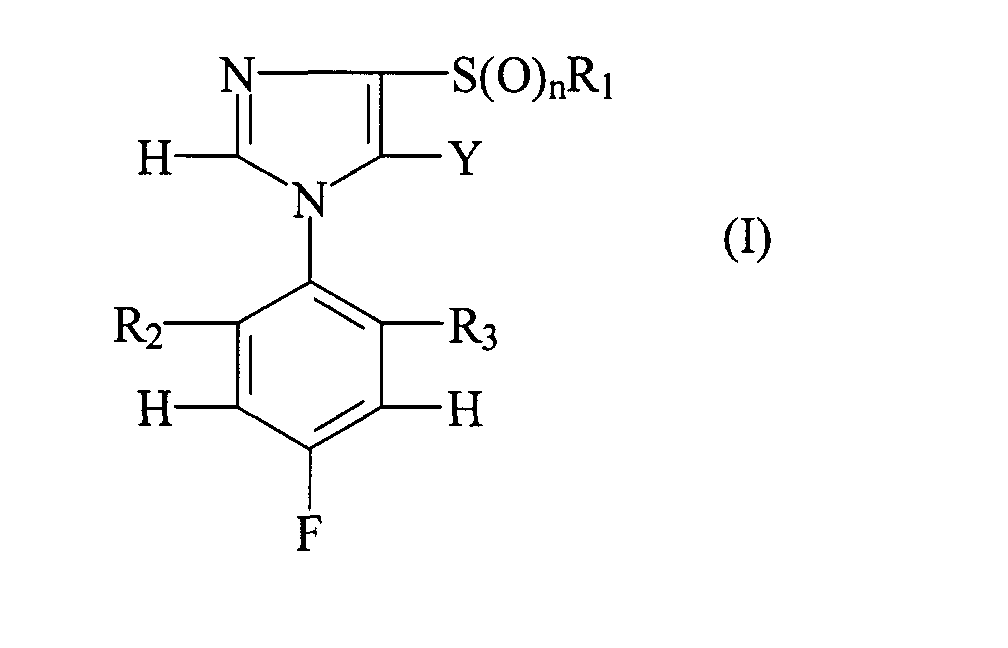
- R1 is CF3, CCl2F or CClF2;
- n is 0, 1 or 2;
- Y is H, Cl, Br or SCH3;
- R2 is Cl or Br; and
- R3 is Cl or Br; which compound is:
- 1-(2,6-dibromo-4-fluorophenyl)-5-bromo-4-chlorodifluoromethylsulfenylimidazole;
- 1-(2,6-dichloro-4-fluorophenyl)-5-methylsulfenyl-4-dichlorofluoromethylsulfenylimidazole;
- 1-(2,6-dichloro-4-fluorophenyl)-5-bromo-4-dichlorofluoromethylsulfenylimidazole;
- 1-(2,6-dichloro-4-fluorophenyl)-5-methylsulfenyl-4-chlorodifluoromethylsulfenylimidazole;
- 1-(2,6-dichloro-4-fluorophenyl)-5-bromo-4-chlorodifluoromethylsulfenylimidazole;
- 1-(2,6-dichloro-4-fluorophenyl)-5-chloro-4-dichlorofluoromethylsulfenylimidazole;
- 1-(2,6-dichloro-4-fluorophenyl)-4-dichlorofluoromethylsulfonylimidazole;
- 1-(2, 6-dichloro-4-fluorophenyl)-5-bromo-4-trifluoromethylsulfenylimidazole;
- 1-(2,6-dichloro-4-fluorophenyl)-5-bromo-4-trifluoromethylsulfinylimidazole;
- 1-(2,6-dichloro-4-fluorophenyl)-5-bromo-4-trifluoromethylsulfonylimidazole;
- 1-(2,6-dichloro-4-fluorophenyl)-5-chloro-4-trifluoromethylsulfinylimidazole;
- 1-(2,6-dichloro-4-fluorophenyl)-5-bromo-4-chlorodifluoromethylsulfinylimidazole;
- 1-(2,6-dichloro-4-fluorophenyl)-5-bromo-4-chlorodifluoromethylsulfonylimidazole;
- 1-(2,6-dichloro-4-fluorophenyl)-5-bromo-4-dichlorofluoromethylsulfinylimidazole; or
- 1-(2,6-dichloro-4-fluorophenyl)-5-bromo-4-dichlorofluoromethylsulfonylimidazole.
-
- In particular related to compounds of formula (I), there are certain specific substituent groups which appear to be beneficial in providing the safety characteristics described above. These groups include, for example:
- methylsulfenyl represented by Y; and
- halogen being fluorine.
- The following are some of the compounds of formula (I) (described subsequently in EXAMPLES 1-15), which especially have high miticidal activity:
- Compounds of EXAMPLES 1 to 6, 8, 10, 14 and 15.
- Typically wherein:
- Y is SCH3, Cl or Br;
- R1 is CF3, CCl2F or CClF2 ;
- R2 and R3 are Cl or Br; and
- n is 0.
-
- It is an object of the present invention to provide new compounds of the imidazole family together with processes for their preparation.
- A second object of the present invention is to provide, for example, agronomically or medicinally acceptable compositions.
- A third object of the present invention is to provide highly active compounds for use against: arthropods, especially mites, aphids or insects; plant nematodes; or helminth or protozoan pests. The compounds are thus advantageously used, for example, in agricultural or horticultural crops, forestry or livestock husbandry, or in public health.
- A fourth object of the present invention is to provide compounds with broad spectrum activity as insecticides, miticides, aphicides or nematicides, by either soil, foliar application or seed treatment, including via systemic action.
- A fifth object of the present invention is to provide compounds having high arthropod toxicity, for example, to mites in the subclass Acari, particularly Tetranychus urticae (twospotted spider mite), or Panonychus ulmi (European red mite).
- An additional object of the present invention is to provide pesticidal compounds which are highly active, especially as insecticides or miticides, and are safe to man or his environment during handling, use, or application.
- These and other objects of the invention shall become readily apparent from the detailed description of the present invention.
- The compounds of general formula (I) can be prepared by the application or adaptation of known methods (i.e. methods heretofore used or described in the chemical literature): generally imidazole ring formation followed wherein necessary by changing substituents. It is to be also understood that, in the description of the following process methods, the sequences for the introduction of the various groups on the imidazole ring may be performed in a different order and that suitable protecting groups may be required as will be apparent to those skilled in the art. Also intermediates and compounds of general formula (I) may be converted by known methods into other compounds of general formula (I).
- In the following description of process methods when symbols appearing in formulae are not specifically defined, it is to be understood that they are "as herein before defined" in accordance with the first definition of each symbol in this specification. The term "protection" shall include conversion to a suitable non-reactive group which may be reconverted when desired, as well as the addition of groups which render the functionality non-reactive. Within the process definitions, unless otherwise stated, amino refers to the unsubstituted amino group.
- There are also particular intermediate compounds, useful to make certain of the herein contemplated compounds. Such preferred intermediate compounds, prepared as described herein, are defined in the following methods. In particular, intermediates that are more preferred have R2 and R3 as defined by formula (I) of the invention or more specifically preferred R2 and R3 definitions therein.
- The following synthetic Method I describes a cyclization procedure beginning with appropriately substituted N-phenylimino compounds which are cyclized by means of a basic reagent to useful intermediate N-phenylimidazole compounds. This reaction (including subsequent initial derivatization of Y') can be generally represented by the reaction of a compound of formula (II) with a basic agent to give a compound of formula (III) as follows:wherein for formula (II):

- R2 and R3 are as defined in formula (I); and
- Q is cyano. wherein for formula (III):
- R2 and R3 are as defined in formula (I); and
- Y' is amino.
-
- Particularly useful intermediate phenyl imidazole compounds, discussed in the Methods herein for the preparation of compounds of the invention of formula (I), are specifically compounds of formulae (III), (Ia) and (Ib). Additionally, compounds of formula (II) which are useful are specifically compounds of formula (4). In particular, the 4-sulfenated 1-arylimidazoles containing S(O)nR1 at the 4-position, wherein n and R1 are previously defined) of this invention can be prepared by a variety of methods. A preferred method is illustrated by reaction SCHEME I (METHOD I).
- According to Method I, a particularly useful intermediate compound to formula (I), namely (Ia),can be prepared wherein R1, n, R2 and R3 are as defined in formula (I).

- Compounds of the invention or intermediates of general formula (I), in which Y is amino, hydrogen, Cl, Br or SCH3, and R1, R2 and R3 are as defined in formula (I) can be prepared by procedures described in SCHEME I.
- In SCHEME I the starting material, alkyl orthoformate (1), in which R' is a C1 to C4 alkyl group, is generally commercially available and the aniline (2) is usually also a commercial product or else it may be prepared following well-known literature procedures. The catalyst used for formimidate (3) formation is generally an inorganic acid such as hydrochloric acid or an organic acid such as p-toluenesulfonic acid. The reaction may be carried out at a temperature between -20°C and 180°C, preferably between 0°C and 120°C, in the presence of an inert organic solvent such as a hydrocarbon, a chlorinated hydrocarbon, an aromatic, an ether, an alcohol and the like or the alkyl orthoformate itself may be used as the solvent. The formimidate (3) may exist as a mixture of regioisomers.
- The intermediate formimidine (4) is prepared by reaction of the formimidate (3) with aminoacetonitrile or the hydrochloride salt thereof in the presence of a base and in an inert organic solvent preferably capable of providing a homogeneous solution for the reactants. Typical organic and inorganic bases are alkoxides, hydroxides, hydrides, carbonates of alkali or alkaline earth metals, and amines such as diisopropylamine, tripropylamine, etc. Solvents which may be employed include inert organic solvents such as alcohols (e.g., methanol or ethanol), ethers (e.g., diethyl ether, tetrahydrofuran, dioxane or diglyme), amines (e.g., triethylamine or pyridine) or water or combinations of these solvents. The reaction is usually conducted at a temperature between -20°C and 180°C, preferably between 20°C and 120°C.
- The intermediate formimidine (4) may either be isolated or cyclized in situ to imidazole (5) without isolation by further treatment with a base and under the conditions as described above, preferably using sodium methoxide in methanol at 20-25°C. Compounds of formulae (4) and (5) are useful as intermediates in the methods or processes of synthesis of compounds of formula (I) of the invention.
- The reaction of imidazole (5) with a sulfenyl halide, preferably chloride, R1 SHalo, in which R1 is defined above, to give (6) conveniently may be conducted in an inert aprotic organic solvent such as a chlorinated hydrocarbon, a hydrocarbon or an ether, preferablyin dichloromethane, with or without an acid acceptor such as pyridine, any tertiary amine or an alkali metal carbonate. The reaction may be carried out between -25°C and 100°C depending on the boiling point of the sulfenyl halide reagent and the solvent.

- The desaminoimidazole (7) may be prepared by reacting the aminoimidazole (6) with an organic nitrite, such as t-butyl nitrite, in an organic solvent such as tetrahydrofuran between -20°C to 180°C, preferably between 10°C to 100°C.
- The oxidation of the sulfide (7), n = 0, to the sulfoxide, n = 1, or sulfone (8), n = 2, may be carried out by using an appropriate quantity of peracetic acid, trifluoroperacetic acid, m-chloroperbenzoic acid, hydrogen peroxide, a combination of peracetic acid and hydrogen peroxide, or potassium peroxymonosulfate which is commercially available as Oxone®. The reaction is usually conducted in an inert organic solvent typically between -30°C to 180°C.
- Specific procedures for introducing a Y substituent into a particular intermediate of formula (Ia) provide a compound of the invention of formula (I) wherein R1 to R3 and n are defined above.
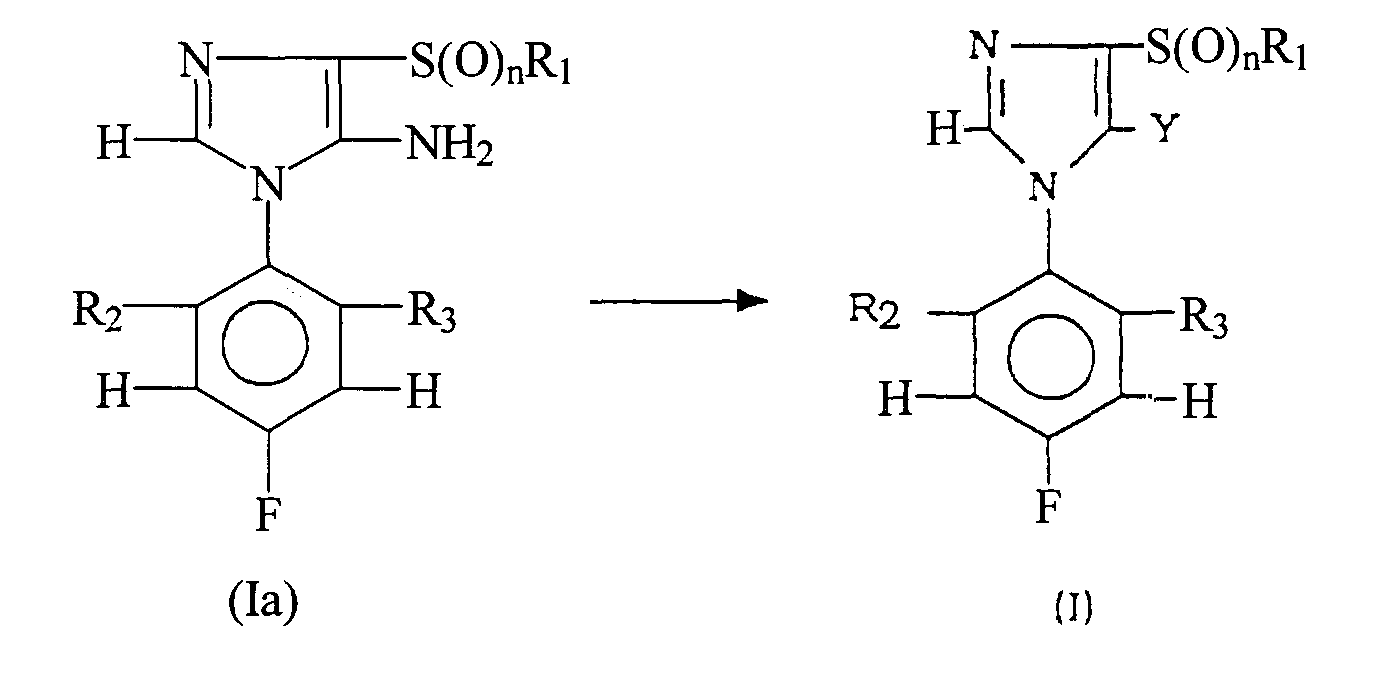
- A compound of formula (I), wherein Y, R1, n, R2 and R3 have the meanings defined above, can be alternatively prepared by the following procedures starting from the intermediate compound (Ib) to give an intermediate wherein the 4-position is substituted by thiocyano, (12), or is chlorosulfonyl, (9). Either of these interemediates may be converted to the corresponding disulfide intermediate which is then converted to the corresponding sulfenyl compound, in which R1 is as previously defined, which in turn may be oxidized to the corresponding sulfoxide or sulfone, in which n is 1 or 2.
- a) An intermediate of the formula (9), in which
Y, R2 and R3 have the meanings defined in
the definition of formula (I), can be prepared from an intermediate
compound of the formula (Ib) in which Y,
R2 and R3 are defined herein above, by treatment with
chlorosulfonic or dichlorosulfonic acid. The reaction can be carried out
in the presence of organic solvents such as methylene chloride,
chloroform, carbon tetrachloride or dimethylformamide or using
chlorosulfonic acid as solvent at a reaction temperature from -10°C
to 160°C. A representative procedure for chlorosulfonation of an
aromatic compound is reported in J. March, "Advanced Organic
Chemistry", McGraw-Hill publ. (1968), p. 402.

- b) An intermediate disulfide compound of the formula (10),
in which the definitions of Y, R2 and R3 are
those given for the definition of formula (I), can be prepared from the
compound of the formula (9) by treatment with a reducing agent, such
as triphenylphosphine, in the presence of an organic solvent, such as
tetrahydrofuran, dichloromethane or toluene at a reaction temperature
from -10°C to 120°C. A representative example of a
procedure for the reduction to p-tolyldisulfide is reported in J. Org.
Chem. 1980, 45, 4792. Alternatively, disulfenylation can be effected
using a metal carbonyl such as hexacarbonylmolybedium in anhydrous
tetramethyurea. The procedure of this reaction is reported by H. Alper,
Angew. Chem. Internat. Edit, 8. 677, 1969.
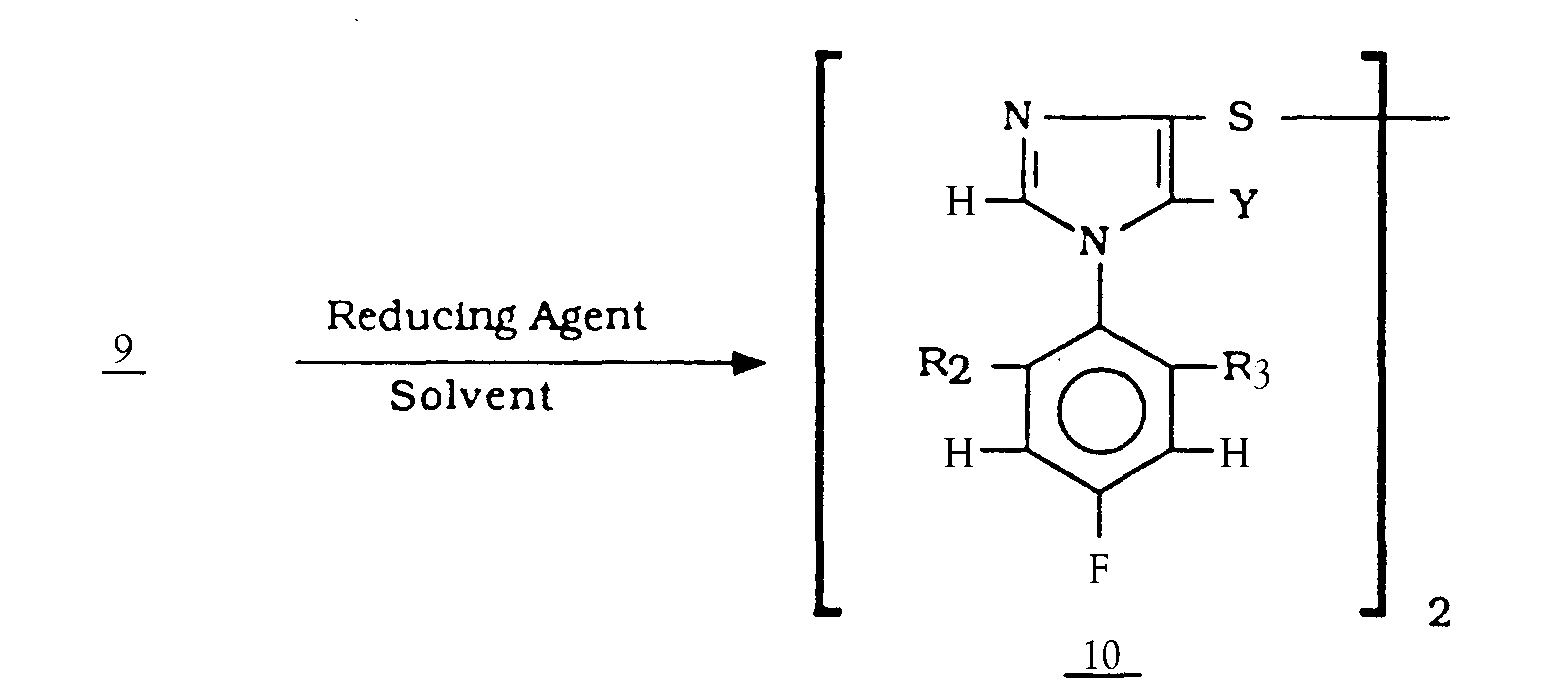
- c) A compound of the formula (I), wherein the
definition of Y, R1, R2 and R3 are those given for the definition
of formula (I),
can be prepared by the reaction of a compound of the formula (10)
and a corresponding perhaloalkane Halo R1 (11) selected from
Halo CF3, Halo CF2Cl, or Halo CFCl2 wherein Halo is Cl, Bror I
with a reducing agent which can promote the
formation of the free radical CF3, CF2Cl or CFCl2. The reducing
agent is preferably chosen from a metal consisting of zinc, aluminum,
cadmium, manganese or a compound with an oxide of sulfur, e.g., a
dithionite or a hydroxymethylsulfinate. The alkaline dithonite, alkaline
earth or the metal dithionite corresponds to the formula Mn(S2O4), in
which n can be 1 or 2 depending upon the valence of the metal M. When
a dithionite or a hydroxymethylsulfinate is used, a base is needed. The
base can be chosen from among an alkaline hydroxide, alkali earth
hydroxide, ammonia, alkylamine, triethylbenzylammonium or the salt of
weak acids such as disodium phosphate, sodium metabisulfite, sodium
hydrogen sulfite or sodium borate. The solvents used for the reaction are
those which can solubilize the dithionite or the hydroxymethylsulfinate,
and the compounds (10) and (11). Useful solvents are acetonitrile,
dimethylformamide, formamide, dimethylacetamide, hexamethylphosphoramide,
N-methylpyrrolidone, dimethylsulfoxide or sulfolane. The
reaction temperature is from 10°C to 100°C. Typical
procedures are similar to those reported by A. Maggiolo, J. Am. Chem.
Soc., 1951, 5815 and by P.W. Feit, Acta. Chem. Scan., 16, 1962, 297. The
reaction is represented by the following equation:

- d) The intermediate compound of formula (I) in
which the 4-position is substituted by cyanothio and Y, R2 and R3 have the meanings
given in the definition of formula (I), may be prepared from a compound
of formula (Ib) by treatment with bromine and an alkali
thiocyanate such as potassium thiocyanate in a suitable solvent such as
methanol at a temperature from -78°C to room temperature.
The solvent should be inert to and capable of solvolyzing the reactants.

- e) Alternatively, the compound of formula (I) wherein n=0
may be prepared by a
sequence of oxidation of a compound of formula (12) to form an
intermediate disulfide compound of formula (10), which can then be
converted into its corresponding haloalkylsulfenyl compound of formula
(I) wherein n=0. The oxidation can be achieved using an oxidizing agent such as
hydrogen peroxide in the presence of an alkali hydroxide, such as sodium
hydroxide, or an amine such as ammonia in a suitable solvent, such as an
alcohol, water, tetrahydrofuran, a halogenated alkane or mixed solvent
thereof, at a reaction temperature from -70°C to 55°C.
Typical procedures are reported by A. Maggiolo, J. Am. Chem. Soc., 1951,
5815 and by P. W. Feit, Acta. Chem. Scan., 16, 1962, 297. The
haloalkylsulfenyl compound of formula (I) wherein n=0 can be prepared by reacting
the disulfide intermediate compound with an appropriate perhaloalkane.
optionally in the presence of a reducing agent such as a metal consisting
of zinc, aluminum, cadmium or manganese.

- f) A further compound of formula (I), wherein n=0
and Y, R1, R2 and R3 are as
defined by formula (I), can be prepared by treating a compound of
formula (12) with an appropriate reagent of formula R1 Halo, in which R1 is
defined above, in a suitable
solvent such as an alcohol, preferably the corresponding alkyl alcohol, in
the presence of a base catalyst such as an alkali hydroxide or alkali
carbonate at a reaction temperature from -20°C to 75°C.

- g) A compound of formula (I), wherein n = 1 or 2 and Y, R1, R2 and R3 are as defined in formula (I), can be prepared from a compound of formulae (I) wherein n=0 by the oxidation procedures described, for example in Method I.
-
- It is understood that, for example, the sequence of the synthetic chemical steps may be performed in a different order as appropriate, suitable protecting groups may be employed, and substitutent groups may be incorporated when convenient. In the description of process methods, when symbols appearing in a formula are not specifically-defined, it is also to be understood that they are "as herein before defined" in accordance with the first definition of each symbol in this specification.
- In an overall/global manner the foregoing Methods of synthesis may be represented by the following processes P1 to P3 of the invention which are described as follows:
- P1. A process of preparation of a compound of formula (Ia),
wherein R1, n, R2 and R3 are as defined in formula (I), wherein a compound of formula (5),
 wherein R2 and R3 are as defined above and in which amino is optionally protected as required, is first reacted with a sulfenyl halide, R1SHalo in which R1 is as defined above, in an organic reaction medium, optionally in the presence of an acid acceptor such as a tertiary amine to obtain a compound of formula (Ia), wherein R1 is as defined above, which is then optionally oxidized by known methods such as by a peroxide, to obtain a compound of formula (Ia), wherein n is 1 or 2 and R1 is as defined above.
- P2. A process of preparation of a compound of formula (I),
wherein Y, R1, n, R2 and R3 are as hereinbefore defined, wherein a compound of formula (Ib),
 in which R1, n, R2 and R3 are as defined above and in which S(O)nR1, the H atom at the 2-position of the imidazole ring and amino are optionally protected as required, is deaminated by known procedures, such as with an alkylnitrite to convert the compound, in which Y is amino, into its corresponding diazonium salt, followed by quenching the diazonium salt with a quenching agent according to known procedures to obtain a compound of formula (I), in which Y is H, Cl, Br or SCH3.
- P3. A process of preparation of a compound of formula (I),
wherein Y, R1, n, R2 and R3 are as hereinbefore defined, wherein a compound of formula (Ib),
 wherein Y, R2 and R3 are as hereinbefore defined and in which Y and the H atom at the 2-position of the imidazole ring are optionally protected as required:
- a) is first reacted with a mixture of bromine and a metal thiocyanate to give an intermediate compound corresponding to formula (I), wherein the 4-position is substituted by thiocyano, which then is treated with a corresponding a haloalkylating agent, optionally in the presence of a base to directly give a compound of formula (I) in which n is 0, or optionally the intermediate compound, wherein the 4-substituent is thiocyano, is first oxidized to a corresponding intermediate disulfide compound which is then reacted with the perhaloalkane, optionally in the presence of a reducing agent, to give a compound of formula (I) in which n is 0, and finally the compound in which n is 0 is optionally oxidized by known methods similar to those of process P1a to obtain the sulfoxide or sulfone analog, that is a compound of formula (I) in which n is 1 or 2; or
- b) is first reacted according to known procedures, for example with chlorosulfonic or dichlorosulfonic acid, to convert the compound of formula (Ib), in which the 4-position is unsubstituted, to an intermediate compound corresponding to formula (I), in which the 4-position substituted by chlorosulfonyl, then the chlorosulfonyl compound is reacted with a reducing agent such as triphenylphosphine to give the same disulfide intermediate described above in part a) above, then finally the disulfide is converted by the procedures described above in part a) above to give a compound of formula (I) in which n is 0, or optionally the compound of formula (I) in which n is 0 is oxidized to give a compound of formula (I) in which n is 1 or 2.
-
- The following COMPOUND EXAMPLES 1 to 15 illustrate the compounds of formula (I) of the invention. Details of typical methods of synthesis utilized in the preparation of intermediates and compounds of the invention are specifically provided below for representative compounds of COMPARISON REFERENCE EXAMPLES A to J. The other compounds were prepared using similar methods of synthesis or modifications thereof of the detailed procedures as applicable to a given compound. These compound examples are listed in TABLE 1 wherein the compounds are grouped by the phenyl ring substitution shown below, with R1, n, and as defined. Reported melting points for compounds represent the average value of an observed melting point range determined for a compound or furthermore represent the average value of a number of separate melting point determinations. Additionally, one or more spectroscopic analyses (IR, NMR, GC/MS, etc.) have been performed on each compound for characterization and confirmation of the chemical structure.
PHENYL RING SUBSTITUTION GROUP IN TABLE 1 R2 R3 1 Br Br 2 Cl Cl - To 1.09 g (4.6 mmole) of 2,6-dichloro-4-trifluoromethylaniline was added conc. HC1 (0.46 mmole) and 1.04 g (7.0 mmole) of triethylorthoformate. The resulting mixture was stirred and then it was heated to 85°C and evaporated under vacuum. The residue was analyzed by 1H NMR which indicated the desired structure-1H NMR (CDCL3) : δ 1.42 (t, J=7.0 Hz, 3H), 4.47 (q, J=7.0 Hz, 2H), 7.57 (s, 3H). This compound was used in the next step without further purification.
- To a solution of 20.20 g (0.218 mole) of aminoacetonitrile hydrochloride in 500 ml of methanol was added at 0°C 11.79g (0.218 mole) of sodium methoxide. The mixture was stirred at RT for 30 min. and then evaporated to dryness under vacuum. The residue was extracted twice with 400 ml of diethyl ether and the ethereal solution was added to 62.45g (0.218 mole) of ethyl N-(2,6-dichloro-4-trifluoromethylphenyl)formimidate at RT. The solvent was evaporated, 400ml of tetrahydrofuran was added, and the mixture was heated to reflux for 18 h. The solvent was then evaporated and the residue partitioned between water and methylene chloride. The organic layer was dried over anhydrous sodium sulfate and the solvent was evaporated. The residue was finally purified by flash column chromatography using 20% ethyl acetate in hexane, followed by elution with 30% ethyl acetate in hexane to give 24 g (37.25% yield) of the desired product. 1H NMR (CDCL3): δ 4.40 (s, 2H), 7.55 (s, 2H), 7.59 (s, 1H).
- To a solution of 4.4g (14.91 mmole) of cyanomethyl N-(2,6-dichloro-4-trifluoromethylphenyl)formimidine in 400 ml of methanol was added 81 mg (14.91 mmole) of sodium methoxide at 4°C. The mixture was stirred at RT for 3 h. The mixture was then evaporated to dryness to give the desired product (100% yield)-1 HNMR (CDCL3/acetone-d6): δ 3.43 (s, 2H), 6.68 (s, 1H), 7.28 (s, 1H), 7.88 (2H).
- To a solution of 4.8g (14.91 mmole) of 1-(2,6-dichloro-4-trifluoromethylphenyl)-5-aminoimidazole in 400 ml of methylene chloride was added 1.3 ml (14.91 mmole) of trifluoromethanesulfenyl chloride at 0°C. The mixture was stirred at 0°C for 4 h and then at RT for 15 h. Water was added and the mixture was partitioned between water and methylene chloride. The organic layer was dried over anhydrous sodium sulfate and the solvent removed. The residue was recrystallized from methylene chloride to give 3.36g (52.51% yield) of the desired product., mp 134°C.
Anal. C11H5Cl2F6N3S. Calc. C, 33.35; H, 1.27; N, 10.61; S 8.09. Found C, 33.54; H, 1.20; N, 10.67; S 8.37. - To a solution of 6.0 g (15.15 mmole) of 1-(2,6-dichloro-4-trifluoromethylphenyl)-5-amino-4-trifluoromethylsulfenylimidazole in 100 ml of methylene chloride was added 1.70 ml (18.18 mmole) of sulfuryl chloride at 0°C. The resulting mixture was stirred at RT for 5 days under a nitrogen atmosphere. The mixture was quenched with water, then partitioned between methylene chloride and aqueous sodium bicarbonate. The organic layer was dried over anhydrous sodium sulfate and the solvent was removed. The residue was purified by column chromatography using 20% ethyl acetate in hexane to give 1.9 g (31.62% yield) of the desired product, mp 172.5°C.
- To a solution of 2.0g (4.64 mmole) of 1-(2,6-dichloro-4-trifluoromethylphenyl)-5-amino-2-chloro-4-trifluoromethylsulfenylimidazole in 40 ml of tetrahydrofuran was added 2.76 ml (23.2 mmole) of t-butylnitrite. The resulting mixture was heated to reflux under a nitrogen atmosphere for 2 h. The mixture was evaporated to dryness and the residue was purified by column chromatography using 10% ethyl acetate in hexane to give 1.6g (83.0% yield) of the desired product, mp 112°C.
Anal. C11H3Cl3F6N2S. Calc C, 31.79; H, 0.73; N, 6.74; F, 27.43. Found C, 31.71; H, 0.68; N, 6.75; F, 27.65. - To a solution of 800 mg (1.93 mmole) of 1-(2,6-dichloro-4-trifluoromethylphenyl)-2-chloro-4-trifluoromethylsulfenylimidazole in trifluoroacetic acid was added 0.20 ml of 30% hydrogen peroxide at 0°C. The resulting mixture was stirred at 0°C for 4 h and then at RT for 50 h. The mixture was evaporated at RT and the residue was partitioned between methylene chloride and a saturated aqueous sodium bisulfite solution. The organic layer was washed with an aqueous sodium bicarbonate solution and the organic layer was evaporated. The residue was purified by flash column chromatography on silica gel using 5% ethyl acetate in hexane. After the solvent was removed there was obtained 300 mg (36.02% yield) of the desired product as a white solid, mp 147.5°C.
Anal. C11H3Cl3F6N2OS. Calc. C, 30.61; H, 0.70; N, 6.49; Cl, 24.64; F, 26.41; S, 7.43 Found C, 30.63; H, 0.83; N, 6.48; Cl, 24.83; F, 26.53; S, 7.78. - To a solution of 300 mg (0.72 mmole) of 1-(2,6-dichloro-4-trifluoromethylphenyl)-2-chloro-4-trifluoromethylsulfenylimidazole in 5 ml of trifluoroacetic acid was added 0.15 ml (1.44 mmole) of 30% hydrogen peroxide at 0°C. The resulting mixture was stirred at RT for 4 days. The mixture was evaporated to remove trifluoroacetic acid and the residue was partitioned between methylene chloride and a saturated aqueous sodium bisulfite solution. The organic layer was washed with an aqueous sodium bicarbonate solution. The organic layer was dried over anhydrous sodium sulfate and the solvent was removed. The residue was purified by preparative TLC using 100% methylene chloride to give 190 mg (59.03% yield) of the desired product as white solid, mp 182.5°C.
- To a solution of 700 mg (1.77 mmole) of 1-(2,6-dichloro-4-trifluoromethylphenyl)-5-amino-2-chloro-4-trifluoromethylsulfenylimidazole in 8 ml of chloroform was added 0.26 ml (2.54 mmole) of dimethyl disulfide and 0.32 ml (0.89 mmole) of t-butylnitrite at 0°C. The resulting mixture was stirred at 0°C for 15 min. and then at RT for 45 min.. The mixture was diluted with 75 ml of methylene chloride and partitioned between water and methylene chloride. The organic layer was dried over anhydrous sodium sulfate and the solvent was evaporated. The residue was purified by preparative TLC using 5% ethyl acetate in hexane to give 480 mg (58.74% yield) of the desired product. 1H NMR (CDCl3): δ 2.26 (s, 3H), 7.82 (s, 2H).
- To a solution of 1.35g (3.40 mmole) of 1-(2,6-dichloro-4-trifluoromethylphenyl)-5-amino-4-trifluoromethylsulfenylimidazole in 20 ml of chloroform was added 0.5 ml (9.76 mmole) of bromine. The resulting mixture was stirred at RT under a nitrogen atmosphere for 2 hr. The mixture was then evaporated to remove the excess of bromine and the residue was partioned between water and methylene chloride. The organic layer was dried over anhydrous sodium sulfate and solvent was removed. The residue was purified by flash column chromatography on silica gel using 7% ethyl acetate in hexane to give 200 mg (13.62% yield) of the desired product, mp 154°C.
- To a solution of 2.0g (5.05 mmole) of 1-(2,6-dichloro-4-trifluoromethylphenyl)-5-amino-4-trifluoromethylsulfenylimidazole in 10 ml of acetonitrile was added 1 ml of bromoform and 1.20 ml (10.10 mmole) of t-butylnitrite at 0°C. The resulting mixture was stirred at RT under a nitrogen atmosphere for 1.5 h. Ten ml of toluene was added and the mixture was evaporated to dryness under vacuum. The residue was purified by column chromatography on silica gel using 5% ethyl acetate in hexane to give 800 mg (34.44% yield) of the desired product, mp 87.5°C.
Anal. C11H3BrCl2F6N2S. Calc. C, 28.72; H, 0.66; N, 6.09; F, 24.78; S, 6.97. Found C, 29.06; H, 0.69; N, 6.20; F, 24.2; S, 7.48. - To a solution of 500 mg (0.984 mmole) of 1-(2,6-dichloro-4-trifluoromethylphenyl)-2-bromo-4-chlorodifluoromethylsulfonyl-imidazole in 2 ml of tetrahydrofuran was added a solution of 69 mg (0.984 mmole) of sodium methanethiolate in 0.3 ml of water. The resulting mixture was stirred at RT for 14 hours, after which it was partitioned between water and diethyl ether. The organic layer was separated, dried over anhydrous sodium sulfate and stripped of solvent. The residue was purified by preparative TLC using 20% ethyl acetate in hexane to give 180 mg (35% yield) of the product, mp 116°C.
- To 10.6 g (0.26 mole) of dry potassiumin hydride in THF (150 ml) was added 20 g (87.3 mmole) of 2,6-dichloro-4-trifluoromethylaniline at 0°C under a nitrogen atmosphere. The resulting mixture was stirred and warmed to room temperature for 3.5 h. The mixture was cooled to 0°C and 6.6 ml (92.8 mmole) of acetyl chloride was added dropwise. The mixture was stirred at 0°C for 30 min. The mixture was warmed to room temperature under a nitrogen atmosphere overnight. The mixture was quenched with satd. NH4Cl (150 ml). The mixture was evaporated to remove THF and the suspension was filtered and the solid washed with hexane, followed by a wash with dichloromethane to give 14.5 g( 61%) of the desired product. 1H NMR, (CDCl3/CD3OD): δ 2.12(s, 3H), 7.60(s,2H).
- To a suspension of 4.3 g (15.8 mmole) of N-acetyl-2,6-dichloro-4-trifluoromethylaniline in 50 ml of chloroform was added 3.3 g (15.8 mmole) of phosphorous pentachloride at RT. The mixture was heated to reflux under a nitrogen atmosphere for 1 h. The mixture was evaporated to dryness. To the residue was added 50 ml of benzene. The resulting mixture was heated to reflux for 1 h. under a nitrogen atmosphere. The mixture was evaporated to dryness and the residue purified by a column chromatography on silica gel using 10% ethyl acetate in hexane to yield 4.3 g (93.7% yield) of the desired product as an oil. 1H NMR, (CDCl3): δ 2.70(s, 3H), 7.58(s, 2H).
- To a solution of 9.6g (33.0 mmole) of 1-chloro-1-methyl-N-(2,6-dichloro-4-trifluoromethylphenyl)formimine in 300 ml of chloroform was added 3.7g (66.0 mmole) of aminoacetonitrile at RT. The resulting mixture was heated to reflux under a nitrogen atmosphere for 60 h. The reaction mixture was used in the following step without purification. The 1H NMR spectrum indicated approximately 60% conversion based on the starting iminochloride. 1H NMR, (CDCl3) : δ 2.13(s, 3H), 6.58(s, 1H), 7.76(s, 2H).
- To the reaction mixture, described above in (c), was added 5.8 ml (57.7 mmole) of chlorodifluoromethanesulfenyl chloride at RT. The mixture was stirred at RT for 3.5 h. The mixture was quenched with water. The mixture was partitioned between water and dichloro methane. The organic layer was dried over anhydrous sodium sulfate and the solvent evaporated to give the desired product. The crude product was used in the following step without further purification.
- To the crude product, described above in (d), was added 100 ml of THF, followed by addition of 19.6 ml (165 mmole) of t-butylnitrite. The mixture was stirred at RT under a nitrogen atmosphere with protection from light overnight. The mixture was evaporated to dryness. The residue was purified by a flash column chromatography using 10% ethyl acetate in hexane to give 1.3 g (9.46% yield from the imino chloride. described in (b)) of the desired product, mp 118.5°C.
SYNTHESIZED IMIDAZOLE COMPOUNDS OF FORMULA (I) CMPD. OF EXAMPLE Substituent R1 n Y M.P.,°C Group 1: R2 and R3 are Br 1 CClF2 0 Br 82 Group 2: R2 and R3 are Cl 2 CCl2F 0 SCH3 OIL 3 CCl2F 0 Br OIL 4 CClF2 0 SCH3 OIL 5 CClF2 0 Br OIL 6 CCl2F 0 Cl OIL 7 CCl2F 2 H 165.5 8 CF3 0 Br 64 9 CF3 1 Br 158 10 CF3 2 Br 118.5 11 CF3 1 Cl 116 12 CClF2 1 Br 129.5 13 CClF2 2 Br 104.5 14 CCl2F 1 Br 118.5 15 CCl2F 2 Br 129.5 - The following test procedures, using the compounds of EXAMPLES 1-15, were conducted to determine the pesticidal use and activity of compounds of the invention against: mites; certain insects, including an aphids, a caterpillar, a fly, and three species of beetle larvae (two foliar feeding and the other root feeding); and nematodes. The specific species tested were as follows:
GENUS, SPECIES COMMON NAME (ABBREVIATION) Tetranychus urticae twospotted spider mite TSM Aphis nasturtii buckthorn aphid BA Spodoptera eridania southern armyworm SAW Epilachna varivestis Mexican bean beetle MBB Musca domestica housefly HF Diabrotica u. howardi southern corn rootworm SCRW Meloidogyne incognita southern root-knot nematode SRKN Leptinotarsa decemlineata Colorado potato beetle CPB Aphis gossypii cotton aphid CA - The test compounds (EXAMPLES 1-15) were formulated for use according to the following methods used for each of the test procedures.
- For mite, aphid, southern armyworm, and Mexican bean beetle tests, a solution or suspension was prepared by adding 10 mg of the test compound to a solution of 160 mg of dimethylformamide, 838 mg of acetone, 2 mg of a 3:1 ratio of Triton X-172 : Triton X-152 (respectively, mainly anionic and nonionic low foam emulsifiers which are each anhydrous blends of alkylaryl polyether alcohols with organic sulfonates), and 98.99 g of water. The result was a concentration of 100 ppm of the test compound.
- For housefly tests, the formulation was initially prepared in a similar manner to the above, but in 16.3 g of water with corresponding adjustment of other components, providing a 200 ppm concentration. Final dilution with an equal volume of a 20% by weight aqueous solution of sucrose provided a 100 ppm concentration of the test compound. When necessary, sonication was provided to insure complete dispersion.
- For southern corn rootworm tests, a solution or suspension was prepared in the same manner as that used for the initial 200 ppm concentration for housefly. Aliquots of this 200 ppm formulation were then used by dilution with water according to the required test concentration.
- For southern root-knot nematode and systemic tests for southern armyworm, Colorado potato beetle and cotton aphid, a stock solution or suspension was prepared by adding 15 mg of the test compound to 250 mg of dimethylformamide, 1250 mg of acetone and 3 mg of the emulsifier blend referenced above. Water was then added to bring the total volume to 45 ml and a test compound concentration of 333 ppm. When necessary, sonication was provided to insure complete dispersion.
- The above formulated test compounds were then evaluated for their pesticidal activity at the specified concentrations, in ppm (parts per million) by weight, according to the following test procedures:
- Twospotted spider mite: Leaves infested with adult and nymphal stages of the two-spotted spider mite, obtained from a stock culture were placed on the primary leaves of two bean plants growing in a 6 cm. peat pot. A sufficient number of mites (150-200) for testing were transferred to the fresh plants within a period of twenty-four hours. The potted plants (one pot per compound) were placed on a revolving turntable and sprayed, sufficient to wet the plants to runoff, with 100 ml of the 100 ppm test compound formulation by use of a DeVilbiss spray gun set at 40 psig. air pressure. As an untreated control, 100 ml of the water-acetone-DMF-emulsifier solution, containing no test compound, were also sprayed on infested plants. A treated control with a commercial technical compound, either dicofol or hexythiazox, formulated in the same manner. was tested as a standard. The sprayed plants were held for six days, after which a mortality count of motile forms was made.
- Twospotted spider mite (ovicide test): Eggs were obtained from adults of the twospotted spider mite from a stock culture. Heavily infested leaves from the stock culture were placed on uninfested bean plants. Females were allowed to oviposit for a period of about 24 hours, after which the leaves of the plant were dipped into a solution of TEPP (tetraethyl diphosphate) in order to kill the motile forms and prevent additional egg laying. This dipping procedure, which was repeated after the plants dried, did not affect the viability of the eggs. The potted plants (one pot per compound) were placed on a revolving turntable and sprayed, sufficient to wet the plants to runoff, with 100 ml of the 100 ppm test compound formulation by use of a DeVilbiss spray gun set at 40 psig. air pressure. As an untreated control, 100 ml of the water-acetone-DMF-emulsifier solution, containing no test compound, were also sprayed on infested plants. A treated control with a commercial technical compound, typically demeton, formulated in the same manner, was tested as a standard. The sprayed plants were held for seven days, after which a mortality count of egg forms was made along with notations on residual activity on hatched larvae.
- Buckthorn aphid: Adult and nymphal stages of buckthorn aphid were reared on potted dwarf nasturtium plants. The potted plants (one pot per compound tested) infested with 100-150 aphids, were placed on a revolving turntable and sprayed with 100 ml of the 100 ppm test i compound formulation by use of a DeVilbiss spray gun set at 40 psig air pressure. As an untreated control, 100 ml of a water-acetone-DMF-emulsifier solution, containing no test compound, were also sprayed on infested plants. A treated control with a commercial technical compound, malathion, formulated in the same manner, was tested as a standard. After spraying, the pots were stored for one day after which the dead aphids were counted.
- Southern armyworm: Potted bean plants, were placed on a revolving turntable and sprayed with 100 ml of the 100 ppm test compound formulation by use of a DeVilbiss spray gun set at 40 psig air pressure. As an untreated control, 100 ml of a water-acetone-DMF-emulsifier solution, containing no test compound, were also sprayed on plants. A treated control with a commercial technical compound, either cypermethrin or sulprofos, formulated in the same manner, was tested as a standard. When dry, the leaves were placed in plastic cups lined with moistened filter paper. Five randomly selected second instar southern armyworm larvae were introduced into each cup which was closed and held for five days. Larvae which were unable to move the length of the body, even upon stimulation by prodding, were considered dead.
- Southern armyworm and Colorado potato beetle on tomato - systemic evaluation: This test was conducted in conjunction with the southern root-knot nematode evaluation (discussed below). The tomato plants, grown in the soil (at an initial compound test screening rate of 13.2 ppm soil concentration or about 150 ppm solution concentration) for nematode evaluation, were then utilized for evaluation of a compound's uptake via roots and subsequent systemic transport to the tomato foliage. At the termination of the nematode test, the tomato foliage was excised, placed into a plastic container, and infested with second instar larvae of southern armyworm. After about 5 days, the larvae were examined for percent mortality. Foliage which was sufficiently lethal for SAW was then feed to second instar larvae of Colorado potato beetle. After about 2 days, the larvae were examined for percent mortality.
- Southern armyworm and cotton aphid on cotton and sorghum-systemic evaluation: The stock solution of the compound was prepared as in the above systemic tests and diluted, as appropriate, to deliver 5 ml of a 10 ppm soil concentration dose as a drench to 6 cm pots containing cotton and sorghum plants. The cotton plants were previously infested with cotton aphids about 2 day before treatment. After holding the plants about 4 days, the cotton aphids were counted and mortality was assessed. The cotton and sorghum foliage was excised, and placed in separate plastic containers, and infested with second instar larvae of southern armyworm. After about 5 days, the larvae were examined for percent mortality.
- Mexican bean beetle: Potted bean plants were placed on a revolving turntable and sprayed with 100 ml of the 100 ppm test compound formulation, sufficient to wet the plants to runoff, by use of a DeVilbiss spray gun set at 40 psig air pressure. As an untreated control, 100 ml of a water-acetone-DMF-emulsifier solution, containing no test compound, were also sprayed on plants. A treated control with a commercial technical compound, either cypermethrin or sulprofos, formulated in the same manner, was tested as a standard. When dry, the leaves were placed in plastic cups lined with moistened filter paper. Five randomly selected second instar Mexican bean beetle larvae were introduced into each cup which was closed and held for five days. Larvae which were unable to move the length of the body, even upon stimulation by prodding, were considered dead.
- House fly: Four to six day old adult house flies were reared according to the specifications of the Chemical Specialties Manufacturing Association (Blue Book, McNair-Dorland Co., N.Y. 1954; pages 243-244, 261) under controlled conditions. The flies were immobilized by anesthetizing with carbon dioxide and twenty five immobilized individuals, males and females, were transferred to a cage consisting of a standard food strainer and a wrapping-paper-covered surface. Ten ml of the 100 ppm test compound formulation were added to a soufflé cup containing an absorbent cotton pad. As an untreated control, 10 ml of a water-acetone-DMF-emulsifier-sucrose solution, containing no test compound, were applied in a similar manner. A treated control with a commercial technical compound, malathion, formulated in the same manner, was tested as a standard. The bait cup was introduced inside the food strainer prior to admitting the anesthetized flies. After 24 hours, flies which showed no sign of movement on stimulation were considered dead.
- Southern corn rootworm: Into a jar containing 60g of sandy loam soil was added 1.5 ml of an aqueous formulation consisting of an aliquot of the 200 ppm test compound formulation, diluted with water as appropriate for the final soil concentration of the test compound, 3.2 ml of water and five pregerminated corn seedlings. The jar was shaken thoroughly to obtain an even distribution of the test formulation. Following this, twenty southern corn rootworm eggs were placed into a cavity, which was made in the soil. Vermiculite(1 ml) and water (1.7ml) were then added to this cavity. In a similar manner, an untreated control was prepared by application of the same size aliquot of a water-acetone-DMF-emulsifier solution, containing no test compound. Additionally, a treated control with a commercial technical compound (selected typically from terbufos, fonofos, phorate, chlorpyrifos, carbofuran, isazophos, or ethoprop), formulated in the same manner was used as a test standard. After 7 days, the living rootworm larvae were counted using a well known "Berlese" funnel extraction method.
- Southern root-knot nematode: Infected roots of tomato plants, containing egg masses of southern root-knot nematode, were removed from a stock culture and cleaned of soil by shaking and washing with tap water. The nematode eggs were separated from the root tissue and rinsed with water. Samples of the egg suspension were placed on a fine screen over a receiving bowl, in which the water level was adjusted to be in contact with the screen. From the bowl, juveniles were collected on a fine screen. The bottom of a cone-shaped container was plugged with coarse vermiculite and then filled to within 1.5 cm of the top with about a 200 ml volume of pasteurized soil. Then into a hole made in the center of the soil in the cone was pipetted an aliquot of the 333 ppm test compound formulation. A treated control with a commerical technical compound, fenamifos, formulated in a similar manner, was tested as a standard. As an untreated control, an aliquot of a water-acetone-DMF-emulsifier solution, containing no test compound, was applied in a similar manner. Immediately after treatment of the soil with the test compound there were added to the top of each cone 1000 second stage juvenile southern root-knot nematodes. After 3 days, a single healthy tomato seedling was then transplanted into the cone. The cone, containing the infested soil and tomato seedling, was kept in the greenhouse for 3 weeks. At the termination of the test, roots of the tomato seedling were removed from the cone and evaluated for galling on a rating scale relative to the untreated control as follows:
- 1- severe galling, equal to untreated control
- 3- light galling
- 4- very light galling
- 5- no galling, ie, complete control
-
- These results were then converted to an ED3 or ED5 value (effective dose to provide a 3 or 5 gall rating).
- In general, or the field tests, an approximate 50% (500 g ai/l) suspension concentrate of the test compound is prepared utilizing the following components and preferred ranges:
Wt. % Test Compound Active Ingredient 25-75 Rouge basoflex 3855 red dye colorant 0.5-5.0 Soprophor BC 10 ethoxylated nonylphenol wetting agent 2.0-8.0 Soprophor PS 19 ethoxylated alkyl-aryl and alcohol phosphate esters, K salt. dispersing agent 1.0-5.0 Rhodorsil 426R silicone antifoam 0.1-3.0 Rhodopol MD Xantham gum viscosity agent 0.1-0.3 Proxel GXL (19%) 1,2-benzisothiazolin -3-1-one preservative 0.1-0.3 Rhodoviol BM polyvinyl alcohol sticker 1.0-4.0 Alsi AD inert clay filler 10-50 Water solvent carrier 50-75 - Use Results: Results of miticidal, insecticidal, and nematicidal activity for compound EXAMPLES 1 and 3 to 15 are set forth in TABLE 2 against the indicated test species (BA, SAW, MBB, HF, TSM: designated by common name abbreviations) and at the indicated dosage rates. The results in TABLE 2 are presented (by an X) as compounds which provide a 70-100% mortality against the indicated test species.
- The compounds of the invention also provide some other control of mites (TSM) where, for example, the compound of EXAMPLE 2, at 100 ppm, gave 50-100% residual toxicity (mortality) to hatched larvae in the mite ovicide test. Compounds of the invention furthermore provide control of various mite species.
- Some of the compounds additionally exhibit systemic control of insect larvae and aphids via root uptake at the soil concentrations specified in the above protocols.
- Nematicidal activity is additionally provided by compounds of the invention.
- Furthermore, compounds of the invention exhibit reduced or antifeeding properties for some pest species, for example for foliar pests such as southern armyworm and Mexican bean beetle.
- The compounds of the invention have utility against various pest species at even lower rates, for example: for foliar application, rates in the range of 50-0.5ppm, or less, may be useful; for bait application, rates in the range of 50-0.05ppm, or less, may be useful; and for soil application, rates in the range of 1.0-0.01ppm, or less, may be useful.
- In the above discussion and the results reported in TABLE 2, compounds according to the invention are applied at various concentrations. The use of a 1 ppm (concentration of the compound in parts per million of the test solution applied) foliar solution or suspension or emulsion corresponds approximately to an application of 1 g/ha of active ingredient, based upon an approximate spray volume of 1000 liters/ha (sufficient to run off). Thus applications of foliar sprays of from 6.25 to 500 ppm would correspond to 6-500 g/ha. For soil applications, a 1 ppm soil concentration, on the basis of a 7.5 cm soil depth, corresponds to an approximate 1000 g/ha broadcast field application.
USE EXAMPLE OF PESTICIDAL ACTIVITY OF REPRESENTATIVE IMIDAZOLE COMPOUNDS PROVIDING 70-100% PEST MORTALITY CMPD. OF EXAMPLE Foliar or Bait Application at 100 ppm MBB TSM 1 X 3 X X 4 X X 5 X X 6 X 7 X 8 X 9 X 10 X 11 X 12 X 13 X 14 X 15 X X - As is evident from the foregoing pesticidal uses, the present invention provides pesticidally active compounds and methods of use of said compounds for the control of a number of pest species which includes: arthropods, especially insects or mites; plant nematodes; or helminth or protozoan pests. The compounds thus are advantageously employed in practical uses, for example, in agricultural or horticultural crops, forestry, veterinary medicine or livestock husbandry, or in public health.
- A feature of the present invention therefore provides a method of control of pests at a locus which comprises the treatment of the locus (e.g., by application or administration) with an effective amount of a compound of general formula (I), wherein the substituent groups are as hereinbefore defined. The locus includes, for example, the pest itself or the place (plant. animal, person, field, structure, premises, forest, orchard, waterway, soil, plant or animal product, or the like) where the pest resides or feeds.
- The compounds of this invention are preferably used to control soil insects, such as corn rootworm, termites (especially for protection of structures), root maggots, wireworms, root weevils, stalkborers, cutworms, root aphids, or grubs. They may also be used to provide activity against plant pathogenic nematodes, such as root-knot, cyst, dagger, lesion, or stem or bulb nematodes, or against mites. For the control of soil pests, for example corn rootworm, the compounds are advantageously applied to or incorporated at an effective rate into the soil in which crops are planted or to be planted or to the seeds or growing plant roots.
- Furthermore, these compounds may be useful in the control via foliar application or systemic action of some arthropods, especially some insects or mites, which feed on the above ground portions of plants. Control of foliar pests may additionally be provided by application to the plant roots or plant seeds with subsequent systemic translocation to the above ground portions of the plants.
- In the area of public health, the compounds are especially useful in the control of many insects, especially filth flies or other Dipteran pests. such as houseflies, stableflies, soldierflies, hornflies, deerflies, horseflies. midges, punkies, blackflies, or mosquitoes.
- Compounds of the invention may be used in the following applications and on the following pests including arthropods, especially insects or mites, nematodes, or helminth or protozoan pests:
- In the protection of stored products, for example cereals, including grain or flour, groundnuts, animal feedstuffs, timber or household goods, e.g. carpets and textiles, compounds of the invention are useful against attack by arthropods, more especially beetles, including weevils, moths or mites, for example Ephestia spp. (flour moths), Anthrenus spp. (carpet beetles), Tribolium spp. (flour beetles), Sitophilus spp. (grain weevils) or Acarus spp. (mites).
- In the control of cockroaches, ants or termites or similar arthropod pests in infested domestic or industrial premises or in the control of mosquito larvae in waterways, wells, reservoirs or other running or standing water.
- For the treatment of foundations, structures or soil in the prevention of the attack on building by termites, for example. Reticulitermes spp., Heterotermes spp., Coptotermes spp..
- In agriculture against adults, larvae and eggs of Lepidoptera (butterflies and moths), e.g. Heliothis spp. such as Heliothis virescens (tobacco budworm), Heliothis armigera and Heliothis zea, Spodoptera spp. such as S. exempta, S. frugiperda, S. exiqua, S. littoralis (Egyptian cotton worm), S. eridania (southern army worm), and Mamestra configurata (bertha army worm); Earias spp. e.g. E. insulana (Egyptian bollworm), Pectinophora spp. e.g. Pectinophora gossypiella (pink bollworm), Ostrinia spp. such as O. nubilalis (European cornborer), Trichoplusia ni (cabbage looper), Artogeia spp. (cabbage worms), Laphygma spp. (army worms), Agrotis and Amathes spp. (cutworms), Wiseana spp. (porina moth), Chilo spp. (rice stem borer), Tryporyza spp. and Diatraea spp. (sugar cane borers and rice borers), Sparganothis pilleriana (grape berry moth), Cydia pomonella (codling moth), Archips spp. (fruit tree tortrix moth), Plutella xylostella (diamond back moth), Bupalus piniarius. Cheimatobia brumata, Lithocolletis blancardella. Hyponomeuta padella, Plutella maculipennis. Malacosoma neustria. Euproctis chrysorrhoea. Lymantria spp. Bucculatrix thurberiella. Phyllocnistis citrella. Euxoa spp., Feltia brassicae. Panolis flammea, Prodenia litura. Carpocapsa pomonella. Pyrausta nubilalis. Ephestia kuehniella. Galleria mellonella. Tineola bisselliella. Tinea pellionella. Hofmannophila pseudospretella. Cacoecia podana. Capus reticulana, Choristoneura fumiferana. Clysia ambiguellis, Homona magnanime and Tortix viridana.
- Against adults and larvae of Coleoptera (beetles) e.g. Hypothenemus hampei (coffee berry borer), Hylesinus spp. (bark beetles), Anthonomus spp. e.g. grandis (cotton boll weevil), Acalymma spp. (cucumber beetles), Lema spp., Psylliodes spp., Leptinotarsa decemlineata (Colorado potato beetle), Diabrotica spp. (corn rootworms), Gonocephalum spp. (false wire worms), Agriotes spp., Limonius spp. (wireworms), Dermolepida spp., Popillia spp., Heteronychus spp. (white grubs), Phaedon cochleariae (mustard beetle), Epitrix spp. (flea beetles), Lissorhoptrus oryzophilus (rice water weevil), Meligethes spp. (pollen beetles), Ceutorhynchus spp., Rhynchophorus and Cosmopolites spp. (root weevils), Anobium punctatum, Rhizopertha dominica, Bruchidius obtectus. Acanthoscelides obtectus. Hylotrupes bajulus, Agelastica alni. Psylliodes chrysocephala. Epilachna varivestis. Atomaria spp., Oryzaephilus surinamensis. Sitophilus spp., Otiorrhynchus sulcatus, Cosmoplites sordidus, Ceuthorrhynchus assimilis, Hypera postica, Dermestes spp., Trogoderma spp., Anthrenus spp., Attagenus spp., Lyctus spp., Maligethes aeneus, Ptinus spp., Niptus hololeucrus, Gibbium psylloides. Tribolium spp., Tenebrio molitor, Conoderus spp., Melolontha melolontha. Amphimallon solstitialis and Costelytra zealandica.
- Against Heteroptera (Hemiptera and Homoptera) e.g. Psylla spp., Bemisia spp., Trialeurodes spp., Aphis spp., Myzus spp., Megoura viciae, Phylloxera spp., Adelges spp., Phorodon humuli (hop damson aphid), Aeneolamia spp., Nephotettix spp. (rice leaf hoppers), Empoasca spp., Nilaparvata spp., Perkinsiella spp., Pyrilla spp., Aonidiella spp. (red scales), Coccus spp., Pseucoccus spp., Helopeltis spp. (mosquito bugs), Lygus spp., Dysdercus spp., Oxycarenus spp., Nezara spp., Eurygaster spp., Piesma quadrata. Cimex lectularius, Rhodnius prolixus and Triatoma spp. Aspidiotus hederae, Aeurodes brassicae, Brevicoryne brassicae. Cryptomyzus ribis, Doralis fabae, Doralis pomi., Eriosoma lanigerum, Hyalopterus arundinis. Macrosiphum avenae, Phorodon humuli, Rhopalosiphum padi, Euscelis bilobatus, Nephotettix cincticeps, Lecanium corni, Saissetia oleae. Laodelphax striatellus.
- Against Hymenoptera e.g. Athalia spp. and Cephus spp. (saw flies), Atta spp. (leaf cutting ants), Diprion spp., Hopolocampa spp., Lasius spp., Monomorium spp., Polistes spp., Vespa spp., Vespula spp., and Solenopsis spp..
- Against Diptera e.g. Delia spp. (root maggots), Atherigona spp. and Chlorops spp., Sarcophaga spp., Musca spp, Phormia spp., Aedes spp.. Anopheles spp., Simulium spp., (shoot flies), Phytomyza spp. (leaf miners), Ceratitis spp. (fruit flies), Culex spp., Drosophila melanogaster. Ceratitis capitata, Dacus oleae. Tipula paludosa, Calliphora erythrocephala, Lucilia spp., Chrysomyia spp., Cuterebra spp., Gastrophilus spp., Hyppobosca spp., Stomoxys spp., Oestrus spp., Hypoderma spp., Tabanus spp., Fannia spp., Bibio hortulanus, Oscinella frit. Phorbia spp., Pegomyia hyoscyani.
- Against Thysanoptera such as Thrips tabaci. Hercinothrips femoralis, and Frankliniella spp..
- Against Orthoptera such as Locusta and Schistocerca spp., (locusts and crickets) e.g. Gryllus spp., and Acheta spp. for example, Blatta orientalis. Periplaneta americana. Leucophaea maderae. Blatella germanica, Acheta domesticus, Gryllotalpa spp., Locusta migratoria migratorioides. Melanoplus differentialis and Schistocerca gregaria.
- Against Collembola e.g. Sminthurus spp. and Onychiurus spp. (springtails); Periplaneta spp. and Blattela spp. (roaches).
- Against Isoptera e.g. Odontotermes spp., Reticuletermes spp., Coptotermes spp. (termites).
- Against Dermaptera e.g. Forticula sp. (earwigs).
- Against arthropods of agricultural significance such as Acari (mites) e.g. Tetranychus spp., Panonychus spp., Bryobia spp. (spider mites), Ornithonyssus spp. (fowl mites), Eriophyes spp. (gall mites). and Polyphadotarsonemus supp..
- Against Thysanura, for example Lepisma saccharia.
- Against Anoplura for example, Phylloxera vastatrix. Pemphigus spp., Pediculus humanus corporis. Haematopinus spp. and Linognathus spp..
- Against Mallophaga, for example, Trichodectes spp. and Damalinea spp..
- Against Siphonoptera, for example, Xenopsylla cheopis and Ceratophyllus spp..
- Against other arthopods, such as Blaniulus spp. (millipedes). Scutigerella spp. (symphilids), Oniscus spp. (woodlice) and Triops spp. (crustacea).
- Against Isopoda, for example, Oniseus asellus. Armadillidium vulgare and Porcellio scaber.
- Against Chilopoda, for example, Geophilus carpophagus and Scutigera spex.,
- Against nematodes which attack plants or trees of importance to agriculture, forestry or horticulture either directly or by spreading bacterial, viral, mycoplasma or fungal diseases of the plants. For example root-knot nematodes such as Meloidogyne spp. (e.g. M. incognita); cyst nematodes such as Globodera spp. (e.g. G. rostochiensis); Heterodera spp. (e.g. H. avenae); Radopholus spp. (e.g. R. similis; lesion nematodes such as Pratylenchus spp. (e.g. P. pratensis); Belonolaimus spp. (eg. B. gracilis); Tylenchulus spp. (e.g. T. semipenetrans); Rotylenchulus spp. (e.g. R. reniformis); Rotylenchus spp. (R. robustus); Helicotylenchus spp. (e.g. H. multicinctus); Hemicycliophora spp. (e.g. H. gracilis); Criconemoides spp. (e.g. C. similis); Trichodorus spp. (e.g. T. primitivus); dagger nematodes such as Xiphinema spp. (e.g. X. diversicaudatum), Longidorus spp. (e.g. L. elongatus); Hoplolaimus spp. (e.g. H. coronatus); Aphelenchoides spp. (e.g. A. ritzema-bosi. A. besseyi); stem and bulb eelworm such as Ditylenchus spp. (e.g. D. dipsaci).
- In the field of veterinary medicine or livestock husbandry or in the maintenance of public health against arthropods, helminths or protozoa which are parasitic internally or externally upon vertebrates, particularly warm-blooded vertebrates, for example man or domestic animals, e.g. cattle, sheep, goats, equines, swine, poultry, dogs or cats, for example Acarina, including ticks (e.g. Ixodes spp., Boophilus spp. e.g. Boophilus microplus. Amblyomma spp., Hyalomma spp., Rhipicephalus spp. e.g. Rhipicephalus appendiculatus. Haemaphysalis spp., Dermacentor spp., Ornithodorus spp. (e.g. Ornithodorus moubata) and mites (e.g. Damalinia spp., Dermahyssus gallinae, Sarcoptes spp. e.g. Sarcoptes scabiei, Psoroptes spp., Chorioptes spp;, Demodex spp., Eutrombicula spp.,); Diptera (e.g. Aedes spp., Anopheles spp., Musca spp., Hypoderma spp., Gasterophilus spp., Simulium spp); Hemiptera (e.g. Triatoma spp); Phthirapter (e.g. Damalinia spp., Linognathus spp.); Siphonaptera (e.g. Ctenocephalides spp.); Dictyoptera (e.g. Periplaneta spp., Blatella spp.); Hymenoptera (e.g. Monomorium pharaonis); for example against infections of the gastro-intestinal tract caused by parasitic nematode worms, for example members of the family Trichostrongylidae, Nippostrongylus brasiliensis. Trichinella spiralis, Haemonchus contortus, Trichostrongylus colubriformis. Nematodirus batus. Ostertagis circumcincta. Trichostrongylus axei. Cooperia spp. and Hymenolepis nana; in the control and treatment of protozoal diseases caused by, for example, Eimeria spp. e.g. Eimeria tenella. Eimeria acervulina. Eimeria brunetti. Eimeria maxima and Eimeria necatrix, Trypanosoms cruzi. Leishaminia spp., Plasmodium spp., Babesis spp., Trichomonadidae spp., Histomanas spp., Giardia spp., Toxoplasma spp.. Entamoeba histolytica and Theileria spp..
- The invention, as previously described, provides methods of control of pests via application or administration of an effective amount of compounds of formula (I) at a locus which comprises treatment of the locus.
- In practical use for the control of arthropods, especially insects or mites, or nematode pests of plants, a method, for example, comprises applying to the plants or to the medium in which they grow an effective amount of a compound of the invention. For such a method, the active compound is generally applied to the locus in which the arthropod or nematode infestation is to be controlled at an effective rate in the range of 0.005 kg to 15 kg of the active compound per hectare of locus treated. Under ideal conditions, depending on the pest to be controlled, a lower rate may offer adequate protection. On the other hand, adverse weather conditions, resistance of the pest or other factors may require that the active ingredient be used at higher rates. The optimum rate depends usually upon a number of factors, for example, the type of pest being controlled, the type or the growth stage of the infested plant, the row spacing or also the method of application. More preferably an effective rate range of the active compound is from 0.01 kg/ha to to 2 kg/ha.
- When a pest is soil-borne. the active compound generally in a formulated composition, is distributed evenly over the area to be treated (ie, for example broadcast or band treatment) in any convenient manner. Application may be made, if desired, to the field or crop-growing area generally or in close proximity to the seed or plant to be protected from attack. The active component can be washed into the soil by spraying with water over the area or can be left to the natural action of rainfall. During or after application, the formulated compound can, if desired, be distributed mechanically in the soil, for example by ploughing, disking. or use of drag chains. Application can be prior to planting, at planting, after planting but before sprouting has taken place, or after sprouting. Additionally, a method of control may also comprise treatment of the seed prior to planting with subsequent control effected after planting the seed.
- Methods of control of pests also consist of application to or treatment of the foliage of plants to control arthropods, especially insects or mites, or nematodes attacking the aerial parts of the plants. In addition, methods of control of pests by the invention compounds are provided to control pests which feed on parts of the plant remote from the point of application, e.g., leaf feeding insects which are controlled via systemic action of the active compound when applied for example to the roots of a plant or to the plant seed prior to planting. Furthermore, the compounds of the invention may reduce attacks on a plant by means of antifeeding or repellent effects.
- The compounds of the invention and methods of control of pests therewith are of particular value in the protection of field, forage, plantation, glasshouse, orchard or vineyard crops, of ornamentals, or of plantation or forest trees, for example: cereals (such as maize, wheat, rice, or sorghum), cotton, tobacco, vegetables (such as beans, cole crops, curcurbits, lettuce, onions, tomatoes or peppers), field crops (such as potatoes, sugar beets, ground nuts, soybeans, or oil seed rape), sugar cane, grassland or forage crops (such as maize, sorghum, or lucerne), plantations (such as tea, coffee, cocoa, banana, palm oil, coconut, rubber, or spices), orchards or groves (such as of stone or pit fruit, citrus. kiwifruit, avocado, mango, olives or walnuts), vineyards, ornamental plants, flowers or vegetables or shrubs under glass or in gardens or parks, or forest trees (both deciduous and evergreen) in forests, plantations or nurseries.
- They are also valuable in the protection of timber (standing, felled, converted, stored or structural) from attack, for example, by sawflies or beetles or termites.
- They have applications in the protection of stored products such as grains, fruits, nuts, spices or tobacco, whether whole, milled or compounded into products, from moth, beetle, mite or grain weevil attack. Also protected are stored animal products such as skins, hair, wool or feathers in natural or converted form (e.g. as carpets or textiles) from moth or beetle attack as well as stored meat, fish or grains from beetle, mite or fly attack.
- Additionally, the compounds of the invention and methods of use thereof are of particular value in the control of arthropods, helminths or protozoa which are injurious to, or spread or act as vectors of diseases in man and domestic animals, for example those hereinbefore mentioned, and more especially in the control of ticks, mites, lice, fleas, midges, or biting, nuisance or myiasis flies. The compounds of the invention are particularly useful in controlling arthropods, helminths or protozoa which are present inside domestic host animals or which feed in or on the skin or suck the blood of the animal, for which purpose they may be administered orally, parenterally, percutaneously or topically.
- Furthermore, compounds of the invention may be useful for coccidiosis, a disease caused by infections from protozoan parasites of the genus Eimeria. It is an important potential cause of economic loss in domestic animals and birds, particularly those raised or kept under intensive conditions. For example, cattle, sheep, pigs or rabbits may be affected, but the disease is especially important in poultry, particularly in chickens. Administration of a small amount of a compound of the invention, preferably by a combination with feed is effective in preventing or greatly reducing the incidence of coccidiosis. The compounds are effective against both the cecal form and the intestinal forms. Furthermore, the compounds of the invention may also exert an inhibiting effect on oocysts by greatly reducing the number and sporulation of those produced. The poultry disease is generally spread by the birds picking up the infectious organism in droppings in or on contaminated litter, ground, food, or drinking water. The disease is manifested by hemorrhage, accumulation of blood in the ceca, passage of blood to the droppings, weakness and digestive disturbances. The disease often terminates in the death of the animal, but the fowl which survive severe infections have had their market value subtantially reduced as a result of the infection.
- The compositions hereinafter described for application to growing crops or crop growing loci or as a seed dressing may, in general, alternatively be employed for topical application to man or animals or in the protection of stored products, household goods, property or areas of the general environment. Suitable means of applying the compounds of the invention include:
- to growing crops as foliar sprays, dusts, granules, fogs or foams or also as suspensions of finely divided or encapsulated compositions as soil or root treatments by liquid drenches, dusts, granules, smokes or foams; to seeds of crops via application as seed dressings by liquid slurries or dusts:
- to persons or animals infested by or exposed to infestation by arthropods, helminths or protozoa, by parenteral, oral or topical application of compositions in which the active ingredient exhibits an immediate and/or prolonged action over a period of time against the arthropods, helminths or protozoa, for example by incorporation in feed or suitable orally-ingestible pharmaceutical formulations, edible baits, salt licks, dietary supplements, pour-on formulations, sprays, baths, dips, showers, jets, dusts, greases. shampoos, creams, wax smears or livestock self-treatment systems;
- to the environment in general or to specific locations where pests may lurk, including stored products, timber, household goods, or domestic or industrial premises, as sprays, fogs, dusts, smokes, wax-smears, lacquers, granules or baits, or in tricklefeeds to waterways, wells, reservoirs or other running or standing water;
- to domestic animals in feed to control fly larvae feeding in their feces;
-
- In practice, the compounds of the invention most frequently form parts of compositions. These compositions can be employed to control: arthopods, especially insects or mites; nematodes; or helminth or protozoan pests. The compositions may be of any type known in the art suitable for application to the desired pest in any premises or indoor or outdoor area or by internal or external administration to vertebrates. These compositions contain at least one compound of the invention, such as described earlier, as the active ingredient in combination or association with one or more other compatible components which are for example, solid or liquid carriers or diluents, adjuvants, surface-active-agents, or the like appropriate for the intended use and which are agronomically or medicinally acceptable. These compositions, which may be prepared by any manner known in the art, likewise form a part of this invention.
- These compositions may also contain other kinds of ingredients such as protective colloids, adhesives, thickeners, thixotropic agents, penetrating agents, spray oils (especially for acaridical use), stabilizers, preservative agents (especially mold preservatives), sequestering agents, or the like, as well as other known active ingredients with pesticidal properties (particularly insecticidal, miticidal, nematicidal, or fungicidal) or with properties regulating the growth of plants. More generally, the compounds employed in the invention may be combined with all the solid or liquid additives corresponding to the usual techniques of formulation.
- Compositions, suitable for applications in agriculture, horticulture, or the like include formulations suitable for use as, for example, sprays, dusts, granules, fogs, foams, emulsions, or the like.
- Compositions suitable for administration to vertebrates or man, include preparations suitable for oral, parenteral, percutaneous, e.g. pour-on, or topical administration.
- Compositions for oral administration comprise one or more of the compounds of general formula(I) in association with pharmaceutically acceptable carriers or coatings and include, for example, tablets, pills, capsules, pastes, gels, drenches, medicated feeds, medicated drinking water, medicated dietary supplements, slow-release boluses or other slow-release devices intended to be retained within the gastro-intestinal tract. Any of these may incorporate the active ingredient contained within microcapsules or coated with acid-labile or alkali-labile or other pharmaceutically acceptable enteric coatings. Feed premixes or concentrates containing compounds of the present invention for use in preparation of medicated diets, drinking water or other materials for consumption by animals may also be used.
- Compositions for parenteral administration include solutions, emulsions or suspensions in any suitable pharmaceutically acceptable vehicle or solid or semisolid subcutaneous implants or pellets designed to release the active ingredient over a protracted period of time and may be prepared and made sterile in any appropriate manner known to the art.
- Compositions for percutaneous and topical administration include sprays, dusts, baths, dips, showers, jets, greases, shampoos, creams, wax-smears, or pour-on preparations or devices (e.g. ear tags attached externally to animals in such a way as to provide local or systemic arthropod control).
- Solid or liquid baits, suitable for controlling arthropods, comprise one or more compounds of general formula(I) and a carrier or diluent which may include a food substance or some other substance to induce consumption by the arthropod.
- The effective use doses of the compounds employed in the invention can vary within wide limits, particularly depending on the nature of the pest to be eliminated or degree of infestation, for example, of crops with these pests. In general, the compositions according to the invention usually contain 0.05 to 95% (by weight) of one or more active ingredients according to the invention, 1 to 95% of one or more solid or liquid carriers and, optionally. 0.1 to 50% of one or more other compatible components, such as surface-active agents.
- In the present account, the term "carrier" denotes an organic or inorganic ingredient, natural or synthetic, with which the active ingredient is combined to facilitate its application, for example, to the plant, to seeds or to the soil. This carrier is therefore generally inert and it must be acceptable (for example, agronomically acceptable, particularly to the treated plant).
- The carrier may be a solid, for example, clays, natural or synthetic silicates, silica, resins, waxes, solid fertilizers (for example ammonium salts), ground natural minerals, such as kaolins, clays, talc, chalk, quartz, attapulgite, montmorillonite, bentonite or diatomaceous earth, or ground synthetic minerals, such as silica, alumina, or silicates especially aluminium or magnesium silicates. As solid carriers for granules the following are suitable: crushed or fractionated natural rocks such as calcite, marble, pumice, sepiolite and dolomite; synthetic granules of inorganic or organic meals; granules of organic material such as sawdust, coconut shells, corn cobs, corn husks or tobacco stalks; kieselguhr, tricalcium phosphate, powdered cork, or absorbent carbon black; water soluble polymers, resins, waxes; or solid fertilizers. Such solid compositions may, if desired, contain one or more compatible wetting, dispersing, emulsifying or colouring agents which, when solid, may also serve as a diluent.
- The carrier may also be liquid, for example: water; alcohols, particularly butanol or glycol, as well as their ethers or esters, particularly methylglycol acetate; ketones, particularly acetone, cyclohexanone. methylethyl ketone, methylisobutylketone, or isophorone; petroleum fractions such as paraffinic or aromatic hydrocarbons, particularly xylenes or alkyl naphthalenes; mineral or vegetable oils; aliphatic chlorinated hydrocarbons, particularly trichloroethane or methylene chloride; aromatic chlorinated hydrocarbons, particularly chlorobenzenes; watersoluble or strongly polar solvents such as dimethylformamide, dimethyl sulphoxide, or N-methylpyrrolidone; liquefied gases; or the like or a mixture thereof.
- The surface-active agent may be an emulsifying agent, dispersing agent or wetting agent of the ionic or non-ionic type or a mixture of such surface-active agents. Amongst these are e.g., salts of polyacrylic acids, salts of lignosulphonic acids, salts of phenolsulphonic or naphthalenesulphonic acids, polycondensates of ethylene oxide with fatty alcohols or fatty acids or fatty esters or fatty amines, substituted phenols (particularly alkylphenols or arylphenols), salts of sulphosuccinic acid esters, taurine derivatives (particularly alkyltaurates), phosphoric esters of alcohols or of polycondensates of ethylene oxide with phenols, esters of fatty acids with polyols, or sulphate, sulphonate or phosphate functional derivatives of the above compounds. The presence of at least one surface-active agent is generally essential when the active ingredient and/or the inert carrier are only slightly water soluble or are not water soluble and the carrier agent of the composition for application is water.
- Compositions of the invention may further contain different other additives such adhesives or colorants. Adhesives such as carboxymethylcellulose or natural or synthetic polymers in the form of powders, granules or lattices, such as arabic gum, polyvinyl alcohol or polyvinyl acetate, natural phospholipids, such as cephalins or lecithins, or synthetic phospholipids can be used in the formulations. It is possible to use colorants such as inorganic pigments, for example: iron oxides, titanium oxides or Prussian Blue; organic dyestuffs, such as alizarin dyestuffs, azo dyestuffs or metal phthalocyanine dyestuffs; or trace nutrients such as salts of iron, manganese, boron, copper, cobalt, molybdenum or zinc.
- Compositions containing compounds of general formula(I) which may be applied to control arthropod, plant nematode, helminth or protozoan pests, may also contain synergists (e.g. piperonyl butoxide or sesamex), stabilizing substances, other insecticides, acaricides, plant nematocides, anthelmintics or anticoccidials, fungicides (agricultural or veterinary as appropriate, e.g. benomyl and iprodione), bactericides, arthropod or vertebrate attractants or repellents or pheromones. deodorants, flavouring agents, dyes, or auxiliary therapeutic agents, e.g. trace elements. These may be designed to improve potency, persistence, safety, uptake where desired, spectrum of pests controlled or to enable the composition to perform other useful functions in the same animal or area treated.
- Examples of other pesticidally-active compounds which may be included in, or used in conjunction with the compositions of the present invention are: acephate, chlorpyrifos, demeton-S-methyl, disulfoton, ethoprofos, fenitrothion, malathion, monocrotophos, parathion, phosalone, pirimiphos-methyl, triazophos, cyfluthrin, cyermethrin. deltamethrin, fenpropathrin, fenvalerate, permethrin, aldicarb, carbosulfan, methomyl, oxamyl, pirimicarb, bendiocarb, teflubenzuron. dicofol, endosulfan, lindane, benzoximate, cartap, cyhexatin, tetradifon, avermectins, ivermectins, milbemycins, thiophanate, trichlorfon. dichlorvos, diaveridine or dimetriadazole.
- For their agricultural application, the compounds of the formula(I) are therefore generally in the form of compositions, which are in various solid or liquid forms.
- Solid forms of compositions which can be used are dusting powders (with a content of the compound of formula(I) ranging up to 80%), wettable powders or granules (including water dispersible granules), particularly those obtained by extrusion, compacting, impregnation of a granular carrier, or granulation starting from a powder (the content of the compound of formula(I) in these wettable powders or granules being between about 0.5 and about 80%). Solid homogenous or heterogenous compositions containing one or more compounds of general formula(I) for example granules, pellets, briquettes or capsules, may be used to treat standing or running water over a period of time. A similar effect may be achieved using trickle or intermittent feeds of water dispersible concentrates as described herein.
- Liquid compositions, for example, include aqueous or non-aqueous solutions or suspensions (such as emulsifiable concentrates, emulsions, flowables, dispersions, or solutions) or aerosols. Liquid compositions also include, in particular, emulsifiable concentrates, dispersions, emulsions, flowables, aerosols, wettable powders (or powder for spraying), dry flowables or pastes as forms of compositions which are liquid or intended to form liquid compositions when applied, for example as aqueous sprays (including low and ultra-low volume) or as fogs or aerosols.
- Liquid compositions, for example, in the form of emulsifiable or soluble concentrates most frequently comprise about 5 to about 80% by weight of the active ingredient, while the emulsions or solutions which are ready for application contain, in their case, 0.01 to 20% of the active ingredient. Besides the solvent, the emulsifiable or soluble concentrates may contain, when required, 2 to 50% of suitable additives, such as stabilizers, surface-active agents, penetrating agents, corrosion inhibitors, colorants or adhesives. Emulsions of any required concentration, which are particularly suitable for application, for example, to plants, may be obtained from these concentrates by dilution with water. These compositions are included within the scope of the compositions which may be employed in the present invention. The emulsions may be in the form of water-in-oil or oil-in-water type and they may have a thick consistency.
- The liquid compositions of this invention may, in addition to normal agricultural use applications be used for example to treat substrates or sites infested or liable to infestation by arthropods (or other pests controlled by compounds of this invention) including premises, outdoor or indoor storage or processing areas, containers or equipment or standing or running water.
- All these aqueous dispersions or emulsions or spraying mixtures can be applied, for example, to crops by any suitable means, chiefly by spraying, at rates which are generally of the order of 100 to 1,200 liters of spraying mixture per hectare, but may be higher or lower (eg. low or ultra-low volume) depending upon the need or application technique. The compounds or compositions according to the invention are conveniently applied to vegetation and in particular to roots or leaves having pests to be eliminated. Another method of application of the compounds or compositions according to the invention is by chemigation, that is to say, the addition of a formulation containing the active ingredient to irrigation water. This irrigation may be sprinkler irrigation for foliar pesticides or it can be ground irrigation or underground irrigation for soil or for systemic pesticides.
- The concentrated suspensions, which can be applied by spraying, are prepared so as to produce a stable fluid product which does not settle (fine grinding) and usually contain from 10 to 75% by weight of active ingredient, from 0.5 to 30% of surface-active agents, from 0.1 to 10% of thixotropic agents, from 0 to 30% of suitable additives, such as anti-foaming agents, corrosion inhibitors, stabilizers, penetrating agents, adhesives and, as the carrier, water or an organic liquid in which the active ingredient is poorly soluble or insoluble Some organic solids or inorganic salts may be dissolved in the carrier to help prevent settling or as antifreezes for water.
- The wettable powers (or powder for spraying) are usually prepared so that they contain from 10 to 80% by weight of active ingredient, from about 20 to 90% of a solid carrier, from 0 to 5% of a wetting agent, from 3 to 10% of a dispersing agent and, when necessary, from 0 to 80% of one or more stabilizers and/or other additives, such as penetrating agents, adhesives, anti-caking agents, colorants. To obtain these wettable powders, the active ingredient(s) is(are) thoroughly mixed in a suitable blender with additional substances which may be impregnated on the porous filler and is(are) ground using a mill or other suitable grinder. This produces wettable powders, the wettability and the suspendability of which are advantageous. They may be suspended in water to give any desired concentration and this suspension can be employed very advantageously in particular for application to plant foliage.
- The "water dispersible granules (WG)" (granules which are readily dispersible in water) have compositions which are substantially close to that of the wettable powders. They may be prepared by granulation of formulations described for the wettable powders, either by a wet route (contacting finely divided active ingredient with the inert filler and a little water, e.g. 1 to 20% by weight, or with an aqueous solution of a dispersing agent or binder, followed by drying and screening), or by a dry route (compacting followed by grinding and screening).
- The application dose (effective dose) of active ingredient, also as a formulated composition, is generally between about 0.005 and about 15 kg/ha, preferably between 0.01 and 2 kg/ha. Therefore, the rates and concentrations of the formulated compositions may vary according to the method of application or the nature of the compositions or use thereof. Generally speaking, the compositions for application to control arthropod, plant nematode, helminth or protozoan pests usually contain from 0.00001% to 95%, more particularly from 0.0005% to 50% by weight of one or more compounds of general formula(I) or of total active ingredients (that is to say the compound(s) of general formula(I) together with: other substances toxic to arthropods or plant nematodes, anthelmintics, anticoccidials, synergists, trace elements or stabilizers). The actual compositions employed and their rate of application will be selected to achieve the desired effect(s) by the farmer, livestock producer, medical or veterinary practitioner, pest control operator or other person skilled in the art.
- Solid or liquid compositions for application topically to animals, timber, stored products or household goods usually contain from 0.00005% to 90%. more particularly from 0.001% to 10%, by weight of one or more compounds of general formula(I). For administration to animals orally or parenterally, including percutaneously solid or liquid compositions, these normally contain from 0.1% to 90% by weight of one or more compounds of general formula(I). Medicated feedstuffs normally contain from 0.001% to 3% by weight of one or more compounds of general formula(I). Concentrates or supplements for mixing with feedstuffs normally contain from about 5% to about 90%, preferably from 5% to 50%, by weight of one or more compounds of general formula(I). Mineral salt licks normally contain from 0.1% to 10% by weight of one or more compounds of general formula(I).
- Dusts or liquid compositions for application to livestock, persons, goods, premises or outdoor areas may contain from 0.0001% to 15%, more especially from 0.005% to 2.0%, by weight, of one or more compounds of general formula(I). Suitable concentrations in treated waters are between 0.0001 ppm and 20 ppm, more particularly 0.001 ppm to 5.0 ppm. of one or more ocompounds of general formula(I) and may be used therapeutically in fish farming with appropriate exposure times. Edible baits may contain from 0.01% to 5%, preferably from 0.01% to 1.0%, by weight, of one or more compounds of general formula(I).
- When administered to vertebrates parenterally, orally or by percutaneous or other means, the dosage of compounds of general formula(I) will depend upon the species, age, or health of the vertebrate and upon the nature and degree of its actual or potential infestation by arthropod, helminth or protozoan pests. A single dose of 0.1 to 100 mg, preferably 2.0 to 20.0 mg, per kg body weight of the animal or doses of 0.01 to 20.0 mg, preferably 0.1 to 5.0 mg, per kg body weight of the animal per day, for sustained medication, are generally suitable by oral or parenteral administration. By use of sustained release formulations or devices, the daily doses required over a period of months may be combined and administered to animals on a single occasion.
- The following composition EXAMPLES 16 - 27 illustrate compositions for use against arthropods, especially mites or insects, plant nematodes, or helminth or protozoan pests which comprise, as active ingredient, compounds of general formula (I) as described in preparative EXAMPLES 1 to 15. The compositions described in EXAMPLES 16-21 can each be diluted in water to give a sprayable composition at concentrations suitable for use in the field. Generic chemical descriptions of the ingredients (for which all of the following percentages are in weight percent), used in the composition EXAMPLES 16-27 exemplified below, are as follows:
Trade Name Chemical Description Ethylan BCP Nonylphenol ethylene oxide condensate Soprophor BSU Tristyrylphenol ethylene oxide condensate Arylan CA A 70% w/v solution of calcium dodecylbenzenesulfonate Solvesso 150 Light C10 aromatic solvent Arylan S Sodium dodecylbenzenesulfonate Darvan No2 Sodium lignosulphonate Celite PF Synthetic magnesium silicate carrier Sopropon T36 Sodium salts of polycarboxylic acids Rhodigel 23 Polysaccharide xanthan gum Bentone 38 Organic derivative of magnesium montmorillonite Aerosil Microfine silicon dioxide - A water soluble concentrate is prepared with the composition as follows:
Active ingredient 7% Ethylan BCP 10% N-methylpyrrolidone 83% - To a solution of Ethylan BCP dissolved in a portion of N-methylpyrrolidone is added the active ingredient with heating and stirring until dissolved. The resulting solution is made up to volume with the remainder of the solvent.
- An emulsifiable concentrate (EC) is prepared with the composition as follows:
Active ingredient 7% Soprophor BSU 4% Arylan CA 4% N-methylpyrrolidone 50% Solvesso 150 35% - The first three components are dissolved in N-methylpyrrolidone and to this is then added the Solvesso 150 to give the final volume.
- A wettable powder (WP) is prepared with the composition as follows:
Active ingredient 40% Arylan S 2% Darvan No2 5% Celite PF 53% - The ingredients are mixed and ground in a hammer-mill to a powder with a particle size of less than 50 microns.
- An aqueous-flowable formulation is prepared with the composition as follows:
Active ingredient 40.00% Ethylan BCP 1.00% Sopropon T360. 0.20% Ethylene glycol 5.00% Rhodigel 230. 0.15% Water 53.65% - The ingredients are intimately mixed and are ground in a bead mill until a mean particle size of less than 3 microns is obtained.
- An emulsifiable suspension concentrate is prepared with the composition as follows:
Active ingredient 30.0% Ethylan BCP 10.0% Bentone 38 0.5% Solvesso 150 59.5% - The ingredients are intimately mixed and ground in a beadmill until a mean particle size of less than 3 microns is obtained.
- A water dispersible granule is prepared with the composition as follows:
Active ingredient 30% Darvan No 2 15% Arylan S 8% Celite PF 47% - The ingredients are mixed, micronized in a fluid-energy mill and then granulated in a rotating pelletizer by spraying with water (up to 10%). The resulting granules are dried in a fluid-bed drier to remove excess water.
- A dusting powder is prepared with the composition as follows:
Active ingredient 1 to 10% Talc powder-superfine 99 to 90% - The ingredients are intimately mixed and further ground as necessary to achieve a fine powder. This powder may be appplied to a locus of arthropod infestation, for example refuse dumps, stored products or household goods or animals infested by, or at risk of infestation by, arthropods to control the arthropods by oral ingestion. Suitable means for distributing the dusting powder to the locus of arthropod infestation include mechanical blowers, handshakers or livestock self treatment devices.
- An edible bait is prepared with the composition as follows:
Active ingredient 0.1 to 1.0% Wheat flour 80% Molasses 19.9 to 19% - The ingredients are intimately mixed and formed as required into a bait form. This edible bait may be distributed at a locus, for example domestic or industrial premises, e.g. kitchens, hospitals or stores, or outdoor areas, infested by arthropods, for example ants, locusts, cockroaches or flies, to control the arthropods by oral ingestion.
- A solution formulation is prepared with a composition as follows:
Active ingredient 15% Dimethyl sulfoxide 85% - The active ingredient is dissolved in dimethyl sulfoxide with mixing and or heating as required. This solution may be applied percutaneously as a pour-on application to domestic animals infested by arthropods or, after sterilization by filtration through a polytetrafluoroethylene membrane (0.22 micrometer pore size), by parenteral injection, at a rate of application of from 1.2 to 12 ml of solution per 100 kg of animal body weight.
- A wettable powder is prepared with the composition as follows:
Active ingredient 50% Ethylan BCP 5% Aerosil 5% Celite PF 40% - The Ethylan BCP is absorbed onto the Aerosil which is then mixed with the other ingredients and ground in a hammer-mill to give a wettable powder, which may be diluted with water to a concentration of from 0.001% to 2% by weight of the active compound and applied to a locus of infestation by arthropods, for example, dipterous larvae or plant nematodes, by spraying, or to domestic animals infested by, or at risk of infection by arthropods, helminths or protozoa, by spraying or dipping, or by oral administration in drinking water, to control the arthropods, helminths or protozoa.
- A slow release bolus composition is formed from granules containing the following components in varying percentages(similar to those described for the previous compositions) depending upon need:
Active ingredient Density agent Slow-release agent Binder - The intimately mixed ingredients are formed into granules which are compressed into a bolus with a specific gravity of 2 or more. This can be administered orally to ruminant domestic animals for retention within the reticulo-rumen to give a continual slow release of active compound over an extended period of time to control infestation of the ruminant domestic animals by arthropods, helminths or protozoa.
- A slow release composition in the form of granules, pellets, brickettes or the like can be prepared with compositions as follows:
Active ingredient 0.5 to 25% Polyvinyl chloride 75 to 99.5% Dioctyl phthalate (plasticizer) catalytic amount - The components are blended and then formed into suitable shapes by melt-extrusion or molding. These composition are useful, for example, for addition to standing water or for fabrication into collars or eartags for attachment to domestic animals to control pests by slow release.
- While the present invention has been set forth in specific and illustrative details and described with preferred particularity, it is susceptible to changes, modifications or alternations, obvious to one of ordinary skill in the art, without departing from the scope and spirit of the invention, which is defined by the claims appended hereto.
Claims (18)
- A compound of formula (I)wherein:
 which compound is:R1 is CF3, CCl2F or CClF2;n is 0, 1 or 2;Y is H, Cl, Br or SCH3;R2 is Cl or Br; andR3 is Cl or Br;1-(2,6-dibromo-4-fluorophenyl)-5-bromo-4-chlorodifluoromethylsulfenylimidazole;1-(2,6-dichloro-4-fluorophenyl)-5-methylsulfenyl-4-dichlorofluoromethylsulfenylimidazole;1-(2,6-dichloro-4-fluorophenyl)-5-bromo-4-dichlorofluoromethylsulfenylimidazole;1-(2,6-dichloro-4-fluorophenyl)-5-methylsulfenyl-4-chlorodifluoromethylsulfenylimidazole;1-(2,6-dichloro-4-fluorophenyl)-5-bromo-4-chlorodifluoromethylsulfenylimidazole;1-(2,6-dichloro-4-fluorophenyl)-5-chloro-4-dichlorofluoromethylsulfenylimidazole;1-(2,6-dichloro-4-fluorophenyl)-4-dichlorofluoromethylsulfonylimidazole;1-(2,6-dichloro-4-fluorophenyl)-5-bromo-4-trifluoromethylsulfenylimidazole;1-(2,6-dichloro-4-fluorophenyl)-5-bromo-4-trifluoromethylsulfinylimidazole;1-(2,6-dichloro-4-fluorophenyl)-5-bromo-4-trifluoromethylsulfonylimidazole;1-(2,6-dichloro-4-fluorophenyl)-5-chloro-4-trifluoromethylsulfinylimidazole;1-(2,6-dichloro-4-fluorophenyl)-5-bromo-4-chlorodifluoromethylsulfinylimidazole;1-(2,6-dichloro-4-fluorophenyl)-5-bromo-4-chlorodifluoromethylsulfonylimidazole;1-(2,6-dichloro-4-fluorophenyl)-5-bromo-4-dichlorofluoromethylsulfinylimidazole; or1-(2,6-dichloro-4-fluorophenyl)-5-bromo-4-dichlorofluoromethylsulfonylimidazole.
 - A compound according to claim 1 which is:1-(2,6-dichloro-4-fluorophenyl)-5-methylsulfenyl-4-dichlorofluoromethylsulfenylimidazole;1-(2,6-dichloro-4-fluorophenyl)-5-bromo-4-dichlorofluoromethylsulfenylimidazole;1-(2,6-dichloro-4-fluorophenyl)-5-methylsulfenyl-4-chlorodifluoromethylsulfenylimidazole;1-(2,6-dichloro-4-fluorophenyl)-5-bromo-4-trifluoromethylsulfenylimidazole;1-(2,6-dichloro-4-fluorophenyl)-5-chloro-4-dichlorofluoromethylsulfenylimidazole;1-(2,6-dichloro-4-fluorophenyl)-5-bromo-4-chlorodifluoromethylsulfenylimidazole;1-(2,6-dibromo-4-fluorophenyl)-5-bromo-4-chlorodifluoromethylsulfenylimidazole;1-(2,6-dichloro-4-fluorophenyl)-5-bromo-4-trifluoromethylsulfonylimidazole; or1-(2,6-dichloro-4-fluorophenyl)-5-bromo-4-dichlorofluoromethylsulfonylimidazole.
- A compound according to claim 1 which is 1-(2,6-dichloro-4-fluorophenyl)-5-bromo-4-dichlorofluoromethylsulfinylimidazole.
- A method for the control of: arthropods; nematodes; or helminth or protozoan pests at a locus which comprises treatment of the locus with an effective amount of the compound of formula (I) as claimed in any one of claims 1 to 3; with the exclusion of a method for treatment of the human or animal body by therapy.
- A method according to claim 4, wherein the locus comprises agricultural or horticultural plants or a medium in which the plants grow and the pests are arthropod or nematode pests of the plants, and the treatment is by applying to the plants or to the medium in which they grow an effective amount of the compound of formula (I).
- A method according to claim 5, wherein the compound is applied to the locus, in which the arthropod or nematode pests are controlled, at a rate of 0.005 kg to 15 kg of compound per hectare of locus treated, preferably at a rate of 0.02 kg to 2 kg of compound per hectare.
- A method according to claim 5, wherein the pests are mites, aphids, insects, or plant nematodes or combinations thereof, which comprises incorporating the compound into soil in which the plants are planted or are to be planted, or applying the compound to the plant's seeds, to the plant's roots or to the plant's foliage.
- A method according to claim 7, wherein the mites are in the subclass Acari.
- A method according to claim 4, wherein the method is employed in the field of livestock husbandry or in the maintenance of public health against arthropods, helminths or protozoa which are parasitic externally upon warm-blooded vertebrates.
- A method according to claim 9, wherein the arthropods are insects, mites or both.
- A composition for the control of arthropod, nematode, helminth, or protozoan pests comprising a compatible component and an effective amount of a compound of formula (I) as claimed in any one of claims 1 to 3.
- A composition according to claim 11, which contains 0.05 to 95% by weight of one or more compounds of formula (I) as active ingredient and 1 to 95% by weight of one or more agronomically or medicinally acceptable solid or liquid carriers, and preferably further comprising 0.5 to 50% by weight of one of more compatible components, which are agronomically or medicinally acceptable diluents, adjuvants or surface active agents.
- A composition useful in the field of veterinary medicine and livestock husbandry or in the maintenance of public health, comprising one or more medicinally compatible components and as an active ingredient at least one compound of formula (I) as claimed in any one of claims 1 to 3.
- A process of preparation of a compound of formula (Ia)wherein R1, n, R2 and R3 are as defined for a compound of formula (I) as claimed in claim 1, wherein a compound of formula (5),
 wherein R2 and R3 are as defined above and in which amino is optionally protected as required, is first reacted with a sulfenyl halide, R1SHalo in which R1 is as defined above, in an organic reaction medium, optionally in the presence of an acid acceptor to obtain a compound of formula (Ia), wherein n is 0, which is then optionally oxidized by known methods to obtain a compound of formula (Ia), wherein n is 1 or 2.
- A process of preparation of a compound of formula (I) as claimed in claim 1, wherein a compound of formula (Ia) as defined in claim 14 in which R1, n, R2 and R3 are as defined in claim 1 and in which S(O)nR1, the H atom at the 2-position of the imidazole ring and amino are optionally protected as required, is deaminated by known procedures to convert the amino group of formula (Ia), into its corresponding diazonium salt, followed by conversion of the diazonium salt by known procedures to obtain a compound of formula (I), in which Y is H, Cl, Br or SCH3.
- A process of preparation of a compound of formula (I) as claimed in claim 1, wherein a compound of formula (Ib)wherein Y, R2 and R3 are as defined in claim 1 and in which Y and the H atom at the 2-position of the imidazole ring are optionally protected as required:
 a) is first reacted with a mixture of bromine and a metal thiocyanate to give an intermediate compound corresponding to formula (I) in which the substituent at the 4-position of the imidazole ring is thiocyano, which then is treated with a haloalkylating agent, optionally in the presence of a base to directly give a compound of formula (I), in which n is 0, or optionally the intermediate compound, in which the substituent at the 4-position of the imidazole ring is thiocyano, is first oxidized to a corresponding intermediate disulfide compound which is then reacted with the corresponding perhalomethane, optionally in the presence of a reducing agent, to give a compound of formula (I) in which n is 0, and finally the compound in which n is 0 is optionally oxidized by known methods to give a compound of formula (I) in which n is 1 or 2; orb) is first according to known procedures converted to an intermediate compound corresponding to formula (I), in which the substituent at the 4-position of the imidazole ring is chlorosulfonyl, then the chlorosulfonyl compound is reacted with a reducing agent to give a disulfide intermediate described in part a) above, then finally the disulfide is converted by the procedures described in part a) above to give a compound of formula (I) in which n is 0, or optionally the compound of formula (I) in which n is 0 is oxidized to give a compound of formula (I) in which n is 1 or 2.
 - A compound of formula (Ia) as defined in claim 14.
Applications Claiming Priority (2)
| Application Number | Priority Date | Filing Date | Title |
|---|---|---|---|
| US606518 | 1990-10-31 | ||
| US07/606,518 US5223525A (en) | 1989-05-05 | 1990-10-31 | Pesticidal 1-arylimidazoles |
Publications (2)
| Publication Number | Publication Date |
|---|---|
| EP0484165A1 EP0484165A1 (en) | 1992-05-06 |
| EP0484165B1 true EP0484165B1 (en) | 2001-08-16 |
Family
ID=24428298
Family Applications (1)
| Application Number | Title | Priority Date | Filing Date |
|---|---|---|---|
| EP91310094A Expired - Lifetime EP0484165B1 (en) | 1990-10-31 | 1991-10-31 | Pesticidal 1-arylimidazoles |
Country Status (35)
| Country | Link |
|---|---|
| US (1) | US5223525A (en) |
| EP (1) | EP0484165B1 (en) |
| JP (1) | JP3051535B2 (en) |
| KR (1) | KR100193403B1 (en) |
| CN (1) | CN1061965A (en) |
| AT (1) | ATE204258T1 (en) |
| AU (1) | AU655204B2 (en) |
| BG (1) | BG60966B1 (en) |
| BR (1) | BR9104749A (en) |
| CA (1) | CA2053716C (en) |
| CZ (1) | CZ284626B6 (en) |
| DE (1) | DE69132687T2 (en) |
| DK (1) | DK0484165T3 (en) |
| EC (1) | ECSP910787A (en) |
| EG (1) | EG19700A (en) |
| ES (1) | ES2162787T3 (en) |
| FI (1) | FI108032B (en) |
| HU (1) | HU214937B (en) |
| IE (1) | IE913801A1 (en) |
| IL (1) | IL99735A (en) |
| MA (1) | MA22334A1 (en) |
| MX (1) | MX9101892A (en) |
| MY (1) | MY106309A (en) |
| NO (1) | NO179516C (en) |
| NZ (1) | NZ240412A (en) |
| OA (1) | OA09901A (en) |
| PL (1) | PL168473B1 (en) |
| PT (1) | PT99386B (en) |
| RO (1) | RO110488B1 (en) |
| RU (1) | RU2072992C1 (en) |
| SK (1) | SK280538B6 (en) |
| TR (1) | TR25470A (en) |
| YU (1) | YU173591A (en) |
| ZA (1) | ZA918674B (en) |
| ZW (1) | ZW14791A1 (en) |
Families Citing this family (29)
| Publication number | Priority date | Publication date | Assignee | Title |
|---|---|---|---|---|
| FR2716453B1 (en) * | 1994-02-22 | 1996-03-29 | Rhone Poulenc Agrochimie | Sulfinylation process of heterocyclic compounds. |
| KR910021381A (en) * | 1990-02-20 | 1991-12-20 | 모리 히데오 | 4-tert-butylimidazole derivatives, and preparation method and use thereof |
| EP0599183A1 (en) * | 1992-11-25 | 1994-06-01 | Rhone-Poulenc Agrochimie | Manufacturing of pesticides and intermediates |
| PL176522B1 (en) * | 1993-06-14 | 1999-06-30 | Pfizer | New imidazole derivatives |
| FR2712144B1 (en) * | 1993-11-04 | 1997-07-18 | Rhone Poulenc Agrochimie | Association of a fungicide with an azole group with an insecticide with a pyrazole, pyrrole or phenylimidazole group. |
| FR2729825A1 (en) * | 1995-01-30 | 1996-08-02 | Rhone Poulenc Agrochimie | INSECTICIDAL ASSOCIATIONS COMPRISING AN INSECTICIDE OF THE CHLORONICOTINYL FAMILY AND A PYRAZOLE, PYRROLE OR PHENYLIMIDAZOLE GROUP INSECTICIDE FOR TREATING SEED OR SOIL |
| US6136983A (en) * | 1995-06-05 | 2000-10-24 | Rhone-Poulenc Agrochimie | Pesticidal sulfur compounds |
| US6060502A (en) * | 1995-06-05 | 2000-05-09 | Rhone-Poulenc Agrochimie | Pesticidal sulfur compounds |
| US6060495A (en) * | 1995-06-05 | 2000-05-09 | Rhone-Poulenc Agrochimie | Pesticidal sulfur compounds |
| FR2737085B1 (en) * | 1995-07-26 | 1997-08-22 | Rhone Poulenc Agrochimie | INSECTICIDE ASSOCIATIONS OF A CARBAMATE OXIME WITH A PYRAZOLE OR PHENYLIMIDAZOLE GROUP INSECTICIDE |
| US5939356A (en) * | 1996-06-21 | 1999-08-17 | Southwest Research Institute | Controlled release coated agricultural products |
| ATE224878T1 (en) | 1996-11-04 | 2002-10-15 | Aventis Cropscience Sa | 1-POLYARYLPYRAZOLES AS PESTICIDES |
| JP3378017B2 (en) * | 1996-12-26 | 2003-02-17 | 塩野義製薬株式会社 | Method for producing imidazole derivatives |
| ZA981934B (en) * | 1997-03-10 | 1999-09-06 | Rhone Poulenc Agrochimie | Pesticidal 1-aryl-3-iminopyrazoles. |
| ZA981776B (en) | 1997-03-10 | 1998-09-03 | Rhone Poulenc Agrochimie | Pesticidal 1-arylpyrazoles |
| GB9810354D0 (en) | 1998-05-14 | 1998-07-15 | Pfizer Ltd | Heterocycles |
| FR2805971B1 (en) | 2000-03-08 | 2004-01-30 | Aventis Cropscience Sa | METHODS OF TREATING AND / OR PROTECTING CROPS AGAINST ARTHROPODS AND COMPOSITIONS USEFUL FOR SUCH METHODS |
| JP2002097133A (en) * | 2000-07-17 | 2002-04-02 | Shionogi & Co Ltd | Antimalarial and nematicide containing triazene compound |
| CA2630849C (en) | 2005-12-14 | 2013-05-14 | Makhteshim Chemical Works Ltd. | Polymorphs and amorphous forms of 5-amino-1-[2,6-dichloro-4-(trifluoromethyl)phenyl]-4-[(trifluoromethyl)sulfinyl]-1h-pyrazole-3-carbonitrile |
| MX2009004323A (en) | 2006-11-10 | 2009-05-05 | Basf Se | Crystalline modification of fipronil. |
| UA110598C2 (en) | 2006-11-10 | 2016-01-25 | Басф Се | METHOD OF OBTAINING CRYSTAL MODIFICATION OF FIPRONIL |
| PT2083629E (en) | 2006-11-10 | 2011-09-01 | Basf Se | Crystalline modification of fipronil |
| JP5931322B2 (en) | 2006-11-10 | 2016-06-08 | ビーエーエスエフ ソシエタス・ヨーロピアBasf Se | Crystal modification of fipronil |
| GB0806745D0 (en) * | 2008-04-14 | 2008-05-14 | Syngenta Participations Ag | Novel imidazole derivatives |
| US8431699B2 (en) * | 2009-02-27 | 2013-04-30 | Vertichem Corporation | Method for manufacture of 2-oxoimidazolidines |
| GB0904315D0 (en) * | 2009-03-12 | 2009-04-22 | Syngenta Participations Ag | Novel imidazole derivatives |
| AU2012100035A4 (en) | 2011-01-14 | 2012-02-09 | Keki Hormusji Gharda | Polymorphism in 5-amino-1-(2,6-dichloro-4-trifluoromethylphenyl)-3-cyano-4-trifluoro methyl sulfinyl pyrazole |
| US10058542B1 (en) | 2014-09-12 | 2018-08-28 | Thioredoxin Systems Ab | Composition comprising selenazol or thiazolone derivatives and silver and method of treatment therewith |
| WO2017189348A1 (en) | 2016-04-25 | 2017-11-02 | Bayer Cropscience Lp | Formulation and method for controlling varroa mites |
Citations (3)
| Publication number | Priority date | Publication date | Assignee | Title |
|---|---|---|---|---|
| EP0270061A2 (en) * | 1986-12-01 | 1988-06-08 | Ciba-Geigy Ag | Five-membered heterocycles with three heteroatoms, their preparation and their use as pesticides |
| AU1288388A (en) * | 1987-03-13 | 1988-09-15 | Ishihara Sangyo Kaisha Ltd. | Imidazole compounds and biocidal compositions comprising the same for controlling harmful organisms |
| EP0289919A2 (en) * | 1987-05-02 | 1988-11-09 | BASF Aktiengesellschaft | N-Substituted azoles |
Family Cites Families (4)
| Publication number | Priority date | Publication date | Assignee | Title |
|---|---|---|---|---|
| NZ212209A (en) * | 1984-05-29 | 1988-08-30 | Pfizer | Quinolone derivatives and pharmaceutical compositions |
| DE3608143A1 (en) * | 1986-03-12 | 1987-09-17 | Hoechst Ag | 1-PHENYLIMIDAZOLE CARBONIC ACID AMIDES, THEIR PRODUCTION AND THEIR USE AS GROWTH REGULATORS |
| IL85556A (en) * | 1987-03-05 | 1994-06-24 | May & Baker Ltd | Pesticidal method using 2-phenylimidazole derivatives, some such novel compounds and process for their preparation |
| CA2015366C (en) * | 1989-05-05 | 2001-09-11 | Rhone-Poulenc Agrochimie | Pesticidal 1-arylimidazoles |
-
1990
- 1990-10-31 US US07/606,518 patent/US5223525A/en not_active Expired - Fee Related
-
1991
- 1991-10-14 IL IL9973591A patent/IL99735A/en not_active IP Right Cessation
- 1991-10-15 AU AU85847/91A patent/AU655204B2/en not_active Ceased
- 1991-10-18 CA CA002053716A patent/CA2053716C/en not_active Expired - Fee Related
- 1991-10-21 RO RO148609A patent/RO110488B1/en unknown
- 1991-10-23 EC EC1991000787A patent/ECSP910787A/en unknown
- 1991-10-28 EG EG65691A patent/EG19700A/en active
- 1991-10-29 PL PL91292211A patent/PL168473B1/en not_active IP Right Cessation
- 1991-10-29 SK SK3278-91A patent/SK280538B6/en unknown
- 1991-10-29 NO NO914230A patent/NO179516C/en not_active IP Right Cessation
- 1991-10-29 CZ CS913278A patent/CZ284626B6/en not_active IP Right Cessation
- 1991-10-29 ZW ZW147/91A patent/ZW14791A1/en unknown
- 1991-10-30 BG BG95400A patent/BG60966B1/en unknown
- 1991-10-30 FI FI915116A patent/FI108032B/en not_active IP Right Cessation
- 1991-10-30 IE IE380191A patent/IE913801A1/en not_active Application Discontinuation
- 1991-10-30 MY MYPI91002011A patent/MY106309A/en unknown
- 1991-10-30 HU HU414/91A patent/HU214937B/en not_active IP Right Cessation
- 1991-10-30 MA MA22616A patent/MA22334A1/en unknown
- 1991-10-30 PT PT99386A patent/PT99386B/en not_active IP Right Cessation
- 1991-10-30 NZ NZ240412A patent/NZ240412A/en unknown
- 1991-10-30 RU SU915010300A patent/RU2072992C1/en not_active IP Right Cessation
- 1991-10-31 TR TR91/1059A patent/TR25470A/en unknown
- 1991-10-31 KR KR1019910019310A patent/KR100193403B1/en not_active Expired - Fee Related
- 1991-10-31 OA OA60091A patent/OA09901A/en unknown
- 1991-10-31 MX MX9101892A patent/MX9101892A/en not_active IP Right Cessation
- 1991-10-31 DE DE69132687T patent/DE69132687T2/en not_active Expired - Fee Related
- 1991-10-31 JP JP3349314A patent/JP3051535B2/en not_active Expired - Fee Related
- 1991-10-31 DK DK91310094T patent/DK0484165T3/en active
- 1991-10-31 ES ES91310094T patent/ES2162787T3/en not_active Expired - Lifetime
- 1991-10-31 CN CN91110473A patent/CN1061965A/en active Pending
- 1991-10-31 AT AT91310094T patent/ATE204258T1/en not_active IP Right Cessation
- 1991-10-31 ZA ZA918674A patent/ZA918674B/en unknown
- 1991-10-31 YU YU173591A patent/YU173591A/en unknown
- 1991-10-31 BR BR919104749A patent/BR9104749A/en not_active IP Right Cessation
- 1991-10-31 EP EP91310094A patent/EP0484165B1/en not_active Expired - Lifetime
Patent Citations (3)
| Publication number | Priority date | Publication date | Assignee | Title |
|---|---|---|---|---|
| EP0270061A2 (en) * | 1986-12-01 | 1988-06-08 | Ciba-Geigy Ag | Five-membered heterocycles with three heteroatoms, their preparation and their use as pesticides |
| AU1288388A (en) * | 1987-03-13 | 1988-09-15 | Ishihara Sangyo Kaisha Ltd. | Imidazole compounds and biocidal compositions comprising the same for controlling harmful organisms |
| EP0289919A2 (en) * | 1987-05-02 | 1988-11-09 | BASF Aktiengesellschaft | N-Substituted azoles |
Also Published As
Similar Documents
| Publication | Publication Date | Title |
|---|---|---|
| US5306694A (en) | Pesticidal 1-(2-pyridyl)-pyrazole | |
| EP0385809B1 (en) | Pesticidal 3-cyano-5-alkoxy-1-arylpyrazoles | |
| US5236938A (en) | Pesticidal 1-aryl-5-(substituted alkylideneimino)pyrazoles | |
| US5556873A (en) | Pesticidal 1-aryl-5-(substituted alkyl (thio) amido)pyrazoles | |
| US5223525A (en) | Pesticidal 1-arylimidazoles | |
| EP0460940B1 (en) | Pesticidal 1-arylpyrroles | |
| EP0780378B1 (en) | New 1-aryl pyrazole derivatives and their use as pesticides | |
| EP0511845B1 (en) | Pesticidal 1-aryl-5-(substituted alkylideneimino)-pyrazoles | |
| EP0396427B1 (en) | Pesticidal 1-arylimidazoles | |
| US5817688A (en) | Pesticidal 1-arylpyrazole derivatives | |
| US5360910A (en) | Pesticidal 1-aryl-5-(substituted alkylideneimino)pyrazoles | |
| US5079370A (en) | 1-arylpyrazoles | |
| US6180798B1 (en) | Intermediates to pesticidal 1-arylpyrazoles | |
| US5321040A (en) | Pesticidal 1-aryl-5-(substituted N-cinnamylideneimino) pyrazoles | |
| EP0811615A1 (en) | 1-Aryl-5-(substituted alkyl (thio) amido) pyrazoles and their use as pesticides |
Legal Events
| Date | Code | Title | Description |
|---|---|---|---|
| PUAI | Public reference made under article 153(3) epc to a published international application that has entered the european phase |
Free format text: ORIGINAL CODE: 0009012 |
|
| AK | Designated contracting states |
Kind code of ref document: A1 Designated state(s): AT BE CH DE DK ES FR GB GR IT LI LU NL SE |
|
| 17P | Request for examination filed |
Effective date: 19920915 |
|
| 17Q | First examination report despatched |
Effective date: 19941219 |
|
| RAP1 | Party data changed (applicant data changed or rights of an application transferred) |
Owner name: AVENTIS CROPSCIENCE S.A. |
|
| GRAG | Despatch of communication of intention to grant |
Free format text: ORIGINAL CODE: EPIDOS AGRA |
|
| GRAG | Despatch of communication of intention to grant |
Free format text: ORIGINAL CODE: EPIDOS AGRA |
|
| GRAG | Despatch of communication of intention to grant |
Free format text: ORIGINAL CODE: EPIDOS AGRA |
|
| GRAH | Despatch of communication of intention to grant a patent |
Free format text: ORIGINAL CODE: EPIDOS IGRA |
|
| GRAH | Despatch of communication of intention to grant a patent |
Free format text: ORIGINAL CODE: EPIDOS IGRA |
|
| GRAA | (expected) grant |
Free format text: ORIGINAL CODE: 0009210 |
|
| AK | Designated contracting states |
Kind code of ref document: B1 Designated state(s): AT BE CH DE DK ES FR GB GR IT LI LU NL SE |
|
| REF | Corresponds to: |
Ref document number: 204258 Country of ref document: AT Date of ref document: 20010915 Kind code of ref document: T |
|
| REG | Reference to a national code |
Ref country code: CH Ref legal event code: EP |
|
| REF | Corresponds to: |
Ref document number: 69132687 Country of ref document: DE Date of ref document: 20010920 |
|
| ITF | It: translation for a ep patent filed | ||
| REG | Reference to a national code |
Ref country code: CH Ref legal event code: NV Representative=s name: BOVARD AG PATENTANWAELTE |
|
| REG | Reference to a national code |
Ref country code: DK Ref legal event code: T3 |
|
| ET | Fr: translation filed | ||
| REG | Reference to a national code |
Ref country code: GB Ref legal event code: IF02 |
|
| REG | Reference to a national code |
Ref country code: ES Ref legal event code: FG2A Ref document number: 2162787 Country of ref document: ES Kind code of ref document: T3 |
|
| REG | Reference to a national code |
Ref country code: GR Ref legal event code: EP Ref document number: 20010402072 Country of ref document: GR |
|
| PLBE | No opposition filed within time limit |
Free format text: ORIGINAL CODE: 0009261 |
|
| STAA | Information on the status of an ep patent application or granted ep patent |
Free format text: STATUS: NO OPPOSITION FILED WITHIN TIME LIMIT |
|
| 26N | No opposition filed | ||
| PGFP | Annual fee paid to national office [announced via postgrant information from national office to epo] |
Ref country code: FR Payment date: 20031003 Year of fee payment: 13 |
|
| PGFP | Annual fee paid to national office [announced via postgrant information from national office to epo] |
Ref country code: SE Payment date: 20031007 Year of fee payment: 13 |
|
| PGFP | Annual fee paid to national office [announced via postgrant information from national office to epo] |
Ref country code: NL Payment date: 20031008 Year of fee payment: 13 |
|
| PGFP | Annual fee paid to national office [announced via postgrant information from national office to epo] |
Ref country code: AT Payment date: 20031013 Year of fee payment: 13 |
|
| PGFP | Annual fee paid to national office [announced via postgrant information from national office to epo] |
Ref country code: DK Payment date: 20031015 Year of fee payment: 13 |
|
| PGFP | Annual fee paid to national office [announced via postgrant information from national office to epo] |
Ref country code: LU Payment date: 20031027 Year of fee payment: 13 |
|
| PGFP | Annual fee paid to national office [announced via postgrant information from national office to epo] |
Ref country code: GR Payment date: 20031029 Year of fee payment: 13 Ref country code: GB Payment date: 20031029 Year of fee payment: 13 |
|
| PGFP | Annual fee paid to national office [announced via postgrant information from national office to epo] |
Ref country code: CH Payment date: 20031030 Year of fee payment: 13 |
|
| PGFP | Annual fee paid to national office [announced via postgrant information from national office to epo] |
Ref country code: DE Payment date: 20031113 Year of fee payment: 13 |
|
| PGFP | Annual fee paid to national office [announced via postgrant information from national office to epo] |
Ref country code: ES Payment date: 20031128 Year of fee payment: 13 |
|
| PGFP | Annual fee paid to national office [announced via postgrant information from national office to epo] |
Ref country code: BE Payment date: 20031211 Year of fee payment: 13 |
|
| PG25 | Lapsed in a contracting state [announced via postgrant information from national office to epo] |
Ref country code: LU Free format text: LAPSE BECAUSE OF NON-PAYMENT OF DUE FEES Effective date: 20041031 Ref country code: LI Free format text: LAPSE BECAUSE OF NON-PAYMENT OF DUE FEES Effective date: 20041031 Ref country code: GB Free format text: LAPSE BECAUSE OF NON-PAYMENT OF DUE FEES Effective date: 20041031 Ref country code: CH Free format text: LAPSE BECAUSE OF NON-PAYMENT OF DUE FEES Effective date: 20041031 Ref country code: BE Free format text: LAPSE BECAUSE OF NON-PAYMENT OF DUE FEES Effective date: 20041031 Ref country code: AT Free format text: LAPSE BECAUSE OF NON-PAYMENT OF DUE FEES Effective date: 20041031 |
|
| PG25 | Lapsed in a contracting state [announced via postgrant information from national office to epo] |
Ref country code: SE Free format text: LAPSE BECAUSE OF NON-PAYMENT OF DUE FEES Effective date: 20041101 Ref country code: DK Free format text: LAPSE BECAUSE OF NON-PAYMENT OF DUE FEES Effective date: 20041101 |
|
| PG25 | Lapsed in a contracting state [announced via postgrant information from national office to epo] |
Ref country code: ES Free format text: LAPSE BECAUSE OF NON-PAYMENT OF DUE FEES Effective date: 20041102 |
|
| BERE | Be: lapsed |
Owner name: S.A. *AVENTIS CROPSCIENCE Effective date: 20041031 |
|
| PG25 | Lapsed in a contracting state [announced via postgrant information from national office to epo] |
Ref country code: NL Free format text: LAPSE BECAUSE OF NON-PAYMENT OF DUE FEES Effective date: 20050501 |
|
| PG25 | Lapsed in a contracting state [announced via postgrant information from national office to epo] |
Ref country code: DE Free format text: LAPSE BECAUSE OF NON-PAYMENT OF DUE FEES Effective date: 20050503 |
|
| PG25 | Lapsed in a contracting state [announced via postgrant information from national office to epo] |
Ref country code: GR Free format text: LAPSE BECAUSE OF NON-PAYMENT OF DUE FEES Effective date: 20050504 |
|
| REG | Reference to a national code |
Ref country code: DK Ref legal event code: EBP |
|
| REG | Reference to a national code |
Ref country code: CH Ref legal event code: PL |
|
| GBPC | Gb: european patent ceased through non-payment of renewal fee |
Effective date: 20041031 |
|
| PG25 | Lapsed in a contracting state [announced via postgrant information from national office to epo] |
Ref country code: FR Free format text: LAPSE BECAUSE OF NON-PAYMENT OF DUE FEES Effective date: 20050630 |
|
| NLV4 | Nl: lapsed or anulled due to non-payment of the annual fee |
Effective date: 20050501 |
|
| EUG | Se: european patent has lapsed | ||
| REG | Reference to a national code |
Ref country code: FR Ref legal event code: ST |
|
| PG25 | Lapsed in a contracting state [announced via postgrant information from national office to epo] |
Ref country code: IT Free format text: LAPSE BECAUSE OF NON-PAYMENT OF DUE FEES;WARNING: LAPSES OF ITALIAN PATENTS WITH EFFECTIVE DATE BEFORE 2007 MAY HAVE OCCURRED AT ANY TIME BEFORE 2007. THE CORRECT EFFECTIVE DATE MAY BE DIFFERENT FROM THE ONE RECORDED. Effective date: 20051031 |
|
| REG | Reference to a national code |
Ref country code: ES Ref legal event code: FD2A Effective date: 20041102 |
|
| BERE | Be: lapsed |
Owner name: S.A. *AVENTIS CROPSCIENCE Effective date: 20041031 |