EP0480204B1 - Imidazole derivatives, potent and selective antagonists of angiotensin II receptor - Google Patents
Imidazole derivatives, potent and selective antagonists of angiotensin II receptor Download PDFInfo
- Publication number
- EP0480204B1 EP0480204B1 EP91115644A EP91115644A EP0480204B1 EP 0480204 B1 EP0480204 B1 EP 0480204B1 EP 91115644 A EP91115644 A EP 91115644A EP 91115644 A EP91115644 A EP 91115644A EP 0480204 B1 EP0480204 B1 EP 0480204B1
- Authority
- EP
- European Patent Office
- Prior art keywords
- imidazo
- methyl
- pyrrolyl
- pyridine
- benzyl
- Prior art date
- Legal status (The legal status is an assumption and is not a legal conclusion. Google has not performed a legal analysis and makes no representation as to the accuracy of the status listed.)
- Expired - Lifetime
Links
- 0 CC1=IC(C*(N)=CC=I=CC2)=C2*1P Chemical compound CC1=IC(C*(N)=CC=I=CC2)=C2*1P 0.000 description 5
- UOIGOLSKSFDTHJ-UHFFFAOYSA-N C1CCCCNCCCCC1 Chemical compound C1CCCCNCCCCC1 UOIGOLSKSFDTHJ-UHFFFAOYSA-N 0.000 description 1
- TXSYUJZYRYMDQD-UHFFFAOYSA-N CCC(CC(C)C)N Chemical compound CCC(CC(C)C)N TXSYUJZYRYMDQD-UHFFFAOYSA-N 0.000 description 1
Classifications
-
- C—CHEMISTRY; METALLURGY
- C07—ORGANIC CHEMISTRY
- C07D—HETEROCYCLIC COMPOUNDS
- C07D401/00—Heterocyclic compounds containing two or more hetero rings, having nitrogen atoms as the only ring hetero atoms, at least one ring being a six-membered ring with only one nitrogen atom
- C07D401/02—Heterocyclic compounds containing two or more hetero rings, having nitrogen atoms as the only ring hetero atoms, at least one ring being a six-membered ring with only one nitrogen atom containing two hetero rings
- C07D401/04—Heterocyclic compounds containing two or more hetero rings, having nitrogen atoms as the only ring hetero atoms, at least one ring being a six-membered ring with only one nitrogen atom containing two hetero rings directly linked by a ring-member-to-ring-member bond
-
- C—CHEMISTRY; METALLURGY
- C07—ORGANIC CHEMISTRY
- C07D—HETEROCYCLIC COMPOUNDS
- C07D403/00—Heterocyclic compounds containing two or more hetero rings, having nitrogen atoms as the only ring hetero atoms, not provided for by group C07D401/00
- C07D403/14—Heterocyclic compounds containing two or more hetero rings, having nitrogen atoms as the only ring hetero atoms, not provided for by group C07D401/00 containing three or more hetero rings
-
- A—HUMAN NECESSITIES
- A61—MEDICAL OR VETERINARY SCIENCE; HYGIENE
- A61P—SPECIFIC THERAPEUTIC ACTIVITY OF CHEMICAL COMPOUNDS OR MEDICINAL PREPARATIONS
- A61P43/00—Drugs for specific purposes, not provided for in groups A61P1/00-A61P41/00
-
- A—HUMAN NECESSITIES
- A61—MEDICAL OR VETERINARY SCIENCE; HYGIENE
- A61P—SPECIFIC THERAPEUTIC ACTIVITY OF CHEMICAL COMPOUNDS OR MEDICINAL PREPARATIONS
- A61P9/00—Drugs for disorders of the cardiovascular system
-
- A—HUMAN NECESSITIES
- A61—MEDICAL OR VETERINARY SCIENCE; HYGIENE
- A61P—SPECIFIC THERAPEUTIC ACTIVITY OF CHEMICAL COMPOUNDS OR MEDICINAL PREPARATIONS
- A61P9/00—Drugs for disorders of the cardiovascular system
- A61P9/12—Antihypertensives
-
- C—CHEMISTRY; METALLURGY
- C07—ORGANIC CHEMISTRY
- C07D—HETEROCYCLIC COMPOUNDS
- C07D471/00—Heterocyclic compounds containing nitrogen atoms as the only ring hetero atoms in the condensed system, at least one ring being a six-membered ring with one nitrogen atom, not provided for by groups C07D451/00 - C07D463/00
- C07D471/02—Heterocyclic compounds containing nitrogen atoms as the only ring hetero atoms in the condensed system, at least one ring being a six-membered ring with one nitrogen atom, not provided for by groups C07D451/00 - C07D463/00 in which the condensed system contains two hetero rings
- C07D471/04—Ortho-condensed systems
-
- C—CHEMISTRY; METALLURGY
- C07—ORGANIC CHEMISTRY
- C07D—HETEROCYCLIC COMPOUNDS
- C07D495/00—Heterocyclic compounds containing in the condensed system at least one hetero ring having sulfur atoms as the only ring hetero atoms
- C07D495/02—Heterocyclic compounds containing in the condensed system at least one hetero ring having sulfur atoms as the only ring hetero atoms in which the condensed system contains two hetero rings
- C07D495/04—Ortho-condensed systems
-
- Y—GENERAL TAGGING OF NEW TECHNOLOGICAL DEVELOPMENTS; GENERAL TAGGING OF CROSS-SECTIONAL TECHNOLOGIES SPANNING OVER SEVERAL SECTIONS OF THE IPC; TECHNICAL SUBJECTS COVERED BY FORMER USPC CROSS-REFERENCE ART COLLECTIONS [XRACs] AND DIGESTS
- Y02—TECHNOLOGIES OR APPLICATIONS FOR MITIGATION OR ADAPTATION AGAINST CLIMATE CHANGE
- Y02P—CLIMATE CHANGE MITIGATION TECHNOLOGIES IN THE PRODUCTION OR PROCESSING OF GOODS
- Y02P20/00—Technologies relating to chemical industry
- Y02P20/50—Improvements relating to the production of bulk chemicals
- Y02P20/55—Design of synthesis routes, e.g. reducing the use of auxiliary or protecting groups
Definitions
- the present invention relates to novel imidazole derivatives and a pharmaceutically acceptable salt thereof which have pharmacological activities such as angiotensin II antagonism and the like, to process for preparation thereof, to a pharmaceutical composition comprising the same and to a use of the same for the preparation of a medicament useful for treating or preventing angiotensin II mediated diseases, for example, hypertension (e.g. essential hypertension, renal hypertension ), heart failure, and the like in human being or animals.
- EP-A-0 380 959 discloses imidazole compounds which have angiotensin II antagonizing properties as well as 8-adrenoceptor antagonizing properties, which are useful as antihypertensives and for treatment of congestive heart failure.
- EP-A-0 324 377 discloses a pharmaceutical composition
- a pharmaceutical composition comprising a diuretic or a non-steroidal antiinflammatory drug, a pharmaceutical suitable carrier and an antihypertensive selected from imidazole.
- EP-A-0 071 060 discloses imidazolyl compounds and their acid addition salts and their use as medicaments especially for the treatment of inflammatory and thromboembolic diseases.
- EP-A-0 426 021 discloses condensed imidazole derivates and the use for treating or preventing angiotensin II mediated diseases.
- EP-A-0 399 731 discloses azaindenes which antagonizes the actions of angiotensin II and are of value in treating conditions such as hypertension and congestive heart failure.
- EP-A-0 400 974 discloses substituted imidazo-fused-6-membered heterocycles which are angiotensin II antoganists which are useful in the treatment of hypertension and congestive heart failure.
- the imidazole derivatives of the present invention are novel and can be represented by the formula (I) as defined in claim 1.
- the object compound (I) can be prepared by the following processes.
- R1, R, R3, R4, R5, A, Q, X, Y and are each as defined above
- R 4 a is oxo (C1-C6)alkyl or halogen
- R 4 b is hydroxy(C1-C6)alkyl or hydrogen
- R 5 a is imino-protective group
- R6 is acid residue.
- Suitable salts of the compound (I) are conventional non-toxic, pharmaceutically acceptable salt and may include a salt with a base or an acid addition salt such as a salt with an inorganic base, for example, an alkali metal salt (e.g. sodium salt, potassium salt, cesium salt, etc.), an alkaline earth metal salt (e.g. calcium salt, magnesium salt, etc.), an ammonium salt; a salt with an organic base, for example, an organic amine salt (e.g.
- triethylamine salt pyridine salt, picoline salt, ethanolamine salt, triethanolamine salt, dicyclohexylamine salt, N,N'-dibenzylethylenediamine salt, etc.), etc.
- an inorganic acid addition salt e.g. hydrochloride, hydrobromide, sulfate, phosphate, etc.
- an organic carboxylic or sulfonic acid addition salt e.g. formate, acetate, trifluoroacetate, maleate, tartrate, methanesulfonate, benzenesulfonate, p-toluenesulfonate, etc.
- a salt with a basic or acidic amino acid e.g. arginine, aspartic acid, glutamic acid, etc.
- the preferable example thereof is an acid addition salt.
- C1-C6 alkyl and C1-C6 alkyl group in the term “C1-C6 alkylthio” may include straight or branched one, having 1 to 6 carbon atom(s), such as methyl, ethyl, propyl, isopropyl, butyl, t-butyl, pentyl, hexyl, and the like.
- Suitable "C2-C6 alkenyl” may include vinyl, 1-propenyl, allyl, 1-butenyl, 2-butenyl, 2-pentenyl, and the like, in which the most preferred one is vinyl.
- Suitable "C1-C6 alkylene” is one having 1 to 6 carbon atom(s) and may include methylene, ethylene, trimethylene, propylene, tetramethylene, methyltrimethylene, dimethylethylene, hexamethylene, and the like, in which the preferred one is methylene.
- halogen means fluoro, chloro, bromo and iodo.
- Suitable "C1-C6 alkoxy” may include straight or branched one such as methoxy, ethoxy, propoxy, isopropoxy, butoxy, isobutoxy, tert-butoxy, pentyloxy, hexyloxy or the like.
- Suitable acyl group in the term "acylamino" may include carbamoyl, thiocarbamoyl, sulfamoyl, aliphatic acyl, aromatic acyl, heterocyclic acyl, in which the preferable one is aliphatic acyl such as C1-C6 alkanoyl (e.g. formyl, acetyl, propionyl, butyryl, hexanoyl, etc.).
- C1-C6 alkanoyl e.g. formyl, acetyl, propionyl, butyryl, hexanoyl, etc.
- Suitable "mono or di or trihalo(C1-C6)alkyl” may include chloromethyl, fluoromethyl, difluoromethyl, dichloromethyl, trifluoromethyl, trifluoromethylpropyl, and the like.
- Suitable "hydroxy(C1-C6)alkyl” may include hydroxymethyl, hydroxyetyl, and the like.
- Suitable "oxo(C1-C6)alkyl” may include formyl, formylmethyl, formylethyl, and the like.
- Suitable “esterified carboxy” may include C1-C6 alkoxycarbonyl (e.g. methoxycarbonyl, ethoxycarbonyl, etc.), and the like.
- Suitable "imino-protective group” may include conventional one, and the preferable example thereof is ar(C1-C6)alkyl such as mono-(or di- or tri-)phenyl-(C1-C6)alkyl (e.g. benzyl, benzhydryl, trityl, etc.), acyl such as C1-C6 alkoxycarbonyl (e.g. tert-butoxycarbonyl, etc.), C1-C6 alkanesulfonyl (e.g. mesyl, etc.), arenesulfonyl (e.g. tosyl, etc.), and the like, in which the most preferred one is trityl.
- ar(C1-C6)alkyl such as mono-(or di- or tri-)phenyl-(C1-C6)alkyl (e.g. benzyl, benzhydryl, trityl, etc.)
- acyl such as C1-C
- 2-C1-C6 alkyl-3H-imidazo[4,5-b]pyridin-3-yl e.g. 2-ethyl-3H-imidazo[4,5-b]pyridin-3-yl, 2-propyl-3H-imidazo[4,5-b]pyridin-3-yl, 2-butyl-3H-imidazo[4,5-b]pyridin-3-yl, etc.); 2,7-di(C1-C6)alkyl-3H-imidazo[4,5-b]pyridin-3-yl (e.g.
- Suitable “acid residue” may include halogen (e.g. fluoro, chloro, bromo, iodo), acyloxy (e.g. acetoxy, tosyloxy, mesyloxy, etc.) and the like.
- halogen e.g. fluoro, chloro, bromo, iodo
- acyloxy e.g. acetoxy, tosyloxy, mesyloxy, etc.
- heterocyclic derivatives (I) of the present invention can be represented by the following chemical formula : wherein
- R1 is hydrogen, halogen, nitro, C1-C6 alkyl, C1-C6 alkoxy, amino or acylamino
- R, R3 and R4 are each hydrogen, halogen, nitro, cyano, C1-C6 alkyl or C2-C6 alkenyl; or R and R3 are linked together to form 1,3-butadienylene
- A is C1-C6 alkylene
- Q is CH or N
- each of these definitions is the same as those mentioned above, and more preferred example of may be: 2-lower alkyl-3H-imidazo[4,5-b]pyridin-3-yl (e.g. 2-propyl-3H-imidazo[4,5-b]pyridin-3-yl, 2-butyl-3H-imidazo[4,5-b]pyridin-3-yl, etc.); 2,7-di(lower)alkyl-3H-imidazo[4,5-b]pyridin-3-yl (e.g.
- R1 is hydrogen, halogen, nitro, C1-C6 alkyl, C1-C6 alkoxy, amino or acylamino
- R, R3 and R4 are each hydrogen, halogen, nitro, cyano, C1-C6 alkyl, C2-C6 alkenyl, C1-C6 alkylthio, dihalo(C1-C6)alkyl, oxo(C1-C6)alkyl or hydroxy(C1-C6)alkyl; or R and R3 are linked together to form 1,3-butadienylene
- A is C1-C6 alkylene
- Q is CH or N
- R1 is hydrogen, halogen, nitro, C1-C6 alkyl, C1-C6 alkoxy, amino or acylamino
- R, R3 and R4 are each hydrogen, halogen, nitro, cyano, C1-C6 alkyl, C2-C6 alkenyl, C1-C6 alkylthio, mono or di or trihalo(C1-C6)alkyl, oxo(C1-C6)alkyl, hydroxy(C1-C6)alkyl or optionally esterified carboxy; or R and R3 are linked together to form 1,3-butadienylene, R5 is hydrogen or imino-protective group, A is C1-C6 alkylene, Q is CH or N, and is 3H-imidazo[4,5-b]pyridin-3-yl, which may have C1-C6 alkyl, halogen, C1-C6 alk
- the preferred compound (I) of the present invention is represented by the following formula: wherein R, R3 and R4 are each hydrogen, halogen, nitro, cyano, C1-C6 alkyl, C2-C6 alkenyl, C1-C6 alkylthio, mono or di or trihalo(C1-C6)alkyl, oxo(C1-C6)alkyl, hydroxy(C1-C6)alkyl or optionally esterified carboxy (more preferably carboxy or C1-C6 alkoxycarbonyl); or R and R3 are linked together to form 1,3-butadienylene, Y is NH and is 2-lower alkyl-3H-imidazo[4,5-b]pyridin-3-yl, 2,7-di(lower)alkyl-3H-imidazo[4,5-b]pyridin-3-yl, 2,5,7-tri(lower)alkyl-3H-imidazo-[4,5-b]pyridin-3-yl,
- R 2 a is hydrogen, halogen, cyano, C1-C6 alkyl or C1-C6 alkylthio
- R 3 a is hydrogen, halogen, nitro, C1-C6 alkyl, C2-C6 alkenyl, trihalo(C1-C6)alkyl, oxo(C1-C6)alkyl, hydroxy(C1-C6)alkyl or C1-C6 alkoxycarbonyl; wherein R 2 b and R 3 b are each halogen;
- R 2 c is hydrogen, halogen or C1-C6 alkyl, R 3 c is C1-C6 alkyl, and R 4 c is hydrogen or halogen; or wherein R 2 d is hydrogen, halogen or C1-C6 alkyl, and R 3 d is C1-C6 alkyl; and the most preferred one is : wherein R 2 f and R 3 f are each hydrogen, C1-C6 alkyl or halogen.
- the object compound (I) or a salt thereof can be prepared by subjecting the compound (II) to the formation reaction of a tetrazole group.
- the agent to be used in the present reaction may include conventional ones which is capable of converting a cyano group to a tetrazolyl group such as metal azide, for example, alkali metal azide (e.g., potassium azide, sodium azide etc.), tri(C1-C6)alkyltin azide (e.g. trimethyltin azide, etc.), triaryltin azide (e.g. triphenyltin azide, etc.), or the like.
- metal azide for example, alkali metal azide (e.g., potassium azide, sodium azide etc.), tri(C1-C6)alkyltin azide (e.g. trimethyltin azide, etc.), triaryltin azide (e.g. triphenyltin azide, etc.), or the like.
- the present reaction is usually carried out in the presence of a base such as tri(C1-C6)alkylamine (e.g. triethylamine, etc.), and the like, or 1,3-dimethyl-2-imidazolidinone, and the like.
- a base such as tri(C1-C6)alkylamine (e.g. triethylamine, etc.), and the like, or 1,3-dimethyl-2-imidazolidinone, and the like.
- the present reaction is usually carried out in a solvent such as xylene, dioxane, chloroform, methylene chloride, 1,2-dichloroethane, tetrahydrofuran, pyridine, acetonitrile, dimethylformamide or any other solvent which does not adversely affect the reaction.
- a solvent such as xylene, dioxane, chloroform, methylene chloride, 1,2-dichloroethane, tetrahydrofuran, pyridine, acetonitrile, dimethylformamide or any other solvent which does not adversely affect the reaction.
- the reaction temperature is not critical and the reaction is usually carried out under warming or heating, preferably under heating.
- the compound (I) wherein R1 is amino can be prepared by reducing the corresponding nitro compound in a conventional manner, and the compound (I) wherein R1 is acylamino can be prepared by acylating the amino compound obtained above in a conventional manner.
- the present reaction includes, within its scope, the case that the dihalo(C1-C6)alkyl group on R, R3 or R4 is transformed to the oxo(C1-C6)alkyl group during the reaction or at the post-treating step of the present process.
- the object compound (I-b) or a salt thereof can be prepared by subjecting the compound (I-a) or a salt thereof to reduction.
- the reduction may include, for example, chemical reduction with an alkali metal borohydride (e.g. sodium borohydride, etc.), and catalytic reduction with palladium catalysts (e.g. palladium on carbon, etc.), and the like.
- alkali metal borohydride e.g. sodium borohydride, etc.
- palladium catalysts e.g. palladium on carbon, etc.
- This reaction is usually carried out in a conventional solvent which does not adversely influence the reaction such as alcohol [e.g. methanol, ethanol, propanol, etc.], tetrahydrofuran, dioxane, dimethyl sulfoxide, N,N-dimethylformamide or a mixture thereof.
- alcohol e.g. methanol, ethanol, propanol, etc.
- tetrahydrofuran e.g. methanol, ethanol, propanol, etc.
- dioxane dioxane
- dimethyl sulfoxide dimethyl sulfoxide
- N,N-dimethylformamide N,N-dimethylformamide
- the reaction temperature is not critical, and the reaction is usually carried out under cooling to heating.
- the object compound (I) or a salt thereof can be prepared by reacting the compound (III) or a salt thereof with the compound (IV) or a salt thereof.
- the present reaction is usually carried out in the presence of a base such as alkyl lithium (e.g. n-butyl lithium, etc.), alkali metal hydride (e.g. sodium hydride, potassium hydride, etc.), di(C1-C6)alkylamine (e.g. diisopropylamine, etc.), tri(C1-C6)alkylamine (e.g. trimethylamine, triethylamine, etc.), pyridine or its derivative (e.g. picoline, lutidine, 4-dimethylaminopyridine, etc.), or the like.
- a base such as alkyl lithium (e.g. n-butyl lithium, etc.), alkali metal hydride (e.g. sodium hydride, potassium hydride, etc.), di(C1-C6)alkylamine (e.g. diisopropylamine, etc.), tri(C1-C6)alkylamine (e.g. trimethylamine,
- the present reaction is usually carried out in a solvent such as dioxane, dimethyl sulfoxide, dimethylformamide, diethylformamide, dimethylacetamide, benzene, tetrahydrofuran, or any other solvent which does not adversely affect the reaction.
- a solvent such as dioxane, dimethyl sulfoxide, dimethylformamide, diethylformamide, dimethylacetamide, benzene, tetrahydrofuran, or any other solvent which does not adversely affect the reaction.
- the base to be used is liquid, it can also be used as a solvent.
- the reaction temperature is not critical and the reaction is usually carried out under cooling, at ambient temperature or under heating.
- the object compound (I-d) or a salt thereof can be prepared by subjecting the compound (I-c) or a salt thereof to removal reaction of the imino-protective group.
- Suitable method for this removal may include conventional one which is capable of removing an imino-protective group on a tetrazolyl group such as hydrolysis, reduction, or the like.
- the hydrolysis is preferably carried out in the presence of the base or an acid.
- Suitable base may include, for example, an inorganic base such as alkali metal hydride (e.g. sodium hydroxide, potassium hydroxide, etc.), alkaline earth metal hydroxide (e.g. magnesium hydroxide, calcium hydroxide, etc.), alkali metal carbonate, (e.g. sodium carbonate, potassium carbonate, etc.), alkaline earth metal carbonate (e.g. magnesium carbonate, calcium carbonate, etc.), alkali metal bicarbonate (e.g. sodium bicarbonate, potassium bicarbonate, etc.), alkali metal acetate (e.g. sodium acetate, potassium acetate, etc.), alkaline earth metal phosphate (e.g.
- alkali metal hydride e.g. sodium hydroxide, potassium hydroxide, etc.
- alkaline earth metal hydroxide e.g. magnesium hydroxide, calcium hydroxide, etc.
- alkali metal carbonate e.g. sodium carbonate, potassium carbonate, etc.
- alkali metal hydrogen phosphate e.g. disodium hydrogen phosphate, dipotassium hydrogen phosphate, etc.
- an organic base such as trialkylamine (e.g. trimethylamine, triethylamine, etc.), picoline, N-methylpyrrolidine, N-methylmorpholine, 1,5-diazabicyclo-[4,3,0]non-5-one, 1,4-diazabicyclo[2,2,2]octane, 1,5-diazabicyclo[5,4,0]undecene-5 or the like.
- the hydrolysis using a base is often carried out in water or a hydrophilic organic solvent or a mixed solvent thereof.
- Suitable acid may include an organic acid (e.g. formic acid acetic acid, propionic acid, etc.) and an inorganic acid (e.g. hydrochloric acid, hydrobromic acid, sulfuric acid, etc.).
- organic acid e.g. formic acid acetic acid, propionic acid, etc.
- inorganic acid e.g. hydrochloric acid, hydrobromic acid, sulfuric acid, etc.
- the present hydrolysis is usually carried out in an organic solvent, water or a mixed solvent thereof.
- the reaction temperature is not critical, and the reaction is usually carried out at ambient temperature or under warming or heating.
- the starting compounds (II), (III) and (IV) are new and can be prepared by the methods of Preparations mentioned below or a similar manner thereto or a conventional manner.
- the object compound (I) of the present invention can be isolated and purified in a conventional manner, for example, extraction precipitation, fractional crystallization, recrystallization, chromatography, and the like.
- the object compound (I) thus obtained can be converted to its salt by a conventional method.
- the object compound (I) of the present invention exhibits angiotensin antagonism such as vasodilating activity and is useful as an angiotensin II antagonist and effective to various angiotensin II mediated diseases such as hypertension (e.g. essential hypertension, renal hypertension, etc.), heart failure, and the like.
- angiotensin antagonism such as vasodilating activity
- angiotensin II antagonist and effective to various angiotensin II mediated diseases such as hypertension (e.g. essential hypertension, renal hypertension, etc.), heart failure, and the like.
- the object compounds of the present invention are useful as therapeutical and/or preventive agents for cardiopathy (e.g. angina pectoris, arrhythmia, myocardial infarction, etc.), hyperaldosteronism, cerebral vascular diseases, senile dementia, ophthalimic diseases (e.g. glaucoma, etc.), and the like; and diagnostic agents to test the renin angiotensin system.
- cardiopathy e.g. angina pectoris, arrhythmia, myocardial infarction, etc.
- hyperaldosteronism e.g. angina pectoris, arrhythmia, myocardial infarction, etc.
- cerebral vascular diseases e.g. senile dementia
- ophthalimic diseases e.g. glaucoma, etc.
- ileum Male guinea pigs weighing 300 g to 500 g were sacrificed by decapitation and the ileum were excised. Longitudinal strips of the ileum (length : 2 cm) were placed in a 25 ml organ bath containing Tyrode's solution of the following composition (mM) : NaCl, 137; KCl, 2.7; CaCl2, 1.8; MgCl2, 1.1; NaH2PO4, 0.4; NaHCO3, 12; Glucose, 5.6.
- mM Tyrode's solution of the following composition (mM) : NaCl, 137; KCl, 2.7; CaCl2, 1.8; MgCl2, 1.1; NaH2PO4, 0.4; NaHCO3, 12; Glucose, 5.6.
- the bath was maintained at 37°C and bubbled with 95% O2 + 5% CO2.
- the strips was stretched with a resting force of 0.5 g, and the isometric contraction were recorded via force development transducer on an ink-writing recorder.
- the preparation was equilibrated in Tyrode's solution mentioned above for 30 minutes, and then exposed to atropine (3.2 x 10 ⁇ 7 g/ml). Five minutes later, the response for angiotensin II (1 x 10 ⁇ 8 g/ml) was obtained and the preparation was washed a few times. This procedure was repeated twice.
- control response After the last response for angiotensin II was obtained (control response), the preparation was washed, and the response for angiotensin II (10 ⁇ 8 g/ml) was obtained in the presence of the test compound.
- concentration of the test compound were 10 ⁇ 7, 10 ⁇ 8, 10 ⁇ 9, 10 ⁇ 10 M.
- the test compound were added 3 minutes prior to adding angiotensin II.
- Atropine was also added 5 minutes prior to adding angiotensin II.
- the inhibition of the test compound for angiotensin II contraction were expressed as a percentage change to control response, and IC50 (M) was calculated.
- the object compound (I) of the present invention are used in the form of conventional pharmaceutical preparation which contains said compound as an active ingredient, in admixture with pharmaceutically acceptable carriers such as an organic or inorganic solid or liquid excipient which is suitable for oral, parenteral and external administration.
- pharmaceutically acceptable carriers such as an organic or inorganic solid or liquid excipient which is suitable for oral, parenteral and external administration.
- the pharmaceutical preparation may be in solid form such as tablet, granule, powder, capsule, or liquid form such as solution, suspension, syrup, emulsion, lemonade and the like.
- auxiliary substances stabilizing agents, wetting agents and other commonly used additives such as lactose, citric acid, tartaric acid, stearic acid, magnesium stearate, terra alba, sucrose, corn starch, talc, gelatin, agar, pectin, peanut oil, olive oil, cacao butter, ethylene glycol, and the like.
- the dosage of the compound (I) may vary from and also depend upon the age, conditions of the patient, a kind of diseases or conditions, a kind of the compound (I) to be applied, etc. In general amounts between 0.01 mg and about 500 mg or even more per day may be administered to a patient. An average single dose of about 0.05 mg, 0.1 mg, 0.25 mg, 0.5 mg, 1 mg, 20 mg, 50 mg, 100 mg of the object compound (I) of the present invention may be used in treating diseases.
- Chlorosulfonyl isocyanate (1.2 ml) in methylene chloride (12 ml) was added dropwise to a stirred solution of 1-(2-bromo-4-methylphenyl)pyrrole (2.5 g) in methylene chloride (25 ml) kept about -20°C under nitrogen atmosphere.
- the reaction mixture was stirred at -20°C for 30 minutes and at room temperature for 1.5 hours, and then was added dropwise dimethylformamide (1.7 ml) keeping at about -20°C.
- the reaction mixture was stirred at -20°C for 30 minutes and at room temperature for an hour.
- To the reaction mixture was added 4N-hydrochloric acid at 0°C, and stirred at 0°C for 30 minutes.
- Ethyl chloroformate (0.3 ml) was added to the mixture at the same temperature and the resulting mixture was stirred at -78°C for half an hour, at 0°C for one hour and then at ambient temperature for two hours. The reaction was quenched with aqueous saturated sodium bicarbonate and diluted with ethyl acetate. The organic layer was washed with brine and dried over magnesium sulfate.
- 4-(4-Methoxycarbonylphenyl)-1H-pyrrole-3-carbonitrile (13.21 g) was prepared by reacting 4-methoxycarbonyl-cinnamonitrile (50 g) with p-tolylmethyl isocyanide (62.5 g) in a conventional manner.
- the following compound was obtained by reacting 4-(4-methoxycarbonylphenyl)-1-methylpyrrole-3-carbonitrile with thionyl chloride, silica gel and carbon tetrachloride in a conventional manner.
Landscapes
- Chemical & Material Sciences (AREA)
- Organic Chemistry (AREA)
- Health & Medical Sciences (AREA)
- Life Sciences & Earth Sciences (AREA)
- General Health & Medical Sciences (AREA)
- General Chemical & Material Sciences (AREA)
- Medicinal Chemistry (AREA)
- Nuclear Medicine, Radiotherapy & Molecular Imaging (AREA)
- Bioinformatics & Cheminformatics (AREA)
- Pharmacology & Pharmacy (AREA)
- Engineering & Computer Science (AREA)
- Animal Behavior & Ethology (AREA)
- Chemical Kinetics & Catalysis (AREA)
- Public Health (AREA)
- Veterinary Medicine (AREA)
- Cardiology (AREA)
- Heart & Thoracic Surgery (AREA)
- Pharmaceuticals Containing Other Organic And Inorganic Compounds (AREA)
- Nitrogen Condensed Heterocyclic Rings (AREA)
- Plural Heterocyclic Compounds (AREA)
- Medicines That Contain Protein Lipid Enzymes And Other Medicines (AREA)
- Nitrogen And Oxygen Or Sulfur-Condensed Heterocyclic Ring Systems (AREA)
Abstract
Description
- The present invention relates to novel imidazole derivatives and a pharmaceutically acceptable salt thereof which have pharmacological activities such as angiotensin II antagonism and the like, to process for preparation thereof, to a pharmaceutical composition comprising the same and to a use of the same for the preparation of a medicament useful for treating or preventing angiotensin II mediated diseases, for example, hypertension (e.g. essential hypertension, renal hypertension ), heart failure, and the like in human being or animals.
- EP-A-0 380 959 discloses imidazole compounds which have angiotensin II antagonizing properties as well as 8-adrenoceptor antagonizing properties, which are useful as antihypertensives and for treatment of congestive heart failure.
- EP-A-0 324 377 discloses a pharmaceutical composition comprising a diuretic or a non-steroidal antiinflammatory drug, a pharmaceutical suitable carrier and an antihypertensive selected from imidazole.
- EP-A-0 071 060 discloses imidazolyl compounds and their acid addition salts and their use as medicaments especially for the treatment of inflammatory and thromboembolic diseases.
- EP-A-0 426 021 discloses condensed imidazole derivates and the use for treating or preventing angiotensin II mediated diseases.
- EP-A-0 399 731 discloses azaindenes which antagonizes the actions of angiotensin II and are of value in treating conditions such as hypertension and congestive heart failure.
- EP-A-0 400 974 discloses substituted imidazo-fused-6-membered heterocycles which are angiotensin II antoganists which are useful in the treatment of hypertension and congestive heart failure.
- The imidazole derivatives of the present invention are novel and can be represented by the formula (I) as defined in claim 1.
- According to the present invention, the object compound (I) can be prepared by the following processes.
-

-

-


-
 are each as defined above,
R
R
R
R⁶ is acid residue. - Suitable salts of the compound (I) are conventional non-toxic, pharmaceutically acceptable salt and may include a salt with a base or an acid addition salt such as a salt with an inorganic base, for example, an alkali metal salt (e.g. sodium salt, potassium salt, cesium salt, etc.), an alkaline earth metal salt (e.g. calcium salt, magnesium salt, etc.), an ammonium salt; a salt with an organic base, for example, an organic amine salt (e.g. triethylamine salt, pyridine salt, picoline salt,
ethanolamine salt, triethanolamine salt, dicyclohexylamine salt, N,N'-dibenzylethylenediamine salt, etc.), etc.; an inorganic acid addition salt (e.g. hydrochloride, hydrobromide, sulfate, phosphate, etc.);
an organic carboxylic or sulfonic acid addition salt (e.g. formate, acetate, trifluoroacetate, maleate, tartrate, methanesulfonate, benzenesulfonate, p-toluenesulfonate, etc.); a salt with a basic or acidic amino acid (e.g. arginine, aspartic acid, glutamic acid, etc.); and the like, and the preferable example thereof is an acid addition salt. - In the above and subsequent descriptions of the present specification, suitable examples and illustrations of the various definitions which the present invention include within the scope thereof are explained in detail as follows.
- Suitable "C₁-C₆ alkyl" and C₁-C₆ alkyl group in the term "C₁-C₆ alkylthio" may include straight or branched one, having 1 to 6 carbon atom(s), such as methyl, ethyl, propyl, isopropyl, butyl, t-butyl, pentyl, hexyl, and the like.
- Suitable "C₂-C₆ alkenyl" may include vinyl, 1-propenyl, allyl, 1-butenyl, 2-butenyl, 2-pentenyl, and the like, in which the most preferred one is vinyl.
- Suitable "C₁-C₆ alkylene" is one having 1 to 6 carbon atom(s) and may include methylene, ethylene, trimethylene, propylene, tetramethylene, methyltrimethylene, dimethylethylene, hexamethylene, and the like, in which the preferred one is methylene.
- Suitable "halogen" means fluoro, chloro, bromo and iodo.
- Suitable "C₁-C₆ alkoxy" may include straight or branched one such as methoxy, ethoxy, propoxy, isopropoxy, butoxy, isobutoxy, tert-butoxy, pentyloxy, hexyloxy or the like.
- Suitable acyl group in the term "acylamino" may include carbamoyl, thiocarbamoyl, sulfamoyl, aliphatic acyl, aromatic acyl, heterocyclic acyl, in which the preferable one is aliphatic acyl such as C₁-C₆ alkanoyl (e.g. formyl, acetyl, propionyl, butyryl, hexanoyl, etc.).
- Suitable "mono or di or trihalo(C₁-C₆)alkyl" may include chloromethyl, fluoromethyl, difluoromethyl, dichloromethyl, trifluoromethyl, trifluoromethylpropyl, and the like.
- Suitable "hydroxy(C₁-C₆)alkyl" may include hydroxymethyl, hydroxyetyl, and the like.
- Suitable "oxo(C₁-C₆)alkyl" may include formyl, formylmethyl, formylethyl, and the like.
- Suitable "esterified carboxy" may include C₁-C₆ alkoxycarbonyl (e.g. methoxycarbonyl, ethoxycarbonyl, etc.), and the like.
- Suitable "imino-protective group" may include conventional one, and the preferable example thereof is ar(C₁-C₆)alkyl such as mono-(or di- or tri-)phenyl-(C₁-C₆)alkyl (e.g. benzyl, benzhydryl, trityl, etc.), acyl such as C₁-C₆ alkoxycarbonyl (e.g. tert-butoxycarbonyl, etc.), C₁-C₆ alkanesulfonyl (e.g. mesyl, etc.), arenesulfonyl (e.g. tosyl, etc.), and the like, in which the most preferred one is trityl.
- Particularly, the preferred embodiment ofis as follows.
- 2-C₁-C₆ alkyl-3H-imidazo[4,5-b]pyridin-3-yl (e.g. 2-ethyl-3H-imidazo[4,5-b]pyridin-3-yl, 2-propyl-3H-imidazo[4,5-b]pyridin-3-yl, 2-butyl-3H-imidazo[4,5-b]pyridin-3-yl, etc.); 2,7-di(C₁-C₆)alkyl-3H-imidazo[4,5-b]pyridin-3-yl (e.g. 2-ethyl-7-methyl-3H-imidazo[4,5-b]pyridin-3-yl, 7-methyl-2-propyl-3H-imidazo[4,5-b]pyridin-3-yl, 2-butyl-7-methyl-3H-imidazo[4,5-b]pyridin-3-yl, etc.), 2,5,7-tri(C₁-C₆)alkyl-3H-imidazo[4,5-b]pyridin-3-yl (e.g. 2-ethyl-5,7-dimethyl-3H-imidazo[4,5-b]pyridin-3-yl, 5,7-dimethyl-2-propyl-3H-imidazo[4,5-b]pyridin-3-yl, etc.); 5-halo-2-C₁-C₆ alkyl-3H-imidazo[4,5-b]pyridin-3-yl (e.g. 2-butyl-5-chloro-3H-imidazo[4,5-b]pyridin-3-yl, etc.), 5-C₁-C₆ alkoxy-2-C₁-C₆ alkyl-3H-imidazo[4,5-b]pyridin-3-yl (e.g. 2-butyl-5-methoxy-3H-imidazo[4,5-b]pyridin-3-yl, etc.), and more preferably 2-C₁-C₆ alkyl-3H-imidazo[4,5-b]pyridin-3-yl, 2,7-di(C₁-C₆)alkyl-3H-imidazo[4,5-b]pyridin-3-yl and 2,5,7-tri(C₁-C₆)alkyl-3H-imidazo[4,5-b]pyridin-3-yl.
- Suitable "acid residue" may include halogen (e.g. fluoro, chloro, bromo, iodo), acyloxy (e.g. acetoxy, tosyloxy, mesyloxy, etc.) and the like.
- The preferred embodiment of the heterocyclic derivatives (I) of the present invention can be represented by the following chemical formula :

- Ra
- is C₁-C₆ alkyl,
- Rb
- is hydrogen or C₁-C₆ alkyl,
- A
- is C₁-C₆ alkylene, and
- R, R³ and R⁴
- are each hydrogen, halogen or nitro;
or - R and R³
- are linked together to form 1,3-butadienylene,
- Also, the preferred embodiment of the compound (I) can be represented by the following formula .

- Ra
- is C₁-C₆ alkyl,
- Rb
- is hydrogen or C₁-C₆ alkyl,
- R¹
- is hydrogen, halogen, nitro, alkoxy, amino or acylamino,
- A
- is C₁-C₆ alkylene,
- Q
- is CH or N, and
- R, R³ and R⁴
- are each hydrogen, halogen or nitro;
or - R and R³
- are linked together to form 1,3-butadienylene,
- Also, the preferred embodiment of the compound (I) can be represented by the following formula.
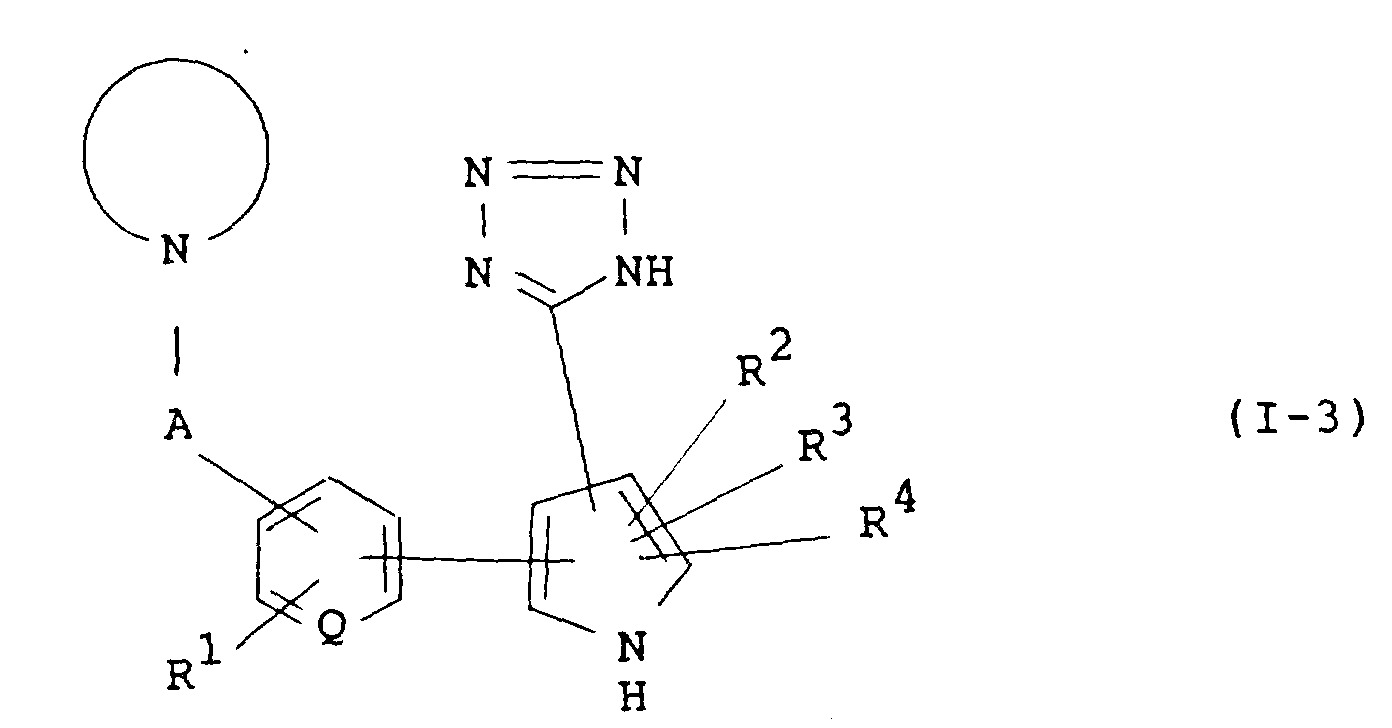
R¹ is hydrogen, halogen, nitro, C₁-C₆ alkyl, C₁-C₆ alkoxy, amino or acylamino,
R, R³ and R⁴ are each hydrogen, halogen, nitro, cyano, C₁-C₆ alkyl or C₂-C₆ alkenyl; or
R and R³ are linked together to form 1,3-butadienylene,
A is C₁-C₆ alkylene,
Q is CH or N, and
is 3H-imidazo[4,5-b]pyridin-3-yl which may have C₁₋₆ alkyl, halogen, C₁₋₆ alkoxy, hydroxy(C₁₋₆) alkyl or optionally esterified carboxy. in which each of these definitions is the same as those mentioned above, and more preferred example ofmay be:
2-lower alkyl-3H-imidazo[4,5-b]pyridin-3-yl (e.g. 2-propyl-3H-imidazo[4,5-b]pyridin-3-yl, 2-butyl-3H-imidazo[4,5-b]pyridin-3-yl, etc.);
2,7-di(lower)alkyl-3H-imidazo[4,5-b]pyridin-3-yl (e.g. 7-methyl-2-propyl-3H-imidazo[4,5-b]pyridin-3-yl, 2-butyl-7-methyl-3H-imidazo[4,5-b]pyridin-3-yl, etc.), 5-halo-2-lower alkyl-3H-imidazo[4,5-b]pyridin-3-yl (e.g. 2-butyl-5-chloro-3H-imidazo[4,5-b]pyridin-3-yl, etc.), 5-lower alkyl-2-lower alkyl-3H-imidazo[4,5-b]pyridin-3-yl (e.g. 2-butyl-5-methoxy-3H-imidazo[4,5-b]pyridin-3-yl, etc.). - Also, the preferred embodiment of the compound (I) can be represented by the following formula.

R¹ is hydrogen, halogen, nitro, C₁-C₆ alkyl, C₁-C₆ alkoxy, amino or acylamino,
R, R³ and R⁴ are each hydrogen, halogen, nitro, cyano, C₁-C₆ alkyl, C₂-C₆ alkenyl, C₁-C₆ alkylthio, dihalo(C₁-C₆)alkyl,
oxo(C₁-C₆)alkyl or hydroxy(C₁-C₆)alkyl; or
R and R³ are linked together to form 1,3-butadienylene,
A is C₁-C₆ alkylene,
Q is CH or N, and
is 3H-imidazo[4,5-b]pyridin-3-yl, which may have C₁-C₆ alkyl, halogen, C₁-C₆ alkoxy, hydroxy(C₁-C₆)alkyl or optionally esterified carboxy in which each of these definitions is the same as those mentioned above, and more preferred example ofmay be:
2-lower alkyl-3H-imidazo[4,5-b]pyridin-3-yl (e.g. 2-propyl-3H-imidazo[4,5-b]pyridin-3-yl, 2-butyl-3H-imidazo[4,5-b]pyridin-3-yl, etc.);
2,7-di(lower)alkyl-3H-imidazo[4,5-b]pyridin-3-yl (e.g. 7-methyl-2-propyl-3H-imidazo[4,5-b]pyridin-3-yl, 2-butyl-7-methyl-3H-imidazo[4,5-b]pyridin-3-yl, etc.), 2,5,7-tri(lower)alkyl-3H-imidazo[4,5-b]pyridin-3-yl (e.g. 2-ethyl-5,7-dimethyl-3H-imidazo[4,5-b]pyridin-3-yl, etc.); 5-halo-2-lower alkyl-3H-imidazo[4,5-b]pyridin-3-yl (e.g. 2-butyl-5-chloro-3H-imidazo[4,5-b]pyridin-3-yl, etc.), 5-lower alkoxy-2-lower alkyl-3H-imidazo[4,5-b]pyridin-3-yl (e.g. 2-butyl-5-methoxy-3H-imidazo[4,5-b]pyridin-3-yl, etc.). - Further, the preferred embodiment of the compound (I) can be represented by the following formula.

R¹ is hydrogen, halogen, nitro, C₁-C₆ alkyl, C₁-C₆ alkoxy, amino or acylamino,
R, R³ and R⁴ are each hydrogen, halogen, nitro, cyano, C₁-C₆ alkyl, C₂-C₆ alkenyl, C₁-C₆ alkylthio, mono or di or trihalo(C₁-C₆)alkyl, oxo(C₁-C₆)alkyl, hydroxy(C₁-C₆)alkyl or optionally esterified carboxy; or
R and R³ are linked together to form 1,3-butadienylene,
R⁵ is hydrogen or imino-protective group,
A is C₁-C₆ alkylene,
Q is CH or N, and
is 3H-imidazo[4,5-b]pyridin-3-yl, which may have C₁-C₆ alkyl, halogen, C₁-C₆ alkoxy, hydroxy-(C₁-C₆)alkyl or optionally esterified carboxy, in which each of these definitions is the same as those mentioned above, and more preferred example ofmay be :
2-lower alkyl-3H-imidazo[4,5-b]pyridin-3-yl (e.g. 2-propyl-3H-imidazo[4,5-b]pyridin-3-yl, 2-butyl-3H-imidazo[4,5-b]pyridin-3-yl, etc.); 2,7-di(lower)alkyl-3H-imidazo[4,5-b]pyridin-3-yl (e.g. 7-methyl-2-propyl-3H-imidazo[4,5-b]pyridin-3-yl, 2-butyl-7-methyl-3H-imidazo[4,5-b]pyridin-3-yl, etc.), 2,5,7-tri(lower)alkyl-3H-imidazo[4,5-b]pyridin-3-yl (e.g. 2-ethyl-5,7-dimethyl-3H-imidazo[4,5-b]pyridin-3-yl, etc.); 5-halo-2-lower alkyl-3H-imidazo[4,5-b]pyridin-3-yl (e.g. 2-butyl-5-chloro-3H-imidazo[4,5-b]pyridin-3-yl, etc.), 5-lower alkoxy-2-lower alkyl-3H-imidazo[4,5-b]pyridin-3-yl (e.g. 2-butyl-5-methoxy-3H-imidazo[4,5-b]pyridin-3-yl, etc.). - Particularly, the preferred compound (I) of the present invention is represented by the following formula:

R, R³ and R⁴ are each hydrogen, halogen, nitro, cyano, C₁-C₆ alkyl, C₂-C₆ alkenyl, C₁-C₆ alkylthio, mono or di or trihalo(C₁-C₆)alkyl, oxo(C₁-C₆)alkyl, hydroxy(C₁-C₆)alkyl or optionally esterified carboxy (more preferably carboxy or C₁-C₆ alkoxycarbonyl); or
R and R³ are linked together to form 1,3-butadienylene,
Y is NH and
is 2-lower alkyl-3H-imidazo[4,5-b]pyridin-3-yl, 2,7-di(lower)alkyl-3H-imidazo[4,5-b]pyridin-3-yl, 2,5,7-tri(lower)alkyl-3H-imidazo-[4,5-b]pyridin-3-yl, 5-halo-2-lower alkyl-3H-imidazo[4,5-b]pyridin-3-yl, 5-lower alkoxy-2-lower alkyl-3H-imidazo[4,5-b]pyridin-3-yl (more preferably, 2-lower alkyl-3H-imidazo[4,5-b]pyridin-3-yl, 2,7-di(lower)alkyl-3H-imidazo[4,5-b]pyridin-3-yl or 2,5,7-tri(lower)alkyl-3H-imidazo[4,5-b]pyridin-3-yl), and further, more preferred embodiment of a group of the formula.

R
R

R

-

R
R
R

R
and
R

R

- The processes for preparing the object compound (I) of the present invention are explained in detail in the following.
- The object compound (I) or a salt thereof can be prepared by subjecting the compound (II) to the formation reaction of a tetrazole group.
- The agent to be used in the present reaction may include conventional ones which is capable of converting a cyano group to a tetrazolyl group such as metal azide, for example, alkali metal azide (e.g., potassium azide, sodium azide etc.), tri(C₁-C₆)alkyltin azide (e.g. trimethyltin azide, etc.), triaryltin azide (e.g. triphenyltin azide, etc.), or the like.
- The present reaction is usually carried out in the presence of a base such as tri(C₁-C₆)alkylamine (e.g. triethylamine, etc.), and the like, or 1,3-dimethyl-2-imidazolidinone, and the like.
- The present reaction is usually carried out in a solvent such as xylene, dioxane, chloroform, methylene chloride, 1,2-dichloroethane, tetrahydrofuran, pyridine, acetonitrile, dimethylformamide or any other solvent which does not adversely affect the reaction.
- The reaction temperature is not critical and the reaction is usually carried out under warming or heating, preferably under heating.
- Further, the compound (I) wherein R¹ is amino can be prepared by reducing the corresponding nitro compound in a conventional manner, and the compound (I) wherein R¹ is acylamino can be prepared by acylating the amino compound obtained above in a conventional manner.
- And further, the present reaction includes, within its scope, the case that the dihalo(C₁-C₆)alkyl group on R, R³ or R⁴ is transformed to the oxo(C₁-C₆)alkyl group during the reaction or at the post-treating step of the present process.
- The object compound (I-b) or a salt thereof can be prepared by subjecting the compound (I-a) or a salt thereof to reduction.
- The reduction may include, for example, chemical reduction with an alkali metal borohydride (e.g. sodium borohydride, etc.), and catalytic reduction with palladium catalysts (e.g. palladium on carbon, etc.), and the like.
- This reaction is usually carried out in a conventional solvent which does not adversely influence the reaction such as alcohol [e.g. methanol, ethanol, propanol, etc.], tetrahydrofuran, dioxane, dimethyl sulfoxide, N,N-dimethylformamide or a mixture thereof.
- The reaction temperature is not critical, and the reaction is usually carried out under cooling to heating.
- The object compound (I) or a salt thereof can be prepared by reacting the compound (III) or a salt thereof with the compound (IV) or a salt thereof.
- The present reaction is usually carried out in the presence of a base such as alkyl lithium (e.g. n-butyl lithium, etc.), alkali metal hydride (e.g. sodium hydride, potassium hydride, etc.), di(C₁-C₆)alkylamine (e.g. diisopropylamine, etc.), tri(C₁-C₆)alkylamine (e.g. trimethylamine, triethylamine, etc.), pyridine or its derivative (e.g. picoline, lutidine, 4-dimethylaminopyridine, etc.), or the like.
- The present reaction is usually carried out in a solvent such as dioxane, dimethyl sulfoxide, dimethylformamide, diethylformamide, dimethylacetamide, benzene, tetrahydrofuran, or any other solvent which does not adversely affect the reaction. In case that the base to be used is liquid, it can also be used as a solvent.
- The reaction temperature is not critical and the reaction is usually carried out under cooling, at ambient temperature or under heating.
- The object compound (I-d) or a salt thereof can be prepared by subjecting the compound (I-c) or a salt thereof to removal reaction of the imino-protective group.
- Suitable method for this removal may include conventional one which is capable of removing an imino-protective group on a tetrazolyl group such as hydrolysis, reduction, or the like. The hydrolysis is preferably carried out in the presence of the base or an acid.
- Suitable base may include, for example, an inorganic base such as alkali metal hydride (e.g. sodium hydroxide, potassium hydroxide, etc.), alkaline earth metal hydroxide (e.g. magnesium hydroxide, calcium hydroxide, etc.), alkali metal carbonate, (e.g. sodium carbonate, potassium carbonate, etc.), alkaline earth metal carbonate (e.g. magnesium carbonate, calcium carbonate, etc.), alkali metal bicarbonate (e.g. sodium bicarbonate, potassium bicarbonate, etc.), alkali metal acetate (e.g. sodium acetate, potassium acetate, etc.), alkaline earth metal phosphate (e.g. magnesium phosphate, calcium phosphate, etc.), alkali metal hydrogen phosphate (e.g. disodium hydrogen phosphate, dipotassium hydrogen phosphate, etc.), or the like, and an organic base such as trialkylamine (e.g. trimethylamine, triethylamine, etc.), picoline, N-methylpyrrolidine, N-methylmorpholine, 1,5-diazabicyclo-[4,3,0]non-5-one, 1,4-diazabicyclo[2,2,2]octane, 1,5-diazabicyclo[5,4,0]undecene-5 or the like. The hydrolysis using a base is often carried out in water or a hydrophilic organic solvent or a mixed solvent thereof.
- Suitable acid may include an organic acid (e.g. formic acid acetic acid, propionic acid, etc.) and an inorganic acid (e.g. hydrochloric acid, hydrobromic acid, sulfuric acid, etc.).
- The present hydrolysis is usually carried out in an organic solvent, water or a mixed solvent thereof.
- The reaction temperature is not critical, and the reaction is usually carried out at ambient temperature or under warming or heating.
- The starting compounds (II), (III) and (IV) are new and can be prepared by the methods of Preparations mentioned below or a similar manner thereto or a conventional manner.
- The object compound (I) of the present invention can be isolated and purified in a conventional manner, for example, extraction precipitation, fractional crystallization, recrystallization, chromatography, and the like.
- The object compound (I) thus obtained can be converted to its salt by a conventional method.
- The object compound (I) of the present invention exhibits angiotensin antagonism such as vasodilating activity and is useful as an angiotensin II antagonist and effective to various angiotensin II mediated diseases such as hypertension (e.g. essential hypertension, renal hypertension, etc.), heart failure, and the like.
- Further, it is expected that the object compounds of the present invention are useful as therapeutical and/or preventive agents for cardiopathy (e.g. angina pectoris, arrhythmia, myocardial infarction, etc.), hyperaldosteronism, cerebral vascular diseases, senile dementia, ophthalimic diseases (e.g. glaucoma, etc.), and the like; and diagnostic agents to test the renin angiotensin system.
- In order to illustrate the usefulness of the object compounds (I), pharmacological activity of representative compounds of the present invention is shown below.
- ① 3-[4-[4-Bromo-2-(1H-tetrazol-5-yl)-1-pyrrolyl]-benzyl]-2-butyl-7-methyl-3H-imidazo[4,5-b]pyridine (hereinafter referred to as Compound ①)
- Male guinea pigs weighing 300 g to 500 g were sacrificed by decapitation and the ileum were excised. Longitudinal strips of the ileum (length : 2 cm) were placed in a 25 ml organ bath containing Tyrode's solution of the following composition (mM) : NaCl, 137; KCl, 2.7; CaCl₂, 1.8; MgCl₂, 1.1; NaH₂PO₄, 0.4; NaHCO₃, 12; Glucose, 5.6.
- The bath was maintained at 37°C and bubbled with 95% O₂ + 5% CO₂. The strips was stretched with a resting force of 0.5 g, and the isometric contraction were recorded via force development transducer on an ink-writing recorder. The preparation was equilibrated in Tyrode's solution mentioned above for 30 minutes, and then exposed to atropine (3.2 x 10⁻⁷ g/ml). Five minutes later, the response for angiotensin II (1 x 10⁻⁸ g/ml) was obtained and the preparation was washed a few times. This procedure was repeated twice. After the last response for angiotensin II was obtained (control response), the preparation was washed, and the response for angiotensin II (10⁻⁸ g/ml) was obtained in the presence of the test compound. The concentration of the test compound were 10⁻⁷, 10⁻⁸, 10⁻⁹, 10⁻¹⁰ M. The test compound were added 3 minutes prior to adding angiotensin II. Atropine was also added 5 minutes prior to adding angiotensin II. The inhibition of the test compound for angiotensin II contraction were expressed as a percentage change to control response, and IC₅₀ (M) was calculated.
-
Compound IC₅₀ (M) ① 1.70 x 10⁻⁹ - For therapeutic or preventive administration, the object compound (I) of the present invention are used in the form of conventional pharmaceutical preparation which contains said compound as an active ingredient, in admixture with pharmaceutically acceptable carriers such as an organic or inorganic solid or liquid excipient which is suitable for oral, parenteral and external administration. The pharmaceutical preparation may be in solid form such as tablet, granule, powder, capsule, or liquid form such as solution, suspension, syrup, emulsion, lemonade and the like.
- If needed, there may be included in the above preparations auxiliary substances, stabilizing agents, wetting agents and other commonly used additives such as lactose, citric acid, tartaric acid, stearic acid, magnesium stearate, terra alba, sucrose, corn starch, talc, gelatin, agar, pectin, peanut oil, olive oil, cacao butter, ethylene glycol, and the like.
- While the dosage of the compound (I) may vary from and also depend upon the age, conditions of the patient, a kind of diseases or conditions, a kind of the compound (I) to be applied, etc. In general amounts between 0.01 mg and about 500 mg or even more per day may be administered to a patient. An average single dose of about 0.05 mg, 0.1 mg, 0.25 mg, 0.5 mg, 1 mg, 20 mg, 50 mg, 100 mg of the object compound (I) of the present invention may be used in treating diseases.
- The following Preparations and Examples are given for the purpose of illustrating the present invention.
- To a solution of 1-(4-methylphenyl)pyrrole-2-carbonitrile (1.274 g) in tetrahydrofuran (25 ml) was added N-bromosuccinimide (1.776 g) in several portions at ambient temperature. After being stirred for 3 hours at the same temperature, the mixture was concentrated in vacuo. The residue was treated with diethyl ether. The precipitates were removed by filtration and washed with a small amounts of diethyl ether. The filtrates were concentrated in vacuo to give an oily residue, which was purified by silica gel column chromatography (elution by 40% dichloromethane in n-hexane) to yield 4-bromo-1-(4-methylphenyl)pyrrole-2-carbonitrile (1.78 g) as a solid.
- mp :
- 55-59.5°C
- NMR (CDCl₃, δ) :
- 2.42 (3H, s), 6.93 (1H, d, J=2.3Hz), 7.04 (1H, d, J=2.3Hz), 7.29 (5H, s)
- To a solution of 1-(4-methylphenyl)pyrrole (1 g) in tetrahydrofuran (50 ml) was added N-chlorosuccinimide (850 mg) in one portion at -78°C under nitrogen atmosphere. The mixture was warmed to 10°C, stirred for one hour, and then concentrated in vacuo. The residue was purified by flash column chromatography on silica gel to yield 2-chloro-1-(4-methylphenyl)pyrrole (1.2 g) as an oil. (This product was a mixture of the starting material and the desired product and used to the next reaction furthermore without purification.)
- Phosphoryl chloride (747 µl) was added dropwise to N,N-dimethylformamide (7 ml) at 5°C. The mixture was stirred at 5°C for 15 minutes and at ambient temperature for 15 minutes. To the mixture was added a solution of 2-chloro-1-(4-methylphenyl)pyrrole (1.2 g) in N,N-dimethylformamide (7 ml) at ambient temperature. The mixture was stirred at the same temperature for one hour and at 50°C for 2.5 hours. After cooled to ambient temperature, the mixture was treated with saturated aqueous sodium bicarbonate solution. The separated oil was extracted with ethyl acetate. The organic layer was washed with water, dried, and concentrated in vacuo. The residue was column chromatographed on silica gel to yield 5-chloro-1-(4-methylphenyl)pyrrole-2-carbaldehyde (377 mg) as a solid.
- NMR (CDCl₃, δ) :
- 2.44 (3H, s), 6.33 (1H, d, J=4.5Hz), 7.09 (1H, d, J=4.5Hz), 7.18 (2H, d, J=8.0Hz), 7.31 (2H, d, J=8.0Hz), 9.32 (1H, s)
- A mixture of 5-chloro-1-(4-methylphenyl)pyrrole-2-carbaldehyde (365 mg), hydroxylamine hydrochloride (173 mg), and sodium acetate (204 mg) in 60% aqueous ethanol (6 ml) was stirred at 60°C for one hour. The mixture was concentrated in vacuo. The residue was dissolved in ethyl acetate. The mixture was washed with water, dried, and concentrated in vacuo to give a residue (450 mg) of 5-chloro-1-(4-methylphenyl)pyrrole-2-carbaldehyde oxime. A mixture of the residue and sodium acetate (30 mg) in acetic anhydride (5 ml) was stirred at 160°C for one and half hours under nitrogen atmosphere. The reaction mixture was concentrated in vacuo. The residue was purified by silica gel column chromatography (eluted by ethyl acetate:n-hexane = 1/15) to yield 5-chloro-1-(4-methylphenyl)pyrrole-2-carbonitrile (325 mg) as an oil.
- NMR (CDCl₃, δ) :
- 2.45 (3H, s), 6.25 (1H, d, J=4.5Hz), 6.90 (1H, d, J=4.5Hz), 7.23 (2H, d, J=8.0Hz), 7.34 (2H, d, J=8Hz)
- To a solution of 1-(4-methylphenyl)pyrrole-2-carbonitrile (1.092 g) in a mixture of ethanol (10 ml) and 1,4-dioxane (10 ml) was added N-chlorosuccinimide (1.862 g) in one portion at ambient temperature. The mixture was stirred for 2.5 hours at the same temperature and then water (30 ml) was added therein. The separated oil was extracted with diethyl ether. The extract was washed with water, dried, and concentrated in vacuo. The yellow residue was crystallized from n-hexane to yield 3,4-dichloro-1-(4-methylphenyl)pyrrole-2-carbonitrile (1.28 g).
- mp :
- 85-86°C
- NMR (CDCl₃, δ) :
- 2.45 (3H, s), 6.91 (1H, s), 7.23 and 7.34 (4H, ABq, J=7.5Hz)
- To a solution of 1-(4-methylphenyl)pyrrole-2-carbonitrile (1.0 g) in acetic anhydride (4 ml) was added nitric acid (231 µl, 94%) dropwise at 5°C. The mixture was stirred at the same temperature for 3 hours and then poured into ice water. The pH was adjusted to 5-7 by the addition of saturated aqueous sodium bicarbonate solution. The separated oil was extracted with ethyl acetate. The organic layer was washed with saturated aqueous sodium bicarbonate solution, water and brine, dried, and evaporated under reduced pressure. The residue was purified by silica gel column chromatography to yield 1-(4-methylphenyl)-4-nitropyrrole-2-carbonitrile (471 mg) as a solid.
- NMR (CDCl₃, δ) :
- 2.47 (3H, s), 7.36 (4H, s), 7.49 (1H, d, J=1.5Hz), 7.83 (1H, d, J=1.5Hz)
- A mixture of 3,4-dichloro-1-(4-methylphenyl)pyrrole-2-carbonitrile (1.25 g), 2,2'-azobisisobutyronitrile (10 mg) and N-bromosuccinimide (1.068 g) in carbon tetrachloride (25 ml) was refluxed for 3 hours, cooled to ambient temperature, and filtered. The filtrate was concentrated in vacuo. The residue was crystallized from 10% ethyl acetate in n-hexane to yield 1-(4-bromomethylphenyl)-3,4-dichloropyrrole-2-carbonitrile (1.01 g).
- NMR (CDCl₃, δ) :
- 4.53 (2H, s), 6.94 (1H, s), 7.46 and 7.58 (4H, ABq, J=7.5Hz)
- The following compounds were obtained according to a similar manner to that of Preparation 7.
- (1) 4-Bromo-1-(4-bromomethylphenyl)pyrrole-2-carbonitrile
- mp :
- 105-116°C
- NMR (CDCl₃, δ) :
- 4.54 (2H, s), 7.00 (1H, d, J=2.3Hz), 7.10 (1H, d, J=2.3Hz), 7.41 (2H, d, J=8.5Hz), 7.55 (2H, d, J=8.5Hz)
- (2) 1-(4-Bromomethylphenyl)-5-chloropyrrole-2-carbonitrile
- NMR (CDCl₃, δ) :
- 4.53 (2H, s), 6.30 (1H, d, J=4.5Hz), 6.94 (1H, d, J=4.5Hz), 7.37 (2H, d, J=8.0Hz), 7.57 (2H, d, J=8.0Hz)
- (3) 1-(4-Bromomethylphenyl)-4-nitropyrrole-2-carbonitrile
- NMR (CDCl₃, δ) :
- 4.54 (2H, s), 7.48 (2H, d, J=8.5Hz), 7.52 (1H, d, J=1.5Hz), 7.62 (2H, d, J=8.5Hz), 7.88 (1H, d, J=1.5Hz)
- (4) 1-(4-Bromomethylphenyl)pyrrole-2-carbonitrile
- NMR (CDCl₃, δ) :
- 4.55 (2H, s), 6.37 (1H, dd, J=4.5Hz and 3.0Hz), 7.01 (1H, dd, J=4.5Hz and 2.5Hz), 7.09 (1H, dd, J=3Hz and 2.5Hz), 7.43 (2H, d, J=9Hz), 7.52 (2H, d, J=9Hz)
- (5) 1-(4-Bromomethylphenyl)indole-2-carbonitrile
- This compound was used to the next reaction without furthermore purification.
- To a solution of 2-butyl-7-methyl-3H-imidazo[4,5-b]-pyridine (568 mg) in dimethyl sulfoxide (7 ml) was added sodium hydride (132 mg, 60% oil dispersion) at ambient temperature. The mixture was stirred for 40 minutes at the same temperature. To the mixture was added dropwise a solution of 1-(4-bromomethylphenyl)-3,4-dichloropyrrole-2-carbonitrile (990 mg) in dimethyl sulfoxide (3 ml). The mixture was stirred for 2 hours at ambient temperature and ice water (30 ml) was added therein. The separated oil was extracted twice with ethyl acetate. The extracts were washed with water, dried, and evaporated under reduced pressure. The residue was purified by silica gel column chromatography eluted by 50% ethyl acetate in n-hexane to give 2-butyl-3-[4-(2-cyano-3,4-dichloro-1-pyrrolyl)-benzyl]-7-methyl-3H-imidazo[4,5-b]pyridine (546 mg) as an oil.
- NMR (CDCl₃, δ) :
- 0.91 (3H, t, J=7.5Hz), 1.42 (2H, m), 1.76 (2H, m), 2.73 (3H, s), 2.90 (2H, t, J=7.5Hz), 5.60 (2H, s), 6.94 (1H, s), 7.09 (1H, d, J=5Hz), 7.31 (4H, s), 8.25 (1H, d, J=5Hz)
- The following compounds were obtained according to a similar manner to that of Preparation 9.
- (1) 3-[4-(4-Bromo-2-cyano-1-pyrrolyl)benzyl]-2-butyl-7-methyl-3H-imidazo[4,5-b]pyridine
- NMR (CDCl₃, δ) :
- 0.92 (3H, t, J=7.5Hz), 1.42 (2H, m), 1.77 (2H, m), 2.72 (3H, s), 2.88 (2H, t, J=7.5Hz), 5.57 (2H, s), 6.97 (1H, d, J=2.3Hz), 7.03 (1H, d, J=2.3Hz), 7.08 (1H, d, J=5Hz), 7.38 (2H, d, J=8.5Hz), 7.48 (2H, d, J=8.5Hz), 8.24 (1H, d, J=5Hz)
- (2) 2-Butyl-3-[4-(5-chloro-2-cyano-1-pyrrolyl)benzyl]-3H-imidazo[4,5-b]pyridine
- NMR (CDCl₃, δ) :
- 0.92 (3H, t, J=7.5Hz), 1.32-1.52 (2H, m), 1.72-1.91 (2H, m), 2.87 (2H, t, J=7.5Hz), 5.59 (2H, s), 6.27 (1H, d, J=4.5Hz), 6.91 (1H, d, J=4.5Hz), 7.28 (1H, dd, J=8.5Hz and 5.0Hz), 7.32 (4H, s), 8.07 (1H, dd, J=8.5Hz and 1.0Hz), 8.38 (1H, dd, J=5.0Hz and 1.0Hz)
- (3) 2-Butyl-3-[4-(2-cyano-4-nitro-1-pyrrolyl)benzyl]-3H-imidazo[4,5-b]pyridine
- NMR (CDCl₃, δ) :
- 0.94 (3H, t, J=7.5Hz), 1.33-1.56 (2H, m), 1.77-1.97 (2H, m), 2.90 (2H, t, J=7.5Hz), 5.61 (2H, s), 7.31 (1H, dd, J=7.5Hz and 4.5Hz), 7.37 (2H, d, J=8.5Hz), 7.45 (2H, d, J=8.5Hz), 7.49 (1H, d, J=1.5Hz), 7.82 (1H, d, J=1.5Hz), 8.09 (1H, dd, J=7.5Hz and 1Hz), 8.39 (1H, dd, J=4.5Hz and 1.0Hz)
- (4) 2-Butyl-3-[4-(2-cyano-1-pyrrolyl)benzyl]-3H-imidazo-[4,5-b]pyridine
- NMR (CDCl₃, δ) :
- 0.93 (3H, t, J=7.5Hz), 1.45 (2H, m), 1.87 (2H, m), 2.88 (2H, dd, J=8Hz and 8Hz), 5.56 (2H, s), 6.33 (1H, dd, J=4Hz and 3Hz), 6.98 (1H, dd, J=4Hz and 1Hz), 7.03 (1H, dd, J=3Hz and 1Hz), 7.28 (1H, m), 7.29 (2H, d, J=8Hz), 7.41 (2H, d, J=8Hz), 8.07 (1H, dd, J=7.5Hz and 1.5Hz), 8.38 (1H, dd, J=4Hz and 1.5Hz)
- (5) 2-Butyl-3-[4-(2-cyano-1-indolyl)benzyl]-3H-imidazo-[4,5-b]pyridine
- NMR (CDCl₃, δ) :
- 0.93 (3H, t, J=7.5Hz), 1.46 (2H, m), 1.88 (2H, m), 2.98 (2H, t, J=8Hz), 5.66 (2H, s), 7.21-7.45 (4H, m), 7.32 (2H, d, J=8Hz), 7.40 (1H, s), 7.48 (2H, d, J=8Hz), 7.72 (1H, m), 8.13 (1H, dd, J=8Hz and 1Hz), 8.46 (1H, dd, J=4.5Hz and 1Hz)
- (6) 2-Butyl-3-[4-(5-chloro-2-cyano-1-pyrrolyl)benzyl]-7-methyl-3H-imidazo[4,5-b]pyridine
- NMR (CDCl₃, δ) :
- 0.90 (3H, t, J=6.5Hz), 1.40 (2H, m), 1.73 (2H, m), 2.72 (3H, s), 2.87 (2H, t, J=7.5Hz), 5.58 (2H, s), 6.24 (1H, d, J=4Hz), 6.90 (1H, d, J=4Hz), 7.08 (1H, d, J=5Hz), 7.30 (4H, s), 8.25 (1H, d, J=5Hz)
- A mixture of 2-amino-4-methyl-3-nitropyridine (5.0 g) and N,N-dimethylaniline (8.5 ml) was heated at 100°C under nitrogen atmosphere. To the solution was added butyryl chloride (3.5 ml) and the mixture was stirred at 100°C for 5 hours. After being cooled to room temperature, ethyl acetate was added to the reaction mixture. The organic layer was separated and washed successively with water and brine. The solution was dried over magnesium sulfate and the solvent was evaporated in vacuo. The residue was washed with n-hexane to give 2-butyrylamino-4-methyl-3-nitropyridine (7.0 g).
- mp :
- 92.5-99°C
- NMR (CDCl₃, δ) :
- 1.01 (3H, t, J=7.5Hz), 1.64-1.85 (2H, m), 2.43 (2H, t, J=7.5Hz), 2.48 (3H, s), 7.10 (1H, d, J=5.0Hz), 8.26 (1H, br s), 8.35 (1H, d, J=5.0Hz)
- A solution of 2-butyrylamino-4-methyl-3-nitropyridine (7.0 g) and iron powder (17.5 g) in a mixture of acetic acid (14 ml) and ethanol (100 ml) was stirred at 90°C for 3 hours under nitrogen atmosphere. After being cooled to room temperature, the reaction mixture was filtered through Celite and the filtrate was evaporated in vacuo. Ethyl acetate and saturated aqueous sodium hydrogencarbonate were added to the residue until pH 7∼8 and the resulting suspension was filtered through Celite. The organic layer of the filtrate was separated, washed with brine and dried over magnesium sulfate. The solvent was evaporated in vacuo and the residue was purified with silica gel column chromatography (eluent : ethyl acetate) to give 7-methyl-2-propyl-3H-imidazo-[4,5-b]pyridine (3.6 g).
- mp :
- 108-111°C
- NMR (CDCl₃, δ) :
- 1.09 (3H, t, J=7.5Hz), 1.90-2.12 (2H, m), 2.72 (3H, s), 3.06 (2H, t, J=7.5Hz), 7.07 (1H, d, J=5.0Hz), 8.19 (1H, d, J=5.0Hz)
- 2-Bromo-4-methylaniline (15.0 g), 2,5-dimethoxy-tetrahydrofuran (10.7 g) and acetic acid (81 ml) were combined under nitrogen atmosphere. The reaction mixture was stirred at 90°C for 1.5 hours. After being cooled to room temperature, the reaction mixture was concentrated in vacuo with toluene. n-Hexane (300 ml) was added to the residue, and the suspension was filtered through Celite. Then silica gel was added to the filtrate with stirring until the colour of the solution disappeared. The suspension was filtered and the filtrate was concentrated in vacuo to give 1-(2-bromo-4-methylphenyl)pyrrole (16.1 g).
- NMR (CDCl₃, δ) :
- 2.38 (3H, s), 6.31 (2H, t, J=3.0Hz), 6.83 (2H, t, J=3.0Hz), 7.12-7.22 (2H, m), 7.51 (1H, d, J=1.0Hz)
- The following compounds were obtained according to a similar manner to that of Preparation 13.
- (1) 1-(3-Fluoro-4-methylphenyl)pyrrole
- NMR (CDCl₃, δ) :
- 2.39 (3H, d, J=2.5Hz), 6.32 (2H, m), 7.02-7.26 (5H, m)
- (2) 5-Methyl-2-(1-pyrrolyl)pyridine
- mp :
- 54.5-62°C
- NMR (CDCl₃, δ) :
- 2.33 (3H, s), 6.35 (2H, t, J=2.0Hz), 7.22 (1H, d, J=8.5Hz), 7.48 (2H, t, J=2.0Hz), 7.56 (1H, dd, J=8.5Hz, 1.5Hz), 8.25 (1H, d, J=1.5Hz)
- (3) 1-(3-Chloro-4-methylphenyl)pyrrole
- mp :
- 48-50°C
- NMR (CDCl₃, δ):
- 2.39 (3H, s), 6.34 (2H, dd, J=4Hz, 4Hz), 7.05 (2H, dd, J=4Hz, 4Hz), 7.19 (1H, dd, J=8Hz, 2Hz), 7.26 (1H, d, J=8Hz), 7.40 (1H, d, J=2Hz)
- (4) 1-(3-Methoxy-4-methylphenyl)pyrrole
- NMR (CDCl₃, δ) :
- 2.23 (3H, s), 3.87 (3H, s), 6.33 (2H, t, J=2Hz), 6.84 (1H, d, J=2Hz), 6.88 (1H, dd, J=8Hz, 2Hz), 7.06 (2H, t, J=2Hz), 7.16 (1H, d, J=8Hz)
- (5) 1-(4-Methyl-2-nitrophenyl)pyrrole
- NMR (CDCl₃, δ) :
- 2.48 (3H, s), 6.35 (2H, t, J=2Hz), 6.78 (2H, t, J=2Hz), 7.35 (1H, d, J=8Hz), 7.46 (1H, dd, J=8Hz, 1Hz), 7.67 (1H, d, J=1Hz)
- (6) 1-(2-Chloro-4-methylphenyl)pyrrole
- NMR (CDCl₃, δ) :
- 2.48 (3H, s), 6.34 (2H, t, J=2.5Hz), 6.89 (2H, t, J=2.5Hz), 7.12 (1H, dd, J=9Hz, 1Hz), 7.24 (1H, d, J=9Hz), 7.33 (1H, br s)
- The following compounds were obtained according to a similar manner to that of Preparation 3.
- (1) 1-(5-Methyl-2-pyridyl)pyrrole-2-carbaldehyde
- NMR (CDCl₃, δ) :
- 2.40 (3H, s), 6.42 (1H, dd, J=4.0Hz, 3.5Hz), 7.19 (1H, dd, J=4.0Hz, 1.5Hz), 7.33 (1H, d, J=8.5Hz), 7.41 (1H, dd, J=3.5Hz, 1.5Hz), 7.64 (1H, dd, J=8.5Hz, 2.0Hz), 8.33 (1H, d, J=2.0Hz), 9.75 (1H, s)
- (2) 1-(3-Chloro-4-methylphenyl)pyrrole-2-carbaldehyde
- NMR (CDCl₃, δ) :
- 2.44 (3H, s), 6.41 (1H, dd, J=4Hz, 3Hz), 7.04 (1H, m), 7.15 (1H, m), 7.17 (1H, dd, J=7Hz, 2Hz), 7.32 (1H, d, J=7Hz), 7.37 (1H, d, J=2Hz), 9.48 (1H, s)
- (3) 1-(3-Methoxy-4-methylphenyl)pyrrole-2-carbaldehyde
- NMR (CDCl₃, δ) :
- 2.27 (3H, s), 3.85 (3H, s), 6.40 (1H, dd, J=4Hz, 3Hz), 6.82 (1H, d, J=2Hz), 6.87 (1H, dd, J=7Hz, 2Hz), 7.08 (1H, dd, J=3Hz, 2Hz), 7.17 (1H, dd, J=4Hz, 2Hz), 7.20 (1H, d, J=7Hz), 9.59 (1H, s)
- (4) 1-(2-Chloro-4-methylphenyl)pyrrole-2-carbaldehyde
- mp :
- 109-110°C
- NMR (CDCl₃, δ) :
- 2.42 (3H, s), 6.43 (1H, dd, J=4Hz, 3Hz), 6.95 (1H, m), 7.11 (1H, dd, J=4Hz, 1Hz), 7.19 (1H, d, J=9Hz), 7.15 (1H, d, J=9Hz), 7.32 (1H, br s), 9.50 (1H, s)
- 1-(4-Methylphenyl)pyrrole-2-carbaldehyde (1.45 g) was dissolved in chloroform (20 ml), and pyridinium hydrobromide perbromide (2.62 g) was added to the solution at 0°C under nitrogen atmosphere. The reaction mixture was stirred at the same temperature for 30 minutes. Methylene chloride was added to the mixture, and then saturated sodium thiosulfate was added until excess reagent was decomposed. The organic solution was washed with saturated sodium hydrogencarbonate and brine, and dried over magnesium sulfate. The obtained residue was purified by isopropyl ether to give 1-bromo-1-(4-methylphenyl)pyrrole-2-carbaldehyde (1.65 g).
- NMR (CDCl₃, δ) :
- 2.47 (3H, s), 6.46 (1H, d, J=4Hz), 7.09 (1H, d, J=4Hz), 7.17 (2H, d, J=8Hz), 7.30 (2H, d, J=8Hz)
- The following compounds were obtained according to a similar manner to that of Preparation 16.
- (1) 5-Bromo-1-(5-methyl-2-pyridyl)pyrrole-2-carbaldehyde
- mp :
- 65.5-73°C
- NMR (CDCl₃, δ) :
- 2.45 (3H, s), 6.47 (1H, d, J=4.5Hz), 7.07 (1H, d, J=4.5Hz), 7.24 (1H, d, J=7.0Hz), 7.71 (1H, dd, J=7.0Hz, 1.5Hz), 8.04 (1H, d, J=1.5Hz), 9.37 (1H, s)
- (2) 5-Bromo-1-(2-chloro-4-methylphenyl)pyrrole-2-carbaldehyde
- mp :
- 88-90°C
- NMR (CDCl₃, δ) :
- 2.44 (3H, s), 6.50 (1H, d, J=4Hz), 7.06 (1H, d, J=4Hz), 7.20 (2H, s), 7.36 (1H, br s), 9.29 (1H, s)
- (3) 5-Bromo-1-(3-methoxy-4-methylphenyl)pyrrole-2-carbaldehyde
- NMR (CDCl₃, δ) :
- 2.30 (3H, s), 3.33 (3H, s), 6.47 (1H, d, J=4Hz), 6.71 (1H, d, J=2Hz), 6.80 (1H, dd, J=8, 2Hz), 7.10 (1H, d, J=4Hz), 7.24 (1H, d, J=8Hz), 9.31 (1H, s)
- The following compounds were obtained according to a similar manner to that of Preparation 4.
- (1) 5-Bromo-1-(4-methylphenyl)pyrrole-2-carbonitrile
- NMR (CDCl₃, δ) :
- 2.44 (3H, s), 6.37 (1H, d, J=4Hz), 6.92 (1H, d, J=4Hz), 7.23 (2H, d, J=8Hz), 7.32 (2H, d, J=8Hz)
- (2) 1-(5-Methyl-2-pyridyl)pyrrole-2-carbonitrile
- NMR (CDCl₃, δ) :
- 2.39 (3H, s), 6.37 (1H, t, J=4.5Hz), 7.04 (1H, dd, J=4.5Hz, 1.0Hz), 7.52 (1H, d, J=9.0Hz), 7.56 (1H, dd, J=4.5Hz, 1.0Hz), 7.69 (1H, dd, J=9.0Hz, 1.5Hz), 8.39 (1H, d, J=1.5Hz)
- (3) 5-Bromo-1-(5-methyl-2-pyridyl)pyrrole-2-carbonitrile
- mp :
- 95-100.5°C
- NMR (CDCl₃, δ) :
- 2.45 (3H, s), 6.40 (1H, d, J=4.0Hz), 6.95 (1H, d, J=4.0Hz), 7.37 (1H, d, J=8.5Hz), 7.73 (1H, dd, J=8.5Hz, 1.5Hz), 8.48 (1H, d, J=1.5Hz)
- (4) 5-Bromo-1-(2-chloro-4-methylphenyl)pyrrole-2-carbonitrile
- NMR (CDCl₃, δ) :
- 2.46 (3H, s), 6.40 (1H, d, J=4Hz), 6.94 (1H, d, J=4Hz), 7.20-7.94 (2H, m), 7.41 (1H, br s)
- (5) 1-(3-Chloro-4-methylphenyl)pyrrole-2-carbonitrile
- NMR (CDCl₃, δ) :
- 2.42 (3H, s), 6.35 (1H, dd, J=4Hz, 2.5Hz), 6.99 (1H, dd, J=4Hz, 1Hz), 7.05 (1H, dd, J=2.5Hz, 1Hz), 7.28 (1H, dd, J=8Hz, 1.5Hz), 7.36 (1H, d, J=8Hz), 7.45 (1H, d, J=1.5Hz)
- (6) 5-Bromo-1-(3-methoxy-4-methylphenyl)pyrrole-2-carbonitrile
- NMR (CDCl₃, δ) :
- 2.30 (3H, s), 3.89 (3H, s), 6.40 (1H, d, J=4Hz), 6.78 (1H, d, J=2Hz), 6.88 (1H, dd, J=8, 2Hz), 6.94 (1H, d, J=4Hz), 7.38 (1H, d, J=8Hz)
- (7) 1-(2-Chloro-4-methylphenyl)pyrrole-2-carbonitrile
- NMR (CDCl₃, δ) :
- 2.42 (3H, s), 6.35 (1H, dd, J=4Hz, 3Hz), 6.89-7.02 (2H, m), 7.18 (1H, dd, J=8Hz, 1Hz), 7.28 (1H, d, J=8Hz), 7.36 (1H, br s)
- Chlorosulfonyl isocyanate (1.2 ml) in methylene chloride (12 ml) was added dropwise to a stirred solution of 1-(2-bromo-4-methylphenyl)pyrrole (2.5 g) in methylene chloride (25 ml) kept about -20°C under nitrogen atmosphere. The reaction mixture was stirred at -20°C for 30 minutes and at room temperature for 1.5 hours, and then was added dropwise dimethylformamide (1.7 ml) keeping at about -20°C. The reaction mixture was stirred at -20°C for 30 minutes and at room temperature for an hour. To the reaction mixture was added 4N-hydrochloric acid at 0°C, and stirred at 0°C for 30 minutes. The organic layer was washed with water and saturated sodium hydrogencarbonate solution, and dried over magnesium sulfate, and evaporated in vacuo. The residue was purified by silica gel column chromatography with a mixture of ethyl acetate and n-hexane (1:10) as eluent to give 1-(2-bromo-4-methylphenyl)pyrrole-2-carbonitrile (2.4 g).
- NMR (CDCl₃, δ) :
- 2.42 (3H, s), 6.36 (1H, dd, J=4.0, 3.0Hz), 6.93 (1H, dd, J=3.0Hz, 1.0Hz), 6.97 (1H, dd, J=4.0Hz, 1.0Hz), 7.22-7.29 (2H, m), 7.55 (1H, d, J=1.0Hz)
- The following compounds were obtained according to a similar manner to that of Preparation 19.
- (1) 1-(3-Fluoro-4-methylphenyl)pyrrole-2-carbonitrile
- NMR (CDCl₃, δ) :
- 2.35 (3H, d, J=2.5Hz), 6.37 (1H, m), 6.99-7.48 (5H, m)
- (2) 1-(4-Methyl-2-nitrophenyl)pyrrole-2-carbonitrile
- NMR (CDCl₃, δ) :
- 2.56 (3H, s), 6.48 (1H, dd, J=4Hz, 3Hz), 6.90 (1H, dd, J=3Hz, 2Hz), 7.01 (1H, dd, J=4Hz, 2Hz), 7.41 (1H, d, J=8Hz), 7.57 (1H, dd, J=8Hz, 1Hz), 7.92 (1H, d, J=1Hz)
- The following compounds were obtained according to a similar manner to that of Preparation 2.
- (1) 4-Bromo-3-chloro-1-(4-methylphenyl)pyrrole-2-carbonitrile
- NMR (CDCl₃, δ) :
- 2.47 (3H, s), 6.97 (1H, s), 7.23 (2H, d, J=9Hz), 7.35 (2H, d, J=9Hz)
- (2) 4-Bromo-1-(3-fluoro-4-methylphenyl)pyrrole-2-carbonitrile
- NMR (CDCl₃, δ) :
- 2.35 (3H, d, J=2.5Hz), 6.88 (1H, d, J=2Hz), 7.07 (1H, d, J=2Hz), 7.09-7.49 (4H, m)
- (3) 4-Bromo-1-(2-bromo-4-methylphenyl)pyrrole-2-carbonitrile
- NMR (CDCl₃, δ) :
- 2.41 (3H, s), 6.93 (2H, s), 7.23-7.28 (2H, m), 7.56 (1H, s)
- (4) 4-Bromo-1-(2-chloro-4-methylphenyl)pyrrole-2-carbonitrile
- mp :
- 92-94°C
- NMR (CDCl₃, δ) :
- 2.42 (3H, s), 6.94 (2H, s), 7.19 (1H, dd, J=7.5Hz, 0.8Hz), 7.27 (1H, d, J=7.5Hz), 7.36 (1H, m)
- (5) 4-Bromo-1-(3-chloro-4-methylphenyl)pyrrole-2-carbonitrile
- NMR (CDCl₃, δ) :
- 2.43 (3H, s), 6.96 (1H, d, J=2Hz), 7.06 (1H, d, J=2Hz), 7.26 (1H, dd, J=8Hz, 2Hz), 7.35 (1H, d, J=8Hz), 7.42 (1H, d, J=2Hz)
- The following compounds were obtained according to a similar manner to that of Preparation 7.
- (1) 4-Bromo-1-(4-bromomethylphenyl)-3-chloropyrrole-2-carbonitrile
- NMR (CDCl₃, δ) :
- 4.55 (2H, s), 7.00 (1H, s), 7.34 (2H, d, J=9Hz), 7.59 (2H, d, J=9Hz)
- (2) 5-Bromo-1-(4-bromomethylphenyl)pyrrole-2-carbonitrile
- NMR (CDCl₃, δ) :
- 4.55 (2H, s), 6.40 (1H, d, J=4Hz), 6.93 (1H, d, J=4Hz), 7.33 (1H, d, J=8Hz), 7.55 (1H, d, J=8Hz)
- (3) 4-Bromo-1-(4-bromomethyl-3-fluorophenyl)pyrrole-2-carbonitrile
- NMR (CDCl₃, δ) :
- 4.54 (2H, s), 7.01 (1H, d, J=2.5Hz),7,10 (1H, d, J=2.5Hz), 7.19-7.62 (3H, m)
- (4) 1-(5-Bromomethyl-2-pyridyl)pyrrole-2-carbonitrile
- NMR (CDCl₃, δ) :
- 4.52 (2H, s), 6.40 (1H, t, J=4.0Hz), 7.08 (1H, dd, J=4.0Hz, 1.0Hz), 7.61 (1H, dd, J=4.0Hz, 1.0Hz), 7.65 (1H, d, J=9.0Hz), 7.92 (1H, dd, J=9.0Hz, 2.0Hz), 8.54 (1H, d, J=2.0Hz)
- (5) 5-Bromo-1-(5-bromomethyl-2-pyridyl)pyrrole-2-carbonitrile
- NMR (CDCl₃, δ) :
- 4.54 (2H, s), 6.42 (1H, d, J=4.5Hz), 6.97 (1H, d, J=4.5Hz), 7.49 (1H, d, J=8.5Hz), 7.98 (1H, dd, J=8.5Hz, 1.5Hz), 8.68 (1H, d, J=1.5Hz)
- (6) 1-(2-Bromo-4-bromomethylphenyl)pyrrole-2-carbonitrile
- NMR (CDCl₃, δ) :
- 4.49 (2H, s), 6.38 (1H, dd, J=4.0Hz, 3.0Hz), 6.93-7.03 (2H, m), 7.39 (1H, d, J=8.0Hz), 7.49 (1H, dd, J=8.0Hz, 1.0Hz), 7.77 (1H, d, J=1.0Hz)
- (7) 4-Bromo-1-(2-bromo-4-bromomethylphenyl)pyrrole-2-carbonitrile
- NMR (CDCl₃, δ) :
- 4.48 (2H, s), 6.97 (2H, s), 7.35 (1H, d, J=8.0Hz), 7.49 (1H, dd, J=8.0Hz, 1.0Hz), 7.79 (1H, d, J=1.0Hz)
- (8) 5-Bromo-1-(4-bromomethyl-2-chlorophenyl)pyrrole-2-carbonitrile
- NMR (CDCl₃, δ) :
- 4.50 (2H, s), 6.42 (1H, d, J=4Hz), 6.95 (1H, d, J=4Hz), 7.36 (1H, d, J=8Hz), 7.47 (1H, d, J=8Hz, 1Hz), 7.62 (1H, d, J=1Hz)
- (9) 4-Bromo-1-(4-bromomethyl-2-chlorophenyl)pyrrole-2-carbonitrile
(This product was a mixture of the starting material and the desired product and used to the next reaction furthermore without purification.) - (10) 4-Bromo-1-(4-bromomethyl-3-chlorophenyl)pyrrole-2-carbonitrile
- NMR (CDCl₃, δ):
- 4.61 (2H, s), 6.99 (1H, d, J=1.5Hz), 7.19 (1H, d, J=1.5Hz), 7.36 (1H, dd, J=8Hz and 2Hz), 7.50 (1H, d, J=2Hz), 7.61 (1H, d, J=8Hz)
- (11) 5-Bromo-1-(4-bromomethyl-3-methoxyphenyl)pyrrole-2-carbonitrile
- NMR (CDCl₃, δ) :
- 3.94 (3H, s), 4.58 (2H, s), 6.49 (1H, d, J=4Hz), 6.85 (1H, d, J=2Hz), 6.90-6.99 (2H, m), 7.48 (1H, d, J=8Hz)
- (12) 1-(4-Bromomethyl-2-nitrophenyl)pyrrole-2-carbonitrile
- NMR (CDCl₃, δ) :
- 4.57 (2H, s), 6.41 (1H, dd, J=4.3Hz), 6.91 (1H, dd, J=3, 2Hz), 7.03 (1H, dd, J=4Hz, 2Hz), 7.53 (1H, d, J=8Hz), 7.80 (1H, dd, J=8Hz, 2Hz), 8.14 (1H, d, J=2Hz)
- (13) 1-(4-Bromomethyl-2-chlorophenyl)pyrrole-2-carbonitrile
(This product was a mixture of the starting material and the desired product and used to the next reaction furthermore without purification.) - The following compounds were obtained according to a similar manner to that of Preparation 9.
- (1) 3-[4-(4-Bromo-3-chloro-2-cyano-1-pyrrolyl)benzyl]-2-butyl-7-methyl-3H-imidazo[4,5-b]pyridine
- NMR (CDCl₃, δ) :
- 0.90 (3H, t, J=7Hz), 1.40 (2H, m), 1.74 (2H, m), 2.71 (3H, s), 2.86 (2H, t, J=8Hz), 5.59 (2H, s), 6.96 (1H, s), 7.07 (1H, d, J=5Hz), 7.30 (4H, s), 8.23 (1H, d, J=5Hz)
- (2) 3-[4-(2-Bromo-5-cyano-1-pyrrolyl)benzyl]-2-butyl-7-methyl-3H-imidazo[4,5-b]pyridine
- NMR (CDCl₃, δ) :
- 0.90 (3H, t, J=7.5Hz), 1.41 (2H, m), 1.74 (2H, m), 2.70 (3H, s), 2.88 (2H, t, J=8Hz), 5.60 (2H, s), 6.37 (1H, d, J=4Hz), 6.91 (1H, d, J=4Hz), 7.07 (1H, d, J=5Hz), 7.31 (4H, s), 8.24 (1H, d, J=5Hz)
- (3) 3-[4-(4-Bromo-2-cyano-1-pyrrolyl)]-2-fluorobenzyl]-2-butyl-7-methyl-3H-imidazo[4,5-b]pyridine
- NMR (CDCl₃, δ) :
- 0.92 (3H, t, J=7.5Hz), 1.33-1.56 (2H, m), 1.68-1.87 (2H, m), 2.70 (3H, s), 2.89 (2H, t, J=7.5Hz), 5.58 (2H, s), 6.97 (1H, d, J=1.0Hz), 7.01-7.30 (5H, m), 8.21 (1H, d, J=5.0Hz)
- (4) 3-[4-(4-Bromo-2-cyano-1-pyrrolyl)benzyl]-7-methyl-2-propyl-3H-imidazo[4,5-b]pyridine
- mp :
- 115-118°C
- NMR (CDCl₃, δ) :
- 1.01 (3H, t, J=7.5Hz), 1.71-1.93 (2H, m), 2.71 (3H, s), 2.85 (2H, t, J=7.5Hz), 5.57 (2H, s), 6.96 (1H, d, J=1.5Hz), 7.03 (1H, d, J=1.5Hz), 7.07 (1H, d, J=5.0Hz), 7.28 (2H, d, J=9.5Hz), 7.38 (2H, d, J=9.5Hz), 8.22 (1H, d, J=5.0Hz)
- (5) 2-Butyl-3-[2-(2-cyano-1-pyrrolyl)-5-pyridylmethyl]-7-methyl-3H-imidazo[4,5-b]pyridine
- mp :
- 104-108.5°C
- NMR (CDCl₃, δ) :
- 0.93 (3H, t, J=7.5Hz), 1.34-1.55 (2H, m), 1.69-1.89 (2H, m), 2.70 (3H, s), 2.89 (2H, t, J=7.5Hz), 5.53 (2H, s), 6.37 (1H, dd, J=4.5Hz, 3.0Hz), 7.01-7.11 (2H, m), 7.54 (1H, dd, J=3.0Hz, 1.0Hz), 7.56 (1H, d, J=8.0Hz), 7.70 (1H, dd, J=8.0Hz, 1.5Hz), 8.22 I1H, d, J=5.0Hz), 8.46 (1H, d, J=1.5Hz)
- (6) 3-[2-(5-Bromo-2-cyano-1-pyrrolyl)-5-pyridylmethyl]-2-butyl-7-methyl-3H-imidazo[4,5-b]pyridine
- NMR (CDCl₃, δ) :
- 0.92 (3H, t, J=7.5Hz), 3.33-1.54 (2H, m), 1.68-1.86 (2H, m), 2.70 (3H, s), 2.89 (2H, t, J=7.5Hz), 5.60 (2H, s), 6.40 (1H, d, J=4.0Hz), 6.95 (1H, d, J=4.0Hz), 7.07 (1H, d, J=5.0Hz), 7.39 (1H, d, J=8.5Hz), 7.71 (1H, dd, J=8.5Hz, 1.5Hz), 8.23 (1H, d, J=5.0Hz), 8.61 (1H, d, J=1.5Hz)
- (7) 3-[3-Bromo-4-(2-cyano-1-pyrrolyl)benzyl]-2-butyl-7-methyl-3H-imidazo[4,5-b]pyridine
- mp :
- 162-167°C
- NMR (CDCl₃, δ) :
- 0.94 (3H, t, J=7.5Hz), 1.35-1.56 (2H, m), 1.70-1.88 (2H, m), 2.71 (3H, s), 2.89 (2H, t, J=7.5Hz), 5.53 (2H, s), 6.35 (1H, dd, J=3.5Hz, 3.0Hz), 6.90 (1H, dd, J=3.0Hz, 1.0Hz), 6.98 (1H, dd, J=3.5Hz, 1.0Hz), 7.08 (1H, d, J=5.0Hz), 7.18 (1K, dd, J=8.0Hz, 1.0Hz), 7.35 (1H, d, J=8.0Hz), 7.53 (1H, d, J=1.0Hz), 8.22 (1H, d, J=5.0Hz)
- (8) 3-[3-Bromo-4-(4-bromo-2-cyano-1-pyrrolyl)benzyl]-2-butyl-7-methyl-3H-imidazo[4,5-b]pyridine
- NMR (CDCl₃, δ) :
- 0.93 (3H, t, J=7.5Hz), 1.34-1.55 (2H, m), 1.70-1.91 (2H, m), 2.73 (3H, s), 2.93 (2H, t, J=7.5Hz), 5.54 (2H, s), 6.90 (1H, d, J=1.0Hz), 6.94 (1H, d, J=1.0Hz), 7.10 (1H, d, J=5.0Hz), 7.18 (1H, dd, J=8.0Hz, 1.0Hz), 7.32 (1H, d, J=8.0Hz), 7.56 (1H, d, J=1.0Hz), 8.23 (1H, d, J=5.0Hz)
- (9) 3-[4-(2-Bromo-5-cyano-1-pyrrolyl)-3-chlorobenzyl]-2-butyl-7-methyl-3H-imidazo[4,5-b]pyridine
- NMR (CDCl₃, δ) :
- 0.91 (3H, t, J=7Hz), 1.42 (2H, m), 1.75 (2H, m), 2.73 (3H, s), 2.88 (2H, t, J=8Hz), 5.58 (2H, s), 6.40 (1H, d, J=4Hz), 6.92 (1H, d, J=4Hz), 7.09 (1H, d, J=5Hz), 7.19 (1H, dd, J=8Hz, 1Hz), 7.31 (1H, d, J=8Hz), 7.39 (1H, d, J=1Hz), 8.25 (1H, d, J=5Hz)
- (10) 3-[4-(4-Bromo-2-cyano-1-pyrrolyl)-3-chlorobenzyl]-2-butyl-7-methyl-3H-imidazo[4,5-b]pyridine
- NMR (CDCl₃, δ) :
- 0.92 (3H, t, J=8Hz), 1.45 (2H, m), 1.79 (2H, m), 2.73 (3H, s), 2.89 (2H, t, J=8Hz), 5.55 (2H, s), 6.92 (1H, d, J=1Hz), 6.95 (1H, d, J=1Hz), 7.07 (1H, d, J=5Hz), 7.15 (1H, dd, J=7.5Hz, 1Hz), 7.34 (1H, d, J=7.5Hz), 7.36 (1H, s), 8.22 (1H, d, J=5Hz)
- (11) 3-[4-(4-Bromo-2-cyano-1-pyrrolyl)-2-chlorobenzyl]-2-butyl-7-methyl-3H-imidazo[4,5-b]pyridine
- NMR (CDCl₃, δ) :
- 0.92 (3H, t, J=8Hz), 1.49 (2H, m), 1.78 (2H, m), 2.80 (3H, s), 3.00 (2H, m), 5.70 (2H, s), 6.77 (1H, d, J=8Hz), 6.99 (1H, d, J=2Hz), 7.04 (1H, d, J=2Hz), 7.20 (1H, dd, J=8Hz, 2Hz), 7.25 (1H, d, J=8Hz), 7.58 (1H, d, J=2Hz), 8.30 (1H, d, J=8Hz)
- (12) 3-[4-(2-Bromo-5-cyano-1-pyrrolyl)benzyl]-7-methyl-2-propyl-3H-imidazo[4,5-b]pyridine
- NMR (CDCl₃, δ) :
- 0.99 (3H, t, J=7Hz), 1.80 (2H, m), 2.70 (3H, s), 2.84 (2H, t, J=8Hz), 5.60 (2H, s), 6.36 (1H, d, J=4.5Hz), 6.91 (1H, d, J=4.5Hz), 7.05 (1H, d, J=5Hz), 7.30 (4H, s), 8.23 (1H, d, J=5Hz)
- (13) 3-[4-(2-Bromo-5-cyano-1-pyrrolyl)-2-methoxy]benzyl]-2-butyl-7-methyl-3H-imidazo[4,5-b]pyridine
- NMR (CDCl₃, δ) :
- 0.92 (3H, t, J=7Hz), 1.43 (2H, m), 1.77 (2H, m), 2.73 (3H, s), 2.93 (2H, t, J=7Hz), 3.96 (3H, s), 5.56 (2H, s), 6.37 (1H, d, J=4Hz), 6.71-6.89 (3H, m), 6.92 (1H, d, J=4Hz), 7.07 (1H, d, J=5Hz), 8.23 (1H, d, J=5Hz)
- (14) 2-Butyl-3-[4-(2-cyano-1-pyrrolyl)-3-nitrobenzyl]-7-methyl-3H-imidazo[4,5-b]pyridine
- NMR (CDCl₃, δ) :
- 0.96 (3H, t, J=7Hz), 1.48 (3H, m), 1.83 (2H, m), 2.98 (2H, t, J=7Hz), 5.64 (2H, s), 6.39 (1H, dd, J=4Hz, 3Hz), 6.88 (1H, dd, J=3Hz, 2Hz), 7.01 (1H, dd, J=4Hz, 2Hz), 7.12 (1H, d, J=4Hz), 7.44-7.56 (2H, m), 7.98 (1H, s), 8.25 (1H, d, J=4Hz)
- (15) 2-Butyl-3-[3-chloro-4-(2-cyano-1-pyrrolyl)benzyl]-7-methyl-3H-imidazo[4,5-b]pyridine
- NMR (CDCl₃, δ) :
- 0.95 (3H, t, J=7Hz), 1.46 (2H, m), 1.80 (2H, m), 2.73 (3H, s), 2.90 (2H, t, J=7.5Hz), 5.56 (2H, s), 6.36 (1H, dd, J=4Hz, 3Hz), 6.93 (1H, dd, J=3Hz, 1Hz), 6.99 (1H, dd, J=4Hz, 1Hz), 7.08 (1H, d, J=5Hz), 7.15 (1H, dd, J=8Hz, 1Hz), 7.34 (1H, d, J=8Hz), 7.35 (1H, d, J=1Hz), 8.23 (1H, d, J=5Hz)
- To a stirred mixture of 1-(4-methylphenyl)pyrrole-2-carbonitrile (10 g), silica gel (46 g) and carbon tetrachloride (150 ml) was added dropwise a solution of tertbutyl hypochlorite (8.1 g) in carbon tetrachloride (15 ml). After stirring for 1 hour at ambient temperature, the precipitate was filtered off and the filtrate was evaporated in vacuo to give an oily residue which was crystallized from n-hexane. The crystals were further purified by silica gel column chromatography (SiO₂ 100 g, n-hexane-toluene = 1:1) and subsequent crystallization from n-hexane to give colorless crystals (3.92 g) of 4-chloro-1-(4-methylphenyl)pyrrole-2-carbonitrile.
- mp :
- 72-74°C
- NMR (CDCl₃, δ) :
- 2.43 (3H, s), 6.89 (1H, d, J=2Hz), 7.02 (1H, d, J=2Hz), 7.33 (4H, s)
- The following compound was obtained according to a similar manner to that of Preparation 7.
- 1-(4-Bromomethylphenyl)-4-chloropyrrole-2-carbonitrile
- mp :
- 95-97°C
- NMR (CDCl₃, δ) :
- 4.52 (2H, s), 6.92 (1H, d, J=lHz), 7.03 (1H, d, J=1Hz), 7.41 (2H, d, J=8Hz), 7.54 (2H, d, J=8Hz)
- The following compound was obtained according to a similar manner to that of Preparation 9.
- 2-Butyl-3-[4-(4-chloro-2-cyano-1-pyrrolyl)benzyl]-7-methyl-3H-imidazo[4,5-b]pyridine
- mp :
- 112-113°C
- NMR (CDCl₃, δ) :
- 0.92 (3H, t, J=7.5Hz), 1.32-1.53 (2H, m), 1.66-1.87 (2H, m), 2.72 (3H, s), 2.90 (2H, t, J=7.5Hz), 5.57 (2H, s), 6.89 (1H, d, J=1.5Hz), 6.99 (1H, d, J=1.5Hz), 7.09 (1H, d, J=5.0Hz), 7.28 (2H, d, J=9.0Hz), 7.39 (2H, d, J=9.0Hz), 8.24 (1H, d, J=5.0Hz)
- To a suspension of sodium hydride (114 mg, 60% oil dispersion) in dimethyl sulfoxide (5 ml) was added dropwise a solution of 2-butyrylamino-4-methyl-3-nitropyridine (605 mg) in dimethyl sulfoxide (10 ml) at ambient temperature under nitrogen atmosphere. The mixture was stirred at the same temperature for one hour and a solution of 1-(4-bromomethylphenyl)-4-chloropyrrole-2-carbonitrile (800 ml) in dimethyl sulfoxide (10 ml) was added therein. The reaction mixture was stirred at ambient temperature for 2 hours and quenched with ice water. The separated oil was extracted twice with ethyl acetate. The combined extracts were washed with water, dried, and concentrated in vacuo. The residue was purified by column chromatography on silica gel eluted by n-hexane/ethylacetate (2/1-1/1) to yield 2-[N-butyryl-N-[4-(4-chloro-2-cyano-1-pyrrolyl)benzyl]amino]-4-methyl-3-nitropyridine (723 mg).
- mp :
- 139-141°C
- NMR (CDCl₃, δ) :
- 0.90 (3H, t, J=7.5Hz), 1.57-1.80 (2H, m), 1.98-2.20 (2H, broad peak), 2.42 (3H, s), 4.40-5.35 (2H, broad peak), 6.91 (1H, d, J=1Hz), 7.04 (1H, d, J=1Hz), 7.10-7.65 (5H, m), 8.40-8.58 (1H, m)
- A mixture of 2-[N-butyryl-N-[4-(4-chloro-2-cyano-1-pyrrolyl)benzyl]amino]-4-methyl-3-nitropyridine (700 mg), iron powder (894 mg), acetic acid (1.8 ml) and ethanol (15 ml) was stirred under reflux for 15 hours. After being cooled to room temperature, the reaction mixture was filtered and the filtrate was evaporated in vacuo. The residue was partitioned into ethyl acetate (100 ml) and saturated aqueous sodium hydrogencarbonate solution. The organic layer was washed with water, dried over magnesium sulfate and evaporated in vacuo. The residue was purified by a silica gel column chromatography (n-hexane-ethyl acetate = 1:1) to give 3-[4-(4-chloro-2-cyano-1-pyrrolyl)benzyl]-7-methyl-2-propyl-3H-imidazo-[4,5-b]pyridine (565 mg) as a pale yellow powder.
- NMR (CDCl₃, δ) :
- 1.01 (3H, t, J=7.5Hz), 1.70-1.94 (2H, m), 2.71 (3H, s), 2.33 (2H, t, J=7.5Hz), 5.56 (2H, s), 6.89 (1H, d, J=1Hz), 7.00 (1H, d, J=1Hz), 7.07 (1H, d, J=5Hz), 7.25 (2H, d, J=8Hz), 7.38 (2H, d, J=8Hz), 8.22 (1H, d, J=5Hz)
- The following compounds were obtained according to a similar manner to that of Preparation 13.
- (1) 1-(2-Fluoro-4-methylphenyl)pyrrole
- NMR (CDCl₃, δ) :
- 2.38 (3H, s), 6.33 (2H, t, J=2.5Hz), 6.96-7.08 (4H, m), 7.28 (1H, t, J=8.0Hz)
- (2) 1-(3-Fluoro-4-methylphenyl)pyrrole
- mp :
- 64-67.5°C
- NMR (CDCl₃, δ) :
- 2.28 (3H, d, J=1.0Hz), 6.32 (2H, t, J=2.5Hz), 7.04 (2H, t, J=2.5Hz), 7.01-7.12 (2H, m), 7.21 (1H, t, J=8.0Hz)
- (3) Ethyl 3-methyl-4-(1-pyrrolyl)benzoate
- NMR (CDCl₃, δ) :
- 1.40 (3H, t, J=7.5Hz), 2.30 (3H, s), 4.40 (2H, q, J=7.5Hz), 6.30-6.38 (2H, m), 6.77-6.85 (2H, m), 7.30 (1H, d, J=8Hz), 7.93 (1H, dd), 8.00 (1H, d)
- The following compounds were obtained according to a similar manner to that of Preparation 3.
- (1) 1-(3-Fluoro-4-methylphenyl)pyrrole-2-carbaldehyde
- NMR (CDCl₃, δ) :
- 2.32 (3H, d, J=1.0Hz), 6.40 (1H, dd, J=4.5Hz, 3.0Hz), 6.99-7.11 (3H, m), 7.15 (1H, dd, J=4.5Hz, 1.0Hz), 7.26 (1H, t, J=8.0Hz), 9.57 (1H, s)
- (2) 1-(2-Bromo-4-methylphenyl)pyrrole-2-carbaldehyde
- mp :
- 116-119°C
- NMR (CDCl₃, δ) :
- 2.42 (3H, s), 6.42 (1H, dd, J=4.0Hz, 3.0Hz), 6.91-6.97 (1H, m), 7.12 (1H, dd, J=4.0Hz, 1.0Hz), 7.19-7.24 (2H, m), 7.52 (1H, s), 9.49 (1H, s)
- The following compounds were obtained according to a similar manner to that of Preparation 16.
- (1) 5-Bromo-1-(3-fluoro-4-methylphenyl)pyrrole-2-carbaldehyde
- mp :
- 126-138.5°C
- NMR (CDCl₃, δ) :
- 2.38 (3H, d, J=1.5Hz), 6.47 (1H, d, J=4.5Hz), 6.97 (2H, d, J=8.0Hz), 7.08 (1H, d, J=4.5Hz), 7.31 (1H, t, J=8.0Hz), 9.32 (1H, s)
- (2) 5-Bromo-1-(2-bromo-4-methylphenyl)pyrrole-2-carbaldehyde
- mp :
- 110.5-113.5°C
- NMR (CDCl₃, δ) :
- 2.44 (3H, s), 6.51 (1H, d, J=4.5Hz), 7.08 (1H, d, J=4.5Hz), 7.20-7.30 (2H, m), 7.54 (1H, d, J=0.5Hz), 9.29 (1H, s)
- The following compounds were obtained according to a similar manner to that of Preparation 19.
- (1) 1-(4-Ethoxycarbonyl-2-methylphenyl)pyrrole-2-carbonitrile
- mp :
- 61-63°C
- NMR (CDCl₃, δ) :
- 1.44 (3H, t, J=7.5Hz), 2.20 (3H, s), 4.42 (2H, q, J=7.5Hz), 6.35-6.43 (1H, m), 6.88-6.98 (1H, m), 6.98-7.04 (1H, m), 7.38 (1H, d, J=9Hz), 8.00 (1H, dd, J=9Hz, 1Hz), 8.07 (1H, d, J=1Hz)
- (2) 1-(2-Fluoro-4-methylphenyl)pyrrole-2-carbonitrile
- mp :
- 47-52°C
- NMR (CDCl₃, δ) :
- 2.41 (3H, s), 6.35 (1H, dd, J=4.5Hz, 3.5Hz), 6.94-7.15 (4H, m), 7.31 (1H, t, J=8.0Hz)
- (3) 1-(4-Ethoxycarbonylphenyl)pyrrole-2-carbonitrile
- mp :
- 110-112°C
- NMR (CDCl₃, δ) :
- 1.43 (3H, t, J=7.5Hz), 4.43 (2H, q, J=7.5Hz), 6.40 (1H, q, J=4Hz & 3Hz), 7.05 (1H, q, J=4Hz & 2Hz), 7.16 (1H, q, J=3Hz & 2Hz), 7.57 (2H, d, J=10Hz), 8.21 (2H, d, J=10Hz)
- The following compounds were obtained according to a similar manner to that of Preparation 4.
- (1) 5-Bromo-1-(3-fluoro-4-methylphenyl)pyrrole-2-carbonitrile
- mp :
- 56.5-58°C
- NMR (CDCl₃, δ) :
- 2.37 (3H, d, J=1.0Hz), 6.38 (1H, d, J=4.5Hz), 6.92 (1H, d, J=4.5Hz), 7.02-7.11 (2H, m), 7.35 (1H, t, J=8.0Hz)
- (2) 5-Bromo-1-(2-bromo-4-methylphenyl)pyrrole-2-carbonitrile
- NMR (CDCl₃, δ) :
- 2.45 (3H, s), 6.39 (1H, d, J=4.5Hz), 6.95 (1H, d, J=4.5Hz), 7.27 (2H, s), 7.59 (1H, s)
- The following compound was obtained according to a similar manner to that of Preparation 2.
4-Bromo-1-(5-methyl-2-pyridyl)pyrrole-2-carbonitrile - mp :
- 97.5-109.5°C
- NMR (CDCl₃, δ) :
- 2.41 (3H, s), 7.01 (1H, d, J=1.5Hz), 7.50 (1H, d, J=8.0Hz), 7.57 (1H, d, J=1.5Hz), 7.70 (1H, dd, J=8.0Hz, 1.0Hz), 8.38 (1H, d, J=1.0Hz)
- To a mixture of 1-(4-ethoxycarbonylphenyl)pyrrole-2-carbonitrile (5.16 g) and aluminum chloride (5.72 g) in 1,2-dichloroethane (51 ml) was added a solution of dichloromethylmethyl ether (2.97 g) in 1,2-dichloroethane (5 ml) in one portion at -15°C. The mixture was stirred for one hour at the same temperature and then dichloromethylmethyl ether (0.6 g) was added therein. After stirring for 3 hours at 5°C, the reaction mixture was quenched with 10% hydrochloric acid. The separated organic layer was washed with 10% hydrochloric acid three times, dried, and concentrated in vacuo. The residue was purified by flash column chromatography on silica gel eluted by 1% methanol in dichloromethane to yield 1-(4-ethoxycarbonylphenyl)-4-formylpyrrole-2-carbonitrile (2.96 g) as a pale yellow solid.
- mp :
- 128-129.5°C
- NMR (CDCl₃, δ) :
- 1.46 (3H, t, J=7.5Hz), 4.44 (2H, q, J=7.5Hz), 7.48 (1H, d, J=2Hz), 7.59 (2H, d, J=10Hz), 7.73 (1H, d, J=2Hz), 8.27 (2H, t, J=10Hz), 9.89 (1H, s)
- To a solution of dimethylsulfoxide (64 ml) was added sodium hydride (480 mg, 60% oil dispersion) at ambient temperature. The suspension was stirred at 60°C for 50 minutes to give a clear solution. To the cooled solution was added methyltriphenylphosphonium bromide (4.29 g) at ambient temperature in one portion. The mixture was stirred at ambient temperature for half an hour and at 50°C for half an hour. The yellow mixture was cooled to ambient temperature and therein 1-(4-ethoxycarbonyl-phenyl)-4-formylpyrrole-2-carbonitrile (2.68 g) was added in one portion. After stirring at ambient temperature for one and half hours, the mixture was quenched with aqueous hydrochloric acid and extracted with dichloromethane. The organic layer was washed with aqueous hydrochloric acid three times, dried, and concentrated in vacuo. The residue was purified by flash column chromatography on silica gel eluted by 20% n-hexane in dichloromethane to yield 1-(4-ethoxycarbonylphenyl)-4-vinylpyrrole-2-carbonitrile (1.80 g) as a white solid.
- mp :
- 118.5-120°C
- NMR (CDCl₃, δ) :
- 1.43 (3H, t, J=7.5Hz), 4.42 (2H, q, J=7.5Hz), 5.18 (1H, d, J=10Hz), 5.56 (1H, d, J=17.5Hz), 6.56 (1H, q, J=10Hz & 17.5Hz), 7.14 (2H, s), 7.56 (2H, d, J=7.5Hz), 8.21 (2H, d, J=7.5Hz)
- A mixture of 1-(4-ethoxycarbonylphenyl)-4-vinylpyrrole-2-carbonitrile (1.59 g) and lithium borohydride (78.4 mg) in tetrahydrofuran (30 ml) was refluxed for 3 hours. To the pale green solution was added lithium borohydride (78.4 mg) and the mixture was refluxed for 3 hours. The cooled mixture was quenched with saturated aqueous ammonium chloride solution and diethyl ether was added. The separated organic layer was washed with saturated aqueous ammonium chloride solution, dried, and concentrated in vacuo. The residue was purified by flash column chromatography on silica gel eluted by 2% methanol in dichloromethane to yield 1-(4-hydroxymethylphenyl)-4-vinylpyrrole-2-carbonitrile (910 mg) as a white solid.
- mp :
- 77-79°C
- NMR (CDCl₃, δ) :
- 4.79 (2H, s), 5.16 (1H, d, J=10Hz), 5.54 (1H, d, J=17.5Hz), 6.55 (1H, q, J=10Hz & 17.5Hz), 7.10 (2H, s), 7.43 (2H, d, J=10Hz), 7.52 (2H, d, J=10Hz)
- The following compound was obtained according to a similar manner to that of Preparation 37.
1-(4-Hydroxymethyl-2-methylphenyl)pyrrole-2-carbonitrile - NMR (CDCl₃, δ) :
- 1.82 (1H, br), 2.14 (3H, s), 4.74 (2H, s), 6.30-6.40 (1H, m), 6.85-6.93 (1H, m), 6.93-7.00 (1H, m), 7.22-7.40 (3H, m)
- To a mixture of 1-(4-methylphenyl)pyrrole-2-carbonitrile (546 mg) and aluminum chloride (532 mg) in dichloromethane (10 ml) was added t-butyl chloride (368 mg) in dichloromethane (10 ml) in one portion at 5°C. The mixture was stirred at the same temperature for 20 minutes. The reaction mixture was quenched with 10% hydrochloric acid. The separated organic layer was washed with 10% hydrochloric acid and water, successively, dried, and concentrated in vacuo. The residue was purified by flash column chromatography on silica gel eluted by a mixture of ethyl acetate and n-hexane (1:6) to yield 4-t-butyl-1-(4-methylphenyl)pyrrole-2-carbonitrile (660 mg).
- mp :
- 77-78°C
- NMR (CDCl₃, δ) :
- 1.28 (9H, s), 2.40 (3H, s), 6.87 (1H, d, J=2Hz), 6.90 (1H, d, J=2Hz), 7.27 (2H, d, J=10Hz), 7.32 (2H, d, J=10Hz)
- The following compounds were obtained according to a similar manner to that of Preparation 7.
- (1) 1-(4-Bromomethyl-2-fluorophenyl)pyrrole-2-carbonitrile
- mp :
- 67-69°C
- NMR (CDCl₃, δ) :
- 4.50 (2H, s), 6.40 (1H, dd, J=4.5Hz, 3.5Hz), 6.99-7.10 (2H, m), 7.28-7.51 (3H, m)
- (2) 5-Bromo-1-(4-bromomethyl-3-fluorophenyl)pyrrole-2-carbonitrile
- mp :
- 70.5-73°C
- NMR (CDCl₃, δ) :
- 4.57 (2H, s), 6.41 (1H, d, J=4.5Hz), 6.95 (1H, d, J=4.5Hz), 7.15 (1H, dd, J=8.0Hz, 1.0Hz), 7.19 (1H, dd, J=8.0Hz, 1.0Hz), 7.59 (1H, t, J=8.0Hz)
- (3) 4-Bromo-1-(5-bromomethyl-2-pyridyl)pyrrole-2-carbonitrile
- mp :
- 107.5-115°C
- NMR (CDCl₃, δ) :
- 4.51 (2H, s), 7.03 (1H, d, J=1.0Hz), 7.62 (1H, d, J=8.5Hz), 7.63 (1H, d, J=1.0Hz), 7.93 (1H, dd, J=8.5Hz, 1.5Hz), 8.53 (1H, d, J=1.5Hz)
- (4) 5-Bromo-1-(2-bromo-4-bromomethylphenyl)pyrrole-2-carbonitrile
- NMR (CDCl₃, δ) :
- 4.49 (2H, s), 6.42 (1H, d, J=4.0Hz), 6.96 (1H, d, J=4.0Hz), 7.37 (1H, d, J=8.0Hz), 7.53 (1H, dd, J=8.0Hz, 1.5Hz), 7.80 (1H, d, J=1.5Hz)
- (5) 1-(4-Bromomethylphenyl)pyrrole-2,5-dicarbonitrile
- mp :
- 123-138°C
- NMR (CDCl₃, δ) :
- 4.53 (2H, s), 6.99 (2H, s), 7.46 (2H, d, J=8Hz), 7.62 (2H, d, J=8Hz)
- (6) 1-(4-Bromomethylphenyl)-4-tert-butylpyrrole-2-carbonitrile
- mp :
- 108-109°C
- NMR (CDCl₃, δ) :
- 1.25 (9H, s), 4.52 (2H, s), 6.88 (1H, d, J=1Hz), 6.91 (1H, d, J=1Hz), 7.36-7.56 (4H, m)
- To a solution of 1-(4-hydroxymethylphenyl)-4-vinylpyrrole-2-carbonitrile (910 mg) in dichloromethane (15 ml) was added pyridine (385 mg), 4-dimethylaminopyridine (20 mg), methanesulfonyl chloride (560 mg) successively at 5°C. The mixture was stirred at ambient temperature for 4 hours and then pyridine (385 mg) and methanesulfonyl chloride (560 mg) was added therein. The mixture was stirred at the same temperature overnight, washed with aqueous hydrochloric acid, dried, and concentrated in vacuo. The residue was purified by flash column chromatography on silica gel eluted by dichloromethane to yield 1-(4-chloromethylphenyl)-4-vinylpyrrole-2-carbonitrile (831 mg) as a colorless oil.
- NMR (CDCl₃, δ) :
- 4.64 (2H, s), 5.17 (1H, dd, J=1Hz & 10Hz), 5.54 (1H, dd, J=1Hz & 17.5Hz), 6.56 (1H, dd, J=10Hz & 17.5Hz), 7.10 (1H, d, J=1.5Hz), 7.08 (1H, d, J=1.5Hz), 7.44 (2H, d, J=7.5Hz), 7.54 (2H, d, J=7.5Hz)
- The following compound was obtained according to a similar manner to that of Preparation 41.
- 1-(4-Chloromethyl-2-methylphenyl)pyrrole-2-carbonitrile
- NMR (CDCl₃, δ) :
- 2.15 (3H, s), 4.60 (2H, s), 6.32-6.40 (1H, m), 6.85-6.93 (1H, m), 6.93-7.01 (1H, m), 7.23-7.44 (3H, m)
- A mixture of ethyl 4-amino-3-nitrobenzoate (49.5 g) and N,N-dimethylaniline (90 ml) was heated at 110°C under nitrogen atmosphere. To the solution was added valeryl chloride (29 ml) and the mixture was stirred at 110°C for 1.5 hours. After being cooled to room temperature, 1N hydrochloric acid was added until pH 2∼3 to the reaction mixture. The aqueous solution was extracted with ethyl acetate. The organic layer was separated and washed successively with water and brine. The solution was dried over magnesium sulfate and the solvent was evaporated in vacuo. The residue was purified with silica gel column chromatography (ethyl acetate : n-hexane = 1:5) to give ethyl 3-nitro-4-valerylaminobenzoate (67.5 g).
- NMR (CDCl₃, δ) :
- 0.98 (3H, t, J=7.5Hz), 1.35-1.56 (2H, m), 1.43 (3H, t, J=7.5Hz), 1.67-1.85 (2H, m), 2.52 (2H, t, J=7.5Hz), 4.43 (2H, q, J=7.5Hz), 7.82 (1H, dd, J=9.0Hz, 1.0Hz), 8.28 (1H, d, J=9.0Hz), 9.41 (1H, d, J=1.0Hz)
- The following compounds were obtained according to a similar manner to that of Preparation 43.
- (1) 6-Chloro-3-nitro-2-valerylaminopyridine
- mp :
- 101-102°C
- NMR (CDCl₃, δ) :
- 0.96 (3H, t, J=7.5Hz), 1.47 (2H, m), 1.72 (2H, m), 2.72 (2H, t, J=7.5Hz), 7.18 (1H, d, J=9Hz), 8.43 (1H, d, J=9Hz)
- (2) 6-Methoxy-3-Nitro-2-valerylaminopyridine
- mp :
- 62-64°C
- NMR (CDCl₃, δ) :
- 0.97 (3H, t, J=7.5Hz), 1.43 (2H, m), 1.76 (2H, m), 2.79 (2H, t, J=7.5Hz), 4.06 (3H, s), 6.51 (1H, d, J=9Hz), 8.42 (1H, d, J=9Hz)
- The following compounds were obtained according to a similar manner to that of Preparation 27.
- (1) 4-Bromo-1-[4-[N-(5-ethoxycarbonyl-2-nitrophenyl)-N-valerylamino]methylphenyl]pyrrole-2-carbonitrile
- NMR (CDCl₃, δ) :
- 0.87 (3H, t, J=7.5Hz), 1.15-1.50 (5H, m), 1.54-1.80 (2H, m), 1.99-2.18 (2H, m), 4.43 (2H, q, J=7.5Hz), 4.63 (1H, d, J=15Hz), 5.20 (1H, d, J=15Hz), 7.00 (1H, d, J=1Hz), 7.10 (1H, d, J=1Hz), 7.30-7.40 (4H, m), 7.73 (1H, d, J=1Hz), 7.98 (1H, d, J=10Hz), 8.21 (1H, dd, J=10Hz, 1Hz)
- (2) 4-Bromo-1-[4-[N-(6-chloro-3-nitropyridin-2-yl)-N-valerylamino]methylphenyl]pyrrole-2-carbonitrile
- NMR (CDCl₃, δ) :
- 0.87 (3H, t, J=7.5Hz), 1.18-1.40 (2H, m), 1.52-1.76 (2H, m), 2.28-2.55 (2H, m), 5.20-5.45 (2H, br), 6.98 (1H, d, J=1Hz), 7.08 (1H, d, J=1Hz), 7.30-7.72 (5H, m), 8.23 (1H, d, J=8Hz)
- (3) 4-Bromo-1-[4-[N-(6-methoxy-3-nitropyridin-2-yl)-N-valerylamino]methylphenyl]pyrrole-2-carbonitrile
- NMR (CDCl₃, δ) :
- 0.85 (3H, t, J=7.5Hz), 1.18-1.41 (2H, m), 1.50-1.75 (4H, m), 2.05-2.48 (1H, br s), 5.10-5.45 (1H, br s), 6.65-6.86 (1H, m), 6.95 (1H, d, J=1Hz), 7.06 (1H, d, J=1Hz), 7.20-7.60 (4H, m), 8.20-8.35 (1H, m)
- The following compounds were obtained according to a similar manner to that of Preparation 9.
- (1) 2-Butyl-3-[4-(2-cyano-1-pyrrolyl)-3-fluorobenzyl]-7-methyl-3H-imidazo[4,5-b]pyridine
- mp :
- 119-122°C
- NMR (CDCl₃, δ) :
- 0.92 (3H, t, J=7.5Hz), 1.34-1.56 (2H, m), 1.70-1.89 (2H, m), 2.72 (3H, s), 2.89 (2H, t, J=7.5Hz), 5.54 (2H, s), 6.37 (1H, dd, J=4.5Hz, 3.5Hz), 6.95-7.14 (5H, m), 7.40 (1H, t, J=6.5Hz), 8.23 (1H, d, J=5Hz)
- (2) 2-Butyl-3-[4-(5-bromo-2-cyano-1-pyrrolyl)-2-fluorobenzyl]-7-methyl-3H-imidazo[4,5-b]pyridine
- NMR (CDCl₃, δ) :
- 0.93 (3H, t, J=7.5Hz), 1.33-1.56 (2H, m), 1.69-1.87 (2H, m), 2.72 (3H, s), 2.93 (2H, t, J=7.5Hz), 5.62 (2H, s), 6.39 (1H, d, J=4.5Hz), 6.93 (1H, d, J=4.5Hz), 7.01-7.17 (3H, m), 7.20 (1H, dd, J=10.0Hz, 1.5Hz), 8.26 (1H, d, J=5.0Hz)
- (3) 3-[[2-(4-Bromo-2-cyano-1-pyrrolyl)pyridin-5-yl]-methyl]-2-butyl-7-methyl-3H-imidazo[4,5-b]pyridine
- mp :
- 135-138.5°C
- NMR (CDCl₃, δ) :
- 0.94 (3H, t, J=7.5Hz), 1.33-1.55 (2H, m), 1.69-1.88 (2H, m), 2.70 (3H, s), 2.89 (2H, t, J=7.5Hz), 5.53 (2H, s), 7.01 (1H, d, J=1.5Hz), 7.08 (1H, d, J=5.0Hz), 7.54 (1H, d, J=8.0Hz), 7.56 (1H, d, J=1.5Hz), 7.70 (1H, dd, J=8.0Hz, 2.0Hz), 8.22 (1H, d, J=5.0Hz), 8.46 (1H, d, J=2.0Hz)
- (4) 3-[3-Bromo-4-(5-bromo-2-cyano-1-pyrrolyl)benzyl]-2-butyl-7-methyl-3H-imidazo[4,5-b]pyridine
- mp :
- 139-145.5°C
- NMR (CDCl₃, δ) :
- 0.92 (3H, t, J=7.5Hz), 1.31-1.54 (2H, m), 1.67-1.85 (2H, m), 2.71 (3H, s), 2.89 (2H, t, J=7.5Hz), 5.56 (2H, s), 6.39 (1H, d, J=4.0Hz), 6.93 (1H, d, J=4.0Hz), 7.09 (1H, d, J=5.0Hz), 7.21 (1H, dd, J=7.5Hz, 1.5Hz), 7.31 (1H, d, J=7.5Hz), 7.57 (1H, d, J=1.5Hz), 8.23 (1H, d, J=5.0Hz)
- (5) 2-Butyl-3-[4-(2,5-dicyano-1-pyrrolyl)benzyl]-7-methyl-3H-imidazo[4,5-b]pyridine
- mp :
- 159-161°C
- NMR (CDCl₃, δ) :
- 0.90 (3H, t, J=7.5Hz), 1.28-1.52 (2H, m), 1.63-1.86 (2H, m), 2.70 (3H, s), 2.86 (2H, t, J=7.5Hz), 5.59 (2H, s), 6.96 (2H, s), 7.08 (1H, d, J=5Hz), 7.33 (2H, d, J=8Hz), 7.41 (2H, d, J=8Hz), 8.21 (1H, d, J=5Hz)
- (6) 3-[4-(2-Cyano-1-pyrrolyl)-3-methylbenzyl]-7-methyl-3-propyl-3H-imidazo[4,5-b]pyridine
- mp :
- 127-128°C
- NMR (CDCl₃, δ) :
- 1.03 (3H, t, J=7.5Hz), 1.72-1.94 (2H, m), 2.08 (3H, s), 2.72 (3H, s), 2.85 (3H, t, J=7.5Hz), 5.52 (2H, s), 6.28-6.38 (1H, m), 6.80-6.88 (1H, m), 6.91-6.99 (1H, m), 6.99-7.14 (3H, m), 7.20 (1H, d, J=8Hz), 8.21 (1H, d, J=5Hz)
- (7) 2-Butyl-3-[4-(4-tert-butyl-2-cyano-1-pyrrolyl)-benzyl]-7-methyl-3H-imidazo[4,5-b]pyridine
- NMR (CDCl₃, δ) :
- 0.91 (3H, t, J=7.5Hz), 1.26 (9H, s), 1.30-1.55 (2H, m), 1.65-1.90 (2H, m), 2.73 (3H, s), 2.88 (2H, t), 5.54 (2H, s), 6.80 (1H, d, J=1Hz), 6.88 (1H, d, J=1Hz), 7.08 (1H, d, J=5Hz), 7.23 (2H, d, J=8Hz), 7.39 (2H, d, J=8Hz), 8.23 (1H, d, J=5Hz)
- (8) 2-Butyl-3-[4-(4-chloro-2-cyano-1-pyrrolyl)benzyl]-3H-imidazo[4,5-b]pyridine
- NMR (CDCl₃, δ) :
- 0.93 (3H, t, J=7.5Hz), 1.30-1.53 (2H, m), 1.73-1.93 (2H, m), 2.82 (2H, t, J=7.5Hz), 5.57 (2H, s), 6.89 (1H, d, J=2Hz), 7.00 (1H, d, J=2Hz), 7.19-7.46 (5H, m), 8.02 (1H, dd, J=8Hz, 1Hz), 8.36 (1H, dd, J=5Hz, 1Hz)
- (9) 3-[4-(2-Cyano-4-vinyl-1-pyrrolyl)benzyl]-7-methyl-2-propyl-3H-imidazo[4,5-b]pyridine
- NMR (CDCl₃, δ) :
- 1.01 (3H, t, J=7.5Hz), 1.70-1.92 (2H, m), 2.70 (3H, s), 2.83 (2H, t, J=7.5Hz), 5.14 (1H, dd, J=11Hz, 1Hz), 5.43-5.60 (3H, m), 6.52 (1H, dd, J=11Hz, 17.5Hz), 7.00-7.10 (3H, m), 7.25 (2H, d, J=8Hz), 7.39 (2H, d, J=8Hz), 8.21 (1H, d, J=5Hz)
- The following compounds were obtained according to a similar manner to that of Preparation 28.
- (1) 3-[4-(4-Bromo-2-cyano-1-pyrrolyl)benzyl]-2-butyl-5-chloro-3H-imidazo[4,5-b]pyridine
- mp :
- 140-141°C
- NMR (CDCl₃, δ) :
- 0.98 (3H, t, J=7.5Hz), 1.31-1.53 (2H, m), 1.70-1.92 (2H, m), 2.88 (2H, t, J=7.5Hz), 5.52 (2H, s), 6.98 (1H, d, J=1Hz), 7.06 (1H, d, J=1Hz), 7.22-7.48 (5H, m), 8.04 (1H, d, J=8Hz)
- (2) 3-[4-(4-Bromo-2-cyano-1-pyrrolyl)benzyl]-2-butyl-5-methoxy-3H-imidazo[4,5-b]pyridine
- mp :
- 140-143°C
- NMR (CDCl₃, δ) :
- 0.92 (3H, t, J=7.5Hz), 1.30-1.54 (2H, m), 1.70-1.90 (2H, m), 2.82 (2H, t-like, J=7.5Hz), 3.98 (3H, s), 5.48 (2H, s), 6.72 (1H, d, J=10Hz), 6.98 (1H, d, J=1Hz), 7.04 (1H, d, J=1Hz), 7.30-7.47 (4H, m), 7.94 (1H, d, J=10Hz)
- To a solution of 4-(4-methylphenyl)pyrrole-3-carbonitrile (2.0 g) in a mixture of benzene (40 ml) and 50% aqueous sodium hydroxide solution (10 ml) was added methyliodide (1.56 g) and tetrabutylammonium iodide (4.06 g) in that order in an ice bath. The mixture was stirred for 3 hours at ambient temperature and extracted twice with diethyl ether. The combined organic layers were washed with aqueous hydrochloric acid and then water, dried, and concentrated in vacuo to yield 1-methyl-4-(4-methylphenyl)pyrrole-3-carbonitrile (2.03 g) as pale yellow crystals.
- mp :
- 93-94°C
- NMR (CDCl₃, δ) :
- 2.38 (3H, s), 3.72 (3H, s), 6.78 (1H, d, J=2Hz), 7.14 (1H, d, J=2Hz), 7.21 (2H, d, J=8Hz), 7.52 (2H, d, J=8Hz)
- A mixture of 1-methyl-4-(4-methylphenyl)pyrrole-3-carbonitrile (2.0 g), 2,2'-azobis(4-methoxy-2,4-dimethylvaleronitrile (200 mg) and N-bromosuccinimide (1.91 g) in carbon tetrachloride (40 ml) was refluxed under nitrogen atmosphere, cooled to ambient temperature, and filtered. The filtrate was washed with 5% sodium thiosulfate solution and water. The separated oil was extracted with carbon tetrachloride, dried, and evaporated under reduced pressure to give a mixture of 2-bromo-l-methyl-3-(4-methylphenyl)pyrrole-4-carbonitrile and 2-bromo-1-methyl-4-(4-methylphenyl)pyrrole-3-carbonitrile.
- mp :
- 113-115°C
- NMR (CDCl₃, δ) :
- 2.39 (3H, s), 3.70 (3H, s), 7.20-7.35 (3H, m), 7.45 (2H, d, J=8Hz)
- The following compound was obtained according to a similar manner to that of Preparation 7.
- A mixture of 2-bromo-3-(4-bromomethylphenyl)-1-methylpyrrole-4-carbonitrile and 2-bromo-4-(4-bromomethylphenyl)-1-methylpyrrole-3-carbonitrile
- mp :
- 146-149°C
- NMR (CDCl₃, δ) :
- 3.69 (3H, s), 4.51 (2H, s), 7.35 (1H, s), 7.49-7.57 (4H, m)
- The following compound was obtained according to a similar manner to that of Preparation 27.
- A mixture of 2-bromo-1-methyl-3-[4-[N-(4-methyl-3-nitropyridin-2-yl)-N-butyrylamino]methylphenyl]pyrrole-4-carbonitrile and 2-bromo-1-methyl-4-[4-[N-(4-methyl-3-nitropyridin-2-yl)-N-butyrylamino]methylphenyl]pyrrole-3-carbonitrile.
- NMR (CDCl₃, δ) :
- 0.89 (3H, t, J=7.5Hz), 1.55-1.85 (2H, m), 2.00-2.24 (2H, br peak), 2.43 (3H, s), 3.70 (3H, s), 4.90-5.35 (2H, br peak), 7.00-7.64 (6H, m), 8.37-8.52 (1H, m)
- The following compound was obtained according to a similar manner to that of Preparation 28.
- A mixture of 3-[4-(2-bromo-4-cyano-1-methyl-3-pyrrolyl)benzyl]-7-methyl-2-propyl-3H-imidazo[4,5-b]-pyridine and 3-[4-(2-bromo-3-cyano-1-methyl-4-pyrrolyl)-benzyl]-7-methyl-2-propyl-3H-imidazo[4,5-b]pyridine.
- mp :
- 105-108°C
- NMR (CDCl₃, δ) :
- 1.00 (3H, t, J=7.5Hz), 1.69-1.92 (2H, m), 2.70 (3H, s), 3.69 (3H, s), 5.52 (2H, s), 7.02 (1H, d, J=5Hz), 7.18 (2H, d, J=8Hz), 7.30 (1H, s), 7.48 (2H, d, J=8Hz), 8.21 (1H, d, J=5Hz)
- A solution of the mixture prepared by Preparation 53 (300 mg) in methanol (15 ml) was hydrogenated over 10% palladium on carbon (300 mg) under a hydrogen atmosphere (3 atm) for 8 hours. The catalyst was filtered off and the filtrate was evaporated under reduced pressure. The residue was purified by preparative thin layer chromatography to give 3-[4-(4-cyano-1-methyl-3-pyrrolyl)-benzyl]-7-methyl-2-propyl-3H-imidazo[4,5-b]pyridine (117 mg) as crystals.
- mp :
- 117-120°C
- NMR (CDCl₃, δ) :
- 1.00 (3H, t, J=7.5Hz), 1.69-1.91 (2H, m), 2.71 (3H, s), 2.86 (2H, t, J=7.5Hz), 3.71 (3H, s), 5.51 (2H, s), 6.76 (1H, d, J=2Hz), 7.06 (1H, d, J=5Hz), 7.10-7.20 (3H, m), 7.53 (2H, d, J=9Hz), 8.22 (1H, d, J=5Hz)
- To a solution of 1-(4-ethoxycarbonylphenyl)-4-formylpyrrole-2-carbonitrile (2.0 g) in 1,2-dichloroethane (10 ml) was added sodium borohydride (296 mg) in one portion under nitrogen at ambient temperature. The mixture was stirred for one hour at the same temperature and then quenched with aqueous saturated ammonium chloride solution at 5°C. The organic layer was washed with water and brine, dried, and concentrated in vacuo. The residue was purified by silica gel column chromatography eluted by a mixture of ethyl acetate and n-hexane (2:1) to give 1-(4-ethoxycarbonylphenyl)-4-hydroxymethylpyrrole-2-carbonitrile (1.3 g) as a white solid.
- mp :
- 120-121.5°C
- NMR (CDCl₃, δ) :
- 1.43 (3H, t, J=7.0Hz), 4.42 (2H, q, J=7.0Hz), 4.65 (2H, s), 7.04 (1H, d, J=1.0Hz), 7.18 (1H, d, J=1.0Hz), 7.55 (2H, d, J=9.0Hz), 8.20 (2H, d, J=9.0Hz)
- To a solution of 1-(4-ethoxycarbonylphenyl)-4-hydroxymethylpyrrole-2-carbonitrile (500 mg) in dichloromethane (5.5 ml) was added trifluoroacetic acid (2.8 ml) and triethylsilane (652 µl) in that order at 5°C under nitrogen. The mixture was stirred at 5°C for one and half hours and at ambient temperature for one hour and then poured into a mixture of diethyl ether and n-hexane (1:1). The mixture was washed with saturated sodium bicarbonate solution and brine, dried, and concentrated in vacuo. The residue was purified by column chromatography on silica gel (elution by ethyl acetate/n-hexane = 1/10) to yield 1-(4-ethoxycarbonylphenyl)-4-methylpyrrole-2-carbonitrile (163 mg) as a white solid.
- mp :
- 72-75.5°C
- NMR (CDCl₃, δ) :
- 1.42 (3H, t, J=7.0Hz), 2.16 (3H, s), 4.41 (2H, q, J=7.0Hz), 6.87 (1H, d, J=1.0Hz), 6.93 (1H, d, J=1.0Hz), 7.52 (2H, d, J=9.0Hz), 8.19 (2H, d, J=9.0Hz)
- The following compound was obtained according to a similar manner to that of Preparation 55.
- 1-(4-Ethoxycarbonylphenyl)-5-methylpyrrole-2-carbonitrile
- mp :
- 99-104°C
- NMR (CDCl₃, δ) :
- 1.42 (3H, t, J=7.0Hz), 2.18 (3H, s), 4.42 (2H, q, J=7.0Hz), 6.11 (1H, d, J=4.5Hz), 6.90 (1H, d, J=4.5Hz), 7.40 (2H, d, J=9.0Hz), 8.21 (2H, d, J=9.0Hz)
- The following compounds were obtained according to a similar manner to that of Preparation 37.
- (1) 1-(4-Hydroxymethylphenyl)-4-methylpyrrole-2-carbonitrile
- mp :
- 89-95°C
- NMR (CDCl₃, δ) :
- 1.76 (1H, br s), 2.16 (3H, s), 4.75 (2H, s), 6.81 (1H, d, J=1.0Hz), 6.87 (1H, d, J=1.0Hz), 7.41 (2H, d, J=9.0Hz), 7.49 (2H, d, J=9.0Hz)
- (2) 1-(4-Hydroxymethylphenyl)-5-methylpyrrole-2-carbonitrile
- NMR (CDCl₃, δ) :
- 1.99 (1H, br), 2.15 (3H, s), 4.79 (2H, d, J=5.5Hz), 6.08 (1H, d, J=4.5Hz), 6.87 (1H, d, J=4.5Hz), 7.31 (2H, d, J=9.0Hz), 7.52 (2H, d, J=9.0Hz)
- (3) 3-Chloro-1-(4-hydroxymethylphenyl)-2-methylpyrrole-5-carbonitrile
- NMR (CDCl₃, δ) :
- 1.89 (1H, br s), 2.12 (3H, s), 4.80 (2H, s), 6.86 (1H, s), 7.29 (2H, d, J=9.0Hz), 7.53 (2H, d, J=9.0Hz)
- The following compound was obtained according to a similar manner to that of Preparation 41.
- 1-(4-Chloromethylphenyl)-4-methylpyrrole-2-carbonitrile
- mp :
- 115-120°C
- NMR (CDCl₃, δ) :
- 2.15 (3H, s), 4.63 (2H, s), 6.82 (1H, d, J=1.0Hz), 6.88 (1H, d, J=1.0Hz), 7.42 (2H, d, J=9.0Hz), 7.52 (2H, d, J=9.0Hz)
- To a solution of 1-(4-hydroxymethylphenyl)-5-methyl-pyrrole-2-carbonitrile (890 mg) in dichloromethane (9 ml) was added triethylamine (794 µl) and methanesulfonyl chloride (343 µl) at 0°C under nitrogen atmosphere. The mixture was stirred at 0°C for an hour and then dichloromethane was added therein. The mixture was stirred and washed with water twice and brine, dried over magnesium sulfate and concentrated in vacuo to give 1-(4-methanesulfonyloxymethylphenyl)-5-methylpyrrole-2-carbonitrile (1.19 g).
- NMR (CDCl₃, δ) :
- 2.18 (3H, s), 3.03 (3H, s), 5.31 (2H, s), 6.10 (1H, d, J=4.5Hz), 6.89 (1H, d, J=4.5Hz), 7.37 (2H, d, J=9.0Hz), 7.59 (2H, d, J=9.0Hz)
- The following compounds were obtained according to a similar manner to that of Preparation 59.
- (1) 3-Chloro-1-(4-methanesulfonyloxymethylphenyl)-2-methylpyrrole-5-carbonitrile
- NMR (CDCl₃, δ) :
- 2.12 (3H, s), 3.04 (3H, s), 5.31 (2H, s), 6.87 (1H, s), 7.37 (2H, d, J=9.0Hz), 7.61 (2H, d, J=9.0Hz)
- (2) 1-(4-Methanesulfonyloxymethylphenyl)-5-methylthio-pyrrole-2-carbonitrile
- mp :
- 95-98°C
- NMR (CDCl₃, δ) :
- 2.20 (3H, s), 2.94 (3H, s), 5.24 (2H, s), 6.24 (1H, d, J=5Hz), 6.90 (1H, d, J=5Hz), 7.38 (2H, d, J=8Hz), 7.51 (2H, d, J=8Hz)
- The following compound was obtained according to a similar manner to that of Preparation 27.
- 2-[N-Butyryl-N-[4-(2-cyano-4-methyl-1-pyrrolyl)-benzyl]amino]-4-methyl-3-nitropyridine
- NMR (CDCl₃, δ) :
- 0.88 (3H, t, J=7.0Hz), 1.56-1.80 (2H, m), 2.02-2.19 (2H, m), 2.12 (3H, s), 2.43 (3H, s), 4.72-5.30 (2H, m), 6.78-6.91(3H, m), 7.26-7.53 (4H, m), 8.46-8.57 (1H, m)
- The following compound was obtained according to a similar manner to that of Preparation 28.
- 3-[4-(2-Cyano-4-methyl-1-pyrrolyl)benzyl]-7-methyl-2-propyl-3H-imidazo[4,5-b]pyridine
- NMR (CDCl₃, δ) :
- 1.01 (3H, t, J=7.5Hz), 1.71-1.92 (2H, m), 2.11 (3H, s), 2.70 (3H, s), 2.83 (2H, t, J=7.5Hz), 5.54 (2H, s), 6.79 (2H, d, J=1.0Hz), 7.06 (1H, d, J=5.0Hz), 7.23 (2H, d, J=9.0Hz), 7.36 (2H, d, J=9.0Hz), 8.21 (1H, d, J=5.0Hz)
- The following compound was obtained according to a similar manner to that of Preparation 3.
- 1-(4-Ethoxycarbonylphenyl)pyrrole-2-carbaldehyde
- mp :
- 66-69°C
- NMR (CDCl₃, δ) :
- 1.41 (3H, t, J=7.0Hz), 4.41 (2H, q, J=7.0Hz), 6.44 (1H, dd, J=4.0 & 3.0Hz), 7.11 (1H, dd, J=3.0 & 1.0Hz), 7.19 (1H, dd, J=4.0 & 1.0Hz), 7.41 (2H, d, J=9.0Hz), 8.16 (2H, d, J=9.0Hz), 9.60 (1H, s)
- The following compound was obtained according to a similar manner to that of Preparation 54.
- 1-(4-Ethoxycarbonylphenyl)-2-hydroxymethylpyrrole
- NMR (CDCl₃, δ) :
- 1.41 (3H, t, J=7.5Hz), 4.40 (2H, q, J=7.5Hz), 4.54 (2H, s), 6.29 (1H, dd, J=4.0 & 3.0Hz), 6.37 (1H, dd, J=4.0 & 1.0Hz), 6.92 (1H, dd, J=3.0 & 1.0Hz), 7.60 (2H, d, J=9.0Hz), 8.15 (2H, d, J=9.0Hz)
- To a solution of 1-(4-ethoxycarbonylphenyl)-2-hydroxymethylpyrrole (8.97 g) in dichloromethane (90 ml) was added triethylamine (12.1 ml), 4-dimethylaminopyridine (100 mg) and tert-butylchlorodiphenylsilane (10.6 ml) in that order at 5°C under nitrogen atmosphere. After stirring for half an hour at 5°C, the mixture was allowed to warm to ambient temperature and stirred for 13.5 hours. The mixture was washed with water and brine, dried, concentrated in vacuo. The residue was purified by column chromatography on silica gel (elution by ethyl acetate/n-hexane = 1/7) to yield 2-tert-butyldiphenylsilyloxymethyl-1-(4-ethoxycarbonylphenyl)pyrrole (18.67 g) as an oil.
- NMR (CDCl₃, δ) :
- 1.02 (9H, s), 1.44 (3H, t, J=7.5Hz), 4.43 (2H, q, J=7.5Hz), 4.56 (2H, s), 6.13 (1H, dd, J=4.0 & 1.0Hz), 6.23 (1H, dd, J=4.0 & 3.5Hz), 6.90 (1H, dd, J=3.5 & 1.0Hz), 7.30-7.48 (6H, m), 7.59-7.76 (6H, m), 8.12 (2H, d, J=9.0Hz)
- The following compound was obtained according to a similar manner to that of Preparation 19.
- 2-tert-Butyldiphenylsilyloxymethyl-1-(4-ethoxycarbonylphenyl)pyrrole-2-carbonitrile
- NMR (CDCl₃, δ) :
- 0.98 (9H, s), 1.46 (3H, t, J=7.5Hz), 4.43 (2H, q, J=7.5Hz), 4.45 (2H, s), 6.19 (1H, d, J=4.0Hz), 6.91 (1H, d, J=4.0Hz), 7.29-7.59 (10H, m), 7.77 (2H, d, J=9.0Hz), 8.16 (2H, d, J=9.0Hz)
- To a solution of 2-tert-butyldiphenylsilyloxymethyl-1-(4-ethoxycarbonylphenyl)pyrrole-2-carbonitrile (1.9 g) in tetrahydrofuran (19 ml) was added tetrabutylammonium fluoride (5.6 ml, 1M tetrahydrofuran solution) through syringe at ambient temperature. The mixture was stirred for half an hour at the same temperature and concentrated in vacuo. The residue was dissolved in ethyl acetate and the solution was washed with aqueous hydrochloric acid, water and brine, and then dried, and concentrated in vacuo. The oily residue was chromatographed on silica gel (elution by ethyl acetate/n-hexane = 1/1) to give 1-(4-ethoxycarbonylphenyl)-5-hydroxymethylpyrrole-2-carbonitrile (702.5 mg) as an oil.
- NMR (CDCl₃, δ) :
- 1.42 (3H, t, J=7.0Hz), 4.44 (2H, q, J=7.0Hz), 4.49 (2H, s), 6.40 (1H, d, J=4.5Hz), 6.97 (1H, d, J=4.5Hz), 7.54 (2H, d, J=9.0Hz), 8.23 (2H, d, J=9.0Hz)
- The following compound was obtained according to a similar manner to that of Preparation 67.
- 1-(4-Hydroxymethylphenyl)-5-methylthiopyrrole-2-carbonitrile
- mp :
- 88-91°C
- NMR (CDCl₃, δ) :
- 2.28 (3H, s), 4.81 (2H, s), 6.30 (1H, d, J=5Hz), 6.96 (1H, d, J=5Hz), 7.39 (2H, d, J=8Hz), 7.53 (2H, d, J=8Hz)
- The following compounds were obtained according to a similar manner to that of Preparation 9.
- (1) 3-[4-(2-Cyano-5-methyl-1-pyrrolyl)benzyl]-7-methyl-2-propyl-3H-imidazo[4,5-b]pyridine
- NMR (CDCl₃, δ) :
- 1.00 (3H, t, J=7.0Hz), 1.69-1.91 (2H, m), 2.10 (3H, s), 2.72 (3H, s), 2.87 (2H, t, J=7.0Hz), 5.57 (2H, s), 6.06 (1H, d, J=4.5Hz), 6.86 (1H, d, J=4.5Hz), 7.08 (1H, d, J=5.0Hz), 7.28 (4H, s), 8.23 (1H, d, J=5.0Hz)
- (2) 3-[4-(3-Chloro-5-cyano-2-methyl-1-pyrrolyl)benzyl]-7-methyl-2-propyl-3H-imidazo[4,5-b]pyridine
- NMR (CDCl₃, δ) :
- 1.00 (3H, t, J=7.5Hz), 1.70-1.91 (2H, m), 2.08 (3H, s), 2.71 (3H, s), 2.87 (2H, t, J=7.5Hz), 5.57 (2H, s), 6.83 (1H, s), 7.08 (1H, d, J=5.0Hz), 7.23 (2H, d, J=9.0Hz), 7.31 (2H, d, J=9.0Hz), 8.23 (1H, d, J=5.0Hz)
- (3) 3-[4-(2-Cyano-5-methylthio-1-pyrrolyl)benzyl]-7-methyl-2-propyl-3H-imidazo[4,5-b]pyridine
- NMR (CDCl₃, δ) :
- 1.00 (3H, t, J=7.5Hz), 1.68-1.90 (2H, m), 2.21 (3H, s), 2.70 (3H, s), 2.82 (2H, t, J=7.5Hz), 5.58 (2H, s), 6.28 (1H, d, J=5Hz), 6.91 (1H, d, J=5Hz), 7.06 (1H, d, J=5Hz), 7.22-7.48 (4H, m), 8.22 (1H, d, J=5Hz)
- (4) 2-Butyl-3-[4-(2-cyano-5-methyl-1-pyrrolyl)benzyl]-7-methyl-3H-imidazo[4,5-b]pyridine
- NMR (CDCl₃, δ) :
- 0.91 (3H, t, J=7Hz), 1.41 (2H, m), 1.75 (2H, m), 2.10 (3H, s), 2.71 (3H, s), 2.87 (2H, t, J=7Hz), 5.58 (2H, s), 6.05 (1H, d, J=4Hz), 6.86 (1H, d, J=4Hz), 7.07 (1H, d, J=5Hz), 7.28 (4H, s), 8.23 (1H, d, J=5Hz)
- (5) 3-[4-(4-Chloro-2-cyano-1-pyrrolyl)benzyl]-2-ethyl-5,7-dimethyl-3H-imidazo[4,5-b]pyridine
- NMR (CDCl₃, δ) :
- 1.34 (3H, t, J=7.5Hz), 2.61 (3H, s), 2.68 (3H, s), 2.87 (2H, q, J=7.5Hz), 5.53 (2H, s), 6.89 (1H, d, J=1Hz), 6.95 (1H, s), 7.00 (1H, d, J=1Hz), 7.28 (2H, d, J=8Hz), 7.38 (2H, d, J=8Hz)
- (6) 3-[4-(2-Cyano-4-difluoromethyl-1-pyrrolyl)benzyl]-7-methyl-2-propyl-3H-imidazo[4,5-b]pyridine
- NMR (CDCl₃, δ) :
- 1.02 (3H, t, J=7.5Hz), 1.72-1.98 (2H, m), 2.75 (3H, s), 2.93 (2H, t, J=7.5Hz), 5.59 (2H, s), 6.68 (1H, t, J=56Hz), 7.05-7.18 (2H, m), 7.18-7.37 (3H, m), 7.37-7.49 (2H, m), 8.29 (1H, d, J=5Hz)
- To a suspension of 1-(4-ethoxycarbonylphenyl)-5-methylpyrrole-2-carbonitrile (1.76 g) and silica gel (8.0 g, Mallinckrodt) in tetrachloromethane (26 ml) was added dropwise sulfuryl chloride (760 µl) at 5°C under nitrogen atmosphere. The suspension was stirred at 5°C for one hour and then at ambient temperature for half an hour. The mixture was filtered off and washed with a little amount of tetrachloromethane. The filtrate was concentrated in vacuo and the residue was purified by column chromatography on silica gel (elution by ethyl acetate/n-hexane = 1/7) to yield 4-chloro-1-(4-ethoxycarbonylphenyl)-5-methylpyrrole-2-carbonitrile (1.36 g).
- mp :
- 101-106°C
- NMR (CDCl₃, δ) :
- 1.42 (3H, t, J=7.0Hz), 2.15 (3H, s), 4.43 (2H, q, J=7.0Hz), 6.89 (1H, s), 7.38 (2H, d, J=9.0Hz), 8.22 (2H, d, J=9.0Hz)
- The following compound was obtained according to a similar manner to that of Preparation 16.
- 5-Bromo-1-(4-tert-butyldiphenylsilyloxymethylphenyl)-pyrrole-2-carbaldehyde
- NMR (CDCl₃, δ) :
- 1.12 (9H, s), 4.86 (2H, s), 6.49 (1H, d, J=4Hz), 7.11 (1H, d, J=4Hz), 7.53-7.19 (10H, m), 7.78-7.67 (4H, m), 9.31 (1H, s)
- The following compound was obtained according to a similar manner to that of Preparation 4.
- 5-Bromo-1-(4-tert-butyldiphenylsilyloxymethylphenyl)-pyrrole-2-carbonitrile
- NMR (CDCl₃, δ) :
- 1.13 (9H, s), 4.84 (2H, s), 6.37 (1H, d, J=4Hz), 6.92 (1H, d, J=4Hz), 7.54-7.23 (10H, m), 7.76-7.66 (4H, m)
- To a mixture of N,N,N'-N'-tetramethylethylenediamine (1.55 ml) and 5-bromo-1-(4-tert-butyldiphenylsilyloxymethylphenyl)pyrrole-2-carbonitrile (3.80 g) was added dropwise n-butyllithium solution (1.6M solution in n-hexane, 5.2 ml) during a period of 20 minutes at -60°C under nitrogen atmosphere. The mixture was stirred for one hour at the same temperature and then dimethyldisulfide (1 ml) was added therein in one portion. The reaction mixture was allowed to warm to ambient temperature, stirred overnight at the same temperature and then poured into ice water. The separated oil was extracted with ethyl acetate. The organic layer was washed with water, dried, and concentrated in vacuo to give the residue, which was purified by column chromatography on silica gel to yield 1-(4-tert-butyldiphenylsilyloxymethylphenyl)-5-methylthiopyrrole-2-carbonitrile (1.94 g) as a solid.
- mp :
- 145-148°C
- NMR (CDCl₃, δ) :
- 1.11 (9H, s), 2.27 (3H, s), 4.83 (2H, s), 6.30 (1H, d, J=5Hz), 6.93 (1H, d, J=5Hz), 7.29-7.53 (10H, m), 7.64-7.74 (4H, m)
- To a solution of diethylaminosulfur trifluoride (639 mg) in dichloromethane (10 ml) was added 4-formyl-1-(4-methylphenyl)pyrrole-2-carbonitrile (417 mg) in one portion at ambient temperature. The mixture was stirred for 6.5 hours at the same temperature and further more diethylaminosulfur trifluoride (0.5 ml) was added therein to complete the reaction. The mixture was stirred overnight at the same temperature and then washed with water. The organic layer was dried and concentrated in vacuo to give an oily residue, which was purified by flash column chromatography on silica gel (elution by n-hexane/ethyl acetate = 9/1) to yield 4-difluoromethyl-1-(4-methylphenyl)pyrrole-2-carbonitrile (364 mg) as an yellow oil.
- NMR (CDCl₃, δ) :
- 2.43 (3H, s), 6.68 (1H, t, J=56Hz), 7.09 (1H, br s), 7.24 (1H, br s), 7.33 (4H, s)
- The following compound was obtained according to a similar manner to that of Preparation 7.
- 1-(4-Bromomethylphenyl)-4-difluoromethylpyrrole-2-carbonitrile
- mp :
- 74-76°C
- NMR (CDCl₃, δ) :
- 4.53 (2H, s), 6.79 (1H, t, J=56Hz), 7.12 (1H, br s), 7.28 (1H, br s), 7.45 (2H, d, J=10Hz), 7.57 (2H, d, J=10Hz)
- A mixture of 4-bromo-1-(4-methylphenyl)pyrrole-2-carbonitrile (3.66 g), sodium trifluoroacetate (7.62 g), cuprous iodide (5.34 g) and N-methylpyrrolidone (40 ml) was stirred at 200°C under a nitrogen atmosphere for 11 hours. The mixture was filtered. The filtrate was poured into water and extracted with ethyl acetate twice. The combined organic layer was dried over magnesium sulfate and evaporated in vacuo. The residue was purified by silica gel column chromatography to afford 1-(4-methylphenyl)-4-trifluoromethylpyrrole-2-carbonitrile (0.98 g).
- mp :
- 40-42°C
- NMR (CDCl₃, δ) :
- 2.44 (3H, s), 7.13 (1H, s like), 7.32 (5H, s)
- The following compound was obtained according to a similar manner to that of Preparation 7.
- 1-(4-Bromomethylphenyl)-4-trifluoromethylpyrrole-2-carbonitrile
- mp :
- 65-68°C
- NMR (CDCl₃, δ) :
- 4.53 (2H, s), 7.17 (1H, s like), 7.38 (1H, s like), 7.45 (2H, d, J=9Hz), 7.60 (2H, d, J=9Hz)
- The following compound was obtained according to a similar manner to that of Preparation 35.
- 1-(4-Ethoxycarbonylphenyl)-5-formyl-4-methylpyrrole-2-carbonitrile
- mp :
- 105-108°C
- NMR (CDCl₃, δ) :
- 1.42 (3H, t, J=7.5Hz), 2.46 (3H, s), 4.43 (2H, q, J=7.5Hz), 6.82 (1H, s), 7.47 (2H, d, J=9.0Hz), 8.23 (2H, d, J=9.0Hz), 9.68 (1H, s)
- The following compound was obtained according to similar manners to those of Preparations 54 and 55, successively.
- 4,5-Dimethyl-1-(4-ethoxycarbonylphenyl)pyrrole-2-carbonitrile
- mp :
- 58-59°C
- NMR (CDCl₃, δ) :
- 1.41 (3H, t, J=7.5Hz), 2.09 (6H, s), 4.43 (2H, q, J=7.5Hz), 6.79 (1H, s), 7.40 (2H, d, J=9.0Hz), 8.20 (2H, d, J=9.0Hz)
- The following compound was obtained according to a similar manner to that of Preparation 70.
- 5-Chloro-1-(4-ethoxycarbonylphenyl)-4-methylpyrrole-2-carbonitrile
- mp :
- 72-75°C
- NMR (CDCl₃, δ) :
- 1.42 (3H, t, J=7.5Hz), 2.12 (3H, s), 4.42 (2H, q, J=7.5Hz), 6.83 (1H, s), 7.46 (2H, d, J=9.0Hz), 8.21 (2H, d, J=9.0Hz)
- The following compound was obtained according to a similar manner to that of Preparation 16.
- 5-Bromo-1-(4-ethoxycarbonylphenyl)-4-methylpyrrole-2-carbonitrile
- mp :
- 68-70.5°C
- NMR (CDCl₃, δ) :
- 1.42 (3H, t, J=7.5Hz), 2.13 (3H, s), 4.43 (2H, q, J=7.5Hz), 6.86 (1H, s), 7.45 (2H, d, J=9.0Hz), 8.21 (2H, d, J=9.0Hz)
- The following compounds were obtained according to a similar manner to that of Preparation 37.
- (1) 4,5-Dimethyl-1-(4-hydroxymethylphenyl)pyrrole-2-carbonitrile
- mp :
- 77.5-82°C
- NMR (CDCl₃, δ) :
- 2.05 (3H, s), 2.09 (3H, s), 4.74 (2H, s), 6.73 (1H, s), 7.27 (2H, d, J=9.0Hz), 7.49 (2H, d, J=9.0Hz)
- (2) 5-Chloro-1-(4-hydroxymethylphenyl)-4-methylpyrrole-2-carbonitrile
- mp :
- 94-99.5°C
- NMR (CDCl₃, δ) :
- 1.85 (1H, t like), 2.11 (3H, s), 4.80 (2H, d, J=4.5Hz), 6.80 (1H, s), 7.35 (2H, d, J=9.0Hz), 7.56 (2H, d, J=9.0Hz)
- (3) 5-Bromo-1-(4-hydroxymethylphenyl)-4-methylpyrrole-2-carbonitrile
- mp :
- 84-87.5°C
- NMR (CDCl₃, δ) :
- 2.11 (3H, s), 4.80 (2H, s), 6.81 (1H, s), 7.32 (2H, d, J=9.0Hz), 7.52 (2H, d, J=9.0Hz)
- The following compounds were obtained according to a similar manner to that of Preparation 59.
- (1) 4,5-Dimethyl-1-(4-methanesulfonyloxymethylphenyl)-pyrrole-2-carbonitrile
- mp :
- 91.5-93.5°C
- NMR (CDCl₃, δ) :
- 2.08 (6H, s), 3.01 (3H, s), 5.30 (2H, s), 6.75 (1H, s), 7.35 (2H, d, J=9.OHz), 7.58 (2H, d, J=9.0Hz)
- (2) 5-Chloro-1-(4-methanesulfonyloxymethylphenyl)-4-methylpyrrole-2-carbonitrile
- NMR (CDCl₃, δ) :
- 2.12 (3H, s), 3.02 (3H, s), 5.31 (2H, s), 6.81 (1H, s), 7.42 (2H, d, J=9.0Hz), 7.61 (2H, d, J=9.0Hz)
- (3) 5-Bromo-1-(4-methanesulfonyloxymethylphenyl)-4-methylpyrrole-2-carbonitrile
- NMR (CDCl₃, δ) :
- 2.13 (3H, s), 3.01 (3H, s), 5.31 (2H, s), 6.84 (1H, s), 7.40 (2H, d, J=9.0Hz), 7.59 (2H, d, J=9.0Hz)
- (4) 4-Ethoxycarbonyl-1-(4-methanesulfonyloxymethyl-phenyl)-2-(1-trityl-1H-tetrazol-5-yl)pyrrole
- NMR (CDCl₃, δ) :
- 1.37 (3H, t, J=8Hz), 2.92 (3H, s), 4.32 (2H, q, J=8Hz), 5.19 (2H, s), 6.88-6.98 (6H, m), 7.18-7.39 (13H, m), 7.44 (1H, d, J=1.5Hz), 7.55 (1H, d, J=1.5Hz)
- To a solution of 2-butyrylamino-4,6-dimethyl-3-nitro-pyridine (2.49 g) in dimethylformamide (12.5 ml) was added sodium hydride (441 mg) in an ice-water bath. The mixture was stirred at room temperature for an hour, and a solution of 1-(4-methanesulfonyloxymethylphenyl)-5-methylpyrrole-2-carbonitrile (3.05 g) in dimethylformamide (15 ml) was dropwise therein. The reaction mixture was stirred at room temperature for 5.5 hours and was stood overnight. The separated oil was extracted with ethyl acetate. The extract were washed with brine, dried, and concentrated in vacuo. The residue was purified by flash column chromatography eluted by n-hexane/ethyl acetate (1/1) to give 2-[N-butyryl-N-[4-(2-cyano-5-methyl-1pyrrolyl)benzyl]amino]-4,6-dimethyl-3-nitropyridine (2.75 g) as oil.
- NMR (CDCl₃, δ) :
- 0.89 (3H, t, J=7Hz), 1.68 (2H, m), 2.10 (2H, m), 2.15 (3H, s), 2.36 (3H, s), 2.52 (3H, s), 4.73-5.32 (2H), 6.06 (1H, d, J=4Hz), 6.86 (1H, d, J=4Hz), 7.08-7.48 (5H)
- The following compounds were obtained according to a similar manner to that of Preparation 84.
- (1) 2-[N-Butyryl-N-[4-(2-cyano-4,5-dimethyl-1-pyrrolyl)-benzyl]amino]-4-methyl-3-nitropyridine
- NMR (CDCl₃, δ) :
- 0.88 (3H, t, J=7.5Hz), 1.57-1.80 (2H, m), 1.98-2.20 (2H, m), 2.04 (3H, s), 2.06 (3H, s), 2.42 (3H, s), 4.62-5.38 (2H, m), 6.71 (1H, s), 7.07-7.55 (5H, m), 8.42-8.55 (1H, m)
- (2) 4,6-Dimethyl-2-[N-propionyl-N-[4-(2-cyano-5-methyl-1-pyrrolyl)benzyl]amino]-3-nitropyridine
- NMR (CDCl₃, δ) :
- 1.10 (3H, t, J=7Hz), 2.13 (3H, s), 2.13-2.25 (2H, m), 2.36 (3H, s), 2.52 (3H, s), 4.66-5.40 (2H, m), 6.04 (1H, m), 6.83 (1H, m), 7.03-7.75 (5H, m)
- The following compounds were obtained according to a similar manner to that of Preparation 9.
- (1) 3-[4-(2-Cyano-4-trifluoromethyl-1-pyrrolyl)benzyl]-7-methyl-2-propyl-3H-imidazo[4,5-b]pyridine
- NMR (CDCl₃, δ) :
- 1.02 (3H, t, J=7Hz), 1.83 (2H, dt, J-7Hz, 7Hz), 2.71 (3H, s), 2.86 (2H, t, J=7Hz), 5.58 (2H, s), 7.08 (1H, d, J=5Hz), 7.15 (1H, s like), 7.30 (2H, d, J=7Hz), 7.32 (1H, s like), 7.40 (2H, d, J=7Hz), 8.22 (1H, d, J=5Hz)
- (2) 3-[4-(4-Chloro-2-cyano-1-pyrrolyl)benzyl]-2-ethyl-7-methyl-3H-imidazo[4,5-b]pyridine
- NMR (CDCl₃, δ) :
- 1.42 (3H, t, J=7.5Hz), 2.75 (3H, s), 2.92 (2H, q, J=7.5Hz), 5.58 (2H, s), 6.91 (1H, d, J=2Hz), 7.01 (1H, d, J=2Hz), 7.09 (1H, d, J=5Hz), 7.31 (2H, d, J=9Hz), 7.40 (2H, d, J=9Hz), 8.25 (1H, d, J=5Hz)
- (3) 3-[4-(4-Chloro-2-cyano-1-pyrrolyl)benzyl]-2-propyl-3H-imidazo[4,5-b]pyridine
- NMR (CDCl₃, δ) :
- 1.03 (3H, t, J=7.5Hz), 1.78-2.02 (2H, m), 2.84 (2H, t, J=7.5Hz), 5.58 (2H, s), 6.90 (1H, d, J=1Hz), 7.00 (1H, d, J=1Hz), 7.20-7.45 (5H, m), 8.07 (1H, dd, J=8Hz, lHz), 8.48 (1H, dd, J=5Hz, 1Hz)
- (4) 3-[4-(4-Chloro-2-cyano-1-pyrrolyl)benzyl]-5,7-dimethyl-2-propyl-3H-imidazo[4,5-b]pyridine
- NMR (CDCl₃, δ) :
- 0.99 (3H, s), 1.67-1.90 (2H, m), 2.60 (3H, s), 2.64 (3H, s), 2.77 (2H, t, J=7.5Hz), 5.52 (2H, s), 6.89 (1H, d, J=1Hz), 6.93 (1H, s), 7.00 (1H, d, J=1Hz), 7.26 (2H, d, J=9Hz), 7.37 (2H, d, J=9Hz)
- (5) 3-[4-(5-Chloro-2-cyano-4-methyl-1-pyrrolyl)benzyl]-7-methyl-2-propyl-3H-imidazo[4,5-b]pyridine
- NMR (CDCl₃, δ) :
- 1.00 (3H, t, J=7.5Hz), 1.69-1.90 (2H, m), 2.09 (3H, s), 2.70 (3H, s), 2.82 (2H, t, J=7.5Hz), 5.57 (2H, s), 6.77 (1H, s), 7.04 (1H, d, J=5.0Hz), 7.28 (4H, s), 8.21 (1H, d, J=5.0Hz)
- (6) 3-[4-(5-Bromo-2-cyano-4-methyl-1-pyrrolyl)benzyl]-7-methyl-2-propyl-3H-imidazo[4,5-b]pyridine
- mp :
- 106-109°C
- NMR (CDCl₃, δ) :
- 1.00 (3H, t, J=7.5Hz), 1.69-1.90 (2H, m), 2.10 (3H, s), 2.71 (3H, s), 2.85 (2H, t, J=7.5Hz), 5.58 (2H, s), 6.80 (1H, s), 7.07 (1H, d, J=5.0Hz), 7.28 (4H, s), 8.23 (1H, d, J=5.0Hz)
- (7) 3-[4-(2-Chloro-4-cyano-1-methyl-3-pyrrolyl]benzyl]-2-propyl-7-methyl-3H-imidazo[4,5-b]pyridine
- NMR (CDCl₃, δ) :
- 1.00 (3H, t, J=7.5Hz), 1.69-1.91 (2H, m), 2.69 (3H, s), 2.83 (2H, t, J=7.5Hz), 3.67 (3H, s), 5.52 (2H, s), 7.03 (1H, d, J=5Hz), 7.13-7.24 (3H, m), 7.51 (2H, d, J=9Hz), 8.21 (1H, d, J=5Hz)
- The following compounds were obtained according to a similar manner to that of Preparation 28.
- (1) 3-[4-(2-Cyano-5-methyl-1-pyrrolyl)benzyl]-2-ethyl-5,7-dimethyl-3H-imidazo[4,5-b]pyridine
- mp :
- 182-183.5°C
- NMR (CDCl₃, δ) :
- 1.34 (3H, t, J=8Hz), 2.09 (3H, s), 2.60 (3H, s), 2.65 (3H, s), 2.84 (2H, q, J=8Hz), 5.53 (2H, s), 6.04 (1H, d, J=5Hz), 6.85 (1H, d, J=5Hz), 6.92 (1H, s), 7.22 (2H, d, J=7Hz), 7.26 (2H, d, J=7Hz)
- (2) 3-[4-(2-Cyano-4,5-dimethyl-1-pyrrolyl)benzyl]-7-methyl-2-propyl-3H-imiazo[4,5-b]pyridine
- NMR (CDCl₃, δ) :
- 0.99 (3H, t, J=7.5Hz), 1.70-1.92 (2H, m), 2.00 (3H, s), 2.04 (3H, s), 2.70 (3H, s), 2.87 (2H, t, J=7.5Hz), 5.57 (2H, s), 6.71 (1H, s), 7.06 (1H, d, J=5.0Hz), 7.21 (2H, d, J=9.0Hz), 7.28 (2H, d, J=9.0Hz), 8.23 (1H, d, J=5.0Hz)
- (3) 3-[4-(2-Cyano-5-methyl-1-pyrrolyl)benzyl]-5,7-dimethyl-2-propyl-3H-imidazo[4,5-b]pyridine
- NMR (CDCl₃, δ) :
- 0.97 (3H, t, J=7Hz), 1.76 (2H, dt, J=7Hz, 7Hz), 2.61 (3H, s), 2.65 (3H, s), 2.78 (2H, t, J=7Hz), 5.53 (2H, s), 6.06 (1H, d, J=4Hz), 6.86 (1H, d, J=4Hz), 6.92 (1H, s), 7.28 (4H, s)
- The following compound was obtained according to a similar manner to that of Preparation 4.
- 1-(4-tert-Butyldiphenylsilyloxymethylphenyl)pyrrole-2-carbonitrile
- NMR (CDCl₃, δ) :
- 1.11 (9H, s), 4.82 (2H, s), 6.35 (1H, dd, J=5Hz, 4Hz), 6.99 (1H, dd, J=5Hz, 2Hz), 7.08 (1H, dd, J=4Hz, 2Hz), 7.30-7.53 (10H, m), 7.62-7.74 (4H, m)
- The following compound was obtained according to a similar manner to that of Preparation 1.
- 4-Bromo-1-(4-tert-butyldiphenylsilyloxymethylphenyl)-pyrrole-2-carbonitrile
- mp :
- 88-90°C
- NMR (CDCl₃, δ) :
- 1.10 (9H, s), 4.81 (2H, s), 6.97 (1H, d, J=2Hz), 7.09 (1H, d, J=2Hz), 7.32-7.58 (10H, m), 7.65-7.80 (2H, m)
- A mixture of 4-bromo-1-(4-tert-butyldiphenylsilyloxy-methylphenyl)pyrrole-2-carbonitrile (2.02 g) and trimethyltin azide (2.42 g) in xylene (20 ml) was stirred at 120°C for 14 hours. After cooled to ambient temperature, the reaction mixture was concentrated in vacuo. To the residue was added trityl chloride (42 mg), triethylamine (50 µl) and methylene chloride (1 ml), and the mixture was treated in a conventional manner to give 4-bromo-1-(4-tert-butyldiphenylsilyloxymethylphenyl)-2-(1-trityl-1H-tetrazol-5-yl)pyrrole (1.63 g)
- NMR (CDCl₃, δ) :
- 1.12 (9H, s), 4.73 (2H, s), 6.84-7.51 (27H, m), 7.64-7.76 (4H, m)
- To a stirred solution of 4-bromo-1-(4-tert-butyldiphenylsilyloxymethylphenyl)-2-(1-trityl-1H-tetrazol-5-yl)pyrrole (500 mg) in a mixture of tetrahydrofuran (5 ml) and N,N,N',N'-tetramethylethylenediamine (0.19 ml) was added n-butyl lithium (0.41 ml; 1.6M in n-hexane) at -78°C under nitrogen atmosphere and the mixture was stirred at the same temperature for half an hour. Ethyl chloroformate (0.3 ml) was added to the mixture at the same temperature and the resulting mixture was stirred at -78°C for half an hour, at 0°C for one hour and then at ambient temperature for two hours. The reaction was quenched with aqueous saturated sodium bicarbonate and diluted with ethyl acetate. The organic layer was washed with brine and dried over magnesium sulfate. After filtration, the filtrate was concentrated and the residue was purified by flash chromatography eluted with a mixture of ethyl acetate - n-hexane 1:9 (V/V) to give 1-(4-tert-butyldiphenylsilyloxymethylphenyl)-4-ethoxycarbonyl-2-(1-trityl-1H-tetrazol-5-yl)pyrrole (311 mg) as a colorless viscous oil.
- NMR (CDCl₃, δ) :
- 1.12 (9H, s), 1.36 (3H, t, J=8Hz), 4.31 (2H, q, J=8Hz), 4.72 (2H, s), 6.83-6.98 (4H, m), 7.09-7.46 (20H, m), 7.55 (1H, d, J=1Hz), 7.64-7.75 (4H, m)
- The following compound was obtained according to a similar manner to that of Preparation 67.
- 4-Ethoxycarbonyl-1-(4-hydroxymethylphenyl)-2-(1-trityl-1H-tetrazol-5-yl)pyrrole
- NMR (CDCl₃, δ) :
- 1.36 (3H, t, J=8Hz), 4.31 (2H, q, J=8Hz), 4.67 (2H, br d, J=4Hz), 6.85-7.02 (13H, m), 7.13-7.39 (6H, m), 7.43 (1H, d, J=2Hz), 7.55 (1H, d, J=5Hz)
- To a stirred solution of diethyl cyanomethylphosphonate (96 ml) in 1,2-dimethoxyethane (375 ml) was added sodium hydride (60% : 22g) portionwise below 5°C and the stirring was continued at 0°C for half an hour and then at ambient temperature for half an hour. The reaction mixture was recooled to 0°C and a solution of methyl p-formylbenzoate (75 g) in 1,2-dimethoxyethane (375 ml) was added to the reaction mixture below 6°C. The reaction mixture was quenched with saturated aqueous sodium bicarbonate and diluted with ethyl acetate. The organic layer was washed with water and aqueous saturated sodium bicarbonate and dried over magnesium sulfate and filtered. The solvent was removed in vacuo and the solid product was recrystallized from ethanol to give 4-methoxycarbonylcinnamonitrile (52.12 g) as a white needle.
- mp :
- 141-144°C
- NMR (CDCl₃, δ) :
- 3.95 (3H, s), 6.00 (1H, d, J=17Hz), 7.45 (1H, d, J=17Hz), 7.53 (2H, d, J=9Hz), 8.09 (2H, d, J=9Hz)
- 4-(4-Methoxycarbonylphenyl)-1H-pyrrole-3-carbonitrile (13.21 g) was prepared by reacting 4-methoxycarbonyl-cinnamonitrile (50 g) with p-tolylmethyl isocyanide (62.5 g) in a conventional manner.
- mp :
- 171-172°C
- NMR (CDCl₃, + CD₃OD, δ) :
- 3.93 (3H, s), 7.04-7.11 (1H, m), 7.35-7.41 (1H, m), 7.73 (2H, d, J=9Hz), 8.07 (2H, d, J=9Hz)
- To a stirred solution of 4-(4-methoxycarbonylphenyl)-1H-pyrrole-3-carbonitrile (3.00 g) in N,N-dimethylformamide (25 ml) was added sodium hydride (60% oil dispersion : 559mg) at ambient temperature and the stirring was continued for half an hour at the same temperature. Iodomethane (1.99 g) was added to the mixture, and was stirred at ambient temperature for two hours. The reaction mixture was poured onto ice water and extracted with ethyl acetate and washed with 7% aqueous hydrochloric acid. The organic layer was dried over magnesium sulfate, filtered and concentrated in vacuo. The residue was recrystallized from ethanol to give 4-(4-methoxycarbonylphenyl)-1-methylpyrrole-3-carbonitrile (2.78 g) as pale yellow needles.
- mp :
- 125-126°C
- NMR (CDCl₃, δ) :
- 3.75 (3H, s), 3.93 (3H, s), 6.91 (1H, d, J=2Hz), 7.20 (1H, d, J=2Hz), 7.70 (2H, d, J=9Hz), 8.06 (2H, d, J=9Hz)
- The following compound was obtained by reacting 4-(4-methoxycarbonylphenyl)-1-methylpyrrole-3-carbonitrile with thionyl chloride, silica gel and carbon tetrachloride in a conventional manner.
- A mixture of 5-chloro-4-(4-methoxycarbonyIphenyI)-1-methylpyrrole-3-carbonitrile and 2,5-dichloro-4-(4-methoxycarbonylphenyl)-1-methylpyrrole-3-carbonitrile.
- NMR (CDCl₃, δ) :
- 3.70, 3.71, 3.95, 7.24, 7.60-7.72, 8.07-8.17
- The following compounds were obtained according to a similar manner to that of Preparation 37.
- (1) 5-Chloro-4-(4-hydroxymethylphenyl)-1-methylpyrrole-3-carbonitrile
- mp :
- 153-155°C
- NMR (CDCl₃, δ) :
- 3.69 (3H, s), 4.73 (2H, s), 7.21 (1H, s), 7.46 (2H, d, J=9Hz), 7.59 (2H, d, J=9Hz)
- (2) 2,5-Dichloro-4-(4-hydroxymethylphenyl)-1-methylpyrrole-3-carbonitrile
- mp :
- 167-170°C
- NMR (CDCl₃, δ) :
- 3.68 (3H, s), 4.74 (2H, s), 7.46 (2H, d, J=9Hz), 7.56 (2H, d, J=9Hz)
- To a stirred solution of 5-chloro-4-(4-hydroxymethylphenyl)-1-methylpyrrole-3-carbonitrile (450 mg) in methylene chloride (20 ml) was added triphenylphosphine (1.44 g) and carbon tetrabromide (1.21 g) successively at 0°C and the resulting yellow solution was stirred at the same temperature for a while. The mixture was washed with aqueous saturated sodium bicarbonate and water, dried over magnesium sulfate and filtered. The organic layer was concentrated in vacuo and the residue was purified by flash chromatography eluted with a mixture of ethyl acetate and n-hexane 1:4 (V/V) then with 1:3 (V/V) to give 4-(4-bromomethylphenyl)-5-chloro-1-methylpyrrole-3-carbonitrile (220 mg) as a white solid.
- mp :
- 128-133°C
- NMR (CDCl₃, δ) :
- 3.70 (3H, s), 4.63 (2H, s), 7.22 (1H, s), 7.49 (2H, d, J=9Hz), 7.59 (2H, d, J=9Hz)
- To a stirred suspension of 2-formylamino-2-(4-methylphenyl)acetic acid (4.00 g) in acetic anhydride (45 ml) was added 2-chloroacrylonitrile (16.5 ml) at room temperature and the resulting suspension was heated at 90°C for 2.5 hours. After cooling, the solvent was evaporated and the residue was washed with isopropyl ether. The mixture was filtered and the resulting solid was dissolved into ethyl acetate and the solution was washed with aqueous saturated sodium bicarbonate and water successively. The organic layer was dried with magnesium sulfate, filtered and concentrated in vacuo. The residue was purified by silica gel column chromatography eluted with n-hexane/methylene chloride 1:3 (V/V) to give 2-(4-methylphenyl)pyrrole-3-carbonitrile (0.73 g) as a colorless viscous oil.
- NMR (CDCl₃, δ) :
- 2.40 (3H, s), 6.50-6.58 (1H, m), 6.75-6.84 (1H, m), 7.27 (2H, d, J=9Hz), 7.59 (2H, d, J=9Hz), 8.68 (1H, br s)
- The following compound was obtained according to a similar manner to that of Preparation 95.
- 1-Ethyl-2-(4-methylphenyl)pyrrole-3-carbonitrile
- NMR (CDCl₃, δ) :
- 1.31 (3H, t, J=7Hz), 2.40 (3H, s), 3.90 (2H, q, J=7Hz), 6.47 (1H, d, J=4Hz), 6.70 (1H, d, J=4Hz), 7.28 (5H, s)
- The following compound was obtained according to a similar manner to that of Preparation 1.
- A mixture of 5-bromo-1-ethyl-2-(4-methylphenyl)-pyrrole-3-carbonitrile and 4-bromo-1-ethyl-2-(4-methylphenyl)pyrrole-3-carbonitrile.
- NMR (CDCl₃, δ) :
- 1.23 (3H, t, J=7Hz), 2.42 (3H, s), 3.95 (2H, q, J=7Hz), 6.51 (0.63H, s), 7.28 (4.37H, s)
- The following compound was obtained according to a similar manner to that of Preparation 7.
- A mixture of 5-bromo-2-(4-bromomethylphenyI)-1-ethylpyrrole-3-carbonitrile and 4-bromo-2-(4-bromo-methylphenyl)-1-ethylpyrrole-3-carbonitrile
(This compound was used to the next reaction without furthermore purification.) - The following compounds were obtained according to a similar manner to that of Preparation 9.
- (1) A mixture of 3-[4-(5-bromo-3-cyano-1-ethyl-2-pyrrolyl)benzyl]-7-methyl-2-propyl-3H-imidazo[4,5-b]-pyridine and 3-[4-(4-bromo-3-cyano-1-ethyl-2-pyrrolyl)benzyl]-7-methyl-2-propyl-3H-imidazo-[4,5-b]pyridine
- NMR (CDCl₃, δ) :
- 1.00 (3H, t, J=7Hz), 1.19 and 1.20 (total 3H, each t, J=7Hz), 1.81 (2H, m), 2.75 (3H, s), 2.91 (2H, m), 3.90 (2H, q, J=7Hz), 5.58 (2H, s), 6.50 (0.6H, s), 7.10 (1H, d, J=5Hz), 7.28 (2H, d, J=8Hz), 7.85 (2H, d, J=8Hz), 8.24 and 8.26 (total 1H, each d, J=5Hz)
- (2) 3-[4-(5-Bromo-3-cyano-1-ethyl-2-pyrrolyl)benzyl]-7-methyl-2-propyl-3H-imidazo[4,5-b]pyridine
- NMR (CDCl₃, δ) :
- 1.02 (3H, t, J=8Hz), 1.20 (3H, t, J=7Hz), 1.83 (2H, m), 2.73 (3H, s), 2.90 (2H, dd, J=8Hz, 7Hz), 3.90 (2H, d, J=7Hz), 5.58 (2H, s), 6.51 (1H, s), 7.09 (1H, d, J=4Hz), 7.25 (2H, d, J=8Hz), 7.35 (2H, d, J=8Hz), 8.25 (1H, d, J=4Hz)
- A mixture of 3-[4-(5-bromo-3-cyano-1-ethyl-2-pyrrolyl)benzyl]-7-methyl-2-propyl-3H-imidazo[4,5-b]-pyridine and 3-[4-(4-bromo-3-cyano-1-ethyl-2-pyrrolyl)-benzyl]-7-methyl-2-propyl-3H-imidazo[4,5-b]pyridine was dissolved in methanol (15 ml) and hydrogenated with 10% palladium on charcoal (300 mg) and potassium hydroxide (180 mg) at atmospheric pressure at ambient temperature for two hours. Concentrated hydrochloric acid was added until the pH of the solution was adjusted to 1 and then triethylamine was added until the pH was alkaline. The mixture was filtered through celite and the filtrate was concentrated in vacuo. The residue was chromatographed on silica gel eluted with ethyl acetate to give 3-[4-(3-cyano-1-ethyl-2-pyrrolyl)benzyl]-7-methyl-2-propyl-3H-imidazo[4,5-b]pyridine as a colorless oil.
- NMR (CDCl₃, δ) :
- 1.01 (3H, t, J=7.0Hz), 1.28 (3H, t, J=8Hz), 1.82 (2H, m), 2.73 (3H, s), 2.91 (2H, t, J=7Hz), 3.86 (2H, q, J=8Hz), 5.58 (2H, s), 6.50 (1H, d, J=2Hz), 6.70 (1H, d, J=2Hz), 7.09 (1H, d, J=4Hz), 7.24 (2H, d, J=8Hz), 7.35 (2H, d, J=8Hz), 8.25 (1H, d, J=4Hz)
- A mixture of 2-amino-4-methyl-3-nitropyridine (5.0 g) and N,N-dimethylaniline (8.5 ml) was heated at 100°C under nitrogen atmosphere. To the solution was added butyryl chloride (3.5 ml) and the mixture was stirred at 100°C for 5 hours. After being cooled to room temperature, ethyl acetate was added to the reaction mixture. The organic layer was separated and washed successively with water and brine. The solution was dried over magnesium sulfate and the solvent was evaporated in vacuo. The residue was washed with n-hexane to give 2-butyrylamino-4-methyl-3-nitropyridine (7.0 g).
- mp :
- 92.5-99°C
- NMR (CDCl₃, δ) :
- 1.01 (3H, t, J=7.5Hz), 1.64-1.85 (2H, m), 2.43 (2H, t, J=7.5Hz), 2.48 (3H, s), 7.10 (1H, d, J=5.0Hz), 8.26 (1H, br s), 8.35 (1H, d, J=5.0Hz)
- A solution of 2-butyrylamino-4-methyl-3-nitropyridine (7.0 g) and iron powder (17.5 g) in a mixture of acetic acid (14 ml) and ethanol (100 ml) was stirred at 90°C for 3 hours under nitrogen atmosphere. After being cooled to room temperature, the reaction mixture was filtered through Celite and the filtrate was evaporated in vacuo. Ethyl acetate and saturated aqueous sodium hydrogencarbonate were added to the residue until pH 7∼8 and the resulting suspension was filtered through Celite. The organic layer of the filtrate was separated, washed with brine and dried over magnesium sulfate. The solvent was evaporated in vacuo and the residue was purified with silica gel column chromatography (eluent:ethyl acetate) to give 7-methyl-2-propyl-3H-imidazo[4,5-b]pyridine (3.6 g).
- mp :
- 108-111°C
- NMR (CDCl₃, δ) :
- 1.09 (3H, t, J=7.5Hz), 1.90-2.12 (2H, m), 2.72 (3H, s), 3.06 (2H, t, J=7.5Hz), 7.07 (1H, d, J=5.0Hz), 8.19 (1H, d, J=5.0Hz)
- A mixture of 2-hydroxy-4'-methylbenzophenone (18.3 g), chloroacetonitrile (7.87 g) and potassium carbonate (14.2 g) in N,N'-dimethylformamide (183 ml) was stirred at ambient temperature for 5 hours and then poured into ice water. The separated oil was extracted with dichloromethane (x2). The organic layer were washed with water (x3), dried and concentrated in vacuo. The residue was purified by flash column chromatography on silica gel eluted with dichloromethane to give 2-cyanomethoxy-4'-methylbenzophenone (21.3 g) as a yellow oil.
- NMR (CDCl₃, δ) :
- 2.42 (3H, s), 4.72 (2H, s), 7.10-7.72 (8H, m)
- The following compounds was obtained according to a similar manner to that of Preparation 3.
- 2-(4-Methylphenyl)indolizine-3-carbaldehyde
- NMR (CDCl₃, δ) :
- 2.41 (3H, s), 6.58 (1H, s), 6.91 (1H, t, J=6Hz), 7.23 (1H, m), 7.26 (2H, d, J=8Hz), 7.46 (2H, d, J=8Hz), 7.55 (1H, d, J=8Hz), 9.75 (1H, s), 9.84 (1H, d, J=6Hz)
- To a stirred solution of 2-picoline (5.12 g) in acetone (10 ml) was added 2-bromo-4'-methylacetophenone (10.4 g) in one portion and the mixture was heated at 80°C for one hour. After addition of diethyl ether, the crystalline product was collected and washed with diethyl ether. After drying in air for several hours, this product was suspended in water (100 ml) and a solution of sodium bicarbonate (21 g) in water (100 ml) was added dropwise to the suspension. The mixture was stirred at ambient temperature for 45 minutes and refluxed for half an hour. The mixture was diluted with methylene chloride and washed with aqueous saturated sodium chloride. The organic layer was separated, dried over potassium carbonate and filtered. The solvent was removed in vacuo and the resulting solid was recrystallized from benzene to give 2-(4-methylphenyl)indolizine (7.51 g).
- NMR (CDCl₃, δ) :
- 2.36 (3H, s), 6.43 (1H, br t, J=6Hz), 6.66 (2H, m), 7.20 (2H, d, J=8Hz), 7.32 (1H, d, J=8Hz), 7.54 (2H, d, J=8Hz), 7.52 (1H, m), 7.89 (1H, br s)
- A mixture of 2-pyridyl acetonitrile (5.0 g) and 2-bromo-4'-methylacetophenone (8.52 g) in acetone (10 ml) was heated at 80°C for 24 hours, during which 2-pyridylacetonitrile (1 g, 2 g) was added to the reaction mixture. After being cooled, the solvent was removed in vacuo and the residue was chromatographed on silica gel eluted with a mixture of ethyl acetate and n-hexane (1:6 to 1:2, V/V) to give a solid product. This product was recrystallized from ethanol-water to give 2-(4-methylphenyl)indolizine-1-carbonitrile (4.1 g) as a pale brown powder.
- mp :
- 107-109°C
- NMR (CDCl₃, δ) :
- 2.40 (3H, s), 6.75 (1H, dd, J=7Hz and 1Hz), 7.06 (1H, ddd, J=1Hz, 7Hz and 8Hz), 7.26 (2H, d, J=8Hz), 7.42 (1H, s), 7.65 (1H, m), 7.67 (2H, d, J=8Hz), 8.00 (1H, br d, J=7Hz)
- The following compounds was obtained according to a similar manner to that of Preparation 4.
- 2-(4-Methylphenyl)indolizine-3-carbonitrile
- NMR (CDCl₃, δ) :
- 2.40 (3H, s), 6.66 (1H, s), 6.81 (1H, dt, J=1Hz and 7Hz), 7.02 (1H, dt, J=1Hz and 7Hz), 7.39 (2H, d, J=8Hz), 7.49 (1H, d, J=7Hz), 7.71 (2H, d, J=8Hz), 8.26 (1H, d, J=7Hz)
- The following compound was obtained according to a similar manner to that of Preparation 35.
- 2-Formyl-3-(4-methoxycarbonylphenyl)-1-methylpyrrole-4-carbonitrile
- mp :
- 197-200°C
- NMR (CDCl₃, δ) :
- 3.97 (3H, s), 4.05 (3H, s), 7.35 (1H, s), 7.56 (2H, d, J=9Hz), 8.17 (2H, d, J=9Hz), 9.61 (1H, s)
- The following compound was obtained according to similar manners to those of Preparations 54 and 55, successively.
- 1,2-Dimethyl-3-(4-methoxycarbonylphenyl)pyrrole-4-carbonitrile
- mp :
- 135-138°C
- NMR (CDCl₃, δ) :
- 2.29 (3H, s), 3.62 (3H, s), 3.93 (3H, s), 7.17 (1H, s), 7.46 (2H, d, J=9Hz), 8.10 (2H, d, J=9Hz)
- The following compound was obtained according to a similar manner to that of Preparation 37.
- 1,2-Dimethyl-3-(4-hydroxymethylphenyl)pyrrole-4-carbonitrile
- NMR (CDCl₃, δ) :
- 1.78 (1H, br s), 2.27 (3H, s), 3.61 (3H, s), 4.71 (2H, s), 7.13 (1H, s), 7.34-7.48 (4H, m)
- The following compound was obtained according to a similar manner to that of Preparation 98.
- 3-(4-Chloromethylphenyl)-1,2-dimethylpyrrole-4-carbonitrile
- mp :
- 170-177°C
- NMR (CDCl₃, δ) :
- 2.27 (3H, s), 3.62 (3H, s), 4.63 (2H, s), 7.14 (1H, s), 7.34-7.50 (4H, m)
- The following compounds were obtained according to a similar manner to that of Preparation 95.
- (1) 2-(4-Methylphenyl)-1-propylpyrrole-3-carbonitrile
- NMR (CDCl₃, δ) :
- 0.80 (3H, t, J=8Hz), 1.56 (2H, m), 2.40 (3H, s), 3.32 (2H, t, J=8Hz), 6.49 (1H, d, J=3Hz), 6.69 (1H, d, J=3Hz), 7.20-7.36 (4H, m)
- (2) 1-Isopropyl-2-(4-methylphenyl)pyrrole-3-carbonitrile
- NMR (CDCl₃, δ) :
- 1.37 (6H, d, J=7Hz), 2.41 (3H, s), 4.40 (1H, m), 6.50 (1H, d, J=4Hz), 6.78 (1H, d, J=4Hz), 7.28 (4H, s)
- The following compound was obtained according to similar manners to those of Preparation 7 and 27, successively.
- A mixture of 4,6-dimethyl-3-nitro-2-[N-propionyl-N-[4-(4-bromo-3-cyano-1-ethyl-2-pyrrolyl)benzyl]amino]-pyridine and 4,6-dimethyl-3-nitro-2-[N-propionyl-N-[4-(5-bromo-3-cyano-1-ethyl-2-pyrrolyl)benzyl]amino]pyridine.
(This mixture was used to the next reaction without further purification.) - The following compound was obtained according to a similar manner to that of Preparation 27.
- 4,6-Dimethyl-2-[N-propionyl-N-[4-(2-chloro-4-cyano-1-methyl-3-pyrrolyl)benzyl]amino]-3-nitropyridine
- NMR (CDCl₃, δ) :
- 1.11 (3H, t, J=7.5Hz), 2.05-2.65 (8H, m), 3.68 (3H, s), 4.55-5.40 (2H, br), 6.88-7.68 (6H, m)
- The following compounds were obtained according to a similar manner to that of Preparation 49.
- (1) 1-Bromo-2-(4-methylphenyl)indolizine-3-carbonitrile
- NMR (CDCl₃, δ) :
- 2.43 (3H, s), 6.88 (1H, dt, J=1Hz and 7Hz), 7.13 (1H, ddd, J=1Hz, 7Hz and 8Hz), 7.30 (2H, d, J=8Hz), 7.58 (1H, d, J=8Hz), 7.62 (2H, d, J=8Hz), 8.27 (1H, d, J=7Hz)
- (2) 3-Bromo-2-(4-methylphenyl)indolizine-l-carbonitrile
- NMR (CDCl₃, δ) :
- 2.42 (3H, s), 6.93 (1H, dt, J=0.5 and 7Hz), 7.18 (1H, dt, J=0.5Hz and 8Hz), 7.32 (2H, d, J=7Hz), 7.60 (2H, d, J=7Hz), 7.69 (1H, d, J=8Hz), 8.21 (1H, d, J=7Hz)
- The following compounds were obtained according to a similar manner to that of Preparation 1.
- (1) A mixture of 4-bromo-2-(4-methylphenyl)-1-propylpyrrole-3-carbonitrile and 5-bromo-2-(4-methylphenyl)-1-propylpyrrole-3-carbonitrile (This mixture was used to the next reaction without further purification.)
- (2) 4,5-Dibromo-1-isopropyl-2-(4-methylphenyl)pyrrole-3-carbonitrile
(This compound was used to the next reaction without further purification.) - The following compounds were obtained according to a similar manner to that of Preparation 7.
- (1) 1-Bromo-2-(4-bromomethylphenyl)indolizine-3-carbonitrile
- NMR (CDCl₃, δ) :
- 4.56 (2H, s), 6.92 (1H, dt, J=1Hz and 7Hz), 7.17 (1H, ddd, J=1Hz, 7Hz and 8Hz), 7.54 (2H, d, J=7Hz), 7.60 (1H, m), 7.71 (2H, d, J=7Hz), 8.28 (1H, d, J=7Hz)
- (2) 3-Bromo-2-(4-bromomethylphenyl)indolizine-1-carbonitrile
- NMR (CDCl₃, δ) :
- 4.56 (2H, s), 6.95 (1H, dt, J=0.5 and 7Hz), 7.19 (1H, ddd, J=0.5Hz, 7Hz and 8Hz), 7.53 (2H, d, J=7Hz), 7.65 (1H, m), 7.68 (2H, d, J=7Hz), 8.24 (1H, d, J=7Hz)
- (3) 2-(4-Bromomethylphenyl)-4,5-dibromo-1-isopropyl-pyrrole-3-carbonitrile
(This compound was used to the next reaction without further purification.) - The following compounds were obtained according to a similar manner to that of Preparation 9.
- (1) 2-Butyl-3-[4-(1-bromo-3-cyano-2-indolizinyl)benzyl]-3H-imidazo[4,5-b]pyridine
- NMR (CDCl₃, δ) :
- 0.92 (3H, t, J=7Hz), 1.44 (2H, m), 1.86 (2H, m), 2.94 (2H, t, J=7Hz), 5.61 (2H, s), 6.90 (1H, dt, J=1Hz and 7Hz), 7.15 (1H, ddd, J=1Hz, 7Hz and 8Hz), 7.28 (2H, d, J=7Hz), 7.29 (1H, m), 7.57 (1H, d, J=8Hz), 7.67 (2H, d, J=8Hz), 8.13 (1H, d, J=8Hz), 8.25 (1H, d, J=7Hz), 8.43 (1H, dd, J=1Hz and 6Hz)
- (2) 2-Butyl-3-[4-(3-bromo-1-cyano-2-indolizinyl)benzyl]-3H-imidazo[4,5-b]pyridine
- NMR (CDCl₃, δ) :
- 0.91 (3H, t, J=7Hz), 1.43 (2H, m), 1.86 (2H, m), 2.88 (2H, t, J=7Hz), 5.63 (2H, s), 6.98 (1H, dd, J=1Hz and 7Hz), 7.21 (1H, dd, J=1Hz and 8Hz), 7.28 (1H, m), 7.31 (2H, d, J=7Hz), 7.68 (2H, d, J=7Hz), 7.70 (1H, m), 8.11 (1H, dd, J=7Hz and 1Hz), 8.24 (1H, d, J=7Hz), 8.53 (1H, dd, J=5Hz and 1Hz)
- (3) 3-[4-(4-Cyano-1,2-dimethyl-3-pyrrolyl)benzyl]-7-methyl-2-propyl-3H-imidazo[4,5-b]pyridine
- mp :
- 122-124°C
- NMR (CDCl₃, δ) :
- 1.00 (3H, t, J=7.5Hz), 1.70-1.93 (2H, m), 2.20 (3H, s), 2.71 (3H, s), 2.86 (2H, t, J=7.5Hz), 3.58 (3H, s), 5.53 (2H, s), 7.05 (1H, d, J=5Hz), 7.10 (1H, s), 7.18 (2H, d, J=9Hz), 7.32 (2H, d, J=9Hz), 8.23 (1H, d, J=5Hz)
- (4) 3-[4-(3-Cyano-4,5-dibromo-1-isopropyl-2-pyrrolyl)-benzyl]-7-methyl-2-propyl-3H-imidazo[4,5-b]pyridine
- NMR (CDCl₃, δ) :
- 1.02 (3H, t, J=8Hz), 1.48 (6H, d, J=7Hz), 1.83 (2H, m), 2.72 (3H, s), 2.87 (2H, t, J=8Hz), 4.49 (1H, m), 5.56 (2H, s), 7.07 (1H, d, J=5Hz), 7.24 (2H, d, J=9Hz), 7.39 (2H, d, J=9Hz), 8.23 (1H, d, J=5Hz)
- (5) 3-[4-(2-Chloro-4-cyano-1-methyl-3-pyrrolyl)benzyl]-5,7-dimethyl-2-propyl-3H-imidazo[4,5-b]pyridine
- mp :
- 150-152°C
- NMR (CDCl₃, δ) :
- 0.99 (3H, t, J=7.5Hz), 1.66-1.90 (2H, m), 2.61 (3H, s), 2.65 (3H, s), 2.80 (2H, m), 3.67 (3H, s), 5.50 (2H, s), 6.92 (1H, s), 7.11-7.23 (3H, m), 7.50 (2H, d, J=9Hz)
- The following compound was obtained according to similar manners to those of Preparation 7 and 9, successively.
- A mixture of 3-[4-(5-bromo-3-cyano-1-propyl-2-pyrrolyl)benzyl]-7-methyl-3-propyl-3H-imidazo[4,5-b]-pyridine and 3-[4-(4-bromo-3-cyano-1-propyl-2-pyrrolyl)-benzyl]-7-methyl-2-propyl-3H-imidazo[4,5-b]pyridine.
- NMR (CDCl₃, δ) :
- 0.67 (1.5H, t, J=8Hz), 0.70 (1.5H, t, J=8Hz), 0.99 (3H, t, J=8Hz), 1.57 (2H, m), 1.83 (2H, m), 2.74 (3H, br s), 2.91 (2H, m), 3.86 (2H, m), 5.57 (2H, s), 6.50 (0.5H, s), 7.10 (1H, d, J=5Hz), 7.19-7.41 (4.5H, m), 8.26 (0.5H, d, J=5Hz), 8.27 (0.5H, d, J=5Hz)
- The following compounds were obtained according to a similar manner to that of Preparation 28.
- (1) 3-[4-(2-Chloro-4-cyano-1-methyl-3-pyrrolyl)benzyl]-5,7-dimethyl-2-ethyl-3H-imidazo[4,5-b]pyridine
- mp :
- 155-157°C
- NMR (CDCl₃, δ) :
- 1.35 (3H, t, J=7.5Hz), 2.60 (3H, s), 2.67 (3H, s), 2.86 (2H, q), 3.67 (3H, s), 5.50 (2H, s), 6.92 (1H, s), 7.13-7.24 (3H, m), 7.50 (2H, d, J=9Hz)
- (2) A mixture of 3-[4-(4-bromo-3-cyano-1-ethyl-2-pyrrolyl)benzyl]-5,7-dimethyl-2-ethyl-3H-imidazo-[4,5-b]pyridine and 3-[4-(5-bromo-3-cyano-1-ethyl-2-pyrrolyl)benzyl]-5,7-dimethyl-2-ethyl-3H-imidazo-[4,5-b]pyridine.
- NMR (CDCl₃, δ) :
- 1.12-1.32 (6H, m), 2.60 (3H, s), 2.65 (3H, s), 2.82 (2H, t, J=8Hz), 3.82-4.05 (2H, m), 5.54 (2H, s), 6.50 (0.4H, s), 6.93 (0.6H, s), 7.18-7.42 (4H, m)
- The following compounds were obtained according to a similar manner to that of Preparation 104.
- (1) 3-[4-(3-Cyano-1-propyl-2-pyrrolyl)benzyl]-7-methyl-2-propyl-3H-imidazo[4,5-b]pyridine
- NMR (CDCl₃, δ) :
- 0.75 (3H, t, J=8Hz), 1.00 (3H, t, J=8Hz), 1.61 (2H, m), 1.81 (2H, m), 2.72 (3H, s), 2.88 (2H, t, J=8Hz), 3.78 (2H, t, J=8Hz), 5.55 (2H, s), 6.47 (1H, d, J=3Hz), 6.69 (1H, d, J=3Hz), 7.06 (1H, d, J=5Hz), 7.23 (2H, d, J=9Hz), 7.33 (2H, d, J=9Hz), 8.24 (1H, d, J=5Hz)
- (2) 3-[4-(3-Cyano-1-ethyl-2-pyrrolyl)benzyl]-5,7-dimethyl-2-ethyl-3H-imidazo[4,5-b]pyridine
- mp :
- 171-172°C
- NMR (CDCl₃, δ) :
- 1.26 (3H, t, J=8Hz), 1.36 (3H, t, J=8Hz), 2.61 (3H, s), 2.66 (3H, s), 2.86 (2H, q, J=8Hz), 3.87 (2H, q, J=8Hz), 5.53 (2H, s), 6.49 (1H, d, J=3Hz), 6.70 (1H, d, J=3Hz), 6.95 (1H, s), 7.23 (2H, d, J=9Hz), 7.35 (2H, d, J=9Hz)
- (3) 3-[4-(3-Cyano-1-isopropyl-2-pyrrolyl)benzyl]-7-methyl-2-propyl-3H-imidazo[4,5-b]pyridine
- NMR (CDCl₃, δ) :
- 1.01 (3H, t, J=8Hz), 1.33 (6H, d, J=7Hz), 1.81 (2H, m), 2.70 (3H, s), 2.86 (2H, t, J=8Hz), 4.31 (1H, m), 5.55 (2H, s), 6.50 (1H, d, J=3Hz), 6.79 (1H, d, J=3Hz), 7.05 (1H, d, J=5Hz), 7.23 (2H, d, J=9Hz), 7.32 (2H, d, J=9Hz), 8.23 (1H, d, J=5Hz)
- The following compound was obtained according to similar manners to those of Preparation 27 and 28, successively.
- A mixture of 3-[4-(4-bromo-3-cyano-1-ethyl-2-pyrrolyl)benzyl]-5,7-dimethyl-2-propyl-3H-imidazo[4,5-b]-pyridine and 3-[4-(5-bromo-3-cyano-1-ethyl-2-pyrrolyl)-benzyl]-5,7-dimethyl-2-propyl-3H-imidazo[4,5-b]pyridine
- NMR (CDCl₃, δ) :
- 0.96 (3H, t, J=8Hz), 1.21 (3H, t, J=8Hz), 1.76 (2H, m), 2.59 (3H, s), 2.63 (3H, s), 2.76 (2H, t, J=8Hz), 3.85-4.05 (2H, m), 5.51 (2H, s), 6.91 (0.9H, s), 7.16-7.57 (4.1H, m)
- The following compound was obtained according to a similar manner to that of Preparation 104.
- 3-[4-(3-Cyano-1-ethyl-2-pyrrolyl)benzyl]-5,7-dimethyl-2-propyl-3H-imidazo[4,5-b]pyridine
- NMR (CDCl₃, δ) :
- 0.97 (3H, t, J=8Hz), 1.26 (3H, t, J=8Hz), 1.76 (2H, m), 2.60 (3H, s), 2.64 (3H, s), 2.76 (2H, dd, J=7Hz and 8Hz), 3.88 (2H, q, J=8Hz), 5.52 (2H, s), 6.49 (1H, d, J=3Hz), 6.70 (1H, d, J=3Hz), 6.90 (1H, s), 7.23 (2H, d, J=9Hz), 7.84 (2H, d, J=9Hz)
- A mixture of (4-methoxycarbonylbenzoyl) acetonitrile (80.0 g), 2-aminopropanone diethyl acetal (58.0 g) and toluene (370 ml) was refluxed for 15 hours under nitrogen atmosphere. The mixture was evaporated in vacuo. The residue was purified by silica gel column chromatography to afford a mixture of (E)-3-(2,2-diethoxy-1-methylethylamino)-3-(4-methoxycarbonylphenyl)acrylonitrile and (Z)-3-(2,2-diethoxy-1-methylethylamino)-3-4-methoxy-carbonylphenyl)acrylonitrile as a brown oil (117.6 g).
- NMR (CDCl₃, δ) :
- 1.23 (6H, t, J=7.0Hz), 1.27 (3H, d, J=7.0Hz), 3.44-3.86 (4H, m), 3.91-4.01 (1H, m), 3.95 (3H, s), 4.03 (2/5H, s), 4.17 (3/5H, s), 4.36 (2/5H, d, J=3.5Hz), 4.46 (3/5H, d, J=3.5Hz), 4.69 (3/5H, d, J=8.0Hz), 5.07 (2/5H, d, J=10.0Hz), 7.50 (4/5H, d, J=8.0Hz), 7.61 (6/5H, d, J=8.0Hz), 8.08 (4/5H, d, J=8.0Hz), 8.11 (6/5H, d, J=8.0Hz)
- A mixture (117.0 g) of (E)-3-(2,2-diethoxy-1-methylethylamino-3-(4-methoxycarbonylphenyl)acrylonitrile and (Z)-3-(2,2-diethoxy-1-methylethylamino)-3-(4-methoxycarbonylphenyl)acrylonitrile was treated with trifluoroacetic acid (200 ml) at 0°C for 30 minutes and then at ambient temperature for 30 minutes. To the mixture ethyl acetate (300 ml) was added at 0°C and this mixture was stirred at 0°C for 15 minutes. The precipitates were collected by vacuum filtration to afford 2-(4-methoxycarbonylphenyl)-5-methylpyrrole-3-carbonitrile as an orange powder (54.8 g).
- mp :
- 201-205°C
- NMR (CDCl₃, δ) :
- 2.35 (3H, s), 3.96 (3H, s), 6.28 (1H, d, J=2.5Hz), 7.74 (2H, d, J=9.0Hz), 8.10 (2H, d, J=9.0Hz), 8.60 (1H, br s)
- The following compounds were obtained according to a similar manner to that of Preparation 95.
- (1) 2-(4-Methoxycarbonylphenyl)-1,5-dimethylpyrrole-3-carbonitrile
- mp :
- 138-139.5°C
- NMR (CDCl₃, δ) :
- 2.29 (3H, s), 3.51 (3H, s), 3.96 (3H, s), 6.27 (1H, s), 7.52 (2H, d, J=9.0Hz), 8.16 (2H, d, J=9.0Hz)
- (2) 1-Ethyl-2-(4-methoxycarbonylphenyl)-5-methylpyrrole-3-carbonitrile
- mp :
- 84-85.5°C
- NMR (CDCl₃, δ) :
- 1.21 (3H, t, J=7.0Hz), 2.31 (3H, s), 3.91 (2H, q, J=7.0Hz), 3.97 (3H, s), 6.26 (1H, s), 7.51 (2H, d, J=9.0Hz), 8.16 (2H, d, J=9.0Hz)
- (3) 5-Chloro-1-methyl-2-(4-methylphenyl)pyrrole-3-carbonitrile
- NMR (CDCl₃, δ) :
- 2.42 (3H, s), 3.54 (3H, s), 6.41 (1H, s), 7.32 (4H, s)
- (4) 5-Chloro-1-ethyl-2-(4-methylphenyl)pyrrole-3-carbonitrile
- NMR (CDCl₃, δ) :
- 1.25 (3H, t, J=7Hz), 2.41 (3H, s), 3.92 (2H, q, J=7Hz), 6.49 (1H, s), 7.30 (4H, s)
- The following compound was obtained according to a similar manner to that of Preparation 1.
- 5-Chloro-2-(4-methylphenyl)pyrrole-3-carbonitrile
- NMR (CDCl₃, δ) :
- 2.39 (3H, s), 6.37 (1H, d, J=3Hz), 7.27 (2H, d, J=9Hz), 7.54 (2H, d, J=9Hz), 8.64 (1H, br s)
- The following compounds were obtained according to a similar manner to that of Preparation 37.
- (1) 2-(4-Hydroxymethylphenyl)-1,5-dimethylpyrrole-3-carbonitrile
- mp :
- 108-111°C
- NMR (CDCl₃, δ) :
- 1.96 (1H, bt, J=4.0Hz), 2.28 (3H, s), 3.49 (3H, s), 4.75 (2H, d, J=4.0Hz), 6.22 (1H, s), 7.41 (2H, d, J=9.0Hz), 7.49 (2H, d, J=9.0Hz)
- (2) 1-Ethyl-2-(4-hydroxymethylphenyl)-5-methylpyrrole-3-carbonitrile
- mp :
- 91-94.5°C
- NMR (CDCl₃, δ) :
- 1.18 (3H, t, J=7.0Hz), 2.19 (1H, br s), 2.29 (3H, s), 3.87 (2H, q, J=7.0Hz), 4.73 (2H, s), 6.20 (1H, s), 7.40 (2H, d, J=9.0Hz), 7.48 (2H, d, J=9.0Hz)
- The following compounds were obtained according to a similar manner to that of Preparation 59.
- (1) 2-(4-Methanesulfonyloxymethylphenyl)-1,5-dimethylpyrrole-3-carbonitrile
- mp :
- 89-94°C
- NMR (CDCl₃, δ) :
- 2.28 (3H, s), 3.01 (3H, s), 3.49 (3H, s), 5.29 (2H, s), 6.25 (1H, s), 7.47 (2H, d, J=9.0Hz), 7.56 (2H, d, J=9.0Hz)
- (2) 1-Ethyl-2-(4-methanesulfonyloxymethylphenyl)-5-methylpyrrole-3-carbonitrile
- mp :
- 104.5-108°C
- NMR (CDCl₃, δ) :
- 1.20 (3H, t, J=7 .0Hz), 2.31 (3H, s), 3.01 (3H, s), 3.89 (2H, q, J=7.0Hz), 5.29 (2H, s), 6.24 (1H, s), 7.47 (2H, d, J=9.0Hz), 7.56 (2H, d, J=9.0Hz)
- The following compounds were obtained according to a similar manner to that of Preparation 7.
- (1) 2-(4-Bromomethylphenyl)-5-chloro-1-methylpyrrole-3-carbonitrile
- NMR (CDCl₃, δ) :
- 4.54 (2H, s), 6.45 (1H, s), 7.41 (2H, d, J=9Hz), 7.53 (2H, d, J=9Hz)
- (2) 2-(4-Bromomethylphenyl)-5-chloro-1-ethylpyrrole-3-carbonitrile
- NMR (CDCl₃, δ) :
- 1.28 (3H, t, J=7Hz), 3.97 (2H, q, J=7Hz), 4.52 (2H, s), 6.42 (1H, s), 7.40 (2H, d, J=9Hz), 7.52 (2H, d, J=9Hz)
- The following compounds were obtained according to a similar manner to that of Preparation 9.
- (1) 3-[4-(3-Cyano-5-chloro-1-ethyl-2-pyrrolyl)benzyl]-7-methyl-2-propyl-3H-imidazo[4,5-b]pyridine
- NMR (CDCl₃, δ) :
- 1.00 (3H, t, J=7Hz), 1.20 (3H, t, J=7Hz), 1.81 (2H, m), 2.71 (3H, s), 2.82 (2H, t, J=7Hz), 3.91 (2H, q, J=7Hz), 5.54 (2H, s), 6.40 (1H, s), 7.04 (1H, d, J=5Hz), 7.19 (2H, d, J=9Hz), 7.33 (2H, d, J=9Hz), 8.23 (1H, d, J=5Hz)
- (2) 3-[4-(3-Cyano-5-chloro-1-methyl-2-pyrrolyl)benzyl]-7-methyl-2-propyl-3H-imidazo[4,5-b]pyridine
- mp :
- 132-134°C
- NMR (CDCl₃, δ) :
- 1.01 (3H, t, J=7Hz), 1.82 (2H, m), 2.70 (3H, s), 2.83 (2H, t, J=7Hz), 3.50 (3H, s), 5.55 (2H, s), 6.41 (1H, s), 7.05 (1H, d, J=5Hz), 7.24 (2H, d, J=9Hz), 7.36 (2H, d, J=9Hz), 8.21 (1H, d, J=5Hz)
- (3) 3-[4-(5-Chloro-3-cyano-1-ethyl-2-pyrrolyl)benzyl]-2-ethyl-5,7-dimethyl-3H-imidazo[4,5-b]pyridine
- NMR (CDCl₃, δ) :
- 1.19 (3H, t, J=8Hz), 1.32 (3H, t, J=8Hz), 2.60 (3H, s), 2.65 (3H, s), 2.81 (2H, q, J=8Hz), 3.90 (2H, q, J=8Hz), 5.50 (2H, s), 6.40 (1H, s), 6.90 (1H, s), 7.19 (2H, d, J=9Hz), 7.34 (2H, d, J=9Hz)
- (4) 3-[4-(5-Chloro-3-cyano-1-methyl-2-pyrrolyl)benzyl]-2-ethyl-5,7-dimethyl-3H-imidazo[4,5-b]pyridine
- NMR (CDCl₃, δ) :
- 1.36 (3H, t, J=7Hz), 2.60 (3H, s), 2.64 (3H, s), 2.82 (2H, q, J=7Hz), 3.50 (3H, s), 5.51 (2H, s), 6.41 (1H, s), 6.92 (1H, s), 7.24 (2H, d, J=9Hz), 7.36 (2H, d, J=9Hz)
- (5) 3-[4-(5-Chloro-3-cyano-1-ethyl-2-pyrrolyl)benzyl]-5,7-dimethyl-2-propyl-3H-imidazo[4,5-b]pyridine
- mp :
- 131-135°C
- NMR (CDCl₃, δ) :
- 0.96 (3H, t, J=7Hz), 1.21 (3H, t, J=7Hz), 1.76 (2H, m), 2.60 (3H, s), 2.64 (3H, s), 2.77 (2H, t, J=7Hz), 3.91 (2H, q, J=7Hz), 5.52 (2H, s), 6.40 (1H, s), 6.92 (1H, s), 7.25 (2H, d, J=9Hz), 7.34 (2H, d, J=9Hz)
- (6) 3-[4-(5-Chloro-3-cyano-1-methyl-2-pyrrolyl)benzyl]-5,7-dimethyl-2-propyl-3H-imidazo[4,5-b]pyridine
- NMR (CDCl₃, δ) :
- 0.98 (3H, t, J=7Hz), 1.78 (2H, m), 2.60 (3H, s), 2.63 (3H, s), 2.76 (2H, t, J=7Hz), 3.50 (3H, s), 5.51 (2H, s), 6.40 (1H, s), 6.91 (1H, s), 7.22 (2H, d, J=9Hz), 7.34 (2H, d, J=9Hz)
- (7) 3-[4-(3-Cyano-1,5-dimethyl-2-pyrrolyl)benzyl]-2-ethyl-5,7-dimethyl-3H-imidazo[4,5-b]pyridine
- mp :
- 156-157°C
- NMR (CDCl₃, δ) :
- 1.34 (3H, t, J=7.5Hz), 2.25 (3H, s), 2.60 (3H, s), 2.65 (3H, s), 2.82 (2H, q, J=7.5Hz), 3.42 (3H, s), 5.51 (2H, s), 6.21 (1H, s), 6.91 (1H, s), 7.22 (2H, d, J=9.0Hz), 7.35 (2H, d, J=9.0Hz)
- (8) 3-[4-(3-Cyano-1-ethyl-5-methyl-2-pyrrolyl)benzyl]-2-ethyl-5,7-dimethyl-3H-imidazo[4,5-b]pyridine
- mp :
- 159-162°C
- NMR (CDCl₃, δ) :
- 1.15 (3H, t, J=7.0Hz), 1.32 (3H, t, J=7.5Hz), 2.28 (3H, s), 2.61 (3H, s), 2.66 (3H, s), 2.84 (2H, q, J=7.5Hz), 3.81 (2H, q, J=7.0Hz), 5.51 (2H, s), 6.20 (1H, s), 6.91 (1H, s), 7.21 (2H, d, J=9.0Hz), 7.35 (2H, d, J=9.0Hz)
- (9) 3-[4-(3-Cyano-1,5-dimethyl-2-pyrrolyl)benzyl]-7-methyl-2-propyl-3H-imidazo[4,5-b]pyridine
- mp :
- 111-113°C
- NMR (CDCl₃, δ) :
- 1.01 (3H, t, J=7.5Hz), 1.71-1.92 (2H, m), 2.24 (3H, s), 2.70 (3H, s), 2.84 (2H, t, J=7.5Hz), 3.42 (3H, s), 5.54 (2H, s), 6.21 (1H, s), 7.03 (1H, d, J=5.0Hz), 7.22 (2H, d, J=9.0Hz), 7.37 (2H, d, J=9.0Hz), 8.21 (1H, d, J=5.0Hz)
- (10) 3-[4-(3-Cyano-1-ethyl-5-methyl-2-pyrrolyl)benzyl]-7-methyl-2-propyl-3H-imidazo[4,5-b]pyridine
- mp :
- 113-115°C
- NMR (CDCl₃, δ) :
- 1.00 (3H, t, J=7.5Hz), 1.15 (3H, t, J=7.0Hz), 1.70-1.91 (2H, m), 2.28 (3H, s), 2.70 (3H, s), 2.83 (2H, t, J=7.5Hz), 3.82 (2H, q, J=7.0Hz), 5.54 (2H, s), 6.20 (1H, s), 7.05 (1H, d, J=5.0Hz), 7.21 (2H, d, J=9.0Hz), 7.35 (2H, d, J=9.0Hz), 8.21 (1H, d, J=5.0Hz)
- (11) 3-[4-(3-Cyano-1,5-dimethyl-2-pyrrolyl)benzyl]-5,7-dimethyl-2-propyl-3H-imidazo[4,5-b]pyridine
- mp :
- 118-120°C
- NMR (CDCl₃, δ) :
- 0.98 (3H, t, J=7.5Hz), 1.67-1.89 (2H, m), 2.25 (3H, s), 2.60 (3H, s), 2.63 (3H, s), 2.78 (2H, t, J=7.5Hz), 3.42 (3H, s), 5.51 (2H, s), 6.21 (1H, s), 6.91 (1H, s), 7.21 (2H, d, J=9Hz), 7.35 (2H, d, J=7.5Hz)
- (12) 3-[4-(3-Cyano-1-ethyl-5-methyl-2-pyrrolyl)benzyl]-5,7-dimethyl-2-propyl-3H-imidazo[4,5-b]pyridine
- mp :
- 169-170°C
- NMR (CDCl₃, δ) :
- 0.98 (3H, t, J=7Hz), 1.14 (3H, t, J=7Hz), 1.77 (2H, m), 2.27 (3H, s), 2.61 (3H, s), 2.65 (3H, s), 2.78 (2H, t, J=7Hz), 3.81 (2H, q, J=7Hz), 5.52 (2H, s), 6.20 (1H, s), 6.91 (1H, s), 7.21 (2H, d, J=9Hz), 7.35 (2H, d, J=9Hz)
- (13) 3-[4-(2-Bromo-4-cyano-1-methyl-3-pyrrolyl)benzyl]-2-ethyl-5,7-dimethyl-3H-imidazo[4,5-b]pyridine
- mp :
- 151-152°C
- NMR (CDCl₃, δ) :
- 1.33 (3H, t, J=7.5Hz), 2.60 (3H, s), 2.64 (3H, s), 2.82 (2H, q, J=7.5Hz), 3.69 (3H, s), 5.50 (2H, s), 6.90 (1H, s), 7.19 (2H, d, J=9Hz), 7.30 (1H, s), 7.48 (2H, d, J=9Hz)
- (14) 3-[4-(2-Bromo-4-cyano-1-methyl-3-pyrrolyl)benzyl]-5,7-dimethyl-2-propyl-3H-imidazo[4,5-b]pyridine
- mp :
- 142-143°C
- NMR (CDCl₃, δ) :
- 0.98 (3H, t, J=7.5Hz), 1.65-1.87 (2H, m), 2.60 (3H, s), 2.64 (3H, s), 2.78 (2H, t, J=7.5Hz), 3.69 (3H, s), 5.50 (2H, s), 6.90 (1H, s), 7.17 (2H, d, J=9Hz), 7.30 (1H, s), 7.48 (2H, d, J=9Hz)
- A mixture of 2-butyl-3-[4-(3,4-dichloro-2-cyano-1-pyrrolyl)benzyl]-7-methyl-3H-imidazo[4,5-b]pyridine (490 mg) and trimethyltin azide (690 mg) in xylene (5 ml) was stirred at 120°C for 22 hours. After cooled to ambient temperature, the mixture was treated with aqueous 1N sodium hydroxide (10 ml) for 4 hours. The suspension was filtered. The filtrate was washed with diisopropyl ether, adjusted to pH 4 with aqueous lN-hydrochloric acid, and concentrated in vacuo. The residue was purified by column chromatography on silica gel (elution by methanol/dichloromethane = 1/8) to give 2-butyl-3-[4-[3,4-dichloro-2-(1H-tetrazol-5-yl)-1-pyrrolyl]benzyl]-7-methyl-3H-imidazo[4,5-b]pyridine (516 mg) as an amorphous solid.
- NMR (DMSO-d₆, δ) :
- 0.83 (3H, t, J=7.5Hz), 1.22-1.44 (2H, m), 1.57-1.74 (2H, m), 2.58 (3H, s), 2.85 (2H, t, J=7.5Hz), 5.58 (2H, s), 6.81 (1H, s), 7.10 (1H, d, J=4.5Hz), 7.20 (2H, d, J=8.5Hz), 7.28 (2H, d, J=8.5Hz), 8.18 (1H, d, J=4.5Hz)
- The following compounds were obtained according to a similar manner to that of Example 1.
- (1) 3-[4-[4-Bromo-2-(1H-tetrazol-5-yl)-1-pyrrolyl]-benzyl]-2-butyl-7-methyl-3H-imidazo[4,5-b]pyridine
- mp :
- 188-191°C
- NMR (DMSO-d₆, δ) :
- 0.88 (3H, t, J=7.5Hz), 1.37 (2H, m), 1.68 (2H, m), 2.57 (3H, s), 5.55 (2H, s), 6.87 (1H, d, J=2.3Hz), 7.09 (1H, d, J=5Hz), 7.19 (4H, m), 7.40 (1H, d, J=2.3Hz), 8.17 (1H, d, J=5Hz)
- (2) 2-Butyl-3-[4-[2-chloro-5-(1H-tetrazol-5-yl)-1-pyrrolyl]benzyl]-3H-imidazo[4,5-b]pyridine
- mp :
- 147°C
- NMR (DMSO-d₆, δ) :
- 0.82 (3H, t, J=7.5Hz), 1.22-1.45 (2H, m), 1.58-1.77 (2H, m), 2.86 (2H, t, J=7.5Hz), 5.60 (2H, s), 6.41 (1H, d, J=4.5Hz), 6.74 (1H, d, J=4.5Hz), 7.21 (4H, s), 7.28 (1H, dd, J=8.0Hz and 5.0Hz), 8.03 (1H, dd, J=8.0Hz and 1.0Hz), 8.33 (1H, dd, J=5.0Hz and 1.0Hz)
- (3) 2-Butyl-3-[4-[4-nitro-2-(1H-tetrazol-5-yl)-1-pyrrolyl] benzyl]-3H-imidazo[4,5-b]pyridine
- NMR (DMSO-d₆, δ) :
- 0.88 (3H, t, J=7.5Hz), 1.27-1.49 (2H, m), 1.64-1.83 (2H, m), 2.89 (2H, t, J=7.5Hz), 5.56 (2H, s),7.03 (1H, d, J=1.5Hz), 7.19 (2H, d, J=8.0Hz), 7.27 (1H, dd, J=7.5Hz and 5.0Hz), 7.29 (2H, d, J=8.0Hz), 8.01 (1H, dd, J=7.5Hz & 1.0Hz), 8.19 (1H, d, J=1.5Hz), 8.31 (1H, dd, J=5.0Hz and 1.0Hz)
- (4) 2-Butyl-3-[4-[2-(1H-tetrazol-5-yl)-1-pyrrolyl]-benzyl]-3H-imidazo[4,5-b]pyridine
- mp :
- 98-101°C
- NMR (CD₃OD, δ) :
- 0.93 (3H, t, J=7.5Hz), 1.44 (2H, m), 1.80 (2H, m), 2.90 (2H, dd, J=7Hz & 7Hz), 5.57 (2H, s), 6.42 (1H, dd, J=3. 5Hz & 3Hz), 6.94 (1H, dd, J=3.5Hz & 2Hz), 7.04 (1H, dd, J=3Hz & 2Hz), 7.21 (4H, s), 7.32 (lH, dd, J=8Hz & 5Hz), 8.04 (1H, dd, J=8Hz & 1Hz), 8.35 (1H, dd, J=5Hz & 1Hz)
- (5) 2-Butyl-3-[4-[2-(1H-tetrazol-5-yl)-1-indolyl]-benzyl]-3H-imidazo[4,5-b]pyridine
- (6) 2-Butyl-3-[4-[2-chloro-5-(1H-tetrazol-5-yl)-1-pyrrolyl]benzyl]-7-methyl-3H-imidazo[4,5-b]pyridine
- To a solution of 2-butyl-3-[4-[3,4-dichloro-2-(1H-tetrazol-5-yl)-1-pyrrolyl]benzyl]-7-methyl-3H-imidazo-[4,5-b]pyridine (496 mg) in hot ethanol (7.5 ml) was added a solution of sodium bicarbonate (86.6 mg) in water (4 ml) in one portion. The mixture was stirred at 80°C for 5 minutes and concentrated in vacuo. The residue was dissolved in ethanol (6 ml). The ethanolic solution was filtered through a millipor filter. The filtrate was evaporated under reduced pressure. The residue was dissolved in water (5 ml) and lyophilized to yield sodium salt of 2-butyl-3-[4-[3,4-dichloro-2-(1H-tetrazol-5-yl)-1-pyrrolyl]benzyl]-7-methyl-3H-imidazo[4,5-b]pyridine (466 mg) as a solid.
- NMR (D₂O, δ ) :
- 0.43 (3H, t, J=7.5Hz), 0.80-1.01 (2H, m), 1.14-1.34 (2H, m), 2.31 (3H, s), 2.61 (2H, t, J=7.5Hz), 5.31 (2H, s), 6.54 (1H, s), 6.69 (2H, d, J=8.5Hz), 6.79 (1H, d, J=5.0Hz), 6.90 (2H, d, J=8.5Hz), 7.90 (1H, d, J=5.0Hz)
- The following compounds were obtained according to a similar manner to that of Example 3.
- (1) Sodium salt of 3-[4-[4-bromo-2-(1H-tetrazol-5-yl)-1-pyrrolyl]benzyl]-2-butyl-7-methyl-3H-imidazo[4,5-b]-pyridine
- mp :
- 154-168°C
- NMR (D₂O, δ) :
- 0.51 (3H, t, J=7.5Hz), 0.87-1.08 (2H, m), 1.15-1.36 (2H, m), 2.30 (3H, s), 2.55 (2H, t, J=7.5Hz), 5.18 (2H, s), 6.26 (1H, d, J=1.5Hz), 6.48 (1H, d, J=1.5Hz), 6.51 (2H, d, J=8.0Hz), 6.69 (2H, d, J=8.0Hz), 6.71 (1H, d, J=5.0Hz), 7.78 (1H, d, J=5.0Hz)
- (2) Sodium salt of 2-butyl-3-[4-[2-chloro-5-(1H-tetrazol-5-yl)-1-pyrrolyl]benzyl]-3H-imidazo[4,5-b]-pyridine
- NMR (D₂O, δ) :
- 0.60 (3H, t, J=7Hz), 1.08 (2H, m), 1.40 (2H, m), 2.70 (2H, t, J=7Hz), 5.42 (2H, s), 6.19 (1H, d, J=4Hz), 6.63 (1H, d, J=4Hz), 6.90 (2H, d, J=9Hz), 7.00 (2H, d, J=9Hz), 7.20 (1H, dd, J=9Hz & 6Hz), 7.90 (1H, dd, J=9Hz & 1Hz), 8.17 (1H, dd, J=6Hz & 1Hz)
- (3) Sodium salt of 2-butyl-3-[4-[4-nitro-2-(1H-tetrazol-5-yl)-1-pyrrolyl]benzyl]-3H-imidazo[4,5-b]-pyridine
- mp :
- 166-179°C
- NMR (D₂O, δ) :
- 0.71 (3H, t, J=7.5Hz), 1.05-1.27 (2H, m), 1.41-1.61 (2H, m), 2.70 (2H, t, J=7.5Hz), 5.42 (2H, s), 6.83 (2H, d, J=9.0Hz), 6.94 (2H, d, J=9.0Hz), 7.12 (1H, d, J=1.5Hz), 7.21 (1H, dd, J=8Hz & 5Hz), 7.64 (1H, d, J=1.5Hz), 7.92 (1H, dd, J=8.0Hz & 1.0Hz), 8.12 (1H, dd, J=5.0Hz & 1.0Hz)
- (4) Sodium salt of 2-butyl-3-[4-[2-(1H-tetrazol-5-yl)-1-indolyl]benzyl]-3H-imidazo[4,5-b]pyridine
- mp :
- 187-192°C (dec.)
- NMR (D₂O + CD₃OD, δ) :
- 0.50 (3H, t, J=7.5Hz), 0.92 (2H, m), 1.28 (2H, m), 2.50 (2H, t, J=7.5Hz), 5.26 (2H, s), 6.50-6.82 (3H, m), 6.63 (2H, d, J=8Hz), 6.80 (2H, d, J=8Hz), 6.98 (1H, s), 7.12 (1H, dd, J=8Hz & 5Hz), 7.37 (1H, d, J=8Hz), 7.86 (1H, d, J=8Hz), 8.08 (1H, d, J=5Hz)
- (5) Sodium salt of 2-butyl-3-[4-[2-chloro-5-(1H-tetrazol-5-yl)-1-pyrrolyl]benzyl]-7-methyl-3H-imidazo[4,5-b]pyridine
- mp :
- 154-157°C
- NMR (D₂O, δ) :
- 0.72 (3H, t, J=7.5Hz), 1.21 (2H, m), 1.49 (2H, m), 2.60 (3H, s), 2.87 (2H, t, J=6Hz), 5.54 (2H, s), 6.25 (1H, d, J=4Hz), 6.84 (1H, d, J=4Hz), 6.90 (2H, d, J=9Hz), 7.05 (1H, d, J=5Hz), 7.14 (2H, d, J=9Hz), 8.15 (1H, d, J=5Hz)
- The following compounds were obtained according to a similar manner to that of Example 1.
- (1) 3-[4-[2-Bromo-5-(1H-tetrazol-5-yl)-1-pyrrolyl]-benzyl]-2-butyl-7-methyl-3H-imidazo[4,5-b]pyridine
- NMR (CDCl₃, δ) :
- 0.90 (3H, t, J=7.5Hz), 1.40 (2H, m), 1.70 (2H, m), 3.41 (2H, m), 5.62 (2H, s), 6.47 (1H, d, J=4Hz), 6.90 (1H, d, J=4Hz), 7.15 (1H, d, J=5Hz), 7.23 (4H, s), 8.20 (1H, d, J=5Hz)
- (2) 3-[4-[4-Bromo-2-(1H-tetrazol-5-yl)-1-pyrrolyl]-2-fluorobenzyl]-2-butyl-7-methyl-3H-imidazo[4,5-b]-pyridine
- NMR (DMSO-d₆, δ) :
- 0.89 (3H, t, J=7.5Hz), 1.27-1.49 (2H, m), 1.62-1.82 (2H, m), 2.57 (3H, s), 2.86 (2H, t, J=7.5Hz), 5.57 (2H, s), 6.85 (1H, d, J=1.0Hz), 6.92 (1H, d, J=9Hz), 7.03 (1H, dd, J=9.0Hz & 1.5Hz), 7.09 (1H, d, J=5.0Hz), 7.33 (1H, dd, J=11.0Hz & 1.5Hz), 7.45 (1H, d, J=1.0Hz), 8.14 (1H, d, J=5.0Hz)
- (3) 3-[4-[4-Bromo-2-(1H-tetrazol-5-yl)-1-pyrrolyl]-benzyl]-7-methyl-2-propyl-3H-imidazo[4,5-b]pyridine
- mp :
- 179-186°C
- NMR (DMSO-d₆, δ) :
- 0.94 (3H, t, J=7.5Hz), 1.62-1.86 (2H, m), 2.58 (3H, s), 2.82 (2H, t, J=7.5Hz), 5.53 (2H, s), 6.81 (1H, d, J=1.0Hz), 7.09 (1H, d, J=5Hz), 7.16 (2H, d, J=9.0Hz), 7.22 (2H, d, J=9.0Hz), 7.39 (1H, d, J=1.0Hz), 8.16 (1H, d, J=5.0Hz)
- (4) 2-Butyl-7-methyl-3-[2-[2-(1H-tetrazol-5-yl)-1-pyrrolyl]-5-pyridylmethyl]-3H-imidazo[4,5-b]pyridine
- mp :
- 148-154°C
- NMR (DMSO-d₆, δ) :
- 0.89 (3H, t, J=7.5Hz), 1.28-1.49 (2H, m), 1.61-1.81 (2H, m), 2.56 (3H, s), 2.90 (2H, t, J=7.5Hz), 5.57 (2H, s), 6.46 (1H, t, J=4.0Hz), 6.86 (1H, dd, J=4.0Hz & 1.0Hz), 7.11 (1H, d, J=5.0Hz), 7.38 (1H, d, J=8.5Hz), 7.50 (1H, dd, J=4.0Hz & 1.0Hz), 7.69 (1H, dd, J=8.5Hz & 1.5Hz), 8.17 (1H, d, J=5.0Hz), 8.31 (1H, d, J=1.5Hz)
- (5) 3-[2-[2-Bromo-5-(1H-tetrazol-5-yl)-1-pyrrolyl]-5-pyridylmethyl]-2-butyl-7-methyl-3H-imidazo[4,5-b]-pyridine
- mp :
- 98-114°C
- NMR (DMSO-d₆, δ) :
- 0.87 (3H, t, J=7.5Hz), 1.25-1.48 (2H, m), 1.59-1.78 (2H, m), 2.57 (3H, s), 2.90 (2H, t, J=7.5Hz), 5.69 (2H, s), 6.58 (1H, d, J=4.5Hz), 6.96 (1H, d, J=4.5Hz), 7.11 (1H, d, J=5.0Hz), 7.48 (1H, d, J=7.5Hz), 7.73 (1H, dd, J=7.5Hz & 1.5Hz), 8.20 (1H, d, J=5.0Hz), 8.48 (1H, d, J=1.5Hz)
- (6) 3-[3-Bromo-4-[2-(1H-tetrazol-5-yl)-1-pyrrolyl]-benzyl]-2-butyl-7-methyl-3H-imidazo[4,5-b]pyridine
- NMR (DMSO-d₆, δ) :
- 0.89 (3H, t, J=7.5Hz), 1.29-1.50 (2H, m), 1.62-1.80 (2H, m), 2.58 (3H, s), 2.89 (2H, t, J=7.5Hz), 5.61 (2H, s), 6.43 (1H, t, J=4.0Hz), 6.97 (1H, dd, J=4.0Hz & 1.0Hz), 7.05-7.15 (1H, m), 7.11(1H, d, J=5.0Hz), 7.16 (1H, dd, J=8.5Hz & 1.0Hz), 7.43 (1H, d, J=8.5Hz), 7.64 (1H, d, J=1.0Hz), 8.20 (1H, d, J=5.0Hz)
- (7) 3-[3-Bromo-4-[4-bromo-2-(1H-tetrazol-5-yl)-1-pyrrolyl]benzyl]-2-butyl-7-methyl-3H-imidazo[4,5-b]-pyridine
- NMR (DMSO-d₆, δ) :
- 0.89 (3H, t, J=7.5Hz), 1.28-1.50 (2H, m), 1.62-1.80 (2H, m), 2.58 (3H, s), 2.88 (2H, t, J=7.5Hz), 5.61 (2H, s), 6.93 (1H, d, J=1.5Hz), 7.11 (1H, d, J=5.0Hz), 7.15 (1H, dd, J=8.5Hz & 1.0Hz), 7.31 (1H, d, J=1.5Hz), 7.45 (1H, d, J=8.5Hz), 7.63 (1H, d, J=1.0Hz), 8.19 (1H, d, J=5.0Hz)
- (8) 3-[4-[2-Bromo-5-(1H-tetrazol-5-yl)-1-pyrrolyl]-3-chlorobenzyl]-2-butyl-7-methyl-3H-imidazo[4,5-b]-pyridine
- NMR (CDCl₃-CD₃OD, δ) :
- 0.93 (3H, t, J=7.5Hz), 1.44 (2H, m), 1.74 (2H, m), 2.73 (3H, s), 3.05 (2H, dd, J=8Hz & 7Hz), 5.72 (2H, s), 6.53 (1H, d, J=4Hz), 6.98 (1H, d, J=4Hz), 7.32-7.34 (2H, m), 7.37-7.45 (2H, m), 8.37 (1H, d, J=5Hz)
- (9) 3-[4-[4-Bromo-2-(1H-tetrazol-5-yl)-1-pyrrolyl]-3-chlorobenzyl]-2-butyl-7-methyl-3H-imidazo[4,5-b]-pyridine
- NMR (CDCl₃ + CD₃OD, δ) :
- 0.95 (3H, t, J=7.5Hz), 1.45 (2H, m), 1.77 (2H, m), 2.70 (3H, s), 2.94 (2H, t, J=7.5Hz), 5.59 (2H, s), 6.93 (1H, d, J=1.9Hz), 6.95 (1H, d, J=1.9Hz), 7.13 (1H, d, J=5Hz), 7.15 (1H, d, J=8.1Hz, 1.9Hz), 7.29 (1H, d, J=1.9Hz), 7.38 (1H, d, J=8.1Hz), 8.20 (1H, d, J=5Hz)
- (10) 3-[4-[4-Bromo-2-(1H-tetrazol-5-yl)-1-pyrrolyl]-2-chlorobenzyl]-2-butyl-7-methyl-3H-imidazo[4,5-b]-pyridine
- NMR (CDCl₃-CD₃OD, δ) :
- 0.94 (3H, t, J=7.5Hz), 1.44 (2H, m), 1.75 (2H, m), 2.70 (3H, s), 2.88 (2H, t, J=8Hz), 5.65 (2H, s), 6.58 (1H, d, J=8Hz), 6.92 (1H, d, J=2Hz), 7.02 (1H, dd, J=8Hz & 2Hz), 7.09 (1H, d, J=2Hz), 7.14 (1H, d, J=5Hz), 7.47 (1H, d, J=2Hz), 8.18 (1H, d, J=5Hz)
- (11) 3-[4-[2-Bromo-5-(1H-tetrazol-5-yl)-1-pyrrolyl]-benzyl]-7-methyl-2-propyl-3H-imidazo[4,5-b]pyridine
- NMR (CDCl₃-CD₃OD, δ) :
- 0.96 (3H, t, J=7.5Hz), 1.74 (2H, m), 2.69 (3H, s), 2.86 (2H, t, J=8Hz), 5.60 (2H, s), 6.45 (1H, d, J=4Hz), 6.86 (1H, d, J=4Hz), 7.13 (1H, d, J=5Hz), 7.22 (4H, s), 8.20 (1H, d, J=5Hz)
- (12) 2-Butyl-7-methyl-3-[3-nitro-4-[2-(1H-tetrazol-5-yl)-1-pyrrolyl]benzyl]-3H-imidazo[4,5-b]pyridine
- NMR (DMSO-d₆, δ) :
- 0.88 (3H, t, J=7Hz), 1.39 (2H, m), 1.73 (2H, m), 2.92 (2H, t, J=7Hz), 5.72 (2H, s), 6.45 (1H, t, J=3Hz), 6.96 (1H, dd, J=3Hz & 1Hz), 7.12 (1H, d, J=4Hz), 7.19 (1H, d, J=1Hz), 7.48 (1H, dd, J=7Hz & 1Hz), 7.57 (1H, d, J=7Hz), 8.10 (1H, d, J=1Hz), 8.19 (1H, d, J=4Hz)
- (13) 2-Butyl-3-[3-chloro-4-[2-(1H-tetrazol-5-yl)-1-pyrrolyl]benzyl]-7-methyl-3H-imidazo[4,5-b]pyridine
- NMR (CDCl₃-CD₃OD, δ) :
- 0.90 (3H, t, J=7.5Hz), 1.40 (2H, m), 1.70 (2H, m), 2.64 (3H, s), 2.87 (2H, t, J=8Hz), 5.54 (2H, s), 6.40 (1H, dd, J=4Hz & 3Hz), 6.85 (1H, dd, J=3Hz & 1Hz), 6.90 (1H, dd, J=4Hz & 1Hz), 7.09 (1H, d, J=5Hz), 7.10 (1H, dd, J=8Hz & 2Hz), 7.23 (1H, d, J=2Hz), 7.32 (1H, d, J=8Hz), 8.14 (1H, d, J=5Hz)
- The following compounds were obtained according to a similar manner to that of Example 3.
- (1) Sodium salt of 3-[4-[2-bromo-5-(1H-tetrazol-5-yl)-1-pyrrolyl]benzyl]-2-butyl-7-methyl-3H-imidazo[4,5-b]-pyridine
- NMR (D₂O, δ) :
- 0.58 (3H, t, J=7.5Hz), 1.06 (2H, m), 1.31 (2H, m), 2.44 (3H, s), 2.71 (2H, t, J=6Hz), 5.38 (2H, s), 6.26 (1H, d, J=4Hz), 6.66 (1H, d, J=4Hz), 7.35 (2H, d, J=8Hz), 7.43 (1H, d, J=5Hz), 7.46 (2H, d, J=8Hz), 7.97 (1H, d, J=5Hz)
- (2) Sodium salt of 3-[4-[4-bromo-2-(1H-tetrazol-5-yl)-1-pyrrolyl]-2-fluorobenzyl]-2-butyl-7-methyl-3H-imidazo[4,5-b]pyridine
- mp :
- 153-179°C
- NMR (D₂O, δ) :
- 0.58 (3H, t, J=7.5Hz), 0.95-1.17 (2H, m), 1.25-1.46 (2H, m), 2.35 (3H, s), 2.63 (2H, t, J=7.5Hz), 5.27 (2H, s), 6.29-6.43 (1H, m), 6.37 (1H, d, J=1.0Hz), 6.49-6.63 (2H, m), 6.53 (1H, d, J=1.0Hz), 6.73 (1H, d, J=5.0Hz), 7.83 (1H, d, J=5.0Hz)
- (3) Sodium salt of 3-[4-[4-bromo-2-(1H-tetrazol-5-yl)-1-pyrrolyl]benzyl]-7-methyl-2-propyl-3H-imidazo[4,5-b]-pyridine
- mp :
- 157-178°C
- NMR (D₂O, δ) :
- 0.78 (3H, t, J=7.5Hz), 1.40-1.62 (2H, m), 2.47 (3H, s), 2.70 (2H, t, J=7.5Hz), 5.35 (2H, s), 6.52 (1H, d, J=1.0Hz), 6.64 (2H, d, J=9.0Hz), 6.65 (1H, d, J=1.0Hz), 6.82 (2H, d, J=9.0Hz), 6.93 (1H, d, J=5.0Hz), 7.93 (1H, d, J=5.0Hz)
- (4) Sodium salt of 2-butyl-7-methyl-3-[2-[2-(1H-tetrazol-5-yl)-1-pyrrolyl]-5-pyridylmethyl]-3H-imidazo[4,5-b]-pyridine
- mp :
- 123-148°C
- NMR (D₂O, δ) :
- 0.74 (3H, t, J=7.5Hz), 1.12-1.33 (2H, m), 1.39-1.59 (2H, m), 2.50 (3H, s), 2.82 (2H, t, J=7.5Hz), 5.42 (2H, s), 6.40 (1H, t, J=3.5Hz), 6.65 (1H, d, J=8.0Hz), 6.73 (1H, dd, J=3.5Hz & 1.0Hz), 6.98 (1H, d, J=5.0Hz), 7.10 (1H, dd, J=3.5Hz, 1.0Hz), 7.28 (1H, dd, J=8.0Hz & 1.5Hz), 7.97 (1H, d, J=5.0Hz), 8.17 (1H, d, J=1.5Hz)
- (5) Sodium salt of 3-[2-[2-bromo-5-(1H-tetrazol-5-yl)-1-pyrrolyl]-5-pyridylmethyl]-2-butyl-7-methyl-3H-imidazo[4,5-b]pyridine
- mp :
- 132-157°C
- NMR (D₂O, δ) :
- 0.68 (3H, t, J=7.5Hz), 1.06-1.28 (2H, m), 1.33-1.52 (2H, m), 2.50 (3H, s), 2.84 (2H, t, J=7.5Hz), 5.56 (2H, s), 6.41 (1H, d, J=4.5Hz), 6.73 (1H, d, J=4.5Hz), 7.03 (1H, d, J=5.0Hz), 7.09 (1H, d, J=9Hz), 7.52 (1H, dd, J=9.0Hz & 1.5Hz), 8.04 (1H, d, J=5.0Hz), 8.31 (1H, d, J=1.5Hz)
- (6) Sodium salt of 3-[3-bromo-4-[2-(1H-tetrazol-5-yl)-1-pyrrolyl]benzyl]-2-butyl-7-methyl-3H-imidazo[4,5-b]-pyridine
- mp :
- 128.5-159.5°C
- NMR (D₂O, δ) :
- 0.63 (3H, t, J=7.5Hz), 1.01-1.24 (2H, m), 1.31-1.53 (2H, m), 2.43 (3H, s), 2.74 (2H, t, J=7.5Hz), 5.38 (2H, s), 6.28 (1H, t, J=3.0Hz), 6.55 (1H, br s), 6.71-6.81 (1H, m), 6.90 (1H, d, J=5.0Hz), 7.00 (1H, d, J=8.0Hz), 7.09 (1H, d, J=8.0Hz), 7.21 (1H, s), 7.95 (1H, d, J=5.0Hz)
- (7) Sodium salt of 3-[3-bromo-4-[4-bromo-2-(1H-tetrazol-5-yl)-1-pyrrolyl]benzyl]-2-butyl-7-methyl-3H-imidazo[4,5-b]pyridine
- mp :
- 159.5-170.5°C
- NMR (D₂O, δ) :
- 0.52 (3H, t, J=7.5Hz), 0.92-1.18 (2H, m), 1.27-1.50 (2H, m), 2.36 (3H, s), 2.69 (2H, t, J=7.5Hz), 5.35 (2H, s), 6.30 (1H, d, J=1.0Hz), 6.66 (1H, d, J=1.0Hz), 6.79 (1H, d, J=5.0Hz), 6.98 (2H, s), 7.17 (1H, s), 7.89 (1H, d, J=5.0Hz)
- (8) Sodium salt of 3-[4-[2-bromo-5-(1H-tetrazol-5-yl)-1-pyrrolyl]-3-chlorobenzyl]-2-butyl-7-methyl-3H-imidazo[4,5-b]pyridine
- mp :
- 165-175°C
- NMR (D₂O, δ) :
- 0.47 (3H, t, J=7Hz), 0.98 (2H, m), 1.27 (2H, m), 2.69 (2H, t, J=8Hz), 5.36 (2H, br s), 6.20 (1H, d, J=4Hz), 6.72 (1H, d, J=4Hz), 6.82 (1H, d, J=5Hz), 6.94 (1H, dd, J=8Hz & 1Hz), 6.99 (1H, d, J=8Hz), 7.10 (1H, s), 7.94 (1H, d, J=5Hz)
- (9) Sodium salt of 3-[4-[4-bromo-2-(1H-tetrazol-5-yl)-1-pyrrolyl]-3-chlorobenzyl]-2-butyl-7-methyl-3H-imidazo[4,5-b]pyridine
- mp :
- 168-178°C
- NMR (D₂O, δ) :
- 0.61 (3H, t, J=7.5Hz), 1.13 (2H, m), 1.42 (2H, m), 2.43 (3H, s), 2.73 (2H, t, J=8Hz), 5.49 (2H, s), 6.43 (1H, d, J=1Hz), 6.68 (1H, d, J=1Hz), 6.90 (1H, d, J=5Hz), 6.91-7.08 (3H, m), 7.94 (1H, d, J=5Hz)
- (10) Sodium salt of 3-[4-[4-bromo-2-(1H-tetrazol-5-yl)-1-pyrrolyl]-2-chlorobenzyl]-2-butyl-7-methyl-3H-imidazo[4,5-b]pyridine
- NMR (D₂O, δ) :
- 0.60 (3H, t, J=7.5Hz), 1.07 (2H, m), 1.37 (2H, m), 2.39 (3H, s), 2.60 (2H, t, J=8Hz), 5.30 (2H, br s), 6.20 (1H, d, J=9Hz), 6.42 (1H, dd, J=9Hz & 1Hz), 6.45 (1H, d, J=1Hz), 6.55 (1H, d, J=1Hz), 6.84 (1H, d, J=5Hz), 6.95 (1H, d, J=1Hz), 7.86 (1H, d, J=5Hz)
- (11) Sodium salt of 3-[4-[2-bromo-5-(1H-tetrazoI-5-yl)-1-pyrrolyl]benzyl]-7-methyl-2-propyl-3H-imidazo[4,5-b]-pyridine
- NMR (D₂O, δ) :
- 0.65 (3H, t, J=7.5Hz), 1.36 (2H, m), 2.41 (3H, s), 2.69 (2H, t, J=8Hz), 5.37 (2H, s), 6.27 (1H, d, J=4Hz), 6.66 (1H, d, J=4Hz), 6.81 (2H, d, J=8Hz), 6.90 (1H, d, J=5Hz), 6.94 (2H, d, J=8Hz), 7.94 (1H, d, J=5Hz)
- (12) Sodium salt of 2-butyl-7-methyl-3-[3-nitro-4-[2-(1H-tetrazol-5-yl)-1-pyrrolyl]benzyl]-3H-imidazo[4,5-b]-pyridine
- NMR (D₂O, δ) :
- 0.72 (3H, t, J=7Hz), 1.22 (2H, m), 1.50 (2H, m), 2.83 (2H, t, J=7Hz), 5.52 (2H, s), 6.39 (1H, t, J=3Hz), 6.76 (1H, dd, J=3Hz & 1Hz), 6.83 (1H, d, J=1Hz), 7.00 (1H, d, J=5Hz), 7.28-7.42 (2H, m), 7.62 (1H, s), 8.00 (1H, d, J=5Hz)
- (13) Sodium salt of 2-butyl-3-[3-chloro-4-[2-(1H-tetrazol-5-yl)-1-pyrrolyl]benzyl]-7-methyl-3H-imidazo[4,5-b]pyridine
- mp :
- 49-50°C
- NMR (D₂O, δ) :
- 0.62 (3H, t, J=7.5Hz), 1.10 (2H, m), 1.40 (2H, m), 2.43 (3H, s), 2.71 (2H, t, J=8Hz), 5.34 (2H, s), 6.27 (1H, t, J=3Hz), 6.52 (1H, br s), 6.73 (1H, d, J=4Hz), 6.83 (1H, d, J=5Hz), 6.90 (1H, d, J=8Hz), 7.00 (2H, m), 7.90 (1H, d, J=5Hz)
- (14) Potassium salt of 3-[4-[4-bromo-2-(1H-tetrazol-5-yl)-1-pyrrolyl]benzyl]-7-methyl-2-propyl-3H-imidazo-[4,5-b]pyridine
- NMR (D₂O, δ) :
- 0.69 (3H, t, J=7.5Hz), 1.43 (2H, m), 2.60 (2H, t, J=7.5Hz), 5.74 (2H, s), 6.26 (1H, d, J=1Hz), 6.52 (2H, d, J=9Hz), 6.55 (1H, d, J=1Hz), 6.71 (1H, d, J=5Hz), 6.73 (1H, d, J=5Hz), 7.82 (1H, d, J=5Hz)
- The following compounds were obtained according to similar manners to those of Example 1 and Example 3, successively.
- (1) Sodium salt of 3-[4-[4-bromo-3-chloro-2-(1H-tetrazol-5-yl)-1-pyrrolyl]benzyl-2-butyl-7-methyl-3H-imidazo-[4,5-b]pyridine
- mp :
- 160-175°C
- NMR (D₂O, δ) :
- 0.43 (3H, t, J=7Hz), 0.94 (2H, m), 1.27 (2H, m), 2.66 (2H, t, J=7Hz), 5.43 (2H, s), 6.63 (1H, s), 6.76 (2H, d, J=9Hz), 6.83 (1H, d, J=5Hz), 6.97 (2H, d, J=9Hz), 7.96 (1H, d, J=5Hz)
- (2) Sodium salt of 3-[4-(2-bromo-5-(1H-tetrazol-5-yl)-1-pyrrolyl]-2-methoxybenzyl]-2-butyl-7-methyl-3H-imidazo[4,5-b]pyridine
- NMR (CDCl₃, δ) :
- 0.51 (3H, t, J=7Hz), 1.00 (2H, m), 1.28 (2H, m), 2.38 (3H, s), 2.57 (2H, t, J=7Hz), 3.52 (3H, s), 5.20 (2H, s), 6.15 (1H, d, J=2Hz), 6.28 (1H, d, J=8Hz), 6.41 (1H, d, J=8Hz), 6.59 (1H, d, J=2Hz), 6.66 (1H, s), 6.82 (1H, d, J=4Hz), 7.92 (1H, d, J=4Hz)
- A mixture of 2-butyl-7-methyl-3-[3-nitro-4-[2-(1H-tetrazol-5-yl)-1-pyrrolyl]benzyl]-3H-imidazo[4,5-b]-pyridine (145 mg), 10% palladium on carbon (30 mg), and methanol (5 ml) was stirred at room temperature for 5 hours under hydrogen atmosphere(4 atom). After vacuum filtration, the filtrate was evaporated in vacuo to give a yellow residue of 3-[3-amino-4-[2-(1H-tetrazol-5-yl)-1-pyrrolyl]benzyl]-2-butyl-7-methyl-3H-imidazo[4,5-b]-pyridine (130 mg). This residue was treated with acetic anhydride (1 ml) and pyridine (2 ml) at room temperature for 2 hours. The reaction mixture was evaporated in vacuo and purified by preparative thin layer chromatography (ethyl acetate-acetic acid = 19:1) to give a brownish viscous oil (65 ml). To a solution of the oil in ethanol (2 ml) was added a solution of sodium hydrogencarbonate (12.8 mg) in water (1 ml) and the mixture was evaporated in vacuo. The residue was dissolved in water (2 ml) and lyophilized to afford sodium salt of 3-[3-acetamido-4-[2-(1H-tetrazol-5-yl)-1-pyrrolyl]-benzyl]-2-butyl-7-methyl-3H-imidazo[4,5-b]pyridine (65 mg) as an amorphous powder.
- NMR (D₂O, δ) :
- 0.79 (3H, t, J=7Hz), 1.28 (2H, m), 1.56 (2H, m), 1.74 (3H, s), 2.55 (3H, s), 2.87 (2H, t, J=7Hz), 5.49 (2H, s), 6.41 (1H, br s), 6.73 (1H, br s), 6.81 (1H, br s), 6.96 (1H, d, J=8Hz), 7.08 (1H, d, J=5Hz), 7.19 (1H, br s), 7.21 (1H, d, J=8Hz), 8.08 (1H, d, J=5Hz)
- The following compounds were obtained according to a similar manner to that of Example 1.
- (1) 2-Butyl-3-[4-[4-chloro-2-(1H-tetrazol-5-yl)-1-pyrrolyl]benzyl]-7-methyl-3H-imidazo[4,5-b]pyridine
- mp :
- 186-190.5°C
- NMR (CD₃OD-CDCl₃, δ) :
- 0.91 (3H, t,J=7.5HZ), 1.31-1.52 (2H, m), 1.64-1.83 (2H, m), 2.70 (3H, s), 2.91 (2H, t, J=7.5Hz), 5.58 (2H, s), 6.85 (1H, d, J=1.5Hz), 6.98 (1H, d, J=1.5Hz), 7.14 (1H, d, J=5.0Hz), 7.19 (4H, s), 8.21 (1H, d, J=5.0Hz)
- (2) 3-[4-[4-Chloro-2-(1H-tetrazol-5-yl)-1-pyrrolyl]-benzyl]-7-methyl-2-propyl-3H-imidazo[4,5-b]pyridine
- mp :
- 225-227°C
- NMR (DMSO-d₆, δ) :
- 0.95 (3H, t, J=7.5Hz), 1.62-1.86 (2H, m), 2.57 (3H, s), 2.84 (2H, t, J=7.5Hz), 5.58 (2H, s), 6.92 (1H, d, J=1Hz), 7.10 (1H, d, J=5Hz), 7.14-7.35 (4H, m), 7.49 (1H, d, J=1Hz), 8.18 (1H, d, J=5Hz)
- The following compounds were obtained according to a similar manner to that of Example 3.
- (1) Sodium salt of 2-butyl-3-[4-[4-chloro-2-(1H-tetrazol-5-yl)-1-pyrrolyl]benzyl]-7-methyl-3H-imidazo[4,5-b]-pyridine
- mp :
- 161-170°C
- NMR (D₂O, δ) :
- 0.68 (3H, t, J=7.5Hz), 1.02-1.23 (2H, m), 1.31-1.50 (2H, m), 2.44 (3H, s), 2.67 (2H, t, J=7.5Hz), 5.31 (2H, s), 6.51 (1H, d, J=1.0Hz), 6.57 (1H, d, J=1.0Hz), 6.65 (2H, d, J=8.5Hz), 6.82 (2H, d, J=8.5Hz), 6.90 (1H, d, J=5.0Hz), 7.92 (1H, d, J=5.0Hz)
- (2) Sodium salt of 3-[4-[4-chloro-2-(1H-tetrazol-5-yl)-1-pyrrolyl]benzyl]-7-methyl-2-propyl-3H-imidazo-[4,5-b]pyridine
- mp :
- 184-187°C
- NMR (D₂O, δ) :
- 0.74 (3H, t, J=7.5Hz), 1.35-1.59 (2H, m), 2.42 (3H, s), 2.65 (2H, t, J=7.5Hz), 5.30 (2H, s), 6.44 (1H, d, J=1Hz), 6.51-6.63 (3H, m), 6.77 (2H, d, J=8Hz), 6.86 (1H, d, J=5Hz), 7.39 (1H, d, J=5Hz)
- The following compounds were obtained according to a similar manner to that of Example 1.
- (1) 2-Butyl-3-[3-fluoro-4-[2-(1H-tetrazol-5-yl)-1-pyrrolyl]benzyl]-7-methyl-3H-imidazo[4,5-b]pyridine
- mp :
- 106.5-108°C
- NMR (DMSO-d₆, δ) :
- 0.89 (3H, t, J=7.5Hz), 1.27-1.50 (2H, m), 1.62-1.81 (2H, m), 2.57 (3H, s), 2.89 (2H, t, J=7.5Hz), 5.60 (2H, s), 6.46 (1H, t, J=3.0Hz), 6.94-7.04 (2H, m), 7.11 (1H, d, J=5.0Hz), 7.17-7.29 (2H, m), 7.41 (1H, t, J=8.5Hz), 8.18 (1H, d, J=5.0Hz)
- (2) 2-Butyl-3-[4-[2-bromo-5-(1H-tetrazol-5-yl)-1-pyrrolyl]-2-fluorobenzyl]-7-methyl-3H-imidazo[4,5-b]-pyridine
- NMR (DMSO-d₆, δ) :
- 0.85 (3H, t, J=7.5Hz), 1.25-1.47 (2H, m), 1.59-1.78 (2H, m), 2.57 (3H, s), 2.86 (2H, t, J=7.5Hz), 5.62 (2H, s), 6.58 (1H, d, J=4.5Hz), 6.89-7.16 (2H, m), 6.93 (1H, d, J=4.5Hz), 7.10 (1H, d, J=5.0Hz), 7.40 (1H, dd, J=10.0Hz & 1.0Hz), 8.18 (1H, d, J=5.0Hz)
- (3) 3-[[2-[4-Bromo-2-(1H-tetrazol-5-yl)-1-pyrrolyl]pyridin-5-yl]methyl]-2-butyl-7-methyl-3H-imidazo-[4,5-b]pyridine
- NMR (DMSO-d₆, δ) :
- 0.88 (3H, t, J=7.5Hz), 1.27-1.49 (2H, m), 1.61-1.80 (2H, m), 2.55 (3H, s), 2.90 (2H, t, J=7.5Hz), 5.56 (2H, s), 6.72 (1H, d, J=1.5Hz), 7.09 (1H, d, J=5.0Hz), 7.17 (1H, d, J=8.5Hz), 7.58 (1H, d, J=1.5Hz), 7.60 (1H, dd, J=8.5Hz & 1.0Hz), 8.15 (1H, d, J=5.0Hz), 8.31 (1H, d, J=1.0Hz)
- (4) 3-[3-Bromo-4-[2-bromo-5-(1H-tetrazol-5-yl)-1-pyrrolyl]benzyl]-2-butyl-7-methyl-3H-imidazo[4,5-b]-pyridine
- NMR (DMSO-d₆, δ) :
- 0.83 (3H, t, J=7.5Hz), 1.25-1.45 (2H, m), 1.56-1.72 (2H, m), 2.58 (3H, s), 2.88 (2H, t, J=7.5Hz), 5.63 (2H, s), 6.62 (1H, d, J=4.5Hz), 7.01 (1H, d, J=4.5Hz), 7.12 (1H, d, J=5.0Hz), 7.18 (1H, dd, J=8.5Hz & 1.0Hz), 7.42 (1H, d, J=8.5Hz), 7.69 (1H, d, J=1.0Hz), 8.19 (1H, d, J=5.0Hz)
- (5) 2-Butyl-3-[4-[2-cyano-5-(1H-tetrazol-5-yl)-1-pyrrolyl]benzyl]-7-methyl-3H-imidazo[4,5-b]pyridine
- NMR (DMSO-d₆, δ) :
- 0.87 (3H, t, J=7.5Hz), 1.22-1.45 (2H, m), 1.57-1.76 (2H, m), 2.57 (3H, s), 2.83 (2H, t, J=7.5Hz), 5.58 (2H, s), 6.58 (1H, d, J=4Hz), 7.06-7.33 (6H, m), 8.18 (1H, d, J=5Hz)
- (6) 7-Methyl-2-propyl-3-[4-[2-(1H-tetrazol-5-yl)-4-vinyl-1-pyrrolyl]benzyl]-3H-imidazo[4,5-b]pyridine
- NMR (CDCl₃ + CD₃OD, δ) :
- 0.92 (3H, t, J=7.5Hz), 1.59-1.82 (2H, m), 2.60 (3H, s), 2.72 (2H, t, J=7.5Hz), 4.96 (1H, dd, J=11Hz & 1Hz), 5.32-5.50 (3H, m), 6.50 (1H, dd, J=11Hz, 17.5Hz), 6.83-6.90 (2H, m), 6.89-7.08 (5H, m), 8.05 (1H, d, J=5Hz)
- A mixture of 7-methyl-2-propyl-3-[4-[2-(1H-tetrazol-5-yl)-4-vinyl-1-pyrrolyl]benzyl]-3H-imidazo[4,5-b]pyridine (40 mg), 10% palladium on carbon (10 mg) and methanol (5 ml) was stirred at room temperature for 4 hours under hydrogen atmosphere (3 atm). After filtration, the filtrate was evaporated in vacuo. The residue was purified by preparative thin layer chromatography (dichloromethane:methanol = 5:1) to give 3-[4-[4-ethyl-2-(1H-tetrazol-5-yl)-1-pyrrolyl]benzyl]-7-methyl-2-propyl-3H-imidazo[4,5-b]pyridine (20 ml).
- NMR (CDCl₃, + CD₃OD, δ) :
- 0.99 (3H, t, J=7.5Hz), 1.21 (3H, t, J=7.5Hz), 1.64-1.87 (2H, m), 2.44-2.60 (2H, m), 2.64 (3H, s), 2.80 (2H, t, J=7.5Hz), 5.46 (2H, s), 6.67-6.76 (2H, m), 6.97-7.13 (5H, m), 8.13 (1H, d, J=5Hz)
- A mixture of 3-[4-(2-cyano-1-pyrrolyl)-3-methylbenzyl]-7-methyl-3-propyl-3H-imidazo[4,5-b]pyridine (260 mg), sodium azide (183 mg), triethylamine hydrochloride (484 mg) and 1,3-dimethyl-2-imidazolidinone (5 ml) were stirred at 130°C for 2 days under nitrogen atmosphere. The mixture was poured into water (25 ml) and the pH value was adjusted to 4 with 7% hydrochloric acid. The mixture was extracted with ethyl acetate and the organic layer was washed with brine, dried over magnesium sulfate and evaporated in vacuo. The residue was purified by preparative thin layer chromatography (CH₂Cl₂-MeOH = 6:1) to afford 7-methyl-3-[3-methyl-4-[2-(1H-tetrazol-5-yl)-1-pyrrolyl]benzyl]-2-propyl-3H-imidazo[4,5-b]pyridine (225 mg).
- NMR (CDCl₃, δ) :
- 0.96 (3H, t, J=7.5Hz), 1.67-2.00 (5H, m), 2.72 (3H, s), 2.98 (2H, t, J=7.5Hz), 5.54 (2H, s), 6.36-6.43 (1H, m), 6.77-6.84 (1H, m), 6.93-7.22 (5H, m), 8.29 (1H, d, J=5Hz)
- The following compounds were obtained according to a similar manner to that of Example 13.
- (1) 3-[4-[4-Bromo-2-(1H-tetrazol-5-yl)-1-pyrrolyl]-benzyl]-2-butyl-5-methoxy-3H-imidazo[4,5-b]pyridine
- mp :
- 235-241°C
- NMR (CDCl₃, + CD₃OD, δ) :
- 0.92 (3H, t, J=7.5Hz), 1.38-1.51 (2H, m), 1.63-1.85 (2H, m), 2.75-2.90 (2H, t-like, J=7.5Hz), 3.98 (3H, s), 5.48 (2H, s), 6.72 (1H, d, J=9Hz), 6.91 (1H, d, J=1Hz), 7.01 (1H, d, J=lHz), 7.15-7.32 (4H, m), 7.89 (1H, d, J=9Hz)
- (2) 2-Butyl-3-[4-[4-chloro-2-(1H-tetrazol-5-yl)-1-pyrrolyl]benzyl]-3H-imidazo[4,5-b]pyridine
- NMR (CDCl₃, δ) :
- 0.82 (3H, t, J=7.5Hz), 1.19-1.46 (2H, m), 1.59-1.81 (2H, m), 2.78 (2H, t, J=7.5Hz), 5.48 (2H, s), 6.83-7.0 (2H, m), 7.00-7.38 (5H, m), 7.98 (2H, d, J=8Hz), 8.37 (2H, d, J=5Hz)
- The following compounds were obtained according to a similar manner to that of Example 3.
- (1) Sodium salt of 2-butyl-3-[3-fluoro-4-[2-(1H-tetrazol-5-yl)-1-pyrrolyl]benzyl]-7-methyl-3H-imidazo[4,5-b]-pyridine
- mp :
- 93-131°C
- NMR (D₂O, δ) :
- 0.66 (3H, t, J=7.5Hz), 1.03-1.25 (2H, m), 1.32-1.52 (2H, m), 2.45 (3H, s), 2.72 (2H, t, J=7.5Hz), 5.35 (2H, s), 6.32 (1H, t, J=3.5Hz), 6.63-6.80 (4H, m), 6.89 (1H, d, J=5.0Hz), 6.94 (1H, t, J=8.0Hz), 7.91 (1H, d, J=5.0Hz)
- (2) Sodium salt of 2-butyl-3-[4-[2-bromo-5-(1H-tetrazol-5-yl)-1-pyrrolyl]-2-fluorobenzyl]-7-methyl-3H-imidazo[4,5-b]pyridine
- mp :
- 129-151°C
- NMR (D₂O, δ) :
- 0.52 (3H, t, J=7.5Hz), 0.90-1.12 (2H, m), 1.20-1.41 (2H, m), 2.32 (3H, s), 2.65 (2H, t, J=7.5Hz), 5.37 (2H, s), 6.11 (1H, d, J=4.0Hz), 6.50 (1H, d, J=8.0Hz), 6.61 (1H, d, J=4.0Hz), 6.68 (1H, d, J=8.0Hz), 6.75-6.87 (2H, m), 7.91 (1H, d, J=5.0Hz)
- (3) Sodium salt of 3-[[2-[4-bromo-2-(1H-tetrazol-5-yl)-1-pyrrolyl]pyridin-5-yl]methyl]-2-butyl-7-methyl-3H-imidazo[4,5-b]pyridine
- mp :
- 155-170.5°C
- NMR (D₂O, δ) :
- 0.72 (3H, t, J=7.5Hz), 1.09-1.33 (2H, m), 1.40-1.58 (2H, m), 2.48 (3H, s), 2.81 (2H, t, J=7.5Hz), 5.43 (2H, s), 6.61 (1H, d, J=9.0Hz), 6.64 (1H, d, J=1.5Hz), 6.95 (1H, d, J=5.0Hz), 6.97 (1H, d, J=1.5Hz), 7.30 (1H, dd, J=9.0Hz & 1.0Hz), 7.93 (1H, d, J=5.0Hz), 8.13 (1H, d, J=1.0Hz)
- (4) Sodium salt of 3-[3-bromo-4-[2-bromo-5-(1H-tetrazol-5-yl)-1-pyrrolyl]benzyl]-2-butyl-7-methyl-3H-imidazo[4,5-b]pyridine
- mp :
- 142-169°C
- NMR (D₂O, δ) :
- 0.50 (3H, t, J=7.5Hz), 0.89-1.11 (2H, m), 1.21-1.42 (2H, m), 2.38 (3H, s), 2.70 (2H, t, J=7.5Hz), 5.39 (2H, s), 6.21 (1H, d, J=4.5Hz), 6.72 (1H, d, J=4.5Hz), 6.84 (1H, d, J=5.0Hz), 7.04 (2H, s), 7.29 (1H, s), 7.97 (1H, d, J=5.0Hz)
- (5) Sodium salt of 2-butyl-3-[4-[2-cyano-5-(1H-tetrazol-5-yl)-1-pyrrolyl]benzyl]-7-methyl-3H-imidazo[4,5-b]pyridine
- NMR (CDCl₃, δ) :
- 0.60 (3H, t, J=7.5Hz), 0.97-1.20 (2H, m), 1.20-1.41 (2H, m), 2.44 (3H, s), 2.71 (2H, t, J=7.5Hz), 5.38 (2H, s), 6.72 (1H, d, J=4Hz), 6.88-7.08 (6H, m), 7.97 (1H, d, J=5Hz)
- (6) Sodium salt of 7-methyl-3-[3-methyl-4-[2-(1H-tetrazol-5-yl)-1-pyrrolyl]benzyl]-2-propyl-3H-imidazo[4,5-b]pyridine
- mp :
- 125-128°C
- NMR (D₂O, δ) :
- 0.80 (3H, t, J=7.5Hz), 1.40-1.70 (5H, m), 2.51 (3H, s), 2.77 (2H, t, J=7.5Hz), 5.38 (2H, s), 6.32-6.41 (1H, m), 6.59-6.68 (1H, m), 6.68-6.82 (2H, m), 6.82-6.96 (2H, m), 7.00 (1H, d, J=5Hz), 8.01 (1H, d, J=5Hz)
- (7) Sodium salt of 2-butyl-3-[4-[4-chloro-2-(1H-tetrazol-5-yl)-1-pyrrolyl]benzyl]-3H-imidazo[4,5-b]pyridine
- mp :
- 190-193°C
- NMR (D₂O, δ) :
- 0.62 (3H, t, J=7.5Hz), 0.96-1.19 (2H, m), 1.32-1.56 (2H, m), 2.60 (2H, t, J=7.5Hz), 5.30 (2H, s), 6.41 (1H, d, J=2Hz), 6.52 (1H, d, J=2Hz), 6.62 (2H, d, J=8Hz), 6.81 (2H, d, J=8Hz), 7.10 (1H, dd, J=5Hz & 8Hz), 7.85 (1H, dd, J=8Hz & 1Hz),'8.06 (1H, dd, J=5Hz & 1Hz)
- (8) Sodium salt of 7-methyl-2-propyl-3-[4-[2-(1H-tetrazol-5-yl)-4-vinyl-1-pyrrolyl]benzyl]-3H-imidazo-[4,5-b]pyridine
- NMR (D₂O, δ) :
- 0.79 (3H, t, J=7.5Hz), 1.40-1.64 (2H, m), 2.52 (3H, s), 2.63-2.85 (2H, m), 5.00-5.12 (1H, m), 5.32-5.60 (3H, m), 6.42-7.14 (8H, m), 7.92-8.05 (1H, m)
- (9) Sodium salt of 3-[4-[4-ethyl-2-(1H-tetrazol-5-yl)-1-pyrrolyl]benzyl]-7-methyl-2-propyl-3H-imidazo[4,5-b]pyridine
- NMR (D₂O, δ) :
- 0.84 (3H, t, J=7.5Hz), 1.17 (3H, t, J=7.5Hz), 1.50-1.70 (2H, m), 2.39-2.64 (5H, m), 2.70-2.87 (2H, m), 5.48 (2H, s), 6.58-6.70 (2H, m), 6.83 (2H, d, J=8Hz), 6.94 (2H, d, J=8Hz), 7.12 (1H, d, J=5Hz), 8.08 (1H, d, J=5Hz)
- The following compounds were obtained according to similar manners to those of Examples 13 and 3, successively.
- (1) Sodium salt of 3-[4-[4-bromo-2-(1H-tetrazol-5-yl)-1-pyrrolyl]benzyl]-2-butyl-5-chloro-3H-imidazo[4,5-b]pyridine
- NMR (D₂O, δ) :
- 0.63 (3H, t, J=7.5Hz), 0.94-1.19 (2H, m), 1.33-1.55 (2H, m), 2.61 (2H, t, J=7.5Hz), 5.20 (2H, s), 6.38 (1H, d, J=lHz), 6.57 (1H, d, J=lHz), 6.68 (2H, d, J=8Hz), 6.84 (2H, d, J=8Hz), 6.93 (1H, d, J=8Hz), 7.69 (1H, d, J=8Hz)
- (2) Sodium salt of 2-butyl-3-[4-[4-tert-butyl-2-(1H-tetrazol-5-yl)-1-pyrrolyl]benzyl]-7-methyl-3H-imidazo[4,5-b]pyridine
- mp :
- 188-195°C
- NMR (D₂O, δ) :
- 0.61 (3H, t, J=7.5Hz), 0.85-1.18 (11H, m), 1.30-1.50 (2H, m), 2.44 (3H, s), 2.63 (2H, t), 5.31 (2H, s), 6.38 (1H, d), 6.57 (1H, d), 6.68 (2H, d, J=8Hz), 6.84 (2H, d, J=8Hz), 6.92 (1H, d, J=5Hz), 7.93 (1H, d, J=5Hz)
- The following compounds were obtained according to a similar manner to that of Example 1.
- (1) A mixture of 3-[4-[2-bromo-1-methyl-4-(1H-tetrazol-5-yl)-3-pyrrolyl]benzyl]-7-methyl-2-propyl [4,5-b]pyridine and 3-[4-[2-bromo-1-methyl-3-(1H-tetrazol-5-yl)-4-pyrrolyl]benzyl]-7-methyl-2-propyl-3H-imidazo[4,5-b]pyridine.
- NMR (DMSO-d₆, δ) :
- 0.93 (3H, t, J=7.5Hz), 1.61-1.86 (2H, m), 2.57 (3H, s), 2.83 (2H, t, J=7.5Hz), 3.70 (3H, s), 5.51 (2H, s), 7.05-7.26 (5H, m), 7.51 (1H, s), 8.16 (1H, d, J=5Hz)
- (2) 3-[4-[1-Methyl-4-(1H-tetrazol-5-yl)-3-pyrrolyl]-benzyl]-7-methyl-2-propyl-3H-imidazo[4,5-b]pyridine
- NMR (CDCl₃ + CD₃OD, δ) :
- 1.02 (3H, t, J=7.5Hz), 1.71-1.93 (2H, m), 2.91 (2H, t, J=7.5Hz), 2.65 (3H, s), 2.91 (2H, t, J=7.5Hz), 3.75 (3H, s), 5.51 (2H, s), 6.72 (1H, d, J=2Hz), 7.03 (2H, d, J=9Hz), 7.11 (1H, d, J=5Hz), 7.20 (2H, d, J=9Hz), 7.33 (1H, d, J=2Hz), 8.19 (1H, d, J=5Hz)
- The following compounds were obtained according to a similar manner to that of Example 3.
- (1) A mixture of sodium salt of 3-[4-[2-bromo-1-methyl-4-(1H-tetrazol-5-yl)-3-pyrrolyl]benzyl]-7-methyl-2-propyl-3H-imidazo[4,5-b]pyridine and sodium salt of 3-[4-[2-bromo-1-methyl-3-(1H-tetrazol-5-yl)-4-pyrrolyl]benzyl]-7-methyl-2-propyl-3H-imidazo[4,5-b]-pyridine.
- mp :
- 83-85°C
- NMR (D₂O, δ) :
- 0.63 (3H, t, J=7.5Hz), 1.27-1.52 (2H, m), 2.31 (3H, s), 2.59 (2H, t, J=7.5Hz), 3.23 (3H, s), 5.24 (2H, s), 6.67-6.90 (5H, m), 7.18 (1H, s), 7.88 (1H, d, J=5Hz)
- (2) Sodium salt of 3-[4-[1-methyl-4-(1H-tetrazol-5-yl)-3-pyrrolyl]benzyl]-7-methyl-2-propyl-3H-imidazo[4,5-b]pyridine
- mp :
- 140-143°C
- NMR (D₂O, δ) :
- 0.78 (3H, t, J=7.5Hz), 1.40-1.65 (2H, m), 2.48 (3H, s), 2.64 (2H, t, J=7.5Hz), 3.58 (3H, s), 5.28 (2H, s), 6.52 (1H, d, J=2Hz), 6.73 (2H, d, J=9Hz), 6.88 (2H, d, J=9Hz), 6.99 (1H, d, J=5Hz), 7.05 (1H, d, J=2Hz), 7.97 (1H, d, J=5Hz)
- The following compounds were obtained according to a similar manner to that of Example 1.
- (1) 7-Methyl-3-[4-[4-methyl-2-(1H-tetrazol-5-yl)-1-pyrrolyl]benzyl]-2-propyl-3H-imidazo[4,5-b]pyridine
- NMR (DMSO-d₆, δ) :
- 0.93 (3H, t, J=7.5Hz), 1.62-1.84 (2H, m), 2.09 (3H, s), 2.56 (3H, s), 2.83 (2H, t, J=7.5Hz), 5.52 (2H, s), 6.67 (1H, d, J=1.0Hz), 6.99 (1H, d, J=1.0Hz), 7.09 (1H, d, J=5.0Hz), 7.18 (4H, s), 8.18 (1H, d, J=5.0Hz)
- (2) 7-Methyl-3-[4-[5-methylthio-2-(1H-tetrazol-5-yl)-1-pyrrolyl]benzyl]-2-propyl-3H-imidazo[4,5-b]pyridine
- mp :
- 181-183°C
- NMR (DMSO-d₆, δ) :
- 0.91 (3H, t, J=7.5Hz), 1.57-1.78 (2H, m), 2.18 (3H, s), 2.57 (3H, s), 2.81 (2H, t, J=7.5Hz), 5.60 (2H, s), 6.51 (1H, d, J=5Hz), 6.91 (1H, d, J=5Hz), 7.22 (4H, s-like), 8.19 (1H, d, J=5Hz)
- (3) 3-[4-[4-Chloro-2-(1H-tetrazol-5-yl)-1-pyrrolyl]-benzyl]-2-ethyl-5,7-dimethyl-3H-imidzo[4,5-b]pyridine NMR (CDCl₃, δ) : 1.31 (3H, t, J=7.5Hz), 2.60 (3H, s), 2.62 (3H, s), 2.81 (2H, q, J=7.5Hz), 5.50 (2H, s), 6.83 (1H, d, J=lHz), 6.90-6.98 (2H, m), 7.03-7.20 (4H, m)
- The following compounds were obtained according to a similar manner to that of Example 13.
- (1) 7-Methyl-3-[4-[2-methyl-5-(1H-tetrazol-5-yl)-1-pyrrolyl]benzyl]-2-propyl-3H-imidazo[4,5-b]pyridine
- mp :
- 184-186°C
- NMR (DMSO-d₆, δ) :
- 0.90 (3H, t, J=7.5Hz), 1.57-1.79 (2H, m), 1.99 (3H, s), 2.57 (3H, s), 2.82 (2H, t, J=7.5Hz), 5.60 (2H, s), 6.18 (1H, d, J=4.5Hz), 6.80 (1H, d, J=4.5Hz), 7.10 (1H, d, J=5.0Hz), 7.22 (4H, s), 8.19 (1H, d, J=5.0Hz)
- (2) 3-[4-[3-Chloro-2-methyl-5-(1H-tetrazol-5-yl)-1-pyrrolyl]benzyl]-7-methyl-2-propyl-3H-imidazo[4,5-b]pyridine
- mp :
- 190.5-192.5°C
- NMR (DMSO-d₆, δ) :
- 0.90 (3H, t, J=7. 5Hz), 1.56-1.79 (2H, m), 1.98 (3H, s), 2.57 (3H, s), 2.82 (2H, t, J=7.5Hz), 5.60 (2H, s), 6.90 (1H, s), 7.11 (1H, d, J=5.0Hz), 7.24 (4H, s), 8.18 (1H, d, J=5.0Hz)
- The following compounds were obtained according to a similar manner to that of Example 3.
- (1) Sodium salt of 7-methyl-3-[4-[4-methyl-2-(1H-tetrazol-5-yl)-1-pyrrolyl]benzyl]-2-propyl-3H-imidazo[4,5-b]pyridine
- NMR (D₂O, δ) :
- 0.74 (3H, t, J=7.5Hz), 1.35-1.58 (2H, m), 1.97 (3H, s), 2.43 (3H, s), 2.63 (2H, t, J=7.5Hz), 5.26 (2H, s), 6.25 (1H, d, J=1.0Hz), 6.51 (1H, d, J=1.0Hz), 6.58 (2H, d, J=9.0Hz), 6.73 (2H, d, J=9.0Hz), 6.87 (1H, d, J=5.0Hz), 7.89 (1H, d, J=5.0Hz)
- (2) Sodium salt of 7-methyl-3-[4-[2-methyl-5-(1H-tetrazol-5-yl)-1-pyrrolyl]benzyl]-2-propyl-3H-imidazo[4,5-b]pyridine
- NMR (D₂O, δ) :
- 0.66 (3H, t, J=7.5Hz), 1.23-1.48 (2H, m), 1.62 (3H, s), 2.35 (3H, s), 2.65 (2H, t, J=7.5Hz), 5.27 (2H, s), 5.97 (1H, d, J=4.5Hz), 6.59 (1H, d, J=4.5Hz), 6.71 (2H, d, J=9.0Hz), 6.76 (1H, d, J=5.0Hz), 6.89 (2H, d, J=9.0Hz), 7.85 (1H, d, J=5.0Hz)
- (3) Sodium salt of 3-[4-[3-chloro-2-methyl-5-(1H-tetrazol-5-yl)-1-pyrrolyl]benzyl]-7-methyl-2-propyl-3H-imidazo[4,5-b]pyridine
- NMR (D₂O, δ) :
- 0.57 (3H, t, J=7.5Hz), 1.22-1.48 (2H, m), 1.36 (3H, s), 2.29 (3H, s), 2.61 (2H, t, J=7.5Hz), 5.27 (2H, s), 6.48 (1H, s), 6.58 (2H, d, J=9.0Hz), 6.71 (1H, d, J=5.0Hz), 6.87 (2H, d, J=9.0Hz), 7.82 (1H, d, J=5.0Hz)
- (4) Sodium salt of 7-methyl-3-[4-[5-methylthio-2-(1H-tetrazol-5-yl)-1-pyrrolyl]benzyl]-2-propyl-3H-imidazo[4,5-b]pyridine
- NMR (D₂O, δ) :
- 0.68 (3H, t, J=7.5Hz), 1.25-1.55 (2H, m), 1.79 (3H, s), 2.40 (3H, s), 2.69 (3H, t, J=7.5Hz), 5.38 (2H, s), 6.35 (1H, d, J=5Hz), 6.68 (1H, d, J=5Hz), 6.85 (2H, d, J=8Hz), 6.95 (2H, d, J=8Hz), 7.93 (1H, d, J=5Hz)
- (5) Sodium salt of 3-[4-[4-chloro-2-(1H-tetrazol-5-yl)-1-pyrrolyl]benzyl]-2-ethyl-5,7-dimethyl-3H-imidazo-[4,5-b]pyridine
- NMR (D₂O, δ) :
- 1.13 (3H, t, J=7.5Hz), 2.39 (3H, s), 2.42 (3H, s), 2.72 (2H, q, J=7.5Hz), 5.38 (2H, s), 6.59-6.67 (2H, m), 6.70 (2H, d, J=8Hz), 6.81-6.93 (3H, m)
- The following compound was obtained according to similar manners to those of Examples 1 and 3, successively.
- Sodium salt of 2-butyl-7-methyl-3-[4-[2-methyl-5-(1H-tetrazol-5-yl)-1-pyrrolyl]benzyl]-3H-imidazo[4,5-b]-pyridine
- NMR (D₂O, δ) :
- 0.69 (3H, t, J=7Hz), 1.16 (2H, m), 1.40 (2H, m), 1.88 (3H, s), 2.50 (3H, s), 2.78 (2H, t, J=7Hz), 5.43 (2H, s), 6.11 (1H, d, J=4Hz), 6.60 (1H, d, J=4Hz), 6.90 (2H, d, J=8Hz), 7.00 (2H, d, J=8Hz), 7.03 (1H, d, J=5Hz), 8.03 (1H, d, J=5Hz)
- A mixture of trimethyltin azide (315 mg) and 3-[4-(2-cyano-4-difluoromethyl-1-pyrrolyl)benzyl]-7-methyl-2-propyl-3H-imidazo[4,5-b]pyridine (155.3 mg) in xylene (3 ml) was stirred at 125°C for 16 hours and concentrated in vacuo. The residue was dissolved in methanol (2 ml) and the methanolic solution was treated with aqueous 8.9N-hydrochloric acid (0.3 ml). The solution was adjusted to pH 5 with aqueous 1N sodium hydroxide solution and then concentrated in vacuo. The residue was purified by preparative thin layer chromatography to yield 3-[4-[4-formyl-2-(1H-tetrazol-5-yl)-1-pyrrolyl]benzyl]-7-methyl-2-propyl-3H-imidazo-[4,5-b]pyridine (60 mg) as an amorphous solid.
- NMR (CDCl₃, δ) :
- 0.93 (3H, t, J=7.5Hz), 1.63-1.87 (2H, m), 2.57 (3H, s), 2.82 (2H, t, J=7.5Hz), 5.54 (2H, s), 6.90 (1H, d, J=1Hz), 7.09 (1H, d, J=5Hz), 7.17 (2H, d, J=8Hz), 7.25 (2H, d, J=8Hz), 7.93 (1H, d, J=1Hz), 8.16 (1H, d, J=5Hz), 9.78 (1H, s)
- The following compound was obtained according to similar manners to those of Preparation 54 and Example 3, successively.
- Sodium salt of 3-[4-[4-hydroxymethyl-2-(1H-tetrazol-5-yl)-1-pyrrolyl]benzyl]-7-methyl-2-propyl-3H-imidazo-[4,5-b]pyridine
- NMR (D₂O, δ) :
- 0.81 (3H, t, J=7.5Hz), 1.44-1.68 (2H, m), 2.56 (3H, s), 2.76 (2H, t, J=7 .5Hz), 4.56 (2H, s), 5.44 (2H, s), 6.72 (1H, d, J=lHz), 6.76-6.94 (5H, m), 7.09 (1H, d, J=5Hz), 8.03 (1H, d, J=5Hz)
- To a suspension of 3-[4-[4-chloro-2-(1H-tetrazol-5-yl)-1-pyrrolyl]benzyl]-7-methyl-2-propyl-3H-imidazo-[4,5-b]pyridine (10.33 g) in ethanol (100 ml) was added concentrated hydrochloric acid (10 ml) and ethanol (200 ml). The mixture was heated to 40-50°C in a water bath. The resulting solution was concentrated to half volume under reduced pressure. The precipitates were collected by filtration, washed with ethanol (50 ml) and dried over phosphorus pentoxide to yield 3-[4-[4-chloro-2-(1H-tetrazol-5-yl)-1-pyrrolyl]benzyl]-7-methyl-2-propyl-3H-imidazo[4,5-b]pyridine hydrochloride (7.70 g) as a cream powder.
- mp:
- 140-143°C
- NMR (DMSO-d₆, δ):
- 0.98 (3H, t, J=7.5Hz), 1.76 (2H, m), 2.71 (3H, s), 3.19 (2H, t, J=7.5Hz), 5.78 (2H, s), 7.02 (1H, d, J=1Hz), 7.29 and 7.40 (4H, ABq, J=8.5Hz), 7.42-7.48 (3H, m), 8.48 (1H, d, J=5Hz)
- The following compounds were obtained according to a similar manner to that of Example 1.
- (1) 7-Methyl-2-propyl-3-[4-[2-(1H-tetrazol-5-yl)-4-trifluoromethyl-1-pyrrolyl]benzyl]-3H-imidazo[4,5-b]-pyridine
- NMR (DMSO-d₆, δ) :
- 0.96 (3H, t, J=7Hz), 1.76 (2H, dt, J=7Hz, 7Hz), 2.57 (3H, s), 2.85 (2H, t, J=7Hz), 5.57 (2H, s), 7.08 (1H, s), 7.21 (2H, d, J=8Hz), 7.31 (2H, d, J=8Hz), 7.85 (1H, s), 8.18 (1H, d, J=5Hz)
- (2) 5,7-Dimethyl-3-[4-[2-methyl-5-(1H-tetrazol-5-yl)-1-pyrrolyl]benzyl]-2-propyl-3H-imidazo[4,5-b]pyridine
- mp :
- 242-243°C
- NMR (DMSO-d₆, δ) :
- 0.88 (3H, t, J=7Hz), 1.65 (2H, dt, J=7Hz, 7Hz), 2.00 (3H, s), 2.52 (3H, s), 2.53 (3H, s), 2.76 (2H, t, J=7Hz), 5.56 (2H, s), 6.18 (1H, d, J=4Hz) , 6.80 (1H, d, J=4Hz), 6.97 (1H, s), 7.21 (4H, s)
- (3) 3-[4-[2,3-Dimethyl-5-(1H-tetrazol-5-yl)-1-pyrrolyl]-benzyl]-7-methyl-2-propyl-3H-imidazo[4,5-b]pyridine
- mp :
- 212-215°C
- NMR (DMSO-d₆, δ) :
- 0.90 (3H, t, J=7.5Hz), 1.58-1.80 (2H, m), 1.91 (3H, s), 2.06 (3H, s), 2.57 (3H, s), 2.82 (2H, t, J=7.5Hz), 5.60 (2H, s), 6.70 (1H, s), 7.10 (1H, d, J=5.0Hz), 7.18 (2H, d, J=9.0Hz), 7.24 (2H, d, J=9.0Hz), 8.20 (1H, d, J=5.0Hz)
- (4) 3-[4-[2-Chloro-3-methyl-5-(1H-tetrazol-5-yl)-1-pyrrolyl]benzyl]-7-methyl-2-propyl-3H-imidazo-[4,5-b]pyridine
- mp :
- 213-215°C
- NMR (DMSO-d₆, δ) :
- 0.90 (3H, t, J=7.5Hz), 1.59-1.81 (2H, m), 2.10 (3H, s), 2.57 (3H, s), 2.82 (2H, t, J=7.5Hz), 5.60 (2H, s), 6.85 (1H, s), 7.10 (1H, d, J=5.0Hz), 7.23 (4H, s), 8.18 (1H, d, J=5.0Hz)
- (5) 3-[4-[2-Bromo-3-methyl-5-(1H-tetrazol-5-yl)-1-pyrrolyl]benzyl]-7-methyl-2-propyl-3H-imidazo-[4,5-b]pyridine
- mp :
- 214-216°C
- NMR (DMSO-d₆, δ) :
- 0.90 (3H, t, J=7.5Hz), 1.58-1.80 (2H, m), 2.08 (3H, s), 2.57 (3H, s), 2.81 (2H, t, J=7.5Hz), 5.60 (2H, s), 6.85 (1H, s), 7.11 (1H, d, J=5Hz), 7.16-7.30 (4H, m), 8.19 (1H, d, J=5Hz)
- (6) 2-Ethyl-5,7-dimethyl-3-[4-[5-methyl-2-(1H-tetrazol-5-yl)-1-pyrrolyl]benzyl]-3H-imidazo[4,5-b]pyridine
- mp :
- 261-263°C
- NMR (DMSO-d₆, δ) :
- 1.20 (3H, t, J=7Hz), 2.00 (3H, s), 2.52 (3H x 2, s), 2.79 (2H, q, J=7Hz), 5.55 (2H, s), 6.18 (1H, d, J=4Hz), 6.81 (1H, d, J=4Hz), 6.96 (1H, s), 7.20 (4H, s)
- (7) 3-[4-[4-Chloro-2-(1H-tetrazol-5-yl)-1-pyrrolyl]-benzyl]-2-ethyl-7-methyl-3H-imidazo[4,5-b]pyridine
- mp :
- 210-213°C
- NMR (DMSO-d₆, δ) :
- 1.29 (3H, t, J=8Hz), 2.57 (3H, s), 2.87 (2H, t, J=8Hz), 5.53 (2H, s), 6.89 (1H, d, J=2Hz), 7.09 (1H, d, J=4Hz), 7.20 (2H, d, J=7Hz), 7.24 (2H, d, J=7Hz), 7.46 (1H, d, J=2Hz), 8.18 (1H, d, J=4Hz)
- (8) 3-[4-[4-Chloro-2-(1H-tetrazol-5-yl)-1-pyrrolyl]-benzyl]-3H-imidazo[4,5-b]pyridine
- mp :
- 188-193°C
- NMR (DMSO-d₆, δ) :
- 0.96 (3H, t, J=7.5Hz), 1.65-1.88 (2H, m), 2.85 (2H, t, J=7.5Hz), 5.59 (2H, s), 6.89 (1H, d, J=1Hz), 7.15-7.32 (5H, m), 7.45 (1H, d, J=1Hz), 8.03 (1H, dd, J=8Hz, 1Hz), 8.32 (1H, dd, J=5Hz, 1Hz)
- (9) 3-[4-(4-Chloro-2-(1H-tetrazol-5-yl)-1-pyrrolyl]-benzyl]-5,7-dimethyl-2-propyl-3H-imidazo[4,5-b]-pyridine
- mp :
- 217-219°C
- NMR (DMSO-d₆, δ) :
- 0.93 (3H, t, J=7.5Hz), 1.60-1.82 (2H, m), 2.5 (6H), 2.76 (2H, t, J=7.5Hz), 5.51 (2H, s), 6.90 (1H, d, J=1Hz), 6.96 (1H, s), 7.15 (2H, d, J=9Hz), 7.25 (2H, d, J=9Hz), 7.45 (1H, d, J=1Hz)
- (10) 3-[4-[2-Chloro-1-methyl-4-(1H-tetrazol-5-yl)-3-pyrrolyl]benzyl]-7-methyl-2-propyl-3H-imidazo[4,5-b]-pyridine
- NMR (DMSO-d₆, δ) :
- 0.94 (3H, t, J=7.5Hz), 1.63-1.85 (2H, m), 2.56 (3H, s), 2.81 (2H, t, J=7.5Hz), 3.69 (3H, s), 5.51 (2H, s), 7.04-7.28 (5H, m), 7.50 (1H, s), 8.17 (1H, d, J=5Hz)
- (11) 3-[4-[5-Bromo-1-ethyl-3-(1H-tetrazol-5-yl)-2-pyrrolyl]benzyl]-7-methyl-2-propyl-3H-imidazo[4,5-b]-pyridine
- NMR (DMSO-d₆, δ) :
- 0.89 (3H, t, J=8Hz), 1.04 (3H, t, J=8Hz), 1.66 (2H, m), 2.56 (3H, s), 2.81 (2H, t, J=8Hz), 3.78 (2H, t, J=8Hz), 5.59 (2H, s), 6.76 (1H, s), 7.08 (1H, d, J=4Hz), 7.21 (2H, d, J=7Hz), 7.32 (2H, d, J=7Hz), 8.18 (1H, d, J=4Hz)
- (12) 3-[4-[1-Ethyl-3-(1H-tetrazol-5-yl)-2-pyrrolyl]-benzyl]-7-methyl-2-propyl-3H-imidazo[4,5-b]pyridine
- NMR (CDCl₃ - CD₃OD, δ) :
- 0.96 (3H, t, J=7Hz), 1.20 (3H, t, J=7Hz), 1.75 (2H, m), 2.64 (3H, s), 2.88 (2H, t, J=7Hz), 3.78 (2H, t, J=7Hz), 5.58 (2H, s), 6.62 (1H, d, J=2Hz), 6.86 (1H, d, J=2Hz), 7.11 (1H, d, J=5Hz), 7.17 (2H, d, J=7Hz), 7.26 (2H, d, J=7Hz), 8.18 (1H, d, J=5Hz)
- Sodium hydride (10 mg) (60% in oil) was added to a stirred solution of 2-butyl-7-methylimidazo[4,5-b]pyridine (48 mg) in dimethyl sulfoxide (5.0 ml) and the mixture was stirred for 30 minutes at ambient temperature. To this mixture was added a solution of 4-ethoxycarbonyl-1-(4-methanesulfonyloxymethylphenyl)-2-(1-trityl-1H-tetrazol-5-yl)pyrrole (193 mg) in dimethyl sulfoxide (2 ml). The mixture was stirred for 3 hours at ambient temperature and poured into brine. The mixture was extracted with ethyl acetate, dried over magnesium sulfate and evaporated in vacuo. The residue was purified by preparative thin layer chromatography to afford 2-butyl-3-[4-[4-ethoxycarbonyl-2-(1-trityl-1H-tetrazol-5-yl)-1-pyrrolyl]benzyl]-7-methyl-3H-imidazo[4,5-b]pyridine (123 mg) as a colorless viscous oil.
- NMR (CDCl₃, δ) :
- 0.88 (3H, t, J=8Hz), 1.36 (3H, t, J=8Hz), 1.24-1.41 (2H, m), 1.71 (2H, m), 2.70 (3H, s), 2.74 (2H, t, J=8Hz), 4.30 (2H, q, J=8Hz), 5.44 (2H, s), 6.86-7.35 (20H, m), 7.40 (1H, d, J=1.5Hz), 7.48 (1H, d, J=1.5Hz), 8.20 (1H, d, J=8Hz)
- A mixture of 2-butyl-3-[4-[4-ethoxycarbonyl-2-(1-trityl-1H-tetrazol-5-yl)-1-pyrrolyl]benzyl]-7-methyl-3H-imidazo[4,5-b]pyridine (115 mg), conc. hydrochloric acid (0.25 ml) and methanol (20 ml) was stirred for 2 hours and concentrated under reduced pressure. The residue was purified by preparative thin layer chromatography to give 2-butyl-3-[4-[4-ethoxycarbonyl-2-(1H-tetrazol-5-yl)-1-pyrrolyl]benzyl]-7-methyl-3H-imidazo[4,5-b]pyridine (53 mg) as a colorless viscous oil.
- NMR (CDCl₃ - CD₃OD, δ) :
- 0.93 (3H, t, J=8Hz), 1.36 (3H, t, J=8Hz), 1.42 (2H, m), 1.73 (2H, m), 2.69 (3H, s), 2.90 (2H, t, J=8Hz), 4.31 (2H, t, J=8Hz), 5.60 (2H, s), 7.14 (1H, d, J=8Hz), 7.17-7.31 (6H, m), 8.18 (1H, d, J=8Hz)
- The following compounds were obtained according to a similar manner to that of Example 3.
- (1) Sodium salt of 7-methyl-2-propyl-3-[4-[2-(1H-tetrazol-5-yl)-4-trifluoromethyl-1-pyrrolyl]benzyl]3H-imidazo[4,5-b]pyridine
- NMR (D₂O, δ) :
- 0.56 (3H, t, J=7Hz), 1.39 (2H, dt, J=7.7Hz), 2.35 (3H, s), 2.56 (2H, t, J=7Hz), 5.21 (2H, s), 6.57 (2H, d, J=8Hz), 6.67-6.83 (5H), 7.79 (1H, d, J=8Hz)
- (2) Sodium salt of 5,7-dimethyl-3-[4-[2-methyl-5-(1H-tetrazol-5-yl)-1-pyrrolyl]benzyl]-2-propyl-3H-imidazo[4,5-b]pyridine
- NMR (D₂O, δ) :
- 0.69 (3H, t, J=7Hz), 1.37 (2H, m), 1.80 (3H, s), 2.37 (6H, s), 2.67 (2H, t, J=7Hz), 5.34 (2H, s), 6.07 (1H, d, J=4Hz), 6.60 (1H, d, J=4Hz), 6.71 (1H, s), 6.84 (2H, d, J=8Hz), 6.96 (2H, d, J=8Hz)
- (3) Sodium salt of 3-[4-[2,3-dimethyl-5-(1H-tetrazol-5-yl)-1-pyrrolyl]benzyl]-7-methyl-2-propyl [4,5-b]pyridine
- mp :
- 123-129.5°C
- NMR (D₂O, δ) :
- 0.63 (3H, t, J=7.5Hz), 1.22-1.52 (2H, m), 1.45 (3H, s), 1.82 (3H, s), 2.35 (3H, s), 2.65 (2H, t, J=7.5Hz), 5.30 (2H, s), 6.48 (1H, s), 6.65 (2H, d, J=9.0Hz), 6.77 (1H, d, J=5.0Hz), 6.88 (2H, d, J=9.0Hz), 7.87 (1H, d, J=5.0Hz)
- (4) Sodium salt of 3-[4-[2-chloro-3-methyl-5-(1H-tetrazol-5-yl)-1-pyrrolyl]benzyl]-7-methyl-2-propyl-3H-imidazo[4,5-b]pyridine
- NMR (D₂O, δ) :
- 0.48 (3H, t, J=7.5Hz), 1.12-1.39 (2H, m), 1.60 (3H, s), 2.26 (3H, s), 2.51 (2H, t, J=7.5Hz), 5.21 (2H, s), 6.46 (1H, s), 6.58-6.71 (3H, m), 6.83 (2H, d, J=9.0Hz), 7.81 (1H, d, J=5.0Hz)
- (5) Sodium salt of 3-[4-(2-bromo-3-methyl-5-(1H-tetrazol-5-yl)-1-pyrrolyl]benzyl]-7-methyl-2-propyl-3H-imidazo[4,5-b]pyridine
- NMR (D₂O, δ) :
- 0.50 (3H, t, J=7.5Hz), 1.10-1.49 (2H, m), 1.62 (3H, s), 2.26 (3H, s), 2.50 (2H, t, J=7.5Hz), 5.22 (2H, s), 6.50 (1H, s), 6.57-6.72 (3H, m), 6.83 (2H, d, J=9Hz), 7.83 (1H, d, J=5Hz)
- (6) Sodium salt of 2-ethyl-5,7-dimethyl-3-[4-[2-methyl-5-(1H-tetrazol-5-yl)-1-pyrrolyl]benzyl]-3H-imidazo-[4,5-b]pyridine
- mp :
- 177-181°C
- NMR (D₂O, δ) :
- 1.00 (3H, t, J=7Hz), 1.63 (3H, s), 2.26 (3H x 2, s), 2.65 (2H, q, J=7Hz), 5.76 (2H, s), 5.96 (1H, d, J=3Hz), 6.46 (1H, s), 6.59 (1H, d, J=3Hz), 6.72 (2H, d, J=8Hz), 6.90 (2H, d, J=8Hz)
- (7) Sodium salt of 3-[4-[4-chloro-2-(1H-tetrazol-5-yl)-1-pyrrolyl]benzyl]-2-ethyl-7-methyl-3H-imidazo[4,5-b]-pyridine
- NMR (D₂O, δ) :
- 1.11 (3H, t, J=7.5Hz), 2.43 (3H, s), 2.70 (2H, q, J=7.5Hz), 5.30 (2H, s), 6.44 (1H, d, J=2Hz), 6.51-6.63 (3H, m), 6.78 (2H, d, J=9Hz), 6.89 (1H, d, J=5Hz), 7.88 (1H, d, J=5Hz)
- (8) Sodium salt of 3-[4-[4-chloro-2-(1H-tetrazol-5-yl)-1-pyrrolyl]benzyl]-2-propyl-3H-imidazo[4,5-b]pyridine
- NMR (D₂O, δ) :
- 0.80 (3H, t, J=7.5Hz), 1.45-1.71 (2H, m), 2.70 (2H, t, J=7.5Hz), 5.40 (2H, s), 6.56-6.76 (4H, m), 6.86 (2H, d, J=9Hz), 7.22 (1H, dd, J=8Hz, 5Hz), 7.95 (1H, dd, J=8Hz, 1Hz), 8.14 (1H, dd, J=5Hz, 1Hz)
- (9) Sodium salt of 3-[4-[4-Chloro-2-(lH-tetrazol-5-yl)-1-pyrrolyl]benzyl]-5,7-dimethyl-2-propyl-3H-imidazo-[4,5-b]pyridine
- NMR (D₂O, δ) :
- 0.73 (3H, t, J=7.5Hz), 1.34-1.59 (2H, m), 2.33 (3H, s), 2.37 (3H, s), 2.64 (2H, t, J=7.5Hz), 5.30 (2H, s), 6.43 (1H, d, J=1Hz), 6.50-6.72 (4H, m), 6.80 (2H, d, J=9Hz)
- (10) Sodium salt of 2-butyl-3-[4-[4-ethoxycarbonyl-2-(1H-tetrazol-5-yl)-1-pyrrolyl]benzyl]-7-methyl-3H-imidazo[4,5-b]pyridine
- NMR (D₂O, δ) :
- 0.68 (3H, t, J=8Hz), 1.17 (2H, t, J=8Hz), 1.15 (2H, m), 1.43 (2H, m), 2.44 (3H, s), 2.64 (2H, t, J=8Hz), 4.11 (2H, q, J=8Hz), 5.31 (2H, s), 6.71 (2H, d, J=8Hz), 6.88 (2H, d, J=8Hz), 6.90 (1H, d, J=5Hz), 6.96 (1H, d, J=1.5Hz), 6.98 (1H, d, J=1.5Hz), 7.90 (1H, d, J=5Hz)
- (11) Sodium salt of 3-[4-[2-chloro-1-methyl-4-(1H-tetrazol-5-yl)-3-pyrrolyl]benzyl]-7-methyl-2-propyl-3H-imidazo[4,5-b]pyridine
- NMR (D₂O, δ) :
- 0.70 (3H, t, J=7.5Hz), 1.33-1.58 (2H, m), 2.37 (3H, s), 2.62 (2H, t, J=7.5Hz), 3.33 (3H, s), 6.74-6.93 (5H, m), 7.07 (1H, s), 7.93 (1H, d, J=5Hz)
- (12) Sodium salt of 3-[4-[5-bromo-1-ethyl-3-(1H-tetrazol-5-yl)-2-pyrrolyl]benzyl]-7-methyl-2-propyl-3H-imidazo[4,5-b]pyridine
- NMR (D₂O, δ) :
- 0.45 (3H, t, J=7Hz), 0.58 (3H, t, J=7Hz), 1.35 (2H, m), 2.30 (3H, s), 2.63 (2H, t, J=7Hz), 3.20 (2H, m), 5.30 (2H, s), 6.56 (1H, s), 6.71 (1H, d, J=4Hz), 6.79 (2H, d, J=7Hz), 6.95 (2H, d, J=7Hz), 7.83 (1H, d, J=4Hz)
- (13) Sodium salt of 3-[4-[1-ethyl-3-(1H-tetrazol-5-yl)-2-pyrrolyl]benzyl]-7-methyl-2-propyl-3H-imidazo[4,5-b]-pyridine
- NMR (D₂O, δ) :
- 0.65 (3H, t, J=7Hz), 0.73 (3H, t, J=7Hz), 1.35 (2H, m), 2.32 (3H, s), 2.65 (2H, t, J=7Hz), 3.34 (2H, q, J=7Hz), 5.28 (2H, s), 6.57 (1H, d, J=1Hz), 6.75 (1H, d, J=1Hz), 6.76 (1H, d, J=5Hz), 6.82 (2H, d, J=8Hz), 6.89 (2H, d, J=8Hz), 7.83 (1H, d, J=5Hz)
- 7-Methyl-3-[4-[5-methyl-2-(1H-tetrazol-5-yl)-1-pyrrolyl]benzyl]-2-propyl-3H-imidazo[4,5-b]pyridine (13.1 g) was dissolved in hot ethanol (70 ml) and conc. hydrochloric acid (3.2 ml) was added therein. The mixture was stirred for 1 hour at ambient temperature and the precipitate was collected by vacuum filtration to give a white powder (11.7 g). This was recrystallized from methanol - 1N hydrochloric acid to afford 7-methyl-3-[4-[5-methyl-2-(1H-tetrazol-5-yl)-1-pyrrolyl]-benzyl]-2-propyl-3H-imidazo[4,5-b]pyridine hydrochloride (9.13 g) as colorless fine crystals.
- mp :
- 241-243°C
- NMR (DMSO-d₆, δ) :
- 0.90 (3H, t, J=7Hz), 1.69 (2H, m), 2.00 (3H, s), 2.70 (3H, s), 3.18 (2H, t, J=7Hz), 5.82 (2H, s), 6.20 (1H, d, J=4Hz), 6.88 (1H, d, J=4Hz), 7.27 (2H, d, J=8Hz), 7.40 (2H, d, J=8Hz), 7.46 (1H, d, J=4Hz), 8.50 (1H, d, J=4Hz)
- The following compounds were obtained according to a similar manner to that of Example 1.
- (1) 2-Butyl-3-[4-[1-bromo-3-(1H-tetrazol-5-yl)-2-indolizinyl]benzyl]-3H-imidazo[4,5-b]pyridine
- NMR (CDCl₃-CD₃OD, δ) :
- 0.93 (3H, t, J=7Hz), 1.43 (2H, m), 1.79 (2H, m), 2.93 (2H, t, J=7Hz), 5.64 (2H, s), 6.86 (1H, dd, J=7Hz and 1Hz), 7.11 (1H, dd, J=7Hz and 8Hz), 7.21 (2H, d, J=8Hz), 7.32 (1H, m), 7.35 (2H, d, J=8Hz), 7.57 (1H, d, J=8Hz), 8.05 (1H, dd, J=8Hz and 1Hz), 8.36 (1H, dd, J=7Hz and 1Hz), 9.10 (1H, d, J=7Hz)
- (2) 2-Butyl-3-[4-[1-bromo-3-(1H-tetrazol-5-yl)-2-indolizinyl]benzyl]-3H-imidazo]4,5-b]pyridine
- NMR (CDCl₃-CD₃OD, δ) :
- 0.92 (3H, t, J=7Hz), 1.44 (2H, m), 1.86 (2H, m), 3.02 (2H, t, J=7Hz), 5.62 (2H, s), 6.93 (1H, dd, J=7Hz), 7.17 (1H, ddd, J=1Hz, 7Hz and 8Hz), 7.24-7.45 (5H, m), 8.15 (2H, dt, J=1Hz and 7Hz), 8.43 (1H, dd, J=1Hz and 5Hz), 8.52 (1H, d, J=8Hz)
- (3) 3-[4-[2-Chloro-1-methyl-4-(1H-tetrazol-5-yl)-3-pyrrolyl]benzyl]-5,7-dimethyl-2-ethyl-3H-imidazo-[4,5-b]pyridine
- mp :
- 224-226°C
- NMR (DMSO-d₆, δ) :
- 1.26 (3H, t, J=7.5Hz), 2.52 (6H, s), 2.81 (2H, q, J=7.5Hz), 3.69 (3H, s), 5.48 (2H, s), 6.96 (1H, s), 7.10 (2H, d, J=9Hz), 7.21 (2H, d, J=9Hz), 7.51 (1H, s)
- (4) 3-[4-[1,2-Dimethyl-4-(1H-tetrazol-5-yl)-3-pyrrolyl]-benzyl]-7-methyl-2-propyl-3H-imidazo[4,5-b]pyridine
- mp :
- 124-130°C
- NMR (DMSO-d₆, δ) :
- 0.92 (3H, t, J=7.5Hz), 1.61-1.83 (2H, m), 2.12 (3H, s), 2.56 (3H, s), 2.83 (2H, t, J=7.5Hz), 3.62 (3H, s), 5.50 (2H, s), 7.03-7.18 (5H, m), 7.30 (1H, s), 8.17 (1H, d, J=5Hz)
- (5) 7-Methyl-2-propyl-3-[4-[1-propyl-3-(1H-tetrazol-5-yl)-2-pyrrolyl]benzyl]-3H-imidazo[4,5-b]pyridine
- NMR (DMSO-d₆, δ) :
- 0.63 (3H, t, J=8Hz), 0.88 (3H, t, J=8Hz), 1.45 (2H, m), 1.66 (2H, m), 2.56 (3H, s), 2.83 (2H, t, J=8Hz), 3.72 (2H, t, J=8Hz), 5.58 (2H, s), 6.58 (1H, d, J=4Hz), 7.07 (1H, d, J=4Hz), 7.09 (1H, d, J=5Hz), 7.10 (2H, d, J=9Hz), 7.20 (2H, d, J=9Hz), 8.17 (1H, d, J=5Hz)
- (6) 5,7-Dimethyl-2-ethyl-3-[4-[1-ethyl-3-(1H-tetrazol-5-yl)-2-pyrrolyl]benzyl]-3H-imidazo[4,5-b]pyridine
- mp :
- 252-254°C
- NMR (DMSO-d₆, δ) :
- 1.11 (3H, t, J=8Hz), 1.23 (3H, t, J=8Hz), 2.44 (3H, s), 2.47 (3H, s), 2.81 (2H, q, J=8Hz), 3.77 (2H, q, J=8Hz), 5.51 (2H, s), 6.58 (1H, d, J=3Hz), 6.95 (1H, s), 7.10 (1H, d, J=3Hz), 7.19 (2H, d, J=9Hz), 7.31 (2H, d, J=9Hz)
- (7) 3-[4-[1-Isopropyl-3-(1H-tetrazol-5-yl)-2-pyrrolyl]-benzyl]-7-methyl-2-propyl-3H-imidazo[4,5-b]pyridine
- NMR (DMSO-d₆, δ) :
- 0.90 (3H, t, J=8Hz), 1.28 (6H, d, J=8Hz), 1.70 (2H, m), 2.56 (3H, s), 2.82 (2H, t, J=8Hz), 4.07 (1H, m), 5.57 (2H, s), 6.61 (1H, d, J=3Hz), 7.09 (1H, d, J=SHz), 7.19 (1H, d, J=3Hz), 7.22 (2H, d, J=9Hz), 7.29 (2H, d, J=9Hz), 8.17 (1H, d, J=5Hz)
- (8) 3-[4-[2-Chloro-1-methyl-4-(1H-tetrazol-5-yl)-3-pyrrolyl]benzyl]-5,7-dimethyl-2-propyl-3H-imidazo-[4,5-b]pyridine
- mp :
- 147-150°C
- NMR (DMSO-d₆, δ) :
- 0.91 (3H, t, J=7.5Hz), 1.60-1.81 (2H, m), 2.51(6H, s), 2.77 (2H, t, J=7.5Hz), 3.70 (3H, s), 5.48 (2H, s), 6.96 (1H, s), 7.10 (2H, d, J=9Hz), 7.21 (2H, d, J=9Hz), 7.51 (1H, s)
- (9) 5,7-Dimethyl-3-[4-[1-ethyl-3-(1H-tetrazol-5-yl)-2-pyrrolyl]benzyl]-2-propyl-3H-imidazo[4,5-b]pyridine
- mp :
- 209-212°C
- NMR (DMSO-d₆, δ) :
- 0.86 (3H, t, J=8Hz), 1.11 (3H, t, J=8Hz), 1.68 (2H, m), 2.50 (3H, s), 2.53 (3H, s), 2.75 (2H, t, J=8Hz), 3.78 (2H, q, J=8Hz), 5.55 (2H, s), 6.60 (1H, d, J=3Hz), 6.98 (1H, s), 7.10 (1H, d, J=3Hz), 7.17 (2H, d, J=9Hz), 7.31 (2H, d, J=9Hz)
- The following compounds were obtained according to a similar manner to that of Example 3.
- (1) Sodium salt of 3-[4-[2-chloro-1-methyl-4-(1H-tetrazol-5-yl)-3-pyrrolyl]benzyl]-5,7-dimethyl-2-ethyl-3H-imidazo[4,5-b]pyridine
- mp :
- 107-112°C
- NMR (D₂O, δ) :
- 1.00 (3H, t, J=7.5Hz), 2.19 (3H, s), 2.23 (3H, s), 2.55 (2H, q, J=7.5Hz), 3.20 (3H, s), 5.19 (2H, s), 6.48 (1H, s), 6.66-6.84 (4H, m), 7.00 (1H, s)
- (2) Sodium salt of 3-[4-[1,2-dimethyl-4-(1H-tetrazol-5-yl)-3-pyrrolyl]benzyl]-7-methyl-2-propyl imidazo[4,5-b]pyridine
- NMR (D₂O, δ) :
- 0.78 (3H, t, J=7.5Hz), 1.40-1.62 (2H, m), 1.78 (3H, s), 2.46 (3H, s), 2.71 (2H, t, J=7.5Hz), 3.45 (3H, s), 5.35 (2H, s), 6.73 (2H, d, J=9Hz), 6.85 (2H, d, J=9Hz), 6.97 (1H, d, J=5Hz), 7.07 (1H, s), 7.98 (1H, d, J=5Hz)
- (3) Sodium salt of 7-methyl-2-propyl-3-[4-[1-propyl-3-(1H-tetrazol-5-yl)-2-pyrrolyl]benzyl]-3H-imidazo-[4,5-b]pyridine
- NMR (D₂O, δ) :
- 0.28 (3H, t, J=8Hz), 0.62 (3H, t, J=8Hz), 1.07 (2H, m), 1.34 (2H, m), 2.37 (3H, s), 2.65 (2H, t, J=8Hz), 3.28 (2H, t, J=8Hz), 5.33 (2H, s), 6.53 (1H, d, J=3Hz), 6.68 (1H, d, J=3Hz), 6.78 (1H, d, J=5Hz), 6.89 (2H, d, J=9Hz), 6.94 (2H, d, J=9Hz), 7.90 (1H, d, J=5Hz)
- (4) Sodium salt of 5,7-dimethyl-2-ethyl-3-[4-[1-ethyl-3-(1H-tetrazol-5-yl)-2-pyrrolyl]benzyl]-3H-imidazo-[4,5-b]pyridine
- NMR (D₂O, δ) :
- 0.78 (3H, t, J=8Hz), 1.05 (3H, t, J=8Hz), 2.29 (6H, s), 2.67 (2H, q, J=8Hz), 3.40 (2H, q, J=8Hz), 5.79 (2H, s), 6.55 (1H, d, J=3Hz), 6.56 (1H, s), 6.78 (1H, d, J=3Hz), 6.86 (2H, d, J=9Hz), 6.91 (2H, d, J=9Hz)
- (5) Sodium salt of 3-[4-[1-isopropyl-3-(1H-tetrazol-5-yl)-2-pyrrolyl]benzyl]-7-methyl-2-propyl [4,5-b]pyridine
- NMR (D₂O, δ) :
- 0.68 (3H, t, J=8Hz), 0.92 (6H, d, J=7Hz), 1.40 (2H, m), 2.39 (3H, s), 2.69 (2H, t, J=7Hz), 3.82 (1H, m), 5.34 (2H, s), 6.56 (1H, d, J=3Hz), 6.84 (1H, d, J=5Hz), 6.85 (1H, d, J=3Hz), 6.91 (2H, d, J=9Hz), 6.98 (2H, d, J=9Hz), 7.90 (1H, d, J=5Hz)
- (6) Sodium salt of 5,7-dimethyl-3-[4-[1-ethyl-3-(1H-tetrazol-5-yl)-2-pyrrolyl]benzyl]-2-propyl-3H-imidazo[4,5-b]pyridine
- NMR (D₂O, δ) :
- 0.64 (3H, t, J=8Hz), 0.80 (3H, t, J=8Hz), 1.35 (2H, m), 2.27 (3H, s), 2.31 (3H, s), 2.63 (2H, t, J=8Hz), 3.45 (2H, q, J=8Hz), 5.82 (2H, s), 6.56 (1H, d, J=3Hz), 6.61 (1H, s), 6.79 (1H, d, J=3Hz), 6.89 (2H, d, J=9Hz), 6.94 (2H, d, J=9Hz)
- The following compounds were obtained according to a similar manner to that of Example 1.
- (1) 3-[4-[5-Chloro-1-ethyl-3-(1H-tetrazol-5-yl)-2-pyrrolyl]benzyl]-7-methyl-2-propyl-3H-imidazo[4,5-b]-pyridine
- mp :
- 213-214°C
- NMR (CDCl₃-CD₃OD, δ) :
- 1.01 (3H, t, J=7Hz), 1.18 (3H, t, J=7Hz), 1.80 (2H, m), 2.71 (3H, s), 2.95 (2H, t, J=7Hz), 3.89 (2H, q, J=7Hz), 5.63 (2H, s), 6.60 (1H, s), 7.15 (1H, d, J=5Hz), 7.22 (2H, d, J=9Hz), 7.30 (2H, d, J=9Hz), 7.49 (1H, s), 8.23 (1H, d, J=5Hz)
- (2) 3-[4-[5-Chloro-1-methyl-3-(1H-tetrazol-5-yl)-2-pyrrolyl]benzyl]-7-methyl-2-propyl-3H-imidazo[4,5-b]-pyridine
- mp :
- 190-191°C
- NMR (DMSO-d₆, δ) :
- 0.93 (3H, t, J=7Hz), 1.72 (2H, m), 2.57 (3H, s), 2.84 (2H, d, J=7Hz), 3.37 (3H, s), 5.58 (2H, s), 6.67 (1H, s), 7.10 (1H, d, J=5Hz), 7.22 (2H, d, J=9Hz), 7.37 (2H, d, J=9Hz), 8.18 (1H, d, J=5Hz)
- (3) 3-[4-[5-Chloro-1-ethyl-3-(1H-tetrazol-5-yl)-2-pyrrolyl]benzyl]-2-ethyl-5,7-dimethyl-3H-imidazo-[4,5-b]pyridine
- mp :
- 254-261°C (dec.)
- NMR (CDCl₃-CD₃OD, δ) :
- 1.17 (3H, t, J=7.5Hz), 1.34 (3H, t, J=7.5Hz), 2.61 (3H, s), 2.63 (3H, s), 2.89 (2H, q, J=7.5Hz), 3.88 (2H, q, J=7.5Hz), 5.58 (2H, s), 6.60 (2H, s), 7.00 (1H, s), 7.20 (2H, d, J=9Hz), 7.30 (2H, d, J=9Hz)
- (4) 3-[4-[5-Chloro-1-methyl-3-(1H-tetrazol-5-yl)-2-pyrrolyl]benzyl]-2-ethyl-5,7-dimethyl-3H-imidazo-[4,5-b]pyridine
- mp :
- 244-245°C (dec.)
- NMR (DMSO-d₆, δ) :
- 1.25 (3H, t, J=7Hz), 2.51 (6H, s), 2.82 (2H, q, J=7Hz), 5.53 (2H, s), 6.68 (1H, s), 6.97 (1H, s), 7.20 (2H, d, J=9Hz), 7.37 (2H, d, J=9Hz)
- (5) 3-[4-[5-Chloro-1-ethyl-3-(1H-tetrazol-5-yl)-2-pyrrolyl]benzyl]-5,7-dimethyl-2-propyl-3H-imidazo-[4,5-b]pyridine
- mp :
- 211-213°C
- NMR (CDCl₃-CD₃OD, δ) :
- 0.96 (3H, t, J=7Hz), 1.18 (3H, t, J=7Hz), 1.75 (2H, m), 2.60 (3H, s), 2.65 (3H, s), 2.83 (2H, t, J=7Hz), 3.39 (2H, q, J=7Hz), 5.59 (2H, s), 6.60 (1H, s), 6.99 (1H, s), 7.20 (2H, d, J=9Hz), 7.30 (2H, d, J=9Hz)
- (6) 3-[4-[5-Chloro-1-methyl-3-(1H-tetrazol-5-yl)-2-pyrrolyl]benzyl]-5,7-dimethyl-2-propyl-3H-imidazo-[4,5-b]pyridine
- mp :
- 191-193°C
- NMR (CDCl₃-CD₃OD, δ) :
- 0.99 (3H, t, J=7Hz), 1.77 (2H, m), 2.60 (3H, s), 2.62 (3H, s), 2.84 (2H, t, J=7Hz), 3.46 (3H, s), 5.57 (2H, s), 6.60 (1H, s), 6.99 (1H, s), 7.19 (2H, d, J=9Hz), 7.29 (2H, d, J=9Hz)
- (7) 3-[4-[1,5-Dimethyl-3-(1H-tetrazol-5-yl)-2-pyrrolyl]-benzyl]-2-ethyl-5,7-dimethyl-3H-imidazo[4,5-b]-pyridine
- mp :
- 238-241°C
- NMR (DMSO-d₆, δ) :
- 1.26 (3H, t, J=7.5Hz), 2.27 (3H, s), 2.50 (6H, s), 2.83 (2H, q, J=7.5Hz), 3.31 (3H, s), 5.52 (2H, s), 6.36 (1H, s), 6.97 (1H, s), 7.18 (2H, d, J=9.0Hz), 7.31 (2H, d, J=9.0Hz)
- (8) 3-[4-[1-Ethyl-5-methyl-3-(1H-tetrazol-5-yl)-2-pyrrolyl]benzyl]-2-ethyl-5,7-dimethyl-3H-imidazo-[4,5-b]pyridine
- mp :
- 261.5-262.5°C
- NMR (DMSO-d₆, δ) :
- 1.02 (3H, t, J=7.0Hz), 1.22 (3H, t, J=7.5Hz), 2.29 (3H, s), 2.51 (6H, s), 2.82 (2H, q, J=7.5Hz), 3.73 (2H, q, J=7.0Hz), 5.53 (2H, s), 6.34 (1H, s), 6.97 (1H, s), 7.19 (2H, d, J=9.0Hz), 7.30 (2H, d, J=9.0Hz)
- (9) 3-[4-[1,5-Dimethyl-3-(1H-tetrazol-5-yl)-2-pyrrolyl]-benzyl]-7-methyl-2-propyl-3H-imidazo[4,5-b]pyridine
- mp :
- 202-204.5°C
- NMR (DMSO-d₆, δ):
- 0.93 (3H, t, J=7.5Hz), 1.62-1.83 (2H, m), 2.27 (3H, s), 2.57 (3H, s), 2.86 (2H, t, J=7.5Hz), 3.32 (3H, s), 5.58 (2H, s), 6.34 (1H, s), 7.09 (1H, d, J=5.0Hz), 7.21 (2H, d, J=9.0Hz), 7.32 (2H, d, J=9.0Hz), 8.17 (1H, d, J=5.0Hz)
- (10) 3-[4-[1-Ethyl-5-methyl-3-(1H-tetrazol-5-yl)-2-pyrrolyl]benzyl]-7-methyl-2-propyl-3H-imidazo-[4,5-b]pyridine
- mp :
- 176-178°C
- NMR (DMSO-d₆, δ) :
- 0.90 (3H, t, J=7.5Hz), 1.00 (3H, t, J=7.0Hz), 1.58-1.80 (2H, m), 2.29 (3H, s), 2.58 (3H, s), 2.82 (2H, t, J=7.5Hz), 3.71 (2H, q, J=7.0Hz), 5.58 (2H, s), 6.34 (1H, s), 7.10 (1H, d, J=5.0Hz), 7.21 (2H, d, J=9.0Hz), 7.30 (2H, d, J=9.0Hz), 8.20 (1H, d, J=5.0Hz)
- (11) 3-[4-[1,5-Dimethyl-3-(1H-tetrazol-5-yl)-2-pyrrolyl]benzyl]-5,7-dimethyl-2-propyl-3H-imidazo[4,5-b]-pyridine
- mp :
- 148-153°C
- NMR (DMSO-d₆, δ) :
- 0.91 (3H, t, J=7.5Hz), 1.59-1.82 (2H, m), 2.27 (3H, s), 2.80 (2H, t, J=7.5Hz), 3.32 (3H, s), 5.53 (2H, s), 6.35 (1H, s), 6.97 (1H, s), 7.17 (2H, d, J=9Hz), 7.31 (2H, d, J=9Hz)
- (12) 3-[4-1-Ethyl-5-methyl-3-(1H-tetrazol-5-yl)-2-pyrrolyl]benzyl]-5,7-dimethyl-2-propyl-3H-imidazo-[4,5-b]pyridine
- mp :
- 208-209°C
- NMR (DMSO-d₆, δ) :
- 0.88 (3H, t, J=7Hz), 1.00 (3H, t, J=7Hz), 1.66 (2H, m), 2.30 (3H, s), 2.50 (6H, s), 2.77 (2H, q, J=7Hz), 3.73 (2H, q, J=7Hz), 5.54 (2H, s), 6.34 (1H, s), 6.97 (1H, s), 7.18 (2H, d, J=9Hz), 7.30 (2H, d, J=9Hz)
- (13) 3-[4-[2-Bromo-1-methyl-4-(1H-tetrazol-5-yl)-3-pyrrolyl]benzyl]-2-ethyl-5,7-dimethyl-3H-imidazo-[4,5-b]pyridine
- mp :
- 229-231°C
- NMR (DMSO-d₆, δ) :
- 1.25 (3H, t, J=7.5Hz), 2.81 (2H, q, J=7.5Hz), 3.71 (3H, s), 5.48 (2H, s), 6.95 (1H, s), 7.10 (2H, d, J=9Hz), 7.20 (2H, d, J=9Hz), 7.63 (1H, s)
- (14) 3-[4-[2-Bromo-1-methyl-4-(1H-tetrazol-5-yl)-3-pyrrolyl]benzyl]-5,7-dimethyl-2-propyl-3H-imidazo-[4,5-b]pyridine
- mp :
- 151-153°C
- NMR (DMSO-d₆, δ) :
- 0.91 (3H, t, J=7.5Hz), 1.59-1.82 (2H, m), 2.76 (2H, t, J=7.5Hz), 3.71 (3H, s), 5.48 (2H, s), 6.95 (1H, s), 7.10 (2H, d, J=9Hz), 7.20 (2H, d, J=9Hz), 7.63 (1H, s)
- The following compounds were obtained according to a similar manner to that of Example 3.
- (1) Sodium salt of 3-[4-[5-chloro-1-ethyl-3-(1H-tetrazol-5-yl)-2-pyrrolyl]benzyl]-7-methyl-2-propyl-3H-imidazo[4,5-b]pyridine
- NMR (D₂O, δ) :
- 0.57 (3H, t, J=7Hz), 0.64 (3H, t, J=7Hz), 1.38 (2H, m), 2.35 (3H, s), 2.68 (2H, t, J=7Hz), 3.29 (2H, br q, J=7Hz), 5.36 (2H, s), 6.44 (1H, s), 6.80 (1H, d, J=5Hz), 6.83 (2H, d, J=9Hz), 6.95 (2H, d, J=9Hz), 7.88 (1H, d, J=5Hz)
- (2) Sodium salt of 3-[4-[5-chloro-1-methyl-3-(1H-tetrazol-5-yl)-2-pyrrolyl]benzyl]-7-methyl-2-propyl-3H-imidazo[4,5-b]pyridine
- NMR (D₂O, δ) :
- 0.77 (3H, t, J=7Hz), 1.50 (2H, s), 2.40 (3H, s), 2.71 (2H, t, J=7Hz), 2.89 (3H, s), 5.35 (2H, s), 6.47 (1H, s), 6.73 (2H, d, J=5Hz), 6.82-6.92 (3H), 7.91 (1H, d, J=5Hz)
- (3) Sodium salt of 3-[4-[5-chloro-1-ethyl-3-(1H-tetrazol-5-yl)-2-pyrrolyl]benzyl]-2-ethyl-5,7-dimethyl-3H-imidazo[4,5-b]pyridine
- NMR (D₂O, δ) :
- 0.53 (3H, t, J=7Hz), 1.02 (3H, t, J=7Hz), 2.24 (6H, s), 2.66 (2H, q, J=7Hz), 3.24 (2H, br q, J=7Hz), 5.80 (2H, br s), 6.43 (1H, s), 6.50 (1H, s), 6.80 (2H, d, J=9Hz), 6.93 (2H, d, J=9Hz)
- (4) Sodium salt of 3-[4-[5-chloro-1-methyl-3-(1H-tetrazol-5-yl)-2-pyrrolyl]benzyl]-2-ethyl-5,7-dimethyl-3H-imidazo[4,5-b]pyridine
- NMR (D₂O, δ) :
- 1.11 (3H, t, J=7Hz), 2.29 (6H, s), 2.70 (2H, q, J=7Hz), 2.82 (3H, s), 5.30 (2H, s), 6.43 (1H, s), 6.64 (1H, s), 6.72 (2H, d, J=9Hz), 6.88 (2H, d, J=9Hz)
- (5) Sodium salt of 3-[4-[5-chloro-1-ethyl-3-(1H-tetrazol-5-yl)-2-pyrrolyl]benzyl]-5,7-dimethyl-2-propyl-3H-imidazo[4,5-b]pyridine
- mp :
- 172-176°C
- NMR (DMSO-d₆, δ) :
- 0.89 (3H, t, J=7Hz), 1.02 (3H, t, J=7Hz), 1.68 (2H, m), 2.49 (3H, s), 2.51 (3H, s), 2.76 (2H, t, J=7.5Hz), 3.75 (2H, q, J=7Hz), 5.50 (2H, s), 6.36 (1H, s), 6.95 (1H, s), 7.10 (2H, d, J=9Hz), 7.35 (2H, d, J=9Hz)
- (6) Sodium salt of 3-[4-[5-chloro-1-methyl-3-(1H-tetrazol-5-yl)-2-pyrrolyl]benzyl]-5,7-dimethyl-2-propyl-3H-imidazo[4,5-b]pyridine
- NMR (D₂O, δ) :
- 0.68 (3H, t, J=7.5Hz), 1.40 (2H, m), 2.26 (6H, s), 2.60 (2H, t, J=8Hz), 2.71 (3H, s), 5.78 (2H, s), 6.44 (1H, s), 6.58 (1H, s), 6.73 (2H, d, J=9Hz), 6.87 (2H, d, J=9Hz)
- (7) Sodium salt of 3-[4-[1,5-dimethyl-3-(1H-tetrazol-5-yl)-2-pyrrolyl]benzyl]-2-ethyl-5,7-dimethyl-3H-imidazo[4,5-b]pyridine
- NMR (D₂O, δ) :
- 1.08 (3H, t, J=7.5Hz), 2.07 (3H, s), 2.30 (6H, s), 2.68 (2H, q, J=7.5Hz), 2.85 (3H, s), 5.28 (2H, s), 6.28 (1H, s), 6.65 (1H, s), 6.80 (2H, d, J=9.0Hz), 6.88 (2H, d, J=9.0Hz)
- (8) Sodium salt of 3-[4-[1-ethyl-5-methyl-3-(1H-tetrazol-5-yl)-2-pyrrolyl]benzyl]-2-ethyl-5,7-dimethyl-3H-imidazo[4,5-b]pyridine
- mp :
- 138.5-148°C
- NMR (DMSO-d₆, δ) :
- 0.97 (3H, t, J=7.5Hz), 1.23 (3H, t, J=7.5Hz), 2.24 (3H, s), 2.80 (2H, q, J=7.5Hz), 3.69 (2H, q, J=7.5Hz), 5.48 (2H, s), 6.10 (1H, s), 6.95 (1H, s), 7.07 (2H, d, J=9Hz), 7.31 (2H, d, J=9Hz)
- (9) Sodium salt of 3-[4-[1,5-dimethyl-3-(1H-tetrazol-5-yl)-2-pyrrolyl]benzyl]-7-methyl-2-propyl-3H-imidazo-[4,5-b]pyridine
- NMR (D₂O, δ) :
- 0.75 (3H, t, J=7.5Hz), 1.48 (2H, m), 2.11 (3H, s), 2.42 (3H, s), 2.69 (2H, t, J=7.5Hz), 2.90 (3H, s), 5.33 (2H, s), 6.30 (1H, s), 6.80 (2H, d, J=9.0Hz), 6.87 (2H, d, J=9.0Hz), 6.89 (1H, d, J=5.0Hz), 7.90 (1H, d, J=5.0Hz)
- (10) Sodium salt of 3-[4-[1-ethyl-5-methyl-3-(1H-tetrazol-5-yl)-2-pyrrolyl]benzyl]-7-methyl-2-propyl-3H-imidazo[4,5-b]pyridine
- NMR (D₂O, δ) :
- 0.60 (3H, t, J=7.5Hz), 0.64 (3H, t, J=7.0Hz), 1.26-1.49 (2H, m), 2.10 (3H, s), 2.38 (3H, s), 2.68 (2H, t, J=7.5Hz), 3.28 (2H, q, J=7.0Hz), 5.32 (2H, s), 6.30 (1H, s), 6.81 (1H, d, J=5.0Hz), 6.85 (2H, d, J=9.0Hz), 6.94 (2H, d, J=9.0Hz), 7.90 (1H, d, J=5.0Hz)
- (11) Sodium salt of 3-[4-[1,5-dimethyl-3-(1H-tetrazol-5-yl)-2-pyrrolyl]benzyl]-5,7-dimethyl-2-propyl-3H-imidazo[4,5-b]pyridine
- mp :
- 112-113°C
- NMR (DMSO-d₆, δ) :
- 0.93 (3H, t, J=7.5Hz), 1.60-1.84 (2H, m), 2.23 (3H, s), 2.79 (2H, t, J=7.5Hz), 3.28 (3H, s), 5.46 (2H, s), 6.11 (1H, s), 6.95 (1H, s), 7.06 (2H, d, J=9Hz), 7.48 (2H, d, J=9Hz)
- (12) Sodium salt of 3-[4-[1-ethyl-5-methyl-3-(1H-tetrazol-5-yl)-2-pyrrolyl]benzyl]-5,7-dimethyl-2-propyl-3H-imidazo[4,5-b]pyridine
- mp :
- 165-173°C
- NMR (DMSO-d₆, δ) :
- 0.90 (3H, t, J=7Hz), 0.98 (3H, t, J=7Hz), 1.68 (2H, m), 2.25 (3H, s), 2.52 (6H, s), 2.77 (2H, t, J=7Hz), 3.69 (2H, q, J=7Hz), 5.49 (2H, s), 6.11 (1H, s), 6.95 (1H, s), 7.07 (2H, d, J=9Hz), 7.31 (2H, d, J=9Hz)
- (13) Sodium salt of 3-[4-[2-bromo-1-methyl-4-(1H-tetrazol-5-yl)-3-pyrrolyl]benzyl]-2-ethyl-5,7-dimethyl-3H-imidazo[4,5-b]pyridine
- mp :
- 188-190°C
- NMR (DMSO-d₆, δ) :
- 1.27 (3H, t, J=7.5Hz), 2.82 (2H, q, J=7.5Hz), 3.63 (3H, s), 5.43 (2H, s), 6.94 (1H, s), 7.00 (2H, d, J=9Hz), 7.20 (1H, s), 7.31 (2H, d, J=9Hz)
- (14) Sodium salt of 3-[4-[2-bromo-1-methyl-4-(1H-tetrazol-5-yl)-3-pyrrolyl]benzyl]-5,7-dimethyl-2-propyl-3H-imidazo[4,5-b]pyridine
- mp :
- 171-173°C
- NMR (DMSO-d₆, δ) :
- 0.93 (3H, t, J=7.5Hz), 1.62-1.84 (2H, m), 2.78 (2H, t, J=7.5Hz), 3.63 (3H, s), 5.43 (2H, s), 6.94 (1H, s), 6.99 (2H, d, J=9Hz), 7.19 (1H, s), 7.30 (2H, d, J=9Hz)
- The following compounds were obtained according to similar manners to those of Examples 27 and 28 successively.
- (1) 3-[4-[4-Chloro-2-(1H-tetrazol-5-yl)-1-pyrrolyl]-benzyl]-7-methyl-2-propyl-3H-imidazo[4,5-b]pyridine
- mp :
- 225-227°C
- NMR (DMSO-d₆, δ) :
- 0.95 (3H, t, J=7.5Hz), 1.62-1.86 (2H, m), 2.57 (3H, s), 2.84 (2H, t, J=7.5Hz), 5.58 (2H, s), 6.92 (1H, d, J=1Hz), 7.10 (1H, d, J=5Hz), 7.14-7.35 (4H, m), 7.49 (1H, d, J=1Hz), 8.18 (1H, d, J=5Hz)
- (2) 7-Methyl-3-[4-[2-methyl-5-(1H-tetrazol-5-yl)-1-pyrrolyl]benzyl]-2-propyl-3H-imidazo[4,5-b]pyridine
- mp :
- 184-186°C
- NMR (DMSO-d₆, δ) :
- 0.90 (3H, t, J=7.5Hz), 1.57-1.79 (2H, m), 1.99 (3H, s), 2.57 (3H, s), 2.82 (2H, t, J=7.5Hz), 5.60 (2H, s), 6.18 (1H, d, J=4.5Hz), 6.80 (1H, d, J=4.5Hz), 7.10 (1H, d, J=5.0Hz), 7.22 (4H, s), 8.19 (1H, d, J=5.0Hz)
- The following compound was obtained according to a similar manner to that of Preparation 9.
- 3-[4-(2-Chloro-4-cyano-1-methyl-3-pyrrolyl)benzyl]-5,7-dimethyl-2-propyl-3H-imidazo[4,5-b]pyridine
- mp :
- 150-152°C
- NMR (CDCl₃, δ) :
- 0.99 (3H, t, J=7.5Hz), 1.66-1.90 (2H, m), 2.61 (3H, s), 2.65 (3H, s), 2.80 (2H, m), 3.67 (3H, s), 5.50 (2H, s), 6.92 (1H, s), 7.11-7.23 (3H, m), 7.50 (2H, d, J=9Hz)
- The following compound was obtained according to a similar manner to that of Example 1.
- 3-[4-[2-Chloro-1-methyl-4-(1H-tetrazol-5-yl)-3-pyrrolyl]benzyl]-5,7-dimethyl-2-propyl-3H-imidazo-[4,5-b]pyridine
- mp :
- 147-150°C
- NMR (DMSO-d₆, δ) :
- 0.91 (3H, t, J=7.5Hz), 1.60-1.81 (2H, m), 2.51 (6H, s), 2.77 (2H, t, J=7.5Hz), 3.70 (3H, s), 5.48 (2H, s), 6.96 (1H, s), 7.10 (2H, d, J=9Hz), 7.21 (2H, d, J=9Hz), 7.51 (1H, s)
- The following compound was obtained according to a similar manner to that of Example 3.
- Sodium salt of 3-[4-[2-chloro-1-methyl-4-(1H-tetrazol-5-yl)-3-pyrrolyl]benzyl]-5,7-dimethyl-2-propyl-3H-imidazo[4,5-b]pyridine
- NMR (D₂O, δ) :
- 0.68 (3H, t, J=7.5Hz), 1.32-1.55 (2H, m), 2.29 (3H, s), 2.35 (3H, s), 2.58 (2H, t, J=7.5Hz), 3.31 (3H, s), 5.28 (2H, s), 6.63 (1H, s), 6.77-6.90 (4H, m), 7.04 (1H, s)
Claims (13)
- A compound of the formula :
 R¹ is hydrogen, halogen, nitro, C₁-C₆ alkyl, C₁-C₆ alkoxy, amino or acylamino,R, R³ and R⁴ are each hydrogen, halogen, nitro, cyano, C₁-C₆ alkyl, C₂-C₆ alkenyl, C₁-C₆ alkylthio, mono or di or trihalo(C₁-C₆)alkyl, oxo(C₁-C₆)alkyl, hydroxy(C₁-C₆)alkyl or optionally esterified carboxy; orR and R³ are linked together to form 1,3-butadienylene,R⁵ is hydrogen or imino-protective group,A is C₁-C₆ alkylene,Q is CH or N,X is CH,Y is NH, andand pharmaceutically acceptable salt thereof.is 3H-imidazo[4,5-b]pyridin-3-yl, which may have C₁-C₆ alkyl, halogen, C₁-C₆ alkoxy, hydroxy(C₁-C₆)alkyl or optionally esterified carboxy,
 - A compound of claim 1, whereinR¹ is hydrogen, halogen, nitro, C₁-C₆ alkyl, C₁-C₆ alkoxy, amino or C₁-C₆ alkanoylamino,R, R³ and R⁴ are each hydrogen, halogen, nitro, cyano, C₁-C₆ alkyl, C₂-C₆ alkenyl, C₁-C₆ alkylthio, mono- or di- or trihalo(C₁-C₆)alkyl, oxo(C₁-C₆)alkyl, hydroxy(C₁-C₆)alkyl, carboxy or C₁-C₆ alkoxycarbonyl, andR⁵ is hydrogen or mono- or di- or triphenyl(C₁-C₆)alkyl.
- A compound of claim 2, whereinR¹ and R⁴ are each hydrogen, andQ is CH.
- A compound of claim 3, which is represented by the formula :

- A compound of claim 4, whereinis 2-C₁-C₆ alkyl-3H-imidazo[4,5-b]pyridin-3-yl, 2,7-di(C₁-C₆)alkyl-3H-imidazo[4,5-b]pyridin-3-yl, 2,5,7-tri(C₁-C₆)alkyl-3H-imidazo[4,5-b]pyridin-3-yl, 5-halo-2-C₁-C₆ alkyl-3H-imidazo[4,5-b]pyridin-3-yl or 5-C₁-C₆ alkoxy-2-C₁-C₆ alkyl-3H-imidazo[4,5-b]pyridin-3-yl, and

 R
R Rwherein
 R
R

 R
R R
R R
R
 R
R R
R
- A compound of claim 5, which is selected from the group consisting of :(1) 3-[4-[4-bromo-2-(1H-tetrazol-5-yl)-1-pyrrolyl]-benzyl]-2-butyl-7-methyl-3H-imidazo[4,5-b]pyridine,(2) 2-butyl-3-[4-[3,4-dichloro-2-(1H-tetrazol-5-yl)-1-pyrrolyl]benzoyl]-7-methyl-3H-imidazo[4,5-b]pyridine,(3) 3-[4-[2-bromo-5-(1H-tetrazol-5-yl)-1-pyrrolyl]-benzyl]-2-butyl-7-methyl-3H-imidazo[4,5-b]pyridine,(4) 3-[4-[4-bromo-2-(1H-tetrazol-5-yl)-1-pyrrolyl]-benzyl]-7-methyl-2-propyl-3H-imidazo[4,5-b]pyridine,(5) 2-butyl-3-[4-[4-chloro-2-(1H-tetrazol-5-yl)-1-pyrrolyl]benzyl]-7-methyl-3H-imidazo[4,5-b]pyridine,(6) 3-[4-[4-chloro-2-(1H-tetrazol-5-yl)-1-pyrrolyl]-benzyl]-7-methyl-2-propyl-3H-imidazo[4,5-b]pyridine,(7) 7-methyl-3-[4-[4-methyl-2-(1H-tetrazol-5-yl)-1-pyrrolyl]benzyl]-2-propyl-3H-imidazo[4,5-b]pyridine,(8) 7-methyl-3-[4-[2-methyl-5-(1H-tetrazol-5-yl)-1-pyrrolyl]benzyl]-2-propyl-3H-imidazo[4,5-b]pyridine,(9) 3-[4-[3-chloro-2-methyl-5-(1H-tetrazol-5-yl)-1-pyrrolyl]benzyl]-7-methyl-2-propyl-3H-imidazo[4,5-b]-pyridine,(10) 3-[4-[4-chloro-2-(1H-tetrazoI-5-yl)-1-pyrrolyl]benzyl]-2-ethyl-5,7-dimethyl-3H-imidazo[4,5-b]-pyridine,(11) 5,7-dimethyl-3-[4-[2-methyl-5-(1H-tetrazol-5-yl)-1-pyrrolyl]benzyl]-2-propyl-3H-imidazo[4,5-b]pyridine,(12) 3-[4-[2,3-dimethyl-5-(1H-tetrazol-5-yl)-1-pyrrolyl]-benzyl]-7-methyl-2-propyl-3H-imidazo[4,5-b]pyridine,(13) 3-[4-[2-chloro-3-methyl-5-(1H-tetrazoI-5-yl)-1-pyrrolyl]benzyl]-7-methyl-2-propyl-3H-imidazo[4,5-b]-pyridine,(14) 2-ethyl-5,7-dimethyl-3-[4-[2-methyl-5-(1H-tetrazol-5-yl)-1-pyrrolyl]benzyl]-3H-imidazo[4,5-b]pyridine,(15) 3-[4-[4-chloro-2-(1H-tetrazol-5-yl)-1-pyrrolyl]-benzyl]-2-ethyl-7-methyl-3H-imidazo[4,5-b]pyridine,(16) 3-[4-[4-chloro-2-(1H-tetrazol-5-yl)-1-pyrrolyl]benzyl]-5,7-dimethyl-2-propyl-3H-imidazo[4,5-b]-pyridine(17) 3-[4-[2-chloro-1-methyl-4-(1H-tetrazol-5-yl)-3-pyrrolyl]benzyl]-7-methyl-2-propyl-3H-imidazo[4,5-b]-pyridine(18) 3-[4-[5-bromo-1-ethyl-3-(1H-tetrazol-5-yl)-2-pyrrolyl]benzyl]-7-methyl-2-propyl-3H-imidazo[4,5-b]-pyridine(19) 3-[4-[1-ethyl-3-(1H-tetrazol-5-yl)-2-pyrrolyl]-benzyl]-7-methyl-2-propyl-3H-imidazo[4,5-b]pyridine,(20) 3-[4-[2-chloro-1-methyl-4-(1H-tetrazol-5-yl)-3-pyrrolyl]benzyl]-5,7-dimethyl-2-ethyl-3H-imidazo-[4,5-b]pyridine,(21) 5,7-dimethyl-2-ethyl-3-[4-[1-ethyl-3-(1H-tetrazol-5-yl)-2-pyrrolyl]benzyl]imidazo[4,5-b]pyridine,(22) 5,7-dimethyl-3-[4-[1-ethyl-3-(1H-tetrazol-5-yl)-2-pyrrolyl]benzyl]-2-propyl-3H-imidazo[4,5-b]pyridine, and(23) 3-[4-[2-chloro-1-methyl-4-(1H-tetrazol-5-yl)-3-pyrrolyl]benzyl]-5,7-dimethyl-2-propyl-3H-imidazo-[4,5-b]pyridine,
or their sodium salt or hydrochloride. - A process for preparing a compound of the formula :
 R¹ is hydrogen, halogen, nitro, C₁-C₆ alkyl, C₁-C₆ alkoxy, amino or acylamino,R, R³ and R⁴ are each hydrogen, halogen, nitro, cyano, C₁-C₆ alkyl, C₂-C₆ alkenyl, C₁-C₆ alkylthio, moro or di or trihalo(C₁-C₆)alkyl, oxo(C₁-C₆)alkyl, hydroxy(C₁-C₆)alkyl or optionally esterified carboxy; orR and R³ are linked together to form 1,3-butadienylene,R⁵ is hydrogen or imino-protective group,A is C₁-C₆ alkylene,Q is CH or N,X is CH,Y is NH, andor a salt thereof,is, 3H-imidazo[4,5-b]pyridin-3-yl, which may have C₁-C₆ alkyl, halogen, C₁-C₆ alkoxy, hydroxy(C₁-C₆)alkyl or optionally esterified carboxy,
which comprisesa) subjecting a compound of the formula :
R¹, R, R³, R⁴, A, Q, X, Y andare each as defined above,
to formation reaction of a tetrazole group,
to give a compound of the formula :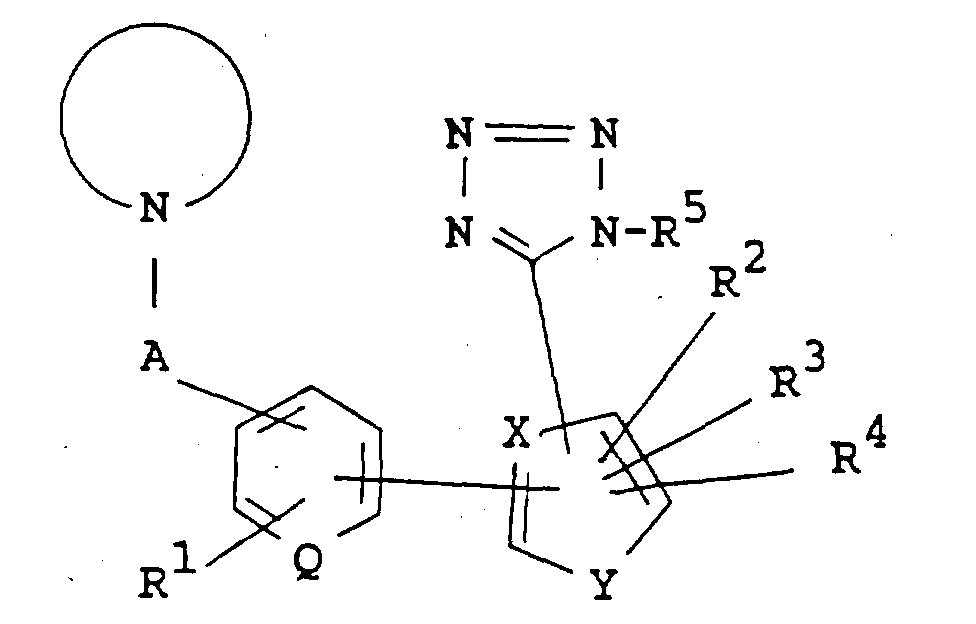
R¹, R, R³, R⁴, R⁵, A, Q, X, Y andare each as defined above,
or a salt thereof, orb) subjecting a compound of the formula :
R¹, R, R³, R⁵, A, Q, X, Y andare each as defined above,
and
R
or a salt thereof, to reduction, to give a compound of the formula :
R¹, R, R³, R⁵ A, Q, X, Y andare each as defined above,
and
R
or a salt thereof orc) reacting a compound of the formula :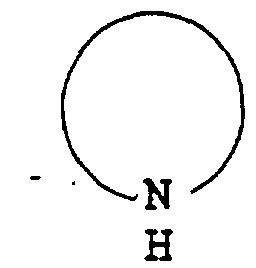 is as defined above, and
or a salt thereof,
with a compound of the formula :
R¹, R, R³, R⁴, R⁵, A, Q, X, Y andare each as defined above,
and
R⁶ is acid residue,
or a salt thereof,
to give a compound of the formula :
R¹, R, R³, R⁴, R⁵, A, Q, X, Y andare each as defined above,
or a salt thereof, ord) subjecting a compound of the formula :
R¹, R, R³, R⁴, A, Q, X, Y andare each as defined above,
and
R
or a salt thereof, to removal of the imino-protective group, to give a compound of the formula :
R¹, R, R³, R⁴, A, Q, X, Y andare each as defined above,
or a salt thereof. - A pharmaceutical composition comprising a compound of claim 1 or pharmaceutically acceptable salt thereof in association with a pharmaceutically acceptable, substantially non-toxic carrier or excipient.
- A compound of claim 1 or pharmaceutically acceptable salt thereof for use as a medicament.
- A compound of claim 1 or pharmaceutically acceptable salt thereof for use as an angiotensin II antagonist.
- Use of a compound of claim 1 for manufacturing a medicament for treating or preventing angiotensin II mediated diseases.
- Use of a compound of claim 1 for manufacturing a medicament for treating or preventing hypertension or heart failure.
- A process for preparing a pharmaceutical composition which comprises admixing a compound of claim 1 with a pharmaceutically acceptable substantially non-toxic carrier or excipient.
Applications Claiming Priority (14)
| Application Number | Priority Date | Filing Date | Title |
|---|---|---|---|
| GB909020838A GB9020838D0 (en) | 1990-09-25 | 1990-09-25 | Condensed imidazole derivatives and process for preparation thereof |
| GB9020838 | 1990-09-25 | ||
| GB9023467 | 1990-10-29 | ||
| GB909023467A GB9023467D0 (en) | 1990-10-29 | 1990-10-29 | Condensed imidazole derivatives and process for preparation thereof |
| GB9028216 | 1990-12-31 | ||
| GB909028216A GB9028216D0 (en) | 1990-12-31 | 1990-12-31 | Condensed imidazole derivatives and process for preparation thereof |
| GB919103874A GB9103874D0 (en) | 1991-02-25 | 1991-02-25 | Heterocyclic derivatives |
| GB9103874 | 1991-02-25 | ||
| GB919106956A GB9106956D0 (en) | 1991-04-03 | 1991-04-03 | Heterocyclic derivatives |
| GB9106956 | 1991-04-03 | ||
| GB919107231A GB9107231D0 (en) | 1991-04-05 | 1991-04-05 | Heterocyclic derivatives |
| GB9107231 | 1991-04-05 | ||
| GB919112803A GB9112803D0 (en) | 1991-06-14 | 1991-06-14 | Heterocyclic derivatives |
| GB9112803 | 1991-06-14 |
Publications (2)
| Publication Number | Publication Date |
|---|---|
| EP0480204A1 EP0480204A1 (en) | 1992-04-15 |
| EP0480204B1 true EP0480204B1 (en) | 1996-03-20 |
Family
ID=27562836
Family Applications (1)
| Application Number | Title | Priority Date | Filing Date |
|---|---|---|---|
| EP91115644A Expired - Lifetime EP0480204B1 (en) | 1990-09-25 | 1991-09-14 | Imidazole derivatives, potent and selective antagonists of angiotensin II receptor |
Country Status (15)
| Country | Link |
|---|---|
| US (1) | US5210092A (en) |
| EP (1) | EP0480204B1 (en) |
| JP (1) | JPH04288075A (en) |
| KR (1) | KR920006347A (en) |
| CN (1) | CN1059723A (en) |
| AT (1) | ATE135701T1 (en) |
| AU (1) | AU650473B2 (en) |
| CA (1) | CA2052125A1 (en) |
| DE (1) | DE69118082T2 (en) |
| FI (1) | FI914163A7 (en) |
| HU (1) | HUT59404A (en) |
| IE (1) | IE913164A1 (en) |
| IL (1) | IL99443A0 (en) |
| NO (1) | NO913750L (en) |
| PT (1) | PT99038A (en) |
Families Citing this family (46)
| Publication number | Priority date | Publication date | Assignee | Title |
|---|---|---|---|---|
| US5177074A (en) * | 1991-03-26 | 1993-01-05 | Merck & Co., Inc. | Angiotensin ii antagonists incorporating a substituted thiophene or furan |
| TW274551B (en) * | 1991-04-16 | 1996-04-21 | Takeda Pharm Industry Co Ltd | |
| US5252574A (en) * | 1991-04-26 | 1993-10-12 | Merck & Co., Inc. | Angiotensin II antagonists incorporating a substituted thiophene or furan |
| US5198438A (en) * | 1991-05-07 | 1993-03-30 | Merck & Co., Inc. | Angiotensin ii antagonists incorporating a substituted thiophene or furan |
| US5354759A (en) * | 1991-09-12 | 1994-10-11 | Fujisawa Pharmaceutical Co., Ltd. | Angiotenin II antagonizing heterocyclic compounds |
| WO1993019067A1 (en) * | 1991-09-12 | 1993-09-30 | Fujisawa Pharmaceutical Co., Ltd. | Imidazopyridine derivatives as angiotensin ii antagonists |
| GB9201789D0 (en) * | 1992-01-28 | 1992-03-11 | Fujisawa Pharmaceutical Co | Heterocyclic derivatives |
| US5283242A (en) * | 1991-10-24 | 1994-02-01 | American Home Products Corporation | Substituted benzimidazoles and quinazolines as antihypertensives |
| WO1993018030A1 (en) * | 1992-03-03 | 1993-09-16 | Fujisawa Pharmaceutical Co., Ltd. | Benzimidazole derivatives as angiotensin ii antagonists |
| US5364869A (en) * | 1992-03-09 | 1994-11-15 | Abbott Laboratories | Heterocycle-substituted benzyaminopyridine angiotensin II receptor antagonists |
| US5583229A (en) * | 1992-12-07 | 1996-12-10 | Eisai Co., Ltd. | Process for the preparation of imidazopyridine derivatives |
| EP0577025A3 (en) * | 1992-07-01 | 1998-02-04 | Hoechst Aktiengesellschaft | Angiotensin-ii-receptorantagonist for the treatment and prophylaxis of coronary heart diseases |
| EP0577023A3 (en) * | 1992-07-01 | 1996-12-18 | Hoechst Ag | Angiotensin-ii receptor-antagonists for the treatment of arrhythmices |
| GB9218449D0 (en) | 1992-08-29 | 1992-10-14 | Boots Co Plc | Therapeutic agents |
| WO1994005633A1 (en) * | 1992-09-01 | 1994-03-17 | Ciba-Geigy Ag | 3-cyano-4-halogeno-2-(subst.phenyl)-pyrroles as pesticides and fungicides |
| CA2143193A1 (en) * | 1992-10-13 | 1994-04-28 | David B. Reitz | N-arylheteroarylalkyl 1-phenyl-imidazol-2-one compounds for treatment of circulatory disorders |
| DE4236026A1 (en) * | 1992-10-24 | 1994-04-28 | Merck Patent Gmbh | imidazopyridines |
| US5376666A (en) * | 1992-11-30 | 1994-12-27 | The Du Pont Merck Pharmaceutical Company | Angiotension-II receptor blocking, azacycloalkyl or azacycloalkenyl |
| US5455260A (en) * | 1993-05-21 | 1995-10-03 | Rhone-Poulenc Rorer Pharmaceuticals Inc. | Aliphatic amino bis-aryl squalene synthase inhibitors |
| US5338740A (en) * | 1993-07-13 | 1994-08-16 | Pfizer Inc. | Angiotensin II receptor antagonists |
| EP0842923B1 (en) * | 1995-06-07 | 2006-03-01 | Nippon Shinyaku Company, Limited | Pyrrole derivatives and medicinal composition |
| JP2002507996A (en) | 1997-07-03 | 2002-03-12 | デュポン ファーマシューティカルズ カンパニー | Imidazopyrimidines and imidazopyridines for treating neurological disorders |
| US6124463A (en) * | 1998-07-02 | 2000-09-26 | Dupont Pharmaceuticals | Benzimidazoles as corticotropin release factor antagonists |
| US6365589B1 (en) | 1998-07-02 | 2002-04-02 | Bristol-Myers Squibb Pharma Company | Imidazo-pyridines, -pyridazines, and -triazines as corticotropin releasing factor antagonists |
| SE9903028D0 (en) | 1999-08-27 | 1999-08-27 | Astra Ab | New use |
| US7772271B2 (en) | 2004-07-14 | 2010-08-10 | Ptc Therapeutics, Inc. | Methods for treating hepatitis C |
| EP1771169A1 (en) | 2004-07-14 | 2007-04-11 | PTC Therapeutics, Inc. | Methods for treating hepatitis c |
| US7781478B2 (en) | 2004-07-14 | 2010-08-24 | Ptc Therapeutics, Inc. | Methods for treating hepatitis C |
| US7868037B2 (en) | 2004-07-14 | 2011-01-11 | Ptc Therapeutics, Inc. | Methods for treating hepatitis C |
| JP2008507518A (en) | 2004-07-22 | 2008-03-13 | ピーティーシー セラピューティクス,インコーポレーテッド | Thienopyridine for treating hepatitis C |
| US7531560B2 (en) * | 2004-11-10 | 2009-05-12 | Boehringer Ingelheim Pharmaceuticals, Inc. | Anti-cytokine heterocyclic compounds |
| PE20070341A1 (en) * | 2005-07-29 | 2007-04-13 | Wyeth Corp | PIRROL DERIVATIVES AS PROGESTERONE RECEPTOR MODULATORS |
| PE20070182A1 (en) * | 2005-07-29 | 2007-03-06 | Wyeth Corp | CYANOPYRROL-PHENYL AMIDE DERIVATIVES AS PROGESTERONE RECEPTOR MODULATORS |
| MX2009013293A (en) | 2007-06-04 | 2010-02-15 | Synergy Pharmaceuticals Inc | Agonists of guanylate cyclase useful for the treatment of gastrointestinal disorders, inflammation, cancer and other disorders. |
| US8969514B2 (en) | 2007-06-04 | 2015-03-03 | Synergy Pharmaceuticals, Inc. | Agonists of guanylate cyclase useful for the treatment of hypercholesterolemia, atherosclerosis, coronary heart disease, gallstone, obesity and other cardiovascular diseases |
| EP2810951B1 (en) | 2008-06-04 | 2017-03-15 | Synergy Pharmaceuticals Inc. | Agonists of guanylate cyclase useful for the treatment of gastrointestinal disorders, inflammation, cancer and other disorders |
| AR072297A1 (en) | 2008-06-27 | 2010-08-18 | Novartis Ag | DERIVATIVES OF INDOL-2-IL-PIRIDIN-3-ILO, PHARMACEUTICAL COMPOSITION THAT INCLUDES THEM AND ITS USE IN MEDICINES FOR THE TREATMENT OF DISEASES MEDIATED BY THE SYNTHESIS ALDOSTERONE. |
| CA2730603C (en) | 2008-07-16 | 2019-09-24 | Synergy Pharmaceuticals Inc. | Agonists of guanylate cyclase useful for the treatment of gastrointestinal disorders, inflammation, cancer and other disorders |
| US9616097B2 (en) | 2010-09-15 | 2017-04-11 | Synergy Pharmaceuticals, Inc. | Formulations of guanylate cyclase C agonists and methods of use |
| WO2012174164A2 (en) | 2011-06-15 | 2012-12-20 | Metabolex, Inc. | Agonists of gpr131 and uses thereof |
| US9593109B2 (en) | 2011-08-26 | 2017-03-14 | Cymabay Therapeutics, Inc. | Bicyclic agonists of GPR131 and uses thereof |
| US8889730B2 (en) | 2012-04-10 | 2014-11-18 | Pfizer Inc. | Indole and indazole compounds that activate AMPK |
| JP2016514670A (en) | 2013-03-15 | 2016-05-23 | シナジー ファーマシューティカルズ インコーポレイテッド | Guanylate cyclase receptor agonists in combination with other drugs |
| JP2016514671A (en) | 2013-03-15 | 2016-05-23 | シナジー ファーマシューティカルズ インコーポレイテッド | Guanylate cyclase agonists and uses thereof |
| EP2970177A1 (en) | 2013-03-15 | 2016-01-20 | Pfizer Inc. | Indole compounds that activate ampk |
| EA201592263A1 (en) | 2013-06-05 | 2016-05-31 | Синерджи Фармасьютикалз, Инк. | ULTRASCULAR AGONISTS OF GUANYLACYCLASE C, METHOD OF THEIR RECEIVING AND USING |
Citations (2)
| Publication number | Priority date | Publication date | Assignee | Title |
|---|---|---|---|---|
| EP0399731A1 (en) * | 1989-05-23 | 1990-11-28 | Zeneca Limited | Azaindenes |
| EP0400974A2 (en) * | 1989-05-30 | 1990-12-05 | Merck & Co. Inc. | Substituted imidazo-fused 6-membered heterocycles as angiotensin II antagonists |
Family Cites Families (5)
| Publication number | Priority date | Publication date | Assignee | Title |
|---|---|---|---|---|
| DE3130251A1 (en) * | 1981-07-31 | 1983-02-17 | A. Nattermann & Cie GmbH, 5000 Köln | 6- (4 - ((OMEGA) - (1-IMIDAZOLYL) -ALKYL) -PHENYL) -3-OXO -2,3,4,5-TETRAHYDRO-PYRIDAZINE AND THE ACID ADDITION SALTS THEREOF, METHOD FOR THE PRODUCTION THEREOF AND PHARMACEUTICAL PRODUCTS CONTAINING THEM |
| CA1338238C (en) * | 1988-01-07 | 1996-04-09 | David John Carini | Angiotensin ii receptor blocking imidazoles and combinations thereof with diuretics and nsaids |
| US4916129A (en) * | 1989-01-19 | 1990-04-10 | E. I. Du Pont De Nemours And Company | Combination β-blocking/angiotensin II blocking antihypertensives |
| IL96019A0 (en) * | 1989-10-31 | 1991-07-18 | Fujisawa Pharmaceutical Co | Imidazole derivatives,processes for the preparation thereof and pharmaceutical compositions containing the same |
| TW300219B (en) * | 1991-09-14 | 1997-03-11 | Hoechst Ag |
-
1991
- 1991-08-23 US US07/748,954 patent/US5210092A/en not_active Expired - Fee Related
- 1991-08-30 AU AU83454/91A patent/AU650473B2/en not_active Ceased
- 1991-09-04 FI FI914163A patent/FI914163A7/en not_active Application Discontinuation
- 1991-09-08 IL IL99443A patent/IL99443A0/en unknown
- 1991-09-09 IE IE316491A patent/IE913164A1/en unknown
- 1991-09-14 AT AT91115644T patent/ATE135701T1/en not_active IP Right Cessation
- 1991-09-14 EP EP91115644A patent/EP0480204B1/en not_active Expired - Lifetime
- 1991-09-14 DE DE69118082T patent/DE69118082T2/en not_active Expired - Fee Related
- 1991-09-24 JP JP3317589A patent/JPH04288075A/en active Pending
- 1991-09-24 CN CN91109182A patent/CN1059723A/en active Pending
- 1991-09-24 NO NO91913750A patent/NO913750L/en unknown
- 1991-09-24 CA CA002052125A patent/CA2052125A1/en not_active Abandoned
- 1991-09-24 HU HU913052A patent/HUT59404A/en unknown
- 1991-09-24 KR KR1019910016597A patent/KR920006347A/en not_active Withdrawn
- 1991-09-24 PT PT99038A patent/PT99038A/en not_active Application Discontinuation
Patent Citations (2)
| Publication number | Priority date | Publication date | Assignee | Title |
|---|---|---|---|---|
| EP0399731A1 (en) * | 1989-05-23 | 1990-11-28 | Zeneca Limited | Azaindenes |
| EP0400974A2 (en) * | 1989-05-30 | 1990-12-05 | Merck & Co. Inc. | Substituted imidazo-fused 6-membered heterocycles as angiotensin II antagonists |
Also Published As
| Publication number | Publication date |
|---|---|
| CA2052125A1 (en) | 1992-03-26 |
| NO913750L (en) | 1992-03-26 |
| KR920006347A (en) | 1992-04-27 |
| NO913750D0 (en) | 1991-09-24 |
| HUT59404A (en) | 1992-05-28 |
| EP0480204A1 (en) | 1992-04-15 |
| DE69118082D1 (en) | 1996-04-25 |
| AU650473B2 (en) | 1994-06-23 |
| CN1059723A (en) | 1992-03-25 |
| US5210092A (en) | 1993-05-11 |
| ATE135701T1 (en) | 1996-04-15 |
| HU913052D0 (en) | 1992-01-28 |
| JPH04288075A (en) | 1992-10-13 |
| FI914163L (en) | 1992-03-26 |
| IL99443A0 (en) | 1992-08-18 |
| DE69118082T2 (en) | 1996-10-17 |
| PT99038A (en) | 1992-08-31 |
| AU8345491A (en) | 1992-04-02 |
| FI914163A7 (en) | 1992-03-26 |
| IE913164A1 (en) | 1992-02-25 |
| FI914163A0 (en) | 1991-09-04 |
Similar Documents
| Publication | Publication Date | Title |
|---|---|---|
| US5210092A (en) | Angiotensin ii antagonizing heterocyclic derivatives | |
| TW492971B (en) | Nitrogen containing heteroaromtics as factor XA inhibitors | |
| JP3382963B2 (en) | Imidazopyridines | |
| US4880804A (en) | Angiotensin II receptor blocking benzimidazoles | |
| RU2293735C2 (en) | Derivatives of nor-seco-chimbacine, pharmaceutical composition and method for inhibiting based on thereof | |
| AU2005316091B2 (en) | 2-(phenyl or heterocyclic)-1H-phenantrho[9,10-D]imidazoles as mPGES-1 inhibitors | |
| TWI426070B (en) | Piperidine/piperazine derivatives | |
| US5215994A (en) | Angiotenin II antagonizing heterocyclic derivatives | |
| JP3535534B2 (en) | Novel bicyclic derivatives of pyridine, processes for their preparation, new intermediates obtained, their use as medicaments and pharmaceutical compositions containing them | |
| EP0426021A1 (en) | Condensed imidazole derivatives and processes for preparation thereof | |
| EP1142879B1 (en) | Imidazole compounds and medicinal use thereof | |
| JPH10158264A (en) | Intermediates for the synthesis of heterocyclic-cyclic amine derivatives | |
| EP0684945A1 (en) | Heterocyclic-substituted alkyl amide acat inhibitors | |
| JP2004513134A (en) | Aza- and polyaza-naphthalenyl ketones useful as HIV integrase inhibitors | |
| CA2294117A1 (en) | Imidazopyrimidines and imidazopyridines for the treatment of neurological disorders | |
| JPH11508267A (en) | Pyrazole compounds and pharmaceutical compositions | |
| CN102595900A (en) | Indazole Inhibitors of the Wnt Signaling Pathway and Their Therapeutic Uses | |
| NO300271B1 (en) | Pyrazolopyridine compounds and pharmaceutical compositions containing them | |
| DE69306792T2 (en) | IMIDAZOLE DERIVATIVES WITH ANGIOTENSIN II ANTAGONISTIC EFFECT | |
| AU752064B2 (en) | Compounds and compositions for treating diseases associated with serine protease, particularly tryptase, activity | |
| CA2600860A1 (en) | Diphenyl substituted cycloalkanes, compositions containing such compounds and methods of use | |
| JP3439643B2 (en) | Benzimidazole compounds | |
| FI78089B (en) | FRAME FOR THE PREPARATION OF THERAPEUTIC NETWORK IMMEDIATE / 1,5-A / PYRIDINDERIVAT. | |
| US6562854B2 (en) | Compositions comprising a substituted benzimidazole useful for treating immunomediated inflammatory disorders | |
| JPH06340658A (en) | Benzimidazole derivative |
Legal Events
| Date | Code | Title | Description |
|---|---|---|---|
| PUAI | Public reference made under article 153(3) epc to a published international application that has entered the european phase |
Free format text: ORIGINAL CODE: 0009012 |
|
| AK | Designated contracting states |
Kind code of ref document: A1 Designated state(s): AT BE CH DE DK ES FR GB GR IT LI LU NL SE |
|
| 17P | Request for examination filed |
Effective date: 19921007 |
|
| 17Q | First examination report despatched |
Effective date: 19930106 |
|
| GRAH | Despatch of communication of intention to grant a patent |
Free format text: ORIGINAL CODE: EPIDOS IGRA |
|
| GRAA | (expected) grant |
Free format text: ORIGINAL CODE: 0009210 |
|
| AK | Designated contracting states |
Kind code of ref document: B1 Designated state(s): AT BE CH DE DK ES FR GB GR IT LI LU NL SE |
|
| PG25 | Lapsed in a contracting state [announced via postgrant information from national office to epo] |
Ref country code: NL Free format text: LAPSE BECAUSE OF FAILURE TO SUBMIT A TRANSLATION OF THE DESCRIPTION OR TO PAY THE FEE WITHIN THE PRESCRIBED TIME-LIMIT Effective date: 19960320 Ref country code: GR Free format text: LAPSE BECAUSE OF FAILURE TO SUBMIT A TRANSLATION OF THE DESCRIPTION OR TO PAY THE FEE WITHIN THE PRESCRIBED TIME-LIMIT Effective date: 19960320 Ref country code: FR Effective date: 19960320 Ref country code: ES Free format text: THE PATENT HAS BEEN ANNULLED BY A DECISION OF A NATIONAL AUTHORITY Effective date: 19960320 Ref country code: DK Effective date: 19960320 Ref country code: BE Effective date: 19960320 Ref country code: AT Effective date: 19960320 |
|
| REF | Corresponds to: |
Ref document number: 135701 Country of ref document: AT Date of ref document: 19960415 Kind code of ref document: T |
|
| REG | Reference to a national code |
Ref country code: CH Ref legal event code: NV Representative=s name: A. BRAUN, BRAUN, HERITIER, ESCHMANN AG PATENTANWAE |
|
| REF | Corresponds to: |
Ref document number: 69118082 Country of ref document: DE Date of ref document: 19960425 |
|
| ITF | It: translation for a ep patent filed | ||
| PG25 | Lapsed in a contracting state [announced via postgrant information from national office to epo] |
Ref country code: SE Effective date: 19960620 |
|
| EN | Fr: translation not filed | ||
| NLV1 | Nl: lapsed or annulled due to failure to fulfill the requirements of art. 29p and 29m of the patents act | ||
| PG25 | Lapsed in a contracting state [announced via postgrant information from national office to epo] |
Ref country code: GB Effective date: 19960914 |
|
| PG25 | Lapsed in a contracting state [announced via postgrant information from national office to epo] |
Ref country code: LU Free format text: LAPSE BECAUSE OF NON-PAYMENT OF DUE FEES Effective date: 19960930 Ref country code: LI Effective date: 19960930 Ref country code: CH Effective date: 19960930 |
|
| PLBE | No opposition filed within time limit |
Free format text: ORIGINAL CODE: 0009261 |
|
| STAA | Information on the status of an ep patent application or granted ep patent |
Free format text: STATUS: NO OPPOSITION FILED WITHIN TIME LIMIT |
|
| 26N | No opposition filed | ||
| GBPC | Gb: european patent ceased through non-payment of renewal fee |
Effective date: 19960914 |
|
| REG | Reference to a national code |
Ref country code: CH Ref legal event code: PL |
|
| PG25 | Lapsed in a contracting state [announced via postgrant information from national office to epo] |
Ref country code: DE Effective date: 19970603 |
|
| PG25 | Lapsed in a contracting state [announced via postgrant information from national office to epo] |
Ref country code: IT Free format text: LAPSE BECAUSE OF NON-PAYMENT OF DUE FEES Effective date: 20050914 |