EP0479961B1 - A method for preparing a conductive polymer - Google Patents
A method for preparing a conductive polymer Download PDFInfo
- Publication number
- EP0479961B1 EP0479961B1 EP91905862A EP91905862A EP0479961B1 EP 0479961 B1 EP0479961 B1 EP 0479961B1 EP 91905862 A EP91905862 A EP 91905862A EP 91905862 A EP91905862 A EP 91905862A EP 0479961 B1 EP0479961 B1 EP 0479961B1
- Authority
- EP
- European Patent Office
- Prior art keywords
- polymer
- conductor
- doping
- doping agent
- mixing
- Prior art date
- Legal status (The legal status is an assumption and is not a legal conclusion. Google has not performed a legal analysis and makes no representation as to the accuracy of the status listed.)
- Expired - Lifetime
Links
- 238000000034 method Methods 0.000 title claims abstract description 23
- 229920001940 conductive polymer Polymers 0.000 title claims abstract description 9
- 229920000642 polymer Polymers 0.000 claims abstract description 62
- 239000004020 conductor Substances 0.000 claims abstract description 35
- 239000002019 doping agent Substances 0.000 claims abstract description 24
- 239000000203 mixture Substances 0.000 claims abstract description 16
- 239000011159 matrix material Substances 0.000 claims abstract description 12
- 239000000463 material Substances 0.000 claims description 11
- 238000002844 melting Methods 0.000 claims description 5
- 230000008018 melting Effects 0.000 claims description 5
- 239000011248 coating agent Substances 0.000 claims description 4
- 238000000576 coating method Methods 0.000 claims description 4
- 238000001746 injection moulding Methods 0.000 claims description 4
- 239000007787 solid Substances 0.000 claims description 4
- 229910021578 Iron(III) chloride Inorganic materials 0.000 claims description 3
- 238000003490 calendering Methods 0.000 claims description 3
- RBTARNINKXHZNM-UHFFFAOYSA-K iron trichloride Chemical compound Cl[Fe](Cl)Cl RBTARNINKXHZNM-UHFFFAOYSA-K 0.000 claims description 3
- 239000007788 liquid Substances 0.000 claims description 3
- 238000001125 extrusion Methods 0.000 claims description 2
- 230000001590 oxidative effect Effects 0.000 claims description 2
- 239000000126 substance Substances 0.000 claims description 2
- PNDPGZBMCMUPRI-UHFFFAOYSA-N iodine Chemical compound II PNDPGZBMCMUPRI-UHFFFAOYSA-N 0.000 claims 1
- BDHFUVZGWQCTTF-UHFFFAOYSA-N sulfonic acid Chemical compound OS(=O)=O BDHFUVZGWQCTTF-UHFFFAOYSA-N 0.000 claims 1
- 238000002156 mixing Methods 0.000 description 45
- YTPLMLYBLZKORZ-UHFFFAOYSA-N Thiophene Chemical compound C=1C=CSC=1 YTPLMLYBLZKORZ-UHFFFAOYSA-N 0.000 description 14
- 239000000047 product Substances 0.000 description 12
- 238000001816 cooling Methods 0.000 description 7
- 229920003023 plastic Polymers 0.000 description 7
- 239000004033 plastic Substances 0.000 description 7
- -1 poly(3-octyl thiophene) Polymers 0.000 description 7
- 229920000123 polythiophene Polymers 0.000 description 7
- 229930192474 thiophene Natural products 0.000 description 7
- 239000004800 polyvinyl chloride Substances 0.000 description 6
- 229920000915 polyvinyl chloride Polymers 0.000 description 6
- 239000002904 solvent Substances 0.000 description 5
- 239000002826 coolant Substances 0.000 description 4
- 238000010438 heat treatment Methods 0.000 description 4
- 239000004698 Polyethylene Substances 0.000 description 3
- 239000007789 gas Substances 0.000 description 3
- ZCYVEMRRCGMTRW-UHFFFAOYSA-N 7553-56-2 Chemical compound [I] ZCYVEMRRCGMTRW-UHFFFAOYSA-N 0.000 description 2
- 229920000280 Poly(3-octylthiophene) Polymers 0.000 description 2
- 239000004743 Polypropylene Substances 0.000 description 2
- 239000004793 Polystyrene Substances 0.000 description 2
- 239000002253 acid Substances 0.000 description 2
- XECAHXYUAAWDEL-UHFFFAOYSA-N acrylonitrile butadiene styrene Chemical compound C=CC=C.C=CC#N.C=CC1=CC=CC=C1 XECAHXYUAAWDEL-UHFFFAOYSA-N 0.000 description 2
- 239000004676 acrylonitrile butadiene styrene Substances 0.000 description 2
- 229920000122 acrylonitrile butadiene styrene Polymers 0.000 description 2
- 230000001419 dependent effect Effects 0.000 description 2
- 239000006185 dispersion Substances 0.000 description 2
- 229910052740 iodine Inorganic materials 0.000 description 2
- 239000011630 iodine Substances 0.000 description 2
- 229920000573 polyethylene Polymers 0.000 description 2
- 229920002959 polymer blend Polymers 0.000 description 2
- 238000009747 press moulding Methods 0.000 description 2
- 238000003825 pressing Methods 0.000 description 2
- 239000002994 raw material Substances 0.000 description 2
- 239000000725 suspension Substances 0.000 description 2
- 229920001169 thermoplastic Polymers 0.000 description 2
- 239000004952 Polyamide Substances 0.000 description 1
- 239000004721 Polyphenylene oxide Substances 0.000 description 1
- 229920001328 Polyvinylidene chloride Polymers 0.000 description 1
- XUIMIQQOPSSXEZ-UHFFFAOYSA-N Silicon Chemical compound [Si] XUIMIQQOPSSXEZ-UHFFFAOYSA-N 0.000 description 1
- 230000002378 acidificating effect Effects 0.000 description 1
- 239000000654 additive Substances 0.000 description 1
- 150000001450 anions Chemical class 0.000 description 1
- QVGXLLKOCUKJST-UHFFFAOYSA-N atomic oxygen Chemical compound [O] QVGXLLKOCUKJST-UHFFFAOYSA-N 0.000 description 1
- 230000015572 biosynthetic process Effects 0.000 description 1
- 238000007664 blowing Methods 0.000 description 1
- 239000003054 catalyst Substances 0.000 description 1
- 230000005611 electricity Effects 0.000 description 1
- 230000007613 environmental effect Effects 0.000 description 1
- XERAGTFKMJZSDI-UHFFFAOYSA-N ethene;ethenyl prop-2-enoate Chemical compound C=C.C=COC(=O)C=C XERAGTFKMJZSDI-UHFFFAOYSA-N 0.000 description 1
- 239000012467 final product Substances 0.000 description 1
- 239000008187 granular material Substances 0.000 description 1
- 239000003999 initiator Substances 0.000 description 1
- 239000012212 insulator Substances 0.000 description 1
- 238000004519 manufacturing process Methods 0.000 description 1
- 239000000155 melt Substances 0.000 description 1
- 239000012528 membrane Substances 0.000 description 1
- 229910052751 metal Inorganic materials 0.000 description 1
- 239000002184 metal Substances 0.000 description 1
- 150000002739 metals Chemical class 0.000 description 1
- 230000004048 modification Effects 0.000 description 1
- 238000012986 modification Methods 0.000 description 1
- 229920000620 organic polymer Polymers 0.000 description 1
- 239000001301 oxygen Substances 0.000 description 1
- 229910052760 oxygen Inorganic materials 0.000 description 1
- 229920002647 polyamide Polymers 0.000 description 1
- 229920000728 polyester Polymers 0.000 description 1
- 229920000570 polyether Polymers 0.000 description 1
- 229920005597 polymer membrane Polymers 0.000 description 1
- 238000006116 polymerization reaction Methods 0.000 description 1
- 229920001155 polypropylene Polymers 0.000 description 1
- 229920002223 polystyrene Polymers 0.000 description 1
- 239000005033 polyvinylidene chloride Substances 0.000 description 1
- 238000002360 preparation method Methods 0.000 description 1
- 230000001681 protective effect Effects 0.000 description 1
- 238000005204 segregation Methods 0.000 description 1
- 229910052710 silicon Inorganic materials 0.000 description 1
- 239000010703 silicon Substances 0.000 description 1
- 239000000243 solution Substances 0.000 description 1
- 230000006641 stabilisation Effects 0.000 description 1
- 238000011105 stabilization Methods 0.000 description 1
- 231100000331 toxic Toxicity 0.000 description 1
- 230000002588 toxic effect Effects 0.000 description 1
- 238000002604 ultrasonography Methods 0.000 description 1
- XLYOFNOQVPJJNP-UHFFFAOYSA-N water Substances O XLYOFNOQVPJJNP-UHFFFAOYSA-N 0.000 description 1
Images

Classifications
-
- H—ELECTRICITY
- H01—ELECTRIC ELEMENTS
- H01B—CABLES; CONDUCTORS; INSULATORS; SELECTION OF MATERIALS FOR THEIR CONDUCTIVE, INSULATING OR DIELECTRIC PROPERTIES
- H01B1/00—Conductors or conductive bodies characterised by the conductive materials; Selection of materials as conductors
- H01B1/06—Conductors or conductive bodies characterised by the conductive materials; Selection of materials as conductors mainly consisting of other non-metallic substances
- H01B1/12—Conductors or conductive bodies characterised by the conductive materials; Selection of materials as conductors mainly consisting of other non-metallic substances organic substances
- H01B1/124—Intrinsically conductive polymers
- H01B1/127—Intrinsically conductive polymers comprising five-membered aromatic rings in the main chain, e.g. polypyrroles, polythiophenes
-
- C—CHEMISTRY; METALLURGY
- C08—ORGANIC MACROMOLECULAR COMPOUNDS; THEIR PREPARATION OR CHEMICAL WORKING-UP; COMPOSITIONS BASED THEREON
- C08L—COMPOSITIONS OF MACROMOLECULAR COMPOUNDS
- C08L65/00—Compositions of macromolecular compounds obtained by reactions forming a carbon-to-carbon link in the main chain; Compositions of derivatives of such polymers
Definitions
- the invention relates to a method for preparing a conductive polymer by doping a conductor polymer.
- Plastics and other polymers do not by themselves conduct electricity, but they can be made conductive for various applications.
- Electrically active or conductive polymers can be prepared from organic polymers having long chains of conjugated double bonds. The silicon electrodes in the double bonds can be "disturbed” by adding to the polymer certain doping agents, which either receive or donate electrons. Openings or extra electrons then arise in the polymer chain which make the passage of electric current along the conjugated chain possible.
- the conductivity of polymers can be adjusted depending on the doping agent content such that it covers nearly the entire conductivity range from insulators to metals.
- Such conductive polymers have many interesting applications, e.g. in the manufacture of light batteries and accumulators.
- Polythiophene is one of the polymers, which can be made electrically active in the above-mentioned manner.
- Polythiophene can be prepared for example by using Ziegler-type catalysts and acidic initiators.
- the usability of electrically active polymers is dependent e.g. on their stability properties.
- Polythiophene is in a reduced pure form very stable in different conditions, such as in air, moisture, vacuum and at high temperatures.
- the stability of a conductive polythiophene is, by contrast, in different conditions dependent on the doping agent anion used.
- the polythiophene complexes known previously are more or less unstable and thereby questionable for many applications.
- a more stable conductive polythiophene polymer is prepared by doping and treating it with FeCl3. According to the application, this doping is performed by means of a solvent or a suspension medium. After the doping, the membrane obtained is washed clean from the extra doping agent.
- the polymer After the doping, the polymer is generally insoluble and it can no longer be formed, due to which doping has traditionally been performed subsequently after the forming of the polymer.
- the doping of polymers thus occurs after the treatment, or after the formation of the product, e.g. in the manner described above with FeCl3.
- Such a method becomes very expensive because of special devices designed for doping, and furthermore, it is unpractical and non-pro-environmental, since toxic volatile gases spread to the environment.
- conductive polymers are polyconjugated systems.
- the properties of conductive polymers include a high crystallinity, and their color is generally mat-black.
- Conductive polymeric and organic conductors are generally speaking insoluble, it is not possible to melt or form them, and in certain cases, they are unstable against oxygen, moisture and high temperatures, due to which also doping at high temperatures has previously not succeeded.
- the object of the present invention is to provide a method for doping a conductor polymer, in which method the properties of the conductor polymer can be treated as desired, and which polymer is stable. Furthermore, the object of the present invention is to provide a method, in which no disadvantages of prior art occur.
- conductor polymer also concerns the polymer to be doped, although it is not yet conductive before the doping.
- the inventive method for preparing a conductive polymer product by doping is mainly characterized in that a conductor polymer or a mixture of a conductor polymer and matrix polymer is in a molten state brought into contact with a doping agent, after which the mixture is treated into a product in a manner known per se.
- the doping can be performed by adding a doping agent into a conductor polymer when it is in a molten state, and the doping is timed to occur in connection with the treatment. This means that the doping is performed when treating the product e.g. in connection with injection moulding, whereby the doping agent is added to an extruder or after it, before being pressed into a form.
- the doping agent can be brought to the molten mixture such that is has been mixed with the conductor polymer or the matrix plastic, or the doping agent can be added directly to the conductor polymer or to the molten mixture formed by the conductor polymer and the matrix plastic.
- the mixing of the doping agent with the plastic occurs e.g. in an extruder before the pressing of the product, whereby the doping action begins in connection with the melt mixing and continues during the forming of the product and after it.
- the doping can be performed in connection with any melt treatment method for plastics.
- melt treatment methods include extrusion, calendering, deep drawing, coating and injection moulding, press moulding, membrabe blowing, etc.
- the oxidizing and reducing doping agent can be a gas, (e.g. an iodine steam), a liquid (e.g. a liquid suiphonic acid) or a solid substance (e.g. a suiphonic acid having a suitable melting point).
- a gas e.g. an iodine steam
- a liquid e.g. a liquid suiphonic acid
- a solid substance e.g. a suiphonic acid having a suitable melting point
- the polymer used can be any melt-treatable dopable polymer, such as poly(3-octyl thiophene), and the matrix material can be any treatable polymer.
- the invention can be used for preparing any polymer having a potential conductivity.
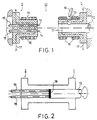
- Figs. 1 and 2 show one embodiment of how the inventive doping can be performed when treating the polymer e.g. by means of a mixer according to the FI application 896313.
- Fig. 1 is a section of the inventive device, when the parts of the device have been separated.
- Fig. 2 shows the first mixing step
- Fig. 3 shows the second mixing step.
- Fig. 4 shows the cooling step
- Fig. 5 shows the removal step of a test piece.
- Fig. 1 shows a mixing device 10, when its main parts, a mixing cylinder 1 and a bottom part 2, are separated.
- the mixing cylinder 1 has a cylindrical mixing space 11, into which a mixing piston 12 is fitted.
- the mixing piston 12 can move in the cylindrical mixing space 11, whereby the size of the mixing space varies.
- the mixing piston 12 can also be rotated.
- the mixing cylinder 1 can also have an opening 13 for adding a raw material 18 to be mixed, i.e. a conductor polymer and a possible doping agent and a matrix polymer.
- the mixing piston or auxiliary pistons are used for removing a completely mixed material from the mixing device.
- the mixing device operates as a conventional injection moulding machine with a fixed mould, whereby the doping and the press moulding of the conductor polymer is achieved in the same device.
- the doping agent can also be added to the mould and the mixing device is emptied at the same time as the plastic mixture is led directly into the mould, in which case the forming of the product occurs as the final step of the mixing.
- the embodiment of the inventive mixing device is also provided with heating and, when needed, with cooling.
- the bottom part 2 is provided with one or several auxiliary cylinders 14 provided with auxiliary pistons 15.
- the auxiliary pistons 15 can move in the auxiliary cylinders 14 such that the volume of the auxiliary cylinders 14 varies according to the movement of the auxiliary pistons 15.
- the auxiliary pistons 15 may be provided with their own actuators for moving them, or they may only have a return spring.
- Both main parts 1 and 2 of the mixing device 10 are provided with heating devices for heating and melting the material to be mixed, which devices are most preferably electric resistances 16.
- the device can be provided with cooling, which most preferably comprises a piping 17 for coolant circulation.
- Fig. 1 shows at the same time a mixing step, wherein a raw material 18 to be mixed is added to the mixing device 10.
- the main parts 1 and 2 of the mixing device 10 are then usually in a closed space.
- the material to be mixed is thus a conductor polymer or a mixture of a conductor polymer and a matrix polymer and often in this phase already a doping agent.
- the material 18 to be mixed which is thus a conductor polymer or a mixture of a conductor polymer and a matrix polymer and as well as a doping agent, is entirely in the mixing space 11.
- the mixing in the first step occurs by rotating the mixing piston 12. If the materials 18 are solid, their melting by the electric resistances 16 occurs in the first step.
- Fig. 3 shows the second mixing step, in which the material 18 to be mixed is pressed into the auxiliary cylincers 18 by means of the main cylinder. This occurs by pushing the mixing piston 12 into the mixing space 11.
- the auxiliary pistons 15 in the auxiliary cylinders 14 then push deeper into the auxiliary cylinders 14 and the material 18 to be mixed can enter inside the auxiliary cylinders 14.
- Fig. 4 shows a possible cooling step.
- the mixed product 19 can be cooled by leading a coolant into the cooling channel 17.
- the mixed product is then directly led e.g. into a mould or into another forming treatment, whereby the forming of the product occurs as a final step of the mixing.
- the mixed product 19 can then be cooled under pressure, which thereby prevents the segregation of gases in the plastic.
- Fig. 5 shows the removal step of the test piece.
- the cooled, mixed product 19 is removed from the forming treatment occurring after the mixing device 10 by separating the main parts of the mixing device 10, i.e. the mixing cylinder 1 and the bottom part 2, from each other.
- the material 18 to be mixed is added as solid, e.g. as granules, which are melted by means of heating devices, preferably e.g. by means of electric resistances 16, placed in the mixing device 10.
- the mixing device 10 can also be realized without the opening 13 shown in Fig. 1.
- the material 18 to be mixed (the conductor polymer) and the doping agent or the polymer mixture and the doping agent is then added to the mixing space 11, when the bottom part 2 and the mixing cylinder 1 are separated.
- the mixing device 10 is can be furnished with a cooling device, comprising e.g. channels 17 surrounding the mixing space 11 for coolant circulation. It is most preferable to use water as a coolant.
Landscapes
- Chemical & Material Sciences (AREA)
- Health & Medical Sciences (AREA)
- Chemical Kinetics & Catalysis (AREA)
- Medicinal Chemistry (AREA)
- Polymers & Plastics (AREA)
- Organic Chemistry (AREA)
- Physics & Mathematics (AREA)
- Spectroscopy & Molecular Physics (AREA)
- Compositions Of Macromolecular Compounds (AREA)
- Processes Of Treating Macromolecular Substances (AREA)
- Polyoxymethylene Polymers And Polymers With Carbon-To-Carbon Bonds (AREA)
- Processing And Handling Of Plastics And Other Materials For Molding In General (AREA)
- Injection Moulding Of Plastics Or The Like (AREA)
- Addition Polymer Or Copolymer, Post-Treatments, Or Chemical Modifications (AREA)
- Manufacture Of Macromolecular Shaped Articles (AREA)
- Treatments Of Macromolecular Shaped Articles (AREA)
- Liquid Crystal (AREA)
Abstract
Description
- The invention relates to a method for preparing a conductive polymer by doping a conductor polymer.
- Plastics and other polymers do not by themselves conduct electricity, but they can be made conductive for various applications. Electrically active or conductive polymers can be prepared from organic polymers having long chains of conjugated double bonds. The silicon electrodes in the double bonds can be "disturbed" by adding to the polymer certain doping agents, which either receive or donate electrons. Openings or extra electrons then arise in the polymer chain which make the passage of electric current along the conjugated chain possible. The conductivity of polymers can be adjusted depending on the doping agent content such that it covers nearly the entire conductivity range from insulators to metals. Such conductive polymers have many interesting applications, e.g. in the manufacture of light batteries and accumulators.
- Polythiophene is one of the polymers, which can be made electrically active in the above-mentioned manner. Polythiophene can be prepared for example by using Ziegler-type catalysts and acidic initiators.
- The usability of electrically active polymers is dependent e.g. on their stability properties. Polythiophene is in a reduced pure form very stable in different conditions, such as in air, moisture, vacuum and at high temperatures. The stability of a conductive polythiophene is, by contrast, in different conditions dependent on the doping agent anion used. The polythiophene complexes known previously are more or less unstable and thereby questionable for many applications. According to an earlier patent application by the applicant, "A conductive polythiophene and a method for its preparation and its usage" (FI-852883), a more stable conductive polythiophene polymer is prepared by doping and treating it with FeCl₃. According to the application, this doping is performed by means of a solvent or a suspension medium. After the doping, the membrane obtained is washed clean from the extra doping agent.
- After the doping, the polymer is generally insoluble and it can no longer be formed, due to which doping has traditionally been performed subsequently after the forming of the polymer.
- As known, the doping of polymers thus occurs after the treatment, or after the formation of the product, e.g. in the manner described above with FeCl₃. Such a method becomes very expensive because of special devices designed for doping, and furthermore, it is unpractical and non-pro-environmental, since toxic volatile gases spread to the environment.
- Prior art is also described in the US patent 4,557,807 and EP patent application 0 168 621 A2, which present devices and methods for preparing conductor polymers by coating the polymer with a conductive coating, which is brought onto a pretreated polymer membrane placed in a form with an electrical layering method.
- As previously mentioned, conductive polymers are polyconjugated systems. The properties of conductive polymers include a high crystallinity, and their color is generally mat-black. Conductive polymeric and organic conductors are generally speaking insoluble, it is not possible to melt or form them, and in certain cases, they are unstable against oxygen, moisture and high temperatures, due to which also doping at high temperatures has previously not succeeded. Until now, it has therefore not been possible to treat or form conductor polymers thermoplastically in any way. There are descriptions of the meltability of some single conductor polymers, but their conductivity has been very poor.
- Methods have been presented, in which gel-like polymer mixtures containing a solvent are pressed and dried and thereafter calendered. However, the final product still contains an amount of the solvent. see e.g. EP-26235 and GB-2072197.
- For solving the problem, attempts have also been made to develop special polymerization methods, and mixtures of conductor polymers and other polymers have been formed, which could be formed after doping. The conductivity has, however, generally been too low. Suspensions have also been formed, which contain a solvent suitable for moisturization.
- With respect to prior art related to this invention, a reference is made to the EP patent application no. 0 168 620, in which the object is to achieve a stable dispersion of a conductor polymer into a thermoplastic polymer, the forming of which is possible such that an optimal conductivity is maintained. Another object of this publication is also the possibility of stabilization after the dispersion. In this EP publication, the conductor polymer is mixed (dispersed or dissolved) in a molten state with a thermoplastic polymer, until a homogenous mass is obtained, after which the solvent is removed. Polyether, polyester, polyvinylidene chloride, polyamide, etc. have been mentioned as the matrix polymer. The doping according to the publication occurs in a solution or by the action of ultrasound. Additives are also used for improving the treatability.
- The object of the present invention is to provide a method for doping a conductor polymer, in which method the properties of the conductor polymer can be treated as desired, and which polymer is stable. Furthermore, the object of the present invention is to provide a method, in which no disadvantages of prior art occur.
- In this application, the concept "conductor polymer" also concerns the polymer to be doped, although it is not yet conductive before the doping.
- For reaching the above goals, the inventive method for preparing a conductive polymer product by doping is mainly characterized in that a conductor polymer or a mixture of a conductor polymer and matrix polymer is in a molten state brought into contact with a doping agent, after which the mixture is treated into a product in a manner known per se.
- The preferred embodimemts of the invention have the characteristics of the subclaims.
- The applicants have discovered that the doping can be performed by adding a doping agent into a conductor polymer when it is in a molten state, and the doping is timed to occur in connection with the treatment. This means that the doping is performed when treating the product e.g. in connection with injection moulding, whereby the doping agent is added to an extruder or after it, before being pressed into a form.
- Previously, when attempts have been made at a high temperature, it has only been observed that the dopability deteriorates. In this invention, this is utilized such that the dopability deteriorates temporarily, whereby the doping and the treatment occur essentially simultaneously.
- In accordance with the invention, the doping agent can be brought to the molten mixture such that is has been mixed with the conductor polymer or the matrix plastic, or the doping agent can be added directly to the conductor polymer or to the molten mixture formed by the conductor polymer and the matrix plastic. In this case, the mixing of the doping agent with the plastic occurs e.g. in an extruder before the pressing of the product, whereby the doping action begins in connection with the melt mixing and continues during the forming of the product and after it.
- In compliance with the principle of the invention, the doping can be performed in connection with any melt treatment method for plastics. Such methods include extrusion, calendering, deep drawing, coating and injection moulding, press moulding, membrabe blowing, etc.
- The oxidizing and reducing doping agent can be a gas, (e.g. an iodine steam), a liquid (e.g. a liquid suiphonic acid) or a solid substance (e.g. a suiphonic acid having a suitable melting point).
- The polymer used can be any melt-treatable dopable polymer, such as poly(3-octyl thiophene), and the matrix material can be any treatable polymer.
- The invention can be used for preparing any polymer having a potential conductivity.
- An example of an embodiment of the invention is described next with reference to the figures of the accompanying drawing.
- Figs. 1 and 2 show one embodiment of how the inventive doping can be performed when treating the polymer e.g. by means of a mixer according to the FI application 896313.
- Fig. 1 is a section of the inventive device, when the parts of the device have been separated.
- Fig. 2 shows the first mixing step.
- Fig. 3 shows the second mixing step.
- Fig. 4 shows the cooling step.
- Fig. 5 shows the removal step of a test piece.
- Fig. 1 shows a
mixing device 10, when its main parts, a mixingcylinder 1 and abottom part 2, are separated. The mixingcylinder 1 has acylindrical mixing space 11, into which amixing piston 12 is fitted. Themixing piston 12 can move in thecylindrical mixing space 11, whereby the size of the mixing space varies. Themixing piston 12 can also be rotated. The mixingcylinder 1 can also have anopening 13 for adding araw material 18 to be mixed, i.e. a conductor polymer and a possible doping agent and a matrix polymer. With respect to a more detailed description of this device, a reference is made to the applicant's FI patent application no. 896313. - In one modification of the device, the mixing piston or auxiliary pistons are used for removing a completely mixed material from the mixing device. In this case, the mixing device operates as a conventional injection moulding machine with a fixed mould, whereby the doping and the press moulding of the conductor polymer is achieved in the same device. In the invention, the doping agent can also be added to the mould and the mixing device is emptied at the same time as the plastic mixture is led directly into the mould, in which case the forming of the product occurs as the final step of the mixing. The embodiment of the inventive mixing device is also provided with heating and, when needed, with cooling.
- The function of the inventive mixing device is illustrated in the enclosed drawings.
- The
bottom part 2 is provided with one or severalauxiliary cylinders 14 provided withauxiliary pistons 15. Theauxiliary pistons 15 can move in theauxiliary cylinders 14 such that the volume of theauxiliary cylinders 14 varies according to the movement of theauxiliary pistons 15. Theauxiliary pistons 15 may be provided with their own actuators for moving them, or they may only have a return spring. - Both
main parts device 10 are provided with heating devices for heating and melting the material to be mixed, which devices are most preferablyelectric resistances 16. Similarly, the device can be provided with cooling, which most preferably comprises a piping 17 for coolant circulation. - Fig. 1 shows at the same time a mixing step, wherein a
raw material 18 to be mixed is added to themixing device 10. Themain parts device 10 are then usually in a closed space. In the invention, the material to be mixed is thus a conductor polymer or a mixture of a conductor polymer and a matrix polymer and often in this phase already a doping agent. - In the first mixing step of Fig. 2, the
material 18 to be mixed, which is thus a conductor polymer or a mixture of a conductor polymer and a matrix polymer and as well as a doping agent, is entirely in the mixingspace 11. The mixing in the first step occurs by rotating themixing piston 12. If thematerials 18 are solid, their melting by theelectric resistances 16 occurs in the first step. - Fig. 3 shows the second mixing step, in which the
material 18 to be mixed is pressed into theauxiliary cylincers 18 by means of the main cylinder. This occurs by pushing themixing piston 12 into the mixingspace 11. Theauxiliary pistons 15 in theauxiliary cylinders 14 then push deeper into theauxiliary cylinders 14 and the material 18 to be mixed can enter inside theauxiliary cylinders 14. - Fig. 4 shows a possible cooling step. When the mixing steps shown in Fig. 2 and 3 have been repeated a sufficient number of times, the
mixed product 19 can be cooled by leading a coolant into the coolingchannel 17. The mixed product is then directly led e.g. into a mould or into another forming treatment, whereby the forming of the product occurs as a final step of the mixing. Themixed product 19 can then be cooled under pressure, which thereby prevents the segregation of gases in the plastic. - Fig. 5 shows the removal step of the test piece. The cooled,
mixed product 19 is removed from the forming treatment occurring after themixing device 10 by separating the main parts of the mixingdevice 10, i.e. the mixingcylinder 1 and thebottom part 2, from each other. - In one embodiment of the mixing
device 10, thematerial 18 to be mixed is added as solid, e.g. as granules, which are melted by means of heating devices, preferably e.g. by means ofelectric resistances 16, placed in themixing device 10. The mixingdevice 10 can also be realized without theopening 13 shown in Fig. 1. The material 18 to be mixed (the conductor polymer) and the doping agent or the polymer mixture and the doping agent is then added to the mixingspace 11, when thebottom part 2 and themixing cylinder 1 are separated. - Similarly, the mixing
device 10 is can be furnished with a cooling device, comprisinge.g. channels 17 surrounding the mixingspace 11 for coolant circulation. It is most preferable to use water as a coolant. - Advantages of the invention are that it has extensive possibilities of application, since it can be used for preparing all conductive antistatic and EMI protective materials, e.g. for EMI applications (ADP monitor) (EMI = electromagnetic interference) or ESD applications (antistatic mat), whereby the composition is for example
- 1) PP + POT (polypropylene + polyoctyl thiophene)
- 2) hard PVC + POT (polyvinyl chloride + polyoctyl thiophene)
- 3) soft PVC + POT (polyvinyl chloride + polyoctyl thiophene)
- 4) PS + POT (polystyrene + polyoctyl thiophene)
- 5) PE + POT (polyethylene + polyoctyl thiophene)
- 6) EVA + POT (ethylene vinyl acrylate + polyoctyl thiophene)
- 7) ABS + PVC + POT (acrylonitrile butadiene styrene + polyvinyl chloride + polyoctyl thiophene)
- Furthermore, the invention is illustrated by means of the following example.
- 4.42 g of poly(3-octyl thiophene) is placed in the mixer, as a doping agent is used 2.21 g of iodine and 1.36 g of polyethylene. The mixing time is 20 s, the pressing time 20 s and the cooling time in the mould is 120 s. The conductivity of the test piece obtained is 10⁻⁴S/cm.
Claims (7)
- A method for preparing a conductive polymer product by doping a conductor polymer, characterized in that the conductor polymer or a mixture of the conductor polymer and a matrix polymer is in a molten state brought into contact with a doping agent, after which the mixture is treated into a product in a manner known per se.
- A method according to Claim 1, characterized in that the doping agent is an oxidative or reductible gas, a liquid or a solid substance, e.g. iodine, sulphonic acid or ferric chloride.
- A method according to Claim 1 or 2, characterized in that the doping agent is added to the conductor polymer or to the mixture of the conductor polymer and the matrix polymer before the melting.
- A method according to Claim 1 or 2, characterized in that the doping agent is added to the conductor polymer or to the mixture of the conductor polymer and the matrix polymer in connection with the melting or thereafter.
- A method according to Claims 1-4, characterized in that the conductivity of the polymer is adjusted by means of the quantity of the doping agent or the conductor polymer in the composition.
- A method according to any of the Claims 1-5, characterized in that the treatment method used in the step d) is extrusion, calendering, deep drawing, coating or injection moulding.
- The utilization of the method according to any of the Claims 1-6 for preparing materials for EMI applications or ESD applications.
Applications Claiming Priority (3)
| Application Number | Priority Date | Filing Date | Title |
|---|---|---|---|
| FI901632 | 1990-03-30 | ||
| FI901632A FI89377C (en) | 1990-03-30 | 1990-03-30 | Process for preparing an conductive polymer product |
| PCT/FI1991/000082 WO1991015859A1 (en) | 1990-03-30 | 1991-03-27 | A method for preparing a conductive polymer |
Publications (2)
| Publication Number | Publication Date |
|---|---|
| EP0479961A1 EP0479961A1 (en) | 1992-04-15 |
| EP0479961B1 true EP0479961B1 (en) | 1995-08-30 |
Family
ID=8530181
Family Applications (1)
| Application Number | Title | Priority Date | Filing Date |
|---|---|---|---|
| EP91905862A Expired - Lifetime EP0479961B1 (en) | 1990-03-30 | 1991-03-27 | A method for preparing a conductive polymer |
Country Status (7)
| Country | Link |
|---|---|
| US (1) | US5279769A (en) |
| EP (1) | EP0479961B1 (en) |
| JP (1) | JPH05500533A (en) |
| AT (1) | ATE127268T1 (en) |
| DE (1) | DE69112558T2 (en) |
| FI (1) | FI89377C (en) |
| WO (1) | WO1991015859A1 (en) |
Families Citing this family (6)
| Publication number | Priority date | Publication date | Assignee | Title |
|---|---|---|---|---|
| FI90325C (en) * | 1990-12-14 | 1994-01-25 | Neste Oy | Process for producing an electrical conductive plastic product |
| FI90324C (en) * | 1990-12-14 | 1994-01-25 | Neste Oy | Process for producing an electrical conductive plastic product |
| FI89720C (en) * | 1991-03-14 | 1993-11-10 | Neste Oy | FRAMSTAELLNINGSFOERFARANDE FOER ELLEDANDE POLYMER |
| JPH0710992A (en) * | 1993-06-04 | 1995-01-13 | Neste Oy | Processible conductive polymer material and its production |
| US20100151319A1 (en) * | 2006-05-12 | 2010-06-17 | Lg Chem, Ltd. | Highly electron conductive polymer and electrochemical energy storage device with high capacity and high power using the same |
| US7829390B2 (en) * | 2008-11-20 | 2010-11-09 | Azurewave Technologies, Inc. | Packaging structure of SIP and a manufacturing method thereof |
Family Cites Families (7)
| Publication number | Priority date | Publication date | Assignee | Title |
|---|---|---|---|---|
| US4568482A (en) * | 1983-08-23 | 1986-02-04 | Honeywell Inc. | Process for making electrically conducting polymers and polymers made by such process |
| DE3337245A1 (en) * | 1983-10-13 | 1985-04-25 | Brown, Boveri & Cie Ag, 6800 Mannheim | METHOD FOR PRODUCING A PLASTIC |
| DE3422316C2 (en) * | 1984-06-15 | 1986-11-20 | Zipperling Kessler & Co (Gmbh & Co), 2070 Ahrensburg | Process for the production of deformable polymer blends from electrically conductive organic polymers and / or organic conductors, device for carrying out the process and use of the polymer blends |
| FI82702C (en) * | 1987-07-29 | 1991-04-10 | Neste Oy | Non-conductive plastic composites containing poly (3-alkylthiophene) |
| FI890427A7 (en) * | 1989-01-27 | 1990-07-28 | Neste Oy | BRUK AV EN ELLEDANDE POLYMER COMPOSITES. |
| US5110669A (en) * | 1989-09-28 | 1992-05-05 | The Dow Chemical Company | Conductive polymer laminates |
| US5171478A (en) * | 1991-03-05 | 1992-12-15 | Allied-Signal Inc. | Thermally induced chain coupling in solid state polyaniline |
-
1990
- 1990-03-30 FI FI901632A patent/FI89377C/en not_active IP Right Cessation
-
1991
- 1991-03-27 AT AT91905862T patent/ATE127268T1/en not_active IP Right Cessation
- 1991-03-27 JP JP3505758A patent/JPH05500533A/en active Pending
- 1991-03-27 US US07/777,396 patent/US5279769A/en not_active Expired - Fee Related
- 1991-03-27 WO PCT/FI1991/000082 patent/WO1991015859A1/en not_active Ceased
- 1991-03-27 EP EP91905862A patent/EP0479961B1/en not_active Expired - Lifetime
- 1991-03-27 DE DE69112558T patent/DE69112558T2/en not_active Expired - Fee Related
Also Published As
| Publication number | Publication date |
|---|---|
| DE69112558T2 (en) | 1996-04-04 |
| FI89377C (en) | 1993-09-27 |
| FI89377B (en) | 1993-06-15 |
| FI901632A0 (en) | 1990-03-30 |
| JPH05500533A (en) | 1993-02-04 |
| ATE127268T1 (en) | 1995-09-15 |
| WO1991015859A1 (en) | 1991-10-17 |
| DE69112558D1 (en) | 1995-10-05 |
| EP0479961A1 (en) | 1992-04-15 |
| FI901632L (en) | 1991-10-01 |
| US5279769A (en) | 1994-01-18 |
Similar Documents
| Publication | Publication Date | Title |
|---|---|---|
| Yang et al. | Processable conductive composites of polyaniline/poly (alkyl methacrylate) prepared via an emulsion method | |
| Ikkala et al. | Counter-ion induced processibility of polyaniline: Conducting melt processible polymer blends | |
| US4617353A (en) | Electrically conductive polymer blend | |
| EP0583364B1 (en) | Melt-processible conducting polymer blends based on fibrils of intractable conducting polymers | |
| JPS6116931A (en) | Preparation of processable polymer blend, apparatus and product | |
| US5151221A (en) | Conductive plastic composites | |
| KR100491473B1 (en) | Conductive Thermoplastic Elastomer Blends and Their Applications | |
| JPH07126384A (en) | Conductive composition | |
| US5279769A (en) | Method for preparing a conductive polymer | |
| CA2106853C (en) | Material for semiconductor screen | |
| Ruckenstein et al. | Polythiophene and polythiophene-based conducting composites | |
| Titelman et al. | Thermal dynamic processing of polyaniline with dodecylbenzene sulfonic acid | |
| US5929137A (en) | Process for the production of improved dielectric strength materials and the use of materials obtained by this process in the manufacture of power transmission cables | |
| US5158707A (en) | Conductive plastic composite and its preparation and use | |
| WO1990009027A1 (en) | Use of electrically conducting polymer composites | |
| BR0113038A (en) | Process for producing a cable for distribution or transmission of medium or high voltage electric power, cable, and method for increasing the dielectric strength of at least one sheath | |
| WO1992001543A1 (en) | A device for preparing a conductive polymer | |
| Banerjee | Electrically conductive interpenetrating network composites of polyaniline and carboxymethylcellulose | |
| US5219492A (en) | Conductive plastic composites | |
| US7029722B2 (en) | Conductive elastomeric foams and method of manufacture thereof | |
| JPH10283836A (en) | Immobilized liquid film conductor | |
| JPH051307B2 (en) | ||
| JPS61245404A (en) | Method for manufacturing conductive polymer membrane |
Legal Events
| Date | Code | Title | Description |
|---|---|---|---|
| PUAI | Public reference made under article 153(3) epc to a published international application that has entered the european phase |
Free format text: ORIGINAL CODE: 0009012 |
|
| 17P | Request for examination filed |
Effective date: 19911128 |
|
| AK | Designated contracting states |
Kind code of ref document: A1 Designated state(s): AT BE CH DE DK ES FR GB GR IT LI LU NL SE |
|
| 17Q | First examination report despatched |
Effective date: 19941121 |
|
| GRAA | (expected) grant |
Free format text: ORIGINAL CODE: 0009210 |
|
| AK | Designated contracting states |
Kind code of ref document: B1 Designated state(s): AT BE CH DE DK ES FR GB GR IT LI LU NL SE |
|
| PG25 | Lapsed in a contracting state [announced via postgrant information from national office to epo] |
Ref country code: AT Effective date: 19950830 Ref country code: IT Free format text: LAPSE BECAUSE OF FAILURE TO SUBMIT A TRANSLATION OF THE DESCRIPTION OR TO PAY THE FEE WITHIN THE PRE;WARNING: LAPSES OF ITALIAN PATENTS WITH EFFECTIVE DATE BEFORE 2007 MAY HAVE OCCURRED AT ANY TIME BEFORE 2007. THE CORRECT EFFECTIVE DATE MAY BE DIFFERENT FROM THE ONE RECORDED.SCRIBED TIME-LIMIT Effective date: 19950830 Ref country code: ES Free format text: THE PATENT HAS BEEN ANNULLED BY A DECISION OF A NATIONAL AUTHORITY Effective date: 19950830 Ref country code: GR Free format text: LAPSE BECAUSE OF FAILURE TO SUBMIT A TRANSLATION OF THE DESCRIPTION OR TO PAY THE FEE WITHIN THE PRESCRIBED TIME-LIMIT Effective date: 19950830 Ref country code: DK Effective date: 19950830 |
|
| REF | Corresponds to: |
Ref document number: 127268 Country of ref document: AT Date of ref document: 19950915 Kind code of ref document: T |
|
| REF | Corresponds to: |
Ref document number: 69112558 Country of ref document: DE Date of ref document: 19951005 |
|
| ET | Fr: translation filed | ||
| PG25 | Lapsed in a contracting state [announced via postgrant information from national office to epo] |
Ref country code: SE Effective date: 19951130 |
|
| PLBE | No opposition filed within time limit |
Free format text: ORIGINAL CODE: 0009261 |
|
| STAA | Information on the status of an ep patent application or granted ep patent |
Free format text: STATUS: NO OPPOSITION FILED WITHIN TIME LIMIT |
|
| 26N | No opposition filed | ||
| PGFP | Annual fee paid to national office [announced via postgrant information from national office to epo] |
Ref country code: FR Payment date: 19980310 Year of fee payment: 8 |
|
| PGFP | Annual fee paid to national office [announced via postgrant information from national office to epo] |
Ref country code: LU Payment date: 19980317 Year of fee payment: 8 |
|
| PGFP | Annual fee paid to national office [announced via postgrant information from national office to epo] |
Ref country code: GB Payment date: 19980318 Year of fee payment: 8 |
|
| PGFP | Annual fee paid to national office [announced via postgrant information from national office to epo] |
Ref country code: NL Payment date: 19980326 Year of fee payment: 8 |
|
| PGFP | Annual fee paid to national office [announced via postgrant information from national office to epo] |
Ref country code: DE Payment date: 19980403 Year of fee payment: 8 |
|
| PGFP | Annual fee paid to national office [announced via postgrant information from national office to epo] |
Ref country code: CH Payment date: 19980408 Year of fee payment: 8 |
|
| PGFP | Annual fee paid to national office [announced via postgrant information from national office to epo] |
Ref country code: BE Payment date: 19980518 Year of fee payment: 8 |
|
| PG25 | Lapsed in a contracting state [announced via postgrant information from national office to epo] |
Ref country code: LU Free format text: LAPSE BECAUSE OF NON-PAYMENT OF DUE FEES Effective date: 19990327 Ref country code: GB Free format text: LAPSE BECAUSE OF NON-PAYMENT OF DUE FEES Effective date: 19990327 |
|
| PG25 | Lapsed in a contracting state [announced via postgrant information from national office to epo] |
Ref country code: CH Free format text: LAPSE BECAUSE OF NON-PAYMENT OF DUE FEES Effective date: 19990331 Ref country code: BE Free format text: LAPSE BECAUSE OF NON-PAYMENT OF DUE FEES Effective date: 19990331 Ref country code: LI Free format text: LAPSE BECAUSE OF NON-PAYMENT OF DUE FEES Effective date: 19990331 |
|
| BERE | Be: lapsed |
Owner name: NESTE OY Effective date: 19990331 |
|
| PG25 | Lapsed in a contracting state [announced via postgrant information from national office to epo] |
Ref country code: NL Free format text: LAPSE BECAUSE OF NON-PAYMENT OF DUE FEES Effective date: 19991001 |
|
| REG | Reference to a national code |
Ref country code: CH Ref legal event code: PL |
|
| GBPC | Gb: european patent ceased through non-payment of renewal fee |
Effective date: 19990327 |
|
| PG25 | Lapsed in a contracting state [announced via postgrant information from national office to epo] |
Ref country code: FR Free format text: LAPSE BECAUSE OF NON-PAYMENT OF DUE FEES Effective date: 19991130 |
|
| NLV4 | Nl: lapsed or anulled due to non-payment of the annual fee |
Effective date: 19991001 |
|
| REG | Reference to a national code |
Ref country code: FR Ref legal event code: ST |
|
| PG25 | Lapsed in a contracting state [announced via postgrant information from national office to epo] |
Ref country code: DE Free format text: LAPSE BECAUSE OF NON-PAYMENT OF DUE FEES Effective date: 20000101 |