EP0478679B1 - Method and device for the detection of vessel dilatating components - Google Patents
Method and device for the detection of vessel dilatating components Download PDFInfo
- Publication number
- EP0478679B1 EP0478679B1 EP90910165A EP90910165A EP0478679B1 EP 0478679 B1 EP0478679 B1 EP 0478679B1 EP 90910165 A EP90910165 A EP 90910165A EP 90910165 A EP90910165 A EP 90910165A EP 0478679 B1 EP0478679 B1 EP 0478679B1
- Authority
- EP
- European Patent Office
- Prior art keywords
- preparation
- vessel
- blood vessel
- instance
- dilatation
- Prior art date
- Legal status (The legal status is an assumption and is not a legal conclusion. Google has not performed a legal analysis and makes no representation as to the accuracy of the status listed.)
- Expired - Lifetime
Links
- 238000000034 method Methods 0.000 title claims abstract description 14
- 238000001514 detection method Methods 0.000 title claims abstract description 10
- SPSSULHKWOKEEL-UHFFFAOYSA-N 2,4,6-trinitrotoluene Chemical compound CC1=C([N+]([O-])=O)C=C([N+]([O-])=O)C=C1[N+]([O-])=O SPSSULHKWOKEEL-UHFFFAOYSA-N 0.000 claims abstract description 22
- 239000000015 trinitrotoluene Substances 0.000 claims abstract description 22
- 210000004204 blood vessel Anatomy 0.000 claims abstract description 19
- 239000002360 explosive Substances 0.000 claims abstract description 10
- SNIOPGDIGTZGOP-UHFFFAOYSA-N Nitroglycerin Chemical compound [O-][N+](=O)OCC(O[N+]([O-])=O)CO[N+]([O-])=O SNIOPGDIGTZGOP-UHFFFAOYSA-N 0.000 claims abstract description 5
- 239000000006 Nitroglycerin Substances 0.000 claims abstract description 5
- 229960003711 glyceryl trinitrate Drugs 0.000 claims abstract description 5
- 238000002360 preparation method Methods 0.000 claims description 18
- 230000000694 effects Effects 0.000 claims description 15
- 210000001367 artery Anatomy 0.000 claims description 7
- 210000000056 organ Anatomy 0.000 claims description 7
- 239000007853 buffer solution Substances 0.000 claims description 6
- SONNWYBIRXJNDC-VIFPVBQESA-N phenylephrine Chemical compound CNC[C@H](O)C1=CC=CC(O)=C1 SONNWYBIRXJNDC-VIFPVBQESA-N 0.000 claims description 6
- 229960001802 phenylephrine Drugs 0.000 claims description 6
- 102000004190 Enzymes Human genes 0.000 claims description 3
- 108090000790 Enzymes Proteins 0.000 claims description 3
- 241000270322 Lepidosauria Species 0.000 claims description 3
- 241000124008 Mammalia Species 0.000 claims description 2
- 241000270295 Serpentes Species 0.000 claims description 2
- 230000001413 cellular effect Effects 0.000 claims description 2
- XLYOFNOQVPJJNP-UHFFFAOYSA-N water Substances O XLYOFNOQVPJJNP-UHFFFAOYSA-N 0.000 claims description 2
- UCTWMZQNUQWSLP-UHFFFAOYSA-N adrenaline Chemical compound CNCC(O)C1=CC=C(O)C(O)=C1 UCTWMZQNUQWSLP-UHFFFAOYSA-N 0.000 claims 2
- 239000000048 adrenergic agonist Substances 0.000 claims 1
- 230000004936 stimulating effect Effects 0.000 claims 1
- 210000003462 vein Anatomy 0.000 claims 1
- 210000003205 muscle Anatomy 0.000 description 8
- 230000035945 sensitivity Effects 0.000 description 6
- 241000282472 Canis lupus familiaris Species 0.000 description 5
- 238000007792 addition Methods 0.000 description 4
- 239000000126 substance Substances 0.000 description 4
- 241000283690 Bos taurus Species 0.000 description 3
- 239000007789 gas Substances 0.000 description 3
- CURLTUGMZLYLDI-UHFFFAOYSA-N Carbon dioxide Chemical compound O=C=O CURLTUGMZLYLDI-UHFFFAOYSA-N 0.000 description 2
- 241000700159 Rattus Species 0.000 description 2
- 230000000968 intestinal effect Effects 0.000 description 2
- 239000000203 mixture Substances 0.000 description 2
- 230000004118 muscle contraction Effects 0.000 description 2
- 108010078321 Guanylate Cyclase Proteins 0.000 description 1
- 102000014469 Guanylate cyclase Human genes 0.000 description 1
- 241001465754 Metazoa Species 0.000 description 1
- 241000282887 Suidae Species 0.000 description 1
- 239000000556 agonist Substances 0.000 description 1
- QVGXLLKOCUKJST-UHFFFAOYSA-N atomic oxygen Chemical compound [O] QVGXLLKOCUKJST-UHFFFAOYSA-N 0.000 description 1
- 229910002092 carbon dioxide Inorganic materials 0.000 description 1
- 239000001569 carbon dioxide Substances 0.000 description 1
- 239000003795 chemical substances by application Substances 0.000 description 1
- 230000008602 contraction Effects 0.000 description 1
- 238000000338 in vitro Methods 0.000 description 1
- 238000012417 linear regression Methods 0.000 description 1
- 239000000463 material Substances 0.000 description 1
- 239000002184 metal Substances 0.000 description 1
- 229910052760 oxygen Inorganic materials 0.000 description 1
- 239000001301 oxygen Substances 0.000 description 1
- 230000000630 rising effect Effects 0.000 description 1
- 238000003307 slaughter Methods 0.000 description 1
- 230000000638 stimulation Effects 0.000 description 1
Images

Classifications
-
- G—PHYSICS
- G01—MEASURING; TESTING
- G01N—INVESTIGATING OR ANALYSING MATERIALS BY DETERMINING THEIR CHEMICAL OR PHYSICAL PROPERTIES
- G01N33/00—Investigating or analysing materials by specific methods not covered by groups G01N1/00 - G01N31/00
- G01N33/0004—Gaseous mixtures, e.g. polluted air
- G01N33/0009—General constructional details of gas analysers, e.g. portable test equipment
- G01N33/0027—General constructional details of gas analysers, e.g. portable test equipment concerning the detector
-
- G—PHYSICS
- G01—MEASURING; TESTING
- G01N—INVESTIGATING OR ANALYSING MATERIALS BY DETERMINING THEIR CHEMICAL OR PHYSICAL PROPERTIES
- G01N33/00—Investigating or analysing materials by specific methods not covered by groups G01N1/00 - G01N31/00
- G01N33/0004—Gaseous mixtures, e.g. polluted air
- G01N33/0009—General constructional details of gas analysers, e.g. portable test equipment
- G01N33/0027—General constructional details of gas analysers, e.g. portable test equipment concerning the detector
- G01N33/0036—General constructional details of gas analysers, e.g. portable test equipment concerning the detector specially adapted to detect a particular component
- G01N33/0047—Organic compounds
-
- Y—GENERAL TAGGING OF NEW TECHNOLOGICAL DEVELOPMENTS; GENERAL TAGGING OF CROSS-SECTIONAL TECHNOLOGIES SPANNING OVER SEVERAL SECTIONS OF THE IPC; TECHNICAL SUBJECTS COVERED BY FORMER USPC CROSS-REFERENCE ART COLLECTIONS [XRACs] AND DIGESTS
- Y10—TECHNICAL SUBJECTS COVERED BY FORMER USPC
- Y10T—TECHNICAL SUBJECTS COVERED BY FORMER US CLASSIFICATION
- Y10T436/00—Chemistry: analytical and immunological testing
- Y10T436/17—Nitrogen containing
- Y10T436/173076—Nitrite or nitrate
Definitions
- the present invention relates to a method and a device for the detection of the presence of vessel dilat components in a gas, particularly in air.
- a biological detector is used with intestinal blood vessels or parts thereof as the sensor element.
- the present invention can especially be used for the detection of explosives, such as trinitrotoluene (TNT) and nitroglycerin.
- TNT trinitrotoluene
- nitroglycerin By means of the present invention it is possible to detect TNT in as small amounts as 10 ⁇ 15 mol.
- the sensitivity for nitroglycerin is also high, even if concentrations just as low cannot be detected.
- Vessel dilatating substances can be analyzed with the use of chemically advanced and expensive equipments, being however more suitable for laboratory work.
- a field-adapted analysis apparatus which can be used at places of work.
- a field-adapted analysis apparatus is also required to be used when you are searching for explosives that have been placed by terrorists and for the supervision of airports and to prevent the smuggling of explosives. It is also important to be able to find mines which have been placed in order to damage the civilian population or in order to prevent the advance of military units.
- Dogs are reported to have a sensitivity of up to 10 ⁇ 15 mol of TNT, which corresponds to about 10 ⁇ 13 g, a sensitivity which very well agrees with the requirements given if you should be able to detect a mine when passing. Also other animals such as rats have been tried and found to achieve the same high sensitivity.
- the biological detector according to the invention can register a mine which is enclosed in a metal or plastic casing just by allowing the detector to pass in the vicinity of the mine. It can very well be used to check luggage at airports, locate bombs during bomb threats and the like, i.e.the biological detector of the invention fulfils the demands for sensitivity as well as for usability in the field.
- the vessel dilatation component In order to be able to register the effect of the vessel dilatation component on the blood vessel musculature, you can measure directly the change in the tension force in the muscle or the muscle elongation. You can also study the effect on the enzyme which is active at the transfer of the chemical stimulation leading to vessel dilatation. This enzyme is believed to be the hemoprotein guanylate cyclase.
- the hemoprotein reaction can be registered optically, for instance with the use of a fibre-optical sensor.
- a device measuring for instance the change in the vessel muscle contraction caused by the explosive, comprises a force measuring element, to which the vessel musculature is attached.
- the vessel muscle is preserved in a container containing an organ bath giving nutriment and also a proper milieu for the muscle.
- the muscle is also attached to the bottom of the container. Gas of a suitable composition is pumped through the container.
- the vapour which is to be examined is also sucked or pumped into the container the same way.
- the sensor elements in the form of blood vessel pieces can be stored cold and attached inside expendable packages provided with holds for force measuring elements and counterholdings. During the analysis the blood vessel piece used in the apparatus can be exchanged for new blood vessel pieces by just a single manipulation.
- the blood vessels used in accordance with the invention are preferably taken from newly slaughtered mammals, such as cows and pigs, but also from reptiles, such as snakes. If vessels from reptiles are being used, the organ bath in the form of a physiological buffer solution must not be kept at +37°C but can be of the same temperature as the environment. Intestinal blood vessels can, for instance, be used.
- Bovine mesenterial arteries were fetched from a local slaughter-house within 30 minutes after the slaughter.
- the arteries were transported to the laboratory in a thermos flask, which contained a physiological buffer solution. After the removal of surrounding fat, the arteries were opened longitudinally and then cut into pieces of about 5 mm.
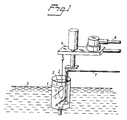
- the pieces 1 were mounted in organ baths 2, which held physiological buffer solutions 3 and were equipped with tension sensors 4 (Fig. 1).
- the buffer solution was Kreb's bicarbonate buffer and was kept at 37°C which was achieved by keeping the organ bath immersed into a water bath 5 of 37°C.
- the isometric tension was registered by means of Grass-amplifiers 6, which were equipped with recorders. Gas of the composition 5% carbon dioxide and 95% oxygen was pumped in through a conduit 7.
- the artery pieces were allowed to obtain equilibrium during 2 hours. Then the arteries were contracted with 3 ⁇ M phenylephrine. When a stable contraction was obtained, TNT was added in rising concentrations (10 ⁇ 15 - 3 x 10 ⁇ 7 M), and the mechanical effects from each addition were recorded.
- E E max x A q /( A q + EC50 q ) by means of a non-linear regression analysis utilizing a computer and a digital plotter.
- E, E max and A are the observed effect, the maximum effect and the concentration of the agonist (in this case TNT) respectively.
- EC50 is the concentration which gives half of the maximum effect and q is the slope of the curve.
- the results are presented as arithmetric average values ⁇ S.E.M. (standard error of means).
- TNT in extremely small amounts relax precontracted bovine mesenterial arteries (Fig. 2).
- the lowest concentration of TNT giving a reproducible effect corresponds to the theoretical detection limit of mine dogs. In occasional cases, effects of even smaller amounts of TNT could be observed.
Landscapes
- Chemical & Material Sciences (AREA)
- Life Sciences & Earth Sciences (AREA)
- Engineering & Computer Science (AREA)
- Health & Medical Sciences (AREA)
- Analytical Chemistry (AREA)
- Food Science & Technology (AREA)
- Medicinal Chemistry (AREA)
- Physics & Mathematics (AREA)
- Combustion & Propulsion (AREA)
- Biochemistry (AREA)
- General Health & Medical Sciences (AREA)
- General Physics & Mathematics (AREA)
- Immunology (AREA)
- Pathology (AREA)
- Investigating Or Analysing Biological Materials (AREA)
- Measuring Or Testing Involving Enzymes Or Micro-Organisms (AREA)
- Measurement Of The Respiration, Hearing Ability, Form, And Blood Characteristics Of Living Organisms (AREA)
Abstract
Description
- The present invention relates to a method and a device for the detection of the presence of vessel dilat components in a gas, particularly in air. A biological detector is used with intestinal blood vessels or parts thereof as the sensor element. The present invention can especially be used for the detection of explosives, such as trinitrotoluene (TNT) and nitroglycerin. By means of the present invention it is possible to detect TNT in as small amounts as 10⁻¹⁵ mol. The sensitivity for nitroglycerin is also high, even if concentrations just as low cannot be detected.
- Vessel dilatating substances can be analyzed with the use of chemically advanced and expensive equipments, being however more suitable for laboratory work. There is, however, a demand for a more field-adapted analysis apparatus, which can be used at places of work. A field-adapted analysis apparatus is also required to be used when you are searching for explosives that have been placed by terrorists and for the supervision of airports and to prevent the smuggling of explosives. It is also important to be able to find mines which have been placed in order to damage the civilian population or in order to prevent the advance of military units.
- The best and most reliable method up to now for a more field-adapted detection of explosives has been to use dogs. Dogs are reported to have a sensitivity of up to 10⁻¹⁵ mol of TNT, which corresponds to about 10⁻¹³ g, a sensitivity which very well agrees with the requirements given if you should be able to detect a mine when passing. Also other animals such as rats have been tried and found to achieve the same high sensitivity.
- We have now found that the same high sensitivity, which is achieved with rats and dogs, can be obtained if instead you use a biological preparation in vitro consisting of precontracted blood vessels in the form of sections, pieces, cellular or subcellular portions thereof, and allow air comprising the vessel dilatating components, for instance vapours from the explosive TNT or nitroglycerin to pass the preparation and observe the effect of the vessel dilatating component on the vessel muscle.
- Thus, the effect of the explosive vapours on the blood vessel musculature can be studied. We have found that if the vessel muscle is shortened, precontracted with phenylephrine, an adrenaline-like substance, extremely small concentrations of TNT will cause relaxation of the muscle. The effect of TNT on the vessel muscle contraction can be observed at as small amounts of TNT as 10⁻¹⁵ mol, which is identical with the detection limit of the mine dogs for TNT. Thus, the biological detector according to the invention can register a mine which is enclosed in a metal or plastic casing just by allowing the detector to pass in the vicinity of the mine. It can very well be used to check luggage at airports, locate bombs during bomb threats and the like, i.e.the biological detector of the invention fulfils the demands for sensitivity as well as for usability in the field.
- In order to be able to register the effect of the vessel dilatation component on the blood vessel musculature, you can measure directly the change in the tension force in the muscle or the muscle elongation. You can also study the effect on the enzyme which is active at the transfer of the chemical stimulation leading to vessel dilatation. This enzyme is believed to be the hemoprotein guanylate cyclase. The hemoprotein reaction can be registered optically, for instance with the use of a fibre-optical sensor.
- A device according to the present invention, measuring for instance the change in the vessel muscle contraction caused by the explosive, comprises a force measuring element, to which the vessel musculature is attached. The vessel muscle is preserved in a container containing an organ bath giving nutriment and also a proper milieu for the muscle. The muscle is also attached to the bottom of the container. Gas of a suitable composition is pumped through the container. The vapour which is to be examined is also sucked or pumped into the container the same way.
- The sensor elements in the form of blood vessel pieces can be stored cold and attached inside expendable packages provided with holds for force measuring elements and counterholdings. During the analysis the blood vessel piece used in the apparatus can be exchanged for new blood vessel pieces by just a single manipulation.
- The blood vessels used in accordance with the invention are preferably taken from newly slaughtered mammals, such as cows and pigs, but also from reptiles, such as snakes. If vessels from reptiles are being used, the organ bath in the form of a physiological buffer solution must not be kept at +37°C but can be of the same temperature as the environment. Intestinal blood vessels can, for instance, be used.
- The invention will now be described in more detail in an illustrative but not delimiting purpose by means of an example, and reference is made to the attached drawings, where
- Fig. 1 shows a device according to the invention and
- Fig. 2 shows
- (A) a representative registration of the effects of TNT. The blood vessel was mounted in a tension meter, and 30 µM phenylephrine (an adrenaline-like substance) was used as contracting agent;
- (B) a concentration-effect curve for TNT. The effect (the y-axis) gives the percentage tension change induced by different concentrations of TNT (0 % tension = before the addition of phenylephrine; 100 % = after the addition of 30 µM phenylephrine). The vertical lines give the S.E.M. (n=15).
- Bovine mesenterial arteries were fetched from a local slaughter-house within 30 minutes after the slaughter. The arteries were transported to the laboratory in a thermos flask, which contained a physiological buffer solution. After the removal of surrounding fat, the arteries were opened longitudinally and then cut into pieces of about 5 mm. The pieces 1 were mounted in
organ baths 2, which held physiological buffer solutions 3 and were equipped with tension sensors 4 (Fig. 1). The buffer solution was Kreb's bicarbonate buffer and was kept at 37°C which was achieved by keeping the organ bath immersed into awater bath 5 of 37°C. The isometric tension was registered by means of Grass-amplifiers 6, which were equipped with recorders. Gas of thecomposition 5% carbon dioxide and 95% oxygen was pumped in through aconduit 7. After the mounting had taken place, the artery pieces were allowed to obtain equilibrium during 2 hours. Then the arteries were contracted with 3 µM phenylephrine. When a stable contraction was obtained, TNT was added in rising concentrations (10⁻¹⁵ - 3 x 10⁻⁷ M), and the mechanical effects from each addition were recorded. - Experimental data for the varying additions of TNT were adapted to the logistical function:

by means of a non-linear regression analysis utilizing a computer and a digital plotter. E, Emax and A are the observed effect, the maximum effect and the concentration of the agonist (in this case TNT) respectively. EC₅₀ is the concentration which gives half of the maximum effect and q is the slope of the curve. The results are presented as arithmetric average values ± S.E.M. (standard error of means). - It was found that TNT in extremely small amounts relax precontracted bovine mesenterial arteries (Fig. 2). The lowest concentration of TNT giving a reproducible effect corresponds to the theoretical detection limit of mine dogs. In occasional cases, effects of even smaller amounts of TNT could be observed.
Claims (10)
- Method for the detection of the presence of vessel dilatation components in a gas, characterized by precontraction of a blood vessel preparation, exposure of the preparation to the vessel dilatation component and determination of the relaxation of the preparation caused by the exposure.
- Method according to claim 1, characterized in that the biological preparation consists of sections or pieces of arteries or veins or cellular or subcellular portions thereof.
- Method according to claim 1 or 2, characterized in that the preparation is made from blood vessels from mammals, for instance from cow or pig.
- Method according to claim 1 or 2, characterized in that the preparation is made from blood vessels from reptiles, for instance from snake.
- Method according to any one of claims 1 - 4, characterized in that the precontraction of the preparation is made by means of an alpha-adrenoceptor agonist, for instance adrenaline or phenylephrine.
- Method according to any one of claims 1 - 5, characterized in that the activity of the dilatation stimulating enzyme in the blood vessel preparation is determined before as well as after the exposure.
- Method according to claim 6, characterized in that the effect of the exposure on the contents of hemoprotein in the blood vessel preparation is determined optically, for instance by means of a fibre-optical sensor.
- Method according to any one of claims 1 - 7, characterized in that the presence of vessel dilatation components is detected in air.
- Method according to any one of claims 1 - 8, characterized in that the presence of explosives, such as trinitrotoluene (TNT) or nitroglycerin, is determined by allowing the vessel dilatation vapours released from the explosive to the environment to act upon precontracted blood vessel preparations.
- Device for the detection of vessel dilatation components, characterized by comprising a precontracted preparation (1) consisting of a blood vessel or part thereof; an organ bath (2) comprising a physiological buffer solution (3) being suitable for the preparation; a water bath (5) into which the organ bath is immersed and having a temperature being suitable to the preparation; a conduit (7) for gas supply to the preparation; a tension meter (4); holds for attachment of the preparation to the organ bath and to the tension meter; and a device (6) for registration of the change in the preparation tension or length caused by the presence of the blood vessel relaxation.
Applications Claiming Priority (3)
| Application Number | Priority Date | Filing Date | Title |
|---|---|---|---|
| SE8902294 | 1989-06-22 | ||
| SE8902294A SE465292B (en) | 1989-06-22 | 1989-06-22 | PROCEDURE AND DEVICE FOR THE DETECTION OF VARIABLE COMPONENTS WITH THE USE OF BLOOD CEREALS |
| PCT/SE1990/000451 WO1990015991A1 (en) | 1989-06-22 | 1990-06-21 | Method and device for the detection of vessel dilatation components |
Publications (2)
| Publication Number | Publication Date |
|---|---|
| EP0478679A1 EP0478679A1 (en) | 1992-04-08 |
| EP0478679B1 true EP0478679B1 (en) | 1995-09-20 |
Family
ID=20376382
Family Applications (1)
| Application Number | Title | Priority Date | Filing Date |
|---|---|---|---|
| EP90910165A Expired - Lifetime EP0478679B1 (en) | 1989-06-22 | 1990-06-21 | Method and device for the detection of vessel dilatating components |
Country Status (7)
| Country | Link |
|---|---|
| US (1) | US5348851A (en) |
| EP (1) | EP0478679B1 (en) |
| JP (1) | JPH06506296A (en) |
| DE (1) | DE69022591T2 (en) |
| DK (1) | DK0478679T3 (en) |
| SE (1) | SE465292B (en) |
| WO (1) | WO1990015991A1 (en) |
Families Citing this family (2)
| Publication number | Priority date | Publication date | Assignee | Title |
|---|---|---|---|---|
| US6622345B2 (en) * | 2001-05-29 | 2003-09-23 | Hoshizaki America, Inc. | Door hinge mechanism |
| IT202100004736A1 (en) * | 2021-03-01 | 2022-09-01 | Cocktailsmachine Srl | CONNECTOR FOR FLUID DISPENSER |
Family Cites Families (2)
| Publication number | Priority date | Publication date | Assignee | Title |
|---|---|---|---|---|
| US3430482A (en) * | 1967-07-20 | 1969-03-04 | Us Army | Automatic bomb detector |
| US3568411A (en) * | 1969-03-18 | 1971-03-09 | Us Army | Chemosensor bomb detection device |
-
1989
- 1989-06-22 SE SE8902294A patent/SE465292B/en not_active IP Right Cessation
-
1990
- 1990-06-21 JP JP2509484A patent/JPH06506296A/en active Pending
- 1990-06-21 DK DK90910165.1T patent/DK0478679T3/en active
- 1990-06-21 US US07/834,227 patent/US5348851A/en not_active Expired - Fee Related
- 1990-06-21 EP EP90910165A patent/EP0478679B1/en not_active Expired - Lifetime
- 1990-06-21 WO PCT/SE1990/000451 patent/WO1990015991A1/en not_active Ceased
- 1990-06-21 DE DE69022591T patent/DE69022591T2/en not_active Expired - Fee Related
Also Published As
| Publication number | Publication date |
|---|---|
| SE8902294D0 (en) | 1989-06-22 |
| DK0478679T3 (en) | 1996-02-12 |
| US5348851A (en) | 1994-09-20 |
| JPH06506296A (en) | 1994-07-14 |
| DE69022591D1 (en) | 1995-10-26 |
| DE69022591T2 (en) | 1996-05-02 |
| SE465292B (en) | 1991-08-19 |
| WO1990015991A1 (en) | 1990-12-27 |
| EP0478679A1 (en) | 1992-04-08 |
| SE8902294L (en) | 1991-01-28 |
Similar Documents
| Publication | Publication Date | Title |
|---|---|---|
| Racotta et al. | Hemolymph metabolic variables in response to experimental manipulation stress and serotonin injection in Penaeus vannamei | |
| US5348851A (en) | Method and device for the detection of vessel dilatation components | |
| Acquarone et al. | Field metabolic rates of walrus (Odobenus rosmarus) measured by the doubly labeled water method | |
| CURRIER et al. | Hematology and blood chemistry of the mountain lion (Felis concolor) | |
| Stoeppler et al. | Comparative studies on trace metal levels in marine biota: II. Trace metals in krill, krill products, and fish from the antarctic scotia sea | |
| WO1990015990A1 (en) | Method and device for the detection of explosives | |
| Heming | Clinical studies of fish blood: importance of sample collection and measurement techniques | |
| Moriarty | Persistent contaminants, compartmental models and concentration along food-chains | |
| Veselá et al. | Determination of acrylamide in dry feedstuff for dogs and cats | |
| SE504986C2 (en) | Tri:nitrotoluene for medical purposes | |
| Stehr et al. | Environmental assessment of Vancouver Harbour data report for the PICES practical workshop | |
| ATE164009T1 (en) | METHOD AND DEVICE FOR DETERMINING GLYCOSYLATED PROTEIN | |
| Hoben et al. | A study of the inhalation of pentachlorophenol by rats part V. A protein binding study of pentachlorophenol | |
| US4119402A (en) | Method to measure in vivo N-nitroso compounds | |
| Ulrich et al. | A Range-Gated Pulse-Echo Ultrasonic System for Detection of Bubbles in Decompression Sickness. | |
| McCormick et al. | Identification of deer meat in cooked products | |
| Hammond et al. | Pulmonary metabolic function can serve as a monitor for lung preservation. | |
| Verthé et al. | Technetium in marine animals | |
| Niimi | Quantitative analysis of carbon-14 labelled polychlorinated biphenyls and hexachlorobenzene in biological samples using an oxidative combustion method | |
| McFarland et al. | Application of physicochemical estimation methods to bioaccumulation from contaminated sediments. II. Steady-state from single time-point observations | |
| Adolfs et al. | Detection of small amounts of prostaglandin (PG)-like material and rabbit aorta contracting substance (RCS) released into the blood of the rat [proceedings] | |
| Kniseley et al. | An Inductively Coupled Plasma Analytical System to Simultaneously Determine in Body Fluids Trace Elements Associated with Cardiovascular Disease. | |
| Boychuk | Hepatic mixed-function oxidase enzymes in white suckers (Catostomas commersoni) over a seasonal cycle and following injection with PCB Congener 77 | |
| Sturm et al. | Separation of Water Samples into Seston and Water for the Determination of Organic Pollutants(Trennung von Wasser in Schwebstoffe und Wasser zur Bestimmung Organischer Spurenstoffe in Oberflaechengewaessern) | |
| Petrovská et al. | The Polarographic Analysis of Seminal Fluids as a Method for the Study of their Antigenicity |
Legal Events
| Date | Code | Title | Description |
|---|---|---|---|
| PUAI | Public reference made under article 153(3) epc to a published international application that has entered the european phase |
Free format text: ORIGINAL CODE: 0009012 |
|
| 17P | Request for examination filed |
Effective date: 19911213 |
|
| AK | Designated contracting states |
Kind code of ref document: A1 Designated state(s): DE DK FR GB IT SE |
|
| 17Q | First examination report despatched |
Effective date: 19931228 |
|
| RAP1 | Party data changed (applicant data changed or rights of an application transferred) |
Owner name: FOERSVARETS FORSKNINGSANSTALT |
|
| GRAA | (expected) grant |
Free format text: ORIGINAL CODE: 0009210 |
|
| AK | Designated contracting states |
Kind code of ref document: B1 Designated state(s): DE DK FR GB IT SE |
|
| REF | Corresponds to: |
Ref document number: 69022591 Country of ref document: DE Date of ref document: 19951026 |
|
| ITF | It: translation for a ep patent filed | ||
| ET | Fr: translation filed | ||
| REG | Reference to a national code |
Ref country code: DK Ref legal event code: T3 |
|
| PLBE | No opposition filed within time limit |
Free format text: ORIGINAL CODE: 0009261 |
|
| STAA | Information on the status of an ep patent application or granted ep patent |
Free format text: STATUS: NO OPPOSITION FILED WITHIN TIME LIMIT |
|
| 26N | No opposition filed | ||
| PGFP | Annual fee paid to national office [announced via postgrant information from national office to epo] |
Ref country code: DE Payment date: 19990617 Year of fee payment: 10 |
|
| PGFP | Annual fee paid to national office [announced via postgrant information from national office to epo] |
Ref country code: FR Payment date: 19990629 Year of fee payment: 10 Ref country code: DK Payment date: 19990629 Year of fee payment: 10 |
|
| PGFP | Annual fee paid to national office [announced via postgrant information from national office to epo] |
Ref country code: GB Payment date: 20000620 Year of fee payment: 11 |
|
| PG25 | Lapsed in a contracting state [announced via postgrant information from national office to epo] |
Ref country code: DK Free format text: LAPSE BECAUSE OF NON-PAYMENT OF DUE FEES Effective date: 20000621 |
|
| REG | Reference to a national code |
Ref country code: DK Ref legal event code: EBP |
|
| PG25 | Lapsed in a contracting state [announced via postgrant information from national office to epo] |
Ref country code: FR Free format text: LAPSE BECAUSE OF NON-PAYMENT OF DUE FEES Effective date: 20010228 |
|
| REG | Reference to a national code |
Ref country code: FR Ref legal event code: ST |
|
| PG25 | Lapsed in a contracting state [announced via postgrant information from national office to epo] |
Ref country code: DE Free format text: LAPSE BECAUSE OF NON-PAYMENT OF DUE FEES Effective date: 20010403 |
|
| PG25 | Lapsed in a contracting state [announced via postgrant information from national office to epo] |
Ref country code: GB Free format text: LAPSE BECAUSE OF NON-PAYMENT OF DUE FEES Effective date: 20010621 |
|
| PGFP | Annual fee paid to national office [announced via postgrant information from national office to epo] |
Ref country code: SE Payment date: 20010629 Year of fee payment: 12 |
|
| GBPC | Gb: european patent ceased through non-payment of renewal fee |
Effective date: 20010621 |
|
| PG25 | Lapsed in a contracting state [announced via postgrant information from national office to epo] |
Ref country code: SE Free format text: LAPSE BECAUSE OF NON-PAYMENT OF DUE FEES Effective date: 20020622 |
|
| EUG | Se: european patent has lapsed | ||
| PG25 | Lapsed in a contracting state [announced via postgrant information from national office to epo] |
Ref country code: IT Free format text: LAPSE BECAUSE OF NON-PAYMENT OF DUE FEES;WARNING: LAPSES OF ITALIAN PATENTS WITH EFFECTIVE DATE BEFORE 2007 MAY HAVE OCCURRED AT ANY TIME BEFORE 2007. THE CORRECT EFFECTIVE DATE MAY BE DIFFERENT FROM THE ONE RECORDED. Effective date: 20050621 |