EP0477819B1 - Benzimidazole derivatives, their preparation and use - Google Patents
Benzimidazole derivatives, their preparation and use Download PDFInfo
- Publication number
- EP0477819B1 EP0477819B1 EP91116148A EP91116148A EP0477819B1 EP 0477819 B1 EP0477819 B1 EP 0477819B1 EP 91116148 A EP91116148 A EP 91116148A EP 91116148 A EP91116148 A EP 91116148A EP 0477819 B1 EP0477819 B1 EP 0477819B1
- Authority
- EP
- European Patent Office
- Prior art keywords
- chloro
- dihydro
- hydroxyphenyl
- trifluoromethyl
- compound
- Prior art date
- Legal status (The legal status is an assumption and is not a legal conclusion. Google has not performed a legal analysis and makes no representation as to the accuracy of the status listed.)
- Expired - Lifetime
Links
- 0 Cc1c(*)c(*)c(*=*)c(N2c3c(*)c(*)c(*)c(*)c3N(*)C2=*)c1* Chemical compound Cc1c(*)c(*)c(*=*)c(N2c3c(*)c(*)c(*)c(*)c3N(*)C2=*)c1* 0.000 description 2
Classifications
-
- C—CHEMISTRY; METALLURGY
- C07—ORGANIC CHEMISTRY
- C07D—HETEROCYCLIC COMPOUNDS
- C07D235/00—Heterocyclic compounds containing 1,3-diazole or hydrogenated 1,3-diazole rings, condensed with other rings
- C07D235/02—Heterocyclic compounds containing 1,3-diazole or hydrogenated 1,3-diazole rings, condensed with other rings condensed with carbocyclic rings or ring systems
- C07D235/04—Benzimidazoles; Hydrogenated benzimidazoles
- C07D235/06—Benzimidazoles; Hydrogenated benzimidazoles with only hydrogen atoms, hydrocarbon or substituted hydrocarbon radicals, directly attached in position 2
- C07D235/12—Radicals substituted by oxygen atoms
-
- C—CHEMISTRY; METALLURGY
- C07—ORGANIC CHEMISTRY
- C07D—HETEROCYCLIC COMPOUNDS
- C07D235/00—Heterocyclic compounds containing 1,3-diazole or hydrogenated 1,3-diazole rings, condensed with other rings
- C07D235/02—Heterocyclic compounds containing 1,3-diazole or hydrogenated 1,3-diazole rings, condensed with other rings condensed with carbocyclic rings or ring systems
- C07D235/04—Benzimidazoles; Hydrogenated benzimidazoles
- C07D235/24—Benzimidazoles; Hydrogenated benzimidazoles with hetero atoms or with carbon atoms having three bonds to hetero atoms with at the most one bond to halogen, e.g. ester or nitrile radicals, directly attached in position 2
- C07D235/30—Nitrogen atoms not forming part of a nitro radical
-
- A—HUMAN NECESSITIES
- A61—MEDICAL OR VETERINARY SCIENCE; HYGIENE
- A61P—SPECIFIC THERAPEUTIC ACTIVITY OF CHEMICAL COMPOUNDS OR MEDICINAL PREPARATIONS
- A61P11/00—Drugs for disorders of the respiratory system
- A61P11/06—Antiasthmatics
-
- A—HUMAN NECESSITIES
- A61—MEDICAL OR VETERINARY SCIENCE; HYGIENE
- A61P—SPECIFIC THERAPEUTIC ACTIVITY OF CHEMICAL COMPOUNDS OR MEDICINAL PREPARATIONS
- A61P11/00—Drugs for disorders of the respiratory system
- A61P11/08—Bronchodilators
-
- A—HUMAN NECESSITIES
- A61—MEDICAL OR VETERINARY SCIENCE; HYGIENE
- A61P—SPECIFIC THERAPEUTIC ACTIVITY OF CHEMICAL COMPOUNDS OR MEDICINAL PREPARATIONS
- A61P25/00—Drugs for disorders of the nervous system
- A61P25/08—Antiepileptics; Anticonvulsants
-
- A—HUMAN NECESSITIES
- A61—MEDICAL OR VETERINARY SCIENCE; HYGIENE
- A61P—SPECIFIC THERAPEUTIC ACTIVITY OF CHEMICAL COMPOUNDS OR MEDICINAL PREPARATIONS
- A61P9/00—Drugs for disorders of the cardiovascular system
- A61P9/08—Vasodilators for multiple indications
-
- A—HUMAN NECESSITIES
- A61—MEDICAL OR VETERINARY SCIENCE; HYGIENE
- A61P—SPECIFIC THERAPEUTIC ACTIVITY OF CHEMICAL COMPOUNDS OR MEDICINAL PREPARATIONS
- A61P9/00—Drugs for disorders of the cardiovascular system
- A61P9/10—Drugs for disorders of the cardiovascular system for treating ischaemic or atherosclerotic diseases, e.g. antianginal drugs, coronary vasodilators, drugs for myocardial infarction, retinopathy, cerebrovascula insufficiency, renal arteriosclerosis
-
- A—HUMAN NECESSITIES
- A61—MEDICAL OR VETERINARY SCIENCE; HYGIENE
- A61P—SPECIFIC THERAPEUTIC ACTIVITY OF CHEMICAL COMPOUNDS OR MEDICINAL PREPARATIONS
- A61P9/00—Drugs for disorders of the cardiovascular system
- A61P9/12—Antihypertensives
-
- C—CHEMISTRY; METALLURGY
- C07—ORGANIC CHEMISTRY
- C07D—HETEROCYCLIC COMPOUNDS
- C07D235/00—Heterocyclic compounds containing 1,3-diazole or hydrogenated 1,3-diazole rings, condensed with other rings
- C07D235/02—Heterocyclic compounds containing 1,3-diazole or hydrogenated 1,3-diazole rings, condensed with other rings condensed with carbocyclic rings or ring systems
- C07D235/04—Benzimidazoles; Hydrogenated benzimidazoles
- C07D235/24—Benzimidazoles; Hydrogenated benzimidazoles with hetero atoms or with carbon atoms having three bonds to hetero atoms with at the most one bond to halogen, e.g. ester or nitrile radicals, directly attached in position 2
- C07D235/26—Oxygen atoms
-
- C—CHEMISTRY; METALLURGY
- C07—ORGANIC CHEMISTRY
- C07D—HETEROCYCLIC COMPOUNDS
- C07D235/00—Heterocyclic compounds containing 1,3-diazole or hydrogenated 1,3-diazole rings, condensed with other rings
- C07D235/02—Heterocyclic compounds containing 1,3-diazole or hydrogenated 1,3-diazole rings, condensed with other rings condensed with carbocyclic rings or ring systems
- C07D235/04—Benzimidazoles; Hydrogenated benzimidazoles
- C07D235/24—Benzimidazoles; Hydrogenated benzimidazoles with hetero atoms or with carbon atoms having three bonds to hetero atoms with at the most one bond to halogen, e.g. ester or nitrile radicals, directly attached in position 2
- C07D235/28—Sulfur atoms
Definitions
- the present invention relates to novel benzimidazole derivatives, a method of preparing the same, and a pharmaceutical composition comprising the same as well as to their use for the manufacture of a medicament for the treatment of certain disorders such as hypertension, asthma, ischemica and convulsions.
- K+ channels potassium (K+) channels leads to a hyperpolarization and relaxation of cells.
- K+ channel openers cromakalim and pinacidil for example
- They exert their effect primarily via the ATP sensitive K+ channel. They have a high affinity for vascular smooth muscle cells and are thus mostly vasodilators.
- K+ channel openers hyperpolarizing neuronal cells also have anticonvulsive and antiischemic effects in the central nervous system (the CNS) (European Journal of Pharmacology 167 , 181-183 (1989), Neuroscience Letters 115 , 195-200 (1990), Neuroscience 37(1) , 55-60 (1990), The Journal of Pharmacology and Experimental Therapeutics 251(1) , 98-104 (1989)).
- Bianchi et al. in Eur. J. Med. Chem. - Chimica Therapeutica 16(4) , 321-326 (1981) discloses benzimidazolin-2-one derivatives having anti-ulcer and anti-secretory activity.
- EP-A-0,051,827 discloses omega-(2-oxo-benzazolinyl)-alkanoic acid derivatives and certain benzimidazol-2-one derivatives useful in the treatment of asthma, allergy, atereosclerosis and inflammation.
- EP-A-0,232,937 discloses that certain piperidin-4-amines, and among them certain N-(2-benzimidazolyl)-4-piperidinamines have anti-allergic properties.
- CH-A-460,028 discloses that certain 1-phenyl-3-aminoalkyl-benzimidazol-2-one derivatives possess antidepressive and anti-convulsive properties.
- US-A-3,989,709 discloses fused ring benzimidazole derivatives having hypotensive properties.
- GB-A-1,408,408 discloses that certain 1-alkyl-2-cyanamino-benzimidazoles having anti-hypertensive activity.
- FR-A-1,561,830 discloses that certain 1-(4-alkoxy-phenyl)-benzimidazol-2-one derivatives have interesting pharmacological properties.
- DE-A-2,725,957 discloses a method for the preparation of benzimidazol-2-one derivatives.
- R1 is hydrogen, NH2 or C1 ⁇ 6-alkyl which may be branched;
- X is 0, S or NCN;
- Y is 0 or S;
- R11 is hydrogen, halogen, NO2 or SO2NR'R'' wherein R' and R'' independently are hydrogen or C1 ⁇ 6-alkyl;
- R13 is hydrogen, halogen, phenyl, CF3 or NO2;
- R12 is hydrogen or together with R13 forms a C4 ⁇ 7-carbocyclic ring which may be aromatic or partially saturated;
- R14 is hydrogen or together with R13 forms a C4 ⁇ 7-carbocyclic ring which may be aromatic
- the present invention provides the use of a compound of the above general formula for the manufacture of a medicament for the treatment of a disorder of an animal body, including human, responsive to the opening of potassium channels and, more specifically, to the use for the manufacture of a medicament for treating hypertension, asthma, ischemia or convulsions.
- a pharmaceutical composition comprising a therapeutically-effective amount of a compound of the above general formula together with a pharmaceutically-acceptable carrier.
- the compound of the above general formula is prepared by a method which comprises the step of reacting a compound having the formula wherein R1, R4, R5, R6, R7, Y, R11, R12, R13 and R14 have the meanings set forth above with phosgene, thiocarbonyl diimidazol or N-cyanoimido-S,S'-dimethyldithiocarbonate.
- the compounds of the present invention are potent openers of the high conductance, calcium activated K+-channel, sometimes referred to as the Big K+ channel or the BK Ca channel.
- the BK Ca channel is present in most neuronal cells, in airway and vascular smooth muscle cells as well as in pancreatic ⁇ -cells.
- N1E-115 neuroblastoma cells The membrane potential of N1E-115 neuroblastoma cells was determined in whole-cell recordings using current clamp mode (HEKA EPC-9 patch-clamp amplifier). Due to the high-resistance seal and the large size of these cells the recorded membrane potential stayed stable for periods of 30-60 min, although at somewhat depolarized values (-15 - -60 Mv).
- the BK Ca channel in granule cells has been studied in symmetric 144 mM K+, and under these conditions the average conductance is 154 pS (76 pS with 4 mM external K+).
- Charybdotoxin blocks the channel in outside-out patches with the characteristic blocking pattern of silent periods interdispersed with periods of low or normal activity, thus confirming the identity of the channel activated by the compounds of the invention.
- compositions and unit dosages thereof may be placed into the form of pharmaceutical compositions and unit dosages thereof, and in such form may be employed as solids, such as tablets or filled capsules, or liquids such as solutions, suspensions, emulsions, elixirs, or capsules filled with the same, all for oral use, in the form of suppositories for rectal administration; or in the form of sterile injectable solutions for parenteral (including subcutaneous) use.
- Such pharmaceutical compositions and unit dosage forms thereof may comprise conventional ingredients in conventional proportions, with or without additional active compounds or principles, and such unit dosage forms may contain any suitable effective amount of the active ingredient commensurate with the intended daily dosage range to be employed. Tablets containing 10 mg of active ingredients or, more broadly, 0.1 to 100 mg, per tablet, are accordingly suitable representative unit dosage forms.
- Medicaments comprising the compounds of this invention are extremely useful in the treatment of disorders of mammals due to the potent potassium channel activating properties of the compounds of this invention.
- medicaments comprising the compounds of this invention are extremely useful in the treatment of convulsions, asthma, hypertension, ischemia, and other disorders sensitive to potassium channel activating activity such as epilepsia.
- reaction mixture was poured onto water, the crystalline product was collected by filtration and the acetate was hydrolysed by reflux in ethanol (50 ml) and 4M sodium hydroxide (5 ml) for 1 h.
- the reaction mixture was acidified by addition of 4M hydrochloric acid and water was added until precipitation started.
- the mixture was cooled and the crystals were collected by filtration yielding the title compound as slightly yellow crystals, M.p. 262-264°C.
Landscapes
- Health & Medical Sciences (AREA)
- Chemical & Material Sciences (AREA)
- Organic Chemistry (AREA)
- Engineering & Computer Science (AREA)
- Bioinformatics & Cheminformatics (AREA)
- Life Sciences & Earth Sciences (AREA)
- Veterinary Medicine (AREA)
- Chemical Kinetics & Catalysis (AREA)
- General Chemical & Material Sciences (AREA)
- Medicinal Chemistry (AREA)
- Nuclear Medicine, Radiotherapy & Molecular Imaging (AREA)
- Pharmacology & Pharmacy (AREA)
- Animal Behavior & Ethology (AREA)
- General Health & Medical Sciences (AREA)
- Public Health (AREA)
- Cardiology (AREA)
- Heart & Thoracic Surgery (AREA)
- Pulmonology (AREA)
- Vascular Medicine (AREA)
- Pain & Pain Management (AREA)
- Biomedical Technology (AREA)
- Neurology (AREA)
- Neurosurgery (AREA)
- Urology & Nephrology (AREA)
- Pharmaceuticals Containing Other Organic And Inorganic Compounds (AREA)
- Plural Heterocyclic Compounds (AREA)
- Nitrogen And Oxygen Or Sulfur-Condensed Heterocyclic Ring Systems (AREA)
- Nitrogen Condensed Heterocyclic Rings (AREA)
- Polyesters Or Polycarbonates (AREA)
- Graft Or Block Polymers (AREA)
Abstract
Description
- The present invention relates to novel benzimidazole derivatives, a method of preparing the same, and a pharmaceutical composition comprising the same as well as to their use for the manufacture of a medicament for the treatment of certain disorders such as hypertension, asthma, ischemica and convulsions.
- It is generally well known that opening of potassium (K⁺) channels leads to a hyperpolarization and relaxation of cells. The presently known K⁺ channel openers (cromakalim and pinacidil for example) exert their effect primarily via the ATP sensitive K⁺ channel. They have a high affinity for vascular smooth muscle cells and are thus mostly vasodilators. Recent studies indicate, however, that K⁺ channel openers hyperpolarizing neuronal cells also have anticonvulsive and antiischemic effects in the central nervous system (the CNS) (European Journal of Pharmacology 167, 181-183 (1989), Neuroscience Letters 115, 195-200 (1990), Neuroscience 37(1), 55-60 (1990), The Journal of Pharmacology and Experimental Therapeutics 251(1), 98-104 (1989)). Furthermore recent studies demonstrate that potassium channel openers acting on airways smooth muscle (tracheal smooth muscle) cells will have anti-asthmatic effects (Small et al., K⁺-channel opening as a mechanism for relaxing airways smooth muscle in New Anti-Asthma Drugs (pp 89-94) 1988 Birkhäuser Verlag Basel, and Dr. S.G. Dilly, Cromakalim/Lemakalim, experience in hypertension and nocturnal asthma in Conference Documentation, Potassium Channels '90, The Royal College of Physicians, Dec. 6-7, 1990).
- Bianchi et al. in Eur. J. Med. Chem. - Chimica Therapeutica 16(4), 321-326 (1981) discloses benzimidazolin-2-one derivatives having anti-ulcer and anti-secretory activity.
- Clark et al. in J. Med. Chem. 21(9), 965-978 (1978) discloses imidazo[4,5-b]pyridin-2-one derivatives having analgesic activity.
- EP-A-0,051,827 discloses omega-(2-oxo-benzazolinyl)-alkanoic acid derivatives and certain benzimidazol-2-one derivatives useful in the treatment of asthma, allergy, atereosclerosis and inflammation.
- EP-A-0,232,937 discloses that certain piperidin-4-amines, and among them certain N-(2-benzimidazolyl)-4-piperidinamines have anti-allergic properties.
- CH-A-460,028 discloses that certain 1-phenyl-3-aminoalkyl-benzimidazol-2-one derivatives possess antidepressive and anti-convulsive properties.
- US-A-3,989,709 discloses fused ring benzimidazole derivatives having hypotensive properties.
- GB-A-1,408,408 discloses that certain 1-alkyl-2-cyanamino-benzimidazoles having anti-hypertensive activity.
- FR-A-1,561,830 discloses that certain 1-(4-alkoxy-phenyl)-benzimidazol-2-one derivatives have interesting pharmacological properties.
- DE-A-2,725,957 discloses a method for the preparation of benzimidazol-2-one derivatives.
- It is the object of the present invention to provide novel benzimidazole compounds which are useful in the treatment of diseases in mammals, including a human, and especially in the treatment of diseases which can be treated by opening cell membrane potassium channels of such mammals.
- According to the present invention, this object is achieved with a compound having the formula
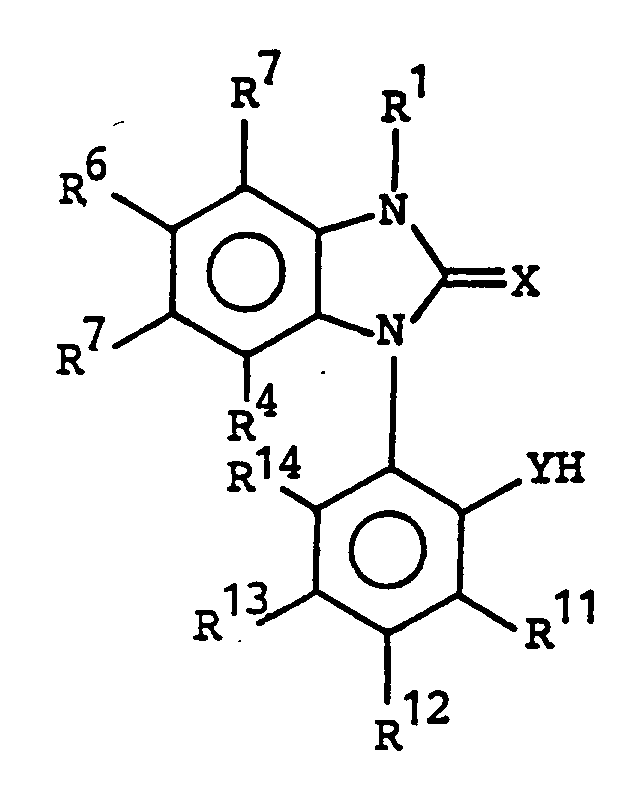
wherein R¹ is hydrogen, NH₂ or C₁₋₆-alkyl which may be branched;
X is 0, S or NCN;
Y is 0 or S;
R⁴, R⁵, R⁶ and R⁷ each independently are hydrogen, halogen, CF₃, NO₂, NH₂, OH, C₁₋₆-alkoxy, C(=O)-phenyl or SO₂NRIRII wherein RI and RII independently are hydrogen or C₁₋₆-alkyl;
R¹¹ is hydrogen, halogen, NO₂ or SO₂NR'R'' wherein R' and R'' independently are hydrogen or C₁₋₆-alkyl;
R¹³ is hydrogen, halogen, phenyl, CF₃ or NO₂;
R¹² is hydrogen or together with R¹³ forms a C₄₋₇-carbocyclic ring which may be aromatic or partially saturated;
R¹⁴ is hydrogen or together with R¹³ forms a C₄₋₇-carbocyclic ring which may be aromatic or partially saturated;
and with a compound as the above which is 5-trifluoromethyl-2,3-dihydro-1-(5-chloro-2-hydroxyphenyl)-1H-2-oxo-benzimidazole,
a compound as the above which is 5-trifluoromethyl-2,3-dihydro-1-(5-phenyl-2-hydroxyphenyl)-1H-2-oxo-benzimidazole,
a compound as the above which is 5-trifluoromethyl-6-nitro-2,3-dihydro-1-(3-nitro-5-chloro-2-hydroxyphenyl)-1H-2-oxo- benzimidazole. - Further, the present invention provides the use of a compound of the above general formula for the manufacture of a medicament for the treatment of a disorder of an animal body, including human, responsive to the opening of potassium channels and, more specifically, to the use for the manufacture of a medicament for treating hypertension, asthma, ischemia or convulsions.
- According to the present invention, there is also provided a pharmaceutical composition comprising a therapeutically-effective amount of a compound of the above general formula together with a pharmaceutically-acceptable carrier.
- In accordance with the present invention, the compound of the above general formula is prepared by a method which comprises the step of reacting a compound having the formula

wherein R¹, R⁴, R⁵, R⁶, R⁷, Y, R¹¹, R¹², R¹³ and R¹⁴ have the meanings set forth above with phosgene,
thiocarbonyl diimidazol or N-cyanoimido-S,S'-dimethyldithiocarbonate. - The compounds of the present invention are potent openers of the high conductance, calcium activated K⁺-channel, sometimes referred to as the Big K⁺ channel or the BKCa channel. The BKCa channel is present in most neuronal cells, in airway and vascular smooth muscle cells as well as in pancreatic β-cells.
- The ability of the compounds of the present invention to open the BKCa channel can be demonstrated in several ways.
- All experiments were performed with patch-clamp technique (Hamill et al., Pflügers Arch. 391, 85-100 (1981). The ion composition of the internal solution was (in mM) 4 NaCl, 140 KCl, 1 CaCl₂, 1 MgCl₂, 2 EGTA, 10 HEPES and the external solution contained 140 NaCl, 4 Kcl, 2 CaCl₂, 1 MgCl₂ and 10 HEPES.
- The membrane potential of N1E-115 neuroblastoma cells was determined in whole-cell recordings using current clamp mode (HEKA EPC-9 patch-clamp amplifier). Due to the high-resistance seal and the large size of these cells the recorded membrane potential stayed stable for periods of 30-60 min, although at somewhat depolarized values (-15 - -60 Mv).
- Administration of for example 1-(5-chloro-2-hydroxyphenyl)-5-trifluoromethyl-1,3-dihydro-2H-benzimidazol-2-one (30 »M) to the bath hyperpolarized the cells after a delay of 1-3 min. The average hyperpolarization was -14 Mv (SD = -5 Mv, n = 8), and the effect was largest in the cells being most depolarized prior to administration of the compound.
- The equilibrium potentials for K⁺, Cl⁻, and Na⁺ in these experiments were -90 mV, 0 mV, and +90 mV, respectively (cf. ion composition above). Thus, since potassium is the only ion having a reversal potential more negative than the resting membrane potential the observed hyperpolarization induced by the test compound must be explained through an increased potassium conductance.
- In inside-out patches of cerebellar granule cell membrane single BKCa channels were activated by for example 5-trifluoromethyl-1-(5-chloro-2-hydroxyphenyl)-1,3-dihydro-2H-benzimidazole-2-one (3-10 »M), 5-trifluoromethyl-1-(2-hydroxyphenyl)-1,3-dihydro-2H-benzimidazole-2-one (10-30 mM), 5-trifluoromethyl-1-(5-phenyl-2-hydroxyphenyl)-1,3-dihydro-2H-benzimidazole-2-one (3-30 »M). All compounds increased the open probability of the BKCa channel with several hundred percent. No effect was found on the delayed rectifier K⁺ channel or on the Cl⁻ channels also present in the patches.
- The BKCa channel in granule cells has been studied in symmetric 144 mM K⁺, and under these conditions the average conductance is 154 pS (76 pS with 4 mM external K⁺). Charybdotoxin blocks the channel in outside-out patches with the characteristic blocking pattern of silent periods interdispersed with periods of low or normal activity, thus confirming the identity of the channel activated by the compounds of the invention.
- Likewise in cultured bovine aortic smooth muscle cells in which the BKCa is the predominant K⁺ channel for example 1,3-dihydro-1-(5-chloro-2-hydroxyphenyl)-5,6-dichloro-2H-benzimidazole-2-one (3-30 »M), 1,3-dihydro-1-(3-hydroxy-2-naphthyl)-5-trifluoromethyl-2H-benzimidazole-2-one (3-30 »M), 5-trifluoromethyl-1-(5-chloro-2-hydroxyphenyl)-1,3-dihydro-2H-benzimidazole-2-one (3-30 »M), 5-trifluoromethyl-1,3-dihydro-1-(2-hydroxy-5-phenylphenyl)-2H-benzimidazole-2-one (3-30 »M), 1,3-dihydro-1-(3-nitro-5-chloro-2-hydroxyphenyl)-5-trifluoromethyl-6-nitro-2H-benzimidazole-2-one (1-3 »M) and 1,3-dihydro-1-(2-hydroxyphenyl)-5-trifluoromethyl-2H-benzimidazole-2-thione (3-30 »M) significantly activated the BKCa channel.
- Likewise in cultured guinea pig tracheal smooth muscle cells in which a 160-180 pS BKCa channel is expressed for example 1,3-dihydro-1-(5-chloro-2-hydroxyphenyl)-5-trifluoromethyl-2H-benzimidazole-2-one potently activated the BKCa channel.
- The compounds of the invention, together with a conventional adjuvant, carrier, or diluent, may be placed into the form of pharmaceutical compositions and unit dosages thereof, and in such form may be employed as solids, such as tablets or filled capsules, or liquids such as solutions, suspensions, emulsions, elixirs, or capsules filled with the same, all for oral use, in the form of suppositories for rectal administration; or in the form of sterile injectable solutions for parenteral (including subcutaneous) use. Such pharmaceutical compositions and unit dosage forms thereof may comprise conventional ingredients in conventional proportions, with or without additional active compounds or principles, and such unit dosage forms may contain any suitable effective amount of the active ingredient commensurate with the intended daily dosage range to be employed. Tablets containing 10 mg of active ingredients or, more broadly, 0.1 to 100 mg, per tablet, are accordingly suitable representative unit dosage forms.
- Medicaments comprising the compounds of this invention are extremely useful in the treatment of disorders of mammals due to the potent potassium channel activating properties of the compounds of this invention. Thus, medicaments comprising the compounds of this invention are extremely useful in the treatment of convulsions, asthma, hypertension, ischemia, and other disorders sensitive to potassium channel activating activity such as epilepsia.
-
- a) N-(2-hydroxyphenyl)-2-nitroaniline.
A solution of 2-nitrofluorobenzene (2 g, 20 mmol), 2-aminophenol (2.2 g, 20 mole) and triethylamine (2.8 ml) in tetrahydrofuran was stirred for 16 h at 100°C and then for 48 h at RT. The reaction mixture was then poured onto a mixture of 50 ml water and 50 ml hexane. The phases were separated and the aqueous phase was extracted with ether. The obtained organic solution was extracted with 20 ml 2 N sodium hydroxide. The aqueous phase was neutralized and acidified with hydrochloric acid. The precipitate was extracted with ether which was dried with MgSO₄. The organic solution was evaporated to give an orange oil which crystallized over a short period. Yield 0.6 g, of the title compound, M.p. 132-134°C. The following compounds were prepared in a similar manner.
N-(2-hydroxyphenyl)-2-nitro-4,6-dichloro-aniline, M.p. 182-184°C, by reaction between 2,3,5-trichloro-nitrobenzene and 2-aminophenol.
N-(2-hydroxyphenyl)-2-nitro-4-trifluoromethyl-aniline, M.p. oil at RT, by reaction between 2-aminophenol and 2-chloro-5-trifluoromethyl-nitrobenzene.
N-(2-methoxy-5-chloro-phenyl)-2-nitroaniline, M.p. 107-108°C, by reaction between 2-fluoro-nitrobenzene and 2-methoxy-5-chloro-aniline.
N-(2-methoxy-5-chloro-phenyl)-4-trifluoromethyl-2-nitroaniline, M.p. 133-136°C, by reaction between 2-chloro-5-trifluoromethyl-nitrobenzene and 2-methoxy-5-chloro-aniline.
N-(2-methoxy-5-chlorophenyl)-2-nitro-4,6-dichloroaniline, M.p. 60-61°C, by reaction between 2,3,5-trichloro-nitrobenzene and 2-methoxy-5-chloro-aniline.
N-(2-methoxyphenyl)-2-nitroaniline, M.p. 80-82°C by reaction between 2-methoxyaniline and 2-fluoro-nitrobenzene. - b) N-(2-methoxy-5-phenylphenyl)-2-nitroaniline.
To a stirred solution of 2-fluoronitrobenzene (10 mmol, 1 ml) and 2-methoxy-5-phenylaniline (10 mmol, 2.0 g) in tetrahydrofuran (50 ml) was added sodium hydride (10 mmol, 380 mg - 60% in mineral oil). The reaction mixture was stirred at reflux temperature for 8 h and then evaporated in vacuo. The residue was partitioned between ether (100 ml) and 1N hydrochloric acid (50 ml). The organic phase was dried and evaporated in vacuo. The residue was extracted several times at room temperature with petrol ether, in order to remove remaining 2-fluoronitrobenzene. This treatment left the title compound as a dark yellow oil.
The following compounds were prepared in a similar manner.
N-(2-methoxyphenyl)-2-nitro-4-trifluoromethyl aniline, M.p. 112-114°C by reaction between o-anisidine and 4-chloro-3-nitro-benzotrifluoride.
N-(2-methoxy-5-trifluoromethylphenyl)-2-nitro-4-trifluoromethyl aniline, M.p. 90-95°C by reaction between 3-amino-4-methoxybenzotrifluoride and 4-chloro-3-nitrobenzotrifluoride.
N-(2-methoxyphenyl)-2-nitro-4-dimethylsulfamoyl-aniline, M.p. 136-138°C, by reaction between 2-methoxy-aniline and 5-dimethylsulfamoyl-2-chloro-nitrobenzene.
N-(2-methoxyphenyl)-2-nitro-4,5-dichloroaniline, M.p. 145-148°C, by reaction between 2-methoxyaniline and 2-fluoro-4,5-dichloronitrobenzene.
N-(2-hydroxy-1-naphthyl)-2-nitro-4-trifluoromethyl-aniline, M.p. 187-190°C, by reaction between 2-chloro-5-trifluoromethyl-nitrobenzene and 2-hydroxy-1-amino-naphthalene.
N-(5-chloro-2-methoxyphenyl)-2-nitro-4-methoxyaniline, M.p. 112-114°C, by reaction between 2-methoxy-5-chloroaniline and 2-nitro-4-methoxychlorobenzene.
N-(2-methoxyphenyl)-2-nitro-4-trifluoromethyl-5-chloroaniline, M.p. 142-145°C, by reaction between 2-methoxyaniline and 2-chloro-4-chloro-5-trifluoromethyl-nitrobenzene. - c) 4,5-dichloro-2-nitro-N-(2-hydroxyphenyl)aniline, M.p. 193-194°C.
A solution of 4,5-dichloro-2-fluoro-nitrobenzene (2.1 g, 10 mmol) and o-aminophenol (2.1 g, 19 mmol) in a mixture of dimethylformamide (25 ml) and pyridine was stirred overnight at 60°C. The solvents were evaporated, and the residue was partitioned between ether (100 ml)/1N Hcl (100 ml). The organic phase was washed with water, dried and evaporated. This gave a crystalline residue of the crude product, which was recrystallized in methanol, M.p. 193-194°C.
In a similar manner the following compound was prepared:
2-nitro-4-dimethylsulfamoyl-N-(5-chloro-2-hydroxyphenyl)-aniline, oil at RT, by reacting 2-chloro-5-dimethylsulfamoyl-nitrobenzene and 2-amino-4-chloro-phenol. -
- a) 2-benzoxazolinone
1.09 g 2-aminophenol was dissolved in dry tetrahydrofuran (25 ml) and triethylamine (3.09 g). Then phosgene (5.5 ml) was added dropwise and the resulting mixture was refluxed for 4 h and was left at RT overnight. The reaction mixture was filtrated and the filtrate was evaporated. Yield 0.75 g of title compound, M.p. 137-138°C.
The following compounds were prepared in a similar manner.
5-chloro-2-benzoxazolinone, M.p. 190-192°C.
5-nitro-2-benzoxazolinone, M.p. 207-210°C. - b) N-(2-nitrophenyl)-2-benzoxazolinone
0.7 g of 2-benzoxazolinone was dissolved in 5 ml of dimethylformamide and 0.52 ml 2-fluoro-nitrobenzene was added. Then 0.27 g sodium hydride (60% oil suspension) was added. The mixture was stirred at RT until gas development ceased and thereafter at 80°C for 1 h. The reaction mixture was cooled and poured unto 25 ml water and 1 ml glacial acetic acid. The precipitate was filtered off and was washed with water and diethyl ether. Yield 1.0 g of the title compound, M.p. 153-155°C.
The following compounds were prepared in a similar manner.
N-(2-nitro-4-trifluoromethylphenyl)-5-chloro-2-benzoxazolinone, M.p. 177-179°C by reaction between 2-chloro-5-trifluoro-nitrobenzene and 5-chloro-2-benzoxazolinone.
N-(2-nitrophenyl)-2-benzothiazolinone, M.p. 92-95°C by reaction between 2-fluoronitrobenzene and 2-benzothiazolinone.
N-(2-nitro-4-fluorophenyl)-5-chloro-2-benzoxazolinone by reaction between 2,4-difluoro-nitrobenzene and 5-chloro-2-benzoxazolinone. The product was used without further purification.
N-(2-nitro-4-trifluoromethylphenyl)-5-phenyl-o-anisidine by reaction between 2-fluoro-5-trifluoromethyl-nitrobenzene and 5-phenyl-o-anisidine. The product was used without further purification.
N-(2-nitro-4-trifluoromethyl-5-chlorophenyl)-5-phenyl-o-anisidine by reaction between 2-chloro-4-chloro-5-trifluoromethyl-nitrobenzene and 5-phenyl-o-anisidine. The product was used without further purification.
N-(2-nitrophenyl)-3,5-dichloro-2-methoxy-aniline by reaction between 2-fluoro-nitrobenzene and 3,5-dichloro-o-anisidine, brown crystals, M.p. 104-105°C.
N-(2-nitro-4-benzoylphenyl)-5-chloro-2-benzoxazolinone by reaction between 4-chloro-3-nitrobenzophenone and 5-chloro-2-benzoxazolinone. The product was used without further purification.
N-(2,4-dinitrophenyl)-5-chloro-2-benzoxazolinone by reaction between 2,4-dinitro-chlorobenzene and 5-chloro-2-benzoxazolinone. The product was used without further purification. - c) N-(2-hydroxyphenyl)-2-nitro-aniline
0.23 g N-(2-nitrophenyl)-2-benzoxazolinone was heated at 70°C for 1 h in a mixture of 2 ml 4N sodium hydroxide and 5 ml 96% ethanol. The reaction mixture was then cooled and neutralized with hydrochloric acid. The red precipitate was isolated by filtration or extraction with diethyl ether followed by evaporation. Yield 180 mg title compound, M.p. 133-135°C.
The following compounds were prepared in a similar manner.
2-nitro-N-(5-chloro-2-hydroxyphenyl)-4-trifluoromethyl aniline, M.p. 67-70°C from N-(2-nitro-4-trifluoromethylphenyl)-5-chloro-2-benzoxazolinone.
N-(2-mercaptophenyl)-2-nitroaniline, M.p. 105-110°C from N-(2-nitrophenyl)-2-benzothiazolinone.
N-(5-chloro-2-hydroxyphenyl)-4-fluoro-2-nitro-aniline from N-(2-nitro-4-fluorophenyl)-5-chloro-2-benzoxazolinone. The product was used without further purification.
N-(5-chloro-2-hydroxyphenyl)-4-benzoyl-2-nitro-aniline from N-(2-nitro-4-benzoylphenyl)-5-chloro-2-benzoxazolinone. The product was used without further purification.
N-(5-chloro-2-hydroxyphenyl)-2,4-dinitroaniline from N-(2,4-dinitrophenyl)-5-chloro-2-benzoxazolinone. The product was used without further purification. - 2-amino-N-(5-chloro-2-hydroxyphenyl)-4-nitro-anilinehydrochloride.
- A mixture of N-(5-chloro-2-hydroxyphenyl)-2,4-dinitroaniline (7.9 g, 25.6 mmol), ammoniumchloride (5.2 g, 98 mmol) and sodiumsulfide nonahydrate (23.5 g, 98 mmol) in methanol (350 ml) was refluxed for 1 h. The reaction was filtered after cooling to room temperature and the filtrate was concentrated in vacuo. The remanecens was dissolved in ethanol, acidified with concentrated hydrochloric acid and the mixture was concentrated in vacuo. Finally the crude product was triturated with diethyl ether yielding the title compound as red/brown crystals. The product was used without further purification.
- N-(2-hydroxyphenyl)-2-phenylene diamine hydrochloride.
- 1.5 g of N-(2-hydroxyphenyl)-2-nitroaniline was hydrogenated under standard conditions, 98 x 10³ Pa (1 atm) with 0.5 g 5% Pd/C as catalyst, ethanol (100 ml) as solvent and 0.6 ml concentrated hydrochloric acid to give the title compound as an oil which crystallized over a short period. Yield: 1.1 g greenish crystals of the title compound, M.p. 220-223°C.
- The following compounds were prepared in a similar manner. In cases where the free bases were isolated, addition of hydrochloric acid was omitted during the hydrogenation.
- N-(2-methoxyphenyl)-2-amino-4-trifluoroaniline, hydrochloride, M.p. 258-260°C.
- 2-amino-N-(2-hydroxyphenyl)-4-trifluoromethyl aniline, M.p. 108-109°C.
- 2-amino-N-(2-methoxy-5-chloro-phenyl)-aniline, M.p. oil at RT. Raney Nickel was used as catalyst.
- 2-amino-4-trifluoromethyl-N-(2-methoxy-5-chloro-phenyl)-aniline, M.p. oil at RT. Raney nickel was used as catalyst.
- 2-amino-N-(2-methoxyphenyl)-aniline, M.p. Oil at RT.
- 2-amino-4,6-dichloro-N-(2-methoxy-5-chlorophenyl)-aniline, M.p. Oil at RT. Raney Nickel was used as catalyst.
- 2-amino-N-(5-chloro-2-hydroxyphenyl)-4-trifluoromethyl anilinehydrochloride, M.p. 192-195°C. Raney Nickel was used as catalyst.
- N-(2-methoxy-5-phenylphenyl)-2-amino aniline, hydrochloride, oil at RT.
- N-(2-hydroxyphenyl)-4,5-dichloro-2-amino aniline, M.p. 132-133°C. Raney nickel was used as catalyst.
- N-(2-mercaptophenyl)-2-amino aniline, oil at RT.
- N-(5-chloro-2-methoxyphenyl)-2-amino aniline. Raney nickel was used as catalyst, oil at RT.
- N-(5-chloro-2-methoxy -2-amino-4-methoxy-aniline, M.p. oil at RT. Raney nickel was used as catalyst.
- N-(5-chloro-2-hydroxyphenyl)-2-amino-4-dimethylsulfamoyl-aniline, M.p. 207-209°C. Raney nickel was used as catalyst.
- N-(2-methoxyphenyl)-2-amino-4-dimethylsulfamoyl-aniline, M.p. 162-164°C. 5% Pd/C was used as catalyst.
- N-(2-methoxyphenyl)-2-amino-4-trifluoromethyl-5-chloro-aniline, M.p. 188-190°C. Raney nickel was used as catalyst.
- N-(2-methoxyphenyl)-2-amino-4,5-dichloro-aniline, hydrochloride, M.p. 176-178°C. Raney nickel was used as catalyst.
- N-(3-hydroxy-2-naphthyl)-2-amino-4-trifluoromethyl-aniline, M.p. 280°C (decomp.). 5% Pd/C was used as catalyst.
- N-(2-hydroxy-1-naphthyl)-2-amino-4-trifluoromethyl-aniline, M.p. 154-157°C. 5% Pd/C was used as catalyst.
- 2-amino-N-(5-chloro-2-hydroxyphenyl)-4-fluoro-anilinehydrochloride, Raney Nickel was used as catalyst. The product was used without further purification.
- 2-amino-N-(5-phenyl-2-methoxyphenyl)-4-trifluoromethyl-aniline, 5% Pd/C was used as catalyst. The product was used without further purification.
- 2-amino-N-(5-phenyl-2-methoxyphenyl)-5-chloro-4-trifluoromethyl-aniline, Raney Nickel was used as catalyst. The product was used without further purification.
- 2-amino-N-(3,5-dichloro-2-methoxyphenyl)-aniline, hydrochloride, Raney Nickel was used as catalyst. Grey crystals, M.p. 191-192°C.
- 2-amino-N-(5-chloro-2-hydroxyphenyl)-4-benzoyl-aniline, Raney Nickel was used as catalyst. The product was used without further purification.
- 1,3-dihydro-1-(5-chloro-2-methoxyphenyl)-5-trifluoromethyl-2-cyanoimido-benzimidazole.
- N-(5-chloro-2-methoxyphenyl)-2-amino-4-trifluoromethyl-aniline, hydrochloride (1.06 g, 3 mmol), N-cyanoimido-S,S'-dimethyl-dithiocarbonate (0.44 g, 3 mmol) and 60% sodiumhydride in oil (0.24 g, 6 mmol) were mixed in dry tetrahydrofuran (15 ml) and stirred at RT. The reaction mixture was evaporated and dimethylformamide (10 ml) was added to the residue and the resulting mixture was heated at 80°C for 24 h, whereafter 6 mmol additional sodium hydride was added and heating was continued for 24 h. Thereafter water and light petroleum were added. The precipitate was filtrated off and was redissolved in ether. The solution was evaporated and the residue was treated with light petroleum and thereafter with toluene. Yield: 100 mg of the title compound, M.p. 218-220°C.
-
- a) N,N'-di-(2-methoxyphenyl)-urea.
Under stirring on an ice bath phosgene (20.7 ml, 1.93 M sol in toluene, 40 mmol) was added to a solution of o-anisidine (12.3 g, 100 mmol) and triethylamine (11 ml, 80 mmol) in absolute toluene (100 ml) and the mixture was stirred at 90°C for 3 h. After cooling of the mixture to ambient temperature it was poured onto water (100 ml) and the title compound was collected by filtration and used without further purification. - b) 1,3-dihydro-1-(2-methoxyphenyl)-4-methoxy-2H-benzimidazol-2-one
To a mixture of N,N'-di-(2-methoxyphenyl)-urea (6.81 g, 25 mmol) and tetra-n-butyl-ammoniumbromide (0.4 g, 1.3 mmol) in methylene chloride methanol (1:1 , 200 ml) a solution of sodium hydroxide (2 g in 10 ml water) followed by a solution of sodiumhypochlorit (55 ml, Aldrich) was added at room temperature under vigorous stirring. The mixture was stirred for 4 h and 30 ml water was added. The organic phase was washed with 10 ml 1M hydrogen chloride sol., dried and concentrated in vacuo. Upon trituration with diethyl ether dark grey crystals separated. The crude product was recrystallized twice first from ethanol and then from ethyl acetate yielding the title compound as white crystals, M.p. 246-247°C. - 1,3-dihydro-1-(2-hydroxyphenyl)-2H-benzimidazol-2-one. Compound of Invention.
- 2-amino-N-(2-hydroxyphenyl)-aniline (1 g, 4.2 mmol) and 2.1 ml (15 mmol) triethylamine were dissolved in dry tetrahydrofuran (50 ml). Then 2.5 ml (5 mM in toluene) of phosgene was added dropwise, whereafter the mixture was refluxed for 2 h. The resulting mixture was evaporated in vacuo and the residue was partitioned between water and ethyl acetate. The organic phase was extracted with a 1 N sodium hydroxide solution (20 ml). The aqueous phase was neutralized whereafter the crude product was isolated by filtration. The product was recrystallized from 15 ml isopropanol. Yield: 0.5 g of the title compound, M.p. 216-217 mg.
- In a similar way the following compounds were synthesized.
- 5-trifluoromethyl-1,3-dihydro-1-(2-hydroxyphenyl)-2H-benzimidazol-2-one, M.p. 154-155°C. Compound of Invention.
- 1-(5-chloro-2-hydroxyphenyl)-5-trifluoromethyl-1,3-dihydro-2H-benzimidazol-2-one, M.p. 223-224°C. Compound of Invention.
- 1,3-dihydro-1-(2-methoxyphenyl)-2H-benzimidazol-2-one, M.p. 184-186°C. Intermediate.
- 1-(5-chloro-2-methoxyphenyl)-5-trifluoromethyl-1,3-dihydro-2H-benzimidazol-2-one, M.p. 135-138°C. Intermediate.
- 1-(5-chloro-2-methoxyphenyl)-1,3-dihydro-2H-benzimidazol-2-one, M.p. 168-170°C. Intermediate.
- 1-(5-chloro-2-methoxyphenyl)-5,7-dichloro-1,3-dihydro-2H-benzimidazol-2-one, M.p. 218-220°C. Intermediate.
- 1,3-dihydro-1-(2-methoxyphenyl)-5-trifluoromethyl-2H-benzimidazol-2-one, M.p. 223-226°C. Intermediate.
- 1,3-dihydro-1-(2-mercaptophenyl)-2H-benzimidazol-2-one, M.p. 190-195°C. Compound of Invention.
- 1,3-dihydro-1-(2-methoxy-5-phenylphenyl)-2H-benzimidazol-2-one, M.p. rearranges at 115°C melts at 185°C. Intermediate.
- 5,6-dichloro-1,3-dihydro-1-(2-hydroxyphenyl)-2H-benzimidazol-2-one, M.p. 282-285°C. Compound of Invention.
- 1,3-dihydro-(5-chloro-2-methoxyphenyl)-5-methoxy-2H-benzimidazol-2-one, M.p. 199-202°C. Intermediate.
- 1,3-dihydro-1-(5-chloro-2-hydroxyphenyl)-5-dimethylsulfamoyl-2H-benzimidazol-2-one, M.p. 100-105°C (decomp.). Compound of Invention.
- 1,3-dihydro-1-(2-methoxyphenyl)-5-dimethylsulfamoyl-2H-benzimidazol-2-one, M.p. 200-203°C. Intermediate.
- 1,3-dihydro-1-(2-methoxyphenyl)-5-trifluoromethyl-6-chloro-2H-benzimidazol-2-one, M.p. 289-291°C. Intermediate.
- 1,3-dihydro-1-(2-methoxyphenyl)-5,6-dichloro-2H-benzimidazol-2-one, M.p. 262-264°C. Intermediate.
- 1,3-dihydro-1-(3-hydroxy-2-naphthyl)-5-trifluoromethyl-2H-benzimidazol-2-one, M.p. 290-293°C. Compound of Invention.
- 1,3-dihydro-1-(2-hydroxy-1-naphthyl)-5-trifluoromethyl-2H-imidazole-2-one, M.p. 223-228°C. Compound of Invention.
- 1,3-dihydro-1-(5-chloro-2-hydroxyphenyl)-5-trifluoromethyl-2H-benzimidazol-2-thione. Compound of Invention.
- 2-amino-N-(5-chloro-2-hydroxyphenyl)-4-trifluoromethyl-aniline (0.51 g, 1.5 mmol), triethylamine (0.28 ml, 2 mmol) and thiocarbonyl diimidazol (0.36 g, 2 mmol) were dissolved in dry tetrahydrofuran (15 ml) and the mixture was stirred for 30 min. The reaction mixture was evaporated in vacuo.The residue was redissolved in ethanol and water and light petroleum were added. The precipitate was isolated and was purified by column chromatography on silica gel with ether/light petroleum (2:1) as eluent. Yield of title compound was 200 mg, M.p. 248-250°C.
- The following compounds were prepared in a similar manner.
- 1,3-dihydro-1-(5-chloro-2-methoxyphenyl)-5-trifluoromethyl-2H-benzimidazol-2-thione, M.p. 168-170°C. Intermediate.
- 1,3-dihydro-1-(3-hydroxy-2-naphthyl)-5-trifluoromethyl-2H-benzimidazol-2-thione, M.p. 216-220°C. Compound of Invention.
- 1,3-dihydro-1-(5-chloro-2-hydroxyphenyl)-5-fluoro-2H-benzimidazol-2-one. Compound of Invention.
- A mixture of 2-amino-N-(5-chloro-2-hydroxyphenyl)-5-fluoroanilinehydrochloride (14 mmol) and urea (1.2 g, 20 mmol) in 50 ml absolute dimethylethyleneglycol was stirred at 170° C for 4 h. After cooling to ambient temperature the mixture was poured onto 200 ml ice water and a crystalline product was isolated by filtration. The crude product was treated with active coal in ethanol and recrystallized from toluene to yield the title compound as white crystals, M.p. 256-260°C.
- The following compounds were prepared in a similar manner.
- 1,3-dihydro-1-(5-phenyl-2-methoxyphenyl)-5-trifluoromethyl-2H-benzimidazol-2-one, white crystals after column chromatography using methylene chloride:methanol (9:1) as eluent, M.p. 258-259°C. Intermediate.
- 1,3-dihydro-1-(5-phenyl-2-methoxyphenyl)-5-trifluoromethyl-6-chloro-2H-benzimidazol-2-one, white crystals, M.p. 295-298°C. Intermediate.
- 1,3-dihydro-1-(5-chloro-2-hydroxyphenyl)-5-benzoyl-2H-benzimidazol-2-one, White crystals, M.p. 279-280°C. Compound of Invention.
- 2-ethoxycarbonylamino-N-(3,5-dichloro-2-methoxyphenyl)-aniline. Intermediate.
- To a mixture of 2-Amino-N-(3,5-dichloro-2-methoxyphenyl)-aniline (2.23 g, 6.3 mmol) and triethylamine (1.74 ml 12.5 mmol) in absolute methylene chloride (40 ml) ethyl chloroformate (1.2 ml, 13.8 mmol) was added at room temperature and the mixture was refluxed over night. The reaction mixture was allowed to reach room temperature and was diluted with water (40 ml) and the water phase was extracted twice with diethylether. The combined organic phases were dried and concentrated in vacuo yielding a red/brown oil which was used without further purification.
- The following compounds were prepared in a similar manner.
- 2-ethoxycarbonylamino-N-(5-chloro-2-hydroxyphenyl)-4-nitroaniline, brown crystals. The product was used without further purification. Intermediate.
- 1,3-dihydro-1-(3,5-dichloro-2-methoxyphenyl)-2H-benzimidazol-2-one. Intermediate.
- To a solution of 2-ethoxycarbonylamino-N-(3,5-dichloro-2-methoxyphenyl)-aniline (1.94 g, 5.4 mmol) in absolute ethanol (20 ml) small pieces of sodium (0.25 g, 10.8 mmol) were added at room temperature. The mixture was heated at reflux for 1 1/2 h after all the sodium had reacted. After cooling to room temperature the mixture was poured onto ice water (50 ml) and collected by filtration yielding the title compound as slightly pink crystals, M.p. 202-203°C.
- The following compound was prepared in a similar manner.
- 1,3-dihydro-1-(5-chloro-2-hydroxyphenyl)-2H-5-nitrobenzimidazole-2-one, beige crystals, M.p. 238-239°C. Compound of Invention.
- 1-(5-chloro-2-hydroxyphenyl)-1,3-dihydro-2H-benzimidazol-2-one
1-(5-chloro-2-methoxyphenyl)-1,3-dihydro-2H-benzimidazol-2-one (0.3 g) was refluxed for 32 h in 48% HBr (1 ml) in acetic acid (5 ml). The reaction mixture was then cooled and 25 ml water was added, whereby the crude product precipitated. To the mixture was added 5 ml diethylether whereafter it was filtered to give 150 mg of the title compound, M.p. 248-250°C. - The following compounds were prepared in a similar manner from the corresponding alkoxy analogues:
1,3-dihydro-1-(2-hydroxy-5-phenylphenyl)-2H-benzimidazol-2-one, M.p. 130°C decomp. - 5,7-dichloro-1-(5-chloro-2-hydroxyphenyl)-1,3-dihydro-2H-benzimidazol-2-one, M.p. 206-208°C.
- 1,3-dihydro-1-(2-hydroxyphenyl)-4-hydroxy-2H-benzimidazol-2-one
To a slurry of 1,3-dihydro-1-(2-methoxyphenyl)-4-methoxy-2H-benzimidazol-2-one (500 mg, 1.9 mmol) in 15 mol absolute methylene chloride boron tribromide (350 »l, 3.7 mmol) was added under a nitrogen atmosphere at -78°C and the mixture was allowed to reach room temperature. After stirring for 5 h the mixture was poured onto 150 ml water and was stirred vigorously for 15 min. The phases were separated, the water phase was extracted twice with 50 ml methylene chloride and the combined organic phases were dried and concentrated in vacuo. The crude crystalline product was triturated with a small amount of ethyl acetate yielding the title compound as slightly brown crystals, M.p. 235°C (dec.). - The following compounds were prepared in a similar manner.
- 1,3-dihydro-1-(5-phenyl-2-hydroxyphenyl)-5-trifluoromethyl-2H-benzimidazol-2-one, white crystals M.p. 258-259°C.
- 1,3-dihydro-1-(5-phenyl-2-hydroxyphenyl)-5-trifluoromethyl-6-chloro-2H-benzimidazol-2-one, white crystals M.p. 275-277°C.
- 1,3-dihydro-1-(3,5-dichloro-2-hydroxyphenyl)-2H-benzimidazol-2-one, light grey crystals, M.p. 238-239°C.
- 1,3-dihydro-1-(5-chloro-2-hydroxyphenyl)-3-methyl-5-fluoro-2H-benzimidazol-2-one.
- A mixture of 1,3-dihydro-1-(5-chloro-2-hydroxyphenyl)-5-fluoro-2H-benzimidazol-2-one (300 mg, 1.1 mmol), anhydrous potassium carbonate (415 mg) and iodomethane (68 »l) in 10 ml absolute acetone was refluxed for 5 h. The mixture was filtered, concentrated in vacuo and the crude product was subjected to column chromatography using methylene chloride:acetone (20:1) as eluent. The fractions containing the product was concentrated in vacuo and the title compound was obtained as white crystals, M.p. 247-250°C.
- The following compound was prepared in a similar manner.
- 1,3-dihydro-1-(5-chloro-2-hydroxyphenyl)-3-methyl-5-trifluoromethyl-2H-benzimidazol-2-one, white crystals, M.p. 257-260°C.
- 1,3-dihydro-1-(5-chloro-3-bromo-2-hydroxyphenyl)-5-trifluoromethyl-2H-benzimidazol-2-one.
- To a solution of 1,3-dihydro-1-(5-chloro-2-hydroxyphenyl)-5-trifluoromethyl-2H-benzimidazol-2-one (0.2 g, 0.6 mmol) in glacial acetic acid (5 ml) bromine (45 »l, 0.9 mmol) was added at room temperature and after stirring for 20 min the mixture was poured onto water (25 ml). The crude product was collected by filtration, taken up in hot ethanol and precipitated by the addition of water yielding the title compound as white crystals, M.p. 254-255°C.
- 1,3-dihydro-1-(5-chloro-3-bromo-2-hydroxyphenyl)-5-trifluoromethyl-6-nitro-2H-benzimidazol-2-one.
- To a slurry of 1,3-dihydro-1-(5-chloro-3-bromo-2-hydroxyphenyl)-5-trifluoromethyl-2H-benzimidazol-2-one (1 g, 2.5 mmol) in glacial acetic acid (5 ml) acetic anhydride (2.5 ml) and two drops of concentrated sulfuric acid were added under stirring on an ice bath. When the starting material had gone into solution, an ice cold solution of potassium nitrate (0.3 g, 3 mmol) in concentrated sulfuric acid (1 ml) was added, and the mixture was stirred for 15 min. The reaction mixture was poured onto water, the crystalline product was collected by filtration and the acetate was hydrolysed by reflux in ethanol (50 ml) and 4M sodium hydroxide (5 ml) for 1 h. The reaction mixture was acidified by addition of 4M hydrochloric acid and water was added until precipitation started. The mixture was cooled and the crystals were collected by filtration yielding the title compound as slightly yellow crystals, M.p. 262-264°C.
- 1,3-dihydro-1-(5-chloro-3-nitro-2-hydroxyphenyl)-5-trifluoromethyl-2H-benzimidazol-2-one.
- To a solution of 1,3-dihydro-1-(5-chloro-2-hydroxyphenyl)-5-trifluoromethyl-2H-benzimidazol-2-one (0.2 g, 0.6 mmol) in concentrated sulfuric acid (2.5 ml) an ice cold solution of potassium nitrate (61 mg, 6 mmol) in concentrated sulfuric acid (1 ml) was added under stirring on an ice bath. The reaction mixture was poured onto ice (30 g) and the crude product was collected by filtration and recrystallized from ethanol:water 2:1 yielding the title compound as yellow crystals, M.p. 250°C (dec.).
- The following compounds were prepared in a similar manner.
- 1,3-dihydro-1-(5-chloro-3-nitro-2-hydroxyphenyl)-5-trifluoromethyl-6-nitro-2H-benzimidazol-2-one, yellow crystals, M.p. 283-284°C, using two equivalents of potassium nitrate.
- 1,3-dihydro-1-(3,5-dichloro-2-hydroxyphenyl)-5,6-dinitro-2H-benzimidazol-2-one, yellow crystals, M.p. 300-303°C, using two equivalents of potassium nitrate.
- 1,3-dihydro-1-(5-nitro-2-hydroxyphenyl)-5-trifluoromethyl-6-nitro-2H-benzimidazole-2-one, yellow crystals, M.p. 285°C (decomp.), using two equivalents of potassium nitrate.
- 1,3-dihydro-1-(5-chloro-2-hydroxyphenyl)-3-amino-5-trifluoromethyl-2H-benzimidazol-2-one.
- To a solution of 1,3-dihydro-1-(5-chloro-2-hydroxyphenyl)-5-trifluoromethyl-2H-benzimidazol-2-one (0.2 g, 0.6 mmol) in absolute N,N-dimethylformamide (5 ml) potassium hydroxide (2 pellets) and hydroxylamine-o-sulfonic acid (0.16 g, 1.3 mmol) were added at room temperature. The reaction was stirred over night, water was added (20 ml) and the mixture was acidified with 4 M hydrochloric acid. The crude crystalline product was collected by filtration and subjected to column chromatography using methylene chloride:methanol (19:1) as eluent. The fractions containing the product were concentrated in vacuo yielding the title compound as white crystals, M.p. 228-230°C.
Claims (8)
- A compound having the formula

- A compound of claim 1 which is 5-trifluoromethyl-2,3-dihydro-1-(5-chloro-2-hydroxyphenyl)-1H-2-oxo-benzmidazole.
- A compound of claim 1 which is 5-trifluoromethyl-2,3-dihydro-1-(5-phenyl-2-hydroxyphenyl)-1H-2-oxo-benzimidazole.
- A compound of claim 1 which is 5-trifluoromethyl-6-nitro-2,3-dihydro-1-(3-nitro-5-chloro-2-hydroxyphenyl)-1H-2-oxo-benzimidazole.
- A pharmaceutical composition comprising a therapeutically-effective amount of a compound of claim 1 together with a pharmaceutically-acceptable carrier.
- A method of preparing a compound of claim 1 which comprises the step of reacting a compound having the formula

- Use of a compound of claim 1 for the manufacture of a medicament for the treatment of a disorder of an animal body, including human, said disorder being responsive to the opening of potassium channels.
- The use according to claim 7, wherein said disorder is hypertension, asthma, ischemia or convulsions.
Applications Claiming Priority (2)
| Application Number | Priority Date | Filing Date | Title |
|---|---|---|---|
| US58690090A | 1990-09-24 | 1990-09-24 | |
| US586900 | 1990-09-24 |
Publications (3)
| Publication Number | Publication Date |
|---|---|
| EP0477819A2 EP0477819A2 (en) | 1992-04-01 |
| EP0477819A3 EP0477819A3 (en) | 1992-05-20 |
| EP0477819B1 true EP0477819B1 (en) | 1995-03-15 |
Family
ID=24347548
Family Applications (1)
| Application Number | Title | Priority Date | Filing Date |
|---|---|---|---|
| EP91116148A Expired - Lifetime EP0477819B1 (en) | 1990-09-24 | 1991-09-23 | Benzimidazole derivatives, their preparation and use |
Country Status (15)
| Country | Link |
|---|---|
| EP (1) | EP0477819B1 (en) |
| JP (1) | JP3203017B2 (en) |
| KR (1) | KR100195770B1 (en) |
| AT (1) | ATE119887T1 (en) |
| AU (1) | AU635440B2 (en) |
| CA (1) | CA2052041C (en) |
| DE (1) | DE69108156T2 (en) |
| DK (1) | DK0477819T3 (en) |
| ES (1) | ES2072504T3 (en) |
| FI (1) | FI103408B1 (en) |
| IE (1) | IE67133B1 (en) |
| NO (1) | NO180795C (en) |
| NZ (1) | NZ239540A (en) |
| PT (1) | PT99032B (en) |
| ZA (1) | ZA916805B (en) |
Families Citing this family (20)
| Publication number | Priority date | Publication date | Assignee | Title |
|---|---|---|---|---|
| EP0520200B1 (en) * | 1991-06-24 | 1998-02-18 | Neurosearch A/S | Imidazole compounds, their preparation and use |
| US5158969A (en) * | 1991-08-21 | 1992-10-27 | Neurosearch A/S | Indole derivatives as potassium channel blockers |
| US5232899A (en) * | 1992-06-08 | 1993-08-03 | Imperial Chemical Industries Plc | Benzoxazolinones and their use as herbicides |
| WO1994011355A1 (en) * | 1992-11-19 | 1994-05-26 | Dainippon Pharmaceutical Co., Ltd. | 3,4-dihydro-1-(2-hydroxyphenyl)-2(1h)-quinoxalinone derivative and related compound |
| DK154092D0 (en) * | 1992-12-23 | 1992-12-23 | Neurosearch As | IMIDAZOLE COMPOUNDS, THEIR PREPARATION AND USE |
| DK28893D0 (en) * | 1993-03-15 | 1993-03-15 | Neurosearch As | BENZIMIDAZOLE DERIVATIVES, THEIR PREPARATION AND USE |
| DK41193D0 (en) * | 1993-04-07 | 1993-04-07 | Neurosearch As | ion channel openers |
| US5637470A (en) * | 1994-05-13 | 1997-06-10 | Merck & Co., Inc. | Screening array using cells expressing recombinant α and β subunits of the mammalian large-conductance (maxi-K) potassium channel |
| FR2722190B1 (en) * | 1994-07-05 | 1996-10-04 | Sanofi Sa | 1-BENZYL-1,3-DIHYDRO-2H-BENZIMIDAZOL-2-ONE DERIVATIVES, THEIR PREPARATION, THE PHARMACEUTICAL COMPOSITIONS CONTAINING THEM |
| US5565483A (en) * | 1995-06-07 | 1996-10-15 | Bristol-Myers Squibb Company | 3-substituted oxindole derivatives as potassium channel modulators |
| TW504504B (en) * | 1996-11-26 | 2002-10-01 | Bristol Myers Squibb Co | 4-aryl-3-hydroxyquinolin-2-one derivatives as ion channel modulators |
| US5893085A (en) * | 1997-06-10 | 1999-04-06 | Phillips; Ronald W. | Dynamic fuzzy logic process for identifying objects in three-dimensional data |
| WO1999009983A1 (en) * | 1997-08-28 | 1999-03-04 | Bristol-Myers Squibb Company | 4-aryl-3-aminoquinoline-2-one derivatives as potassium channel modulators |
| BR9915744A (en) * | 1998-12-04 | 2001-08-21 | Bristol Myers Squibb Co | 3-substituted 4-arylquinolin-2-one derivatives as modulators of the potassium channel |
| AU760250B2 (en) * | 1998-12-04 | 2003-05-08 | Neurosearch A/S | New benzimidazolone-, benzoxazolone-, or benzothiazolone derivatives as ion channel modulating agents |
| WO2004002962A1 (en) * | 2002-06-26 | 2004-01-08 | Poseidon Pharmaceuticals A/S | Novel benzimidazol-2-one derivatives and their use |
| WO2004064835A1 (en) * | 2003-01-17 | 2004-08-05 | Neurosearch A/S | Use of ion channel modulating agents for treating pain |
| ES2222831B2 (en) * | 2003-07-30 | 2006-02-16 | Laboratorios Del Dr. Esteve, S.A. | COMBINATION OF ACTIVE PRINCIPLE THAT INCLUDES A 2,5-DIHYDROXIBENCENOSULPHONE COMPOUND AND A K + CHANNEL MODULATOR. |
| AR050084A1 (en) * | 2004-07-27 | 2006-09-27 | Novartis Ag | BENCIMIDAZOLONE DERIVATIVES AS HSP90 INHIBITORS |
| JP5313883B2 (en) * | 2007-04-18 | 2013-10-09 | キッセイ薬品工業株式会社 | Nitrogen-containing fused ring derivative, pharmaceutical composition containing the same, and pharmaceutical use thereof |
Family Cites Families (7)
| Publication number | Priority date | Publication date | Assignee | Title |
|---|---|---|---|---|
| CH460028A (en) * | 1965-01-22 | 1968-07-31 | Wander Ag Dr A | Process for the preparation of benzimidazolone derivatives |
| FR1561830A (en) * | 1968-05-08 | 1969-03-28 | ||
| GB1408408A (en) * | 1971-11-24 | 1975-10-01 | Beecham Group Ltd | Benzimidazole derivatives |
| GB1476949A (en) * | 1974-11-20 | 1977-06-16 | Wyeth John & Brother Ltd | Imidazo-1,2-a-benzimidazole and pyrimido-1,2-a-benzimidazole derivatives their preparation and their pharmaceutical compositions |
| CH622009A5 (en) * | 1976-06-11 | 1981-03-13 | Ciba Geigy Ag | |
| DE3042481A1 (en) * | 1980-11-11 | 1982-06-16 | A. Nattermann & Cie GmbH, 5000 Köln | (OMEGA) - (2-OXO-BENZAZOLINYL) -ALKANIC ACID DERIVATIVES, METHOD FOR THE PRODUCTION THEREOF AND PHARMACEUTICAL PREPARATIONS CONTAINING THEM |
| CA1327579C (en) * | 1986-02-03 | 1994-03-08 | Frans Eduard Janssens | Anti-histaminic compositions containing n-heterocyclyl-4-piperidinamines |
-
1991
- 1991-08-26 NZ NZ239540A patent/NZ239540A/en not_active IP Right Cessation
- 1991-08-28 ZA ZA916805A patent/ZA916805B/en unknown
- 1991-08-28 AU AU82767/91A patent/AU635440B2/en not_active Ceased
- 1991-09-11 IE IE319791A patent/IE67133B1/en not_active IP Right Cessation
- 1991-09-11 FI FI914275A patent/FI103408B1/en not_active IP Right Cessation
- 1991-09-20 JP JP24194691A patent/JP3203017B2/en not_active Expired - Fee Related
- 1991-09-20 KR KR1019910016522A patent/KR100195770B1/en not_active Expired - Fee Related
- 1991-09-23 DE DE69108156T patent/DE69108156T2/en not_active Expired - Fee Related
- 1991-09-23 DK DK91116148.7T patent/DK0477819T3/en active
- 1991-09-23 NO NO913728A patent/NO180795C/en unknown
- 1991-09-23 AT AT91116148T patent/ATE119887T1/en not_active IP Right Cessation
- 1991-09-23 ES ES91116148T patent/ES2072504T3/en not_active Expired - Lifetime
- 1991-09-23 EP EP91116148A patent/EP0477819B1/en not_active Expired - Lifetime
- 1991-09-23 CA CA002052041A patent/CA2052041C/en not_active Expired - Fee Related
- 1991-09-24 PT PT99032A patent/PT99032B/en not_active IP Right Cessation
Also Published As
| Publication number | Publication date |
|---|---|
| JP3203017B2 (en) | 2001-08-27 |
| NZ239540A (en) | 1993-11-25 |
| FI103408B (en) | 1999-06-30 |
| ES2072504T3 (en) | 1995-07-16 |
| ZA916805B (en) | 1992-05-27 |
| DE69108156T2 (en) | 1995-07-06 |
| IE913197A1 (en) | 1992-02-25 |
| PT99032A (en) | 1993-11-30 |
| NO913728L (en) | 1992-03-25 |
| AU635440B2 (en) | 1993-03-18 |
| FI914275A0 (en) | 1991-09-11 |
| NO180795C (en) | 1997-06-25 |
| KR100195770B1 (en) | 1999-06-15 |
| PT99032B (en) | 1999-02-26 |
| FI103408B1 (en) | 1999-06-30 |
| NO180795B (en) | 1997-03-17 |
| FI914275L (en) | 1992-03-25 |
| IE67133B1 (en) | 1996-03-06 |
| NO913728D0 (en) | 1991-09-23 |
| EP0477819A2 (en) | 1992-04-01 |
| CA2052041C (en) | 2002-08-20 |
| AU8276791A (en) | 1992-03-26 |
| EP0477819A3 (en) | 1992-05-20 |
| KR920006327A (en) | 1992-04-27 |
| CA2052041A1 (en) | 1992-03-25 |
| DE69108156D1 (en) | 1995-04-20 |
| ATE119887T1 (en) | 1995-04-15 |
| DK0477819T3 (en) | 1995-07-17 |
| JPH04305568A (en) | 1992-10-28 |
Similar Documents
| Publication | Publication Date | Title |
|---|---|---|
| EP0477819A2 (en) | Benzimidazole derivatives, their preparation and use | |
| US5200422A (en) | Benzimidazole derivatives, their preparation and use | |
| EP0260817B1 (en) | Quinazolinediones and pyridopyrimidinediones | |
| CA2381819C (en) | New benzimidazolone derivatives having mixed serotonine and dopamine receptors affinity | |
| FI90234B (en) | Process for the preparation of pharmacologically useful quinazoline derivatives | |
| Walsh et al. | Antiinflammatory agents. 3. Synthesis and pharmacological evaluation of 2-amino-3-benzoylphenylacetic acid and analogs | |
| CA1248115A (en) | Process for preparing 7-(2-aminoethyl)-1,3-benzthia- or oxa-zol-2(3h)-ones | |
| US5166170A (en) | 2-(aminoaryl) indoles and indolines as topical antiinflammatory agents for the treatment of skin disorders | |
| CA2497827A1 (en) | (1h-benzoimidazol-2-yl)-(piperazinyl)-methanone derivatives and related compounds as histamine h4-receptor antagonists for the treatment of inflammatory and allergic disorders | |
| IE911251A1 (en) | Benzimidazolinone derivatives | |
| IE58566B1 (en) | 1-Substituted oxindole-3-carboxamides as antiinflammatory and analgesic agents | |
| US3480642A (en) | Process for producing 2-carbalkoxyaminobenzimidazoles | |
| WO2006044754A2 (en) | Process for preparing telmisartan | |
| JP3243733B2 (en) | New isoquinoline derivatives | |
| US5214059A (en) | 2-(aminoaryl) indoles and indolines as topical antiinflammatory agents for the treatment of skin disorders | |
| EP0204215A1 (en) | 2-[(1H-benzimidazol-2-ylsulfinyl)methyl]-benzenamines | |
| US3538086A (en) | 4-oxo-4h-pyrimido 2,1-b benzothiazoles | |
| CA1100978A (en) | Benzimidazole derivatives | |
| Kumar et al. | Syntheses and anthelmintic activity of alkyl 5 (6)-(substituted carbamoyl)-and 5 (6)-(disubstituted carbamoyl) benzimidazole-2-carbamates and related compounds | |
| CA1294618C (en) | Pyridopyrimidinediones | |
| US3405136A (en) | 1-phenylsulfonyl-2-benzimidazo-linones and 1-phenylsulfonyl-2-benzimidazolinethiones | |
| Wielgosz-Collin et al. | 8-Amino-5-nitro-6-phenoxyquinolines: potential non-peptidic neuropeptide Y receptor ligands | |
| US2980690A (en) | New basically substituted benzylbenzimidazoles | |
| US4316021A (en) | Substituted 1-sulfonylbenzimidazoles | |
| US3337579A (en) | Unsymmetrical 2, 2'-alkylene-bisbenzimidazoles |
Legal Events
| Date | Code | Title | Description |
|---|---|---|---|
| PUAI | Public reference made under article 153(3) epc to a published international application that has entered the european phase |
Free format text: ORIGINAL CODE: 0009012 |
|
| AK | Designated contracting states |
Kind code of ref document: A2 Designated state(s): AT BE CH DE DK ES FR GB GR IT LI LU NL SE |
|
| PUAL | Search report despatched |
Free format text: ORIGINAL CODE: 0009013 |
|
| AK | Designated contracting states |
Kind code of ref document: A3 Designated state(s): AT BE CH DE DK ES FR GB GR IT LI LU NL SE |
|
| 17P | Request for examination filed |
Effective date: 19920811 |
|
| 17Q | First examination report despatched |
Effective date: 19921027 |
|
| GRAA | (expected) grant |
Free format text: ORIGINAL CODE: 0009210 |
|
| AK | Designated contracting states |
Kind code of ref document: B1 Designated state(s): AT BE CH DE DK ES FR GB GR IT LI LU NL SE |
|
| REF | Corresponds to: |
Ref document number: 119887 Country of ref document: AT Date of ref document: 19950415 Kind code of ref document: T |
|
| ITF | It: translation for a ep patent filed | ||
| REF | Corresponds to: |
Ref document number: 69108156 Country of ref document: DE Date of ref document: 19950420 |
|
| ET | Fr: translation filed | ||
| REG | Reference to a national code |
Ref country code: ES Ref legal event code: FG2A Ref document number: 2072504 Country of ref document: ES Kind code of ref document: T3 |
|
| REG | Reference to a national code |
Ref country code: DK Ref legal event code: T3 |
|
| REG | Reference to a national code |
Ref country code: GR Ref legal event code: FG4A Free format text: 3016194 |
|
| PLBE | No opposition filed within time limit |
Free format text: ORIGINAL CODE: 0009261 |
|
| STAA | Information on the status of an ep patent application or granted ep patent |
Free format text: STATUS: NO OPPOSITION FILED WITHIN TIME LIMIT |
|
| 26N | No opposition filed | ||
| REG | Reference to a national code |
Ref country code: FR Ref legal event code: CA |
|
| REG | Reference to a national code |
Ref country code: GB Ref legal event code: IF02 |
|
| REG | Reference to a national code |
Ref country code: CH Ref legal event code: PUE Owner name: POSEIDON PHARMACEUTICALS A/S Free format text: NEUROSEARCH A/S#SMEDELAND 26#GLOSTRUP (DK) -TRANSFER TO- POSEIDON PHARMACEUTICALS A/S#93 PEDERSTRUPVEJ#2750 BALLERUP (DK) |
|
| NLS | Nl: assignments of ep-patents |
Owner name: POSEIDON PHARMACEUTICALS A/S |
|
| REG | Reference to a national code |
Ref country code: GB Ref legal event code: 732E |
|
| REG | Reference to a national code |
Ref country code: ES Ref legal event code: PC2A |
|
| REG | Reference to a national code |
Ref country code: FR Ref legal event code: TP |
|
| PGFP | Annual fee paid to national office [announced via postgrant information from national office to epo] |
Ref country code: DK Payment date: 20070914 Year of fee payment: 17 |
|
| PGFP | Annual fee paid to national office [announced via postgrant information from national office to epo] |
Ref country code: DE Payment date: 20070920 Year of fee payment: 17 |
|
| PGFP | Annual fee paid to national office [announced via postgrant information from national office to epo] |
Ref country code: CH Payment date: 20070913 Year of fee payment: 17 Ref country code: AT Payment date: 20070912 Year of fee payment: 17 |
|
| PGFP | Annual fee paid to national office [announced via postgrant information from national office to epo] |
Ref country code: GB Payment date: 20070919 Year of fee payment: 17 |
|
| PGFP | Annual fee paid to national office [announced via postgrant information from national office to epo] |
Ref country code: NL Payment date: 20070823 Year of fee payment: 17 Ref country code: SE Payment date: 20070905 Year of fee payment: 17 Ref country code: IT Payment date: 20070926 Year of fee payment: 17 Ref country code: LU Payment date: 20071001 Year of fee payment: 17 Ref country code: ES Payment date: 20071024 Year of fee payment: 17 |
|
| PGFP | Annual fee paid to national office [announced via postgrant information from national office to epo] |
Ref country code: BE Payment date: 20071120 Year of fee payment: 17 |
|
| PGFP | Annual fee paid to national office [announced via postgrant information from national office to epo] |
Ref country code: FR Payment date: 20070914 Year of fee payment: 17 |
|
| PGFP | Annual fee paid to national office [announced via postgrant information from national office to epo] |
Ref country code: GR Payment date: 20070813 Year of fee payment: 17 |
|
| BERE | Be: lapsed |
Owner name: *POSEIDON PHARMACEUTICALS A/S Effective date: 20080930 |
|
| REG | Reference to a national code |
Ref country code: CH Ref legal event code: PL |
|
| REG | Reference to a national code |
Ref country code: DK Ref legal event code: EBP |
|
| GBPC | Gb: european patent ceased through non-payment of renewal fee |
Effective date: 20080923 |
|
| PG25 | Lapsed in a contracting state [announced via postgrant information from national office to epo] |
Ref country code: NL Free format text: LAPSE BECAUSE OF NON-PAYMENT OF DUE FEES Effective date: 20090401 |
|
| NLV4 | Nl: lapsed or anulled due to non-payment of the annual fee |
Effective date: 20090401 |
|
| REG | Reference to a national code |
Ref country code: FR Ref legal event code: ST Effective date: 20090529 |
|
| PG25 | Lapsed in a contracting state [announced via postgrant information from national office to epo] |
Ref country code: BE Free format text: LAPSE BECAUSE OF NON-PAYMENT OF DUE FEES Effective date: 20080930 |
|
| PG25 | Lapsed in a contracting state [announced via postgrant information from national office to epo] |
Ref country code: IT Free format text: LAPSE BECAUSE OF NON-PAYMENT OF DUE FEES Effective date: 20080923 Ref country code: AT Free format text: LAPSE BECAUSE OF NON-PAYMENT OF DUE FEES Effective date: 20080923 Ref country code: DE Free format text: LAPSE BECAUSE OF NON-PAYMENT OF DUE FEES Effective date: 20090401 |
|
| PG25 | Lapsed in a contracting state [announced via postgrant information from national office to epo] |
Ref country code: LI Free format text: LAPSE BECAUSE OF NON-PAYMENT OF DUE FEES Effective date: 20080930 Ref country code: CH Free format text: LAPSE BECAUSE OF NON-PAYMENT OF DUE FEES Effective date: 20080930 Ref country code: FR Free format text: LAPSE BECAUSE OF NON-PAYMENT OF DUE FEES Effective date: 20080930 |
|
| REG | Reference to a national code |
Ref country code: ES Ref legal event code: FD2A Effective date: 20080924 |
|
| PG25 | Lapsed in a contracting state [announced via postgrant information from national office to epo] |
Ref country code: GB Free format text: LAPSE BECAUSE OF NON-PAYMENT OF DUE FEES Effective date: 20080923 Ref country code: GR Free format text: LAPSE BECAUSE OF NON-PAYMENT OF DUE FEES Effective date: 20090402 |
|
| PG25 | Lapsed in a contracting state [announced via postgrant information from national office to epo] |
Ref country code: ES Free format text: LAPSE BECAUSE OF NON-PAYMENT OF DUE FEES Effective date: 20080924 |
|
| PG25 | Lapsed in a contracting state [announced via postgrant information from national office to epo] |
Ref country code: DK Free format text: LAPSE BECAUSE OF NON-PAYMENT OF DUE FEES Effective date: 20090331 |
|
| PG25 | Lapsed in a contracting state [announced via postgrant information from national office to epo] |
Ref country code: LU Free format text: LAPSE BECAUSE OF NON-PAYMENT OF DUE FEES Effective date: 20080923 |
|
| PG25 | Lapsed in a contracting state [announced via postgrant information from national office to epo] |
Ref country code: SE Free format text: LAPSE BECAUSE OF NON-PAYMENT OF DUE FEES Effective date: 20080924 |