EP0476865A1 - Resist material and process for forming pattern using the same - Google Patents
Resist material and process for forming pattern using the same Download PDFInfo
- Publication number
- EP0476865A1 EP0476865A1 EP91307908A EP91307908A EP0476865A1 EP 0476865 A1 EP0476865 A1 EP 0476865A1 EP 91307908 A EP91307908 A EP 91307908A EP 91307908 A EP91307908 A EP 91307908A EP 0476865 A1 EP0476865 A1 EP 0476865A1
- Authority
- EP
- European Patent Office
- Prior art keywords
- group
- straight
- chain
- branched
- polymer
- Prior art date
- Legal status (The legal status is an assumption and is not a legal conclusion. Google has not performed a legal analysis and makes no representation as to the accuracy of the status listed.)
- Withdrawn
Links
- 239000000463 material Substances 0.000 title claims abstract description 82
- 238000000034 method Methods 0.000 title claims description 9
- 229920000642 polymer Polymers 0.000 claims abstract description 78
- FUGYGGDSWSUORM-UHFFFAOYSA-N 4-hydroxystyrene Chemical compound OC1=CC=C(C=C)C=C1 FUGYGGDSWSUORM-UHFFFAOYSA-N 0.000 claims abstract description 69
- 150000001875 compounds Chemical class 0.000 claims abstract description 33
- 239000002253 acid Substances 0.000 claims abstract description 21
- 239000000758 substrate Substances 0.000 claims abstract description 13
- 238000010438 heat treatment Methods 0.000 claims abstract description 11
- 239000002904 solvent Substances 0.000 claims abstract description 7
- TVJDPJGWJPLQJY-UHFFFAOYSA-N 2-(4-ethenylphenoxy)acetic acid Chemical compound OC(=O)COC1=CC=C(C=C)C=C1 TVJDPJGWJPLQJY-UHFFFAOYSA-N 0.000 claims abstract 2
- 125000004432 carbon atom Chemical group C* 0.000 claims description 44
- -1 p-toluenesulfonate ion Chemical class 0.000 claims description 33
- 125000002496 methyl group Chemical group [H]C([H])([H])* 0.000 claims description 28
- 125000006165 cyclic alkyl group Chemical group 0.000 claims description 22
- 125000004435 hydrogen atom Chemical group [H]* 0.000 claims description 22
- 125000000217 alkyl group Chemical group 0.000 claims description 21
- 125000001997 phenyl group Chemical group [H]C1=C([H])C([H])=C(*)C([H])=C1[H] 0.000 claims description 16
- 125000005843 halogen group Chemical group 0.000 claims description 10
- 238000010894 electron beam technology Methods 0.000 claims description 9
- 125000001188 haloalkyl group Chemical group 0.000 claims description 8
- 125000001037 p-tolyl group Chemical group [H]C1=C([H])C(=C([H])C([H])=C1*)C([H])([H])[H] 0.000 claims description 8
- 125000003545 alkoxy group Chemical group 0.000 claims description 6
- KUKFFKZFIKMBGB-UHFFFAOYSA-N (1-methylcyclohexyl) 2-(4-ethenylphenoxy)acetate Chemical compound C=1C=C(C=C)C=CC=1OCC(=O)OC1(C)CCCCC1 KUKFFKZFIKMBGB-UHFFFAOYSA-N 0.000 claims description 5
- TYLLQQVLLXAVMO-UHFFFAOYSA-N (1-methylcyclopentyl) 2-(4-ethenylphenoxy)acetate Chemical compound C=1C=C(C=C)C=CC=1OCC(=O)OC1(C)CCCC1 TYLLQQVLLXAVMO-UHFFFAOYSA-N 0.000 claims description 4
- XUDLSJGJDOZIBU-UHFFFAOYSA-N 1-methoxyethyl 2-(4-ethenylphenoxy)acetate Chemical compound COC(C)OC(=O)COC1=CC=C(C=C)C=C1 XUDLSJGJDOZIBU-UHFFFAOYSA-N 0.000 claims description 4
- GTQNPWIYTFJCRI-UHFFFAOYSA-N 2-methoxypropan-2-yl 2-(4-ethenylphenoxy)acetate Chemical compound COC(C)(C)OC(=O)COC1=CC=C(C=C)C=C1 GTQNPWIYTFJCRI-UHFFFAOYSA-N 0.000 claims description 4
- XBBSVKQTFYOEHD-UHFFFAOYSA-N 2-methoxypropan-2-yl 2-(4-prop-1-en-2-ylphenoxy)acetate Chemical compound COC(C)(C)OC(=O)COC1=CC=C(C(C)=C)C=C1 XBBSVKQTFYOEHD-UHFFFAOYSA-N 0.000 claims description 4
- 125000000094 2-phenylethyl group Chemical group [H]C1=C([H])C([H])=C(C([H])=C1[H])C([H])([H])C([H])([H])* 0.000 claims description 4
- 125000001797 benzyl group Chemical group [H]C1=C([H])C([H])=C(C([H])=C1[H])C([H])([H])* 0.000 claims description 4
- 125000001495 ethyl group Chemical group [H]C([H])([H])C([H])([H])* 0.000 claims description 4
- 125000000449 nitro group Chemical group [O-][N+](*)=O 0.000 claims description 4
- GXFATCAIBXGTQJ-UHFFFAOYSA-N 1-(2-methylpropoxy)ethyl 2-(4-prop-1-en-2-ylphenoxy)acetate Chemical compound CC(C)COC(C)OC(=O)COC1=CC=C(C(C)=C)C=C1 GXFATCAIBXGTQJ-UHFFFAOYSA-N 0.000 claims description 3
- BFPJFVYPPUWJLG-UHFFFAOYSA-N 1-butoxyethyl 2-(4-ethenylphenoxy)propanoate Chemical compound CCCCOC(C)OC(=O)C(C)OC1=CC=C(C=C)C=C1 BFPJFVYPPUWJLG-UHFFFAOYSA-N 0.000 claims description 3
- BCWZHXWIVSSRJP-UHFFFAOYSA-N 1-cyclohexyloxyethyl 2-(4-ethenylphenoxy)acetate Chemical compound C=1C=C(C=C)C=CC=1OCC(=O)OC(C)OC1CCCCC1 BCWZHXWIVSSRJP-UHFFFAOYSA-N 0.000 claims description 3
- 229920002120 photoresistant polymer Polymers 0.000 claims description 3
- 125000001412 tetrahydropyranyl group Chemical group 0.000 claims description 3
- 125000000026 trimethylsilyl group Chemical group [H]C([H])([H])[Si]([*])(C([H])([H])[H])C([H])([H])[H] 0.000 claims description 3
- 125000004414 alkyl thio group Chemical group 0.000 claims description 2
- 125000004093 cyano group Chemical group *C#N 0.000 claims description 2
- 125000004170 methylsulfonyl group Chemical group [H]C([H])([H])S(*)(=O)=O 0.000 claims description 2
- VLTRZXGMWDSKGL-UHFFFAOYSA-M perchlorate Chemical compound [O-]Cl(=O)(=O)=O VLTRZXGMWDSKGL-UHFFFAOYSA-M 0.000 claims description 2
- 125000002023 trifluoromethyl group Chemical group FC(F)(F)* 0.000 claims description 2
- 125000001889 triflyl group Chemical group FC(F)(F)S(*)(=O)=O 0.000 claims description 2
- 239000000126 substance Substances 0.000 abstract description 18
- 230000015572 biosynthetic process Effects 0.000 description 39
- 238000003786 synthesis reaction Methods 0.000 description 39
- HEDRZPFGACZZDS-MICDWDOJSA-N Trichloro(2H)methane Chemical compound [2H]C(Cl)(Cl)Cl HEDRZPFGACZZDS-MICDWDOJSA-N 0.000 description 34
- LFQSCWFLJHTTHZ-UHFFFAOYSA-N Ethanol Chemical compound CCO LFQSCWFLJHTTHZ-UHFFFAOYSA-N 0.000 description 28
- 239000000243 solution Substances 0.000 description 23
- YXFVVABEGXRONW-UHFFFAOYSA-N Toluene Chemical compound CC1=CC=CC=C1 YXFVVABEGXRONW-UHFFFAOYSA-N 0.000 description 21
- 239000000203 mixture Substances 0.000 description 19
- 238000005160 1H NMR spectroscopy Methods 0.000 description 18
- YMWUJEATGCHHMB-UHFFFAOYSA-N Dichloromethane Chemical compound ClCCl YMWUJEATGCHHMB-UHFFFAOYSA-N 0.000 description 18
- XEKOWRVHYACXOJ-UHFFFAOYSA-N Ethyl acetate Chemical compound CCOC(C)=O XEKOWRVHYACXOJ-UHFFFAOYSA-N 0.000 description 18
- 239000000178 monomer Substances 0.000 description 17
- XLYOFNOQVPJJNP-UHFFFAOYSA-N water Chemical compound O XLYOFNOQVPJJNP-UHFFFAOYSA-N 0.000 description 17
- UHOVQNZJYSORNB-UHFFFAOYSA-N Benzene Chemical compound C1=CC=CC=C1 UHOVQNZJYSORNB-UHFFFAOYSA-N 0.000 description 15
- 238000003756 stirring Methods 0.000 description 15
- 229920005989 resin Polymers 0.000 description 13
- 239000011347 resin Substances 0.000 description 13
- OKKJLVBELUTLKV-UHFFFAOYSA-N Methanol Chemical compound OC OKKJLVBELUTLKV-UHFFFAOYSA-N 0.000 description 12
- KWYUFKZDYYNOTN-UHFFFAOYSA-M Potassium hydroxide Chemical compound [OH-].[K+] KWYUFKZDYYNOTN-UHFFFAOYSA-M 0.000 description 12
- HEMHJVSKTPXQMS-UHFFFAOYSA-M Sodium hydroxide Chemical compound [OH-].[Na+] HEMHJVSKTPXQMS-UHFFFAOYSA-M 0.000 description 12
- 238000006243 chemical reaction Methods 0.000 description 12
- RTZKZFJDLAIYFH-UHFFFAOYSA-N Diethyl ether Chemical compound CCOCC RTZKZFJDLAIYFH-UHFFFAOYSA-N 0.000 description 10
- 238000002474 experimental method Methods 0.000 description 10
- VLKZOEOYAKHREP-UHFFFAOYSA-N n-Hexane Chemical compound CCCCCC VLKZOEOYAKHREP-UHFFFAOYSA-N 0.000 description 10
- 238000002834 transmittance Methods 0.000 description 10
- 230000007261 regionalization Effects 0.000 description 9
- 239000007787 solid Substances 0.000 description 9
- DDPLKUDCQKROTF-UHFFFAOYSA-N 1-cyclohexyl-2-methyl-2-(4-methylphenyl)sulfonylpropan-1-one Chemical compound C1=CC(C)=CC=C1S(=O)(=O)C(C)(C)C(=O)C1CCCCC1 DDPLKUDCQKROTF-UHFFFAOYSA-N 0.000 description 8
- VEXZGXHMUGYJMC-UHFFFAOYSA-N Hydrochloric acid Chemical compound Cl VEXZGXHMUGYJMC-UHFFFAOYSA-N 0.000 description 8
- CSNNHWWHGAXBCP-UHFFFAOYSA-L Magnesium sulfate Chemical compound [Mg+2].[O-][S+2]([O-])([O-])[O-] CSNNHWWHGAXBCP-UHFFFAOYSA-L 0.000 description 8
- JUJWROOIHBZHMG-UHFFFAOYSA-N Pyridine Chemical compound C1=CC=NC=C1 JUJWROOIHBZHMG-UHFFFAOYSA-N 0.000 description 8
- QAOWNCQODCNURD-UHFFFAOYSA-N Sulfuric acid Chemical compound OS(O)(=O)=O QAOWNCQODCNURD-UHFFFAOYSA-N 0.000 description 8
- 239000003960 organic solvent Substances 0.000 description 8
- WGTYBPLFGIVFAS-UHFFFAOYSA-M tetramethylammonium hydroxide Chemical compound [OH-].C[N+](C)(C)C WGTYBPLFGIVFAS-UHFFFAOYSA-M 0.000 description 8
- CSCPPACGZOOCGX-UHFFFAOYSA-N Acetone Chemical compound CC(C)=O CSCPPACGZOOCGX-UHFFFAOYSA-N 0.000 description 7
- 239000007864 aqueous solution Substances 0.000 description 7
- 150000001732 carboxylic acid derivatives Chemical class 0.000 description 7
- WYURNTSHIVDZCO-UHFFFAOYSA-N Tetrahydrofuran Chemical compound C1CCOC1 WYURNTSHIVDZCO-UHFFFAOYSA-N 0.000 description 6
- ZMANZCXQSJIPKH-UHFFFAOYSA-N Triethylamine Chemical compound CCN(CC)CC ZMANZCXQSJIPKH-UHFFFAOYSA-N 0.000 description 6
- 239000012230 colorless oil Substances 0.000 description 6
- BWHMMNNQKKPAPP-UHFFFAOYSA-L potassium carbonate Chemical compound [K+].[K+].[O-]C([O-])=O BWHMMNNQKKPAPP-UHFFFAOYSA-L 0.000 description 6
- 239000002244 precipitate Substances 0.000 description 6
- 239000011541 reaction mixture Substances 0.000 description 6
- 230000035945 sensitivity Effects 0.000 description 6
- NAWXUBYGYWOOIX-SFHVURJKSA-N (2s)-2-[[4-[2-(2,4-diaminoquinazolin-6-yl)ethyl]benzoyl]amino]-4-methylidenepentanedioic acid Chemical compound C1=CC2=NC(N)=NC(N)=C2C=C1CCC1=CC=C(C(=O)N[C@@H](CC(=C)C(O)=O)C(O)=O)C=C1 NAWXUBYGYWOOIX-SFHVURJKSA-N 0.000 description 5
- RYHBNJHYFVUHQT-UHFFFAOYSA-N 1,4-Dioxane Chemical compound C1COCCO1 RYHBNJHYFVUHQT-UHFFFAOYSA-N 0.000 description 5
- GRFNSWBVXHLTCI-UHFFFAOYSA-N 1-ethenyl-4-[(2-methylpropan-2-yl)oxy]benzene Chemical compound CC(C)(C)OC1=CC=C(C=C)C=C1 GRFNSWBVXHLTCI-UHFFFAOYSA-N 0.000 description 5
- HKTXUVNEWNVQDR-UHFFFAOYSA-N 1-ethoxyethyl 2-(4-ethenylphenoxy)acetate Chemical compound CCOC(C)OC(=O)COC1=CC=C(C=C)C=C1 HKTXUVNEWNVQDR-UHFFFAOYSA-N 0.000 description 5
- OZAIFHULBGXAKX-UHFFFAOYSA-N 2-(2-cyanopropan-2-yldiazenyl)-2-methylpropanenitrile Chemical compound N#CC(C)(C)N=NC(C)(C)C#N OZAIFHULBGXAKX-UHFFFAOYSA-N 0.000 description 5
- 239000012670 alkaline solution Substances 0.000 description 5
- 238000011161 development Methods 0.000 description 5
- 230000018109 developmental process Effects 0.000 description 5
- 239000003921 oil Substances 0.000 description 5
- XRLQPWQYUOVNTR-UHFFFAOYSA-N 1-cyclohexyl-2-methylpropan-1-one Chemical compound CC(C)C(=O)C1CCCCC1 XRLQPWQYUOVNTR-UHFFFAOYSA-N 0.000 description 4
- IJGRMHOSHXDMSA-UHFFFAOYSA-N Atomic nitrogen Chemical compound N#N IJGRMHOSHXDMSA-UHFFFAOYSA-N 0.000 description 4
- YNAVUWVOSKDBBP-UHFFFAOYSA-N Morpholine Chemical compound C1COCCN1 YNAVUWVOSKDBBP-UHFFFAOYSA-N 0.000 description 4
- NBIIXXVUZAFLBC-UHFFFAOYSA-N Phosphoric acid Chemical compound OP(O)(O)=O NBIIXXVUZAFLBC-UHFFFAOYSA-N 0.000 description 4
- NQRYJNQNLNOLGT-UHFFFAOYSA-N Piperidine Chemical compound C1CCNCC1 NQRYJNQNLNOLGT-UHFFFAOYSA-N 0.000 description 4
- WQDUMFSSJAZKTM-UHFFFAOYSA-N Sodium methoxide Chemical compound [Na+].[O-]C WQDUMFSSJAZKTM-UHFFFAOYSA-N 0.000 description 4
- 230000000052 comparative effect Effects 0.000 description 4
- 238000004090 dissolution Methods 0.000 description 4
- FJKIXWOMBXYWOQ-UHFFFAOYSA-N ethenoxyethane Chemical compound CCOC=C FJKIXWOMBXYWOQ-UHFFFAOYSA-N 0.000 description 4
- 239000000706 filtrate Substances 0.000 description 4
- 229910052943 magnesium sulfate Inorganic materials 0.000 description 4
- 235000019341 magnesium sulphate Nutrition 0.000 description 4
- 239000012044 organic layer Substances 0.000 description 4
- 235000011118 potassium hydroxide Nutrition 0.000 description 4
- UMJSCPRVCHMLSP-UHFFFAOYSA-N pyridine Natural products COC1=CC=CN=C1 UMJSCPRVCHMLSP-UHFFFAOYSA-N 0.000 description 4
- 239000004065 semiconductor Substances 0.000 description 4
- 235000011121 sodium hydroxide Nutrition 0.000 description 4
- JOXIMZWYDAKGHI-UHFFFAOYSA-N toluene-4-sulfonic acid Chemical compound CC1=CC=C(S(O)(=O)=O)C=C1 JOXIMZWYDAKGHI-UHFFFAOYSA-N 0.000 description 4
- JFJGNYUOSBSXHF-UHFFFAOYSA-N (1-methylcyclohexyl) 2-chloroacetate Chemical compound ClCC(=O)OC1(C)CCCCC1 JFJGNYUOSBSXHF-UHFFFAOYSA-N 0.000 description 3
- KYPOHTVBFVELTG-OWOJBTEDSA-N (e)-but-2-enedinitrile Chemical compound N#C\C=C\C#N KYPOHTVBFVELTG-OWOJBTEDSA-N 0.000 description 3
- GYQQFWWMZYBCIB-UHFFFAOYSA-N 1-[diazo-(4-methylphenyl)sulfonylmethyl]sulfonyl-4-methylbenzene Chemical compound C1=CC(C)=CC=C1S(=O)(=O)C(=[N+]=[N-])S(=O)(=O)C1=CC=C(C)C=C1 GYQQFWWMZYBCIB-UHFFFAOYSA-N 0.000 description 3
- MOLRNXJUYCXJTN-UHFFFAOYSA-N 2,4-dimethyl-2-(4-methylphenyl)sulfonylpentan-3-one Chemical compound CC(C)C(=O)C(C)(C)S(=O)(=O)C1=CC=C(C)C=C1 MOLRNXJUYCXJTN-UHFFFAOYSA-N 0.000 description 3
- ZWEHNKRNPOVVGH-UHFFFAOYSA-N 2-Butanone Chemical compound CCC(C)=O ZWEHNKRNPOVVGH-UHFFFAOYSA-N 0.000 description 3
- WLHCBQAPPJAULW-UHFFFAOYSA-N 4-methylbenzenethiol Chemical compound CC1=CC=C(S)C=C1 WLHCBQAPPJAULW-UHFFFAOYSA-N 0.000 description 3
- JAGRUUPXPPLSRX-UHFFFAOYSA-N 4-prop-1-en-2-ylphenol Chemical compound CC(=C)C1=CC=C(O)C=C1 JAGRUUPXPPLSRX-UHFFFAOYSA-N 0.000 description 3
- MHAJPDPJQMAIIY-UHFFFAOYSA-N Hydrogen peroxide Chemical compound OO MHAJPDPJQMAIIY-UHFFFAOYSA-N 0.000 description 3
- 239000004793 Polystyrene Substances 0.000 description 3
- VYPSYNLAJGMNEJ-UHFFFAOYSA-N Silicium dioxide Chemical compound O=[Si]=O VYPSYNLAJGMNEJ-UHFFFAOYSA-N 0.000 description 3
- 239000012298 atmosphere Substances 0.000 description 3
- 238000001816 cooling Methods 0.000 description 3
- 229920001577 copolymer Polymers 0.000 description 3
- 125000000524 functional group Chemical group 0.000 description 3
- 238000004519 manufacturing process Methods 0.000 description 3
- 229910052757 nitrogen Inorganic materials 0.000 description 3
- 229920002223 polystyrene Polymers 0.000 description 3
- 229910000027 potassium carbonate Inorganic materials 0.000 description 3
- NLKNQRATVPKPDG-UHFFFAOYSA-M potassium iodide Chemical compound [K+].[I-] NLKNQRATVPKPDG-UHFFFAOYSA-M 0.000 description 3
- 239000000843 powder Substances 0.000 description 3
- 238000010992 reflux Methods 0.000 description 3
- 239000000741 silica gel Substances 0.000 description 3
- 229910002027 silica gel Inorganic materials 0.000 description 3
- YLQBMQCUIZJEEH-UHFFFAOYSA-N tetrahydrofuran Natural products C=1C=COC=1 YLQBMQCUIZJEEH-UHFFFAOYSA-N 0.000 description 3
- ORHHLVHWTMXLJC-UHFFFAOYSA-N (1-methylcyclohexyl) 2-(4-ethenylphenoxy)propanoate Chemical compound C1CCCCC1(C)OC(=O)C(C)OC1=CC=C(C=C)C=C1 ORHHLVHWTMXLJC-UHFFFAOYSA-N 0.000 description 2
- FTVCUHLTUOFLDA-UHFFFAOYSA-N (1-methylcyclopentyl) 2-chloroacetate Chemical compound ClCC(=O)OC1(C)CCCC1 FTVCUHLTUOFLDA-UHFFFAOYSA-N 0.000 description 2
- IJBCYQZVWXAIIE-UHFFFAOYSA-N (2-nitrophenyl)methyl 2,2,2-trichloroacetate Chemical compound [O-][N+](=O)C1=CC=CC=C1COC(=O)C(Cl)(Cl)Cl IJBCYQZVWXAIIE-UHFFFAOYSA-N 0.000 description 2
- VTBOTOBFGSVRMA-UHFFFAOYSA-N 1-Methylcyclohexanol Chemical compound CC1(O)CCCCC1 VTBOTOBFGSVRMA-UHFFFAOYSA-N 0.000 description 2
- UDLWISMMARZDOE-UHFFFAOYSA-N 1-ethoxyethyl 2-(3-ethenylphenoxy)acetate Chemical compound CCOC(C)OC(=O)COC1=CC=CC(C=C)=C1 UDLWISMMARZDOE-UHFFFAOYSA-N 0.000 description 2
- ZAYWKTJZACHOOZ-UHFFFAOYSA-N 1-ethoxyethyl 2-bromoacetate Chemical compound CCOC(C)OC(=O)CBr ZAYWKTJZACHOOZ-UHFFFAOYSA-N 0.000 description 2
- XLOXYWLRAKCDQL-UHFFFAOYSA-N 1-methyl-4-[(4-methylphenyl)sulfonylmethylsulfonyl]benzene Chemical compound C1=CC(C)=CC=C1S(=O)(=O)CS(=O)(=O)C1=CC=C(C)C=C1 XLOXYWLRAKCDQL-UHFFFAOYSA-N 0.000 description 2
- AVFZOVWCLRSYKC-UHFFFAOYSA-N 1-methylpyrrolidine Chemical compound CN1CCCC1 AVFZOVWCLRSYKC-UHFFFAOYSA-N 0.000 description 2
- HXVNBWAKAOHACI-UHFFFAOYSA-N 2,4-dimethyl-3-pentanone Chemical compound CC(C)C(=O)C(C)C HXVNBWAKAOHACI-UHFFFAOYSA-N 0.000 description 2
- DRYBUHKBBRHEAE-UHFFFAOYSA-N 2-[diazo(propan-2-ylsulfonyl)methyl]sulfonylpropane Chemical compound CC(C)S(=O)(=O)C(=[N+]=[N-])S(=O)(=O)C(C)C DRYBUHKBBRHEAE-UHFFFAOYSA-N 0.000 description 2
- SAFWZKVQMVOANB-UHFFFAOYSA-N 2-[tert-butylsulfonyl(diazo)methyl]sulfonyl-2-methylpropane Chemical compound CC(C)(C)S(=O)(=O)C(=[N+]=[N-])S(=O)(=O)C(C)(C)C SAFWZKVQMVOANB-UHFFFAOYSA-N 0.000 description 2
- OMZQWSPVAWCLGS-UHFFFAOYSA-N 2-chloro-1-cyclohexyl-2-methylpropan-1-one Chemical compound CC(C)(Cl)C(=O)C1CCCCC1 OMZQWSPVAWCLGS-UHFFFAOYSA-N 0.000 description 2
- WRVFPCIKYVFCLS-UHFFFAOYSA-N 2-cyclohexylsulfonyl-2,4,4-trimethylpentan-3-one Chemical compound CC(C)(C)C(=O)C(C)(C)S(=O)(=O)C1CCCCC1 WRVFPCIKYVFCLS-UHFFFAOYSA-N 0.000 description 2
- XLLIQLLCWZCATF-UHFFFAOYSA-N 2-methoxyethyl acetate Chemical compound COCCOC(C)=O XLLIQLLCWZCATF-UHFFFAOYSA-N 0.000 description 2
- WBXCFSRAWFNBHW-UHFFFAOYSA-N 2-methyl-2-(4-methylphenyl)sulfonyl-1-phenylpropan-1-one Chemical compound C1=CC(C)=CC=C1S(=O)(=O)C(C)(C)C(=O)C1=CC=CC=C1 WBXCFSRAWFNBHW-UHFFFAOYSA-N 0.000 description 2
- BMYNFMYTOJXKLE-UHFFFAOYSA-N 3-azaniumyl-2-hydroxypropanoate Chemical compound NCC(O)C(O)=O BMYNFMYTOJXKLE-UHFFFAOYSA-N 0.000 description 2
- YNGIFMKMDRDNBQ-UHFFFAOYSA-N 3-ethenylphenol Chemical compound OC1=CC=CC(C=C)=C1 YNGIFMKMDRDNBQ-UHFFFAOYSA-N 0.000 description 2
- YYROPELSRYBVMQ-UHFFFAOYSA-N 4-toluenesulfonyl chloride Chemical compound CC1=CC=C(S(Cl)(=O)=O)C=C1 YYROPELSRYBVMQ-UHFFFAOYSA-N 0.000 description 2
- XKRFYHLGVUSROY-UHFFFAOYSA-N Argon Chemical compound [Ar] XKRFYHLGVUSROY-UHFFFAOYSA-N 0.000 description 2
- 0 CC1=CC=C(CS(O)(=O)=O)**1 Chemical compound CC1=CC=C(CS(O)(=O)=O)**1 0.000 description 2
- VGCXGMAHQTYDJK-UHFFFAOYSA-N Chloroacetyl chloride Chemical compound ClCC(Cl)=O VGCXGMAHQTYDJK-UHFFFAOYSA-N 0.000 description 2
- BUDQDWGNQVEFAC-UHFFFAOYSA-N Dihydropyran Chemical compound C1COC=CC1 BUDQDWGNQVEFAC-UHFFFAOYSA-N 0.000 description 2
- IAZDPXIOMUYVGZ-UHFFFAOYSA-N Dimethylsulphoxide Chemical compound CS(C)=O IAZDPXIOMUYVGZ-UHFFFAOYSA-N 0.000 description 2
- VVQNEPGJFQJSBK-UHFFFAOYSA-N Methyl methacrylate Chemical compound COC(=O)C(C)=C VVQNEPGJFQJSBK-UHFFFAOYSA-N 0.000 description 2
- AHVYPIQETPWLSZ-UHFFFAOYSA-N N-methyl-pyrrolidine Natural products CN1CC=CC1 AHVYPIQETPWLSZ-UHFFFAOYSA-N 0.000 description 2
- CDBYLPFSWZWCQE-UHFFFAOYSA-L Sodium Carbonate Chemical compound [Na+].[Na+].[O-]C([O-])=O CDBYLPFSWZWCQE-UHFFFAOYSA-L 0.000 description 2
- PXIPVTKHYLBLMZ-UHFFFAOYSA-N Sodium azide Chemical compound [Na+].[N-]=[N+]=[N-] PXIPVTKHYLBLMZ-UHFFFAOYSA-N 0.000 description 2
- PPBRXRYQALVLMV-UHFFFAOYSA-N Styrene Chemical compound C=CC1=CC=CC=C1 PPBRXRYQALVLMV-UHFFFAOYSA-N 0.000 description 2
- 238000010521 absorption reaction Methods 0.000 description 2
- 229910000147 aluminium phosphate Inorganic materials 0.000 description 2
- 238000004458 analytical method Methods 0.000 description 2
- KDPAWGWELVVRCH-UHFFFAOYSA-N bromoacetic acid Chemical compound OC(=O)CBr KDPAWGWELVVRCH-UHFFFAOYSA-N 0.000 description 2
- 239000002274 desiccant Substances 0.000 description 2
- 238000001312 dry etching Methods 0.000 description 2
- 239000003480 eluent Substances 0.000 description 2
- AOAHUNYKWQJZHP-UHFFFAOYSA-N ethyl 2-(4-ethenylphenoxy)acetate Chemical compound CCOC(=O)COC1=CC=C(C=C)C=C1 AOAHUNYKWQJZHP-UHFFFAOYSA-N 0.000 description 2
- LZCLXQDLBQLTDK-UHFFFAOYSA-N ethyl 2-hydroxypropanoate Chemical compound CCOC(=O)C(C)O LZCLXQDLBQLTDK-UHFFFAOYSA-N 0.000 description 2
- 238000001914 filtration Methods 0.000 description 2
- 239000000499 gel Substances 0.000 description 2
- UQEAIHBTYFGYIE-UHFFFAOYSA-N hexamethyldisiloxane Chemical compound C[Si](C)(C)O[Si](C)(C)C UQEAIHBTYFGYIE-UHFFFAOYSA-N 0.000 description 2
- 125000002887 hydroxy group Chemical group [H]O* 0.000 description 2
- 125000001449 isopropyl group Chemical group [H]C([H])([H])C([H])(*)C([H])([H])[H] 0.000 description 2
- 239000010410 layer Substances 0.000 description 2
- VJGXUYBCBNEPET-UHFFFAOYSA-N methyl 2-(4-ethenylphenoxy)acetate Chemical compound COC(=O)COC1=CC=C(C=C)C=C1 VJGXUYBCBNEPET-UHFFFAOYSA-N 0.000 description 2
- QQEUVKZYWXAYSI-UHFFFAOYSA-N oxan-2-yl 2-(4-ethenylphenoxy)acetate Chemical compound C1=CC(C=C)=CC=C1OCC(=O)OC1OCCCC1 QQEUVKZYWXAYSI-UHFFFAOYSA-N 0.000 description 2
- ISWSIDIOOBJBQZ-UHFFFAOYSA-N phenol group Chemical group C1(=CC=CC=C1)O ISWSIDIOOBJBQZ-UHFFFAOYSA-N 0.000 description 2
- 235000015320 potassium carbonate Nutrition 0.000 description 2
- 239000007870 radical polymerization initiator Substances 0.000 description 2
- 239000011369 resultant mixture Substances 0.000 description 2
- QDRKDTQENPPHOJ-UHFFFAOYSA-N sodium ethoxide Chemical compound [Na+].CC[O-] QDRKDTQENPPHOJ-UHFFFAOYSA-N 0.000 description 2
- 229910000104 sodium hydride Inorganic materials 0.000 description 2
- XMVONEAAOPAGAO-UHFFFAOYSA-N sodium tungstate Chemical compound [Na+].[Na+].[O-][W]([O-])(=O)=O XMVONEAAOPAGAO-UHFFFAOYSA-N 0.000 description 2
- 230000003595 spectral effect Effects 0.000 description 2
- AIBKTSSWLZGMLQ-UHFFFAOYSA-N tert-butyl 2-(4-ethenylphenoxy)acetate Chemical compound CC(C)(C)OC(=O)COC1=CC=C(C=C)C=C1 AIBKTSSWLZGMLQ-UHFFFAOYSA-N 0.000 description 2
- NDLIRBZKZSDGSO-UHFFFAOYSA-N tosyl azide Chemical compound CC1=CC=C(S(=O)(=O)[N-][N+]#N)C=C1 NDLIRBZKZSDGSO-UHFFFAOYSA-N 0.000 description 2
- GKNXALOWPZOTRL-UHFFFAOYSA-N trimethylsilyl 2-chloroacetate Chemical compound C[Si](C)(C)OC(=O)CCl GKNXALOWPZOTRL-UHFFFAOYSA-N 0.000 description 2
- FWJZHDWZWUBLKH-UHFFFAOYSA-N (1-methylcyclohexyl) 2-chloropropanoate Chemical compound CC(Cl)C(=O)OC1(C)CCCCC1 FWJZHDWZWUBLKH-UHFFFAOYSA-N 0.000 description 1
- HUCGNXXVEWYDSW-UHFFFAOYSA-N (2,4-dinitrophenyl)methyl 2,3,4-trifluorobenzenesulfonate Chemical compound [O-][N+](=O)C1=CC([N+](=O)[O-])=CC=C1COS(=O)(=O)C1=CC=C(F)C(F)=C1F HUCGNXXVEWYDSW-UHFFFAOYSA-N 0.000 description 1
- HXBRXDFAARYETA-UHFFFAOYSA-N (2,6-dinitrophenyl)methyl 2,2,2-trichloroacetate Chemical compound [O-][N+](=O)C1=CC=CC([N+]([O-])=O)=C1COC(=O)C(Cl)(Cl)Cl HXBRXDFAARYETA-UHFFFAOYSA-N 0.000 description 1
- MCJPJAJHPRCILL-UHFFFAOYSA-N (2,6-dinitrophenyl)methyl 4-methylbenzenesulfonate Chemical compound C1=CC(C)=CC=C1S(=O)(=O)OCC1=C([N+]([O-])=O)C=CC=C1[N+]([O-])=O MCJPJAJHPRCILL-UHFFFAOYSA-N 0.000 description 1
- BWRBVBFLFQKBPT-UHFFFAOYSA-N (2-nitrophenyl)methanol Chemical compound OCC1=CC=CC=C1[N+]([O-])=O BWRBVBFLFQKBPT-UHFFFAOYSA-N 0.000 description 1
- MCVVDMSWCQUKEV-UHFFFAOYSA-N (2-nitrophenyl)methyl 4-methylbenzenesulfonate Chemical compound C1=CC(C)=CC=C1S(=O)(=O)OCC1=CC=CC=C1[N+]([O-])=O MCVVDMSWCQUKEV-UHFFFAOYSA-N 0.000 description 1
- 229920002818 (Hydroxyethyl)methacrylate Polymers 0.000 description 1
- GSQOONAGPLSPOB-UHFFFAOYSA-N 1-[(e)-cyclohexylsulfonyl(diazo)methyl]sulfonyl-4-methylbenzene Chemical compound C1=CC(C)=CC=C1S(=O)(=O)C(=[N+]=[N-])S(=O)(=O)C1CCCCC1 GSQOONAGPLSPOB-UHFFFAOYSA-N 0.000 description 1
- DPOPGHCRRJYPMP-UHFFFAOYSA-N 1-[diazo(methylsulfonyl)methyl]sulfonyl-4-methylbenzene Chemical compound CC1=CC=C(S(=O)(=O)C(=[N+]=[N-])S(C)(=O)=O)C=C1 DPOPGHCRRJYPMP-UHFFFAOYSA-N 0.000 description 1
- ARXJGSRGQADJSQ-UHFFFAOYSA-N 1-methoxypropan-2-ol Chemical compound COCC(C)O ARXJGSRGQADJSQ-UHFFFAOYSA-N 0.000 description 1
- CAKWRXVKWGUISE-UHFFFAOYSA-N 1-methylcyclopentan-1-ol Chemical compound CC1(O)CCCC1 CAKWRXVKWGUISE-UHFFFAOYSA-N 0.000 description 1
- OVCHQRXVZXVQNQ-UHFFFAOYSA-N 2,2,4-trimethylpentan-3-one Chemical compound CC(C)C(=O)C(C)(C)C OVCHQRXVZXVQNQ-UHFFFAOYSA-N 0.000 description 1
- ZBKHMZZGPDLXJP-UHFFFAOYSA-N 2,4-dimethyl-4-(trifluoromethyl)hexan-3-one Chemical compound CCC(C)(C(F)(F)F)C(=O)C(C)C ZBKHMZZGPDLXJP-UHFFFAOYSA-N 0.000 description 1
- JEPBDUIPTFKNRI-UHFFFAOYSA-N 2-(2-carboxybutan-2-yldiazenyl)-2-methylbutanoic acid Chemical compound CCC(C)(C(O)=O)N=NC(C)(CC)C(O)=O JEPBDUIPTFKNRI-UHFFFAOYSA-N 0.000 description 1
- ISDOUCZWKZTUOW-UHFFFAOYSA-N 2-(4-ethenylphenoxy)oxolane Chemical compound C1=CC(C=C)=CC=C1OC1OCCC1 ISDOUCZWKZTUOW-UHFFFAOYSA-N 0.000 description 1
- VRJYQIIUEHYEGN-UHFFFAOYSA-N 2-(4-methylphenyl)sulfonyl-1-phenylpropan-1-one Chemical compound C=1C=C(C)C=CC=1S(=O)(=O)C(C)C(=O)C1=CC=CC=C1 VRJYQIIUEHYEGN-UHFFFAOYSA-N 0.000 description 1
- JWOKTXBOTKSAOQ-UHFFFAOYSA-N 2-(benzenesulfonyl)-1-(4-methoxyphenyl)-2-methylpropan-1-one Chemical compound C1=CC(OC)=CC=C1C(=O)C(C)(C)S(=O)(=O)C1=CC=CC=C1 JWOKTXBOTKSAOQ-UHFFFAOYSA-N 0.000 description 1
- JCTFOZJIQYDICZ-UHFFFAOYSA-N 2-(benzenesulfonyl)-1-cyclohexyl-2-methylpropan-1-one Chemical compound C=1C=CC=CC=1S(=O)(=O)C(C)(C)C(=O)C1CCCCC1 JCTFOZJIQYDICZ-UHFFFAOYSA-N 0.000 description 1
- WYGWHHGCAGTUCH-UHFFFAOYSA-N 2-[(2-cyano-4-methylpentan-2-yl)diazenyl]-2,4-dimethylpentanenitrile Chemical compound CC(C)CC(C)(C#N)N=NC(C)(C#N)CC(C)C WYGWHHGCAGTUCH-UHFFFAOYSA-N 0.000 description 1
- KESVGLILNNFIIU-UHFFFAOYSA-N 2-[4-[(2-methylpropan-2-yl)oxy]phenyl]ethenyl hydrogen carbonate Chemical compound C(C)(C)(C)OC1=CC=C(C=COC(=O)O)C=C1 KESVGLILNNFIIU-UHFFFAOYSA-N 0.000 description 1
- AUSXTUGKHNFFKJ-UHFFFAOYSA-N 2-chloro-2,4,4-trimethylpentan-3-one Chemical compound CC(C)(C)C(=O)C(C)(C)Cl AUSXTUGKHNFFKJ-UHFFFAOYSA-N 0.000 description 1
- ZOUZZZIUAWKPKL-UHFFFAOYSA-N 2-cyclohexylsulfonyl-2,4,4-trimethylhexan-3-one Chemical compound CCC(C)(C)C(=O)C(C)(C)S(=O)(=O)C1CCCCC1 ZOUZZZIUAWKPKL-UHFFFAOYSA-N 0.000 description 1
- SVONRAPFKPVNKG-UHFFFAOYSA-N 2-ethoxyethyl acetate Chemical compound CCOCCOC(C)=O SVONRAPFKPVNKG-UHFFFAOYSA-N 0.000 description 1
- KXGFMDJXCMQABM-UHFFFAOYSA-N 2-methoxy-6-methylphenol Chemical compound [CH]OC1=CC=CC([CH])=C1O KXGFMDJXCMQABM-UHFFFAOYSA-N 0.000 description 1
- BSMGLVDZZMBWQB-UHFFFAOYSA-N 2-methyl-1-phenylpropan-1-one Chemical compound CC(C)C(=O)C1=CC=CC=C1 BSMGLVDZZMBWQB-UHFFFAOYSA-N 0.000 description 1
- XLLXMBCBJGATSP-UHFFFAOYSA-N 2-phenylethenol Chemical group OC=CC1=CC=CC=C1 XLLXMBCBJGATSP-UHFFFAOYSA-N 0.000 description 1
- HCGFUIQPSOCUHI-UHFFFAOYSA-N 2-propan-2-yloxyethanol Chemical compound CC(C)OCCO HCGFUIQPSOCUHI-UHFFFAOYSA-N 0.000 description 1
- GNVZJXNNFLDRHK-UHFFFAOYSA-N 3-but-1-en-2-ylphenol Chemical compound CCC(=C)C1=CC=CC(O)=C1 GNVZJXNNFLDRHK-UHFFFAOYSA-N 0.000 description 1
- INUNLMUAPJVRME-UHFFFAOYSA-N 3-chloropropanoyl chloride Chemical compound ClCCC(Cl)=O INUNLMUAPJVRME-UHFFFAOYSA-N 0.000 description 1
- REWLXMVGEZMKSG-UHFFFAOYSA-N 3-prop-1-en-2-ylphenol Chemical compound CC(=C)C1=CC=CC(O)=C1 REWLXMVGEZMKSG-UHFFFAOYSA-N 0.000 description 1
- LPEKGGXMPWTOCB-UHFFFAOYSA-N 8beta-(2,3-epoxy-2-methylbutyryloxy)-14-acetoxytithifolin Natural products COC(=O)C(C)O LPEKGGXMPWTOCB-UHFFFAOYSA-N 0.000 description 1
- OZAIFHULBGXAKX-VAWYXSNFSA-N AIBN Substances N#CC(C)(C)\N=N\C(C)(C)C#N OZAIFHULBGXAKX-VAWYXSNFSA-N 0.000 description 1
- NLHHRLWOUZZQLW-UHFFFAOYSA-N Acrylonitrile Chemical compound C=CC#N NLHHRLWOUZZQLW-UHFFFAOYSA-N 0.000 description 1
- 239000004342 Benzoyl peroxide Substances 0.000 description 1
- OMPJBNCRMGITSC-UHFFFAOYSA-N Benzoylperoxide Chemical compound C=1C=CC=CC=1C(=O)OOC(=O)C1=CC=CC=C1 OMPJBNCRMGITSC-UHFFFAOYSA-N 0.000 description 1
- WKBOTKDWSSQWDR-UHFFFAOYSA-N Bromine atom Chemical group [Br] WKBOTKDWSSQWDR-UHFFFAOYSA-N 0.000 description 1
- TVMWOAZHCGADIV-UHFFFAOYSA-N CC1=CC=C2C(CS(O)(=O)=O)C1CC2 Chemical compound CC1=CC=C2C(CS(O)(=O)=O)C1CC2 TVMWOAZHCGADIV-UHFFFAOYSA-N 0.000 description 1
- VEXZGXHMUGYJMC-UHFFFAOYSA-M Chloride anion Chemical compound [Cl-] VEXZGXHMUGYJMC-UHFFFAOYSA-M 0.000 description 1
- 239000007818 Grignard reagent Substances 0.000 description 1
- WOBHKFSMXKNTIM-UHFFFAOYSA-N Hydroxyethyl methacrylate Chemical compound CC(=C)C(=O)OCCO WOBHKFSMXKNTIM-UHFFFAOYSA-N 0.000 description 1
- YIVJZNGAASQVEM-UHFFFAOYSA-N Lauroyl peroxide Chemical compound CCCCCCCCCCCC(=O)OOC(=O)CCCCCCCCCCC YIVJZNGAASQVEM-UHFFFAOYSA-N 0.000 description 1
- FYYHWMGAXLPEAU-UHFFFAOYSA-N Magnesium Chemical compound [Mg] FYYHWMGAXLPEAU-UHFFFAOYSA-N 0.000 description 1
- XCOBLONWWXQEBS-KPKJPENVSA-N N,O-bis(trimethylsilyl)trifluoroacetamide Chemical compound C[Si](C)(C)O\C(C(F)(F)F)=N\[Si](C)(C)C XCOBLONWWXQEBS-KPKJPENVSA-N 0.000 description 1
- ZLMJMSJWJFRBEC-UHFFFAOYSA-N Potassium Chemical compound [K] ZLMJMSJWJFRBEC-UHFFFAOYSA-N 0.000 description 1
- XUIMIQQOPSSXEZ-UHFFFAOYSA-N Silicon Chemical compound [Si] XUIMIQQOPSSXEZ-UHFFFAOYSA-N 0.000 description 1
- UIIMBOGNXHQVGW-UHFFFAOYSA-M Sodium bicarbonate Chemical class [Na+].OC([O-])=O UIIMBOGNXHQVGW-UHFFFAOYSA-M 0.000 description 1
- GSEJCLTVZPLZKY-UHFFFAOYSA-N Triethanolamine Chemical compound OCCN(CCO)CCO GSEJCLTVZPLZKY-UHFFFAOYSA-N 0.000 description 1
- KKIPGWXSPPZADA-UHFFFAOYSA-M [2-(2,5-dimethoxyphenyl)-2-oxoethyl]-diphenylsulfanium;4-methylbenzenesulfonate Chemical compound CC1=CC=C(S([O-])(=O)=O)C=C1.COC1=CC=C(OC)C(C(=O)C[S+](C=2C=CC=CC=2)C=2C=CC=CC=2)=C1 KKIPGWXSPPZADA-UHFFFAOYSA-M 0.000 description 1
- JCSLBTHEFYGCBO-UHFFFAOYSA-M [2-(4-methylphenyl)-2-oxoethyl]-diphenylsulfanium;perchlorate Chemical compound [O-]Cl(=O)(=O)=O.C1=CC(C)=CC=C1C(=O)C[S+](C=1C=CC=CC=1)C1=CC=CC=C1 JCSLBTHEFYGCBO-UHFFFAOYSA-M 0.000 description 1
- GLGXSTXZLFQYKJ-UHFFFAOYSA-N [cyclohexylsulfonyl(diazo)methyl]sulfonylcyclohexane Chemical compound C1CCCCC1S(=O)(=O)C(=[N+]=[N-])S(=O)(=O)C1CCCCC1 GLGXSTXZLFQYKJ-UHFFFAOYSA-N 0.000 description 1
- FEVJONIJUZTKGL-UHFFFAOYSA-N [tert-butylsulfonyl(diazo)methyl]sulfonylcyclohexane Chemical compound CC(C)(C)S(=O)(=O)C(=[N+]=[N-])S(=O)(=O)C1CCCCC1 FEVJONIJUZTKGL-UHFFFAOYSA-N 0.000 description 1
- 150000001412 amines Chemical class 0.000 description 1
- 229910052786 argon Inorganic materials 0.000 description 1
- 125000003118 aryl group Chemical group 0.000 description 1
- 125000004429 atom Chemical group 0.000 description 1
- 239000007869 azo polymerization initiator Substances 0.000 description 1
- 235000019400 benzoyl peroxide Nutrition 0.000 description 1
- 238000009835 boiling Methods 0.000 description 1
- 239000012267 brine Substances 0.000 description 1
- KDPAWGWELVVRCH-UHFFFAOYSA-M bromoacetate Chemical compound [O-]C(=O)CBr KDPAWGWELVVRCH-UHFFFAOYSA-M 0.000 description 1
- AQNQQHJNRPDOQV-UHFFFAOYSA-N bromocyclohexane Chemical compound BrC1CCCCC1 AQNQQHJNRPDOQV-UHFFFAOYSA-N 0.000 description 1
- 229910052799 carbon Inorganic materials 0.000 description 1
- 125000003262 carboxylic acid ester group Chemical group [H]C([H])([*:2])OC(=O)C([H])([H])[*:1] 0.000 description 1
- 150000001733 carboxylic acid esters Chemical class 0.000 description 1
- 239000003054 catalyst Substances 0.000 description 1
- 230000003197 catalytic effect Effects 0.000 description 1
- 229910052801 chlorine Inorganic materials 0.000 description 1
- 125000001309 chloro group Chemical group Cl* 0.000 description 1
- FOCAUTSVDIKZOP-UHFFFAOYSA-N chloroacetic acid Chemical compound OC(=O)CCl FOCAUTSVDIKZOP-UHFFFAOYSA-N 0.000 description 1
- OEYIOHPDSNJKLS-UHFFFAOYSA-N choline Chemical compound C[N+](C)(C)CCO OEYIOHPDSNJKLS-UHFFFAOYSA-N 0.000 description 1
- 229960001231 choline Drugs 0.000 description 1
- 238000007796 conventional method Methods 0.000 description 1
- 125000000582 cycloheptyl group Chemical group [H]C1([H])C([H])([H])C([H])([H])C([H])([H])C([H])(*)C([H])([H])C1([H])[H] 0.000 description 1
- CMKBCTPCXZNQKX-UHFFFAOYSA-N cyclohexanethiol Chemical compound SC1CCCCC1 CMKBCTPCXZNQKX-UHFFFAOYSA-N 0.000 description 1
- 125000000113 cyclohexyl group Chemical group [H]C1([H])C([H])([H])C([H])([H])C([H])(*)C([H])([H])C1([H])[H] 0.000 description 1
- 125000000640 cyclooctyl group Chemical group [H]C1([H])C([H])([H])C([H])([H])C([H])([H])C([H])(*)C([H])([H])C([H])([H])C1([H])[H] 0.000 description 1
- 125000001511 cyclopentyl group Chemical group [H]C1([H])C([H])([H])C([H])([H])C([H])(*)C1([H])[H] 0.000 description 1
- 125000001559 cyclopropyl group Chemical group [H]C1([H])C([H])([H])C1([H])* 0.000 description 1
- HPNMFZURTQLUMO-UHFFFAOYSA-N diethylamine Chemical compound CCNCC HPNMFZURTQLUMO-UHFFFAOYSA-N 0.000 description 1
- SBZXBUIDTXKZTM-UHFFFAOYSA-N diglyme Chemical compound COCCOCCOC SBZXBUIDTXKZTM-UHFFFAOYSA-N 0.000 description 1
- 238000007598 dipping method Methods 0.000 description 1
- ODQWQRRAPPTVAG-GZTJUZNOSA-N doxepin Chemical compound C1OC2=CC=CC=C2C(=C/CCN(C)C)/C2=CC=CC=C21 ODQWQRRAPPTVAG-GZTJUZNOSA-N 0.000 description 1
- 230000000694 effects Effects 0.000 description 1
- 238000003379 elimination reaction Methods 0.000 description 1
- 125000004185 ester group Chemical group 0.000 description 1
- 150000002148 esters Chemical class 0.000 description 1
- LRMHFDNWKCSEQU-UHFFFAOYSA-N ethoxyethane;phenol Chemical compound CCOCC.OC1=CC=CC=C1 LRMHFDNWKCSEQU-UHFFFAOYSA-N 0.000 description 1
- 229940116333 ethyl lactate Drugs 0.000 description 1
- 150000004795 grignard reagents Chemical class 0.000 description 1
- 125000003187 heptyl group Chemical group [H]C([*])([H])C([H])([H])C([H])([H])C([H])([H])C([H])([H])C([H])([H])C([H])([H])[H] 0.000 description 1
- 125000004051 hexyl group Chemical group [H]C([H])([H])C([H])([H])C([H])([H])C([H])([H])C([H])([H])C([H])([H])* 0.000 description 1
- 230000002401 inhibitory effect Effects 0.000 description 1
- 230000010354 integration Effects 0.000 description 1
- 125000001972 isopentyl group Chemical group [H]C([H])([H])C([H])(C([H])([H])[H])C([H])([H])C([H])([H])* 0.000 description 1
- 238000001459 lithography Methods 0.000 description 1
- 239000011777 magnesium Substances 0.000 description 1
- 229910052749 magnesium Inorganic materials 0.000 description 1
- 238000005259 measurement Methods 0.000 description 1
- 229940057867 methyl lactate Drugs 0.000 description 1
- 238000002156 mixing Methods 0.000 description 1
- 125000004108 n-butyl group Chemical group [H]C([H])([H])C([H])([H])C([H])([H])C([H])([H])* 0.000 description 1
- 125000000740 n-pentyl group Chemical group [H]C([H])([H])C([H])([H])C([H])([H])C([H])([H])C([H])([H])* 0.000 description 1
- 125000002347 octyl group Chemical group [H]C([*])([H])C([H])([H])C([H])([H])C([H])([H])C([H])([H])C([H])([H])C([H])([H])C([H])([H])[H] 0.000 description 1
- ZGMNAOBAJHPZAI-UHFFFAOYSA-N oxan-2-yl 2-bromoacetate Chemical compound BrCC(=O)OC1CCCCO1 ZGMNAOBAJHPZAI-UHFFFAOYSA-N 0.000 description 1
- 150000002978 peroxides Chemical class 0.000 description 1
- WJCGCXKBNDSQRD-UHFFFAOYSA-M phenacyl(diphenyl)sulfanium;trifluoromethanesulfonate Chemical compound [O-]S(=O)(=O)C(F)(F)F.C=1C=CC=CC=1C(=O)C[S+](C=1C=CC=CC=1)C1=CC=CC=C1 WJCGCXKBNDSQRD-UHFFFAOYSA-M 0.000 description 1
- 229920001568 phenolic resin Polymers 0.000 description 1
- 239000005011 phenolic resin Substances 0.000 description 1
- 239000003505 polymerization initiator Substances 0.000 description 1
- 239000011591 potassium Substances 0.000 description 1
- 229910052700 potassium Inorganic materials 0.000 description 1
- 235000011181 potassium carbonates Nutrition 0.000 description 1
- 238000012545 processing Methods 0.000 description 1
- PFMRBQVKOMFOKN-UHFFFAOYSA-N propan-2-yl 2-(4-ethenylphenoxy)acetate Chemical compound CC(C)OC(=O)COC1=CC=C(C=C)C=C1 PFMRBQVKOMFOKN-UHFFFAOYSA-N 0.000 description 1
- KJRCEJOSASVSRA-UHFFFAOYSA-N propane-2-thiol Chemical compound CC(C)S KJRCEJOSASVSRA-UHFFFAOYSA-N 0.000 description 1
- 125000001436 propyl group Chemical group [H]C([*])([H])C([H])([H])C([H])([H])[H] 0.000 description 1
- 230000005855 radiation Effects 0.000 description 1
- 238000010526 radical polymerization reaction Methods 0.000 description 1
- 125000002914 sec-butyl group Chemical group [H]C([H])([H])C([H])([H])C([H])(*)C([H])([H])[H] 0.000 description 1
- 229910052710 silicon Inorganic materials 0.000 description 1
- 239000010703 silicon Substances 0.000 description 1
- 229910000029 sodium carbonate Inorganic materials 0.000 description 1
- 235000017550 sodium carbonate Nutrition 0.000 description 1
- KVCGISUBCHHTDD-UHFFFAOYSA-M sodium;4-methylbenzenesulfonate Chemical compound [Na+].CC1=CC=C(S([O-])(=O)=O)C=C1 KVCGISUBCHHTDD-UHFFFAOYSA-M 0.000 description 1
- HPALAKNZSZLMCH-UHFFFAOYSA-M sodium;chloride;hydrate Chemical compound O.[Na+].[Cl-] HPALAKNZSZLMCH-UHFFFAOYSA-M 0.000 description 1
- 239000007921 spray Substances 0.000 description 1
- 125000001424 substituent group Chemical group 0.000 description 1
- YBBRCQOCSYXUOC-UHFFFAOYSA-N sulfuryl dichloride Chemical compound ClS(Cl)(=O)=O YBBRCQOCSYXUOC-UHFFFAOYSA-N 0.000 description 1
- 239000000725 suspension Substances 0.000 description 1
- KUYMVWXKHQSIAS-UHFFFAOYSA-N tert-butyl 2-chloroacetate Chemical compound CC(C)(C)OC(=O)CCl KUYMVWXKHQSIAS-UHFFFAOYSA-N 0.000 description 1
- 125000000999 tert-butyl group Chemical group [H]C([H])([H])C(*)(C([H])([H])[H])C([H])([H])[H] 0.000 description 1
- WMXCDAVJEZZYLT-UHFFFAOYSA-N tert-butylthiol Chemical compound CC(C)(C)S WMXCDAVJEZZYLT-UHFFFAOYSA-N 0.000 description 1
- YNJBWRMUSHSURL-UHFFFAOYSA-N trichloroacetic acid Chemical compound OC(=O)C(Cl)(Cl)Cl YNJBWRMUSHSURL-UHFFFAOYSA-N 0.000 description 1
- JWSMTPKOVBMMKS-UHFFFAOYSA-N trimethylsilyl 2-(4-ethenylphenoxy)acetate Chemical compound C[Si](C)(C)OC(=O)COC1=CC=C(C=C)C=C1 JWSMTPKOVBMMKS-UHFFFAOYSA-N 0.000 description 1
Images

Classifications
-
- C—CHEMISTRY; METALLURGY
- C07—ORGANIC CHEMISTRY
- C07C—ACYCLIC OR CARBOCYCLIC COMPOUNDS
- C07C317/00—Sulfones; Sulfoxides
- C07C317/26—Sulfones; Sulfoxides having sulfone or sulfoxide groups and nitrogen atoms, not being part of nitro or nitroso groups, bound to the same carbon skeleton
- C07C317/28—Sulfones; Sulfoxides having sulfone or sulfoxide groups and nitrogen atoms, not being part of nitro or nitroso groups, bound to the same carbon skeleton with sulfone or sulfoxide groups bound to acyclic carbon atoms of the carbon skeleton
-
- C—CHEMISTRY; METALLURGY
- C07—ORGANIC CHEMISTRY
- C07C—ACYCLIC OR CARBOCYCLIC COMPOUNDS
- C07C317/00—Sulfones; Sulfoxides
- C07C317/24—Sulfones; Sulfoxides having sulfone or sulfoxide groups and doubly-bound oxygen atoms bound to the same carbon skeleton
-
- G—PHYSICS
- G03—PHOTOGRAPHY; CINEMATOGRAPHY; ANALOGOUS TECHNIQUES USING WAVES OTHER THAN OPTICAL WAVES; ELECTROGRAPHY; HOLOGRAPHY
- G03F—PHOTOMECHANICAL PRODUCTION OF TEXTURED OR PATTERNED SURFACES, e.g. FOR PRINTING, FOR PROCESSING OF SEMICONDUCTOR DEVICES; MATERIALS THEREFOR; ORIGINALS THEREFOR; APPARATUS SPECIALLY ADAPTED THEREFOR
- G03F7/00—Photomechanical, e.g. photolithographic, production of textured or patterned surfaces, e.g. printing surfaces; Materials therefor, e.g. comprising photoresists; Apparatus specially adapted therefor
- G03F7/004—Photosensitive materials
- G03F7/039—Macromolecular compounds which are photodegradable, e.g. positive electron resists
-
- G—PHYSICS
- G03—PHOTOGRAPHY; CINEMATOGRAPHY; ANALOGOUS TECHNIQUES USING WAVES OTHER THAN OPTICAL WAVES; ELECTROGRAPHY; HOLOGRAPHY
- G03F—PHOTOMECHANICAL PRODUCTION OF TEXTURED OR PATTERNED SURFACES, e.g. FOR PRINTING, FOR PROCESSING OF SEMICONDUCTOR DEVICES; MATERIALS THEREFOR; ORIGINALS THEREFOR; APPARATUS SPECIALLY ADAPTED THEREFOR
- G03F7/00—Photomechanical, e.g. photolithographic, production of textured or patterned surfaces, e.g. printing surfaces; Materials therefor, e.g. comprising photoresists; Apparatus specially adapted therefor
- G03F7/004—Photosensitive materials
- G03F7/075—Silicon-containing compounds
- G03F7/0757—Macromolecular compounds containing Si-O, Si-C or Si-N bonds
- G03F7/0758—Macromolecular compounds containing Si-O, Si-C or Si-N bonds with silicon- containing groups in the side chains
-
- C—CHEMISTRY; METALLURGY
- C07—ORGANIC CHEMISTRY
- C07C—ACYCLIC OR CARBOCYCLIC COMPOUNDS
- C07C2601/00—Systems containing only non-condensed rings
- C07C2601/12—Systems containing only non-condensed rings with a six-membered ring
- C07C2601/14—The ring being saturated
Definitions
- This invention relates to a resist material usable for producing semiconductor elements and the like. More particularly, the present invention relates to a resist material usable for forming positive tone patterns using a light source of 400 nm or less as an exposure energy source, for example, i-line light of 365 nm, deep ultraviolet light of 300 nm or less, KrF excimer laser light of 248.4 nm, ArF excier laser light of 193 nm, electron beams, X-rays, etc.
- a light source of 400 nm or less as an exposure energy source for example, i-line light of 365 nm, deep ultraviolet light of 300 nm or less, KrF excimer laser light of 248.4 nm, ArF excier laser light of 193 nm, electron beams, X-rays, etc.
- pattern forming materials comprising a photo-sensitive compound having groups of the formulae: and a resin having high transmittance for light of near 248.4 nm (e.g. Japanese Patent Unexamined Publication No. 1-188852; Y. Tani et al., SPIE's 1989 Sympo., 1086-03, etc.).
- these dissolution inhibiting type resist materials have the sensitivity of about 100 to 300 mJ/cm2, so that these materials cannot be used for deep UV light, KrF excimer light, electron beams, etc. which require highly sensitive resist materials.
- the transmittance for light of near 248.4 nm is poor due to the aromatic rings of the resin.
- poly(tert-butylmethacrylate) and the like is used as the resin, heat resistance and resistance to dry etching are poor.
- a resist material using a copolymer of p-tert-butoxycarboxyloxystyrene and p-hydroxystyrene European Patent Laid-Open No. 366590
- a resist material using a copolymer of p-tetrahydrofuranyloxystyrene and p-hydroxystyrene European Patent Laid-Open No. 342498
- a resist material using a copolymer of p-tert-butoxystyrene and p-hydroxystyrène Japanese Patent Unexamined Publication No. 2-62544
- the chemical amplified resist materials have higher sensitivity than known resist materials, but are poor in heat resistance of resin, poor in adhesiveness to substrates, insufficient in transmittance for light of near 248.4 nm, and change the pattern dimension with the lapse of time, resulting in making practical use difficult.
- practically usable highly sensitive resist materials overcoming these problems mentioned above are desired.
- the present invention provides a resist material comprising
- the present invention also provides a process for forming a pattern which comprises forming a film on a substrate using the resist material mentioned above, exposing the film selectively to light, heating the resulting film, developing the film to remove the exposed portions, and forming a photoresist pattern on the unexposed portions of the film.
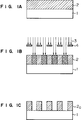
- Figs. 1A to 1C are cross-sectional views explaining a pattern forming process using the resist material of the present invention.
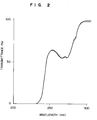
- Fig. 2 is a graph showing UV spectral curves of resist material film obtained in Example 1 (a full line, before exposure to light; a dotted line, after exposure to light).
- Fig. 3 is a cross-sectional view showing a state of overhang during pattern formation in Comparative Example 2 (after 30 minutes).
- Fig. 4 is a cross-sectional view showing failure of pattern formation due to strong overhang in Comparative Examples 1 to 4.
- the chemical amplified resist material of the present invention is characterized by containing a polymer (a) represented by the formula:
- R1 is a tetrahydropyranyl group, a trimethylsilyl group, a group of the formula: in which p is an integer of 4 or 5, e.g. a 1-methyl-cyclopentyl group or a 1-methylcyclohexyl group, or a group of the formula: in which R14 is a hydrogen atom, a methyl group or an ethyl group; and R15 is a straight-chain, branched or cyclic alkyl group having 1 to 6 carbon atoms, e.g.
- R2 to R5 in the formula (1) are independently a hydrogen atom, or a straight-chain or branched alkyl group having 1 to 8 carbon atoms, for exmaple, those exemplified in R15 and a cycloheptyl group, a cyclooctyl group, a heptyl group, and an octyl group.
- R6 to R13 in the formula (1) are independently a hydrogen atom, or a straight-chain or branched alkyl group having 1 to 6 carbon atoms, for example, those exemplified in R15.
- Preferable examples of the polymer of the formula (1) are those represented by the formula: wherein q is an integer of 1 to 3; and R1, R10, R12, k and j are as defined above.
- Preferable examples of the polymer of the formula (2) are those represented by the formulae: wherein R16 is a hydrogen atom or a methyl group; and k, j, p and q are as defined above, and wherein R14 to R16, k, j and q are as defined above.
- the polymer of the formula (1) is characterized by containing a moiety having a functional group which is easily converted chemically to a carboxylic acid with heating under an atmosphere of an acid generated by exposure to light and represented by the formula: wherein R1 to R5, m and n are as defined above, that is a monomer component represented by the formula: wherein R1 to R7, R10 , R11 , m and n are as defined above.
- Examples of monomers containing the monomer component represented by the formula (10) are as follows: 1-methylcyclohexyl 4-ethenylphenoxyacetate, 1-methylcyclopentyl 4-ethenylphenoxyacetate, 1-methylcyclohexyl 4-ethenylphenoxypropionate, 1-cyclohexyloxyethyl 4-ethenylphenoxyacetate, 1-methoxyethyl 4-ethenylphenoxyacetate, 1-ethoxyethyl 4-ethenylphenoxyacetate, 1-methoxy-1-methylethyl 4-ethenylphenoxyacetate, 1-butoxyethyl 4-ethenylphenoxypropionate, 1-isobutyloxyethyl 4-isopropenylphenoxyacetate, 1-ethoxyethyl 3-ethenylphenoxyacetate, 1-methoxy-1-methylethyl 4-isopropenylphenoxyacetate,
- R1 is not the special group as required in the present invention and a straight-chain alkyl group, for example, a compound such as methyl 4-ethenylphenoxyacetate, ethyl 4-ethenylphenoxyacetate, etc., no chemical change takes place even if heated in an atmosphere of acid and no carboxylic acid is generated.
- R1 is a branched alkyl group
- a compound such as tert-butyl 4-ethenyl-phenoxyacetate, isopropyl 4-ethenylphenoxyacetate, etc.
- a carboxylic acid can be formed by chemical change when heated under an atmosphere of acid, but the elimination reaction of ester group does not proceed easily and the production of carboxylic acid is small compared with the monomer component of the present invention, resulting in making the difference in dissolution rates of exposed portions and non-exposed portions not so large.
- the polymer (a) of the present invention may contain in addition to the monomer component of the formula (10), a monomer component of the formula: wherein R8, R9, R12 and R13 are as defined above.
- the monomer component of the formula (11) is derived from a monomer containing a phenolic hydroxyl group.
- a monomer containing a phenolic hydroxyl group examples include 4- or 3-hydroxystyrene, 4- or 3-hydroxy- ⁇ -methylstyrene, 4-or 3-hydroxy- ⁇ -ethylstyrene, 4- or 3-hydroxy- ⁇ -n-(or iso-)propylstyrene, etc.
- the polymer (a) of the present invention may contain a third component (hereinafter referred to as "third monomer”) in addition to the monomer component of the formula (10) and the monomer component of the formula (11) in order to improve transmittance, etc.
- third monomer a third component
- examples of the third monomer are methyl methacrylate, hydroxyethyl methacrylate, acrylonitrile, fumaronitrile, styrene, etc.
- the monomer component of the formula (10) and the monomer component of the formula (11) are preferably contained in a weight ratio of 1:9 to 9:1. But considering the improvement in the heat resistance of the polymer and adhesion to substrate, the weight ratio of 2:8 to 7:3 is more preferable.
- polymer examples include as follows: a polymer of 1-methylcyclohexyl 4-ethenyl-phenoxyacetate and 4-hydroxystryrene, a polymer of 1-methylcyclopentyl 4-ethenyl-phenoxyacetate and 4-hydroxystyrene, a polymer of 1-methylcyclohexyl 4-ethenyl-phenoxypropionate and 4-hydroxystyrene, a polymer of 1-cyclohexyloxyethyl 4-ethenyl-phenoxyacetate and 4-hydroxystyrene, a polymer of 1-ethoxyethyl 4-ethenylphenoxyacetate and 4-hydroxystyrene, a polymer of 1-ethoxyethyl 4-ethenylphenoxyacetate and 4-hydroxystyrene, a polymer of 1-methoxyethyl 4-ethenylphenoxyacetate and 4-hydroxystyrene, a polymer of 1-methoxy-1-methylethyl
- the following polymers are more preferable: a polymer of 1-methylcyclohexyl 4-ethenylphenoxyacetate and 4-hydroxystyrene, a polymer of 1-methylcyclopentyl 4-ethenylphenoxyacetate and 4-hydroxystyrene, a polymer of 1-ethoxyethyl 4-ethenylphenoxyacetate and 4-hydroxystyrene, a polymer of 1-methoxyethyl 4-ethenylphenoxyacetate and 4-hydroxystyrene, a polymer of 1-methoxy-1-methylethyl 4-ethenylphenoxyacetate and 4-hydroxystyrene, a polymer of 1-methoxy-1-methylethyl 4-ethenylphenoxyacetate and 4-hydroxystyrene, a polymer of 1-methoxy-1-methylethyl 4-isopropenylphenoxyacetate and 4-hydroxy- ⁇ -methylstyrene, a polymer of 1-eth
- the polymer corresponding to the formula (1) has a straight-chain or branched alkyl group as R1, not the special R1 group as defined in the present invention, for example, a polymer of methyl 4-ethenyl-phenoxyacetate and 4-hydroxystyrene, a polymer of ethyl 4-ethenylphenoxyacetate and 4-hydroxystyrene, a polymer of tert-butyl 4-ethenylphenoxyacetate and 4-hydroxystyrene, a polymer of isopropyl 4-phenoxyacetate and 4-hydroxystyrene, etc.
- no chemical change takes place in the presence of an acid generated by exposure to light so as to make pattern formation impossible, or even if the chemical change takes place, it is insufficient and the difference in dissolution rates of exposed portions and non-exposed portions is small, resulting in making the resolution insufficient, causing remarkable dimensional change of pattern from the light exposure to baking with the lapse of time.
- R1 group as defined in the present
- the polymer of the formula (1) can be produced as follows.
- a 4-hydroxystyrene polymer as explained below is reacted with a compound of the formula: wherein X is a chlorine atom or an bromine atom; and R1 to R5, m and n are as defined above, in the presence of a base in an organic solvent at 0° to 120°C for 1 to 50 hours, followed by a conventional after-treatment.
- the base there can be used NaOH, KOH, Na2CO3, K2CO3, NaH, sodium methoxide, sodium ethoxide, pyridine, piperidine, morpholine, triethylamine, N-methylpyrrolidine, etc.
- organic solvent there can be used ethyl ether, tetrahydrofuran, toluene, acetone, methyl ethyl ketone, ethyl acetate, etc.
- the compound of the formula (12) can be produced by reacting a compound of the formula: wherein X, R2 to R5, m and n are as defined above, with a compound of the formula: R1 - OH (14) wherein R1 is as defined above, in the presence of a base in an organic solvent at 0° to 120°C for 1 to 50 hours, followed by a conventional aftertreatment.
- the base there can be used NaOH, KOH, NaH, Na2CO2, K2CO3, sodium methoxide, sodium ethoxide, pyridine, piperidine, morpholine, triethylamine, N-methylpyrrolidine, etc.
- organic solvent there can be used benzene, toluene, dichloromethane, ethyl ether, etc.
- the compound of the formula (12) can also be produced by reacting a compound of the formula: wherein X, R2 to R5, m and n are as defined above, with a compound of the formula (14), 2-methoxy-1-propylene, ethyl vinyl ether, dihydropyrane, hexamethyldisiloxane or N,O-bis(trimethylsilyl)trifluoroacetamide in the presence or absence of an acid in an organic solvent at -10° to +110°C for 1 to 50 hours, followed by a conventional aftertreatment.
- the acid there can be used sulfuric acid, phosphoric acid, hydrochloric acid, hydrobromic acid, p-toluenesulfonic acid, etc.
- organic solvent there can be used 1,4-dioxane, benzene, toluene, dichloromethane, ethyl ether, etc.
- 4-hydroxystyrene polymer there can be used a commercially available one [e.g. MARUKA LYNCUR-M, a trade name, mfd. by Maruzen Petrochemical Co., Ltd.], or those synthesized as mentioned below:
- 4-tert-butoxystyrene is polymerized in an organic solvent such as tetrahydrofuran, 1,4-dioxane, benzene, toluene, etc. in the presence of a radical polymerization initiator at 50° to 110°C for 1 to 10 hours in a stream of nitrogen or argon, followed by a conventional aftertreatment to yield 4-tert-butoxystyrene polymer.
- an organic solvent such as tetrahydrofuran, 1,4-dioxane, benzene, toluene, etc.
- a radical polymerization initiator at 50° to 110°C for 1 to 10 hours in a stream of nitrogen or argon
- radical polymerization initiator there can be used an azo polymerization initiator such as 2,2′-azobisisobutyronitrile, 2,2′-azobis(2,4-dimethylvaleronitrile), 2,2′-azobis(methyl 2-methyl-propionate), or the like, a peroxide polymerization initiator such as benzoyl peroxide, lauroyl peroxide, or the like.
- azo polymerization initiator such as 2,2′-azobisisobutyronitrile, 2,2′-azobis(2,4-dimethylvaleronitrile), 2,2′-azobis(methyl 2-methyl-propionate), or the like
- peroxide polymerization initiator such as benzoyl peroxide, lauroyl peroxide, or the like.
- the 4-tert-butoxystyrene polymer is reacted with an acid such as a protonic acid, e.g. sulfuric acid, phosphoric acid, hydrochloric acid, hydrobromic acid, p-toluenesulfonic acid, etc., in an organic solvent such as tetrahydrofuran, acetone, 1,4-dioxane, or the like, at 30 to 110°C for 1 to 20 hours, followed by a conventional aftertreatment to yield the desired 4-hydroxystyrene polymer.
- an acid such as a protonic acid, e.g. sulfuric acid, phosphoric acid, hydrochloric acid, hydrobromic acid, p-toluenesulfonic acid, etc.
- organic solvent such as tetrahydrofuran, acetone, 1,4-dioxane, or the like
- the polymer (a) of the present invention has preferably a weight average molecular weight of about 1,000 to 40,000, more preferably about 3,000 to 20,000.
- photoacid generator As the photo-sensitive compound capable of generating an acid when exposed to light (hereinafter referred to as "photoacid generator”), there can be used a photo-sensitive compound which generates an acid when exposed to light and does not influence badly on the photoresist pattern formation.
- Typical examples of the photoacid generator are compounds of the formulae (5), (6), (7) and (8): wherein R17 and R18 are independently a straight-chain, branched or cyclic alkyl group having 1 to 10 carbon atoms, a straight-chain or branched haloalkyl group having 1 to 10 carbon atoms, or a group of the formula: wherein R19 and R20 are independently a hydrogen atom, a halogen atom, a straight-chain, branched or cyclic alkyl group having 1 to 10 carbon atoms, a straight-chain or branched haloalkyl group having 1 to 10 carbon atoms, a straight-chain or branched alkoxy group having 1 to 10 carbon atoms, a nitro group, or a cyano group; and r is zero or an integer of 1 to 5.
- R17 and R18 are independently a straight-chain, branched or cyclic alkyl group having 1 to 10 carbon atoms, a phenyl group, an alkyl substituted phenyl group, a benzyl group, an alkyl substituted benzyl group, a phenethyl group or an alkyl substituted phenethyl group.
- R21 is a straight-chain, branched or cyclic alkyl group having 1 to 10 carbon atoms, a trifluoromethyl group, a phenyl group or a p-tolyl group
- R22 is a hydrogen atom, a halogen atom, a straight-chain, or branched alkyl group having 1 to 5 carbon atoms, or a straight-chain or branched haloalkyl group having 1 to 5 carbon atoms
- R23 is a hydrogen atom, a straight-chain or branched alkyl group having 1 to 5 carbon atoms, or a straight-chain or branched haloalkyl group having 1 to 5 carbon atoms
- R24 is a straight-chain, branched or cyclic alkyl group having 1 to 10 carbon atoms, a phenyl group, a substituted phenyl group (wherein the substituent is a straight-chain or branched alkyl group having 1 to 5 carbon
- R21 and R24 being independently a straight-chain, branched or cyclic alkyl group having 1 to 10 carbon atoms, a phenyl group or a p-tolyl group; and R22 and R23 being methyl groups.
- R21 being a straight-chain, branched or cyclic alkyl group having 1 to 6 carbon atoms, a phenyl group or a p-tolyl group
- R24 being a branched or cyclic alkyl group having 3 to 6 carbon atoms, a phenyl group or a p-tolyl group
- R22 and R23 being methyl groups.
- R25 to R30 are independently a hydrogen atom, a halogen atom, a straight-chain, branched or cyclic alkyl group having 1 to 10 carbon atoms, a straight-chain or branched alkoxy group having 1 to 10 carbon atoms; and Z ⁇ is a perchlorate ion, a p-toluenesulfonate ion or a trifluoromethanesulfonate ion.
- R31 is a trichloroacetyl group, a p-toluenesulfonyl group, a p-trifluoromethylbenzenesulfonyl group, a methanesulfonyl group, or a trifluoromethanesulfonyl group;
- R32 and R33 are independently a hydrogen atom, a halogen atom or a nitro group.
- photoacid generator examples are as follows. 2,6-dinitrobenzyl p-toluenesulfonate, 2,6-dinitrobenzyl trichloroacetate, 2-nitrobenzyl p-toluenesulfonate, 2-nitrobenzyl trichloroacetate, 2,4-dinitrobenzyl trifluorobenzenesulfonate, bis(p-toluenesulfonyl)diazomethane, bis(cyclohexylsulfonyl)diazomethane, bis(isopropylsulfonyl)diazomethane, 1-p-toluenesulfonyl-1-methanesulfonyldiazomethane, bis(tert-butylsulfonyl)diazomethane, 1-cyclohexylsulfonyl-1-tert-butylsulfonyldi
- the solvent (c) there can be used those which can dissolve both the polymer (a) and the photoacid generator (b).
- Preferable solvents are those having no absorption at near 365 nm and 248 nm. Concrete examples of the solvents are ethyl Cellosolve acetate, methyl Cellosolve acetate, diethylene glycol dimethyl ether, ethyl lactate, methyl lactate, 1,4-dioxane, propylene glycol monomethyl ether, or ethylene glycol monoisopropyl ether, etc.
- Pattern formation using the resist material of the present invention can be carried out, for example, as follows.
- the resist material of the present invention is coated on a substrate such as a silicon wafer so as to make the thickness 0.5 to 2 ⁇ m (when used as the uppermost layer of three layer laminate, the thickness is about 0.1 to 0.5 ⁇ m), and heated at 70° to 130°C for 10 to 30 minutes in an oven, or baked at 70° to 130°C for 1 to 2 minutes on a hot plate.
- a mask for forming the desired pattern is formed on the resulting resist film and exposed to deep ultraviolet light of 300 nm or less with the exposure dose of about 1 to 100 mJ/cm2, followed by development using a developing solution such as an aqueous solution of 0.1 to 5% tetramethylammonium hydroxide (TMAH) for 0.5 to 3 minutes by a conventional method such as a dipping method, a puddle method, a spray method, etc., to form the desired pattern on the substrate.
- TMAH tetramethylammonium hydroxide
- the mixing ratio of the polymer (a) to the photoacid generator (b) in the positive tone resist material is preferably 0.01 to 0.3 part by weight, more preferably 0.01 to 0.1 part by weight, of the photoacid generator (b) per part by weight of the polymer (a).
- alkaline solutions which can hardly dissolve non-exposed portions and can dissolve exposed portions depending on the solubility for alkaline solution of the resin used in the resist material.
- concentration of the alkaline solution is usually 0.01 to 20% by weight.
- alkaline solution there can be used solutions of organic amines such as TMAH, choline, triethanolamine, etc.; inorganic alkalis such as NaOH, KOH, etc.
- organic amines such as TMAH, choline, triethanolamine, etc.
- inorganic alkalis such as NaOH, KOH, etc.
- the polymer (a) used in the present invention has no absorption in the wavelength region of 300 nm or more, and has extremely high transmittance for light of i-line light of 365 nm. Further, since the polymer (a) has a hydroxystyrene skeleton, there can be obtained a pattern having good heat resistance, resistance to dry etching, excellent adhesion to the substrate, and dimensional stability with the lapse of time due to the monomer having the special functional group.
- the resist material of the present invention can generate an acid when exposed to not only KrF excimer laser light but also i-line light and electron beams, and has a chemical amplifying function. Therefore, the resist material of the present invention is able to form a pattern by applying the chemical amplifying method when exposed to a low exposing amount of deep ultraviolet light, KrF excimer laser light (248.4 nm), i-line light (365 nm), or electron beams.
- the carboxylic acid ester group of the polymer (a) is suffered from chemical change by the acid according to the chemical equation [V] to produce a carboxylic acid, which is easily soluble in an alkaline solution compound with a phenolic resin.
- the carboxylic acid releases into the developing solution.
- the reaction mixture was diluted with ethanol (50 ml), added with sodium tungstate (0.4 g), then 30% hydrogen oxide (22.8 g, 0.23 mole) was added dropwise to this solution at 45 - 50°C, and reacted with stirring for 10 hours at the same temperature. After standing at room temperature overnight, the mixture was poured into H2O (500 ml), extracted with ethyl acetate (100 ml x 3), the organic layer was washed with H2O, dried, evaporated and resultant residue (21 g) was recrystallized from 60% ethanol aqueous solution to give the title compound as white leaflets. m.p. 56 - 58.5°C.
- a Resist material having the following composition was prepared.
- Fig. 1A The above-mentioned resist material 2 was spin coated on a substrate 1 such as a semiconductor. After soft baking at 90°C for 90 seconds on a hot plate, a resist material film of 1.0 ⁇ m thick was obtained (Fig. 1A). Then, the resist material film was selectively exposed to KrF excimer laser light 3 of 248.4 nm rai a mask 4 (Fig. 1B). After baking at 110°C for 90 seconds on a hot plate, development was carried out for 60 seconds using an alkaline developing solution (a 2.38% aqueous solution of tetramethylammonium hydroxide) to remove only exposed portions of the resist material 2 by dissolution. As a result, a positive tone (resin) pattern 2a was obtained (Fig. 1C).
- an alkaline developing solution a 2.38% aqueous solution of tetramethylammonium hydroxide
- UV Spectral curves of resist material film (1 ⁇ m) before and after exposure are shown in Fig. 2.
- the transmittance before and after exposure to light is hardly changed and shows a transmittance of as high as about 65% after exposure to light.
- the positive tone pattern had an aspect ratio of about 87°, resolution of 0.3 ⁇ m lines and spaces, and an exposure energy amount of 15 mJ/cm2.
- Example 2 Using the same resist material as used in Example 1, pattern formation was carried out in the same manner as described in Example 1. In this Example, pattern formation was carried out by changing the time from the light exposure to the baking as shown in Table 2. The results are shown in Table 2.
- a resist material having the following composition was prepared and subjected to the same experiments as described in Examples 1 and 2.
- a resist material having the following composition was prepared and subjected to the same experiments as described in Examples 1 and 2.
- a resist material having the following composition was prepared and subjected to the same experiments as described in Examples 1 and 2.
- a resist material having the following composition was prepared and subjected to the same experiments as described in Examples 1 and 2.
- a resist material having the following composition was prepared and subjected to the same experiments as described in Examples 1 and 2.
- a resist material having the following composition was prepared and subjected to the same experiments as described in Examples 1 and 2.
- a resist material having the following composition was prepared and subjected to the same experiments as described in Examples 1 and 2.
- a resist material having the same composition was prepared and subjected to the same experiments as described in Examples 1 and 2.
- a resist material having the same composition was prepared and subjected to the same experiments as described in Examples 1 and 2.
- Resist materials having the compositions as listed in Table 3 were prepared.
- the resist material of the present invention has high transmittance for deep ultraviolet light, KrF excimer laser light, etc., high sensitivity for light exposure to these light sources, electron beams and X-ray radiation, is remarkably excellent in heat resistance and adhesion to the substrate, and able to form fine patterns with good shape of practically usable submicron order and able to maintain stable pattern dimensions with the lapse of time from the light exposure to heat treatment.
- the present invention has a large value for forming ultrafine pattern in semiconductor industry.
- the resist material of the present invention exhibits particularly good effects on forming patterns using deep ultraviolet light and KrF excimer laser, but is also applicable for pattern formation using i-line light, electron beams, X-rays, etc.
Landscapes
- Chemical & Material Sciences (AREA)
- Organic Chemistry (AREA)
- Physics & Mathematics (AREA)
- Spectroscopy & Molecular Physics (AREA)
- General Physics & Mathematics (AREA)
- Materials For Photolithography (AREA)
Abstract
A resist material of chemical amplified type comprising (a) a polymer such as a polymer of 1-methylcycloalkyl 4-ethenylphenoxyacetate and 4-hydroxystyrene, etc., (b) a photo-sensitive compound capable of generating an acid when exposed to light, and (c) a solvent for dissolving both the components (a) and (b) is excellent in heat resistance and adhesiveness to substrates, capable of maintaining stable pattern dimension from exposure to light to heat treatment, and capable of forming patterns using deep ultraviolet light, KrF excimer laser light, etc.
Description
- This invention relates to a resist material usable for producing semiconductor elements and the like. More particularly, the present invention relates to a resist material usable for forming positive tone patterns using a light source of 400 nm or less as an exposure energy source, for example, i-line light of 365 nm, deep ultraviolet light of 300 nm or less, KrF excimer laser light of 248.4 nm, ArF excier laser light of 193 nm, electron beams, X-rays, etc.
- WIth recent higher density and larger scale integration of semiconductor devices, wavelengths used in exposing devices for minute processing, particularly for lithography become shorter and shorter. Now, KrF excimer laser light (248.4 nm) is studied. But, there have been no photosensitive materials suitable for such a wavelength. For example, there are proposed resist materials comprising a resin having high transmittance for light of near 248.4 nm and a photosensitive compound having a group of the formula:


- On the other hand, in order to reduce the exposure energy amount (so as to increase the sensitivity), there are proposed recently chemical amplified resist materials wherein an acid generated by exposure to light is used as a catalyst [H. Ito et al, Polym. Eng. Sci. vol. 23, page 1012 (1983)]. Various chemical amplified resist materials are reported, for example, in U.S. Patent No. 4,491,628 to Ito et al; U.S. Patent No. 4,603,101 to Crivello; W.R. Brunsrold et al: SPIE's 1989 SYmpo., 1086-40; T. Neenan et al: SPIE's 1989 Sympo., 1086-01, etc. But these chemical amplified resist materials have the following disadvantages. When phenol ether type resins such as poly(4-tert-butyoxy-carbonyloxystyrene), poly[(4-tert-butoxycarbonyloxy)-α-methylstyrene], poly(4-tert-butoxystyrene), poly-(4-tert-butoxy-α-methylstyrene) are used, heat resistance is poor, and resist films are easily peeled off at the time of development due to poor adhesion to substrates, resulting in failing to obtain good pattern shapes. Further, when carboxylic acid ester type resins such as poly(tert-buty-4-vinylbenzoate), etc. are used, the transmittance for light of near 248.4 nm is poor due to the aromatic rings of the resin. When poly(tert-butylmethacrylate) and the like is used as the resin, heat resistance and resistance to dry etching are poor.
- In order to improve the above-mentioned disadvantages, there are recently proposed various resist materials, for example, a resist material using a copolymer of p-tert-butoxycarboxyloxystyrene and p-hydroxystyrene (European Patent Laid-Open No. 366590), a resist material using a copolymer of p-tetrahydrofuranyloxystyrene and p-hydroxystyrene (European Patent Laid-Open No. 342498), a resist material using a copolymer of p-tert-butoxystyrene and p-hydroxystyrène (Japanese Patent Unexamined Publication No. 2-62544), etc. When patterns are formed by using these resist materials, it is possible to form patterns in an extremely short time, since dimensions of patterns remarkably change with the lapse of time from light exposure to heat treatment. But in practice, since a much time is required from the light exposure to the heat treatment, it is impossible to obtain good patterns in practical production.
- As mentioned above, the chemical amplified resist materials have higher sensitivity than known resist materials, but are poor in heat resistance of resin, poor in adhesiveness to substrates, insufficient in transmittance for light of near 248.4 nm, and change the pattern dimension with the lapse of time, resulting in making practical use difficult. Thus, practically usable highly sensitive resist materials overcoming these problems mentioned above are desired.
- It is an object of the present invention to provide a positive tone resist material having high transmittance for light of deep ultraviolet light, KrF excimer laser light, etc., high sensitivity when exposed to these light sources, electron beams, and X-rays, excellent heat resistance, remarkably excellent adhesiveness to substrates, and being able to obtain patterns with high precision showing no dimensional changes of patterns with the lapse of time, overcoming the disadvantages of the prior art.
- The present invention provides a resist material comprising
- (a) a polymer represented by the formula:


- (b) a photo-sensitive compound capable of generating an acid when exposed to light, and
- (c) a solvent for dissolving both the components (a) and (b).
- The present invention also provides a process for forming a pattern which comprises
forming a film on a substrate using the resist material mentioned above,
exposing the film selectively to light,
heating the resulting film,
developing the film to remove the exposed portions, and
forming a photoresist pattern on the unexposed portions of the film. - Figs. 1A to 1C are cross-sectional views explaining a pattern forming process using the resist material of the present invention.
- Fig. 2 is a graph showing UV spectral curves of resist material film obtained in Example 1 (a full line, before exposure to light; a dotted line, after exposure to light).
- Fig. 3 is a cross-sectional view showing a state of overhang during pattern formation in Comparative Example 2 (after 30 minutes).
- Fig. 4 is a cross-sectional view showing failure of pattern formation due to strong overhang in Comparative Examples 1 to 4.
- The chemical amplified resist material of the present invention is characterized by containing a polymer (a) represented by the formula:

- In the formula (1), R¹ is a tetrahydropyranyl group, a trimethylsilyl group, a group of the formula:

in which p is an integer of 4 or 5, e.g. a 1-methyl-cyclopentyl group or a 1-methylcyclohexyl group, or a group of the formula:
in which R¹⁴ is a hydrogen atom, a methyl group or an ethyl group; and R¹⁵ is a straight-chain, branched or cyclic alkyl group having 1 to 6 carbon atoms, e.g. methyl, ethyl, propyl, isopropyl, n-butyl, sec-butyl, tert-butyl, amyl, isoamyl, tert-amyl, hexyl, cyclopropyl, cyclopentyl, cyclohexyl, etc. - R² to R⁵ in the formula (1) are independently a hydrogen atom, or a straight-chain or branched alkyl group having 1 to 8 carbon atoms, for exmaple, those exemplified in R¹⁵ and a cycloheptyl group, a cyclooctyl group, a heptyl group, and an octyl group.
- R⁶ to R¹³ in the formula (1) are independently a hydrogen atom, or a straight-chain or branched alkyl group having 1 to 6 carbon atoms, for example, those exemplified in R¹⁵.
- In the formula (1), k and j are independently natural numbers, provided that k/k+j = 0.1 to 0.9; and m and n are independently zero or an integer of 1 to 3.
- Preferable examples of the polymer of the formula (1) are those represented by the formula:

wherein q is an integer of 1 to 3; and R¹, R¹⁰, R¹², k and j are as defined above. - Preferable examples of the polymer of the formula (2) are those represented by the formulae:

wherein R¹⁶ is a hydrogen atom or a methyl group; and k, j, p and q are as defined above, and
wherein R¹⁴ to R¹⁶, k, j and q are as defined above. - The polymer of the formula (1) is characterized by containing a moiety having a functional group which is easily converted chemically to a carboxylic acid with heating under an atmosphere of an acid generated by exposure to light and represented by the formula:

wherein R¹ to R⁵, m and n are as defined above, that is a monomer component represented by the formula:
wherein R¹ to R⁷, R¹⁰ , R¹¹ , m and n are as defined above. - Examples of monomers containing the monomer component represented by the formula (10) (hereinafter referred to as "monomer having a special functional group") are as follows:
1-methylcyclohexyl 4-ethenylphenoxyacetate,
1-methylcyclopentyl 4-ethenylphenoxyacetate,
1-methylcyclohexyl 4-ethenylphenoxypropionate,
1-cyclohexyloxyethyl 4-ethenylphenoxyacetate,
1-methoxyethyl 4-ethenylphenoxyacetate,
1-ethoxyethyl 4-ethenylphenoxyacetate,
1-methoxy-1-methylethyl 4-ethenylphenoxyacetate,
1-butoxyethyl 4-ethenylphenoxypropionate,
1-isobutyloxyethyl 4-isopropenylphenoxyacetate,
1-ethoxyethyl 3-ethenylphenoxyacetate,
1-methoxy-1-methylethyl 4-isopropenylphenoxy-acetate,
2-tetrahydropyranyl 4-ethenylphenoxyacetate, trimethysilyl 4-ethernylphenoxyacetate, etc. - In the formula (10), when R¹ is not the special group as required in the present invention and a straight-chain alkyl group, for example, a compound such as methyl 4-ethenylphenoxyacetate, ethyl 4-ethenylphenoxyacetate, etc., no chemical change takes place even if heated in an atmosphere of acid and no carboxylic acid is generated. On the other hand, when R¹ is a branched alkyl group, for example, a compound such as tert-butyl 4-ethenyl-phenoxyacetate, isopropyl 4-ethenylphenoxyacetate, etc., a carboxylic acid can be formed by chemical change when heated under an atmosphere of acid, but the elimination reaction of ester group does not proceed easily and the production of carboxylic acid is small compared with the monomer component of the present invention, resulting in making the difference in dissolution rates of exposed portions and non-exposed portions not so large.
- The polymer (a) of the present invention may contain in addition to the monomer component of the formula (10), a monomer component of the formula:

wherein R⁸, R⁹, R¹² and R¹³ are as defined above. - The monomer component of the formula (11) is derived from a monomer containing a phenolic hydroxyl group. Examples of such a monomer are 4- or 3-hydroxystyrene, 4- or 3-hydroxy-α-methylstyrene, 4-or 3-hydroxy-α-ethylstyrene, 4- or 3-hydroxy-α-n-(or iso-)propylstyrene, etc.
- The polymer (a) of the present invention may contain a third component (hereinafter referred to as "third monomer") in addition to the monomer component of the formula (10) and the monomer component of the formula (11) in order to improve transmittance, etc. Examples of the third monomer are methyl methacrylate, hydroxyethyl methacrylate, acrylonitrile, fumaronitrile, styrene, etc.
- In the polymer of the present invention, the monomer component of the formula (10) and the monomer component of the formula (11) are preferably contained in a weight ratio of 1:9 to 9:1. But considering the improvement in the heat resistance of the polymer and adhesion to substrate, the weight ratio of 2:8 to 7:3 is more preferable.
- Concrete examples of the polymer are as follows:
a polymer of 1-methylcyclohexyl 4-ethenyl-phenoxyacetate and 4-hydroxystryrene,
a polymer of 1-methylcyclopentyl 4-ethenyl-phenoxyacetate and 4-hydroxystyrene,
a polymer of 1-methylcyclohexyl 4-ethenyl-phenoxypropionate and 4-hydroxystyrene,
a polymer of 1-cyclohexyloxyethyl 4-ethenyl-phenoxyacetate and 4-hydroxystyrene,
a polymer of 1-ethoxyethyl 4-ethenylphenoxyacetate and 4-hydroxystyrene,
a polymer of 1-methoxyethyl 4-ethenylphenoxyacetate and 4-hydroxystyrene,
a polymer of 1-methoxy-1-methylethyl 4-ethenylphenoxyacetate and 4-hydroxystyrene,
a polymer of 1-butoxyethyl 4-ethenylphenoxy-propionate and 4-hydroxystyrene,
a polymer of 1-isobutyloxyethyl 4-isopropenyl-phenoxyacetate and 4-hydroxy-α-methylstyrene,
a polymer of 1-ethoxyethyl 3-ethenylphenoxy-acetate and 3-hydroxystyrene,
a polymer of 1-methoxy-1-methylethyl 4-iso-propenylphenoxyacetate and 4-hydroxy-α-methylstyrene,
a polymer of 2-tetrahydropyranyl 4-ethenylphenoxyacetate and 4-hydroxystyrene,
a polymer of trimethylsilyl 4-ethenylphenoxyacetate and 4-hydroxystyrene,
a polymer of 1-ethoxyethyl 4-ethenylphenoxyacetate, 4-hydroxystyrene and fumaronitrile,
a polymer of 1-methylcyclohexyl 4-ethenylphenoxyacetate, 4-hydroxystyrene and methyl methacrylate, etc. - Considering improvement in sensitivity, resolution, and stable pattern dimension with the lapse of time, the following polymers are more preferable:
a polymer of 1-methylcyclohexyl 4-ethenylphenoxyacetate and 4-hydroxystyrene,
a polymer of 1-methylcyclopentyl 4-ethenylphenoxyacetate and 4-hydroxystyrene,
a polymer of 1-ethoxyethyl 4-ethenylphenoxyacetate and 4-hydroxystyrene,
a polymer of 1-methoxyethyl 4-ethenylphenoxyacetate and 4-hydroxystyrene,
a polymer of 1-methoxy-1-methylethyl 4-ethenylphenoxyacetate and 4-hydroxystyrene,
a polymer of 1-methoxy-1-methylethyl 4-isopropenylphenoxyacetate and 4-hydroxy-α-methylstyrene,
a polymer of 1-ethoxyethyl 4-ethenylphenoxyacetate, 4-hydroxystyrene and fumaronitrile, etc. - When the polymer corresponding to the formula (1) has a straight-chain or branched alkyl group as R¹, not the special R¹ group as defined in the present invention, for example, a polymer of methyl 4-ethenyl-phenoxyacetate and 4-hydroxystyrene, a polymer of ethyl 4-ethenylphenoxyacetate and 4-hydroxystyrene, a polymer of tert-butyl 4-ethenylphenoxyacetate and 4-hydroxystyrene, a polymer of isopropyl 4-phenoxyacetate and 4-hydroxystyrene, etc., no chemical change takes place in the presence of an acid generated by exposure to light so as to make pattern formation impossible, or even if the chemical change takes place, it is insufficient and the difference in dissolution rates of exposed portions and non-exposed portions is small, resulting in making the resolution insufficient, causing remarkable dimensional change of pattern from the light exposure to baking with the lapse of time. Thus, such a polymer is remarkably low in performance compared with the polymer used in the present invention, and thus not suitable for practical production.
- The polymer of the formula (1) can be produced as follows.
- A 4-hydroxystyrene polymer as explained below is reacted with a compound of the formula:

wherein X is a chlorine atom or an bromine atom; and R¹ to R⁵, m and n are as defined above, in the presence of a base in an organic solvent at 0° to 120°C for 1 to 50 hours, followed by a conventional after-treatment. - As the base, there can be used NaOH, KOH, Na₂CO₃, K₂CO₃, NaH, sodium methoxide, sodium ethoxide, pyridine, piperidine, morpholine, triethylamine, N-methylpyrrolidine, etc.
- As the organic solvent, there can be used ethyl ether, tetrahydrofuran, toluene, acetone, methyl ethyl ketone, ethyl acetate, etc.
- The compound of the formula (12) can be produced by reacting a compound of the formula:

wherein X, R² to R⁵, m and n are as defined above, with a compound of the formula:
R¹ - OH (14)
wherein R¹ is as defined above, in the presence of a base in an organic solvent at 0° to 120°C for 1 to 50 hours, followed by a conventional aftertreatment. - As the base, there can be used NaOH, KOH, NaH, Na₂CO₂, K₂CO₃, sodium methoxide, sodium ethoxide, pyridine, piperidine, morpholine, triethylamine, N-methylpyrrolidine, etc.
- As the organic solvent, there can be used benzene, toluene, dichloromethane, ethyl ether, etc.
- The compound of the formula (12) can also be produced by reacting a compound of the formula:

wherein X, R² to R⁵, m and n are as defined above, with a compound of the formula (14), 2-methoxy-1-propylene, ethyl vinyl ether, dihydropyrane, hexamethyldisiloxane or N,O-bis(trimethylsilyl)trifluoroacetamide in the presence or absence of an acid in an organic solvent at -10° to +110°C for 1 to 50 hours, followed by a conventional aftertreatment. - As the acid, there can be used sulfuric acid, phosphoric acid, hydrochloric acid, hydrobromic acid, p-toluenesulfonic acid, etc.
- As the organic solvent, there can be used 1,4-dioxane, benzene, toluene, dichloromethane, ethyl ether, etc.
- As the 4-hydroxystyrene polymer, there can be used a commercially available one [e.g. MARUKA LYNCUR-M, a trade name, mfd. by Maruzen Petrochemical Co., Ltd.], or those synthesized as mentioned below:
- For example, 4-tert-butoxystyrene is polymerized in an organic solvent such as tetrahydrofuran, 1,4-dioxane, benzene, toluene, etc. in the presence of a radical polymerization initiator at 50° to 110°C for 1 to 10 hours in a stream of nitrogen or argon, followed by a conventional aftertreatment to yield 4-tert-butoxystyrene polymer.
- As the radical polymerization initiator, there can be used an azo polymerization initiator such as 2,2′-azobisisobutyronitrile, 2,2′-azobis(2,4-dimethylvaleronitrile), 2,2′-azobis(methyl 2-methyl-propionate), or the like, a peroxide polymerization initiator such as benzoyl peroxide, lauroyl peroxide, or the like.
- Then, the 4-tert-butoxystyrene polymer is reacted with an acid such as a protonic acid, e.g. sulfuric acid, phosphoric acid, hydrochloric acid, hydrobromic acid, p-toluenesulfonic acid, etc., in an organic solvent such as tetrahydrofuran, acetone, 1,4-dioxane, or the like, at 30 to 110°C for 1 to 20 hours, followed by a conventional aftertreatment to yield the desired 4-hydroxystyrene polymer.
- The polymer (a) of the present invention has preferably a weight average molecular weight of about 1,000 to 40,000, more preferably about 3,000 to 20,000.
- As the photo-sensitive compound capable of generating an acid when exposed to light (hereinafter referred to as "photoacid generator"), there can be used a photo-sensitive compound which generates an acid when exposed to light and does not influence badly on the photoresist pattern formation. Typical examples of the photoacid generator are compounds of the formulae (5), (6), (7) and (8):

wherein R¹⁷ and R¹⁸ are independently a straight-chain, branched or cyclic alkyl group having 1 to 10 carbon atoms, a straight-chain or branched haloalkyl group having 1 to 10 carbon atoms, or a group of the formula:
wherein R¹⁹ and R²⁰ are independently a hydrogen atom, a halogen atom, a straight-chain, branched or cyclic alkyl group having 1 to 10 carbon atoms, a straight-chain or branched haloalkyl group having 1 to 10 carbon atoms, a straight-chain or branched alkoxy group having 1 to 10 carbon atoms, a nitro group, or a cyano group; and r is zero or an integer of 1 to 5. Preferable examples of R¹⁷ and R¹⁸ are independently a straight-chain, branched or cyclic alkyl group having 1 to 10 carbon atoms, a phenyl group, an alkyl substituted phenyl group, a benzyl group, an alkyl substituted benzyl group, a phenethyl group or an alkyl substituted phenethyl group.
wherein R²¹ is a straight-chain, branched or cyclic alkyl group having 1 to 10 carbon atoms, a trifluoromethyl group, a phenyl group or a p-tolyl group; R²² is a hydrogen atom, a halogen atom, a straight-chain, or branched alkyl group having 1 to 5 carbon atoms, or a straight-chain or branched haloalkyl group having 1 to 5 carbon atoms; R²³ is a hydrogen atom, a straight-chain or branched alkyl group having 1 to 5 carbon atoms, or a straight-chain or branched haloalkyl group having 1 to 5 carbon atoms; R²⁴ is a straight-chain, branched or cyclic alkyl group having 1 to 10 carbon atoms, a phenyl group, a substituted phenyl group (wherein the substituent is a straight-chain or branched alkyl group having 1 to 5 carbon atoms, a straight-chain or branched alkoxy group having 1 to 5 carbon atoms, a halogen atom, or an alkylthio group). Preferable examples are R²¹ and R²⁴ being independently a straight-chain, branched or cyclic alkyl group having 1 to 10 carbon atoms, a phenyl group or a p-tolyl group; and R²² and R²³ being methyl groups. Further preferable examples are R²¹ being a straight-chain, branched or cyclic alkyl group having 1 to 6 carbon atoms, a phenyl group or a p-tolyl group; R²⁴ being a branched or cyclic alkyl group having 3 to 6 carbon atoms, a phenyl group or a p-tolyl group; and R²² and R²³ being methyl groups.
wherein R²⁵ to R³⁰ are independently a hydrogen atom, a halogen atom, a straight-chain, branched or cyclic alkyl group having 1 to 10 carbon atoms, a straight-chain or branched alkoxy group having 1 to 10 carbon atoms; and Z⁻ is a perchlorate ion, a p-toluenesulfonate ion or a trifluoromethanesulfonate ion.
wherein R³¹ is a trichloroacetyl group, a p-toluenesulfonyl group, a p-trifluoromethylbenzenesulfonyl group, a methanesulfonyl group, or a trifluoromethanesulfonyl group; R³² and R³³ are independently a hydrogen atom, a halogen atom or a nitro group. - Concrete examples of the photoacid generator are as follows.
2,6-dinitrobenzyl p-toluenesulfonate,
2,6-dinitrobenzyl trichloroacetate,
2-nitrobenzyl p-toluenesulfonate,
2-nitrobenzyl trichloroacetate,
2,4-dinitrobenzyl trifluorobenzenesulfonate,
bis(p-toluenesulfonyl)diazomethane,
bis(cyclohexylsulfonyl)diazomethane,
bis(isopropylsulfonyl)diazomethane,
1-p-toluenesulfonyl-1-methanesulfonyldiazomethane,
bis(tert-butylsulfonyl)diazomethane,
1-cyclohexylsulfonyl-1-tert-butylsulfonyldiazomethane,
1-p-toluenesulfonyl-1-cyclohexylsulfonyldiazomethane,
diphenyl-p-methylphenacylsulfonium perchlorate,
diphenyl-2,5-dimethoxyphenacylsulfonium p-toluenesulfonate,
diphenylphenacylsulfonium trifluoromethanesulfonate,
2-methyl-2-p-toluenesulfonylpropiophenone,
2-p-toluenesulfonylpropiophenone,
2-p-toluenesulfonyl-2-cyclohexylcarbonylpropnane,
2,4-dimethyl-2-p-toluenesulfonyl-3-pentanone,
2-benzenesulfonyl-2-cyclohexanecarbonylpropane,
2-cyclohexylsulfonyl-2,4,4-trimethyl-3-pentanone,
2-cyclohexylsulfonyl-2,4,4-trimethyl-3-hexanone,
2,4-dimethyl-4-trifluoromethyl-3-hexanone,
2-benzenesulfonyl-2-(4-methoxybenzoyl)propane,
2-methanesulfonyl-2-methyl-(4-methylthio)-propiophenone, etc. - As the solvent (c), there can be used those which can dissolve both the polymer (a) and the photoacid generator (b). Preferable solvents are those having no absorption at near 365 nm and 248 nm. Concrete examples of the solvents are ethyl Cellosolve acetate, methyl Cellosolve acetate, diethylene glycol dimethyl ether, ethyl lactate, methyl lactate, 1,4-dioxane, propylene glycol monomethyl ether, or ethylene glycol monoisopropyl ether, etc.
- Pattern formation using the resist material of the present invention can be carried out, for example, as follows.
- The resist material of the present invention is coated on a substrate such as a silicon wafer so as to make the thickness 0.5 to 2 µm (when used as the uppermost layer of three layer laminate, the thickness is about 0.1 to 0.5 µm), and heated at 70° to 130°C for 10 to 30 minutes in an oven, or baked at 70° to 130°C for 1 to 2 minutes on a hot plate. Thus, a mask for forming the desired pattern is formed on the resulting resist film and exposed to deep ultraviolet light of 300 nm or less with the exposure dose of about 1 to 100 mJ/cm², followed by development using a developing solution such as an aqueous solution of 0.1 to 5% tetramethylammonium hydroxide (TMAH) for 0.5 to 3 minutes by a conventional method such as a dipping method, a puddle method, a spray method, etc., to form the desired pattern on the substrate.
- The mixing ratio of the polymer (a) to the photoacid generator (b) in the positive tone resist material is preferably 0.01 to 0.3 part by weight, more preferably 0.01 to 0.1 part by weight, of the photoacid generator (b) per part by weight of the polymer (a).
- As the developing solution, there can be used alkaline solutions which can hardly dissolve non-exposed portions and can dissolve exposed portions depending on the solubility for alkaline solution of the resin used in the resist material. The concentration of the alkaline solution is usually 0.01 to 20% by weight.
- As the alkaline solution, there can be used solutions of organic amines such as TMAH, choline, triethanolamine, etc.; inorganic alkalis such as NaOH, KOH, etc.
- The polymer (a) used in the present invention has no absorption in the wavelength region of 300 nm or more, and has extremely high transmittance for light of i-line light of 365 nm. Further, since the polymer (a) has a hydroxystyrene skeleton, there can be obtained a pattern having good heat resistance, resistance to dry etching, excellent adhesion to the substrate, and dimensional stability with the lapse of time due to the monomer having the special functional group.
- The resist material of the present invention can generate an acid when exposed to not only KrF excimer laser light but also i-line light and electron beams, and has a chemical amplifying function. Therefore, the resist material of the present invention is able to form a pattern by applying the chemical amplifying method when exposed to a low exposing amount of deep ultraviolet light, KrF excimer laser light (248.4 nm), i-line light (365 nm), or electron beams.
- When the resist material is exposed to KrF excimer light, deep ultraviolet light, i-line light, electron beams or X-rays, the exposed portions generate an acid by the photo reaction as shown by the following chemical equations (I) to (IV):

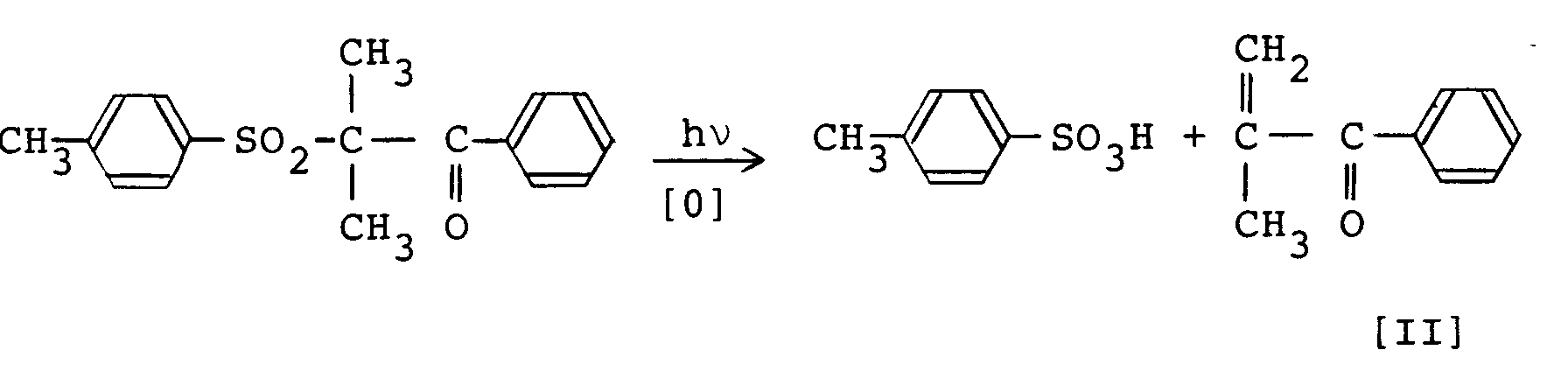


- When heat treatment is conducted subsequent to the exposure to light, the carboxylic acid ester group of the polymer (a) is suffered from chemical change by the acid according to the chemical equation [V] to produce a carboxylic acid, which is easily soluble in an alkaline solution compound with a phenolic resin. Thus, at the time of development, the carboxylic acid releases into the developing solution.

- On the other hand, since non-exposed portions do not generate an acid, no chemical change takes place even if subjected to heat treatment and no alkalisoluble group appears. Further, since the resin per se is high in heat resistance, softening of the resin does not take place at the heat treatment. When the pattern is formed by using the resist material of the present invention, since the carboxylic acid which is an acid stronger than a phenolic hydroxyl group is formed, a larger difference in solubility for the alkaline developing solution takes place between the exposed portions and the non-exposed portions. Further, since the resin in the non-exposed portions is not softened at the time of heat treatment and has strong adhesiveness to the substrate, no peeling of film takes place at the time of development. As a result, there is formed a positive tone pattern having good contrast. In addition, since the acid generated by exposure to light acts catalytically as shown by the equation [V], the exposure to light is only necessary to produce the necessary amount of acid, resulting in making it possible to lower the exposure energy amount.
- The present invention is illustrated by way of the following Examples, in which all percents are by weight unless otherwise specified.
- To a suspension of magnesium turning (23.9 g, 0.98 atom) in dry ethyl ether, cyclohexyl bromide (160 g, 0.98 mole) was added dropwise under mild reflux, followed by reaction with stirring for 1 hour under reflux. After cooling, the resulting Grignard reagent was added dropwise to a solution of isobutyloyl chloride (95 g, 0.89 mole) in dry ethyl ether at -5 - 0°C, and the resultant mixture was stirred at the same temperature for 3 hours and standed at room temperature overnight. The reaction mixture was poured into H₂O, and the organic layer was separated, washed with H₂O, dried over anhydrous MgSO₄ and evaporated. The residue was distilled under reduced pressure to give 50 g of the title compound as a pale yellow oil having a boiling point of 95 - 100°C/20 mmHg.
¹HNMR δppm (CDCl₃): 1.06 (6H, d, CH₃ x2), 1.12 - 1.87 (10H, m, cyclohexylic CH₂ x5), 2.51 (1H, m, cyclohexylic CH), 2.76 (1H, m, CH).
IR(Neat) νcm⁻¹: 1710 (C=O). - To 1-cyclohexyl-2-methyl-1-propanone (47.6 g, 0.31 mole) obtained in above (1), sulfuryl chloride (42 g, 0.31 mole) was added dropwise at 25 - 35°C, and the mixture was stirred at 50°C for 3.5 hours and then evaporated. The resultant residue was distilled under reduced pressure to give 30.1 g of the title compound as a yellow oil.
bp. 99 - 105°C/18 mmHg.
¹HNMR δppm (CDCl₃): 1.18 - 1.87 (16H, m, CH₃ x2 and cyclohexylic CH₂ x5), 3.13 (1H, m, cyclohexylic CH). - A Solution of 2-chloro-1-cyclohexyl-2-methyl-1-propanone (30.0 g, 0.16 mole) and sodium p-toluene-sulfonate (30.0 g, 0.17 mole) in dimethylsulfoxide was reacted with stirring at 60°C for 20 hours. The reaction mixture was poured into cold H₂O, and continued to stirr at 0 - 5°C for 1 hour. The precipitate was filtered, washed with H₂O and dried. The crude solid (18 g) was recrystallized from n-hexane/benzene to give 13.5 g of the title compound as white needles.
m.p. 123 - 123.5°C.
¹HNMR δppm (CDCl₃): 1.19 - 1.91 (16H, m, CH₃ x2 and cyclohexylic CH₂ x5), 2.45 (3H, s, Ar-CH₃), 3.25 (1H, m, cyclohexylic CH), 7.33 (2H, d, J=8Hz, AR 3-H, 5-H), 7.65 (2H, d, J=8Hz, Ar 2-H, 6-H).
IR(KBr-disk) cm⁻¹: 1705 (C=O), 1310. - To cyclohexylthiol (9.3 g, 0.08 mole), an ethanol solution dissolving potassium hydroxide (5.5 g) in ethanol (22 ml) was added dropwise and mixture was reacted with stirring at 30 ± 5°C for 30 minutes. Then 2-chloro-2,4,4-trimethyl-3-pentanone (13.0 g, 0.08 mole) obtained in the same manner as described in Reference Example 1(2) using 2,2,4-trimethyl-3-pentanone was added dropwise to this mixture at 0 - 10°C, reacted with stirring at the same temperature for 3 hours, then at room temperature for 2 hours and standed at room temperature overnight. The reaction mixture was diluted with ethanol (50 ml), added with sodium tungstate (0.4 g), then 30% hydrogen oxide (22.8 g, 0.23 mole) was added dropwise to this solution at 45 - 50°C, and reacted with stirring for 10 hours at the same temperature. After standing at room temperature overnight, the mixture was poured into H₂O (500 ml), extracted with ethyl acetate (100 ml x 3), the organic layer was washed with H₂O, dried, evaporated and resultant residue (21 g) was recrystallized from 60% ethanol aqueous solution to give the title compound as white leaflets.
m.p. 56 - 58.5°C.
¹ HNMR δppm (CDCl₃): 1.13 - 2.11 (25H, m, CH₃ x5 and cyclohexylic CH₂ x5), 3.48 - 3.62 (1H, m, cyclohexylic CH)
IR(KBr-disk) cm⁻¹: 1705 (C=O), 1305 (SO₂). - Using diisopropylketone in place of 1-cyclohexyl-2-methyl-1-propanone, the reaction was carried out in the same manner as described in Reference Example 1(2) and (3). The crude solid was recrystallized from n-hexane/benzene to afford 2,4-dimethyl-2-(p-toluene-sulfonyl)-3-pentanone as white leaflets.
m.p. 76 - 79°C.
¹HNMR δppm (CDCl₃): 1.15 (6H, d, CH₃x2), 1.55 (6H, s, CH₃x2), 2.45 (3H, s, Ar-CH₃), 3.54 (1H, m, J=7Hz, CH), 7.34 (2H, d, J=8Hz, Ar 3-H, 5-H), 7.65 (2H, d, J=8Hz, Ar 2-H, 6-H).
IR(KBr-disk) νcm⁻¹: 1715 (C=O), 1305, 1290. - Using isobutyrophenone in place of 1-cyclohexyl-2-methyl-1-propanone, the reaction was carried out in the same manner as described in Reference Example 1(2) and (3), the crude solid was recrystallized from methanol to afford the title compound as white needles.
m.p. 64 - 64.5°C.
¹HNMR δppm (CDCl₃): 1.70 (6H, s, CH₃ x 2), 2.45 (3H, s, Ar-CH₃), 7.32 (2H, d, J=7Hz, p-Me-Ar 3-H, 5-H), 7.44 (2H, t, J=7Hz, Ar 3-H, 5-H), 7.54 (1H, t, J=7Hz, Ar 4-H), 7.67 (2H, d, J=7Hz, p-Me-Ar 2-H, 6-H), 7.95 (2H, d, J=7Hz, Ar 2-H, 6-H).
IR(KBr-disk) cm⁻¹: 1680 (C=O), 1303, 1290. - After dissolving sodium azide (22.5 g, 0.35 mole) in a small amount of H₂O, the resulting solution was diluted with a 90% ethanol aqueous solution (130 ml). To this, an ethanol solution dissolving p-toluenesulfonyl chloride (60 g, 0.32 mole) was added dropwise at 10 - 25°C, followed by reaction at room temperature for 2.5 hours. The reaction solution was concentrated at room temperature under reduced pressure. The resulting oil residue was washed with H₂O several times and dried over anhydrous MgSO₄. After removing the drying agent by filtration, there was obtained 50.7 g of the title compound as colorless oil.
¹HNMR δppm (CDCl₃): 2.43 (3H, s, CH₃), 7.24 (2H, d, J=8Hz, Ar 3-H, 5-H), 7.67 (2H, d, J=8Hz, AR 2-H, 6-H).
IR(Neat) νcm⁻¹: 2120 (N₃). - To p-thiocresol (20 g, 0.16 mole), an 80% ethanol aqueous solution (75 ml) dissolving potassium hydroxyide (10.7 g, 0.16 mole) was added dropwise at room temperature and mixture was stirred at 30 ± 5°C for 30 minutes. Then methylene chloride (13.7 g, 0.16 mole) was added to this mixture and reacted with stirring at 50 ± 5°C for 6 hours. After standing at room temperature overnight, the reaction mixture was diluted with ethanol (30 ml) and H₂O (30 ml), and then added with sodium tungstate (0.6 g). Then 30% hydrogen peroxide (75 g) was added dropwise to this solution at 45 - 50°C, reacted with stirring for 4 hours at the same temperature, then added with H₂O (1.2 ℓ) and standed overnight at room temperature. The precipitate was filtered, washed with H₂O and dried. The resulting solid was recrystallized from ethanol to give 16.5 g of the title compound as white needles.
m.p. 125 - 128°C.
¹HNMR δppm (CDCl₃): 2.47 (6H, s, CH₃ x 2), 4.69 (2H, s, CH₂), 7.37 (4H, d, J=8Hz, Ar 3-H, 5-H x 2), 7.83 (4H, d, J=8Hz, Ar 2-H, 6-H x 2).
IR(KBr-disk) νcm⁻¹: 1310 (SO₂). - To a solution of sodium hydroxide (1.5 g) in a 60% ethanol aqueous solution (70 ml), bis(p-toluenesulfonyl)methane (10.0 g, 0.03 mole) obtained in above (2) was added, then an ethanol solution of p-toluenesulfonylazide (7.3 g, 0.037 mole) obtained in above (1) was added dropwise at 5 - 10°C, followed by the reaction at room temperature for 7 hours. After standing at room temperature overnight, the precipitate was filtered, washed with ethanol and dried. The resultant solid (5.5 g) was recrystallized from ethanol to give 3.5 g of the title compound as pale yellow leaflets.
m.p. 121.5 - 123°C.
¹HNMR δppm (CDCl₃): 2.46 (6H, s, CH₃ x 2), 7.36 (4H, d, J=8Hz, (Ar 3-H, 5-H) x 2), 7.87 (4H, d, J=8Hz, (Ar 2-H, 6-H) x 2).
IR(KBr-disk) νcm⁻¹: 2110 (CN₂), 1345 (SO₂). - Using tert-butylthiol in place of p-thiocresol, the reaction was carried out in the same manner as described in Reference Example 5. The resutlant crude solid was recrystallized from ethanol to give the title compound as pale yellow needles.
m.p. 121 - 121.5°C.
¹HNMR δppm (CDCl₃): 1.52 (18H, s, CH₃ x 6).
IR(KBr-disk) νcm⁻¹: 2120 (CN₂), 1330 (SO₂), 1315. - Using isopropylthiol in place of p-thiocresol, the synthesis was carried out in the same manner as described in Reference Example 5. The resultant crude solid was recrystallized from methanol to give the title compound as pale yellow needles.
m.p. 82 - 84°C.
¹HNMR δppm (CDCl₃): 1.46 (12H, d, J=7Hz, CH₃ x 4), 3.74 (2H, m, J=7Hz, CH x 2).
IR(KBr-disk) νcm⁻¹: 2120 (CN₂), 1340 (SO₂), 1320. - To a solution of trichloroacetic acid (5 g, 0.031 mole), o-nitrobenzylalcohol (9.4 g, 0.061 mole) and pyridine (4.9 g) in methylene chloride (30 ml), N,N′-cyclohexylcarbodiimide (6.3 g, 0.031 mole) was added in a small portion at 5 - 10°C, reacted with stirring at room temperature for 7 hours, and then standed at room temperature overnight. The precipitate was filtered off, conc. hydrochloric acid (30 ml), H₂O (35 ml) and methylene chloride (150 ml) was added to the filtrate, followed by stirring. The organic layer was separated, washed with H₂O (200 ml x 3), dried over anhydrous MgSO₄ and evaporated. The resultant residue was chromatographed on silica gel (Wako Gel C-200, a trade name, mfd. by Wako Pure Chemical Industries, Ltd.) with ethyl acetate/n-hexane (1/30 → 1/10) as eluent to afford 6.8 g of the title compound as a pale yellow oil.
¹HNMR δppm (CDCl₃): 5.81 (2H, s, CH₂), 7.51 - 7.76 (3H, m, Ar 4-H, 5-H, 6-H), 8.20 (1H, d, J= 8Hz, Ar 3-H).
IR(Neat) νcm⁻¹: 1760 (C=O), 1520 (NO₂), 1335 (NO₂). - To a solution of 1-methylcyclohexan-1-ol (70.8 g, 0.62 mole) and pyridine (8.5 g) in methylene chloride (300 ml), chloroacetylchloride (70 g, 0.62 mole) was added dropwise at 20 - 30°C, reacted with stirring for 2 hours at the same temperature. The precipitate was filtered off and the filtrate was evaporated. The residue (116 g) was chromatographed on silica gel (Wakogel C-200, a trade name, mfd. by Wako Pure Chemical Industries, Ltd.) with n-hexane/ethyl acetate (10/1 v/v) as eluent to give 53.2 g of 1-methylcyclohexyl monochloroacetate as a pale yellow oil.
¹HNMR δppm(CDCl₃): 1.27 - 2.18 (13H, m, CH₃ and cyclohexylic proton), 4.00 (2H, s, CH₂).
IR νcm₋₁(Neat): 1760 (C=O). - To a solution of monobromoacetic acid (25 g, 0.18 mole) and a few drops of conc. sulfuric acid in toluene (35 ml), ethyl vinyl ether (23 g, 0.32 mole) was added dropwise at 15 - 25°C, and reacted with stirring at room temperature for 5 hours. After standing at room temperature overnight, saturated sodium bicarbonate aqueous solution (400 ml) and ethyl acetate (200 ml) were added to the resultant mixture, followed by stirring for 1 hour. The organic layer was separated, washed twice with brine and dried over anhydrous MgSO₄. After removing the drying agent by filtration, the filtrate was evaporated and the residue (29 g) was distilled under reduced pressure to give 23.5 g of 1-ethoxyethyl monobromoacetate as a colorless oil.


- Using monobromoacetic acid (25 g, 0.18 mole) and dihydropyran (27.2 g, 0.32 mole), the reaction was carried out in the same manner as described in Synthesis Example 2. The resultant residue (42.5 g) was chromatographed on silica gel (Wako Gel C-200) with n-hexane/ethyl acetate/diethylamine (10/1/0.5 V/V) to afford 25.6 g of 2-tetrahydropyrany1 monobromoacetate as a colorless oil.
¹HNMR δppm (CDCl₃) : 1.39 - 1.96 (6H, m, THP 3-H, 3-H, 4-H, 4-H, 5-H, 5-H), 3.67 - 4.06 (4H, m, BrCH₂- and THP 6-H, 6-H), 6.06 (1H, bs, THP 2-H).
IR νcm⁻¹ (Neat) : 1730 (C=O) - Using 1-methylcyclopentan-1-ol (23.0 g, 0.23 mole) and chloroacetylchloride (24.8 g, 0.22 mole), the reaction was carried out in the same manner as described in Synthesis Example 1 to give 22.5 g of 1-methylcyclopentyl monochloroacetate as a colorless oil.
¹HNMR δppm (CDCl₃) : 1.58 - 2.30 (11H, m, CH₃ and cyclopentylic proton), 3.97 (2H, s, ClCH₂-). IR νcm⁻¹ (Neat) : 1755 (C=O). - Using 1-methylcyclohexan-1-ol (26.3 g, 0.23 mole) and monochloropropionyl chloride (27.9 g, 0.22 mole), the reaction was carried out in the same manner as described in Synthesis Example 1 to give 23.0 g of 1-methylcyclohexyl monochloroprpionate as a colorless oil. ¹HNMR δppm (CDCl₃) : 1.17 - 2.21 (13H, m, CH₃ and cyclohexylic proton), 2.74 (2H, t, J=6.6Hz, ClCH₂ CH₂COO-), 3.74 (2H, t, J=6.6Hz, ClCH₂CH₂COO-). IR νcm⁻¹ (Neat) : 1725 (C=O).
- To a solution of monochloroacetic acid (16.7 g, 0.18 mole) and hexamethyldisiloxane (57.3 g, 0.35 mole) in toluene (50 ml), conc. sulfuric acid (1 ml) was added and reacted with stirring for 28 hours under reflux. The reaction mixture was evaporated and the residue was distilled under reduced pressure to afford 16.5 g of trimethylsilyl monochloroacetate as a colorless oil.
b.p. 84 - 86°C/60 mmHg.
¹HNMR δppm (CDCl₃) : 0.28 (9H, s, CH₃ x 3), 4.37 (2H, s, ClCH₂).
IR νcm⁻¹ (Neat) : 1735 (C=O). - A solution of 4-tert-butoxyethyrene (17.6 g) in toluene containing catalytic amount of 2,2′-azobisisobutyronitrile (AIBN) was heated at 80°C for 6 hours under nitrogen. After cooling, the reaction mixture was poured into methanol and the polymer was precipitated. The polymer was filtered, washed with methanol and dried under reduced pressure to afford 15.5 g of poly(4-tert-butoxystyrene) as a white powder having

- A solution of poly(4-tert-butoxystyrene) (15.0 g) obtained in above (1) and hydrochloric acid (10 ml) in 1,4-dioxane was refluxed for 4 hours with stirring. The mixture was cooled, poured into H₂O and the white solid was precipitated. The polymer was filtered, washed with H₂O and dried under reduced pressure to afford 9.7 g of poly(4-hydroxystyrene) as a white powder.
- To a solution of poly(4-hydroxystyrene) (4.0 g) obtained in above (2) and 1-methylcyclohexyl monochloroacetate (3.2 g) obtained in Synthesis Example 1 in acetone (35 ml), potassium carbonate (2.4 g) and potassium iodide (0.33 g) were added, and refluxed for 6 hours with stirring. After cooling, the precipitate was filtered off, the filtrate was poured into H₂O, and the resultant white solid was filtered, washed with H₂O and dried under reduced pressure to afford 4.9 g of the title polymer as a white powder having

- Using poly(4-hydroxystyrene) (4.0 g) obtained in the same manner as described in Synthesis Example 7(2) and each monohalogenoacetic ester obtained in Synthesis Examples 2 - 6 or tert-butyl monochloroacetate obtained as a commercial grade, the reaction was carried out in the same manner as described in Synthesis Example 7(3) to afford corresponding polymer.
- The results are shown in Table 1.
In Table 1, the ratio of k and j was found by ¹HNMR analysis, and

- A Resist material having the following composition was prepared.

- Pattern formation using the above-mentioned resist material is explained referring to Fig. 1. The above-mentioned resist
material 2 was spin coated on a substrate 1 such as a semiconductor. After soft baking at 90°C for 90 seconds on a hot plate, a resist material film of 1.0 µm thick was obtained (Fig. 1A). Then, the resist material film was selectively exposed to KrFexcimer laser light 3 of 248.4 nm rai a mask 4 (Fig. 1B). After baking at 110°C for 90 seconds on a hot plate, development was carried out for 60 seconds using an alkaline developing solution (a 2.38% aqueous solution of tetramethylammonium hydroxide) to remove only exposed portions of the resistmaterial 2 by dissolution. As a result, a positive tone (resin)pattern 2a was obtained (Fig. 1C). - UV Spectral curves of resist material film (1 µm) before and after exposure are shown in Fig. 2. As shown in Fig. 2, the transmittance before and after exposure to light is hardly changed and shows a transmittance of as high as about 65% after exposure to light. The positive tone pattern had an aspect ratio of about 87°, resolution of 0.3 µm lines and spaces, and an exposure energy amount of 15 mJ/cm².
- Using the same resist material as used in Example 1, pattern formation was carried out in the same manner as described in Example 1. In this Example, pattern formation was carried out by changing the time from the light exposure to the baking as shown in Table 2. The results are shown in Table 2.

- A resist material having the following composition was prepared and subjected to the same experiments as described in Examples 1 and 2.

- As a result, the same good results as obtained in Examples 1 and 2 were obtained. Particularly, even the time from the light exposure to the baking elapsed 5 hours, the pattern dimension was not changed. A positive tone pattern using this resist material had an exposure energy amount of 18 mJ/cm².
- A resist material having the following composition was prepared and subjected to the same experiments as described in Examples 1 and 2.

- As a result, the same good results as obtained in Examples 1 and 2 were obtained. A positive tone pattern was formed by using this resist material and showed an exposure energy amount of 10 mJ/cm². Further, even the time from the light exposure to the baking elapsed 5 hours, the pattern dimension was not changed.
- A resist material having the following composition was prepared and subjected to the same experiments as described in Examples 1 and 2.

- As a result, the same good results as obtained in Examples 1 and 2 were obtained. A positive tone pattern was formed by using this resist material and showed an exposure energy amount of 8 mJ/cm².
- A resist material having the following composition was prepared and subjected to the same experiments as described in Examples 1 and 2.

- As a result, the same good results as obtained in Examples 1 and 2 were obtained. A positive tone pattern was formed by using this resist material and showed an exposure energy amount of 15 mJ/cm².
- A resist material having the following composition was prepared and subjected to the same experiments as described in Examples 1 and 2.

- As a result, the same good results as obtained in Examples 1 and 2 were obtained. A positive tone pattern was formed by using this resist material and showed an exposure energy amount of 20 mJ/cm².
- A resist material having the following composition was prepared and subjected to the same experiments as described in Examples 1 and 2.

- As a result, the same good results as obtained in Examples 1 and 2 were obtained. A positive tone pattern was formed by using this resist material and showed an exposure energy amount of 25 mJ/cm².
- A resist material having the following composition was prepared and subjected to the same experiments as described in Examples 1 and 2.

- As a result, the same good results as obtained in Examples 1 and 2 were obtained. A positive tone pattern was formed by using this resist material and showed an exposure energy amount of 15 mJ/cm².
- A resist material having the same composition was prepared and subjected to the same experiments as described in Examples 1 and 2.

- As a result, the same good results as obtained in Examples 1 and 2 were obtained. A positive tone pattern was formed by using this resist material and showed an exposure energy amount of 18 mJ/cm².
- A resist material having the same composition was prepared and subjected to the same experiments as described in Examples 1 and 2.

- As a result, the same good results as obtained in Examples 1 and 2 were obtained. A positive tone pattern was formed by using this resist material and showed an exposure energy amount of 10 mJ/cm².
- Resist materials having the compositions as listed in Table 3 were prepared.

- The polymers used in Comparative Examples 2 to 4 were synthesized by the methods described in Japanese Patent Unexamined Publication No. 2-62544, European Patent Laid-Open Nos. 342,498 and 366,590.
- Using the resist materials, the same experiments as described in Examples 1 and 2 were carried out.
- The results are shown in Table 4 and Figs. 3 and 4.

- As is clear from Table 4, and Figs. 3 and 4, when the treatment from the light exposure to baking takes 30 minutes to 1 hour, an overhang phenomenon as shown in Fig. 3 takes place or a pattern is not formed as shown in Fig. 4, wherein numeral 5a denotes a resin pattern.
- As mentioned above, the resist material of the present invention has high transmittance for deep ultraviolet light, KrF excimer laser light, etc., high sensitivity for light exposure to these light sources, electron beams and X-ray radiation, is remarkably excellent in heat resistance and adhesion to the substrate, and able to form fine patterns with good shape of practically usable submicron order and able to maintain stable pattern dimensions with the lapse of time from the light exposure to heat treatment. Thus, the present invention has a large value for forming ultrafine pattern in semiconductor industry.
- Further, the resist material of the present invention exhibits particularly good effects on forming patterns using deep ultraviolet light and KrF excimer laser, but is also applicable for pattern formation using i-line light, electron beams, X-rays, etc.
Claims (17)
- A resist material comprising(a) a polymer represented by the formula:


 (b) a photo-sensitive compound capable of generating an acid when exposed to light, and(c) a solvent for dissolving both the components (a) and (b)
 - A resist material according to Claim 1, wherein the polymer is represented by the formula:

- A resist material according to Claim 1, wherein the polymer is represented by the formula:

- A resist material according to Claim 3, wherein the polymer of the formula (3) is a polymer of 1-methylcyclopentyl 4-ethenylphenoxyacetate and 4-hydroxystyrene, or a polymer of 1-methylcyclohexyl 4-ethenylphenoxyacetate and 4-hydroxystyrene.
- A resist material according to Claim 1, wherein the polymer is represented by the formula:

- A resist material according to Claim 5, wherein the polymer of the formula (4) is a polymer of 1-cyclohexyloxyethyl 4-ethenylphenoxyacetate and 4-hydroxystyrene, a polymer of 1-methoxyethyl 4-ethenyl-phenoxyacetate and 4-hydroxystyrene, a polymer of 1-ethoxethyl 4-ethenylphenoxyacetate and 4-hydroxystyrene, a polymer of 1-methoxy-1-methylethyl 4-ethenylphenoxyacetate and 4-hydroxystyrene, a polymer of 1-methoxy-1-methylethyl 4-isopropenylphenoxyacetate and 4-hydroxy-a-methylstyrene, a polymer of 1-butoxyethyl 4-ethenylphenoxypropionate and 4-hydroxystyrene or a polymer of 1-isobutyloxyethyl 4-isopropenyl-phenoxyacetate and 4-hydroxy-a-methylstyrene.
- A resist material according to Claim 1, wherein the photo-sensitive compound is represented by the formula:


- A resist material according to Claim 7, wherein in the formula (5), R¹⁷ and R¹⁸ are independently a straight-chain, branched or cyclic alkyl group having 1 to 10 carbon atoms, a phenyl group, an alkyl substituted phenyl group, a benzyl group, an alkyl substituted benzyl group, a phenethyl group, or an alkyl substituted phenethyl group.
- A resist material according to Claim 7, wherein in the formula (5), R¹⁷ and R¹⁸ are independently a straight-chain, branched or cyclic alkyl group having 1 to 10 carbon atoms.
- A resist material according to Claim 1, wherein the photo-sensitive compound is represented by the formula:

- A resist material according to Claim 10, wherein in the formula (6) R²¹ and R²⁴ are independently a straight-chain, branched or cyclic alkyl group having 1 to 10 carbon atoms, a phenyl group or a p-tolyl group; and R²² and R²³ are methyl groups.
- A resist material according to Claim 10, wherein in the formula (6) R²¹ is a straight-chain, branched or cyclic alkyl group having 1 to 6 carbon atoms, a phenyl group or a p-tolyl group; R²⁴ is a branched or cyclic alkyl group having 3 to 6 carbon atoms, a phenyl group or a p-tolyl group; and R²² and R²³ are methyl groups.
- A resist material according to Claim 1, wherein the photo-sensitive compound is represented by the formula:

- A resist material according to Claim 1, wherein the photo-sensitive compound is represented by the formula:

- A resist material according to any preceding claim further comprising (c) a solvent for dissolving both the components (a) and (b).
- A process for forming a pattern which comprises
forming a film on a substrate using the resist material of claim 15,
exposing the film selectively to light,
heating the resulting film,
developing the film to remove exposed portions, and
forming a photoresist pattern on unexposed portions of the film. - A process according to Claim 16, wherein the light is i-line light , deep ultraiolet light, KrF excimer laser light, electron beams or X-rays.
Applications Claiming Priority (2)
| Application Number | Priority Date | Filing Date | Title |
|---|---|---|---|
| JP23018590 | 1990-08-31 | ||
| JP230185/90 | 1990-08-31 |
Publications (1)
| Publication Number | Publication Date |
|---|---|
| EP0476865A1 true EP0476865A1 (en) | 1992-03-25 |
Family
ID=16903929
Family Applications (1)
| Application Number | Title | Priority Date | Filing Date |
|---|---|---|---|
| EP91307908A Withdrawn EP0476865A1 (en) | 1990-08-31 | 1991-08-29 | Resist material and process for forming pattern using the same |
Country Status (1)
| Country | Link |
|---|---|
| EP (1) | EP0476865A1 (en) |
Cited By (9)
| Publication number | Priority date | Publication date | Assignee | Title |
|---|---|---|---|---|
| US5372914A (en) * | 1992-03-24 | 1994-12-13 | Kabushiki Kaisha Toshiba | Pattern forming method |
| EP0659781A3 (en) * | 1993-12-21 | 1995-09-27 | Ciba Geigy Ag | Copolymers of maleimide, for photoresists. |
| US5468589A (en) * | 1991-06-18 | 1995-11-21 | Wako Pure Chemical Industries, Ltd. | Resist material and pattern formation process |
| EP0788031A1 (en) * | 1996-02-05 | 1997-08-06 | Fuji Photo Film Co., Ltd. | Positive working photosensitive composition |
| US6090526A (en) * | 1996-09-13 | 2000-07-18 | Shipley Company, L.L.C. | Polymers and photoresist compositions |
| EP1248150A3 (en) * | 1993-12-28 | 2003-11-05 | Fujitsu Limited | Radiation sensitive material and method for forming pattern |
| US6790589B2 (en) | 1993-12-28 | 2004-09-14 | Fujitsu Limited | Radiation sensitive material and method for forming pattern |
| US7301049B2 (en) | 2001-06-21 | 2007-11-27 | The Institute Of Cancer Research | Photolabile esters and their uses |
| EP2052804A2 (en) | 2004-04-13 | 2009-04-29 | Coloplast A/S | A polyethylene product and a method of providing a product, such as a laser welded polyethylene product |
Citations (4)
| Publication number | Priority date | Publication date | Assignee | Title |
|---|---|---|---|---|
| US4491628A (en) * | 1982-08-23 | 1985-01-01 | International Business Machines Corporation | Positive- and negative-working resist compositions with acid generating photoinitiator and polymer with acid labile groups pendant from polymer backbone |
| US4603101A (en) * | 1985-09-27 | 1986-07-29 | General Electric Company | Photoresist compositions containing t-substituted organomethyl vinylaryl ether materials |
| EP0342498A2 (en) * | 1988-05-19 | 1989-11-23 | BASF Aktiengesellschaft | Light-sensitive negative or positive composition, and process for the formation of relief patterns |
| EP0366590A2 (en) * | 1988-10-28 | 1990-05-02 | International Business Machines Corporation | Highly sensitive positive photoresist compositions |
-
1991
- 1991-08-29 EP EP91307908A patent/EP0476865A1/en not_active Withdrawn
Patent Citations (4)
| Publication number | Priority date | Publication date | Assignee | Title |
|---|---|---|---|---|
| US4491628A (en) * | 1982-08-23 | 1985-01-01 | International Business Machines Corporation | Positive- and negative-working resist compositions with acid generating photoinitiator and polymer with acid labile groups pendant from polymer backbone |
| US4603101A (en) * | 1985-09-27 | 1986-07-29 | General Electric Company | Photoresist compositions containing t-substituted organomethyl vinylaryl ether materials |
| EP0342498A2 (en) * | 1988-05-19 | 1989-11-23 | BASF Aktiengesellschaft | Light-sensitive negative or positive composition, and process for the formation of relief patterns |
| EP0366590A2 (en) * | 1988-10-28 | 1990-05-02 | International Business Machines Corporation | Highly sensitive positive photoresist compositions |
Non-Patent Citations (1)
| Title |
|---|
| PATENT ABSTRACTS OF JAPAN, unexamined applications, section P, vol. 14, no. 240, May 22, 1990 THE PATENT OFFICE JAPANESE GOVERNEMENT page 127 P 1051 * |
Cited By (15)
| Publication number | Priority date | Publication date | Assignee | Title |
|---|---|---|---|---|
| US5468589A (en) * | 1991-06-18 | 1995-11-21 | Wako Pure Chemical Industries, Ltd. | Resist material and pattern formation process |
| US5372914A (en) * | 1992-03-24 | 1994-12-13 | Kabushiki Kaisha Toshiba | Pattern forming method |
| EP0659781A3 (en) * | 1993-12-21 | 1995-09-27 | Ciba Geigy Ag | Copolymers of maleimide, for photoresists. |
| US5558978A (en) * | 1993-12-21 | 1996-09-24 | Ocg Microelectronic Materials, Inc. | Photoresist compositions containing copolymers having acid-labile groups and recurring units derived from either N-(hydroxymethyl)maleimide or N-(acetoxymethyl)maleimide or both |
| US7179580B2 (en) | 1993-12-28 | 2007-02-20 | Fujitsu Limited | Radiation sensitive material and method for forming pattern |
| EP1248150A3 (en) * | 1993-12-28 | 2003-11-05 | Fujitsu Limited | Radiation sensitive material and method for forming pattern |
| US6790589B2 (en) | 1993-12-28 | 2004-09-14 | Fujitsu Limited | Radiation sensitive material and method for forming pattern |
| US7465529B2 (en) | 1993-12-28 | 2008-12-16 | Fujitsu Limited | Radiation sensitive material and method for forming pattern |
| US6013411A (en) * | 1996-02-05 | 2000-01-11 | Fuji Photo Film Co., Ltd. | Positive working photosensitive composition |
| EP0788031A1 (en) * | 1996-02-05 | 1997-08-06 | Fuji Photo Film Co., Ltd. | Positive working photosensitive composition |
| US6090526A (en) * | 1996-09-13 | 2000-07-18 | Shipley Company, L.L.C. | Polymers and photoresist compositions |
| US7301049B2 (en) | 2001-06-21 | 2007-11-27 | The Institute Of Cancer Research | Photolabile esters and their uses |
| EP2052804A2 (en) | 2004-04-13 | 2009-04-29 | Coloplast A/S | A polyethylene product and a method of providing a product, such as a laser welded polyethylene product |
| US8084138B2 (en) | 2004-04-13 | 2011-12-27 | Coloplast A/S | Polyethylene product and a method of providing a product, such as a laser welded polyethylene product |
| US8872069B2 (en) | 2004-04-13 | 2014-10-28 | Coloplast A/S | Method of providing a laser welded product and a laser welded product |
Similar Documents
| Publication | Publication Date | Title |
|---|---|---|
| EP0520642A1 (en) | Resist material and pattern formation process | |
| EP0440374A2 (en) | Chemical amplified resist material | |
| KR100526735B1 (en) | Novel Onium Salts, Photoacid Generator, Resist Compositions, and Patterning Process | |
| JP3008594B2 (en) | New resist material and pattern forming method | |
| US5852128A (en) | Acid-labile group protected hydroxystyrene polymers or copolymers thereof and their application to radiation sensitive materials | |
| KR100571455B1 (en) | Photoacid generator, resist material and pattern formation method for new onium salt and resist material | |
| JPH04211258A (en) | Chemical amplification type resist material | |
| JP2000029215A (en) | Novel polymer and photoresist composition | |
| JP2907144B2 (en) | Acid derivative compound, polymer compound, photosensitive resin composition using the same, and pattern forming method | |
| EP1240552B1 (en) | Water-processable photoresist compositions | |
| JP2005157401A (en) | Photoresist composition comprising novel copolymer and copolymer resin binder component | |
| JPH08259626A (en) | Vinyl monomer, polymer, photoresist composition and formation of pattern using the same | |
| JP2004519734A (en) | Silicon-containing acetal protective polymer and photoresist composition thereof | |
| EP0588544A2 (en) | Fine pattern forming material and pattern formation process | |
| JP2008045125A (en) | Photosensitive polymer for extreme ultraviolet and deep ultraviolet and photoresist composition containing the same | |
| KR100295602B1 (en) | Novel Onium Salts and Positive Resist Materials Using Them | |
| EP0476865A1 (en) | Resist material and process for forming pattern using the same | |
| KR100546105B1 (en) | Novel Photoresist Polymers and Photoresist Compositions Containing the Same | |
| US5212047A (en) | Resist material and process for use | |
| US5206317A (en) | Resist material and process for use | |
| JP3601548B2 (en) | Sulfonium salt and chemically amplified positive resist material | |
| KR100286621B1 (en) | Tertiary butyl 4,4-bis (4'-hydroxyphenyl) pentanoate derivative and positive resist material containing the same | |
| HK1003127B (en) | Resist material and process for use | |
| KR0166365B1 (en) | Diazosulfones | |
| JPH0784364A (en) | Resist composition and fine pattern forming method using this resist composition |
Legal Events
| Date | Code | Title | Description |
|---|---|---|---|
| PUAI | Public reference made under article 153(3) epc to a published international application that has entered the european phase |
Free format text: ORIGINAL CODE: 0009012 |
|
| AK | Designated contracting states |
Kind code of ref document: A1 Designated state(s): DE FR GB IT NL |
|
| STAA | Information on the status of an ep patent application or granted ep patent |
Free format text: STATUS: THE APPLICATION IS DEEMED TO BE WITHDRAWN |
|
| 18D | Application deemed to be withdrawn |
Effective date: 19920928 |