EP0476697A1 - Benzofuranyl- and benzothiophenyl substituted uracil derivatives, and their production and use as herbicides - Google Patents
Benzofuranyl- and benzothiophenyl substituted uracil derivatives, and their production and use as herbicides Download PDFInfo
- Publication number
- EP0476697A1 EP0476697A1 EP91116056A EP91116056A EP0476697A1 EP 0476697 A1 EP0476697 A1 EP 0476697A1 EP 91116056 A EP91116056 A EP 91116056A EP 91116056 A EP91116056 A EP 91116056A EP 0476697 A1 EP0476697 A1 EP 0476697A1
- Authority
- EP
- European Patent Office
- Prior art keywords
- atom
- compound
- compound according
- formula
- chloro
- Prior art date
- Legal status (The legal status is an assumption and is not a legal conclusion. Google has not performed a legal analysis and makes no representation as to the accuracy of the status listed.)
- Granted
Links
- 0 CC(CC(*)C1C2C=C(*)*1)C2N(C(C=C(C(F)(F)F)N1)=O)C1=O Chemical compound CC(CC(*)C1C2C=C(*)*1)C2N(C(C=C(C(F)(F)F)N1)=O)C1=O 0.000 description 1
Classifications
-
- C—CHEMISTRY; METALLURGY
- C07—ORGANIC CHEMISTRY
- C07D—HETEROCYCLIC COMPOUNDS
- C07D307/00—Heterocyclic compounds containing five-membered rings having one oxygen atom as the only ring hetero atom
- C07D307/77—Heterocyclic compounds containing five-membered rings having one oxygen atom as the only ring hetero atom ortho- or peri-condensed with carbocyclic rings or ring systems
- C07D307/78—Benzo [b] furans; Hydrogenated benzo [b] furans
- C07D307/79—Benzo [b] furans; Hydrogenated benzo [b] furans with only hydrogen atoms, hydrocarbon or substituted hydrocarbon radicals, directly attached to carbon atoms of the hetero ring
-
- A—HUMAN NECESSITIES
- A01—AGRICULTURE; FORESTRY; ANIMAL HUSBANDRY; HUNTING; TRAPPING; FISHING
- A01N—PRESERVATION OF BODIES OF HUMANS OR ANIMALS OR PLANTS OR PARTS THEREOF; BIOCIDES, e.g. AS DISINFECTANTS, AS PESTICIDES OR AS HERBICIDES; PEST REPELLANTS OR ATTRACTANTS; PLANT GROWTH REGULATORS
- A01N43/00—Biocides, pest repellants or attractants, or plant growth regulators containing heterocyclic compounds
- A01N43/48—Biocides, pest repellants or attractants, or plant growth regulators containing heterocyclic compounds having rings with two nitrogen atoms as the only ring hetero atoms
- A01N43/54—1,3-Diazines; Hydrogenated 1,3-diazines
-
- C—CHEMISTRY; METALLURGY
- C07—ORGANIC CHEMISTRY
- C07D—HETEROCYCLIC COMPOUNDS
- C07D333/00—Heterocyclic compounds containing five-membered rings having one sulfur atom as the only ring hetero atom
- C07D333/50—Heterocyclic compounds containing five-membered rings having one sulfur atom as the only ring hetero atom condensed with carbocyclic rings or ring systems
- C07D333/52—Benzo[b]thiophenes; Hydrogenated benzo[b]thiophenes
- C07D333/54—Benzo[b]thiophenes; Hydrogenated benzo[b]thiophenes with only hydrogen atoms, hydrocarbon or substituted hydrocarbon radicals, directly attached to carbon atoms of the hetero ring
-
- C—CHEMISTRY; METALLURGY
- C07—ORGANIC CHEMISTRY
- C07D—HETEROCYCLIC COMPOUNDS
- C07D405/00—Heterocyclic compounds containing both one or more hetero rings having oxygen atoms as the only ring hetero atoms, and one or more rings having nitrogen as the only ring hetero atom
- C07D405/02—Heterocyclic compounds containing both one or more hetero rings having oxygen atoms as the only ring hetero atoms, and one or more rings having nitrogen as the only ring hetero atom containing two hetero rings
- C07D405/04—Heterocyclic compounds containing both one or more hetero rings having oxygen atoms as the only ring hetero atoms, and one or more rings having nitrogen as the only ring hetero atom containing two hetero rings directly linked by a ring-member-to-ring-member bond
-
- C—CHEMISTRY; METALLURGY
- C07—ORGANIC CHEMISTRY
- C07D—HETEROCYCLIC COMPOUNDS
- C07D409/00—Heterocyclic compounds containing two or more hetero rings, at least one ring having sulfur atoms as the only ring hetero atoms
- C07D409/02—Heterocyclic compounds containing two or more hetero rings, at least one ring having sulfur atoms as the only ring hetero atoms containing two hetero rings
- C07D409/04—Heterocyclic compounds containing two or more hetero rings, at least one ring having sulfur atoms as the only ring hetero atoms containing two hetero rings directly linked by a ring-member-to-ring-member bond
Definitions
- the present invention relates to uracil derivatives, and their production and use. More particularly, it relates to uracil derivatives, a process for producing them, and their use as herbicides.
- U.S. Patent No. 3,920,653 discloses some uracil derivatives useful as herbicides. Also, U.S. Patent No. 4,881,967 discloses some 2,3-dihydrobenzofurans useful as herbicides. However, these known herbicides are not sufficient in herbicidal potency or have poor selectivity between crop plants and weeds. Their herbicidal activity is thus not necessarily satisfactory.
- uracil derivatives of formula I wherein R is a lower alkyl group (e.g. a C1-C3 alkyl group), A is a hydrogen atom, a fluorine atom or a chlorine atom, X is an oxygen atom or a sulfur atom, Y is a hydrogen atom, a fluorine atom, a chlorine atom or a bromine atom and Z is a methyl group or an amino group show a high herbicidal potency aginst various weeds.
- R is a lower alkyl group (e.g. a C1-C3 alkyl group)
- A is a hydrogen atom, a fluorine atom or a chlorine atom
- X is an oxygen atom or a sulfur atom
- Y is a hydrogen atom, a fluorine atom, a chlorine atom or a bromine atom
- Z is a methyl group or an amino group
- Examples of the broad-leaved weeds include wild buckwheat ( Polygonum convolvulus ), pale smartweed ( Polygonum lapathifolium ), common purslane ( Portulaca oleracea ), common chickweed ( Stellaria media ), common lambsquarters ( Chenopodium album ), redroot pigweed ( Amaranthus retroflexus ), radish ( Raphanus sativus ), wild mustard ( Sinapis arvensis ), shepherdspurse (Capsella bursa-pastoris ) hemp sesbania ( Sesbania exaltata ), sicklepod ( Cassia obtusifolia ), velvetleaf ( Abutilon theophrasti ), prickly sida ( Sida spinosa ), field pansy ( Viola arvensis ), catchweed bedstraw ( Galium aparine ), ivyleaf morningglory (Ipomoea hederacea ), tall morningglory (
- Examples of graminaceous weeds include Japanese millet ( Echinochloa frumentacea ), barnyardgrass ( Echinochloa crus-galli ), green foxtail ( Setaria viridis ), large crabgrass ( Digitaria sanguinalis ), annual bluegrass ( Poa annua ), blackgrass ( Alopecurus myosuroides ), oats ( Avena sativa ), wild oats ( Avena fatua ), johnsongrass ( Sorghum halepense ), quackgrass ( Agropyron repens ), downy brome ( Bromus tectorum ), bermudagrass ( Cynodon dactylon ), giant foxtail ( Setaria faberi ), etc.
- Examples of commelinaceous weeds include asiatic dayflower ( Commelina communis ), etc.
- Examples of the cyperaceous weeds include rice flatsedge ( Cyperus iria ), purple nutsedge ( Cyperus rotundus ), etc.
- Some of the compounds (I) are also effective in exterminating paddy field weeds including graminaceous weeds such as barnyardgrass ( Echinochloa oryzicola ), broad-leaved weeds such as common falsepimpernel ( Lindernia procumbens ), indian toothcup ( Rotala indica ) and waterwort ( Elatine triandra ), cyperaceous weeds such as water nutgrass ( Cyperus serotinus ), hardstem bulrush ( Scirpus juncoides ), needle spikerush ( Eleocharis acicularis ) and umbrella sedge ( Cyperus difformis ), and others such as monochoria ( Monochoria vaginalis ) and arrowhead ( Sagittaria pygmaea ) without producing any phytotoxicity to rice plants on flooding treatment.
- graminaceous weeds such as barnyardgrass ( Echinochloa oryzicola ), broad-le
- X is an oxygen atom. More preferred are those wherein X is an oxygen atom and Y is a fluorine atom, a chlorine atom or a bromine atom. Especially preferred are those wherein X is an oxygen atom, Y is a fluorine atom , a chlorine atom or a bromine atom and R is a C1-C3 alkyl group.
- Typical examples of the preferred compounds are 1-(5,7-difluoro-2-methylbenzo[b]furan-4-yl)-3-methyl-4-trifluoromethyl-1,2,3,6-tetrahydropyrimidine-2,6-dione, 1-(7-chloro-2-ethyl-5-fluorobenzo[b]furan-4-yl)-3-methyl-4-trifluoromethy1-1,2,3,6-tetrahydropyrimidine-2,6-dione, 3-amino-1-(7-chloro-2-ethyl-5-fluorobenzo[b]furan-4-yl)-4-trifluoromethyl-1,2,3,6-tetrahydropyrimidine-2,6-dione, 3-amino-1-(5,7-difluoro-2-methylbenzo[b]furan-4-yl)-4-trifluoromethyl-1,2,3,6-tetrahydropyrimidine-2,6-dione and 1-(7-
- the compound (I) of the invention can be produced according to the following procedures.
- the compound (I) can be produced by reacting a compound of formula II: wherein R, A, X and Y are each as defined above with either a compound of formula III: CH3-E (III) wherein E is a chlorine atom, a bromine atom, an iodine atom or a methanesulfonyloxy group, or a compound of formula IV: NH2-G (IV) wherein G is a methanesulfonyloxy group, a p-toluenesulfonyloxy group or a 2,4-dinitrophenoxy group.
- the reaction is usually carried out in an inert solvent at a temperature of about 0 to 100°C for a period of about 0.5 to 10 hours in the presence of a base.
- the compound (III) or (IV) and the base are used respectively in amounts of about 1 to 10 equivalents and of about 1 to 1.5 equivalents to one equivalent of the compound (II).
- an inorganic base e.g. sodium hydride, potassium hydride
- an alkali metal alkoxide e.g. sodium methoxide, sodium ethoxide etc. may be used.
- inert solvent examples include aliphatic hydrocarbons (e.g. hexane, heptane), aromatic hydrocarbons (e.g. benzene, toluene, xylene), halogenated hydrocarbons (e.g. chloroform, carbon tetrachloride), ethers (e.g. diethyl ether, dioxane, tetrahydrofuran), ketones (e.g. acetone, methyl isobutyl ketone), esters (e.g. ethyl acetate), acid amides (e.g. N,N-dimethylformamide), sulfur compounds (e.g. dimethylsulfoxide), etc. These may be used solely or in combination.
- aliphatic hydrocarbons e.g. hexane, heptane
- aromatic hydrocarbons e.g. benzene, toluene, xylene
- halogenated hydrocarbons
- reaction mixture After completion of the reaction, the reaction mixture is subjected to ordinary post-treatment. For instance, the reaction mixture is poured into water, and the precipitated crystals are collected by filtration or extracted with an organic solvent, followed by concentration. If desired, any conventional purification procedure such as chromatography or recrystallization may be applied to the resulting product.
- the compound (I) of the present invention can be also produced by treating a compound of formula V: wherein R' and R'' are the same or different, and each represents a hydrogen atom or a lower alkyl group and A, X, Y and Z are each as defined above with a base.
- the reaction is usually carried out in an inert solvent at a temperature of about 20 to 200°C, preferably about 60 to 150°C for a period of about 1 to 96 hours.
- an inorganic base e.g. potassium carbonate, potassium fluoride, cesium fluoride, sodium hydride
- an organic base e.g. quaternary ammonium fluoride
- an alkali metal alkoxide e.g. sodium methoxide, sodium ethoxide
- the base is used in an amount of about 0.1 to 1 equivalent to one equivalent of the compound (V).
- the inert solvent are aromatic hydrocarbons (e.g. toluene, xylene, mesitylene), acid amides (e.g. N,N-dimethylformamide), ethers (e.g. 1,4-dioxane, tetrahydrofuran), sulfur compounds (e.g. dimethylsulfoxide, sulphorane), etc.
- reaction mixture After completion of the reaction, the reaction mixture is subjected to ordinary post-treatment. For instance, the reaction mixture is poured into an acidic solution, and precipitated crystals are collected by filtration or extracted with an organic solvent, dried and concentrated. If desired, any conventional purification procedure such as recrystallization or chromatography may be applied to the resulting product.
- the compound (V) can be produced by the method as disclosed in EP 260621 A or EP 408382 A.
- the starting compound (II) can be produced according to the following scheme: wherein R', R'', A, X and Y are each as defined above.
- the compound (VII) can be produced by heating the compound (VI) in the presence or absence of an inert solvent at a temperature of about 100 to 300°C, preferably about 150 to 250°C, for a period of about 2 to 100 hours.
- inert solvent examples include aromatic hydrocarbons (e.g. toluene, xylene, mesitylene, tetraline), tertiary amines (e.g. N,N-diethylaniline), etc. These may be used solely or in combination.
- aromatic hydrocarbons e.g. toluene, xylene, mesitylene, tetraline
- tertiary amines e.g. N,N-diethylaniline
- reaction mixture After completion of the reaction, the reaction mixture is subjected to ordinary post-treatment. For instance, the reaction mixture is extracted with an organic solvent, followed by concentration. If desired, any conventional purification procedure such as chromatography, distillation or recrystallization may be applied to the resulting product.
- the compound (VI) can be produced by the method as described in EP 61741 B from the corresponding phenol or thiophenol.
- the compound (VIII) can be produced by reacting the compound (VII) in the presence of an acid.
- the reaction is usually carried out in the presence or absence of an inert solvent at a temperature of about 0 to 100°C, preferably about 5 to 80°C, for a period of about 0.5 to 24 hours.
- the acid is used in an amount of about 1.1 to 100 equivalents to one equivalent of the compound (VII).
- inorganic acids e.g. hydrochloric acid, sulfuric acid, polyphosphoric acid
- sulfonic acids e.g. p-toluenesulfonic acid, trifluoromethanesulfonic acid
- carboxylic acids e.g. formic acid, acetic acid, trifluoroacetic acid
- inert solvent examples include aromatic hydrocarbons (e.g. benzene, toluene), halogenated hydrocarbons (e.g. chloroform, carbon tetrachloride), inorganic acids (e.g. hydrochloric acid, sulfuric acid), organic acids(e.g. acetic acid) and water, etc. These may be used solely or in combination.
- aromatic hydrocarbons e.g. benzene, toluene
- halogenated hydrocarbons e.g. chloroform, carbon tetrachloride
- inorganic acids e.g. hydrochloric acid, sulfuric acid
- organic acids e.g. acetic acid
- reaction mixture After completion of the reaction, the reaction mixture is subjected to ordinary post-treatment. For instance, the reaction mixture is poured into water, and precipitated crystals are collected by filtration or extracted with an organic solvent, followed by concentration. If desired, any conventional purification procedure such as chromatography, distillation or recrystallization may be applied to the resulting product.
- the compound (IX) can be produced by reacting the compound (VIII) with methyl chlorocarbonate.
- the reaction is usually carried out in the presence of a base in an inert solvent at a temperature of about 0 to 120°C, preferably about 20 to 80°C, for a period of about 0.5 to 5 hours.
- Methyl chlorocarbonate and the base are used respectively in amounts of about 1 to 2 equivalents and of about 1 to 1.5 equivalents to one equivalent of the compound (VIII).
- organic bases e.g. triethylamine, pyridine, N,N-diethylaniline
- inorganic bases e.g. potassium carbonate, sodium hydride
- inert solvent examples include aromatic hydrocarbons (e.g. benzene, toluene), halogenated hydrocarbons (e.g. chloroform, carbon tetrachloride), ethers (e.g. diethyl ether, dioxane, tetrahydrofuran), ketones (e.g. acetone, methyl isobutyl ketone), acid amides(e.g. N,N-dimethylfomamide), sulfur compounds (e.g. dimethylsulfoxide), etc.
- aromatic hydrocarbons e.g. benzene, toluene
- halogenated hydrocarbons e.g. chloroform, carbon tetrachloride
- ethers e.g. diethyl ether, dioxane, tetrahydrofuran
- ketones e.g. acetone, methyl isobutyl ketone
- acid amides e.g. N,
- reaction mixture After completion of the reaction, the reaction mixture is subjected to ordinary post-treatment. For instance, the reaction mixture is poured into water and precipitated crystals are collected by filtration, or extracted with an organic solvent, followed by concentration. If desired, any conventional purification procedure such as chromatography or recrystallization may be applied to the resulting product.
- the compound (X) can be produced by reacting the compound (VIII) with phosgene.
- the reaction is usually carried out in an inert solvent at a temperature of about 0 to 120°C, preferably about 20 to 100°C, for a period of about 0.5 to 12 hours.
- the phosgene is used in an amount of about 2 to 10 equivalents to one equivalent of the compund (VIII).
- inert solvent examples include aliphatic hydrocarbons (e.g. hexane, heptane), aromatic hydrocarbons (e.g. benzene, toluene), halogenated hydrocarbons (e.g. chloroform, carbon tetrachloride), etc. These may be used solely or in combination.
- aliphatic hydrocarbons e.g. hexane, heptane
- aromatic hydrocarbons e.g. benzene, toluene
- halogenated hydrocarbons e.g. chloroform, carbon tetrachloride
- the inert solvent and excess phosgene are removed from the reaction mixture. If desired, any conventional purification procedure such as distillation or recrystallization may be applied to the resulting product.
- the reaction is usually carried out at a temperature of about 0 to 150°C, preferably about 80 to 120°C, for a period of about 0.5 to 10 hours.
- the compound (XI) and the base are used respectively in amounts of about 1 to 10 equivalents and of about 1 to 10 equivalents to one equivalent of the compound (IX).
- As the base sodium hydride, potassium hydride, etc. may be used.
- inert solvent examples include aliphatic hydrocarbons (e.g. hexane, heptane), aromatic hydrocarbons (e.g. benzene, toluene), ethers (e.g. diethyl ether, dioxane, tetrahydrofuran), acid amides (e.g. N,N-dimethylformamide) sulfur compounds (e.g. dimethylsulfoxide), etc. These may be used solely or in combination.
- aliphatic hydrocarbons e.g. hexane, heptane
- aromatic hydrocarbons e.g. benzene, toluene
- ethers e.g. diethyl ether, dioxane, tetrahydrofuran
- acid amides e.g. N,N-dimethylformamide
- sulfur compounds e.g. dimethylsulfoxide
- reaction mixture After completion of the reaction, the reaction mixture is subjected to ordinary post-treatment. For example, the reaction mixture is poured into water or an acidic solution, and precipitated crystals are collected by filtration or extracted with an organic solvent, followed by concentration. If desired, any conventional purification procedure such as chromatography, distillation or recrystallization may be applied to the resulting product.
- the compound (II) is also produced by reacting the compound (X) with the compound (XI) in the presence of a base.
- the reaction is usually carried out in an inert solvent at a temperature of about 0 to 60°C, preferably about 5 to 30°C, for a period of about 0.5 to 10 hours.
- the compound (XI) and the base are used respectively in amounts of about 1 to 1.5 equivalents and of about 1 to 1.5 equivalents to one equivalent of the compound (X).
- As the base sodium hydride, potassium hydride, etc. may be used.
- inert solvent examples include aliphatic hydrocarbons (e.g. hexane, heptane), aromatic hydrocarbons (e.g. benzene, toluene), ethers (e.g. diethyl ether, dioxane, tetrahydrofuran), acid amides (e.g. N,N-dimethylformamide), sulfur compounds (e.g. dimethylsulfoxide), etc. These may be used solely or in combination.
- aliphatic hydrocarbons e.g. hexane, heptane
- aromatic hydrocarbons e.g. benzene, toluene
- ethers e.g. diethyl ether, dioxane, tetrahydrofuran
- acid amides e.g. N,N-dimethylformamide
- sulfur compounds e.g. dimethylsulfoxide
- reaction mixture After completion of the reaction, the reaction mixture is subjected to ordinary post-treatment. For instance, the reaction mixture is poured into water or an acidic solution, and precipitated crystals are collected by filtration or extracted with an organic solvent, followed by concentration. If desired, any conventional purification procedure such as chromatography, distillation or recrystallization may be applied to the resulting product.
- the compound (II) which is obtained by the procedures as above can be used for production of the compound (I) without further purification.
- the compound (I) is usually formulated with conventional solid or liquid carriers or diluents as well as surface active agents or auxiliary agents into conventional preparation forms such as emulsifiable concentrates, wettable powders, flowables, water dispersible granules and granules.
- the content of the compound (I) as the active ingredient in such preparation forms is normally within a range of about 0.005 to 80 % by weight, preferably of about 0.01 to 70 % by weight.
- Examples of the solid carrier or diluent are fine powders or granules of kaolin clay, attapulgite clay, bentonite, terra alba, pyrophyllite, talc, diatomaceous earth, calcite, walnut shell powders, urea, ammonium sulfate and synthetic hydrous silicate, etc.
- Examples of the liquid carrier or diluent are aromatic hydrocarbons (e.g. xylene, methylnaphthalene), alcohols (e.g. isopropanol, ethylene glycol, cellosolve), ketones (e.g. acetone, cyclohexanone, isophorone), soybean oil, cotton seed oil, dimethylsulfoxide, N,N-dimethylformamide, acetonitrile, water, etc.
- the surface active agent used for emulsification, dispersing or spreading may be of any type, for instance, either anionic or non-ionic.
- the surface active agent include alkylsulfates, alkylsulfonates, alkylarylsulfonates, dialkylsulfosuccinates, phosphates of polyoxyethylenealkylaryl ethers, polyoxyethylene alkyl ethers, polyoxyethylene alkylaryl ethers, polyoxyethylene polyoxypropylene block copolymer, sorbitan fatty acid esters, polyoxyethylene sorbitan fatty acid esters, etc.
- the auxiliary agents include ligninsulfonates, sodium alginate, polyvinyl alcohol, gum arabic, CMC (carboxymethyl cellulose), PAP (isopropyl acid phosphate), etc.
- the compound (I) thus formulated in any suitable preparation form is useful for pre-emergence or postemergence control of undesired weeds by soil or foliar treatment as well as flood fallowing treatment. These treatments include application to the soil surface prior to or after planting, incorporation into the soil prior to planting or transplanting, etc.
- the foliar treatment may be effected by spraying the herbicidal composition containing the compound (I) over the top of plants. It may also be applied directly to the weeds if care is taken to keep the chemical off the crop foliage.
- the compound (I) may be used together with any other herbicide to improve its activity as a herbicide. Further, it may be applied in combination with an insecticide, an acaricide, a nematocide, a fungicide, a plant growth regulator, a fertilizer, a soil improver, etc. It is also useful as a herbicide to be employed for orchards, pasture lands, lawns, forests, non-agricultural fields, etc.
- the dosage of the compound (I) may vary depending on the prevailing weather conditions, the formulation used, the prevailing season, the mode of application, the soil involved, the crop and weed species, etc. Generally, however, the dosage is from about 0.005 to 80 grams, preferably from about 0.02 to 40 grams, of the active ingredient per are.
- the herbicidal composition of the invention formulated in the form of an emulsifiable concentrate, a wettable powder, a water-dispersible granule or a flowable material may ordinarily be employed by diluting it with water at a volume of about 1 to 10 liters per are, if necessary, with addition of an auxiliary agent such as a spreading agent.
- the spreading agent examples include, in addition to the surface active agents as noted above, polyoxyethylene resin acid (ester), ligninsulfonate, abietic acid salt, dinaphthylmethanedisulfonate, paraffin, etc.
- the composition formulated in the form of granules may be normally applied as such without dilution.
- the biological data of the compound (I) as herbicides will be illustratively shown in the following Examples wherein the phytotoxicity to crop plants and the herbicidal activity on weeds were observed visually as to the degree of germination as well as the growth inhibition and rated with an index 0, 1, 2, 3, 4 or 5, the numeral "0" indicating no material difference as seen in comparison with the untreated plants and the numeral "5" indicating the complete inhibition or death of the test plants.
- Cylindrical plastic pots (diameter, 10 cm; height, 10 cm) were filled with upland field soil, and the seeds of Japanese millet, tall morningglory and velvetleaf were sowed therein and covered with soil.
- a designated amount of the test compound formulated in an emulsifiable concentrate as in Formulation Example 2 was diluted with water, and the dilution was sprayed onto the soil surface by means of a small hand sprayer at a spray volume of 10 liters per are.
- the test plants were grown in a greenhouse for 20 days, and the herbicidal activity was examined. The results are shown in Table 4.
- Cylindrical plastic pots (diameter, 10 cm; height, 10 cm) were filled with upland field soil, and the seeds of Japanese millet, tall morningglory, radish and velvetleaf were sowed therein and cultivated in a greenhouse for 10 days.
- a designated amount of the test compound formulated in an emulsifiable concentrate as in Formulation Example 2 was diluted with water containing a spreading agent, and the dilution was sprayed over the foliage of the test plant by means of a small hand sprayer at a spray volume of 10 liters per are.
- the test plants were further grown in the greenhouse for 20 days, and the herbicidal activity was examined. The results are shown in Table 5.
- Cylindrical plastic pots (diameter, 8 cm; height, 12 cm) were filled with paddy field soil, and the seeds of barnyardgrass, broad-leaved weeds (common falsepimpernel, indian toothcup, warterwort) were sowed therein in 1 to 2 cm depth.
- rice seedlings of the 2-leaf stage were transplanted and cultivated in a greenhouse for 6 days.
- a designated amount of the test compound formulated in an emulsifiable concentrate as in Formulation Example 2 was diluted with water (5 ml), and applied onto the water surface.
- the test plants were further grown in the greenhouse for 20 days, and the herbicidal activity and phytotoxicity were examined. At the time of the treatment, weeds were in general about to germ. The results are shown in Table 6.
- Vats (33 cm x 23 cm x 11 cm) were filled with upland field soil, and the seeds of cotton, corn, black nightshade, velvetleaf, tall morningglory and giant foxtail were sowed therein in 1 to 2 cm depth.
- a designated amount of the test compound formulated in an emulsifiable concentrate as in Formulation Example 2 was diluted with water, and the dilution was sprayed onto the soil surface by means of a small hand sprayer at a spray volume of 10 liters per are.
- the test plants were grown in a greenhouse for 20 days, and the herbicidal activity and the phytotoxicity were examined. The results are shown in Table 7.
- Vats (33 cm x 23 cm x 11 cm) were filled with upland field soil, and the seeds of soybean, rice plant, black nightshade and velvetleaf were sowed therein in 1 to 2 cm depth.
- a designated amount of the test compound formulated in an emulsifiable concentrate as in Formulation Example 2 was diluted with water, and the dilution was sprayed onto the soil surface by means of a small hand sprayer at a spray volume of 10 liters per are.
- the test plants were grown in a greenhouse for 20 days, and the herbicidal activity and the phytotoxicity were examined. The results are shown in Table 8.
- Vats (33 cm x 23 cm x 11 cm) were filled with upland field soil, and the seeds of cotton, prickly sida, sun spurge, velvetleaf and giant foxtail were sowed therein in 1 to 2 cm depth.
- a designated amount of the test compound formulated in an emulsifiable concentrate as in Formulation Example 2 was diluted with water, and the dilution was sprayed onto the soil surface by means of a small hand sprayer at a spray volume of 10 liters per are.
- the test plants were grown in a greenhouse for 20 days, and the herbicidal activity and the phytotoxicity were examined. The results are shown in Table 9.
- Vats (33 cm x 23 cm x 11 cm) were filled with upland field soil, and the seeds of wheat, pale smartweed, common chickweed, field pansy, persian speedwell and annual bluegrass were sowed therein in 1 to 2 cm depth.
- a designated amount of the test compound formulated in an emulsifiable concentrate as in Formulation Example 2 was diluted with water, and the dilution was sprayed onto the soil surface by means of a small hand sprayer at a spray volume of 10 liters per are.
- the test plants were grown in a greenhouse for 27 days, and the herbicidal activity and the phytotoxicity were examined. The results are shown in Table 10.
- Vats (33 cm x 23 cm x 11 cm) were filled with upland field soil, and the seeds of barnyardgrass, common cocklebur, tall morningglory, black nightshade and velvetleaf were sowed therein and cultivated in a greenhouse for 18 days.
- a designated amount of the test compound formulated in an emulsifiable concentrate as in Formulation Example 2 was diluted with water containing a spreading agent, and the dilution was sprayed over the foliage of the test plant by means of a small hand sprayer at a spray volume of 10 liters per are.
- the test plants were further grown in the greenhouse for 20 days, and the herbicidal activity was examined. At the time of application, the test plants were generally at the 1 to 4 leaf stage and in 6 to 30 cm height, although the growing stage of the test plants varied depending on their species. The results are shown in Table 11.
- Vats (33 cm x 23 cm x 11 cm) were filled with upland field soil, and the seeds of pale smartweed, field pansy, persian speedwell and catchweed bedstraw were sowed therein in 1 to 2 cm depth, and cultivated in a greenhouse for 31 days.
- a designated amount of the test compound formulated in an emulsifiable concentrate as in Formulation Example 2 was diluted with water containing a spreading agent, and the dilution was sprayed over the foliage of the test plants by means of a small hand sprayer at a spray volume of 10 liters per are.
- the test plants were further grown in the greenhouse for 27 days, and the herbicidal activity was examined. At the time of application, the test plants were generally at 1 to 4 leaf stage and in 2 to 12 cm height, although the growing stage of the test plants varied depending on their species. The results are shown in Table 12.
Landscapes
- Organic Chemistry (AREA)
- Chemical & Material Sciences (AREA)
- Life Sciences & Earth Sciences (AREA)
- Dentistry (AREA)
- Health & Medical Sciences (AREA)
- Engineering & Computer Science (AREA)
- Plant Pathology (AREA)
- General Health & Medical Sciences (AREA)
- Wood Science & Technology (AREA)
- Zoology (AREA)
- Environmental Sciences (AREA)
- Pest Control & Pesticides (AREA)
- Agronomy & Crop Science (AREA)
- Plural Heterocyclic Compounds (AREA)
- Agricultural Chemicals And Associated Chemicals (AREA)
Abstract
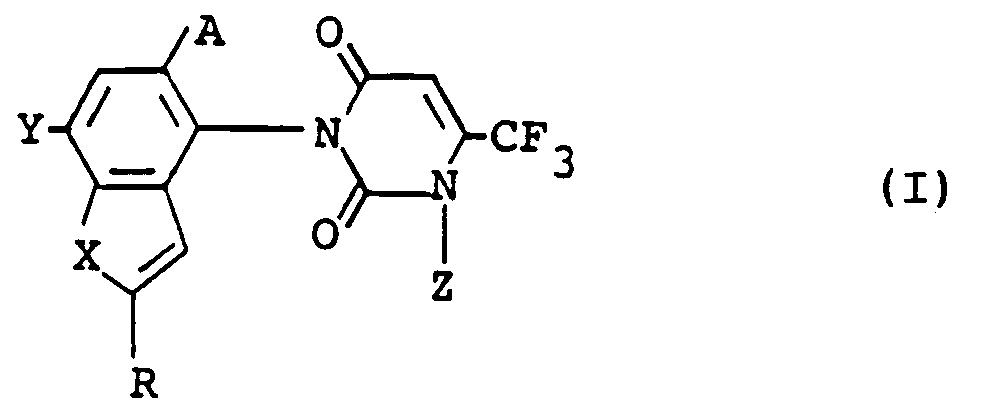
wherein R is a lower alkyl group, A is a hydrogen atom, a fluorine atom or a chlorine atom, X is an oxygen atom or a sulfur atom, Y is a hydrogen atom, a fluorine atom, a chlorine atom or a bromine atom and Z is a methyl group or an amino group, which is useful as a herbicide.
Description
- The present invention relates to uracil derivatives, and their production and use. More particularly, it relates to uracil derivatives, a process for producing them, and their use as herbicides.
- U.S. Patent No. 3,920,653 discloses some uracil derivatives useful as herbicides. Also, U.S. Patent No. 4,881,967 discloses some 2,3-dihydrobenzofurans useful as herbicides. However, these known herbicides are not sufficient in herbicidal potency or have poor selectivity between crop plants and weeds. Their herbicidal activity is thus not necessarily satisfactory.
- It has now been found that uracil derivatives of formula I:

wherein R is a lower alkyl group (e.g. a C₁-C₃ alkyl group), A is a hydrogen atom, a fluorine atom or a chlorine atom, X is an oxygen atom or a sulfur atom, Y is a hydrogen atom, a fluorine atom, a chlorine atom or a bromine atom and Z is a methyl group or an amino group show a high herbicidal potency aginst various weeds. Thus, they produce a strong herbicidal activity against a wide variety of weeds including broad-leaved weeds, graminaceous weeds, commelinaceous weeds and cyperaceous weeds in agricultural plowed fields by foliar or soil treatment. Some of the compounds of formula (I) do not produce any material phytotoxicity on various agricultural crops such as corn, wheat, rice plant, soybean, and cotton. Examples of the broad-leaved weeds include wild buckwheat (Polygonum convolvulus), pale smartweed (Polygonum lapathifolium), common purslane (Portulaca oleracea), common chickweed (Stellaria media), common lambsquarters (Chenopodium album), redroot pigweed (Amaranthus retroflexus), radish (Raphanus sativus), wild mustard (Sinapis arvensis), shepherdspurse (Capsella bursa-pastoris) hemp sesbania (Sesbania exaltata), sicklepod (Cassia obtusifolia), velvetleaf (Abutilon theophrasti), prickly sida (Sida spinosa), field pansy (Viola arvensis), catchweed bedstraw (Galium aparine), ivyleaf morningglory (Ipomoea hederacea), tall morningglory (Ipomoea purpurea), field bindweed (Convolvulus arvensis), purple deadnettle (Lamium purpureum), henbit (Lamium amplexicaure), jimsonweed (Datura stramonium), black nightshade (Solanum nigrum), persian speedwell (Veronica persica), common cocklebur (Xanthium pensylvanicum), common sunflower (Helianthus annuus), scentless chamomile (Matricaria perforata), corn marigold (Chrysanthemum segetum), sun spurge (Euphorbia helioscopia), spotted spurge (Euphorbia maculata), etc. - Examples of graminaceous weeds include Japanese millet (Echinochloa frumentacea), barnyardgrass (Echinochloa crus-galli), green foxtail (Setaria viridis), large crabgrass (Digitaria sanguinalis), annual bluegrass (Poa annua), blackgrass (Alopecurus myosuroides), oats (Avena sativa), wild oats (Avena fatua), johnsongrass (Sorghum halepense), quackgrass (Agropyron repens), downy brome (Bromus tectorum), bermudagrass (Cynodon dactylon), giant foxtail (Setaria faberi), etc.
- Examples of commelinaceous weeds include asiatic dayflower (Commelina communis), etc. Examples of the cyperaceous weeds include rice flatsedge (Cyperus iria), purple nutsedge (Cyperus rotundus), etc.
- Some of the compounds (I) are also effective in exterminating paddy field weeds including graminaceous weeds such as barnyardgrass (Echinochloa oryzicola), broad-leaved weeds such as common falsepimpernel (Lindernia procumbens), indian toothcup (Rotala indica) and waterwort (Elatine triandra), cyperaceous weeds such as water nutgrass (Cyperus serotinus), hardstem bulrush (Scirpus juncoides), needle spikerush (Eleocharis acicularis) and umbrella sedge (Cyperus difformis), and others such as monochoria (Monochoria vaginalis) and arrowhead (Sagittaria pygmaea) without producing any phytotoxicity to rice plants on flooding treatment.
- Among the compounds (I), preferred are those wherein X is an oxygen atom. More preferred are those wherein X is an oxygen atom and Y is a fluorine atom, a chlorine atom or a bromine atom. Especially preferred are those wherein X is an oxygen atom, Y is a fluorine atom , a chlorine atom or a bromine atom and R is a C₁-C₃ alkyl group.
- Typical examples of the preferred compounds are 1-(5,7-difluoro-2-methylbenzo[b]furan-4-yl)-3-methyl-4-trifluoromethyl-1,2,3,6-tetrahydropyrimidine-2,6-dione, 1-(7-chloro-2-ethyl-5-fluorobenzo[b]furan-4-yl)-3-methyl-4-trifluoromethy1-1,2,3,6-tetrahydropyrimidine-2,6-dione, 3-amino-1-(7-chloro-2-ethyl-5-fluorobenzo[b]furan-4-yl)-4-trifluoromethyl-1,2,3,6-tetrahydropyrimidine-2,6-dione, 3-amino-1-(5,7-difluoro-2-methylbenzo[b]furan-4-yl)-4-trifluoromethyl-1,2,3,6-tetrahydropyrimidine-2,6-dione and 1-(7-chloro-5-fluoro-2-methylbenzo[b]furan-4-yl)-3-methyl-4-trifluoromethyl-1,2,3,6-tetrahydropyrimidine-2,6-dione, etc.
- The compound (I) of the invention can be produced according to the following procedures.
- The compound (I) can be produced by reacting a compound of formula II:

wherein R, A, X and Y are each as defined above with either a compound of formula III:
CH₃-E (III)
wherein E is a chlorine atom, a bromine atom, an iodine atom or a methanesulfonyloxy group, or a compound of formula IV:
NH₂-G (IV)
wherein G is a methanesulfonyloxy group, a p-toluenesulfonyloxy group or a 2,4-dinitrophenoxy group. - The reaction is usually carried out in an inert solvent at a temperature of about 0 to 100°C for a period of about 0.5 to 10 hours in the presence of a base.
- The compound (III) or (IV) and the base are used respectively in amounts of about 1 to 10 equivalents and of about 1 to 1.5 equivalents to one equivalent of the compound (II). As the base, an inorganic base (e.g. sodium hydride, potassium hydride), an alkali metal alkoxide (e.g. sodium methoxide, sodium ethoxide) etc. may be used.
- Examples of the inert solvent are aliphatic hydrocarbons (e.g. hexane, heptane), aromatic hydrocarbons (e.g. benzene, toluene, xylene), halogenated hydrocarbons (e.g. chloroform, carbon tetrachloride), ethers (e.g. diethyl ether, dioxane, tetrahydrofuran), ketones (e.g. acetone, methyl isobutyl ketone), esters (e.g. ethyl acetate), acid amides (e.g. N,N-dimethylformamide), sulfur compounds (e.g. dimethylsulfoxide), etc. These may be used solely or in combination.
- After completion of the reaction, the reaction mixture is subjected to ordinary post-treatment. For instance, the reaction mixture is poured into water, and the precipitated crystals are collected by filtration or extracted with an organic solvent, followed by concentration. If desired, any conventional purification procedure such as chromatography or recrystallization may be applied to the resulting product.
- The compound (I) of the present invention can be also produced by treating a compound of formula V:

wherein R' and R'' are the same or different, and each represents a hydrogen atom or a lower alkyl group and A, X, Y and Z are each as defined above with a base. - The reaction is usually carried out in an inert solvent at a temperature of about 20 to 200°C, preferably about 60 to 150°C for a period of about 1 to 96 hours. As the base, an inorganic base (e.g. potassium carbonate, potassium fluoride, cesium fluoride, sodium hydride), an organic base (e.g. quaternary ammonium fluoride), an alkali metal alkoxide (e.g. sodium methoxide, sodium ethoxide), etc. may be used.
- The base is used in an amount of about 0.1 to 1 equivalent to one equivalent of the compound (V). Examples of the inert solvent are aromatic hydrocarbons (e.g. toluene, xylene, mesitylene), acid amides (e.g. N,N-dimethylformamide), ethers (e.g. 1,4-dioxane, tetrahydrofuran), sulfur compounds (e.g. dimethylsulfoxide, sulphorane), etc.
- After completion of the reaction, the reaction mixture is subjected to ordinary post-treatment. For instance, the reaction mixture is poured into an acidic solution, and precipitated crystals are collected by filtration or extracted with an organic solvent, dried and concentrated. If desired, any conventional purification procedure such as recrystallization or chromatography may be applied to the resulting product.
- The compound (V) can be produced by the method as disclosed in EP 260621 A or EP 408382 A.
- The starting compound (II) can be produced according to the following scheme:

wherein R', R'', A, X and Y are each as defined above. - The above reactions are explained in detail below.
- The compound (VII) can be produced by heating the compound (VI) in the presence or absence of an inert solvent at a temperature of about 100 to 300°C, preferably about 150 to 250°C, for a period of about 2 to 100 hours.
- Examples of the inert solvent are aromatic hydrocarbons (e.g. toluene, xylene, mesitylene, tetraline), tertiary amines (e.g. N,N-diethylaniline), etc. These may be used solely or in combination.
- After completion of the reaction, the reaction mixture is subjected to ordinary post-treatment. For instance, the reaction mixture is extracted with an organic solvent, followed by concentration. If desired, any conventional purification procedure such as chromatography, distillation or recrystallization may be applied to the resulting product.
- The compound (VI) can be produced by the method as described in EP 61741 B from the corresponding phenol or thiophenol.
- The compound (VIII) can be produced by reacting the compound (VII) in the presence of an acid.
- The reaction is usually carried out in the presence or absence of an inert solvent at a temperature of about 0 to 100°C, preferably about 5 to 80°C, for a period of about 0.5 to 24 hours.
- The acid is used in an amount of about 1.1 to 100 equivalents to one equivalent of the compound (VII). As the acid, inorganic acids(e.g. hydrochloric acid, sulfuric acid, polyphosphoric acid), sulfonic acids (e.g. p-toluenesulfonic acid, trifluoromethanesulfonic acid), carboxylic acids(e.g. formic acid, acetic acid, trifluoroacetic acid), etc. may be used.
- Examples of the inert solvent are aromatic hydrocarbons (e.g. benzene, toluene), halogenated hydrocarbons (e.g. chloroform, carbon tetrachloride), inorganic acids (e.g. hydrochloric acid, sulfuric acid), organic acids(e.g. acetic acid) and water, etc. These may be used solely or in combination.
- After completion of the reaction, the reaction mixture is subjected to ordinary post-treatment. For instance, the reaction mixture is poured into water, and precipitated crystals are collected by filtration or extracted with an organic solvent, followed by concentration. If desired, any conventional purification procedure such as chromatography, distillation or recrystallization may be applied to the resulting product.
- The compound (IX) can be produced by reacting the compound (VIII) with methyl chlorocarbonate.
- The reaction is usually carried out in the presence of a base in an inert solvent at a temperature of about 0 to 120°C, preferably about 20 to 80°C, for a period of about 0.5 to 5 hours. Methyl chlorocarbonate and the base are used respectively in amounts of about 1 to 2 equivalents and of about 1 to 1.5 equivalents to one equivalent of the compound (VIII). As the base, organic bases(e.g. triethylamine, pyridine, N,N-diethylaniline), inorganic bases(e.g. potassium carbonate, sodium hydride), etc. may be used.
- Examples of the inert solvent are aromatic hydrocarbons (e.g. benzene, toluene), halogenated hydrocarbons (e.g. chloroform, carbon tetrachloride), ethers (e.g. diethyl ether, dioxane, tetrahydrofuran), ketones (e.g. acetone, methyl isobutyl ketone), acid amides(e.g. N,N-dimethylfomamide), sulfur compounds (e.g. dimethylsulfoxide), etc.
- After completion of the reaction, the reaction mixture is subjected to ordinary post-treatment. For instance, the reaction mixture is poured into water and precipitated crystals are collected by filtration, or extracted with an organic solvent, followed by concentration. If desired, any conventional purification procedure such as chromatography or recrystallization may be applied to the resulting product.
- The compound (X) can be produced by reacting the compound (VIII) with phosgene.
- The reaction is usually carried out in an inert solvent at a temperature of about 0 to 120°C, preferably about 20 to 100°C, for a period of about 0.5 to 12 hours. The phosgene is used in an amount of about 2 to 10 equivalents to one equivalent of the compund (VIII).
- Examples of the inert solvent are aliphatic hydrocarbons (e.g. hexane, heptane), aromatic hydrocarbons (e.g. benzene, toluene), halogenated hydrocarbons (e.g. chloroform, carbon tetrachloride), etc. These may be used solely or in combination.
- After completion of the reaction, the inert solvent and excess phosgene are removed from the reaction mixture. If desired, any conventional purification procedure such as distillation or recrystallization may be applied to the resulting product.
- The compound (II) is obtainable by reacting the compound (IX) with a compound of formula XI:
CF₃(NH₂)C=CHCO₂C₂H₅ (XI)
in the presence of a base in an inert solvent. - The reaction is usually carried out at a temperature of about 0 to 150°C, preferably about 80 to 120°C, for a period of about 0.5 to 10 hours.
- The compound (XI) and the base are used respectively in amounts of about 1 to 10 equivalents and of about 1 to 10 equivalents to one equivalent of the compound (IX). As the base, sodium hydride, potassium hydride, etc. may be used.
- Examples of the inert solvent are aliphatic hydrocarbons (e.g. hexane, heptane), aromatic hydrocarbons (e.g. benzene, toluene), ethers (e.g. diethyl ether, dioxane, tetrahydrofuran), acid amides (e.g. N,N-dimethylformamide) sulfur compounds (e.g. dimethylsulfoxide), etc. These may be used solely or in combination.
- After completion of the reaction, the reaction mixture is subjected to ordinary post-treatment. For example, the reaction mixture is poured into water or an acidic solution, and precipitated crystals are collected by filtration or extracted with an organic solvent, followed by concentration. If desired, any conventional purification procedure such as chromatography, distillation or recrystallization may be applied to the resulting product.
- The compound (II) is also produced by reacting the compound (X) with the compound (XI) in the presence of a base.
- The reaction is usually carried out in an inert solvent at a temperature of about 0 to 60°C, preferably about 5 to 30°C, for a period of about 0.5 to 10 hours.
- The compound (XI) and the base are used respectively in amounts of about 1 to 1.5 equivalents and of about 1 to 1.5 equivalents to one equivalent of the compound (X). As the base, sodium hydride, potassium hydride, etc. may be used.
- Examples of the inert solvent are aliphatic hydrocarbons (e.g. hexane, heptane), aromatic hydrocarbons (e.g. benzene, toluene), ethers (e.g. diethyl ether, dioxane, tetrahydrofuran), acid amides (e.g. N,N-dimethylformamide), sulfur compounds (e.g. dimethylsulfoxide), etc. These may be used solely or in combination.
- After completion of the reaction, the reaction mixture is subjected to ordinary post-treatment. For instance, the reaction mixture is poured into water or an acidic solution, and precipitated crystals are collected by filtration or extracted with an organic solvent, followed by concentration. If desired, any conventional purification procedure such as chromatography, distillation or recrystallization may be applied to the resulting product.
- The compound (II) which is obtained by the procedures as above can be used for production of the compound (I) without further purification.
- Typical embodiments for production of the compounds (I) are illustratively shown in the following Examples.
- A mixture of ethyl 3-amino-4,4,4-trifluorocrotonate (2.1 g) and sodium hydride (0.5 g) was dissolved in N,N-dimethylformamide (0.5 g) and cooled, and a solution of 7-chloro-5-fluoro-4-methoxycarbonylamino-2-methylbenzo[b]furan (2.0 g) in N,N-dimethylformamide (5 g) was dropwise added thereto while cooling with ice. The resultant mixture was stirred for 30 minutes, followed by heating under reflux for 3 hours. After cooling, methyl iodide (0.6 g) was added thereto and the resultant mixture was allowed to stand overnight. After completion of the reaction, the reaction mixture was poured into water and extracted with ethyl acetate. The organic layer was washed with water, dried and concentrated. The residue was purified by silica gel chromatography (eluent: hexane/ethyl acetate = 4/1) to give the objective compound, i.e. Compound No. 3 (1.1 g).
- A mixture of ethyl 3-amino-4,4,4-trifluorocrotonate (1.5 g) and sodium hydride (0.2 g) was dissolved in N,N-dimethylformamide (10 ml), and a solution of 7-chloro-5-fluoro-4-methoxycarbonylamino-2-methylbenzo[b]furan (2.3 g) in N,N-dimethylformamide (10 ml) was dropwise added thereto at room temperature, followed by stirring at 120°C for 3 hours. After cooling to room temperature, methyl iodide (2.6 g) was added thereto and the resultant mixture was stirred at room temperature for 2 hours. After completion of the reaction, the reaction mixture was poured into water and extracted with ethyl acetate. The organic layer was washed with water, dried and concentrated. The residue was purified by silica gel chromatography (eluent: hexane/ethyl acetate = 4/1) to give the objective compound, i.e. Compound No. 3 (2.9 g; yeild, 86 %).
¹H-NMR δ (ppm) (60 MHz, CDCl₃): 2.33 (3H, s), 3.42 (3H, s), 6.09 (1H, s), 6.20 (1H, s), 6.99 (1H, d, J = 10 Hz). - In the same manner as in Example 2, Compound No. 2 (0.53 g; yield, 71 %) was obtained by reacting 5,7-difluoro-4-methoxycarbonylamino-2-methylbenzo[b]furan (0.5 g) with ethyl 3-amino-4,4,4-trifluorocrotonate (0.35 g) and methyl iodide (0.6 g).
¹H-NMR δ (ppm) (60 MHz, CDCl₃): 2.38 (3H, s), 3.48 (3H, s), 6.14 (1H, m), 6.24 (1H, s), 7.78 (1H, t, J = 10 Hz). - A mixture of ethyl 3-amino-4,4,4-trifluorocrotonate (0.21 g) and sodium hydride (0.03 g) was dissolved in N,N-dimethylformamide (2 ml), and a solution of 5,7-difluoro-4-methoxycarbonylamino-2-methylbenzo[b]furan (0.3 g) in N,N-dimethylformamide (2 ml) was dropwise added thereto at room temperature, followed by stirring at 120°C for 3 hours. After cooling to room temperature, a solution of 2,4-dinitrophenoxyamine (0.3 g) in N,N-dimethylformamide (1 ml) was added thereto, and the resultant mixture was stirred at room temperature for 3 hours. After completion of the reaction, the reaction mixture was poured into water and extracted with ethyl acetate. The organic layer was washed with water, dried and concentrated. The residue was purified by silica gel chromatography (eluent: hexane/ethyl acetate = 1/1) to give the objective compound, i.e. Compound No. 5 (0.06 g; yield, 13 %).
¹H-NMR δ (ppm) (60 MHz, DMSO-d6: 2.31 (3H, s), 5.34 (2H, s), 6.19 (1H, s), 6.55 (1H, m), 7.20 (1H, t, J = 10 Hz). - A solution of 4-amino-7-chloro-5-fluoro-2-methylbenzo[b]thiophene (2.6 g) in toluene (10 ml) was dropwise added to a solution of phosgene (11.9 g) in toluene (20 ml) at room temperature. The resultant mixture was heated under reflux for 2 hours, followed by removal of excess phosgene to give a solution of an isocyanate derivative in toluene (20 ml). The thus obtained solution was dropwise added to a solution of ethyl 3-amino-4,4,4-trifluorocrotonate (1.6 g) and sodium hydride (0.29 g) in N,N-dimethylformamide (10 ml) at 5°C, followed by dropwise addition of methyl iodide (3.4 g) at the same temperature. The resultant mixture was further stirred at room temperature for 2 hours. After completion of the reaction, the reaction mixture was poured into water and extracted with ethyl acetate. The organic layer was washed with water, dried and concentrated. The residue was purified by silica gel chromatography (eluent: hexane/ethyl acetate = 3/1) to give the objective compound, i.e. Compound No. 8 (1.7 g; yield, 36 %).
¹H-NMR δ (ppm) (60 MHz, CDCl₃): 2.54 (3H, s), 3.54 (3H, s), 6.33 (1H, s), 6.67 (1H, s), 7.15 (1H, d, J = 9 Hz). - A mixture of 1-(7-chloro-2-ethyl-5-fluorobenzo[b]furan-4-yl)-4-trifluoromethyl-1,2,3,6-tetrahydropyrimidine-2,6-dione (1.9 g) and sodium hydride (0.3 g) was dissolved in N,N-dimethylformamide (10 ml). After cooling to room temperature, methyl iodide (0.8 g) was dropwise added to the mixture, which was stirred for 30 minutes. After completion of the reaction, the reaction mixture was poured into water and extracted with ethyl acetate. The organic layer was washed with water, dried and concentrated. The residue was purified by silica gel chromatography (eluent: hexane/ethyl acetate = 4/1) to give the objective compound, i.e. Compound No. 14 (0.7 g; yield, 36 %).
¹H-NMR δ (ppm) (500 MHz, CDCl₃): 1.33 (3H, t, J = 8 Hz), 2.75 (2H, dq, J = 8 Hz(d), 1 Hz(q)), 3.58 (3H, s), 6.24 (1H, t, J = 1 Hz), 6.39 (1H, s), 7.15 (1H, d, J = 10 Hz). - To a solution of 1-[4-chloro-2-fluoro-5-(1-methyl-2-propynyloxy)phenyl]-3-methyl-4-trifluoromethyl-1,2,3,6-tetrahydropyrimidine-2,6-dione (1.1 g) in mesitylene (2 ml), potassium fluoride (0.16 g) was added at room temperature, and the resultant mixture was heated under reflux for 2 hours. After cooling to room temperature, potassium fluoride was removed from the reaction mixture by filtration, followed by removal of the solvent by evaporation. The residue was purified by silica gel chromatography (eluent: hexane/ethyl acetate = 4/1) to give the objective compound, i.e. Compound No. 14 (0.38 g; yield, 35 %).
- 60 % Sodium hydride (0.01 g) was added to dimethylformamide (20 ml), and 3-amino-1-[4-chloro-2-fluoro-5-(1-methyl-2-propynyloxy)phenyl]-4-trifluoromethyl-1,2,3,6- tetrahydropyrimidine-2,6-dione (0.71 g) was added thereto at room temperature. The resultant mixture was stirred at 100°C for 2 days. After cooling to room temperature, the reaction mixture was poured into ice water, extracted with ethyl acetate, dried over anhydrous magnesium sulfate and concentrated under reduced pressure. The residue was purified by silica gel chromatography (eluent: hexane/ethyl acetate = 3/1) to give the objective compound, i.e. Compound No. 17 (0.15 g; yield, 21 %).
¹H-NMR δ (ppm) (60 MHz, CDCl₃): 1.30 (3H, t, J = 8 Hz), 2.79 (2H, dq, J = 8 Hz(d), 1 Hz(q)), 4.58 (2H, s), 6.18 (1H, t, J = 1 Hz), 6.21 (1H, s), 7.07 (1H, d, J = 10 Hz). - In the same manner as above, the compounds (I) as shown in Table 1 are obtained.


- Typical embodiments for the preparation of the starting compounds (VII), (VIII) and (IX) are illustratively shown in the following examples.
- A mixture of 2-chloro-4-fluoro-5-nitrophenol (20.3 g) and 2,3-dichloropropene (11.7 g) was dissolved in N,N-dimethylformamide (200 ml), and potassium carbonate (14.6 g) was added thereto at room temperature, and the resultant mixture was stirred at 80°C for 2 hours. After cooling to room temperature, the reaction mixture was poured into water and extracted with ethyl acetate. The organic layer was washed with water, dried and concentrated. The residue was purified by silica gel chromatography (eluent: hexane/ethyl acetate = 4/1) to give 4-chloro-5-(2-chloro-2-propenyloxy)-2-fluoronitrobenzene (14.8 g; yield, 53 %).
¹H-NMR δ (ppm) (60 MHz, CDCl₃): 4.55 (2H, s), 5.38 (1H, br), 5.51 (1H, br), 7.21 (1H, d, J = 10 Hz), 7.45 (1H, d, J = 6 Hz). - A solution of 4-chloro-5-(2-chloro-2-propenyloxy)-2-fluoronitrobenzene (12.8 g) thus obtained in ethyl acetate (50 ml) was dropwise added to a suspension of iron powder (13.4 g) in acetic acid (200 ml) and water (20 ml) at 80°C for 10 minutes while stirring vigorously. Stirring was continued at 80°C for 0.5 hour, and the reaction mixture was cooled to 60°C, followed by addition of ethyl acetate (500 ml). Insoluble material was removed by filtration, and the filtrate was washed with a 5 % NaHCO₃ solution to remove acetic acid, dried and concentrated to give 4-chloro-5-(2-chloro-2-propenyloxy)-2-fluoroaniline (11.5 g).
¹H-NMR δ (ppm) (60 MHz, CDCl₃): 3.6 - 3.9 (2H, br), 4.51 (2H, s), 5.41 (1H, br), 5.60 (1H, br), 6.33 (1H, d, J = 8 Hz), 6.98 (1H, d, J = 10 Hz). - A solution of 4-chloro-5-(2-chloro-2-propenyloxy)-2-fluoroaniline (10.4 g) thus obtained in N,N-diethylaniline (20 ml) was heated under reflux for 12 hours. After cooling to room tepmperature, the reaction mixture was dissolved in ethyl acetate and washed with 10 % hydrochloric acid three times. After removal of N,N-diethylaniline, the reaction mixture was dried and concentrated. The residue was purified by silica gel chromatography (eluent: hexane/ethyl acetate = 4/1) to give 3-amino-6-chloro-2-(2-chloro-2-propenyl)-4-fluorophenol (7.4 g; yield, 71 %). m.p., 50.5 - 51.5°C.
¹H-NMR δ (ppm) (60 MHz, CDCl₃): 3.67 (2H, s), 3.6 - 3.9 (2H, br), 5.05 (1H, br), 5.20 (1H, br), 5.43 (1H, s), 6.89 (1H, d, J = 10 Hz). - 3-Amino-6-chloro-2-(2-chloro-2-propenyl)-4-fluorophenol (4.8 g) was dissolved in chloroform (20 ml), and trifluoromethanesulfonic acid (4.6 g) was dropwise added thereto at 5°C for 5 minutes, followed by stirring at room temperature for 5 hours. After completion of the reaction, the reaction mixture was poured into a 5 % NaOH solution (30 ml) at 5°C and extracted with ethyl acetate. The organic layer was dried and concentrated to give 4-amino-7-chloro-5-fluoro-2-methylbenzo[b]furan (3.5 g; yield, 86 %).
- A mixture of 5-amino-2-chloro-4-fluorothiophenol (8.89 g) and anhydride potassium carbonate (3.5 g) was dissolved in N,N-dimethylformamide (100 ml), and 2,3-dichloropropene (6.65 g) was added thereto. The resultant mixture was stirred at 20 to 40°C for 4 hours. After completion of the reaction, the reaction mixture was extracted with ether, washed with water, dried and concentrated. The residue was purified by silica gel chromatography (eluent: hexane/ethyl acetate = 7/1) to give 4-chloro-2-fluoro-5-(2-chloro-2-propenylthio)aniline (10.5 g; yield, 84 %).
- A solution of 4-chloro-2-fluoro-5-(2-chloro-2-propenyloxythio)aniline (10.0 g) thus obtained in N,N-diethylaniline (25 ml) was heated under reflux for 6 hours. After cooling to room tepmperature, the reaction mixture was made acidic (pH 2) with addition of 10 % hydrochloric acid and stirred at room temperature for 1 hour. The reaction mixture was extracted with ethyl acetate, washed with water, dried and concentrated. The residue was crystallized and washed with a mixture of hexane and ether to give 4-amino-7-chloro-5-fluoro-2-methylbenzo[b]thiophene (3.4 g).
- In the same manner as in Examples 10 and 11, the compounds (VIII) as shown in Table 2 were obtained.


- A mixture of 4-amino-7-chloro-5-fluoro-2-methylbenzo[b]furan (3.4 g) and N,N-diethylaniline (2.6 g) was dissolved in tetrahydrofuran (20 ml), and methyl chlorocarbonate (1.6 g) was dropwise added thereto at room temperature. The resultant mixture was heated under reflux for 3 hours. After cooling to room temperature, the reaction mixture was dissolved in ethyl acetate and washed with 10 % hydrochloric acid. After removal of N,N-diethylaniline, the reaction mixture was dried and concentrated. The residue was washed with hexane to give 7-chloro-5-fluoro-4-methoxycarbonylamino-2-methylbenzo[b]furan (3.8 g; yield, 87 %). m.p., 168 - 169°C.
¹H-NMR δ (ppm) (60 MHz, CDCl₃): 2.30 (3H, s), 3.71 (3H, s), 6.20 (1H, br), 6.30 (1H, s), 7.09 (1H, d, J = 10 Hz). - In the same manner as in Example 12, 5,7-difluoro-4-methoxycarbonylamino-2-methylbenzo[b]furan was obtained by reacting 4-amino-5,7-difluoro-2-methylbenzo[b]furan with methyl chlorocarbonate. m.p., 156 - 158°C.
¹H-NMR δ (ppm) (60 MHz, DMSO-d6): 2.26 (3H, s), 3.45 (3H, s), 6.39 (1H, br), 7.00 (1H, t, J = 11 Hz), 9.05 (1H, br). - For the practical usage of the compound (I), it is usually formulated with conventional solid or liquid carriers or diluents as well as surface active agents or auxiliary agents into conventional preparation forms such as emulsifiable concentrates, wettable powders, flowables, water dispersible granules and granules. The content of the compound (I) as the active ingredient in such preparation forms is normally within a range of about 0.005 to 80 % by weight, preferably of about 0.01 to 70 % by weight. Examples of the solid carrier or diluent are fine powders or granules of kaolin clay, attapulgite clay, bentonite, terra alba, pyrophyllite, talc, diatomaceous earth, calcite, walnut shell powders, urea, ammonium sulfate and synthetic hydrous silicate, etc. Examples of the liquid carrier or diluent are aromatic hydrocarbons (e.g. xylene, methylnaphthalene), alcohols (e.g. isopropanol, ethylene glycol, cellosolve), ketones (e.g. acetone, cyclohexanone, isophorone), soybean oil, cotton seed oil, dimethylsulfoxide, N,N-dimethylformamide, acetonitrile, water, etc.
- The surface active agent used for emulsification, dispersing or spreading may be of any type, for instance, either anionic or non-ionic. Examples of the surface active agent include alkylsulfates, alkylsulfonates, alkylarylsulfonates, dialkylsulfosuccinates, phosphates of polyoxyethylenealkylaryl ethers, polyoxyethylene alkyl ethers, polyoxyethylene alkylaryl ethers, polyoxyethylene polyoxypropylene block copolymer, sorbitan fatty acid esters, polyoxyethylene sorbitan fatty acid esters, etc. Examples of the auxiliary agents include ligninsulfonates, sodium alginate, polyvinyl alcohol, gum arabic, CMC (carboxymethyl cellulose), PAP (isopropyl acid phosphate), etc.
- Practical embodiments of the herbicidal composition according to the present invention are illustratively shown in the following examples wherein parts are by weight. The number of the active ingredient corresponds to the one in Table 1.
- Fifty parts of any one of Compound Nos. 1 to 5, 8, 14, 17, 25 and 49, 3 parts of calcium ligninsulfonate, 2 parts of sodium laurylsulfate and 45 parts of synthetic hydrous silicate are mixed well while being powdered to obtain a wettable powder.
- Five parts of any one of Compound Nos. 1 to 5, 8, 14, 17, 25 and 49, 14 parts of polyoxyethylenestyrylphenyl ether, 6 parts of calcium dodecylbenzenesulfonate, 25 parts of xylene and 50 parts of cyclohexanone are mixed well to obtain an emulsifiable concentrate.
- Two parts of any one of Compound Nos. 1 to 5, 8, 14, 17, 25 and 49, 1 part of synthetic hydrous silicate, 2 parts of calcium ligninsulfonate, 30 parts of bentonite and 65 parts of kaolin clay are mixed well while being powdered. The mixture is then kneaded with water, granulated and dried to obtain granules.
- Twenty-five parts of any one of Compound Nos. 1 to 5, 8, 14, 17, 25 and 49 are mixed with 3 parts of polyoxyethylene sorbitan monooleate, 3 parts of carboxymethyl cellulose and 69 parts of water and pulverized until the particle size of the mixture becomes less than 5 microns to obtain a flowable material.
- 0.05 part of any one of Compound Nos. 1 to 5, 8, 14, 17, 25 and 49, 1 part of synthetic hydrous silicate, 2 parts of calcium ligninsulfonate, 30 parts of bentonite and 66.95 parts of kaolin clay are mixed well while being powdered. The mixture is then kneaded with water, granulated and dried to obtain granules.
- The compound (I) thus formulated in any suitable preparation form is useful for pre-emergence or postemergence control of undesired weeds by soil or foliar treatment as well as flood fallowing treatment. These treatments include application to the soil surface prior to or after planting, incorporation into the soil prior to planting or transplanting, etc. The foliar treatment may be effected by spraying the herbicidal composition containing the compound (I) over the top of plants. It may also be applied directly to the weeds if care is taken to keep the chemical off the crop foliage.
- The compound (I) may be used together with any other herbicide to improve its activity as a herbicide. Further, it may be applied in combination with an insecticide, an acaricide, a nematocide, a fungicide, a plant growth regulator, a fertilizer, a soil improver, etc. It is also useful as a herbicide to be employed for orchards, pasture lands, lawns, forests, non-agricultural fields, etc.
- The dosage of the compound (I) may vary depending on the prevailing weather conditions, the formulation used, the prevailing season, the mode of application, the soil involved, the crop and weed species, etc. Generally, however, the dosage is from about 0.005 to 80 grams, preferably from about 0.02 to 40 grams, of the active ingredient per are. The herbicidal composition of the invention formulated in the form of an emulsifiable concentrate, a wettable powder, a water-dispersible granule or a flowable material may ordinarily be employed by diluting it with water at a volume of about 1 to 10 liters per are, if necessary, with addition of an auxiliary agent such as a spreading agent. Examples of the spreading agent include, in addition to the surface active agents as noted above, polyoxyethylene resin acid (ester), ligninsulfonate, abietic acid salt, dinaphthylmethanedisulfonate, paraffin, etc. The composition formulated in the form of granules may be normally applied as such without dilution.
- The biological data of the compound (I) as herbicides will be illustratively shown in the following Examples wherein the phytotoxicity to crop plants and the herbicidal activity on weeds were observed visually as to the degree of germination as well as the growth inhibition and rated with an index 0, 1, 2, 3, 4 or 5, the numeral "0" indicating no material difference as seen in comparison with the untreated plants and the numeral "5" indicating the complete inhibition or death of the test plants.
- The compounds as shown in Table 3 were used for comparison.

- Cylindrical plastic pots (diameter, 10 cm; height, 10 cm) were filled with upland field soil, and the seeds of Japanese millet, tall morningglory and velvetleaf were sowed therein and covered with soil. A designated amount of the test compound formulated in an emulsifiable concentrate as in Formulation Example 2 was diluted with water, and the dilution was sprayed onto the soil surface by means of a small hand sprayer at a spray volume of 10 liters per are. The test plants were grown in a greenhouse for 20 days, and the herbicidal activity was examined. The results are shown in Table 4.

- Cylindrical plastic pots (diameter, 10 cm; height, 10 cm) were filled with upland field soil, and the seeds of Japanese millet, tall morningglory, radish and velvetleaf were sowed therein and cultivated in a greenhouse for 10 days. A designated amount of the test compound formulated in an emulsifiable concentrate as in Formulation Example 2 was diluted with water containing a spreading agent, and the dilution was sprayed over the foliage of the test plant by means of a small hand sprayer at a spray volume of 10 liters per are. The test plants were further grown in the greenhouse for 20 days, and the herbicidal activity was examined. The results are shown in Table 5.

- Cylindrical plastic pots (diameter, 8 cm; height, 12 cm) were filled with paddy field soil, and the seeds of barnyardgrass, broad-leaved weeds (common falsepimpernel, indian toothcup, warterwort) were sowed therein in 1 to 2 cm depth. After flooding, rice seedlings of the 2-leaf stage were transplanted and cultivated in a greenhouse for 6 days. A designated amount of the test compound formulated in an emulsifiable concentrate as in Formulation Example 2 was diluted with water (5 ml), and applied onto the water surface. The test plants were further grown in the greenhouse for 20 days, and the herbicidal activity and phytotoxicity were examined. At the time of the treatment, weeds were in general about to germ. The results are shown in Table 6.

- Vats (33 cm x 23 cm x 11 cm) were filled with upland field soil, and the seeds of cotton, corn, black nightshade, velvetleaf, tall morningglory and giant foxtail were sowed therein in 1 to 2 cm depth. A designated amount of the test compound formulated in an emulsifiable concentrate as in Formulation Example 2 was diluted with water, and the dilution was sprayed onto the soil surface by means of a small hand sprayer at a spray volume of 10 liters per are. The test plants were grown in a greenhouse for 20 days, and the herbicidal activity and the phytotoxicity were examined. The results are shown in Table 7.

- Vats (33 cm x 23 cm x 11 cm) were filled with upland field soil, and the seeds of soybean, rice plant, black nightshade and velvetleaf were sowed therein in 1 to 2 cm depth. A designated amount of the test compound formulated in an emulsifiable concentrate as in Formulation Example 2 was diluted with water, and the dilution was sprayed onto the soil surface by means of a small hand sprayer at a spray volume of 10 liters per are. The test plants were grown in a greenhouse for 20 days, and the herbicidal activity and the phytotoxicity were examined. The results are shown in Table 8.

- Vats (33 cm x 23 cm x 11 cm) were filled with upland field soil, and the seeds of cotton, prickly sida, sun spurge, velvetleaf and giant foxtail were sowed therein in 1 to 2 cm depth. A designated amount of the test compound formulated in an emulsifiable concentrate as in Formulation Example 2 was diluted with water, and the dilution was sprayed onto the soil surface by means of a small hand sprayer at a spray volume of 10 liters per are. The test plants were grown in a greenhouse for 20 days, and the herbicidal activity and the phytotoxicity were examined. The results are shown in Table 9.

- Vats (33 cm x 23 cm x 11 cm) were filled with upland field soil, and the seeds of wheat, pale smartweed, common chickweed, field pansy, persian speedwell and annual bluegrass were sowed therein in 1 to 2 cm depth. A designated amount of the test compound formulated in an emulsifiable concentrate as in Formulation Example 2 was diluted with water, and the dilution was sprayed onto the soil surface by means of a small hand sprayer at a spray volume of 10 liters per are. The test plants were grown in a greenhouse for 27 days, and the herbicidal activity and the phytotoxicity were examined. The results are shown in Table 10.

- Vats (33 cm x 23 cm x 11 cm) were filled with upland field soil, and the seeds of barnyardgrass, common cocklebur, tall morningglory, black nightshade and velvetleaf were sowed therein and cultivated in a greenhouse for 18 days. A designated amount of the test compound formulated in an emulsifiable concentrate as in Formulation Example 2 was diluted with water containing a spreading agent, and the dilution was sprayed over the foliage of the test plant by means of a small hand sprayer at a spray volume of 10 liters per are. The test plants were further grown in the greenhouse for 20 days, and the herbicidal activity was examined. At the time of application, the test plants were generally at the 1 to 4 leaf stage and in 6 to 30 cm height, although the growing stage of the test plants varied depending on their species. The results are shown in Table 11.

- Vats (33 cm x 23 cm x 11 cm) were filled with upland field soil, and the seeds of pale smartweed, field pansy, persian speedwell and catchweed bedstraw were sowed therein in 1 to 2 cm depth, and cultivated in a greenhouse for 31 days. A designated amount of the test compound formulated in an emulsifiable concentrate as in Formulation Example 2 was diluted with water containing a spreading agent, and the dilution was sprayed over the foliage of the test plants by means of a small hand sprayer at a spray volume of 10 liters per are. The test plants were further grown in the greenhouse for 27 days, and the herbicidal activity was examined. At the time of application, the test plants were generally at 1 to 4 leaf stage and in 2 to 12 cm height, although the growing stage of the test plants varied depending on their species. The results are shown in Table 12.

Claims (15)
- A compound of formula I:

- The compound according to claim 1, wherein X is an oxygen atom.
- The compound according to claim 1, wherein X is an oxygen atom and Y is a fluorine atom, a chlorine atom or a bromine atom.
- The compound according to claim 1, wherein X is an oxygen atom, Y is a fluorine atom, a chlorine atom or a bromine atom and R is a C₁-C₃ alkyl group.
- The compound according to claim 1, which is 1-(5,7-difluoro-2-methylbenzo[b]furan-4-yl)-3-methyl-4-trifluoromethyl-1,2,3,6-tetrahydropyrimidine-2,6-dione.
- The compound according to claim 1, which is 1-(7-chloro-2-ethyl-5-fluorobenzo[b]furan-4-yl)-3-methyl-4-trifluoromethyl-1,2,3,6-tetrahydropyrimidine-2,6-dione.
- The compound according to claim 1, which is 3-amino-1-(7-chloro-2-ethyl-5-fluorobenzo[b]furan-4-yl)-4-trifluoromethyl-1,2,3,6-tetrahydropyrimidine-2,6-dione.
- The compound according to claim 1, which is 3-amino-1-(5,7-difluoro-2-methylbenzo[b]furan-4-yl)-4-trifluoromethyl-1,2,3,6-tetrahydropyrimidine-2,6-dione.
- The compound according to claim 1, which is 1-(7-chloro-5-fluoro-2-methylbenzo[b]furan-4-yl)-3-methyl-4-trifluoromethyl-1,2,3,6-tetrahydropyrimidine-2,6-dione.
- A process for preparing a compound of formula I which comprises reacting a compound of formula II:

CH₃-E (III)
wherein E is a chlorine atom, a bromine atom, an iodine atom or a methanesulfonyloxy group, or a compound of formula IV:
NH₂-G (IV)
wherein G is a methanesulfonyloxy group, a p-toluenesulfonyloxy group or a 2,4-dinitrophenoxy group. - A process for preparing a compound of formula I which comprises treating a compound of formula V:

- A compound of formula VIII:

- A herbicidal composition which comprises as an active ingredient a herbicidally effective amount of a compound according to any of claims 1 to 9, and an inert carrier or diluent.
- A method for exterminating undesired weeds, which comprises applying a herbicidally effective amount of a compound according to any of claims 1 to 9 and an inert carrier or diluent to the area where the undesired weeds grow or will grow.
- Use of a compound according to any of claims 1 to 9 as a herbicide.
Applications Claiming Priority (2)
| Application Number | Priority Date | Filing Date | Title |
|---|---|---|---|
| JP25331390 | 1990-09-21 | ||
| JP253313/90 | 1990-09-21 |
Publications (2)
| Publication Number | Publication Date |
|---|---|
| EP0476697A1 true EP0476697A1 (en) | 1992-03-25 |
| EP0476697B1 EP0476697B1 (en) | 1996-03-20 |
Family
ID=17249561
Family Applications (1)
| Application Number | Title | Priority Date | Filing Date |
|---|---|---|---|
| EP91116056A Expired - Lifetime EP0476697B1 (en) | 1990-09-21 | 1991-09-20 | Benzofuranyl- and benzothiophenyl substituted uracil derivatives, and their production and use as herbicides |
Country Status (5)
| Country | Link |
|---|---|
| US (1) | US5169431A (en) |
| EP (1) | EP0476697B1 (en) |
| BR (1) | BR9104045A (en) |
| CA (1) | CA2051942A1 (en) |
| DE (1) | DE69118070T2 (en) |
Cited By (15)
| Publication number | Priority date | Publication date | Assignee | Title |
|---|---|---|---|---|
| EP0517181A1 (en) * | 1991-06-07 | 1992-12-09 | Sumitomo Chemical Company, Limited | Amino uracil derivatives, and their production and use |
| WO1993014073A1 (en) * | 1992-01-15 | 1993-07-22 | E.I. Du Pont De Nemours And Company | Pyrimidin compounds useful as herbicides |
| EP0561319A1 (en) * | 1992-03-18 | 1993-09-22 | Sumitomo Chemical Company Limited | Benzofuranyl substituted uracil derivatives, and their production and use as herbicides |
| US5346881A (en) * | 1993-08-13 | 1994-09-13 | Fmc Corporation | 2-(bicyclic heterocyclyl)-6-fluoroalkyluracils |
| EP0617033A1 (en) * | 1993-03-17 | 1994-09-28 | Sumitomo Chemical Company, Limited | Dihydrobenzofuran derivatives, their production and use |
| WO1995006641A1 (en) * | 1993-09-02 | 1995-03-09 | Basf Aktiengesellschaft | Substituted 1-amino-3-phenyluracils with herbicidal activities |
| WO1995002590A3 (en) * | 1993-07-16 | 1995-06-01 | Basf Ag | Substituted 2-fused phenylpyridines with herbicidal activities |
| US5441925A (en) * | 1994-06-28 | 1995-08-15 | Fmc Corporation | 1-amino-3-(bicyclic heterocyclyl)-6-fluoroalkyluracils |
| EP0705829A1 (en) * | 1994-08-31 | 1996-04-10 | Sumitomo Chemical Company, Limited | Epoxyphenol derivatives and herbicides containing them as active ingredients |
| WO1997012886A1 (en) * | 1995-10-04 | 1997-04-10 | Fmc Corporation | Herbicidal heterocyclic benzisoxazoles and benzisoxazolidinones |
| WO1997012884A1 (en) * | 1995-10-04 | 1997-04-10 | Fmc Corporation | Herbicidal 6-heterocyclic indazole derivatives |
| WO1998038188A1 (en) * | 1997-02-26 | 1998-09-03 | Fmc Corporation | Cycloimido-substituted benzofused heterocyclic herbicides |
| EP0902029A1 (en) * | 1997-09-05 | 1999-03-17 | Sumitomo Chemical Company, Limited | Pyrimidinone derivatives and herbicides containing them |
| WO2000015633A1 (en) * | 1998-09-10 | 2000-03-23 | Sumitomo Chemical Company, Limited | Condensed heterocylic compounds and herbicides containing them |
| WO2001010862A3 (en) * | 1999-08-09 | 2001-09-07 | Bayer Ag | Substituted heterocyclybenzofuranes |
Families Citing this family (6)
| Publication number | Priority date | Publication date | Assignee | Title |
|---|---|---|---|---|
| US6207830B1 (en) | 1987-09-23 | 2001-03-27 | Syngenta Crop Protection, Inc. | Process for the production of 3-aryl-uracils |
| WO1995005079A1 (en) * | 1993-08-13 | 1995-02-23 | Fmc Corporation | 3-(benzofuran-7-yl)-6-haloalkyluracils |
| DE19652431A1 (en) | 1996-12-17 | 1998-06-18 | Bayer Ag | Heterocyclyluracile |
| CN1680274A (en) * | 1997-10-27 | 2005-10-12 | Isk美国有限公司 | Substituted benzene compounds, process for their preparation, and herbicidal and defoliant compositions containing them |
| JP2002524399A (en) | 1998-09-09 | 2002-08-06 | 石原産業株式会社 | Condensed benzene derivatives useful as herbicides |
| US20040018941A1 (en) * | 2002-07-17 | 2004-01-29 | Ishihara Sangyo Kaisha, Ltd. | Fused-benzene derivatives of thiouracil, herbicidal and desiccant compositions contaning them |
Citations (5)
| Publication number | Priority date | Publication date | Assignee | Title |
|---|---|---|---|---|
| DE2106038A1 (en) * | 1970-03-02 | 1971-09-30 | Pfizer Inc., New York, N.Y. (V.StA.) | Substituted benzothiophenes and processes for making the same |
| US3920653A (en) * | 1972-02-18 | 1975-11-18 | Bayer Ag | 1-Aminouracil compounds and herbicidal compositions |
| EP0244098A2 (en) * | 1986-04-30 | 1987-11-04 | Schering Agrochemicals Limited | Thiazolotriazole herbicides |
| EP0408382A2 (en) * | 1989-07-14 | 1991-01-16 | Nissan Chemical Industries, Limited | Uracil derivatives and herbicides containing the same as active ingredient |
| EP0420194A2 (en) * | 1989-09-26 | 1991-04-03 | Sumitomo Chemical Company, Limited | Uracil derivatives and their production and use |
Family Cites Families (11)
| Publication number | Priority date | Publication date | Assignee | Title |
|---|---|---|---|---|
| US3740447A (en) * | 1972-02-16 | 1973-06-19 | Questor Corp | Music box |
| DK167280B1 (en) * | 1985-03-20 | 1993-10-04 | Ciba Geigy Ag | 3-ARYLURACIL DERIVATIVES, PROCEDURES FOR PREPARING THEREOF, WEED POLLUTANTS CONTAINING THESE DERIVATIVES AND THE USE OF THE DERIVATIVES FOR THE WEED PREVENTION |
| DK366887A (en) * | 1986-07-31 | 1988-05-13 | Hoffmann La Roche | pyrimidine |
| EP0260621A3 (en) * | 1986-09-18 | 1989-03-15 | F. HOFFMANN-LA ROCHE & CO. Aktiengesellschaft | 3-aryl uracil-enol ethers and their use as herbicides |
| US4881967A (en) * | 1986-12-10 | 1989-11-21 | E. I. Du Pont De Nemours And Company | Heterocyclic 2,3-dihydrobenzofuran herbicides |
| BR8807101A (en) * | 1987-06-19 | 1989-10-31 | Hoffmann La Roche | HETEROCYCLIC COMPOUNDS |
| AU2328188A (en) * | 1987-09-23 | 1989-04-18 | Ciba-Geigy Ag | Heterocyclic compounds |
| JPH02501831A (en) * | 1987-10-22 | 1990-06-21 | チバ ― ガイギー アクチエンゲゼルシャフト | heterocyclic compound |
| US4981508A (en) * | 1989-01-23 | 1991-01-01 | Uniroyal Chemical Company, Inc. | 1,4-benzoxazin-3-one substituted uracils |
| HU206708B (en) * | 1989-06-09 | 1992-12-28 | Ciba Geigy Ag | Herbicide compositions containing pyrimidine-dion derivatives as active components and for extirpating weeds |
| DE69104071T2 (en) * | 1990-01-18 | 1995-05-11 | Nissan Chemical Ind Ltd | Uracil derivatives and pesticides containing them as effective substances. |
-
1991
- 1991-09-20 US US07/763,259 patent/US5169431A/en not_active Expired - Lifetime
- 1991-09-20 DE DE69118070T patent/DE69118070T2/en not_active Expired - Fee Related
- 1991-09-20 BR BR919104045A patent/BR9104045A/en not_active IP Right Cessation
- 1991-09-20 EP EP91116056A patent/EP0476697B1/en not_active Expired - Lifetime
- 1991-09-20 CA CA002051942A patent/CA2051942A1/en not_active Abandoned
Patent Citations (5)
| Publication number | Priority date | Publication date | Assignee | Title |
|---|---|---|---|---|
| DE2106038A1 (en) * | 1970-03-02 | 1971-09-30 | Pfizer Inc., New York, N.Y. (V.StA.) | Substituted benzothiophenes and processes for making the same |
| US3920653A (en) * | 1972-02-18 | 1975-11-18 | Bayer Ag | 1-Aminouracil compounds and herbicidal compositions |
| EP0244098A2 (en) * | 1986-04-30 | 1987-11-04 | Schering Agrochemicals Limited | Thiazolotriazole herbicides |
| EP0408382A2 (en) * | 1989-07-14 | 1991-01-16 | Nissan Chemical Industries, Limited | Uracil derivatives and herbicides containing the same as active ingredient |
| EP0420194A2 (en) * | 1989-09-26 | 1991-04-03 | Sumitomo Chemical Company, Limited | Uracil derivatives and their production and use |
Non-Patent Citations (3)
| Title |
|---|
| CHEMICAL ABSTRACTS, vol. 106, no. 1, January 5, 1987, Columbus, Ohio, USA DUPHAR INTERNATIONAL RESEARCH B.V. "Preparation of piperazines as psychotropics" page 478, column 2, abstract-no. 5 080t * |
| CHEMICAL ABSTRACTS, vol. 107, no. 24, December 14, 1987, Columbus, Ohio, USA KATO, SHOZO et al. "Manufacture of ether com- pounds" page 103, column 1, abstract-no. 219 461n * |
| CHEMICAL ABSTRACTS, vol. 113, no. 10, September 3, 1990, Columbus, Ohio, USA HIROSE, HISAHIRO et al. "Squarylium compound using electrophotograhic photo- receptor" page 662, column 1, abstract-no. 88 199g * |
Cited By (31)
| Publication number | Priority date | Publication date | Assignee | Title |
|---|---|---|---|---|
| EP0517181A1 (en) * | 1991-06-07 | 1992-12-09 | Sumitomo Chemical Company, Limited | Amino uracil derivatives, and their production and use |
| US5280010A (en) * | 1991-06-07 | 1994-01-18 | Sumitomo Chemical Company, Limited | Amino uracil derivatives, and their production and use |
| WO1993014073A1 (en) * | 1992-01-15 | 1993-07-22 | E.I. Du Pont De Nemours And Company | Pyrimidin compounds useful as herbicides |
| US5602077A (en) * | 1992-01-15 | 1997-02-11 | E. I. Du Pont De Nemours And Company | Pyrimidine compounds as herbicides |
| US5567670A (en) * | 1992-01-15 | 1996-10-22 | E. I. Du Pont De Nemours And Company | Herbicides for citrus oil palm rubber and other plantation crops |
| EP0561319A1 (en) * | 1992-03-18 | 1993-09-22 | Sumitomo Chemical Company Limited | Benzofuranyl substituted uracil derivatives, and their production and use as herbicides |
| US5308829A (en) * | 1992-03-18 | 1994-05-03 | Sumitomo Chemical Company, Limited | Benbzofuran derivatives and their use as herbicides |
| US5411935A (en) * | 1993-03-17 | 1995-05-02 | Sumitomo Chemical Co., Ltd. | Dihydrobenzofuran derivatives, their production and use |
| AU676256B2 (en) * | 1993-03-17 | 1997-03-06 | Sumitomo Chemical Company, Limited | Dihydrobenzofuran derivatives, their production and use |
| TR27695A (en) * | 1993-03-17 | 1995-06-19 | Sumitomo Chemical Co | Dihydrobenzofuran derivatives, their production and use. |
| US5476834A (en) * | 1993-03-17 | 1995-12-19 | Sumitomo Chemical Company, Limited | Dihydrobenzofuran derivatives, their production and use |
| CN1053903C (en) * | 1993-03-17 | 2000-06-28 | 住友化学工业株式会社 | Dihydrobenzofuran derivatives and their preparation and use |
| EP0617033A1 (en) * | 1993-03-17 | 1994-09-28 | Sumitomo Chemical Company, Limited | Dihydrobenzofuran derivatives, their production and use |
| WO1995002590A3 (en) * | 1993-07-16 | 1995-06-01 | Basf Ag | Substituted 2-fused phenylpyridines with herbicidal activities |
| US6165941A (en) * | 1993-07-16 | 2000-12-26 | Basf Aktiengesellschaft | Substituted 2-phenylpyridines |
| US5346881A (en) * | 1993-08-13 | 1994-09-13 | Fmc Corporation | 2-(bicyclic heterocyclyl)-6-fluoroalkyluracils |
| WO1995006641A1 (en) * | 1993-09-02 | 1995-03-09 | Basf Aktiengesellschaft | Substituted 1-amino-3-phenyluracils with herbicidal activities |
| US5441925A (en) * | 1994-06-28 | 1995-08-15 | Fmc Corporation | 1-amino-3-(bicyclic heterocyclyl)-6-fluoroalkyluracils |
| EP0705829A1 (en) * | 1994-08-31 | 1996-04-10 | Sumitomo Chemical Company, Limited | Epoxyphenol derivatives and herbicides containing them as active ingredients |
| WO1997012886A1 (en) * | 1995-10-04 | 1997-04-10 | Fmc Corporation | Herbicidal heterocyclic benzisoxazoles and benzisoxazolidinones |
| WO1997012884A1 (en) * | 1995-10-04 | 1997-04-10 | Fmc Corporation | Herbicidal 6-heterocyclic indazole derivatives |
| US6080702A (en) * | 1995-10-04 | 2000-06-27 | Fmc Corporation | Herbicidal heterocyclic benzisoxazoles and benzisoxazolidinones |
| US6077812A (en) * | 1997-02-26 | 2000-06-20 | Fmc Corporation | Cycloimido-substituted benzofused heterocyclic herbicides |
| WO1998038188A1 (en) * | 1997-02-26 | 1998-09-03 | Fmc Corporation | Cycloimido-substituted benzofused heterocyclic herbicides |
| US6352958B1 (en) | 1997-02-26 | 2002-03-05 | Fmc Corporation | Cycloimido-substituted benzofused heterocyclic herbicides |
| US5998333A (en) * | 1997-09-05 | 1999-12-07 | Sumitomo Chemical Company, Ltd. | Pyrimidinone derivatives and herbicides containing them |
| EP0902029A1 (en) * | 1997-09-05 | 1999-03-17 | Sumitomo Chemical Company, Limited | Pyrimidinone derivatives and herbicides containing them |
| US6191070B1 (en) | 1997-09-05 | 2001-02-20 | Sumitomo Chemical Company, Limited | Pyrimidinone derivatives and herbicides containing them |
| WO2000015633A1 (en) * | 1998-09-10 | 2000-03-23 | Sumitomo Chemical Company, Limited | Condensed heterocylic compounds and herbicides containing them |
| US6586368B1 (en) | 1998-09-10 | 2003-07-01 | Sumitomo Chemical Company, Limited | Condensed heterocylic compounds and herbicides containing them |
| WO2001010862A3 (en) * | 1999-08-09 | 2001-09-07 | Bayer Ag | Substituted heterocyclybenzofuranes |
Also Published As
| Publication number | Publication date |
|---|---|
| BR9104045A (en) | 1992-06-09 |
| EP0476697B1 (en) | 1996-03-20 |
| DE69118070T2 (en) | 1996-11-21 |
| DE69118070D1 (en) | 1996-04-25 |
| CA2051942A1 (en) | 1992-03-22 |
| US5169431A (en) | 1992-12-08 |
Similar Documents
| Publication | Publication Date | Title |
|---|---|---|
| EP0476697B1 (en) | Benzofuranyl- and benzothiophenyl substituted uracil derivatives, and their production and use as herbicides | |
| EP0176101B1 (en) | Triazolopyridazines, and their production and use | |
| EP0420194B1 (en) | Uracil derivatives and their production and use | |
| US5280010A (en) | Amino uracil derivatives, and their production and use | |
| EP0142769B1 (en) | Tetrahydrobenzotriazoles, their production and use | |
| US5532208A (en) | Pyrimidone derivatives and their use | |
| US5308829A (en) | Benbzofuran derivatives and their use as herbicides | |
| US4970322A (en) | Process of preparing tetrahydroindazolyl-benzoxazines | |
| EP0446802B1 (en) | Iminothiazolines, their production and use as herbicides, and intermediates for their production | |
| EP0617033A1 (en) | Dihydrobenzofuran derivatives, their production and use | |
| EP0422639B1 (en) | Benzoxazinyl-pyrazoles, and their production and use | |
| EP0177032B1 (en) | Tetrahydrophthalimides, and their production and use | |
| EP0235567B1 (en) | Indazole compounds, their production, use and intermediates | |
| US5350736A (en) | Iminothiazolines, their production and use as herbicides, and intermediates for their production | |
| EP0338533B1 (en) | N-Phenylimides, and their production and use | |
| US5354730A (en) | Uracil derivatives and their herbicidal use | |
| EP0116928B1 (en) | Pyridotriazolium compounds, and their production and use | |
| US5281574A (en) | Uracil derivatives and their use | |
| EP0544218B1 (en) | Arylindazole derivatives and their use | |
| US5238906A (en) | Pyridone derivatives and use | |
| EP0274066B1 (en) | Benzothiazolones, and their production and use | |
| US5314864A (en) | N-aminouracil derivatives, and their production and use |
Legal Events
| Date | Code | Title | Description |
|---|---|---|---|
| PUAI | Public reference made under article 153(3) epc to a published international application that has entered the european phase |
Free format text: ORIGINAL CODE: 0009012 |
|
| AK | Designated contracting states |
Kind code of ref document: A1 Designated state(s): BE CH DE FR GB IT LI NL |
|
| 17P | Request for examination filed |
Effective date: 19920710 |
|
| 17Q | First examination report despatched |
Effective date: 19930823 |
|
| GRAA | (expected) grant |
Free format text: ORIGINAL CODE: 0009210 |
|
| AK | Designated contracting states |
Kind code of ref document: B1 Designated state(s): BE CH DE FR GB IT LI NL |
|
| ITF | It: translation for a ep patent filed | ||
| REF | Corresponds to: |
Ref document number: 69118070 Country of ref document: DE Date of ref document: 19960425 |
|
| ET | Fr: translation filed | ||
| REG | Reference to a national code |
Ref country code: CH Ref legal event code: NV Representative=s name: A. BRAUN, BRAUN, HERITIER, ESCHMANN AG PATENTANWAE |
|
| GRAH | Despatch of communication of intention to grant a patent |
Free format text: ORIGINAL CODE: EPIDOS IGRA |
|
| NLT2 | Nl: modifications (of names), taken from the european patent patent bulletin |
Owner name: SUMITOMO CHEMICAL COMPANY LIMITED |
|
| PLBE | No opposition filed within time limit |
Free format text: ORIGINAL CODE: 0009261 |
|
| STAA | Information on the status of an ep patent application or granted ep patent |
Free format text: STATUS: NO OPPOSITION FILED WITHIN TIME LIMIT |
|
| 26N | No opposition filed | ||
| PGFP | Annual fee paid to national office [announced via postgrant information from national office to epo] |
Ref country code: CH Payment date: 19990928 Year of fee payment: 9 |
|
| PGFP | Annual fee paid to national office [announced via postgrant information from national office to epo] |
Ref country code: NL Payment date: 19990930 Year of fee payment: 9 |
|
| PGFP | Annual fee paid to national office [announced via postgrant information from national office to epo] |
Ref country code: BE Payment date: 19991119 Year of fee payment: 9 |
|
| PG25 | Lapsed in a contracting state [announced via postgrant information from national office to epo] |
Ref country code: CH Free format text: LAPSE BECAUSE OF NON-PAYMENT OF DUE FEES Effective date: 20000930 Ref country code: BE Free format text: LAPSE BECAUSE OF NON-PAYMENT OF DUE FEES Effective date: 20000930 Ref country code: LI Free format text: LAPSE BECAUSE OF NON-PAYMENT OF DUE FEES Effective date: 20000930 |
|
| BERE | Be: lapsed |
Owner name: SUMITOMO CHEMICAL CY LTD Effective date: 20000930 |
|
| PG25 | Lapsed in a contracting state [announced via postgrant information from national office to epo] |
Ref country code: NL Free format text: LAPSE BECAUSE OF NON-PAYMENT OF DUE FEES Effective date: 20010401 |
|
| REG | Reference to a national code |
Ref country code: CH Ref legal event code: PL |
|
| NLV4 | Nl: lapsed or anulled due to non-payment of the annual fee |
Effective date: 20010401 |
|
| REG | Reference to a national code |
Ref country code: GB Ref legal event code: IF02 |
|
| PGFP | Annual fee paid to national office [announced via postgrant information from national office to epo] |
Ref country code: DE Payment date: 20070913 Year of fee payment: 17 |
|
| PGFP | Annual fee paid to national office [announced via postgrant information from national office to epo] |
Ref country code: GB Payment date: 20070919 Year of fee payment: 17 |
|
| PGFP | Annual fee paid to national office [announced via postgrant information from national office to epo] |
Ref country code: IT Payment date: 20070926 Year of fee payment: 17 |
|
| PGFP | Annual fee paid to national office [announced via postgrant information from national office to epo] |
Ref country code: FR Payment date: 20070914 Year of fee payment: 17 |
|
| GBPC | Gb: european patent ceased through non-payment of renewal fee |
Effective date: 20080920 |
|
| REG | Reference to a national code |
Ref country code: FR Ref legal event code: ST Effective date: 20090529 |
|
| PG25 | Lapsed in a contracting state [announced via postgrant information from national office to epo] |
Ref country code: IT Free format text: LAPSE BECAUSE OF NON-PAYMENT OF DUE FEES Effective date: 20080920 Ref country code: DE Free format text: LAPSE BECAUSE OF NON-PAYMENT OF DUE FEES Effective date: 20090401 |
|
| PG25 | Lapsed in a contracting state [announced via postgrant information from national office to epo] |
Ref country code: FR Free format text: LAPSE BECAUSE OF NON-PAYMENT OF DUE FEES Effective date: 20080930 |
|
| PG25 | Lapsed in a contracting state [announced via postgrant information from national office to epo] |
Ref country code: GB Free format text: LAPSE BECAUSE OF NON-PAYMENT OF DUE FEES Effective date: 20080920 |