EP0475196B1 - Method for processing audio signals in a sub-band coding system - Google Patents
Method for processing audio signals in a sub-band coding system Download PDFInfo
- Publication number
- EP0475196B1 EP0475196B1 EP91114465A EP91114465A EP0475196B1 EP 0475196 B1 EP0475196 B1 EP 0475196B1 EP 91114465 A EP91114465 A EP 91114465A EP 91114465 A EP91114465 A EP 91114465A EP 0475196 B1 EP0475196 B1 EP 0475196B1
- Authority
- EP
- European Patent Office
- Prior art keywords
- signals
- band
- audio
- linear
- coding system
- Prior art date
- Legal status (The legal status is an assumption and is not a legal conclusion. Google has not performed a legal analysis and makes no representation as to the accuracy of the status listed.)
- Expired - Lifetime
Links
Images






Classifications
-
- H—ELECTRICITY
- H04—ELECTRIC COMMUNICATION TECHNIQUE
- H04B—TRANSMISSION
- H04B1/00—Details of transmission systems, not covered by a single one of groups H04B3/00 - H04B13/00; Details of transmission systems not characterised by the medium used for transmission
- H04B1/66—Details of transmission systems, not covered by a single one of groups H04B3/00 - H04B13/00; Details of transmission systems not characterised by the medium used for transmission for reducing bandwidth of signals; for improving efficiency of transmission
- H04B1/667—Details of transmission systems, not covered by a single one of groups H04B3/00 - H04B13/00; Details of transmission systems not characterised by the medium used for transmission for reducing bandwidth of signals; for improving efficiency of transmission using a division in frequency subbands
-
- H—ELECTRICITY
- H04—ELECTRIC COMMUNICATION TECHNIQUE
- H04M—TELEPHONIC COMMUNICATION
- H04M3/00—Automatic or semi-automatic exchanges
- H04M3/42—Systems providing special services or facilities to subscribers
- H04M3/56—Arrangements for connecting several subscribers to a common circuit, i.e. affording conference facilities
- H04M3/561—Arrangements for connecting several subscribers to a common circuit, i.e. affording conference facilities by multiplexing
Definitions
- the present invention relates to a method of processing audio signals when audio signals are encoded by a sub-band coding system to transmit voice sound efficiently and to a method of processing audio signals in a sub-band coding system whereby such a method is suitable for use with general communication apparatuses, such as a video telephone conference system or the like which can be realized by using the above-mentioned process.
- a 64K bit/s PCM coding system which at the present time is the most commonly used voice coding system, is designed to encode voice sounds or acoustic signals in a frequency band of between 300 Hz and 3.4 kHz.
- component technology such as a voice detector, a voice level controller, an echo canceller, and voice communication apparatuses, such as an audio teleconference apparatus or the like, in which those technologies are used, have come to be realized by using digital signal processing.
- digital audio signal processing in an audio teleconference apparatus will be explained below.
- an N-1 addition system is adopted in which the voices of all the subscribers who participate in a conference are connected to a conference trunk apparatus, and then one subscriber receives the added voices of the remaining subscribers.
- the N-1 addition system is a system in which after all the signals sent from each subscriber have been added, the signal sent from a particular subscriber is subtracted from it, and the resulting signal is distributed, as a reception signal, to such a subscriber.
- the name of the system is derived from the fact that when the total number of subscribers is N, the number of signals added as reception signals to each subscriber becomes N-1.
- the N-1 addition system will now be explained in detail with reference to Fig. 1.
- Input codes A, B, C, and D from four subscribers are sequentially converted by an expander 1 into linear codes a, b, c, and d and added by the adder 2 to the output from a shift register 3.
- the codes from the expander 1 are also supplied to a shift register 4.
- the addition output from the adder 2 is supplied to the shift register 3 and also to a subtracter 5 where the output from the shift register 4 is subtracted.
- the subtraction output is supplied to a compressor 7 via an attenuator 6, and converted into PCM codes and sent out.
- input code A is first converted into code a by the expander 1 and stacked in the shift registers 3 and 4.
- the next input code B is similarly converted into code b by the expander 1.
- it is added by the adder 2 with data 1 stacked in the shift register 3, and then transferred to the shift register 3 again.
- a code-converted output is also transferred from the expander 1 to the shift register 4 where the output is stacked successively on the data a which has already been stacked.
- Fig. 2 a conventional example is shown in Fig. 2 in which 64K bit/s PCM codes are input to an audio teleconference apparatus using the N-1 addition system in order that the output level is automatically controlled.
- This figure is also disclosed in Japanese Patent Laid-Open No. 63-123257 showing a case of 4 subscribers.
- An explanation will now be provided of the operation of Fig. 2.
- Fig. 2 the expander 1 and the compressor 7 play the same role as those shown in Fig. 1.
- Reference numeral 8 denotes an N-1 addition circuit which consists of the shift registers 3 and 4, the adder 2 and the subtracter 5, all of which are shown in Fig. 1.
- Expanded audio signals a, b, c, and d of 4 subscribers A, B, C, and D are input to the N-1 addition circuit 8.
- the sum thereof (a+b+c+d) is output after a predetermined process is performed thereon and then input to an absolute value circuit 9.
- of the absolute value circuit 9 is supplied to a peak hold circuit 10 where the peak value P is maintained for a preset amount of time.
- the peak value P is supplied to the level control input terminal of a level controller 11, which is in the form of a variable gain amplifier or the like.
- the output level is controlled, for example, by a gain coefficient G determined by the following equation (1), using the peak value P.
- G 1 (0 ⁇ P ⁇ 1)
- G 1/P (1 ⁇ P ⁇ N) where the maximum amplitude level per subscriber is assumed to be 1.
- SB-ADPCM sub-band adaptive differential pulse code modulation
- p. 272-278 is applied to a conference call apparatus as an example of an audio call apparatus in which a sub-band coding system is applied.
- SB-ADPCM coding system performing an N-1 addition process by using linear PCM signals of the whole band (50 Hz to 7 kHz) obtained as normal outputs of an encoder is first considered. That is, when N-1 addition is realized concerning the linear PCM signals of the whole frequency band (50 Hz to 7 kHz), a decoder and an encoder are constructed as shown in Figs. 3 and 4. An N-1 addition circuit is connected between points P1 and P3 shown in the figure and constructed as shown in Fig. 5.
- CCITT recommendation G.722 that prescribes the specification of the coding system recommends that this voice addition be performed by using linear PCM signals of different bands (50 Hz to 4 kHz, and 4 to 7 kHz) for the following reasons:
- N-1 addition circuits are respectively connected between points P2 and P4 of each band in a case where an N-1 addition circuit is used for linear PCM signals of different bands to utilize the advantages of (1) to (3) above.
- Fig. 6 shows an example of a conference call apparatus which is recommended by the above-mentioned CCITT recommendation G.722, p. 326-328.
- the operation of Fig. 6 will be explained below.
- 64K bit/s SB-ADPCM codes are applied to the separation section of an SB-ADPCM decoder 12a placed in the transmission line, they are separated into signals of 16k bit/s in which high-band components of audio signals are encoded and signals of 48k bit/s in which low-band components of audio signals are encoded. They are input to a high-band SB-ADPCM decoder unit and a low-band SB-ADPCM decoder unit.
- Linear PCM signals are output from decoder units of each band and input to N-1 addition circuits 81 and 82 at each band.
- Linear PCM signals in which N-1 addition processing has been performed are again distributed band by band, to SB-ADPCM encoder units 13a to 13n for respective subscribers.
- the signals are encoded by the high-band SB-ADPCM encoder unit to SB-ADPCM codes of 16k bit/s and are encoded by the low-band SB-ADPCM encoder unit to SB-ADPCM codes of 48k bit/s.
- These codes are synthesized in the multiplexing section and become SB-ADPCM codes of 64k bit/s.
- audio signals of 50 Hz to 7 kHz are separated into low band (50 Hz to 4 kHz) and high band (4 to 7 kHz) signals.
- N-1 addition processing is performed in each band, resulting in the following advantages: "miniaturization of an apparatus”; “maintenance of high quality”; “elimination of extra delay”; and “easy echo control is possible”.
- automatic level control is peformed on the result of the addition process, if a technique in which normal audio signal power of all the bands is determined and a gain coefficient is computed on the basis of the power was used, a synthesis of bands is required.
- a voice detection process for detecting a silent condition unique to audio signals is also performed normally by referring to audio signal power in all bands. If bands are synthesized for the purpose of only this voice detecting process, a problem arises in that the amount of hardware of an apparatus increases.
- an object of the present invention is to provide a method of processing audio signals in a sub-band coding system, which is capable of realizing miniaturization of an apparatus, high quality, and simplification of the process by using a means for outputting detected results by referring to signals of only those frequency bands in which signal power is concentrated and for reflecting this output in all the frequency bands as regards such elements that results are determined from the signal power of the whole frequency band in the prior art, as voice detection and automatic level control in a signal process using a sub-band coding system.
- Another object of the present invention is to provide a method for processing audio signals, in which the detection of signals is performed by referring only to those bands in which signal power is concentrated without synthesizing other bands in order to determine the audio signal power of the whole band in a case where a sub-band coding system is used, as an audio coding system, to detect the presence or absence of decoded audio signals, in which coding system audio signals are divided into a plurality of frequency band components and encoded.
- a further object of the present invention is to provide a method of processing audio signals, in which a sub-band coding system for dividing audio signals into a plurality of frequency band components is used to encode the signals and in which the level of decoded audio signals is automatically controlled, comprising the steps of determining a gain coefficient by referring only to those bands in which signal power is concentrated without synthesizing other bands; and controlling the level of each band by using this value.
- a still further object of the present invention is to provide a method of processing audio signals, in which a sub-band coding system which divides audio signals into a plurality of frequency band components is used, as an audio coding system, to encode the signals, and a multi-location audio teleconference is held, comprising the steps of performing an N-1 addition process at each band; and detecting the voices of each of the conference participants and the automatic control of the audio signals after the N-1 addition process by referring only to those bands in which signal power is concentrated.
- a still further object of the present invention is to provide a method of processing audio signals, in which a sub-band coding system which divides audio signals into a plurality of frequency band components is used as a voice coding system, to encode the process, and in which the level of decoded audio signals is automatically controlled, comprising the steps of synthesizing a plurality of bands in which signal power is concentrated to determine a gain coefficient and by referring to those bands without synthesizing all the bands; and controlling the level of each band by using this value.
- a still further object of the present invention is to provide a method of processing audio signals, in which a sub-band coding system which divides audio signals into a plurality of frequency band components is used, as an audio coding system, to encode signals, and a multi-location audio teleconference is held using decoded audio signals, comprising the steps of performing an N-1 addition process at each band; and detecting the voices of each of the conference participants and the automatic control of audio signals after the N-1 addition process by referring only to those bands in which signal power is concentrated.
- the process is performed by referring only to those bands in which signal power is concentrated without synthesizing bands to determine audio signal power.
- a gain coefficient is determined by referring only to those bands in which signal power is concentrated without synthesizing other bands and the level of each band is controlled by using this value.
- a gain coefficient is determined by referring only to those bands in which signal power is concentrated without synthesizing bands and the level of each band is controlled by using this value.
- voice detection, automatic level control and the like can be accomplished by using means for outputting the detected results by referring to only the signals in the frequency band in which the signal power is concentrated and for reflecting the output of the detected results throughout the whole frequency bands, although, in the prior art, they have been obtained from the signal power in the whole frequency bands. It is possible, therefore, to realize miniaturization and high quality of the apparatus, and simplification of the process.
- the advantages that the sub-band coding system possesses can be obtained without requiring extra hardware. Particularly, when the SB-ADPCM coding system which complies with the CCITT recommendation G.722 is applied to a communication apparatus, the following advantages can be obtained:
- Fig. 7 shows an embodiment in which the present invention is realized, which is an audio teleconference apparatus among multi points which uses a 64K bit/s PCM coding system, comprising a voice encoding which complies with CCITT recommendation G.722.
- the constructions of SB-ADPCM decoder units 12a to 12d are as shown in a decoder unit 12 in Fig. 3.
- the construction of SB-ADPCM encoder units 13a to 13d are as shown in an encoder unit 13 in Fig. 4.
- N-1 addition circuits 81 and 82 and a level computing unit 15 correspond to an absolute value circuit 9 and a peak hold circuit 10, both of which are shown in Fig. 2.
- Level controllers 111 and 112 which are in the form of a variable gain amplifier, have a function comparable to that of a level controllers 11 shown in Fig. 2.
- the high-band mixing section 101 comprises the N-1 addition circuit 81 and the level controller 111.
- the low-band mixing section 102 comprises the N-1 addition circuit 82, a sound detector 14, a level computing unit 15, and the level controller 112.
- Fig. 7 is a view showing a case in which a conference call apparatus for four subscribers is realized. If SB-ADPCM codes input from each subscriber are assumed to be A, B, C, and D, they are separated into a h and a l , b h and b l , c h and c l , d h and d l , at each band by the SB-ADPCM decoder units 12a to 12d disposed in the path for each subscriber. These signals are input to the mixing sections 101 and 102 at each band on a time division basis. First, a predetermined process is performed by N-1 addition circuits 81 and 82.
- the result of the N-1 addition is output to each subscriber on a time division basis, each of which is applied to the control input terminals of the level controllers 111 and 112.
- the sum of the audio signals of all the subscribers is computed by the N-1 addition circuit 82 and input to the level computing unit 15 and the sound detector 14.
- a predetermined process is performed by the level computing unit 15 even when the result of the output of the sound detector 14 indicates that only one person is speaking. When no participants are speaking, a process such that the previous output value is maintained is performed.
- Signal levels obtained in this manner are applied to both the level controller 112 of the low-band mixing section 102 and the level controller 111 of the high-band mixing section 101, effecting level control. Therefore, the level controllers 111 and 112 control the outputs of the N-1 addition circuits 81 and 82 respectively by using the same gain coefficient value. Thereafter, each of the signals output from the high- and low-band mixing sections 101 and 102 is input to each of the SB-ADPCM encoder units 13a to 13d for each subscriber. After the signals are processed with a predetermined process, they are transmitted again as 64K bit/s SB-ADPCM codes.
- the same advantages as in the conventional process can be obtained by performing N-1 voice addition at each frequency band, by computing a gain coefficient value by detecting voices on the basis of the signal level in the low-band section where signal power is concentrated without synthesizing all frequency bands, and by automatically controlling the level of the audio signals in both high- and low-band in each signal process, for example, in a conference call system in which a multi-point broadcast communication using an SB-ADPCM coding system is performed.
- extra hardware is not required, and advantages such as these features described in (1) to (3) below that the sub-band coding system possesses can be utilized can be obtained:
- the audio teleconference apparatus in which the SB-ADPCM coding system which complies with the CCITT recommendation G.722 is applied has been explained.
- the same advantages can be obtained by means other than the SB-ADPCM coding system, and can be obtained commonly in a case where the sub-band coding system is employed.
- the amount of computation and required memory capacity can be reduced by the sub-band coding system.
- the same effect as in the non-subband coding system can be achieved by referring to only signals of bands in which signal power is concentrated during the detection of cross talk.
- a coding system which is divided into three or more bands can also be effectively applied to composite outputs in which one band thereof or bands having signal power sufficient for detecting voice sounds and computing the voice level are synthesized.
Landscapes
- Engineering & Computer Science (AREA)
- Signal Processing (AREA)
- Multimedia (AREA)
- Computer Networks & Wireless Communication (AREA)
- Telephonic Communication Services (AREA)
- Interconnected Communication Systems, Intercoms, And Interphones (AREA)
- Tone Control, Compression And Expansion, Limiting Amplitude (AREA)
- Compression, Expansion, Code Conversion, And Decoders (AREA)
Description
- The present invention relates to a method of processing audio signals when audio signals are encoded by a sub-band coding system to transmit voice sound efficiently and to a method of processing audio signals in a sub-band coding system whereby such a method is suitable for use with general communication apparatuses, such as a video telephone conference system or the like which can be realized by using the above-mentioned process.
- A 64K bit/s PCM coding system, which at the present time is the most commonly used voice coding system, is designed to encode voice sounds or acoustic signals in a frequency band of between 300 Hz and 3.4 kHz. With the implementation of this voice encoding technology, component technology, such as a voice detector, a voice level controller, an echo canceller, and voice communication apparatuses, such as an audio teleconference apparatus or the like, in which those technologies are used, have come to be realized by using digital signal processing. As an example of that processing, digital audio signal processing in an audio teleconference apparatus will be explained below.
- In voice conference apparatuses, generally, an N-1 addition system is adopted in which the voices of all the subscribers who participate in a conference are connected to a conference trunk apparatus, and then one subscriber receives the added voices of the remaining subscribers.
- The N-1 addition system is a system in which after all the signals sent from each subscriber have been added, the signal sent from a particular subscriber is subtracted from it, and the resulting signal is distributed, as a reception signal, to such a subscriber. The name of the system is derived from the fact that when the total number of subscribers is N, the number of signals added as reception signals to each subscriber becomes N-1.
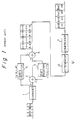
- Fig. 1 is a block diagram showing an example of an audio teleconference apparatus which uses the N-1 addition system. This figure is disclosed, as a known technology, in Japanese Patent Laid-Open No. 63-123257 and shows a case of four (4) subscribers, i.e., N = 4. The N-1 addition system will now be explained in detail with reference to Fig. 1.
- Input codes A, B, C, and D from four subscribers are sequentially converted by an
expander 1 into linear codes a, b, c, and d and added by theadder 2 to the output from ashift register 3. The codes from theexpander 1 are also supplied to a shift register 4. The addition output from theadder 2 is supplied to theshift register 3 and also to asubtracter 5 where the output from the shift register 4 is subtracted. The subtraction output is supplied to acompressor 7 via an attenuator 6, and converted into PCM codes and sent out. - In the case of a conversation involving 4 subscribers (A, D, C, and D), input code A is first converted into code a by the
expander 1 and stacked in theshift registers 3 and 4. The next input code B is similarly converted into code b by theexpander 1. Then, it is added by theadder 2 withdata 1 stacked in theshift register 3, and then transferred to theshift register 3 again. Concurrently, a code-converted output is also transferred from theexpander 1 to the shift register 4 where the output is stacked successively on the data a which has already been stacked. - When operations described above are performed on input codes C and D, the sum of A, B, C, and D (a+b+c+d) is stacked in the
shift register 3. The codes (a, b, c, and d) are successively stacked in this order in the shift register 4. - Lastly, when data of the content (a, b, c, and d) of the shift register 4 is sequentially subtracted from the content (a+b+c+d) of the
shift register 3 by thesubtracter 5, appropriate three-way talk is synthesized. Since these data take the form of simple addition, they may go out of range. Therefore, to prevent this and confine the data to a predetermined range, the data is compressed by acompressor 7 to change it again into PCM codes (non-linear) after it is attenuated by the attenuator 6. - Next, a conventional example is shown in Fig. 2 in which 64K bit/s PCM codes are input to an audio teleconference apparatus using the N-1 addition system in order that the output level is automatically controlled. This figure is also disclosed in Japanese Patent Laid-Open No. 63-123257 showing a case of 4 subscribers. An explanation will now be provided of the operation of Fig. 2. In Fig. 2, the
expander 1 and thecompressor 7 play the same role as those shown in Fig. 1.Reference numeral 8 denotes an N-1 addition circuit which consists of theshift registers 3 and 4, theadder 2 and thesubtracter 5, all of which are shown in Fig. 1. - Expanded audio signals a, b, c, and d of 4 subscribers A, B, C, and D are input to the N-1
addition circuit 8. The sum thereof (a+b+c+d) is output after a predetermined process is performed thereon and then input to anabsolute value circuit 9. The output |a+b+c+d| of theabsolute value circuit 9 is supplied to apeak hold circuit 10 where the peak value P is maintained for a preset amount of time. The peak value P is supplied to the level control input terminal of a level controller 11, which is in the form of a variable gain amplifier or the like. Addition output from the N-1addition circuit 8, i.e., data a'=b+c+d for subscriber A, data b'=a+c+d for subscriber B, data c'=a+b+d for subscriber C, and data d'=a+b+c for subscriber D, are input to the level controller 11 sequentially. The output level is controlled, for example, by a gain coefficient G determined by the following equation (1), using the peak value P.

- As a result, signals a'', b'', c'', and d" respectively for subscribers A, B, C, and D, whose level is controlled automatically and output, become the following:




- In a situation, such as a conference call, where it cannot be determined how many participants are speaking at the same time, an output level which is automatically controlled is highly favored by users. This feature avoids a situation where there is an insufficient signal regardless of the number of participants, and is recognized as one of the functions of the conference call system. As a consequence, when a conference call apparatus is realized by using the conventional 64K bit/s PCM coding system, it is constructed as described above.
- Now, there is a great demand for producing high-quality voice sound transmissions. Application of a wide-band voice coding system which encodes audio signals in a frequency band wider than the conventional system has been desired. However, when a system which encodes/decodes at each frequency band of such a wide-band voice coding system, is used just as it is, audio signal processing objectives can sometimes not be achieved. When such an audio teleconference apparatus is used, the following problems arise:
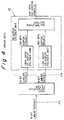
- Consideration will now be given to an audio signal processing in a case where 64K bit/s sub-band adaptive differential pulse code modulation (hereinafter abbreviated as SB-ADPCM) which complies with CCITT recommendation G.722, p. 272-278 is applied to a conference call apparatus as an example of an audio call apparatus in which a sub-band coding system is applied. In the SB-ADPCM coding system, performing an N-1 addition process by using linear PCM signals of the whole band (50 Hz to 7 kHz) obtained as normal outputs of an encoder is first considered. That is, when N-1 addition is realized concerning the linear PCM signals of the whole frequency band (50 Hz to 7 kHz), a decoder and an encoder are constructed as shown in Figs. 3 and 4. An N-1 addition circuit is connected between points P1 and P3 shown in the figure and constructed as shown in Fig. 5.
- However, CCITT recommendation G.722 that prescribes the specification of the coding system recommends that this voice addition be performed by using linear PCM signals of different bands (50 Hz to 4 kHz, and 4 to 7 kHz) for the following reasons:
- (1) Conference call apparatuses can be miniaturized because no sub-band and band synthesizing filters are required.
- (2) Signal distortion and increased delay can be prevented because no filters are required.
- (3) Easier echo control is possible by being performed in each band.
- Therefore, N-1 addition circuits are respectively connected between points P2 and P4 of each band in a case where an N-1 addition circuit is used for linear PCM signals of different bands to utilize the advantages of (1) to (3) above.
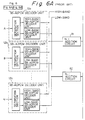
- Fig. 6 shows an example of a conference call apparatus which is recommended by the above-mentioned CCITT recommendation G.722, p. 326-328. The operation of Fig. 6 will be explained below. When 64K bit/s SB-ADPCM codes are applied to the separation section of an SB-
ADPCM decoder 12a placed in the transmission line, they are separated into signals of 16k bit/s in which high-band components of audio signals are encoded and signals of 48k bit/s in which low-band components of audio signals are encoded. They are input to a high-band SB-ADPCM decoder unit and a low-band SB-ADPCM decoder unit. Linear PCM signals are output from decoder units of each band and input to N-1addition circuits ADPCM encoder units 13a to 13n for respective subscribers. The signals are encoded by the high-band SB-ADPCM encoder unit to SB-ADPCM codes of 16k bit/s and are encoded by the low-band SB-ADPCM encoder unit to SB-ADPCM codes of 48k bit/s. These codes are synthesized in the multiplexing section and become SB-ADPCM codes of 64k bit/s. In the manner described above, such an apparatus can be miniaturized, has higher quality, and processing can be simplified in comparison with the case in which processing is performed by using linear PCM signals of the whole band by performing an N-1 addition process at each band. - As described above, in a conference call apparatus which uses an SB-ADPCM coding system as an example of an audio signal processing utilizing a sub-band coding system, audio signals of 50 Hz to 7 kHz are separated into low band (50 Hz to 4 kHz) and high band (4 to 7 kHz) signals. N-1 addition processing is performed in each band, resulting in the following advantages: "miniaturization of an apparatus"; "maintenance of high quality"; "elimination of extra delay"; and "easy echo control is possible". However, when automatic level control is peformed on the result of the addition process, if a technique in which normal audio signal power of all the bands is determined and a gain coefficient is computed on the basis of the power was used, a synthesis of bands is required. In this case, the above-described advantages cannot be obtained. A voice detection process for detecting a silent condition unique to audio signals is also performed normally by referring to audio signal power in all bands. If bands are synthesized for the purpose of only this voice detecting process, a problem arises in that the amount of hardware of an apparatus increases.
- The present invention has been devised in light of the above-described circumstances. Accordingly, an object of the present invention is to provide a method of processing audio signals in a sub-band coding system, which is capable of realizing miniaturization of an apparatus, high quality, and simplification of the process by using a means for outputting detected results by referring to signals of only those frequency bands in which signal power is concentrated and for reflecting this output in all the frequency bands as regards such elements that results are determined from the signal power of the whole frequency band in the prior art, as voice detection and automatic level control in a signal process using a sub-band coding system.
- Another object of the present invention is to provide a method for processing audio signals, in which the detection of signals is performed by referring only to those bands in which signal power is concentrated without synthesizing other bands in order to determine the audio signal power of the whole band in a case where a sub-band coding system is used, as an audio coding system, to detect the presence or absence of decoded audio signals, in which coding system audio signals are divided into a plurality of frequency band components and encoded.
- A further object of the present invention is to provide a method of processing audio signals, in which a sub-band coding system for dividing audio signals into a plurality of frequency band components is used to encode the signals and in which the level of decoded audio signals is automatically controlled, comprising the steps of determining a gain coefficient by referring only to those bands in which signal power is concentrated without synthesizing other bands; and controlling the level of each band by using this value.
- A still further object of the present invention is to provide a method of processing audio signals, in which a sub-band coding system which divides audio signals into a plurality of frequency band components is used, as an audio coding system, to encode the signals, and a multi-location audio teleconference is held, comprising the steps of performing an N-1 addition process at each band; and detecting the voices of each of the conference participants and the automatic control of the audio signals after the N-1 addition process by referring only to those bands in which signal power is concentrated.
- A still further object of the present invention is to provide a method of processing audio signals, in which a sub-band coding system which divides audio signals into a plurality of frequency band components is used as a voice coding system, to encode the process, and in which the level of decoded audio signals is automatically controlled, comprising the steps of synthesizing a plurality of bands in which signal power is concentrated to determine a gain coefficient and by referring to those bands without synthesizing all the bands; and controlling the level of each band by using this value.
- A still further object of the present invention is to provide a method of processing audio signals, in which a sub-band coding system which divides audio signals into a plurality of frequency band components is used, as an audio coding system, to encode signals, and a multi-location audio teleconference is held using decoded audio signals, comprising the steps of performing an N-1 addition process at each band; and detecting the voices of each of the conference participants and the automatic control of audio signals after the N-1 addition process by referring only to those bands in which signal power is concentrated.
- According to the present invention, when the presence or absence of decoded audio signals is detected in an audio signal process using a sub-band coding system, the process is performed by referring only to those bands in which signal power is concentrated without synthesizing bands to determine audio signal power.
- When the level of decoded audio signals is automatically controlled, a gain coefficient is determined by referring only to those bands in which signal power is concentrated without synthesizing other bands and the level of each band is controlled by using this value.
- When a multi-location audio teleconference using decoded audio signals is held, and N-1 addition process is performed for each band, and the detection of the voices of each of the conference participants and the automatic level control after the N-1 addition is made are performed by referring only to those bands in which signal power is concentrated. Thus, an audio teleconference is realized.
- When the level of decoded audio signals is automatically controlled, a gain coefficient is determined by referring only to those bands in which signal power is concentrated without synthesizing bands and the level of each band is controlled by using this value.
- When a multi-location audio teleconference using decoded audio signals is held, an N-1 addition process is performed for each band, and the detection of the voices of each of the conference participants and automatic level control after the N-1 addition is made are performed by synthesizing only a plurality of bands in which signal power is concentrated and by referring to those bands. Thus, an audio teleconference is realized.
- According to an audio signal processing using a sub-band coding system of the present invention, voice detection, automatic level control and the like can be accomplished by using means for outputting the detected results by referring to only the signals in the frequency band in which the signal power is concentrated and for reflecting the output of the detected results throughout the whole frequency bands, although, in the prior art, they have been obtained from the signal power in the whole frequency bands. It is possible, therefore, to realize miniaturization and high quality of the apparatus, and simplification of the process. The advantages that the sub-band coding system possesses can be obtained without requiring extra hardware. Particularly, when the SB-ADPCM coding system which complies with the CCITT recommendation G.722 is applied to a communication apparatus, the following advantages can be obtained:
- (1) Conference call apparatuses can be miniaturized because no sub-band and band synthesizing filters are required.
- (2) Signal distortion and increased delay can be prevented because no filters are required.
- (3) Easier echo control is possible by being performed in each band.
- These and other objects, features and advantages of the present invention will become clear when reference is made to the following description of the preferred embodiments of the present invention, together with reference to the accompanying drawings.
- Fig. 1 is a block diagram showing an N-1 addition method of the prior art;
- Fig. 2 is a connection diagram of an embodiment showing a conventional audio teleconference apparatus;
- Fig. 3 is a block diagram of an SB-ADPCM decoder unit;
- Fig. 4 is a block diagram of an SB-ADPCM encoder unit;
- Fig. 5 is a view showing the construction of an example of an audio teleconference apparatus in a case where the N-1 addition is made after bands are synthesized;
- Fig. 6 is a view showing the construction of an example of an audio teleconference apparatus in which an SB-ADPCM coding system proposed by CCITT recommendation G.722 is used; and
- Fig. 7 is a connection diagram of an embodiment according to the present invention.
- An embodiment of the present invention will be explained below with reference to the accompanying drawings. Fig. 7 shows an embodiment in which the present invention is realized, which is an audio teleconference apparatus among multi points which uses a 64K bit/s PCM coding system, comprising a voice encoding which complies with CCITT recommendation G.722. The constructions of SB-
ADPCM decoder units 12a to 12d are as shown in adecoder unit 12 in Fig. 3. Also, the construction of SB-ADPCM encoder units 13a to 13d are as shown in anencoder unit 13 in Fig. 4. N-1addition circuits level computing unit 15 correspond to anabsolute value circuit 9 and apeak hold circuit 10, both of which are shown in Fig. 2.Level controllers band mixing section 101 comprises the N-1addition circuit 81 and thelevel controller 111. The low-band mixing section 102 comprises the N-1addition circuit 82, a sound detector 14, alevel computing unit 15, and thelevel controller 112. - Next, the operation thereof will now be explained in detail with reference to Fig. 7. Fig. 7 is a view showing a case in which a conference call apparatus for four subscribers is realized. If SB-ADPCM codes input from each subscriber are assumed to be A, B, C, and D, they are separated into ah and aℓ, bh and bℓ, ch and cℓ, dh and dℓ, at each band by the SB-
ADPCM decoder units 12a to 12d disposed in the path for each subscriber. These signals are input to the mixingsections addition circuits level controllers addition circuit 82 and input to thelevel computing unit 15 and the sound detector 14. A predetermined process is performed by thelevel computing unit 15 even when the result of the output of the sound detector 14 indicates that only one person is speaking. When no participants are speaking, a process such that the previous output value is maintained is performed. - Signal levels obtained in this manner are applied to both the
level controller 112 of the low-band mixing section 102 and thelevel controller 111 of the high-band mixing section 101, effecting level control. Therefore, thelevel controllers addition circuits band mixing sections ADPCM encoder units 13a to 13d for each subscriber. After the signals are processed with a predetermined process, they are transmitted again as 64K bit/s SB-ADPCM codes. - As in the above-described embodiment, in an audio signal process in which audio signals are encoded/decoded by using a sub-band coding system, the same advantages as in the conventional process can be obtained by performing N-1 voice addition at each frequency band, by computing a gain coefficient value by detecting voices on the basis of the signal level in the low-band section where signal power is concentrated without synthesizing all frequency bands, and by automatically controlling the level of the audio signals in both high- and low-band in each signal process, for example, in a conference call system in which a multi-point broadcast communication using an SB-ADPCM coding system is performed. In addition, extra hardware is not required, and advantages such as these features described in (1) to (3) below that the sub-band coding system possesses can be utilized can be obtained:
- (1) Conference call apparatuses can be miniaturized because no sub-band and band synthesizing filters are required.
- (2) Signal distortion and increased delay can be prevented because no filters are required.
- (3) Easier echo control is possible by being performed in each band.
- The audio teleconference apparatus in which the SB-ADPCM coding system which complies with the CCITT recommendation G.722 is applied has been explained. The same advantages can be obtained by means other than the SB-ADPCM coding system, and can be obtained commonly in a case where the sub-band coding system is employed. Also, not only in an audio teleconference apparatus but also in other communication apparatuses requiring a voice detector or a voice level computing unit, for example, an echo prevention process required for an echo canceller, the amount of computation and required memory capacity can be reduced by the sub-band coding system. Furthermore, the same effect as in the non-subband coding system can be achieved by referring to only signals of bands in which signal power is concentrated during the detection of cross talk. A coding system which is divided into three or more bands can also be effectively applied to composite outputs in which one band thereof or bands having signal power sufficient for detecting voice sounds and computing the voice level are synthesized.
Claims (3)
- A method of processing audio signals in a sub-band coding system comprising the steps of:inputting non-linear codes indicating wideband audio signals;separating the non-linear code for each audio signal into signals of a plurality of frequency bands;decoding the signal of each frequency band into a plurality of decoded linear signals (ah, al, bh, bl, ch, cl, dh, dl);performing a predetermined computation on the decoded linear signals to generate computed linear signals;reproducing said non-linear codes by encoding and multiplexing the computed linear signals of all frequency band;said method characterized by including the steps of:selecting at least one decoded linear signal in which audio signal power is concentrated;detecting sound levels in the selected decoded linear signals; andusing the detected sound levels for controlling all computed linear signals.
- The method of processing audio signals according to Claim 1, wherein said predetermined computation process is an N-1 addition process for the decoded linear signals for the purpose of holding an audio teleconference among at least two locations, where N is the number of conference participants.
- The method of processing audio signals according to Claim 1 or 2, further including the step of utilizing said sound level to determine a gain coefficient, so that the level of said computed linear signals is controlled with said gain coefficient when said sound levels have been detected.
Applications Claiming Priority (2)
| Application Number | Priority Date | Filing Date | Title |
|---|---|---|---|
| JP225869/90 | 1990-08-28 | ||
| JP2225869A JP2598159B2 (en) | 1990-08-28 | 1990-08-28 | Audio signal processing device |
Publications (3)
| Publication Number | Publication Date |
|---|---|
| EP0475196A2 EP0475196A2 (en) | 1992-03-18 |
| EP0475196A3 EP0475196A3 (en) | 1993-03-17 |
| EP0475196B1 true EP0475196B1 (en) | 1997-01-08 |
Family
ID=16836126
Family Applications (1)
| Application Number | Title | Priority Date | Filing Date |
|---|---|---|---|
| EP91114465A Expired - Lifetime EP0475196B1 (en) | 1990-08-28 | 1991-08-28 | Method for processing audio signals in a sub-band coding system |
Country Status (4)
| Country | Link |
|---|---|
| US (1) | US5280561A (en) |
| EP (1) | EP0475196B1 (en) |
| JP (1) | JP2598159B2 (en) |
| DE (1) | DE69124034T2 (en) |
Families Citing this family (25)
| Publication number | Priority date | Publication date | Assignee | Title |
|---|---|---|---|---|
| JP2838946B2 (en) * | 1992-08-25 | 1998-12-16 | 三菱電機株式会社 | Multipoint voice communication device |
| JPH08102687A (en) * | 1994-09-29 | 1996-04-16 | Yamaha Corp | Aural transmission/reception system |
| US6006108A (en) * | 1996-01-31 | 1999-12-21 | Qualcomm Incorporated | Digital audio processing in a dual-mode telephone |
| FR2802329B1 (en) * | 1999-12-08 | 2003-03-28 | France Telecom | PROCESS FOR PROCESSING AT LEAST ONE AUDIO CODE BINARY FLOW ORGANIZED IN THE FORM OF FRAMES |
| JP4842483B2 (en) * | 1999-12-24 | 2011-12-21 | コーニンクレッカ フィリップス エレクトロニクス エヌ ヴィ | Multi-channel audio signal processing apparatus and method |
| US6587682B2 (en) * | 2001-01-18 | 2003-07-01 | Polycom, Inc. | Signal routing for reduced power consumption in a conferencing system |
| US7619995B1 (en) * | 2003-07-18 | 2009-11-17 | Nortel Networks Limited | Transcoders and mixers for voice-over-IP conferencing |
| US7483369B2 (en) * | 2003-09-30 | 2009-01-27 | Avaya Inc. | Method and apparatus for migrating to an alternate call controller |
| US7460656B2 (en) * | 2003-12-18 | 2008-12-02 | Intel Corporation | Distributed processing in conference call systems |
| US7366110B2 (en) * | 2004-09-30 | 2008-04-29 | Avaya Technology Corp. | Method and apparatus for merging call components during call reconstruction |
| US7706576B1 (en) | 2004-12-28 | 2010-04-27 | Avaya Inc. | Dynamic video equalization of images using face-tracking |
| US7564793B2 (en) * | 2005-01-04 | 2009-07-21 | Avaya Inc. | In-band call association signaling for a single number destination |
| US7496056B2 (en) * | 2005-01-04 | 2009-02-24 | Avaya Inc. | Conference connections using dynamic topology switching for IP and circuit-switched fabrics |
| US20060146859A1 (en) * | 2005-01-04 | 2006-07-06 | Avaya Technology Corp. | Alternate routing of media connections within a single communications system across public or private network facilities |
| US7613106B2 (en) * | 2005-01-04 | 2009-11-03 | Avaya Inc. | Dial plan transparency for fragmented networks |
| US8462637B1 (en) | 2005-01-04 | 2013-06-11 | Sheridan Ross P.C. | Dial plan routing for fragmented networks |
| US7457249B2 (en) * | 2005-01-04 | 2008-11-25 | Avaya, Inc. | Alternate routing of media connections within a single communications system across public or private network facilities |
| US7460150B1 (en) | 2005-03-14 | 2008-12-02 | Avaya Inc. | Using gaze detection to determine an area of interest within a scene |
| US7564476B1 (en) | 2005-05-13 | 2009-07-21 | Avaya Inc. | Prevent video calls based on appearance |
| US7668304B2 (en) * | 2006-01-25 | 2010-02-23 | Avaya Inc. | Display hierarchy of participants during phone call |
| US8433050B1 (en) | 2006-02-06 | 2013-04-30 | Avaya Inc. | Optimizing conference quality with diverse codecs |
| US8165282B1 (en) | 2006-05-25 | 2012-04-24 | Avaya Inc. | Exploiting facial characteristics for improved agent selection |
| AT509439B1 (en) * | 2008-12-19 | 2013-05-15 | Siemens Entpr Communications | METHOD AND MEANS FOR SCALABLE IMPROVEMENT OF THE QUALITY OF A SIGNAL CODING METHOD |
| JP5267257B2 (en) * | 2009-03-23 | 2013-08-21 | 沖電気工業株式会社 | Audio mixing apparatus, method and program, and audio conference system |
| CN110136728B (en) * | 2013-04-05 | 2023-08-04 | 杜比国际公司 | Audio signal decoding method, audio signal decoder, audio signal medium, and audio signal encoding method |
Family Cites Families (10)
| Publication number | Priority date | Publication date | Assignee | Title |
|---|---|---|---|---|
| IT1184023B (en) * | 1985-12-17 | 1987-10-22 | Cselt Centro Studi Lab Telecom | PROCEDURE AND DEVICE FOR CODING AND DECODING THE VOICE SIGNAL BY SUB-BAND ANALYSIS AND VECTORARY QUANTIZATION WITH DYNAMIC ALLOCATION OF THE CODING BITS |
| DE3683767D1 (en) * | 1986-04-30 | 1992-03-12 | Ibm | VOICE CODING METHOD AND DEVICE FOR CARRYING OUT THIS METHOD. |
| JPH07123270B2 (en) * | 1986-11-13 | 1995-12-25 | 旭化成マイクロシステム株式会社 | Conference call equipment |
| US5007093A (en) * | 1987-04-03 | 1991-04-09 | At&T Bell Laboratories | Adaptive threshold voiced detector |
| FR2623677B1 (en) * | 1987-11-20 | 1993-05-28 | Prescom Sarl | CIRCUIT FOR CONFERENCING A PLURALITY OF PARTICIPANTS IN TELECOMMUNICATIONS SYSTEMS |
| US4953160A (en) * | 1988-02-24 | 1990-08-28 | Integrated Network Corporation | Digital data over voice communication |
| US4989246A (en) * | 1989-03-22 | 1991-01-29 | Industrial Technology Research Institute, R.O.C. | Adaptive differential, pulse code modulation sound generator |
| JPH0332228A (en) * | 1989-06-29 | 1991-02-12 | Fujitsu Ltd | Gain-shape vector quantization system |
| US5054075A (en) * | 1989-09-05 | 1991-10-01 | Motorola, Inc. | Subband decoding method and apparatus |
| US4975657A (en) * | 1989-11-02 | 1990-12-04 | Motorola Inc. | Speech detector for automatic level control systems |
-
1990
- 1990-08-28 JP JP2225869A patent/JP2598159B2/en not_active Expired - Fee Related
-
1991
- 1991-08-27 US US07/750,290 patent/US5280561A/en not_active Expired - Lifetime
- 1991-08-28 DE DE69124034T patent/DE69124034T2/en not_active Expired - Fee Related
- 1991-08-28 EP EP91114465A patent/EP0475196B1/en not_active Expired - Lifetime
Also Published As
| Publication number | Publication date |
|---|---|
| DE69124034T2 (en) | 1997-07-31 |
| EP0475196A2 (en) | 1992-03-18 |
| JPH04151953A (en) | 1992-05-25 |
| US5280561A (en) | 1994-01-18 |
| EP0475196A3 (en) | 1993-03-17 |
| JP2598159B2 (en) | 1997-04-09 |
| DE69124034D1 (en) | 1997-02-20 |
Similar Documents
| Publication | Publication Date | Title |
|---|---|---|
| EP0475196B1 (en) | Method for processing audio signals in a sub-band coding system | |
| CA1268546A (en) | Stereophonic voice signal transmission system | |
| US5570372A (en) | Multimedia communications with system-dependent adaptive delays | |
| US5390177A (en) | Conferencing arrangement for compressed information signals | |
| US4864608A (en) | Echo suppressor | |
| JPH0573094B2 (en) | ||
| US4648089A (en) | Digital voice summing for teleconferencing | |
| US5898675A (en) | Volume control arrangement for compressed information signals | |
| EP0996112A2 (en) | Silence compression coding/decoding method and device | |
| KR920004348B1 (en) | PCM code decoder | |
| US7181000B2 (en) | Voice transmission device and voice transmission system | |
| JP4108396B2 (en) | Speech coding transmission system for multi-point control equipment | |
| JP3207281B2 (en) | Stereo speech encoding / decoding system, stereo speech decoding device, and single speech / multiple simultaneous speech discrimination device | |
| US20090129576A1 (en) | Relay device, communication terminal, signal decoder, signal processing method, and signal processing program | |
| JP2838946B2 (en) | Multipoint voice communication device | |
| JP3208629B2 (en) | Relay switching control method | |
| JP2000069179A (en) | Multipoint conference apparatus and method, and multipoint conference terminal device | |
| JP3663555B2 (en) | Multipoint conference device | |
| JP3441112B2 (en) | Multipoint communication controller | |
| JP3217237B2 (en) | Loop type band division audio conference circuit | |
| US5784447A (en) | Method and circuit arrangement for allowing telephone conversations among several users | |
| KR100238090B1 (en) | Apu capable of processing other mode's audio signal | |
| JPS6343942B2 (en) | ||
| EP0982921A1 (en) | Technique for effective distribution of audio signals in a teleconference | |
| JPS6018052A (en) | Digital conference call device |
Legal Events
| Date | Code | Title | Description |
|---|---|---|---|
| PUAI | Public reference made under article 153(3) epc to a published international application that has entered the european phase |
Free format text: ORIGINAL CODE: 0009012 |
|
| AK | Designated contracting states |
Kind code of ref document: A2 Designated state(s): AT BE CH DE DK ES FR GB GR IT LI LU NL SE |
|
| RBV | Designated contracting states (corrected) |
Designated state(s): DE FR GB |
|
| PUAL | Search report despatched |
Free format text: ORIGINAL CODE: 0009013 |
|
| AK | Designated contracting states |
Kind code of ref document: A3 Designated state(s): AT BE CH DE DK ES FR GB GR IT LI LU NL SE |
|
| 17P | Request for examination filed |
Effective date: 19930618 |
|
| 17Q | First examination report despatched |
Effective date: 19950606 |
|
| GRAG | Despatch of communication of intention to grant |
Free format text: ORIGINAL CODE: EPIDOS AGRA |
|
| GRAH | Despatch of communication of intention to grant a patent |
Free format text: ORIGINAL CODE: EPIDOS IGRA |
|
| GRAH | Despatch of communication of intention to grant a patent |
Free format text: ORIGINAL CODE: EPIDOS IGRA |
|
| GRAA | (expected) grant |
Free format text: ORIGINAL CODE: 0009210 |
|
| AK | Designated contracting states |
Kind code of ref document: B1 Designated state(s): DE FR GB |
|
| REF | Corresponds to: |
Ref document number: 69124034 Country of ref document: DE Date of ref document: 19970220 |
|
| ET | Fr: translation filed | ||
| PLBE | No opposition filed within time limit |
Free format text: ORIGINAL CODE: 0009261 |
|
| STAA | Information on the status of an ep patent application or granted ep patent |
Free format text: STATUS: NO OPPOSITION FILED WITHIN TIME LIMIT |
|
| 26N | No opposition filed | ||
| REG | Reference to a national code |
Ref country code: GB Ref legal event code: 746 Effective date: 20000126 |
|
| REG | Reference to a national code |
Ref country code: FR Ref legal event code: D6 |
|
| REG | Reference to a national code |
Ref country code: GB Ref legal event code: IF02 |
|
| PGFP | Annual fee paid to national office [announced via postgrant information from national office to epo] |
Ref country code: FR Payment date: 20060808 Year of fee payment: 16 |
|
| PGFP | Annual fee paid to national office [announced via postgrant information from national office to epo] |
Ref country code: GB Payment date: 20060823 Year of fee payment: 16 |
|
| PGFP | Annual fee paid to national office [announced via postgrant information from national office to epo] |
Ref country code: DE Payment date: 20060824 Year of fee payment: 16 |
|
| GBPC | Gb: european patent ceased through non-payment of renewal fee |
Effective date: 20070828 |
|
| REG | Reference to a national code |
Ref country code: FR Ref legal event code: ST Effective date: 20080430 |
|
| PG25 | Lapsed in a contracting state [announced via postgrant information from national office to epo] |
Ref country code: DE Free format text: LAPSE BECAUSE OF NON-PAYMENT OF DUE FEES Effective date: 20080301 |
|
| PG25 | Lapsed in a contracting state [announced via postgrant information from national office to epo] |
Ref country code: FR Free format text: LAPSE BECAUSE OF NON-PAYMENT OF DUE FEES Effective date: 20070831 |
|
| PG25 | Lapsed in a contracting state [announced via postgrant information from national office to epo] |
Ref country code: GB Free format text: LAPSE BECAUSE OF NON-PAYMENT OF DUE FEES Effective date: 20070828 |