EP0470310B1 - Novel benzopyrans and process for their production - Google Patents
Novel benzopyrans and process for their production Download PDFInfo
- Publication number
- EP0470310B1 EP0470310B1 EP90308787A EP90308787A EP0470310B1 EP 0470310 B1 EP0470310 B1 EP 0470310B1 EP 90308787 A EP90308787 A EP 90308787A EP 90308787 A EP90308787 A EP 90308787A EP 0470310 B1 EP0470310 B1 EP 0470310B1
- Authority
- EP
- European Patent Office
- Prior art keywords
- compound
- process according
- formula
- phenyl
- iii
- Prior art date
- Legal status (The legal status is an assumption and is not a legal conclusion. Google has not performed a legal analysis and makes no representation as to the accuracy of the status listed.)
- Expired - Lifetime
Links
- 238000000034 method Methods 0.000 title claims description 25
- 238000004519 manufacturing process Methods 0.000 title claims description 3
- 150000001562 benzopyrans Chemical class 0.000 title description 4
- 150000001875 compounds Chemical class 0.000 claims description 65
- 239000000203 mixture Substances 0.000 claims description 20
- 238000006243 chemical reaction Methods 0.000 claims description 15
- RTZKZFJDLAIYFH-UHFFFAOYSA-N Diethyl ether Chemical compound CCOCC RTZKZFJDLAIYFH-UHFFFAOYSA-N 0.000 claims description 14
- 125000002887 hydroxy group Chemical group [H]O* 0.000 claims description 14
- 239000002904 solvent Substances 0.000 claims description 13
- RGHHSNMVTDWUBI-UHFFFAOYSA-N 4-hydroxybenzaldehyde Chemical compound OC1=CC=C(C=O)C=C1 RGHHSNMVTDWUBI-UHFFFAOYSA-N 0.000 claims description 12
- 238000002360 preparation method Methods 0.000 claims description 12
- -1 4-methoxyphenylacetyl halide Chemical class 0.000 claims description 9
- 125000001997 phenyl group Chemical group [H]C1=C([H])C([H])=C(*)C([H])=C1[H] 0.000 claims description 7
- VSCWAEJMTAWNJL-UHFFFAOYSA-K aluminium trichloride Chemical compound Cl[Al](Cl)Cl VSCWAEJMTAWNJL-UHFFFAOYSA-K 0.000 claims description 6
- 229940011871 estrogen Drugs 0.000 claims description 6
- 239000000262 estrogen Substances 0.000 claims description 6
- 125000001301 ethoxy group Chemical group [H]C([H])([H])C([H])([H])O* 0.000 claims description 6
- 239000007858 starting material Substances 0.000 claims description 6
- HUHXLHLWASNVDB-UHFFFAOYSA-N 2-(oxan-2-yloxy)oxane Chemical class O1CCCCC1OC1OCCCC1 HUHXLHLWASNVDB-UHFFFAOYSA-N 0.000 claims description 5
- BUDQDWGNQVEFAC-UHFFFAOYSA-N Dihydropyran Chemical compound C1COC=CC1 BUDQDWGNQVEFAC-UHFFFAOYSA-N 0.000 claims description 5
- 125000003545 alkoxy group Chemical group 0.000 claims description 5
- 238000004587 chromatography analysis Methods 0.000 claims description 5
- NLFBCYMMUAKCPC-KQQUZDAGSA-N ethyl (e)-3-[3-amino-2-cyano-1-[(e)-3-ethoxy-3-oxoprop-1-enyl]sulfanyl-3-oxoprop-1-enyl]sulfanylprop-2-enoate Chemical compound CCOC(=O)\C=C\SC(=C(C#N)C(N)=O)S\C=C\C(=O)OCC NLFBCYMMUAKCPC-KQQUZDAGSA-N 0.000 claims description 5
- 125000004203 4-hydroxyphenyl group Chemical group [H]OC1=C([H])C([H])=C(*)C([H])=C1[H] 0.000 claims description 4
- 125000004432 carbon atom Chemical group C* 0.000 claims description 4
- 238000006210 cyclodehydration reaction Methods 0.000 claims description 4
- 150000004678 hydrides Chemical class 0.000 claims description 4
- LMBFAGIMSUYTBN-MPZNNTNKSA-N teixobactin Chemical compound C([C@H](C(=O)N[C@@H]([C@@H](C)CC)C(=O)N[C@@H](CO)C(=O)N[C@H](CCC(N)=O)C(=O)N[C@H]([C@@H](C)CC)C(=O)N[C@@H]([C@@H](C)CC)C(=O)N[C@@H](CO)C(=O)N[C@H]1C(N[C@@H](C)C(=O)N[C@@H](C[C@@H]2NC(=N)NC2)C(=O)N[C@H](C(=O)O[C@H]1C)[C@@H](C)CC)=O)NC)C1=CC=CC=C1 LMBFAGIMSUYTBN-MPZNNTNKSA-N 0.000 claims description 4
- HTSGKJQDMSTCGS-UHFFFAOYSA-N 1,4-bis(4-chlorophenyl)-2-(4-methylphenyl)sulfonylbutane-1,4-dione Chemical compound C1=CC(C)=CC=C1S(=O)(=O)C(C(=O)C=1C=CC(Cl)=CC=1)CC(=O)C1=CC=C(Cl)C=C1 HTSGKJQDMSTCGS-UHFFFAOYSA-N 0.000 claims description 3
- 230000001476 alcoholic effect Effects 0.000 claims description 3
- 239000003054 catalyst Substances 0.000 claims description 3
- 239000003814 drug Substances 0.000 claims description 3
- 150000004820 halides Chemical group 0.000 claims description 3
- 238000010626 work up procedure Methods 0.000 claims description 3
- 125000000229 (C1-C4)alkoxy group Chemical group 0.000 claims description 2
- 238000005618 Fries rearrangement reaction Methods 0.000 claims description 2
- 125000004453 alkoxycarbonyl group Chemical group 0.000 claims description 2
- 230000002152 alkylating effect Effects 0.000 claims description 2
- 150000004945 aromatic hydrocarbons Chemical class 0.000 claims description 2
- 125000004122 cyclic group Chemical group 0.000 claims description 2
- 230000001419 dependent effect Effects 0.000 claims description 2
- 239000003085 diluting agent Substances 0.000 claims description 2
- 239000003937 drug carrier Substances 0.000 claims description 2
- BDHFUVZGWQCTTF-UHFFFAOYSA-N sulfonic acid Chemical compound OS(=O)=O BDHFUVZGWQCTTF-UHFFFAOYSA-N 0.000 claims description 2
- FKLJPTJMIBLJAV-UHFFFAOYSA-N Compound IV Chemical compound O1N=C(C)C=C1CCCCCCCOC1=CC=C(C=2OCCN=2)C=C1 FKLJPTJMIBLJAV-UHFFFAOYSA-N 0.000 claims 1
- 125000002924 primary amino group Chemical group [H]N([H])* 0.000 claims 1
- XEKOWRVHYACXOJ-UHFFFAOYSA-N Ethyl acetate Chemical compound CCOC(C)=O XEKOWRVHYACXOJ-UHFFFAOYSA-N 0.000 description 33
- VLKZOEOYAKHREP-UHFFFAOYSA-N n-Hexane Chemical compound CCCCCC VLKZOEOYAKHREP-UHFFFAOYSA-N 0.000 description 30
- LFQSCWFLJHTTHZ-UHFFFAOYSA-N Ethanol Chemical compound CCO LFQSCWFLJHTTHZ-UHFFFAOYSA-N 0.000 description 29
- UHOVQNZJYSORNB-UHFFFAOYSA-N Benzene Chemical compound C1=CC=CC=C1 UHOVQNZJYSORNB-UHFFFAOYSA-N 0.000 description 24
- CSCPPACGZOOCGX-UHFFFAOYSA-N Acetone Chemical compound CC(C)=O CSCPPACGZOOCGX-UHFFFAOYSA-N 0.000 description 18
- XLYOFNOQVPJJNP-UHFFFAOYSA-N water Substances O XLYOFNOQVPJJNP-UHFFFAOYSA-N 0.000 description 14
- CIUQDSCDWFSTQR-UHFFFAOYSA-N [C]1=CC=CC=C1 Chemical compound [C]1=CC=CC=C1 CIUQDSCDWFSTQR-UHFFFAOYSA-N 0.000 description 13
- 239000007832 Na2SO4 Substances 0.000 description 11
- PMZURENOXWZQFD-UHFFFAOYSA-L Sodium Sulfate Chemical compound [Na+].[Na+].[O-]S([O-])(=O)=O PMZURENOXWZQFD-UHFFFAOYSA-L 0.000 description 11
- 235000019441 ethanol Nutrition 0.000 description 11
- 229910052938 sodium sulfate Inorganic materials 0.000 description 11
- 235000011152 sodium sulphate Nutrition 0.000 description 11
- OAYLNYINCPYISS-UHFFFAOYSA-N ethyl acetate;hexane Chemical compound CCCCCC.CCOC(C)=O OAYLNYINCPYISS-UHFFFAOYSA-N 0.000 description 10
- 239000012044 organic layer Substances 0.000 description 10
- BWHMMNNQKKPAPP-UHFFFAOYSA-L potassium carbonate Chemical compound [K+].[K+].[O-]C([O-])=O BWHMMNNQKKPAPP-UHFFFAOYSA-L 0.000 description 10
- VYPSYNLAJGMNEJ-UHFFFAOYSA-N Silicium dioxide Chemical compound O=[Si]=O VYPSYNLAJGMNEJ-UHFFFAOYSA-N 0.000 description 9
- 239000000741 silica gel Substances 0.000 description 9
- 229910002027 silica gel Inorganic materials 0.000 description 9
- QNCVIMGJHDEDAS-UHFFFAOYSA-N 1-phenyl-3-(2-phenylphenyl)prop-2-en-1-one Chemical compound C=1C=CC=CC=1C(=O)C=CC1=CC=CC=C1C1=CC=CC=C1 QNCVIMGJHDEDAS-UHFFFAOYSA-N 0.000 description 8
- VEXZGXHMUGYJMC-UHFFFAOYSA-N Hydrochloric acid Chemical compound Cl VEXZGXHMUGYJMC-UHFFFAOYSA-N 0.000 description 8
- ISWSIDIOOBJBQZ-UHFFFAOYSA-N Phenol Chemical compound OC1=CC=CC=C1 ISWSIDIOOBJBQZ-UHFFFAOYSA-N 0.000 description 8
- NQRYJNQNLNOLGT-UHFFFAOYSA-N Piperidine Chemical compound C1CCNCC1 NQRYJNQNLNOLGT-UHFFFAOYSA-N 0.000 description 8
- OTKCEEWUXHVZQI-UHFFFAOYSA-N 1,2-diphenylethanone Chemical compound C=1C=CC=CC=1C(=O)CC1=CC=CC=C1 OTKCEEWUXHVZQI-UHFFFAOYSA-N 0.000 description 7
- 239000000706 filtrate Substances 0.000 description 7
- 239000011541 reaction mixture Substances 0.000 description 7
- HEDRZPFGACZZDS-UHFFFAOYSA-N Chloroform Chemical compound ClC(Cl)Cl HEDRZPFGACZZDS-UHFFFAOYSA-N 0.000 description 6
- HEMHJVSKTPXQMS-UHFFFAOYSA-M Sodium hydroxide Chemical compound [OH-].[Na+] HEMHJVSKTPXQMS-UHFFFAOYSA-M 0.000 description 6
- NKANXQFJJICGDU-QPLCGJKRSA-N Tamoxifen Chemical compound C=1C=CC=CC=1C(/CC)=C(C=1C=CC(OCCN(C)C)=CC=1)/C1=CC=CC=C1 NKANXQFJJICGDU-QPLCGJKRSA-N 0.000 description 6
- VMUXSMXIQBNMGZ-UHFFFAOYSA-N 3,4-dihydrocoumarin Chemical compound C1=CC=C2OC(=O)CCC2=C1 VMUXSMXIQBNMGZ-UHFFFAOYSA-N 0.000 description 5
- PNEYBMLMFCGWSK-UHFFFAOYSA-N aluminium oxide Inorganic materials [O-2].[O-2].[O-2].[Al+3].[Al+3] PNEYBMLMFCGWSK-UHFFFAOYSA-N 0.000 description 5
- 239000000328 estrogen antagonist Substances 0.000 description 5
- 229910000027 potassium carbonate Inorganic materials 0.000 description 5
- 238000003756 stirring Methods 0.000 description 5
- 0 *c1ccc(CC(c(ccc(*)c2)c2O)=O)cc1 Chemical compound *c1ccc(CC(c(ccc(*)c2)c2O)=O)cc1 0.000 description 4
- 230000003042 antagnostic effect Effects 0.000 description 4
- 230000001833 anti-estrogenic effect Effects 0.000 description 4
- 239000000463 material Substances 0.000 description 4
- 229910000033 sodium borohydride Inorganic materials 0.000 description 4
- 239000012279 sodium borohydride Substances 0.000 description 4
- 239000011343 solid material Substances 0.000 description 4
- RYHBNJHYFVUHQT-UHFFFAOYSA-N 1,4-Dioxane Chemical compound C1COCCO1 RYHBNJHYFVUHQT-UHFFFAOYSA-N 0.000 description 3
- VFLQQZCRHPIGJU-UHFFFAOYSA-N 1-(2-chloroethyl)piperidine;hydron;chloride Chemical compound Cl.ClCCN1CCCCC1 VFLQQZCRHPIGJU-UHFFFAOYSA-N 0.000 description 3
- DODQJNMQWMSYGS-QPLCGJKRSA-N 4-[(z)-1-[4-[2-(dimethylamino)ethoxy]phenyl]-1-phenylbut-1-en-2-yl]phenol Chemical compound C=1C=C(O)C=CC=1C(/CC)=C(C=1C=CC(OCCN(C)C)=CC=1)/C1=CC=CC=C1 DODQJNMQWMSYGS-QPLCGJKRSA-N 0.000 description 3
- NLXLAEXVIDQMFP-UHFFFAOYSA-N Ammonia chloride Chemical class [NH4+].[Cl-] NLXLAEXVIDQMFP-UHFFFAOYSA-N 0.000 description 3
- UIIMBOGNXHQVGW-UHFFFAOYSA-M Sodium bicarbonate Chemical compound [Na+].OC([O-])=O UIIMBOGNXHQVGW-UHFFFAOYSA-M 0.000 description 3
- ZMANZCXQSJIPKH-UHFFFAOYSA-N Triethylamine Chemical compound CCN(CC)CC ZMANZCXQSJIPKH-UHFFFAOYSA-N 0.000 description 3
- 229940046836 anti-estrogen Drugs 0.000 description 3
- SLUNEGLMXGHOLY-UHFFFAOYSA-N benzene;hexane Chemical compound CCCCCC.C1=CC=CC=C1 SLUNEGLMXGHOLY-UHFFFAOYSA-N 0.000 description 3
- OQNGCCWBHLEQFN-UHFFFAOYSA-N chloroform;hexane Chemical compound ClC(Cl)Cl.CCCCCC OQNGCCWBHLEQFN-UHFFFAOYSA-N 0.000 description 3
- XZEUAXYWNKYKPL-URLMMPGGSA-N ormeloxifene Chemical compound C1([C@@H]2[C@H](C3=CC=C(C=C3OC2(C)C)OC)C=2C=CC(OCCN3CCCC3)=CC=2)=CC=CC=C1 XZEUAXYWNKYKPL-URLMMPGGSA-N 0.000 description 3
- 229960003327 ormeloxifene Drugs 0.000 description 3
- 239000000047 product Substances 0.000 description 3
- 229960001603 tamoxifen Drugs 0.000 description 3
- JOXIMZWYDAKGHI-UHFFFAOYSA-N toluene-4-sulfonic acid Chemical compound CC1=CC=C(S(O)(=O)=O)C=C1 JOXIMZWYDAKGHI-UHFFFAOYSA-N 0.000 description 3
- CXJOONIFSVSFAD-UHFFFAOYSA-N 2-(4-methoxyphenyl)acetyl chloride Chemical compound COC1=CC=C(CC(Cl)=O)C=C1 CXJOONIFSVSFAD-UHFFFAOYSA-N 0.000 description 2
- ASHGTJPOSUFTGB-UHFFFAOYSA-N 3-methoxyphenol Chemical compound COC1=CC=CC(O)=C1 ASHGTJPOSUFTGB-UHFFFAOYSA-N 0.000 description 2
- NRPFNQUDKRYCNX-UHFFFAOYSA-N 4-methoxyphenylacetic acid Chemical compound COC1=CC=C(CC(O)=O)C=C1 NRPFNQUDKRYCNX-UHFFFAOYSA-N 0.000 description 2
- IKHGUXGNUITLKF-UHFFFAOYSA-N Acetaldehyde Chemical compound CC=O IKHGUXGNUITLKF-UHFFFAOYSA-N 0.000 description 2
- 206010006187 Breast cancer Diseases 0.000 description 2
- 208000026310 Breast neoplasm Diseases 0.000 description 2
- YMWUJEATGCHHMB-UHFFFAOYSA-N Dichloromethane Chemical compound ClCCl YMWUJEATGCHHMB-UHFFFAOYSA-N 0.000 description 2
- 230000010933 acylation Effects 0.000 description 2
- 238000005917 acylation reaction Methods 0.000 description 2
- 230000001270 agonistic effect Effects 0.000 description 2
- 125000003118 aryl group Chemical group 0.000 description 2
- 230000015572 biosynthetic process Effects 0.000 description 2
- 125000003178 carboxy group Chemical group [H]OC(*)=O 0.000 description 2
- 239000007795 chemical reaction product Substances 0.000 description 2
- 238000002425 crystallisation Methods 0.000 description 2
- 230000000694 effects Effects 0.000 description 2
- 238000003818 flash chromatography Methods 0.000 description 2
- 229910052739 hydrogen Inorganic materials 0.000 description 2
- 239000001257 hydrogen Substances 0.000 description 2
- 125000004435 hydrogen atom Chemical group [H]* 0.000 description 2
- 239000002798 polar solvent Substances 0.000 description 2
- 125000006239 protecting group Chemical group 0.000 description 2
- 238000000746 purification Methods 0.000 description 2
- AOJFQRQNPXYVLM-UHFFFAOYSA-N pyridin-1-ium;chloride Chemical compound [Cl-].C1=CC=[NH+]C=C1 AOJFQRQNPXYVLM-UHFFFAOYSA-N 0.000 description 2
- GHMLBKRAJCXXBS-UHFFFAOYSA-N resorcinol Chemical compound OC1=CC=CC(O)=C1 GHMLBKRAJCXXBS-UHFFFAOYSA-N 0.000 description 2
- 238000003786 synthesis reaction Methods 0.000 description 2
- FSNGFFWICFYWQC-UHFFFAOYSA-N 1-(2-chloroethyl)pyrrolidine;hydron;chloride Chemical compound Cl.ClCCN1CCCC1 FSNGFFWICFYWQC-UHFFFAOYSA-N 0.000 description 1
- WYMYJTSWNPZKHM-UHFFFAOYSA-N 1-(2-hydroxy-4-methoxyphenyl)-2-phenylethanone Chemical compound OC1=CC(OC)=CC=C1C(=O)CC1=CC=CC=C1 WYMYJTSWNPZKHM-UHFFFAOYSA-N 0.000 description 1
- OBOOCHGOPNGGLO-UHFFFAOYSA-N 1-pyrrolidin-1-yloxypyrrolidine Chemical compound C1CCCN1ON1CCCC1 OBOOCHGOPNGGLO-UHFFFAOYSA-N 0.000 description 1
- IJKJMBDAPXNQJB-UHFFFAOYSA-N 2,2-dihydroxy-1,2-diphenylethanone Chemical compound C=1C=CC=CC=1C(O)(O)C(=O)C1=CC=CC=C1 IJKJMBDAPXNQJB-UHFFFAOYSA-N 0.000 description 1
- QPGHJHVIBWGZOS-UHFFFAOYSA-N 2,2-dihydroxy-1-(2-methoxyphenyl)-2-phenylethanone Chemical compound COC1=CC=CC=C1C(=O)C(O)(O)C1=CC=CC=C1 QPGHJHVIBWGZOS-UHFFFAOYSA-N 0.000 description 1
- YYKGZYGSFFMVEP-UHFFFAOYSA-N 2-phenyl-1-(2,3,4-trihydroxyphenyl)ethanone Chemical compound OC1=C(O)C(O)=CC=C1C(=O)CC1=CC=CC=C1 YYKGZYGSFFMVEP-UHFFFAOYSA-N 0.000 description 1
- VMZCDNSFRSVYKQ-UHFFFAOYSA-N 2-phenylacetyl chloride Chemical class ClC(=O)CC1=CC=CC=C1 VMZCDNSFRSVYKQ-UHFFFAOYSA-N 0.000 description 1
- HPKHLLZWPBHUOX-UHFFFAOYSA-N 4-(7-methoxy-3-phenyl-2h-chromen-2-yl)phenol Chemical compound O1C2=CC(OC)=CC=C2C=C(C=2C=CC=CC=2)C1C1=CC=C(O)C=C1 HPKHLLZWPBHUOX-UHFFFAOYSA-N 0.000 description 1
- 238000005863 Friedel-Crafts acylation reaction Methods 0.000 description 1
- MUBZPKHOEPUJKR-UHFFFAOYSA-N Oxalic acid Chemical compound OC(=O)C(O)=O MUBZPKHOEPUJKR-UHFFFAOYSA-N 0.000 description 1
- 239000002253 acid Substances 0.000 description 1
- 125000002252 acyl group Chemical group 0.000 description 1
- 239000000556 agonist Substances 0.000 description 1
- 125000000217 alkyl group Chemical group 0.000 description 1
- 239000005557 antagonist Substances 0.000 description 1
- CBHOOMGKXCMKIR-UHFFFAOYSA-N azane;methanol Chemical compound N.OC CBHOOMGKXCMKIR-UHFFFAOYSA-N 0.000 description 1
- 238000004440 column chromatography Methods 0.000 description 1
- 238000009833 condensation Methods 0.000 description 1
- 230000005494 condensation Effects 0.000 description 1
- 230000008025 crystallization Effects 0.000 description 1
- 125000000753 cycloalkyl group Chemical group 0.000 description 1
- GPLRAVKSCUXZTP-UHFFFAOYSA-N diglycerol Chemical compound OCC(O)COCC(O)CO GPLRAVKSCUXZTP-UHFFFAOYSA-N 0.000 description 1
- 229940079593 drug Drugs 0.000 description 1
- 150000002148 esters Chemical class 0.000 description 1
- 125000001033 ether group Chemical group 0.000 description 1
- 125000001495 ethyl group Chemical group [H]C([H])([H])C([H])([H])* 0.000 description 1
- 238000000605 extraction Methods 0.000 description 1
- 238000010438 heat treatment Methods 0.000 description 1
- 238000002513 implantation Methods 0.000 description 1
- 239000010410 layer Substances 0.000 description 1
- 125000000956 methoxy group Chemical group [H]C([H])([H])O* 0.000 description 1
- 125000001570 methylene group Chemical group [H]C([H])([*:1])[*:2] 0.000 description 1
- 239000012452 mother liquor Substances 0.000 description 1
- 229910052757 nitrogen Inorganic materials 0.000 description 1
- 125000004433 nitrogen atom Chemical group N* 0.000 description 1
- 238000010979 pH adjustment Methods 0.000 description 1
- 230000000737 periodic effect Effects 0.000 description 1
- 239000003208 petroleum Substances 0.000 description 1
- 239000008194 pharmaceutical composition Substances 0.000 description 1
- 125000000587 piperidin-1-yl group Chemical group [H]C1([H])N(*)C([H])([H])C([H])([H])C([H])([H])C1([H])[H] 0.000 description 1
- 230000003389 potentiating effect Effects 0.000 description 1
- 125000002112 pyrrolidino group Chemical group [*]N1C([H])([H])C([H])([H])C([H])([H])C1([H])[H] 0.000 description 1
- 125000000467 secondary amino group Chemical group [H]N([*:1])[*:2] 0.000 description 1
- 229910000030 sodium bicarbonate Inorganic materials 0.000 description 1
- 235000017557 sodium bicarbonate Nutrition 0.000 description 1
- 230000003595 spectral effect Effects 0.000 description 1
- 238000001256 steam distillation Methods 0.000 description 1
- 230000003637 steroidlike Effects 0.000 description 1
- 238000005556 structure-activity relationship Methods 0.000 description 1
- 125000001302 tertiary amino group Chemical group 0.000 description 1
- 229940086542 triethylamine Drugs 0.000 description 1
Classifications
-
- C—CHEMISTRY; METALLURGY
- C07—ORGANIC CHEMISTRY
- C07D—HETEROCYCLIC COMPOUNDS
- C07D311/00—Heterocyclic compounds containing six-membered rings having one oxygen atom as the only hetero atom, condensed with other rings
- C07D311/02—Heterocyclic compounds containing six-membered rings having one oxygen atom as the only hetero atom, condensed with other rings ortho- or peri-condensed with carbocyclic rings or ring systems
- C07D311/04—Benzo[b]pyrans, not hydrogenated in the carbocyclic ring
- C07D311/58—Benzo[b]pyrans, not hydrogenated in the carbocyclic ring other than with oxygen or sulphur atoms in position 2 or 4
- C07D311/60—Benzo[b]pyrans, not hydrogenated in the carbocyclic ring other than with oxygen or sulphur atoms in position 2 or 4 with aryl radicals attached in position 2
-
- C—CHEMISTRY; METALLURGY
- C07—ORGANIC CHEMISTRY
- C07C—ACYCLIC OR CARBOCYCLIC COMPOUNDS
- C07C45/00—Preparation of compounds having >C = O groups bound only to carbon or hydrogen atoms; Preparation of chelates of such compounds
- C07C45/51—Preparation of compounds having >C = O groups bound only to carbon or hydrogen atoms; Preparation of chelates of such compounds by pyrolysis, rearrangement or decomposition
- C07C45/54—Preparation of compounds having >C = O groups bound only to carbon or hydrogen atoms; Preparation of chelates of such compounds by pyrolysis, rearrangement or decomposition of compounds containing doubly bound oxygen atoms, e.g. esters
-
- C—CHEMISTRY; METALLURGY
- C07—ORGANIC CHEMISTRY
- C07C—ACYCLIC OR CARBOCYCLIC COMPOUNDS
- C07C45/00—Preparation of compounds having >C = O groups bound only to carbon or hydrogen atoms; Preparation of chelates of such compounds
- C07C45/61—Preparation of compounds having >C = O groups bound only to carbon or hydrogen atoms; Preparation of chelates of such compounds by reactions not involving the formation of >C = O groups
- C07C45/67—Preparation of compounds having >C = O groups bound only to carbon or hydrogen atoms; Preparation of chelates of such compounds by reactions not involving the formation of >C = O groups by isomerisation; by change of size of the carbon skeleton
- C07C45/68—Preparation of compounds having >C = O groups bound only to carbon or hydrogen atoms; Preparation of chelates of such compounds by reactions not involving the formation of >C = O groups by isomerisation; by change of size of the carbon skeleton by increase in the number of carbon atoms
- C07C45/72—Preparation of compounds having >C = O groups bound only to carbon or hydrogen atoms; Preparation of chelates of such compounds by reactions not involving the formation of >C = O groups by isomerisation; by change of size of the carbon skeleton by increase in the number of carbon atoms by reaction of compounds containing >C = O groups with the same or other compounds containing >C = O groups
- C07C45/74—Preparation of compounds having >C = O groups bound only to carbon or hydrogen atoms; Preparation of chelates of such compounds by reactions not involving the formation of >C = O groups by isomerisation; by change of size of the carbon skeleton by increase in the number of carbon atoms by reaction of compounds containing >C = O groups with the same or other compounds containing >C = O groups combined with dehydration
-
- C—CHEMISTRY; METALLURGY
- C07—ORGANIC CHEMISTRY
- C07C—ACYCLIC OR CARBOCYCLIC COMPOUNDS
- C07C49/00—Ketones; Ketenes; Dimeric ketenes; Ketonic chelates
- C07C49/76—Ketones containing a keto group bound to a six-membered aromatic ring
- C07C49/82—Ketones containing a keto group bound to a six-membered aromatic ring containing hydroxy groups
- C07C49/83—Ketones containing a keto group bound to a six-membered aromatic ring containing hydroxy groups polycyclic
-
- C—CHEMISTRY; METALLURGY
- C07—ORGANIC CHEMISTRY
- C07C—ACYCLIC OR CARBOCYCLIC COMPOUNDS
- C07C49/00—Ketones; Ketenes; Dimeric ketenes; Ketonic chelates
- C07C49/76—Ketones containing a keto group bound to a six-membered aromatic ring
- C07C49/84—Ketones containing a keto group bound to a six-membered aromatic ring containing ether groups, groups, groups, or groups
-
- C—CHEMISTRY; METALLURGY
- C07—ORGANIC CHEMISTRY
- C07D—HETEROCYCLIC COMPOUNDS
- C07D311/00—Heterocyclic compounds containing six-membered rings having one oxygen atom as the only hetero atom, condensed with other rings
- C07D311/02—Heterocyclic compounds containing six-membered rings having one oxygen atom as the only hetero atom, condensed with other rings ortho- or peri-condensed with carbocyclic rings or ring systems
- C07D311/04—Benzo[b]pyrans, not hydrogenated in the carbocyclic ring
- C07D311/22—Benzo[b]pyrans, not hydrogenated in the carbocyclic ring with oxygen or sulfur atoms directly attached in position 4
- C07D311/26—Benzo[b]pyrans, not hydrogenated in the carbocyclic ring with oxygen or sulfur atoms directly attached in position 4 with aromatic rings attached in position 2 or 3
- C07D311/28—Benzo[b]pyrans, not hydrogenated in the carbocyclic ring with oxygen or sulfur atoms directly attached in position 4 with aromatic rings attached in position 2 or 3 with aromatic rings attached in position 2 only
Definitions
- the present invention relates to novel benzopyrans which are anti-estrogenics and possess significant activity against implantation and breast cancer.
- the invention also relates to a process for the synthesis of these benzopyrans.
- anti-estrogens consist essentially of diarylethylenes (DAE) and triarylethylenes (TAE) and examples of the more important of such compounds in terms of potency include tamoxifen, 4-hydroxytamoxifen, centchroman and hydroxycentchroman.
- DAE diarylethylenes
- TAE triarylethylenes
- Tamoxifen and 4-hydroxytamoxifen can be represented by the formula: wherein when R is hydrogen the compound is tamoxifen and when R is OH the compound is 4-hydroxytamoxifen.
- Centchroman and hydroxycentchroman can be represented by the formula: wherein when R is Me the compound is centchroman and when R is H the compound is hydroxycentchroman.
- the present invention therefore provides a compound of the formula I wherein R1 and R2, which may be the same or different, are each -H, -OH, alkoxy of 1 to 17 carbon atoms or alkoxycarbonyl of 2 to 18 carbon atoms, and R3 is
- R1 and R2 are each independently H, OH or C1 ⁇ 4 alkoxy.
- R1 being H or (ii) R1 and R2 each being an acyl or alkoxy group.
- R3 is preferably a 2-piperidinoethoxy group.
- Specific compounds within formula I include 2-[4-[2-(1-piperidino)ethoxy]phenyl]-3-[4-hydroxyphenyl]-2H-1-benzopyran, 2-[4-[2-(1-piperidino)ethoxy]phenyl]-3-phenyl-7-methoxy-2H-1-benzopyran, 2-[4-[2-(1-piperidino) ethoxy]phenyl]-3-[4-hydroxyphenyl]-7-hydroxy-2H-1-benzopyran.
- the present invention also provides a process for the synthesis of these benzopyrans of the formula: wherein R1, R2 and R3 have the meanings stated above.
- This process comprises reacting a compound of formula II in which R4 and R5 are R1 and R2 respectively, or a protected hydroxy group, with 4-hydroxybenzaldehyde to produce a compound of the formula III forming a compound of formula IV reacting this compound with a compound of formula V in which X is a halide to form a compound of formula VI and, if necessary, deprotecting and acylating or alkylating R4 and R5.
- R1 is H
- R4 is H
- R5 is a protected hydroxy group
- R4 and R5 may be R1 and R2 respectively or may each be in the form of a protected hydroxy group. If R1 or R2 is a hydroxy group then R4 or R5 respectively in the above process is preferably in the form of a protected hydroxy group. If R4 or R5 is a protected group then preferably the protecting group is 3,4-dihydropyran.
- the 3,4-dihydropyran may be reacted with a compound of formula IX where one of R6 and R7 is a hydroxy group and the other is hydrogen or a hydroxy group or an alkoxy or carboxy group, to form a tetrahydropyranyl ether.
- the reaction is carried out in the presence of a sulphonic acid, such as para -toluene sulphonic acid or the like in an ether solvent, such as, dioxan or the like.
- the reaction may be effected for a period of up to 4 hours and the crude reaction product, after stipulated processing, may be purified e.g.by crystallization from a petroleum solvent such as hexane or by rapid chromatography over silica gel.
- the reaction of the compound of formula II with the 4-hydroxybenzaldehyde may be effected in the presence of a cyclic or open chain secondary and/or tertiary amino base such as piperidine or triethyl amine, and an aromatic hydrocarbon solvent such as benzene or the like.
- the solvent may be added at periodic intervals to replenish its loss during the reaction. This reaction may be effected for a period of about 30 hours. Thereafter, the reaction mixture may be cooled and washed with water, the organic layer separated, dried under Na2SO4 and concentrated.
- the solidified material may be filtered off, washed with a halogenated solvent such as chloroform, methylene dichloride or the like to give a compound of the formula III.
- the compound III will be produced as a mixture with a compound of formula VIII
- the product mixture may contain a ratio of compound VIII to compound III of 1.0:1.5.
- the filtrate containing compounds III and VIII may be concentrated, chromatographed and eluted with an eluate of increasing polarity such as ethyl acetate in hexane or the like, thereby separating out the compound of formula III.
- the compound of the formula III may be converted to a compound of formula IV by reduction, for example by treating with a hydride such as sodium borohydride or the like in an alcoholic solvent such as ethyl alcohol or the like. Cyclodehydration may also be carried out, typically during work up of the product e.g. thermal work up may cause cyclodehydration.
- the hydride may be added in different proportions, at intervals of 10 to 15 minutes at room temperature under stirring. The reaction may be continued for a period of up to 12 to 15 hours.
- the reaction product after concentration, pH adjustment and extraction with a polar solvent such as ethyl acetate is purified by chromatography e.g. flash chromatography over silica gel to yield a compound of the formula IV.
- the compound of formula IV is treated with a piperidino- or pyrrolidinoalkyl halide, preferably in the presence of a basic catalyst such as potassium carbonate and a suitable ketonic solvent such as acetone or the like. This may be followed by purification by chromatography e.g. on alumina using hexane or a mixture thereof with a polar solvent to yield a compound of formula VI.
- a basic catalyst such as potassium carbonate
- a suitable ketonic solvent such as acetone or the like.
- R4 and R5 are not protected hydroxy groups then the compound produced is a compound of formula I. If R4 or R5 is a protected hydroxy group then the protecting group(s) may be removed by known methods e.g. by use of an acid such as hydrochloric acid in an alcoholic solvent such as ethanol. The deprotected hydroxy group(s) may, if desired, be alkylated or acylated by known methods to give other compounds of formula I.
- the unprotected starting compound of formula (II)' where R1 and R2 are as herein before defined can be prepared by methods known in the art.
- R1 is H and R2 is OH it can be prepared by condensation of phenol with 4-methoxy-phenylacetyl chloride (in turn prepared from 4-methoxy-phenylacetic acid) to afford an ester which on typical Fries rearrangement in the presence of anhydrous aluminium chloride yields a mixture which can be resolved chromatographically to afford the desired starting material. It can be characterised by its physical and spectral data.
- the starting compound II' may be prepared by Friedel-Crafts acylation of a corresponding phenol, such as 3-methoxyphenol or the like, with a suitable substituted or unsubstituted phenylacetyl chloride using a catalyst, such as anhydrous aluminium chloride.
- the resultant produce may be purified by steam distillation and/or column chromatography.
- the starting compound when R1 and R2 are both OH the starting compound can be prepared by Friedal-Crafts acylation of resorcinol with 4-methoxyphenyl acetyl chloride. This reaction affords a mixture of trihydroxydeoxybenzoin and methoxy dihydroxydeoxybenzoin. The latter compound may be converted into the desired trihydroxy compound by heating it with anhydrous pyridine hydrochloride.
- the residue was chromatographed over a silica gel column eluting with ethyl acetatehexane mixture to afford the unreacted deoxybenzoin ether. Then on increasing the solvent polarity a mixture of the dihydrobenzopyranone and 2-phenylchalcone was obtained.
- the dihydrobenzopyranone (1.2 g, 23%), m.p. 190°C, was separated by crystallisation from a mixture of ethyl acetate-hexane leaving behind the 2-phenylchalcone as an oily residue in the mother liquor.
- the 2-phenylchalcone (2.3 g, 44%) was used in the next step without purification.
- the present invention provides compounds of the formula I as described above for use in a method of medical treatment.
- the invention also provides the use of compounds of the formula I in the manufacture of a medicament for the treatment of an estrogen-dependent condition such as breast cancer.
- the compounds may be administered in the form of a pharmaceutical composition.
- the present invention provides a composition comprising a compound of formula I and a pharmaceutically acceptable carrier or diluent.
- compositions may be administered orally or parenterally, in a dosage of 1 to 1000 »g/kg, depending on factors such as the particular condition to be treated and the route of administration.
Landscapes
- Chemical & Material Sciences (AREA)
- Organic Chemistry (AREA)
- Chemical Kinetics & Catalysis (AREA)
- Pharmaceuticals Containing Other Organic And Inorganic Compounds (AREA)
Description
- The present invention relates to novel benzopyrans which are anti-estrogenics and possess significant activity against implantation and breast cancer. The invention also relates to a process for the synthesis of these benzopyrans.
- A number of anti-estrogens have been synthesised in recent years. These non-steroidal compounds have been developed on the basis of their structure activity relationship established by Dodds and his co-workers and have been found to be more potent than compounds known hereto (Dodds, E.C., J.Pharm. Pharmacol., 1, 137 (1949), Dodds, E.C., Folley, S.J., Glascuck, R.F. and Lawson, W., Biochem.J., 68, 161 (1958); Dodds, E.C., Goldberg, L., Lawson, W. and Robinson, R., Part I Proc. Royal Soc. B., 127, 140 (1939).
- These anti-estrogens consist essentially of diarylethylenes (DAE) and triarylethylenes (TAE) and examples of the more important of such compounds in terms of potency include tamoxifen, 4-hydroxytamoxifen, centchroman and hydroxycentchroman.
- Tamoxifen and 4-hydroxytamoxifen can be represented by the formula:

wherein when R is hydrogen the compound is tamoxifen and when R is OH the compound is 4-hydroxytamoxifen. - Centchroman and hydroxycentchroman can be represented by the formula:
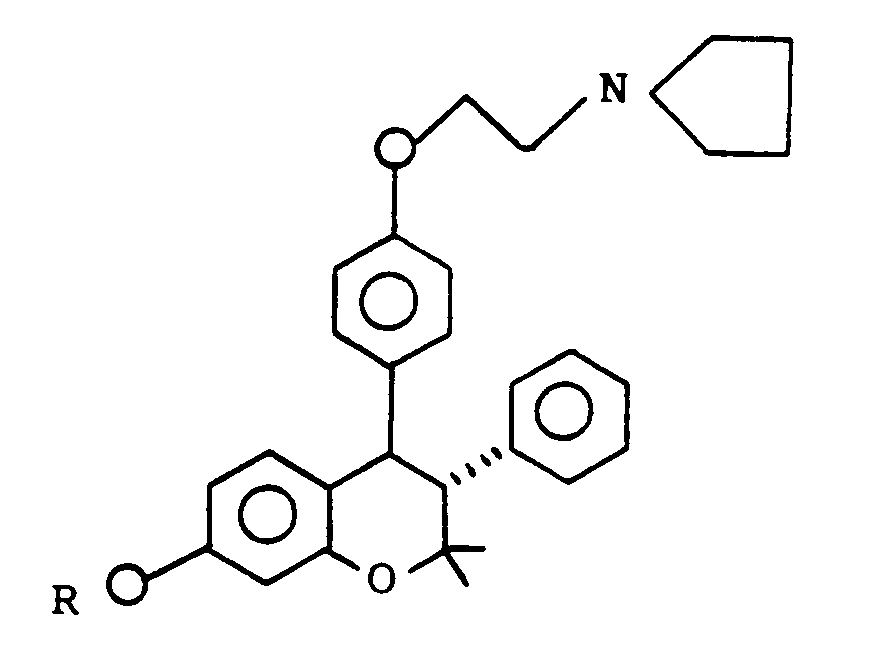
wherein when R is Me the compound is centchroman and when R is H the compound is hydroxycentchroman. - Unfortunately, almost all hitherto known anti-estrogens, including DAE's and TAE's evince varying degrees of agonistic activity. This is a drawback in their use as drugs since it is the estrogen antagonistic activity of DAE's and TAE's which makes them important.
- It has therefore long been desired to develop novel estrogen antagonists which have extremely low, preferably essentially no agonistic activity, viz. which do not evince estrogenecity.
- A study of known DAE's and TAE's has established that it is the presence of glyceryl ether or w-alkylaminoalkoxy chain in the para position in one of the geminal aryl groups that is essential for estrogen antagonistic activity. Two or three methylene groups and the nitrogen atom substituted with one or two short alkyl or single cycloalkyl residue (piperidino or pyrrolidino) in the said chain is the optimum requirement for estrogen antagonistic activity of the prototypes. Among TAEs, molecular geometry plays an important role in determining an agonist/antagonist balance. In most compounds, estrogen antagonist activity is restricted to only those isomers having two of the vicinal aryl groups, without the basic ether chain, in trans geometry to each other. The corresponding cis isomers are estrogens devoid of antagonistic activity.
- The present invention therefore provides a compound of the formula I

wherein R¹ and R², which may be the same or different, are each -H, -OH, alkoxy of 1 to 17 carbon atoms or alkoxycarbonyl of 2 to 18 carbon atoms, and R³ is
- There are several preferred embodiments. In one preferred embodiment R¹ and R² are each independently H, OH or C₁₋₄ alkoxy.
- Other preferred embodiments include (i) R¹ being H or (ii) R¹ and R² each being an acyl or alkoxy group.
- R³ is preferably a 2-piperidinoethoxy group. Specific compounds within formula I include 2-[4-[2-(1-piperidino)ethoxy]phenyl]-3-[4-hydroxyphenyl]-2H-1-benzopyran, 2-[4-[2-(1-piperidino)ethoxy]phenyl]-3-phenyl-7-methoxy-2H-1-benzopyran, 2-[4-[2-(1-piperidino) ethoxy]phenyl]-3-[4-hydroxyphenyl]-7-hydroxy-2H-1-benzopyran.
- The present invention also provides a process for the synthesis of these benzopyrans of the formula:

wherein R¹, R² and R³ have the meanings stated above. This process comprises reacting a compound of formula II
in which R⁴ and R⁵ are R¹ and R² respectively, or a protected hydroxy group, with 4-hydroxybenzaldehyde to produce a compound of the formula III
forming a compound of formula IV
reacting this compound with a compound of formula V
in which X is a halide to form a compound of formula VI
and, if necessary, deprotecting and acylating or alkylating R⁴ and R⁵. - In the preferred embodiment in which in the compound I produced, R¹ is H, preferably in the above process R⁴ is H and R⁵ is a protected hydroxy group.
- When the process is used to produce a compound in which R¹ and R² are each alkoxy or carboxy then R⁴ and R⁵ may be R¹ and R² respectively or may each be in the form of a protected hydroxy group. If R¹ or R² is a hydroxy group then R⁴ or R⁵ respectively in the above process is preferably in the form of a protected hydroxy group. If R⁴ or R⁵ is a protected group then preferably the protecting group is 3,4-dihydropyran. The 3,4-dihydropyran may be reacted with a compound of formula IX

where one of R⁶ and R⁷ is a hydroxy group and the other is hydrogen or a hydroxy group or an alkoxy or carboxy group, to form a tetrahydropyranyl ether. Preferably the reaction is carried out in the presence of a sulphonic acid, such as para-toluene sulphonic acid or the like in an ether solvent, such as, dioxan or the like. The reaction may be effected for a period of up to 4 hours and the crude reaction product, after stipulated processing, may be purified e.g.by crystallization from a petroleum solvent such as hexane or by rapid chromatography over silica gel. - The reaction of the compound of formula II with the 4-hydroxybenzaldehyde may be effected in the presence of a cyclic or open chain secondary and/or tertiary amino base such as piperidine or triethyl amine, and an aromatic hydrocarbon solvent such as benzene or the like. The solvent may be added at periodic intervals to replenish its loss during the reaction. This reaction may be effected for a period of about 30 hours. Thereafter, the reaction mixture may be cooled and washed with water, the organic layer separated, dried under Na₂SO₄ and concentrated. The solidified material may be filtered off, washed with a halogenated solvent such as chloroform, methylene dichloride or the like to give a compound of the formula III. Generally the compound III will be produced as a mixture with a compound of formula VIII

For example the product mixture may contain a ratio of compound VIII to compound III of 1.0:1.5. The filtrate containing compounds III and VIII may be concentrated, chromatographed and eluted with an eluate of increasing polarity such as ethyl acetate in hexane or the like, thereby separating out the compound of formula III. - The compound of the formula III may be converted to a compound of formula IV by reduction, for example by treating with a hydride such as sodium borohydride or the like in an alcoholic solvent such as ethyl alcohol or the like. Cyclodehydration may also be carried out, typically during work up of the product e.g. thermal work up may cause cyclodehydration. The hydride may be added in different proportions, at intervals of 10 to 15 minutes at room temperature under stirring. The reaction may be continued for a period of up to 12 to 15 hours. The reaction product after concentration, pH adjustment and extraction with a polar solvent such as ethyl acetate is purified by chromatography e.g. flash chromatography over silica gel to yield a compound of the formula IV. The compound of formula IV is treated with a piperidino- or pyrrolidinoalkyl halide, preferably in the presence of a basic catalyst such as potassium carbonate and a suitable ketonic solvent such as acetone or the like. This may be followed by purification by chromatography e.g. on alumina using hexane or a mixture thereof with a polar solvent to yield a compound of formula VI.
- If R⁴ and R⁵ are not protected hydroxy groups then the compound produced is a compound of formula I. If R⁴ or R⁵ is a protected hydroxy group then the protecting group(s) may be removed by known methods e.g. by use of an acid such as hydrochloric acid in an alcoholic solvent such as ethanol. The deprotected hydroxy group(s) may, if desired, be alkylated or acylated by known methods to give other compounds of formula I.
- The unprotected starting compound of formula (II)'
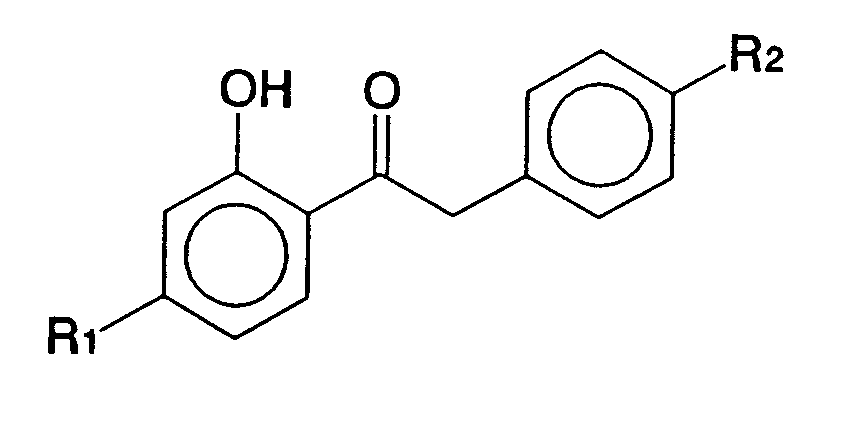
where R¹ and R² are as herein before defined can be prepared by methods known in the art. For example, when R¹ is H and R² is OH it can be prepared by condensation of phenol with 4-methoxy-phenylacetyl chloride (in turn prepared from 4-methoxy-phenylacetic acid) to afford an ester which on typical Fries rearrangement in the presence of anhydrous aluminium chloride yields a mixture which can be resolved chromatographically to afford the desired starting material. It can be characterised by its physical and spectral data. - When R¹ is e.g. methoxy and R² is as hereinbefore defined the starting compound II' may be prepared by Friedel-Crafts acylation of a corresponding phenol, such as 3-methoxyphenol or the like, with a suitable substituted or unsubstituted phenylacetyl chloride using a catalyst, such as anhydrous aluminium chloride. The resultant produce may be purified by steam distillation and/or column chromatography.
- In turn, when R¹ and R² are both OH the starting compound can be prepared by Friedal-Crafts acylation of resorcinol with 4-methoxyphenyl acetyl chloride. This reaction affords a mixture of trihydroxydeoxybenzoin and methoxy dihydroxydeoxybenzoin. The latter compound may be converted into the desired trihydroxy compound by heating it with anhydrous pyridine hydrochloride.
- The following examples illustrate the invention.
-

- To a stirred solution of the deoxybenzoin (18.3 gm, 0.08 mole) and PTSA (100 mg) in dry dioxan (200 ml) was added dropwise a solution of 3,4-dihydro-2H-pyran (14.5 ml, 0.16 mole) in dry dioxan (100 ml) and the stirring was continued for 4 hours. The reaction mixture was then neutralised with methanolic ammonia (5 ml) and concentrated in vacuo. The residue was dissolved in ether (200 ml) and washed twice with 5% sodium hydroxide solution followed by water. The organic layer was dried (Na₂SO₄) and concentrated. The residue was chromatographed over a short silica gel column eluting rapidly with ethyl acetate-hexane (1:20, v/v)) to afford the title compound (20 gm, 80.1%) which was crystallised from hexane to m.p. 95°C.
-

- To a solution of the monotetrahydropyranyl ether of the dihydroxydeoxybenzoin (6.87 g, 22 mmole) and 4-hydroxybenzaldehyde (2.44 gm, 20 mmole) in dry benzene (100 ml) was added dry piperidine (0.12 ml). It was refluxed for 30 hours removing water azeotropically adding fresh portions of dry benzene from time to time to replenish the distilled benzene. The reaction mixture was cooled and washed with water (2 x 40 ml). The organic layer was dried (Na₂SO₄) and concentrated. The residue left was allowed to stand for 24 hours. The solidified material was filtered off and washed with chloroform to afford the dihydrobenzopyranone. The filtrate was collected, concentrated and residue chromatographed over a silica gel column eluting rapidly with 2% ethyl acetate in hexane, to afford, first, the unreacted THP ether of deoxybenzoin (starting compound). With increasing polarity (20% ethyl acetate in hexane), the 2-phenylchalcone (desired compound) was obtained which was crystallised from benzene-hexane, m.p. 140°C (6 g, 72.1%).
-

- To a stirred solution of 2-phenylchalcone, prepared in example-AII, (4.16 gm, 10 mmole) in ethanol (50 ml) was added sodium borohydride (400 mg) in portions at an interval of 10-15 minutes and the stirring was continued for 15 hours. The ethanol was evaporated under vacuum and the residue was decomposed by adding saturated ammonium chloride solution until the pH was 8.0. The mixture was extracted with ethyl acetate. The organic layer was washed twice with water, dried and concentrated (Na₂SO₄). The residue was chromatographed over a silica gel column eluting with 10% ethyl acetate in hexane to afford the desired compound (2.4 gm, 60%) which was crystallised from benzene-hexane, m.p. 110°C.
-

- A mixture of the phenol prepared above in example AIII (800 mg, 2 mmole), 1-[2-chloroethyl] piperidine hydrochloride (590 mg, 3.2 mmole), anhydrous potassium carbonate (440 mg, 3.2 mmole) and dry acetone (20 ml) was stirred and refluxed for 35 hours. It was cooled and solid material filtered off and washed with acetone. The combined filtrate was concentrated and the residue chromatographed over a basic alumina column eluting with 2% ethyl acetate in hexane to afford the THP ether derivative (800 mg).
- To a solution of this compound (800 mg) in ethanol (20 ml) was added 1 N hydrochloric acid (5 ml) and the solution was allowed to stand for 20 minutes. The ethanol was evaporated in vacuo, the residue treated with sodium bicarbonate solution (25 ml) and extracted twice with ethyl acetate. The organic layer was washed with water, dried (Na₂SO₄) and concentrated to afford the title compound of this invention (600 mg, 70.2%). It was crystallised from chloroformhexane, m.p. 110°C.
-

- To a solution of deoxybenzoin i.e. 1-[2-hydroxy-4-methoxy-phenyl]-2-phenyl ethanone (12.1 g, 0.05 mole) and 4-hydroxy-benzaldehyde (6.1 g, 0.05 mole) in dry benzene (200 ml) was added dry piperidine (0.3 ml). The solution was refluxed for 30 hours removing water azeotropically and adding fresh proportions of dry benzene from time to time to replenish its loss during the reaction. It was then cooled and washed twice with water. The organic layer was dried (Na₂SO₄) and concentrated. The residue was allowed to stand for 24 hour, the solidified material filtered and washed with chloroform to afford the dihydrobenzopyranone (4.0 g, 23.2%). It was crystallised from ethyl acetate-hexane, m.p. 195°C.
- The combined filtrate left after the removal of dihydrobenzopyranone was concentrated and the residue subjected to chromatography over a silica gel column eluting with ethyl acetate - hexane to afford, first, the unreacted deoxybenzoin (staring material). Then, on increasing the solvent polarity, the 2-phenyl chalcone i.e. compound desired in this example was obtained (11.0 g, 65.3%). It crystallised from benzene-hexane, m.p. 150°C.
-

- To a stirred solution of 2-phenylchalcone (prepared above in example-BI) (3.46 g, 10 mmole) in ethanol (15 ml) was added sodium borohydride (0.4 g) in three portions at 15 minute intervals and the stirring was continued for 12 hours. Ethanol was evaporated in vacuo and to the residue was added saturated ammonium chloride solution dropwise until the pH was 8.0. The mixture was extracted twice with ethyl acetate, the organic layer washed with water, dried (Na₂SO₄) and concentrated. The residue was chromatographed over a silica gel column eluting with ethyl acetate - hexane to afford the phenol desired under this example (2.5 g, 80%). It was crystallised from chloroform-hexane, m.p. 162°C.
-

- A mixture of the phenol prepared above in example-BII (660 mg, 2 mmole), 1-[2-chloro-ethyl] pyrrolidine hydrochloride (544 mg, 3.2 mmole), anhydrous potassium carbonate (440 mg, 3.2 mmole) and dry acetone (20 ml) was stirred and refluxed for 30 hours. On completion of the reaction (TLC), the reaction mixture was cooled, the solid material filtered off and washed with acetone. The combined filtrate was concentrated. The residue was chromatographed over a basic alumina column eluting with ethyl acetate - hexane to afford the pyrrolidino ether desired in this example (671 mg, 78.6%). It was crystallised from hexane, m.p. 99°C.
-

- A mixture of phenol prepared above in example-BII (660 mg, 2 mmole), 1-[2-chloroethyl] piperidine hydrochloride (590 mg, 3.2 mmole), anhydrous potassium carbonate (440 mg, 3.2 mmole) and dry acetone (20 ml) was stirred and refluxed for 30 hours. On completion of the reaction (TLC), it was cooled, the solid material filtered off and washed with acetone. The combined filtrate was concentrated. The residue was chromatographed over a column of basic alumina eluting with ethyl acetate - hexane to afford the compound desired in this specification (717 mg, 81.5%).
-

- To the starting deoxybenzoin (2.44 g, 10 mmole) shown above, cooled in an ice bath, was added a mixture of 3,4-dihydro-2H-pyran (10 ml, 110 mmole) and concentrated hydrochloric acid (0.01 ml). The reaction mixture was stirred for 4 hours. It was then diluted with ether (100 ml) and washed thrice with 5% sodium hydroxide solution followed by water. The ethereal layer was dried (Na₂SO₄) and concentrated. The oily residue was crystallised from hexane to afford (3.87 g, 94% yield of the title compound, m.p. 118°C.
-
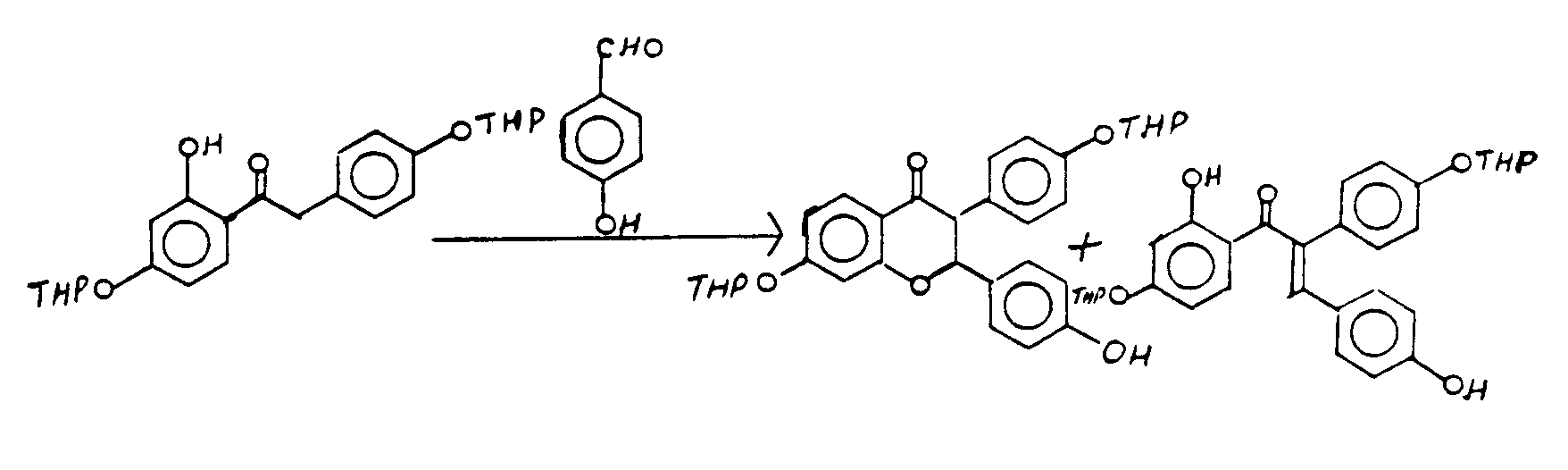
- To a solution of bis (tetrahydropyranyl) ether of deoxybenzoin (4.12 g, 10 mmol), prepared above and 4-hydroxybenzaldehyde (1.22 g, 10 mmole) in dry benzene (100 ml) was added dry piperidine (0.01 ml). The reaction mixture was refluxed for 30 hours removing water azeotropically and adding dry benzene from time to time, if needed, to replenish loss during the reaction. The reaction mixture was cooled and washed twice with water. The organic layer was dried (Na₂SO₄) and concentrated. The residue was chromatographed over a silica gel column eluting with ethyl acetatehexane mixture to afford the unreacted deoxybenzoin ether. Then on increasing the solvent polarity a mixture of the dihydrobenzopyranone and 2-phenylchalcone was obtained. The dihydrobenzopyranone (1.2 g, 23%), m.p. 190°C, was separated by crystallisation from a mixture of ethyl acetate-hexane leaving behind the 2-phenylchalcone as an oily residue in the mother liquor. The 2-phenylchalcone (2.3 g, 44%) was used in the next step without purification.
-

- To a stirred solution of the 2-phenylchalcone (1.29 g, 2.5 mmole), prepared above in example-CII in ethyl alcohol (20 ml) was added sodium borohydride (100 mg) in different portions at an interval of 10-15 minutes at room temperature and the stirring was continued for 12 hours. Ethyl alcohol was evaporated in vacuo, and to the residue was added saturated ammonium chloride solution dropwise until the pH was 8.0. The mixture was extracted twice with ethyl acetate, the organic layer washed with water, dried (Na₂SO₄) and concentrated. The residue was purified by flash chromatography over a silica gel column eluting with ethyl acetate-hexane to afford the title phenol (940 mg, 75%), which was crystallised from chloroform-hexane, m.p. 180°C.
-

- A mixture of the phenol (1.0 g, 2 mmole), prepared above in example-CIII, and 1-[2-chloroethyl] piperidine hydrochloride (590 mg, 3.2 mmole), anhydrous potassium carbonate (440 mg, 3.2 mmole) and dry acetone 30 ml was stirred and refluxed for 30 hours. On completion of the reaction (TLC), it was cooled, the solid material filtered and washed with acetone. The combined filtrate was concentrated and the residue chromatographed over a basic alumina column eluting with ethyl acetate-hexane to afford (1.1 g) of an oil residue. This was dissolved in ethyl alcohol (20 ml) and to it was added 1N hydrochloric acid (10 ml) and the solution was allowed to stand for 20 minutes. It was then concentrated in vacuo, the residue treated with saturated sodium bicarbonate solution (20 ml) and extracted with ethyl acetate.
- The organic layer was washed with water, dried (Na₂SO₄) and concentrated to afford (625 mg, 70%) an oily residue i.e. the compound desired in this example which was crystallised as its oxalate from ethyl alcohol-dry ether, m.p. 190°C. The above compound on desired alklation or acylation at one or both of the hydroxy groups affords other products of compound I.
- The present invention provides compounds of the formula I as described above for use in a method of medical treatment.
- The invention also provides the use of compounds of the formula I in the manufacture of a medicament for the treatment of an estrogen-dependent condition such as breast cancer.
- The compounds may be administered in the form of a pharmaceutical composition. The present invention provides a composition comprising a compound of formula I and a pharmaceutically acceptable carrier or diluent.
- The compositions may be administered orally or parenterally, in a dosage of 1 to 1000 »g/kg, depending on factors such as the particular condition to be treated and the route of administration.
Claims (23)
- A compound of the formula I


- A compound as claimed in claim 1 in which R¹ and R² are each independently H, OH or C₁₋₄alkoxy.
- A compound as claimed in claim 1 or 2 in which R¹ is H.
- A compound as claimed in claim 1, 2 or 3 in which R³ is

- 2-[4-[2-(1-piperidino)ethoxy]phenyl]-3-[4-hydroxyphenyl]-2H-1-benzopyran.
- 2-[4-[2-(1-piperidino)ethoxy]phenyl]-3-phenyl-7-methoxy-2H-1-benzopyran.
- 2-[4-[2-(1-piperidino)ethoxy]phenyl]-3-[4-hydroxyphenyl]-7-hydroxy-2H-1-benzopyran.
- A process for the preparation of a compound as claimed in any one of the preceding claims comprising reacting a compound of formula II


- A process according to claim 8 in which R⁴ is H and R⁵ is a protected hydroxy group.
- A process according to claim 9 in which the unprotected starting compound of formula VII

- A process according to claim 8 in which both R⁴ and R⁵ are protected hydroxy groups.
- A process according to any one of claims 8 to 11 in which the compound of formula II if protected is in the form of a tetrahydropyranyl ether.
- A process according to claim 12 in which the protection is carried out by reacting the unprotected compound with dihydropyran in the presence of a sulphonic acid and an ether.
- A process according to any one of claims 8 to 13 in which the conversion of compound II to compound III is carried out in the presence of an aromatic hydrocarbon solvent, containing a secondary and/or tertiary cyclic or open chain amino base.
- A process according to any one of claims 8 to 14 in which compound II is converted into a mixture of compound III and compound VIII

- A process according to any one of claims 8 to 15 in which conversion of compound III to compound IV is carried out by reduction and cyclodehydration.
- A process according to claim 16 in which the reduction is effected by the addition of a hydride.
- A process according to claim 17 in which the hydride is added in an alcoholic solvent, preferably in portions at 10 to 15 minute intervals for up to 15 hours.
- A process according to any one of claims 16 to 18 in which the cyclodehydration is effected during work up of the product.
- A process according to any one of claims 8 to 19 in which the reaction of compounds IV and V is carried out in the presence of a basic catalyst and a ketonic solvent.
- A compound as claimed in any one of claims 1 to 7 for use in a method of medical treatment.
- A composition comprising a compound as claimed in any one of claims 1 to 7 or 21 and a pharmaceutically acceptable carrier or diluent.
- Use of a compound as claimed in any one of claims 1 to 7 in the manufacture of a medicament for the treatment of an estrogen-dependent condition.
Priority Applications (3)
| Application Number | Priority Date | Filing Date | Title |
|---|---|---|---|
| DE69023906T DE69023906T2 (en) | 1990-08-09 | 1990-08-09 | Benzopyrans and process for their preparation. |
| EP90308787A EP0470310B1 (en) | 1990-08-09 | 1990-08-09 | Novel benzopyrans and process for their production |
| US07/965,608 US5254568A (en) | 1990-08-09 | 1992-10-22 | Benzopyrans as antiestrogenic agents |
Applications Claiming Priority (1)
| Application Number | Priority Date | Filing Date | Title |
|---|---|---|---|
| EP90308787A EP0470310B1 (en) | 1990-08-09 | 1990-08-09 | Novel benzopyrans and process for their production |
Publications (2)
| Publication Number | Publication Date |
|---|---|
| EP0470310A1 EP0470310A1 (en) | 1992-02-12 |
| EP0470310B1 true EP0470310B1 (en) | 1995-11-29 |
Family
ID=8205516
Family Applications (1)
| Application Number | Title | Priority Date | Filing Date |
|---|---|---|---|
| EP90308787A Expired - Lifetime EP0470310B1 (en) | 1990-08-09 | 1990-08-09 | Novel benzopyrans and process for their production |
Country Status (2)
| Country | Link |
|---|---|
| EP (1) | EP0470310B1 (en) |
| DE (1) | DE69023906T2 (en) |
Cited By (3)
| Publication number | Priority date | Publication date | Assignee | Title |
|---|---|---|---|---|
| US7105679B2 (en) | 2001-12-19 | 2006-09-12 | Kanojia Ramesh M | Heteroatom containing tetracyclic derivatives as selective estrogen receptor modulators |
| US7329654B2 (en) | 2001-12-19 | 2008-02-12 | Janssen Pharmaceutica N.V. | Heteroatom containing tetracyclic derivatives as selective estrogen receptor modulators |
| WO2021014386A1 (en) | 2019-07-22 | 2021-01-28 | Sun Pharma Advanced Research Company Limited | Selective estrogen receptor degrader |
Families Citing this family (18)
| Publication number | Priority date | Publication date | Assignee | Title |
|---|---|---|---|---|
| US5686465A (en) * | 1988-10-31 | 1997-11-11 | Endorecherche Inc. | Sex steroid activity inhibitors |
| US5393785A (en) * | 1988-10-31 | 1995-02-28 | Endorecherche, Inc. | Therapeutic antiestrogens |
| US5395842A (en) * | 1988-10-31 | 1995-03-07 | Endorecherche Inc. | Anti-estrogenic compounds and compositions |
| US6060503A (en) * | 1991-12-02 | 2000-05-09 | Endorecherche, Inc. | Benzopyran-containing compounds and method for their use |
| ES2105525T3 (en) * | 1993-06-24 | 1997-10-16 | Lilly Co Eli | 2-PHENYL-3-AROILBENZOTIOFENOS ANTIESTROGENIC AS HYPOGLYCEMIC AGENTS. |
| US5446061A (en) * | 1993-11-05 | 1995-08-29 | Eli Lilly And Company | Methods for lowering serum cholesterol |
| US5407947A (en) * | 1993-11-05 | 1995-04-18 | Eli Lilly And Company | Methods for inhibiting bone loss using pyrolidine and piperidine substituted benzopyrans |
| US5416098A (en) * | 1993-12-30 | 1995-05-16 | Zymogenetics, Inc. | Method for treating dermatitis and related conditions |
| TW398975B (en) | 1994-07-22 | 2000-07-21 | Lilly Co Eli | Pharmaceutical composition for inhibiting bone loss |
| DE10013782A1 (en) * | 2000-03-15 | 2001-10-18 | Schering Ag | 4-fluoroalkyl-2H-benzopyrans with antiestrogenic activity, process for their preparation, pharmaceutical preparations containing them and their use in the manufacture of medicaments |
| US8080675B2 (en) | 2004-09-21 | 2011-12-20 | Marshall Edwards, Inc. | Chroman derivatives, medicaments and use in therapy |
| ATE532777T1 (en) | 2004-09-21 | 2011-11-15 | Marshall Edwards Inc | SUBSTITUTED CHROMEDER DERIVATIVES, MEDICATIONS AND APPLICATIONS IN THERAPY |
| CN102695703A (en) * | 2009-08-19 | 2012-09-26 | 自由州大学 | Synthesis of C-3 coupled biflavonoids and C-3 coupled biflavonoid analogues |
| HUE033581T2 (en) * | 2010-06-10 | 2017-12-28 | Seragon Pharmaceuticals Inc | Estrogen receptor modulators and their applications |
| CA2816322A1 (en) | 2010-11-01 | 2012-05-10 | Marshall Edwards, Inc. | Isoflavonoid compositions and methods for the treatment of cancer |
| SG11201403002RA (en) * | 2011-12-14 | 2014-07-30 | Seragon Pharmaceuticals Inc | Fluorinated estrogen receptor modulators and uses thereof |
| CN107427003B (en) | 2015-02-02 | 2023-01-31 | 梅制药公司 | Combination therapy |
| HRP20220640T1 (en) | 2015-10-27 | 2022-07-08 | Sun Pharma Advanced Research Company Limited | Novel heterocyclic antiestrogens |
Family Cites Families (1)
| Publication number | Priority date | Publication date | Assignee | Title |
|---|---|---|---|---|
| US3314975A (en) * | 1963-01-25 | 1967-04-18 | Jurd Leonard | Flavylium compounds and methods of using them |
-
1990
- 1990-08-09 EP EP90308787A patent/EP0470310B1/en not_active Expired - Lifetime
- 1990-08-09 DE DE69023906T patent/DE69023906T2/en not_active Expired - Fee Related
Cited By (4)
| Publication number | Priority date | Publication date | Assignee | Title |
|---|---|---|---|---|
| US7105679B2 (en) | 2001-12-19 | 2006-09-12 | Kanojia Ramesh M | Heteroatom containing tetracyclic derivatives as selective estrogen receptor modulators |
| US7329654B2 (en) | 2001-12-19 | 2008-02-12 | Janssen Pharmaceutica N.V. | Heteroatom containing tetracyclic derivatives as selective estrogen receptor modulators |
| WO2021014386A1 (en) | 2019-07-22 | 2021-01-28 | Sun Pharma Advanced Research Company Limited | Selective estrogen receptor degrader |
| US11014915B2 (en) | 2019-07-22 | 2021-05-25 | Sun Pharma Advanced Research Company Limited | Selective estrogen receptor degrader |
Also Published As
| Publication number | Publication date |
|---|---|
| DE69023906D1 (en) | 1996-01-11 |
| EP0470310A1 (en) | 1992-02-12 |
| DE69023906T2 (en) | 1996-04-11 |
Similar Documents
| Publication | Publication Date | Title |
|---|---|---|
| US5254568A (en) | Benzopyrans as antiestrogenic agents | |
| EP0470310A1 (en) | Novel benzopyrans and process for their production | |
| KR890001884B1 (en) | Method for preparing naphthalene derivative | |
| US4840951A (en) | Novel naphthalene derivative | |
| SU533336A3 (en) | The method of obtaining aminopropanol, their salts or optically active antipodes | |
| US4336268A (en) | Cyclohexene derivative analgesics | |
| US4500541A (en) | Pharmacologically active cyclopropane derivatives | |
| HU193268B (en) | Process for preparing novel substituted alkane and alkene derivatives | |
| US5075317A (en) | Spirofurane derivatives | |
| US5017572A (en) | Derivatives of 1-[3-(4-hydroxyphenyl) 1-hydroxy 1-propyl] benzene substituted in position 2 by an aminoalkyleneoxy chain, the method of preparing same and the application thereof to therapeutics | |
| AU659157B2 (en) | Triphenylethylene derivative and pharmaceutical preparation containing the same | |
| US20040167169A1 (en) | Novel 4-diphenylmethyl piperidine derivatives | |
| US3317527A (en) | 3a and 5a tertiaryamino cycloalkylene of 5 to 7[alpha]benzofuranols | |
| US4409218A (en) | Analgesic method | |
| KR850001337B1 (en) | 4- [2-hydroxy-4- (substituted) phenyl] naphthalene-2 (1H) -one and 2-ols, these derivatives and methods of preparing these intermediates | |
| US3816434A (en) | 4-(3-(4-phenyl-piperidino)-2-hydroxy-propoxy)-benzophenones | |
| AU616997B2 (en) | Process for the manufacture of benzopyran derivatives | |
| US4897418A (en) | Novel naphthalene derivative | |
| US5594000A (en) | Spirofurane derivatives | |
| US3741974A (en) | Substituted terphenyls | |
| EP0061900A2 (en) | Morpholines | |
| US5380755A (en) | Alkyl and alkylbenzyl ethers of substituted hydroquinones | |
| US4544745A (en) | Cis-4a-aryl, 1, 2, 3, 4, 4A, 9B-hexahydro-benzofuro-[3,2-C]- pyridines useful as analgesics | |
| US3539581A (en) | 2-phenyl-3-(4-hydroxy-4-phenylpiperidino)-propiophenones | |
| US4806671A (en) | Substituted acenaphthenes and their use as inhibitors of phospholipase A2 |
Legal Events
| Date | Code | Title | Description |
|---|---|---|---|
| PUAI | Public reference made under article 153(3) epc to a published international application that has entered the european phase |
Free format text: ORIGINAL CODE: 0009012 |
|
| AK | Designated contracting states |
Kind code of ref document: A1 Designated state(s): BE CH DE FR GB IT LI |
|
| 17P | Request for examination filed |
Effective date: 19920724 |
|
| 17Q | First examination report despatched |
Effective date: 19940128 |
|
| GRAA | (expected) grant |
Free format text: ORIGINAL CODE: 0009210 |
|
| AK | Designated contracting states |
Kind code of ref document: B1 Designated state(s): BE CH DE FR GB IT LI |
|
| ITF | It: translation for a ep patent filed | ||
| REF | Corresponds to: |
Ref document number: 69023906 Country of ref document: DE Date of ref document: 19960111 |
|
| REG | Reference to a national code |
Ref country code: CH Ref legal event code: NV Representative=s name: SCHAAD, BALASS & PARTNER AG |
|
| ET | Fr: translation filed | ||
| PLBE | No opposition filed within time limit |
Free format text: ORIGINAL CODE: 0009261 |
|
| STAA | Information on the status of an ep patent application or granted ep patent |
Free format text: STATUS: NO OPPOSITION FILED WITHIN TIME LIMIT |
|
| 26N | No opposition filed | ||
| PGFP | Annual fee paid to national office [announced via postgrant information from national office to epo] |
Ref country code: DE Payment date: 20000729 Year of fee payment: 11 |
|
| PGFP | Annual fee paid to national office [announced via postgrant information from national office to epo] |
Ref country code: GB Payment date: 20000809 Year of fee payment: 11 |
|
| PGFP | Annual fee paid to national office [announced via postgrant information from national office to epo] |
Ref country code: FR Payment date: 20000811 Year of fee payment: 11 |
|
| PGFP | Annual fee paid to national office [announced via postgrant information from national office to epo] |
Ref country code: CH Payment date: 20000814 Year of fee payment: 11 |
|
| PGFP | Annual fee paid to national office [announced via postgrant information from national office to epo] |
Ref country code: BE Payment date: 20001025 Year of fee payment: 11 |
|
| PG25 | Lapsed in a contracting state [announced via postgrant information from national office to epo] |
Ref country code: GB Free format text: LAPSE BECAUSE OF NON-PAYMENT OF DUE FEES Effective date: 20010809 |
|
| PG25 | Lapsed in a contracting state [announced via postgrant information from national office to epo] |
Ref country code: LI Free format text: LAPSE BECAUSE OF NON-PAYMENT OF DUE FEES Effective date: 20010831 Ref country code: CH Free format text: LAPSE BECAUSE OF NON-PAYMENT OF DUE FEES Effective date: 20010831 Ref country code: BE Free format text: LAPSE BECAUSE OF NON-PAYMENT OF DUE FEES Effective date: 20010831 |
|
| BERE | Be: lapsed |
Owner name: COUNCIL OF SCIENTIFIC AND INDUSTRIAL RESEARCH Effective date: 20010831 |
|
| GBPC | Gb: european patent ceased through non-payment of renewal fee |
Effective date: 20010809 |
|
| REG | Reference to a national code |
Ref country code: CH Ref legal event code: PL |
|
| PG25 | Lapsed in a contracting state [announced via postgrant information from national office to epo] |
Ref country code: FR Free format text: LAPSE BECAUSE OF NON-PAYMENT OF DUE FEES Effective date: 20020430 |
|
| PG25 | Lapsed in a contracting state [announced via postgrant information from national office to epo] |
Ref country code: DE Free format text: LAPSE BECAUSE OF NON-PAYMENT OF DUE FEES Effective date: 20020501 |
|
| REG | Reference to a national code |
Ref country code: FR Ref legal event code: ST |
|
| PG25 | Lapsed in a contracting state [announced via postgrant information from national office to epo] |
Ref country code: IT Free format text: LAPSE BECAUSE OF NON-PAYMENT OF DUE FEES;WARNING: LAPSES OF ITALIAN PATENTS WITH EFFECTIVE DATE BEFORE 2007 MAY HAVE OCCURRED AT ANY TIME BEFORE 2007. THE CORRECT EFFECTIVE DATE MAY BE DIFFERENT FROM THE ONE RECORDED. Effective date: 20050809 |