EP0469607B1 - Continuous process for preparing poly(butylene terephthalate) oligomer or poly-(butylene isophthalate) oligomer - Google Patents
Continuous process for preparing poly(butylene terephthalate) oligomer or poly-(butylene isophthalate) oligomer Download PDFInfo
- Publication number
- EP0469607B1 EP0469607B1 EP91112953A EP91112953A EP0469607B1 EP 0469607 B1 EP0469607 B1 EP 0469607B1 EP 91112953 A EP91112953 A EP 91112953A EP 91112953 A EP91112953 A EP 91112953A EP 0469607 B1 EP0469607 B1 EP 0469607B1
- Authority
- EP
- European Patent Office
- Prior art keywords
- column reactor
- transesterification
- countercurrent column
- oligomer
- reaction mass
- Prior art date
- Legal status (The legal status is an assumption and is not a legal conclusion. Google has not performed a legal analysis and makes no representation as to the accuracy of the status listed.)
- Expired - Lifetime
Links
- -1 poly(butylene terephthalate) Polymers 0.000 title claims abstract description 28
- 229920001707 polybutylene terephthalate Polymers 0.000 title claims abstract description 25
- 238000010924 continuous production Methods 0.000 title claims description 9
- 238000005809 transesterification reaction Methods 0.000 claims abstract description 110
- 238000000034 method Methods 0.000 claims abstract description 43
- 239000011261 inert gas Substances 0.000 claims abstract description 37
- 239000006096 absorbing agent Substances 0.000 claims abstract description 31
- CDQSJQSWAWPGKG-UHFFFAOYSA-N butane-1,1-diol Chemical compound CCCC(O)O CDQSJQSWAWPGKG-UHFFFAOYSA-N 0.000 claims abstract description 18
- 238000006243 chemical reaction Methods 0.000 claims description 66
- WOZVHXUHUFLZGK-UHFFFAOYSA-N dimethyl terephthalate Chemical compound COC(=O)C1=CC=C(C(=O)OC)C=C1 WOZVHXUHUFLZGK-UHFFFAOYSA-N 0.000 claims description 29
- OJURWUUOVGOHJZ-UHFFFAOYSA-N methyl 2-[(2-acetyloxyphenyl)methyl-[2-[(2-acetyloxyphenyl)methyl-(2-methoxy-2-oxoethyl)amino]ethyl]amino]acetate Chemical compound C=1C=CC=C(OC(C)=O)C=1CN(CC(=O)OC)CCN(CC(=O)OC)CC1=CC=CC=C1OC(C)=O OJURWUUOVGOHJZ-UHFFFAOYSA-N 0.000 claims description 24
- 239000003054 catalyst Substances 0.000 claims description 18
- 239000000203 mixture Substances 0.000 claims description 8
- YHWCPXVTRSHPNY-UHFFFAOYSA-N butan-1-olate;titanium(4+) Chemical compound [Ti+4].CCCC[O-].CCCC[O-].CCCC[O-].CCCC[O-] YHWCPXVTRSHPNY-UHFFFAOYSA-N 0.000 claims description 4
- VNGOYPQMJFJDLV-UHFFFAOYSA-N dimethyl benzene-1,3-dicarboxylate Chemical compound COC(=O)C1=CC=CC(C(=O)OC)=C1 VNGOYPQMJFJDLV-UHFFFAOYSA-N 0.000 claims description 4
- 238000004064 recycling Methods 0.000 claims description 3
- 238000006068 polycondensation reaction Methods 0.000 abstract description 20
- 239000003039 volatile agent Substances 0.000 abstract description 9
- 238000004519 manufacturing process Methods 0.000 abstract 1
- WERYXYBDKMZEQL-UHFFFAOYSA-N butane-1,4-diol Chemical compound OCCCCO WERYXYBDKMZEQL-UHFFFAOYSA-N 0.000 description 77
- OKKJLVBELUTLKV-UHFFFAOYSA-N Methanol Chemical compound OC OKKJLVBELUTLKV-UHFFFAOYSA-N 0.000 description 63
- WYURNTSHIVDZCO-UHFFFAOYSA-N Tetrahydrofuran Chemical compound C1CCOC1 WYURNTSHIVDZCO-UHFFFAOYSA-N 0.000 description 46
- 125000004492 methyl ester group Chemical group 0.000 description 17
- 239000000047 product Substances 0.000 description 13
- IJGRMHOSHXDMSA-UHFFFAOYSA-N Atomic nitrogen Chemical compound N#N IJGRMHOSHXDMSA-UHFFFAOYSA-N 0.000 description 11
- XLYOFNOQVPJJNP-UHFFFAOYSA-N water Substances O XLYOFNOQVPJJNP-UHFFFAOYSA-N 0.000 description 10
- 150000004702 methyl esters Chemical class 0.000 description 8
- LYCAIKOWRPUZTN-UHFFFAOYSA-N Ethylene glycol Chemical compound OCCO LYCAIKOWRPUZTN-UHFFFAOYSA-N 0.000 description 6
- 239000007788 liquid Substances 0.000 description 6
- 238000006116 polymerization reaction Methods 0.000 description 6
- 238000005201 scrubbing Methods 0.000 description 6
- 238000011109 contamination Methods 0.000 description 5
- 229910052757 nitrogen Inorganic materials 0.000 description 5
- 230000015572 biosynthetic process Effects 0.000 description 4
- 230000007613 environmental effect Effects 0.000 description 4
- RLSSMJSEOOYNOY-UHFFFAOYSA-N m-cresol Chemical compound CC1=CC=CC(O)=C1 RLSSMJSEOOYNOY-UHFFFAOYSA-N 0.000 description 4
- 238000002360 preparation method Methods 0.000 description 4
- RTAQQCXQSZGOHL-UHFFFAOYSA-N Titanium Chemical compound [Ti] RTAQQCXQSZGOHL-UHFFFAOYSA-N 0.000 description 3
- 150000002148 esters Chemical class 0.000 description 3
- 239000007789 gas Substances 0.000 description 3
- 229920006158 high molecular weight polymer Polymers 0.000 description 3
- WGCNASOHLSPBMP-UHFFFAOYSA-N hydroxyacetaldehyde Natural products OCC=O WGCNASOHLSPBMP-UHFFFAOYSA-N 0.000 description 3
- 238000010992 reflux Methods 0.000 description 3
- 229910052784 alkaline earth metal Inorganic materials 0.000 description 2
- 238000004458 analytical method Methods 0.000 description 2
- ADCOVFLJGNWWNZ-UHFFFAOYSA-N antimony trioxide Chemical compound O=[Sb]O[Sb]=O ADCOVFLJGNWWNZ-UHFFFAOYSA-N 0.000 description 2
- 238000010923 batch production Methods 0.000 description 2
- 239000006227 byproduct Substances 0.000 description 2
- VSGNNIFQASZAOI-UHFFFAOYSA-L calcium acetate Chemical compound [Ca+2].CC([O-])=O.CC([O-])=O VSGNNIFQASZAOI-UHFFFAOYSA-L 0.000 description 2
- 229960005147 calcium acetate Drugs 0.000 description 2
- 235000011092 calcium acetate Nutrition 0.000 description 2
- 239000001639 calcium acetate Substances 0.000 description 2
- 229920001971 elastomer Polymers 0.000 description 2
- 239000000806 elastomer Substances 0.000 description 2
- 238000007710 freezing Methods 0.000 description 2
- 230000008014 freezing Effects 0.000 description 2
- 229920000233 poly(alkylene oxides) Polymers 0.000 description 2
- 229920000642 polymer Polymers 0.000 description 2
- 238000011144 upstream manufacturing Methods 0.000 description 2
- WHXSMMKQMYFTQS-UHFFFAOYSA-N Lithium Chemical compound [Li] WHXSMMKQMYFTQS-UHFFFAOYSA-N 0.000 description 1
- 238000013019 agitation Methods 0.000 description 1
- 239000003513 alkali Substances 0.000 description 1
- 238000009835 boiling Methods 0.000 description 1
- 238000004364 calculation method Methods 0.000 description 1
- 239000007795 chemical reaction product Substances 0.000 description 1
- 229920001577 copolymer Polymers 0.000 description 1
- 230000001419 dependent effect Effects 0.000 description 1
- 239000000539 dimer Substances 0.000 description 1
- 229910001873 dinitrogen Inorganic materials 0.000 description 1
- 230000000694 effects Effects 0.000 description 1
- 238000004817 gas chromatography Methods 0.000 description 1
- 238000005227 gel permeation chromatography Methods 0.000 description 1
- 238000010438 heat treatment Methods 0.000 description 1
- 239000004615 ingredient Substances 0.000 description 1
- 238000011835 investigation Methods 0.000 description 1
- 229910052746 lanthanum Inorganic materials 0.000 description 1
- FZLIPJUXYLNCLC-UHFFFAOYSA-N lanthanum atom Chemical compound [La] FZLIPJUXYLNCLC-UHFFFAOYSA-N 0.000 description 1
- 229910052744 lithium Inorganic materials 0.000 description 1
- 229910052749 magnesium Inorganic materials 0.000 description 1
- 239000011777 magnesium Substances 0.000 description 1
- UEGPKNKPLBYCNK-UHFFFAOYSA-L magnesium acetate Chemical compound [Mg+2].CC([O-])=O.CC([O-])=O UEGPKNKPLBYCNK-UHFFFAOYSA-L 0.000 description 1
- 229940069446 magnesium acetate Drugs 0.000 description 1
- 235000011285 magnesium acetate Nutrition 0.000 description 1
- 239000011654 magnesium acetate Substances 0.000 description 1
- 239000000463 material Substances 0.000 description 1
- 230000008018 melting Effects 0.000 description 1
- 238000002844 melting Methods 0.000 description 1
- 239000000178 monomer Substances 0.000 description 1
- 239000002994 raw material Substances 0.000 description 1
- 239000000376 reactant Substances 0.000 description 1
- 239000011541 reaction mixture Substances 0.000 description 1
- 230000003134 recirculating effect Effects 0.000 description 1
- 239000011347 resin Substances 0.000 description 1
- 229920005989 resin Polymers 0.000 description 1
- 230000000717 retained effect Effects 0.000 description 1
- YLQBMQCUIZJEEH-UHFFFAOYSA-N tetrahydrofuran Natural products C=1C=COC=1 YLQBMQCUIZJEEH-UHFFFAOYSA-N 0.000 description 1
- 239000013638 trimer Substances 0.000 description 1
Images
Classifications
-
- C—CHEMISTRY; METALLURGY
- C08—ORGANIC MACROMOLECULAR COMPOUNDS; THEIR PREPARATION OR CHEMICAL WORKING-UP; COMPOSITIONS BASED THEREON
- C08G—MACROMOLECULAR COMPOUNDS OBTAINED OTHERWISE THAN BY REACTIONS ONLY INVOLVING UNSATURATED CARBON-TO-CARBON BONDS
- C08G63/00—Macromolecular compounds obtained by reactions forming a carboxylic ester link in the main chain of the macromolecule
- C08G63/78—Preparation processes
-
- C—CHEMISTRY; METALLURGY
- C08—ORGANIC MACROMOLECULAR COMPOUNDS; THEIR PREPARATION OR CHEMICAL WORKING-UP; COMPOSITIONS BASED THEREON
- C08G—MACROMOLECULAR COMPOUNDS OBTAINED OTHERWISE THAN BY REACTIONS ONLY INVOLVING UNSATURATED CARBON-TO-CARBON BONDS
- C08G63/00—Macromolecular compounds obtained by reactions forming a carboxylic ester link in the main chain of the macromolecule
- C08G63/02—Polyesters derived from hydroxycarboxylic acids or from polycarboxylic acids and polyhydroxy compounds
- C08G63/12—Polyesters derived from hydroxycarboxylic acids or from polycarboxylic acids and polyhydroxy compounds derived from polycarboxylic acids and polyhydroxy compounds
- C08G63/16—Dicarboxylic acids and dihydroxy compounds
- C08G63/18—Dicarboxylic acids and dihydroxy compounds the acids or hydroxy compounds containing carbocyclic rings
- C08G63/181—Acids containing aromatic rings
Definitions
- PBT poly(butylene terephthalate), hereinafter PBT, copolyetherester elastomers containing PBT hard segments, and poly(butylene isophthalate), hereinafter PBI, continues to grow.
- the first transesterification stage is usually followed by two or more reaction stages operating at reduced pressure wherein the removal of methanol formed as a by-product of the transesterification reaction is completed and sufficient precondensation to form an oligomer (or prepolymer) suitable for feed to a continuous polycondensation reactor is achieved.
- the process of the reference inherently represents a source of environmental contamination by virtue of the fact that several stages prior to the final polycondensation (i.e., precondensation stages) are operated at reduced pressure.
- This is a problem shared by prior continuous processes, along with batch processes, in general.
- Operation of the precondensation stages at reduced pressure on a commercial scale generally requires vacuum sources, such as, for example, steam jets or vacuum pumps.
- vacuum sources such as, for example, steam jets or vacuum pumps.
- environmental contamination can occur because some of the volatile organics being removed in the precondensation stages cannot be fully condensed. The organic volatiles can then be emitted into the environment from the vacuum source. Accordingly, when vacuum operations are used in continuous reaction process, and also in batch processes, additional measures are necessary to protect the environment from the volatile organics that may be emitted by the vacuum source.
- the loss of BDO to THF and environmental contamination by volatile organics are both substantially reduced by an improved continuous process wherein a countercurrent column reactor system is used for the preparation of PBT oligomer or PBI oligomer (or prepolymer) from a reaction mass formed by a transesterification reaction between BDO and a dimethyl ester, said ester being selected from dimethyl isophthalate, DMT, and mixtures thereof, and in the presence of a transesterification catalyst.
- PBT oligomer or PBI oligomer is prepared by an improved continuous process comprising the steps of
- the PBT or PBI oligomer or prepolymer can be fed into conventional polycondensation processes to form PBI polymer or PBT polymer. It also can be mixed with a poly(alkylene oxide) glycol and introduced into a polycondensation reaction to form a copolyetherester.
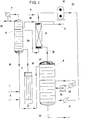
- FIG. 1 is a flow sheet showing equipment arrangement and material flows for the improved process of this invention.
- the equipment arrangement shown is provided only to facilitate description of the invention and is not meant to limit the scope of the invention as defined by the claims.
- the improved process of the present invention makes use of a continuous countercurrent column reactor system to convert a reaction mass from a prior (i.e., upstream) transesterification reaction stage into an oligomer (or prepolymer) of PBT or an oligomer (or prepolymer) of PBI suitable for feed to a continuous polycondensation stage.
- reaction mass is prepared by reacting BDO with a dimethyl ester in the presence of a transesterification catalyst.
- the dimethyl ester used in the prior transesterification stage is selected from DMT, dimethyl isophthalate (hereinafter DMI), and mixtures thereof.
- DMT dimethyl isophthalate
- DMI dimethyl isophthalate
- the dimethyl ester of choice is DMI or a mixture of DMI and DMT wherein DMI is the dominant component; more preferably, it is DMI alone.
- the transesterification catalyst used in the prior transesterification stage can be any of a variety of catalysts known to be useful in transesterification reactions.
- the preferred transesterification catalysts are organic titanates, especially tetraalkyl titanates, used alone or in combination with magnesium acetate or calcium acetate. Most preferred is tetrabutyl titanate.
- the organic titanates are used in amounts corresponding to 0.5-1.0 moles of organic titanate per 1000 moles of dimethyl ester.
- Other catalysts which can be used include complex titanates derived from alkali or alkaline earth metal alkoxides and titanate esters, inorganic titanates, such as lanthanum titanate, calcium acetate/antimony trioxide mixtures, and lithium and magnesium alkoxides.
- excess BDO should be fed into the prior transesterification stage. Most preferably, the excess is 10% or less. Excess BDO is calculated on the basis that one mole of BDO is required per mole of dimethyl ester in order to prepare a high molecular weight polymer. When the ratio of moles BDO:moles dimethyl ester is greater than 1:1, then excess BDO is present. For example, a feed of 1.05 moles of BDO per mole of dimethyl ester corresponds to a 5% excess of BDO.
- Limiting the excess of BDO to 10% or less in the transesterification stage is advantageous in the present process because any excess BDO fed forward must be volatilized in later stages. Large excesses of BDO would therefore require that substantial amounts of heat be supplied to any column reactor to which the BDO is fed forward in order to vaporize the BDO. This is complicated, expensive, and more to the point, unnecessary since it has been found that if the methyl ester conversion is less than 85%, then the rate of exchange of methyl ester groups during the transesterification reaction shows little or no increase when the amount of excess BDO is raised from 2-3% to as high as 30%. Moreover, limiting the excess of BDO in the transesterification stage reduces the amount of BDO lost through the formation of THF.
- Fig. 1 includes a schematic of a continuous transesterification stage useful in the process of the present invention.
- the continuous transesterification process detailed in Fig. 1 makes use of a recirculating loop. More specifically, a continuous transesterification process is as follows: Vertical heat exchanger 5 establishes a flow in the loop by convection, with vapors, which consist of methanol, BDO, water, and THF, and heated reaction mass, which is comprised of BDO, DMT, catalyst, monomer, dimer, trimer, etc., continuously feeding via line 18 into the bottom of transesterification prereactor column 6 having internal plates. The vapors are separated from the reaction mass in the bottom of the column. Methanol formed by the transesterification reaction proceeds up transesterification prereactor column 6 as the principal component of the vapor. The reaction mass then recirculates continuously into line 19 to complete the loop.
- vapors consist of methanol, BDO, water, and THF
- heated reaction mass which is comprised of BDO
- Dimethyl ester is continuously fed into the loop via dimethyl ester feed line 1 .
- Transesterification catalyst is also fed continuously into the loop via catalyst feed line 2 .
- BDO containing some methanol and traces of THF and water is introduced into the transesterification stage on one of the plates, preferably on one of the upper plates, of transesterification prereactor column 6 by means of line 20 .
- BDO is continuously fed into transesterification prereactor column 6 from the countercurrent column reactor system, said reactor system being described in detail in section 2, below.
- fresh BDO preferably at a temperature slightly above its freezing point and more preferably at about 30°C-60°C, most preferably 35°C-45°C
- absorber 9 Any BDO not fed to the absorber is fed to the transesterification prereactor column 6 via line 16 .
- BDO containing some methanol and traces of THF and water from the bottom of the absorber 9 is introduced into the transesterification prereactor column 6 via line 20 .
- Methanol vapor containing minor amounts of THF and water exits overhead from the transesterification prereactor column 6 and is condensed in heat exchanger 7 .
- the impure methanol condensed in heat exchanger 7 is split into two streams, one of which exits the system through line 15 ; and the other of which is returned as reflux to the top of column 6 .
- the methyl ester groups of the dimethyl ester must be reduced to a very low level by transesterification with BDO to form an oligomer (or prepolymer) that has sufficient degree of polymerization and low enough volatility for introduction into a continuous polycondensation reactor.
- the continuous transesterification stage described above, along with other known continuous transesterification processes, is effective for converting the bulk of the methyl ester groups on the dimethyl ester but is relatively inefficient for completing the removal of the methyl ester groups and for yielding an oligomer (or prepolymer) having sufficient degree of polymerization to make it suitable for continuous polycondensation to high molecular weight polymer.
- the conversion of methyl ester groups in the prior transesterification stage be 50-95%, more preferably 70-90%, and most preferably, 75-85%.
- degrees of conversion of about 80% to about 88% can be achieved with transesterification reactor residence times of about 6-10 minutes with excess BDO of 2-10%.
- the preferred minimum degree of conversion of methyl ester groups is 50%, transesterification products with a lower degree of conversion of methyl ester groups would be suitable for feed into the countercurrent column reactor of the present invention.
- the first stage transesterification reaction could be bypassed entirely and the ingredients of said reaction could be fed directly into the countercurrent column reactor system.
- to do so would require that all the heat load for boiling methanol generated by the transesterification reaction would have to be provided by sidestream heat exchangers on the countercurrent column reactor. This is expensive and would require that the size of the countercurrent column reactor be substantially increased.
- transesterification products having a degree of methyl ester conversion of greater than 95% are acceptable for feeding into the countercurrent column reactor described herein; however, such a higher degree of conversion generally requires increased residence time and as residence time increases, it is known that THF formation also increases.
- a countercurrent column reactor is identified as 8 .
- Stream 17 which is the reaction mass from a prior (i.e., upstream) transesterification stage, is continuously fed to the top plate of the countercurrent column reactor 8 .
- the reaction mass flows downward through multiple reactor plates in the countercurrent column reactor and issues from the bottom of the countercurrent column reactor through line 14 , which then carries the product (i.e., an oligomer of sufficient degree of polymerization for polycondensation) to a continuous polycondensation stage.
- the residence time of the reaction mass in the countercurrent column reactor is at least 5 minutes, preferably 6-10 minutes.
- Heat is applied to the countercurrent column reactor in order to maintain or increase the temperature of the liquid reaction mass flowing down the countercurrent column reactor. Heat may be applied to the countercurrent column reactor contents by various known methods. Heat could be applied in any of several places on or in the countercurrent column reactor.
- An example of an acceptable method for applying heat to the countercurrent column reactor 8 is illustrated in Fig. 1. In Fig. 1, a sidestream from the countercurrent column reactor 8 is removed by means of pump 12 , which stream is heated by heat exchanger 13 and then returned to the countercurrent column reactor 8 .
- Countercurrent to the downward liquid flow of the reaction mass in the countercurrent column reactor is a stream of a heated inert gas, preferably nitrogen, which is continuously introduced at the bottom part of the countercurrent column reactor 8 .
- the heated inert gas proceeds up the column and picks up increasing concentrations of volatiles, such as methanol, BDO, and minor amounts of THF and water, from the reaction mass flowing down the countercurrent column reactor.
- volatiles such as methanol, BDO, and minor amounts of THF and water
- the inert gas plus the volatiles exits from the top part of the countercurrent column 8 and flows continuously into the bottom of an absorber 9 via line 21 .
- An example of an absorber 9 that is adequate for this process is a packed tower having about two theoretical plates.
- Incoming BDO from line 3 at a temperature slightly above freezing, more preferably 30°C-60°C, and most preferably 35°C-45°C, continuously flows countercurrent to the inert gas containing the volatiles and scrubs out the methanol, THF, and water in the inert gas.
- the partial pressure of the BDO in the inert gas stream 22 after scrubbing is, as a result, lowered to a level corresponding to the relatively low temperature of the incoming BDO, which is lower than the temperature of the inert gas stream as it enters the absorber.
- the inert gas after scrubbing next exits the absorber 9 and is compressed by a compressor 10 , passed through a heat exchanger 11 , and then reintroduced into the bottom of countercurrent column reactor 8 .
- the inert gas plus volatiles exiting the countercurrent column reactor 8 can be compressed by a compressor first and then passed into the absorber 9 for scrubbing as described above. Such an alternative method would result in more effective scrubbing than if the inert gas plus volatiles were not first compressed but it would demand higher amounts of energy than if the inert gas plus volatiles were scrubbed first.
- a portion of the BDO may by-pass the absorber via a line 16 and be directly introduced into transesterification prereactor column 6 . It is desirable that a major portion of the BDO be introduced to the process via absorber 9 so that the BDO, THF, water, and methanol are thoroughly removed from recycling inert gas. It is most preferred that the total BDO feed of the entire process, regardless of where said BDO is fed into the process, be such that the molar excess of BDO is less than 10%.
- the reaction mass from the transesterification prereactor system fed to the countercurrent column reactor via line 17 should be introduced into the countercurrent column reactor at a temperature at least equivalent to the temperature of the reaction mass as it leaves the transesterification stage. It may be advantageous to heat the reaction mass to a higher temperature after it leaves the transesterification stage but before it enters the countercurrent column reactor.
- the countercurrent column reactor preferably has 6-12 plates.
- plates include sieve plates, slot plates, or bubble cap plates.
- Bubble cap plates are preferred because they are less sensitive to variations in flow rate and viscosity. Because the reaction mass flowing down the column is increasing in viscosity, the plates may need to be modified, for instance, by reducing weir height and increasing the width of the slots in the bubble cap.
- the flow of the heated inert gas into the bottom of the countercurrent column reactor should be sufficient to reduce the partial pressure of the butanediol at the bottom of the countercurrent column reactor to such an extent that an oligomer of sufficient molecular weight for subsequent polymerization reactions is produced.
- the range for acceptable flow rates depends upon column design and further, such flow rates are known in the art. If the flow rate is too low, the liquid in the column will "weep" through the holes in the plates of the column. If the flow rate is too high, entrainment flooding could occur. A short, large diameter column with few trays would have a higher optimal gas flow rate than a tall, smaller diameter column.
- the gas flow rate for the process of the present invention range from about 600-900 standard liters per kilogram of the reaction mass feed from the transesterification stage.
- the gas flow rate is dependent upon the column design and as such, it should be determined for the particular column design being used in the process of the present invention.
- the volume of recycled inert gas used per kilogram of transesterification stage reaction mass depends in part on the amount of excess BDO used in the transesterification stage and the concentration of methyl ester groups in the transesterification stage reaction mass.
- the inert gas stream is fed into the countercurrent column reactor at a minimum temperature of 225°C, preferably 250°C-260°C.
- transesterification stage precedes the countercurrent reactor stage. While a single transesterification stage is preferred, the use of two or more transesterification stages prior to the countercurrent reactor stage is meant to be included within the scope of this invention.
- the essence of this invention resides in the use of the countercurrent column reactor which has proven to be highly efficient for eliminating methyl ester groups from the transesterification reaction mass and at the same time for building sufficient molecular weight in the transesterification reaction mass to form a prepolymer (or oligomer) suitable for feeding to the final polycondensation stage.
- use of the countercurrent reactor is made practical by scrubbing of the inert gas stream in the absorber with incoming BDO. The efficiency of the process can be further enhanced by operating the transesterification stage such that an excess of BDO of 10% or less is used in the process.
- the transesterification stage is known to be effective for converting the bulk of the methyl ester groups but it is relatively inefficient for completing the removal of methyl ester groups. It is preferred in the present process of the present invention that the conversion of methyl ester groups range from 50-95% in the reaction mass fed to the countercurrent column reactor since sufficient heat must be provided to vaporize the methanol formed within the countercurrent column reactor. As is the case with excessive amount of BDO, excess concentrations of methyl ester groups complicate the operation of the countercurrent column reactor because of the large amounts of heat which must be introduced into the reactor.
- the oligomer (or prepolymer) produced in the countercurrent column reactor normally has a conversion of about 98.5% of methyl ester groups. It has a number average molecular weight of about 3000-4000 and an inherent viscosity of about 0.2 to 0.25, measured at 30°C and at a concentration of 0.1 g/dl in m-cresol.
- the oligomer (or prepolymer) exiting the column reactor via line 14 is preferably fed directly to a continuous polycondensation reactor to prepare high molecular weight polymer.
- the oligomer (or prepolymer) from the countercurrent column reactor is mixed with the desired amount of a poly(alkylene oxide) glycol, such as poly(tetramethylene oxide) glycol, until the two liquids form a single phase liquid, which is in turn introduced to a continuous polycondensation reactor.
- Typical continuous polycondensation reactors are well known in the art.
- transesterification reactor was a heated and insulated resin flask fitted with a stirrer. The agitation provided was sufficient that the transesterification reactor was substantially a constant composition continuous reactor. Feed streams, BDO, and DMI were metered by separate pumps and entered the top of the transesterification reactor. Because of its lower melting point, the use of DMI (in contrast to DMT) facilitated operation of the transesterification reactor. Tetrabutyl titanate catalyst was injected by a syringe pump into the BDO feed stream just prior to its entry into the transesterification reactor.
- Table I Run A B C Average reactor temperature °C 196 189 193 Average reactor residence time, min 6.1 7.0 7.0 BDO/DMI feed mole ratio 1.34 1.20 1.00 Tetrabutyl titanate, moles per 1000 moles DMI 0.790 0.758 0.703 Methyl ester conversation, % (a) 81.0 81.1 80.7 Moles BDO degraded to THF per 100 moles DMI (b) 0.19 0.42 0.31 (a) Methyl ester conversion is the average of values determined by (1) analysis of the bottoms product for residual methyl ester end groups and (2) by calculation from the ratio of methanol take-off rate and DMI feed rate (b) THF was determined by gas chromatography of the recovered methanol
- This example illustrates the use of a continuous countercurrent column reactor system to convert the transesterification reaction mass from a prior transesterification stage to an oligomer (or prepolymer) suitable for feed to a continuous polycondensation reactor.
- the countercurrent column reactor was a modified Oldershaw column of 28 mm diameter, 8 plates, 3 mm high weirs, tray spacing between 28 and 29 mm.
- the countercurrent column reactor was heated with a clamshell heater.
- the transesterification reaction mass from a transesterification reaction, described below, was fed to the top of the countercurrent column reactor.
- Heated nitrogen was introduced into the countercurrent column reactor below the bottom tray of the column.
- Finished oligomer (or prepolymer) was removed from the bottom of the countercurrent column reactor.
- the nitrogen gas stream exited from the top of the countercurrent column reactor and was passed through cold traps to condense the volatile organics contained therein.
- the transesterification reaction mass from a transesterification reaction fed to the column was prepared in the continuous transesterification reactor described in Example 1.
- a BDO/DMI feed mole ratio of 1.065 was used with a 7 minute residence time.
- the transesterification product i.e., the transesterification reaction mass
- the molten transesterification reaction mass at a temperature of 262°C was fed to the countercurrent column reactor at a rate of about 460 g/hr.
- the skin temperature of the countercurrent column reactor was maintained at about 264°C by means of the clamshell heater.
- the temperature in the countercurrent column reactor at the uppermost level (above the uppermost tray) heated by the clamshell heater was about 262°C.
- Nitrogen was introduced into the bottom of the countercurrent column reactor at a rate of about 5 standard liters/min. This flow rate gave a ratio of about 750 liters of nitrogen per kilogram of transesterification product fed. The nitrogen was heated to about 244°C before it was introduced into the countercurrent column reactor. The average residence time of liquid transesterification reaction mass in the countercurrent column reactor was estimated to be about 7 minutes.
- the oligomer (or prepolymer) product from the countercurrent column reactor had a methyl ester conversion of 98.5 and an inherent viscosity of 0.2329 dl/g in m-cresol at a concentration of 0.1 g/dl.
- the number average molecular weight of the product was 3400, determined by gel permeation chromatography. This molecular weight corresponds to a degree of polymerization of 15.
- the product is suitable as feed to a continuous polycondensation reactor.
Landscapes
- Chemical & Material Sciences (AREA)
- Health & Medical Sciences (AREA)
- Chemical Kinetics & Catalysis (AREA)
- Medicinal Chemistry (AREA)
- Polymers & Plastics (AREA)
- Organic Chemistry (AREA)
- Polyesters Or Polycarbonates (AREA)
Abstract
Description
- The demand for poly(butylene terephthalate), hereinafter PBT, copolyetherester elastomers containing PBT hard segments, and poly(butylene isophthalate), hereinafter PBI, continues to grow.
- There are numerous patents directed to processes for the continuous preparation of PBT from dimethyl terephthalate and 1,4-butanediol, hereinafter DMT and BDO respectively. Typically, these continuous processes employ a first transesterification stage wherein DMT and a substantial excess of BDO are contacted in the presence of a transesterification catalyst and reacted at around atmospheric pressure and at temperatures of 170-200°C. During the transesterification reaction, methanol is formed as a by-product. In typical continuous processes, the bulk of the methanol thus formed is removed overhead through a fractionating column while any unreacted BDO is retained in the reaction mixture. The first transesterification stage is usually followed by two or more reaction stages operating at reduced pressure wherein the removal of methanol formed as a by-product of the transesterification reaction is completed and sufficient precondensation to form an oligomer (or prepolymer) suitable for feed to a continuous polycondensation reactor is achieved.
- A recent disclosure of such a continuous process for preparing PBT from DMT and BDO is provided by U.S. Patent 4,499,261 to Heinze et al. In the specific example of this reference, two transesterification stages and two precondensation stages are used prior to sending the resulting oligomer (or prepolymer) to the final polycondensation reactor. The first transesterification stage is operated at a pressure of 1.3 bar. The next three stages required to prepare the oligomer (or prepolymer) are operated at subatmospheric pressure. The total residence time of the reactants in the four stages prior to polycondensation is 240 minutes. A 30% molar excess of BDO relative to DMT is used. The loss of BDO resulting from the formation of tetrahydrofuran, hereinafter THF, is stated to be 5.1 moles per 100 moles of DMT fed.
- While the above reference indicates that the loss of BDO to THF in the process therein is substantially less than encountered in earlier processes, a loss of 5.1 moles of BDO per 100 moles of DMT still represents a serious loss of an expensive raw material, especially when it is realized that the desired product is being manufactured at levels of tens of million pounds a year.
- Beyond this yield loss, the process of the reference inherently represents a source of environmental contamination by virtue of the fact that several stages prior to the final polycondensation (i.e., precondensation stages) are operated at reduced pressure. This is a problem shared by prior continuous processes, along with batch processes, in general. Operation of the precondensation stages at reduced pressure on a commercial scale generally requires vacuum sources, such as, for example, steam jets or vacuum pumps. When a vacuum source is used, environmental contamination can occur because some of the volatile organics being removed in the precondensation stages cannot be fully condensed. The organic volatiles can then be emitted into the environment from the vacuum source. Accordingly, when vacuum operations are used in continuous reaction process, and also in batch processes, additional measures are necessary to protect the environment from the volatile organics that may be emitted by the vacuum source.
- Thus, while the continuous preparation of PBT from BDO and DMT is well advanced as a result of numerous extensive investigations, there is still a need for improvement with regard to utilization of BDO and with regard to contamination of the environment with volatile organics. Likewise, the same type of improvements are desired in preparing PBI and copolymers based upon PBT or PBI.
- The loss of BDO to THF and environmental contamination by volatile organics are both substantially reduced by an improved continuous process wherein a countercurrent column reactor system is used for the preparation of PBT oligomer or PBI oligomer (or prepolymer) from a reaction mass formed by a transesterification reaction between BDO and a dimethyl ester, said ester being selected from dimethyl isophthalate, DMT, and mixtures thereof, and in the presence of a transesterification catalyst.
- More specifically, in the present invention, PBT oligomer or PBI oligomer (or prepolymer) is prepared by an improved continuous process comprising the steps of
- (1) continuously feeding a reaction mass prepared from a transesterification reaction between BDO and a dimethyl ester in the presence of a transesterification catalyst and having a dimethyl ester conversion of 50-95%, into the top part of a heated countercurrent column reactor having a plurality of internal plates,
- (2) continuously feeding an inert gas stream having a temperature of at least 225°C into the bottom part of the countercurrent column reactor which is operated at or slightly above atmospheric pressure, and allowing it to flow upwards through the countercurrent column reactor while the reaction mass simultaneously flows downward at a rate such that said reaction mass has a residence time of at least 5 minutes in the countercurrent column reactor,
- (3) continuously feeding the inert gas stream, which now also contains water, methanol, THF, and BDO, from the top part of the countercurrent column reactor into the bottom part of an absorber while also continuously feeding butanediol at a temperature lower than that of the incoming inert gas feed stream into the top part of the absorber,
- (4) continuously passing the inert gas stream upwards through the absorber and into a compressor while simultaneously and continuously passing the butanediol downward through the absorber and passing the butanediol into a transesterification process or back to a butanediol feed line, and
- (5) collecting an oligomer (or prepolymer) of PBT or an oligomer of PBI from the bottom part of the countercurrent column reactor.
- The PBT or PBI oligomer or prepolymer can be fed into conventional polycondensation processes to form PBI polymer or PBT polymer. It also can be mixed with a poly(alkylene oxide) glycol and introduced into a polycondensation reaction to form a copolyetherester.
- In a preferred embodiment, and specifically for the preparation of PBT oligomer, even greater reduction in the loss of BDO to THF can be achieved if operation of the transesterification stage which provides the reaction mass feed for the countercurrent column is adjusted such that the reaction mass feed from said prior transesterification reaction stage is the reaction product of DMT and BDO in the presence of a transesterification catalyst, wherein said BDO is added in a molar excess of 10% or less.
- FIG. 1 is a flow sheet showing equipment arrangement and material flows for the improved process of this invention. The equipment arrangement shown is provided only to facilitate description of the invention and is not meant to limit the scope of the invention as defined by the claims.
- The improved process of the present invention makes use of a continuous countercurrent column reactor system to convert a reaction mass from a prior (i.e., upstream) transesterification reaction stage into an oligomer (or prepolymer) of PBT or an oligomer (or prepolymer) of PBI suitable for feed to a continuous polycondensation stage.
- In the prior transesterification stage, a reaction mass is prepared by reacting BDO with a dimethyl ester in the presence of a transesterification catalyst.
- The dimethyl ester used in the prior transesterification stage is selected from DMT, dimethyl isophthalate (hereinafter DMI), and mixtures thereof. To produce a reaction mass from which PBT oligomer will be prepared, the dimethyl ester of choice is DMT or a mixture of DMT and DMI wherein DMT is the dominant component; more preferably, it is DMT alone. To produce a reaction mass from which PBI oligomer will be prepared, the dimethyl ester of choice is DMI or a mixture of DMI and DMT wherein DMI is the dominant component; more preferably, it is DMI alone.
- The transesterification catalyst used in the prior transesterification stage can be any of a variety of catalysts known to be useful in transesterification reactions. The preferred transesterification catalysts are organic titanates, especially tetraalkyl titanates, used alone or in combination with magnesium acetate or calcium acetate. Most preferred is tetrabutyl titanate. The organic titanates are used in amounts corresponding to 0.5-1.0 moles of organic titanate per 1000 moles of dimethyl ester. Other catalysts which can be used include complex titanates derived from alkali or alkaline earth metal alkoxides and titanate esters, inorganic titanates, such as lanthanum titanate, calcium acetate/antimony trioxide mixtures, and lithium and magnesium alkoxides.
- In a preferred embodiment of the present invention, excess BDO should be fed into the prior transesterification stage. Most preferably, the excess is 10% or less. Excess BDO is calculated on the basis that one mole of BDO is required per mole of dimethyl ester in order to prepare a high molecular weight polymer. When the ratio of moles BDO:moles dimethyl ester is greater than 1:1, then excess BDO is present. For example, a feed of 1.05 moles of BDO per mole of dimethyl ester corresponds to a 5% excess of BDO.
- Limiting the excess of BDO to 10% or less in the transesterification stage is advantageous in the present process because any excess BDO fed forward must be volatilized in later stages. Large excesses of BDO would therefore require that substantial amounts of heat be supplied to any column reactor to which the BDO is fed forward in order to vaporize the BDO. This is complicated, expensive, and more to the point, unnecessary since it has been found that if the methyl ester conversion is less than 85%, then the rate of exchange of methyl ester groups during the transesterification reaction shows little or no increase when the amount of excess BDO is raised from 2-3% to as high as 30%. Moreover, limiting the excess of BDO in the transesterification stage reduces the amount of BDO lost through the formation of THF. It has been found that when the excess BDO is limited to 10% or less in the transesterification stage, the loss of BDO to THF can be reduced to less than 1 mole of BDO per 100 moles of DMT and the total residence time required to prepare an oligomer (or prepolymer) of PBT suitable for continuous polycondensation can be less than 15 minutes. These results represent substantial improvements relative to prior art processes.
- Fig. 1 includes a schematic of a continuous transesterification stage useful in the process of the present invention. The continuous transesterification process detailed in Fig. 1 makes use of a recirculating loop. More specifically, a continuous transesterification process is as follows:
Vertical heat exchanger 5 establishes a flow in the loop by convection, with vapors, which consist of methanol, BDO, water, and THF, and heated reaction mass, which is comprised of BDO, DMT, catalyst, monomer, dimer, trimer, etc., continuously feeding vialine 18 into the bottom oftransesterification prereactor column 6 having internal plates. The vapors are separated from the reaction mass in the bottom of the column. Methanol formed by the transesterification reaction proceeds uptransesterification prereactor column 6 as the principal component of the vapor. The reaction mass then recirculates continuously intoline 19 to complete the loop. - Dimethyl ester is continuously fed into the loop via dimethyl
ester feed line 1. Transesterification catalyst is also fed continuously into the loop viacatalyst feed line 2. As described below in the section on the countercurrent column reactor system, BDO containing some methanol and traces of THF and water is introduced into the transesterification stage on one of the plates, preferably on one of the upper plates, oftransesterification prereactor column 6 by means ofline 20. BDO is continuously fed intotransesterification prereactor column 6 from the countercurrent column reactor system, said reactor system being described in detail insection 2, below. Specifically, fresh BDO, preferably at a temperature slightly above its freezing point and more preferably at about 30°C-60°C, most preferably 35°C-45°C, is fed into the countercurrent column reactor system viafeed line 3, with all or a major portion thereof enteringabsorber 9. Any BDO not fed to the absorber is fed to thetransesterification prereactor column 6 vialine 16. Also, BDO containing some methanol and traces of THF and water from the bottom of theabsorber 9 is introduced into thetransesterification prereactor column 6 vialine 20. Methanol vapor containing minor amounts of THF and water exits overhead from thetransesterification prereactor column 6 and is condensed inheat exchanger 7. The impure methanol condensed inheat exchanger 7 is split into two streams, one of which exits the system throughline 15; and the other of which is returned as reflux to the top ofcolumn 6. - In preparing PBT or PBI from a dimethyl ester and BDO, the methyl ester groups of the dimethyl ester must be reduced to a very low level by transesterification with BDO to form an oligomer (or prepolymer) that has sufficient degree of polymerization and low enough volatility for introduction into a continuous polycondensation reactor. The continuous transesterification stage described above, along with other known continuous transesterification processes, is effective for converting the bulk of the methyl ester groups on the dimethyl ester but is relatively inefficient for completing the removal of the methyl ester groups and for yielding an oligomer (or prepolymer) having sufficient degree of polymerization to make it suitable for continuous polycondensation to high molecular weight polymer. Indicative of the inefficiency of a transesterification stage for completing methanol removal is the process of U.S. Patent, 4,499,261, wherein a total residence time of 130 minutes in two transesterification stages is required with a 30% excess of BDO to reach a conversion of 91%. Such a long residence time increases the losses of BDO to THF substantially.
- At the same time, however, it is preferred in the present process that the conversion of methyl ester groups in the prior transesterification stage be 50-95%, more preferably 70-90%, and most preferably, 75-85%. In the most preferred continuous transesterification process described above with reference to Fig. 1, degrees of conversion of about 80% to about 88% can be achieved with transesterification reactor residence times of about 6-10 minutes with excess BDO of 2-10%. It is noted that while the preferred minimum degree of conversion of methyl ester groups is 50%, transesterification products with a lower degree of conversion of methyl ester groups would be suitable for feed into the countercurrent column reactor of the present invention. In fact, the first stage transesterification reaction could be bypassed entirely and the ingredients of said reaction could be fed directly into the countercurrent column reactor system. However, to do so would require that all the heat load for boiling methanol generated by the transesterification reaction would have to be provided by sidestream heat exchangers on the countercurrent column reactor. This is expensive and would require that the size of the countercurrent column reactor be substantially increased. Similarly, transesterification products having a degree of methyl ester conversion of greater than 95% are acceptable for feeding into the countercurrent column reactor described herein; however, such a higher degree of conversion generally requires increased residence time and as residence time increases, it is known that THF formation also increases.
- By the process of the present invention, conversion of methyl ester groups to hydroxylbutyl endgroups and the building of molecular weight (which impacts in turn on a degree of polymerization and volatility) are efficiently and rapidly accomplished by a novel process wherein there is used a continuous countercurrent column reactor system. Since the continuous countercurrent column reactor system is operated at or slightly above atmospheric pressure, environmental contamination associated with a vacuum source is avoided. Further, since the continuous countercurrent column reactor system operates efficiently and rapidly, the loss of BDO to THF is minimized.
- The continuous countercurrent column reactor system, and the process by which PBT oligomer or PBI oligomer (or prepolymer) is prepared from the reaction mass of the prior transesterification stage, is most easily described by reference to Fig. 1. In Fig. 1, a countercurrent column reactor is identified as 8.
Stream 17, which is the reaction mass from a prior (i.e., upstream) transesterification stage, is continuously fed to the top plate of thecountercurrent column reactor 8. The reaction mass flows downward through multiple reactor plates in the countercurrent column reactor and issues from the bottom of the countercurrent column reactor throughline 14, which then carries the product (i.e., an oligomer of sufficient degree of polymerization for polycondensation) to a continuous polycondensation stage. The residence time of the reaction mass in the countercurrent column reactor is at least 5 minutes, preferably 6-10 minutes. Heat is applied to the countercurrent column reactor in order to maintain or increase the temperature of the liquid reaction mass flowing down the countercurrent column reactor. Heat may be applied to the countercurrent column reactor contents by various known methods. Heat could be applied in any of several places on or in the countercurrent column reactor. An example of an acceptable method for applying heat to thecountercurrent column reactor 8 is illustrated in Fig. 1. In Fig. 1, a sidestream from thecountercurrent column reactor 8 is removed by means ofpump 12, which stream is heated byheat exchanger 13 and then returned to thecountercurrent column reactor 8. - Countercurrent to the downward liquid flow of the reaction mass in the countercurrent column reactor is a stream of a heated inert gas, preferably nitrogen, which is continuously introduced at the bottom part of the
countercurrent column reactor 8. The heated inert gas proceeds up the column and picks up increasing concentrations of volatiles, such as methanol, BDO, and minor amounts of THF and water, from the reaction mass flowing down the countercurrent column reactor. The inert gas plus the volatiles exits from the top part of thecountercurrent column 8 and flows continuously into the bottom of anabsorber 9 vialine 21. An example of anabsorber 9 that is adequate for this process is a packed tower having about two theoretical plates. Incoming BDO fromline 3, at a temperature slightly above freezing, more preferably 30°C-60°C, and most preferably 35°C-45°C, continuously flows countercurrent to the inert gas containing the volatiles and scrubs out the methanol, THF, and water in the inert gas. The partial pressure of the BDO in theinert gas stream 22 after scrubbing is, as a result, lowered to a level corresponding to the relatively low temperature of the incoming BDO, which is lower than the temperature of the inert gas stream as it enters the absorber. The scrubbing of the inert gas containing volatiles in order to remove methanol, THF, and water is essential for the economical operation of the process since it permits the inert gas to be continuously recycled through the countercurrent column reactor system. Incidental losses of inert gas can be compensated for by addition of inert gas throughline 4. - The inert gas after scrubbing next exits the
absorber 9 and is compressed by a compressor 10, passed through aheat exchanger 11, and then reintroduced into the bottom ofcountercurrent column reactor 8. In an alternative method, the inert gas plus volatiles exiting thecountercurrent column reactor 8 can be compressed by a compressor first and then passed into theabsorber 9 for scrubbing as described above. Such an alternative method would result in more effective scrubbing than if the inert gas plus volatiles were not first compressed but it would demand higher amounts of energy than if the inert gas plus volatiles were scrubbed first. - It is not necessary that all of the BDO required by the process be fed to
absorber 9. As shown in Fig. 1, a portion of the BDO may by-pass the absorber via aline 16 and be directly introduced intotransesterification prereactor column 6. It is desirable that a major portion of the BDO be introduced to the process viaabsorber 9 so that the BDO, THF, water, and methanol are thoroughly removed from recycling inert gas. It is most preferred that the total BDO feed of the entire process, regardless of where said BDO is fed into the process, be such that the molar excess of BDO is less than 10%. - The reaction mass from the transesterification prereactor system fed to the countercurrent column reactor via
line 17 should be introduced into the countercurrent column reactor at a temperature at least equivalent to the temperature of the reaction mass as it leaves the transesterification stage. It may be advantageous to heat the reaction mass to a higher temperature after it leaves the transesterification stage but before it enters the countercurrent column reactor. - The countercurrent column reactor preferably has 6-12 plates. Examples of such plates include sieve plates, slot plates, or bubble cap plates. Bubble cap plates are preferred because they are less sensitive to variations in flow rate and viscosity. Because the reaction mass flowing down the column is increasing in viscosity, the plates may need to be modified, for instance, by reducing weir height and increasing the width of the slots in the bubble cap.
- The flow of the heated inert gas into the bottom of the countercurrent column reactor should be sufficient to reduce the partial pressure of the butanediol at the bottom of the countercurrent column reactor to such an extent that an oligomer of sufficient molecular weight for subsequent polymerization reactions is produced. The range for acceptable flow rates depends upon column design and further, such flow rates are known in the art. If the flow rate is too low, the liquid in the column will "weep" through the holes in the plates of the column. If the flow rate is too high, entrainment flooding could occur. A short, large diameter column with few trays would have a higher optimal gas flow rate than a tall, smaller diameter column.
- In general, it is recommended that the gas flow rate for the process of the present invention range from about 600-900 standard liters per kilogram of the reaction mass feed from the transesterification stage. However, as stated above, the gas flow rate is dependent upon the column design and as such, it should be determined for the particular column design being used in the process of the present invention.
- The volume of recycled inert gas used per kilogram of transesterification stage reaction mass depends in part on the amount of excess BDO used in the transesterification stage and the concentration of methyl ester groups in the transesterification stage reaction mass. The greater the excess of BDO used in the transesterification reaction or the greater the concentration of methyl ester groups in the reaction mass, the greater should be the volume of the heated inert gas.
- The inert gas stream is fed into the countercurrent column reactor at a minimum temperature of 225°C, preferably 250°C-260°C.
- As shown in Fig. 1, only one transesterification stage precedes the countercurrent reactor stage. While a single transesterification stage is preferred, the use of two or more transesterification stages prior to the countercurrent reactor stage is meant to be included within the scope of this invention. The essence of this invention resides in the use of the countercurrent column reactor which has proven to be highly efficient for eliminating methyl ester groups from the transesterification reaction mass and at the same time for building sufficient molecular weight in the transesterification reaction mass to form a prepolymer (or oligomer) suitable for feeding to the final polycondensation stage. In turn, use of the countercurrent reactor is made practical by scrubbing of the inert gas stream in the absorber with incoming BDO. The efficiency of the process can be further enhanced by operating the transesterification stage such that an excess of BDO of 10% or less is used in the process.
- As stated previously, the transesterification stage is known to be effective for converting the bulk of the methyl ester groups but it is relatively inefficient for completing the removal of methyl ester groups. It is preferred in the present process of the present invention that the conversion of methyl ester groups range from 50-95% in the reaction mass fed to the countercurrent column reactor since sufficient heat must be provided to vaporize the methanol formed within the countercurrent column reactor. As is the case with excessive amount of BDO, excess concentrations of methyl ester groups complicate the operation of the countercurrent column reactor because of the large amounts of heat which must be introduced into the reactor.
- The oligomer (or prepolymer) produced in the countercurrent column reactor normally has a conversion of about 98.5% of methyl ester groups. It has a number average molecular weight of about 3000-4000 and an inherent viscosity of about 0.2 to 0.25, measured at 30°C and at a concentration of 0.1 g/dl in m-cresol.
- The oligomer (or prepolymer) exiting the column reactor via
line 14 is preferably fed directly to a continuous polycondensation reactor to prepare high molecular weight polymer. In order to prepare copolyetherester elastomers, the oligomer (or prepolymer) from the countercurrent column reactor is mixed with the desired amount of a poly(alkylene oxide) glycol, such as poly(tetramethylene oxide) glycol, until the two liquids form a single phase liquid, which is in turn introduced to a continuous polycondensation reactor. Typical continuous polycondensation reactors are well known in the art. - A series of continuous transesterification reactions were run in which the principal variable studied was the effect of the BDO/DMT ratio on conversion of methyl ester groups. The transesterification reactor was a heated and insulated resin flask fitted with a stirrer. The agitation provided was sufficient that the transesterification reactor was substantially a constant composition continuous reactor. Feed streams, BDO, and DMI were metered by separate pumps and entered the top of the transesterification reactor. Because of its lower melting point, the use of DMI (in contrast to DMT) facilitated operation of the transesterification reactor. Tetrabutyl titanate catalyst was injected by a syringe pump into the BDO feed stream just prior to its entry into the transesterification reactor. Product was removed through an outlet centrally located on the bottom of the transesterification reactor and passed through a U-leg to a vertical tube, the height of which could be adjusted to control the level of the reaction mass in the reactor. Temperature in the transesterification reactor was controlled by varying the heat supplied by a heating mantle. Vapors from the transesterification reactor consisting largely of methanol, with some BDO and traces of THF, and water exited the reactor through an outlet in the top of the reactor, passed through a vacuum jacketed Vigreux column, and were condensed in a water-cooled condenser, which was vented to the atmosphere. Part of the condensate was returned as reflux to the Vigreux column by means of a reflux splitter. The rest of the condensed methanol was passed to a receiving flask.
- The conditions used to make three runs differing mainly in BDO/DMI feed mole ratio and analyses of the resulting products are presented in Table I.
Table I Run A B C Average reactor temperature °C 196 189 193 Average reactor residence time, min 6.1 7.0 7.0 BDO/DMI feed mole ratio 1.34 1.20 1.00 Tetrabutyl titanate, moles per 1000 moles DMI 0.790 0.758 0.703 Methyl ester conversation, %(a) 81.0 81.1 80.7 Moles BDO degraded to THF per 100 moles DMI(b) 0.19 0.42 0.31 (a) Methyl ester conversion is the average of values determined by
(1) analysis of the bottoms product for residual methyl ester end groups and
(2) by calculation from the ratio of methanol take-off rate and DMI feed rate(b) THF was determined by gas chromatography of the recovered methanol - The results of the three runs showed that methyl ester conversions of about 81% were obtained with residence times of 6-7 minutes regardless of the BDO/DMI feed ratio, which was varied from 1.00-1.34. THF formation was low for all three runs.
- Substantially identical results would be obtained if DMI was replaced by an equal amount of DMT, due to the fact that, at the same temperature and catalyst concentration, the ester exchange rate of either with BDO is very nearly identical.
- This example illustrates the use of a continuous countercurrent column reactor system to convert the transesterification reaction mass from a prior transesterification stage to an oligomer (or prepolymer) suitable for feed to a continuous polycondensation reactor.
- The countercurrent column reactor was a modified Oldershaw column of 28 mm diameter, 8 plates, 3 mm high weirs, tray spacing between 28 and 29 mm. The countercurrent column reactor was heated with a clamshell heater. The transesterification reaction mass from a transesterification reaction, described below, was fed to the top of the countercurrent column reactor. Heated nitrogen was introduced into the countercurrent column reactor below the bottom tray of the column. Finished oligomer (or prepolymer) was removed from the bottom of the countercurrent column reactor. After passage upward through the countercurrent column reactor, the nitrogen gas stream exited from the top of the countercurrent column reactor and was passed through cold traps to condense the volatile organics contained therein.
- The transesterification reaction mass from a transesterification reaction fed to the column was prepared in the continuous transesterification reactor described in Example 1. A BDO/DMI feed mole ratio of 1.065 was used with a 7 minute residence time. The transesterification product (i.e., the transesterification reaction mass) had a methyl ester conversion of 81.25%. The molten transesterification reaction mass at a temperature of 262°C was fed to the countercurrent column reactor at a rate of about 460 g/hr. The skin temperature of the countercurrent column reactor was maintained at about 264°C by means of the clamshell heater. The temperature in the countercurrent column reactor at the uppermost level (above the uppermost tray) heated by the clamshell heater was about 262°C. Nitrogen was introduced into the bottom of the countercurrent column reactor at a rate of about 5 standard liters/min. This flow rate gave a ratio of about 750 liters of nitrogen per kilogram of transesterification product fed. The nitrogen was heated to about 244°C before it was introduced into the countercurrent column reactor. The average residence time of liquid transesterification reaction mass in the countercurrent column reactor was estimated to be about 7 minutes.
- The oligomer (or prepolymer) product from the countercurrent column reactor had a methyl ester conversion of 98.5 and an inherent viscosity of 0.2329 dl/g in m-cresol at a concentration of 0.1 g/dl. The number average molecular weight of the product was 3400, determined by gel permeation chromatography. This molecular weight corresponds to a degree of polymerization of 15. The product is suitable as feed to a continuous polycondensation reactor.
- Substantially identical results would be obtained if the transesterification product fed to the column was based on DMT rather than DMI, due to the fact that, at the same temperature and catalyst concentration the ester exchange rate of either with BDO is very nearly identical.
Claims (9)
- A continuous process for preparing poly(butylene terephthalate) oligomer or poly(butylene isophthalate) oligomer comprising the steps of(a) continuously feeding a reaction mass formed from a prior transesterification stage into the top part of a heated countercurrent column reactor having multiple plates wherein said reaction mass is prepared from a transesterification reaction between butanediol and a dimethyl ester selected from the group consisting of dimethyl terephthalate, dimethyl isophthalate, and mixtures thereof, in the presence of a transesterification catalyst, said transesterification reaction being carried to a dimethyl ester conversion of 50 - 95%,(b) continuously feeding into the bottom part of the heated countercurrent column reactor which is operated at or slightly above atmospheric pressure, a stream of inert gas having a minimum temperature of 225°C,(c) continuously passing the inert gas stream upward through the heated countercurrent column reactor and out the top part of the heated countercurrent column reactor into the bottom part of an absorber while the reaction mass is continuously flowing down and through the heated countercurrent column reactor, thereby forming an oligomer, at a flow rate such that the reaction mass has a residence time in the reactor of at least 5 minutes,(d) continuously feeding butanediol into the top part of the absorber at a temperature lower than that of the inert gas stream incoming at the bottom part of the absorber,(e) continuously passing the inert gas stream upward through the absorber and out the top part of the absorber into a compressor while the butanediol is continuously flowing downward through the absorber,(f) passing the inert gas stream from the compressor into a heat exchanger and recycling it into the bottom part of the countercurrent column reactor,(g) passing the butanediol out the bottom part of the absorber and into a butanediol feed line for use in the prior transesterification stage, and(h) collecting an oligomer of poly(butylene terephthalate) or an oligomer of poly(butylene isophthalate) from the bottom of the countercurrent column reactor.
- The process of Claim 1 wherein the reaction mass of step (a) is prepared from butanediol and a dimethyl ester wherein the molar ratio of butanediol:dimethyl ester is 1.1:1-1:1.
- The process of Claim 1 wherein dimethyl ester used to prepare the reaction mass of step (a) is dimethyl terephthalate.
- The process of Claim 1 wherein the transesterification catalyst used to prepare the reaction mass of step (a) is tetrabutyl titanate.
- The process of Claim 1 wherein the conversion of dimethyl ester groups in the reaction mass of step (a) is 50-95%, preferably 75-85%.
- The process of Claim 1 wherein the transesterification reaction mass of step (a) is fed into the countercurrent column reactor at a temperature at least as high as the temperature at which the transesterification reaction was conducted.
- The process of Claim 1 wherein the stream of inert gas has a flow rate in the countercurrent column reactor of 600-900 standard liters/kg of the reaction mass being fed into the countercurrent column reactor.
- The process of Claim 1 wherein the temperature of the butanediol being fed into the absorber in step (d) is 30°C to 60°C.
- A continuous process for preparing poly(butylene terephthalate) oligomer or poly(butylene isophthalate) oligomer comprising the steps of(a) continuously feeding a reaction mass formed from a prior transesterification stage into the top part of a heated countercurrent column reactor having multiple plates wherein said reaction mass is prepared from a transesterification reaction between butanediol and a dimethyl ester selected from the group consisting of dimethyl terephthalate, dimethyl isophthalate, and mixtures thereof, in the presence of a transesterification catalyst, said transesterification reaction being carried to a dimethyl ester conversion of 50-95%,(b) continuously feeding into the bottom part of the heated countercurrent column reactor which is operated at or slightly above atmospheric pressure a stream of inert gas having a minimum temperature of 225°C,(c) continuously passing the inert gas stream upward through the heated countercurrent column reactor and out the top part of the heated countercurrent column reactor into a compressor while the reaction mass is continuously flowing down and through the heated countercurrent column reactor, thereby forming an oligomer, at a flow rate such that the reaction mass has a residence time in the reactor of at least 5 minutes,(d) continuously passing the compressed inert gas from the countercurrent column reactor into the bottom part of an absorber while feeding butanediol into the top part of the absorber at a temperature lower than that of the compressed inert gas stream incoming at the bottom part of the absorber,(e) continuously passing the compressed inert gas stream upward through the absorber and out the top part of the absorber into a heat exchanger and recycling it into the bottom part of the countercurrent column reactor,(f) passing the butanediol out the bottom part of the absorber and into a butanediol feed line for use in the transesterification stage, and(g) collecting an oligomer of poly(butylene terephthalate) or an oligomer of poly(butylene isophthalate) from the bottom of the countercurrent column reactor.
Applications Claiming Priority (2)
| Application Number | Priority Date | Filing Date | Title |
|---|---|---|---|
| US07/561,468 US5064935A (en) | 1990-08-01 | 1990-08-01 | Continuous process for preparing poly(butylene terephthalate) oligomer or poly(butylene isophthalate) oligomer |
| US561468 | 2000-04-28 |
Publications (3)
| Publication Number | Publication Date |
|---|---|
| EP0469607A2 EP0469607A2 (en) | 1992-02-05 |
| EP0469607A3 EP0469607A3 (en) | 1992-07-22 |
| EP0469607B1 true EP0469607B1 (en) | 1997-04-02 |
Family
ID=24242103
Family Applications (1)
| Application Number | Title | Priority Date | Filing Date |
|---|---|---|---|
| EP91112953A Expired - Lifetime EP0469607B1 (en) | 1990-08-01 | 1991-08-01 | Continuous process for preparing poly(butylene terephthalate) oligomer or poly-(butylene isophthalate) oligomer |
Country Status (11)
| Country | Link |
|---|---|
| US (1) | US5064935A (en) |
| EP (1) | EP0469607B1 (en) |
| JP (1) | JPH08849B2 (en) |
| KR (1) | KR0173322B1 (en) |
| AT (1) | ATE151089T1 (en) |
| CA (1) | CA2047994C (en) |
| DE (1) | DE69125428T2 (en) |
| DK (1) | DK0469607T3 (en) |
| ES (1) | ES2101704T3 (en) |
| GR (1) | GR3023526T3 (en) |
| SG (1) | SG47110A1 (en) |
Cited By (1)
| Publication number | Priority date | Publication date | Assignee | Title |
|---|---|---|---|---|
| US7057007B2 (en) | 2000-03-09 | 2006-06-06 | Hitachi, Ltd. | Process for continuously producing polybutylene terephthalate |
Families Citing this family (39)
| Publication number | Priority date | Publication date | Assignee | Title |
|---|---|---|---|---|
| DE3924707A1 (en) * | 1989-07-26 | 1991-01-31 | Vdo Schindling | DISPLAY INSTRUMENT FOR MOTOR VEHICLES |
| US5599900A (en) * | 1993-10-18 | 1997-02-04 | E. I. Du Pont De Nemours And Company | Polyesters production process |
| US5434239A (en) * | 1993-10-18 | 1995-07-18 | E. I. Du Pont De Nemours And Company | Continuous polyester process |
| US5476919A (en) * | 1995-02-21 | 1995-12-19 | Minnesota Mining And Manufacturing Company | Process for esterification |
| CN1085685C (en) * | 1995-12-14 | 2002-05-29 | 纳幕尔杜邦公司 | Process of making polyester prepolymer |
| US5677415A (en) * | 1996-03-28 | 1997-10-14 | E. I. Du Pont De Nemours And Company | Apparatus and process for a polycondensation reaction |
| US5856423A (en) * | 1996-12-23 | 1999-01-05 | E. I. Du Pont De Nemours And Company | Apparatus and process for a polycondensation reaction |
| EP1246861B1 (en) * | 1999-12-17 | 2006-05-17 | E.I. Du Pont De Nemours And Company | Production of polytrimethylene ether glycol and copolymers thereof |
| US6906164B2 (en) | 2000-12-07 | 2005-06-14 | Eastman Chemical Company | Polyester process using a pipe reactor |
| CN1900139B (en) | 2000-12-07 | 2012-11-14 | 奇派特石化有限公司 | Method of manufacturing polycondensate |
| DE10132677A1 (en) * | 2001-07-05 | 2003-01-16 | Cognis Deutschland Gmbh | Aqueous, odorless washing dispersions |
| US7135541B2 (en) | 2003-06-06 | 2006-11-14 | Eastman Chemical Company | Polyester process using a pipe reactor |
| US7074879B2 (en) | 2003-06-06 | 2006-07-11 | Eastman Chemical Company | Polyester process using a pipe reactor |
| US20050010017A1 (en) * | 2003-07-11 | 2005-01-13 | Blakely Dale Milton | Addition of UV inhibitors to pet process for maximum yield |
| US7332548B2 (en) | 2004-03-04 | 2008-02-19 | Eastman Chemical Company | Process for production of a polyester product from alkylene oxide and carboxylic acid |
| US7541407B2 (en) | 2004-05-27 | 2009-06-02 | Eastman Chemical Company | Process for adding methine UV light absorbers to PET prepared by direct esterification |
| US20050277716A1 (en) * | 2004-05-27 | 2005-12-15 | Pearson Jason C | Furyl-2-methylidene UV absorbers and compositions incorporating the UV absorbers |
| US7282555B2 (en) | 2004-05-27 | 2007-10-16 | Eastman Chemical Company | Method for incorporating nitrogen containing methine light absorbers in pet and compositions thereof |
| US20050267283A1 (en) * | 2004-05-27 | 2005-12-01 | Weaver Max A | Process for adding nitrogen containing methine light absorbers to poly(ethylene terephthalate) |
| US20050277759A1 (en) * | 2004-05-27 | 2005-12-15 | Pearson Jason C | Process for adding furyl-2-methylidene UV light absorbers to poly(ethylene terephthalate) |
| EP1775735B1 (en) | 2005-10-14 | 2010-05-26 | Abb Research Ltd. | Electrical insulation system based on poly (butylene terephthalate) |
| DE102006025942B4 (en) * | 2006-06-02 | 2011-07-07 | Uhde Inventa-Fischer GmbH & Co. KG, 13509 | Process for the continuous preparation of high molecular weight polyesters by esterification of dicarboxylic acids and / or transesterification of dicarboxylic acids with diols and / or mixtures thereof and device therefor |
| US7649109B2 (en) | 2006-12-07 | 2010-01-19 | Eastman Chemical Company | Polyester production system employing recirculation of hot alcohol to esterification zone |
| US7943094B2 (en) | 2006-12-07 | 2011-05-17 | Grupo Petrotemex, S.A. De C.V. | Polyester production system employing horizontally elongated esterification vessel |
| US7863477B2 (en) | 2007-03-08 | 2011-01-04 | Eastman Chemical Company | Polyester production system employing hot paste to esterification zone |
| US7868129B2 (en) | 2007-07-12 | 2011-01-11 | Eastman Chemical Company | Sloped tubular reactor with spaced sequential trays |
| US7842777B2 (en) | 2007-07-12 | 2010-11-30 | Eastman Chemical Company | Sloped tubular reactor with divided flow |
| US7847053B2 (en) | 2007-07-12 | 2010-12-07 | Eastman Chemical Company | Multi-level tubular reactor with oppositely extending segments |
| US7872089B2 (en) | 2007-07-12 | 2011-01-18 | Eastman Chemical Company | Multi-level tubular reactor with internal tray |
| US7829653B2 (en) | 2007-07-12 | 2010-11-09 | Eastman Chemical Company | Horizontal trayed reactor |
| US7872090B2 (en) | 2007-07-12 | 2011-01-18 | Eastman Chemical Company | Reactor system with optimized heating and phase separation |
| US7868130B2 (en) | 2007-07-12 | 2011-01-11 | Eastman Chemical Company | Multi-level tubular reactor with vertically spaced segments |
| US7858730B2 (en) | 2007-07-12 | 2010-12-28 | Eastman Chemical Company | Multi-level tubular reactor with dual headers |
| CN101671476B (en) * | 2008-09-11 | 2013-04-10 | 拜耳材料科技(中国)有限公司 | Blend of aromatic polycarbonate and polylactic acid, preparation method and application thereof |
| CN106574043B (en) * | 2014-08-15 | 2020-01-14 | Sabic环球技术有限责任公司 | Batch process for preparing polybutylene terephthalate |
| CN107148439A (en) * | 2014-08-15 | 2017-09-08 | Sabic环球技术有限责任公司 | Continuous process for the preparation of polybutylene terephthalate |
| EP3214108A1 (en) | 2016-03-01 | 2017-09-06 | Novamont S.p.A. | Process for removal of tetrahydrofuran |
| WO2018027170A1 (en) * | 2016-08-04 | 2018-02-08 | Elysium Industries Ltd. | Determination of dynamic viscosity and density in molten salts |
| CN110652946B (en) * | 2019-09-24 | 2021-11-09 | 安徽神剑新材料股份有限公司 | Top temperature control system and method in polyester resin production process |
Family Cites Families (4)
| Publication number | Priority date | Publication date | Assignee | Title |
|---|---|---|---|---|
| DE2504258A1 (en) * | 1975-02-01 | 1976-08-05 | Dynamit Nobel Ag | PROCESS AND APPARATUS FOR THE MANUFACTURING OF OLIGOMERIC ALKYLENE TEREPHTHALATES |
| DE2514116C3 (en) * | 1975-03-29 | 1983-03-17 | Basf Ag, 6700 Ludwigshafen | Process for the continuous production of linear, high molecular weight polybutylene terephthalates |
| US4289871A (en) * | 1980-03-27 | 1981-09-15 | Allied Chemical Corporation | Method to increase reactor capacity for polycondensation of polyesters |
| US4499261A (en) * | 1984-02-22 | 1985-02-12 | Davy Mckee Ag | Process for the continuous production of polybutylene terephthalate of high molecular weight |
-
1990
- 1990-08-01 US US07/561,468 patent/US5064935A/en not_active Expired - Lifetime
-
1991
- 1991-07-25 JP JP3208454A patent/JPH08849B2/en not_active Expired - Fee Related
- 1991-07-26 CA CA002047994A patent/CA2047994C/en not_active Expired - Fee Related
- 1991-07-31 KR KR1019910013228A patent/KR0173322B1/en not_active Expired - Fee Related
- 1991-08-01 AT AT91112953T patent/ATE151089T1/en not_active IP Right Cessation
- 1991-08-01 DE DE69125428T patent/DE69125428T2/en not_active Expired - Fee Related
- 1991-08-01 ES ES91112953T patent/ES2101704T3/en not_active Expired - Lifetime
- 1991-08-01 EP EP91112953A patent/EP0469607B1/en not_active Expired - Lifetime
- 1991-08-01 DK DK91112953.4T patent/DK0469607T3/en active
- 1991-08-01 SG SG1996008177A patent/SG47110A1/en unknown
-
1997
- 1997-05-23 GR GR970401175T patent/GR3023526T3/en unknown
Cited By (2)
| Publication number | Priority date | Publication date | Assignee | Title |
|---|---|---|---|---|
| US7057007B2 (en) | 2000-03-09 | 2006-06-06 | Hitachi, Ltd. | Process for continuously producing polybutylene terephthalate |
| US7204962B2 (en) | 2000-03-09 | 2007-04-17 | Hitachi, Ltd. | Production apparatus for polybutylene terephthalate |
Also Published As
| Publication number | Publication date |
|---|---|
| CA2047994A1 (en) | 1992-02-02 |
| JPH08849B2 (en) | 1996-01-10 |
| EP0469607A3 (en) | 1992-07-22 |
| GR3023526T3 (en) | 1997-08-29 |
| KR920004465A (en) | 1992-03-27 |
| SG47110A1 (en) | 1998-03-20 |
| ATE151089T1 (en) | 1997-04-15 |
| DK0469607T3 (en) | 1997-04-21 |
| EP0469607A2 (en) | 1992-02-05 |
| CA2047994C (en) | 2001-12-18 |
| KR0173322B1 (en) | 1999-04-01 |
| JPH06316628A (en) | 1994-11-15 |
| ES2101704T3 (en) | 1997-07-16 |
| US5064935A (en) | 1991-11-12 |
| DE69125428D1 (en) | 1997-05-07 |
| DE69125428T2 (en) | 1997-08-14 |
Similar Documents
| Publication | Publication Date | Title |
|---|---|---|
| US5064935A (en) | Continuous process for preparing poly(butylene terephthalate) oligomer or poly(butylene isophthalate) oligomer | |
| US4289895A (en) | Method for the preparation of oligomeric alkylene terephthalates | |
| KR100713759B1 (en) | Continuous production process of poly (trimethylene terephthalate) | |
| US6538076B2 (en) | Continuous process for producing poly(trimethylene terephthalate) | |
| US4146729A (en) | Process for preparing poly(ethylene terephthalate) | |
| US4680376A (en) | Process for the continuous production of high-molecular polybutyleneterephthalate | |
| CA2389800C (en) | Continuous process for the preparation of polytrimethylene ether glycol | |
| US4499261A (en) | Process for the continuous production of polybutylene terephthalate of high molecular weight | |
| KR920003774B1 (en) | Purification of ethylene glycol derived from ethylene carbonate | |
| US6812321B1 (en) | Method for the continuous production of polybutyleneterephthalate from terephthalic acid and butanediol | |
| JP4460453B2 (en) | Method for preparing trimethylene terephthalate oligomer | |
| US6951954B1 (en) | Continuous process for producing bis(3-hydroxypropyl) terephthalate | |
| US6657040B1 (en) | Method for the continuous production of polybutylene terephthalate from terephthal acid and butane diole | |
| RU2162862C2 (en) | Method of preparing polyetherpolyols with two terminal hydroxyl groups | |
| Kricheldorf et al. | Macrocycles 11. Polycondensations of aliphatic dicarboxylic acid dichlorides with catechol or bis‐trimethylsilyl catechol | |
| US9527953B2 (en) | Continuous preparation for polyester | |
| KR102814491B1 (en) | Method of recovering eth-ylene glycol in polyethylene terephthalate depolymerization using divided wall distillation column | |
| KR100305125B1 (en) | Manufacturing Method of Diaryl Carbonate | |
| JPS601887B2 (en) | Manufacturing method of polyester low polymer | |
| JPS5942689B2 (en) | Continuous production method of polyester low polymer | |
| KR20010049104A (en) | Polymerization apparatus for polyester |
Legal Events
| Date | Code | Title | Description |
|---|---|---|---|
| PUAI | Public reference made under article 153(3) epc to a published international application that has entered the european phase |
Free format text: ORIGINAL CODE: 0009012 |
|
| AK | Designated contracting states |
Kind code of ref document: A2 Designated state(s): AT BE CH DE DK ES FR GB GR IT LI LU NL SE |
|
| PUAL | Search report despatched |
Free format text: ORIGINAL CODE: 0009013 |
|
| AK | Designated contracting states |
Kind code of ref document: A3 Designated state(s): AT BE CH DE DK ES FR GB GR IT LI LU NL SE |
|
| 17P | Request for examination filed |
Effective date: 19930122 |
|
| 17Q | First examination report despatched |
Effective date: 19960311 |
|
| GRAG | Despatch of communication of intention to grant |
Free format text: ORIGINAL CODE: EPIDOS AGRA |
|
| GRAH | Despatch of communication of intention to grant a patent |
Free format text: ORIGINAL CODE: EPIDOS IGRA |
|
| GRAH | Despatch of communication of intention to grant a patent |
Free format text: ORIGINAL CODE: EPIDOS IGRA |
|
| GRAA | (expected) grant |
Free format text: ORIGINAL CODE: 0009210 |
|
| AK | Designated contracting states |
Kind code of ref document: B1 Designated state(s): AT BE CH DE DK ES FR GB GR IT LI LU NL SE |
|
| REF | Corresponds to: |
Ref document number: 151089 Country of ref document: AT Date of ref document: 19970415 Kind code of ref document: T |
|
| REG | Reference to a national code |
Ref country code: CH Ref legal event code: NV Representative=s name: RITSCHER & SEIFERT PATENTANWAELTE VSP Ref country code: CH Ref legal event code: EP |
|
| REG | Reference to a national code |
Ref country code: DK Ref legal event code: T3 |
|
| REF | Corresponds to: |
Ref document number: 69125428 Country of ref document: DE Date of ref document: 19970507 |
|
| ITF | It: translation for a ep patent filed | ||
| REG | Reference to a national code |
Ref country code: ES Ref legal event code: FG2A Ref document number: 2101704 Country of ref document: ES Kind code of ref document: T3 |
|
| ET | Fr: translation filed | ||
| REG | Reference to a national code |
Ref country code: GR Ref legal event code: FG4A Free format text: 3023526 |
|
| PLBE | No opposition filed within time limit |
Free format text: ORIGINAL CODE: 0009261 |
|
| STAA | Information on the status of an ep patent application or granted ep patent |
Free format text: STATUS: NO OPPOSITION FILED WITHIN TIME LIMIT |
|
| 26N | No opposition filed | ||
| REG | Reference to a national code |
Ref country code: GB Ref legal event code: IF02 |
|
| PGFP | Annual fee paid to national office [announced via postgrant information from national office to epo] |
Ref country code: GR Payment date: 20060714 Year of fee payment: 16 |
|
| PGFP | Annual fee paid to national office [announced via postgrant information from national office to epo] |
Ref country code: GB Payment date: 20060726 Year of fee payment: 16 |
|
| PGFP | Annual fee paid to national office [announced via postgrant information from national office to epo] |
Ref country code: CH Payment date: 20060727 Year of fee payment: 16 Ref country code: DE Payment date: 20060727 Year of fee payment: 16 |
|
| PGFP | Annual fee paid to national office [announced via postgrant information from national office to epo] |
Ref country code: LU Payment date: 20060728 Year of fee payment: 16 |
|
| PGFP | Annual fee paid to national office [announced via postgrant information from national office to epo] |
Ref country code: NL Payment date: 20060803 Year of fee payment: 16 |
|
| PGFP | Annual fee paid to national office [announced via postgrant information from national office to epo] |
Ref country code: FR Payment date: 20060808 Year of fee payment: 16 |
|
| PGFP | Annual fee paid to national office [announced via postgrant information from national office to epo] |
Ref country code: AT Payment date: 20060811 Year of fee payment: 16 |
|
| PGFP | Annual fee paid to national office [announced via postgrant information from national office to epo] |
Ref country code: DK Payment date: 20060815 Year of fee payment: 16 |
|
| PGFP | Annual fee paid to national office [announced via postgrant information from national office to epo] |
Ref country code: IT Payment date: 20060831 Year of fee payment: 16 |
|
| PGFP | Annual fee paid to national office [announced via postgrant information from national office to epo] |
Ref country code: ES Payment date: 20060921 Year of fee payment: 16 |
|
| PGFP | Annual fee paid to national office [announced via postgrant information from national office to epo] |
Ref country code: BE Payment date: 20061013 Year of fee payment: 16 |
|
| PGFP | Annual fee paid to national office [announced via postgrant information from national office to epo] |
Ref country code: SE Payment date: 20060804 Year of fee payment: 16 |
|
| BERE | Be: lapsed |
Owner name: E.I. *DU PONT DE NEMOURS AND CY Effective date: 20070831 |
|
| EUG | Se: european patent has lapsed | ||
| REG | Reference to a national code |
Ref country code: CH Ref legal event code: PL |
|
| REG | Reference to a national code |
Ref country code: DK Ref legal event code: EBP |
|
| GBPC | Gb: european patent ceased through non-payment of renewal fee |
Effective date: 20070801 |
|
| PG25 | Lapsed in a contracting state [announced via postgrant information from national office to epo] |
Ref country code: SE Free format text: LAPSE BECAUSE OF NON-PAYMENT OF DUE FEES Effective date: 20070802 Ref country code: NL Free format text: LAPSE BECAUSE OF NON-PAYMENT OF DUE FEES Effective date: 20080301 Ref country code: CH Free format text: LAPSE BECAUSE OF NON-PAYMENT OF DUE FEES Effective date: 20070831 Ref country code: LI Free format text: LAPSE BECAUSE OF NON-PAYMENT OF DUE FEES Effective date: 20070831 |
|
| NLV4 | Nl: lapsed or anulled due to non-payment of the annual fee |
Effective date: 20080301 |
|
| PG25 | Lapsed in a contracting state [announced via postgrant information from national office to epo] |
Ref country code: AT Free format text: LAPSE BECAUSE OF NON-PAYMENT OF DUE FEES Effective date: 20070801 |
|
| REG | Reference to a national code |
Ref country code: FR Ref legal event code: ST Effective date: 20080430 |
|
| PG25 | Lapsed in a contracting state [announced via postgrant information from national office to epo] |
Ref country code: DK Free format text: LAPSE BECAUSE OF NON-PAYMENT OF DUE FEES Effective date: 20070831 Ref country code: DE Free format text: LAPSE BECAUSE OF NON-PAYMENT OF DUE FEES Effective date: 20080301 |
|
| PG25 | Lapsed in a contracting state [announced via postgrant information from national office to epo] |
Ref country code: BE Free format text: LAPSE BECAUSE OF NON-PAYMENT OF DUE FEES Effective date: 20070831 |
|
| PG25 | Lapsed in a contracting state [announced via postgrant information from national office to epo] |
Ref country code: FR Free format text: LAPSE BECAUSE OF NON-PAYMENT OF DUE FEES Effective date: 20070831 |
|
| REG | Reference to a national code |
Ref country code: ES Ref legal event code: FD2A Effective date: 20070802 |
|
| PG25 | Lapsed in a contracting state [announced via postgrant information from national office to epo] |
Ref country code: GB Free format text: LAPSE BECAUSE OF NON-PAYMENT OF DUE FEES Effective date: 20070801 |
|
| PG25 | Lapsed in a contracting state [announced via postgrant information from national office to epo] |
Ref country code: GR Free format text: LAPSE BECAUSE OF NON-PAYMENT OF DUE FEES Effective date: 20080304 Ref country code: ES Free format text: LAPSE BECAUSE OF NON-PAYMENT OF DUE FEES Effective date: 20070802 |
|
| PG25 | Lapsed in a contracting state [announced via postgrant information from national office to epo] |
Ref country code: LU Free format text: LAPSE BECAUSE OF NON-PAYMENT OF DUE FEES Effective date: 20070801 |
|
| PG25 | Lapsed in a contracting state [announced via postgrant information from national office to epo] |
Ref country code: IT Free format text: LAPSE BECAUSE OF NON-PAYMENT OF DUE FEES Effective date: 20070801 |