EP0469017B1 - Expression of human apolipoproteins ai-milano in yeast - Google Patents
Expression of human apolipoproteins ai-milano in yeast Download PDFInfo
- Publication number
- EP0469017B1 EP0469017B1 EP90906181A EP90906181A EP0469017B1 EP 0469017 B1 EP0469017 B1 EP 0469017B1 EP 90906181 A EP90906181 A EP 90906181A EP 90906181 A EP90906181 A EP 90906181A EP 0469017 B1 EP0469017 B1 EP 0469017B1
- Authority
- EP
- European Patent Office
- Prior art keywords
- apo
- sequence
- yeast
- apolipoprotein
- transformed
- Prior art date
- Legal status (The legal status is an assumption and is not a legal conclusion. Google has not performed a legal analysis and makes no representation as to the accuracy of the status listed.)
- Expired - Lifetime
Links
- 240000004808 Saccharomyces cerevisiae Species 0.000 title claims abstract description 33
- 102000007592 Apolipoproteins Human genes 0.000 title claims abstract description 24
- 108010071619 Apolipoproteins Proteins 0.000 title claims abstract description 24
- 108090000623 proteins and genes Proteins 0.000 claims abstract description 25
- 239000013604 expression vector Substances 0.000 claims abstract description 10
- 102000005666 Apolipoprotein A-I Human genes 0.000 claims abstract description 9
- 108010059886 Apolipoprotein A-I Proteins 0.000 claims abstract description 9
- 239000013612 plasmid Substances 0.000 claims description 12
- 239000012634 fragment Substances 0.000 claims description 10
- 238000000034 method Methods 0.000 claims description 10
- 108091028043 Nucleic acid sequence Proteins 0.000 claims description 9
- 238000002360 preparation method Methods 0.000 claims description 5
- 108700007698 Genetic Terminator Regions Proteins 0.000 claims description 4
- 239000002299 complementary DNA Substances 0.000 claims description 4
- 108020004414 DNA Proteins 0.000 claims description 3
- 238000013518 transcription Methods 0.000 claims description 3
- 230000035897 transcription Effects 0.000 claims description 3
- 238000002955 isolation Methods 0.000 claims description 2
- 239000003550 marker Substances 0.000 claims description 2
- 230000008569 process Effects 0.000 claims description 2
- 230000005030 transcription termination Effects 0.000 claims description 2
- 235000014680 Saccharomyces cerevisiae Nutrition 0.000 claims 7
- FYTCLUIYTYFGPT-YUMQZZPRSA-N His-Gly-Ser Chemical compound [H]N[C@@H](CC1=CNC=N1)C(=O)NCC(=O)N[C@@H](CO)C(O)=O FYTCLUIYTYFGPT-YUMQZZPRSA-N 0.000 claims 2
- MYGQXVYRZMKRDB-SRVKXCTJSA-N Leu-Asp-Lys Chemical compound CC(C)C[C@H](N)C(=O)N[C@@H](CC(O)=O)C(=O)N[C@H](C(O)=O)CCCCN MYGQXVYRZMKRDB-SRVKXCTJSA-N 0.000 claims 2
- OZNSCVPYWZRQPY-CIUDSAMLSA-N Arg-Asp-Glu Chemical compound [H]N[C@@H](CCCNC(N)=N)C(=O)N[C@@H](CC(O)=O)C(=O)N[C@@H](CCC(O)=O)C(O)=O OZNSCVPYWZRQPY-CIUDSAMLSA-N 0.000 claims 1
- FYKUEXMZYFIZKA-DCAQKATOSA-N Pro-Pro-Gln Chemical compound [H]N1CCC[C@H]1C(=O)N1CCC[C@H]1C(=O)N[C@@H](CCC(N)=O)C(O)=O FYKUEXMZYFIZKA-DCAQKATOSA-N 0.000 claims 1
- BVLGVLWFIZFEAH-BPUTZDHNSA-N Ser-Pro-Trp Chemical compound [H]N[C@@H](CO)C(=O)N1CCC[C@H]1C(=O)N[C@@H](CC1=CNC2=C1C=CC=C2)C(O)=O BVLGVLWFIZFEAH-BPUTZDHNSA-N 0.000 claims 1
- AVKUERGKIZMTKX-NJBDSQKTSA-N ampicillin Chemical compound C1([C@@H](N)C(=O)N[C@H]2[C@H]3SC([C@@H](N3C2=O)C(O)=O)(C)C)=CC=CC=C1 AVKUERGKIZMTKX-NJBDSQKTSA-N 0.000 claims 1
- 229960000723 ampicillin Drugs 0.000 claims 1
- 102000004169 proteins and genes Human genes 0.000 abstract description 9
- 201000001320 Atherosclerosis Diseases 0.000 abstract description 5
- 239000013598 vector Substances 0.000 abstract description 4
- 208000024172 Cardiovascular disease Diseases 0.000 abstract description 3
- HVYWMOMLDIMFJA-DPAQBDIFSA-N cholesterol Chemical compound C1C=C2C[C@@H](O)CC[C@]2(C)[C@@H]2[C@@H]1[C@@H]1CC[C@H]([C@H](C)CCCC(C)C)[C@@]1(C)CC2 HVYWMOMLDIMFJA-DPAQBDIFSA-N 0.000 description 40
- 235000012000 cholesterol Nutrition 0.000 description 18
- 108010010234 HDL Lipoproteins Proteins 0.000 description 17
- 210000004027 cell Anatomy 0.000 description 15
- 239000000047 product Substances 0.000 description 15
- 230000003902 lesion Effects 0.000 description 10
- 235000018102 proteins Nutrition 0.000 description 8
- 102000004895 Lipoproteins Human genes 0.000 description 6
- 108090001030 Lipoproteins Proteins 0.000 description 6
- FAPWRFPIFSIZLT-UHFFFAOYSA-M Sodium chloride Chemical compound [Na+].[Cl-] FAPWRFPIFSIZLT-UHFFFAOYSA-M 0.000 description 6
- 108700015934 Triose-phosphate isomerases Proteins 0.000 description 6
- 235000001014 amino acid Nutrition 0.000 description 6
- 150000001413 amino acids Chemical class 0.000 description 6
- 238000000338 in vitro Methods 0.000 description 6
- 150000002632 lipids Chemical class 0.000 description 6
- 239000002245 particle Substances 0.000 description 6
- 229920001184 polypeptide Polymers 0.000 description 6
- 108090000765 processed proteins & peptides Proteins 0.000 description 6
- 102000004196 processed proteins & peptides Human genes 0.000 description 6
- 230000028327 secretion Effects 0.000 description 6
- 241000283973 Oryctolagus cuniculus Species 0.000 description 5
- 102000005924 Triose-Phosphate Isomerase Human genes 0.000 description 5
- 238000010276 construction Methods 0.000 description 5
- 230000000694 effects Effects 0.000 description 5
- 239000002609 medium Substances 0.000 description 5
- 206010003210 Arteriosclerosis Diseases 0.000 description 4
- 241001465754 Metazoa Species 0.000 description 4
- 108010076504 Protein Sorting Signals Proteins 0.000 description 4
- 208000011775 arteriosclerosis disease Diseases 0.000 description 4
- 230000003143 atherosclerotic effect Effects 0.000 description 4
- 208000029078 coronary artery disease Diseases 0.000 description 4
- 238000002474 experimental method Methods 0.000 description 4
- 239000001963 growth medium Substances 0.000 description 4
- 238000001802 infusion Methods 0.000 description 4
- 230000007246 mechanism Effects 0.000 description 4
- WTJKGGKOPKCXLL-RRHRGVEJSA-N phosphatidylcholine Chemical compound CCCCCCCCCCCCCCCC(=O)OC[C@H](COP([O-])(=O)OCC[N+](C)(C)C)OC(=O)CCCCCCCC=CCCCCCCCC WTJKGGKOPKCXLL-RRHRGVEJSA-N 0.000 description 4
- 230000001681 protective effect Effects 0.000 description 4
- RTZKZFJDLAIYFH-UHFFFAOYSA-N Diethyl ether Chemical compound CCOCC RTZKZFJDLAIYFH-UHFFFAOYSA-N 0.000 description 3
- KCXVZYZYPLLWCC-UHFFFAOYSA-N EDTA Chemical compound OC(=O)CN(CC(O)=O)CCN(CC(O)=O)CC(O)=O KCXVZYZYPLLWCC-UHFFFAOYSA-N 0.000 description 3
- 241000588724 Escherichia coli Species 0.000 description 3
- NPBGTPKLVJEOBE-IUCAKERBSA-N Lys-Arg Chemical compound NCCCC[C@H](N)C(=O)N[C@H](C(O)=O)CCCNC(N)=N NPBGTPKLVJEOBE-IUCAKERBSA-N 0.000 description 3
- 102000014190 Phosphatidylcholine-sterol O-acyltransferase Human genes 0.000 description 3
- 108010011964 Phosphatidylcholine-sterol O-acyltransferase Proteins 0.000 description 3
- 102000003990 Urokinase-type plasminogen activator Human genes 0.000 description 3
- 108090000435 Urokinase-type plasminogen activator Proteins 0.000 description 3
- 239000002253 acid Substances 0.000 description 3
- 150000007513 acids Chemical class 0.000 description 3
- 238000004458 analytical method Methods 0.000 description 3
- 239000000969 carrier Substances 0.000 description 3
- 230000037213 diet Effects 0.000 description 3
- 235000005911 diet Nutrition 0.000 description 3
- 230000020764 fibrinolysis Effects 0.000 description 3
- 238000001727 in vivo Methods 0.000 description 3
- 238000011534 incubation Methods 0.000 description 3
- 239000000203 mixture Substances 0.000 description 3
- 239000002773 nucleotide Substances 0.000 description 3
- 239000002243 precursor Substances 0.000 description 3
- 230000009467 reduction Effects 0.000 description 3
- 230000010076 replication Effects 0.000 description 3
- 239000011780 sodium chloride Substances 0.000 description 3
- 239000006228 supernatant Substances 0.000 description 3
- 210000001519 tissue Anatomy 0.000 description 3
- 230000032258 transport Effects 0.000 description 3
- 238000011144 upstream manufacturing Methods 0.000 description 3
- 229960005356 urokinase Drugs 0.000 description 3
- IIZPXYDJLKNOIY-JXPKJXOSSA-N 1-palmitoyl-2-arachidonoyl-sn-glycero-3-phosphocholine Chemical compound CCCCCCCCCCCCCCCC(=O)OC[C@H](COP([O-])(=O)OCC[N+](C)(C)C)OC(=O)CCC\C=C/C\C=C/C\C=C/C\C=C/CCCCC IIZPXYDJLKNOIY-JXPKJXOSSA-N 0.000 description 2
- 200000000007 Arterial disease Diseases 0.000 description 2
- 102000004506 Blood Proteins Human genes 0.000 description 2
- 108010017384 Blood Proteins Proteins 0.000 description 2
- 241000283690 Bos taurus Species 0.000 description 2
- 108010004103 Chylomicrons Proteins 0.000 description 2
- LFQSCWFLJHTTHZ-UHFFFAOYSA-N Ethanol Chemical compound CCO LFQSCWFLJHTTHZ-UHFFFAOYSA-N 0.000 description 2
- 102000009123 Fibrin Human genes 0.000 description 2
- 108010073385 Fibrin Proteins 0.000 description 2
- BWGVNKXGVNDBDI-UHFFFAOYSA-N Fibrin monomer Chemical compound CNC(=O)CNC(=O)CN BWGVNKXGVNDBDI-UHFFFAOYSA-N 0.000 description 2
- WQZGKKKJIJFFOK-GASJEMHNSA-N Glucose Natural products OC[C@H]1OC(O)[C@H](O)[C@@H](O)[C@@H]1O WQZGKKKJIJFFOK-GASJEMHNSA-N 0.000 description 2
- 125000000729 N-terminal amino-acid group Chemical group 0.000 description 2
- 102000013566 Plasminogen Human genes 0.000 description 2
- 108010051456 Plasminogen Proteins 0.000 description 2
- 229920002684 Sepharose Polymers 0.000 description 2
- PXIPVTKHYLBLMZ-UHFFFAOYSA-N Sodium azide Chemical compound [Na+].[N-]=[N+]=[N-] PXIPVTKHYLBLMZ-UHFFFAOYSA-N 0.000 description 2
- 101150033985 TPI gene Proteins 0.000 description 2
- 239000007983 Tris buffer Substances 0.000 description 2
- 238000010171 animal model Methods 0.000 description 2
- 239000000872 buffer Substances 0.000 description 2
- 210000004899 c-terminal region Anatomy 0.000 description 2
- 244000309466 calf Species 0.000 description 2
- 229940099352 cholate Drugs 0.000 description 2
- BHQCQFFYRZLCQQ-OELDTZBJSA-N cholic acid Chemical compound C([C@H]1C[C@H]2O)[C@H](O)CC[C@]1(C)[C@@H]1[C@@H]2[C@@H]2CC[C@H]([C@@H](CCC(O)=O)C)[C@@]2(C)[C@@H](O)C1 BHQCQFFYRZLCQQ-OELDTZBJSA-N 0.000 description 2
- 238000003776 cleavage reaction Methods 0.000 description 2
- 238000010367 cloning Methods 0.000 description 2
- 230000009089 cytolysis Effects 0.000 description 2
- 238000012217 deletion Methods 0.000 description 2
- 230000037430 deletion Effects 0.000 description 2
- 239000000539 dimer Substances 0.000 description 2
- 229950003499 fibrin Drugs 0.000 description 2
- 238000005194 fractionation Methods 0.000 description 2
- 230000006870 function Effects 0.000 description 2
- 239000008103 glucose Substances 0.000 description 2
- 229940067606 lecithin Drugs 0.000 description 2
- 235000010445 lecithin Nutrition 0.000 description 2
- 239000000787 lecithin Substances 0.000 description 2
- 230000004576 lipid-binding Effects 0.000 description 2
- 210000002540 macrophage Anatomy 0.000 description 2
- 230000035772 mutation Effects 0.000 description 2
- 125000003729 nucleotide group Chemical group 0.000 description 2
- 230000037361 pathway Effects 0.000 description 2
- 230000002093 peripheral effect Effects 0.000 description 2
- 150000003904 phospholipids Chemical class 0.000 description 2
- 230000018338 positive regulation of fibrinolysis Effects 0.000 description 2
- 238000012545 processing Methods 0.000 description 2
- 230000004141 reverse cholesterol transport Effects 0.000 description 2
- 230000007017 scission Effects 0.000 description 2
- 230000003248 secreting effect Effects 0.000 description 2
- 239000000243 solution Substances 0.000 description 2
- 239000000126 substance Substances 0.000 description 2
- 230000009466 transformation Effects 0.000 description 2
- LENZDBCJOHFCAS-UHFFFAOYSA-N tris Chemical compound OCC(N)(CO)CO LENZDBCJOHFCAS-UHFFFAOYSA-N 0.000 description 2
- 238000005199 ultracentrifugation Methods 0.000 description 2
- 101150084750 1 gene Proteins 0.000 description 1
- 101150028074 2 gene Proteins 0.000 description 1
- JKMHFZQWWAIEOD-UHFFFAOYSA-N 2-[4-(2-hydroxyethyl)piperazin-1-yl]ethanesulfonic acid Chemical compound OCC[NH+]1CCN(CCS([O-])(=O)=O)CC1 JKMHFZQWWAIEOD-UHFFFAOYSA-N 0.000 description 1
- 102000006410 Apoproteins Human genes 0.000 description 1
- 108010083590 Apoproteins Proteins 0.000 description 1
- 102100026189 Beta-galactosidase Human genes 0.000 description 1
- 241000282472 Canis lupus familiaris Species 0.000 description 1
- OKTJSMMVPCPJKN-UHFFFAOYSA-N Carbon Chemical compound [C] OKTJSMMVPCPJKN-UHFFFAOYSA-N 0.000 description 1
- 241000282693 Cercopithecidae Species 0.000 description 1
- 241000252095 Congridae Species 0.000 description 1
- 108010059378 Endopeptidases Proteins 0.000 description 1
- 102000005593 Endopeptidases Human genes 0.000 description 1
- 241000206602 Eukaryota Species 0.000 description 1
- 108010049003 Fibrinogen Proteins 0.000 description 1
- 102000008946 Fibrinogen Human genes 0.000 description 1
- JZDHUJAFXGNDSB-WHFBIAKZSA-N Glu-Ala Chemical group OC(=O)[C@H](C)NC(=O)[C@@H](N)CCC(O)=O JZDHUJAFXGNDSB-WHFBIAKZSA-N 0.000 description 1
- 108010023302 HDL Cholesterol Proteins 0.000 description 1
- 239000007995 HEPES buffer Substances 0.000 description 1
- 208000035150 Hypercholesterolemia Diseases 0.000 description 1
- 102000014150 Interferons Human genes 0.000 description 1
- 108010050904 Interferons Proteins 0.000 description 1
- JVTAAEKCZFNVCJ-UHFFFAOYSA-M Lactate Chemical compound CC(O)C([O-])=O JVTAAEKCZFNVCJ-UHFFFAOYSA-M 0.000 description 1
- 108091034117 Oligonucleotide Proteins 0.000 description 1
- 108091005804 Peptidases Proteins 0.000 description 1
- 102000035195 Peptidases Human genes 0.000 description 1
- 239000004365 Protease Substances 0.000 description 1
- 108020004511 Recombinant DNA Proteins 0.000 description 1
- 239000012506 Sephacryl® Substances 0.000 description 1
- 102000001494 Sterol O-Acyltransferase Human genes 0.000 description 1
- 108010054082 Sterol O-acyltransferase Proteins 0.000 description 1
- 108090000190 Thrombin Proteins 0.000 description 1
- IXKSXJFAGXLQOQ-XISFHERQSA-N WHWLQLKPGQPMY Chemical compound C([C@@H](C(=O)N[C@@H](CC=1C2=CC=CC=C2NC=1)C(=O)N[C@@H](CC(C)C)C(=O)N[C@@H](CCC(N)=O)C(=O)N[C@@H](CC(C)C)C(=O)N1CCC[C@H]1C(=O)NCC(=O)N[C@@H](CCC(N)=O)C(=O)N[C@@H](CC(O)=O)C(=O)N1CCC[C@H]1C(=O)N[C@@H](CCSC)C(=O)N[C@@H](CC=1C=CC(O)=CC=1)C(O)=O)NC(=O)[C@@H](N)CC=1C2=CC=CC=C2NC=1)C1=CNC=N1 IXKSXJFAGXLQOQ-XISFHERQSA-N 0.000 description 1
- JLCPHMBAVCMARE-UHFFFAOYSA-N [3-[[3-[[3-[[3-[[3-[[3-[[3-[[3-[[3-[[3-[[3-[[5-(2-amino-6-oxo-1H-purin-9-yl)-3-[[3-[[3-[[3-[[3-[[3-[[5-(2-amino-6-oxo-1H-purin-9-yl)-3-[[5-(2-amino-6-oxo-1H-purin-9-yl)-3-hydroxyoxolan-2-yl]methoxy-hydroxyphosphoryl]oxyoxolan-2-yl]methoxy-hydroxyphosphoryl]oxy-5-(5-methyl-2,4-dioxopyrimidin-1-yl)oxolan-2-yl]methoxy-hydroxyphosphoryl]oxy-5-(6-aminopurin-9-yl)oxolan-2-yl]methoxy-hydroxyphosphoryl]oxy-5-(6-aminopurin-9-yl)oxolan-2-yl]methoxy-hydroxyphosphoryl]oxy-5-(6-aminopurin-9-yl)oxolan-2-yl]methoxy-hydroxyphosphoryl]oxy-5-(6-aminopurin-9-yl)oxolan-2-yl]methoxy-hydroxyphosphoryl]oxyoxolan-2-yl]methoxy-hydroxyphosphoryl]oxy-5-(5-methyl-2,4-dioxopyrimidin-1-yl)oxolan-2-yl]methoxy-hydroxyphosphoryl]oxy-5-(4-amino-2-oxopyrimidin-1-yl)oxolan-2-yl]methoxy-hydroxyphosphoryl]oxy-5-(5-methyl-2,4-dioxopyrimidin-1-yl)oxolan-2-yl]methoxy-hydroxyphosphoryl]oxy-5-(5-methyl-2,4-dioxopyrimidin-1-yl)oxolan-2-yl]methoxy-hydroxyphosphoryl]oxy-5-(6-aminopurin-9-yl)oxolan-2-yl]methoxy-hydroxyphosphoryl]oxy-5-(6-aminopurin-9-yl)oxolan-2-yl]methoxy-hydroxyphosphoryl]oxy-5-(4-amino-2-oxopyrimidin-1-yl)oxolan-2-yl]methoxy-hydroxyphosphoryl]oxy-5-(4-amino-2-oxopyrimidin-1-yl)oxolan-2-yl]methoxy-hydroxyphosphoryl]oxy-5-(4-amino-2-oxopyrimidin-1-yl)oxolan-2-yl]methoxy-hydroxyphosphoryl]oxy-5-(6-aminopurin-9-yl)oxolan-2-yl]methoxy-hydroxyphosphoryl]oxy-5-(4-amino-2-oxopyrimidin-1-yl)oxolan-2-yl]methyl [5-(6-aminopurin-9-yl)-2-(hydroxymethyl)oxolan-3-yl] hydrogen phosphate Polymers Cc1cn(C2CC(OP(O)(=O)OCC3OC(CC3OP(O)(=O)OCC3OC(CC3O)n3cnc4c3nc(N)[nH]c4=O)n3cnc4c3nc(N)[nH]c4=O)C(COP(O)(=O)OC3CC(OC3COP(O)(=O)OC3CC(OC3COP(O)(=O)OC3CC(OC3COP(O)(=O)OC3CC(OC3COP(O)(=O)OC3CC(OC3COP(O)(=O)OC3CC(OC3COP(O)(=O)OC3CC(OC3COP(O)(=O)OC3CC(OC3COP(O)(=O)OC3CC(OC3COP(O)(=O)OC3CC(OC3COP(O)(=O)OC3CC(OC3COP(O)(=O)OC3CC(OC3COP(O)(=O)OC3CC(OC3COP(O)(=O)OC3CC(OC3COP(O)(=O)OC3CC(OC3COP(O)(=O)OC3CC(OC3COP(O)(=O)OC3CC(OC3CO)n3cnc4c(N)ncnc34)n3ccc(N)nc3=O)n3cnc4c(N)ncnc34)n3ccc(N)nc3=O)n3ccc(N)nc3=O)n3ccc(N)nc3=O)n3cnc4c(N)ncnc34)n3cnc4c(N)ncnc34)n3cc(C)c(=O)[nH]c3=O)n3cc(C)c(=O)[nH]c3=O)n3ccc(N)nc3=O)n3cc(C)c(=O)[nH]c3=O)n3cnc4c3nc(N)[nH]c4=O)n3cnc4c(N)ncnc34)n3cnc4c(N)ncnc34)n3cnc4c(N)ncnc34)n3cnc4c(N)ncnc34)O2)c(=O)[nH]c1=O JLCPHMBAVCMARE-UHFFFAOYSA-N 0.000 description 1
- 238000010521 absorption reaction Methods 0.000 description 1
- 230000009471 action Effects 0.000 description 1
- 230000004913 activation Effects 0.000 description 1
- 238000013019 agitation Methods 0.000 description 1
- 230000003321 amplification Effects 0.000 description 1
- 210000000709 aorta Anatomy 0.000 description 1
- 230000000923 atherogenic effect Effects 0.000 description 1
- 108010005774 beta-Galactosidase Proteins 0.000 description 1
- 230000027455 binding Effects 0.000 description 1
- 230000004071 biological effect Effects 0.000 description 1
- 238000012925 biological evaluation Methods 0.000 description 1
- 229910052799 carbon Inorganic materials 0.000 description 1
- 238000005119 centrifugation Methods 0.000 description 1
- 230000008859 change Effects 0.000 description 1
- 238000012512 characterization method Methods 0.000 description 1
- 238000006243 chemical reaction Methods 0.000 description 1
- 239000003795 chemical substances by application Substances 0.000 description 1
- 150000001840 cholesterol esters Chemical class 0.000 description 1
- 210000000349 chromosome Anatomy 0.000 description 1
- 238000002983 circular dichroism Methods 0.000 description 1
- 238000011109 contamination Methods 0.000 description 1
- 230000007547 defect Effects 0.000 description 1
- 230000007812 deficiency Effects 0.000 description 1
- 238000004925 denaturation Methods 0.000 description 1
- 230000036425 denaturation Effects 0.000 description 1
- 230000008021 deposition Effects 0.000 description 1
- 238000011161 development Methods 0.000 description 1
- 238000000502 dialysis Methods 0.000 description 1
- 229960004132 diethyl ether Drugs 0.000 description 1
- 230000029087 digestion Effects 0.000 description 1
- 230000002526 effect on cardiovascular system Effects 0.000 description 1
- 230000008030 elimination Effects 0.000 description 1
- 238000003379 elimination reaction Methods 0.000 description 1
- 239000000839 emulsion Substances 0.000 description 1
- 238000005516 engineering process Methods 0.000 description 1
- 230000002708 enhancing effect Effects 0.000 description 1
- 230000007515 enzymatic degradation Effects 0.000 description 1
- 238000006911 enzymatic reaction Methods 0.000 description 1
- 238000011067 equilibration Methods 0.000 description 1
- 210000003527 eukaryotic cell Anatomy 0.000 description 1
- 230000029142 excretion Effects 0.000 description 1
- 239000013613 expression plasmid Substances 0.000 description 1
- 229940012952 fibrinogen Drugs 0.000 description 1
- 230000003480 fibrinolytic effect Effects 0.000 description 1
- 230000004907 flux Effects 0.000 description 1
- 239000012737 fresh medium Substances 0.000 description 1
- 229930182830 galactose Natural products 0.000 description 1
- 238000001641 gel filtration chromatography Methods 0.000 description 1
- 238000002523 gelfiltration Methods 0.000 description 1
- 125000001165 hydrophobic group Chemical group 0.000 description 1
- 239000005457 ice water Substances 0.000 description 1
- 238000007654 immersion Methods 0.000 description 1
- 230000001976 improved effect Effects 0.000 description 1
- 230000001939 inductive effect Effects 0.000 description 1
- 239000012678 infectious agent Substances 0.000 description 1
- 230000005764 inhibitory process Effects 0.000 description 1
- 230000000977 initiatory effect Effects 0.000 description 1
- 230000010354 integration Effects 0.000 description 1
- 230000003993 interaction Effects 0.000 description 1
- 229940079322 interferon Drugs 0.000 description 1
- 230000000968 intestinal effect Effects 0.000 description 1
- 238000004255 ion exchange chromatography Methods 0.000 description 1
- 210000000265 leukocyte Anatomy 0.000 description 1
- 239000002502 liposome Substances 0.000 description 1
- 210000004185 liver Anatomy 0.000 description 1
- 230000004807 localization Effects 0.000 description 1
- 238000000464 low-speed centrifugation Methods 0.000 description 1
- 210000002751 lymph Anatomy 0.000 description 1
- 238000012423 maintenance Methods 0.000 description 1
- 238000004519 manufacturing process Methods 0.000 description 1
- 239000000463 material Substances 0.000 description 1
- 230000035800 maturation Effects 0.000 description 1
- 238000005259 measurement Methods 0.000 description 1
- 244000005700 microbiome Species 0.000 description 1
- 239000007758 minimum essential medium Substances 0.000 description 1
- 230000004048 modification Effects 0.000 description 1
- 238000012986 modification Methods 0.000 description 1
- 238000002703 mutagenesis Methods 0.000 description 1
- 231100000350 mutagenesis Toxicity 0.000 description 1
- 208000010125 myocardial infarction Diseases 0.000 description 1
- 238000003199 nucleic acid amplification method Methods 0.000 description 1
- 239000000825 pharmaceutical preparation Substances 0.000 description 1
- 239000008363 phosphate buffer Substances 0.000 description 1
- 230000007505 plaque formation Effects 0.000 description 1
- 230000036470 plasma concentration Effects 0.000 description 1
- 229940012957 plasmin Drugs 0.000 description 1
- 238000003752 polymerase chain reaction Methods 0.000 description 1
- 230000003389 potentiating effect Effects 0.000 description 1
- 125000002924 primary amino group Chemical group [H]N([H])* 0.000 description 1
- 230000035755 proliferation Effects 0.000 description 1
- 230000002035 prolonged effect Effects 0.000 description 1
- 230000001737 promoting effect Effects 0.000 description 1
- 230000009979 protective mechanism Effects 0.000 description 1
- 108010030416 proteoliposomes Proteins 0.000 description 1
- 238000000746 purification Methods 0.000 description 1
- 230000002285 radioactive effect Effects 0.000 description 1
- 230000001105 regulatory effect Effects 0.000 description 1
- 210000000329 smooth muscle myocyte Anatomy 0.000 description 1
- 238000010561 standard procedure Methods 0.000 description 1
- 239000007858 starting material Substances 0.000 description 1
- 238000006467 substitution reaction Methods 0.000 description 1
- 230000001225 therapeutic effect Effects 0.000 description 1
- 229960004072 thrombin Drugs 0.000 description 1
- UFTFJSFQGQCHQW-UHFFFAOYSA-N triformin Chemical compound O=COCC(OC=O)COC=O UFTFJSFQGQCHQW-UHFFFAOYSA-N 0.000 description 1
- 238000000108 ultra-filtration Methods 0.000 description 1
- 210000003462 vein Anatomy 0.000 description 1
- 238000005406 washing Methods 0.000 description 1
- 210000005253 yeast cell Anatomy 0.000 description 1
- 239000007222 ypd medium Substances 0.000 description 1
Images


Classifications
-
- C—CHEMISTRY; METALLURGY
- C07—ORGANIC CHEMISTRY
- C07K—PEPTIDES
- C07K14/00—Peptides having more than 20 amino acids; Gastrins; Somatostatins; Melanotropins; Derivatives thereof
- C07K14/435—Peptides having more than 20 amino acids; Gastrins; Somatostatins; Melanotropins; Derivatives thereof from animals; from humans
- C07K14/775—Apolipopeptides
-
- A—HUMAN NECESSITIES
- A61—MEDICAL OR VETERINARY SCIENCE; HYGIENE
- A61P—SPECIFIC THERAPEUTIC ACTIVITY OF CHEMICAL COMPOUNDS OR MEDICINAL PREPARATIONS
- A61P3/00—Drugs for disorders of the metabolism
- A61P3/06—Antihyperlipidemics
-
- A—HUMAN NECESSITIES
- A61—MEDICAL OR VETERINARY SCIENCE; HYGIENE
- A61P—SPECIFIC THERAPEUTIC ACTIVITY OF CHEMICAL COMPOUNDS OR MEDICINAL PREPARATIONS
- A61P9/00—Drugs for disorders of the cardiovascular system
-
- A—HUMAN NECESSITIES
- A61—MEDICAL OR VETERINARY SCIENCE; HYGIENE
- A61P—SPECIFIC THERAPEUTIC ACTIVITY OF CHEMICAL COMPOUNDS OR MEDICINAL PREPARATIONS
- A61P9/00—Drugs for disorders of the cardiovascular system
- A61P9/10—Drugs for disorders of the cardiovascular system for treating ischaemic or atherosclerotic diseases, e.g. antianginal drugs, coronary vasodilators, drugs for myocardial infarction, retinopathy, cerebrovascula insufficiency, renal arteriosclerosis
-
- C—CHEMISTRY; METALLURGY
- C07—ORGANIC CHEMISTRY
- C07K—PEPTIDES
- C07K14/00—Peptides having more than 20 amino acids; Gastrins; Somatostatins; Melanotropins; Derivatives thereof
- C07K14/37—Peptides having more than 20 amino acids; Gastrins; Somatostatins; Melanotropins; Derivatives thereof from fungi
- C07K14/39—Peptides having more than 20 amino acids; Gastrins; Somatostatins; Melanotropins; Derivatives thereof from fungi from yeasts
- C07K14/395—Peptides having more than 20 amino acids; Gastrins; Somatostatins; Melanotropins; Derivatives thereof from fungi from yeasts from Saccharomyces
-
- C—CHEMISTRY; METALLURGY
- C12—BIOCHEMISTRY; BEER; SPIRITS; WINE; VINEGAR; MICROBIOLOGY; ENZYMOLOGY; MUTATION OR GENETIC ENGINEERING
- C12N—MICROORGANISMS OR ENZYMES; COMPOSITIONS THEREOF; PROPAGATING, PRESERVING, OR MAINTAINING MICROORGANISMS; MUTATION OR GENETIC ENGINEERING; CULTURE MEDIA
- C12N15/00—Mutation or genetic engineering; DNA or RNA concerning genetic engineering, vectors, e.g. plasmids, or their isolation, preparation or purification; Use of hosts therefor
- C12N15/09—Recombinant DNA-technology
- C12N15/63—Introduction of foreign genetic material using vectors; Vectors; Use of hosts therefor; Regulation of expression
- C12N15/79—Vectors or expression systems specially adapted for eukaryotic hosts
- C12N15/80—Vectors or expression systems specially adapted for eukaryotic hosts for fungi
- C12N15/81—Vectors or expression systems specially adapted for eukaryotic hosts for fungi for yeasts
-
- C—CHEMISTRY; METALLURGY
- C07—ORGANIC CHEMISTRY
- C07K—PEPTIDES
- C07K2319/00—Fusion polypeptide
- C07K2319/01—Fusion polypeptide containing a localisation/targetting motif
- C07K2319/02—Fusion polypeptide containing a localisation/targetting motif containing a signal sequence
Definitions
- the present invention refers to the expression of apolipoprotein AI or apolipoprotein AI-Milano (Apo-AI or Apo-AI-M) in yeast strains and to pharmaceutical preparations containing as active principle said apolipoproteins for the treatment of atherosclerosis and cardiovascular diseases.
- CM chylomicrons
- VLDL very low density
- LDL low density
- HDL high density lipoproteins
- VLDL and, particularly, LDL are responsible for the cholesterol transport into tissues, among these, also into the arterial walls.
- HDL are directly involved in the removal of cholesterol from peripheral tissues, carrying it back either to the liver or to other lipoproteins, by a mechanism known as "reverse cholesterol transport" (RCT).
- RCT reverse cholesterol transport
- Apo AI apolipoprotein AI
- Plasma levels of Apo AI also bear, in fact, a negative correlation with the risk of CHD and with the presence of coronary lesions (Maciejko et al., N.Eng. J. Med. , 309: 385-389, 1983; Sedlis et al., Circulation , 73: 978-984, 1986).
- HDL infusions of HDL can markedly change the plasma lipoprotein composition of Watanabe rabbits with inherited hypercholesterolemia, which develop early arterial lesions.
- HDL infusions can more than double the ratio between the protective HDL and the atherogenic LDL.
- Plasma Apo AI is a single polypeptide chain of 243 amino acids, whose primary sequence is known (Brewer et al., Biochem. Biophys. Res. Commun. , 80: 623-630, 1978). Apo AI is synthesized as a 267 amino acid precursor in the cell. This pre-pro-apoliprotein first loses the 18 N-terminal residues intracellularly; the loss of 6 further amino acids occurs in the plasma and/or lymph by the activity of specific proteases.
- Apo AI The major structural requirement of the Apo AI molecule is believed to be the presence of repeat units of 11 or 22 aminoacids, presumed to exist in amphipathic helical conformation (Segrest et al., FEBS Lett. , 38: 247-253, 1974).
- This structure allows for the main biological activities of Apo AI, i.e. lipid binding and lecithin cholesterol acyl transferase (LCAT) activation.
- LCAT lecithin cholesterol acyl transferase
- the other functions of HDL i.e. interaction with cells and removal of cholesterol from these, are not associated with clear features of the apolipoprotein.
- the apolipoprotein AI-Milano is the first described molecular variant of human Apo AI (Franceschini et al., J. Clin. Invest. , 66: 892-900, 1980). It is characterized by the substitution of Arg 173 with Cys (Weisgraber et al., J. Biol. Chem. , 258: 2508-2513, 1983). The mutant apoprotein is transmitted as an autosomal dominant trait and 8 generations of carriers have been identified (Gualandri et al., Am. J. Hum. Genet. , 37: 1083-1097, 1984).
- the carrier status of Apo AI-M is characterized by a remarkable reduction of HDL-cholesterol.
- the affected subjects do not apparently show any increased risk of arterial disease; indeed, by examination of the genealogic tree it appears that these subjects may be "protected” from atherosclerosis.
- Apo AI-M Another, very specific feature of the Apo AI-M, is its capacity to form dimers with itself and complexes with Apo AII, in both cases because of the presence of the Cys residue.
- the presence of dimers and complexes in the circulation is probably responsible for the prolonged elimination half-life of these in the carriers, recently described in clinical studies (Gregg et al., NATO ARW on Human Apolipoprotein Mutants: From Gene Structure to Phenotypic Expression, Limone S.G., 1988).
- the modified apolipoprotein particles may thus remain in the circulation for very long periods, thus exerting their arterial protective activity in a better way, compared to normal AI particles.
- apolipoprotein AI or of its AI-M mutant is presently limited by the lack of a method allowing the preparation of said apolipoproteins in sufficient amount and in a suitable form.
- E.coli is used as the transformant organism.
- the expressed products are not the mature human Apo AI but contain substantial sequences of heterologous origin. Furthermore the products are not secreted from cells but accumulate intracellularly in the E.coli host organism, thus enhancing the risk of enzymatic degradation of the expressed product.
- WO 87/02062 discloses the expression of an apolipoprotein in yeast cells
- the object of the present invention is to provide Apo AI and Apo AI-M which are generated in high yields in yeast with correctly folded structure and the properties of natural human Apo AI, namely structural features, lipid binding and activation of fibrinolysis and of the lecithin: cholesterol acyl transferase (LCAT) (Mahley et al., J.Lipid. Res. , 25: 1277-1294, 1984).
- LCAT cholesterol acyl transferase
- the genes encoding the Apo AI and Apo AI-M were provided with DNA-sequences encoding yeast-recognizable secretion and processing signals fused upstream to the gene for the mature proteins.
- a modified MF ⁇ 1 leader sequence was used in which the last residues where: HisGlySerLeuAspLysArg.
- the processing signal was the dibasic sequence Lys-Arg, which is then fused to the 5' terminus of the Apo AI gene. It was found that the leader sequence was cleaved off in all the constructions, i.e. cleavage occured at the dibasic sequence Lys-Arg upstream to all the Apo AI and Apo AI-M polypeptides.
- This invention provides a method for producing Apo AI or Apo AI-M in yeast.
- a yeast strain transformed with an expression vector comprising a DNA-sequence encoding the Apo AI or Apo AI-M proteins is cultivated in a suitable culture medium and the Apo AI or Apo AI-M molecules are recovered from the culture medium.
- the expression vectors of the invention comprise a replication system for stable maintenance in a yeast host, DNA-sequences encoding the Apo AI or Apo AI-M and promoter and terminator sequences.
- the expression vector may, upstream to DNA-sequence encoding the desired product, contain a preregion ensuring direction of the expressed product into the yeast secretory pathway and secretion of the expressed product into the growth medium.
- This preregion which might be a naturally occurring signal or leader peptide or a synthetic sequence providing secretion, is generally cleaved from the desired product during secretion, leaving the mature product ready for isolation from the culture broth.
- yeast MF ⁇ 1 leader sequence A well suited leader sequence for yeast is the yeast MF ⁇ 1 leader sequence (Kurjan, j. and Herskowits, I., Cell 30: 933-946, 1982).
- the expression vector may be a plasmid capable of replication in the host microorganism or capable of integration into the host chromosome.
- the vector employed may code for expression of repeated copies of the desired DNA-sequence, each separated by selective cleavage sites.
- the expression of the desired DNA-sequence will be under control of a promoter sequence, correctly positioned to the DNA-sequence encoding the desired product to result in expression of the desired product in the host organism.
- a promoter from a gene indigenous to the yeast host is used, e.g. the promoter of TPI (triose phosphate isomerase) gene or the MF ⁇ 1-promoter.
- the DNA-sequence for the desired product will be followed by a transcription terminator sequence, preferably a terminator sequence from a gene indigenous to the yeast host, e.g. the terminator of the TPI-gene or the MF ⁇ 1-gene.
- a transcription terminator sequence preferably a terminator sequence from a gene indigenous to the yeast host, e.g. the terminator of the TPI-gene or the MF ⁇ 1-gene.
- the present invention describes also the manipulation of the previously cloned Apo AI and Apo AI-M sequences (Sharpe CR, Sidoli A, Shelley CS, Lucero MA, Shoulders CC and Baralle FE, Nucl . Acids Res., 12: 3917-3932, (1984) to make them suitable for secretion in yeast, using a chemically synthesized adaptor of 46 nucleotides, cloned in the unique NcoI site of Apo AI.
- the Apo AI-M mutation was generated by partially cloning the mutant Apo AI-M gene from a carrier and by replacing part of it into the wild type sequence.
- the Apo AI sequences were obtained from our previously described cDNA clone (Sharpe et al., Nucl.Acids Res. , 1984), from which the sequence coding for the signal peptide and the propeptide were removed and modified with the following strategy.
- the Nco I - BamHI fragment from the original cDNA sequences (plasmid pAIA) was ligated simultaneously with a chemically synthesized fragment Hind III - NcoI, containing the end of the MF ⁇ 1 leader sequence and the amino terminal sequence of mature Apo AI (fig. 1) and a Hind III - Bam HI digested pUC 8 (see fig. 2).
- This clone is named pUC/AF-AI.
- the Apo AI-M sequence was obtained by cloning part of the gene from an Apo AI-M carrier.
- the methodology used was as follows:
- the obtained clone is named pUC/AI-M.
- TPI p TPI promoter
- MF ⁇ 1 leader sequence J. Kurkian and I. Herskowitz., Cell 30: 933-943, 1982
- fragments provide sequences to ensure a high rate of transcription for the apo AI encoding gene and also provide a presequence which can effect the localization of Apo AI and Apo AI-M polypeptides into the secretory pathway and its eventual excretion into the growth medium.
- the expression plasmids further comprise the yeast 2» origin of replication and a selectable marker LEU2.
- Hind III-Bam HI fragments from pUC/AF-AI and pUC/AF-AI-M were cloned in the Hind III-Bam HI linearized pYES vectors, as shown in fig. 4.
- the resulting plasmids for yeast transformation and expression of Apo AI and Apo AI-M genes, are called pYES/AI and pYES/AI-M, respectively.
- Plasmids prepared as above described were transformed into S. cerevisiae strains carrying deletions into the TPI gene by selecting for growth on glucose. Such strains are normally unable to grow on glucose as the sole carbon source and grow very slowly on galactose lactate medium. This defect is due to a mutation in the triose phosphate isomerase gene, obtained by deletion and replacement of a major part of this gene with the S. cerevisiae LEU 2 gene. Because of the growth deficiency there is a strong selection for a plasmid containg a gene coding for TPI.
- yeast strains containing plasmids encoding for the apolipoproteins were grown on YPD medium (Sherman, F. et al., Methods in Yeast Genetics, Cold Spring Harbor Laboratory 1981). For each strain, two cultures of 1 litre each in a baffled flask of 2 litres were shaken at 30°C until they reached an OD at 600 nm of approx. 15 (approx. 48 h). After centrifugation the supernatant was removed for further analysis.
- the culture broth was centrifuged at 15,000 rpm for 30 min. and the supernatant dialysed against 0.15 M NaCl, 0.05 M K-phosphate buffer, 0.05% EDTA, pH 7.4 (buffer A).
- Triglyceride-rich particles were isolated from commercial phospholipid-triglyceride emulsions, by ultracentrifugal washing at 4°C, and resuspended in buffer A. The supernatant from culture broth was incubated with TGRP at 37°C for 60 min., with gentle agitation and incubations terminated by immersion in an ice-water bath. TGRP were reisolated by ultracentrifugation at 27,000 rpm for 35 min. at 40°C and delipidated with diethylether:ethanol 3:1. The precipitated protein was collected by low speed centrifugation and passed through a Sephacryl S-200 column and/or an anti-apo AI-Sepharose column.
- a bovine (plasminogen-rich) fibrinogen solution at a final concentration of 0.1% in a volume of 6 ml, was clotted with 0.2 ml of a bovine thrombin solution (20 NIH Units/ml).
- Recombinant Apo AI and Apo AI-M concentration between 10 and 500 »/g
- Tris buffer were rapidly mixed with urokinase (f.c. 3.3 CAT U/ml) and applied to the fibrin plates. These were incubated for 17 h a 37°C.
- lysis area measurements indicate that both proteins significantly increased the urokinase lysis areas, at the highest tested doses, by 64.0% and 67.9% respectively in the case of Apo AI (vs 59.7% and 66.2% for extractive Apo AI; Saku et al., Thromb. Res. , 39: 1-8, 1985) and by 96.7% and 112.1% in the case of Apo AI-M (Table I). In this system, therefore, Apo AI-M appears to be significantly more potent than Apo AI.
- RCT reverse cholesterol transport
- Proteoliposomes containing recombinant Apo AI or Apo AI-M were prepared with egg PC according to the cholate dialysis procedure, as described by Mats and Jonas ( J. Biol. Chem. , 257: 4535-4540, 1982). Mixtures were generally of apolipoprotein/phospholipid/cholate (mass ratio of 1/2.5/1.5-2.5) in 10mM Tris/1mM EDTA/1mM NaN3/150 mM NaCl (pH 8.0). In order to size the apolipoprotein/phospholipid particles, a gel filtration on Sepharose CL/4B (1.5 x 80 cm column) eluted with 0.15 M NaCl/0.02% EDTA, pH 7 was carried out.
- two different concentrations of the apolipoprotein component 50 and 100 »g/ml, i.e. corresponding to concentrations of PC/ml medium of 150 and 300 »g were added to the cells. Since, under these experimental conditions, the unidirectional flux of cholesterol is first-order with respect to cell free cholesterol concentrations, it is possible to calculate a half-time for the cholesterol efflux (t1/2) in the different conditions.
- This experiment evaluated the capacity of extractive Apo AI and recombinant Apo AI-M continuous infusions for 4 weeks, to reduce the arterial lesions, established with a 0.5% cholesterol rich diet for 2 months in rabbits.
- Twenty-five New Zealand male rabbits (starting weight 2.2-2.5 kg) received a 0.5% cholesterol rich diet for 2 months.
- 4 animals were sacrified. Their aortas showed 45.3 ⁇ 7.6% involvement with atherosclerotic lesions.
- the animals were divided into three groups, each of 7 animals.
- Group 1 was placed on a standard, cholesterol-free diet with no treatment.
- Group 2 was continuously infused with Apo AI, by way of a subcutaneously implanted Alzet R Minipump, connected to an ear vein.
- Group 3 was treated in the same way with Apo AI-M.
- the daily total protein dose was 7 mg/rabbit for each of the two apolipoproteins.
Landscapes
- Health & Medical Sciences (AREA)
- Life Sciences & Earth Sciences (AREA)
- Chemical & Material Sciences (AREA)
- Organic Chemistry (AREA)
- Engineering & Computer Science (AREA)
- General Health & Medical Sciences (AREA)
- Bioinformatics & Cheminformatics (AREA)
- Genetics & Genomics (AREA)
- Medicinal Chemistry (AREA)
- Mycology (AREA)
- Biophysics (AREA)
- Chemical Kinetics & Catalysis (AREA)
- Molecular Biology (AREA)
- Animal Behavior & Ethology (AREA)
- Biochemistry (AREA)
- Pharmacology & Pharmacy (AREA)
- Zoology (AREA)
- Public Health (AREA)
- Nuclear Medicine, Radiotherapy & Molecular Imaging (AREA)
- General Chemical & Material Sciences (AREA)
- Veterinary Medicine (AREA)
- Cardiology (AREA)
- Wood Science & Technology (AREA)
- Heart & Thoracic Surgery (AREA)
- General Engineering & Computer Science (AREA)
- Biotechnology (AREA)
- Proteomics, Peptides & Aminoacids (AREA)
- Gastroenterology & Hepatology (AREA)
- Microbiology (AREA)
- Biomedical Technology (AREA)
- Plant Pathology (AREA)
- Obesity (AREA)
- Physics & Mathematics (AREA)
- Diabetes (AREA)
- Toxicology (AREA)
- Urology & Nephrology (AREA)
- Hematology (AREA)
- Vascular Medicine (AREA)
- Medicines That Contain Protein Lipid Enzymes And Other Medicines (AREA)
- Peptides Or Proteins (AREA)
Abstract
Description
- The present invention refers to the expression of apolipoprotein AI or apolipoprotein AI-Milano (Apo-AI or Apo-AI-M) in yeast strains and to pharmaceutical preparations containing as active principle said apolipoproteins for the treatment of atherosclerosis and cardiovascular diseases.
- The clear correlation between elevated levels of serum cholesterol and the development of coronary heart disease (CHD) has been repeatedly confirmed, based on epidemiological and longitudinal studies. The definition, however, of complex mechanisms of cholesterol transport in plasma, has allowed to recognize a selective function of circulating lipoproteins in determining the risk of CHD.
- There are, in fact, four major circulating lipoproteins: chylomicrons (CM), very low density (VLDL), low density (LDL) and high density (HDL) lipoproteins. While CM-constitute a short-lived product of intestinal fat absorption, VLDL and, particularly, LDL are responsible for the cholesterol transport into tissues, among these, also into the arterial walls. In contrast, HDL are directly involved in the removal of cholesterol from peripheral tissues, carrying it back either to the liver or to other lipoproteins, by a mechanism known as "reverse cholesterol transport" (RCT).
- The "protective" role of HDL has been confirmed in a number of studies (Miller et al., Lancet, i: 965-968, 1977; Whayne et al., Atherosclerosis 39: 411-419, 1981). In these, the elevated levels of LDS, less so of VLDL, seem to be clearly associated with an increased cardiovascular risk.
- Recent interest in the study of the protective mechanism/s of HDL has been focussed into apolipoprotein AI (Apo AI), the major component of HDL. Plasma levels of Apo AI also bear, in fact, a negative correlation with the risk of CHD and with the presence of coronary lesions (Maciejko et al., N.Eng. J. Med., 309: 385-389, 1983; Sedlis et al., Circulation, 73: 978-984, 1986).
- In vitro studies, indicate that complexes of Apo AI and lecithin can promote the efflux of free cholesterol from cultured arterial smooth muscle cells (Stein et al., Biochem. Biophys. Acta, 380: 106-118, 1975). By this mechanism HDL can also reduce the proliferation of these cells (Yoshida et al., Exp. Mol. Pathol., 41: 258-266, 1984).
- More recently, the infusion of Apo AI or of HDL in experimental animals has been shown to exert significant biochemical changes, as well as to reduce the extent and severity of atherosclerotic lesions. After an initial report by Maciejko and Mao (Arteriosclerosis, 2: 407a, 1982), Badimon et al., in two successive studies (Cardiovascular Disease, 1983, Abs. 81; Arteriosclerosis, 7: 522a, 1987), clearly showed that, by infusing either Apo AI or HDL (d=1.063-1.325 g/ml), one could significantly reduce the extent of atherosclerotic lesions in cholesterol-fed rabbits (-45%), while reducing the cholesterol ester content in the lesions by 58.4%. It could also be shown (Esper et al., Arteriosclerosis, 7: 523a, 1987) that infusions of HDL can markedly change the plasma lipoprotein composition of Watanabe rabbits with inherited hypercholesterolemia, which develop early arterial lesions. In these, HDL infusions can more than double the ratio between the protective HDL and the atherogenic LDL.
- The potential of HDL to improve arterial disease in animal models has been further stimulated by the observation that Apo AI can exert a significant fibrinolytic activity (Saku et al., Thromb. Res., 39: 1-8, 1985). Ronneberger (Xth Int. Congr. Pharmacol., Sidney, 1987, p 990) clearly demonstrated that extractive Apo AI can significantly increase fibrinolysis in beagle dogs and in Cynomolgous monkeys. A similar activity can be noted in vitro on human plasma. This Author could confirm a reduction of lipid deposition and arterial plaque formation in Apo AI treated animals.
- Plasma Apo AI is a single polypeptide chain of 243 amino acids, whose primary sequence is known (Brewer et al., Biochem. Biophys. Res. Commun., 80: 623-630, 1978). Apo AI is synthesized as a 267 amino acid precursor in the cell. This pre-pro-apoliprotein first loses the 18 N-terminal residues intracellularly; the loss of 6 further amino acids occurs in the plasma and/or lymph by the activity of specific proteases.
- The major structural requirement of the Apo AI molecule is believed to be the presence of repeat units of 11 or 22 aminoacids, presumed to exist in amphipathic helical conformation (Segrest et al., FEBS Lett., 38: 247-253, 1974). This structure allows for the main biological activities of Apo AI, i.e. lipid binding and lecithin cholesterol acyl transferase (LCAT) activation. The other functions of HDL , i.e. interaction with cells and removal of cholesterol from these, are not associated with clear features of the apolipoprotein.
- The apolipoprotein AI-Milano (Apo AI-M) is the first described molecular variant of human Apo AI (Franceschini et al., J. Clin. Invest., 66: 892-900, 1980). It is characterized by the substitution of Arg 173 with Cys (Weisgraber et al., J. Biol. Chem., 258: 2508-2513, 1983). The mutant apoprotein is transmitted as an autosomal dominant trait and 8 generations of carriers have been identified (Gualandri et al., Am. J. Hum. Genet., 37: 1083-1097, 1984).
- The carrier status of Apo AI-M is characterized by a remarkable reduction of HDL-cholesterol. In spite of this, the affected subjects do not apparently show any increased risk of arterial disease; indeed, by examination of the genealogic tree it appears that these subjects may be "protected" from atherosclerosis.
- The mechanism of the possible protective effect of Apo AI-M in the carriers seems to be linked to a modification in the structure of the mutant apolipoprotein, with the loss of one α-helix and an increased esposure of hydrophobic residues (Franceschini et al., J. Biol. Chem., 260: 1632-1635, 1985). The loss of the tight structure of the multiple α-helices leads to an increased flexibility of the molecule, which associates more readily with lipids, compared to normal AI. Moreover, apolipoprotein/lipid complexes are more susceptible to denaturation, thus suggesting that lipid delivery is also improved in the case of the mutant.
- Another, very specific feature of the Apo AI-M, is its capacity to form dimers with itself and complexes with Apo AII, in both cases because of the presence of the Cys residue. The presence of dimers and complexes in the circulation is probably responsible for the prolonged elimination half-life of these in the carriers, recently described in clinical studies (Gregg et al., NATO ARW on Human Apolipoprotein Mutants: From Gene Structure to Phenotypic Expression, Limone S.G., 1988). The modified apolipoprotein particles may thus remain in the circulation for very long periods, thus exerting their arterial protective activity in a better way, compared to normal AI particles.
- The therapeutic use of apolipoprotein AI or of its AI-M mutant is presently limited by the lack of a method allowing the preparation of said apolipoproteins in sufficient amount and in a suitable form.
- The difficulty of producing apolipoprotein AI and particularly AI Milano (AI-M) from plasma fractionation is quite considerable (Franceschini et al., J.Biol.Chem., 260: 16321-16325, 1985). Furthermore there are a series of risks associated with plasma fractionation products, such as contamination with infectious agents and availability of starting material, that are essential to avoid.
- Several attempts have been made to produce human Apo Al, by way of the recombinant DNA technology. In WO 88/03166 the preparation of Apo AI from E.coli is described. The process describes a chimeric polypeptide where the Apo AI moiety is fused to the N-terminal amino acid residues of beta-galactosidase or to one or more IgG-binding domains of Protein A, or to the pro sequence of human Apo AI.
- The above methods suffer from the fact that E.coli is used as the transformant organism. The expressed products are not the mature human Apo AI but contain substantial sequences of heterologous origin. Furthermore the products are not secreted from cells but accumulate intracellularly in the E.coli host organism, thus enhancing the risk of enzymatic degradation of the expressed product.
- A more convenient system for expression of mammalian polypeptides seems to be eukaryotic cells and several attempts have been made to express foreign genes in eukaryotes, especially in yeast. Expression of interferon in yeast is described in European patent publication No. 0060057 and expression and secretion in yeast of proteins heterologous to yeast is described in European patent publication Nos. 0088632, 0116201 and 0123544. WO 87/02062 discloses the expression of an apolipoprotein in yeast cells
The object of the present invention is to provide Apo AI and Apo AI-M which are generated in high yields in yeast with correctly folded structure and the properties of natural human Apo AI, namely structural features, lipid binding and activation of fibrinolysis and of the lecithin: cholesterol acyl transferase (LCAT) (Mahley et al., J.Lipid. Res., 25: 1277-1294, 1984). - According to the present invention the genes encoding the Apo AI and Apo AI-M, were provided with DNA-sequences encoding yeast-recognizable secretion and processing signals fused upstream to the gene for the mature proteins. In particular a modified
MF α 1 leader sequence was used in which the last residues where: HisGlySerLeuAspLysArg. - In this modified
MF α 1 leader the processing signal was the dibasic sequence Lys-Arg, which is then fused to the 5' terminus of the Apo AI gene. It was found that the leader sequence was cleaved off in all the constructions, i.e. cleavage occured at the dibasic sequence Lys-Arg upstream to all the Apo AI and Apo AI-M polypeptides. - This invention provides a method for producing Apo AI or Apo AI-M in yeast. By this method a yeast strain transformed with an expression vector comprising a DNA-sequence encoding the Apo AI or Apo AI-M proteins is cultivated in a suitable culture medium and the Apo AI or Apo AI-M molecules are recovered from the culture medium.
- When cultivating such transformed yeast strains, high yields of the Apo AI or Apo AI-M are isolated from the culture broth.
- The expression products were isolated and Apo AI immunoreactive material was purified and characterized by microsequence analysis. It was found that this polypeptide has the same characteristics as the natural Apo AI.
- The expression vectors of the invention comprise a replication system for stable maintenance in a yeast host, DNA-sequences encoding the Apo AI or Apo AI-M and promoter and terminator sequences.
- The expression vector may, upstream to DNA-sequence encoding the desired product, contain a preregion ensuring direction of the expressed product into the yeast secretory pathway and secretion of the expressed product into the growth medium. This preregion, which might be a naturally occurring signal or leader peptide or a synthetic sequence providing secretion, is generally cleaved from the desired product during secretion, leaving the mature product ready for isolation from the culture broth.
- A well suited leader sequence for yeast is the
yeast MF α 1 leader sequence (Kurjan, j. and Herskowits, I., Cell 30: 933-946, 1982). - The expression vector may be a plasmid capable of replication in the host microorganism or capable of integration into the host chromosome. The vector employed may code for expression of repeated copies of the desired DNA-sequence, each separated by selective cleavage sites.
- The expression of the desired DNA-sequence will be under control of a promoter sequence, correctly positioned to the DNA-sequence encoding the desired product to result in expression of the desired product in the host organism. Preferably a promoter from a gene indigenous to the yeast host is used, e.g. the promoter of TPI (triose phosphate isomerase) gene or the MF α 1-promoter.
- The DNA-sequence for the desired product will be followed by a transcription terminator sequence, preferably a terminator sequence from a gene indigenous to the yeast host, e.g. the terminator of the TPI-gene or the MF α 1-gene.
- The present invention describes also the manipulation of the previously cloned Apo AI and Apo AI-M sequences (Sharpe CR, Sidoli A, Shelley CS, Lucero MA, Shoulders CC and Baralle FE, Nucl. Acids Res., 12: 3917-3932, (1984) to make them suitable for secretion in yeast, using a chemically synthesized adaptor of 46 nucleotides, cloned in the unique NcoI site of Apo AI.
- The Apo AI-M mutation was generated by partially cloning the mutant Apo AI-M gene from a carrier and by replacing part of it into the wild type sequence.
- In the drawings:
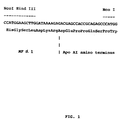
- Figure 1 shows the sequence of the 46-nucleotide adapter containing the end of the
MF α 1 leader sequence and the amino-terminal sequence of mature Apo AI. - Figure 2 shows the construction of the plasmid pUC/AF-AI from pUC8.
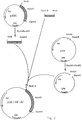
- Figure 3 shows the construction of pUC/AF-AI-M starting from the plasmid of Figure 2.
- Figure 4 shows the preparation of the expression vectors pYES/AI and pYES/AI-M, starting from pYES and from the plasmids of figures 2 and 3.
- The Apo AI sequences were obtained from our previously described cDNA clone (Sharpe et al., Nucl.Acids Res., 1984), from which the sequence coding for the signal peptide and the propeptide were removed and modified with the following strategy.
- The Nco I - BamHI fragment from the original cDNA sequences (plasmid pAIA) was ligated simultaneously with a chemically synthesized fragment Hind III - NcoI, containing the end of the
MF α 1 leader sequence and the amino terminal sequence of mature Apo AI (fig. 1) and a Hind III - Bam HI digested pUC 8 (see fig. 2). This clone is named pUC/AF-AI. - The Apo AI-M sequence was obtained by cloning part of the gene from an Apo AI-M carrier. The methodology used was as follows:
- a) DNA was prepared from peripheral white blood cells following standard methods (Kunkel LM, Smith KD, Boyer SH, Borgaonkar DS, Watchel SS, Miller BJ, Berg WR, Jones HW and Rary JM., Proc. Natl. Acad. Sci. USA, 1245-1249, 1977).
- b) The fragment between
nucleotides 1792 and 2240 (see fig. 3) (Shoulders CC, Kronblihtt AR, Munro BS and F.E. Baralle Nucl. Acids Res., 11: 2827-2837, 1983) was produced by the amplification procedure known as Polymerase Chain Reaction (PCR. Saiki RK, Gelfand DH, Stoffel S, Scharf S, Higuchi R and Horn GT. Science 239: 487-491, 1988), using two synthetic oligonucleotides as primers in the enzymatic reaction on the Apo AI-M genomic DNA, prepared from a carrier, having the following sequences:
5'-CTGAGGCAAGAGATGAGCAA-3'; 5' end in 1792.
5'-CTCAGGAAGCTGACCTTGAA-3'; 5' end in 2240. - c) This fragment was subjected to Xho II and Stu I digestions and the resulting product was ligated with the Hind III - Xho II and Stu I - BamHI fragments from pUC/AF-AI into a pUC-8 BamHI-HindIII linearized vector.
- The obtained clone is named pUC/AI-M.
- Genes encoding the human Apo AI and Apo AI-M were combined with fragments coding for the TPI promoter (TPIp) (T. Alber and G. Kawasaki. J.Mol. Applied Genet. I: 419-434, 1982), the
MF α 1 leader sequence (J. Kurkian and I. Herskowitz., Cell 30: 933-943, 1982) and the transcription termination sequence from TPI of S. cerevisiae TPIt. - These fragments provide sequences to ensure a high rate of transcription for the apo AI encoding gene and also provide a presequence which can effect the localization of Apo AI and Apo AI-M polypeptides into the secretory pathway and its eventual excretion into the growth medium.
- The expression plasmids further comprise the
yeast 2» origin of replication and a selectable marker LEU2. - During in vivo maturation of α-factor in yeast, the last (C-terminal) six amino acids of the
MF α 1 leader peptide (Lys-Arg-Glu-Ala-Glu-Ala) are removed from the -factor precursor by the sequential action of an endopeptidase recognizing the Lys-Arg sequence and an aminodipeptidase which removes the Glu-Ala residues (Julius D, Blair L, Brake A, Sprangue G and Thorner J, Cell 32: 839-852, 1983). To eliminate the need for the yeast aminodipeptidase, the sequence coding for the C-terminal Glu-Ala-Glu-Ala of theMF α 1 leader was removed via in vitro mutagenesis. - The Hind III-Bam HI fragments from pUC/AF-AI and pUC/AF-AI-M were cloned in the Hind III-Bam HI linearized pYES vectors, as shown in fig. 4. The resulting plasmids for yeast transformation and expression of Apo AI and Apo AI-M genes, are called pYES/AI and pYES/AI-M, respectively.
- Plasmids prepared as above described were transformed into S. cerevisiae strains carrying deletions into the TPI gene by selecting for growth on glucose. Such strains are normally unable to grow on glucose as the sole carbon source and grow very slowly on galactose lactate medium. This defect is due to a mutation in the triose phosphate isomerase gene, obtained by deletion and replacement of a major part of this gene with the
S. cerevisiae LEU 2 gene. Because of the growth deficiency there is a strong selection for a plasmid containg a gene coding for TPI. - The yeast strains containing plasmids encoding for the apolipoproteins were grown on YPD medium (Sherman, F. et al., Methods in Yeast Genetics, Cold Spring Harbor Laboratory 1981). For each strain, two cultures of 1 litre each in a baffled flask of 2 litres were shaken at 30°C until they reached an OD at 600 nm of approx. 15 (approx. 48 h). After centrifugation the supernatant was removed for further analysis.
- The culture broth was centrifuged at 15,000 rpm for 30 min. and the supernatant dialysed against 0.15 M NaCl, 0.05 M K-phosphate buffer, 0.05% EDTA, pH 7.4 (buffer A).
- Triglyceride-rich particles (TGRP) were isolated from commercial phospholipid-triglyceride emulsions, by ultracentrifugal washing at 4°C, and resuspended in buffer A. The supernatant from culture broth was incubated with TGRP at 37°C for 60 min., with gentle agitation and incubations terminated by immersion in an ice-water bath. TGRP were reisolated by ultracentrifugation at 27,000 rpm for 35 min. at 40°C and delipidated with diethylether:ethanol 3:1. The precipitated protein was collected by low speed centrifugation and passed through a Sephacryl S-200 column and/or an anti-apo AI-Sepharose column.
- The structural features of the recombinant Apo AI and AI-M were tested by aminoacid analysis and protein microsequencing, confirming the purity of the apolipoprotein preparations. The secondary structure was analyzed by circular dichroism, indicating that the recombinant apolipoprotein are properly folded: the α'-helix content was calculated as 52% and 43% for recombinant Apo AI and Apo AI-M, respectively, as a 49% content for extractive Apo AI. Thus recombinant AI-M, as extractive AI-M (Franceschini et al., J. Biol. Chem., 260: 16321-16325, 1985), has a lower α-helix content compared to normal AI.
- All reported experiments were carried out by comparing Apo AI and Apo AI-M, obtained from S. cerevisiae, with human Apo AI, extracted from plasma. Human Apo AI was prepared from human HDL, separated by preparative ultracentrifugation. Following delipidazation of the isolated HDL fraction, Apo AI was separated by gel filtration and ion exchange chromatography (Baker et al., Biochemistry, 12: 3866-3871, 1983). In vitro studies
- Agents promoting the conversion of plasminogen to plasmin, thus initiating fibrinolysis, are gaining increased interest in the treatment of myocardial infarction (Laffell and Braunwald, N. Engl. J. Med., 311: 710-717, 1984). Previous data have shown that the Apo AI can activate fibrinolysis in vitro (Saku et al., Thromb. Res., 39: 1-8, 1985).
- Experiments were carried out by the fibrin plate method (Glas-Greenwalt et al., J. Lab. Clin. Med., 104: 962-976, 1984) in order to evaluate the potentiation or inhibition of urokinase activity.
- A bovine (plasminogen-rich) fibrinogen solution, at a final concentration of 0.1% in a volume of 6 ml, was clotted with 0.2 ml of a bovine thrombin solution (20 NIH Units/ml). Recombinant Apo AI and Apo AI-M (concentrations between 10 and 500 »/g), diluted in Tris buffer were rapidly mixed with urokinase (f.c. 3.3 CAT U/ml) and applied to the fibrin plates. These were incubated for 17 h a 37°C. The lysis area measurements indicate that both proteins significantly increased the urokinase lysis areas, at the highest tested doses, by 64.0% and 67.9% respectively in the case of Apo AI (vs 59.7% and 66.2% for extractive Apo AI; Saku et al., Thromb. Res., 39: 1-8, 1985) and by 96.7% and 112.1% in the case of Apo AI-M (Table I). In this system, therefore, Apo AI-M appears to be significantly more potent than Apo AI.
- The so called "reverse cholesterol transport" (RCT), i.e. the transport of cholesterol from tissues to plasma, is believed to be regulated by HDL, acting as the acceptor lipoprotein (Glomset J., Adv. Int. Med., 25: 91-116, 1980). Since Apo AI is believed to be responsible for the removal capacity of HDL, experiments were carried out with J-774 mouse macrophages equilibrated with ³H cholesterol. The monolayers were incubated with "Minimum Essential Medium", solvent-extracted delipidized calf serum protein, egg phosphatidylcholine (PC) and esterified cholesterol (Rothblat et al., In vitro, 12: 554-557, 1976). Equilibration with ³H cholesterol was for 48 h, after which the radioactive medium was removed, the cells extensively washed and added with fresh medium, supplemented with 5 mg/ml delipidized calf serum protein. After overnight incubation, the cells were again extensively washed and incubated with HEPES-buffered Williams Medium E in 35 mm flat dishes, with the addition of 2 ml of each acceptor particle. Each 90 min., 0.1 ml aliquots of the incubation medium were taken, in the fist 6 h and then every 3 h, for a total 24 h period and counted in order to determine the amount of labelled cholesterol released by the cells (Rothblat and Phillips, J. Biol. Chem. , 250: 4775-4782, 1982).
- Proteoliposomes containing recombinant Apo AI or Apo AI-M were prepared with egg PC according to the cholate dialysis procedure, as described by Mats and Jonas (J. Biol. Chem., 257: 4535-4540, 1982). Mixtures were generally of apolipoprotein/phospholipid/cholate (mass ratio of 1/2.5/1.5-2.5) in 10mM Tris/1mM EDTA/1mM NaN₃/150 mM NaCl (pH 8.0). In order to size the apolipoprotein/phospholipid particles, a gel filtration on Sepharose CL/4B (1.5 x 80 cm column) eluted with 0.15 M NaCl/0.02% EDTA, pH 7 was carried out. Peak fractions were concentrated on ultrafiltration cells (Amicon model 52). By determination of the chemical composition and molecular microscopic features of the particles containing Apo AI or Apo AI-M, no significant differences could be found. To evaluate the capacity to remove cell cholesterol, two different concentrations of the apolipoprotein component (50 and 100 »g/ml, i.e. corresponding to concentrations of PC/ml medium of 150 and 300 »g) were added to the cells. Since, under these experimental conditions, the unidirectional flux of cholesterol is first-order with respect to cell free cholesterol concentrations, it is possible to calculate a half-time for the cholesterol efflux (t1/2) in the different conditions.
- A shown in Table 2, at both concentrations of apolipoprotein in the liposomes, the efflux of free cholesterol from J-774 cells was considerably faster with Apo AI-M, compared to Apo AI. Again, no difference could be detected between the recombinant and extractive Apo AI (t1/2: 17.9±3.2).
- This experiment evaluated the capacity of extractive Apo AI and recombinant Apo AI-M continuous infusions for 4 weeks, to reduce the arterial lesions, established with a 0.5% cholesterol rich diet for 2 months in rabbits. Twenty-five New Zealand male rabbits (starting weight 2.2-2.5 kg) received a 0.5% cholesterol rich diet for 2 months. At this time 4 animals were sacrified. Their aortas showed 45.3±7.6% involvement with atherosclerotic lesions. At this point, the animals were divided into three groups, each of 7 animals.
Group 1 was placed on a standard, cholesterol-free diet with no treatment.Group 2 was continuously infused with Apo AI, by way of a subcutaneously implanted AlzetR Minipump, connected to an ear vein. Group 3 was treated in the same way with Apo AI-M. The daily total protein dose was 7 mg/rabbit for each of the two apolipoproteins. - After 4 weeks of treatment, both the extent of aortic fatty lesions and the aortic lipid content were evaluated in the three groups. The data (Table 3) show a more than 30% regression of lesions with Apo AI, and a more than 60% regression with Apo AI-M, with a corresponding highly significant reduction of aortic total cholesterol and cholesteryl esters in both groups, Apo AI-M being significantly more effective, compared to normal Apo AI.
- The reported findings confirm the remarkable activity of Apo AI, in an in vivo condition (Badimon et al., Arteriosclerosis, 7: 522a, 1987) and indicate that Apo AI-M, probably because of its physico-chemical properties, is more effective in inducing the regression of atherosclerotic lesions, compared to normal human AI.


Claims (7)
- An expression vector capable of expressing, in a transformed yeast, apolipoprotein AI or apolipoprotein AI-M (Milano) comprising a promoter sequence autologous to the yeast to be transformed, a DNA sequence coding for Apo AI or Apo AI-M, a sequence coding for a leader which is the modified MF α 1 leader sequence encoding for the residue His Gly Ser Leu Asp Lys Arg, and a transcription terminator sequence autologous to the yeast to be transformed.
- An expression vector according to claim 1 capable of expressing Apo AI or Apo AI-M, which is derived form plasmid pUC8.
- An expression vector according to any one of the previous claims containing a Hind III NcoI fragment of the sequencefollowed by the NcoI-Bam HI of the Apo AI cDNA, or the XhOII-StuI of the ApoAI-M cDNA, the transcription termination sequence from TPI of S.cerevisiae TPIt, the Hind III-Bam HI fragment of pUC 8 containing the ampicillin resistance gene, the LEU2 marker from the 2» plasmid of S.cerevisiae, the TPI promoter and the MFαI leader sequence, in that order.

- A synthetic DNA encoding for the residue His Gly Ser Leu Asp Lys Arg Asp Glu Pro Pro Gln Ser Pro Trp having the following sequence
CCATGGAAGCTTGGATAAAAGAGACGAGCCACCGCAGAGCCCATGG - A host yeast transformed with the expression vector of claims 1-4.
- A host yeast according to claim 5 which is a strain of Saccharomyces cerevisiae.
- Process for the preparation of recombinant apolipoprotein AI or apolipoprotein AI-M comprising the cultivation of a host yeast according to claim 5 and the isolation of the desired apolipoprotein from the culture broth.
Applications Claiming Priority (3)
| Application Number | Priority Date | Filing Date | Title |
|---|---|---|---|
| IT2022689 | 1989-04-20 | ||
| IT8920226A IT1229996B (en) | 1989-04-20 | 1989-04-20 | EXPRESSION OF APOLIPOPROTEIN AI AND APOLIPOPROTEIN AI-MILAN IN YEAST AND PHARMACEUTICAL COMPOSITIONS CONTAINING THESE APOLIPOPROTEINS. |
| PCT/EP1990/000617 WO1990012879A2 (en) | 1989-04-20 | 1990-04-17 | Expression of human apolipoproteins ai-milano in yeast |
Publications (2)
| Publication Number | Publication Date |
|---|---|
| EP0469017A1 EP0469017A1 (en) | 1992-02-05 |
| EP0469017B1 true EP0469017B1 (en) | 1994-06-15 |
Family
ID=11164927
Family Applications (1)
| Application Number | Title | Priority Date | Filing Date |
|---|---|---|---|
| EP90906181A Expired - Lifetime EP0469017B1 (en) | 1989-04-20 | 1990-04-17 | Expression of human apolipoproteins ai-milano in yeast |
Country Status (10)
| Country | Link |
|---|---|
| EP (1) | EP0469017B1 (en) |
| JP (3) | JP3082941B2 (en) |
| AT (1) | ATE107360T1 (en) |
| AU (1) | AU641389B2 (en) |
| CA (1) | CA2053288C (en) |
| DE (1) | DE69010000T2 (en) |
| DK (1) | DK0469017T3 (en) |
| ES (1) | ES2054353T3 (en) |
| IT (1) | IT1229996B (en) |
| WO (1) | WO1990012879A2 (en) |
Families Citing this family (22)
| Publication number | Priority date | Publication date | Assignee | Title |
|---|---|---|---|---|
| SE9103701D0 (en) * | 1991-12-13 | 1991-12-13 | Kabi Pharmacia Ab | apolipoprotein |
| FR2686605B1 (en) * | 1992-01-27 | 1994-03-11 | Rhone Poulenc Rorer Sa | NOVEL POLYPEPTIDES, THEIR PREPARATION AND THEIR USE. |
| SE9203753D0 (en) * | 1992-12-11 | 1992-12-11 | Kabi Pharmacia Ab | EXPRESSION SYSTEM FOR PRODUCING APOLIPOPROTEIN AI-M |
| SE9500778D0 (en) * | 1995-03-03 | 1995-03-03 | Pharmacia Ab | Process for producing a protein |
| SE9603068D0 (en) * | 1996-08-23 | 1996-08-23 | Pharmacia & Upjohn Ab | Process for purifying a protein |
| SE9603303D0 (en) | 1996-09-11 | 1996-09-11 | Pharmacia & Upjohn Ab | Process for purifying a protein |
| CA2265929A1 (en) * | 1996-09-11 | 1998-03-19 | Pharmacia & Upjohn Ab | A process for purifying apolipoproteins and a composition for use in the process |
| JP2000513945A (en) * | 1996-09-11 | 2000-10-24 | エスペリオン セラピューティクス インコーポレイテッド | Process for purifying apolipoproteins and compositions for use in the process |
| SE9603304D0 (en) | 1996-09-11 | 1996-09-11 | Pharmacia & Upjohn Ab | Process for purifying a compound |
| JP4344136B2 (en) | 2000-11-10 | 2009-10-14 | エフ・ホフマン−ラ・ロシュ・リミテッド | Apolipoprotein analog |
| MXPA04002848A (en) * | 2001-09-28 | 2005-06-06 | Esperion Therapeutics Inc | Prevention and treatment of restenosis by local administration of drug. |
| WO2005051413A2 (en) * | 2003-11-26 | 2005-06-09 | Novartis Ag | Disease associated genes |
| JP2007531537A (en) | 2004-04-06 | 2007-11-08 | セダーズ−シナイ メディカル センター | Prevention and treatment of vascular disease with recombinant adeno-associated virus vectors encoding apolipoprotein AI and apolipoprotein A-IMLANO |
| KR100560102B1 (en) | 2004-06-25 | 2006-03-13 | 한국생명공학연구원 | Proapolipoprotein A-I variants and antilipidemia or arteriosclerosis comprising the same |
| CN1320119C (en) * | 2004-12-09 | 2007-06-06 | 复旦大学 | Method of expressing human apolipoprotein ApoA I inside Pichia yeast cell |
| US7759315B2 (en) | 2005-03-09 | 2010-07-20 | Csl Behring Ag | Treatment of inflammatory conditions of the intestine |
| ES2386905T3 (en) | 2007-03-01 | 2012-09-05 | Csl Limited | Endothelial dysfunction treatment in diabetic patients |
| US10894098B2 (en) | 2012-04-09 | 2021-01-19 | Signablok, Inc. | Methods and compositions for targeted imaging |
| WO2011143362A1 (en) | 2010-05-11 | 2011-11-17 | Esperion Therapeutics, Inc. | Dimeric oxidation-resistant apolipoprotein a1 variants |
| JP2013531990A (en) * | 2010-06-15 | 2013-08-15 | シー. ローヤー,マシュー | Compositions and methods for the treatment of atherosclerosis |
| FR2961814B1 (en) * | 2010-06-29 | 2014-09-26 | Isp Investments Inc | NOVEL SIRTUIN 6 ACTIVATOR PEPTIDES AND COSMETIC OR PHARMACEUTICAL COMPOSITION COMPRISING SAME. |
| PT2673296T (en) | 2011-02-07 | 2019-01-31 | Cerenis Therapeutics Holding Sa | Lipoprotein complexes and manufacturing and uses thereof |
Family Cites Families (5)
| Publication number | Priority date | Publication date | Assignee | Title |
|---|---|---|---|---|
| US4546082A (en) * | 1982-06-17 | 1985-10-08 | Regents Of The Univ. Of California | E. coli/Saccharomyces cerevisiae plasmid cloning vector containing the alpha-factor gene for secretion and processing of hybrid proteins |
| AU6522486A (en) * | 1985-10-04 | 1987-04-24 | Biotechnology Research Partners Limited | Recombinant apolipoproteins and methods |
| GB8625435D0 (en) * | 1986-10-23 | 1986-11-26 | Erba Farmitalia | Human apolipoprotein ai |
| GB8712540D0 (en) * | 1987-05-28 | 1987-07-01 | Ucb Sa | Expression of human proapolipoprotein a-i |
| DK463887D0 (en) * | 1987-09-07 | 1987-09-07 | Novo Industri As | GAERLEADER |
-
1989
- 1989-04-20 IT IT8920226A patent/IT1229996B/en active
-
1990
- 1990-04-17 CA CA002053288A patent/CA2053288C/en not_active Expired - Fee Related
- 1990-04-17 WO PCT/EP1990/000617 patent/WO1990012879A2/en not_active Ceased
- 1990-04-17 AU AU54245/90A patent/AU641389B2/en not_active Ceased
- 1990-04-17 DE DE69010000T patent/DE69010000T2/en not_active Expired - Fee Related
- 1990-04-17 JP JP02505967A patent/JP3082941B2/en not_active Expired - Fee Related
- 1990-04-17 DK DK90906181.4T patent/DK0469017T3/en active
- 1990-04-17 ES ES90906181T patent/ES2054353T3/en not_active Expired - Lifetime
- 1990-04-17 AT AT90906181T patent/ATE107360T1/en not_active IP Right Cessation
- 1990-04-17 EP EP90906181A patent/EP0469017B1/en not_active Expired - Lifetime
-
1999
- 1999-12-01 JP JP11342246A patent/JP2000212098A/en not_active Withdrawn
-
2004
- 2004-06-30 JP JP2004192803A patent/JP3845101B2/en not_active Expired - Fee Related
Non-Patent Citations (2)
| Title |
|---|
| Chemical Abstracts, vol. 109, no. 15, 10 Oct. 1988, (Columbus, Ohio, US), p. 199, abstract 123809x * |
| Gene, vol. 54, 1987, Elsevier Science Publishers B.V., (Amsterdam, NL), R.S. Sidhu et al., pp. 175-184 * |
Also Published As
| Publication number | Publication date |
|---|---|
| JP3082941B2 (en) | 2000-09-04 |
| JP3845101B2 (en) | 2006-11-15 |
| DE69010000T2 (en) | 1994-09-22 |
| JP2004339229A (en) | 2004-12-02 |
| IT1229996B (en) | 1991-09-20 |
| EP0469017A1 (en) | 1992-02-05 |
| DK0469017T3 (en) | 1994-10-03 |
| WO1990012879A2 (en) | 1990-11-01 |
| AU5424590A (en) | 1990-11-16 |
| CA2053288C (en) | 2006-06-06 |
| DE69010000D1 (en) | 1994-07-21 |
| CA2053288A1 (en) | 1990-10-21 |
| WO1990012879A3 (en) | 1991-05-16 |
| IT8920226A0 (en) | 1989-04-20 |
| ATE107360T1 (en) | 1994-07-15 |
| ES2054353T3 (en) | 1994-08-01 |
| AU641389B2 (en) | 1993-09-23 |
| JPH05504673A (en) | 1993-07-22 |
| JP2000212098A (en) | 2000-08-02 |
Similar Documents
| Publication | Publication Date | Title |
|---|---|---|
| AU641389B2 (en) | Expression of human apolipoproteins AI-milano in yeast | |
| Breslow | Apolipoprotein genetic variation and human disease | |
| Minnich et al. | Site-directed mutagenesis and structure-function analysis of the human apolipoprotein AI. Relation between lecithin-cholesterol acyltransferase activation and lipid binding. | |
| Yang et al. | Sequence, structure, receptor-binding domains and internal repeats of human apolipoprotein B-100 | |
| US6777207B2 (en) | Method for making insulin precursors and insulin precursor analogues having improved fermentation yield in yeast | |
| JP3068139B2 (en) | Microbiological production of human serum albumin and other heterologous proteins from yeast | |
| CA1340772C (en) | Expression and secretion of heterologous protiens in yeast employing truncated alpha-factor leader sequences | |
| CZ103990A3 (en) | Polypeptide, dna structure, recombinant expression vector and process for preparing heterologous polypeptide and yeast strain for this purpose | |
| EP0267703A1 (en) | Human apolipoprotein AI and variant form of the same expressed in Escherichia coli | |
| EP0239631A1 (en) | Recombinant apolipoproteins and methods | |
| BG61451B1 (en) | Dimer of molecular alternative of apolipoprotein and method for its preparation | |
| EP0189998B1 (en) | A process for preparing glucagon or derivatives thereof in a transformed yeast strain | |
| EP1246933B1 (en) | Method for making insulin precursors and insulin precursor analogues having improved fermentation yield in yeast | |
| US4943527A (en) | Mature apoai protein production under serum free culturing conditions | |
| JPH02501108A (en) | Production of human parathyroid hormone by microorganisms | |
| EP0307513A2 (en) | Pulmonary hydrophobic surfactant-associated proteins | |
| CA2619943A1 (en) | Compositions and methods for producing apolipoprotein gene products in lactic acid bacteria | |
| EP0222591B1 (en) | Method and nucleic acid for the preparation of lecithin: cholesterol acyltransferase | |
| US9637753B2 (en) | In-plant production of oligomeric (comprising three or more units) forms of human Apo A-1 protein muteins | |
| RU2091490C1 (en) | Method of preparing the heterologic polypeptide in eucaryotic microorganisms | |
| WO1989009818A1 (en) | Processes for purifying phospholipase a2 and producing phospholipase a2-like polypeptides | |
| EP0375718A1 (en) | Process for the production of aprotinin and aprotinin homologues in yeast. | |
| Egel-Mitani et al. | Competitive expression of two heterologous genes inserted into one plasmid in Saccharomyces cerevisiae | |
| CZ297397A3 (en) | Dna molecule for expression of bile salt stimulated lipase (bssl) | |
| US8129146B2 (en) | Method for making insulin precursors and insulin precursor analogues having improved fermentation yield in yeast |
Legal Events
| Date | Code | Title | Description |
|---|---|---|---|
| PUAI | Public reference made under article 153(3) epc to a published international application that has entered the european phase |
Free format text: ORIGINAL CODE: 0009012 |
|
| 17P | Request for examination filed |
Effective date: 19911004 |
|
| AK | Designated contracting states |
Kind code of ref document: A1 Designated state(s): AT BE CH DE DK ES FR GB IT LI LU NL SE |
|
| 17Q | First examination report despatched |
Effective date: 19920716 |
|
| GRAA | (expected) grant |
Free format text: ORIGINAL CODE: 0009210 |
|
| AK | Designated contracting states |
Kind code of ref document: B1 Designated state(s): AT BE CH DE DK ES FR GB IT LI LU NL SE |
|
| REF | Corresponds to: |
Ref document number: 107360 Country of ref document: AT Date of ref document: 19940715 Kind code of ref document: T |
|
| REF | Corresponds to: |
Ref document number: 69010000 Country of ref document: DE Date of ref document: 19940721 |
|
| REG | Reference to a national code |
Ref country code: ES Ref legal event code: FG2A Ref document number: 2054353 Country of ref document: ES Kind code of ref document: T3 |
|
| ITF | It: translation for a ep patent filed | ||
| REG | Reference to a national code |
Ref country code: DK Ref legal event code: T3 |
|
| ET | Fr: translation filed | ||
| EAL | Se: european patent in force in sweden |
Ref document number: 90906181.4 |
|
| PLBE | No opposition filed within time limit |
Free format text: ORIGINAL CODE: 0009261 |
|
| STAA | Information on the status of an ep patent application or granted ep patent |
Free format text: STATUS: NO OPPOSITION FILED WITHIN TIME LIMIT |
|
| 26N | No opposition filed | ||
| REG | Reference to a national code |
Ref country code: GB Ref legal event code: 732E |
|
| REG | Reference to a national code |
Ref country code: FR Ref legal event code: TP |
|
| NLS | Nl: assignments of ep-patents |
Owner name: ESPERION THERAPEUTICS INC. |
|
| REG | Reference to a national code |
Ref country code: CH Ref legal event code: PUE Owner name: CESARE SIRTORI;GUIDO FRANCESCHINI TRANSFER- ESPERI |
|
| REG | Reference to a national code |
Ref country code: ES Ref legal event code: PC2A |
|
| REG | Reference to a national code |
Ref country code: GB Ref legal event code: IF02 |
|
| PGFP | Annual fee paid to national office [announced via postgrant information from national office to epo] |
Ref country code: GB Payment date: 20070313 Year of fee payment: 18 |
|
| PGFP | Annual fee paid to national office [announced via postgrant information from national office to epo] |
Ref country code: AT Payment date: 20070314 Year of fee payment: 18 |
|
| PGFP | Annual fee paid to national office [announced via postgrant information from national office to epo] |
Ref country code: NL Payment date: 20070315 Year of fee payment: 18 Ref country code: DK Payment date: 20070315 Year of fee payment: 18 |
|
| PGFP | Annual fee paid to national office [announced via postgrant information from national office to epo] |
Ref country code: LU Payment date: 20070323 Year of fee payment: 18 |
|
| PGFP | Annual fee paid to national office [announced via postgrant information from national office to epo] |
Ref country code: SE Payment date: 20070410 Year of fee payment: 18 |
|
| PGFP | Annual fee paid to national office [announced via postgrant information from national office to epo] |
Ref country code: ES Payment date: 20070425 Year of fee payment: 18 |
|
| PGFP | Annual fee paid to national office [announced via postgrant information from national office to epo] |
Ref country code: CH Payment date: 20070427 Year of fee payment: 18 |
|
| PGFP | Annual fee paid to national office [announced via postgrant information from national office to epo] |
Ref country code: DE Payment date: 20070430 Year of fee payment: 18 |
|
| PGFP | Annual fee paid to national office [announced via postgrant information from national office to epo] |
Ref country code: BE Payment date: 20070430 Year of fee payment: 18 Ref country code: IT Payment date: 20070616 Year of fee payment: 18 |
|
| PGFP | Annual fee paid to national office [announced via postgrant information from national office to epo] |
Ref country code: FR Payment date: 20070404 Year of fee payment: 18 |
|
| BERE | Be: lapsed |
Owner name: *ESPERION THERAPEUTICS INC. Effective date: 20080430 |
|
| REG | Reference to a national code |
Ref country code: CH Ref legal event code: PL |
|
| REG | Reference to a national code |
Ref country code: DK Ref legal event code: EBP |
|
| EUG | Se: european patent has lapsed | ||
| GBPC | Gb: european patent ceased through non-payment of renewal fee |
Effective date: 20080417 |
|
| NLV4 | Nl: lapsed or anulled due to non-payment of the annual fee |
Effective date: 20081101 |
|
| PG25 | Lapsed in a contracting state [announced via postgrant information from national office to epo] |
Ref country code: NL Free format text: LAPSE BECAUSE OF NON-PAYMENT OF DUE FEES Effective date: 20081101 Ref country code: LI Free format text: LAPSE BECAUSE OF NON-PAYMENT OF DUE FEES Effective date: 20080430 Ref country code: DE Free format text: LAPSE BECAUSE OF NON-PAYMENT OF DUE FEES Effective date: 20081101 Ref country code: CH Free format text: LAPSE BECAUSE OF NON-PAYMENT OF DUE FEES Effective date: 20080430 |
|
| REG | Reference to a national code |
Ref country code: FR Ref legal event code: ST Effective date: 20081231 |
|
| PG25 | Lapsed in a contracting state [announced via postgrant information from national office to epo] |
Ref country code: AT Free format text: LAPSE BECAUSE OF NON-PAYMENT OF DUE FEES Effective date: 20080417 |
|
| PG25 | Lapsed in a contracting state [announced via postgrant information from national office to epo] |
Ref country code: BE Free format text: LAPSE BECAUSE OF NON-PAYMENT OF DUE FEES Effective date: 20080430 |
|
| PG25 | Lapsed in a contracting state [announced via postgrant information from national office to epo] |
Ref country code: DK Free format text: LAPSE BECAUSE OF NON-PAYMENT OF DUE FEES Effective date: 20080430 Ref country code: FR Free format text: LAPSE BECAUSE OF NON-PAYMENT OF DUE FEES Effective date: 20080430 |
|
| REG | Reference to a national code |
Ref country code: ES Ref legal event code: FD2A Effective date: 20080418 |
|
| PG25 | Lapsed in a contracting state [announced via postgrant information from national office to epo] |
Ref country code: GB Free format text: LAPSE BECAUSE OF NON-PAYMENT OF DUE FEES Effective date: 20080417 |
|
| PG25 | Lapsed in a contracting state [announced via postgrant information from national office to epo] |
Ref country code: ES Free format text: LAPSE BECAUSE OF NON-PAYMENT OF DUE FEES Effective date: 20080418 |
|
| PG25 | Lapsed in a contracting state [announced via postgrant information from national office to epo] |
Ref country code: IT Free format text: LAPSE BECAUSE OF NON-PAYMENT OF DUE FEES Effective date: 20080417 |
|
| PG25 | Lapsed in a contracting state [announced via postgrant information from national office to epo] |
Ref country code: LU Free format text: LAPSE BECAUSE OF NON-PAYMENT OF DUE FEES Effective date: 20080417 |
|
| PG25 | Lapsed in a contracting state [announced via postgrant information from national office to epo] |
Ref country code: SE Free format text: LAPSE BECAUSE OF NON-PAYMENT OF DUE FEES Effective date: 20080418 |