EP0468626B1 - Cotton bales and method of producing same - Google Patents
Cotton bales and method of producing same Download PDFInfo
- Publication number
- EP0468626B1 EP0468626B1 EP19910305032 EP91305032A EP0468626B1 EP 0468626 B1 EP0468626 B1 EP 0468626B1 EP 19910305032 EP19910305032 EP 19910305032 EP 91305032 A EP91305032 A EP 91305032A EP 0468626 B1 EP0468626 B1 EP 0468626B1
- Authority
- EP
- European Patent Office
- Prior art keywords
- cotton
- polyorganosiloxane
- group
- carbon atoms
- lint
- Prior art date
- Legal status (The legal status is an assumption and is not a legal conclusion. Google has not performed a legal analysis and makes no representation as to the accuracy of the status listed.)
- Expired - Lifetime
Links
Classifications
-
- D—TEXTILES; PAPER
- D06—TREATMENT OF TEXTILES OR THE LIKE; LAUNDERING; FLEXIBLE MATERIALS NOT OTHERWISE PROVIDED FOR
- D06M—TREATMENT, NOT PROVIDED FOR ELSEWHERE IN CLASS D06, OF FIBRES, THREADS, YARNS, FABRICS, FEATHERS OR FIBROUS GOODS MADE FROM SUCH MATERIALS
- D06M15/00—Treating fibres, threads, yarns, fabrics, or fibrous goods made from such materials, with macromolecular compounds; Such treatment combined with mechanical treatment
- D06M15/19—Treating fibres, threads, yarns, fabrics, or fibrous goods made from such materials, with macromolecular compounds; Such treatment combined with mechanical treatment with synthetic macromolecular compounds
- D06M15/37—Macromolecular compounds obtained otherwise than by reactions only involving carbon-to-carbon unsaturated bonds
- D06M15/643—Macromolecular compounds obtained otherwise than by reactions only involving carbon-to-carbon unsaturated bonds containing silicon in the main chain
-
- Y—GENERAL TAGGING OF NEW TECHNOLOGICAL DEVELOPMENTS; GENERAL TAGGING OF CROSS-SECTIONAL TECHNOLOGIES SPANNING OVER SEVERAL SECTIONS OF THE IPC; TECHNICAL SUBJECTS COVERED BY FORMER USPC CROSS-REFERENCE ART COLLECTIONS [XRACs] AND DIGESTS
- Y10—TECHNICAL SUBJECTS COVERED BY FORMER USPC
- Y10T—TECHNICAL SUBJECTS COVERED BY FORMER US CLASSIFICATION
- Y10T428/00—Stock material or miscellaneous articles
- Y10T428/29—Coated or structually defined flake, particle, cell, strand, strand portion, rod, filament, macroscopic fiber or mass thereof
- Y10T428/2913—Rod, strand, filament or fiber
- Y10T428/2933—Coated or with bond, impregnation or core
- Y10T428/2962—Silane, silicone or siloxane in coating
-
- Y—GENERAL TAGGING OF NEW TECHNOLOGICAL DEVELOPMENTS; GENERAL TAGGING OF CROSS-SECTIONAL TECHNOLOGIES SPANNING OVER SEVERAL SECTIONS OF THE IPC; TECHNICAL SUBJECTS COVERED BY FORMER USPC CROSS-REFERENCE ART COLLECTIONS [XRACs] AND DIGESTS
- Y10—TECHNICAL SUBJECTS COVERED BY FORMER USPC
- Y10T—TECHNICAL SUBJECTS COVERED BY FORMER US CLASSIFICATION
- Y10T428/00—Stock material or miscellaneous articles
- Y10T428/31504—Composite [nonstructural laminate]
- Y10T428/31652—Of asbestos
- Y10T428/31663—As siloxane, silicone or silane
-
- Y—GENERAL TAGGING OF NEW TECHNOLOGICAL DEVELOPMENTS; GENERAL TAGGING OF CROSS-SECTIONAL TECHNOLOGIES SPANNING OVER SEVERAL SECTIONS OF THE IPC; TECHNICAL SUBJECTS COVERED BY FORMER USPC CROSS-REFERENCE ART COLLECTIONS [XRACs] AND DIGESTS
- Y10—TECHNICAL SUBJECTS COVERED BY FORMER USPC
- Y10T—TECHNICAL SUBJECTS COVERED BY FORMER US CLASSIFICATION
- Y10T428/00—Stock material or miscellaneous articles
- Y10T428/4935—Impregnated naturally solid product [e.g., leather, stone, etc.]
Definitions
- This invention relates to cotton bales and an improved method of producing the same. More particularly, this invention relates to baled lint cotton with a limited moisture absorbing and emitting property and a method of producing bales of such cotton.
- Cotton bales are produced generally by subjecting collected seed cotton to a ginning process whereby seeds and cotton fibers are separated, removing burrs, leaves, stems and other trash from the separated fibers to obtain lint cotton, and compressing the lint cotton.
- seed cotton or lint cotton of a low quality which would adversely affect the commercial value of the produced cotton bale may be removed and water may be sprayed on to the seed cotton or lint cotton in order to roughly adjust their moisture regain during their production process.
- seed cotton and lint cotton which is obtained therefrom are mainly composed of cellulose fibers, they absorb and emit moisture more strongly than synthetic fibers such as polyesters and nylon and their moisture content varies significantly with changes in the temperature and humidity of the environment.
- quality of seed cotton and lint cotton such as the amount of sugar content, the amount of so-called honeydew (insect secretion) which is attached and the amount of mixed unripe fibers, varies greatly, depending on the climate and soil conditions of the region, the method of planting and their variety. The greater their amounts, the greater the hygroscopicity as compared to normal cotton.
- cotton bales produced by a conventional method as described above changes significantly due to changes in the environmental conditions such as temperature and humidity because of the moisture absorbing and emitting property of seed cotton and lint cotton obtained therefrom. For this reason, cotton bales produced by a conventional method have the following problems.
- baled lint cotton absorbs moisture from the environment while being stored or transported such that the official moisture content is exceeded, it is commercially a very significant disadvantage.
- high-density compressed cotton bales are advantageous because the cost of their transportation and storage is low. For this reason, it is a common practice to preliminarily apply moisture to baled lint cotton such that its moisture content becomes about 9 - 11%. This is so as to humidify the cotton fibers and to thereby reduce their Young's modulus such that they can be compressed more efficiently. This method is being practised both in India and in Pakistan where cotton bales of density 520 - 570 kg/m3 are being produced. High-density cotton bales thus produced suffer from the major disadvantage explained above.
- the present invention has been accomplished by the present inventors who diligently carried out researches in view of the above and other objects and is based on their discovery as a result of their studies that good results can be obtained if a specified amount of polyorganosiloxane of a specified structure is applied.
- the present invention relates, in one aspect thereof, to a cotton bale comprising baled lint cotton characterized as having applied thereon 0.03 - 2.0 weight % of linear polyorganosiloxane having 10 - 6000 siloxane units and being insoluble or dispersive in water or preferably polyorganosiloxane shown below by Equation I or II.
- the present invention relates to a method of producing cotton bales by obtaining lint cotton by subjecting seed cotton to a ginning process and a compression process characterized in that 0.03 - 2.0 weight % of linear polyorganosiloxane having 10 - 6000 siloxane units and being insoluble or dispersive in water or preferably polyorganosiloxane shown below by Equation I or II is attached to the seed cotton or lint cotton.
- Equation I is given by T1OA a B b T2 where A and B are connected in a block or random manner;
- A is a dimethyl siloxane unit shown by
- B is a modified siloxane unit shown by or
- X and Y are hydrogen or an organic group selected from alkyl group, aromatic hydrocarbon group and aralkyl group with 2-18 carbon atoms, -(CH2) e -O-R3, -(CH2) f -Si(CH3) g (OR4) 3-g ) -(CH2) n -N(R7)2, -(CH2) r -N ⁇ (R10)3 ⁇ Z ⁇
- R3 is hydrogen, alkyl group with 1-18 carbon atoms or alkanoyl group with 1-18 carbon atoms;
- R4, R6 and R10 are alkyl groups with 1-3 carbon atoms;
- R5, R7, R8 and R9 are hydrogen or alkyl group with 1-3 carbon atoms;
- T1 and T2 are polysiloxane end group shown by -Si(CH3) v (OR2) 3-v , -Si(CH3)3, -SiH(CH3)2 or -H where R2 is alkyl group with 1-3 carbon atoms; v is an integer 0 - 3; a is an integer 10 - 2000; and b is 0 or an integer such that b ⁇ 2a.
- Equation II is given by T1OA a D d T2 where A and D are connected in a block or random manner; A, T1, T2 and a are as defined above; D is modified siloxane unit given by R12 and R13 are alkylene groups with 2-3 carbon atoms; R14 is hydrogen, alkyl group with 1-18 carbon atoms or alkanoyl group with 1-18 carbon atoms; w is an integer 1 - 100; d is an integer such that 1 ⁇ d ⁇ 2a; and the polyalkylene oxide group inside () w is single addition of ethylene oxide or propylene oxide or their block or random addition amounting to less than 50 weight % of polyorganosiloxane.
- Polyorganosiloxane according to the present invention is linear polyorganosiloxane having 10 - 6000 siloxane units and being insoluble or dispersive in water, or preferably polydimethylsiloxane having dimethylsiloxane units as indispensable constituents or its derivative as shown in Equations I and II.
- the unit which constitutes the main chain of polyorganosiloxane shown by Equation I may contain modified siloxane units shown by B besides dimethylsiloxane units shown by A. Examples of such modified siloxane unit include the following:
- Modified polyorganosiloxanes having modified siloxane units as mentioned above can be obtained by a known method, that is, by the hydrosilylation reaction between polydimethylhydrogen siloxane having methylhydrogen siloxane units and a compound having one carbon-carbon double bond in its molecule.
- Examples of such compound having one carbon-carbon double bond include the following:
- the repetition number of dimethyl siloxane units shown by A is within the range of 10 - 2000 and more preferably within the range of 40 - 300.
- the repetition number of modified siloxane units shown by B is 0 or less than twice the aforementioned repetition number of dimethyl siloxane and more preferably less than one-half of the aforementioned repetition number of dimethyl siloxane.
- the polysiloxane end groups shown by T1 and T2 are as described above but more preferably trimethyl siloxane group.
- Examples of polyorganosiloxane shown by Equation I and usable advantageously according to the present invention include the following: Me3SiO(Me2SiO)50SiMe3, Me3SiO(Me2SiO)100SiMe3, Me3SiO(Me2SiO)99H, H(Me2SiO)150H, where Me indicates a methyl group.
- the units which constitute the main chain include dimethyl siloxane shown by A and modified siloxane units shown by D.
- modified siloxane units include the following:
- Modified polyorganosiloxane having modified siloxane units as described above can be obtained by a known process, that is, by the hydrosilylation reaction between polydimethylhydrogen siloxane having methylhydrogen siloxane units and ⁇ , ⁇ -alkenoxy polyalkylene glycol ethers.
- ⁇ , ⁇ -alkenoxy polyalxylene glycol ethers include the following:
- the repetition number of dimethyl siloxane units shown by A is within the range of 10 - 2000 and more preferably within the range of 40 - 300.
- the repetition number of modified siloxane units shown by D is equal to or greater than 1 and less than twice the repetition number of the aforementioned dimethyl siloxane units and more preferably less than one quarter of this repetition number of the dimethyl siloxane units.
- the polysiloxane end groups shown by T1 and T2 are as explained above and more preferably trimethyl siloxane.
- the alkylene oxide group shown by R13O is preferably propylene oxide alone or a mixture of ethylene oxide and propylene oxide. In the case of a mixture, the ratio of propylene oxide is preferably greater than 50 molar %.
- Polyorganosiloxanes shown by Equation II can be soluble, dispersive or insoluble in water, depending on factors such as the ratio between dimethyl siloxane units and modified siloxane units, the kind of alkylene oxide group and the ratio of the molar numbers of addition of ethylene oxide groups and propylene oxide groups.
- the ratio between dimethyl siloxane units and modified siloxane units the kind of alkylene oxide group and the ratio of the molar numbers of addition of ethylene oxide groups and propylene oxide groups.
- AO 48.9% ⁇ ⁇ B addition
- AO 24.7% ⁇ ⁇ B addition
- Me indicates methyl group
- EO indicates ethylene oxide
- PO indicates propylene oxide
- B Addition indicates block-type mixed addition of EO and PO
- R Addition indicates random-type mixed addition of EO and PO
- AO indicates the weight % of alkylene oxide group in polyorganosiloxane.
- a linear polyorganosiloxane which has 10 - 6000 siloxane units and is either insoluble or dispersive in water, or more particularly the polyorganosiloxane shown by Equation 1 or Equation 2 is applied to seed cotton or ginned cotton obtained from seed cotton.
- Polyorganosiloxane may be applied in its neat form or in the form of a solution by using an appropriate solvent, but it is preferable to use it in the form of an aqueous emulsion because both the appropriate amount of polyorganosiloxane to be applied and the moisture regain of ginned cotton can be controlled at the same time.
- An aqueous emulsion of polyorganosiloxane can be prepared by a mechanical emulsifying means either with or without the additional use of a surfactant.
- a surfactant is to be used supplementarily, it is preferable to use a non-ionic surfactant such as polyoxyalkylene alkyl ether, polyoxyalkylene alkylphenyI ether and alkylene oxide adduct of castor oil.
- non-ionic surfactant include straight-chain or branched higher alcohol to which ethylene oxide is added by 3 - 20 moles, nonylphenyl to which ethylene oxide is added by 3 - 20 moles and castor oil to which ethylene oxide is added by 10 - 100 moles.
- One with appropriate HLB should be selected according to the kind of polyorganosiloxane.
- a surfactant When a surfactant is used supplementarily in the preparation of an aqueous emulsion of polyorganosiloxane, its mixing ratio should be preferably less than 30 weight %, and more preferably less than 15 weight % of the total including both polyorganosiloxane and the surfactant.
- An aqueous emulsion of polyorganosiloxane is normally used at 1 - 20 weight % as concentration of the agent inclusive of the supplementarily used surfactant and is thus applied to seed cotton which has been collected or ginned cotton obtained through a ginning process.
- Polyorganosiloxane should be already applied to ginned cotton when it is made into bales.
- polyorganosiloxane onto seed cotton and ginned cotton can be effected by any method such as by spraying or immersion but the amount of polyorganosiloxane used should be 0.03 - 2.0 weight %, or more preferably 0.1 - 0.7 weight % of ginned cotton to be compressed and baled.
- Cotton bales produced by compressing ginned cotton onto which polyorganosiloxane has been applied can be maintained at a constant level of moisture content for a long time since the moisture emitting and absorbing characteristics of the ginned cotton have already been reduced.
- the present invention makes it possible at the time of production of cotton bales to adjust the moisture content of ginned cotton to be compressed and baled. In such a situation, the moisture content of ginned cotton is adjusted to 6.0 - 8.5%, or more preferably to 7.0 - 8.2%.
- polyorganosiloxane either in the neat form or in a diluted form in a solvent
- water is first applied to the ginned cotton. If the moisture of the ginned cotton is higher than the specified level, on the contrary, the ginned cotton is first dried by a hot-air drying process or the like so as to adjust its moisture content.
- polyorganosiloxane in the form of an aqueous emulsion is applied to ginned cotton, the moisture content of the ginned cotton can similarly be adjusted to a specified level by controlling the concentration of the emulsion or the applied amount.
- the moisture content of ginned cotton can be adjusted, for example, by drying it in a warm or hot wind of room temperature - 80°C with relative humidity below 60%.
- ginned cotton is to be dried after an aqueous emulsion has been attached thereto, use may preferably be made of polyorganosiloxane such as polydimethyl hydrogen siloxane, alkoxy modified polydimethyl siloxane and epoxy modified polydimethyl siloxane and the drying should preferably be carried out by means of hot wind of 50 - 80°C.
- Cotton bales according to the present invention of specified weight and dimensions are produced from such ginned cotton with polyorganosiloxane applied thereto by using a bale press to compress it into bags of hemp cloth, cotton cloth or nylon cloth or jute bags.
- this invention is not limited by any method of pressing, any particular type of bale press to be used, the dimensions of cotton bale or the quantity which is compressed and packed, it is to be noted that high-density cotton bales can be produced according to the present invention because of the superior compression characteristics of ginned cotton with a specified amount of polyorganosiloxane applied thereto.
- cotton bales of compressed density in excess of 600 kg /m3 can be produced without difficulty.
- Test 1 (with Test Examples 1-4 and Comparison Examples 1-4)
- the target amount of polyorganosiloxane in the aqueous emulsion taken up by the ginned cotton was 0.2 weight % and the target moisture content of the ginned cotton was 8. 3%.
- moisture content is the weight of water contained in 100 g of cotton under condition of 30% RH.
- repetition numbers of dimethyl siloxane units and modified siloxane units are average values; Me indicates methyl group; POE indicates polyoxyethylene; and the number inside () indicates the average condensation number of oxyethylene groups.
- R-1 was used as a representative example of water-proofing or water-repellant agent and R-2 was used as a representative example of water-holding or water-absorbing agent.
- For the packaging of these cotton bales use was made of bags of hemp cloth and 9 stainless steel wire straps.
- cotton bales of another kind were produced in an identical manner as above except water was applied instead of an aqueous emulsion of any agent at 2.4 weight %.
- Cotton bales of still another kind were produced in an identical manner as above except neither water nor an aqueous emulsion of any agent was applied to the ginned cotton.
- the attached amount is the amount of polyorganosiloxane; the numbers inside () indicate the values obtained by subtracting wax portion from the extracted amount of n-hexane; *1 indicates the moisture content of ginned cotton immediately before the compression and packaging; *2 indicates the moisture content of ginned cotton immediately after the unpacking; and *3 indicates the moisture content of cotton block after it has been opened and left.
- Tables 1 and 3 were obtained as follows. The moisture content compressed recovery ratio, tear off and amount of attached polyorganosiloxane are averaged values.
- honeydew was evaluated by the Benedict method according to JIS L 1019-1972 (Japanese Industrial Standards) in terms of "None”, “Very Little”, “Little”, “Some” and “Much”.
- the moisture content was measured by the method according to JIS L 1019-1972.
- the tear off was evaluated as follows:
- Texas seed cotton from Texas, U.S.A. was subjected to a ginning process to obtain ginned cotton as in Test 1.
- This ginned cotton had average fiber length of 2.62 cm, average fiber fineness of 1.77 ⁇ m/cm, moisture content (35% RH) of 6.0%, wax components of 0.39% and much honeydew.
- it was sprayed with 13.7-weight % aqueous emulsions of Agents E - H, R-3 and R-4 shown in Table 4 such that the amount of each aqueous emulsion taken up would be 2.2 weight % with respect to the ginned cotton.
- the target amount of polyorganosiloxane in the aqueous emulsion applied to the ginned cotton was 0.27 weight % and the target moisture content of the ginned cotton was 8.0%.
- net weight 252 kg
- dimensions 140 cm (length) x 51 cm (width) x 51 cm (thickness)
- pressed density 692 kgs/m3.
- For the packaging of these cotton bales use was made of bags of hemp cloth and 8 stainless
- cotton bales (Comparison Example 7) were produced by using ginned cotton to which water was applied instead of an aqueous emulsion of any agent.
- Table 5 The results are shown in Table 5. The results of Table 5 were obtained as explained above with reference to Test 1 except as described below. In Table 5, the thickness recovery ratio (TRR), external appearance (EA), tear off (TO) and the amount of attached polyorganosiloxane are averaged values.
- Ginned cotton of Test 2 obtained by subjecting Texas seed cotton from Texas, U.S.A. to a ginning process was first sprayed with water such that the amount of water taken up by the ginned cotton would be 2 weight %. It was then sprayed with Agents I - K in their neat forms such that the amount of the agents taken up by the ginned cotton would be 0.30 weight %. Thereafter, cotton bales (Test Examples 9 - 11) were obtained therefrom in the same manner as in Test 2. These Test Examples were measured and evaluated as in Test 2. The results are also shown in Table 5.
- ginned cotton Upland seed cotton from Alabama, U.S.A. was subjected to a ginning process to obtain ginned cotton as in Test 1.
- This ginned cotton had average fiber length of 3.18 cm, average fiber fineness of 1.65 ⁇ m/cm, moisture content (60% RH) of 8.1%, wax components of 0.43% and a small amount of honeydew. It was sprayed with 5 weight % aqueous emulsions of Agents L and M shown in Table 6 such that the amount of each aqueous emulsion taken up would be 10 weight % with respect to the ginned cotton It was then dried with hot air of 80°C.
- cotton bales (Comparison Example 9) were additionally produced by using the ginned cotton directly without applying any aqueous emulsion of agent.
- the ginned cotton of Test 4 obtained by subjecting Upland seed cotton to a ginning process was sprayed with Agent N of Table 4 in its neat form such that the amount of the agent taken up would be 0.60 weight % with respect to the ginned cotton.
- Cotton bales were produced therefrom as in Test 4 without drying the ginned cotton. Five cotton bales thus produced were used for measurements and evaluations as in Test 4. The results are shown in Table 7.
- the present invention has the favorable effect of reducing moisture emitting and absorbing characteristics of baled lint cotton
- the moisture content of cotton bales according to the present invention does not vary greatly in spite of changes in the environmental temperature and humidity and their characteristics at the time of baling can be maintained for a long time during their storage and transportation. Additionally, cotton bales of the present invention can be effectively compressed and have superior compressed recovery ratios when they are opened.
Landscapes
- Chemical & Material Sciences (AREA)
- Chemical Kinetics & Catalysis (AREA)
- Engineering & Computer Science (AREA)
- Textile Engineering (AREA)
- Polysaccharides And Polysaccharide Derivatives (AREA)
- Treatments For Attaching Organic Compounds To Fibrous Goods (AREA)
- Preliminary Treatment Of Fibers (AREA)
- Compositions Of Macromolecular Compounds (AREA)
- Crystals, And After-Treatments Of Crystals (AREA)
- Saccharide Compounds (AREA)
- Pharmaceuticals Containing Other Organic And Inorganic Compounds (AREA)
- Silicon Polymers (AREA)
Abstract
Description
- This invention relates to cotton bales and an improved method of producing the same. More particularly, this invention relates to baled lint cotton with a limited moisture absorbing and emitting property and a method of producing bales of such cotton.
- Cotton bales are produced generally by subjecting collected seed cotton to a ginning process whereby seeds and cotton fibers are separated, removing burrs, leaves, stems and other trash from the separated fibers to obtain lint cotton, and compressing the lint cotton. For reasons of practicality in the trade of cotton bales, seed cotton or lint cotton of a low quality which would adversely affect the commercial value of the produced cotton bale may be removed and water may be sprayed on to the seed cotton or lint cotton in order to roughly adjust their moisture regain during their production process.
- Since seed cotton and lint cotton which is obtained therefrom are mainly composed of cellulose fibers, they absorb and emit moisture more strongly than synthetic fibers such as polyesters and nylon and their moisture content varies significantly with changes in the temperature and humidity of the environment. Moreover, quality of seed cotton and lint cotton, such as the amount of sugar content, the amount of so-called honeydew (insect secretion) which is attached and the amount of mixed unripe fibers, varies greatly, depending on the climate and soil conditions of the region, the method of planting and their variety. The greater their amounts, the greater the hygroscopicity as compared to normal cotton.
- The moisture content of cotton bales produced by a conventional method as described above changes significantly due to changes in the environmental conditions such as temperature and humidity because of the moisture absorbing and emitting property of seed cotton and lint cotton obtained therefrom. For this reason, cotton bales produced by a conventional method have the following problems.
- Firstly, if cotton bales from lint cotton, which was already high or normal in moisture content absorb more humidity from the environment while they are being stored or being transported, they are easily mildewed or invaded by bacteria. As a result, they may become discolored or malodorous, or their strength may be adversely affected.
- Secondly, if baled lint cotton absorbs moisture from the environment while being stored or transported such that the official moisture content is exceeded, it is commercially a very significant disadvantage.
- Thirdly, high-density compressed cotton bales are advantageous because the cost of their transportation and storage is low. For this reason, it is a common practice to preliminarily apply moisture to baled lint cotton such that its moisture content becomes about 9 - 11%. This is so as to humidify the cotton fibers and to thereby reduce their Young's modulus such that they can be compressed more efficiently. This method is being practised both in India and in Pakistan where cotton bales of density 520 - 570 kg/m³ are being produced. High-density cotton bales thus produced suffer from the major disadvantage explained above.
- Fourthly, such high-density cotton bales do not return efficiently to the original condition before the compression and this adversely affects the handling of cotton blocks after the bales are opened.
- It is therefore a general object of the invention to provide improved cotton bales with which the problems mentioned above can be eliminated and a method of producing such improved cotton bales.
- It is a more particular object of the invention to provide cotton bales with only small changes in moisture content in the baled lint cotton and a method of producing such cotton bales.
- It is another object of the invention to provide cotton bales which can be efficiently compressed and can recover efficiently from a compressed condition.
- The present invention has been accomplished by the present inventors who diligently carried out researches in view of the above and other objects and is based on their discovery as a result of their studies that good results can be obtained if a specified amount of polyorganosiloxane of a specified structure is applied.
- The present invention relates, in one aspect thereof, to a cotton bale comprising baled lint cotton characterized as having applied thereon 0.03 - 2.0 weight % of linear polyorganosiloxane having 10 - 6000 siloxane units and being insoluble or dispersive in water or preferably polyorganosiloxane shown below by Equation I or II. In another aspect, the present invention relates to a method of producing cotton bales by obtaining lint cotton by subjecting seed cotton to a ginning process and a compression process characterized in that 0.03 - 2.0 weight % of linear polyorganosiloxane having 10 - 6000 siloxane units and being insoluble or dispersive in water or preferably polyorganosiloxane shown below by Equation I or II is attached to the seed cotton or lint cotton.
- Equation I is given by T¹OAaBbT² where A and B are connected in a block or random manner; A is a dimethyl siloxane unit shown by

B is a modified siloxane unit shown by
or
X and Y are hydrogen or an organic group selected from alkyl group, aromatic hydrocarbon group and aralkyl group with 2-18 carbon atoms, -(CH₂)e-O-R³, -(CH₂)f-Si(CH₃)g(OR⁴)3-g)


-(CH₂)n-N(R⁷)₂,

-(CH₂)r-N⊕(R¹⁰)₃·Z⊖

R³ is hydrogen, alkyl group with 1-18 carbon atoms or alkanoyl group with 1-18 carbon atoms; R⁴, R⁶ and R¹⁰ are alkyl groups with 1-3 carbon atoms; R⁵, R⁷, R⁸ and R⁹ are hydrogen or alkyl group with 1-3 carbon atoms; R¹¹ is alkyl group with 1-17 carbon atoms; Z⁻ is an anion group; e, f, h, j, m, n, p, q, r and t are 2 or 3; g, k and u are integers 0 - 3; and R¹ is hydrogen or methyl group. T¹ and T² are polysiloxane end group shown by -Si(CH₃)v(OR²)3-v, -Si(CH₃)₃, -SiH(CH₃)₂ or -H where R² is alkyl group with 1-3 carbon atoms; v is an integer 0 - 3; a is an integer 10 - 2000; and b is 0 or an integer such that b ≦ 2a. - Equation II is given by T¹OAaDdT² where A and D are connected in a block or random manner; A, T¹, T² and a are as defined above; D is modified siloxane unit given by

R¹² and R¹³ are alkylene groups with 2-3 carbon atoms; R¹⁴ is hydrogen, alkyl group with 1-18 carbon atoms or alkanoyl group with 1-18 carbon atoms; w is an integer 1 - 100; d is an integer such that 1 ≦ d ≦ 2a; and the polyalkylene oxide group inside ()w is single addition of ethylene oxide or propylene oxide or their block or random addition amounting to less than 50 weight % of polyorganosiloxane. - Polyorganosiloxane according to the present invention is linear polyorganosiloxane having 10 - 6000 siloxane units and being insoluble or dispersive in water, or preferably polydimethylsiloxane having dimethylsiloxane units as indispensable constituents or its derivative as shown in Equations I and II. The unit which constitutes the main chain of polyorganosiloxane shown by Equation I may contain modified siloxane units shown by B besides dimethylsiloxane units shown by A. Examples of such modified siloxane unit include the following:
- (1) Alkyl modified, aryl modified, aralkyl modified or alkoxyalkyl modified siloxane units such as butyl·methyl siloxane units, octyl·methyl siloxane units, octadecyl·methyl siloxane units, phenyl·methyl siloxane units, benzyl·methyl siloxane units and butoxypropyl·methyl siloxane units;
- (2) Siloxane units modified by organic groups having alkyl group, aryl group or aralkyl group such as 2-lauroxy carbonyl propyl·methyl siloxane units, phenoxy carbonyl ethyl·methyl siloxane units and phenylmethoxy carbonyl ethyl·methyl siloxane units;
- (3) Siloxane units modified by organic groups having alkoxysilyl group such as trimethoxy silylethyl·methyl siloxane units, dimethoxy methylsilylethyl·methyl siloxane units, triethoxysilylpropyl·methyl siloxane units, 2-trimethoxysilylethyl-oxycarbonylpropyl·methyl siloxane units, and 2-(N-dimethoxymethylsilylethyl, N-methylamino)-ethyl·methyl siloxane units;
- (4) Siloxane units modified by organic groups having epoxy group such as γ-glycidoxypropyl·methyl siloxane units, glycidyl·methyl siloxane units, and 2-glycidoxycarbonylpropyl·methyl siloxane units;
- (5) Siloxane units modified by organic groups having amino group such as γ-aminopropyl·methyl siloxane units, N,N-dimethyl-γ-aminopropyl·methyl siloxane units, N-(β-aminoethyl)-γ-aminopropyl·methyl siloxane units, and 2-aminoethyl-oxycarbonylethyl·methyl siloxane units;
- (6) Siloxane units modified by organic groups having quaternary ammonium group such as N,N-dimethyl-γ-aminopropyl·methyl siloxane units quaternized by methyl chloride, and N,N-dimethyl-γ-aminopropyl·methyl siloxane units quaternized by dimethyl sulfate;
- (7) Siloxane units modified by organic groups having alkanoylsilyl group such as trisurlauroylsilylethyl·methyl siloxane units, and diacetylmethylsilylpropyl-oxycarbonylethyl·methyl siloxane units; and
- (8) Methyl·hydrogen siloxane units.
- Modified polyorganosiloxanes having modified siloxane units as mentioned above can be obtained by a known method, that is, by the hydrosilylation reaction between polydimethylhydrogen siloxane having methylhydrogen siloxane units and a compound having one carbon-carbon double bond in its molecule. Examples of such compound having one carbon-carbon double bond include the following:
- (1) Functional derivatives of (meth)acrylic acid ester such as (meth)acrylic acid esters, glycidyl (meth)acrylate, 2-aminoethyl (meth)acrylate, and dimethylaminopropyl (meth)acrylate;
- (2) α,β-unsaturated hydrocarbons such as styrene, α-methylstyrene, and α-olefin;
- (3) α,β-alkenylalkyl ethers such as dodecylvinylethers and octylallyl ethers; and
- (4) Functional derivatives having vinyl or allyl group such as dimethylalkoxyvinyl silane, allylglycidyl ether and allyldimethyl amine.
- Regarding polyorganosiloxane shown by Equation I, the repetition number of dimethyl siloxane units shown by A is within the range of 10 - 2000 and more preferably within the range of 40 - 300. The repetition number of modified siloxane units shown by B is 0 or less than twice the aforementioned repetition number of dimethyl siloxane and more preferably less than one-half of the aforementioned repetition number of dimethyl siloxane. The polysiloxane end groups shown by T¹ and T² are as described above but more preferably trimethyl siloxane group.
- Examples of polyorganosiloxane shown by Equation I and usable advantageously according to the present invention include the following:
Me₃SiO(Me₂SiO)₅₀SiMe₃,
Me₃SiO(Me₂SiO)₁₀₀SiMe₃,
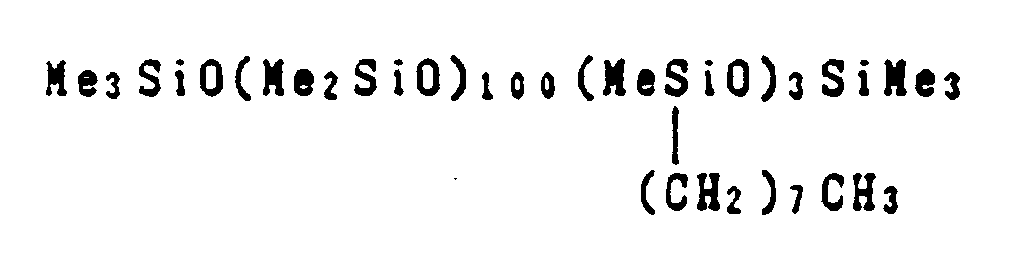


Me₃SiO(Me₂SiO)₉₉H,
H(Me₂SiO)₁₅₀H,


where Me indicates a methyl group. - Regarding polyorganosiloxane shown by Equation II, the units which constitute the main chain include dimethyl siloxane shown by A and modified siloxane units shown by D. Examples of such modified siloxane units include the following:
- (1) Siloxane units modified by organic groups having polyethylene oxide group such as methoxy polyethoxy propyl·methyl siloxane units, and butoxy polyethoxy ethyl·methyl siloxane units;
- (2) Siloxane units modified by organic groups having polypropylene oxide group such as methoxy polypropoxy propyl·methyl siloxane units, and ethoxy polypropoxy ethyl·methyl siloxane units; and
- (3) Alcoxy polyethoxy polypropoxy propyl·methyl siloxane units with random or block addition of ethylene oxide and propylene oxide.
- Modified polyorganosiloxane having modified siloxane units as described above can be obtained by a known process, that is, by the hydrosilylation reaction between polydimethylhydrogen siloxane having methylhydrogen siloxane units and α,β-alkenoxy polyalkylene glycol ethers. Examples of such α,β-alkenoxy polyalxylene glycol ethers include the following:
- (1) Methoxy polyethylene glycol allyl ether;
- (2) Butoxy polyethylene glycol vinyl ether;
- (3) Methoxy polypropylene glycol allyl ether;
- (4) Ethoxy polypropylene glycol vinyl ether;
- (5) Alcoxy polyalkylene glycol allyl ether with random or block addition of ethylene oxide and propylene oxide;
- (6) Polyethylene glycol monoallyl ether;
- (7) Polyethylene glycol monovinyl ether;
- (8) Polypropylene glycol monoallyl ether;
- (9) Polypropylene glycol monovinyl ether;
- (10) Polyalkylene glycol monoallyl ether with random or block addition of ethylene oxide and propylene oxide;
- (11) Aliphatic acid esters of polyalkylene glycol monoallyl ethers of (6), (8) and (10); and
- (12) Aliphatic acid esters of polyalkylene glycol monovinyl ethers of (7) and (9).
- Regarding polyorganosiloxane shown by Equation II, the repetition number of dimethyl siloxane units shown by A is within the range of 10 - 2000 and more preferably within the range of 40 - 300. The repetition number of modified siloxane units shown by D is equal to or greater than 1 and less than twice the repetition number of the aforementioned dimethyl siloxane units and more preferably less than one quarter of this repetition number of the dimethyl siloxane units. The polysiloxane end groups shown by T¹ and T² are as explained above and more preferably trimethyl siloxane.
- The alkylene oxide group shown by R¹³O is preferably propylene oxide alone or a mixture of ethylene oxide and propylene oxide. In the case of a mixture, the ratio of propylene oxide is preferably greater than 50 molar %.
- Polyorganosiloxanes shown by Equation II can be soluble, dispersive or insoluble in water, depending on factors such as the ratio between dimethyl siloxane units and modified siloxane units, the kind of alkylene oxide group and the ratio of the molar numbers of addition of ethylene oxide groups and propylene oxide groups. For the purpose of the present invention, use is made of those which are either insoluble or dispersive in water and more preferably those which are practically water-insoluble. This is why those containing less than 50 weight % of polyalkylene oxide group in polyorganosiloxane are selected.
- Practical examples of polyorganosiloxane shown by Equation II according to the present invention include the following although they do not limit the scope of the present invention:

{AO = 13.4%}
{AO = 12.3%}
{AO = 49.3%}
{AO = 43.0%}
{R addition, AO = 48.9%}
{B addition, AO = 24.7%}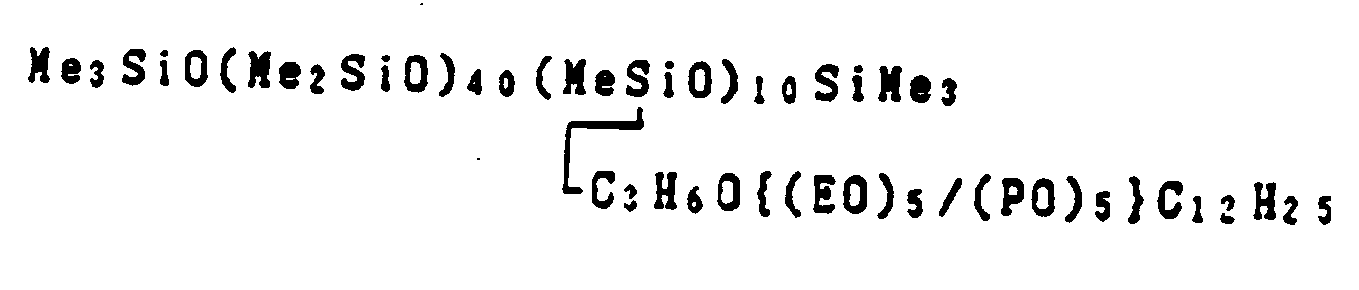
{B addition, AO = 46.0%}
{AO = 40.9%}
{AO = 12.1%}
{B addition, AO = 35.7%}
{AO = 32.5%} - In the above and in what follows, Me indicates methyl group, EO indicates ethylene oxide, PO indicates propylene oxide, B Addition indicates block-type mixed addition of EO and PO, R Addition indicates random-type mixed addition of EO and PO, and AO indicates the weight % of alkylene oxide group in polyorganosiloxane.
- According to the present invention, a linear polyorganosiloxane which has 10 - 6000 siloxane units and is either insoluble or dispersive in water, or more particularly the polyorganosiloxane shown by Equation 1 or Equation 2 is applied to seed cotton or ginned cotton obtained from seed cotton. Polyorganosiloxane may be applied in its neat form or in the form of a solution by using an appropriate solvent, but it is preferable to use it in the form of an aqueous emulsion because both the appropriate amount of polyorganosiloxane to be applied and the moisture regain of ginned cotton can be controlled at the same time.
- An aqueous emulsion of polyorganosiloxane can be prepared by a mechanical emulsifying means either with or without the additional use of a surfactant. If a surfactant is to be used supplementarily, it is preferable to use a non-ionic surfactant such as polyoxyalkylene alkyl ether, polyoxyalkylene alkylphenyI ether and alkylene oxide adduct of castor oil. Practical examples of such non-ionic surfactant include straight-chain or branched higher alcohol to which ethylene oxide is added by 3 - 20 moles, nonylphenyl to which ethylene oxide is added by 3 - 20 moles and castor oil to which ethylene oxide is added by 10 - 100 moles. One with appropriate HLB should be selected according to the kind of polyorganosiloxane.
- When a surfactant is used supplementarily in the preparation of an aqueous emulsion of polyorganosiloxane, its mixing ratio should be preferably less than 30 weight %, and more preferably less than 15 weight % of the total including both polyorganosiloxane and the surfactant. An aqueous emulsion of polyorganosiloxane is normally used at 1 - 20 weight % as concentration of the agent inclusive of the supplementarily used surfactant and is thus applied to seed cotton which has been collected or ginned cotton obtained through a ginning process. Polyorganosiloxane should be already applied to ginned cotton when it is made into bales.
- Application of polyorganosiloxane onto seed cotton and ginned cotton can be effected by any method such as by spraying or immersion but the amount of polyorganosiloxane used should be 0.03 - 2.0 weight %, or more preferably 0.1 - 0.7 weight % of ginned cotton to be compressed and baled. Cotton bales produced by compressing ginned cotton onto which polyorganosiloxane has been applied can be maintained at a constant level of moisture content for a long time since the moisture emitting and absorbing characteristics of the ginned cotton have already been reduced. In other words, the present invention makes it possible at the time of production of cotton bales to adjust the moisture content of ginned cotton to be compressed and baled. In such a situation, the moisture content of ginned cotton is adjusted to 6.0 - 8.5%, or more preferably to 7.0 - 8.2%.
- When polyorganosiloxane (either in the neat form or in a diluted form in a solvent) is applied to ginned cotton, if the moisture content of the ginned cotton is below a specified level, water is first applied to the ginned cotton. If the moisture of the ginned cotton is higher than the specified level, on the contrary, the ginned cotton is first dried by a hot-air drying process or the like so as to adjust its moisture content. When polyorganosiloxane in the form of an aqueous emulsion is applied to ginned cotton, the moisture content of the ginned cotton can similarly be adjusted to a specified level by controlling the concentration of the emulsion or the applied amount. If the moisture content of ginned cotton has become higher than the specified level as a result of the application, the moisture content can be adjusted, for example, by drying it in a warm or hot wind of room temperature - 80°C with relative humidity below 60%. When ginned cotton is to be dried after an aqueous emulsion has been attached thereto, use may preferably be made of polyorganosiloxane such as polydimethyl hydrogen siloxane, alkoxy modified polydimethyl siloxane and epoxy modified polydimethyl siloxane and the drying should preferably be carried out by means of hot wind of 50 - 80°C.
- Cotton bales according to the present invention of specified weight and dimensions are produced from such ginned cotton with polyorganosiloxane applied thereto by using a bale press to compress it into bags of hemp cloth, cotton cloth or nylon cloth or jute bags. Although this invention is not limited by any method of pressing, any particular type of bale press to be used, the dimensions of cotton bale or the quantity which is compressed and packed, it is to be noted that high-density cotton bales can be produced according to the present invention because of the superior compression characteristics of ginned cotton with a specified amount of polyorganosiloxane applied thereto. According to the present invention, for example, cotton bales of compressed density in excess of 600 kg /m³ can be produced without difficulty.
- In what follows, test results will be presented in order to describe the essence and effects of the invention more clearly but these exemplary test results are not intended to limit the scope of the invention.
- Allen seed cotton from Central Western Africa was subjected to a ginning process to obtain ginned cotton by eliminating trash such as seed crusts, leaves, stems, sand and gravel. Table 1 shows the characteristics of the ginned cotton thus obtained. On the chute immediately before the ginned cotton is introduced into a press box, 10-weight % aqueous emulsions of Agents A, B, C and D as described in Table 2 were applied by spraying such that the amount of each emulsion taken up by the ginned cotton became 2.2 weight %. In this operation, the target amount of polyorganosiloxane in the aqueous emulsion taken up by the ginned cotton was 0.2 weight % and the target moisture content of the ginned cotton was 8. 3%. In Table 1, moisture content is the weight of water contained in 100 g of cotton under condition of 30% RH. In Table 2 and hereinbelow, repetition numbers of dimethyl siloxane units and modified siloxane units are average values; Me indicates methyl group; POE indicates polyoxyethylene; and the number inside () indicates the average condensation number of oxyethylene groups. R-1 was used as a representative example of water-proofing or water-repellant agent and R-2 was used as a representative example of water-holding or water-absorbing agent.
- The ginned cotton with aqueous emulsion of polyorganosiloxane applied thereto was introduced into a press box of area 137 cm (length) x 51 cm (width) = 0.699 m² and use was made of a gin standard bale press (with cylinder diameter of oil press = 38 cm and maximum gauge pressure = 140 kg/cm²) for compression to produce cotton bales (Test Examples 1 - 4) of net weight = 216 kg, dimensions = 140 cm (length) x 51 cm (width) x 63.5 cm (thickness) and pressed density = 476.4 kg/m³. For the packaging of these cotton bales, use was made of bags of hemp cloth and 9 stainless steel wire straps.
- For the purpose of comparison, 10 weight % aqueous emulsions of Agents R-1 and R-2 as shown also in Table 2 were applied by spraying to ginned cotton obtained from Allen seed cotton similarly as above on the chute immediately before the introduction of the ginned cotton into the press box such that 2.2 weight % of each aqueous emulsion was taken up with respect to the ginned cotton. Cotton bales (Comparison Examples 1 and 2) were produced in the same manners from these ginned cotton with these aqueous emulsions attached thereto. Separately from the above, cotton bales of another kind (Comparison Example 3) were produced in an identical manner as above except water was applied instead of an aqueous emulsion of any agent at 2.4 weight %. Cotton bales of still another kind (Comparison Example 4) were produced in an identical manner as above except neither water nor an aqueous emulsion of any agent was applied to the ginned cotton.
- Ten cotton bales each of the Examples were prepared and they were divided into Group 1 and Group 2 of five bales each. The bales of Group 1 were kept under the conditions of 25°C and 30% RH for 3 months. Those of Group 2 were kept under the conditions of 35°C and 80% RH for 3 months. Thereafter, these bales were opened by removing the steel wires and the bags and the cotton blocks, from which external constraining force was thus removed, were further left for 48 hours under the conditions of 20°C and 65% RH. For each of the examples, the moisture content of ginned cotton immediately before compression and packaging, the maximum gauge pressure value of the oil press at the time of compression and packaging, the moisture content of the cotton block immediately after the package was removed and after it was left, the "compressed recovery ratio" and "tear off" of the cotton block after the package was opened and it was left, and the amount of attached polyorganosiloxane were measured or evaluated. The results are shown in Table 3. In Table 3 and hereinbelow, the attached amount is the amount of polyorganosiloxane; the numbers inside () indicate the values obtained by subtracting wax portion from the extracted amount of n-hexane; *1 indicates the moisture content of ginned cotton immediately before the compression and packaging; *2 indicates the moisture content of ginned cotton immediately after the unpacking; and *3 indicates the moisture content of cotton block after it has been opened and left.
- The results of Tables 1 and 3 were obtained as follows. The moisture content compressed recovery ratio, tear off and amount of attached polyorganosiloxane are averaged values.
- The amount of honeydew was evaluated by the Benedict method according to JIS L 1019-1972 (Japanese Industrial Standards) in terms of "None", "Very Little", "Little", "Some" and "Much".
- The moisture content was measured by the method according to JIS L 1019-1972.
- The compressed recovery ratio was calculated by the following formula by measuring at eight different places the length, width and thickness of each cotton block after it has been left for 48 hours at 20°C and 65% RH to obtain the average values of length (x cm), width (y cm) and thickness (z cm): Compressed Recovery Ratio = {xyz/(140 x 51 x 63.5)} x 100.
- For the tear off, the upper section of each of the cotton block, after its compressed recovery ratio was measured as above, was torn off at a position about 10 cm from the top surface. The tear off was evaluated as follows:
- A: The tear off was very easy.
- B: Slight resistance was sensed.
- C: Some resistance was felt but it can be torn off at a constant thickness.
- D: significant resistance against tear off and it cannot be torn off at a constant thickness.
- To measure the amount of polyorganosiloxane taken up by the sample pieces were collected from 5 different places of each cotton block after the tear off test. An extract was obtained from each sample piece by using a Soxley extractor with n-hexane and removing n-hexane from the extract under a condition of reduced pressure. This extract was analyzed by using an inductively coupled plasma emission spectrometer (ICP light-emitting spectrometer) to determine the Si content from a graph which is preliminarily prepared from samples with known concentrations. The amount of attached polyorganosiloxane is calculated from the Si content thus obtained.


- Texas seed cotton from Texas, U.S.A. was subjected to a ginning process to obtain ginned cotton as in Test 1. This ginned cotton had average fiber length of 2.62 cm, average fiber fineness of 1.77 µm/cm, moisture content (35% RH) of 6.0%, wax components of 0.39% and much honeydew. As in Test 1, it was sprayed with 13.7-weight % aqueous emulsions of Agents E - H, R-3 and R-4 shown in Table 4 such that the amount of each aqueous emulsion taken up would be 2.2 weight % with respect to the ginned cotton. In this operation, the target amount of polyorganosiloxane in the aqueous emulsion applied to the ginned cotton was 0.27 weight % and the target moisture content of the ginned cotton was 8.0%.
- The ginned cotton with aqueous emulsion of polyorganosiloxane applied thereto was introduced into a press box of area 137 cm (length) x 51 cm (width) = 0.699 m² and use was made of a bale press (with cylinder diameter of oil press = 40.6 cm and maximum gauge pressure = 314 kg/cm²) for compression to produce cotton bales (Test Examples 5 - 8 and Comparison Examples 5 and 6) of net weight = 252 kg, dimensions = 140 cm (length) x 51 cm (width) x 51 cm (thickness) and pressed density = 692 kgs/m³. For the packaging of these cotton bales, use was made of bags of hemp cloth and 8 stainless steel wire straps.
- For the purpose of comparison as in Test 1, cotton bales (Comparison Example 7) were produced by using ginned cotton to which water was applied instead of an aqueous emulsion of any agent. An attempt was also made to produce cotton bales of a further kind (Comparison Example 8) in an identical manner to above except neither water nor an aqueous emulsion of any agent was applied to the ginned cotton, but was stopped for safety reasons because the gauge pressure of the oil press exceeded 300 kg/cm² during the compression and packaging process.
- Five cotton bales each of the Examples were prepared (except Comparison Example 8) and after they were kept under the conditions of 35°C and 65% RH for 120 days, they were opened by removing the steel wire straps and the bags. The cotton blocks, from which external constraining force was thus removed, were further left for one week under the conditions of 35°C and 65% RH. For each of the samples, measurements and observations were made of the moisture content of ginned cotton immediately before compression and packaging, the maximum gauge pressure value of the oil press at the time of compression and packaging, the moisture content of the cotton block immediately after the package was removed and after it was left, the thickness recovery ratio, appearance and "tear off" of the cotton block after the package was opened and it was left, and the amount of attached polyorganosiloxane. The results are shown in Table 5. The results of Table 5 were obtained as explained above with reference to Test 1 except as described below. In Table 5, the thickness recovery ratio (TRR), external appearance (EA), tear off (TO) and the amount of attached polyorganosiloxane are averaged values.


- Thickness recovery ratio of each sample was obtained by measuring the thickness of the cotton block at 8 different places to obtain their average value (h cm) and calculating as follows: Thickness Recovery Ratio (%) = {h/51} x 100.
- Appearance of each cotton block was functionally evaluated as follows after its thickness recovery ratio had been measured:
- A: No abnormality is observed;
- B: Slight musty odor and yellowing parts are slightly observed;
- C: Strong musty odor and many yellowing parts.
- Ginned cotton of Test 2 obtained by subjecting Texas seed cotton from Texas, U.S.A. to a ginning process was first sprayed with water such that the amount of water taken up by the ginned cotton would be 2 weight %. It was then sprayed with Agents I - K in their neat forms such that the amount of the agents taken up by the ginned cotton would be 0.30 weight %. Thereafter, cotton bales (Test Examples 9 - 11) were obtained therefrom in the same manner as in Test 2. These Test Examples were measured and evaluated as in Test 2. The results are also shown in Table 5.
- Upland seed cotton from Alabama, U.S.A. was subjected to a ginning process to obtain ginned cotton as in Test 1. This ginned cotton had average fiber length of 3.18 cm, average fiber fineness of 1.65 µm/cm, moisture content (60% RH) of 8.1%, wax components of 0.43% and a small amount of honeydew. It was sprayed with 5 weight % aqueous emulsions of Agents L and M shown in Table 6 such that the amount of each aqueous emulsion taken up would be 10 weight % with respect to the ginned cotton It was then dried with hot air of 80°C.
- The dried ginned cotton was introduced into a press box of area 137 cm (length) x 51 cm (width) = 0.699 m² and use was made of a bale press (with cylinder diameter of oil press = 44.1 cm and maximum gauge pressure = 348 kg/cm²) for compression to produce cotton bales (Test Examples 12 and 13) of net weight = 450 kg, dimensions = 140 cm (length) x 51 cm (width) x 80 cm (thickness) and pressed density = 788 kgs/m³. For the packaging of these cotton bales, use was made of bags of hemp cloth and 8 steel bands. For the purpose of comparison, cotton bales (Comparison Example 9) were additionally produced by using the ginned cotton directly without applying any aqueous emulsion of agent.
- Five cotton bales each of the Examples were prepared and after they were kept under the conditions of 20°C and 65% RH for 120 days, they were opened to remove the external force due to the bag and the steel bands. Thereafter, measurements and evaluations were carried out as in Test 2. The moisture content after the unpacking was measured at 20°C and 65% RH and it was the same as the official moisture content.
- The ginned cotton of Test 4 obtained by subjecting Upland seed cotton to a ginning process was sprayed with Agent N of Table 4 in its neat form such that the amount of the agent taken up would be 0.60 weight % with respect to the ginned cotton. Cotton bales were produced therefrom as in Test 4 without drying the ginned cotton. Five cotton bales thus produced were used for measurements and evaluations as in Test 4. The results are shown in Table 7.
- As can be seen from the results of the measurements and evaluations, the present invention has the favorable effect of reducing moisture emitting and absorbing characteristics of baled lint cotton
- As a result, the moisture content of cotton bales according to the present invention does not vary greatly in spite of changes in the environmental temperature and humidity and their characteristics at the time of baling can be maintained for a long time during their storage and transportation. Additionally, cotton bales of the present invention can be effectively compressed and have superior compressed recovery ratios when they are opened.

Claims (10)
- A cotton bale comprising baled lint cotton characterised in that a linear polyorganosiloxane which has 10-6000 siloxane units and is insoluble or dispersive in water is taken up by the baled lint cotton in an amount from 0.03-2.0 weight %.
- The cotton bale of claim 1 wherein said polyorganosiloxane is of the form T¹OAaBbT² where A and B are connected in a block or random manner; A is a dimethyl siloxane unit shown by


-(CH₂)n-N(R⁷)₂,

-(CH₂)r-N⊕(R¹⁰)₃·Z⊖

- The cotton bale of claim 1 wherein said polyorganosiloxane is of the form T¹OAaDdT² where A and D are connected in a block or random manner; A is a dimethyl siloxane unit shown by


- The cotton bales of claims 1 to 3 wherein said baled lint cotton has a moisture content of less than 8.5% at 20°C and 65% relative humidity.
- The cotton bales of claims 2 or 3 wherein the packed density of said baled lint cotton is over 600 kg/m³.
- A method of producing cotton bales by obtaining lint cotton by subjecting collected seed cotton to a ginning process and baling said obtained lint cotton to produce baled lint cotton, characterised in that the method comprises the step of applying polyorganosiloxane to the seed cotton or to the lint cotton so that the polyorganosiloxane is taken up in an amount from 0.03 - 2.0 weight % with respect to the cotton, the polyorganosiloxane being linear polyorganosiloxane which has 10 - 6000 siloxane units and is insoluble or dispersive in water.
- A method according to claim 6, wherein the said polyorganosiloxane is as defined in claim 2 or claim 3.
- A method according to claim 6 wherein said step of attaching polyorganosiloxane comprises spraying an aqueous emulsion of said polyorganosiloxane.
- A method according to claims 6 to 8, further comprising the step of adjusting the moisture content of said seed cotton or lint cotton such that the moisture content of said baled lint cotton becomes 6.0 -8.5%.
- A method according to any of claims 6 to 9 wherein said lint cotton is compressed to density greater than 600 kg/m³.
Applications Claiming Priority (4)
| Application Number | Priority Date | Filing Date | Title |
|---|---|---|---|
| JP2200985A JP2561903B2 (en) | 1990-07-27 | 1990-07-27 | Method for producing cotton veil and cotton veil obtained by the method |
| JP200985/90 | 1990-07-27 | ||
| JP2305709A JP2561904B2 (en) | 1990-11-08 | 1990-11-08 | Method for producing cotton veil and cotton veil obtained by the method |
| JP305709/90 | 1990-11-08 |
Publications (3)
| Publication Number | Publication Date |
|---|---|
| EP0468626A2 EP0468626A2 (en) | 1992-01-29 |
| EP0468626A3 EP0468626A3 (en) | 1992-12-09 |
| EP0468626B1 true EP0468626B1 (en) | 1994-06-01 |
Family
ID=26512510
Family Applications (1)
| Application Number | Title | Priority Date | Filing Date |
|---|---|---|---|
| EP19910305032 Expired - Lifetime EP0468626B1 (en) | 1990-07-27 | 1991-06-04 | Cotton bales and method of producing same |
Country Status (12)
| Country | Link |
|---|---|
| US (2) | US5188224A (en) |
| EP (1) | EP0468626B1 (en) |
| KR (1) | KR930009838B1 (en) |
| AT (1) | ATE106474T1 (en) |
| AU (1) | AU649679B2 (en) |
| BR (1) | BR9102739A (en) |
| DE (1) | DE69102221D1 (en) |
| EG (1) | EG19378A (en) |
| ES (1) | ES2057772T3 (en) |
| MX (1) | MX9100382A (en) |
| OA (1) | OA09502A (en) |
| PT (1) | PT98469B (en) |
Families Citing this family (2)
| Publication number | Priority date | Publication date | Assignee | Title |
|---|---|---|---|---|
| KR930009838B1 (en) * | 1990-07-27 | 1993-10-11 | 다케모도 유시 가부시키가이샤 | Cotton bales and method of producing same |
| CN102321434B (en) * | 2011-08-19 | 2014-02-12 | 山西省电力公司晋城供电分公司 | RTV (room temperature vulcanized silicone rubber) anti-pollution flashover paint and preparation method thereof |
Family Cites Families (7)
| Publication number | Priority date | Publication date | Assignee | Title |
|---|---|---|---|---|
| JPS57111354A (en) * | 1980-12-29 | 1982-07-10 | Toray Silicone Co Ltd | Organopolysiloxane composition |
| US4477514A (en) * | 1983-11-14 | 1984-10-16 | Dow Corning Corporation | Method for treating cellulosic textile fabrics with aqueous emulsions of carboxyfunctional silicone fluids |
| EP0258398A4 (en) * | 1986-02-11 | 1988-06-27 | Bio Tech Lab Inc | Use of metam sodium for preserving high-moisture crops. |
| JPS6392781A (en) * | 1986-10-03 | 1988-04-23 | 竹本油脂株式会社 | Oil agent for spinning cotton |
| EP0342834B1 (en) * | 1988-05-17 | 1995-01-25 | Dow Corning Limited | Treatment of fibrous materials |
| JPH0723585B2 (en) * | 1989-11-06 | 1995-03-15 | 信越化学工業株式会社 | Wool treating agent |
| KR930009838B1 (en) * | 1990-07-27 | 1993-10-11 | 다케모도 유시 가부시키가이샤 | Cotton bales and method of producing same |
-
1991
- 1991-04-04 KR KR1019910005500A patent/KR930009838B1/en not_active Expired - Fee Related
- 1991-06-04 AT AT91305032T patent/ATE106474T1/en not_active IP Right Cessation
- 1991-06-04 EP EP19910305032 patent/EP0468626B1/en not_active Expired - Lifetime
- 1991-06-04 DE DE69102221T patent/DE69102221D1/en not_active Expired - Lifetime
- 1991-06-04 ES ES91305032T patent/ES2057772T3/en not_active Expired - Lifetime
- 1991-06-07 AU AU78242/91A patent/AU649679B2/en not_active Ceased
- 1991-06-10 OA OA60014A patent/OA09502A/en unknown
- 1991-07-01 BR BR9102739A patent/BR9102739A/en not_active Application Discontinuation
- 1991-07-09 US US07/727,830 patent/US5188224A/en not_active Expired - Fee Related
- 1991-07-22 EG EG45291A patent/EG19378A/en active
- 1991-07-25 MX MX9100382A patent/MX9100382A/en unknown
- 1991-07-26 PT PT98469A patent/PT98469B/en not_active IP Right Cessation
-
1992
- 1992-11-30 US US07/984,081 patent/US5372854A/en not_active Expired - Lifetime
Also Published As
| Publication number | Publication date |
|---|---|
| PT98469A (en) | 1992-05-29 |
| KR920002876A (en) | 1992-02-28 |
| EG19378A (en) | 1995-02-28 |
| PT98469B (en) | 1997-10-31 |
| ES2057772T3 (en) | 1994-10-16 |
| KR930009838B1 (en) | 1993-10-11 |
| US5372854A (en) | 1994-12-13 |
| AU649679B2 (en) | 1994-06-02 |
| EP0468626A2 (en) | 1992-01-29 |
| US5188224A (en) | 1993-02-23 |
| BR9102739A (en) | 1992-02-18 |
| MX9100382A (en) | 1992-02-28 |
| EP0468626A3 (en) | 1992-12-09 |
| DE69102221D1 (en) | 1994-07-07 |
| ATE106474T1 (en) | 1994-06-15 |
| AU7824291A (en) | 1992-01-30 |
| OA09502A (en) | 1992-11-15 |
Similar Documents
| Publication | Publication Date | Title |
|---|---|---|
| EP1632521B1 (en) | Oil in water emulsions of aminosiloxanes | |
| US4246423A (en) | Silicone polyether copolymers | |
| US4293611A (en) | Silicone polyether copolymers | |
| DE69330305T3 (en) | Cleaner for hard surfaces | |
| DE68905882T2 (en) | WATER-SOLUBLE ANTIMICROBIAL SUBSTRATES. | |
| US4179543A (en) | Staple fiber, finish therefor and process for use of same | |
| JPS59184225A (en) | Alkoxysilyl functional silicone | |
| DE2325645B2 (en) | HAIR SPRAY COMPOSITION | |
| DE3539714A1 (en) | ORGANOSILOXANE-OXYALKYLENE COPOLYMER, METHOD FOR THE PRODUCTION THEREOF AND THE USE THEREOF IN COATING AGENTS | |
| US4477514A (en) | Method for treating cellulosic textile fabrics with aqueous emulsions of carboxyfunctional silicone fluids | |
| DE3431075A1 (en) | ORGANOPOLYSILOXANES WITH SI-TIED HYDROGEN AND SIC-TIED EPOXY GROUPS, METHOD FOR THE PRODUCTION THEREOF AND THE USE OF THESE ORGANOPOLYSILOXANS | |
| EP1914261B1 (en) | New phosphated organo-siloxanyl derivatives and their use for treating leather | |
| DE69823711T2 (en) | Process for the stabilization of siloxane polymers | |
| US5372854A (en) | Method of producing cotton bales | |
| JP2000017177A (en) | Organopolysiloxane composition with excellent storage stability | |
| CA1061510A (en) | Silicone compositions for imparting shrinkage resistance to keratinous fibers | |
| EP0016907B1 (en) | Preparation for making wool shrink-proof | |
| DE69109017T2 (en) | Silicone textile finishing agent. | |
| JP2561904B2 (en) | Method for producing cotton veil and cotton veil obtained by the method | |
| EP2054550B1 (en) | Method for treating cellulose-containing fibers or planar structures containing cellulose-containing fibers | |
| DE2365977A1 (en) | ORGANOPOLYSILOXANE COMPOSITION | |
| EP0089784B1 (en) | Method for durable press finish using formaldehyde-free organosilicon compositions and textiles therefrom | |
| EP1445273B1 (en) | Linear carboxyfunctional Organosiloxanes and their use for the surface treatment of leather | |
| DE1719358C3 (en) | Process for equipping hydrophobic synthetic fiber materials to produce permanent hydrophilic and antistatic properties | |
| CN101283140B (en) | Fiber-treating agent |
Legal Events
| Date | Code | Title | Description |
|---|---|---|---|
| PUAI | Public reference made under article 153(3) epc to a published international application that has entered the european phase |
Free format text: ORIGINAL CODE: 0009012 |
|
| AK | Designated contracting states |
Kind code of ref document: A2 Designated state(s): AT BE CH DE DK ES FR GB GR IT LI LU NL SE |
|
| PUAL | Search report despatched |
Free format text: ORIGINAL CODE: 0009013 |
|
| AK | Designated contracting states |
Kind code of ref document: A3 Designated state(s): AT BE CH DE DK ES FR GB GR IT LI LU NL SE |
|
| 17P | Request for examination filed |
Effective date: 19930120 |
|
| 17Q | First examination report despatched |
Effective date: 19930903 |
|
| GRAA | (expected) grant |
Free format text: ORIGINAL CODE: 0009210 |
|
| AK | Designated contracting states |
Kind code of ref document: B1 Designated state(s): AT BE CH DE DK ES FR GB GR IT LI LU NL SE |
|
| PG25 | Lapsed in a contracting state [announced via postgrant information from national office to epo] |
Ref country code: IT Free format text: LAPSE BECAUSE OF FAILURE TO SUBMIT A TRANSLATION OF THE DESCRIPTION OR TO PAY THE FEE WITHIN THE PRE;WARNING: LAPSES OF ITALIAN PATENTS WITH EFFECTIVE DATE BEFORE 2007 MAY HAVE OCCURRED AT ANY TIME BEFORE 2007. THE CORRECT EFFECTIVE DATE MAY BE DIFFERENT FROM THE ONE RECORDED.SCRIBED TIME-LIMIT Effective date: 19940601 Ref country code: NL Effective date: 19940601 Ref country code: CH Effective date: 19940601 Ref country code: BE Effective date: 19940601 Ref country code: AT Effective date: 19940601 Ref country code: DK Effective date: 19940601 Ref country code: LI Effective date: 19940601 |
|
| REF | Corresponds to: |
Ref document number: 106474 Country of ref document: AT Date of ref document: 19940615 Kind code of ref document: T |
|
| PG25 | Lapsed in a contracting state [announced via postgrant information from national office to epo] |
Ref country code: LU Free format text: LAPSE BECAUSE OF NON-PAYMENT OF DUE FEES Effective date: 19940630 |
|
| REF | Corresponds to: |
Ref document number: 69102221 Country of ref document: DE Date of ref document: 19940707 |
|
| PG25 | Lapsed in a contracting state [announced via postgrant information from national office to epo] |
Ref country code: SE Effective date: 19940901 |
|
| ET | Fr: translation filed | ||
| PG25 | Lapsed in a contracting state [announced via postgrant information from national office to epo] |
Ref country code: DE Effective date: 19940902 |
|
| REG | Reference to a national code |
Ref country code: CH Ref legal event code: PL |
|
| REG | Reference to a national code |
Ref country code: ES Ref legal event code: FG2A Ref document number: 2057772 Country of ref document: ES Kind code of ref document: T3 |
|
| REG | Reference to a national code |
Ref country code: GR Ref legal event code: FG4A Free format text: 3013057 |
|
| NLV1 | Nl: lapsed or annulled due to failure to fulfill the requirements of art. 29p and 29m of the patents act | ||
| PLBE | No opposition filed within time limit |
Free format text: ORIGINAL CODE: 0009261 |
|
| STAA | Information on the status of an ep patent application or granted ep patent |
Free format text: STATUS: NO OPPOSITION FILED WITHIN TIME LIMIT |
|
| 26N | No opposition filed | ||
| PGFP | Annual fee paid to national office [announced via postgrant information from national office to epo] |
Ref country code: GB Payment date: 19980526 Year of fee payment: 8 |
|
| PGFP | Annual fee paid to national office [announced via postgrant information from national office to epo] |
Ref country code: FR Payment date: 19980609 Year of fee payment: 8 |
|
| PGFP | Annual fee paid to national office [announced via postgrant information from national office to epo] |
Ref country code: GR Payment date: 19980625 Year of fee payment: 8 |
|
| PG25 | Lapsed in a contracting state [announced via postgrant information from national office to epo] |
Ref country code: GB Free format text: LAPSE BECAUSE OF NON-PAYMENT OF DUE FEES Effective date: 19990604 |
|
| PG25 | Lapsed in a contracting state [announced via postgrant information from national office to epo] |
Ref country code: FR Free format text: THE PATENT HAS BEEN ANNULLED BY A DECISION OF A NATIONAL AUTHORITY Effective date: 19990630 Ref country code: GR Free format text: LAPSE BECAUSE OF NON-PAYMENT OF DUE FEES Effective date: 19990630 |
|
| GBPC | Gb: european patent ceased through non-payment of renewal fee |
Effective date: 19990604 |
|
| PGFP | Annual fee paid to national office [announced via postgrant information from national office to epo] |
Ref country code: ES Payment date: 20000623 Year of fee payment: 10 |
|
| REG | Reference to a national code |
Ref country code: FR Ref legal event code: ST |
|
| PG25 | Lapsed in a contracting state [announced via postgrant information from national office to epo] |
Ref country code: ES Free format text: LAPSE BECAUSE OF NON-PAYMENT OF DUE FEES Effective date: 20010605 |
|
| REG | Reference to a national code |
Ref country code: ES Ref legal event code: FD2A Effective date: 20030303 |