EP0464408B1 - Process for preparing star compounds - Google Patents
Process for preparing star compounds Download PDFInfo
- Publication number
- EP0464408B1 EP0464408B1 EP91109563A EP91109563A EP0464408B1 EP 0464408 B1 EP0464408 B1 EP 0464408B1 EP 91109563 A EP91109563 A EP 91109563A EP 91109563 A EP91109563 A EP 91109563A EP 0464408 B1 EP0464408 B1 EP 0464408B1
- Authority
- EP
- European Patent Office
- Prior art keywords
- formula
- branched
- adduct
- represented
- group
- Prior art date
- Legal status (The legal status is an assumption and is not a legal conclusion. Google has not performed a legal analysis and makes no representation as to the accuracy of the status listed.)
- Expired - Lifetime
Links
Classifications
-
- C—CHEMISTRY; METALLURGY
- C08—ORGANIC MACROMOLECULAR COMPOUNDS; THEIR PREPARATION OR CHEMICAL WORKING-UP; COMPOSITIONS BASED THEREON
- C08F—MACROMOLECULAR COMPOUNDS OBTAINED BY REACTIONS ONLY INVOLVING CARBON-TO-CARBON UNSATURATED BONDS
- C08F216/00—Copolymers of compounds having one or more unsaturated aliphatic radicals, each having only one carbon-to-carbon double bond, and at least one being terminated by an alcohol, ether, aldehydo, ketonic, acetal or ketal radical
- C08F216/12—Copolymers of compounds having one or more unsaturated aliphatic radicals, each having only one carbon-to-carbon double bond, and at least one being terminated by an alcohol, ether, aldehydo, ketonic, acetal or ketal radical by an ether radical
- C08F216/125—Monomers containing two or more unsaturated aliphatic radicals, e.g. trimethylolpropane triallyl ether or pentaerythritol triallyl ether
-
- C—CHEMISTRY; METALLURGY
- C08—ORGANIC MACROMOLECULAR COMPOUNDS; THEIR PREPARATION OR CHEMICAL WORKING-UP; COMPOSITIONS BASED THEREON
- C08F—MACROMOLECULAR COMPOUNDS OBTAINED BY REACTIONS ONLY INVOLVING CARBON-TO-CARBON UNSATURATED BONDS
- C08F212/00—Copolymers of compounds having one or more unsaturated aliphatic radicals, each having only one carbon-to-carbon double bond, and at least one being terminated by an aromatic carbocyclic ring
- C08F212/02—Monomers containing only one unsaturated aliphatic radical
- C08F212/04—Monomers containing only one unsaturated aliphatic radical containing one ring
- C08F212/14—Monomers containing only one unsaturated aliphatic radical containing one ring substituted by heteroatoms or groups containing heteroatoms
- C08F212/22—Oxygen
Definitions
- the present invention relates to processes for preparing three-branched or four-branched star compounds such as three-branched star polyalkenyl ethers, four-branched star polyalkenyl ethers, three-branched star polyalkyloxystyrenes and four-branched star polyalkyloxystyrenes.
- Such polyfunctional polyolefins are expected to be useful advanced polymer materials as prepolymers for elastomers, crosslinking agents, ionomers, surfactants, compatibilizing agents, etc.
- Alkenyl ethers and alkyloxystyrenes can be polymerized only by cationic polymerization, whereas usual cationic polymerization involves unstable growing carbocations and encounters difficulties in inhibiting transfer and termination reactions and therefore in forming monodisperse polymers or block copolymers with a reduced distribution of molecular weights.
- isobutyl vinyl ether can be subjected to living polymerization to form a polymer or block copolymer having a narrow molecular weight distribution when a binary initiator is used which comprises HI, a cation-donating compound, and I2, ZnI2 or a metal halide (ZnBr2, ZnCl2, SnI2, SnCl2, MgCl2, BF3OEt2 or SnCl4.
- a binary initiator which comprises HI, a cation-donating compound, and I2, ZnI2 or a metal halide (ZnBr2, ZnCl2, SnI2, SnCl2, MgCl2, BF3OEt2 or SnCl4.
- alkyloxystyrenes we have also found that p-methoxystyrene or p-tert-butoxystyrene can be subjected to living polymerization to give a polymer of narrow molecular weight distribution using a binary initiator which comprises HI, a cation-donating compound, and ZnI2 (Polymer Bulletin, 1988, 19 , 7-11, and Macromol. Chem., Suppl., 1989, 15 , 127136).
- a binary initiator which comprises HI, a cation-donating compound, and ZnI2 (Polymer Bulletin, 1988, 19 , 7-11, and Macromol. Chem., Suppl., 1989, 15 , 127136).
- Three- or four-branched star polymers are advanced polymers which have three or four branched chains extending radially from a common center and three or four active ends. Accordingly, they possess such physical properties that are not available with conventional linear high polymers, can be used for wider application, for example, as prepolymers for elastomers crosslinking agents, ionomers, surfactants, compatibilizing agents, etc. and are expected to be useful. advanced polymer materials.
- the initiator for use in the living cationic polymerization of alkenyl ethers is the adduct of a monofunctional alkenyl ether with a cation-donating compound. Since this adduct forms only one active site per molecule, it has been impossible to prepare star polymers.
- FR-A-2 501 697 relates to a process for preparing a crosslinked product by photo-initiated cationic polymerization of a polyfunctional vinyl ether as a monomer.
- the main object of the present invention is to provide a process for preparing a three- or four-branched star compound.
- the present invention provides a process for preparing a three-branched or four-branched star compound represented by the formula wherein A is a single bond or phenylene group, n is an integer of 3 or 4, R1 is a hydrogen atom or methyl group, R2 is a trivalent organic group when n is 3 or a tetravalent organic group when n is 4, R3 is a hydrogen atom or methyl group when A is a single bond or a hydrogen atom when A is a phenylene group, R4 is a monovalent organic group when A is a single bond or an alkyl group when A is a phenylene group, x is 1 to 10000 and Z is a terminator residue, the process comprising reacting, in the presence of a Lewis acid or in the presence of a Lewis base and an organo-aluminium compound an olefin compound represented by the formula wherein A, R3 and R4 are as defined above, using as an initiator the adduct of
- an alkenyl ether represented by the formula wherein R3 is a hydrogen atom or methyl group, and R4 is a monovalent organic group is reacted using as the initiator the adduct of a trifunctional alkenyl ether represented by the formula wherein R1 is a hydrogen atom or methyl group, and R2 is a trivalent organic group with a Bronsted acid as a cation-donating compound to prepare a three-branched star alkenyl ether represented by the formula wherein x is 1 to 10000, Z is a terminator residue, and R1, R2, R3 and R4 are as defined above.
- an alkyloxystyrene represented by the formula wherein A is a phenylene group, and R4 is an alkyl group is reacted using the adduct of a trifunctional alkenyl ether represented by the formula (Ia) with a Bronsted acid as a cation-donating compound as the initiator, and a bivalent metal halide as an activating agent to prepare a corresponding three-branched star alkyloxystyrene represented by the formula wherein x is 1 to 10000, Z is a terminator residue, and R1, R2, R4 and A are as defined above.
- an alkenyl ether represented by the formula wherein R3 is a hydrogen atom or methyl group, and R4 is a monovalent organic group is reacted using as the initiator the adduct of a tetrafunctional alkenyl ether represented by the formula wherein R1 is a hydrogen atom or methyl group, and R2 is a tetravalent organic group with a Bronsted acid as a cation-donating compound to prepare a four-branched star alkenyl ether represented by the formula wherein x is 1 to 10000, Z is a terminator residue, and R1, R2, R3 and R4 are as defined above.
- an alkyloxystyrene represented by the formula wherein A is a phenylene group, and R4 is an alkyl group is reacted using the adduct of a tetrafunctional alkenyl ether represented by the formula (Ib) with a Bronsted acid as a cation-donating compound as the initiator, and a bivalent metal halide as an activating agent to prepare a corresponding four-branched star alkyloxystyrene represented by the formula wherein x is 1 to 10000, Z is a terminator residue, and R1, R2, R4 and A are as defined above.
- trifunctional alkenyl ethers (Ia) those wherein the group R2 has an ether linkage are prepared, for example, by reacting a corresponding trifunctional alcohol with 2-chloroethyl vinyl ether or 2-chloroethyl propenyl ether in dimethyl sulfoxide in the presence of sodium hydroxide.
- trifunctional alkenyl ethers (Ia) those wherein the group R2 has an ester linkage are prepared, for example, by converting 2-hydroxyethyl vinyl ether or 2-hydroxyethyl propenyl ether to a sodium salt with sodium hydride in toluene, and reacting the salt with a corresponding trifunctional carboxyilic acid chloride.
- the tetrafunctional alkenyl ethers (Ib'), (Ib'') for use in preparing four-branched polymers have the following respective structures. wherein R1 is a hydrogen atom or methyl group.
- Examples of tetrafunctional alkenyl ethers (Ib') are as follows. 1,1,4,4-Tetrakis[4-(2-vinyloxy)ethoxyphenyl]cyclohexane, 1,1,4,4-Tetrakis[4-(2-propenyloxy)ethoxyphenyl]cyclohexane.
- Examples of tetrafunctional alkenyl ethers are as follows. 1,1,3,3-Tetrakis(4-(2-vinyloxy)ethoxyphenyl]cyclohexane, 1,1,3,3-Tetrakis[4-(2-propenyloxy)ethoxyphenyl]cyclohexane.
- the tetrafunctional alkenyl ether (Ib') or (Ib'') is prepared, for example, by reacting tetrakis(4-hydroxyphenyl)cyclohexane with chloroethyl vinyl ether or chloroethyl propenyl ether in dimethyl sulfoxide in the presence of sodium hydroxide.
- Bronsted acids as the cation-donating compounds for use in the process of the invention are CF3COOH, CCl3COOH, CH3COOH, HCOOH, H3PO4, HOPO(OC4H7)2, HOPO(OC6H5)2, HOPO(C6H5)2, HI, HCl or HBr.
- the process of the present invention employs as an initiator the adduct of a polyfunctional alkenyl ether (I) with a Bronsted acid as a cation-donating compound, i.e., the adduct of a trifunctional alkenyl ether (Ia) with such a cation-donating compound, or the adduct of a tetrafunctional alkenyl ether (Ib') or (Ib'') with such a cation-donating compound.
- the adduct is represented by R2 ( ⁇ O-CHB-CH2 R1) n (IV) wherein R1, R2 and n has the same meaning as above, and B is the portion of the Bronsted acid remaining after the donation of cation.
- the adduct (IV) is prepared, for example, by dissolving a polyfunctional alkenyl ether (I) in an inert solvent (preferably of the same kind as the solvent to be used for the polymerization reaction), such as carbon tetrachloride, n-hexane or toluene, under dry nitrogen at room temperature, and adding an equivalent amount of the Bronsted acid HB to the solution for reaction.
- a polyfunctional alkenyl ether (I) in an inert solvent (preferably of the same kind as the solvent to be used for the polymerization reaction), such as carbon tetrachloride, n-hexane or toluene, under dry nitrogen at room temperature, and adding an equivalent amount of the Bronsted acid HB to the solution for reaction.
- the molar ratio of the trifunctional alkenyl ether (Ia) to the Bronsted acid HB to be added thereto is substantially 1:3.
- the reaction is conducted at a suitable temperature usually in the range of -90° C to 100° C, generally at atmospheric pressure although an increased pressure is applicable.
- the reaction time is 10 seconds to 24 hours, preferably 5 minutes to 1 hour.
- the reaction of this method proceeds rapidly, quantitatively giving a solution of the adduct (IV).
- the adduct (IV) may be isolated from the solution, the solution can be used as it is for the polymerization without isolation.
- the polymerization degree of the polymer is dependent on the molar ratio (100% polymerization ratio) of the olefin compound (II) to the adduct (IV), so that the amount of adduct (IV) is critical.
- the molar ratio of the olefin compound (II) to the adduct (IV) is determined according to the desired polymerization degree, whereby the polymer can be given the desired molecular weight.
- the molar ratio is at least 3 when the three-branched star compound is to be obtained, or at least 4 when the four-branched star compound is to be obtained.
- the molar ratio is suitably determined according to the desired polymerization degree.
- alkenyl ethers represented by the formula (IIa) and included in olefin compounds (II) which are monomers for use in the invention for polymerization those wherein R4 is a monovalent organic group are, for example, as follows.
- Such olefins (IIa) may be used singly, or at least two of them may be used in combination.
- the process wherein the olefin (IIa) is used is practiced preferably by employing a method of accelerating the polymerization (living polymerization). There are the following two methods for this purpose.
- the first of these methods is a method wherein the living polymerization is conducted in the presence of an organoaluminum compound as a catalyst, with the growing carbocation protected with a Lewis base to thereby prevent a side reaction.
- the living polymerization is conducted, with a Lewis acid used for adjusting the nucleophilic property of the counteranion for the growing carbocation to prevent a side reaction.
- an organoaluminum compound represented by the following formula (V) is used as a catalyst in the presence of a Lewis base.
- organoaluminum compounds (V) examples include trichloro-aluminum, tribromo-aluminum, ethylaluminum dichloride, ethylaluminum dibromide, diethylaluminum chloride, diethylaluminum bromide, ethylaluminum diiodide, ethylaluminum difluoride, methylaluminum dichloride, methylaluminum dibromide, dimethylaluminum chloride, dimethylaluminum bromide and the like. These organoaluminum compounds may be used singly, or at least two of them may be used in combination. The compound is used in such an amount that the molar ratio of the olefin (II) to the organoaluminum compound (V) is generally in the range of 2 to 10000, preferably in the range of 10 to 5000.
- Lewis bases examples include ethyl acetate, n-butyl acetate, phenyl acetate, ethyl benzoate, ethyl p-chlorobenzoate, ethyl p-methylbenzoate, ethyl p-methoxybenzoate, methyl acetate, isopropyl acetate, tert-butyl acetate and like ester compounds; 1,4-dioxane, diethyl ether, tetrahydrofuran, di-n-hexyl ether, diisopropyl ether, di-n-butyl ether, methoxytoluene, propylene oxide, 1,2-diethoxyethane, 1,2-dibutoxyethane, diethylene glycol dimethyl ether, diethylene glycol diethyl ether, diethylene glycol dibutyl ether, acetal and like ether compounds; pyridine
- Lewis bases are usable singly, or at least two of them can be used in combination.
- the base is usable in bulk or as dissolved in an inert solvent.
- the Lewis base is added to the reaction system in such an amount that the ratio of the amount to be amount of alkenyl ether (I) used is in the following range. 0.001 ⁇ Amount of Lewis base Amount of alkenyl ether (I) ⁇ 100
- the second method employs a Lewis acid for suitably activating the counteranion for the growing carbocation.
- a Lewis acid for suitably activating the counteranion for the growing carbocation.
- useful Lewis acids are iodene, zinc(II) halides, tin(II) halides, etc., among which I2, ZnI2, ZnBr2, ZnCl2, SnI2, and SnCl2 are especially suitable to use.
- Such Lewis acids are used singly, or at least two of them are used in combination.
- the Lewis acid is used in such an amount that the molar ratio of the alkenyl ether (I) to the acid is usually in the range of 2 to 100000, preferably in the range of 10 to 10000.
- alkyloxystyrenes represented by the formula (IIb) and included in the olefin compounds (II) for use in the process of the invention are o-methoxystyrene, m-methoxystyrene, p-methoxystyrene, o-ethoxystyrene, m-ethoxystyrene, p-ethoxystyrene, o-n-propyloxystyrene, m-n-propyloxystyrene, p-n-propyloxystyrene, o-isopropyloxystyrene, m-isopropyloxystyrene, p-isopropyloxystyrene, o-n-butoxystyrene, m-n-butoxystyrene, p-n-butoxystyrene, o-tert-butoxystyren
- the polymerization (living polymerization) is effected using a halide of a bivalent metal as an activating agent.
- the metal halide serves to activate the counteranion for the growing carbocation during the polymerization.
- useful metal halides are ZnI2, ZnBr2, ZnCl2, SnI2, SnCl2 and the like.
- metal halides are used singly, or at least two of them are used in combination.
- the metal. halide is used in such an amount that the molar ratio of the polyfunctional alkenyl ether (I) to the metal halide is in the range of 0.01 to 1000, preferably 0.1 to 100.
- the polymerization reaction of the present invention is carried out usually by solution polymerization, while other methods, such as bulk polymerization, can also be used.
- solvents useful for solution polymerization are n-hexane, cyclohexane, benzene, toluene, carbon tetrachloride, ethylene chloride and like inert solvents.
- the reaction is conducted at a suitable temperature usually within the range of -40° C to 100° C, generally at atmospheric pressure although an increased pressure is applicable.
- the reaction time is 3 seconds to 7 days, preferably 1 minute to 24 hours.
- the polymerization terminator is preferably a compound represented by HZ (wherein Z is the terminator residue), such as methanol, ethanol, propanol, isopropanol, butanol or like alcohol; or dimethylamine, diethylamine or like amine.
- HZ a compound represented by HZ (wherein Z is the terminator residue)
- methanol ethanol, propanol, isopropanol, butanol or like alcohol
- dimethylamine, diethylamine or like amine When methanol is used, it is desirable to use ammonia water in combination therewith. Ammonia acts to deactivate the organoaluminum compound (V), Lewis acid and metal halide.
- the molar ratio of the polymerization terminator to the cation-donating compound HB is 1 to 10000, preferably 1 to 1000.
- the polymer formed is collected by washing the reaction mixture with an aqueous solution of hydrochloric acid or like acid and then with water, and removing the solvent from the mixture.
- the reaction product of the present invention i.e., star compound, has a polymerization degree x in the range of 1 to 10000, preferably 4 to 5000, more preferably 10 to 1000, most preferably 10 to 600.
- the process of the present invention provides star compounds having three or four branches of uniform length and having a narrow molecular weight distribution. Furthermore, the star compounds prepared by the present process have active polymer ends. This makes it possible, for example, to prepare block copolymers from the present polymer and other polymer, or to introduce a functional group into the present polymer at the terminal position. Depending on the kind of monomer used, the polymer can be made hydrophilic by a reaction of the polymer. Furthermore, a block copolymer can be prepared which comprises hydrophilic blocks and hydrophobic blocks.
- the star polymers of the invention are usable for wider application as functional polymers and are expected to find use in prepolymers for novel elastomers, crosslinking agents, ionomers, surfactants, compatibilizing agents, etc.
- the present invention will be further described with reference to the following examples, in which the molar concentration (mole /1) indicates the amount in moles of the compound used based on the whole volume of the polymerization system, the weight average molecular weight is represented by Mw, and the number average molecular weight by Mn.
- the Mw, Mn and the ratio Mw/Mn were determined by light diffusion gel permeation chromatography GPC ("LS8000 System,” product of Toyo Soda Mfg. Co., Ltd., column: “Polystyrene Gel. KF-802, KF-803, KF-804," product of Showa Denko K.K., 8 mm in inside diameter, 300 mm in length).
- the chemical structure of the polymer was determined by 1H-NMR ("GSX-270," product of JEOL, Ltd., 270 MHz).
- the adducts used in Examples of a polyfunctional alkenyl ether (I) with a cation-donating compound were prepared by dissolving the ether (I) in a fully purified and dried inert solvent (of the same kind as the solvent used for polymerization reaction), adding an equivalent amount of cation-donating compound HB to the solution and stirring the mixture at room temperature in a nitrogen stream for 15 minutes.
- the adduct obtained was used for polymerization in the form of a solution without isolation.
- a 10.0 g quantity (22.1 mmoles) of 1,1,4,4-tetrakis(4-hydroxyphenyl)cyclohexane was dissolved in 75 ml of dimethyl sulfoxide in a nitrogen stream within a three-necked glass flask equipped with a condenser and a stirrer, 21.2 g (530 mmoles) of sodium hydroxide powder was added to the solution, and the mixture was stirred at 75° C for 3 hours. Subsequently, 53.9 ml (530 mmoles) of 2-chloroethyl vinyl ether was added to the solution and reacted therewith at 80° C for 5 hours.
- 1,1,4,4-Tetrakis[4-(2-propenyloxy)ethoxyphenyl]cyclohexane was prepared in the same manner as in Reference Example 3 with the exception of using 63.9 ml (530 mmoles) of 2-chloroethyl propenyl ether in place of 2-chloroethyl vinyl ether.
- 1,1,3,3-Tetrakis[4-(2-vinyloxy)ethoxyphenl]cyclohexane was prepared in the same manner as in Reference Example 3 with the exception of using 10.0 g (22.1 mmoles) of 1,1,3,3-tetrakis(4-hydroxyphenyl)cyclohexane instead of 1,1,4,4-tetrakis(4-hydroxyphenyl)cyclohexane.
- the three-branched star polyisobutyl vinyl ether was a polymer having branches of uniform length
- the three ester linkages in the organic group R2 in the center of the star polymer were hydrolyzed by immersing the polymer in an aqueous solution of sodium hydroxide at room temperature for 2 days with stirring.
- the branched polymer obtained was 1.3 x 10⁴ in Mn and 1.06 in Mw/Mn. This indicated that the three-branched star polyisobutyl vinyl ether was a polymer having three branches of uniform length.
- a polymer was prepared by the same procedure as in Example 1 except that the polymerization was conducted at a temperature of 60° C for 10 minutes.
- the polymer obtained was a three-branched star polyisobutyl vinyl ether which was 1.5 x 10⁵ in Mn and 1.10 in Mw/Mn.
- the Mn value agreed well with the value of 1.8 x 10⁵ which was calculated assuming that one molecule of the adduct formed a three-branched molecule.
- a 0.25 ml quantity (0.35 mole/l) of isobutyl vinyl ether was dissolved in 3.25 ml of n-hexane fully purified and dried in a nitrogen atmosphere.
- a 0.5 ml quantity (1.2 moles/l) of 1,4-dioxane was added to the solution.
- Further added to the solution were 0.5 ml (3.5 mmoles/l) of the same adduct as used in Example 1 and 0.5 ml (10 mmoles/l) of hexane solution of ethylaluminum dichloride to initiate polymerization at 0° C.
- the polymer was a three-branched star block copolymer which was 2.8 x 10⁴ in Mn and 1.04 in Mw/Mn.
- the Mn value agreed well with the value of 2.6 x 10⁴ which was calculated assuming that one molecule of the adduct formed a three-branched molecule.
- the polymer was further hydrolyzed with an alkali to convert the poly-2-acetoxyethyl vinyl ether on the outer side to poly-2-hydroxyethyl vinyl ether and obtain an amphiphatic three-branched star polymer having hydrophobic groups internally and hydrophilic groups externally.
- Example 5 The procedure of Example 5 was repeated with the exception of using 0.25 ml (0.38 mole/l) of 2-vinyloxyethyl acetate first in place of isobutyl vinyl ether to effect polymerization at 40° C for 2 hours, followed by addition of 0.25 ml (0.38 mole/l) of isobutyl vinyl ether to effect further polymerization at 40° C for 1 hour.
- the polymer was further hydrolyzed with an alkali to convert the poly-2-acetoxyethyl vinyl ether on the inner side to poly-2-hydroxyethyl vinyl ether and prepare an amphiphatic three-branched star polymer having hydrophilic groups internally and hydrophobic groups externally.
- the product obtained was a three-branched star polyisobutyl vinyl ether which was 2.8 x 10⁴ in Mn and 1.04 in Mw/Mn.
- the Mn value agreed well with the valuce of 2.6 x 10⁴ which was calculated assuming that one molecule of the adduct formed a three-branched molecule.
- Example 7 The same procedure as in Example 7 was repeated with the exception of using the adduct (3.0 mmoles/l) of tri(2-vinyloxy)ethyl 1,3,5-benzenetricarboxylate (the first compound in Table 1) with hydrogen iodide, as diluted with toluene, in place of the adduct used in Example 7. Consequently, a three-branched star polyisobutyl vinyl ether was obtained which was 3.3 x 10⁴ in Mn and 1.04 in Mw/Mn.
- a 0.25 ml quantity (0.38 mole/l) of 2-vinyloxy-ethyl acetate was dissolved in 3:0 ml of toluene fully purified and dried in a nitrogen atmosphere, and the solution was maintained at a temperature of -15° C.
- To the solution were added first 0.5 ml (3.0 mmoles/l) of the same adduct as used in Example 5, and then a toluene solution (9.0 mmoles/l) of iodine (I2) to start polymerization. After continuing the polymerization at -15° C for 1 hour, the same procedure as in Example 5 was repeated to prepare a polymer.
- the polymer obtained was a three-branched star poly-2-acetoxyethy vinyl ether which was 1.9 x 10⁴ in Mn and 1.08 in Mw/Mn.
- the Mn value agreed well with the value of 1.7 x 10⁴ which was calculated assuming that one molecule of the adduct formed a three-branched molecule.
- a 0.25 ml quantity (0.38 mole/l) of p-methoxystyrene was dissolved in 3.75 ml of toluene fully purified and dried in a nitrogen atmosphere, and the solution was maintained at a temperature of -78° C.
- To the solution were added first 0.5 ml (3.3 mmoles/l) of the adduct of 1,1,1-tris[4-(2-vinyloxy)ethoxyphenyl]ethane (the second compound in Table 2) with hydrogen iodide, as diluted with toluene, and then 0.5 ml (3.3 mmoles/l) of ethereal solution of zinc iodide.
- the resulting solution was allowed to stand at -78° C for 20 hours and thereafter heated to -15° C to start polymerization. After continuing the polymerization at -15° C for 2 hours, methanol (330 mmoles/l) containing a small amount of ammonia water was added to the reaction system to terminate the polymerization and obtain a mixture containing a polymer. The mixture was washed first with hydrochloric acid aqueous solution (8 vol. %) and then with water, and the solvent, etc. were evaporated off the mixture to collect the polymer.
- a polymer was prepared in the same manner as in Example 10 with the exception of using tri(2-vinyloxy)ethyl 1,3,5-benzenetricarboxylate (the first compound in Table 1) instead of the trifunctional alkenyl ether used in Example 10.
- the three-branched star poly(p-methoxystyrene) was immersed in a sodium hydroxide aqueous solution at room temperature for 2 days to hydrolyze the three ester linkages in the center of the three branches and obtain a branched polymer.
- the branched polymer was found to be 5.0 x 10³ in Mn and 1.07 in Mw/Mn.
- a polymer was prepared in the same manner as in Example 10 with the exception of using hydrogen chloride in place of hydrogen iodide, and zinc chloride in place of zinc iodide, and effecting the polymerization at a temperature of 0° C for 20 minutes.
- a polymer was prepared in the same manner as in Example 10 except that p-tert-butoxystyrene (0.26 mole/l) was polymerized in place of p-methoxystyrene (0.38 mole/l) at a temperature of 25° C.
- p-Methoxystyrene was polymerized in the same manner as in Example 10, and 25 ml (0.26 mole/l) of p-tert-butoxystyrene was thereafter added to the reaction mixture and further polymerized therewith at an elevated temperature of 25° C. Subsequently, methanol (330 mmoles/l) containing a small amount of ammonia water was added to the reaction system to terminate the polymerization and obtain a mixture containing a polymer. The mixture was washed first with a hydrochloric acid aqueous solution (8 vol. %) and then with water, followed by evaporation for the removal of the solvent, etc. to collect the polymer.
- the copolymer was further treated with hydrogen bromide to convert poly(p-tert-butoxystyrene) on the outer side to poly(p-vinylphenol) and obtain an amphiphatic three-branched star copolymer having hydrophobic groups internally and hydrophilic groups externally.
- Example 10 In the same manner as in Example 10 with the exception of using p-tert-butoxystyrene (0.26 mole/l) instead of p-methoxystyrene (0.38 mole/l) at a temperature of 25° c, the p-tert-butoxystyrene was polymerized. Subsequently, 25 ml (0.38 mole/l) of p-methoxystyrene was added to the reaction mixture and further reacted therewith at 25° c for 20 minutes. Methanol (330 mmoles/l) containing a small amount of ammonia water was thereafter added to the reaction system to terminate the polymerization and obtain a mixture containing a polymer. The mixture was washed first with a hydrochloric acid aqueous solution (8 vol. %) and then with water, followed by evaporation for the removal of the solvent, etc. to collect the polymer.
- a hydrochloric acid aqueous solution 8 vol.
- the copolymer was further treated with hydrogen bromide to convert the poly(p-tert-butoxystyrene) in the inside to poly(p-vinylphenol) and obtain an amphiphatic three-branched star copolymer having hydrophilic groups internally and hydrophobic groups externally.
- the polymer obtained was a four-branched star polyisobutyl vinyl ether which was 1.6 x 10⁵ in Mn and 1.06 in Mw/Mn.
- the Mn value agreed well with the value of 1.8 x 10⁵ which was calculated assuming that one molecule of the adduct formed a four-branched molecule.
- a polymer was prepared by the same procedure as in Example 16 except that the polymerization was conducted at a temperature of 60° C for 10 minutes.
- the polymer obtained was a four -branched star polyisobutyl vinyl ether which was 1.6 x 10⁵ in Mn and 1.10 in Mw/Mn.
- the Mn value agreed well with the value of 1.8 x 10⁵ which was calculated assuming that one molecule of the adduct formed a four -branched molecule.
- a 0.25 ml quantity (0.35 mole/l) of isobutyl vinyl ether was dissolved in 3.25 ml of n-hexane fully purified and dried in a nitrogen atmosphere.
- a 0.5 ml quantity (1.2 moles/l) of 1,4-dioxane was added to the solution.
- Further added to the solution were 0.5 ml (3.5 mmoles/l) of the same adduct as used in Example 16 and 0.5 ml (10 mmoles/l) of hexane solution of ethylaluminum dichloride to initiate polymerization at 0° C.
- the polymer was a four -branched star block copolymer which was 2.6 x 10⁴ in Mn and 1.06 in Mw/Mn.
- the Mn value agreed well with the value of 2.6 x 10⁴ which was calculated assuming that one molecule of the adduct formed a four -branched molecule.
- the polymer was further hydrolyzed with an alkali to convert the poly-2-acetoxyethyl vinyl ether on the outer side to poly-2-hydroxyethyl vinyl ether and obtain an amphiphatic four-branched star polymer having hydrophobic groups internally and hydrophilic groups externally.
- Example 20 The procedure of Example 20 was repeated with the exception of using 0.25 ml (0.38 mole/l) of 2-vinyloxyethyl acetate first in place of isobutyl vinyl ether to effect polymerization at 40° C for 2 hours, followed by addition of 0.25 ml (0.38 mole/l) of isobutyl vinyl ether to effect further polymerization at 40° C for 1 hour.
- the polymer was further hydrolyzed with an alkali to convert the poly-2-acetoxyethyl vinyl ether on the inner side to poly-2-hydroxyethyl vinyl ether and prepare an amphiphatic four -branched star polymer having hydrophilic groups internally and hydrophobic groups externally.
- the product obtained was a four-branched star polyisobutyl vinyl ether which was 2.4 x 10⁴ in Mn and 1.06 in Mw/Mn.
- the Mn value agreed well with the valuce of 2.6 x 10⁴ which was calculated assuming that one molecule of the adduct, formed a four -branched molecule.
- Example 22 The same procedure as in Example 22 was repeated with the exception of using the adduct (3.0 mmoles/l) of 1,1,4,4-tetrakis[4-(2-propenyloxy)ethoxyphenyl]cyclohexane with hydrogen iodide, as diluted with toluene, in place of the adduct used in Example 22 Consequently, a four-branched star polyisobutyl vinyl ether was obtained which was 2.8 x 10⁴ in Mn and 1.07 in Mw/Mn.
- a 0.25 ml quantity (0.38 mole/l) of 2-vinyloxyethyl acetate was dissolved in 3.0 ml of toluene fully purified and dried in a nitrogen atmosphere, and the solution was maintained at a temperature of -15° C.
- To the solution were added first 0.5 ml (3.0 mmoles/l) of the same adduct as used in Example 22 and then a toluene solution (9.0 mmoles/l) of iodine (I2) to start polymerization. After continuing the polymerization at -15° C for 1 hour, the same procedure as in Example 22 was repeated to prepare a polymer.
- the polymer obtained was a four -branched star poly-2-acetoxyethy vinyl ether which was 1.6 x 10⁴ in Mn and 1.06 in Mw/Mn.
- the Mn value agreed well with the value of 1.7 x 10⁴ which was calculated assuming that one molecule of the adduct formed a four -branched molecule.
- a 0.25 ml quantity (0.38 mole/l) of p-methoxystyrene was dissolved in 3.75 ml of toluene fully purified and dried in a nitrogen atmosphere, and the solution was maintained at a temperature of -78° C.
- To the solution were added first 0.5 ml (3.3 mmoles/l) of the adduct of 1,1,4,4-tetrakis[4-(2-vinyloxy)ethoxyphenyl] cyclohexane with hydrogen iodide, as diluted with toluene, and then 0.5 ml. (3.3 mmoles/l) of ethereal solution of zinc iodide.
- the resulting solution was allowed to stand at -78° C for 20 hours and thereafter heated to -15° C to start polymerization. After continuing the polymerization at -15° C for 2 hours, methanol (330 mmoles/l) containing a small amount of ammonia water was added to the reaction system to terminate the polymerization and obtain a mixture containing a polymer. The mixture was washed first with sodiumith sulfate aqueous solution (8 vol. %) and then with water, and the solvent, etc. were evaporated off the mixture to collect the polymer.
- a polymer was prepared in the same manner as in Example 10 with the exception of using 1,1,3,3-tetrakis [4-(2-vinyloxy)ethoxyphenyl]cyclohexane instead of the trifunctional alkenyl ether used in Example 25.
- a polymer was prepared in the same manner as in Example 25 with the exception of using hydrogen chloride in place of hydrogen iodide, and zinc chloride in place of zinc iodide, and effecting the polymerization at a temperature of 0° C for 20 minutes.
- a polymer was prepared in the same manner as in Example 25 except that p-tert-butoxystyrene (0.26 mole/l) was polymerized in place of p-methoxystyrene (0.38 mole/l) at a temperature of 25° C.
- p-Methoxystyrene was polymerized in the same manner as in Example 25 and 25 ml (0.26 mole/l) of p-tert-butoxystyrene was thereafter added to the reaction mixture and further polymerized therewith at an elevated temperature of 25° C. Subsequently, methanol (330 mmoles/l) containing a small amount of ammonia water was added to the reaction system to terminate the polymerization and obtain a mixture containing a polymer. The mixture was washed first with a hydrochloric acid aqueous solution (8 vol. %) and then with water, followed by evaporation for the removal of the solvent, etc. to collect the polymer.
- the copolymer was further treated with hydrogen bromide to convert poly(p-tert-butoxystyrene) on the outer side to poly(p-vinylphenol) and obtain an amphiphatic four-branched star copolymer having hydrophobic groups internally and hydrophilic groups externally.
- Example 25 In the same manner as in Example 25 with the exception of using p-tert-butoxystyrene (0.26 mole/l) instead of p-methoxystyrene (0.38 mole/l) at a temperature of 25° C, the p-tert-butoxystyrene was polymerized. Subsequently, 25 ml (0.38 mole/l) of p-methoxystyrene was added to the reaction mixture and further reacted therewith at 25° C for 20 minutes. Methanol (330 mmoles/l) containing a small amount of ammonia water was thereafter added to the reaction system to terminate the polymerization and obtain a mixture containing a polymer. The mixture was washed first with a hydrochloric acid aqueous solution (8 vol. %) and then with water, followed by evaporation for the removal of the solvent, etc. to collect the polymer.
- a hydrochloric acid aqueous solution 8 vol. % and
- the copolymer was further treated with hydrogen bromide to convert the poly(p-tert-butoxystyrene) in the inside to poly(p-vinylphenol) and obtain an amphiphatic four -branched star copolymer having hydrophilic groups internally and hydrophobic groups externally.
Landscapes
- Chemical & Material Sciences (AREA)
- Health & Medical Sciences (AREA)
- Chemical Kinetics & Catalysis (AREA)
- Medicinal Chemistry (AREA)
- Polymers & Plastics (AREA)
- Organic Chemistry (AREA)
- Emergency Medicine (AREA)
- Addition Polymer Or Copolymer, Post-Treatments, Or Chemical Modifications (AREA)
- Polymerization Catalysts (AREA)
- Organic Low-Molecular-Weight Compounds And Preparation Thereof (AREA)
Description
- The present invention relates to processes for preparing three-branched or four-branched star compounds such as three-branched star polyalkenyl ethers, four-branched star polyalkenyl ethers, three-branched star polyalkyloxystyrenes and four-branched star polyalkyloxystyrenes.
- Such polyfunctional polyolefins are expected to be useful advanced polymer materials as prepolymers for elastomers, crosslinking agents, ionomers, surfactants, compatibilizing agents, etc.
- Alkenyl ethers and alkyloxystyrenes can be polymerized only by cationic polymerization, whereas usual cationic polymerization involves unstable growing carbocations and encounters difficulties in inhibiting transfer and termination reactions and therefore in forming monodisperse polymers or block copolymers with a reduced distribution of molecular weights.
- However, we have found that isobutyl vinyl ether can be subjected to living polymerization to form a polymer or block copolymer having a narrow molecular weight distribution when a binary initiator is used which comprises HI, a cation-donating compound, and I₂, ZnI₂ or a metal halide (ZnBr₂, ZnCl₂, SnI₂, SnCl₂, MgCl₂, BF₃OEt₂ or SnCl₄. (See Macromolecules, 17, 265 (1984) for HI/I₂ initiator, Macromolecules, 20, 2693 (1987) for HI/ZnI₂, and Macromolecules, 22, 1552 (1989) for metal halides.)
- As to alkyloxystyrenes, we have also found that p-methoxystyrene or p-tert-butoxystyrene can be subjected to living polymerization to give a polymer of narrow molecular weight distribution using a binary initiator which comprises HI, a cation-donating compound, and ZnI₂ (Polymer Bulletin, 1988, 19, 7-11, and Macromol. Chem., Suppl., 1989, 15, 127136).
- Three- or four-branched star polymers are advanced polymers which have three or four branched chains extending radially from a common center and three or four active ends. Accordingly, they possess such physical properties that are not available with conventional linear high polymers, can be used for wider application, for example, as prepolymers for elastomers crosslinking agents, ionomers, surfactants, compatibilizing agents, etc. and are expected to be useful. advanced polymer materials.
- However, the initiator for use in the living cationic polymerization of alkenyl ethers is the adduct of a monofunctional alkenyl ether with a cation-donating compound. Since this adduct forms only one active site per molecule, it has been impossible to prepare star polymers.
- FR-A-2 501 697 relates to a process for preparing a crosslinked product by photo-initiated cationic polymerization of a polyfunctional vinyl ether as a monomer.
- In view of the above situation, the main object of the present invention is to provide a process for preparing a three- or four-branched star compound.
- To filfill this object, the present invention provides a process for preparing a three-branched or four-branched star compound represented by the formula

wherein A is a single bond or phenylene group, n is an integer of 3 or 4, R¹ is a hydrogen atom or methyl group, R² is a trivalent organic group when n is 3 or a tetravalent organic group when n is 4, R³ is a hydrogen atom or methyl group when A is a single bond or a hydrogen atom when A is a phenylene group, R⁴ is a monovalent organic group when A is a single bond or an alkyl group when A is a phenylene group, x is 1 to 10000 and Z is a terminator residue, the process comprising reacting, in the presence of a Lewis acid or in the presence of a Lewis base and an organo-aluminium compound an olefin compound represented by the formula
wherein A, R³ and R⁴ are as defined above, using as an initiator the adduct of a polyfunctional alkenyl ether represented by the formula
R² (̵O-CH=CHR¹)n (I)
wherein R¹, R² and n are as defined above with a Bronsted acid as a cation-donating compound. - The process of the invention will be described first for the preparation of three-branched star compounds.
- According to the present process, an alkenyl ether represented by the formula
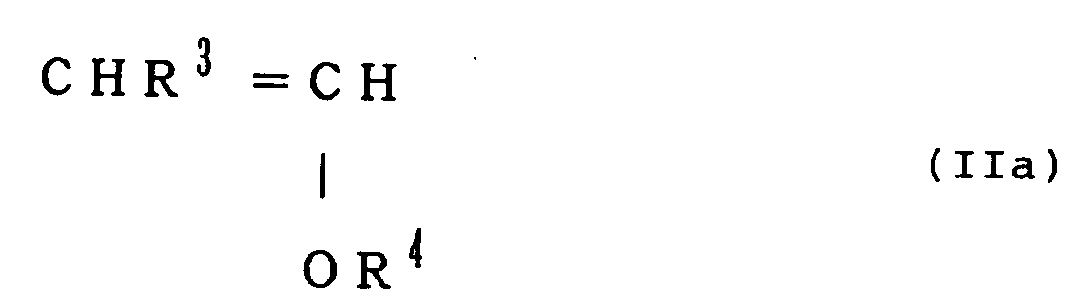
wherein R³ is a hydrogen atom or methyl group, and R⁴ is a monovalent organic group is reacted using as the initiator the adduct of a trifunctional alkenyl ether represented by the formula
wherein R¹ is a hydrogen atom or methyl group, and R² is a trivalent organic group with a Bronsted acid as a cation-donating compound to prepare a three-branched star alkenyl ether represented by the formula
wherein x is 1 to 10000, Z is a terminator residue, and R¹, R², R³ and R⁴ are as defined above. - Further according to the present process, an alkyloxystyrene represented by the formula

wherein A is a phenylene group, and R⁴ is an alkyl group is reacted using the adduct of a trifunctional alkenyl ether represented by the formula (Ia) with a Bronsted acid as a cation-donating compound as the initiator, and a bivalent metal halide as an activating agent to prepare a corresponding three-branched star alkyloxystyrene represented by the formula
wherein x is 1 to 10000, Z is a terminator residue, and R¹, R², R⁴ and A are as defined above. - Next, the process of the invention will be described for the preparation of four-branched star compounds.
- According to the process of the invention, an alkenyl ether represented by the formula

wherein R³ is a hydrogen atom or methyl group, and R⁴ is a monovalent organic group is reacted using as the initiator the adduct of a tetrafunctional alkenyl ether represented by the formula
wherein R¹ is a hydrogen atom or methyl group, and R² is a tetravalent organic group with a Bronsted acid as a cation-donating compound to prepare a four-branched star alkenyl ether represented by the formula
wherein x is 1 to 10000, Z is a terminator residue, and R¹, R², R³ and R⁴ are as defined above. - Further according to the present process, an alkyloxystyrene represented by the formula

wherein A is a phenylene group, and R⁴ is an alkyl group is reacted using the adduct of a tetrafunctional alkenyl ether represented by the formula (Ib) with a Bronsted acid as a cation-donating compound as the initiator, and a bivalent metal halide as an activating agent to prepare a corresponding four-branched star alkyloxystyrene represented by the formula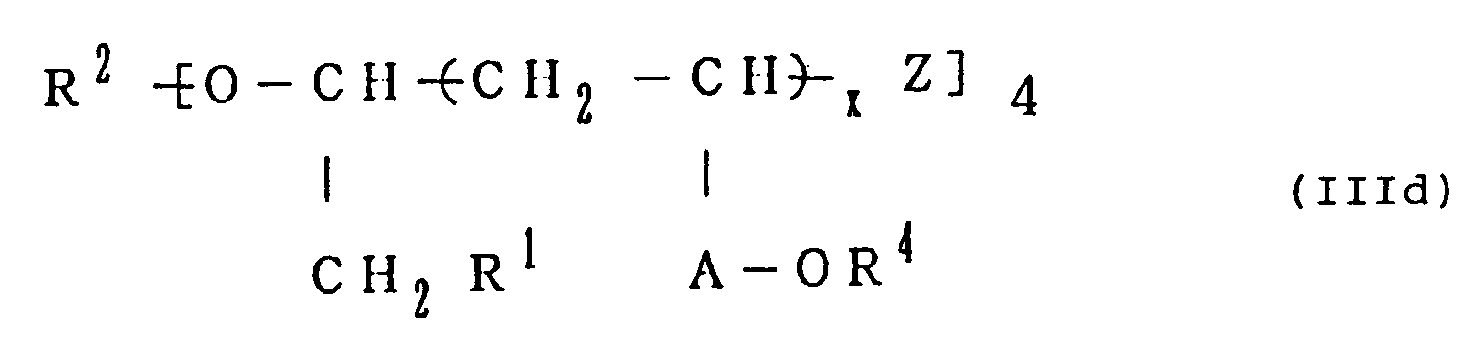
wherein x is 1 to 10000, Z is a terminator residue, and R¹, R², R⁴ and A are as defined above. - Given in Tables 1 to 6 are examples of trifunctional alkenyl ethers (Ia) for use in preparing three-branched star compounds.


- Among the trifunctional alkenyl ethers (Ia), those wherein the group R² has an ether linkage are prepared, for example, by reacting a corresponding trifunctional alcohol with 2-chloroethyl vinyl ether or 2-chloroethyl propenyl ether in dimethyl sulfoxide in the presence of sodium hydroxide.
- Among the trifunctional alkenyl ethers (Ia), those wherein the group R² has an ester linkage are prepared, for example, by converting 2-hydroxyethyl vinyl ether or 2-hydroxyethyl propenyl ether to a sodium salt with sodium hydride in toluene, and reacting the salt with a corresponding trifunctional carboxyilic acid chloride.
- The tetrafunctional alkenyl ethers (Ib'), (Ib'') for use in preparing four-branched polymers have the following respective structures.

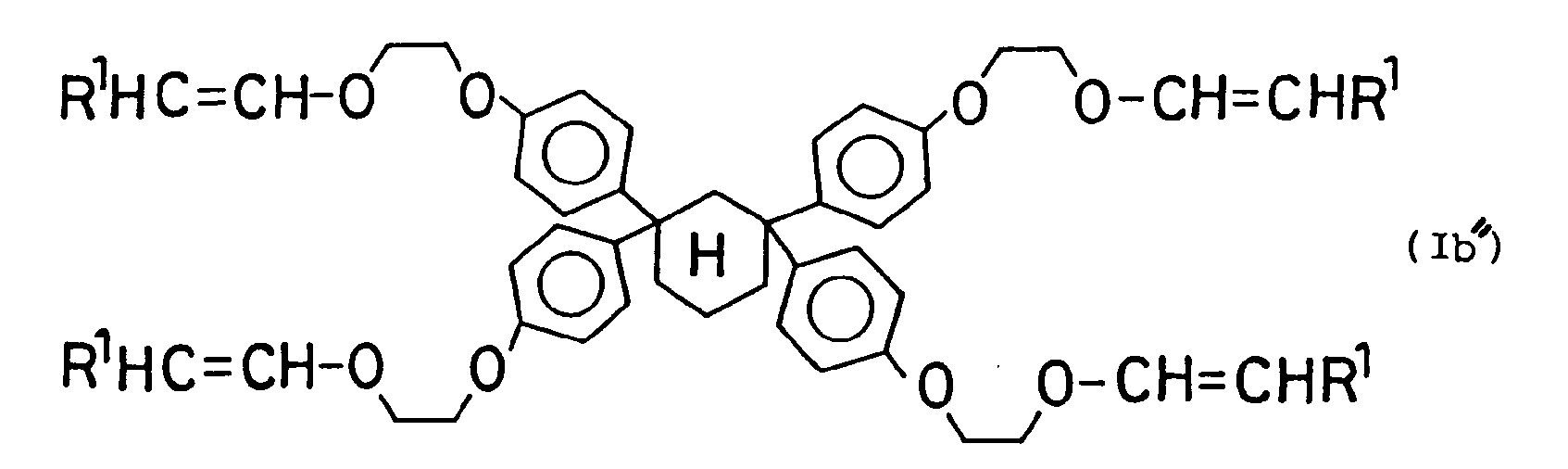
wherein R¹ is a hydrogen atom or methyl group. - Examples of tetrafunctional alkenyl ethers (Ib') are as follows.
1,1,4,4-Tetrakis[4-(2-vinyloxy)ethoxyphenyl]cyclohexane,
1,1,4,4-Tetrakis[4-(2-propenyloxy)ethoxyphenyl]cyclohexane. - Examples of tetrafunctional alkenyl ethers (Ib'') are as follows.
1,1,3,3-Tetrakis(4-(2-vinyloxy)ethoxyphenyl]cyclohexane,
1,1,3,3-Tetrakis[4-(2-propenyloxy)ethoxyphenyl]cyclohexane. - The tetrafunctional alkenyl ether (Ib') or (Ib'') is prepared, for example, by reacting tetrakis(4-hydroxyphenyl)cyclohexane with chloroethyl vinyl ether or chloroethyl propenyl ether in dimethyl sulfoxide in the presence of sodium hydroxide.
- Examples of Bronsted acids as the cation-donating compounds for use in the process of the invention are CF₃COOH, CCl₃COOH, CH₃COOH, HCOOH, H₃PO₄, HOPO(OC₄H₇)₂, HOPO(OC₆H₅)₂, HOPO(C₆H₅)₂, HI, HCl or HBr.
- The process of the present invention employs as an initiator the adduct of a polyfunctional alkenyl ether (I) with a Bronsted acid as a cation-donating compound, i.e., the adduct of a trifunctional alkenyl ether (Ia) with such a cation-donating compound, or the adduct of a tetrafunctional alkenyl ether (Ib') or (Ib'') with such a cation-donating compound. When the Bronsted acid as the cation-donating compound is represented by HB, the adduct is represented by
R² (̵O-CHB-CH₂ R¹)n (IV)
wherein R¹, R² and n has the same meaning as above, and B is the portion of the Bronsted acid remaining after the donation of cation. - Generally, the adduct (IV) is prepared, for example, by dissolving a polyfunctional alkenyl ether (I) in an inert solvent (preferably of the same kind as the solvent to be used for the polymerization reaction), such as carbon tetrachloride, n-hexane or toluene, under dry nitrogen at room temperature, and adding an equivalent amount of the Bronsted acid HB to the solution for reaction. The molar ratio of the trifunctional alkenyl ether (Ia) to the Bronsted acid HB to be added thereto is substantially 1:3. The molar ratio of the tetrafunctional alkenyl ether (Ib'), (Ib'') to the Bronsted acid is substantially 1:4. The reaction is conducted at a suitable temperature usually in the range of -90° C to 100° C, generally at atmospheric pressure although an increased pressure is applicable. The reaction time is 10 seconds to 24 hours, preferably 5 minutes to 1 hour. The reaction of this method proceeds rapidly, quantitatively giving a solution of the adduct (IV). Although the adduct (IV) may be isolated from the solution, the solution can be used as it is for the polymerization without isolation.
- The polymerization degree of the polymer is dependent on the molar ratio (100% polymerization ratio) of the olefin compound (II) to the adduct (IV), so that the amount of adduct (IV) is critical. The molar ratio of the olefin compound (II) to the adduct (IV) is determined according to the desired polymerization degree, whereby the polymer can be given the desired molecular weight. The molar ratio is at least 3 when the three-branched star compound is to be obtained, or at least 4 when the four-branched star compound is to be obtained. Thus, the molar ratio is suitably determined according to the desired polymerization degree.
- Among the alkenyl ethers represented by the formula (IIa) and included in olefin compounds (II) which are monomers for use in the invention for polymerization, those wherein R⁴ is a monovalent organic group are, for example, as follows.
- Methyl, ethyl, n-propyl, isopropyl, n-butyl, isobutyl, sec-butyl, tert-butyl, n-pentyl, isopentyl, 1,2-dimethylpropyl, n-hexyl, isohexyl, 2-ethylbutyl, 1,3-dimethylbutyl, n-heptyl, isoheptyl, n-octyl, 1-methylheptyl, 2-ethylhexyl, n-nonyl, 2-methyloctyl, n-decyl, 1-pentylhexyl, 4-ethyl-1-methyloctyl, n-dodecyl, n-tetradecyl, n-hexadecyl, n-octadecyl, n-eicosyl, n-docosyl and the like alkyl groups; cyclohexyl and like cycloalkyl groups; cyclohexylmethyl, terpenyl, menthyl, bornyl, isobornyl and like cycloalkylalkyl groups; benzyl, p-methylbenzyl, p-chlorobenzyl, p-phenylbenzyl, 1-phenylethyl, 2-phenylethyl, 2-phenlpropyl, 3-phenylpropyl, 1,1-dimethylbenzyl, benzhydryl, 3-phenylpropane-2-yl and like aralkyl groups; cinnamyl, 1-methylcinnamyl, 3-methylcinnamyl, 3-phenylcinnamyl, 2-phenylallyl, 1-methyl-2-phenylally and like arylalkenyl groups; phenyl, o-tolyl, m-tolyl, p-tolyl, p-tert-butylphenyl, mesityl, p-isohexylphenyl, p-isooctylphenyl, o-chlorophenyl, m-chlorophenyl, p-chlorophenyl, o-bromophenyl, m-bromophenyl, p-bromophenyl, o-bromophenyl, m-bromophenyl, p-bromophenyl, o-methoxyphenyl, m-methoxyphenyl, p-methoxyphenyl, o-nitrophenyl, m-nitrophenyl, p-nitrophenyl, 2,4-dinitrophenyl and like aryl groups; 1-chloroethyl, 2-chloroethyl, 2-bromoethyl, 2-iodoethyl, 2-fluoroethyl, 2,2,2-trifluoroethyl, 3-chloropropyl and like haloalkyl groups; methoxyethyl, ethoxyethyl, 2-ethoxyethoxyethyl and like alkoxyalkyl groups, and phenoxyethyl, p-chlorophenoxyethyl, p-bromophenoxyethyl, p-fluorophenoxyethyl, p-methoxyphenoxyethyl and like aryloxyalkyl groups; 2-acetoxyethyl, 2-benzoxyethyl, 2-(p-methoxybenzoxy)ethyl, 2-(p-chlorobenzoxy)ethyl and like acyloxyalkyl groups; 2-phthaliminoethyl, 2-(di-tert-butylcarboxyimino)ethyl and like iminoalkyl groups; 2-diethylmalonylethyl, 2-diphenylmalonylethyl and like malonylalkyl groups; 2-acryloxyethyl, 2-methacryloxyethyl, 2-cinnamyloxyethyl, 2-sorbinyloxy and like aryloxyalkyl groups.
- Such olefins (IIa) may be used singly, or at least two of them may be used in combination.
- The process wherein the olefin (IIa) is used is practiced preferably by employing a method of accelerating the polymerization (living polymerization). There are the following two methods for this purpose.
- The first of these methods is a method wherein the living polymerization is conducted in the presence of an organoaluminum compound as a catalyst, with the growing carbocation protected with a Lewis base to thereby prevent a side reaction. In the second method, the living polymerization is conducted, with a Lewis acid used for adjusting the nucleophilic property of the counteranion for the growing carbocation to prevent a side reaction.
- These methods will be described below in greater detail.
- With the first method, an organoaluminum compound represented by the following formula (V) is used as a catalyst in the presence of a Lewis base.
R⁵r A l XS (V)
wherein R⁵ is a monovalent organic group, X is a halogen atom, and r and s are each an integer and are in the relation defined by r + s = 3, 0 ≦ r < 3 and 0 ≦ s < 3. - Examples of useful organoaluminum compounds (V) are trichloro-aluminum, tribromo-aluminum, ethylaluminum dichloride, ethylaluminum dibromide, diethylaluminum chloride, diethylaluminum bromide, ethylaluminum diiodide, ethylaluminum difluoride, methylaluminum dichloride, methylaluminum dibromide, dimethylaluminum chloride, dimethylaluminum bromide and the like. These organoaluminum compounds may be used singly, or at least two of them may be used in combination. The compound is used in such an amount that the molar ratio of the olefin (II) to the organoaluminum compound (V) is generally in the range of 2 to 10000, preferably in the range of 10 to 5000.
- Examples of useful Lewis bases to be present in the reaction system are ethyl acetate, n-butyl acetate, phenyl acetate, ethyl benzoate, ethyl p-chlorobenzoate, ethyl p-methylbenzoate, ethyl p-methoxybenzoate, methyl acetate, isopropyl acetate, tert-butyl acetate and like ester compounds; 1,4-dioxane, diethyl ether, tetrahydrofuran, di-n-hexyl ether, diisopropyl ether, di-n-butyl ether, methoxytoluene, propylene oxide, 1,2-diethoxyethane, 1,2-dibutoxyethane, diethylene glycol dimethyl ether, diethylene glycol diethyl ether, diethylene glycol dibutyl ether, acetal and like ether compounds; pyridine, 2,6-dimethylpyridine, 2-methylpyridine, 2,4,6-trimethylpyridine, 2,4-dimethylpyridine, 2,6-di-tert-butylpyridine and like pyridine derivatives.
- These Lewis bases are usable singly, or at least two of them can be used in combination. The base is usable in bulk or as dissolved in an inert solvent. In accordance with the basicity of the Lewis base, the Lewis base is added to the reaction system in such an amount that the ratio of the amount to be amount of alkenyl ether (I) used is in the following range.

- The ratio of the amount of Lewis base used to the amount of alkenyl ether (I) used, if less than 0.001 or over 100, is not desirable since it is then difficult to provide a perfect living polymerization system.
- The second method employs a Lewis acid for suitably activating the counteranion for the growing carbocation. Examples of useful Lewis acids are iodene, zinc(II) halides, tin(II) halides, etc., among which I₂, ZnI₂, ZnBr₂, ZnCl₂, SnI₂, and SnCl₂ are especially suitable to use. Such Lewis acids are used singly, or at least two of them are used in combination. The Lewis acid is used in such an amount that the molar ratio of the alkenyl ether (I) to the acid is usually in the range of 2 to 100000, preferably in the range of 10 to 10000.
- Examples of alkyloxystyrenes represented by the formula (IIb) and included in the olefin compounds (II) for use in the process of the invention are o-methoxystyrene, m-methoxystyrene, p-methoxystyrene, o-ethoxystyrene, m-ethoxystyrene, p-ethoxystyrene, o-n-propyloxystyrene, m-n-propyloxystyrene, p-n-propyloxystyrene, o-isopropyloxystyrene, m-isopropyloxystyrene, p-isopropyloxystyrene, o-n-butoxystyrene, m-n-butoxystyrene, p-n-butoxystyrene, o-tert-butoxystyrene, m-tert-butoxystyrene, p-tert-butoxystyrene and the like. These styrenes may be used singly or in combination.
- In the process wherein the alkyloxystyrene (IIb) is used, the polymerization (living polymerization) is effected using a halide of a bivalent metal as an activating agent.
- The metal halide serves to activate the counteranion for the growing carbocation during the polymerization. Examples of useful metal halides are ZnI₂, ZnBr₂, ZnCl₂, SnI₂, SnCl₂ and the like.
- Such metal halides are used singly, or at least two of them are used in combination. The metal. halide is used in such an amount that the molar ratio of the polyfunctional alkenyl ether (I) to the metal halide is in the range of 0.01 to 1000, preferably 0.1 to 100.
- The polymerization reaction of the present invention is carried out usually by solution polymerization, while other methods, such as bulk polymerization, can also be used. Examples of solvents useful for solution polymerization are n-hexane, cyclohexane, benzene, toluene, carbon tetrachloride, ethylene chloride and like inert solvents. The reaction is conducted at a suitable temperature usually within the range of -40° C to 100° C, generally at atmospheric pressure although an increased pressure is applicable. The reaction time is 3 seconds to 7 days, preferably 1 minute to 24 hours.
- Since the polymerization reaction of the present invention is living polymerization, the polymerization reaction is terminated by adding a polymerization terminator. The polymerization terminator is preferably a compound represented by HZ (wherein Z is the terminator residue), such as methanol, ethanol, propanol, isopropanol, butanol or like alcohol; or dimethylamine, diethylamine or like amine. When methanol is used, it is desirable to use ammonia water in combination therewith. Ammonia acts to deactivate the organoaluminum compound (V), Lewis acid and metal halide. The molar ratio of the polymerization terminator to the cation-donating compound HB is 1 to 10000, preferably 1 to 1000.
- The polymer formed is collected by washing the reaction mixture with an aqueous solution of hydrochloric acid or like acid and then with water, and removing the solvent from the mixture.
- The reaction product of the present invention, i.e., star compound, has a polymerization degree x in the range of 1 to 10000, preferably 4 to 5000, more preferably 10 to 1000, most preferably 10 to 600.
- The process of the present invention provides star compounds having three or four branches of uniform length and having a narrow molecular weight distribution. Furthermore, the star compounds prepared by the present process have active polymer ends. This makes it possible, for example, to prepare block copolymers from the present polymer and other polymer, or to introduce a functional group into the present polymer at the terminal position. Depending on the kind of monomer used, the polymer can be made hydrophilic by a reaction of the polymer. Furthermore, a block copolymer can be prepared which comprises hydrophilic blocks and hydrophobic blocks. Thus, the star polymers of the invention are usable for wider application as functional polymers and are expected to find use in prepolymers for novel elastomers, crosslinking agents, ionomers, surfactants, compatibilizing agents, etc.
- The present invention will be further described with reference to the following examples, in which the molar concentration (mole /1) indicates the amount in moles of the compound used based on the whole volume of the polymerization system, the weight average molecular weight is represented by Mw, and the number average molecular weight by Mn. The Mw, Mn and the ratio Mw/Mn were determined by light diffusion gel permeation chromatography GPC ("LS8000 System," product of Toyo Soda Mfg. Co., Ltd., column: "Polystyrene Gel. KF-802, KF-803, KF-804," product of Showa Denko K.K., 8 mm in inside diameter, 300 mm in length). The chemical structure of the polymer was determined by ¹H-NMR ("GSX-270," product of JEOL, Ltd., 270 MHz). The adducts used in Examples of a polyfunctional alkenyl ether (I) with a cation-donating compound were prepared by dissolving the ether (I) in a fully purified and dried inert solvent (of the same kind as the solvent used for polymerization reaction), adding an equivalent amount of cation-donating compound HB to the solution and stirring the mixture at room temperature in a nitrogen stream for 15 minutes. The adduct obtained was used for polymerization in the form of a solution without isolation.
- A 9.96 g quantity (113 mmoles) of 2-hydroxyethyl vinyl ether was dissolved in 50 ml of toluene in a nitrogen atmosphere within three-necked glass flask equipped with a condenser and a stirrer, 2.71 g (113 mmoles) of sodium hydride powder was added to the solution, and the mixture was stirred at room temperature for 1 hour. To the solution were then added 10.0 g (33.7 mmoles) of trimesic acid chloride and 0.5 g of tetra-n-butylammonium chloride, followed by reaction at 80° C for 4 hours. The reaction mixture was subjected to extraction with diethyl ether, and the extract was dried to give crude crystals, which were then recrystallized from toluene/hexane (1:1), affording tri(2-vinyloxy)ethyl 1,3,5-benzenetricarboxylate (the first compound in Table 1). Yield: 62%, m.p.: 92-93° C (pale yellow crystals), IR absorption spectrum (Nujol): νC=C = 1620 cm⁻¹, νPh = 830 cm⁻¹.
- A 10.0 g quantity (32.6 mmoles) of 1,1,1-tris(4-hydroxyphenyl)ethane was dissolved in 75 ml of dimethyl sulfoxide in dry nitrogen within a three-necked glass flask equipped with a condenser and a stirrer, 23.5 g (587 mmoles) of sodium hydroxide powder was added to the solution, and the mixture was stirred at 75° C for 3 hours. To the solution was then added 59.7 ml (587 mmoles) of 2-chloroethyl vinyl ether, and the mixture was reacted at 80° C for 5 hours. The reaction mixture was purified in the same manner as in Reference Example 1 to obtain 1,1,1-tris[4-(2-vinyloxy)ethoxyphenyl]ethane (the second compound in Table 2).
- A 10.0 g quantity (22.1 mmoles) of 1,1,4,4-tetrakis(4-hydroxyphenyl)cyclohexane was dissolved in 75 ml of dimethyl sulfoxide in a nitrogen stream within a three-necked glass flask equipped with a condenser and a stirrer, 21.2 g (530 mmoles) of sodium hydroxide powder was added to the solution, and the mixture was stirred at 75° C for 3 hours. Subsequently, 53.9 ml (530 mmoles) of 2-chloroethyl vinyl ether was added to the solution and reacted therewith at 80° C for 5 hours. The reaction mixture was purified in the same manner as in Reference Example 1, giving 1,1,4,4-tetrakis[4-(2-vinyloxy)ethoxyphenyl]cyclohexane. Yield: 48%, m.p.: 137.5-139° C (pale yellow crystals), IR absorption spectrum (Nujol): νC=C = 1620 cm⁻¹, νPh = 830 cm⁻¹.
- 1,1,4,4-Tetrakis[4-(2-propenyloxy)ethoxyphenyl]cyclohexane was prepared in the same manner as in Reference Example 3 with the exception of using 63.9 ml (530 mmoles) of 2-chloroethyl propenyl ether in place of 2-chloroethyl vinyl ether.
- 1,1,3,3-Tetrakis[4-(2-vinyloxy)ethoxyphenl]cyclohexane was prepared in the same manner as in Reference Example 3 with the exception of using 10.0 g (22.1 mmoles) of 1,1,3,3-tetrakis(4-hydroxyphenyl)cyclohexane instead of 1,1,4,4-tetrakis(4-hydroxyphenyl)cyclohexane.
- A 2.0 ml quantity (3.0 moles/l) of isobutyl vinyl ether was dissolved in 1.5 ml of n-hexane fully purified and dried in a nitrogen atmosphere. With addition of 0.5 ml (1.2 moles/l) of 1,4-dioxane, the solution was maintained at a temperature of 0° C. To the solution were added first 0.5 ml (1.7 mmoles/l) of the adduct of 1,1,1-tris[4-(2-vinyloxy)ethoxyphenyl]ethane (the second compound in Table 2) with trifluoroacetic acid (CF₃COOH), as diluted with n-hexane, and then 0.5 ml (1.7 mmoles/l) of hexane solution of ethylaluminum dichloride to initiate polymerization, which was continued at 0° C for 3 hours. Methanol (170 mmoles/l) containing a small amount of ammonia water was thereafter added to the reaction system to terminate the polymerization. The reaction mixture was washed with an aqueous solution of hydrochloric acid (8 vol. %) first and then with water, followed by the removal of the catalyst residue and then by the removal of the solvent, etc. by evaporation to collect a polymer.
- The above procedure gave a three-branched star polyisobutyl vinyl ether which was 1.6 x 10⁵ in Mn and 1.04 in Mw/Mn. The Mn value was in good agreement with the value of 1.8 x 10⁵ which was calculated on the assumption that one molecule of the adduct formed a three-branched molecule.
Values Obtained by ¹H-NMR Spectroscopy (270 MHz, CDCl₃)
(Trifunctional vinyl ether)
δ(ppm): Peaks - a
- 2.05(s, 3H, CH₃)
- d
- 4.00(t, 6H, -CH₂-)
- e
- 4.15(t, 6H, -CH₂-)
- g
- 4.00 and 4.25(dd, 6H, =CH₂)
- f
- 6.50(dd, 3H, =CH)
- b
- 6.80(d, 6H, aromatic)
- c
- 7.00(d, 6H, aromatic)
- g
- 1.50(s, 9H, CH₃)
- a
- 2.05(s, 3H, CH₃)
- d+e
- 4.00(m, 12H, -CH₂-)
- f
- 6.15(q, 3H, CH)
- b
- 6.70(d, 6H, aromatic)
- c
- 6.90(d, 6H, aromatic)
- k
- 0.90(18xH, CH₃)
- f
- 1.20(9H, CH₃)
- g+j
- 1.40-2.00(9xH, -CH₂-)
- a
- 2.10(3H, CH₃)
- d,e,h,i,n
- 3.00-4.00
- c
- 4.10(6H, -CH₂-)
- m
- 4.65(3H, CH)
- b
- 6.75-7.00(12H, aromatic)
- A 1.0 ml quantity (1.5 moles/l) of isobutyl vinyl ether was dissolved in 2.5 ml of n-hexane fully purified and dried in a nitrogen atmosphere. With addition of 0.5 ml (1.2 moles/l) of 1,4-dioxane, the solution was maintained at a temperature of 0° C. To the solution were added first 0.5 ml (3.5 mmoles/l) of the adduct of tri(2-vinyloxy)ethyl 1,3,5-benzenetricarboxylate (the first compound in Table 1) with trifluoroacetic acid, as diluted with n-hexane, and then 0.5 ml (10 mmoles/l) of hexane solution of ethylaluminum dichloride to initiate polymerization. The same procedure as in Example 1 was thereafter followed to obtain a polymer.
- The above process afforded a three-branched star polyisobutyl vinyl ether which was 3.8x 10⁴ in Mn and 1.12 in Mw/Mn. The Mn value was in good agreement with the value of 3.9 x 10⁴ which was calculated assuming that one molecule of the adduct formed a three-branched molecule.
- Further to substantiate that the three-branched star polyisobutyl vinyl ether was a polymer having branches of uniform length, the three ester linkages in the organic group R² in the center of the star polymer were hydrolyzed by immersing the polymer in an aqueous solution of sodium hydroxide at room temperature for 2 days with stirring. The branched polymer obtained was 1.3 x 10⁴ in Mn and 1.06 in Mw/Mn. This indicated that the three-branched star polyisobutyl vinyl ether was a polymer having three branches of uniform length.
- A 1.0 ml quantity (0.38 mole/l) of toluene solution of methyl vinyl ether was added to 2.50 ml of toluene fully purified and dried in a nitrogen atmosphere. To the solution was then added 0.5 ml (1.2 moles/l) of 1,4-dioxane. Further added to the solution were 0.5 ml (3.5 mmoles/l) of the same adduct as used in Example 1, and 0.5 ml (10 mmoles/l) of hexane solution of ethylaluminum dichloride to initiate polymerization at -15° C. The polymerization was continued for 3 hours, followed by the same procedure as in Example 1 to obtain a polymer.
- Consequently, a hydrophilic three-branched star polymethyl vinyl ether was prepared which was 6.7 x 10³ in Mn and 1.05 in Mw/Mn. The Mn value agreed well with the value of 6.9 x 10³ which was calculated assuming that one molecule of the adduct formed a three-branched molecule.
- A polymer was prepared by the same procedure as in Example 1 except that the polymerization was conducted at a temperature of 60° C for 10 minutes.
- The polymer obtained was a three-branched star polyisobutyl vinyl ether which was 1.5 x 10⁵ in Mn and 1.10 in Mw/Mn. The Mn value agreed well with the value of 1.8 x 10⁵ which was calculated assuming that one molecule of the adduct formed a three-branched molecule.
- A 0.25 ml quantity (0.35 mole/l) of isobutyl vinyl ether was dissolved in 3.25 ml of n-hexane fully purified and dried in a nitrogen atmosphere. A 0.5 ml quantity (1.2 moles/l) of 1,4-dioxane was added to the solution. Further added to the solution were 0.5 ml (3.5 mmoles/l) of the same adduct as used in Example 1 and 0.5 ml (10 mmoles/l) of hexane solution of ethylaluminum dichloride to initiate polymerization at 0° C. Three minutes after the start of the reaction, 0.25 ml (0.38 mole/l) of 2-vinyloxyethyl acetate was added to the mixture, followed by further polymerization at a temperature of 40° C for 3 hours. The same procedure as in Example 1 was thereafter repeated to obtain a polymer.
- The polymer was a three-branched star block copolymer which was 2.8 x 10⁴ in Mn and 1.04 in Mw/Mn. The Mn value agreed well with the value of 2.6 x 10⁴ which was calculated assuming that one molecule of the adduct formed a three-branched molecule.
- The polymer was further hydrolyzed with an alkali to convert the poly-2-acetoxyethyl vinyl ether on the outer side to poly-2-hydroxyethyl vinyl ether and obtain an amphiphatic three-branched star polymer having hydrophobic groups internally and hydrophilic groups externally.
- The procedure of Example 5 was repeated with the exception of using 0.25 ml (0.38 mole/l) of 2-vinyloxyethyl acetate first in place of isobutyl vinyl ether to effect polymerization at 40° C for 2 hours, followed by addition of 0.25 ml (0.38 mole/l) of isobutyl vinyl ether to effect further polymerization at 40° C for 1 hour.
- As a result, a three-branched star block copolymer was obtained which was 2.3 x 10⁴ in Mn and 1.11 in Mw/Mn. The Mn value agreed well with the value of 2.6 x 10⁴ which was calculated assuming that one molecule of the adduct formed a three-branched molecule.
- The polymer was further hydrolyzed with an alkali to convert the poly-2-acetoxyethyl vinyl ether on the inner side to poly-2-hydroxyethyl vinyl ether and prepare an amphiphatic three-branched star polymer having hydrophilic groups internally and hydrophobic groups externally.
- A 0.5 ml quantity (0.76 mole/l) of isobutyl vinyl ether was dissolved in 3.5 ml of toluene fully purified and dried in a nitrogen atmosphere, and the solution was maintained at a temperature of -15° C. To the solution were added first 0.5 ml (3.0 mmoles/l) of the adduct of 1,1,1-tris[4-(2-vinyloxy)ethoxyphenyl]ethane (the second compound in Table 2) with hydrogen iodide, as diluted with toluene, and then an ethereal solution (0.2 mmole/l) of zinc iodide (ZnI₂) to effect polymerization at -15° C for 1 hour. Methanol (300 mmoles/l) containing a small amount of ammonia was then added to the reaction system to terminate the polymerization. The reaction mixture was washed with a sodium thiosulfate aqueous solution (8 vol. %) first then with water, followed by the removal of the catalyst residue and thereafter by the removal of the solvent, etc. by evaporation to obtain a product.
- The product obtained was a three-branched star polyisobutyl vinyl ether which was 2.8 x 10⁴ in Mn and 1.04 in Mw/Mn. The Mn value agreed well with the valuce of 2.6 x 10⁴ which was calculated assuming that one molecule of the adduct formed a three-branched molecule.
- The same procedure as in Example 7 was repeated with the exception of using the adduct (3.0 mmoles/l) of tri(2-vinyloxy)ethyl 1,3,5-benzenetricarboxylate (the first compound in Table 1) with hydrogen iodide, as diluted with toluene, in place of the adduct used in Example 7. Consequently, a three-branched star polyisobutyl vinyl ether was obtained which was 3.3 x 10⁴ in Mn and 1.04 in Mw/Mn.
- A 0.25 ml quantity (0.38 mole/l) of 2-vinyloxy-ethyl acetate was dissolved in 3:0 ml of toluene fully purified and dried in a nitrogen atmosphere, and the solution was maintained at a temperature of -15° C. To the solution were added first 0.5 ml (3.0 mmoles/l) of the same adduct as used in Example 5, and then a toluene solution (9.0 mmoles/l) of iodine (I₂) to start polymerization. After continuing the polymerization at -15° C for 1 hour, the same procedure as in Example 5 was repeated to prepare a polymer.
- The polymer obtained was a three-branched star poly-2-acetoxyethy vinyl ether which was 1.9 x 10⁴ in Mn and 1.08 in Mw/Mn. The Mn value agreed well with the value of 1.7 x 10⁴ which was calculated assuming that one molecule of the adduct formed a three-branched molecule.
- A 0.25 ml quantity (0.38 mole/l) of p-methoxystyrene was dissolved in 3.75 ml of toluene fully purified and dried in a nitrogen atmosphere, and the solution was maintained at a temperature of -78° C. To the solution were added first 0.5 ml (3.3 mmoles/l) of the adduct of 1,1,1-tris[4-(2-vinyloxy)ethoxyphenyl]ethane (the second compound in Table 2) with hydrogen iodide, as diluted with toluene, and then 0.5 ml (3.3 mmoles/l) of ethereal solution of zinc iodide. The resulting solution was allowed to stand at -78° C for 20 hours and thereafter heated to -15° C to start polymerization. After continuing the polymerization at -15° C for 2 hours, methanol (330 mmoles/l) containing a small amount of ammonia water was added to the reaction system to terminate the polymerization and obtain a mixture containing a polymer. The mixture was washed first with hydrochloric acid aqueous solution (8 vol. %) and then with water, and the solvent, etc. were evaporated off the mixture to collect the polymer.
- GPC and ¹H-NMR spectroscopy revealed that the polymer obtained was a three-branched star poly(p-methoxystyrene) which was 1.4 x 10⁴ in Mn and 1.05 in Mw/Mn. The Mn value agreed well with the value of 1.5 x 10⁴ which was calculated assuming that one molecule of the adduct formed a three-branched molecule. Values Obtained by ¹H-NMR Spectroscopy (270 MHz, CDCl₃)
(Three-branched poly(p-methoxystyrene))
δ(ppm): Peaks - f
- 0.90(9H, CH₃)
- g+h
- 1.20-2.20(9xH, -CH₂-CH-)
- a
- 2.10(3H, CH₃)
- k
- 3.00(9H, OCH₃)
- c
- 3.10-3.40(6H, -CH₂-)
- d
- 3.00-4.00(6H, -CH₂-)
- j
- 3.70(9xH, OCH₃)
- e
- 3.00-4.00(3H, -CH-)
- b+i
- 6.25-7.05(12(x+1) H, aromatic)
- A polymer was prepared in the same manner as in Example 10 with the exception of using tri(2-vinyloxy)ethyl 1,3,5-benzenetricarboxylate (the first compound in Table 1) instead of the trifunctional alkenyl ether used in Example 10.
- GPC and ¹H-NMR spectroscopy revealed that the polymer obtained was a three-branched star poly(p-methoxystyrene) which was 1.6 x 10⁴ in Mn and 1.06 in Mw/Mn. The Mn value agreed well with the value of 1.5 x 10⁴ which was calculated assuming that one molecule of the adduct formed a three-branched molecule.
- The three-branched star poly(p-methoxystyrene) was immersed in a sodium hydroxide aqueous solution at room temperature for 2 days to hydrolyze the three ester linkages in the center of the three branches and obtain a branched polymer. When analyzed by GPC, the branched polymer was found to be 5.0 x 10³ in Mn and 1.07 in Mw/Mn.
-
- A polymer was prepared in the same manner as in Example 10 with the exception of using hydrogen chloride in place of hydrogen iodide, and zinc chloride in place of zinc iodide, and effecting the polymerization at a temperature of 0° C for 20 minutes.
- GPC and ¹H-NMR spectroscopy revealed that the polymer obtained was a three-branched star poly(p-methoxystyrene) which was 1.4 x 10⁴ in Mn and 1.06 in Mw/Mn. The Mn value agreed well with the value of 1.5 x 10⁴ which was calculated assuming that one molecule of the adduct formed a three-branched molecule.
- A polymer was prepared in the same manner as in Example 10 except that p-tert-butoxystyrene (0.26 mole/l) was polymerized in place of p-methoxystyrene (0.38 mole/l) at a temperature of 25° C.
- GPC and ¹H-NMR spectroscopy revealed that the polymer obtained was three-branched star poly(p-tert-butoxystyrene) which was 1.3 x 10⁴ in Mn and 1.07 in Mw/Mn. The Mn value agreed well with the value of 1.4 x 10⁴ calculated assuming that one molecule of the adduct formed a three-branched molecule.
- p-Methoxystyrene was polymerized in the same manner as in Example 10, and 25 ml (0.26 mole/l) of p-tert-butoxystyrene was thereafter added to the reaction mixture and further polymerized therewith at an elevated temperature of 25° C. Subsequently, methanol (330 mmoles/l) containing a small amount of ammonia water was added to the reaction system to terminate the polymerization and obtain a mixture containing a polymer. The mixture was washed first with a hydrochloric acid aqueous solution (8 vol. %) and then with water, followed by evaporation for the removal of the solvent, etc. to collect the polymer.
- GPC and ¹H-NMR spectroscopy revealed that the polymer obtained was a three-branched star block copolymer comprising poly(p-methoxystyrene) and poly(p-tert-butoxystyrene),and 3.0 x 10⁴ in Mn and 1.05 in Mw/Mn.
- The Mn value agreed well with the value of 2.9 x 10⁴ which was calculated assuming that one molecule of the adduct formed a three-branched molecule.
- The copolymer was further treated with hydrogen bromide to convert poly(p-tert-butoxystyrene) on the outer side to poly(p-vinylphenol) and obtain an amphiphatic three-branched star copolymer having hydrophobic groups internally and hydrophilic groups externally.
-
- In the same manner as in Example 10 with the exception of using p-tert-butoxystyrene (0.26 mole/l) instead of p-methoxystyrene (0.38 mole/l) at a temperature of 25° c, the p-tert-butoxystyrene was polymerized. Subsequently, 25 ml (0.38 mole/l) of p-methoxystyrene was added to the reaction mixture and further reacted therewith at 25° c for 20 minutes. Methanol (330 mmoles/l) containing a small amount of ammonia water was thereafter added to the reaction system to terminate the polymerization and obtain a mixture containing a polymer. The mixture was washed first with a hydrochloric acid aqueous solution (8 vol. %) and then with water, followed by evaporation for the removal of the solvent, etc. to collect the polymer.
- GPC and ¹H-NMR spectroscopy revealed that the polymer obtained was a three-branched star block copolymer comprising poly(p-tert-butoxystyrene) and poly(p-methoxystyrene), and 2.8 x 10⁴ in Mn and 1.06 in Mw/Mn.
- The Mn value agreed well with the value of 2.9 x 10⁴ which was calculated assuming that one molecule of the adduct formed a three-branched molecule.
- The copolymer was further treated with hydrogen bromide to convert the poly(p-tert-butoxystyrene) in the inside to poly(p-vinylphenol) and obtain an amphiphatic three-branched star copolymer having hydrophilic groups internally and hydrophobic groups externally.
- A 2.0 ml quantity (3.0 moles/l) of isobutyl vinyl ether was dissolved in 1.5 ml of n-hexane fully purified and dried in a nitrogen atmosphere, 0.5 ml (1.2 moles/l) of 1,4-dioxane was added to the solution, and the resulting solution was maintained at a temperature of 0° C. To the solution were added first 0.5 ml (1.7 mmoles/l) of the adduct of 1,1,4,4-tetrakis[4-(2-vinyloxy)ethoxyphenyl]cyclohexane with trifluoroacetic acid (CF₃COOH), as diluted with n-hexane, and then 0.5 ml (5.0 mmoles/l) of hexane solution of ethylaluminum dichloride to start polymerization. After continuing the polymerization at 0° C for 3 hours, methanol (330 mmoles/l) containing a small amount of ammonia water was added to the reaction system to terminate the polymerization. The reaction mixture was washed first with a hydrochloric acid aqueous solution (8 vol. %) and then with water, followed by the removal of the catalyst residue and then by the removal of the solvent, etc. by evaporation to collect a polymer.
- The polymer obtained was a four-branched star polyisobutyl vinyl ether which was 1.6 x 10⁵ in Mn and 1.06 in Mw/Mn. The Mn value agreed well with the value of 1.8 x 10⁵ which was calculated assuming that one molecule of the adduct formed a four-branched molecule.
Values Obtained by ¹H-NMR Spectroscopy (270 MHz, CDCl₃)
(Tetrafunctional vinyl ether)
δ(ppm): Peaks - a
- 2.25(m, 8H, cyclohexane ring)
- d
- 4.00(t, 8H, -CH₂-)
- e
- 4.15(t, 8H, -CH₂-)
- g
- 4.00 and 4.25(dd, 8H, =CH₂)
- f
- 6.50(dd, 4H, =CH)
- b
- 6.80(d, 8H, aromatic)
- c
- 7.00(d, 8H, aromatic)
- g
- 1.50(s, 12H, CH₃)
- a
- 2.25(m, 8H, cyclohexane ring)
- d+e
- 4.00(m, 16H, -CH₂-)
- f
- 6.15(q, 4H, CH)
- b
- 6.70(d, 8H, aromatic)
- c
- 6.90(d, 8H, aromatic)
- k
- 0.90(24xH, CH₃)
- f
- 1.20(12H, CH₃)
- g+j
- 1.40-2.00(12xH, -CH₂-)
- a
- 2.10-2.40(8H, cyclohexane ring)
- d,e,h,i,n
- 3.00-4.00
- c
- 4.10(8H, -CH₂-)
- m
- 4.65(4H, CH)
- b
- 6.75-7.00(16H, aromatic)
- A 1.0 ml quantity (1.5 moles/l) of isobutyl vinyl ether was dissolved in 2.5 ml of n-hexane fully purified and dried in a nitrogen atmosphere. With addition of 0.5 ml (1.2 moles/l) of 1,4-dioxane, the solution was maintained at a temperature of 0° C. To the solution were added first 0.5 ml (3.5 mmoles/l) of the adduct of 1,1,4,4-tetrakis[4-(2-propenyloxy) ethoxyphenyl]cyclohexane with trifluoroacetic acid, as diluted with n-hexane, and then 0.5 ml (10 mmoles/l) of hexane solution of ethylaluminum dichloride to initiate polymerization. The same procedure as in Example16 was thereafter followed to obtain a polymer.
- The above process afforded a four -branched star polyisobutyl vinyl ether which was 3.7 x 10⁴ in Mn and 1.08 in Mw/Mn. The Mn value was in good agreement with the value of 3.9 x 10⁴ which was calculated assuming that one molecule of the adduct formed a four branched molecule.
- A 1.0 ml quantity (0.38 mole/l) of toluene solution of methyl vinyl ether was added to 2.50 ml of toluene fully purified and dried in a nitrogen atmosphere. To the solution was then added 0.5 ml (1.2 moles/l) of 1,4-dioxane. Further added to the solution were 0.5 ml (3.5 mmoles/l) of the same adduct as used in Example 16 and 0.5 ml (10 mmoles/l) of hexane solution of ethylaluminum dichloride to initiate polymerization at -15° C. The polymerization was continued for 3 hours, followed by the same procedure as in Example 16 to obtain a polymer.
- Consequently, a hydrophilic four -branched star polymethyl vinyl ether was prepared which was 6.6 x 10³ in Mn and 1.06 in Mw/Mn. The Mn value agreed well with the value of 6.9 x 10³ which was calculated assuming that one molecule of the adduct formed a four -branched molecule.
- A polymer was prepared by the same procedure as in Example 16 except that the polymerization was conducted at a temperature of 60° C for 10 minutes.
- The polymer obtained was a four -branched star polyisobutyl vinyl ether which was 1.6 x 10⁵ in Mn and 1.10 in Mw/Mn. The Mn value agreed well with the value of 1.8 x 10⁵ which was calculated assuming that one molecule of the adduct formed a four -branched molecule.
- A 0.25 ml quantity (0.35 mole/l) of isobutyl vinyl ether was dissolved in 3.25 ml of n-hexane fully purified and dried in a nitrogen atmosphere. A 0.5 ml quantity (1.2 moles/l) of 1,4-dioxane was added to the solution. Further added to the solution were 0.5 ml (3.5 mmoles/l) of the same adduct as used in Example 16 and 0.5 ml (10 mmoles/l) of hexane solution of ethylaluminum dichloride to initiate polymerization at 0° C. Three minutes after the start of the reaction, 0.25 ml (0.38 mole/l) of 2-vinyloxyethyl acetate was added to the mixture, followed by further polymerization at a temperature of 40° C for 3 hours. The same procedure as in Example16 was thereafter repeated to obtain a polymer.
- The polymer was a four -branched star block copolymer which was 2.6 x 10⁴ in Mn and 1.06 in Mw/Mn. The Mn value agreed well with the value of 2.6 x 10⁴ which was calculated assuming that one molecule of the adduct formed a four -branched molecule.
- The polymer was further hydrolyzed with an alkali to convert the poly-2-acetoxyethyl vinyl ether on the outer side to poly-2-hydroxyethyl vinyl ether and obtain an amphiphatic four-branched star polymer having hydrophobic groups internally and hydrophilic groups externally.
- The procedure of Example 20 was repeated with the exception of using 0.25 ml (0.38 mole/l) of 2-vinyloxyethyl acetate first in place of isobutyl vinyl ether to effect polymerization at 40° C for 2 hours, followed by addition of 0.25 ml (0.38 mole/l) of isobutyl vinyl ether to effect further polymerization at 40° C for 1 hour.
- As a result, a four -branched star block copolymer was obtained which was 2.4 x 10⁴ in Mn and 1.10 in Mw/Mn. The Mn value agreed well with the value of 2.6 x 10⁴ which was calculated assuming that one molecule of the adduct formed a four -branched molecule.
- The polymer was further hydrolyzed with an alkali to convert the poly-2-acetoxyethyl vinyl ether on the inner side to poly-2-hydroxyethyl vinyl ether and prepare an amphiphatic four -branched star polymer having hydrophilic groups internally and hydrophobic groups externally.
- A 0.5 ml quantity (0.76 mole/l) of isobutyl vinyl ether was dissolved in 3.5 ml of toluene fully purified and dried in a nitrogen atmosphere, and the solution was maintained at a temperature of -15° C. To the solution were added first 0.5 ml (3.0 mmoles/l) of the adduct of 1,1,4,4-tetrakis[4-(2-vinyloxy)ethoxyphenyl] cyclohexane with hydrogen iodide, as diluted with toluene, and then an ethereal solution (0.2 mmole/l) of zinc iodide (ZnI₂) to effect polymerization at -15° C for 1 hour. Methanol (300 mmoles/l) containing a small amount of ammonia was then added to the reaction system to terminate the polymerization. The reaction mixture was washed with a sodium thiosulfate aqueous solution (8 vol. %) first then with water, followed by the removal of the catalyst residue and thereafter by the removal of the solvent, etc. by evaporation to obtain a product.
- The product obtained was a four-branched star polyisobutyl vinyl ether which was 2.4 x 10⁴ in Mn and 1.06 in Mw/Mn. The Mn value agreed well with the valuce of 2.6 x 10⁴ which was calculated assuming that one molecule of the adduct, formed a four -branched molecule.
- The same procedure as in Example 22 was repeated with the exception of using the adduct (3.0 mmoles/l) of 1,1,4,4-tetrakis[4-(2-propenyloxy)ethoxyphenyl]cyclohexane with hydrogen iodide, as diluted with toluene, in place of the adduct used in Example 22 Consequently, a four-branched star polyisobutyl vinyl ether was obtained which was 2.8 x 10⁴ in Mn and 1.07 in Mw/Mn.
- A 0.25 ml quantity (0.38 mole/l) of 2-vinyloxyethyl acetate was dissolved in 3.0 ml of toluene fully purified and dried in a nitrogen atmosphere, and the solution was maintained at a temperature of -15° C. To the solution were added first 0.5 ml (3.0 mmoles/l) of the same adduct as used in Example 22 and then a toluene solution (9.0 mmoles/l) of iodine (I₂) to start polymerization. After continuing the polymerization at -15° C for 1 hour, the same procedure as in Example 22 was repeated to prepare a polymer.
- The polymer obtained was a four -branched star poly-2-acetoxyethy vinyl ether which was 1.6 x 10⁴ in Mn and 1.06 in Mw/Mn. The Mn value agreed well with the value of 1.7 x 10⁴ which was calculated assuming that one molecule of the adduct formed a four -branched molecule.
- A 0.25 ml quantity (0.38 mole/l) of p-methoxystyrene was dissolved in 3.75 ml of toluene fully purified and dried in a nitrogen atmosphere, and the solution was maintained at a temperature of -78° C. To the solution were added first 0.5 ml (3.3 mmoles/l) of the adduct of 1,1,4,4-tetrakis[4-(2-vinyloxy)ethoxyphenyl] cyclohexane with hydrogen iodide, as diluted with toluene, and then 0.5 ml. (3.3 mmoles/l) of ethereal solution of zinc iodide. The resulting solution was allowed to stand at -78° C for 20 hours and thereafter heated to -15° C to start polymerization. After continuing the polymerization at -15° C for 2 hours, methanol (330 mmoles/l) containing a small amount of ammonia water was added to the reaction system to terminate the polymerization and obtain a mixture containing a polymer. The mixture was washed first with sodiumith sulfate aqueous solution (8 vol. %) and then with water, and the solvent, etc. were evaporated off the mixture to collect the polymer.
- GPC and ¹H-NMR spectroscopy revealed that the polymer obtained was a four -branched star poly(p-methoxystyrene) which was 1.5 x 10⁴ in Mn and 1.05 in Mw/Mn. The Mn value agreed well with the value of 1.5 x 10⁴ which was calculated assuming that one molecule of the adduct formed a four -branched molecule. Values Obtained by ¹H-HMR Spectroscopy (270 MHz, CDCl₃)
(Four -branched poly(p-methoxystyrene))
δ(ppm): Peaks - f
- 0.90 (12H, CH₃)
- g + h
- 1.20 -2.20 (12xH, -CH₂ -CH-)
- a
- 2.10 -2.40 (8H, cyclohexane ring)
- k
- 3.00 (12H, OCH₃ )
- c
- 3.10 -3.40 (8H, -CH₂-)
- d
- 3.00 -4.00 (8H, -CH₂-)
- j
- 3.70 (12xH, OCH₃)
- e
- 3.00 4.00 (4H, -CH-)
- b + i
- 6.25 -7.05 (16(x+1) H, aromatic)
- A polymer was prepared in the same manner as in Example 10 with the exception of using 1,1,3,3-tetrakis [4-(2-vinyloxy)ethoxyphenyl]cyclohexane instead of the trifunctional alkenyl ether used in Example 25.
- GPC and ¹H-NMR spectroscopy revealed that the polymer obtained was a four-branched star poly(p-methoxystyrene) which was 1.4 x 10⁴ in Mn and 1.09 in Mw/Mn. The Mn value agreed well with the value of 1.5 x 10⁴ which was calculated assuming that one molecule of the adduct formed a four -branched molecule.
-
- A polymer was prepared in the same manner as in Example 25 with the exception of using hydrogen chloride in place of hydrogen iodide, and zinc chloride in place of zinc iodide, and effecting the polymerization at a temperature of 0° C for 20 minutes.
- GPC and ¹H-NMR spectroscopy revealed that the polymer obtained was a four-branched star poly(p-methoxystyrene) which was 1.4 x 10⁴ in Mn and 1.05 in Mw/Mn. The Mn value agreed well with the value of 1.5 x 10⁴ which was calculated assuming that one molecule of the adduct formed a four -branched molecule.
- A polymer was prepared in the same manner as in Example 25 except that p-tert-butoxystyrene (0.26 mole/l) was polymerized in place of p-methoxystyrene (0.38 mole/l) at a temperature of 25° C.
- GPC and ¹H-NMR spectroscopy revealed that the polymer obtained was four -branched star poly(p-tert-butoxystyrene) which was 1.4 x 10⁴ in Mn and 1.06 in Mw/Mn. The Mn value agreed well with the value of 1.4 x 10⁴ calculated assuming that one molecule of the adduct formed a four-branched molecule.
- p-Methoxystyrene was polymerized in the same manner as in Example 25 and 25 ml (0.26 mole/l) of p-tert-butoxystyrene was thereafter added to the reaction mixture and further polymerized therewith at an elevated temperature of 25° C. Subsequently, methanol (330 mmoles/l) containing a small amount of ammonia water was added to the reaction system to terminate the polymerization and obtain a mixture containing a polymer. The mixture was washed first with a hydrochloric acid aqueous solution (8 vol. %) and then with water, followed by evaporation for the removal of the solvent, etc. to collect the polymer.
- GPC and ¹H-NMR spectroscopy revealed that the polymer obtained was a four -branched star block copolymer comprising poly(p-methoxystyrene) and poly(p-tert-butoxystyrene), and 2.8 x 10⁴ in Mn and 1.05 in Mw/Mn.
- The Mn value agreed well with the value of 2.9 x 10⁴ which was calculated assuming that one molecule of the adduct formed a four -branched molecule.
- The copolymer was further treated with hydrogen bromide to convert poly(p-tert-butoxystyrene) on the outer side to poly(p-vinylphenol) and obtain an amphiphatic four-branched star copolymer having hydrophobic groups internally and hydrophilic groups externally.
-
- In the same manner as in Example 25 with the exception of using p-tert-butoxystyrene (0.26 mole/l) instead of p-methoxystyrene (0.38 mole/l) at a temperature of 25° C, the p-tert-butoxystyrene was polymerized. Subsequently, 25 ml (0.38 mole/l) of p-methoxystyrene was added to the reaction mixture and further reacted therewith at 25° C for 20 minutes. Methanol (330 mmoles/l) containing a small amount of ammonia water was thereafter added to the reaction system to terminate the polymerization and obtain a mixture containing a polymer. The mixture was washed first with a hydrochloric acid aqueous solution (8 vol. %) and then with water, followed by evaporation for the removal of the solvent, etc. to collect the polymer.
- GPC and ¹H-NMR spectroscopy revealed that the polymer obtained was a four-branched star block copolymer comprising poly(p-tert-butoxystyrene) and poly(p-methoxystyrene), and 3.0 x 10⁴ in Mn and 1.08 in Mw/Mn.
- The Mn value agreed well with the value of 2.9 x 10⁴ which was calculated assuming that one molecule of the adduct formed a four-branched molecule.
- The copolymer was further treated with hydrogen bromide to convert the poly(p-tert-butoxystyrene) in the inside to poly(p-vinylphenol) and obtain an amphiphatic four -branched star copolymer having hydrophilic groups internally and hydrophobic groups externally.
(Trifunctional initiator)

δ(ppm): Peaks
(Three-branched polyvinyl ether)

δ(ppm): Peaks
(Tetrafunctional initiator)

δ(ppm): Peaks
(Four-branched polyvinyl ether)

δ(ppm): Peaks
Claims (8)
- A process for preparing a three-branched or four-branched star compound characterized by reacting, in the presence of a Lewis acid or in the presence of a Lewis base and an organoaluminum compound, an olefin compound represented by the formula

R²(̵O-CH=CHR¹)n (I)
wherein R¹ is a hydrogen atom or methyl group, n is an integer of 3 or 4, and R² is a trivalent organic group when n is 3 or a tetravalent organic group when n is 4, with a Bronsted acid as a cation-donating compound to prepare a three-branched or four-branched star compound represented by the formula
- The process as defined in claim 1 wherein an alkenyl ether represented by the formula


- The process as defined in claim 1 wherein an alkyloxystyrene represented by the formula


- The process as defined in claim 1 wherein an alkenyl ether represented by the formula


- The process as defined in claim 1 wherein an alkyloxystyrene represented by the formula

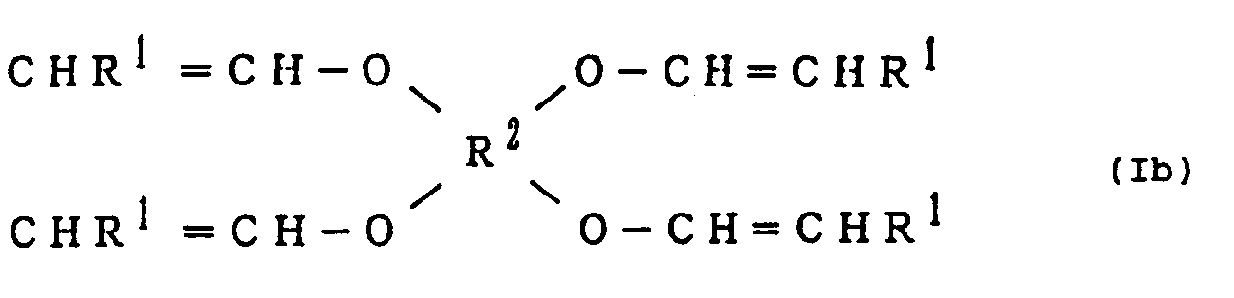

- The process as defined in any one of claims 1 to 5 wherein the adduct is a compound represented by the formula
R² (̵O-CHB-CH₂R¹)n (IV)
wherein R¹, R², and n are as defined in claim 1, and B is the portion of the Bronsted acid remaining after the donation of cation. - The process as defined in any one of claims 1 to 5 wherein a plurality of different olefin compounds (I) are reacted successively to obtain a multi-branched star polymer in the form of a block copolymer.
- The process as defined in any one of claims 1 to 5 wherein x is 4 to 5000.
Applications Claiming Priority (4)
| Application Number | Priority Date | Filing Date | Title |
|---|---|---|---|
| JP156160/90 | 1990-06-14 | ||
| JP15616090 | 1990-06-14 | ||
| JP66509/91 | 1991-03-29 | ||
| JP6650991 | 1991-03-29 |
Publications (2)
| Publication Number | Publication Date |
|---|---|
| EP0464408A1 EP0464408A1 (en) | 1992-01-08 |
| EP0464408B1 true EP0464408B1 (en) | 1994-01-12 |
Family
ID=26407692
Family Applications (1)
| Application Number | Title | Priority Date | Filing Date |
|---|---|---|---|
| EP91109563A Expired - Lifetime EP0464408B1 (en) | 1990-06-14 | 1991-06-11 | Process for preparing star compounds |
Country Status (3)
| Country | Link |
|---|---|
| US (1) | US5102966A (en) |
| EP (1) | EP0464408B1 (en) |
| DE (1) | DE69100978T2 (en) |
Families Citing this family (11)
| Publication number | Priority date | Publication date | Assignee | Title |
|---|---|---|---|---|
| US5395885A (en) * | 1993-12-17 | 1995-03-07 | The University Of Akron | Multi-arm cationic star-polymers |
| JPH07247364A (en) * | 1994-03-10 | 1995-09-26 | Toyota Central Res & Dev Lab Inc | Oligomer degradable polymer, production method, recovery method and regeneration method thereof |
| DE19528878A1 (en) * | 1995-08-05 | 1997-02-06 | Herberts Gmbh | Aqueous coating compositions using polyalkylene glycol dialkyl ethers and processes for multi-layer coating |
| US6414101B1 (en) | 1999-03-26 | 2002-07-02 | Shin-Etsu Chemical Co., Ltd. | Dendritic polymers and making method |
| KR100454608B1 (en) | 1999-08-31 | 2004-11-03 | 닛뽕소다 가부시키가이샤 | Star block copolymer |
| US6228945B1 (en) | 1999-12-20 | 2001-05-08 | The University Of Akron | Three arm star compositions of matter having diblock arms based on polyisobutylene and methods of preparation |
| CN1886431B (en) * | 2003-11-26 | 2014-02-05 | 日本曹达株式会社 | A new type of multi-branched polymer |
| JP5329755B2 (en) * | 2004-08-13 | 2013-10-30 | 日本曹達株式会社 | Hyperbranched polymer |
| US8436103B2 (en) * | 2005-09-07 | 2013-05-07 | Nippon Soda Co., Ltd. | Star polymer and method of producing the same |
| JP5770625B2 (en) * | 2009-03-24 | 2015-08-26 | 丸善石油化学株式会社 | Vinyl ether-based star polymer and method for producing the same |
| JP5844640B2 (en) * | 2009-08-14 | 2016-01-20 | 丸善石油化学株式会社 | Vinyl ether-based star polymer and method for producing the same |
Family Cites Families (3)
| Publication number | Priority date | Publication date | Assignee | Title |
|---|---|---|---|---|
| US4388450A (en) * | 1981-03-13 | 1983-06-14 | General Electric Company | Aromatic polyvinyl ethers and heat curable molding compositions obtained therefrom |
| WO1989007620A1 (en) * | 1988-02-19 | 1989-08-24 | Asahi Denka Kogyo K.K. | Resin composition for optical modeling |
| US4845265A (en) * | 1988-02-29 | 1989-07-04 | Allied-Signal Inc. | Polyfunctional vinyl ether terminated ester oligomers |
-
1991
- 1991-06-11 EP EP91109563A patent/EP0464408B1/en not_active Expired - Lifetime
- 1991-06-11 DE DE69100978T patent/DE69100978T2/en not_active Expired - Fee Related
- 1991-06-13 US US07/714,531 patent/US5102966A/en not_active Expired - Lifetime
Also Published As
| Publication number | Publication date |
|---|---|
| DE69100978T2 (en) | 1994-08-04 |
| EP0464408A1 (en) | 1992-01-08 |
| DE69100978D1 (en) | 1994-02-24 |
| US5102966A (en) | 1992-04-07 |
Similar Documents
| Publication | Publication Date | Title |
|---|---|---|
| US10577448B2 (en) | Organic zinc compound comprising polyolefin-polystyrene block copolymer, and method for preparing the same | |
| US11292863B2 (en) | Polyolefin-polystyrene multi-block copolymer, organozinc compound for preparing same, and method for preparing polyolefin-polystyrene multi-block copolymer | |
| JP3828340B2 (en) | Monomolecular carboxylic acid neodymium compound and diene polymerization catalyst containing the compound | |
| US5102966A (en) | Process for preparing star compounds | |
| JP3485605B2 (en) | Method for producing polymer | |
| JP3414029B2 (en) | Monodisperse polymers and methods for their production | |
| EP0530408B1 (en) | Olefin polymers having both ends modified and processes for the production thereof | |
| EP0266062B1 (en) | Group transfer polymerization catalyzed by mercury compounds | |
| KR20010043677A (en) | Process for making anionic polymeric di- and polyfunctional polymers using protected functional initiators | |
| JPH082923B2 (en) | Method for producing star compound | |
| JP3078060B2 (en) | Star block copolymer and method for producing the same | |
| JPS6335659B2 (en) | ||
| JPH01108203A (en) | Manufacture of polyalkenyl ether | |
| Stewart et al. | Anionic functional initiators. 1: 3‐dimethylaminopropyllithium as an initiator for the synthesis of Bi‐and difunctional polybutadienes | |
| JP3078061B2 (en) | Method for producing star compound having hydroxyl group | |
| US4943648A (en) | Initiators for group transfer polymerization | |
| JP2004244535A (en) | Method for producing vinyl ether polymer | |
| US4012336A (en) | Alkaline earth metal organometallic compounds, their preparation by metallation and catalysts comprising same | |
| JPH01108202A (en) | Manufacture of polyalkenyl ether | |
| JPH072805B2 (en) | Method for producing polyalkenyl ether | |
| JPH0830094B2 (en) | Method for producing styrene polymer | |
| JPH05279414A (en) | Star polyvinyl acetal and its production | |
| US3966638A (en) | Alkaline earth metal organometallic compounds, their preparation by metallation and catalysts comprising same | |
| JP2003055420A (en) | Production method of block copolymer | |
| US20040254321A1 (en) | Uniform initiation of anionic polymerization using organo-substituted alkali metal initiators |
Legal Events
| Date | Code | Title | Description |
|---|---|---|---|
| PUAI | Public reference made under article 153(3) epc to a published international application that has entered the european phase |
Free format text: ORIGINAL CODE: 0009012 |
|
| AK | Designated contracting states |
Kind code of ref document: A1 Designated state(s): DE FR |
|
| 17P | Request for examination filed |
Effective date: 19920326 |
|
| 17Q | First examination report despatched |
Effective date: 19920812 |
|
| GRAA | (expected) grant |
Free format text: ORIGINAL CODE: 0009210 |
|
| AK | Designated contracting states |
Kind code of ref document: B1 Designated state(s): DE FR |
|
| REF | Corresponds to: |
Ref document number: 69100978 Country of ref document: DE Date of ref document: 19940224 |
|
| ET | Fr: translation filed | ||
| PLBE | No opposition filed within time limit |
Free format text: ORIGINAL CODE: 0009261 |
|
| STAA | Information on the status of an ep patent application or granted ep patent |
Free format text: STATUS: NO OPPOSITION FILED WITHIN TIME LIMIT |
|
| 26N | No opposition filed | ||
| PGFP | Annual fee paid to national office [announced via postgrant information from national office to epo] |
Ref country code: FR Payment date: 20050608 Year of fee payment: 15 |
|
| REG | Reference to a national code |
Ref country code: FR Ref legal event code: ST Effective date: 20070228 |
|
| PGFP | Annual fee paid to national office [announced via postgrant information from national office to epo] |
Ref country code: DE Payment date: 20070607 Year of fee payment: 17 |
|
| PG25 | Lapsed in a contracting state [announced via postgrant information from national office to epo] |
Ref country code: FR Free format text: LAPSE BECAUSE OF NON-PAYMENT OF DUE FEES Effective date: 20060630 |
|
| PG25 | Lapsed in a contracting state [announced via postgrant information from national office to epo] |
Ref country code: DE Free format text: LAPSE BECAUSE OF NON-PAYMENT OF DUE FEES Effective date: 20090101 |