EP0463748B1 - Preparation of conjugated dienes - Google Patents
Preparation of conjugated dienes Download PDFInfo
- Publication number
- EP0463748B1 EP0463748B1 EP91304959A EP91304959A EP0463748B1 EP 0463748 B1 EP0463748 B1 EP 0463748B1 EP 91304959 A EP91304959 A EP 91304959A EP 91304959 A EP91304959 A EP 91304959A EP 0463748 B1 EP0463748 B1 EP 0463748B1
- Authority
- EP
- European Patent Office
- Prior art keywords
- aluminium
- catalyst
- phosphate
- cristobalite
- isoprene
- Prior art date
- Legal status (The legal status is an assumption and is not a legal conclusion. Google has not performed a legal analysis and makes no representation as to the accuracy of the status listed.)
- Expired - Lifetime
Links
- 238000002360 preparation method Methods 0.000 title claims description 14
- 150000001993 dienes Chemical class 0.000 title claims description 13
- RRHGJUQNOFWUDK-UHFFFAOYSA-N Isoprene Chemical compound CC(=C)C=C RRHGJUQNOFWUDK-UHFFFAOYSA-N 0.000 claims description 48
- VYPSYNLAJGMNEJ-UHFFFAOYSA-N Silicium dioxide Chemical group O=[Si]=O VYPSYNLAJGMNEJ-UHFFFAOYSA-N 0.000 claims description 44
- 229910000147 aluminium phosphate Inorganic materials 0.000 claims description 41
- 239000003054 catalyst Substances 0.000 claims description 34
- 238000000034 method Methods 0.000 claims description 34
- BYGQBDHUGHBGMD-UHFFFAOYSA-N 2-methylbutanal Chemical compound CCC(C)C=O BYGQBDHUGHBGMD-UHFFFAOYSA-N 0.000 claims description 30
- 229910000149 boron phosphate Inorganic materials 0.000 claims description 26
- ILRRQNADMUWWFW-UHFFFAOYSA-K aluminium phosphate Chemical compound O1[Al]2OP1(=O)O2 ILRRQNADMUWWFW-UHFFFAOYSA-K 0.000 claims description 25
- 229940001007 aluminium phosphate Drugs 0.000 claims description 25
- 238000006243 chemical reaction Methods 0.000 claims description 23
- YZYDPPZYDIRSJT-UHFFFAOYSA-K boron phosphate Chemical compound [B+3].[O-]P([O-])([O-])=O YZYDPPZYDIRSJT-UHFFFAOYSA-K 0.000 claims description 22
- 239000001893 (2R)-2-methylbutanal Substances 0.000 claims description 15
- 150000001728 carbonyl compounds Chemical class 0.000 claims description 11
- 238000001354 calcination Methods 0.000 claims description 9
- 239000000203 mixture Substances 0.000 claims description 8
- 229910052698 phosphorus Inorganic materials 0.000 claims description 7
- 239000011574 phosphorus Substances 0.000 claims description 7
- 125000004432 carbon atom Chemical group C* 0.000 claims description 5
- 159000000013 aluminium salts Chemical class 0.000 claims description 4
- 229910000329 aluminium sulfate Inorganic materials 0.000 claims description 4
- -1 phosphorus compound Chemical class 0.000 claims description 4
- 150000001875 compounds Chemical class 0.000 claims 1
- 150000003839 salts Chemical class 0.000 claims 1
- 238000006297 dehydration reaction Methods 0.000 description 22
- NBIIXXVUZAFLBC-UHFFFAOYSA-N Phosphoric acid Chemical compound OP(O)(O)=O NBIIXXVUZAFLBC-UHFFFAOYSA-N 0.000 description 11
- 229910052906 cristobalite Inorganic materials 0.000 description 11
- 230000018044 dehydration Effects 0.000 description 10
- IJGRMHOSHXDMSA-UHFFFAOYSA-N Atomic nitrogen Chemical compound N#N IJGRMHOSHXDMSA-UHFFFAOYSA-N 0.000 description 9
- VSCWAEJMTAWNJL-UHFFFAOYSA-K aluminium trichloride Chemical compound Cl[Al](Cl)Cl VSCWAEJMTAWNJL-UHFFFAOYSA-K 0.000 description 9
- 230000000694 effects Effects 0.000 description 9
- 229910019142 PO4 Inorganic materials 0.000 description 8
- XAGFODPZIPBFFR-UHFFFAOYSA-N aluminium Chemical compound [Al] XAGFODPZIPBFFR-UHFFFAOYSA-N 0.000 description 8
- 239000004411 aluminium Substances 0.000 description 8
- 229910052905 tridymite Inorganic materials 0.000 description 8
- SYBYTAAJFKOIEJ-UHFFFAOYSA-N 3-Methylbutan-2-one Chemical compound CC(C)C(C)=O SYBYTAAJFKOIEJ-UHFFFAOYSA-N 0.000 description 6
- 235000011007 phosphoric acid Nutrition 0.000 description 6
- 150000001299 aldehydes Chemical class 0.000 description 5
- 229920001971 elastomer Polymers 0.000 description 5
- 235000021317 phosphate Nutrition 0.000 description 5
- 239000005060 rubber Substances 0.000 description 5
- KAKZBPTYRLMSJV-UHFFFAOYSA-N Butadiene Chemical compound C=CC=C KAKZBPTYRLMSJV-UHFFFAOYSA-N 0.000 description 4
- KFZMGEQAYNKOFK-UHFFFAOYSA-N Isopropanol Chemical compound CC(C)O KFZMGEQAYNKOFK-UHFFFAOYSA-N 0.000 description 4
- 229910052782 aluminium Inorganic materials 0.000 description 4
- 239000000499 gel Substances 0.000 description 4
- 238000004519 manufacturing process Methods 0.000 description 4
- 229910052757 nitrogen Inorganic materials 0.000 description 4
- 239000000047 product Substances 0.000 description 4
- CSCPPACGZOOCGX-UHFFFAOYSA-N Acetone Chemical compound CC(C)=O CSCPPACGZOOCGX-UHFFFAOYSA-N 0.000 description 3
- VHUUQVKOLVNVRT-UHFFFAOYSA-N Ammonium hydroxide Chemical compound [NH4+].[OH-] VHUUQVKOLVNVRT-UHFFFAOYSA-N 0.000 description 3
- ZOXJGFHDIHLPTG-UHFFFAOYSA-N Boron Chemical compound [B] ZOXJGFHDIHLPTG-UHFFFAOYSA-N 0.000 description 3
- WSFSSNUMVMOOMR-UHFFFAOYSA-N Formaldehyde Chemical compound O=C WSFSSNUMVMOOMR-UHFFFAOYSA-N 0.000 description 3
- OAICVXFJPJFONN-UHFFFAOYSA-N Phosphorus Chemical compound [P] OAICVXFJPJFONN-UHFFFAOYSA-N 0.000 description 3
- 235000011114 ammonium hydroxide Nutrition 0.000 description 3
- 229910052796 boron Inorganic materials 0.000 description 3
- 239000012159 carrier gas Substances 0.000 description 3
- 238000000605 extraction Methods 0.000 description 3
- 150000003013 phosphoric acid derivatives Chemical class 0.000 description 3
- 239000002244 precipitate Substances 0.000 description 3
- 239000007858 starting material Substances 0.000 description 3
- 125000000383 tetramethylene group Chemical group [H]C([H])([*:1])C([H])([H])C([H])([H])C([H])([H])[*:2] 0.000 description 3
- 229910021493 α-cristobalite Inorganic materials 0.000 description 3
- FJJYHTVHBVXEEQ-UHFFFAOYSA-N 2,2-dimethylpropanal Chemical compound CC(C)(C)C=O FJJYHTVHBVXEEQ-UHFFFAOYSA-N 0.000 description 2
- YGHRJJRRZDOVPD-UHFFFAOYSA-N 3-methylbutanal Chemical compound CC(C)CC=O YGHRJJRRZDOVPD-UHFFFAOYSA-N 0.000 description 2
- ZTQSAGDEMFDKMZ-UHFFFAOYSA-N Butyraldehyde Chemical compound CCCC=O ZTQSAGDEMFDKMZ-UHFFFAOYSA-N 0.000 description 2
- CURLTUGMZLYLDI-UHFFFAOYSA-N Carbon dioxide Chemical compound O=C=O CURLTUGMZLYLDI-UHFFFAOYSA-N 0.000 description 2
- VQTUBCCKSQIDNK-UHFFFAOYSA-N Isobutene Chemical compound CC(C)=C VQTUBCCKSQIDNK-UHFFFAOYSA-N 0.000 description 2
- BZLVMXJERCGZMT-UHFFFAOYSA-N Methyl tert-butyl ether Chemical compound COC(C)(C)C BZLVMXJERCGZMT-UHFFFAOYSA-N 0.000 description 2
- 238000002441 X-ray diffraction Methods 0.000 description 2
- QGZKDVFQNNGYKY-UHFFFAOYSA-N ammonia Natural products N QGZKDVFQNNGYKY-UHFFFAOYSA-N 0.000 description 2
- 239000007864 aqueous solution Substances 0.000 description 2
- 230000015572 biosynthetic process Effects 0.000 description 2
- KGBXLFKZBHKPEV-UHFFFAOYSA-N boric acid Chemical compound OB(O)O KGBXLFKZBHKPEV-UHFFFAOYSA-N 0.000 description 2
- 239000004327 boric acid Substances 0.000 description 2
- 238000006555 catalytic reaction Methods 0.000 description 2
- 239000000543 intermediate Substances 0.000 description 2
- QWTDNUCVQCZILF-UHFFFAOYSA-N isopentane Chemical compound CCC(C)C QWTDNUCVQCZILF-UHFFFAOYSA-N 0.000 description 2
- 239000000463 material Substances 0.000 description 2
- NBIIXXVUZAFLBC-UHFFFAOYSA-K phosphate Chemical compound [O-]P([O-])([O-])=O NBIIXXVUZAFLBC-UHFFFAOYSA-K 0.000 description 2
- 239000010452 phosphate Substances 0.000 description 2
- 238000000634 powder X-ray diffraction Methods 0.000 description 2
- 239000000243 solution Substances 0.000 description 2
- 238000003786 synthesis reaction Methods 0.000 description 2
- AZUYLZMQTIKGSC-UHFFFAOYSA-N 1-[6-[4-(5-chloro-6-methyl-1H-indazol-4-yl)-5-methyl-3-(1-methylindazol-5-yl)pyrazol-1-yl]-2-azaspiro[3.3]heptan-2-yl]prop-2-en-1-one Chemical compound ClC=1C(=C2C=NNC2=CC=1C)C=1C(=NN(C=1C)C1CC2(CN(C2)C(C=C)=O)C1)C=1C=C2C=NN(C2=CC=1)C AZUYLZMQTIKGSC-UHFFFAOYSA-N 0.000 description 1
- AKUUEDVRXOZTBF-UHFFFAOYSA-N 2,3-dimethylbutanal Chemical compound CC(C)C(C)C=O AKUUEDVRXOZTBF-UHFFFAOYSA-N 0.000 description 1
- UNNGUFMVYQJGTD-UHFFFAOYSA-N 2-Ethylbutanal Chemical compound CCC(CC)C=O UNNGUFMVYQJGTD-UHFFFAOYSA-N 0.000 description 1
- BKOOMYPCSUNDGP-UHFFFAOYSA-N 2-methylbut-2-ene Chemical group CC=C(C)C BKOOMYPCSUNDGP-UHFFFAOYSA-N 0.000 description 1
- SUZYEOAGZVOFCB-UHFFFAOYSA-N 2-methylbutanal;pentanal Chemical compound CCCCC=O.CCC(C)C=O SUZYEOAGZVOFCB-UHFFFAOYSA-N 0.000 description 1
- YJWJGLQYQJGEEP-UHFFFAOYSA-N 3-methylpentanal Chemical compound CCC(C)CC=O YJWJGLQYQJGEEP-UHFFFAOYSA-N 0.000 description 1
- 239000005995 Aluminium silicate Substances 0.000 description 1
- NLXLAEXVIDQMFP-UHFFFAOYSA-N Ammonium chloride Substances [NH4+].[Cl-] NLXLAEXVIDQMFP-UHFFFAOYSA-N 0.000 description 1
- 238000004438 BET method Methods 0.000 description 1
- SOVIVRUMASUXGO-UHFFFAOYSA-N CCC(C)C=O.CCC(C)C=O Chemical compound CCC(C)C=O.CCC(C)C=O SOVIVRUMASUXGO-UHFFFAOYSA-N 0.000 description 1
- OYPRJOBELJOOCE-UHFFFAOYSA-N Calcium Chemical compound [Ca] OYPRJOBELJOOCE-UHFFFAOYSA-N 0.000 description 1
- 238000005033 Fourier transform infrared spectroscopy Methods 0.000 description 1
- QAOWNCQODCNURD-UHFFFAOYSA-L Sulfate Chemical compound [O-]S([O-])(=O)=O QAOWNCQODCNURD-UHFFFAOYSA-L 0.000 description 1
- 238000004833 X-ray photoelectron spectroscopy Methods 0.000 description 1
- 239000002253 acid Substances 0.000 description 1
- 230000002378 acidificating effect Effects 0.000 description 1
- 239000003513 alkali Substances 0.000 description 1
- HSFWRNGVRCDJHI-UHFFFAOYSA-N alpha-acetylene Natural products C#C HSFWRNGVRCDJHI-UHFFFAOYSA-N 0.000 description 1
- 229940037003 alum Drugs 0.000 description 1
- PZZYQPZGQPZBDN-UHFFFAOYSA-N aluminium silicate Chemical compound O=[Al]O[Si](=O)O[Al]=O PZZYQPZGQPZBDN-UHFFFAOYSA-N 0.000 description 1
- 235000012211 aluminium silicate Nutrition 0.000 description 1
- 229910000323 aluminium silicate Inorganic materials 0.000 description 1
- 239000001164 aluminium sulphate Substances 0.000 description 1
- 235000011128 aluminium sulphate Nutrition 0.000 description 1
- 150000001412 amines Chemical class 0.000 description 1
- 239000000908 ammonium hydroxide Substances 0.000 description 1
- MXZRMHIULZDAKC-UHFFFAOYSA-L ammonium magnesium phosphate Chemical compound [NH4+].[Mg+2].[O-]P([O-])([O-])=O MXZRMHIULZDAKC-UHFFFAOYSA-L 0.000 description 1
- WAKZZMMCDILMEF-UHFFFAOYSA-H barium(2+);diphosphate Chemical compound [Ba+2].[Ba+2].[Ba+2].[O-]P([O-])([O-])=O.[O-]P([O-])([O-])=O WAKZZMMCDILMEF-UHFFFAOYSA-H 0.000 description 1
- IAQRGUVFOMOMEM-UHFFFAOYSA-N butene Natural products CC=CC IAQRGUVFOMOMEM-UHFFFAOYSA-N 0.000 description 1
- 239000006227 byproduct Substances 0.000 description 1
- 239000011575 calcium Substances 0.000 description 1
- 229910052791 calcium Inorganic materials 0.000 description 1
- 239000001506 calcium phosphate Substances 0.000 description 1
- 229910000389 calcium phosphate Inorganic materials 0.000 description 1
- 235000011010 calcium phosphates Nutrition 0.000 description 1
- 239000001569 carbon dioxide Substances 0.000 description 1
- 229910002092 carbon dioxide Inorganic materials 0.000 description 1
- 238000003763 carbonization Methods 0.000 description 1
- 230000003197 catalytic effect Effects 0.000 description 1
- 239000003153 chemical reaction reagent Substances 0.000 description 1
- 238000005336 cracking Methods 0.000 description 1
- 239000013078 crystal Substances 0.000 description 1
- 238000002425 crystallisation Methods 0.000 description 1
- 238000006356 dehydrogenation reaction Methods 0.000 description 1
- 230000002939 deleterious effect Effects 0.000 description 1
- 230000001419 dependent effect Effects 0.000 description 1
- BUACSMWVFUNQET-UHFFFAOYSA-H dialuminum;trisulfate;hydrate Chemical compound O.[Al+3].[Al+3].[O-]S([O-])(=O)=O.[O-]S([O-])(=O)=O.[O-]S([O-])(=O)=O BUACSMWVFUNQET-UHFFFAOYSA-H 0.000 description 1
- AFABGHUZZDYHJO-UHFFFAOYSA-N dimethyl butane Natural products CCCC(C)C AFABGHUZZDYHJO-UHFFFAOYSA-N 0.000 description 1
- 125000002534 ethynyl group Chemical group [H]C#C* 0.000 description 1
- 238000001914 filtration Methods 0.000 description 1
- 239000007789 gas Substances 0.000 description 1
- 238000000227 grinding Methods 0.000 description 1
- 238000007037 hydroformylation reaction Methods 0.000 description 1
- 238000010348 incorporation Methods 0.000 description 1
- 239000013067 intermediate product Substances 0.000 description 1
- 238000006317 isomerization reaction Methods 0.000 description 1
- 150000002576 ketones Chemical class 0.000 description 1
- 230000007774 longterm Effects 0.000 description 1
- 238000004949 mass spectrometry Methods 0.000 description 1
- 239000002808 molecular sieve Substances 0.000 description 1
- 239000000178 monomer Substances 0.000 description 1
- JCXJVPUVTGWSNB-UHFFFAOYSA-N nitrogen dioxide Inorganic materials O=[N]=O JCXJVPUVTGWSNB-UHFFFAOYSA-N 0.000 description 1
- TVMXDCGIABBOFY-UHFFFAOYSA-N octane Chemical compound CCCCCCCC TVMXDCGIABBOFY-UHFFFAOYSA-N 0.000 description 1
- 238000001556 precipitation Methods 0.000 description 1
- 230000002035 prolonged effect Effects 0.000 description 1
- 238000000197 pyrolysis Methods 0.000 description 1
- 150000003242 quaternary ammonium salts Chemical class 0.000 description 1
- 230000007420 reactivation Effects 0.000 description 1
- 238000007086 side reaction Methods 0.000 description 1
- 239000000377 silicon dioxide Substances 0.000 description 1
- URGAHOPLAPQHLN-UHFFFAOYSA-N sodium aluminosilicate Chemical compound [Na+].[Al+3].[O-][Si]([O-])=O.[O-][Si]([O-])=O URGAHOPLAPQHLN-UHFFFAOYSA-N 0.000 description 1
- 238000001179 sorption measurement Methods 0.000 description 1
- 238000003756 stirring Methods 0.000 description 1
- 229910052567 struvite Inorganic materials 0.000 description 1
- 239000000126 substance Substances 0.000 description 1
- 229910021653 sulphate ion Inorganic materials 0.000 description 1
- 239000006228 supernatant Substances 0.000 description 1
- 229920003051 synthetic elastomer Polymers 0.000 description 1
- 239000005061 synthetic rubber Substances 0.000 description 1
- IAQRGUVFOMOMEM-ONEGZZNKSA-N trans-but-2-ene Chemical compound C\C=C\C IAQRGUVFOMOMEM-ONEGZZNKSA-N 0.000 description 1
- QORWJWZARLRLPR-UHFFFAOYSA-H tricalcium bis(phosphate) Chemical compound [Ca+2].[Ca+2].[Ca+2].[O-]P([O-])([O-])=O.[O-]P([O-])([O-])=O QORWJWZARLRLPR-UHFFFAOYSA-H 0.000 description 1
- XLYOFNOQVPJJNP-UHFFFAOYSA-N water Substances O XLYOFNOQVPJJNP-UHFFFAOYSA-N 0.000 description 1
- 238000004876 x-ray fluorescence Methods 0.000 description 1
- 239000010457 zeolite Substances 0.000 description 1
Images


Classifications
-
- C—CHEMISTRY; METALLURGY
- C07—ORGANIC CHEMISTRY
- C07C—ACYCLIC OR CARBOCYCLIC COMPOUNDS
- C07C1/00—Preparation of hydrocarbons from one or more compounds, none of them being a hydrocarbon
- C07C1/20—Preparation of hydrocarbons from one or more compounds, none of them being a hydrocarbon starting from organic compounds containing only oxygen atoms as heteroatoms
- C07C1/207—Preparation of hydrocarbons from one or more compounds, none of them being a hydrocarbon starting from organic compounds containing only oxygen atoms as heteroatoms from carbonyl compounds
-
- B—PERFORMING OPERATIONS; TRANSPORTING
- B01—PHYSICAL OR CHEMICAL PROCESSES OR APPARATUS IN GENERAL
- B01J—CHEMICAL OR PHYSICAL PROCESSES, e.g. CATALYSIS OR COLLOID CHEMISTRY; THEIR RELEVANT APPARATUS
- B01J23/00—Catalysts comprising metals or metal oxides or hydroxides, not provided for in group B01J21/00
- B01J23/16—Catalysts comprising metals or metal oxides or hydroxides, not provided for in group B01J21/00 of arsenic, antimony, bismuth, vanadium, niobium, tantalum, polonium, chromium, molybdenum, tungsten, manganese, technetium or rhenium
-
- C—CHEMISTRY; METALLURGY
- C07—ORGANIC CHEMISTRY
- C07C—ACYCLIC OR CARBOCYCLIC COMPOUNDS
- C07C1/00—Preparation of hydrocarbons from one or more compounds, none of them being a hydrocarbon
- C07C1/20—Preparation of hydrocarbons from one or more compounds, none of them being a hydrocarbon starting from organic compounds containing only oxygen atoms as heteroatoms
- C07C1/24—Preparation of hydrocarbons from one or more compounds, none of them being a hydrocarbon starting from organic compounds containing only oxygen atoms as heteroatoms by elimination of water
-
- C—CHEMISTRY; METALLURGY
- C07—ORGANIC CHEMISTRY
- C07C—ACYCLIC OR CARBOCYCLIC COMPOUNDS
- C07C2527/00—Catalysts comprising the elements or compounds of halogens, sulfur, selenium, tellurium, phosphorus or nitrogen; Catalysts comprising carbon compounds
- C07C2527/14—Phosphorus; Compounds thereof
- C07C2527/16—Phosphorus; Compounds thereof containing oxygen
- C07C2527/167—Phosphates or other compounds comprising the anion (PnO3n+1)(n+2)-
Definitions
- This invention relates to the preparation of a conjugated diene by dehydration of the corresponding carbonyl compound having the same number of carbon atoms and to a catalyst for the dehydration reaction.
- Conjugated dienes, especially butadiene and isoprene are important monomers for the synthetic rubber industry.
- this invention relates to the preparation of isoprene by the dehydration of 2-methyl butyraldehyde (2-methylbutanal).
- Isoprene may be obtained as a by-product from naphtha cracking by extraction from pyrolysis fractions or it may be synthesised by a number of routes. Synthetic routes to isoprene have been comprehensively reviewed in the literature (see, for example, M J Rhoad, Rubber Ind (London) 9 (12), 68 (1975); E Schoenberg, H A Marsh, S J Walters and W M Saltman, Rubber Chem Tech 52 , 526 (1979) and D L Schultz, Ed, Rubber World 179 (7), 87 (1980)).
- USSR Inventors Certificate No 721116 discloses a method for the preparation of boron phosphate for the production of isoprene, the invention relating to a method of obtaining a boron phosphate catalyst with enhanced activity and selectivity.
- Other improved boron phosphate catalysts and/or improved processes for their use in the dehydration reaction have been described in US Patent Nos 4,524,233, 4,587,372, 4,632,913 and 4,628,140 (all Goodyear Tire & Rubber) and US Patent No 4,547,614 (Monsanto).
- the conversion of 2-methylbutanal to isoprene using boron phosphate catalysts has been extensively studied by Moffat and co-workers (see, for example, J B Moffat Rev Chemical Intermediates 8 1 (1987)).
- boron phosphate catalysts exhibit high conversions and selectivities, they deactivate very rapidly and long term effective reactivation techniques have not been disclosed in the literature.
- Catalysts, other than boron phosphate, which have been investigated for this dehydration reaction include an alum or a mixed sulphate derived therefrom (British Patent No 2,063,297) and magnesium ammonium phosphate (British Patent No 2,093,060).
- a process for the preparation of a conjugated diene from the corresponding carbonyl compound having the same number of carbon atoms comprises contacting the carbonyl compound at a temperature of 300°C to 450°C with a catalyst comprising aluminium phosphate having at least 20% cristobalite structure on a molar basis.
- the invention also includes a process for the preparation of a conjugated diene from the corresponding carbonyl compound having the same number of carbon atoms which comprises contacting the carbonyl compound at a temperature of 300°C to 450°C with a catalyst comprising aluminium phosphate obtained by reaction of an aluminium salt and a phosphorus compound followed by calcination at a temperature of at least 300°C for 1 hour or more, the starting materials and reaction conditions being such that the aluminium phosphate product comprises at least some, preferably 25% or more, of crystobalite structure.
- Aluminium phosphate is capable of existing in six different structures analogous to the six forms of silica. The type of phase occurring is dependent on the method of preparation and treatment temperature. We have found that the crystal structure of the aluminium phosphate has a critical effect upon catalyst activity and selectivity in the dehydration of the carbonyl compound (hereinafter referred to as 'the dehydration reaction'). Thus aluminium phosphate having the cristobalite structure exhibits similar activity in the dehydration reaction, to boron phosphate though at a higher temperature in contrast to aluminium phosphate, which is all tridymite structure or substantially (eg 85% or more on a molar basis) tridymite structure, which shows much reduced conversions and selectivity in the dehydration reaction.
- the aluminium phosphate used in the diene preparation need not be all cristobalite.
- a material which is a mixture of cristobalite and triydmite phases (1:1 molar), of predominately (ie is a major proportion of) cristobalite structure or of all cristobalite structure is preferred.
- mixtures containing as little as 20% cristobalite, on a molar basis give improvements in the dehydration reaction.
- 20% cristobalite represents a practical minimum figure.
- the aluminium to phosphorus atomic ratio is preferably 1:1 or is such that there is a stoichiometric excess of phosphorus.
- aluminium phosphate of suitable structure is that described by Campelo J M et al J Catalysis 111 , 106 (1988) incorporated herein by reference, starting from aluminium chloride but the invention is not restricted to the use of aluminium phosphate prepared by this method.
- mixed phosphates for example a mixed aluminium/boron phosphate in which the aluminium phosphate comprises at least some cristobalite structure by incorporation of eg 5% to 40%, preferably 10% to 30% molar, of boron phosphate during the aluminium phosphate preparation and the invention specifically includes the use of such mixed phosphates in the dehydration reaction.
- aluminium phosphate of the required structure is obtained by reaction of an aluminium salt and a phosphorus compound followed by calcination at a temperature of at least 300°C for 1 hour or more. Reaction may be by controlled precipitation with alkali, preferably dilute aqueous ammonia, added slowly to an aqueous solution of the aluminium salt and the phosphorus compound, eg a phosphorus acid. Co-grinding of suitable starting materials, dry or by the paste method, is another possible route. Calcination is an important step in the catalyst preparation and is generally carried out at a temperature of at least 300°C for a period of one hour or more.
- Calcination time is at least one hour but prolonged calcination, eg up to 8 hours, is not deleterious.
- the surface area of the cristobalite aluminium phosphate catalyst should be as high as possible, for example 50 to 200 m2/g, determined using the BET nitrogen adsorption method.
- a carbonyl compound preferably an aldehyde corresponding to the desired conjugated diene
- the catalyst at a temperature of 300°C to 450°C.
- carbonisation and undesired side reactions occur at higher temperatures. These should therefore be avoided.
- At lower temperatures than 300°C the reaction is not so efficient and yields of the diene product are therefore much lower.
- the carbonyl compound preferably an aldehyde
- the carbonyl compound has the same number of carbon atoms as the desired conjugated diene, but as is known in the art, some isomers are easier to dehydrate than others.
- 2-methyl butanal is the preferred starting material compared with 3-methyl butanal or 2,2-dimethyl propanal.
- isoprene from 2-methyl butanal some methyl isopropyl ketone is formed and this is readily dehydrated to isoprene using the alpha cristobalite catalyst described herein.
- aldehydes are n-butanal, 2,3-dimethyl butanal and 2- or 3-ethyl butanal.
- an inert carrier gas such as nitrogen or carbon dioxide can be included with the carbonyl compound feed.
- conjugated dienes especially 1,3 butadiene and isoprene may be prepared in good yield and high selectivity.
- An aluminium phosphate (Al/P molar ratio 1) sample (APIA) was prepared from aluminium chloride and orthophosphoric acid using the procedure described by Campelo et al, J Catalysis 111, 106 (1988) at page 107.
- the mixture was then filtered and the precipitate washed several times with propan-2-ol and then dried at 120°C for twenty four hours.
- the resultant dried gel was screened at 200-250 mesh then calcined at 800°C for three hours.
- This sample was characterised as being a mixture of alpha cristobalite and tridymite structures of approximately 30% cristobalite structure using powder x-ray diffraction and was also studied using Diffuse Reflectance Fourier Transform Infra-Red, X-Ray Photoelectron Spectroscopy and X-Ray Fluorescence.
- a second aluminium phosphate sample was prepared as described above but starting with aluminium sulphate instead of aluminium chloride.
- the dried gel was calcined at 500°C for three hours.
- This sample was characterised as being all tridymite structure using the same method as for sample APIA.
- each sample was measured using the BET method and was 93 m2/g for sample (APIA) and 50 m2/g for sample (APIB).
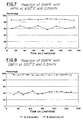
- Example 1a A portion of the cristobalite/tridymite AlPO4 sample APIA was tested (Example 1a) in a microreactor for activity in the conversion of 2-methyl butanal to isoprene at 400°C. For comparison, a similar run was carried out using a portion of the all tridymite AlPO4, sample APIB (Example 1b). The reactions were carried out using a nitrogen carrier gas flow rate of 24 ml/minute and a flow rate of 0.2 ml/hr of 2-methyl butanal feed. The conversion and selectivity for the dehydration reactions were determined at intervals using an on-line gas chromatograph and mass spectrometry. The results are shown in Figures 1 and 2 which show the percent conversion and percent selectivity for isoprene plotted against time in minutes after raising the temperature from 370°C initially.
- APIA Figure 1
- APIB Figure 2
- high activity in excess of 80%
- selectivity in excess of 70%
- Results are shown in Figures 3 to 8 in which:- Figures 3 and 4 are graphs of % selectivity against % conversion using variable flow rates of 2-methyl butanal feed (increasing from 0.1 ml/hr to 0.8 ml/hr in steps of 0.1 m every 30 minutes).
- Figures 5 and 6 are graphs of % conversion and % selectivity measured at various intervals of time using 2-methyl isopropyl ketone feed at a fixed flow rate of 0.1 ml/hr.
- Figures 7 and 8 are similar graphs of % conversion and % selectivity measured at various intervals of time using 2-methyl isopropyl ketone feed at a fixed flow rate of 0.2 ml/hr.
- aluminium phosphate having the cristobalite structure is markedly superior to boron phosphate in converting methyl isopropyl ketone, which is an intermediate product in the dehydration of 2-methyl butanal, to isoprene.
- This superiority is an important advantage since, in this dehydration reaction, an appreciable amount of the ketone is formed and conversion of this intermediate to isoprene significantly improves the process economics of the conversion reaction starting from 2-methyl butanal.
- a mixed aluminium/boron phosphate catalyst was prepared using the following procedure:- Aluminium chloride (12.0 g) in water (50 ml) was mixed with orthophosphoric acid, H3PO4, (85% solution, 5.2 ml) at 20°C then boron phosphate (0.5 g) was added.
- the boron phosphate had been prepared previously by reacting boric acid and phosphoric acid in 1:1 molar ratio then calcining at 350°C for 3 hours and shown to have the cristobalite structure using x-ray diffraction.
- ammonium hydroxide was added gradually to bring the pH to 7.
- the precipitate was separated by filtration, washed three times with isopropyl alcohol and dried at 120°C for 16 hours.
- the product was calcined for three hours at 800°C in air.
- the boron:aluminium molar ratio was found to be 0.05 mole BPO4:0.95 mole aluminium phosphate (ie 5% BPO4) and x-ray diffraction showed that the aluminium phosphate was a mixture of cristobalite/tridymite structures.
- the mixed aluminium/boron phosphate and the comparison material (both having the cristobalite structure) were tested in the dehydration reaction at 325°C using a flow rate of 2-methyl butanal of 0.2 ml/hr and a nitrogen carrier gas flow rate of 24 ml/min.
- the results showed that the mixed catalyst gave an enhanced yield of isoprene compared with the all AlPO4 catalyst.
Landscapes
- Chemical & Material Sciences (AREA)
- Organic Chemistry (AREA)
- Engineering & Computer Science (AREA)
- Materials Engineering (AREA)
- Chemical Kinetics & Catalysis (AREA)
- Organic Low-Molecular-Weight Compounds And Preparation Thereof (AREA)
- Low-Molecular Organic Synthesis Reactions Using Catalysts (AREA)
- Catalysts (AREA)
Description
- This invention relates to the preparation of a conjugated diene by dehydration of the corresponding carbonyl compound having the same number of carbon atoms and to a catalyst for the dehydration reaction. Conjugated dienes, especially butadiene and isoprene, are important monomers for the synthetic rubber industry. In a preferred embodiment, this invention relates to the preparation of isoprene by the dehydration of 2-methyl butyraldehyde (2-methylbutanal).
- Isoprene may be obtained as a by-product from naphtha cracking by extraction from pyrolysis fractions or it may be synthesised by a number of routes. Synthetic routes to isoprene have been comprehensively reviewed in the literature (see, for example, M J Rhoad, Rubber Ind (London) 9 (12), 68 (1975); E Schoenberg, H A Marsh, S J Walters and W M Saltman, Rubber Chem Tech 52, 526 (1979) and D L Schultz, Ed, Rubber World 179 (7), 87 (1980)).
- Extraction, dehydrogenation of isoamylene or isopentane and synthesis from acetylene/acetone or isobutene and formaldehyde are the usual processes to obtain isoprene, commercially. A high proportion of commercial production is obtained by extraction.
- Recently, interest has turned to a process for the synthesis of isoprene from linear butenes by isomerisation of mixed linear butenes, hydroformylation of the butene-2 mixture to 2-methylbutanal and dehydration of the 2-methylbutanal (see, for example, Proceedings 26th Assembly of International Rubber Study Group, Kuala Lumpur 29th September - 4 October 1980, 218; D A Bol'shakov et al, Prom Sint Kauchuka 8, 2 (1980), European Patent No 80449 and Forster, D; Sluka, J P and Vavere A Chemtech 16 No 12 746, 1986). The commercial attraction of this process is the availability of large quantities of linear butenes as a raffinate in the production of methyl tertiary butyl ether (MTBE) as an octane booster for petrol.
- A process for producing isoprene by dehydration of valeraldehyde (2-methyl butanal) using aluminium silicate at 400° to 600°C was first disclosed in US Patent No 1,033,180 (1911). Much more recently, British Patent No 1,385,348 (Erdolchemie) discloses a process for the catalytic production of dienes from aldehydes by dehydration using an acidic dehydration catalyst. Boron phosphate is a particularly preferred dehydration catalyst for the process. USSR Inventors Certificate No 721116 (Bolshakov et al) discloses a method for the preparation of boron phosphate for the production of isoprene, the invention relating to a method of obtaining a boron phosphate catalyst with enhanced activity and selectivity. Other improved boron phosphate catalysts and/or improved processes for their use in the dehydration reaction have been described in US Patent Nos 4,524,233, 4,587,372, 4,632,913 and 4,628,140 (all Goodyear Tire & Rubber) and US Patent No 4,547,614 (Monsanto). The conversion of 2-methylbutanal to isoprene using boron phosphate catalysts has been extensively studied by Moffat and co-workers (see, for example, J B Moffat Rev Chemical Intermediates 8 1 (1987)).
- Although boron phosphate catalysts exhibit high conversions and selectivities, they deactivate very rapidly and long term effective reactivation techniques have not been disclosed in the literature.
- Catalysts, other than boron phosphate, which have been investigated for this dehydration reaction include an alum or a mixed sulphate derived therefrom (British Patent No 2,063,297) and magnesium ammonium phosphate (British Patent No 2,093,060).
- Irodov, A V, Smirnov, V A and Kryrukov S I Zh Org Khim, 18 1401 (1982) describe the study of a number of catalysts based on the phosphates of aluminium, boron and calcium although the results reported relate only to calcium phosphate catalyst. A wide variety of catalysts including Be3(PO4)2, Mg3(PO4)2, Si3(PO4), Ba3(PO4)2 and AlPO4 et al, was studied by Maraeva V A et al, Neftekhim 30 (2) 211 (1990). According to EP-A-0272 663 aldehydes can be converted to dienes by contacting them with a non-zeolitic molecular sieve. Especially suitable is the conversion of 2-methyl butyraldehyde to isoprene. The use of zeolites as dehydration catalyst has been disclosed in US Patent No 4,560,822 and European Patent No 219,042 (BASF) as well as US Patent No 4,734,538 and European Patent No 272,662 (Union Carbide).
- Another form of catalyst is that disclosed in US-A-4310440 which is a family of crystalline, microporous alumino phosphate compositions synthesised by hydrothermal crystallisation at an elevated temperature of alumino phosphate gels containing a molecular structure-forming template, eg an organic amine or a quaternary ammonium salt.
- According to the present invention a process for the preparation of a conjugated diene from the corresponding carbonyl compound having the same number of carbon atoms comprises contacting the carbonyl compound at a temperature of 300°C to 450°C with a catalyst comprising aluminium phosphate having at least 20% cristobalite structure on a molar basis. The invention also includes a process for the preparation of a conjugated diene from the corresponding carbonyl compound having the same number of carbon atoms which comprises contacting the carbonyl compound at a temperature of 300°C to 450°C with a catalyst comprising aluminium phosphate obtained by reaction of an aluminium salt and a phosphorus compound followed by calcination at a temperature of at least 300°C for 1 hour or more, the starting materials and reaction conditions being such that the aluminium phosphate product comprises at least some, preferably 25% or more, of crystobalite structure.
- Aluminium phosphate is capable of existing in six different structures analogous to the six forms of silica. The type of phase occurring is dependent on the method of preparation and treatment temperature.

We have found that the crystal structure of the aluminium phosphate has a critical effect upon catalyst activity and selectivity in the dehydration of the carbonyl compound (hereinafter referred to as 'the dehydration reaction'). Thus aluminium phosphate having the cristobalite structure exhibits similar activity in the dehydration reaction, to boron phosphate though at a higher temperature in contrast to aluminium phosphate, which is all tridymite structure or substantially (eg 85% or more on a molar basis) tridymite structure, which shows much reduced conversions and selectivity in the dehydration reaction. - The aluminium phosphate used in the diene preparation need not be all cristobalite. A material which is a mixture of cristobalite and triydmite phases (1:1 molar), of predominately (ie is a major proportion of) cristobalite structure or of all cristobalite structure is preferred. However mixtures containing as little as 20% cristobalite, on a molar basis, give improvements in the dehydration reaction. Thus 20% cristobalite represents a practical minimum figure. The aluminium to phosphorus atomic ratio is preferably 1:1 or is such that there is a stoichiometric excess of phosphorus. One method for preparing aluminium phosphate of suitable structure is that described by Campelo J M et al J Catalysis 111, 106 (1988) incorporated herein by reference, starting from aluminium chloride but the invention is not restricted to the use of aluminium phosphate prepared by this method.
- It is also possible to prepare mixed phosphates, for example a mixed aluminium/boron phosphate in which the aluminium phosphate comprises at least some cristobalite structure by incorporation of eg 5% to 40%, preferably 10% to 30% molar, of boron phosphate during the aluminium phosphate preparation and the invention specifically includes the use of such mixed phosphates in the dehydration reaction.
- In general terms, aluminium phosphate of the required structure is obtained by reaction of an aluminium salt and a phosphorus compound followed by calcination at a temperature of at least 300°C for 1 hour or more. Reaction may be by controlled precipitation with alkali, preferably dilute aqueous ammonia, added slowly to an aqueous solution of the aluminium salt and the phosphorus compound, eg a phosphorus acid. Co-grinding of suitable starting materials, dry or by the paste method, is another possible route. Calcination is an important step in the catalyst preparation and is generally carried out at a temperature of at least 300°C for a period of one hour or more. Temperatures considerably in excess of 300°C are preferred, for example, 500°C or more, preferably 650°C to 1100°C, more preferably 750°C to 1000°C. Calcination time is at least one hour but prolonged calcination, eg up to 8 hours, is not deleterious.
- Irrespective of the particular method used to prepare the catalyst, the desired product preferably comprises at least 20% cristobalite structure. This can be established using powder x-ray diffraction. The structure corresponding to the orthorhombic symmetry of alpha cristobalite gives a characteristic peak, particularly at 2ϑ = 21.79.
- The surface area of the cristobalite aluminium phosphate catalyst should be as high as possible, for example 50 to 200 m²/g, determined using the BET nitrogen adsorption method.
- In the process of the invention a carbonyl compound, preferably an aldehyde corresponding to the desired conjugated diene, is contacted with the catalyst at a temperature of 300°C to 450°C. In general, carbonisation and undesired side reactions occur at higher temperatures. These should therefore be avoided. At lower temperatures than 300°C the reaction is not so efficient and yields of the diene product are therefore much lower.
- Using the process of the invention, the carbonyl compound, preferably an aldehyde, has the same number of carbon atoms as the desired conjugated diene, but as is known in the art, some isomers are easier to dehydrate than others. In the preparation of isoprene, 2-methyl butanal is the preferred starting material compared with 3-methyl butanal or 2,2-dimethyl propanal. In the preparation of isoprene from 2-methyl butanal, some methyl isopropyl ketone is formed and this is readily dehydrated to isoprene using the alpha cristobalite catalyst described herein.
- Other suitable aldehydes are n-butanal, 2,3-dimethyl butanal and 2- or 3-ethyl butanal.
- If desired an inert carrier gas such as nitrogen or carbon dioxide can be included with the carbonyl compound feed.
- By the process of the invention conjugated dienes, especially 1,3 butadiene and isoprene may be prepared in good yield and high selectivity.
- The following examples illustrate the invention:-
- An aluminium phosphate (Al/P molar ratio = 1) sample (APIA) was prepared from aluminium chloride and orthophosphoric acid using the procedure described by Campelo et al, J Catalysis 111, 106 (1988) at page 107.
- To a cold aqueous solution containing an equal amount of aluminium chloride and orthophosphoric acid solution (0.985M) is dropwise added, with continuous stirring, a cold dilute aqueous ammonia solution (40% volume) until a white gel was precipitated and the pH of the supernatant became 7.0. The precipitate was then allowed to stand at room temperature for eighteen hours.
- The mixture was then filtered and the precipitate washed several times with propan-2-ol and then dried at 120°C for twenty four hours. The resultant dried gel was screened at 200-250 mesh then calcined at 800°C for three hours.
- This sample (APIA) was characterised as being a mixture of alpha cristobalite and tridymite structures of approximately 30% cristobalite structure using powder x-ray diffraction and was also studied using Diffuse Reflectance Fourier Transform Infra-Red, X-Ray Photoelectron Spectroscopy and X-Ray Fluorescence.
- For comparison, a second aluminium phosphate sample (APIB) was prepared as described above but starting with aluminium sulphate instead of aluminium chloride. The dried gel was calcined at 500°C for three hours. This sample (APIB) was characterised as being all tridymite structure using the same method as for sample APIA.
- The surface of each sample was measured using the BET method and was 93 m²/g for sample (APIA) and 50 m²/g for sample (APIB).
- A portion of the cristobalite/tridymite AlPO4 sample APIA was tested (Example 1a) in a microreactor for activity in the conversion of 2-methyl butanal to isoprene at 400°C. For comparison, a similar run was carried out using a portion of the all tridymite AlPO4, sample APIB (Example 1b). The reactions were carried out using a nitrogen carrier gas flow rate of 24 ml/minute and a flow rate of 0.2 ml/hr of 2-methyl butanal feed. The conversion and selectivity for the dehydration reactions were determined at intervals using an on-line gas chromatograph and mass spectrometry. The results are shown in Figures 1 and 2 which show the percent conversion and percent selectivity for isoprene plotted against time in minutes after raising the temperature from 370°C initially.
- By comparing Figures 1 and 2 it can be seen very clearly that the cristobalite/tridymite AlPO4 sample, APIA (Figure 1) is considerably superior to the all tridymite sample, APIB (Figure 2). In particular the high activity (in excess of 80%) compares with only about 50% for the all tridymite sample and selectivity (in excess of 70%) is superior.
- In this example, portions of the aluminium phosphate cristobalite/tridymite sample (APIA) were tested for activity in the conversion of 2-methyl butanal and methyl isopropyl ketone to isoprene using the procedure of Example 1.
- For comparison, similar runs were carried out at 325°C using a boron phosphate catalyst (DBP.11) prepared from phosphoric acid and boric acid then calcined at 350°C. 325°C is known to be the preferred operating temperature for boron phosphate in the dehydration reaction.
- Results (% conversion and % selectivity) are shown in Figures 3 to 8 in which:-
Figures 3 and 4 are graphs of % selectivity against % conversion using variable flow rates of 2-methyl butanal feed (increasing from 0.1 ml/hr to 0.8 ml/hr in steps of 0.1 m every 30 minutes). - Fig 3 AlPO4 (sample APIA) at 400°C.
- Fig 4 BPO4 sample at 320°C.
- In each case the nitrogen flow was 24 ml/min.
- Figures 5 and 6 are graphs of % conversion and % selectivity measured at various intervals of time using 2-methyl isopropyl ketone feed at a fixed flow rate of 0.1 ml/hr.
- Fig 5 AlPO4 (Sample APIA) at 400°C.
- Fig 6 BPO4 sample at 325°C.
- Figures 7 and 8 are similar graphs of % conversion and % selectivity measured at various intervals of time using 2-methyl isopropyl ketone feed at a fixed flow rate of 0.2 ml/hr.
- From Figures 3 and 4 it can be seen that the activity/selectivity observed for the cristobalite/tridymite AlPO4 catalyst at 400°C (Fig 3) is comparable to that observed for boron phosphate at 325°C (Fig 4) in the conversion of 2-methyl butanal to isoprene.
- From Figures 5, 6, 7 and 8 it can be seen that the activity for the cristobalite/tridymite AlPO4 catalyst at 400°C (Figs 5 & 7) is broadly similar to that observed for boron phosphate at 325°C (Figs 6 & 8) in the conversion of 2-methyl isopropyl ketone to isoprene. However the selectivity for isoprene is much superior when using the AlPO4 catalyst.
- Unexpectedly the aluminium phosphate having the cristobalite structure is markedly superior to boron phosphate in converting methyl isopropyl ketone, which is an intermediate product in the dehydration of 2-methyl butanal, to isoprene. This superiority is an important advantage since, in this dehydration reaction, an appreciable amount of the ketone is formed and conversion of this intermediate to isoprene significantly improves the process economics of the conversion reaction starting from 2-methyl butanal.
- A mixed aluminium/boron phosphate catalyst was prepared using the following procedure:-
Aluminium chloride (12.0 g) in water (50 ml) was mixed with orthophosphoric acid, H3PO4, (85% solution, 5.2 ml) at 20°C then boron phosphate (0.5 g) was added. The boron phosphate had been prepared previously by reacting boric acid and phosphoric acid in 1:1 molar ratio then calcining at 350°C for 3 hours and shown to have the cristobalite structure using x-ray diffraction. To the mixed aluminium/boron reagent system, ammonium hydroxide was added gradually to bring the pH to 7. - The mixed aluminium/boron phosphate precipitated and was left, without further treatment, open to air to age for 15 hours. The precipitate was separated by filtration, washed three times with isopropyl alcohol and dried at 120°C for 16 hours. The product was calcined for three hours at 800°C in air. The boron:aluminium molar ratio was found to be 0.05 mole BPO4:0.95 mole aluminium phosphate (ie 5% BPO4) and x-ray diffraction showed that the aluminium phosphate was a mixture of cristobalite/tridymite structures.
- For comparison, a second sample was prepared using the same procedure but omitting the boron phosphate.
- The mixed aluminium/boron phosphate and the comparison material (both having the cristobalite structure) were tested in the dehydration reaction at 325°C using a flow rate of 2-methyl butanal of 0.2 ml/hr and a nitrogen carrier gas flow rate of 24 ml/min. The results showed that the mixed catalyst gave an enhanced yield of isoprene compared with the all AlPO4 catalyst.
Claims (7)
- A process for the preparation of a conjugated diene from the corresponding carbonyl compound having the same number of carbon atoms which comprises contacting the carbonyl compound at a temperature of 300°C to 450°C with a catalyst comprising aluminium phosphate having at least 20% cristobalite structure on a molar basis.
- A process according to claim 1 in which the catalyst is a mixture of cristobalite structure and tridymite structure in which the cristobalite structure predominates.
- A process according to claim 1 or claim 2 in which the catalyst comprises a mixed aluminium phosphate/boron phosphate in which the aluminium phosphate has at least 20% cristobalite structure on a molar basis.
- A process according to any preceding claim in which the aluminium phosphate used as catalyst is obtained by reaction of an aluminium salt and a phosphorus compound followed by calcination at a temperature of at least 300°C for one hour or more, the salt and compound and the reaction conditions being such that the aluminium phosphate product comprises at least said 20% cristobalite structure.
- A process according to claim 4 in which the calcination temperature is 500°C or more.
- A process according to claim 5 in which the calcination temperature is 650°C to 1100°C.
- A process according to any preceding claim in which 2-methyl butanal is converted to isoprene.
Applications Claiming Priority (2)
| Application Number | Priority Date | Filing Date | Title |
|---|---|---|---|
| GB9012429 | 1990-06-04 | ||
| GB909012429A GB9012429D0 (en) | 1990-06-04 | 1990-06-04 | Preparation of conjugated dienes |
Publications (2)
| Publication Number | Publication Date |
|---|---|
| EP0463748A1 EP0463748A1 (en) | 1992-01-02 |
| EP0463748B1 true EP0463748B1 (en) | 1995-06-21 |
Family
ID=10677040
Family Applications (1)
| Application Number | Title | Priority Date | Filing Date |
|---|---|---|---|
| EP91304959A Expired - Lifetime EP0463748B1 (en) | 1990-06-04 | 1991-05-31 | Preparation of conjugated dienes |
Country Status (5)
| Country | Link |
|---|---|
| EP (1) | EP0463748B1 (en) |
| CA (1) | CA2043437A1 (en) |
| DE (1) | DE69110555T2 (en) |
| ES (1) | ES2075352T3 (en) |
| GB (2) | GB9012429D0 (en) |
Citations (1)
| Publication number | Priority date | Publication date | Assignee | Title |
|---|---|---|---|---|
| US4310440A (en) * | 1980-07-07 | 1982-01-12 | Union Carbide Corporation | Crystalline metallophosphate compositions |
Family Cites Families (3)
| Publication number | Priority date | Publication date | Assignee | Title |
|---|---|---|---|---|
| DE3419379A1 (en) * | 1984-05-24 | 1985-11-28 | Basf Ag, 6700 Ludwigshafen | METHOD FOR PRODUCING SERVES BY DEHYDRATING ALDEHYDES |
| US4524233A (en) * | 1984-09-10 | 1985-06-18 | The Goodyear Tire & Rubber Company | Process for the production of dienes from aldehydes |
| US4734538A (en) * | 1986-12-24 | 1988-03-29 | Union Carbide Corporation | Process for the production of dienes |
-
1990
- 1990-06-04 GB GB909012429A patent/GB9012429D0/en active Pending
-
1991
- 1991-05-29 CA CA002043437A patent/CA2043437A1/en not_active Abandoned
- 1991-05-31 EP EP91304959A patent/EP0463748B1/en not_active Expired - Lifetime
- 1991-05-31 DE DE69110555T patent/DE69110555T2/en not_active Expired - Lifetime
- 1991-05-31 GB GB9111778A patent/GB2245901B/en not_active Expired - Fee Related
- 1991-05-31 ES ES91304959T patent/ES2075352T3/en not_active Expired - Lifetime
Patent Citations (1)
| Publication number | Priority date | Publication date | Assignee | Title |
|---|---|---|---|---|
| US4310440A (en) * | 1980-07-07 | 1982-01-12 | Union Carbide Corporation | Crystalline metallophosphate compositions |
Non-Patent Citations (1)
| Title |
|---|
| US-A 4 310 440 * |
Also Published As
| Publication number | Publication date |
|---|---|
| CA2043437A1 (en) | 1991-12-05 |
| ES2075352T3 (en) | 1995-10-01 |
| EP0463748A1 (en) | 1992-01-02 |
| GB2245901B (en) | 1994-02-16 |
| DE69110555T2 (en) | 1995-11-02 |
| GB9111778D0 (en) | 1991-07-24 |
| GB2245901A (en) | 1992-01-15 |
| GB9012429D0 (en) | 1990-07-25 |
| DE69110555D1 (en) | 1995-07-27 |
Similar Documents
| Publication | Publication Date | Title |
|---|---|---|
| US5049536A (en) | Catalytically active silica and alumina gel and process for preparing it | |
| EP0212850B1 (en) | Dehydrogenation process and catalyst | |
| US4171320A (en) | Hydrocarbon synthesis from CO and H2 using Ru supported on group VB metal oxides | |
| AU2008274582B2 (en) | Process for preparing silicoaluminoposphate (SAPO) molecular sieves, catalysts containing said sieves and catalytic dehydration processes using said catalysts | |
| US4970191A (en) | Basic mixed oxide | |
| RU2656602C1 (en) | One-step method of obtaining butadiene | |
| GB2049645A (en) | Activated alumina catalyst for the conversion of ethanol to ethylene | |
| EP0118085B1 (en) | Process for preparation of tertiary olefins | |
| US4711869A (en) | Silica-titania hydrocarbon conversion catalyst | |
| EP0252365A2 (en) | Process for the condensation of aldehydes | |
| KR940000786B1 (en) | Light olefin small polymerization method | |
| US5055620A (en) | Process for aldol condensation | |
| KR100219895B1 (en) | PROCESS FOR OBTAINING β-HYDROXY AND/OR α,β-UNSATURATED CARBONYL COMPOUNDS | |
| CA1246524A (en) | Post-treatment of ams-1b crystalline molecular sieve- based catalyst composition | |
| JPH0257524B2 (en) | ||
| Campelo et al. | The effect of the fluoride ion on the catalytic activity of AIPO4 in the cyclohexene skeletal isomerization | |
| US4560822A (en) | Preparation of dienes by dehydration of aldehydes | |
| US5264644A (en) | Preparation of conjugated dienes | |
| US3873632A (en) | Alkylaromatic hydrocarbon isomerization process | |
| EP0463748A1 (en) | Preparation of conjugated dienes | |
| JP2582759B2 (en) | New phenylacetaldehyde | |
| US4014952A (en) | Process for the preparation of isoprene | |
| US4906793A (en) | Silica-titania hydrocarbon conversion catalyst | |
| US4996385A (en) | Use of silica-titania hydrocarbon conversion catalyst in hydrocarbon conversion processes | |
| US4444904A (en) | Process for synthesizing a multicomponent acidic catalyst composition containing zirconium by an organic solution method |
Legal Events
| Date | Code | Title | Description |
|---|---|---|---|
| PUAI | Public reference made under article 153(3) epc to a published international application that has entered the european phase |
Free format text: ORIGINAL CODE: 0009012 |
|
| AK | Designated contracting states |
Kind code of ref document: A1 Designated state(s): BE DE ES FR IT NL |
|
| 17P | Request for examination filed |
Effective date: 19920609 |
|
| 17Q | First examination report despatched |
Effective date: 19931118 |
|
| GRAA | (expected) grant |
Free format text: ORIGINAL CODE: 0009210 |
|
| AK | Designated contracting states |
Kind code of ref document: B1 Designated state(s): BE DE ES FR IT NL |
|
| PG25 | Lapsed in a contracting state [announced via postgrant information from national office to epo] |
Ref country code: NL Free format text: LAPSE BECAUSE OF FAILURE TO SUBMIT A TRANSLATION OF THE DESCRIPTION OR TO PAY THE FEE WITHIN THE PRESCRIBED TIME-LIMIT Effective date: 19950621 Ref country code: BE Effective date: 19950621 |
|
| REF | Corresponds to: |
Ref document number: 69110555 Country of ref document: DE Date of ref document: 19950727 |
|
| ET | Fr: translation filed | ||
| ITF | It: translation for a ep patent filed | ||
| REG | Reference to a national code |
Ref country code: ES Ref legal event code: FG2A Ref document number: 2075352 Country of ref document: ES Kind code of ref document: T3 |
|
| NLV1 | Nl: lapsed or annulled due to failure to fulfill the requirements of art. 29p and 29m of the patents act | ||
| PLBE | No opposition filed within time limit |
Free format text: ORIGINAL CODE: 0009261 |
|
| STAA | Information on the status of an ep patent application or granted ep patent |
Free format text: STATUS: NO OPPOSITION FILED WITHIN TIME LIMIT |
|
| PG25 | Lapsed in a contracting state [announced via postgrant information from national office to epo] |
Ref country code: ES Free format text: LAPSE BECAUSE OF NON-PAYMENT OF DUE FEES Effective date: 19960601 |
|
| 26N | No opposition filed | ||
| PG25 | Lapsed in a contracting state [announced via postgrant information from national office to epo] |
Ref country code: FR Effective date: 19970131 |
|
| REG | Reference to a national code |
Ref country code: FR Ref legal event code: ST |
|
| REG | Reference to a national code |
Ref country code: ES Ref legal event code: FD2A Effective date: 19990503 |
|
| PG25 | Lapsed in a contracting state [announced via postgrant information from national office to epo] |
Ref country code: IT Free format text: LAPSE BECAUSE OF NON-PAYMENT OF DUE FEES;WARNING: LAPSES OF ITALIAN PATENTS WITH EFFECTIVE DATE BEFORE 2007 MAY HAVE OCCURRED AT ANY TIME BEFORE 2007. THE CORRECT EFFECTIVE DATE MAY BE DIFFERENT FROM THE ONE RECORDED. Effective date: 20050531 |
|
| PGFP | Annual fee paid to national office [announced via postgrant information from national office to epo] |
Ref country code: DE Payment date: 20100527 Year of fee payment: 20 |
|
| REG | Reference to a national code |
Ref country code: DE Ref legal event code: R071 Ref document number: 69110555 Country of ref document: DE |
|
| PG25 | Lapsed in a contracting state [announced via postgrant information from national office to epo] |
Ref country code: DE Free format text: LAPSE BECAUSE OF EXPIRATION OF PROTECTION Effective date: 20110601 |