EP0463140B1 - production of a peroxidase - Google Patents
production of a peroxidase Download PDFInfo
- Publication number
- EP0463140B1 EP0463140B1 EP91902188A EP91902188A EP0463140B1 EP 0463140 B1 EP0463140 B1 EP 0463140B1 EP 91902188 A EP91902188 A EP 91902188A EP 91902188 A EP91902188 A EP 91902188A EP 0463140 B1 EP0463140 B1 EP 0463140B1
- Authority
- EP
- European Patent Office
- Prior art keywords
- peroxidase
- culture
- cells
- extra
- cellular
- Prior art date
- Legal status (The legal status is an assumption and is not a legal conclusion. Google has not performed a legal analysis and makes no representation as to the accuracy of the status listed.)
- Expired - Lifetime
Links
Images


Classifications
-
- C—CHEMISTRY; METALLURGY
- C12—BIOCHEMISTRY; BEER; SPIRITS; WINE; VINEGAR; MICROBIOLOGY; ENZYMOLOGY; MUTATION OR GENETIC ENGINEERING
- C12N—MICROORGANISMS OR ENZYMES; COMPOSITIONS THEREOF; PROPAGATING, PRESERVING, OR MAINTAINING MICROORGANISMS; MUTATION OR GENETIC ENGINEERING; CULTURE MEDIA
- C12N9/00—Enzymes; Proenzymes; Compositions thereof; Processes for preparing, activating, inhibiting, separating or purifying enzymes
- C12N9/0004—Oxidoreductases (1.)
- C12N9/0065—Oxidoreductases (1.) acting on hydrogen peroxide as acceptor (1.11)
-
- C—CHEMISTRY; METALLURGY
- C12—BIOCHEMISTRY; BEER; SPIRITS; WINE; VINEGAR; MICROBIOLOGY; ENZYMOLOGY; MUTATION OR GENETIC ENGINEERING
- C12N—MICROORGANISMS OR ENZYMES; COMPOSITIONS THEREOF; PROPAGATING, PRESERVING, OR MAINTAINING MICROORGANISMS; MUTATION OR GENETIC ENGINEERING; CULTURE MEDIA
- C12N5/00—Undifferentiated human, animal or plant cells, e.g. cell lines; Tissues; Cultivation or maintenance thereof; Culture media therefor
- C12N5/04—Plant cells or tissues
Definitions
- This invention relates to a process for the production of peroxidase enzymes from plant cell cultures.
- Peroxidase enzymes catalyse a host of reactions in which hydrogen peroxide is a specific oxidising agent and a wide range of substrates act as electron donors. It is widely used at the moment in diagnostic kits, and among other things it has potential use in other industries such as paper recycling, chemical, waste water treatment, and in detergents and bleaching agents.
- Peroxidase enzymes are widely distributed in nature and are produced by a wide variety of plant species. At the present time, however, the chief commercial source is horseradish. In the commercial production of horseradish peroxidase (HRP) the horseradish roots are harvested and the sprouted roots are minced mechanically in water to form a starting material. From this, peroxidase is purified by a series of ammonium sulphate and ethanol precipitations. To obtain high purity enzyme, conventional chromatographic techniques are employed. Unfortunately, this process leads to large quantities of waste tissue and problems arise with dispersing of waste. Not only this but there is a significant irreversible loss of enzyme activity resulting from the precipitations with ethanol and ammonium sulphate which are used to extract the enzyme from the tissue. The present invention not only overcomes many of these problems associated with the conventional method for producing peroxidase, it also produces a new peroxidase with improved properties in relatively high yields.
- a plant cell culture technique for the production HRPO is disclosed in J. Fermentation Technology, 1989, 67:31-34 based on cultures established from genetically modified horseradish cells, modified to increase the stability of the enzyme.
- That intra-cellular peroxidase may be recovered, for example, by the established procedures of disrupting the cells to release the intra-cellular peroxidase followed by extraction and precipitation with ethanol and ammonium sulphate in the conventional way.
- a process for the production of peroxidase enzyme which comprises establishing a plant cell culture of extra-cellular peroxidase producing cells from a plant of the genus Acer in suspension in a culture medium capable of supporting the growth of the extra-cellular peroxidase producing cells, continuing the culture of said cells in suspension in the culture medium with the concomitant accumulation of extra-cellular peroxidase in the culture medium, and recovering the accumulated peroxidase from the culture medium.
- the resulting extra-cellular peroxidase has advantageous properties over the conventional horseradish peroxidase. Included among these properties are a high initial level of activity and an improved thermal stability at high temperatures. This is very useful in some industries where a reaction may be more effective at a higher working temperature but is unable to operate there due to the very sensitive nature of enzymes which denature under adverse thermal conditions. Additionally, the peroxidase according to this invention has a high storage stability.
- This invention thus provides in substantially pure form peroxidase enzyme having the following characteristics: Source Acer pseudoplatanus Location Extra-cellular Mol.wt.(Gel.Filtration) Approx. 37000 pH range 4 - 9 Optimum pH 5.5 Optimum assay temperature 45°C Stability Retains at least 50% of optimum activity at 65 to 75°C. Reactivity Substantially H 2 O 2 specific, but reactive in the presence of: guaiacol, pyrogallol, aminophenol or O-dianisidine as the reductant. Elution profile Six distinct activity peaks - see Figure 4.
- the process of the present invention begins with the initiation and maintenance of a suspension culture of the extra-cellular peroxidase producing Acer plant cells, preferably Acer pseudoplatanus .
- Acer seeds preferably seeds of Acer pseudoplatanus on a suitable growth medium, e.g. agar
- a suitable growth medium e.g. agar
- excising root tissue from the germinated seeds transferring the excised root tissue on to fresh growth medium and continuing the growth of the root tissue in said fresh medium to produce root tissue calli, which can then be comminuted and transferred into a liquid growth medium to establish a suspension culture of the root tissue.
- This initial culture can then be subcultured to provide for the large scale production and accumulation of extra-cellular peroxidase in the culture medium.
- any suitable culture medium for plant cell cultures e.g. Gamborgs B5 medium or Murashige and Skoog (MS) medium containing a suitable carbon source, e.g. one or more of glucose, sucrose and fructose in an amount of from 1-15% by weight, preferably from about 2-5%, and most preferably about 3%, and the necessary phytohormones, e.g. dichlorophenoxyacetic acid and kinetin.
- a suitable carbon source e.g. one or more of glucose, sucrose and fructose in an amount of from 1-15% by weight, preferably from about 2-5%, and most preferably about 3%
- the necessary phytohormones e.g. dichlorophenoxyacetic acid and kinetin.
- the preferred medium is the MS medium.
- a characteristic feature of the plant cell cultures used in accordance with the present invention, particularly the root cell cultures of Acer Pseudoplatanus is that it has been found possible to use carbohydrate waste materials containing glucose and/or sucrose, such as are produced in large amounts in the confectionery industry, as the carbon source in the culture medium, rather than the customarily used refined glucose and/or sucrose.
- carbohydrate waste materials containing glucose and/or sucrose such as are produced in large amounts in the confectionery industry, as the carbon source in the culture medium, rather than the customarily used refined glucose and/or sucrose.
- Glucose and/or sucrose containing wastes produced in the confectionery industry e.g. floor sweepings, mis-shapen moulded confectioneries and discontinued lines, present a substantial disposal problem in the confectionery industry since it is usually not economic to reprocess the waste, and simply dumping the waste presents environmental problems.
- wastes provide an inexpensive source of glucose and/or sucrose for the plant cell cultures and which can be supplied simply by extracting the waste confectionery with water and feeding the crude extract, without further purification or refinement, to the culture medium, the plant cell culture being remarkably tolerant to the other water soluble ingredients, dyes etc. in the waste confectionery.
- the necessary phytohormones used in the medium are 2,4-dichlorophenoxyacetic acid at around lmg. L -1 and 6-furfurylaminopurine (kinetin) at around 0.1 mg. L -1 .
- Aerobic culture conditions are used preferably at a pH from 5.6 to 5.8 and at a temperature of about 25°C, with optimum peroxidase activity occurring in the culture medium after about 8 days of continuous culture.
- Sycamore cell cultures are initiated from root tissue of Acer pseudoplatanus by first germinating seeds of A. pseudoplatanus on agar medium.
- the seeds are first sterilised by immersion in 15% hypochlorite solution with shaking on a gyrotatory shaker for approximately 40 minutes at 24°C. After this sterilisation, the seeds are washed with copious amounts of sterile distilled water to remove all traces of hypochlorite. The seeds are then placed on agar and incubated at 25°C. After germination, small segments of root are excised aseptically and transferred onto fresh agar medium. Periodically the tissue is examined for callus formation.
- Callus cultures are then initiated and established by routine subculture, following which portions of the callus culture tissue are transferred into a liquid culture medium to establish the cell suspension culture.
- suspension culture viability tests are carried out on the cell lines using the fluorescin diacetate method (described below).
- the suspension cultures can be subcultured by volume on a fortnightly basis, i.e. they can be maintained routinely by the aseptic transfer of 20 mL amounts of 14 day old cultures into 100 mL aliquots of sterilised culture medium in 250 ml Erlenmeyer flasks. The flasks are placed on a gyrotatory shaker at 150 rpm in the light at 25°C.
- the cell line is initiated on B5 medium (Gamborg et al., Exp.Cell Res.50, 148-151, 1968) with 3% sucrose as the carbon source, but is later transferred on to Murashige & Skoog (MS) medium (Murashige et al. Physiol. Plant 15, 473-497, 1962) with 3% glucose as the carbon source.
- the phytohormones added to the medium are 1 mg.L -1 2,4-dichlorophenoxyacetic acid and 0.1 mg.L -1 6-furfurylaminopurine (kinetin).
- the pH of the growth medium is adjusted to 5.6 - 5.8 prior to sterilisation.
- the cultures are subcultured by weight, i.e. 3 g fresh weight per 100 ml medium.
- two litres of 14 day old culture can be used as inoculum in 8L of fresh medium in a reaction vessel equipped with a stirrer.
- Suitable intermediate scale culture conditions include pH 5.6 to 5.8 temperature 25°C and a compressed air feed of about 1Lmin -1 .
- LH Registered TM 30 L airlift fermentor
- 14 day old root cell cultures sufficient to give a fresh weight of 20g.L -1 (approximately 2.0 g.L -1 dry weight).
- the vessel is aerated with compressed air at a rate of 6L.min -1 and at a temperature of 25°C.
- Figure 1 of the accompanying drawings shows a growth profile for a sycamore culture grown in a 30 L airlift fermentor. This shows an optimum cell viability after 9 days in the fermentor, an optimum cell fresh weight after 11 days in the fermentor and an optimum cell dry weight after 10 days in the fermentor.
- a Whatman (Registered Trade Mark) No. 1 filter paper disc, 2.5 cm in diameter, is weighed directly after its removal from an oven where it has been drying at 60°C for at least 24 hours.
- the disc i then placed on a stainless steel filter bed seated on a rubber stopper in a Buchner flask.
- the disc is wetted with distilled water and a vacuum applied to the flask for approximately 10 seconds to remove excess water.
- the wet filter disc is then weighed immediately.
- the disc was replaced on the filter bed and the filter top is positioned directly over the disc.
- a 3 mL portion of culture is filtered through the system and a vacuum applied to remove any excess of medium.
- the disc with the cells thereon is weighed immediately and placed in an oven at 60°C for at least 24 hours before being reweighed. Calculations of the fresh and dry weights of the cultures are made using the following equations:
- samples from the culture are fractionated into cell and medium fractions in order to determine the peroxidase activity in each.
- the cells are disrupted on ice using a pre-chilled mortar and pestle with approximately 10% (w/w) pre-chilled, acid-washed sand and ice cold 0.1 M McIlvaine's citric acid phosphate buffer* pH 5.5.
- An Eppendorf system was used to centrifuge the cell homogenate for 2 minutes to remove the sand and debris. The resulting supernatant was transferred to clean tubes and centrifuged for a further 5 minutes. The supernatant was carefully removed from the centrifuge tube and kept on ice before use.
- Peroxidase catalyses a host of reaction in which hydrogen peroxide is a specific oxidising agent and a wide range of substrates act as electron donors.
- the assay mixture is prepared as follows: Assay Mixture For Medium Enzyme For Cell Enzyme 0.1M McIlvaine's citric acid phosphate buffer, pH 5.5 2.80 mL 2.84 mL 0.15 M guaiacol (18.3 g.L -1 ) 0.10 mL 0.10 mL 43.7 mM H 2 O 2 0.04 mL 0.04 mL Cell extract - 0.02 mL Medium 0.06 mL -
- the reaction is started by the addition of hydrogen peroxide. Although the volume of cell extract is altered depending upon the activity of the enzyme, however the total assay volume is maintained at 3.0 ml by a corresponding change in the volume of buffer used. The appearance of tetra-guaiacal, i.e. an increase in absorbence at 436 nm, is monitored during the reaction at 25°C.
- One unit of enzyme activity is defined as ⁇ moles of substrate utilised per minute.
- ⁇ /min is the change in absorbence per minute at 436 nm
- 25.5 is the molar extinction coefficient (cm 2 /mole) for tetra-guaiacal.
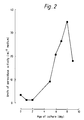
- Figure 2 of the accompanying drawings represents a graph showing the peroxidase production profile in the medium from a suspension root cell culture of Acer psuedoplatanus in 250 mL Erlenmeyer flasks.
- On day 8 of culture there is a substantial increase in medium peroxidase activity to reach 34,500 units per litre of medium. This level of activity corresponds to approximately 80% of total peroxidase activity in the culture. Thus it would appear that day 8 of the culture is optimum for the extraction of peroxidase.
- Extraction of peroxidase from the culture is achieved by conventional downstream processing techniques, and here the advantage of this process lies in the fact that approximately 80% of the peroxidase is present in the culture medium and therefore is relatively easily extracted.
- the latter is concentrated using ultrafiltration by first passing the liquor through a 100,000 molecular weight cut-off filter, followed by a 20,000 molecular weight cut-off filter.
- a 100,000 molecular weight cut-off filter For high purity enzyme conventional chromatography techniques can be employed.
- the characteristics of the peroxidase product obtained are as follows:
Landscapes
- Life Sciences & Earth Sciences (AREA)
- Health & Medical Sciences (AREA)
- Engineering & Computer Science (AREA)
- Chemical & Material Sciences (AREA)
- Wood Science & Technology (AREA)
- Organic Chemistry (AREA)
- Zoology (AREA)
- Bioinformatics & Cheminformatics (AREA)
- Genetics & Genomics (AREA)
- Biotechnology (AREA)
- Biomedical Technology (AREA)
- Microbiology (AREA)
- Biochemistry (AREA)
- General Engineering & Computer Science (AREA)
- General Health & Medical Sciences (AREA)
- Cell Biology (AREA)
- Botany (AREA)
- Medicinal Chemistry (AREA)
- Molecular Biology (AREA)
- Enzymes And Modification Thereof (AREA)
Description
| Source | Acer pseudoplatanus |
| Location | Extra-cellular |
| Mol.wt.(Gel.Filtration) | Approx. 37000 |
| pH range | 4 - 9 |
| Optimum pH | 5.5 |
| Optimum assay temperature | 45°C |
| Stability | Retains at least 50% of optimum activity at 65 to 75°C. |
| Reactivity | Substantially H2O2 specific, but reactive in the presence of: guaiacol, pyrogallol, aminophenol or O-dianisidine as the reductant. |
| Elution profile | Six distinct activity peaks - see Figure 4. |
- Fig.1
- shows the growth profile of A. pseudoplatanus root cell cultures in MS medium supplie with 3% sucrose/glucose in a 30L airlift fermentor.
- Fig.2
- shows the extra-cellular peroxidase production profile of A. pseudoplatanus root cell culture in MS medium supplied with 3% sucrose/glucose in a 250 mL Erlenmeyer flask.
- Fig.3
- shows the thermal stability profile of the A. pseudoplatanus extra-cellular peroxidase.
- Fig.4
- shows the elution profile.


| Assay Mixture | ||
| For Medium Enzyme | For Cell Enzyme | |
| 0.1M McIlvaine's citric acid phosphate buffer, pH 5.5 | 2.80 mL | 2.84 mL |
| 0.15 M guaiacol (18.3 g.L -1) | 0.10 mL | 0.10 mL |
| 43.7 mM H2O2 | 0.04 mL | 0.04 mL |
| Cell extract | - | 0.02 mL |
| Medium | 0.06 mL | - |
| | 4 to 9; |
| Optimum pH | 5.5; |
| Optimum assay | 45°C |
Claims (11)
- A process for the production of peroxidase enzyme which comprises establishing a plant cell culture of extra-cellular peroxidase producing cells from a plant of the genus Acer in suspension in a culture medium capable of supporting the growth of the extra-cellular peroxidase producing cells, continuing the culture of said cells in suspension in the culture medium with the concomitant accumulation of extra-cellular peroxidase in the culture medium, and recovering the accumulated peroxidase from the culture medium.
- A process according to claim 1, wherein the extra-cellular peroxidase producing plant cells are cells from the species Acer pseudoplatanus.
- A process according to claim 1 or 2, wherein the extra-cellular peroxidase producing plant cells are root cells.
- A process according to claim 3, wherein the suspension culture is established from germinated plant seeds by first germinating the plant seeds on a first growth medium, transferring sections of root tissue from the germinated seeds to fresh growth medium, allowing the transferred root tissue to form a callus, disrupting the callus and dispersing the disrupted callus cells into the culture medium to form a suspension culture.
- A process according to any one of claims 1 - 4, where in the culture medium used in the suspension culture of the extra-cellular peroxidase producing plant cells contains as a carbon source from 1-15% by weight fructose, glucose or sucrose.
- A process according to claim 5, wherein there is used as the carbon-containing source a carbohydrate waste material containing glucose and/or sucrose.
- A process according to claim 6, wherein the glucose and/or sucrose containing waste is a confectionery waste.
- A process according to any one of claims 2 - 8, wherein the cells are cultured in the suspension culture under aerobic conditions at a temperature of about 25°C and at a pH in the range 5.6 to 5.8.
- A process according to any one of claims 1 - 8, wherein the product extra-cellular peroxidase is recovered from the culture as a crude extract by separating the supernatant peroxidase-containing liquor from the culture and concentrating the liquor to produce a crude peroxidase containing concentrate.
- A process according to any one of claims 1 - 9, wherein following the suspension culture, the cultured plant cell tissue is separated from the culture medium to provide a supernatant liquor containing the accumulated extra-cellular peroxidase, recovering the extra-cellular peroxidase from the supernatant liquor and further processing the separated plant cell tissue to recover intra-cellular peroxidase as a separate product.
- A process according to claim 10, wherein the intra-cellular peroxidase is recovered from the separated plant cell tissue by disrupting the cells in the separated plant cell tissue, extracting the intra-cellular peroxidase from the disrupted plant cells by extraction with ethanol and precipitating the extracted intra-cellular peroxidase with ammonium sulphate.
Applications Claiming Priority (3)
| Application Number | Priority Date | Filing Date | Title |
|---|---|---|---|
| GB9000827 | 1990-01-15 | ||
| GB909000827A GB9000827D0 (en) | 1990-01-15 | 1990-01-15 | Novel peroxidase and its production |
| PCT/GB1991/000051 WO1991010729A1 (en) | 1990-01-15 | 1991-01-15 | Novel peroxidase and its production |
Publications (2)
| Publication Number | Publication Date |
|---|---|
| EP0463140A1 EP0463140A1 (en) | 1992-01-02 |
| EP0463140B1 true EP0463140B1 (en) | 1998-04-01 |
Family
ID=10669292
Family Applications (1)
| Application Number | Title | Priority Date | Filing Date |
|---|---|---|---|
| EP91902188A Expired - Lifetime EP0463140B1 (en) | 1990-01-15 | 1991-01-15 | production of a peroxidase |
Country Status (5)
| Country | Link |
|---|---|
| EP (1) | EP0463140B1 (en) |
| JP (1) | JPH04504364A (en) |
| DE (1) | DE69129169T2 (en) |
| GB (1) | GB9000827D0 (en) |
| WO (1) | WO1991010729A1 (en) |
Cited By (1)
| Publication number | Priority date | Publication date | Assignee | Title |
|---|---|---|---|---|
| CN101210231B (en) * | 2007-12-20 | 2010-09-08 | 东北林业大学 | A suspension cell line of Acer japonica with high gallic acid production |
Families Citing this family (4)
| Publication number | Priority date | Publication date | Assignee | Title |
|---|---|---|---|---|
| GB9119717D0 (en) * | 1991-09-16 | 1991-10-30 | Plant Science Ltd | Peroxidase producing plant cell cultures |
| WO1993010218A1 (en) * | 1991-11-14 | 1993-05-27 | The United States Government As Represented By The Secretary Of The Department Of Health And Human Services | Vectors including foreign genes and negative selective markers |
| FR2693208A1 (en) * | 1992-07-02 | 1994-01-07 | Inocosm Laboratoires | Prepn. of anti-radical enzyme compsn. for prodn. of super-oxide dismutase, peroxidase and catalase - by extn. with ethanol@ or methanol followed by recovery, re-extraction and vacuum drying. |
| US7390641B2 (en) | 2004-05-25 | 2008-06-24 | Council Of Scientific And Industrial Research | Production of peroxidase from plant cell and callus cultures |
-
1990
- 1990-01-15 GB GB909000827A patent/GB9000827D0/en active Pending
-
1991
- 1991-01-15 DE DE69129169T patent/DE69129169T2/en not_active Expired - Fee Related
- 1991-01-15 EP EP91902188A patent/EP0463140B1/en not_active Expired - Lifetime
- 1991-01-15 WO PCT/GB1991/000051 patent/WO1991010729A1/en not_active Ceased
- 1991-01-15 JP JP3502478A patent/JPH04504364A/en active Pending
Cited By (1)
| Publication number | Priority date | Publication date | Assignee | Title |
|---|---|---|---|---|
| CN101210231B (en) * | 2007-12-20 | 2010-09-08 | 东北林业大学 | A suspension cell line of Acer japonica with high gallic acid production |
Also Published As
| Publication number | Publication date |
|---|---|
| JPH04504364A (en) | 1992-08-06 |
| EP0463140A1 (en) | 1992-01-02 |
| WO1991010729A1 (en) | 1991-07-25 |
| GB9000827D0 (en) | 1990-03-14 |
| DE69129169T2 (en) | 1998-07-30 |
| DE69129169D1 (en) | 1998-05-07 |
Similar Documents
| Publication | Publication Date | Title |
|---|---|---|
| Solymosy et al. | A new method based on the use of diethyl pyrocarbonate as a nuclease inhibitor for the extraction of undegraded nucleic acid from plant tissues | |
| Sunderland et al. | Shed pollen culture in Hordeum vulgare | |
| Seara et al. | Autolysis of the cell wall. Its possible role in endogenous and IAA‐induced growth in epicotyls of Cicer arietinum | |
| WO1991010729A1 (en) | Novel peroxidase and its production | |
| Kurina Sanz et al. | Enhancement of tessaric acid production in Tessaria absinthioides cell suspension cultures | |
| US5728550A (en) | Peroxidase production | |
| Kudielka et al. | Derepression of glyoxylate cycle enzyme activities in anise suspension culture cells | |
| Lainé et al. | Callus formation from cotyledon protoplasts of Pinus oocarpa and Pinus patula | |
| Thorup et al. | Ribosome‐Inactivating Protein Production from Trichosanthes kirilowii Plant Cell Cultures | |
| US7390641B2 (en) | Production of peroxidase from plant cell and callus cultures | |
| Ishida et al. | Cell wall-associated peroxidase in cultured cells of liverwort, Marchantia polymorpha L. Changes of peroxidase level and its localization in the cell wall | |
| Kudielka et al. | Substrate dependent formation of glyoxysomes in cell suspension cultures of anise (Pimpinella anisum L.) | |
| Johnson et al. | Pectolyase Y-23 for isolating mesophyll protoplasts from several Medicago species | |
| US5670357A (en) | Peroxidase produced by plant cell cultures | |
| Hazarika et al. | Sucrose induced biochemical changes in in vitro microshoots of Citrus species | |
| Chaubet et al. | β-Galactosidases of suspension-cultured Medicago sativa cells growing on lactose | |
| JP2967532B2 (en) | Method for producing taxane compound | |
| Chowhury et al. | Callus production from photoautotrophic soybean cell culture protoplasts | |
| PT98441A (en) | Process for the production of a peroxidase enzyme | |
| Ikeda et al. | Effect of auxins on the formation of ubiquinone by tobacco plant cells in suspension culture | |
| EP0249772A2 (en) | Method and composition for plant tissue and cell culture | |
| Tamer et al. | Protease from callus and cell suspension cultures of Onopordum turcicum (Compositae) | |
| Bouchet et al. | Soluble and cell-wall peroxidases and auxin destruction in normal and habituated tobacco callus | |
| Obata-Sasamoto et al. | Starch deposition in potato callus cultures | |
| Geissler et al. | Reactivation by a bacterial acetate: Enzyme ligase of plant glyoxysomal isocitrate lyase |
Legal Events
| Date | Code | Title | Description |
|---|---|---|---|
| PUAI | Public reference made under article 153(3) epc to a published international application that has entered the european phase |
Free format text: ORIGINAL CODE: 0009012 |
|
| 17P | Request for examination filed |
Effective date: 19910914 |
|
| AK | Designated contracting states |
Kind code of ref document: A1 Designated state(s): CH DE DK FR GB IT LI NL SE |
|
| RAP1 | Party data changed (applicant data changed or rights of an application transferred) |
Owner name: PHYTERA LIMITED |
|
| RAP1 | Party data changed (applicant data changed or rights of an application transferred) |
Owner name: PHYTERA, INC. |
|
| 17Q | First examination report despatched |
Effective date: 19960130 |
|
| GRAG | Despatch of communication of intention to grant |
Free format text: ORIGINAL CODE: EPIDOS AGRA |
|
| GRAG | Despatch of communication of intention to grant |
Free format text: ORIGINAL CODE: EPIDOS AGRA |
|
| GRAH | Despatch of communication of intention to grant a patent |
Free format text: ORIGINAL CODE: EPIDOS IGRA |
|
| GRAH | Despatch of communication of intention to grant a patent |
Free format text: ORIGINAL CODE: EPIDOS IGRA |
|
| GRAA | (expected) grant |
Free format text: ORIGINAL CODE: 0009210 |
|
| AK | Designated contracting states |
Kind code of ref document: B1 Designated state(s): CH DE DK FR GB IT LI NL SE |
|
| PG25 | Lapsed in a contracting state [announced via postgrant information from national office to epo] |
Ref country code: IT Free format text: LAPSE BECAUSE OF FAILURE TO SUBMIT A TRANSLATION OF THE DESCRIPTION OR TO PAY THE FEE WITHIN THE PRESCRIBED TIME-LIMIT;WARNING: LAPSES OF ITALIAN PATENTS WITH EFFECTIVE DATE BEFORE 2007 MAY HAVE OCCURRED AT ANY TIME BEFORE 2007. THE CORRECT EFFECTIVE DATE MAY BE DIFFERENT FROM THE ONE RECORDED. Effective date: 19980401 Ref country code: LI Free format text: LAPSE BECAUSE OF FAILURE TO SUBMIT A TRANSLATION OF THE DESCRIPTION OR TO PAY THE FEE WITHIN THE PRESCRIBED TIME-LIMIT Effective date: 19980401 Ref country code: CH Free format text: LAPSE BECAUSE OF FAILURE TO SUBMIT A TRANSLATION OF THE DESCRIPTION OR TO PAY THE FEE WITHIN THE PRESCRIBED TIME-LIMIT Effective date: 19980401 Ref country code: NL Free format text: LAPSE BECAUSE OF FAILURE TO SUBMIT A TRANSLATION OF THE DESCRIPTION OR TO PAY THE FEE WITHIN THE PRESCRIBED TIME-LIMIT Effective date: 19980401 |
|
| REG | Reference to a national code |
Ref country code: CH Ref legal event code: EP |
|
| ET | Fr: translation filed | ||
| REF | Corresponds to: |
Ref document number: 69129169 Country of ref document: DE Date of ref document: 19980507 |
|
| PG25 | Lapsed in a contracting state [announced via postgrant information from national office to epo] |
Ref country code: SE Free format text: LAPSE BECAUSE OF FAILURE TO SUBMIT A TRANSLATION OF THE DESCRIPTION OR TO PAY THE FEE WITHIN THE PRESCRIBED TIME-LIMIT Effective date: 19980701 Ref country code: DK Free format text: LAPSE BECAUSE OF FAILURE TO SUBMIT A TRANSLATION OF THE DESCRIPTION OR TO PAY THE FEE WITHIN THE PRESCRIBED TIME-LIMIT Effective date: 19980701 |
|
| NLV1 | Nl: lapsed or annulled due to failure to fulfill the requirements of art. 29p and 29m of the patents act | ||
| REG | Reference to a national code |
Ref country code: CH Ref legal event code: PL |
|
| PLBE | No opposition filed within time limit |
Free format text: ORIGINAL CODE: 0009261 |
|
| STAA | Information on the status of an ep patent application or granted ep patent |
Free format text: STATUS: NO OPPOSITION FILED WITHIN TIME LIMIT |
|
| PGFP | Annual fee paid to national office [announced via postgrant information from national office to epo] |
Ref country code: DK Payment date: 19990304 Year of fee payment: 9 |
|
| 26N | No opposition filed | ||
| REG | Reference to a national code |
Ref country code: GB Ref legal event code: IF02 |
|
| PGFP | Annual fee paid to national office [announced via postgrant information from national office to epo] |
Ref country code: FR Payment date: 20040108 Year of fee payment: 14 |
|
| PGFP | Annual fee paid to national office [announced via postgrant information from national office to epo] |
Ref country code: GB Payment date: 20040114 Year of fee payment: 14 |
|
| PGFP | Annual fee paid to national office [announced via postgrant information from national office to epo] |
Ref country code: DE Payment date: 20040122 Year of fee payment: 14 |
|
| PG25 | Lapsed in a contracting state [announced via postgrant information from national office to epo] |
Ref country code: GB Free format text: LAPSE BECAUSE OF NON-PAYMENT OF DUE FEES Effective date: 20050115 |
|
| PG25 | Lapsed in a contracting state [announced via postgrant information from national office to epo] |
Ref country code: DE Free format text: LAPSE BECAUSE OF NON-PAYMENT OF DUE FEES Effective date: 20050802 |
|
| GBPC | Gb: european patent ceased through non-payment of renewal fee |
Effective date: 20050115 |
|
| PG25 | Lapsed in a contracting state [announced via postgrant information from national office to epo] |
Ref country code: FR Free format text: LAPSE BECAUSE OF NON-PAYMENT OF DUE FEES Effective date: 20050930 |
|
| REG | Reference to a national code |
Ref country code: FR Ref legal event code: ST |