EP0460827B1 - Production of alpha, para-dimethylstyrene - Google Patents
Production of alpha, para-dimethylstyrene Download PDFInfo
- Publication number
- EP0460827B1 EP0460827B1 EP91304600A EP91304600A EP0460827B1 EP 0460827 B1 EP0460827 B1 EP 0460827B1 EP 91304600 A EP91304600 A EP 91304600A EP 91304600 A EP91304600 A EP 91304600A EP 0460827 B1 EP0460827 B1 EP 0460827B1
- Authority
- EP
- European Patent Office
- Prior art keywords
- catalyst
- reactor
- para
- process according
- cymene
- Prior art date
- Legal status (The legal status is an assumption and is not a legal conclusion. Google has not performed a legal analysis and makes no representation as to the accuracy of the status listed.)
- Expired - Lifetime
Links
- 238000004519 manufacturing process Methods 0.000 title claims abstract description 7
- 239000003054 catalyst Substances 0.000 claims abstract description 41
- HFPZCAJZSCWRBC-UHFFFAOYSA-N p-cymene Chemical compound CC(C)C1=CC=C(C)C=C1 HFPZCAJZSCWRBC-UHFFFAOYSA-N 0.000 claims abstract description 37
- 238000000034 method Methods 0.000 claims abstract description 31
- 238000006243 chemical reaction Methods 0.000 claims abstract description 24
- UQSXHKLRYXJYBZ-UHFFFAOYSA-N Iron oxide Chemical compound [Fe]=O UQSXHKLRYXJYBZ-UHFFFAOYSA-N 0.000 claims abstract description 22
- 238000006356 dehydrogenation reaction Methods 0.000 claims abstract description 21
- 239000007789 gas Substances 0.000 claims abstract description 14
- QVGXLLKOCUKJST-UHFFFAOYSA-N atomic oxygen Chemical compound [O] QVGXLLKOCUKJST-UHFFFAOYSA-N 0.000 claims abstract description 11
- 239000001301 oxygen Substances 0.000 claims abstract description 11
- 229910052760 oxygen Inorganic materials 0.000 claims abstract description 11
- SZVJSHCCFOBDDC-UHFFFAOYSA-N ferrosoferric oxide Chemical compound O=[Fe]O[Fe]O[Fe]=O SZVJSHCCFOBDDC-UHFFFAOYSA-N 0.000 claims abstract description 10
- PPBRXRYQALVLMV-UHFFFAOYSA-N Styrene Natural products C=CC1=CC=CC=C1 PPBRXRYQALVLMV-UHFFFAOYSA-N 0.000 claims abstract description 5
- 229930195733 hydrocarbon Natural products 0.000 claims description 9
- 150000002430 hydrocarbons Chemical class 0.000 claims description 9
- 239000004215 Carbon black (E152) Substances 0.000 claims description 7
- 238000011065 in-situ storage Methods 0.000 claims description 5
- JEIPFZHSYJVQDO-UHFFFAOYSA-N iron(III) oxide Inorganic materials O=[Fe]O[Fe]=O JEIPFZHSYJVQDO-UHFFFAOYSA-N 0.000 claims description 5
- 238000010438 heat treatment Methods 0.000 claims description 3
- 239000007795 chemical reaction product Substances 0.000 claims description 2
- 238000004508 fractional distillation Methods 0.000 claims description 2
- 239000007788 liquid Substances 0.000 claims description 2
- 230000003197 catalytic effect Effects 0.000 abstract description 2
- 239000002304 perfume Substances 0.000 abstract description 2
- 239000000047 product Substances 0.000 description 13
- YNQLUTRBYVCPMQ-UHFFFAOYSA-N Ethylbenzene Chemical compound CCC1=CC=CC=C1 YNQLUTRBYVCPMQ-UHFFFAOYSA-N 0.000 description 6
- 230000003750 conditioning effect Effects 0.000 description 4
- 238000011069 regeneration method Methods 0.000 description 4
- 239000006227 byproduct Substances 0.000 description 3
- QROGIFZRVHSFLM-UHFFFAOYSA-N prop-1-enylbenzene Chemical class CC=CC1=CC=CC=C1 QROGIFZRVHSFLM-UHFFFAOYSA-N 0.000 description 3
- 239000000376 reactant Substances 0.000 description 3
- 238000010025 steaming Methods 0.000 description 3
- DNRJTBAOUJJKDY-UHFFFAOYSA-N 2-Acetyl-3,5,5,6,8,8-hexamethyl-5,6,7,8- tetrahydronaphthalene Chemical compound CC(=O)C1=C(C)C=C2C(C)(C)C(C)CC(C)(C)C2=C1 DNRJTBAOUJJKDY-UHFFFAOYSA-N 0.000 description 2
- PKXHXOTZMFCXSH-UHFFFAOYSA-N 3,3-dimethylbut-1-ene Chemical compound CC(C)(C)C=C PKXHXOTZMFCXSH-UHFFFAOYSA-N 0.000 description 2
- IJGRMHOSHXDMSA-UHFFFAOYSA-N Atomic nitrogen Chemical compound N#N IJGRMHOSHXDMSA-UHFFFAOYSA-N 0.000 description 2
- 238000004458 analytical method Methods 0.000 description 2
- 230000001143 conditioned effect Effects 0.000 description 2
- 230000003647 oxidation Effects 0.000 description 2
- 238000007254 oxidation reaction Methods 0.000 description 2
- IWDCLRJOBJJRNH-UHFFFAOYSA-N p-cresol Chemical compound CC1=CC=C(O)C=C1 IWDCLRJOBJJRNH-UHFFFAOYSA-N 0.000 description 2
- 230000008929 regeneration Effects 0.000 description 2
- 102200082886 rs33950093 Human genes 0.000 description 2
- JIVANURAWUCQIG-UHFFFAOYSA-N 1,1,2,4,4,7-hexamethyl-2,3-dihydronaphthalene Chemical compound C1=C(C)C=C2C(C)(C)C(C)CC(C)(C)C2=C1 JIVANURAWUCQIG-UHFFFAOYSA-N 0.000 description 1
- UFHFLCQGNIYNRP-UHFFFAOYSA-N Hydrogen Chemical compound [H][H] UFHFLCQGNIYNRP-UHFFFAOYSA-N 0.000 description 1
- ZLMJMSJWJFRBEC-UHFFFAOYSA-N Potassium Chemical compound [K] ZLMJMSJWJFRBEC-UHFFFAOYSA-N 0.000 description 1
- 230000002411 adverse Effects 0.000 description 1
- 230000032683 aging Effects 0.000 description 1
- 125000001931 aliphatic group Chemical group 0.000 description 1
- -1 aromatic cyclohexenes Chemical class 0.000 description 1
- 125000003118 aryl group Chemical group 0.000 description 1
- 239000011324 bead Substances 0.000 description 1
- 230000015572 biosynthetic process Effects 0.000 description 1
- 238000009835 boiling Methods 0.000 description 1
- 239000000919 ceramic Substances 0.000 description 1
- 239000000571 coke Substances 0.000 description 1
- 238000004939 coking Methods 0.000 description 1
- 230000000694 effects Effects 0.000 description 1
- 239000002360 explosive Substances 0.000 description 1
- 239000003205 fragrance Substances 0.000 description 1
- ONKNPOPIGWHAQC-UHFFFAOYSA-N galaxolide Chemical compound C1OCC(C)C2=C1C=C1C(C)(C)C(C)C(C)(C)C1=C2 ONKNPOPIGWHAQC-UHFFFAOYSA-N 0.000 description 1
- 238000004817 gas chromatography Methods 0.000 description 1
- 239000001257 hydrogen Substances 0.000 description 1
- 229910052739 hydrogen Inorganic materials 0.000 description 1
- 239000003701 inert diluent Substances 0.000 description 1
- 230000014759 maintenance of location Effects 0.000 description 1
- 238000001819 mass spectrum Methods 0.000 description 1
- 239000000463 material Substances 0.000 description 1
- 239000000203 mixture Substances 0.000 description 1
- 229910052757 nitrogen Inorganic materials 0.000 description 1
- 229910052700 potassium Inorganic materials 0.000 description 1
- 239000011591 potassium Substances 0.000 description 1
- 238000002360 preparation method Methods 0.000 description 1
- 238000010926 purge Methods 0.000 description 1
- 229930195734 saturated hydrocarbon Natural products 0.000 description 1
- 238000003786 synthesis reaction Methods 0.000 description 1
Images
Classifications
-
- B—PERFORMING OPERATIONS; TRANSPORTING
- B01—PHYSICAL OR CHEMICAL PROCESSES OR APPARATUS IN GENERAL
- B01J—CHEMICAL OR PHYSICAL PROCESSES, e.g. CATALYSIS OR COLLOID CHEMISTRY; THEIR RELEVANT APPARATUS
- B01J23/00—Catalysts comprising metals or metal oxides or hydroxides, not provided for in group B01J21/00
- B01J23/90—Regeneration or reactivation
- B01J23/94—Regeneration or reactivation of catalysts comprising metals, oxides or hydroxides of the iron group metals or copper
-
- B—PERFORMING OPERATIONS; TRANSPORTING
- B01—PHYSICAL OR CHEMICAL PROCESSES OR APPARATUS IN GENERAL
- B01J—CHEMICAL OR PHYSICAL PROCESSES, e.g. CATALYSIS OR COLLOID CHEMISTRY; THEIR RELEVANT APPARATUS
- B01J23/00—Catalysts comprising metals or metal oxides or hydroxides, not provided for in group B01J21/00
- B01J23/70—Catalysts comprising metals or metal oxides or hydroxides, not provided for in group B01J21/00 of the iron group metals or copper
- B01J23/74—Iron group metals
- B01J23/745—Iron
-
- C—CHEMISTRY; METALLURGY
- C07—ORGANIC CHEMISTRY
- C07C—ACYCLIC OR CARBOCYCLIC COMPOUNDS
- C07C5/00—Preparation of hydrocarbons from hydrocarbons containing the same number of carbon atoms
- C07C5/32—Preparation of hydrocarbons from hydrocarbons containing the same number of carbon atoms by dehydrogenation with formation of free hydrogen
- C07C5/327—Formation of non-aromatic carbon-to-carbon double bonds only
- C07C5/333—Catalytic processes
- C07C5/3332—Catalytic processes with metal oxides or metal sulfides
-
- Y—GENERAL TAGGING OF NEW TECHNOLOGICAL DEVELOPMENTS; GENERAL TAGGING OF CROSS-SECTIONAL TECHNOLOGIES SPANNING OVER SEVERAL SECTIONS OF THE IPC; TECHNICAL SUBJECTS COVERED BY FORMER USPC CROSS-REFERENCE ART COLLECTIONS [XRACs] AND DIGESTS
- Y02—TECHNOLOGIES OR APPLICATIONS FOR MITIGATION OR ADAPTATION AGAINST CLIMATE CHANGE
- Y02P—CLIMATE CHANGE MITIGATION TECHNOLOGIES IN THE PRODUCTION OR PROCESSING OF GOODS
- Y02P20/00—Technologies relating to chemical industry
- Y02P20/50—Improvements relating to the production of bulk chemicals
- Y02P20/584—Recycling of catalysts
Definitions
- the present invention relates to a method of producing alpha, para-dimethylstyrene (hereafter "APDMS”) by a catalytic dehydrogenation of para-cymene.
- ADMS alpha, para-dimethylstyrene
- APDMS is a valuable intermediate for the manufacture of perfumes with musk-like fragrance such as 1,1,3,4,4,6-hexamethyl 1,2,3,4-tetrahydronaphthalene (hereafter referred to as "HMT”) and its 7-acetyl derivative (hereafter referred to as “Acetyl HMT”).
- HMT 1,1,3,4,4,6-hexamethyl 1,2,3,4-tetrahydronaphthalene
- Alcohol HMT 7-acetyl derivative
- Such products and their preparation are described in GB-A-1442954 and in US-A-3246044. However, in the former patent specification it is stated at page 1, lines 26-31 that:
- US Patent No. 3246044 discloses a simple convenient process for the production of HMT and Acetyl HMT utilizing as reactants alpha, para-dimethylstyrene and neo-hexene (t-butylethylene).
- alpha, para-dimethylstyrene required in the process of US Patent 3246044 previously in good supply as a by-product of p-cresol ex p-cymene process, is now only available in limited supply and is likely to become even scarcer in the future.”
- the present invention is a process for the production of alpha, para-dimethylstyrene, said process comprising dehydrogenating para-cyemene in the substantial absence of oxygen or an oxidising gas and in the presence of an iron oxide, Fe3O4, catalyst and steam at a temperature in the range from 500-700°C and a pressure from 0.1-10 atmospheres.
- the expression "in the substantial absence of oxygen or an oxidising gas” as used herein and throughout the specification is meant that to carry out the dehydrogenation of para-cymene to APDMS at no stage is any oxygen or oxidising gas introduced into the system and any such gases present in the reaction system prior to the commencement of the reaction is purged from the dehydrogenation reactor.
- the co-reactant steam is not regarded as an oxidising gas.
- the dehydrogenation reaction should be totally free of any oxygen or oxidising gases as herein defined.
- the catalyst used for the dehydrogenation is the iron oxide catalyst, Fe3O4.
- This catalyst species can be derived by the reduction of a commercially available Fe2O3 catalyst. The reduction of Fe2O3 can be carried out prior to use in the dehydrogenation step or 'in situ', for instance by conditioning over a duration in a dehydrogenation reactor where significant quantities of hydrogen will be readily available for this purpose.
- Examples of commercial iron oxide catalysts that may be used include Girdler G64C (ex Sud-Chemie) and Shell 105. The performance of these catalysts may be improved by the use of promoters such as potassium.
- the reactor Prior to the introduction of the catalyst into the reactor it is essential to ensure that the reactor is substantially free of any oxygen or other oxidising gases. This is due to the fact that the presence of such gases may risk deactivating the iron oxide catalyst.
- the removal of oxygen or other oxidising gases in the reactor may be achieved by purging the reactor with a gas inert under the reaction conditions such as e.g. nitrogen.
- the relative molar ratios of steam to para-cymene in the feed is suitably from 1.5 : 1 to 20 : 1, preferably from 5 : 1 to 10 : 1.
- the dehydrogenation reaction is carried out at a temperature from 500-700°C, preferably from 520-600°C.
- the reaction pressure is preferably from 0.1-1 atmosphere.
- the process of the present invention can be carried out isothermally or adiabatically.
- the dehydrogenation reaction is suitably carried out using a liquid hourly space velocity (LHSV) in the range of 0.1-10hr ⁇ 1, preferably from 0.1-2hr ⁇ 1 based on the para-cymene feed.
- LHSV liquid hourly space velocity
- the iron oxide catalyst will be deactivated during the dehydrogenation reaction due to coking.
- the coked catalyst has to be regenerated by steam in the absence of any hydrocarbon such as the feed hydrocarbon.
- the deactivated catalyst used in this reaction can however be regenerated without removing the same from the reactor by shutting off the hydrocarbon feed to the reactor and simply heating the deactivated catalyst in the presence of steam alone. Once the regeneration of the catalyst is achieved, the supply of the hydrocarbon to the reactor can be resumed and the dehydrogenation continued as previously.
- the alpha, para-dimethylstyrene so formed can be recovered from the reaction products by fractional distillation.
- Small amounts of by-products which can be formed by this process include methyl styrenes and non-aromatic cyclohexenes in amounts from 1-5%.
- Methyl styrenes form the light ends boiling from 160-170°C, the feed hydrocarbon boils at 176°C whereas APDMS boils at ca 185°C.
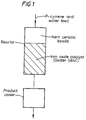
- Fig. 1 shows the experimental set-up used for the Examples described below.
- a reactor (18 in. long, 1 in. I.D.) was charged with 100 g (80ml) of a commercial iron oxide catalyst (Girdler G64C, ex Sud-Chemie). The remaining space at the top of the reactor was filled with inert diluent in the form of cylindrical ceramic beads (4mm x 4mm), which acted as a preheating zone.
- This iron oxide catalyst was pre-conditioned for two days using ethylbenzene (hereafter "EB") feed at 600°C, atmospheric pressure, LHSV 0.56hr ⁇ 1 and a steam/ethylbenzene ratio of 1.75w/w.
- EB ethylbenzene
- This pre-conditioning period reduced the iron oxide (Fe2O3) catalyst in situ to the more active haemetite form (Fe3O4). It is also possible to carry out this pre-conditioning procedure using p-cymene feed rather than EB.
- the temperature was reduced to 560°C and allowed to stabilise for two hours.
- the EB feed was then replaced by p-cymene feed of 98.2% purity.
- the feed rate and steam ratio were also altered when p-cymene was introduced into the reactor.
- the p-cymene feed rate was reduced to a space velocity of 0.30h ⁇ 1 and the steam/p-cymene ratio was increased to 6 w/w.
- Example 1 The procedure of Example 1 was continued for 18 hr (total 28 Hours-on-Stream (HOS)) the p-cymene feed was then stopped, whilst maintaining the steam flow in order to regenerate the catalyst by steaming for about 1 hr at a slightly lower temperature of about 550°C to remove any coke deposits from the catalyst surface.
- HOS Hours-on-Stream
- the reactor temperature was increased to 580°C, the p-cymene feed to the reactor restored at the same steam ratio and space velocity as in Example 1.
- the reactor product was sampled and analysed by GC. The conversion achieved (69.1%) was higher than that at 560°C and the selectivity was still high (95.0 mol%).
- Example 2 The reaction in Example 2 was continued for a further 4 hours (total 34 HOS) under the same conditions, after which a product sample was again analysed by GC. The conversion was found to be 54.7% and the selectivity was high at 95.4 mol%.
- Example 3 The reaction in Example 3 was continued for a further 6 hours (total 40 HOS) and the catalyst was then regenerated by steaming for 1hr at 550°C as in Example 2. Thereafter, p-cymene feed was re-introduced, with a reactor temperature of 550°C, the other reaction conditions remaining unchanged. After a 2hr run (total 42 HOS) a sample of the product was analysed by GC. The conversion was found to be 63.8% and the selectivity 97.9 mol%.
- Example 4 The reaction in Example 4 was continued for a further 44 hr (total 86 HOS) under the same conditions and a sample of the reactor product analysed again by GC. The conversion was found to be 40.9% and selectivity 97.8 mol%. This result showed that catalyst ageing was much slower at lower temperatures than at the relatively higher temperature of 580°C used in Example 3.
- Example 5 The catalyst after 86 HOS in Example 5 was steamed again for 2 hr as in Example 2. The p-cymene feed was then re-introduced and the reaction continued under the same conditions as in Example 5 for 2 hr (total 88 HOS). A product sample from the reactor was then analysed by GC and was found to show a conversion of 67.3% and a selectivity of 98.1 mol%. When compared with the results in Example 4, this result shows that the activity of the catalyst can be completely restored by the regeneration procedure used.
Landscapes
- Chemical & Material Sciences (AREA)
- Organic Chemistry (AREA)
- Chemical Kinetics & Catalysis (AREA)
- Engineering & Computer Science (AREA)
- Materials Engineering (AREA)
- Organic Low-Molecular-Weight Compounds And Preparation Thereof (AREA)
- Low-Molecular Organic Synthesis Reactions Using Catalysts (AREA)
- Pharmaceuticals Containing Other Organic And Inorganic Compounds (AREA)
Abstract
Description
- The present invention relates to a method of producing alpha, para-dimethylstyrene (hereafter "APDMS") by a catalytic dehydrogenation of para-cymene.
- APDMS is a valuable intermediate for the manufacture of perfumes with musk-like fragrance such as 1,1,3,4,4,6-hexamethyl 1,2,3,4-tetrahydronaphthalene (hereafter referred to as "HMT") and its 7-acetyl derivative (hereafter referred to as "Acetyl HMT"). These products are sold under the trade names "TONALID", "GALOXOLIDE" and "VERITONE" (all Regd Trade Marks). Such products and their preparation are described in GB-A-1442954 and in US-A-3246044. However, in the former patent specification it is stated at page 1, lines 26-31 that:
- "US Patent No. 3246044 discloses a simple convenient process for the production of HMT and Acetyl HMT utilizing as reactants alpha, para-dimethylstyrene and neo-hexene (t-butylethylene). However, the alpha, para-dimethylstyrene required in the process of US Patent 3246044, previously in good supply as a by-product of p-cresol ex p-cymene process, is now only available in limited supply and is likely to become even scarcer in the future."
- GB-A-1442954 was filed in 1973 and even today, nearly 20 years after the filing date of this application, there is a scarcity of alpha, para-dimethylstyrene. Thus there is at present no commercially viable synthetic route to APDMS.
- It is well known to dehydropenate ethyl benzene to styrene using a dehydrogenation catalyst. Such processes have been claimed and described inter alia in our published EP-A-336622, and in GB-A-1176916, GB-A-1378151, US-A-3654181, US-A-3702346, US-A-3703593, US-A-4048244, US-A-4048245, and US-A-4652687. Whilst all these prior publications include a long list of hydrocarbons, both aliphatic and aromatic, which can be dehydrogenated to produce the corresponding olefinic material from saturated hydrocarbons, none of them include para-cymene as a hydrocarbon which can be dehydrogenated by the methods claimed in these prior patents.
- A further list of patents mention a dehydrogenation reaction which is followed by an oxidation step and in these patents p-isopropyl toluene (which is the same as para-cymene) is inter alia listed although no specific examples of dehydrogenation of para-cymene to APDMS is described. These patents include: US Patents 4418237, 4435607, 4565898, 4652687, 4691071 and 4717779.
- The use of an oxidation step and the presence of oxygen as a reactant not only make the process capital intensive thereby adversely affecting the economics of the process but can also run the risk of forming explosive mixtures with the hydrocarbons and can in some instances deactivate the catalyst.
- It has now been found that the scarcity of APDMS can be met by the dehydrogenation of p-cymene using a process which avoids the use of any oxygen during the reaction.
- Accordingly, the present invention is a process for the production of alpha, para-dimethylstyrene, said process comprising dehydrogenating para-cyemene in the substantial absence of oxygen or an oxidising gas and in the presence of an iron oxide, Fe₃O₄, catalyst and steam at a temperature in the range from 500-700°C and a pressure from 0.1-10 atmospheres.
- By the expression "in the substantial absence of oxygen or an oxidising gas" as used herein and throughout the specification is meant that to carry out the dehydrogenation of para-cymene to APDMS at no stage is any oxygen or oxidising gas introduced into the system and any such gases present in the reaction system prior to the commencement of the reaction is purged from the dehydrogenation reactor. For the purposes of this invention, the co-reactant steam is not regarded as an oxidising gas. Ideally the dehydrogenation reaction should be totally free of any oxygen or oxidising gases as herein defined.
- The catalyst used for the dehydrogenation is the iron oxide catalyst, Fe₃O₄. This catalyst species can be derived by the reduction of a commercially available Fe₂O₃ catalyst. The reduction of Fe₂O₃ can be carried out prior to use in the dehydrogenation step or 'in situ', for instance by conditioning over a duration in a dehydrogenation reactor where significant quantities of hydrogen will be readily available for this purpose. Examples of commercial iron oxide catalysts that may be used include Girdler G64C (ex Sud-Chemie) and Shell 105. The performance of these catalysts may be improved by the use of promoters such as potassium.
- Prior to the introduction of the catalyst into the reactor it is essential to ensure that the reactor is substantially free of any oxygen or other oxidising gases. This is due to the fact that the presence of such gases may risk deactivating the iron oxide catalyst. The removal of oxygen or other oxidising gases in the reactor may be achieved by purging the reactor with a gas inert under the reaction conditions such as e.g. nitrogen.
- In carrying out the dehydrogenation reaction, the relative molar ratios of steam to para-cymene in the feed is suitably from 1.5 : 1 to 20 : 1, preferably from 5 : 1 to 10 : 1.
- The dehydrogenation reaction is carried out at a temperature from 500-700°C, preferably from 520-600°C. The reaction pressure is preferably from 0.1-1 atmosphere.
- The process of the present invention can be carried out isothermally or adiabatically.
- The dehydrogenation reaction is suitably carried out using a liquid hourly space velocity (LHSV) in the range of 0.1-10hr⁻¹, preferably from 0.1-2hr⁻¹ based on the para-cymene feed.
- It is expected that the iron oxide catalyst will be deactivated during the dehydrogenation reaction due to coking. In the case of the present invention, it is not possible to regenerate the catalyst by the conventional auto-regeneration methods. The coked catalyst has to be regenerated by steam in the absence of any hydrocarbon such as the feed hydrocarbon. The deactivated catalyst used in this reaction can however be regenerated without removing the same from the reactor by shutting off the hydrocarbon feed to the reactor and simply heating the deactivated catalyst in the presence of steam alone. Once the regeneration of the catalyst is achieved, the supply of the hydrocarbon to the reactor can be resumed and the dehydrogenation continued as previously. Of course, it would be possible also to remove the catalyst from the reactor and to introduce a fresh charge of the catalyst. However, this would necesitate shutdown of the process, and therefore, it is more preferable to regenerate the catalyst in situ by steaming.
- By operating the process as described above it is possible to readily achieve conversions in the region of 60-80% and selectivities of the order of 95-99%. In order to improve the conversion and selectivity of the reaction it may sometimes be an advantage to carry out the reaction in more than one reactor so that the effluent from the first reactor is fed into a second reactor containing a further aliquot/charge of a fresh catalyst. Such expedients will be well known to those skilled in the art.
- The alpha, para-dimethylstyrene so formed can be recovered from the reaction products by fractional distillation. Small amounts of by-products which can be formed by this process include methyl styrenes and non-aromatic cyclohexenes in amounts from 1-5%. Methyl styrenes form the light ends boiling from 160-170°C, the feed hydrocarbon boils at 176°C whereas APDMS boils at ca 185°C.
- Whilst methyl styrenes have to be removed before the APDMS product is used in synthesis of perfumery products such as Tonalid, the non-aromatics need not be separated for the subsequent reaction.
- The present invention is further illustrated with reference to the following Examples:
- Fig. 1 shows the experimental set-up used for the Examples described below. A reactor (18 in. long, 1 in. I.D.) was charged with 100 g (80ml) of a commercial iron oxide catalyst (Girdler G64C, ex Sud-Chemie). The remaining space at the top of the reactor was filled with inert diluent in the form of cylindrical ceramic beads (4mm x 4mm), which acted as a preheating zone.
- This iron oxide catalyst was pre-conditioned for two days using ethylbenzene (hereafter "EB") feed at 600°C, atmospheric pressure, LHSV 0.56hr⁻¹ and a steam/ethylbenzene ratio of 1.75w/w. This pre-conditioning period reduced the iron oxide (Fe₂O₃) catalyst in situ to the more active haemetite form (Fe₃O₄). It is also possible to carry out this pre-conditioning procedure using p-cymene feed rather than EB.
- Thereafter, the temperature was reduced to 560°C and allowed to stabilise for two hours. The EB feed was then replaced by p-cymene feed of 98.2% purity. The feed rate and steam ratio were also altered when p-cymene was introduced into the reactor. The p-cymene feed rate was reduced to a space velocity of 0.30h⁻¹ and the steam/p-cymene ratio was increased to 6 w/w.
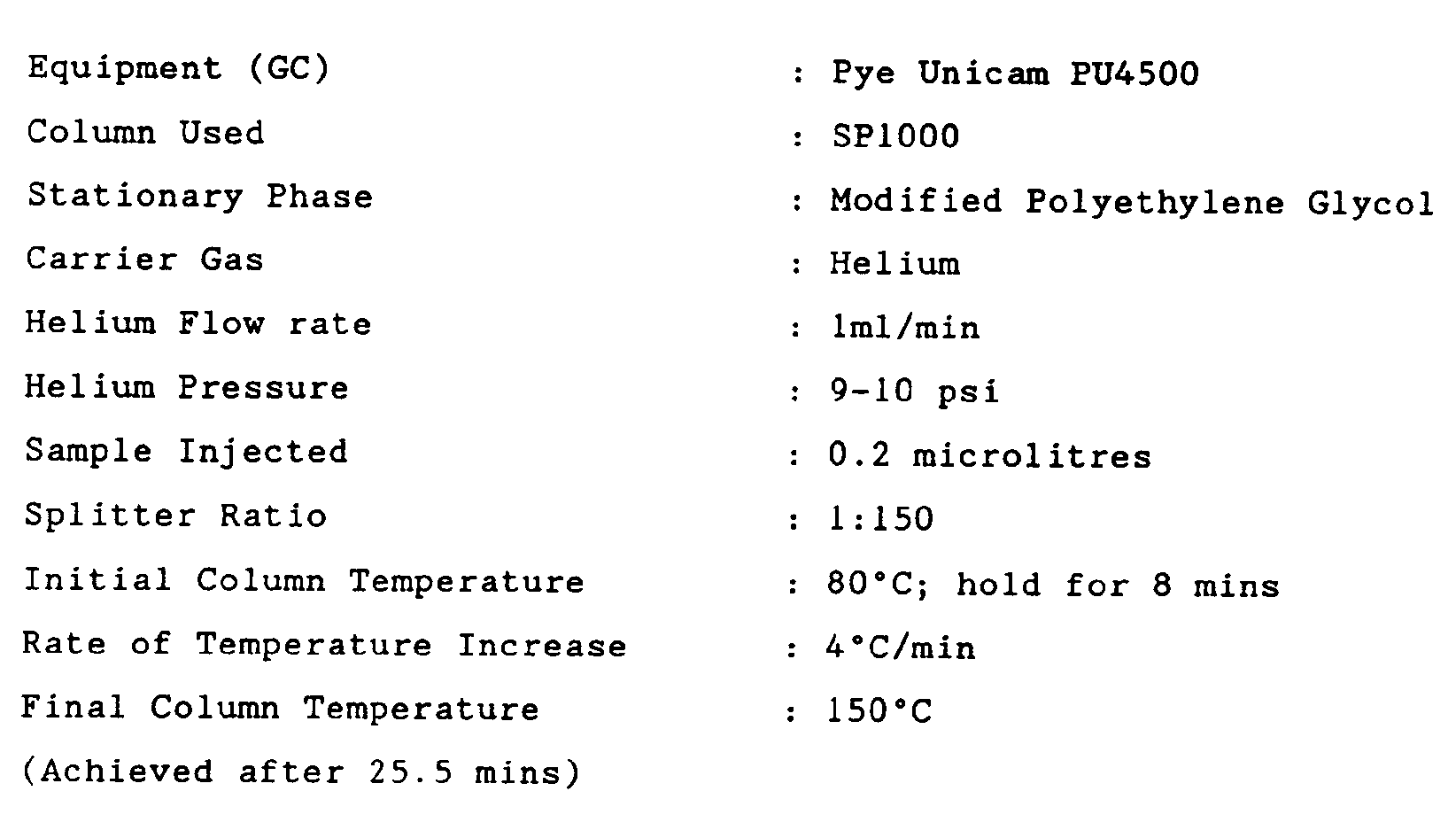
- In the following Examples, the product analyses were all carried out by off-line Gas Chromatography using the following process and apparatus:
-
-

- The by-products were calculated from a GC mass spectrum of the product samples. The results from the Examples are summarised in Table 1 below:
- The p-cymene feed to the reactor containing the conditioned haemetite catalyst produced as described in (A) above was continued for 10hr, after which the product from the reactor was sampled by GC. The results showed a good conversion of 58.6% with a high selectivity of 97.5 mole % to teh desired product.
- The procedure of Example 1 was continued for 18 hr (total 28 Hours-on-Stream (HOS)) the p-cymene feed was then stopped, whilst maintaining the steam flow in order to regenerate the catalyst by steaming for about 1 hr at a slightly lower temperature of about 550°C to remove any coke deposits from the catalyst surface.
- After regeneration, the reactor temperature was increased to 580°C, the p-cymene feed to the reactor restored at the same steam ratio and space velocity as in Example 1. After two hours (total HOS 30 hr) the reactor product was sampled and analysed by GC. The conversion achieved (69.1%) was higher than that at 560°C and the selectivity was still high (95.0 mol%).
- The reaction in Example 2 was continued for a further 4 hours (total 34 HOS) under the same conditions, after which a product sample was again analysed by GC. The conversion was found to be 54.7% and the selectivity was high at 95.4 mol%.
- The reaction in Example 3 was continued for a further 6 hours (total 40 HOS) and the catalyst was then regenerated by steaming for 1hr at 550°C as in Example 2. Thereafter, p-cymene feed was re-introduced, with a reactor temperature of 550°C, the other reaction conditions remaining unchanged. After a 2hr run (total 42 HOS) a sample of the product was analysed by GC. The conversion was found to be 63.8% and the selectivity 97.9 mol%.
- The reaction in Example 4 was continued for a further 44 hr (total 86 HOS) under the same conditions and a sample of the reactor product analysed again by GC. The conversion was found to be 40.9% and selectivity 97.8 mol%. This result showed that catalyst ageing was much slower at lower temperatures than at the relatively higher temperature of 580°C used in Example 3.
- The catalyst after 86 HOS in Example 5 was steamed again for 2 hr as in Example 2. The p-cymene feed was then re-introduced and the reaction continued under the same conditions as in Example 5 for 2 hr (total 88 HOS). A product sample from the reactor was then analysed by GC and was found to show a conversion of 67.3% and a selectivity of 98.1 mol%. When compared with the results in Example 4, this result shows that the activity of the catalyst can be completely restored by the regeneration procedure used.

Claims (10)
- A process for the production of alpha, para-dimethyl styrene, said process comprising dehydrogenating para-cymene in a reactor in the substantial absence of oxygen or an oxidising gas and in the presence of an iron oxide, Fe₃O₄, catalyst and steam at a temperature in the range from 500-700°C and a pressure from 0.1-10 atmospheres.
- A process according to Claim 1 wherein the iron oxide catalyst is derived by the reduction of a commercially available Fe₂O₃ catalyst.
- A process according to Claim 2 wherein the reduction of Fe₂O₃ is carried out in situ prior to the dehydrogenation step.
- A process according to any one of the preceding Claims wherein the reactor is rendered substantially free of oxygen or any oxidising gases prior to introduction of the dehydrogenation catalyst into the reactor.
- A process according to any one of the preceding claims wherein the dehyrogenation reaction is carried out using a feed in which the relative molar ratio of steam to para-cymene is from 1.5 : 1 to 20 : 1.
- A process according to any one of the preceding Claims wherein the dehydrogenation is carried out at a temperature from 520-600°C.
- A process according to any one of the preceding Claims wherein the dehydrogenation is carried out using a liquid hourly space velocity (LHSV) in the range of 0.1-1-10 hr⁻¹ based on the para-cymene in the feed.
- A process according to any one of the preceding Claims wherein any deactivated catalyst in the reactor is regenerated by heating the deactivated catalyst in the presence of steam.
- A process according to Claim 8 wherein the deactivated catalyst is regenerated in the dehyrogenation reactor in situ by shutting off the hydrocarbon feed to the reactor and heating the deactivated catalyst in the presence of steam.
- A process according to any of the preceding Claims wherein the alpha, para-dimethyl styrene formed is recovered from the reaction products by fractional distillation.
Applications Claiming Priority (2)
| Application Number | Priority Date | Filing Date | Title |
|---|---|---|---|
| GB9012812 | 1990-06-08 | ||
| GB909012812A GB9012812D0 (en) | 1990-06-08 | 1990-06-08 | Production of alpha,para-dimethylstyrene |
Publications (2)
| Publication Number | Publication Date |
|---|---|
| EP0460827A1 EP0460827A1 (en) | 1991-12-11 |
| EP0460827B1 true EP0460827B1 (en) | 1994-07-27 |
Family
ID=10677290
Family Applications (1)
| Application Number | Title | Priority Date | Filing Date |
|---|---|---|---|
| EP91304600A Expired - Lifetime EP0460827B1 (en) | 1990-06-08 | 1991-05-21 | Production of alpha, para-dimethylstyrene |
Country Status (8)
| Country | Link |
|---|---|
| EP (1) | EP0460827B1 (en) |
| JP (1) | JPH04244032A (en) |
| AT (1) | ATE109126T1 (en) |
| CA (1) | CA2044046A1 (en) |
| DE (1) | DE69103093T2 (en) |
| DK (1) | DK0460827T3 (en) |
| ES (1) | ES2057770T3 (en) |
| GB (1) | GB9012812D0 (en) |
Family Cites Families (1)
| Publication number | Priority date | Publication date | Assignee | Title |
|---|---|---|---|---|
| US4590324A (en) * | 1985-03-11 | 1986-05-20 | Amoco Corporation | Dehydrogenation of alkylaromatics |
-
1990
- 1990-06-08 GB GB909012812A patent/GB9012812D0/en active Pending
-
1991
- 1991-05-21 AT AT91304600T patent/ATE109126T1/en not_active IP Right Cessation
- 1991-05-21 ES ES91304600T patent/ES2057770T3/en not_active Expired - Lifetime
- 1991-05-21 EP EP91304600A patent/EP0460827B1/en not_active Expired - Lifetime
- 1991-05-21 DE DE69103093T patent/DE69103093T2/en not_active Expired - Fee Related
- 1991-05-21 DK DK91304600.9T patent/DK0460827T3/en active
- 1991-06-05 JP JP3134345A patent/JPH04244032A/en active Pending
- 1991-06-06 CA CA002044046A patent/CA2044046A1/en not_active Abandoned
Also Published As
| Publication number | Publication date |
|---|---|
| DE69103093D1 (en) | 1994-09-01 |
| ATE109126T1 (en) | 1994-08-15 |
| GB9012812D0 (en) | 1990-08-01 |
| CA2044046A1 (en) | 1991-12-09 |
| JPH04244032A (en) | 1992-09-01 |
| EP0460827A1 (en) | 1991-12-11 |
| DE69103093T2 (en) | 1994-11-17 |
| ES2057770T3 (en) | 1994-10-16 |
| DK0460827T3 (en) | 1994-11-14 |
Similar Documents
| Publication | Publication Date | Title |
|---|---|---|
| US3658928A (en) | Dehydration of alpha-methylbenzyl alcohol | |
| US4229602A (en) | Dehydrocyclization process | |
| UA104257C2 (en) | ONE-STAGE METHOD OF OBTAINING BUTADIEN | |
| US3391213A (en) | Isoprene production from isopentane via hydroperoxide and borate ester | |
| US3836603A (en) | Process for preparing para-xylene | |
| US4123470A (en) | Biaryl production | |
| US2300971A (en) | Catalytic dehydrogenation process | |
| JPH0415772B2 (en) | ||
| US2143364A (en) | Process for effecting catalytic reactions | |
| US3887631A (en) | Oxidative dehydrogenation of hydrocarbons | |
| US5001291A (en) | Hydrocarbon dehydrogenation reactions | |
| US2813835A (en) | Reactivation of sulfide catalysts | |
| US2648638A (en) | Method for preparing a tellurium oxide-containing catalyst | |
| EP0460827A1 (en) | Production of alpha, para-dimethylstyrene | |
| JPS62126140A (en) | Dehydrogenation for isobutane | |
| US3047630A (en) | Production of condensation products of aliphatic alcohols | |
| US4902845A (en) | Method to extend life of iron oxide-containing catalysts using low levels of oxygen | |
| US2495278A (en) | Dehydrogenation of alkyl aromatic compounds | |
| US4035428A (en) | Process for production of orthophenylphenol | |
| WO1989000452A1 (en) | Catalyst composition and method for selective dehydrogenation | |
| US2198153A (en) | Hydrogenation of maleic anhydride | |
| US2376549A (en) | Production of styrene and butadiene | |
| US3920766A (en) | Production of isobutane from tertiary butyl alcohol | |
| US2592646A (en) | Regeneration and preconditioning of a methanethiol synthesis catalyst | |
| US2414620A (en) | Catalytic dehydroisomerization of five membered alicyclic ring hydrocarbons having six or more carbon atoms per molecule to aromatic hydrocarbons |
Legal Events
| Date | Code | Title | Description |
|---|---|---|---|
| PUAI | Public reference made under article 153(3) epc to a published international application that has entered the european phase |
Free format text: ORIGINAL CODE: 0009012 |
|
| AK | Designated contracting states |
Kind code of ref document: A1 Designated state(s): AT BE CH DE DK ES FR GB GR IT LI NL SE |
|
| 17P | Request for examination filed |
Effective date: 19911111 |
|
| RAP1 | Party data changed (applicant data changed or rights of an application transferred) |
Owner name: BP CHEMICALS LIMITED |
|
| 17Q | First examination report despatched |
Effective date: 19930910 |
|
| GRAA | (expected) grant |
Free format text: ORIGINAL CODE: 0009210 |
|
| AK | Designated contracting states |
Kind code of ref document: B1 Designated state(s): AT BE CH DE DK ES FR GB GR IT LI NL SE |
|
| REF | Corresponds to: |
Ref document number: 109126 Country of ref document: AT Date of ref document: 19940815 Kind code of ref document: T |
|
| REF | Corresponds to: |
Ref document number: 69103093 Country of ref document: DE Date of ref document: 19940901 |
|
| ITF | It: translation for a ep patent filed | ||
| ET | Fr: translation filed | ||
| REG | Reference to a national code |
Ref country code: ES Ref legal event code: FG2A Ref document number: 2057770 Country of ref document: ES Kind code of ref document: T3 |
|
| REG | Reference to a national code |
Ref country code: GR Ref legal event code: FG4A Free format text: 3012872 |
|
| REG | Reference to a national code |
Ref country code: DK Ref legal event code: T3 |
|
| EAL | Se: european patent in force in sweden |
Ref document number: 91304600.9 |
|
| PGFP | Annual fee paid to national office [announced via postgrant information from national office to epo] |
Ref country code: GR Payment date: 19950313 Year of fee payment: 5 |
|
| PGFP | Annual fee paid to national office [announced via postgrant information from national office to epo] |
Ref country code: FR Payment date: 19950329 Year of fee payment: 5 |
|
| PGFP | Annual fee paid to national office [announced via postgrant information from national office to epo] |
Ref country code: SE Payment date: 19950330 Year of fee payment: 5 Ref country code: DK Payment date: 19950330 Year of fee payment: 5 Ref country code: DE Payment date: 19950330 Year of fee payment: 5 |
|
| PGFP | Annual fee paid to national office [announced via postgrant information from national office to epo] |
Ref country code: GB Payment date: 19950418 Year of fee payment: 5 |
|
| PGFP | Annual fee paid to national office [announced via postgrant information from national office to epo] |
Ref country code: AT Payment date: 19950510 Year of fee payment: 5 |
|
| PGFP | Annual fee paid to national office [announced via postgrant information from national office to epo] |
Ref country code: ES Payment date: 19950518 Year of fee payment: 5 Ref country code: CH Payment date: 19950518 Year of fee payment: 5 |
|
| PGFP | Annual fee paid to national office [announced via postgrant information from national office to epo] |
Ref country code: NL Payment date: 19950531 Year of fee payment: 5 |
|
| PLBE | No opposition filed within time limit |
Free format text: ORIGINAL CODE: 0009261 |
|
| STAA | Information on the status of an ep patent application or granted ep patent |
Free format text: STATUS: NO OPPOSITION FILED WITHIN TIME LIMIT |
|
| PGFP | Annual fee paid to national office [announced via postgrant information from national office to epo] |
Ref country code: BE Payment date: 19950608 Year of fee payment: 5 |
|
| 26N | No opposition filed | ||
| PG25 | Lapsed in a contracting state [announced via postgrant information from national office to epo] |
Ref country code: GB Effective date: 19960521 Ref country code: DK Effective date: 19960521 Ref country code: AT Effective date: 19960521 |
|
| REG | Reference to a national code |
Ref country code: DK Ref legal event code: EBP |
|
| PG25 | Lapsed in a contracting state [announced via postgrant information from national office to epo] |
Ref country code: SE Effective date: 19960522 Ref country code: ES Free format text: LAPSE BECAUSE OF NON-PAYMENT OF DUE FEES Effective date: 19960522 |
|
| PG25 | Lapsed in a contracting state [announced via postgrant information from national office to epo] |
Ref country code: LI Effective date: 19960531 Ref country code: CH Effective date: 19960531 Ref country code: BE Effective date: 19960531 |
|
| BERE | Be: lapsed |
Owner name: BP CHEMICALS LTD Effective date: 19960531 |
|
| PG25 | Lapsed in a contracting state [announced via postgrant information from national office to epo] |
Ref country code: GR Free format text: THE PATENT HAS BEEN ANNULLED BY A DECISION OF A NATIONAL AUTHORITY Effective date: 19961130 |
|
| PG25 | Lapsed in a contracting state [announced via postgrant information from national office to epo] |
Ref country code: NL Effective date: 19961201 |
|
| REG | Reference to a national code |
Ref country code: GR Ref legal event code: MM2A Free format text: 3012872 |
|
| GBPC | Gb: european patent ceased through non-payment of renewal fee |
Effective date: 19960521 |
|
| REG | Reference to a national code |
Ref country code: CH Ref legal event code: PL |
|
| PG25 | Lapsed in a contracting state [announced via postgrant information from national office to epo] |
Ref country code: FR Effective date: 19970131 |
|
| PG25 | Lapsed in a contracting state [announced via postgrant information from national office to epo] |
Ref country code: DE Effective date: 19970201 |
|
| EUG | Se: european patent has lapsed |
Ref document number: 91304600.9 |
|
| NLV4 | Nl: lapsed or anulled due to non-payment of the annual fee |
Effective date: 19961201 |
|
| REG | Reference to a national code |
Ref country code: FR Ref legal event code: ST |
|
| REG | Reference to a national code |
Ref country code: ES Ref legal event code: FD2A Effective date: 19990405 |
|
| PG25 | Lapsed in a contracting state [announced via postgrant information from national office to epo] |
Ref country code: IT Free format text: LAPSE BECAUSE OF NON-PAYMENT OF DUE FEES Effective date: 20050521 |