EP0459287B1 - Carbon fiber and carbon fiber-reinforced resin composition using it - Google Patents
Carbon fiber and carbon fiber-reinforced resin composition using it Download PDFInfo
- Publication number
- EP0459287B1 EP0459287B1 EP19910108258 EP91108258A EP0459287B1 EP 0459287 B1 EP0459287 B1 EP 0459287B1 EP 19910108258 EP19910108258 EP 19910108258 EP 91108258 A EP91108258 A EP 91108258A EP 0459287 B1 EP0459287 B1 EP 0459287B1
- Authority
- EP
- European Patent Office
- Prior art keywords
- carbon fiber
- weight
- resin composition
- reinforced resin
- copolymer
- Prior art date
- Legal status (The legal status is an assumption and is not a legal conclusion. Google has not performed a legal analysis and makes no representation as to the accuracy of the status listed.)
- Expired - Lifetime
Links
- 229920000049 Carbon (fiber) Polymers 0.000 title claims description 75
- 239000004917 carbon fiber Substances 0.000 title claims description 75
- VNWKTOKETHGBQD-UHFFFAOYSA-N methane Chemical compound C VNWKTOKETHGBQD-UHFFFAOYSA-N 0.000 title claims description 70
- 239000011342 resin composition Substances 0.000 title claims description 21
- OKTJSMMVPCPJKN-UHFFFAOYSA-N Carbon Chemical compound [C] OKTJSMMVPCPJKN-UHFFFAOYSA-N 0.000 title claims description 20
- 229910052799 carbon Inorganic materials 0.000 title claims description 20
- 239000011203 carbon fibre reinforced carbon Substances 0.000 title 1
- -1 diamine compound Chemical class 0.000 claims description 46
- 229920005989 resin Polymers 0.000 claims description 46
- 239000011347 resin Substances 0.000 claims description 46
- 229920001577 copolymer Polymers 0.000 claims description 25
- 239000000203 mixture Substances 0.000 claims description 22
- 229920000233 poly(alkylene oxides) Polymers 0.000 claims description 19
- 239000004677 Nylon Substances 0.000 claims description 17
- 239000000178 monomer Substances 0.000 claims description 17
- 229920001778 nylon Polymers 0.000 claims description 17
- 239000011159 matrix material Substances 0.000 claims description 15
- 125000003055 glycidyl group Chemical group C(C1CO1)* 0.000 claims description 11
- WNLRTRBMVRJNCN-UHFFFAOYSA-N adipic acid Chemical compound OC(=O)CCCCC(O)=O WNLRTRBMVRJNCN-UHFFFAOYSA-N 0.000 claims description 10
- 125000000217 alkyl group Chemical group 0.000 claims description 10
- 125000004432 carbon atom Chemical group C* 0.000 claims description 10
- NAQMVNRVTILPCV-UHFFFAOYSA-N hexane-1,6-diamine Chemical compound NCCCCCCN NAQMVNRVTILPCV-UHFFFAOYSA-N 0.000 claims description 10
- 229920005992 thermoplastic resin Polymers 0.000 claims description 8
- 229920001707 polybutylene terephthalate Polymers 0.000 claims description 7
- JBKVHLHDHHXQEQ-UHFFFAOYSA-N epsilon-caprolactam Chemical compound O=C1CCCCCN1 JBKVHLHDHHXQEQ-UHFFFAOYSA-N 0.000 claims description 6
- 239000001361 adipic acid Substances 0.000 claims description 5
- 235000011037 adipic acid Nutrition 0.000 claims description 5
- 239000004417 polycarbonate Substances 0.000 claims description 5
- 229920000515 polycarbonate Polymers 0.000 claims description 5
- 239000004721 Polyphenylene oxide Substances 0.000 claims description 4
- BDJRBEYXGGNYIS-UHFFFAOYSA-N nonanedioic acid Chemical compound OC(=O)CCCCCCCC(O)=O BDJRBEYXGGNYIS-UHFFFAOYSA-N 0.000 claims description 4
- WLJVNTCWHIRURA-UHFFFAOYSA-N pimelic acid Chemical compound OC(=O)CCCCCC(O)=O WLJVNTCWHIRURA-UHFFFAOYSA-N 0.000 claims description 4
- 229920006380 polyphenylene oxide Polymers 0.000 claims description 4
- KIDHWZJUCRJVML-UHFFFAOYSA-N putrescine Chemical compound NCCCCN KIDHWZJUCRJVML-UHFFFAOYSA-N 0.000 claims description 4
- CXMXRPHRNRROMY-UHFFFAOYSA-N sebacic acid Chemical compound OC(=O)CCCCCCCCC(O)=O CXMXRPHRNRROMY-UHFFFAOYSA-N 0.000 claims description 4
- TYFQFVWCELRYAO-UHFFFAOYSA-N suberic acid Chemical compound OC(=O)CCCCCCC(O)=O TYFQFVWCELRYAO-UHFFFAOYSA-N 0.000 claims description 4
- 239000004952 Polyamide Substances 0.000 claims description 3
- 229920002647 polyamide Polymers 0.000 claims description 3
- PWGJDPKCLMLPJW-UHFFFAOYSA-N 1,8-diaminooctane Chemical compound NCCCCCCCCN PWGJDPKCLMLPJW-UHFFFAOYSA-N 0.000 claims description 2
- RTBFRGCFXZNCOE-UHFFFAOYSA-N 1-methylsulfonylpiperidin-4-one Chemical compound CS(=O)(=O)N1CCC(=O)CC1 RTBFRGCFXZNCOE-UHFFFAOYSA-N 0.000 claims description 2
- PIICEJLVQHRZGT-UHFFFAOYSA-N Ethylenediamine Chemical compound NCCN PIICEJLVQHRZGT-UHFFFAOYSA-N 0.000 claims description 2
- JHWNWJKBPDFINM-UHFFFAOYSA-N Laurolactam Chemical compound O=C1CCCCCCCCCCCN1 JHWNWJKBPDFINM-UHFFFAOYSA-N 0.000 claims description 2
- KDYFGRWQOYBRFD-UHFFFAOYSA-N Succinic acid Natural products OC(=O)CCC(O)=O KDYFGRWQOYBRFD-UHFFFAOYSA-N 0.000 claims description 2
- 229920000122 acrylonitrile butadiene styrene Polymers 0.000 claims description 2
- JFCQEDHGNNZCLN-UHFFFAOYSA-N anhydrous glutaric acid Natural products OC(=O)CCCC(O)=O JFCQEDHGNNZCLN-UHFFFAOYSA-N 0.000 claims description 2
- KDYFGRWQOYBRFD-NUQCWPJISA-N butanedioic acid Chemical compound O[14C](=O)CC[14C](O)=O KDYFGRWQOYBRFD-NUQCWPJISA-N 0.000 claims description 2
- YQLZOAVZWJBZSY-UHFFFAOYSA-N decane-1,10-diamine Chemical compound NCCCCCCCCCCN YQLZOAVZWJBZSY-UHFFFAOYSA-N 0.000 claims description 2
- XECAHXYUAAWDEL-UHFFFAOYSA-N acrylonitrile butadiene styrene Chemical compound C=CC=C.C=CC#N.C=CC1=CC=CC=C1 XECAHXYUAAWDEL-UHFFFAOYSA-N 0.000 claims 1
- 239000004676 acrylonitrile butadiene styrene Substances 0.000 claims 1
- 238000004513 sizing Methods 0.000 description 29
- 239000003795 chemical substances by application Substances 0.000 description 26
- 239000007864 aqueous solution Substances 0.000 description 21
- 229920000642 polymer Polymers 0.000 description 16
- 230000000052 comparative effect Effects 0.000 description 15
- 239000000835 fiber Substances 0.000 description 13
- 238000012360 testing method Methods 0.000 description 10
- 230000001070 adhesive effect Effects 0.000 description 8
- 239000002131 composite material Substances 0.000 description 8
- 238000002360 preparation method Methods 0.000 description 8
- 230000000694 effects Effects 0.000 description 7
- XLYOFNOQVPJJNP-UHFFFAOYSA-N water Substances O XLYOFNOQVPJJNP-UHFFFAOYSA-N 0.000 description 7
- 239000000853 adhesive Substances 0.000 description 6
- 238000000034 method Methods 0.000 description 6
- 239000000463 material Substances 0.000 description 5
- 239000008188 pellet Substances 0.000 description 5
- 239000000047 product Substances 0.000 description 5
- IJGRMHOSHXDMSA-UHFFFAOYSA-N Atomic nitrogen Chemical compound N#N IJGRMHOSHXDMSA-UHFFFAOYSA-N 0.000 description 4
- 150000001875 compounds Chemical class 0.000 description 4
- 239000003822 epoxy resin Substances 0.000 description 4
- 229920000647 polyepoxide Polymers 0.000 description 4
- 239000000126 substance Substances 0.000 description 4
- 239000004925 Acrylic resin Substances 0.000 description 3
- 239000011248 coating agent Substances 0.000 description 3
- 238000000576 coating method Methods 0.000 description 3
- 238000005520 cutting process Methods 0.000 description 3
- 239000000839 emulsion Substances 0.000 description 3
- 238000001746 injection moulding Methods 0.000 description 3
- 238000005259 measurement Methods 0.000 description 3
- 238000002156 mixing Methods 0.000 description 3
- 230000000704 physical effect Effects 0.000 description 3
- 230000003014 reinforcing effect Effects 0.000 description 3
- 239000012779 reinforcing material Substances 0.000 description 3
- CFZGIDYCUWFUJR-UHFFFAOYSA-N 3-(dimethylamino)azepan-2-one Chemical compound CN(C)C1CCCCNC1=O CFZGIDYCUWFUJR-UHFFFAOYSA-N 0.000 description 2
- VTYYLEPIZMXCLO-UHFFFAOYSA-L Calcium carbonate Chemical compound [Ca+2].[O-]C([O-])=O VTYYLEPIZMXCLO-UHFFFAOYSA-L 0.000 description 2
- YCKRFDGAMUMZLT-UHFFFAOYSA-N Fluorine atom Chemical compound [F] YCKRFDGAMUMZLT-UHFFFAOYSA-N 0.000 description 2
- PXHVJJICTQNCMI-UHFFFAOYSA-N Nickel Chemical compound [Ni] PXHVJJICTQNCMI-UHFFFAOYSA-N 0.000 description 2
- 229930040373 Paraformaldehyde Natural products 0.000 description 2
- 239000004696 Poly ether ether ketone Substances 0.000 description 2
- 239000002202 Polyethylene glycol Substances 0.000 description 2
- 239000004793 Polystyrene Substances 0.000 description 2
- KKEYFWRCBNTPAC-UHFFFAOYSA-N Terephthalic acid Chemical compound OC(=O)C1=CC=C(C(O)=O)C=C1 KKEYFWRCBNTPAC-UHFFFAOYSA-N 0.000 description 2
- ZEASXVYVFFXULL-UHFFFAOYSA-N amezinium metilsulfate Chemical compound COS([O-])(=O)=O.COC1=CC(N)=CN=[N+]1C1=CC=CC=C1 ZEASXVYVFFXULL-UHFFFAOYSA-N 0.000 description 2
- 125000003368 amide group Chemical group 0.000 description 2
- IISBACLAFKSPIT-UHFFFAOYSA-N bisphenol A Chemical compound C=1C=C(O)C=CC=1C(C)(C)C1=CC=C(O)C=C1 IISBACLAFKSPIT-UHFFFAOYSA-N 0.000 description 2
- 239000004918 carbon fiber reinforced polymer Substances 0.000 description 2
- 230000006866 deterioration Effects 0.000 description 2
- 238000011161 development Methods 0.000 description 2
- 235000012438 extruded product Nutrition 0.000 description 2
- 239000011737 fluorine Substances 0.000 description 2
- 229910052731 fluorine Inorganic materials 0.000 description 2
- 230000005484 gravity Effects 0.000 description 2
- 238000005470 impregnation Methods 0.000 description 2
- QQVIHTHCMHWDBS-UHFFFAOYSA-N isophthalic acid Chemical compound OC(=O)C1=CC=CC(C(O)=O)=C1 QQVIHTHCMHWDBS-UHFFFAOYSA-N 0.000 description 2
- 238000004898 kneading Methods 0.000 description 2
- 239000007788 liquid Substances 0.000 description 2
- 229910052751 metal Inorganic materials 0.000 description 2
- 239000002184 metal Substances 0.000 description 2
- 229910052757 nitrogen Inorganic materials 0.000 description 2
- 239000003960 organic solvent Substances 0.000 description 2
- 229920006122 polyamide resin Polymers 0.000 description 2
- 229920005668 polycarbonate resin Polymers 0.000 description 2
- 239000004431 polycarbonate resin Substances 0.000 description 2
- 229920000728 polyester Polymers 0.000 description 2
- 229920002530 polyetherether ketone Polymers 0.000 description 2
- 229920001223 polyethylene glycol Polymers 0.000 description 2
- 229920000098 polyolefin Polymers 0.000 description 2
- 229920006324 polyoxymethylene Polymers 0.000 description 2
- 229920001955 polyphenylene ether Polymers 0.000 description 2
- 229920012287 polyphenylene sulfone Polymers 0.000 description 2
- 229920002223 polystyrene Polymers 0.000 description 2
- 229920000036 polyvinylpyrrolidone Polymers 0.000 description 2
- 239000001267 polyvinylpyrrolidone Substances 0.000 description 2
- 235000013855 polyvinylpyrrolidone Nutrition 0.000 description 2
- 239000000243 solution Substances 0.000 description 2
- 239000002904 solvent Substances 0.000 description 2
- SMZOUWXMTYCWNB-UHFFFAOYSA-N 2-(2-methoxy-5-methylphenyl)ethanamine Chemical compound COC1=CC=C(C)C=C1CCN SMZOUWXMTYCWNB-UHFFFAOYSA-N 0.000 description 1
- NIXOWILDQLNWCW-UHFFFAOYSA-N 2-Propenoic acid Natural products OC(=O)C=C NIXOWILDQLNWCW-UHFFFAOYSA-N 0.000 description 1
- 241000531908 Aramides Species 0.000 description 1
- ZOXJGFHDIHLPTG-UHFFFAOYSA-N Boron Chemical compound [B] ZOXJGFHDIHLPTG-UHFFFAOYSA-N 0.000 description 1
- RYGMFSIKBFXOCR-UHFFFAOYSA-N Copper Chemical compound [Cu] RYGMFSIKBFXOCR-UHFFFAOYSA-N 0.000 description 1
- IAYPIBMASNFSPL-UHFFFAOYSA-N Ethylene oxide Chemical compound C1CO1 IAYPIBMASNFSPL-UHFFFAOYSA-N 0.000 description 1
- GOOHAUXETOMSMM-UHFFFAOYSA-N Propylene oxide Chemical compound CC1CO1 GOOHAUXETOMSMM-UHFFFAOYSA-N 0.000 description 1
- 229920000297 Rayon Polymers 0.000 description 1
- 239000006087 Silane Coupling Agent Substances 0.000 description 1
- 238000005299 abrasion Methods 0.000 description 1
- 238000007259 addition reaction Methods 0.000 description 1
- 239000000654 additive Substances 0.000 description 1
- 150000005215 alkyl ethers Chemical class 0.000 description 1
- 229910052782 aluminium Inorganic materials 0.000 description 1
- XAGFODPZIPBFFR-UHFFFAOYSA-N aluminium Chemical compound [Al] XAGFODPZIPBFFR-UHFFFAOYSA-N 0.000 description 1
- 229920003235 aromatic polyamide Polymers 0.000 description 1
- 125000003118 aryl group Chemical group 0.000 description 1
- 229910052796 boron Inorganic materials 0.000 description 1
- 229910000019 calcium carbonate Inorganic materials 0.000 description 1
- 125000003178 carboxy group Chemical group [H]OC(*)=O 0.000 description 1
- 239000007795 chemical reaction product Substances 0.000 description 1
- 239000000805 composite resin Substances 0.000 description 1
- 229910052802 copper Inorganic materials 0.000 description 1
- 239000010949 copper Substances 0.000 description 1
- 239000007822 coupling agent Substances 0.000 description 1
- 238000000354 decomposition reaction Methods 0.000 description 1
- 239000006185 dispersion Substances 0.000 description 1
- 238000001035 drying Methods 0.000 description 1
- 239000000945 filler Substances 0.000 description 1
- 239000003365 glass fiber Substances 0.000 description 1
- 238000010348 incorporation Methods 0.000 description 1
- 238000009434 installation Methods 0.000 description 1
- 239000000314 lubricant Substances 0.000 description 1
- 239000010445 mica Substances 0.000 description 1
- 229910052618 mica group Inorganic materials 0.000 description 1
- CWQXQMHSOZUFJS-UHFFFAOYSA-N molybdenum disulfide Chemical compound S=[Mo]=S CWQXQMHSOZUFJS-UHFFFAOYSA-N 0.000 description 1
- 229910052982 molybdenum disulfide Inorganic materials 0.000 description 1
- RXOHFPCZGPKIRD-UHFFFAOYSA-N naphthalene-2,6-dicarboxylic acid Chemical compound C1=C(C(O)=O)C=CC2=CC(C(=O)O)=CC=C21 RXOHFPCZGPKIRD-UHFFFAOYSA-N 0.000 description 1
- 229910052759 nickel Inorganic materials 0.000 description 1
- 238000012856 packing Methods 0.000 description 1
- 229920002239 polyacrylonitrile Polymers 0.000 description 1
- 238000006116 polymerization reaction Methods 0.000 description 1
- 238000003825 pressing Methods 0.000 description 1
- KCTAWXVAICEBSD-UHFFFAOYSA-N prop-2-enoyloxy prop-2-eneperoxoate Chemical compound C=CC(=O)OOOC(=O)C=C KCTAWXVAICEBSD-UHFFFAOYSA-N 0.000 description 1
- 239000002964 rayon Substances 0.000 description 1
- 238000011084 recovery Methods 0.000 description 1
- 238000011160 research Methods 0.000 description 1
- HBMJWWWQQXIZIP-UHFFFAOYSA-N silicon carbide Chemical compound [Si+]#[C-] HBMJWWWQQXIZIP-UHFFFAOYSA-N 0.000 description 1
- 229910010271 silicon carbide Inorganic materials 0.000 description 1
- 239000003381 stabilizer Substances 0.000 description 1
- 239000000454 talc Substances 0.000 description 1
- 229910052623 talc Inorganic materials 0.000 description 1
- 238000002834 transmittance Methods 0.000 description 1
- 238000005303 weighing Methods 0.000 description 1
Classifications
-
- D—TEXTILES; PAPER
- D01—NATURAL OR MAN-MADE THREADS OR FIBRES; SPINNING
- D01F—CHEMICAL FEATURES IN THE MANUFACTURE OF ARTIFICIAL FILAMENTS, THREADS, FIBRES, BRISTLES OR RIBBONS; APPARATUS SPECIALLY ADAPTED FOR THE MANUFACTURE OF CARBON FILAMENTS
- D01F11/00—Chemical after-treatment of artificial filaments or the like during manufacture
- D01F11/10—Chemical after-treatment of artificial filaments or the like during manufacture of carbon
- D01F11/14—Chemical after-treatment of artificial filaments or the like during manufacture of carbon with organic compounds, e.g. macromolecular compounds
-
- Y—GENERAL TAGGING OF NEW TECHNOLOGICAL DEVELOPMENTS; GENERAL TAGGING OF CROSS-SECTIONAL TECHNOLOGIES SPANNING OVER SEVERAL SECTIONS OF THE IPC; TECHNICAL SUBJECTS COVERED BY FORMER USPC CROSS-REFERENCE ART COLLECTIONS [XRACs] AND DIGESTS
- Y10—TECHNICAL SUBJECTS COVERED BY FORMER USPC
- Y10T—TECHNICAL SUBJECTS COVERED BY FORMER US CLASSIFICATION
- Y10T428/00—Stock material or miscellaneous articles
- Y10T428/249921—Web or sheet containing structurally defined element or component
- Y10T428/249924—Noninterengaged fiber-containing paper-free web or sheet which is not of specified porosity
- Y10T428/24994—Fiber embedded in or on the surface of a polymeric matrix
- Y10T428/249948—Fiber is precoated
-
- Y—GENERAL TAGGING OF NEW TECHNOLOGICAL DEVELOPMENTS; GENERAL TAGGING OF CROSS-SECTIONAL TECHNOLOGIES SPANNING OVER SEVERAL SECTIONS OF THE IPC; TECHNICAL SUBJECTS COVERED BY FORMER USPC CROSS-REFERENCE ART COLLECTIONS [XRACs] AND DIGESTS
- Y10—TECHNICAL SUBJECTS COVERED BY FORMER USPC
- Y10T—TECHNICAL SUBJECTS COVERED BY FORMER US CLASSIFICATION
- Y10T428/00—Stock material or miscellaneous articles
- Y10T428/29—Coated or structually defined flake, particle, cell, strand, strand portion, rod, filament, macroscopic fiber or mass thereof
- Y10T428/2913—Rod, strand, filament or fiber
- Y10T428/2918—Rod, strand, filament or fiber including free carbon or carbide or therewith [not as steel]
-
- Y—GENERAL TAGGING OF NEW TECHNOLOGICAL DEVELOPMENTS; GENERAL TAGGING OF CROSS-SECTIONAL TECHNOLOGIES SPANNING OVER SEVERAL SECTIONS OF THE IPC; TECHNICAL SUBJECTS COVERED BY FORMER USPC CROSS-REFERENCE ART COLLECTIONS [XRACs] AND DIGESTS
- Y10—TECHNICAL SUBJECTS COVERED BY FORMER USPC
- Y10T—TECHNICAL SUBJECTS COVERED BY FORMER US CLASSIFICATION
- Y10T428/00—Stock material or miscellaneous articles
- Y10T428/29—Coated or structually defined flake, particle, cell, strand, strand portion, rod, filament, macroscopic fiber or mass thereof
- Y10T428/2913—Rod, strand, filament or fiber
- Y10T428/2933—Coated or with bond, impregnation or core
- Y10T428/2938—Coating on discrete and individual rods, strands or filaments
-
- Y—GENERAL TAGGING OF NEW TECHNOLOGICAL DEVELOPMENTS; GENERAL TAGGING OF CROSS-SECTIONAL TECHNOLOGIES SPANNING OVER SEVERAL SECTIONS OF THE IPC; TECHNICAL SUBJECTS COVERED BY FORMER USPC CROSS-REFERENCE ART COLLECTIONS [XRACs] AND DIGESTS
- Y10—TECHNICAL SUBJECTS COVERED BY FORMER USPC
- Y10T—TECHNICAL SUBJECTS COVERED BY FORMER US CLASSIFICATION
- Y10T428/00—Stock material or miscellaneous articles
- Y10T428/30—Self-sustaining carbon mass or layer with impregnant or other layer
Definitions
- the present invention relates to a carbon fiber and a carbon fiber-reinforced resin composition having the carbon fiber incorporated therein.
- the carbon fiber wherein characteristics other than the mechanical properties such as strength, elastic modulus, such as electrical conductivity, thermal conductivity and X-ray transmittance, are utilized.
- characteristics other than the mechanical properties such as strength, elastic modulus, such as electrical conductivity, thermal conductivity and X-ray transmittance, are utilized.
- it is frequently used as a conductive composite material wherein the high conductivity of the carbon fiber itself is utilized.
- the interfacial adhesive strength between the resin and the carbon fiber is influential over the mechanical strength of the composite material.
- the carbon fiber is dispersed in a resin in the form of short fibers having a length of from a few tens »m to a few mm, if the interfacial adhesive power is small, the strength of the composite material tends to be remarkably low.
- it has been attempted to treat the carbon fiber surface with a coupling agent or to coat it with a resin having good adhesive properties.
- the adhesive power between the carbon fiber coated with a resin and the matrix resin varies depending upon the type of the matrix resin even when the same resin is coated on the carbon fiber. Therefore, development of coating resins suitable for the respective matrix resins is being made.
- a polyamide resin used as a matrix resin
- a resin for treating the fiber surface which is so-called a sizing agent, has a role of bundling fibers into a strand and improving the operation efficiency for e.g. cutting or weighing the fiber strand.
- a sizing agent for an aqueous solution or aqueous dispersion system is preferred from the practical point of view.
- conventional sizing agents did not satisfy various requirements for sizing agents, such as improvement of the interfacial adhesive properties, the bundling properties and the electrical conductivity, and easy sizing operation.
- the present inventors have conducted an extensive research to solve such conventional problems and as a result, have found that by using a carbon fiber coated with a polymer having a specific composition, the bundling properties can be improved and it is possible to improve the strength and the electrical conductivity of a resin composite material by reinforcing the material with such a carbon fiber.
- the present invention has been accomplished on the basis of this discovery.
- Such an object can readily be accomplished by: a carbon fiber having its surface coated with a copolymer composed of a diamine compound, a dicarboxylic acid compound and a glycidyl polyalkylene oxide derivative of the following formula (I), wherein the copolymer contains said polyalkylene oxide derivative in an amount of from 10 to 50% by weight as in the monomer composition: wherein R1 is H or an alkyl group having not more than 20 carbon atoms, R2 is H or CH3, and n is an integer of from 1 to 40; and a carbon fiber-reinforced resin composition comprising 100 parts by weight of a thermoplastic resin having a polyamide group in the backbone chain structure and from 1 to 50 parts by weight of a carbon fiber incorporated thereto, said carbon fiber having its surface coated with a copolymer composed of a diamine compound, a dicarboxylic acid compound and a glycidyl polyalkylene oxide derivative of the following formula (I), wherein the copolymer contains said polyal
- carbon fiber in the present invention various conventional carbon fibers can be used. Specifically, carbon fibers of polyacrylonitrile type, pitch type and rayon type may be mentioned.
- the polymer to be used for coating is a copolymer of a diamine compound, a dicarboxylic acid compound, a cyclic amide compound and a glycidyl polyalkylene oxide.
- the diamine compound is not particularly limited, but is preferably a compound of the formula (II): H2N-R3-NH2 (II) wherein R3 is an alkyl group having not more than 15 carbon atoms, and a derivative thereof. Specifically, it includes ethylenediamine, tetramethylenediamine, hexamethylenediamine, octamethylenediamine and decamethylenediamine, and methylated, ethylated and halogenated derivatives thereof.
- the proportions of monomers in the monomer composition are determined within a range where the mixture is substantially completely polymerized to form a polymer having a proper molecular weight.
- the content of the diamine compound derivative is usually from 25 to 45% by weight. Further, in order to improve the adhesive strength or the bundling properties of the carbon fiber, it is preferably from 25 to 45% by weight.
- the content of the diamine compound derivative is usually from 10 to 30% by weight.
- the dicarboxylic acid compound is preferably a compound of the formula (III): HOOC-R4-COOH (III) wherein R4 is an alkyl group having not more than 15 carbon atoms, or a single nucleus or two nuclei aromatic ring, or a derivative thereof.
- R4 is an alkyl group having not more than 15 carbon atoms, or a single nucleus or two nuclei aromatic ring, or a derivative thereof.
- R4 is an alkyl group having not more than 15 carbon atoms, or a single nucleus or two nuclei aromatic ring, or a derivative thereof.
- R4 is an alkyl group having not more than 15 carbon atoms, or a single nucleus or two nuclei aromatic ring, or a derivative thereof.
- succinic acid glutaric acid, adipic acid, pimelic acid, suberic acid, azelaic acid and sebacic acid, and methylated, ethylated and hal
- the cyclic amide compound is an optional component which may be incorporated to improve the electrical conductivity.
- a cyclic amide compound preferred is a compound of the formula (IV): wherein R5 is an alkyl group having not more than 20 carbon atoms, or a derivative thereof. Specifically, it includes caprolactam and lauryllactam.
- the proportions of monomers in the monomer composition are determined within a range where the mixture is substantially completely polymerized to form a polymer having a proper molecular weight.
- the content of the glycidyl polyalkylene oxide derivative is usually from 10 to 50% by weight. Further, in order to improve the adhesive strength or the bundling properties of the carbon fiber, it is preferably from 30 to 50% by weight.
- the content of the glycidyl polyalkylene oxide derivative is usually from 10 to 30% by weight, preferably from 15 to 25% by weight.
- the content of the glycidyl polyalkylene oxide derivative exceeds 50% by weight, the bundling properties of the carbon fiber strand tend to be poor, such being undesirable.
- the content is less than 10% by weight, the strength of the composite material tends to be low, and the water-solubility tends to be low, such being undesirable.
- the carbon fiber is used in the form of a strand formed by bundling a few thousands to a few tens thousands monofilaments, and the strand is sized by a resin to improve the handling efficiency, or it is incorporated in a resin to form a composite material having improved properties.
- the method for applying the obtained copolymer to the carbon fiber surface there is no particular restriction as to the method for applying the obtained copolymer to the carbon fiber surface.
- the concentration of the aqueous solution may be adjusted to a level where the amount of the copolymer covering the carbon fiber would be a desired level.
- the amount of the copolymer coated on the carbon fiber is usually from 0.5 to 20% by weight, preferably from 2 to 10% by weight. If the coated amount is small, no adequate effects by the sizing agent for improving the properties of the composite material tend to be obtained, or the bundling properties of the carbon fiber tend to be inadequate.
- the carbon fiber strands impregnated in the aqueous solution of the copolymer will then be dried by ultraviolet rays or hot air.
- the drying temperature is preferably not higher than 300°C, so that no decomposition of the sizing agent will take place.
- the dried carbon fiber strands will then be cut to a length of from 1 to 20 mm, preferably from 3 to 10 mm, to facilitate the incorporation to a resin (the cut carbon fiber strands are called chopped strands).
- the carbon fiber strands of the present invention are excellent in the bundling properties and the electrical conductivity. When incorporated to a resin, they present effects for improving the mechanical strength.
- thermoplastic resins may be employed, for example, a thermoplastic resin having an amide group in the backbone chain structure, such as 6,6-nylon, 4,6-nylon, 6,10-nylon, 6-nylon or 12-nylon, a polymer such as polycarbonate, polystyrene, polyester, polyolefin, acrylate resin, polyoxymethylene, polyphenylene ether, polyphenylene oxide, polybutylene terephthalate, polyether ether ketone, polyphenylene sulfone or fluorine resin, or a copolymer thereof.
- a thermoplastic resin having an amide group in the backbone chain structure such as 6,6-nylon, 4,6-nylon, 6,10-nylon, 6-nylon or 12-nylon
- a polymer such as polycarbonate, polystyrene, polyester, polyolefin, acrylate resin, polyoxymethylene, polyphenylene ether, polyphenylene oxide, polybutylene terephthalate, polyether
- thermoplastic resin having an amide group such as 6,6-nylon, 6,4-nylon, 6,10-nylon, 6-nylon or 12-nylon
- a polymer such as polycarbonate, polystyrene, polyester, polyolefin, acrylate resin, polyoxymethylene, polyphenylene ether, polyphenylene oxide, polybutylene terephthalate, polyether ether ketone, polyphenylene sulfone or fluorine resin, or a copolymer thereof.
- ABS resin acryronitrile-butadiene-styrene resin
- the carbon fiber is usually within a range of from 1 to 50 parts by weight, preferably from 5 to 40 parts by weight, per 100 parts by weight of the thermoplastic resin.
- the amount of the carbon fiber is less than 1 part by weight, no adequate reinforcing effects or no adequate conductivity-improving effects by the carbon fiber tend to be obtained. On the other hand, if the amount exceeds 50 parts by weight, various problems are likely to occur in the steps of mixing and dispersing the carbon fiber to the matrix resin.
- fibrous reinforcing materials such as short fibers or long fibers of e.g. other types of carbon fibers, glass fibers, aramide fibers, boron fibers or silicon carbide fibers, whiskers, fibers having a metal such as nickel, aluminum or copper coated thereon, or metal fibers, or reinforcing materials composed of fillers such as carbon, molybdenum disulfide, mica, talc, or calcium carbonate, stabilizers, lubricants or other additives, may be incorporated to such an extent not to impair the effects of the present invention.
- fillers such as carbon, molybdenum disulfide, mica, talc, or calcium carbonate, stabilizers, lubricants or other additives
- the carbon fiber-reinforced plastic resin composition thus obtained exhibits high strength and electrical conductivity as compared with the resin composition reinforced by conventional carbon fibers.
- the physical properties were measured as follows. Tensile strength of the molded product: ASTM D-638 Bulk density of chopped strands: About 30 g of chopped strands were weighed. About 1/3 thereof was sequentially put into a 200 ml measuring cylinder. Each time when the chopped strands were put into the measuring cylinder, the measuring cylinder was dropped ten times from a height of 5 cm. When the entire amount was packed, the volume was read.
- Example 2 The test was conducted in the same manner as in Example 1 except that instead of the aqueous solution of the sizing agent in Example 1, an aqueous solution of ⁇ -(N,N-dimethylamino)- ⁇ -caprolactam polymer, was used.
- Test specimens were prepared and tested in the same manner as in Example 1 except that instead of the aqueous solution of the sizing agent in Example 1, an aqueous solution of polyethylene glycol (molecular weight: 50,000) was used as the sizing agent.
- polyethylene glycol molecular weight: 50,000
- Test specimens were prepared and tested in the same manner as in Example 1 except that instead of the aqueous solution of the sizing agent in Example 1, an emulsion of an epoxy acrylate resin obtained by esterifying with acrylic acid the terminals of a bisphenol A type epoxy resin, was used as the sizing agent.
- Chopped strands were prepared in the same manner as in Example 1 except that instead of the aqueous solution of the sizing agent in Example 1, an aqueous emulsion type sizing agent composed of a mixture comprising 60 parts by weight of an epoxy resin "Epicoat” 834 (manufactured by Shell Chemical Company Limited) and 40 parts by weight of "Epicoat” 1004 (manufactured by Shell Chemical Company Limited) was used.
- the chopped strands were mixed with pellets of 6,6-nylon resin, and the mixture was fed to a screw extruder, whereupon the viscosity of the molten resin increased, and rotation of the screw stopped during the kneading operation, and kneading could not be completed.
- Test specimens were prepared in the same manner as in Example 2 except that instead of the aqueous solution of the sizing agent in Example 2, an aqueous emulsion type sizing agent comprising 60 parts by weight of an epoxy resin "Epicoat” 834 (manufactured by Shell Chemical Company Limited) and 40 parts by weight of "Epicoat” 1004 (manufactured by Shell Chemical Company Limited) was used.
- an aqueous emulsion type sizing agent comprising 60 parts by weight of an epoxy resin "Epicoat” 834 (manufactured by Shell Chemical Company Limited) and 40 parts by weight of "Epicoat” 1004 (manufactured by Shell Chemical Company Limited) was used.
- Test specimens were prepared in the same manner as in Example 2 except that instead of the aqueous solution of the sizing agent in Example 2, an aqueous solution of polyvinyl pyrrolidone (molecular weight: 40,000) was used as the sizing agent.
- Test specimens were prepared in the same manner as in Example 2 except that instead of the aqueous solution of the sizing agent in example 2, an aqueous solution of polyethylene glycol (molecular weight: 50,000) was used as the sizing agent.
- Test specimens were prepared in the same manner as in Example 2 except that instead of the matrix resin polybutylene terephthalate in Example 2, a polycarbonate resin was used, and the amount of the resin-coated carbon fiber was changed to 20 parts by weight.
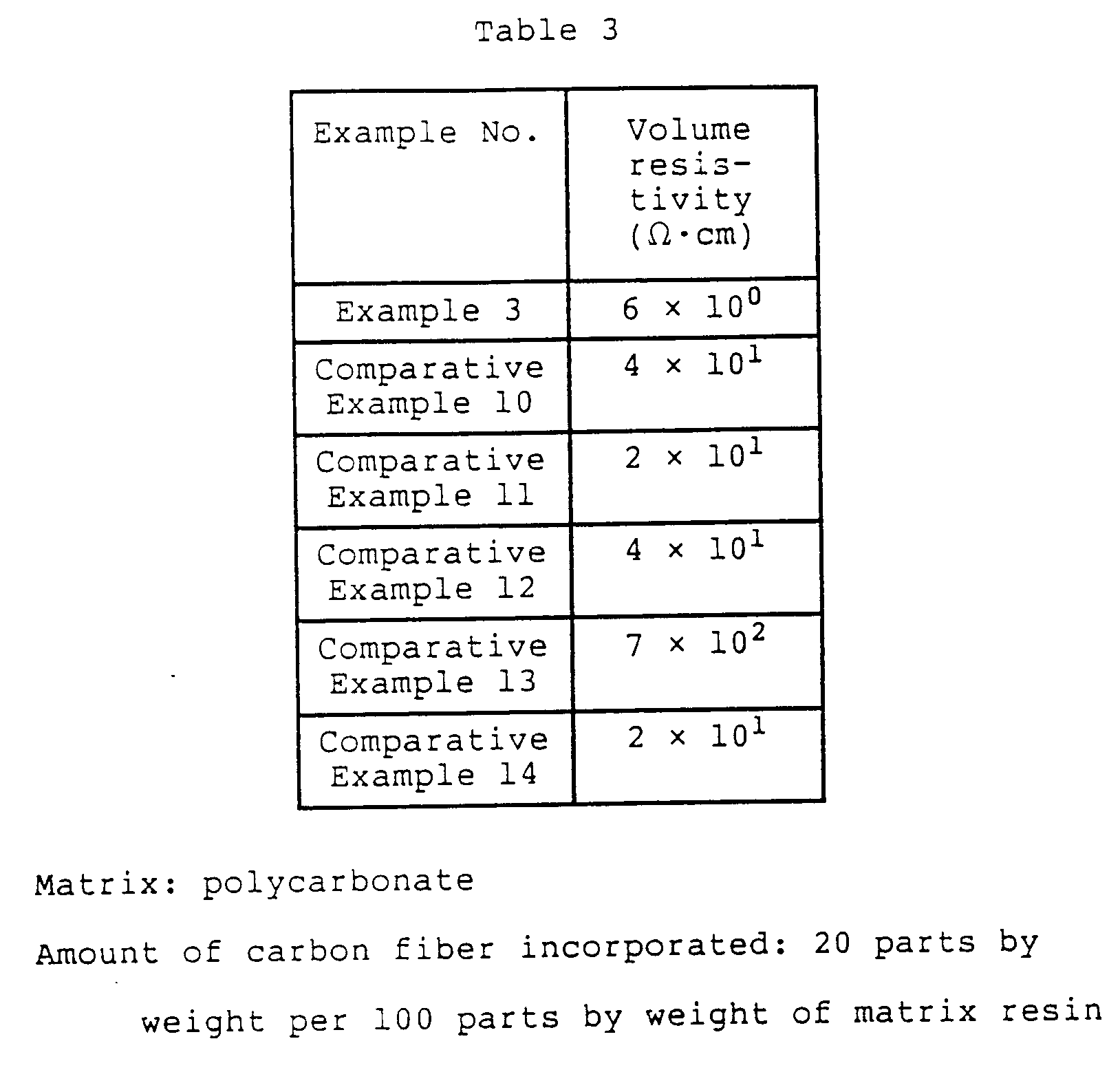
- the result of the measurement of the volume resistivity is shown in Table 3 together with the results of Comparative Examples 10 to 14.
- Test specimens were prepared in the same manner as in Comparative Examples 5 to 9 except that the matrix resin was changed from the polybutylene terephthalate to a polycarbonate resin, and the amount of the resin-coated carbon fiber was changed to 20 parts by weight, and the volume resistivity was measured.
- the resin-coated carbon fiber of the present invention has an effect of improving the electrical conductivity of a carbon fiber-reinforced thermoplastic resin to a large extent as compared with the conventional carbon fibers, and it is very useful from the industrial point of view, as well as the fiber-reinforced resin having such a fiber incorporated therein.
Landscapes
- Chemical & Material Sciences (AREA)
- Chemical Kinetics & Catalysis (AREA)
- General Chemical & Material Sciences (AREA)
- Engineering & Computer Science (AREA)
- Textile Engineering (AREA)
- Reinforced Plastic Materials (AREA)
- Treatments For Attaching Organic Compounds To Fibrous Goods (AREA)
Description
- The present invention relates to a carbon fiber and a carbon fiber-reinforced resin composition having the carbon fiber incorporated therein.
- In recent years, an attention has been drawn to a fiber-reinforced resin composition having a carbon fiber mixed and dispersed in various matrix resins, as an industrially important material by virtue of its mechanical characteristics such as high strength, high stiffness, low specific gravity and high abrasion resistance.
- Further, development is being made for the application of the carbon fiber wherein characteristics other than the mechanical properties such as strength, elastic modulus, such as electrical conductivity, thermal conductivity and X-ray transmittance, are utilized. Especially in the electronics-related field, it is frequently used as a conductive composite material wherein the high conductivity of the carbon fiber itself is utilized.
- However, if the carbon fiber is merely mixed with a resin and molded, no adequate conductivity can be obtained unless a large amount of the carbon fiber is incorporated. This brings about an increase of the cost for the resin compound, a deterioration of the physical properties such as impact resistance, an increase of the specific gravity and a deterioration of the processability, due to the use of a large amount of the expensive carbon fiber. Thus, use of the carbon fiber has been restricted. To solve such problems, it has been attempted to improve the conductivity. For example, Japanese Unexamined Patent Publication No. 56586/1982 discloses that a carbon fiber is coated with a polyvinyl pyrrolidone to improve the conductivity of the composite material.
- From the viewpoint of the mechanical strength, it is known that the interfacial adhesive strength between the resin and the carbon fiber is influential over the mechanical strength of the composite material. Particularly when the carbon fiber is dispersed in a resin in the form of short fibers having a length of from a few tens »m to a few mm, if the interfacial adhesive power is small, the strength of the composite material tends to be remarkably low. In order to improve this interfacial adhesive power, it has been attempted to treat the carbon fiber surface with a coupling agent or to coat it with a resin having good adhesive properties.
- On the other hand, the adhesive power between the carbon fiber coated with a resin and the matrix resin varies depending upon the type of the matrix resin even when the same resin is coated on the carbon fiber. Therefore, development of coating resins suitable for the respective matrix resins is being made. For example, in a case where a polyamide resin is used as a matrix resin, it has been attempted to improve the adhesion to the matrix by a carbon fiber coated with a polyamide resin (Japanese Examined Patent Publication No. 7225/1987), or to improve the adhesion to the matrix by coating the fiber with a mixture of an epoxy resin and a silane coupling agent (Japanese Unexamined Patent Publication No. 53544/1985).
- Further, a resin for treating the fiber surface, which is so-called a sizing agent, has a role of bundling fibers into a strand and improving the operation efficiency for e.g. cutting or weighing the fiber strand.
- For the sizing step to coat a carbon fiber with a sizing agent, it is common to employ a method wherein a sizing agent is dissolved or emulsified and dispersed in water or in an organic solvent to form a liquid, and the carbon fiber is impregnated in the liquid, followed by removing the solvent. In this process, if an organic solvent is used, there will be disadvantages such that the operation environment deteriorates, and it is required to set up an installation for recovery of the solvent. Therefore, a sizing agent for an aqueous solution or aqueous dispersion system is preferred from the practical point of view.
- However, conventional sizing agents did not satisfy various requirements for sizing agents, such as improvement of the interfacial adhesive properties, the bundling properties and the electrical conductivity, and easy sizing operation.
- Under these circumstances, the present inventors have conducted an extensive research to solve such conventional problems and as a result, have found that by using a carbon fiber coated with a polymer having a specific composition, the bundling properties can be improved and it is possible to improve the strength and the electrical conductivity of a resin composite material by reinforcing the material with such a carbon fiber. The present invention has been accomplished on the basis of this discovery.
- Namely, it is an object of the present invention to provide a carbon fiber for reinforcing a resin, which is capable of providing a resin composition having excellent bundling properties and presenting high strength and good electrical conductivity, and to provide a carbon fiber-reinforced resin composition using such a carbon fiber.
- Such an object can readily be accomplished by:
a carbon fiber having its surface coated with a copolymer composed of a diamine compound, a dicarboxylic acid compound and a glycidyl polyalkylene oxide derivative of the following formula (I), wherein the copolymer contains said polyalkylene oxide derivative in an amount of from 10 to 50% by weight as in the monomer composition: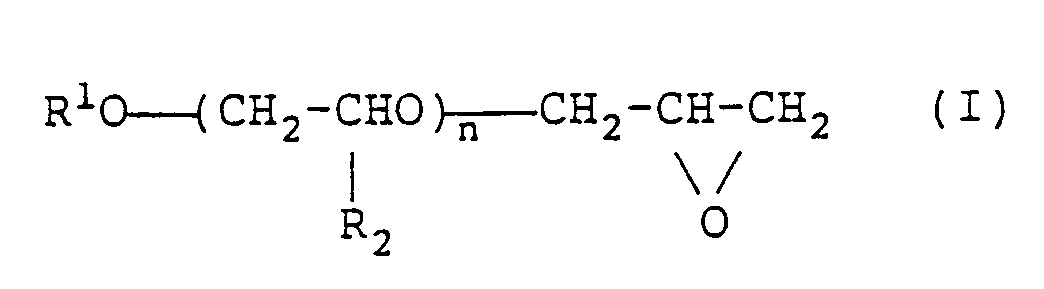
wherein R¹ is H or an alkyl group having not more than 20 carbon atoms, R² is H or CH₃, and n is an integer of from 1 to 40; and
a carbon fiber-reinforced resin composition comprising 100 parts by weight of a thermoplastic resin having a polyamide group in the backbone chain structure and from 1 to 50 parts by weight of a carbon fiber incorporated thereto, said carbon fiber having its surface coated with a copolymer composed of a diamine compound, a dicarboxylic acid compound and a glycidyl polyalkylene oxide derivative of the following formula (I), wherein the copolymer contains said polyalkylene oxide derivative in an amount of from 10 to 50% by weight as in the monomer composition:
wherein R¹ is H or an alkyl group having not more than 20 carbon atoms, R² is H or CH₃, and n is an integer of from 1 to 40. - From the viewpoint of the electrical conductivity, such an object can better be accomplished by:
a carbon fiber having its surface coated with a copolymer composed of a diamine compound, a dicarboxylic acid compound, a cyclic amide compound and a glycidyl polyalkylene oxide derivative of the following formula (I), wherein the copolymer contains said polyalkylene oxide derivative in an amount of from 10 to 30% by weight as in the monomer composition:
wherein R¹ is H or an alkyl group having not more than 20 carbon atoms, R² is H or CH₃, and n is an integer of from 1 to 40; and
a carbon fiber-reinforced resin composition comprising 100 parts by weight of a thermoplastic resin having a polyamide group in the backbone chain structure and from 1 to 50 parts by weight of a carbon fiber incorporated thereto, said carbon fiber having its surface coated with a copolymer composed of a diamine compound, a dicarboxylic acid compound, a cyclic amide compound and a glycidyl polyalkylene oxide derivative of the following formula (I), wherein the copolymer contains said polyalkylene oxide derivative in an amount of from 10 to 30% by weight as in the monomer composition:
wherein R¹ is H or an alkyl group having not more than 20 carbon atoms, R² is H or CH₃, and n is an integer of from 1 to 40. - Now, the present invention will be described in detail with reference to the preferred embodiments.
- As the carbon fiber in the present invention, various conventional carbon fibers can be used. Specifically, carbon fibers of polyacrylonitrile type, pitch type and rayon type may be mentioned.
- The polymer to be used for coating is a copolymer of a diamine compound, a dicarboxylic acid compound, a cyclic amide compound and a glycidyl polyalkylene oxide.
- The diamine compound is not particularly limited, but is preferably a compound of the formula (II):
H₂N-R³-NH₂ (II)
wherein R³ is an alkyl group having not more than 15 carbon atoms, and a derivative thereof. Specifically, it includes ethylenediamine, tetramethylenediamine, hexamethylenediamine, octamethylenediamine and decamethylenediamine, and methylated, ethylated and halogenated derivatives thereof. - The proportions of monomers in the monomer composition are determined within a range where the mixture is substantially completely polymerized to form a polymer having a proper molecular weight. To obtain an adequate effect for improving the electrical conductivity, the content of the diamine compound derivative is usually from 25 to 45% by weight. Further, in order to improve the adhesive strength or the bundling properties of the carbon fiber, it is preferably from 25 to 45% by weight. When the cyclic amide compound is contained in the monomer composition to improve the electrical conductivity, the content of the diamine compound derivative is usually from 10 to 30% by weight.
- The dicarboxylic acid compound is preferably a compound of the formula (III):
HOOC-R⁴-COOH (III)
wherein R⁴ is an alkyl group having not more than 15 carbon atoms, or a single nucleus or two nuclei aromatic ring, or a derivative thereof. Specifically, it includes succinic acid, glutaric acid, adipic acid, pimelic acid, suberic acid, azelaic acid and sebacic acid, and methylated, ethylated and halogenated derivatives thereof, as well as aromatic dicarboxylic acids such as terephthalic acid, isophthalic acid and 2,6-naphthalene dicarboxylic acid. - The cyclic amide compound is an optional component which may be incorporated to improve the electrical conductivity. As such a cyclic amide compound, preferred is a compound of the formula (IV):

wherein R⁵ is an alkyl group having not more than 20 carbon atoms, or a derivative thereof. Specifically, it includes caprolactam and lauryllactam. - The glycidyl polyalkylene oxide derivative of the formula (I):

wherein n is an integer of from 1 to 40, preferably from 5 to 20, R¹ is an alkyl group having not more than 20 carbon atoms, and R² is H or CH₃, is an alkyl ether of an addition reaction product of ethylene oxide or propylene oxide having a glycicyl group at one terminal end. Specifically, it includes polyoxyethylene lauryl glycidyl ether and polyoxyethylene octylglycidyl ether. - The proportions of monomers in the monomer composition are determined within a range where the mixture is substantially completely polymerized to form a polymer having a proper molecular weight. To obtain an adequate effect for improving the electrical conductivity, the content of the glycidyl polyalkylene oxide derivative is usually from 10 to 50% by weight. Further, in order to improve the adhesive strength or the bundling properties of the carbon fiber, it is preferably from 30 to 50% by weight. When the cyclic amide compound is contained in the monomer composition to improve the electrical conductivity, the content of the glycidyl polyalkylene oxide derivative is usually from 10 to 30% by weight, preferably from 15 to 25% by weight. If the content of the glycidyl polyalkylene oxide derivative exceeds 50% by weight, the bundling properties of the carbon fiber strand tend to be poor, such being undesirable. On the other hand, if the content is less than 10% by weight, the strength of the composite material tends to be low, and the water-solubility tends to be low, such being undesirable.
- Usually, the carbon fiber is used in the form of a strand formed by bundling a few thousands to a few tens thousands monofilaments, and the strand is sized by a resin to improve the handling efficiency, or it is incorporated in a resin to form a composite material having improved properties.
- There is no particular restriction as to the method for applying the obtained copolymer to the carbon fiber surface. However, it is practical to adopt a method wherein carbon fiber strands are impregnated in an aqueous solution of the copolymer. The concentration of the aqueous solution may be adjusted to a level where the amount of the copolymer covering the carbon fiber would be a desired level. The amount of the copolymer coated on the carbon fiber is usually from 0.5 to 20% by weight, preferably from 2 to 10% by weight. If the coated amount is small, no adequate effects by the sizing agent for improving the properties of the composite material tend to be obtained, or the bundling properties of the carbon fiber tend to be inadequate. On the other hand, if the coated amount is too large, the physical properties of the composite material tend to deteriorate, or the handling efficiency of the carbon fiber strands after the sizing operation tends to be poor. The carbon fiber strands impregnated in the aqueous solution of the copolymer, will then be dried by ultraviolet rays or hot air. The drying temperature is preferably not higher than 300°C, so that no decomposition of the sizing agent will take place. The dried carbon fiber strands will then be cut to a length of from 1 to 20 mm, preferably from 3 to 10 mm, to facilitate the incorporation to a resin (the cut carbon fiber strands are called chopped strands).
- The carbon fiber strands of the present invention are excellent in the bundling properties and the electrical conductivity. When incorporated to a resin, they present effects for improving the mechanical strength.
- Now, a fiber-reinforced resin composition wherein such a carbon fiber is used as a reinforcing material, will be described.
- As the matrix resin, conventional thermoplastic resins may be employed, for example, a thermoplastic resin having an amide group in the backbone chain structure, such as 6,6-nylon, 4,6-nylon, 6,10-nylon, 6-nylon or 12-nylon, a polymer such as polycarbonate, polystyrene, polyester, polyolefin, acrylate resin, polyoxymethylene, polyphenylene ether, polyphenylene oxide, polybutylene terephthalate, polyether ether ketone, polyphenylene sulfone or fluorine resin, or a copolymer thereof. Among them, to obtain a fiber-reinforced resin composition having particularly high strength, a thermoplastic resin having an amide group, such as 6,6-nylon, 6,4-nylon, 6,10-nylon, 6-nylon or 12-nylon, is preferred. Further, to obtain a fiber-reinforced resin composition having excellent electrical conductivity, it is preferred to employ a polymer such as polycarbonate, polystyrene, polyester, polyolefin, acrylate resin, polyoxymethylene, polyphenylene ether, polyphenylene oxide, polybutylene terephthalate, polyether ether ketone, polyphenylene sulfone or fluorine resin, or a copolymer thereof. It is particularly preferred to employ a polycarbonate, an acryronitrile-butadiene-styrene resin (ABS resin), a polybutylene terephthalate, polycarbonate or a polyphenylene oxide.
- With respect to the blending ratio of the above described resin-reinforcing carbon fiber and the matrix resin, the carbon fiber is usually within a range of from 1 to 50 parts by weight, preferably from 5 to 40 parts by weight, per 100 parts by weight of the thermoplastic resin.
- If the amount of the carbon fiber is less than 1 part by weight, no adequate reinforcing effects or no adequate conductivity-improving effects by the carbon fiber tend to be obtained. On the other hand, if the amount exceeds 50 parts by weight, various problems are likely to occur in the steps of mixing and dispersing the carbon fiber to the matrix resin.
- There is no particular restriction as to the method for blending such a matrix resin and the carbon fiber of the present invention. However, it is common to employ a method using a single screw extruder, a twin screw extruder, a pressing machine, a high speed mixer, an injection molding machine or a pultrusion machine.
- Further, in addition to the above mentioned components, fibrous reinforcing materials such as short fibers or long fibers of e.g. other types of carbon fibers, glass fibers, aramide fibers, boron fibers or silicon carbide fibers, whiskers, fibers having a metal such as nickel, aluminum or copper coated thereon, or metal fibers, or reinforcing materials composed of fillers such as carbon, molybdenum disulfide, mica, talc, or calcium carbonate, stabilizers, lubricants or other additives, may be incorporated to such an extent not to impair the effects of the present invention.
- The carbon fiber-reinforced plastic resin composition thus obtained exhibits high strength and electrical conductivity as compared with the resin composition reinforced by conventional carbon fibers.
- Now, the present invention will be described in further detail with reference to Examples. However, it should be understood that the present invention is by no means restricted to such specific Examples.
- In these Examples, the physical properties were measured as follows.
Tensile strength of the molded product: ASTM D-638
Bulk density of chopped strands:
About 30 g of chopped strands were weighed.
About 1/3 thereof was sequentially put into a 200 mℓ measuring cylinder. Each time when the chopped strands were put into the measuring cylinder, the measuring cylinder was dropped ten times from a height of 5 cm. When the entire amount was packed, the volume was read. - The bulk density (d) was calculated from the weight (w) of the chopped strands and the volume (v) after the packing by the following formula:

Electrical conductivity:
The conductivity was evaluated by measuring the volume resistivity in accordance with SRIS 2301. -
- (A) Preparation of a sizing agent
29 parts by weight of hexamethylenediamine, 36 parts by weight of adipic acid and 35 parts by weight of polyoxyethylene lauryl glycidyl ether (molecular weight: about 700) were mixed, and after flashing with nitrogen, °he mixture of these monomers was heated to 220°C and polymerized while removing water to obtain a polymer. This polymer was dissolved in water to obtain an aqueous solution, which was used as a sizing agent solution for impregnation of carbon fiber strands. - (B) Preparation of chopped strands
6,000 continuous filaments of pitch carbon fiber ("Dialead" K223, manufactured by Mitsubishi Kasei Corporation) were impregnated in the above mentioned 4% aqueous solution of the polymer, then heat-dried for 20 minutes at about 120°C and cut by a cutting machine to obtain chopped strands having a length of 6 mm. The amount of the polymer coated on the chopped strands thus obtained and the bulk density are shown in Table 1 together with the data of Comparative Examples 1 to 4. - (C) Preparation of a molded product of short carbon fiber-reinforced resin
10 parts of the above chopped strands preliminarily dried and 100 parts by weight of pellets of 6,6-nylon resin "Bandain" (manufactured by U.S. Monsanto Company) were dry-blended and then fed into a screw extruder and melt-mixed and extruded. The extruded product was cooled with water and cut into pellets. The carbon fiber-incorporated resin material thus obtained was dried at 120°C for 5 hours and then molded by an injection molding machine to obtain test specimens. Then, the tensile strength was measured. The results of the measurement are shown in Table 1 together with the results of Comparative Examples 1 to 4. - The test was conducted in the same manner as in Example 1 except that instead of the aqueous solution of the sizing agent in Example 1, an aqueous solution of α-(N,N-dimethylamino)-ε-caprolactam polymer, was used.
- Test specimens were prepared and tested in the same manner as in Example 1 except that instead of the aqueous solution of the sizing agent in Example 1, an aqueous solution of polyethylene glycol (molecular weight: 50,000) was used as the sizing agent.
- Test specimens were prepared and tested in the same manner as in Example 1 except that instead of the aqueous solution of the sizing agent in Example 1, an emulsion of an epoxy acrylate resin obtained by esterifying with acrylic acid the terminals of a bisphenol A type epoxy resin, was used as the sizing agent.
- Chopped strands were prepared in the same manner as in Example 1 except that instead of the aqueous solution of the sizing agent in Example 1, an aqueous emulsion type sizing agent composed of a mixture comprising 60 parts by weight of an epoxy resin "Epicoat" 834 (manufactured by Shell Chemical Company Limited) and 40 parts by weight of "Epicoat" 1004 (manufactured by Shell Chemical Company Limited) was used. The chopped strands were mixed with pellets of 6,6-nylon resin, and the mixture was fed to a screw extruder, whereupon the viscosity of the molten resin increased, and rotation of the screw stopped during the kneading operation, and kneading could not be completed.

-
- (A) Preparation of a sizing agent
25 parts of hexamethylenediamine, 31 parts by weight of adipic acid, 24 parts by weight of caprolactam and 20 parts by weight of polyoxyethylene lauryl glycidyl ether (molecular weight: about 700) were mixed, and after flashing with nitrogen, the mixture of these monomers was heated to 220°C and polymerized while removing water to obtain a polymer. This polymer was dissolved in water to obtain an aqueous solution, which was used as a sizing agent solution for impregnation of carbon fiber strands. - (B) Preparation of chopped strands
6,000 continuous filaments of pitch type carbon fiber ("Dialead" K223, manufactured by Mitsubishi Kasei Corporation) were impregnated in the above 4% aqueous solution of the polymer, then heat-dried for 20 minutes at about 120°C and cut by a cutting machine to obtain chopped strands having a length of 6 mm. The amount of the polymer coated on the chopped strands is shown in Table 2 together with the results of Comparative Examples 5 to 9. - (C) Preparation of a molded product of short carbon fiber-reinforced resin
10 parts by weight of the above chopped strands preliminarily dried and 100 parts by weight of pellets of polybutylene terephthalate resin "Nobadol" 5008 (manufactured by Mitsubishi Kasei Corporation) were dry-blended, then fed to a screw extruder and melt-mixed. The extruded product was cooled with water and cut into pellets. The carbon fiber-incorporated resin material thus obtained was dried at 120°C for 5 hours and then molded by an injection molding machine to obtain test specimens. The volume resistivity was measured. The results of the measurement are shown in Table 2 together with the results of Comparative Examples 5 to 9. - Polymerization was conducted, chopped strands were prepared and a molded product of carbon fiber-reinforced resin was prepared in the same manner as in Example 2 with a monomer composition comprising 29 parts by weight of hexamethylenediamine, 36 parts by weight of adipic acid and 35 parts by weight of polyoxyethylene lauryl glycidyl ether (molecular weight: 700), and the volume resistivity was measured.
- Preparation of chopped strands and preparation of a molded product of carbon fiber-reinforced resin were conducted in the same manner as in Example 2 except that instead of the aqueous solution of the sizing agent in Example 2, an aqueous solution of α-(N,N-dimethylamino)-ε-caprolactam polymer was used, and the volume resistivity was measured.
- Test specimens were prepared in the same manner as in Example 2 except that instead of the aqueous solution of the sizing agent in Example 2, an aqueous emulsion type sizing agent comprising 60 parts by weight of an epoxy resin "Epicoat" 834 (manufactured by Shell Chemical Company Limited) and 40 parts by weight of "Epicoat" 1004 (manufactured by Shell Chemical Company Limited) was used.
- Test specimens were prepared in the same manner as in Example 2 except that instead of the aqueous solution of the sizing agent in Example 2, an aqueous solution of polyvinyl pyrrolidone (molecular weight: 40,000) was used as the sizing agent.
- Test specimens were prepared in the same manner as in Example 2 except that instead of the aqueous solution of the sizing agent in example 2, an aqueous solution of polyethylene glycol (molecular weight: 50,000) was used as the sizing agent.
- Test specimens were prepared in the same manner as in Example 2 except that instead of the matrix resin polybutylene terephthalate in Example 2, a polycarbonate resin was used, and the amount of the resin-coated carbon fiber was changed to 20 parts by weight. The result of the measurement of the volume resistivity is shown in Table 3 together with the results of Comparative Examples 10 to 14.
- Test specimens were prepared in the same manner as in Comparative Examples 5 to 9 except that the matrix resin was changed from the polybutylene terephthalate to a polycarbonate resin, and the amount of the resin-coated carbon fiber was changed to 20 parts by weight, and the volume resistivity was measured.
- As shown in Tables 2 and 3, it is possible to obtain resin compositions having better electrical conductivity by using a carbon fiber coated with the resin having the composition of the present invention than using a carbon fiber coated with other resins.

- The resin-coated carbon fiber of the present invention has an effect of improving the electrical conductivity of a carbon fiber-reinforced thermoplastic resin to a large extent as compared with the conventional carbon fibers, and it is very useful from the industrial point of view, as well as the fiber-reinforced resin having such a fiber incorporated therein.
Claims (10)
- A carbon fiber having its surface coated with a copolymer composed of a diamine compound, a dicarboxylic acid compound and a glycidyl polyalkylene oxide derivative of the following formula (I), wherein the copolymer contains said polyalkylene oxide derivative in an amount of from 10 to 50% by weight as in the monomer composition:

- A carbon fiber-reinforced resin composition comprising 100 parts by weight of a thermoplastic resin having a polyamide group in the backbone chain structure and from 1 to 50 parts by weight of a carbon fiber incorporated thereto, said carbon fiber having its surface coated-with a copolymer composed of a diamine compound, a dicarboxylic acid compound and a glycidyl polyalkylene oxide derivative of the following formula (I), wherein the copolymer contains said polyalkylene oxide derivative in an amount of from 10 to 50% by weight as in the monomer composition:

- A carbon fiber according to Claim 1 wherein the copolymer is composed of an additional cyclic amide compound and wherein the copolymer contains said polyalkylene oxide derivative in an amount of from 10 to 30 % by weight as in the monomer composition.
- A carbon fiber-reinforced resin composition according to Claim 2 wherein the copolymer is composed of an additional cyclic amide compound and wherein the copolymer contains said polyalkylene oxide derivative in an amount of from 10 to 30 % by weight as in the monomer composition.
- The carbon fiber and the carbon fiber-reinforced resin composition according to Claims 1 to 4 wherein said diamine compound is selected from the group consisting of ethylenediamine, tetramethylenediamine, hexamethylenediamine, octamethylenediamine and decamethylenediamine, and methylated, ethylated and halogenated derivatives thereof.
- The carbon fiber and the carbon fiber-reinforced resin composition according to Claims 1 to 4, wherein said dicarboxylic acid compound is selected from the group consisting of succinic acid, glutaric acid, adipic acid, pimelic acid, suberic acid, azelaic acid and sebacic acid, and methylated, ethylated and halogenated derivatives thereof.
- The carbon fiber and the carbon fiber-reinforced resin composition according to Claim 3 or 4, wherein the cyclic amide compound is caprolactam or lauryllactam.
- The carbon fiber and the carbon fiber-reinforced resin composition according to Claims 1 to 4, wherein the amount of the copolymer coated on the carbon fiber is from 0.5 to 20% by weight.
- The carbon fiber-reinforced resin composition according to Claim 2 or 4, wherein at least one member selected from the group consisting of 6,6-nylon, 6,4-nylon, 6,10-nylon, 6-nylon, 12-nylon, a polycarbonate, an acrylonitrile-butadiene-styrene resin, a polybutylene terephthalate and a polyphenylene oxide, is used as the matrix resin.
- The carbon fiber-reinforced resin composition according to Claim 2 or 4, wherein the carbon fiber is incorporated in an amount of from 1 to 50 parts by weight per 100 parts by weight of the matrix resin.
Applications Claiming Priority (4)
| Application Number | Priority Date | Filing Date | Title |
|---|---|---|---|
| JP13238190A JP2861261B2 (en) | 1990-05-22 | 1990-05-22 | Carbon fiber and carbon fiber reinforced resin composition using the same |
| JP132379/90 | 1990-05-22 | ||
| JP132381/90 | 1990-05-22 | ||
| JP13237990A JP2861260B2 (en) | 1990-05-22 | 1990-05-22 | Carbon fiber and carbon fiber reinforced resin composition using the same |
Publications (3)
| Publication Number | Publication Date |
|---|---|
| EP0459287A2 EP0459287A2 (en) | 1991-12-04 |
| EP0459287A3 EP0459287A3 (en) | 1992-02-19 |
| EP0459287B1 true EP0459287B1 (en) | 1995-05-10 |
Family
ID=26466964
Family Applications (1)
| Application Number | Title | Priority Date | Filing Date |
|---|---|---|---|
| EP19910108258 Expired - Lifetime EP0459287B1 (en) | 1990-05-22 | 1991-05-22 | Carbon fiber and carbon fiber-reinforced resin composition using it |
Country Status (2)
| Country | Link |
|---|---|
| US (1) | US5229202A (en) |
| EP (1) | EP0459287B1 (en) |
Families Citing this family (17)
| Publication number | Priority date | Publication date | Assignee | Title |
|---|---|---|---|---|
| DE4407246C1 (en) * | 1994-03-04 | 1995-08-17 | Inventa Ag | Penetration aid for elastomer-compatible reinforcement substrates containing a monoglycidyl ether |
| DE4438527C2 (en) * | 1994-10-31 | 2002-05-23 | Lohmann Therapie Syst Lts | Use of a multilayer packaging material for the production of packaging for active substance plasters with childproof tear resistance |
| US20010003647A1 (en) * | 1995-06-07 | 2001-06-14 | Ji Sun | Coreatant-including electrochemiluminescent compounds, methods, systems and kits utilizing same |
| US6852502B1 (en) | 1995-06-06 | 2005-02-08 | Bioveris Corporation | Electrochemiluminescent enzyme biosensors |
| US5834337A (en) * | 1996-03-21 | 1998-11-10 | Bryte Technologies, Inc. | Integrated circuit heat transfer element and method |
| JP3707151B2 (en) * | 1996-06-10 | 2005-10-19 | 三菱化学株式会社 | Carbon fiber, method for producing the same, and fiber-reinforced resin composition using the same |
| US5804313A (en) * | 1996-07-15 | 1998-09-08 | Ppg Industries, Inc. | Polyamide and acrylic polymer coated glass fiber reinforcements, reinforced polymeric composites and a method of reinforcing a polymeric material |
| US5824413A (en) * | 1996-07-15 | 1998-10-20 | Ppg Industries, Inc. | Secondary coating for fiber strands, coated strand reinforcements, reinforced polymeric composites and a method of reinforcing a polymeric material |
| US7078098B1 (en) | 2000-06-30 | 2006-07-18 | Parker-Hannifin Corporation | Composites comprising fibers dispersed in a polymer matrix having improved shielding with lower amounts of conducive fiber |
| US6066395A (en) * | 1997-05-23 | 2000-05-23 | Toray Industries, Inc. | Chopped carbon fibers and a production process there of |
| US6703116B2 (en) * | 2001-09-19 | 2004-03-09 | Nippon Mitsubishi Oil Corporation | CFRP component for use in conveyor with its processed surface coated and method of coating |
| EP2239293A1 (en) * | 2009-04-07 | 2010-10-13 | Research Institute of Petroleum Industry (RIPI) | Hardeners for epoxy coatings |
| CH708727B1 (en) * | 2013-11-21 | 2020-08-31 | Ems Patent Ag | Carbon fiber reinforced plastic molding compounds. |
| US9453129B2 (en) * | 2014-06-23 | 2016-09-27 | Ut-Battelle, Llc | Polymer blend compositions and methods of preparation |
| CN104212168B (en) * | 2014-08-14 | 2017-01-11 | 哈尔滨工业大学 | Preparation method of SiC nanowire modified CF/PI composite material |
| US9815985B2 (en) | 2015-07-14 | 2017-11-14 | Ut-Battelle, Llc | High performance lignin-acrylonitrile polymer blend materials |
| US11124652B2 (en) | 2017-06-21 | 2021-09-21 | Ut-Battelle, Llc | Shape memory polymer blend materials |
Family Cites Families (9)
| Publication number | Priority date | Publication date | Assignee | Title |
|---|---|---|---|---|
| US3827230A (en) * | 1970-04-13 | 1974-08-06 | Owens Corning Fiberglass Corp | Glass fiber size |
| US3914504A (en) * | 1973-10-01 | 1975-10-21 | Hercules Inc | Sized carbon fibers |
| US4163003A (en) * | 1975-05-23 | 1979-07-31 | Hercules Incorporated | Unsaturated epoxides as coupling agents for carbon fibers and unsaturated matrix resins |
| US4147833A (en) * | 1977-05-27 | 1979-04-03 | Ppg Industries, Inc. | Glass fiber coating composition |
| US4394467A (en) * | 1981-06-22 | 1983-07-19 | Celanese Corporation | Sized carbon fibers capable of use with polyimide matrix |
| JPS6047953B2 (en) * | 1982-07-05 | 1985-10-24 | 東レ株式会社 | Carbon fiber with excellent high-order processability and composite properties |
| JPS59149922A (en) * | 1983-02-16 | 1984-08-28 | Sumitomo Chem Co Ltd | Epoxy resin composition |
| US4615946A (en) * | 1985-03-29 | 1986-10-07 | Ppg Industries, Inc. | Chemically treated glass fibers for reinforcing polymeric matrices |
| US4751258A (en) * | 1986-06-06 | 1988-06-14 | Takemoto Yushi Kabushiki Kaisha | Sizing agents for carbon yarns |
-
1991
- 1991-05-20 US US07/702,399 patent/US5229202A/en not_active Expired - Fee Related
- 1991-05-22 EP EP19910108258 patent/EP0459287B1/en not_active Expired - Lifetime
Also Published As
| Publication number | Publication date |
|---|---|
| US5229202A (en) | 1993-07-20 |
| EP0459287A2 (en) | 1991-12-04 |
| EP0459287A3 (en) | 1992-02-19 |
Similar Documents
| Publication | Publication Date | Title |
|---|---|---|
| US5229202A (en) | Carbon fiber and carbon fiber-reinforced resin composition using it | |
| JPH06192448A (en) | Long fiber reinforced polyolefin resin structure and molded product thereof | |
| EP0248384B1 (en) | Elongated molding granules and injection-molding process employing them | |
| US5250604A (en) | Glass fiber reinforced polyamide composition and the process for manufacturing the same | |
| US4944965A (en) | Elongated molding granules and injection-molding process employing them | |
| CN112194893B (en) | Hydrolysis-resistant reinforced flame-retardant PA6-POK alloy material and preparation method thereof | |
| JP2861261B2 (en) | Carbon fiber and carbon fiber reinforced resin composition using the same | |
| CA1333837C (en) | Low viscosity epoxy resin compositions | |
| JP4370652B2 (en) | Sizing agent and chopped carbon fiber treated with the sizing agent | |
| JP2014205926A (en) | Carbon fiber bundle | |
| JPH05112657A (en) | Resin composition reinforced with carbon fiber for thermoplastic resin reinforcement and carbon fiber reinforced thermoplastic resin composite material | |
| JP2757454B2 (en) | Short carbon fiber aggregate and fiber-reinforced thermoplastic resin composition obtained by blending the same | |
| EP0208873B1 (en) | Elongated molding granules and injection-molding process employing them | |
| JP2861260B2 (en) | Carbon fiber and carbon fiber reinforced resin composition using the same | |
| JPH0526642B2 (en) | ||
| JPH1077350A (en) | Carbon fiber chopped strand | |
| JP5162806B2 (en) | Carbon fiber reinforced polycarbonate resin composition, molding material and molded article | |
| US5430076A (en) | Glass fiber strand for reinforcing a thermoplastic resin and process for preparing a fiber-reinforced resin product | |
| JP3008481B2 (en) | Short carbon fiber aggregate and fiber reinforced thermoplastic resin composition using the same as reinforcing material | |
| JP2512028B2 (en) | Carbon short fiber aggregate and fiber reinforced thermoplastic resin composition using the same | |
| JPS6231107B2 (en) | ||
| JP2003181833A (en) | Carbon fiber chopped fiber | |
| JP2946872B2 (en) | Carbon fiber and carbon fiber reinforced resin composition using the same | |
| JP3301099B2 (en) | Short carbon fiber aggregate, method for producing the same, and fiber-reinforced thermoplastic resin composition using the same | |
| JPH04153007A (en) | Carbon fiber reinforced thermoplastic resin composition |
Legal Events
| Date | Code | Title | Description |
|---|---|---|---|
| PUAI | Public reference made under article 153(3) epc to a published international application that has entered the european phase |
Free format text: ORIGINAL CODE: 0009012 |
|
| AK | Designated contracting states |
Kind code of ref document: A2 Designated state(s): FR GB NL |
|
| PUAL | Search report despatched |
Free format text: ORIGINAL CODE: 0009013 |
|
| AK | Designated contracting states |
Kind code of ref document: A3 Designated state(s): FR GB NL |
|
| 17P | Request for examination filed |
Effective date: 19920819 |
|
| 17Q | First examination report despatched |
Effective date: 19931015 |
|
| GRAA | (expected) grant |
Free format text: ORIGINAL CODE: 0009210 |
|
| RAP1 | Party data changed (applicant data changed or rights of an application transferred) |
Owner name: MITSUBISHI CHEMICAL CORPORATION |
|
| AK | Designated contracting states |
Kind code of ref document: B1 Designated state(s): FR GB NL |
|
| ET | Fr: translation filed | ||
| PLBE | No opposition filed within time limit |
Free format text: ORIGINAL CODE: 0009261 |
|
| STAA | Information on the status of an ep patent application or granted ep patent |
Free format text: STATUS: NO OPPOSITION FILED WITHIN TIME LIMIT |
|
| 26N | No opposition filed | ||
| PGFP | Annual fee paid to national office [announced via postgrant information from national office to epo] |
Ref country code: FR Payment date: 19990318 Year of fee payment: 9 |
|
| PGFP | Annual fee paid to national office [announced via postgrant information from national office to epo] |
Ref country code: NL Payment date: 19990324 Year of fee payment: 9 |
|
| PGFP | Annual fee paid to national office [announced via postgrant information from national office to epo] |
Ref country code: GB Payment date: 19990325 Year of fee payment: 9 |
|
| PG25 | Lapsed in a contracting state [announced via postgrant information from national office to epo] |
Ref country code: GB Free format text: LAPSE BECAUSE OF NON-PAYMENT OF DUE FEES Effective date: 20000522 |
|
| PG25 | Lapsed in a contracting state [announced via postgrant information from national office to epo] |
Ref country code: NL Free format text: LAPSE BECAUSE OF NON-PAYMENT OF DUE FEES Effective date: 20001201 |
|
| GBPC | Gb: european patent ceased through non-payment of renewal fee |
Effective date: 20000522 |
|
| PG25 | Lapsed in a contracting state [announced via postgrant information from national office to epo] |
Ref country code: FR Free format text: LAPSE BECAUSE OF NON-PAYMENT OF DUE FEES Effective date: 20010131 |
|
| NLV4 | Nl: lapsed or anulled due to non-payment of the annual fee |
Effective date: 20001201 |
|
| REG | Reference to a national code |
Ref country code: FR Ref legal event code: ST |