EP0457215B1 - 3'-deamino-4'-deoxy-4'-amino-8-fluoroanthracyclines and processes for their preparation - Google Patents
3'-deamino-4'-deoxy-4'-amino-8-fluoroanthracyclines and processes for their preparation Download PDFInfo
- Publication number
- EP0457215B1 EP0457215B1 EP91107628A EP91107628A EP0457215B1 EP 0457215 B1 EP0457215 B1 EP 0457215B1 EP 91107628 A EP91107628 A EP 91107628A EP 91107628 A EP91107628 A EP 91107628A EP 0457215 B1 EP0457215 B1 EP 0457215B1
- Authority
- EP
- European Patent Office
- Prior art keywords
- formula
- glycoside
- group
- compound
- fluoro
- Prior art date
- Legal status (The legal status is an assumption and is not a legal conclusion. Google has not performed a legal analysis and makes no representation as to the accuracy of the status listed.)
- Expired - Lifetime
Links
- 238000000034 method Methods 0.000 title claims description 28
- 238000002360 preparation method Methods 0.000 title abstract description 5
- 150000001875 compounds Chemical class 0.000 claims description 50
- VEXZGXHMUGYJMC-UHFFFAOYSA-N Hydrochloric acid Chemical compound Cl VEXZGXHMUGYJMC-UHFFFAOYSA-N 0.000 claims description 30
- 239000000203 mixture Substances 0.000 claims description 29
- XLYOFNOQVPJJNP-UHFFFAOYSA-N water Substances O XLYOFNOQVPJJNP-UHFFFAOYSA-N 0.000 claims description 27
- JUJWROOIHBZHMG-UHFFFAOYSA-N Pyridine Chemical compound C1=CC=NC=C1 JUJWROOIHBZHMG-UHFFFAOYSA-N 0.000 claims description 22
- 125000000956 methoxy group Chemical group [H]C([H])([H])O* 0.000 claims description 21
- ZMANZCXQSJIPKH-UHFFFAOYSA-N Triethylamine Chemical compound CCN(CC)CC ZMANZCXQSJIPKH-UHFFFAOYSA-N 0.000 claims description 18
- 150000003839 salts Chemical class 0.000 claims description 14
- UMJSCPRVCHMLSP-UHFFFAOYSA-N pyridine Natural products COC1=CC=CN=C1 UMJSCPRVCHMLSP-UHFFFAOYSA-N 0.000 claims description 11
- 239000000460 chlorine Substances 0.000 claims description 10
- VZGDMQKNWNREIO-UHFFFAOYSA-N tetrachloromethane Chemical compound ClC(Cl)(Cl)Cl VZGDMQKNWNREIO-UHFFFAOYSA-N 0.000 claims description 10
- 229930182470 glycoside Natural products 0.000 claims description 9
- 150000002338 glycosides Chemical class 0.000 claims description 9
- -1 p-nitrobenzoyloxy group Chemical group 0.000 claims description 9
- CURLTUGMZLYLDI-UHFFFAOYSA-N Carbon dioxide Chemical compound O=C=O CURLTUGMZLYLDI-UHFFFAOYSA-N 0.000 claims description 6
- WKBOTKDWSSQWDR-UHFFFAOYSA-N Bromine atom Chemical compound [Br] WKBOTKDWSSQWDR-UHFFFAOYSA-N 0.000 claims description 5
- 230000031709 bromination Effects 0.000 claims description 5
- 238000005893 bromination reaction Methods 0.000 claims description 5
- GDTBXPJZTBHREO-UHFFFAOYSA-N bromine Substances BrBr GDTBXPJZTBHREO-UHFFFAOYSA-N 0.000 claims description 5
- 229910052794 bromium Inorganic materials 0.000 claims description 5
- 229910052801 chlorine Inorganic materials 0.000 claims description 5
- PXHVJJICTQNCMI-UHFFFAOYSA-N Nickel Chemical compound [Ni] PXHVJJICTQNCMI-UHFFFAOYSA-N 0.000 claims description 4
- KDLHZDBZIXYQEI-UHFFFAOYSA-N Palladium Chemical compound [Pd] KDLHZDBZIXYQEI-UHFFFAOYSA-N 0.000 claims description 4
- DTQVDTLACAAQTR-UHFFFAOYSA-N Trifluoroacetic acid Chemical compound OC(=O)C(F)(F)F DTQVDTLACAAQTR-UHFFFAOYSA-N 0.000 claims description 4
- 239000002253 acid Substances 0.000 claims description 4
- 239000003795 chemical substances by application Substances 0.000 claims description 4
- 230000007062 hydrolysis Effects 0.000 claims description 4
- 238000006460 hydrolysis reaction Methods 0.000 claims description 4
- URGAHOPLAPQHLN-UHFFFAOYSA-N sodium aluminosilicate Chemical compound [Na+].[Al+3].[O-][Si]([O-])=O.[O-][Si]([O-])=O URGAHOPLAPQHLN-UHFFFAOYSA-N 0.000 claims description 4
- JSPLKZUTYZBBKA-UHFFFAOYSA-N trioxidane Chemical compound OOO JSPLKZUTYZBBKA-UHFFFAOYSA-N 0.000 claims description 4
- IAZDPXIOMUYVGZ-UHFFFAOYSA-N Dimethylsulphoxide Chemical compound CS(C)=O IAZDPXIOMUYVGZ-UHFFFAOYSA-N 0.000 claims description 3
- YCKRFDGAMUMZLT-UHFFFAOYSA-N Fluorine atom Chemical compound [F] YCKRFDGAMUMZLT-UHFFFAOYSA-N 0.000 claims description 3
- 239000004280 Sodium formate Substances 0.000 claims description 3
- 125000002252 acyl group Chemical group 0.000 claims description 3
- 125000004432 carbon atom Chemical group C* 0.000 claims description 3
- 150000001732 carboxylic acid derivatives Chemical class 0.000 claims description 3
- 125000001309 chloro group Chemical group Cl* 0.000 claims description 3
- 229960001760 dimethyl sulfoxide Drugs 0.000 claims description 3
- 229910052731 fluorine Inorganic materials 0.000 claims description 3
- 239000011737 fluorine Substances 0.000 claims description 3
- 239000002808 molecular sieve Substances 0.000 claims description 3
- 230000000269 nucleophilic effect Effects 0.000 claims description 3
- QRUBYZBWAOOHSV-UHFFFAOYSA-M silver trifluoromethanesulfonate Chemical compound [Ag+].[O-]S(=O)(=O)C(F)(F)F QRUBYZBWAOOHSV-UHFFFAOYSA-M 0.000 claims description 3
- HLBBKKJFGFRGMU-UHFFFAOYSA-M sodium formate Chemical compound [Na+].[O-]C=O HLBBKKJFGFRGMU-UHFFFAOYSA-M 0.000 claims description 3
- 235000019254 sodium formate Nutrition 0.000 claims description 3
- 125000004044 trifluoroacetyl group Chemical group FC(C(=O)*)(F)F 0.000 claims description 3
- FTVLMFQEYACZNP-UHFFFAOYSA-N trimethylsilyl trifluoromethanesulfonate Chemical compound C[Si](C)(C)OS(=O)(=O)C(F)(F)F FTVLMFQEYACZNP-UHFFFAOYSA-N 0.000 claims description 3
- RBWNDBNSJFCLBZ-UHFFFAOYSA-N 7-methyl-5,6,7,8-tetrahydro-3h-[1]benzothiolo[2,3-d]pyrimidine-4-thione Chemical compound N1=CNC(=S)C2=C1SC1=C2CCC(C)C1 RBWNDBNSJFCLBZ-UHFFFAOYSA-N 0.000 claims description 2
- HOPRXXXSABQWAV-UHFFFAOYSA-N anhydrous collidine Natural products CC1=CC=NC(C)=C1C HOPRXXXSABQWAV-UHFFFAOYSA-N 0.000 claims description 2
- 229910052796 boron Inorganic materials 0.000 claims description 2
- 229920001429 chelating resin Polymers 0.000 claims description 2
- INGGGNUCWJHFKD-UHFFFAOYSA-N chromium;pyridine Chemical class [Cr].C1=CC=NC=C1 INGGGNUCWJHFKD-UHFFFAOYSA-N 0.000 claims description 2
- UTBIMNXEDGNJFE-UHFFFAOYSA-N collidine Natural products CC1=CC=C(C)C(C)=N1 UTBIMNXEDGNJFE-UHFFFAOYSA-N 0.000 claims description 2
- 238000009833 condensation Methods 0.000 claims description 2
- 230000005494 condensation Effects 0.000 claims description 2
- 238000006482 condensation reaction Methods 0.000 claims description 2
- 239000012024 dehydrating agents Substances 0.000 claims description 2
- 125000000468 ketone group Chemical group 0.000 claims description 2
- 229910000474 mercury oxide Inorganic materials 0.000 claims description 2
- UKWHYYKOEPRTIC-UHFFFAOYSA-N mercury(ii) oxide Chemical compound [Hg]=O UKWHYYKOEPRTIC-UHFFFAOYSA-N 0.000 claims description 2
- PSHKMPUSSFXUIA-UHFFFAOYSA-N n,n-dimethylpyridin-2-amine Chemical compound CN(C)C1=CC=CC=N1 PSHKMPUSSFXUIA-UHFFFAOYSA-N 0.000 claims description 2
- 229910052759 nickel Inorganic materials 0.000 claims description 2
- 239000003960 organic solvent Substances 0.000 claims description 2
- 229910052763 palladium Inorganic materials 0.000 claims description 2
- GRJJQCWNZGRKAU-UHFFFAOYSA-N pyridin-1-ium;fluoride Chemical class F.C1=CC=NC=C1 GRJJQCWNZGRKAU-UHFFFAOYSA-N 0.000 claims description 2
- 238000010992 reflux Methods 0.000 claims description 2
- 238000003797 solvolysis reaction Methods 0.000 claims description 2
- 125000001424 substituent group Chemical group 0.000 claims description 2
- GFYHSKONPJXCDE-UHFFFAOYSA-N sym-collidine Natural products CC1=CN=C(C)C(C)=C1 GFYHSKONPJXCDE-UHFFFAOYSA-N 0.000 claims description 2
- XJDNKRIXUMDJCW-UHFFFAOYSA-J titanium tetrachloride Chemical compound Cl[Ti](Cl)(Cl)Cl XJDNKRIXUMDJCW-UHFFFAOYSA-J 0.000 claims description 2
- 238000004519 manufacturing process Methods 0.000 claims 2
- UPQQXPKAYZYUKO-UHFFFAOYSA-N 2,2,2-trichloroacetamide Chemical group OC(=N)C(Cl)(Cl)Cl UPQQXPKAYZYUKO-UHFFFAOYSA-N 0.000 claims 1
- 229910021627 Tin(IV) chloride Inorganic materials 0.000 claims 1
- 238000005904 alkaline hydrolysis reaction Methods 0.000 claims 1
- 230000003301 hydrolyzing effect Effects 0.000 claims 1
- 239000003999 initiator Substances 0.000 claims 1
- 150000002576 ketones Chemical class 0.000 claims 1
- NGYIMTKLQULBOO-UHFFFAOYSA-L mercury dibromide Chemical compound Br[Hg]Br NGYIMTKLQULBOO-UHFFFAOYSA-L 0.000 claims 1
- 125000000466 oxiranyl group Chemical group 0.000 claims 1
- 229920005989 resin Polymers 0.000 claims 1
- 239000011347 resin Substances 0.000 claims 1
- HPGGPRDJHPYFRM-UHFFFAOYSA-J tin(iv) chloride Chemical compound Cl[Sn](Cl)(Cl)Cl HPGGPRDJHPYFRM-UHFFFAOYSA-J 0.000 claims 1
- JOXIMZWYDAKGHI-UHFFFAOYSA-N toluene-4-sulfonic acid Chemical compound CC1=CC=C(S(O)(=O)=O)C=C1 JOXIMZWYDAKGHI-UHFFFAOYSA-N 0.000 claims 1
- 230000000259 anti-tumor effect Effects 0.000 abstract description 3
- 239000008194 pharmaceutical composition Substances 0.000 abstract description 3
- YMWUJEATGCHHMB-UHFFFAOYSA-N Dichloromethane Chemical compound ClCCl YMWUJEATGCHHMB-UHFFFAOYSA-N 0.000 description 49
- OKKJLVBELUTLKV-UHFFFAOYSA-N Methanol Chemical compound OC OKKJLVBELUTLKV-UHFFFAOYSA-N 0.000 description 45
- RTZKZFJDLAIYFH-UHFFFAOYSA-N Diethyl ether Chemical compound CCOCC RTZKZFJDLAIYFH-UHFFFAOYSA-N 0.000 description 41
- HEDRZPFGACZZDS-UHFFFAOYSA-N Chloroform Chemical compound ClC(Cl)Cl HEDRZPFGACZZDS-UHFFFAOYSA-N 0.000 description 32
- HEDRZPFGACZZDS-MICDWDOJSA-N Trichloro(2H)methane Chemical compound [2H]C(Cl)(Cl)Cl HEDRZPFGACZZDS-MICDWDOJSA-N 0.000 description 30
- 239000000243 solution Substances 0.000 description 24
- PMZURENOXWZQFD-UHFFFAOYSA-L Sodium Sulfate Chemical compound [Na+].[Na+].[O-]S([O-])(=O)=O PMZURENOXWZQFD-UHFFFAOYSA-L 0.000 description 22
- UIIMBOGNXHQVGW-UHFFFAOYSA-M Sodium bicarbonate Chemical compound [Na+].OC([O-])=O UIIMBOGNXHQVGW-UHFFFAOYSA-M 0.000 description 16
- 239000002904 solvent Substances 0.000 description 16
- 239000011541 reaction mixture Substances 0.000 description 15
- WYURNTSHIVDZCO-UHFFFAOYSA-N Tetrahydrofuran Chemical compound C1CCOC1 WYURNTSHIVDZCO-UHFFFAOYSA-N 0.000 description 14
- VYPSYNLAJGMNEJ-UHFFFAOYSA-N Silicium dioxide Chemical compound O=[Si]=O VYPSYNLAJGMNEJ-UHFFFAOYSA-N 0.000 description 13
- 229960004132 diethyl ether Drugs 0.000 description 13
- 238000005160 1H NMR spectroscopy Methods 0.000 description 12
- QTBSBXVTEAMEQO-UHFFFAOYSA-N Acetic acid Chemical compound CC(O)=O QTBSBXVTEAMEQO-UHFFFAOYSA-N 0.000 description 11
- 238000006243 chemical reaction Methods 0.000 description 11
- 229910052938 sodium sulfate Inorganic materials 0.000 description 11
- 235000011152 sodium sulphate Nutrition 0.000 description 11
- CSCPPACGZOOCGX-UHFFFAOYSA-N Acetone Chemical compound CC(C)=O CSCPPACGZOOCGX-UHFFFAOYSA-N 0.000 description 10
- 229940073584 methylene chloride Drugs 0.000 description 10
- 125000000325 methylidene group Chemical group [H]C([H])=* 0.000 description 10
- 238000003756 stirring Methods 0.000 description 10
- XEKOWRVHYACXOJ-UHFFFAOYSA-N Ethyl acetate Chemical compound CCOC(C)=O XEKOWRVHYACXOJ-UHFFFAOYSA-N 0.000 description 9
- YXFVVABEGXRONW-UHFFFAOYSA-N Toluene Chemical compound CC1=CC=CC=C1 YXFVVABEGXRONW-UHFFFAOYSA-N 0.000 description 9
- VLKZOEOYAKHREP-UHFFFAOYSA-N n-Hexane Chemical compound CCCCCC VLKZOEOYAKHREP-UHFFFAOYSA-N 0.000 description 9
- 239000000284 extract Substances 0.000 description 8
- 235000017557 sodium bicarbonate Nutrition 0.000 description 8
- 229910000030 sodium bicarbonate Inorganic materials 0.000 description 8
- QAEDZJGFFMLHHQ-UHFFFAOYSA-N trifluoroacetic anhydride Chemical compound FC(F)(F)C(=O)OC(=O)C(F)(F)F QAEDZJGFFMLHHQ-UHFFFAOYSA-N 0.000 description 8
- 150000002923 oximes Chemical class 0.000 description 7
- YLQBMQCUIZJEEH-UHFFFAOYSA-N tetrahydrofuran Natural products C=1C=COC=1 YLQBMQCUIZJEEH-UHFFFAOYSA-N 0.000 description 7
- IJGRMHOSHXDMSA-UHFFFAOYSA-N Atomic nitrogen Chemical compound N#N IJGRMHOSHXDMSA-UHFFFAOYSA-N 0.000 description 6
- 0 CC([C@](CC1)N)O[C@]1O*(C(C(Cc1c(*)c(C(c2cccc(*)c22)=O)c3C2O)(C(C=I)=O)O)F)c1c3N=O Chemical compound CC([C@](CC1)N)O[C@]1O*(C(C(Cc1c(*)c(C(c2cccc(*)c22)=O)c3C2O)(C(C=I)=O)O)F)c1c3N=O 0.000 description 6
- LFQSCWFLJHTTHZ-UHFFFAOYSA-N Ethanol Chemical compound CCO LFQSCWFLJHTTHZ-UHFFFAOYSA-N 0.000 description 6
- ZMXDDKWLCZADIW-UHFFFAOYSA-N N,N-Dimethylformamide Chemical compound CN(C)C=O ZMXDDKWLCZADIW-UHFFFAOYSA-N 0.000 description 6
- HEMHJVSKTPXQMS-UHFFFAOYSA-M Sodium hydroxide Chemical compound [OH-].[Na+] HEMHJVSKTPXQMS-UHFFFAOYSA-M 0.000 description 6
- 238000003818 flash chromatography Methods 0.000 description 6
- 239000012074 organic phase Substances 0.000 description 6
- 238000010828 elution Methods 0.000 description 5
- WTDHULULXKLSOZ-UHFFFAOYSA-N Hydroxylamine hydrochloride Chemical compound Cl.ON WTDHULULXKLSOZ-UHFFFAOYSA-N 0.000 description 4
- 125000003277 amino group Chemical group 0.000 description 4
- 239000007864 aqueous solution Substances 0.000 description 4
- 150000002148 esters Chemical class 0.000 description 4
- 239000007788 liquid Substances 0.000 description 4
- 150000007530 organic bases Chemical class 0.000 description 4
- GEHJYWRUCIMESM-UHFFFAOYSA-L sodium sulfite Chemical compound [Na+].[Na+].[O-]S([O-])=O GEHJYWRUCIMESM-UHFFFAOYSA-L 0.000 description 4
- 239000000725 suspension Substances 0.000 description 4
- RYHBNJHYFVUHQT-UHFFFAOYSA-N 1,4-Dioxane Chemical compound C1COCCO1 RYHBNJHYFVUHQT-UHFFFAOYSA-N 0.000 description 3
- SKDHHIUENRGTHK-UHFFFAOYSA-N 4-nitrobenzoyl chloride Chemical compound [O-][N+](=O)C1=CC=C(C(Cl)=O)C=C1 SKDHHIUENRGTHK-UHFFFAOYSA-N 0.000 description 3
- UHOVQNZJYSORNB-UHFFFAOYSA-N Benzene Chemical compound C1=CC=CC=C1 UHOVQNZJYSORNB-UHFFFAOYSA-N 0.000 description 3
- 238000005481 NMR spectroscopy Methods 0.000 description 3
- KWYUFKZDYYNOTN-UHFFFAOYSA-M Potassium hydroxide Chemical compound [OH-].[K+] KWYUFKZDYYNOTN-UHFFFAOYSA-M 0.000 description 3
- 239000012043 crude product Substances 0.000 description 3
- 229940093499 ethyl acetate Drugs 0.000 description 3
- 235000019439 ethyl acetate Nutrition 0.000 description 3
- IXCSERBJSXMMFS-UHFFFAOYSA-N hydrogen chloride Substances Cl.Cl IXCSERBJSXMMFS-UHFFFAOYSA-N 0.000 description 3
- 229910000041 hydrogen chloride Inorganic materials 0.000 description 3
- 229910052757 nitrogen Inorganic materials 0.000 description 3
- 239000002244 precipitate Substances 0.000 description 3
- 239000000047 product Substances 0.000 description 3
- 229920006395 saturated elastomer Polymers 0.000 description 3
- RIOQSEWOXXDEQQ-UHFFFAOYSA-N triphenylphosphine Substances C1=CC=CC=C1P(C=1C=CC=CC=1)C1=CC=CC=C1 RIOQSEWOXXDEQQ-UHFFFAOYSA-N 0.000 description 3
- NRKYWOKHZRQRJR-UHFFFAOYSA-N 2,2,2-trifluoroacetamide Chemical compound NC(=O)C(F)(F)F NRKYWOKHZRQRJR-UHFFFAOYSA-N 0.000 description 2
- OTLNPYWUJOZPPA-UHFFFAOYSA-N 4-nitrobenzoic acid Chemical compound OC(=O)C1=CC=C([N+]([O-])=O)C=C1 OTLNPYWUJOZPPA-UHFFFAOYSA-N 0.000 description 2
- NLXLAEXVIDQMFP-UHFFFAOYSA-N Ammonia chloride Chemical compound [NH4+].[Cl-] NLXLAEXVIDQMFP-UHFFFAOYSA-N 0.000 description 2
- USFZMSVCRYTOJT-UHFFFAOYSA-N Ammonium acetate Chemical compound N.CC(O)=O USFZMSVCRYTOJT-UHFFFAOYSA-N 0.000 description 2
- 239000005695 Ammonium acetate Substances 0.000 description 2
- ZAMOUSCENKQFHK-UHFFFAOYSA-N Chlorine atom Chemical compound [Cl] ZAMOUSCENKQFHK-UHFFFAOYSA-N 0.000 description 2
- AOJJSUZBOXZQNB-TZSSRYMLSA-N Doxorubicin Chemical compound O([C@H]1C[C@@](O)(CC=2C(O)=C3C(=O)C=4C=CC=C(C=4C(=O)C3=C(O)C=21)OC)C(=O)CO)[C@H]1C[C@H](N)[C@H](O)[C@H](C)O1 AOJJSUZBOXZQNB-TZSSRYMLSA-N 0.000 description 2
- KRHYYFGTRYWZRS-UHFFFAOYSA-N Fluorane Chemical compound F KRHYYFGTRYWZRS-UHFFFAOYSA-N 0.000 description 2
- XDXDZDZNSLXDNA-TZNDIEGXSA-N Idarubicin Chemical compound C1[C@H](N)[C@H](O)[C@H](C)O[C@H]1O[C@@H]1C2=C(O)C(C(=O)C3=CC=CC=C3C3=O)=C3C(O)=C2C[C@@](O)(C(C)=O)C1 XDXDZDZNSLXDNA-TZNDIEGXSA-N 0.000 description 2
- XDXDZDZNSLXDNA-UHFFFAOYSA-N Idarubicin Natural products C1C(N)C(O)C(C)OC1OC1C2=C(O)C(C(=O)C3=CC=CC=C3C3=O)=C3C(O)=C2CC(O)(C(C)=O)C1 XDXDZDZNSLXDNA-UHFFFAOYSA-N 0.000 description 2
- WMFOQBRAJBCJND-UHFFFAOYSA-M Lithium hydroxide Chemical compound [Li+].[OH-] WMFOQBRAJBCJND-UHFFFAOYSA-M 0.000 description 2
- QAOWNCQODCNURD-UHFFFAOYSA-N Sulfuric acid Chemical compound OS(O)(=O)=O QAOWNCQODCNURD-UHFFFAOYSA-N 0.000 description 2
- AZDRQVAHHNSJOQ-UHFFFAOYSA-N alumane Chemical compound [AlH3] AZDRQVAHHNSJOQ-UHFFFAOYSA-N 0.000 description 2
- 229910000091 aluminium hydride Inorganic materials 0.000 description 2
- 235000019257 ammonium acetate Nutrition 0.000 description 2
- 229940043376 ammonium acetate Drugs 0.000 description 2
- 239000008346 aqueous phase Substances 0.000 description 2
- RQPZNWPYLFFXCP-UHFFFAOYSA-L barium dihydroxide Chemical compound [OH-].[OH-].[Ba+2] RQPZNWPYLFFXCP-UHFFFAOYSA-L 0.000 description 2
- UORVGPXVDQYIDP-UHFFFAOYSA-N borane Chemical compound B UORVGPXVDQYIDP-UHFFFAOYSA-N 0.000 description 2
- 238000013375 chromatographic separation Methods 0.000 description 2
- 238000005859 coupling reaction Methods 0.000 description 2
- STQGQHZAVUOBTE-VGBVRHCVSA-N daunorubicin Chemical compound O([C@H]1C[C@@](O)(CC=2C(O)=C3C(=O)C=4C=CC=C(C=4C(=O)C3=C(O)C=21)OC)C(C)=O)[C@H]1C[C@H](N)[C@H](O)[C@H](C)O1 STQGQHZAVUOBTE-VGBVRHCVSA-N 0.000 description 2
- 238000010537 deprotonation reaction Methods 0.000 description 2
- 238000010438 heat treatment Methods 0.000 description 2
- 125000004435 hydrogen atom Chemical group [H]* 0.000 description 2
- 229960000908 idarubicin Drugs 0.000 description 2
- 238000002844 melting Methods 0.000 description 2
- 230000008018 melting Effects 0.000 description 2
- 238000007254 oxidation reaction Methods 0.000 description 2
- NFHFRUOZVGFOOS-UHFFFAOYSA-N palladium;triphenylphosphane Chemical compound [Pd].C1=CC=CC=C1P(C=1C=CC=CC=1)C1=CC=CC=C1.C1=CC=CC=C1P(C=1C=CC=CC=1)C1=CC=CC=C1.C1=CC=CC=C1P(C=1C=CC=CC=1)C1=CC=CC=C1.C1=CC=CC=C1P(C=1C=CC=CC=1)C1=CC=CC=C1 NFHFRUOZVGFOOS-UHFFFAOYSA-N 0.000 description 2
- CAEWJEXPFKNBQL-UHFFFAOYSA-N prop-2-enyl carbonochloridate Chemical compound ClC(=O)OCC=C CAEWJEXPFKNBQL-UHFFFAOYSA-N 0.000 description 2
- 238000000746 purification Methods 0.000 description 2
- LEHBURLTIWGHEM-UHFFFAOYSA-N pyridinium chlorochromate Chemical compound [O-][Cr](Cl)(=O)=O.C1=CC=[NH+]C=C1 LEHBURLTIWGHEM-UHFFFAOYSA-N 0.000 description 2
- BEOOHQFXGBMRKU-UHFFFAOYSA-N sodium cyanoborohydride Chemical compound [Na+].[B-]C#N BEOOHQFXGBMRKU-UHFFFAOYSA-N 0.000 description 2
- 235000010265 sodium sulphite Nutrition 0.000 description 2
- 238000006467 substitution reaction Methods 0.000 description 2
- 239000001117 sulphuric acid Substances 0.000 description 2
- 235000011149 sulphuric acid Nutrition 0.000 description 2
- LMBFAGIMSUYTBN-MPZNNTNKSA-N teixobactin Chemical compound C([C@H](C(=O)N[C@@H]([C@@H](C)CC)C(=O)N[C@@H](CO)C(=O)N[C@H](CCC(N)=O)C(=O)N[C@H]([C@@H](C)CC)C(=O)N[C@@H]([C@@H](C)CC)C(=O)N[C@@H](CO)C(=O)N[C@H]1C(N[C@@H](C)C(=O)N[C@@H](C[C@@H]2NC(=N)NC2)C(=O)N[C@H](C(=O)O[C@H]1C)[C@@H](C)CC)=O)NC)C1=CC=CC=C1 LMBFAGIMSUYTBN-MPZNNTNKSA-N 0.000 description 2
- 230000001225 therapeutic effect Effects 0.000 description 2
- 125000000391 vinyl group Chemical group [H]C([*])=C([H])[H] 0.000 description 2
- OBETXYAYXDNJHR-SSDOTTSWSA-M (2r)-2-ethylhexanoate Chemical compound CCCC[C@@H](CC)C([O-])=O OBETXYAYXDNJHR-SSDOTTSWSA-M 0.000 description 1
- SCYULBFZEHDVBN-UHFFFAOYSA-N 1,1-Dichloroethane Chemical compound CC(Cl)Cl SCYULBFZEHDVBN-UHFFFAOYSA-N 0.000 description 1
- QLGMGIPNUQDZIL-UHFFFAOYSA-N 1,2,3,4-tetrahydroxytetracene-5,12-dione Chemical compound C1=CC=C2C=C(C(=O)C=3C(=C(O)C(O)=C(C=3O)O)C3=O)C3=CC2=C1 QLGMGIPNUQDZIL-UHFFFAOYSA-N 0.000 description 1
- GJFNRSDCSTVPCJ-UHFFFAOYSA-N 1,8-bis(dimethylamino)naphthalene Chemical compound C1=CC(N(C)C)=C2C(N(C)C)=CC=CC2=C1 GJFNRSDCSTVPCJ-UHFFFAOYSA-N 0.000 description 1
- GUBGYTABKSRVRQ-XLOQQCSPSA-N Alpha-Lactose Chemical compound O[C@@H]1[C@@H](O)[C@@H](O)[C@@H](CO)O[C@H]1O[C@@H]1[C@@H](CO)O[C@H](O)[C@H](O)[C@H]1O GUBGYTABKSRVRQ-XLOQQCSPSA-N 0.000 description 1
- CPELXLSAUQHCOX-UHFFFAOYSA-M Bromide Chemical compound [Br-] CPELXLSAUQHCOX-UHFFFAOYSA-M 0.000 description 1
- FJLBFGOKBJMYLU-RETJWPESSA-N COc1c(C(C2C(C3=O)C([O]=C)=C(C[C@@](C(C4)N)(C(N=N)=O)O)C4C2[O]#C)=O)c3ccc1 Chemical compound COc1c(C(C2C(C3=O)C([O]=C)=C(C[C@@](C(C4)N)(C(N=N)=O)O)C4C2[O]#C)=O)c3ccc1 FJLBFGOKBJMYLU-RETJWPESSA-N 0.000 description 1
- 239000004215 Carbon black (E152) Substances 0.000 description 1
- FBPFZTCFMRRESA-KVTDHHQDSA-N D-Mannitol Chemical compound OC[C@@H](O)[C@@H](O)[C@H](O)[C@H](O)CO FBPFZTCFMRRESA-KVTDHHQDSA-N 0.000 description 1
- AVXURJPOCDRRFD-UHFFFAOYSA-N Hydroxylamine Chemical compound ON AVXURJPOCDRRFD-UHFFFAOYSA-N 0.000 description 1
- DGAQECJNVWCQMB-PUAWFVPOSA-M Ilexoside XXIX Chemical compound C[C@@H]1CC[C@@]2(CC[C@@]3(C(=CC[C@H]4[C@]3(CC[C@@H]5[C@@]4(CC[C@@H](C5(C)C)OS(=O)(=O)[O-])C)C)[C@@H]2[C@]1(C)O)C)C(=O)O[C@H]6[C@@H]([C@H]([C@@H]([C@H](O6)CO)O)O)O.[Na+] DGAQECJNVWCQMB-PUAWFVPOSA-M 0.000 description 1
- GUBGYTABKSRVRQ-QKKXKWKRSA-N Lactose Natural products OC[C@H]1O[C@@H](O[C@H]2[C@H](O)[C@@H](O)C(O)O[C@@H]2CO)[C@H](O)[C@@H](O)[C@H]1O GUBGYTABKSRVRQ-QKKXKWKRSA-N 0.000 description 1
- 239000002841 Lewis acid Substances 0.000 description 1
- 229930195725 Mannitol Natural products 0.000 description 1
- 241001465754 Metazoa Species 0.000 description 1
- JWIPGAFCGUDKEY-UHFFFAOYSA-L O[Cr](Cl)(=O)=O.C1=CC=NC=C1 Chemical class O[Cr](Cl)(=O)=O.C1=CC=NC=C1 JWIPGAFCGUDKEY-UHFFFAOYSA-L 0.000 description 1
- ATJFFYVFTNAWJD-UHFFFAOYSA-N Tin Chemical compound [Sn] ATJFFYVFTNAWJD-UHFFFAOYSA-N 0.000 description 1
- OBETXYAYXDNJHR-UHFFFAOYSA-N alpha-ethylcaproic acid Natural products CCCCC(CC)C(O)=O OBETXYAYXDNJHR-UHFFFAOYSA-N 0.000 description 1
- 235000019270 ammonium chloride Nutrition 0.000 description 1
- 150000003863 ammonium salts Chemical class 0.000 description 1
- 229940045799 anthracyclines and related substance Drugs 0.000 description 1
- 239000003242 anti bacterial agent Substances 0.000 description 1
- 230000001093 anti-cancer Effects 0.000 description 1
- 229940088710 antibiotic agent Drugs 0.000 description 1
- 239000011260 aqueous acid Substances 0.000 description 1
- 229910001863 barium hydroxide Inorganic materials 0.000 description 1
- 229910000085 borane Inorganic materials 0.000 description 1
- 239000001569 carbon dioxide Substances 0.000 description 1
- 229910002092 carbon dioxide Inorganic materials 0.000 description 1
- 150000004649 carbonic acid derivatives Chemical class 0.000 description 1
- 239000003153 chemical reaction reagent Substances 0.000 description 1
- 239000003638 chemical reducing agent Substances 0.000 description 1
- 239000012050 conventional carrier Substances 0.000 description 1
- 150000004696 coordination complex Chemical class 0.000 description 1
- 238000002425 crystallisation Methods 0.000 description 1
- 230000008025 crystallization Effects 0.000 description 1
- 239000003085 diluting agent Substances 0.000 description 1
- 229960004679 doxorubicin Drugs 0.000 description 1
- 239000003937 drug carrier Substances 0.000 description 1
- 230000000694 effects Effects 0.000 description 1
- 150000002170 ethers Chemical class 0.000 description 1
- 229940052303 ethers for general anesthesia Drugs 0.000 description 1
- 239000000706 filtrate Substances 0.000 description 1
- 125000001153 fluoro group Chemical group F* 0.000 description 1
- 239000012458 free base Substances 0.000 description 1
- 150000002337 glycosamines Chemical class 0.000 description 1
- 238000005858 glycosidation reaction Methods 0.000 description 1
- 229910052736 halogen Inorganic materials 0.000 description 1
- 150000002367 halogens Chemical class 0.000 description 1
- 229930195733 hydrocarbon Natural products 0.000 description 1
- 150000002430 hydrocarbons Chemical class 0.000 description 1
- 229910052739 hydrogen Inorganic materials 0.000 description 1
- 239000001257 hydrogen Substances 0.000 description 1
- 125000002887 hydroxy group Chemical group [H]O* 0.000 description 1
- 239000012442 inert solvent Substances 0.000 description 1
- 150000007529 inorganic bases Chemical class 0.000 description 1
- 239000003456 ion exchange resin Substances 0.000 description 1
- 229920003303 ion-exchange polymer Polymers 0.000 description 1
- 239000008101 lactose Substances 0.000 description 1
- 150000007517 lewis acids Chemical class 0.000 description 1
- 239000000594 mannitol Substances 0.000 description 1
- 235000010355 mannitol Nutrition 0.000 description 1
- 125000002496 methyl group Chemical group [H]C([H])([H])* 0.000 description 1
- 230000007935 neutral effect Effects 0.000 description 1
- 239000012044 organic layer Substances 0.000 description 1
- 230000003647 oxidation Effects 0.000 description 1
- 230000001590 oxidative effect Effects 0.000 description 1
- 239000003208 petroleum Substances 0.000 description 1
- 239000012071 phase Substances 0.000 description 1
- 239000002798 polar solvent Substances 0.000 description 1
- 239000003755 preservative agent Substances 0.000 description 1
- 125000002924 primary amino group Chemical group [H]N([H])* 0.000 description 1
- 230000035484 reaction time Effects 0.000 description 1
- 229910052708 sodium Inorganic materials 0.000 description 1
- 239000011734 sodium Substances 0.000 description 1
- WBHQBSYUUJJSRZ-UHFFFAOYSA-M sodium bisulfate Chemical compound [Na+].OS([O-])(=O)=O WBHQBSYUUJJSRZ-UHFFFAOYSA-M 0.000 description 1
- UIICPZFWHBJNIG-UHFFFAOYSA-N sodium;2-methoxyethanolate Chemical compound [Na+].COCC[O-] UIICPZFWHBJNIG-UHFFFAOYSA-N 0.000 description 1
- 239000007787 solid Substances 0.000 description 1
- 230000001131 transforming effect Effects 0.000 description 1
- 230000001173 tumoral effect Effects 0.000 description 1
Classifications
-
- C—CHEMISTRY; METALLURGY
- C07—ORGANIC CHEMISTRY
- C07H—SUGARS; DERIVATIVES THEREOF; NUCLEOSIDES; NUCLEOTIDES; NUCLEIC ACIDS
- C07H15/00—Compounds containing hydrocarbon or substituted hydrocarbon radicals directly attached to hetero atoms of saccharide radicals
- C07H15/20—Carbocyclic rings
- C07H15/24—Condensed ring systems having three or more rings
- C07H15/244—Anthraquinone radicals, e.g. sennosides
-
- C—CHEMISTRY; METALLURGY
- C07—ORGANIC CHEMISTRY
- C07H—SUGARS; DERIVATIVES THEREOF; NUCLEOSIDES; NUCLEOTIDES; NUCLEIC ACIDS
- C07H15/00—Compounds containing hydrocarbon or substituted hydrocarbon radicals directly attached to hetero atoms of saccharide radicals
- C07H15/20—Carbocyclic rings
- C07H15/24—Condensed ring systems having three or more rings
- C07H15/252—Naphthacene radicals, e.g. daunomycins, adriamycins
-
- A—HUMAN NECESSITIES
- A61—MEDICAL OR VETERINARY SCIENCE; HYGIENE
- A61P—SPECIFIC THERAPEUTIC ACTIVITY OF CHEMICAL COMPOUNDS OR MEDICINAL PREPARATIONS
- A61P35/00—Antineoplastic agents
-
- C—CHEMISTRY; METALLURGY
- C07—ORGANIC CHEMISTRY
- C07D—HETEROCYCLIC COMPOUNDS
- C07D309/00—Heterocyclic compounds containing six-membered rings having one oxygen atom as the only ring hetero atom, not condensed with other rings
- C07D309/02—Heterocyclic compounds containing six-membered rings having one oxygen atom as the only ring hetero atom, not condensed with other rings having no double bonds between ring members or between ring members and non-ring members
- C07D309/08—Heterocyclic compounds containing six-membered rings having one oxygen atom as the only ring hetero atom, not condensed with other rings having no double bonds between ring members or between ring members and non-ring members with hetero atoms or with carbon atoms having three bonds to hetero atoms with at the most one bond to halogen, e.g. ester or nitrile radicals, directly attached to ring carbon atoms
- C07D309/14—Nitrogen atoms not forming part of a nitro radical
Definitions
- This invention relates to glycosidic derivatives of 8-fluoroanthracycline of formula I: where:
- Daunorubicin (daunomycin), 4-demethoxydaunorubicin (Idarubicin) and their derivatives comprising a hydroxylated side chain (doxorubicins) are glycosides possessing known antitumoral properties, the preparation and use of which have already been described (F. Arcamone "Doxorubicin Anticancer Antibiotics", Medicinal Chemistry Series Vol. 17. Academic Press, 1981).
- the present invention therefore relates to glycosidic derivatives of 8-fluoroanthracycline of formula (I): where:
- One of the preferred salts of the present invention is the hydrochloride of compounds of formula (I).
- the compounds of formula (I) and their pharmaceutically acceptable salts are prepared by condensing an 8-fluoroanthracyclinone of formula (II): where R1 is as heretofore defined, with a compound of formula IIIa or IIIe: in which X is a leaving group able to generate, under condensation conditions, a stable carbocation which can be attached by a hydroxyl group in position C-7, and R2 is a protected amino group, to obtain the glycoside of formula (IV) in which R1 and R2 are as heretofore defined and ( ) indicates that the substituent R2 can be arranged in the axial or equatorial configuration.
- the preferred leaving group X for the compounds of formula III is a halogen such as bromine or chlorine, preferably chlorine, or a p-nitrobenzoyloxy group.
- An amino-protected R2 group is preferably a trifluoroacetamide or an allyloxycarboxyamide.
- reaction conditions for the condensation reaction between a compound of formula II and one of formula IIIa or IIIe to obtain a compound of formula IV can vary according to the type of substitution of the compounds of formula IIIa or IIIe.
- the glycosidation reaction is conducted in an inert organic solvent in the presence of a condensing agent.
- Hydrocarbon solvents such as benzene or toluene, ethers such as diethyl-ether, tetrahydrofuran or dioxane, chlorinated solvents such as chloroform, methylenechloride or dichloroethane and their mixtures can be used.
- Methylenechloride is the preferred solvent.
- Condensing agents can be salts such as silver triflate, silver perchlorate, mercury oxide and bromide mixtures, trimethylsilyltriflate; Lewis acids such as boron halides, tin or titanium tetrachloride; or acid ion exchange resins such as Amberlites.
- the reaction temperature can vary from -40°C to 40°C, preferably from -20°C to 20°C, and the reaction can last from 15 minutes to 3 hours.
- a dehydrating agent such as an activated molecular sieve is preferably present in the reaction mixture.
- an organic base such as pyridine, collidine, N,N-dimethylaminopyridine, triethylamine or proton sponge can be added to the reaction mixture.
- the deprotonation reaction is conducted in a polar solvent such as water, methanol, ethanol, pyridine, dimethylformamide or their mixtures in the presence of a stoichiometric or greater than stoichiometric quantity of an inorganic base such as NaOH, KOH, LiOH, Ba(OH)2 or their carbonates.
- a polar solvent such as water, methanol, ethanol, pyridine, dimethylformamide or their mixtures
- a stoichiometric or greater than stoichiometric quantity of an inorganic base such as NaOH, KOH, LiOH, Ba(OH)2 or their carbonates.
- the reaction temperature can vary from 0°C to 50°C and the reaction can last from 3 hours to 3 days.
- the deprotonation reaction is conducted in an inert solvent in the presence of a metal complex such as (tetrakis-triphenylphosphine) palladium, as described for example in Tetrahedron Letters, 30, 3773 (1989), or (tetracarbonyl)nickel as described for example in J. Org. Chem. 38, 3233 (1973).
- a metal complex such as (tetrakis-triphenylphosphine) palladium, as described for example in Tetrahedron Letters, 30, 3773 (1989), or (tetracarbonyl)nickel as described for example in J. Org. Chem. 38, 3233 (1973).
- a compound of formula I in which R is hydrogen and R1 is as heretofore defined can be transformed, respectively, into a compound of formula I in which R is OH and R1 is as heretofore defined, by bromination in position C-14 followed by hydrolysis of the 14-bromo derivative obtained in this manner.
- the bromination and subsequent hydrolysis are described in US-A-4 122 076.
- the present invention also relates to the 8-fluoroanthracyclinones of general formula II and the process for their preparation. This process is illustrated by the reaction scheme (A).
- the first stage of the process comprises oxidizing an epoxyalcohol of general formula V in which R1 is as heretofore defined, to obtain an epoxyketone of general formula VI in which R1 is as heretofore described.
- the epoxyalcohol V can be prepared as described in GB-A-2 125 030.
- the oxidation reaction can be conducted by the methods generally known to the expert of the art. Methods comprising the use of dimethylsulphoxide, such as oxidation by the Moffat method and the like, or the use of pyridine-chromium complexes such as pyridinium chlorochromates, are preferred.
- the second stage of the process illustrated in Scheme A comprises reacting the epoxyketone VI with a nucleophilic fluorine generator, to obtain the 8-fluorinated compound of general formula VII in which R1 is as heretofore defined.
- the nucleophilic fluorine generator can for example be the pyridine-hydrofluoric acid complex, and a preferred method for implementing this stage is to stir a solution or suspension of the compound, of formula VI with the reagent at ambient temperature overnight.
- the last reaction stage comprises transforming the fluorohydro-ketone of formula VII into the compound of formula II. This can be done by known methods such as bromination and solvolysis, if necessary protecting the keto group [Can. J. Chem., 49, 2712 (1973); J. Am. Chem. Soc., 98, 1969 (1976); J. Am. Chem. Soc., 98, 1967 (1976)].
- the present invention also relates to the amino sugars of formula III in which X and R2 are as heretofore defined, and a process for their preparation comprising:
- stage a) the methyl-2,3,6-trideoxy- ⁇ -L-glycero-hexoxypyranoside-4-ulose VIII can be treated with hydroxylamine hydrochloride in triethylamine to give the syn and anti oximes IX.
- stage b) the oximes IX can be reduced with borane in tetrahydrofuran or bis-dimethoxyethoxy sodium aluminium hydride (Vitride)® in tetrahydrofuran, toluene or dioxane.
- the reaction temperature can be between -20°C and 20°C and the reaction time between 3 and 12 hours.
- the reduced mixture can be reacted with trifluoroacetic anhydride in carbon tetrachloride or diethylether at ambient temperature, preferably in the presence of an organic base such as triethylamine or pyridine, to obtain a mixture of N-trifluoroacetylated derivatives from which the corresponding products of formula Xa and Xe are obtained separately by chromatographic separation.
- an organic base such as triethylamine or pyridine
- the reduced mixture can be reacted with allylchlorocarbonate in tetrahydrofuran in the presence of an organic base such as pyridine, triethylamine or the like at a temperatre of between -20°C and 20°C for 3-12 hours, to obtain a mixture or N-allyloxycarbonylates from which the corresponding products of fomula XIa and XIe are obtained by chromatographic separation.
- an organic base such as pyridine, triethylamine or the like at a temperatre of between -20°C and 20°C for 3-12 hours
- stage c reduction of the ulose or formula VIII can be effected with sodium cyanoborohydride and ammonium acetate or ammonium chloride in tetrahydrofuran, diethylether, methanol or ethanol at a temperature of between -20°C and 20°C.
- the reduced mixture can be treated as described in stage b).
- the conversion of each epimer Xa and Xe into the corresponding 1-hydroxy derivatives XIIa and XIIe or, if preferred, the conversion of each epimer XIa and XIe into the corresponding 1-hydroxy derivatives XIIIa and XIIIe can be effected by heating in the presence of an acid. Heating can be to a temperature of between 70°C and 100°C for a time of between 30 minutes and 3 hours, using an aqueous solution of acetic, trifluoroacetic or hydrochloric acid. The aqueous acid solution concentration can be between 5% and 30%.
- each 1-hydroxy epimer of formula XIIa, XIIe, XIIIa and XIIIe can be firstly treated overnight at 0°C with trifluoroacetic anhydride and then dissolved in diethyl ether and reacted overnight with gaseous hydrochloric acid to obtain each individual epimer of formula IIIa and IIIe in which X is chlorine and R2 is a heretofore defined.
- each of said 1-hydroxy epimers or formula XIIa, XIIe, XIIIa and XIIIe can be dissolved in pyridine or dimethylformamide or dimethylsulphoxide in the presence of an organic base and treated with p-nitrobenzoylchloride at a temperature of between -20°C and 20°C for 1-6 hours to obtain each individual epimer of formula IIIa and IIIe in which X is n-nitrobenzoyloxy and R2 is as heretofore defined.
- the present invention also relates to pharmaceutical compositions containing as active principle an anthracyclineglycoside of formula I or a pharmaceutically active salt thereof together with a pharmaceutically acceptable carrier or diluent.
- a therapeutically effective quantity of a compound according to the present invention is combined with an inert carrier.
- Conventional carriers can be used and the composition can be formulated in the usual manner.
- the compound according to the invention are effective in therapeutic treatment methods on man or animals.
- the compounds of the invention are useful as antitumoral agents, by administration of therapeutically effective quantities of the compound to the patient under treatment.
- reaction mixture was stirred during 15 minutes at 0°C and quenched with 266 mg of 1,8-bis-(dimethylamino)-naphthalin, after stirring for 10 minutes.
- the mixture was filtered to remove the resulting white precipitate and the filtrate evaporated under vacuum to obtain a residue which was purified by flash chromatography.
- the crude product was dissolved in a mixture of 5 ml of acetone and 1 ml of water and treated with 150 mg of sodium formate.
- the reaction mixture was stirred at room temperature for 36 hours, than water was added and extracted with methylene chloride.
- the aqueous phase was added with 3 ml of 8% aqueous solution of sodium hydrogen carbonate and extracted with methylene dichloride.
- a suitable quantity of the active principle can for example be dissolved in bidistilled water for injectable use, to a concentration of 1-10 mg/ml.
- the solution obtained in this manner can then be lyophilized after adding a suitable carrier (such as mannitol or lactose) either with or without appropriate preservatives, and then divided into sterile vials ready for subsequent use.
- a suitable carrier such as mannitol or lactose
Landscapes
- Chemical & Material Sciences (AREA)
- Organic Chemistry (AREA)
- Health & Medical Sciences (AREA)
- General Health & Medical Sciences (AREA)
- Life Sciences & Earth Sciences (AREA)
- Molecular Biology (AREA)
- Genetics & Genomics (AREA)
- Biotechnology (AREA)
- Biochemistry (AREA)
- Engineering & Computer Science (AREA)
- Pharmacology & Pharmacy (AREA)
- Public Health (AREA)
- Veterinary Medicine (AREA)
- Animal Behavior & Ethology (AREA)
- Nuclear Medicine, Radiotherapy & Molecular Imaging (AREA)
- Medicinal Chemistry (AREA)
- General Chemical & Material Sciences (AREA)
- Chemical Kinetics & Catalysis (AREA)
- Pharmaceuticals Containing Other Organic And Inorganic Compounds (AREA)
- Saccharide Compounds (AREA)
- Organic Low-Molecular-Weight Compounds And Preparation Thereof (AREA)
- Nitrogen Condensed Heterocyclic Rings (AREA)
- Pyrane Compounds (AREA)
- Epoxy Compounds (AREA)
- Hydrogenated Pyridines (AREA)
- Solid-Sorbent Or Filter-Aiding Compositions (AREA)
- Low-Molecular Organic Synthesis Reactions Using Catalysts (AREA)
- Acyclic And Carbocyclic Compounds In Medicinal Compositions (AREA)
Abstract
Description
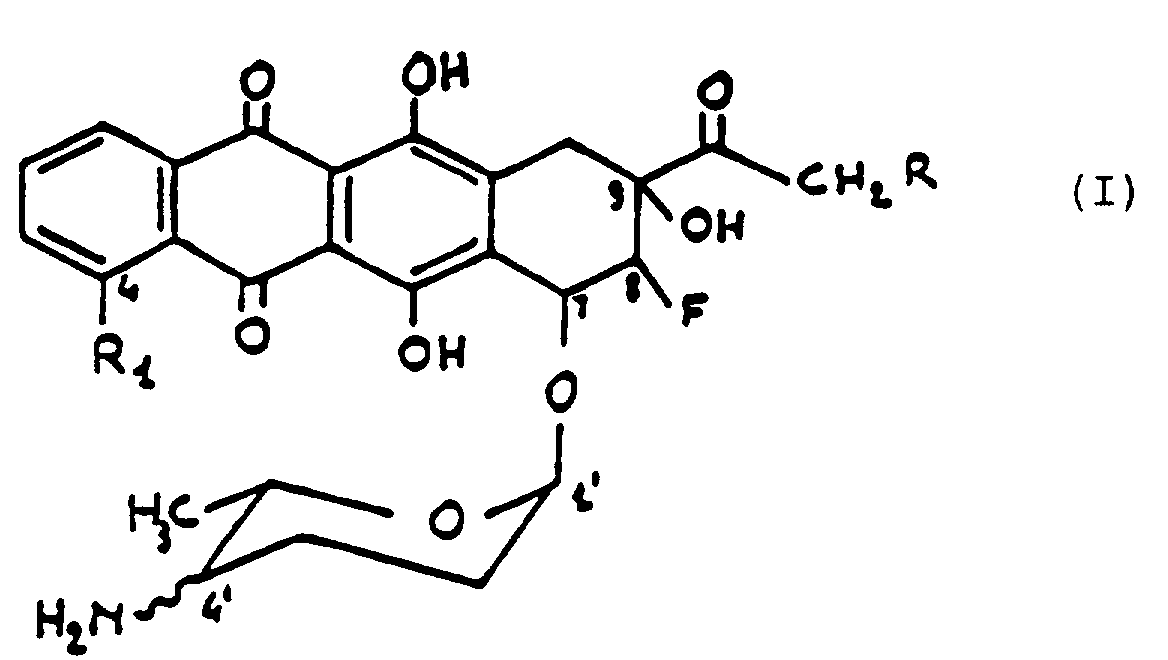
- This invention relates to glycosidic derivatives of 8-fluoroanthracycline of formula I:

- R = H, OH, OR";
- R₁ = H, OH, OCH₃;
- R" = CHO-COCH₃ or an acyl residue derived from a carboxylic acid containing up to 6 carbon atoms;
- and NH₂ indicates that the amino substituent can be in the axial configuration (natural configuration) or equatorial configuration (epi configuration);

- and their pharmaceutically acceptable salts.
- Daunorubicin (daunomycin), 4-demethoxydaunorubicin (Idarubicin) and their derivatives comprising a hydroxylated side chain (doxorubicins) are glycosides possessing known antitumoral properties, the preparation and use of which have already been described (F. Arcamone "Doxorubicin Anticancer Antibiotics", Medicinal Chemistry Series Vol. 17. Academic Press, 1981).
- It has now been surprisingly found that replacing an H atom with an F atom in the C-8 position of the non-glycosidic part of the molecule increases the activity and selectivity of these compounds, which thus unexpectedly possess superior power compared with known anthracyclines, especially in the case of tumoral cells resistant to known compounds.
- The present invention therefore relates to glycosidic derivatives of 8-fluoroanthracycline of formula (I):

- R
- = H, OH, OR";
- R₁
- = H', OH, OCH₃;
- R"
- = CHO-COCH₃ or an acyl residue derived from a carboxylic acid containing up to 6 carbon atoms;
- One of the preferred salts of the present invention is the hydrochloride of compounds of formula (I).
- More particularly the present invention relates to the following compounds:
- 4-demethoxy-8-fluoro-3'-deamino-4'-deoxy-4'-aminodaunorubicin (R = R₁ = H);
- 4-demethoxy-8-fluoro-3'-deamino-4'-deoxy-4'-epi-aminodaunorubicin (R = R₁ = H);
- 8-fluoro-3'-deamino-4'-deoxy-4'-epi-aminodaunorubicin (R = H, R₁ = OCH₃);
- 8-fluoro-3'-deamino-4'-deoxy-4'-aminodaunorubicin (R = H, R₁ = OCH₃);
- 8-fluoro-3'-deamino-4'-desoxy-4'-aminocarminorubycin (R = H, R₁ = OH);
- 8-fluoro-3'-deamino-4'-desoxy-4'-epi-aminocarminorubycin (R = H, R₁ = OH);
- 4-demethoxy-8-fluoro-3'-deamino-4'-deoxy-4'-aminodoxorubicin (R = OH, R₁ = H); and its esters in C-14
- 4-demethoxy-8-fluoro-3'-deamino-4'-deoxy-4'-epi-aminodoxorubicin (R = OH, R₁ = H); and its esters in C-14
- 8-fluoro-3'-deamino-4'-deoxy-4'-aminodoxorubicin (R = H, R₁ = OCH₃); and its esters in C-14
- 8-fluoro-3'-deamino-4'-deoxy-4'-epi-aminodoxorubicin (R = H, R₁ = OCH₃); and its esters in C-14
- The compounds of formula (I) and their pharmaceutically acceptable salts are prepared by condensing an 8-fluoroanthracyclinone of formula (II):


 ) indicates that the substituent R₂ can be arranged in the axial or equatorial configuration.
 - On removing the amino-protecting group from the compound of formula IV, the 8-fluoroanthracyclineglycoside of formula I is obtained in which R and R₁ are as heretofore defined.
- The anthracyclineglycoside of formula I can be converted into one of its pharmaceutically acceptable salts, or alternatively the compound of formula I or a pharmaceutically acceptable salt can be brominated and the 14-bromo derivative obtained can be hydrolyzed to obtain the anthracyclineglycoside of formula I in which R = OH, and if desired said anthracyclineglycoside can be transformed into one of its pharmaceutically acceptable salts.
- According to the present invention the preferred leaving group X for the compounds of formula III is a halogen such as bromine or chlorine, preferably chlorine, or a p-nitrobenzoyloxy group. An amino-protected R₂ group is preferably a trifluoroacetamide or an allyloxycarboxyamide.
- The reaction conditions for the condensation reaction between a compound of formula II and one of formula IIIa or IIIe to obtain a compound of formula IV can vary according to the type of substitution of the compounds of formula IIIa or IIIe.
- The glycosidation reaction is conducted in an inert organic solvent in the presence of a condensing agent.
- Hydrocarbon solvents such as benzene or toluene, ethers such as diethyl-ether, tetrahydrofuran or dioxane, chlorinated solvents such as chloroform, methylenechloride or dichloroethane and their mixtures can be used. Methylenechloride is the preferred solvent. Condensing agents can be salts such as silver triflate, silver perchlorate, mercury oxide and bromide mixtures, trimethylsilyltriflate; Lewis acids such as boron halides, tin or titanium tetrachloride; or acid ion exchange resins such as Amberlites.
- The reaction temperature can vary from -40°C to 40°C, preferably from -20°C to 20°C, and the reaction can last from 15 minutes to 3 hours.
- A dehydrating agent such as an activated molecular sieve is preferably present in the reaction mixture.
- During the course of the reaction or at its end, an organic base such as pyridine, collidine, N,N-dimethylaminopyridine, triethylamine or proton sponge can be added to the reaction mixture.
- According to the present invention the conditions for removing the amino-protecting group of the compound of formula IV in which R₁ and R₂ are as heretofore defined, in order to obtain a compound of formula I in which R = H and R₁ is as heretofore defined, can vary as a consequence of the mechanism of substitution of the compound of formula IV.
- When the amino-protecting group is trifluoroacetamide, the deprotonation reaction is conducted in a polar solvent such as water, methanol, ethanol, pyridine, dimethylformamide or their mixtures in the presence of a stoichiometric or greater than stoichiometric quantity of an inorganic base such as NaOH, KOH, LiOH, Ba(OH)₂ or their carbonates. The reaction temperature can vary from 0°C to 50°C and the reaction can last from 3 hours to 3 days.
- When the amino-protecting group is an allylcarboxyamide the deprotonation reaction is conducted in an inert solvent in the presence of a metal complex such as (tetrakis-triphenylphosphine) palladium, as described for example in Tetrahedron Letters, 30, 3773 (1989), or (tetracarbonyl)nickel as described for example in J. Org. Chem. 38, 3233 (1973).
- If necessary, a compound of formula I in which R is hydrogen and R₁ is as heretofore defined can be transformed, respectively, into a compound of formula I in which R is OH and R₁ is as heretofore defined, by bromination in position C-14 followed by hydrolysis of the 14-bromo derivative obtained in this manner. The bromination and subsequent hydrolysis are described in US-A-4 122 076. The bromination of a compound of formula I in which R = H and R₁ is as heretofore defined is conducted with bromine in chloroform to obtain the corresponding 14-bromo derivative from which, after hydrolysis at ambient temperature for 48 hours with an aqueous sodium formate solution, a compound of formula I is obtained as a free base in which R = OH and R₁ is as heretofore defined, and which by treatment with hydrochloric acid in methyl alcohol is isolated as the hydrochloride.
- The present invention also relates to the 8-fluoroanthracyclinones of general formula II and the process for their preparation. This process is illustrated by the reaction scheme (A).

- The first stage of the process comprises oxidizing an epoxyalcohol of general formula V in which R₁ is as heretofore defined, to obtain an epoxyketone of general formula VI in which R₁ is as heretofore described. The epoxyalcohol V can be prepared as described in GB-A-2 125 030. The oxidation reaction can be conducted by the methods generally known to the expert of the art. Methods comprising the use of dimethylsulphoxide, such as oxidation by the Moffat method and the like, or the use of pyridine-chromium complexes such as pyridinium chlorochromates, are preferred.
- The second stage of the process illustrated in Scheme A comprises reacting the epoxyketone VI with a nucleophilic fluorine generator, to obtain the 8-fluorinated compound of general formula VII in which R₁ is as heretofore defined.
- The nucleophilic fluorine generator can for example be the pyridine-hydrofluoric acid complex, and a preferred method for implementing this stage is to stir a solution or suspension of the compound, of formula VI with the reagent at ambient temperature overnight. The last reaction stage comprises transforming the fluorohydro-ketone of formula VII into the compound of formula II. This can be done by known methods such as bromination and solvolysis, if necessary protecting the keto group [Can. J. Chem., 49, 2712 (1973); J. Am. Chem. Soc., 98, 1969 (1976); J. Am. Chem. Soc., 98, 1967 (1976)].
- The present invention also relates to the amino sugars of formula III in which X and R₂ are as heretofore defined, and a process for their preparation comprising:
- a) reacting methyl-2,3,6-trideoxy-α-L-glycero-hexoxypyranoside-4-ulose of formula VIII:


- b) reducing said mixture, after protecting the formed amino group with a trifluoroacetyl group and separating the 4-N-trifluoroacetylated epimers of formula Xa and Xe thus obtained:

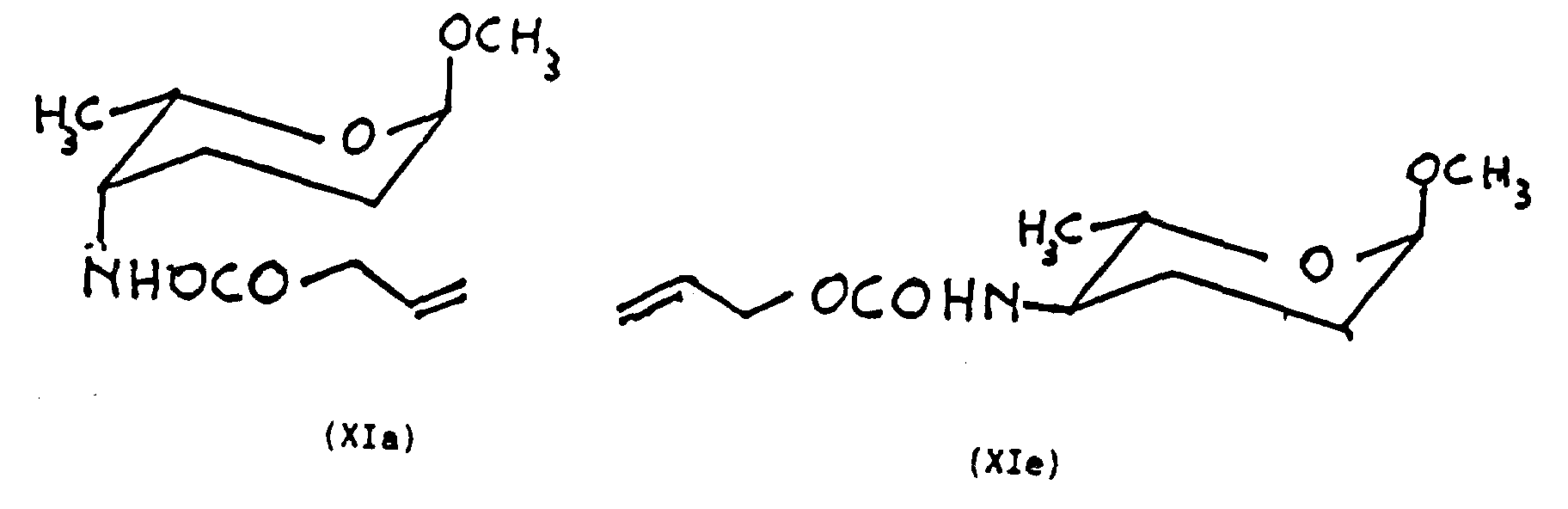
- c) if preferred, as an alternative to the aforesaid stages, reacting the methyl-2,3,6-trideoxy-α-L-glycero-hexoxypyranoside-4-ulose of formula VIII with a reducing agent in the presence of ammonium salts, protecting the thus formed amino group with a trifluoroacetyl group or, if preferred, with an allyloxycarbonyl group, and separating the epimers of formula Xa and Xe or XIa and XIe;
- d) converting each epimer Xa and Xe into the corresponding 1-hydroxy derivative of formula XIIa and XIIe:
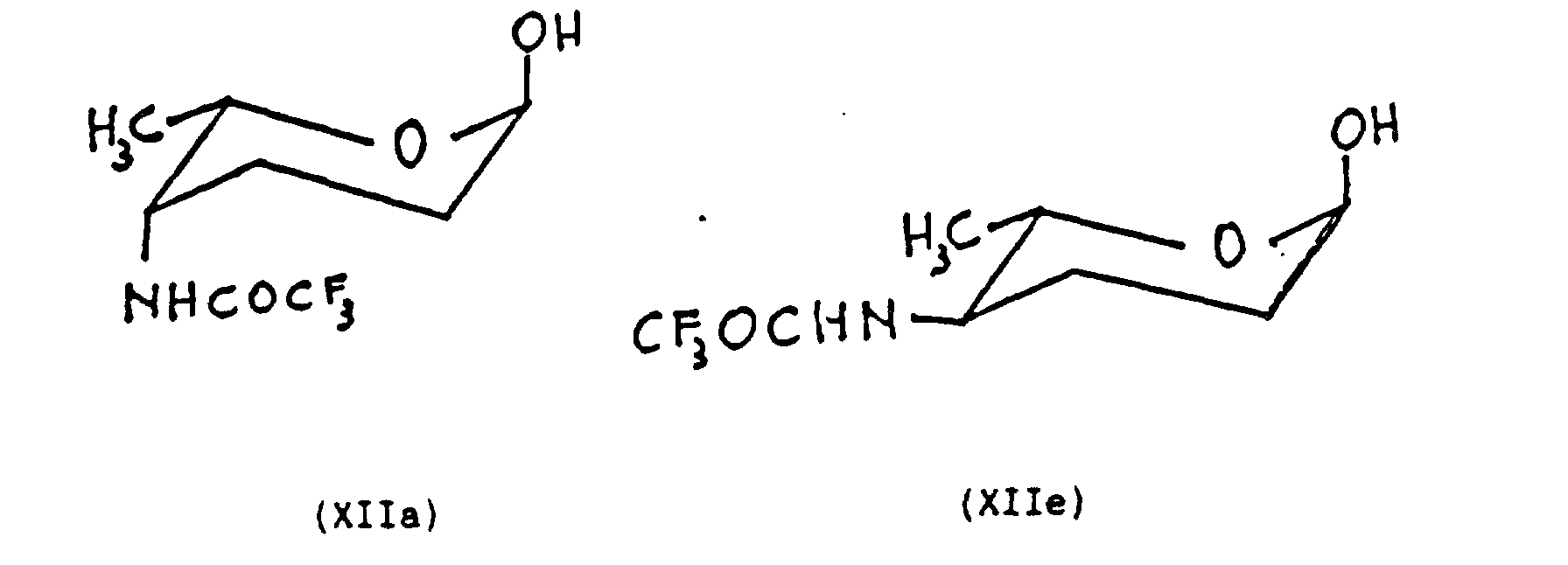

- e) converting said 1-hydroxy derivatives XIIa and XIIe or XIIIa and XIIIe into the corresponding compounds of formula IIIa and IIIe, in which X is chlorine and R₂ is as heretofore defined, or, if desired, converting each said 1-hydroxy derivative XIIa and XIIe or XIIIa and XIIIe into the corresponding compounds of formula IIIa and IIIe, in which X is p-nitrobenzoyloxy and R₂ is as heretofore defined.
- In stage a) the methyl-2,3,6-trideoxy-α-L-glycero-hexoxypyranoside-4-ulose VIII can be treated with hydroxylamine hydrochloride in triethylamine to give the syn and anti oximes IX. In stage b) the oximes IX can be reduced with borane in tetrahydrofuran or bis-dimethoxyethoxy sodium aluminium hydride (Vitride)® in tetrahydrofuran, toluene or dioxane. The reaction temperature can be between -20°C and 20°C and the reaction time between 3 and 12 hours. The reduced mixture can be reacted with trifluoroacetic anhydride in carbon tetrachloride or diethylether at ambient temperature, preferably in the presence of an organic base such as triethylamine or pyridine, to obtain a mixture of N-trifluoroacetylated derivatives from which the corresponding products of formula Xa and Xe are obtained separately by chromatographic separation. If preferred, the reduced mixture can be reacted with allylchlorocarbonate in tetrahydrofuran in the presence of an organic base such as pyridine, triethylamine or the like at a temperatre of between -20°C and 20°C for 3-12 hours, to obtain a mixture or N-allyloxycarbonylates from which the corresponding products of fomula XIa and XIe are obtained by chromatographic separation.
- Alternatively, in stage c), reduction of the ulose or formula VIII can be effected with sodium cyanoborohydride and ammonium acetate or ammonium chloride in tetrahydrofuran, diethylether, methanol or ethanol at a temperature of between -20°C and 20°C. The reduced mixture can be treated as described in stage b).
- In stage d) the conversion of each epimer Xa and Xe into the corresponding 1-hydroxy derivatives XIIa and XIIe or, if preferred, the conversion of each epimer XIa and XIe into the corresponding 1-hydroxy derivatives XIIIa and XIIIe can be effected by heating in the presence of an acid. Heating can be to a temperature of between 70°C and 100°C for a time of between 30 minutes and 3 hours, using an aqueous solution of acetic, trifluoroacetic or hydrochloric acid. The aqueous acid solution concentration can be between 5% and 30%.
- In stage e) each 1-hydroxy epimer of formula XIIa, XIIe, XIIIa and XIIIe can be firstly treated overnight at 0°C with trifluoroacetic anhydride and then dissolved in diethyl ether and reacted overnight with gaseous hydrochloric acid to obtain each individual epimer of formula IIIa and IIIe in which X is chlorine and R₂ is a heretofore defined.
- If preferred, each of said 1-hydroxy epimers or formula XIIa, XIIe, XIIIa and XIIIe can be dissolved in pyridine or dimethylformamide or dimethylsulphoxide in the presence of an organic base and treated with p-nitrobenzoylchloride at a temperature of between -20°C and 20°C for 1-6 hours to obtain each individual epimer of formula IIIa and IIIe in which X is n-nitrobenzoyloxy and R₂ is as heretofore defined.
- The present invention also relates to pharmaceutical compositions containing as active principle an anthracyclineglycoside of formula I or a pharmaceutically active salt thereof together with a pharmaceutically acceptable carrier or diluent.
- A therapeutically effective quantity of a compound according to the present invention is combined with an inert carrier. Conventional carriers can be used and the composition can be formulated in the usual manner.
- The compound according to the invention are effective in therapeutic treatment methods on man or animals. In particular, the compounds of the invention are useful as antitumoral agents, by administration of therapeutically effective quantities of the compound to the patient under treatment.
- The following examples illustrate the invention but without in any way limiting its scope.
- 9-(1'-hydroxyethyl)-9,8-(8H)-epoxy-7,10-dihydro-6,11-dihydroxy-5,12-naphthacene-dione (VI, R₁ = H) prepared as described in GB-A-2 125 030 (1.9 g, 5.6 mmoles) dissolved in methylene chloride (150 ml) was added at ambient temperature under stirring to a suspension of pyridinium chlorochromate (1.8 g. 8.5 mmoles). The reaction mixture was kept stirring overnight, diluted by adding methylene chloride and washed with water (2 x 100 ml). The organic phase was dried over sodium sulphate, filtered and evaporated under vacuum to give a residue which was crystallized from ethyl acetate. 1.78 g (yield 90%) of the compound were obtained with a melting point of 219-221°C.
- I.R. (nujol, cm⁻¹):
- 1713
- N.M.R. (CDCl₃, δ) :
- 2.17 (s, 3H)
3.01 (dd, J=20 HZ, 1H)
3.4-4.2 (m, 4H)
7.80 (m, 2H)
8.30 (m, 2H)
13.39 (s, 1H)
13.42 (s, 1H) - Proceeding in like manner, the following were prepared:
- 4-methoxy-9-acetyl-9,8(8H)-epoxy-7,10-dihydro-6,11-dihydroxy-5,12-naphthacene-dione (VI, R₁ = OCH₃) and
- 9-acetyl-9,8(8H)-epoxy-7,10-dihydro-4,6,11-trihydroxy-5,12-naphthacene-dione (VI, R₁ = OH)
- A mixture of 9-acetyl-9,8(8H)-epoxy-7,10-dihydro-6,11-dihydroxy-5,12-naphthacene-dione (0.6 g, 1.7 mmoles), prepared as in Example 1, and hydrofluoric acid/pyridine (70% solution, 21 ml) was stirred for 24 hours in a nitrogen stream at ambient temperature. The reaction mixture was then poured into ice and water and stirred for 30 minutes. The precipitate obtained was filtered, washed with water until neutral and dried at 40°C under vacuum. After crystallization 0.380 g (yield 60%) of the compound were obtained, with a melting point of 248-252°C.
- N.M.R. (CDCl₃, δ):
- 2.50 (3H, d, JHF=2.6 Hz)
3.0-3.4 (4H, m)
4.25 (1H,s)
4.78 (1H, ddd, JHF=48.4 Hz)
7.80 (2H, m)
8.30 (2H, m)
13.00 (1H, s)
13.05 (1H, s) - Proceeding in like manner, the following were prepared:
- 4-methoxy-9-acetyl-8(8H)-fluoro-7,10-dihydro-6,9,11-trihydroxy-5,12-naphthacene-dione (VII, R₁ = OCH₃) and
- 9-acetyl-8(8H)-fluoro-7,10-dihydro-4,6,9,11-tetrahydroxy-5,12-naphthacene-dione (VII, R₁ = OH)
- A mixture of 9-acetyl-8(8H)-fluoro-7,10-dihydro-6,9,11-trihydroxy-5,12-naphthacene-dione (0.1 g, 0.26 mmoles), prepared as in Example 2, and bromine (0.4 mmoles) in carbon tetrachloride (30 ml) was irradiated for one hour with a 500 watt sun lamp. The reaction mixture was washed with a saturated aqueous sodium bicarbonate solution and then with water, dried over sodium sulphate, filtered and evaporated under vacuum to give a residue which was purified by flash chromatography. 0.028 g (yield 30%) of product were obtained.
- N.M.R. (CDCl₃, δ):
- 2.54 (3H, d, JHF=2.2 Hz)
3.18 (1H, dd, J=18 Hz)
3.30 (1H, dd, J=18 Hz)
3.65 (1H, d, JHF=3 Hz)
4.60 (1H, bs)
4.98 (1H, dd, JHF=46.2 Hz)
5.18 (1H, bd, JHF=13 Hz)
7.80-7.90 (2H, m)
8.20-8.43 (2H, m)
13.29 (1H, s)
13.53 (1H, s) - Proceeding in like manner, the following were prepared:
- 4-methoxy-9-acetyl-8(8H)-fluoro-10-hydro-6,7(7H),9,11-tetrahydroxy-5,12-naphthacene-dione (II, R₁ = OCH₃) and
- 9-acetyl-8(8H)-fluoro-10-hydro-4,6,7(7H),9,11-pentahydroxy-5,12-naphthacene-dione (II, R₁ = OH)
- A mixture of 2.5 g of methyl-2,3,6-trideoxy-α-L-glycerohexoxypyranoside-4-ulose (VIII), 2.4 g of hydroxylamine hydrochloride and 3.33 ml of methanol was kept under reflux for 2 hours. The solvent was evaporated under vacuum and the resultant oily residue was taken up in 150 ml of water and extracted with 200 ml of methylene chloride (3 times).
- The extracts were dried over sodium sulphate, filtered, and evaporated under vacuum to give a residue which was purified by flash chromatography, eluting with 6/4 hexane/diethyl ether.
- 2.42 g of a syn/anti mixture of the oximes (IX) were obtained in viscous liquid form. This viscous liquid (0.830 g, 5.21 mmoles) was dissolved in toluene (15 ml), and bis methoxyethoxy sodium aluminium hydride (24.5 moles) was added dropwise at -40°C to this solution under a nitrogen stream. The reaction mixture was kept stirring at -40°C for 1/2 hour and at ambient temperature for 4 hours, after which water (0.5 ml), aqueous sodium hydroxide solution (0.5 ml) and water (1.5 ml) were added. The two phases were separated, the organic phase was dried over sodium sulphite, filtered through celite and evaporated under vacuum to give a crude compound which was suspended in carbon tetrachloride. Triethylamine (2.27 ml, 16.3 mmoles) and trifluoroacetic anhydride (1.15 ml, 6.24 mmoles) in carbon tetrachloride (10 ml) were added dropwise in that order to the suspension at 0°C while stirring.
- After 3 hours of further stirring at 0°C the reaction mixture was diluted with methylene chloride and washed with water, with a 10% aqueous sodium bisulphate solution and with an 8% aqueous sodium bicarbonate solution. The organic phase was dried over sodium sulphate, filtered, and evaporated under vacuum to give a crude product which was purified by flash chromatography. Elution with 15/1 methylene/diethyl ether gave the compound Xa (0.480 g, yield 38%).
- N.M.R. (CDCl₃, δ):
- 1.10 (d, 3H, J=8 Hz)
1.5-2.0 (m, 4H)
3.31 (s, 3H)
3.8-4.3 (m, 2H)
4.6-4.8 (m, 1H)
6.8 (s, 1H) - Elution with 10/1 methylene/diethyl ether gave the compound Xe (0.480 g, yield 38%).
- N.M.R. (CDCl₃, δ):
- 1.15 (d, 3H, J=8 Hz)
1.7-1.9 (m, 4H)
3.32 (s, 3H)
3.6-3.8 (m, 2H)
4.6-4.7 (m, 1H)
6.8 (s, 1H) - A mixture of methyl-2,3,6-trideoxy-α-L-threo-hexoxypyranoside-4-ulose (VIII) (2 g, 13.8 mmoles), ammonium acetate (10.7 g, 139 mmoles) and sodium cyanoborohydride (2.84 g, 45 mmoles) in methanol (480 ml) was kept stirring at ambient temperature for 48 hours and then treated with a 5% aqueous acetic acid solution (240 ml). After 10 minutes of further stirring, the resultant solution was washed with chloroform (400 ml). The aqueous phase was separated, adjusted to pH 8 by adding sodium bicarbonate and extracted 7 times with 300 ml of chloroform.
- The extracts were dried over sodium sulphite, filtered and evaporated under vacuum to give a crude product which after treatment with trifluoroacetic anhydride (5.8 ml) as described in Example 4, enables the two compounds Xa (0.28 g) and Xe (1.5 g) to be obtained.
- The reduced mixture (0.58 g, 4 mmoles) obtained as described in Example 4 and dissolved in tetrahydrofuran (6 ml) was treated at 0°C with pyridine (0.55 ml) and allylchlorocarbonate (0.82 g, 6.8 mmoles) dissolved in tetrahydrofuran (2 ml) in that order.
- The reaction mixture was stirred for 6 hours at ambient temperature after which water was added and the mixture extracted with methylene chloride (5 times, each with 10 ml). The extracts were dried over sodium sulphate, filtered, and evaporated under vacuum to give a residue which was purified by flash chromatography. Elution with 9/1 petroleum ether/acetone gave successively the title compound XIa (0.366 g, yield 40%).
- N.M.R. (200 MHz, CDCl₃, δ):
- 1.08 (d, J=65 Hz, 3H)
1.2-2.1 (m, 4H)
3.31 (s, 3H)
3.4-3.5 (m, 1H)
3.63 (d, 1H, J=10.73)
4.02 (td, 1H, Jh=6.5 Hz, Jh = 1.6 Hz)
4.54 (d, 2H, J=5.6 Hz)
5.18 (dd, 1H)
5.27 (dd, 1H)
5.9 (m, 1H) - NMR (200 MHz, CDCl₃, δ) :
- 1.08 (d, J = 6,5 Hz, 3H)
1.4 - 1.9 (m, 4H)
3.31 (s, 3H)
3.4 - 3.5 (m, 1H)
3.52 (qd, 1H, JH-Me = 6.5 Hz, JH-H = 9.9 Hz)
4.46 (d, 1H, J = 10.7 Hz)
4.54 (d, 2H, J = 5.6 Hz)
4.63 (d, 1H, J < 1Hz)
5.18 (dd, 1H)
5.27 (dd, 1H)
5.9 (m, 1H) - A mixture of 150 mg of methyl 2,3,4,6-tetradeoxy-4-trifluoro-acetamido-α-L-erythro-hexoxypyranoside (Xe), prepared as described in Example 5, and a 20% aqueous acetic acid solution (15 ml) was heated to 80°C for 3 hours.
- The reaction mixture was evaporated under vacuum to give 2,3,4,6-tetradeoxy-4-trifluoroacetamido-L-erythro-hexoxy-pyranoside (XIIe) in the form of a white solid which was dissolved in 2.5 ml of pyridine and treated at 0°C with 177 mg of p-nitrobenzoylchloride. The reaction mixture was stirred for 2 hours at 0°C, water was added and the mixture extracted with chloroform (5 times, each with 3 ml). The extracts were washed with 3N sulphuric acid, water and an 8% aqueous sodium bicarbonate solution. The organic phase was dried over sodium sulphate, filtered and evaporated under vacuum to obtain the compound IIIe (200 mg, yield 85%) in the form of a viscous yellow liquid.
- N.M.R. (60 MHz CDCl₃,δ):
- 1.25 (d, J=6 Hz, 3H)
1.9-2.2 (m, 4H)
3,6-4.0 (m, 2H)
6.0 (s, 1H)
6.35 (m, 1H)
8.2 (s, 4H) - Starting from methyl-2,3,4,6-tetradeoxy-4-trifluoroacetamido-α-L-threo-hexoxypyranoside (Xa), prepared as described in Example 4, the said compound was prepared by the procedure described in Example 7.
- TLC on Kieselgel plates (Merck F₂₅₄) using the solvent system : hexane/ethylacetate (3 : 1) Rf = 0.43.
- A mixture of 200 mg of methyl-2,3.4,6-tetradeoxy-4-allyloxycarboxyamide-α-L-threo-hexoxypyranoside (XIa), prepared as described in Example 6, and 20 ml of 20% aqueous acetic acid solution was heated to 80°C for 2 hours. The reaction mixture was evaporated under vacuum to give 2,3,4,6-tetradeoxy-4-allyloxycarboxyamido-α-L-threo-hexoxypyranose (XIIIa) in the form of a viscous liquid which was dissolved in 4 ml of pyridine and treated with 120 mg of p-nitrobenzoylchloride. The reaction mixture was stirred for 2 hours at 0°C, water was added and the mixture extracted with chloroform (5 times, each with 4 ml). The extracts were washed with 3N sulphuric acid, water and an 8% aqueous sodium bicarbonate solution. The organic phase was dried over sodium sulphate and evaporated under vacuum to obtain the compound IIIa (260 mg, yield 81%).
- TLC on Kieselgel plates (Merck F₂₅₄) using the solvent system : dichloromethane/acetone (95 : 5) Rf = 0.40.
- Starting from methyl-2,3,4,6-tetradeoxy-4-allyloxy-carboxyamide-α-L-erythro-hexoxypyranoside (XIe), prepared as described in Example 6, the said compound was obtained by the procedure described in Example 9.
- TLC on Kieselgel plates (Merck F₂₅₄) using the solvent system : hexane/ethylacetate (95 : 5) Rf = 0.31.
- A solution of 210 mg of 2,3,4,6-tetradeoxy-4-trifluoroacetamido-α-L-erythro-hexoxy-pyranosyl-p-nitrobenzoate (IIIe, R₂ = NHCOCF₃, X = p-NO₂-C₆H₄-COO), prepared in accordance with Example 7, in 5 ml of anhydrous methylene dichloride, was saturated at 0°C with anhydrous hydrochloric acid. After standing overnight at 0°C the precipitated p-nitrobenzoic acid was filtered off and the solution evaporated under vacuum to give the compound, which was used for the coupling reaction without further purification.
- Starting from 2,3,4,6-tetradeoxy-4-trifluoroacetamido-L-threo-hexoxy-pyranosyl-p-nitrobenzoate (IIIa, R₂ = NHCOCF₃, X = p-NO₂-C₆H₄-COO), prepared as described in Example 8, the said compound was prepared following the procedure described in Example 11.
- A solution of 270 mg of 2,3,4,6-tetradeoxy-4-allyloxycarboxyamido-L-threo-hexoxypyranosyl-p-nitrobenzoate (IIIa, R₂ = NHCOOCH₂CH=CH₂, X = p-NO₂-C₆H₄-COO), prepared in accordance with Example 9, in 6 ml of anhydrous methylene dichloride, was saturated with anhydrous hydrochloric acid. After standing overnight at 0°C the precipitated p-nitrobenzoic acid was filtered off and the solution evaporated under vacuum to give the compound, which was used for the coupling reaction without further purification.
- Starting from 2,3,4,6-tetradeoxy-4-allyloxycarboxyamido-L-erythrohexoxypyranosyl-p-nitrobenzoate (IIIe, R₂ = NHCOOCH₂CH=CH₂, X = p-NO₂-C₆H₄-COO), prepared in accordance with Example 10, the said compound was obtained following the procedure described in Example 13.
- A mixture of 120 mg of 9-acetyl-8(8H)-fluoro-10-hydro-6,7(7H),9,11 tetrahydroxy-5,12-naphthacenedione (II, R₁ = H), prepared as described in EXAMPLE 3, 240 mg of 2,3,4,6-tetradeoxy-4-trifluoroacetamido-α-L-erythro-hexopyranosyl-p-nitrobenzoate (IIIe, R₂ = NHCOCF₃, X = p-NO₂-C₆H₄-COO), prepared as described in EXAMPLE 7, in 60 ml of dry methylene dichloride and 20 ml of diethyl ether and in the presence of molecular sieves (4 Å) at 0°C was treated with 0,225 ml of trimethylsilyltriflate.
- The reaction mixture was stirred during 15 minutes at 0°C and quenched with 266 mg of 1,8-bis-(dimethylamino)-naphthalin, after stirring for 10 minutes. The mixture was filtered to remove the resulting white precipitate and the filtrate evaporated under vacuum to obtain a residue which was purified by flash chromatography.
- Elution with methylene/acetone (95 : 5) afforded 4-demethoxy-8-fluoro-3'-deamino-4'-deoxy-4'-epi-trifluoroacetamidodaunorubicin (IV, R₁ = H, R₂ = NHCOCF₃) (108 mg, yield 60%)
- H-NMR (200 MHz, CDCl₃, δ) :
- 1.15 (d, J = 8 Hz, 3H)
1.7 - 1.9 (m, 4H)
2,45 (s, 3H)
3.19 (d, J = 19 Hz, 1H)
3.33 (dd, JH-F = 3.6, J = 19 Hz, 1H)
3.6 - 3.8 (m, 2H)
3.98 (s, 1H)
4.91 (dd, JH-F = 50 Hz, 1H)
5.17 (dd, JH-F = 12 Hz, 1H)
5.26 (m, 1H)
6.21 (bd, 1H)
7.86 (m, 2H)
8.4 (m, 2H)
13.35 (s, 1H)
13.36 (s, 1H) - A suspension of 78 mg of the N-trifluoroacetyl derivative in 15.6 ml of barium hydroxide 0.2 M was stirred during 2 hours under nitrogen at room temperature. The reaction mixture was neutralized with carbon dioxide and then extracted with chloroform; the combined extracts were dried over anhydrous sodium sulphate and concentrated to a small volume. Hydrogen chloride and diethylether was added to give the title compound (I, R = H, R₁ = H) (56 mg, yield 80%).
- TLC on Kieselgel plates (Merck F₂₅₄) using the solvent system : chloroform/methanol/water (65 : 30 : 10) Rf = 0.45
- By proceeding analogously the following compounds can be prepared 4-demethoxy-8-fluoro-3'deamino-4'-deoxy-4'-aminodaunorubicin hydrochloride (I, R = H, R₁ = H)
- TLC on Kieselgel plates (Merck F₂₅₄) using the solvent system : chloroform/methanol/water (65 : 30 : 10) Rf = 0.47
- H-NMR of the corresponding trifluoroacetamido derivative is reported
- H-NMR (200 MHz, CDCl₃ inter alia δ) :
- 3.17 (d, J = 19 Hz, 1H, H-10 ax)
3.31 (dd, JH-F = 3.6, J = 19 Hz, 1H, H-10 e);
3.8 - 4.3 (m, 2H, H-4', H-5');
4.89 (dd, JH-F = 50 Hz, 1H, H-8)
5.25 (dd, JH-F = 12 Hz, 1H, H-7)
5.46 (m, 1H, H-1') - TLC on Kieselgel plates (Merck F₂₅₄) using the solvent system chloroform/methanol/water (65 : 30 : 10) Rf = 0.41
- H- NMR of the corresponding trifluoroacetamido derivative is reported :
- H-NMR (200 MHz, CDCl₃, inter alia δ):
- 3.17 (d, J = 19 Hz, H-10 ax);
3.5 (dd, JH-F = 3.6 Hz, J= 19 Hz, 1H, H-10 e); 4.10 (s, 3H, OCH₃) - TLC on Kieselgel plates (Merck F₂₅₄) using the solvent system chloroform/methanol/water (65 : 30: 10) Rf = 0.42
- H- NMR of the corresponding trifluoroacetamido derivative is reported :
- H-NMR (200 MHz, CDCl₃, inter alia δ) :
- 3.15 (d, J = 19 Hz, 1H, H-10 ax);
3.49 (dd, JH-F = 3.6 Hz, J = 19 Hz, 1H, H-10 e); 4.08 (s, 3H, OCH₃) - A mixture of 200 mg of 9-acetyl-8(8H)-fluoro-10-hydro-6,7(7H),9,11-tetrahydroxy-5,12-naphthacenedione (II, R₁ = H) prepared as described in EXAMPLE 3, 157 mg of 2,3,4,6 tetradeoxy-4-allyloxycarboxyamido-L-threo-hexopyranosylchloride (IIIa, R = NHCOOCH₂-CH=CH₂, X = Cl) prepared as described in EXAMPLE 13 in 60 ml of dry methylene dichloride and in the presence of molecular sieves (4 Å) at 0° C was treated with a solution of 134 mg of silver trifluoromethanesulphonate in 10 ml of diethylether. After 45 minutes the mixture was filtered to remove the resulting white precipitate and the filtered solution was treated with a satured aqueous solution of sodium hydrogen carbonate. The organic layer was separated off and evaporated under vacuum to obtain a residue which was purified by flash chromatography.
- Elution with methylene dichloride/acetone (95 : 5) afforded 4-demethoxy-8-fluoro-3'-deamino-4'-deoxy-4'-allyloxycarboxyamido (IV, R₁ = H, R₂ = NHCOOCH₂CH=CH₂) (160 mg, yield 53%)
- H-NMR (200 MHz, CDCl₃, δ) :
- 1.08 (d, J = 6.5 Hz, 3H)
1.2 - 2.1 (m, 4H)
2.45 (s, 3H)
3.18 (dd, J = 19 Hz, 1H)
3.31 (dd, JH-F = 3,6 Hz, J = 19 Hz, 1H)
3.63 (bd, 1H)
3.38 -3.52 (m, 1H)
4.02 (m, 1H)
4.54 (d,2H)
4.89 (dd, JH-F = 50 Hz, 1H)
5.15 (dd, JH-F = 12 Hz, 1H)
5.21 - 5.27 (m, 3H)
5.9 (m, 1H) - A mixture of 102 mg of the N-allyloxycarbonyl derivative, 4.4 mg of tetrakis(triphenylphosphine)palladium, 4.4 mg of triphenylphosphine and 44.5 mg of 2-ethylhexanoic acid in 15 ml of anhydrous methylene chloride was stirred at 25° C for 21 hours. Methylene chloride was added, the organic phase was washed with a 8% sodium bicarbonate aqueous solution, dried over anhydrous sodium sulphate and evaporated under vacuum. The residue was taken with aqueous hydrochloric acid (pH = 3) and then extracted with methylene dichloride and the combined extracts were dried over anhydrous sodium sulphate and concentrated to a small volume. Hydrogen chloride and diethylether was added to give the title compound (I, R = H, R₁ = H) (76 mg, yield 81%).
- TLC on Kieselgel plates (Merck F₂₅₄) using the solvent system chloroform/methanol/water (65 : 30 : 10) Rf = 0.48.
- By proceeding analogously the following compounds can be prepared :
4-demethoxy-8-fluoro-3'deamino-4'-deoxy-4'-epi-aminodaunorubicin hydrochloride (I, R = H, R₁ = H) - H-NMR of the corresponding allyloxycarboxyamido derivative is reported :
- H-NMR (200 MHz, CDCI₃, inter alia δ) :
- 3.19 (d, J = 19 Hz, 1H, H-10 ax)
3.33 (dd, JH-F = 3.6 Hz, J = 19 Hz, 1H, H - 10 e); 4.91 (dd, JH-F = 50 Hz, 1H, H-8);
5.14 (dd, 3H-F = 12 Hz, 1H, H-7);
5.18 - 5.27 (m, 3H, H-1' + -CH=CH₂) - H-NMR of the corresponding allyloxycarboxyamido derivative is reported :
- H-NMR (200 MHz, CDCl₃, inter alia δ) :
- 3.19 (d, J = 19 Hz, 1H, H-10 ax); 3.48 (dd, JH-F = 3.6 Hz, J = 19 Hz, 1H, H - 10 e);
4.10 (s, 3H, OCH₃) - H-NMR of the corresponding allylcarboxyamido derivative is reported:
- H-NMR (200 MHz, CDCl₃, inter alia δ) :
- 3.17 8d, J = 19 Hz, 1H, H-10 ax); 3.52 (dd, JH-F = 3.6, J = 19 Hz, 1H, H-10 e); 4.08 (s, 3H, OCH₃)
- According to the procedure described in US-4,122,076 a solution of 100 mg of 4-demethoxy-8-fluoro-3'-deamino-4'-deoxy-4'-epi-aminodaunorubicin hydrochloride (IV, R₁ = H, R₂ = NH₂) prepared as described in EXAMPLE XVII in 2,5 ml of anhydrous methanol and 5 ml of dioxane was treated under stirring with a solution of 490 mg of bromine in 5 ml of methylene dichloride to afford the crude 14-bromo-4-demethoxy-8-fluoro-3'-deamino-4'-deoxy-4'-epi-daunorubicin which was precipitated by adding diethyl ether. The crude product was dissolved in a mixture of 5 ml of acetone and 1 ml of water and treated with 150 mg of sodium formate. The reaction mixture was stirred at room temperature for 36 hours, than water was added and extracted with methylene chloride. The aqueous phase was added with 3 ml of 8% aqueous solution of sodium hydrogen carbonate and extracted with methylene dichloride. The combined organic extracts were dried over anhydrous sodium sulphate, concentrated under vacuum to a small volume and treated with methanolic hydrogen chloride (pH = 3.5) and diethyl ether to give the title compound (I, R₁ = H, R = OH) (77 mg, yield 75%).
- TLC on Kieselgel (Merck F₂₅₄) using the solvent system chloroform/methanol/water (65 : 30 : 10) Rf = 0.31
- By proceeding analogously starting from the corresponding daunorubicin derivatives (I, R = H, R₁ = H or OCH₃) the following compounds can be prepared :
4-demethoxy-8-fluoro-3'-deamino-4'-deoxy-4'-aminodoxorubicin hydrochloride (I, R = OH, R₁ = H) - TLC on Kieselgel (Merck F₂₅₄) using the solvent system chloroform/methanol/water (65 : 30 : 10) Rf = 0.34
8-fluoro-3'-deamino-4'-deoxy-4'-aminodoxorubicin hydrochloride
(I, R = OH, R₁ = OCH₃) - TLC on Kieselgel (Merck F₂₅₄) using the solvent system chloroform/methanol/water (65 : 30 : 10) Rf = 0.29
8-fluoro-3'-deamino-4'-deoxy-4'-epi-aminodoxorubicin hydrochloride
(I, R = OH, R₁ = OCH₃) - TLC on Kieselgel (Merck F₂₅₄) using the solvent system chloroform/methanol/water (65 : 30 : 10) Rf = 0.27
- To prepare a pharmaceutical composition suitable for therapeutic use, a suitable quantity of the active principle can for example be dissolved in bidistilled water for injectable use, to a concentration of 1-10 mg/ml. The solution obtained in this manner can then be lyophilized after adding a suitable carrier (such as mannitol or lactose) either with or without appropriate preservatives, and then divided into sterile vials ready for subsequent use.
and their pharmaceutically acceptable salts.
Claims (29)
- A process for preparing 8-fluoroanthracyclineglycosides of formula I
 R = H, OH, OR";R₁ = H, OH, OCH₃;R" = CHO-COCH₃ or an acyl residue derived from a carboxylic acid containing up to 6 carbon atoms;andNH₂ indicates that the amino substituent can be in the axial or equatorial configuration;
 and their pharmaceutically acceptable salts of addition, comprising:i) condensing 8-fluoroanthracyclinone of formula II:

 ) indicates that the substituent R₂ is in the axial or equatorial configuration, and removing the protecting trifluoroacetyl or, if preferred, the allyloxycarbonyl group, to form the 8-fluoro-anthracyclineglycoside of formula I in which R = H and R₁ is as heretofore defined;ii) if preferred, converting said glycoside of formula I, in which R = H and R₁ is as heretofore defined, into a pharmaceutically acceptable salt thereof;iii) if preferred, brominating said glycoside of formula I, in which R = H and R₁ is as heretofore defined, or a pharmaceutically acceptable salt thereof, and hydrolyzing the resultant corresponding 14-bromo derivative to obtain the corresponding glycoside of formula I in which R = OH; andiv) if preferred, converting said glycoside of formula I in which R = OH into a pharmaceutically acceptable salt.
 - A process as claimed in claim 1, wherein stage i) is conducted in the presence of a condensing agent such as silver triflate, silver perchlorate, mixture of mercury oxide and mercury bromide, trimethylsilyltriflate, p-toluenesulphonic acid, trifluoroacetic acid, boron halides, tin tetrachloride, titanium tetrachloride or acid resins of Amberlite type.
- A process as claimed in claim 2, wherein the 8-fluoroanthracyclinone of formula II is dissolved in an inert organic solvent and the condensation is conducted in the presence of a molecular sieve as dehydrating agent.
- A process as claimed in claims 2 and 3, wherein pyridine, collidine, N,N-dimethylaminopyridine, triethylamine or proton sponge is added to the condensation reaction.
- A process as claimed in claims 1 to 4, wherein the N-trifluoroacetyl group is removed by mild alkaline hydrolysis.
- A process as claimed in claims 1 to 4, wherein the N-allyloxycarbonyl group is removed by the action of (tetrakistriphenylphosphine)palladium or (tetracarbonyl)nickel.
- A process as claimed in claims 1 to 6, wherein the glycoside of formula I in which R = H is isolated in stage ii) as hydrochloride.
- A process as claimed in claims 1 to 7, wherein the hydrolysis in stage iii) is conducted with sodium formate.
- A process as claimed in claims 1 to 8, wherein the glycoside of formula I in which R = OH is isolated in stage iv) as hydrochloride.
- A process for preparing 8-fluoroanthracyclinone of formula II in which R₁ is as defined in claim 1, wherein an epoxyalcohol of formula V:


- A process as claimed in claim 10, wherein the epoxyalcohol of formula V is oxidized in the presence of dimethylsulphoxide or chromium-pyridine complexes.
- A process as claimed in claims 10 and 11, wherein the opening of the oxirane ring of the epoxyketone of formula VI is effected by hydrofluoric acid-pyridine complexes in pyridine.
- A process as claimed in claims 10 to 12, wherein the fluorohydroxyketone VII dissolved in carbon tetrachloride is treated with bromine under reflux in the presence of a radical initiator and dissolved in water.
Applications Claiming Priority (2)
| Application Number | Priority Date | Filing Date | Title |
|---|---|---|---|
| IT2030090 | 1990-05-14 | ||
| IT20300A IT1241927B (en) | 1990-05-14 | 1990-05-14 | 3'-DEAMINO-4'-DEOSSI-4'-AMINO-8-FLUOROANTRA- CYCLES PROCESSES FOR THEIR PREPARATION AND PHARMACEUTICAL COMPOSITIONS CONTAINING THEM |
Publications (2)
| Publication Number | Publication Date |
|---|---|
| EP0457215A1 EP0457215A1 (en) | 1991-11-21 |
| EP0457215B1 true EP0457215B1 (en) | 1996-01-17 |
Family
ID=11165542
Family Applications (1)
| Application Number | Title | Priority Date | Filing Date |
|---|---|---|---|
| EP91107628A Expired - Lifetime EP0457215B1 (en) | 1990-05-14 | 1991-05-10 | 3'-deamino-4'-deoxy-4'-amino-8-fluoroanthracyclines and processes for their preparation |
Country Status (30)
| Country | Link |
|---|---|
| US (1) | US5807835A (en) |
| EP (1) | EP0457215B1 (en) |
| JP (1) | JPH04226972A (en) |
| KR (1) | KR910020025A (en) |
| CN (1) | CN1031192C (en) |
| AT (1) | ATE133177T1 (en) |
| AU (1) | AU638574B2 (en) |
| BR (1) | BR9101973A (en) |
| CA (1) | CA2042463A1 (en) |
| CS (1) | CS135891A3 (en) |
| DE (1) | DE69116423T2 (en) |
| DK (1) | DK0457215T3 (en) |
| ES (1) | ES2084724T3 (en) |
| FI (1) | FI912269A7 (en) |
| GR (1) | GR3018716T3 (en) |
| HU (1) | HU209458B (en) |
| IE (1) | IE911634A1 (en) |
| IL (1) | IL98117A0 (en) |
| IT (1) | IT1241927B (en) |
| MA (1) | MA22153A1 (en) |
| MX (1) | MX25747A (en) |
| NO (1) | NO174963C (en) |
| PL (1) | PL290236A1 (en) |
| PT (1) | PT97663B (en) |
| RO (1) | RO108792B1 (en) |
| RU (1) | RU2095365C1 (en) |
| TN (1) | TNSN91036A1 (en) |
| TW (1) | TW228524B (en) |
| YU (1) | YU83691A (en) |
| ZA (1) | ZA913644B (en) |
Families Citing this family (5)
| Publication number | Priority date | Publication date | Assignee | Title |
|---|---|---|---|---|
| IT1262565B (en) * | 1993-09-30 | 1996-07-04 | Menarini Farma Ind | ANTHRACYCLINE DISACCARIDES, THEIR PREPARATION PROCESSES AND PHARMACEUTICAL COMPOSITIONS CONTAINING THEM. |
| US6143864A (en) * | 1994-06-28 | 2000-11-07 | Merck & Co., Inc. | Peptides |
| IT1271689B (en) * | 1994-08-04 | 1997-06-04 | Menarini Farma Ind | 8-FLUORO-ANTRACICLINE, THEIR PREPARATION PROCESSES AND PHARMACEUTICAL COMPOSITIONS CONTAINING THEM |
| US8357785B2 (en) * | 2008-01-08 | 2013-01-22 | Solux Corporation | Method of aralkylation of 4′-hydroxyl group of anthracylins |
| CN104098628B (en) * | 2014-07-31 | 2017-07-18 | 大连大学 | The seleno derivative of one class N trifluoroacetyl daunorubicins, its preparation method and application |
Family Cites Families (3)
| Publication number | Priority date | Publication date | Assignee | Title |
|---|---|---|---|---|
| US4663445A (en) * | 1985-03-20 | 1987-05-05 | The Ohio State Research Foundation | 1-fluoro, 4-fluoro, and 1,4-difluoro-2'-halo anthracycline antibiotics |
| GB8803076D0 (en) * | 1988-02-10 | 1988-03-09 | Erba Carlo Spa | 3'-deamino-4'-deoxy-4'-amino anthracyclines |
| GB8902709D0 (en) * | 1989-02-07 | 1989-03-30 | Erba Carlo Spa | New 4'-epi-4'-amino anthracyclines |
-
1990
- 1990-05-14 IT IT20300A patent/IT1241927B/en active IP Right Grant
-
1991
- 1991-05-08 CS CS911358A patent/CS135891A3/en unknown
- 1991-05-08 NO NO911798A patent/NO174963C/en unknown
- 1991-05-10 DE DE69116423T patent/DE69116423T2/en not_active Expired - Fee Related
- 1991-05-10 MX MX25747A patent/MX25747A/en unknown
- 1991-05-10 FI FI912269A patent/FI912269A7/en not_active Application Discontinuation
- 1991-05-10 EP EP91107628A patent/EP0457215B1/en not_active Expired - Lifetime
- 1991-05-10 DK DK91107628.9T patent/DK0457215T3/en active
- 1991-05-10 AT AT91107628T patent/ATE133177T1/en active
- 1991-05-10 ES ES91107628T patent/ES2084724T3/en not_active Expired - Lifetime
- 1991-05-13 RU SU914895527A patent/RU2095365C1/en active
- 1991-05-13 TW TW080103704A patent/TW228524B/zh active
- 1991-05-13 AU AU76493/91A patent/AU638574B2/en not_active Ceased
- 1991-05-13 IL IL98117A patent/IL98117A0/en unknown
- 1991-05-13 YU YU83691A patent/YU83691A/en unknown
- 1991-05-13 CA CA002042463A patent/CA2042463A1/en not_active Abandoned
- 1991-05-13 MA MA22423A patent/MA22153A1/en unknown
- 1991-05-13 PL PL29023691A patent/PL290236A1/en unknown
- 1991-05-13 HU HU911595A patent/HU209458B/en not_active IP Right Cessation
- 1991-05-13 IE IE163491A patent/IE911634A1/en unknown
- 1991-05-14 TN TNTNSN91036A patent/TNSN91036A1/en unknown
- 1991-05-14 BR BR919101973A patent/BR9101973A/en not_active Application Discontinuation
- 1991-05-14 JP JP3136954A patent/JPH04226972A/en active Pending
- 1991-05-14 ZA ZA913644A patent/ZA913644B/en unknown
- 1991-05-14 PT PT97663A patent/PT97663B/en not_active IP Right Cessation
- 1991-05-14 RO RO147541A patent/RO108792B1/en unknown
- 1991-05-14 US US07/699,898 patent/US5807835A/en not_active Expired - Fee Related
- 1991-05-14 KR KR1019910007747A patent/KR910020025A/en not_active Withdrawn
- 1991-05-14 CN CN91103091A patent/CN1031192C/en not_active Expired - Fee Related
-
1996
- 1996-01-18 GR GR950403698T patent/GR3018716T3/en unknown
Also Published As
Similar Documents
| Publication | Publication Date | Title |
|---|---|---|
| JP2651414B2 (en) | 4-dementoxy-4-amino-anthracyclines | |
| US4465671A (en) | Anthracycline glycosides use and compositions containing same | |
| EP0819132B1 (en) | A process for the preparation of anthracycline antibiotics | |
| EP1963348A2 (en) | Synthesis of epirubicin from 13-dihydrodaunorubicine | |
| US4366149A (en) | Antitumor anthracycline glycosides, their preparation, intermediates therefor, and compositions and use thereof | |
| EP0024727B1 (en) | Anthracycline glycosides, processes for their preparation and pharmaceutical composition containing them | |
| JP2516769B2 (en) | New anthracyclines | |
| US5807835A (en) | 3'-Deamino-4'-deoxy-4'-amino-8-fluoroanthracyclines | |
| EP0199920B1 (en) | New antitumor anthracyclines | |
| EP0051279B1 (en) | Anthracycline glycosides, intermediate compounds, process for preparing both and pharmaceutical compositions | |
| US4322412A (en) | Anthracycline glycosides, their preparation, use and compositions thereof | |
| SU867315A3 (en) | Method of preparing substituted anthracycline chlorohydrates | |
| JPH0742304B2 (en) | Novel anthracycline derivative and method for producing the same | |
| JPH0641179A (en) | Anthracyling lycosides and process for producing the same | |
| US4563444A (en) | Anthracycline glycosides, use and compositions containing same | |
| HUT76339A (en) | 8-fluoro-anthracyclines, process for their preparation and pharmaceutical compositions containing them | |
| US4496485A (en) | Asymmetric 7-O-(substituted acetyl)-4-demethoxydaunomycinones | |
| JPS6259717B2 (en) | ||
| JPH0778073B2 (en) | Nitroanthracycline, process for its production and use thereof | |
| JPH035397B2 (en) | ||
| US4276289A (en) | Antitumor glycosides, their preparation and use | |
| JPH05178880A (en) | Process for producing 4'-demethylepipodophyllotoxin glucoside 4'-phosphate | |
| JPH04290891A (en) | New anthracycline-based compound | |
| PL167042B1 (en) | Method of obtaining novel derivatives of 10,11,12,13--tetrahydrodemycosine |
Legal Events
| Date | Code | Title | Description |
|---|---|---|---|
| PUAI | Public reference made under article 153(3) epc to a published international application that has entered the european phase |
Free format text: ORIGINAL CODE: 0009012 |
|
| AK | Designated contracting states |
Kind code of ref document: A1 Designated state(s): AT BE CH DE DK ES FR GB GR IT LI LU NL SE |
|
| 17P | Request for examination filed |
Effective date: 19920513 |
|
| 17Q | First examination report despatched |
Effective date: 19940825 |
|
| GRAA | (expected) grant |
Free format text: ORIGINAL CODE: 0009210 |
|
| AK | Designated contracting states |
Kind code of ref document: B1 Designated state(s): AT BE CH DE DK ES FR GB GR IT LI LU NL SE |
|
| REF | Corresponds to: |
Ref document number: 133177 Country of ref document: AT Date of ref document: 19960215 Kind code of ref document: T |
|
| REF | Corresponds to: |
Ref document number: 69116423 Country of ref document: DE Date of ref document: 19960229 |
|
| REG | Reference to a national code |
Ref country code: CH Ref legal event code: NV |
|
| REG | Reference to a national code |
Ref country code: GR Ref legal event code: FG4A Free format text: 3018716 |
|
| PGFP | Annual fee paid to national office [announced via postgrant information from national office to epo] |
Ref country code: LU Payment date: 19960401 Year of fee payment: 6 |
|
| REG | Reference to a national code |
Ref country code: CH Ref legal event code: NV Representative=s name: R. A. EGLI & CO. PATENTANWAELTE |
|
| ITF | It: translation for a ep patent filed | ||
| ET | Fr: translation filed | ||
| REG | Reference to a national code |
Ref country code: ES Ref legal event code: FG2A Ref document number: 2084724 Country of ref document: ES Kind code of ref document: T3 |
|
| PGFP | Annual fee paid to national office [announced via postgrant information from national office to epo] |
Ref country code: SE Payment date: 19960517 Year of fee payment: 6 |
|
| PGFP | Annual fee paid to national office [announced via postgrant information from national office to epo] |
Ref country code: GR Payment date: 19960521 Year of fee payment: 6 |
|
| PGFP | Annual fee paid to national office [announced via postgrant information from national office to epo] |
Ref country code: AT Payment date: 19960528 Year of fee payment: 6 |
|
| PGFP | Annual fee paid to national office [announced via postgrant information from national office to epo] |
Ref country code: NL Payment date: 19960531 Year of fee payment: 6 |
|
| REG | Reference to a national code |
Ref country code: DK Ref legal event code: T3 |
|
| PGFP | Annual fee paid to national office [announced via postgrant information from national office to epo] |
Ref country code: BE Payment date: 19960711 Year of fee payment: 6 |
|
| PGFP | Annual fee paid to national office [announced via postgrant information from national office to epo] |
Ref country code: CH Payment date: 19960903 Year of fee payment: 6 |
|
| PLBE | No opposition filed within time limit |
Free format text: ORIGINAL CODE: 0009261 |
|
| STAA | Information on the status of an ep patent application or granted ep patent |
Free format text: STATUS: NO OPPOSITION FILED WITHIN TIME LIMIT |
|
| PGFP | Annual fee paid to national office [announced via postgrant information from national office to epo] |
Ref country code: DK Payment date: 19961202 Year of fee payment: 6 |
|
| 26N | No opposition filed | ||
| PG25 | Lapsed in a contracting state [announced via postgrant information from national office to epo] |
Ref country code: LU Free format text: LAPSE BECAUSE OF NON-PAYMENT OF DUE FEES Effective date: 19970510 Ref country code: DK Free format text: LAPSE BECAUSE OF NON-PAYMENT OF DUE FEES Effective date: 19970510 Ref country code: AT Effective date: 19970510 |
|
| REG | Reference to a national code |
Ref country code: DK Ref legal event code: EBP |
|
| PG25 | Lapsed in a contracting state [announced via postgrant information from national office to epo] |
Ref country code: SE Effective date: 19970511 |
|
| PG25 | Lapsed in a contracting state [announced via postgrant information from national office to epo] |
Ref country code: LI Free format text: LAPSE BECAUSE OF NON-PAYMENT OF DUE FEES Effective date: 19970531 Ref country code: CH Free format text: LAPSE BECAUSE OF NON-PAYMENT OF DUE FEES Effective date: 19970531 Ref country code: BE Effective date: 19970531 |
|
| BERE | Be: lapsed |
Owner name: A. MENARINI INDUSTRIE FARMACEUTICHE RIUNITE S.R.L Effective date: 19970531 |
|
| PG25 | Lapsed in a contracting state [announced via postgrant information from national office to epo] |
Ref country code: GR Free format text: THE PATENT HAS BEEN ANNULLED BY A DECISION OF A NATIONAL AUTHORITY Effective date: 19971130 |
|
| PG25 | Lapsed in a contracting state [announced via postgrant information from national office to epo] |
Ref country code: NL Effective date: 19971201 |
|
| REG | Reference to a national code |
Ref country code: GR Ref legal event code: MM2A Free format text: 3018716 |
|
| REG | Reference to a national code |
Ref country code: CH Ref legal event code: PL |
|
| EUG | Se: european patent has lapsed |
Ref document number: 91107628.9 |
|
| NLV4 | Nl: lapsed or anulled due to non-payment of the annual fee |
Effective date: 19971201 |
|
| PGFP | Annual fee paid to national office [announced via postgrant information from national office to epo] |
Ref country code: GB Payment date: 19990422 Year of fee payment: 9 |
|
| PGFP | Annual fee paid to national office [announced via postgrant information from national office to epo] |
Ref country code: DE Payment date: 19990427 Year of fee payment: 9 |
|
| PGFP | Annual fee paid to national office [announced via postgrant information from national office to epo] |
Ref country code: FR Payment date: 19990430 Year of fee payment: 9 |
|
| PGFP | Annual fee paid to national office [announced via postgrant information from national office to epo] |
Ref country code: ES Payment date: 19990505 Year of fee payment: 9 |
|
| PG25 | Lapsed in a contracting state [announced via postgrant information from national office to epo] |
Ref country code: GB Free format text: LAPSE BECAUSE OF NON-PAYMENT OF DUE FEES Effective date: 20000510 |
|
| PG25 | Lapsed in a contracting state [announced via postgrant information from national office to epo] |
Ref country code: ES Free format text: THE PATENT HAS BEEN ANNULLED BY A DECISION OF A NATIONAL AUTHORITY Effective date: 20000511 |
|
| GBPC | Gb: european patent ceased through non-payment of renewal fee |
Effective date: 20000510 |
|
| PG25 | Lapsed in a contracting state [announced via postgrant information from national office to epo] |
Ref country code: FR Free format text: LAPSE BECAUSE OF NON-PAYMENT OF DUE FEES Effective date: 20010131 |
|
| PG25 | Lapsed in a contracting state [announced via postgrant information from national office to epo] |
Ref country code: DE Free format text: LAPSE BECAUSE OF NON-PAYMENT OF DUE FEES Effective date: 20010301 |
|
| REG | Reference to a national code |
Ref country code: FR Ref legal event code: ST |
|
| REG | Reference to a national code |
Ref country code: ES Ref legal event code: FD2A Effective date: 20020204 |
|
| PG25 | Lapsed in a contracting state [announced via postgrant information from national office to epo] |
Ref country code: IT Free format text: LAPSE BECAUSE OF NON-PAYMENT OF DUE FEES;WARNING: LAPSES OF ITALIAN PATENTS WITH EFFECTIVE DATE BEFORE 2007 MAY HAVE OCCURRED AT ANY TIME BEFORE 2007. THE CORRECT EFFECTIVE DATE MAY BE DIFFERENT FROM THE ONE RECORDED. Effective date: 20050510 |