EP0456746B1 - Crosslinked halogen-containing polymer - Google Patents
Crosslinked halogen-containing polymer Download PDFInfo
- Publication number
- EP0456746B1 EP0456746B1 EP90903232A EP90903232A EP0456746B1 EP 0456746 B1 EP0456746 B1 EP 0456746B1 EP 90903232 A EP90903232 A EP 90903232A EP 90903232 A EP90903232 A EP 90903232A EP 0456746 B1 EP0456746 B1 EP 0456746B1
- Authority
- EP
- European Patent Office
- Prior art keywords
- crosslinking
- polymer
- copolymer
- gma
- halogen
- Prior art date
- Legal status (The legal status is an assumption and is not a legal conclusion. Google has not performed a legal analysis and makes no representation as to the accuracy of the status listed.)
- Expired - Lifetime
Links
- 229920000642 polymer Polymers 0.000 title claims abstract description 39
- 229910052736 halogen Inorganic materials 0.000 title claims abstract description 15
- 150000002367 halogens Chemical class 0.000 title claims abstract description 15
- 238000004132 cross linking Methods 0.000 claims abstract description 54
- VOZRXNHHFUQHIL-UHFFFAOYSA-N glycidyl methacrylate Chemical compound CC(=C)C(=O)OCC1CO1 VOZRXNHHFUQHIL-UHFFFAOYSA-N 0.000 claims abstract description 29
- 238000000034 method Methods 0.000 claims abstract description 24
- BZHJMEDXRYGGRV-UHFFFAOYSA-N Vinyl chloride Chemical group ClC=C BZHJMEDXRYGGRV-UHFFFAOYSA-N 0.000 claims abstract description 21
- 238000012545 processing Methods 0.000 claims abstract description 18
- BLRPTPMANUNPDV-UHFFFAOYSA-N Silane Chemical compound [SiH4] BLRPTPMANUNPDV-UHFFFAOYSA-N 0.000 claims abstract description 16
- 229910000077 silane Inorganic materials 0.000 claims abstract description 16
- 238000004519 manufacturing process Methods 0.000 claims abstract description 3
- 229920001577 copolymer Polymers 0.000 claims description 21
- 229920000915 polyvinyl chloride Polymers 0.000 claims description 16
- 239000004800 polyvinyl chloride Substances 0.000 claims description 16
- 239000000203 mixture Substances 0.000 claims description 15
- NIXOWILDQLNWCW-UHFFFAOYSA-M Acrylate Chemical compound [O-]C(=O)C=C NIXOWILDQLNWCW-UHFFFAOYSA-M 0.000 claims description 10
- 125000003396 thiol group Chemical group [H]S* 0.000 claims description 10
- 229910052801 chlorine Inorganic materials 0.000 claims description 9
- 239000000460 chlorine Substances 0.000 claims description 9
- 125000003700 epoxy group Chemical group 0.000 claims description 9
- 125000003055 glycidyl group Chemical group C(C1CO1)* 0.000 claims description 8
- ZAMOUSCENKQFHK-UHFFFAOYSA-N Chlorine atom Chemical compound [Cl] ZAMOUSCENKQFHK-UHFFFAOYSA-N 0.000 claims description 7
- 239000000314 lubricant Substances 0.000 claims description 6
- 239000003381 stabilizer Substances 0.000 claims description 6
- 239000000395 magnesium oxide Substances 0.000 claims description 5
- CPLXHLVBOLITMK-UHFFFAOYSA-N magnesium oxide Inorganic materials [Mg]=O CPLXHLVBOLITMK-UHFFFAOYSA-N 0.000 claims description 5
- AXZKOIWUVFPNLO-UHFFFAOYSA-N magnesium;oxygen(2-) Chemical compound [O-2].[Mg+2] AXZKOIWUVFPNLO-UHFFFAOYSA-N 0.000 claims description 5
- 150000004756 silanes Chemical class 0.000 claims description 5
- 239000004593 Epoxy Substances 0.000 claims description 4
- 239000004014 plasticizer Substances 0.000 claims description 4
- 125000003277 amino group Chemical group 0.000 claims description 3
- 150000008064 anhydrides Chemical class 0.000 claims description 3
- 229910044991 metal oxide Inorganic materials 0.000 claims description 3
- 150000004706 metal oxides Chemical class 0.000 claims description 3
- 125000000956 methoxy group Chemical group [H]C([H])([H])O* 0.000 claims description 3
- 125000002924 primary amino group Chemical group [H]N([H])* 0.000 claims description 3
- 150000001732 carboxylic acid derivatives Chemical class 0.000 claims description 2
- 239000003431 cross linking reagent Substances 0.000 claims description 2
- 125000000524 functional group Chemical group 0.000 claims description 2
- RPQRDASANLAFCM-UHFFFAOYSA-N oxiran-2-ylmethyl prop-2-enoate Chemical compound C=CC(=O)OCC1CO1 RPQRDASANLAFCM-UHFFFAOYSA-N 0.000 claims description 2
- OKXMWNAHYXVYSN-UHFFFAOYSA-N 2-(oxiran-2-ylmethyl)hept-2-enoic acid Chemical compound CCCCC=C(C(O)=O)CC1CO1 OKXMWNAHYXVYSN-UHFFFAOYSA-N 0.000 claims 1
- 238000012662 bulk polymerization Methods 0.000 claims 1
- 238000007334 copolymerization reaction Methods 0.000 claims 1
- 238000007720 emulsion polymerization reaction Methods 0.000 claims 1
- 238000006116 polymerization reaction Methods 0.000 claims 1
- 125000000467 secondary amino group Chemical class [H]N([*:1])[*:2] 0.000 claims 1
- 238000010557 suspension polymerization reaction Methods 0.000 claims 1
- 238000006243 chemical reaction Methods 0.000 abstract description 22
- 239000000178 monomer Substances 0.000 abstract description 4
- 150000001875 compounds Chemical class 0.000 description 19
- 230000035515 penetration Effects 0.000 description 11
- XLYOFNOQVPJJNP-UHFFFAOYSA-N water Substances O XLYOFNOQVPJJNP-UHFFFAOYSA-N 0.000 description 10
- BJQHLKABXJIVAM-UHFFFAOYSA-N bis(2-ethylhexyl) phthalate Chemical compound CCCCC(CC)COC(=O)C1=CC=CC=C1C(=O)OCC(CC)CCCC BJQHLKABXJIVAM-UHFFFAOYSA-N 0.000 description 9
- 230000007547 defect Effects 0.000 description 7
- 239000000463 material Substances 0.000 description 7
- 238000012360 testing method Methods 0.000 description 7
- UUEWCQRISZBELL-UHFFFAOYSA-N 3-trimethoxysilylpropane-1-thiol Chemical compound CO[Si](OC)(OC)CCCS UUEWCQRISZBELL-UHFFFAOYSA-N 0.000 description 5
- 238000002474 experimental method Methods 0.000 description 5
- 229920001519 homopolymer Polymers 0.000 description 5
- KEQXNNJHMWSZHK-UHFFFAOYSA-L 1,3,2,4$l^{2}-dioxathiaplumbetane 2,2-dioxide Chemical compound [Pb+2].[O-]S([O-])(=O)=O KEQXNNJHMWSZHK-UHFFFAOYSA-L 0.000 description 4
- SJECZPVISLOESU-UHFFFAOYSA-N 3-trimethoxysilylpropan-1-amine Chemical compound CO[Si](OC)(OC)CCCN SJECZPVISLOESU-UHFFFAOYSA-N 0.000 description 4
- VEXZGXHMUGYJMC-UHFFFAOYSA-N Hydrochloric acid Chemical compound Cl VEXZGXHMUGYJMC-UHFFFAOYSA-N 0.000 description 4
- WYURNTSHIVDZCO-UHFFFAOYSA-N Tetrahydrofuran Chemical compound C1CCOC1 WYURNTSHIVDZCO-UHFFFAOYSA-N 0.000 description 4
- 230000002349 favourable effect Effects 0.000 description 4
- 229960000869 magnesium oxide Drugs 0.000 description 4
- 235000012245 magnesium oxide Nutrition 0.000 description 4
- PNEYBMLMFCGWSK-UHFFFAOYSA-N Alumina Chemical compound [O-2].[O-2].[O-2].[Al+3].[Al+3] PNEYBMLMFCGWSK-UHFFFAOYSA-N 0.000 description 3
- 239000004135 Bone phosphate Substances 0.000 description 3
- 125000000746 allylic group Chemical group 0.000 description 3
- 150000001412 amines Chemical class 0.000 description 3
- IQFVPQOLBLOTPF-HKXUKFGYSA-L congo red Chemical compound [Na+].[Na+].C1=CC=CC2=C(N)C(/N=N/C3=CC=C(C=C3)C3=CC=C(C=C3)/N=N/C3=C(C4=CC=CC=C4C(=C3)S([O-])(=O)=O)N)=CC(S([O-])(=O)=O)=C21 IQFVPQOLBLOTPF-HKXUKFGYSA-L 0.000 description 3
- 230000000694 effects Effects 0.000 description 3
- 230000000269 nucleophilic effect Effects 0.000 description 3
- 102100031476 Cytochrome P450 1A1 Human genes 0.000 description 2
- 102100026533 Cytochrome P450 1A2 Human genes 0.000 description 2
- 101000941690 Homo sapiens Cytochrome P450 1A1 Proteins 0.000 description 2
- 101000855342 Homo sapiens Cytochrome P450 1A2 Proteins 0.000 description 2
- -1 Magnesiumoxide 1 mercaptopropyltrimethoxysilane Chemical compound 0.000 description 2
- 235000021355 Stearic acid Nutrition 0.000 description 2
- 125000001309 chloro group Chemical group Cl* 0.000 description 2
- 238000009833 condensation Methods 0.000 description 2
- 230000005494 condensation Effects 0.000 description 2
- 239000013078 crystal Substances 0.000 description 2
- 238000000354 decomposition reaction Methods 0.000 description 2
- 230000007062 hydrolysis Effects 0.000 description 2
- 238000006460 hydrolysis reaction Methods 0.000 description 2
- YJOMWQQKPKLUBO-UHFFFAOYSA-L lead(2+);phthalate Chemical compound [Pb+2].[O-]C(=O)C1=CC=CC=C1C([O-])=O YJOMWQQKPKLUBO-UHFFFAOYSA-L 0.000 description 2
- 238000005259 measurement Methods 0.000 description 2
- OQCDKBAXFALNLD-UHFFFAOYSA-N octadecanoic acid Natural products CCCCCCCC(C)CCCCCCCCC(O)=O OQCDKBAXFALNLD-UHFFFAOYSA-N 0.000 description 2
- 230000005855 radiation Effects 0.000 description 2
- 230000000087 stabilizing effect Effects 0.000 description 2
- 239000008117 stearic acid Substances 0.000 description 2
- 239000000126 substance Substances 0.000 description 2
- 125000001424 substituent group Chemical group 0.000 description 2
- TXDNPSYEJHXKMK-UHFFFAOYSA-N sulfanylsilane Chemical class S[SiH3] TXDNPSYEJHXKMK-UHFFFAOYSA-N 0.000 description 2
- YLQBMQCUIZJEEH-UHFFFAOYSA-N tetrahydrofuran Natural products C=1C=COC=1 YLQBMQCUIZJEEH-UHFFFAOYSA-N 0.000 description 2
- VEXZGXHMUGYJMC-UHFFFAOYSA-M Chloride anion Chemical compound [Cl-] VEXZGXHMUGYJMC-UHFFFAOYSA-M 0.000 description 1
- 239000004803 Di-2ethylhexylphthalate Substances 0.000 description 1
- MQIUGAXCHLFZKX-UHFFFAOYSA-N Di-n-octyl phthalate Natural products CCCCCCCCOC(=O)C1=CC=CC=C1C(=O)OCCCCCCCC MQIUGAXCHLFZKX-UHFFFAOYSA-N 0.000 description 1
- FYYHWMGAXLPEAU-UHFFFAOYSA-N Magnesium Chemical compound [Mg] FYYHWMGAXLPEAU-UHFFFAOYSA-N 0.000 description 1
- QAOWNCQODCNURD-UHFFFAOYSA-L Sulfate Chemical compound [O-]S([O-])(=O)=O QAOWNCQODCNURD-UHFFFAOYSA-L 0.000 description 1
- YSMRWXYRXBRSND-UHFFFAOYSA-N TOTP Chemical compound CC1=CC=CC=C1OP(=O)(OC=1C(=CC=CC=1)C)OC1=CC=CC=C1C YSMRWXYRXBRSND-UHFFFAOYSA-N 0.000 description 1
- KRADHMIOFJQKEZ-UHFFFAOYSA-N Tri-2-ethylhexyl trimellitate Chemical compound CCCCC(CC)COC(=O)C1=CC=C(C(=O)OCC(CC)CCCC)C(C(=O)OCC(CC)CCCC)=C1 KRADHMIOFJQKEZ-UHFFFAOYSA-N 0.000 description 1
- 150000001252 acrylic acid derivatives Chemical class 0.000 description 1
- 239000000654 additive Substances 0.000 description 1
- 125000003545 alkoxy group Chemical group 0.000 description 1
- 229960005363 aluminium oxide Drugs 0.000 description 1
- 150000001408 amides Chemical class 0.000 description 1
- 229910052925 anhydrite Inorganic materials 0.000 description 1
- 230000015572 biosynthetic process Effects 0.000 description 1
- 125000000484 butyl group Chemical group [H]C([*])([H])C([H])([H])C([H])([H])C([H])([H])[H] 0.000 description 1
- BRPQOXSCLDDYGP-UHFFFAOYSA-N calcium oxide Chemical compound [O-2].[Ca+2] BRPQOXSCLDDYGP-UHFFFAOYSA-N 0.000 description 1
- 239000000292 calcium oxide Substances 0.000 description 1
- ODINCKMPIJJUCX-UHFFFAOYSA-N calcium oxide Inorganic materials [Ca]=O ODINCKMPIJJUCX-UHFFFAOYSA-N 0.000 description 1
- 235000012255 calcium oxide Nutrition 0.000 description 1
- 229940087373 calcium oxide Drugs 0.000 description 1
- OSGAYBCDTDRGGQ-UHFFFAOYSA-L calcium sulfate Chemical compound [Ca+2].[O-]S([O-])(=O)=O OSGAYBCDTDRGGQ-UHFFFAOYSA-L 0.000 description 1
- 125000002843 carboxylic acid group Chemical group 0.000 description 1
- 229920006037 cross link polymer Polymers 0.000 description 1
- 239000002274 desiccant Substances 0.000 description 1
- 230000006866 deterioration Effects 0.000 description 1
- 230000001627 detrimental effect Effects 0.000 description 1
- 125000001891 dimethoxy group Chemical group [H]C([H])([H])O* 0.000 description 1
- 230000008030 elimination Effects 0.000 description 1
- 238000003379 elimination reaction Methods 0.000 description 1
- 150000002148 esters Chemical class 0.000 description 1
- 125000001495 ethyl group Chemical group [H]C([H])([H])C([H])([H])* 0.000 description 1
- 238000001125 extrusion Methods 0.000 description 1
- 238000010438 heat treatment Methods 0.000 description 1
- XLYOFNOQVPJJNP-ZSJDYOACSA-N heavy water Substances [2H]O[2H] XLYOFNOQVPJJNP-ZSJDYOACSA-N 0.000 description 1
- 239000011133 lead Substances 0.000 description 1
- 229910000464 lead oxide Inorganic materials 0.000 description 1
- 229910052749 magnesium Inorganic materials 0.000 description 1
- 239000011777 magnesium Substances 0.000 description 1
- 229940091250 magnesium supplement Drugs 0.000 description 1
- 150000002734 metacrylic acid derivatives Chemical class 0.000 description 1
- 229910052751 metal Inorganic materials 0.000 description 1
- 239000002184 metal Substances 0.000 description 1
- 239000012038 nucleophile Substances 0.000 description 1
- QIQXTHQIDYTFRH-UHFFFAOYSA-N octadecanoic acid Chemical compound CCCCCCCCCCCCCCCCCC(O)=O QIQXTHQIDYTFRH-UHFFFAOYSA-N 0.000 description 1
- 235000019198 oils Nutrition 0.000 description 1
- YEXPOXQUZXUXJW-UHFFFAOYSA-N oxolead Chemical compound [Pb]=O YEXPOXQUZXUXJW-UHFFFAOYSA-N 0.000 description 1
- 230000008092 positive effect Effects 0.000 description 1
- 150000003141 primary amines Chemical class 0.000 description 1
- 239000002994 raw material Substances 0.000 description 1
- 230000009257 reactivity Effects 0.000 description 1
- 230000000979 retarding effect Effects 0.000 description 1
- 238000005096 rolling process Methods 0.000 description 1
- 150000003839 salts Chemical class 0.000 description 1
- 150000003335 secondary amines Chemical class 0.000 description 1
- FZHAPNGMFPVSLP-UHFFFAOYSA-N silanamine Chemical class [SiH3]N FZHAPNGMFPVSLP-UHFFFAOYSA-N 0.000 description 1
- 125000005372 silanol group Chemical group 0.000 description 1
- 239000002904 solvent Substances 0.000 description 1
- 235000012424 soybean oil Nutrition 0.000 description 1
- 238000003756 stirring Methods 0.000 description 1
- 238000006467 substitution reaction Methods 0.000 description 1
- 229910021653 sulphate ion Inorganic materials 0.000 description 1
- 239000000725 suspension Substances 0.000 description 1
- 150000003512 tertiary amines Chemical class 0.000 description 1
- 238000006177 thiolation reaction Methods 0.000 description 1
- 125000005591 trimellitate group Chemical group 0.000 description 1
- 238000009827 uniform distribution Methods 0.000 description 1
Classifications
-
- C—CHEMISTRY; METALLURGY
- C08—ORGANIC MACROMOLECULAR COMPOUNDS; THEIR PREPARATION OR CHEMICAL WORKING-UP; COMPOSITIONS BASED THEREON
- C08J—WORKING-UP; GENERAL PROCESSES OF COMPOUNDING; AFTER-TREATMENT NOT COVERED BY SUBCLASSES C08B, C08C, C08F, C08G or C08H
- C08J3/00—Processes of treating or compounding macromolecular substances
- C08J3/24—Crosslinking, e.g. vulcanising, of macromolecules
-
- C—CHEMISTRY; METALLURGY
- C08—ORGANIC MACROMOLECULAR COMPOUNDS; THEIR PREPARATION OR CHEMICAL WORKING-UP; COMPOSITIONS BASED THEREON
- C08F—MACROMOLECULAR COMPOUNDS OBTAINED BY REACTIONS ONLY INVOLVING CARBON-TO-CARBON UNSATURATED BONDS
- C08F8/00—Chemical modification by after-treatment
- C08F8/42—Introducing metal atoms or metal-containing groups
-
- C—CHEMISTRY; METALLURGY
- C08—ORGANIC MACROMOLECULAR COMPOUNDS; THEIR PREPARATION OR CHEMICAL WORKING-UP; COMPOSITIONS BASED THEREON
- C08K—Use of inorganic or non-macromolecular organic substances as compounding ingredients
- C08K5/00—Use of organic ingredients
- C08K5/54—Silicon-containing compounds
-
- C—CHEMISTRY; METALLURGY
- C08—ORGANIC MACROMOLECULAR COMPOUNDS; THEIR PREPARATION OR CHEMICAL WORKING-UP; COMPOSITIONS BASED THEREON
- C08J—WORKING-UP; GENERAL PROCESSES OF COMPOUNDING; AFTER-TREATMENT NOT COVERED BY SUBCLASSES C08B, C08C, C08F, C08G or C08H
- C08J2327/00—Characterised by the use of homopolymers or copolymers of compounds having one or more unsaturated aliphatic radicals, each having only one carbon-to-carbon double bond, and at least one being terminated by a halogen; Derivatives of such polymers
- C08J2327/02—Characterised by the use of homopolymers or copolymers of compounds having one or more unsaturated aliphatic radicals, each having only one carbon-to-carbon double bond, and at least one being terminated by a halogen; Derivatives of such polymers not modified by chemical after-treatment
- C08J2327/04—Characterised by the use of homopolymers or copolymers of compounds having one or more unsaturated aliphatic radicals, each having only one carbon-to-carbon double bond, and at least one being terminated by a halogen; Derivatives of such polymers not modified by chemical after-treatment containing chlorine atoms
- C08J2327/06—Homopolymers or copolymers of vinyl chloride
Definitions
- the invention concerns a method for production of thermostable crosslinked polymer.
- a slightly crosslinking of halogen-containing polymer, especially PVC has been considered as an attractive method to improve the mechanical properties of the polymer at high temperatures.
- PVC for example crosslinking by socalled reactive plasticizer has had a certain commercial progress.
- phr parts per 100 parts polymer
- a fundamentally different method for crosslinking of PVC is to utilize the fact that the carbon-chlorine bond in PVC is polar, which results in the possibility to substitute the chlorine by a nucleophilic attack. Especially thiolations have turned out to be suited nucleophiles. (See for example W.A. Salmon and L.D. Loan, J. Appl. Polum. Sci, 16 , 671 (1972)). Mori and Nakamura have described crosslinking of PVC by different dithioltriazines in several articles and patents. These have turned out to have suitable reactivity, volatility, poisonousness and level of smell which can vary with different substituents on the dithioltriazine. The crosslinking takes place through a metal salt of dithioltriazinc, especially magnesium - and natriumsalt has been used.
- the crosslinking reactions are started by heat. Flexible PVC is processed at temperatures being very close to the decomposition temperature of the substance. For unplasticised PVC the decomposition - and processing temperature are in the same range. This results in a very difficult balance by first processing of the material without obtaining crosslinking, at the same time as a rapid crosslinking started by heat shall be carried out afterwards. Either too many of the reactions occur during the processing when a rapid system is used, or the thermical load will be too large when a slow system is used.
- the "rapid" dithioltrazines for example 2-dibutyamino - 4,6-dithioltriazine, in addition have proven to have a detrimental effect on PVC. This results in that a good working PVC-compound for crosslinking with good heat stability, hardly could be produced according to this method.
- Another very interesting method is crosslinking of PVC by organic alkoxysilanes.
- This method it is possible to separate the crosslinking from the processing by using a crosslinking reaction which is catalyzed by water.
- the processing then occurs in relatively dry state, for example by extrusion.
- the crosslinking is carried out in a following step, by supply of moisture in the shape of steam, hot or cold water, or just by the atmospheric humidity. This should make it possible to produce a thermostable, crosslinked PVC.
- the object of the invention thus is to produce a thermostable crosslinked halogen-containing polymer. It is essential to produce a polymer which can be processed without crosslinking taking place to any considerable extent. After processing it is essential that the crosslinking reaction can occur very fast by contact with water or steam. It is important that the polymer gain good stability at high temperatures. It is preferable to use different organic silanes for the crosslinking reaction.
- the present invention concerns a method for crosslinking of halogen-containing polymers by use of organic silanes. It is preferably used 0,05-15 parts by weight of a silane of the general formula where
- the part which should be grafted to the polymer is a mercapto-, carboxylic acid- or amino-group or an anhydride.
- the crosslinking part is one or another form of alkoxysilane, for example trimethoxy-, dimethoxy-, triethoxy etc.
- silanes for crosslinking.
- the characteristic feature with this method is that in the polymerisation of the halogen-containing polymer expoxygroups are introduced which easily can react with the organic silane. It is preferred to use polyvinyl chloride as halogen containing polymer.
- the epoxy groups are introduced by copolymerisation with a glycidyl-containing acrylate (GHA) for example glycidylmethacrylate (GMA) with VCM as an example.
- GHA shall make 0,05-10 % by weight, preferably 0,5-3 % by weight of the total amount of monomer. Below 0,05 weight % the effect will be too small and above 10 % the polymerisation will be too slow.
- the polymerisation can be performed by suspension-, microsuspension-, emulsion- or mass-polymerisation, preferably to produce a copolymer of vinylchloride and glycidylmethacrylate (GMA).
- silane comprising a primary amine it is favourable to have a pre-reaction with an epoxy-comprising composition. It is used compositions in such a ratio that the epoxy-groups constitute 20 - 150 % of the amino groups, especially 80 - 120 %.
- metal oxides as for example magnesium oxide, prevents crosslinking during processing and has a positive effect to the thermostability.
- the crosslinking reaction is carried out by exposure to water or steam.
- the crosslinking period can vary from some few minutes to a couple of hours depending on temperature and thickness.
- the finished product will contain 30-98 % copolymer of the halogen-containing polymer and glycidyl-containing acrylate, 0-70 % plasticizer, 0,05-10 % organic silane which could be hydrolyzed, 0,1 - 10 % stabilizer and 0-3 % lubricant.
- the content of glycidyl-containing acrylate in the copolymer will be 0,05-10 %.
- the main reason for the poor thermal stability of PVC is defect structures as allylic and tertiary chlorine, as illustrated below.
- the good access to grafting sites makes it easy for the organic silane to find the right place, and small amounts of organic silane can be used to obtain crosslinking in this case.
- mercaptosilanes for example mercaptopropyltrimethoxy silane
- an alkaline material for example tribasic leadsulphate
- aminosilanes for example aminopropyltrimethoxysilane
- HP1 is identical to CP1, with the exception of the polymer, as HP2 is identical to CP2 etc.
- Table 2 gives the result from the first three tests, while table 3 gives the results from the penetration test.
- thermostability shows only a little deterioration compared to (not yet crosslinked) homopolymer.
- the difference corresponds to not more than an addition of about 0,5 phr lead stabilizer. That a further improvement of the thermostability could be gained without making the crosslinking poorer, is illustrated by the following example.
- VCM-GMA a copolymer (100:1) the high temperature qualities is quickly improved with increasing addition of until about 6 phr (I). Thereafter any minor changes occur.
- VCM:GMA 100:1 it is meant the composition of monomeric phase.
- the amount of GMA in the polymer is about 1,25 %, because a complete usage of GMA and an average degree of conversion of 80 % is calculated.
- a molar 1:1 ratio with (I) is gained.
- That larger supply of (I) gives effect could be explained by the following: a) The reaction between the epoxy- and mercapto group is improved by an excess of mercapto groups; b) (I) which can not be grafted to the polymer chains through the mercapto group, could form bonds between molecules of (I) which are grafted to the chains; c) Reaction between (I) and labile chlorine, as described above. Large addition of (I) can also contribute to disintegration and formation of new labile chlorine.
- VCM-GMA copolymers in combination with (I) are used, the perferred composition with (I) is VCM:GMA 100:0,1-10, especially 100:0,5-3 in combination with an addition of (I) of 0,1-10 phr, especially 0,5-6 phr, with the reference to raw material cost, polymerisation periode (GMA prolonges this) and gained effect.
- the glycidylmethacrylate could be substituted by another glycidyl-containing acrylate as glycidylacrylate or buthylglycidyl acrylate where the copolymerisation factors r1 and r2 are of such a value that the acrylate is not concentrated in the monomeric phase during polymerisation.
- inorganic compositions comprising crystal water in an amount of 0,1 to 5 phr could be added to the polymer compound.
- crystal water is liberated at the processing temperature or maximum 250°C.
- drying agents as for example calsium sulphate or calsium chloride to the polymer compound to prevent crosslinking during processing.
- a method for crosslinking of halogen-containing polymers through introduction of epoxygroups via a comonomer is brought forward.
- the crosslinking taking place by the help of an organic silane which could be hydrolyzed.
- the crosslinking could be separated from the processing because it is catalyzed by water after finishing the processing.
- the crosslinking is done very fast. Very good thermostability can be gained even if the halogen-containing monomer is vinyl chloride (VCM).
Landscapes
- Chemical & Material Sciences (AREA)
- Health & Medical Sciences (AREA)
- Chemical Kinetics & Catalysis (AREA)
- Medicinal Chemistry (AREA)
- Polymers & Plastics (AREA)
- Organic Chemistry (AREA)
- General Chemical & Material Sciences (AREA)
- Addition Polymer Or Copolymer, Post-Treatments, Or Chemical Modifications (AREA)
- Polymers With Sulfur, Phosphorus Or Metals In The Main Chain (AREA)
- Compositions Of Macromolecular Compounds (AREA)
- Graft Or Block Polymers (AREA)
- Processes Of Treating Macromolecular Substances (AREA)
Abstract
Description
- The invention concerns a method for production of thermostable crosslinked polymer. For a long time a slightly crosslinking of halogen-containing polymer, especially PVC, has been considered as an attractive method to improve the mechanical properties of the polymer at high temperatures. Many different technical solutions have been tried. For PVC for example crosslinking by socalled reactive plasticizer has had a certain commercial progress. These normally are di- or tri-functional acrylates or methacrylates, which are normally added in amounts of 20-50 phr (phr = parts per 100 parts polymer). These will be crosslinked when being exposed to radiation or free radicals. They are making a relatively dense network which is grafted to the PVC-chains. The drawback with this system is that a strong heterogenous network is introduced, this resulting in a conciderable brittleness. At the same time the thermal stability of the polymer will be poorer by being exposed to radiation or free radicals (see for example W.A. Salmon and L.D. Loan, J. Appl. Polum. Sci, 16, 671 (1972)).
- A fundamentally different method for crosslinking of PVC is to utilize the fact that the carbon-chlorine bond in PVC is polar, which results in the possibility to substitute the chlorine by a nucleophilic attack. Especially thiolations have turned out to be suited nucleophiles. (See for example W.A. Salmon and L.D. Loan, J. Appl. Polum. Sci, 16, 671 (1972)). Mori and Nakamura have described crosslinking of PVC by different dithioltriazines in several articles and patents. These have turned out to have suitable reactivity, volatility, poisonousness and level of smell which can vary with different substituents on the dithioltriazine. The crosslinking takes place through a metal salt of dithioltriazinc, especially magnesium - and natriumsalt has been used.
- This method has not been any commercial success. This may have several explanations. The crosslinking reactions are started by heat. Flexible PVC is processed at temperatures being very close to the decomposition temperature of the substance. For unplasticised PVC the decomposition - and processing temperature are in the same range. This results in a very difficult balance by first processing of the material without obtaining crosslinking, at the same time as a rapid crosslinking started by heat shall be carried out afterwards. Either too many of the reactions occur during the processing when a rapid system is used, or the thermical load will be too large when a slow system is used. The "rapid" dithioltrazines, for example 2-dibutyamino - 4,6-dithioltriazine, in addition have proven to have a detrimental effect on PVC. This results in that a good working PVC-compound for crosslinking with good heat stability, hardly could be produced according to this method.
- Another very interesting method is crosslinking of PVC by organic alkoxysilanes. By this method it is possible to separate the crosslinking from the processing by using a crosslinking reaction which is catalyzed by water. The processing then occurs in relatively dry state, for example by extrusion. The crosslinking is carried out in a following step, by supply of moisture in the shape of steam, hot or cold water, or just by the atmospheric humidity. This should make it possible to produce a thermostable, crosslinked PVC.
- Several patent applications are filed concerning use of organic silanes for crosslinking of halogen-containing polymers, for example the use of mercaptopropyltrimetoxysilane (I) for crosslinking of PVC and its copolymers, as in the patent applications DE 3719151 A1 and JP 55151049. According to this method the difunctionality of (I) is used in such a way that the mercaptogroups are added to the PVC-chain, and the alkoxysilane-groups are used for crosslinking by hydrolysis and following condensation to -Si-O-Si- bonds.
- This method however has a weakness because the grafting to the PVC chains through the mercaptogroups not easily occurs. According to patent application DE 3719151 A1, an alkaline lead sulphate is needed to activate the mercaptogroups. Still very long period of time for crosslinking is needed according to the patent application. The examples mention intervals of 6 hours at 100°C for a flexible PVC-compound. There is no information about thermostability.
- The object of the invention thus is to produce a thermostable crosslinked halogen-containing polymer. It is essential to produce a polymer which can be processed without crosslinking taking place to any considerable extent. After processing it is essential that the crosslinking reaction can occur very fast by contact with water or steam. It is important that the polymer gain good stability at high temperatures. It is preferable to use different organic silanes for the crosslinking reaction.
- These and other objects of the invention are gained with the process as described below, and the invention is characterized and defined by the following patent claims.
- The present invention concerns a method for crosslinking of halogen-containing polymers by use of organic silanes. It is preferably used 0,05-15 parts by weight of a silane of the general formula

where - RF =
- a mercaptogroup, a primary or secondary amine, a carboxylic acid or anhydride.
- R' =
- a CH₂, -C₂H₄- until -C₈H₁₆- group or another non-functional group.
- R'' =
- a non-hydrolyzed group
- Y =
- one or more groups which can be hydrolyzed, for example -OCH₃ , -OC₂H₅, -OC₃H₇, -OC₄H₉
- n =
- 0, 1 or 2.
- The part which should be grafted to the polymer is a mercapto-, carboxylic acid- or amino-group or an anhydride. The crosslinking part is one or another form of alkoxysilane, for example trimethoxy-, dimethoxy-, triethoxy etc. As previously said it is know to use silanes for crosslinking. The characteristic feature with this method is that in the polymerisation of the halogen-containing polymer expoxygroups are introduced which easily can react with the organic silane. It is preferred to use polyvinyl chloride as halogen containing polymer. The epoxy groups are introduced by copolymerisation with a glycidyl-containing acrylate (GHA) for example glycidylmethacrylate (GMA) with VCM as an example. GHA shall make 0,05-10 % by weight, preferably 0,5-3 % by weight of the total amount of monomer. Below 0,05 weight % the effect will be too small and above 10 % the polymerisation will be too slow. The polymerisation can be performed by suspension-, microsuspension-, emulsion- or mass-polymerisation, preferably to produce a copolymer of vinylchloride and glycidylmethacrylate (GMA).
- Especially for suspensionpolymerisation at high temperature it has proven to be favourable not to add GMA before about 30 minutes of polymerisation, to obtain a stable suspension. By copolymerisation of VCM and GMA, GMA will be consumed relatively faster than VCM (shown by reaction constants). Because it is favourable to have such a uniform distribution of GMA in the polymer as possible, it is preferably being added continuously or at intervals during polymerisation. As GMA is rapidly consumed, it will not be concentrated in the monomeric phase, something obviously being an advantage.
- By the use of a silane comprising a primary amine it is favourable to have a pre-reaction with an epoxy-comprising composition. It is used compositions in such a ratio that the epoxy-groups constitute 20 - 150 % of the amino groups, especially 80 - 120 %. The addition of metal oxides as for example magnesium oxide, prevents crosslinking during processing and has a positive effect to the thermostability.
- The crosslinking reaction is carried out by exposure to water or steam. The crosslinking period can vary from some few minutes to a couple of hours depending on temperature and thickness. The finished product will contain 30-98 % copolymer of the halogen-containing polymer and glycidyl-containing acrylate, 0-70 % plasticizer, 0,05-10 % organic silane which could be hydrolyzed, 0,1 - 10 % stabilizer and 0-3 % lubricant. The content of glycidyl-containing acrylate in the copolymer will be 0,05-10 %.
- The main reason for the poor thermal stability of PVC is defect structures as allylic and tertiary chlorine, as illustrated below.
- Normal structure:

Allylic chlorine:
tertiary chlorine:
X= ethyl, butyl or long chain
These defect structures however give good possibilities for grafting to the PVC-chain, as these are conciderably more sensitive to a nucleophilic attack, than the ordinary structure. There ought to be no doubt about that these first of all are being substituted. A mercaptogroup can also add to the double bond created because of built-in defect structures or liberation of HCl. These defect structure at the beginning are not in such a number that a silane could be grafted to the polymer chains to such an extent that a network could exist. New defect sites arise as the material is exposed to thermal load, which occurs by liberation of HCl. These defect sites give new possibilities for grafting for example of mercaptopropyltrimetoxy silane (I). There is a possibility for the silane to actively contribute to this by a nucleophilic attack to the ordinary structure, resulting in that elimination of HCl occurs instead of the substitution. This is the source to an allylic chlorine which could be substituted. The consequence of this however, is a poorer thermostability during crosslinking. - The decisive difference between the method according to DE 3719151 A1 and JP 55151049 and the presently described method, thus is that the grafting to the PVC-chains also occur through the epoxygroups. The reaction is illustrated below using mercaptopropyltrimethoxy silane as the organic silane.

It is no reason for assuming that the grafting through defect sites should cease. But, as shown in the examples below, these are not sufficiently many to give a correspondingly rapid crosslinking as by the use of copolymer with GMA. - The good access to grafting sites makes it easy for the organic silane to find the right place, and small amounts of organic silane can be used to obtain crosslinking in this case.
- Also by the use of mercaptosilanes (for example mercaptopropyltrimethoxy silane) there will in certain cases surprisingly be needed an alkaline material, for example tribasic leadsulphate, for the reaction with the epoxygroups to occur, especially with small amounts of GMA in the polymer. This reaction however is taking place very fast. When aminosilanes (for example aminopropyltrimethoxysilane) are used, such a compound is not needed.
- When the organic silane is grafted to the polymer chains, the crosslinking occur under influence of water by hydrolysis and condensation:

R= branch from polymer chain
The remaining silanol groups can react further and reinforce the network. The reactions will be the same with other alkoxy groups than methoxy groups. - The invention will be further illustrated by the following examples. During the experiments it has appeared that small additives of certain metal oxides, especially magnesium oxide prevent crosslinking during processing without negative influence to the crosslinking after steam- or water-treatment. Also lead, aluminium- or calciumoxide can be used for this purpose. These are added in an amount of 0,1 to 5 phr.
- Eight different polymer compounds were produced as shown in table 1.
Table 1 Compound HP1 HP2 HP3 HP4 CP1 CP2 CP3 CP4 COPOLYMER (1% GMA+VCM) - - - - 100 100 100 100 Homopolymer (VCM) 100 100 100 100 - - - - DOP 40 40 40 40 40 40 40 40 Interstab LF 3655¹ 4 - - - 4 - - - Tribasic leadsulphate - 4 2 4 - 4 2 4 Leadphthalate - 2 4 2 - 2 4 2 Loxiol G70² .5 - - - .5 - - - Stearic acid - 1 1 1 - 1 1 1 Magnesiumoxide - - - 1 - - - 1 Mercaptopropyltri- methoxysilane 1.5 1.5 1.5 1.5 1.5 1.5 1.5 1.5 ¹ = commercial leadstabilizer and lubricant combination ² = commercial lubricant of polyestertype DOP= dioctylphthalate - Four of the compounds comprise only VCM homopolymer while the rest are a copolymer of vinylchloride and glycidylmethacrylate. HP1 is identical to CP1, with the exception of the polymer, as HP2 is identical to CP2 etc.
- These compounds were mixed and roll milled for 5 min. at 170°C. The resulting roll milled sheet were then exposed to steam at 120°C in 30 min. to obtain crosslinking.
- The following analysis were performed:
Stress relaxation (=SR) measured at 170 C for roll milled sheet before and after exposure to steam. The ratio between the stress relaxation module initially and after 100 seconds was measured at 5% constant deformation. The measurement was carried out on a Reometrics RDS 7700. This method is especially favourable as the crosslinking reaction can be followed in an early phase within gel is produced and even how a produced gel is condensed can be seen. The value is given in percentage, and the higher the value is the more crosslinking sites (or larger molecules) are present in the material. As a number of socalled physical network tie points (crystallites) excist at the actual measuring temperature, the material has a "basic value" of 11-16 %.
Gel content (=Gel) (i.e. part of PVC being insoluble in solvent) was measured for material exposed to steam in tetrahydrofuran (THF) at room temperature.
Thermal stability (=TS) was measured as Congo Red stability (also called VDE-stability) at 200°C. About 5 g material was finely chopped and put into a test tube which was placed into an oil bath of given temperature. The stability is given as the time until an indicator strip in the test tube shows that HCl is being liberated.
Penetration: Penetration as a function of temperature, was measured on a Mettler TMA. An indentor with a cross sectional areal of 7 mm² was pressed into the sample under constant load of 0,2N. The start temperature was 35°, the heating rate was 10°/min., the final temperature in the chamber 220°C, which gave the sample a final temperature of 204°C. - The results of the tests are shown in the following tables. Table 2 gives the result from the first three tests, while table 3 gives the results from the penetration test.
Table 2 Compound SR(%) f SR(%) e Gel(%) e TS(min) f TS(min) e CP1 19.1 33.9 38.3 65 58 HP1 16.8 23.0 0 85 85 CP2 26.3 41.2 56.5 160 135 HP2 18.6 28.0 0 186 167 CP3 17.0 27.6 33.4 168 164 HP3 16.2 24.2 0 190 191 CP4 18.4 36.1 55.7 173 170 HP4 16.9 24.8 0 208 204 f= roll milled sheet before exposure to steam,
e= the same after exposure to steam,other abbreviations, see aboveTable 3 Compound Thickness of sample (µm) Penetration at 204°C (µm) The same in % Max. penetration velocity (µm/s) (at temp) Penetration velocity 204°C (µm/s) HP1 716 649 91 3.2 (195°C) 2.7 CP1 517 115 22 0.6 (182°C) 0.2 HP2 720 486 68 2.6 (190°C) 2.1 CP1 678 142 21 0.5 (182°C) 0.2 HP3 556 411 74 2.5 (195°C) 2.2 CP3 689 316 46 1.4 (182°C) 0.8 HP4 656 524 80 2.4 (195°C) 2.2 CP4 658 150 23 0.6 (182°C) 0.4 - The results shown above confirm in a convincing way that the copolymer of GMA and VCM by a wide margin is best suited for crosslinking with mercaptosilanes compared to PVC-homopolymer. The measurement of gel content, stress relaxation and penetration unambiguously show that under the conditions giving a chemical network with the copolymer, only a minor molecule enlargement is obtained with the homopolymer. The crosslinking reaction of the copolymer is very fast, other tests have shown that 10-15 minutes exposure to steam give as good results as 30 min. Further extension of the period of crosslinking up to 6 hours only give marginal changes.
- A comparison between the results for CP2 and CP4 show the strongly retarding effect of magnesium oxide to the crosslinking during processing (rolling), without influencing the result after exposure to steam to any considerable extent.
- The thermal stability shows only a little deterioration compared to (not yet crosslinked) homopolymer. The difference corresponds to not more than an addition of about 0,5 phr lead stabilizer. That a further improvement of the thermostability could be gained without making the crosslinking poorer, is illustrated by the following example.
-
Table 4 Compound CP5 Copolymer /VCM:GMA 100:1) 100 DOP 40 tribasic leadsulphate 6 leadphthalate 2 stearic acid 1 Magnesiumoxide 1 mercaptopropyltrimethoxysilane 1.5 Table 5 Compound SR (%) f SR (%) e TS (min) f TS (min) e CP5 17.0 35.0 244 244 - By addition of further stabilizer the thermal stability has been improved without the remaining properties being poorer. A Congo-Red thermal stability of 244 min. at 200°C is more than the double of what is needed according to strict cable standards.
- This example illustrates experiments performed with mixtures with varying amount of mercaptopropyl trimethoxysilane (I) added.
Table 6 Compound CP6 CP7 CP8 CP9 CP10 Copolymer (VCM:GMA 100:1) 100 100 100 100 100 DOP 40 40 40 40 40 Interstab LF 3655 4 4 4 4 4 Loxiol G70 - 0.5 0.5 1.5 1.5 mercaptopropyltrimethoxysilane (I) 0.5 1.5 3.0 6.0 8.0 Result: SR f (%) 15.6 17.6 24.3 22.7 20.5 SR e (%) 16.6 32.0 47.7 55.2 54.7 Penetration at 200°C f (%) 74 27 32 25 Penetration at 200°C e (%) 18 8 6 5 - By the use of a copolymer VCM-GMA (100:1) the high temperature qualities is quickly improved with increasing addition of until about 6 phr (I). Thereafter any minor changes occur. When the copolymer is indicated as VCM:GMA 100:1, it is meant the composition of monomeric phase. The amount of GMA in the polymer is about 1,25 %, because a complete usage of GMA and an average degree of conversion of 80 % is calculated. By an addition of about 1,75 phr (I) a molar 1:1 ratio with (I) is gained. That larger supply of (I) gives effect, could be explained by the following: a) The reaction between the epoxy- and mercapto group is improved by an excess of mercapto groups; b) (I) which can not be grafted to the polymer chains through the mercapto group, could form bonds between molecules of (I) which are grafted to the chains; c) Reaction between (I) and labile chlorine, as described above. Large addition of (I) can also contribute to disintegration and formation of new labile chlorine.
- This example illustrates the result of variation of the GMA-content in the polymer. The composition of the compounds and the results of the tests are shown in table 7.
Table 7 Compound CP7 KP7 CP8 KP8 Copolymer (VCM:GMA 100:1.0) 100 - 100 - Copolymer (VCM:GMA 100:0.5) - 100 - 100 DOP 40 40 40 40 Interst. LF 3655 4 4 4 4 Loxiol G70 0.5 0.5 0.5 0.5 (I) 1.5 1.5 3 3 Result: SR f (%) 17.6 16.1 24.3 17.3 SR e (%) 32.0 22.8 47.7 29.6 Penetration at 200°C f (%) 74 27 72 Penetration at 200°C e (%) 18 8 32 - The analysis are the same as for example 3.
- The above results show that by lowering the content of GMA in the polymer with the half, the crosslinking is reduced and the high temperature properties is correspondingly poorer.
- It is found that when VCM-GMA copolymers in combination with (I) are used, the perferred composition with (I) is VCM:GMA 100:0,1-10, especially 100:0,5-3 in combination with an addition of (I) of 0,1-10 phr, especially 0,5-6 phr, with the reference to raw material cost, polymerisation periode (GMA prolonges this) and gained effect.
- The glycidylmethacrylate could be substituted by another glycidyl-containing acrylate as glycidylacrylate or buthylglycidyl acrylate where the copolymerisation factors r₁ and r₂ are of such a value that the acrylate is not concentrated in the monomeric phase during polymerisation.
- During the experiments plasticizers and lubricants of ester or amide types has been used. Especially di-2-ethyl hexylphthalate, diocthyladipate, tricresylphosphate, tri-Linevol 79, trimellitate and tri-2-ethylhexyltrimellitate.
- There have also been performed experiments using aminopropyl trimethoxy silane (II) as crosslinking agent. The composition of the compounds are shown in table 8.
Table 8 Compound CP11 CP12 Cop. (VCM:GMA 100:1) 100 100 DOP 40 40 leadstab. 6 6 lubricant 1 1 aminopropyltrimethoxysilane (II) 0.2 0.5 - The compounds were processed and analyzed as in example 2. The results are shown in table 9.
Table 9 Compound SR (%) f SR (%) e TS (min) e CP11 16.4 17.8 CP12 26.0 27.2 51 - It is evident that (II) for the first gives crosslinking during processing, which also could be seen from the apperance of the roll milled sheet. This can be explained by the amine being difunctional and thereby can react with two epoxy groups. Aminopropyl trimethoxy silane also has a strong negative influence to the thermostability (normal value of TS with this stabilizing is about 180 min.) which can be due to that it as secondary and especially as tertiary amine, can give base catalyzed disintegration.
- To avoid these problems a reaction was performed between the amine and one with regard to the content of epoxy, equivalent amount of epoxydated soya oil (ESO). The purpose was to block a reaction site on the amine and also add such a large substituent that this sterically should be able to prevent the base catalyzed disintegration. The reaction was carried out in this way:
1.25 g (II) and 4.75 g ESO (6 % epoxy) was stirred into 40 g DOP. This was heated in a E-flask during stirring to 60°C. The mixture was held at this temperature for 30 minutes. The mixture is called DOP-mix in table 10 showing compositions and results.Table 10 Compound CP13 CP14 CP15 Cop.(VCM:GMA 100:1) 100 100 100 DOP 40 24 8 DOP-mix - 18.4 36.8 Ca-Zn stabilizer 2 2 2 ESO 1.9 - 0.5 Result: SR (%) f SR (%) e TS (min) e CP13 11.0 11.9 20 CP14 15.4 17.9 17 CP15 21.7 27.5 15 - By these experiments the degree of crosslinking during processing has been conciderably lowered (CP14 corresponds to 0,5 phr (II), CP15 1 phr (II)). Besides, the negative influence of (II) on the thermostability has been reduced, especially considering that the help stabilizing effect of ESO has been used up when the DOP-mix is used. (Ca-Zn stabilizers give considerably worse thermostability when it is measured as Congo Red).
- Instead of performing the crosslinking reaction by exposure to water or steam, inorganic compositions comprising crystal water in an amount of 0,1 to 5 phr could be added to the polymer compound. Especially CaSO₄ 2H₂O could be mentioned. The crystal water is liberated at the processing temperature or maximum 250°C. It is also possible to add drying agents as for example calsium sulphate or calsium chloride to the polymer compound to prevent crosslinking during processing.
- By this invention a method for crosslinking of halogen-containing polymers through introduction of epoxygroups via a comonomer is brought forward. The crosslinking taking place by the help of an organic silane which could be hydrolyzed. By this method the crosslinking could be separated from the processing because it is catalyzed by water after finishing the processing. The crosslinking is done very fast. Very good thermostability can be gained even if the halogen-containing monomer is vinyl chloride (VCM).
Claims (10)
- Method for production of a thermostable crosslinked chlorine-containing polymer, where an organic silane is used as crosslinking agent and where the crosslinking is carried out in the presence of humidity,
characterized in that
epoxy groups are added to a chlorine-containing polymer by copolymerization with a glycidyl (epoxy)-containing acrylate and with the addition of 0,05-15 parts by weight of a silane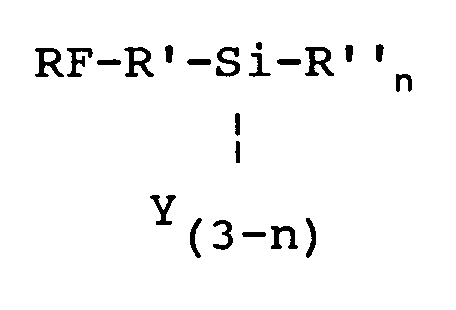 RF = a mercapto group, a primary or secondary amine, a carboxylic acid or anhydride.R' = a -CH₂-, -C₂H₄-, until -C₈H₁₆- group or other non-functional groupsR''= a non-hydrolyzed groupY = one or more groups which could be hydrolyzed, for example -OCH₃, -OC₂H₅, -OC₃H₇, -OC₄H₉n = 0, 1 or 2.and where the crosslinking is carried out after processing of the polymer.
 - Method according to claim 1,
characterized in that
a halogen-containing polymer comprising 0,05-10 % glycidyl-containing acrylate is used. - Method according to claim 2,
characterized in that
glycidylmethacrylate, glycidylacrylate or butylglycidylacrylate is used. - Method according to claim 1,
characterized in that
polyvinylchloride is used as halogen-containing polymer. - Method according to claim 1,
characterized in that
a copolymer of vinylchloride and glycidylmethacrylate (GMA) produced by suspension-, microsuspension-, emulsion- or mass-polymerization is used. - Method according to claim 1,
where the polymer is produced by suspension polymerization,
characterized in that
GMA is added in intervals or continously during polymerization. - Method according to claim 1,
characterized in that
0,1-5 phr metal oxide, especially magnesium oxide, is added to the polymer. - Method according to claim 1,
characterized in that
silanes which are containing primary amine are prereacted with epoxy-containing compositions in such a ratio that the epoxy groups constitute 20-150 % of the amino groups, especially 80-120 %. - Thermostable crosslinked copolymer,
characterized in that
it comprises 30-98 % copolymer of a halogen-containing polymer and a glycidyl-containing acrylate, 0-70 % plasticizer, 0,05-10 % organic silane which can be hydrolyzed, 0,1-10 % stabilizer and 0-3 % lubricant. - Copolymer according to claim 9,
characterized in that
the content of glycidyl-containing acrylate is 0,05-10 %.
Applications Claiming Priority (3)
| Application Number | Priority Date | Filing Date | Title |
|---|---|---|---|
| NO890543A NO166189C (en) | 1989-02-08 | 1989-02-08 | CIRCULATED THERMOSTABLE POLYMER AND MANUFACTURING THEREOF. |
| NO890543 | 1989-02-08 | ||
| PCT/NO1990/000033 WO1990009407A1 (en) | 1989-02-08 | 1990-02-08 | Crosslinked halogen-containing polymer |
Publications (2)
| Publication Number | Publication Date |
|---|---|
| EP0456746A1 EP0456746A1 (en) | 1991-11-21 |
| EP0456746B1 true EP0456746B1 (en) | 1994-06-01 |
Family
ID=19891733
Family Applications (1)
| Application Number | Title | Priority Date | Filing Date |
|---|---|---|---|
| EP90903232A Expired - Lifetime EP0456746B1 (en) | 1989-02-08 | 1990-02-08 | Crosslinked halogen-containing polymer |
Country Status (16)
| Country | Link |
|---|---|
| US (1) | US5191019A (en) |
| EP (1) | EP0456746B1 (en) |
| JP (1) | JPH0725897B2 (en) |
| CN (1) | CN1031270C (en) |
| AT (1) | ATE106427T1 (en) |
| AU (1) | AU647380B2 (en) |
| BR (1) | BR9007109A (en) |
| CA (1) | CA2046282C (en) |
| DE (1) | DE69009460T2 (en) |
| DK (1) | DK0456746T3 (en) |
| FI (1) | FI100333B (en) |
| HU (1) | HU209732B (en) |
| NO (1) | NO166189C (en) |
| PT (1) | PT93098B (en) |
| RU (1) | RU2078775C1 (en) |
| WO (1) | WO1990009407A1 (en) |
Families Citing this family (17)
| Publication number | Priority date | Publication date | Assignee | Title |
|---|---|---|---|---|
| NO173337C (en) * | 1991-09-03 | 1993-12-01 | Norsk Hydro As | White or light colored crosslinked halogenated polymeric material and its preparation |
| FR2682914B1 (en) * | 1991-10-23 | 1995-03-10 | Labinal | PROCESS FOR THE MANUFACTURE OF AN ARTICLE CONSISTING OF ALL OR PART OF A POLY (VINYL CHLORIDE) HAVING EPOXY AND SILANE PATTERNS, AND RESULTING ARTICLE, IN PARTICULAR ELECTRICAL CABLE COATED WITH AN INSULATING SHEATH FORMED BY CARRYING OUT THIS PROCESS. |
| NO175596C (en) * | 1991-12-23 | 1994-11-02 | Norsk Hydro As | Chemical resistant cross-linked plastics and their manufacture and use |
| NO175597C (en) * | 1992-09-14 | 1994-11-02 | Norsk Hydro As | Crosslinked silane-containing PVC copolymer and a process for its preparation |
| FR2741083B1 (en) * | 1995-11-13 | 1999-02-19 | Nobel Plastiques | METHOD OF IGNITING A PLASTIC COMPONENT BELONGING TO A PLANT FOR DISPENSING A FLAMMABLE LIQUID |
| ATE191176T1 (en) | 1995-02-02 | 2000-04-15 | Nobel Plastiques | METHOD FOR FLAMEPROOFING A PLASTIC PART IN A FLAMMABLE LIQUID FEEDING SYSTEM |
| CA2190050A1 (en) * | 1996-11-12 | 1998-05-12 | G. Ronald Brown | Moisture cross-linking of vinyl chloride homopolymers and copolymers |
| NO322911B1 (en) * | 2002-10-16 | 2006-12-18 | Sinvent As | Hardener for curing epoxy resins and articles made of epoxy resin and such curing agent |
| DE10309857A1 (en) * | 2003-03-06 | 2004-09-23 | Wacker Polymer Systems Gmbh & Co. Kg | Epoxy-modified vinyl chloride-vinyl ester copolymer solid resins |
| DE10309858A1 (en) * | 2003-03-06 | 2004-09-23 | Wacker Polymer Systems Gmbh & Co. Kg | Thermostable vinyl chloride copolymers |
| CN1300197C (en) * | 2005-05-30 | 2007-02-14 | 浙江大学 | Process for preparing hydrolysis crosslinkable vinyl chloride / silicane copolymer resin |
| NO325797B1 (en) * | 2005-10-14 | 2008-07-21 | Nor X Ind As | Light preservative based on organic / inorganic hybrid polymer, process for preparation and use of same |
| KR100662539B1 (en) * | 2005-12-30 | 2006-12-28 | 제일모직주식회사 | Composition for fuel cell bipolar plate |
| US20070196680A1 (en) * | 2006-02-08 | 2007-08-23 | Fine Harry M | System and method of applying architectural coatings and apparatus therefor |
| KR100894884B1 (en) * | 2008-04-30 | 2009-04-30 | 제일모직주식회사 | Flame Retardant Thermoplastic Composition |
| WO2012174500A2 (en) * | 2011-06-17 | 2012-12-20 | Illinois Tool Works Inc. | Hybrid sealant composition |
| KR101805230B1 (en) | 2013-03-13 | 2017-12-05 | 롯데첨단소재(주) | Flame-Retardant Polyamide Resin Composition and Molded Article Using Same |
Family Cites Families (6)
| Publication number | Priority date | Publication date | Assignee | Title |
|---|---|---|---|---|
| US3781379A (en) * | 1971-08-16 | 1973-12-25 | Ford Motor Co | Powdered coating compositions containing glycidyl methacrylate copolymers with anhydride crosslinking agents and flow control agent |
| JPS5628219A (en) * | 1979-08-17 | 1981-03-19 | Asahi Glass Co Ltd | New fluorine-containing elastomer |
| JPS5763351A (en) * | 1980-10-03 | 1982-04-16 | Kanegafuchi Chem Ind Co Ltd | Composition having improved pot life |
| US4446259A (en) * | 1982-09-30 | 1984-05-01 | E. I. Du Pont De Nemours And Company | Coating composition of a blend of a glycidyl acrylic polymer and a reactive polysiloxane |
| DE3573794D1 (en) * | 1984-08-06 | 1989-11-23 | Fujikura Ltd | Silane-crosslinkable halogenated polymer composition and process of crosslinking the same |
| CS262332B1 (en) * | 1987-03-30 | 1989-03-14 | Miroslav Doc Ing Csc Schatz | Process for preparing vulcanizable halogen-hydrocarbon polymers |
-
1989
- 1989-02-08 NO NO890543A patent/NO166189C/en unknown
-
1990
- 1990-02-08 US US07/768,975 patent/US5191019A/en not_active Expired - Fee Related
- 1990-02-08 JP JP2503376A patent/JPH0725897B2/en not_active Expired - Lifetime
- 1990-02-08 PT PT93098A patent/PT93098B/en not_active IP Right Cessation
- 1990-02-08 AT AT90903232T patent/ATE106427T1/en not_active IP Right Cessation
- 1990-02-08 EP EP90903232A patent/EP0456746B1/en not_active Expired - Lifetime
- 1990-02-08 WO PCT/NO1990/000033 patent/WO1990009407A1/en not_active Ceased
- 1990-02-08 HU HU901992A patent/HU209732B/en not_active IP Right Cessation
- 1990-02-08 BR BR909007109A patent/BR9007109A/en not_active Application Discontinuation
- 1990-02-08 CN CN90101174A patent/CN1031270C/en not_active Expired - Fee Related
- 1990-02-08 DE DE69009460T patent/DE69009460T2/en not_active Expired - Fee Related
- 1990-02-08 CA CA002046282A patent/CA2046282C/en not_active Expired - Fee Related
- 1990-02-08 RU SU905001630A patent/RU2078775C1/en active
- 1990-02-08 DK DK90903232.8T patent/DK0456746T3/en active
- 1990-02-08 AU AU50837/90A patent/AU647380B2/en not_active Ceased
-
1991
- 1991-08-08 FI FI913771A patent/FI100333B/en not_active IP Right Cessation
Also Published As
| Publication number | Publication date |
|---|---|
| CN1045268A (en) | 1990-09-12 |
| HU209732B (en) | 1994-10-28 |
| HUT59170A (en) | 1992-04-28 |
| JPH04503368A (en) | 1992-06-18 |
| WO1990009407A1 (en) | 1990-08-23 |
| DK0456746T3 (en) | 1994-10-03 |
| CA2046282A1 (en) | 1990-08-09 |
| NO166189B (en) | 1991-03-04 |
| ATE106427T1 (en) | 1994-06-15 |
| FI913771A0 (en) | 1991-08-08 |
| CN1031270C (en) | 1996-03-13 |
| AU647380B2 (en) | 1994-03-24 |
| US5191019A (en) | 1993-03-02 |
| NO890543D0 (en) | 1989-02-08 |
| BR9007109A (en) | 1991-12-17 |
| CA2046282C (en) | 1996-11-12 |
| DE69009460D1 (en) | 1994-07-07 |
| AU5083790A (en) | 1990-09-05 |
| JPH0725897B2 (en) | 1995-03-22 |
| FI100333B (en) | 1997-11-14 |
| PT93098A (en) | 1990-08-31 |
| NO890543L (en) | 1990-08-09 |
| DE69009460T2 (en) | 1995-02-09 |
| PT93098B (en) | 1997-11-28 |
| NO166189C (en) | 1991-06-12 |
| HU901992D0 (en) | 1991-11-28 |
| RU2078775C1 (en) | 1997-05-10 |
| EP0456746A1 (en) | 1991-11-21 |
Similar Documents
| Publication | Publication Date | Title |
|---|---|---|
| US5191019A (en) | Crosslinked halogen-containing polymer | |
| US5561191A (en) | Method for the production of silane containing crosslinked PVC copolymer | |
| JPH11209545A (en) | Impact modified poly (vinyl chloride) showing improved low temperature melting | |
| EP0024456A1 (en) | Thermoplastic resin compositions containing a filler and artifacts formed therefrom | |
| Fiaz et al. | Silane crosslinking of plasticized poly (vinyl chloride) | |
| US5359011A (en) | Process for the complete neutralization of chlorinated polyvinyl chloride and product resulting therefrom | |
| JP3361094B2 (en) | Free flowing powdered polyvinyl chloride composition | |
| EP0618938A1 (en) | Method for productional thermostable chemical resistant plastics | |
| CN107304236B (en) | Chlorinated polyvinyl chloride and preparation method thereof | |
| CN114933764A (en) | Luminous high-performance PVC optical cable material and preparation method thereof | |
| US3851016A (en) | Process for the production of transparent,impact-resistant polymers of vinyl chloride | |
| Gunewardena et al. | Peroxide crosslinking of rigid poly (vinyl chloride) | |
| EP0371216A2 (en) | Reactive polyvinyl chloride and polymer products made therefrom | |
| JP2001002873A (en) | Vinyl chloride resin composition for molding | |
| EP0657494B1 (en) | Composition for obtaining foamed polyvinylchloride material and method of obtaining it | |
| Sundbø et al. | Preparation of crosslinked and thermostable paste poly (vinyl chloride) | |
| CA1228693A (en) | Terpolymer processing aid for polyvinyl halide polymers | |
| JP2631036B2 (en) | Composition for crosslinked polymer and method for producing the same | |
| KR20190011514A (en) | Preparation method of polyvinyl chloride | |
| CN118496598A (en) | Ultralow heat conduction moisture-proof heat insulation material product and preparation method thereof | |
| CN114573856A (en) | Modified PVC (polyvinyl chloride) foaming cushion and preparation method thereof | |
| JPH04300939A (en) | Crosslinkable plastisol | |
| Fernández et al. | Properties of aminosilane grafted moisture curable poly (vinyl chloride) formulations | |
| JPS6249902B2 (en) | ||
| KR20260070816A (en) | Vinyl chloride based Resin Composition |
Legal Events
| Date | Code | Title | Description |
|---|---|---|---|
| PUAI | Public reference made under article 153(3) epc to a published international application that has entered the european phase |
Free format text: ORIGINAL CODE: 0009012 |
|
| 17P | Request for examination filed |
Effective date: 19910820 |
|
| AK | Designated contracting states |
Kind code of ref document: A1 Designated state(s): AT BE DE DK FR GB IT LU NL SE |
|
| 17Q | First examination report despatched |
Effective date: 19921116 |
|
| GRAA | (expected) grant |
Free format text: ORIGINAL CODE: 0009210 |
|
| AK | Designated contracting states |
Kind code of ref document: B1 Designated state(s): AT BE DE DK FR GB IT LU NL SE |
|
| REF | Corresponds to: |
Ref document number: 106427 Country of ref document: AT Date of ref document: 19940615 Kind code of ref document: T |
|
| REF | Corresponds to: |
Ref document number: 69009460 Country of ref document: DE Date of ref document: 19940707 |
|
| ITF | It: translation for a ep patent filed | ||
| REG | Reference to a national code |
Ref country code: DK Ref legal event code: T3 |
|
| ET | Fr: translation filed | ||
| BECA | Be: change of holder's address |
Free format text: 940601 S.A. *HYDRO AGRI BELGIUM:NEERVELDSTRAAT 107, 1200 BRUSSEL |
|
| BECH | Be: change of holder |
Free format text: 940601 S.A. *HYDRO AGRI BELGIUM |
|
| EAL | Se: european patent in force in sweden |
Ref document number: 90903232.8 |
|
| PG25 | Lapsed in a contracting state [announced via postgrant information from national office to epo] |
Ref country code: BE Effective date: 19950228 |
|
| PLBE | No opposition filed within time limit |
Free format text: ORIGINAL CODE: 0009261 |
|
| STAA | Information on the status of an ep patent application or granted ep patent |
Free format text: STATUS: NO OPPOSITION FILED WITHIN TIME LIMIT |
|
| 26N | No opposition filed | ||
| BERE | Be: lapsed |
Owner name: S.A. HYDRO AGRI BELGIUM Effective date: 19950228 |
|
| PGFP | Annual fee paid to national office [announced via postgrant information from national office to epo] |
Ref country code: DK Payment date: 19970212 Year of fee payment: 8 |
|
| PGFP | Annual fee paid to national office [announced via postgrant information from national office to epo] |
Ref country code: AT Payment date: 19970213 Year of fee payment: 8 |
|
| PGFP | Annual fee paid to national office [announced via postgrant information from national office to epo] |
Ref country code: NL Payment date: 19970227 Year of fee payment: 8 |
|
| PGFP | Annual fee paid to national office [announced via postgrant information from national office to epo] |
Ref country code: LU Payment date: 19970327 Year of fee payment: 8 |
|
| PG25 | Lapsed in a contracting state [announced via postgrant information from national office to epo] |
Ref country code: LU Free format text: LAPSE BECAUSE OF NON-PAYMENT OF DUE FEES Effective date: 19980208 Ref country code: AT Free format text: LAPSE BECAUSE OF NON-PAYMENT OF DUE FEES Effective date: 19980208 |
|
| PG25 | Lapsed in a contracting state [announced via postgrant information from national office to epo] |
Ref country code: DK Free format text: LAPSE BECAUSE OF NON-PAYMENT OF DUE FEES Effective date: 19980302 |
|
| PG25 | Lapsed in a contracting state [announced via postgrant information from national office to epo] |
Ref country code: NL Free format text: LAPSE BECAUSE OF NON-PAYMENT OF DUE FEES Effective date: 19980901 |
|
| NLV4 | Nl: lapsed or anulled due to non-payment of the annual fee |
Effective date: 19980901 |
|
| REG | Reference to a national code |
Ref country code: DK Ref legal event code: EBP |
|
| REG | Reference to a national code |
Ref country code: GB Ref legal event code: IF02 |
|
| PGFP | Annual fee paid to national office [announced via postgrant information from national office to epo] |
Ref country code: SE Payment date: 20020206 Year of fee payment: 13 Ref country code: GB Payment date: 20020206 Year of fee payment: 13 |
|
| PGFP | Annual fee paid to national office [announced via postgrant information from national office to epo] |
Ref country code: FR Payment date: 20020212 Year of fee payment: 13 |
|
| PGFP | Annual fee paid to national office [announced via postgrant information from national office to epo] |
Ref country code: DE Payment date: 20020227 Year of fee payment: 13 |
|
| PG25 | Lapsed in a contracting state [announced via postgrant information from national office to epo] |
Ref country code: GB Free format text: LAPSE BECAUSE OF NON-PAYMENT OF DUE FEES Effective date: 20030208 |
|
| PG25 | Lapsed in a contracting state [announced via postgrant information from national office to epo] |
Ref country code: SE Free format text: LAPSE BECAUSE OF NON-PAYMENT OF DUE FEES Effective date: 20030209 |
|
| PG25 | Lapsed in a contracting state [announced via postgrant information from national office to epo] |
Ref country code: DE Free format text: LAPSE BECAUSE OF NON-PAYMENT OF DUE FEES Effective date: 20030902 |
|
| EUG | Se: european patent has lapsed | ||
| GBPC | Gb: european patent ceased through non-payment of renewal fee | ||
| PG25 | Lapsed in a contracting state [announced via postgrant information from national office to epo] |
Ref country code: FR Free format text: LAPSE BECAUSE OF NON-PAYMENT OF DUE FEES Effective date: 20031031 |
|
| REG | Reference to a national code |
Ref country code: FR Ref legal event code: ST |
|
| PG25 | Lapsed in a contracting state [announced via postgrant information from national office to epo] |
Ref country code: IT Free format text: LAPSE BECAUSE OF NON-PAYMENT OF DUE FEES Effective date: 20050208 |