EP0456380B1 - Photocurable composition comprising maleic anhydride adduct of polybutadiene or butadiene copolydiene copolymers - Google Patents
Photocurable composition comprising maleic anhydride adduct of polybutadiene or butadiene copolydiene copolymers Download PDFInfo
- Publication number
- EP0456380B1 EP0456380B1 EP91303732A EP91303732A EP0456380B1 EP 0456380 B1 EP0456380 B1 EP 0456380B1 EP 91303732 A EP91303732 A EP 91303732A EP 91303732 A EP91303732 A EP 91303732A EP 0456380 B1 EP0456380 B1 EP 0456380B1
- Authority
- EP
- European Patent Office
- Prior art keywords
- polybutadiene
- adduct
- groups
- anhydride
- prepolymer
- Prior art date
- Legal status (The legal status is an assumption and is not a legal conclusion. Google has not performed a legal analysis and makes no representation as to the accuracy of the status listed.)
- Expired - Lifetime
Links
- 229920002857 polybutadiene Polymers 0.000 title claims abstract description 35
- 239000005062 Polybutadiene Substances 0.000 title claims abstract description 34
- 229920001577 copolymer Polymers 0.000 title claims abstract description 12
- 239000000203 mixture Substances 0.000 title claims description 57
- FPYJFEHAWHCUMM-UHFFFAOYSA-N maleic anhydride Chemical compound O=C1OC(=O)C=C1 FPYJFEHAWHCUMM-UHFFFAOYSA-N 0.000 title claims description 23
- KAKZBPTYRLMSJV-UHFFFAOYSA-N Butadiene Chemical compound C=CC=C KAKZBPTYRLMSJV-UHFFFAOYSA-N 0.000 title claims description 20
- 150000008064 anhydrides Chemical group 0.000 claims abstract description 35
- 239000000178 monomer Substances 0.000 claims abstract description 13
- 229920005862 polyol Polymers 0.000 claims abstract description 6
- 238000000034 method Methods 0.000 claims description 33
- 229920000554 ionomer Polymers 0.000 claims description 31
- 229920005601 base polymer Polymers 0.000 claims description 22
- 238000006243 chemical reaction Methods 0.000 claims description 20
- 239000007787 solid Substances 0.000 claims description 17
- -1 alkadiene polyol Chemical class 0.000 claims description 16
- 229920000642 polymer Polymers 0.000 claims description 16
- 125000002843 carboxylic acid group Chemical group 0.000 claims description 12
- 125000003178 carboxy group Chemical group [H]OC(*)=O 0.000 claims description 10
- 229910052708 sodium Inorganic materials 0.000 claims description 10
- 239000003153 chemical reaction reagent Substances 0.000 claims description 9
- 125000002496 methyl group Chemical group [H]C([H])([H])* 0.000 claims description 9
- 238000002360 preparation method Methods 0.000 claims description 9
- XLYOFNOQVPJJNP-UHFFFAOYSA-N water Substances O XLYOFNOQVPJJNP-UHFFFAOYSA-N 0.000 claims description 9
- JOYRKODLDBILNP-UHFFFAOYSA-N Ethyl urethane Chemical compound CCOC(N)=O JOYRKODLDBILNP-UHFFFAOYSA-N 0.000 claims description 7
- 150000002009 diols Chemical class 0.000 claims description 7
- 238000000576 coating method Methods 0.000 claims description 6
- 229910052744 lithium Inorganic materials 0.000 claims description 6
- 239000011248 coating agent Substances 0.000 claims description 5
- 229910052739 hydrogen Inorganic materials 0.000 claims description 5
- 239000001257 hydrogen Substances 0.000 claims description 5
- 229910052799 carbon Inorganic materials 0.000 claims description 4
- 125000004432 carbon atom Chemical group C* 0.000 claims description 4
- 125000003118 aryl group Chemical group 0.000 claims description 3
- 150000001721 carbon Chemical group 0.000 claims description 3
- 125000004435 hydrogen atom Chemical group [H]* 0.000 claims description 3
- 230000003472 neutralizing effect Effects 0.000 claims description 3
- 125000002877 alkyl aryl group Chemical group 0.000 claims description 2
- 125000003710 aryl alkyl group Chemical group 0.000 claims description 2
- 125000000524 functional group Chemical group 0.000 claims description 2
- 229910052736 halogen Inorganic materials 0.000 claims description 2
- 150000002367 halogens Chemical class 0.000 claims description 2
- 150000002431 hydrogen Chemical class 0.000 claims description 2
- 239000007795 chemical reaction product Substances 0.000 claims 3
- NIXOWILDQLNWCW-UHFFFAOYSA-M Acrylate Chemical compound [O-]C(=O)C=C NIXOWILDQLNWCW-UHFFFAOYSA-M 0.000 claims 1
- CERQOIWHTDAKMF-UHFFFAOYSA-M methacrylate group Chemical group C(C(=C)C)(=O)[O-] CERQOIWHTDAKMF-UHFFFAOYSA-M 0.000 claims 1
- 239000000047 product Substances 0.000 claims 1
- 229920002818 (Hydroxyethyl)methacrylate Polymers 0.000 abstract description 17
- WOBHKFSMXKNTIM-UHFFFAOYSA-N Hydroxyethyl methacrylate Chemical compound CC(=C)C(=O)OCCO WOBHKFSMXKNTIM-UHFFFAOYSA-N 0.000 abstract description 17
- 150000001875 compounds Chemical class 0.000 abstract description 9
- 230000007062 hydrolysis Effects 0.000 abstract description 7
- 238000006460 hydrolysis reaction Methods 0.000 abstract description 7
- 238000006386 neutralization reaction Methods 0.000 abstract description 2
- 150000003077 polyols Chemical class 0.000 abstract description 2
- 239000000976 ink Substances 0.000 description 17
- 239000002904 solvent Substances 0.000 description 16
- OKKJLVBELUTLKV-UHFFFAOYSA-N Methanol Chemical compound OC OKKJLVBELUTLKV-UHFFFAOYSA-N 0.000 description 12
- HEMHJVSKTPXQMS-UHFFFAOYSA-M Sodium hydroxide Chemical compound [OH-].[Na+] HEMHJVSKTPXQMS-UHFFFAOYSA-M 0.000 description 12
- 239000011734 sodium Substances 0.000 description 11
- 239000000243 solution Substances 0.000 description 11
- YXFVVABEGXRONW-UHFFFAOYSA-N Toluene Chemical compound CC1=CC=CC=C1 YXFVVABEGXRONW-UHFFFAOYSA-N 0.000 description 9
- 150000001768 cations Chemical class 0.000 description 8
- 238000005886 esterification reaction Methods 0.000 description 8
- RINCXYDBBGOEEQ-UHFFFAOYSA-N succinic anhydride Chemical compound O=C1CCC(=O)O1 RINCXYDBBGOEEQ-UHFFFAOYSA-N 0.000 description 7
- KWYUFKZDYYNOTN-UHFFFAOYSA-M Potassium hydroxide Chemical compound [OH-].[K+] KWYUFKZDYYNOTN-UHFFFAOYSA-M 0.000 description 6
- 239000003085 diluting agent Substances 0.000 description 6
- 230000005855 radiation Effects 0.000 description 6
- 238000003756 stirring Methods 0.000 description 6
- KWVGIHKZDCUPEU-UHFFFAOYSA-N 2,2-dimethoxy-2-phenylacetophenone Chemical compound C=1C=CC=CC=1C(OC)(OC)C(=O)C1=CC=CC=C1 KWVGIHKZDCUPEU-UHFFFAOYSA-N 0.000 description 5
- DGAQECJNVWCQMB-PUAWFVPOSA-M Ilexoside XXIX Chemical compound C[C@@H]1CC[C@@]2(CC[C@@]3(C(=CC[C@H]4[C@]3(CC[C@@H]5[C@@]4(CC[C@@H](C5(C)C)OS(=O)(=O)[O-])C)C)[C@@H]2[C@]1(C)O)C)C(=O)O[C@H]6[C@@H]([C@H]([C@@H]([C@H](O6)CO)O)O)O.[Na+] DGAQECJNVWCQMB-PUAWFVPOSA-M 0.000 description 5
- 230000032050 esterification Effects 0.000 description 5
- 239000000463 material Substances 0.000 description 5
- 239000003960 organic solvent Substances 0.000 description 5
- 230000000704 physical effect Effects 0.000 description 5
- 238000006116 polymerization reaction Methods 0.000 description 5
- 238000003860 storage Methods 0.000 description 5
- OGBWMWKMTUSNKE-UHFFFAOYSA-N 1-(2-methylprop-2-enoyloxy)hexyl 2-methylprop-2-enoate Chemical compound CCCCCC(OC(=O)C(C)=C)OC(=O)C(C)=C OGBWMWKMTUSNKE-UHFFFAOYSA-N 0.000 description 4
- JMIZWXDKTUGEES-UHFFFAOYSA-N 2,2-di(cyclopenten-1-yloxy)ethyl 2-methylprop-2-enoate Chemical compound C=1CCCC=1OC(COC(=O)C(=C)C)OC1=CCCC1 JMIZWXDKTUGEES-UHFFFAOYSA-N 0.000 description 4
- XFCMNSHQOZQILR-UHFFFAOYSA-N 2-[2-(2-methylprop-2-enoyloxy)ethoxy]ethyl 2-methylprop-2-enoate Chemical compound CC(=C)C(=O)OCCOCCOC(=O)C(C)=C XFCMNSHQOZQILR-UHFFFAOYSA-N 0.000 description 4
- PPBRXRYQALVLMV-UHFFFAOYSA-N Styrene Chemical compound C=CC1=CC=CC=C1 PPBRXRYQALVLMV-UHFFFAOYSA-N 0.000 description 4
- 239000000654 additive Substances 0.000 description 4
- 230000015572 biosynthetic process Effects 0.000 description 4
- 229920000831 ionic polymer Polymers 0.000 description 4
- UHOVQNZJYSORNB-UHFFFAOYSA-N Benzene Chemical compound C1=CC=CC=C1 UHOVQNZJYSORNB-UHFFFAOYSA-N 0.000 description 3
- 239000004322 Butylated hydroxytoluene Substances 0.000 description 3
- NLZUEZXRPGMBCV-UHFFFAOYSA-N Butylhydroxytoluene Chemical compound CC1=CC(C(C)(C)C)=C(O)C(C(C)(C)C)=C1 NLZUEZXRPGMBCV-UHFFFAOYSA-N 0.000 description 3
- WMFOQBRAJBCJND-UHFFFAOYSA-M Lithium hydroxide Chemical compound [Li+].[OH-] WMFOQBRAJBCJND-UHFFFAOYSA-M 0.000 description 3
- 239000002253 acid Substances 0.000 description 3
- NIXOWILDQLNWCW-UHFFFAOYSA-N acrylic acid group Chemical group C(C=C)(=O)O NIXOWILDQLNWCW-UHFFFAOYSA-N 0.000 description 3
- 239000002585 base Substances 0.000 description 3
- 235000010354 butylated hydroxytoluene Nutrition 0.000 description 3
- 239000003795 chemical substances by application Substances 0.000 description 3
- 238000004132 cross linking Methods 0.000 description 3
- 230000000694 effects Effects 0.000 description 3
- 239000000945 filler Substances 0.000 description 3
- 238000009472 formulation Methods 0.000 description 3
- 125000002887 hydroxy group Chemical group [H]O* 0.000 description 3
- 239000003112 inhibitor Substances 0.000 description 3
- 238000000807 solvent casting Methods 0.000 description 3
- 239000003381 stabilizer Substances 0.000 description 3
- 125000000391 vinyl group Chemical group [H]C([*])=C([H])[H] 0.000 description 3
- XHLHPRDBBAGVEG-UHFFFAOYSA-N 1-tetralone Chemical compound C1=CC=C2C(=O)CCCC2=C1 XHLHPRDBBAGVEG-UHFFFAOYSA-N 0.000 description 2
- LEJBBGNFPAFPKQ-UHFFFAOYSA-N 2-(2-prop-2-enoyloxyethoxy)ethyl prop-2-enoate Chemical compound C=CC(=O)OCCOCCOC(=O)C=C LEJBBGNFPAFPKQ-UHFFFAOYSA-N 0.000 description 2
- INQDDHNZXOAFFD-UHFFFAOYSA-N 2-[2-(2-prop-2-enoyloxyethoxy)ethoxy]ethyl prop-2-enoate Chemical compound C=CC(=O)OCCOCCOCCOC(=O)C=C INQDDHNZXOAFFD-UHFFFAOYSA-N 0.000 description 2
- HCLJOFJIQIJXHS-UHFFFAOYSA-N 2-[2-[2-(2-prop-2-enoyloxyethoxy)ethoxy]ethoxy]ethyl prop-2-enoate Chemical compound C=CC(=O)OCCOCCOCCOCCOC(=O)C=C HCLJOFJIQIJXHS-UHFFFAOYSA-N 0.000 description 2
- VVBLNCFGVYUYGU-UHFFFAOYSA-N 4,4'-Bis(dimethylamino)benzophenone Chemical compound C1=CC(N(C)C)=CC=C1C(=O)C1=CC=C(N(C)C)C=C1 VVBLNCFGVYUYGU-UHFFFAOYSA-N 0.000 description 2
- NTPLXRHDUXRPNE-UHFFFAOYSA-N 4-methoxyacetophenone Chemical compound COC1=CC=C(C(C)=O)C=C1 NTPLXRHDUXRPNE-UHFFFAOYSA-N 0.000 description 2
- KWOLFJPFCHCOCG-UHFFFAOYSA-N Acetophenone Chemical compound CC(=O)C1=CC=CC=C1 KWOLFJPFCHCOCG-UHFFFAOYSA-N 0.000 description 2
- RYGMFSIKBFXOCR-UHFFFAOYSA-N Copper Chemical compound [Cu] RYGMFSIKBFXOCR-UHFFFAOYSA-N 0.000 description 2
- QSJXEFYPDANLFS-UHFFFAOYSA-N Diacetyl Chemical compound CC(=O)C(C)=O QSJXEFYPDANLFS-UHFFFAOYSA-N 0.000 description 2
- 238000004566 IR spectroscopy Methods 0.000 description 2
- LRHPLDYGYMQRHN-UHFFFAOYSA-N N-Butanol Chemical compound CCCCO LRHPLDYGYMQRHN-UHFFFAOYSA-N 0.000 description 2
- ISWSIDIOOBJBQZ-UHFFFAOYSA-N Phenol Chemical compound OC1=CC=CC=C1 ISWSIDIOOBJBQZ-UHFFFAOYSA-N 0.000 description 2
- 229920000604 Polyethylene Glycol 200 Polymers 0.000 description 2
- VYPSYNLAJGMNEJ-UHFFFAOYSA-N Silicium dioxide Chemical compound O=[Si]=O VYPSYNLAJGMNEJ-UHFFFAOYSA-N 0.000 description 2
- DAKWPKUUDNSNPN-UHFFFAOYSA-N Trimethylolpropane triacrylate Chemical compound C=CC(=O)OCC(CC)(COC(=O)C=C)COC(=O)C=C DAKWPKUUDNSNPN-UHFFFAOYSA-N 0.000 description 2
- 238000004458 analytical method Methods 0.000 description 2
- 239000007864 aqueous solution Substances 0.000 description 2
- HUMNYLRZRPPJDN-UHFFFAOYSA-N benzaldehyde Chemical compound O=CC1=CC=CC=C1 HUMNYLRZRPPJDN-UHFFFAOYSA-N 0.000 description 2
- 125000002915 carbonyl group Chemical group [*:2]C([*:1])=O 0.000 description 2
- 150000001732 carboxylic acid derivatives Chemical class 0.000 description 2
- 229910052802 copper Inorganic materials 0.000 description 2
- 239000010949 copper Substances 0.000 description 2
- 125000004386 diacrylate group Chemical group 0.000 description 2
- 230000008034 disappearance Effects 0.000 description 2
- 229920001971 elastomer Polymers 0.000 description 2
- YLQWCDOCJODRMT-UHFFFAOYSA-N fluoren-9-one Chemical compound C1=CC=C2C(=O)C3=CC=CC=C3C2=C1 YLQWCDOCJODRMT-UHFFFAOYSA-N 0.000 description 2
- 239000003365 glass fiber Substances 0.000 description 2
- QNXSIUBBGPHDDE-UHFFFAOYSA-N indan-1-one Chemical compound C1=CC=C2C(=O)CCC2=C1 QNXSIUBBGPHDDE-UHFFFAOYSA-N 0.000 description 2
- 125000005395 methacrylic acid group Chemical class 0.000 description 2
- LQNUZADURLCDLV-UHFFFAOYSA-N nitrobenzene Chemical compound [O-][N+](=O)C1=CC=CC=C1 LQNUZADURLCDLV-UHFFFAOYSA-N 0.000 description 2
- GJYCVCVHRSWLNY-UHFFFAOYSA-N ortho-butylphenol Natural products CCCCC1=CC=CC=C1O GJYCVCVHRSWLNY-UHFFFAOYSA-N 0.000 description 2
- 229920000728 polyester Polymers 0.000 description 2
- 229940113115 polyethylene glycol 200 Drugs 0.000 description 2
- 229910052700 potassium Inorganic materials 0.000 description 2
- 238000012545 processing Methods 0.000 description 2
- 239000011347 resin Substances 0.000 description 2
- 229920005989 resin Polymers 0.000 description 2
- 239000005060 rubber Substances 0.000 description 2
- 238000001179 sorption measurement Methods 0.000 description 2
- 239000000126 substance Substances 0.000 description 2
- 239000004094 surface-active agent Substances 0.000 description 2
- CNHDIAIOKMXOLK-UHFFFAOYSA-N toluquinol Chemical compound CC1=CC(O)=CC=C1O CNHDIAIOKMXOLK-UHFFFAOYSA-N 0.000 description 2
- RIOQSEWOXXDEQQ-UHFFFAOYSA-N triphenylphosphine Chemical compound C1=CC=CC=C1P(C=1C=CC=CC=1)C1=CC=CC=C1 RIOQSEWOXXDEQQ-UHFFFAOYSA-N 0.000 description 2
- CSUUDNFYSFENAE-UHFFFAOYSA-N (2-methoxyphenyl)-phenylmethanone Chemical compound COC1=CC=CC=C1C(=O)C1=CC=CC=C1 CSUUDNFYSFENAE-UHFFFAOYSA-N 0.000 description 1
- PSGCQDPCAWOCSH-UHFFFAOYSA-N (4,7,7-trimethyl-3-bicyclo[2.2.1]heptanyl) prop-2-enoate Chemical compound C1CC2(C)C(OC(=O)C=C)CC1C2(C)C PSGCQDPCAWOCSH-UHFFFAOYSA-N 0.000 description 1
- RBKHNGHPZZZJCI-UHFFFAOYSA-N (4-aminophenyl)-phenylmethanone Chemical compound C1=CC(N)=CC=C1C(=O)C1=CC=CC=C1 RBKHNGHPZZZJCI-UHFFFAOYSA-N 0.000 description 1
- CGCQHMFVCNWSOV-UHFFFAOYSA-N (4-morpholin-4-ylphenyl)-phenylmethanone Chemical compound C=1C=C(N2CCOCC2)C=CC=1C(=O)C1=CC=CC=C1 CGCQHMFVCNWSOV-UHFFFAOYSA-N 0.000 description 1
- UOCLXMDMGBRAIB-UHFFFAOYSA-N 1,1,1-trichloroethane Chemical compound CC(Cl)(Cl)Cl UOCLXMDMGBRAIB-UHFFFAOYSA-N 0.000 description 1
- MYWOJODOMFBVCB-UHFFFAOYSA-N 1,2,6-trimethylphenanthrene Chemical compound CC1=CC=C2C3=CC(C)=CC=C3C=CC2=C1C MYWOJODOMFBVCB-UHFFFAOYSA-N 0.000 description 1
- 238000011925 1,2-addition Methods 0.000 description 1
- MSAHTMIQULFMRG-UHFFFAOYSA-N 1,2-diphenyl-2-propan-2-yloxyethanone Chemical compound C=1C=CC=CC=1C(OC(C)C)C(=O)C1=CC=CC=C1 MSAHTMIQULFMRG-UHFFFAOYSA-N 0.000 description 1
- UHKJKVIZTFFFSB-UHFFFAOYSA-N 1,2-diphenylbutan-1-one Chemical compound C=1C=CC=CC=1C(CC)C(=O)C1=CC=CC=C1 UHKJKVIZTFFFSB-UHFFFAOYSA-N 0.000 description 1
- BPXVHIRIPLPOPT-UHFFFAOYSA-N 1,3,5-tris(2-hydroxyethyl)-1,3,5-triazinane-2,4,6-trione Chemical compound OCCN1C(=O)N(CCO)C(=O)N(CCO)C1=O BPXVHIRIPLPOPT-UHFFFAOYSA-N 0.000 description 1
- VDYWHVQKENANGY-UHFFFAOYSA-N 1,3-Butyleneglycol dimethacrylate Chemical compound CC(=C)C(=O)OC(C)CCOC(=O)C(C)=C VDYWHVQKENANGY-UHFFFAOYSA-N 0.000 description 1
- DKEGCUDAFWNSSO-UHFFFAOYSA-N 1,8-dibromooctane Chemical compound BrCCCCCCCCBr DKEGCUDAFWNSSO-UHFFFAOYSA-N 0.000 description 1
- CWILMKDSVMROHT-UHFFFAOYSA-N 1-(2-phenanthrenyl)ethanone Chemical compound C1=CC=C2C3=CC=C(C(=O)C)C=C3C=CC2=C1 CWILMKDSVMROHT-UHFFFAOYSA-N 0.000 description 1
- HSOAIPRTHLEQFI-UHFFFAOYSA-N 1-(3,5-diacetylphenyl)ethanone Chemical compound CC(=O)C1=CC(C(C)=O)=CC(C(C)=O)=C1 HSOAIPRTHLEQFI-UHFFFAOYSA-N 0.000 description 1
- SKBBQSLSGRSQAJ-UHFFFAOYSA-N 1-(4-acetylphenyl)ethanone Chemical compound CC(=O)C1=CC=C(C(C)=O)C=C1 SKBBQSLSGRSQAJ-UHFFFAOYSA-N 0.000 description 1
- ZEFQETIGOMAQDT-UHFFFAOYSA-N 1-(4-morpholin-4-ylphenyl)propan-1-one Chemical compound C1=CC(C(=O)CC)=CC=C1N1CCOCC1 ZEFQETIGOMAQDT-UHFFFAOYSA-N 0.000 description 1
- ZDQNWDNMNKSMHI-UHFFFAOYSA-N 1-[2-(2-prop-2-enoyloxypropoxy)propoxy]propan-2-yl prop-2-enoate Chemical compound C=CC(=O)OC(C)COC(C)COCC(C)OC(=O)C=C ZDQNWDNMNKSMHI-UHFFFAOYSA-N 0.000 description 1
- SQAINHDHICKHLX-UHFFFAOYSA-N 1-naphthaldehyde Chemical compound C1=CC=C2C(C=O)=CC=CC2=C1 SQAINHDHICKHLX-UHFFFAOYSA-N 0.000 description 1
- QQLIGMASAVJVON-UHFFFAOYSA-N 1-naphthalen-1-ylethanone Chemical compound C1=CC=C2C(C(=O)C)=CC=CC2=C1 QQLIGMASAVJVON-UHFFFAOYSA-N 0.000 description 1
- JKVNPRNAHRHQDD-UHFFFAOYSA-N 1-phenanthren-3-ylethanone Chemical compound C1=CC=C2C3=CC(C(=O)C)=CC=C3C=CC2=C1 JKVNPRNAHRHQDD-UHFFFAOYSA-N 0.000 description 1
- UIFAWZBYTTXSOG-UHFFFAOYSA-N 1-phenanthren-9-ylethanone Chemical compound C1=CC=C2C(C(=O)C)=CC3=CC=CC=C3C2=C1 UIFAWZBYTTXSOG-UHFFFAOYSA-N 0.000 description 1
- MAHPVQDVMLWUAG-UHFFFAOYSA-N 1-phenylhexan-1-one Chemical compound CCCCCC(=O)C1=CC=CC=C1 MAHPVQDVMLWUAG-UHFFFAOYSA-N 0.000 description 1
- VOBUAPTXJKMNCT-UHFFFAOYSA-N 1-prop-2-enoyloxyhexyl prop-2-enoate Chemical compound CCCCCC(OC(=O)C=C)OC(=O)C=C VOBUAPTXJKMNCT-UHFFFAOYSA-N 0.000 description 1
- WJFKNYWRSNBZNX-UHFFFAOYSA-N 10H-phenothiazine Chemical compound C1=CC=C2NC3=CC=CC=C3SC2=C1 WJFKNYWRSNBZNX-UHFFFAOYSA-N 0.000 description 1
- GIMQKKFOOYOQGB-UHFFFAOYSA-N 2,2-diethoxy-1,2-diphenylethanone Chemical compound C=1C=CC=CC=1C(OCC)(OCC)C(=O)C1=CC=CC=C1 GIMQKKFOOYOQGB-UHFFFAOYSA-N 0.000 description 1
- HWSSEYVMGDIFMH-UHFFFAOYSA-N 2-[2-[2-(2-methylprop-2-enoyloxy)ethoxy]ethoxy]ethyl 2-methylprop-2-enoate Chemical compound CC(=C)C(=O)OCCOCCOCCOC(=O)C(C)=C HWSSEYVMGDIFMH-UHFFFAOYSA-N 0.000 description 1
- LTHJXDSHSVNJKG-UHFFFAOYSA-N 2-[2-[2-[2-(2-methylprop-2-enoyloxy)ethoxy]ethoxy]ethoxy]ethyl 2-methylprop-2-enoate Chemical compound CC(=C)C(=O)OCCOCCOCCOCCOC(=O)C(C)=C LTHJXDSHSVNJKG-UHFFFAOYSA-N 0.000 description 1
- TXBCBTDQIULDIA-UHFFFAOYSA-N 2-[[3-hydroxy-2,2-bis(hydroxymethyl)propoxy]methyl]-2-(hydroxymethyl)propane-1,3-diol Chemical compound OCC(CO)(CO)COCC(CO)(CO)CO TXBCBTDQIULDIA-UHFFFAOYSA-N 0.000 description 1
- XSAYZAUNJMRRIR-UHFFFAOYSA-N 2-acetylnaphthalene Chemical compound C1=CC=CC2=CC(C(=O)C)=CC=C21 XSAYZAUNJMRRIR-UHFFFAOYSA-N 0.000 description 1
- KMNCBSZOIQAUFX-UHFFFAOYSA-N 2-ethoxy-1,2-diphenylethanone Chemical compound C=1C=CC=CC=1C(OCC)C(=O)C1=CC=CC=C1 KMNCBSZOIQAUFX-UHFFFAOYSA-N 0.000 description 1
- GTELLNMUWNJXMQ-UHFFFAOYSA-N 2-ethyl-2-(hydroxymethyl)propane-1,3-diol;prop-2-enoic acid Chemical class OC(=O)C=C.OC(=O)C=C.OC(=O)C=C.CCC(CO)(CO)CO GTELLNMUWNJXMQ-UHFFFAOYSA-N 0.000 description 1
- BQZJOQXSCSZQPS-UHFFFAOYSA-N 2-methoxy-1,2-diphenylethanone Chemical compound C=1C=CC=CC=1C(OC)C(=O)C1=CC=CC=C1 BQZJOQXSCSZQPS-UHFFFAOYSA-N 0.000 description 1
- UPTHZKIDNHJFKQ-UHFFFAOYSA-N 2-methylprop-2-enoic acid;propane-1,2,3-triol Chemical compound CC(=C)C(O)=O.CC(=C)C(O)=O.OCC(O)CO UPTHZKIDNHJFKQ-UHFFFAOYSA-N 0.000 description 1
- AIXYXZFKOULKBD-UHFFFAOYSA-N 2-pentoxybenzene-1,4-diol Chemical compound CCCCCOC1=CC(O)=CC=C1O AIXYXZFKOULKBD-UHFFFAOYSA-N 0.000 description 1
- FQMIAEWUVYWVNB-UHFFFAOYSA-N 3-prop-2-enoyloxybutyl prop-2-enoate Chemical compound C=CC(=O)OC(C)CCOC(=O)C=C FQMIAEWUVYWVNB-UHFFFAOYSA-N 0.000 description 1
- DBCAQXHNJOFNGC-UHFFFAOYSA-N 4-bromo-1,1,1-trifluorobutane Chemical compound FC(F)(F)CCCBr DBCAQXHNJOFNGC-UHFFFAOYSA-N 0.000 description 1
- JHWGFJBTMHEZME-UHFFFAOYSA-N 4-prop-2-enoyloxybutyl prop-2-enoate Chemical compound C=CC(=O)OCCCCOC(=O)C=C JHWGFJBTMHEZME-UHFFFAOYSA-N 0.000 description 1
- KIIIPQXXLVCCQP-UHFFFAOYSA-N 4-propoxyphenol Chemical compound CCCOC1=CC=C(O)C=C1 KIIIPQXXLVCCQP-UHFFFAOYSA-N 0.000 description 1
- BMVWCPGVLSILMU-UHFFFAOYSA-N 5,6-dihydrodibenzo[2,1-b:2',1'-f][7]annulen-11-one Chemical compound C1CC2=CC=CC=C2C(=O)C2=CC=CC=C21 BMVWCPGVLSILMU-UHFFFAOYSA-N 0.000 description 1
- SAPGBCWOQLHKKZ-UHFFFAOYSA-N 6-(2-methylprop-2-enoyloxy)hexyl 2-methylprop-2-enoate Chemical compound CC(=C)C(=O)OCCCCCCOC(=O)C(C)=C SAPGBCWOQLHKKZ-UHFFFAOYSA-N 0.000 description 1
- FIHBHSQYSYVZQE-UHFFFAOYSA-N 6-prop-2-enoyloxyhexyl prop-2-enoate Chemical compound C=CC(=O)OCCCCCCOC(=O)C=C FIHBHSQYSYVZQE-UHFFFAOYSA-N 0.000 description 1
- HUKPVYBUJRAUAG-UHFFFAOYSA-N 7-benzo[a]phenalenone Chemical compound C1=CC(C(=O)C=2C3=CC=CC=2)=C2C3=CC=CC2=C1 HUKPVYBUJRAUAG-UHFFFAOYSA-N 0.000 description 1
- PKICNJBYRWRABI-UHFFFAOYSA-N 9h-thioxanthene 10-oxide Chemical compound C1=CC=C2S(=O)C3=CC=CC=C3CC2=C1 PKICNJBYRWRABI-UHFFFAOYSA-N 0.000 description 1
- NLHHRLWOUZZQLW-UHFFFAOYSA-N Acrylonitrile Chemical compound C=CC#N NLHHRLWOUZZQLW-UHFFFAOYSA-N 0.000 description 1
- 229920002799 BoPET Polymers 0.000 description 1
- OKTJSMMVPCPJKN-UHFFFAOYSA-N Carbon Chemical compound [C] OKTJSMMVPCPJKN-UHFFFAOYSA-N 0.000 description 1
- 239000004970 Chain extender Substances 0.000 description 1
- LFQSCWFLJHTTHZ-UHFFFAOYSA-N Ethanol Chemical compound CCO LFQSCWFLJHTTHZ-UHFFFAOYSA-N 0.000 description 1
- 239000004606 Fillers/Extenders Substances 0.000 description 1
- 229920002121 Hydroxyl-terminated polybutadiene Polymers 0.000 description 1
- VQTUBCCKSQIDNK-UHFFFAOYSA-N Isobutene Chemical group CC(C)=C VQTUBCCKSQIDNK-UHFFFAOYSA-N 0.000 description 1
- WHXSMMKQMYFTQS-UHFFFAOYSA-N Lithium Chemical compound [Li] WHXSMMKQMYFTQS-UHFFFAOYSA-N 0.000 description 1
- 239000005041 Mylar™ Substances 0.000 description 1
- 239000004677 Nylon Substances 0.000 description 1
- CTQNGGLPUBDAKN-UHFFFAOYSA-N O-Xylene Chemical compound CC1=CC=CC=C1C CTQNGGLPUBDAKN-UHFFFAOYSA-N 0.000 description 1
- NCXJHEBVPMOSEM-UHFFFAOYSA-N OC(=O)C=C.OC(=O)C=C.OC(=O)C=C.OC(=O)C=C.CC(C)(CO)CO Chemical compound OC(=O)C=C.OC(=O)C=C.OC(=O)C=C.OC(=O)C=C.CC(C)(CO)CO NCXJHEBVPMOSEM-UHFFFAOYSA-N 0.000 description 1
- CYTYCFOTNPOANT-UHFFFAOYSA-N Perchloroethylene Chemical group ClC(Cl)=C(Cl)Cl CYTYCFOTNPOANT-UHFFFAOYSA-N 0.000 description 1
- 229920003171 Poly (ethylene oxide) Polymers 0.000 description 1
- 229920002582 Polyethylene Glycol 600 Polymers 0.000 description 1
- 239000004793 Polystyrene Substances 0.000 description 1
- 239000004372 Polyvinyl alcohol Substances 0.000 description 1
- ZLMJMSJWJFRBEC-UHFFFAOYSA-N Potassium Chemical compound [K] ZLMJMSJWJFRBEC-UHFFFAOYSA-N 0.000 description 1
- 244000028419 Styrax benzoin Species 0.000 description 1
- 235000000126 Styrax benzoin Nutrition 0.000 description 1
- 235000008411 Sumatra benzointree Nutrition 0.000 description 1
- XSTXAVWGXDQKEL-UHFFFAOYSA-N Trichloroethylene Chemical compound ClC=C(Cl)Cl XSTXAVWGXDQKEL-UHFFFAOYSA-N 0.000 description 1
- OKKRPWIIYQTPQF-UHFFFAOYSA-N Trimethylolpropane trimethacrylate Chemical compound CC(=C)C(=O)OCC(CC)(COC(=O)C(C)=C)COC(=O)C(C)=C OKKRPWIIYQTPQF-UHFFFAOYSA-N 0.000 description 1
- 229920004890 Triton X-100 Polymers 0.000 description 1
- HCHKCACWOHOZIP-UHFFFAOYSA-N Zinc Chemical compound [Zn] HCHKCACWOHOZIP-UHFFFAOYSA-N 0.000 description 1
- GQPVFBDWIUVLHG-UHFFFAOYSA-N [2,2-bis(hydroxymethyl)-3-(2-methylprop-2-enoyloxy)propyl] 2-methylprop-2-enoate Chemical compound CC(=C)C(=O)OCC(CO)(CO)COC(=O)C(C)=C GQPVFBDWIUVLHG-UHFFFAOYSA-N 0.000 description 1
- CQHKDHVZYZUZMJ-UHFFFAOYSA-N [2,2-bis(hydroxymethyl)-3-prop-2-enoyloxypropyl] prop-2-enoate Chemical compound C=CC(=O)OCC(CO)(CO)COC(=O)C=C CQHKDHVZYZUZMJ-UHFFFAOYSA-N 0.000 description 1
- ULQMPOIOSDXIGC-UHFFFAOYSA-N [2,2-dimethyl-3-(2-methylprop-2-enoyloxy)propyl] 2-methylprop-2-enoate Chemical compound CC(=C)C(=O)OCC(C)(C)COC(=O)C(C)=C ULQMPOIOSDXIGC-UHFFFAOYSA-N 0.000 description 1
- GCNKJQRMNYNDBI-UHFFFAOYSA-N [2-(hydroxymethyl)-2-(2-methylprop-2-enoyloxymethyl)butyl] 2-methylprop-2-enoate Chemical compound CC(=C)C(=O)OCC(CO)(CC)COC(=O)C(C)=C GCNKJQRMNYNDBI-UHFFFAOYSA-N 0.000 description 1
- JUDXBRVLWDGRBC-UHFFFAOYSA-N [2-(hydroxymethyl)-3-(2-methylprop-2-enoyloxy)-2-(2-methylprop-2-enoyloxymethyl)propyl] 2-methylprop-2-enoate Chemical compound CC(=C)C(=O)OCC(CO)(COC(=O)C(C)=C)COC(=O)C(C)=C JUDXBRVLWDGRBC-UHFFFAOYSA-N 0.000 description 1
- HVVWZTWDBSEWIH-UHFFFAOYSA-N [2-(hydroxymethyl)-3-prop-2-enoyloxy-2-(prop-2-enoyloxymethyl)propyl] prop-2-enoate Chemical compound C=CC(=O)OCC(CO)(COC(=O)C=C)COC(=O)C=C HVVWZTWDBSEWIH-UHFFFAOYSA-N 0.000 description 1
- FHLPGTXWCFQMIU-UHFFFAOYSA-N [4-[2-(4-prop-2-enoyloxyphenyl)propan-2-yl]phenyl] prop-2-enoate Chemical class C=1C=C(OC(=O)C=C)C=CC=1C(C)(C)C1=CC=C(OC(=O)C=C)C=C1 FHLPGTXWCFQMIU-UHFFFAOYSA-N 0.000 description 1
- AFPRJLBZLPBTPZ-UHFFFAOYSA-N acenaphthoquinone Chemical compound C1=CC(C(C2=O)=O)=C3C2=CC=CC3=C1 AFPRJLBZLPBTPZ-UHFFFAOYSA-N 0.000 description 1
- 150000003926 acrylamides Chemical class 0.000 description 1
- 229920006397 acrylic thermoplastic Polymers 0.000 description 1
- 150000008360 acrylonitriles Chemical class 0.000 description 1
- 230000000996 additive effect Effects 0.000 description 1
- 239000000853 adhesive Substances 0.000 description 1
- 230000001070 adhesive effect Effects 0.000 description 1
- 150000001299 aldehydes Chemical class 0.000 description 1
- 239000012670 alkaline solution Substances 0.000 description 1
- 230000009435 amidation Effects 0.000 description 1
- 238000007112 amidation reaction Methods 0.000 description 1
- 150000001412 amines Chemical class 0.000 description 1
- 239000003963 antioxidant agent Substances 0.000 description 1
- 230000003078 antioxidant effect Effects 0.000 description 1
- 150000004945 aromatic hydrocarbons Chemical class 0.000 description 1
- QVGXLLKOCUKJST-UHFFFAOYSA-N atomic oxygen Chemical compound [O] QVGXLLKOCUKJST-UHFFFAOYSA-N 0.000 description 1
- 239000003637 basic solution Substances 0.000 description 1
- 235000012216 bentonite Nutrition 0.000 description 1
- LHMRXAIRPKSGDE-UHFFFAOYSA-N benzo[a]anthracene-7,12-dione Chemical compound C1=CC2=CC=CC=C2C2=C1C(=O)C1=CC=CC=C1C2=O LHMRXAIRPKSGDE-UHFFFAOYSA-N 0.000 description 1
- 229960002130 benzoin Drugs 0.000 description 1
- RWCCWEUUXYIKHB-UHFFFAOYSA-N benzophenone Chemical compound C=1C=CC=CC=1C(=O)C1=CC=CC=C1 RWCCWEUUXYIKHB-UHFFFAOYSA-N 0.000 description 1
- 239000012965 benzophenone Substances 0.000 description 1
- QUZSUMLPWDHKCJ-UHFFFAOYSA-N bisphenol A dimethacrylate Chemical class C1=CC(OC(=O)C(=C)C)=CC=C1C(C)(C)C1=CC=C(OC(=O)C(C)=C)C=C1 QUZSUMLPWDHKCJ-UHFFFAOYSA-N 0.000 description 1
- 229940095259 butylated hydroxytoluene Drugs 0.000 description 1
- 238000003490 calendering Methods 0.000 description 1
- 239000003054 catalyst Substances 0.000 description 1
- 239000003093 cationic surfactant Substances 0.000 description 1
- 239000001913 cellulose Substances 0.000 description 1
- 229920002678 cellulose Polymers 0.000 description 1
- 239000013522 chelant Substances 0.000 description 1
- YACLQRRMGMJLJV-UHFFFAOYSA-N chloroprene Chemical compound ClC(=C)C=C YACLQRRMGMJLJV-UHFFFAOYSA-N 0.000 description 1
- 238000011109 contamination Methods 0.000 description 1
- 150000001879 copper Chemical class 0.000 description 1
- KBLWLMPSVYBVDK-UHFFFAOYSA-N cyclohexyl prop-2-enoate Chemical compound C=CC(=O)OC1CCCCC1 KBLWLMPSVYBVDK-UHFFFAOYSA-N 0.000 description 1
- 230000007423 decrease Effects 0.000 description 1
- 230000007812 deficiency Effects 0.000 description 1
- 230000001419 dependent effect Effects 0.000 description 1
- ISAOCJYIOMOJEB-UHFFFAOYSA-N desyl alcohol Natural products C=1C=CC=CC=1C(O)C(=O)C1=CC=CC=C1 ISAOCJYIOMOJEB-UHFFFAOYSA-N 0.000 description 1
- 150000001993 dienes Chemical class 0.000 description 1
- 239000000428 dust Substances 0.000 description 1
- 125000004185 ester group Chemical group 0.000 description 1
- 150000002148 esters Chemical class 0.000 description 1
- STVZJERGLQHEKB-UHFFFAOYSA-N ethylene glycol dimethacrylate Substances CC(=C)C(=O)OCCOC(=O)C(C)=C STVZJERGLQHEKB-UHFFFAOYSA-N 0.000 description 1
- 238000001704 evaporation Methods 0.000 description 1
- 230000008020 evaporation Effects 0.000 description 1
- 238000001125 extrusion Methods 0.000 description 1
- 239000004744 fabric Substances 0.000 description 1
- 239000011521 glass Substances 0.000 description 1
- 235000019382 gum benzoic Nutrition 0.000 description 1
- 231100001261 hazardous Toxicity 0.000 description 1
- 238000010438 heat treatment Methods 0.000 description 1
- 229920006158 high molecular weight polymer Polymers 0.000 description 1
- NWVVVBRKAWDGAB-UHFFFAOYSA-N hydroquinone methyl ether Natural products COC1=CC=C(O)C=C1 NWVVVBRKAWDGAB-UHFFFAOYSA-N 0.000 description 1
- 239000004615 ingredient Substances 0.000 description 1
- 150000002500 ions Chemical class 0.000 description 1
- 239000002648 laminated material Substances 0.000 description 1
- 238000003475 lamination Methods 0.000 description 1
- PBOSTUDLECTMNL-UHFFFAOYSA-N lauryl acrylate Chemical compound CCCCCCCCCCCCOC(=O)C=C PBOSTUDLECTMNL-UHFFFAOYSA-N 0.000 description 1
- CDOSHBSSFJOMGT-UHFFFAOYSA-N linalool Chemical compound CC(C)=CCCC(C)(O)C=C CDOSHBSSFJOMGT-UHFFFAOYSA-N 0.000 description 1
- JILPJDVXYVTZDQ-UHFFFAOYSA-N lithium methoxide Chemical compound [Li+].[O-]C JILPJDVXYVTZDQ-UHFFFAOYSA-N 0.000 description 1
- QSHDDOUJBYECFT-UHFFFAOYSA-N mercury Chemical compound [Hg] QSHDDOUJBYECFT-UHFFFAOYSA-N 0.000 description 1
- 150000002734 metacrylic acid derivatives Chemical class 0.000 description 1
- YDKNBNOOCSNPNS-UHFFFAOYSA-N methyl 1,3-benzoxazole-2-carboxylate Chemical compound C1=CC=C2OC(C(=O)OC)=NC2=C1 YDKNBNOOCSNPNS-UHFFFAOYSA-N 0.000 description 1
- VYQNWZOUAUKGHI-UHFFFAOYSA-N monobenzone Chemical compound C1=CC(O)=CC=C1OCC1=CC=CC=C1 VYQNWZOUAUKGHI-UHFFFAOYSA-N 0.000 description 1
- 229960000990 monobenzone Drugs 0.000 description 1
- 239000002736 nonionic surfactant Substances 0.000 description 1
- 229920001778 nylon Polymers 0.000 description 1
- 238000000643 oven drying Methods 0.000 description 1
- 229910052760 oxygen Inorganic materials 0.000 description 1
- 239000001301 oxygen Substances 0.000 description 1
- AZQWKYJCGOJGHM-UHFFFAOYSA-N para-benzoquinone Natural products O=C1C=CC(=O)C=C1 AZQWKYJCGOJGHM-UHFFFAOYSA-N 0.000 description 1
- QNGNSVIICDLXHT-UHFFFAOYSA-N para-ethylbenzaldehyde Natural products CCC1=CC=C(C=O)C=C1 QNGNSVIICDLXHT-UHFFFAOYSA-N 0.000 description 1
- 235000011837 pasties Nutrition 0.000 description 1
- 230000000737 periodic effect Effects 0.000 description 1
- 229950000688 phenothiazine Drugs 0.000 description 1
- 150000003003 phosphines Chemical class 0.000 description 1
- 229920003023 plastic Polymers 0.000 description 1
- 239000004033 plastic Substances 0.000 description 1
- 229920003229 poly(methyl methacrylate) Polymers 0.000 description 1
- 229920002589 poly(vinylethylene) polymer Polymers 0.000 description 1
- 239000004417 polycarbonate Substances 0.000 description 1
- 229920000515 polycarbonate Polymers 0.000 description 1
- 229920006267 polyester film Polymers 0.000 description 1
- 229940057847 polyethylene glycol 600 Drugs 0.000 description 1
- 229920002223 polystyrene Polymers 0.000 description 1
- 229920002451 polyvinyl alcohol Polymers 0.000 description 1
- 239000011591 potassium Substances 0.000 description 1
- 230000002028 premature Effects 0.000 description 1
- 230000001681 protective effect Effects 0.000 description 1
- 230000001105 regulatory effect Effects 0.000 description 1
- 150000003839 salts Chemical class 0.000 description 1
- RSVDRWTUCMTKBV-UHFFFAOYSA-N sbb057044 Chemical compound C12CC=CC2C2CC(OCCOC(=O)C=C)C1C2 RSVDRWTUCMTKBV-UHFFFAOYSA-N 0.000 description 1
- 238000007493 shaping process Methods 0.000 description 1
- 238000007086 side reaction Methods 0.000 description 1
- 239000000377 silicon dioxide Substances 0.000 description 1
- 239000011877 solvent mixture Substances 0.000 description 1
- 241000894007 species Species 0.000 description 1
- 125000001424 substituent group Chemical group 0.000 description 1
- 238000003786 synthesis reaction Methods 0.000 description 1
- MUTNCGKQJGXKEM-UHFFFAOYSA-N tamibarotene Chemical compound C=1C=C2C(C)(C)CCC(C)(C)C2=CC=1NC(=O)C1=CC=C(C(O)=O)C=C1 MUTNCGKQJGXKEM-UHFFFAOYSA-N 0.000 description 1
- ISXSCDLOGDJUNJ-UHFFFAOYSA-N tert-butyl prop-2-enoate Chemical compound CC(C)(C)OC(=O)C=C ISXSCDLOGDJUNJ-UHFFFAOYSA-N 0.000 description 1
- 229950011008 tetrachloroethylene Drugs 0.000 description 1
- 238000012719 thermal polymerization Methods 0.000 description 1
- YRHRIQCWCFGUEQ-UHFFFAOYSA-N thioxanthen-9-one Chemical compound C1=CC=C2C(=O)C3=CC=CC=C3SC2=C1 YRHRIQCWCFGUEQ-UHFFFAOYSA-N 0.000 description 1
- 230000001988 toxicity Effects 0.000 description 1
- 231100000419 toxicity Toxicity 0.000 description 1
- 229910052723 transition metal Inorganic materials 0.000 description 1
- 150000003624 transition metals Chemical class 0.000 description 1
- COIOYMYWGDAQPM-UHFFFAOYSA-N tris(2-methylphenyl)phosphane Chemical compound CC1=CC=CC=C1P(C=1C(=CC=CC=1)C)C1=CC=CC=C1C COIOYMYWGDAQPM-UHFFFAOYSA-N 0.000 description 1
- GPRLSGONYQIRFK-MNYXATJNSA-N triton Chemical compound [3H+] GPRLSGONYQIRFK-MNYXATJNSA-N 0.000 description 1
- 229910052721 tungsten Inorganic materials 0.000 description 1
- 239000010937 tungsten Substances 0.000 description 1
- 238000004148 unit process Methods 0.000 description 1
- XKGLSKVNOSHTAD-UHFFFAOYSA-N valerophenone Chemical compound CCCCC(=O)C1=CC=CC=C1 XKGLSKVNOSHTAD-UHFFFAOYSA-N 0.000 description 1
- 229920002554 vinyl polymer Polymers 0.000 description 1
- 230000004584 weight gain Effects 0.000 description 1
- 235000019786 weight gain Nutrition 0.000 description 1
- 239000002759 woven fabric Substances 0.000 description 1
- JNELGWHKGNBSMD-UHFFFAOYSA-N xanthone Chemical compound C1=CC=C2C(=O)C3=CC=CC=C3OC2=C1 JNELGWHKGNBSMD-UHFFFAOYSA-N 0.000 description 1
- 229910052724 xenon Inorganic materials 0.000 description 1
- FHNFHKCVQCLJFQ-UHFFFAOYSA-N xenon atom Chemical compound [Xe] FHNFHKCVQCLJFQ-UHFFFAOYSA-N 0.000 description 1
- 239000008096 xylene Substances 0.000 description 1
- 229910052725 zinc Inorganic materials 0.000 description 1
- 239000011701 zinc Substances 0.000 description 1
Images

Classifications
-
- C—CHEMISTRY; METALLURGY
- C08—ORGANIC MACROMOLECULAR COMPOUNDS; THEIR PREPARATION OR CHEMICAL WORKING-UP; COMPOSITIONS BASED THEREON
- C08F—MACROMOLECULAR COMPOUNDS OBTAINED BY REACTIONS ONLY INVOLVING CARBON-TO-CARBON UNSATURATED BONDS
- C08F299/00—Macromolecular compounds obtained by interreacting polymers involving only carbon-to-carbon unsaturated bond reactions, in the absence of non-macromolecular monomers
-
- C—CHEMISTRY; METALLURGY
- C08—ORGANIC MACROMOLECULAR COMPOUNDS; THEIR PREPARATION OR CHEMICAL WORKING-UP; COMPOSITIONS BASED THEREON
- C08C—TREATMENT OR CHEMICAL MODIFICATION OF RUBBERS
- C08C19/00—Chemical modification of rubber
- C08C19/28—Reaction with compounds containing carbon-to-carbon unsaturated bonds
-
- C—CHEMISTRY; METALLURGY
- C08—ORGANIC MACROMOLECULAR COMPOUNDS; THEIR PREPARATION OR CHEMICAL WORKING-UP; COMPOSITIONS BASED THEREON
- C08C—TREATMENT OR CHEMICAL MODIFICATION OF RUBBERS
- C08C19/00—Chemical modification of rubber
- C08C19/30—Addition of a reagent which reacts with a hetero atom or a group containing hetero atoms of the macromolecule
- C08C19/34—Addition of a reagent which reacts with a hetero atom or a group containing hetero atoms of the macromolecule reacting with oxygen or oxygen-containing groups
- C08C19/36—Addition of a reagent which reacts with a hetero atom or a group containing hetero atoms of the macromolecule reacting with oxygen or oxygen-containing groups with carboxy radicals
-
- G—PHYSICS
- G03—PHOTOGRAPHY; CINEMATOGRAPHY; ANALOGOUS TECHNIQUES USING WAVES OTHER THAN OPTICAL WAVES; ELECTROGRAPHY; HOLOGRAPHY
- G03F—PHOTOMECHANICAL PRODUCTION OF TEXTURED OR PATTERNED SURFACES, e.g. FOR PRINTING, FOR PROCESSING OF SEMICONDUCTOR DEVICES; MATERIALS THEREFOR; ORIGINALS THEREFOR; APPARATUS SPECIALLY ADAPTED THEREFOR
- G03F7/00—Photomechanical, e.g. photolithographic, production of textured or patterned surfaces, e.g. printing surfaces; Materials therefor, e.g. comprising photoresists; Apparatus specially adapted therefor
- G03F7/004—Photosensitive materials
- G03F7/027—Non-macromolecular photopolymerisable compounds having carbon-to-carbon double bonds, e.g. ethylenic compounds
- G03F7/032—Non-macromolecular photopolymerisable compounds having carbon-to-carbon double bonds, e.g. ethylenic compounds with binders
- G03F7/033—Non-macromolecular photopolymerisable compounds having carbon-to-carbon double bonds, e.g. ethylenic compounds with binders the binders being polymers obtained by reactions only involving carbon-to-carbon unsaturated bonds, e.g. vinyl polymers
Definitions
- This invention relates to radiation curable prepolymers and formulations or compositions containing the same, as well as radiation sensitive articles having solid layers prepared from such prepolymers or formulations.
- the invention also relates to processes for making and using the prepolymer or composition to form the radiation sensitive articles.
- Photocurable prepolymers and compositions are well known in the art for forming printing plates and other radiation sensitive articles.
- the plates typically comprise a support and a photosensitive layer prepared from the photocurable composition. Additional layers on the plate include slip and release films to protect the photosensitive surface. Prior to processing the plate, the additional layers are removed, and the photosensitive layer is exposed to radiation in an imagewise fashion. The unexposed areas of the layer are then removed in developer baths.
- a flexographic printing plate in addition to possessing an aqueous developable photosensitive layer, a flexographic printing plate must have sufficient flexibility to wrap around a printing cylinder, yet be strong enough to withstand the rigors experienced during typical printing processes. Further, the printing plate should possess a low hardness to facilitate ink transfer during printing.
- water-developable photosensitive compositions which contain as the main component a high molecular weight polymer such as polyvinyl alcohol, cellulose, polyethylene oxide, or the like, are insufficient in flexibility and rubber hardness and hence are unsuitable for use in flexographic printing plates.
- a high molecular weight polymer such as polyvinyl alcohol, cellulose, polyethylene oxide, or the like
- the photosensitive layer of the printing plate be dimensionally stable during storage.
- some compositions used for making plates have shown inferior stability properties when used in solid flexographic printing plates in that the compositions become tacky and pasty during storage. Those inferior properties have been attributed to the low molecular weight of the polymers used to prepare the printing plates. See U. S. Patent No. 4,762,892 to Koch et al. and discussion of low molecular weight polymers disclosed in Japanese Kokoku 57-23693.
- the reference is directed to oligomers having a polybutadiene backbone, side radicals prepared by (a) maleating the polybutadiene, (b) esterifying the resultant pendant succinic anhydride ring with hydroxyethyl methacrylate (HEMA), and (c) neutralizing the carboxyl groups generated during the esterification with a cation from Groups I to V of the Periodic Table.
- HEMA hydroxyethyl methacrylate
- the preferred cation is zinc.
- the first process involves the reaction of the succinic acid anhydride side groups with hydroxy or amino derivatives of compounds having an olefinically unsaturated double bond (such as hydroxyethyl methacrylate) to introduce a side radical ("B" in the reference), and, if desired, with compounds containing polar groups to produce a further side radical ("D" in the reference). These two compounds are reacted in one step, not sequentially.
- the second process for partial esterification involves the hydrolysis of all of the succinic acid anhydride side groups with water and reaction of the acid groups so formed with acid reactive compounds containing unsaturated double bonds to introduce side radical "B” or acid reactive compounds containing polar groups to introduce side radical "D".
- a photocurable composition which is suitable as an aqueous developable, photosensitive layer on a flexible photosensitive article such as a flexible printing plate.
- the photocurable composition comprising an ionic prepolymer derived from a chain extended maleic anhydride adduct of a base polymer (a polybutadiene or a butadiene copolymer) wherein a significant degree of the segments of the base polymer has a 1,4 microstructure.
- a preferred base polymer maleic anhydride adduct is made from polybutadiene having a molecular weight of about 8000 and having about 8 anhydride groups per molecule.
- the maleic anhydride groups are converted to succinic anhydride groups.
- the two terms may be used interchangeably.
- the present invention provides, a prepolymer comprising segments of the structure: where X and Y are different from one another and are H or a carbon atom of the base polymer; the base polymer being polybutadiene or a butadiene copolymer;
- the prepolymer has an average molecular weight of at least 15,000 and wherein the base polymer is a polybutadiene.
- the invention also provides a photocurable composition comprising a prepolymer of the invention and an unsaturated monomer and a flexible photosensitive article comprising a support and a solid photosensitive layer comprising such a photosensitive composition.
- the invention provides a process for the preparation of an aqueous dispersible photocurable prepolymer for a photosensitive article which process comprises:
- the thus produced product may be applied in a further step (e) to a support to form a flexible photosensitive article.
- the process can also comprise adding photocurable unsaturated monomers and photoinitiators, e.g., to the product of (d) above.
- the invention yet further provides a method of forming a flexographic printing plate which method comprises:
- the invention also provides a printing plate obtainable by such a method wherein said urethane-coated support and said ionomer layer further comprise unsaturated monomer.
- said urethane-coated support and said ionomer layer further comprise photoinitiator.
- the product of process step (c) (sometimes herein referred to as "non-ionomer”) comprises segments of the structure: where X and Y are different from one another and are H or a carbon atom of the base polymer;
- the product of process step (d) (herein, "ionomer”) comprises segments substantially the same as those in the product of (c), except that R 3 is replaced by R 5 .
- R 5 is R 3 or M, where M is Li, Na, or K, provided that in at least one segment R 5 is M.
- R 5 groups wherein R 5 is M.
- the aforesaid segments may be described as where V is R 3 or R 5 , depending respectively on whether the product is from (c) or (d).
- R 2 the segments numbered m and p, although shown for the sake of simplicity in block polymer form, can actually be in random form, or random plus block form.
- n 2
- R 1 is methyl
- m is about 70
- p is about 23
- q is 1
- molecular weight of the base polymer is about 8000.
- results of (a), (b), or (c), and (d) above may include segments that are not chain-extended, so that the final photopolymer of (c) and/or (d) may comprise R 2 -free segments.
- molecular weights are number average, M n determined by GPC using polystyrene standards.
- HEMA hydroxyethyl methacrylate
- R 2 indicates the central portion of polybutadiene diol.
- HEMA opens the anhydride group, esterifying one of the carbonyls arid converting the other to carboxylic acid, -COOH.
- a molecule of the chain-extending diol opens anhydride groups on two or three molecules of maleated polybutadiene and forms -C(:O)0-R 2 -OC(:0)- linkages, where the carboxyls derive from residual maleic (succinic) anhydride moieties.
- Two or more chain-extending diols may link any two given maleated base polymer molecules; on the other hand it is expected that some maleated base polymers will escape the chain-extending reaction.
- the product of (a) and (b) is reacted with water in (c). This results in hydrolysis of the remaining succinic anhydride groups.
- the product now comprises copious -COOH groups and little or no anhydride groups.
- This (c) product is referred to herein as a "non-ionomer” or "preionomer”.
- the non-ionomer of (c) is treated with NaOH to neutralize some of or all of the -COOH groups and produce the final ionomer product.
- the product of (d) is ready for formulation with UV-sensitive additives and photoinitiators and solvent casting on a support as explained in detail hereinafter.
- reaction of the anhydride group with HEMA and/or with the extender is shown with the carbonyl group nearest the base polymer backbone.
- the reaction may occur with either anhydride carbonyl, thus (with HEMA): wherein Z is the backbone of the base polymer adduct.
- Figure 1 is a simplified flow sheet which illustrates preparing the invention.
- the photocurable or photosensitive composition can be a prepolymer derived from a maleic anhydride adduct of polybutadiene having at least 70 to 80% 1,4 microstructure. As discussed later, the photocurable composition preferably comprises additional photocurable compounds such as unsaturated monomers. "Maleic anhydride” includes substituents as hereinafter discussed.
- 1,4 microstructure refers to the butadiene segment's structure which results from 1,4 addition to a 1,3 butadiene monomer during polymerization.
- the remaining percentage of butadiene segments have a 1,2 microstructure which results from 1,2 addition during polymerization.
- the polybutadiene has pendent vinyl groups on its structure, as illustrated below: wherein p is a positive integer depending on the amount of polymerization and the molecular weight of the polymer.
- p is a positive integer depending on the amount of polymerization and the molecular weight of the polymer.
- the formation of the 1,4 microstructure is dependent upon reaction conditions used during the polymerization reaction and can be regulated by known techniques.
- a polymer having increased 1,4 content will lead to higher elasticity and an increase in the rubbery nature of the composition. It is believed that those properties can be attributed to less crosslinking between pendent vinyl groups which are present on the polybutadienes which have a higher degree of 1,2 microstructure.
- the adduct can have a maleic anhydride content of from 5-30 percent by weight of the adduct and preferably contains 8-20% by weight. Lower amounts of anhydride content decreases the aqueous developability of the photocurable composition, and layers made therefrom, while higher amounts causes the composition and layers therefrom to be hard and less flexible.
- the addition of the maleic anhydride to the polybutadiene can be accomplished by reacting the polybutadiene with a maleic anhydride of the general formula wherein R 6 and R 7 are individually a member of the group consisting of hydrogen, halogen, carboxyl, linear or cyclic alkyl containing 1-20 carbon atoms, aryl, alkaryl and aralkyl containing 6 to 20 carbon atoms.
- the adduct can be formed by heating the polybutadiene and the maleic anhydride to about 220°C, with stirring in a halogenated aromatic hydrocarbon solvent, such as ⁇ -chloronapthalene.
- the reaction can be carried out in the presence of an inhibitor so as to prevent side reactions. Suitable inhibitors include copper, copper salts and copper chelate complexes.
- the maleic anhydride can be added in any proportion from a minimum of 5% by weight up to 30% by weight, with the percentage of bonded maleic anhydride preferably being between 8 and 20% by weight.
- the molecular weight of the adduct can be between 1000 and 20,000 number average and is preferably 2,000 to 12,000. Other known techniques of adding maleic anhydride can be used. See U.
- the adduct may also comprise a base polymer which is a butadiene copolymer with styrene, acrylonitrile, chloroprene, isobutylene, propylene, ethylene, or acrylic and methacrylic acids and esters.
- a base polymer which is a butadiene copolymer with styrene, acrylonitrile, chloroprene, isobutylene, propylene, ethylene, or acrylic and methacrylic acids and esters.
- a base polymer which is a butadiene copolymer with styrene, acrylonitrile, chloroprene, isobutylene, propylene, ethylene, or acrylic and methacrylic acids and esters.
- at least 70 to 80% of the butadiene segments should have 1,4 microstructure.
- Commercially available maleic anhydride adducts of a butadiene copolymer with styrene include
- the adduct is chain-extended and esterified. These two reactions will be described separately.
- a portion of the adduct's anhydride groups is esterfied with a reagent having an olefinically unsaturated group and a functional group which-reacts with and opens the anhydride groups to form carboxylic acid and ester groups.
- An example of a reagent having hydroxy as the anhydride reactive group is hydroxyethyl methacrylate (HEMA).
- the esterification reaction (and chain extension reaction) is carried out at temperatures from 50°C to 120°C, preferably at about 95-100°C for 1 to 6 hours.
- the reaction is preferably carried out in an organic solvent in which the adduct, vinyl compound, and extension agent are soluble.
- An organic solvent is needed to facilitate formation of the high molecular weight and high viscosity of the chain extended product.
- the esterification reagent is added in amounts to react with 5 to 40% of the adduct's anhydride groups.
- the esterification reaction creates pendent groups having the following structure P: wherein [0] is the oxygen linkage formed by the anhydride reactive group and X, Y, R 1 , and S are as above defined.
- the pendent groups P provide photocurability to the polybutadiene adduct.
- the vinyl groups in P crosslink, thus curing the composition and imparting tensile strength and modulus to any layer prepared from the composition, as well as imparting improved swell resistance of the polymer in solvents.
- the esterification reaction opens the anhydride groups to form free carboxylic acid groups, thus providing a water dispersible composition which can be developed in aqueous or aqueous-alkaline solutions.
- the adduct is chain extended to improve the physical properties, i.e., increase elongation and provide a stable and durable photosensitive surface.
- the chain-extending agent has a molecular weight of about 1000-7000.
- chain extension of the adducts occurs through a portion of the anhydride groups.
- chain extension occurs through 5 to 30 % of the adduct's original anhydride groups.
- the carboxyl groups are neutralized by bases that provide Li, Na, or K ions, such as (but not limited to) lithium hydroxide, sodium hydroxide, or potassium hydroxide.
- the neutralized carboxylic acid groups on the ionomer are represented by -COOV wherein V is R 5 and R 5 is M, i.e. Li, Na or K. It has been found that the resulting salts have improved physical properties such as higher resilience, higher elongation and better resistance to swell in organic solvents commonly used in printing inks.
- the relative proportions of ingredients in forming the photopolymer are important. For example, too much HEMA results in a product too hard to permit good ink transfer. Too little chain extension results in a product with low elongation, and too little hydrolysis of the remaining anhydride groups will yield a material which will not become a solid when neutralized with monovalent cations.
- a flexographic printing plate should meet certain physical requirements, typically:
- the photocurable compositions can also contain components in addition to the above described neutralized prepolymer.
- photocurable monomer diluents are preferably added.
- Operable diluents include reactive acrylic or methacrylic diluents of the formula wherein R 8 is hydrogen or methyl, and R 9 is an organic moiety having the valence of t, and t is 1 or more.
- Such reactive acrylic diluents include, but are not limited to, trimethylolpropane triacrylate, hexanediol diacrylate, 1,3-butylene glycol diacrylate, diethylene glycol diacrylate, 1,6-hexanediol diacrylate, neopentyl glycol diacrylate, polyethylene glycol-200 diacrylate, tetraethylene glycol diacrylate, triethylene glycol diacrylate, pentaerythritol tetraacrylate, tripropylene glycol diacrylate, ethoxylated bisphenol-A diacrylate, trimethylolpropane triacrylate, di-methylolpropane tetraacrylate, triacrylate of tris(hydroxyethyl) isocyanurate, dipentaerythritol hydroxypentaacrylate, pentaerythritol triacrylate, ethoxylated trimethylolpropane triacrylate, triethylene glycol
- Monoacrylates such as cyclohexyl acrylate, isobornyl acrylate, lauryl acrylate, dicyclopentenyloxyethyl acrylate and tetrahydrofurfuryl acrylate and the corresponding methacrylates are also operable as reactive diluents.
- Suitable diluents include polymerizable ethylenically unsaturated addition monomers described in U.S. Patent 4,442,302. Those monomers include monofunctional, difunctional or polyfunctional compounds based on moieties such as (meth)acrylonitriles and acrylamides, as well as the (meth)acrylics described above.
- Suitable photoinitiators for the photocurable composition include benzoin alkyl ethers, such as benzoin methyl ether, benzoin ethyl ether, benzoin isopropyl ether and benzoin isobutyl ether.
- Another class of photoinitiators are the dialkoxyacetophenones exemplified by 2,2-dimethoxy-2-phenylacetophenone, i.e., Irgacure® 651 (Ciba-Geigy); and 2,2-diethoxy-2-phenylacetophenone.
- Still another class of photoinitiators are the aldehyde and ketone carbonyl compounds having at least one aromatic nucleus attached directly to the carboxyl group.
- photoinitiators include benzophenone, acetophenone, o-methoxybenzophenone, acenaphthene-quinone, valerophenone, hexanophenone, alpha-phenyl-butyrophenone, p-morpholinopropiophenone, dibenzosuberone, 4-morpholinobenzophenone,4'-morpholinodeoxybenzoin, p-diacetylbenzene, 4-aminobenzophenone, 4'-methoxyacetophenone, benzaldehyde, alpha-tetralone, 9-acetylphenanthrene, 2-acetylphenanthrene, 10-thioxanthenone, 3-acetylphenanthrene, 3-acetylindone, 9-fluorenone, 1-indanone, 1,3,5-triacetylbenzene, thioxanthen-9-one, xanthene-9-one, 7-H-benz[
- Phosphines such as triphenylphosphine and tri-o-tolylphosphine are also operable herein as photoinitiators.
- the photoinitiators or mixtures thereof are usually added in an amount ranging from 0.01 to 5% by weight of the total weight of the photocurable composition.
- additives to the photocurable composition can be included.
- thermal polymerization inhibitors and stabilizers are added.
- stabilizers include hydroquinone monobenzyl ether, methyl hydroquinone, amyl quinone, amyloxyhydroquinone, n-butylphenol, phenol, hydroquinone monopropyl ether, phenothiazine and nitrobenzene, and mixtures thereof.
- additives are used in an amount within the range of from 0.01 to 2% by weight of the prepolymer.
- compositions also may contain up to 50% by weight of an inert particulate filler which is essentially transparent to actinic light.
- inert particulate filler include the organophilic silicas, bentonites, silica and powdered glass. Such fillers can impart desirable properties to the photocurable compositions and reliefs on printing plates containing those compositions.
- the photocurable composition can then be shaped and formed as a solid layer of suitable thickness according to conventional solvent casting, i.e., dissolving the composition in a solvent, shaping the solution into a film or plate and removing the solvent.
- Conventional extrusion calendaring or hot press techniques can also be used.
- Solid layers of the photosensitive composition in the form of a film can be adhered to supports such as those comprising polyester, nylon or polycarbonate.
- suitable supports include woven fabrics and mats, e.g. glass fiber fabrics, or laminated materials made of, for example, glass fibers and plastics. It is preferred that the supports are dimensionally stable and resistant to the washout solutions.
- photocurable compositions can sometimes be tacky and it is desirable to apply a release film to the surface of the photosensitive layer before application of the coversheet.
- This release film may consist of a thin, flexible and aqueous dispersible polymeric film. This film allows for intimate contact between the surface of the photocurable composition opposite to the support and an image bearing negative applied to the surface.
- Photosensitive articles comprising a support having a solid layer or surface comprising the photocurable composition, e.g. solid flexographic printing plates, can then be processed by well known techniques for imagewise exposure to actinic light.
- the light should have a wavelength of from about 230-450 nm. Exposure is through a negative placed between the light source and the photosensitive surface. Suitable sources of light include Type RS sunlamps, carbon arc lamps, xenon arc lamps, mercury vapor lamps, tungsten halide lamps and the like.
- Exposure periods depend upon the intensity of the actinic light, thickness of the plate and the depth of the relief desired on the printing plate. Periods of from 2 to 20 minutes are preferred.
- Suitable solutions include those of nonionic and cationic surfactants, as well as basic and semi-aqueous basic solutions and combinations thereof.
- surfactants are commercially available as Triton® X-100 from Union Carbide Company and Igepal® C0-730 from GAF Corporation.
- Example 2 To 41g of the prepolymer prepared in Example 1 (92g of solution) was added 1g NaOH dissolved in 12g methanol. This mixture was stirred at room temperature for 1 hour. 4.11g of hexanediol dimethacrylate, 2.75g of dicyclopentenyloxyethyl methacrylate and 0.484g Irgacure 651 were then added and mixed for an additional hour.
- Example 2 To 41g of a prepolymer prepared as in Example 1 was added 1.62g of 85% potassium hydroxide in 12g methanol. After stirring for one hour, 4.11g hexanediol dimethacrylate, 2.75g dicyclopentenyloxyethyl methacrylate and 0.484g Irgacure 651 was added and the solution mixed for an additional hour.
- Example 2 The formulated products of Examples 2 to 4 were solvent cast to produce solid, dry films. The films were cured by exposure to UV light and their mechanical properties and swell resistance in typical flexographic inks determined.
- Tensile 24 Hour Weight Gain Modulus kPa (psi) Elong. % Strength kPa (psi) Resilience % Shore A Solvent Ink Aqueous Ink
- Example 5 (Na) 3810(553) 180 2495(362) 48 60 6.0% 7.4%
- Example 6 (Li) 3950(573) 197 2585(375) 46 57 9.4% 5.9%
- Example 7 (K) 2710(393) 140 2240(325) 51 60 8.3% 17.0%
- Example shows the effect of high HEMA content on physical properties as well as the effect of no hydrolysis on the solidness of monovalent cation salts.
- a formulated sodium ionomer solution prepared as described in Example 2 was solvent cast onto a polyester support to provide a solid, nontacky 1700 ⁇ m (67 mil) thick film.
- This film was imaged by UV exposure through a negative and developed in a 4% Triton RW-150 surfactant solution at 60°C (140°F).
- a printing plate with 30 mils relief and excellent reproduction of the negative film image was obtained. This plate was found to have excellent ink transfer with both aqueous and solvent-based inks.
- a conventional photopolymer backing is a polyester film (e.g., "Mylar") coated with a urethane adhesive.
- the ionomer forms of the photopolymers of this invention do not adhere well to this particular type of backing.
- Both coatings can be applied by conventional solvent casting onto a belt, with application of several layers. Evaporation of solvent is completed by conventional oven drying.
Landscapes
- Chemical & Material Sciences (AREA)
- Chemical Kinetics & Catalysis (AREA)
- Health & Medical Sciences (AREA)
- Medicinal Chemistry (AREA)
- Polymers & Plastics (AREA)
- Organic Chemistry (AREA)
- General Chemical & Material Sciences (AREA)
- Physics & Mathematics (AREA)
- Spectroscopy & Molecular Physics (AREA)
- General Physics & Mathematics (AREA)
- Macromonomer-Based Addition Polymer (AREA)
- Addition Polymer Or Copolymer, Post-Treatments, Or Chemical Modifications (AREA)
- Photosensitive Polymer And Photoresist Processing (AREA)
- Adhesives Or Adhesive Processes (AREA)
Abstract
Description
- This invention relates to radiation curable prepolymers and formulations or compositions containing the same, as well as radiation sensitive articles having solid layers prepared from such prepolymers or formulations. The invention also relates to processes for making and using the prepolymer or composition to form the radiation sensitive articles.
- Photocurable prepolymers and compositions are well known in the art for forming printing plates and other radiation sensitive articles. In the field of flexographic printing plates, the plates typically comprise a support and a photosensitive layer prepared from the photocurable composition. Additional layers on the plate include slip and release films to protect the photosensitive surface. Prior to processing the plate, the additional layers are removed, and the photosensitive layer is exposed to radiation in an imagewise fashion. The unexposed areas of the layer are then removed in developer baths.
- Removal of unexposed layers comprising photocurable compositions such as those disclosed in U. S. Patent No. 2,760,863 require the use of developer baths comprising environmentally unsafe, organic solvents such as tetrachloroethylene, perchloroethylene, 2-butanone, benzene, toluene, xylene, trichloroethane and solvent mixtures such as tetrachloroethylene/n-butanol. However, due to the toxicity, high volatility and low flash point, their use gives rise to hazardous conditions and creates pollution problems. Thus, recently there has been a strong interest in the field to develop photosensitive layers in non-organic solvent developing solutions, e.g. aqueous or alkaline-aqueous solutions. However, the compositions resulting from recent attempts to achieve aqueous developable plates demonstrate deficiencies in mechanical properties or are unsuitable for use with a wide variety of printing inks, especially alcohol based inks.
- For instance, in addition to possessing an aqueous developable photosensitive layer, a flexographic printing plate must have sufficient flexibility to wrap around a printing cylinder, yet be strong enough to withstand the rigors experienced during typical printing processes. Further, the printing plate should possess a low hardness to facilitate ink transfer during printing.
- Previous aqueous developable compositions have not possessed all the desirable features such as flexibility, softness and solvent resistance to inks typically used in printing. For example, U. S. Patent No. 4,023,973 describes a photosensitive composition comprising of a maleic anhydride adduct of a 1,2-polybutadiene. However, because the 1,2 content of this material is very high, i.e. 70% or more, this composition has an undesirably high rubber hardness.
- Furthermore, other water-developable photosensitive compositions which contain as the main component a high molecular weight polymer such as polyvinyl alcohol, cellulose, polyethylene oxide, or the like, are insufficient in flexibility and rubber hardness and hence are unsuitable for use in flexographic printing plates.
- Finally, it is also important that the photosensitive layer of the printing plate be dimensionally stable during storage. For example, some compositions used for making plates have shown inferior stability properties when used in solid flexographic printing plates in that the compositions become tacky and pasty during storage. Those inferior properties have been attributed to the low molecular weight of the polymers used to prepare the printing plates. See U. S. Patent No. 4,762,892 to Koch et al. and discussion of low molecular weight polymers disclosed in Japanese Kokoku 57-23693.
- One attempt to develop an aqueous developable, flexible printing plate is illustrated in U. S. Patent 4,916,045 (Koch et al., assigned to BASF Aktiengesellschaft). Koch et al.'s '045 patent describes a photosensitive recording element consisting primarily of an ionic polymer. The ionic polymer is prepared by the partial esterification or amidation of succinic acid anhydride side groups on an alkadiene polymer. The resultant polymer is then converted into an ionic polymer by reaction with suitable compounds. With reference to the preferred materials, the reference is directed to oligomers having a polybutadiene backbone, side radicals prepared by (a) maleating the polybutadiene, (b) esterifying the resultant pendant succinic anhydride ring with hydroxyethyl methacrylate (HEMA), and (c) neutralizing the carboxyl groups generated during the esterification with a cation from Groups I to V of the Periodic Table. The preferred cation is zinc.
- Two processes are described for the preparation of the partially esterified or amidated polymer. The first process involves the reaction of the succinic acid anhydride side groups with hydroxy or amino derivatives of compounds having an olefinically unsaturated double bond (such as hydroxyethyl methacrylate) to introduce a side radical ("B" in the reference), and, if desired, with compounds containing polar groups to produce a further side radical ("D" in the reference). These two compounds are reacted in one step, not sequentially. The second process for partial esterification involves the hydrolysis of all of the succinic acid anhydride side groups with water and reaction of the acid groups so formed with acid reactive compounds containing unsaturated double bonds to introduce side radical "B" or acid reactive compounds containing polar groups to introduce side radical "D".
- However, when prepared from certain monovalent cations, Koch et al.'s ionic polymer does not appear to result in a flexible printing plate having sufficient mechanical properties. For instance, it has been found that when an ionomer prepared according to Koch et al.'s teaching is prepared with sodium, the dimensional stability and flexibility of a printing plate prepared from that ionomer are insufficient for use as a plate in flexographic printing. See Example 8 herein. On the other hand, it has recently been found that monovalent cation, e.g. sodium, based ionomers prepared from other polymers will result in flexographic printing plates having excellent dimensional stability and flexibility. Such plates also demonstrate minimal ink swell in aqueous and solvent based inks. See Example 9.
- Accordingly, it is an object of the invention to prepare a photocurable composition which is suitable as an aqueous developable, photosensitive layer on a flexible photosensitive article such as a flexible printing plate.
- It is an object of the invention to prepare a solid, photosensitive layer which is flexible, yet strong and durable.
- It is also an object to prepare a solid photosensitive layer which when cured in an imagewise pattern results in a relief pattern layer which easily transfers ink in instances the layer is that of a flexible printing plate.
- It is thus a further object of the invention to provide a novel photocurable composition possessing the aforementioned properties, the photocurable composition comprising an ionic prepolymer derived from a chain extended maleic anhydride adduct of a base polymer (a polybutadiene or a butadiene copolymer) wherein a significant degree of the segments of the base polymer has a 1,4 microstructure.
- A preferred base polymer maleic anhydride adduct is made from polybutadiene having a molecular weight of about 8000 and having about 8 anhydride groups per molecule. In preparing the maleic anhydride-base polymer, the maleic anhydride groups are converted to succinic anhydride groups. The two terms may be used interchangeably.
- The present invention provides, a prepolymer comprising segments of the structure:
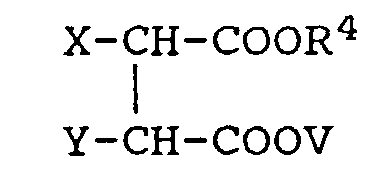
- V is H or M;
- R4 is R or

- R is -(CH2)n-OC(:O)C(R1)=CH2;
- R1 is H or methyl;
- R2 is

- M is Li, Na, or K;
- n is 2, 3, or 4;
- m + p = 15-130; and m is 70-100% of m + p;
- q is 0 or 1;
- provided that in at least one segment R4 is R;
- Preferably the prepolymer has an average molecular weight of at least 15,000 and wherein the base polymer is a polybutadiene.
- The invention also provides a photocurable composition comprising a prepolymer of the invention and an unsaturated monomer and a flexible photosensitive article comprising a support and a solid photosensitive layer comprising such a photosensitive composition.
- In a further aspect the invention provides a process for the preparation of an aqueous dispersible photocurable prepolymer for a photosensitive article which process comprises:
- (a) reacting anhydride groups of a maleic anhydride adduct of a polybutadiene or butadiene copolymer with a reagent having olefinically unsaturated groups and an anhydride reactive group; where, upon reaction the anhydride groups are opened and carboxylic acid groups are formed;
- (b) chain-extending the adduct by reacting a polymeric alkadiene polyol of the structure [R2]-OHw where w=2-3 and R2 is as hereinbefore defined with unreacted anhydride groups from (a) to increase the molecular weight (Mn) of the thus chain-extended polymer to at least 2500;
- (c) then reacting the remaining unreacted anhydride groups from (a) and (b) with water to form more carboxylic acid groups; and
- (d) then neutralizing a portion or all of the carboxylic acid groups in (c) with Li-, Na-, or K-containing base.
- The thus produced product may be applied in a further step (e) to a support to form a flexible photosensitive article. The process can also comprise adding photocurable unsaturated monomers and photoinitiators, e.g., to the product of (d) above.
- The invention yet further provides a method of forming a flexographic printing plate which method comprises:
- (1) coating a urethane-coated support with a non-ionomer polymer comprising segments of the structure

- (2) applying onto the coating in (1) a layer of an ionomer comprising segments of the structure:

- The invention also provides a printing plate obtainable by such a method wherein said urethane-coated support and said ionomer layer further comprise unsaturated monomer. Optionally said urethane-coated support and said ionomer layer further comprise photoinitiator.
- The product of process step (c) (sometimes herein referred to as "non-ionomer") comprises segments of the structure:

- R is -(CH2)n-OC(:O)C(R1)=CH2;
- R1 is H or methyl;
- R2 is

- R3 is H;
- R4 is R or

- n is 2, 3, or 4;
- m + p = 15-130; and m is 70-100% of m + p;
- q is 0 or 1;
- Provided that in at least one segment R4 is R; in at least one segment R4 is

- The product of process step (d) (herein, "ionomer") comprises segments substantially the same as those in the product of (c), except that R3 is replaced by R5. R5 is R3 or M, where M is Li, Na, or K, provided that in at least one segment R5 is M. For practical and statistical reasons, however, more than one segment will likely have R5 groups wherein R5 is M. Thus, generically speaking, the aforesaid segments may be described as

- In R2 the segments numbered m and p, although shown for the sake of simplicity in block polymer form, can actually be in random form, or random plus block form.
- In a preferred embodiment (cf Example 1) n is 2, R1 is methyl, m is about 70, p is about 23, q is 1, and molecular weight of the base polymer is about 8000.
- The results of (a), (b), or (c), and (d) above may include segments that are not chain-extended, so that the final photopolymer of (c) and/or (d) may comprise R2-free segments.
- Herein molecular weights are number average, Mn determined by GPC using polystyrene standards.
- Referring now to Figure 1, the principal unit processes in the preferred embodiment of the invention are given in short summary, starting with maleated polybutadiene and concluding with solid ionomer. The species used includes hydroxyethyl methacrylate (HEMA). R2 indicates the central portion of polybutadiene diol. In Steps (a) and (b) maleated polybutadiene is reacted with HEMA and chain-extending polybutadiene diol. The HEMA opens the anhydride group, esterifying one of the carbonyls arid converting the other to carboxylic acid, -COOH. During the same reaction, a molecule of the chain-extending diol opens anhydride groups on two or three molecules of maleated polybutadiene and forms -C(:O)0-R2-OC(:0)- linkages, where the carboxyls derive from residual maleic (succinic) anhydride moieties. Two or more chain-extending diols may link any two given maleated base polymer molecules; on the other hand it is expected that some maleated base polymers will escape the chain-extending reaction.
- Continuing with Figure 1, the product of (a) and (b) is reacted with water in (c). This results in hydrolysis of the remaining succinic anhydride groups. The product now comprises copious -COOH groups and little or no anhydride groups. This (c) product is referred to herein as a "non-ionomer" or "preionomer". In (d) the non-ionomer of (c) is treated with NaOH to neutralize some of or all of the -COOH groups and produce the final ionomer product. The product of (d) is ready for formulation with UV-sensitive additives and photoinitiators and solvent casting on a support as explained in detail hereinafter. In Figure 1, for the sake of simplicity, reaction of the anhydride group with HEMA and/or with the extender is shown with the carbonyl group nearest the base polymer backbone. Actually, the reaction may occur with either anhydride carbonyl, thus (with HEMA):

- Figure 1 is a simplified flow sheet which illustrates preparing the invention.
- The photocurable or photosensitive composition (the term "photocurable" and "photosensitive" being used interchangeably throughout) can be a prepolymer derived from a maleic anhydride adduct of polybutadiene having at least 70 to 80% 1,4 microstructure. As discussed later, the photocurable composition preferably comprises additional photocurable compounds such as unsaturated monomers. "Maleic anhydride" includes substituents as hereinafter discussed.
- The term 1,4 microstructure refers to the butadiene segment's structure which results from 1,4 addition to a 1,3 butadiene monomer during polymerization. The general structure for a 1,4 polybutadiene is illustrated below:
-[CH2 - CH = CH - CH2]m-
wherein m is a positive integer depending on the amount of polymerization desired and the molecular weight of the polymer. The remaining percentage of butadiene segments have a 1,2 microstructure which results from 1,2 addition during polymerization. In instances where butadiene segments having 1,2 microstructure are present, the polybutadiene has pendent vinyl groups on its structure, as illustrated below: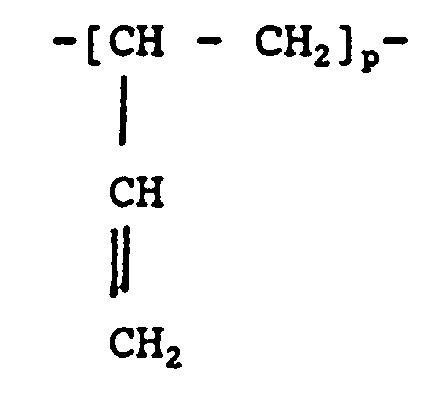
- For instance, the choice of catalyst or promoter, variation in the polarity of solvents used, variations in the reaction temperatures and the presence of transition metals all influence the 1,4 content of the resulting polymers' microstructure. In general, a polymer having increased 1,4 content will lead to higher elasticity and an increase in the rubbery nature of the composition. It is believed that those properties can be attributed to less crosslinking between pendent vinyl groups which are present on the polybutadienes which have a higher degree of 1,2 microstructure.
- The adduct can have a maleic anhydride content of from 5-30 percent by weight of the adduct and preferably contains 8-20% by weight. Lower amounts of anhydride content decreases the aqueous developability of the photocurable composition, and layers made therefrom, while higher amounts causes the composition and layers therefrom to be hard and less flexible.
- The addition of the maleic anhydride to the polybutadiene can be accomplished by reacting the polybutadiene with a maleic anhydride of the general formula

- For example, the adduct can be formed by heating the polybutadiene and the maleic anhydride to about 220°C, with stirring in a halogenated aromatic hydrocarbon solvent, such as α-chloronapthalene. The reaction can be carried out in the presence of an inhibitor so as to prevent side reactions. Suitable inhibitors include copper, copper salts and copper chelate complexes. The maleic anhydride can be added in any proportion from a minimum of 5% by weight up to 30% by weight, with the percentage of bonded maleic anhydride preferably being between 8 and 20% by weight. The molecular weight of the adduct can be between 1000 and 20,000 number average and is preferably 2,000 to 12,000. Other known techniques of adding maleic anhydride can be used. See U. S. Patent 3,974,129 and W. Cloak, Industrial Engineering Chemistry, Vol. 4, p.2095 (1955). Commercially available maleic anhydride adducts of 1,4 polybutadiene include a material designated as LX16-10MA from Revertex Ltd. and a material designated as Ricon 131 MA from Colorado Chemical Specialties.
- The adduct may also comprise a base polymer which is a butadiene copolymer with styrene, acrylonitrile, chloroprene, isobutylene, propylene, ethylene, or acrylic and methacrylic acids and esters. In instances where a copolymer is used, at least 70 to 80% of the butadiene segments should have 1,4 microstructure. Commercially available maleic anhydride adducts of a butadiene copolymer with styrene include Ricon 184 MA from Colorado Chemical Specialties.
- The adduct is chain-extended and esterified. These two reactions will be described separately.
- A portion of the adduct's anhydride groups is esterfied with a reagent having an olefinically unsaturated group and a functional group which-reacts with and opens the anhydride groups to form carboxylic acid and ester groups. Preferably, the reagent has a structure of

- The esterification reaction (and chain extension reaction) is carried out at temperatures from 50°C to 120°C, preferably at about 95-100°C for 1 to 6 hours. The reaction is preferably carried out in an organic solvent in which the adduct, vinyl compound, and extension agent are soluble. An organic solvent is needed to facilitate formation of the high molecular weight and high viscosity of the chain extended product. The esterification reagent is added in amounts to react with 5 to 40% of the adduct's anhydride groups. The esterification reaction creates pendent groups having the following structure P:

- As illustrated above, the pendent groups P provide photocurability to the polybutadiene adduct. When the adduct is exposed to UV radiation, the vinyl groups in P crosslink, thus curing the composition and imparting tensile strength and modulus to any layer prepared from the composition, as well as imparting improved swell resistance of the polymer in solvents. Further, the esterification reaction opens the anhydride groups to form free carboxylic acid groups, thus providing a water dispersible composition which can be developed in aqueous or aqueous-alkaline solutions.
- The adduct is chain extended to improve the physical properties, i.e., increase elongation and provide a stable and durable photosensitive surface. The chain extending agent is a polymeric alkadienyl diol or triol of the structure [R2]-[-OH]2 or [-OH]3, where R2 is as previously defined, and the [-OH] groups are directly attached to the polymeric alkadienyl backbone in the case of q = 0 or attached to the (COOCH2CH2-) groups in the case of q = 1. The chain-extending agent has a molecular weight of about 1000-7000.
- In the chain extension reaction carboxyl groups on two base polymer adducts are joined, thus:

- As shown, chain extension of the adducts occurs through a portion of the anhydride groups.
Preferably, chain extension occurs through 5 to 30 % of the adduct's original anhydride groups. - To open the remaining anhydride groups the chain-extended product is reacted with water. This reaction produces additional carboxylic acid groups which when neutralized with monovalent cations as herein described, form a solid photopolymer and increases the water dispersibility of the photocurable composition.
- Finally, to provide the ionomer previously illustrated the carboxyl groups are neutralized by bases that provide Li, Na, or K ions, such as (but not limited to) lithium hydroxide, sodium hydroxide, or potassium hydroxide. The neutralized carboxylic acid groups on the ionomer are represented by -COOV wherein V is R5 and R5 is M, i.e. Li, Na or K. It has been found that the resulting salts have improved physical properties such as higher resilience, higher elongation and better resistance to swell in organic solvents commonly used in printing inks.
- The selection of one of the three stated cations permits synthesis of a photopolymer tailor-made for a specific end use. For example, Li gives lower swells in aqueous based printing inks, while Na gives lower swells in solvent based inks.
- The relative proportions of ingredients in forming the photopolymer are important. For example, too much HEMA results in a product too hard to permit good ink transfer. Too little chain extension results in a product with low elongation, and too little hydrolysis of the remaining anhydride groups will yield a material which will not become a solid when neutralized with monovalent cations.
- Based on 100 parts by weight of maleic anhydride adduct of base polymer (polyalkadiene homo- or copolymer), of which 5-30, preferably 8-20 parts by weight is maleic anhydride moiety, we use (in parts by weight except as noted):
- Olefinically unsaturated side chain additive (e.g., HEMA), 0.7-3.2, preferably 2.0-2.6;
- Polyalkadienyl polyol chain extender (e.g., polybutadiene diol), 10-63, preferably 30-50;
- Water, sufficient to complete hydrolysis of substantially all remaining anhydride groups still present after steps (a) and (b), and suitably in slight excess;
- Li-, Na-, or K-containing base, sufficient to neutralize 40-100 % of the carboxylic acid groups, preferably 50-70 % in the non-ionomer with formation of ionomer.
- To succeed commercially a flexographic printing plate should meet certain physical requirements, typically:
- (1) Elongation (ASTM D 412) should exceed about 140%
- (2) Tensile strength (ASTM D 412) should exceed about 2070 kPa (300 psi)
- (3) Tensile modulus (1% elongation) (ASTM D 412) should not exceed about (13,800 kPa (2000 psi)
- (4) Shore hardness (ASTM 2240) should not exceed about 60.
- Printing plates prepared from prepolymers in accordance with the processes of the instant invention readily meet these criteria.
- As mentioned earlier, the photocurable compositions can also contain components in addition to the above described neutralized prepolymer. For instance, photocurable monomer diluents are preferably added. Operable diluents include reactive acrylic or methacrylic diluents of the formula

- Other suitable diluents include polymerizable ethylenically unsaturated addition monomers described in U.S. Patent 4,442,302. Those monomers include monofunctional, difunctional or polyfunctional compounds based on moieties such as (meth)acrylonitriles and acrylamides, as well as the (meth)acrylics described above.
- Suitable photoinitiators for the photocurable composition include benzoin alkyl ethers, such as benzoin methyl ether, benzoin ethyl ether, benzoin isopropyl ether and benzoin isobutyl ether. Another class of photoinitiators are the dialkoxyacetophenones exemplified by 2,2-dimethoxy-2-phenylacetophenone, i.e., Irgacure® 651 (Ciba-Geigy); and 2,2-diethoxy-2-phenylacetophenone. Still another class of photoinitiators are the aldehyde and ketone carbonyl compounds having at least one aromatic nucleus attached directly to the carboxyl group. These photoinitiators include benzophenone, acetophenone, o-methoxybenzophenone, acenaphthene-quinone, valerophenone, hexanophenone, alpha-phenyl-butyrophenone, p-morpholinopropiophenone, dibenzosuberone, 4-morpholinobenzophenone,4'-morpholinodeoxybenzoin, p-diacetylbenzene, 4-aminobenzophenone, 4'-methoxyacetophenone, benzaldehyde, alpha-tetralone, 9-acetylphenanthrene, 2-acetylphenanthrene, 10-thioxanthenone, 3-acetylphenanthrene, 3-acetylindone, 9-fluorenone, 1-indanone, 1,3,5-triacetylbenzene, thioxanthen-9-one, xanthene-9-one, 7-H-benz[de]-anthracene-7-one, 1-naphthaldehyde, 4,4'-bis(dimethylamino)-benzophenone, fluorene-9-one, 1'-acetonaphthone, 2'-acetonaphthone, 2,3-butanedione, acetonaphthene, benz[a]anthracene 7,12 dione, etc. Phosphines such as triphenylphosphine and tri-o-tolylphosphine are also operable herein as photoinitiators. The photoinitiators or mixtures thereof are usually added in an amount ranging from 0.01 to 5% by weight of the total weight of the photocurable composition.
- Other additives to the photocurable composition can be included. To inhibit premature crosslinking during storage of the prepolymer containing compositions of this invention, thermal polymerization inhibitors and stabilizers are added. Such stabilizers are well known in the art, and include hydroquinone monobenzyl ether, methyl hydroquinone, amyl quinone, amyloxyhydroquinone, n-butylphenol, phenol, hydroquinone monopropyl ether, phenothiazine and nitrobenzene, and mixtures thereof. Such additives are used in an amount within the range of from 0.01 to 2% by weight of the prepolymer. These stabilizers are effective in preventing crosslinking of the prepolymer composition during preparation, processing and storage.
- The compositions also may contain up to 50% by weight of an inert particulate filler which is essentially transparent to actinic light. Such fillers include the organophilic silicas, bentonites, silica and powdered glass. Such fillers can impart desirable properties to the photocurable compositions and reliefs on printing plates containing those compositions.
- The photocurable composition can then be shaped and formed as a solid layer of suitable thickness according to conventional solvent casting, i.e., dissolving the composition in a solvent, shaping the solution into a film or plate and removing the solvent. Conventional extrusion calendaring or hot press techniques can also be used. Solid layers of the photosensitive composition in the form of a film can be adhered to supports such as those comprising polyester, nylon or polycarbonate. Other suitable supports include woven fabrics and mats, e.g. glass fiber fabrics, or laminated materials made of, for example, glass fibers and plastics. It is preferred that the supports are dimensionally stable and resistant to the washout solutions.
- It is necessary to protect photosensitive surfaces from contamination by dirt and dust during storage before being exposed and washed. Such protection is accomplished by lamination or application of a flexible protective cover sheet to the side of the photocurable composition opposite that of the support. As mentioned before the photocurable compositions can sometimes be tacky and it is desirable to apply a release film to the surface of the photosensitive layer before application of the coversheet. This release film may consist of a thin, flexible and aqueous dispersible polymeric film. This film allows for intimate contact between the surface of the photocurable composition opposite to the support and an image bearing negative applied to the surface.
- Photosensitive articles comprising a support having a solid layer or surface comprising the photocurable composition, e.g. solid flexographic printing plates, can then be processed by well known techniques for imagewise exposure to actinic light. Preferably, the light should have a wavelength of from about 230-450 nm. Exposure is through a negative placed between the light source and the photosensitive surface. Suitable sources of light include Type RS sunlamps, carbon arc lamps, xenon arc lamps, mercury vapor lamps, tungsten halide lamps and the like.
- Exposure periods depend upon the intensity of the actinic light, thickness of the plate and the depth of the relief desired on the printing plate. Periods of from 2 to 20 minutes are preferred.
- After exposure and the negative has been removed, the unexposed areas of the photosensitive surface can be developed in aqueous solutions. Suitable solutions include those of nonionic and cationic surfactants, as well as basic and semi-aqueous basic solutions and combinations thereof. Such surfactants are commercially available as Triton® X-100 from Union Carbide Company and Igepal® C0-730 from GAF Corporation.
- The following are examples illustrating the instant invention.
- 409g of a maleated polybutadiene (Mn = 8800, degree of maleation = 9%), 165g of hydroxy terminated polybutadiene (hydroxyl number = 22.65), 9.1g of hydroxyethyl methacrylate, 2.3g of butylated hydroxy toluene antioxidant (BHT) and 726g of toluene were charged into a 3L resin kettle equipped with an overhead stirrer, condenser and thermocouple. This mixture was heated at 95-100°C with stirring for 4 hours at which time the reaction was complete as determined by IR spectroscopy. The solution was cooled to 60°C, and an excess of water added (8g) and then stirred for an additional 16 hours. Analysis by IR spectroscopy showed the complete disappearance of the anhydride adsorption band at 1780 cm-1 indicating the reaction was over.
- To 41g of the prepolymer prepared in Example 1 (92g of solution) was added 1g NaOH dissolved in 12g methanol. This mixture was stirred at room temperature for 1 hour. 4.11g of hexanediol dimethacrylate, 2.75g of dicyclopentenyloxyethyl methacrylate and 0.484g Irgacure 651 were then added and mixed for an additional hour.
- To 41g of a prepolymer prepared as in Example 1 was added 0.95g lithium methoxide dissolved in 18g methanol. After stirring for one hour, 4.11g hexanediol dimethacrylate, 2.75g dicyclopentenyloxyethyl methacrylate and 0.484g Irgacure 651 was added and mixed until well blended.
- To 41g of a prepolymer prepared as in Example 1 was added 1.62g of 85% potassium hydroxide in 12g methanol. After stirring for one hour, 4.11g hexanediol dimethacrylate, 2.75g dicyclopentenyloxyethyl methacrylate and 0.484g Irgacure 651 was added and the solution mixed for an additional hour.
- The formulated products of Examples 2 to 4 were solvent cast to produce solid, dry films. The films were cured by exposure to UV light and their mechanical properties and swell resistance in typical flexographic inks determined.
Tensile 24 Hour Weight Gain Modulus kPa (psi) Elong. % Strength kPa (psi) Resilience % Shore A Solvent Ink Aqueous Ink Example 5 (Na) 3810(553) 180 2495(362) 48 60 6.0% 7.4% Example 6 (Li) 3950(573) 197 2585(375) 46 57 9.4% 5.9% Example 7 (K) 2710(393) 140 2240(325) 51 60 8.3% 17.0% - The following Example shows the effect of high HEMA content on physical properties as well as the effect of no hydrolysis on the solidness of monovalent cation salts.
- 182g of a maleated polybutadiene (Mn = 8800, degree of maleation = 9%), 20g hydroxyethyl methacrylate, 1.0g BHT and 160g toluene were charged into a 21 resin kettle equipped with an overhead mechanical stirrer, condenser and thermocouple. The mixture was heated at 90°C with stirring until IR analysis indicated the reaction was complete (disappearance of the anhydride adsorption band at 1780 cm-1).
- To 24.4g of prepolymer (50g of solution) was added 0.46g NaOH dissolved in 6g methanol. After stirring for 1 hour, 2.4g hexane diol dimethacrylate, 1.6g dicyclopentenyloxyethyl methacrylate and 0.3g Irgacure 651 was added to the ionomer solution and mixed thoroughly. This mixture was solvent cast to produce a 510µm (20 mil) film. The tacky, non-solid film obtained was unsuitable for use as a solid printing plate due to dimensional instability. The mechanical properties of a film cured by exposure to UV light are shown below.
Tensile Modulus Elongation Tensile Strength Shore A Hardness 26550 kPa 5860 kPa (3850 psi) 50% (850 psi) 80 - A formulated sodium ionomer solution prepared as described in Example 2 was solvent cast onto a polyester support to provide a solid, nontacky 1700µm (67 mil) thick film. This film was imaged by UV exposure through a negative and developed in a 4% Triton RW-150 surfactant solution at 60°C (140°F). A printing plate with 30 mils relief and excellent reproduction of the negative film image was obtained. This plate was found to have excellent ink transfer with both aqueous and solvent-based inks.
- A conventional photopolymer backing is a polyester film (e.g., "Mylar") coated with a urethane adhesive. The ionomer forms of the photopolymers of this invention do not adhere well to this particular type of backing. We have found, however, that we can coat such backing with a thin coating of our photopolymer in its non-ionomer form in solvent (result of step (c)), and that, so primed, the photopolymer in ionomer form (result of step (d)) (and preferably promptly applied) will then adhere firmly to the plate. Both coatings can be applied by conventional solvent casting onto a belt, with application of several layers. Evaporation of solvent is completed by conventional oven drying.

in at least one segment V is M.
Claims (26)
- A prepolymer comprising segments of the structure:
 V is H or M;R4 is R or
 R is -(CH2)n-OC(:O)C(R1)=CH2;R1 is H or methyl;R2 is
 M is Li, Na, or K;n is 2, 3, or 4;m + p = 15-130; and m is 70-100% of m + p;q is 0 or 1;provided that in at least one segment R4 is R;in at least one segment R4 is
in at least one segment V is M. - Prepolymer according to claim 1 wherein V is H.
- Prepolymer according to claim 1 wherein V is H or M, provided that in at least some segments, V is M.
- A prepolymer according to any one of claims 1 to 3 wherein the segments are derived from a polybutadiene maleic anhydride adduct wherein said adduct is a polybutadiene having a molecular weight of about 8000 and having about 8 anhydride groups per molecule.
- A prepolymer according to claim 4 wherein said adduct has been prepared with a maleic anhydride of the formula

- A prepolymer according to any one of the preceding claims wherein the base polymer is a polybutadiene comprising at least 70% 1,4 microstructure.
- A prepolymer according to any one of the preceding claims with an average molecular weight of at least 15,000 and wherein the base polymer is a polybutadiene.
- A prepolymer according to claim 1 wherein n=2 and R1 is methyl.
- A prepolymer according to claim 3 wherein n is 2; R1 is methyl; m is about 70, p is about 23, q is 1, and the molecular weight of the base polymer is about 8000.
- A photocurable composition comprising a prepolymer according to any one of claims 1 to 9 and further comprising an unsaturated monomer.
- A photocurable composition according to claim 10 wherein said unsaturated monomer is a methacrylate or acrylate.
- A photocurable composition according to claim 10 or 11 further comprising a photoinitiator.
- A flexible, photosensitive article comprising a support and a solid photosensitive layer comprising a photocurable composition as defined in any one of claims 10 to 12.
- A process for the preparation of an aqueous dispersible photocurable prepolymer for a flexible photosensitive article which process comprises(a) reacting anhydride groups of a maleic anhydride adduct of a polybutadiene or butadiene copolymer with a reagent having olefinically unsaturated groups and an anhydride reactive functional group, where upon reaction, the anhydride groups are opened and carboxylic acid groups are formed;(b) chain extending the adduct in (a) by reacting a polymeric alkadiene polyol of the structure [R2]-[OH]w wherein w = 2-3 and R2 is as defined in claim 1 with unreacted anhydride groups of the reaction product of (a), such that the molecular weight (Mn) of the chain extended polymer is at least 2500; and(c) reacting the anhydride groups remaining after steps (a) and (b) with water to form carboxylic acid groups; and, optionally,(d) neutralizing at least a portion of the carboxylic acid groups in (c) with a Li-, Na-, or K-containing base.
- Process according to claim 14, wherein, based on 100 parts by weight of maleic anhydride adduct of polybutadiene or butadiene copolymer, in parts by weight, the process comprises:(1) 5-30 parts of the anhydride groups of the adduct;(2) 0.7-3.2 parts of the reagent in step (a); and(3) 10-63 parts of the polymeric alkadiene polyol.
- Process according to claim 14 or 15 which comprises:(1) 8-20 parts of the anhydride groups;(2) 2.0-2.6 parts of the reagent in step (a); and(3) 30-50 parts of the polymeric alkadiene polyol.
- Process according to claim 14, 15 or 16 wherein 40-100 mol % of the carboxylic acid groups in (c) are neutralized.
- Process according to claim 17 wherein 50-70 mol % of the carboxylic acid groups in (c) are neutralized.
- Process according to any one of claims 14 to 18 wherein the reaction product in (c) is cast onto a support or the neutralized product of step (d) is cast or extruded onto a support.
- Process according to any one of claims 14 to 19 wherein said adduct is prepared from a polybutadiene having a molecular weight of about 8000 and about 70% 1,4 microstructure and said adduct has about 8 anhydride groups per molecule.
- Process according to any one of claims 14 to 20 wherein in (b) the polymeric alkadiene polyol is a diol wherein m is about 70% of m t p, and p is about 23.
- Process according to any one of claims 14 to 21 wherein the reagent in step (a) is HO-(CH2)n-O-C(:O)-C(R1)=CH2 wherein R1 is hydrogen or methyl, and n = 2 to 4.
- Process according to any one of claims 14 to 22 further comprising mixing the neutralized reaction product with unsaturated monomers and photoinitiators.
- Method of forming a flexographic printing plate which method comprises:(1) coating a urethane-coated support with a non-ionomer polymer comprising segments of the structure
 (2) applying onto the coating in (1) a layer of an ionomer comprising segments of the structure:
- Printing plate obtainable by the method of claim 24 wherein said urethane-coated support and said ionomer layer further comprise unsaturated monomer.
- Printing plate according to claim 25 wherein said urethane-coated support and said ionomer layer further comprise photoinitiator.
Applications Claiming Priority (4)
| Application Number | Priority Date | Filing Date | Title |
|---|---|---|---|
| US51489990A | 1990-04-26 | 1990-04-26 | |
| US514899 | 1991-03-22 | ||
| US07/671,937 US5407784A (en) | 1990-04-26 | 1991-03-22 | Photocurable composition comprising maleic anhydride adduct of polybutadiene or butadiene copolymers |
| US671937 | 1996-06-28 |
Publications (3)
| Publication Number | Publication Date |
|---|---|
| EP0456380A2 EP0456380A2 (en) | 1991-11-13 |
| EP0456380A3 EP0456380A3 (en) | 1992-03-18 |
| EP0456380B1 true EP0456380B1 (en) | 1996-07-10 |
Family
ID=27058352
Family Applications (1)
| Application Number | Title | Priority Date | Filing Date |
|---|---|---|---|
| EP91303732A Expired - Lifetime EP0456380B1 (en) | 1990-04-26 | 1991-04-25 | Photocurable composition comprising maleic anhydride adduct of polybutadiene or butadiene copolydiene copolymers |
Country Status (8)
| Country | Link |
|---|---|
| EP (1) | EP0456380B1 (en) |
| JP (1) | JP3068237B2 (en) |
| AT (1) | ATE140245T1 (en) |
| AU (1) | AU7518591A (en) |
| BR (1) | BR9101674A (en) |
| CA (1) | CA2040621C (en) |
| DE (1) | DE69120724T2 (en) |
| NZ (1) | NZ237756A (en) |
Cited By (1)
| Publication number | Priority date | Publication date | Assignee | Title |
|---|---|---|---|---|
| CN106814541A (en) * | 2015-11-30 | 2017-06-09 | 乐凯华光印刷科技有限公司 | A kind of ageing-resistant flexographic plate and preparation method thereof |
Families Citing this family (4)
| Publication number | Priority date | Publication date | Assignee | Title |
|---|---|---|---|---|
| US5362806A (en) * | 1993-01-07 | 1994-11-08 | W. R. Grace & Co.-Conn. | Toughened photocurable polymer composition for processible flexographic printing plates |
| US5859134A (en) * | 1997-03-18 | 1999-01-12 | Polyfibron Technologies, Inc. | Polymers which are dispersible in aqueous solvents and photocurable elements comprising same |
| ATE265505T1 (en) * | 2000-02-07 | 2004-05-15 | Sartomer Co Inc | CROSS-LINKABLE POLYMER COMPOSITIONS |
| EP3026065B1 (en) * | 2013-12-04 | 2017-11-01 | Kuraray Co., Ltd. | Modified liquid diene-based rubber and production process for the same |
Family Cites Families (2)
| Publication number | Priority date | Publication date | Assignee | Title |
|---|---|---|---|---|
| DE2632010C3 (en) * | 1976-07-16 | 1983-12-22 | Metallgesellschaft Ag, 6000 Frankfurt | Radiation curable ink composition |
| DE3543646A1 (en) | 1985-12-11 | 1987-06-19 | Basf Ag | IONIC POLYMERISATE |
-
1991
- 1991-04-09 NZ NZ237756A patent/NZ237756A/en unknown
- 1991-04-17 CA CA002040621A patent/CA2040621C/en not_active Expired - Fee Related
- 1991-04-22 AU AU75185/91A patent/AU7518591A/en not_active Abandoned
- 1991-04-24 JP JP3119037A patent/JP3068237B2/en not_active Expired - Lifetime
- 1991-04-25 BR BR919101674A patent/BR9101674A/en not_active Application Discontinuation
- 1991-04-25 EP EP91303732A patent/EP0456380B1/en not_active Expired - Lifetime
- 1991-04-25 DE DE69120724T patent/DE69120724T2/en not_active Expired - Fee Related
- 1991-04-25 AT AT91303732T patent/ATE140245T1/en not_active IP Right Cessation
Cited By (1)
| Publication number | Priority date | Publication date | Assignee | Title |
|---|---|---|---|---|
| CN106814541A (en) * | 2015-11-30 | 2017-06-09 | 乐凯华光印刷科技有限公司 | A kind of ageing-resistant flexographic plate and preparation method thereof |
Also Published As
| Publication number | Publication date |
|---|---|
| AU7518591A (en) | 1992-01-02 |
| JPH04330446A (en) | 1992-11-18 |
| EP0456380A2 (en) | 1991-11-13 |
| BR9101674A (en) | 1991-12-10 |
| DE69120724T2 (en) | 1996-11-07 |
| JP3068237B2 (en) | 2000-07-24 |
| DE69120724D1 (en) | 1996-08-14 |
| EP0456380A3 (en) | 1992-03-18 |
| CA2040621A1 (en) | 1991-10-27 |
| NZ237756A (en) | 1992-12-23 |
| ATE140245T1 (en) | 1996-07-15 |
| CA2040621C (en) | 2003-03-25 |
Similar Documents
| Publication | Publication Date | Title |
|---|---|---|
| EP0523945B1 (en) | Photosensitive elastomer polymer composition for flexographic printing plates | |
| US5688633A (en) | Soft relief photopolymer printing plates for flexographic printing | |
| US5462835A (en) | Photocurable composition, flexible, photosensitive articles made therefrom, and methods of improving solvent resistance and flexibility of those articles | |
| EP0624825B1 (en) | Photosensitive polymer composition for flexographic printing plates processable in aqueous media | |
| US5407784A (en) | Photocurable composition comprising maleic anhydride adduct of polybutadiene or butadiene copolymers | |
| EP0584970A2 (en) | Aqueous developable photosensitive polyurethane-(meth)acrylate | |
| JP3199812B2 (en) | Water-based developable photocurable compositions, photosensitive products having layers made therefrom, and methods of improving those products | |
| JP3775688B2 (en) | Photosensitive polyurethane-methacrylate capable of aqueous development | |
| CA2040621C (en) | Photocurable composition comprising maleic anhydride adduct of polybutadiene or butadiene copolymers | |
| US5268257A (en) | Aqueous developable, photocurable composition, and flexible, photosensitive articles made therefrom | |
| US5750313A (en) | Photosensitive resin composition and process for producing the same | |
| JPH06220144A (en) | Multiblock copolymer for flexographic printing plate | |
| US6326126B1 (en) | Photocurable elastomeric mixture and recording material obtained therefrom for the production of relief printing plates | |
| AU663339B2 (en) | Photosensitive elastomer polymer composition for flexographic printing plates processible in aqueous solutions | |
| US5362806A (en) | Toughened photocurable polymer composition for processible flexographic printing plates | |
| US5034306A (en) | Photocurable elastomeric mixture and recording material, obtained therefrom, for the production of relief printing plates | |
| US5550005A (en) | Photosensitive elastomer polymer compositions for flexographic printing plates | |
| CA2047582A1 (en) | Aqueous, developable photocurable composition, process of making thereof and flexible photosensitive articles made therefrom | |
| JPH06214389A (en) | Photosensitive elastomer composition |
Legal Events
| Date | Code | Title | Description |
|---|---|---|---|
| PUAI | Public reference made under article 153(3) epc to a published international application that has entered the european phase |
Free format text: ORIGINAL CODE: 0009012 |
|
| AK | Designated contracting states |
Kind code of ref document: A2 Designated state(s): AT BE CH DE DK ES FR GB GR IT LI LU NL SE |
|
| PUAL | Search report despatched |
Free format text: ORIGINAL CODE: 0009013 |
|
| AK | Designated contracting states |
Kind code of ref document: A3 Designated state(s): AT BE CH DE DK ES FR GB GR IT LI LU NL SE |
|
| 17P | Request for examination filed |
Effective date: 19920520 |
|
| 17Q | First examination report despatched |
Effective date: 19940830 |
|
| RAP1 | Party data changed (applicant data changed or rights of an application transferred) |
Owner name: PT SUB, INC. |
|
| GRAH | Despatch of communication of intention to grant a patent |
Free format text: ORIGINAL CODE: EPIDOS IGRA |
|
| GRAH | Despatch of communication of intention to grant a patent |
Free format text: ORIGINAL CODE: EPIDOS IGRA |
|
| GRAA | (expected) grant |
Free format text: ORIGINAL CODE: 0009210 |
|
| AK | Designated contracting states |
Kind code of ref document: B1 Designated state(s): AT BE CH DE DK ES FR GB GR IT LI LU NL SE |
|
| PG25 | Lapsed in a contracting state [announced via postgrant information from national office to epo] |
Ref country code: IT Free format text: LAPSE BECAUSE OF FAILURE TO SUBMIT A TRANSLATION OF THE DESCRIPTION OR TO PAY THE FEE WITHIN THE PRE;WARNING: LAPSES OF ITALIAN PATENTS WITH EFFECTIVE DATE BEFORE 2007 MAY HAVE OCCURRED AT ANY TIME BEFORE 2007. THE CORRECT EFFECTIVE DATE MAY BE DIFFERENT FROM THE ONE RECORDED.SCRIBED TIME-LIMIT Effective date: 19960710 Ref country code: ES Free format text: THE PATENT HAS BEEN ANNULLED BY A DECISION OF A NATIONAL AUTHORITY Effective date: 19960710 Ref country code: GR Free format text: LAPSE BECAUSE OF FAILURE TO SUBMIT A TRANSLATION OF THE DESCRIPTION OR TO PAY THE FEE WITHIN THE PRESCRIBED TIME-LIMIT Effective date: 19960710 Ref country code: AT Effective date: 19960710 Ref country code: BE Effective date: 19960710 Ref country code: LI Effective date: 19960710 Ref country code: DK Effective date: 19960710 Ref country code: CH Effective date: 19960710 Ref country code: NL Free format text: LAPSE BECAUSE OF FAILURE TO SUBMIT A TRANSLATION OF THE DESCRIPTION OR TO PAY THE FEE WITHIN THE PRESCRIBED TIME-LIMIT Effective date: 19960710 |
|
| REF | Corresponds to: |
Ref document number: 140245 Country of ref document: AT Date of ref document: 19960715 Kind code of ref document: T |
|
| ET | Fr: translation filed | ||
| REF | Corresponds to: |
Ref document number: 69120724 Country of ref document: DE Date of ref document: 19960814 |
|
| PG25 | Lapsed in a contracting state [announced via postgrant information from national office to epo] |
Ref country code: SE Effective date: 19961010 |
|
| NLV1 | Nl: lapsed or annulled due to failure to fulfill the requirements of art. 29p and 29m of the patents act | ||
| REG | Reference to a national code |
Ref country code: CH Ref legal event code: PL |
|
| PG25 | Lapsed in a contracting state [announced via postgrant information from national office to epo] |
Ref country code: LU Free format text: LAPSE BECAUSE OF NON-PAYMENT OF DUE FEES Effective date: 19970430 |
|
| PLBE | No opposition filed within time limit |
Free format text: ORIGINAL CODE: 0009261 |
|
| STAA | Information on the status of an ep patent application or granted ep patent |
Free format text: STATUS: NO OPPOSITION FILED WITHIN TIME LIMIT |
|
| 26N | No opposition filed | ||
| REG | Reference to a national code |
Ref country code: GB Ref legal event code: IF02 |
|
| PGFP | Annual fee paid to national office [announced via postgrant information from national office to epo] |
Ref country code: DE Payment date: 20030430 Year of fee payment: 13 |
|
| PG25 | Lapsed in a contracting state [announced via postgrant information from national office to epo] |
Ref country code: DE Free format text: LAPSE BECAUSE OF NON-PAYMENT OF DUE FEES Effective date: 20041103 |
|
| PGFP | Annual fee paid to national office [announced via postgrant information from national office to epo] |
Ref country code: GB Payment date: 20100331 Year of fee payment: 20 |
|
| PGFP | Annual fee paid to national office [announced via postgrant information from national office to epo] |
Ref country code: FR Payment date: 20100506 Year of fee payment: 20 |
|
| REG | Reference to a national code |
Ref country code: GB Ref legal event code: PE20 Expiry date: 20110424 |
|
| PG25 | Lapsed in a contracting state [announced via postgrant information from national office to epo] |
Ref country code: GB Free format text: LAPSE BECAUSE OF EXPIRATION OF PROTECTION Effective date: 20110424 |