EP0455269B1 - Packing for use in resolution - Google Patents
Packing for use in resolution Download PDFInfo
- Publication number
- EP0455269B1 EP0455269B1 EP91110768A EP91110768A EP0455269B1 EP 0455269 B1 EP0455269 B1 EP 0455269B1 EP 91110768 A EP91110768 A EP 91110768A EP 91110768 A EP91110768 A EP 91110768A EP 0455269 B1 EP0455269 B1 EP 0455269B1
- Authority
- EP
- European Patent Office
- Prior art keywords
- group
- carbon atoms
- silica gel
- atom
- packing
- Prior art date
- Legal status (The legal status is an assumption and is not a legal conclusion. Google has not performed a legal analysis and makes no representation as to the accuracy of the status listed.)
- Expired - Lifetime
Links
- 238000012856 packing Methods 0.000 title claims description 47
- VYPSYNLAJGMNEJ-UHFFFAOYSA-N Silicium dioxide Chemical compound O=[Si]=O VYPSYNLAJGMNEJ-UHFFFAOYSA-N 0.000 claims description 78
- 239000000741 silica gel Substances 0.000 claims description 65
- 229910002027 silica gel Inorganic materials 0.000 claims description 65
- 125000004432 carbon atom Chemical group C* 0.000 claims description 63
- 239000003795 chemical substances by application Substances 0.000 claims description 26
- BLRPTPMANUNPDV-UHFFFAOYSA-N Silane Chemical compound [SiH4] BLRPTPMANUNPDV-UHFFFAOYSA-N 0.000 claims description 25
- 229910000077 silane Inorganic materials 0.000 claims description 25
- -1 copper carboxylate Chemical class 0.000 claims description 23
- RTZKZFJDLAIYFH-UHFFFAOYSA-N Diethyl ether Chemical compound CCOCC RTZKZFJDLAIYFH-UHFFFAOYSA-N 0.000 claims description 18
- 125000000217 alkyl group Chemical group 0.000 claims description 16
- 150000001875 compounds Chemical class 0.000 claims description 16
- 125000003118 aryl group Chemical group 0.000 claims description 14
- 125000003277 amino group Chemical group 0.000 claims description 12
- 125000003710 aryl alkyl group Chemical group 0.000 claims description 12
- 125000005842 heteroatom Chemical group 0.000 claims description 12
- 125000006850 spacer group Chemical group 0.000 claims description 10
- 230000003287 optical effect Effects 0.000 claims description 9
- 125000004435 hydrogen atom Chemical group [H]* 0.000 claims description 8
- 229910052802 copper Inorganic materials 0.000 claims description 7
- 239000010949 copper Substances 0.000 claims description 7
- 150000001408 amides Chemical class 0.000 claims description 6
- 229910052799 carbon Inorganic materials 0.000 claims description 6
- 150000002148 esters Chemical class 0.000 claims description 6
- 125000005843 halogen group Chemical group 0.000 claims description 6
- 125000002887 hydroxy group Chemical group [H]O* 0.000 claims description 6
- QAWTYRYXDYHQNU-UHFFFAOYSA-N diazathiane Chemical compound NSN QAWTYRYXDYHQNU-UHFFFAOYSA-N 0.000 claims description 5
- 238000000034 method Methods 0.000 claims description 5
- 125000004430 oxygen atom Chemical group O* 0.000 claims description 5
- 229910052717 sulfur Inorganic materials 0.000 claims description 5
- 125000004434 sulfur atom Chemical group 0.000 claims description 5
- 125000003545 alkoxy group Chemical group 0.000 claims description 4
- 239000000126 substance Substances 0.000 claims description 4
- BDHFUVZGWQCTTF-UHFFFAOYSA-M sulfonate Chemical compound [O-]S(=O)=O BDHFUVZGWQCTTF-UHFFFAOYSA-M 0.000 claims description 4
- 125000002947 alkylene group Chemical group 0.000 claims description 3
- 238000004587 chromatography analysis Methods 0.000 claims description 3
- 125000000466 oxiranyl group Chemical group 0.000 claims description 2
- 125000004429 atom Chemical group 0.000 claims 2
- OKKJLVBELUTLKV-UHFFFAOYSA-N Methanol Chemical compound OC OKKJLVBELUTLKV-UHFFFAOYSA-N 0.000 description 42
- UHOVQNZJYSORNB-UHFFFAOYSA-N Benzene Chemical compound C1=CC=CC=C1 UHOVQNZJYSORNB-UHFFFAOYSA-N 0.000 description 36
- IJGRMHOSHXDMSA-UHFFFAOYSA-N Atomic nitrogen Chemical compound N#N IJGRMHOSHXDMSA-UHFFFAOYSA-N 0.000 description 24
- 238000006243 chemical reaction Methods 0.000 description 21
- ZMXDDKWLCZADIW-UHFFFAOYSA-N N,N-Dimethylformamide Chemical compound CN(C)C=O ZMXDDKWLCZADIW-UHFFFAOYSA-N 0.000 description 18
- 230000015572 biosynthetic process Effects 0.000 description 17
- 239000000203 mixture Substances 0.000 description 17
- 238000003786 synthesis reaction Methods 0.000 description 17
- 150000001879 copper Chemical class 0.000 description 15
- 239000000725 suspension Substances 0.000 description 14
- 229940024606 amino acid Drugs 0.000 description 13
- 150000001413 amino acids Chemical class 0.000 description 13
- 229910052757 nitrogen Inorganic materials 0.000 description 12
- 239000000047 product Substances 0.000 description 11
- XLYOFNOQVPJJNP-UHFFFAOYSA-N water Substances O XLYOFNOQVPJJNP-UHFFFAOYSA-N 0.000 description 11
- ONIBWKKTOPOVIA-BYPYZUCNSA-N L-Proline Chemical compound OC(=O)[C@@H]1CCCN1 ONIBWKKTOPOVIA-BYPYZUCNSA-N 0.000 description 9
- 125000002496 methyl group Chemical group [H]C([H])([H])* 0.000 description 9
- 229960002429 proline Drugs 0.000 description 9
- 239000002904 solvent Substances 0.000 description 9
- 239000011521 glass Substances 0.000 description 8
- 239000007788 liquid Substances 0.000 description 8
- 239000002245 particle Substances 0.000 description 8
- 239000011148 porous material Substances 0.000 description 8
- 230000000694 effects Effects 0.000 description 7
- 0 CCCCC(CC*)*Cl Chemical compound CCCCC(CC*)*Cl 0.000 description 6
- 229930182821 L-proline Natural products 0.000 description 6
- 229910000365 copper sulfate Inorganic materials 0.000 description 6
- XTVVROIMIGLXTD-UHFFFAOYSA-N copper(II) nitrate Chemical compound [Cu+2].[O-][N+]([O-])=O.[O-][N+]([O-])=O XTVVROIMIGLXTD-UHFFFAOYSA-N 0.000 description 6
- ARUVKPQLZAKDPS-UHFFFAOYSA-L copper(II) sulfate Chemical compound [Cu+2].[O-][S+2]([O-])([O-])[O-] ARUVKPQLZAKDPS-UHFFFAOYSA-L 0.000 description 6
- 238000010992 reflux Methods 0.000 description 6
- 229910001220 stainless steel Inorganic materials 0.000 description 6
- 239000010935 stainless steel Substances 0.000 description 6
- 238000010438 heat treatment Methods 0.000 description 5
- 150000003839 salts Chemical class 0.000 description 5
- BPSIOYPQMFLKFR-UHFFFAOYSA-N trimethoxy-[3-(oxiran-2-ylmethoxy)propyl]silane Chemical group CO[Si](OC)(OC)CCCOCC1CO1 BPSIOYPQMFLKFR-UHFFFAOYSA-N 0.000 description 5
- PMMYEEVYMWASQN-DMTCNVIQSA-N Hydroxyproline Chemical compound O[C@H]1CN[C@H](C(O)=O)C1 PMMYEEVYMWASQN-DMTCNVIQSA-N 0.000 description 4
- 125000002029 aromatic hydrocarbon group Chemical group 0.000 description 4
- 125000001797 benzyl group Chemical group [H]C1=C([H])C([H])=C(C([H])=C1[H])C([H])([H])* 0.000 description 4
- 150000002430 hydrocarbons Chemical group 0.000 description 4
- 125000001424 substituent group Chemical group 0.000 description 4
- FGMPLJWBKKVCDB-UHFFFAOYSA-N trans-L-hydroxy-proline Natural products ON1CCCC1C(O)=O FGMPLJWBKKVCDB-UHFFFAOYSA-N 0.000 description 4
- ONIBWKKTOPOVIA-UHFFFAOYSA-N Proline Natural products OC(=O)C1CCCN1 ONIBWKKTOPOVIA-UHFFFAOYSA-N 0.000 description 3
- 239000002184 metal Substances 0.000 description 3
- 229910052751 metal Inorganic materials 0.000 description 3
- 125000000467 secondary amino group Chemical group [H]N([*:1])[*:2] 0.000 description 3
- 159000000000 sodium salts Chemical class 0.000 description 3
- KNTKCYKJRSMRMZ-UHFFFAOYSA-N 3-chloropropyl-dimethoxy-methylsilane Chemical compound CO[Si](C)(OC)CCCCl KNTKCYKJRSMRMZ-UHFFFAOYSA-N 0.000 description 2
- SNRUBQQJIBEYMU-UHFFFAOYSA-N Dodecane Chemical group CCCCCCCCCCCC SNRUBQQJIBEYMU-UHFFFAOYSA-N 0.000 description 2
- 125000002015 acyclic group Chemical group 0.000 description 2
- 125000001204 arachidyl group Chemical group [H]C([*])([H])C([H])([H])C([H])([H])C([H])([H])C([H])([H])C([H])([H])C([H])([H])C([H])([H])C([H])([H])C([H])([H])C([H])([H])C([H])([H])C([H])([H])C([H])([H])C([H])([H])C([H])([H])C([H])([H])C([H])([H])C([H])([H])C([H])([H])[H] 0.000 description 2
- VVCLBQFBKZQOAF-NSHDSACASA-N benzyl (2s)-pyrrolidine-2-carboxylate Chemical compound O=C([C@H]1NCCC1)OCC1=CC=CC=C1 VVCLBQFBKZQOAF-NSHDSACASA-N 0.000 description 2
- 125000000484 butyl group Chemical group [H]C([*])([H])C([H])([H])C([H])([H])C([H])([H])[H] 0.000 description 2
- 125000003178 carboxy group Chemical group [H]OC(*)=O 0.000 description 2
- 230000000052 comparative effect Effects 0.000 description 2
- 125000004122 cyclic group Chemical group 0.000 description 2
- 125000000753 cycloalkyl group Chemical group 0.000 description 2
- 125000000113 cyclohexyl group Chemical group [H]C1([H])C([H])([H])C([H])([H])C([H])(*)C([H])([H])C1([H])[H] 0.000 description 2
- 125000001511 cyclopentyl group Chemical group [H]C1([H])C([H])([H])C([H])([H])C([H])(*)C1([H])[H] 0.000 description 2
- 125000002704 decyl group Chemical group [H]C([H])([H])C([H])([H])C([H])([H])C([H])([H])C([H])([H])C([H])([H])C([H])([H])C([H])([H])C([H])([H])C([H])([H])* 0.000 description 2
- PMMYEEVYMWASQN-UHFFFAOYSA-N dl-hydroxyproline Natural products OC1C[NH2+]C(C([O-])=O)C1 PMMYEEVYMWASQN-UHFFFAOYSA-N 0.000 description 2
- 125000003438 dodecyl group Chemical group [H]C([H])([H])C([H])([H])C([H])([H])C([H])([H])C([H])([H])C([H])([H])C([H])([H])C([H])([H])C([H])([H])C([H])([H])C([H])([H])C([H])([H])* 0.000 description 2
- 150000002118 epoxides Chemical class 0.000 description 2
- 125000004185 ester group Chemical group 0.000 description 2
- 125000001495 ethyl group Chemical group [H]C([H])([H])C([H])([H])* 0.000 description 2
- 125000000623 heterocyclic group Chemical group 0.000 description 2
- 229960002591 hydroxyproline Drugs 0.000 description 2
- 125000002883 imidazolyl group Chemical group 0.000 description 2
- 125000001449 isopropyl group Chemical group [H]C([H])([H])C([H])(*)C([H])([H])[H] 0.000 description 2
- 125000004372 methylthioethyl group Chemical group [H]C([H])([H])SC([H])([H])C([H])([H])* 0.000 description 2
- 125000002347 octyl group Chemical group [H]C([*])([H])C([H])([H])C([H])([H])C([H])([H])C([H])([H])C([H])([H])C([H])([H])C([H])([H])[H] 0.000 description 2
- 125000000913 palmityl group Chemical group [H]C([*])([H])C([H])([H])C([H])([H])C([H])([H])C([H])([H])C([H])([H])C([H])([H])C([H])([H])C([H])([H])C([H])([H])C([H])([H])C([H])([H])C([H])([H])C([H])([H])C([H])([H])C([H])([H])[H] 0.000 description 2
- 125000001997 phenyl group Chemical group [H]C1=C([H])C([H])=C(*)C([H])=C1[H] 0.000 description 2
- 125000002924 primary amino group Chemical group [H]N([H])* 0.000 description 2
- 230000008569 process Effects 0.000 description 2
- 125000001436 propyl group Chemical group [H]C([*])([H])C([H])([H])C([H])([H])[H] 0.000 description 2
- 125000004076 pyridyl group Chemical group 0.000 description 2
- HYHCSLBZRBJJCH-UHFFFAOYSA-M sodium hydrosulfide Chemical compound [Na+].[SH-] HYHCSLBZRBJJCH-UHFFFAOYSA-M 0.000 description 2
- APARIAFVBSRIHF-UHFFFAOYSA-M sodium;methanethioate Chemical compound [Na+].[O-]C=S APARIAFVBSRIHF-UHFFFAOYSA-M 0.000 description 2
- 125000004079 stearyl group Chemical group [H]C([*])([H])C([H])([H])C([H])([H])C([H])([H])C([H])([H])C([H])([H])C([H])([H])C([H])([H])C([H])([H])C([H])([H])C([H])([H])C([H])([H])C([H])([H])C([H])([H])C([H])([H])C([H])([H])C([H])([H])C([H])([H])[H] 0.000 description 2
- 125000000999 tert-butyl group Chemical group [H]C([H])([H])C(*)(C([H])([H])[H])C([H])([H])[H] 0.000 description 2
- 150000003566 thiocarboxylic acids Chemical class 0.000 description 2
- PZJJKWKADRNWSW-UHFFFAOYSA-N trimethoxysilicon Chemical compound CO[Si](OC)OC PZJJKWKADRNWSW-UHFFFAOYSA-N 0.000 description 2
- 230000004304 visual acuity Effects 0.000 description 2
- 239000004711 α-olefin Substances 0.000 description 2
- DVBBCRYVNGHUKI-NEPJUHHUSA-N (2s,4r)-4-hydroxy-1-octylpyrrolidine-2-carboxylic acid Chemical compound CCCCCCCCN1C[C@H](O)C[C@H]1C(O)=O DVBBCRYVNGHUKI-NEPJUHHUSA-N 0.000 description 1
- AFILDYMJSTXBAR-UHFFFAOYSA-N (4-chlorophenyl)-triethoxysilane Chemical group CCO[Si](OCC)(OCC)C1=CC=C(Cl)C=C1 AFILDYMJSTXBAR-UHFFFAOYSA-N 0.000 description 1
- SWYZNMNIUXTWTF-UHFFFAOYSA-N (4-chlorophenyl)-trimethoxysilane Chemical group CO[Si](OC)(OC)C1=CC=C(Cl)C=C1 SWYZNMNIUXTWTF-UHFFFAOYSA-N 0.000 description 1
- FPZWZCWUIYYYBU-UHFFFAOYSA-N 2-(2-ethoxyethoxy)ethyl acetate Chemical group CCOCCOCCOC(C)=O FPZWZCWUIYYYBU-UHFFFAOYSA-N 0.000 description 1
- NGNBDVOYPDDBFK-UHFFFAOYSA-N 2-[2,4-di(pentan-2-yl)phenoxy]acetyl chloride Chemical compound CCCC(C)C1=CC=C(OCC(Cl)=O)C(C(C)CCC)=C1 NGNBDVOYPDDBFK-UHFFFAOYSA-N 0.000 description 1
- UUNGBOQAZQUJMZ-UHFFFAOYSA-N 3-bromopropyl(trichloro)silane Chemical compound Cl[Si](Cl)(Cl)CCCBr UUNGBOQAZQUJMZ-UHFFFAOYSA-N 0.000 description 1
- GLISZRPOUBOZDL-UHFFFAOYSA-N 3-bromopropyl(trimethoxy)silane Chemical compound CO[Si](OC)(OC)CCCBr GLISZRPOUBOZDL-UHFFFAOYSA-N 0.000 description 1
- HGMFUUOXNVMNSL-UHFFFAOYSA-N 3-bromopropyl-chloro-dimethylsilane Chemical compound C[Si](C)(Cl)CCCBr HGMFUUOXNVMNSL-UHFFFAOYSA-N 0.000 description 1
- KSCAZPYHLGGNPZ-UHFFFAOYSA-N 3-chloropropyl(triethoxy)silane Chemical compound CCO[Si](OCC)(OCC)CCCCl KSCAZPYHLGGNPZ-UHFFFAOYSA-N 0.000 description 1
- OXYZDRAJMHGSMW-UHFFFAOYSA-N 3-chloropropyl(trimethoxy)silane Chemical compound CO[Si](OC)(OC)CCCCl OXYZDRAJMHGSMW-UHFFFAOYSA-N 0.000 description 1
- FEIKZCGUXVWQTC-UHFFFAOYSA-N 3-trichlorosilylpropyl carbonochloridate Chemical compound ClC(=O)OCCC[Si](Cl)(Cl)Cl FEIKZCGUXVWQTC-UHFFFAOYSA-N 0.000 description 1
- IHBDUARGLPMOND-UHFFFAOYSA-N 4-(2-trichlorosilylethyl)benzenesulfonyl chloride Chemical compound Cl[Si](Cl)(Cl)CCC1=CC=C(S(Cl)(=O)=O)C=C1 IHBDUARGLPMOND-UHFFFAOYSA-N 0.000 description 1
- NYIDSUMRGUILGR-UHFFFAOYSA-N 4-(2-trimethoxysilylethyl)benzenesulfonyl chloride Chemical compound CO[Si](OC)(OC)CCC1=CC=C(S(Cl)(=O)=O)C=C1 NYIDSUMRGUILGR-UHFFFAOYSA-N 0.000 description 1
- DMNALYQQZDWQQL-UHFFFAOYSA-N 8-bromooctyl(trichloro)silane Chemical compound Cl[Si](Cl)(Cl)CCCCCCCCBr DMNALYQQZDWQQL-UHFFFAOYSA-N 0.000 description 1
- RYGMFSIKBFXOCR-UHFFFAOYSA-N Copper Chemical compound [Cu] RYGMFSIKBFXOCR-UHFFFAOYSA-N 0.000 description 1
- JPVYNHNXODAKFH-UHFFFAOYSA-N Cu2+ Chemical compound [Cu+2] JPVYNHNXODAKFH-UHFFFAOYSA-N 0.000 description 1
- QXNVGIXVLWOKEQ-UHFFFAOYSA-N Disodium Chemical class [Na][Na] QXNVGIXVLWOKEQ-UHFFFAOYSA-N 0.000 description 1
- DGAQECJNVWCQMB-PUAWFVPOSA-M Ilexoside XXIX Chemical compound C[C@@H]1CC[C@@]2(CC[C@@]3(C(=CC[C@H]4[C@]3(CC[C@@H]5[C@@]4(CC[C@@H](C5(C)C)OS(=O)(=O)[O-])C)C)[C@@H]2[C@]1(C)O)C)C(=O)O[C@H]6[C@@H]([C@H]([C@@H]([C@H](O6)CO)O)O)O.[Na+] DGAQECJNVWCQMB-PUAWFVPOSA-M 0.000 description 1
- COLNVLDHVKWLRT-QMMMGPOBSA-N L-phenylalanine Chemical compound OC(=O)[C@@H](N)CC1=CC=CC=C1 COLNVLDHVKWLRT-QMMMGPOBSA-N 0.000 description 1
- QIVBCDIJIAJPQS-VIFPVBQESA-N L-tryptophane Chemical compound C1=CC=C2C(C[C@H](N)C(O)=O)=CNC2=C1 QIVBCDIJIAJPQS-VIFPVBQESA-N 0.000 description 1
- FYTPGBJPTDQJCG-UHFFFAOYSA-N Trichloro(chloromethyl)silane Chemical compound ClC[Si](Cl)(Cl)Cl FYTPGBJPTDQJCG-UHFFFAOYSA-N 0.000 description 1
- QIVBCDIJIAJPQS-UHFFFAOYSA-N Tryptophan Natural products C1=CC=C2C(CC(N)C(O)=O)=CNC2=C1 QIVBCDIJIAJPQS-UHFFFAOYSA-N 0.000 description 1
- 239000006035 Tryptophane Substances 0.000 description 1
- ARDJEUGWAAIWTL-UHFFFAOYSA-N [2-(chloromethyl)phenoxy]-dimethyl-nitrosilane Chemical compound [O-][N+](=O)[Si](C)(C)OC1=CC=CC=C1CCl ARDJEUGWAAIWTL-UHFFFAOYSA-N 0.000 description 1
- 239000002253 acid Substances 0.000 description 1
- 230000009471 action Effects 0.000 description 1
- 238000007259 addition reaction Methods 0.000 description 1
- 230000008901 benefit Effects 0.000 description 1
- 125000003236 benzoyl group Chemical group [H]C1=C([H])C([H])=C(C([H])=C1[H])C(*)=O 0.000 description 1
- 125000001584 benzyloxycarbonyl group Chemical group C(=O)(OCC1=CC=CC=C1)* 0.000 description 1
- CAURZYXCQQWBJO-UHFFFAOYSA-N bromomethyl-chloro-dimethylsilane Chemical compound C[Si](C)(Cl)CBr CAURZYXCQQWBJO-UHFFFAOYSA-N 0.000 description 1
- 150000001732 carboxylic acid derivatives Chemical class 0.000 description 1
- 125000002057 carboxymethyl group Chemical group [H]OC(=O)C([H])([H])[*] 0.000 description 1
- BJLJNLUARMMMLW-UHFFFAOYSA-N chloro-(3-chloropropyl)-dimethylsilane Chemical compound C[Si](C)(Cl)CCCCl BJLJNLUARMMMLW-UHFFFAOYSA-N 0.000 description 1
- OWMLBGFLFVQFFG-UHFFFAOYSA-N chloro-(chloromethyl)-dimethylsilane chloromethyl(ethoxy)silane Chemical compound ClC[SiH2]OCC.ClC[Si](Cl)(C)C OWMLBGFLFVQFFG-UHFFFAOYSA-N 0.000 description 1
- VGQOKOYKFDUPPJ-UHFFFAOYSA-N chloro-[2-[chloro(dimethyl)silyl]ethyl]-dimethylsilane Chemical compound C[Si](C)(Cl)CC[Si](C)(C)Cl VGQOKOYKFDUPPJ-UHFFFAOYSA-N 0.000 description 1
- ZDOBWJOCPDIBRZ-UHFFFAOYSA-N chloromethyl(triethoxy)silane Chemical compound CCO[Si](CCl)(OCC)OCC ZDOBWJOCPDIBRZ-UHFFFAOYSA-N 0.000 description 1
- XGLLBUISUZEUMW-UHFFFAOYSA-N chloromethyl-diethoxy-methylsilane Chemical compound CCO[Si](C)(CCl)OCC XGLLBUISUZEUMW-UHFFFAOYSA-N 0.000 description 1
- NQUGDNDBKIFSTA-UHFFFAOYSA-N chloromethyl-dimethyl-phenoxysilane Chemical compound ClC[Si](C)(C)OC1=CC=CC=C1 NQUGDNDBKIFSTA-UHFFFAOYSA-N 0.000 description 1
- 229910001431 copper ion Inorganic materials 0.000 description 1
- 230000006866 deterioration Effects 0.000 description 1
- DOMFCJHYKYJCCA-UHFFFAOYSA-N dichloro-(1-chloroethyl)-methylsilane Chemical compound CC(Cl)[Si](C)(Cl)Cl DOMFCJHYKYJCCA-UHFFFAOYSA-N 0.000 description 1
- DBWSTBGNSJEPFT-UHFFFAOYSA-N dichloro-(2-chloroethyl)-methylsilane Chemical compound C[Si](Cl)(Cl)CCCl DBWSTBGNSJEPFT-UHFFFAOYSA-N 0.000 description 1
- UCJHMXXKIKBHQP-UHFFFAOYSA-N dichloro-(3-chloropropyl)-methylsilane Chemical compound C[Si](Cl)(Cl)CCCCl UCJHMXXKIKBHQP-UHFFFAOYSA-N 0.000 description 1
- UWHAIVBRBAKZDT-UHFFFAOYSA-N dichloro-(3-chloropropyl)-phenylsilane Chemical compound ClCCC[Si](Cl)(Cl)C1=CC=CC=C1 UWHAIVBRBAKZDT-UHFFFAOYSA-N 0.000 description 1
- FWXOHKFZYQJOHA-UHFFFAOYSA-N dichloro-(3-chloropropyl)-propylsilane Chemical compound CCC[Si](Cl)(Cl)CCCCl FWXOHKFZYQJOHA-UHFFFAOYSA-N 0.000 description 1
- GBSIYTILHVLXDE-UHFFFAOYSA-N dichloro-(4-chlorobutyl)-methylsilane Chemical compound C[Si](Cl)(Cl)CCCCCl GBSIYTILHVLXDE-UHFFFAOYSA-N 0.000 description 1
- JAYBZWYBCUJLNQ-UHFFFAOYSA-N dichloro-(chloromethyl)-methylsilane Chemical compound C[Si](Cl)(Cl)CCl JAYBZWYBCUJLNQ-UHFFFAOYSA-N 0.000 description 1
- OTARVPUIYXHRRB-UHFFFAOYSA-N diethoxy-methyl-[3-(oxiran-2-ylmethoxy)propyl]silane Chemical group CCO[Si](C)(OCC)CCCOCC1CO1 OTARVPUIYXHRRB-UHFFFAOYSA-N 0.000 description 1
- 125000001301 ethoxy group Chemical group [H]C([H])([H])C([H])([H])O* 0.000 description 1
- HHBOIIOOTUCYQD-UHFFFAOYSA-N ethoxy-dimethyl-[3-(oxiran-2-ylmethoxy)propyl]silane Chemical group CCO[Si](C)(C)CCCOCC1CO1 HHBOIIOOTUCYQD-UHFFFAOYSA-N 0.000 description 1
- 239000012065 filter cake Substances 0.000 description 1
- 125000000524 functional group Chemical group 0.000 description 1
- 125000001188 haloalkyl group Chemical group 0.000 description 1
- 125000001165 hydrophobic group Chemical group 0.000 description 1
- 125000004356 hydroxy functional group Chemical group O* 0.000 description 1
- 238000011835 investigation Methods 0.000 description 1
- 238000004811 liquid chromatography Methods 0.000 description 1
- 230000014759 maintenance of location Effects 0.000 description 1
- 230000007246 mechanism Effects 0.000 description 1
- 125000000325 methylidene group Chemical group [H]C([H])=* 0.000 description 1
- COLNVLDHVKWLRT-UHFFFAOYSA-N phenylalanine Natural products OC(=O)C(N)CC1=CC=CC=C1 COLNVLDHVKWLRT-UHFFFAOYSA-N 0.000 description 1
- 125000001500 prolyl group Chemical group [H]N1C([H])(C(=O)[*])C([H])([H])C([H])([H])C1([H])[H] 0.000 description 1
- 150000003254 radicals Chemical class 0.000 description 1
- 230000009257 reactivity Effects 0.000 description 1
- 238000007142 ring opening reaction Methods 0.000 description 1
- 238000000926 separation method Methods 0.000 description 1
- 229910052708 sodium Inorganic materials 0.000 description 1
- 239000011734 sodium Substances 0.000 description 1
- 239000007858 starting material Substances 0.000 description 1
- 125000005931 tert-butyloxycarbonyl group Chemical group [H]C([H])([H])C(OC(*)=O)(C([H])([H])[H])C([H])([H])[H] 0.000 description 1
- 150000003573 thiols Chemical class 0.000 description 1
- CAPIMQICDAJXSB-UHFFFAOYSA-N trichloro(1-chloroethyl)silane Chemical compound CC(Cl)[Si](Cl)(Cl)Cl CAPIMQICDAJXSB-UHFFFAOYSA-N 0.000 description 1
- FLPXNJHYVOVLSD-UHFFFAOYSA-N trichloro(2-chloroethyl)silane Chemical compound ClCC[Si](Cl)(Cl)Cl FLPXNJHYVOVLSD-UHFFFAOYSA-N 0.000 description 1
- OOXSLJBUMMHDKW-UHFFFAOYSA-N trichloro(3-chloropropyl)silane Chemical compound ClCCC[Si](Cl)(Cl)Cl OOXSLJBUMMHDKW-UHFFFAOYSA-N 0.000 description 1
- DQZNLOXENNXVAD-UHFFFAOYSA-N trimethoxy-[2-(7-oxabicyclo[4.1.0]heptan-4-yl)ethyl]silane Chemical compound C1C(CC[Si](OC)(OC)OC)CCC2OC21 DQZNLOXENNXVAD-UHFFFAOYSA-N 0.000 description 1
- 229960004799 tryptophan Drugs 0.000 description 1
Classifications
-
- B—PERFORMING OPERATIONS; TRANSPORTING
- B01—PHYSICAL OR CHEMICAL PROCESSES OR APPARATUS IN GENERAL
- B01J—CHEMICAL OR PHYSICAL PROCESSES, e.g. CATALYSIS OR COLLOID CHEMISTRY; THEIR RELEVANT APPARATUS
- B01J20/00—Solid sorbent compositions or filter aid compositions; Sorbents for chromatography; Processes for preparing, regenerating or reactivating thereof
- B01J20/281—Sorbents specially adapted for preparative, analytical or investigative chromatography
- B01J20/282—Porous sorbents
- B01J20/283—Porous sorbents based on silica
-
- B—PERFORMING OPERATIONS; TRANSPORTING
- B01—PHYSICAL OR CHEMICAL PROCESSES OR APPARATUS IN GENERAL
- B01J—CHEMICAL OR PHYSICAL PROCESSES, e.g. CATALYSIS OR COLLOID CHEMISTRY; THEIR RELEVANT APPARATUS
- B01J20/00—Solid sorbent compositions or filter aid compositions; Sorbents for chromatography; Processes for preparing, regenerating or reactivating thereof
- B01J20/281—Sorbents specially adapted for preparative, analytical or investigative chromatography
- B01J20/286—Phases chemically bonded to a substrate, e.g. to silica or to polymers
- B01J20/289—Phases chemically bonded to a substrate, e.g. to silica or to polymers bonded via a spacer
-
- B—PERFORMING OPERATIONS; TRANSPORTING
- B01—PHYSICAL OR CHEMICAL PROCESSES OR APPARATUS IN GENERAL
- B01J—CHEMICAL OR PHYSICAL PROCESSES, e.g. CATALYSIS OR COLLOID CHEMISTRY; THEIR RELEVANT APPARATUS
- B01J20/00—Solid sorbent compositions or filter aid compositions; Sorbents for chromatography; Processes for preparing, regenerating or reactivating thereof
- B01J20/281—Sorbents specially adapted for preparative, analytical or investigative chromatography
- B01J20/29—Chiral phases
-
- B—PERFORMING OPERATIONS; TRANSPORTING
- B01—PHYSICAL OR CHEMICAL PROCESSES OR APPARATUS IN GENERAL
- B01J—CHEMICAL OR PHYSICAL PROCESSES, e.g. CATALYSIS OR COLLOID CHEMISTRY; THEIR RELEVANT APPARATUS
- B01J20/00—Solid sorbent compositions or filter aid compositions; Sorbents for chromatography; Processes for preparing, regenerating or reactivating thereof
- B01J20/30—Processes for preparing, regenerating, or reactivating
- B01J20/32—Impregnating or coating ; Solid sorbent compositions obtained from processes involving impregnating or coating
- B01J20/3202—Impregnating or coating ; Solid sorbent compositions obtained from processes involving impregnating or coating characterised by the carrier, support or substrate used for impregnation or coating
- B01J20/3204—Inorganic carriers, supports or substrates
-
- B—PERFORMING OPERATIONS; TRANSPORTING
- B01—PHYSICAL OR CHEMICAL PROCESSES OR APPARATUS IN GENERAL
- B01J—CHEMICAL OR PHYSICAL PROCESSES, e.g. CATALYSIS OR COLLOID CHEMISTRY; THEIR RELEVANT APPARATUS
- B01J20/00—Solid sorbent compositions or filter aid compositions; Sorbents for chromatography; Processes for preparing, regenerating or reactivating thereof
- B01J20/30—Processes for preparing, regenerating, or reactivating
- B01J20/32—Impregnating or coating ; Solid sorbent compositions obtained from processes involving impregnating or coating
- B01J20/3231—Impregnating or coating ; Solid sorbent compositions obtained from processes involving impregnating or coating characterised by the coating or impregnating layer
- B01J20/3242—Layers with a functional group, e.g. an affinity material, a ligand, a reactant or a complexing group
- B01J20/3244—Non-macromolecular compounds
- B01J20/3246—Non-macromolecular compounds having a well defined chemical structure
- B01J20/3257—Non-macromolecular compounds having a well defined chemical structure the functional group or the linking, spacer or anchoring group as a whole comprising at least one of the heteroatoms nitrogen, oxygen or sulfur together with at least one silicon atom, these atoms not being part of the carrier as such
- B01J20/3263—Non-macromolecular compounds having a well defined chemical structure the functional group or the linking, spacer or anchoring group as a whole comprising at least one of the heteroatoms nitrogen, oxygen or sulfur together with at least one silicon atom, these atoms not being part of the carrier as such comprising a cyclic structure containing at least one of the heteroatoms nitrogen, oxygen or sulfur, e.g. an heterocyclic or heteroaromatic structure
-
- B—PERFORMING OPERATIONS; TRANSPORTING
- B01—PHYSICAL OR CHEMICAL PROCESSES OR APPARATUS IN GENERAL
- B01J—CHEMICAL OR PHYSICAL PROCESSES, e.g. CATALYSIS OR COLLOID CHEMISTRY; THEIR RELEVANT APPARATUS
- B01J20/00—Solid sorbent compositions or filter aid compositions; Sorbents for chromatography; Processes for preparing, regenerating or reactivating thereof
- B01J20/30—Processes for preparing, regenerating, or reactivating
- B01J20/32—Impregnating or coating ; Solid sorbent compositions obtained from processes involving impregnating or coating
- B01J20/3231—Impregnating or coating ; Solid sorbent compositions obtained from processes involving impregnating or coating characterised by the coating or impregnating layer
- B01J20/3242—Layers with a functional group, e.g. an affinity material, a ligand, a reactant or a complexing group
- B01J20/3244—Non-macromolecular compounds
- B01J20/3265—Non-macromolecular compounds with an organic functional group containing a metal, e.g. a metal affinity ligand
-
- C—CHEMISTRY; METALLURGY
- C07—ORGANIC CHEMISTRY
- C07B—GENERAL METHODS OF ORGANIC CHEMISTRY; APPARATUS THEREFOR
- C07B57/00—Separation of optically-active compounds
-
- B—PERFORMING OPERATIONS; TRANSPORTING
- B01—PHYSICAL OR CHEMICAL PROCESSES OR APPARATUS IN GENERAL
- B01J—CHEMICAL OR PHYSICAL PROCESSES, e.g. CATALYSIS OR COLLOID CHEMISTRY; THEIR RELEVANT APPARATUS
- B01J2220/00—Aspects relating to sorbent materials
- B01J2220/50—Aspects relating to the use of sorbent or filter aid materials
- B01J2220/54—Sorbents specially adapted for analytical or investigative chromatography
Definitions
- the present invention relates to a new packing for use in resolution, particularly in liquid chromatography for optical resolution of racemic compounds.
- the packing proposed by the present invention is prepared by reacting a silica gel carrier with a so-called silane treating agent to introduce a spacer part therein and chemically bonding it with an optically active D- or L-group.
- Packings for use in optical resolution comprising silica gel chemically bonded with optically active proline or hydroxyproline, have a carboxyl group coordination-bonded or ionically bonded with a copper ion as described in G. Gübitz et al. "J. High Resolut. Chromatogr. and Chromatogr. Comm.” 2 , 145 (1979), K. Sugden et al. “J. Chromatogr.” 192 , 228 (1980) and V. A. Davankov et al. "Angew. Chem. Int. Ed. Engl.” 21 , 930 (1982). These packings are resolve the racemic compounds taking advantage of a difference in the free energy of the mutual action of the respective antipodes of amino acids with the coordinatable racemic compounds.
- the inventors After intensive investigations made for the purpose of further improving the capacities of the known packings, the inventors have found that the resolving power is greatly influenced by the steric bulkiness of the silane treating agent, the distance between the silica gel and the optically active group and the degree of hydrophobicity in said resolution mechanism.
- the present invention has been completed on the basis of this findings.
- the present invention provides a packing for use in resolution comprising a substance of the following general formula (I) : wherein at least one of Y1, Y2 and Y3 represents a silica gel and siloxane bond with the silica gel and the balance represents a hydrogen atom, an alkyl group having 1 to 20 carbon atoms, an aryl group having 6 to 20 carbon atoms, an aralkyl group having 7 to 20 carbon atoms, a halogen atom, a hydroxy group, an alkoxy group having 1 to 20 carbon atoms or any desired combination of them, and W represents (1) -X-R1 or (2) -X-R2, wherein X represents a spacer having 1 to 30 carbon atoms, R1 represents an optically active group of the general formula: wherein m and n are each 0 or an integer of 1 to 3 and the total of these numbers is up to 3, B2 is a copper Carboxylate or thiocarboxylate, Z is an oxygen atom, a
- the packing of the present invention serves to reduce the time required for effecting the chromatography remarkably as compared with that of the conventional processes without damaging the resolving power. Further, the flow rate of the solvent necessitated in the chromatography can be reduced remarkably and, therefore, the pressure applied to the packing can be reduced and deterioration of the column due to crushing of silica gel can be reduced significantly.
- the resolution packing of the present invention is packed in a metal or glass cylinder in an ordinary liquid chromatograph for use in an optical resolution of racemic compounds.
- the packing of the present invention as defined by the above general formula (I) may be classified into two groups with respect to W in this formula.
- the present invention will be illustrated further with reference to the classification.
- the resolution packing (1) proposed by the present invention is obtained by reacting a silica gel carrier with a so-called silane treating agent to introduce a spacer part therein and chemically bonding the product with a copper salt of a carboxylic or thiocarboxylic acid selected from the group consisting of optically active D- and L-azetidinecarboxylic acid, proline, hydroxyproline and allohydroxyproline.
- any desired group can be introduced into the amino group of the resolution packing agent (1) of the present invention and, therefore, the active center of the optical resolution can be designed as desired. Further, the silane treating agent which acts as the spacer is reacted with a reacting point exerting substantially no influence on the active center such as hydroxy group to avoid the influence of the silane treating agent. As a result, the product (1) has a resolution power far higher than that of the conventional resolution packing.
- the resolution packing (2) proposed by the present invention is obtained by reacting a silica gel carrier with a so-called silane treating agent to introduce a spacer part therein and chemically bonding the product with a copper salt of an optically active D- or L-proline or a corresponding thiocarboxylic acid.
- any desired group can be introduced into the amino group according to the present invention and, therefore, the active center of the optical resolution can be designed as desired. Further, by reacting the silane treating agent which acts as the spacer with a group which exerts substantially no influence on the active center such as a hydroxy, thiol or amino group to form a bond, the influence of the silane treating agent can be eliminated. As a result, the product (2) has a resolution power far higher than that of the conventional resolution packing agent.
- the resolution packing of the present invention comprising the substance of the above general formula (I) comprises the silica gel (A) bonded with the optically active group (C) through the silane treating agent (B).
- the respective components of the packing will now be illustrated.
- the starting silica gel has a particle diameter of 0.1 to 1000 ⁇ m and a pore diameter of 10 to 10,000 ⁇ , preferably a particle diamter of 1 to 100 ⁇ m and a pore diameter of 50 to 5,000 ⁇ .
- silane treating agents may be used as the silane treating agent in forming the spacer part of the packing I-(1) of the present invention. They are represented by the following formula (II): wherein Y, Y' and Y'' represent each a hydrogen atom, an alkyl group having 1 to 20 carbon atoms, an aryl group having 6 to 20 carbon atoms, an aralkyl group having 7 to 20 carbon atoms, a halogen atom, a hydroxy group, an alkoxy group having 1 to 20 carbon atoms or any combination of them, with the proviso that, after the silane treating agent has reacted with the silica gel, Y, Y' and Y'' remaining unreacted with the silica gel coincide with Y1, Y2 and Y3 of the above formula (I) remaining unreacted with the silica gel.
- X' represents a spacer-forming group having 1 to 30 carbon atoms, i.e. an alkyl or aryl group having a halogen atom, an amino group or an oxirane group at a terminal or inside thereof and it may contain a hetero atom. Namely, it may have any desired bond such as ether, ester, amino or amide bonds. Therefore, the radical X in the general formula (I)-(1) is a residue obtained after X' of the general formula (II) is reacted with R.
- silane treating agents of the general formula (II) are those having a functional group reactive with the secondary amino group to form a covalent bond. Examples of them include the following compounds:
- the optically active group R constituting the characteristic part of the packing I-(1) of the present invention is represented by the following general formula (III)-(1): wherein m and n each represents 0 or an integer of 1 to 3, the total of m and n being up to 3, B2 represents a copper carboxylate or thiocarboxylate, Z represents an oxygen atom, a sulfur atom or an amino group, A1 represents an alkyl group having 1 to 40 carbon atoms, an aryl group having 6 to 40 carbon atoms, an aralkyl group having 7 to 47 carbon atoms or a group having 1 to 40 carbon atoms and a hetero atom, i.e. a group having a bond selected from the group consisting of ether, amino, thioether amide, ester, sulfonate and urethane bonds and * refers to an asymmetric carbon atom.
- substituent A1 examples include straight-chain and branched hydrocarbon groups such as methyl, ethyl, propyl, isopropyl, butyl, tert-butyl, octyl, decyl, dodecyl, hexadecyl, octadecyl and eicosyl groups; cyclic hydrocarbon groups such as cyclopentyl and cyclohexyl groups; aromatic hydrocarbon groups such as phenyl and benzyl groups and groups containing these aromatic hydrocarbon groups; heterocyclic groups such as pyridyl and imidazolyl groups and groups containing them; hetero atom-containing cyclic or acyclic hydrocarbon groups such as methoxyethyl, methylthioethyl, N-morpholylethyl and N,N-dimethylaminoethyl groups; as well as carboxymethyl, p-toluenesulfonyl, carbo
- the optically active group R2 constituting the characteristc part of the packing of the present invention is represented by the following general formula: or wherein B2 represents a copper carboxylate or thiocarboxylate group, Z represents an oxygen atom, a sulfur atom or an amino group, A2 represents a hydrogen atom, an alkyl group having 1 to 40 carbon atoms, an aryl group having 6 to 40 carbon atoms, an aralkyl group having 7 to 47 carbon atoms or a group having 1 to 40 carbon atoms and a hetero atom, i.e. a group having a bond selected form the group consisting of ether, amino, ethioether, amide and ester bonds, A3 represents an alkylene group having 2 to 6 carbon atoms and * refers to an asymmetric carbon atom.
- said compound is obtained by introducing the above-mentioned substituent A2 into the secondary amino group of the starting, optically active D- or L-proline to convert said group into a tertiary group.
- said compound is obtained by the ring-opening addition reaction of said proline with an ⁇ -olefin epoxide or cyclic epoxide.
- substituent A2 examples include straight-chain and branched hydrocarbon groups such as methyl, ethyl, propyl, isopropyl, butyl, tert-butyl, octyl. decyl, dodecyl, hexadecyl, octadecyl and eicosyl groups; cyclic hydrocarbon groups such as cyclopentyl and cyclohexyl groups; aromatic hydrocarbon groups such as phenyl and benzyl groups and groups containing these aromatic hydrocarbon groups; heterocyclic groups such as pyridyl and imidazolyl groups and groups containing them; and hetero atom-containing cyclic or acyclic hydrocarbon groups such as methoxyethyl, methylthioethyl, N-morpholylethyl and N,N-dimethylaminoethyl groups.
- the resolving agent of the present invention may be prepared from the above-mentioned starting materials (A),(B) and (c) by treating silica gel with silane and then bonding the silica gel with the optically active group or by previously bonding the silane treating agent with the optically active group and then reacting the resulting product with the silica gel.
- the reaction for the conversion of the carboxyl group or its ester into the metal thiocarboxylate may be conducted either before or after the bonding with the silica gel.
- the metal salt may be converted into a corresponding copper salt by exchange reaction with a copper salt of a strong acid.
- the resolution packing of the present invention comprises the silica gel chemically bonded with the optically active group through the silane treating agent.
- the resolution packing is suitable for use as a liquid chromatographic packing particularly for the optical resolution of amino acids.
- Silica gel was dried by heating to 120 to 150°C in dry nitrogen stream for 2 to 10 h. 20 g of the dry silica gel was suspended in 100 ml of anhydrous benzene. 6 g of glycidoxypropyltrimethoxysilane was added to the suspension and the mixture was heated under reflux in dry nitrogen stream. The reaction was carried out for 5 to 10 h while methanol thus formed was removed from the reaction system. After completion of the reaction, the mixture was cooled to room temperature and filtered through a glass filter. The resulting modified silica gel was washed with anhydrous benzene and dried at 40°C in vacuum.
- modified silica gel was filtered, washed with methanol and poured into a solution of 6 g of copper sulfate in 50 ml of pure water to obtain a copper salt.
- the copper salt was filtered and washed with pure water to obtain a silica gel chemically bonded with the copper salt of L-2-pyrrolidinecarbothioic acid.
- a silica gel was dried by heating to 120 to 150°C in dry nitrogen stream for 2 to 10 h. 20 g of the dry silica gel was suspended in 100 ml of anhydrous benzene. 8 g of 2-(3,4-epoxycyclohexylethyl)trimethoxysilane was added to the suspension and the mixture was heated under reflux in dry nitrogen stream. The reaction was carried out for 5 to 10 h while methanol thus formed was removed from the reaction system. After completion of the reaction, the mixture was cooled to room temperature and filtered through a glass filter. The resulting modified silica gel was washed with anhydrous benzene and dried at 40°C in vacuum.
- the packing obtained from wholly porous silica gel having an average particle diameter of 10 ⁇ m and an average pore diameter of 100 ⁇ in the above Synthesis Example 2 was placed in a stainless steel high-performance liquid chromatographic column (25 cm x 0.46 cm). Racemic amino acids were optically resolved at a flow rate of 2 ml/min at 50°C, using a 2.5 x 10 ⁇ 4M aqueous copper nitrate solution as the solvent to obtain excellent resolution effects as shown in Table 2. The pressure applied to the packing was 32 kg/cm2G.
- a silica gel was dried by heating to 120 to 150°C in dry nitrogen stream for 2 to 10 h. 20 g of the dry silica gel was suspended in 100 ml of anhydrous benzene. 8 g of trimethoxy[2-(7-oxabicyclo[4.1.0]-hept-3-yl)ethyl]silane was added to the suspension and the mixture was heated under reflux in dry nitrogen stream. The reaction was carried out for 5 to 10 h while methanol thus formed was removed from the reaction system. After completion of the reaction, the mixture was cooled to room temperature and filtered through a glass filter. The resulting modified silica gel was washed with anhydrous benzene and dried at 40°C in vacuum.
- the packing obtained from wholly porous silica gel having an average particle diameter of 10 ⁇ m and an average pore diameter of 100 ⁇ in the above Synthesis Example 3 was placed in a stainless steel high-performance liquid chromatographic column (10 cm x 0.46 cm).
- Racemic amino acids were optically resolved at a flow rate of 2 ml/min at 50°C using a 5 x 10 ⁇ 4M aqueous copper nitrate solution as she solvent to obtain excellent resolution effects as shown in Table 3.
- a silica gel was dried by heating to 120 to 150°C in dry nitrogen stream for 2 to 10 h. 20 g of the dry silica gel was suspended in 100 ml of anhydrous benzene. 6 g of glycidoxypropyltrimethoxysilane was added to the suspension and the mixture was heated under reflux in dry nitrogen stream. The reaction was carried out for 5 to 10 h while methanol thus formed was removed from the reaction system. After completion of the reaction, the mixture was cooled to room temperature and filtered through a glass filter. The resulting modified silica gel was washed with anhydrous benzene and dried at 40°C in vacuum.
- the modified silica gel was filtered, washed with methanol and added to a solution of 6 g of copper sulfate in 50 ml of pure water to obtain a corresponding copper salt. This salt was filtered again and washed with pure water to obtain silica gel chemically bonded with copper L-N-ocyl-2-pyrrolidinecarboxylate.
- a silica gel was dried by heating to 120 to 150°C in dry nitrogen stream for 3.5 h.
- 50 g of the dry silica gel was suspended in 300 ml of anhydrous benzene.
- 20 ml of glycidoxypropyltrimethoxysilane was added to the suspension and the mixture was heated under reflux in dry nitrogen stream.
- the reaction was carried out for 16 h while methanol thus formed was removed from the reaction system. After completion of the reaction, the mixture was cooled to room temperature and filtered through a glass filter.
- the resulting modified silica gel was washed with anhydrous benzene and dried at 40°C in vacuum.
- the modified silica gel was filtered, washed with methanol and added to a solution of 2 g of copper sulfate in 50 ml of pure water to obtain a corresponding copper salt. This salt was filtered again and washed with pure water to obtain silica gel chemically bonded with copper salt of N-substituted L-proline.
- Silica gel was heated to 120 to 150°C in dry nitrogen stream for 2 h and then heated in vacuum for 4 h. 50 g of the dried silica gel was suspended in 300 ml of anhydrous benzene. 25 ml of glycidoxypropyltrimethoxysilane was added to the suspension and the mixture was heated under reflux in dry nitrogen stream. The reaction was carried out for 8 h while methanol thus formed was removed from the reaction system. After completion of the reaction, the mixture was cooled to room temperature and filtered through a glass filter. The resulting modified silica gel was washed with anhydrous benzene and dried at 40°C in vacuum.
- An adduct obtained by reacting 1.5 g of sodium salt of L-proline with 5.0 g of a straignt-chain ⁇ -olefin epoxide having 15 to 18 carbon atoms was dissolved in 10 ml of anhydrous dimethylformamide. 6 g of the above obtained silica gel containing glycidoxypropylsilyl group was suspended in said solution. The suspension was agitated at 90°C for 15 h.
- the modified silica gel was filtered, washed with methanol and added to a solution of 1 g of copper sulfate in 50 ml of pure water to obtain a corresponding copper salt. This salt was filtered again and washed with pure water to obtain silica gel chemically bonded with copper salt of N-substituted L-proline.
- R and R' represents a methyl group or both or either of them is the same silica gel as above and R'' represents a straight-chain alkyl group having 13 to 16 carbon atoms.
Landscapes
- Chemical & Material Sciences (AREA)
- Analytical Chemistry (AREA)
- Organic Chemistry (AREA)
- Chemical Kinetics & Catalysis (AREA)
- Inorganic Chemistry (AREA)
- Solid-Sorbent Or Filter-Aiding Compositions (AREA)
- Organic Low-Molecular-Weight Compounds And Preparation Thereof (AREA)
- Treatment Of Liquids With Adsorbents In General (AREA)
Description
- The present invention relates to a new packing for use in resolution, particularly in liquid chromatography for optical resolution of racemic compounds. The packing proposed by the present invention is prepared by reacting a silica gel carrier with a so-called silane treating agent to introduce a spacer part therein and chemically bonding it with an optically active D- or L-group.
- Packings for use in optical resolution, comprising silica gel chemically bonded with optically active proline or hydroxyproline, have a carboxyl group coordination-bonded or ionically bonded with a copper ion as described in G. Gübitz et al. "J. High Resolut. Chromatogr. and Chromatogr. Comm." 2, 145 (1979), K. Sugden et al. "J. Chromatogr." 192, 228 (1980) and V. A. Davankov et al. "Angew. Chem. Int. Ed. Engl." 21, 930 (1982). These packings are resolve the racemic compounds taking advantage of a difference in the free energy of the mutual action of the respective antipodes of amino acids with the coordinatable racemic compounds.
- In using the conventional packings for resolution, the optically active amino group is bonded with the silane treating agent which acts as the spacer and, therefore, the spacer exerts a significant influence on the resolving capacity and synthetic techniques have been greatly restricted in designing such packings. As described by V. A. Davankov et al. in "Chromatographia" 13, 677 (1980), a process wherein L-hydroxyproline containing a straight-chain alkyl group having 7 to 16 carbon atoms is adsorbed on a reversed phase silica gel column to effect the optical resolution has problems that the groups to be introduced into the amino group are limited to hydrophobic groups and the reactivity and the selection of solvent are difficult. Similar optical resolution packings are disclosed in the specifications of Japanese Patent Laid-Open No. 96062/1983 and corresponding West German Patent Laid-Open No. 3,143,726.
- After intensive investigations made for the purpose of further improving the capacities of the known packings, the inventors have found that the resolving power is greatly influenced by the steric bulkiness of the silane treating agent, the distance between the silica gel and the optically active group and the degree of hydrophobicity in said resolution mechanism. The present invention has been completed on the basis of this findings.
- The present invention provides a packing for use in resolution comprising a substance of the following general formula (I) :

wherein at least one of Y¹, Y² and Y³ represents a silica gel and siloxane bond with the silica gel and the balance represents a hydrogen atom, an alkyl group having 1 to 20 carbon atoms, an aryl group having 6 to 20 carbon atoms, an aralkyl group having 7 to 20 carbon atoms, a halogen atom, a hydroxy group, an alkoxy group having 1 to 20 carbon atoms or any desired combination of them, and
W represents
(1) -X-R¹
or
(2) -X-R²,
wherein X represents a spacer having 1 to 30 carbon atoms,
R¹ represents an optically active group of the general formula:
wherein m and n are each 0 or an integer of 1 to 3 and the total of these numbers is up to 3, B² is a copper Carboxylate or thiocarboxylate, Z is an oxygen atom, a sulfur atom or an amino group and A¹ is an alkyl group having 1 to 40 carbon atoms, an aryl group having 6 to 40 carbon atoms, an aralkyl group having 7 to 47 carbon atoms or a group having 1 to 40 carbon atoms and a hetero atom, e.g., a group having an ether, amino, thioether, amide, ester, sulfonate or urethane bond, and
R² represents an optically active group of the general formula:
or
where A² is a hydrogen atom, an alkyl group having 1 to 40 carbon atoms, an aryl group having 6 to 40 carbon atoms, an aralkyl group having 7 to 47 carbon atoms or a group having 1 to 40 carbon atoms and a hetero atom, i.e., a group having an ether, amino, thioether, amide or ester bond, A³ is methylene having 2 to 6 carbon atoms and * refers to an asymmetric carbon atom. - The packing of the present invention serves to reduce the time required for effecting the chromatography remarkably as compared with that of the conventional processes without damaging the resolving power. Further, the flow rate of the solvent necessitated in the chromatography can be reduced remarkably and, therefore, the pressure applied to the packing can be reduced and deterioration of the column due to crushing of silica gel can be reduced significantly.
- The resolution packing of the present invention is packed in a metal or glass cylinder in an ordinary liquid chromatograph for use in an optical resolution of racemic compounds.
- The packing of the present invention as defined by the above general formula (I) may be classified into two groups with respect to W in this formula. The present invention will be illustrated further with reference to the classification.
- The resolution packing (1) proposed by the present invention is obtained by reacting a silica gel carrier with a so-called silane treating agent to introduce a spacer part therein and chemically bonding the product with a copper salt of a carboxylic or thiocarboxylic acid selected from the group consisting of optically active D- and L-azetidinecarboxylic acid, proline, hydroxyproline and allohydroxyproline.
- Any desired group can be introduced into the amino group of the resolution packing agent (1) of the present invention and, therefore, the active center of the optical resolution can be designed as desired. Further, the silane treating agent which acts as the spacer is reacted with a reacting point exerting substantially no influence on the active center such as hydroxy group to avoid the influence of the silane treating agent. As a result, the product (1) has a resolution power far higher than that of the conventional resolution packing.
- The resolution packing (2) proposed by the present invention is obtained by reacting a silica gel carrier with a so-called silane treating agent to introduce a spacer part therein and chemically bonding the product with a copper salt of an optically active D- or L-proline or a corresponding thiocarboxylic acid.
- Any desired group can be introduced into the amino group according to the present invention and, therefore, the active center of the optical resolution can be designed as desired. Further, by reacting the silane treating agent which acts as the spacer with a group which exerts substantially no influence on the active center such as a hydroxy, thiol or amino group to form a bond, the influence of the silane treating agent can be eliminated. As a result, the product (2) has a resolution power far higher than that of the conventional resolution packing agent.
- The resolution packing of the present invention comprising the substance of the above general formula (I) comprises the silica gel (A) bonded with the optically active group (C) through the silane treating agent (B). The respective components of the packing will now be illustrated.
- The starting silica gel has a particle diameter of 0.1 to 1000 µm and a pore diameter of 10 to 10,000 Å, preferably a particle diamter of 1 to 100 µm and a pore diameter of 50 to 5,000 Å.
- Now, the description will be made on the silane treating agent used for forming the packing of the general formula I-(1) and the optically active group.
- Any of known silane treating agents may be used as the silane treating agent in forming the spacer part of the packing I-(1) of the present invention. They are represented by the following formula (II):
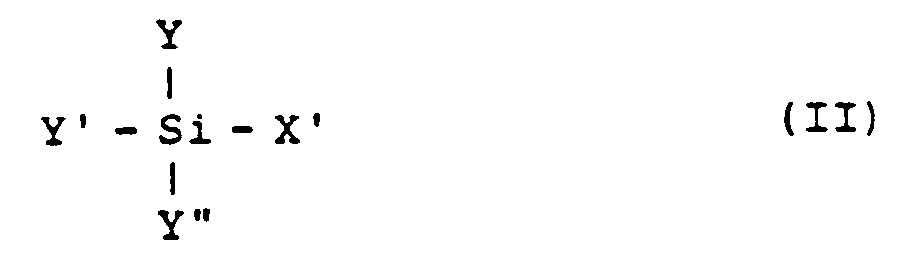
wherein Y, Y' and Y'' represent each a hydrogen atom, an alkyl group having 1 to 20 carbon atoms, an aryl group having 6 to 20 carbon atoms, an aralkyl group having 7 to 20 carbon atoms, a halogen atom, a hydroxy group, an alkoxy group having 1 to 20 carbon atoms or any combination of them, with the proviso that, after the silane treating agent has reacted with the silica gel, Y, Y' and Y'' remaining unreacted with the silica gel coincide with Y¹, Y² and Y³ of the above formula (I) remaining unreacted with the silica gel. - X' represents a spacer-forming group having 1 to 30 carbon atoms, i.e. an alkyl or aryl group having a halogen atom, an amino group or an oxirane group at a terminal or inside thereof and it may contain a hetero atom. Namely, it may have any desired bond such as ether, ester, amino or amide bonds. Therefore, the radical X in the general formula (I)-(1) is a residue obtained after X' of the general formula (II) is reacted with R.
- More specifically, the silane treating agents of the general formula (II) are those having a functional group reactive with the secondary amino group to form a covalent bond. Examples of them include the following compounds:
- 1) compounds of the above formula wherein X' represents -CH₂Cl or -CH₂Br:
chloromethyldimethylchlorosilane
chloromethylethoxysilane,
bromomethyldimethylchlorosilane,
chloromethylmethyldichlorosilane,
chloromethylmethyldiethoxysilane,
chloromethyltrichlorosilane,
chloromethyltriethoxysilane,
chloromethyldimethyl- -nitrophenoxysilane,
chloromethyldirethyl-p-nitrophenoxysilane,
chloromethyldiethyl-2-[(2-ethoxyethoxy)ethoxy]silane,
chloromethyldimethylphenoxysilane,
1,2-bis(dimethylchlorosilyl)ethane, and
allyloxychloromethyldimethylsilane, - 2) compounds of the above formula wherein X' represents -CH₂CH₂CH₂Cl or -CH₂CH₂CH₂Br:
3-chloropropyltrimethoxysilane,
3-chloropropyldimethoxymethylsilane,
3-chloropropylmethyldichlorosilane,
3-chloropropyltrichlorosilane,
3-bromopropyldimethylchlorosilane,
3-bromopropyltrichlorosilane,
3-bromopropyltrimethoxysilane,
3-chloropropyldimethylchlorosilane,
3-chloropropylmethyldimethoxysilane,
3-chloropropyltriethoxysilane,
3-chloropropylphenyldichlorosilane, and
n-propyl(3-chloropropyl)dichlorosilane, - 3) compounds of the above formula wherein X' represents -CH₂CH₂Cl or

2-chloroethylmethyldichlorosilane,
1-chloroethyltrichlorosilane, and
2-chloroethyltrichlorosilane, - 4) compounds of the above formula wherein X' represents

p-chlorophenyltriethoxysilane, - 5) compounds of the above formula wherein X' represents

- 6) compounds of the above formula wherein X' represents

diethoxy-3-glycidoxypropylmethylsilane, and
3-glycidoxypropyldimethylethoxysilane, - 7) compounds of the above formula wherein X' represents a halogenoalkyl:
8-bromooctyltrichlorosilane, and
4-(methyldichlorosilyl)butyl chloride, - 8) compounds of the above formula wherein X' represents an acid chloride:
2-(4-chlorosulfonylphenyl)ethyltrichlorosilane,
2-(4-chlorosulfonylphenyl)ethyltrimethoxysilane, and
3-(trichlorosilyl)propyl chloroformate. - The optically active group R constituting the characteristic part of the packing I-(1) of the present invention is represented by the following general formula (III)-(1):

wherein m and n each represents 0 or an integer of 1 to 3, the total of m and n being up to 3, B² represents a copper carboxylate or thiocarboxylate, Z represents an oxygen atom, a sulfur atom or an amino group, A¹ represents an alkyl group having 1 to 40 carbon atoms, an aryl group having 6 to 40 carbon atoms, an aralkyl group having 7 to 47 carbon atoms or a group having 1 to 40 carbon atoms and a hetero atom, i.e. a group having a bond selected from the group consisting of ether, amino, thioether amide, ester, sulfonate and urethane bonds and * refers to an asymmetric carbon atom. - More specifically, it is obtained by introducing the above-mentioned substituent A¹ into the secondary amino group of starting, optically active D- or L-hydroxyproline or allohydroxyproline to convert said secondary group into a tertiary group. It is necessary in this case that the hydroxy group of the proline skeleton is selectively reacted with the silane treating agent to form a bond.
- Examples of the substituent A¹ include straight-chain and branched hydrocarbon groups such as methyl, ethyl, propyl, isopropyl, butyl, tert-butyl, octyl, decyl, dodecyl, hexadecyl, octadecyl and eicosyl groups; cyclic hydrocarbon groups such as cyclopentyl and cyclohexyl groups; aromatic hydrocarbon groups such as phenyl and benzyl groups and groups containing these aromatic hydrocarbon groups; heterocyclic groups such as pyridyl and imidazolyl groups and groups containing them; hetero atom-containing cyclic or acyclic hydrocarbon groups such as methoxyethyl, methylthioethyl, N-morpholylethyl and N,N-dimethylaminoethyl groups; as well as carboxymethyl, p-toluenesulfonyl, carbobenzyloxy, benzoyl and tert-butoxycarbonyl groups.
- The description will be made on the packing (I)-(2).
(B) The silane treating agent used is the same as that used in (I)-(1). - The optically active group R² constituting the characteristc part of the packing of the present invention is represented by the following general formula:

or
wherein B² represents a copper carboxylate or thiocarboxylate group, Z represents an oxygen atom, a sulfur atom or an amino group, A² represents a hydrogen atom, an alkyl group having 1 to 40 carbon atoms, an aryl group having 6 to 40 carbon atoms, an aralkyl group having 7 to 47 carbon atoms or a group having 1 to 40 carbon atoms and a hetero atom, i.e. a group having a bond selected form the group consisting of ether, amino, ethioether, amide and ester bonds, A³ represents an alkylene group having 2 to 6 carbon atoms and * refers to an asymmetric carbon atom. - Specifically, said compound is obtained by introducing the above-mentioned substituent A² into the secondary amino group of the starting, optically active D- or L-proline to convert said group into a tertiary group.
- More particularly, said compound is obtained by the ring-opening addition reaction of said proline with an α-olefin epoxide or cyclic epoxide.
- Examples of the substituent A² include straight-chain and branched hydrocarbon groups such as methyl, ethyl, propyl, isopropyl, butyl, tert-butyl, octyl. decyl, dodecyl, hexadecyl, octadecyl and eicosyl groups; cyclic hydrocarbon groups such as cyclopentyl and cyclohexyl groups; aromatic hydrocarbon groups such as phenyl and benzyl groups and groups containing these aromatic hydrocarbon groups; heterocyclic groups such as pyridyl and imidazolyl groups and groups containing them; and hetero atom-containing cyclic or acyclic hydrocarbon groups such as methoxyethyl, methylthioethyl, N-morpholylethyl and N,N-dimethylaminoethyl groups.
- The resolving agent of the present invention may be prepared from the above-mentioned starting materials (A),(B) and (c) by treating silica gel with silane and then bonding the silica gel with the optically active group or by previously bonding the silane treating agent with the optically active group and then reacting the resulting product with the silica gel. The reaction for the conversion of the carboxyl group or its ester into the metal thiocarboxylate may be conducted either before or after the bonding with the silica gel. The metal salt may be converted into a corresponding copper salt by exchange reaction with a copper salt of a strong acid.
- As described above, the resolution packing of the present invention comprises the silica gel chemically bonded with the optically active group through the silane treating agent. The resolution packing is suitable for use as a liquid chromatographic packing particularly for the optical resolution of amino acids.
- The following synthesis examples of the resolution packings of the present invention, examples thereof and comparative examples will further illustrate the present invention, which by no means limit the invention.
- Silica gel was dried by heating to 120 to 150°C in dry nitrogen stream for 2 to 10 h. 20 g of the dry silica gel was suspended in 100 mℓ of anhydrous benzene. 6 g of glycidoxypropyltrimethoxysilane was added to the suspension and the mixture was heated under reflux in dry nitrogen stream. The reaction was carried out for 5 to 10 h while methanol thus formed was removed from the reaction system. After completion of the reaction, the mixture was cooled to room temperature and filtered through a glass filter. The resulting modified silica gel was washed with anhydrous benzene and dried at 40°C in vacuum. 4.1 g (0.02 mol) of L-proline benzyl ester was dissolved in 250 mℓ of anhydrous dimethylformamide. 20 g of the silica gel having glycidoxypropylsilyl group was added to the above obtained solution to obtain a suspension, which was then agitated at 90°C for 4 h. The suspension was cooled to room temperature. A solution of 1.2 g (0.021 mol) of sodium hydrosulfide in methanol was added to the suspension and the mixture was agitated at room temperature for 19 h to replace the benzyl ester group with sodium thiocarboxylate. The obtained, modified silica gel was filtered, washed with methanol and poured into a solution of 6 g of copper sulfate in 50 mℓ of pure water to obtain a copper salt. The copper salt was filtered and washed with pure water to obtain a silica gel chemically bonded with the copper salt of L-2-pyrrolidinecarbothioic acid.
- The structural formula of this product was estimated to be as follows:

wherein one or both of R and R' represent a methyl group or both or either of them is the same silica gel as above. - Various racemic amino acids were optically resolved with the packing obtained in Synthesis Example 1. The packing obtained from wholly porous silica gel having an average particle diameter of 10 µm and an average pore diameter of 100 Å in the above Synthesis Example 1 was placed in a stainless steel high-performance liquid chromatographic column (25 cm x 0.46 cm). Racemic amino acids were optically resolved at a flow rate of 2 mℓ/min at 50°C using a 5 x 10⁻⁴M aqueous copper nitrate solution as the solvent to obtain excellent resolution effects as shown in Table 1. The pressure applied to the packing was 30 kg/cm²G.

- The terms k', α and Rs are defined as follows:


- Amino acids were optically resolved under the same conditions as in Example 1 using a column filled with a silica gel having a copper carboxylate of the following formula as the modifying group. The capacity factor of phenylalanine K'L and k'D were 28.8 and 13.9, respectively. The capacity factor of tryptophane k'L and k'D were as high as 74.8 and 23.8, respectively, which were practically undesirable. When the flow rate of the solvent was increased to 5 mℓ/min so as to reduce the time, the pressure applied to the packing was elevated to 90 kg/cm²G and the silica gel was crushed in the continuous operation.
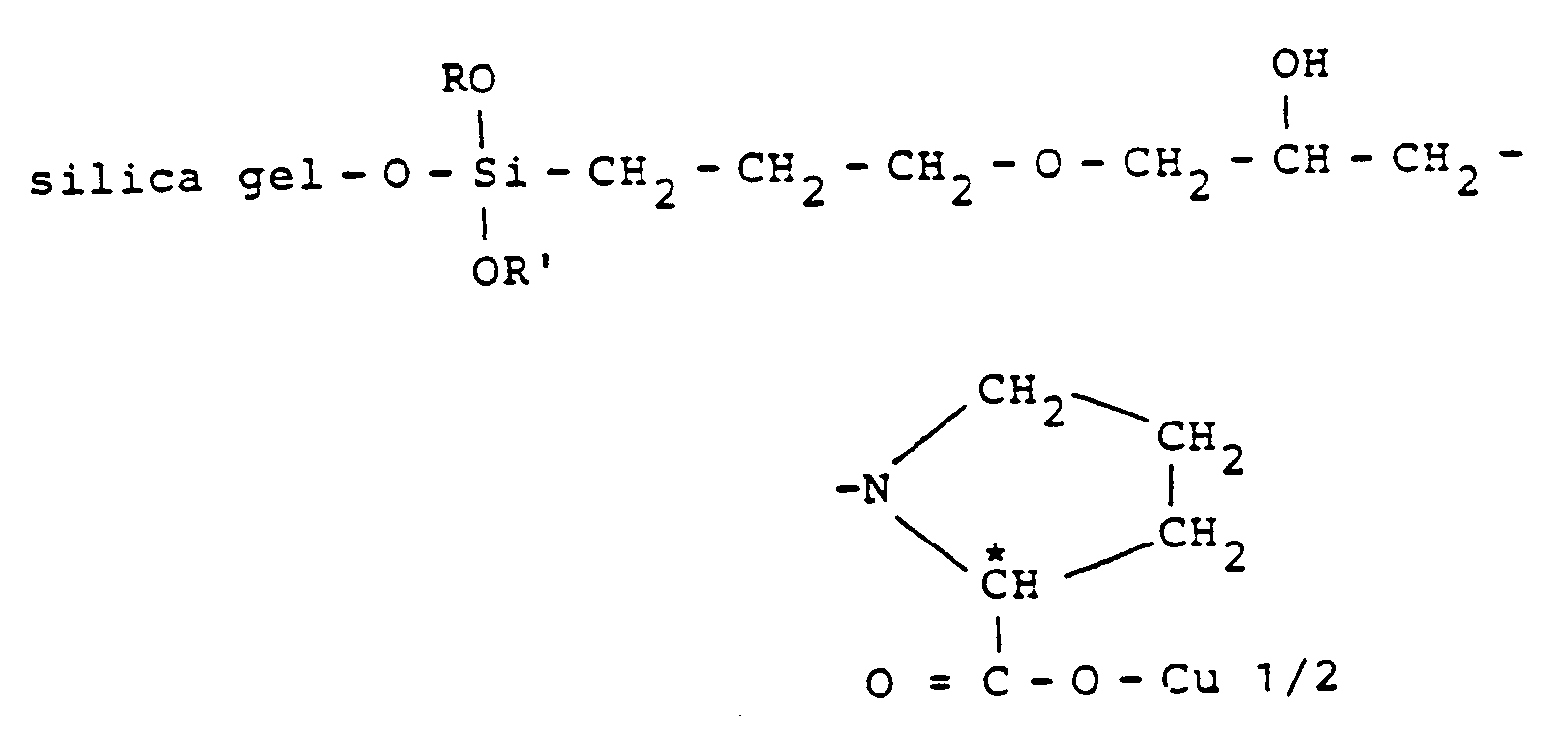
wherein both or either of R and R' represents a methyl group or both or either of them is the same silica gel as above. - A silica gel was dried by heating to 120 to 150°C in dry nitrogen stream for 2 to 10 h. 20 g of the dry silica gel was suspended in 100 mℓ of anhydrous benzene. 8 g of 2-(3,4-epoxycyclohexylethyl)trimethoxysilane was added to the suspension and the mixture was heated under reflux in dry nitrogen stream. The reaction was carried out for 5 to 10 h while methanol thus formed was removed from the reaction system. After completion of the reaction, the mixture was cooled to room temperature and filtered through a glass filter. The resulting modified silica gel was washed with anhydrous benzene and dried at 40°C in vacuum.
- 6.2 g (0.03 mol) of L-proline benzyl ester dried in vacuum was added to 250 mℓ of anhydrous dimethylformamide and the mixture was stirred at 90°C to obtain a solution. 20 g of the modified silica gel obtained as above was added to this solution and the mixture was agitated at 90°C for 4 h. The mixture was then cooled to room temperature. 1.9 g (0.033 mol) of sodium hydrosulfide dissolved in anhydrous methanol was added thereto and the mixture was agitated at room temperature for 19 h to convert the benzyl ester group into sodium thiocarboxylate. The obtained, modified silica gel was filtered through a glass filter. The filter cake was washed with methanol to remove excessive sodium L-prolinethiocarboxylate and then it was added to a solution of 12 g of copper sulfate in 100 mℓ of pure water to obtain the corresponding copper salt.
- The structural formula of the product was estimated to be as follows:

and
wherein both or either of R and R' represents a methyl group or both or either of them is the same silica gel as above. - The packing obtained from wholly porous silica gel having an average particle diameter of 10 µm and an average pore diameter of 100 Å in the above Synthesis Example 2 was placed in a stainless steel high-performance liquid chromatographic column (25 cm x 0.46 cm). Racemic amino acids were optically resolved at a flow rate of 2 mℓ/min at 50°C, using a 2.5 x 10⁻⁴M aqueous copper nitrate solution as the solvent to obtain excellent resolution effects as shown in Table 2. The pressure applied to the packing was 32 kg/cm²G.

- A silica gel was dried by heating to 120 to 150°C in dry nitrogen stream for 2 to 10 h. 20 g of the dry silica gel was suspended in 100 mℓ of anhydrous benzene. 8 g of trimethoxy[2-(7-oxabicyclo[4.1.0]-hept-3-yl)ethyl]silane was added to the suspension and the mixture was heated under reflux in dry nitrogen stream. The reaction was carried out for 5 to 10 h while methanol thus formed was removed from the reaction system. After completion of the reaction, the mixture was cooled to room temperature and filtered through a glass filter. The resulting modified silica gel was washed with anhydrous benzene and dried at 40°C in vacuum. 5.6 g of sodium salt of L-proline was dissovled in 250 mℓ of anhydrous dimethylformamide at 90°C. About 20 g of the above-mentioned silica gel containing 2-(3,4-epoxycyclohexylethyl)silyl group was added to this solution to obtain a suspension, which was agitated at 90°C for 4 h. The suspension was cooled to room temperature and the resulting modified silica gel was filtered, washed with methanol and added to a solution of 12 g of copper sulfate in 100 mℓ of pure water to obtain a copper salt. This salt was filtered again and washed with pure water to obtain silica gel chemically bonded with the copper salt of L-proline.
- The structural formula of the product was estimated to be as follows:

and
wherein both or either of R and R' represents a methyl group or both or either of them is the same silica gel as above. - The packing obtained from wholly porous silica gel having an average particle diameter of 10 µm and an average pore diameter of 100 Å in the above Synthesis Example 3 was placed in a stainless steel high-performance liquid chromatographic column (10 cm x 0.46 cm).
- Racemic amino acids were optically resolved at a flow rate of 2 mℓ/min at 50°C using a 5 x 10⁻⁴M aqueous copper nitrate solution as she solvent to obtain excellent resolution effects as shown in Table 3.

- A silica gel was dried by heating to 120 to 150°C in dry nitrogen stream for 2 to 10 h. 20 g of the dry silica gel was suspended in 100 mℓ of anhydrous benzene. 6 g of glycidoxypropyltrimethoxysilane was added to the suspension and the mixture was heated under reflux in dry nitrogen stream. The reaction was carried out for 5 to 10 h while methanol thus formed was removed from the reaction system. After completion of the reaction, the mixture was cooled to room temperature and filtered through a glass filter. The resulting modified silica gel was washed with anhydrous benzene and dried at 40°C in vacuum. 1.88 g of disodium salt of L-N-octylhydroxyproline was dissolved in 50 mℓ of anhydrous dimethylformamide. 4 g of the above obtained silica gel containing glycidoxypropylsilyl group was suspended in said solution. The suspension was agitated at 90°C for 6 h.
- The modified silica gel was filtered, washed with methanol and added to a solution of 6 g of copper sulfate in 50 mℓ of pure water to obtain a corresponding copper salt. This salt was filtered again and washed with pure water to obtain silica gel chemically bonded with copper L-N-ocyl-2-pyrrolidinecarboxylate.
- The structural formula of the product was estimated to be as follows:

wherein both or either of R and R' represents a methyl group or both or either of them is the same silica gel as above. - Various racemic amino acids were optically resolved with the packing obtained in Synthesis Example 4. The packing obtained from wholly porous silica gel having an average particle diameter of 10 µm and an average pore diameter of 100 Å in the above Synthesis Example 1 was placed in a stainless steel high-performance liquid chromatographic column (25 cm x 0.46 cm). Racemic amino acids were optically resolved at a flow rate of 3 mℓ/min at 50°C using a 5 x 10⁻⁴ M aqueous copper nitrate solution as the solvent to obtain excellent resolution effects shown in Table 4.

- A silica gel was dried by heating to 120 to 150°C in dry nitrogen stream for 3.5 h. 50 g of the dry silica gel was suspended in 300 mℓ of anhydrous benzene. 20 mℓ of glycidoxypropyltrimethoxysilane was added to the suspension and the mixture was heated under reflux in dry nitrogen stream. The reaction was carried out for 16 h while methanol thus formed was removed from the reaction system. After completion of the reaction, the mixture was cooled to room temperature and filtered through a glass filter. The resulting modified silica gel was washed with anhydrous benzene and dried at 40°C in vacuum. 3.0 g of an adduct obtained by reacting sodium salt of L-proline with cyclohexane epoxide was dissolved in 50 mℓ of anhydrous dimethylformamide. 3.5 g of the above obtained silica gel containing glycidoxypropylsilyl group was suspended in said solution. The suspension was agitated at 90°C for 15 h.
- The modified silica gel was filtered, washed with methanol and added to a solution of 2 g of copper sulfate in 50 mℓ of pure water to obtain a corresponding copper salt. This salt was filtered again and washed with pure water to obtain silica gel chemically bonded with copper salt of N-substituted L-proline.
- The structural formula of the product was estimated to be as follows:

wherein both or either of R and R' represents a methyl group or both or either of them is the same silica gel as above. - Various racemic amino acids were optically resolved with the packing obtained in Synthesis Example 5. The packing obtained from wholly porous silica gel having an average particle diameter of 10 µm and an average pore diameter of 60 Å in the above Synthesis Example 1 was placed in a stainless steel high-performance liquid chromatographic column (25 cm x 0.46 cm). Racemic amino acids were optically resolved at a flow rate of 2 mℓ/min at 50°C using a 5 x 10⁻⁴M aqueous copper nitrate solution as the solvent to obtain excellent resolution effects as shown in Table 5.

- Silica gel was heated to 120 to 150°C in dry nitrogen stream for 2 h and then heated in vacuum for 4 h. 50 g of the dried silica gel was suspended in 300 mℓ of anhydrous benzene. 25 mℓ of glycidoxypropyltrimethoxysilane was added to the suspension and the mixture was heated under reflux in dry nitrogen stream. The reaction was carried out for 8 h while methanol thus formed was removed from the reaction system. After completion of the reaction, the mixture was cooled to room temperature and filtered through a glass filter. The resulting modified silica gel was washed with anhydrous benzene and dried at 40°C in vacuum. An adduct obtained by reacting 1.5 g of sodium salt of L-proline with 5.0 g of a straignt-chain α-olefin epoxide having 15 to 18 carbon atoms was dissolved in 10 mℓ of anhydrous dimethylformamide. 6 g of the above obtained silica gel containing glycidoxypropylsilyl group was suspended in said solution. The suspension was agitated at 90°C for 15 h.
- The modified silica gel was filtered, washed with methanol and added to a solution of 1 g of copper sulfate in 50 mℓ of pure water to obtain a corresponding copper salt. This salt was filtered again and washed with pure water to obtain silica gel chemically bonded with copper salt of N-substituted L-proline.
- The structural formula of the product was estimated to be as follows:

wherein both or either of R and R' represents a methyl group or both or either of them is the same silica gel as above and R'' represents a straight-chain alkyl group having 13 to 16 carbon atoms. - Various racemic amino acids were optically resolved with the packing obtained in Synthesis Example 6. The packing obtained from wholly porous silica gel having an average particle diameter of 10 µm and an average pore diameter of 60 Å in the above Synthesis Example 5 was placed in a stainless steel high-performance liquid chromatographic column (25 cm x 0.46 cm). Racemic amino acids were optically resolved at a flow rate of 2 mℓ/min at 50°C using a 5 x 10⁻⁴ M aqueous copper nitrate solution as the solvent to obtain excellent resolution effects similar to those obtained in Example 5.
Claims (3)
- A packing for use in resolution, comprising a substance of the following general formula (I):

(1) -X-R¹
or
(2) -X-R²
wherein X represents a spacer having 1 to 30 carbon atoms, R¹ represents an optically active group of the general formula:


- A method for preparing a packing for use in resolution comprising a substance of the general formula (I):
 a) silica gel is treated with a silane treating agent of the general formula (II):


 (b) previously binding the silane treating agent of formula (II) with the optically active group of formula (III)-(1) or (III)-(2) and then reacting the resulting product with the silica gel.
 - A method for optical resolution of racemic compounds by chromatography using a chromatographic packing, characterised by using a packing as defined in claim 1.
Applications Claiming Priority (6)
| Application Number | Priority Date | Filing Date | Title |
|---|---|---|---|
| JP132361/83 | 1983-07-20 | ||
| JP58132361A JPS6024446A (en) | 1983-07-20 | 1983-07-20 | Packing agent for separation |
| JP150383/83 | 1983-08-19 | ||
| JP58150383A JPS60115855A (en) | 1983-08-19 | 1983-08-19 | Packing material for separation |
| JP154993/83 | 1983-08-26 | ||
| JP58154993A JPS6069551A (en) | 1983-08-26 | 1983-08-26 | Filler material for separation |
Related Parent Applications (2)
| Application Number | Title | Priority Date | Filing Date |
|---|---|---|---|
| EP89100978.9 Division | 1984-07-20 | ||
| EP84902822.0 Division | 1985-02-22 |
Publications (2)
| Publication Number | Publication Date |
|---|---|
| EP0455269A1 EP0455269A1 (en) | 1991-11-06 |
| EP0455269B1 true EP0455269B1 (en) | 1993-11-10 |
Family
ID=27316480
Family Applications (3)
| Application Number | Title | Priority Date | Filing Date |
|---|---|---|---|
| EP89100978A Expired - Lifetime EP0318469B1 (en) | 1983-07-20 | 1984-07-20 | Packing for use in resolution |
| EP91110768A Expired - Lifetime EP0455269B1 (en) | 1983-07-20 | 1984-07-20 | Packing for use in resolution |
| EP84902822A Expired - Lifetime EP0150221B1 (en) | 1983-07-20 | 1984-07-20 | Packing for use in separation |
Family Applications Before (1)
| Application Number | Title | Priority Date | Filing Date |
|---|---|---|---|
| EP89100978A Expired - Lifetime EP0318469B1 (en) | 1983-07-20 | 1984-07-20 | Packing for use in resolution |
Family Applications After (1)
| Application Number | Title | Priority Date | Filing Date |
|---|---|---|---|
| EP84902822A Expired - Lifetime EP0150221B1 (en) | 1983-07-20 | 1984-07-20 | Packing for use in separation |
Country Status (4)
| Country | Link |
|---|---|
| US (1) | US4619984A (en) |
| EP (3) | EP0318469B1 (en) |
| DE (3) | DE3486245T2 (en) |
| WO (1) | WO1985000661A1 (en) |
Families Citing this family (6)
| Publication number | Priority date | Publication date | Assignee | Title |
|---|---|---|---|---|
| DE3674575D1 (en) * | 1985-12-27 | 1990-10-31 | Daicel Chem | USE OF OPTICALLY ACTIVE CARBOALKYLATED AMINO ALCOHOLS FOR THE SEPARATION OF OPTICAL ISOMERS. |
| JPH0750086B2 (en) * | 1989-09-13 | 1995-05-31 | ダイソー株式会社 | Chromatographic packing material and method for separating water-soluble organic compounds using the same |
| JPH11104402A (en) * | 1997-10-03 | 1999-04-20 | Kobe Steel Ltd | Separating of alkylnaphthalene |
| US6352714B1 (en) * | 2000-07-11 | 2002-03-05 | Der, Inc. | Method of producing a metal nutrient for an animal feed |
| US6794044B2 (en) | 2001-03-02 | 2004-09-21 | Selerity Technologies, Inc. | Chromatographic packing materials and methods of making and using such packing materials |
| US20050191503A1 (en) * | 2004-02-27 | 2005-09-01 | Jones Brian A. | Polycarbosilane treatment of substrates |
Family Cites Families (9)
| Publication number | Priority date | Publication date | Assignee | Title |
|---|---|---|---|---|
| US3795313A (en) * | 1970-05-22 | 1974-03-05 | Du Pont | Chromatographic packing with chemically bonded organic stationary phases |
| US4029583A (en) * | 1975-02-28 | 1977-06-14 | Purdue Research Foundation | Chromatographic supports and methods and apparatus for preparing the same |
| JPS561350A (en) * | 1979-06-20 | 1981-01-09 | Shoji Hara | Grafted chromatographic stationary phase or filler and its preparation |
| US4318819A (en) * | 1980-02-25 | 1982-03-09 | Uop Inc. | Chiral supports for resolution of racemates |
| US4322310A (en) * | 1980-06-12 | 1982-03-30 | Uop Inc. | Chiral supports for resolution of racemates |
| US4324681A (en) * | 1980-06-12 | 1982-04-13 | Uop Inc. | Chiral supports for resolution of racemates |
| DE3120214C2 (en) * | 1981-05-21 | 1984-09-27 | Degussa Ag, 6000 Frankfurt | Polymeric tertiary or secondary organosiloxane amines, process for their preparation and use |
| DE3143726C2 (en) | 1981-11-04 | 1987-02-05 | Degussa Ag, 6000 Frankfurt | Optically active proline derivatives, processes for their preparation and their use |
| US4522724A (en) * | 1984-03-02 | 1985-06-11 | J. T. Baker Chemical Company | Diazonium affinity matrixes |
-
1984
- 1984-07-20 DE DE91110768T patent/DE3486245T2/en not_active Expired - Lifetime
- 1984-07-20 EP EP89100978A patent/EP0318469B1/en not_active Expired - Lifetime
- 1984-07-20 US US06/717,267 patent/US4619984A/en not_active Expired - Lifetime
- 1984-07-20 WO PCT/JP1984/000369 patent/WO1985000661A1/en not_active Ceased
- 1984-07-20 DE DE8989100978T patent/DE3485768T2/en not_active Expired - Lifetime
- 1984-07-20 EP EP91110768A patent/EP0455269B1/en not_active Expired - Lifetime
- 1984-07-20 DE DE8484902822T patent/DE3482952D1/en not_active Expired - Lifetime
- 1984-07-20 EP EP84902822A patent/EP0150221B1/en not_active Expired - Lifetime
Also Published As
| Publication number | Publication date |
|---|---|
| EP0318469B1 (en) | 1992-06-10 |
| DE3485768T2 (en) | 1992-12-24 |
| EP0455269A1 (en) | 1991-11-06 |
| DE3486245D1 (en) | 1993-12-16 |
| EP0150221A4 (en) | 1986-11-05 |
| US4619984A (en) | 1986-10-28 |
| EP0318469A1 (en) | 1989-05-31 |
| DE3486245T2 (en) | 1994-03-03 |
| EP0150221B1 (en) | 1990-08-08 |
| DE3482952D1 (en) | 1990-09-13 |
| WO1985000661A1 (en) | 1985-02-14 |
| EP0150221A1 (en) | 1985-08-07 |
| DE3485768D1 (en) | 1992-07-16 |
Similar Documents
| Publication | Publication Date | Title |
|---|---|---|
| JP5667335B2 (en) | Structure obtained by reaction of silica substrate with organosilane compound | |
| JPH06211880A (en) | Liquid chromatography stationary phase undergoing reduced action of silanol | |
| EP1597269B1 (en) | A method of generating metal chelating affinity ligands | |
| KR100975451B1 (en) | Uses thereof on polar silanes and silica supports | |
| US8133390B2 (en) | Reversed endcapping and bonding of chromatographic stationary phases using hydrosilanes | |
| CA1259312A (en) | Silane reagents containing a complexion grouping and inorganic material modified with these reagents | |
| EP0150221B1 (en) | Packing for use in separation | |
| US4627919A (en) | Resolving agent | |
| JPH0429648B2 (en) | ||
| JPH0430928B2 (en) | ||
| JPH0475218B2 (en) | ||
| JPH038511B2 (en) | ||
| JPH0429651B2 (en) | ||
| CS252383B1 (en) | A method of preparing high density sorbents of a chemically bound alkyl phase |
Legal Events
| Date | Code | Title | Description |
|---|---|---|---|
| PUAI | Public reference made under article 153(3) epc to a published international application that has entered the european phase |
Free format text: ORIGINAL CODE: 0009012 |
|
| 17P | Request for examination filed |
Effective date: 19910802 |
|
| AC | Divisional application: reference to earlier application |
Ref document number: 318469 Country of ref document: EP |
|
| AK | Designated contracting states |
Kind code of ref document: A1 Designated state(s): BE CH DE FR GB LI NL |
|
| RIN1 | Information on inventor provided before grant (corrected) |
Inventor name: ICHIDA, AKITO Inventor name: YUKI, YOICHI |
|
| 17Q | First examination report despatched |
Effective date: 19930316 |
|
| GRAA | (expected) grant |
Free format text: ORIGINAL CODE: 0009210 |
|
| AC | Divisional application: reference to earlier application |
Ref document number: 318469 Country of ref document: EP |
|
| AK | Designated contracting states |
Kind code of ref document: B1 Designated state(s): BE CH DE FR GB LI NL |
|
| REF | Corresponds to: |
Ref document number: 3486245 Country of ref document: DE Date of ref document: 19931216 |
|
| ET | Fr: translation filed | ||
| PLBE | No opposition filed within time limit |
Free format text: ORIGINAL CODE: 0009261 |
|
| STAA | Information on the status of an ep patent application or granted ep patent |
Free format text: STATUS: NO OPPOSITION FILED WITHIN TIME LIMIT |
|
| 26N | No opposition filed | ||
| REG | Reference to a national code |
Ref country code: GB Ref legal event code: IF02 |
|
| PGFP | Annual fee paid to national office [announced via postgrant information from national office to epo] |
Ref country code: FR Payment date: 20030711 Year of fee payment: 20 |
|
| PGFP | Annual fee paid to national office [announced via postgrant information from national office to epo] |
Ref country code: GB Payment date: 20030716 Year of fee payment: 20 |
|
| PGFP | Annual fee paid to national office [announced via postgrant information from national office to epo] |
Ref country code: NL Payment date: 20030730 Year of fee payment: 20 Ref country code: CH Payment date: 20030730 Year of fee payment: 20 |
|
| PGFP | Annual fee paid to national office [announced via postgrant information from national office to epo] |
Ref country code: DE Payment date: 20030731 Year of fee payment: 20 |
|
| PGFP | Annual fee paid to national office [announced via postgrant information from national office to epo] |
Ref country code: BE Payment date: 20030923 Year of fee payment: 20 |
|
| PG25 | Lapsed in a contracting state [announced via postgrant information from national office to epo] |
Ref country code: LI Free format text: LAPSE BECAUSE OF EXPIRATION OF PROTECTION Effective date: 20040719 Ref country code: GB Free format text: LAPSE BECAUSE OF EXPIRATION OF PROTECTION Effective date: 20040719 Ref country code: CH Free format text: LAPSE BECAUSE OF EXPIRATION OF PROTECTION Effective date: 20040719 |
|
| PG25 | Lapsed in a contracting state [announced via postgrant information from national office to epo] |
Ref country code: NL Free format text: LAPSE BECAUSE OF EXPIRATION OF PROTECTION Effective date: 20040720 |
|
| BE20 | Be: patent expired |
Owner name: *DAICEL CHEMICAL INDUSTRIES LTD Effective date: 20040720 |
|
| REG | Reference to a national code |
Ref country code: GB Ref legal event code: PE20 |
|
| REG | Reference to a national code |
Ref country code: CH Ref legal event code: PL |
|
| NLV7 | Nl: ceased due to reaching the maximum lifetime of a patent |
Effective date: 20040720 |