EP0455006A2 - Substituted 5-(2-((2-aryl-2-hydroxyethyl)amino)propyl)-1,3-benzodioxoles - Google Patents
Substituted 5-(2-((2-aryl-2-hydroxyethyl)amino)propyl)-1,3-benzodioxoles Download PDFInfo
- Publication number
- EP0455006A2 EP0455006A2 EP91105510A EP91105510A EP0455006A2 EP 0455006 A2 EP0455006 A2 EP 0455006A2 EP 91105510 A EP91105510 A EP 91105510A EP 91105510 A EP91105510 A EP 91105510A EP 0455006 A2 EP0455006 A2 EP 0455006A2
- Authority
- EP
- European Patent Office
- Prior art keywords
- compound
- hydrogen
- group
- alkyl
- propyl
- Prior art date
- Legal status (The legal status is an assumption and is not a legal conclusion. Google has not performed a legal analysis and makes no representation as to the accuracy of the status listed.)
- Granted
Links
- 125000002924 primary amino group Chemical group [H]N([H])* 0.000 title description 4
- 241001465754 Metazoa Species 0.000 claims abstract description 26
- 230000003579 anti-obesity Effects 0.000 claims abstract description 12
- 150000001875 compounds Chemical class 0.000 claims description 133
- 239000000203 mixture Substances 0.000 claims description 57
- 239000001257 hydrogen Substances 0.000 claims description 53
- 229910052739 hydrogen Inorganic materials 0.000 claims description 53
- LFQSCWFLJHTTHZ-UHFFFAOYSA-N Ethanol Chemical compound CCO LFQSCWFLJHTTHZ-UHFFFAOYSA-N 0.000 claims description 43
- 125000000217 alkyl group Chemical group 0.000 claims description 32
- 238000000034 method Methods 0.000 claims description 29
- 125000004435 hydrogen atom Chemical group [H]* 0.000 claims description 27
- -1 carboxy, hydroxymethyl Chemical group 0.000 claims description 24
- 125000004432 carbon atom Chemical group C* 0.000 claims description 19
- OJURWUUOVGOHJZ-UHFFFAOYSA-N methyl 2-[(2-acetyloxyphenyl)methyl-[2-[(2-acetyloxyphenyl)methyl-(2-methoxy-2-oxoethyl)amino]ethyl]amino]acetate Chemical compound C=1C=CC=C(OC(C)=O)C=1CN(CC(=O)OC)CCN(CC(=O)OC)CC1=CC=CC=C1OC(C)=O OJURWUUOVGOHJZ-UHFFFAOYSA-N 0.000 claims description 19
- 150000002431 hydrogen Chemical class 0.000 claims description 18
- 201000001421 hyperglycemia Diseases 0.000 claims description 18
- UFHFLCQGNIYNRP-UHFFFAOYSA-N Hydrogen Chemical compound [H][H] UFHFLCQGNIYNRP-UHFFFAOYSA-N 0.000 claims description 17
- 150000003839 salts Chemical class 0.000 claims description 16
- 239000003153 chemical reaction reagent Substances 0.000 claims description 15
- 230000008569 process Effects 0.000 claims description 15
- 150000002148 esters Chemical class 0.000 claims description 14
- QXNVGIXVLWOKEQ-UHFFFAOYSA-N Disodium Chemical class [Na][Na] QXNVGIXVLWOKEQ-UHFFFAOYSA-N 0.000 claims description 13
- 206010012601 diabetes mellitus Diseases 0.000 claims description 13
- 241000124008 Mammalia Species 0.000 claims description 12
- 208000008589 Obesity Diseases 0.000 claims description 12
- 125000003545 alkoxy group Chemical group 0.000 claims description 12
- 125000004453 alkoxycarbonyl group Chemical group 0.000 claims description 12
- 125000003178 carboxy group Chemical group [H]OC(*)=O 0.000 claims description 12
- 235000020824 obesity Nutrition 0.000 claims description 12
- HBAQYPYDRFILMT-UHFFFAOYSA-N 8-[3-(1-cyclopropylpyrazol-4-yl)-1H-pyrazolo[4,3-d]pyrimidin-5-yl]-3-methyl-3,8-diazabicyclo[3.2.1]octan-2-one Chemical class C1(CC1)N1N=CC(=C1)C1=NNC2=C1N=C(N=C2)N1C2C(N(CC1CC2)C)=O HBAQYPYDRFILMT-UHFFFAOYSA-N 0.000 claims description 9
- 235000020997 lean meat Nutrition 0.000 claims description 9
- 125000002915 carbonyl group Chemical group [*:2]C([*:1])=O 0.000 claims description 8
- 229910052736 halogen Inorganic materials 0.000 claims description 8
- 150000002367 halogens Chemical class 0.000 claims description 8
- 125000002023 trifluoromethyl group Chemical group FC(F)(F)* 0.000 claims description 8
- 241000282412 Homo Species 0.000 claims description 6
- 125000002768 hydroxyalkyl group Chemical group 0.000 claims description 5
- 125000004029 hydroxymethyl group Chemical group [H]OC([H])([H])* 0.000 claims description 5
- 239000008194 pharmaceutical composition Substances 0.000 claims description 5
- 150000003254 radicals Chemical class 0.000 claims description 5
- 125000000475 sulfinyl group Chemical group [*:2]S([*:1])=O 0.000 claims description 5
- 125000000472 sulfonyl group Chemical group *S(*)(=O)=O 0.000 claims description 5
- 125000004001 thioalkyl group Chemical group 0.000 claims description 5
- 125000002813 thiocarbonyl group Chemical group *C(*)=S 0.000 claims description 5
- ZDQWESQEGGJUCH-UHFFFAOYSA-N Diisopropyl adipate Chemical compound CC(C)OC(=O)CCCCC(=O)OC(C)C ZDQWESQEGGJUCH-UHFFFAOYSA-N 0.000 claims description 4
- 239000002253 acid Substances 0.000 claims description 4
- 125000002252 acyl group Chemical group 0.000 claims description 4
- 239000003638 chemical reducing agent Substances 0.000 claims description 4
- CBOIHMRHGLHBPB-UHFFFAOYSA-N hydroxymethyl Chemical group O[CH2] CBOIHMRHGLHBPB-UHFFFAOYSA-N 0.000 claims description 3
- 239000003937 drug carrier Substances 0.000 claims description 2
- JEDJMKTVUPSHFW-ABAIWWIYSA-N 5-[(2r)-2-[[(2r)-2-(3-chlorophenyl)-2-hydroxyethyl]amino]propyl]-1,3-benzodioxole-2,2-dicarboxylic acid Chemical compound C1([C@@H](O)CN[C@@H](CC=2C=C3OC(OC3=CC=2)(C(O)=O)C(O)=O)C)=CC=CC(Cl)=C1 JEDJMKTVUPSHFW-ABAIWWIYSA-N 0.000 claims 4
- 125000004356 hydroxy functional group Chemical group O* 0.000 claims 3
- 125000004178 (C1-C4) alkyl group Chemical group 0.000 claims 1
- 125000000325 methylidene group Chemical group [H]C([H])=* 0.000 claims 1
- 239000003472 antidiabetic agent Substances 0.000 abstract description 5
- 230000003178 anti-diabetic effect Effects 0.000 abstract description 4
- 230000002058 anti-hyperglycaemic effect Effects 0.000 abstract description 3
- 150000005529 1,3-benzodioxoles Chemical class 0.000 abstract description 2
- OKKJLVBELUTLKV-UHFFFAOYSA-N Methanol Chemical compound OC OKKJLVBELUTLKV-UHFFFAOYSA-N 0.000 description 54
- XEKOWRVHYACXOJ-UHFFFAOYSA-N Ethyl acetate Chemical compound CCOC(C)=O XEKOWRVHYACXOJ-UHFFFAOYSA-N 0.000 description 48
- HEMHJVSKTPXQMS-UHFFFAOYSA-M Sodium hydroxide Chemical compound [OH-].[Na+] HEMHJVSKTPXQMS-UHFFFAOYSA-M 0.000 description 42
- YMWUJEATGCHHMB-UHFFFAOYSA-N Dichloromethane Chemical compound ClCCl YMWUJEATGCHHMB-UHFFFAOYSA-N 0.000 description 36
- 239000003921 oil Substances 0.000 description 35
- 235000019198 oils Nutrition 0.000 description 35
- WYURNTSHIVDZCO-UHFFFAOYSA-N Tetrahydrofuran Chemical compound C1CCOC1 WYURNTSHIVDZCO-UHFFFAOYSA-N 0.000 description 34
- CSCPPACGZOOCGX-UHFFFAOYSA-N Acetone Chemical compound CC(C)=O CSCPPACGZOOCGX-UHFFFAOYSA-N 0.000 description 30
- XLYOFNOQVPJJNP-UHFFFAOYSA-N water Substances O XLYOFNOQVPJJNP-UHFFFAOYSA-N 0.000 description 29
- 239000000243 solution Substances 0.000 description 24
- 239000000047 product Substances 0.000 description 23
- VEXZGXHMUGYJMC-UHFFFAOYSA-N Hydrochloric acid Chemical compound Cl VEXZGXHMUGYJMC-UHFFFAOYSA-N 0.000 description 21
- ZMANZCXQSJIPKH-UHFFFAOYSA-N Triethylamine Chemical compound CCN(CC)CC ZMANZCXQSJIPKH-UHFFFAOYSA-N 0.000 description 21
- 125000002496 methyl group Chemical group [H]C([H])([H])* 0.000 description 21
- 239000007787 solid Substances 0.000 description 19
- PEDCQBHIVMGVHV-UHFFFAOYSA-N Glycerine Chemical compound OCC(O)CO PEDCQBHIVMGVHV-UHFFFAOYSA-N 0.000 description 18
- RTZKZFJDLAIYFH-UHFFFAOYSA-N Diethyl ether Chemical compound CCOCC RTZKZFJDLAIYFH-UHFFFAOYSA-N 0.000 description 17
- 230000000694 effects Effects 0.000 description 17
- YLQBMQCUIZJEEH-UHFFFAOYSA-N tetrahydrofuran Natural products C=1C=COC=1 YLQBMQCUIZJEEH-UHFFFAOYSA-N 0.000 description 17
- NOESYZHRGYRDHS-UHFFFAOYSA-N insulin Chemical compound N1C(=O)C(NC(=O)C(CCC(N)=O)NC(=O)C(CCC(O)=O)NC(=O)C(C(C)C)NC(=O)C(NC(=O)CN)C(C)CC)CSSCC(C(NC(CO)C(=O)NC(CC(C)C)C(=O)NC(CC=2C=CC(O)=CC=2)C(=O)NC(CCC(N)=O)C(=O)NC(CC(C)C)C(=O)NC(CCC(O)=O)C(=O)NC(CC(N)=O)C(=O)NC(CC=2C=CC(O)=CC=2)C(=O)NC(CSSCC(NC(=O)C(C(C)C)NC(=O)C(CC(C)C)NC(=O)C(CC=2C=CC(O)=CC=2)NC(=O)C(CC(C)C)NC(=O)C(C)NC(=O)C(CCC(O)=O)NC(=O)C(C(C)C)NC(=O)C(CC(C)C)NC(=O)C(CC=2NC=NC=2)NC(=O)C(CO)NC(=O)CNC2=O)C(=O)NCC(=O)NC(CCC(O)=O)C(=O)NC(CCCNC(N)=N)C(=O)NCC(=O)NC(CC=3C=CC=CC=3)C(=O)NC(CC=3C=CC=CC=3)C(=O)NC(CC=3C=CC(O)=CC=3)C(=O)NC(C(C)O)C(=O)N3C(CCC3)C(=O)NC(CCCCN)C(=O)NC(C)C(O)=O)C(=O)NC(CC(N)=O)C(O)=O)=O)NC(=O)C(C(C)CC)NC(=O)C(CO)NC(=O)C(C(C)O)NC(=O)C1CSSCC2NC(=O)C(CC(C)C)NC(=O)C(NC(=O)C(CCC(N)=O)NC(=O)C(CC(N)=O)NC(=O)C(NC(=O)C(N)CC=1C=CC=CC=1)C(C)C)CC1=CN=CN1 NOESYZHRGYRDHS-UHFFFAOYSA-N 0.000 description 16
- VLKZOEOYAKHREP-UHFFFAOYSA-N n-Hexane Chemical compound CCCCCC VLKZOEOYAKHREP-UHFFFAOYSA-N 0.000 description 15
- 241000699670 Mus sp. Species 0.000 description 14
- 125000002887 hydroxy group Chemical group [H]O* 0.000 description 14
- 238000012360 testing method Methods 0.000 description 13
- QTBSBXVTEAMEQO-UHFFFAOYSA-N Acetic acid Chemical compound CC(O)=O QTBSBXVTEAMEQO-UHFFFAOYSA-N 0.000 description 12
- XKRFYHLGVUSROY-UHFFFAOYSA-N Argon Chemical compound [Ar] XKRFYHLGVUSROY-UHFFFAOYSA-N 0.000 description 12
- 239000012267 brine Substances 0.000 description 12
- BWHMMNNQKKPAPP-UHFFFAOYSA-L potassium carbonate Chemical compound [K+].[K+].[O-]C([O-])=O BWHMMNNQKKPAPP-UHFFFAOYSA-L 0.000 description 12
- HPALAKNZSZLMCH-UHFFFAOYSA-M sodium;chloride;hydrate Chemical compound O.[Na+].[Cl-] HPALAKNZSZLMCH-UHFFFAOYSA-M 0.000 description 12
- 238000011282 treatment Methods 0.000 description 12
- CPELXLSAUQHCOX-UHFFFAOYSA-N Hydrogen bromide Chemical compound Br CPELXLSAUQHCOX-UHFFFAOYSA-N 0.000 description 11
- 239000008103 glucose Substances 0.000 description 11
- PELSWIPEICPCTN-UHFFFAOYSA-N 1,3-benzodioxole-2,2-dicarboxylic acid Chemical compound C1=CC=C2OC(C(=O)O)(C(O)=O)OC2=C1 PELSWIPEICPCTN-UHFFFAOYSA-N 0.000 description 10
- 229910052801 chlorine Chemical group 0.000 description 10
- KZBUYRJDOAKODT-UHFFFAOYSA-N Chlorine Chemical group ClCl KZBUYRJDOAKODT-UHFFFAOYSA-N 0.000 description 9
- WQZGKKKJIJFFOK-GASJEMHNSA-N Glucose Natural products OC[C@H]1OC(O)[C@H](O)[C@@H](O)[C@@H]1O WQZGKKKJIJFFOK-GASJEMHNSA-N 0.000 description 9
- WQZGKKKJIJFFOK-VFUOTHLCSA-N beta-D-glucose Chemical compound OC[C@H]1O[C@@H](O)[C@H](O)[C@@H](O)[C@@H]1O WQZGKKKJIJFFOK-VFUOTHLCSA-N 0.000 description 9
- 229910052731 fluorine Inorganic materials 0.000 description 9
- 102000004877 Insulin Human genes 0.000 description 8
- 108090001061 Insulin Proteins 0.000 description 8
- VYPSYNLAJGMNEJ-UHFFFAOYSA-N Silicium dioxide Chemical compound O=[Si]=O VYPSYNLAJGMNEJ-UHFFFAOYSA-N 0.000 description 8
- 239000004480 active ingredient Substances 0.000 description 8
- ILAHWRKJUDSMFH-UHFFFAOYSA-N boron tribromide Chemical compound BrB(Br)Br ILAHWRKJUDSMFH-UHFFFAOYSA-N 0.000 description 8
- 238000006243 chemical reaction Methods 0.000 description 8
- 229940125396 insulin Drugs 0.000 description 8
- 210000001519 tissue Anatomy 0.000 description 8
- 229920002527 Glycogen Polymers 0.000 description 7
- 241000700159 Rattus Species 0.000 description 7
- 210000000577 adipose tissue Anatomy 0.000 description 7
- 125000002947 alkylene group Chemical group 0.000 description 7
- 210000004369 blood Anatomy 0.000 description 7
- 239000008280 blood Substances 0.000 description 7
- 230000037396 body weight Effects 0.000 description 7
- 239000000284 extract Substances 0.000 description 7
- 238000003818 flash chromatography Methods 0.000 description 7
- 229940096919 glycogen Drugs 0.000 description 7
- IXCSERBJSXMMFS-UHFFFAOYSA-N hydrogen chloride Substances Cl.Cl IXCSERBJSXMMFS-UHFFFAOYSA-N 0.000 description 7
- 229910000041 hydrogen chloride Inorganic materials 0.000 description 7
- HEDRZPFGACZZDS-UHFFFAOYSA-N Chloroform Chemical compound ClC(Cl)Cl HEDRZPFGACZZDS-UHFFFAOYSA-N 0.000 description 6
- 239000012448 Lithium borohydride Substances 0.000 description 6
- ZMXDDKWLCZADIW-UHFFFAOYSA-N N,N-Dimethylformamide Chemical compound CN(C)C=O ZMXDDKWLCZADIW-UHFFFAOYSA-N 0.000 description 6
- UIIMBOGNXHQVGW-UHFFFAOYSA-M Sodium bicarbonate Chemical compound [Na+].OC([O-])=O UIIMBOGNXHQVGW-UHFFFAOYSA-M 0.000 description 6
- FAPWRFPIFSIZLT-UHFFFAOYSA-M Sodium chloride Chemical compound [Na+].[Cl-] FAPWRFPIFSIZLT-UHFFFAOYSA-M 0.000 description 6
- YXFVVABEGXRONW-UHFFFAOYSA-N Toluene Chemical compound CC1=CC=CC=C1 YXFVVABEGXRONW-UHFFFAOYSA-N 0.000 description 6
- DTQVDTLACAAQTR-UHFFFAOYSA-N Trifluoroacetic acid Chemical compound OC(=O)C(F)(F)F DTQVDTLACAAQTR-UHFFFAOYSA-N 0.000 description 6
- 238000007792 addition Methods 0.000 description 6
- 229910052786 argon Inorganic materials 0.000 description 6
- 239000000460 chlorine Chemical group 0.000 description 6
- 239000000706 filtrate Substances 0.000 description 6
- 239000011737 fluorine Chemical group 0.000 description 6
- 229910000027 potassium carbonate Inorganic materials 0.000 description 6
- 239000000843 powder Substances 0.000 description 6
- 101150056956 BRL2 gene Proteins 0.000 description 5
- WVDDGKGOMKODPV-UHFFFAOYSA-N Benzyl alcohol Chemical class OCC1=CC=CC=C1 WVDDGKGOMKODPV-UHFFFAOYSA-N 0.000 description 5
- WKBOTKDWSSQWDR-UHFFFAOYSA-N Bromine atom Chemical group [Br] WKBOTKDWSSQWDR-UHFFFAOYSA-N 0.000 description 5
- KDLHZDBZIXYQEI-UHFFFAOYSA-N Palladium Chemical compound [Pd] KDLHZDBZIXYQEI-UHFFFAOYSA-N 0.000 description 5
- 150000001408 amides Chemical group 0.000 description 5
- 239000003795 chemical substances by application Substances 0.000 description 5
- 239000002024 ethyl acetate extract Substances 0.000 description 5
- 230000002218 hypoglycaemic effect Effects 0.000 description 5
- 239000007788 liquid Substances 0.000 description 5
- GRVDJDISBSALJP-UHFFFAOYSA-N methyloxidanyl Chemical group [O]C GRVDJDISBSALJP-UHFFFAOYSA-N 0.000 description 5
- 244000144977 poultry Species 0.000 description 5
- 238000002360 preparation method Methods 0.000 description 5
- 238000010992 reflux Methods 0.000 description 5
- 239000006188 syrup Substances 0.000 description 5
- 235000020357 syrup Nutrition 0.000 description 5
- UMYZWICEDUEWIM-UHFFFAOYSA-N 1-(3,4-dimethoxyphenyl)propan-2-one Chemical compound COC1=CC=C(CC(C)=O)C=C1OC UMYZWICEDUEWIM-UHFFFAOYSA-N 0.000 description 4
- IAZDPXIOMUYVGZ-UHFFFAOYSA-N Dimethylsulphoxide Chemical compound CS(C)=O IAZDPXIOMUYVGZ-UHFFFAOYSA-N 0.000 description 4
- CSNNHWWHGAXBCP-UHFFFAOYSA-L Magnesium sulfate Chemical compound [Mg+2].[O-][S+2]([O-])([O-])[O-] CSNNHWWHGAXBCP-UHFFFAOYSA-L 0.000 description 4
- 241000282898 Sus scrofa Species 0.000 description 4
- 239000002585 base Substances 0.000 description 4
- 239000000872 buffer Substances 0.000 description 4
- PFKFTWBEEFSNDU-UHFFFAOYSA-N carbonyldiimidazole Chemical compound C1=CN=CN1C(=O)N1C=CN=C1 PFKFTWBEEFSNDU-UHFFFAOYSA-N 0.000 description 4
- 125000002843 carboxylic acid group Chemical group 0.000 description 4
- 125000001309 chloro group Chemical group Cl* 0.000 description 4
- 239000012230 colorless oil Substances 0.000 description 4
- 230000008021 deposition Effects 0.000 description 4
- 235000005911 diet Nutrition 0.000 description 4
- PFZYFZRUPFUEOB-UHFFFAOYSA-N diethyl 2,2-dibromopropanedioate Chemical compound CCOC(=O)C(Br)(Br)C(=O)OCC PFZYFZRUPFUEOB-UHFFFAOYSA-N 0.000 description 4
- 125000001495 ethyl group Chemical group [H]C([H])([H])C([H])([H])* 0.000 description 4
- 239000007789 gas Substances 0.000 description 4
- 230000004130 lipolysis Effects 0.000 description 4
- 235000012054 meals Nutrition 0.000 description 4
- 210000003205 muscle Anatomy 0.000 description 4
- 125000004430 oxygen atom Chemical group O* 0.000 description 4
- 239000008188 pellet Substances 0.000 description 4
- 125000001436 propyl group Chemical group [H]C([*])([H])C([H])([H])C([H])([H])[H] 0.000 description 4
- 230000004044 response Effects 0.000 description 4
- 239000003826 tablet Substances 0.000 description 4
- 239000003981 vehicle Substances 0.000 description 4
- JWZZKOKVBUJMES-UHFFFAOYSA-N (+-)-Isoprenaline Chemical compound CC(C)NCC(O)C1=CC=C(O)C(O)=C1 JWZZKOKVBUJMES-UHFFFAOYSA-N 0.000 description 3
- SWKGZJAAGSVROJ-MWLCHTKSSA-N (3r)-4-[(3r)-3-amino-4-(2,4,5-trifluorophenyl)butanoyl]-3-methyl-1,4-diazepan-2-one Chemical compound C1CCNC(=O)[C@@H](C)N1C(=O)C[C@H](N)CC1=CC(F)=C(F)C=C1F SWKGZJAAGSVROJ-MWLCHTKSSA-N 0.000 description 3
- RXPMTFOPTJYGEB-DIFFPNOSSA-N (5r)-5-(3-chlorophenyl)-3-[(2r)-1-(3,4-dihydroxyphenyl)propan-2-yl]-1,3-oxazolidin-2-one Chemical compound C([C@@H](C)N1C(O[C@@H](C1)C=1C=C(Cl)C=CC=1)=O)C1=CC=C(O)C(O)=C1 RXPMTFOPTJYGEB-DIFFPNOSSA-N 0.000 description 3
- OFQFWPQFYLFCTO-UHFFFAOYSA-N 1-(3-chlorophenyl)-2-[1-(3,4-dimethoxyphenyl)propan-2-ylamino]ethanol Chemical compound C1=C(OC)C(OC)=CC=C1CC(C)NCC(O)C1=CC=CC(Cl)=C1 OFQFWPQFYLFCTO-UHFFFAOYSA-N 0.000 description 3
- IZXIZTKNFFYFOF-UHFFFAOYSA-N 2-Oxazolidone Chemical compound O=C1NCCO1 IZXIZTKNFFYFOF-UHFFFAOYSA-N 0.000 description 3
- STJIXOUDTUPEEL-UHFFFAOYSA-N 2-amino-1-(3-chlorophenyl)ethanol Chemical compound NCC(O)C1=CC=CC(Cl)=C1 STJIXOUDTUPEEL-UHFFFAOYSA-N 0.000 description 3
- 101150112120 BRL1 gene Proteins 0.000 description 3
- 241000283690 Bos taurus Species 0.000 description 3
- 241000283707 Capra Species 0.000 description 3
- ZAMOUSCENKQFHK-UHFFFAOYSA-N Chlorine atom Chemical group [Cl] ZAMOUSCENKQFHK-UHFFFAOYSA-N 0.000 description 3
- PXGOKWXKJXAPGV-UHFFFAOYSA-N Fluorine Chemical group FF PXGOKWXKJXAPGV-UHFFFAOYSA-N 0.000 description 3
- YCKRFDGAMUMZLT-UHFFFAOYSA-N Fluorine atom Chemical group [F] YCKRFDGAMUMZLT-UHFFFAOYSA-N 0.000 description 3
- KFZMGEQAYNKOFK-UHFFFAOYSA-N Isopropanol Chemical group CC(C)O KFZMGEQAYNKOFK-UHFFFAOYSA-N 0.000 description 3
- 241000699666 Mus <mouse, genus> Species 0.000 description 3
- 241001494479 Pecora Species 0.000 description 3
- DNIAPMSPPWPWGF-UHFFFAOYSA-N Propylene glycol Chemical compound CC(O)CO DNIAPMSPPWPWGF-UHFFFAOYSA-N 0.000 description 3
- 101100004664 Schizosaccharomyces pombe (strain 972 / ATCC 24843) brr6 gene Proteins 0.000 description 3
- 230000004913 activation Effects 0.000 description 3
- 238000003556 assay Methods 0.000 description 3
- 229960004217 benzyl alcohol Drugs 0.000 description 3
- 230000015572 biosynthetic process Effects 0.000 description 3
- GDTBXPJZTBHREO-UHFFFAOYSA-N bromine Chemical group BrBr GDTBXPJZTBHREO-UHFFFAOYSA-N 0.000 description 3
- 229910052794 bromium Inorganic materials 0.000 description 3
- 239000002775 capsule Substances 0.000 description 3
- 238000005119 centrifugation Methods 0.000 description 3
- KRKNYBCHXYNGOX-UHFFFAOYSA-N citric acid Chemical compound OC(=O)CC(O)(C(O)=O)CC(O)=O KRKNYBCHXYNGOX-UHFFFAOYSA-N 0.000 description 3
- 230000037213 diet Effects 0.000 description 3
- 239000006185 dispersion Substances 0.000 description 3
- 125000001153 fluoro group Chemical group F* 0.000 description 3
- 235000013305 food Nutrition 0.000 description 3
- 210000002837 heart atrium Anatomy 0.000 description 3
- 229940039009 isoproterenol Drugs 0.000 description 3
- HQKMJHAJHXVSDF-UHFFFAOYSA-L magnesium stearate Chemical compound [Mg+2].CCCCCCCCCCCCCCCCCC([O-])=O.CCCCCCCCCCCCCCCCCC([O-])=O HQKMJHAJHXVSDF-UHFFFAOYSA-L 0.000 description 3
- 238000007911 parenteral administration Methods 0.000 description 3
- 229920001223 polyethylene glycol Polymers 0.000 description 3
- 230000036515 potency Effects 0.000 description 3
- 230000009467 reduction Effects 0.000 description 3
- 230000002441 reversible effect Effects 0.000 description 3
- 235000017557 sodium bicarbonate Nutrition 0.000 description 3
- 229910000030 sodium bicarbonate Inorganic materials 0.000 description 3
- 239000011780 sodium chloride Substances 0.000 description 3
- 239000002904 solvent Substances 0.000 description 3
- 238000003786 synthesis reaction Methods 0.000 description 3
- 208000001072 type 2 diabetes mellitus Diseases 0.000 description 3
- 125000004191 (C1-C6) alkoxy group Chemical group 0.000 description 2
- ZFFMLCVRJBZUDZ-UHFFFAOYSA-N 2,3-dimethylbutane Chemical group CC(C)C(C)C ZFFMLCVRJBZUDZ-UHFFFAOYSA-N 0.000 description 2
- YVMKRPGFBQGEBF-UHFFFAOYSA-N 2-(3-chlorophenyl)oxirane Chemical compound ClC1=CC=CC(C2OC2)=C1 YVMKRPGFBQGEBF-UHFFFAOYSA-N 0.000 description 2
- NLXLAEXVIDQMFP-UHFFFAOYSA-N Ammonia chloride Chemical compound [NH4+].[Cl-] NLXLAEXVIDQMFP-UHFFFAOYSA-N 0.000 description 2
- 108091003079 Bovine Serum Albumin Proteins 0.000 description 2
- 0 CCCC1*(***(*)=C)(C2)CC2C1 Chemical compound CCCC1*(***(*)=C)(C2)CC2C1 0.000 description 2
- 229920002261 Corn starch Polymers 0.000 description 2
- 102000057621 Glycerol kinases Human genes 0.000 description 2
- DHMQDGOQFOQNFH-UHFFFAOYSA-N Glycine Chemical compound NCC(O)=O DHMQDGOQFOQNFH-UHFFFAOYSA-N 0.000 description 2
- 208000013016 Hypoglycemia Diseases 0.000 description 2
- 239000005909 Kieselgur Substances 0.000 description 2
- WTDRDQBEARUVNC-LURJTMIESA-N L-DOPA Chemical compound OC(=O)[C@@H](N)CC1=CC=C(O)C(O)=C1 WTDRDQBEARUVNC-LURJTMIESA-N 0.000 description 2
- WTDRDQBEARUVNC-UHFFFAOYSA-N L-Dopa Natural products OC(=O)C(N)CC1=CC=C(O)C(O)=C1 WTDRDQBEARUVNC-UHFFFAOYSA-N 0.000 description 2
- TWRXJAOTZQYOKJ-UHFFFAOYSA-L Magnesium chloride Chemical compound [Mg+2].[Cl-].[Cl-] TWRXJAOTZQYOKJ-UHFFFAOYSA-L 0.000 description 2
- 239000012359 Methanesulfonyl chloride Substances 0.000 description 2
- 101710163410 Probable glycerol kinase Proteins 0.000 description 2
- KEAYESYHFKHZAL-UHFFFAOYSA-N Sodium Chemical compound [Na] KEAYESYHFKHZAL-UHFFFAOYSA-N 0.000 description 2
- CZMRCDWAGMRECN-UGDNZRGBSA-N Sucrose Chemical compound O[C@H]1[C@H](O)[C@@H](CO)O[C@@]1(CO)O[C@@H]1[C@H](O)[C@@H](O)[C@H](O)[C@@H](CO)O1 CZMRCDWAGMRECN-UGDNZRGBSA-N 0.000 description 2
- 229930006000 Sucrose Natural products 0.000 description 2
- 206010044565 Tremor Diseases 0.000 description 2
- 206010067584 Type 1 diabetes mellitus Diseases 0.000 description 2
- XSQUKJJJFZCRTK-UHFFFAOYSA-N Urea Chemical compound NC(N)=O XSQUKJJJFZCRTK-UHFFFAOYSA-N 0.000 description 2
- 125000004450 alkenylene group Chemical group 0.000 description 2
- VSCWAEJMTAWNJL-UHFFFAOYSA-K aluminium trichloride Chemical compound Cl[Al](Cl)Cl VSCWAEJMTAWNJL-UHFFFAOYSA-K 0.000 description 2
- 150000001412 amines Chemical class 0.000 description 2
- 238000010171 animal model Methods 0.000 description 2
- 230000003110 anti-inflammatory effect Effects 0.000 description 2
- 239000000883 anti-obesity agent Substances 0.000 description 2
- 239000012300 argon atmosphere Substances 0.000 description 2
- XRWSZZJLZRKHHD-WVWIJVSJSA-N asunaprevir Chemical compound O=C([C@@H]1C[C@H](CN1C(=O)[C@@H](NC(=O)OC(C)(C)C)C(C)(C)C)OC1=NC=C(C2=CC=C(Cl)C=C21)OC)N[C@]1(C(=O)NS(=O)(=O)C2CC2)C[C@H]1C=C XRWSZZJLZRKHHD-WVWIJVSJSA-N 0.000 description 2
- 229940098773 bovine serum albumin Drugs 0.000 description 2
- 230000015556 catabolic process Effects 0.000 description 2
- 210000004027 cell Anatomy 0.000 description 2
- NEHMKBQYUWJMIP-UHFFFAOYSA-N chloromethane Chemical compound ClC NEHMKBQYUWJMIP-UHFFFAOYSA-N 0.000 description 2
- 238000004587 chromatography analysis Methods 0.000 description 2
- 229940125961 compound 24 Drugs 0.000 description 2
- 238000001816 cooling Methods 0.000 description 2
- 239000008120 corn starch Substances 0.000 description 2
- 230000007547 defect Effects 0.000 description 2
- RMWRQMOYFYDQSM-VFNWGFHPSA-N diethyl 5-[(2r)-2-[(5r)-5-(3-chlorophenyl)-2-oxo-1,3-oxazolidin-3-yl]propyl]-1,3-benzodioxole-2,2-dicarboxylate Chemical compound C1([C@@H]2CN(C(O2)=O)[C@H](C)CC2=CC=C3OC(OC3=C2)(C(=O)OCC)C(=O)OCC)=CC=CC(Cl)=C1 RMWRQMOYFYDQSM-VFNWGFHPSA-N 0.000 description 2
- 125000004177 diethyl group Chemical group [H]C([H])([H])C([H])([H])* 0.000 description 2
- 239000003085 diluting agent Substances 0.000 description 2
- 238000009826 distribution Methods 0.000 description 2
- 229940079593 drug Drugs 0.000 description 2
- 239000003814 drug Substances 0.000 description 2
- 238000011156 evaluation Methods 0.000 description 2
- 238000001704 evaporation Methods 0.000 description 2
- 230000008020 evaporation Effects 0.000 description 2
- 239000006052 feed supplement Substances 0.000 description 2
- 239000006260 foam Substances 0.000 description 2
- 235000012631 food intake Nutrition 0.000 description 2
- 235000003599 food sweetener Nutrition 0.000 description 2
- 230000002068 genetic effect Effects 0.000 description 2
- 230000007062 hydrolysis Effects 0.000 description 2
- 238000006460 hydrolysis reaction Methods 0.000 description 2
- 239000007943 implant Substances 0.000 description 2
- 230000006872 improvement Effects 0.000 description 2
- 238000010348 incorporation Methods 0.000 description 2
- 230000002401 inhibitory effect Effects 0.000 description 2
- INQOMBQAUSQDDS-UHFFFAOYSA-N iodomethane Chemical compound IC INQOMBQAUSQDDS-UHFFFAOYSA-N 0.000 description 2
- 239000000314 lubricant Substances 0.000 description 2
- 235000019359 magnesium stearate Nutrition 0.000 description 2
- 229910052943 magnesium sulfate Inorganic materials 0.000 description 2
- 235000019341 magnesium sulphate Nutrition 0.000 description 2
- 238000004519 manufacturing process Methods 0.000 description 2
- 239000000463 material Substances 0.000 description 2
- 230000007246 mechanism Effects 0.000 description 2
- 230000001404 mediated effect Effects 0.000 description 2
- QARBMVPHQWIHKH-UHFFFAOYSA-N methanesulfonyl chloride Chemical compound CS(Cl)(=O)=O QARBMVPHQWIHKH-UHFFFAOYSA-N 0.000 description 2
- YDCHPLOFQATIDS-UHFFFAOYSA-N methyl 2-bromoacetate Chemical compound COC(=O)CBr YDCHPLOFQATIDS-UHFFFAOYSA-N 0.000 description 2
- 150000004702 methyl esters Chemical class 0.000 description 2
- 244000005700 microbiome Species 0.000 description 2
- SYSQUGFVNFXIIT-UHFFFAOYSA-N n-[4-(1,3-benzoxazol-2-yl)phenyl]-4-nitrobenzenesulfonamide Chemical class C1=CC([N+](=O)[O-])=CC=C1S(=O)(=O)NC1=CC=C(C=2OC3=CC=CC=C3N=2)C=C1 SYSQUGFVNFXIIT-UHFFFAOYSA-N 0.000 description 2
- LWFWUJCJKPUZLV-UHFFFAOYSA-N n-trimethylsilylacetamide Chemical compound CC(=O)N[Si](C)(C)C LWFWUJCJKPUZLV-UHFFFAOYSA-N 0.000 description 2
- 229930027945 nicotinamide-adenine dinucleotide Natural products 0.000 description 2
- BOPGDPNILDQYTO-NNYOXOHSSA-N nicotinamide-adenine dinucleotide Chemical compound C1=CCC(C(=O)N)=CN1[C@H]1[C@H](O)[C@H](O)[C@@H](COP(O)(=O)OP(O)(=O)OC[C@@H]2[C@H]([C@@H](O)[C@@H](O2)N2C3=NC=NC(N)=C3N=C2)O)O1 BOPGDPNILDQYTO-NNYOXOHSSA-N 0.000 description 2
- 238000013116 obese mouse model Methods 0.000 description 2
- 230000003287 optical effect Effects 0.000 description 2
- 150000002924 oxiranes Chemical class 0.000 description 2
- VLTRZXGMWDSKGL-UHFFFAOYSA-N perchloric acid Chemical compound OCl(=O)(=O)=O VLTRZXGMWDSKGL-UHFFFAOYSA-N 0.000 description 2
- 239000000546 pharmaceutical excipient Substances 0.000 description 2
- 125000001997 phenyl group Chemical group [H]C1=C([H])C([H])=C(*)C([H])=C1[H] 0.000 description 2
- 239000006187 pill Substances 0.000 description 2
- 230000003389 potentiating effect Effects 0.000 description 2
- 238000002953 preparative HPLC Methods 0.000 description 2
- 239000003755 preservative agent Substances 0.000 description 2
- 230000001603 reducing effect Effects 0.000 description 2
- 230000002829 reductive effect Effects 0.000 description 2
- 229920006395 saturated elastomer Polymers 0.000 description 2
- 239000000741 silica gel Substances 0.000 description 2
- 229910002027 silica gel Inorganic materials 0.000 description 2
- 239000000377 silicon dioxide Substances 0.000 description 2
- JHJLBTNAGRQEKS-UHFFFAOYSA-M sodium bromide Chemical compound [Na+].[Br-] JHJLBTNAGRQEKS-UHFFFAOYSA-M 0.000 description 2
- BEOOHQFXGBMRKU-UHFFFAOYSA-N sodium cyanoborohydride Chemical compound [Na+].[B-]C#N BEOOHQFXGBMRKU-UHFFFAOYSA-N 0.000 description 2
- 239000012312 sodium hydride Substances 0.000 description 2
- 229910000104 sodium hydride Inorganic materials 0.000 description 2
- 208000010110 spontaneous platelet aggregation Diseases 0.000 description 2
- 238000003756 stirring Methods 0.000 description 2
- 238000003860 storage Methods 0.000 description 2
- 125000001424 substituent group Chemical group 0.000 description 2
- 239000005720 sucrose Substances 0.000 description 2
- 239000013589 supplement Substances 0.000 description 2
- 239000000725 suspension Substances 0.000 description 2
- 239000012730 sustained-release form Substances 0.000 description 2
- 239000003765 sweetening agent Substances 0.000 description 2
- DYHSDKLCOJIUFX-UHFFFAOYSA-N tert-butoxycarbonyl anhydride Chemical compound CC(C)(C)OC(=O)OC(=O)OC(C)(C)C DYHSDKLCOJIUFX-UHFFFAOYSA-N 0.000 description 2
- 230000004797 therapeutic response Effects 0.000 description 2
- 150000003626 triacylglycerols Chemical class 0.000 description 2
- 230000004584 weight gain Effects 0.000 description 2
- 235000019786 weight gain Nutrition 0.000 description 2
- UAOUIVVJBYDFKD-XKCDOFEDSA-N (1R,9R,10S,11R,12R,15S,18S,21R)-10,11,21-trihydroxy-8,8-dimethyl-14-methylidene-4-(prop-2-enylamino)-20-oxa-5-thia-3-azahexacyclo[9.7.2.112,15.01,9.02,6.012,18]henicosa-2(6),3-dien-13-one Chemical compound C([C@@H]1[C@@H](O)[C@@]23C(C1=C)=O)C[C@H]2[C@]12C(N=C(NCC=C)S4)=C4CC(C)(C)[C@H]1[C@H](O)[C@]3(O)OC2 UAOUIVVJBYDFKD-XKCDOFEDSA-N 0.000 description 1
- OFQFWPQFYLFCTO-SUMWQHHRSA-N (1s)-1-(3-chlorophenyl)-2-[[(2s)-1-(3,4-dimethoxyphenyl)propan-2-yl]amino]ethanol Chemical compound C1=C(OC)C(OC)=CC=C1C[C@H](C)NC[C@@H](O)C1=CC=CC(Cl)=C1 OFQFWPQFYLFCTO-SUMWQHHRSA-N 0.000 description 1
- YVMKRPGFBQGEBF-QMMMGPOBSA-N (2r)-2-(3-chlorophenyl)oxirane Chemical compound ClC1=CC=CC([C@H]2OC2)=C1 YVMKRPGFBQGEBF-QMMMGPOBSA-N 0.000 description 1
- JJYKJUXBWFATTE-VIFPVBQESA-N (2s)-3,3,3-trifluoro-2-methoxy-2-phenylpropanoic acid Chemical compound CO[C@@](C(O)=O)(C(F)(F)F)C1=CC=CC=C1 JJYKJUXBWFATTE-VIFPVBQESA-N 0.000 description 1
- UJEMVSDPTZRTIL-VIFPVBQESA-N (2s)-3-(3,4-dihydroxyphenyl)-2-[(2-methylpropan-2-yl)oxycarbonylamino]propanoic acid Chemical compound CC(C)(C)OC(=O)N[C@H](C(O)=O)CC1=CC=C(O)C(O)=C1 UJEMVSDPTZRTIL-VIFPVBQESA-N 0.000 description 1
- DAXJNUBSBFUTRP-RTQNCGMRSA-N (8r,9s,10r,13s,14s)-6-(hydroxymethyl)-10,13-dimethyl-7,8,9,11,12,14,15,16-octahydro-6h-cyclopenta[a]phenanthrene-3,17-dione Chemical compound O=C1C=C[C@]2(C)[C@H]3CC[C@](C)(C(CC4)=O)[C@@H]4[C@@H]3CC(CO)C2=C1 DAXJNUBSBFUTRP-RTQNCGMRSA-N 0.000 description 1
- 125000004169 (C1-C6) alkyl group Chemical group 0.000 description 1
- OFHHWZBSOCGDDF-YOXFSPIKSA-N 2-[(1s)-6-methoxy-6-(trifluoromethyl)cyclohexa-2,4-dien-1-yl]acetyl chloride Chemical compound COC1(C(F)(F)F)C=CC=C[C@@H]1CC(Cl)=O OFHHWZBSOCGDDF-YOXFSPIKSA-N 0.000 description 1
- NGNBDVOYPDDBFK-UHFFFAOYSA-N 2-[2,4-di(pentan-2-yl)phenoxy]acetyl chloride Chemical compound CCCC(C)C1=CC=C(OCC(Cl)=O)C(C(C)CCC)=C1 NGNBDVOYPDDBFK-UHFFFAOYSA-N 0.000 description 1
- ONCGJYSYDOHSKW-UHFFFAOYSA-N 2-[[2-(carboxymethoxymethyl)-5-[2-[5-(3-chlorophenyl)-2-oxo-1,3-oxazolidin-3-yl]propyl]-1,3-benzodioxol-2-yl]methoxy]acetic acid Chemical compound C=1C=C2OC(COCC(O)=O)(COCC(O)=O)OC2=CC=1CC(C)N(C(O1)=O)CC1C1=CC=CC(Cl)=C1 ONCGJYSYDOHSKW-UHFFFAOYSA-N 0.000 description 1
- BMYNFMYTOJXKLE-UHFFFAOYSA-N 3-azaniumyl-2-hydroxypropanoate Chemical compound NCC(O)C(O)=O BMYNFMYTOJXKLE-UHFFFAOYSA-N 0.000 description 1
- SRWILAKSARHZPR-UHFFFAOYSA-N 3-chlorobenzaldehyde Chemical compound ClC1=CC=CC(C=O)=C1 SRWILAKSARHZPR-UHFFFAOYSA-N 0.000 description 1
- FUSNOPLQVRUIIM-UHFFFAOYSA-N 4-amino-2-(4,4-dimethyl-2-oxoimidazolidin-1-yl)-n-[3-(trifluoromethyl)phenyl]pyrimidine-5-carboxamide Chemical compound O=C1NC(C)(C)CN1C(N=C1N)=NC=C1C(=O)NC1=CC=CC(C(F)(F)F)=C1 FUSNOPLQVRUIIM-UHFFFAOYSA-N 0.000 description 1
- JEDJMKTVUPSHFW-UHFFFAOYSA-N 5-[2-[[2-(3-chlorophenyl)-2-hydroxyethyl]amino]propyl]-1,3-benzodioxole-2,2-dicarboxylic acid Chemical compound C=1C=C2OC(C(O)=O)(C(O)=O)OC2=CC=1CC(C)NCC(O)C1=CC=CC(Cl)=C1 JEDJMKTVUPSHFW-UHFFFAOYSA-N 0.000 description 1
- GUBGYTABKSRVRQ-XLOQQCSPSA-N Alpha-Lactose Chemical compound O[C@@H]1[C@@H](O)[C@@H](O)[C@@H](CO)O[C@H]1O[C@@H]1[C@@H](CO)O[C@H](O)[C@H](O)[C@H]1O GUBGYTABKSRVRQ-XLOQQCSPSA-N 0.000 description 1
- VHUUQVKOLVNVRT-UHFFFAOYSA-N Ammonium hydroxide Chemical compound [NH4+].[OH-] VHUUQVKOLVNVRT-UHFFFAOYSA-N 0.000 description 1
- 241000416162 Astragalus gummifer Species 0.000 description 1
- 241000894006 Bacteria Species 0.000 description 1
- BVKZGUZCCUSVTD-UHFFFAOYSA-M Bicarbonate Chemical compound OC([O-])=O BVKZGUZCCUSVTD-UHFFFAOYSA-M 0.000 description 1
- 241000167854 Bourreria succulenta Species 0.000 description 1
- KCBAMQOKOLXLOX-BSZYMOERSA-N CC1=C(SC=N1)C2=CC=C(C=C2)[C@H](C)NC(=O)[C@@H]3C[C@H](CN3C(=O)[C@H](C(C)(C)C)NC(=O)CCCCCCCCCCNCCCONC(=O)C4=C(C(=C(C=C4)F)F)NC5=C(C=C(C=C5)I)F)O Chemical compound CC1=C(SC=N1)C2=CC=C(C=C2)[C@H](C)NC(=O)[C@@H]3C[C@H](CN3C(=O)[C@H](C(C)(C)C)NC(=O)CCCCCCCCCCNCCCONC(=O)C4=C(C(=C(C=C4)F)F)NC5=C(C=C(C=C5)I)F)O KCBAMQOKOLXLOX-BSZYMOERSA-N 0.000 description 1
- PCBZRNYXXCIELG-WYFCWLEVSA-N COC1=CC=C(C[C@H](NC(=O)OC2CCCC3(C2)OOC2(O3)C3CC4CC(C3)CC2C4)C(=O)N[C@@H]2[C@@H](CO)O[C@H]([C@@H]2O)N2C=NC3=C2N=CN=C3N(C)C)C=C1 Chemical compound COC1=CC=C(C[C@H](NC(=O)OC2CCCC3(C2)OOC2(O3)C3CC4CC(C3)CC2C4)C(=O)N[C@@H]2[C@@H](CO)O[C@H]([C@@H]2O)N2C=NC3=C2N=CN=C3N(C)C)C=C1 PCBZRNYXXCIELG-WYFCWLEVSA-N 0.000 description 1
- UXVMQQNJUSDDNG-UHFFFAOYSA-L Calcium chloride Chemical compound [Cl-].[Cl-].[Ca+2] UXVMQQNJUSDDNG-UHFFFAOYSA-L 0.000 description 1
- 244000025254 Cannabis sativa Species 0.000 description 1
- 241000700199 Cavia porcellus Species 0.000 description 1
- 102000029816 Collagenase Human genes 0.000 description 1
- 108060005980 Collagenase Proteins 0.000 description 1
- 235000019739 Dicalciumphosphate Nutrition 0.000 description 1
- KCXVZYZYPLLWCC-UHFFFAOYSA-N EDTA Chemical compound OC(=O)CN(CC(O)=O)CCN(CC(O)=O)CC(O)=O KCXVZYZYPLLWCC-UHFFFAOYSA-N 0.000 description 1
- QUSNBJAOOMFDIB-UHFFFAOYSA-N Ethylamine Chemical class CCN QUSNBJAOOMFDIB-UHFFFAOYSA-N 0.000 description 1
- 241000233866 Fungi Species 0.000 description 1
- 108010010803 Gelatin Proteins 0.000 description 1
- 239000004366 Glucose oxidase Substances 0.000 description 1
- 108010015776 Glucose oxidase Proteins 0.000 description 1
- 102000000587 Glycerolphosphate Dehydrogenase Human genes 0.000 description 1
- 108010041921 Glycerolphosphate Dehydrogenase Proteins 0.000 description 1
- 239000004471 Glycine Substances 0.000 description 1
- 229920002153 Hydroxypropyl cellulose Polymers 0.000 description 1
- 206010061218 Inflammation Diseases 0.000 description 1
- 239000007836 KH2PO4 Substances 0.000 description 1
- 239000008002 Krebs-Henseleit bicarbonate buffer Substances 0.000 description 1
- 238000000023 Kugelrohr distillation Methods 0.000 description 1
- GUBGYTABKSRVRQ-QKKXKWKRSA-N Lactose Natural products OC[C@H]1O[C@@H](O[C@H]2[C@H](O)[C@@H](O)C(O)O[C@@H]2CO)[C@H](O)[C@@H](O)[C@H]1O GUBGYTABKSRVRQ-QKKXKWKRSA-N 0.000 description 1
- 240000007472 Leucaena leucocephala Species 0.000 description 1
- 235000010643 Leucaena leucocephala Nutrition 0.000 description 1
- FYYHWMGAXLPEAU-UHFFFAOYSA-N Magnesium Chemical compound [Mg] FYYHWMGAXLPEAU-UHFFFAOYSA-N 0.000 description 1
- 240000004658 Medicago sativa Species 0.000 description 1
- 235000017587 Medicago sativa ssp. sativa Nutrition 0.000 description 1
- BAWFJGJZGIEFAR-NNYOXOHSSA-N NAD zwitterion Chemical compound NC(=O)C1=CC=C[N+]([C@H]2[C@@H]([C@H](O)[C@@H](COP([O-])(=O)OP(O)(=O)OC[C@@H]3[C@H]([C@@H](O)[C@@H](O3)N3C4=NC=NC(N)=C4N=C3)O)O2)O)=C1 BAWFJGJZGIEFAR-NNYOXOHSSA-N 0.000 description 1
- 239000007832 Na2SO4 Substances 0.000 description 1
- 235000019502 Orange oil Nutrition 0.000 description 1
- 241000237502 Ostreidae Species 0.000 description 1
- 235000019483 Peanut oil Nutrition 0.000 description 1
- 239000002202 Polyethylene glycol Substances 0.000 description 1
- 241000283984 Rodentia Species 0.000 description 1
- 229920001800 Shellac Polymers 0.000 description 1
- PMZURENOXWZQFD-UHFFFAOYSA-L Sodium Sulfate Chemical compound [Na+].[Na+].[O-]S([O-])(=O)=O PMZURENOXWZQFD-UHFFFAOYSA-L 0.000 description 1
- VMHLLURERBWHNL-UHFFFAOYSA-M Sodium acetate Chemical compound [Na+].CC([O-])=O VMHLLURERBWHNL-UHFFFAOYSA-M 0.000 description 1
- UIIMBOGNXHQVGW-DEQYMQKBSA-M Sodium bicarbonate-14C Chemical compound [Na+].O[14C]([O-])=O UIIMBOGNXHQVGW-DEQYMQKBSA-M 0.000 description 1
- 235000019764 Soybean Meal Nutrition 0.000 description 1
- 229920001615 Tragacanth Polymers 0.000 description 1
- GSEJCLTVZPLZKY-UHFFFAOYSA-N Triethanolamine Chemical compound OCCN(CCO)CCO GSEJCLTVZPLZKY-UHFFFAOYSA-N 0.000 description 1
- OKJPEAGHQZHRQV-UHFFFAOYSA-N Triiodomethane Natural products IC(I)I OKJPEAGHQZHRQV-UHFFFAOYSA-N 0.000 description 1
- LJOOWESTVASNOG-UFJKPHDISA-N [(1s,3r,4ar,7s,8s,8as)-3-hydroxy-8-[2-[(4r)-4-hydroxy-6-oxooxan-2-yl]ethyl]-7-methyl-1,2,3,4,4a,7,8,8a-octahydronaphthalen-1-yl] (2s)-2-methylbutanoate Chemical compound C([C@H]1[C@@H](C)C=C[C@H]2C[C@@H](O)C[C@@H]([C@H]12)OC(=O)[C@@H](C)CC)CC1C[C@@H](O)CC(=O)O1 LJOOWESTVASNOG-UFJKPHDISA-N 0.000 description 1
- YWNBUKLRJDUFAR-KWCCSABGSA-N [(2S)-3-(3,4-dimethoxyphenyl)-1-hydroxy-4,4-dimethylpentan-2-yl] hydrogen carbonate Chemical compound COC1=CC=C(C([C@@H](CO)OC(O)=O)C(C)(C)C)C=C1OC YWNBUKLRJDUFAR-KWCCSABGSA-N 0.000 description 1
- 238000002835 absorbance Methods 0.000 description 1
- FXXACINHVKSMDR-UHFFFAOYSA-N acetyl bromide Chemical compound CC(Br)=O FXXACINHVKSMDR-UHFFFAOYSA-N 0.000 description 1
- 230000009471 action Effects 0.000 description 1
- 239000011149 active material Substances 0.000 description 1
- 125000004423 acyloxy group Chemical group 0.000 description 1
- 210000001789 adipocyte Anatomy 0.000 description 1
- 239000000556 agonist Substances 0.000 description 1
- GZCGUPFRVQAUEE-SLPGGIOYSA-N aldehydo-D-glucose Chemical compound OC[C@@H](O)[C@@H](O)[C@H](O)[C@@H](O)C=O GZCGUPFRVQAUEE-SLPGGIOYSA-N 0.000 description 1
- 239000000783 alginic acid Substances 0.000 description 1
- 235000010443 alginic acid Nutrition 0.000 description 1
- 229920000615 alginic acid Polymers 0.000 description 1
- 229960001126 alginic acid Drugs 0.000 description 1
- 150000004781 alginic acids Chemical class 0.000 description 1
- 125000005907 alkyl ester group Chemical group 0.000 description 1
- 239000002168 alkylating agent Substances 0.000 description 1
- 229940100198 alkylating agent Drugs 0.000 description 1
- 125000004419 alkynylene group Chemical group 0.000 description 1
- 125000003368 amide group Chemical group 0.000 description 1
- 235000019270 ammonium chloride Nutrition 0.000 description 1
- 239000000908 ammonium hydroxide Substances 0.000 description 1
- 239000003708 ampul Substances 0.000 description 1
- 239000000538 analytical sample Substances 0.000 description 1
- 230000002783 anti-lipogenic effect Effects 0.000 description 1
- 229940125708 antidiabetic agent Drugs 0.000 description 1
- 239000002220 antihypertensive agent Substances 0.000 description 1
- 229940030600 antihypertensive agent Drugs 0.000 description 1
- 229940125710 antiobesity agent Drugs 0.000 description 1
- 239000006286 aqueous extract Substances 0.000 description 1
- 239000007864 aqueous solution Substances 0.000 description 1
- 125000003435 aroyl group Chemical group 0.000 description 1
- QVGXLLKOCUKJST-UHFFFAOYSA-N atomic oxygen Chemical compound [O] QVGXLLKOCUKJST-UHFFFAOYSA-N 0.000 description 1
- 230000001580 bacterial effect Effects 0.000 description 1
- 230000008901 benefit Effects 0.000 description 1
- 235000019445 benzyl alcohol Nutrition 0.000 description 1
- 125000000051 benzyloxy group Chemical group [H]C1=C([H])C([H])=C(C([H])=C1[H])C([H])([H])O* 0.000 description 1
- 102000012740 beta Adrenergic Receptors Human genes 0.000 description 1
- 108010079452 beta Adrenergic Receptors Proteins 0.000 description 1
- 102000016966 beta-2 Adrenergic Receptors Human genes 0.000 description 1
- 108010014499 beta-2 Adrenergic Receptors Proteins 0.000 description 1
- 239000011230 binding agent Substances 0.000 description 1
- 229940036811 bone meal Drugs 0.000 description 1
- 239000002374 bone meal Substances 0.000 description 1
- 239000001110 calcium chloride Substances 0.000 description 1
- 235000011148 calcium chloride Nutrition 0.000 description 1
- 229910001628 calcium chloride Inorganic materials 0.000 description 1
- 239000001506 calcium phosphate Substances 0.000 description 1
- CJZGTCYPCWQAJB-UHFFFAOYSA-L calcium stearate Chemical compound [Ca+2].CCCCCCCCCCCCCCCCCC([O-])=O.CCCCCCCCCCCCCCCCCC([O-])=O CJZGTCYPCWQAJB-UHFFFAOYSA-L 0.000 description 1
- 239000008116 calcium stearate Substances 0.000 description 1
- 235000013539 calcium stearate Nutrition 0.000 description 1
- 239000004202 carbamide Substances 0.000 description 1
- 125000001951 carbamoylamino group Chemical group C(N)(=O)N* 0.000 description 1
- 239000000969 carrier Substances 0.000 description 1
- 239000003054 catalyst Substances 0.000 description 1
- 239000006285 cell suspension Substances 0.000 description 1
- 235000019693 cherries Nutrition 0.000 description 1
- 239000007958 cherry flavor Substances 0.000 description 1
- 238000013375 chromatographic separation Methods 0.000 description 1
- 150000001851 cinnamic acid derivatives Chemical class 0.000 description 1
- 238000000576 coating method Methods 0.000 description 1
- 229960002424 collagenase Drugs 0.000 description 1
- 238000004440 column chromatography Methods 0.000 description 1
- 230000000052 comparative effect Effects 0.000 description 1
- 229940125833 compound 23 Drugs 0.000 description 1
- 229940127204 compound 29 Drugs 0.000 description 1
- 229940125898 compound 5 Drugs 0.000 description 1
- 235000005687 corn oil Nutrition 0.000 description 1
- 239000002285 corn oil Substances 0.000 description 1
- 235000012343 cottonseed oil Nutrition 0.000 description 1
- 239000002385 cottonseed oil Substances 0.000 description 1
- 230000001186 cumulative effect Effects 0.000 description 1
- 230000007812 deficiency Effects 0.000 description 1
- NEFBYIFKOOEVPA-UHFFFAOYSA-K dicalcium phosphate Chemical compound [Ca+2].[Ca+2].[O-]P([O-])([O-])=O NEFBYIFKOOEVPA-UHFFFAOYSA-K 0.000 description 1
- 229940038472 dicalcium phosphate Drugs 0.000 description 1
- 229910000390 dicalcium phosphate Inorganic materials 0.000 description 1
- 239000002027 dichloromethane extract Substances 0.000 description 1
- 150000005690 diesters Chemical class 0.000 description 1
- 230000000378 dietary effect Effects 0.000 description 1
- FNJVDWXUKLTFFL-UHFFFAOYSA-N diethyl 2-bromopropanedioate Chemical compound CCOC(=O)C(Br)C(=O)OCC FNJVDWXUKLTFFL-UHFFFAOYSA-N 0.000 description 1
- 125000005805 dimethoxy phenyl group Chemical group 0.000 description 1
- 201000010099 disease Diseases 0.000 description 1
- 208000037265 diseases, disorders, signs and symptoms Diseases 0.000 description 1
- 239000002612 dispersion medium Substances 0.000 description 1
- 238000006073 displacement reaction Methods 0.000 description 1
- 239000012153 distilled water Substances 0.000 description 1
- 231100000673 dose–response relationship Toxicity 0.000 description 1
- 229940088598 enzyme Drugs 0.000 description 1
- 201000010063 epididymitis Diseases 0.000 description 1
- 238000011067 equilibration Methods 0.000 description 1
- 150000002169 ethanolamines Chemical class 0.000 description 1
- 150000003947 ethylamines Chemical class 0.000 description 1
- 230000001747 exhibiting effect Effects 0.000 description 1
- 238000002474 experimental method Methods 0.000 description 1
- 239000010685 fatty oil Substances 0.000 description 1
- 239000012530 fluid Substances 0.000 description 1
- 238000005187 foaming Methods 0.000 description 1
- 238000009472 formulation Methods 0.000 description 1
- TUHMQDODLHWPCC-UHFFFAOYSA-N formyl cyanide Chemical compound O=CC#N TUHMQDODLHWPCC-UHFFFAOYSA-N 0.000 description 1
- 235000021588 free fatty acids Nutrition 0.000 description 1
- 229920000159 gelatin Polymers 0.000 description 1
- 239000008273 gelatin Substances 0.000 description 1
- 235000019322 gelatine Nutrition 0.000 description 1
- 235000011852 gelatine desserts Nutrition 0.000 description 1
- 239000011521 glass Substances 0.000 description 1
- 229940116332 glucose oxidase Drugs 0.000 description 1
- 235000019420 glucose oxidase Nutrition 0.000 description 1
- 125000005843 halogen group Chemical group 0.000 description 1
- 239000007887 hard shell capsule Substances 0.000 description 1
- 229940088597 hormone Drugs 0.000 description 1
- 239000005556 hormone Substances 0.000 description 1
- 239000012493 hydrazine sulfate Substances 0.000 description 1
- 229910000377 hydrazine sulfate Inorganic materials 0.000 description 1
- 239000001863 hydroxypropyl cellulose Substances 0.000 description 1
- 235000010977 hydroxypropyl cellulose Nutrition 0.000 description 1
- 230000003345 hyperglycaemic effect Effects 0.000 description 1
- 239000003701 inert diluent Substances 0.000 description 1
- 230000004054 inflammatory process Effects 0.000 description 1
- 238000002347 injection Methods 0.000 description 1
- 239000007924 injection Substances 0.000 description 1
- 238000002955 isolation Methods 0.000 description 1
- 239000008101 lactose Substances 0.000 description 1
- 229960004502 levodopa Drugs 0.000 description 1
- XMGQYMWWDOXHJM-UHFFFAOYSA-N limonene Chemical compound CC(=C)C1CCC(C)=CC1 XMGQYMWWDOXHJM-UHFFFAOYSA-N 0.000 description 1
- 239000000944 linseed oil Substances 0.000 description 1
- 235000021388 linseed oil Nutrition 0.000 description 1
- 150000002632 lipids Chemical class 0.000 description 1
- 229910052749 magnesium Inorganic materials 0.000 description 1
- 229910001629 magnesium chloride Inorganic materials 0.000 description 1
- 235000013372 meat Nutrition 0.000 description 1
- 230000010534 mechanism of action Effects 0.000 description 1
- 230000002503 metabolic effect Effects 0.000 description 1
- GBMDVOWEEQVZKZ-UHFFFAOYSA-N methanol;hydrate Chemical compound O.OC GBMDVOWEEQVZKZ-UHFFFAOYSA-N 0.000 description 1
- 229940050176 methyl chloride Drugs 0.000 description 1
- 235000010270 methyl p-hydroxybenzoate Nutrition 0.000 description 1
- 125000005699 methyleneoxy group Chemical group [H]C([H])([*:1])O[*:2] 0.000 description 1
- 125000004170 methylsulfonyl group Chemical group [H]C([H])([H])S(*)(=O)=O 0.000 description 1
- 238000002156 mixing Methods 0.000 description 1
- 238000012986 modification Methods 0.000 description 1
- 230000004048 modification Effects 0.000 description 1
- 235000013379 molasses Nutrition 0.000 description 1
- 235000019796 monopotassium phosphate Nutrition 0.000 description 1
- JJYKJUXBWFATTE-UHFFFAOYSA-N mosher's acid Chemical compound COC(C(O)=O)(C(F)(F)F)C1=CC=CC=C1 JJYKJUXBWFATTE-UHFFFAOYSA-N 0.000 description 1
- 239000007968 orange flavor Substances 0.000 description 1
- 239000010502 orange oil Substances 0.000 description 1
- 239000001301 oxygen Substances 0.000 description 1
- 229910052760 oxygen Inorganic materials 0.000 description 1
- 235000020636 oyster Nutrition 0.000 description 1
- 229910052763 palladium Inorganic materials 0.000 description 1
- 239000000312 peanut oil Substances 0.000 description 1
- LCPDWSOZIOUXRV-UHFFFAOYSA-N phenoxy-acetic acid Natural products OC(=O)COC1=CC=CC=C1 LCPDWSOZIOUXRV-UHFFFAOYSA-N 0.000 description 1
- QCCDLTOVEPVEJK-UHFFFAOYSA-N phenylacetone Chemical compound CC(=O)CC1=CC=CC=C1 QCCDLTOVEPVEJK-UHFFFAOYSA-N 0.000 description 1
- 125000003170 phenylsulfonyl group Chemical group C1(=CC=CC=C1)S(=O)(=O)* 0.000 description 1
- 239000004033 plastic Substances 0.000 description 1
- 229920003023 plastic Polymers 0.000 description 1
- 229920005862 polyol Polymers 0.000 description 1
- 150000003077 polyols Chemical class 0.000 description 1
- 230000000291 postprandial effect Effects 0.000 description 1
- 229920001592 potato starch Polymers 0.000 description 1
- 230000002335 preservative effect Effects 0.000 description 1
- 235000010232 propyl p-hydroxybenzoate Nutrition 0.000 description 1
- 238000000746 purification Methods 0.000 description 1
- 239000000376 reactant Substances 0.000 description 1
- 238000001953 recrystallisation Methods 0.000 description 1
- 238000011160 research Methods 0.000 description 1
- 238000004366 reverse phase liquid chromatography Methods 0.000 description 1
- CVHZOJJKTDOEJC-UHFFFAOYSA-N saccharin Chemical compound C1=CC=C2C(=O)NS(=O)(=O)C2=C1 CVHZOJJKTDOEJC-UHFFFAOYSA-N 0.000 description 1
- 229940081974 saccharin Drugs 0.000 description 1
- 235000019204 saccharin Nutrition 0.000 description 1
- 239000000901 saccharin and its Na,K and Ca salt Substances 0.000 description 1
- 150000003335 secondary amines Chemical class 0.000 description 1
- 238000000926 separation method Methods 0.000 description 1
- 239000008159 sesame oil Substances 0.000 description 1
- 235000011803 sesame oil Nutrition 0.000 description 1
- 239000004208 shellac Substances 0.000 description 1
- ZLGIYFNHBLSMPS-ATJNOEHPSA-N shellac Chemical compound OCCCCCC(O)C(O)CCCCCCCC(O)=O.C1C23[C@H](C(O)=O)CCC2[C@](C)(CO)[C@@H]1C(C(O)=O)=C[C@@H]3O ZLGIYFNHBLSMPS-ATJNOEHPSA-N 0.000 description 1
- 229940113147 shellac Drugs 0.000 description 1
- 235000013874 shellac Nutrition 0.000 description 1
- 210000002027 skeletal muscle Anatomy 0.000 description 1
- 239000001632 sodium acetate Substances 0.000 description 1
- 235000017281 sodium acetate Nutrition 0.000 description 1
- 239000012279 sodium borohydride Substances 0.000 description 1
- 229910000033 sodium borohydride Inorganic materials 0.000 description 1
- 229910052938 sodium sulfate Inorganic materials 0.000 description 1
- 235000011152 sodium sulphate Nutrition 0.000 description 1
- 239000007886 soft shell capsule Substances 0.000 description 1
- 239000004455 soybean meal Substances 0.000 description 1
- 239000007858 starting material Substances 0.000 description 1
- 239000006228 supernatant Substances 0.000 description 1
- 239000004094 surface-active agent Substances 0.000 description 1
- XKXIQBVKMABYQJ-UHFFFAOYSA-N tert-butyl hydrogen carbonate Chemical class CC(C)(C)OC(O)=O XKXIQBVKMABYQJ-UHFFFAOYSA-N 0.000 description 1
- VVCBQHAYEWEIEN-LBPRGKRZSA-N tert-butyl-[(2S)-1-(3,4-dimethoxyphenyl)-3-hydroxypropan-2-yl]carbamic acid Chemical compound COC1=CC=C(C[C@@H](CO)N(C(O)=O)C(C)(C)C)C=C1OC VVCBQHAYEWEIEN-LBPRGKRZSA-N 0.000 description 1
- VLLJPLOMIFRURE-ZDUSSCGKSA-N tert-butyl-[(2S)-1-(3,4-dimethoxyphenyl)-3-methylsulfonyloxypropan-2-yl]carbamic acid Chemical compound COC1=CC=C(C[C@@H](COS(C)(=O)=O)N(C(O)=O)C(C)(C)C)C=C1OC VLLJPLOMIFRURE-ZDUSSCGKSA-N 0.000 description 1
- 230000001225 therapeutic effect Effects 0.000 description 1
- 238000002560 therapeutic procedure Methods 0.000 description 1
- 125000005147 toluenesulfonyl group Chemical group C=1(C(=CC=CC1)S(=O)(=O)*)C 0.000 description 1
- 125000001680 trimethoxyphenyl group Chemical group 0.000 description 1
- LEIMLDGFXIOXMT-UHFFFAOYSA-N trimethylsilyl cyanide Chemical compound C[Si](C)(C)C#N LEIMLDGFXIOXMT-UHFFFAOYSA-N 0.000 description 1
- 238000009827 uniform distribution Methods 0.000 description 1
- 235000015112 vegetable and seed oil Nutrition 0.000 description 1
- 239000008158 vegetable oil Substances 0.000 description 1
- 238000005303 weighing Methods 0.000 description 1
Images


Classifications
-
- C—CHEMISTRY; METALLURGY
- C07—ORGANIC CHEMISTRY
- C07D—HETEROCYCLIC COMPOUNDS
- C07D413/00—Heterocyclic compounds containing two or more hetero rings, at least one ring having nitrogen and oxygen atoms as the only ring hetero atoms
- C07D413/02—Heterocyclic compounds containing two or more hetero rings, at least one ring having nitrogen and oxygen atoms as the only ring hetero atoms containing two hetero rings
- C07D413/06—Heterocyclic compounds containing two or more hetero rings, at least one ring having nitrogen and oxygen atoms as the only ring hetero atoms containing two hetero rings linked by a carbon chain containing only aliphatic carbon atoms
-
- A—HUMAN NECESSITIES
- A61—MEDICAL OR VETERINARY SCIENCE; HYGIENE
- A61P—SPECIFIC THERAPEUTIC ACTIVITY OF CHEMICAL COMPOUNDS OR MEDICINAL PREPARATIONS
- A61P3/00—Drugs for disorders of the metabolism
- A61P3/04—Anorexiants; Antiobesity agents
-
- A—HUMAN NECESSITIES
- A61—MEDICAL OR VETERINARY SCIENCE; HYGIENE
- A61P—SPECIFIC THERAPEUTIC ACTIVITY OF CHEMICAL COMPOUNDS OR MEDICINAL PREPARATIONS
- A61P3/00—Drugs for disorders of the metabolism
- A61P3/08—Drugs for disorders of the metabolism for glucose homeostasis
-
- A—HUMAN NECESSITIES
- A61—MEDICAL OR VETERINARY SCIENCE; HYGIENE
- A61P—SPECIFIC THERAPEUTIC ACTIVITY OF CHEMICAL COMPOUNDS OR MEDICINAL PREPARATIONS
- A61P3/00—Drugs for disorders of the metabolism
- A61P3/08—Drugs for disorders of the metabolism for glucose homeostasis
- A61P3/10—Drugs for disorders of the metabolism for glucose homeostasis for hyperglycaemia, e.g. antidiabetics
-
- C—CHEMISTRY; METALLURGY
- C07—ORGANIC CHEMISTRY
- C07D—HETEROCYCLIC COMPOUNDS
- C07D317/00—Heterocyclic compounds containing five-membered rings having two oxygen atoms as the only ring hetero atoms
- C07D317/08—Heterocyclic compounds containing five-membered rings having two oxygen atoms as the only ring hetero atoms having the hetero atoms in positions 1 and 3
- C07D317/44—Heterocyclic compounds containing five-membered rings having two oxygen atoms as the only ring hetero atoms having the hetero atoms in positions 1 and 3 ortho- or peri-condensed with carbocyclic rings or ring systems
- C07D317/46—Heterocyclic compounds containing five-membered rings having two oxygen atoms as the only ring hetero atoms having the hetero atoms in positions 1 and 3 ortho- or peri-condensed with carbocyclic rings or ring systems condensed with one six-membered ring
Definitions
- the present invention relates to novel 1,3-benzodioxole compounds which have antidiabetic and/or anti-hyperglycemic properties in mammals. More particularly it relates to novel substituted 5-(2-((2-aryl-2-hydroxyethyl)amino)propyl)-1,3-benzodioxoles.
- the present invention also relates to pharmaceutical compositions comprising these compounds, methods for the preparation of these compounds, as well as methods for the use of these compounds in treating diabetes and/or hyperglycemia and/or obesity in mammals.
- R1 is a hydrogen, fluorine or chlorine atom or a hydroxyl, hydroxymethyl, methyl, methoxyl, amido, formamido, acetamido, methylsulfonylamido, nitro, benzyloxy, methylsulfonylmethyl, ureido, trifluoromethyl, or methoxybenzylamino group
- R2 is a hydrogen, fluorine or chlorine atom or a hydroxyl group
- R3 is a hydrogen or chlorine atom or a hydroxyl group
- R4 is a carboxylic acid group or a salt, ester or amide thereof
- R5 is a hydrogen, chlorine or fluorine atom or a methyl, methoxyl, or hydroxyl group or a carboxylic acid group or a salt, ester or amide thereof
- R6 is a hydrogen atom atom
- R1, R2 and R3 are as defined in relation to formula (I) or each independently represents a bromine atom;
- R4 is an alkyl group of 1 to 10 carbon atoms substituted by a hydroxyl, lower alkoxyl, oxo, lower acyloxy or OCH2CO2H group or lower alkyl ester thereof;
- R5 is a hydrogen, chlorine or fluorine atom or a methyl, methoxyl or hydroxyl group or a carboxylic acid group or a salt, ester or amide thereof;
- R6 is a hydrogen atom or a methyl, ethyl or propyl group;
- R7 is a hydrogen atom or a methyl, ethyl, or propyl group;
- X is an oxygen atom or a bond; and
- Y is an alkylene group of up to six carbon atoms or a bond;
- Ferris, United States Patent No. 4,341,793 discloses secondary amine compounds of the formula (IV): wherein A1 and A2 are hydrogen or methyl; n is 1, 2 or 3; and R is hydrogen, chlorine, bromine, hydroxy, nitro, amino or trifluoromethyl; which are useful as anti-hyperglycemia agents or anti-obesity agents.
- R1 and R2 and R3 are as defined in relation to formula (II);
- R4 is a hydrogen, chlorine or fluorine atom or a methyl, methoxyl or hydroxyl group or a carboxylic acid group or a salt, ester or amide thereof;
- R5 and R6 are a hydrogen atom or methyl group;
- R7 and R8 are a hydrogen atom or methyl or ethyl group;
- X is an oxygen atom or a bond; and
- Y is an alkylene group of up to 5 carbon atoms; which have been found to possess anti-obesity and/or anti-hyperglycemia activity.
- each of R1 and R2 are hydrogen, methyl or ethyl; R3 is hydrogen, fluorine, chlorine, bromine or trifluoromethyl; each of R4 and R5 is hydrogen, fluorine, chlorine, bromine, alkyl having 1 to 6 carbon atoms, or alkoxy having 1 to 6 carbon atoms; n is 1 or 2; and X is straight or branched alkylene having 1 to 12 carbon atoms; which are anti-obesity, hypoglycemia, anti-inflammatory and platelet aggregation inhibiting agents.
- R1, R2 and R3 are as defined in relation to formula (I) or each independently represent a bromine atom;
- R4 is a hydrogen atom or methyl group;
- R5 is a hydrogen atom or methyl group;
- R6 is a hydrogen, fluorine or chlorine atom or a methyl, methoxyl or hydroxy group;
- X is an oxygen atom or a bond;
- Y is an alkylene group of up to 6 carbon atoms or a bond;
- Z is an alkylene, alkenylene or an alkynylene group of up to 10 carbon atoms; which possess anti-obesity and anti-hyperglycemia properties.
- FIG. 1 shows a comparison of the selectivity between a compound of the present invention and a prior art compound.
- FIG. 2 shows a comparison of the selectivity between a compound of the present invention and a prior art compound.
- R1 and R4 may be one or more groups which may be the same or different and are selected from the group consisting of hydrogen, C1 to C4 alkyl, C1 to C4 alkoxy, hydroxy, halogen, trifluoromethyl, carboxy, hydroxyalkyl, alkoxycarbonyl, C1 to C4 thioalkyl, sulfonyl and sulfinyl;
- X is a divalent radical consisting of wherein R' is selected from the group consisting of hydrogen, C1 to C4 alkyl and C1 to C4 acyl and Y is selected from the group consisting of carbonyl and thiocarbonyl;
- R2 and R3 may be the same or different and are selected from the group consisting of hydrogen and C1 to C4 alkyl;
- R5 and R6 are selected from the group consisting of hydrogen, carboxy, alkoxycarbonyl, hydroxymethyl, -CH2OCH2
- the compounds of the above formula have centers of asymmetry at the carbon atoms marked with an asterisk.
- the compounds may, therefore, exist in at least two and often four stereoisomeric forms.
- the present invention encompasses all stereoisomers of the compounds whether free from other stereoisomers or admixed with other stereoisomers in any proportion and thus includes, for instance, racemic mixture of enantiomers as well as the diastereomeric mixture of isomers.
- a preferred embodiment of the invention is compounds wherein R1 is one or two groups as defined above.
- a more preferred embodiment is compounds wherein R1 is two of the defined groups.
- both asymmetric carbon atoms have the R absolute stereochemical configuration.
- the absolute configuration of any compound may be determined by conventional X-ray cyrstallography.
- the preferred compounds are ( R * , R * )-(+/-)-5-(2-((2-(3-chlorophenyl)-2-hydroxyethyl)amino)propyl)-1,3-benzodioxole-2,2-dicarboxylic acid, dimethyl ester; ( R *, R *)-(+/-)-5-(2-((2-(3-chlorophenyl)-2-hydroxyethyl)amino)propyl)-1,3-benzodioxole-2,2-dicarboxylic acid, diethyl ester; ( R *, R *)-(+/-)-5-(2-((2-(3-chlorophenyl)-2-hydroxyethyl)amino)propyl)-1,3-benzodioxole-2,2-dicarboxylic acid, diisopropyl ester; ( R *, R *)-(+/-)-5-(2-((2-(3-
- a method of treating diabetes and/or hyperglycemia and/or obesity in humans or other mammals which comprises administering to a human or other mammal an antiobesity effective amount or an anti-hyperglycemia effective amount of a compound of the present invention.
- compositions of matter comprising an effective amount of the compounds of the present invention in combination with a pharmaceutically acceptable carrier; as well as a method for increasing the content of lean meat in edible mammals, which comprises administering to edible mammals an effective amount of the compound.
- the disease diabetes mellitus is characterized by metabolic defects in production and utilization of glucose which result in the failure to maintain appropriate blood sugar levels. The result of these defects is elevated blood glucose or hyperglycemia.
- Research on the treatment of diabetes has centered on attempts to normalize fasting and postprandial blood glucose levels. Treatments have included parenteral administration of exogenous insulin, oral administration of drugs and dietary therapies.
- Type I diabetes or insulin-dependent diabetes
- Type II diabetes or insulin-independent diabetes
- Most of the Type II diabetics are also obese.
- the compounds of this invention were tested for hypoglycemic and anti-obesity activity according to the following procedure.
- Obese mice C57 B1/6J (ob/ob)
- C57 B1/KsJ (db/db) were obtained from Jackson Laboratories, Bar Harbor, Maine.
- Obese rats fa/fa
- Obese mice were 8 weeks of age and diabetic mice were 9 weeks of age at the start of the test.
- Obese rats were 12 - 14 weeks of age at the start.
- test compounds were dissolved in methanol, mixed with powdered Purina rodent chow on a weight of compound to weight of chow basis and thoroughly dried.
- mice or rats received vehicle (methanol) treated chow.
- mice Groups of 6 test mice were fed ad libitum for up to seven weeks and food consumption was measured daily by weighing the food bins before and after the addition of fresh chow.
- a 40 g mouse fed the test compound at a concentration of 0.02 percent of the diet, would receive a dose of 20 mg/kg/day if it ate 4 g of chow per day.
- Groups of 6 test rats were fed 25 g of chow per day for one month. Except for the first day or two, they consumed all their food each day. When these animals are fed ad libitum , they consume 26 g of chow per day and the compounds have no effect on food consumption.
- mice or rats were weighed before the first treatment and once at the end of each indicated treatment period.
- Blood samples were collected before the first treatment and once at the end of each indicated treatment period by retro-orbital puncture using heparinized capillary tubes.
- Table I demonstrates that compounds of the present invention and the pharmaceutically active salts thereof effectively lower blood glucose levels when administered orally to genetic strains of hyperglycemic mice which are animal models of type II diabetes.
- the compounds of the present invention are also seen, in Table II, to decrease weight gain when administered to genetic strains of mice and rats which are animal models of obesity.
- the exact mechanism by which they act is not known and the invention should not be construed as limited to any particular mechanism of action.
- hypoglycemic and weight loss agents are useful for the treatment of hyperglycemia and obesity in Type II diabetes.
- ⁇ -Adrenergic receptors can be divided into 1, ⁇ 2 and ⁇ 3-subtypes.
- Activation of ⁇ 1-receptors invokes increases in heart rate while activation of ⁇ 2-receptors stimulates glycogen breakdown in muscle and thereby prevents glycogen synthesis.
- Activation of ⁇ 3-receptors stimulates lipolysis (the breakdown of adipose tissue triglycerides to glycerol and free fatty acids), and thereby promotes the loss of fat mass.
- Compounds that stimulate ⁇ 3-receptors will have anti-obesity activity. In addition, they have hypoglycemic or anti-diabetic activity, but the mechanism of this effect is unknown.
- a compound that selectively stimulates ⁇ 3-receptors i.e., has little or no ⁇ 1 or ⁇ 2-activity, will have the desired anti-diabetic and/or anti-obesity activity, but without the undesirable effects of increased heart rate ⁇ 1-effect) or muscle tremor ( ⁇ 2-effect).
- the effect on heart rate was determined using isolated right atria. Guinea pig hearts were placed in a petri dish containing aerated Krebs Henseleit bicarbonate buffer (KHB) of the following composition (mM): NaCl, 112.9: KCl, 4.7: KH2PO4 , 1.2: MgSO4 7H2O, 1.2: NaHCO3, 25.0: CaCl2, 2.4 and glucose, 11.5. The buffer was continuously aerated with 95% O2 - 5% CO2.
- KHB Krebs Henseleit bicarbonate buffer
- the right atria were dissected and clamped at one end to a tissue holder and electrode assembly (MRA Corp.) and tied at the other end to a force-displacement transducer (Gould-Statham, Burco).
- the tissues were maintained at 32°C in a 50 ml capacity glass chamber (MRA Corp.) preloaded with 0.5g tension.
- Heart rate was monitored by a Grass polygragh. After equilibration for two hours, the atria were exposed to 1 X 10 ⁇ 6M isoproterenol for 5 minutes. The increase in heart rate was calculated and considered to be the maximum response for that tissue. The tissues were then washed and allowed to equilibrate for 90 minutes.
- Cumulative concentration-response curves were then determined for each compound or vehicle. All responses were measured 5 minutes post-exposure. The responses of each compound were expressed as a percent of the response to isoproterenol. The molar EC50 value is the concentration of compound that gave 50% of its own maximum increase in heart rate.
- the ⁇ 2-effect of the compounds was determined by their ability to inhibit the insulin-mediated incorporation of 14C-glucose into glycogen in isolated muscle.
- Soleus muscle from mice were dissected, tied at each end, and placed in a clamp to maintain tension.
- the clamped muscle was added to a vial that contained 2 ml of KHB with 1.5% bovine serum albumin, 0.3 mU/ml insulin, 5mM (U ⁇ 14C) glucose, and the appropriate additions of compound or vehicle.
- the vial was gassed with 95% O2 - 5% CO2, capped, and the tissue incubated for one hour in a rotating water bath at 37°C.
- the muscle was then removed, rinsed in ice-cold saline, blotted and weighed.
- the ⁇ 3-effect of the compounds was determined by their ability to stimulate adipocyte lipolysis.
- Rat epididymal fat pads were excised and placed in 0.9% saline.
- Four grams of tissue were transferred to a flask with 20 ml of aerated Krebs-Henseleit bicarbonate (KHB) buffer containing 3% fatty acid-free bovine serum albumin to which 75 mg of crude bacterial collagenase (Worthington) had been added.
- KHB Krebs-Henseleit bicarbonate
- the tissue was incubated for about 45 minutes at 37°C with gentle shaking.
- the cells were then washed three times with two volumes of KHB buffer, filtered through two layers of gauze, and brought to a final volume of 80 ml with KHB buffer.
- test tube that contained 0.91 ml of an assay mixture comprised of the following: 0.84 M glycine, 0.42 M hydrazine sulfate, 4.2 mM EDTA, 0.9 mM ⁇ -NAD, 9.9 mM MgCl2, 1 mM ATP, 17 U of glycerophosphate dehydrogenase, and 4.3 U of glycerokinase.
- the test tubes were incubated for 40 minutes at 37°C with constant shaking. The amount of NADH generated, which is proportional to the amount of glycerol, was determined from the increase in absorbance at 340 nm.
- the molar EC50 value is the molar concentration of compound that gave 50% of that compound's own maximum rate of lipolysis.
- Figure 1 shows a comparison of the selectivity of a compound of the present invention CL1 (R*,R*)-(+/-)-5-(2-((2-(3-chlorophenyl)-2-hydroxyethyl)amino)propyl)-1, 3-benzodioxole-2,2-dicarboxylic acid, dimethyl ester hydrobromide with that of the corresponding prior art compound, BRL1 (R*,R*)-(+/-)-(4-(2-((2-(4-chlorophenyl)-2-hydroxyethyl)amino)propyl)phenoxy)-acetic acid, methyl ester (Beecham).
- Table IV also summarizes the relative ⁇ 3 potencies of the resolved forms (RR and SS) of both the salt (CL2) and methyl ester (CL1). It can be seen from this data that the majority of activity resides with the RR isomer in each case. In the case of the disodium salts, the RR enantiomer is 47 fold more potent than the SS enantiomer. In the case of the methyl ester, the RR isomer is 36 fold more potent.
- the compounds of the present invention may generally be prepared according to the following process, the process comprising:
- Compound 6 may alternatively be reacted with lithium borohydride in anhydrous tetrahydrofuran followed by reaction with sodium hydride and methyl bromoacetate in anhydrous tetrahydrofuran, giving ( R * , R * )-(+/-)-((5-(2((5-(3-chlorophenyl)-2-oxo)-3-oxazolidinyl)propyl)-1,3-benzodioxole-2,2-diyl)bis(methyleneoxy)) bis acetic acid, dimethyl ester 8 which is then reacted with lithium borohydride in anhydrous tetrahydrofuran, giving ( R * , R * )-(+/-)-3-(2-((2,2-bis((2-hydroxyethoxy) methyl)-1,3-benzodioxole-5-yl)-1-methylethyl)-5-(3-chlorophenyl)2-oxazo
- compound 8 may be refluxed with sodium hydroxide in ethanol, then neutralized and reacted with hydrogen chloride gas in methanol to derive the product 11 .
- optical isomers of the present invention and the derivatives, salts and esters thereof may be resolved by a process comprising: (a) attaching a chiral auxiliary group at the N-9 position of a mixture of (+) and (-) enantiomers of the compounds to form a new pair of diastereoisomers; (b) separating the new pair of diastereoisomers and recovering the new (+) or (-) enantiomer; and (c) converting the substantially pure new diastereoisomer into the corresponding desired substantially pure (+) or (-) enantiomer of a derivative, salt or ester of the compound.
- 1,3-benzodioxole-2,2-dicarboxylic acid, 5-(2-((2-(3-chlorophenyl)-2-hydroxyethyl)amino) propyl-, dimethyl ester, hydrobromide (R*, R*)-(+/-)-, ( 12 ) is treated with the acid chloride derived from (S)-(-)- -methoxy- -trifluoromethylphenylacetic acid (Mosher's acid).
- the diastereomeric amides 13 and 14 are separated by preparative HPLC, treated with sodium hydroxide, and the disodium salts 15 and 16 (pure enantiomers), respectively are isolated by reverse phase column chromatography.
- Treatment of each salt with hydrobromic acid in methanol yields each diester, 1,3-benzodioxole-2,2-dicarboxylic acid, 5-(2-((-(3-chlorophenyl)-2-hydroxyethyl)amino)propyl-, dimethyl ester, hydrobromide (R,R) ( 17 ) and 1,3-benzodioxole-2,2-dicarboxylic acid, 5-(2-((2-(3-chlorophenyl)-2-hydroxyethyl)amino)propyl-, dimethyl ester hydrobromide (S,S) ( 18 ) respectively.
- S,S dimethyl ester hydrobromide
- the chiral synthesis of the compounds of the present invention may generally be prepared according to the following process, the process comprising;
- the present invention provides a process for producing the initial reactant of the above process, having the general formula wherein R2 and R3 may be the same or different and are selected from the group consisting of hydrogen and C1 - C4 alkyl and R'' are independently selected from C1 to C4 alkyl and R4 is selected from the group consisting of hydrogen, C1 - C4 alkyl, C1 - C4 alkoxy, hydroxy, halogen, trifluoromethyl, carboxy, hydroxyalkyl, alkoxycarbonyl, C1 to C4 thioalkyl, sulfonyl and sulfinyl; the process comprising
- the chiral synthesis may be carried out by performing the synthetic reaction sequence outlined in Scheme III.
- L-DOPA 19 is treated with di- t -butyl-dicarbonate in dimethylformamide, giving (S)- N -(1-(1,1-dimethylethoxy)carbonyl)-3-hydroxy-L-tyrosine 20 which is reacted with methyl iodide and anhydrous potassium carbonate in acetone, giving (S)- N -(1,1-dimethylethoxy)carbonyl)-3,4-dimethoxy-L-phenylalanine methyl ester 21 which is reduced with lithium borohydride giving (S)-1,1-dimethylethyl-(2-(3,4-dimethoxyphenyl)-1-(hydroxymethyl)ethyl) carbonate 22 , which is reacted with methanesulfonyl chloride and triethylamine in methylene chloride, giving (S)-1,1-di
- Compound 23 is treated with trifluoroacetic acid and then is reduced using 10% Pd/C and hydrogen giving (R)-3,4-dimethoxy- -methylbenzeneethanamine 24 .
- the compound 24 is treated with 3-chlorostyrene oxide 25 and N -(trimethylsilyl) acetamide giving a mixture of (R,S)- and (S,S)-3-chloro-(((2-(3,4-dimethoxyphenyl)-1-methylethyl)amino)methyl) benzenemethanol 26 .
- enantiomerically pure 15 is prepared.
- Enantiomerically pure epoxides can be prepared by asymmetric reduction of the corresponding x-chloroketone as described by Corey, J. Am. Chem, Soc., 109 , 5551 (1987), followed by base catalyzed closure to the epoxide.
- the active compounds of the present invention may be orally administered as a pharmaceutical composition, for example, with an inert diluent, or with an assimilable edible carrier, or they may be enclosed in hard or soft shell capsules, or they may be compressed into tablets, or they may be incorporated directly with the food of the diet.
- these active compounds may be incorporated with excipients and used in the form of tablets, pills, capsules, ampules, sachets, elixirs, suspensions, syrups, and the like.
- Such compositions and preparations should contain at least 0.1 percent of active compound.
- the percentage of active compound in these compositions may, of course, be varied and may conveniently be between about 2 percent to about 60 percent of the weight of the unit.
- the amount of active compound in such therapeutically useful compositions is such that an effective dosage will be obtained.
- the effective dosage of active ingredient employed may vary depending on the particular compound employed, the mode of administration, the condition being treated and the severity of the condition being treated.
- the compounds of the present invention are administered at a daily dosage of from about 0.1 milligram to about 1 milligram per kilogram of animal body weight, preferably given in divided doses two to six times a day, or in sustained release form.
- the total daily dosage is from about 3.5 milligrams to about 140 milligrams, preferably from about 3.5 milligrams to about 5 milligrams.
- the total daily dose will generally be from about 7 milligrams to about 70 milligrams. This dosage regimen may be adjusted to provide the optimal therapeutic response.
- the compounds of the present invention are administered at a daily dosage of from 1 milligram to about 10 milligrams per kilogram of animal body weight, preferably given in divided doses two to six times a day, or in sustained release form.
- the total daily dosage is from about 35 milligrams to about 1,400 milligrams, preferably from about 35 milligrams to about 50 milligrams.
- the total daily dose will generally be from about 70 milligrams to about 700 milligrams. This dosage regimen may be adjusted to provide the optimal therapeutic response.
- the tablets, pills, capsules, and the like may also contain a binder such as gum tragacanth, acacia, corn starch or gelatin; excipients such as dicalcium phosphate; a disintegrating agent such as corn starch, potato starch, alginic acid; a lubricant such as magnesium stearate; and a sweetening agent such as sucrose, lactose or saccharin.
- a dosage unit form is a capsule, it may contain, in addition to materials of the above type, a liquid carrier such as a fatty oil.
- tablets may be coated with shellac, sugar or both.
- a syrup or elixir may contain, in addition to the active ingredient, sucrose as a sweetening agent, methyl and propylparabens as preservatives, a dye and a flavoring such as cherry or orange flavor.
- active compounds may also be administered parenterally. Solutions or suspensions of these active compounds can be prepared in water suitably mixed with a surfactant such as hydroxypropylcellulose. Dispersions can also be prepared in glycerol, liquid polyethylene glycols and mixtures thereof in oils. Under ordinary conditions of storage and use, these preparations contain a preservative to prevent the growth of microorganisms.
- the pharmaceutical forms suitable for injectable use include sterile aqueous solutions or dispersions and sterile powders for the extemporaneous preparation of sterile injectable solutions or dispersions.
- the form must be sterile and must be fluid to the extent that easy syringability exists. It must be stable under the conditions of manufacture and storage and must be preserved against the contaminating action of microorganisms such as bacteria and fungi.
- the carrier can be a solvent or dispersion medium containing, for example, water, ethanol, polyol (e.g. glycerol, propylene glycol and liquid polyethylene glycol), suitable mixtures thereof, and vegetable oils.
- the compounds of the present invention also possess utility for increasing lean meat deposition and/or improving lean meat to fat ratio in edible animals, i.e. ungulate animals and poultry.
- Animal feed compositions effective for increasing lean meat deposition and for improving lean meat to fat ratio in poultry, swine, sheep, goats, domestic pets and cattle are generally prepared by mixing the compounds of the present invention with a sufficient amount of animal feed to provide from about 1 to 1000 ppm of the compound in the feed.
- Animal feed supplements can be prepared by admixing about 75% to 95% by weight of a compound of the present invention with about 5% to about 25% by weight of a suitable carrier or diluent.
- Carriers suitable for use to make up the feed supplement compositions include the following: alfalfa meal, soybean meal, cottonseed oil meal, linseed oil meal, sodium chloride, cornmeal, cane molasses, urea, bone meal, corncob meal and the like.
- the carrier promotes a uniform distribution of the active ingredients in the finished feed into which the supplement is blended. It thus performs an important function by ensuring proper distribution of the active ingredient throughout the feed.
- the supplement is used as a top dressing for the feed, it likewise helps to ensure uniformity of distribution of the active material across the top of the dressed feed.
- the prefered medicated swine, cattle, sheep and goat feed generally contain from 0.01 to 400 grams of active ingredient per ton of feed, the optimum amount for these animals usually being about 50 to 300 grams per ton of feed.
- the preferred poultry and domestic pet feeds usually contain about 0.01 to 400 grams and preferably 10 to 400 grams of active ingredient per ton of feed.
- the compounds of the present invention may be prepared in the form of a paste or a pellet and administered as an implant, usually under the skin of the head or ear of the animal in which increase in lean meat deposition and improvement in lean mean to fat ratio is sought.
- parenteral administration involves injection of a sufficient amount of the compounds of the present invention to provide the animal with 0.001 to 100 mg/kg/day of body weight of the active ingredient.
- the preferred dosage for swine, cattle, sheep and goats is in the range of from 0.001 to 50 mg/kg/day of body weight of active ingredient; whereas, the preferred dose level for poultry and domestic pets is usually in the range of from 0.001 to 35 mg/kg/day of body weight.
- Paste formulations can be prepared by dispersing the active compound in a pharmaceutically acceptable oil such as peanut oil, sesame oil, corn oil or the like.
- Pellets containing an effective amount of the compounds of the present invention can be prepared by admixing the compounds of the present invention with a diluent such as carbowax, carnuba wax, and the like, and a lubricant, such as magnesium or calcium stearate, can be added to improve the pelleting process.
- a diluent such as carbowax, carnuba wax, and the like
- a lubricant such as magnesium or calcium stearate
- the method of the present invention has several advantages; for the pet owner or veterinarian who wishes to increase leaness and trim unwanted fat from pet animals, the present invention provides the means by which this can be accomplished. For the poultry men and swine raisers, using the method of the present invnetion yields leaner animals which command higher prices from the meat industry.
- CFI female mice 55 days old, are weighed in groups of 5 and allotted to cages to minimize weight variation among cages. Treatments are randomly assigned to cages.
- Each of the treatments are tested in 1 to 3 replicates, i.e., in 3 cages of 5 mice each. There are 10 cages of 5 control mice each. Test compounds are mixed in the diet at the dosage level indicated. Feed and water are offered ad libitum for a 12-day test period. The mice are weighed as a group of 5 and the weight gain determined. The mice are sacrificed by cervical dislocation. The right uterine fat pad of each mouse is removed. The fat pads for each cage of 5 mice are weighed as a unit. The fat versus body weight ratio is determined using the absolute weights of the fat pads and the absolute body weight.
- a reduction in fat pad weights of animals is generally indicative of a reduction of total body fat of the treated animals.
- the compounds showed good fat reducing activity without interferring with normal animal growth.
- the mixture is then stirred at room temperature for 1 hour, filtered through diatomaceous earth, washed with tetrahydrofuran and the combined filtrate and wash are concentrated in vacuo until most of the tetrahydrofuran is removed.
- a 250 ml portion of water and 150 ml of concentrated hydrochloric acid are added, the solution is heated on a steam bath for 1.5 hours, cooled and extracted twice with dichloromethane.
- the aqueous extracts are combined, made strongly basic with 200 ml of 10N sodium hydroxide in a cooling bath and extracted four times with dichloromethane.
- the dichloromethane extracts are combined, washed twice with water, dried and evaporated to a yellow oil.
- the mixture is poured into aqueous sodium bicarbonate and extracted twice with ethyl acetate.
- the extracts are combined, washed with brine, dried and evaporated.
- the residue is purified by flash chromatography, eluting with ethyl acetate, giving 220 mg of the desired product as a pale yellow thick oil.
- Absolute methanol (20 mL) is treated dropwise with distilled acetyl bromide (20 drops) and the solution is stirred for 5 minutes.
- To this solution is added (R*,R*)-(+/-)-5-(2-((2-(3-chlorophenyl)-2-hydroxyethyl)amino)propyl)-1,3-benzodioxole-2,2-dicarboxylic acid, disodium salt (500 mg, 1.09 mmol) and the solution is stirred for 24 hours at room temperature.
- the solution is evaporated to give to yield a brown oil which is dissolved in chloroform and filtered to remove sodium bromide.
- 1,3-Benzodioxole-2,2-Dicarboxylic Acid 5-(2-((2-(3-Chlorophenyl)-2-Hydroxyethyl)Amino)Propyl)-, Disodium salt, (R,R) and 1,3-Benzodioxole-2,2-Dicarboxylic acid, 5-(2-((-(3-Chlorophenyl)-2-Hydroxyethyl)Amino)Propyl)-, Disodium Salt, (S,S)
- the more polar isomer (235 mg, 0.353 mmol) is heated at reflux in a solution of ethanol (4mL) and 5N NaOH (2mL) for 24 hours under argon atmosphere. The solution is cooled and acidified to pH 9 using concentrated HCl causing some white solid to form. The entire mixture is loaded onto a flash chromatography column packed with C18 silica (40 mL) which had been prepared as described in the (R*,S*)-5-(2-((2-(3-chlorophenyl)-2-hydroxyethyl)amino)propyl)-1,3-benzodioxole-2,2-dicarboxylic acid, disodium salt experiment.
- a mixture of 420 mg of the above amine and 311 mg of N -(trimethylsilyl)acetamide in 2 ml of dimethylsulfoxide is stirred at room temperature for 1 hour.
- a solution of 349 mg of 3-chlorostyreneoxide in 0.3 ml dimethylsulfoxide is added to the above mixture and the resulting mixture is heated at 65°C to 70°C for 20 hours, cooled, poured into a mixture of ice and concentrated hydrochloric acid, stirred, basified with 10N NaOH and extracted with ethyl acetate.
- a mixture of 234 mg of the above diethyl ester, 8.5 ml of 5N sodium hydroxide and 17 ml of ethanol is heated at reflux under argon overnight, cooled and then acidified to pH 9 using concentrated hydrochloric acid causing a copious amount of a white solid to precipitate.
- the mixture is filtered and the solid is washed with water.
- the combined filtrate and water wash (22 ml) is loaded onto a column packed with C18 reverse phase silica gel, which was first washed with methanol (64 ml), and then a pH 8.5 solution.
- the product is eluted using methanol water (1:1). Evaporation of the product containing fractions gives a yellow oil which becomes a powdery solid upon the addition of methanol.
- the solid is collected and washed with ether to yield 8.5 mg of the compound of this example as a white solid.
- Example 1 The procedure of Example 1 is repeated, except that the substituents on the starting compounds are varied.
- Table A sets forth the compounds produced in accordance with the present invention.
Landscapes
- Chemical & Material Sciences (AREA)
- Organic Chemistry (AREA)
- Health & Medical Sciences (AREA)
- Diabetes (AREA)
- Pharmacology & Pharmacy (AREA)
- Life Sciences & Earth Sciences (AREA)
- Engineering & Computer Science (AREA)
- Bioinformatics & Cheminformatics (AREA)
- Hematology (AREA)
- Obesity (AREA)
- Chemical Kinetics & Catalysis (AREA)
- General Chemical & Material Sciences (AREA)
- Medicinal Chemistry (AREA)
- Nuclear Medicine, Radiotherapy & Molecular Imaging (AREA)
- Veterinary Medicine (AREA)
- Public Health (AREA)
- Animal Behavior & Ethology (AREA)
- General Health & Medical Sciences (AREA)
- Endocrinology (AREA)
- Emergency Medicine (AREA)
- Child & Adolescent Psychology (AREA)
- Pharmaceuticals Containing Other Organic And Inorganic Compounds (AREA)
- Organic Low-Molecular-Weight Compounds And Preparation Thereof (AREA)
- Acyclic And Carbocyclic Compounds In Medicinal Compositions (AREA)
- Peptides Or Proteins (AREA)
- Fodder In General (AREA)
- Heterocyclic Compounds That Contain Two Or More Ring Oxygen Atoms (AREA)
- Plural Heterocyclic Compounds (AREA)
Abstract
Description
- The present invention relates to novel 1,3-benzodioxole compounds which have antidiabetic and/or anti-hyperglycemic properties in mammals. More particularly it relates to novel substituted 5-(2-((2-aryl-2-hydroxyethyl)amino)propyl)-1,3-benzodioxoles. The present invention also relates to pharmaceutical compositions comprising these compounds, methods for the preparation of these compounds, as well as methods for the use of these compounds in treating diabetes and/or hyperglycemia and/or obesity in mammals.
- It is well known to employ medicinal agents in the treatment of persons suffering from diabetes, hyperglycemia and obesity.
- Ainsworth et al, United States Patent No. 4,478,849, disclose secondary amine compounds having the general formula (I):

wherein R₁ is a hydrogen, fluorine or chlorine atom or a hydroxyl, hydroxymethyl, methyl, methoxyl, amido, formamido, acetamido, methylsulfonylamido, nitro, benzyloxy, methylsulfonylmethyl, ureido, trifluoromethyl, or methoxybenzylamino group; R₂ is a hydrogen, fluorine or chlorine atom or a hydroxyl group; R₃ is a hydrogen or chlorine atom or a hydroxyl group; R₄ is a carboxylic acid group or a salt, ester or amide thereof; R₅ is a hydrogen, chlorine or fluorine atom or a methyl, methoxyl, or hydroxyl group or a carboxylic acid group or a salt, ester or amide thereof; R₆ is a hydrogen atom or a methyl or propyl group; X is an oxygen atom or a bond; and Y is an alkylene group of up to 6 carbon atoms or a bond, which have anti-obesity and/or anti-hyperglycemic activity. - Ainsworth et al, United States Patent No. 4,396,627, disclose secondary amine compounds of the formula (II):

wherein R₁, R₂ and R₃ are as defined in relation to formula (I) or each independently represents a bromine atom; R₄ is an alkyl group of 1 to 10 carbon atoms substituted by a hydroxyl, lower alkoxyl, oxo, lower acyloxy or OCH₂CO₂H group or lower alkyl ester thereof; R₅ is a hydrogen, chlorine or fluorine atom or a methyl, methoxyl or hydroxyl group or a carboxylic acid group or a salt, ester or amide thereof; R₆ is a hydrogen atom or a methyl, ethyl or propyl group; R₇ is a hydrogen atom or a methyl, ethyl, or propyl group; X is an oxygen atom or a bond; and Y is an alkylene group of up to six carbon atoms or a bond; which are useful in reducing high blood glucose and lipid levels in humans and animals. - Ainsworth et al, United States Patent No. 4,385,066 disclose arylethanol amine derivatives of the formula (III):

wherein R₁ and R₂ are hydrogen or methyl; n is 1, 2 or 3; and Z is alkyl of 1 to 6 carbon atoms, alkoxy of 1 to 6 carbon atoms, halogen or hydrogen; useful in treating obesity and/or hyperglycemia and/or inflammation in mammals. - Ferris, United States Patent No. 4,341,793 discloses secondary amine compounds of the formula (IV):

wherein A₁ and A₂ are hydrogen or methyl; n is 1, 2 or 3; and R is hydrogen, chlorine, bromine, hydroxy, nitro, amino or trifluoromethyl; which are useful as anti-hyperglycemia agents or anti-obesity agents. - Smith et al., United States Patent No. 4,309,443, disclose cinnamic acid derivatives of the formula (V):

wherein R₁ and R₂ and R₃ are as defined in relation to formula (II); R₄ is a hydrogen, chlorine or fluorine atom or a methyl, methoxyl or hydroxyl group or a carboxylic acid group or a salt, ester or amide thereof; R₅ and R₆ are a hydrogen atom or methyl group; R₇ and R₈ are a hydrogen atom or methyl or ethyl group; X is an oxygen atom or a bond; and Y is an alkylene group of up to 5 carbon atoms; which have been found to possess anti-obesity and/or anti-hyperglycemia activity. - Duckworth, United States Patent No. 4,382,958, disclose secondary amine compositions of the formula (VI):

wherein each of R₁ and R₂ are hydrogen, methyl or ethyl; R₃ is hydrogen, fluorine, chlorine, bromine or trifluoromethyl; each of R₄ and R₅ is hydrogen, fluorine, chlorine, bromine, alkyl having 1 to 6 carbon atoms, or alkoxy having 1 to 6 carbon atoms; n is 1 or 2; and X is straight or branched alkylene having 1 to 12 carbon atoms; which are anti-obesity, hypoglycemia, anti-inflammatory and platelet aggregation inhibiting agents. - Ainsworth et al., United States Patent No. 4,654,371, disclose secondary amine compounds of the formula (VII):

wherein R₁₅ is a hydrogen atom or a methyl group; R₁₆ is a hydrogen atom or a methyl group and m is 1; useful in treating obesity and hyperglycemia in humans or animals. - Ikezaki et al., United States Patent No. 4,490,392 disclose benzylalcohol derivatives of the formula (VIII):

wherein R is hydroxy, benzyloxy, halogen or alkoxy having 1 to 4 carbon atoms and Ring A is monomethoxyphenyl, dimethoxyphenyl, trimethoxyphenyl or 3,4-methylenedioxyphenyl; which are useful as anti-diabetic agents. - Ferris, United States Patent No. 4,432,993 discloses 2-(2-benzofuranyl)ethanolamine derivatives of the formula (IX):

wherein R₁ is hydrogen or methyl; R₂ is hydrogen or methyl; R₃ is hydroxy, hydroxy(C₁-C₆)alkoxy, benzyloxy or a group X-Y-Z wherein (i) X is a bond or oxygen, Y is a C₁-C₆ straight or branched alkylene, and Z is hydrogen or carboxy; or (ii) X is a bond or -O-CH₂-, Y is a C₂-C₆ straight or branched alkenylene and Z is carboxy; R₄ is hydrogen, hydroxy, halogen, C₁-C₆ alkyl or C₁-C₆ alkoxy; and n is 1, 2 or 3; which have anti-obesity, hypoglycemia, anti-inflammatory, and platelet-aggregation inhibiting activity. - Ainsworth et al., United States Patent No. 4,338,333 disclose ethanamine derivatives of the formula (X):

wherein R₁, R₂ and R₃ are as defined in relation to formula (I) or each independently represent a bromine atom; R₄ is a hydrogen atom or methyl group; R₅ is a hydrogen atom or methyl group; R₆ is a hydrogen, fluorine or chlorine atom or a methyl, methoxyl or hydroxy group; X is an oxygen atom or a bond; Y is an alkylene group of up to 6 carbon atoms or a bond; and Z is an alkylene, alkenylene or an alkynylene group of up to 10 carbon atoms; which possess anti-obesity and anti-hyperglycemia properties. - Ikezaki et al., United States Patent No. 4,032,575 disclose benzylalcohol amine derivatives of the formula (XI):

wherein Ring A is monohydroxyphenyl; which induce a decrease in blood sugar levels when Ring A is 2-hydroxyphenyl. - Holloway et al., United States Patent No. 4,772,631, disclose phenoxyacetic acid ethers of the formula (XII):

wherein R₁ is hydrogen or fluorine; R₂ and R₃ are hydrogen or alkyl having 1 to 3 carbon atoms; Z is CH₂OH or a group -COR₄ in which R₄ is OH, NH₂ or alkoxy having 1 to 6 carbon atoms; which are useful in treating obesity and related conditions. - Philion, United States Patent No. 4,751,246 disclose benzenemethanol and ethylamine compounds of the formula (XIII):

wherein R₁, R₂ and R₃ are independently hydrogen or lower alkyl; n is an integer from 1 to 3; Ar is phenyl, methylenedioxyphenyl or phenyl having from 1 to 3 substituents selected from the group consisting of halo, lower alkyl, hydroxy and lower alkoxy; R is lower alkyl; and Y is hydrogen, lower alkyl, lower alkoxy, lower alkyl; lower alkanoyl, aroyl, benzenesulfonyl or toluenesulfonyl; which are useful as anti-hypertensive agents. - It has now been discovered that a group of novel substituted 5-(2-((2-aryl-2-hydroxyethyl)amino) propyl)-1,3-benzodioxoles possess vastly increased anti-hyperglycemia and anti-obesity properties with greater β₃ selectivity in comparison with the prior art compounds. The compounds are therefore useful in treating diabetes, hyperglycemia and obesity, exhibiting minimal side effects, i.e. heart rate increase and muscle tremor in humans and animals, when formulated into pharmaceutical compositions.
- FIG. 1 shows a comparison of the selectivity between a compound of the present invention and a prior art compound.
- FIG. 2 shows a comparison of the selectivity between a compound of the present invention and a prior art compound.
- According to the present invention there are provided new compounds of the formula (XIV):

wherein R₁ and R₄ may be one or more groups which may be the same or different and are selected from the group consisting of hydrogen, C₁ to C₄ alkyl, C₁ to C₄ alkoxy, hydroxy, halogen, trifluoromethyl, carboxy, hydroxyalkyl, alkoxycarbonyl, C₁ to C₄ thioalkyl, sulfonyl and sulfinyl; X is a divalent radical consisting of
wherein R' is selected from the group consisting of hydrogen, C₁ to C₄ alkyl and C₁ to C₄ acyl and Y is selected from the group consisting of carbonyl and thiocarbonyl; R₂ and R₃ may be the same or different and are selected from the group consisting of hydrogen and C₁ to C₄ alkyl; R₅ and R₆ are selected from the group consisting of hydrogen, carboxy, alkoxycarbonyl, hydroxymethyl, -CH₂OCH₂COOR₇ and -CH₂OCH₂CH₂OR₇, where R₇ is hydrogen or C₁ to C₄ alkyl; with the provision that R₅ and R₆ may not both be hydrogen; and the pharmaceutically acceptable salts and esters thereof, the enantiomers thereof, the racemic mixtures thereof and the diastereomeric mixtures thereof. - The compounds of the above formula have centers of asymmetry at the carbon atoms marked with an asterisk. The compounds may, therefore, exist in at least two and often four stereoisomeric forms. The present invention encompasses all stereoisomers of the compounds whether free from other stereoisomers or admixed with other stereoisomers in any proportion and thus includes, for instance, racemic mixture of enantiomers as well as the diastereomeric mixture of isomers.
- A preferred embodiment of the invention is compounds wherein R₁ is one or two groups as defined above. A more preferred embodiment is compounds wherein R₁ is two of the defined groups.
- Preferably both asymmetric carbon atoms have the R absolute stereochemical configuration.
- The absolute configuration of any compound may be determined by conventional X-ray cyrstallography.
- The preferred compounds are (R *,R *)-(+/-)-5-(2-((2-(3-chlorophenyl)-2-hydroxyethyl)amino)propyl)-1,3-benzodioxole-2,2-dicarboxylic acid, dimethyl ester; (R*,R*)-(+/-)-5-(2-((2-(3-chlorophenyl)-2-hydroxyethyl)amino)propyl)-1,3-benzodioxole-2,2-dicarboxylic acid, diethyl ester; (R*,R*)-(+/-)-5-(2-((2-(3-chlorophenyl)-2-hydroxyethyl)amino)propyl)-1,3-benzodioxole-2,2-dicarboxylic acid, diisopropyl ester; (R*,R*)-(+/-)-5-(2-((2-(3-chlorophenyl)-2-hydroxyethyl)amino)propyl)-1,3-benzo dioxole-2,2-dicarboxylic acid, disodium salt; (R*,R*)-(+/-)((5-(2-(5-(3-chlorophenyl)-2-oxo-3-oxazolidinyl)propyl)-1,3-benzodioxole-2,2-diyl)-bis-(methyleneoxy)bis acetic acid, dimethyl ester; (R*,R*)-(+/-)-3-(2-(2,2-bis(2-hydroxyethoxy)methyl)-1,3-benzodioxole-5-yl)-1-methylethyl)5-(3-chlorophenyl)-2-oxazolidinone; (R*,R*)-(+/-)-((5-(2-((2-(3-chlorophenyl)-2-hydroxyethyl) amino)propyl)-1,3-benzodioxole-2,2-diyl)bis(methyleneoxy)) bis acetic acid, dimethyl ester; (R*,R*)-(+/-)alpha-(((2-(2,2-bis(2-hydroxyethoxyl)methyl)-1,3-benzodioxole-5-yl)-1-methylethyl)amino)methyl)-3-chlorobenzenemethanol; and the optically active derivatives thereof.
- Also according to the present invention there is provided a method of treating diabetes and/or hyperglycemia and/or obesity in humans or other mammals which comprises administering to a human or other mammal an antiobesity effective amount or an anti-hyperglycemia effective amount of a compound of the present invention.
- Further, according to the present invention there are provided pharmaceutical compositions of matter comprising an effective amount of the compounds of the present invention in combination with a pharmaceutically acceptable carrier; as well as a method for increasing the content of lean meat in edible mammals, which comprises administering to edible mammals an effective amount of the compound.
- Also according to the present invention there are provided processes for producing the compounds of the present invention and a process for the resolution of the optical isomers of the present invention and salts and esters thereof.
- The disease diabetes mellitus is characterized by metabolic defects in production and utilization of glucose which result in the failure to maintain appropriate blood sugar levels. The result of these defects is elevated blood glucose or hyperglycemia. Research on the treatment of diabetes has centered on attempts to normalize fasting and postprandial blood glucose levels. Treatments have included parenteral administration of exogenous insulin, oral administration of drugs and dietary therapies.
- Two major forms of diabetes mellitus are now recognized. Type I diabetes, or insulin-dependent diabetes, is the result of an absolute deficiency of insulin, the hormone which regulates glucose utilization. Type II diabetes, or insulin-independent diabetes, often occurs in the face of normal, or even elevated levels of insulin and appears to be the result of the inability of tissues to respond appropriately to insulin. Most of the Type II diabetics are also obese.
- The compounds of this invention were tested for hypoglycemic and anti-obesity activity according to the following procedure.
- Obese mice (C57 B1/6J (ob/ob)), and/or diabetic mice (C57 B1/KsJ (db/db)) were obtained from Jackson Laboratories, Bar Harbor, Maine. Obese rats (fa/fa) were obtained from Charles River Laboratories, Wilmington, Massachusetts. Obese mice were 8 weeks of age and diabetic mice were 9 weeks of age at the start of the test. Obese rats were 12 - 14 weeks of age at the start.
- The test compounds were dissolved in methanol, mixed with powdered Purina rodent chow on a weight of compound to weight of chow basis and thoroughly dried.
- Groups of 6 control mice or rats received vehicle (methanol) treated chow.
- Groups of 6 test mice were fed ad libitum for up to seven weeks and food consumption was measured daily by weighing the food bins before and after the addition of fresh chow. Thus, a 40 g mouse, fed the test compound at a concentration of 0.02 percent of the diet, would receive a dose of 20 mg/kg/day if it ate 4 g of chow per day.
- Groups of 6 test rats were fed 25 g of chow per day for one month. Except for the first day or two, they consumed all their food each day. When these animals are fed ad libitum, they consume 26 g of chow per day and the compounds have no effect on food consumption.
- The mice or rats were weighed before the first treatment and once at the end of each indicated treatment period.
- Blood samples were collected before the first treatment and once at the end of each indicated treatment period by retro-orbital puncture using heparinized capillary tubes.
- Plasma was separated by centrifugation in a Beckman microfuge for 5 minutes. Plasma glucose concentrations were determined with the Beckman glucose analyzer which uses a glucose oxidase method.
- The results of these tests on representative compounds of this present invention and a comparative compound of the prior art appear in Table I - III.


- The above Table I demonstrates that compounds of the present invention and the pharmaceutically active salts thereof effectively lower blood glucose levels when administered orally to genetic strains of hyperglycemic mice which are animal models of type II diabetes. The compounds of the present invention are also seen, in Table II, to decrease weight gain when administered to genetic strains of mice and rats which are animal models of obesity. The exact mechanism by which they act is not known and the invention should not be construed as limited to any particular mechanism of action.
- As effective hypoglycemic and weight loss agents, these compounds are useful for the treatment of hyperglycemia and obesity in Type II diabetes.
- β-Adrenergic receptors can be divided into ₁, β₂ and β₃-subtypes. Activation of β₁-receptors invokes increases in heart rate while activation of β₂-receptors stimulates glycogen breakdown in muscle and thereby prevents glycogen synthesis. Activation of β₃-receptors stimulates lipolysis (the breakdown of adipose tissue triglycerides to glycerol and free fatty acids), and thereby promotes the loss of fat mass. Compounds that stimulate β₃-receptors will have anti-obesity activity. In addition, they have hypoglycemic or anti-diabetic activity, but the mechanism of this effect is unknown. A compound that selectively stimulates β₃-receptors, i.e., has little or no β₁ or β₂-activity, will have the desired anti-diabetic and/or anti-obesity activity, but without the undesirable effects of increased heart rate β₁-effect) or muscle tremor (β₂-effect).
- Selectivity of a compound was determined- using the following procedures. The effect on heart rate (β₁-effect) was determined using isolated right atria. Guinea pig hearts were placed in a petri dish containing aerated Krebs Henseleit bicarbonate buffer (KHB) of the following composition (mM): NaCl, 112.9: KCl, 4.7: KH₂PO₄, 1.2: MgSO₄ 7H₂O, 1.2: NaHCO₃, 25.0: CaCl₂, 2.4 and glucose, 11.5. The buffer was continuously aerated with 95% O₂ - 5% CO₂. The right atria were dissected and clamped at one end to a tissue holder and electrode assembly (MRA Corp.) and tied at the other end to a force-displacement transducer (Gould-Statham, Burco). The tissues were maintained at 32°C in a 50 ml capacity glass chamber (MRA Corp.) preloaded with 0.5g tension. Heart rate was monitored by a Grass polygragh. After equilibration for two hours, the atria were exposed to 1
X 10⁻⁶M isoproterenol for 5 minutes. The increase in heart rate was calculated and considered to be the maximum response for that tissue. The tissues were then washed and allowed to equilibrate for 90 minutes. Cumulative concentration-response curves were then determined for each compound or vehicle. All responses were measured 5 minutes post-exposure. The responses of each compound were expressed as a percent of the response to isoproterenol. The molar EC₅₀ value is the concentration of compound that gave 50% of its own maximum increase in heart rate. - The β₂-effect of the compounds was determined by their ability to inhibit the insulin-mediated incorporation of ¹⁴C-glucose into glycogen in isolated muscle. Soleus muscle from mice were dissected, tied at each end, and placed in a clamp to maintain tension. The clamped muscle was added to a vial that contained 2 ml of KHB with 1.5% bovine serum albumin, 0.3 mU/ml insulin, 5mM (U⁻¹⁴C) glucose, and the appropriate additions of compound or vehicle. The vial was gassed with 95% O₂ - 5% CO₂, capped, and the tissue incubated for one hour in a rotating water bath at 37°C. The muscle was then removed, rinsed in ice-cold saline, blotted and weighed. It was then added to 1 ml of 30% KOH containing 5 mg/ml of oyster glycogen, boiled for 10 minutes, and 0.4 ml of 2% Na₂SO₄ and 3.2 ml of 100% ethanol added. After standing overnight at 4°C, the glycogen was pelleted by centrifugation, washed once with 66% ethanol, and repelleted. The pellet was dissolved in 1 ml of water and the amount of radioactivity present determined by liquid scintillation. The decrease in radioactivity incorporated into glycogen by each compound is expressed as a percentage of the decrease obtained in the presence of 1
X 10⁻⁷M isoproterenol. The molar EC₅₀ value is the concentration of compound that gave 50 percent of its own maximum percentage decrease in insulin-mediated incorporation of ¹⁴C-glucose into glycogen. - The β₃-effect of the compounds was determined by their ability to stimulate adipocyte lipolysis. Rat epididymal fat pads were excised and placed in 0.9% saline. Four grams of tissue were transferred to a flask with 20 ml of aerated Krebs-Henseleit bicarbonate (KHB) buffer containing 3% fatty acid-free bovine serum albumin to which 75 mg of crude bacterial collagenase (Worthington) had been added. The tissue was incubated for about 45 minutes at 37°C with gentle shaking. The cells were then washed three times with two volumes of KHB buffer, filtered through two layers of gauze, and brought to a final volume of 80 ml with KHB buffer. One ml aliquots of the cell suspension were added to plastic test tubes containing the appropriate additions of vehicle or compound. The cells were gassed for 1 minute with 95% O₂-5% CO₂, capped, and incubated at 37°C with continuous shaking for a total of 30 minutes. The reaction was stopped by adding 0.1 ml of 30% perchloric acid and 0.1 ml of chloroform. After centrifugation, 0.5 ml of supernatant was transferred to another test tube and neutralized with 0.04 ml of 3 M K₂CO₃-0.5 M triethanolamine. The amount of glycerol generated from the hydrolysis of endogenous triglycerides was determined in a coupled-enzyme spectrophotometric assay. One-tenth milliliter of the neutralized extract was added to a test tube that contained 0.91 ml of an assay mixture comprised of the following: 0.84 M glycine, 0.42 M hydrazine sulfate, 4.2 mM EDTA, 0.9 mM β-NAD, 9.9 mM MgCl₂, 1 mM ATP, 17 U of glycerophosphate dehydrogenase, and 4.3 U of glycerokinase. The test tubes were incubated for 40 minutes at 37°C with constant shaking. The amount of NADH generated, which is proportional to the amount of glycerol, was determined from the increase in absorbance at 340 nm. This value was corrected for the amount of NADH generated in the absence of glycerol by incubating another aliquot of the neutralized extract with the same assay mixture but without glycerokinase. The molar EC₅₀ value is the molar concentration of compound that gave 50% of that compound's own maximum rate of lipolysis.
- Figure 1 shows a comparison of the selectivity of a compound of the present invention CL₁ (R*,R*)-(+/-)-5-(2-((2-(3-chlorophenyl)-2-hydroxyethyl)amino)propyl)-1, 3-benzodioxole-2,2-dicarboxylic acid, dimethyl ester hydrobromide with that of the corresponding prior art compound, BRL₁ (R*,R*)-(+/-)-(4-(2-((2-(4-chlorophenyl)-2-hydroxyethyl)amino)propyl)phenoxy)-acetic acid, methyl ester (Beecham).
- The results indicate that prior art compound BRL₁ has slightly greater β₃ potency, but that it also has more of the undesirable β₁ and β₂ activities than does CL₁. Figure 2 shows a comparison of the selectivity of a compound of the present invention CL₂ (R*,R*)-(+/-)-5(2-((2-(3-chlorophenyl)-2-hydroxyethyl)amino)propyl)-1,3-benzodioxole-2,2-dicarboxylic acid, disodium salt with the corresponding prior art compound, BRL₂ (R*,R*)-(+/-)-alpha-(((2-(1,3-benzodioxol-5-yl)-1-methylethyl)amino) methyl)-3-chlorobenzenemethanol (Beecham).
- The results indicate that CL₂ has slightly greater β₃ potency than does BRL₂. CL₂ has no measurable β₁ activity whereas BRL₂ has significant β₁ activity. CL₂ showed only minimal β₂ activity at 1 x 10⁻⁴M whereas BRL₂ was a full agonist with measurable activity at 1 x 10⁻⁷M. Thus, both of the prior art compounds have more of the undesirable activities than do the corresponding compounds of the present invention. These results are summarized in Table IV below.
- Table IV also summarizes the relative β₃ potencies of the resolved forms (RR and SS) of both the salt (CL₂) and methyl ester (CL₁). It can be seen from this data that the majority of activity resides with the RR isomer in each case. In the case of the disodium salts, the RR enantiomer is 47 fold more potent than the SS enantiomer. In the case of the methyl ester, the RR isomer is 36 fold more potent.


- The results indicate that the compounds of the present invention, CL₂ and CL₁ are 200 and 3 times more selective for lipolysis than are the prior art compounds, BRL₂ and BRL₁ respectively.
- In addition to the abilities of the compounds of the present invention described hereinabove, some of the compounds of the present invention are useful in the preparation of other compounds of the present invention.
- The compounds of the present invention may generally be prepared according to the following process, the process comprising:
- (a) reacting a compound of the formula


- (b)(i) reacting the product of step (a) with a base followed by an acid and alcohol to produce a compound of the formula
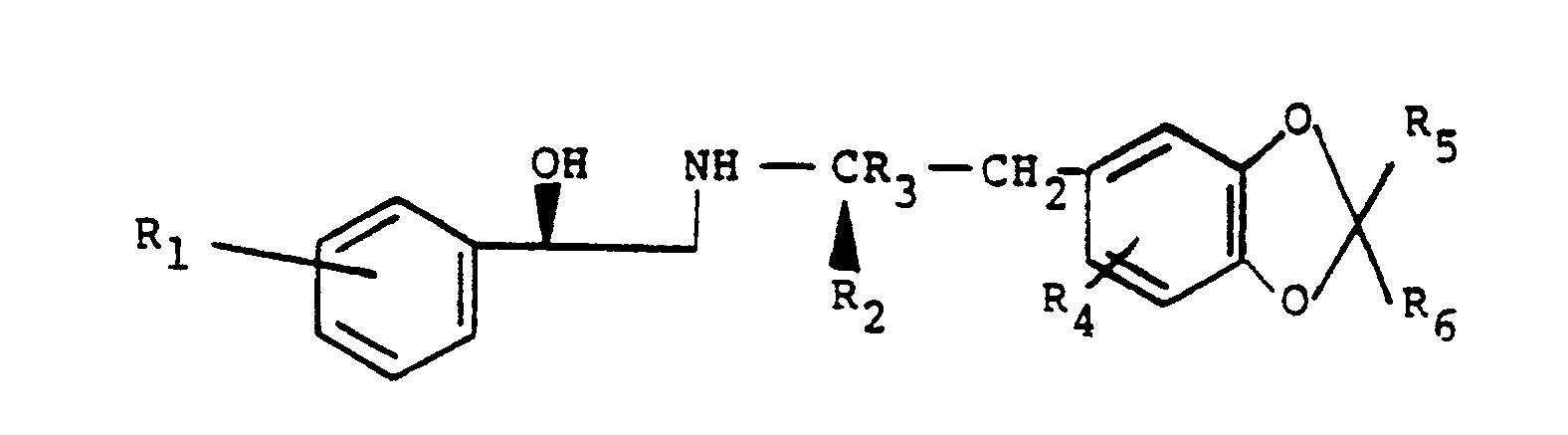
- (b)(ii) reacting the product of step (b)(i) with a reagent or reagents for converting the groups represented by R₅ and R₆ to carboxy, hydroxymethyl, -CH₂OCH₂COOR₇ and CH₂OCH₂-CH₂OR₇ wherein R₇ is hydrogen or C₁ to C₄ alkyl; or
- (c)(i) reacting the product of step (a) with a carbonyl reducing agent to form a compound of the formula

- (c)(ii) reacting the product of (c)(i) with a reagent or reagents for converting the CH₂OH groups to a -CH₂OCH₂COOR₇ group or a -CH₂OCH₂CH₂OR₇ group wherein R₇ is as defined above; or
- (c)(iii) reacting the product of step (c)(ii) with a base to produce a compound of the formula

- Any conventional ketalizing reagents, bases, acids alcohols, reagents for converting to defined groups and carbonyl reducing agents known to those skilled in the art may be employed and are contemplated by the present invention.
- In preferred embodiments of the present invention, the following reaction scheme may be employed.
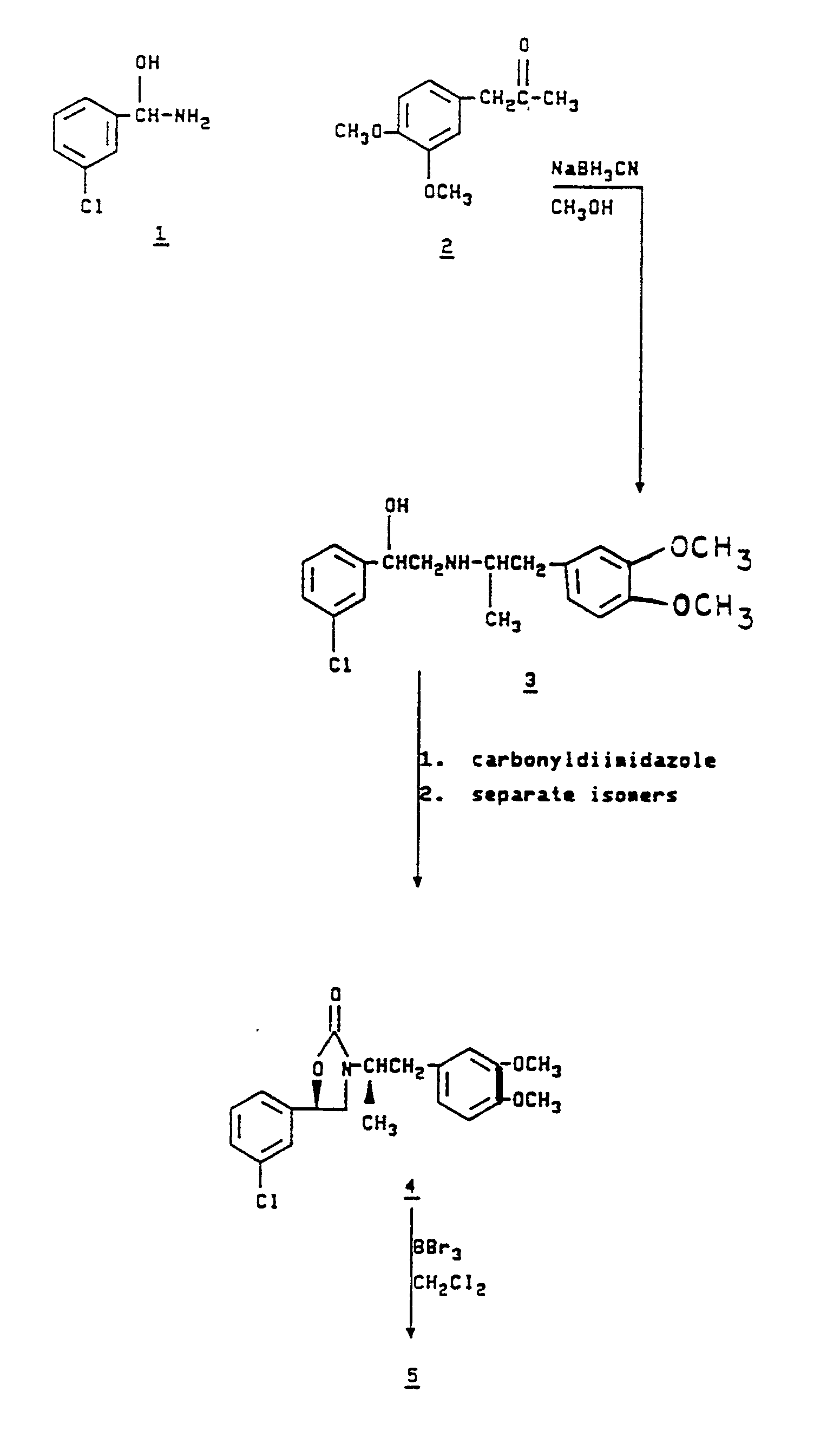

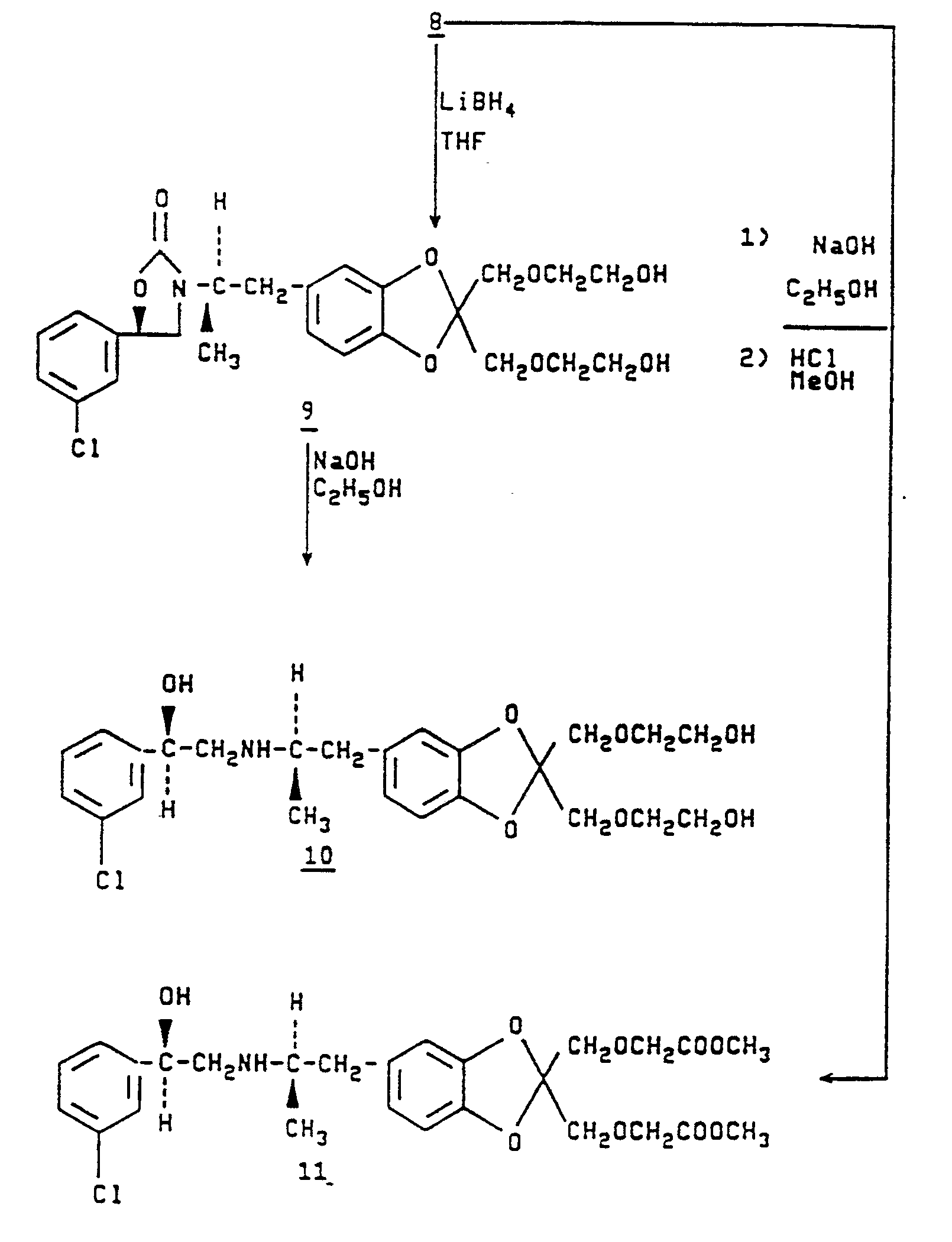
- In accordance with the above preferred reaction scheme 2-(3-chlorophenyl)-2-
hydroxyethylamine dimethoxyphenylacetone 2 are reacted with sodium cyanoborohydride in methanol, giving 3-chloro-alpha-(((2-(3,4-dimethoxyphenyl)-1-methylethyl)amino)methyl)benzenemethanol 3 which is reacted with carbonyl diimidazole and triethylamine in tetrahydrofuran, followed by separation of isomers, giving cyclized derivative 4 which is reacted with boron tribromide in dichloromethane, giving (R *,R *)-(+/-)-5-(3-chlorophenyl)-3-(2-(3,4-dihydroxy phenyl)-1-methylethyl)2-oxazolidinone 5.Compound 5 is then reacted with diethyl dibromomalonate and anhydrous potassium carbonate in acetone, giving (R *,R *)-(+/-)-5-(2-(5-(3-chlorophenyl)-2-oxo-3-oxazolidinyl)propyl)-1, 3-benzodioxole-2,2-dicarboxylic acid,diethyl ester 6 which is then reacted first with sodium hydroxide in ethanol and then with hydrogen chloride gas in methanol, giving the product (R *,R *)-(+/-) 5-(2-((2-(3-chlorophenyl) 2-hydroxyethyl)-amino)propyl)-1,3-benzodioxole-2, 2-dicarboxylic acid,dimethyl ester 7. -
Compound 6 may alternatively be reacted with lithium borohydride in anhydrous tetrahydrofuran followed by reaction with sodium hydride and methyl bromoacetate in anhydrous tetrahydrofuran, giving (R *,R *)-(+/-)-((5-(2((5-(3-chlorophenyl)-2-oxo)-3-oxazolidinyl)propyl)-1,3-benzodioxole-2,2-diyl)bis(methyleneoxy)) bis acetic acid,dimethyl ester 8 which is then reacted with lithium borohydride in anhydrous tetrahydrofuran, giving (R *,R *)-(+/-)-3-(2-((2,2-bis((2-hydroxyethoxy) methyl)-1,3-benzodioxole-5-yl)-1-methylethyl)-5-(3-chlorophenyl)2-oxazolidinone 9.Compound 9 is then refluxed with sodium hydroxide in ethanol, under argon, giving (R *,R *)-(+/-)-alpha-(((2-(2,2-bis((2-hydroxyethoxy)methyl)-1,3-benzodioxole-5-yl)-1-methylethyl)amino)methyl)-3-chlorobenzenemethanol 10. - Alternatively
compound 8 may be refluxed with sodium hydroxide in ethanol, then neutralized and reacted with hydrogen chloride gas in methanol to derive the product 11. - In another preferred embodiment, optical isomers of the present invention and the derivatives, salts and esters thereof may be resolved by a process comprising: (a) attaching a chiral auxiliary group at the N-9 position of a mixture of (+) and (-) enantiomers of the compounds to form a new pair of diastereoisomers; (b) separating the new pair of diastereoisomers and recovering the new (+) or (-) enantiomer; and (c) converting the substantially pure new diastereoisomer into the corresponding desired substantially pure (+) or (-) enantiomer of a derivative, salt or ester of the compound.
- In a preferred embodiment, the following Scheme II may be employed.

- In accordance with the reaction sequence outlined in Scheme II, 1,3-benzodioxole-2,2-dicarboxylic acid, 5-(2-((2-(3-chlorophenyl)-2-hydroxyethyl)amino) propyl-, dimethyl ester, hydrobromide (R*, R*)-(+/-)-, (12) is treated with the acid chloride derived from (S)-(-)- -methoxy- -trifluoromethylphenylacetic acid (Mosher's acid). The diastereomeric amides 13 and 14 are separated by preparative HPLC, treated with sodium hydroxide, and the disodium salts 15 and 16 (pure enantiomers), respectively are isolated by reverse phase column chromatography. Treatment of each salt with hydrobromic acid in methanol yields each diester, 1,3-benzodioxole-2,2-dicarboxylic acid, 5-(2-((-(3-chlorophenyl)-2-hydroxyethyl)amino)propyl-, dimethyl ester, hydrobromide (R,R) (17) and 1,3-benzodioxole-2,2-dicarboxylic acid, 5-(2-((2-(3-chlorophenyl)-2-hydroxyethyl)amino)propyl-, dimethyl ester hydrobromide (S,S) (18) respectively. In a similar manner, the corresponding diethyl and diisopropyl esters can be prepared.
- Repeating the above sequence starting with 1,3-benzodioxole-2,2-dicarboxylic acid, 5-((2-(3-chlorophenyl)-2-hydroxyethyl)amino)propyl-, dimethyl ester, hydrobromide (R*,S*)-(+/-) yields both
enantiomers 1,3-benzodioxole-2,2-dicarboxylic acid, 5-(2-((2-(3-chlorophenyl)-2-hydroxyethyl)amino)propyl-, dimethyl ester, hydrobromide (R,S) and 1,3-benzodioxole-2,2-carboxylic acid, 5-(2-((2-(3-chlorophenyl)-2-hydroxyethyl)amino)propyl-, dimethyl ester, hydrobromide (S,R) respectively. In a similar manner, the corresponding diethyl and diisopropyl esters can be prepared. - Alternatively, the chiral synthesis of the compounds of the present invention may generally be prepared according to the following process, the process comprising;
- (a)(i) reacting an optically active compound of the formula


- (b)(i) reacting the product of step (a)(i) with a cyclizing reagent followed by separating the diastereoisomers and recovering the new (+) or (-) enantiomer; or
- (a)(ii) reacting an optically active compound of the formula


- (b)(ii) optionally, reacting said compound with a cyclizing reagent to produce a compound of the formula

- (c) recovering the substantially pure new enantiomers of steps (b)(i), (a)(ii) or (b)(ii) and if desired converting said substantially pure (+) or (-) enantiomer into the corresponding derivative, salt or ester of the compounds of the present invention.
- Further, the present invention provides a process for producing the initial reactant of the above process, having the general formula

wherein R₂ and R₃ may be the same or different and are selected from the group consisting of hydrogen and C₁ - C₄ alkyl and R'' are independently selected from C₁ to C₄ alkyl and R⁴ is selected from the group consisting of hydrogen, C₁ - C₄ alkyl, C₁ - C₄ alkoxy, hydroxy, halogen, trifluoromethyl, carboxy, hydroxyalkyl, alkoxycarbonyl, C₁ to C₄ thioalkyl, sulfonyl and sulfinyl; the process comprising - (a) reacting a compound of the formula


- (b) reacting the product of step (a) with an alkylating agent to produce a compound of the formula

- (c) reacting the product of step (b) with a selective reducing agent to produce a compound of the formula

- (d) reacting the product of step (c) with a sulfonylating agent to produce a compound of the formula

- (e) reacting the product of step (d) with an acid followed by hydrogen and palladium to produce said compound.
- More specifically, the chiral synthesis may be carried out by performing the synthetic reaction sequence outlined in Scheme III. L-DOPA 19 is treated with di-t-butyl-dicarbonate in dimethylformamide, giving (S)-N-(1-(1,1-dimethylethoxy)carbonyl)-3-hydroxy-L-
tyrosine 20 which is reacted with methyl iodide and anhydrous potassium carbonate in acetone, giving (S)-N-(1,1-dimethylethoxy)carbonyl)-3,4-dimethoxy-L-phenylalanine methyl ester 21 which is reduced with lithium borohydride giving (S)-1,1-dimethylethyl-(2-(3,4-dimethoxyphenyl)-1-(hydroxymethyl)ethyl) carbonate 22, which is reacted with methanesulfonyl chloride and triethylamine in methylene chloride, giving (S)-1,1-dimethylethyl-(2-(3,4-dimethoxyphenyl)-1(((methylsulfonyl) oxy)methyl)ethyl)carbamate 23. Compound 23 is treated with trifluoroacetic acid and then is reduced using 10% Pd/C and hydrogen giving (R)-3,4-dimethoxy- -methylbenzeneethanamine 24. The compound 24 is treated with 3-chlorostyrene oxide 25 and N-(trimethylsilyl) acetamide giving a mixture of (R,S)- and (S,S)-3-chloro-(((2-(3,4-dimethoxyphenyl)-1-methylethyl)amino)methyl) benzenemethanol 26. Reaction of 26 with carbonyl diimidazole and triethylamine in tetrahydrofuran, followed by chromatographic separation of the diastereomers gives cyclized derivative 27, which is reacted with boron tribromide in dichloromethane, giving (R,R)-5-(3-chlorophenyl)-3-(2-(3,4-dihydroxyphenyl)-1-methylethyl)-2-oxazolidinone 28. Compound 28 is then reacted with diethyl dibromomalonate and anhydrous potassium carbonate in acetone, giving (R,R)-5-(2-(5-(3-chlorophenyl)-2-oxo-3-oxazolidinyl)propyl)-1,3-benzodioxole-2,2-dicarboxylic acid, diethyl ester 29. Compound 29 is reacted with 5N sodium hydroxide in ethanol and then isolated by reverse phase chromatography to give (R,R)-1,3-benzodioxole-2,2-dicarboxylic acid, 5-(2-((2-(3-chlorophenyl)-2-hydroxyethyl)amino)propyl)-, disodium salt 15. - Alternatively, reacting compound 24 with (R)-3-chlorostyrene oxide, enantiomerically pure 15 is prepared. Enantiomerically pure epoxides can be prepared by asymmetric reduction of the corresponding x-chloroketone as described by Corey, J. Am. Chem, Soc., 109, 5551 (1987), followed by base catalyzed closure to the epoxide.


- The active compounds of the present invention may be orally administered as a pharmaceutical composition, for example, with an inert diluent, or with an assimilable edible carrier, or they may be enclosed in hard or soft shell capsules, or they may be compressed into tablets, or they may be incorporated directly with the food of the diet. For oral therapeutic administration, these active compounds may be incorporated with excipients and used in the form of tablets, pills, capsules, ampules, sachets, elixirs, suspensions, syrups, and the like. Such compositions and preparations should contain at least 0.1 percent of active compound. The percentage of active compound in these compositions may, of course, be varied and may conveniently be between about 2 percent to about 60 percent of the weight of the unit. The amount of active compound in such therapeutically useful compositions is such that an effective dosage will be obtained.
- The effective dosage of active ingredient employed may vary depending on the particular compound employed, the mode of administration, the condition being treated and the severity of the condition being treated.
- When treating diabetes mellitus and/or hyperglycemia generally satisfactory results are obtained when the compounds of the present invention are administered at a daily dosage of from about 0.1 milligram to about 1 milligram per kilogram of animal body weight, preferably given in divided doses two to six times a day, or in sustained release form. For most large mammals, the total daily dosage is from about 3.5 milligrams to about 140 milligrams, preferably from about 3.5 milligrams to about 5 milligrams. In the case of a 70 kg adult human, the total daily dose will generally be from about 7 milligrams to about 70 milligrams. This dosage regimen may be adjusted to provide the optimal therapeutic response.
- When treating obesity, in conjunction with diabetes and/or hyperglycemia, or alone, generally satisfactory results are obtained when the compounds of the present invention are administered at a daily dosage of from 1 milligram to about 10 milligrams per kilogram of animal body weight, preferably given in divided doses two to six times a day, or in sustained release form. For most large mammals, the total daily dosage is from about 35 milligrams to about 1,400 milligrams, preferably from about 35 milligrams to about 50 milligrams. In the case of a 70 kg adult human, the total daily dose will generally be from about 70 milligrams to about 700 milligrams. This dosage regimen may be adjusted to provide the optimal therapeutic response.
- The tablets, pills, capsules, and the like may also contain a binder such as gum tragacanth, acacia, corn starch or gelatin; excipients such as dicalcium phosphate; a disintegrating agent such as corn starch, potato starch, alginic acid; a lubricant such as magnesium stearate; and a sweetening agent such as sucrose, lactose or saccharin. When a dosage unit form is a capsule, it may contain, in addition to materials of the above type, a liquid carrier such as a fatty oil.
- Various other materials may be present as coatings or to modify the physical form of the dosage unit. For instance, tablets may be coated with shellac, sugar or both. A syrup or elixir may contain, in addition to the active ingredient, sucrose as a sweetening agent, methyl and propylparabens as preservatives, a dye and a flavoring such as cherry or orange flavor.
- These active compounds may also be administered parenterally. Solutions or suspensions of these active compounds can be prepared in water suitably mixed with a surfactant such as hydroxypropylcellulose. Dispersions can also be prepared in glycerol, liquid polyethylene glycols and mixtures thereof in oils. Under ordinary conditions of storage and use, these preparations contain a preservative to prevent the growth of microorganisms.
- The pharmaceutical forms suitable for injectable use include sterile aqueous solutions or dispersions and sterile powders for the extemporaneous preparation of sterile injectable solutions or dispersions. In all cases, the form must be sterile and must be fluid to the extent that easy syringability exists. It must be stable under the conditions of manufacture and storage and must be preserved against the contaminating action of microorganisms such as bacteria and fungi. The carrier can be a solvent or dispersion medium containing, for example, water, ethanol, polyol (e.g. glycerol, propylene glycol and liquid polyethylene glycol), suitable mixtures thereof, and vegetable oils.
- The compounds of the present invention also possess utility for increasing lean meat deposition and/or improving lean meat to fat ratio in edible animals, i.e. ungulate animals and poultry.
- Animal feed compositions effective for increasing lean meat deposition and for improving lean meat to fat ratio in poultry, swine, sheep, goats, domestic pets and cattle are generally prepared by mixing the compounds of the present invention with a sufficient amount of animal feed to provide from about 1 to 1000 ppm of the compound in the feed.
- Animal feed supplements can be prepared by admixing about 75% to 95% by weight of a compound of the present invention with about 5% to about 25% by weight of a suitable carrier or diluent. Carriers suitable for use to make up the feed supplement compositions include the following: alfalfa meal, soybean meal, cottonseed oil meal, linseed oil meal, sodium chloride, cornmeal, cane molasses, urea, bone meal, corncob meal and the like. The carrier promotes a uniform distribution of the active ingredients in the finished feed into which the supplement is blended. It thus performs an important function by ensuring proper distribution of the active ingredient throughout the feed.
- If the supplement is used as a top dressing for the feed, it likewise helps to ensure uniformity of distribution of the active material across the top of the dressed feed.
- The prefered medicated swine, cattle, sheep and goat feed generally contain from 0.01 to 400 grams of active ingredient per ton of feed, the optimum amount for these animals usually being about 50 to 300 grams per ton of feed.
- The preferred poultry and domestic pet feeds usually contain about 0.01 to 400 grams and preferably 10 to 400 grams of active ingredient per ton of feed.
- For parenteral administration the compounds of the present invention may be prepared in the form of a paste or a pellet and administered as an implant, usually under the skin of the head or ear of the animal in which increase in lean meat deposition and improvement in lean mean to fat ratio is sought.
- In general, parenteral administration involves injection of a sufficient amount of the compounds of the present invention to provide the animal with 0.001 to 100 mg/kg/day of body weight of the active ingredient. The preferred dosage for swine, cattle, sheep and goats is in the range of from 0.001 to 50 mg/kg/day of body weight of active ingredient; whereas, the preferred dose level for poultry and domestic pets is usually in the range of from 0.001 to 35 mg/kg/day of body weight.
- Paste formulations can be prepared by dispersing the active compound in a pharmaceutically acceptable oil such as peanut oil, sesame oil, corn oil or the like.
- Pellets containing an effective amount of the compounds of the present invention can be prepared by admixing the compounds of the present invention with a diluent such as carbowax, carnuba wax, and the like, and a lubricant, such as magnesium or calcium stearate, can be added to improve the pelleting process.
- It is, or course, recognized that more than one pellet may be administered to an animal to achieve the desired dose level which will provide the increase in lean meat deposition and improvement in lean meat to fat ratio desired. Moreover, it has been found that implants may also be made periodically during the animal treatment period in order to maintain the proper drug level in the animal's body.
- The method of the present invention has several advantages; for the pet owner or veterinarian who wishes to increase leaness and trim unwanted fat from pet animals, the present invention provides the means by which this can be accomplished. For the poultry men and swine raisers, using the method of the present invnetion yields leaner animals which command higher prices from the meat industry.
- The results of animal growth regulant evaluation of compounds of the invention appear in Table V.
- CFI female mice, 55 days old, are weighed in groups of 5 and allotted to cages to minimize weight variation among cages. Treatments are randomly assigned to cages.
- Each of the treatments are tested in 1 to 3 replicates, i.e., in 3 cages of 5 mice each. There are 10 cages of 5 control mice each. Test compounds are mixed in the diet at the dosage level indicated. Feed and water are offered ad libitum for a 12-day test period. The mice are weighed as a group of 5 and the weight gain determined. The mice are sacrificed by cervical dislocation. The right uterine fat pad of each mouse is removed. The fat pads for each cage of 5 mice are weighed as a unit. The fat versus body weight ratio is determined using the absolute weights of the fat pads and the absolute body weight.
- It can be seen that a reduction in fat pad weights of animals is generally indicative of a reduction of total body fat of the treated animals.

- The compounds showed good fat reducing activity without interferring with normal animal growth.
- The following specific examples illustrate the present invention. They are not to be construed to limit the claims in any manner whatsoever.
-
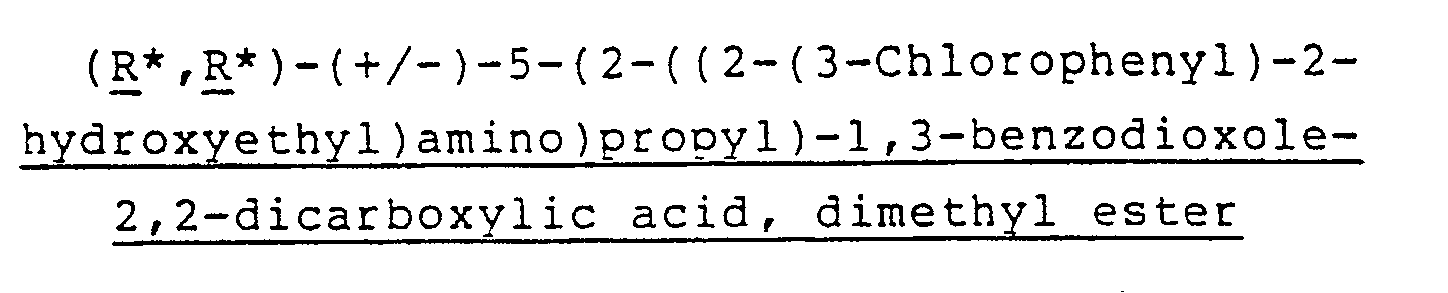
- To a mixture of 53.2 g of trimethylsilyl cyanide and 0.5 g of anhydrous aluminum chloride under argon is added dropwise 75.3 g of 3-chlorobenzaldehyde at such a rate that the reaction temperature does not exceed 80°C. The mixture is stirred for 30 minutes, then filtered and washed with ether. The combined filtrate and wash is evaporated to an oil which is distilled on a Kugelrohr giving 107.4 g of O-trimethysilyl-3-chloromandelonitrile (70-77°C) as a pale yellow liquid.
- To a mixture of 34.7 g of sodium borohydride and 500 ml of tetrahydrofuran is added 104.6 g of trifluoroacetic acid over 40 minutes with stirring in a 20°C water bath. A 110 g portion of O-trimethyl-silyl-3-chloromandelonitrile is added over 45 minutes, followed by 150 ml of tetrahydrofuran. The mixture is stirred overnight in the 20°C water bath, then 500 ml of water is added dropwise with ice bath cooling. The mixture is then stirred at room temperature for 1 hour, filtered through diatomaceous earth, washed with tetrahydrofuran and the combined filtrate and wash are concentrated in vacuo until most of the tetrahydrofuran is removed. A 250 ml portion of water and 150 ml of concentrated hydrochloric acid are added, the solution is heated on a steam bath for 1.5 hours, cooled and extracted twice with dichloromethane. The aqueous extracts are combined, made strongly basic with 200 ml of 10N sodium hydroxide in a cooling bath and extracted four times with dichloromethane. The dichloromethane extracts are combined, washed twice with water, dried and evaporated to a yellow oil. This oil is dissolved in ether, filtered through diatomaceous earth and evaporated to an oil. This oil is distilled on a Kugelrohr giving 58.73 g of 2-(3-chlorophenyl)-2-hydroxyethylamine as thick orange oil.
- A mixture of 4 g of 2-(3-chlorophenyl)-2-hydroxyethylamine, 4.53 g of 3,4-dimethoxyphenylacetone, 2 g of sodium cyanoborohydride and 40 ml of methanol is stirred for 3 hours and then worked up giving 7.5 g of oil. This oil is purified by chromatography, eluting with hexane:ethyl acetate (1:1), then ethyl acetate, giving 5.35 g of 3-chloro-alpha-(((2-(3,4-dimethoxy phenyl)-1-methylethyl)amino)methyl)benzenemethanol as thick yellow syrup.
- A mixture of 4.39 g of 3-chloro-alpha-(((2-(3, 4-dimethoxyphenyl)-1-methylethyl)amino)methyl)benzenemethanol, 4.5 g of carbonyldiimidazole, 13 ml of triethylamine and 45 ml of tetrahydrofuran are stirred overnight, then poured into water and extracted twice with ethyl acetate. The extracts are combined, washed twice with 2N hydrochloric acid, once with brine, dried and evaporated to an oil. This oil is chromatographed, eluting with hexane:ethyl acetate (3:1 to 2:1). Fractions 16-19 are combined and evaporated giving 2.02 g of a colorless syrup. To an ice cold solution of 1.71 g of this syrup in 70 ml of dichloromethane is added dropwise 1.3 ml of boron tribromide. The mixture is stirred at 0° to 5°C for 15 minutes, then at room temperature for 20 minutes, quenched with water and stirred for 20 minutes. The dichloromethane layer is separated, washed with brine, dried and evaporated, giving 1.6 g of (R*,S*)-(+/-)-5-(3-chlorophenyl)-3-(2-(3, 4-dihydroxyphenyl)-1-methylethyl)-2-oxazolidinone as a foamy solid.
- A mixture of 0.8 g of the above oxazolidinone, 0.74 g of diethyl dibromomalonate, 1.2 g of anhydrous potassium carbonate and 20 ml of acetone are stirred overnight with the addition of a few drops of diethyl dibromomalonate. The mixture is filtered, washed with acetone and the combined filtrate and wash are evaporated to a yellow oil. The oil is purified by flash chromatography, eluting with 5 percent acetone in toluene. The pure fractions are combined and evaporated, giving 766 mg of (R*,S*)-(+/-)-5-(2-(5-(3-chlorophenyl)-2-oxo-3-oxazolidinyl)propyl)-1,3-benzodioxole-2,2-dicarboxylic acid, diethyl ester as a colorless oil.
- A mixture of 636 mg of the above diethyl ester, 23 ml of 5N sodium hydroxide and 44 ml of ethanol are heated at reflux under argon overnight, then cooled and evaporated. The solid residue is taken up in methanol, placed in an ice bath and hydrogen chloride gas is passed through the solution for 3-4 minutes. This mixture is stirred for 1.5 hours, then poured cautiously into saturated aqueous sodium bicarbonate and extracted with ethyl acetate. This ethyl acetate extract is washed with brine, dried, filtered and evaporated to an oil. This oil is purified by flash chromatography, eluting with ethyl acetate. The pure fractions are combined and evaporated, giving 264 mg of the desired product as a colorless oil.
-

- A mixture of 1.63 g of (R*,S*)-(+/-)-5-(2-(5 (3-chlorophenyl)-2-oxo-3-oxazolidinyl)propyl)-1,3-benzodioxole-2,2-dicarboxylic acid, diethyl ester and 2.5 g of lithium borohydride in 25 ml of anhydrous tetrahydrofuran are reacted, giving 1.26 g of the corresponding alcohol as a white foam.
- A 590 mg portion of 60 percent sodium hydride is washed three times with hexane. To this is added under argon, 10 ml of dry tetrahydrofuran and, over 5 minutes, a solution of 1.24 g of (R*,R*)-(+/-)-5-(2-(5-(3-chlorophenyl)-2-oxo-3-oxazolidinyl)propyl)-1,3-benzodioxole-2,2-dicarboxylic acid in 10 ml of dry tetrahydrofuran. The solution is stirred for 5 minutes, then 1.36 g of methyl bromoacetate is added over 10 minutes. After stirring overnight this mixture is poured into aqueous ammonium chloride and extracted twice with ethyl acetate. The extracts are combined, dried and evaporated to an oil which is purified by chromatography, giving 1.03 g of the desired product as a pale yellow oil.
-

- A mixture of 420 mg of (R*,R*)-(+/-)-(5-(2-(5-(3-chlorophenyl)-2-oxo-3-oxazolidinyl)propyl-1,3-benzodioxole)-2,2-diyl)bis(methyleneoxy)bis acetic acid, dimethyl ester, 0.75 g of lithium borohydride and 10 ml of anhydrous tetrahydrofuran are allowed to react for 1.5 hours, giving 340 mg of the desired product as a milky film.
-

- A mixture of 370 mg of (R*,R*)-(+/-)-(5-(2-(5-(3-chlorophenyl)-2-oxo-3-oxazolidinyl)propyl)-1,3-benzodioxole-2,2-diyl)bis(methyleneoxy)bis acetic acid, dimethyl ester, 9 ml of 5N sodium hydroxide and 19 ml of absolute ethanol are refluxed overnight, then cooled, acidified to
pH 5 with concentrated hydrochloric acid and evaporated to dryness in vacuo. The residue is dissolved in 20 ml of methanol, then saturated with hydrogen chloride gas and stirred for 1.5 hours. The mixture is poured into aqueous sodium bicarbonate and extracted twice with ethyl acetate. The extracts are combined, washed with brine, dried and evaporated. The residue is purified by flash chromatography, eluting with ethyl acetate, giving 220 mg of the desired product as a pale yellow thick oil. -

- A mixture of 270 mg of (R *,R *)-(+/-)-3-(2-(2,2-bis((2-hydroxyethoxy)methyl)-1,3-benzodioxole-5-yl)-1-methylethyl)-5-chlorophenyl)-2-oxazolidinone, 200 ml of ethanol and 5 ml of 5N sodium hydroxide are refluxed under argon for 8 hours, then poured into salty water and extracted twice with ethyl acetate. The extracts are combined, washed with brine, dried and evaporated. The residue is purified by flash chromatography, eluting with dichloromethane:methanol:ammonium hydroxide (250:35:5).
Fractions - A solution of (1,3-benzodioxole-2,2-dicarboxylic acid, 5-(2-(5-(3-chlorophenyl)-2-oxo-3-oxazolidinyl)propyl-, diethyl ester, (R*,R*)-(+/-)-, (550 mg 1.09 mmol), 5N NaOH (15 mL) and distilled water (15 mL) is heated at reflux under an argon atmosphere for 17 hours. The solution is cooled, and then acidified to
pH 9 using concentrated HCl causing a copious amount of white solid to precipitate. The mixture is filtered and the solid is washed with water. The combined filtrate and water wash (53 mL) is loaded onto a column packed with C₁₈ reverse phase silica gel (75 mL) which had first been washed with MeOH (150 mL) and then a pH 8.5 solution and then the product is eluted using MeOH:water (1:1). Evaporation of the product-containing fractions yielded a yellow oil which became a powdery solid upon addition of MeOH. The solid was collected and washed with ether to yield a dry white powder, 395 mg (78%). - Absolute methanol (20 mL) is treated dropwise with distilled acetyl bromide (20 drops) and the solution is stirred for 5 minutes. To this solution is added (R*,R*)-(+/-)-5-(2-((2-(3-chlorophenyl)-2-hydroxyethyl)amino)propyl)-1,3-benzodioxole-2,2-dicarboxylic acid, disodium salt (500 mg, 1.09 mmol) and the solution is stirred for 24 hours at room temperature. The solution is evaporated to give to yield a brown oil which is dissolved in chloroform and filtered to remove sodium bromide. The chloroform is evaporated and ether is added to the resulting brown oil to give a beige solid. The solid is collected and washed with ether to give a dry powder (520 mg, 90%). Recrystallization from acetonitrile-ether yielded the analytical sample, mp 145 - 147°C.
- A solution of (R*,R*)-(+/-)-5-(2((2-(3-chlorophenyl)-2-hydroxyethyl)amino)propyl)-1,3-benzodioxole-2,2-dicarboxylic acid, dimethyl ester hydrobromide (1.00 g, 1.88 mmol), triethylamine (0.48g, 4.71 mmol) and (S)-(-)-2-trifluoromethyl-2-methoxyphenylacetyl chloride (0.54 g, 2.26 mmol) in 10 mL of methylene chloride is stirred at room temperature for 3 days. The yellow solution is diluted with 50 mL of ether and washed sequentially with 2N HCl, aqueous sodium bicarbonate, and brine. The organic solution is dried (MgSO₄), filtered and concentrated to give a yellow oil. Purification by preparative HPLC (silica, hexane: ethyl acetate 4:1) yielded: (1) the less polar isomer, 229 mg (18%) and (2) the more polar isomer, 248 mg (20%), both as dry foams.
- The more polar isomer (235 mg, 0.353 mmol) is heated at reflux in a solution of ethanol (4mL) and 5N NaOH (2mL) for 24 hours under argon atmosphere. The solution is cooled and acidified to
pH 9 using concentrated HCl causing some white solid to form. The entire mixture is loaded onto a flash chromatography column packed with C₁₈ silica (40 mL) which had been prepared as described in the (R*,S*)-5-(2-((2-(3-chlorophenyl)-2-hydroxyethyl)amino)propyl)-1,3-benzodioxole-2,2-dicarboxylic acid, disodium salt experiment. Isolation of the product is accomplished in the same manner as was previously described. The product (single enantiomer), a white powder (117 mg, 71%) is obtained. The other enantiomer is obtained by a similar hydrolysis of the less polar diastereomer. - A mixture of 25 g of L-DOPA, 27.7 g of di-t-butyl dicarbonate in 300 ml of dimethylformamide is heated at 65°C for 22 hours, cooled, poured into 5 percent citric acid solution and extracted twice with ethyl acetate. The ethyl acetate extracts are washed with brine, dried, filtered and evaporated to yield 31.0 g of (S)-N-(1,1-dimethylethoxy)carbonyl-3-hydroxy-L-tyrosine, as a brown oil.
- A mixture of 31.0 g of the above t-butyl carbonate derivative, 52 ml of iodomethane, and 145 g of anhydrous potassium carbonate in 300 ml of acetone is heated to reflux for 20 hours, cooled, filtered and the solvent evaporated to yield a residue. The residue is then partitioned between water and methylene chloride. The methylene chloride extract is washed with brine, dried, filtered and evaporated to yield 27 g of (S)-N-(1,1-dimethylethoxy)carbonyl-3,4-dimethoxy-L-phenylalanine, methyl ester as a yellow solid.
- A mixture of 27.0 g of the above ester derivative, 3.7 g of lithium borohydride and 180 ml of tetrahydrofuran is allowed to react for 18 hours, giving 22.0 g of (S)-1,1-dimethylethyl-(2-(3,4-dimethoxyphenyl)-1-(hydroxymethyl)ethyl)carbamate as a white solid.
- To an ice cold solution of 22.0 g of the above hydroxymethyl derivative, 15 ml of triethylamine in 140 ml of anhydrous tetrahydrofuran, is added 7.0 ml of methanesulfonylchloride, stirred at room temperature for 2 hours, diluted with water, and extracted with ethyl acetate. The ethyl acetate extract is washed with 2N hydrochloric acid, 1N sodium hydroxide, brine, and then dried, filtered and evaporated to give 25.0 g of (S)-1, 1-dimethylethyl-(2-(3,4-dimethoxyphenyl)-1-((methylsulfonyl)oxy)methyl)ethyl)carbamate as a white solid.
- A mixture of 18.0 g of the above mesyl derivative and 35 ml of trifluoroacetic acid in 80 ml of methyl chloride is reacted for 18 hours and solvent is evaporated to yield a gray oil. The oil is dissolved in ethanol and 15 g of sodium acetate, and 1.8 g of 10 percent palladium on carbon is added. The resulting mixture is then hydrogenated on a Parr shaker overnight. The catalyst is filtered and the filtrate evaporated to yield an oil. The oil is purified by kugelrohr distillation to yield 5.8 g of (R)-3,4-dimethoxymethylbenzeneethanamine as a white solid.
- A mixture of 420 mg of the above amine and 311 mg of N-(trimethylsilyl)acetamide in 2 ml of dimethylsulfoxide is stirred at room temperature for 1 hour. A solution of 349 mg of 3-chlorostyreneoxide in 0.3 ml dimethylsulfoxide is added to the above mixture and the resulting mixture is heated at 65°C to 70°C for 20 hours, cooled, poured into a mixture of ice and concentrated hydrochloric acid, stirred, basified with 10N NaOH and extracted with ethyl acetate. The ethyl acetate extract is washed with brine, dried, filtered and evaporated to yield an oil which is purified by flash chromatography to yield 489 mg of (R,S) and (S,S)-3-chloro-α-(((2-(3,4-dimethoxyphenyl)-1-methylethyl)amino)methyl)benzenemethanol.
- A mixture of 1.4 g of the above benzenemethanol derivatives, 1.39 g of carbonyldiimidazole, 3.5 ml of triethylamine and 15 ml of tetrahydrofuran is stirred overnight, then poured into water and extracted twice with ethyl acetate. The ethyl acetate extract is washed with 2N hydrochloric acid, brine, dried and evaporated to an oil. The oil is chromatographed, eluting with hexane:ethyl acetate (3:1 to 2:1). Fractions containing bottom spot are combined and evaporated giving 318 mg of colorless oil. To an ice cold solution of 300 mg of this oil is added dropwise 0.23 ml of boron tribromide. The mixture is stirred at 0°C to 5°C for 15 minutes, then at room temperature for 20 minutes, quenched with water and stirred for 20 minutes. The dichloromethane layer is separated, washed with brine, dried and evaporated giving 254 mg of (R,R)-5-(3-chlorophenyl)-3-(2-(3,4-dihydroxyphenyl)-1-methylethyl)-2-oxazolidinone as a foaming solid.
- A mixture of 240 mg of the above oxazolidinone, 234 mg of diethyl bromomalonate, 450 mg of anhydrous potassium carbonate and 10 ml of acetone is stirred overnight, filtered, washed with acetone and evaporated to a brown oil. The oil is purified by flash chromatography, eluting with 5 percent acetone in toluene. The pure fractions are combined and evaporated giving 237 mg of (R,R)-5-(3-chlorophenyl)-2-oxo-3-oxazolidinyl)propyl)-1,3-benzodioxole-2,2-dicarboxylic acid, diethyl ester as a colorless oil.
- A mixture of 234 mg of the above diethyl ester, 8.5 ml of 5N sodium hydroxide and 17 ml of ethanol is heated at reflux under argon overnight, cooled and then acidified to
pH 9 using concentrated hydrochloric acid causing a copious amount of a white solid to precipitate. The mixture is filtered and the solid is washed with water. The combined filtrate and water wash (22 ml) is loaded onto a column packed with C₁₈ reverse phase silica gel, which was first washed with methanol (64 ml), and then a pH 8.5 solution. The product is eluted using methanol water (1:1). Evaporation of the product containing fractions gives a yellow oil which becomes a powdery solid upon the addition of methanol. The solid is collected and washed with ether to yield 8.5 mg of the compound of this example as a white solid. - The procedure to prepare the dimethyl ester of Example 7 is repeated, substituting ethanol for methanol to produce the compound of the example as a white powder, mp 174-176°C.
- The procedure to prepare the dimethyl ester of Example 7 is repeated, substituting 2-propanol for methanol to produce the compound of the example as an off-white powder, mp 170-172°C.
- The procedure of Example 1 is repeated, except that the substituents on the starting compounds are varied. Table A sets forth the compounds produced in accordance with the present invention.


- The above mentioned patents and publications are incorporated herein by reference.
- Many variations of the present invention will suggest themselves to those who are skilled in the art in light of the above detailed description. All such obvious modifications are within the full intended scope of the appended claims.
Claims (15)
- A compound of the formula


- A compound as defined in claim 1 wherein X is the divalent radical

- A compound as defined in claim 2 wherein R₅ and R₆ are both alkoxycarbonyl or carboxy; R₂ is hydrogen; and R₃ is C₁ to C₄ alkyl and R₁ is one or two groups.
- The optically active compound as defined in claim 3 which is (R,R)-5-(2-((2-(3-chlorophenyl)-2-hydroxyethyl)amino)propyl)-1,3-benzodioxole-2,2-dicarboxylic acid, dimethyl ester.
- The optically active compound as defined in claim 3 which is (R,R)-5-(2-((2-(3-chlorophenyl)-2-hydroxyethyl)amino)propyl)-1,3-benzodioxole-2,2-dicarboxylic acid, diethyl ester.
- The optically active compound as defined in claim 3 which is (R,R)-5-(2-((2-(3-chlorophenyl)-2-hydroxyethyl)amino)propyl)-1,3-benzodioxole-2,2-dicarboxylic acid, diisopropyl ester.
- The optically active compound as defined in claim 3 which is (R,R)-5-(2-((2-(3-chlorophenyl)-2-hydroxyethyl)amino)propyl)-1,3-benzodioxole-2,2-dicarboxylic acid, disodium salt.
- The racemic compound as defined in Claim 3 which is (R*,S*)-(+/-)-5-(2-((2-(3-chlorophenyl)-2-hydroxyethyl)amino)propyl)-1,3-benzodioxole-2,2-dicarboxylic acid, diethyl ester.
- The racemic compound as defined in Claim 3 which is (R*,S*)-(+/-)-5-(2-((2-(3-chlorophenyl)-2-hydroxyethyl)amino)propyl)-1,3-benzodioxole-2,2-dicarboxylic acid, diisopropyl ester.
- The racemic compound as defined in Claim 3 which is (R*,S*)-(+/-)-5-(2-((2-(3-chlorophenyl)-2-hydroxyethyl)amino)propyl)-1,3-benzodioxole-2,2-dicarboxylic acid, disodium salt.
- A pharmaceutical composition for treating diabetes, hyperglycemia or obesity in humans or other mammals, comprising an effective amount of a compound as defined in claim 1, in combination with a pharmaceutically acceptable carrier.
- A method of treating hyperglycemia or obesity in humans or other mammals, which comprises administering to a human or other mammal an anti-obesity effective amount or an anti-hyperglycemia effective amount of a compound as defined in claim 1.
- A process for producing a compound of the formula:

 (a) reacting compound of the formula

 (b)(i) reacting the product of step (a) with a base followed by an acid and alcohol to produce a compound of the formula
 (b)(ii) reacting the product of step (b)(i) with a reagent or reagents for converting the groups represented by R₅ and R₆ to carboxy, hydroxymethyl, -CH₂OCH₂COOR₇ and CH₂OCH₂CH₂OR₇ wherein R₇ is hydrogen or C₁-C₄ alkyl; or(c)(i) reacting the product of step (a) with a carbonyl reducing agent to form a compound of the formula wherein R₁, R₂, R₃, R₄ are as above defined and(c)(ii) reacting the product of step (c)(i) with a reagent or reagents for converting the CH₂OH groups to a -CH₂OCH₂COOR₇ or a -CH₂OCH₂CH₂OR₇ group wherein R₇ is as above defined; or(c)(iii) reacting the product of step (c)(ii) with a base to produce a compound of the formula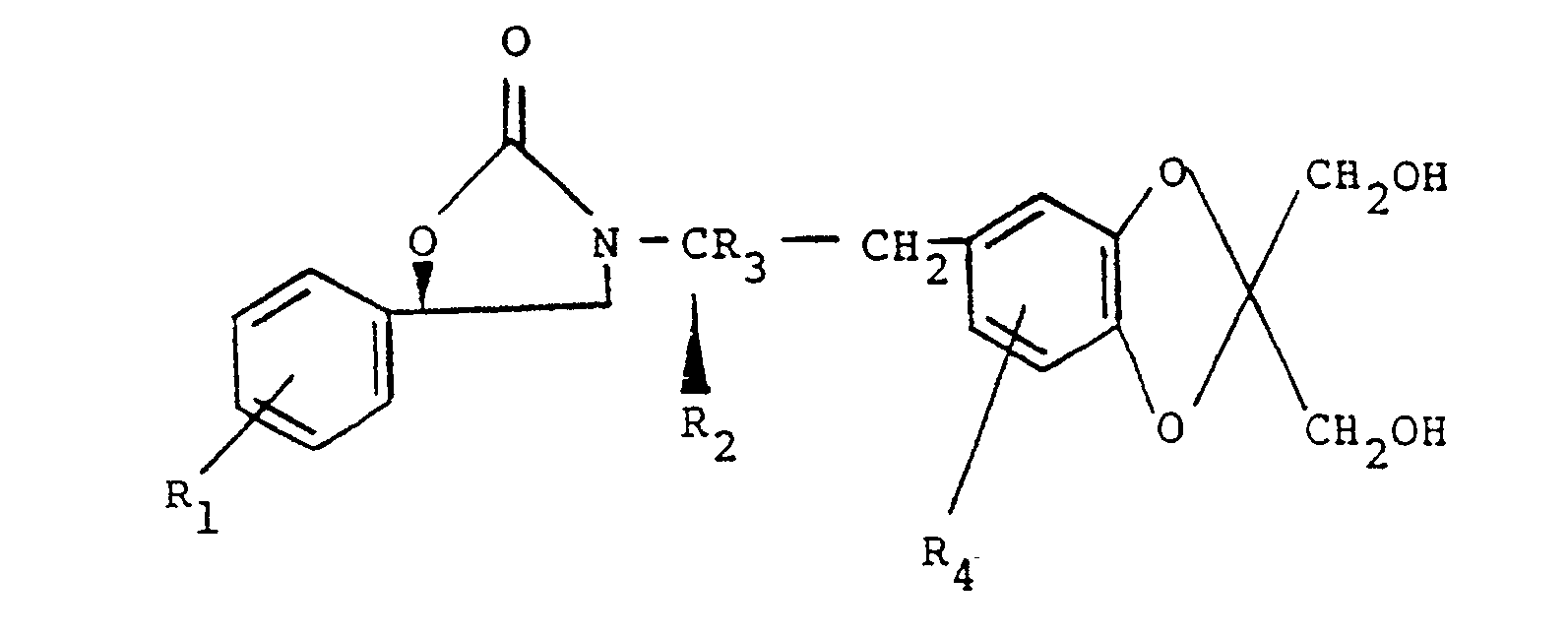
- A method of increasing the content of lean meat in edible animals, which comprises administering to an edible animal an effective amount of the compound of Claim 1.
- A process for producing a desired substantially pure (+) or (-) enantiomer or a derivative, salt or ester of a compound of the formula

 (a) attaching a chiral auxiliary group at the N-9 position of a mixture of (+) and (-) enantiomers of said compound to form a new pair of diastereoisomers;(b) separating said new pair of diastereoisomers and recovering the new (+) or (-) enantiomer; and(c) converting the substantially pure new enantiomer into the corresponding desired substantially pure (+) or (-) enantiomer or a derivative, salt or ester of said compound.
Applications Claiming Priority (2)
| Application Number | Priority Date | Filing Date | Title |
|---|---|---|---|
| US07/519,192 US5061727A (en) | 1990-05-04 | 1990-05-04 | Substituted 5-(2-((2-aryl-2-hydroxyethyl)amino)propyl)-1,3-benzodioxoles |
| US519192 | 1990-05-04 |
Publications (3)
| Publication Number | Publication Date |
|---|---|
| EP0455006A2 true EP0455006A2 (en) | 1991-11-06 |
| EP0455006A3 EP0455006A3 (en) | 1992-04-01 |
| EP0455006B1 EP0455006B1 (en) | 1999-07-07 |
Family
ID=24067267
Family Applications (1)
| Application Number | Title | Priority Date | Filing Date |
|---|---|---|---|
| EP91105510A Expired - Lifetime EP0455006B1 (en) | 1990-05-04 | 1991-04-08 | Substituted 5-(2-((2-aryl-2-hydroxyethyl)amino)propyl)-1,3-benzodioxoles |
Country Status (22)
| Country | Link |
|---|---|
| US (1) | US5061727A (en) |
| EP (1) | EP0455006B1 (en) |
| JP (1) | JPH05320153A (en) |
| KR (1) | KR0181178B1 (en) |
| CN (1) | CN1037348C (en) |
| AT (1) | ATE181914T1 (en) |
| AU (1) | AU639094B2 (en) |
| CA (1) | CA2041712A1 (en) |
| CZ (1) | CZ283420B6 (en) |
| DE (1) | DE69131412D1 (en) |
| DK (1) | DK0455006T3 (en) |
| ES (1) | ES2133273T3 (en) |
| FI (1) | FI94862C (en) |
| HU (2) | HU210596B (en) |
| IE (1) | IE911509A1 (en) |
| IL (1) | IL97900A (en) |
| NO (1) | NO177822C (en) |
| NZ (1) | NZ237992A (en) |
| PL (1) | PL165665B1 (en) |
| PT (1) | PT97540B (en) |
| SG (1) | SG47917A1 (en) |
| ZA (1) | ZA913366B (en) |
Cited By (37)
| Publication number | Priority date | Publication date | Assignee | Title |
|---|---|---|---|---|
| WO1994002493A1 (en) * | 1992-07-25 | 1994-02-03 | Smithkline Beecham Plc | Phosphonated arylethanolamine compounds with anti-hyperglycemic and/or anti-obesity activity |
| EP0627397A1 (en) * | 1993-06-04 | 1994-12-07 | Daicel Chemical Industries, Ltd. | Optically active 1-phenyl-2-substituted propane derivatives and methods of producing the same |
| WO1995004047A1 (en) * | 1993-07-31 | 1995-02-09 | Smithkline Beecham Plc | 2-benzoheterocyclyloxy or thiopropanolamine derivatives with adreno receptor agonist activity |
| US5451677A (en) * | 1993-02-09 | 1995-09-19 | Merck & Co., Inc. | Substituted phenyl sulfonamides as selective β 3 agonists for the treatment of diabetes and obesity |
| WO1995029903A1 (en) * | 1994-05-03 | 1995-11-09 | Celgene Corporation | Stereopreferential synthesis of 3-(1-phenylprop-2-yl)-5-phenyloxazolidinones |
| WO1995033724A1 (en) * | 1994-06-09 | 1995-12-14 | Glaxo Group Limited | Phenethanolamine derivatives and their use as atypical beta-adrenoceptor agonists |
| US5541197A (en) * | 1994-04-26 | 1996-07-30 | Merck & Co., Inc. | Substituted sulfonamides as selective β3 agonists for the treatment of diabetes and obesity |
| US5561142A (en) * | 1994-04-26 | 1996-10-01 | Merck & Co., Inc. | Substituted sulfonamides as selective β3 agonists for the treatment of diabetes and obesity |
| US5658889A (en) * | 1989-01-24 | 1997-08-19 | Gensia Pharmaceuticals, Inc. | Method and compounds for aica riboside delivery and for lowering blood glucose |
| WO1997043273A1 (en) * | 1996-05-14 | 1997-11-20 | American Home Products Corporation | Substituted 1, 3-benzodioxoles |
| US5705515A (en) * | 1994-04-26 | 1998-01-06 | Merck & Co., Inc. | Substituted sulfonamides as selective β-3 agonists for the treatment of diabetes and obesity |
| US5767133A (en) * | 1993-06-14 | 1998-06-16 | Pfizer Inc. | Secondary amines as antidiabetic and antiobesity agents |
| US5786356A (en) * | 1995-09-21 | 1998-07-28 | Eli Lilly And Company | Selective β3 adrenergic agonists |
| US5808080A (en) * | 1996-09-05 | 1998-09-15 | Eli Lilly And Company | Selective β3 adrenergic agonists |
| WO1999065877A1 (en) * | 1998-06-13 | 1999-12-23 | Glaxo Group Limited | Therapeutic biaryl derivatives |
| US6037362A (en) * | 1996-01-10 | 2000-03-14 | Asahi Kasei Kogyo Kabushiki Kaisha | Tricyclic compounds and drug compositions containing the same |
| US6043253A (en) * | 1998-03-03 | 2000-03-28 | Merck & Co., Inc. | Fused piperidine substituted arylsulfonamides as β3-agonists |
| US6046227A (en) * | 1997-12-05 | 2000-04-04 | Eli Lilly And Company | Selective β3 adrenergic agonists |
| US6140352A (en) * | 1996-09-05 | 2000-10-31 | Eli Lilly And Company | Carbazolyl-substituted ethanolamines as selective β-3 agonists |
| WO2002018363A3 (en) * | 2000-08-29 | 2002-06-27 | Abbott Lab | 3-phenyl-propanoic acid derivatives as protein tyrosine phosphatase inhibitors |
| US6472545B2 (en) | 2000-08-29 | 2002-10-29 | Abbott Laboratories | Protein tyrosine phosphatase inhibitors |
| WO2003024483A1 (en) * | 2001-09-11 | 2003-03-27 | Fujisawa Pharmaceutical Co., Ltd. | Potentiator for inhibitory effects on urinary frequency and urinary incontinence |
| US6861444B2 (en) | 2000-04-28 | 2005-03-01 | Asahi Kasei Pharma Corporation | Bicyclic compounds |
| US7022732B2 (en) | 2000-08-10 | 2006-04-04 | Nisshin Pharma Inc. | Propanolamine derivative having 1, 4-benzodioxane ring |
| US7034053B2 (en) * | 2001-01-31 | 2006-04-25 | Smithkline Beecham Corporation | Phenethanolamine derivatives, compositions, and their use as agonists at atypical beta-adrenoreceptors |
| US7271190B2 (en) | 2001-10-25 | 2007-09-18 | Asahi Kasei Pharma Corporation | Indazole compounds as β3 adrenoceptor agonist |
| WO2007078523A3 (en) * | 2005-12-15 | 2007-11-15 | Astrazeneca Ab | 5-phenyl-3-benzyl-0xaz0lidin-2-0ne derivatives and related compounds as metabotropic glutamate receptor potentiators for the treatment of neurological and psychiatric disorders |
| US7425639B2 (en) | 2001-01-31 | 2008-09-16 | Smithkline Beecham Corporation | Process |
| US7709677B2 (en) | 2001-01-31 | 2010-05-04 | Glaxosmithkline Llc | Process of preparing arylethanoldiamines |
| US8008506B2 (en) | 2008-10-09 | 2011-08-30 | Asahi Kasei Pharma Corporation | Indazole compounds |
| US20110312947A1 (en) * | 1999-09-17 | 2011-12-22 | Duke University | Method of improving ß-adrenergic receptor function |
| US8304443B2 (en) | 2008-10-09 | 2012-11-06 | Asahi Kasei Pharma Corporation | Indazole derivatives |
| WO2014033343A1 (en) | 2012-08-29 | 2014-03-06 | Fundación Centro Nacional De Investigaciones Cardiovasculares Carlos Iii (Cnic) | Beta-3 adrenoceptor agonists for the treatment of pulmonary hypertension |
| US9522129B2 (en) | 2010-08-03 | 2016-12-20 | Velicept Therapeutics, Inc. | Pharmaceutical Combination |
| WO2017070689A2 (en) | 2015-10-23 | 2017-04-27 | Velicept Therapeutics, Inc. | Solabegron zwitterion and uses thereof |
| US9907767B2 (en) | 2010-08-03 | 2018-03-06 | Velicept Therapeutics, Inc. | Pharmaceutical compositions and the treatment of overactive bladder |
| US9956194B2 (en) | 2014-12-03 | 2018-05-01 | Velicept Therapeutics, Inc. | Compositions and methods of using modified release solabegron for lower urinary tract symptoms |
Families Citing this family (37)
| Publication number | Priority date | Publication date | Assignee | Title |
|---|---|---|---|---|
| US5245053A (en) * | 1990-05-04 | 1993-09-14 | American Cyanamid Company | Substituted 5-(2-(2-aryl-2-hydroxyethyl)-amino)propyl)-1,3-benzodioxoles |
| ES2174897T3 (en) * | 1992-01-22 | 2002-11-16 | Glaxo Group Ltd | MEDICAL USE OF ATIPIC BETA-ADRENOCEPTORS AGONISTS. |
| SG47557A1 (en) * | 1993-01-29 | 1998-04-17 | American Cyanamid Co | Aminocycloalkanobenzodioxoles as beta-3 selective adrenergic agents |
| US5578638A (en) * | 1993-11-05 | 1996-11-26 | American Cyanamid Company | Treatment of glaucoma and ocular hypertension with β3 -adrenergic agonists |
| US5563171A (en) * | 1993-11-05 | 1996-10-08 | American Cyanamid Company | Treatment of glaucoma and ocular hypertension with β3-adrenergic agonists |
| US5629200A (en) | 1993-11-18 | 1997-05-13 | Daicel Chemical Industries, Ltd. | Production of optically active 2-amino-1-phenylethanol derivatives by asymetrical assimilation |
| US5438148A (en) * | 1994-09-20 | 1995-08-01 | American Cyanamid Company | Process for the synthesis [R-(R*-,R*-)]-5-(3-chlorophenyl-3-[2-(3,4-dihydroxyphenyl)-1-methylethyl]-2 |
| US5420291A (en) * | 1993-12-09 | 1995-05-30 | American Cyanamid Company | Process improvement in the synthesis of [R-(R*,R*)1-5-(3-chlorophenyl)-3-[2-]-2-oxazolidinone |
| ATE155463T1 (en) * | 1993-12-09 | 1997-08-15 | American Cyanamid Co | IMPROVEMENT IN MANUFACTURING (R-(R:, R:)>-5-(3-CHLOROPHENYL)-3-(2-(3,4-DIHYDROXYPHENYL)-1-METHYLETHYL-2-OXAZOLIDINONE |
| US5480908A (en) * | 1993-12-13 | 1996-01-02 | American Cyanamid Company | β3 -adrenergic agents benzodioxole dicarboxylates and their use in pharmaceutical compositions |
| US5776983A (en) * | 1993-12-21 | 1998-07-07 | Bristol-Myers Squibb Company | Catecholamine surrogates useful as β3 agonists |
| US5488064A (en) * | 1994-05-02 | 1996-01-30 | Bristol-Myers Squibb Company | Benzo 1,3 dioxole derivatives |
| US5461163A (en) * | 1994-06-06 | 1995-10-24 | American Cyanamid Company | Synthesis and purification of [R-(R*,R*)]-5-[2-[5-(3-chloro-phenyl)-2-oxo-3-oxazolidinyl]-propyl]-1,-3-benzodiozole-2,2-dicarboxylic acid dimethyl ester |
| US5627200A (en) * | 1994-09-26 | 1997-05-06 | Pfizer Inc | β3 -Adrenoceptor agonists and antagonists for the treatment of intestinal motility disorders, depression, prostate disease and dyslipidemia |
| US5541204A (en) * | 1994-12-02 | 1996-07-30 | Bristol-Myers Squibb Company | Aryloxypropanolamine β 3 adrenergic agonists |
| FR2732894B1 (en) * | 1995-04-13 | 1997-07-04 | Sanofi Sa | NEW USE OF BETA9-ADRENERGIC AGONIST COMPOUNDS |
| FR2734482B1 (en) * | 1995-04-13 | 1997-08-14 | Sanofi Sa | NEW USE OF BETA3-ADRENERGIC AGONIST COMPOUNDS |
| EP0825189B1 (en) * | 1995-05-12 | 2002-01-02 | Nisshin Pharma Inc. | 1,4-benzodioxin derivatives |
| US5597843A (en) * | 1995-06-07 | 1997-01-28 | Houghten Pharmaceuticals | Use of a substituted 1,3-benzodioxole to reduce a wasting condition |
| US5770615A (en) * | 1996-04-04 | 1998-06-23 | Bristol-Myers Squibb Company | Catecholamine surrogates useful as β3 agonists |
| EP0801060A1 (en) * | 1996-04-09 | 1997-10-15 | Pfizer Inc. | Heterocyclic Beta-3 Adrenergenic Agonists |
| US5914339A (en) * | 1996-05-14 | 1999-06-22 | American Home Products Corporation | Substituted 1,3-benzodioxoles |
| EP0948494A1 (en) * | 1996-12-30 | 1999-10-13 | American Home Products Corporation | Substituted benzo 1,4]dioxanes as antiobesity agents |
| US5965607A (en) * | 1996-12-30 | 1999-10-12 | American Home Products Corporation | Substituted Benzo[1,4]dioxines as antiobesity agents |
| US6172099B1 (en) | 1997-07-03 | 2001-01-09 | Asahi Kasei Kogyo Kabushiki Kaisha | Tricyclic compounds having saturated rings and medicinal compositions containing the same |
| CA2394778A1 (en) * | 1999-12-16 | 2002-06-14 | Shiro Miyoshi | Novel substituted tricyclic compounds |
| WO2014108449A1 (en) | 2013-01-08 | 2014-07-17 | Atrogi Ab | A screening method, a kit, a method of treatment and a compound for use in a method of treatment |
| GB201714740D0 (en) | 2017-09-13 | 2017-10-25 | Atrogi Ab | New compounds and uses |
| GB201714745D0 (en) | 2017-09-13 | 2017-10-25 | Atrogi Ab | New compounds and uses |
| GB201714734D0 (en) | 2017-09-13 | 2017-10-25 | Atrogi Ab | New compounds and uses |
| GB201714736D0 (en) | 2017-09-13 | 2017-10-25 | Atrogi Ab | New compounds and uses |
| GB201903832D0 (en) | 2019-03-20 | 2019-05-01 | Atrogi Ab | New compounds and methods |
| US12492178B2 (en) | 2021-09-01 | 2025-12-09 | Empathbio, Inc. | Stable polymorph of R-MDMA HCl |
| US11993577B2 (en) | 2021-09-01 | 2024-05-28 | Empathbio, Inc. | Synthesis of MDMA or its optically active (R)- or (S)-MDMA isomers |
| WO2023056102A1 (en) | 2021-10-01 | 2023-04-06 | ATAI Life Sciences AG | Novel prodrugs of mdma, mda, and derivatives thereof |
| US11912680B2 (en) | 2021-12-28 | 2024-02-27 | Empathbio, Inc. | Nitric oxide releasing prodrugs of MDA and MDMA |
| GB202205895D0 (en) | 2022-04-22 | 2022-06-08 | Atrogi Ab | New medical uses |
Citations (12)
| Publication number | Priority date | Publication date | Assignee | Title |
|---|---|---|---|---|
| US4032575A (en) | 1974-06-10 | 1977-06-28 | Tanabe Seiyaku Co., Ltd. | Benzylalcohol amine derivatives |
| US4309443A (en) | 1979-09-06 | 1982-01-05 | Beecham Group Limited | Cinnamic acid derivatives, their preparation, and pharmaceutical compositions containing them |
| US4338333A (en) | 1979-06-16 | 1982-07-06 | Beecham Group Limited | Ethanamine derivatives their preparation and use in pharmaceutical compositions |
| US4341793A (en) | 1979-11-15 | 1982-07-27 | Beecham Group Limited | Secondary amines and their use in pharmaceutical compositions |
| US4382958A (en) | 1980-11-20 | 1983-05-10 | Beecham Group Limited | Secondary amines and compositions for treatment of hypoglycaemia or obesity |
| US4385066A (en) | 1980-05-22 | 1983-05-24 | Beecham Group Limited | Arylethanolamine derivatives, their preparation and use in pharmaceutical compositions |
| US4396627A (en) | 1979-06-16 | 1983-08-02 | Beecham Group Limited | Secondary amines, their preparation and use in pharmaceutical compositions |
| US4432993A (en) | 1980-09-26 | 1984-02-21 | Beecham Group Limited | Method of treating obesity hyperglycemia, inflammation and platelet aggregation |
| US4478849A (en) | 1978-06-28 | 1984-10-23 | Beecham Group Limited | Secondary amines, their preparation and use in pharmaceutical compositions |
| US4490392A (en) | 1977-08-11 | 1984-12-25 | Tanabe Seiyaku Co., Ltd. | Benzylalcohol derivative and process for preparing |
| US4751246A (en) | 1978-08-30 | 1988-06-14 | Sterling Drug Inc. | Compositions and method |
| US4772631A (en) | 1985-07-30 | 1988-09-20 | Imperial Chemical Industries Plc | Phenyl ethers |
Family Cites Families (8)
| Publication number | Priority date | Publication date | Assignee | Title |
|---|---|---|---|---|
| GB1469410A (en) * | 1973-12-17 | 1977-04-06 | Christiaens Sa A | Benzodioxole derivatives |
| JPS51138638A (en) * | 1975-05-12 | 1976-11-30 | Smithkline Corp | 33aminoo22substituteddphenyll11propanols |
| US4374149A (en) * | 1977-06-03 | 1983-02-15 | Sterling Drug Inc. | α-{[(Arylalkyl)amino]alkyl}-4-hydroxy-3-(lower-alkylsulfinyl)benzenemethanols |
| US4287205A (en) * | 1978-06-20 | 1981-09-01 | National Foundation For Cancer Research | Hypotensive and analgesic compounds and compositions and methods for using same |
| US4452816A (en) * | 1978-08-30 | 1984-06-05 | Sterling Drug Inc. | Method of lowering blood pressure by α-{[arylalkylamino]alkyl}-4-hydroxy-3-(loweralkylsulfinyl)benzenemethanols |
| JPS6010021B2 (en) * | 1979-01-31 | 1985-03-14 | 田辺製薬株式会社 | New benzyl alcohol derivative and its production method |
| US4404222A (en) * | 1980-08-25 | 1983-09-13 | American Cyanamid Company | Phenylethanolamine derivatives and acid addition salts thereof for enhancing the growth rate of meat-producing animals and improving the efficiency of feed utilization thereby |
| US4407819A (en) * | 1980-08-25 | 1983-10-04 | American Cyanamid Company | Phenylethanolamine derivatives and acid addition salts thereof for the depression of fat deposition in warm blooded animals |
-
1990
- 1990-05-04 US US07/519,192 patent/US5061727A/en not_active Expired - Lifetime
-
1991
- 1991-04-08 EP EP91105510A patent/EP0455006B1/en not_active Expired - Lifetime
- 1991-04-08 ES ES91105510T patent/ES2133273T3/en not_active Expired - Lifetime
- 1991-04-08 SG SG1996005341A patent/SG47917A1/en unknown
- 1991-04-08 DK DK91105510T patent/DK0455006T3/en active
- 1991-04-08 DE DE69131412T patent/DE69131412D1/en not_active Expired - Lifetime
- 1991-04-08 AT AT91105510T patent/ATE181914T1/en not_active IP Right Cessation
- 1991-04-19 IL IL97900A patent/IL97900A/en not_active IP Right Cessation
- 1991-04-29 AU AU76078/91A patent/AU639094B2/en not_active Ceased
- 1991-04-30 NZ NZ237992A patent/NZ237992A/en unknown
- 1991-05-02 PT PT97540A patent/PT97540B/en not_active IP Right Cessation
- 1991-05-02 CA CA002041712A patent/CA2041712A1/en not_active Abandoned
- 1991-05-02 PL PL91290119A patent/PL165665B1/en unknown
- 1991-05-02 JP JP3130413A patent/JPH05320153A/en active Pending
- 1991-05-03 NO NO911751A patent/NO177822C/en not_active IP Right Cessation
- 1991-05-03 FI FI912142A patent/FI94862C/en active
- 1991-05-03 HU HU911495A patent/HU210596B/en not_active IP Right Cessation
- 1991-05-03 CZ CS911285A patent/CZ283420B6/en not_active IP Right Cessation
- 1991-05-03 KR KR1019910007217A patent/KR0181178B1/en not_active Expired - Fee Related
- 1991-05-03 ZA ZA913366A patent/ZA913366B/en unknown
- 1991-05-03 IE IE150991A patent/IE911509A1/en unknown
- 1991-05-04 CN CN91102965A patent/CN1037348C/en not_active Expired - Fee Related
-
1995
- 1995-06-27 HU HU95P/P00457P patent/HU211607A9/en unknown
Patent Citations (13)
| Publication number | Priority date | Publication date | Assignee | Title |
|---|---|---|---|---|
| US4032575A (en) | 1974-06-10 | 1977-06-28 | Tanabe Seiyaku Co., Ltd. | Benzylalcohol amine derivatives |
| US4490392A (en) | 1977-08-11 | 1984-12-25 | Tanabe Seiyaku Co., Ltd. | Benzylalcohol derivative and process for preparing |
| US4654371A (en) | 1978-06-28 | 1987-03-31 | Beecham Group P.L.C. | Secondary amines, their preparation and use in pharmaceutical compositions |
| US4478849A (en) | 1978-06-28 | 1984-10-23 | Beecham Group Limited | Secondary amines, their preparation and use in pharmaceutical compositions |
| US4751246A (en) | 1978-08-30 | 1988-06-14 | Sterling Drug Inc. | Compositions and method |
| US4396627A (en) | 1979-06-16 | 1983-08-02 | Beecham Group Limited | Secondary amines, their preparation and use in pharmaceutical compositions |
| US4338333A (en) | 1979-06-16 | 1982-07-06 | Beecham Group Limited | Ethanamine derivatives their preparation and use in pharmaceutical compositions |
| US4309443A (en) | 1979-09-06 | 1982-01-05 | Beecham Group Limited | Cinnamic acid derivatives, their preparation, and pharmaceutical compositions containing them |
| US4341793A (en) | 1979-11-15 | 1982-07-27 | Beecham Group Limited | Secondary amines and their use in pharmaceutical compositions |
| US4385066A (en) | 1980-05-22 | 1983-05-24 | Beecham Group Limited | Arylethanolamine derivatives, their preparation and use in pharmaceutical compositions |
| US4432993A (en) | 1980-09-26 | 1984-02-21 | Beecham Group Limited | Method of treating obesity hyperglycemia, inflammation and platelet aggregation |
| US4382958A (en) | 1980-11-20 | 1983-05-10 | Beecham Group Limited | Secondary amines and compositions for treatment of hypoglycaemia or obesity |
| US4772631A (en) | 1985-07-30 | 1988-09-20 | Imperial Chemical Industries Plc | Phenyl ethers |
Non-Patent Citations (1)
| Title |
|---|
| COREY, J. AM. CHEM, SOC., vol. 109, 1987, pages 5551 |
Cited By (63)
| Publication number | Priority date | Publication date | Assignee | Title |
|---|---|---|---|---|
| US5658889A (en) * | 1989-01-24 | 1997-08-19 | Gensia Pharmaceuticals, Inc. | Method and compounds for aica riboside delivery and for lowering blood glucose |
| WO1994002493A1 (en) * | 1992-07-25 | 1994-02-03 | Smithkline Beecham Plc | Phosphonated arylethanolamine compounds with anti-hyperglycemic and/or anti-obesity activity |
| US5519006A (en) * | 1992-07-25 | 1996-05-21 | Smithkline Beecham Plc | Phosphonated arylethanolamine compounds with anti-hyperglycemic and/or anti-obesity activity |
| US5451677A (en) * | 1993-02-09 | 1995-09-19 | Merck & Co., Inc. | Substituted phenyl sulfonamides as selective β 3 agonists for the treatment of diabetes and obesity |
| EP0627397A1 (en) * | 1993-06-04 | 1994-12-07 | Daicel Chemical Industries, Ltd. | Optically active 1-phenyl-2-substituted propane derivatives and methods of producing the same |
| US5767133A (en) * | 1993-06-14 | 1998-06-16 | Pfizer Inc. | Secondary amines as antidiabetic and antiobesity agents |
| WO1995004047A1 (en) * | 1993-07-31 | 1995-02-09 | Smithkline Beecham Plc | 2-benzoheterocyclyloxy or thiopropanolamine derivatives with adreno receptor agonist activity |
| US5705515A (en) * | 1994-04-26 | 1998-01-06 | Merck & Co., Inc. | Substituted sulfonamides as selective β-3 agonists for the treatment of diabetes and obesity |
| US5541197A (en) * | 1994-04-26 | 1996-07-30 | Merck & Co., Inc. | Substituted sulfonamides as selective β3 agonists for the treatment of diabetes and obesity |
| US5561142A (en) * | 1994-04-26 | 1996-10-01 | Merck & Co., Inc. | Substituted sulfonamides as selective β3 agonists for the treatment of diabetes and obesity |
| WO1995029903A1 (en) * | 1994-05-03 | 1995-11-09 | Celgene Corporation | Stereopreferential synthesis of 3-(1-phenylprop-2-yl)-5-phenyloxazolidinones |
| WO1995033724A1 (en) * | 1994-06-09 | 1995-12-14 | Glaxo Group Limited | Phenethanolamine derivatives and their use as atypical beta-adrenoceptor agonists |
| US5786356A (en) * | 1995-09-21 | 1998-07-28 | Eli Lilly And Company | Selective β3 adrenergic agonists |
| US6093735A (en) * | 1995-09-21 | 2000-07-25 | Eli Lilly And Company | Selective β-3 adrenergic agonists |
| US5939443A (en) * | 1995-09-21 | 1999-08-17 | Eli Lilly And Company | Selective β3 adrenergic agonists |
| US5977154A (en) * | 1995-09-21 | 1999-11-02 | Eli Lilly And Company | Selective β3 adrenergic agonist |
| US6265581B1 (en) | 1995-09-21 | 2001-07-24 | Eli Lilly And Company | Selective β3 adrenergic agonists |
| US6060492A (en) * | 1995-09-21 | 2000-05-09 | Eli Lilly And Company | Selective β3 adrenergic agonists |
| US6545053B1 (en) | 1996-01-10 | 2003-04-08 | Asahi Kasei Kogyo Kabushiki Kaisha | Tricyclic compounds and drug compositions containing same |
| US6037362A (en) * | 1996-01-10 | 2000-03-14 | Asahi Kasei Kogyo Kabushiki Kaisha | Tricyclic compounds and drug compositions containing the same |
| US6187809B1 (en) | 1996-01-10 | 2001-02-13 | Asahi Kasei Kogyo Kabushiki Kaisha | Tricyclic compounds and drug compositions containing the same |
| WO1997043273A1 (en) * | 1996-05-14 | 1997-11-20 | American Home Products Corporation | Substituted 1, 3-benzodioxoles |
| AU730659B2 (en) * | 1996-05-14 | 2001-03-08 | American Home Products Corporation | Substituted 1, 3-benzodioxoles |
| US6413991B1 (en) | 1996-09-05 | 2002-07-02 | Eli Lilly And Company | Selective β3 adrenergic agonists |
| US6075040A (en) * | 1996-09-05 | 2000-06-13 | Eli Lilly And Company | Selective β3 adrenergic agonists |
| US6140352A (en) * | 1996-09-05 | 2000-10-31 | Eli Lilly And Company | Carbazolyl-substituted ethanolamines as selective β-3 agonists |
| US6686372B2 (en) | 1996-09-05 | 2004-02-03 | Eli Lilly And Company | Selective β3 adrenergic agonists |
| US5808080A (en) * | 1996-09-05 | 1998-09-15 | Eli Lilly And Company | Selective β3 adrenergic agonists |
| US5840738A (en) * | 1996-09-05 | 1998-11-24 | Eli Lilly And Company | Selective β-3 adrenergic agonists |
| US6046227A (en) * | 1997-12-05 | 2000-04-04 | Eli Lilly And Company | Selective β3 adrenergic agonists |
| US6617347B1 (en) | 1997-12-05 | 2003-09-09 | Eli Lilly And Company | Selective β3 adrenergic agonists |
| US6043253A (en) * | 1998-03-03 | 2000-03-28 | Merck & Co., Inc. | Fused piperidine substituted arylsulfonamides as β3-agonists |
| US6251925B1 (en) | 1998-06-13 | 2001-06-26 | Glaxo Wellcome Inc. | Therapeutic biaryl derivatives |
| WO1999065877A1 (en) * | 1998-06-13 | 1999-12-23 | Glaxo Group Limited | Therapeutic biaryl derivatives |
| US20110312947A1 (en) * | 1999-09-17 | 2011-12-22 | Duke University | Method of improving ß-adrenergic receptor function |
| US6861444B2 (en) | 2000-04-28 | 2005-03-01 | Asahi Kasei Pharma Corporation | Bicyclic compounds |
| US7022732B2 (en) | 2000-08-10 | 2006-04-04 | Nisshin Pharma Inc. | Propanolamine derivative having 1, 4-benzodioxane ring |
| US6472545B2 (en) | 2000-08-29 | 2002-10-29 | Abbott Laboratories | Protein tyrosine phosphatase inhibitors |
| WO2002018363A3 (en) * | 2000-08-29 | 2002-06-27 | Abbott Lab | 3-phenyl-propanoic acid derivatives as protein tyrosine phosphatase inhibitors |
| US7425639B2 (en) | 2001-01-31 | 2008-09-16 | Smithkline Beecham Corporation | Process |
| US7034053B2 (en) * | 2001-01-31 | 2006-04-25 | Smithkline Beecham Corporation | Phenethanolamine derivatives, compositions, and their use as agonists at atypical beta-adrenoreceptors |
| US7709677B2 (en) | 2001-01-31 | 2010-05-04 | Glaxosmithkline Llc | Process of preparing arylethanoldiamines |
| WO2003024483A1 (en) * | 2001-09-11 | 2003-03-27 | Fujisawa Pharmaceutical Co., Ltd. | Potentiator for inhibitory effects on urinary frequency and urinary incontinence |
| US7511069B2 (en) | 2001-10-25 | 2009-03-31 | Asahi Pharma Corporation | Indazole compounds as β3 andrenoceptor agonist |
| US7598284B2 (en) | 2001-10-25 | 2009-10-06 | Asahi Kasei Pharma Corporation | Indazole compounds as B3 adrenoceptor agonist |
| US7271190B2 (en) | 2001-10-25 | 2007-09-18 | Asahi Kasei Pharma Corporation | Indazole compounds as β3 adrenoceptor agonist |
| WO2007078523A3 (en) * | 2005-12-15 | 2007-11-15 | Astrazeneca Ab | 5-phenyl-3-benzyl-0xaz0lidin-2-0ne derivatives and related compounds as metabotropic glutamate receptor potentiators for the treatment of neurological and psychiatric disorders |
| US7816354B2 (en) | 2005-12-15 | 2010-10-19 | Astrazeneca Ab | Oxazolidinone compounds and their use as metabotropic glutamate receptor potentiators |
| US8008506B2 (en) | 2008-10-09 | 2011-08-30 | Asahi Kasei Pharma Corporation | Indazole compounds |
| US8304443B2 (en) | 2008-10-09 | 2012-11-06 | Asahi Kasei Pharma Corporation | Indazole derivatives |
| US9907767B2 (en) | 2010-08-03 | 2018-03-06 | Velicept Therapeutics, Inc. | Pharmaceutical compositions and the treatment of overactive bladder |
| US9522129B2 (en) | 2010-08-03 | 2016-12-20 | Velicept Therapeutics, Inc. | Pharmaceutical Combination |
| US10350182B2 (en) | 2010-08-03 | 2019-07-16 | Velicept Therapeutics, Inc. | Pharmaceutical compositions and the treatment of overactive bladder |
| US10668034B2 (en) | 2010-08-03 | 2020-06-02 | Velicept Therapeutcis, Inc. | Pharmaceutical compositions and the treatment of overactive bladder |
| WO2014033343A1 (en) | 2012-08-29 | 2014-03-06 | Fundación Centro Nacional De Investigaciones Cardiovasculares Carlos Iii (Cnic) | Beta-3 adrenoceptor agonists for the treatment of pulmonary hypertension |
| US9956194B2 (en) | 2014-12-03 | 2018-05-01 | Velicept Therapeutics, Inc. | Compositions and methods of using modified release solabegron for lower urinary tract symptoms |
| US10751311B2 (en) | 2014-12-03 | 2020-08-25 | Velicept Therapeutics, Inc. | Compositions and methods of using modified release solabegron for lower urinary tract symptoms |
| WO2017070689A2 (en) | 2015-10-23 | 2017-04-27 | Velicept Therapeutics, Inc. | Solabegron zwitterion and uses thereof |
| US10065922B2 (en) | 2015-10-23 | 2018-09-04 | Velicept Therapeutics, Inc. | Solabegron zwitterion and uses thereof |
| US10221126B2 (en) | 2015-10-23 | 2019-03-05 | Velicept Therapeutics, Inc. | Solabegron zwitterion and uses thereof |
| US10844004B2 (en) | 2015-10-23 | 2020-11-24 | Velicept Therapeutics, Inc. | Solabegron zwitterion and uses thereof |
| US11691944B2 (en) | 2015-10-23 | 2023-07-04 | B3Ar Therapeutics, Inc. | Solabegron zwitterion and uses thereof |
| US12435026B2 (en) | 2015-10-23 | 2025-10-07 | B3Ar Therapeutics, Inc. | Solabegron zwitterion and uses thereof |
Also Published As
Similar Documents
| Publication | Publication Date | Title |
|---|---|---|
| EP0455006B1 (en) | Substituted 5-(2-((2-aryl-2-hydroxyethyl)amino)propyl)-1,3-benzodioxoles | |
| US5106867A (en) | Method of increasing lean meat in edible animals | |
| EP0028105B1 (en) | Secondary amines, their preparation and use in pharmaceutical compositions | |
| US4391821A (en) | 7-Substituted benzopyranes and process for the preparation thereof | |
| US4341793A (en) | Secondary amines and their use in pharmaceutical compositions | |
| AU598644B2 (en) | Compounds and treatment | |
| US5510376A (en) | Aminocycloalkanobenzodioxoles as beta-3 selective adrenergic agents | |
| EP0171702A1 (en) | Benzoxazinone derivatives, preparation and use | |
| EP0051917A1 (en) | Benzofuran ethanolamine derivatives, processes for their preparation, and their use in medicine | |
| US5252578A (en) | 3-aminochroman compounds | |
| BE898072A (en) | PYRROLE DERIVATIVES AND THEIR PREPARATION. | |
| US5606069A (en) | β3 -adrenergic agents, benzodioxole dicarboxylates and their use in pharmaceutical compositions | |
| US5151439A (en) | Substituted 5-(2-((2-aryl-2-hydroxyethyl)amino)propyl)-1,3-benzodioxoles | |
| US5245053A (en) | Substituted 5-(2-(2-aryl-2-hydroxyethyl)-amino)propyl)-1,3-benzodioxoles | |
| CH655719A5 (en) | PIPERAZINE DERIVATIVES OR SALTS THEREOF, PROCESS FOR PRODUCING THE SAME AND DERIVATIVES THEREOF AND MEDICAMENT FOR IMPROVING CEREBRAL CIRCULATION. | |
| US5149714A (en) | Antidepressants | |
| US4803293A (en) | Tertiary amines | |
| AU617353B2 (en) | Pyridylethanolamines | |
| FR2662691A1 (en) | DICHLOROANILINE DERIVATIVE. | |
| KR820002065B1 (en) | Process for the preparation of phenethanol aminos | |
| US5273994A (en) | 3-aminochroman compounds | |
| KR20000011001A (en) | Substituted 1, 3-benzodioxoles |
Legal Events
| Date | Code | Title | Description |
|---|---|---|---|
| PUAI | Public reference made under article 153(3) epc to a published international application that has entered the european phase |
Free format text: ORIGINAL CODE: 0009012 |
|
| AK | Designated contracting states |
Kind code of ref document: A2 Designated state(s): AT BE CH DE DK ES FR GB GR IT LI NL SE |
|
| PUAL | Search report despatched |
Free format text: ORIGINAL CODE: 0009013 |
|
| AK | Designated contracting states |
Kind code of ref document: A3 Designated state(s): AT BE CH DE DK ES FR GB GR IT LI NL SE |
|
| 17P | Request for examination filed |
Effective date: 19920817 |
|
| RAP1 | Party data changed (applicant data changed or rights of an application transferred) |
Owner name: AMERICAN CYANAMID COMPANY |
|
| 17Q | First examination report despatched |
Effective date: 19941220 |
|
| GRAG | Despatch of communication of intention to grant |
Free format text: ORIGINAL CODE: EPIDOS AGRA |
|
| GRAG | Despatch of communication of intention to grant |
Free format text: ORIGINAL CODE: EPIDOS AGRA |
|
| GRAG | Despatch of communication of intention to grant |
Free format text: ORIGINAL CODE: EPIDOS AGRA |
|
| GRAH | Despatch of communication of intention to grant a patent |
Free format text: ORIGINAL CODE: EPIDOS IGRA |
|
| GRAH | Despatch of communication of intention to grant a patent |
Free format text: ORIGINAL CODE: EPIDOS IGRA |
|
| GRAA | (expected) grant |
Free format text: ORIGINAL CODE: 0009210 |
|
| AK | Designated contracting states |
Kind code of ref document: B1 Designated state(s): AT BE CH DE DK ES FR GB GR IT LI NL SE |
|
| PG25 | Lapsed in a contracting state [announced via postgrant information from national office to epo] |
Ref country code: SE Free format text: THE PATENT HAS BEEN ANNULLED BY A DECISION OF A NATIONAL AUTHORITY Effective date: 19990707 Ref country code: NL Free format text: LAPSE BECAUSE OF FAILURE TO SUBMIT A TRANSLATION OF THE DESCRIPTION OR TO PAY THE FEE WITHIN THE PRESCRIBED TIME-LIMIT Effective date: 19990707 Ref country code: GR Free format text: LAPSE BECAUSE OF NON-PAYMENT OF DUE FEES Effective date: 19990707 Ref country code: FR Free format text: THE PATENT HAS BEEN ANNULLED BY A DECISION OF A NATIONAL AUTHORITY Effective date: 19990707 |
|
| REF | Corresponds to: |
Ref document number: 181914 Country of ref document: AT Date of ref document: 19990715 Kind code of ref document: T |
|
| REG | Reference to a national code |
Ref country code: CH Ref legal event code: NV Representative=s name: E. BLUM & CO. PATENTANWAELTE Ref country code: CH Ref legal event code: EP |
|
| REF | Corresponds to: |
Ref document number: 69131412 Country of ref document: DE Date of ref document: 19990812 |
|
| ET | Fr: translation filed | ||
| REG | Reference to a national code |
Ref country code: ES Ref legal event code: FG2A Ref document number: 2133273 Country of ref document: ES Kind code of ref document: T3 |
|
| PG25 | Lapsed in a contracting state [announced via postgrant information from national office to epo] |
Ref country code: DE Free format text: LAPSE BECAUSE OF FAILURE TO SUBMIT A TRANSLATION OF THE DESCRIPTION OR TO PAY THE FEE WITHIN THE PRESCRIBED TIME-LIMIT Effective date: 19991008 |
|
| REG | Reference to a national code |
Ref country code: DK Ref legal event code: T3 |
|
| NLV1 | Nl: lapsed or annulled due to failure to fulfill the requirements of art. 29p and 29m of the patents act | ||
| PG25 | Lapsed in a contracting state [announced via postgrant information from national office to epo] |
Ref country code: GB Free format text: LAPSE BECAUSE OF NON-PAYMENT OF DUE FEES Effective date: 20000408 Ref country code: DK Free format text: LAPSE BECAUSE OF NON-PAYMENT OF DUE FEES Effective date: 20000408 Ref country code: AT Free format text: LAPSE BECAUSE OF NON-PAYMENT OF DUE FEES Effective date: 20000408 |
|
| PG25 | Lapsed in a contracting state [announced via postgrant information from national office to epo] |
Ref country code: ES Free format text: LAPSE BECAUSE OF NON-PAYMENT OF DUE FEES Effective date: 20000410 |
|
| PG25 | Lapsed in a contracting state [announced via postgrant information from national office to epo] |
Ref country code: LI Free format text: LAPSE BECAUSE OF NON-PAYMENT OF DUE FEES Effective date: 20000430 Ref country code: CH Free format text: LAPSE BECAUSE OF NON-PAYMENT OF DUE FEES Effective date: 20000430 Ref country code: BE Free format text: LAPSE BECAUSE OF NON-PAYMENT OF DUE FEES Effective date: 20000430 |
|
| PLBE | No opposition filed within time limit |
Free format text: ORIGINAL CODE: 0009261 |
|
| STAA | Information on the status of an ep patent application or granted ep patent |
Free format text: STATUS: NO OPPOSITION FILED WITHIN TIME LIMIT |
|
| 26N | No opposition filed | ||
| BERE | Be: lapsed |
Owner name: AMERICAN CYANAMID CY Effective date: 20000430 |
|
| GBPC | Gb: european patent ceased through non-payment of renewal fee |
Effective date: 20000408 |
|
| REG | Reference to a national code |
Ref country code: CH Ref legal event code: PL |
|
| REG | Reference to a national code |
Ref country code: FR Ref legal event code: ST |
|
| REG | Reference to a national code |
Ref country code: DK Ref legal event code: EBP |
|
| REG | Reference to a national code |
Ref country code: ES Ref legal event code: FD2A Effective date: 20030203 |
|
| PG25 | Lapsed in a contracting state [announced via postgrant information from national office to epo] |
Ref country code: IT Free format text: LAPSE BECAUSE OF NON-PAYMENT OF DUE FEES Effective date: 20050408 |