EP0454240A2 - Electrochromic window, based on a polymeric electrolyte - Google Patents
Electrochromic window, based on a polymeric electrolyte Download PDFInfo
- Publication number
- EP0454240A2 EP0454240A2 EP91200941A EP91200941A EP0454240A2 EP 0454240 A2 EP0454240 A2 EP 0454240A2 EP 91200941 A EP91200941 A EP 91200941A EP 91200941 A EP91200941 A EP 91200941A EP 0454240 A2 EP0454240 A2 EP 0454240A2
- Authority
- EP
- European Patent Office
- Prior art keywords
- lithium
- electrochromic window
- range
- comprised
- ether
- Prior art date
- Legal status (The legal status is an assumption and is not a legal conclusion. Google has not performed a legal analysis and makes no representation as to the accuracy of the status listed.)
- Withdrawn
Links
- 239000003792 electrolyte Substances 0.000 title claims abstract description 14
- QYKIQEUNHZKYBP-UHFFFAOYSA-N Vinyl ether Chemical compound C=COC=C QYKIQEUNHZKYBP-UHFFFAOYSA-N 0.000 claims abstract description 20
- 229910052744 lithium Inorganic materials 0.000 claims abstract description 17
- 229960000834 vinyl ether Drugs 0.000 claims abstract description 16
- 239000007787 solid Substances 0.000 claims abstract description 15
- WHXSMMKQMYFTQS-UHFFFAOYSA-N Lithium Chemical compound [Li] WHXSMMKQMYFTQS-UHFFFAOYSA-N 0.000 claims abstract description 14
- 239000011521 glass Substances 0.000 claims abstract description 14
- 239000004721 Polyphenylene oxide Substances 0.000 claims abstract description 13
- 229910000480 nickel oxide Inorganic materials 0.000 claims abstract description 13
- 229920000570 polyether Polymers 0.000 claims abstract description 13
- GNRSAWUEBMWBQH-UHFFFAOYSA-N oxonickel Chemical compound [Ni]=O GNRSAWUEBMWBQH-UHFFFAOYSA-N 0.000 claims abstract description 12
- 238000009830 intercalation Methods 0.000 claims abstract description 11
- 230000002687 intercalation Effects 0.000 claims abstract description 9
- 238000007334 copolymerization reaction Methods 0.000 claims abstract description 6
- 150000002642 lithium compounds Chemical class 0.000 claims abstract description 4
- 239000006104 solid solution Substances 0.000 claims abstract description 4
- ZNOKGRXACCSDPY-UHFFFAOYSA-N tungsten trioxide Chemical compound O=[W](=O)=O ZNOKGRXACCSDPY-UHFFFAOYSA-N 0.000 claims abstract description 4
- 229910001887 tin oxide Inorganic materials 0.000 claims description 13
- 239000004020 conductor Substances 0.000 claims description 10
- 229910003437 indium oxide Inorganic materials 0.000 claims description 8
- MHCFAGZWMAWTNR-UHFFFAOYSA-M lithium perchlorate Chemical compound [Li+].[O-]Cl(=O)(=O)=O MHCFAGZWMAWTNR-UHFFFAOYSA-M 0.000 claims description 8
- 229910001486 lithium perchlorate Inorganic materials 0.000 claims description 8
- ATJFFYVFTNAWJD-UHFFFAOYSA-N Tin Chemical compound [Sn] ATJFFYVFTNAWJD-UHFFFAOYSA-N 0.000 claims description 7
- PJXISJQVUVHSOJ-UHFFFAOYSA-N indium(iii) oxide Chemical class [O-2].[O-2].[O-2].[In+3].[In+3] PJXISJQVUVHSOJ-UHFFFAOYSA-N 0.000 claims description 7
- QGLKJKCYBOYXKC-UHFFFAOYSA-N nonaoxidotritungsten Chemical compound O=[W]1(=O)O[W](=O)(=O)O[W](=O)(=O)O1 QGLKJKCYBOYXKC-UHFFFAOYSA-N 0.000 claims description 7
- 229910001930 tungsten oxide Inorganic materials 0.000 claims description 7
- 125000000391 vinyl group Chemical group [H]C([*])=C([H])[H] 0.000 claims description 6
- 150000008040 ionic compounds Chemical class 0.000 claims description 5
- XOLBLPGZBRYERU-UHFFFAOYSA-N tin dioxide Chemical compound O=[Sn]=O XOLBLPGZBRYERU-UHFFFAOYSA-N 0.000 claims description 5
- 238000000151 deposition Methods 0.000 claims description 4
- -1 fluoroborate Chemical compound 0.000 claims description 4
- 230000009477 glass transition Effects 0.000 claims description 3
- 238000004544 sputter deposition Methods 0.000 claims description 3
- BTBUEUYNUDRHOZ-UHFFFAOYSA-N Borate Chemical compound [O-]B([O-])[O-] BTBUEUYNUDRHOZ-UHFFFAOYSA-N 0.000 claims description 2
- DTQVDTLACAAQTR-UHFFFAOYSA-M Trifluoroacetate Chemical compound [O-]C(=O)C(F)(F)F DTQVDTLACAAQTR-UHFFFAOYSA-M 0.000 claims description 2
- 230000004913 activation Effects 0.000 claims description 2
- QUPDWYMUPZLYJZ-UHFFFAOYSA-N ethyl Chemical compound C[CH2] QUPDWYMUPZLYJZ-UHFFFAOYSA-N 0.000 claims description 2
- WCYWZMWISLQXQU-UHFFFAOYSA-N methyl Chemical compound [CH3] WCYWZMWISLQXQU-UHFFFAOYSA-N 0.000 claims description 2
- 125000002496 methyl group Chemical group [H]C([H])([H])* 0.000 claims description 2
- ITMCEJHCFYSIIV-UHFFFAOYSA-M triflate Chemical compound [O-]S(=O)(=O)C(F)(F)F ITMCEJHCFYSIIV-UHFFFAOYSA-M 0.000 claims description 2
- ZMZDMBWJUHKJPS-UHFFFAOYSA-M Thiocyanate anion Chemical compound [S-]C#N ZMZDMBWJUHKJPS-UHFFFAOYSA-M 0.000 claims 1
- ZMZDMBWJUHKJPS-UHFFFAOYSA-N hydrogen thiocyanate Natural products SC#N ZMZDMBWJUHKJPS-UHFFFAOYSA-N 0.000 claims 1
- 238000000034 method Methods 0.000 description 11
- 239000000463 material Substances 0.000 description 6
- 230000003287 optical effect Effects 0.000 description 4
- 238000002834 transmittance Methods 0.000 description 4
- 230000000295 complement effect Effects 0.000 description 2
- 230000002441 reversible effect Effects 0.000 description 2
- 229910016327 MxWO3 Inorganic materials 0.000 description 1
- 239000000010 aprotic solvent Substances 0.000 description 1
- 230000015572 biosynthetic process Effects 0.000 description 1
- 150000001875 compounds Chemical class 0.000 description 1
- 230000008021 deposition Effects 0.000 description 1
- 238000005516 engineering process Methods 0.000 description 1
- APFVFJFRJDLVQX-UHFFFAOYSA-N indium atom Chemical compound [In] APFVFJFRJDLVQX-UHFFFAOYSA-N 0.000 description 1
- 150000002500 ions Chemical class 0.000 description 1
- 229910003002 lithium salt Inorganic materials 0.000 description 1
- 159000000002 lithium salts Chemical class 0.000 description 1
- 229910021645 metal ion Inorganic materials 0.000 description 1
- 230000010287 polarization Effects 0.000 description 1
- 229920000728 polyester Polymers 0.000 description 1
- RUOJZAUFBMNUDX-UHFFFAOYSA-N propylene carbonate Chemical compound CC1COC(=O)O1 RUOJZAUFBMNUDX-UHFFFAOYSA-N 0.000 description 1
- 239000000565 sealant Substances 0.000 description 1
- 239000004984 smart glass Substances 0.000 description 1
- 239000000243 solution Substances 0.000 description 1
- 125000006850 spacer group Chemical group 0.000 description 1
- QHGNHLZPVBIIPX-UHFFFAOYSA-N tin(ii) oxide Chemical class [Sn]=O QHGNHLZPVBIIPX-UHFFFAOYSA-N 0.000 description 1
Images

Classifications
-
- H—ELECTRICITY
- H01—ELECTRIC ELEMENTS
- H01M—PROCESSES OR MEANS, e.g. BATTERIES, FOR THE DIRECT CONVERSION OF CHEMICAL ENERGY INTO ELECTRICAL ENERGY
- H01M10/00—Secondary cells; Manufacture thereof
- H01M10/05—Accumulators with non-aqueous electrolyte
- H01M10/052—Li-accumulators
-
- G—PHYSICS
- G02—OPTICS
- G02F—OPTICAL DEVICES OR ARRANGEMENTS FOR THE CONTROL OF LIGHT BY MODIFICATION OF THE OPTICAL PROPERTIES OF THE MEDIA OF THE ELEMENTS INVOLVED THEREIN; NON-LINEAR OPTICS; FREQUENCY-CHANGING OF LIGHT; OPTICAL LOGIC ELEMENTS; OPTICAL ANALOGUE/DIGITAL CONVERTERS
- G02F1/00—Devices or arrangements for the control of the intensity, colour, phase, polarisation or direction of light arriving from an independent light source, e.g. switching, gating or modulating; Non-linear optics
- G02F1/01—Devices or arrangements for the control of the intensity, colour, phase, polarisation or direction of light arriving from an independent light source, e.g. switching, gating or modulating; Non-linear optics for the control of the intensity, phase, polarisation or colour
- G02F1/15—Devices or arrangements for the control of the intensity, colour, phase, polarisation or direction of light arriving from an independent light source, e.g. switching, gating or modulating; Non-linear optics for the control of the intensity, phase, polarisation or colour based on an electrochromic effect
- G02F1/1514—Devices or arrangements for the control of the intensity, colour, phase, polarisation or direction of light arriving from an independent light source, e.g. switching, gating or modulating; Non-linear optics for the control of the intensity, phase, polarisation or colour based on an electrochromic effect characterised by the electrochromic material, e.g. by the electrodeposited material
- G02F1/1523—Devices or arrangements for the control of the intensity, colour, phase, polarisation or direction of light arriving from an independent light source, e.g. switching, gating or modulating; Non-linear optics for the control of the intensity, phase, polarisation or colour based on an electrochromic effect characterised by the electrochromic material, e.g. by the electrodeposited material comprising inorganic material
- G02F1/1525—Devices or arrangements for the control of the intensity, colour, phase, polarisation or direction of light arriving from an independent light source, e.g. switching, gating or modulating; Non-linear optics for the control of the intensity, phase, polarisation or colour based on an electrochromic effect characterised by the electrochromic material, e.g. by the electrodeposited material comprising inorganic material characterised by a particular ion transporting layer, e.g. electrolyte
-
- H—ELECTRICITY
- H01—ELECTRIC ELEMENTS
- H01B—CABLES; CONDUCTORS; INSULATORS; SELECTION OF MATERIALS FOR THEIR CONDUCTIVE, INSULATING OR DIELECTRIC PROPERTIES
- H01B1/00—Conductors or conductive bodies characterised by the conductive materials; Selection of materials as conductors
- H01B1/06—Conductors or conductive bodies characterised by the conductive materials; Selection of materials as conductors mainly consisting of other non-metallic substances
- H01B1/12—Conductors or conductive bodies characterised by the conductive materials; Selection of materials as conductors mainly consisting of other non-metallic substances organic substances
- H01B1/122—Ionic conductors
-
- H—ELECTRICITY
- H01—ELECTRIC ELEMENTS
- H01M—PROCESSES OR MEANS, e.g. BATTERIES, FOR THE DIRECT CONVERSION OF CHEMICAL ENERGY INTO ELECTRICAL ENERGY
- H01M10/00—Secondary cells; Manufacture thereof
- H01M10/05—Accumulators with non-aqueous electrolyte
- H01M10/056—Accumulators with non-aqueous electrolyte characterised by the materials used as electrolytes, e.g. mixed inorganic/organic electrolytes
- H01M10/0564—Accumulators with non-aqueous electrolyte characterised by the materials used as electrolytes, e.g. mixed inorganic/organic electrolytes the electrolyte being constituted of organic materials only
- H01M10/0565—Polymeric materials, e.g. gel-type or solid-type
-
- Y—GENERAL TAGGING OF NEW TECHNOLOGICAL DEVELOPMENTS; GENERAL TAGGING OF CROSS-SECTIONAL TECHNOLOGIES SPANNING OVER SEVERAL SECTIONS OF THE IPC; TECHNICAL SUBJECTS COVERED BY FORMER USPC CROSS-REFERENCE ART COLLECTIONS [XRACs] AND DIGESTS
- Y02—TECHNOLOGIES OR APPLICATIONS FOR MITIGATION OR ADAPTATION AGAINST CLIMATE CHANGE
- Y02E—REDUCTION OF GREENHOUSE GAS [GHG] EMISSIONS, RELATED TO ENERGY GENERATION, TRANSMISSION OR DISTRIBUTION
- Y02E60/00—Enabling technologies; Technologies with a potential or indirect contribution to GHG emissions mitigation
- Y02E60/10—Energy storage using batteries
Definitions
- the present invention relates to an electrochromic window, based on a polymeric electrolyte, which electrochromic window is endowed with improved characteristics.
- Optical devices which, following the application of an electric signal, are capable of turning from a condition of maximum transparency into the opposite condition, with minimal transmittance, are known in the art. These devices are considerably interesting from the viewpoint of energy saving, in the field of building industry (smart window) and in automobile industry.
- the optical modulation can be suitably induced by electrochemical way by means of the use of electrochromic materials.
- electrochromic materials those compounds are meant which are capable of undergoing reversible changes in colour following suitable electrochemical processes.
- the example is typical of tungsten oxide, WO3, which turns from transparent into blue coloured following an electrochemical intercalation process of the type: carried out in a cell containing a transparent electrolyte capable of supplying the intercalating ion M+ (normally, an alcali metal ion).
- the cell contains another, optically passive, material (i.e., a material which is transparent irrispective of whether the signal applied when to it is an anodic or a cathodic one is applied), or a material which is electrochromic with complementary characteristics to WO3, a device is obtained which, when a signal (e.g. a cathodic signal) is applied to it, becomes of dark colour (due to the formation of blue-coloured M x WO3), whilst, when the opposite signal (i.e., an anodic signal) is applied to it, turns back into transparent (owing to the restoration of light-coloured WO3).
- a signal e.g. a cathodic signal
- an electrochromic window having laminar configuration and with unexpectedly improved performance can be provided by means of the use of a particular polymeric electrolyte in the solid state inserted between a layer of tungsten oxide and a layer of nickel oxide, with said layers being deposited on a glass support made conductive by films of indium and tin oxides.
- an electrochromic window comprising:
- the electrode of tungsten oxide can be prepared, according to technologies presently known in the art, by depositing, by sputtering techniques, a thin layer of tungsten oxide (WO3) on a glass sheet made conductive by means of a film of tin oxide, or of tin and indium oxides.
- tungsten oxide will tipically have a thickness of the order of 3,000 ⁇ .
- the conductor glasses are products available from the market.
- the counterelectrode of nickel oxide can be prepared by deposition on conductive glass by means of techniques known in the art.
- nickel oxide is not capable of operating as the counterlectrode in an electrochromic window.
- This condition requires an activation treatment, which essentially consists in a pre-intercalation of lithium.
- the electrode is charged to an electrochemical cell containing a solution of a lithium salt (e.g., lithium perchlorate) in an aprotic solvent (e.g., propylene carbonate) and a counterelectrode of lithium metal.
- a lithium salt e.g., lithium perchlorate
- aprotic solvent e.g., propylene carbonate
- the intercalation of lithium inside nickel oxide is promoted.
- This process modifies the optical properties of said nickel oxide layer.
- nickel oxide becomes transparent and capable of reversibly donating and retaking said lithium, either without loosing its transparency, or turning into its coloured state with an electrochemical process complementary to the process of (WO3)
- the solid polymeric electrolyte interposed between the electrode (a) and the counterlectrode (b), is constituted by a solid solution of an ionic lithium compound in a solid, crosslinked polyether.
- the ionic compounds of lithium can be advantageously selected from the group consisting of lithium perchlorate, borate, fluoroborate, thiocyanate hexafluoroarsenate, trifluoroacetate and trifluoromethane-sulphonate. Lithium perchlorate is preferred.
- the solid, crosslinked polyether useful for the purposes according to the present invention preferably is the product of copolymerization of a divinyl-ether (II) and a vinyl-ether (I) in which R is a methyl radical and n and m are integers comprised within the range of from 1 to 6, in a mutual molar ratio of the order of 3 : 100, with a weight average molecular weight comprised within the range of from 20,000 to 100,000.
- the atomic ratio of oxigen in said polyether to lithium in the ionic compound may be comprised within the range of from 4 : 1 to 12 : 1, and preferably is of the order of 8 : 1.
- the electrochromic window of Figure 1 is piloted by a square-wave signal generally variable within the range of from -2 volts to +2 volts.
- a square-wave signal generally variable within the range of from -2 volts to +2 volts.
- the window is dark (intercalation of WO3) and its transmittance is low, whilst during the following positive impulse (anodic WO3), the window turns back into transparent (de-intercalation of lithium from WO3), and transmittance is high.
- the time interval necessary for the electrochromic processes (i.e., the cathodic and anodic processes) to take place up to completeness is of the order of hundred of seconds. This time varies with varying values of the signal which pilots the cell. In case of a square wave of from +2 volts to -2 volts, the change in transmittance between the minimum and the maximum values, and vice-versa, is obtained within a time of approximately 400 seconds.
Landscapes
- Chemical & Material Sciences (AREA)
- Physics & Mathematics (AREA)
- Electrochemistry (AREA)
- Chemical Kinetics & Catalysis (AREA)
- Nonlinear Science (AREA)
- General Chemical & Material Sciences (AREA)
- Inorganic Chemistry (AREA)
- Manufacturing & Machinery (AREA)
- Engineering & Computer Science (AREA)
- General Physics & Mathematics (AREA)
- Optics & Photonics (AREA)
- Spectroscopy & Molecular Physics (AREA)
- Condensed Matter Physics & Semiconductors (AREA)
- Dispersion Chemistry (AREA)
- Electrochromic Elements, Electrophoresis, Or Variable Reflection Or Absorption Elements (AREA)
- Polyoxymethylene Polymers And Polymers With Carbon-To-Carbon Bonds (AREA)
- Conductive Materials (AREA)
Abstract
Description
- The present invention relates to an electrochromic window, based on a polymeric electrolyte, which electrochromic window is endowed with improved characteristics.
- Optical devices which, following the application of an electric signal, are capable of turning from a condition of maximum transparency into the opposite condition, with minimal transmittance, are known in the art. These devices are considerably interesting from the viewpoint of energy saving, in the field of building industry (smart window) and in automobile industry.
- In these devices, the optical modulation can be suitably induced by electrochemical way by means of the use of electrochromic materials. By «electrochromic materials», those compounds are meant which are capable of undergoing reversible changes in colour following suitable electrochemical processes. The example is typical of tungsten oxide, WO₃, which turns from transparent into blue coloured following an electrochemical intercalation process of the type:

carried out in a cell containing a transparent electrolyte capable of supplying the intercalating ion M⁺ (normally, an alcali metal ion). If the cell contains another, optically passive, material (i.e., a material which is transparent irrispective of whether the signal applied when to it is an anodic or a cathodic one is applied), or a material which is electrochromic with complementary characteristics to WO₃, a device is obtained which, when a signal (e.g. a cathodic signal) is applied to it, becomes of dark colour (due to the formation of blue-coloured MxWO₃), whilst, when the opposite signal (i.e., an anodic signal) is applied to it, turns back into transparent (owing to the restoration of light-coloured WO₃). Therefore, by the application of a square-wave signal, the optical transparency of the device can be modulated, with said device being hence given the characteristics of an electrochromic window, with the important technological implications as above mentioned. For this known art, reference is made in particular to the paper by B. Scrosati in Chimicaoggi, June 1989, pages 41-45. - In the sector to which the present invention is directed, a continuous need exists, due to application reasons, of improving both the laminar configuration of the electrochromic devices in the solid state, as well as the electrochromic materials, so as to accomplish fast and reversible electrochromic processes. In particular, the present Applicant found, according to the present invention, that an electrochromic window having laminar configuration and with unexpectedly improved performance can be provided by means of the use of a particular polymeric electrolyte in the solid state inserted between a layer of tungsten oxide and a layer of nickel oxide, with said layers being deposited on a glass support made conductive by films of indium and tin oxides.
- In accordance therewith, the present invention relates to an electrochromic window comprising:
- (a) an electrode of tungsten oxide (WO₃) on a transparent, conductive glass sheet bearing on its inner face a layer of conductive material of tin oxide, or of tin and indium oxides;
- (b) a counterelectrode of nickel oxide (NiOz , with z comprised within the range of from 1 to 1.66), activated by intercalation of lithium metal, on a transparent, conductive glass sheet bearing, on its inner face, a layer of a conductive material of tin oxide, or tin and indium oxides; and
- (c) a solid, polymeric electrolyte interposed between said electrode (a) and said counterelectrode (b),
- R
- represents a methyl or ethyl radical; and
- n
- is an integer comprised within the range of from 1 to 6;
- m
- is an integer comprised within the range of from 1 to 6;
- In the electrochromic window according to the present invention, the electrode of tungsten oxide can be prepared, according to technologies presently known in the art, by depositing, by sputtering techniques, a thin layer of tungsten oxide (WO₃) on a glass sheet made conductive by means of a film of tin oxide, or of tin and indium oxides. The layer of tungsten oxide will tipically have a thickness of the order of 3,000 Å. The conductor glasses are products available from the market.
- Also the counterelectrode of nickel oxide can be prepared by deposition on conductive glass by means of techniques known in the art. However, in this initial layer, nickel oxide is not capable of operating as the counterlectrode in an electrochromic window. This condition requires an activation treatment, which essentially consists in a pre-intercalation of lithium. For that purpose, the electrode is charged to an electrochemical cell containing a solution of a lithium salt (e.g., lithium perchlorate) in an aprotic solvent (e.g., propylene carbonate) and a counterelectrode of lithium metal. Owing to the cathodic polarization, the intercalation of lithium inside nickel oxide is promoted. This process modifies the optical properties of said nickel oxide layer. In fact, owing to lithium entering inside its structure, nickel oxide becomes transparent and capable of reversibly donating and retaking said lithium, either without loosing its transparency, or turning into its coloured state with an electrochemical process complementary to the process of (WO₃).
- In the electrochromic window according to the present invention, the solid polymeric electrolyte interposed between the electrode (a) and the counterlectrode (b), is constituted by a solid solution of an ionic lithium compound in a solid, crosslinked polyether.
- The ionic compounds of lithium can be advantageously selected from the group consisting of lithium perchlorate, borate, fluoroborate, thiocyanate hexafluoroarsenate, trifluoroacetate and trifluoromethane-sulphonate. Lithium perchlorate is preferred.
- The solid, crosslinked polyether useful for the purposes according to the present invention preferably is the product of copolymerization of a divinyl-ether (II) and a vinyl-ether (I) in which R is a methyl radical and n and m are integers comprised within the range of from 1 to 6, in a mutual molar ratio of the order of 3 : 100, with a weight average molecular weight comprised within the range of from 20,000 to 100,000.
- In the solid polymeric electrolyte, the atomic ratio of oxigen in said polyether to lithium in the ionic compound may be comprised within the range of from 4 : 1 to 12 : 1, and preferably is of the order of 8 : 1.
- In figure 1 of the accompanying drawing tables a typical form of practical invention is shown of the window according to the present invention. In particular, in this Figure:
- with (1) the glass support is indicated, which bears the layer (2) of tin and indium oxide, onto which a layer (3) of tungsten oxide (having a thickness of approximately 3,000 Å) was deposited by sputtering;
- with (4) the solid polymeric electrolyte is indicated, which has the shape of a film having a thickness of approximately 100 microns, constituted by a crosslinked polyether containing lithium perchlorate.
- with (5) the glass support is indicated, which bears the layer (6) of tin and indium oxide, onto which a layer (7) of nickel oxide, activated by intercalation with lithium, was deposited, by operating in the way as described hereinabove;
- with (8) a sealant is indicated; with (9) a spacer is indicated; with (10) an external generator of square-wave voltage is indicated; and with (11) the line is indicated, which connects the generator (10) with two terminals connected with the conductor layer of the electrode and the conductor layer of the counterelectrode.
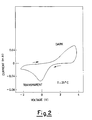
- The electrochromic window of Figure 1 is piloted by a square-wave signal generally variable within the range of from -2 volts to +2 volts. During the negative impulse (cathodic WO₃), the window is dark (intercalation of WO₃) and its transmittance is low, whilst during the following positive impulse (anodic WO₃), the window turns back into transparent (de-intercalation of lithium from WO₃), and transmittance is high. This behaviour, which can be repeated a very large number of times, is bound to the following to the electrochemical process:

- This behaviour is schematically shown in figure 2 of the accompanying drawing tables. The time interval necessary for the electrochromic processes (i.e., the cathodic and anodic processes) to take place up to completeness is of the order of hundred of seconds. This time varies with varying values of the signal which pilots the cell. In case of a square wave of from +2 volts to -2 volts, the change in transmittance between the minimum and the maximum values, and vice-versa, is obtained within a time of approximately 400 seconds.
with said polymeric electrolyte being a solid solution of an ionic lithium compound in a solid, crosslinked polyester, obtained by copolymerization of a vinyl-ether having the formula:
R-(O-CH₂-CH₂)n-O-CH=CH₂ (I)
wherein:
with a divinyl-ether having the formula:
CH₂=CH-(O-CH₂-CH₂)m-O-CH=CH₂ (II)
wherein:
with a molar ratio of the divinyl-ether (II) to the vinyl-ether (I) comprised within the range of from 1:100 to 10:100;
with said cross linked polyether having a weight average molecular weight of at least 10,000, and a glass transition temperature (Tg) comprised within the range of from -60°C to -80°C.
More particularly, the crosslinked polyether is the product obtained by copolymerization of the divinyl-ether having the formula
CH₂=CH-(O-CH₂-CH₂)₂-O-CH=CH₂
with the vinyl-ether having the formula
CH₃-(O-CH₂₋CH₂)₂-O-CH=CH₂,
in a mutual molar ratio of 3 : 100, having a weight average molecular weight of approximately 30,000 and a glass transition temperature (Tg) of -71°C. In this polyether, lithium perchlorate was dissolved in such an amount, as to have an atomic ratio of oxigen (contained in polyether) to lithium (contained in lithium perchlorate) of about 8 : 1;
Claims (8)
- Electrochromic window comprising:(a) an electrode of tungsten oxide (WO₃) on a transparent, conductive glass sheet bearing on its inner face a layer of conductive material of tin oxide, or tin and indium oxides;(b) a counterelectrode of nickel oxide (NiOz, with z comprised within the range of from 1 to 1.66), activated by electrochemical, intercalation of lithium metal, on a transparent, conductive glass sheet bearing, on its inner face, a layer of a conductive material of tin oxide, or of tin and indium oxides; and(c) a solid, polymeric electrolyte interposed between said electrode (a) and said counterelectrode (b),with said polymeric electrolyte being a solid solution of an ionic lithium compound in a solid, crosslinked polyether, obtained by copolymerization of a vinyl-ether having the formula:
R-(O-CH₂-CH₂)n-O-CH=CH₂ (I)
wherein:R represents a methyl or ethyl radical; andn is an integer comprised within the range of from 1 to 6; with a divinyl-ether having the formula:
CH₂=CH-(O-CH₂-CH₂)m-O-CH=CH₂ (II)
wherein:m is an integer comprised within the range of from 1 to 6;with a molar ratio of the divinyl-ether (II) to the vinyl-ether (I) comprised within the range of from 1:100 to 10:100;
with said crosslinked polyether having a weight average molecular weight of at least 10,000, and a glass transition temperature (Tg) comprised within the range of from -60°C to -80°C. - Electrochromic window according to claim 1, characterized in that the electrode of tungsten oxide is obtained by depositing, by sputtering, a layer of about 3,000 Å of tungsten oxide on the conductor glass.
- Electrochromic window according to claim 1, characterized in that the counterelectrode of nickel oxide is obtained by depositing nickel oxide onto the conductor glass, with a following activation treatment by electrochemical intercalation of lithium.
- Electrochromic window according to claim 1, characterized in that the ionic compounds of lithium are selected from among lithium perchlorate, borate, fluoroborate, thiocyanate, hexafluoroarsenate, trifluoroacetate and trifluoromethane-sulphonate.
- Electrochromic window according to claim 4, characterized in that the ionic compound of lithium is lithium perchlorate.
- Electrochromic window according to claim 1, characterized in that the solid, cross linked polyether is the product of copolymerization of a divinyl-ether (II) and a vinyl-ether (I), in which R is the methyl radical and n and m are integers comprised within the range of from 1 to 6, with their mutual molar ratio being of the order of 3 : 100, with a weight average molecular weight comprised within the range of from 20,000 to 100,000.
- Electrochromic window according to claim 1, characterized in that in the solid, polymeric electrolyte the atomic ratio of oxigen of polyether to lithium of the ionic compound is comprised within the range of from 4 : 1 to 12 : 1, and preferably is of the order of 8 : 1.
- Electrochromic window according to claim 1, characterized in that it furthermore comprises a generator of square-wave voltage and lines which connect said generator with two terminals respectively connected with the conductor layers of the electrode and of the counterelectrode.
Applications Claiming Priority (2)
| Application Number | Priority Date | Filing Date | Title |
|---|---|---|---|
| IT20127A IT1240674B (en) | 1990-04-24 | 1990-04-24 | POLYMERIC ELECTROLYTE-BASED ELECTROCHROME WINDOW |
| IT2012790 | 1990-04-24 |
Publications (2)
| Publication Number | Publication Date |
|---|---|
| EP0454240A2 true EP0454240A2 (en) | 1991-10-30 |
| EP0454240A3 EP0454240A3 (en) | 1992-03-11 |
Family
ID=11164027
Family Applications (1)
| Application Number | Title | Priority Date | Filing Date |
|---|---|---|---|
| EP19910200941 Withdrawn EP0454240A3 (en) | 1990-04-24 | 1991-04-19 | Electrochromic window, based on a polymeric electrolyte |
Country Status (2)
| Country | Link |
|---|---|
| EP (1) | EP0454240A3 (en) |
| IT (1) | IT1240674B (en) |
Cited By (3)
| Publication number | Priority date | Publication date | Assignee | Title |
|---|---|---|---|---|
| WO2011050291A3 (en) * | 2009-10-23 | 2011-08-18 | Applied Materials, Inc. | Materials and device stack for market viable electrochromic devices |
| US9581875B2 (en) | 2005-02-23 | 2017-02-28 | Sage Electrochromics, Inc. | Electrochromic devices and methods |
| KR20180080008A (en) * | 2017-01-03 | 2018-07-11 | 고려대학교 산학협력단 | Bending detection system |
Family Cites Families (1)
| Publication number | Priority date | Publication date | Assignee | Title |
|---|---|---|---|---|
| IT1222929B (en) * | 1987-10-16 | 1990-09-12 | Enirecherche S P A | SOLID POLYMER ELECTROLYTE AND ELECTROCHEMICAL GENERATORS THAT CONTAIN IT |
-
1990
- 1990-04-24 IT IT20127A patent/IT1240674B/en active IP Right Grant
-
1991
- 1991-04-19 EP EP19910200941 patent/EP0454240A3/en not_active Withdrawn
Cited By (6)
| Publication number | Priority date | Publication date | Assignee | Title |
|---|---|---|---|---|
| US9581875B2 (en) | 2005-02-23 | 2017-02-28 | Sage Electrochromics, Inc. | Electrochromic devices and methods |
| US10061174B2 (en) | 2005-02-23 | 2018-08-28 | Sage Electrochromics, Inc. | Electrochromic devices and methods |
| US11567383B2 (en) | 2005-02-23 | 2023-01-31 | Sage Electrochromics, Inc. | Electrochromic devices and methods |
| WO2011050291A3 (en) * | 2009-10-23 | 2011-08-18 | Applied Materials, Inc. | Materials and device stack for market viable electrochromic devices |
| US8736947B2 (en) | 2009-10-23 | 2014-05-27 | Applied Materials, Inc. | Materials and device stack for market viable electrochromic devices |
| KR20180080008A (en) * | 2017-01-03 | 2018-07-11 | 고려대학교 산학협력단 | Bending detection system |
Also Published As
| Publication number | Publication date |
|---|---|
| EP0454240A3 (en) | 1992-03-11 |
| IT1240674B (en) | 1993-12-17 |
| IT9020127A0 (en) | 1990-04-24 |
| IT9020127A1 (en) | 1991-10-24 |
Similar Documents
| Publication | Publication Date | Title |
|---|---|---|
| JP3009725B2 (en) | ELECTROCHROMIC ELEMENT, MATERIAL USED FOR THIS ELEMENT, METHOD OF MANUFACTURING THIS ELEMENT, AND USE OF THIS ELEMENT IN ELECTROCHROMIC GLASS APPARATUS | |
| EP0461685B1 (en) | Electrochromic window, based on a polymeric polyepoxy electrolyte | |
| US5142406A (en) | Electrochromic optical switching device | |
| US5206756A (en) | Solid state electrochromic devices | |
| US5442478A (en) | Electrochromic device using mercaptans and organothiolate compounds | |
| Heuer et al. | Electrochromic window based on conducting poly (3, 4‐ethylenedioxythiophene)–poly (styrene sulfonate) | |
| US6515787B1 (en) | Electrochromic layer | |
| US5161048A (en) | Electrochromic window with metal grid counter electrode and acidic polyelectrolyte | |
| US5274493A (en) | Electrochromic element, materials for use in such element, processes for making such element and such materials and use of such element in an electrochromic glass device | |
| EP0294756B1 (en) | Electrochromic window with metal grid counter electrode | |
| KR100526640B1 (en) | Electrochemical device | |
| US5350646A (en) | Ionically conductive polymeric materials | |
| US7342708B2 (en) | Electrochromic device using poly(3,4-ethylenedioxythiophene) and derivatives thereof | |
| US5215821A (en) | Solid-state electrochromic device with proton-conducting polymer electrolyte and Prussian blue counterelectrode | |
| US5471554A (en) | Primer for electrochromic device with plastic substrate | |
| EP0735408B1 (en) | Solid-state electrochromic device | |
| EP0512601B1 (en) | Process of manufacturing an electrode of nickel oxide intercalated with lithium ions | |
| CA1111537A (en) | Electrochromic devices | |
| EP0454240A2 (en) | Electrochromic window, based on a polymeric electrolyte | |
| EP3444663B1 (en) | Electrochromic device and manufacturing method therefor | |
| Andrei et al. | Highly conductive solid polymer electrolyte for smart windows | |
| Visco et al. | Polyorganodisulfide electrodes for solid-state batteries and electrochromic devices | |
| JPH06242473A (en) | Electrochromic element | |
| AU648526B2 (en) | Solid state electrochromic devices | |
| JPH06250231A (en) | Electrochromic device |
Legal Events
| Date | Code | Title | Description |
|---|---|---|---|
| PUAI | Public reference made under article 153(3) epc to a published international application that has entered the european phase |
Free format text: ORIGINAL CODE: 0009012 |
|
| AK | Designated contracting states |
Kind code of ref document: A2 Designated state(s): AT BE CH DE DK ES FR GB GR LI LU NL SE |
|
| PUAL | Search report despatched |
Free format text: ORIGINAL CODE: 0009013 |
|
| AK | Designated contracting states |
Kind code of ref document: A3 Designated state(s): AT BE CH DE DK ES FR GB GR LI LU NL SE |
|
| 17P | Request for examination filed |
Effective date: 19920610 |
|
| 17Q | First examination report despatched |
Effective date: 19940420 |
|
| STAA | Information on the status of an ep patent application or granted ep patent |
Free format text: STATUS: THE APPLICATION IS DEEMED TO BE WITHDRAWN |
|
| 18D | Application deemed to be withdrawn |
Effective date: 19941101 |