EP0452660B1 - L-glutamic acid derivatives - Google Patents
L-glutamic acid derivatives Download PDFInfo
- Publication number
- EP0452660B1 EP0452660B1 EP91103482A EP91103482A EP0452660B1 EP 0452660 B1 EP0452660 B1 EP 0452660B1 EP 91103482 A EP91103482 A EP 91103482A EP 91103482 A EP91103482 A EP 91103482A EP 0452660 B1 EP0452660 B1 EP 0452660B1
- Authority
- EP
- European Patent Office
- Prior art keywords
- olef
- arom
- acid
- mixture
- hydroxypyrimidin
- Prior art date
- Legal status (The legal status is an assumption and is not a legal conclusion. Google has not performed a legal analysis and makes no representation as to the accuracy of the status listed.)
- Expired - Lifetime
Links
- 125000003338 L-glutaminyl group Chemical class O=C([*])[C@](N([H])[H])([H])C([H])([H])C([H])([H])C(=O)N([H])[H] 0.000 title 1
- 150000001875 compounds Chemical class 0.000 claims description 23
- 125000000325 methylidene group Chemical group [H]C([H])=* 0.000 claims description 13
- 229910052739 hydrogen Inorganic materials 0.000 claims description 8
- 239000001257 hydrogen Substances 0.000 claims description 8
- 125000006244 carboxylic acid protecting group Chemical group 0.000 claims description 5
- 238000002360 preparation method Methods 0.000 claims description 5
- UFHFLCQGNIYNRP-UHFFFAOYSA-N Hydrogen Chemical compound [H][H] UFHFLCQGNIYNRP-UHFFFAOYSA-N 0.000 claims description 4
- 238000006243 chemical reaction Methods 0.000 claims description 4
- 150000002306 glutamic acid derivatives Chemical class 0.000 claims description 4
- 238000000034 method Methods 0.000 claims description 4
- 125000004432 carbon atom Chemical group C* 0.000 claims description 3
- 229910052799 carbon Inorganic materials 0.000 claims description 2
- 125000004435 hydrogen atom Chemical group [H]* 0.000 claims description 2
- 125000004029 hydroxymethyl group Chemical group [H]OC([H])([H])* 0.000 claims description 2
- 125000000391 vinyl group Chemical group [H]C([*])=C([H])[H] 0.000 claims description 2
- 229920002554 vinyl polymer Polymers 0.000 claims description 2
- 229960002989 glutamic acid Drugs 0.000 abstract description 17
- 125000003236 benzoyl group Chemical group [H]C1=C([H])C([H])=C(C([H])=C1[H])C(*)=O 0.000 abstract description 8
- WHUUTDBJXJRKMK-VKHMYHEASA-N L-Glutamic acid Natural products OC(=O)[C@@H](N)CCC(O)=O WHUUTDBJXJRKMK-VKHMYHEASA-N 0.000 abstract description 4
- 229940034982 antineoplastic agent Drugs 0.000 abstract description 4
- 239000002246 antineoplastic agent Substances 0.000 abstract description 4
- 125000004528 pyrimidin-5-yl group Chemical group N1=CN=CC(=C1)* 0.000 abstract 1
- OKKJLVBELUTLKV-UHFFFAOYSA-N Methanol Chemical compound OC OKKJLVBELUTLKV-UHFFFAOYSA-N 0.000 description 36
- 239000000203 mixture Substances 0.000 description 32
- WYURNTSHIVDZCO-UHFFFAOYSA-N Tetrahydrofuran Chemical compound C1CCOC1 WYURNTSHIVDZCO-UHFFFAOYSA-N 0.000 description 31
- RTZKZFJDLAIYFH-UHFFFAOYSA-N Diethyl ether Chemical compound CCOCC RTZKZFJDLAIYFH-UHFFFAOYSA-N 0.000 description 29
- QTBSBXVTEAMEQO-UHFFFAOYSA-N Acetic acid Chemical compound CC(O)=O QTBSBXVTEAMEQO-UHFFFAOYSA-N 0.000 description 22
- XEKOWRVHYACXOJ-UHFFFAOYSA-N Ethyl acetate Chemical compound CCOC(C)=O XEKOWRVHYACXOJ-UHFFFAOYSA-N 0.000 description 22
- CSNNHWWHGAXBCP-UHFFFAOYSA-L Magnesium sulfate Chemical compound [Mg+2].[O-][S+2]([O-])([O-])[O-] CSNNHWWHGAXBCP-UHFFFAOYSA-L 0.000 description 22
- HEDRZPFGACZZDS-MICDWDOJSA-N Trichloro(2H)methane Chemical compound [2H]C(Cl)(Cl)Cl HEDRZPFGACZZDS-MICDWDOJSA-N 0.000 description 22
- 239000000047 product Substances 0.000 description 22
- VLKZOEOYAKHREP-UHFFFAOYSA-N n-Hexane Chemical class CCCCCC VLKZOEOYAKHREP-UHFFFAOYSA-N 0.000 description 16
- HEMHJVSKTPXQMS-UHFFFAOYSA-M Sodium hydroxide Chemical compound [OH-].[Na+] HEMHJVSKTPXQMS-UHFFFAOYSA-M 0.000 description 15
- YLQBMQCUIZJEEH-UHFFFAOYSA-N tetrahydrofuran Natural products C=1C=COC=1 YLQBMQCUIZJEEH-UHFFFAOYSA-N 0.000 description 15
- HEDRZPFGACZZDS-UHFFFAOYSA-N Chloroform Chemical compound ClC(Cl)Cl HEDRZPFGACZZDS-UHFFFAOYSA-N 0.000 description 14
- IAZDPXIOMUYVGZ-WFGJKAKNSA-N Dimethyl sulfoxide Chemical compound [2H]C([2H])([2H])S(=O)C([2H])([2H])[2H] IAZDPXIOMUYVGZ-WFGJKAKNSA-N 0.000 description 14
- SJRJJKPEHAURKC-UHFFFAOYSA-N N-Methylmorpholine Chemical compound CN1CCOCC1 SJRJJKPEHAURKC-UHFFFAOYSA-N 0.000 description 12
- GRVDJDISBSALJP-UHFFFAOYSA-N methyloxidanyl Chemical compound [O]C GRVDJDISBSALJP-UHFFFAOYSA-N 0.000 description 12
- LFQSCWFLJHTTHZ-UHFFFAOYSA-N Ethanol Chemical compound CCO LFQSCWFLJHTTHZ-UHFFFAOYSA-N 0.000 description 11
- 238000001914 filtration Methods 0.000 description 11
- 238000003818 flash chromatography Methods 0.000 description 11
- 229910052943 magnesium sulfate Inorganic materials 0.000 description 11
- 235000019341 magnesium sulphate Nutrition 0.000 description 11
- YMWUJEATGCHHMB-UHFFFAOYSA-N Dichloromethane Chemical compound ClCCl YMWUJEATGCHHMB-UHFFFAOYSA-N 0.000 description 9
- FAPWRFPIFSIZLT-UHFFFAOYSA-M Sodium chloride Chemical compound [Na+].[Cl-] FAPWRFPIFSIZLT-UHFFFAOYSA-M 0.000 description 9
- 229960000583 acetic acid Drugs 0.000 description 9
- 239000002253 acid Substances 0.000 description 9
- 229960004132 diethyl ether Drugs 0.000 description 9
- 239000000284 extract Substances 0.000 description 9
- XLYOFNOQVPJJNP-UHFFFAOYSA-N water Substances O XLYOFNOQVPJJNP-UHFFFAOYSA-N 0.000 description 8
- 229940093499 ethyl acetate Drugs 0.000 description 7
- 235000019439 ethyl acetate Nutrition 0.000 description 7
- 239000000706 filtrate Substances 0.000 description 7
- 239000012362 glacial acetic acid Substances 0.000 description 7
- 229960000485 methotrexate Drugs 0.000 description 7
- 239000011541 reaction mixture Substances 0.000 description 7
- FBOZXECLQNJBKD-ZDUSSCGKSA-N L-methotrexate Chemical compound C=1N=C2N=C(N)N=C(N)C2=NC=1CN(C)C1=CC=C(C(=O)N[C@@H](CCC(O)=O)C(O)=O)C=C1 FBOZXECLQNJBKD-ZDUSSCGKSA-N 0.000 description 6
- ZMXDDKWLCZADIW-UHFFFAOYSA-N N,N-Dimethylformamide Chemical compound CN(C)C=O ZMXDDKWLCZADIW-UHFFFAOYSA-N 0.000 description 6
- UIIMBOGNXHQVGW-UHFFFAOYSA-M Sodium bicarbonate Chemical compound [Na+].OC([O-])=O UIIMBOGNXHQVGW-UHFFFAOYSA-M 0.000 description 6
- 125000003178 carboxy group Chemical group [H]OC(*)=O 0.000 description 6
- 239000000543 intermediate Substances 0.000 description 6
- 150000003839 salts Chemical class 0.000 description 6
- NLXLAEXVIDQMFP-UHFFFAOYSA-N Ammonia chloride Chemical class [NH4+].[Cl-] NLXLAEXVIDQMFP-UHFFFAOYSA-N 0.000 description 5
- WSFSSNUMVMOOMR-UHFFFAOYSA-N Formaldehyde Chemical compound O=C WSFSSNUMVMOOMR-UHFFFAOYSA-N 0.000 description 5
- 206010028980 Neoplasm Diseases 0.000 description 5
- KEAYESYHFKHZAL-UHFFFAOYSA-N Sodium Chemical compound [Na] KEAYESYHFKHZAL-UHFFFAOYSA-N 0.000 description 5
- 238000001816 cooling Methods 0.000 description 5
- 230000000694 effects Effects 0.000 description 5
- 235000019256 formaldehyde Nutrition 0.000 description 5
- 239000007789 gas Substances 0.000 description 5
- 239000012299 nitrogen atmosphere Substances 0.000 description 5
- 125000006239 protecting group Chemical group 0.000 description 5
- 238000010992 reflux Methods 0.000 description 5
- 239000007787 solid Substances 0.000 description 5
- 238000003756 stirring Methods 0.000 description 5
- 238000005160 1H NMR spectroscopy Methods 0.000 description 4
- DVNYTAVYBRSTGK-UHFFFAOYSA-N 5-aminoimidazole-4-carboxamide Chemical compound NC(=O)C=1N=CNC=1N DVNYTAVYBRSTGK-UHFFFAOYSA-N 0.000 description 4
- 239000002585 base Substances 0.000 description 4
- 230000015572 biosynthetic process Effects 0.000 description 4
- 150000002148 esters Chemical class 0.000 description 4
- 230000007062 hydrolysis Effects 0.000 description 4
- 238000006460 hydrolysis reaction Methods 0.000 description 4
- 208000032839 leukemia Diseases 0.000 description 4
- 239000002244 precipitate Substances 0.000 description 4
- 239000011780 sodium chloride Substances 0.000 description 4
- 229910000104 sodium hydride Inorganic materials 0.000 description 4
- 239000002904 solvent Substances 0.000 description 4
- QXNVGIXVLWOKEQ-UHFFFAOYSA-N Disodium Chemical class [Na][Na] QXNVGIXVLWOKEQ-UHFFFAOYSA-N 0.000 description 3
- ZMANZCXQSJIPKH-UHFFFAOYSA-N Triethylamine Chemical compound CCN(CC)CC ZMANZCXQSJIPKH-UHFFFAOYSA-N 0.000 description 3
- UAOMVDZJSHZZME-UHFFFAOYSA-N diisopropylamine Chemical compound CC(C)NC(C)C UAOMVDZJSHZZME-UHFFFAOYSA-N 0.000 description 3
- ZIUSEGSNTOUIPT-UHFFFAOYSA-N ethyl 2-cyanoacetate Chemical compound CCOC(=O)CC#N ZIUSEGSNTOUIPT-UHFFFAOYSA-N 0.000 description 3
- 125000001495 ethyl group Chemical group [H]C([H])([H])C([H])([H])* 0.000 description 3
- 238000000605 extraction Methods 0.000 description 3
- 150000002224 folic acids Chemical class 0.000 description 3
- 239000010410 layer Substances 0.000 description 3
- 125000002496 methyl group Chemical group [H]C([H])([H])* 0.000 description 3
- 239000012044 organic layer Substances 0.000 description 3
- 125000003548 sec-pentyl group Chemical group [H]C([H])([H])C([H])([H])C([H])([H])C([H])(*)C([H])([H])[H] 0.000 description 3
- 235000017557 sodium bicarbonate Nutrition 0.000 description 3
- 229910000030 sodium bicarbonate Inorganic materials 0.000 description 3
- 239000012312 sodium hydride Substances 0.000 description 3
- VOLGAXAGEUPBDM-UHFFFAOYSA-N $l^{1}-oxidanylethane Chemical compound CC[O] VOLGAXAGEUPBDM-UHFFFAOYSA-N 0.000 description 2
- JYEUMXHLPRZUAT-UHFFFAOYSA-N 1,2,3-triazine Chemical compound C1=CN=NN=C1 JYEUMXHLPRZUAT-UHFFFAOYSA-N 0.000 description 2
- VEFLKXRACNJHOV-UHFFFAOYSA-N 1,3-dibromopropane Chemical compound BrCCCBr VEFLKXRACNJHOV-UHFFFAOYSA-N 0.000 description 2
- QMNWYGTWTXOQTP-UHFFFAOYSA-N 1h-triazin-6-one Chemical compound O=C1C=CN=NN1 QMNWYGTWTXOQTP-UHFFFAOYSA-N 0.000 description 2
- GPIQOFWTZXXOOV-UHFFFAOYSA-N 2-chloro-4,6-dimethoxy-1,3,5-triazine Chemical compound COC1=NC(Cl)=NC(OC)=N1 GPIQOFWTZXXOOV-UHFFFAOYSA-N 0.000 description 2
- BBNKPDPKBCNMQU-UHFFFAOYSA-N 4-[5-(2,6-diamino-4-oxo-1h-pyrimidin-5-yl)pent-1-en-2-yl]benzoic acid Chemical compound OC1=NC(N)=NC(N)=C1CCCC(=C)C1=CC=C(C(O)=O)C=C1 BBNKPDPKBCNMQU-UHFFFAOYSA-N 0.000 description 2
- MARADXMSSCRGMR-UHFFFAOYSA-N 4-[6-(2,6-diamino-4-oxo-1h-pyrimidin-5-yl)hex-1-en-3-yl]benzoic acid Chemical compound OC1=NC(N)=NC(N)=C1CCCC(C=C)C1=CC=C(C(O)=O)C=C1 MARADXMSSCRGMR-UHFFFAOYSA-N 0.000 description 2
- TVZGACDUOSZQKY-LBPRGKRZSA-N 4-aminofolic acid Chemical compound C1=NC2=NC(N)=NC(N)=C2N=C1CNC1=CC=C(C(=O)N[C@@H](CCC(O)=O)C(O)=O)C=C1 TVZGACDUOSZQKY-LBPRGKRZSA-N 0.000 description 2
- QGZKDVFQNNGYKY-UHFFFAOYSA-O Ammonium Chemical compound [NH4+] QGZKDVFQNNGYKY-UHFFFAOYSA-O 0.000 description 2
- IJGRMHOSHXDMSA-UHFFFAOYSA-N Atomic nitrogen Chemical compound N#N IJGRMHOSHXDMSA-UHFFFAOYSA-N 0.000 description 2
- 102000004190 Enzymes Human genes 0.000 description 2
- 108090000790 Enzymes Proteins 0.000 description 2
- ZRALSGWEFCBTJO-UHFFFAOYSA-N Guanidine Chemical compound NC(N)=N ZRALSGWEFCBTJO-UHFFFAOYSA-N 0.000 description 2
- VEXZGXHMUGYJMC-UHFFFAOYSA-N Hydrochloric acid Chemical compound Cl VEXZGXHMUGYJMC-UHFFFAOYSA-N 0.000 description 2
- DGAQECJNVWCQMB-PUAWFVPOSA-M Ilexoside XXIX Chemical compound C[C@@H]1CC[C@@]2(CC[C@@]3(C(=CC[C@H]4[C@]3(CC[C@@H]5[C@@]4(CC[C@@H](C5(C)C)OS(=O)(=O)[O-])C)C)[C@@H]2[C@]1(C)O)C)C(=O)O[C@H]6[C@@H]([C@H]([C@@H]([C@H](O6)CO)O)O)O.[Na+] DGAQECJNVWCQMB-PUAWFVPOSA-M 0.000 description 2
- FYYHWMGAXLPEAU-UHFFFAOYSA-N Magnesium Chemical compound [Mg] FYYHWMGAXLPEAU-UHFFFAOYSA-N 0.000 description 2
- MZRVEZGGRBJDDB-UHFFFAOYSA-N N-Butyllithium Chemical compound [Li]CCCC MZRVEZGGRBJDDB-UHFFFAOYSA-N 0.000 description 2
- WQDUMFSSJAZKTM-UHFFFAOYSA-N Sodium methoxide Chemical compound [Na+].[O-]C WQDUMFSSJAZKTM-UHFFFAOYSA-N 0.000 description 2
- 108010022394 Threonine synthase Proteins 0.000 description 2
- IQFYYKKMVGJFEH-XLPZGREQSA-N Thymidine Chemical compound O=C1NC(=O)C(C)=CN1[C@@H]1O[C@H](CO)[C@@H](O)C1 IQFYYKKMVGJFEH-XLPZGREQSA-N 0.000 description 2
- MFUPLHQOVIUESQ-JEDNCBNOSA-N [(2s)-1,5-dimethoxy-1,5-dioxopentan-2-yl]azanium;chloride Chemical compound Cl.COC(=O)CC[C@H](N)C(=O)OC MFUPLHQOVIUESQ-JEDNCBNOSA-N 0.000 description 2
- 125000003545 alkoxy group Chemical group 0.000 description 2
- 229960003896 aminopterin Drugs 0.000 description 2
- -1 and the like Substances 0.000 description 2
- WPYMKLBDIGXBTP-UHFFFAOYSA-N benzoic acid Chemical compound OC(=O)C1=CC=CC=C1 WPYMKLBDIGXBTP-UHFFFAOYSA-N 0.000 description 2
- 208000035269 cancer or benign tumor Diseases 0.000 description 2
- YKMSJNKOLKMNJK-KRWDZBQOSA-N dimethyl (2s)-2-[[4-[5-(2,6-diamino-4-oxo-1h-pyrimidin-5-yl)pent-1-en-2-yl]benzoyl]amino]pentanedioate Chemical compound C1=CC(C(=O)N[C@@H](CCC(=O)OC)C(=O)OC)=CC=C1C(=C)CCCC1=C(N)NC(N)=NC1=O YKMSJNKOLKMNJK-KRWDZBQOSA-N 0.000 description 2
- PSHPTNYPDYGSNU-IBYPIGCZSA-N dimethyl (2s)-2-[[4-[6-(2,6-diamino-4-oxo-1h-pyrimidin-5-yl)hex-1-en-3-yl]benzoyl]amino]pentanedioate Chemical compound C1=CC(C(=O)N[C@@H](CCC(=O)OC)C(=O)OC)=CC=C1C(C=C)CCCC1=C(N)NC(N)=NC1=O PSHPTNYPDYGSNU-IBYPIGCZSA-N 0.000 description 2
- 125000000118 dimethyl group Chemical group [H]C([H])([H])* 0.000 description 2
- 238000004821 distillation Methods 0.000 description 2
- DYKGNEFQFNRTJZ-UHFFFAOYSA-N ethyl 4-(6-bromohex-1-en-3-yl)benzoate Chemical compound CCOC(=O)C1=CC=C(C(CCCBr)C=C)C=C1 DYKGNEFQFNRTJZ-UHFFFAOYSA-N 0.000 description 2
- DDDAKAHBSBYREK-UHFFFAOYSA-N ethyl 4-(7-cyano-8-ethoxy-8-oxooct-1-en-3-yl)benzoate Chemical compound CCOC(=O)C(C#N)CCCC(C=C)C1=CC=C(C(=O)OCC)C=C1 DDDAKAHBSBYREK-UHFFFAOYSA-N 0.000 description 2
- OVBPIULPVIDEAO-LBPRGKRZSA-N folic acid Chemical compound C=1N=C2NC(N)=NC(=O)C2=NC=1CNC1=CC=C(C(=O)N[C@@H](CCC(O)=O)C(O)=O)C=C1 OVBPIULPVIDEAO-LBPRGKRZSA-N 0.000 description 2
- 239000012458 free base Substances 0.000 description 2
- 229960000789 guanidine hydrochloride Drugs 0.000 description 2
- PJJJBBJSCAKJQF-UHFFFAOYSA-N guanidinium chloride Chemical compound [Cl-].NC(N)=[NH2+] PJJJBBJSCAKJQF-UHFFFAOYSA-N 0.000 description 2
- 150000002431 hydrogen Chemical group 0.000 description 2
- CBOIHMRHGLHBPB-UHFFFAOYSA-N hydroxymethyl Chemical compound O[CH2] CBOIHMRHGLHBPB-UHFFFAOYSA-N 0.000 description 2
- FDGQSTZJBFJUBT-UHFFFAOYSA-N hypoxanthine Chemical compound O=C1NC=NC2=C1NC=N2 FDGQSTZJBFJUBT-UHFFFAOYSA-N 0.000 description 2
- 229910052749 magnesium Inorganic materials 0.000 description 2
- 239000011777 magnesium Substances 0.000 description 2
- 150000002730 mercury Chemical class 0.000 description 2
- 230000002503 metabolic effect Effects 0.000 description 2
- FUJANMIDUKVLJK-UHFFFAOYSA-N methyl 3-[4-(2,6-diamino-4-oxo-1h-pyrimidin-5-yl)pent-1-en-2-yl]benzoate Chemical compound COC(=O)C1=CC=CC(C(=C)CC(C)C=2C(=NC(N)=NC=2N)O)=C1 FUJANMIDUKVLJK-UHFFFAOYSA-N 0.000 description 2
- UJJLJCGAOMACQF-UHFFFAOYSA-N methyl 4-(4-acetyloxybutanoyl)benzoate Chemical compound COC(=O)C1=CC=C(C(=O)CCCOC(C)=O)C=C1 UJJLJCGAOMACQF-UHFFFAOYSA-N 0.000 description 2
- FCRMPVNWMHHKSE-UHFFFAOYSA-N methyl 4-(4-hydroxybut-1-ynyl)benzoate Chemical compound COC(=O)C1=CC=C(C#CCCO)C=C1 FCRMPVNWMHHKSE-UHFFFAOYSA-N 0.000 description 2
- FIRZMJKUFGVJLB-UHFFFAOYSA-N methyl 4-(5-acetyloxypent-1-en-2-yl)benzoate Chemical compound COC(=O)C1=CC=C(C(=C)CCCOC(C)=O)C=C1 FIRZMJKUFGVJLB-UHFFFAOYSA-N 0.000 description 2
- JESNGIUBYPNCMB-UHFFFAOYSA-N methyl 4-(5-hydroxypent-1-en-2-yl)benzoate Chemical compound COC(=O)C1=CC=C(C(=C)CCCO)C=C1 JESNGIUBYPNCMB-UHFFFAOYSA-N 0.000 description 2
- ZFHSCOBUOOPRLG-UHFFFAOYSA-N methyl 4-(5-methylsulfonyloxypent-1-en-2-yl)benzoate Chemical compound COC(=O)C1=CC=C(C(=C)CCCOS(C)(=O)=O)C=C1 ZFHSCOBUOOPRLG-UHFFFAOYSA-N 0.000 description 2
- WLBXTIYZWZFKLQ-UHFFFAOYSA-N methyl 4-(6-cyano-7-ethoxy-7-oxohept-1-en-2-yl)benzoate Chemical compound CCOC(=O)C(C#N)CCCC(=C)C1=CC=C(C(=O)OC)C=C1 WLBXTIYZWZFKLQ-UHFFFAOYSA-N 0.000 description 2
- 125000001997 phenyl group Chemical group [H]C1=C([H])C([H])=C(*)C([H])=C1[H] 0.000 description 2
- BWHMMNNQKKPAPP-UHFFFAOYSA-L potassium carbonate Chemical compound [K+].[K+].[O-]C([O-])=O BWHMMNNQKKPAPP-UHFFFAOYSA-L 0.000 description 2
- JUJWROOIHBZHMG-UHFFFAOYSA-O pyridinium Chemical compound C1=CC=[NH+]C=C1 JUJWROOIHBZHMG-UHFFFAOYSA-O 0.000 description 2
- 229920006395 saturated elastomer Polymers 0.000 description 2
- 229910052708 sodium Inorganic materials 0.000 description 2
- 239000011734 sodium Substances 0.000 description 2
- JHJLBTNAGRQEKS-UHFFFAOYSA-M sodium bromide Chemical compound [Na+].[Br-] JHJLBTNAGRQEKS-UHFFFAOYSA-M 0.000 description 2
- QAOWNCQODCNURD-UHFFFAOYSA-N sulfuric acid Substances OS(O)(=O)=O QAOWNCQODCNURD-UHFFFAOYSA-N 0.000 description 2
- DNISEZBAYYIQFB-PHDIDXHHSA-N (2r,3r)-2,3-diacetyloxybutanedioic acid Chemical compound CC(=O)O[C@@H](C(O)=O)[C@H](C(O)=O)OC(C)=O DNISEZBAYYIQFB-PHDIDXHHSA-N 0.000 description 1
- QLPRLGAHKHCVEW-AWEZNQCLSA-N (2s)-2-[[4-[(2,4-diaminopyrido[2,3-d]pyrimidin-6-yl)methylamino]benzoyl]amino]pentanedioic acid Chemical compound C1=NC2=NC(N)=NC(N)=C2C=C1CNC1=CC=C(C(=O)N[C@@H](CCC(O)=O)C(O)=O)C=C1 QLPRLGAHKHCVEW-AWEZNQCLSA-N 0.000 description 1
- JVKOZIXIYHORFY-CVRLYYSRSA-N (2s)-2-[[4-[2-(2,4-diamino-5,6,7,8-tetrahydropyrido[2,3-d]pyrimidin-6-yl)ethyl]benzoyl]amino]pentanedioic acid Chemical compound C1NC2=NC(N)=NC(N)=C2CC1CCC1=CC=C(C(=O)N[C@@H](CCC(O)=O)C(O)=O)C=C1 JVKOZIXIYHORFY-CVRLYYSRSA-N 0.000 description 1
- LGFLRHWJJKLPCC-ZDUSSCGKSA-N (2s)-2-[[4-[2-(2,4-diaminopteridin-6-yl)ethyl]benzoyl]amino]pentanedioic acid Chemical compound C1=NC2=NC(N)=NC(N)=C2N=C1CCC1=CC=C(C(=O)N[C@@H](CCC(O)=O)C(O)=O)C=C1 LGFLRHWJJKLPCC-ZDUSSCGKSA-N 0.000 description 1
- RGUQKUKRLMXLCM-HNNXBMFYSA-N (2s)-2-[[4-[2-(2,4-diaminopyrido[2,3-d]pyrimidin-6-yl)ethyl]benzoyl]amino]pentanedioic acid Chemical compound C1=NC2=NC(N)=NC(N)=C2C=C1CCC1=CC=C(C(=O)N[C@@H](CCC(O)=O)C(O)=O)C=C1 RGUQKUKRLMXLCM-HNNXBMFYSA-N 0.000 description 1
- BHDZQFSNQPIPGI-HNNXBMFYSA-N (2s)-2-[[4-[2-(2-amino-4-oxo-1h-pyrido[2,3-d]pyrimidin-6-yl)ethyl]benzoyl]amino]pentanedioic acid Chemical class C=1N=C2NC(N)=NC(=O)C2=CC=1CCC1=CC=C(C(=O)N[C@@H](CCC(O)=O)C(O)=O)C=C1 BHDZQFSNQPIPGI-HNNXBMFYSA-N 0.000 description 1
- HNINZDCYNQKJFV-HNNXBMFYSA-N (2s)-2-[[4-[5-(2,6-diamino-4-oxo-1h-pyrimidin-5-yl)pent-1-en-2-yl]benzoyl]amino]pentanedioic acid Chemical compound N1C(N)=NC(=O)C(CCCC(=C)C=2C=CC(=CC=2)C(=O)N[C@@H](CCC(O)=O)C(O)=O)=C1N HNINZDCYNQKJFV-HNNXBMFYSA-N 0.000 description 1
- MSTNYGQPCMXVAQ-RYUDHWBXSA-N (6S)-5,6,7,8-tetrahydrofolic acid Chemical compound C([C@H]1CNC=2N=C(NC(=O)C=2N1)N)NC1=CC=C(C(=O)N[C@@H](CCC(O)=O)C(O)=O)C=C1 MSTNYGQPCMXVAQ-RYUDHWBXSA-N 0.000 description 1
- MIOPJNTWMNEORI-GMSGAONNSA-N (S)-camphorsulfonic acid Chemical compound C1C[C@@]2(CS(O)(=O)=O)C(=O)C[C@@H]1C2(C)C MIOPJNTWMNEORI-GMSGAONNSA-N 0.000 description 1
- BJEPYKJPYRNKOW-REOHCLBHSA-N (S)-malic acid Chemical compound OC(=O)[C@@H](O)CC(O)=O BJEPYKJPYRNKOW-REOHCLBHSA-N 0.000 description 1
- KFDGPNMYYRHJPQ-UHFFFAOYSA-N 2-[4-(6-bromohex-1-en-3-yl)phenyl]-4,4-dimethyl-5h-1,3-oxazole Chemical compound CC1(C)COC(C=2C=CC(=CC=2)C(CCCBr)C=C)=N1 KFDGPNMYYRHJPQ-UHFFFAOYSA-N 0.000 description 1
- WDZACGWEPQLKOM-UHFFFAOYSA-N 2-chloro-1,3,5-trimethylbenzene Chemical compound CC1=CC(C)=C(Cl)C(C)=C1 WDZACGWEPQLKOM-UHFFFAOYSA-N 0.000 description 1
- ODHCTXKNWHHXJC-VKHMYHEASA-N 5-oxo-L-proline Chemical compound OC(=O)[C@@H]1CCC(=O)N1 ODHCTXKNWHHXJC-VKHMYHEASA-N 0.000 description 1
- VVIAGPKUTFNRDU-UHFFFAOYSA-N 6S-folinic acid Natural products C1NC=2NC(N)=NC(=O)C=2N(C=O)C1CNC1=CC=C(C(=O)NC(CCC(O)=O)C(O)=O)C=C1 VVIAGPKUTFNRDU-UHFFFAOYSA-N 0.000 description 1
- HBAQYPYDRFILMT-UHFFFAOYSA-N 8-[3-(1-cyclopropylpyrazol-4-yl)-1H-pyrazolo[4,3-d]pyrimidin-5-yl]-3-methyl-3,8-diazabicyclo[3.2.1]octan-2-one Chemical class C1(CC1)N1N=CC(=C1)C1=NNC2=C1N=C(N=C2)N1C2C(N(CC1CC2)C)=O HBAQYPYDRFILMT-UHFFFAOYSA-N 0.000 description 1
- UHOVQNZJYSORNB-UHFFFAOYSA-N Benzene Chemical compound C1=CC=CC=C1 UHOVQNZJYSORNB-UHFFFAOYSA-N 0.000 description 1
- DWRXFEITVBNRMK-UHFFFAOYSA-N Beta-D-1-Arabinofuranosylthymine Natural products O=C1NC(=O)C(C)=CN1C1C(O)C(O)C(CO)O1 DWRXFEITVBNRMK-UHFFFAOYSA-N 0.000 description 1
- GEXAWIPVLNXYAP-UHFFFAOYSA-N CC1(C)C(C(O)=O)CCC1(CBr)C(O)=O Chemical compound CC1(C)C(C(O)=O)CCC1(CBr)C(O)=O GEXAWIPVLNXYAP-UHFFFAOYSA-N 0.000 description 1
- OYPRJOBELJOOCE-UHFFFAOYSA-N Calcium Chemical compound [Ca] OYPRJOBELJOOCE-UHFFFAOYSA-N 0.000 description 1
- LSPHULWDVZXLIL-UHFFFAOYSA-N Camphoric acid Natural products CC1(C)C(C(O)=O)CCC1(C)C(O)=O LSPHULWDVZXLIL-UHFFFAOYSA-N 0.000 description 1
- 208000006332 Choriocarcinoma Diseases 0.000 description 1
- FEWJPZIEWOKRBE-JCYAYHJZSA-N Dextrotartaric acid Chemical compound OC(=O)[C@H](O)[C@@H](O)C(O)=O FEWJPZIEWOKRBE-JCYAYHJZSA-N 0.000 description 1
- 229940117937 Dihydrofolate reductase inhibitor Drugs 0.000 description 1
- WHUUTDBJXJRKMK-UHFFFAOYSA-N Glutamic acid Natural products OC(=O)C(N)CCC(O)=O WHUUTDBJXJRKMK-UHFFFAOYSA-N 0.000 description 1
- 239000007818 Grignard reagent Substances 0.000 description 1
- UGQMRVRMYYASKQ-UHFFFAOYSA-N Hypoxanthine nucleoside Natural products OC1C(O)C(CO)OC1N1C(NC=NC2=O)=C2N=C1 UGQMRVRMYYASKQ-UHFFFAOYSA-N 0.000 description 1
- 150000008539 L-glutamic acids Chemical class 0.000 description 1
- WHXSMMKQMYFTQS-UHFFFAOYSA-N Lithium Chemical compound [Li] WHXSMMKQMYFTQS-UHFFFAOYSA-N 0.000 description 1
- 241000124008 Mammalia Species 0.000 description 1
- OVBPIULPVIDEAO-UHFFFAOYSA-N N-Pteroyl-L-glutaminsaeure Natural products C=1N=C2NC(N)=NC(=O)C2=NC=1CNC1=CC=C(C(=O)NC(CCC(O)=O)C(O)=O)C=C1 OVBPIULPVIDEAO-UHFFFAOYSA-N 0.000 description 1
- CHJJGSNFBQVOTG-UHFFFAOYSA-N N-methyl-guanidine Natural products CNC(N)=N CHJJGSNFBQVOTG-UHFFFAOYSA-N 0.000 description 1
- 208000015914 Non-Hodgkin lymphomas Diseases 0.000 description 1
- ZLMJMSJWJFRBEC-UHFFFAOYSA-N Potassium Chemical compound [K] ZLMJMSJWJFRBEC-UHFFFAOYSA-N 0.000 description 1
- 201000004681 Psoriasis Diseases 0.000 description 1
- 229910006069 SO3H Inorganic materials 0.000 description 1
- VYPSYNLAJGMNEJ-UHFFFAOYSA-N Silicium dioxide Chemical compound O=[Si]=O VYPSYNLAJGMNEJ-UHFFFAOYSA-N 0.000 description 1
- 206010041067 Small cell lung cancer Diseases 0.000 description 1
- VMHLLURERBWHNL-UHFFFAOYSA-M Sodium acetate Chemical compound [Na+].CC([O-])=O VMHLLURERBWHNL-UHFFFAOYSA-M 0.000 description 1
- FEWJPZIEWOKRBE-UHFFFAOYSA-N Tartaric acid Natural products [H+].[H+].[O-]C(=O)C(O)C(O)C([O-])=O FEWJPZIEWOKRBE-UHFFFAOYSA-N 0.000 description 1
- 102000005497 Thymidylate Synthase Human genes 0.000 description 1
- DTQVDTLACAAQTR-UHFFFAOYSA-N Trifluoroacetic acid Chemical compound OC(=O)C(F)(F)F DTQVDTLACAAQTR-UHFFFAOYSA-N 0.000 description 1
- HCHKCACWOHOZIP-UHFFFAOYSA-N Zinc Chemical compound [Zn] HCHKCACWOHOZIP-UHFFFAOYSA-N 0.000 description 1
- BHIIGRBMZRSDRI-UHFFFAOYSA-N [chloro(phenoxy)phosphoryl]oxybenzene Chemical compound C=1C=CC=CC=1OP(=O)(Cl)OC1=CC=CC=C1 BHIIGRBMZRSDRI-UHFFFAOYSA-N 0.000 description 1
- 230000002378 acidificating effect Effects 0.000 description 1
- 150000007513 acids Chemical class 0.000 description 1
- 230000004913 activation Effects 0.000 description 1
- 208000009956 adenocarcinoma Diseases 0.000 description 1
- 238000006136 alcoholysis reaction Methods 0.000 description 1
- 229910052783 alkali metal Inorganic materials 0.000 description 1
- 150000008044 alkali metal hydroxides Chemical class 0.000 description 1
- 150000001340 alkali metals Chemical class 0.000 description 1
- 229910052784 alkaline earth metal Inorganic materials 0.000 description 1
- 150000001342 alkaline earth metals Chemical class 0.000 description 1
- AFVLVVWMAFSXCK-VMPITWQZSA-N alpha-cyano-4-hydroxycinnamic acid Chemical group OC(=O)C(\C#N)=C\C1=CC=C(O)C=C1 AFVLVVWMAFSXCK-VMPITWQZSA-N 0.000 description 1
- BJEPYKJPYRNKOW-UHFFFAOYSA-N alpha-hydroxysuccinic acid Natural products OC(=O)C(O)CC(O)=O BJEPYKJPYRNKOW-UHFFFAOYSA-N 0.000 description 1
- 229910052782 aluminium Inorganic materials 0.000 description 1
- XAGFODPZIPBFFR-UHFFFAOYSA-N aluminium Chemical compound [Al] XAGFODPZIPBFFR-UHFFFAOYSA-N 0.000 description 1
- 150000003863 ammonium salts Chemical class 0.000 description 1
- 150000008064 anhydrides Chemical class 0.000 description 1
- 230000001399 anti-metabolic effect Effects 0.000 description 1
- 230000000340 anti-metabolite Effects 0.000 description 1
- 229940100197 antimetabolite Drugs 0.000 description 1
- 239000002256 antimetabolite Substances 0.000 description 1
- 239000011260 aqueous acid Substances 0.000 description 1
- 206010003246 arthritis Diseases 0.000 description 1
- 125000003118 aryl group Chemical group 0.000 description 1
- 125000002648 azanetriyl group Chemical group *N(*)* 0.000 description 1
- 125000001797 benzyl group Chemical group [H]C1=C([H])C([H])=C(C([H])=C1[H])C([H])([H])* 0.000 description 1
- IQFYYKKMVGJFEH-UHFFFAOYSA-N beta-L-thymidine Natural products O=C1NC(=O)C(C)=CN1C1OC(CO)C(O)C1 IQFYYKKMVGJFEH-UHFFFAOYSA-N 0.000 description 1
- 210000000481 breast Anatomy 0.000 description 1
- 229910052791 calcium Inorganic materials 0.000 description 1
- 239000011575 calcium Substances 0.000 description 1
- LSPHULWDVZXLIL-QUBYGPBYSA-N camphoric acid Chemical compound CC1(C)[C@H](C(O)=O)CC[C@]1(C)C(O)=O LSPHULWDVZXLIL-QUBYGPBYSA-N 0.000 description 1
- 201000011510 cancer Diseases 0.000 description 1
- 239000002775 capsule Substances 0.000 description 1
- 150000001721 carbon Chemical group 0.000 description 1
- 125000002843 carboxylic acid group Chemical group 0.000 description 1
- 125000002091 cationic group Chemical group 0.000 description 1
- 150000001768 cations Chemical class 0.000 description 1
- 238000005119 centrifugation Methods 0.000 description 1
- 238000004587 chromatography analysis Methods 0.000 description 1
- 238000009833 condensation Methods 0.000 description 1
- 230000005494 condensation Effects 0.000 description 1
- 230000008878 coupling Effects 0.000 description 1
- 238000010168 coupling process Methods 0.000 description 1
- 238000005859 coupling reaction Methods 0.000 description 1
- 231100000433 cytotoxic Toxicity 0.000 description 1
- 230000001472 cytotoxic effect Effects 0.000 description 1
- 231100000135 cytotoxicity Toxicity 0.000 description 1
- 230000003013 cytotoxicity Effects 0.000 description 1
- GYOZYWVXFNDGLU-XLPZGREQSA-N dTMP Chemical compound O=C1NC(=O)C(C)=CN1[C@@H]1O[C@H](COP(O)(O)=O)[C@@H](O)C1 GYOZYWVXFNDGLU-XLPZGREQSA-N 0.000 description 1
- 102000004419 dihydrofolate reductase Human genes 0.000 description 1
- 239000003166 dihydrofolate reductase inhibitor Substances 0.000 description 1
- OZRNSSUDZOLUSN-LBPRGKRZSA-N dihydrofolic acid Chemical compound N=1C=2C(=O)NC(N)=NC=2NCC=1CNC1=CC=C(C(=O)N[C@@H](CCC(O)=O)C(O)=O)C=C1 OZRNSSUDZOLUSN-LBPRGKRZSA-N 0.000 description 1
- 229940043279 diisopropylamine Drugs 0.000 description 1
- SWSQBOPZIKWTGO-UHFFFAOYSA-N dimethylaminoamidine Natural products CN(C)C(N)=N SWSQBOPZIKWTGO-UHFFFAOYSA-N 0.000 description 1
- 125000005982 diphenylmethyl group Chemical group [H]C1=C([H])C([H])=C(C([H])=C1[H])C([H])(*)C1=C([H])C([H])=C([H])C([H])=C1[H] 0.000 description 1
- 229940079593 drug Drugs 0.000 description 1
- 239000003814 drug Substances 0.000 description 1
- 238000001035 drying Methods 0.000 description 1
- 229920001971 elastomer Polymers 0.000 description 1
- 230000002255 enzymatic effect Effects 0.000 description 1
- 235000019152 folic acid Nutrition 0.000 description 1
- 239000011724 folic acid Substances 0.000 description 1
- 229960000304 folic acid Drugs 0.000 description 1
- 239000004052 folic acid antagonist Substances 0.000 description 1
- VVIAGPKUTFNRDU-ABLWVSNPSA-N folinic acid Chemical compound C1NC=2NC(N)=NC(=O)C=2N(C=O)C1CNC1=CC=C(C(=O)N[C@@H](CCC(O)=O)C(O)=O)C=C1 VVIAGPKUTFNRDU-ABLWVSNPSA-N 0.000 description 1
- 235000008191 folinic acid Nutrition 0.000 description 1
- 239000011672 folinic acid Substances 0.000 description 1
- 238000001640 fractional crystallisation Methods 0.000 description 1
- 150000004795 grignard reagents Chemical class 0.000 description 1
- 229960004198 guanidine Drugs 0.000 description 1
- 229910052736 halogen Inorganic materials 0.000 description 1
- 125000005843 halogen group Chemical group 0.000 description 1
- 150000002367 halogens Chemical group 0.000 description 1
- 208000014829 head and neck neoplasm Diseases 0.000 description 1
- 238000010438 heat treatment Methods 0.000 description 1
- 125000000623 heterocyclic group Chemical group 0.000 description 1
- 239000005457 ice water Substances 0.000 description 1
- 125000001841 imino group Chemical group [H]N=* 0.000 description 1
- 239000012535 impurity Substances 0.000 description 1
- 230000005764 inhibitory process Effects 0.000 description 1
- 238000001361 intraarterial administration Methods 0.000 description 1
- 238000007918 intramuscular administration Methods 0.000 description 1
- 238000007913 intrathecal administration Methods 0.000 description 1
- 238000001990 intravenous administration Methods 0.000 description 1
- 229960001691 leucovorin Drugs 0.000 description 1
- 229910052744 lithium Inorganic materials 0.000 description 1
- 201000005243 lung squamous cell carcinoma Diseases 0.000 description 1
- 239000001630 malic acid Substances 0.000 description 1
- 235000011090 malic acid Nutrition 0.000 description 1
- 208000026037 malignant tumor of neck Diseases 0.000 description 1
- BRMYZIKAHFEUFJ-UHFFFAOYSA-L mercury diacetate Chemical compound CC(=O)O[Hg]OC(C)=O BRMYZIKAHFEUFJ-UHFFFAOYSA-L 0.000 description 1
- 229910052751 metal Inorganic materials 0.000 description 1
- 239000002184 metal Substances 0.000 description 1
- OKKJLVBELUTLKV-VMNATFBRSA-N methanol-d1 Chemical compound [2H]OC OKKJLVBELUTLKV-VMNATFBRSA-N 0.000 description 1
- RMIODHQZRUFFFF-UHFFFAOYSA-N methoxyacetic acid Chemical compound COCC(O)=O RMIODHQZRUFFFF-UHFFFAOYSA-N 0.000 description 1
- 125000004184 methoxymethyl group Chemical group [H]C([H])([H])OC([H])([H])* 0.000 description 1
- AZFQCTBZOPUVOW-UHFFFAOYSA-N methyl(triphenyl)phosphanium Chemical compound C=1C=CC=CC=1[P+](C=1C=CC=CC=1)(C)C1=CC=CC=C1 AZFQCTBZOPUVOW-UHFFFAOYSA-N 0.000 description 1
- 201000005962 mycosis fungoides Diseases 0.000 description 1
- 229910052757 nitrogen Inorganic materials 0.000 description 1
- 231100000252 nontoxic Toxicity 0.000 description 1
- 230000003000 nontoxic effect Effects 0.000 description 1
- 230000003287 optical effect Effects 0.000 description 1
- 239000006186 oral dosage form Substances 0.000 description 1
- 239000003960 organic solvent Substances 0.000 description 1
- 125000001181 organosilyl group Chemical group [SiH3]* 0.000 description 1
- 229960003552 other antineoplastic agent in atc Drugs 0.000 description 1
- 125000006503 p-nitrobenzyl group Chemical group [H]C1=C([H])C(=C([H])C([H])=C1[N+]([O-])=O)C([H])([H])* 0.000 description 1
- 230000020477 pH reduction Effects 0.000 description 1
- 238000007911 parenteral administration Methods 0.000 description 1
- 229910052700 potassium Inorganic materials 0.000 description 1
- 239000011591 potassium Substances 0.000 description 1
- 229910000027 potassium carbonate Inorganic materials 0.000 description 1
- 238000001556 precipitation Methods 0.000 description 1
- 102000004196 processed proteins & peptides Human genes 0.000 description 1
- 108090000765 processed proteins & peptides Proteins 0.000 description 1
- 150000003195 pteridines Chemical class 0.000 description 1
- 238000000746 purification Methods 0.000 description 1
- 230000006825 purine synthesis Effects 0.000 description 1
- 150000003212 purines Chemical class 0.000 description 1
- 125000000714 pyrimidinyl group Chemical group 0.000 description 1
- 230000008929 regeneration Effects 0.000 description 1
- 238000011069 regeneration method Methods 0.000 description 1
- 238000007363 ring formation reaction Methods 0.000 description 1
- 239000000741 silica gel Substances 0.000 description 1
- 229910002027 silica gel Inorganic materials 0.000 description 1
- 208000000587 small cell lung carcinoma Diseases 0.000 description 1
- 239000001632 sodium acetate Substances 0.000 description 1
- 235000017281 sodium acetate Nutrition 0.000 description 1
- WRIKHQLVHPKCJU-UHFFFAOYSA-N sodium bis(trimethylsilyl)amide Chemical compound C[Si](C)(C)N([Na])[Si](C)(C)C WRIKHQLVHPKCJU-UHFFFAOYSA-N 0.000 description 1
- 150000003431 steroids Chemical class 0.000 description 1
- 239000000126 substance Substances 0.000 description 1
- 239000000758 substrate Substances 0.000 description 1
- 238000003786 synthesis reaction Methods 0.000 description 1
- 239000011975 tartaric acid Substances 0.000 description 1
- 235000002906 tartaric acid Nutrition 0.000 description 1
- 125000000999 tert-butyl group Chemical group [H]C([H])([H])C(*)(C([H])([H])[H])C([H])([H])[H] 0.000 description 1
- 239000005460 tetrahydrofolate Substances 0.000 description 1
- 229940104230 thymidine Drugs 0.000 description 1
- GSEJCLTVZPLZKY-UHFFFAOYSA-O triethanolammonium Chemical compound OCC[NH+](CCO)CCO GSEJCLTVZPLZKY-UHFFFAOYSA-O 0.000 description 1
- ZMANZCXQSJIPKH-UHFFFAOYSA-O triethylammonium ion Chemical compound CC[NH+](CC)CC ZMANZCXQSJIPKH-UHFFFAOYSA-O 0.000 description 1
- ILWRPSCZWQJDMK-UHFFFAOYSA-N triethylazanium;chloride Chemical compound Cl.CCN(CC)CC ILWRPSCZWQJDMK-UHFFFAOYSA-N 0.000 description 1
- GETQZCLCWQTVFV-UHFFFAOYSA-N trimethylamine Chemical compound CN(C)C GETQZCLCWQTVFV-UHFFFAOYSA-N 0.000 description 1
- 125000000026 trimethylsilyl group Chemical group [H]C([H])([H])[Si]([*])(C([H])([H])[H])C([H])([H])[H] 0.000 description 1
- FIQMHBFVRAXMOP-UHFFFAOYSA-N triphenylphosphane oxide Chemical compound C=1C=CC=CC=1P(C=1C=CC=CC=1)(=O)C1=CC=CC=C1 FIQMHBFVRAXMOP-UHFFFAOYSA-N 0.000 description 1
- 229910052725 zinc Inorganic materials 0.000 description 1
- 239000011701 zinc Substances 0.000 description 1
Classifications
-
- C—CHEMISTRY; METALLURGY
- C07—ORGANIC CHEMISTRY
- C07D—HETEROCYCLIC COMPOUNDS
- C07D239/00—Heterocyclic compounds containing 1,3-diazine or hydrogenated 1,3-diazine rings
- C07D239/02—Heterocyclic compounds containing 1,3-diazine or hydrogenated 1,3-diazine rings not condensed with other rings
- C07D239/24—Heterocyclic compounds containing 1,3-diazine or hydrogenated 1,3-diazine rings not condensed with other rings having three or more double bonds between ring members or between ring members and non-ring members
- C07D239/28—Heterocyclic compounds containing 1,3-diazine or hydrogenated 1,3-diazine rings not condensed with other rings having three or more double bonds between ring members or between ring members and non-ring members with hetero atoms or with carbon atoms having three bonds to hetero atoms with at the most one bond to halogen, directly attached to ring carbon atoms
- C07D239/46—Two or more oxygen, sulphur or nitrogen atoms
- C07D239/48—Two nitrogen atoms
-
- A—HUMAN NECESSITIES
- A61—MEDICAL OR VETERINARY SCIENCE; HYGIENE
- A61P—SPECIFIC THERAPEUTIC ACTIVITY OF CHEMICAL COMPOUNDS OR MEDICINAL PREPARATIONS
- A61P35/00—Antineoplastic agents
Definitions
- This invention pertains to derivatives of L-glutamic acid which are antineoplastic agents, to their preparation and use, and to intermediates useful in their preparation.
- aminopterin and amethopterin are antineoplastic agents. These compounds inhibit enzymatic conversions involving metabolic derivatives of folic acid.
- Amethopterin for example, inhibits dihydrofolate reductase, an enzyme necessary for the regeneration of tetrahydrofolate from dihydrofolate which is formed during the conversion of 2-deoxyuridylate to thymidylate by the enzyme thymidylate synthetase.
- 10-Dideazafolic acid is only marginally effective as a dihydrofolate reductase inhibitor (DeGraw et al., "Chemistry and Biology of Pteridines", Elsevier, 1979, 229) and 5,8, 10-trideazafolic acid also shows only marginal activity against mouse L1210 leukemia (Oatis et al., J. Med. Chem ., 1977, 20 , 1393). 5,10-Dideazaaminopterin and 5,10-dideaza-5,6,7,8-tetrahydroaminopterin, and the corresponding 5,10-dideazafolic acid derivatives are reported by Taylor et al., J. Med. Chem ., 28:7, 914 (1985).
- the invention pertains to glutamic acid derivatives of the formula: in which
- the invention includes the pharmaceutically acceptable alkali metal, alkaline earth metal, non-toxic metal, ammonium, and substituted ammonium salts, such as for example the sodium, potassium, lithium, calcium, magnesium, aluminum, zinc, ammonium, trimethylammonium, triethylammonium, triethanolammonium, pyridinium, substituted pyridinium, and the like.
- the compounds can be prepared by hydrolysis of a 2,6-diamino-4-hydroxypyrimidin-5-yl-L-glutamic acid derivative of the formula: in which each of R and R3 is the same or different carboxylic acid protecting group, and n, Z and R are as defined above.
- Carboxylic acid protecting groups can be, for example, esters conceptually derived from lower alkanols of from 1 to 6 carbon atoms, including those branched in the 1-position and those which are substituted with one of more aromatic groups such as phenyl, or with halo or alkoxy; e.g., methyl, ethyl, t-butyl, benzyl, 4-nitrobenzyl, diphenylmethyl, methoxymethyl, and the like esters.
- Silyl esters such as trimethylsilyl also can be employed.
- the hydrolysis is conducted at normal temperatures utilizing aqueous acid or base, such as for example, an aqueous alkali metal hydroxide, optionally in the presence of a water miscible organic solvent such as methanol, ethanol, tetrahydrofuran, dimethylformamide, and the like, or an acid, as for example triflouroacetic acid.
- aqueous acid or base such as for example, an aqueous alkali metal hydroxide
- a water miscible organic solvent such as methanol, ethanol, tetrahydrofuran, dimethylformamide, and the like
- an acid as for example triflouroacetic acid.
- the resulting products generally are crystalline or microcrystalline solids.
- Compounds of Formula II can be prepared by coupling a compound of the formula: with a protected glutamic acid derivative of the formula: utilizing conventional condensation techniques for the formation of peptide bonds, such as activation of the carboxylic acid group through formation of a mixed anhydride, treatment with DCC, or the use of diphenylchlorophosphonate.
- Formation of the intermediate of Formula III can be accomplished by cyclization of an ⁇ -cyano dicarboxylate of the formula: in which R4 and R4' are the same or different alkoxy group of 1 to 6 carbon atoms and n, Z and R are as herein defined, with guanidine free base. Following formation of the pyrimidine ring, the R4' group can be removed through hydrolysis.
- the intermediates of Formula V can be prepared by condensing an alkyl cyanoacetate of the formula: R4CO-CH2-CN (VI) with an ester of the formula: in which n, Z, R, R4 and R4' are as herein defined and R5 is halogen in the presence of a strong base such as sodium hydride.
- ester intermediates of Formula VII are either known or can be prepared by known methods, as more fully exemplified below.
- Typical compounds of the present invention include N-(4-[5-(2,6-diamino-4-hydroxypyrimidin-5-yl)pent-1-en-2-yl]benzoyl)-L-glutamic acid; N-(4-[6-(2,6-diamino-4-hydroxypyrimidin-5-yl)hex-1-en-3-yl]benzoyl)-L-glutamic acid; and N-(4-[1-hydroxy-5-(2,6-diamino-4-hydroxypyrimidin-5-yl)pent-2-yl]benzoyl)-L-glutamic acid.
- the compounds of Formula I contain a chiral center in the L-glutamic acid portion of the molecule. If no other chiral centers are present, the compounds are obtained in this configuration as the single enantiomer. If Z is hydrogen, however, a second chiral center is present, leading to diastereomers. These diastereomers can be separated mechanically, as by chromatography, so that each is in a form substantially free of the other; i.e., having an optical purity of >95%. Alternatively, a mixture of diastereoisomeric compounds of Formula I is treated with a chiral acid operable to form a salt therewith.
- the resultant diastereoisomeric salts are then separated through one or more fractional crystallizations and thereafter the free base of the cationic moiety of at least one of the separated salts is liberated through treatment with a base and removal of the protecting groups.
- the liberation of the cation of the salt can be performed as a discrete step before or after the removal of the protecting groups, or concomitantly with the removal when such groups are susceptible to removal under basic conditions; i.e., basic hydrolysis.
- Suitable chiral acids include the individual enantiomers of 10-camphorsulfonic acid, camphoric acid, alpha bromocamphoric acid, methoxyacetic acid, tartaric acid, diacetyltartaric acid, malic acid, pyrrolidone-5-carboxylic acid, and the like.
- the compounds of this invention have an effect on one or more enzymes which utilize folic acid, and in particular metabolic derivatives of folic acid, as a substrate.
- the IC50 in whole cell human leukemia cell lines, CCFR-CEM, of N-(4-[5-(2,6-diamino-4-hydroxypyrimidin-5-yl)-pent-1-en-2-ylbenzoyl)-L-glutamic acid is approximately 0.004 ⁇ g/ml
- that for N-(4-[6-(2,6-diamino-4-hydroxypyrimidin-5-yl)-hex-1-en-3-yl]benzoyl)-L-glutamic acid is approximately 0.0035 ⁇ g/ml.
- Cytotoxicity is reversed by addition of purines such as hypoxanthine or by addition of leucovorin or amino-imidazolecarboxamide (AICA) but is not reversed by addition of thymidine, indicating specific inhibition in the de novo purine synthesis.
- purines such as hypoxanthine or by addition of leucovorin or amino-imidazolecarboxamide (AICA)
- AICA amino-imidazolecarboxamide
- the compounds of Formula I can be used, alone or in combination, to treat neoplasms including choriocarcinoma, leukemia, adenocarcinoma of the female breast, epidermid cancers of the head and neck, squamous or small-cell lung cancer, and various lymphosarcomas.
- the compounds can also be used to treat mycosis fungoides, psoriasis, and arthritis.
- the compounds can be administered either orally or preferably parenterally, alone or in combination with other anti-neoplastic agents, steroids, etc., to a mammal suffering from neoplasm and in need of treatment.
- Parenteral routes of administration include intramuscular, intrathecal, intravenous, or intraarterial.
- the compounds are administered in much the same fashion as methotrexate, but because of a different mode of action, can be administered in higher dosages than those usually employed with methotrexate.
- Dosage regimens must be titrated to the particular neoplasm, the condition of the patient, and the response but generally doses will be from about 10 to about 100 mg/day for 5-10 days or single daily administration of 250-500 mg., repeated periodically; e.g. every 14 days.
- Oral dosage forms include tablets and capsules containing from 1-10 mg of drug per unit dosage. Isotonic saline solutions containing 20-100 mg/ml can be used for parenteral administration.
- This compound was prepared according to Taylor et al., Heterocycles , 1989, 28 :1169, modified by stirring for 3 days at room temperature, extracting with diethyl ether, and filtering over silica gel with 1:1 ethylacetate:hexanes.
- Methyl triphenylphosphonium (1.5g, 1.1 eq) was suspended in 50 ml of anhydrous tetrahydrofuran and 4.0 ml of 1.0M solution of sodium hexamethyldisilazide (1.05 eq) in tetrahydrofuran were added via syringe. The mixture was stirred at room temperature for one hour and a solution of 1.0g (1.0 eq) of methyl 4-(4-acetoxy-1-oxobutyl)benzoate in anhydrous tetrahydrofuran, was added dropwise. The resulting reaction mixture was stirred for 2 hours at room temperature.
- a 1 liter three neck round bottomed-flask was equipped with a reflux condenser, addition funnel, and gas inlet, and charged with a mixture of 0.10g (5.0 eq) of 80% sodium hydride in 40 ml of anhydrous tetrahydrofuran. This mixture was cooled to 0°C and a solution of 0.39 ml (5.5 eq) of ethyl cyanoacetate in anhydrous tetrahydrofuran was added dropwise under a nitrogen atmosphere. The mixture was vigorously stirred and allowed to attain room temperature until hydrogen evolution was no longer observed.
Landscapes
- Chemical & Material Sciences (AREA)
- Organic Chemistry (AREA)
- Health & Medical Sciences (AREA)
- Chemical Kinetics & Catalysis (AREA)
- General Chemical & Material Sciences (AREA)
- Medicinal Chemistry (AREA)
- Nuclear Medicine, Radiotherapy & Molecular Imaging (AREA)
- Pharmacology & Pharmacy (AREA)
- Life Sciences & Earth Sciences (AREA)
- Animal Behavior & Ethology (AREA)
- General Health & Medical Sciences (AREA)
- Public Health (AREA)
- Veterinary Medicine (AREA)
- Pharmaceuticals Containing Other Organic And Inorganic Compounds (AREA)
- Preparation Of Compounds By Using Micro-Organisms (AREA)
- Acyclic And Carbocyclic Compounds In Medicinal Compositions (AREA)
Abstract
Description
- This invention pertains to derivatives of L-glutamic acid which are antineoplastic agents, to their preparation and use, and to intermediates useful in their preparation.
- The folic acid antimetabolites aminopterin and amethopterin (also known as 10-methylaminopterin or methotrexate) are antineoplastic agents. These compounds inhibit enzymatic conversions involving metabolic derivatives of folic acid. Amethopterin, for example, inhibits dihydrofolate reductase, an enzyme necessary for the regeneration of tetrahydrofolate from dihydrofolate which is formed during the conversion of 2-deoxyuridylate to thymidylate by the enzyme thymidylate synthetase.
- Other derivatives of folic acid and aminopterin have been synthesized and tested as antimetabolites. Among these are compounds in which a methylene or methylidene group occupies a position in the molecule normally occupied by an imino or nitrilo group respectively. These derivatives have varying degrees of antimetabolic activity. 10-Deazaaminopterin is highly active (Sirotak et al., Cancer Treat. Rep., 1978, 62, 1047) and 5-deazaaminopterin has activity similar to that of amethopterin (Taylor et al., J. Org. Chem., 1983, 48, 4852). 8,10-Dideazaaminopterin is reported to be active (U.S. Patent No. 4,460,591) and 5,8,10-trideazaaminopterin exhibits activity against mouse L1210 leukemia (Yan et al., J. Heterocycl. Chem., 1979, 16, 541). 10-Deazafolic acid, on the other hand, shows no significant activity (Struck et al., J. Med. Chem., 1971, 14, 693) and 5-deazafolic acid is only weakly cytotoxic. 8, 10-Dideazafolic acid is only marginally effective as a dihydrofolate reductase inhibitor (DeGraw et al., "Chemistry and Biology of Pteridines", Elsevier, 1979, 229) and 5,8, 10-trideazafolic acid also shows only marginal activity against mouse L1210 leukemia (Oatis et al., J. Med. Chem., 1977, 20, 1393). 5,10-Dideazaaminopterin and 5,10-dideaza-5,6,7,8-tetrahydroaminopterin, and the corresponding 5,10-dideazafolic acid derivatives are reported by Taylor et al., J. Med. Chem., 28:7, 914 (1985).
- The invention pertains to glutamic acid derivatives of the formula:

- n has a value of 2 to 5;
- R is vinyl or hydroxymethyl and Z is hydrogen or R and Z taken together are methylene;
- each of R and R³ is hydrogen or a carboxylic acid protecting group; and
- the configuration about the carbon atom designated * is L; and
- the pharmaceutically acceptable salts thereof.
- The compounds of Formula I in which each of R and R³ is hydrogen, and the salts thereof, are antineoplastic agents; the compounds of Formula I in which each or both of R and R³ are carboxylic acid protecting groups are chemical intermediates useful in the preparation of the former compounds.
- The compounds of Formula I are shown in the 3,4-dehydro-4-hydroxy form but exist in tautomeric equilibrium with the corresponding 4(3H)-oxo compounds:
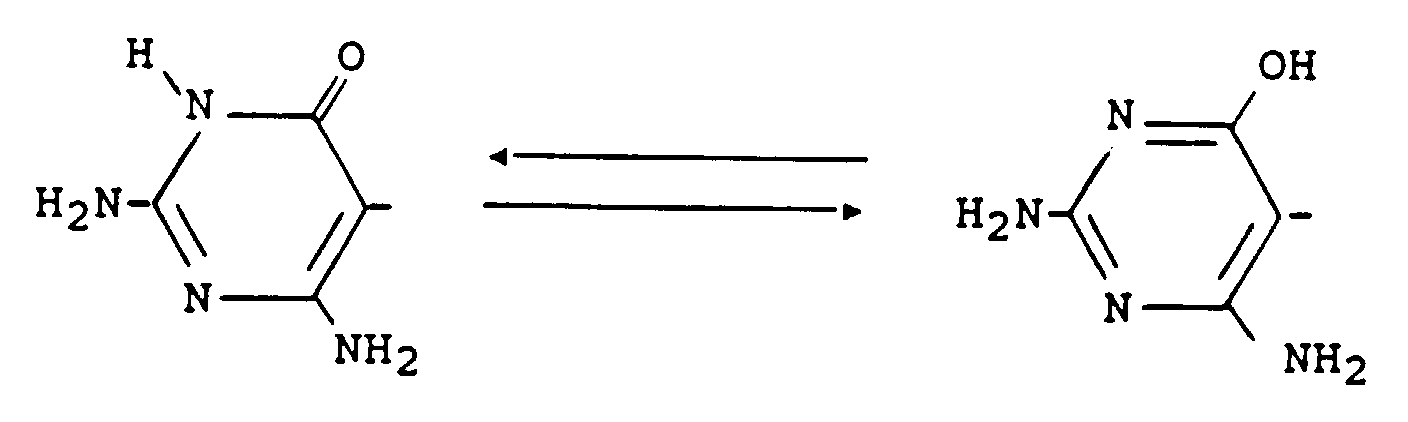
- For convenience, the 3,4-dehydro-4-hydroxy form is depicted and the corresponding nomenclature is used throughout this specification, it being understood that in each case such includes the tautomeric 4(3H)-oxo forms.
- The invention includes the pharmaceutically acceptable alkali metal, alkaline earth metal, non-toxic metal, ammonium, and substituted ammonium salts, such as for example the sodium, potassium, lithium, calcium, magnesium, aluminum, zinc, ammonium, trimethylammonium, triethylammonium, triethanolammonium, pyridinium, substituted pyridinium, and the like.
- The compounds can be prepared by hydrolysis of a 2,6-diamino-4-hydroxypyrimidin-5-yl-L-glutamic acid derivative of the formula:

- Protecting groups encompassed by R and R³ and reactions for their removal are described, for example, in "Protective Groups in Organic Chemistry", Plenum Press, London and New York (1973); Greene, "Protective Groups in Organic Synthesis", Wiley, New York (1981); "The Peptides", Vol. I, Schröder and Lubke, Academic Press, London and New York (1965); in "Methoden der organischen Chemie", HoubenWeyl, 4th Edition, Vol. 15/I, Georg Thieme Verlag, Stuttgart (1974). Carboxylic acid protecting groups can be, for example, esters conceptually derived from lower alkanols of from 1 to 6 carbon atoms, including those branched in the 1-position and those which are substituted with one of more aromatic groups such as phenyl, or with halo or alkoxy; e.g., methyl, ethyl, t-butyl, benzyl, 4-nitrobenzyl, diphenylmethyl, methoxymethyl, and the like esters. Silyl esters such as trimethylsilyl also can be employed.
- The hydrolysis is conducted at normal temperatures utilizing aqueous acid or base, such as for example, an aqueous alkali metal hydroxide, optionally in the presence of a water miscible organic solvent such as methanol, ethanol, tetrahydrofuran, dimethylformamide, and the like, or an acid, as for example triflouroacetic acid. When base is used, the product is initially formed as the dicationic glutamate salt and can be readily precipitated by adjustment of pH, as through acidification with, for example, acetic acid.
- The resulting products generally are crystalline or microcrystalline solids.
- Compounds of Formula II can be prepared by coupling a compound of the formula:


- Formation of the intermediate of Formula III can be accomplished by cyclization of an α-cyano dicarboxylate of the formula:

- The intermediates of Formula V can be prepared by condensing an alkyl cyanoacetate of the formula:
R⁴CO-CH₂-CN (VI)
with an ester of the formula:
- The ester intermediates of Formula VII are either known or can be prepared by known methods, as more fully exemplified below.
- Typical compounds of the present invention include N-(4-[5-(2,6-diamino-4-hydroxypyrimidin-5-yl)pent-1-en-2-yl]benzoyl)-L-glutamic acid; N-(4-[6-(2,6-diamino-4-hydroxypyrimidin-5-yl)hex-1-en-3-yl]benzoyl)-L-glutamic acid; and N-(4-[1-hydroxy-5-(2,6-diamino-4-hydroxypyrimidin-5-yl)pent-2-yl]benzoyl)-L-glutamic acid.
- The compounds of Formula I contain a chiral center in the L-glutamic acid portion of the molecule. If no other chiral centers are present, the compounds are obtained in this configuration as the single enantiomer. If Z is hydrogen, however, a second chiral center is present, leading to diastereomers. These diastereomers can be separated mechanically, as by chromatography, so that each is in a form substantially free of the other; i.e., having an optical purity of >95%. Alternatively, a mixture of diastereoisomeric compounds of Formula I is treated with a chiral acid operable to form a salt therewith. The resultant diastereoisomeric salts are then separated through one or more fractional crystallizations and thereafter the free base of the cationic moiety of at least one of the separated salts is liberated through treatment with a base and removal of the protecting groups. The liberation of the cation of the salt can be performed as a discrete step before or after the removal of the protecting groups, or concomitantly with the removal when such groups are susceptible to removal under basic conditions; i.e., basic hydrolysis.
- Suitable chiral acids include the individual enantiomers of 10-camphorsulfonic acid, camphoric acid, alpha bromocamphoric acid, methoxyacetic acid, tartaric acid, diacetyltartaric acid, malic acid, pyrrolidone-5-carboxylic acid, and the like.
- The compounds of this invention have an effect on one or more enzymes which utilize folic acid, and in particular metabolic derivatives of folic acid, as a substrate. For example, the IC₅₀ in whole cell human leukemia cell lines, CCFR-CEM, of N-(4-[5-(2,6-diamino-4-hydroxypyrimidin-5-yl)-pent-1-en-2-ylbenzoyl)-L-glutamic acid is approximately 0.004 µg/ml, while that for N-(4-[6-(2,6-diamino-4-hydroxypyrimidin-5-yl)-hex-1-en-3-yl]benzoyl)-L-glutamic acid is approximately 0.0035 µg/ml.
- Cytotoxicity is reversed by addition of purines such as hypoxanthine or by addition of leucovorin or amino-imidazolecarboxamide (AICA) but is not reversed by addition of thymidine, indicating specific inhibition in the de novo purine synthesis.
- The compounds of Formula I can be used, alone or in combination, to treat neoplasms including choriocarcinoma, leukemia, adenocarcinoma of the female breast, epidermid cancers of the head and neck, squamous or small-cell lung cancer, and various lymphosarcomas. The compounds can also be used to treat mycosis fungoides, psoriasis, and arthritis. The compounds can be administered either orally or preferably parenterally, alone or in combination with other anti-neoplastic agents, steroids, etc., to a mammal suffering from neoplasm and in need of treatment. Parenteral routes of administration include intramuscular, intrathecal, intravenous, or intraarterial. In general, the compounds are administered in much the same fashion as methotrexate, but because of a different mode of action, can be administered in higher dosages than those usually employed with methotrexate. Dosage regimens must be titrated to the particular neoplasm, the condition of the patient, and the response but generally doses will be from about 10 to about 100 mg/day for 5-10 days or single daily administration of 250-500 mg., repeated periodically; e.g. every 14 days. Oral dosage forms include tablets and capsules containing from 1-10 mg of drug per unit dosage. Isotonic saline solutions containing 20-100 mg/ml can be used for parenteral administration.
- The following examples will serve to further illustrate the invention.
- This compound was prepared according to Meyers et al., J. Org. Chem., 1974, 39:2787. High purity magnesium (>99.99%) and doubly distilled anhydrous tetrahydrofuran were used for the preparation of the Grignard reagent. The reaction mixture was hydrolyzed with saturated ammonium chloride solution and extracted three times with ether. The extracts were dried over magnesium sulfate and the solvent evaporated under reduced pressure to yield the intermediate which was further purified by flash chromatography eluting with 1:5 ethyl acetate:hexanes. ¹H NMR (CDCl₃, 300 MHz): δ =1.40 (s, 6H, (CH₃)₂); 3.39 (d, 2H, CH₂-C=, J= 7.5 Hz); 4.05 (s, 2H, CH₂O); 5.05 (d, 1Holef., CH(H)=CH, Jtrans=16 Hz); 5.10 (d, 1Holef., CH(H)=CH, Jcis= 10 Hz); 5.92 (ddt, 1Holef., CH=CH₂, J= 7.5, 10, 16 Hz); 7.22 (d, 2Harom., J= 9 Hz); 7.88 (d, 2Harom., J= 9 Hz).
- A 2 liter three neck round-bottomed flask equipped with a rubber septum, a reflux condenser, and a dropping addition funnel, was torched dry, cooled to room temperature, and charged with 20.6 ml (14.88g, 2.1 eq) of diisopropylamine in 800 ml of anhydrous tetrahydrofuran under a nitrogen atmosphere. After cooling the mixture to 0°C in an ice bath, 56 ml of n-butyllithium (2.5M, 2.0 eq) were added dropwise. The mixture was stirred for 15 minutes, and then heated in an oil bath at 45°C. A solution of 15.0g (1.0 eq) of 2-(4-allyphenyl)-4,4-dimethyl-2-oxazoline in 200 ml of anhydrous tetrahydrofuran was adding dropwise to the mixture over a 2 minute period and the reaction mixture then was stirred for 5 to 6 minutes at 45°C. One hundred and fifteen milliliters (16 eq) of 1,3-dibromopropane were quickly added with vigorously stirring and the reaction mixture then was stirred at 45°C for 45 minutes. One hundred milliliters of saturated ammonium chloride solution were added, followed by extraction with diethyl ether. The extracts were dried over magnesium sulfate and concentrated under reduced pressure to yield the product which was further purified by distillation under vacuum (30°C, 0. lmm) to remove excess 1,3-dibromopropane and flash chromatography, eluting with 1:5 ethylacetate:hexanes. M.S.: m/z= 335.0890 (M⁺, calc. for C₁₇H₂₂NO⁷⁹Br: 335.0884), 322, 320 (100%), 265, 214. ¹H-NMR (CDCl₃, 300 MHz):δ= 1.39 (s, 6H, (CH₃)₂) ; 1.7-2.0(m, 4H, CH₂-CH₂); 3.32 (dt, 1H, CH-C, J= 7.5 Hz); 3.40 (t, 2H, CH₂-Br, J= 7.5 Hz) ; 4.12 (s, 2H, CH₂O) ; 5.06 (d, 1Holef., CH(H)=CH, Jtrans.=18 Hz); 5.08 (d, 1Holef., CH(H)=CH, Jcis= 10 Hz); 5.95 (ddd, 1Holef., CH=CH₂, J= 7.5, 10, 18 Hz); 7.23 (d, 2Harom., J= 9 Hz); 7.91 (d, 2Harom., J= 9 Hz).
- The procedure of Meyers et al. supra. was followed for the alcoholysis of the compound produced in step B above. Thirteen grams (1 eq) of 2-[4-(6-bromohex-1-en-3-yl)phenyl]-4,4-dimethyloxazoline were dissolved in a mixture of 910 ml of ethanol, 50 ml of water, and 40 ml of concentrated sulfuric acid. The mixture was refluxed for 20 hours. After cooling to approximately 40°C, most of the ethanol was removed under reduced pressure. The residue was extracted with diethyl ether three times, and the combined extracts dried over magnesium sulfate and evaporated to yield the product which was further purified by flash chromatography, eluting with 1:15 ethylacetate:hexanes. M.S.; m/z= 310.0578 (M⁺, calc. for C₁₅H₁₉O2 79Br: 310.0568), 267, 265, 239, 237, 204, 189, 145, 117 (100%). I.R. (NaCl): v= 2910, 1710(s), 1610, 1365, 1270 (s), 1180, 1100 (s), 1015, 910, 760 cm⁻¹. ¹H-N.M.R.(CDCl₃, 300 MHz):δ= 1.43 (t, 3H, CH₃-CH₂O, J= 7.5 Hz); 1.7-2.0(m, 4H, CH₂-CH₂); 3.37 (dt, 1H, CH-CH=, J= 7.5 Hz); 3.42 (t, 2H, CH₂-Br, J= 7.5 Hz); 4.39 (q, 2H, CH₃-CH₂O, J= 7.5 Hz); 5.09 (d, 1Holef., CH(H)=CH, Jtrans= 18 Hz); 5.11 (d, 1Holef., CH(H)=CH, Jcis= 9 Hz); 5.94 (ddd, 1Holef., CH=CH₂, J= 7.5, 9, 18 Hz); 7.28 (d, 2Harom., J= 9 Hz); 8.00 (d, 2Harom., J= 9 Hz).
- A 1 liter three neck round-bottomed flask, equipped with a reflux condenser, additional funnel, and gas inlet, was charged with 1.45g (5 eq) of 80% sodium hydride (1.16g of 100% NaH) in 400 ml of anhydrous tetrahydrofuran. This mixture was cooled to 0°C and 6.15 ml (6 eq) of an anhydrous tetrahydrofuran solution of ethylcyanoacetate were added dropwise under a nitrogen atmosphere. The mixture was vigorously stirred and allowed to attain room temperature until the evolution of hydrogen ceased (approximately 30 minutes). A solution of 3.00 grams (1 eq) of ethyl 4-(6-bromohex-1-en-3-yl) benzoate in 50 ml of anhydrous tetrahydrofuran was added and the mixture then refluxed for 36 hours. Saturated ammonium chloride was added and the mixture then extracted three times with diethyl ether. The combined organic extracts were dried over magnesium sulfate and concentrated under reduced pressure to yield the product which was further purified by flash chromatography eluting with 1:3 ethyl acetate:hexanes. M.S.: m/z= 343.1778 (M⁺, calc. for C₂₀H₂₅NO₄: 343.1783), 297 (100%), 270, 189, 145, 117. I.R. (NaCl): v= 2970, 2925, 2860, 2240 (w, CN), 1740 (s), 1715 (s), 1610, 1450, 1405, 1370, 1270 (s), 1180, 1105, 1020, 920, 855, 770 710 cm⁻¹. ¹H-N.M.R. (CDCl₃, 300 MHz): δ= 1.32 (dt, 3H, CH₃-CH₂O₂C-CH-CN, J= 7.5 Hz); 1.41 (t, 3H, CH₃-CH₂O₂C-Ar, J= 7.5 Hz); 1.4 - 1.68 (m, 2H, CH₂-CH₂-CH₂); 1.78 (m, 2H, CH₂-CH-CH=); 1.97 (dt, 2H, CH₂-CH-CN, J= 7.5 Hz); 3.33 (dt, 1H, CH-C=, J= 7.5 Hz); 3.47(dt, 1H, CH-CN, J= 7.5 Hz); 4.27 (dq, 2H, CH₃-CH₂OC-CH*, J= 7.5 Hz); 4.38 (q, 2H, CH₃-CH₂O₂C-Ar, J= 7.5 Hz); 5.08 (d, 1Holef., CH (H) =CH, Jtrans = 18 Hz); 5.12 (d, 1Holef., CH(H)=CH, Jcis = 10 Hz); 5.92 (dd, 1Holef., CH=CH₂, J= 7.5, 10, 18 Hz); 7.26 (d, 2Harom., J= 9 Hz); 8.01 (d, 2Harom., J= 9 Hz).
- Sodium metal (460mg, 2 eq) was completely dissolved in 10.0 ml of anhydrous ethanol and 1.05g (1.1 eq) of dry guanidine hydrochloride was added. The mixture was stirred for 30 minutes at ambient temperature. The solid was removed by filtration and the filtrate transferred to a 50 ml round-bottomed flask equipped with a reflux condenser and a gas inlet. A mixture of ethyl 4-(7-carboethoxy-7-cyano-hept-1-en-3-yl)benzoate (3.4g, 1.0 eq) in 10 ml of anhydrous ethanol was added to the filtrate and the mixture refluxed for 12 hours under a nitrogen atmosphere. The solution was cooled to ambient temperature and 0.6 ml (1 eq) of glacial acetic acid were added. The solvent was removed under reduced pressure to yield the product which was further purified by flash chromatography eluting with 10:1 chloroform:methanol. m.p. 184°C; M.S.: m/z = 356.1853 (M⁺, calc. for C₁₉H₂₄N₄O₃: 356.1848), 311, 167, 152, 139 (100%). ¹H-N.M.R. (DMSO-d⁶, 300 MHz): δ= 1.03-1.23 (m, 2H, CH₂-CH₂-CH₂); 1.28 (t, 3H, CH₃CH₂O, J= 7.5 Hz); 1.64 (m, 2H, CH₂-CH-CH=); 2.13 (t, 2H, CH₂-pyr, J= 7.5 Hz); 3.36 (dt, 1H, CH-C=, J= 7.5 Hz); 4.27 (q, 2H, CH₃CH₂O, J= 7.5 Hz); 4.98 (d, 1Holef., CH(H)=CH, Jcis= 10 Hz); 5.00 (d, 1Holef., CH(H)=CH, Jtrans= 19 Hz); 5.60 (s (broad), 2H, NH₂); 5.80 (s (broad), 2H, NH₂); 5.92 (ddd, 1Holef., CH=CH₂, J= 7.5, 10, 19 Hz); 7.32 (d, 2Harom., J= 8 Hz); 7.85 (d, 2Harom., J= 8 Hz); 9.73 (s (broad), 1H, NH).
- A 50 ml round bottomed flask was charged with 1.35g (1 eq) of ethyl 4-[6-(2,6-diamino-4-hydroxypyrimidin-5-yl)-hex-1-en-3-yl) benzoate, as prepared in step E, in 19 ml of 1N aqueous sodium hydroxide (approximately 5 eq). The mixture was heated at 60°C for 1 hour and then continuously stirred overnight at room temperature. Impurities were removed by filtration and the filtrate was mixed with 1.6 ml of glacial acetic acid to precipitate the product. The precipitate was centrifuged with water, collected, dissolved in methanol, and concentrated under reduced pressure. m.p. 210°C. M.S.: m/z = 328.1531 (M⁺, calc. for C₁₇H₂₀N₄0₃: 328.1535). ¹H-N.M.R. (DMSO-d⁶, 300 MHz): δ= 1.03-1.35 (m, 2H, CH₂-CH₂-CH₂); 1.66 (m, 2H, CH₂-CH-CH=); 2.17 (t, 2H, CH₂-pyr, J= 7.5 Hz); 3.34 (dt, 1H, CH-C=, J= 7.5 Hz); 4.98 (d, 1Holef., CH(H)=CH, Jcis= 10 Hz); 5.00 (d, 1Holef., CH(H)=CH, Jtrans= 19 Hz) ; 5.67 (s (broad), 2H, NH₂); 5.91 (ddd, 1Holef., CH=CH₂, J= 7.5, 10, 19 Hz) ; 5.98 (s (broad), 2H, NH₂); 7.31 (d, 2Harom., J= 8 Hz); 7.85 (d, 2Harom., J= 8 Hz); 10.02 (s (broad), 1H, NH).
- A solution containing 950 mg (1 eq) of 4-[6-(2,6-diamino-4-hydroxypyrimidin-5-yl)hex-1-en-3-yl]benzoic acid as prepared in step F, 351 mg (1.2 eq) of N-methylmorpholine, and 10.0 ml of anhydrous dimethylformamide, was vigorously stirred at ambient temperature for 5 minutes. To this solution was added 556 mg (1.1 eq) of 2,4-dimethoxy-6-chloro-1,3,5-triazine and this mixture was then stirred at room temperature for 40 minutes. Following addition to the solution of 351 mg (1.3 eq) of N-methylmorpholine, and 795 mg (1.3 eq) of dry dimethyl-L-glutamate hydrochloride, the mixture was continuously stirred overnight at room temperature and the solvent then removed under reduced pressure. The product was dissolved in chloroform, and extracted with saturated aqueous sodium bicarbonate to remove unreacted acid, triazine and triazinone. The organic extract was dried over magnesium sulfate, filtered and evaporated to dryness to yield the product which was further purified by flash chromatography eluting with 1:10 methanol:chloroform. M.S.: m/z = 485.2269 (M⁺, calc. for C₂₄H₃₁N₅O₆: 485.2274). ¹H-N.M.R. (CDCl₃, 300 MHz): δ= 1.03-1.35 (m, 2H, CH₂-CH₂-CH₂); 1.62 (m, 2H, CH₂-CH-CH=); 2.15 (t, 2H, CH₂-pyr, J= 7.5 Hz); 2.0-2.5 (m, 4H, 2 x CH2(glu); 3.18 (m, 1H, CH-C=); 3.56 (s, 3H, CH₃O); 3.66 (s, 3H, CH₃O); 4.70 (m, 1H, CHglu); 4.8-5.0 (m, 2Holef.,) ; 4.89 (s (broad), 2H, NH₂); 5.6-5.9 (m, 3H, NH₂ + CH=CH₂); 7.08 (d, 2Harom., J= 8 Hz); 7.50 (m, 1H, NHglu); 7.63 (d, 2Harom., J= 8 Hz); 11.25 (s (broad), 1H, NHpyr).
- A solution consisting of 120 mg of dimethyl N-{4-[6-(2,6-diamino-4-hydroxypyrimidin-5-yl)-hex-1-en-3-yl]benzoyl}L-glutamate in 1.0 ml of 1N aqueous sodium hydroxide (1 eq), was stirred overnight at room temperature to form the disodium salt of N-(6-[4-(2,6-diamino-4-hydroxypyrimidin-5-yl)-hex-1-en-3-yl] benzoyl)-L-glutamic acid. This solution then was vigorously stirred while 0.12 ml (2 eq) of glacial acetic acid was dropwise added tp pH= 4.0. The product was collected by filtration, washed three times with 1 ml of cold water, and dried under high vacuum. M.S. (F.A.B.): m/z = 458.20261 (M⁺+H, calc. for C₂₂H₂₈N₅O₆: 458.2039). ¹H-N.M.R. (DMSO-d⁶, 300 MHz); δ= 1.05-1.40 (m, 2H, CH₂-CH₂-CH₂); 1.64 (m, 2H, CH₂-CH-CH=); 1.9-2.25 (m, 2H, CH₂-CHglu); 2.16 (t, 2H, CH₂-pyr, J= 7.5 Hz); 2.35 (t, 2H, CH₂-CO₂H, J= 7.5 Hz); 3.34 (dt, 1H, CH-C=, J= 7.5 Hz); 4.35 (dt, 1h, CHglu, J= 7.5 Hz); 4.97 (d, 1Holef., CH(H)=CH, Jcis= 10 Hz); 5.02 (d, 1Holef., CH(H)=CH, Jtrans= 19 Hz); 5.63 (s (broad), 2H, NH₂); 5.95 (ddd, 1Holef., CH=CH₂, J= 7.5, 10, 19 Hz); 5.92 (s (broad), 2H NH₂); 7.28 (d, 2Harom., J= 8 Hz); 7.82 (d, 2Harom., J= 8 Hz); 8.50 (d, 1H, NHglu, J= 7.5 Hz); 9.81 (s (broad), 1H, NHpyr), 12.56 (s (broad), 2H, 2 x CO₂H).
- This compound was prepared according to Taylor et al., Heterocycles, 1989, 28:1169, modified by stirring for 3 days at room temperature, extracting with diethyl ether, and filtering over silica gel with 1:1 ethylacetate:hexanes.
- To 10.0 g (1 eq) of methyl 4-(4-hydroxy-1-butynyl)benzoate in 200 ml of 90% aqueous acetic acid and 2.4g (0.15 eq) of mercuric acetate were added 1.0 ml of concentrated sulfuric acid. The mixture was refluxed for 2 hours at approximately 140°C, and cooled to room temperature to facilitate precipitation of mercury salts. The precipitated mercury salts were removed by filtration and the filtrate extracted three times with dichloromethane. The acidic extract was neutralized to pH 7 with solid sodium bicarbonate and the aqueous layer then extracted with dichloromethane. The extracts were dried over magnesium sulfate and evaporated under reduced pressure to yield the product which was further purified by flash chromatography eluting with 1:2 ethylacetate:hexanes. m.p. 61-62°C. M.S.: m/z= 264 (M⁺, CI), 233.0812 (M⁺-CH₃O, calc. for C₁₃H₁₃O₅: 233.0814), 204 (M⁺-AcOH), 176, 163 (100%), 143. ¹H-N.M.R. (CDCl₃, 300 MHz): δ= 2.08 (s, 3H, CH₃-CO); 2.10 (quin, 2H, CH₂-CH₂-CH₂, J= 7.5 Hz); 3.12 (t, 2H, CH₂-CO, J= 7.5 Hz); 3.96 (s, 3H, CH₃O); 4.20 (t, 2H, CH₂O, J= 7.5 Hz); 8.02 (d, 2Harom., J= 9 Hz); 8.18 (d, 2Harom., J= 9 Hz).
- Methyl triphenylphosphonium (1.5g, 1.1 eq) was suspended in 50 ml of anhydrous tetrahydrofuran and 4.0 ml of 1.0M solution of sodium hexamethyldisilazide (1.05 eq) in tetrahydrofuran were added via syringe. The mixture was stirred at room temperature for one hour and a solution of 1.0g (1.0 eq) of methyl 4-(4-acetoxy-1-oxobutyl)benzoate in anhydrous tetrahydrofuran, was added dropwise. The resulting reaction mixture was stirred for 2 hours at room temperature. Sodium bromide/triphenylphosphineoxide precipitate was removed by filtration, and the filtrate washed with water. After extraction of the aqueous layer with diethyl ether, the organic layers were dried over magnesium sulfate and evaporated to dryness to yield the product which was further purified by flash chromatography eluting with 1:5 ethyl acetate:hexanes. M.S.:m/z= 262 (M⁺,CI), 231.1020 (M⁺ - CH₃O, calc. for C₁₄H₁₅O₃: 231.1021), 202 (M⁺ - AcOH), 176, 143 (100%). ¹H-N.M.R. (CDCl₃, 300 MHz): δ=1.80(quin, 2H, CH₂-CH₂-CH₂, J= 7.5 Hz); 2.04(s, 3H, CH₃-CO); 2.62 (t, 2H, CH₂-C=, J= 7.5 Hz); 3.94(s, 3H, CH₃O); 4.10(t, 2H, CH₂O, J= 7.5 Hz); 5.20 (s, 1Holef.) ; 5.41(s, 1Holef.) ; 7.48(d, 2Harom., J= 9 Hz); 8.01(d, 2Harom., J= 9 Hz).
- To a solution containing 0.52g (1.0 eq) of dry potassium carbonate in 100 ml of anhydrous methanol was added 1.0g (1.0 eq) of methyl 4-(5-acetoxy-pent-1-en-2-yl)benzoate in anhydrous methanol. The resulting reaction mixture was stirred for two hours at room temperature, neutralized by the addition of 7.6 ml of 1N hydrochloric acid (2.0 eq), and extracted twice with dichloromethane. The extracts were dried over magnesium sulfate, and concentrated under reduced pressure to yield the product. mp. 28-30°C. M.S.:m/z= 220.1094, (M⁺ calc. for CH₁₃H₁₆O₃: 220.1099), 189 (M⁺-CH₃O), 176 (100%), 145. ¹H-N.M.R.(CDCl₃, 300 MHz): δ=1.56(s (broad), 1H, OH); 1.75(quin, 2H, CH₂-CH₂-CH₂, J= 7.5 Hz); 2.60(t, 2H, CH₂-C=, J= 7.5 Hz); 3.68(t, broad), 2H, CH₂OH, J= 7.5 Hz; 3.94(s, 3H, CH₃O); 5.20(s, 1Holef.) ; 5.42(s, 1Holef.); 7.48 (d, 2Harom., J= 9 Hz); 8.00(d, 2Harom., J= 9 Hz).
- To a solution of 0.40g (1.0 eq) of methyl 4-(5-hydroxypent-1-en-2-yl)benzoate and 0.38g (2.0 eq) of triethylamine in anhydrous diethylether, cooled to 0°C, was added in a dropwise fashion a solution of 0.44g (2.0 eq) mesitylchloride in anhydrous diethylether. Cooling was discontinued after 15 minutes and the mixture allowed to attain room temperature while stirring under nitrogen for 4 hours. The triethylamine hydrochloride precipitate was extracted with saturated ammonium chloride solution and the aqueous layer then washed three times with diethylether. The combined organic layers were dried over magnesium sulfate and concentrated under reduced pressure to yield the product. M.S.:m/z= 298 (M⁺), 267.0683 (M⁺-CH₃O, calc. for C₁₃H₁₅O₄S: 267.0691), 202 (M⁺-CH₃-SO₃H), 143 (100%). I.R. (NaCl): v= 2950, 1720, 1610, 1440, 1350, 1280, 1180, 1120, 970, 840, 790, 730 cm⁻¹. ¹H-N.M.R.(CDCl₃, 300 MHz): δ= 1.92 (quin, 2H, CH₂-CH₂-CH₂, J= 7.5 Hz); 2.70(t, 2H, CH₂-C=, J= 7.5 Hz); 3.02(s, 3H, CH₃-SO₃); 3.96 (s, 3H, CH₃O); 4.24(t, 2H, CH₂O, J= 7.5 Hz); 5.22(s, 1Holef.); 5.44 (s, 1Holef); 7.48 (d, 2Harom., J= 9 Hz); 8.01(d, 2Harom., J= 9 Hz).
- A 1 liter three neck round bottomed-flask was equipped with a reflux condenser, addition funnel, and gas inlet, and charged with a mixture of 0.10g (5.0 eq) of 80% sodium hydride in 40 ml of anhydrous tetrahydrofuran. This mixture was cooled to 0°C and a solution of 0.39 ml (5.5 eq) of ethyl cyanoacetate in anhydrous tetrahydrofuran was added dropwise under a nitrogen atmosphere. The mixture was vigorously stirred and allowed to attain room temperature until hydrogen evolution was no longer observed. To the mixture was then added 0.40g (1.0 eq) of methyl 4-(5-methylsulfonyloxy-pent-1-en-2-yl)benzoate in 5 ml of anhydrous tetrahydrofuran. The mixture was then refluxed for 15 hours, saturated ammonium chloride solution was added, and the solution extracted three times with diethylether. The extracts were dried over magnesium sulfate, and concentrated under reduced pressure to give the product (containing some unreacted ethyl cyanoacetate which can be removed by Kugelröhr distillation at 40°C/1 mm Hg). Further purification of the product was accomplished by flash chromatography, eluting with 1:3 ethylacetate:hexanes. M.S.:m/z= 315.1458 (M⁺, calc. for C₁₈H₂₁O₄N: 315.1470), 284 (M⁺-CH₃O), 202 (M⁺-EtO₂C-CH₂-CN), 176, 143 (100%). ¹H-N.M.R.(CDCl₃, 300 MHz): δ= 1.28(t, 3H, CH₃-CH₂O, J= 7.5 Hz); 1.64(quin, 2H, CH₂-CH₂-CH₂, J= 7.5 Hz); 1.96(dt, 2H, CH₂-CH, J= 7.5 Hz); 2.60(t, 2H, CH₂-C=, J= 7.5 Hz); 3.44(t, 1H, CH-CN, J= 7.5 Hz); 3.92(s, 3H, CH₃O); 4.22(q, 2H, CH₃-CH₂O, J= 7.5 Hz); 5.19(s, 1Holef.) ; 5.41(s, 1Holef.) ; 7.42 (d, 2Harom., J= 9 Hz); 8.00(d, 2Harom., J= 9 Hz).
- To a solution of sodium metal (190 mg, 2 eq) in 10.0 ml of anhydrous methanol is added 0.414g (1.1 eq) of dry guanidine hydrochloride. The reaction mixture was stirred at room temperature for about 30 minutes. Sodium chloride precipitate was removed by filtration and the filtrate solution transferred to a 50 ml round-bottomed flask which was equipped with a reflux condenser and a gas inlet. A mixture of 1.30g (1.0 eq) of methyl 4-(6-carboethoxy-6-cyanohex-1-en-2-yl)benzoate in 10ml of anhydrous methanol is added to the filtrateand the solution then refluxed for 12 hours under a nitrogen atmosphere. After cooling to room temperature, 0.23 ml (1 eq) of glacial acetic acid was added to neutralize excess sodium methoxide. Concentration under reduced pressure yielded the product which was removed by filtration, washed with a cold mixture of 1:1 chloroform:methanol, and dried. M.S.:m/z= 328.1530 (M⁺, calc. for C₁₇H₂₀N₄O₃: 328.1535). ¹H-N.M.R.(DMSO-d⁶, 300 MHz): δ= 1.40(quin, 2H, CH₂-CH₂-CH₂, J= 7.5 Hz); 2.25(t, 2H, CH₂-pyr, J= 7.5 Hz); 2.60 (t, 2H, CH₂-C=, J= 7.5 Hz); 3.84(s, 3H, CH₃O); 5.10(s, 1Holef.); 5.36(s, 1Holef.); 5.62(s (broad), 2H, NH₂); 5.93 (s (broad), 2H, NH₂); 7.53 (d, 2Harom., J= 9 Hz); 7.84 (d, 2Harom., J= 9 Hz); 9.86 (s (broad), 1H, NH).
- A 50 ml round-bottomed flask was charged with a mixture of 0.420g (1eq) of methyl 5-[4-(2,6-diamino-4-hydroxypyrimidin-5-yl)-pent-1-en-2-yl]benzoate in 7 ml of 1N of aqueous sodium hydroxide (approximately 5 eq). After heating the solution to 60°C for 1 hr, the solution was allowed to cool to ambient temperature and then stirred overnight. Impuities were removed by filtration and the filtrate was acidified with 0.35 ml of glacial acetic acid. The resulting solid was collected by centrifugation with water and dissolved in methanol. The solution was concentrated under reduced pressure to give the product. M.S.:m/z= 314.1366 (M⁺, calc. for C₁₆H₁₈N₄O₃: 314.1379). ¹H-N.M.R.(DMSO-d⁶, 300 MHz): δ= 1.40 (quin, 2H, CH₂-CH₂-CH₂, J= 7.5 Hz); 2.22(t, 2H, CH₂-pyr, J= 7.5 Hz); 2.56(t, 2H, CH₂-C=, J= 7.5 Hz); 5.14(s, 1Holef.) ; 5.39(s, 1Holef.) ; 5.68 (s (broad), 2H, NH₂); 5.92 (s(broad), 2H, NH₂); 7.53 (d, 2Harom., J= 9 Hz) 7.88 (d, 2Harom., J= 9 Hz); 9.82 (s (broad), 1H, NH).
- A mixture of 270mg (1 eq) of 4-[5-(2,6-diamino-4-hydroxypyrimidin-5-yl)-pent-1-en-2-yl]benzoic acid and 104mg (1.2 eq) of N-methylmorpholine in 4.0 ml of anhydrous tetrahydrofuran, was vigorously stirred for 5 minutes at room temperature. To this mixture, 165mg (1.1 eq) of 2,4-dimethoxy-6-chloro-1,3,5-triazine were added and the solution was stirred for 40 minutes at room temperature. An additional 104mg (1.2 eq) of N-methylmorpholine were introduced followed by 236mg (1.3 eq) of dry dimethyl-L-glutamate hydrochloride. The solution then was continuously stirred for 4 hrs. at room temperature. The solvent was removed under reduced pressure and the residue dissolved in chloroform. Extraction with saturated aqueous sodium bicarbonate removed unreacted acid, triazine and triazinone. The organic layer was dried over magnesium sulfate, filtered and evaporated to dryness to yield the product which was further purified by flash chromatography eluting with 1:10 methanol:chloroform. M.S.:m/z= 471.2081 (M⁺, calc. for C₂₃H₂₉N₅O₆: 471.2118). ¹H-N.M.R.(CDCl₃, 300 MHz): δ= 1.41(quin, 2H, CH₂-CH₂-CH₂, J= 7.5 Hz); 2.00-2.55(m, 8H, 4 x -CH2-); 3.56(s, 3H, CH₃O); 3.68(s, 3H, CH₃O); 4.68 (dt, 1H, CH, J= 6, 7.5 Hz); 4.84 (s (broad), 2H, NH₂); 4.97 (s, 1Holef.); 5.18 (s, 1Holef.); 5.86 (s (broad), 2H, NH₂); 7.29 (d, 2Harom., J= 9 Hz); 7.62 (m, (broad), 1H, NHglu); 7.64 (d, 2Harom., J= 9 Hz); 11.20 (s (broad), 1H, NHpyr).
- A solution containing 100mg of dimethyl N-{4-[5-(2,6-diamino-4-hydroxypyrimidin-5-yl)-pent-1-en-2-yl]benzoyl}-L-glutamate in 1.0 ml of 1N aqueous sodium hydroxide was stirred overnight at room temperature to yield the disodium salt of N-{4-[5-(2,6-diamino-4-hydroxypyrimidin-5-yl)-pent-1-en-2-yl]benzoyl}-L-glutamic acid. Glacial acetic acid (0.12 ml, 2 eq) then was added dropwise with vigorous stirring. The desired product was removed by filtration and washed three times with 1 ml of cold water, followed by drying under high vacuum. M.S.(F.A.B.):m/z= 444.18695 (M⁺+H, calc. for C₂₁H₂₆N₅O₆: 444.1883) . ¹H-N.M.R. (DMSO-d₆, 300 MHz): δ= 1.43 (quin, 2H, CH₂-CH₂-CH₂, J= 7.5 Hz); 1.85-2.15 (m, 2H, CH₂-CH, J= 7.5 Hz); 2.21 (t, 2H, CH₂-pyr, J= 7.5 Hz); 2.36 (dt, 2H, CH₂-CO₂H, J= 7.5 Hz); 2.56 (t, 2H, CH₂- C=, J= 7.5 Hz); 4.36 (dt, 1H, CH, J= 6, 7.5 Hz); 5.15 (s, 1Holef.,); 5.39 (s, 1Holef.,); 5.69 (s (broad), 2H, NH₂); 5.96 (s (broad), 2H, NH₂); 7.47 (d, 2Harom., J= 9 Hz); 7.83 (d, 2Harom., J= 9 Hz); 8.57 (d, 1H, NHglu, J= 6 Hz); 9.84 (s (broad), 1H, NHpyr); 12.65 (s (broad), 2H, 2 x CO₂H).
- A 50 ml round bottomed flask equipped with a gas inlet was dried and charged with 500 mg (1 eq) of N-{4-[5-(2,6-diamino-4-hydroxypyrimidin-5-yl)-pent-1-en-2-yl]benzoyl}-L-glutamic acid in 10 ml of anhydrous tetrahydrofuran. To this reaction mixture, 9.0 ml (9.0 eq) of 1.OM borohydride tetrahydofuran etherate was added at a rate of 3 ml/hour and a temperature of 55°C. After vigorously stirring the mixture for three additional hours, the mixture was cooled to room temperature and 200 mg (1 eq) of sodium borotetrahydrate in 10 ml of water was added. The mixture then was stirred at room temperature for two hours, followed by concentration under reduced pressure to yield the product which was further purified by flash chromatography, eluting with 1:4 methanol/chloroform. m.p. 104°C. M.S.: m/z= 489.2233 (M⁺, calc. for C₂₃H₃₁N₅O₇: 489.2233); ¹H-NMR (MeOD, 300 MHz): δ= 1.22-1.37 (m, 2H, CH₂-CH₂-CH₂); 1.55-1.85 (m, 2H, CH₂-CH₂-CH₂); 2.04-2.35 (m, 2H, CH₂-CHglu); 2.25 (t, 2H, CH₂-pyr, J= 7.5 Hz); 2.48 (t, 2H, CH₂CO₂Me, J= 7.5 Hz); 2.75-2.87 (m, 1H, CH-CH₂OH); 3.63 (s, 3H, CH₃O); 3.66 (d, 2H, CH₂OH, J= 7.5 Hz); 3.74 (s, 3H, CH₃O); 4.62 (dt, 1H, CHglu, J= 6, 7.5 Hz); 7.30 (d, 2Harom., J= 9 Hz); 7.76 (d, 2Harom., J= 9 Hz).
- Dimethyl N-{4-[1-hydroxy-5-(2,6-diamino-4-hydroxypyrimidin-5-yl)-pent-2-yl]benzoyl}-L-glutamate (60 mg) was dissolved in 0.5 ml of 1N aqueous sodium hydroxide (1 eq) and the solution then vigorously stirred for one hour at room temperature to yield the disodium salt of N-{4-[1-hydroxy-5-(2,6-diamino-4-hydroxypyrimidin-5-yl)-pent-2-yl]benzoyl}-L-glutamic acid. To this solution, 0.06 ml (2.0 eq) of glacial acetic acid was added dropwise followed by cooling at -10°C for 30 minutes. The solid was removed by filtration, washed with 1 ml of ice water, and dried to produce N-{4-[1-hydroxy-5-(2,6-diamino-4-hydroxypyrimidin-5-yl)pent-2-yl]benzoyl)-L-glutamic acid, m.p. 164°C. The product contains 1 equivalent of sodium acetate). M.S. (F.A.B.): mz= (M⁺+H, calc. for C₂₁H₂₇N₅O₇: 462.1989). ¹H-NMR (DMSO-d₆, 270 MHz): δ= 1.24-1.35 (m, 2H, CH₂-CH₂-CH₂); 1.55-1.95 (m, 2H, CH₂-CH₂-CH₂); 1.98-2.20 (m, 2H, CH₂-CHglu); 2.25 (t, 2H, CH₂-pyr, J= 7.5 Hz); 2.47 (dt, 2H, CH₂-CO₂H, J= 7.5 Hz); 2.80-2.90 (m, 1H, CH-CH₂OH, J= 7.5 Hz); 4.51 (dt, 1H, CHglu, J= 6, 7.5 Hz); 5.70 (s (broad), 2H, NH₂); 6.08 (s (broad), 2H, NH₂); 7.42 (d, 2Harom., J= 9 Hz); 7.90 (d, 2Harom., J= 9 Hz); 8.50 (d, 1H, NHglu, J= 6 Hz); 9.95 (s (broad), 1H, NHpyr); 12.6 (s (broad), 2H, 2 x CO₂H).
Claims (9)
- Process for the preparation of the compounds of formula:
 n has a value of 2 to 5;R is vinyl or hydroxymethyl and Z is hydrogen or R and Z taken together are methylene;each of R and R³ is hydrogen or a carboxylic acid protecting group; andthe configuration about the carbon atom designated * is Lcomprising the reaction of a compound of the formula:

Applications Claiming Priority (2)
| Application Number | Priority Date | Filing Date | Title |
|---|---|---|---|
| US07/510,669 US5013738A (en) | 1990-04-18 | 1990-04-18 | L-glutamic acid derivatives |
| US510669 | 1990-04-18 |
Publications (3)
| Publication Number | Publication Date |
|---|---|
| EP0452660A2 EP0452660A2 (en) | 1991-10-23 |
| EP0452660A3 EP0452660A3 (en) | 1992-01-29 |
| EP0452660B1 true EP0452660B1 (en) | 1996-05-29 |
Family
ID=24031685
Family Applications (1)
| Application Number | Title | Priority Date | Filing Date |
|---|---|---|---|
| EP91103482A Expired - Lifetime EP0452660B1 (en) | 1990-04-18 | 1991-03-07 | L-glutamic acid derivatives |
Country Status (7)
| Country | Link |
|---|---|
| US (1) | US5013738A (en) |
| EP (1) | EP0452660B1 (en) |
| JP (1) | JPH05262746A (en) |
| AT (1) | ATE138655T1 (en) |
| CA (1) | CA2037015A1 (en) |
| DE (1) | DE69119819T2 (en) |
| SG (1) | SG49323A1 (en) |
Families Citing this family (6)
| Publication number | Priority date | Publication date | Assignee | Title |
|---|---|---|---|---|
| US5945427A (en) * | 1995-06-07 | 1999-08-31 | Agouron Pharmaceuticals, Inc. | Antiproliferative substituted 5-thiapyrimidinone and 5-selenopyrimidinone compounds |
| US5739141A (en) * | 1992-12-16 | 1998-04-14 | Agouron Pharmaceuticals, Inc. | Antiproliferative substituted 5-thiapyrimidinone and 5-selenopyrimidinone compounds |
| US5594139A (en) * | 1993-01-29 | 1997-01-14 | Agouron Pharmaceuticals, Inc. | Processes for preparing antiproliferative garft-inhibiting compounds |
| US5831100A (en) * | 1995-06-07 | 1998-11-03 | Agouron Pharmaceuticals, Inc. | Syntheses of optically pure compounds useful as GARFT inhibitors and their intermediates |
| WO1999049856A2 (en) * | 1998-03-27 | 1999-10-07 | Genentech, Inc. | Antagonists for treatment of cd11/cd18 adhesion receptor mediated disorders |
| JP2005528397A (en) * | 2002-04-05 | 2005-09-22 | ザ スクリプス リサーチ インスティテュート | Inhibitors of glycinamide ribonucleotide transformylase |
Family Cites Families (2)
| Publication number | Priority date | Publication date | Assignee | Title |
|---|---|---|---|---|
| GB8625019D0 (en) * | 1986-10-18 | 1986-11-19 | Wellcome Found | Compounds |
| US4871743A (en) * | 1988-01-19 | 1989-10-03 | The Trustees Of Princeton University | L-glutamic acid derivatives |
-
1990
- 1990-04-18 US US07/510,669 patent/US5013738A/en not_active Expired - Fee Related
-
1991
- 1991-02-25 CA CA002037015A patent/CA2037015A1/en not_active Abandoned
- 1991-03-06 JP JP3065397A patent/JPH05262746A/en active Pending
- 1991-03-07 AT AT91103482T patent/ATE138655T1/en not_active IP Right Cessation
- 1991-03-07 EP EP91103482A patent/EP0452660B1/en not_active Expired - Lifetime
- 1991-03-07 SG SG1996009299A patent/SG49323A1/en unknown
- 1991-03-07 DE DE69119819T patent/DE69119819T2/en not_active Expired - Fee Related
Also Published As
| Publication number | Publication date |
|---|---|
| ATE138655T1 (en) | 1996-06-15 |
| DE69119819T2 (en) | 1996-11-28 |
| US5013738A (en) | 1991-05-07 |
| EP0452660A3 (en) | 1992-01-29 |
| JPH05262746A (en) | 1993-10-12 |
| CA2037015A1 (en) | 1991-10-19 |
| EP0452660A2 (en) | 1991-10-23 |
| SG49323A1 (en) | 1998-05-18 |
| DE69119819D1 (en) | 1996-07-04 |
Similar Documents
| Publication | Publication Date | Title |
|---|---|---|
| US5344932A (en) | N-(pyrrolo(2,3-d)pyrimidin-3-ylacyl)-glutamic acid derivatives | |
| US5028608A (en) | N-(6-Amino-(pyrrolo(2,3-d)pyrimidin-3-ylacyl) )-glutamic acid derivatives | |
| US5552545A (en) | 5-deaza-10-oxo-and 5-deaza-10-thio-5,6,7,8-tetrahydrofolic acids | |
| US4684653A (en) | Pyrido(2,3-d)pyrimidine derivatives | |
| FI112477B (en) | Chloropyrimidine intermediates, their preparation and process for the preparation of 2-aminopurines | |
| AU640182B2 (en) | N-(pyrrolo(2,3-d)pyrimidin-3-ylacyl)-glutamic acid derivatives | |
| MXPA96003091A (en) | Cloropirimid intermediaries | |
| US4889859A (en) | Pyrido[2,3-d]pyrimidine derivatives | |
| US4871743A (en) | L-glutamic acid derivatives | |
| IE63653B1 (en) | Pyrido [2,3-d]pyrimidine derivatives | |
| US4927828A (en) | Diastereoisomeric tetrahydropyrido-(2,3,d) pyrimidine derivatives | |
| EP0314280B1 (en) | Process for the preparation of fused pyridine compounds | |
| US4920125A (en) | L-glutamic acid derivatives | |
| US5013738A (en) | L-glutamic acid derivatives | |
| US4882333A (en) | N-(5,6,7,8-tetrahydropyrido[2,3-d]pyrimidin-6-yl-alkanoyl)-glutamic acid derivatives | |
| US4833145A (en) | 4(3H)-oxo-5,6,7,8-tetrahydropyrido[2,3-d]pyrimidine derivatives | |
| JP2818198B2 (en) | N- (5,6,7,8-tetrahydropyrido [2,3-d] pyrimidin-6-ylalkanoyl) glutamic acid derivative | |
| US5026851A (en) | Pyrido[2,3-]pyrimidine derivatives | |
| US5246931A (en) | Carbocyclic nucleoside analogs | |
| US4883799A (en) | N-(4-(1-hydroxy-3-(5,6,7,8-tetrahydropyrido(2,3,-d)-pyrimidin-6-yl)prop-2-yl)benzoyl)glutamic acid derivatives | |
| US20050215789A1 (en) | Production method of aminopyrimidine compound | |
| HU211941A9 (en) | N-(pyrrolo(2,3-d)pyrimidin-3-ylacyl)-glutamic acid derivatives | |
| HK1000284B (en) | N-(5,6,7,8-tetrahydropyrido(2,3-d) pyrimidin-6-yl-alkanoyl)-glutamic acid derivatives |
Legal Events
| Date | Code | Title | Description |
|---|---|---|---|
| PUAI | Public reference made under article 153(3) epc to a published international application that has entered the european phase |
Free format text: ORIGINAL CODE: 0009012 |
|
| AK | Designated contracting states |
Kind code of ref document: A2 Designated state(s): AT BE CH DE DK ES FR GB GR IT LI LU NL SE |
|
| PUAL | Search report despatched |
Free format text: ORIGINAL CODE: 0009013 |
|
| AK | Designated contracting states |
Kind code of ref document: A3 Designated state(s): AT BE CH DE DK ES FR GB GR IT LI LU NL SE |
|
| 17P | Request for examination filed |
Effective date: 19920421 |
|
| 17Q | First examination report despatched |
Effective date: 19940518 |
|
| GRAH | Despatch of communication of intention to grant a patent |
Free format text: ORIGINAL CODE: EPIDOS IGRA |
|
| GRAA | (expected) grant |
Free format text: ORIGINAL CODE: 0009210 |
|
| AK | Designated contracting states |
Kind code of ref document: B1 Designated state(s): AT BE CH DE DK ES FR GB GR IT LI LU NL SE |
|
| PG25 | Lapsed in a contracting state [announced via postgrant information from national office to epo] |
Ref country code: NL Free format text: LAPSE BECAUSE OF FAILURE TO SUBMIT A TRANSLATION OF THE DESCRIPTION OR TO PAY THE FEE WITHIN THE PRESCRIBED TIME-LIMIT Effective date: 19960529 Ref country code: LI Effective date: 19960529 Ref country code: GR Free format text: LAPSE BECAUSE OF FAILURE TO SUBMIT A TRANSLATION OF THE DESCRIPTION OR TO PAY THE FEE WITHIN THE PRESCRIBED TIME-LIMIT Effective date: 19960529 Ref country code: ES Free format text: THE PATENT HAS BEEN ANNULLED BY A DECISION OF A NATIONAL AUTHORITY Effective date: 19960529 Ref country code: DK Effective date: 19960529 Ref country code: CH Effective date: 19960529 Ref country code: BE Effective date: 19960529 Ref country code: AT Effective date: 19960529 |
|
| REF | Corresponds to: |
Ref document number: 138655 Country of ref document: AT Date of ref document: 19960615 Kind code of ref document: T |
|
| REF | Corresponds to: |
Ref document number: 69119819 Country of ref document: DE Date of ref document: 19960704 |
|
| ITF | It: translation for a ep patent filed | ||
| ET | Fr: translation filed | ||
| NLV1 | Nl: lapsed or annulled due to failure to fulfill the requirements of art. 29p and 29m of the patents act | ||
| REG | Reference to a national code |
Ref country code: CH Ref legal event code: PL |
|
| PGFP | Annual fee paid to national office [announced via postgrant information from national office to epo] |
Ref country code: SE Payment date: 19970206 Year of fee payment: 7 |
|
| PGFP | Annual fee paid to national office [announced via postgrant information from national office to epo] |
Ref country code: FR Payment date: 19970219 Year of fee payment: 7 |
|
| PGFP | Annual fee paid to national office [announced via postgrant information from national office to epo] |
Ref country code: GB Payment date: 19970226 Year of fee payment: 7 |
|
| PGFP | Annual fee paid to national office [announced via postgrant information from national office to epo] |
Ref country code: DE Payment date: 19970326 Year of fee payment: 7 |
|
| PG25 | Lapsed in a contracting state [announced via postgrant information from national office to epo] |
Ref country code: LU Free format text: LAPSE BECAUSE OF NON-PAYMENT OF DUE FEES Effective date: 19970331 |
|
| PLBE | No opposition filed within time limit |
Free format text: ORIGINAL CODE: 0009261 |
|
| STAA | Information on the status of an ep patent application or granted ep patent |
Free format text: STATUS: NO OPPOSITION FILED WITHIN TIME LIMIT |
|
| 26N | No opposition filed | ||
| PG25 | Lapsed in a contracting state [announced via postgrant information from national office to epo] |
Ref country code: GB Free format text: LAPSE BECAUSE OF NON-PAYMENT OF DUE FEES Effective date: 19980307 |
|
| PG25 | Lapsed in a contracting state [announced via postgrant information from national office to epo] |
Ref country code: SE Free format text: LAPSE BECAUSE OF NON-PAYMENT OF DUE FEES Effective date: 19980308 |
|
| PG25 | Lapsed in a contracting state [announced via postgrant information from national office to epo] |
Ref country code: FR Free format text: THE PATENT HAS BEEN ANNULLED BY A DECISION OF A NATIONAL AUTHORITY Effective date: 19980331 |
|
| GBPC | Gb: european patent ceased through non-payment of renewal fee |
Effective date: 19980307 |
|
| PG25 | Lapsed in a contracting state [announced via postgrant information from national office to epo] |
Ref country code: DE Free format text: LAPSE BECAUSE OF NON-PAYMENT OF DUE FEES Effective date: 19981201 |
|
| EUG | Se: european patent has lapsed |
Ref document number: 91103482.5 |
|
| REG | Reference to a national code |
Ref country code: FR Ref legal event code: ST |
|
| PG25 | Lapsed in a contracting state [announced via postgrant information from national office to epo] |
Ref country code: IT Free format text: LAPSE BECAUSE OF NON-PAYMENT OF DUE FEES;WARNING: LAPSES OF ITALIAN PATENTS WITH EFFECTIVE DATE BEFORE 2007 MAY HAVE OCCURRED AT ANY TIME BEFORE 2007. THE CORRECT EFFECTIVE DATE MAY BE DIFFERENT FROM THE ONE RECORDED. Effective date: 20050307 |