EP0452141A2 - The determination of a characteristic of a medium - Google Patents
The determination of a characteristic of a medium Download PDFInfo
- Publication number
- EP0452141A2 EP0452141A2 EP91303242A EP91303242A EP0452141A2 EP 0452141 A2 EP0452141 A2 EP 0452141A2 EP 91303242 A EP91303242 A EP 91303242A EP 91303242 A EP91303242 A EP 91303242A EP 0452141 A2 EP0452141 A2 EP 0452141A2
- Authority
- EP
- European Patent Office
- Prior art keywords
- layer
- medium
- diamond
- rate
- characteristic
- Prior art date
- Legal status (The legal status is an assumption and is not a legal conclusion. Google has not performed a legal analysis and makes no representation as to the accuracy of the status listed.)
- Withdrawn
Links
Images

Classifications
-
- G—PHYSICS
- G01—MEASURING; TESTING
- G01K—MEASURING TEMPERATURE; MEASURING QUANTITY OF HEAT; THERMALLY-SENSITIVE ELEMENTS NOT OTHERWISE PROVIDED FOR
- G01K7/00—Measuring temperature based on the use of electric or magnetic elements directly sensitive to heat ; Power supply therefor, e.g. using thermoelectric elements
- G01K7/16—Measuring temperature based on the use of electric or magnetic elements directly sensitive to heat ; Power supply therefor, e.g. using thermoelectric elements using resistive elements
- G01K7/22—Measuring temperature based on the use of electric or magnetic elements directly sensitive to heat ; Power supply therefor, e.g. using thermoelectric elements using resistive elements the element being a non-linear resistance, e.g. thermistor
- G01K7/223—Measuring temperature based on the use of electric or magnetic elements directly sensitive to heat ; Power supply therefor, e.g. using thermoelectric elements using resistive elements the element being a non-linear resistance, e.g. thermistor characterised by the shape of the resistive element
-
- G—PHYSICS
- G01—MEASURING; TESTING
- G01K—MEASURING TEMPERATURE; MEASURING QUANTITY OF HEAT; THERMALLY-SENSITIVE ELEMENTS NOT OTHERWISE PROVIDED FOR
- G01K7/00—Measuring temperature based on the use of electric or magnetic elements directly sensitive to heat ; Power supply therefor, e.g. using thermoelectric elements
- G01K7/16—Measuring temperature based on the use of electric or magnetic elements directly sensitive to heat ; Power supply therefor, e.g. using thermoelectric elements using resistive elements
- G01K7/22—Measuring temperature based on the use of electric or magnetic elements directly sensitive to heat ; Power supply therefor, e.g. using thermoelectric elements using resistive elements the element being a non-linear resistance, e.g. thermistor
-
- G—PHYSICS
- G01—MEASURING; TESTING
- G01F—MEASURING VOLUME, VOLUME FLOW, MASS FLOW OR LIQUID LEVEL; METERING BY VOLUME
- G01F23/00—Indicating or measuring liquid level or level of fluent solid material, e.g. indicating in terms of volume or indicating by means of an alarm
- G01F23/22—Indicating or measuring liquid level or level of fluent solid material, e.g. indicating in terms of volume or indicating by means of an alarm by measuring physical variables, other than linear dimensions, pressure or weight, dependent on the level to be measured, e.g. by difference of heat transfer of steam or water
- G01F23/24—Indicating or measuring liquid level or level of fluent solid material, e.g. indicating in terms of volume or indicating by means of an alarm by measuring physical variables, other than linear dimensions, pressure or weight, dependent on the level to be measured, e.g. by difference of heat transfer of steam or water by measuring variations of resistance of resistors due to contact with conductor fluid
- G01F23/246—Indicating or measuring liquid level or level of fluent solid material, e.g. indicating in terms of volume or indicating by means of an alarm by measuring physical variables, other than linear dimensions, pressure or weight, dependent on the level to be measured, e.g. by difference of heat transfer of steam or water by measuring variations of resistance of resistors due to contact with conductor fluid thermal devices
-
- G—PHYSICS
- G01—MEASURING; TESTING
- G01K—MEASURING TEMPERATURE; MEASURING QUANTITY OF HEAT; THERMALLY-SENSITIVE ELEMENTS NOT OTHERWISE PROVIDED FOR
- G01K13/00—Thermometers specially adapted for specific purposes
Definitions
- This invention relates to the determination of a characteristic of a medium using, for example, a thermistor.
- a thermistor is a temperature sensitive resistor used for measuring the temperature of various environments. It is known from the literature that semi-conducting diamond can be used as a thermistor. Diamond is extremely resistant to erosion and abrasion and so is useful for measuring the temperature of various hostile environments. It also operates as a thermistor at higher temperatures than conventional metal-oxide thermistors.
- the absolute value of resistance of the thermistor is a measure of the temperature of the environment in which it is placed.
- United States Patent No. 3,435,399 describes a thermistor device comprising a semi-conducting single crystal diamond and two electrically conductive leads bonded to the crystal to provide ohmic contact therewith.
- the specification provides typical curves illustrating resistivity versus temperature for natural IIb type semi-conducting diamond as contrasted with the corresponding characteristics of a thermistor of the invention.
- a method of determining a characteristic of a medium includes the steps of:
- the rate of change of a response induced by a voltage pulse applied to a layer of conductive or semi-conductive material in thermal contact with a medium varies with the nature of that medium.
- the rate of change of the response will vary according to the temperature of the medium, its humidity, whether it is a gas or liquid, the mass flow or viscosity thereof, and if the medium is liquid, the level thereof.
- the rate of change is a sensitive and accurate means of determining a characteristic of the medium.
- the medium will generally be a fluid and preferably a liquid. Where the medium is a liquid, the invention may be used to determine the level of the liquid. This aspect of the invention is described more fully hereinafter with reference to Figure 6.
- the characteristic of the medium which is determined is its temperature.
- the layer may be a semi-conducting diamond having spaced leads in ohmic contact with it.
- the diamond may, in one form of the invention, have at least two surfaces, the one surface being adapted to be placed in thermal contact with the medium, and the other surface having spaced recesses or holes formed therein which receive the leads.
- this body will be elongate and the two surfaces will be defined by the ends thereof.
- the semi-conducting diamond may also be a body in the form of a cube with the leads typically being bonded to opposite surfaces thereof.
- the layer in another form of the invention, may be in thermal contact with an electrically non-conducting diamond.
- the electrically non-conducting diamond will generally be exposed to, or placed in contact with, the medium.
- the layer in this form of the invention may be a semi-conducting diamond layer.
- the semi-conducting diamond is preferably p-type in nature, e.g. boron doped diamond, or a naturally occurring semi-conducting diamond.
- the layer may also be metallic. An example of a suitable metal is platinum.
- the electrically non-conductive diamond is preferably diamond of type Ib or type IIa.
- the rate of change of a current induced by the voltage pulse that is determined in step (iv) above.
- the rate of change of resistance may also be determined.
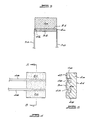
- FIG. 1 there is shown a semi-conducting diamond body 10 which has an elongate, cylindrical shape. Extending into the body from one end 12 thereof are two holes 14, 16. The holes 14, 16 accommodate electrical leads 18, 20 which are held in position by means of a suitable braze or solder 22. The leads thus make ohmic contact with the diamond.
- the end 24 of the diamond body 10 is inserted into an environment, a characteristic of which is to be determined. Thereafter, a voltage pulse is applied to the leads to heat the diamond body.
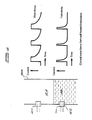
- a typical voltage pulse is illustrated graphically by Figure 2.
- the rate of decay of each induced current pulse shown graphically also by Figure 2, is determined. This rate of decay is dependent on the nature of the environment in which the diamond body is inserted.
- thermistor it is possible to determine the characteristic of a variety of environments, even hostile environments such as corrosive gases or liquids because of the inertness of diamond to such environments. Examples of characteristics which can be determined are temperature, humidity, and whether the environment is liquid or gas.
- FIG. 3 illustrates a second embodiment of a thermistor.
- a thermistor comprising a non-conducting diamond body 30 having a layer 32 of metal or semi-conducting diamond bonded to a surface 34 thereof. Spaced leads 36, 38 are bonded to the side surfaces 40, 42 of the layer 32.
- the non-conducting diamond body 30 is placed in the environment, a characteristic of which is to be determined. A voltage pulse is applied across the layer 32 and the rate of change of the current induced by this voltage pulse determined.
- FIG. 4 A third embodiment of a thermistor is illustrated by Figures 4 and 5.
- a body 40 of non-conducting diamond has major surfaces 42 and 44 on each of opposite sides thereof.
- Two grooves 46 are formed in the surface 42.
- Located in the grooves 46 are leads 48.
- a layer 50 of metal or semi-conducting diamond is provided over the entire surface 42 and partially fills the grooves 46. This layer brings the leads into thermal contact with the body 40.
- the semi-conducting diamond layer 50 will preferably be produced by chemical vapour deposition or by ion implantation.
- a boron doped layer of diamond of 10 micron thickness was deposited on the surface 42 of a Ib type diamond (1mm3 cube). This layer was formed by chemical vapour deposition.
- the boron concentration of the layer was in the range 1000 to 5000ppm.
- the thermistors described above are all useful in the practice of the invention which may be used for determining the characteristics of hostile and other mediums.
- the invention may be used to determine the temperature of components in nuclear instruments or of cryogenic mediums.
- the invention may also be used for determining the liquid level or the quality of oils in sensitive engines such as those used in helicopters where the temperature or quality of the oil is of critical importance for the proper working of the engine.
- FIG. 6 A practical example of the invention is illustrated schematically by Figure 6.
- diamond thermistors 60, 62 of the type illustrated by Figure 1 are placed in thermal contact with air 64 and liquid 66 in a container 68.
- Voltage pulses are applied across the two diamond thermistors and the decay profiles of the currents induced by such pulses are illustrated to the right of the container 68.
- the profile of the rate of decay of the current in air is very different to that of the liquid.
- the profile of the rate of decay of the current will change and provide an accurate and immediate indication of the level of the liquid in the container.
- the quality of the liquid 66 varies, the profile of the rate of decay of the current induced in the thermistor 62 will differ from that illustrated. By providing suitable standards, it is possible accurately to determine the quality or state of the liquid at any given time.
Landscapes
- Physics & Mathematics (AREA)
- General Physics & Mathematics (AREA)
- Nonlinear Science (AREA)
- Thermal Sciences (AREA)
- Fluid Mechanics (AREA)
- Thermistors And Varistors (AREA)
- Investigating Or Analyzing Materials Using Thermal Means (AREA)
- Investigating Or Analyzing Materials By The Use Of Electric Means (AREA)
- Measurement Of Levels Of Liquids Or Fluent Solid Materials (AREA)
Abstract
A method is provided for determining a characteristic such as the temperature of a medium. This medium will typically be a fluid and preferably be a liquid. The method involves providing a layer (10, 32, 50) of a conductive or semi-conductive material, placing the layer (10, 32, 50) in thermal contact with the medium, causing a voltage pulse to be applied to the layer (10, 32, 50), determining the rate of change of a response induced by the voltage pulse, e.g. the rate of change of a current induced by the voltage pulse, comparing that rate of change with a standard and using that comparison to make the characteristic determination.
Description
- This invention relates to the determination of a characteristic of a medium using, for example, a thermistor.
- A thermistor is a temperature sensitive resistor used for measuring the temperature of various environments. It is known from the literature that semi-conducting diamond can be used as a thermistor. Diamond is extremely resistant to erosion and abrasion and so is useful for measuring the temperature of various hostile environments. It also operates as a thermistor at higher temperatures than conventional metal-oxide thermistors.
- The absolute value of resistance of the thermistor is a measure of the temperature of the environment in which it is placed.
- United States Patent No. 3,435,399 describes a thermistor device comprising a semi-conducting single crystal diamond and two electrically conductive leads bonded to the crystal to provide ohmic contact therewith. The specification provides typical curves illustrating resistivity versus temperature for natural IIb type semi-conducting diamond as contrasted with the corresponding characteristics of a thermistor of the invention.
- According to the present invention, a method of determining a characteristic of a medium includes the steps of:
- (i) providing a layer of a conductive or semi-conductive material;
- (ii) placing the layer in thermal contact with the medium;
- (iii) causing a voltage pulse to be applied to the layer;
- (iv) determining the rate of change of a response induced by the voltage pulse;
- (v) comparing that rate of change with a standard; and
- (vi) using that comparison to make the characteristic determination.
- The invention will be further described by way of non-limitative example with reference to the accompanying drawings, in which:-
- Figure 1 illustrates a sectional side view of a semi-conducting diamond thermistor useful in the practice of the invention;
- Figure 2 illustrates a typical voltage pulse and corresponding current pulse;
- Figure 3 illustrates a sectional side view of a second embodiment of a thermistor useful in the practice of the invention;
- Figure 4 illustrates a plan view of a third embodiment of a thermistor useful in the practice of the invention;
- Figure 5 is a section along the line 5-5 of Figure 4; and
- Figure 6 illustrates diagramatically diamond thermistors used as a liquid level sensor and the current wave forms generated therefrom.
- It has been found that the rate of change of a response induced by a voltage pulse applied to a layer of conductive or semi-conductive material in thermal contact with a medium varies with the nature of that medium. For example, the rate of change of the response will vary according to the temperature of the medium, its humidity, whether it is a gas or liquid, the mass flow or viscosity thereof, and if the medium is liquid, the level thereof. The rate of change is a sensitive and accurate means of determining a characteristic of the medium.
- The medium will generally be a fluid and preferably a liquid. Where the medium is a liquid, the invention may be used to determine the level of the liquid. This aspect of the invention is described more fully hereinafter with reference to Figure 6.
- Typically, the characteristic of the medium which is determined is its temperature.
- The layer may be a semi-conducting diamond having spaced leads in ohmic contact with it. The diamond may, in one form of the invention, have at least two surfaces, the one surface being adapted to be placed in thermal contact with the medium, and the other surface having spaced recesses or holes formed therein which receive the leads. Typically, this body will be elongate and the two surfaces will be defined by the ends thereof.
- The semi-conducting diamond may also be a body in the form of a cube with the leads typically being bonded to opposite surfaces thereof.
- The layer, in another form of the invention, may be in thermal contact with an electrically non-conducting diamond. The electrically non-conducting diamond will generally be exposed to, or placed in contact with, the medium. The layer in this form of the invention may be a semi-conducting diamond layer. The semi-conducting diamond is preferably p-type in nature, e.g. boron doped diamond, or a naturally occurring semi-conducting diamond. The layer may also be metallic. An example of a suitable metal is platinum. The electrically non-conductive diamond is preferably diamond of type Ib or type IIa.
- Preferably, it is the rate of change of a current induced by the voltage pulse that is determined in step (iv) above. The rate of change of resistance may also be determined.
- The invention will further be illustrated with reference to the accompanying drawings. Referring first to Figure 1, there is shown a
semi-conducting diamond body 10 which has an elongate, cylindrical shape. Extending into the body from oneend 12 thereof are twoholes holes electrical leads 18, 20 which are held in position by means of a suitable braze orsolder 22. The leads thus make ohmic contact with the diamond. - In use, the
end 24 of thediamond body 10 is inserted into an environment, a characteristic of which is to be determined. Thereafter, a voltage pulse is applied to the leads to heat the diamond body. A typical voltage pulse is illustrated graphically by Figure 2. The rate of decay of each induced current pulse, shown graphically also by Figure 2, is determined. This rate of decay is dependent on the nature of the environment in which the diamond body is inserted. Using the illustrated thermistor it is possible to determine the characteristic of a variety of environments, even hostile environments such as corrosive gases or liquids because of the inertness of diamond to such environments. Examples of characteristics which can be determined are temperature, humidity, and whether the environment is liquid or gas. - Figure 3 illustrates a second embodiment of a thermistor. Referring to this figure, there is shown a thermistor comprising a non-conducting diamond body 30 having a
layer 32 of metal or semi-conducting diamond bonded to asurface 34 thereof. Spaced leads 36, 38 are bonded to theside surfaces layer 32. In use, the non-conducting diamond body 30 is placed in the environment, a characteristic of which is to be determined. A voltage pulse is applied across thelayer 32 and the rate of change of the current induced by this voltage pulse determined. - A third embodiment of a thermistor is illustrated by Figures 4 and 5. Referring to these figures, a
body 40 of non-conducting diamond hasmajor surfaces grooves 46 are formed in thesurface 42. Located in thegrooves 46 are leads 48. Alayer 50 of metal or semi-conducting diamond is provided over theentire surface 42 and partially fills thegrooves 46. This layer brings the leads into thermal contact with thebody 40. - The
semi-conducting diamond layer 50 will preferably be produced by chemical vapour deposition or by ion implantation. By way of example, a boron doped layer of diamond of 10 micron thickness was deposited on thesurface 42 of a Ib type diamond (1mm³ cube). This layer was formed by chemical vapour deposition. The boron concentration of the layer was in the range 1000 to 5000ppm. - The thermistors described above are all useful in the practice of the invention which may be used for determining the characteristics of hostile and other mediums. For example, the invention may be used to determine the temperature of components in nuclear instruments or of cryogenic mediums. The invention may also be used for determining the liquid level or the quality of oils in sensitive engines such as those used in helicopters where the temperature or quality of the oil is of critical importance for the proper working of the engine.
- A practical example of the invention is illustrated schematically by Figure 6. Referring to this drawing,
diamond thermistors 60, 62 of the type illustrated by Figure 1 are placed in thermal contact withair 64 and liquid 66 in a container 68. Voltage pulses are applied across the two diamond thermistors and the decay profiles of the currents induced by such pulses are illustrated to the right of the container 68. It will be noted that the profile of the rate of decay of the current in air is very different to that of the liquid. When the liquid level drops to a point below the top surface 70 of thethermistor 62, the profile of the rate of decay of the current will change and provide an accurate and immediate indication of the level of the liquid in the container. Similarly, if the quality of the liquid 66 varies, the profile of the rate of decay of the current induced in thethermistor 62 will differ from that illustrated. By providing suitable standards, it is possible accurately to determine the quality or state of the liquid at any given time.
Claims (13)
- A method of determining a characteristic of a medium includes the steps of:(i) providing a layer (10, 32, 50) of a conductive or semi-conductive material;(ii) placing the layer (10, 32, 50) in thermal contact with the medium;(iii) causing a voltage pulse to be applied to the layer (10, 32, 50);(iv) determining the rate of change of a response induced by the voltage pulse;(v) comparing that rate of change with a standard; and(vi) using that comparison to make the characteristic determination.
- A method of claim 1 wherein the characteristic of the medium which is determined is its temperature.
- A method of claim 1 or claim 2 wherein the medium is a fluid.
- A method of claim 3 wherein the fluid is a liquid.
- A method of claim 1 wherein the medium is a liquid and the characteristic which is determined is the level of the liquid.
- A method of any one of the preceding claims wherein the layer (10) is a semi-conducting diamond and spaced leads (18, 20) are in ohmic contact with the diamond.
- A method of claim 6 wherein the diamond is a body ( 10) having at least two surfaces (12, 24), the one surface (24) being adapted to be placed in thermal contact with the medium and the other surface (12) having spaced recesses or holes (14, 16) formed therein which receive the leads ( 18, 20).
- A method of claim 7 wherein the body (10) is elongate and the two surfaces (12, 24) are defined by the ends thereof.
- A method of claim 7 wherein the body is a cube.
- A method of any one of claims 1 to 5 wherein the layer (32) is in thermal contact with an electrically non-conducting diamond (30).
- A method of claim 10 wherein the layer (32) is a semi-conducting diamond layer.
- A method of claim 10 wherein the layer (32) is a metallic layer.
- A method according to any one of the preceding claims wherein the rate of change of a current induced by the voltage pulse is determined in step (iv).
Applications Claiming Priority (4)
| Application Number | Priority Date | Filing Date | Title |
|---|---|---|---|
| GB9008364 | 1990-04-12 | ||
| GB909008364A GB9008364D0 (en) | 1990-04-12 | 1990-04-12 | Thermistor |
| GB909025655A GB9025655D0 (en) | 1990-11-26 | 1990-11-26 | Thermistor |
| GB9025655 | 1990-11-26 |
Publications (2)
| Publication Number | Publication Date |
|---|---|
| EP0452141A2 true EP0452141A2 (en) | 1991-10-16 |
| EP0452141A3 EP0452141A3 (en) | 1992-05-06 |
Family
ID=26296935
Family Applications (1)
| Application Number | Title | Priority Date | Filing Date |
|---|---|---|---|
| EP19910303242 Withdrawn EP0452141A3 (en) | 1990-04-12 | 1991-04-11 | The determination of a characteristic of a medium |
Country Status (3)
| Country | Link |
|---|---|
| EP (1) | EP0452141A3 (en) |
| JP (1) | JPH05107118A (en) |
| KR (1) | KR910018788A (en) |
Cited By (5)
| Publication number | Priority date | Publication date | Assignee | Title |
|---|---|---|---|---|
| FR2808086A1 (en) * | 2000-04-19 | 2001-10-26 | Air Liquide | Determination of level of cold liquid, particularly cryogenic liquid, comprises measuring voltage change across resistance during heating and cooling |
| US6671232B1 (en) * | 2001-07-25 | 2003-12-30 | Maxtor Corporation | Method and apparatus for measuring the surface temperature of a disk |
| DE102007002369B3 (en) * | 2007-01-17 | 2008-05-15 | Drägerwerk AG & Co. KGaA | Dual temperature sensor for e.g. patient, has sensor units with connections arranged parallel to each other in block and at distance to each other from external surface of block, where distance is formed by layer of insulating material |
| US9606008B2 (en) | 2011-08-22 | 2017-03-28 | Element Six Abrasives S.A. | Temperature sensor |
| EP3449225A4 (en) * | 2016-04-29 | 2019-12-04 | Hewlett-Packard Development Company, L.P. | DETECTION OF FLUID LEVELS USING A VOLTAGE COMPARATOR |
Families Citing this family (2)
| Publication number | Priority date | Publication date | Assignee | Title |
|---|---|---|---|---|
| KR100416764B1 (en) * | 2002-03-21 | 2004-01-31 | 삼성전자주식회사 | Non-invasive measuring apparatus of a living body and method thereof |
| JP5826605B2 (en) * | 2011-11-10 | 2015-12-02 | 株式会社東芝 | Apparatus and method for detecting water level in spent fuel storage pool |
Family Cites Families (4)
| Publication number | Priority date | Publication date | Assignee | Title |
|---|---|---|---|---|
| CH491375A (en) * | 1968-05-27 | 1970-05-31 | Siemens Ag | Method for measuring the thermal conductivity of gases and liquids |
| JPS61254827A (en) * | 1985-05-08 | 1986-11-12 | Nippon Steel Corp | Temperature measuring method |
| DE3527868A1 (en) * | 1985-08-02 | 1987-02-12 | Schmidt Feintechnik Gmbh | METHOD AND MEASURING PROBE FOR PROBING THE LEVEL OF THE MASS CURRENT, THE FLUID TYPE, THE FLUID COMPOSITION OR THE LIKE IN A CONTAINER, PIPE OR THE LIKE CONTAINING ONE OR MORE FLUIDS |
| JP2567441B2 (en) * | 1988-02-05 | 1996-12-25 | 住友電気工業株式会社 | Measuring method of thermal conductivity, measuring device and thermistor |
-
1991
- 1991-04-11 JP JP3169495A patent/JPH05107118A/en active Pending
- 1991-04-11 KR KR1019910005784A patent/KR910018788A/en not_active Withdrawn
- 1991-04-11 EP EP19910303242 patent/EP0452141A3/en not_active Withdrawn
Cited By (8)
| Publication number | Priority date | Publication date | Assignee | Title |
|---|---|---|---|---|
| FR2808086A1 (en) * | 2000-04-19 | 2001-10-26 | Air Liquide | Determination of level of cold liquid, particularly cryogenic liquid, comprises measuring voltage change across resistance during heating and cooling |
| US6671232B1 (en) * | 2001-07-25 | 2003-12-30 | Maxtor Corporation | Method and apparatus for measuring the surface temperature of a disk |
| DE102007002369B3 (en) * | 2007-01-17 | 2008-05-15 | Drägerwerk AG & Co. KGaA | Dual temperature sensor for e.g. patient, has sensor units with connections arranged parallel to each other in block and at distance to each other from external surface of block, where distance is formed by layer of insulating material |
| EP1947431A2 (en) | 2007-01-17 | 2008-07-23 | Drägerwerk AG & Co. KGaA | Double temperature sensor |
| US7789554B2 (en) | 2007-01-17 | 2010-09-07 | DRäGERWERK AKTIENGESELLSCHAFT | Double temperature sensor |
| US9606008B2 (en) | 2011-08-22 | 2017-03-28 | Element Six Abrasives S.A. | Temperature sensor |
| EP3449225A4 (en) * | 2016-04-29 | 2019-12-04 | Hewlett-Packard Development Company, L.P. | DETECTION OF FLUID LEVELS USING A VOLTAGE COMPARATOR |
| US10837818B2 (en) | 2016-04-29 | 2020-11-17 | Hewlett-Packard Development Company, L.P. | Detecting fluid levels using a voltage comparator |
Also Published As
| Publication number | Publication date |
|---|---|
| EP0452141A3 (en) | 1992-05-06 |
| KR910018788A (en) | 1991-11-30 |
| JPH05107118A (en) | 1993-04-27 |
Similar Documents
| Publication | Publication Date | Title |
|---|---|---|
| EP3234559B1 (en) | Detecting composition of a sample based on thermal properties | |
| CA2324843C (en) | Monitoring fluid condition through an aperture | |
| US5457396A (en) | Electrode structure of metallic particle detecting sensor | |
| US5138881A (en) | Liquid level sensor including conductive plastic technology | |
| US5275044A (en) | Three wire potentiometric liquid level sensor | |
| US4246786A (en) | Fast response temperature sensor and method of making | |
| US5363084A (en) | Film resistors having trimmable electrodes | |
| US4512871A (en) | Oxygen sensor with heater | |
| US4679432A (en) | Probe for measuring the level of a liquid | |
| US6318171B1 (en) | Flow rate sensor implementing a plurality of inner tubes located within a sensor tube | |
| KR870008174A (en) | Measurement method of fluid state | |
| US5044764A (en) | Method and apparatus for fluid state determination | |
| US4805454A (en) | Continuous fluid level detector | |
| EP0063445A2 (en) | A thin film thermistor | |
| US4326164A (en) | Electrical resistance corrosion probe | |
| EP0245092B1 (en) | Thermo-sensitive resistor | |
| EP0066851A2 (en) | Oxygen concentration detector | |
| US5392646A (en) | Thermal type of flow rate sensor | |
| JPH05107118A (en) | Method of measuring characteristic of medium | |
| US4246787A (en) | Fast response temperature sensor and method of making | |
| US20190376824A1 (en) | Sensor element and thermal flow sensor for determining a physical variable of a measurment medium | |
| US3197724A (en) | Electrical resistance corrosion probe | |
| US4771271A (en) | Silicon based low level liquid sensor having a fast response time | |
| WO2004046672A1 (en) | Fluid temperature measurement | |
| EP0282780B1 (en) | Method for measuring heat transfer coefficient and sensor including heat transfer element and thermal insulation element |
Legal Events
| Date | Code | Title | Description |
|---|---|---|---|
| PUAI | Public reference made under article 153(3) epc to a published international application that has entered the european phase |
Free format text: ORIGINAL CODE: 0009012 |
|
| AK | Designated contracting states |
Kind code of ref document: A2 Designated state(s): BE CH DE FR GB IT LI NL SE |
|
| PUAL | Search report despatched |
Free format text: ORIGINAL CODE: 0009013 |
|
| AK | Designated contracting states |
Kind code of ref document: A3 Designated state(s): BE CH DE FR GB IT LI NL SE |
|
| STAA | Information on the status of an ep patent application or granted ep patent |
Free format text: STATUS: THE APPLICATION IS DEEMED TO BE WITHDRAWN |
|
| 18D | Application deemed to be withdrawn |
Effective date: 19921107 |