EP0450730B1 - Cloaca cutter - Google Patents
Cloaca cutter Download PDFInfo
- Publication number
- EP0450730B1 EP0450730B1 EP91200784A EP91200784A EP0450730B1 EP 0450730 B1 EP0450730 B1 EP 0450730B1 EP 91200784 A EP91200784 A EP 91200784A EP 91200784 A EP91200784 A EP 91200784A EP 0450730 B1 EP0450730 B1 EP 0450730B1
- Authority
- EP
- European Patent Office
- Prior art keywords
- centring pin
- end portion
- vent
- thickened end
- retaining element
- Prior art date
- Legal status (The legal status is an assumption and is not a legal conclusion. Google has not performed a legal analysis and makes no representation as to the accuracy of the status listed.)
- Expired - Lifetime
Links
Images

Classifications
-
- A—HUMAN NECESSITIES
- A22—BUTCHERING; MEAT TREATMENT; PROCESSING POULTRY OR FISH
- A22B—SLAUGHTERING
- A22B5/00—Accessories for use during or after slaughtering
- A22B5/0094—Cutting or blocking the rectum of a carcass, e.g. for avoiding fecal contamination
-
- A—HUMAN NECESSITIES
- A22—BUTCHERING; MEAT TREATMENT; PROCESSING POULTRY OR FISH
- A22C—PROCESSING MEAT, POULTRY, OR FISH
- A22C21/00—Processing poultry
- A22C21/06—Eviscerating devices for poultry
Definitions
- the invention relates to a device for cutting out the vent of a slaughtered bird, comprising an elongated centring pin which is provided with a thickened end portion which can be inserted into the vent; a rotatable cutting element with an axially directed cutting edge, the axis of rotation running parallel to the axis of the centring pin, and the cutting edge being directed to and being movable towards the thickened end portion of the centring pin; and an axially movable retaining element of which the surface facing the thickened end portion of the centring pin is intended for interacting with the thickened end portion of the centring pin to retain the vent.
- Such a device is known from US Patent Specification 2 943 346.
- This specification describes a retaining element essentially comprising a hollow tube in which the centring pin is fitted in such a way that the thickened end portion of this pin, a cone, projects from the tube. Further, a partial vacuum is created in the tube by extracting air from it.
- the cone When the cone is inserted far enough into the vent of a slaughtered bird, the skin around the vent comes into contact with one end of the tube. Due to the partial vacuum in the tube the skin is drawn against the end of the tube in the process. In this way the vent is retained, and an incision can be made around the vent by means of the cutting element, which is moved in the direction of the thickened end portion of the centring pin.
- the cutting edge of the cutting element in this case moves away from the end of the tube, and the resulting radially directed forces on the orbicular muscle produce the risk of the orbicular muscle being pulled away from the retaining element. This is extremely undesirable, since in this case faeces come away from the intestine of the bird and can contamitane the meat.
- the object of the device according to the invention is to ensure good positioning of the vent between the end of the retaining element facing the thickened end portion of the centring pin and the thickened end portion of the centring pin without the risk of uncrontrolled release of faeces or uncontrolled damage to the intestinal wall, and thereto the device is characterized in that in an end position of the retaining element relative to the thickened end portion of the centring pin between these two elements a semi-closed annular space is formed for the confinement of the orbicular muscle of the vent, while in this end position between the retaining element and the thickened end portion of the centring pin an annylar gap remains open with a width which is smaller than the thickness of the orbicular muscle.
- the axial length of the annular space is greater than the thickness of the orbicular muscle.
- the optimum width of the annular gap, as well as the axial length of the annular space, depend on the species of birds to be processed.
- the width of the annular gap may lie in the interval of about 0.0002 - 0.0005 m, while for turkeys the width of the annular gap may lie in the interval of about 0.0004 - 0.0007 m.
- Fig. 1 shows a centring pin 2 which is provided with a thickened end portion in the form of a cone 4.
- the cone is inserted into the vent of a slaughtered bird, of which bird only the end of the intestine 6 is shown schematically.
- the bird is suspended by both legs from a hook and is positioned by means of devices, not shown in any further detail, in a slaughter line relative to the device of which centring pin 2 forms part.
- Other drive and positioning means which, although they belong to a device according to the invention, are not essential for a description thereof are not shown either.
- the largest diameter of the cone 4 is such that during the insertion thereof into the anus the orbicular muscle 8 stretches, following which it closes again partially around the top part of the cone 4.
- the retaining element 10 Fitted in a sliding manner on the centring pin 2 is a retaining element 10 which is movable in the direction of the cone 4 until it meets the stop 12. This situation is shown in Fig. 2.
- the retaining element 10 comprises an annular cavity 14 with a diameter which is larger than the largest diameter of the cone 4.
- Fig. 2 shows that the cone 4, the stop 12 and the cavity 14 together determine a space whose cross-section is greater than the cross-section of the orbicular muscle 8.
- an annular gap 16 is left between the cone 4 and the bottom end of the retaining element 10, which gap is wide enough to accomodate the skin and the intestinal wall, but is not wide enough to accomodate the orbicular muscle.
- the orbicular muscle is thus confined in the above-mentioned space, and a rotating cutting element 18 can be moved parallel to the central axis of the centring pin in the direction of the cone 4, in which case the vent of the bird is cut out.
- Fig. 3 shows a device with a large annular space defined by the retaining element 10 and the thickened end portion 4 of the centring pin 2.
- the retaining element 10 is fixed to a tube 20.
- the centring pin 2 is fixed, e.g. screwed to a rod 22 which has a slightly larger diameter than the centring pin 2.
- a stop edge is formed at the transition from rod 22 to pin 2 by means of which the axial movement of the centring pin 2 relative to the retaining element 10 in one direction is limited.
- the axial movement of the centring pin 2 relative to the retaining element 10 in the other direction may be limited by a stop ring 24 indicated in dashed lines, the stop ring being fixed to the centring pin 2.
- the large annular space ensures an excellent operation of the device.
Landscapes
- Life Sciences & Earth Sciences (AREA)
- Engineering & Computer Science (AREA)
- Food Science & Technology (AREA)
- Wood Science & Technology (AREA)
- Zoology (AREA)
- Processing Of Meat And Fish (AREA)
- Milling Processes (AREA)
Description
- The invention relates to a device for cutting out the vent of a slaughtered bird, comprising an elongated centring pin which is provided with a thickened end portion which can be inserted into the vent; a rotatable cutting element with an axially directed cutting edge, the axis of rotation running parallel to the axis of the centring pin, and the cutting edge being directed to and being movable towards the thickened end portion of the centring pin; and an axially movable retaining element of which the surface facing the thickened end portion of the centring pin is intended for interacting with the thickened end portion of the centring pin to retain the vent.
- Such a device is known from US Patent Specification 2 943 346. This specification describes a retaining element essentially comprising a hollow tube in which the centring pin is fitted in such a way that the thickened end portion of this pin, a cone, projects from the tube. Further, a partial vacuum is created in the tube by extracting air from it. When the cone is inserted far enough into the vent of a slaughtered bird, the skin around the vent comes into contact with one end of the tube. Due to the partial vacuum in the tube the skin is drawn against the end of the tube in the process. In this way the vent is retained, and an incision can be made around the vent by means of the cutting element, which is moved in the direction of the thickened end portion of the centring pin. The cutting edge of the cutting element in this case moves away from the end of the tube, and the resulting radially directed forces on the orbicular muscle produce the risk of the orbicular muscle being pulled away from the retaining element. This is extremely undesirable, since in this case faeces come away from the intestine of the bird and can contamitane the meat.
- If an attempt is made to overcome this problem by a stronger partial vacuum, there is a risk of the cut-out vent as a result being drawn into the tube and tearing the intestinal wall, again with the undesirable consequence of the contents of the intestine being released in an uncontrolled manner.
- The object of the device according to the invention is to ensure good positioning of the vent between the end of the retaining element facing the thickened end portion of the centring pin and the thickened end portion of the centring pin without the risk of uncrontrolled release of faeces or uncontrolled damage to the intestinal wall, and thereto the device is characterized in that in an end position of the retaining element relative to the thickened end portion of the centring pin between these two elements a semi-closed annular space is formed for the confinement of the orbicular muscle of the vent, while in this end position between the retaining element and the thickened end portion of the centring pin an annylar gap remains open with a width which is smaller than the thickness of the orbicular muscle.
- In the advantageous embodiment of the device the axial length of the annular space is greater than the thickness of the orbicular muscle. An annular space with such an axial length, which length is measured from the annular gap between the retaining element and the thickened end portion of the centring pin, provides an axially loose accomodation of the orbicular muscle and thus diminishes stress in the bird's skin around the orbicular muscle in the process of moving the retaining element in the direction of the thickened end portion of the centring pin.
- It has been found advantageous to choose the axial length of the annular space at least about 0.007 m.
- The optimum width of the annular gap, as well as the axial length of the annular space, depend on the species of birds to be processed. For chickens, the width of the annular gap may lie in the interval of about 0.0002 - 0.0005 m, while for turkeys the width of the annular gap may lie in the interval of about 0.0004 - 0.0007 m.
- The invention is explained with reference to the appended drawings, in which:
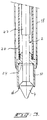
- Fig. 1 shows a partial cross-section of an embodiment of the device according to the invention, in which the thickened end portion of the centring pin is inserted into the cloaca of a bird;
- Fig. 2 shows the positioning of the vent on the thickened end portion of the centring pin with the aid of a retaining element, in a partial cross-section according to Fig. 1; and
- Fig. 3 shows a partial cross-section of another embodiment of the device according to the invention in the position of Fig. 2, the cloaca not being shown.
- Fig. 1 shows a
centring pin 2 which is provided with a thickened end portion in the form of a cone 4. The cone is inserted into the vent of a slaughtered bird, of which bird only the end of theintestine 6 is shown schematically. The bird is suspended by both legs from a hook and is positioned by means of devices, not shown in any further detail, in a slaughter line relative to the device of which centringpin 2 forms part. Other drive and positioning means which, although they belong to a device according to the invention, are not essential for a description thereof are not shown either. - The largest diameter of the cone 4 is such that during the insertion thereof into the anus the
orbicular muscle 8 stretches, following which it closes again partially around the top part of the cone 4. - Fitted in a sliding manner on the
centring pin 2 is aretaining element 10 which is movable in the direction of the cone 4 until it meets thestop 12. This situation is shown in Fig. 2. Theretaining element 10 comprises anannular cavity 14 with a diameter which is larger than the largest diameter of the cone 4. - Fig. 2 shows that the cone 4, the
stop 12 and thecavity 14 together determine a space whose cross-section is greater than the cross-section of theorbicular muscle 8. On the other hand, anannular gap 16 is left between the cone 4 and the bottom end of theretaining element 10, which gap is wide enough to accomodate the skin and the intestinal wall, but is not wide enough to accomodate the orbicular muscle. The orbicular muscle is thus confined in the above-mentioned space, and a rotatingcutting element 18 can be moved parallel to the central axis of the centring pin in the direction of the cone 4, in which case the vent of the bird is cut out. - Fig. 3 shows a device with a large annular space defined by the
retaining element 10 and the thickened end portion 4 of thecentring pin 2. Theretaining element 10 is fixed to atube 20. Thecentring pin 2 is fixed, e.g. screwed to arod 22 which has a slightly larger diameter than thecentring pin 2. Thus, a stop edge is formed at the transition fromrod 22 topin 2 by means of which the axial movement of thecentring pin 2 relative to theretaining element 10 in one direction is limited. Similarly, the axial movement of thecentring pin 2 relative to theretaining element 10 in the other direction may be limited by a stop ring 24 indicated in dashed lines, the stop ring being fixed to thecentring pin 2. The large annular space ensures an excellent operation of the device. - It will be clear that the dimensions of the space and the gap are adapted to the orbicular muscle dimensions of the species of birds to be processed.
Claims (4)
- Device for cutting out the vent of a slaughtered bird, comprising:- an elongated centring pin (2) which is provided with a thickened end portion (4) which can be inserted into the vent;- a rotatable cutting element (18) with an axially directed cutting edge, the axis of rotation running parallel to the axis of the centring pin, and the cutting edge being directed to and being movable towards the thickened end portion (4) of the centring pin (2); and- an axially movable retaining element (10) of which the end facing the thickened end portion (4) of the centring pin (2) is intended for interacting with the thickened end portion of the centring pin to retain the vent, characterized in that in an end position of the retaining element (10) relative to the thickened end portion (4) of the centring pin (2) between these two elements a semi-closed annular space is formed for the confinement of the orbicular muscle (8) of the vent, while in this end position between the retaining element (10) and the thickened end portion (4) of the centring pin (2) and annular gap (16) remains open for letting the skin and the intestinal wall of the bird pass, which gap has a width which is smaller than the maximun dimension in the same direction of the annular space for retaining the orbicular muscle (8).
- Device according to claim 1, characterized in that the axial length of the annular space is greater than the thickness of the orbicular muscle (8).
- Device according to claim 2, characterized in that the axial length of the annular space is at least about 0.007 m.
- Device according to claim 1, characterized in that the width of the annular gap (16) is at least about 0.0002 m and does not exceed about 0.001 m.
Applications Claiming Priority (2)
| Application Number | Priority Date | Filing Date | Title |
|---|---|---|---|
| NL9000782 | 1990-04-03 | ||
| NL9000782A NL189443C (en) | 1990-04-03 | 1990-04-03 | Cloaca cutter. |
Publications (2)
| Publication Number | Publication Date |
|---|---|
| EP0450730A1 EP0450730A1 (en) | 1991-10-09 |
| EP0450730B1 true EP0450730B1 (en) | 1993-03-17 |
Family
ID=19856857
Family Applications (1)
| Application Number | Title | Priority Date | Filing Date |
|---|---|---|---|
| EP91200784A Expired - Lifetime EP0450730B1 (en) | 1990-04-03 | 1991-04-03 | Cloaca cutter |
Country Status (6)
| Country | Link |
|---|---|
| US (1) | US5133686A (en) |
| EP (1) | EP0450730B1 (en) |
| DE (1) | DE69100042T2 (en) |
| DK (1) | DK0450730T3 (en) |
| ES (1) | ES2039131T3 (en) |
| NL (1) | NL189443C (en) |
Families Citing this family (24)
| Publication number | Priority date | Publication date | Assignee | Title |
|---|---|---|---|---|
| NL9300815A (en) | 1992-09-10 | 1994-04-05 | Stork Pmt | Method and device for removing and processing an organ package from a slaughtered animal. |
| NZ293519A (en) * | 1994-09-26 | 1996-11-26 | Commw Scient Ind Res Org | Rectum separating for use with slaughtered animal carcass: gripper located inside a closure bag |
| US5480347A (en) * | 1994-10-17 | 1996-01-02 | Flohr Metal Fabricators, Inc. | Fish deheading machine |
| US5580304A (en) * | 1995-01-18 | 1996-12-03 | Baader North America Corporation | Method and apparatus for venting slaughtered poultry |
| US5741176A (en) * | 1996-07-26 | 1998-04-21 | Stork Gamco Inc. | Skin-holding vent cutter |
| US6186881B1 (en) | 1996-09-20 | 2001-02-13 | Foodcraft Equipment Co., Ltd. | Method and apparatus for venting/opening, eviscerating/cropping, inspecting and cleaning of poultry |
| US5993308A (en) | 1996-09-20 | 1999-11-30 | Foodcraft Equipment Company | Machine for eviscerating and displaying poultry for inspection |
| AUPO943997A0 (en) | 1997-09-26 | 1997-10-16 | Meat Research Corporation | Anal sealing |
| AU735096B2 (en) * | 1997-09-26 | 2001-06-28 | Meat & Livestock Australia Limited | Anal sealing of carcasses |
| US6383069B1 (en) | 1998-02-20 | 2002-05-07 | Stork Gamco Inc. | Methods and apparatus for performing processing operations on a slaughtered animal or part thereof |
| US6190250B1 (en) | 1998-02-20 | 2001-02-20 | Stork Gamco Incorporated | Method and apparatus for performing processing operations on a slaughtered animal or part thereof |
| NL1012463C2 (en) * | 1999-06-29 | 2001-01-02 | Meyn Food Proc Technology Bv | Device for cutting off the butt of slaughtered poultry. |
| US6244949B1 (en) * | 1999-11-18 | 2001-06-12 | James A. Moody | Method and apparatus for removing internal organs from a slain deer |
| US6265004B1 (en) | 1999-11-19 | 2001-07-24 | G. Douglas Cagle | Poultry visceral cavity shaping method and product |
| NL1015137C2 (en) * | 1999-12-24 | 2001-06-26 | Stork Mps Bv | Rectum removing method for animal carcasses, involves shielding rectum with closure part, making incision around rectum next to tailbone and pulling out rectum |
| US7367877B1 (en) * | 2005-03-31 | 2008-05-06 | Luster Michael A | Big game field dressing tool and method |
| US7597614B2 (en) * | 2007-09-21 | 2009-10-06 | Hunter's Specialties, Inc. | Big game animal field dressing tool and method |
| RU2483555C1 (en) * | 2011-11-22 | 2013-06-10 | Государственное научное учреждение Всероссийский научно-исследовательский институт птицеперерабатывающей промышленности Россельхозакадемии (ГНУ ВНИИПП Россельхозакадемии) | Device for poultry carcases cloaca cutting-out |
| RU2551104C1 (en) * | 2013-12-16 | 2015-05-20 | Государственное научное учреждение Всероссийский научно-исследовательский институт птицеперерабатывающей промышленности Россельхозакадемии (ГНУ ВНИИПП Россельхозакадемии) | Device for poultry carcases cloaca cutting-out |
| DE202015007949U1 (en) * | 2015-11-17 | 2016-01-18 | Olaf Ehrich | Ringel Help |
| NL2017997B1 (en) * | 2016-12-14 | 2018-06-26 | Meyn Food Processing Tech Bv | Vent cutter and method for cutting loose tissue around a vent of poultry |
| CN107006583A (en) * | 2017-04-28 | 2017-08-04 | 甘肃凯伟农牧业科技发展有限公司 | A kind of poultry organ removing device |
| JP7669384B2 (en) | 2020-03-31 | 2025-04-28 | マレル・レッド・ミート・ベスローテン・フェンノートシャップ | Bang punching machine with bang holder |
| WO2023052382A1 (en) | 2021-09-29 | 2023-04-06 | Marel Red Meat B.V. | A cutting device, a system including a cutting device and a method for cutting free a rectum end portion of an animal carcass |
Family Cites Families (4)
| Publication number | Priority date | Publication date | Assignee | Title |
|---|---|---|---|---|
| US2943346A (en) * | 1957-10-10 | 1960-07-05 | Melvin J Jensen | Eviscerating tool |
| NL156025B (en) * | 1975-04-29 | 1978-03-15 | Meyn Pieter | DEVICE FOR CUTTING OUT THE EAR OF A BIRD. |
| US4564977A (en) * | 1983-09-15 | 1986-01-21 | Simon-Johnson, Inc. | Poultry vent removal machine |
| DE8625835U1 (en) * | 1986-09-26 | 1986-12-18 | Machinefabriek Markert B.V., Ede | Cloaca cutting machine |
-
1990
- 1990-04-03 NL NL9000782A patent/NL189443C/en not_active IP Right Cessation
-
1991
- 1991-04-03 DE DE9191200784T patent/DE69100042T2/en not_active Expired - Fee Related
- 1991-04-03 ES ES199191200784T patent/ES2039131T3/en not_active Expired - Lifetime
- 1991-04-03 US US07/679,624 patent/US5133686A/en not_active Expired - Fee Related
- 1991-04-03 DK DK91200784.6T patent/DK0450730T3/en active
- 1991-04-03 EP EP91200784A patent/EP0450730B1/en not_active Expired - Lifetime
Also Published As
| Publication number | Publication date |
|---|---|
| DE69100042D1 (en) | 1993-04-22 |
| DK0450730T3 (en) | 1993-05-03 |
| DE69100042T2 (en) | 1993-06-24 |
| NL189443C (en) | 1994-06-16 |
| ES2039131T3 (en) | 1993-08-16 |
| EP0450730A1 (en) | 1991-10-09 |
| US5133686A (en) | 1992-07-28 |
| NL9000782A (en) | 1991-11-01 |
| NL189443B (en) | 1992-11-16 |
Similar Documents
| Publication | Publication Date | Title |
|---|---|---|
| EP0450730B1 (en) | Cloaca cutter | |
| NL1012463C2 (en) | Device for cutting off the butt of slaughtered poultry. | |
| EP0421552A1 (en) | Device and method for washing poultry | |
| US5741176A (en) | Skin-holding vent cutter | |
| US4788749A (en) | Crop removal system | |
| US4208764A (en) | Poultry eviscerating method | |
| NL8901551A (en) | CRUISER FOR POULTRY. | |
| EP0162154B1 (en) | A device for extracting the crop, the vent and the gullet of slaughtered poultry | |
| NL8501556A (en) | CRUSHING MACHINE. | |
| JP2014533118A (en) | Organ removal device and method for organ removal | |
| BR112017000980B1 (en) | Method and device for evisceration of slaughtered poultry | |
| JP6940514B2 (en) | Equipment and methods for preparing the visceral removal of headless slaughtered poultry | |
| HUT68601A (en) | A method and an apparatus for cutting free and removing the rectum of an animal to be slaughtered, preferably pigs | |
| US4791704A (en) | Automatic transfer apparatus | |
| CA2079962A1 (en) | Eviscerating spoon | |
| EP0354603A1 (en) | Device for removing the craw of slaughtered poultry | |
| US5180328A (en) | Method and apparatus for removing a hide from a back portion and tail of a carcass | |
| JP4562840B2 (en) | Method and apparatus for removing edible beast bung and vent cutter | |
| RU94018049A (en) | DEVICE FOR CUTTING CLOACS AND OPENING THE ABDOMINAL CAVITY OF BIRDS | |
| GB1507002A (en) | Method of drawing the gizzard and crop from slaughtered poultry | |
| AU2021250830B2 (en) | A bung driller with a bung holder | |
| AU643240B2 (en) | A method and means of removing and handling animal viscera | |
| EP0145024A2 (en) | Tubular core for a shirred casing article | |
| CN110312428A (en) | Internal organ take out tool and take out the internal organ withdrawing device of tool with this internal organ | |
| JPH07114626B2 (en) | Extractor for poultry |
Legal Events
| Date | Code | Title | Description |
|---|---|---|---|
| PUAI | Public reference made under article 153(3) epc to a published international application that has entered the european phase |
Free format text: ORIGINAL CODE: 0009012 |
|
| AK | Designated contracting states |
Kind code of ref document: A1 Designated state(s): DE DK ES FR GB IT NL |
|
| 17P | Request for examination filed |
Effective date: 19920213 |
|
| 17Q | First examination report despatched |
Effective date: 19920619 |
|
| ITF | It: translation for a ep patent filed | ||
| GRAA | (expected) grant |
Free format text: ORIGINAL CODE: 0009210 |
|
| AK | Designated contracting states |
Kind code of ref document: B1 Designated state(s): DE DK ES FR GB IT NL |
|
| REF | Corresponds to: |
Ref document number: 69100042 Country of ref document: DE Date of ref document: 19930422 |
|
| REG | Reference to a national code |
Ref country code: DK Ref legal event code: T3 |
|
| ET | Fr: translation filed | ||
| REG | Reference to a national code |
Ref country code: ES Ref legal event code: FG2A Ref document number: 2039131 Country of ref document: ES Kind code of ref document: T3 |
|
| PLBI | Opposition filed |
Free format text: ORIGINAL CODE: 0009260 |
|
| 26 | Opposition filed |
Opponent name: MEYN MACHINEFABRIEK B.V. Effective date: 19931216 |
|
| NLR1 | Nl: opposition has been filed with the epo |
Opponent name: MEYN MACHINEFABRIEK B.V. |
|
| ITTA | It: last paid annual fee | ||
| PLBO | Opposition rejected |
Free format text: ORIGINAL CODE: EPIDOS REJO |
|
| PLBN | Opposition rejected |
Free format text: ORIGINAL CODE: 0009273 |
|
| STAA | Information on the status of an ep patent application or granted ep patent |
Free format text: STATUS: OPPOSITION REJECTED |
|
| 27O | Opposition rejected |
Effective date: 19960311 |
|
| NLR2 | Nl: decision of opposition | ||
| K1C1 | Correction of patent application (title page) published |
Effective date: 19911009 |
|
| REG | Reference to a national code |
Ref country code: GB Ref legal event code: IF02 |
|
| PGFP | Annual fee paid to national office [announced via postgrant information from national office to epo] |
Ref country code: GB Payment date: 20020409 Year of fee payment: 12 |
|
| PGFP | Annual fee paid to national office [announced via postgrant information from national office to epo] |
Ref country code: FR Payment date: 20020422 Year of fee payment: 12 |
|
| PGFP | Annual fee paid to national office [announced via postgrant information from national office to epo] |
Ref country code: ES Payment date: 20020424 Year of fee payment: 12 |
|
| PGFP | Annual fee paid to national office [announced via postgrant information from national office to epo] |
Ref country code: DE Payment date: 20020425 Year of fee payment: 12 |
|
| PG25 | Lapsed in a contracting state [announced via postgrant information from national office to epo] |
Ref country code: GB Free format text: LAPSE BECAUSE OF NON-PAYMENT OF DUE FEES Effective date: 20030403 |
|
| PG25 | Lapsed in a contracting state [announced via postgrant information from national office to epo] |
Ref country code: ES Free format text: LAPSE BECAUSE OF NON-PAYMENT OF DUE FEES Effective date: 20030404 |
|
| PGFP | Annual fee paid to national office [announced via postgrant information from national office to epo] |
Ref country code: NL Payment date: 20030429 Year of fee payment: 13 Ref country code: DK Payment date: 20030429 Year of fee payment: 13 |
|
| PG25 | Lapsed in a contracting state [announced via postgrant information from national office to epo] |
Ref country code: DE Free format text: LAPSE BECAUSE OF NON-PAYMENT OF DUE FEES Effective date: 20031101 |
|
| GBPC | Gb: european patent ceased through non-payment of renewal fee |
Effective date: 20030403 |
|
| PG25 | Lapsed in a contracting state [announced via postgrant information from national office to epo] |
Ref country code: FR Free format text: LAPSE BECAUSE OF NON-PAYMENT OF DUE FEES Effective date: 20031231 |
|
| REG | Reference to a national code |
Ref country code: FR Ref legal event code: ST |
|
| PG25 | Lapsed in a contracting state [announced via postgrant information from national office to epo] |
Ref country code: DK Free format text: LAPSE BECAUSE OF NON-PAYMENT OF DUE FEES Effective date: 20040430 |
|
| REG | Reference to a national code |
Ref country code: ES Ref legal event code: FD2A Effective date: 20030404 |
|
| PG25 | Lapsed in a contracting state [announced via postgrant information from national office to epo] |
Ref country code: NL Free format text: LAPSE BECAUSE OF NON-PAYMENT OF DUE FEES Effective date: 20041101 |
|
| NLV4 | Nl: lapsed or anulled due to non-payment of the annual fee |
Effective date: 20041101 |
|
| PG25 | Lapsed in a contracting state [announced via postgrant information from national office to epo] |
Ref country code: IT Free format text: LAPSE BECAUSE OF NON-PAYMENT OF DUE FEES Effective date: 20050403 |